Senior 2 ScienceClassroom Assessment in Science
41
CLASSROOM ASSESSMENT IN SCIENCE
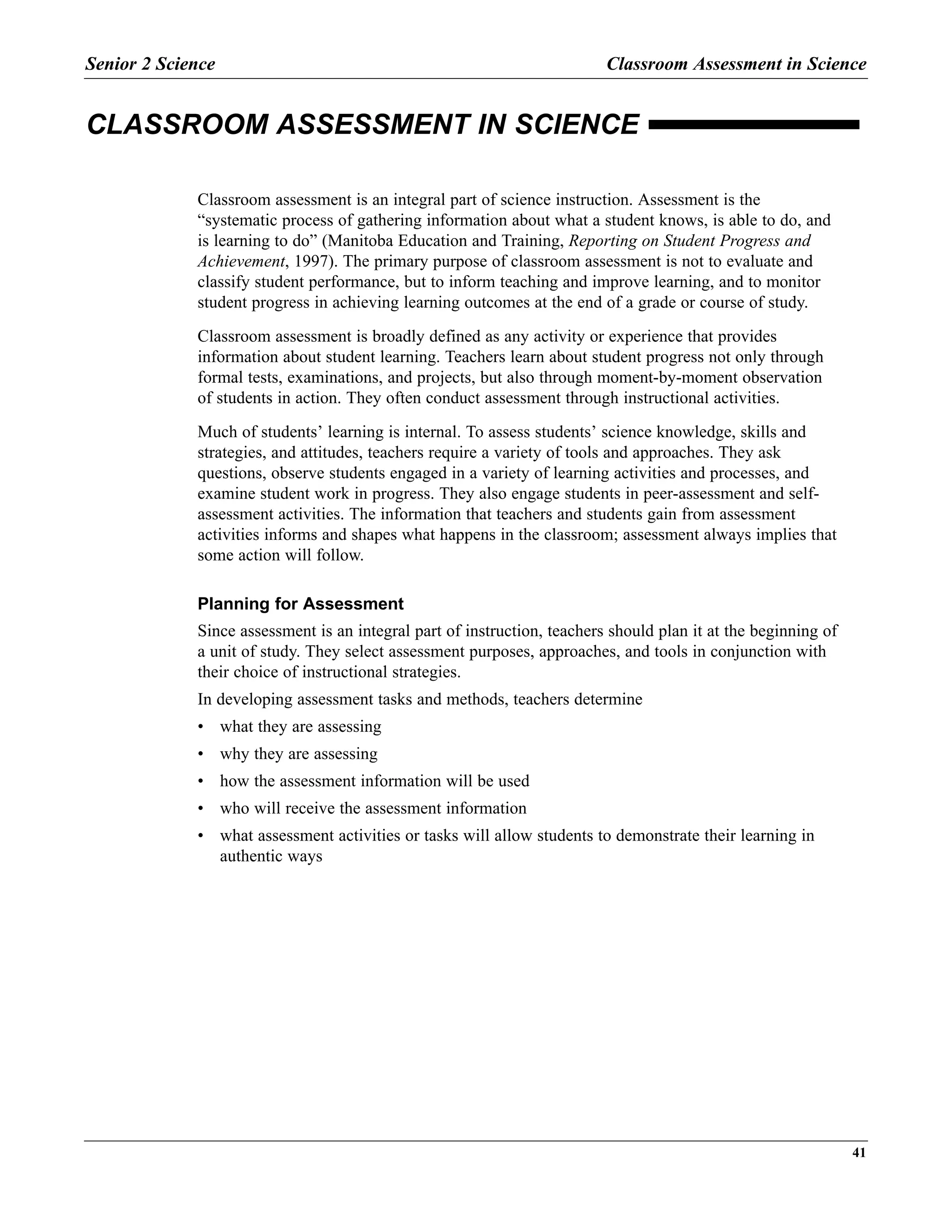
Classroom assessment is an integral part of science instruction. Assessment is the
“systematic process of gathering information about what a student knows, is able to do, and
is learning to do” (Manitoba Education and Training, Reporting on Student Progress and
Achievement, 1997). The primary purpose of classroom assessment is not to evaluate and
classify student performance, but to inform teaching and improve learning, and to monitor
student progress in achieving learning outcomes at the end of a grade or course of study.
Classroom assessment is broadly defined as any activity or experience that provides
information about student learning. Teachers learn about student progress not only through
formal tests, examinations, and projects, but also through moment-by-moment observation
of students in action. They often conduct assessment through instructional activities.
Much of students’ learning is internal. To assess students’ science knowledge, skills and
strategies, and attitudes, teachers require a variety of tools and approaches. They ask
questions, observe students engaged in a variety of learning activities and processes, and
examine student work in progress. They also engage students in peer-assessment and self-
assessment activities. The information that teachers and students gain from assessment
activities informs and shapes what happens in the classroom; assessment always implies that
some action will follow.
Planning for Assessment
Since assessment is an integral part of instruction, teachers should plan it at the beginning of
a unit of study. They select assessment purposes, approaches, and tools in conjunction with
their choice of instructional strategies.
In developing assessment tasks and methods, teachers determine
• what they are assessing
• why they are assessing
• how the assessment information will be used
• who will receive the assessment information
• what assessment activities or tasks will allow students to demonstrate their learning in
authentic ways
2.
Classroom Assessment inScience Senior 2 Science
42
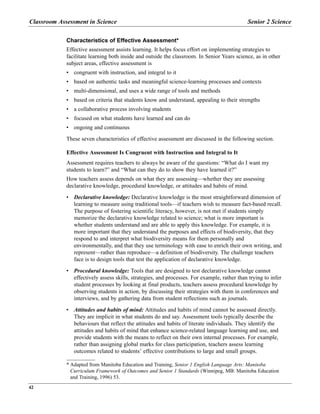
Characteristics of Effective Assessment*
Effective assessment assists learning. It helps focus effort on implementing strategies to
facilitate learning both inside and outside the classroom. In Senior Years science, as in other
subject areas, effective assessment is
• congruent with instruction, and integral to it
• based on authentic tasks and meaningful science-learning processes and contexts
• multi-dimensional, and uses a wide range of tools and methods
• based on criteria that students know and understand, appealing to their strengths
• a collaborative process involving students
• focused on what students have learned and can do
• ongoing and continuous
These seven characteristics of effective assessment are discussed in the following section.
Effective Assessment Is Congruent with Instruction and Integral to It
Assessment requires teachers to always be aware of the questions: “What do I want my
students to learn?” and “What can they do to show they have learned it?”
How teachers assess depends on what they are assessing—whether they are assessing
declarative knowledge, procedural knowledge, or attitudes and habits of mind.
• Declarative knowledge: Declarative knowledge is the most straightforward dimension of
learning to measure using traditional tools—if teachers wish to measure fact-based recall.
The purpose of fostering scientific literacy, however, is not met if students simply
memorize the declarative knowledge related to science; what is more important is
whether students understand and are able to apply this knowledge. For example, it is
more important that they understand the purposes and effects of biodiversity, that they
respond to and interpret what biodiversity means for them personally and
environmentally, and that they use terminology with ease to enrich their own writing, and
represent—rather than reproduce—a definition of biodiversity. The challenge teachers
face is to design tools that test the application of declarative knowledge.
• Procedural knowledge: Tools that are designed to test declarative knowledge cannot
effectively assess skills, strategies, and processes. For example, rather than trying to infer
student processes by looking at final products, teachers assess procedural knowledge by
observing students in action, by discussing their strategies with them in conferences and
interviews, and by gathering data from student reflections such as journals.
• Attitudes and habits of mind: Attitudes and habits of mind cannot be assessed directly.
They are implicit in what students do and say. Assessment tools typically describe the
behaviours that reflect the attitudes and habits of literate individuals. They identify the
attitudes and habits of mind that enhance science-related language learning and use, and
provide students with the means to reflect on their own internal processes. For example,
rather than assigning global marks for class participation, teachers assess learning
outcomes related to students’ effective contributions to large and small groups.
* Adapted from Manitoba Education and Training, Senior 1 English Language Arts: Manitoba
Curriculum Framework of Outcomes and Senior 1 Standards (Winnipeg, MB: Manitoba Education
and Training, 1996) 53.
3.
Senior 2 ScienceClassroom Assessment in Science
43
Assessment is intended to inform students of the programming emphases and to help them
focus on important aspects of learning. If teachers assess only the elements that are easiest
to measure, students may focus only on those things. For example, if science courses place a
high value on collaboration, creativity, and divergent thinking (learning outcomes that may
be more difficult to measure), then assessment tools and processes must reflect those values.
The ways teachers assess (what and how) inform students of what is considered important in
learning.
Effective Assessment Is Based on Authentic Tasks and Meaningful Science Learning
Processes and Contexts
Assessment tasks in science should be authentic and meaningful—tasks worth mastering for
their own sake rather than tasks designed simply to demonstrate student proficiency for
teachers and others. Through assessment, teachers discover whether students can use
knowledge, processes, and resources effectively to achieve worthwhile purposes. Therefore,
teachers design tasks that replicate the context in which knowledge will be applied in the
world beyond the classroom.
For example, authentic science writing tasks employ the forms used by a wide range of
people (e.g., journalists, filmmakers, poets, novelists, publicists, speakers, technical writers,
engineers, and academics). As often as possible, students write, speak, or represent their
ideas for real audiences and for real purposes. In developing assessment tasks, teachers may
consider providing students with the resources people use when performing the same tasks
in real-life situations related to issues in science.
Authentic assessment tasks are not only tests of the information students possess, but also of
the way their understanding of a subject has deepened, and of their ability to apply learning.
They demonstrate to students the relevance and importance of learning. Performance-based
tests are also a way of consolidating student learning. The perennial problem teachers have
with “teaching to the test” is of less concern if tests are authentic assessments of student
knowledge, skills and strategies, and attitudes.
Effective Assessment Is Multi-dimensional and Uses a Wide Range of
Tools and Methods
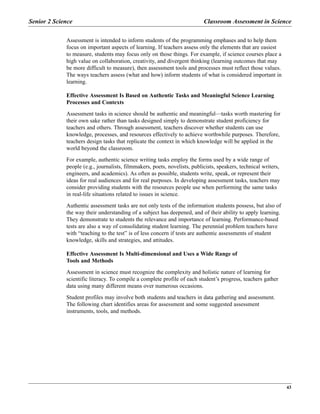
Assessment in science must recognize the complexity and holistic nature of learning for
scientific literacy. To compile a complete profile of each student’s progress, teachers gather
data using many different means over numerous occasions.
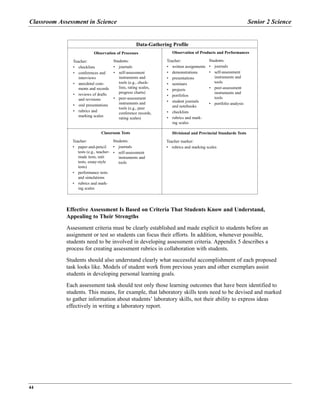
Student profiles may involve both students and teachers in data gathering and assessment.
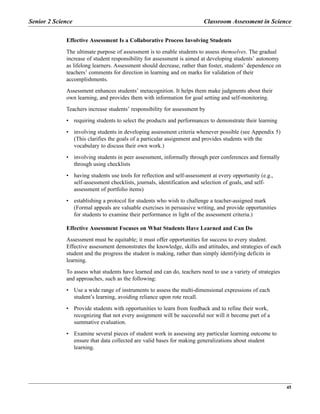
The following chart identifies areas for assessment and some suggested assessment
instruments, tools, and methods.
4.
Classroom Assessment inScience Senior 2 Science
44
Effective Assessment Is Based on Criteria That Students Know and Understand,
Appealing to Their Strengths
Assessment criteria must be clearly established and made explicit to students before an
assignment or test so students can focus their efforts. In addition, whenever possible,
students need to be involved in developing assessment criteria. Appendix 5 describes a
process for creating assessment rubrics in collaboration with students.
Students should also understand clearly what successful accomplishment of each proposed
task looks like. Models of student work from previous years and other exemplars assist
students in developing personal learning goals.
Each assessment task should test only those learning outcomes that have been identified to
students. This means, for example, that laboratory skills tests need to be devised and marked
to gather information about students’ laboratory skills, not their ability to express ideas
effectively in writing a laboratory report.
Observation of Processes
Teacher:
• checklists
• conferences and
interviews
• anecdotal com-
ments and records
• reviews of drafts
and revisions
• oral presentations
• rubrics and
marking scales
Students:
• journals
• self-assessment
instruments and
tools (e.g., check-
lists, rating scales,
progress charts)
• peer-assessment
instruments and
tools (e.g., peer
conference records,
rating scales)
Observation of Products and Performances
Teacher:
• written assignments
• demonstrations
• presentations
• seminars
• projects
• portfolios
• student journals
and notebooks
• checklists
• rubrics and mark-
ing scales
Students:
• journals
• self-assessment
instruments and
tools
• peer-assessment
instruments and
tools
• portfolio analysis
Classroom Tests
Teacher:
• paper-and-pencil
tests (e.g., teacher-
made tests, unit
tests, essay-style
tests)
• performance tests
and simulations
• rubrics and mark-
ing scales
Students:
• journals
• self-assessment
instruments and
tools
Divisional and Provincial Standards Tests
Teacher marker:
• rubrics and marking scales
Data-Gathering Profile
5.
Senior 2 ScienceClassroom Assessment in Science
45
Effective Assessment Is a Collaborative Process Involving Students
The ultimate purpose of assessment is to enable students to assess themselves. The gradual
increase of student responsibility for assessment is aimed at developing students’ autonomy
as lifelong learners. Assessment should decrease, rather than foster, students’ dependence on
teachers’ comments for direction in learning and on marks for validation of their
accomplishments.
Assessment enhances students’ metacognition. It helps them make judgments about their
own learning, and provides them with information for goal setting and self-monitoring.
Teachers increase students’ responsibility for assessment by
• requiring students to select the products and performances to demonstrate their learning
• involving students in developing assessment criteria whenever possible (see Appendix 5)
(This clarifies the goals of a particular assignment and provides students with the
vocabulary to discuss their own work.)
• involving students in peer assessment, informally through peer conferences and formally
through using checklists
• having students use tools for reflection and self-assessment at every opportunity (e.g.,
self-assessment checklists, journals, identification and selection of goals, and self-
assessment of portfolio items)
• establishing a protocol for students who wish to challenge a teacher-assigned mark
(Formal appeals are valuable exercises in persuasive writing, and provide opportunities
for students to examine their performance in light of the assessment criteria.)
Effective Assessment Focuses on What Students Have Learned and Can Do
Assessment must be equitable; it must offer opportunities for success to every student.
Effective assessment demonstrates the knowledge, skills and attitudes, and strategies of each
student and the progress the student is making, rather than simply identifying deficits in
learning.
To assess what students have learned and can do, teachers need to use a variety of strategies
and approaches, such as the following:
• Use a wide range of instruments to assess the multi-dimensional expressions of each
student’s learning, avoiding reliance upon rote recall.
• Provide students with opportunities to learn from feedback and to refine their work,
recognizing that not every assignment will be successful nor will it become part of a
summative evaluation.
• Examine several pieces of student work in assessing any particular learning outcome to
ensure that data collected are valid bases for making generalizations about student
learning.
6.
Classroom Assessment inScience Senior 2 Science
46
• Develop complete student profiles by using information from both learning outcome-
referenced assessment, which compares a student’s performance to predetermined
criteria, and self-referenced assessment, which compares a student’s performance to her
or his prior performance.
• Avoid using assessment for purposes of discipline or classroom control. Ryan, Connell,
and Deci (1985) found that assessment that is perceived as a tool for controlling student
behaviour, meting out rewards and punishments rather than providing feedback on
student learning, reduces student motivation.
Students are sometimes assigned a mark of zero for incomplete work. Averaging a zero
into the student’s mark, however, means the mark no longer communicates accurate
information about the student’s achievement of science learning outcomes. Unfinished
assignments signal personal or motivational problems that need to be addressed in
appropriate and alternative ways.
• Allow students, when appropriate and possible, to choose how they will demonstrate
their competence.
• Use assessment tools appropriate for assessing individual and unique products, processes,
and performances.
Effective Assessment Is Ongoing and Continuous
Assessment that is woven into daily instruction offers students frequent opportunities to gain
feedback, to modify their learning approaches and methods, and to observe their progress.
Teachers provide informal assessment by questioning students and offering comments. They
also conduct formal assessments at various stages of a project or unit of study.
Continuous assessment provides ongoing opportunities for teachers to review and revise
instruction, content, process emphases, and learning resources.
Managing Classroom Assessment
Assessment is one of the greatest challenges science teachers face. The practices that make
science classrooms vital and effective—promoting student choice, assessing processes, and
assessing the subjective aspect of learning—make assessment a complex matter.
Systems and supports that may assist teachers in managing assessment include
• dispensing with ineffectual means of assessment
• using time savers
• sharing the load
• taking advantage of technology
• establishing systems of recording assessment information
7.
These suggestions arediscussed in the following section.
Dispensing with Ineffectual Means of Assessment
Teachers need to question the efficacy, for example, of writing lengthy commentaries on
summative assessment of student projects. Detailed comments are best
• provided as formative assessment, when students can make immediate use of the
feedback
• shared orally in conferences, which provide opportunities for student-teacher discussion
The time spent in assessment needs to be learning time, both for teacher and student.
Using Time Savers
Many effective assessment tools are time savers. Developing checklists and rubrics is time-
consuming; however, well-written rubrics may eliminate the need to write extensive
comments, and may mean that student performances can be assessed largely during class
time. Some of the assessment tools in the professional literature related to science
assessment may also be useful.
Sharing the Load
While the ultimate responsibility for assessment rests with the teacher, student self-
assessment also provides a wealth of information. Collaborating with students to generate
assessment criteria is part of effective instruction (see Appendix 5). Senior 2 students may
develop checklists and keep copies of their own learning goals in an assessment binder for
periodic conferences. Students may be willing to contribute work samples to be used as
models with other classes.
Collaborating with other teachers in creating assessment tools saves time and provides
opportunities to discuss assessment criteria.
Taking Advantage of Technology
Electronic tools (e.g., audiotapes, videotapes, and computer software) can assist teachers in
making and recording observations. Word processors allow teachers to save, modify, and
reuse task-specific checklists and rubrics.
Establishing Systems for Recording Assessment Information
Collecting data from student observations is especially challenging for Senior Years
teachers, who may teach several classes of students in a given semester or term. Teachers
may want to identify a group of students in each class for observation each week. Binders,
card files, and electronic databases are useful for record keeping, as are self-stick notes
recording brief observations on student files, which can later be transformed into anecdotal
reports.
Teachers may also want to develop comprehensive forms for listing the prescribed learning
outcomes, and for recording data. Online opportunities for the creation of lesson or unit
packages based on the Manitoba learning outcomes for Senior 2 Science can be accessed at
<http://www2.edu.gov.mb.ca/ks4/cur/science/>. Access the “Curriculum Documents” link in
the navigation column.
Senior 2 Science Classroom Assessment in Science
47
8.
This view ofeffective assessment in science for Manitoba is reflective of changes in
emphases in science education at the national level and is congruent with international
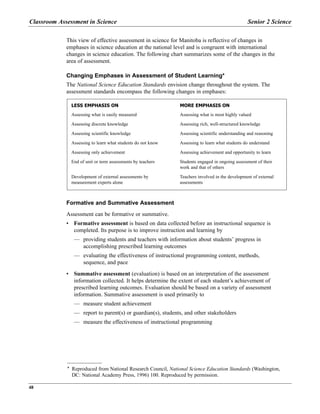
changes in science education. The following chart summarizes some of the changes in the
area of assessment.
Changing Emphases in Assessment of Student Learning*
The National Science Education Standards envision change throughout the system. The
assessment standards encompass the following changes in emphases:
Formative and Summative Assessment
Assessment can be formative or summative.
• Formative assessment is based on data collected before an instructional sequence is
completed. Its purpose is to improve instruction and learning by
— providing students and teachers with information about students’ progress in
accomplishing prescribed learning outcomes
— evaluating the effectiveness of instructional programming content, methods,
sequence, and pace
• Summative assessment (evaluation) is based on an interpretation of the assessment
information collected. It helps determine the extent of each student’s achievement of
prescribed learning outcomes. Evaluation should be based on a variety of assessment
information. Summative assessment is used primarily to
— measure student achievement
— report to parent(s) or guardian(s), students, and other stakeholders
— measure the effectiveness of instructional programming
LESS EMPHASIS ON
Assessing what is easily measured
Assessing discrete knowledge
Assessing scientific knowledge
Assessing to learn what students do not know
Assessing only achievement
End of unit or term assessments by teachers
Development of external assessments by
measurement experts alone
MORE EMPHASIS ON
Assessing what is most highly valued
Assessing rich, well-structured knowledge
Assessing scientific understanding and reasoning
Assessing to learn what students do understand
Assessing achievement and opportunity to learn
Students engaged in ongoing assessment of their
work and that of others
Teachers involved in the development of external
assessments
Classroom Assessment in Science Senior 2 Science
48
* Reproduced from National Research Council, National Science Education Standards (Washington,
DC: National Academy Press, 1996) 100. Reproduced by permission.
9.
Senior 2 Science:A Foundation for Implementation suggests a range of assessment
strategies. The same strategy can be used both for formative and summative assessment,
depending on the purpose of the assessment.
Suggested assessment strategies that can be used in the science classroom are discussed in
detail in the following section:
• Observation
— Observation of students is an integral part of the assessment process. It is most
effective when focused on skills, concepts, and attitudes. Without record keeping,
however, observations and conversations can easily be forgotten. Making brief notes
on index cards, self-stick notes, or grids, as well as keeping checklists, helps teachers
maintain records of continuous progress and achievement.
• Interviews
— Interviews allow teachers to assess an individual’s understanding and achievement of
the prescribed student learning outcome(s). Interviews provide students with
opportunities to model and explain their understandings.
Interviews may be both formal and informal. Posing science-related questions during
planned interviews enables teachers to focus on individual student skills and attitudes.
Students reveal their thinking processes and use of skills when they are questioned
about how they solved problems or answered science questions. Using a prepared set
of questions ensures that all interviews follow a similar structure. It is important to
keep a record of student responses and/or understandings.
• Group/Peer Assessment
— Group assessment gives students opportunities to assess how well they work within a
group. Peer assessment gives them opportunities to reflect on one another’s work,
according to clearly established criteria. During the peer assessment process, students
reflect on their own understanding in order to assess the performance of another
student.
• Self-Assessment
— Self-assessment is vital to all learning and, therefore, integral to the assessment
process. Each student should be encouraged to assess her or his own work. Students
apply known criteria and expectations to their work and reflect on results to
determine their progress toward the mastery of a prescribed learning outcome.
Participation in setting self-assessment criteria and expectations helps students to see
themselves as scientists and problem solvers. It is important that teachers model the
self-assessment process before expecting students to assess themselves.
• Performance Assessment/Student Demonstration
— Performance tasks provide students with opportunities to demonstrate their
knowledge, thinking processes, and skill development. The tasks require the
application of knowledge and skills related to a group of student learning outcomes.
Performance-based tests do not test the information that students possess, but the way
their understanding of a subject has been deepened, and their ability to apply their
learning in a simulated performance. A scoring rubric that includes a scale for the
performance of the task helps organize and interpret evidence. Rubrics allow for a
continuum of performance levels associated with the task being assessed.
Senior 2 Science Classroom Assessment in Science
49
10.
• Science JournalEntries
— Science journal writing provides opportunities for students to reflect on their learning
and to demonstrate their understanding using pictures, labeled drawings, and words.
They can be powerful tools of formative assessment, allowing teachers to gauge a
student’s depth of understanding. In this document, direct questions/scenarios frame
the science journal suggestions.
• Rubrics/Checklists
— Rubrics and checklists are tools that identify the criteria upon which student
processes, performances, or products will be assessed. They also describe the qualities
of work at various levels of proficiency for each criterion. Rubrics and checklists may
be developed in collaboration with students.
• Visual Displays
— When students or student groups prepare visual displays, they are involved in
processing information and producing a knowledge framework. The completed poster,
concept map, diagram, model, etc., is the product with which teachers can determine
what their students are thinking.
• Laboratory Report
— Laboratory reports allow teachers to gauge the ability of students to observe, record,
and interpret experimental results. These tools can aid teachers in determining how
well students understand the content.
• Pencil-and-Paper Tasks
— Quizzes can be used as discrete assessment tools, and tests can be larger assessment
experiences. These written tasks may include items such as multiple choice questions,
completion of a drawing or labeled diagram, problem solving, or long-answer
questions. Ensure that both restricted and extended, expository responses are included
in these assessment devices.
• Research Report/Presentation
— Research projects allow students to achieve the learning outcomes in individual ways.
Assessment should be built into the project at every stage, from planning, to
researching, to presenting the finished product.
The foregoing assessment suggestions are not meant to be limiting. Teachers are strongly
encouraged to develop their own assessment for Senior Years science based on their
students’ learning requirements and the prescribed student learning outcomes. Reporting on
Student Progress and Achievement: A Policy Handbook for Teachers, Administrators, and
Parents (Manitoba Education and Training, 1997) contains further information related to
reporting on student progress.
Classroom Assessment in Science Senior 2 Science
50