TSI ASEAN HRC Index
Methodology Deep-Dive
April 2015
/2
The key principles of TSI’s approach are:
– to maximise industry participation in compiling each index and the
accuracy of the data submitted
– whilst minimising opportunities for manipulation and subjectivity in the
compilation of each index
TSI uses the same approach for compiling its iron ore, steel and scrap
reference prices:
– legal agreements with relevant Data Providers active in the physical
market
– secure confidential on-line data collection of actual transactions
– prices normalised to reference product specifications
– data ‘cleaned’ with outliers excluded
– volume-weighted average calculated and published
Methodology foundations:
Background to The Steel Index (TSI)
Introduction to ASEAN CFR Index
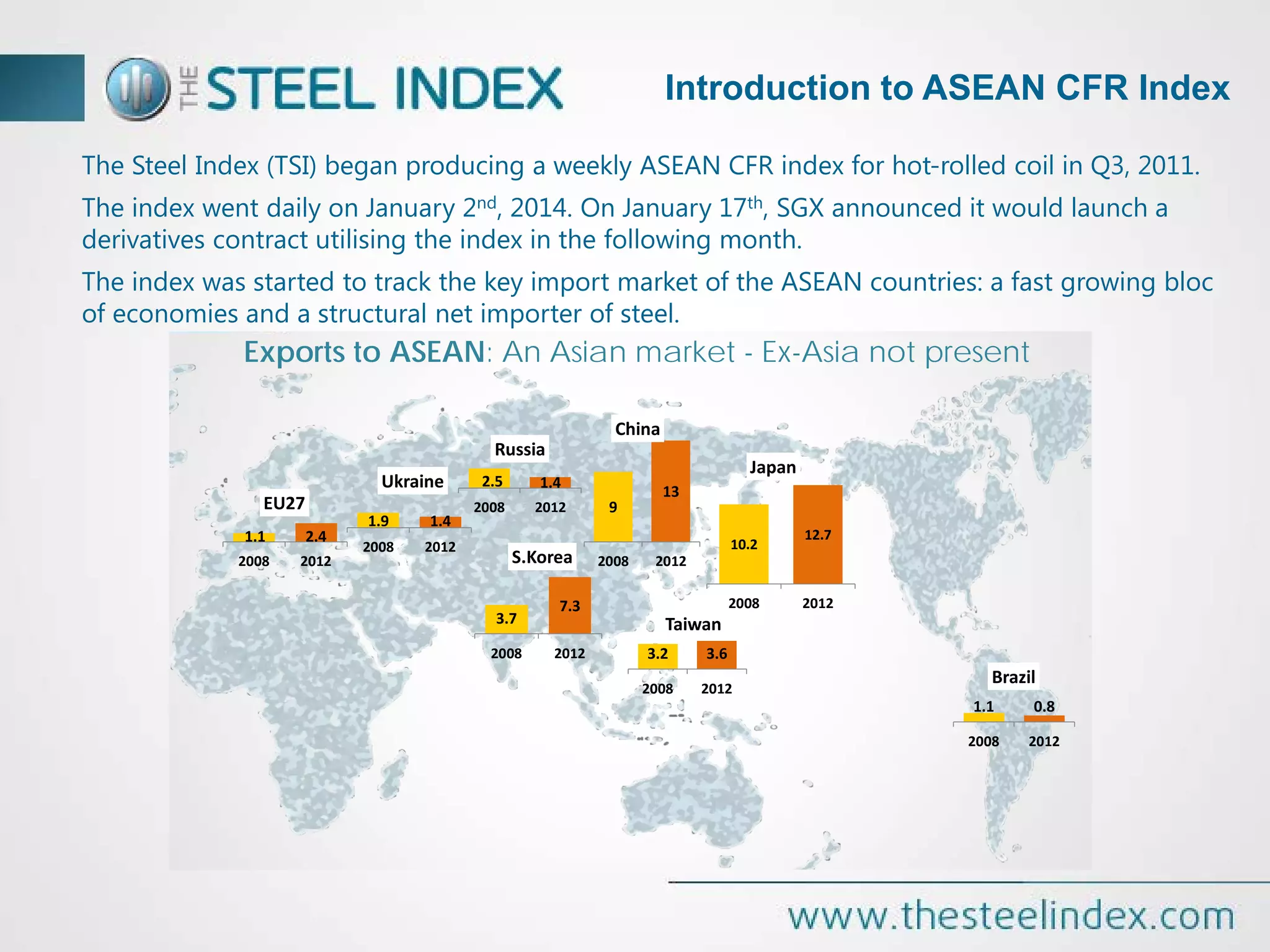
The Steel Index (TSI) began producing a weekly ASEAN CFR index for hot-rolled coil in Q3, 2011.
The index went daily on January 2nd, 2014. On January 17th, SGX announced it would launch a
derivatives contract utilising the index in the following month.
The index was started to track the key import market of the ASEAN countries: a fast growing bloc
of economies and a structural net importer of steel.
9
13
2008 2012
China
1.1 0.8
2008 2012
Brazil
10.2
12.7
2008 2012
Japan
1.9 1.4
2008 2012
Ukraine
3.7
7.3
2008 2012
S.Korea
1.1 2.4
2008 2012
EU27
2.5 1.4
2008 2012
Russia
3.2 3.6
2008 2012
Taiwan
Exports to ASEAN: An Asian market - Ex-Asia not present
CONFIDENTIALITY
AGREEMENT
Transaction
Data Sample
Step1Step2
Outliers
excluded
Prices
Normalized
PublishTSI
Reference
Prices
Final
Data Set
Step3
Volume-
weighted
averages
calculated
Buy/Sell
balance
Step4
Submits price
data to TSI
using secure
online system
The
Steel
Index
Data
Provider
The ASEAN CFR Index process
TSI employ the same methodology for the ASEAN CFR index as we do for all our other indices.
Registered data providers deliver price data to TSI and we normalise this sample, go through the
steps below and produce a daily volume-weighted average.
TSI produces a number of indices with multiple levels of normalisation. The ASEAN CFR index
contains the most of any of our steel indices. We feel it is worth the work to produce an index
reflective of Asian HRC prices, rather than only Chinese origin HRC.
Prominent exporters
ASEAN Countries
ASEAN HRC: a benchmark for Asia.
The ASEAN index is open for participation by a
wide range of physical spot market participants.
Vendors from China, Japan, S. Korea, Taiwan and
India can take part, as can buyers from Vietnam,
Thailand, Singapore, Philippines, Mynamar,
Malaysia, Lao, Indonesia, Cambodia & Brunei.
The reference product is SAE 1006 HRC. SS400
material can also be reported.
The SAE 1006 material is structurally anticipated to
be of Chinese origination. Material from
elsewhere can be reported.
The reference location is CFR Singapore – to
represent a delivery location without tariff barriers.
Deliveries into other locations (with or without
tariffs) can also be reported.
ASEAN HRC: a benchmark for Asia.
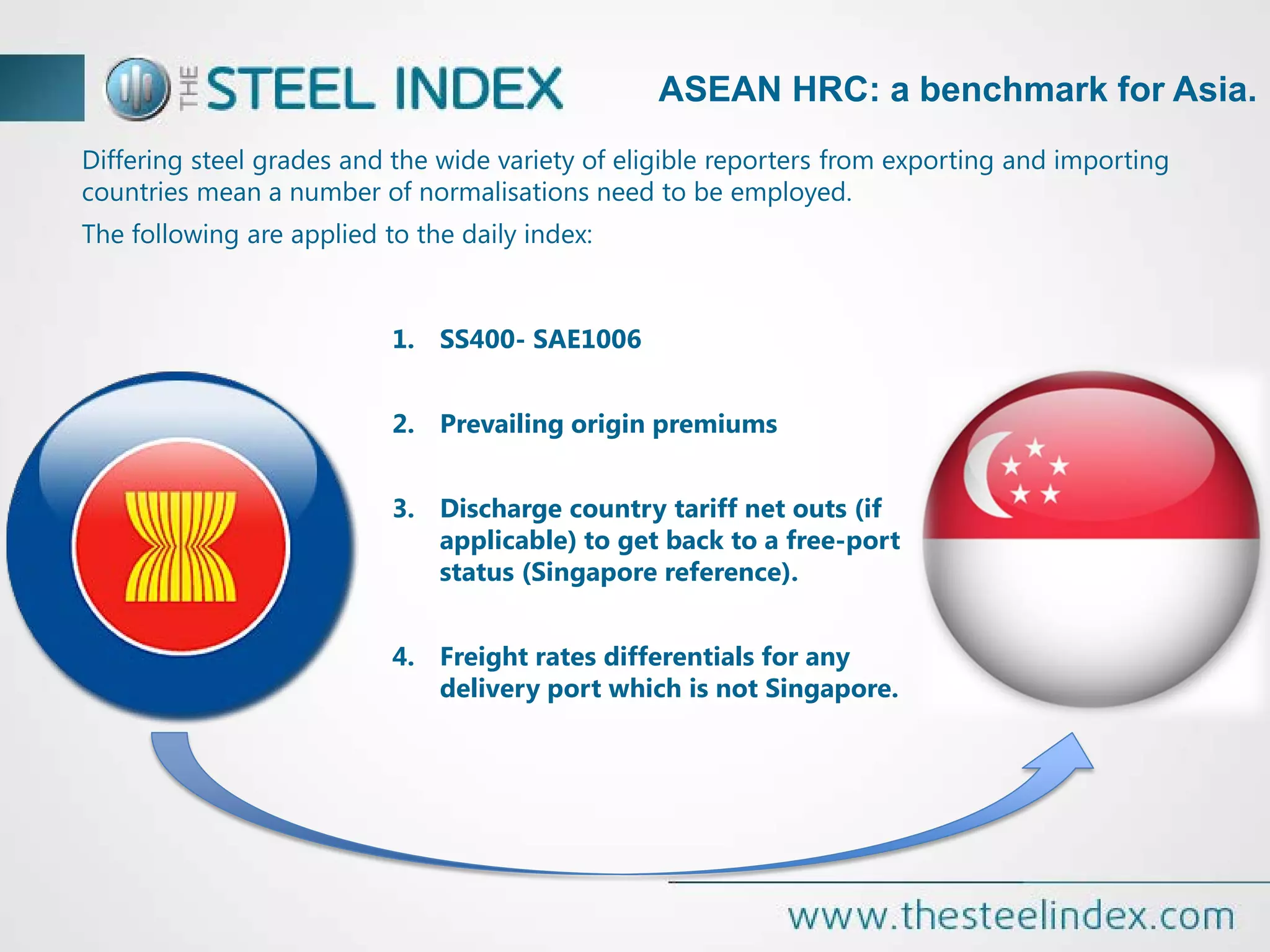
Differing steel grades and the wide variety of eligible reporters from exporting and importing
countries mean a number of normalisations need to be employed.
The following are applied to the daily index:
1. SS400- SAE1006
2. Prevailing origin premiums
3. Discharge country tariff net outs (if
applicable) to get back to a free-port
status (Singapore reference).
4. Freight rates differentials for any
delivery port which is not Singapore.
Normalisation values at April 6th, 2015
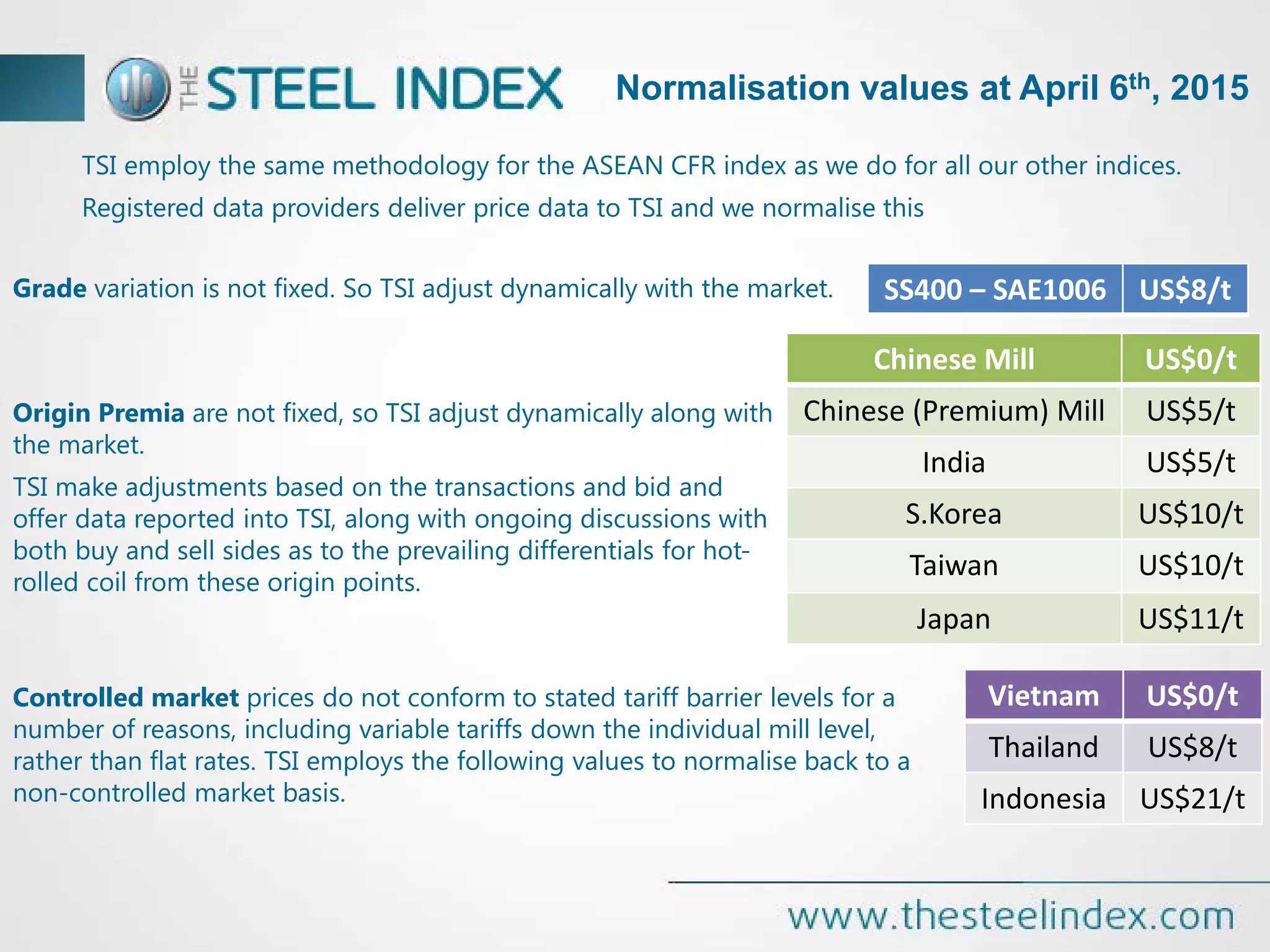
TSI employ the same methodology for the ASEAN CFR index as we do for all our other indices.
Registered data providers deliver price data to TSI and we normalise this
SS400 – SAE1006 US$8/t
Chinese Mill US$0/t
Chinese (Premium) Mill US$5/t
India US$5/t
S.Korea US$10/t
Taiwan US$10/t
Japan US$11/t
Vietnam US$0/t
Thailand US$8/t
Indonesia US$21/t
Grade variation is not fixed. So TSI adjust dynamically with the market.
Origin Premia are not fixed, so TSI adjust dynamically along with
the market.
TSI make adjustments based on the transactions and bid and
offer data reported into TSI, along with ongoing discussions with
both buy and sell sides as to the prevailing differentials for hot-
rolled coil from these origin points.
Controlled market prices do not conform to stated tariff barrier levels for a
number of reasons, including variable tariffs down the individual mill level,
rather than flat rates. TSI employs the following values to normalise back to a
non-controlled market basis.
Price History
350
400
450
500
550
600
650
700
750
4/14 5/14 6/14 7/14 8/14 9/14 10/14 11/14 12/14 1/15 2/15 3/15
549.8 546.7 539.3 540.3 541.3 523.1 500.5 497 481.2 449.4 398.3 392.1
Monthly Average: US$/t
The normalisations produce a price series widely recognised as being representative of the region
tracked. Monthly price history shows a volatile past and recent reintroduction of volatility.
For TSI’s ‘definitive methodology’ pack, click the image below left.
For more information on SGX price risk management tools, click the image below right.
For more information on TSI’s full index history, how to participate, or if you have other
questions about TSI, contact Terence Soh (Shanghai), Terry Chuay (Singapore, for ASEAN),
or hard@thesteelindex.com.
Further information
Steel: since 2006
Iron Ore: since 2008
Scrap: since 2010
Coking Coal: since 2012
Thank you for your attention!
mcoal@thesteelindex.com

Asean methodology pack

  • 1.
    TSI ASEAN HRCIndex Methodology Deep-Dive April 2015
  • 2.
    /2 The key principlesof TSI’s approach are: – to maximise industry participation in compiling each index and the accuracy of the data submitted – whilst minimising opportunities for manipulation and subjectivity in the compilation of each index TSI uses the same approach for compiling its iron ore, steel and scrap reference prices: – legal agreements with relevant Data Providers active in the physical market – secure confidential on-line data collection of actual transactions – prices normalised to reference product specifications – data ‘cleaned’ with outliers excluded – volume-weighted average calculated and published Methodology foundations: Background to The Steel Index (TSI)
  • 3.
    Introduction to ASEANCFR Index The Steel Index (TSI) began producing a weekly ASEAN CFR index for hot-rolled coil in Q3, 2011. The index went daily on January 2nd, 2014. On January 17th, SGX announced it would launch a derivatives contract utilising the index in the following month. The index was started to track the key import market of the ASEAN countries: a fast growing bloc of economies and a structural net importer of steel. 9 13 2008 2012 China 1.1 0.8 2008 2012 Brazil 10.2 12.7 2008 2012 Japan 1.9 1.4 2008 2012 Ukraine 3.7 7.3 2008 2012 S.Korea 1.1 2.4 2008 2012 EU27 2.5 1.4 2008 2012 Russia 3.2 3.6 2008 2012 Taiwan Exports to ASEAN: An Asian market - Ex-Asia not present
  • 4.
    CONFIDENTIALITY AGREEMENT Transaction Data Sample Step1Step2 Outliers excluded Prices Normalized PublishTSI Reference Prices Final Data Set Step3 Volume- weighted averages calculated Buy/Sell balance Step4 Submitsprice data to TSI using secure online system The Steel Index Data Provider The ASEAN CFR Index process TSI employ the same methodology for the ASEAN CFR index as we do for all our other indices. Registered data providers deliver price data to TSI and we normalise this sample, go through the steps below and produce a daily volume-weighted average. TSI produces a number of indices with multiple levels of normalisation. The ASEAN CFR index contains the most of any of our steel indices. We feel it is worth the work to produce an index reflective of Asian HRC prices, rather than only Chinese origin HRC.
  • 5.
    Prominent exporters ASEAN Countries ASEANHRC: a benchmark for Asia. The ASEAN index is open for participation by a wide range of physical spot market participants. Vendors from China, Japan, S. Korea, Taiwan and India can take part, as can buyers from Vietnam, Thailand, Singapore, Philippines, Mynamar, Malaysia, Lao, Indonesia, Cambodia & Brunei. The reference product is SAE 1006 HRC. SS400 material can also be reported. The SAE 1006 material is structurally anticipated to be of Chinese origination. Material from elsewhere can be reported. The reference location is CFR Singapore – to represent a delivery location without tariff barriers. Deliveries into other locations (with or without tariffs) can also be reported.
  • 6.
    ASEAN HRC: abenchmark for Asia. Differing steel grades and the wide variety of eligible reporters from exporting and importing countries mean a number of normalisations need to be employed. The following are applied to the daily index: 1. SS400- SAE1006 2. Prevailing origin premiums 3. Discharge country tariff net outs (if applicable) to get back to a free-port status (Singapore reference). 4. Freight rates differentials for any delivery port which is not Singapore.
  • 7.
    Normalisation values atApril 6th, 2015 TSI employ the same methodology for the ASEAN CFR index as we do for all our other indices. Registered data providers deliver price data to TSI and we normalise this SS400 – SAE1006 US$8/t Chinese Mill US$0/t Chinese (Premium) Mill US$5/t India US$5/t S.Korea US$10/t Taiwan US$10/t Japan US$11/t Vietnam US$0/t Thailand US$8/t Indonesia US$21/t Grade variation is not fixed. So TSI adjust dynamically with the market. Origin Premia are not fixed, so TSI adjust dynamically along with the market. TSI make adjustments based on the transactions and bid and offer data reported into TSI, along with ongoing discussions with both buy and sell sides as to the prevailing differentials for hot- rolled coil from these origin points. Controlled market prices do not conform to stated tariff barrier levels for a number of reasons, including variable tariffs down the individual mill level, rather than flat rates. TSI employs the following values to normalise back to a non-controlled market basis.
  • 8.
    Price History 350 400 450 500 550 600 650 700 750 4/14 5/146/14 7/14 8/14 9/14 10/14 11/14 12/14 1/15 2/15 3/15 549.8 546.7 539.3 540.3 541.3 523.1 500.5 497 481.2 449.4 398.3 392.1 Monthly Average: US$/t The normalisations produce a price series widely recognised as being representative of the region tracked. Monthly price history shows a volatile past and recent reintroduction of volatility.
  • 9.
    For TSI’s ‘definitivemethodology’ pack, click the image below left. For more information on SGX price risk management tools, click the image below right. For more information on TSI’s full index history, how to participate, or if you have other questions about TSI, contact Terence Soh (Shanghai), Terry Chuay (Singapore, for ASEAN), or hard@thesteelindex.com. Further information
  • 10.
    Steel: since 2006 IronOre: since 2008 Scrap: since 2010 Coking Coal: since 2012 Thank you for your attention! mcoal@thesteelindex.com