AS
FILM PRODUCTION COMPANY
PRESENTS
SINCE 2023
VIDEO CONTINUITY TASK
“wallet ?”
Preliminary task 2
Anqila Shan
brief Project Explanation
In this preliminary assignment we planned to shoot and edit a continuity sequence to create a tense
climax. We will maintain spatial and temporal continuity through filming and editing.
We will examine and demonstrate specific continuity shooting and editing techniques.
To meet the project standards and requirements, we needed to first plan, shoot and edit the sequence,
highlighting the different elements of continuity editing. Later we will identify the use of continuity editing
and evaluate how successful it is and what we can do better.
• This clip demonstrates our understanding of the following 5 media techniques:
Match on action
Eyeline match
Cross cutting
Shot/reverse/shot
The 180-degree rule
Explanation of shots used
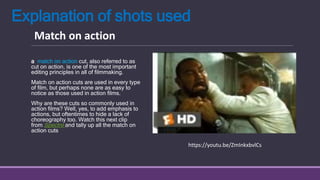
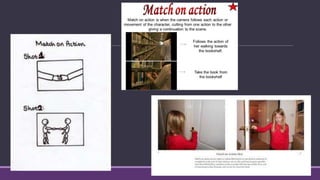
a match on action cut, also referred to as
cut on action, is one of the most important
editing principles in all of filmmaking.
Match on action cuts are used in every type
of film, but perhaps none are as easy to
notice as those used in action films.
Why are these cuts so commonly used in
action films? Well, yes, to add emphasis to
actions, but oftentimes to hide a lack of
choreography too. Watch this next clip
from Spectre and tally up all the match on
action cuts
https://youtu.be/ZmInkxbvlCs
Match on action
Explanation of shots used
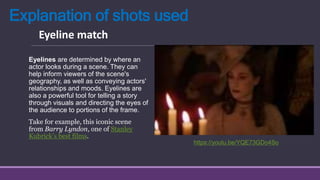
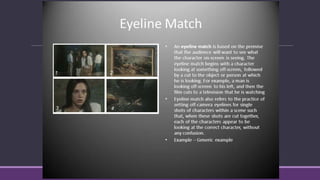
Eyelines are determined by where an
actor looks during a scene. They can
help inform viewers of the scene's
geography, as well as conveying actors'
relationships and moods. Eyelines are
also a powerful tool for telling a story
through visuals and directing the eyes of
the audience to portions of the frame.
Take for example, this iconic scene
from Barry Lyndon, one of Stanley
Kubrick’s best films.
Eyeline match
https://youtu.be/YQE73GDo4So
Explanation of shots used
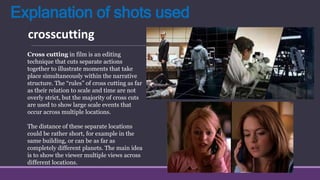
crosscutting
Cross cutting in film is an editing
technique that cuts separate actions
together to illustrate moments that take
place simultaneously within the narrative
structure. The “rules” of cross cutting as far
as their relation to scale and time are not
overly strict, but the majority of cross cuts
are used to show large scale events that
occur across multiple locations.
The distance of these separate locations
could be rather short, for example in the
same building, or can be as far as
completely different planets. The main idea
is to show the viewer multiple views across
different locations.
Explanation of shots used
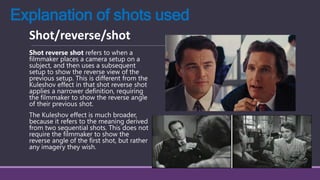
Shot reverse shot refers to when a
filmmaker places a camera setup on a
subject, and then uses a subsequent
setup to show the reverse view of the
previous setup. This is different from the
Kuleshov effect in that shot reverse shot
applies a narrower definition, requiring
the filmmaker to show the reverse angle
of their previous shot.
The Kuleshov effect is much broader,
because it refers to the meaning derived
from two sequential shots. This does not
require the filmmaker to show the
reverse angle of the first shot, but rather
any imagery they wish.
Shot/reverse/shot
Explanation of shots used
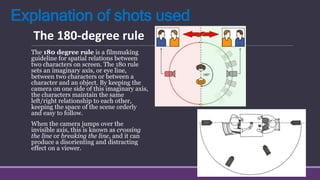
The 180 degree rule is a filmmaking
guideline for spatial relations between
two characters on screen. The 180 rule
sets an imaginary axis, or eye line,
between two characters or between a
character and an object. By keeping the
camera on one side of this imaginary axis,
the characters maintain the same
left/right relationship to each other,
keeping the space of the scene orderly
and easy to follow.
When the camera jumps over the
invisible axis, this is known as crossing
the line or breaking the line, and it can
produce a disorienting and distracting
effect on a viewer.
The 180-degree rule
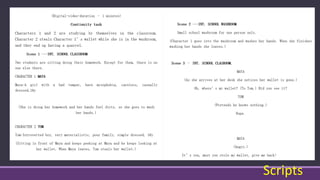
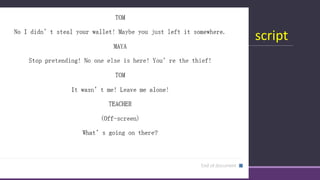
Scripts
script
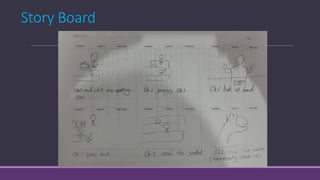
Story Board
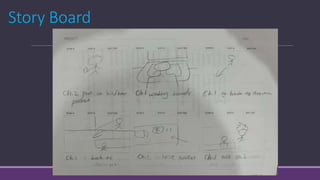
Story Board
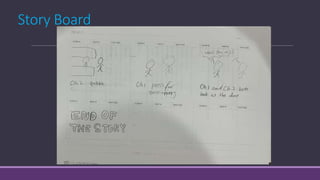
Story Board
Location search
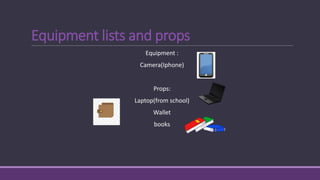
Equipment lists and props
Equipment :
Camera(Iphone)
Props:
Laptop(from school)
Wallet
books
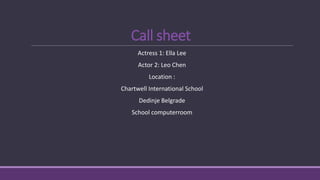
Call sheet
Actress 1: Ella Lee
Actor 2: Leo Chen
Location :
Chartwell International School
Dedinje Belgrade
School computerroom
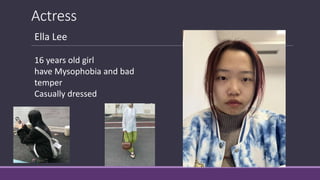
Actress
Ella Lee
16 years old girl
have Mysophobia and bad
temper
Casually dressed
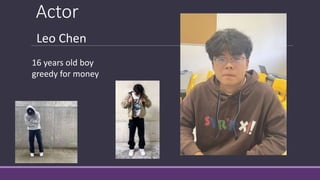
Actor
Leo Chen
16 years old boy
greedy for money
Preliminary Task 2 Evaluation
The overall story of this incident is that a greedy male
classmate saw the wallet of a female classmate and
took her wallet into her pocket while she was going to
the bathroom. When she came back, she found that
her wallet was missing, and started a series of fights
with the male classmate, confrontation.
Naughty students, missing wallets, falling while walking, etc. are some of the little things that
often happen in life. And I just magnified one of these small things and made it into a short
video. When I started planning how to shoot this video, I first drew a storyboard, which
helped me a lot and gave me a more complete idea of what each frame should look like.
This includes:
-location and setting
-actors appearing in the shot as well as direction props
-type of shot, angle, movement
After completing the storyboard, we move on to the final stages of pre-production, which
include:
- Actor and location search
- Equipment and props list
This was crucial to have done before production as it greatly helped us plan and anticipate
almost all the challenges of shooting on this location.
Then I do secondary research to help me present my video
better.
This includes:
The 180 rules——In I used it at the beginning of the video to present
the two protagonists directly.
Shot reverse shot——I use it to add atmosphere between the two main
characters and it makes the dialogue more graphic and natural.
a match on action cut——I use it to put more emphasis on the
protagonists' actions
Once I completed my secondary research, I began the pre-production phase to create a video
that met all of the above requirements. I believe my video ideas are the perfect blend of visual,
technical and creative needs. The first step in pre-production is writing a brief.
In 《"Wallet?" 》In the summary, we made sure to write a short table. I've included all the
important elements, which means:
Characters, storyline, action and reactions - chronologically arranged from beginning to end.
The next steps are to script the video and complete the storyboard according to accepted
common scripting and storyboarding standards. After I finished the script, I evaluated it and
framed it into individual shots that visually translated into monotonous storyboard panels.
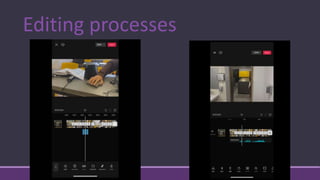
I ended up editing the messy footage I shot, piecing them together and adding some sound
effects, and finally made the final video.
Editing application
• CapCut
Editing processes
THE END
BY ANQILA SHAN

PRELIMINARY TASK 2- CONTINUITY SEQUENCE

  • 1.
  • 2.
    VIDEO CONTINUITY TASK “wallet?” Preliminary task 2 Anqila Shan
  • 3.
    brief Project Explanation Inthis preliminary assignment we planned to shoot and edit a continuity sequence to create a tense climax. We will maintain spatial and temporal continuity through filming and editing. We will examine and demonstrate specific continuity shooting and editing techniques. To meet the project standards and requirements, we needed to first plan, shoot and edit the sequence, highlighting the different elements of continuity editing. Later we will identify the use of continuity editing and evaluate how successful it is and what we can do better. • This clip demonstrates our understanding of the following 5 media techniques: Match on action Eyeline match Cross cutting Shot/reverse/shot The 180-degree rule
  • 4.
    Explanation of shotsused a match on action cut, also referred to as cut on action, is one of the most important editing principles in all of filmmaking. Match on action cuts are used in every type of film, but perhaps none are as easy to notice as those used in action films. Why are these cuts so commonly used in action films? Well, yes, to add emphasis to actions, but oftentimes to hide a lack of choreography too. Watch this next clip from Spectre and tally up all the match on action cuts https://youtu.be/ZmInkxbvlCs Match on action
  • 6.
    Explanation of shotsused Eyelines are determined by where an actor looks during a scene. They can help inform viewers of the scene's geography, as well as conveying actors' relationships and moods. Eyelines are also a powerful tool for telling a story through visuals and directing the eyes of the audience to portions of the frame. Take for example, this iconic scene from Barry Lyndon, one of Stanley Kubrick’s best films. Eyeline match https://youtu.be/YQE73GDo4So
  • 8.
    Explanation of shotsused crosscutting Cross cutting in film is an editing technique that cuts separate actions together to illustrate moments that take place simultaneously within the narrative structure. The “rules” of cross cutting as far as their relation to scale and time are not overly strict, but the majority of cross cuts are used to show large scale events that occur across multiple locations. The distance of these separate locations could be rather short, for example in the same building, or can be as far as completely different planets. The main idea is to show the viewer multiple views across different locations.
  • 9.
    Explanation of shotsused Shot reverse shot refers to when a filmmaker places a camera setup on a subject, and then uses a subsequent setup to show the reverse view of the previous setup. This is different from the Kuleshov effect in that shot reverse shot applies a narrower definition, requiring the filmmaker to show the reverse angle of their previous shot. The Kuleshov effect is much broader, because it refers to the meaning derived from two sequential shots. This does not require the filmmaker to show the reverse angle of the first shot, but rather any imagery they wish. Shot/reverse/shot
  • 10.
    Explanation of shotsused The 180 degree rule is a filmmaking guideline for spatial relations between two characters on screen. The 180 rule sets an imaginary axis, or eye line, between two characters or between a character and an object. By keeping the camera on one side of this imaginary axis, the characters maintain the same left/right relationship to each other, keeping the space of the scene orderly and easy to follow. When the camera jumps over the invisible axis, this is known as crossing the line or breaking the line, and it can produce a disorienting and distracting effect on a viewer. The 180-degree rule
  • 11.
  • 12.
  • 13.
  • 14.
  • 15.
  • 16.
  • 17.
    Equipment lists andprops Equipment : Camera(Iphone) Props: Laptop(from school) Wallet books
  • 18.
    Call sheet Actress 1:Ella Lee Actor 2: Leo Chen Location : Chartwell International School Dedinje Belgrade School computerroom
  • 19.
    Actress Ella Lee 16 yearsold girl have Mysophobia and bad temper Casually dressed
  • 20.
    Actor Leo Chen 16 yearsold boy greedy for money
  • 21.
    Preliminary Task 2Evaluation The overall story of this incident is that a greedy male classmate saw the wallet of a female classmate and took her wallet into her pocket while she was going to the bathroom. When she came back, she found that her wallet was missing, and started a series of fights with the male classmate, confrontation.
  • 22.
    Naughty students, missingwallets, falling while walking, etc. are some of the little things that often happen in life. And I just magnified one of these small things and made it into a short video. When I started planning how to shoot this video, I first drew a storyboard, which helped me a lot and gave me a more complete idea of what each frame should look like. This includes: -location and setting -actors appearing in the shot as well as direction props -type of shot, angle, movement After completing the storyboard, we move on to the final stages of pre-production, which include: - Actor and location search - Equipment and props list This was crucial to have done before production as it greatly helped us plan and anticipate almost all the challenges of shooting on this location.
  • 23.
    Then I dosecondary research to help me present my video better. This includes: The 180 rules——In I used it at the beginning of the video to present the two protagonists directly. Shot reverse shot——I use it to add atmosphere between the two main characters and it makes the dialogue more graphic and natural. a match on action cut——I use it to put more emphasis on the protagonists' actions
  • 24.
    Once I completedmy secondary research, I began the pre-production phase to create a video that met all of the above requirements. I believe my video ideas are the perfect blend of visual, technical and creative needs. The first step in pre-production is writing a brief. In 《"Wallet?" 》In the summary, we made sure to write a short table. I've included all the important elements, which means: Characters, storyline, action and reactions - chronologically arranged from beginning to end. The next steps are to script the video and complete the storyboard according to accepted common scripting and storyboarding standards. After I finished the script, I evaluated it and framed it into individual shots that visually translated into monotonous storyboard panels. I ended up editing the messy footage I shot, piecing them together and adding some sound effects, and finally made the final video.
  • 25.
  • 26.
  • 27.