Capital Precision Ltd


Investor Targeting – Theory and Practice
Capital Precision

 We specialize in helping Companies (and their Advisory Banks) identify
 who are the beneficial owners of their shares, who manages the
 investment decisions and who to target as new investors

 We are employed for both Investor Relations and Corporate Transaction
 projects

 We work for approx 200+ Blue Chip companies and 24 Banks

 50+ years of collective experience

 Awarded the contract to provide CMI Services to the London Stock
 Exchange IR Solutions team, Nov 2005


                                      2
Targeting – A Complex Challenge


   What will happen if you take management on a world
   tour of investment centres and no-one buys the shares?

   What shareholder structure are you trying to achieve?
   How do you decide where to go?
   How do you decide who to meet with?
   What criteria did you use to evaluate your targets?
   How do you know if it was successful?
Targeting is a marketing discipline


Know your customer

     Who is the customer?
     What is motivating them to buy (or sell)?
     What do you need to do to keep them?


Where do you find more of the same?

     How do you determine where they are and what will
     motivate them to buy?
     How do you measure whether your IR Programme is
     working?

                             4
Targeting is about prioritisation


   There are over 40,000+ funds under management around
   the world, you cannot meet them all


   The challenge is to filter the 40,000 down to the investors
   who are going to be most interested in your investment
   story
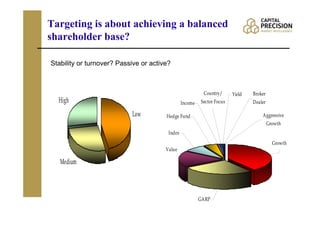
Targeting is about achieving a balanced
shareholder base?

Stability or turnover? Passive or active?


                                                          Country/      Yield   Broker
  High                                          Income   Sector Focus           Dealer

                           Low         Hedge Fund                                   Aggressive
                                                                                         Growth
                                        Index
                                                                                           Growth
                                       Value

   Medium


                                                         GARP
Investor Targeting – The objectives


   Maximize demand for the shares – This cannot be
   achieved if it is left to the market to determine who will
   be buying your shares

   The challenge is to find investors whose investment
   profile matches your future investment proposition

   The better the Targeting, the better control there is over
   the shareholder structure
Targeting – A Strategic Planning
discipline

   In an ideal world a company would have a clear objective
   of the types of shareholders they would like to have in the
   future

   The targeting process should be based upon anticipating
   what is likely to happen and not based upon what has
   happened

   The targeting process must be measurable
Structuring the shareholder base


  Is there a transaction anticipated?
  Who will support the company in the transaction?
  Who holds the voting power?
  Do you want more passive or active investors?
  Are you looking for liquidity or stability?
  Are you looking to diversify the shareholder base?
  Which shareholders are likely to rotate out and when?
  Which current investors could buy more shares?
  Who is not investing yet but could be?
  Which investors could be activist?
  Where are the strengths and weaknesses in the shareholder
  base?

                            9
The starting point for a Targeting Programme

  Step 1 - The “stock take” – Where are you now?

  Does your shareholder base reflect what you believe to be what you
  represent to the market?

  The first step is to have a clear understanding of who is already
  holding your stock and why.

  The second step is to identify which shareholders could rotate out of
  the stock in the future

  The third step is to determine the impact that this selling activity is
  likely to have on liquidity and smaller investors
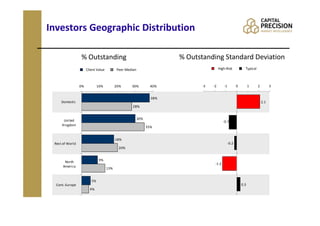
Investors Geographic Distribution

                 % Outstanding                                         % Outstanding Standard Deviation
                      Client Value         Peer Median                                  High-Risk            Typical


                 0%           10%          20%     30%           40%          -3   -2      -1          0         1     2         3


                                                                 38%
     Domestic                                                                                                              2.1
                                                    28%


      United                                             30%
                                                                                           -0.7
     Kingdom
                                                               35%


                                           18%
 Rest of World                                                                                  -0.2
                                            20%


       North                   9%
                                                                                    -1.3
      America
                                     13%


                         5%
  Cont. Europe                                                                                             0.3
                        4%
Investor Geographic Distribution


   Although increased foreign investment is often very much
   desired, dependence on any one region for support can
   have significant impact on the turnover of your
   shareholder base.

   Geographic considerations

    Perceived strength of your company’s country or region
    Regional/Global stability concerns
    Currency strength/weakness
    Governmental and/or regulatory impact
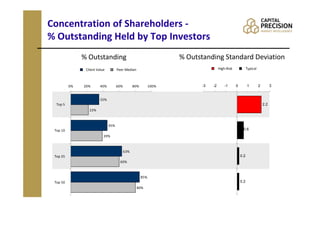
Concentration of Shareholders -
% Outstanding Held by Top Investors
               % Outstanding                                        % Outstanding Standard Deviation
                Client Value         Peer Median                                     High-Risk             Typical


          0%   20%       40%         60%         80%         100%          -3   -2       -1      0         1         2         3


                         35%
  Top 5                                                                                                                  2.2
                  22%


                               45%
 Top 10                                                                                               0.6
                           39%


                                           63%
 Top 25                                                                                              0.2
                                       60%


                                                       85%
 Top 50                                                                                              0.2
                                                   80%
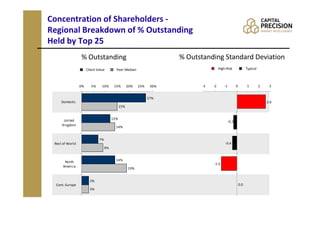
Concentration of Shareholders -
Regional Breakdown of % Outstanding
Held by Top 25
                 % Outstanding                                         % Outstanding Standard Deviation
                      Client Value        Peer Median                                   High-Risk                 Typical


                 0%      5%     10%      15%        20%   25%    30%          -3   -2       -1          0         1         2    3


                                                                27%
     Domestic                                                                                                                   2.6
                                              15%


      United                            12%
                                                                                                 -0.3
     Kingdom
                                          14%


                              7%
 Rest of World                                                                              -0.4
                                   9%


       North                              14%
                                                                                   -1.4
      America
                                                    19%


                        3%
  Cont. Europe                                                                                              0.0
                        3%
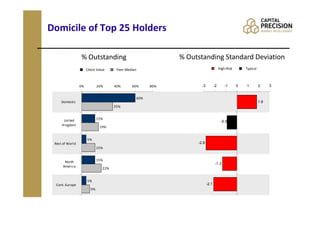
Domicile of Top 25 Holders

                 % Outstanding                                   % Outstanding Standard Deviation
                      Client Value     Peer Median                                       High-Risk       Typical


                 0%          20%      40%      60%         80%          -3          -2       -1      0   1         2     3


                                                     60%
     Domestic                                                                                                      1.8
                                      35%


      United                 15%
                                                                                          -0.9
     Kingdom
                              19%


                      5%
 Rest of World                                                        -2.8
                             15%


       North                 15%
                                                                                     -1.3
      America
                                22%


                      5%
  Cont. Europe                                                               -2.1
                        9%
Concentration of Shareholders

 Although it is often typical and potentially beneficial to have a few
 “anchor” investors at the top of the shareholder register, a shareholder
 base that is too concentrated can be cause for concern.

 Pricing impact

 Potential to trade in large blocks in the event of a bid or corporate action

 Disproportionate affect on voting

 Lower “real” float; liquidity

 Higher likelihood of regional concentration (as per previous page)
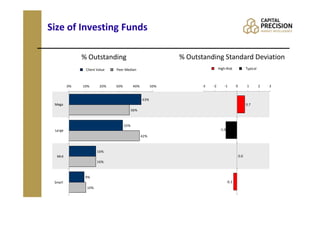
Size of Investing Funds

              % Outstanding                                  % Outstanding Standard Deviation
               Client Value   Peer Median                                     High-Risk                Typical


         0%   10%      20%    30%          40%         50%          -3   -2       -1         0         1         2   3


                                                 43%
 Mega                                                                                                  0.7
                                          36%


                                    32%
 Large                                                                         -1.0
                                                 42%


                      16%
  Mid                                                                                            0.0
                      16%


               9%
 Small                                                                                -0.3
               10%
Size of Investing Funds

  Attracting funds of various sizes requires different modes of outreach

  Larger fund managers
  Have an abundance of internal resources and heavily rely on in-house research
  Require direct one-on-one interaction with management
  Manage a large portfolio of securities which ultimately ends up being closely tied to an index
  benchmark portfolio
  Will most probably hold many in your peer group already; will try to outperform through re-
  weighting on a regular basis

  Smaller fund managers
  Less reliant on direct one-on-one management interaction; group meetings may be sufficient
  Will rely on sell-side analysis due to their limited in-house research
  Require accessible and good company information, presentations and disclosure
  Lack the resources to manage a broad portfolio
  Take large, opportunistic positions in a concentrated number of companies
  Can buy into or sell out of a large position very quickly
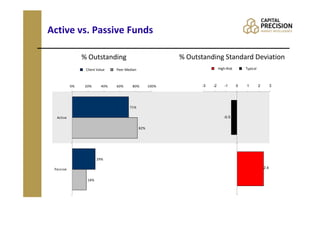
Active vs. Passive Funds

                % Outstanding                              % Outstanding Standard Deviation
                 Client Value   Peer Median                                 High-Risk       Typical


           0%    20%      40%   60%     80%         100%          -3   -2       -1      0   1         2         3


                                       71%

  Active                                                                       -0.5

                                              82%


                        29%

 Passive                                                                                                  2.4


                  18%
Active vs. Passive Funds

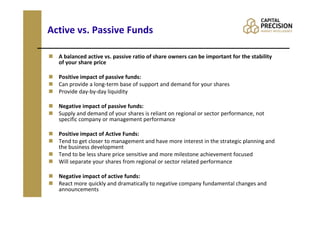
  A balanced active vs. passive ratio of share owners can be important for the stability
  of your share price

  Positive impact of passive funds:
  Can provide a long-term base of support and demand for your shares
  Provide day-by-day liquidity

  Negative impact of passive funds:
  Supply and demand of your shares is reliant on regional or sector performance, not
  specific company or management performance

  Positive impact of Active Funds:
  Tend to get closer to management and have more interest in the strategic planning and
  the business development
  Tend to be less share price sensitive and more milestone achievement focused
  Will separate your shares from regional or sector related performance

  Negative impact of active funds:
  React more quickly and dramatically to negative company fundamental changes and
  announcements
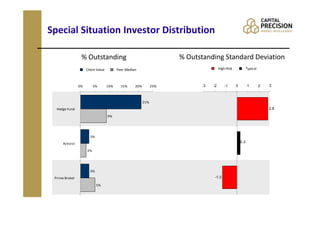
Special Situation Investor Distribution

                  % Outstanding                                        % Outstanding Standard Deviation
                      Client Value         Peer Median                                  High-Risk             Typical


                 0%        5%        10%     15%     20%         25%          -3   -2       -1      0         1         2   3


                                                           21%
  Hedge Fund                                                                                                                2.8

                                     9%


                        3%
      Activist                                                                                          0.3

                      2%


                        3%
 Prime Broker                                                                       -1.3

                             5%
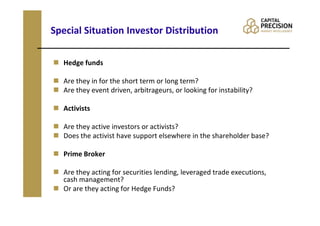
Special Situation Investor Distribution

  Hedge funds

  Are they in for the short term or long term?
  Are they event driven, arbitrageurs, or looking for instability?

  Activists

  Are they active investors or activists?
  Does the activist have support elsewhere in the shareholder base?

  Prime Broker

  Are they acting for securities lending, leveraged trade executions,
  cash management?
  Or are they acting for Hedge Funds?
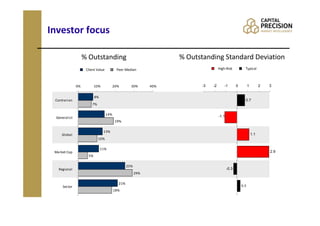
Investor focus

                   % Outstanding                                   % Outstanding Standard Deviation
                    Client Value          Peer Median                               High-Risk           Typical


              0%          10%            20%       30%       40%          -3   -2       -1        0         1         2   3


                          8%
 Contrarian                                                                                             0.7
                        7%

                                   14%
 Generalist                                                                         -1.1
                                          19%

                                13%
     Global                                                                                                     1.1
                             10%

                               11%
 Market Cap                                                                                                               2.9
                     5%

                                                 25%
   Regional                                                                                -0.3
                                                       29%

                                           21%
     Sector                                                                                           0.3
                                         18%
Investor focus

     It is important to be diversified among a broad spectrum of fund focuses

     Who am I attracting? Or equally as important – who have I yet to attract?
        Sector followers? Growth investors? Value players? Market cap specific
        funds?

     Which universe of peers are they comparing me against?

     Which benchmarks are my shares being compared against?

     Heavy weighting in any one focus area can yield swings in ownership and
     share price if the specific focus comes under pressure, or the demand from,
     or fund flows to, those types of funds change
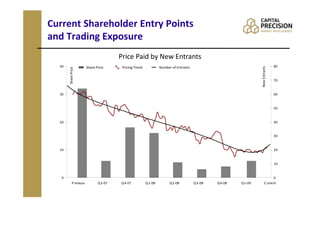
Current Shareholder Entry Points
and Trading Exposure
                                        Price Paid by New Entrants
  40                     Share Price     Pricing Trend           Number of Entrants                                          80


                                                                                                              New Entrants
       Share Price

                                                                                                                             70


  30                                                                                                                         60


                                                                                                                             50


  20                                                                                                                         40


                                                                                                                             30


  10                                                                                                                         20


                                                                                                                             10


   0                                                                                                                      0
             P revious          Q3-07   Q4-07            Q1-08         Q2-08          Q3-08   Q4-08   Q1-09         C urrent
Current Shareholder Entry Points and
Trading Exposure

   It is assumed that investors which have suffered large losses or
   benefited from large gains are more likely to part with their shares.

   The aim is to best estimate when the current shareholders entered
   the stock so as to estimate the number of investors which would be
   considered likely to be at risk.

   The analysis should be viewed in the context of the general market
   and sector performance and be read in conjunction with the active
   versus passive analysis to give a picture of those individual investors
   at risk.
The next steps


   The primary goal of all Targeting Programmes is
   to find investors who have both the appetite and
   the capacity to buy your shares

   It is important is to look at the whole market and
   then filter down and prioritise to identify those
   targets that will best fit with your future
   objectives
How can targets be evaluated?


Step 1. Identify targets with the “Appetite” to buy

  Monitor current buying and selling activity in the peer group

  Monitor current capital flows across the sector

  Monitor current capital flows across the region


                              28
How can targets be evaluated?


Step 2. Identify Targets with the capacity to buy

     Net asset value of the fund
     % Fund exposure to the sector
     % Fund exposure to the country
     % Fund exposure to the rest of world
     Top 10 holdings of each individual fund


                              29
The “Weighting” objective


   Most Targeting methodologies rely on a “Weighting
   Principle”

   This is achieved by identifying funds/institutions that are
   currently overweight in the peers/sector/region but
   underweight in you

   The goal is to be at least fairly weighted

   The objective is to identify funds/institutions that are
   currently buying into the peers/sector/region
Is this objective being achieved?


   No, for two fundamental reasons

   A Weighting Analysis cannot easily be achieved by
   using the usual data sources

   Therefore most Targeting Programmes start from
   an incorrect view of the market and can send you
   in the wrong direction
“Public Data” sources – The problems


   The lack of “up to date” information

   The lack of complete information

   “Public Data” sources do not identify who makes
   the investment decisions for multi-managed and
   outsourced funds
The lack of “up to date” information


   The information that is made available in the
   public domain consists of Regulatory Fund Filings,
   Declarable Stake threshold breaches, “Technical
   Announcements” or Published Fund/Institutional
   Positions

   Both the filing and published information is
   historic by its nature
Weighting Analysis
using “Public Data” sources

   Because there are mostly only Mutual Fund positions in
   the public domain, any Weighting Analysis is immediately
   flawed because it is based on only a partial and historical
   picture of an Institutions true investment behaviour and
   potential

   If you are comparing bespoke researched shareholder
   positions on you against public filings, you are not
   comparing like with like

   the peers may appear “underweight
The lack of complete information

  Mutual Funds only represent (approx) 25% of investments

    Pension Funds
    Sovereign Wealth Funds
    Active and Activist Funds
    Insurance Funds
    Hedge Funds
    Prime Brokerage and Proprietary Desk positions
    Wealth Management
    Stock Lending
    Retail

  FEW IF ANY “FILE” OR APPEAR IN PUBLIC DATABASES
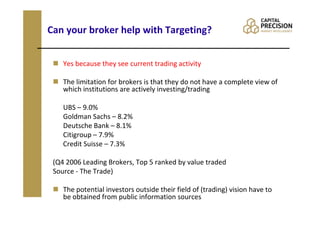
Can your broker help with Targeting?


    Yes because they see current trading activity

    The limitation for brokers is that they do not have a complete view of
    which institutions are actively investing/trading

    UBS – 9.0%
    Goldman Sachs – 8.2%
    Deutsche Bank – 8.1%
    Citigroup – 7.9%
    Credit Suisse – 7.3%

 (Q4 2006 Leading Brokers, Top 5 ranked by value traded
 Source - The Trade)

    The potential investors outside their field of (trading) vision have to
    be obtained from public information sources
End of Part 1


   Targeting

      Define your objectives
      Know your customer
      Prioritise the investment community
      Evaluate your targets
Part 2 – Evaluation of alternative
sources of information

 Publicly available data sources

   The lack of “up to date” information

   The lack of complete information

   “Public Data” sources do not identify who makes
   the investment decisions for multi-managed and
   outsourced funds
The lack of
“up to date” information


 US Mutual Funds - 13F Filings

   4 snapshots in the year

   45 days in which to file

   “Window dressing” & “Bed and Breakfasting”
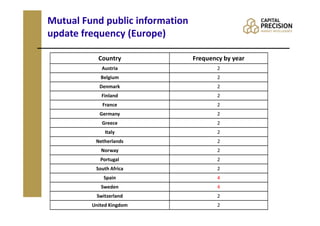
Mutual Fund public information
update frequency (Europe)

           Country               Frequency by year
            Austria                      2
            Belgium                      2
           Denmark                       2
            Finland                      2
             France                      2
            Germany                      2
            Greece                       2
              Italy                      2
          Netherlands                    2
            Norway                       2
            Portugal                     2
          South Africa                   2
             Spain                       4
            Sweden                       4
          Switzerland                    2
         United Kingdom                  2
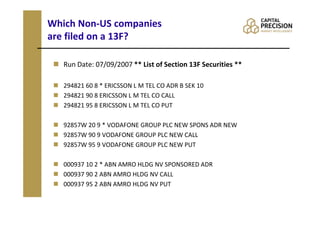
Which Non-US companies
are filed on a 13F?

   Run Date: 07/09/2007 ** List of Section 13F Securities **

   294821 60 8 * ERICSSON L M TEL CO ADR B SEK 10
   294821 90 8 ERICSSON L M TEL CO CALL
   294821 95 8 ERICSSON L M TEL CO PUT

   92857W 20 9 * VODAFONE GROUP PLC NEW SPONS ADR NEW
   92857W 90 9 VODAFONE GROUP PLC NEW CALL
   92857W 95 9 VODAFONE GROUP PLC NEW PUT

   000937 10 2 * ABN AMRO HLDG NV SPONSORED ADR
   000937 90 2 ABN AMRO HLDG NV CALL
   000937 95 2 ABN AMRO HLDG NV PUT
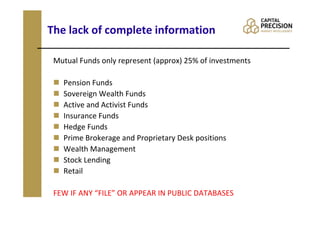
The lack of complete information

 Mutual Funds only represent (approx) 25% of investments

   Pension Funds
   Sovereign Wealth Funds
   Active and Activist Funds
   Insurance Funds
   Hedge Funds
   Prime Brokerage and Proprietary Desk positions
   Wealth Management
   Stock Lending
   Retail

 FEW IF ANY “FILE” OR APPEAR IN PUBLIC DATABASES
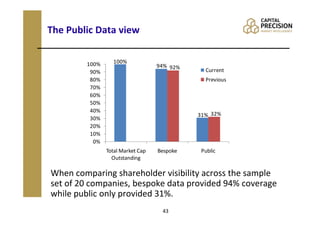
The Public Data view


        100%     100%
                                  94% 92%
         90%                                  Current
         80%                                  Previous
         70%
         60%
         50%
         40%
                                            31% 32%
         30%
         20%
         10%
          0%
               Total Market Cap   Bespoke    Public
                 Outstanding

When comparing shareholder visibility across the sample
set of 20 companies, bespoke data provided 94% coverage
while public only provided 31%.
                                   43
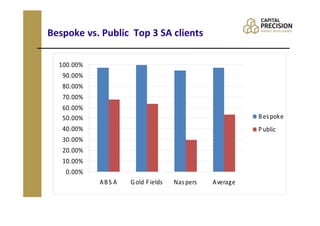
Bespoke vs. Public Top 3 SA clients

  100.00%
   90.00%
   80.00%
   70.00%
   60.00%
   50.00%                                                  B es poke
   40.00%                                                  P ublic
   30.00%
   20.00%
   10.00%
    0.00%
            AB S A   G old F ields   Nas pers   A verage
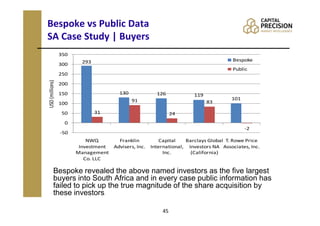
Bespoke vs Public Data
SA Case Study | Buyers
                 350
                         293                                                           Bespoke
                 300
                                                                                       Public
                 250
USD (millions)


                 200
                 150                   130              126            119
                                             91                                       101
                 100                                                         83

                 50            31                              24
                   0
                                                                                            -2
                 -50
                           NWQ         Franklin           Capital   Barclays Global T. Rowe Price
                        Investment   Advisers, Inc.   International, Investors NA Associates, Inc.
                       Management                          Inc.       (California)
                          Co. LLC

           Bespoke revealed the above named investors as the five largest
           buyers into South Africa and in every case public information has
           failed to pick up the true magnitude of the share acquisition by
           these investors.

                                                          45
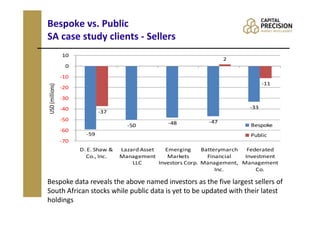
Bespoke vs. Public
SA case study clients - Sellers
                 10
                                                                         2
                  0
                 -10
                                                                                      -11
USD (millions)


                 -20
                 -30
                 -40                                                            -33
                               -37
                 -50                                               -47
                                        -50          -48                         Bespoke
                 -60
                         -59                                                     Public
                 -70
                       D. E. Shaw &   Lazard Asset    Emerging     Batterymarch  Federated
                         Co., Inc.    Management       Markets       Financial  Investment
                                          LLC      Investors Corp. Management, Management
                                                                        Inc.        Co.

Bespoke data reveals the above named investors as the five largest sellers of
South African stocks while public data is yet to be updated with their latest
holdings
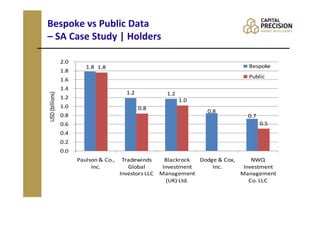
Bespoke vs Public Data
– SA Case Study | Holders

                 2.0
                          1.8 1.8                                                  Bespoke
                 1.8
                                                                                   Public
                 1.6
                 1.4
                                          1.2             1.2
USD (billions)


                 1.2
                                                                1.0
                 1.0                            0.8                   0.8
                 0.8                                                               0.7
                 0.6                                                                     0.5
                 0.4
                 0.2
                 0.0
                       Paulson & Co.,    Tradewinds       Blackrock Dodge & Cox,     NWQ
                            Inc.           Global        Investment     Inc.      Investment
                                        Investors LLC   Management               Management
                                                          (UK) Ltd.                 Co. LLC
Finally, How do you measure whether
you have targeted the right investors?


  Monitor subsequent trading activity

  Determine investor perceptions

  A constantly evolving process

As ferramentas de Targeting

  • 1.
    Capital Precision Ltd InvestorTargeting – Theory and Practice
  • 2.
    Capital Precision Wespecialize in helping Companies (and their Advisory Banks) identify who are the beneficial owners of their shares, who manages the investment decisions and who to target as new investors We are employed for both Investor Relations and Corporate Transaction projects We work for approx 200+ Blue Chip companies and 24 Banks 50+ years of collective experience Awarded the contract to provide CMI Services to the London Stock Exchange IR Solutions team, Nov 2005 2
  • 3.
    Targeting – AComplex Challenge What will happen if you take management on a world tour of investment centres and no-one buys the shares? What shareholder structure are you trying to achieve? How do you decide where to go? How do you decide who to meet with? What criteria did you use to evaluate your targets? How do you know if it was successful?
  • 4.
    Targeting is amarketing discipline Know your customer Who is the customer? What is motivating them to buy (or sell)? What do you need to do to keep them? Where do you find more of the same? How do you determine where they are and what will motivate them to buy? How do you measure whether your IR Programme is working? 4
  • 5.
    Targeting is aboutprioritisation There are over 40,000+ funds under management around the world, you cannot meet them all The challenge is to filter the 40,000 down to the investors who are going to be most interested in your investment story
  • 6.
    Targeting is aboutachieving a balanced shareholder base? Stability or turnover? Passive or active? Country/ Yield Broker High Income Sector Focus Dealer Low Hedge Fund Aggressive Growth Index Growth Value Medium GARP
  • 7.
    Investor Targeting –The objectives Maximize demand for the shares – This cannot be achieved if it is left to the market to determine who will be buying your shares The challenge is to find investors whose investment profile matches your future investment proposition The better the Targeting, the better control there is over the shareholder structure
  • 8.
    Targeting – AStrategic Planning discipline In an ideal world a company would have a clear objective of the types of shareholders they would like to have in the future The targeting process should be based upon anticipating what is likely to happen and not based upon what has happened The targeting process must be measurable
  • 9.
    Structuring the shareholderbase Is there a transaction anticipated? Who will support the company in the transaction? Who holds the voting power? Do you want more passive or active investors? Are you looking for liquidity or stability? Are you looking to diversify the shareholder base? Which shareholders are likely to rotate out and when? Which current investors could buy more shares? Who is not investing yet but could be? Which investors could be activist? Where are the strengths and weaknesses in the shareholder base? 9
  • 10.
    The starting pointfor a Targeting Programme Step 1 - The “stock take” – Where are you now? Does your shareholder base reflect what you believe to be what you represent to the market? The first step is to have a clear understanding of who is already holding your stock and why. The second step is to identify which shareholders could rotate out of the stock in the future The third step is to determine the impact that this selling activity is likely to have on liquidity and smaller investors
  • 11.
    Investors Geographic Distribution % Outstanding % Outstanding Standard Deviation Client Value Peer Median High-Risk Typical 0% 10% 20% 30% 40% -3 -2 -1 0 1 2 3 38% Domestic 2.1 28% United 30% -0.7 Kingdom 35% 18% Rest of World -0.2 20% North 9% -1.3 America 13% 5% Cont. Europe 0.3 4%
  • 12.
    Investor Geographic Distribution Although increased foreign investment is often very much desired, dependence on any one region for support can have significant impact on the turnover of your shareholder base. Geographic considerations Perceived strength of your company’s country or region Regional/Global stability concerns Currency strength/weakness Governmental and/or regulatory impact
  • 13.
    Concentration of Shareholders- % Outstanding Held by Top Investors % Outstanding % Outstanding Standard Deviation Client Value Peer Median High-Risk Typical 0% 20% 40% 60% 80% 100% -3 -2 -1 0 1 2 3 35% Top 5 2.2 22% 45% Top 10 0.6 39% 63% Top 25 0.2 60% 85% Top 50 0.2 80%
  • 14.
    Concentration of Shareholders- Regional Breakdown of % Outstanding Held by Top 25 % Outstanding % Outstanding Standard Deviation Client Value Peer Median High-Risk Typical 0% 5% 10% 15% 20% 25% 30% -3 -2 -1 0 1 2 3 27% Domestic 2.6 15% United 12% -0.3 Kingdom 14% 7% Rest of World -0.4 9% North 14% -1.4 America 19% 3% Cont. Europe 0.0 3%
  • 15.
    Domicile of Top25 Holders % Outstanding % Outstanding Standard Deviation Client Value Peer Median High-Risk Typical 0% 20% 40% 60% 80% -3 -2 -1 0 1 2 3 60% Domestic 1.8 35% United 15% -0.9 Kingdom 19% 5% Rest of World -2.8 15% North 15% -1.3 America 22% 5% Cont. Europe -2.1 9%
  • 16.
    Concentration of Shareholders Although it is often typical and potentially beneficial to have a few “anchor” investors at the top of the shareholder register, a shareholder base that is too concentrated can be cause for concern. Pricing impact Potential to trade in large blocks in the event of a bid or corporate action Disproportionate affect on voting Lower “real” float; liquidity Higher likelihood of regional concentration (as per previous page)
  • 17.
    Size of InvestingFunds % Outstanding % Outstanding Standard Deviation Client Value Peer Median High-Risk Typical 0% 10% 20% 30% 40% 50% -3 -2 -1 0 1 2 3 43% Mega 0.7 36% 32% Large -1.0 42% 16% Mid 0.0 16% 9% Small -0.3 10%
  • 18.
    Size of InvestingFunds Attracting funds of various sizes requires different modes of outreach Larger fund managers Have an abundance of internal resources and heavily rely on in-house research Require direct one-on-one interaction with management Manage a large portfolio of securities which ultimately ends up being closely tied to an index benchmark portfolio Will most probably hold many in your peer group already; will try to outperform through re- weighting on a regular basis Smaller fund managers Less reliant on direct one-on-one management interaction; group meetings may be sufficient Will rely on sell-side analysis due to their limited in-house research Require accessible and good company information, presentations and disclosure Lack the resources to manage a broad portfolio Take large, opportunistic positions in a concentrated number of companies Can buy into or sell out of a large position very quickly
  • 19.
    Active vs. PassiveFunds % Outstanding % Outstanding Standard Deviation Client Value Peer Median High-Risk Typical 0% 20% 40% 60% 80% 100% -3 -2 -1 0 1 2 3 71% Active -0.5 82% 29% Passive 2.4 18%
  • 20.
    Active vs. PassiveFunds A balanced active vs. passive ratio of share owners can be important for the stability of your share price Positive impact of passive funds: Can provide a long-term base of support and demand for your shares Provide day-by-day liquidity Negative impact of passive funds: Supply and demand of your shares is reliant on regional or sector performance, not specific company or management performance Positive impact of Active Funds: Tend to get closer to management and have more interest in the strategic planning and the business development Tend to be less share price sensitive and more milestone achievement focused Will separate your shares from regional or sector related performance Negative impact of active funds: React more quickly and dramatically to negative company fundamental changes and announcements
  • 21.
    Special Situation InvestorDistribution % Outstanding % Outstanding Standard Deviation Client Value Peer Median High-Risk Typical 0% 5% 10% 15% 20% 25% -3 -2 -1 0 1 2 3 21% Hedge Fund 2.8 9% 3% Activist 0.3 2% 3% Prime Broker -1.3 5%
  • 22.
    Special Situation InvestorDistribution Hedge funds Are they in for the short term or long term? Are they event driven, arbitrageurs, or looking for instability? Activists Are they active investors or activists? Does the activist have support elsewhere in the shareholder base? Prime Broker Are they acting for securities lending, leveraged trade executions, cash management? Or are they acting for Hedge Funds?
  • 23.
    Investor focus % Outstanding % Outstanding Standard Deviation Client Value Peer Median High-Risk Typical 0% 10% 20% 30% 40% -3 -2 -1 0 1 2 3 8% Contrarian 0.7 7% 14% Generalist -1.1 19% 13% Global 1.1 10% 11% Market Cap 2.9 5% 25% Regional -0.3 29% 21% Sector 0.3 18%
  • 24.
    Investor focus It is important to be diversified among a broad spectrum of fund focuses Who am I attracting? Or equally as important – who have I yet to attract? Sector followers? Growth investors? Value players? Market cap specific funds? Which universe of peers are they comparing me against? Which benchmarks are my shares being compared against? Heavy weighting in any one focus area can yield swings in ownership and share price if the specific focus comes under pressure, or the demand from, or fund flows to, those types of funds change
  • 25.
    Current Shareholder EntryPoints and Trading Exposure Price Paid by New Entrants 40 Share Price Pricing Trend Number of Entrants 80 New Entrants Share Price 70 30 60 50 20 40 30 10 20 10 0 0 P revious Q3-07 Q4-07 Q1-08 Q2-08 Q3-08 Q4-08 Q1-09 C urrent
  • 26.
    Current Shareholder EntryPoints and Trading Exposure It is assumed that investors which have suffered large losses or benefited from large gains are more likely to part with their shares. The aim is to best estimate when the current shareholders entered the stock so as to estimate the number of investors which would be considered likely to be at risk. The analysis should be viewed in the context of the general market and sector performance and be read in conjunction with the active versus passive analysis to give a picture of those individual investors at risk.
  • 27.
    The next steps The primary goal of all Targeting Programmes is to find investors who have both the appetite and the capacity to buy your shares It is important is to look at the whole market and then filter down and prioritise to identify those targets that will best fit with your future objectives
  • 28.
    How can targetsbe evaluated? Step 1. Identify targets with the “Appetite” to buy Monitor current buying and selling activity in the peer group Monitor current capital flows across the sector Monitor current capital flows across the region 28
  • 29.
    How can targetsbe evaluated? Step 2. Identify Targets with the capacity to buy Net asset value of the fund % Fund exposure to the sector % Fund exposure to the country % Fund exposure to the rest of world Top 10 holdings of each individual fund 29
  • 30.
    The “Weighting” objective Most Targeting methodologies rely on a “Weighting Principle” This is achieved by identifying funds/institutions that are currently overweight in the peers/sector/region but underweight in you The goal is to be at least fairly weighted The objective is to identify funds/institutions that are currently buying into the peers/sector/region
  • 31.
    Is this objectivebeing achieved? No, for two fundamental reasons A Weighting Analysis cannot easily be achieved by using the usual data sources Therefore most Targeting Programmes start from an incorrect view of the market and can send you in the wrong direction
  • 32.
    “Public Data” sources– The problems The lack of “up to date” information The lack of complete information “Public Data” sources do not identify who makes the investment decisions for multi-managed and outsourced funds
  • 33.
    The lack of“up to date” information The information that is made available in the public domain consists of Regulatory Fund Filings, Declarable Stake threshold breaches, “Technical Announcements” or Published Fund/Institutional Positions Both the filing and published information is historic by its nature
  • 34.
    Weighting Analysis using “PublicData” sources Because there are mostly only Mutual Fund positions in the public domain, any Weighting Analysis is immediately flawed because it is based on only a partial and historical picture of an Institutions true investment behaviour and potential If you are comparing bespoke researched shareholder positions on you against public filings, you are not comparing like with like the peers may appear “underweight
  • 35.
    The lack ofcomplete information Mutual Funds only represent (approx) 25% of investments Pension Funds Sovereign Wealth Funds Active and Activist Funds Insurance Funds Hedge Funds Prime Brokerage and Proprietary Desk positions Wealth Management Stock Lending Retail FEW IF ANY “FILE” OR APPEAR IN PUBLIC DATABASES
  • 36.
    Can your brokerhelp with Targeting? Yes because they see current trading activity The limitation for brokers is that they do not have a complete view of which institutions are actively investing/trading UBS – 9.0% Goldman Sachs – 8.2% Deutsche Bank – 8.1% Citigroup – 7.9% Credit Suisse – 7.3% (Q4 2006 Leading Brokers, Top 5 ranked by value traded Source - The Trade) The potential investors outside their field of (trading) vision have to be obtained from public information sources
  • 37.
    End of Part1 Targeting Define your objectives Know your customer Prioritise the investment community Evaluate your targets
  • 38.
    Part 2 –Evaluation of alternative sources of information Publicly available data sources The lack of “up to date” information The lack of complete information “Public Data” sources do not identify who makes the investment decisions for multi-managed and outsourced funds
  • 39.
    The lack of “upto date” information US Mutual Funds - 13F Filings 4 snapshots in the year 45 days in which to file “Window dressing” & “Bed and Breakfasting”
  • 40.
    Mutual Fund publicinformation update frequency (Europe) Country Frequency by year Austria 2 Belgium 2 Denmark 2 Finland 2 France 2 Germany 2 Greece 2 Italy 2 Netherlands 2 Norway 2 Portugal 2 South Africa 2 Spain 4 Sweden 4 Switzerland 2 United Kingdom 2
  • 41.
    Which Non-US companies arefiled on a 13F? Run Date: 07/09/2007 ** List of Section 13F Securities ** 294821 60 8 * ERICSSON L M TEL CO ADR B SEK 10 294821 90 8 ERICSSON L M TEL CO CALL 294821 95 8 ERICSSON L M TEL CO PUT 92857W 20 9 * VODAFONE GROUP PLC NEW SPONS ADR NEW 92857W 90 9 VODAFONE GROUP PLC NEW CALL 92857W 95 9 VODAFONE GROUP PLC NEW PUT 000937 10 2 * ABN AMRO HLDG NV SPONSORED ADR 000937 90 2 ABN AMRO HLDG NV CALL 000937 95 2 ABN AMRO HLDG NV PUT
  • 42.
    The lack ofcomplete information Mutual Funds only represent (approx) 25% of investments Pension Funds Sovereign Wealth Funds Active and Activist Funds Insurance Funds Hedge Funds Prime Brokerage and Proprietary Desk positions Wealth Management Stock Lending Retail FEW IF ANY “FILE” OR APPEAR IN PUBLIC DATABASES
  • 43.
    The Public Dataview 100% 100% 94% 92% 90% Current 80% Previous 70% 60% 50% 40% 31% 32% 30% 20% 10% 0% Total Market Cap Bespoke Public Outstanding When comparing shareholder visibility across the sample set of 20 companies, bespoke data provided 94% coverage while public only provided 31%. 43
  • 44.
    Bespoke vs. PublicTop 3 SA clients 100.00% 90.00% 80.00% 70.00% 60.00% 50.00% B es poke 40.00% P ublic 30.00% 20.00% 10.00% 0.00% AB S A G old F ields Nas pers A verage
  • 45.
    Bespoke vs PublicData SA Case Study | Buyers 350 293 Bespoke 300 Public 250 USD (millions) 200 150 130 126 119 91 101 100 83 50 31 24 0 -2 -50 NWQ Franklin Capital Barclays Global T. Rowe Price Investment Advisers, Inc. International, Investors NA Associates, Inc. Management Inc. (California) Co. LLC Bespoke revealed the above named investors as the five largest buyers into South Africa and in every case public information has failed to pick up the true magnitude of the share acquisition by these investors. 45
  • 46.
    Bespoke vs. Public SAcase study clients - Sellers 10 2 0 -10 -11 USD (millions) -20 -30 -40 -33 -37 -50 -47 -50 -48 Bespoke -60 -59 Public -70 D. E. Shaw & Lazard Asset Emerging Batterymarch Federated Co., Inc. Management Markets Financial Investment LLC Investors Corp. Management, Management Inc. Co. Bespoke data reveals the above named investors as the five largest sellers of South African stocks while public data is yet to be updated with their latest holdings
  • 47.
    Bespoke vs PublicData – SA Case Study | Holders 2.0 1.8 1.8 Bespoke 1.8 Public 1.6 1.4 1.2 1.2 USD (billions) 1.2 1.0 1.0 0.8 0.8 0.8 0.7 0.6 0.5 0.4 0.2 0.0 Paulson & Co., Tradewinds Blackrock Dodge & Cox, NWQ Inc. Global Investment Inc. Investment Investors LLC Management Management (UK) Ltd. Co. LLC
  • 48.
    Finally, How doyou measure whether you have targeted the right investors? Monitor subsequent trading activity Determine investor perceptions A constantly evolving process