Studio.
Methods Book
Shaping our world
through design
rooted in human insight.
Studio.
Who we are
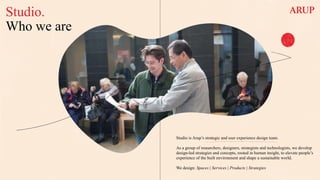
Studio is Arup’s strategic and user experience design team.
As a group of researchers, designers, strategists and technologists, we develop
design-led strategies and concepts, rooted in human insight, to elevate people’s
experience of the built environment and shape a sustainable world.
We design: Spaces | Services | Products | Strategies
Studio.
Introduction
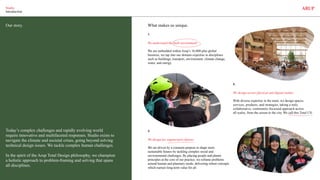
We understand the built environment:
We are embedded within Arup’s 16,000-plus global
business, we tap into our domain expertise in disciplines
such as buildings, transport, environment, climate change,
water, and energy.
We design across physical and digital realms:
With diverse expertise in the team, we design spaces,
services, products, and strategies, taking a truly
collaborative, community-focussed approach across
all scales, from the screen to the city. We call this Total UX.
We design for regenerative futures:
We are driven by a common purpose to shape more
sustainable futures by tackling complex social and
environmental challenges. By placing people and planet-
principles at the core of our practice, we reframe problems
around human and planetary needs, delivering robust concepts
which nurture long-term value for all.
Our story. What makes us unique.
Today’s complex challenges and rapidly evolving world
require innovative and multifaceted responses. Studio exists to
navigate the climate and societal crises, going beyond solving
technical design issues. We tackle complex human challenges.
In the spirit of the Arup Total Design philosophy, we champion
a holistic approach to problem-framing and solving that spans
all disciplines.
1.
2.
3.
“I appreciate that you were okay with
the unknowns and that we didn’t always
know what we wanted and needed, and for
working with us through uncertainty”
East West Rail
Studio.
Introduction
Clients we work with
“Arup helped us to understand how digital
technology can unlock future possibilities.”
Network Rail Telecom
“This report is a cultural signifier of how
we want to approach place-making. The
work offered more than we were originally
thinking, really considering the influence of
technology in the public realm.”
Adur & Worthing Councils
“
“The Digital Buildings Strategy was
instrumental in creating global alignment
and has been reached more than 1000 unique
users across the portfolio globally.
It has greatly impacted how we approach
technical challenges and develop solutions,
bringing in a user-centred perspective.”
Technology Company [Confidential]
“We hope that this report can be the start
of open and collaborative discussions
between the many stakeholders in our
cities to make the transition to better
office districts with better communities.”
IPUT Real Estate Dublin
“Although we knew that people were at
the heart of this agenda, this work has
challenged us to explore the perspectives
of ‘the user’in a structured way.
The report is a concise articulation of the
challenge and a framework within which
each discipline can engage and collaborate.
Arup Retrofit at Scale Taskforce Lead
“
“
Studio.
Introduction
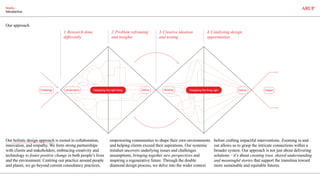
Our holistic design approach is rooted in collaboration,
innovation, and empathy. We form strong partnerships
with clients and stakeholders, embracing creativity and
technology to foster positive change in both people’s lives
and the environment. Centring our practice around people
and planet, we go beyond current consultancy practices,
empowering communities to shape their own environments
and helping clients exceed their aspirations. Our systemic
mindset uncovers underlying issues and challenges
assumptions, bringing together new perspectives and
inspiring a regenerative future. Through the double
diamond design process, we delve into the wider context
before crafting impactful interventions. Zooming in and
out allows us to grasp the intricate connections within a
broader system. Our approach is not just about delivering
solutions – it’s about creating trust, shared understanding
and meaningful stories that support the transition toward
more sustainable and equitable futures.
Studio.
Introduction
1.Research done
differently
2.Problem reframing
and insights
4.Catalysing design
opportunities
3.Creative ideation
and testing
Understand
Challenge Designing the right thing Designing the thing right Impact
Define Develop Deliver
Our approach
Studio.
How we work,
with you
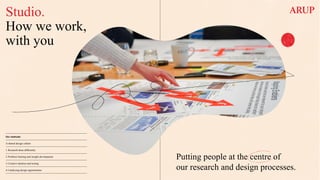
Putting people at the centre of
our research and design processes.
Our methods:
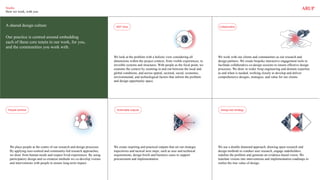
A shared design culture
1.Research done differently
2.Problem framing and insight development
3.Creative ideation and testing
4.Catalysing design opportunities
Studio.
How we work, with you
We place people at the centre of our research and design processes.
By applying user-centred and community-led research approaches,
we draw from human needs and respect lived experiences. By using
participatory design and co-creation methods we co-develop visions
and interventions with people to ensure long-term impact.
We look at the problem with a holistic view considering all
dimensions within the project context; from visible experiences, to
invisible systems and structures. With people as the focal point, we
examine the context by zooming in and out between the local and
global conditions, and across spatial, sectoral, social, economic,
environmental, and technological factors that inform the problem
and design opportunity space.
We work with our clients and communities as our research and
design partners. We create bespoke interactive engagement tools to
facilitate collaborative co-design sessions to ensure effective design
processes. We draw in wider Arup engineering and domain expertise
as and when is needed, working closely to develop and deliver
comprehensive designs, strategies, and value for our clients.
We create inspiring and practical outputs that set out strategic
trajectories and tactical next steps; such as user and technical
requirements, design briefs and business cases to support
procurement and implementation.
We use a double diamond approach, drawing upon research and
design methods to conduct user research, engage stakeholders,
redefine the problem and generate an evidence-based vision. We
translate visions into interventions and implementation roadmaps to
realise the true value of design.
A shared design culture
People-centred Actionable outputs
360º View Collaborative
Design-led strategy
Our practice is centred around embedding
each of these core tenets in our work, for you,
and the communities you work with.
Studio.
How we work
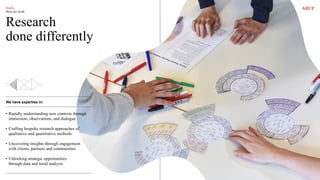
We have expertise in:
Research
done differently
• Rapidly understanding new contexts through
immersion, observations, and dialogue
• Crafting bespoke research approaches of
qualitative and quantitative methods
• Uncovering insights through engagement
with clients, partners and communities
• Unlocking strategic opportunities
through data and trend analysis
Studio.
How we work
• Interviews
Conducting in-depth 1-to-1 interviews
to understand needs, behaviours,
values, and long-term aspirations.
• Field research
Being immersed in the project setting
and context, observing how places
are used, to better understand use,
interactions, goals, and needs.
• Interactive workshops
Working with stakeholders in
engaging workshops to gather
requirements, explore possibilities,
and generate or prioritise ideas.
Creating a shared space for visions
and goals to be devised and agreed.
• Desk research & literature review
Integrating existing knowledge
and visions, aligning the project
strategy and goals with the wider
organisational and community contexts.
• Community researchers
Training and supporting community
members to lead research activities
with peers, from interviews, to
workshops and synthesis.
• Quantitative research
Employing surveys, web analytics,
and building data to identify, user
preferences and behaviours online,
at scale, or over geographically
dispersed locations.
• Trend analysis & benchmarking
Identifying emerging trends and
opportunities to guide targeted
research and design.
• (Digital) ethnography & diary studies
Gathering first-person perspectives of
people’s everyday lives, documenting
their behaviours, and motivations
through digital engagement tools.
Our core methodologies:
Research done differently
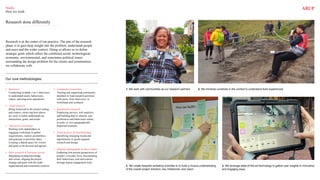
1. We work with communities as our research partners
3. We create bespoke workshop activities to to build a mutual understanding
of the overall project direction, key milestones, and vision
2. We immerse ourselves in the context to understand lived experiences
4. We leverage state-of-the-art technology to gather user insights in innovative
and engaging ways
Research is at the centre of our practice. The aim of the research
phase is to gain deep insight into the problem, understand people
and users and the wider context. Doing so allows us to define
strategic goals which reflect the combined social, technological,
economic, environmental, and sometimes political issues
surrounding the design problem for the clients and communities
we collaborate with.
Studio.
How we work
Studio.
How we work
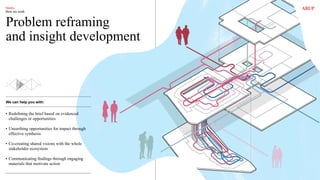
• Redefining the brief based on evidenced
challenges or opportunities
• Unearthing opportunities for impact through
effective synthesis
• Co-creating shared visions with the whole
stakeholder ecosystem
• Communicating findings through engaging
materials that motivate action
Problem reframing
and insight development
We can help you with:
Studio.
How we work
Problem framing
and insight development
Translating research into action relies on effective synthesis.
Findings from primary and secondary research can be distilled into
a range of design hypotheses. We test these hypotheses across our
client and user groups to provoke new design opportunities and
communicate the complexity inherent in strategic design issues.
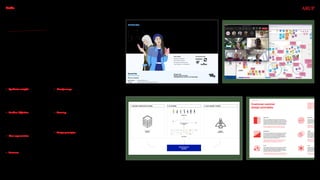
2. We use digital collaboration tools for efficient synthesis of the research
4. We devise user experience principles to steer decisions
1. We craft well-researched personas to illustrate behaviours and needs,
and enable human-centred decision-making
3. We translate insights into frameworks that set the direction for a project
EWR Route Bicester to Oxford, 16 minutes
Solo or Group Travelling with a friend
Journey London to Bicester to Oxford, back to London
29 years old
Tourist to UK from China
Visiting Bicester, Oxford, and Cambridge
Tian as a customer
Tourist Tian
First Time User
Favourite brands
Bold fashion statements
Social media is influence
All answers can be found online
I want to explore - but nothing risky
We Chat
Weibo
Core values
Household Income
Household Members
High-income family owned business
Parents back in Shanghai
Tian is a master’s student from
Shanghai studying business
management.
Coming from a well-off family,
this trip is funded by her father
as a reward for finishing her MBA.
She’s willing to pay for quality and
brand, if she thinks it’s a fair price.
She values a global outlook, new
trends and social media influence.
She suffers from over-active
bladder condition, and so prefers
to know that toilets are nearby.
Travelling Tian
29 years old
Tourist to UK from China
Visiting Bicester, Oxford, and Cambridge
Tourist Tian
First Time User
• Synthesise insights
Synthesising research findings into
actionable insights by identifying
opportunity areas and challenges.
Supported by rich data and crafted
into compelling narratives.
• Problem definition
Setting out the problem, project goals
and the desired future state. Clear
articulation promotes alignment and
helps those involved take ownership
of and enact the strategy.
• User segmentation
Segmenting users by behavioural
characteristics to support tailored
experience propositions.
• Personas
Illustrating user behaviours, needs,
values, and expectations through
captivating human narratives that can
inform design and decision-making.
• User journeys
Stitching experiential moments into
an end-to-end journey or day-in-a-life,
conveying the concepts from a user
perspective and demonstrating how
multiple concepts work together.
• Framing
Devising strategic frameworks to
ensure that concepts respond to the
precise problems, opportunities, and
values of their context.
• Design principles
Developing guiding principles that
can be applied by organisations or a
design team to drive strategic goals
and deliver high-quality consistent
experiences.
Some of the methods we use:
PAGE
-
6
Customer-centred
design principles
Easy to use
Empowering
For all
End-to-end
Trusted
Local
Easy to use, coherent and consistent services provide users
with a sense of familiarity and reassurance wherever they travel.
The service requires minimal thinking by the user and ensures all
components work together seamlessly. Common touch points
and interactions will make the service more approachable and
intuitive, no matter what the unique needs of the user might be.
Whether a seasoned or a first time user, people will be able
to intuitively understand where to go within the interchange.
Services that make people feel valued, inspired and empowered
to achieve what they want in life, not simply getting from A to
B. The design of the service will make people feel in control
to travel how they want to, and get to where they need to go.
Transport services will enable people to explore, discover new
places, and give people their independence.
People will feel valued and cared for by the interchange that
enables them to travel how and when they want to, with
services, amenities and facilities that suits their lives.
Public transport invites use by all, where friendly and accessible
services attend to a diverse range of user needs and make
everyone feel welcome. Services are designed for the breadth
of physical and digital abilities, groups, individuals, cultural and
language diversity, carers, children and animals.
Everyone will be able to access, use and be comfortable with the
interchange and its auxiliary services, regardless of who they are.
Connecting users from before they
including their destination. Users ta
transport network across all modes
The connection to and between diff
seamless, encouraging wider use a
People will focus on what they wan
transport service and infrastructure
Different modes will not be a decisi
Users trust that public transport is
greatest value service available to t
transport service, TfW are transpare
providing a dependable service tha
and the people of Wales, regardles
time or frequent user of the network
Customers can depend on honest a
infrastructure, with an operator in T
account by all people of Wales for t
Cultivating a sense of community fo
culture and etiquettes which enhan
transport builds social bonds and c
to the network and TfW. The servic
providing local communities a feelin
Wherever you are from, the intercha
a sense of community and reflect W
These six principles can b
customer-centred decison
a project. They have been
extensive user research, i
Bus Network customer ex
2 - TOOLKIT ELEMENTS
2. UX CHANNEL
21MF Users
Base-Build
Review
User Journeys &
Needs
OPPORTUNITY
MATRIX
Use Cases
3. LOCAL MARKET CHANNEL
1. BUILDING CONSTRAINTS CHANNEL
Supplier
Engagement
Studio.
How we work
Studio.
How we work
Creative ideation
and testing.
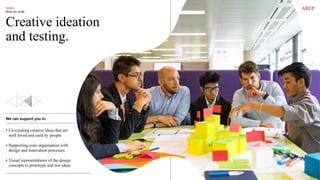
• Co-creating creative ideas that are
well loved and used by people
• Supporting your organisation with
design and innovation processes
• Visual representations of the design
concepts to prototype and test ideas
We can support you in:
Studio.
How we work
• Concept development
Translating desired outcomes into
tangible human experiences by
developing and visualising concepts.
• Service mapping
Visualising a system by mapping
all service components, to identify
existing user touchpoints and
interactions, and to craft an enhanced
end-to-end experience.
• Co-creation design
Work together with communities to
co-create visions for their future.
• Prioritisation
Shortlisting design concepts
which align with strategic goals,
organisational capacity, risks and short
and long-term impact.
Creative ideation and testing
The ideation phase is essential to any design process. Through
ideation potential solutions based on deep insight, and shared future
visions can be devised and tested. Testing ensures concepts are
desirable to communities, and viable for creating real world value.
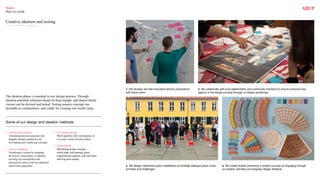
1. We develop and test innovative service propositions
with future users
4. We create shared ownership in project success by engaging through
co-creation activities and bespoke design artefacts
2. We collaborate with local stakeholders and community members to ensure everyone has
agency in the design process through co-design workshops
3. We design interactive public installations to facilitate dialogue about urban
priorities and challenges
Some of our design and ideation methods:
Studio.
How we work
Studio.
How we work
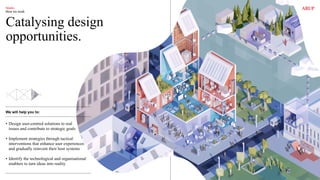
Catalysing design
opportunities.
• Design user-centred solutions to real
issues and contribute to strategic goals
• Implement strategies through tactical
interventions that enhance user experiences
and gradually reinvent their host systems
• Identify the technological and organisational
enablers to turn ideas into reality
We will help you to:
Studio.
How we work
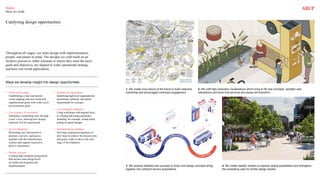
Catalysing design opportunities
1. We create vivid visions of the future to build collective
ownership and encouraged continued engagement
4. We create realistic renders to express radical possibilities and strengthen
the compelling case for further design studies
2. We craft high-resolution visualisations which bring to life new concepts, spotlight user
interactions and show how services and places will transform
3. We produce detailed user journeys to show how design concepts string
together into coherent service propositions
CASTLEGATE
H
A
L
L
A
M
C
E
N
TRALCAMPUS
CCA
AS
STLEGAT
AT
A E
H
A
L
L
A
M
C
E
N
TRALCAMPUS
H
E
A
R
T
O
F
THECITYEXTENDED
We'vecreatedasuccessfulcentralbusinessandcultural
areaaroundPeaceGardens.Nowasimilarapproachisbeing
appliedtothestreetsaroundCambridgeStandPinstoneSt,
combiningshopping,offices,leisureandhomes,ofteninthesame
building,whilstupgradinghistoricstreets,spacesandlandmarks
andsupportingindependentbusinesses.
BUILDINGBLOCKS
ThewesternhalfoftheCIQisbecoming
hometomulti-functionalmixed-useblocks
combiningdistinctiveworkplaces,training
centres,flatsofvarioussizeswithcafésand
shops,allwithaccesstothePorterBrook. RESTORINGTHERIVERS
Likemostgreatcities,Sheffield
developedaroundrivers—yetwe
neglectedthemfordecades.Nowwe
areuncoveringandincreasingaccess
totheDon,theSheafandthePorter
Brook,toenablesmarterfloodwater
handlingaswellasbetterfishing!
BACKTOTHEFUTURE
Castlegatewillbeoneofthekeyareas
fordevelopment,envisagedasatruly
mixed-usesetof‘buildingblocks’,with
adiversityofspaceandtenurefornew
kindsofhightechandcreativework.
Transformationwillbekickstartedby
rediscoveringtheremainsandstories
ofthecastleandhiddenRiverSheaf,
andbyextendingtheGreyto
Greenfloweringwater
meadowstomeetthe
riverDon.
NEW CENTRES OF GRAVITY
Newdevelopmentsdowntowardsthe
rivershelpcreatedifferentcentresof
gravitywithinthecitycentre.Thesewill
behigh-qualitybuildingswithhigh-quality
publicrealm,extendingthe‘GreytoGreen’
networksandcreatingnewpublicspaces
alongsideresidentialandcommercial
opportunities,suchaslargerflooroffices,
hotelsandapartments.
LEARNINGINTHECITY
Wearefortunatetohaveouruniversities
soclosetothecentreofthecity—they
provideenergyandinventionaswellas
newspaces.TheHallamUniversityCampus
Masterplanproposesmoreconcentration
initscentralcampus,aroundtheentry
totheCulturalIndustriesQuarter
andStation,enablingthatareatobe
furthertransformedintosafe,attractive
pedestrian-andcycle-friendlyplaces.
DETAILS OF ALL THESE INITIATIVES
ARE AVAILABLE IN THE FULL PLAN.
FIND WAYS TO ENGAGE OVERLEAF!
DIVERSERESIDENTIAL
RIVERSIDE
CULTURE
CASTLEREMAINS
MIXED-USE
FINE-GRAIN
INCUBATORS
RIVERSIDE
RIVERSIDE
CAFĒ
RESTAURANT
SMALLBUSINESS
PUBLICREALM
RESIDENTIAL
BUSINESS
URBANNATUREPARK
LIVING IN THE CITY
AtKelhamIsland,wecanseenew,sustainablecity
centrehousingemerging,includingfamily-friendly
housingreturningtothecentreforthefirsttime
indecades.Wewillplanformoreverylowenergy
housing,forawiderrangeofpeople,inand
aroundthecitycentre,aswellasthespacesand
amenitiesthatfamiliesneed,suchasanewschool
atnearbyPyeBank.
KELHAMISLAND
NEWMOBILITY
LikemostBritishcities,ourcentre
gotrebuiltaroundthecarinthe
20thcentury.Forthe21st,we
areplanningforflexible,cleaner,
healthierandmoreaccessible
mobility,asseenininrecent
enhancementstotheBrookHill,
LeavygreaveandGlossoproads,
whereweareintroducinghigh-
qualityPriorityStreetsforwalking,
cycling,publictransportandprivate
vehicles.
Diversecitylivingatthe
EyewitnessWorksDevelopment
MakingtheHeartoftheCity
anewcenterofgravity
NewHeartspaceatrium
forSt.George
HS2andHS3offer
opportunitiestoconnectus
muchbetterinternationally,
nationally,andregionally,as
wellastofutureproofthe
stationanditssurrounds.
AnewCentralLibrary
wouldbecomethecity's
livingroom,aplaceto
discussanddiscover.
IncubatorslikeCastleHouse
allowstart-upstoflourish.
W
E
S
T
BARSQUARE
RESTORINGTHERIVERS
Likemostgreatcities,Sheffield
BROOK
POCKETPARK
FLOODRETENTION
BIODIVERSITY
BROOK
NEWMOBILITY
NEWMOBILITY
BIKE
INFRASTRUCTURE
U
NIVERSITYSTGEORGE'S
WALKABLECITY
TRAMNETWORK
GREEN
PUBLICREALM
We'vecreatedasuccessfulcentralbusinessandcultural
areaaroundPeaceGardens.Nowasimilarapproachisbeing
appliedtothestreetsaroundCambridgeStandPinstoneSt,
areaaroundPeaceGardens.Nowasimilarapproachisbeing
appliedtothestreetsaroundCambridgeStandPinstoneSt,
areaaroundPeaceGardens.Nowasimilarapproachisbeing
combiningshopping,offices,leisureandhomes,ofteninthesame
appliedtothestreetsaroundCambridgeStandPinstoneSt,
combiningshopping,offices,leisureandhomes,ofteninthesame
appliedtothestreetsaroundCambridgeStandPinstoneSt,
BIGBUSINESS SMALLBUSINESS
RESIDENTIAL
PUBLICREALM
CULTURE
EDUCATION
PUBLICREALM
CAFĒ
MIXEDUSE
ThewesternhalfoftheCIQisbecoming
hometomulti-functionalmixed-useblocks
ThewesternhalfoftheCIQisbecoming
hometomulti-functionalmixed-useblocks
ThewesternhalfoftheCIQisbecoming
EDUCATION
NATURE
BUSINESS
CAFĒ
COWORK
RESIDENTIAL
ThewesternhalfoftheCIQisbecoming
hometomulti-functionalmixed-useblocks
ThewesternhalfoftheCIQisbecoming
hometomulti-functionalmixed-useblocks
ThewesternhalfoftheCIQisbecoming
combiningdistinctiveworkplaces,training
CULTURALINDUS
T
R
I
E
S
Q
U
A
R
T
E
R
P
O
RTERBROOK
1
8
9
10
11
11
11
11
11
11
12
13
2
3
4
5
5
5
5
6
7
7
18
17
19
20
21
22
14
16
15
GOLDROUTE
STEELROUTE
KNOWLEDGEGATEWAY
GREYTOGREEN
BUSINESS
1 HollySt/CarverStoffices&restaurants
2 PinstoneSt/UnionStoffice&retail
3 HS2andHS3stationmasterplan
4 DigitalCampus
5 CentralBusinessDistrictredevelopment
6 RiversideBusinessDistrictexpansion
7 BroadStWest/ExchangeSquare
mixed-usedevelopment
RETAIL
8 HeartoftheCity2:
living,working,playing,shopping
9 Moor/FurnivalGate:largerretail,bowling&leisure
10 MoorfootconnectiontoLondon/EcclesallRd
11 Independentshopping CASTLEGATE
21 RestorationofOldTownHall
22 CastleHouse:reuseoflistedstore
asTechCoworkingCentre
KNOWLEDGE
12 UoSEngineeringHeartspacenewatrium
13 UoSnewteachingandlaboratorybuilding
CULTURE&LEISURE
17 SiteGalleryexpansion
18 CentralLibrary/GravesArtGallery
relocation/restoration
GREENCITY
19 Newgreenspacesat
Denholme/Woodside/StanleyFields
20 RestoredPorterBrookand
mixedusedevelopments
LIVEABLECITY
14 ClayWoodfamilyhousing
15 ParkHill:flats,offices,studios,schools,art
16 Largernon-studentflatstorent
overoffice,studioorcafé
Mainhigh-qualitypedestrianfriendlyroutes:
TOWNHA
L
L
CATHEDRAL
PONDSFORGECEN
T
R
E
CITYHALL
S
T
GEORGE'SCH
U
R
C
H
Throughout all stages, our team design with implementation,
people, and planet in mind. The designs we craft build on an
iterative process to refine solutions to ensure they meet the users’
goals and objectives, are aligned to wider operational strategy,
and have real world applications.
Ways we develop insight into design opportunities:
• Vision and strategy
Establishing a clear and holistic
vision aligning end-user needs and
organisational goals with wider socio-
environmental goals.
• User journey & storyboard
Narrating a compelling story through
a user’s eyes, showing how design
solutions will be experienced.
• Service blueprints
Illustrating user interactions to
products, services, and spaces,
together with the infrastructure,
systems and support required to
deliver experiences.
• Design concepts
Creating high resolution propositions
that become clear design briefs
for further development and
implementation.
• Enablers & requirements
Identifying high-level organisational,
operational, technical, and spatial
requirements for concepts.
• User testing & validation
Using workshops with targeted users,
or creating and testing prototypes,
including, for example, virtual reality
testing of spatial designs.
• Implementation roadmap
Devising a planned programme of
next steps to achieve the desired aims
and goals, ready to take to the next
stage of development.
Arup Studio Design Methodologies and Approach

Arup Studio Design Methodologies and Approach

  • 1.
    Studio. Methods Book Shaping ourworld through design rooted in human insight.
  • 2.
    Studio. Who we are Studiois Arup’s strategic and user experience design team. As a group of researchers, designers, strategists and technologists, we develop design-led strategies and concepts, rooted in human insight, to elevate people’s experience of the built environment and shape a sustainable world. We design: Spaces | Services | Products | Strategies
  • 3.
    Studio. Introduction We understand thebuilt environment: We are embedded within Arup’s 16,000-plus global business, we tap into our domain expertise in disciplines such as buildings, transport, environment, climate change, water, and energy. We design across physical and digital realms: With diverse expertise in the team, we design spaces, services, products, and strategies, taking a truly collaborative, community-focussed approach across all scales, from the screen to the city. We call this Total UX. We design for regenerative futures: We are driven by a common purpose to shape more sustainable futures by tackling complex social and environmental challenges. By placing people and planet- principles at the core of our practice, we reframe problems around human and planetary needs, delivering robust concepts which nurture long-term value for all. Our story. What makes us unique. Today’s complex challenges and rapidly evolving world require innovative and multifaceted responses. Studio exists to navigate the climate and societal crises, going beyond solving technical design issues. We tackle complex human challenges. In the spirit of the Arup Total Design philosophy, we champion a holistic approach to problem-framing and solving that spans all disciplines. 1. 2. 3.
  • 4.
    “I appreciate thatyou were okay with the unknowns and that we didn’t always know what we wanted and needed, and for working with us through uncertainty” East West Rail Studio. Introduction Clients we work with “Arup helped us to understand how digital technology can unlock future possibilities.” Network Rail Telecom “This report is a cultural signifier of how we want to approach place-making. The work offered more than we were originally thinking, really considering the influence of technology in the public realm.” Adur & Worthing Councils “ “The Digital Buildings Strategy was instrumental in creating global alignment and has been reached more than 1000 unique users across the portfolio globally. It has greatly impacted how we approach technical challenges and develop solutions, bringing in a user-centred perspective.” Technology Company [Confidential] “We hope that this report can be the start of open and collaborative discussions between the many stakeholders in our cities to make the transition to better office districts with better communities.” IPUT Real Estate Dublin “Although we knew that people were at the heart of this agenda, this work has challenged us to explore the perspectives of ‘the user’in a structured way. The report is a concise articulation of the challenge and a framework within which each discipline can engage and collaborate. Arup Retrofit at Scale Taskforce Lead “ “
  • 5.
    Studio. Introduction Our holistic designapproach is rooted in collaboration, innovation, and empathy. We form strong partnerships with clients and stakeholders, embracing creativity and technology to foster positive change in both people’s lives and the environment. Centring our practice around people and planet, we go beyond current consultancy practices, empowering communities to shape their own environments and helping clients exceed their aspirations. Our systemic mindset uncovers underlying issues and challenges assumptions, bringing together new perspectives and inspiring a regenerative future. Through the double diamond design process, we delve into the wider context before crafting impactful interventions. Zooming in and out allows us to grasp the intricate connections within a broader system. Our approach is not just about delivering solutions – it’s about creating trust, shared understanding and meaningful stories that support the transition toward more sustainable and equitable futures. Studio. Introduction 1.Research done differently 2.Problem reframing and insights 4.Catalysing design opportunities 3.Creative ideation and testing Understand Challenge Designing the right thing Designing the thing right Impact Define Develop Deliver Our approach
  • 6.
    Studio. How we work, withyou Putting people at the centre of our research and design processes. Our methods: A shared design culture 1.Research done differently 2.Problem framing and insight development 3.Creative ideation and testing 4.Catalysing design opportunities
  • 7.
    Studio. How we work,with you We place people at the centre of our research and design processes. By applying user-centred and community-led research approaches, we draw from human needs and respect lived experiences. By using participatory design and co-creation methods we co-develop visions and interventions with people to ensure long-term impact. We look at the problem with a holistic view considering all dimensions within the project context; from visible experiences, to invisible systems and structures. With people as the focal point, we examine the context by zooming in and out between the local and global conditions, and across spatial, sectoral, social, economic, environmental, and technological factors that inform the problem and design opportunity space. We work with our clients and communities as our research and design partners. We create bespoke interactive engagement tools to facilitate collaborative co-design sessions to ensure effective design processes. We draw in wider Arup engineering and domain expertise as and when is needed, working closely to develop and deliver comprehensive designs, strategies, and value for our clients. We create inspiring and practical outputs that set out strategic trajectories and tactical next steps; such as user and technical requirements, design briefs and business cases to support procurement and implementation. We use a double diamond approach, drawing upon research and design methods to conduct user research, engage stakeholders, redefine the problem and generate an evidence-based vision. We translate visions into interventions and implementation roadmaps to realise the true value of design. A shared design culture People-centred Actionable outputs 360º View Collaborative Design-led strategy Our practice is centred around embedding each of these core tenets in our work, for you, and the communities you work with.
  • 8.
    Studio. How we work Wehave expertise in: Research done differently • Rapidly understanding new contexts through immersion, observations, and dialogue • Crafting bespoke research approaches of qualitative and quantitative methods • Uncovering insights through engagement with clients, partners and communities • Unlocking strategic opportunities through data and trend analysis
  • 9.
    Studio. How we work •Interviews Conducting in-depth 1-to-1 interviews to understand needs, behaviours, values, and long-term aspirations. • Field research Being immersed in the project setting and context, observing how places are used, to better understand use, interactions, goals, and needs. • Interactive workshops Working with stakeholders in engaging workshops to gather requirements, explore possibilities, and generate or prioritise ideas. Creating a shared space for visions and goals to be devised and agreed. • Desk research & literature review Integrating existing knowledge and visions, aligning the project strategy and goals with the wider organisational and community contexts. • Community researchers Training and supporting community members to lead research activities with peers, from interviews, to workshops and synthesis. • Quantitative research Employing surveys, web analytics, and building data to identify, user preferences and behaviours online, at scale, or over geographically dispersed locations. • Trend analysis & benchmarking Identifying emerging trends and opportunities to guide targeted research and design. • (Digital) ethnography & diary studies Gathering first-person perspectives of people’s everyday lives, documenting their behaviours, and motivations through digital engagement tools. Our core methodologies: Research done differently 1. We work with communities as our research partners 3. We create bespoke workshop activities to to build a mutual understanding of the overall project direction, key milestones, and vision 2. We immerse ourselves in the context to understand lived experiences 4. We leverage state-of-the-art technology to gather user insights in innovative and engaging ways Research is at the centre of our practice. The aim of the research phase is to gain deep insight into the problem, understand people and users and the wider context. Doing so allows us to define strategic goals which reflect the combined social, technological, economic, environmental, and sometimes political issues surrounding the design problem for the clients and communities we collaborate with.
  • 10.
    Studio. How we work Studio. Howwe work • Redefining the brief based on evidenced challenges or opportunities • Unearthing opportunities for impact through effective synthesis • Co-creating shared visions with the whole stakeholder ecosystem • Communicating findings through engaging materials that motivate action Problem reframing and insight development We can help you with:
  • 11.
    Studio. How we work Problemframing and insight development Translating research into action relies on effective synthesis. Findings from primary and secondary research can be distilled into a range of design hypotheses. We test these hypotheses across our client and user groups to provoke new design opportunities and communicate the complexity inherent in strategic design issues. 2. We use digital collaboration tools for efficient synthesis of the research 4. We devise user experience principles to steer decisions 1. We craft well-researched personas to illustrate behaviours and needs, and enable human-centred decision-making 3. We translate insights into frameworks that set the direction for a project EWR Route Bicester to Oxford, 16 minutes Solo or Group Travelling with a friend Journey London to Bicester to Oxford, back to London 29 years old Tourist to UK from China Visiting Bicester, Oxford, and Cambridge Tian as a customer Tourist Tian First Time User Favourite brands Bold fashion statements Social media is influence All answers can be found online I want to explore - but nothing risky We Chat Weibo Core values Household Income Household Members High-income family owned business Parents back in Shanghai Tian is a master’s student from Shanghai studying business management. Coming from a well-off family, this trip is funded by her father as a reward for finishing her MBA. She’s willing to pay for quality and brand, if she thinks it’s a fair price. She values a global outlook, new trends and social media influence. She suffers from over-active bladder condition, and so prefers to know that toilets are nearby. Travelling Tian 29 years old Tourist to UK from China Visiting Bicester, Oxford, and Cambridge Tourist Tian First Time User • Synthesise insights Synthesising research findings into actionable insights by identifying opportunity areas and challenges. Supported by rich data and crafted into compelling narratives. • Problem definition Setting out the problem, project goals and the desired future state. Clear articulation promotes alignment and helps those involved take ownership of and enact the strategy. • User segmentation Segmenting users by behavioural characteristics to support tailored experience propositions. • Personas Illustrating user behaviours, needs, values, and expectations through captivating human narratives that can inform design and decision-making. • User journeys Stitching experiential moments into an end-to-end journey or day-in-a-life, conveying the concepts from a user perspective and demonstrating how multiple concepts work together. • Framing Devising strategic frameworks to ensure that concepts respond to the precise problems, opportunities, and values of their context. • Design principles Developing guiding principles that can be applied by organisations or a design team to drive strategic goals and deliver high-quality consistent experiences. Some of the methods we use: PAGE - 6 Customer-centred design principles Easy to use Empowering For all End-to-end Trusted Local Easy to use, coherent and consistent services provide users with a sense of familiarity and reassurance wherever they travel. The service requires minimal thinking by the user and ensures all components work together seamlessly. Common touch points and interactions will make the service more approachable and intuitive, no matter what the unique needs of the user might be. Whether a seasoned or a first time user, people will be able to intuitively understand where to go within the interchange. Services that make people feel valued, inspired and empowered to achieve what they want in life, not simply getting from A to B. The design of the service will make people feel in control to travel how they want to, and get to where they need to go. Transport services will enable people to explore, discover new places, and give people their independence. People will feel valued and cared for by the interchange that enables them to travel how and when they want to, with services, amenities and facilities that suits their lives. Public transport invites use by all, where friendly and accessible services attend to a diverse range of user needs and make everyone feel welcome. Services are designed for the breadth of physical and digital abilities, groups, individuals, cultural and language diversity, carers, children and animals. Everyone will be able to access, use and be comfortable with the interchange and its auxiliary services, regardless of who they are. Connecting users from before they including their destination. Users ta transport network across all modes The connection to and between diff seamless, encouraging wider use a People will focus on what they wan transport service and infrastructure Different modes will not be a decisi Users trust that public transport is greatest value service available to t transport service, TfW are transpare providing a dependable service tha and the people of Wales, regardles time or frequent user of the network Customers can depend on honest a infrastructure, with an operator in T account by all people of Wales for t Cultivating a sense of community fo culture and etiquettes which enhan transport builds social bonds and c to the network and TfW. The servic providing local communities a feelin Wherever you are from, the intercha a sense of community and reflect W These six principles can b customer-centred decison a project. They have been extensive user research, i Bus Network customer ex 2 - TOOLKIT ELEMENTS 2. UX CHANNEL 21MF Users Base-Build Review User Journeys & Needs OPPORTUNITY MATRIX Use Cases 3. LOCAL MARKET CHANNEL 1. BUILDING CONSTRAINTS CHANNEL Supplier Engagement
  • 12.
    Studio. How we work Studio. Howwe work Creative ideation and testing. • Co-creating creative ideas that are well loved and used by people • Supporting your organisation with design and innovation processes • Visual representations of the design concepts to prototype and test ideas We can support you in:
  • 13.
    Studio. How we work •Concept development Translating desired outcomes into tangible human experiences by developing and visualising concepts. • Service mapping Visualising a system by mapping all service components, to identify existing user touchpoints and interactions, and to craft an enhanced end-to-end experience. • Co-creation design Work together with communities to co-create visions for their future. • Prioritisation Shortlisting design concepts which align with strategic goals, organisational capacity, risks and short and long-term impact. Creative ideation and testing The ideation phase is essential to any design process. Through ideation potential solutions based on deep insight, and shared future visions can be devised and tested. Testing ensures concepts are desirable to communities, and viable for creating real world value. 1. We develop and test innovative service propositions with future users 4. We create shared ownership in project success by engaging through co-creation activities and bespoke design artefacts 2. We collaborate with local stakeholders and community members to ensure everyone has agency in the design process through co-design workshops 3. We design interactive public installations to facilitate dialogue about urban priorities and challenges Some of our design and ideation methods:
  • 14.
    Studio. How we work Studio. Howwe work Catalysing design opportunities. • Design user-centred solutions to real issues and contribute to strategic goals • Implement strategies through tactical interventions that enhance user experiences and gradually reinvent their host systems • Identify the technological and organisational enablers to turn ideas into reality We will help you to:
  • 15.
    Studio. How we work Catalysingdesign opportunities 1. We create vivid visions of the future to build collective ownership and encouraged continued engagement 4. We create realistic renders to express radical possibilities and strengthen the compelling case for further design studies 2. We craft high-resolution visualisations which bring to life new concepts, spotlight user interactions and show how services and places will transform 3. We produce detailed user journeys to show how design concepts string together into coherent service propositions CASTLEGATE H A L L A M C E N TRALCAMPUS CCA AS STLEGAT AT A E H A L L A M C E N TRALCAMPUS H E A R T O F THECITYEXTENDED We'vecreatedasuccessfulcentralbusinessandcultural areaaroundPeaceGardens.Nowasimilarapproachisbeing appliedtothestreetsaroundCambridgeStandPinstoneSt, combiningshopping,offices,leisureandhomes,ofteninthesame building,whilstupgradinghistoricstreets,spacesandlandmarks andsupportingindependentbusinesses. BUILDINGBLOCKS ThewesternhalfoftheCIQisbecoming hometomulti-functionalmixed-useblocks combiningdistinctiveworkplaces,training centres,flatsofvarioussizeswithcafésand shops,allwithaccesstothePorterBrook. RESTORINGTHERIVERS Likemostgreatcities,Sheffield developedaroundrivers—yetwe neglectedthemfordecades.Nowwe areuncoveringandincreasingaccess totheDon,theSheafandthePorter Brook,toenablesmarterfloodwater handlingaswellasbetterfishing! BACKTOTHEFUTURE Castlegatewillbeoneofthekeyareas fordevelopment,envisagedasatruly mixed-usesetof‘buildingblocks’,with adiversityofspaceandtenurefornew kindsofhightechandcreativework. Transformationwillbekickstartedby rediscoveringtheremainsandstories ofthecastleandhiddenRiverSheaf, andbyextendingtheGreyto Greenfloweringwater meadowstomeetthe riverDon. NEW CENTRES OF GRAVITY Newdevelopmentsdowntowardsthe rivershelpcreatedifferentcentresof gravitywithinthecitycentre.Thesewill behigh-qualitybuildingswithhigh-quality publicrealm,extendingthe‘GreytoGreen’ networksandcreatingnewpublicspaces alongsideresidentialandcommercial opportunities,suchaslargerflooroffices, hotelsandapartments. LEARNINGINTHECITY Wearefortunatetohaveouruniversities soclosetothecentreofthecity—they provideenergyandinventionaswellas newspaces.TheHallamUniversityCampus Masterplanproposesmoreconcentration initscentralcampus,aroundtheentry totheCulturalIndustriesQuarter andStation,enablingthatareatobe furthertransformedintosafe,attractive pedestrian-andcycle-friendlyplaces. DETAILS OF ALL THESE INITIATIVES ARE AVAILABLE IN THE FULL PLAN. FIND WAYS TO ENGAGE OVERLEAF! DIVERSERESIDENTIAL RIVERSIDE CULTURE CASTLEREMAINS MIXED-USE FINE-GRAIN INCUBATORS RIVERSIDE RIVERSIDE CAFĒ RESTAURANT SMALLBUSINESS PUBLICREALM RESIDENTIAL BUSINESS URBANNATUREPARK LIVING IN THE CITY AtKelhamIsland,wecanseenew,sustainablecity centrehousingemerging,includingfamily-friendly housingreturningtothecentreforthefirsttime indecades.Wewillplanformoreverylowenergy housing,forawiderrangeofpeople,inand aroundthecitycentre,aswellasthespacesand amenitiesthatfamiliesneed,suchasanewschool atnearbyPyeBank. KELHAMISLAND NEWMOBILITY LikemostBritishcities,ourcentre gotrebuiltaroundthecarinthe 20thcentury.Forthe21st,we areplanningforflexible,cleaner, healthierandmoreaccessible mobility,asseenininrecent enhancementstotheBrookHill, LeavygreaveandGlossoproads, whereweareintroducinghigh- qualityPriorityStreetsforwalking, cycling,publictransportandprivate vehicles. Diversecitylivingatthe EyewitnessWorksDevelopment MakingtheHeartoftheCity anewcenterofgravity NewHeartspaceatrium forSt.George HS2andHS3offer opportunitiestoconnectus muchbetterinternationally, nationally,andregionally,as wellastofutureproofthe stationanditssurrounds. AnewCentralLibrary wouldbecomethecity's livingroom,aplaceto discussanddiscover. IncubatorslikeCastleHouse allowstart-upstoflourish. W E S T BARSQUARE RESTORINGTHERIVERS Likemostgreatcities,Sheffield Likemostgreatcities,Sheffield BROOK POCKETPARK FLOODRETENTION BIODIVERSITY BROOK NEWMOBILITY NEWMOBILITY BIKE INFRASTRUCTURE U NIVERSITYSTGEORGE'S WALKABLECITY TRAMNETWORK GREEN PUBLICREALM We'vecreatedasuccessfulcentralbusinessandcultural areaaroundPeaceGardens.Nowasimilarapproachisbeing appliedtothestreetsaroundCambridgeStandPinstoneSt, areaaroundPeaceGardens.Nowasimilarapproachisbeing appliedtothestreetsaroundCambridgeStandPinstoneSt, areaaroundPeaceGardens.Nowasimilarapproachisbeing combiningshopping,offices,leisureandhomes,ofteninthesame appliedtothestreetsaroundCambridgeStandPinstoneSt, combiningshopping,offices,leisureandhomes,ofteninthesame appliedtothestreetsaroundCambridgeStandPinstoneSt, BIGBUSINESS SMALLBUSINESS RESIDENTIAL PUBLICREALM CULTURE EDUCATION PUBLICREALM CAFĒ MIXEDUSE ThewesternhalfoftheCIQisbecoming hometomulti-functionalmixed-useblocks ThewesternhalfoftheCIQisbecoming hometomulti-functionalmixed-useblocks ThewesternhalfoftheCIQisbecoming EDUCATION NATURE BUSINESS CAFĒ COWORK RESIDENTIAL ThewesternhalfoftheCIQisbecoming hometomulti-functionalmixed-useblocks ThewesternhalfoftheCIQisbecoming hometomulti-functionalmixed-useblocks ThewesternhalfoftheCIQisbecoming combiningdistinctiveworkplaces,training CULTURALINDUS T R I E S Q U A R T E R P O RTERBROOK 1 8 9 10 11 11 11 11 11 11 12 13 2 3 4 5 5 5 5 6 7 7 18 17 19 20 21 22 14 16 15 GOLDROUTE STEELROUTE KNOWLEDGEGATEWAY GREYTOGREEN BUSINESS 1 HollySt/CarverStoffices&restaurants 2 PinstoneSt/UnionStoffice&retail 3 HS2andHS3stationmasterplan 4 DigitalCampus 5 CentralBusinessDistrictredevelopment 6 RiversideBusinessDistrictexpansion 7 BroadStWest/ExchangeSquare mixed-usedevelopment RETAIL 8 HeartoftheCity2: living,working,playing,shopping 9 Moor/FurnivalGate:largerretail,bowling&leisure 10 MoorfootconnectiontoLondon/EcclesallRd 11 Independentshopping CASTLEGATE 21 RestorationofOldTownHall 22 CastleHouse:reuseoflistedstore asTechCoworkingCentre KNOWLEDGE 12 UoSEngineeringHeartspacenewatrium 13 UoSnewteachingandlaboratorybuilding CULTURE&LEISURE 17 SiteGalleryexpansion 18 CentralLibrary/GravesArtGallery relocation/restoration GREENCITY 19 Newgreenspacesat Denholme/Woodside/StanleyFields 20 RestoredPorterBrookand mixedusedevelopments LIVEABLECITY 14 ClayWoodfamilyhousing 15 ParkHill:flats,offices,studios,schools,art 16 Largernon-studentflatstorent overoffice,studioorcafé Mainhigh-qualitypedestrianfriendlyroutes: TOWNHA L L CATHEDRAL PONDSFORGECEN T R E CITYHALL S T GEORGE'SCH U R C H Throughout all stages, our team design with implementation, people, and planet in mind. The designs we craft build on an iterative process to refine solutions to ensure they meet the users’ goals and objectives, are aligned to wider operational strategy, and have real world applications. Ways we develop insight into design opportunities: • Vision and strategy Establishing a clear and holistic vision aligning end-user needs and organisational goals with wider socio- environmental goals. • User journey & storyboard Narrating a compelling story through a user’s eyes, showing how design solutions will be experienced. • Service blueprints Illustrating user interactions to products, services, and spaces, together with the infrastructure, systems and support required to deliver experiences. • Design concepts Creating high resolution propositions that become clear design briefs for further development and implementation. • Enablers & requirements Identifying high-level organisational, operational, technical, and spatial requirements for concepts. • User testing & validation Using workshops with targeted users, or creating and testing prototypes, including, for example, virtual reality testing of spatial designs. • Implementation roadmap Devising a planned programme of next steps to achieve the desired aims and goals, ready to take to the next stage of development.