1
Contents
Artificial Intelligence
It is the science and engineering of making
intelligent machines, especially intelligent
computer programs. It is related to the similar
task of using computers to understand
human intelligence.
2
AI can have two purposes:-
• To use a computer's artificial intelligence to
understand how humans think.
• To use a computer’s artificial intelligence to make it
work as a human brain.
Major Branches of AI
 Perceptive system
 A system that approximates the way a human sees, hears, and
feels objects
 Vision system
 Capture, store, and manipulate visual images and pictures
 Robotics
 Mechanical and computer devices that perform tedious tasks
with high precision
 Expert system
 Stores knowledge and makes inferences
3
4
 Learning system
 Computer changes how it functions or reacts to situations based
on feedback
 Natural language processing
 Computers understand and react to statements and commands
made in a “natural” language, such as English
 Neural network
 Computer system that can act like or simulate the functioning of
the human brain
Classifications of AI
 Classified by design
 Symbolic AI – Designers explicitly program all of the AI
“knowledge.”
 Connectionist AI – Designers “teach” an artificial
neural network what the AI needs to “know.”
 Evolutionary AI – Designers give the AI the ability to
refine itself.
5
Components/ Software of AI
Three Main Components of A.I.
 Speech Synthesis
 Speech Recognition
 Logical Reasoning
Two Main Software/Programming Languages
• Prolog
• Lisp
6
PROLOG (Programming in Logic)
• Where other programming languages tell the computer
how to do something, PROLOG tells the computer what to
do.
• PROLOG does this by reasoning out the variables and
parameters stored in the computers memory.
• The key to PROLOG programming is writing clear, precise
parameters.
• With these precise variables and parameters PROLOG is
able to use its built-in reasoning mechanism called
“backtracking” to solve any user-entered queries.
7
LISP (LISt Processor)
• List- Important information arranged in an ordered
sequence.
• The flexibility of LISP allow the programmer to use a
wide range of things from system programs to system
processes without having to state them in advance.
• This flexibility is allowed because LISP doesn’t use a
backtracking mechanism, however one can easily be
equipped to the processor.
• In today's world LISP has several features that make
development easier, which has it viewed as a
programming standard.
8
Uses of Artificial Intelligence
 Robotics
 Medical
 Video games
 Expert System
 Natural Language
 Speech Reconization
 Computer Vision
Robotics
Data Mining
 An application that allows the computer to learn from
its environment
Eg. Smart Cars, self-parking cars can parallel park
themselves with out hitting any other objects around it.
10
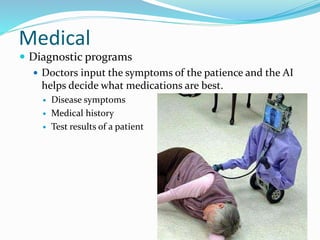
Medical
 Diagnostic programs
 Doctors input the symptoms of the patience and the AI
helps decide what medications are best.
 Disease symptoms
 Medical history
 Test results of a patient
11
Video Games
 AI
 What you do in the game will determine how the
computer reacts
 Ex. An enemy see’s your character, the computer’s
reaction is to attack your character.
12
Jobs and Employment
 Smarter computers and robots increases the amount of
jobs they can do
 Decreasing the amount of people needed for different
jobs
 Increasing unemployment
13
Social Effects of AI
Conclusion
 In it’s short existence, AI has increased
understanding of the nature of intelligence and
provided an impressive array of application in a
wide range of areas. It has sharpened
understanding of human reasoning, and of the
nature of intelligence in general. At the same
time, it has revealed the complexity of modeling
human reasoning providing new areas and rich
challenges for the future.
14
15

Artificial_Intelligence_ppt_presentation.pptx

  • 1.
  • 2.
    Artificial Intelligence It isthe science and engineering of making intelligent machines, especially intelligent computer programs. It is related to the similar task of using computers to understand human intelligence. 2 AI can have two purposes:- • To use a computer's artificial intelligence to understand how humans think. • To use a computer’s artificial intelligence to make it work as a human brain.
  • 3.
    Major Branches ofAI  Perceptive system  A system that approximates the way a human sees, hears, and feels objects  Vision system  Capture, store, and manipulate visual images and pictures  Robotics  Mechanical and computer devices that perform tedious tasks with high precision  Expert system  Stores knowledge and makes inferences 3
  • 4.
    4  Learning system Computer changes how it functions or reacts to situations based on feedback  Natural language processing  Computers understand and react to statements and commands made in a “natural” language, such as English  Neural network  Computer system that can act like or simulate the functioning of the human brain
  • 5.
    Classifications of AI Classified by design  Symbolic AI – Designers explicitly program all of the AI “knowledge.”  Connectionist AI – Designers “teach” an artificial neural network what the AI needs to “know.”  Evolutionary AI – Designers give the AI the ability to refine itself. 5
  • 6.
    Components/ Software ofAI Three Main Components of A.I.  Speech Synthesis  Speech Recognition  Logical Reasoning Two Main Software/Programming Languages • Prolog • Lisp 6
  • 7.
    PROLOG (Programming inLogic) • Where other programming languages tell the computer how to do something, PROLOG tells the computer what to do. • PROLOG does this by reasoning out the variables and parameters stored in the computers memory. • The key to PROLOG programming is writing clear, precise parameters. • With these precise variables and parameters PROLOG is able to use its built-in reasoning mechanism called “backtracking” to solve any user-entered queries. 7
  • 8.
    LISP (LISt Processor) •List- Important information arranged in an ordered sequence. • The flexibility of LISP allow the programmer to use a wide range of things from system programs to system processes without having to state them in advance. • This flexibility is allowed because LISP doesn’t use a backtracking mechanism, however one can easily be equipped to the processor. • In today's world LISP has several features that make development easier, which has it viewed as a programming standard. 8
  • 9.
    Uses of ArtificialIntelligence  Robotics  Medical  Video games  Expert System  Natural Language  Speech Reconization  Computer Vision
  • 10.
    Robotics Data Mining  Anapplication that allows the computer to learn from its environment Eg. Smart Cars, self-parking cars can parallel park themselves with out hitting any other objects around it. 10
  • 11.
    Medical  Diagnostic programs Doctors input the symptoms of the patience and the AI helps decide what medications are best.  Disease symptoms  Medical history  Test results of a patient 11
  • 12.
    Video Games  AI What you do in the game will determine how the computer reacts  Ex. An enemy see’s your character, the computer’s reaction is to attack your character. 12
  • 13.
    Jobs and Employment Smarter computers and robots increases the amount of jobs they can do  Decreasing the amount of people needed for different jobs  Increasing unemployment 13 Social Effects of AI
  • 14.
    Conclusion  In it’sshort existence, AI has increased understanding of the nature of intelligence and provided an impressive array of application in a wide range of areas. It has sharpened understanding of human reasoning, and of the nature of intelligence in general. At the same time, it has revealed the complexity of modeling human reasoning providing new areas and rich challenges for the future. 14
  • 15.