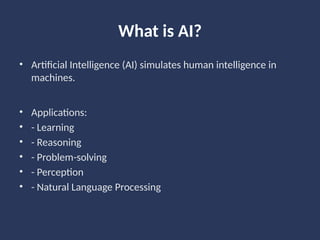
What is AI?
•Artificial Intelligence (AI) simulates human intelligence in
machines.
• Applications:
• - Learning
• - Reasoning
• - Problem-solving
• - Perception
• - Natural Language Processing
3.
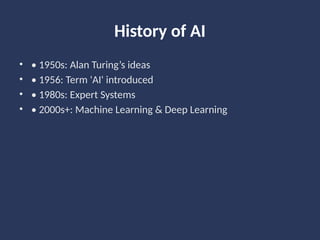
History of AI
•• 1950s: Alan Turing’s ideas
• • 1956: Term 'AI' introduced
• • 1980s: Expert Systems
• • 2000s+: Machine Learning & Deep Learning
4.
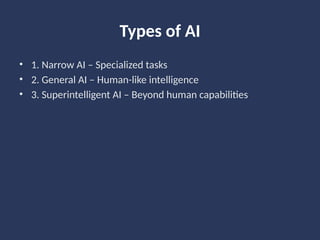
Types of AI
•1. Narrow AI – Specialized tasks
• 2. General AI – Human-like intelligence
• 3. Superintelligent AI – Beyond human capabilities
5.
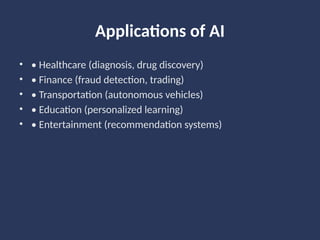
Applications of AI
•• Healthcare (diagnosis, drug discovery)
• • Finance (fraud detection, trading)
• • Transportation (autonomous vehicles)
• • Education (personalized learning)
• • Entertainment (recommendation systems)
6.
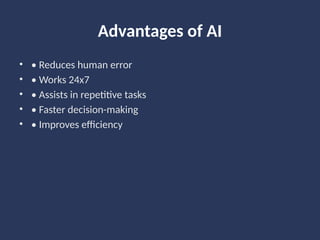
Advantages of AI
•• Reduces human error
• • Works 24x7
• • Assists in repetitive tasks
• • Faster decision-making
• • Improves efficiency
7.
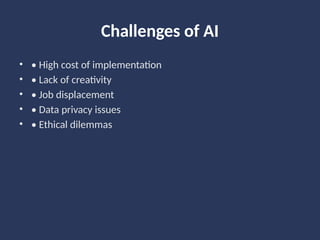
Challenges of AI
•• High cost of implementation
• • Lack of creativity
• • Job displacement
• • Data privacy issues
• • Ethical dilemmas
8.
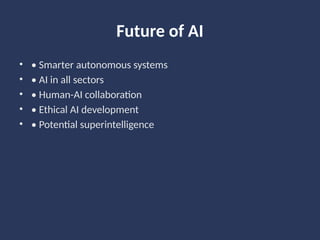
Future of AI
•• Smarter autonomous systems
• • AI in all sectors
• • Human-AI collaboration
• • Ethical AI development
• • Potential superintelligence
9.
AI in DailyLife
• • Virtual assistants (Siri, Alexa)
• • Online recommendations
• • Spam filters
• • Maps & navigation
• • Smart home devices
10.
Conclusion
• Artificial Intelligenceis reshaping the world.
• If used responsibly, AI can drive progress while addressing
challenges for a safe, ethical future.



![AI_presentation_AICT[1] [Read-Only].pptx](https://cdn.slidesharecdn.com/ss_thumbnails/aipresentationaict1read-only-250905174825-38ac6625-thumbnail.jpg?width=640&height=640&fit=bounds)
![AI_presentation_AICT[1] [Read-Only].pptx](https://cdn.slidesharecdn.com/ss_thumbnails/aipresentationaict1read-only-250905174916-d5ef4934-thumbnail.jpg?width=640&height=640&fit=bounds)
![AI_presentation_AICT[1] [Read-Only].pptx](https://cdn.slidesharecdn.com/ss_thumbnails/aipresentationaict1read-only-250905175118-16902bff-thumbnail.jpg?width=640&height=640&fit=bounds)


![Download Chimera Tool Setup V42.47.0924 [Latest Version]](https://cdn.slidesharecdn.com/ss_thumbnails/artificialintelligence4-250505221011-8e660a4e-thumbnail.jpg?width=640&height=640&fit=bounds)


