Submitted to MAM SADIA SAHAR
SUBMITTED BY AMARA MUSARAT, AMNA
ASHRAF, REDA SHAHEEN, RIDA MARIAM,
SADIA MUNAWAR, SAYYEDA UMMARA,
SAIMINA FALAK SHER
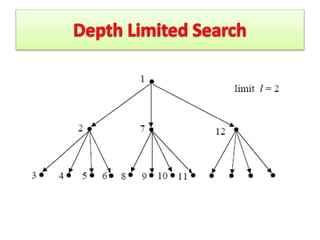
• DLS is a variation of DFS. If we put a limit l on
how deep a depth first search can go,
• we can guarantee that the search will
terminate (either in success or failure).
• If there is at least one goal state at a depth
less than L, this algorithm is guaranteed to
find a goal state, but it is not guaranteed to
find an optimal path.
• The space complexity is O(bl), and the time
complexity is O(bl).
• For most problems we will not know what is a
good limit L until we have solved the problem!
• If L < D (solution depth) then it will be
incomplete. Difficult to know D. If L > D, may
be non-optimal.
• L can be set from knowledge of a domain.
• The search is limited to a predefined depth.
• The depth of each state is recorded as it is
generated. When picking the next state to
expand, only those with depth less or equal
than the current depth are expanded.
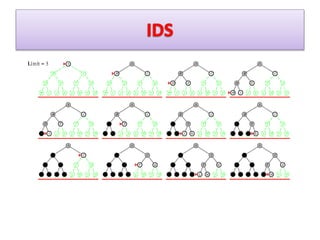
• IDS is a variation of DLS.
• Combines the benefits of depth-first and
breadth-first search.
• It is complete and optimal.
• It has time complexity of O(bd).
• But space complexity is only O(bd).
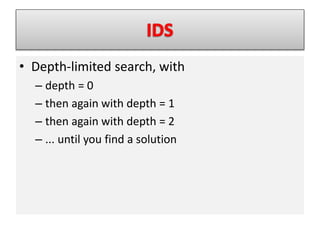
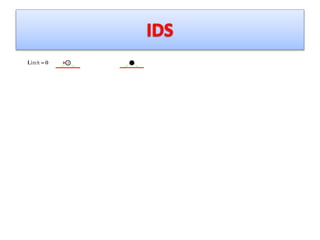
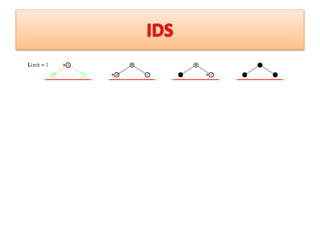
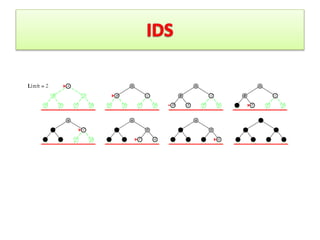
• Depth-limited search, with
– depth = 0
– then again with depth = 1
– then again with depth = 2
– ... until you find a solution
• Complete?
– Yes
• Time?
– The time complexity is O(bd) as in BFS, which is
better than DFS.
• Space?
– The space complexity is O(bd) as in DLS with l=d,
which is better than BFS.
• Optimal?
– Yes, if step cost = 1
Artificial intelligence searches

Artificial intelligence searches

  • 1.
    Submitted to MAMSADIA SAHAR SUBMITTED BY AMARA MUSARAT, AMNA ASHRAF, REDA SHAHEEN, RIDA MARIAM, SADIA MUNAWAR, SAYYEDA UMMARA, SAIMINA FALAK SHER
  • 2.
    • DLS isa variation of DFS. If we put a limit l on how deep a depth first search can go, • we can guarantee that the search will terminate (either in success or failure).
  • 4.
    • If thereis at least one goal state at a depth less than L, this algorithm is guaranteed to find a goal state, but it is not guaranteed to find an optimal path. • The space complexity is O(bl), and the time complexity is O(bl). • For most problems we will not know what is a good limit L until we have solved the problem!
  • 5.
    • If L< D (solution depth) then it will be incomplete. Difficult to know D. If L > D, may be non-optimal. • L can be set from knowledge of a domain. • The search is limited to a predefined depth. • The depth of each state is recorded as it is generated. When picking the next state to expand, only those with depth less or equal than the current depth are expanded.
  • 6.
    • IDS isa variation of DLS. • Combines the benefits of depth-first and breadth-first search. • It is complete and optimal. • It has time complexity of O(bd). • But space complexity is only O(bd).
  • 7.
    • Depth-limited search,with – depth = 0 – then again with depth = 1 – then again with depth = 2 – ... until you find a solution
  • 12.
    • Complete? – Yes •Time? – The time complexity is O(bd) as in BFS, which is better than DFS. • Space? – The space complexity is O(bd) as in DLS with l=d, which is better than BFS. • Optimal? – Yes, if step cost = 1

Editor's Notes

  • #7 If the lowest depth of a goal state is not known, we can always find the best limit L for DLS by trying all possible depths L= 0, 1, 2, 3, … in turn, and stopping once we have achieved a goal state. This appears wasteful because all the DLS for l less than the goal level are useless, and many states are expanded many times. However, in practice, most of the time is spent at the deepest part of the search tree, so the algorithm actually combines the benefits of DFS and BFS
  • #8 Because all the nodes are expanded at each level, the algorithm is complete and optimal like BFS, but has the modest memory requirements of DFS. Exercise: if we had plenty of memory, could/should we avoid expanding the top level states many times? The space complexity is O(bd) as in DLS with l = d, which is better than BFS. The time complexity is O(bd) as in BFS, which is better than DFS.