January 26, 2003 AI: Chapter 3: Solving Problems
by Searching
1
Artificial Intelligence
Chapter 3: Solving Problems by
Searching
Michael Scherger
Department of Computer
Science
Kent State University
January 26, 2003 AI: Chapter 3: Solving Problems
by Searching
2
Problem Solving Agents
• Problem solving agent
– A kind of “goal based” agent
– Finds sequences of actions that lead to
desirable states.
• The algorithms are uninformed
– No extra information about the problem
other than the definition
• No extra information
• No heuristics (rules)
January 26, 2003 AI: Chapter 3: Solving Problems
by Searching
3
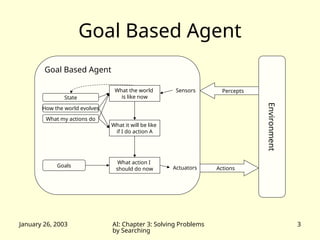
Goal Based Agent
Goal Based Agent
Environment
Percepts
Actions
What the world
is like now
Sensors
Actuators
What action I
should do now
Goals
State
How the world evolves
What my actions do
What it will be like
if I do action A
January 26, 2003 AI: Chapter 3: Solving Problems
by Searching
4
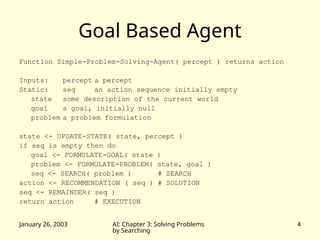
Goal Based Agent
Function Simple-Problem-Solving-Agent( percept ) returns action
Inputs: percept a percept
Static: seq an action sequence initially empty
state some description of the current world
goal a goal, initially null
problem a problem formulation
state <- UPDATE-STATE( state, percept )
if seq is empty then do
goal <- FORMULATE-GOAL( state )
problem <- FORMULATE-PROBLEM( state, goal )
seq <- SEARCH( problem ) # SEARCH
action <- RECOMMENDATION ( seq ) # SOLUTION
seq <- REMAINDER( seq )
return action # EXECUTION
January 26, 2003 AI: Chapter 3: Solving Problems
by Searching
5
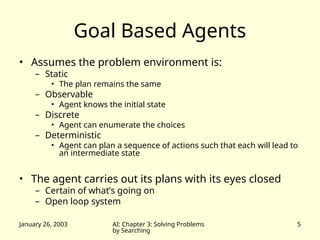
Goal Based Agents
• Assumes the problem environment is:
– Static
• The plan remains the same
– Observable
• Agent knows the initial state
– Discrete
• Agent can enumerate the choices
– Deterministic
• Agent can plan a sequence of actions such that each will lead to
an intermediate state
• The agent carries out its plans with its eyes closed
– Certain of what’s going on
– Open loop system
January 26, 2003 AI: Chapter 3: Solving Problems
by Searching
6
Well Defined Problems and
Solutions
• A problem
– Initial state
– Actions and Successor Function
– Goal test
– Path cost
January 26, 2003 AI: Chapter 3: Solving Problems
by Searching
7
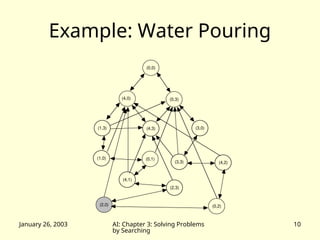
Example: Water Pouring
• Given a 4 gallon bucket and a 3 gallon
bucket, how can we measure exactly 2
gallons into one bucket?
– There are no markings on the bucket
– You must fill each bucket completely
January 26, 2003 AI: Chapter 3: Solving Problems
by Searching
8
Example: Water Pouring
• Initial state:
– The buckets are empty
– Represented by the tuple ( 0 0 )
• Goal state:
– One of the buckets has two gallons of water in it
– Represented by either ( x 2 ) or ( 2 x )
• Path cost:
– 1 per unit step
January 26, 2003 AI: Chapter 3: Solving Problems
by Searching
9
Example: Water Pouring
• Actions and Successor Function
– Fill a bucket
• (x y) -> (3 y)
• (x y) -> (x 4)
– Empty a bucket
• (x y) -> (0 y)
• (x y) -> (x 0)
– Pour contents of one bucket into another
• (x y) -> (0 x+y) or (x+y-4, 4)
• (x y) -> (x+y 0) or (3, x+y-3)
January 26, 2003 AI: Chapter 3: Solving Problems
by Searching
10
Example: Water Pouring
(0,0)
(4,0) (0,3)
(4,3) (3,0)
(1,3)
(3,3)
(1,0) (0,1)
(4,1)
(2,3)
(2,0) (0,2)
(4,2)
January 26, 2003 AI: Chapter 3: Solving Problems
by Searching
11
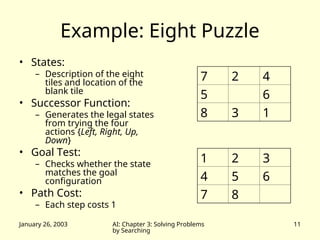
Example: Eight Puzzle
• States:
– Description of the eight
tiles and location of the
blank tile
• Successor Function:
– Generates the legal states
from trying the four
actions {Left, Right, Up,
Down}
• Goal Test:
– Checks whether the state
matches the goal
configuration
• Path Cost:
– Each step costs 1
7 2 4
5 6
8 3 1
1 2 3
4 5 6
7 8
January 26, 2003 AI: Chapter 3: Solving Problems
by Searching
12
Example: Eight Puzzle
• Eight puzzle is from a family of “sliding –
block puzzles”
– NP Complete
– 8 puzzle has 9!/2 = 181440 states
– 15 puzzle has approx. 1.3*1012
states
– 24 puzzle has approx. 1*1025
states
January 26, 2003 AI: Chapter 3: Solving Problems
by Searching
13
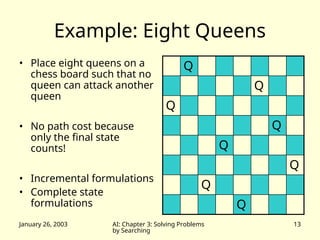
Example: Eight Queens
• Place eight queens on a
chess board such that no
queen can attack another
queen
• No path cost because
only the final state
counts!
• Incremental formulations
• Complete state
formulations Q
Q
Q
Q
Q
Q
Q
Q
January 26, 2003 AI: Chapter 3: Solving Problems
by Searching
14
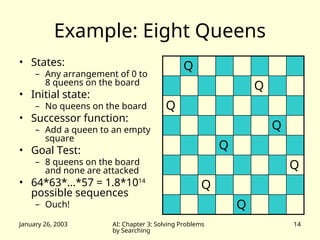
Example: Eight Queens
• States:
– Any arrangement of 0 to
8 queens on the board
• Initial state:
– No queens on the board
• Successor function:
– Add a queen to an empty
square
• Goal Test:
– 8 queens on the board
and none are attacked
• 64*63*…*57 = 1.8*1014
possible sequences
– Ouch! Q
Q
Q
Q
Q
Q
Q
Q
January 26, 2003 AI: Chapter 3: Solving Problems
by Searching
15
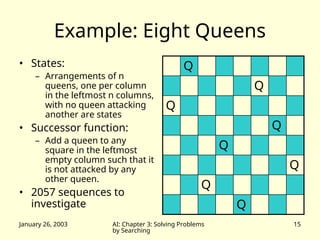
Example: Eight Queens
• States:
– Arrangements of n
queens, one per column
in the leftmost n columns,
with no queen attacking
another are states
• Successor function:
– Add a queen to any
square in the leftmost
empty column such that it
is not attacked by any
other queen.
• 2057 sequences to
investigate Q
Q
Q
Q
Q
Q
Q
Q
January 26, 2003 AI: Chapter 3: Solving Problems
by Searching
16
Other Toy Examples
• Another Example: Jug Fill
• Another Example: Black White Marbles
• Another Example: Row Boat Problem
• Another Example: Sliding Blocks
• Another Example: Triangle Tee
January 26, 2003 AI: Chapter 3: Solving Problems
by Searching
17
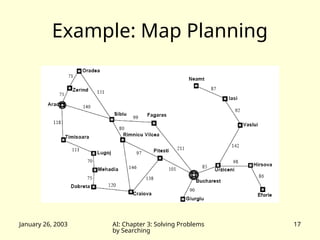
Example: Map Planning
January 26, 2003 AI: Chapter 3: Solving Problems
by Searching
18
Searching For Solutions
• Initial State
– e.g. “At Arad”
• Successor Function
– A set of action state pairs
– S(Arad) = {(Arad->Zerind, Zerind), …}
• Goal Test
– e.g. x = “at Bucharest”
• Path Cost
– sum of the distances traveled
January 26, 2003 AI: Chapter 3: Solving Problems
by Searching
19
Searching For Solutions
• Having formulated some problems…
how do we solve them?
• Search through a state space
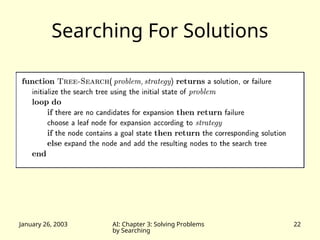
• Use a search tree that is generated with
an initial state and successor functions
that define the state space
January 26, 2003 AI: Chapter 3: Solving Problems
by Searching
20
Searching For Solutions
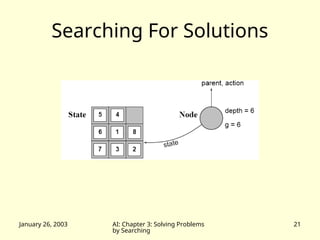
• A state is (a representation of) a physical configuration
• A node is a data structure constituting part of a search
tree
– Includes parent, children, depth, path cost
• States do not have children, depth, or path cost
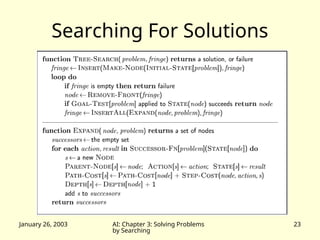
• The EXPAND function creates new nodes, filling in the
various fields and using the SUCCESSOR function of the
problem to create the corresponding states
January 26, 2003 AI: Chapter 3: Solving Problems
by Searching
21
Searching For Solutions
January 26, 2003 AI: Chapter 3: Solving Problems
by Searching
22
Searching For Solutions
January 26, 2003 AI: Chapter 3: Solving Problems
by Searching
23
Searching For Solutions
January 26, 2003 AI: Chapter 3: Solving Problems
by Searching
24
Uninformed Search Strategies
• Uninformed strategies use only the
information available in the problem definition
– Also known as blind searching
• Breadth-first search
• Uniform-cost search
• Depth-first search
• Depth-limited search
• Iterative deepening search
January 26, 2003 AI: Chapter 3: Solving Problems
by Searching
25
Comparing Uninformed Search
Strategies
• Completeness
– Will a solution always be found if one exists?
• Time
– How long does it take to find the solution?
– Often represented as the number of nodes searched
• Space
– How much memory is needed to perform the search?
– Often represented as the maximum number of nodes stored
at once
• Optimal
– Will the optimal (least cost) solution be found?
• Page 81 in AIMA text
January 26, 2003 AI: Chapter 3: Solving Problems
by Searching
26
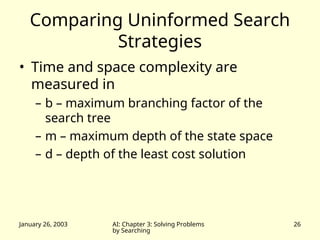
Comparing Uninformed Search
Strategies
• Time and space complexity are
measured in
– b – maximum branching factor of the
search tree
– m – maximum depth of the state space
– d – depth of the least cost solution
January 26, 2003 AI: Chapter 3: Solving Problems
by Searching
27
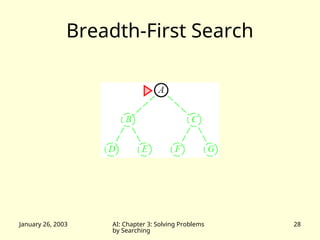
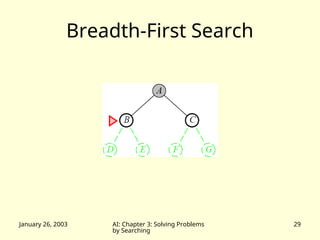
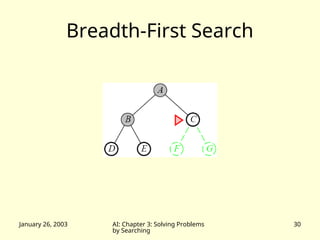
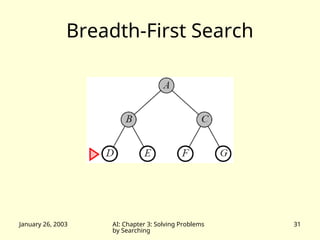
Breadth-First Search
• Recall from Data Structures the basic
algorithm for a breadth-first search on a
graph or tree
• Expand the shallowest unexpanded node
• Place all new successors at the end of a
FIFO queue
January 26, 2003 AI: Chapter 3: Solving Problems
by Searching
28
Breadth-First Search
January 26, 2003 AI: Chapter 3: Solving Problems
by Searching
29
Breadth-First Search
January 26, 2003 AI: Chapter 3: Solving Problems
by Searching
30
Breadth-First Search
January 26, 2003 AI: Chapter 3: Solving Problems
by Searching
31
Breadth-First Search
January 26, 2003 AI: Chapter 3: Solving Problems
by Searching
32
Properties of Breadth-First
Search
• Complete
– Yes if b (max branching factor) is finite
• Time
– 1 + b + b2
+ … + bd
+ b(bd
-1) = O(bd+1
)
– exponential in d
• Space
– O(bd+1
)
– Keeps every node in memory
– This is the big problem; an agent that generates nodes at 10
MB/sec will produce 860 MB in 24 hours
• Optimal
– Yes (if cost is 1 per step); not optimal in general
January 26, 2003 AI: Chapter 3: Solving Problems
by Searching
33
Lessons From Breadth First
Search
• The memory requirements are a bigger
problem for breadth-first search than is
execution time
• Exponential-complexity search
problems cannot be solved by
uniformed methods for any but the
smallest instances
January 26, 2003 AI: Chapter 3: Solving Problems
by Searching
34
Uniform-Cost Search
• Same idea as the algorithm for breadth-
first search…but…
– Expand the least-cost unexpanded node
– FIFO queue is ordered by cost
– Equivalent to regular breadth-first search if
all step costs are equal
January 26, 2003 AI: Chapter 3: Solving Problems
by Searching
35
Uniform-Cost Search
• Complete
– Yes if the cost is greater than some threshold
– step cost >= ε
• Time
– Complexity cannot be determined easily by d or d
– Let C* be the cost of the optimal solution
– O(bceil(C*/ ε)
)
• Space
– O(bceil(C*/ ε)
)
• Optimal
– Yes, Nodes are expanded in increasing order
January 26, 2003 AI: Chapter 3: Solving Problems
by Searching
36
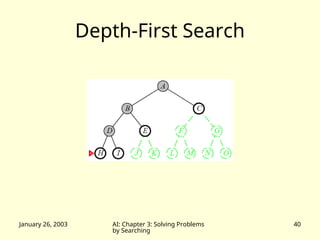
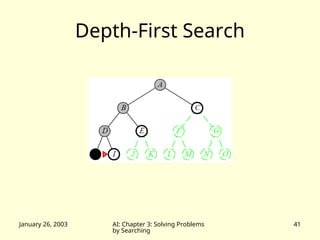
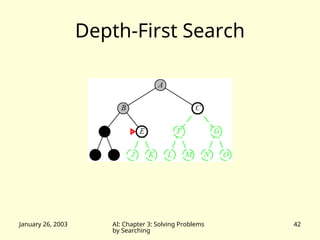
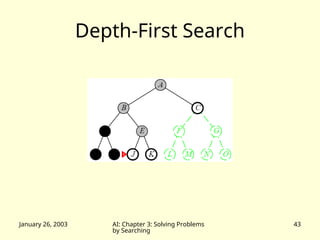
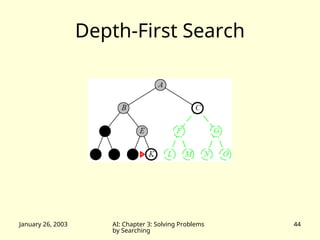
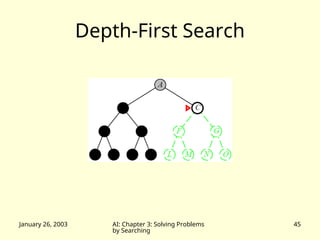
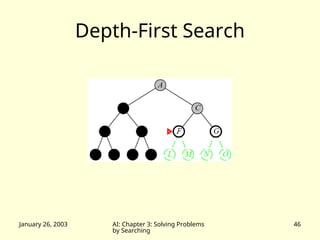
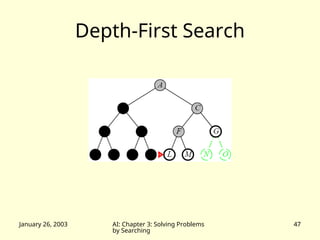
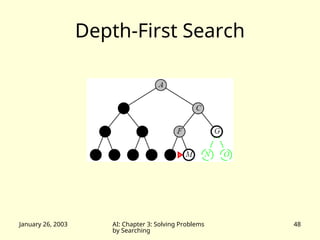
Depth-First Search
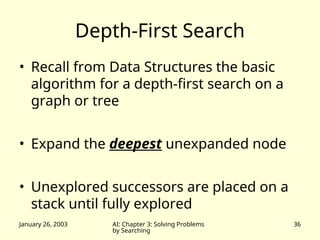
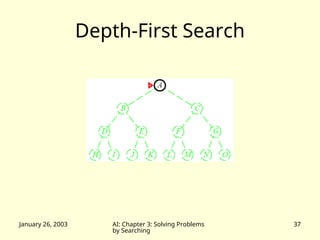
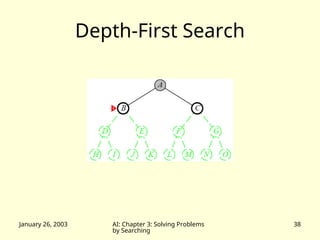
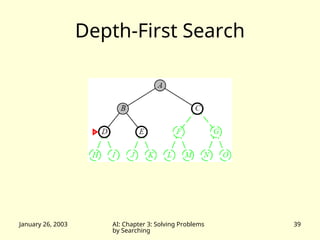
• Recall from Data Structures the basic
algorithm for a depth-first search on a
graph or tree
• Expand the deepest unexpanded node
• Unexplored successors are placed on a
stack until fully explored
January 26, 2003 AI: Chapter 3: Solving Problems
by Searching
37
Depth-First Search
January 26, 2003 AI: Chapter 3: Solving Problems
by Searching
38
Depth-First Search
January 26, 2003 AI: Chapter 3: Solving Problems
by Searching
39
Depth-First Search
January 26, 2003 AI: Chapter 3: Solving Problems
by Searching
40
Depth-First Search
January 26, 2003 AI: Chapter 3: Solving Problems
by Searching
41
Depth-First Search
January 26, 2003 AI: Chapter 3: Solving Problems
by Searching
42
Depth-First Search
January 26, 2003 AI: Chapter 3: Solving Problems
by Searching
43
Depth-First Search
January 26, 2003 AI: Chapter 3: Solving Problems
by Searching
44
Depth-First Search
January 26, 2003 AI: Chapter 3: Solving Problems
by Searching
45
Depth-First Search
January 26, 2003 AI: Chapter 3: Solving Problems
by Searching
46
Depth-First Search
January 26, 2003 AI: Chapter 3: Solving Problems
by Searching
47
Depth-First Search
January 26, 2003 AI: Chapter 3: Solving Problems
by Searching
48
Depth-First Search
January 26, 2003 AI: Chapter 3: Solving Problems
by Searching
49
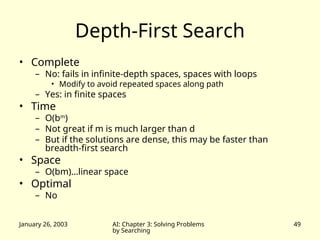
Depth-First Search
• Complete
– No: fails in infinite-depth spaces, spaces with loops
• Modify to avoid repeated spaces along path
– Yes: in finite spaces
• Time
– O(bm
)
– Not great if m is much larger than d
– But if the solutions are dense, this may be faster than
breadth-first search
• Space
– O(bm)…linear space
• Optimal
– No
January 26, 2003 AI: Chapter 3: Solving Problems
by Searching
50
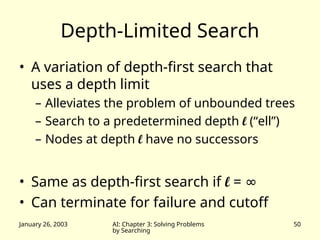
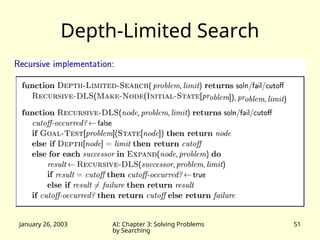
Depth-Limited Search
• A variation of depth-first search that
uses a depth limit
– Alleviates the problem of unbounded trees
– Search to a predetermined depth l (“ell”)
– Nodes at depth l have no successors
• Same as depth-first search if l = ∞
• Can terminate for failure and cutoff
January 26, 2003 AI: Chapter 3: Solving Problems
by Searching
51
Depth-Limited Search
January 26, 2003 AI: Chapter 3: Solving Problems
by Searching
52
Depth-Limited Search
• Complete
– Yes if l < d
• Time
– O(bl
)
• Space
– O(bl)
• Optimal
– No if l > d
January 26, 2003 AI: Chapter 3: Solving Problems
by Searching
53
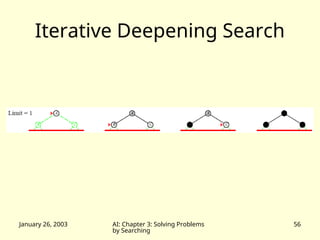
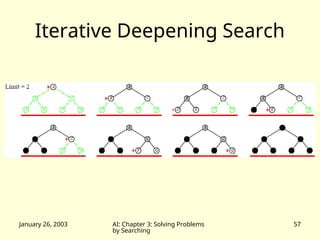
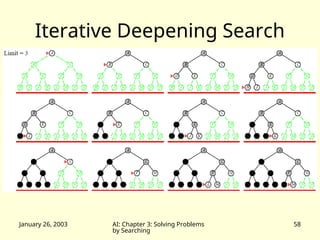
Iterative Deepening Search
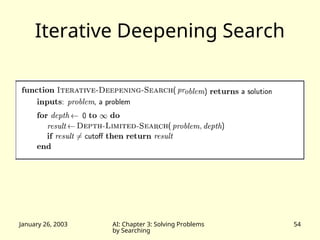
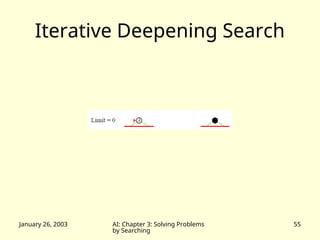
• Iterative deepening depth-first search
– Uses depth-first search
– Finds the best depth limit
• Gradually increases the depth limit; 0, 1, 2, …
until a goal is found
January 26, 2003 AI: Chapter 3: Solving Problems
by Searching
54
Iterative Deepening Search
January 26, 2003 AI: Chapter 3: Solving Problems
by Searching
55
Iterative Deepening Search
January 26, 2003 AI: Chapter 3: Solving Problems
by Searching
56
Iterative Deepening Search
January 26, 2003 AI: Chapter 3: Solving Problems
by Searching
57
Iterative Deepening Search
January 26, 2003 AI: Chapter 3: Solving Problems
by Searching
58
Iterative Deepening Search
January 26, 2003 AI: Chapter 3: Solving Problems
by Searching
59
Iterative Deepening Search
• Complete
– Yes
• Time
– O(bd
)
• Space
– O(bd)
• Optimal
– Yes if step cost = 1
– Can be modified to explore uniform cost tree
January 26, 2003 AI: Chapter 3: Solving Problems
by Searching
60
Lessons From Iterative
Deepening Search
• Faster than BFS even though IDS
generates repeated states
– BFS generates nodes up to level d+1
– IDS only generates nodes up to level d
• In general, iterative deepening search is
the preferred uninformed search method
when there is a large search space and
the depth of the solution is not known
January 26, 2003 AI: Chapter 3: Solving Problems
by Searching
61
Avoiding Repeated States
• Complication of wasting time by expanding
states that have already been encountered
and expanded before
– Failure to detect repeated states can turn a linear
problem into an exponential one
• Sometimes, repeated states are unavoidable
– Problems where the actions are reversable
• Route finding
• Sliding blocks puzzles
January 26, 2003 AI: Chapter 3: Solving Problems
by Searching
62
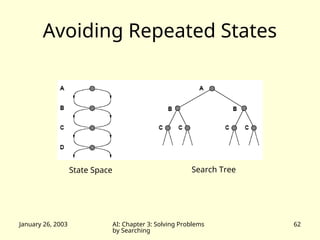
Avoiding Repeated States
State Space Search Tree
January 26, 2003 AI: Chapter 3: Solving Problems
by Searching
63
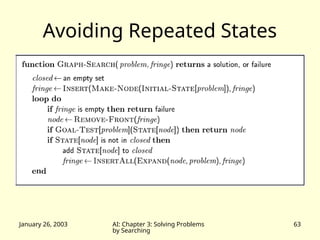
Avoiding Repeated States
Artificial intelligence chapter three power point

  • 1.
    January 26, 2003AI: Chapter 3: Solving Problems by Searching 1 Artificial Intelligence Chapter 3: Solving Problems by Searching Michael Scherger Department of Computer Science Kent State University
  • 2.
    January 26, 2003AI: Chapter 3: Solving Problems by Searching 2 Problem Solving Agents • Problem solving agent – A kind of “goal based” agent – Finds sequences of actions that lead to desirable states. • The algorithms are uninformed – No extra information about the problem other than the definition • No extra information • No heuristics (rules)
  • 3.
    January 26, 2003AI: Chapter 3: Solving Problems by Searching 3 Goal Based Agent Goal Based Agent Environment Percepts Actions What the world is like now Sensors Actuators What action I should do now Goals State How the world evolves What my actions do What it will be like if I do action A
  • 4.
    January 26, 2003AI: Chapter 3: Solving Problems by Searching 4 Goal Based Agent Function Simple-Problem-Solving-Agent( percept ) returns action Inputs: percept a percept Static: seq an action sequence initially empty state some description of the current world goal a goal, initially null problem a problem formulation state <- UPDATE-STATE( state, percept ) if seq is empty then do goal <- FORMULATE-GOAL( state ) problem <- FORMULATE-PROBLEM( state, goal ) seq <- SEARCH( problem ) # SEARCH action <- RECOMMENDATION ( seq ) # SOLUTION seq <- REMAINDER( seq ) return action # EXECUTION
  • 5.
    January 26, 2003AI: Chapter 3: Solving Problems by Searching 5 Goal Based Agents • Assumes the problem environment is: – Static • The plan remains the same – Observable • Agent knows the initial state – Discrete • Agent can enumerate the choices – Deterministic • Agent can plan a sequence of actions such that each will lead to an intermediate state • The agent carries out its plans with its eyes closed – Certain of what’s going on – Open loop system
  • 6.
    January 26, 2003AI: Chapter 3: Solving Problems by Searching 6 Well Defined Problems and Solutions • A problem – Initial state – Actions and Successor Function – Goal test – Path cost
  • 7.
    January 26, 2003AI: Chapter 3: Solving Problems by Searching 7 Example: Water Pouring • Given a 4 gallon bucket and a 3 gallon bucket, how can we measure exactly 2 gallons into one bucket? – There are no markings on the bucket – You must fill each bucket completely
  • 8.
    January 26, 2003AI: Chapter 3: Solving Problems by Searching 8 Example: Water Pouring • Initial state: – The buckets are empty – Represented by the tuple ( 0 0 ) • Goal state: – One of the buckets has two gallons of water in it – Represented by either ( x 2 ) or ( 2 x ) • Path cost: – 1 per unit step
  • 9.
    January 26, 2003AI: Chapter 3: Solving Problems by Searching 9 Example: Water Pouring • Actions and Successor Function – Fill a bucket • (x y) -> (3 y) • (x y) -> (x 4) – Empty a bucket • (x y) -> (0 y) • (x y) -> (x 0) – Pour contents of one bucket into another • (x y) -> (0 x+y) or (x+y-4, 4) • (x y) -> (x+y 0) or (3, x+y-3)
  • 10.
    January 26, 2003AI: Chapter 3: Solving Problems by Searching 10 Example: Water Pouring (0,0) (4,0) (0,3) (4,3) (3,0) (1,3) (3,3) (1,0) (0,1) (4,1) (2,3) (2,0) (0,2) (4,2)
  • 11.
    January 26, 2003AI: Chapter 3: Solving Problems by Searching 11 Example: Eight Puzzle • States: – Description of the eight tiles and location of the blank tile • Successor Function: – Generates the legal states from trying the four actions {Left, Right, Up, Down} • Goal Test: – Checks whether the state matches the goal configuration • Path Cost: – Each step costs 1 7 2 4 5 6 8 3 1 1 2 3 4 5 6 7 8
  • 12.
    January 26, 2003AI: Chapter 3: Solving Problems by Searching 12 Example: Eight Puzzle • Eight puzzle is from a family of “sliding – block puzzles” – NP Complete – 8 puzzle has 9!/2 = 181440 states – 15 puzzle has approx. 1.3*1012 states – 24 puzzle has approx. 1*1025 states
  • 13.
    January 26, 2003AI: Chapter 3: Solving Problems by Searching 13 Example: Eight Queens • Place eight queens on a chess board such that no queen can attack another queen • No path cost because only the final state counts! • Incremental formulations • Complete state formulations Q Q Q Q Q Q Q Q
  • 14.
    January 26, 2003AI: Chapter 3: Solving Problems by Searching 14 Example: Eight Queens • States: – Any arrangement of 0 to 8 queens on the board • Initial state: – No queens on the board • Successor function: – Add a queen to an empty square • Goal Test: – 8 queens on the board and none are attacked • 64*63*…*57 = 1.8*1014 possible sequences – Ouch! Q Q Q Q Q Q Q Q
  • 15.
    January 26, 2003AI: Chapter 3: Solving Problems by Searching 15 Example: Eight Queens • States: – Arrangements of n queens, one per column in the leftmost n columns, with no queen attacking another are states • Successor function: – Add a queen to any square in the leftmost empty column such that it is not attacked by any other queen. • 2057 sequences to investigate Q Q Q Q Q Q Q Q
  • 16.
    January 26, 2003AI: Chapter 3: Solving Problems by Searching 16 Other Toy Examples • Another Example: Jug Fill • Another Example: Black White Marbles • Another Example: Row Boat Problem • Another Example: Sliding Blocks • Another Example: Triangle Tee
  • 17.
    January 26, 2003AI: Chapter 3: Solving Problems by Searching 17 Example: Map Planning
  • 18.
    January 26, 2003AI: Chapter 3: Solving Problems by Searching 18 Searching For Solutions • Initial State – e.g. “At Arad” • Successor Function – A set of action state pairs – S(Arad) = {(Arad->Zerind, Zerind), …} • Goal Test – e.g. x = “at Bucharest” • Path Cost – sum of the distances traveled
  • 19.
    January 26, 2003AI: Chapter 3: Solving Problems by Searching 19 Searching For Solutions • Having formulated some problems… how do we solve them? • Search through a state space • Use a search tree that is generated with an initial state and successor functions that define the state space
  • 20.
    January 26, 2003AI: Chapter 3: Solving Problems by Searching 20 Searching For Solutions • A state is (a representation of) a physical configuration • A node is a data structure constituting part of a search tree – Includes parent, children, depth, path cost • States do not have children, depth, or path cost • The EXPAND function creates new nodes, filling in the various fields and using the SUCCESSOR function of the problem to create the corresponding states
  • 21.
    January 26, 2003AI: Chapter 3: Solving Problems by Searching 21 Searching For Solutions
  • 22.
    January 26, 2003AI: Chapter 3: Solving Problems by Searching 22 Searching For Solutions
  • 23.
    January 26, 2003AI: Chapter 3: Solving Problems by Searching 23 Searching For Solutions
  • 24.
    January 26, 2003AI: Chapter 3: Solving Problems by Searching 24 Uninformed Search Strategies • Uninformed strategies use only the information available in the problem definition – Also known as blind searching • Breadth-first search • Uniform-cost search • Depth-first search • Depth-limited search • Iterative deepening search
  • 25.
    January 26, 2003AI: Chapter 3: Solving Problems by Searching 25 Comparing Uninformed Search Strategies • Completeness – Will a solution always be found if one exists? • Time – How long does it take to find the solution? – Often represented as the number of nodes searched • Space – How much memory is needed to perform the search? – Often represented as the maximum number of nodes stored at once • Optimal – Will the optimal (least cost) solution be found? • Page 81 in AIMA text
  • 26.
    January 26, 2003AI: Chapter 3: Solving Problems by Searching 26 Comparing Uninformed Search Strategies • Time and space complexity are measured in – b – maximum branching factor of the search tree – m – maximum depth of the state space – d – depth of the least cost solution
  • 27.
    January 26, 2003AI: Chapter 3: Solving Problems by Searching 27 Breadth-First Search • Recall from Data Structures the basic algorithm for a breadth-first search on a graph or tree • Expand the shallowest unexpanded node • Place all new successors at the end of a FIFO queue
  • 28.
    January 26, 2003AI: Chapter 3: Solving Problems by Searching 28 Breadth-First Search
  • 29.
    January 26, 2003AI: Chapter 3: Solving Problems by Searching 29 Breadth-First Search
  • 30.
    January 26, 2003AI: Chapter 3: Solving Problems by Searching 30 Breadth-First Search
  • 31.
    January 26, 2003AI: Chapter 3: Solving Problems by Searching 31 Breadth-First Search
  • 32.
    January 26, 2003AI: Chapter 3: Solving Problems by Searching 32 Properties of Breadth-First Search • Complete – Yes if b (max branching factor) is finite • Time – 1 + b + b2 + … + bd + b(bd -1) = O(bd+1 ) – exponential in d • Space – O(bd+1 ) – Keeps every node in memory – This is the big problem; an agent that generates nodes at 10 MB/sec will produce 860 MB in 24 hours • Optimal – Yes (if cost is 1 per step); not optimal in general
  • 33.
    January 26, 2003AI: Chapter 3: Solving Problems by Searching 33 Lessons From Breadth First Search • The memory requirements are a bigger problem for breadth-first search than is execution time • Exponential-complexity search problems cannot be solved by uniformed methods for any but the smallest instances
  • 34.
    January 26, 2003AI: Chapter 3: Solving Problems by Searching 34 Uniform-Cost Search • Same idea as the algorithm for breadth- first search…but… – Expand the least-cost unexpanded node – FIFO queue is ordered by cost – Equivalent to regular breadth-first search if all step costs are equal
  • 35.
    January 26, 2003AI: Chapter 3: Solving Problems by Searching 35 Uniform-Cost Search • Complete – Yes if the cost is greater than some threshold – step cost >= ε • Time – Complexity cannot be determined easily by d or d – Let C* be the cost of the optimal solution – O(bceil(C*/ ε) ) • Space – O(bceil(C*/ ε) ) • Optimal – Yes, Nodes are expanded in increasing order
  • 36.
    January 26, 2003AI: Chapter 3: Solving Problems by Searching 36 Depth-First Search • Recall from Data Structures the basic algorithm for a depth-first search on a graph or tree • Expand the deepest unexpanded node • Unexplored successors are placed on a stack until fully explored
  • 37.
    January 26, 2003AI: Chapter 3: Solving Problems by Searching 37 Depth-First Search
  • 38.
    January 26, 2003AI: Chapter 3: Solving Problems by Searching 38 Depth-First Search
  • 39.
    January 26, 2003AI: Chapter 3: Solving Problems by Searching 39 Depth-First Search
  • 40.
    January 26, 2003AI: Chapter 3: Solving Problems by Searching 40 Depth-First Search
  • 41.
    January 26, 2003AI: Chapter 3: Solving Problems by Searching 41 Depth-First Search
  • 42.
    January 26, 2003AI: Chapter 3: Solving Problems by Searching 42 Depth-First Search
  • 43.
    January 26, 2003AI: Chapter 3: Solving Problems by Searching 43 Depth-First Search
  • 44.
    January 26, 2003AI: Chapter 3: Solving Problems by Searching 44 Depth-First Search
  • 45.
    January 26, 2003AI: Chapter 3: Solving Problems by Searching 45 Depth-First Search
  • 46.
    January 26, 2003AI: Chapter 3: Solving Problems by Searching 46 Depth-First Search
  • 47.
    January 26, 2003AI: Chapter 3: Solving Problems by Searching 47 Depth-First Search
  • 48.
    January 26, 2003AI: Chapter 3: Solving Problems by Searching 48 Depth-First Search
  • 49.
    January 26, 2003AI: Chapter 3: Solving Problems by Searching 49 Depth-First Search • Complete – No: fails in infinite-depth spaces, spaces with loops • Modify to avoid repeated spaces along path – Yes: in finite spaces • Time – O(bm ) – Not great if m is much larger than d – But if the solutions are dense, this may be faster than breadth-first search • Space – O(bm)…linear space • Optimal – No
  • 50.
    January 26, 2003AI: Chapter 3: Solving Problems by Searching 50 Depth-Limited Search • A variation of depth-first search that uses a depth limit – Alleviates the problem of unbounded trees – Search to a predetermined depth l (“ell”) – Nodes at depth l have no successors • Same as depth-first search if l = ∞ • Can terminate for failure and cutoff
  • 51.
    January 26, 2003AI: Chapter 3: Solving Problems by Searching 51 Depth-Limited Search
  • 52.
    January 26, 2003AI: Chapter 3: Solving Problems by Searching 52 Depth-Limited Search • Complete – Yes if l < d • Time – O(bl ) • Space – O(bl) • Optimal – No if l > d
  • 53.
    January 26, 2003AI: Chapter 3: Solving Problems by Searching 53 Iterative Deepening Search • Iterative deepening depth-first search – Uses depth-first search – Finds the best depth limit • Gradually increases the depth limit; 0, 1, 2, … until a goal is found
  • 54.
    January 26, 2003AI: Chapter 3: Solving Problems by Searching 54 Iterative Deepening Search
  • 55.
    January 26, 2003AI: Chapter 3: Solving Problems by Searching 55 Iterative Deepening Search
  • 56.
    January 26, 2003AI: Chapter 3: Solving Problems by Searching 56 Iterative Deepening Search
  • 57.
    January 26, 2003AI: Chapter 3: Solving Problems by Searching 57 Iterative Deepening Search
  • 58.
    January 26, 2003AI: Chapter 3: Solving Problems by Searching 58 Iterative Deepening Search
  • 59.
    January 26, 2003AI: Chapter 3: Solving Problems by Searching 59 Iterative Deepening Search • Complete – Yes • Time – O(bd ) • Space – O(bd) • Optimal – Yes if step cost = 1 – Can be modified to explore uniform cost tree
  • 60.
    January 26, 2003AI: Chapter 3: Solving Problems by Searching 60 Lessons From Iterative Deepening Search • Faster than BFS even though IDS generates repeated states – BFS generates nodes up to level d+1 – IDS only generates nodes up to level d • In general, iterative deepening search is the preferred uninformed search method when there is a large search space and the depth of the solution is not known
  • 61.
    January 26, 2003AI: Chapter 3: Solving Problems by Searching 61 Avoiding Repeated States • Complication of wasting time by expanding states that have already been encountered and expanded before – Failure to detect repeated states can turn a linear problem into an exponential one • Sometimes, repeated states are unavoidable – Problems where the actions are reversable • Route finding • Sliding blocks puzzles
  • 62.
    January 26, 2003AI: Chapter 3: Solving Problems by Searching 62 Avoiding Repeated States State Space Search Tree
  • 63.
    January 26, 2003AI: Chapter 3: Solving Problems by Searching 63 Avoiding Repeated States