Artificial Intelligence (AI)
• Artificial intelligence (AI) - When machines, like computers, are designed to
do things that typically require human intelligence.
• Tasks such as problem-solving, understanding language, recognizing speech,
and seeing things like humans do.
• Specific uses - Expert systems (smart computer programs), understanding
and responding to human language, recognizing speech, and helping
machines "see" and understand the world around them.
AI Programming
• Learning:
Machines learn by gathering information and making rules on how to use that information. These rules, called algorithms, give step-by-step instructions to
computers on how to do specific tasks.
• Reasoning:
Machines decide on the best way to achieve a goal by picking the right set of instructions (algorithm).
• Self-correction:
Machines are designed to keep getting better. They constantly adjust their rules (algorithms) to make sure they give the most accurate results.
• Creativity:
Machines can be creative! They use different techniques, like neural networks and statistical methods, to come up with new things like images, text, music, and
ideas.
AI, machine learning and deep
learning
• Machine Learning: It allows software to get better at predicting things without
being explicitly programmed. It learns from past data to make accurate predictions,
and it became more powerful with access to large datasets.
• Deep Learning: Deep learning is like a special type of machine learning. It's inspired
by how our brains work and uses structures called artificial neural networks. This
technology has powered recent advances in AI, like self-driving cars and ChatGPT.
Importance of AI
• Automation: AI is crucial because it helps businesses automate tasks that humans do, such as customer service, lead generation, fraud
detection, and quality control. This means faster and more efficient operations.
• Accuracy in Repetitive Tasks: AI excels at repetitive and detail-oriented tasks, ensuring accuracy in jobs like analyzing legal documents. It
can handle large datasets quickly and with fewer errors than humans.
• Insights and Efficiency: Due to its ability to process massive datasets, AI provides valuable insights into business operations. This helps
enterprises discover new information they might not have been aware of, leading to increased efficiency.
• Generative AI Tools: The growing use of generative AI tools is transforming various fields, including education, marketing, and product
design. These tools contribute to innovation and improved processes.
• Business Opportunities: AI not only enhances efficiency but also creates new business opportunities. Companies like Uber, using AI to
connect riders with taxis, have turned innovative ideas into successful ventures.
• Key Players: AI is central to major companies like Alphabet, Apple, Microsoft, and Meta. These companies leverage AI technologies to
improve operations and stay ahead of competition.
Advantages of AI
•Great at Detailed Tasks: AI is excellent at tasks that require a keen eye for detail.
•Speeds up Data Analysis: In industries with lots of data, like banking and insurance, AI is used to quickly analyze big
datasets, reducing processing time.
•Labor Savings and Increased Productivity: AI, especially when integrated with warehouse automation, saves labor
and boosts productivity. This was notably seen during the pandemic and is expected to grow.
•Consistent Results: The best AI translation tools deliver consistent and reliable results, allowing businesses to
communicate effectively in various languages.
•Personalization for Customer Satisfaction: AI can personalize content, messages, ads, recommendations, and
websites for individual customers, enhancing their satisfaction.
•24/7 Availability with Virtual Agents: AI-powered virtual agents are always available, providing continuous service
without the need for breaks or sleep.
Disadvantages of AI
•Costly: AI can be expensive to implement and maintain.
•Technical Expertise Needed: Building and managing AI tools requires specialized technical knowledge.
•Shortage of Skilled Workers: There's a shortage of qualified workers with the necessary skills to develop AI
tools.
•Biases in Training Data: AI systems can adopt biases present in their training data, potentially causing issues.
•Limited Task Generalization: AI may struggle to apply knowledge from one task to another, lacking
generalization abilities.
•Job Losses and Unemployment: The use of AI can lead to job cuts, contributing to higher unemployment
rates.
Types of AI
• Type 1: Reactive machines.
•These AI systems have no memory and are task-specific. Deep Blue can identify pieces on a chessboard and make predictions, but
because it has no memory, it cannot use past experiences to inform future ones.
•Type 2: Limited memory.
•These AI systems have memory, so they can use past experiences to inform future decisions. Some of the decision-making functions in
self-driving cars are designed this way.
•Type 3: Theory of mind.
•The social intelligence to understand emotions. This type of AI will be able to infer human intentions and predict behavior, a necessary
skill for AI systems to become integral members of human teams.
•Type 4: Self-awareness.
•In this category, AI systems have a sense of self, which gives them consciousness. Machines with self-awareness understand their own
current state. This type of AI does not yet exist.
Some Examples of AI
• Automation - When paired with AI technologies, automation tools can expand the volume and types of tasks
performed. An example is robotic process automation (RPA), a type of software that automates repetitive,
rules-based data processing tasks traditionally done by humans.
• Machine learning - This is the science of getting a computer to act without programming. Deep learning is a
subset of machine learning that, in very simple terms, can be thought of as the automation of predictive
analytics.
• Machine vision - This technology gives a machine the ability to see. Machine vision captures and analyzes
visual information using a camera, analog-to-digital conversion and digital signal processing.
• Natural language processing (NLP) - This is the processing of human language by a computer program. One of
the older and best-known examples of NLP is spam detection, which looks at the subject line and text of an
email and decides if it's junk.
Some Examples of AI
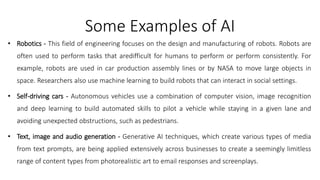
• Robotics - This field of engineering focuses on the design and manufacturing of robots. Robots are
often used to perform tasks that aredifficult for humans to perform or perform consistently. For
example, robots are used in car production assembly lines or by NASA to move large objects in
space. Researchers also use machine learning to build robots that can interact in social settings.
• Self-driving cars - Autonomous vehicles use a combination of computer vision, image recognition
and deep learning to build automated skills to pilot a vehicle while staying in a given lane and
avoiding unexpected obstructions, such as pedestrians.
• Text, image and audio generation - Generative AI techniques, which create various types of media
from text prompts, are being applied extensively across businesses to create a seemingly limitless
range of content types from photorealistic art to email responses and screenplays.
Artificial intelligence and Legal Profession

Artificial intelligence and Legal Profession

  • 1.
    Artificial Intelligence (AI) •Artificial intelligence (AI) - When machines, like computers, are designed to do things that typically require human intelligence. • Tasks such as problem-solving, understanding language, recognizing speech, and seeing things like humans do. • Specific uses - Expert systems (smart computer programs), understanding and responding to human language, recognizing speech, and helping machines "see" and understand the world around them.
  • 2.
    AI Programming • Learning: Machineslearn by gathering information and making rules on how to use that information. These rules, called algorithms, give step-by-step instructions to computers on how to do specific tasks. • Reasoning: Machines decide on the best way to achieve a goal by picking the right set of instructions (algorithm). • Self-correction: Machines are designed to keep getting better. They constantly adjust their rules (algorithms) to make sure they give the most accurate results. • Creativity: Machines can be creative! They use different techniques, like neural networks and statistical methods, to come up with new things like images, text, music, and ideas.
  • 3.
    AI, machine learningand deep learning • Machine Learning: It allows software to get better at predicting things without being explicitly programmed. It learns from past data to make accurate predictions, and it became more powerful with access to large datasets. • Deep Learning: Deep learning is like a special type of machine learning. It's inspired by how our brains work and uses structures called artificial neural networks. This technology has powered recent advances in AI, like self-driving cars and ChatGPT.
  • 4.
    Importance of AI •Automation: AI is crucial because it helps businesses automate tasks that humans do, such as customer service, lead generation, fraud detection, and quality control. This means faster and more efficient operations. • Accuracy in Repetitive Tasks: AI excels at repetitive and detail-oriented tasks, ensuring accuracy in jobs like analyzing legal documents. It can handle large datasets quickly and with fewer errors than humans. • Insights and Efficiency: Due to its ability to process massive datasets, AI provides valuable insights into business operations. This helps enterprises discover new information they might not have been aware of, leading to increased efficiency. • Generative AI Tools: The growing use of generative AI tools is transforming various fields, including education, marketing, and product design. These tools contribute to innovation and improved processes. • Business Opportunities: AI not only enhances efficiency but also creates new business opportunities. Companies like Uber, using AI to connect riders with taxis, have turned innovative ideas into successful ventures. • Key Players: AI is central to major companies like Alphabet, Apple, Microsoft, and Meta. These companies leverage AI technologies to improve operations and stay ahead of competition.
  • 5.
    Advantages of AI •Greatat Detailed Tasks: AI is excellent at tasks that require a keen eye for detail. •Speeds up Data Analysis: In industries with lots of data, like banking and insurance, AI is used to quickly analyze big datasets, reducing processing time. •Labor Savings and Increased Productivity: AI, especially when integrated with warehouse automation, saves labor and boosts productivity. This was notably seen during the pandemic and is expected to grow. •Consistent Results: The best AI translation tools deliver consistent and reliable results, allowing businesses to communicate effectively in various languages. •Personalization for Customer Satisfaction: AI can personalize content, messages, ads, recommendations, and websites for individual customers, enhancing their satisfaction. •24/7 Availability with Virtual Agents: AI-powered virtual agents are always available, providing continuous service without the need for breaks or sleep.
  • 6.
    Disadvantages of AI •Costly:AI can be expensive to implement and maintain. •Technical Expertise Needed: Building and managing AI tools requires specialized technical knowledge. •Shortage of Skilled Workers: There's a shortage of qualified workers with the necessary skills to develop AI tools. •Biases in Training Data: AI systems can adopt biases present in their training data, potentially causing issues. •Limited Task Generalization: AI may struggle to apply knowledge from one task to another, lacking generalization abilities. •Job Losses and Unemployment: The use of AI can lead to job cuts, contributing to higher unemployment rates.
  • 7.
    Types of AI •Type 1: Reactive machines. •These AI systems have no memory and are task-specific. Deep Blue can identify pieces on a chessboard and make predictions, but because it has no memory, it cannot use past experiences to inform future ones. •Type 2: Limited memory. •These AI systems have memory, so they can use past experiences to inform future decisions. Some of the decision-making functions in self-driving cars are designed this way. •Type 3: Theory of mind. •The social intelligence to understand emotions. This type of AI will be able to infer human intentions and predict behavior, a necessary skill for AI systems to become integral members of human teams. •Type 4: Self-awareness. •In this category, AI systems have a sense of self, which gives them consciousness. Machines with self-awareness understand their own current state. This type of AI does not yet exist.
  • 8.
    Some Examples ofAI • Automation - When paired with AI technologies, automation tools can expand the volume and types of tasks performed. An example is robotic process automation (RPA), a type of software that automates repetitive, rules-based data processing tasks traditionally done by humans. • Machine learning - This is the science of getting a computer to act without programming. Deep learning is a subset of machine learning that, in very simple terms, can be thought of as the automation of predictive analytics. • Machine vision - This technology gives a machine the ability to see. Machine vision captures and analyzes visual information using a camera, analog-to-digital conversion and digital signal processing. • Natural language processing (NLP) - This is the processing of human language by a computer program. One of the older and best-known examples of NLP is spam detection, which looks at the subject line and text of an email and decides if it's junk.
  • 9.
    Some Examples ofAI • Robotics - This field of engineering focuses on the design and manufacturing of robots. Robots are often used to perform tasks that aredifficult for humans to perform or perform consistently. For example, robots are used in car production assembly lines or by NASA to move large objects in space. Researchers also use machine learning to build robots that can interact in social settings. • Self-driving cars - Autonomous vehicles use a combination of computer vision, image recognition and deep learning to build automated skills to pilot a vehicle while staying in a given lane and avoiding unexpected obstructions, such as pedestrians. • Text, image and audio generation - Generative AI techniques, which create various types of media from text prompts, are being applied extensively across businesses to create a seemingly limitless range of content types from photorealistic art to email responses and screenplays.