AWS & AZURE
T
H
E
L
E
A
D
E
R
I
N
S
E
C
U
R
I
T
Y
O
P
E
R
A
T
I
O
N
S
How to Limit Risks When
Moving to the Cloud
SECURING CLOUD
INFRASTRUCTURE
2
TABLE OF
CONTENTS
3 | The Need for Cloud Security
4 | By the Numbers: Cloud Breaches
5 | Top Cloud Risks
6 | Shared Responsibility for Cloud Security
7 | Building Effective IaaS Security
© 2021 ARCTIC WOLF NETWORKS, INC. ALL RIGHTS RESERVED.  |   PUBLIC
ARCTIC WOLF IS A TRADEMARK OF ARCTIC WOLF NETWORKS, INC., REGISTERED IN THE U.S. AND ELSEWHERE.
SECURING CLOUD INFRASTRUCTURE
8 | Cloud Security Posture Management
9 | Security Options Built for IaaS
10 | Finding an IaaS Security Vendor
11 | What’s Next?
3
© 2021 ARCTIC WOLF NETWORKS, INC. ALL RIGHTS RESERVED. | PUBLIC 3
© 2021 ARCTIC WOLF NETWORKS, INC. ALL RIGHTS RESERVED. | PUBLIC
SECURING CLOUD INFRASTRUCTURE
A GUIDE TO
SECURING
YOUR CLOUD
INFRASTRUCTURE:
HOW TO LIMIT
RISKS WHEN MOVING
TO THE CLOUD
Most organizations now view the cloud as essential
infrastructure, but they often adopt or expand their
cloud footprint without a plan for new complexities
and risks. As a result, misconfiguration and
mismanagement are some of the biggest causes of
successful attacks on cloud infrastructure.
To mitigate these risks and ward off attacks, IT leaders
must implement a comprehensive and effective cloud
security program. This guide takes a look at cloud
risks, as well as the components of infrastructure-as-
a-service (IaaS) security that are important to consider.
THE NEED FOR
CLOUD SECURITY
Cost efficiencies, faster delivery of products and services,
and improved business continuity are among the factors
behind soaring cloud adoption. Today, an estimated 96
percent of organizations use at least one public cloud.1
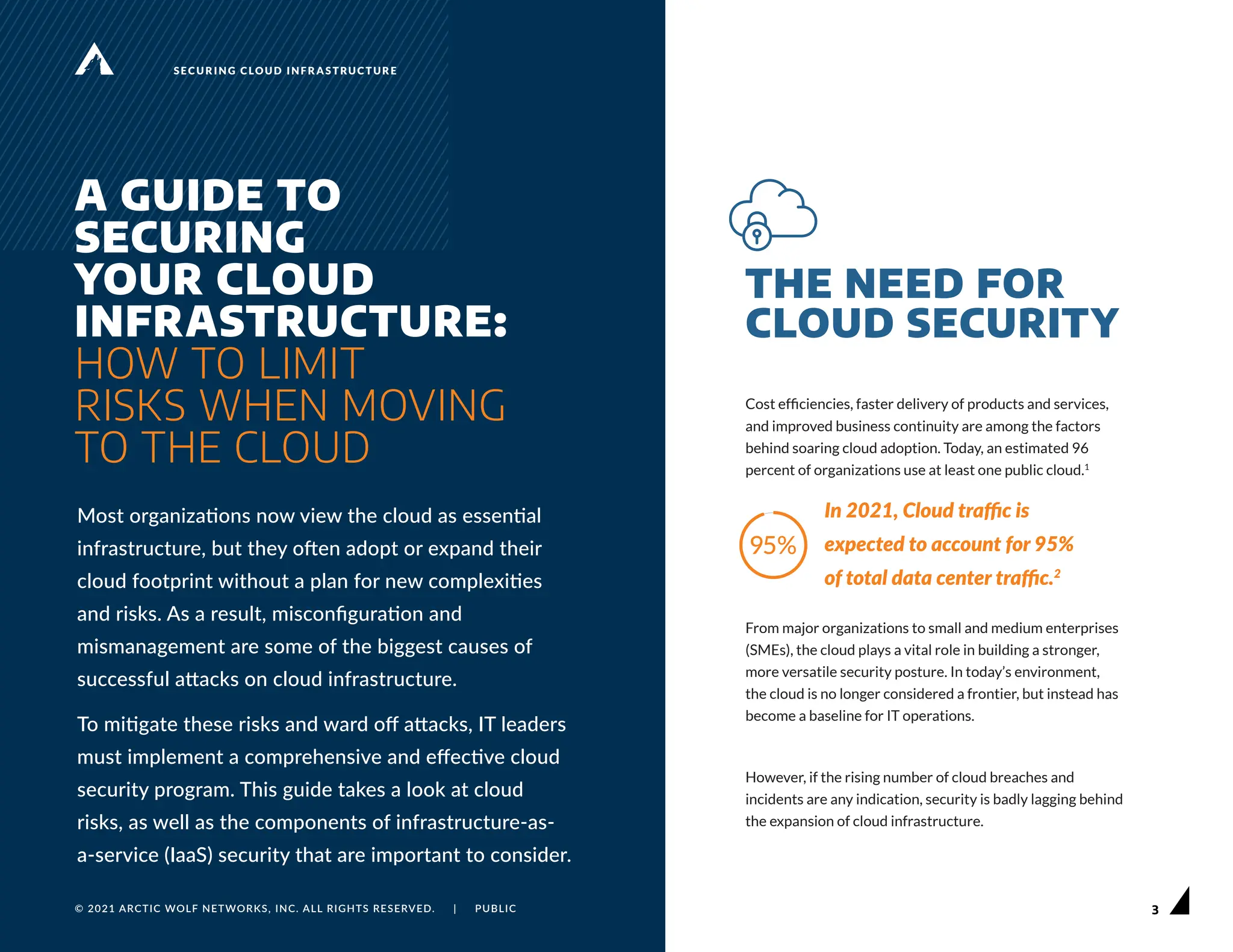
In 2021, Cloud traffic is
expected to account for 95%
of total data center traffic.2
From major organizations to small and medium enterprises
(SMEs), the cloud plays a vital role in building a stronger,
more versatile security posture. In today’s environment,
the cloud is no longer considered a frontier, but instead has
become a baseline for IT operations.
However, if the rising number of cloud breaches and
incidents are any indication, security is badly lagging behind
the expansion of cloud infrastructure.
SECURING CLOUD INFRASTRUCTURE
© 2021 ARCTIC WOLF NETWORKS, INC. ALL RIGHTS RESERVED. | PUBLIC
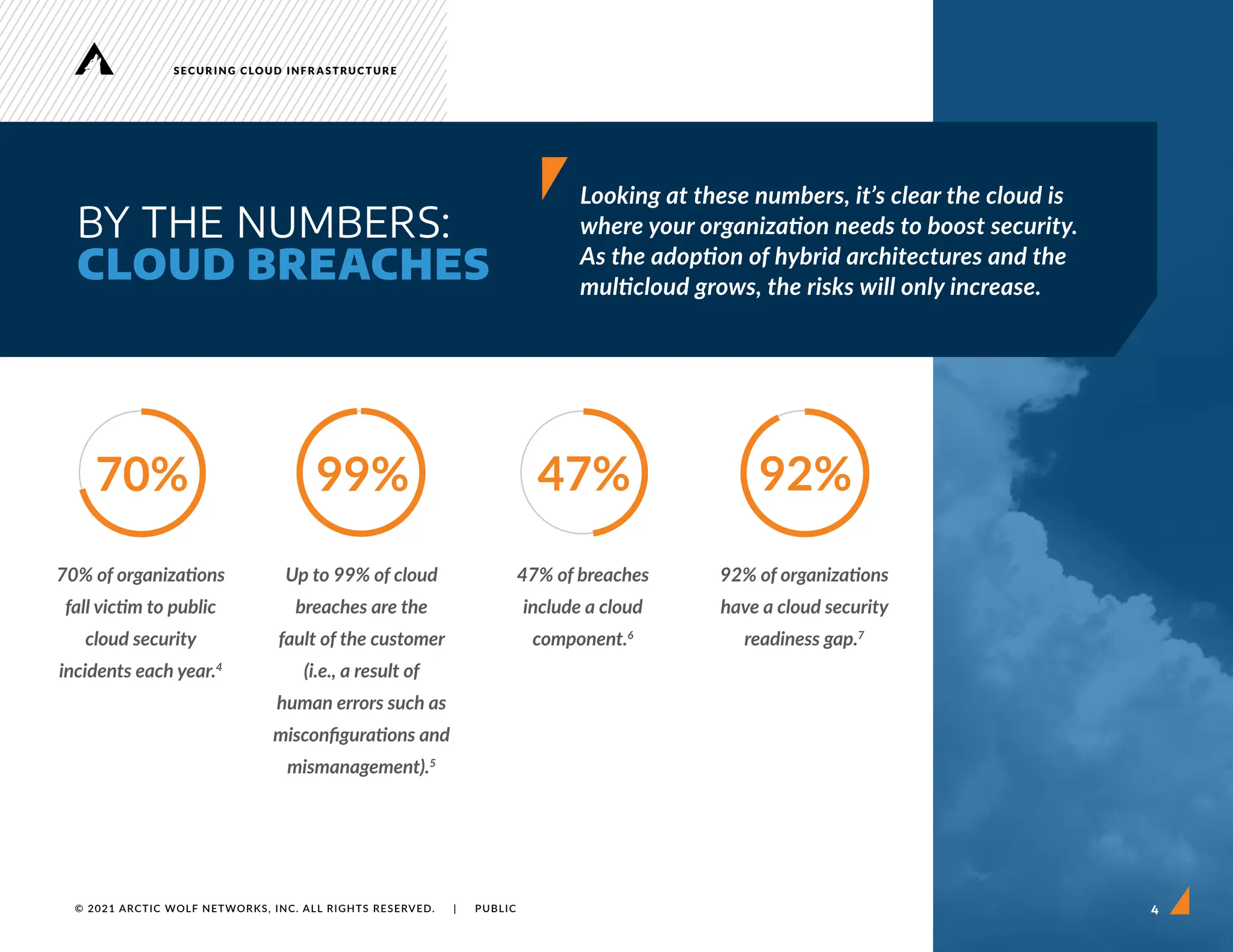
70% of organizations
fall victim to public
cloud security
incidents each year.4
70%
Up to 99% of cloud
breaches are the
fault of the customer
(i.e., a result of
human errors such as
misconfigurations and
mismanagement).5
99%
47% of breaches
include a cloud
component.6
47%
92% of organizations
have a cloud security
readiness gap.7
92%
Looking at these numbers, it’s clear the cloud is
where your organization needs to boost security.
As the adoption of hybrid architectures and the
multicloud grows, the risks will only increase.
BY THE NUMBERS:
CLOUD BREACHES
4
5
SECURING CLOUD INFRASTRUCTURE
© 2021 ARCTIC WOLF NETWORKS, INC. ALL RIGHTS RESERVED. | PUBLIC
Adoption of IaaS has grown from an estimated 62 percent in 2018 to
76 percent in 2020.8
Here are the top risks organizations face today:
TOP CLOUD RISKS
Data breaches
–
Regardless of your organization’s
size, this is the highest risk—
and it comes with significant
consequences, both in terms of the
cost of mitigating the breach and
the damage to your reputation.
No organization can afford to lose
customer trust.
Along with compromised
credentials, misconfigured clouds
are the leading cause of data
breaches,9
and misconfigurations
increase the average cost of a
breach by more than half a million
dollars, to a total of $4.4 million.10
Shadow IT
–
Shadow IT is not just a concern
restricted to unauthorized user
devices. When a development
team or another department
launches a project without the
IT department’s knowledge or
authorization, sensitive data
is potentially created, stored,
and shared in unvetted IaaS
environments.
Agility and speed are often
the reasons for such shadow
projects. While they might help
you reach your organization’s
business objectives faster, such
projects may compromise your
IT infrastructure security.
Resource misuse
–
Both outsiders and insiders (acting
maliciously or inadvertently) can
misuse cloud resources in a variety
of ways, including:
• Cryptojacking—when insiders or
outsiders mine for digital currency
using your cloud resources, the
resulting bill can be substantial. One
way to carry out cloud cryptojacking
is through unsecure (e.g., unencrypted
or misconfigured) databases.
• Unauthorized access—both insiders
and outsiders can access sensitive
data and read, delete, and modify
it. This is especially common when
organizations lack a proper identity
and access management program.
• Insider misuse—without firewalls
and other security defenses to stop
them, insiders not only have easy
access to data but can also leak
critical information. This may happen,
for example, when employees store
sensitive data in unsecure cloud
storage.
01 02 03 Other threats
–
From malware and phishing to
credential theft and advanced
persistent threat (APT) activity,
anything that can happen on
premises can also happen in the
cloud. Yet, many organizations
don’t have the same level of
monitoring and protection in
their cloud environment as
they do on-premises.
04
6
SECURING CLOUD INFRASTRUCTURE
© 2021 ARCTIC WOLF NETWORKS, INC. ALL RIGHTS RESERVED. | PUBLIC
SHARED
RESPONSIBILITY
FOR CLOUD SECURITY
Looking at these
numbers, it’s clear the
cloud is where your
organization needs
to boost security. As
the adoption of hybrid
architectures and the
multicloud grows,
the risks will only
increase.
Based on Gartner’s shared responsibility model, the Cloud Security Alliance’s
guidelines11
state that the responsibilities of cloud security providers (CSPs) include:
• Physical security of infrastructure
• Security of computing, storage, and network hardware
• Cloud storage security, such as backup and recovery
• Secure access to cloud resources by tenant
• Security of basic networks
Customers are responsible for:
• Security of terminals (e.g., hardware, software, and applications)
accessing the cloud service
• User identity and access controls of the systems
• Data security
This means that, although you can expect your CSP to provide robust security for the
underlying infrastructure, security of your data along with the secure use of the IaaS
services rests with you. For that reason, you need to build an effective IaaS security
program to address your cloud risks.
7
SECURING CLOUD INFRASTRUCTURE
© 2021 ARCTIC WOLF NETWORKS, INC. ALL RIGHTS RESERVED. | PUBLIC
BUILDING
EFFECTIVE
IAAS SECURITY
IaaS platforms generate
a lot of security data
streaming in through APIs,
but they don’t necessarily
aggregate or correlate
the data.
Additionally, IaaS platforms lack
security alert customization and
collaboration across platforms.
Even if the IaaS platform generates
the data you need, you’re likely to
miss cloud security incidents.
Enables you to track security-relevant event
data and generates actionable insights so you
can protect your cloud workloads
Provides real-time detection, response,
and containment for threats such as
misconfigurations and vulnerabilities
Boosts your security posture and improves
regulatory compliance
01
To address
these security
gaps, you need
a centralized
detection
and response
approach for
IaaS that:
02
03
8
SECURING CLOUD INFRASTRUCTURE
© 2021 ARCTIC WOLF NETWORKS, INC. ALL RIGHTS RESERVED. | PUBLIC
Cloud configuration
practices are new and
constantly evolving.
All it takes is a single
slip to leave the door
wide open—and leak
your data for anyone
on the internet.
Cloud security posture management (CSPM) is a type of IaaS
threat detection and response that provides you with the tools
you need to protect against vulnerabilities.
With CSPM, you can evaluate IaaS configurations against relevant benchmarks
such as:
• Common frameworks
• Compliance requirements
• Best practices
• Your IT policies
CSPM benefits include:
• Improved visibility across cloud resources and flagging of vulnerabilities
• The ability to prioritize vulnerabilities to guide remediation actions
• Reduced alert fatigue
CLOUD SECURITY
POSTURE MANAGEMENT
9
SECURING CLOUD INFRASTRUCTURE
© 2021 ARCTIC WOLF NETWORKS, INC. ALL RIGHTS RESERVED. | PUBLIC
SECURITY
OPTIONS
BUILT FOR IAAS
The cloud is now a
critical part of your
security operations,
which means you need
consistent visibility,
threat detection, and
response across your
entire environment.
Integrating cloud security makes
your security operations more
efficient by ensuring you don’t have
gaps between your on-premises and
cloud systems. It also ensures that
you prioritize risks regardless of
location.
Finding skilled security talent in general is a challenge across
industries, with many organizations already struggling to fill
security roles.
Even if you don’t have a problem staffing your IT team with
security talent, your generalists are likely not well equipped to
handle the growing cloud complexity and threat sophistication.
Unfortunately, finding talent with the right cloud security
skills is exceedingly difficult.
There’s no shortage of vendors offering cloud security tools.
But a tool-first solution leaves IT teams behind the eight ball—
they may have the data they need to protect their business but
not the processes and the people required to actually achieve
cloud security.
Tools alone don’t protect your on-prem environment, and
they’re not enough for your cloud infrastructure either.
To solve these challenges, organizations are now turning to vendors
who can provide actionable expertise and an ongoing relationship.
Partnering with a vendor for IaaS security brings many advantages,
but it’s important to make sure your partner not only supports your
needs today but also supports what you may require in the future
as your challenges grow and new needs evolve.
ACUTE
LACK OF
EXPERTISE
For many
organizations,
however, adding
cloud security
operations
presents a number
of challenges,
including:
GAPS IN
PROCESS
10
SECURING CLOUD INFRASTRUCTURE
© 2021 ARCTIC WOLF NETWORKS, INC. ALL RIGHTS RESERVED. | PUBLIC
Can you deliver IaaS threat detection and response?
–
Look for a vendor who can help you understand your cloud risk surface, identify IaaS risks, provide
visibility across all your cloud platforms, and detect unauthorized cloud use (shadow IT).
01
Can you deliver cloud security posture management?
–
Make sure your partner can detect misconfigurations and other vulnerabilities in real time, as
well as help you prioritize mitigation based on the highest risks.
02
Can you deliver security operations?
–
You don’t want to add more work for your IT team when you hire an IaaS security provider.
Consider a partner who will provide white-glove service for the deployment and management
of your security solution.
03
FINDING
AN IAAS
SECURITY
VENDOR
If you’re considering
outsourcing IaaS security
to a managed security
services provider, make
certain the vendor can
customize their services
to your needs and your
environment.
And be sure to ask the following
questions:
11
SECURING CLOUD INFRASTRUCTURE
Huge security gaps caused by a move to the cloud will only widen. The growing number of
cloud data breaches in the last few years indicates that threat actors consider insufficient
cloud security as low-hanging fruit for their attacks and are increasingly taking advantage.
Businesses should realize they not only need to step up their cloud security, but they also
must choose a partner with a forward-looking cloud security strategy whose capabilities
and vision will keep their cloud infrastructure protected well into the future.
Sources
1. Flexera 2020 State of the Cloud Report
2. Global Cloud Index, Cisco (2018)
3. Cloud Computing Market Size, Grandview Research (2020)
4. The State of Cloud Security, Sophos (2020)
5. “Is the Cloud Secure?” Gartner (2019)
6. Arctic Wolf data
7. Oracle and KPMG Cloud Threat Report (2020)
8. Oracle and KPMG Cloud Threat Report (2020)
9. Cost of a Data Breach Report, IBM (2020)
10. Cost of a Data Breach Report, IBM (2020)
11. CSP/Customer Shared Responsibilities, Cloud Security Alliance (2019)
WHAT’S NEXT?
Arctic Wolf®
is the market leader in security
operations. Using the cloud-native Arctic Wolf®
Platform, we provide security operations as
a concierge service. Highly trained Concierge
Security®
experts work as an extension of your
team to provide 24x7 monitoring, detection, and
response, as well as ongoing risk management
to proactively protect systems and data while
continually strengthening your security posture.
For more information about Arctic Wolf,
visit arcticwolf.com.
ABOUT
ARCTIC WOLF
REQUEST A DEMO
AW_G_SECURING CLOUD INFRASTRUCTURE_0121
11
E N D C Y B E R R I S K
© 2021 ARCTIC WOLF NETWORKS, INC. ALL RIGHTS RESERVED.  |   PUBLIC
ARCTIC WOLF IS A TRADEMARK OF ARCTIC WOLF NETWORKS, INC., REGISTERED IN THE U.S. AND ELSEWHERE.
SOC2 TYPE II CERTIFIED CONTACT US
arcticwolf.com
1.888.272.8429
ask@arcticwolf.com

ArticWolf - Securing Amazon AWS & Microsoft Azure.pdf

  • 1.
    AWS & AZURE T H E L E A D E R I N S E C U R I T Y O P E R A T I O N S Howto Limit Risks When Moving to the Cloud SECURING CLOUD INFRASTRUCTURE
  • 2.
    2 TABLE OF CONTENTS 3 |The Need for Cloud Security 4 | By the Numbers: Cloud Breaches 5 | Top Cloud Risks 6 | Shared Responsibility for Cloud Security 7 | Building Effective IaaS Security © 2021 ARCTIC WOLF NETWORKS, INC. ALL RIGHTS RESERVED.  |   PUBLIC ARCTIC WOLF IS A TRADEMARK OF ARCTIC WOLF NETWORKS, INC., REGISTERED IN THE U.S. AND ELSEWHERE. SECURING CLOUD INFRASTRUCTURE 8 | Cloud Security Posture Management 9 | Security Options Built for IaaS 10 | Finding an IaaS Security Vendor 11 | What’s Next?
  • 3.
    3 © 2021 ARCTICWOLF NETWORKS, INC. ALL RIGHTS RESERVED. | PUBLIC 3 © 2021 ARCTIC WOLF NETWORKS, INC. ALL RIGHTS RESERVED. | PUBLIC SECURING CLOUD INFRASTRUCTURE A GUIDE TO SECURING YOUR CLOUD INFRASTRUCTURE: HOW TO LIMIT RISKS WHEN MOVING TO THE CLOUD Most organizations now view the cloud as essential infrastructure, but they often adopt or expand their cloud footprint without a plan for new complexities and risks. As a result, misconfiguration and mismanagement are some of the biggest causes of successful attacks on cloud infrastructure. To mitigate these risks and ward off attacks, IT leaders must implement a comprehensive and effective cloud security program. This guide takes a look at cloud risks, as well as the components of infrastructure-as- a-service (IaaS) security that are important to consider. THE NEED FOR CLOUD SECURITY Cost efficiencies, faster delivery of products and services, and improved business continuity are among the factors behind soaring cloud adoption. Today, an estimated 96 percent of organizations use at least one public cloud.1 In 2021, Cloud traffic is expected to account for 95% of total data center traffic.2 From major organizations to small and medium enterprises (SMEs), the cloud plays a vital role in building a stronger, more versatile security posture. In today’s environment, the cloud is no longer considered a frontier, but instead has become a baseline for IT operations. However, if the rising number of cloud breaches and incidents are any indication, security is badly lagging behind the expansion of cloud infrastructure.
  • 4.
    SECURING CLOUD INFRASTRUCTURE ©2021 ARCTIC WOLF NETWORKS, INC. ALL RIGHTS RESERVED. | PUBLIC 70% of organizations fall victim to public cloud security incidents each year.4 70% Up to 99% of cloud breaches are the fault of the customer (i.e., a result of human errors such as misconfigurations and mismanagement).5 99% 47% of breaches include a cloud component.6 47% 92% of organizations have a cloud security readiness gap.7 92% Looking at these numbers, it’s clear the cloud is where your organization needs to boost security. As the adoption of hybrid architectures and the multicloud grows, the risks will only increase. BY THE NUMBERS: CLOUD BREACHES 4
  • 5.
    5 SECURING CLOUD INFRASTRUCTURE ©2021 ARCTIC WOLF NETWORKS, INC. ALL RIGHTS RESERVED. | PUBLIC Adoption of IaaS has grown from an estimated 62 percent in 2018 to 76 percent in 2020.8 Here are the top risks organizations face today: TOP CLOUD RISKS Data breaches – Regardless of your organization’s size, this is the highest risk— and it comes with significant consequences, both in terms of the cost of mitigating the breach and the damage to your reputation. No organization can afford to lose customer trust. Along with compromised credentials, misconfigured clouds are the leading cause of data breaches,9 and misconfigurations increase the average cost of a breach by more than half a million dollars, to a total of $4.4 million.10 Shadow IT – Shadow IT is not just a concern restricted to unauthorized user devices. When a development team or another department launches a project without the IT department’s knowledge or authorization, sensitive data is potentially created, stored, and shared in unvetted IaaS environments. Agility and speed are often the reasons for such shadow projects. While they might help you reach your organization’s business objectives faster, such projects may compromise your IT infrastructure security. Resource misuse – Both outsiders and insiders (acting maliciously or inadvertently) can misuse cloud resources in a variety of ways, including: • Cryptojacking—when insiders or outsiders mine for digital currency using your cloud resources, the resulting bill can be substantial. One way to carry out cloud cryptojacking is through unsecure (e.g., unencrypted or misconfigured) databases. • Unauthorized access—both insiders and outsiders can access sensitive data and read, delete, and modify it. This is especially common when organizations lack a proper identity and access management program. • Insider misuse—without firewalls and other security defenses to stop them, insiders not only have easy access to data but can also leak critical information. This may happen, for example, when employees store sensitive data in unsecure cloud storage. 01 02 03 Other threats – From malware and phishing to credential theft and advanced persistent threat (APT) activity, anything that can happen on premises can also happen in the cloud. Yet, many organizations don’t have the same level of monitoring and protection in their cloud environment as they do on-premises. 04
  • 6.
    6 SECURING CLOUD INFRASTRUCTURE ©2021 ARCTIC WOLF NETWORKS, INC. ALL RIGHTS RESERVED. | PUBLIC SHARED RESPONSIBILITY FOR CLOUD SECURITY Looking at these numbers, it’s clear the cloud is where your organization needs to boost security. As the adoption of hybrid architectures and the multicloud grows, the risks will only increase. Based on Gartner’s shared responsibility model, the Cloud Security Alliance’s guidelines11 state that the responsibilities of cloud security providers (CSPs) include: • Physical security of infrastructure • Security of computing, storage, and network hardware • Cloud storage security, such as backup and recovery • Secure access to cloud resources by tenant • Security of basic networks Customers are responsible for: • Security of terminals (e.g., hardware, software, and applications) accessing the cloud service • User identity and access controls of the systems • Data security This means that, although you can expect your CSP to provide robust security for the underlying infrastructure, security of your data along with the secure use of the IaaS services rests with you. For that reason, you need to build an effective IaaS security program to address your cloud risks.
  • 7.
    7 SECURING CLOUD INFRASTRUCTURE ©2021 ARCTIC WOLF NETWORKS, INC. ALL RIGHTS RESERVED. | PUBLIC BUILDING EFFECTIVE IAAS SECURITY IaaS platforms generate a lot of security data streaming in through APIs, but they don’t necessarily aggregate or correlate the data. Additionally, IaaS platforms lack security alert customization and collaboration across platforms. Even if the IaaS platform generates the data you need, you’re likely to miss cloud security incidents. Enables you to track security-relevant event data and generates actionable insights so you can protect your cloud workloads Provides real-time detection, response, and containment for threats such as misconfigurations and vulnerabilities Boosts your security posture and improves regulatory compliance 01 To address these security gaps, you need a centralized detection and response approach for IaaS that: 02 03
  • 8.
    8 SECURING CLOUD INFRASTRUCTURE ©2021 ARCTIC WOLF NETWORKS, INC. ALL RIGHTS RESERVED. | PUBLIC Cloud configuration practices are new and constantly evolving. All it takes is a single slip to leave the door wide open—and leak your data for anyone on the internet. Cloud security posture management (CSPM) is a type of IaaS threat detection and response that provides you with the tools you need to protect against vulnerabilities. With CSPM, you can evaluate IaaS configurations against relevant benchmarks such as: • Common frameworks • Compliance requirements • Best practices • Your IT policies CSPM benefits include: • Improved visibility across cloud resources and flagging of vulnerabilities • The ability to prioritize vulnerabilities to guide remediation actions • Reduced alert fatigue CLOUD SECURITY POSTURE MANAGEMENT
  • 9.
    9 SECURING CLOUD INFRASTRUCTURE ©2021 ARCTIC WOLF NETWORKS, INC. ALL RIGHTS RESERVED. | PUBLIC SECURITY OPTIONS BUILT FOR IAAS The cloud is now a critical part of your security operations, which means you need consistent visibility, threat detection, and response across your entire environment. Integrating cloud security makes your security operations more efficient by ensuring you don’t have gaps between your on-premises and cloud systems. It also ensures that you prioritize risks regardless of location. Finding skilled security talent in general is a challenge across industries, with many organizations already struggling to fill security roles. Even if you don’t have a problem staffing your IT team with security talent, your generalists are likely not well equipped to handle the growing cloud complexity and threat sophistication. Unfortunately, finding talent with the right cloud security skills is exceedingly difficult. There’s no shortage of vendors offering cloud security tools. But a tool-first solution leaves IT teams behind the eight ball— they may have the data they need to protect their business but not the processes and the people required to actually achieve cloud security. Tools alone don’t protect your on-prem environment, and they’re not enough for your cloud infrastructure either. To solve these challenges, organizations are now turning to vendors who can provide actionable expertise and an ongoing relationship. Partnering with a vendor for IaaS security brings many advantages, but it’s important to make sure your partner not only supports your needs today but also supports what you may require in the future as your challenges grow and new needs evolve. ACUTE LACK OF EXPERTISE For many organizations, however, adding cloud security operations presents a number of challenges, including: GAPS IN PROCESS
  • 10.
    10 SECURING CLOUD INFRASTRUCTURE ©2021 ARCTIC WOLF NETWORKS, INC. ALL RIGHTS RESERVED. | PUBLIC Can you deliver IaaS threat detection and response? – Look for a vendor who can help you understand your cloud risk surface, identify IaaS risks, provide visibility across all your cloud platforms, and detect unauthorized cloud use (shadow IT). 01 Can you deliver cloud security posture management? – Make sure your partner can detect misconfigurations and other vulnerabilities in real time, as well as help you prioritize mitigation based on the highest risks. 02 Can you deliver security operations? – You don’t want to add more work for your IT team when you hire an IaaS security provider. Consider a partner who will provide white-glove service for the deployment and management of your security solution. 03 FINDING AN IAAS SECURITY VENDOR If you’re considering outsourcing IaaS security to a managed security services provider, make certain the vendor can customize their services to your needs and your environment. And be sure to ask the following questions:
  • 11.
    11 SECURING CLOUD INFRASTRUCTURE Hugesecurity gaps caused by a move to the cloud will only widen. The growing number of cloud data breaches in the last few years indicates that threat actors consider insufficient cloud security as low-hanging fruit for their attacks and are increasingly taking advantage. Businesses should realize they not only need to step up their cloud security, but they also must choose a partner with a forward-looking cloud security strategy whose capabilities and vision will keep their cloud infrastructure protected well into the future. Sources 1. Flexera 2020 State of the Cloud Report 2. Global Cloud Index, Cisco (2018) 3. Cloud Computing Market Size, Grandview Research (2020) 4. The State of Cloud Security, Sophos (2020) 5. “Is the Cloud Secure?” Gartner (2019) 6. Arctic Wolf data 7. Oracle and KPMG Cloud Threat Report (2020) 8. Oracle and KPMG Cloud Threat Report (2020) 9. Cost of a Data Breach Report, IBM (2020) 10. Cost of a Data Breach Report, IBM (2020) 11. CSP/Customer Shared Responsibilities, Cloud Security Alliance (2019) WHAT’S NEXT? Arctic Wolf® is the market leader in security operations. Using the cloud-native Arctic Wolf® Platform, we provide security operations as a concierge service. Highly trained Concierge Security® experts work as an extension of your team to provide 24x7 monitoring, detection, and response, as well as ongoing risk management to proactively protect systems and data while continually strengthening your security posture. For more information about Arctic Wolf, visit arcticwolf.com. ABOUT ARCTIC WOLF REQUEST A DEMO AW_G_SECURING CLOUD INFRASTRUCTURE_0121 11 E N D C Y B E R R I S K © 2021 ARCTIC WOLF NETWORKS, INC. ALL RIGHTS RESERVED.  |   PUBLIC ARCTIC WOLF IS A TRADEMARK OF ARCTIC WOLF NETWORKS, INC., REGISTERED IN THE U.S. AND ELSEWHERE. SOC2 TYPE II CERTIFIED CONTACT US arcticwolf.com 1.888.272.8429 ask@arcticwolf.com