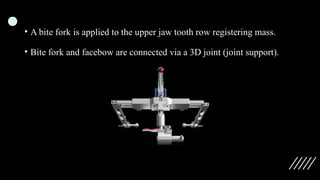
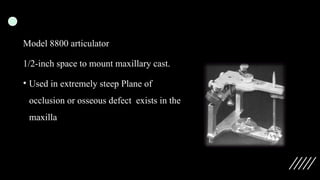
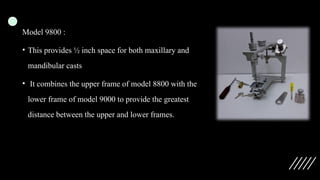
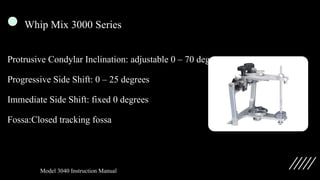
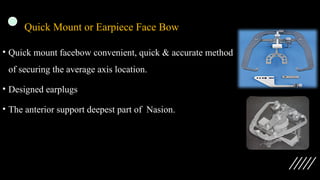
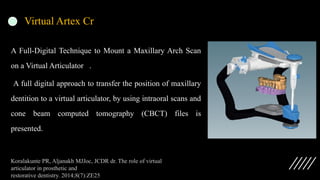
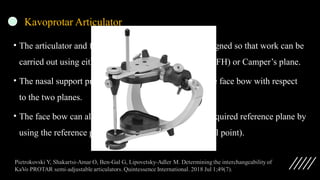
A R T I C U L A T O R S
P R E S E N T E D B Y
D R B A S I T H N P
2
CONTENTS
• INTRODUCTION
• TERMENOLOGIES
• PURPOSE OF AN ARTICULATOR
• REQUIREMENTS
• USES OF AN ARTICULATOR
• ADVANTAGE
• EVOLUTION
3
• CLASSIFICATION OF ARTICULATORS
• THEORIES OF ARTICULATORS
• ARCON AND NON ARCON
• LAWS OF ARTICULATON
• SELECTION OF ARTICULATORS
4
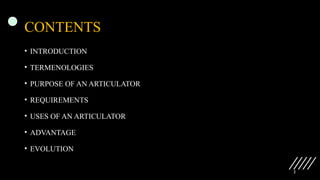
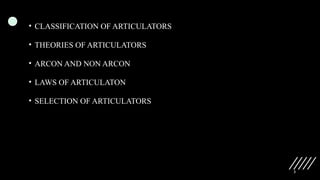
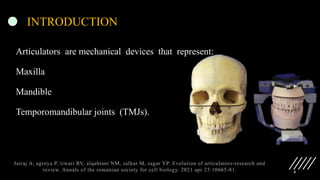
INTRODUCTION
Articulators are mechanical devices that represent:
Maxilla
Mandible
Temporomandibular joints (TMJs).
Jairaj A, agroya P, tiwari RV, alqahtani NM, salkar M, sagar YP. Evolution of articulators-research and
review. Annals of the romanian society for cell biology. 2021 apr 25:10665-81.
5
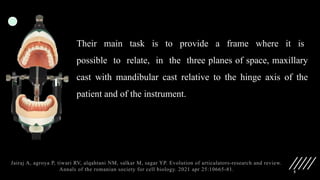
Their main task is to provide a frame where it is
possible to relate, in the three planes of space, maxillary
cast with mandibular cast relative to the hinge axis of the
patient and of the instrument.
Jairaj A, agroya P, tiwari RV, alqahtani NM, salkar M, sagar YP. Evolution of articulators-research and review.
Annals of the romanian society for cell biology. 2021 apr 25:10665-81.
6
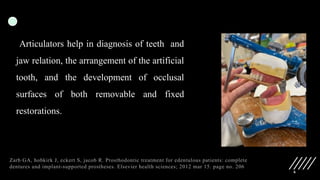
Articulators help in diagnosis of teeth and
jaw relation, the arrangement of the artificial
tooth, and the development of occlusal
surfaces of both removable and fixed
restorations.
Zarb GA, hobkirk J, eckert S, jacob R. Prosthodontic treatment for edentulous patients: complete
dentures and implant-supported prostheses. Elsevier health sciences; 2012 mar 15. page no. 206
7
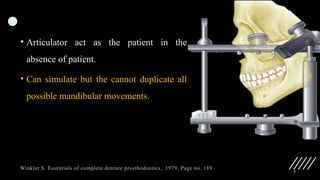
• Articulator act as the patient in the
absence of patient.
• Can simulate but the cannot duplicate all
possible mandibular movements.
Winkler S. Essentials of complete denture prosthodontics.. 1979. Page no. 189
8
TERMINOLOGIES
9
Articulator:
• An analog, whether mechanical or digital, to which maxillary and
mandibular casts may be coupled to simulate some or all mandibular
movements. (GPT10)
• A mechanical device that represents the temporomandibular joints and
jaw members to which maxillary and mandibular cast may be attached.
(Winkler)
1.Layton DM, morgano SM, muller F, kelly JA, nguyen CT, scherrer SS, salinas TJ, shah KC, att W, freilich MA,
ferro KJ. Glossary of prosthodontic terms 2023. J prosthet dent. 2023;130(4s1):e1-26.
2. Winkler S. Essentials of complete denture prosthodontics.. 1979. Page no. 189
10
Articulation: The static and dynamic contact relationship between the
occlusal surfaces of the teeth during function. (GPT10)
Arcon: contr, ARTICULATOR and CONDYLE; used to describe an
articulator containing the condylar path elements within its upper
member and the condylar elements within the lower member.
Layton DM, morgano SM, muller F, kelly JA, nguyen CT, scherrer SS, salinas TJ, shah KC, att W, freilich MA,
ferro KJ. Glossary of prosthodontic terms 2023. J prosthet dent. 2023;130(4s1):e1-26.
11
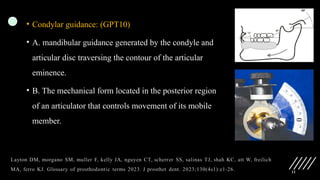
• Condylar guidance: (GPT10)
• A. mandibular guidance generated by the condyle and
articular disc traversing the contour of the articular
eminence.
• B. The mechanical form located in the posterior region
of an articulator that controls movement of its mobile
member.
12
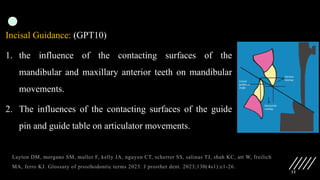
Incisal Guidance: (GPT10)
1. the influence of the contacting surfaces of the
mandibular and maxillary anterior teeth on mandibular
movements.
2. The influences of the contacting surfaces of the guide
pin and guide table on articulator movements.
Layton DM, morgano SM, muller F, kelly JA, nguyen CT, scherrer SS, salinas TJ, shah KC, att W, freilich
MA, ferro KJ. Glossary of prosthodontic terms 2023. J prosthet dent. 2023;130(4s1):e1-26.
13
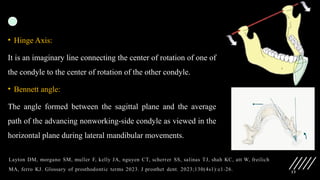
• Hinge Axis:
It is an imaginary line connecting the center of rotation of one of
the condyle to the center of rotation of the other condyle.
• Bennett angle:
The angle formed between the sagittal plane and the average
path of the advancing nonworking-side condyle as viewed in the
horizontal plane during lateral mandibular movements.
14
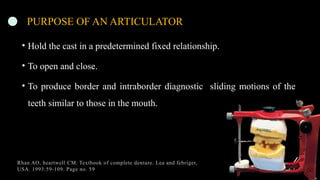
PURPOSE OF AN ARTICULATOR
• Hold the cast in a predetermined fixed relationship.
• To open and close.
• To produce border and intraborder diagnostic sliding motions of the
teeth similar to those in the mouth.
Rhan AO, heartwell CM. Textbook of complete denture. Lea and febriger,
USA. 1993:59-109. Page no. 59
USES Of THE ARTICULATOR
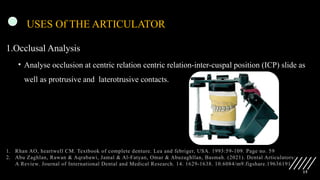
1.Occlusal Analysis
• Analyse occlusion at centric relation centric relation-inter-cuspal position (ICP) slide as
well as protrusive and laterotrusive contacts.
1. Rhan AO, heartwell CM. Textbook of complete denture. Lea and febriger, USA. 1993:59-109. Page no. 59
2. Abu Zaghlan, Rawan & Aqrabawi, Jamal & Al-Fatyan, Omar & Abuzaghllan, Basmah. (2021). Dental Articulators:
A Review. Journal of International Dental and Medical Research. 14. 1629-1638. 10.6084/m9.figshare.19636191.
15
16
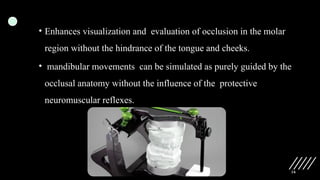
• Enhances visualization and evaluation of occlusion in the molar
region without the hindrance of the tongue and cheeks.
• mandibular movements can be simulated as purely guided by the
occlusal anatomy without the influence of the protective
neuromuscular reflexes.
17
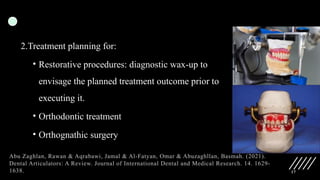
2.Treatment planning for:
• Restorative procedures: diagnostic wax-up to
envisage the planned treatment outcome prior to
executing it.
• Orthodontic treatment
• Orthognathic surgery
Abu Zaghlan, Rawan & Aqrabawi, Jamal & Al-Fatyan, Omar & Abuzaghllan, Basmah. (2021).
Dental Articulators: A Review. Journal of International Dental and Medical Research. 14. 1629-
1638.
18
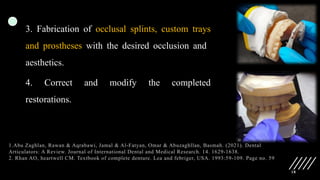
3. Fabrication of occlusal splints, custom trays
and prostheses with the desired occlusion and
aesthetics.
4. Correct and modify the completed
restorations.
1.Abu Zaghlan, Rawan & Aqrabawi, Jamal & Al-Fatyan, Omar & Abuzaghllan, Basmah. (2021). Dental
Articulators: A Review. Journal of International Dental and Medical Research. 14. 1629-1638.
2. Rhan AO, heartwell CM. Textbook of complete denture. Lea and febriger, USA. 1993:59-109. Page no. 59
19
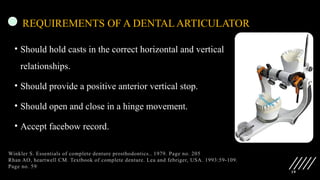
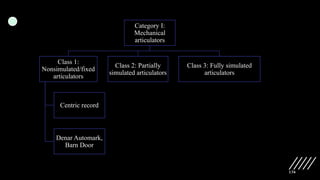
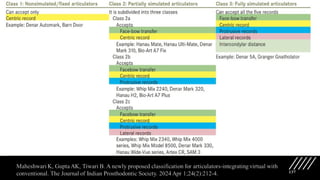
REQUIREMENTS OF A DENTAL ARTICULATOR
• Should hold casts in the correct horizontal and vertical
relationships.
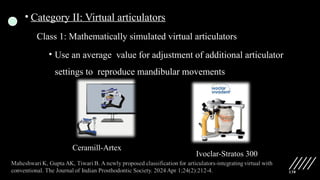
• Should provide a positive anterior vertical stop.
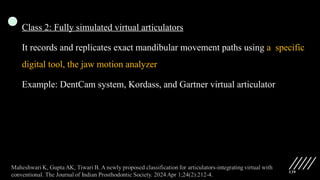
• Should open and close in a hinge movement.
• Accept facebow record.
Winkler S. Essentials of complete denture prosthodontics.. 1979. Page no. 205
Rhan AO, heartwell CM. Textbook of complete denture. Lea and febriger, USA. 1993:59-109.
Page no. 59
20
• Adequate distance between the upper and lower members and
vision should not obscured from the rear.
• Moving parts should move freely and non moving parts should be
a rigid construction.
• Should be made of strong, corrosion, lightweight and wear-
resistant material.
Rhan AO, heartwell CM. Textbook of complete denture. Lea and febriger, USA. 1993:59-109.
Page no. 59
Winkler S. Essentials of complete denture prosthodontics.. 1979. Page no. 205
21
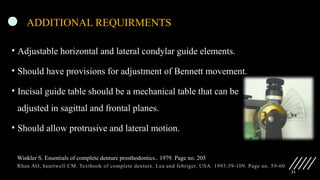
ADDITIONAL REQUIRMENTS
• Adjustable horizontal and lateral condylar guide elements.
• Should have provisions for adjustment of Bennett movement.
• Incisal guide table should be a mechanical table that can be
adjusted in sagittal and frontal planes.
• Should allow protrusive and lateral motion.
Rhan AO, heartwell CM. Textbook of complete denture. Lea and febriger, USA. 1993:59-109. Page no. 59-60
Winkler S. Essentials of complete denture prosthodontics.. 1979. Page no. 205
22
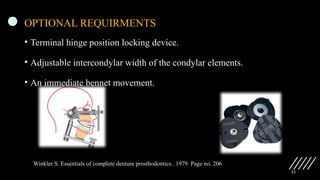
OPTIONAL REQUIRMENTS
• Terminal hinge position locking device.
• Adjustable intercondylar width of the condylar elements.
• An immediate bennet movement.
Winkler S. Essentials of complete denture prosthodontics.. 1979. Page no. 206
23
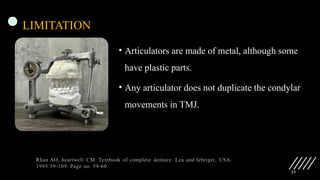
LIMITATION
• Articulators are made of metal, although some
have plastic parts.
• Any articulator does not duplicate the condylar
movements in TMJ.
24
EFFECTIVNESS OF AN ARTICULATOR
• How well the operator understands its construction & purpose.
• How enthusiastic the dentist is for particular instrument.
• How well the dentists understands the anatomy of joints their movements and
neuro muscular system.
• How much precision used in recording jaw relations.
• An articulator do no more than what operator does with it.
25
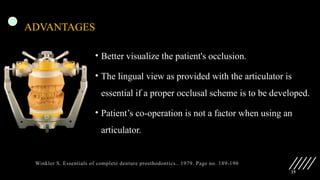
ADVANTAGES
• Better visualize the patient's occlusion.
• The lingual view as provided with the articulator is
essential if a proper occlusal scheme is to be developed.
• Patient’s co-operation is not a factor when using an
articulator.
Winkler S. Essentials of complete denture prosthodontics.. 1979. Page no. 189-190
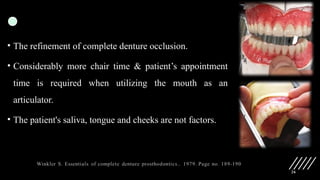
26
• The refinement of complete denture occlusion.
• Considerably more chair time & patient’s appointment
time is required when utilizing the mouth as an
articulator.
• The patient's saliva, tongue and cheeks are not factors.
30
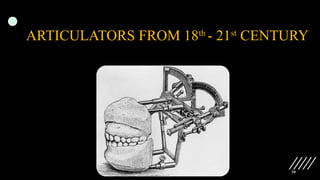
ARTICULATORS FROM 18th
- 21st
CENTURY
31
Starcke EN, engelmeier RL, belles DM. The history of articulators: the “articulator wars” phenomenon with
some circumstances leading up to it. Journal of prosthodontics: implant, esthetic and reconstructive dentistry.
2010 jun;19(4):321-33.
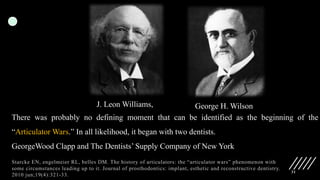
J. Leon Williams, George H. Wilson
There was probably no defining moment that can be identified as the beginning of the
“Articulator Wars.” In all likelihood, it began with two dentists.
GeorgeWood Clapp and The Dentists’ Supply Company of New York
32
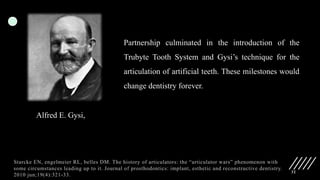
Alfred E. Gysi,
Partnership culminated in the introduction of the
Trubyte Tooth System and Gysi’s technique for the
articulation of artificial teeth. These milestones would
change dentistry forever.
Starcke EN, engelmeier RL, belles DM. The history of articulators: the “articulator wars” phenomenon with
some circumstances leading up to it. Journal of prosthodontics: implant, esthetic and reconstructive dentistry.
2010 jun;19(4):321-33.
33
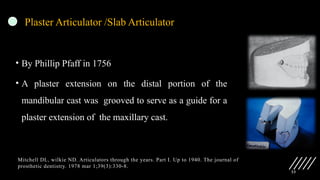
Plaster Articulator /Slab Articulator
• By Phillip Pfaff in 1756
• A plaster extension on the distal portion of the
mandibular cast was grooved to serve as a guide for a
plaster extension of the maxillary cast.
Mitchell DL, wilkie ND. Articulators through the years. Part I. Up to 1940. The journal of
prosthetic dentistry. 1978 mar 1;39(3):330-8.
34
Barn Door Hinge & Adaptable Barn Door Hinge
• Inexpensive and easy to obtain from any
hardware or general store.
• Modified by bending each arm 90 degrees to
form L-shaped upper and lower members.
35
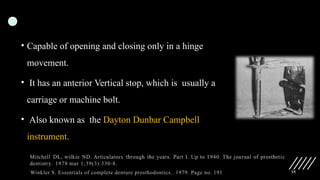
• Capable of opening and closing only in a hinge
movement.
• It has an anterior Vertical stop, which is usually a
carriage or machine bolt.
• Also known as the Dayton Dunbar Campbell
instrument.
Winkler S. Essentials of complete denture prosthodontics.. 1979. Page no. 191
36
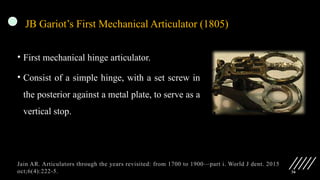
JB Gariot’s First Mechanical Articulator (1805)
• First mechanical hinge articulator.
• Consist of a simple hinge, with a set screw in
the posterior against a metal plate, to serve as a
vertical stop.
Jain AR. Articulators through the years revisited: from 1700 to 1900—part i. World J dent. 2015
oct;6(4):222-5.
37
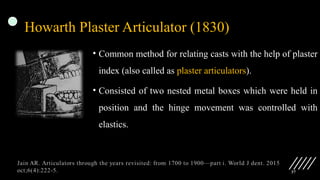
Howarth Plaster Articulator (1830)
• Common method for relating casts with the help of plaster
index (also called as plaster articulators).
• Consisted of two nested metal boxes which were held in
position and the hinge movement was controlled with
elastics.
38
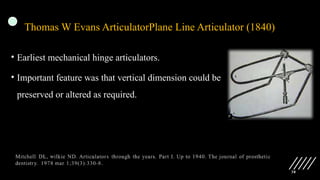
Thomas W Evans ArticulatorPlane Line Articulator (1840)
• Earliest mechanical hinge articulators.
• Important feature was that vertical dimension could be
preserved or altered as required.
39
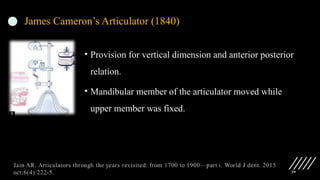
James Cameron’s Articulator (1840)
• Provision for vertical dimension and anterior posterior
relation.
• Mandibular member of the articulator moved while
upper member was fixed.
40
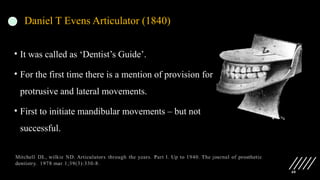
Daniel T Evens Articulator (1840)
• It was called as ‘Dentist’s Guide’.
• For the first time there is a mention of provision for
protrusive and lateral movements.
• First to initiate mandibular movements – but not
successful.
41
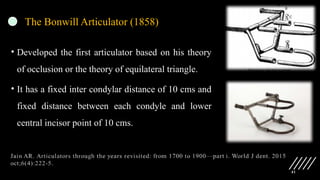
The Bonwill Articulator (1858)
• Developed the first articulator based on his theory
of occlusion or the theory of equilateral triangle.
• It has a fixed inter condylar distance of 10 cms and
fixed distance between each condyle and lower
central incisor point of 10 cms.
42
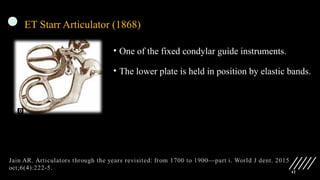
ET Starr Articulator (1868)
• One of the fixed condylar guide instruments.
• The lower plate is held in position by elastic bands.
43
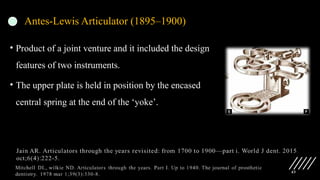
Antes-Lewis Articulator (1895–1900)
• Product of a joint venture and it included the design
features of two instruments.
• The upper plate is held in position by the encased
central spring at the end of the ‘yoke’.
44
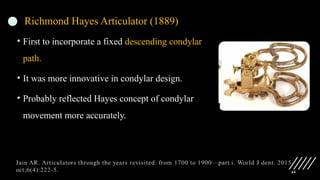
Richmond Hayes Articulator (1889)
• First to incorporate a fixed descending condylar
path.
• It was more innovative in condylar design.
• Probably reflected Hayes concept of condylar
movement more accurately.
45
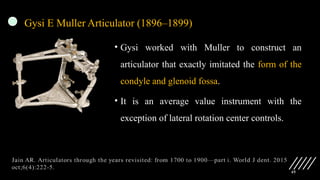
Gysi E Muller Articulator (1896–1899)
• Gysi worked with Muller to construct an
articulator that exactly imitated the form of the
condyle and glenoid fossa.
• It is an average value instrument with the
exception of lateral rotation center controls.
46
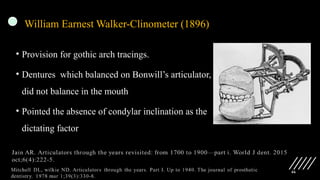
William Earnest Walker-Clinometer (1896)
• Provision for gothic arch tracings.
• Dentures which balanced on Bonwill’s articulator,
did not balance in the mouth
• Pointed the absence of condylar inclination as the
dictating factor
47
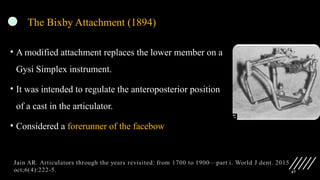
The Bixby Attachment (1894)
• A modified attachment replaces the lower member on a
Gysi Simplex instrument.
• It was intended to regulate the anteroposterior position
of a cast in the articulator.
• Considered a forerunner of the facebow
48
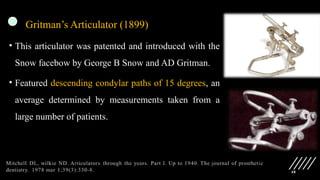
Gritman’s Articulator (1899)
• This articulator was patented and introduced with the
Snow facebow by George B Snow and AD Gritman.
• Featured descending condylar paths of 15 degrees, an
average determined by measurements taken from a
large number of patients.
49
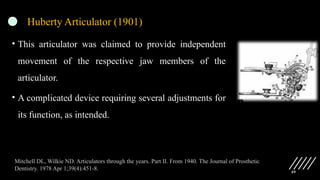
Huberty Articulator (1901)
• This articulator was claimed to provide independent
movement of the respective jaw members of the
articulator.
• A complicated device requiring several adjustments for
its function, as intended.
Mitchell DL, Wilkie ND. Articulators through the years. Part II. From 1940. The Journal of Prosthetic
Dentistry. 1978 Apr 1;39(4):451-8.
50
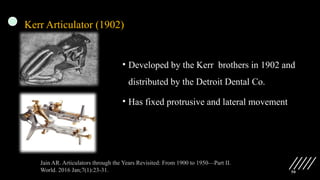
Kerr Articulator (1902)
• Developed by the Kerr brothers in 1902 and
distributed by the Detroit Dental Co.
• Has fixed protrusive and lateral movement
Jain AR. Articulators through the Years Revisited: From 1900 to 1950—Part II.
World. 2016 Jan;7(1):23-31.
51
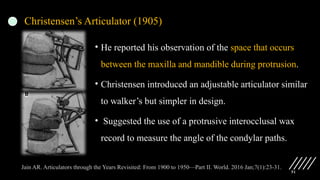
Christensen’s Articulator (1905)
• He reported his observation of the space that occurs
between the maxilla and mandible during protrusion.
• Christensen introduced an adjustable articulator similar
to walker’s but simpler in design.
• Suggested the use of a protrusive interocclusal wax
record to measure the angle of the condylar paths.
Jain AR. Articulators through the Years Revisited: From 1900 to 1950—Part II. World. 2016 Jan;7(1):23-31.
52
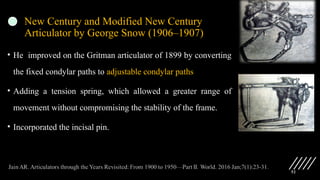
New Century and Modified New Century
Articulator by George Snow (1906–1907)
• He improved on the Gritman articulator of 1899 by converting
the fixed condylar paths to adjustable condylar paths
• Adding a tension spring, which allowed a greater range of
movement without compromising the stability of the frame.
• Incorporated the incisal pin.
53
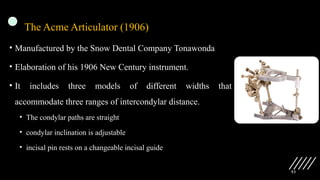
The Acme Articulator (1906)
• Manufactured by the Snow Dental Company Tonawonda
• Elaboration of his 1906 New Century instrument.
• It includes three models of different widths that
accommodate three ranges of intercondylar distance.
• The condylar paths are straight
• condylar inclination is adjustable
• incisal pin rests on a changeable incisal guide
54
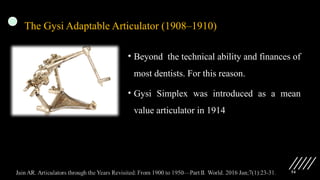
The Gysi Adaptable Articulator (1908–1910)
• Beyond the technical ability and finances of
most dentists. For this reason.
• Gysi Simplex was introduced as a mean
value articulator in 1914
55
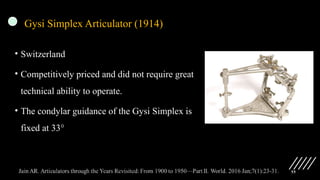
Gysi Simplex Articulator (1914)
• Switzerland
• Competitively priced and did not require great
technical ability to operate.
• The condylar guidance of the Gysi Simplex is
fixed at 33°
56
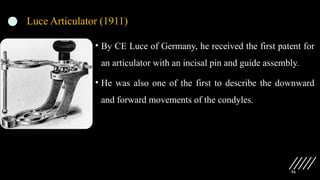
Luce Articulator (1911)
• By CE Luce of Germany, he received the first patent for
an articulator with an incisal pin and guide assembly.
• He was also one of the first to describe the downward
and forward movements of the condyles.
57
Eltner Articulator (1912)
• This was the second articulator patented with incisal pin and
guide table.
• It was constructed on the theory that the temporomandibular
joints (TMJ)
• Have two horizontal axes, one running through the condyles
and the other through the articulator eminences.
Mitchell DL, Wilkie ND. Articulators through the years. Part II. From 1940. The Journal of Prosthetic
Dentistry. 1978 Apr 1;39(4):451-8.
58
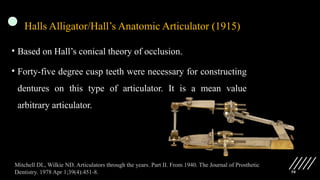
Halls Alligator/Hall’s Anatomic Articulator (1915)
• Based on Hall’s conical theory of occlusion.
• Forty-five degree cusp teeth were necessary for constructing
dentures on this type of articulator. It is a mean value
arbitrary articulator.
Mitchell DL, Wilkie ND. Articulators through the years. Part II. From 1940. The Journal of Prosthetic
Dentistry. 1978 Apr 1;39(4):451-8.
59
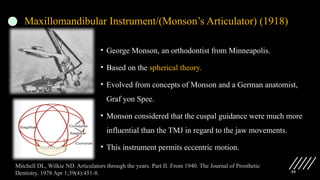
Maxillomandibular Instrument/(Monson’s Articulator) (1918)
• George Monson, an orthodontist from Minneapolis.
• Based on the spherical theory.
• Evolved from concepts of Monson and a German anatomist,
Graf yon Spee.
• Monson considered that the cuspal guidance were much more
influential than the TMJ in regard to the jaw movements.
• This instrument permits eccentric motion.
Mitchell DL, Wilkie ND. Articulators through the years. Part II. From 1940. The Journal of Prosthetic
Dentistry. 1978 Apr 1;39(4):451-8.
60
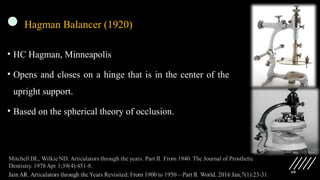
Hagman Balancer (1920)
• HC Hagman, Minneapolis
• Opens and closes on a hinge that is in the center of the
upright support.
• Based on the spherical theory of occlusion.
61
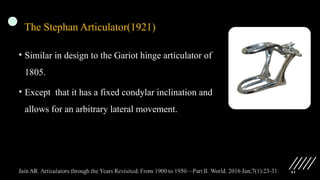
The Stephan Articulator(1921)
• Similar in design to the Gariot hinge articulator of
1805.
• Except that it has a fixed condylar inclination and
allows for an arbitrary lateral movement.
62
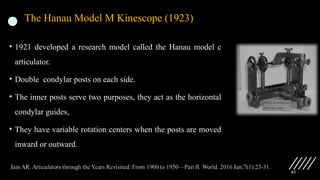
The Hanau Model M Kinescope (1923)
• 1921 developed a research model called the Hanau model c
articulator.
• Double condylar posts on each side.
• The inner posts serve two purposes, they act as the horizontal
condylar guides,
• They have variable rotation centers when the posts are moved
inward or outward.
63
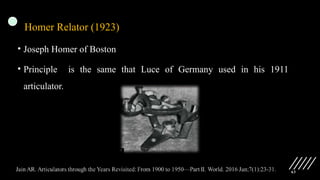
Homer Relator (1923)
• Joseph Homer of Boston
• Principle is the same that Luce of Germany used in his 1911
articulator.
64
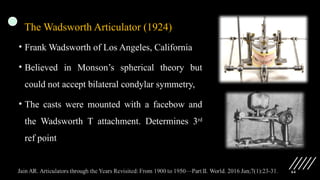
The Wadsworth Articulator (1924)
• Frank Wadsworth of Los Angeles, California
• Believed in Monson’s spherical theory but
could not accept bilateral condylar symmetry,
• The casts were mounted with a facebow and
the Wadsworth T attachment. Determines 3rd
ref point
65
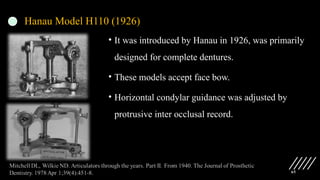
Hanau Model H110 (1926)
• It was introduced by Hanau in 1926, was primarily
designed for complete dentures.
• These models accept face bow.
• Horizontal condylar guidance was adjusted by
protrusive inter occlusal record.
66
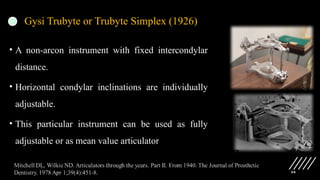
Gysi Trubyte or Trubyte Simplex (1926)
• A non-arcon instrument with fixed intercondylar
distance.
• Horizontal condylar inclinations are individually
adjustable.
• This particular instrument can be used as fully
adjustable or as mean value articulator
67
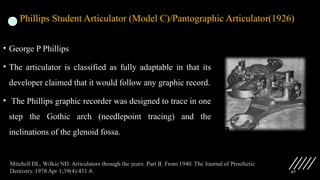
Phillips Student Articulator (Model C)/Pantographic Articulator(1926)
• George P Phillips
• The articulator is classified as fully adaptable in that its
developer claimed that it would follow any graphic record.
• The Phillips graphic recorder was designed to trace in one
step the Gothic arch (needlepoint tracing) and the
inclinations of the glenoid fossa.
68
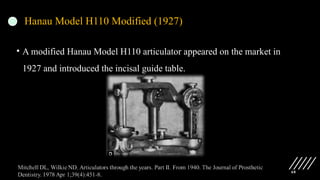
Hanau Model H110 Modified (1927)
• A modified Hanau Model H110 articulator appeared on the market in
1927 and introduced the incisal guide table.
69
The House Articulator (1927)
• The House articulator was developed by MM House in the early 1930s.
• The Needle House intraoral
• chew in or other positional records can be used to set the house articulator
• Needle house chew in employs four metal studs in the upper occlusal rim against a
lower compound rim.
• It permits eccentric movements based on Needle House records and doesn’t accept
facebow transfer.
70
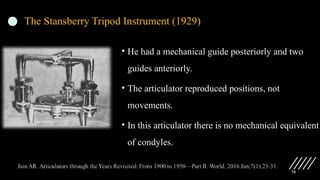
The Stansberry Tripod Instrument (1929)
• He had a mechanical guide posteriorly and two
guides anteriorly.
• The articulator reproduced positions, not
movements.
• In this articulator there is no mechanical equivalent
of condyles.
71
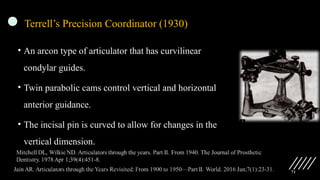
Terrell’s Precision Coordinator (1930)
• An arcon type of articulator that has curvilinear
condylar guides.
• Twin parabolic cams control vertical and horizontal
anterior guidance.
• The incisal pin is curved to allow for changes in the
vertical dimension.
72
Hanau Crown and Bridge Articulator (1934)
• Small articulator but unlike with other hinge articulators
• A posterior pin and cam guidance mechanism can be set to simulate
working and balancing side excursions of 15º.
• The mechanism can be set to
• L left quadrant
• R right quadrant
• A for anterior restorations
73
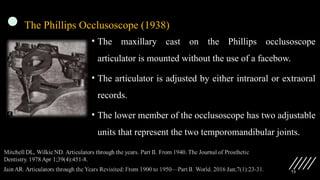
The Phillips Occlusoscope (1938)
• The maxillary cast on the Phillips occlusoscope
articulator is mounted without the use of a facebow.
• The articulator is adjusted by either intraoral or extraoral
records.
• The lower member of the occlusoscope has two adjustable
units that represent the two temporomandibular joints.
74
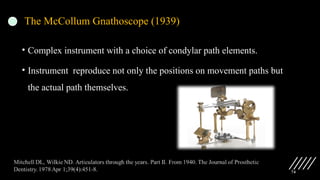
The McCollum Gnathoscope (1939)
• Complex instrument with a choice of condylar path elements.
• Instrument reproduce not only the positions on movement paths but
the actual path themselves.
75
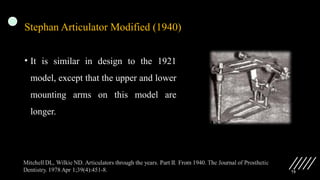
Stephan Articulator Modified (1940)
• It is similar in design to the 1921
model, except that the upper and lower
mounting arms on this model are
longer.
76
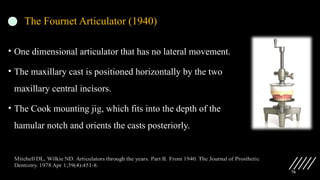
• One dimensional articulator that has no lateral movement.
• The maxillary cast is positioned horizontally by the two
maxillary central incisors.
• The Cook mounting jig, which fits into the depth of the
hamular notch and orients the casts posteriorly.
The Fournet Articulator (1940)
77
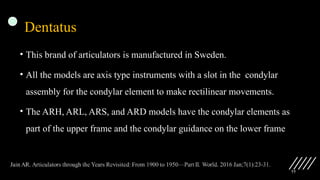
Dentatus
• This brand of articulators is manufactured in Sweden.
• All the models are axis type instruments with a slot in the condylar
assembly for the condylar element to make rectilinear movements.
• The ARH, ARL, ARS, and ARD models have the condylar elements as
part of the upper frame and the condylar guidance on the lower frame
78
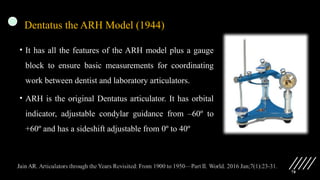
Dentatus the ARH Model (1944)
• It has all the features of the ARH model plus a gauge
block to ensure basic measurements for coordinating
work between dentist and laboratory articulators.
• ARH is the original Dentatus articulator. It has orbital
indicator, adjustable condylar guidance from –60º to
+60º and has a sideshift adjustable from 0º to 40º
79
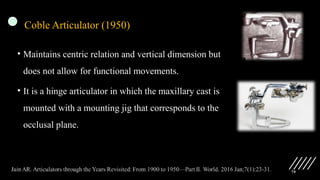
Coble Articulator (1950)
• Maintains centric relation and vertical dimension but
does not allow for functional movements.
• It is a hinge articulator in which the maxillary cast is
mounted with a mounting jig that corresponds to the
occlusal plane.
80
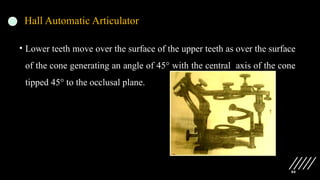
Hall Automatic Articulator
• Lower teeth move over the surface of the upper teeth as over the surface
of the cone generating an angle of 45° with the central axis of the cone
tipped 45° to the occlusal plane.
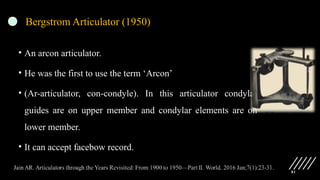
81
Bergstrom Articulator (1950)
• An arcon articulator.
• He was the first to use the term ‘Arcon’
• (Ar-articulator, con-condyle). In this articulator condylar
guides are on upper member and condylar elements are on
lower member.
• It can accept facebow record.
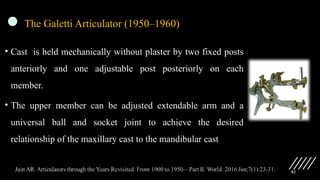
82
The Galetti Articulator (1950–1960)
• Cast is held mechanically without plaster by two fixed posts
anteriorly and one adjustable post posteriorly on each
member.
• The upper member can be adjusted extendable arm and a
universal ball and socket joint to achieve the desired
relationship of the maxillary cast to the mandibular cast
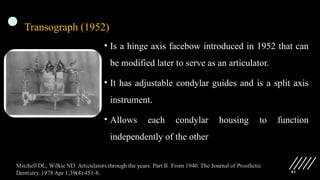
83
Transograph (1952)
• Is a hinge axis facebow introduced in 1952 that can
be modified later to serve as an articulator.
• It has adjustable condylar guides and is a split axis
instrument.
• Allows each condylar housing to function
independently of the other
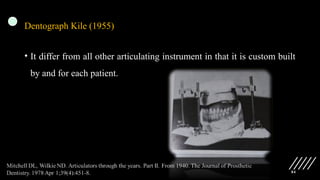
84
Dentograph Kile (1955)
• It differ from all other articulating instrument in that it is custom built
by and for each patient.
85
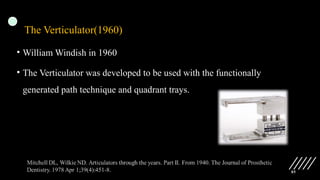
The Verticulator(1960)
• William Windish in 1960
• The Verticulator was developed to be used with the functionally
generated path technique and quadrant trays.
86
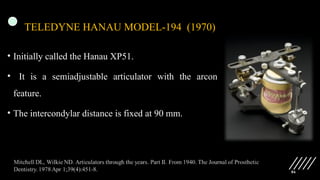
TELEDYNE HANAU MODEL-194 (1970)
• Initially called the Hanau XP51.
• It is a semiadjustable articulator with the arcon
feature.
• The intercondylar distance is fixed at 90 mm.
87
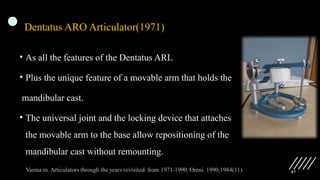
Dentatus ARO Articulator(1971)
• As all the features of the Dentatus ARL
• Plus the unique feature of a movable arm that holds the
mandibular cast.
• The universal joint and the locking device that attaches
the movable arm to the base allow repositioning of the
mandibular cast without remounting.
88
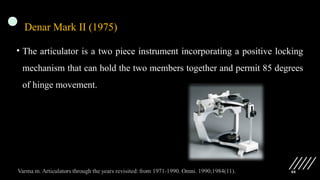
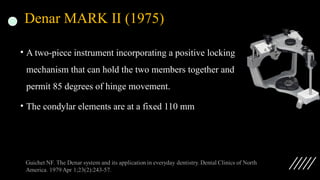
Denar Mark II (1975)
• The articulator is a two piece instrument incorporating a positive locking
mechanism that can hold the two members together and permit 85 degrees
of hinge movement.
89
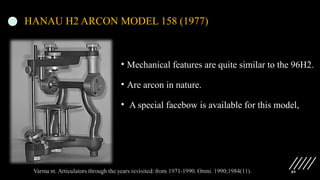
HANAU H2 ARCON MODEL 158 (1977)
• Mechanical features are quite similar to the 96H2.
• Are arcon in nature.
• A special facebow is available for this model,
90
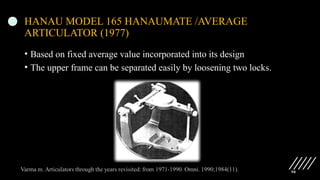
HANAU MODEL 165 HANAUMATE /AVERAGE
ARTICULATOR (1977)
• Based on fixed average value incorporated into its design
• The upper frame can be separated easily by loosening two locks.
91
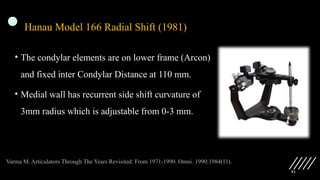
Hanau Model 166 Radial Shift (1981)
• The condylar elements are on lower frame (Arcon)
and fixed inter Condylar Distance at 110 mm.
• Medial wall has recurrent side shift curvature of
3mm radius which is adjustable from 0-3 mm.
Varma M. Articulators Through The Years Revisited: From 1971-1990. Omni. 1990;1984(11).
92
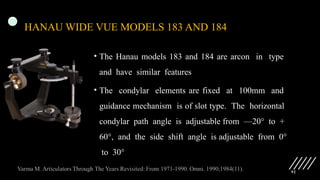
HANAU WIDE VUE MODELS 183 AND 184
• The Hanau models 183 and 184 are arcon in type
and have similar features
• The condylar elements are fixed at 100mm and
guidance mechanism is of slot type. The horizontal
condylar path angle is adjustable from —20° to +
60°, and the side shift angle is adjustable from 0°
to 30°
93
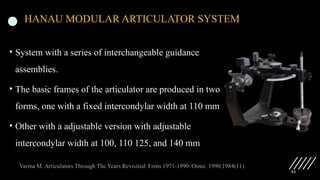
HANAU MODULAR ARTICULATOR SYSTEM
• System with a series of interchangeable guidance
assemblies.
• The basic frames of the articulator are produced in two
forms, one with a fixed intercondylar width at 110 mm
• Other with a adjustable version with adjustable
intercondylar width at 100, 110 125, and 140 mm
94
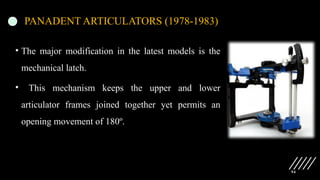
PANADENT ARTICULATORS (1978-1983)
• The major modification in the latest models is the
mechanical latch.
• This mechanism keeps the upper and lower
articulator frames joined together yet permits an
opening movement of 180º.
95
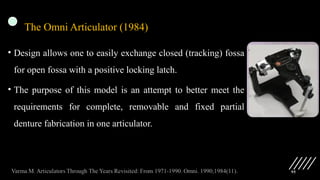
The Omni Articulator (1984)
• Design allows one to easily exchange closed (tracking) fossa
for open fossa with a positive locking latch.
• The purpose of this model is an attempt to better meet the
requirements for complete, removable and fixed partial
denture fabrication in one articulator.
96
Sam Articulator (1990)
• This German articulation system is durable, stable, and
precise.
• One aspect of its popularity is the ability to interchange
mounted casts from one instrument to another.
97
The Sam 2 Articulator
• 3 interchangeable condylar housings that incorporate
different curvatures to the superior wall.
• Adjustable instrument, compatible from one to another.
• Offers three optional interchangeable condylar housings
that incorporate different curves for the horizontal
condylar pathways.
98
Sam 3 Articulator
• The instrument has a unique On-Off Centric Locking
Device and condylar element covers to keep the lower
and upper members locked together during hinge and
eccentric movement.
99
GirrbachArtex Articulators(1995)
• Pierrosilveranibiavati devised an original
system to be applied to a semi individual
articulator based on monson’stheory.
• This system was developed over the years and
realized in 1995 in cooperation with the
GirrbachArtex, pforzheim, Germany.
100
CLASSIFICATIONS
Theories of
occlusion
Various authors
Instrument
function
Degree of articulator
adjustability
101
Articulators Based on Geometric Theories of Mandibular
Movements
Based on Geometric
Theories
Bonwill’s Equilateral
theory
Monson’s spherical
theory Hall’s conical theory
102
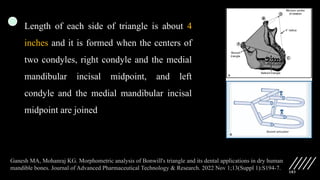
Bonwill’s Equilateral theory
• An equilateral triangle was described by G Bonwill, an
American dentist in 1858, and it became Bonwill’s
theory of occlusion’s basis.
• Measuring 6000 skulls and 4000 living persons
Ganesh MA, Mohanraj KG. Morphometric analysis of Bonwill's triangle and its dental applications in dry human
mandible bones. Journal of Advanced Pharmaceutical Technology & Research. 2022 Nov 1;13(Suppl 1):S194-7.
103
Length of each side of triangle is about 4
inches and it is formed when the centers of
two condyles, right condyle and the medial
mandibular incisal midpoint, and left
condyle and the medial mandibular incisal
midpoint are joined
Ganesh MA, Mohanraj KG. Morphometric analysis of Bonwill's triangle and its dental applications in dry human
mandible bones. Journal of Advanced Pharmaceutical Technology & Research. 2022 Nov 1;13(Suppl 1):S194-7.
104
Evaluation of Bonwill's triangle parameters using cone-beam computed
tomography for gender determination.
Koothati, Ramesh Kumar; Khandare, Samadhan; Suresh, Dirasantchu;
Sravanthi, Yendluru Mercy; Avinash, Kallumata; Himapavana, Muvva
The aim of this study was to evaluate the mandibular Bonwill's triangle parameters
using CBCT for gender determination
Koothati, R.K., Khandare, S., Suresh, D., Sravanthi, Y.M., Avinash, K. and Himapavana, M., 2023.
Evaluation of Bonwill's triangle parameters using cone-beam computed tomography for gender
determination: A retrospective study. Journal of Oral and Maxillofacial Radiology, 11(1), pp.6-10.
SAMPLE FOOTER TEXT 105
• Conclusion:
The parameters of the mandibular Bonwill's triangle in the Indian
population were observed to be larger in males than females. Hence,
these parameters can be used for gender identification in forensic and
medicolegal practice.
106
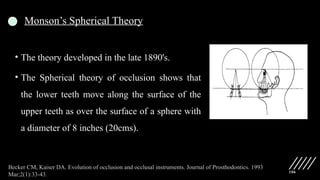
Monson’s Spherical Theory
• The theory developed in the late 1890's.
• The Spherical theory of occlusion shows that
the lower teeth move along the surface of the
upper teeth as over the surface of a sphere with
a diameter of 8 inches (20cms).
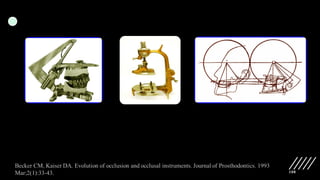
Becker CM, Kaiser DA. Evolution of occlusion and occlusal instruments. Journal of Prosthodontics. 1993
Mar;2(1):33-43.
107
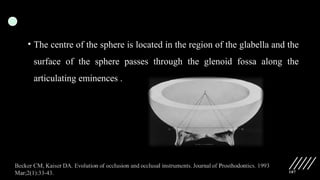
• The centre of the sphere is located in the region of the glabella and the
surface of the sphere passes through the glenoid fossa along the
articulating eminences .
108
109
Hall’s Conical Theory
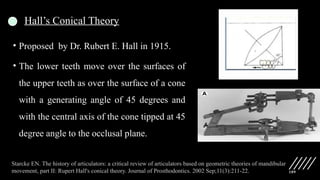
• Proposed by Dr. Rubert E. Hall in 1915.
• The lower teeth move over the surfaces of
the upper teeth as over the surface of a cone
with a generating angle of 45 degrees and
with the central axis of the cone tipped at 45
degree angle to the occlusal plane.
Starcke EN. The history of articulators: a critical review of articulators based on geometric theories of mandibular
movement, part II: Rupert Hall's conical theory. Journal of Prosthodontics. 2002 Sep;11(3):211-22.
110
To determine the influence of the radius of Monson’s sphere, the number of
posterior laterotrusive, mediotrusive, and protrusive contacts, and the chewing
rate on food comminution.
Carneiro DE, Zander LR, Ruppel C, Canales GD, Auccaise-Estrada R, Sánchez-Ayala A. Influence of the radius of
Monson’s sphere and excursive occlusal contacts on masticatory function of dentate subjects. Archives of Oral
Biology. 2024 Mar 1;159:105879.
111
A larger radius of Monson’s sphere and a greater number of posterior
excursive contacts were found to be related to better masticatory
function
112
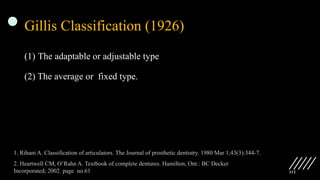
Gillis Classification (1926)
(1) The adaptable or adjustable type
(2) The average or fixed type.
1. Rihani A. Classification of articulators. The Journal of prosthetic dentistry. 1980 Mar 1;43(3):344-7.
2. Heartwell CM, O’Rahn A. Textbook of complete dentures. Hamilton, Ont.: BC Decker
Incorporated; 2002. page no.61
113
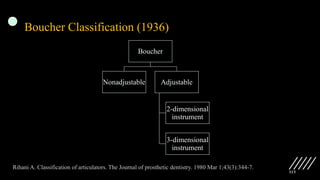
Boucher Classification (1936)
Boucher
Nonadjustable Adjustable
2-dimensional
instrument
3-dimensional
instrument
Rihani A. Classification of articulators. The Journal of prosthetic dentistry. 1980 Mar 1;43(3):344-7.
114
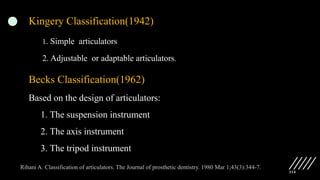
Kingery Classification(1942)
1. Simple articulators
2. Adjustable or adaptable articulators.
Becks Classification(1962)
Based on the design of articulators:
1. The suspension instrument
2. The axis instrument
3. The tripod instrument
Rihani A. Classification of articulators. The Journal of prosthetic dentistry. 1980 Mar 1;43(3):344-7.
115
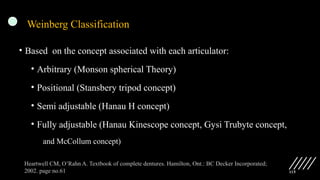
Weinberg Classification
• Based on the concept associated with each articulator:
• Arbitrary (Monson spherical Theory)
• Positional (Stansbery tripod concept)
• Semi adjustable (Hanau H concept)
• Fully adjustable (Hanau Kinescope concept, Gysi Trubyte concept,
and McCollum concept)
Heartwell CM, O’Rahn A. Textbook of complete dentures. Hamilton, Ont.: BC Decker Incorporated;
2002. page no.61
Posselt’s Classification (1968)
• Plain line
• Mean value
• Adjustable
C.J. Thomas Classification (1973) (Types of record used)
• Arbitrary(not adjustable)
• Positional (axis and nonaxis types, static records)
• Functional(axis and nonaxis types, functional records)
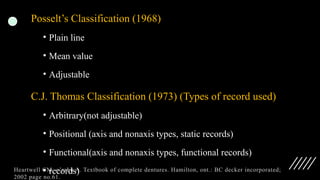
• records)
Heartwell CM, o’rahn A. Textbook of complete dentures. Hamilton, ont.: BC decker incorporated;
2002 page no.61.
117
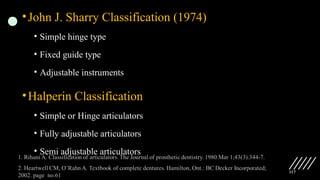
•John J. Sharry Classification (1974)
• Simple hinge type
• Fixed guide type
• Adjustable instruments
•Halperin Classification
• Simple or Hinge articulators
• Fully adjustable articulators
• Semi adjustable articulators
118
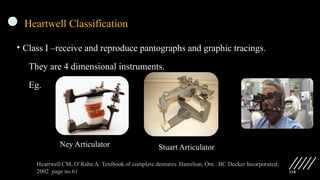
Heartwell Classification
• Class I –receive and reproduce pantographs and graphic tracings.
They are 4 dimensional instruments.
Eg.
Ney Articulator Stuart Articulator
119
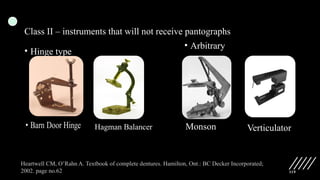
Class II – instruments that will not receive pantographs
• Hinge type
• Arbitrary
Hagman Balancer Monson Verticulator
Heartwell CM, O’Rahn A. Textbook of complete dentures. Hamilton, Ont.: BC Decker Incorporated;
2002. page no.62
120
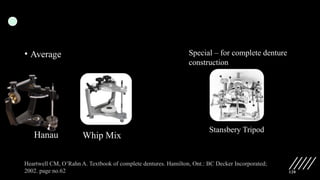
• Average
Hanau Whip Mix
Special – for complete denture
construction
Stansbery Tripod
Heartwell CM, O’Rahn A. Textbook of complete dentures. Hamilton, Ont.: BC Decker Incorporated;
2002. page no.62
121
International Prosthodontics Workshop
(University Of Michigan In 1972)
• Based on Instrument function
• Instrument capability
• Intent
• Registration procedure
• Registration acceptance
Winkler S. Essentials of complete denture prosthodontics.. 1979. Page no. 190
122
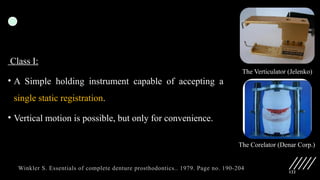
Class I:
• A Simple holding instrument capable of accepting a
single static registration.
• Vertical motion is possible, but only for convenience.
The Verticulator (Jelenko)
The Corelator (Denar Corp.)
Winkler S. Essentials of complete denture prosthodontics.. 1979. Page no. 190-204
123
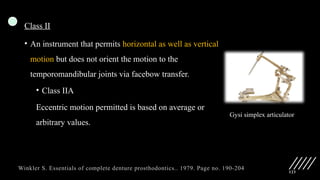
Class II
• An instrument that permits horizontal as well as vertical
motion but does not orient the motion to the
temporomandibular joints via facebow transfer.
• Class IIA
Eccentric motion permitted is based on average or
arbitrary values.
Gysi simplex articulator
Winkler S. Essentials of complete denture prosthodontics.. 1979. Page no. 190-204
124
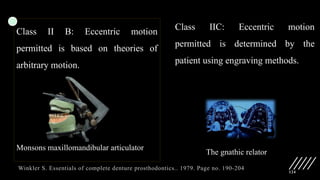
Class II B: Eccentric motion
permitted is based on theories of
arbitrary motion.
Monsons maxillomandibular articulator
Class IIC: Eccentric motion
permitted is determined by the
patient using engraving methods.
The gnathic relator
Winkler S. Essentials of complete denture prosthodontics.. 1979. Page no. 190-204
125
Class III:
• Instruments that simulate condylar pathways by using averages or
mechanical equivalents for all or part of the motion.
• These instruments allow for orientation of the cast relative to the joints and
may be arcon or nonarcon instruments, accept facebows, and have
mounting plates
Winkler S. Essentials of complete denture prosthodontics.. 1979. Page no. 190-204
126
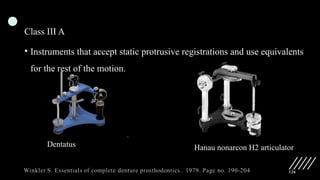
Class III A
• Instruments that accept static protrusive registrations and use equivalents
for the rest of the motion.
Dentatus Hanau nonarcon H2 articulator
127
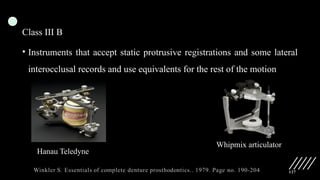
Class III B
• Instruments that accept static protrusive registrations and some lateral
interocclusal records and use equivalents for the rest of the motion
Hanau Teledyne
Whipmix articulator
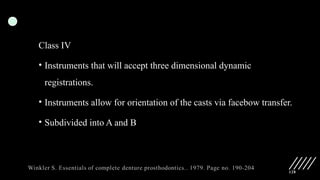
128
Class IV
• Instruments that will accept three dimensional dynamic
registrations.
• Instruments allow for orientation of the casts via facebow transfer.
• Subdivided into A and B
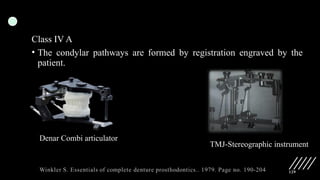
129
Class IV A
• The condylar pathways are formed by registration engraved by the
patient.
Denar Combi articulator
TMJ-Stereographic instrument
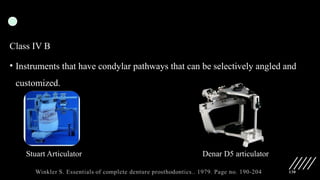
130
Class IV B
• Instruments that have condylar pathways that can be selectively angled and
customized.
Stuart Articulator Denar D5 articulator
131
Rihani’s Classification System (1980)
• Non adjustable - A simple holding instrument capable of accepting single
static registration.
• Vertical motion
• Can accept one or two of the following records:
1. Face bow
2. Centric jaw relation record
3. Protrusive record.
Rihani A. Classification of articulators. The Journal of prosthetic dentistry. 1980 Mar 1;43(3):344-7.
132
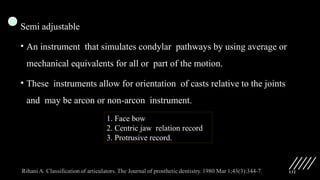
Semi adjustable
• An instrument that simulates condylar pathways by using average or
mechanical equivalents for all or part of the motion.
• These instruments allow for orientation of casts relative to the joints
and may be arcon or non-arcon instrument.
1. Face bow
2. Centric jaw relation record
3. Protrusive record.
133
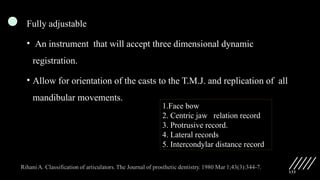
Fully adjustable
• An instrument that will accept three dimensional dynamic
registration.
• Allow for orientation of the casts to the T.M.J. and replication of all
mandibular movements.
1.Face bow
2. Centric jaw relation record
3. Protrusive record.
4. Lateral records
5. Intercondylar distance record
134
135
• Adapted from the University of Michigan and Rihani’s
classification; based on the adjustment capabilities of an articulator.
• Facebow transfer, intercondylar distance adjustment,centric record,
protrusive record, and lateral record.
Maheshwari K, Gupta AK, Tiwari B. A newly proposed classification for articulators-integrating virtual with
conventional. The Journal of Indian Prosthodontic Society. 2024 Apr 1;24(2):212-4.
136
Category I:
Mechanical
articulators
Class 1:
Nonsimulated/fixed
articulators
Centric record
Denar Automark,
Barn Door
Class 2: Partially
simulated articulators
Class 3: Fully simulated
articulators
137
138
• Category II: Virtual articulators
Class 1: Mathematically simulated virtual articulators
• Use an average value for adjustment of additional articulator
settings to reproduce mandibular movements
Ceramill-Artex
Ivoclar-Stratos 300
139
Class 2: Fully simulated virtual articulators
It records and replicates exact mandibular movement paths using a specific
digital tool, the jaw motion analyzer
Example: DentCam system, Kordass, and Gartner virtual articulator
140
SELECTION OF ARTICULATORS
141
• Articulator movements of the condylar elements do not reproduce
condylar movements as in the temporomandibular joints. The goal of
articulation is to duplicate tooth movements along border pathways in at
least two planes of space.
• The most important requirements of an articulator are to maintain centric
relation and the vertical dimension of occlusion once it has been
established.
Joshi PR, Bhat GS, Dixit S. Selection of articulator for general dental practice. Kathmandu University Medical
Journal (KUMJ). 2008 Jan 1;6(1):112-6.
142
The selection of the articulator is dependent on:-
• Occlusal scheme to be developed
• Posterior tooth form
• Excursive tooth guidance
• Jaw relation records that can be made to adjust the articulator.
Joshi PR, Bhat GS, Dixit S. Selection of articulator for general dental practice. Kathmandu University Medical
Journal (KUMJ). 2008 Jan 1;6(1):112-6.
143
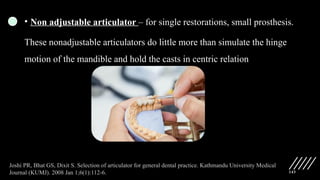
• Non adjustable articulator – for single restorations, small prosthesis.
These nonadjustable articulators do little more than simulate the hinge
motion of the mandible and hold the casts in centric relation
Joshi PR, Bhat GS, Dixit S. Selection of articulator for general dental practice. Kathmandu University Medical
Journal (KUMJ). 2008 Jan 1;6(1):112-6.
144
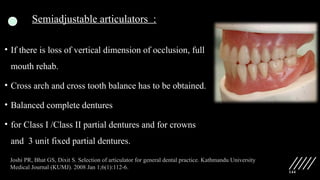
Semiadjustable articulators :
• If there is loss of vertical dimension of occlusion, full
mouth rehab.
• Cross arch and cross tooth balance has to be obtained.
• Balanced complete dentures
• for Class I /Class II partial dentures and for crowns
and 3 unit fixed partial dentures.
Joshi PR, Bhat GS, Dixit S. Selection of articulator for general dental practice. Kathmandu University
Medical Journal (KUMJ). 2008 Jan 1;6(1):112-6.
145
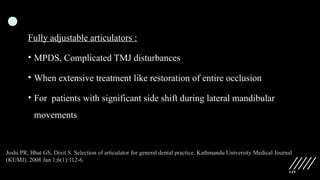
Fully adjustable articulators :
• MPDS, Complicated TMJ disturbances
• When extensive treatment like restoration of entire occlusion
• For patients with significant side shift during lateral mandibular
movements
Joshi PR, Bhat GS, Dixit S. Selection of articulator for general dental practice. Kathmandu University Medical Journal
(KUMJ). 2008 Jan 1;6(1):112-6.
146
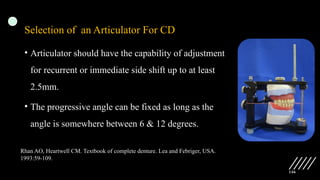
Selection of an Articulator For CD
• Articulator should have the capability of adjustment
for recurrent or immediate side shift up to at least
2.5mm.
• The progressive angle can be fixed as long as the
angle is somewhere between 6 & 12 degrees.
Rhan AO, Heartwell CM. Textbook of complete denture. Lea and Febriger, USA.
1993:59-109.
147
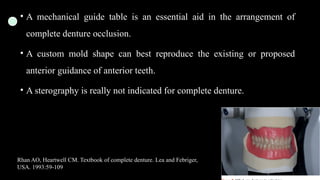
• A mechanical guide table is an essential aid in the arrangement of
complete denture occlusion.
• A custom mold shape can best reproduce the existing or proposed
anterior guidance of anterior teeth.
• A sterography is really not indicated for complete denture.
Rhan AO, Heartwell CM. Textbook of complete denture. Lea and Febriger,
USA. 1993:59-109
148
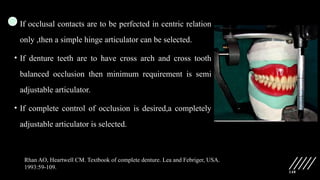
• If occlusal contacts are to be perfected in centric relation
only ,then a simple hinge articulator can be selected.
• If denture teeth are to have cross arch and cross tooth
balanced occlusion then minimum requirement is semi
adjustable articulator.
• If complete control of occlusion is desired,a completely
adjustable articulator is selected.
Rhan AO, Heartwell CM. Textbook of complete denture. Lea and Febriger, USA.
1993:59-109.
149
According to Celenza
• In complete dentures construction, a centric relation system should be
used.
• But precise 3 dimensional eccentric registrations is a wasted effort
because of tissue resiliency.
Celenza FV: An analysis of articulators. Dent Clin North Am. 1979 Apr;23(2):305-26.
150
According to Winkler
• If complete dentures are fabricated in centric relations, articulators
with minimal requirements are sufficient.
• If teeth are arranged in balanced occlusion an articulator with
additional requirements is necessary.
Sheldon Winkler: Essentials of complete denture prosthodontics. 2nd edition,2004, Ishiyaku Euro
America, Inc, 142-183.
151
Selection Of An Articulator For Fpd
• Single restoration- Non adjustable articulator
• Larger parts of the segments with multiple restorations-Adjustable articulator.
• Articulators with immediate side shift not recommended.
• With progressive side shift- least desirable.
• With curved superior surface- not necessary unless balanced articulation is
desired.
Shillingburg H T, Hobo S : Arti Sutradhar W, Mishra SK, Chowdhary R. Uses, accuracy and limitations of semiadjustable
articulators in dentistry: a systematic review. Tanta Dental Journal. 2019 Jul 1;16(3):121. culator selection for restorative
dentistry J Prosthet dent 1976 ; 36 :35-43.
152
• Intercondylar distance adjustments only simplify the records transfer.
• Open fossa design is very convenient for waxing & Porcelain stacking.
• Closed fossa design preferred for CD.
• Open fossa design is preferred as a diagnostic instrument in diagnosing
joint –tooth disharmonies.
153
Selection Of An Articulator For Rpd
• A simple hinge or a non-adjustable-class III partially edentulous cases
• Semi-adjustable like Hanau, Whip-mix- most class I &II
• Fully adjustable articulator is usually limited to those patients needing
a removable partial denture, wherein the entire occlusal scheme is to
be developed at one time by the wax additive technique. Stuart
articulator is generally used
154
155
• Factors governing the laws of articulation as stated by Rudolph Hanau
have been accepted as the standard reference on this subject.
• Hanau’s study was a pioneer exploration of the subject, and the
“articulation quint”
Trapozzano VR. Laws of articulation. Journal of Prosthetic Dentistry. 1963 Jan 1;13(1):34-44.
156
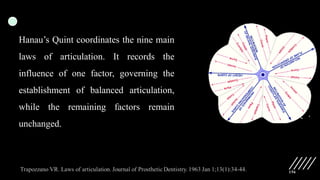
Hanau’s Quint coordinates the nine main
laws of articulation. It records the
influence of one factor, governing the
establishment of balanced articulation,
while the remaining factors remain
unchanged.
157
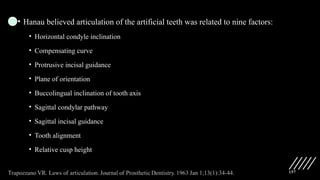
• Hanau believed articulation of the artificial teeth was related to nine factors:
• Horizontal condyle inclination
• Compensating curve
• Protrusive incisal guidance
• Plane of orientation
• Buccolingual inclination of tooth axis
• Sagittal condylar pathway
• Sagittal incisal guidance
• Tooth alignment
• Relative cusp height
158
Later he combined the original nine and reduced
them to five:
• The inclination of the condylar guidance
• Prominence of the compensating curve
• Inclination of the plane of orientation
• Inclination of the incisal guidance
• The height of the cusp
159
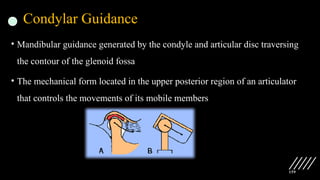
Condylar Guidance
• Mandibular guidance generated by the condyle and articular disc traversing
the contour of the glenoid fossa
• The mechanical form located in the upper posterior region of an articulator
that controls the movements of its mobile members
160
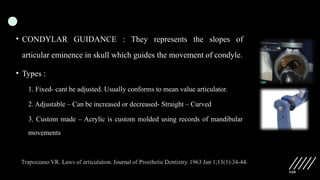
• CONDYLAR GUIDANCE : They represents the slopes of
articular eminence in skull which guides the movement of condyle.
• Types :
1. Fixed- cant be adjusted. Usually conforms to mean value articulator.
2. Adjustable – Can be increased or decreased- Straight – Curved
3. Custom made – Acrylic is custom molded using records of mandibular
movements
161
• The degree of condylar inclination registered results from
• The shape of the bony contour of the temporomandibular joint
• The action of the muscles attaching to the mandible
• The limitation of movements effected by the attaching ligaments
• The method used
162
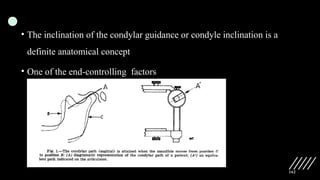
• The inclination of the condylar guidance or condyle inclination is a
definite anatomical concept
• One of the end-controlling factors
163
Anterior Guidance
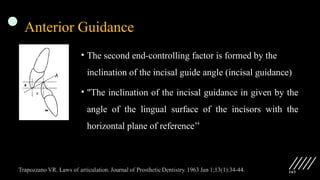
• The second end-controlling factor is formed by the
inclination of the incisal guide angle (incisal guidance)
• "The inclination of the incisal guidance in given by the
angle of the lingual surface of the incisors with the
horizontal plane of reference’’
164
• The influence of the contacting surfaces of anterior teeth on
mandibular movements for analysis and treatment of occlusion.
165
Height Of The Cusp
• “In the establishment of balanced articulation, we are primarily interested in
the length and the inclination of the effective cusp inclines’’
• Any increase or decrease in cusp height (the vertical distance from the tip of
the cusp to its base) will result in an increase or decrease in the length of the
cusp inclines.
166
• Cusp height exerts its influence by determining the range of tooth
contact during eccentric movement. The higher the cusp, the longer
the effective tooth incline, and therefore, the greater the range of the
tooth contact during eccentric movement.
167
Plane Of Orientation
• Hanau states that "the plane of orientation is a purely geometrical
factor. It is a plane assumed to pass through the dental landmarks or
points; namely the central incisal contact point and the summits of the
mesiobuccal cusps of the molars.
168
PROMINENCE OF THE COMPENSATING CURVE
• Hanau states ‘the prominence of the compensating curve infers an increase
of the concavity (sometimes a decrease of the convexity) in the alignment
of the mandibular posterior teeth.
• The compensating curve is the most important factor for obtaining
balance.Cusp teeth have inclines necessary for obtaining balanced
occlusion
169
ARCON VS NON ARCON
170
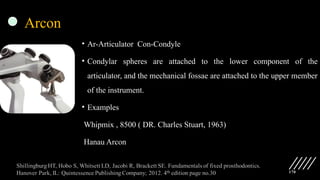
Arcon
• Ar-Articulator Con-Condyle
• Condylar spheres are attached to the lower component of the
articulator, and the mechanical fossae are attached to the upper member
of the instrument.
• Examples
Whipmix , 8500 ( DR. Charles Stuart, 1963)
Hanau Arcon
171
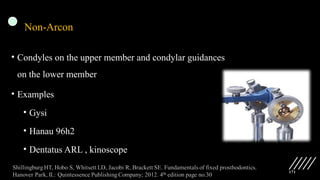
Non-Arcon
• Condyles on the upper member and condylar guidances
on the lower member
• Examples
• Gysi
• Hanau 96h2
• Dentatus ARL , kinoscope
172
• Relation between condylar indications with a given axis vary with
• The magnitude and direction of protrusion
• Degree of opening
• The relation of condylar guide in terms of central bearing point, teeth, or
incisal pin
• The inclination of the incisal guide.
173
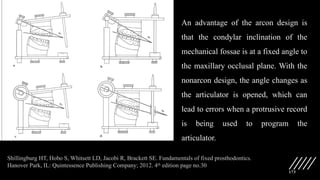
An advantage of the arcon design is
that the condylar inclination of the
mechanical fossae is at a fixed angle to
the maxillary occlusal plane. With the
nonarcon design, the angle changes as
the articulator is opened, which can
lead to errors when a protrusive record
is being used to program the
articulator.
Shillingburg HT, Hobo S, Whitsett LD, Jacobi R, Brackett SE. Fundamentals of fixed prosthodontics.
Hanover Park, IL: Quintessence Publishing Company; 2012. 4th
edition page no.30
174
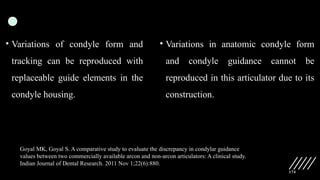
• Variations of condyle form and
tracking can be reproduced with
replaceable guide elements in the
condyle housing.
• Variations in anatomic condyle form
and condyle guidance cannot be
reproduced in this articulator due to its
construction.
Goyal MK, Goyal S. A comparative study to evaluate the discrepancy in condylar guidance
values between two commercially available arcon and non-arcon articulators: A clinical study.
Indian Journal of Dental Research. 2011 Nov 1;22(6):880.
175
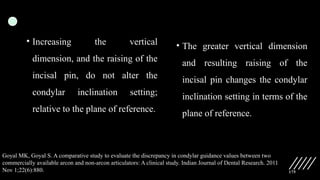
• Increasing the vertical
dimension, and the raising of the
incisal pin, do not alter the
condylar inclination setting;
relative to the plane of reference.
• The greater vertical dimension
and resulting raising of the
incisal pin changes the condylar
inclination setting in terms of the
plane of reference.
Goyal MK, Goyal S. A comparative study to evaluate the discrepancy in condylar guidance values between two
commercially available arcon and non-arcon articulators: A clinical study. Indian Journal of Dental Research. 2011
Nov 1;22(6):880.
176
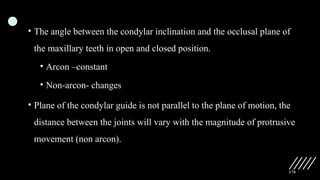
• The angle between the condylar inclination and the occlusal plane of
the maxillary teeth in open and closed position.
• Arcon –constant
• Non-arcon- changes
• Plane of the condylar guide is not parallel to the plane of motion, the
distance between the joints will vary with the magnitude of protrusive
movement (non arcon).
177
A comparative study to evaluate the discrepancy in condylar guidance
values between two commercially available arcon and non-arcon
articulators A clinical study
Goyal, Mukesh Kumar; Goyal, Shelly
Goyal MK, Goyal S. A comparative study to evaluate the discrepancy in condylar guidance values between
two commercially available arcon and non-arcon articulators: A clinical study. Indian Journal of Dental
Research. 2011 Nov 1;22(6):880.
SAMPLE FOOTER TEXT 178
• The purpose of this study was comparative evaluation of sagittal
condylar values of arcon and non-arcon articulators with cephalometric
readings and to determine the amount of discrepancy in sagittal
condylar guidance values between arcon and non-arcon articulators
using same protrusive record.
Hanau H2 (non-arcon type) and Hanau Wide-Vue (arcon type)
articulators
179
• Conclusion: The mean difference in the sagittal condylar guidance
values obtained from non-arcon and arcon articulators shows a low
level of reproducibility, and no significant difference found in mean
sagittal condylar values obtained from arcon articulator and
cephalometric tracings indicates replication of sagittal condylar
guidance value from image of articular eminence.
180
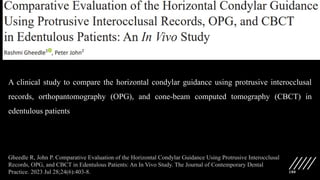
A clinical study to compare the horizontal condylar guidance using protrusive interocclusal
records, orthopantomography (OPG), and cone-beam computed tomography (CBCT) in
edentulous patients
Gheedle R, John P. Comparative Evaluation of the Horizontal Condylar Guidance Using Protrusive Interocclusal
Records, OPG, and CBCT in Edentulous Patients: An In Vivo Study. The Journal of Contemporary Dental
Practice. 2023 Jul 28;24(6):403-8.
181
• Cone-beam computed tomography is as reliable and accurate as the clinical
method. A significant correlation exists between the clinical method and
CBCT. It can be used as a dependable adjunct to the clinical method of
HCGA measurement.
182
SUMMARY
• Uses or purpose of articulators
• Requirements :minimal additional and optional
• Limitations
• Advantages
• Evolution from 18th
to 21st
century
• Classification: theories, authors..
• Selection of articulators
• Arcon vs non arcon
A R T I C U L A T O R S
PA RT I I
CONTENTS
• COMMONLY USED ARTICULATORS
• MEAN VALUE ARTICULATORS
• HANUAS
• ARTEX
• WHIPMIX
• RECENT ADVANCMENTS
• CARE AND MAINTANENCE
• SUMMARY
• REFRENCES
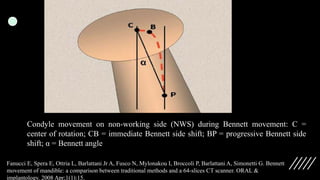
Condyle movement on non-working side (NWS) during Bennett movement: C =
center of rotation; CB = immediate Bennett side shift; BP = progressive Bennett side
shift; α = Bennett angle
Fanucci E, Spera E, Ottria L, Barlattani Jr A, Fusco N, Mylonakou I, Broccoli P, Barlattani A, Simonetti G. Bennett
movement of mandible: a comparison between traditional methods and a 64-slices CT scanner. ORAL &
implantology. 2008 Apr;1(1):15.
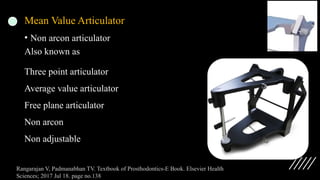
Mean Value Articulator
• Non arcon articulator
Also known as
Three point articulator
Average value articulator
Free plane articulator
Non arcon
Non adjustable
Rangarajan V, Padmanabhan TV. Textbook of Prosthodontics-E Book. Elsevier Health
Sciences; 2017 Jul 18. page no.138
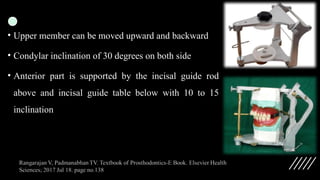
• Upper member can be moved upward and backward
• Condylar inclination of 30 degrees on both side
• Anterior part is supported by the incisal guide rod
above and incisal guide table below with 10 to 15
inclination
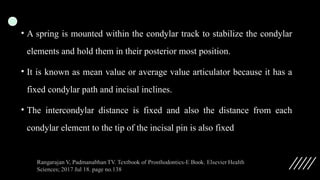
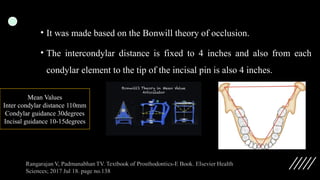
• A spring is mounted within the condylar track to stabilize the condylar
elements and hold them in their posterior most position.
• It is known as mean value or average value articulator because it has a
fixed condylar path and incisal inclines.
• The intercondylar distance is fixed and also the distance from each
condylar element to the tip of the incisal pin is also fixed
• It was made based on the Bonwill theory of occlusion.
• The intercondylar distance is fixed to 4 inches and also from each
condylar element to the tip of the incisal pin is also 4 inches.
Mean Values
Inter condylar distance 110mm
Condylar guidance 30degrees
Incisal guidance 10-15degrees
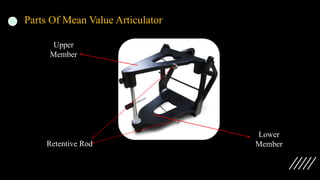
Parts Of Mean Value Articulator
Upper
Member
Lower
Member
Retentive Rod
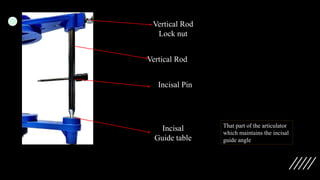
Vertical Rod
Lock nut
Vertical Rod
Incisal
Guide table
Incisal Pin
That part of the articulator
which maintains the incisal
guide angle
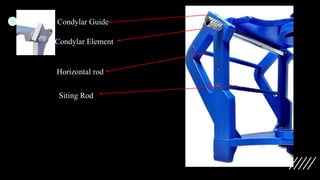
Condylar Element
Siting Rod
Horizontal rod
Condylar Guide
Disadvantages
• Lack of individualised information concerning occlusion.
• Only opening and closing in one direction (vertical) can be made.
• There is no provision for lateral movements.
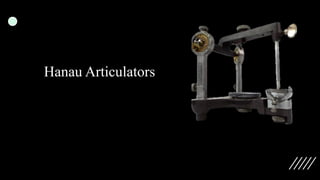
Hanau Articulators
The Hanau Model H Series Articulator (1923)
• Accept Face Bow record
• Horizontal condylar guidance was adjusted by
Protrusive inter- occlusal record.
• Lateral shift calculated by the formula.
• L=H/8 + 12
Noel DW, Mitchell DL. Articulators through the years: Part—II. J Prosthet dent. 1978;39:168-81.
The Hanau Model H2 Series (1958) Non Arcon
• Auditory pin
• Model H2-PR (with calibrated adjustments to protrude or retrude the
condylar balls up to 3 mm,)
• H2-X (with extendable condylar shaft) and Model H2 – XPR
(combination of above models ),
Noel DW, Mitchell DL. Articulators through the years: Part—II. J Prosthet dent. 1978;39:168-81.
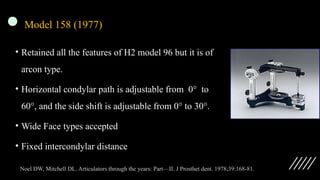
Model 158 (1977)
• Retained all the features of H2 model 96 but it is of
arcon type.
• Horizontal condylar path is adjustable from 0° to
60°, and the side shift is adjustable from 0° to 30°.
• Wide Face types accepted
• Fixed intercondylar distance
Noel DW, Mitchell DL. Articulators through the years: Part—II. J Prosthet dent. 1978;39:168-81.
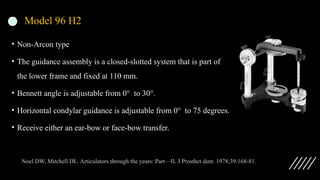
Model 96 H2
• Non-Arcon type
• The guidance assembly is a closed-slotted system that is part of
the lower frame and fixed at 110 mm.
• Bennett angle is adjustable from 0° to 30°.
• Horizontal condylar guidance is adjustable from 0° to 75 degrees.
• Receive either an ear-bow or face-bow transfer.
Noel DW, Mitchell DL. Articulators through the years: Part—II. J Prosthet dent. 1978;39:168-81.
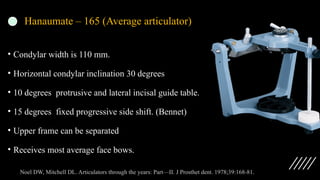
Hanaumate – 165 (Average articulator)
• Condylar width is 110 mm.
• Horizontal condylar inclination 30 degrees
• 10 degrees protrusive and lateral incisal guide table.
• 15 degrees fixed progressive side shift. (Bennet)
• Upper frame can be separated
• Receives most average face bows.
Noel DW, Mitchell DL. Articulators through the years: Part—II. J Prosthet dent. 1978;39:168-81.
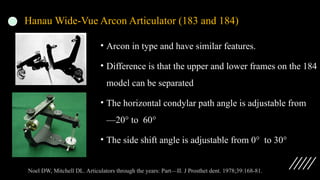
Hanau Wide-Vue Arcon Articulator (183 and 184)
• Arcon in type and have similar features.
• Difference is that the upper and lower frames on the 184
model can be separated
• The horizontal condylar path angle is adjustable from
—20° to 60°
• The side shift angle is adjustable from 0° to 30°
Noel DW, Mitchell DL. Articulators through the years: Part—II. J Prosthet dent. 1978;39:168-81.
Hanau Radial shift (Model 166) : 1981
• Arcon type
• Upper member can be removed for waxing
• A curved immediate side shift ( Radial shift) with adjustable
progressive Bennet angle of 0 to 60degrees.
• Fixed Inter Condylar Distance - 110 mm
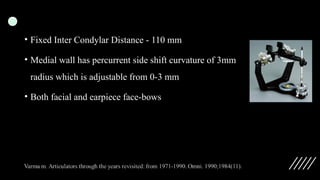
• Medial wall has percurrent side shift curvature of 3mm
radius which is adjustable from 0-3 mm
• Both facial and earpiece face-bows
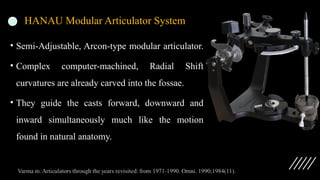
HANAU Modular Articulator System
• Semi-Adjustable, Arcon-type modular articulator.
• Complex computer-machined, Radial Shift
curvatures are already carved into the fossae.
• They guide the casts forward, downward and
inward simultaneously much like the motion
found in natural anatomy.
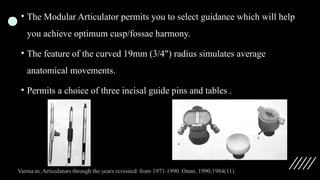
• The Modular Articulator permits you to select guidance which will help
you achieve optimum cusp/fossae harmony.
• The feature of the curved 19mm (3/4") radius simulates average
anatomical movements.
• Permits a choice of three incisal guide pins and tables .
A Comparative Evaluation of Lateral Condylar Guidance by Clinical and
Radiographic Methods – Hanau's Formula Revisited
Praveena, Kanagesan; Ajay, Ranganathan; Devaki, Veeramalai; Balu,
Kandasamy; Preethisuganya, Selvakumar; Menaga, Venkatachalam
Praveena K, Ajay R, Devaki V, Balu K, Preethisuganya S, Menaga V. A comparative evaluation of lateral condylar
guidance by clinical and radiographic methods–Hanau's formula revisited. Journal of Pharmacy and Bioallied
Sciences. 2021 Jun 1;13(Suppl 1):S537-41.
• The purpose of this study is to use radiographic technique to
determine the lateral CG and compare these values with those obtained
using Hanau's formula and to evaluate whether there are differences
between the right and left paths of the condyles.
The median (interquartile range [IQR]) of right and left LCG-C were 15.45
(0.8) and 15.50 (0.7), respectively. The median (IQR) of right and left LCG-M
were 37.00 (6.0) and 36.50 (6.8), respectively. A statistically significant
difference exists between LCG-C and LCG-M. Both LCG-C and-M values
exhibited no variations on both sides.
• 1. Concerning the sides, there is no significant difference within LCG C
‑
and LCG M
‑
• 2.There exist a huge difference between the LCG C obtained from the
‑
Hanau’s formula and LCG M obtained from the SMV projection
‑
radiographs.
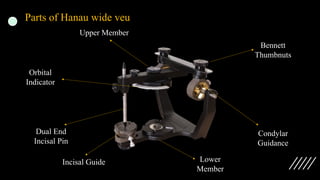
Parts of Hanau wide veu
Incisal Guide
Upper Member
Lower
Member
Bennett
Thumbnuts
Condylar
Guidance
Orbital
Indicator
Dual End
Incisal Pin
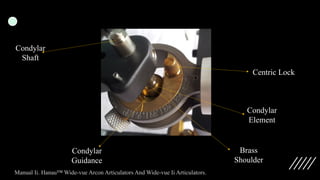
Centric Lock
Condylar
Element
Brass
Shoulder
Condylar
Shaft
Condylar
Guidance
Manual Ii. Hanau™ Wide-vue Arcon Articulators And Wide-vue Ii Articulators.
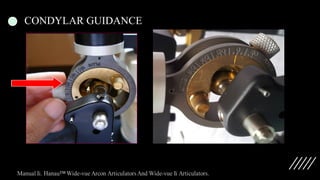
CONDYLAR GUIDANCE
Manual Ii. Hanau™ Wide-vue Arcon Articulators And Wide-vue Ii Articulators.
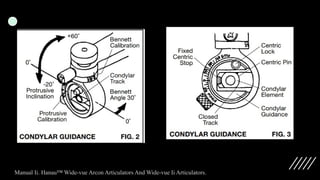
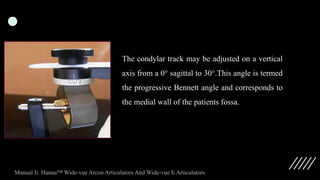
The condylar track may be adjusted on a vertical
axis from a 0° sagittal to 30°.This angle is termed
the progressive Bennett angle and corresponds to
the medial wall of the patients fossa.
Manual Ii. Hanau™ Wide-vue Arcon Articulators And Wide-vue Ii Articulators.
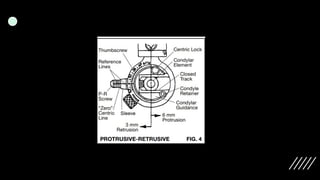
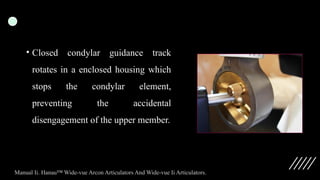
• Closed condylar guidance track
rotates in a enclosed housing which
stops the condylar element,
preventing the accidental
disengagement of the upper member.
Manual Ii. Hanau™ Wide-vue Arcon Articulators And Wide-vue Ii Articulators.
Centric Lock
Manual Ii. Hanau™ Wide-vue Arcon Articulators And Wide-vue Ii Articulators.
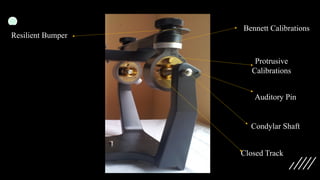
Closed Track
Condylar Shaft
Resilient Bumper
Protrusive
Calibrations
Auditory Pin
Bennett Calibrations
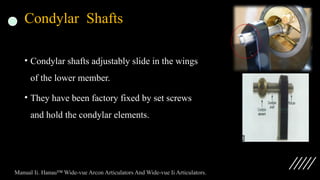
Condylar Shafts
• Condylar shafts adjustably slide in the wings
of the lower member.
• They have been factory fixed by set screws
and hold the condylar elements.
Manual Ii. Hanau™ Wide-vue Arcon Articulators And Wide-vue Ii Articulators.
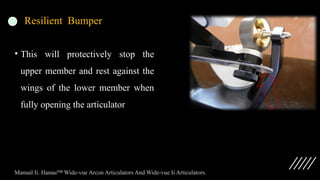
Resilient Bumper
• This will protectively stop the
upper member and rest against the
wings of the lower member when
fully opening the articulator
Manual Ii. Hanau™ Wide-vue Arcon Articulators And Wide-vue Ii Articulators.
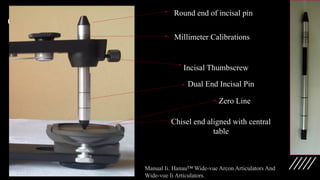
Incisal Thumbscrew
Millimeter Calibrations
Chisel end aligned with central
table
Zero Line
Round end of incisal pin
Dual End Incisal Pin
Manual Ii. Hanau™ Wide-vue Arcon Articulators And
Wide-vue Ii Articulators.
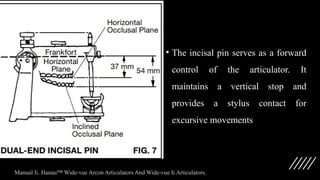
• The incisal pin serves as a forward
control of the articulator. It
maintains a vertical stop and
provides a stylus contact for
excursive movements
Manual Ii. Hanau™ Wide-vue Arcon Articulators And Wide-vue Ii Articulators.
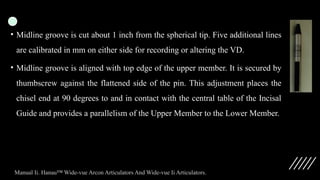
• Midline groove is cut about 1 inch from the spherical tip. Five additional lines
are calibrated in mm on either side for recording or altering the VD.
• Midline groove is aligned with top edge of the upper member. It is secured by
thumbscrew against the flattened side of the pin. This adjustment places the
chisel end at 90 degrees to and in contact with the central table of the Incisal
Guide and provides a parallelism of the Upper Member to the Lower Member.
Manual Ii. Hanau™ Wide-vue Arcon Articulators And Wide-vue Ii Articulators.
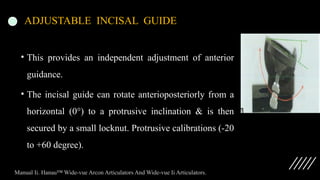
ADJUSTABLE INCISAL GUIDE
• This provides an independent adjustment of anterior
guidance.
• The incisal guide can rotate anterioposteriorly from a
horizontal (0°) to a protrusive inclination & is then
secured by a small locknut. Protrusive calibrations (-20
to +60 degree).
Manual Ii. Hanau™ Wide-vue Arcon Articulators And Wide-vue Ii Articulators.
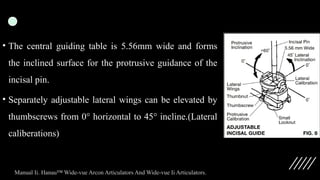
• The central guiding table is 5.56mm wide and forms
the inclined surface for the protrusive guidance of the
incisal pin.
• Separately adjustable lateral wings can be elevated by
thumbscrews from 0° horizontal to 45° incline.(Lateral
caliberations)
Manual Ii. Hanau™ Wide-vue Arcon Articulators And Wide-vue Ii Articulators.
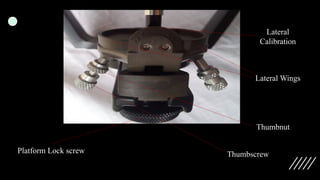
Thumbnut
Lateral Wings
Lateral
Calibration
Platform Lock screw Thumbscrew
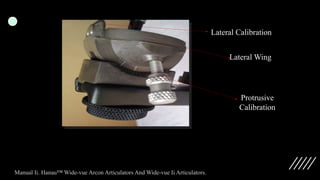
Lateral Wing
Protrusive
Calibration
Lateral Calibration
Manual Ii. Hanau™ Wide-vue Arcon Articulators And Wide-vue Ii Articulators.
• Slide the Platform antero-posteriorly to align the chisel end of the
Incisal Pin with the “zero” indicating line on the Lateral Wings.
• This adjustment will place the Incisal Pin contact on the rotational
center of the Guide, thereby maintaining the vertical dimension when
adjusting the inclination for protrusion.
Manual Ii. Hanau™ Wide-vue Arcon Articulators And Wide-vue Ii Articulators.
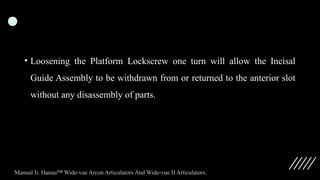
• Loosening the Platform Lockscrew one turn will allow the Incisal
Guide Assembly to be withdrawn from or returned to the anterior slot
without any disassembly of parts.
Manual Ii. Hanau™ Wide-vue Arcon Articulators And Wide-vue II Articulators.
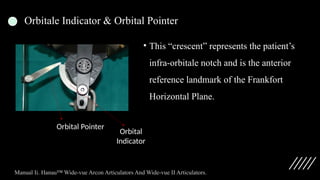
Orbitale Indicator & Orbital Pointer
• This “crescent” represents the patient’s
infra-orbitale notch and is the anterior
reference landmark of the Frankfort
Horizontal Plane.
Orbital
Indicator
Orbital Pointer
Manual Ii. Hanau™ Wide-vue Arcon Articulators And Wide-vue II Articulators.
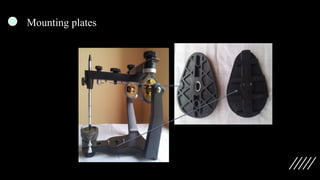
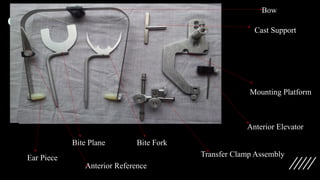
Mounting plates
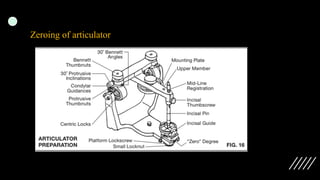
Zeroing of articulator
Mounting Platform
Bite Fork
Cast Support
Anterior Elevator
Bite Plane
Transfer Clamp Assembly
Anterior Reference
Ear Piece
Bow
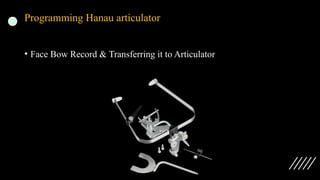
Programming Hanau articulator
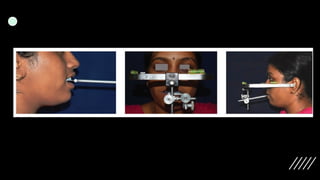
• Face Bow Record & Transferring it to Articulator
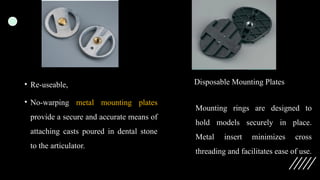
• Re-useable,
• No-warping metal mounting plates
provide a secure and accurate means of
attaching casts poured in dental stone
to the articulator.
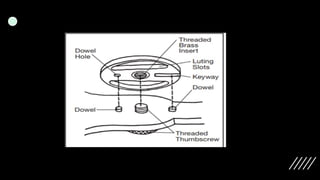
Disposable Mounting Plates
Mounting rings are designed to
hold models securely in place.
Metal insert minimizes cross
threading and facilitates ease of use.
Zeroing of articulators
Zeroing an articulator is the process of standardizing it to a reproducible
starting point.
Nowlin TP, Bailey Jr JO, Taubert TR. Accuracy of zeroing the articulator. The Journal of Prosthetic
Dentistry. 1987 May 1;57(5):647-9.
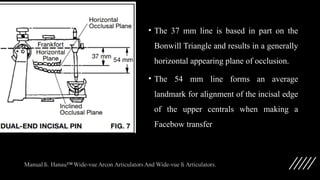
• The 37 mm line is based in part on the
Bonwill Triangle and results in a generally
horizontal appearing plane of occlusion.
• The 54 mm line forms an average
landmark for alignment of the incisal edge
of the upper centrals when making a
Facebow transfer
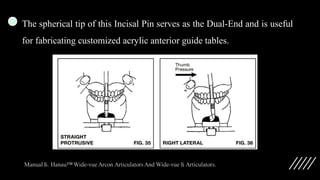
The spherical tip of this Incisal Pin serves as the Dual-End and is useful
for fabricating customized acrylic anterior guide tables.
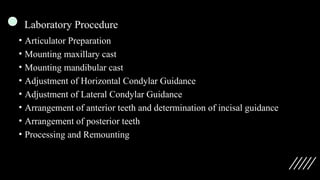
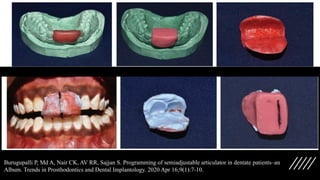
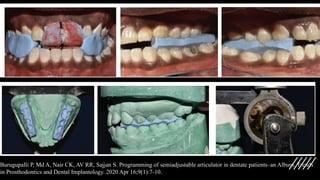
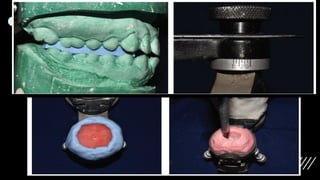
Laboratory Procedure
• Articulator Preparation
• Mounting maxillary cast
• Mounting mandibular cast
• Adjustment of Horizontal Condylar Guidance
• Adjustment of Lateral Condylar Guidance
• Arrangement of anterior teeth and determination of incisal guidance
• Arrangement of posterior teeth
• Processing and Remounting
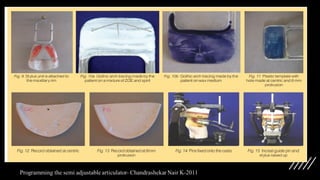
Burugupalli P, Md A, Nair CK, AV RR, Sajjan S. Programming of semiadjustable articulator in dentate patients–an
Album. Trends in Prosthodontics and Dental Implantology. 2020 Apr 16;9(1):7-10.
Burugupalli P, Md A, Nair CK, AV RR, Sajjan S. Programming of semiadjustable articulator in dentate patients–an Album. Trends
in Prosthodontics and Dental Implantology. 2020 Apr 16;9(1):7-10.
Bennet movement
• Calculated from the horizontal condylar settings by Hanau’s equation.
Bennet angle L = H/8+12
• H horizontal condylar inclination determined by protrusive interocclusal
record
McGuckin RS. Essentials of complete denture prosthodontics| Sheldon Winkler, DDS, Editor, with 26
contributors, Softbound. PSG Publishing,. Page no. 212
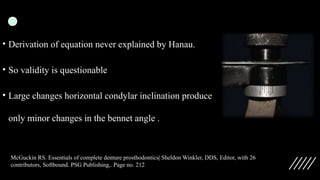
• Derivation of equation never explained by Hanau.
• So validity is questionable
• Large changes horizontal condylar inclination produce
only minor changes in the bennet angle .
McGuckin RS. Essentials of complete denture prosthodontics| Sheldon Winkler, DDS, Editor, with 26
contributors, Softbound. PSG Publishing,. Page no. 212
Study was carried out to evaluate and compare the lateral condylar guidance: (1)
Using the Hanau’s formula and the computerized jaw tracking device
(Kinesiograph). (2) On the right and left sides using both these methods
Bhawsar SV, Marathe AS, Ansari SA. Evaluation of Hanau's formula in determination of lateral condylar guidance:
A clinical research study. The Journal of Indian Prosthodontic Society. 2015 Oct 1;15(4):326-30.
2015
The lateral condylar guidance values obtained using the Hanau’s formula
ranged from 14 to 17° while those obtained using the computerized K7 jaw
tracking device ranged from 8 to 40°. Bennett angle values, obtained using the
jaw tracking device and Hanau’s formula showed statistically significant
differences(P < 0.05) using paired t-test (at 95% confidence interval)
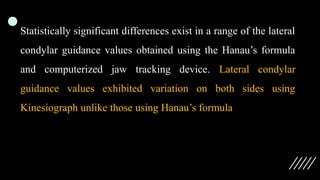
Statistically significant differences exist in a range of the lateral
condylar guidance values obtained using the Hanau’s formula
and computerized jaw tracking device. Lateral condylar
guidance values exhibited variation on both sides using
Kinesiograph unlike those using Hanau’s formula
Shetty, R., Shetty, S., Shetty, N., Pinge, S.S., Zahid, M. and Suhaim, K.S., 2021. Comparative Evaluation of Lateral
Condylar Guidance Angle Measured Using Hanau's Formula & Lateral Interocclusal Records. Journal of Evolution of
Medical and Dental Sciences, 10(26), pp.1917-1921.
Study Was Undertaken To Evaluate And Compare The 2 Methods Used To Determine The
Lateral Condylar Guidance.
2021
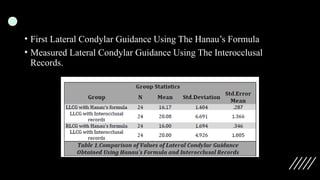
• First Lateral Condylar Guidance Using The Hanau’s Formula
• Measured Lateral Condylar Guidance Using The Interocclusal
Records.
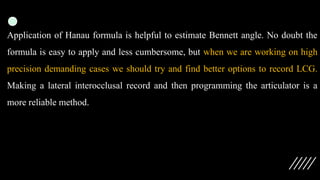
Application of Hanau formula is helpful to estimate Bennett angle. No doubt the
formula is easy to apply and less cumbersome, but when we are working on high
precision demanding cases we should try and find better options to record LCG.
Making a lateral interocclusal record and then programming the articulator is a
more reliable method.
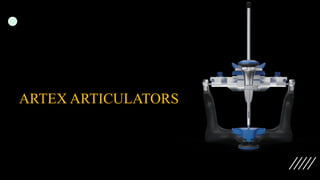
ARTEX ARTICULATORS
Principle
• A Bonwill’s triangle with a leg length of 110mm connecting the mid
point of the condyles with the incisal point and thus fixing the
intercondylar distance
• The interior structural height is 126 mm.
AMANNGIRBBACH GENERAL CATALOG
• Integrated magnetic model plate system
• Adjust design for high-precision receptor fit
• Lower part of articulator designs CN, CT and CR made of carbon:
• Makes for lightweight, strong and ergonomic design and easy handling
• Overall height, internally: 126 mm – large working area offering a lot of
space for mounting models
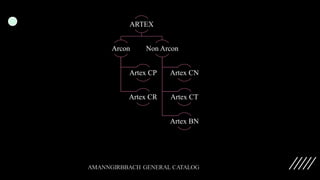
ARTEX
Arcon
Artex CP
Artex CR
Non Arcon
Artex CN
Artex CT
Artex BN
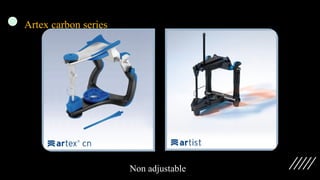
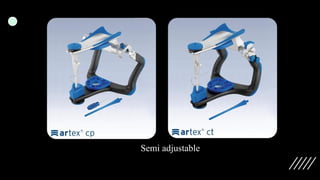
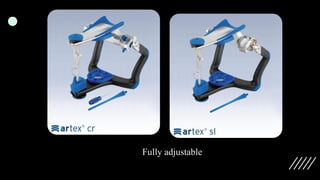
Artex carbon series
Non adjustable
Semi adjustable
Fully adjustable
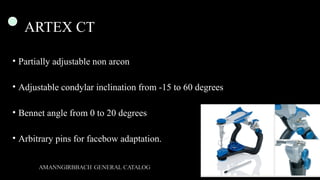
ARTEX CT
• Partially adjustable non arcon
• Adjustable condylar inclination from -15 to 60 degrees
• Bennet angle from 0 to 20 degrees
• Arbitrary pins for facebow adaptation.
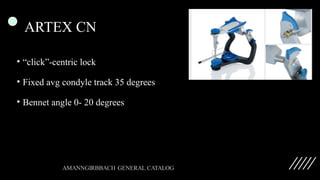
ARTEX CN
• “click”-centric lock
• Fixed avg condyle track 35 degrees
• Bennet angle 0- 20 degrees
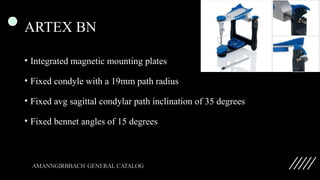
ARTEX BN
• Integrated magnetic mounting plates
• Fixed condyle with a 19mm path radius
• Fixed avg sagittal condylar path inclination of 35 degrees
• Fixed bennet angles of 15 degrees
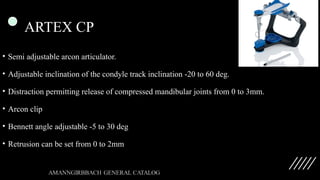
ARTEX CP
• Semi adjustable arcon articulator.
• Adjustable inclination of the condyle track inclination -20 to 60 deg.
• Distraction permitting release of compressed mandibular joints from 0 to 3mm.
• Arcon clip
• Bennett angle adjustable -5 to 30 deg
• Retrusion can be set from 0 to 2mm
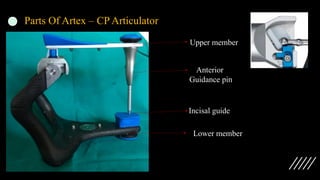
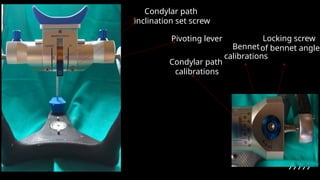
Parts Of Artex – CP Articulator
Upper member
Lower member
Incisal guide
Anterior
Guidance pin
Condylar path
inclination set screw
Pivoting lever
Condylar path
calibrations
Bennet
calibrations
Locking screw
of bennet angle
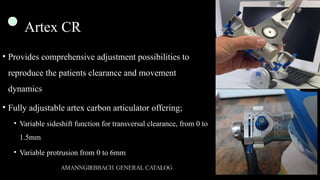
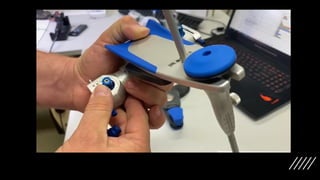
Artex CR
• Provides comprehensive adjustment possibilities to
reproduce the patients clearance and movement
dynamics
• Fully adjustable artex carbon articulator offering;
• Variable sideshift function for transversal clearance, from 0 to
1.5mm
• Variable protrusion from 0 to 6mm
FACEBOW
• Called as Artex Rotofix
• Ear piece type of facebow
• Anterior reference point : Nasale
• Posterior reference point : the external auditory
meatus
• The Artex facebow is a parallel-opening bow made of anodised
aluminum.
• The parallel opening of the facebow is used to insert the facebow via the
porus buttons into the patient's ear canal.
• Frontally, the facebow is supported on the skull via an adjustable rod in
the nasian bar with a nasian adapter.
• A bite fork is applied to the upper jaw tooth row registering mass.
• Bite fork and facebow are connected via a 3D joint (joint support).
Whip Mix Articulator
• Developed by charles E. Stuart in 1964
• Semi adjustable arcon type
• The condylar element of whip-mix articulator is
adjustable about the vertical and horizontal axes
but not the sagittal axis.
Winkler S. Essentials of complete denture prosthodontics. . 1979.
• His main objective was
• Aid in teaching the principles of occlusion for better diagnosis of the
occlusion
• To provide simplified instrument for fabrication of prosthodontic
restorations.
Winkler S. Essentials of complete denture prosthodontics. . 1979.
• Models available : 8500,8800, 9000 9800
• Arcon type
• It uses a quick mount facebow or kinematic face bow
• Anterior reference point : Nasion
• Posterior reference point : External auditory meatus
• Intercondylar distance is adjustable S(96mm) , M(110mm) and
L(124mm) by means of removable condylar guidance spacers along
the instrument’s horizontal axis.
Model 8500 Instruction Manual
• Has a centric latch to lock the upper member in correct position
• Horizontal condylar inclinations are set by means of lateral or
protrusive interocclusal records.
• Amount of Bennett movement is set by lateral interocclusal records.
Whip Mix Model 8500
• Protrusive Condylar Inclination: adjustable 0 – 70
degrees
• Progressive Side Shift: adjustable 0 – 40 degrees
• Adjustable intercondylar distance:
S (96mm)
M (110mm)
L (124mm)
Model 8500 Instruction Manual
• The upper and lower member are attached by
means of spring latch assembly.
• Guide table - the articulator is available either
with an adjustable mechanical guide table or a
flat or a dimpled plastic incisal guide table
• Model 9000 similar model 8500; except the lower frame is 1/2-inch
taller to provide more space for mounting the mandibular cast.
Model 8800 articulator
1/2-inch space to mount maxillary cast.
• Used in extremely steep Plane of
occlusion or osseous defect exists in the
maxilla
Model 9800 :
• This provides ½ inch space for both maxillary and
mandibular casts
• It combines the upper frame of model 8800 with the
lower frame of model 9000 to provide the greatest
distance between the upper and lower frames.
Whip Mix 3000 Series
Protrusive Condylar Inclination: adjustable 0 – 70 degrees
Progressive Side Shift: 0 – 25 degrees
Immediate Side Shift: fixed 0 degrees
Fossa:Closed tracking fossa
Model 3040 Instruction Manual
Quick Mount or Earpiece Face Bow
• Quick mount facebow convenient, quick & accurate method
of securing the average axis location.
• Designed earplugs
• The anterior support deepest part of Nasion.
Denar Articulator
• 1968 Dr. Niles Guichet
• Introduced the Denar 4A
• Current model D5A
• Saves time and effort needed to manually transfer the recordings and to
program the articulator.
Guichet NF. The Denar system and its application in everyday dentistry. Dental Clinics of North
America. 1979 Apr 1;23(2):243-57.
Denar Mark II Articulators
• Introduced in 1975 and developed to satisfy the undergraduate needs of education
for a simpler arcon articulator.
• Has adjustable horizontal inclinations of 0 to 60degrees.
• Has immediate side shift of 0 to 4mm + progressive shift of 0 to 15degree.
• The posterior fossa wall is inclined posteriorly 25 degrees to allow for a backward
movement of the rotating condyle as it moves outward during lateral side shift.
Denar MARK II (1975)
• A two-piece instrument incorporating a positive locking
mechanism that can hold the two members together and
permit 85 degrees of hinge movement.
• The condylar elements are at a fixed 110 mm
DENAR D5A
• Fully-adjustable fossae walls can be easily
adjusted to duplicate patient’s condylar path of
movement as recorded by the Pantograph or
Cadiax.
• The side shift (bennett movement) adjustment is
in the medial wall and has provisions for both
immediate and progressive settings.
Fully Adjustable Procedure Manual
• Protrusive angle: 0-60°
• Immediate side shift: 0-4mm
• Progressive side shift: 0-30°
• Rear wall 30° backward
• Top wall 30° up, 30° down
• Intercondylar distance: 90-150mm
Fully Adjustable Procedure Manual
• Uses denar slidematic facebow
• Anterior reference point : 43 mm above the incisal
edges of the maxillary teeth
• Posterior reference point : External auditory meatus
• Has a centric latch
Denar Mark II plus
• 1975, arcon
• Two piece inst. incorporating a ‘+’ locking
mechanism, hold two member together, permit
85deg of Hinge movement. The HorizontaI
condylar inclination can be adjusted 0-60.
• Immediate side shift adj. 0-4mm, a progressive shift adj.0-15mm.
Inter condylar distance (110 to 122 mm)
• Posterior wall fossa inclined posteriorly 25deg to allow, backward
movement of the rotating condyle as it moves outward during lateral
side shift.
• Springs hold the U/L frame together
• Four different facebow : Earpiece, facia & slidematic facebow for CD.
Adjustable axis facebow for fixed Prosthodontics.
• Earpiece converted to facia, removing earplugs from condylar rods.
CARE OF ARTICULATORS
• Lubrication
• Cleaning
• Storage
Lubrication
• Light application of quality hand piece oil.
• Excess oil should be wiped off.
• Thin coating of petroleum jelly-when in contact with gypsum.
Cleaning and Disinfecting Articulators and Face-bows.whipmix manual
Cleaning
• Cleaning solvent or mild detergent
• Liberal use of fluid with small brush removes all wax and abrasive grit
• No to Scraping or Abrasive cleanser
• Effect of chlorine in abrasive cleansers
• Blow dry air, re-lubricate
Storage
• When not in use ,store in clean, dry atmosphere-free of plaster and
abrasive dust.
• A corrugated carrying carton
• Not near acids, alkalies or medicaments-Fumes may be of corrosive
nature.
Recent Advancements
• The digital articulator (VA)
• PROTARevo/Kavoprotar Articulator
• Disposable Crown & Bridge Articulators
• The patient-specific anatomical articulator
The virtual articulator (VA) is a technology that
simulates the jaw relation in a computer-generated
setting. Augmented and virtual reality have been
utilized as digital technology, which aids in many
areas of dentistry and dental education.
Doshi KN, Sathe S, Dubey SA, Bhoyar A, Dhamande M, Jaiswal T. A Comprehensive Review on
Virtual Articulators. Cureus. 2024 Jan;16(1).
• Need for the digital articulator
A mechanical tool is limited in its capacity to reproduce the
variability of biologic systems:
• The teeth mobility when using plaster casts in the articulator.
• The deformation and distortion of the mandible during loading conditions.
• The complexity of the movement patterns of the jaw.
Doshi KN, Sathe S, Dubey SA, Bhoyar A, Dhamande M, Jaiswal T. A Comprehensive Review on
Virtual Articulators. Cureus. 2024 Jan;16(1).
• Classification of digital articulator
• There are two types of digital articulators.
1- Completely adjustable articulators
2- Mathematical Simulated Digital Articulator
Completely adjustable articulators (motion analyzer)
• it was designed by Kordass and Gaertner from the Greifswald
University in Germany.
• It reproducerecords precise movement paths of the mandible utilizing
an electronic jaw registration system called Jaw (Motion Analyzer)
(JMA).
• Jaw Motion Analyzer is tool for tracking patient's jaw.
• It is comprises of facebow with receiver sensors ,pointer sensor, and
lower jaw ,software and occlusal adapter.
Doshi KN, Sathe S, Dubey SA, Bhoyar A, Dhamande M, Jaiswal T. A Comprehensive Review on
Virtual Articulators. Cureus. 2024 Jan;16(1).
Mathematical Simulated Digital Articulator
• It reproduces  records movement of the articulator which is based on
Mathematical stimulation the movement of the articulator.
• A fully adjustable 3D digital articulator is equipped for duplicating all articulator
movement.
• These digital articulators consider extra settings, for example,
curved Bennett movement or different movement for adjustment in perfect settings.
Koralakunte PR, Aljanakh MJJoc, JCDR dr. The role of virtual articulator in prosthetic and
restorative dentistry. 2014;8(7):ZE25
• The main drawback is that it acts as an average value articulator and it
is impossible to expect individualized movement paths of each patient.
Egg: Stratos 200, Szentpetery's digital articulators
Koralakunte PR, Aljanakh MJJoc, JCDR dr. The role of virtual articulator in prosthetic and
restorative dentistry. 2014;8(7):ZE25
Virtual Artex Cr
A Full-Digital Technique to Mount a Maxillary Arch Scan
on a Virtual Articulator .
A full digital approach to transfer the position of maxillary
dentition to a virtual articulator, by using intraoral scans and
cone beam computed tomography (CBCT) files is
presented.
Koralakunte PR, Aljanakh MJJoc, JCDR dr. The role of virtual
articulator in prosthetic and
restorative dentistry. 2014;8(7):ZE25
• This technique offers reduced chairside time and the flexibility of
choosing the orientation plane. It can be used in orthognathic
surgeries, complex interdisciplinary treatments requiring a CBCT scan
with a large field of view, or treatment that already have the head CT
or CBCT scans from previous diagnosis/treatment
• The virtual articulator offers the same functional
scope as compared to the real Artex CR
• The transfer of the models by means of the Ceramill
Fixator ensures the precision at the functional
interface between manual and digital techniques
Koralakunte PR, Aljanakh MJJoc, JCDR dr. The role of virtual
articulator in prosthetic and
restorative dentistry. 2014;8(7):ZE25
• The calculation of the fully anatomical construction is dynamic and
static under consideration of the antagonists and the adjusted values of
the articulator
Kavoprotar Articulator
• The articulator and face bow system from Kavo is designed so that work can be
carried out using either the Frankfurt horizontal plane (FH) or Camper’s plane.
• The nasal support provides an average alignment of the face bow with respect
to the two planes.
• The face bow can also be individually aligned to the required reference plane by
using the reference pointer (Infra-orbital point,Subnasal point).
• Precise programming via enlarged scaling for joint path inclination
• Models can be magnetically attached without split-casting
• Lightweight, with excellent handling
• Smooth, hygienic metal surfaces for easy cleaning
Pietrokovski Y, Shakartsi-Amar O, Ben-Gal G, Lipovetsky-Adler M. Determining the interchangeability of
KaVo PROTAR semi-adjustable articulators. Quintessence International. 2018 Jul 1;49(7).
Precision I
Optimum setting of the
patient’s data by use of the
large dimension adjustment
scale.
Precision II
precision in the smallest
detail. Rigid centric lock of
Inox steel for perfect static
occlusion.
Pietrokovski Y, Shakartsi-Amar O, Ben-Gal G, Lipovetsky-Adler M. Determining the interchangeability of KaVo
PROTAR semi-adjustable articulators. Quintessence International. 2018 Jul 1;49(7).
Disposable Crown & Bridge Articulators
• Great centric occlusion
• Allows lateral and protrusive movements
• No plaster needed
• Light weight
• Heavy-duty plastic
Sober V. A more efficient, disposable articulator: a new option to
send completed bites to your clients. Dental Lab Products. 2015
Mar 1;40(3):14-6.
The patient-specific anatomical articulator
• Condylar elements and patient maxilla (whether dentulous
or edentulous) are anatomically related to each other, as
well as to the FHP. This valuable feature eliminates the
need for ear bow transfer.
• Patient-specific intercondylar distance.
Azer SS, Kemper E. The patient-specific anatomical articulator. The Journal of prosthetic dentistry.
2022 Dec 1;128(6):1158-64.
• Patient-specific protrusive and lateral angles because the
shapes of the condyles and bony slopes are replicated from the
patient and not based on average values.
• Built-in immediate mandibular lateral translation movement.
• Permits mounting of mandibular cast by using centric relation
record. Cross-mounting of maxillary cast is easily facilitated.
Azer SS, Kemper E. The patient-specific anatomical articulator. The Journal of prosthetic
dentistry. 2022 Dec 1;128(6):1158-64.
Comparative evaluation of the volume of occlusal adjustment of
repositioning occlusal devices designed by using an average value digital
articulator and the jaw movement analyzer
Tiwu Peng MS a, Zhikang Yang MS b, Teng Ma MS c, Mindi Zhang MS d,
Guanghui Ren MMed
Peng T, Yang Z, Ma T, Zhang M, Ren G. Comparative evaluation of the volume of occlusal adjustment of repositioning
occlusal devices designed by using an average value digital articulator and the jaw movement analyzer. The Journal of
Prosthetic Dentistry. 2023 Aug 1.
• The purpose of this clinical study was to evaluate and compare the
clinical efficacy and volume of occlusal adjustment of digital occlusal
devices designed by using an average value digital articulator and the
jaw movement analyze
• No significant difference in the volume of occlusal adjustment was
found when using occlusal devices made by using the digital average
articulator or the JMA, suggesting that either method can be used to
program articulators for the fabrication of occlusal devices.
AIM: To analyze the accuracy of transferring casts in maximal intercuspal
position to a virtual articulator by using transfer plates in the laboratory scanner
before and after occlusal optimization.
He M, Ding Q, Li L, Yang G, Zhao Y, Sun Y, Zhang L. The accuracy of transferring casts in maximal
intercuspal position to a virtual articulator. Journal of Prosthodontics. 2022 Apr;31(4):326-32.
The sensitivity before occlusal optimization (0.14 ± 0.15) was significantly lower
than that after occlusal optimization (0.82 ± 0.10) (p = 0.003). However, there was
no significant difference between the positive predictive value before (0.80 ± 0.45)
and after (0.81 ± 0.09) occlusal optimization (p = 0.952).
Conclusion: The accuracy of transferring casts in maximal intercuspal position to a
virtual articulator using transfer plates in the laboratory scanner could be improve
after occlusal optimization and can meet the clinical needs for occlusal design and
analysis of prostheses.
SUMMARY
Mean Value articulator
Hanau articulator
Artex
Care of articulators
Recent advancements

Articulators in Prosthodontics: A Complete Guide

  • 1.
    A R TI C U L A T O R S P R E S E N T E D B Y D R B A S I T H N P
  • 2.
    2 CONTENTS • INTRODUCTION • TERMENOLOGIES •PURPOSE OF AN ARTICULATOR • REQUIREMENTS • USES OF AN ARTICULATOR • ADVANTAGE • EVOLUTION
  • 3.
    3 • CLASSIFICATION OFARTICULATORS • THEORIES OF ARTICULATORS • ARCON AND NON ARCON • LAWS OF ARTICULATON • SELECTION OF ARTICULATORS
  • 4.
    4 INTRODUCTION Articulators are mechanicaldevices that represent: Maxilla Mandible Temporomandibular joints (TMJs). Jairaj A, agroya P, tiwari RV, alqahtani NM, salkar M, sagar YP. Evolution of articulators-research and review. Annals of the romanian society for cell biology. 2021 apr 25:10665-81.
  • 5.
    5 Their main taskis to provide a frame where it is possible to relate, in the three planes of space, maxillary cast with mandibular cast relative to the hinge axis of the patient and of the instrument. Jairaj A, agroya P, tiwari RV, alqahtani NM, salkar M, sagar YP. Evolution of articulators-research and review. Annals of the romanian society for cell biology. 2021 apr 25:10665-81.
  • 6.
    6 Articulators help indiagnosis of teeth and jaw relation, the arrangement of the artificial tooth, and the development of occlusal surfaces of both removable and fixed restorations. Zarb GA, hobkirk J, eckert S, jacob R. Prosthodontic treatment for edentulous patients: complete dentures and implant-supported prostheses. Elsevier health sciences; 2012 mar 15. page no. 206
  • 7.
    7 • Articulator actas the patient in the absence of patient. • Can simulate but the cannot duplicate all possible mandibular movements. Winkler S. Essentials of complete denture prosthodontics.. 1979. Page no. 189
  • 8.
  • 9.
    9 Articulator: • An analog,whether mechanical or digital, to which maxillary and mandibular casts may be coupled to simulate some or all mandibular movements. (GPT10) • A mechanical device that represents the temporomandibular joints and jaw members to which maxillary and mandibular cast may be attached. (Winkler) 1.Layton DM, morgano SM, muller F, kelly JA, nguyen CT, scherrer SS, salinas TJ, shah KC, att W, freilich MA, ferro KJ. Glossary of prosthodontic terms 2023. J prosthet dent. 2023;130(4s1):e1-26. 2. Winkler S. Essentials of complete denture prosthodontics.. 1979. Page no. 189
  • 10.
    10 Articulation: The staticand dynamic contact relationship between the occlusal surfaces of the teeth during function. (GPT10) Arcon: contr, ARTICULATOR and CONDYLE; used to describe an articulator containing the condylar path elements within its upper member and the condylar elements within the lower member. Layton DM, morgano SM, muller F, kelly JA, nguyen CT, scherrer SS, salinas TJ, shah KC, att W, freilich MA, ferro KJ. Glossary of prosthodontic terms 2023. J prosthet dent. 2023;130(4s1):e1-26.
  • 11.
    11 • Condylar guidance:(GPT10) • A. mandibular guidance generated by the condyle and articular disc traversing the contour of the articular eminence. • B. The mechanical form located in the posterior region of an articulator that controls movement of its mobile member.
  • 12.
    12 Incisal Guidance: (GPT10) 1.the influence of the contacting surfaces of the mandibular and maxillary anterior teeth on mandibular movements. 2. The influences of the contacting surfaces of the guide pin and guide table on articulator movements. Layton DM, morgano SM, muller F, kelly JA, nguyen CT, scherrer SS, salinas TJ, shah KC, att W, freilich MA, ferro KJ. Glossary of prosthodontic terms 2023. J prosthet dent. 2023;130(4s1):e1-26.
  • 13.
    13 • Hinge Axis: Itis an imaginary line connecting the center of rotation of one of the condyle to the center of rotation of the other condyle. • Bennett angle: The angle formed between the sagittal plane and the average path of the advancing nonworking-side condyle as viewed in the horizontal plane during lateral mandibular movements.
  • 14.
    14 PURPOSE OF ANARTICULATOR • Hold the cast in a predetermined fixed relationship. • To open and close. • To produce border and intraborder diagnostic sliding motions of the teeth similar to those in the mouth. Rhan AO, heartwell CM. Textbook of complete denture. Lea and febriger, USA. 1993:59-109. Page no. 59
  • 15.
    USES Of THEARTICULATOR 1.Occlusal Analysis • Analyse occlusion at centric relation centric relation-inter-cuspal position (ICP) slide as well as protrusive and laterotrusive contacts. 1. Rhan AO, heartwell CM. Textbook of complete denture. Lea and febriger, USA. 1993:59-109. Page no. 59 2. Abu Zaghlan, Rawan & Aqrabawi, Jamal & Al-Fatyan, Omar & Abuzaghllan, Basmah. (2021). Dental Articulators: A Review. Journal of International Dental and Medical Research. 14. 1629-1638. 10.6084/m9.figshare.19636191. 15
  • 16.
    16 • Enhances visualizationand evaluation of occlusion in the molar region without the hindrance of the tongue and cheeks. • mandibular movements can be simulated as purely guided by the occlusal anatomy without the influence of the protective neuromuscular reflexes.
  • 17.
    17 2.Treatment planning for: •Restorative procedures: diagnostic wax-up to envisage the planned treatment outcome prior to executing it. • Orthodontic treatment • Orthognathic surgery Abu Zaghlan, Rawan & Aqrabawi, Jamal & Al-Fatyan, Omar & Abuzaghllan, Basmah. (2021). Dental Articulators: A Review. Journal of International Dental and Medical Research. 14. 1629- 1638.
  • 18.
    18 3. Fabrication ofocclusal splints, custom trays and prostheses with the desired occlusion and aesthetics. 4. Correct and modify the completed restorations. 1.Abu Zaghlan, Rawan & Aqrabawi, Jamal & Al-Fatyan, Omar & Abuzaghllan, Basmah. (2021). Dental Articulators: A Review. Journal of International Dental and Medical Research. 14. 1629-1638. 2. Rhan AO, heartwell CM. Textbook of complete denture. Lea and febriger, USA. 1993:59-109. Page no. 59
  • 19.
    19 REQUIREMENTS OF ADENTAL ARTICULATOR • Should hold casts in the correct horizontal and vertical relationships. • Should provide a positive anterior vertical stop. • Should open and close in a hinge movement. • Accept facebow record. Winkler S. Essentials of complete denture prosthodontics.. 1979. Page no. 205 Rhan AO, heartwell CM. Textbook of complete denture. Lea and febriger, USA. 1993:59-109. Page no. 59
  • 20.
    20 • Adequate distancebetween the upper and lower members and vision should not obscured from the rear. • Moving parts should move freely and non moving parts should be a rigid construction. • Should be made of strong, corrosion, lightweight and wear- resistant material. Rhan AO, heartwell CM. Textbook of complete denture. Lea and febriger, USA. 1993:59-109. Page no. 59 Winkler S. Essentials of complete denture prosthodontics.. 1979. Page no. 205
  • 21.
    21 ADDITIONAL REQUIRMENTS • Adjustablehorizontal and lateral condylar guide elements. • Should have provisions for adjustment of Bennett movement. • Incisal guide table should be a mechanical table that can be adjusted in sagittal and frontal planes. • Should allow protrusive and lateral motion. Rhan AO, heartwell CM. Textbook of complete denture. Lea and febriger, USA. 1993:59-109. Page no. 59-60 Winkler S. Essentials of complete denture prosthodontics.. 1979. Page no. 205
  • 22.
    22 OPTIONAL REQUIRMENTS • Terminalhinge position locking device. • Adjustable intercondylar width of the condylar elements. • An immediate bennet movement. Winkler S. Essentials of complete denture prosthodontics.. 1979. Page no. 206
  • 23.
    23 LIMITATION • Articulators aremade of metal, although some have plastic parts. • Any articulator does not duplicate the condylar movements in TMJ.
  • 24.
    24 EFFECTIVNESS OF ANARTICULATOR • How well the operator understands its construction & purpose. • How enthusiastic the dentist is for particular instrument. • How well the dentists understands the anatomy of joints their movements and neuro muscular system. • How much precision used in recording jaw relations. • An articulator do no more than what operator does with it.
  • 25.
    25 ADVANTAGES • Better visualizethe patient's occlusion. • The lingual view as provided with the articulator is essential if a proper occlusal scheme is to be developed. • Patient’s co-operation is not a factor when using an articulator. Winkler S. Essentials of complete denture prosthodontics.. 1979. Page no. 189-190
  • 26.
    26 • The refinementof complete denture occlusion. • Considerably more chair time & patient’s appointment time is required when utilizing the mouth as an articulator. • The patient's saliva, tongue and cheeks are not factors.
  • 27.
  • 28.
    31 Starcke EN, engelmeierRL, belles DM. The history of articulators: the “articulator wars” phenomenon with some circumstances leading up to it. Journal of prosthodontics: implant, esthetic and reconstructive dentistry. 2010 jun;19(4):321-33. J. Leon Williams, George H. Wilson There was probably no defining moment that can be identified as the beginning of the “Articulator Wars.” In all likelihood, it began with two dentists. GeorgeWood Clapp and The Dentists’ Supply Company of New York
  • 29.
    32 Alfred E. Gysi, Partnershipculminated in the introduction of the Trubyte Tooth System and Gysi’s technique for the articulation of artificial teeth. These milestones would change dentistry forever. Starcke EN, engelmeier RL, belles DM. The history of articulators: the “articulator wars” phenomenon with some circumstances leading up to it. Journal of prosthodontics: implant, esthetic and reconstructive dentistry. 2010 jun;19(4):321-33.
  • 30.
    33 Plaster Articulator /SlabArticulator • By Phillip Pfaff in 1756 • A plaster extension on the distal portion of the mandibular cast was grooved to serve as a guide for a plaster extension of the maxillary cast. Mitchell DL, wilkie ND. Articulators through the years. Part I. Up to 1940. The journal of prosthetic dentistry. 1978 mar 1;39(3):330-8.
  • 31.
    34 Barn Door Hinge& Adaptable Barn Door Hinge • Inexpensive and easy to obtain from any hardware or general store. • Modified by bending each arm 90 degrees to form L-shaped upper and lower members.
  • 32.
    35 • Capable ofopening and closing only in a hinge movement. • It has an anterior Vertical stop, which is usually a carriage or machine bolt. • Also known as the Dayton Dunbar Campbell instrument. Winkler S. Essentials of complete denture prosthodontics.. 1979. Page no. 191
  • 33.
    36 JB Gariot’s FirstMechanical Articulator (1805) • First mechanical hinge articulator. • Consist of a simple hinge, with a set screw in the posterior against a metal plate, to serve as a vertical stop. Jain AR. Articulators through the years revisited: from 1700 to 1900—part i. World J dent. 2015 oct;6(4):222-5.
  • 34.
    37 Howarth Plaster Articulator(1830) • Common method for relating casts with the help of plaster index (also called as plaster articulators). • Consisted of two nested metal boxes which were held in position and the hinge movement was controlled with elastics.
  • 35.
    38 Thomas W EvansArticulatorPlane Line Articulator (1840) • Earliest mechanical hinge articulators. • Important feature was that vertical dimension could be preserved or altered as required.
  • 36.
    39 James Cameron’s Articulator(1840) • Provision for vertical dimension and anterior posterior relation. • Mandibular member of the articulator moved while upper member was fixed.
  • 37.
    40 Daniel T EvensArticulator (1840) • It was called as ‘Dentist’s Guide’. • For the first time there is a mention of provision for protrusive and lateral movements. • First to initiate mandibular movements – but not successful.
  • 38.
    41 The Bonwill Articulator(1858) • Developed the first articulator based on his theory of occlusion or the theory of equilateral triangle. • It has a fixed inter condylar distance of 10 cms and fixed distance between each condyle and lower central incisor point of 10 cms.
  • 39.
    42 ET Starr Articulator(1868) • One of the fixed condylar guide instruments. • The lower plate is held in position by elastic bands.
  • 40.
    43 Antes-Lewis Articulator (1895–1900) •Product of a joint venture and it included the design features of two instruments. • The upper plate is held in position by the encased central spring at the end of the ‘yoke’.
  • 41.
    44 Richmond Hayes Articulator(1889) • First to incorporate a fixed descending condylar path. • It was more innovative in condylar design. • Probably reflected Hayes concept of condylar movement more accurately.
  • 42.
    45 Gysi E MullerArticulator (1896–1899) • Gysi worked with Muller to construct an articulator that exactly imitated the form of the condyle and glenoid fossa. • It is an average value instrument with the exception of lateral rotation center controls.
  • 43.
    46 William Earnest Walker-Clinometer(1896) • Provision for gothic arch tracings. • Dentures which balanced on Bonwill’s articulator, did not balance in the mouth • Pointed the absence of condylar inclination as the dictating factor
  • 44.
    47 The Bixby Attachment(1894) • A modified attachment replaces the lower member on a Gysi Simplex instrument. • It was intended to regulate the anteroposterior position of a cast in the articulator. • Considered a forerunner of the facebow
  • 45.
    48 Gritman’s Articulator (1899) •This articulator was patented and introduced with the Snow facebow by George B Snow and AD Gritman. • Featured descending condylar paths of 15 degrees, an average determined by measurements taken from a large number of patients.
  • 46.
    49 Huberty Articulator (1901) •This articulator was claimed to provide independent movement of the respective jaw members of the articulator. • A complicated device requiring several adjustments for its function, as intended. Mitchell DL, Wilkie ND. Articulators through the years. Part II. From 1940. The Journal of Prosthetic Dentistry. 1978 Apr 1;39(4):451-8.
  • 47.
    50 Kerr Articulator (1902) •Developed by the Kerr brothers in 1902 and distributed by the Detroit Dental Co. • Has fixed protrusive and lateral movement Jain AR. Articulators through the Years Revisited: From 1900 to 1950—Part II. World. 2016 Jan;7(1):23-31.
  • 48.
    51 Christensen’s Articulator (1905) •He reported his observation of the space that occurs between the maxilla and mandible during protrusion. • Christensen introduced an adjustable articulator similar to walker’s but simpler in design. • Suggested the use of a protrusive interocclusal wax record to measure the angle of the condylar paths. Jain AR. Articulators through the Years Revisited: From 1900 to 1950—Part II. World. 2016 Jan;7(1):23-31.
  • 49.
    52 New Century andModified New Century Articulator by George Snow (1906–1907) • He improved on the Gritman articulator of 1899 by converting the fixed condylar paths to adjustable condylar paths • Adding a tension spring, which allowed a greater range of movement without compromising the stability of the frame. • Incorporated the incisal pin.
  • 50.
    53 The Acme Articulator(1906) • Manufactured by the Snow Dental Company Tonawonda • Elaboration of his 1906 New Century instrument. • It includes three models of different widths that accommodate three ranges of intercondylar distance. • The condylar paths are straight • condylar inclination is adjustable • incisal pin rests on a changeable incisal guide
  • 51.
    54 The Gysi AdaptableArticulator (1908–1910) • Beyond the technical ability and finances of most dentists. For this reason. • Gysi Simplex was introduced as a mean value articulator in 1914
  • 52.
    55 Gysi Simplex Articulator(1914) • Switzerland • Competitively priced and did not require great technical ability to operate. • The condylar guidance of the Gysi Simplex is fixed at 33°
  • 53.
    56 Luce Articulator (1911) •By CE Luce of Germany, he received the first patent for an articulator with an incisal pin and guide assembly. • He was also one of the first to describe the downward and forward movements of the condyles.
  • 54.
    57 Eltner Articulator (1912) •This was the second articulator patented with incisal pin and guide table. • It was constructed on the theory that the temporomandibular joints (TMJ) • Have two horizontal axes, one running through the condyles and the other through the articulator eminences. Mitchell DL, Wilkie ND. Articulators through the years. Part II. From 1940. The Journal of Prosthetic Dentistry. 1978 Apr 1;39(4):451-8.
  • 55.
    58 Halls Alligator/Hall’s AnatomicArticulator (1915) • Based on Hall’s conical theory of occlusion. • Forty-five degree cusp teeth were necessary for constructing dentures on this type of articulator. It is a mean value arbitrary articulator. Mitchell DL, Wilkie ND. Articulators through the years. Part II. From 1940. The Journal of Prosthetic Dentistry. 1978 Apr 1;39(4):451-8.
  • 56.
    59 Maxillomandibular Instrument/(Monson’s Articulator)(1918) • George Monson, an orthodontist from Minneapolis. • Based on the spherical theory. • Evolved from concepts of Monson and a German anatomist, Graf yon Spee. • Monson considered that the cuspal guidance were much more influential than the TMJ in regard to the jaw movements. • This instrument permits eccentric motion. Mitchell DL, Wilkie ND. Articulators through the years. Part II. From 1940. The Journal of Prosthetic Dentistry. 1978 Apr 1;39(4):451-8.
  • 57.
    60 Hagman Balancer (1920) •HC Hagman, Minneapolis • Opens and closes on a hinge that is in the center of the upright support. • Based on the spherical theory of occlusion.
  • 58.
    61 The Stephan Articulator(1921) •Similar in design to the Gariot hinge articulator of 1805. • Except that it has a fixed condylar inclination and allows for an arbitrary lateral movement.
  • 59.
    62 The Hanau ModelM Kinescope (1923) • 1921 developed a research model called the Hanau model c articulator. • Double condylar posts on each side. • The inner posts serve two purposes, they act as the horizontal condylar guides, • They have variable rotation centers when the posts are moved inward or outward.
  • 60.
    63 Homer Relator (1923) •Joseph Homer of Boston • Principle is the same that Luce of Germany used in his 1911 articulator.
  • 61.
    64 The Wadsworth Articulator(1924) • Frank Wadsworth of Los Angeles, California • Believed in Monson’s spherical theory but could not accept bilateral condylar symmetry, • The casts were mounted with a facebow and the Wadsworth T attachment. Determines 3rd ref point
  • 62.
    65 Hanau Model H110(1926) • It was introduced by Hanau in 1926, was primarily designed for complete dentures. • These models accept face bow. • Horizontal condylar guidance was adjusted by protrusive inter occlusal record.
  • 63.
    66 Gysi Trubyte orTrubyte Simplex (1926) • A non-arcon instrument with fixed intercondylar distance. • Horizontal condylar inclinations are individually adjustable. • This particular instrument can be used as fully adjustable or as mean value articulator
  • 64.
    67 Phillips Student Articulator(Model C)/Pantographic Articulator(1926) • George P Phillips • The articulator is classified as fully adaptable in that its developer claimed that it would follow any graphic record. • The Phillips graphic recorder was designed to trace in one step the Gothic arch (needlepoint tracing) and the inclinations of the glenoid fossa.
  • 65.
    68 Hanau Model H110Modified (1927) • A modified Hanau Model H110 articulator appeared on the market in 1927 and introduced the incisal guide table.
  • 66.
    69 The House Articulator(1927) • The House articulator was developed by MM House in the early 1930s. • The Needle House intraoral • chew in or other positional records can be used to set the house articulator • Needle house chew in employs four metal studs in the upper occlusal rim against a lower compound rim. • It permits eccentric movements based on Needle House records and doesn’t accept facebow transfer.
  • 67.
    70 The Stansberry TripodInstrument (1929) • He had a mechanical guide posteriorly and two guides anteriorly. • The articulator reproduced positions, not movements. • In this articulator there is no mechanical equivalent of condyles.
  • 68.
    71 Terrell’s Precision Coordinator(1930) • An arcon type of articulator that has curvilinear condylar guides. • Twin parabolic cams control vertical and horizontal anterior guidance. • The incisal pin is curved to allow for changes in the vertical dimension.
  • 69.
    72 Hanau Crown andBridge Articulator (1934) • Small articulator but unlike with other hinge articulators • A posterior pin and cam guidance mechanism can be set to simulate working and balancing side excursions of 15º. • The mechanism can be set to • L left quadrant • R right quadrant • A for anterior restorations
  • 70.
    73 The Phillips Occlusoscope(1938) • The maxillary cast on the Phillips occlusoscope articulator is mounted without the use of a facebow. • The articulator is adjusted by either intraoral or extraoral records. • The lower member of the occlusoscope has two adjustable units that represent the two temporomandibular joints.
  • 71.
    74 The McCollum Gnathoscope(1939) • Complex instrument with a choice of condylar path elements. • Instrument reproduce not only the positions on movement paths but the actual path themselves.
  • 72.
    75 Stephan Articulator Modified(1940) • It is similar in design to the 1921 model, except that the upper and lower mounting arms on this model are longer.
  • 73.
    76 • One dimensionalarticulator that has no lateral movement. • The maxillary cast is positioned horizontally by the two maxillary central incisors. • The Cook mounting jig, which fits into the depth of the hamular notch and orients the casts posteriorly. The Fournet Articulator (1940)
  • 74.
    77 Dentatus • This brandof articulators is manufactured in Sweden. • All the models are axis type instruments with a slot in the condylar assembly for the condylar element to make rectilinear movements. • The ARH, ARL, ARS, and ARD models have the condylar elements as part of the upper frame and the condylar guidance on the lower frame
  • 75.
    78 Dentatus the ARHModel (1944) • It has all the features of the ARH model plus a gauge block to ensure basic measurements for coordinating work between dentist and laboratory articulators. • ARH is the original Dentatus articulator. It has orbital indicator, adjustable condylar guidance from –60º to +60º and has a sideshift adjustable from 0º to 40º
  • 76.
    79 Coble Articulator (1950) •Maintains centric relation and vertical dimension but does not allow for functional movements. • It is a hinge articulator in which the maxillary cast is mounted with a mounting jig that corresponds to the occlusal plane.
  • 77.
    80 Hall Automatic Articulator •Lower teeth move over the surface of the upper teeth as over the surface of the cone generating an angle of 45° with the central axis of the cone tipped 45° to the occlusal plane.
  • 78.
    81 Bergstrom Articulator (1950) •An arcon articulator. • He was the first to use the term ‘Arcon’ • (Ar-articulator, con-condyle). In this articulator condylar guides are on upper member and condylar elements are on lower member. • It can accept facebow record.
  • 79.
    82 The Galetti Articulator(1950–1960) • Cast is held mechanically without plaster by two fixed posts anteriorly and one adjustable post posteriorly on each member. • The upper member can be adjusted extendable arm and a universal ball and socket joint to achieve the desired relationship of the maxillary cast to the mandibular cast
  • 80.
    83 Transograph (1952) • Isa hinge axis facebow introduced in 1952 that can be modified later to serve as an articulator. • It has adjustable condylar guides and is a split axis instrument. • Allows each condylar housing to function independently of the other
  • 81.
    84 Dentograph Kile (1955) •It differ from all other articulating instrument in that it is custom built by and for each patient.
  • 82.
    85 The Verticulator(1960) • WilliamWindish in 1960 • The Verticulator was developed to be used with the functionally generated path technique and quadrant trays.
  • 83.
    86 TELEDYNE HANAU MODEL-194(1970) • Initially called the Hanau XP51. • It is a semiadjustable articulator with the arcon feature. • The intercondylar distance is fixed at 90 mm.
  • 84.
    87 Dentatus ARO Articulator(1971) •As all the features of the Dentatus ARL • Plus the unique feature of a movable arm that holds the mandibular cast. • The universal joint and the locking device that attaches the movable arm to the base allow repositioning of the mandibular cast without remounting.
  • 85.
    88 Denar Mark II(1975) • The articulator is a two piece instrument incorporating a positive locking mechanism that can hold the two members together and permit 85 degrees of hinge movement.
  • 86.
    89 HANAU H2 ARCONMODEL 158 (1977) • Mechanical features are quite similar to the 96H2. • Are arcon in nature. • A special facebow is available for this model,
  • 87.
    90 HANAU MODEL 165HANAUMATE /AVERAGE ARTICULATOR (1977) • Based on fixed average value incorporated into its design • The upper frame can be separated easily by loosening two locks.
  • 88.
    91 Hanau Model 166Radial Shift (1981) • The condylar elements are on lower frame (Arcon) and fixed inter Condylar Distance at 110 mm. • Medial wall has recurrent side shift curvature of 3mm radius which is adjustable from 0-3 mm. Varma M. Articulators Through The Years Revisited: From 1971-1990. Omni. 1990;1984(11).
  • 89.
    92 HANAU WIDE VUEMODELS 183 AND 184 • The Hanau models 183 and 184 are arcon in type and have similar features • The condylar elements are fixed at 100mm and guidance mechanism is of slot type. The horizontal condylar path angle is adjustable from —20° to + 60°, and the side shift angle is adjustable from 0° to 30°
  • 90.
    93 HANAU MODULAR ARTICULATORSYSTEM • System with a series of interchangeable guidance assemblies. • The basic frames of the articulator are produced in two forms, one with a fixed intercondylar width at 110 mm • Other with a adjustable version with adjustable intercondylar width at 100, 110 125, and 140 mm
  • 91.
    94 PANADENT ARTICULATORS (1978-1983) •The major modification in the latest models is the mechanical latch. • This mechanism keeps the upper and lower articulator frames joined together yet permits an opening movement of 180º.
  • 92.
    95 The Omni Articulator(1984) • Design allows one to easily exchange closed (tracking) fossa for open fossa with a positive locking latch. • The purpose of this model is an attempt to better meet the requirements for complete, removable and fixed partial denture fabrication in one articulator.
  • 93.
    96 Sam Articulator (1990) •This German articulation system is durable, stable, and precise. • One aspect of its popularity is the ability to interchange mounted casts from one instrument to another.
  • 94.
    97 The Sam 2Articulator • 3 interchangeable condylar housings that incorporate different curvatures to the superior wall. • Adjustable instrument, compatible from one to another. • Offers three optional interchangeable condylar housings that incorporate different curves for the horizontal condylar pathways.
  • 95.
    98 Sam 3 Articulator •The instrument has a unique On-Off Centric Locking Device and condylar element covers to keep the lower and upper members locked together during hinge and eccentric movement.
  • 96.
    99 GirrbachArtex Articulators(1995) • Pierrosilveranibiavatidevised an original system to be applied to a semi individual articulator based on monson’stheory. • This system was developed over the years and realized in 1995 in cooperation with the GirrbachArtex, pforzheim, Germany.
  • 97.
  • 98.
    101 Articulators Based onGeometric Theories of Mandibular Movements Based on Geometric Theories Bonwill’s Equilateral theory Monson’s spherical theory Hall’s conical theory
  • 99.
    102 Bonwill’s Equilateral theory •An equilateral triangle was described by G Bonwill, an American dentist in 1858, and it became Bonwill’s theory of occlusion’s basis. • Measuring 6000 skulls and 4000 living persons Ganesh MA, Mohanraj KG. Morphometric analysis of Bonwill's triangle and its dental applications in dry human mandible bones. Journal of Advanced Pharmaceutical Technology & Research. 2022 Nov 1;13(Suppl 1):S194-7.
  • 100.
    103 Length of eachside of triangle is about 4 inches and it is formed when the centers of two condyles, right condyle and the medial mandibular incisal midpoint, and left condyle and the medial mandibular incisal midpoint are joined Ganesh MA, Mohanraj KG. Morphometric analysis of Bonwill's triangle and its dental applications in dry human mandible bones. Journal of Advanced Pharmaceutical Technology & Research. 2022 Nov 1;13(Suppl 1):S194-7.
  • 101.
    104 Evaluation of Bonwill'striangle parameters using cone-beam computed tomography for gender determination. Koothati, Ramesh Kumar; Khandare, Samadhan; Suresh, Dirasantchu; Sravanthi, Yendluru Mercy; Avinash, Kallumata; Himapavana, Muvva The aim of this study was to evaluate the mandibular Bonwill's triangle parameters using CBCT for gender determination Koothati, R.K., Khandare, S., Suresh, D., Sravanthi, Y.M., Avinash, K. and Himapavana, M., 2023. Evaluation of Bonwill's triangle parameters using cone-beam computed tomography for gender determination: A retrospective study. Journal of Oral and Maxillofacial Radiology, 11(1), pp.6-10.
  • 102.
    SAMPLE FOOTER TEXT105 • Conclusion: The parameters of the mandibular Bonwill's triangle in the Indian population were observed to be larger in males than females. Hence, these parameters can be used for gender identification in forensic and medicolegal practice.
  • 103.
    106 Monson’s Spherical Theory •The theory developed in the late 1890's. • The Spherical theory of occlusion shows that the lower teeth move along the surface of the upper teeth as over the surface of a sphere with a diameter of 8 inches (20cms). Becker CM, Kaiser DA. Evolution of occlusion and occlusal instruments. Journal of Prosthodontics. 1993 Mar;2(1):33-43.
  • 104.
    107 • The centreof the sphere is located in the region of the glabella and the surface of the sphere passes through the glenoid fossa along the articulating eminences .
  • 105.
  • 106.
    109 Hall’s Conical Theory •Proposed by Dr. Rubert E. Hall in 1915. • The lower teeth move over the surfaces of the upper teeth as over the surface of a cone with a generating angle of 45 degrees and with the central axis of the cone tipped at 45 degree angle to the occlusal plane. Starcke EN. The history of articulators: a critical review of articulators based on geometric theories of mandibular movement, part II: Rupert Hall's conical theory. Journal of Prosthodontics. 2002 Sep;11(3):211-22.
  • 107.
    110 To determine theinfluence of the radius of Monson’s sphere, the number of posterior laterotrusive, mediotrusive, and protrusive contacts, and the chewing rate on food comminution. Carneiro DE, Zander LR, Ruppel C, Canales GD, Auccaise-Estrada R, Sánchez-Ayala A. Influence of the radius of Monson’s sphere and excursive occlusal contacts on masticatory function of dentate subjects. Archives of Oral Biology. 2024 Mar 1;159:105879.
  • 108.
    111 A larger radiusof Monson’s sphere and a greater number of posterior excursive contacts were found to be related to better masticatory function
  • 109.
    112 Gillis Classification (1926) (1)The adaptable or adjustable type (2) The average or fixed type. 1. Rihani A. Classification of articulators. The Journal of prosthetic dentistry. 1980 Mar 1;43(3):344-7. 2. Heartwell CM, O’Rahn A. Textbook of complete dentures. Hamilton, Ont.: BC Decker Incorporated; 2002. page no.61
  • 110.
    113 Boucher Classification (1936) Boucher NonadjustableAdjustable 2-dimensional instrument 3-dimensional instrument Rihani A. Classification of articulators. The Journal of prosthetic dentistry. 1980 Mar 1;43(3):344-7.
  • 111.
    114 Kingery Classification(1942) 1. Simplearticulators 2. Adjustable or adaptable articulators. Becks Classification(1962) Based on the design of articulators: 1. The suspension instrument 2. The axis instrument 3. The tripod instrument Rihani A. Classification of articulators. The Journal of prosthetic dentistry. 1980 Mar 1;43(3):344-7.
  • 112.
    115 Weinberg Classification • Basedon the concept associated with each articulator: • Arbitrary (Monson spherical Theory) • Positional (Stansbery tripod concept) • Semi adjustable (Hanau H concept) • Fully adjustable (Hanau Kinescope concept, Gysi Trubyte concept, and McCollum concept) Heartwell CM, O’Rahn A. Textbook of complete dentures. Hamilton, Ont.: BC Decker Incorporated; 2002. page no.61
  • 113.
    Posselt’s Classification (1968) •Plain line • Mean value • Adjustable C.J. Thomas Classification (1973) (Types of record used) • Arbitrary(not adjustable) • Positional (axis and nonaxis types, static records) • Functional(axis and nonaxis types, functional records) • records) Heartwell CM, o’rahn A. Textbook of complete dentures. Hamilton, ont.: BC decker incorporated; 2002 page no.61.
  • 114.
    117 •John J. SharryClassification (1974) • Simple hinge type • Fixed guide type • Adjustable instruments •Halperin Classification • Simple or Hinge articulators • Fully adjustable articulators • Semi adjustable articulators
  • 115.
    118 Heartwell Classification • ClassI –receive and reproduce pantographs and graphic tracings. They are 4 dimensional instruments. Eg. Ney Articulator Stuart Articulator
  • 116.
    119 Class II –instruments that will not receive pantographs • Hinge type • Arbitrary Hagman Balancer Monson Verticulator Heartwell CM, O’Rahn A. Textbook of complete dentures. Hamilton, Ont.: BC Decker Incorporated; 2002. page no.62
  • 117.
    120 • Average Hanau WhipMix Special – for complete denture construction Stansbery Tripod Heartwell CM, O’Rahn A. Textbook of complete dentures. Hamilton, Ont.: BC Decker Incorporated; 2002. page no.62
  • 118.
    121 International Prosthodontics Workshop (UniversityOf Michigan In 1972) • Based on Instrument function • Instrument capability • Intent • Registration procedure • Registration acceptance Winkler S. Essentials of complete denture prosthodontics.. 1979. Page no. 190
  • 119.
    122 Class I: • ASimple holding instrument capable of accepting a single static registration. • Vertical motion is possible, but only for convenience. The Verticulator (Jelenko) The Corelator (Denar Corp.) Winkler S. Essentials of complete denture prosthodontics.. 1979. Page no. 190-204
  • 120.
    123 Class II • Aninstrument that permits horizontal as well as vertical motion but does not orient the motion to the temporomandibular joints via facebow transfer. • Class IIA Eccentric motion permitted is based on average or arbitrary values. Gysi simplex articulator Winkler S. Essentials of complete denture prosthodontics.. 1979. Page no. 190-204
  • 121.
    124 Class II B:Eccentric motion permitted is based on theories of arbitrary motion. Monsons maxillomandibular articulator Class IIC: Eccentric motion permitted is determined by the patient using engraving methods. The gnathic relator Winkler S. Essentials of complete denture prosthodontics.. 1979. Page no. 190-204
  • 122.
    125 Class III: • Instrumentsthat simulate condylar pathways by using averages or mechanical equivalents for all or part of the motion. • These instruments allow for orientation of the cast relative to the joints and may be arcon or nonarcon instruments, accept facebows, and have mounting plates Winkler S. Essentials of complete denture prosthodontics.. 1979. Page no. 190-204
  • 123.
    126 Class III A •Instruments that accept static protrusive registrations and use equivalents for the rest of the motion. Dentatus Hanau nonarcon H2 articulator
  • 124.
    127 Class III B •Instruments that accept static protrusive registrations and some lateral interocclusal records and use equivalents for the rest of the motion Hanau Teledyne Whipmix articulator
  • 125.
    128 Class IV • Instrumentsthat will accept three dimensional dynamic registrations. • Instruments allow for orientation of the casts via facebow transfer. • Subdivided into A and B
  • 126.
    129 Class IV A •The condylar pathways are formed by registration engraved by the patient. Denar Combi articulator TMJ-Stereographic instrument
  • 127.
    130 Class IV B •Instruments that have condylar pathways that can be selectively angled and customized. Stuart Articulator Denar D5 articulator
  • 128.
    131 Rihani’s Classification System(1980) • Non adjustable - A simple holding instrument capable of accepting single static registration. • Vertical motion • Can accept one or two of the following records: 1. Face bow 2. Centric jaw relation record 3. Protrusive record. Rihani A. Classification of articulators. The Journal of prosthetic dentistry. 1980 Mar 1;43(3):344-7.
  • 129.
    132 Semi adjustable • Aninstrument that simulates condylar pathways by using average or mechanical equivalents for all or part of the motion. • These instruments allow for orientation of casts relative to the joints and may be arcon or non-arcon instrument. 1. Face bow 2. Centric jaw relation record 3. Protrusive record.
  • 130.
    133 Fully adjustable • Aninstrument that will accept three dimensional dynamic registration. • Allow for orientation of the casts to the T.M.J. and replication of all mandibular movements. 1.Face bow 2. Centric jaw relation record 3. Protrusive record. 4. Lateral records 5. Intercondylar distance record
  • 131.
  • 132.
    135 • Adapted fromthe University of Michigan and Rihani’s classification; based on the adjustment capabilities of an articulator. • Facebow transfer, intercondylar distance adjustment,centric record, protrusive record, and lateral record. Maheshwari K, Gupta AK, Tiwari B. A newly proposed classification for articulators-integrating virtual with conventional. The Journal of Indian Prosthodontic Society. 2024 Apr 1;24(2):212-4.
  • 133.
    136 Category I: Mechanical articulators Class 1: Nonsimulated/fixed articulators Centricrecord Denar Automark, Barn Door Class 2: Partially simulated articulators Class 3: Fully simulated articulators
  • 134.
  • 135.
    138 • Category II:Virtual articulators Class 1: Mathematically simulated virtual articulators • Use an average value for adjustment of additional articulator settings to reproduce mandibular movements Ceramill-Artex Ivoclar-Stratos 300
  • 136.
    139 Class 2: Fullysimulated virtual articulators It records and replicates exact mandibular movement paths using a specific digital tool, the jaw motion analyzer Example: DentCam system, Kordass, and Gartner virtual articulator
  • 137.
  • 138.
    141 • Articulator movementsof the condylar elements do not reproduce condylar movements as in the temporomandibular joints. The goal of articulation is to duplicate tooth movements along border pathways in at least two planes of space. • The most important requirements of an articulator are to maintain centric relation and the vertical dimension of occlusion once it has been established. Joshi PR, Bhat GS, Dixit S. Selection of articulator for general dental practice. Kathmandu University Medical Journal (KUMJ). 2008 Jan 1;6(1):112-6.
  • 139.
    142 The selection ofthe articulator is dependent on:- • Occlusal scheme to be developed • Posterior tooth form • Excursive tooth guidance • Jaw relation records that can be made to adjust the articulator. Joshi PR, Bhat GS, Dixit S. Selection of articulator for general dental practice. Kathmandu University Medical Journal (KUMJ). 2008 Jan 1;6(1):112-6.
  • 140.
    143 • Non adjustablearticulator – for single restorations, small prosthesis. These nonadjustable articulators do little more than simulate the hinge motion of the mandible and hold the casts in centric relation Joshi PR, Bhat GS, Dixit S. Selection of articulator for general dental practice. Kathmandu University Medical Journal (KUMJ). 2008 Jan 1;6(1):112-6.
  • 141.
    144 Semiadjustable articulators : •If there is loss of vertical dimension of occlusion, full mouth rehab. • Cross arch and cross tooth balance has to be obtained. • Balanced complete dentures • for Class I /Class II partial dentures and for crowns and 3 unit fixed partial dentures. Joshi PR, Bhat GS, Dixit S. Selection of articulator for general dental practice. Kathmandu University Medical Journal (KUMJ). 2008 Jan 1;6(1):112-6.
  • 142.
    145 Fully adjustable articulators: • MPDS, Complicated TMJ disturbances • When extensive treatment like restoration of entire occlusion • For patients with significant side shift during lateral mandibular movements Joshi PR, Bhat GS, Dixit S. Selection of articulator for general dental practice. Kathmandu University Medical Journal (KUMJ). 2008 Jan 1;6(1):112-6.
  • 143.
    146 Selection of anArticulator For CD • Articulator should have the capability of adjustment for recurrent or immediate side shift up to at least 2.5mm. • The progressive angle can be fixed as long as the angle is somewhere between 6 & 12 degrees. Rhan AO, Heartwell CM. Textbook of complete denture. Lea and Febriger, USA. 1993:59-109.
  • 144.
    147 • A mechanicalguide table is an essential aid in the arrangement of complete denture occlusion. • A custom mold shape can best reproduce the existing or proposed anterior guidance of anterior teeth. • A sterography is really not indicated for complete denture. Rhan AO, Heartwell CM. Textbook of complete denture. Lea and Febriger, USA. 1993:59-109
  • 145.
    148 • If occlusalcontacts are to be perfected in centric relation only ,then a simple hinge articulator can be selected. • If denture teeth are to have cross arch and cross tooth balanced occlusion then minimum requirement is semi adjustable articulator. • If complete control of occlusion is desired,a completely adjustable articulator is selected. Rhan AO, Heartwell CM. Textbook of complete denture. Lea and Febriger, USA. 1993:59-109.
  • 146.
    149 According to Celenza •In complete dentures construction, a centric relation system should be used. • But precise 3 dimensional eccentric registrations is a wasted effort because of tissue resiliency. Celenza FV: An analysis of articulators. Dent Clin North Am. 1979 Apr;23(2):305-26.
  • 147.
    150 According to Winkler •If complete dentures are fabricated in centric relations, articulators with minimal requirements are sufficient. • If teeth are arranged in balanced occlusion an articulator with additional requirements is necessary. Sheldon Winkler: Essentials of complete denture prosthodontics. 2nd edition,2004, Ishiyaku Euro America, Inc, 142-183.
  • 148.
    151 Selection Of AnArticulator For Fpd • Single restoration- Non adjustable articulator • Larger parts of the segments with multiple restorations-Adjustable articulator. • Articulators with immediate side shift not recommended. • With progressive side shift- least desirable. • With curved superior surface- not necessary unless balanced articulation is desired. Shillingburg H T, Hobo S : Arti Sutradhar W, Mishra SK, Chowdhary R. Uses, accuracy and limitations of semiadjustable articulators in dentistry: a systematic review. Tanta Dental Journal. 2019 Jul 1;16(3):121. culator selection for restorative dentistry J Prosthet dent 1976 ; 36 :35-43.
  • 149.
    152 • Intercondylar distanceadjustments only simplify the records transfer. • Open fossa design is very convenient for waxing & Porcelain stacking. • Closed fossa design preferred for CD. • Open fossa design is preferred as a diagnostic instrument in diagnosing joint –tooth disharmonies.
  • 150.
    153 Selection Of AnArticulator For Rpd • A simple hinge or a non-adjustable-class III partially edentulous cases • Semi-adjustable like Hanau, Whip-mix- most class I &II • Fully adjustable articulator is usually limited to those patients needing a removable partial denture, wherein the entire occlusal scheme is to be developed at one time by the wax additive technique. Stuart articulator is generally used
  • 151.
  • 152.
    155 • Factors governingthe laws of articulation as stated by Rudolph Hanau have been accepted as the standard reference on this subject. • Hanau’s study was a pioneer exploration of the subject, and the “articulation quint” Trapozzano VR. Laws of articulation. Journal of Prosthetic Dentistry. 1963 Jan 1;13(1):34-44.
  • 153.
    156 Hanau’s Quint coordinatesthe nine main laws of articulation. It records the influence of one factor, governing the establishment of balanced articulation, while the remaining factors remain unchanged.
  • 154.
    157 • Hanau believedarticulation of the artificial teeth was related to nine factors: • Horizontal condyle inclination • Compensating curve • Protrusive incisal guidance • Plane of orientation • Buccolingual inclination of tooth axis • Sagittal condylar pathway • Sagittal incisal guidance • Tooth alignment • Relative cusp height
  • 155.
    158 Later he combinedthe original nine and reduced them to five: • The inclination of the condylar guidance • Prominence of the compensating curve • Inclination of the plane of orientation • Inclination of the incisal guidance • The height of the cusp
  • 156.
    159 Condylar Guidance • Mandibularguidance generated by the condyle and articular disc traversing the contour of the glenoid fossa • The mechanical form located in the upper posterior region of an articulator that controls the movements of its mobile members
  • 157.
    160 • CONDYLAR GUIDANCE: They represents the slopes of articular eminence in skull which guides the movement of condyle. • Types : 1. Fixed- cant be adjusted. Usually conforms to mean value articulator. 2. Adjustable – Can be increased or decreased- Straight – Curved 3. Custom made – Acrylic is custom molded using records of mandibular movements
  • 158.
    161 • The degreeof condylar inclination registered results from • The shape of the bony contour of the temporomandibular joint • The action of the muscles attaching to the mandible • The limitation of movements effected by the attaching ligaments • The method used
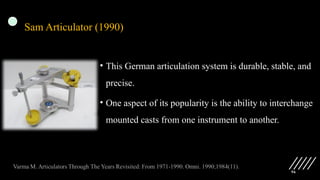
  • 159.
    162 • The inclinationof the condylar guidance or condyle inclination is a definite anatomical concept • One of the end-controlling factors
  • 160.
    163 Anterior Guidance • Thesecond end-controlling factor is formed by the inclination of the incisal guide angle (incisal guidance) • "The inclination of the incisal guidance in given by the angle of the lingual surface of the incisors with the horizontal plane of reference’’
  • 161.
    164 • The influenceof the contacting surfaces of anterior teeth on mandibular movements for analysis and treatment of occlusion.
  • 162.
    165 Height Of TheCusp • “In the establishment of balanced articulation, we are primarily interested in the length and the inclination of the effective cusp inclines’’ • Any increase or decrease in cusp height (the vertical distance from the tip of the cusp to its base) will result in an increase or decrease in the length of the cusp inclines.
  • 163.
    166 • Cusp heightexerts its influence by determining the range of tooth contact during eccentric movement. The higher the cusp, the longer the effective tooth incline, and therefore, the greater the range of the tooth contact during eccentric movement.
  • 164.
    167 Plane Of Orientation •Hanau states that "the plane of orientation is a purely geometrical factor. It is a plane assumed to pass through the dental landmarks or points; namely the central incisal contact point and the summits of the mesiobuccal cusps of the molars.
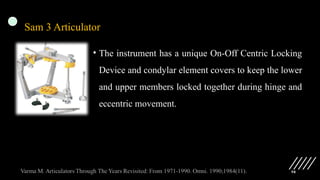
  • 165.
    168 PROMINENCE OF THECOMPENSATING CURVE • Hanau states ‘the prominence of the compensating curve infers an increase of the concavity (sometimes a decrease of the convexity) in the alignment of the mandibular posterior teeth. • The compensating curve is the most important factor for obtaining balance.Cusp teeth have inclines necessary for obtaining balanced occlusion
  • 166.
  • 167.
    170 Arcon • Ar-Articulator Con-Condyle •Condylar spheres are attached to the lower component of the articulator, and the mechanical fossae are attached to the upper member of the instrument. • Examples Whipmix , 8500 ( DR. Charles Stuart, 1963) Hanau Arcon
  • 168.
    171 Non-Arcon • Condyles onthe upper member and condylar guidances on the lower member • Examples • Gysi • Hanau 96h2 • Dentatus ARL , kinoscope
  • 169.
    172 • Relation betweencondylar indications with a given axis vary with • The magnitude and direction of protrusion • Degree of opening • The relation of condylar guide in terms of central bearing point, teeth, or incisal pin • The inclination of the incisal guide.
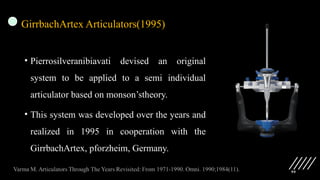
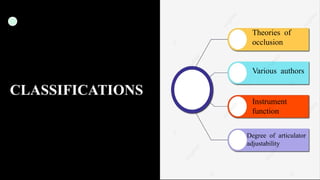
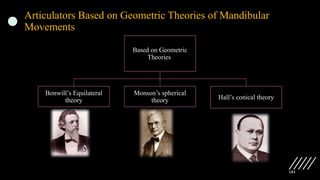
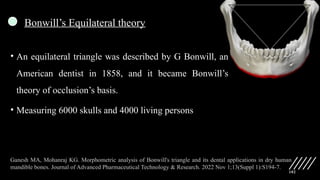
  • 170.
    173 An advantage ofthe arcon design is that the condylar inclination of the mechanical fossae is at a fixed angle to the maxillary occlusal plane. With the nonarcon design, the angle changes as the articulator is opened, which can lead to errors when a protrusive record is being used to program the articulator. Shillingburg HT, Hobo S, Whitsett LD, Jacobi R, Brackett SE. Fundamentals of fixed prosthodontics. Hanover Park, IL: Quintessence Publishing Company; 2012. 4th edition page no.30
  • 171.
    174 • Variations ofcondyle form and tracking can be reproduced with replaceable guide elements in the condyle housing. • Variations in anatomic condyle form and condyle guidance cannot be reproduced in this articulator due to its construction. Goyal MK, Goyal S. A comparative study to evaluate the discrepancy in condylar guidance values between two commercially available arcon and non-arcon articulators: A clinical study. Indian Journal of Dental Research. 2011 Nov 1;22(6):880.
  • 172.
    175 • Increasing thevertical dimension, and the raising of the incisal pin, do not alter the condylar inclination setting; relative to the plane of reference. • The greater vertical dimension and resulting raising of the incisal pin changes the condylar inclination setting in terms of the plane of reference. Goyal MK, Goyal S. A comparative study to evaluate the discrepancy in condylar guidance values between two commercially available arcon and non-arcon articulators: A clinical study. Indian Journal of Dental Research. 2011 Nov 1;22(6):880.
  • 173.
    176 • The anglebetween the condylar inclination and the occlusal plane of the maxillary teeth in open and closed position. • Arcon –constant • Non-arcon- changes • Plane of the condylar guide is not parallel to the plane of motion, the distance between the joints will vary with the magnitude of protrusive movement (non arcon).
  • 174.
    177 A comparative studyto evaluate the discrepancy in condylar guidance values between two commercially available arcon and non-arcon articulators A clinical study Goyal, Mukesh Kumar; Goyal, Shelly Goyal MK, Goyal S. A comparative study to evaluate the discrepancy in condylar guidance values between two commercially available arcon and non-arcon articulators: A clinical study. Indian Journal of Dental Research. 2011 Nov 1;22(6):880.
  • 175.
    SAMPLE FOOTER TEXT178 • The purpose of this study was comparative evaluation of sagittal condylar values of arcon and non-arcon articulators with cephalometric readings and to determine the amount of discrepancy in sagittal condylar guidance values between arcon and non-arcon articulators using same protrusive record. Hanau H2 (non-arcon type) and Hanau Wide-Vue (arcon type) articulators
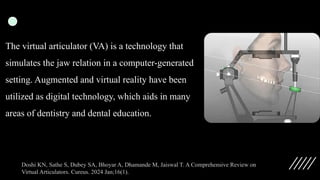
  • 176.
    179 • Conclusion: Themean difference in the sagittal condylar guidance values obtained from non-arcon and arcon articulators shows a low level of reproducibility, and no significant difference found in mean sagittal condylar values obtained from arcon articulator and cephalometric tracings indicates replication of sagittal condylar guidance value from image of articular eminence.
  • 177.
    180 A clinical studyto compare the horizontal condylar guidance using protrusive interocclusal records, orthopantomography (OPG), and cone-beam computed tomography (CBCT) in edentulous patients Gheedle R, John P. Comparative Evaluation of the Horizontal Condylar Guidance Using Protrusive Interocclusal Records, OPG, and CBCT in Edentulous Patients: An In Vivo Study. The Journal of Contemporary Dental Practice. 2023 Jul 28;24(6):403-8.
  • 178.
    181 • Cone-beam computedtomography is as reliable and accurate as the clinical method. A significant correlation exists between the clinical method and CBCT. It can be used as a dependable adjunct to the clinical method of HCGA measurement.
  • 179.
    182 SUMMARY • Uses orpurpose of articulators • Requirements :minimal additional and optional • Limitations • Advantages • Evolution from 18th to 21st century • Classification: theories, authors.. • Selection of articulators • Arcon vs non arcon
  • 180.
    A R TI C U L A T O R S PA RT I I
  • 181.
    CONTENTS • COMMONLY USEDARTICULATORS • MEAN VALUE ARTICULATORS • HANUAS • ARTEX • WHIPMIX
  • 182.
    • RECENT ADVANCMENTS •CARE AND MAINTANENCE • SUMMARY • REFRENCES
  • 183.
    Condyle movement onnon-working side (NWS) during Bennett movement: C = center of rotation; CB = immediate Bennett side shift; BP = progressive Bennett side shift; α = Bennett angle Fanucci E, Spera E, Ottria L, Barlattani Jr A, Fusco N, Mylonakou I, Broccoli P, Barlattani A, Simonetti G. Bennett movement of mandible: a comparison between traditional methods and a 64-slices CT scanner. ORAL & implantology. 2008 Apr;1(1):15.
  • 184.
    Mean Value Articulator •Non arcon articulator Also known as Three point articulator Average value articulator Free plane articulator Non arcon Non adjustable Rangarajan V, Padmanabhan TV. Textbook of Prosthodontics-E Book. Elsevier Health Sciences; 2017 Jul 18. page no.138
  • 185.
    • Upper membercan be moved upward and backward • Condylar inclination of 30 degrees on both side • Anterior part is supported by the incisal guide rod above and incisal guide table below with 10 to 15 inclination
  • 186.
    • A springis mounted within the condylar track to stabilize the condylar elements and hold them in their posterior most position. • It is known as mean value or average value articulator because it has a fixed condylar path and incisal inclines. • The intercondylar distance is fixed and also the distance from each condylar element to the tip of the incisal pin is also fixed
  • 187.
    • It wasmade based on the Bonwill theory of occlusion. • The intercondylar distance is fixed to 4 inches and also from each condylar element to the tip of the incisal pin is also 4 inches. Mean Values Inter condylar distance 110mm Condylar guidance 30degrees Incisal guidance 10-15degrees
  • 188.
    Parts Of MeanValue Articulator Upper Member Lower Member Retentive Rod
  • 189.
    Vertical Rod Lock nut VerticalRod Incisal Guide table Incisal Pin That part of the articulator which maintains the incisal guide angle
  • 190.
  • 191.
    Disadvantages • Lack ofindividualised information concerning occlusion. • Only opening and closing in one direction (vertical) can be made. • There is no provision for lateral movements.
  • 192.
  • 193.
    The Hanau ModelH Series Articulator (1923) • Accept Face Bow record • Horizontal condylar guidance was adjusted by Protrusive inter- occlusal record. • Lateral shift calculated by the formula. • L=H/8 + 12 Noel DW, Mitchell DL. Articulators through the years: Part—II. J Prosthet dent. 1978;39:168-81.
  • 194.
    The Hanau ModelH2 Series (1958) Non Arcon • Auditory pin • Model H2-PR (with calibrated adjustments to protrude or retrude the condylar balls up to 3 mm,) • H2-X (with extendable condylar shaft) and Model H2 – XPR (combination of above models ), Noel DW, Mitchell DL. Articulators through the years: Part—II. J Prosthet dent. 1978;39:168-81.
  • 195.
    Model 158 (1977) •Retained all the features of H2 model 96 but it is of arcon type. • Horizontal condylar path is adjustable from 0° to 60°, and the side shift is adjustable from 0° to 30°. • Wide Face types accepted • Fixed intercondylar distance Noel DW, Mitchell DL. Articulators through the years: Part—II. J Prosthet dent. 1978;39:168-81.
  • 196.
    Model 96 H2 •Non-Arcon type • The guidance assembly is a closed-slotted system that is part of the lower frame and fixed at 110 mm. • Bennett angle is adjustable from 0° to 30°. • Horizontal condylar guidance is adjustable from 0° to 75 degrees. • Receive either an ear-bow or face-bow transfer. Noel DW, Mitchell DL. Articulators through the years: Part—II. J Prosthet dent. 1978;39:168-81.
  • 197.
    Hanaumate – 165(Average articulator) • Condylar width is 110 mm. • Horizontal condylar inclination 30 degrees • 10 degrees protrusive and lateral incisal guide table. • 15 degrees fixed progressive side shift. (Bennet) • Upper frame can be separated • Receives most average face bows. Noel DW, Mitchell DL. Articulators through the years: Part—II. J Prosthet dent. 1978;39:168-81.
  • 198.
    Hanau Wide-Vue ArconArticulator (183 and 184) • Arcon in type and have similar features. • Difference is that the upper and lower frames on the 184 model can be separated • The horizontal condylar path angle is adjustable from —20° to 60° • The side shift angle is adjustable from 0° to 30° Noel DW, Mitchell DL. Articulators through the years: Part—II. J Prosthet dent. 1978;39:168-81.
  • 199.
    Hanau Radial shift(Model 166) : 1981 • Arcon type • Upper member can be removed for waxing • A curved immediate side shift ( Radial shift) with adjustable progressive Bennet angle of 0 to 60degrees.
  • 200.
    • Fixed InterCondylar Distance - 110 mm • Medial wall has percurrent side shift curvature of 3mm radius which is adjustable from 0-3 mm • Both facial and earpiece face-bows
  • 201.
    HANAU Modular ArticulatorSystem • Semi-Adjustable, Arcon-type modular articulator. • Complex computer-machined, Radial Shift curvatures are already carved into the fossae. • They guide the casts forward, downward and inward simultaneously much like the motion found in natural anatomy.
  • 202.
    • The ModularArticulator permits you to select guidance which will help you achieve optimum cusp/fossae harmony. • The feature of the curved 19mm (3/4") radius simulates average anatomical movements. • Permits a choice of three incisal guide pins and tables .
  • 203.
    A Comparative Evaluationof Lateral Condylar Guidance by Clinical and Radiographic Methods – Hanau's Formula Revisited Praveena, Kanagesan; Ajay, Ranganathan; Devaki, Veeramalai; Balu, Kandasamy; Preethisuganya, Selvakumar; Menaga, Venkatachalam Praveena K, Ajay R, Devaki V, Balu K, Preethisuganya S, Menaga V. A comparative evaluation of lateral condylar guidance by clinical and radiographic methods–Hanau's formula revisited. Journal of Pharmacy and Bioallied Sciences. 2021 Jun 1;13(Suppl 1):S537-41.
  • 204.
    • The purposeof this study is to use radiographic technique to determine the lateral CG and compare these values with those obtained using Hanau's formula and to evaluate whether there are differences between the right and left paths of the condyles.
  • 205.
    The median (interquartilerange [IQR]) of right and left LCG-C were 15.45 (0.8) and 15.50 (0.7), respectively. The median (IQR) of right and left LCG-M were 37.00 (6.0) and 36.50 (6.8), respectively. A statistically significant difference exists between LCG-C and LCG-M. Both LCG-C and-M values exhibited no variations on both sides.
  • 206.
    • 1. Concerningthe sides, there is no significant difference within LCG C ‑ and LCG M ‑ • 2.There exist a huge difference between the LCG C obtained from the ‑ Hanau’s formula and LCG M obtained from the SMV projection ‑ radiographs.
  • 207.
    Parts of Hanauwide veu Incisal Guide Upper Member Lower Member Bennett Thumbnuts Condylar Guidance Orbital Indicator Dual End Incisal Pin
  • 208.
    Centric Lock Condylar Element Brass Shoulder Condylar Shaft Condylar Guidance Manual Ii.Hanau™ Wide-vue Arcon Articulators And Wide-vue Ii Articulators.
  • 209.
  • 210.
    Manual Ii. Hanau™Wide-vue Arcon Articulators And Wide-vue Ii Articulators.
  • 212.
    The condylar trackmay be adjusted on a vertical axis from a 0° sagittal to 30°.This angle is termed the progressive Bennett angle and corresponds to the medial wall of the patients fossa. Manual Ii. Hanau™ Wide-vue Arcon Articulators And Wide-vue Ii Articulators.
  • 213.
    • Closed condylarguidance track rotates in a enclosed housing which stops the condylar element, preventing the accidental disengagement of the upper member. Manual Ii. Hanau™ Wide-vue Arcon Articulators And Wide-vue Ii Articulators.
  • 214.
    Centric Lock Manual Ii.Hanau™ Wide-vue Arcon Articulators And Wide-vue Ii Articulators.
  • 215.
    Closed Track Condylar Shaft ResilientBumper Protrusive Calibrations Auditory Pin Bennett Calibrations
  • 216.
    Condylar Shafts • Condylarshafts adjustably slide in the wings of the lower member. • They have been factory fixed by set screws and hold the condylar elements. Manual Ii. Hanau™ Wide-vue Arcon Articulators And Wide-vue Ii Articulators.
  • 217.
    Resilient Bumper • Thiswill protectively stop the upper member and rest against the wings of the lower member when fully opening the articulator Manual Ii. Hanau™ Wide-vue Arcon Articulators And Wide-vue Ii Articulators.
  • 218.
    Incisal Thumbscrew Millimeter Calibrations Chiselend aligned with central table Zero Line Round end of incisal pin Dual End Incisal Pin Manual Ii. Hanau™ Wide-vue Arcon Articulators And Wide-vue Ii Articulators.
  • 219.
    • The incisalpin serves as a forward control of the articulator. It maintains a vertical stop and provides a stylus contact for excursive movements Manual Ii. Hanau™ Wide-vue Arcon Articulators And Wide-vue Ii Articulators.
  • 220.
    • Midline grooveis cut about 1 inch from the spherical tip. Five additional lines are calibrated in mm on either side for recording or altering the VD. • Midline groove is aligned with top edge of the upper member. It is secured by thumbscrew against the flattened side of the pin. This adjustment places the chisel end at 90 degrees to and in contact with the central table of the Incisal Guide and provides a parallelism of the Upper Member to the Lower Member. Manual Ii. Hanau™ Wide-vue Arcon Articulators And Wide-vue Ii Articulators.
  • 221.
    ADJUSTABLE INCISAL GUIDE •This provides an independent adjustment of anterior guidance. • The incisal guide can rotate anterioposteriorly from a horizontal (0°) to a protrusive inclination & is then secured by a small locknut. Protrusive calibrations (-20 to +60 degree). Manual Ii. Hanau™ Wide-vue Arcon Articulators And Wide-vue Ii Articulators.
  • 222.
    • The centralguiding table is 5.56mm wide and forms the inclined surface for the protrusive guidance of the incisal pin. • Separately adjustable lateral wings can be elevated by thumbscrews from 0° horizontal to 45° incline.(Lateral caliberations) Manual Ii. Hanau™ Wide-vue Arcon Articulators And Wide-vue Ii Articulators.
  • 223.
  • 224.
    Lateral Wing Protrusive Calibration Lateral Calibration ManualIi. Hanau™ Wide-vue Arcon Articulators And Wide-vue Ii Articulators.
  • 225.
    Manual Ii. Hanau™Wide-vue Arcon Articulators And Wide-vue Ii Articulators.
  • 226.
    • Slide thePlatform antero-posteriorly to align the chisel end of the Incisal Pin with the “zero” indicating line on the Lateral Wings. • This adjustment will place the Incisal Pin contact on the rotational center of the Guide, thereby maintaining the vertical dimension when adjusting the inclination for protrusion. Manual Ii. Hanau™ Wide-vue Arcon Articulators And Wide-vue Ii Articulators.
  • 227.
    • Loosening thePlatform Lockscrew one turn will allow the Incisal Guide Assembly to be withdrawn from or returned to the anterior slot without any disassembly of parts. Manual Ii. Hanau™ Wide-vue Arcon Articulators And Wide-vue II Articulators.
  • 228.
    Orbitale Indicator &Orbital Pointer • This “crescent” represents the patient’s infra-orbitale notch and is the anterior reference landmark of the Frankfort Horizontal Plane. Orbital Indicator Orbital Pointer Manual Ii. Hanau™ Wide-vue Arcon Articulators And Wide-vue II Articulators.
  • 229.
  • 231.
  • 232.
    Mounting Platform Bite Fork CastSupport Anterior Elevator Bite Plane Transfer Clamp Assembly Anterior Reference Ear Piece Bow
  • 233.
    Programming Hanau articulator •Face Bow Record & Transferring it to Articulator
  • 234.
    • Re-useable, • No-warpingmetal mounting plates provide a secure and accurate means of attaching casts poured in dental stone to the articulator. Disposable Mounting Plates Mounting rings are designed to hold models securely in place. Metal insert minimizes cross threading and facilitates ease of use.
  • 235.
    Zeroing of articulators Zeroingan articulator is the process of standardizing it to a reproducible starting point. Nowlin TP, Bailey Jr JO, Taubert TR. Accuracy of zeroing the articulator. The Journal of Prosthetic Dentistry. 1987 May 1;57(5):647-9.
  • 236.
    • The 37mm line is based in part on the Bonwill Triangle and results in a generally horizontal appearing plane of occlusion. • The 54 mm line forms an average landmark for alignment of the incisal edge of the upper centrals when making a Facebow transfer
  • 237.
    The spherical tipof this Incisal Pin serves as the Dual-End and is useful for fabricating customized acrylic anterior guide tables.
  • 239.
    Laboratory Procedure • ArticulatorPreparation • Mounting maxillary cast • Mounting mandibular cast • Adjustment of Horizontal Condylar Guidance • Adjustment of Lateral Condylar Guidance • Arrangement of anterior teeth and determination of incisal guidance • Arrangement of posterior teeth • Processing and Remounting
  • 240.
    Burugupalli P, MdA, Nair CK, AV RR, Sajjan S. Programming of semiadjustable articulator in dentate patients–an Album. Trends in Prosthodontics and Dental Implantology. 2020 Apr 16;9(1):7-10.
  • 241.
    Burugupalli P, MdA, Nair CK, AV RR, Sajjan S. Programming of semiadjustable articulator in dentate patients–an Album. Trends in Prosthodontics and Dental Implantology. 2020 Apr 16;9(1):7-10.
  • 244.
    Bennet movement • Calculatedfrom the horizontal condylar settings by Hanau’s equation. Bennet angle L = H/8+12 • H horizontal condylar inclination determined by protrusive interocclusal record McGuckin RS. Essentials of complete denture prosthodontics| Sheldon Winkler, DDS, Editor, with 26 contributors, Softbound. PSG Publishing,. Page no. 212
  • 245.
    • Derivation ofequation never explained by Hanau. • So validity is questionable • Large changes horizontal condylar inclination produce only minor changes in the bennet angle . McGuckin RS. Essentials of complete denture prosthodontics| Sheldon Winkler, DDS, Editor, with 26 contributors, Softbound. PSG Publishing,. Page no. 212
  • 246.
    Study was carriedout to evaluate and compare the lateral condylar guidance: (1) Using the Hanau’s formula and the computerized jaw tracking device (Kinesiograph). (2) On the right and left sides using both these methods Bhawsar SV, Marathe AS, Ansari SA. Evaluation of Hanau's formula in determination of lateral condylar guidance: A clinical research study. The Journal of Indian Prosthodontic Society. 2015 Oct 1;15(4):326-30. 2015
  • 247.
    The lateral condylarguidance values obtained using the Hanau’s formula ranged from 14 to 17° while those obtained using the computerized K7 jaw tracking device ranged from 8 to 40°. Bennett angle values, obtained using the jaw tracking device and Hanau’s formula showed statistically significant differences(P < 0.05) using paired t-test (at 95% confidence interval)
  • 248.
    Statistically significant differencesexist in a range of the lateral condylar guidance values obtained using the Hanau’s formula and computerized jaw tracking device. Lateral condylar guidance values exhibited variation on both sides using Kinesiograph unlike those using Hanau’s formula
  • 249.
    Shetty, R., Shetty,S., Shetty, N., Pinge, S.S., Zahid, M. and Suhaim, K.S., 2021. Comparative Evaluation of Lateral Condylar Guidance Angle Measured Using Hanau's Formula & Lateral Interocclusal Records. Journal of Evolution of Medical and Dental Sciences, 10(26), pp.1917-1921. Study Was Undertaken To Evaluate And Compare The 2 Methods Used To Determine The Lateral Condylar Guidance. 2021
  • 250.
    • First LateralCondylar Guidance Using The Hanau’s Formula • Measured Lateral Condylar Guidance Using The Interocclusal Records.
  • 251.
    Application of Hanauformula is helpful to estimate Bennett angle. No doubt the formula is easy to apply and less cumbersome, but when we are working on high precision demanding cases we should try and find better options to record LCG. Making a lateral interocclusal record and then programming the articulator is a more reliable method.
  • 252.
  • 253.
    Principle • A Bonwill’striangle with a leg length of 110mm connecting the mid point of the condyles with the incisal point and thus fixing the intercondylar distance • The interior structural height is 126 mm. AMANNGIRBBACH GENERAL CATALOG
  • 254.
    • Integrated magneticmodel plate system • Adjust design for high-precision receptor fit • Lower part of articulator designs CN, CT and CR made of carbon: • Makes for lightweight, strong and ergonomic design and easy handling • Overall height, internally: 126 mm – large working area offering a lot of space for mounting models
  • 255.
    ARTEX Arcon Artex CP Artex CR NonArcon Artex CN Artex CT Artex BN
  • 256.
  • 257.
  • 258.
  • 259.
    ARTEX CT • Partiallyadjustable non arcon • Adjustable condylar inclination from -15 to 60 degrees • Bennet angle from 0 to 20 degrees • Arbitrary pins for facebow adaptation.
  • 260.
    ARTEX CN • “click”-centriclock • Fixed avg condyle track 35 degrees • Bennet angle 0- 20 degrees
  • 261.
    ARTEX BN • Integratedmagnetic mounting plates • Fixed condyle with a 19mm path radius • Fixed avg sagittal condylar path inclination of 35 degrees • Fixed bennet angles of 15 degrees
  • 262.
    ARTEX CP • Semiadjustable arcon articulator. • Adjustable inclination of the condyle track inclination -20 to 60 deg. • Distraction permitting release of compressed mandibular joints from 0 to 3mm. • Arcon clip • Bennett angle adjustable -5 to 30 deg • Retrusion can be set from 0 to 2mm
  • 263.
    Parts Of Artex– CP Articulator Upper member Lower member Incisal guide Anterior Guidance pin
  • 264.
    Condylar path inclination setscrew Pivoting lever Condylar path calibrations Bennet calibrations Locking screw of bennet angle
  • 268.
    Artex CR • Providescomprehensive adjustment possibilities to reproduce the patients clearance and movement dynamics • Fully adjustable artex carbon articulator offering; • Variable sideshift function for transversal clearance, from 0 to 1.5mm • Variable protrusion from 0 to 6mm
  • 270.
    FACEBOW • Called asArtex Rotofix • Ear piece type of facebow • Anterior reference point : Nasale • Posterior reference point : the external auditory meatus
  • 271.
    • The Artexfacebow is a parallel-opening bow made of anodised aluminum. • The parallel opening of the facebow is used to insert the facebow via the porus buttons into the patient's ear canal. • Frontally, the facebow is supported on the skull via an adjustable rod in the nasian bar with a nasian adapter.
  • 272.
    • A bitefork is applied to the upper jaw tooth row registering mass. • Bite fork and facebow are connected via a 3D joint (joint support).
  • 276.
    Whip Mix Articulator •Developed by charles E. Stuart in 1964 • Semi adjustable arcon type • The condylar element of whip-mix articulator is adjustable about the vertical and horizontal axes but not the sagittal axis. Winkler S. Essentials of complete denture prosthodontics. . 1979.
  • 277.
    • His mainobjective was • Aid in teaching the principles of occlusion for better diagnosis of the occlusion • To provide simplified instrument for fabrication of prosthodontic restorations. Winkler S. Essentials of complete denture prosthodontics. . 1979.
  • 278.
    • Models available: 8500,8800, 9000 9800 • Arcon type • It uses a quick mount facebow or kinematic face bow • Anterior reference point : Nasion • Posterior reference point : External auditory meatus
  • 279.
    • Intercondylar distanceis adjustable S(96mm) , M(110mm) and L(124mm) by means of removable condylar guidance spacers along the instrument’s horizontal axis. Model 8500 Instruction Manual
  • 280.
    • Has acentric latch to lock the upper member in correct position • Horizontal condylar inclinations are set by means of lateral or protrusive interocclusal records. • Amount of Bennett movement is set by lateral interocclusal records.
  • 281.
    Whip Mix Model8500 • Protrusive Condylar Inclination: adjustable 0 – 70 degrees • Progressive Side Shift: adjustable 0 – 40 degrees • Adjustable intercondylar distance: S (96mm) M (110mm) L (124mm) Model 8500 Instruction Manual
  • 282.
    • The upperand lower member are attached by means of spring latch assembly. • Guide table - the articulator is available either with an adjustable mechanical guide table or a flat or a dimpled plastic incisal guide table
  • 283.
    • Model 9000similar model 8500; except the lower frame is 1/2-inch taller to provide more space for mounting the mandibular cast.
  • 284.
    Model 8800 articulator 1/2-inchspace to mount maxillary cast. • Used in extremely steep Plane of occlusion or osseous defect exists in the maxilla
  • 285.
    Model 9800 : •This provides ½ inch space for both maxillary and mandibular casts • It combines the upper frame of model 8800 with the lower frame of model 9000 to provide the greatest distance between the upper and lower frames.
  • 286.
    Whip Mix 3000Series Protrusive Condylar Inclination: adjustable 0 – 70 degrees Progressive Side Shift: 0 – 25 degrees Immediate Side Shift: fixed 0 degrees Fossa:Closed tracking fossa Model 3040 Instruction Manual
  • 287.
    Quick Mount orEarpiece Face Bow • Quick mount facebow convenient, quick & accurate method of securing the average axis location. • Designed earplugs • The anterior support deepest part of Nasion.
  • 288.
    Denar Articulator • 1968Dr. Niles Guichet • Introduced the Denar 4A • Current model D5A • Saves time and effort needed to manually transfer the recordings and to program the articulator. Guichet NF. The Denar system and its application in everyday dentistry. Dental Clinics of North America. 1979 Apr 1;23(2):243-57.
  • 289.
    Denar Mark IIArticulators • Introduced in 1975 and developed to satisfy the undergraduate needs of education for a simpler arcon articulator. • Has adjustable horizontal inclinations of 0 to 60degrees. • Has immediate side shift of 0 to 4mm + progressive shift of 0 to 15degree. • The posterior fossa wall is inclined posteriorly 25 degrees to allow for a backward movement of the rotating condyle as it moves outward during lateral side shift.
  • 290.
    Denar MARK II(1975) • A two-piece instrument incorporating a positive locking mechanism that can hold the two members together and permit 85 degrees of hinge movement. • The condylar elements are at a fixed 110 mm
  • 291.
    DENAR D5A • Fully-adjustablefossae walls can be easily adjusted to duplicate patient’s condylar path of movement as recorded by the Pantograph or Cadiax. • The side shift (bennett movement) adjustment is in the medial wall and has provisions for both immediate and progressive settings. Fully Adjustable Procedure Manual
  • 292.
    • Protrusive angle:0-60° • Immediate side shift: 0-4mm • Progressive side shift: 0-30° • Rear wall 30° backward • Top wall 30° up, 30° down • Intercondylar distance: 90-150mm Fully Adjustable Procedure Manual
  • 293.
    • Uses denarslidematic facebow • Anterior reference point : 43 mm above the incisal edges of the maxillary teeth • Posterior reference point : External auditory meatus • Has a centric latch
  • 294.
    Denar Mark IIplus • 1975, arcon • Two piece inst. incorporating a ‘+’ locking mechanism, hold two member together, permit 85deg of Hinge movement. The HorizontaI condylar inclination can be adjusted 0-60.
  • 295.
    • Immediate sideshift adj. 0-4mm, a progressive shift adj.0-15mm. Inter condylar distance (110 to 122 mm) • Posterior wall fossa inclined posteriorly 25deg to allow, backward movement of the rotating condyle as it moves outward during lateral side shift.
  • 296.
    • Springs holdthe U/L frame together • Four different facebow : Earpiece, facia & slidematic facebow for CD. Adjustable axis facebow for fixed Prosthodontics. • Earpiece converted to facia, removing earplugs from condylar rods.
  • 297.
  • 298.
  • 299.
    Lubrication • Light applicationof quality hand piece oil. • Excess oil should be wiped off. • Thin coating of petroleum jelly-when in contact with gypsum. Cleaning and Disinfecting Articulators and Face-bows.whipmix manual
  • 300.
    Cleaning • Cleaning solventor mild detergent • Liberal use of fluid with small brush removes all wax and abrasive grit • No to Scraping or Abrasive cleanser • Effect of chlorine in abrasive cleansers • Blow dry air, re-lubricate
  • 301.
    Storage • When notin use ,store in clean, dry atmosphere-free of plaster and abrasive dust. • A corrugated carrying carton • Not near acids, alkalies or medicaments-Fumes may be of corrosive nature.
  • 302.
  • 303.
    • The digitalarticulator (VA) • PROTARevo/Kavoprotar Articulator • Disposable Crown & Bridge Articulators • The patient-specific anatomical articulator
  • 304.
    The virtual articulator(VA) is a technology that simulates the jaw relation in a computer-generated setting. Augmented and virtual reality have been utilized as digital technology, which aids in many areas of dentistry and dental education. Doshi KN, Sathe S, Dubey SA, Bhoyar A, Dhamande M, Jaiswal T. A Comprehensive Review on Virtual Articulators. Cureus. 2024 Jan;16(1).
  • 305.
    • Need forthe digital articulator A mechanical tool is limited in its capacity to reproduce the variability of biologic systems: • The teeth mobility when using plaster casts in the articulator. • The deformation and distortion of the mandible during loading conditions. • The complexity of the movement patterns of the jaw. Doshi KN, Sathe S, Dubey SA, Bhoyar A, Dhamande M, Jaiswal T. A Comprehensive Review on Virtual Articulators. Cureus. 2024 Jan;16(1).
  • 306.
    • Classification ofdigital articulator • There are two types of digital articulators. 1- Completely adjustable articulators 2- Mathematical Simulated Digital Articulator
  • 307.
    Completely adjustable articulators(motion analyzer) • it was designed by Kordass and Gaertner from the Greifswald University in Germany. • It reproducerecords precise movement paths of the mandible utilizing an electronic jaw registration system called Jaw (Motion Analyzer) (JMA).
  • 308.
    • Jaw MotionAnalyzer is tool for tracking patient's jaw. • It is comprises of facebow with receiver sensors ,pointer sensor, and lower jaw ,software and occlusal adapter. Doshi KN, Sathe S, Dubey SA, Bhoyar A, Dhamande M, Jaiswal T. A Comprehensive Review on Virtual Articulators. Cureus. 2024 Jan;16(1).
  • 309.
    Mathematical Simulated DigitalArticulator • It reproduces records movement of the articulator which is based on Mathematical stimulation the movement of the articulator. • A fully adjustable 3D digital articulator is equipped for duplicating all articulator movement. • These digital articulators consider extra settings, for example, curved Bennett movement or different movement for adjustment in perfect settings. Koralakunte PR, Aljanakh MJJoc, JCDR dr. The role of virtual articulator in prosthetic and restorative dentistry. 2014;8(7):ZE25
  • 310.
    • The maindrawback is that it acts as an average value articulator and it is impossible to expect individualized movement paths of each patient. Egg: Stratos 200, Szentpetery's digital articulators Koralakunte PR, Aljanakh MJJoc, JCDR dr. The role of virtual articulator in prosthetic and restorative dentistry. 2014;8(7):ZE25
  • 311.
    Virtual Artex Cr AFull-Digital Technique to Mount a Maxillary Arch Scan on a Virtual Articulator . A full digital approach to transfer the position of maxillary dentition to a virtual articulator, by using intraoral scans and cone beam computed tomography (CBCT) files is presented. Koralakunte PR, Aljanakh MJJoc, JCDR dr. The role of virtual articulator in prosthetic and restorative dentistry. 2014;8(7):ZE25
  • 312.
    • This techniqueoffers reduced chairside time and the flexibility of choosing the orientation plane. It can be used in orthognathic surgeries, complex interdisciplinary treatments requiring a CBCT scan with a large field of view, or treatment that already have the head CT or CBCT scans from previous diagnosis/treatment
  • 313.
    • The virtualarticulator offers the same functional scope as compared to the real Artex CR • The transfer of the models by means of the Ceramill Fixator ensures the precision at the functional interface between manual and digital techniques Koralakunte PR, Aljanakh MJJoc, JCDR dr. The role of virtual articulator in prosthetic and restorative dentistry. 2014;8(7):ZE25
  • 314.
    • The calculationof the fully anatomical construction is dynamic and static under consideration of the antagonists and the adjusted values of the articulator
  • 315.
    Kavoprotar Articulator • Thearticulator and face bow system from Kavo is designed so that work can be carried out using either the Frankfurt horizontal plane (FH) or Camper’s plane. • The nasal support provides an average alignment of the face bow with respect to the two planes. • The face bow can also be individually aligned to the required reference plane by using the reference pointer (Infra-orbital point,Subnasal point).
  • 316.
    • Precise programmingvia enlarged scaling for joint path inclination • Models can be magnetically attached without split-casting • Lightweight, with excellent handling • Smooth, hygienic metal surfaces for easy cleaning Pietrokovski Y, Shakartsi-Amar O, Ben-Gal G, Lipovetsky-Adler M. Determining the interchangeability of KaVo PROTAR semi-adjustable articulators. Quintessence International. 2018 Jul 1;49(7).
  • 317.
    Precision I Optimum settingof the patient’s data by use of the large dimension adjustment scale. Precision II precision in the smallest detail. Rigid centric lock of Inox steel for perfect static occlusion. Pietrokovski Y, Shakartsi-Amar O, Ben-Gal G, Lipovetsky-Adler M. Determining the interchangeability of KaVo PROTAR semi-adjustable articulators. Quintessence International. 2018 Jul 1;49(7).
  • 318.
    Disposable Crown &Bridge Articulators • Great centric occlusion • Allows lateral and protrusive movements • No plaster needed • Light weight • Heavy-duty plastic Sober V. A more efficient, disposable articulator: a new option to send completed bites to your clients. Dental Lab Products. 2015 Mar 1;40(3):14-6.
  • 319.
    The patient-specific anatomicalarticulator • Condylar elements and patient maxilla (whether dentulous or edentulous) are anatomically related to each other, as well as to the FHP. This valuable feature eliminates the need for ear bow transfer. • Patient-specific intercondylar distance. Azer SS, Kemper E. The patient-specific anatomical articulator. The Journal of prosthetic dentistry. 2022 Dec 1;128(6):1158-64.
  • 320.
    • Patient-specific protrusiveand lateral angles because the shapes of the condyles and bony slopes are replicated from the patient and not based on average values. • Built-in immediate mandibular lateral translation movement. • Permits mounting of mandibular cast by using centric relation record. Cross-mounting of maxillary cast is easily facilitated. Azer SS, Kemper E. The patient-specific anatomical articulator. The Journal of prosthetic dentistry. 2022 Dec 1;128(6):1158-64.
  • 321.
    Comparative evaluation ofthe volume of occlusal adjustment of repositioning occlusal devices designed by using an average value digital articulator and the jaw movement analyzer Tiwu Peng MS a, Zhikang Yang MS b, Teng Ma MS c, Mindi Zhang MS d, Guanghui Ren MMed Peng T, Yang Z, Ma T, Zhang M, Ren G. Comparative evaluation of the volume of occlusal adjustment of repositioning occlusal devices designed by using an average value digital articulator and the jaw movement analyzer. The Journal of Prosthetic Dentistry. 2023 Aug 1.
  • 322.
    • The purposeof this clinical study was to evaluate and compare the clinical efficacy and volume of occlusal adjustment of digital occlusal devices designed by using an average value digital articulator and the jaw movement analyze
  • 323.
    • No significantdifference in the volume of occlusal adjustment was found when using occlusal devices made by using the digital average articulator or the JMA, suggesting that either method can be used to program articulators for the fabrication of occlusal devices.
  • 324.
    AIM: To analyzethe accuracy of transferring casts in maximal intercuspal position to a virtual articulator by using transfer plates in the laboratory scanner before and after occlusal optimization. He M, Ding Q, Li L, Yang G, Zhao Y, Sun Y, Zhang L. The accuracy of transferring casts in maximal intercuspal position to a virtual articulator. Journal of Prosthodontics. 2022 Apr;31(4):326-32.
  • 325.
    The sensitivity beforeocclusal optimization (0.14 ± 0.15) was significantly lower than that after occlusal optimization (0.82 ± 0.10) (p = 0.003). However, there was no significant difference between the positive predictive value before (0.80 ± 0.45) and after (0.81 ± 0.09) occlusal optimization (p = 0.952). Conclusion: The accuracy of transferring casts in maximal intercuspal position to a virtual articulator using transfer plates in the laboratory scanner could be improve after occlusal optimization and can meet the clinical needs for occlusal design and analysis of prostheses.
  • 326.
    SUMMARY Mean Value articulator Hanauarticulator Artex Care of articulators Recent advancements

Editor's Notes

  • #7 Patients tmj Muscle of mastication Mandiubular ligaments Complex neuromuscular mechanism that programs mandibular movements.
  • #13 imaginary line around which the mandible may rotate within the sagittal plane.
  • #14 Useful instrument in absence of patient Intrument can be programmed with certain patient records that allow the operator and lab assitent to fab a restoration.
  • #19 Cast should be easily removable and attachable to the articulator without losing their correct horizontal and vertical relationship Should be rigid
  • #23 Articulators are subjected to error in tooling and to error resulting from metal fatigue and wear.Even the best instrument is of little value if inaccurate casts or improper jaw relations are transferred to articulators
  • #24 Regardles of how simple or complex an articulator may be,
  • #25 Properly mounted casts allow the operator to better visualize the patient's occlusion, especially from lingual view. When articulating teeth for complete denture, the lingual view as provided with the articulator is essential if a proper occlusal scheme is to be developed. Patient’s co-operation is not a factor when using an articulator once the appropriate inter occlusal records is obtained from the patients.
  • #26 The refinement of complete denture occlusion can be done outside the mouth.
  • #31 In all likelihood, it began with two dentists, J. Leon Williams (Fig 1)3 and Alfred Gysi (Fig 2)3 who, as a result of their landmark contributions between 1907 and 1914, were in strumental in igniting the spark that led to this remark able phenomenon. At first, they worked independently, and then in collaboration. This was made possible, incidentally, only by the personal efforts and financial support of George Wood Clapp a
  • #34 not credited to any one individual, has been in use for many years
  • #40 Kern few modifications
  • #46 Dentures which blanced on bonwill articulator did not blalance in mouth and pointed the absence of condylar inclination
  • #49 Not know if this was manufactured
  • #53 Adjustable posterior for increasing the distance between the upper and lower
  • #58 Theory says lower teeth move over the surfaces of the upper as over the surface of a cone, with a generating angle of 45º and the central axis of the cone tipped at 45º to the occlusal plan
  • #59 the mandibular teeth move over the maxillary teeth as over the surface of a sphere with a diameter of 8 cm in radius, the center of which is located in the region of glabella and the surface of the sphere passes through the glenoid fossa along the articulating eminences or concentric with them
  • #60 minipolis
  • #62 Rudolph L Hanau, an engineer, was influenced by Dr Rupert E Hall to study the design of articulators. 1923 another research instrument hanau model m kinescope
  • #63 Used plastic material rather than mechanical guides to preserve articulator position
  • #65 It has individual condylar guidance adjustments in both sagittal and the horizontal planes. Rather than using lateral positional records, the lateral setting is calculated by dividing the horizontal condylar inclination by 8 and adding 12. This formula is given on the base of the articulator as: L = H/8 + 12 Hanau model 110 modified : This is the same as the 1926 Hanau Model H110 except that an incisal guide table was used, which was an improvement over the incisal guide cup used earlier. It has individual condylar guidance adjustments in both sagittal and the horizontal planes. Rather than using lateral positional records, the lateral setting is calculated by dividing the horizontal condylar inclination by 8 and adding 12. This formula is given on the base of the articulator as: L = H/8 + 12 Hanau model 110 modified : This is the same as the 1926 Hanau Model H110 except that an incisal guide table was used, which was an improvement over the incisal guide cup used earlier.
  • #66 Intra oral and extra oral records Changeable inclined plane for incisal rod
  • #67 philedelphia
  • #68 The original incisal guide cup with its fixed curvature could be moved only as a unit, and it did not have calibrations for resetting.
  • #69 Mm house
  • #70 Cj stransburry of los angels positional articulator No hinge movements
  • #72 Restorations of the patients
  • #74 It was designed for use with the gnathograph, an extraoral device for tracing mandibular movements
  • #76 Some operators restore only the maxillary teeth on this articulator and subsequently complete the mandibular phase either on a hinge axis instrument or with functionally generated path technique
  • #78 The ARH is the original Dentatus articulator. It has orbital indicator, adjustable condylar guidance from –60º to +60º and has a sideshift adjustable from 0º to 40º
  • #81 uses protrusive interocclusal record and has curved condylar guides.
  • #82 Rapid cast mounting
  • #86 Short lived
  • #87 ARH is the original Dentatus articulator. It has orbital indicator, adjustable condylar guidance from –60º to +60º and has a sideshift adjustable from 0º to 40º
  • #88 Hc inclination 0 60
  • #89 but it will receive most other face-bows. Hc 0 to 60
  • #90 The condylar element is at 110 mm and has a 30º horizontal inclination, 15° progressive sideshift, and 10º inclination on the incisal guide table
  • #91 Hcg 0 t0 60
  • #92 -20 to 60
  • #109 These are based on theoretical concepts There is no provision for variations that occur in different persons
  • #111 Sixty healthy dentate subjects, aged 21.22 ± 2.30 years, were selected. The three-dimensional coordinates of the cusp tips of the lower canine, premolar, and molar teeth were identified from the subjects’ digital mod
  • #118 Pantograph: An instrument used to graphically record in, one or more planes, paths of mandibular movement Pantographic tracing: a graphic record of mandibular movement usually recorded in the horizontal, sagittal and frontal planes as registered by styli on the recording tables of a pantograph. Tmj sterographic Denar d5a
  • #119 Will not receive 3D graphic records Fixed controls no more than 2 planes Galetti Twin stage articulator Acme Bonwill handy transgraph
  • #122 Instrument function Instrument capability Intent Registration procedure Registration acceptance
  • #140 Numerous articulators are available for the restoration of occlusion. The challenge for the dentist is to choose an articulator that is suitable for the purpose at hand, neither more nor less complicated than necessary
  • #143 Occlusal inaccuracies produced by this type of instrument may be corrected intraorally using valuable chair time but the final restoration is a result that is less than Optimal Many inaccuracies, however, remain unrecognized and these remain in mouth as occlusal interferences which frequently may produce pathologic conditions ranging from destruction of teeth and supporting structures and/or TMJ disturbances
  • #144 replicate average mandibular movements. If there is no loss of vertical dimension of occlusion, no evidence of intermediate side shift – semiadjustable articulators is preferred.
  • #145 Fully adjustable articulators duplicate the mandibular movements with a higher degree of precision. These instruments allow for orientation of the cast to the temporomandibular joints and replication of all mandibular movementshowever, treatment using these instruments is time-consuming, demand great skill by the dentist and the technician, hence, economically not feasible for smaller routine treatment plan
  • #167 Maximum alteration 10degree
  • #168 Trapozzano's Concept only three Plane of occlusion &Compensating curve: Boucher's Concept There are 3 fixed factors The orientation of the occlusal plane The incisal guidance The condylar guidance Lott Concept Bernard Levin Concept He named the four factors ‘QUAD’ The condylar guidance is fixed The incisal guidance is usually obtained from the patients esthetic and phonetic requirements. The compensating curve is the most important factor for obtaining balance. Cusp teeth have inclines necessary for obtaining balanced occlusion
  • #170 ARCON ARTICULATOR, Arcon articulator, the condylar elements are placed on the lower member of the articulator, just as the condyles are located on the mandible. The mechanical fossae are placed on the upper member of the articulator, simulating the position the glenoid fossae in the skull. – The Face Bow transfer, occlusal plane, and relationship of the opposing casts are preserved when the articulator is opened and closed.
  • #173 For the amount of opening illustrated, there would be a difference of 8 degrees between the condylar inclination at an open position (where the articulator settings are adjusted) and the closed position at which the articulator is used.
  • #193 Supporting rod Oreintation rod
  • #202  a lateral movement of the mandible towards the working side at the beginning of mandibular laterotrusion.
  • #211 Twenty completely edentulous patients were selected. Articulator was modified with sectioned protractor for obtaining per degree interval calibration. With the protrusive records, the horizontal CG (H) was adjusted and the Bennett's angle (LCG-C) was calculated using the formula. With the tracing device in the mouth, sub-mento vertex projection radiographs were obtained. Each radiograph was traced and superimposed for Bennett angle determination (LCG-M).
  • #216 condylar guidanceThe condylar guidance are the control centers of the articulator and they adjustably assimilate the multiple function of the glenoid fossa The condylar track may be adjustably inclined on the horizontal transverse axis from 0° to +60° or to a -20°. These inclinations are termed the protrusive inclinations and simulate the patients superior wall of the fossa.
  • #217 The Condylar Guidances are the control centers of the Articulator and they adjustably assimilate the multiple function of the glenoid fossa. The Condylar Track may be adjustably inclined on the horizontal transverse axis from a “zero” to a plus 60 degree or to a minus 20 degree. These inclinations are termed the protrusive inclination and simulate the patient’s superior wall of the fossa. The Condylar Track may also be adjusted on the vertical axis from a “zero” sagittal to 30˚. This angle is termed the progressive Bennett angle and corresponds to the medial wall of the patient’s fossa.
  • #221 limit the anterior movement of the condylar element. Engagement of the centric lock depresses a centric pin, causing it to arrest the the condylar element at the centric position , the point from where the protrusive and bennett angles emanate. When locked the upper member is restricted to an opening and closing movement only. Releasing the centric lock two full turns will disengage the centric pin and return the elements freedom of movement on the condylar track.
  • #226 Two annular grooves appear on the Incisal Pin at 37 and 54 mm, below the Frankfort Horizontal Plane. These grooves form arbitrary vertical landmarks for alignment of the incisal edge of the maxillary centrals when making a Facebow transfer. The earlier Hanau articulators had different anterior points of references marked on the incisal guide pin at the levels 30 mm, 37 mm, and 51 mm below the condylar plane.
  • #230 An anterior slot in the Lower Member, allows repositioning of the Incisal Guide. Adjust and lock the Guide at a “zero” horizontal and slightly loosen the Platform Lockscrew. Slide the Platform antero-posteriorly to align the chisel end of the Incisal Pin with the “zero” indicating line on the Lateral Wings. This adjustment will place the Incisal Pin contact on the rotational center of the Guide, thereby maintaining the vertical dimension when adjusting the inclination for protrusion. Loosening the Platform Lockscrew one turn will allow the Incisal Guide Assembly to be withdrawn fromor returned to the anterior slot without any disassembly of parts.
  • #235 When used with an Orbitale Pointer on a Facebow it provides an anatomical vertical orientation for the upper arch, obviating the use of any average reference lines on the Incisal Pin.
  • #237 These non-warping metal Plates contain two elongated and tapering luting slots for a secure adherence of the gypsum mounting. At their center is a domed brass insert which is internally threaded for attachment to the Upper or Lower Member. Longitudinally disposed to the luting slots and on the center plane of the insert is a keyway and a dowel hole which register over two Dowels in the Upper and Lower Member. The Dowels cooperatively assist a threaded Thumbscrew which securely and accurately attaches the Mounting Plate
  • #251 The upper member of the articulator with the upper split of the cast should now be approximated. At this point it is desirable to release the centric lock. When it is approximated, both the parts of the split cast must approximate closely. While it is closed, if the condylar spheres are making contact with the respective stops it can be considered that the tentative centric is matching with graphic tracing
  • #262 integrated magnetic model plate system _ Adjust design for high-precision receptor fit _ Lower part of articulator designs CN, Ct, Ct and Cr made of carbon: - makes for lightweight, strong and ergonomic design and easy handling - 3 positions, no tipping over _ Overall height, internally: 126 mm – large working area offering a lot of space for mounting models _ reliably reproducible centric relation for the starting and end positions of every movement, checking position for static occlusion _ Bonwill triangle with 110 mm side length, made up of the intercondylar distance and the incisal point _ Average-value marking of the occlusal surface plane _ Adjustable scaled anterior guidance pin (-5 mm to +10 mm) _ Support pin for upper part of the Artex® articulator flipped back
  • #277 The adjustment range for the angle of condylar inclination is -20-+60 degrees. Adjustment of the condylar inclination is achieved by rotating the condyle housing around the condylar ball. A socket wrench is used to fix a particular value, at the back of the upper bow on the immobile base frame. The Bennett angle is adjustable with in a range of -5 -+30 degrees. The Bennett angle adjustment components are located to one side of the condylar inclination scale. A centric latch present in the upper bow moves two axial latching pins simultaneously from medial into corresponding recesses in the condyle balls.
  • #287 20 Adapter screw 21 Fork mounting 22 Collar screw 23 Toggle nut, complete 24Toggle screw 25 Tray handle
  • #289 Remove the incisal pin, holder remains in top part and serves to assign the plane of the top part of the artex in relation to facebow Set condyle path inclination to zero degrees on both sides Suspend facebow on the arbitrary pin. Align facebow in parallel with the plane of the table using telescopic legs and water balance. The pin holder on the facebow supports the top portion of the artex.Insert the 3 d joint with the bite fork in the facebow. Bite fork is supported by the bite fork support. Move the cross bar until it touches the bite fork and tighten up the knurled screw. Insert maxillary model in the bite frk impressions. Insert base plate in top part of artex Mix plaster nad mount Using the recors mandibular cast is mounted
  • #290 The basic concept behind all Artex articulators is construction to guarantee receptor-sensitive accuracy . This is simultaneously a prerequisite for calibrating articulators using a magnetic plate system i.e. making models/work interchangeable. Prosthetic orientation points and planes are clearly defined on all equipme
  • #295 Original model.-8500 The condylar elements on the lower frame are adjustable to 3 positions. Intercondylar distance can be adjusted between 96mm,110mm and 124mm
  • #311 Set screwis loosened on the top of each fossa as far as possible to the medial. Incisal pin is lifted to prevent it from touching the plastic incisal stop. Centric latch is released
  • #326 Store the articulator in a clean, dry atmosphere free of plaster and carborundum dust; away from acids, alkalies or corrosive medicaments. Wait a full day after mounting casts before storing the articulator in a carrying case or corrugated carton. Moisture dissipation from the stone in an enclosed area causes alkalinity of the stone mixture which can damage the articulator surface
  • #353 The semi-adjustable articulator was superior in static and dynamic occlusion analysis compared to the virtual articulator