http://www.uneeducationpourdemain.org	


Page 1 sur 3	
  
On Awareness and Awarenesses
Roslyn Young
I want to write about awareness and awarenesses because French and English allow me very
different entries into this area and consequently very different awarenesses about the nature of
awareness and of awarenesses.
For some time now, I have been with the difference between awareness as a state, and
"awarenesses"; between "la conscience" et "les prises de conscience".
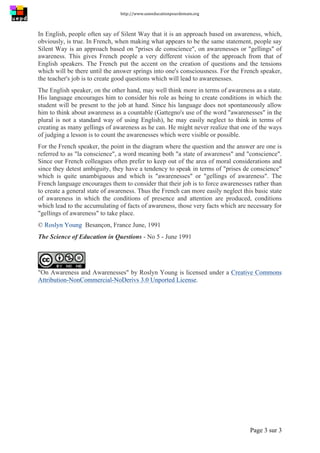
We can easily understand this difference with the help of the following table.
At the point on the left of the diagram, question and answer are simultaneous. Here, we are in
the area of states of awareness and English requires us to use the word "awareness". We could
even say that simultaneity of the question and the answer is what characterizes this state of
awareness. The question is the answer. When I try to describe this state in myself, I describe
the movements of my presence.
In fact, as soon as I stop going about my usual occupations for a few moments and look inside
myself, I cannot fail to realize that I have an inner life made of thoughts, of the reception of
impacts coming from outside, of recognition or not of their meaning(s), of emotions,
sentiments -of all the activities, the inner transactions, the qualities which allow me to live a
life.
My access to my inner and outer life takes place by means of my presence which is constantly
moving, going here and there to grasp what is accessible to it in my environment. When I
observe my way of functioning, I see that my presence goes to any activity whatever which
come into my mind for the slightest second, anything of which I become aware. My presence
moves to take into account impressions which touch it or affect it. Each time my presence
http://www.uneeducationpourdemain.org	


Page 2 sur 3	
  
moves, it generates one or more facts of awareness, facts of which I am aware. (Science tells
us that many impressions come into each of us without having gone through the field of our
awareness and that, for this reason, there are, in each of us a huge quantity of 'unconscious
facts'.) What we are dealing with here are facts of awareness, facts of which we have become
aware.
I can be present in my awareness and aware of my presence, which tells me that the two are
not the same. In both English and French, what we call "presence" is characterized by a
certain focalisation which is not necessarily the case for awareness.
All the facts I know to be in myself are facts of awareness. I stop typing this text for a
moment and move my awareness to the world around me and immediately I hear the cars in
the street, some noises from round about. I begin typing again and, instead of focusing my
attention on the content of my mind, I take it to the content of my ears. Immediately I hear the
noise the keys make as they touch the bottom of the keyboard. I move my awareness inside
and immediately find the taste of a banana I ate half an hour ago, the feeling of my feet on the
floor, my sweater which is making me itch at a precise spot where it is touching my skin.
Each of these tastes, these sensations, these noises, constitutes a fact of awareness, since I am
aware of them.
In this description of my inner state, it would be artificial to try to distinguish questions from
answers. I can, if I decide to do so, find a question each time: What is my ear hearing at this
instant? and now? and now? and I am immediately aware of the answer. In fact the places to
which my presence goes constitute both the question and the answer, simultaneously.
But as soon as we start moving to the right of the diagram above, where the question and the
answer do not take place together in time, we move into an area in which French allows us a
deeper understanding than English. This is the area of "prises de conscience". Why "prise"?
This word, from the French verb "prendre", meaning "to take", is also used for jelly "taking"
when it goes from its liquid to its solid form. "Prise de conscience" can well be translated as
"gellings of awareness". As we move away from the point, Gattegno invites us to speak in
English of "awarenesses" or of "becoming aware". The French term "prise de conscience"
draws our attention to the energy transactions involved, the gellings necessary to create these
awarenesses. We are closer to the tension created by the question which grows in us until the
answer springs forth. The corresponding release of tension is accompanied by an "Ah!" so
characteristic of an awareness -here, we move into the area of countables, since each
awareness can be counted- and the loudness of the "Ah!" is in relation with the strength of the
tension associated with the question. Thus, at the far right hand end of the scale, we have, as
an example, the gelling of awareness Archimedes experienced which led to his running
through the streets shouting "Eureka!" so loudly that the echo comes down to us 2400 years
later.
Archimedes had a question. How was it possible to measure exactly the volume of gold in the
crown without melting it down? This question had been with him for some time, creating a
tension which, we can imagine, became greater as the days went by. I like to imagine a tired,
dispirited Archimedes stepping into his bath and gently sinking down into the delicious hot
water. Suddenly the different relevant facts of awareness come together and "gel" into an
awareness -if he places the crown in a container completely filled with water and if he
measures the volume of water which overflows, he will effectively have measured the volume
of the crown. None of the facts required to produce this awareness is new. What is new is the
coming together of the relevant facts in order to create a new awareness which, in French, is
described as "une prise de conscience", a "gelling of awareness".
To illustrate what is being said here, we can take what English speakers and French speakers
say about Silent Way and what they mean by what they say.
http://www.uneeducationpourdemain.org	


Page 3 sur 3	
  
In English, people often say of Silent Way that it is an approach based on awareness, which,
obviously, is true. In French, when making what appears to be the same statement, people say
Silent Way is an approach based on "prises de conscience", on awarenesses or "gellings" of
awareness. This gives French people a very different vision of the approach from that of
English speakers. The French put the accent on the creation of questions and the tensions
which will be there until the answer springs into one's consciousness. For the French speaker,
the teacher's job is to create good questions which will lead to awarenesses.
The English speaker, on the other hand, may well think more in terms of awareness as a state.
His language encourages him to consider his role as being to create conditions in which the
student will be present to the job at hand. Since his language does not spontaneously allow
him to think about awareness as a countable (Gattegno's use of the word "awarenesses" in the
plural is not a standard way of using English), he may easily neglect to think in terms of
creating as many gellings of awareness as he can. He might never realize that one of the ways
of judging a lesson is to count the awarenesses which were visible or possible.
For the French speaker, the point in the diagram where the question and the answer are one is
referred to as "la conscience", a word meaning both "a state of awareness" and "conscience".
Since our French colleagues often prefer to keep out of the area of moral considerations and
since they detest ambiguity, they have a tendency to speak in terms of "prises de conscience"
which is quite unambiguous and which is "awarenesses" or "gellings of awareness". The
French language encourages them to consider that their job is to force awarenesses rather than
to create a general state of awareness. Thus the French can more easily neglect this basic state
of awareness in which the conditions of presence and attention are produced, conditions
which lead to the accumulating of facts of awareness, those very facts which are necessary for
"gellings of awareness" to take place.
© Roslyn Young Besançon, France June, 1991
The Science of Education in Questions - No 5 - June 1991
"On Awareness and Awarenesses" by Roslyn Young is licensed under a Creative Commons
Attribution-NonCommercial-NoDerivs 3.0 Unported License.

Articles en therotical_reflections_8

  • 1.
    http://www.uneeducationpourdemain.org     Page1 sur 3   On Awareness and Awarenesses Roslyn Young I want to write about awareness and awarenesses because French and English allow me very different entries into this area and consequently very different awarenesses about the nature of awareness and of awarenesses. For some time now, I have been with the difference between awareness as a state, and "awarenesses"; between "la conscience" et "les prises de conscience". We can easily understand this difference with the help of the following table. At the point on the left of the diagram, question and answer are simultaneous. Here, we are in the area of states of awareness and English requires us to use the word "awareness". We could even say that simultaneity of the question and the answer is what characterizes this state of awareness. The question is the answer. When I try to describe this state in myself, I describe the movements of my presence. In fact, as soon as I stop going about my usual occupations for a few moments and look inside myself, I cannot fail to realize that I have an inner life made of thoughts, of the reception of impacts coming from outside, of recognition or not of their meaning(s), of emotions, sentiments -of all the activities, the inner transactions, the qualities which allow me to live a life. My access to my inner and outer life takes place by means of my presence which is constantly moving, going here and there to grasp what is accessible to it in my environment. When I observe my way of functioning, I see that my presence goes to any activity whatever which come into my mind for the slightest second, anything of which I become aware. My presence moves to take into account impressions which touch it or affect it. Each time my presence
  • 2.
    http://www.uneeducationpourdemain.org     Page2 sur 3   moves, it generates one or more facts of awareness, facts of which I am aware. (Science tells us that many impressions come into each of us without having gone through the field of our awareness and that, for this reason, there are, in each of us a huge quantity of 'unconscious facts'.) What we are dealing with here are facts of awareness, facts of which we have become aware. I can be present in my awareness and aware of my presence, which tells me that the two are not the same. In both English and French, what we call "presence" is characterized by a certain focalisation which is not necessarily the case for awareness. All the facts I know to be in myself are facts of awareness. I stop typing this text for a moment and move my awareness to the world around me and immediately I hear the cars in the street, some noises from round about. I begin typing again and, instead of focusing my attention on the content of my mind, I take it to the content of my ears. Immediately I hear the noise the keys make as they touch the bottom of the keyboard. I move my awareness inside and immediately find the taste of a banana I ate half an hour ago, the feeling of my feet on the floor, my sweater which is making me itch at a precise spot where it is touching my skin. Each of these tastes, these sensations, these noises, constitutes a fact of awareness, since I am aware of them. In this description of my inner state, it would be artificial to try to distinguish questions from answers. I can, if I decide to do so, find a question each time: What is my ear hearing at this instant? and now? and now? and I am immediately aware of the answer. In fact the places to which my presence goes constitute both the question and the answer, simultaneously. But as soon as we start moving to the right of the diagram above, where the question and the answer do not take place together in time, we move into an area in which French allows us a deeper understanding than English. This is the area of "prises de conscience". Why "prise"? This word, from the French verb "prendre", meaning "to take", is also used for jelly "taking" when it goes from its liquid to its solid form. "Prise de conscience" can well be translated as "gellings of awareness". As we move away from the point, Gattegno invites us to speak in English of "awarenesses" or of "becoming aware". The French term "prise de conscience" draws our attention to the energy transactions involved, the gellings necessary to create these awarenesses. We are closer to the tension created by the question which grows in us until the answer springs forth. The corresponding release of tension is accompanied by an "Ah!" so characteristic of an awareness -here, we move into the area of countables, since each awareness can be counted- and the loudness of the "Ah!" is in relation with the strength of the tension associated with the question. Thus, at the far right hand end of the scale, we have, as an example, the gelling of awareness Archimedes experienced which led to his running through the streets shouting "Eureka!" so loudly that the echo comes down to us 2400 years later. Archimedes had a question. How was it possible to measure exactly the volume of gold in the crown without melting it down? This question had been with him for some time, creating a tension which, we can imagine, became greater as the days went by. I like to imagine a tired, dispirited Archimedes stepping into his bath and gently sinking down into the delicious hot water. Suddenly the different relevant facts of awareness come together and "gel" into an awareness -if he places the crown in a container completely filled with water and if he measures the volume of water which overflows, he will effectively have measured the volume of the crown. None of the facts required to produce this awareness is new. What is new is the coming together of the relevant facts in order to create a new awareness which, in French, is described as "une prise de conscience", a "gelling of awareness". To illustrate what is being said here, we can take what English speakers and French speakers say about Silent Way and what they mean by what they say.
  • 3.
    http://www.uneeducationpourdemain.org     Page3 sur 3   In English, people often say of Silent Way that it is an approach based on awareness, which, obviously, is true. In French, when making what appears to be the same statement, people say Silent Way is an approach based on "prises de conscience", on awarenesses or "gellings" of awareness. This gives French people a very different vision of the approach from that of English speakers. The French put the accent on the creation of questions and the tensions which will be there until the answer springs into one's consciousness. For the French speaker, the teacher's job is to create good questions which will lead to awarenesses. The English speaker, on the other hand, may well think more in terms of awareness as a state. His language encourages him to consider his role as being to create conditions in which the student will be present to the job at hand. Since his language does not spontaneously allow him to think about awareness as a countable (Gattegno's use of the word "awarenesses" in the plural is not a standard way of using English), he may easily neglect to think in terms of creating as many gellings of awareness as he can. He might never realize that one of the ways of judging a lesson is to count the awarenesses which were visible or possible. For the French speaker, the point in the diagram where the question and the answer are one is referred to as "la conscience", a word meaning both "a state of awareness" and "conscience". Since our French colleagues often prefer to keep out of the area of moral considerations and since they detest ambiguity, they have a tendency to speak in terms of "prises de conscience" which is quite unambiguous and which is "awarenesses" or "gellings of awareness". The French language encourages them to consider that their job is to force awarenesses rather than to create a general state of awareness. Thus the French can more easily neglect this basic state of awareness in which the conditions of presence and attention are produced, conditions which lead to the accumulating of facts of awareness, those very facts which are necessary for "gellings of awareness" to take place. © Roslyn Young Besançon, France June, 1991 The Science of Education in Questions - No 5 - June 1991 "On Awareness and Awarenesses" by Roslyn Young is licensed under a Creative Commons Attribution-NonCommercial-NoDerivs 3.0 Unported License.