ARTICLES- QUIZ
Entry 3
QUESTION 1
 When do we use ‘a’ and when do we use
‘an’. Give examples.
 We use ‘a’ before countable nouns starting
with consonants and we use ‘an’ before
countable nouns starting with vowels, e.g. ‘a
horse’, ‘an eagle’.
QUESTION 2
 Can we use ‘the’ before a singlar countable
noun?
 Yes, e.g. The boy you saw yesterday is my
cousin.
QUESTION 3
 When the noun is mentioned for the second
time in the sentence do we use ‘a’/ ‘an’ or
‘the’?
 ‘The’, e.g. There is a bottle on a table. The
bottle is full.
QUESTION 4
 What is ‘definite’ and ‘indefinite’ article?
 Definite article is ‘the’, indefinite article is ‘a’
or ‘an’.
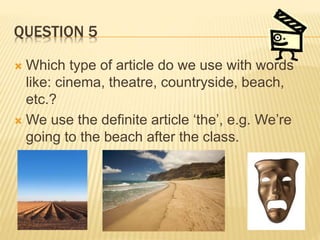
QUESTION 5
 Which type of article do we use with words
like: cinema, theatre, countryside, beach,
etc.?
 We use the definite article ‘the’, e.g. We’re
going to the beach after the class.
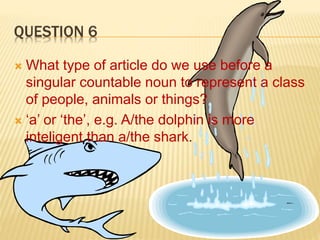
QUESTION 6
 What type of article do we use before a
singular countable noun to represent a class
of people, animals or things?
 ‘a’ or ‘the’, e.g. A/the dolphin is more
inteligent than a/the shark.
QUESTION 7
 Is the following sentence correct? Why/ why
not?
Dolphins are more intelligent than sharks.
 Yes, we can use plural countable nouns to
represent a class of people, animals or
things without any articles.
QUESTION 8
 When do we use indefinite articles? (the
most common rule)
 Before single countable nouns, e.g. I see a
cat.
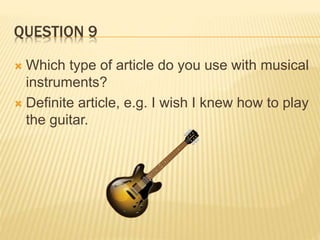
QUESTION 9
 Which type of article do you use with musical
instruments?
 Definite article, e.g. I wish I knew how to play
the guitar.
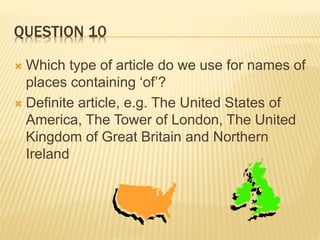
QUESTION 10
 Which type of article do we use for names of
places containing ‘of’?
 Definite article, e.g. The United States of
America, The Tower of London, The United
Kingdom of Great Britain and Northern
Ireland
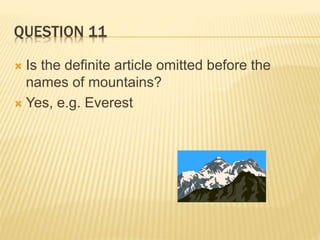
QUESTION 11
 Is the definite article omitted before the
names of mountains?
 Yes, e.g. Everest
QUESTION 12
 Is the definite article omitted before the
groups of mountains/islands?
 No, e.g. the Alps, the Bahamas, the Canary
Islands
QUESTION 13
 Do we use definite article before the names
of seas?
 Yes, e.g. the Black Sea, the Baltic Sea
QUESTION 14
 Do we use definite article for titles with
proper names?
 No, e.g. Queen Elizabeth, President Obama
QUESTION 15
 Do we use definite article before meals?
 No, e.g. Dinner is ready.
QUESTION 16
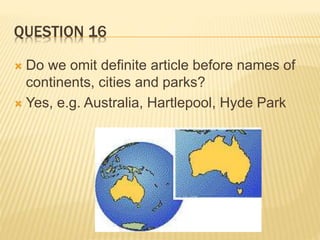
 Do we omit definite article before names of
continents, cities and parks?
 Yes, e.g. Australia, Hartlepool, Hyde Park
QUESTION 17
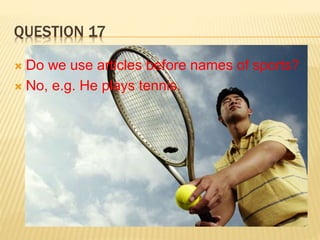
 Do we use articles before names of sports?
 No, e.g. He plays tennis.
QUESTION 18
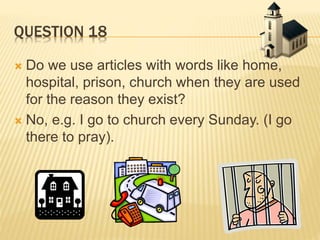
 Do we use articles with words like home,
hospital, prison, church when they are used
for the reason they exist?
 No, e.g. I go to church every Sunday. (I go
there to pray).
QUESTION 19
 Do we use definite articles for adjectives
used as plural nouns?
 Yes, e.g. the rich, the poor, the unemployed,
etc.
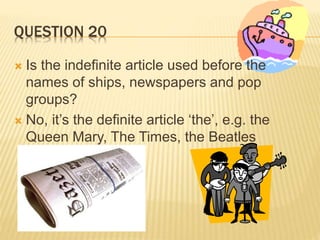
QUESTION 20
 Is the indefinite article used before the
names of ships, newspapers and pop
groups?
 No, it’s the definite article ‘the’, e.g. the
Queen Mary, The Times, the Beatles
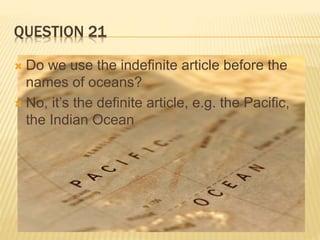
QUESTION 21
 Do we use the indefinite article before the
names of oceans?
 No, it’s the definite article, e.g. the Pacific,
the Indian Ocean
QUESTION 22
 Which one is correct and why?
A European driving licence/An European
driving licence
 A European driving licence because although
the word ‘European’ starts with a vowel letter,
it is read as a consonant sound /ˌjʊərəˈpiːən/
QUESTION 23
 What is the difference between ‘few’ and ‘a
few’?
 There is a difference in meaning. ‘A few’
means several, e.g. A few people came to
the funeral (maybe 4 or 5 people). ‘Few’
means not as many as expected, hardly any,
e.g. Few people came to the funeral (maybe
4 or 5 but not as many as expected).
QUESTION 24
 We use indefinite articles for certain
exclamations, e.g. What a beautiful girl!,
What a nice car! Is the following exclamation
correct? Why/ why not?
What a beautiful weather!
 No. Weather is an uncountable noun and it
does not take an indefinite article.

articles.definite abd indefinite articles in English

  • 1.
  • 2.
    QUESTION 1  Whendo we use ‘a’ and when do we use ‘an’. Give examples.  We use ‘a’ before countable nouns starting with consonants and we use ‘an’ before countable nouns starting with vowels, e.g. ‘a horse’, ‘an eagle’.
  • 3.
    QUESTION 2  Canwe use ‘the’ before a singlar countable noun?  Yes, e.g. The boy you saw yesterday is my cousin.
  • 4.
    QUESTION 3  Whenthe noun is mentioned for the second time in the sentence do we use ‘a’/ ‘an’ or ‘the’?  ‘The’, e.g. There is a bottle on a table. The bottle is full.
  • 5.
    QUESTION 4  Whatis ‘definite’ and ‘indefinite’ article?  Definite article is ‘the’, indefinite article is ‘a’ or ‘an’.
  • 6.
    QUESTION 5  Whichtype of article do we use with words like: cinema, theatre, countryside, beach, etc.?  We use the definite article ‘the’, e.g. We’re going to the beach after the class.
  • 7.
    QUESTION 6  Whattype of article do we use before a singular countable noun to represent a class of people, animals or things?  ‘a’ or ‘the’, e.g. A/the dolphin is more inteligent than a/the shark.
  • 8.
    QUESTION 7  Isthe following sentence correct? Why/ why not? Dolphins are more intelligent than sharks.  Yes, we can use plural countable nouns to represent a class of people, animals or things without any articles.
  • 9.
    QUESTION 8  Whendo we use indefinite articles? (the most common rule)  Before single countable nouns, e.g. I see a cat.
  • 10.
    QUESTION 9  Whichtype of article do you use with musical instruments?  Definite article, e.g. I wish I knew how to play the guitar.
  • 11.
    QUESTION 10  Whichtype of article do we use for names of places containing ‘of’?  Definite article, e.g. The United States of America, The Tower of London, The United Kingdom of Great Britain and Northern Ireland
  • 12.
    QUESTION 11  Isthe definite article omitted before the names of mountains?  Yes, e.g. Everest
  • 13.
    QUESTION 12  Isthe definite article omitted before the groups of mountains/islands?  No, e.g. the Alps, the Bahamas, the Canary Islands
  • 14.
    QUESTION 13  Dowe use definite article before the names of seas?  Yes, e.g. the Black Sea, the Baltic Sea
  • 15.
    QUESTION 14  Dowe use definite article for titles with proper names?  No, e.g. Queen Elizabeth, President Obama
  • 16.
    QUESTION 15  Dowe use definite article before meals?  No, e.g. Dinner is ready.
  • 17.
    QUESTION 16  Dowe omit definite article before names of continents, cities and parks?  Yes, e.g. Australia, Hartlepool, Hyde Park
  • 18.
    QUESTION 17  Dowe use articles before names of sports?  No, e.g. He plays tennis.
  • 19.
    QUESTION 18  Dowe use articles with words like home, hospital, prison, church when they are used for the reason they exist?  No, e.g. I go to church every Sunday. (I go there to pray).
  • 20.
    QUESTION 19  Dowe use definite articles for adjectives used as plural nouns?  Yes, e.g. the rich, the poor, the unemployed, etc.
  • 21.
    QUESTION 20  Isthe indefinite article used before the names of ships, newspapers and pop groups?  No, it’s the definite article ‘the’, e.g. the Queen Mary, The Times, the Beatles
  • 22.
    QUESTION 21  Dowe use the indefinite article before the names of oceans?  No, it’s the definite article, e.g. the Pacific, the Indian Ocean
  • 23.
    QUESTION 22  Whichone is correct and why? A European driving licence/An European driving licence  A European driving licence because although the word ‘European’ starts with a vowel letter, it is read as a consonant sound /ˌjʊərəˈpiːən/
  • 24.
    QUESTION 23  Whatis the difference between ‘few’ and ‘a few’?  There is a difference in meaning. ‘A few’ means several, e.g. A few people came to the funeral (maybe 4 or 5 people). ‘Few’ means not as many as expected, hardly any, e.g. Few people came to the funeral (maybe 4 or 5 but not as many as expected).
  • 25.
    QUESTION 24  Weuse indefinite articles for certain exclamations, e.g. What a beautiful girl!, What a nice car! Is the following exclamation correct? Why/ why not? What a beautiful weather!  No. Weather is an uncountable noun and it does not take an indefinite article.