PPARc Agonists Promote Oligodendrocyte
Differentiation of Neural Stem Cells by Modulating
Stemness and Differentiation Genes
Saravanan Kanakasabai1
, Ecaterina Pestereva1
, Wanida Chearwae1
, Sushil K. Gupta1
, Saif Ansari1
,
John J. Bright1,2
*
1 Neuroscience Research Laboratory, Methodist Research Institute, Indiana University Health, Indianapolis, Indiana, United States of America, 2 Department of Medicine,
Indiana University School of Medicine, Indianapolis, Indiana, United States of America
Abstract
Neural stem cells (NSCs) are a small population of resident cells that can grow, migrate and differentiate into neuro-glial
cells in the central nervous system (CNS). Peroxisome proliferator-activated receptor gamma (PPARc) is a nuclear receptor
transcription factor that regulates cell growth and differentiation. In this study we analyzed the influence of PPARc agonists
on neural stem cell growth and differentiation in culture. We found that in vitro culture of mouse NSCs in neurobasal
medium with B27 in the presence of epidermal growth factor (EGF) and basic fibroblast growth factor (bFGF) induced their
growth and expansion as neurospheres. Addition of all-trans retinoic acid (ATRA) and PPARc agonist ciglitazone or 15-
Deoxy-D12,14
-Prostaglandin J2 (15d-PGJ2) resulted in a dose-dependent inhibition of cell viability and proliferation of NSCs in
culture. Interestingly, NSCs cultured with PPARc agonists, but not ATRA, showed significant increase in oligodendrocyte
precursor-specific O4 and NG2 reactivity with a reduction in NSC marker nestin, in 3–7 days. In vitro treatment with PPARc
agonists and ATRA also induced modest increase in the expression of neuronal b-III tubulin and astrocyte-specific GFAP in
NSCs in 3–7 days. Further analyses showed that PPARc agonists and ATRA induced significant alterations in the expression
of many stemness and differentiation genes associated with neuro-glial differentiation in NSCs. These findings highlight the
influence of PPARc agonists in promoting neuro-glial differentiation of NSCs and its significance in the treatment of
neurodegenerative diseases.
Citation: Kanakasabai S, Pestereva E, Chearwae W, Gupta SK, Ansari S, et al. (2012) PPARc Agonists Promote Oligodendrocyte Differentiation of Neural Stem Cells
by Modulating Stemness and Differentiation Genes. PLoS ONE 7(11): e50500. doi:10.1371/journal.pone.0050500
Editor: Silvana Allodi, Federal University of Rio de Janeiro, Brazil
Received March 20, 2012; Accepted October 23, 2012; Published November 21, 2012
Copyright: ß 2012 Kanakasabai et al. This is an open-access article distributed under the terms of the Creative Commons Attribution License, which permits
unrestricted use, distribution, and reproduction in any medium, provided the original author and source are credited.
Funding: These authors have no support or funding to report.
Competing Interests: The authors have declared that no competing interests exist.
* E-mail: jbright1@clarian.org
Introduction
The central nervous system (CNS) was thought to be a
terminally differentiated organ. This was partly because the
majority of cells in adult mammalian brain emerge at prenatal
period which has limited ability to grow and replace lost cells or
restore function. During embryonic development these cells
originate from neural progenitor cells (NPCs) [1–3]. But recent
studies have localized a small population of resident neural stem
cells (NSCs) in the subventricular zone of adult brain [4]. It is well
recognized that NSCs can proliferate, migrate and differentiate
into neurons and glia in normal brain [5–8]. Under optimum
conditions, NSCs grow and differentiate into neuro-glial cells in
culture [9,10]. Adoptively transferred NSCs migrate, grow and
differentiate into neuro-glial cells in the brain of experimental
models [11], suggesting their use in the treatment of human
neurodegenerative diseases such as multiple sclerosis (MS),
Alzheimer’s disease (AD), Parkinson’s disease (PD), spinal cord
injury, trauma, and stroke [12–15]. Unfortunately, the behavior of
cells in normal brain or in tissue culture does not adequately
predict how these cells will behave in the CNS of patients with
neurodegenerative diseases. This is more significant in compro-
mised CNS niche with neuroinflammation where multiple factors
converge on to influence the normal physiology. Thus an effective
therapy for neurodegenerative diseases hinges on novel strategies
to improve the ability of NSCs to thrive, integrate, and function in
a physiologically meaningful manner without causing adverse side
effects.
Peroxisome proliferator-activated receptors (PPAR) are a family
of ligand-dependent nuclear receptor transcriptional factors that
regulate lipid metabolism and glucose homeostasis [16–18].
PPARa, PPARc and PPARd are three known subtypes of the
PPAR family [19]. Several fatty acids, leukotrienes and 15-Deoxy-
D12,14
-Prostaglandin J2 (15d-PGJ2) function as natural ligand for
PPARc [20–23]. Thiazolidinediones (TZDs) such as ciglitazone,
troglitazone, pioglitazone, and rosiglitazone function as high
affinity synthetic agonists for PPARc [24–27]. Upon activation
with specific ligands, PPARc forms heterodimer complex with
retinoid X receptor (RXR) and mediates target gene expression
[19]. Interestingly, earlier studies have demonstrated that PPARc
is a potent regulator of inflammation [21,28] and in vivo treatment
with PPARc agonists reduces clinical symptoms of MS, Alzhei-
mer’s disease, spinal cord injury, and stroke in animal models [29–
31]. TZD compounds have been shown to inhibit microglial
activation [32,33] and brain injury [34–38]. We have demon-
strated earlier that PPARc agonists ameliorate experimental
PLOS ONE | www.plosone.org 1 November 2012 | Volume 7 | Issue 11 | e50500
allergic encephalomyelitis (EAE) model of MS by blocking
inflammatory signaling networks [39], suggesting a physiological
role for the PPARc in the regulation of inflammation and CNS
repair in neurodegenerative diseases.
However, recent studies examining the influence of PPARc
agonists on cultured NSCs generated conflicting results. While
many reports showed reduced growth with increased differentia-
tion, others demonstrated increased growth with reduced differ-
entiation of NSCs in culture [40–42]. In this study we examined
the mechanisms by which PPARc agonists regulate growth and
differentiation of NSCs in culture. Our results demonstrate that
PPARc agonists promote oligodendrocyte differentiation of mouse
NSCs by modulating the expression of stemness and differentia-
tion genes, suggesting its use in the treatment of demyelinating
diseases.
Results
PPARc agonists inhibit proliferation of NSCs
To study the effect of PPARc agonists on NSCs, we first
established conditions to grow and expand mouse NSCs in culture.
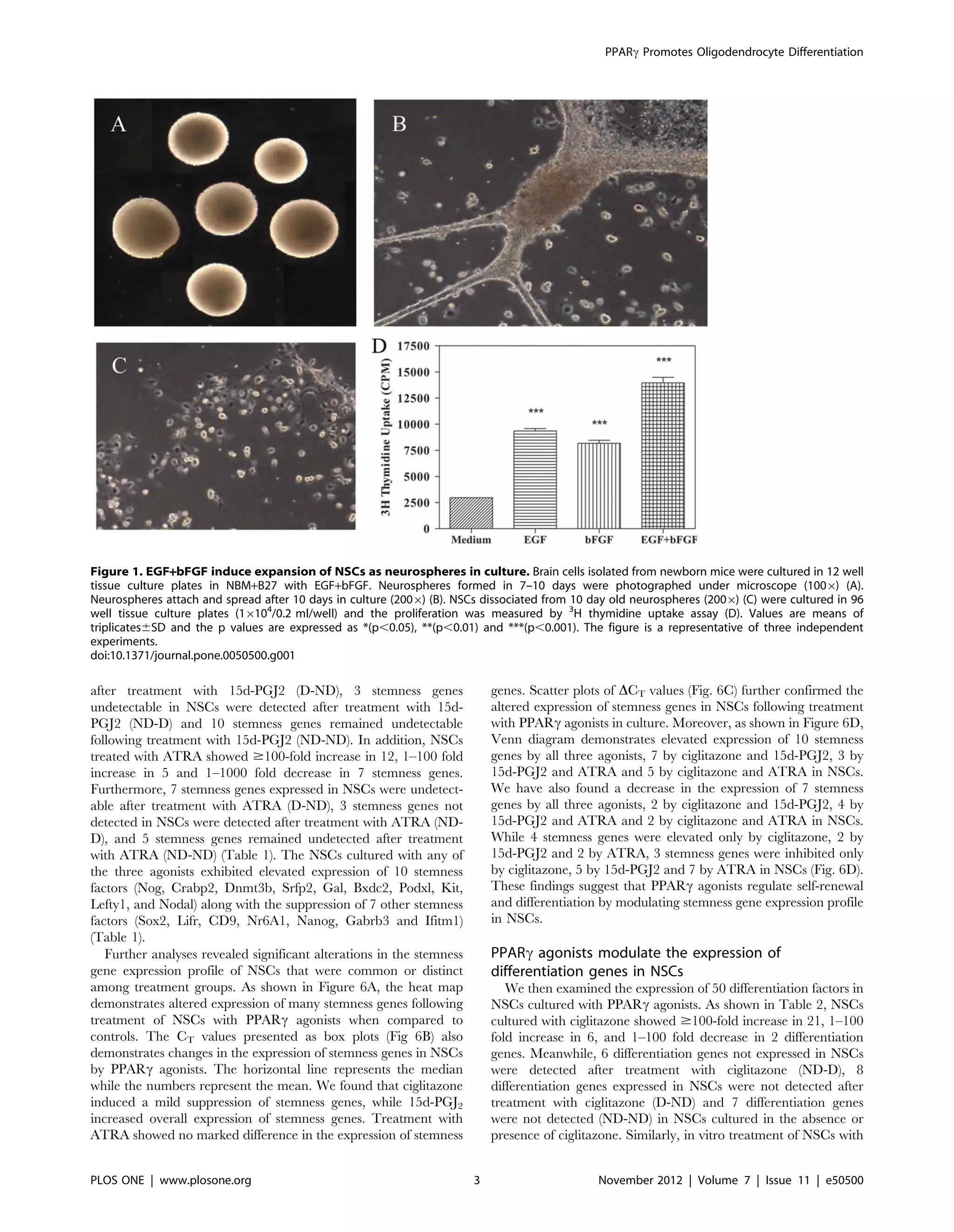
As shown in Figure 1, in vitro culture of brain cells from newborn
mice in NBM with EGF+bFGF induced neurosphere formation in
3 to 5 days that increased in size by 10 days (Fig 1A, B). The NSCs
dissociated from neurospheres (Fig. 1C) showed proliferation in
NBM and that increased significantly following addition of EGF
and bFGF alone or in combination (Fig. 1D). 3
H Thymidine
uptake assay showed that NSCs cultured in medium displayed a
background count of 2970 cpm that increased to 81686297 and
93566223 cpm following the addition of 10 ng/ml bFGF and
EGF, respectively (Fig. 1D). Moreover, addition of EGF and
bFGF in combination resulted in further increase in proliferation
reaching 139606520 cpm, suggesting a potentiating effect for
these growth factors on NSCs in culture.
We then examined the effect of PPARc agonists on the
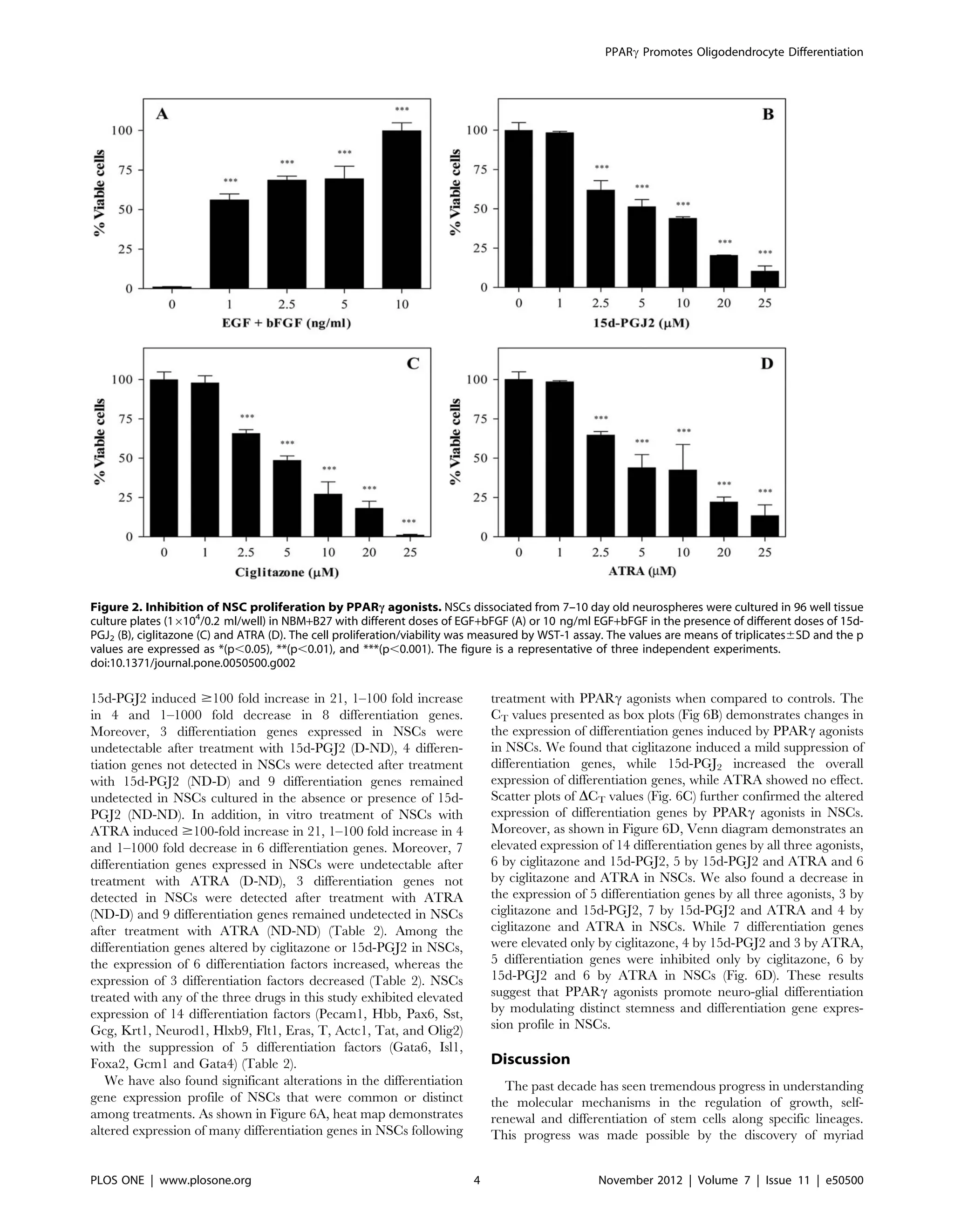
proliferation of NSCs in culture. As shown in Figure 2, in vitro
culture of NSCs in the presence of EGF+bFGF showed a dose-
dependent increase in proliferation or viable cell count as
determined by WST-1 assay. Viable NSCs in the absence of
growth factor was 3% that increased to 56, 68, 69 and 100 percent
by the addition of 1, 2.5, 5 and 10 ng/ml EGF+bFGF, respectively
in culture (Fig. 2A). Interestingly, addition of PPARc agonists
resulted in a dose-dependent decrease in viable cell count in
culture (Fig. 2B, C). While NSCs cultured in NBM with
EGF+bFGF in the absence of 15d-PGJ2 showed 100% viability,
which decreased to 98, 62, 51, 44, 20, and 10 percent following
addition of 1, 2.5, 5, 10, 20 and 25 mM 15d-PGJ2, respectively
(Fig. 2B). Similarly, NSCs cultured in the absence of ciglitazone
showed 100% viability, which decreased to 98, 66, 48, 27, 18 and
1 percent following addition of 1, 2.5, 5, 10, 20 and 25 mM
ciglitazone, respectively (Fig. 2C). Moreover, NSCs cultured with
ATRA also showed a dose-dependent decrease in EGF+bFGF-
induced proliferation/viability. While NSCs cultured with
EGF+bFGF in the absence of ATRA showed 100% viability that
decreased to 98, 65, 44, 42, 22 and 13 percent following addition
of 1, 2.5, 5, 10, 20 and 25 mM ATRA, respectively in culture
(Fig. 2D). These results suggest that PPARc agonists inhibit
EGF+bFGF-induced proliferation and survival of NSCs in culture.
PPARc agonists induce oligodendrocyte differentiation
of NSCs
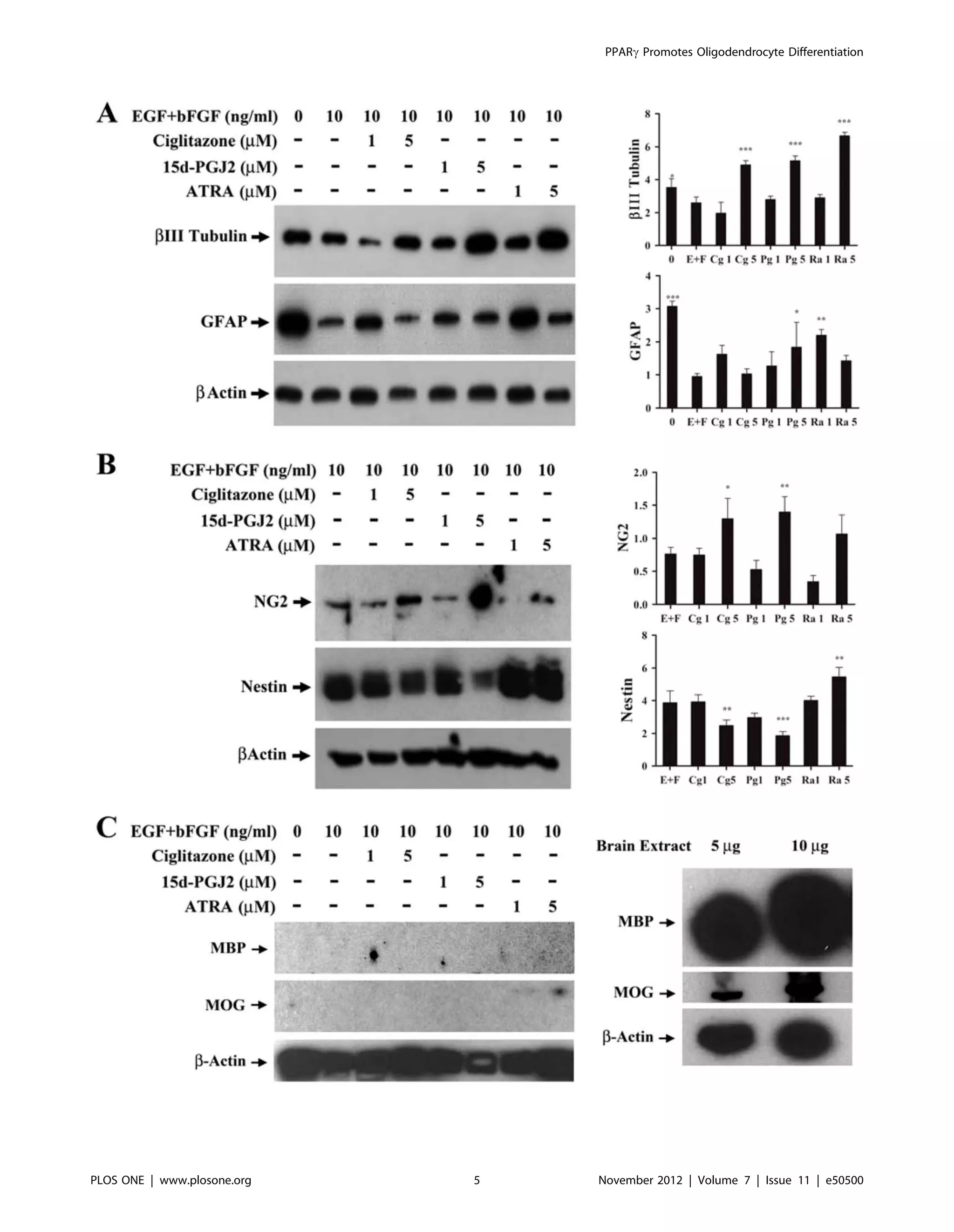
To study the effect of PPARc agonists on NSC differentiation
we examined the expression of neuro-glial markers by Western
blot analysis. As shown in Figure 3A, NSCs cultured in NBM+B27
in the absence of EGF+bFGF expressed elevated levels of neuron-
specific b-III tubulin that decreased significantly following addition
of 10 ng/ml EGF+bFGF. Interestingly, NSCs cultured with
EGF+bFGF in the presence of 5 mM ciglitazone, 15d-PGJ2, or
ATRA showed a significant increase in the expression of b-III
tubulin compared to EGF+bFGF treated cells. Similarly, NSCs
cultured in the absence of EGF+bFGF expressed elevated levels of
astrocyte-specific GFAP that decreased significantly following the
addition of 10 ng/ml EGF+bFGF. Treatment with 1 or 5 mM
ciglitazone, 15d-PGJ2, or ATRA resulted in a partial increase in
GFAP expression, reaching statistical significance at 5 mM 15d-
PGJ2 and 1 mM ATRA compared to EGF+bFGF control (Fig. 3A).
Moreover, NSCs cultured in NBM with EGF+bFGF expressed
detectable levels of oligodendrocyte progenitor-specific NG2
proteoglycan that increased significantly after the addition of
5 mM ciglitazone or 15d-PGJ2 but not with ATRA (Fig. 3B). In
addition, NSCs cultured with EGF+bFGF showed elevated
expression of stem cell marker Nestin that decrease significantly
after the addition of 5 mM ciglitazone or 15d-PGJ2 but increased
after treatment with ATRA (Fig. 3B). However, NSCs cultured in
NBM with EGF+bFGF in the presence of PPARc agonists failed
to express myelin basic protein (MBP) or myelin oligodendrocyte
glycoprotein (MOG), as detected in adult mouse brain (Fig. 3C).
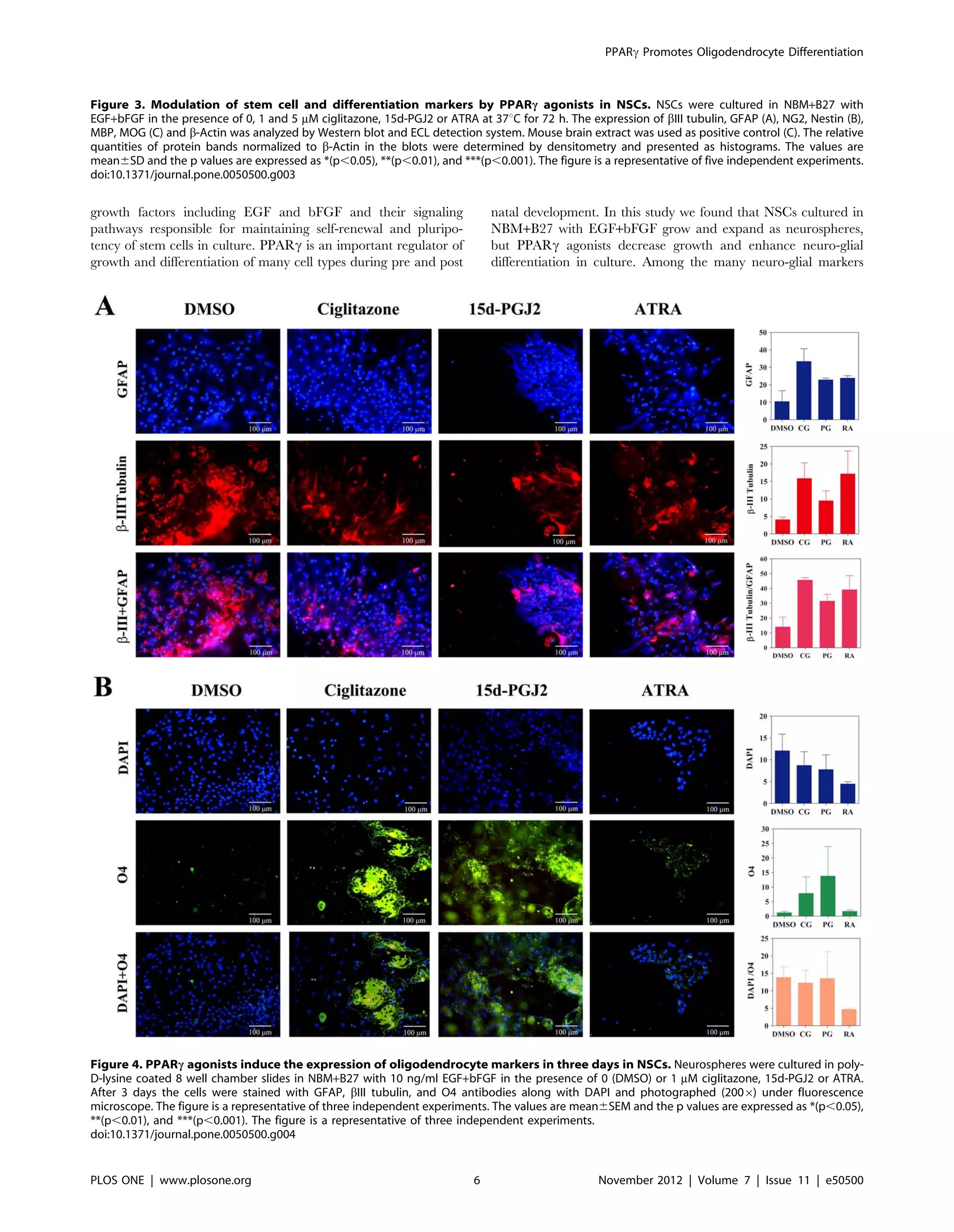
To further determine the effect of PPARc agonists on NSC
differentiation, we examined the expression of neuro-glial markers
by immunocytochemical techniques. As shown in Figure 4 and 5,
NSCs cultured in NBM+B27 in the presence of EGF+bFGF
showed detectable expression of astrocyte-specific GFAP and
neuronal b-III tubulin that increased after treatment with
ciglitazone, 15d-PGJ2 or ATRA for three and seven days,
respectively. Quantitative analysis showed a trend towards
increase in GFAP and b-III tubulin expression in NSCs cultured
with ciglitazone, 15d-PGJ2 or ATRA compared to DMSO
control. In addition, NSCs cultured with EGF+bFGF in the
presence of ciglitazone or 15d-PGJ2 showed considerable increase
in the expression of pre-oligodendrocyte specific O4 reactivity with
characteristic morphology and migration pattern in 3 days that
further increased with 15d-PGJ2 by day 7 (Fig. 4, 5). However,
NSCs cultured with EGF+bFGF in the absence of PPARc agonists
or in the presence of ATRA showed only minimal O4 reactivity on
day 3 with a marginal increase by day 7 (Fig. 4, 5). These findings
suggest that PPARc agonists induce the differentiation of
oligodendrocyte progenitor cells from NSCs and may require
additional signals to promote their maturation to myelinating
oligodendrocytes.
PPARc agonists modulate the expression of stemness
genes in NSCs
To define the mechanisms by which PPARc agonists regulate
neuro-glial differentiation of NSCs, we analyzed stemness gene
profile using TaqMan low density gene array. This array includes
a panel of 40 stemness and 50 differentiation genes. As shown in
Table 1 and 2, in vitro culture of NSCs in NBM with EGF+bFGF
in the presence of PPARc agonists resulted in significant changes
in the expression of many stemness and differentiation genes in
three days. Treatment with ciglitazone induced $100-fold
increase in 22, 1–100 fold increase in 4 and 4 fold decrease in
one stemness gene. Moreover, 9 stemness genes expressed in NSCs
were undetectable after treatment with ciglitazone (D-ND) and 4
stemness genes were undetected in NSCs cultured in the absence
or presence of ciglitazone (ND-ND). Similarly, in vitro treatment
of NSCs with 15d-PGJ2 induced $100-fold increase in 14, 1–100
fold increase in 5 and $100 fold decrease in 2 stemness genes.
Moreover, 6 stemness genes expressed in NSCs were undetectable
PPARc Promotes Oligodendrocyte Differentiation
PLOS ONE | www.plosone.org 2 November 2012 | Volume 7 | Issue 11 | e50500
after treatment with 15d-PGJ2 (D-ND), 3 stemness genes
undetectable in NSCs were detected after treatment with 15d-
PGJ2 (ND-D) and 10 stemness genes remained undetectable
following treatment with 15d-PGJ2 (ND-ND). In addition, NSCs
treated with ATRA showed $100-fold increase in 12, 1–100 fold
increase in 5 and 1–1000 fold decrease in 7 stemness genes.
Furthermore, 7 stemness genes expressed in NSCs were undetect-
able after treatment with ATRA (D-ND), 3 stemness genes not
detected in NSCs were detected after treatment with ATRA (ND-
D), and 5 stemness genes remained undetected after treatment
with ATRA (ND-ND) (Table 1). The NSCs cultured with any of
the three agonists exhibited elevated expression of 10 stemness
factors (Nog, Crabp2, Dnmt3b, Srfp2, Gal, Bxdc2, Podxl, Kit,
Lefty1, and Nodal) along with the suppression of 7 other stemness
factors (Sox2, Lifr, CD9, Nr6A1, Nanog, Gabrb3 and Ifitm1)
(Table 1).
Further analyses revealed significant alterations in the stemness
gene expression profile of NSCs that were common or distinct
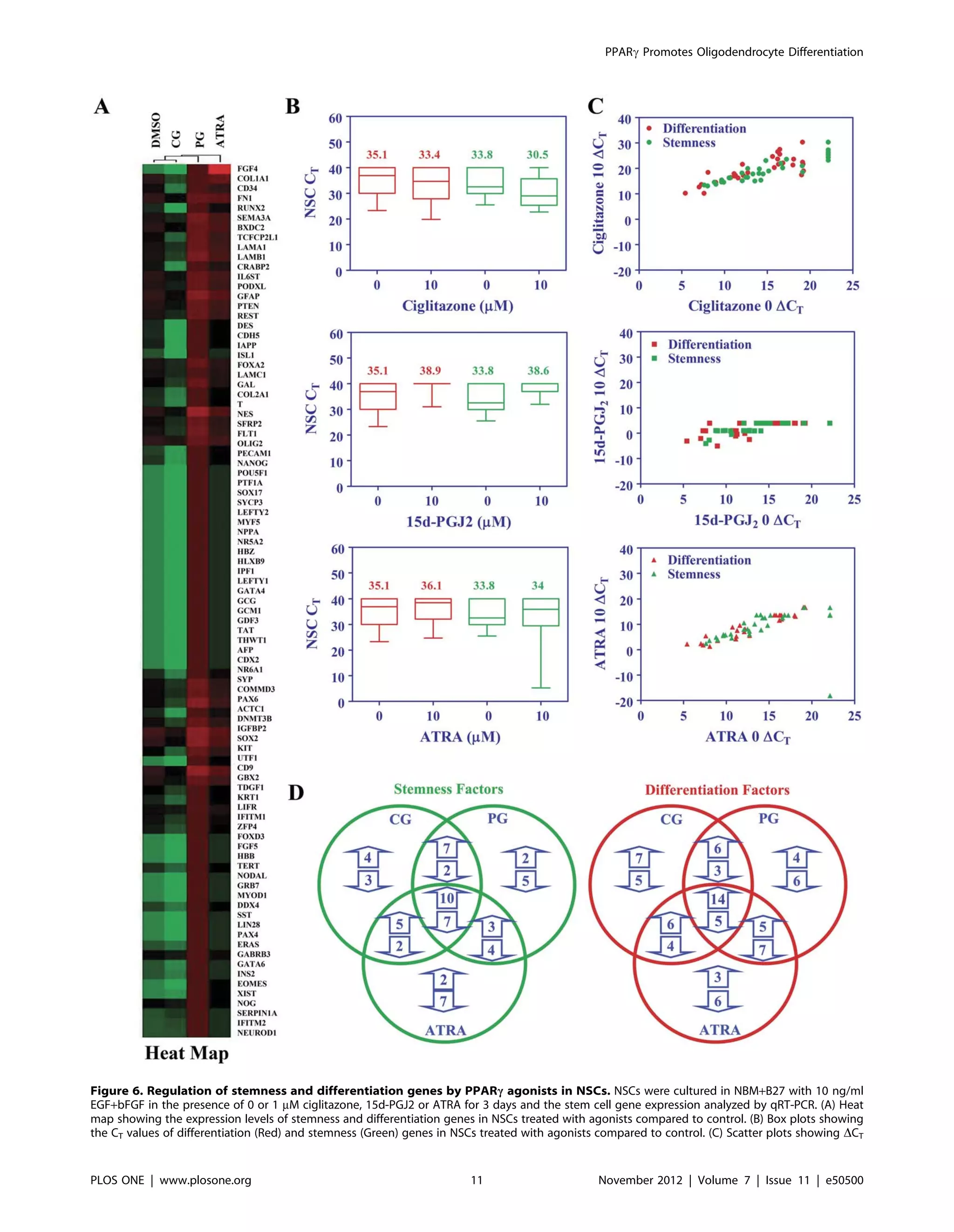
among treatment groups. As shown in Figure 6A, the heat map
demonstrates altered expression of many stemness genes following
treatment of NSCs with PPARc agonists when compared to
controls. The CT values presented as box plots (Fig 6B) also
demonstrates changes in the expression of stemness genes in NSCs
by PPARc agonists. The horizontal line represents the median
while the numbers represent the mean. We found that ciglitazone
induced a mild suppression of stemness genes, while 15d-PGJ2
increased overall expression of stemness genes. Treatment with
ATRA showed no marked difference in the expression of stemness
genes. Scatter plots of DCT values (Fig. 6C) further confirmed the
altered expression of stemness genes in NSCs following treatment
with PPARc agonists in culture. Moreover, as shown in Figure 6D,
Venn diagram demonstrates elevated expression of 10 stemness
genes by all three agonists, 7 by ciglitazone and 15d-PGJ2, 3 by
15d-PGJ2 and ATRA and 5 by ciglitazone and ATRA in NSCs.
We have also found a decrease in the expression of 7 stemness
genes by all three agonists, 2 by ciglitazone and 15d-PGJ2, 4 by
15d-PGJ2 and ATRA and 2 by ciglitazone and ATRA in NSCs.
While 4 stemness genes were elevated only by ciglitazone, 2 by
15d-PGJ2 and 2 by ATRA, 3 stemness genes were inhibited only
by ciglitazone, 5 by 15d-PGJ2 and 7 by ATRA in NSCs (Fig. 6D).
These findings suggest that PPARc agonists regulate self-renewal
and differentiation by modulating stemness gene expression profile
in NSCs.
PPARc agonists modulate the expression of
differentiation genes in NSCs
We then examined the expression of 50 differentiation factors in
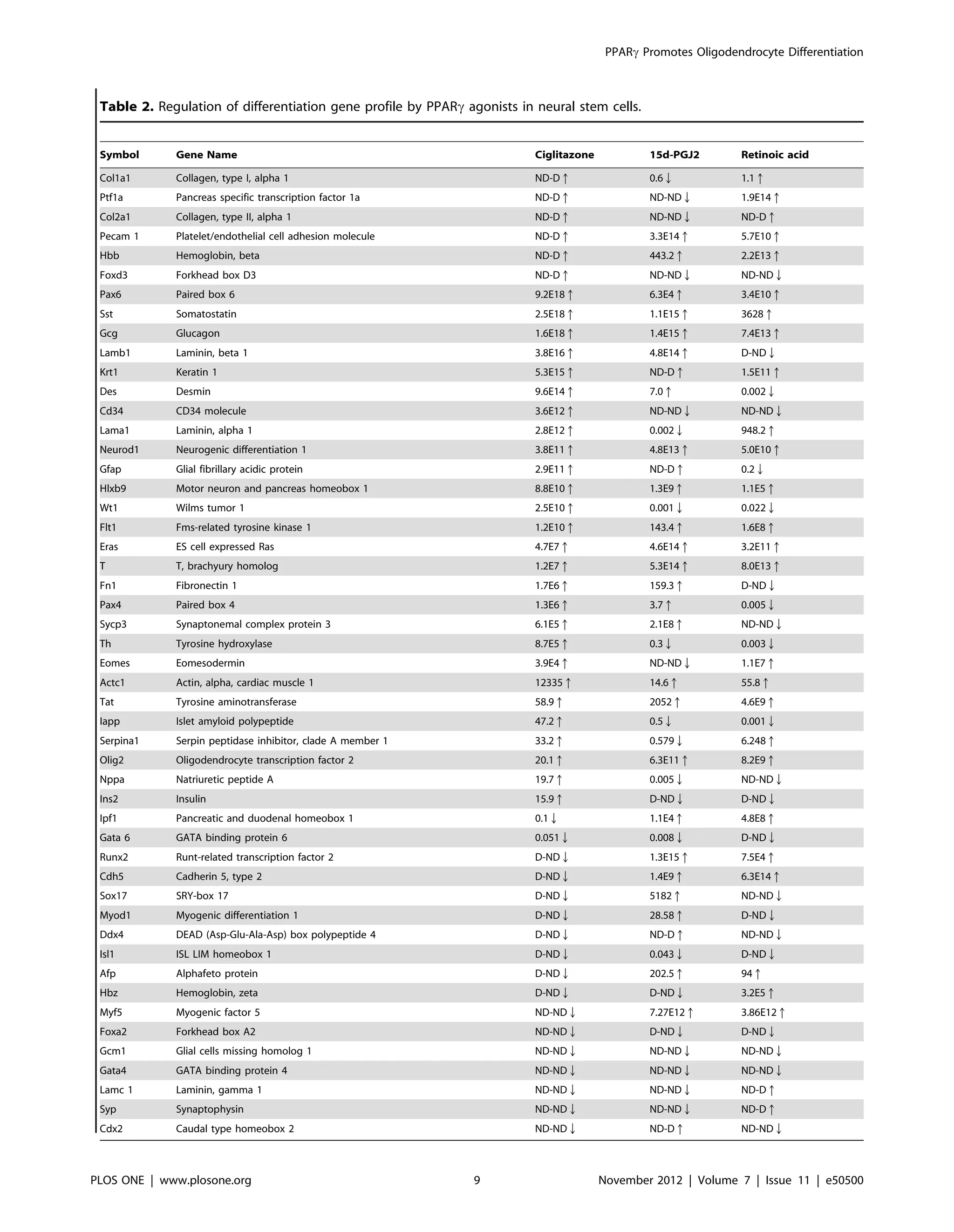
NSCs cultured with PPARc agonists. As shown in Table 2, NSCs
cultured with ciglitazone showed $100-fold increase in 21, 1–100
fold increase in 6, and 1–100 fold decrease in 2 differentiation
genes. Meanwhile, 6 differentiation genes not expressed in NSCs
were detected after treatment with ciglitazone (ND-D), 8
differentiation genes expressed in NSCs were not detected after
treatment with ciglitazone (D-ND) and 7 differentiation genes
were not detected (ND-ND) in NSCs cultured in the absence or
presence of ciglitazone. Similarly, in vitro treatment of NSCs with
Figure 1. EGF+bFGF induce expansion of NSCs as neurospheres in culture. Brain cells isolated from newborn mice were cultured in 12 well
tissue culture plates in NBM+B27 with EGF+bFGF. Neurospheres formed in 7–10 days were photographed under microscope (1006) (A).
Neurospheres attach and spread after 10 days in culture (2006) (B). NSCs dissociated from 10 day old neurospheres (2006) (C) were cultured in 96
well tissue culture plates (16104
/0.2 ml/well) and the proliferation was measured by 3
H thymidine uptake assay (D). Values are means of
triplicates6SD and the p values are expressed as *(p,0.05), **(p,0.01) and ***(p,0.001). The figure is a representative of three independent
experiments.
doi:10.1371/journal.pone.0050500.g001
PPARc Promotes Oligodendrocyte Differentiation
PLOS ONE | www.plosone.org 3 November 2012 | Volume 7 | Issue 11 | e50500
15d-PGJ2 induced $100 fold increase in 21, 1–100 fold increase
in 4 and 1–1000 fold decrease in 8 differentiation genes.
Moreover, 3 differentiation genes expressed in NSCs were
undetectable after treatment with 15d-PGJ2 (D-ND), 4 differen-
tiation genes not detected in NSCs were detected after treatment
with 15d-PGJ2 (ND-D) and 9 differentiation genes remained
undetected in NSCs cultured in the absence or presence of 15d-
PGJ2 (ND-ND). In addition, in vitro treatment of NSCs with
ATRA induced $100-fold increase in 21, 1–100 fold increase in 4
and 1–1000 fold decrease in 6 differentiation genes. Moreover, 7
differentiation genes expressed in NSCs were undetectable after
treatment with ATRA (D-ND), 3 differentiation genes not
detected in NSCs were detected after treatment with ATRA
(ND-D) and 9 differentiation genes remained undetected in NSCs
after treatment with ATRA (ND-ND) (Table 2). Among the
differentiation genes altered by ciglitazone or 15d-PGJ2 in NSCs,
the expression of 6 differentiation factors increased, whereas the
expression of 3 differentiation factors decreased (Table 2). NSCs
treated with any of the three drugs in this study exhibited elevated
expression of 14 differentiation factors (Pecam1, Hbb, Pax6, Sst,
Gcg, Krt1, Neurod1, Hlxb9, Flt1, Eras, T, Actc1, Tat, and Olig2)
with the suppression of 5 differentiation factors (Gata6, Isl1,
Foxa2, Gcm1 and Gata4) (Table 2).
We have also found significant alterations in the differentiation
gene expression profile of NSCs that were common or distinct
among treatments. As shown in Figure 6A, heat map demonstrates
altered expression of many differentiation genes in NSCs following
treatment with PPARc agonists when compared to controls. The
CT values presented as box plots (Fig 6B) demonstrates changes in
the expression of differentiation genes induced by PPARc agonists
in NSCs. We found that ciglitazone induced a mild suppression of
differentiation genes, while 15d-PGJ2 increased the overall
expression of differentiation genes, while ATRA showed no effect.
Scatter plots of DCT values (Fig. 6C) further confirmed the altered
expression of differentiation genes by PPARc agonists in NSCs.
Moreover, as shown in Figure 6D, Venn diagram demonstrates an
elevated expression of 14 differentiation genes by all three agonists,
6 by ciglitazone and 15d-PGJ2, 5 by 15d-PGJ2 and ATRA and 6
by ciglitazone and ATRA in NSCs. We also found a decrease in
the expression of 5 differentiation genes by all three agonists, 3 by
ciglitazone and 15d-PGJ2, 7 by 15d-PGJ2 and ATRA and 4 by
ciglitazone and ATRA in NSCs. While 7 differentiation genes
were elevated only by ciglitazone, 4 by 15d-PGJ2 and 3 by ATRA,
5 differentiation genes were inhibited only by ciglitazone, 6 by
15d-PGJ2 and 6 by ATRA in NSCs (Fig. 6D). These results
suggest that PPARc agonists promote neuro-glial differentiation
by modulating distinct stemness and differentiation gene expres-
sion profile in NSCs.
Discussion
The past decade has seen tremendous progress in understanding
the molecular mechanisms in the regulation of growth, self-
renewal and differentiation of stem cells along specific lineages.
This progress was made possible by the discovery of myriad
Figure 2. Inhibition of NSC proliferation by PPARc agonists. NSCs dissociated from 7–10 day old neurospheres were cultured in 96 well tissue
culture plates (16104
/0.2 ml/well) in NBM+B27 with different doses of EGF+bFGF (A) or 10 ng/ml EGF+bFGF in the presence of different doses of 15d-
PGJ2 (B), ciglitazone (C) and ATRA (D). The cell proliferation/viability was measured by WST-1 assay. The values are means of triplicates6SD and the p
values are expressed as *(p,0.05), **(p,0.01), and ***(p,0.001). The figure is a representative of three independent experiments.
doi:10.1371/journal.pone.0050500.g002
PPARc Promotes Oligodendrocyte Differentiation
PLOS ONE | www.plosone.org 4 November 2012 | Volume 7 | Issue 11 | e50500
PPARc Promotes Oligodendrocyte Differentiation
PLOS ONE | www.plosone.org 5 November 2012 | Volume 7 | Issue 11 | e50500
growth factors including EGF and bFGF and their signaling
pathways responsible for maintaining self-renewal and pluripo-
tency of stem cells in culture. PPARc is an important regulator of
growth and differentiation of many cell types during pre and post
natal development. In this study we found that NSCs cultured in
NBM+B27 with EGF+bFGF grow and expand as neurospheres,
but PPARc agonists decrease growth and enhance neuro-glial
differentiation in culture. Among the many neuro-glial markers
Figure 3. Modulation of stem cell and differentiation markers by PPARc agonists in NSCs. NSCs were cultured in NBM+B27 with
EGF+bFGF in the presence of 0, 1 and 5 mM ciglitazone, 15d-PGJ2 or ATRA at 37uC for 72 h. The expression of bIII tubulin, GFAP (A), NG2, Nestin (B),
MBP, MOG (C) and b-Actin was analyzed by Western blot and ECL detection system. Mouse brain extract was used as positive control (C). The relative
quantities of protein bands normalized to b-Actin in the blots were determined by densitometry and presented as histograms. The values are
mean6SD and the p values are expressed as *(p,0.05), **(p,0.01), and ***(p,0.001). The figure is a representative of five independent experiments.
doi:10.1371/journal.pone.0050500.g003
Figure 4. PPARc agonists induce the expression of oligodendrocyte markers in three days in NSCs. Neurospheres were cultured in poly-
D-lysine coated 8 well chamber slides in NBM+B27 with 10 ng/ml EGF+bFGF in the presence of 0 (DMSO) or 1 mM ciglitazone, 15d-PGJ2 or ATRA.
After 3 days the cells were stained with GFAP, bIII tubulin, and O4 antibodies along with DAPI and photographed (2006) under fluorescence
microscope. The figure is a representative of three independent experiments. The values are mean6SEM and the p values are expressed as *(p,0.05),
**(p,0.01), and ***(p,0.001). The figure is a representative of three independent experiments.
doi:10.1371/journal.pone.0050500.g004
PPARc Promotes Oligodendrocyte Differentiation
PLOS ONE | www.plosone.org 6 November 2012 | Volume 7 | Issue 11 | e50500
analyzed, we observed a significant increase in the expression of
NG2 in PPARc agonist treated NSCs, suggesting oligodendrocyte
progenitor differentiation of NSCs in culture. Moreover, an
increase in the expression of antigens detected by O4 antibody,
suggests pre-oligodendrocyte differentiation of NSCs following
treatment with PPARc agonists. These findings are consistent with
previous reports showing the detection of NG2 and O4 as markers
of NSC differentiation to oligodendrocyte progenitor cells in
culture. Stabenfeldt et al., used O4 as a marker for oligodendro-
cyte differentiation of mouse NSCs in 7 day old cultures [43]. A
study by Sypecka et al., using human cord blood derived NSCs
also demonstrated oligodendroglial differentiation by O4 staining
[44]. Sher et al., used several markers to identify various stages of
oligodendrocyte differentiation (PDGFRa - precursor, progenitor,
NG2 - progenitor, RIP - preoligodendrocyte and MBP -
myelinating mature oligodendrocyte) in NSCs derived from
C57BL/6 mice [45]. However, we found that NSCs cultured in
the presence of PPARc agonists failed to express MBP or MOG as
detected in mouse brain extracts, suggesting that additional signals
are required to induce maturation of oligodendrocytes.
Growth and differentiation signals are integrated by key
transcription factors which regulate specific gene clusters to allow
Figure 5. PPARc agonists induce the expression of oligodendrocyte markers in seven days in NSCs. Neurospheres were cultured in poly-
D-lysine coated 8 well chamber slides in NBM+B27 with 10 ng/ml EGF+bFGF in the presence of 0 (DMSO) or 1 mM ciglitazone, 15d-PGJ2 or ATRA.
After 7 days the cells were stained with GFAP, bIII tubulin, and O4 antibodies along with DAPI and photographed (2006) under fluorescence
microscope. The values are mean6SEM and the p values are expressed as *(p,0.05), **(p,0.01), and ***(p,0.001). The figure is a representative of
three independent experiments.
doi:10.1371/journal.pone.0050500.g005
PPARc Promotes Oligodendrocyte Differentiation
PLOS ONE | www.plosone.org 7 November 2012 | Volume 7 | Issue 11 | e50500
proliferation or differentiation to acquire specialized functions in
NSCs. To define the mechanisms by which PPARc agonists
regulate growth and self-renewal of NSCs, we analyzed the
expression of 40 stemness genes. Among the many altered
stemness genes, Sox2 was one of the important genes inhibited
by PPARc agonists and ATRA in NSCs. Sox2 is a key member of
the Sox (SRY-like HMG box) family transcription factors
expressed in embryonic stem cells (ES), NSCs and trophoblast
stem cells, but not in differentiated cells and is essential for
maintaining pluripotency [46–49]. CD9 is a surface protein
expressed in neural progenitor cells [50] that was also suppressed
by PPARc agonists. The suppression of Sox2, CD9 and other
Table 1. Regulation of stemness gene profile by PPARc agonists in neural stem cells.
Symbol Gene Name Ciglitazone 15d-PGJ2 Retinoic acid
Nog Noggin 9.2E18q 1.6E15q 4 E12q
Crabp2 Cellular retinoic acid binding protein 2 9.2E18q ND-Dq 4.8E14q
Commd3 COMM domain containing 3 9.2E18q ND-NDQ 8.1E12q
Dnmt3b DNA cytosine-5-methyltransferase 3b 1.4E17q 1.8E12q 1.6E12q
Srfp2 Frizzled-related protein 7.1E13q 2.5E7q 4082q
Gdf3 Growth differentiation factor 3 1.9E12q 5771q ND-NDQ
Rest RE1-silencing transcription factor 3.3E11q ND-NDQ 0.001Q
Igfbp2 Insulin-like growth factor binding protein 2 1.3E11q ND-NDQ 1.7q
Nes Nestin 3.0E10q ND-NDQ 1439q
Gal Galanin prepropeptide 5.8E8q 1.2E9q 24.5q
Pou5f1 POU class 5 homeobox 1 2.3E8q 3.8E14q 0.022Q
Xist X (inactive)-specific transcript 8.05E7q 9.17E9q ND-NDQ
Zfp42 Zinc finger protein 42 homolog 8.8E6q 18.8q ND-NDQ
Bxdc2 BRX1, biogenesis of ribosomes, homolog 1.1E6q 7.6E9q 9.5E6q
Podxl Podocalyxin-like 2.8E5q 7.8E14q 16.1q
Tdgf1 Teratocarcinoma-derived growth factor 1 4.3E4q 14.7q 0.003Q
Lin 28 Lin-28 homolog A 2.1E4q ND-NDQ D-NDQ
Fgf5 Fibroblast growth factor 5 1.8E4q D-NDQ 0.11Q
Utf1 Undifferentiated embryonic cell transcription factor 1.4E4q 2.9q D-NDQ
Pten Phosphatase and tensin homolog 6799q ND-NDQ ND-NDQ
Kit Feline sarcoma viral oncogene 757.2q 191.9q 8.1E11q
Lefty1 Left-right determination factor 1 112.4q 5.9E11q 7.2E11q
NR5a2 Nuclear receptor subfamily 5 12.1q 0.003Q ND-Dq
Ifitm2 Interferon induced transmembrane protein 2 11.8q 1.4E7q D-NDQ
Nodal Nodal homolog 9.8q 0.002Q 1.5E10q
Lefty2 Left-right determination factor 2 1.2q ND-Dq 1.6q
Grb7 Growth factor receptor-bound protein 7 0.4Q ND-Dq 2.5E7q
Fgf4 Fibroblast growth factor 4 D-NDQ 4.3E16q 2.6E14q
Gbx2 Gastrulation brain homeobox 2 D-NDQ 6.3E10q 2.5q
Tert Telomerase reverse transcriptase D-NDQ 16.4q 0.002Q
Tfcp2l1 Transcription factor CP2-like 1 D-NDQ 8.9q 0.003Q
Sox2 SRY-box 2 D-NDQ D-NDQ 0.011Q
Lifr Leukemia inhibitory factor receptor alpha D-NDQ D-NDQ D-NDQ
CD9 CD9 molecule D-NDQ D-NDQ D-NDQ
Nr6a1 Nuclear receptor subfamily 6, group A, member 1 D-NDQ D-NDQ D-NDQ
Nanog Nanog homeobox D-NDQ ND-NDQ D-NDQ
Gabrb3 GABA A receptor, beta 3 ND-NDQ D-NDQ 0.5Q
Il6st Interleukin 6 signal transducer ND-NDQ ND-NDQ ND-Dq
Sema3a Sema domain, immunoglobulin domain (Ig) ND-NDQ ND-NDQ ND-Dq
Ifitm1 Interferon induced transmembrane protein 1 ND-NDQ ND-NDQ ND-NDQ
NSCs were cultured in NBM with EGF+bFGF in the presence of DMSO, ciglitazone, 15d-PGJ2 or ATRA for 3 days. The stemness gene expression was analyzed by qRT-PCR
using a 384 gene card array. The fold change was calculated using automatic threshold setting and is based on expression levels in DMSO treated cells as 1 after
normalizing to 18S or GAPDH. The genes in the table are arranged from high to low expression in ciglitazone treated cells. ND, not detected and D, detected. Arrows
indicate up or down regulated genes. This data is a representative of two independent experiments.
doi:10.1371/journal.pone.0050500.t001
PPARc Promotes Oligodendrocyte Differentiation
PLOS ONE | www.plosone.org 8 November 2012 | Volume 7 | Issue 11 | e50500
Table 2. Regulation of differentiation gene profile by PPARc agonists in neural stem cells.
Symbol Gene Name Ciglitazone 15d-PGJ2 Retinoic acid
Col1a1 Collagen, type I, alpha 1 ND-Dq 0.6Q 1.1q
Ptf1a Pancreas specific transcription factor 1a ND-Dq ND-NDQ 1.9E14q
Col2a1 Collagen, type II, alpha 1 ND-Dq ND-NDQ ND-Dq
Pecam 1 Platelet/endothelial cell adhesion molecule ND-Dq 3.3E14q 5.7E10q
Hbb Hemoglobin, beta ND-Dq 443.2q 2.2E13q
Foxd3 Forkhead box D3 ND-Dq ND-NDQ ND-NDQ
Pax6 Paired box 6 9.2E18q 6.3E4q 3.4E10q
Sst Somatostatin 2.5E18q 1.1E15q 3628q
Gcg Glucagon 1.6E18q 1.4E15q 7.4E13q
Lamb1 Laminin, beta 1 3.8E16q 4.8E14q D-NDQ
Krt1 Keratin 1 5.3E15q ND-Dq 1.5E11q
Des Desmin 9.6E14q 7.0q 0.002Q
Cd34 CD34 molecule 3.6E12q ND-NDQ ND-NDQ
Lama1 Laminin, alpha 1 2.8E12q 0.002Q 948.2q
Neurod1 Neurogenic differentiation 1 3.8E11q 4.8E13q 5.0E10q
Gfap Glial fibrillary acidic protein 2.9E11q ND-Dq 0.2Q
Hlxb9 Motor neuron and pancreas homeobox 1 8.8E10q 1.3E9q 1.1E5q
Wt1 Wilms tumor 1 2.5E10q 0.001Q 0.022Q
Flt1 Fms-related tyrosine kinase 1 1.2E10q 143.4q 1.6E8q
Eras ES cell expressed Ras 4.7E7q 4.6E14q 3.2E11q
T T, brachyury homolog 1.2E7q 5.3E14q 8.0E13q
Fn1 Fibronectin 1 1.7E6q 159.3q D-NDQ
Pax4 Paired box 4 1.3E6q 3.7q 0.005Q
Sycp3 Synaptonemal complex protein 3 6.1E5q 2.1E8q ND-NDQ
Th Tyrosine hydroxylase 8.7E5q 0.3Q 0.003Q
Eomes Eomesodermin 3.9E4q ND-NDQ 1.1E7q
Actc1 Actin, alpha, cardiac muscle 1 12335q 14.6q 55.8q
Tat Tyrosine aminotransferase 58.9q 2052q 4.6E9q
Iapp Islet amyloid polypeptide 47.2q 0.5Q 0.001Q
Serpina1 Serpin peptidase inhibitor, clade A member 1 33.2q 0.579Q 6.248q
Olig2 Oligodendrocyte transcription factor 2 20.1q 6.3E11q 8.2E9q
Nppa Natriuretic peptide A 19.7q 0.005Q ND-NDQ
Ins2 Insulin 15.9q D-NDQ D-NDQ
Ipf1 Pancreatic and duodenal homeobox 1 0.1Q 1.1E4q 4.8E8q
Gata 6 GATA binding protein 6 0.051Q 0.008Q D-NDQ
Runx2 Runt-related transcription factor 2 D-NDQ 1.3E15q 7.5E4q
Cdh5 Cadherin 5, type 2 D-NDQ 1.4E9q 6.3E14q
Sox17 SRY-box 17 D-NDQ 5182q ND-NDQ
Myod1 Myogenic differentiation 1 D-NDQ 28.58q D-NDQ
Ddx4 DEAD (Asp-Glu-Ala-Asp) box polypeptide 4 D-NDQ ND-Dq ND-NDQ
Isl1 ISL LIM homeobox 1 D-NDQ 0.043Q D-NDQ
Afp Alphafeto protein D-NDQ 202.5q 94q
Hbz Hemoglobin, zeta D-NDQ D-NDQ 3.2E5q
Myf5 Myogenic factor 5 ND-NDQ 7.27E12q 3.86E12q
Foxa2 Forkhead box A2 ND-NDQ D-NDQ D-NDQ
Gcm1 Glial cells missing homolog 1 ND-NDQ ND-NDQ ND-NDQ
Gata4 GATA binding protein 4 ND-NDQ ND-NDQ ND-NDQ
Lamc 1 Laminin, gamma 1 ND-NDQ ND-NDQ ND-Dq
Syp Synaptophysin ND-NDQ ND-NDQ ND-Dq
Cdx2 Caudal type homeobox 2 ND-NDQ ND-Dq ND-NDQ
PPARc Promotes Oligodendrocyte Differentiation
PLOS ONE | www.plosone.org 9 November 2012 | Volume 7 | Issue 11 | e50500
stemness factors in NSCs suggests the inhibition of self-renewal
and stemness by PPARcagonists. We have also observed the
upregulation of many stemness genes by PPARc agonists in NSCs.
Among them Noggin, a stemness gene implicated in neurogenesis
and the formation of anterior neural patterning [51], was elevated
by PPARc agonists and ATRA. PPARc agonists and ATRA also
increased the expression of cellular retinoic acid binding protein
(Crabp2), known to mediate retinoic acid induced motor neuron
differentiation [52]. Moreover, PPARc agonists and ATRA
increased the expression of Galanin, a protein essential for the
development and survival of a subset of dorsal root ganglia cells
[53] and basal forebrain cholinergic neurons [54]. This is
consistent with earlier studies showing the upregulation of Galanin
mRNA and protein levels after sciatic [55], facial [56] or vagal
[57] nerve injury, suggesting its involvement in nerve repair. Our
findings suggest that the down-regulation of a subset of stemness
genes is sufficient to inhibit growth and self-renewal of NSCs.
To further determine the mechanism in the promotion of
neuro-glial differentiation of NSCs by PPARc agonists, we
analyzed the expression of 50 differentiation genes. Oligodendro-
cyte differentiation factor 2 (Olig2) is one of the many
differentiation factors elevated following treatment with PPARc
agonists that is critical in maintaining oligodendrocyte phenotype
[58]. Therefore, elevated Olig2 and O4 expression as demon-
strated in this study could be a mechanism by which PPARc
agonists promote oligodendrocyte differentiation of NSCs. We
have also found that PPARcagonists increase the expression of
glial fibrillary acidic protein (GFAP) in NSCs, indicating astrocyte
differentiation in culture. PPARc agonists and ATRA also induced
the expression of Pecam1 in NSCs. Earlier studies have shown that
PPARc ligands induce gastro-protective and ulcer healing
properties by increasing the expression of Pecam-1 [59]. Pecam-
1 expressed in NSCs residing in specialized niches closely
associated with blood vessels in adult brain [60,61] may mediate
cross-talk with endothelial cells (ECs) to regulate neurogenesis and
angiogenesis [62]. PPARc agonists and ATRA also induced the
expression of Neurogenic differentiation factor (Neurod1), a
member of the basic helix-loop-helix (bHLH) transcription factor
that plays a role in the development of nervous and endocrine
systems [63]. Neurod1-null mice exhibit behavioral abnormalities
due to a reduction in sensory neurons and Neurod1 regulates
insulin gene expression by binding to a critical E-box motif on
insulin promoter [64]. Pancreas specific transcription factor 1a
(Ptf1a), involved in the maturation of pancreatic b cells, insulin
production and glucose homeostasis [65,66] is also induced by
ciglitazone and ATRA in NSCs. Alphafeto protein (Afp)
expression was enhanced in NSCs following treatment with 15d-
PGJ2 or ATRA. AFP is expressed in early embryos, hematopoietic
progenitor cells and in adult brain [67] and PPARc agonists
upregulate Afp expression and differentiation of hepatic oval cells
[68]. Thus the upregulation of selective differentiation factors
could be a mechanism by which PPARcagonists promote neuro-
glial differentiation of NSCs. Other studies have demonstrated
that in vitro differentiation and maturation of oligodendrocytes
depends on many factors, including T3 function, ECM interac-
tions and modulation of signaling pathways [69,70]. We have also
found an increase in the expression of Olig2 and other genes
relevant to oligodendrocyte differentiation of NSCs following
exposure to PPARc agonists. Our future studies will further
explore the role of specific stemness and differentiation genes
altered by PPARc agonists in promoting neuro-glial differentiation
of NSCs. Our findings suggest that PPARc agonists could prove
beneficial in the treatment of neurodegenerative diseases.
Earlier studies have reported conflicting results on the influence
of PPARc agonists on NSCs. Wada et al., reported elevated
expression of PPARc in NSCs and PPARcagonists induce
proliferation and inhibited neuronal differentiation by activating
EGFR/ERK pathway, which are attenuated in PPARc+/2
and
PPARc-silenced NSCs in culture [40]. Morales-Garcia et al.,
showed that PPARc agonists increase the number of proliferating
NSCs in the subventricular zone and rostral migration in adult rats
and neurosphere formation and differentiation of NSCs that are
blocked by PPARc antagonists in culture [41]. On the other hand,
Katura et al., reported a novel biphasic effect of 15d-PGJ2 on
EGF-induced proliferation of NSCs with an increase at lower
doses (#0.3 mM) and suppression at higher doses (0.5–10 mM) in
culture [42]. In this study we demonstrated that PPARc agonists
inhibit EGF+bFGF-induced proliferation of NSCs at 1 to 25 mM
doses in culture. We have also found that PPARc agonists promote
neuro-glial differentiation by modulating stemness and differenti-
ation genes in NSCs. We believe that the discrepancy between
earlier reports and our results on the effect of PPARc agonists on
NSCs could be due to difference in culture conditions used. In
particular, we performed all our proliferation and differentiation
assays by culturing NSCs in NBM+B27 with EGF+bFGF in the
absence or presence of PPARc agonists, while in other studies
NSCs were cultured with PPARc agonists in the absence of
EGF+bFGF [40]. Earlier studies have used serum containing
medium in the absence of EGF and bFGF that promote
spontaneous differentiation of NSCs into different types of
neuro-glial cells in culture. However, our objective was to promote
selective lineage specific differentiation of NSCs. We have shown
earlier that PPARc agonists regulate leukemia inhibitory factor
(LIF) induced growth and self-renewal of mouse embryonic stem
cells by modulating Jak-Stat signaling pathway [71,72]. We
reasoned that PPARc agonists would regulate selected signaling
pathways induced by EGF+bFGF in stem cell culture condition.
We also believe that the discrepancy between earlier reports and our
results could be due to difference in the PPARc agonists and the
dose-ranges used. In particular, in earlier studies the growth
inducing effect on NSCs was observed only at lower doses of PPARc
agonists, while higher doses caused an anti-proliferative effect,
which is consistent with our findings [40]. Thus further studies on
NSCs were cultured in NBM with EGF+bFGF in the presence of DMSO, ciglitazone, 15d-PGJ2 or ATRA for 3 days. The differentiation gene expression profile was analyzed
by qRT-PCR using a 384 gene card array. The fold change was calculated using automatic threshold setting and is based on expression levels in DMSO treated cells as 1
after normalizing to 18S or GAPDH. The genes are arranged in the table from high to low expression in ciglitazone treated cells. ND, not detected and D, detected.
Arrows indicate up or down regulated genes. This data is a representative of two independent experiments.
doi:10.1371/journal.pone.0050500.t002
Table 2. Cont.
PPARc Promotes Oligodendrocyte Differentiation
PLOS ONE | www.plosone.org 10 November 2012 | Volume 7 | Issue 11 | e50500
Figure 6. Regulation of stemness and differentiation genes by PPARc agonists in NSCs. NSCs were cultured in NBM+B27 with 10 ng/ml
EGF+bFGF in the presence of 0 or 1 mM ciglitazone, 15d-PGJ2 or ATRA for 3 days and the stem cell gene expression analyzed by qRT-PCR. (A) Heat
map showing the expression levels of stemness and differentiation genes in NSCs treated with agonists compared to control. (B) Box plots showing
the CT values of differentiation (Red) and stemness (Green) genes in NSCs treated with agonists compared to control. (C) Scatter plots showing DCT
PPARc Promotes Oligodendrocyte Differentiation
PLOS ONE | www.plosone.org 11 November 2012 | Volume 7 | Issue 11 | e50500
the regulation of NSCs by PPARc agonists would help to determine
their use in the treatment of neurodegenerative diseases.
Materials and Methods
Reagents
The murine recombinant epidermal growth factor (EGF) was
purchased from PeproTech (Rocky Hill, NJ) and basic fibroblast
growth factor (bFGF) was purchased from R&D Systems
(Minneapolis, MN). Ciglitazone was purchased from CalBiochem
(La Jolla, CA), while 15-Deoxy-D12,14
-Prostaglandin J2 (15d-PGJ2)
came from Sigma Chemicals (St Louis, MO). Anti-b-Actin
antibody was purchased from Santa Cruz Biotechnology Inc.
(Santa Cruz, CA). The HRP conjugated secondary Abs, all-trans
retinoic acid (ATRA) and other chemicals were purchased from
Sigma Chemicals Co. (St Louis, MO). WST-1 reagent (4-[3-(4-
iodophenyl)-2-(4-nitrophenyl)-2H-5-tetrazolio]-1,3-benzene disul-
fonate) was purchased from Roche (Indianapolis, IN). Primary
antibodies specific to glial fibrillary acidic protein (GFAP, anti-goat
polyclonal IgG, sc-6170), beta III tubulin (bIII tubulin, anti-mouse
mAb IgG, sc-51670), Nestin (goat polyclonal IgG, sc-21248),
myelin basic protein (MBP, anti-goat polyclonal IgG, sc-13912),
myelin oligodendrocyte glycoprotein (MOG, anti-mouse mAb
IgG, sc-376138), Neural/Glial Antigen 2 (NG2, anti-rabbit
polyclonal IgG, sc-20162) and horse radish peroxidase (HRP)
conjugated secondary antibodies (Goat anti-rabbit IgG, sc-2004;
donkey anti-goat IgG, sc-2020; goat anti-mouse IgG, sc-2031)
were purchased from Santa Cruz Biotechnology Inc. (Santa Cruz,
CA). The mouse monoclonal oligodendrocyte progenitor marker
O4 antibody (Clone 81-IgM); GFAP (rabbit polyclonal IgG,
01415) and fluorochrome conjugated secondary antibodies
(AMCA conjugated goat anti-rabbit polyclonal IgG, 10214; Texas
red conjugated goat anti-mouse mAb IgG, 10213; FITC
conjugated goat anti-mouse IgM, 10211) were purchased from
Stem Cell Technologies (Vancouver, Canada). The 384 well
TaqMan low density mouse stem cell array and other PCR
reagents were obtained from Applied Biosystems (Foster City, CA).
Cell culture
C57BL/6 mice were obtained from Harlan (Indianapolis, IN)
and the breading colonies were maintained in the animal care
facility at Methodist Research Institute. All animal protocols used
in the experiments were approved by the Institutional Animal
Care and Use Committee. Primary mouse NSCs were generated
by culturing dissociated brain cells from new born (post natal 0–3
day) C57B/6 mice in neurobasal medium (NBM) supplemented
with B27 in the presence of 10 ng/ml bFGF and EGF. The cells
were cultured in 12 well tissue culture plates in 5% CO2 incubator
at 37uC with a medium change on every 2–3 days. The
neurospheres generated in 7–10 days were photographed under
phase contrast microscope (AX70, Olympus Optical, Japan).
Proliferation assay
Proliferation of NSCs was measured by 3
H thymidine uptake
and WST-1 assays. Briefly, NSCs obtained by dissociating
neurospheres using accutase (Invitrogen) were cultured in 96-well
tissue culture plates (16104
/200 ml/well) in NBM with B27 in the
absence or presence of 10 ng/ml EGF, bFGF or EGF+bFGF. 3
H
thymidine (0.5 mCi/well) was added at 48 h and the cells were
harvested after 72 h using a Tomtech harvester 96 (Hamden, CT,
USA). The amount of 3
H thymidine uptake was counted on
Wallac Microbeta liquid scintillation counter (Perkin Elmer,
Fremont, CA) as a measure of proliferation. For WST-1 assay,
NSCs were cultured in 96-well tissue culture plates (16104
/
200 ml/well) in NBM with B27 and 10 ng/ml EGF+bFGF in the
presence of 0, 1, 2.5, 5, 10, 20 and 25 mM ciglitazone, 15d-PGJ2
or ATRA. After 72 h, 10 ml of WST-1 reagent was added to each
well and the absorbance determined at 450 nm using a titer-plate
reader (Alpha Diagnostics, San Antonio, TX).
Immunocytochemistry
Neurospheres generated by culturing brain cells from newborn
mice were transferred to poly-D-lysine coated 8 well chamber
slides (BD Biosciences, San Jose, CA) with NBM+B27 and 10 ng/
ml of EGF+bFGF. We have added DMSO vehicle in the absence
or presence of 1.0 mM ciglitazone, 15d-PGJ2 or ATRA in two
identical wells. After 3 and 7 days the cells were fixed with 1%
paraformaldehyde in PBS for 15 min and stained with a
combination of primary and secondary antibodies by indirect
immunofluorescence technique. The cells in one set were stained
with rabbit polyclonal IgG specific to GFAP followed by AMCA
conjugated polyclonal anti-rabbit IgG and mouse monoclonal IgG
specific to bIII-tubulin followed by Texas red conjugated mouse
monoclonal IgG (Fig 4A and Fig 5A). Other set of cells were
stained with mouse monoclonal IgM (O4) followed by FITC
conjugated anti-mouse IgM and DAPI (Fig 4B and Fig 5B). The
images were photographed using Leica Leitz DMRB fluorescent
microscope (Leica Microsystems, Buffalo Grove, IL, USA) and
presented as individual or merged pictures. Quantitative analysis
of immunofluorescence was performed using ImageJ software
(NIH, http://rsbweb.nih.gov/ij/) and presented as histograms.
Western Blot Analysis
To examine the effect of PPARc agonists on neuro-glial
differentiation, NSCs were cultured in NBM+B27 with 10 ng/ml
EGF+bFGF in the presence of 0, 1, and 5 mM ciglitazone, 15d-
PGJ2 or ATRA at 37uC. The cells were harvested after 72 h and
whole cell lysates prepared using lysis buffer (0.2 M Tris-HCl
pH 6.8, 0.8% SDS, 4% Glycerol, 0.588 M b-mercaptoethanol,
0.05 M EDTA, 8 mg/ml bromophenol blue) for 5 min. Adult
C57BL/6 mouse brain was homogenized in lysis buffer and used
as positive control. The total protein samples were resolved on 8%
(Nestin and NG-2) or 12% (b-III Tubulin, GFAP, MBP and
MOG) SDS-PAGE, transferred to nylon (PVD) membrane
(BioRad, Hercules, CA), and the residual binding sites blocked
by incubation with TBST (10 mM Tris-HCl, pH 8.0, 150 mM
NaCl, and 0.05% Tween 20) containing 3% BSA for 1 h.
Membranes were incubated with anti-bIII tubulin, anti-GFAP,
anti-NG2, anti-Nestin, anti-MBP, anti-MOG or anti-b-Actin
antibody (1:200–500) in TBST containing 1% BSA at 4uC
overnight. The blots were washed and incubated with horseradish
peroxidase (HRP)-conjugated secondary antibodies in TBST
(1:2500–5000) for 1 h and developed using enhanced chemilumi-
nescence (ECL) detection system and film (Amersham Life
Science, Arlington Heights, IL) according to manufacturer’s
instructions. Quantitative analyses of Western blots were per-
formed using FluorChem HD2 software (Alpha Innotech/
Quansys Biosciences, West Logan, Utah).
values of differentiation (Red) and stemness (Green) genes in NSCs treated with agonists compared to control. (D) Number of stemness and
differentiation genes altered is presented as Venn diagram. The figure is representative of two independent experiments.
doi:10.1371/journal.pone.0050500.g006
PPARc Promotes Oligodendrocyte Differentiation
PLOS ONE | www.plosone.org 12 November 2012 | Volume 7 | Issue 11 | e50500
Quantitative reverse transcription polymerase chain
reaction
To determine the effect of PPARc agonists on the expression of
stemness and differentiation genes, NSCs were cultured in
NBM+B27 with 10 ng/ml EGF+bFGF in the presence of 0 or
1 mM ciglitazone, 15d-PGJ2 or ATRA at 37uC for 3 days. Total
RNA was extracted using TRIzol reagent (Invitrogen, Carlsbad,
CA) and equal amount of RNA was then reverse transcribed into
cDNA using TaqMan reverse transcription kit (Applied Biosys-
tems, Foster City, CA). Quantitative reverse transcription poly-
merase chain reaction (qRT-PCR) was performed using 384-well
TaqMan Low Density Mouse Stem Cell Gene Array Card with 90
primer sets in 7900 HT fast Real time PCR system (Applied
Biosystems, Foster City, CA). The data were analyzed using the
ABI Prism 7900 relative quantification (delta-delta-Ct) study
software (Applied Biosystems, Foster City, CA) and the gene
expression levels were normalized to 18S or GAPDH and
presented as relative fold change (RQ) compared to control. Heat
map was constructed using the DataAssist software (Applied
Biosystems, Foster City, CA, USA). Box plot, scatter plot, and
Venn diagram were generated using GraphPad Prizm 5.0 software
(GraphPad, La Jolla, CA, USA).
Statistical analysis
The experiments were repeated three or more times and the
values are expressed as mean6SD/SEM. The differences between
groups were analyzed by one way ANOVA using GraphPad Prism
5.0 software and the values * (p,0.05), ** (p,0.01), and ***
(p,0.001) were considered significant.
Author Contributions
Conceived and designed the experiments: SK EP WC SG SA JB.
Performed the experiments: SK EP WC SG SA. Analyzed the data: SK EP
WC SG SA JB. Contributed reagents/materials/analysis tools: JB. Wrote
the paper: SK EP WC SG JB.
References
1. Miller FD, Gauthier AS (2007) Timing is everything: making neurons versus glia
in the developing cortex. Neuron 54: 357–369.
2. Weiss S, Reynolds BA, Vescovi AL, Morshead C, Craig CG, et al. (1996) Is
there a neural stem cell in the mammalian forebrain? Trends Neurosci 19: 387–
393.
3. Gage FH (2000) Mammalian neural stem cells. Science 287: 1433–1438.
4. Eriksson PS, Perfilieva E, Bjork-Eriksson T, Alborn AM, Nordborg C, et al.
(1998) Neurogenesis in the adult human hippocampus. Nat Med 4: 1313–1317.
5. Gage FH (1998) Stem cells of the central nervous system. Curr Opin Neurobiol
8: 671–676.
6. Luskin MB, Zigova T, Soteres BJ, Stewart RR (1997) Neuronal progenitor cells
derived from the anterior subventricular zone of the neonatal rat forebrain
continue to proliferate in vitro and express a neuronal phenotype. Mol Cell
Neurosci 8: 351–366.
7. Nait-Oumesmar B, Decker L, Lachapelle F, Avellana-Adalid V, Bachelin C, et
al. (1999) Progenitor cells of the adult mouse subventricular zone proliferate,
migrate and differentiate into oligodendrocytes after demyelination.
Eur J Neurosci 11: 4357–4366.
8. Bonaguidi MA, Wheeler MA, Shapiro JS, Stadel RP, Sun GJ, et al. (2011) In
Vivo Clonal Analysis Reveals Self-Renewing and Multipotent Adult Neural
Stem Cell Characteristics. Cell 145: 1142–1155.
9. Mokry J, Nemecek S (1999) Cerebral angiogenesis shows nestin expression in
endothelial cells. Gen Physiol Biophys 18 Suppl 1: 25–29.
10. Uchida N, Buck DW, He D, Reitsma MJ, Masek M, et al. (2000) Direct isolation
of human central nervous system stem cells. Proc Natl Acad Sci U S A 97:
14720–14725.
11. Pluchino S, Quattrini A, Brambilla E, Gritti A, Salani G, et al. (2003) Injection
of adult neurospheres induces recovery in a chronic model of multiple sclerosis.
Nature 422: 688–694.
12. Groves AK, Entwistle A, Jat PS, Noble M (1993) The characterization of
astrocyte cell lines that display properties of glial scar tissue. Dev Biol 159: 87–
104.
13. Zhang SC, Fedoroff S (1999) Expression of stem cell factor and c-kit receptor in
neural cells after brain injury. Acta Neuropathol 97: 393–398.
14. Shihabuddin LS, Palmer TD, Gage FH (1999) The search for neural progenitor
cells: prospects for the therapy of neurodegenerative disease. Mol Med Today 5:
474–480.
15. Rogister B, Ben-Hur T, Dubois-Dalcq M (1999) From neural stem cells to
myelinating oligodendrocytes. Mol Cell Neurosci 14: 287–300.
16. Debril MB, Renaud JP, Fajas L, Auwerx J (2001) The pleiotropic functions of
peroxisome proliferator-activated receptor gamma. J Mol Med 79: 30–47.
17. Kliewer SA, Forman BM, Blumberg B, Ong ES, Borgmeyer U, et al. (1994)
Differential expression and activation of a family of murine peroxisome
proliferator-activated receptors. Proc Natl Acad Sci U S A 91: 7355–7359.
18. Michalik L, Wahli W (2006) Involvement of PPAR nuclear receptors in tissue
injury and wound repair. J Clin Invest 116: 598–606.
19. Kliewer SA, Umesono K, Noonan DJ, Heyman RA, Evans RM (1992)
Convergence of 9-cis retinoic acid and peroxisome proliferator signalling
pathways through heterodimer formation of their receptors. Nature 358: 771–
774.
20. Forman BM, Tontonoz P, Chen J, Brun RP, Spiegelman BM, et al. (1995) 15-
Deoxy-delta 12, 14-prostaglandin J2 is a ligand for the adipocyte determination
factor PPAR gamma. Cell 83: 803–812.
21. Jiang C, Ting AT, Seed B (1998) PPAR-gamma agonists inhibit production of
monocyte inflammatory cytokines. Nature 391: 82–86.
22. Kliewer SA, Lenhard JM, Willson TM, Patel I, Morris DC, et al. (1995) A
prostaglandin J2 metabolite binds peroxisome proliferator-activated receptor
gamma and promotes adipocyte differentiation. Cell 83: 813–819.
23. Paruchuri S, Jiang Y, Feng C, Francis SA, Plutzky J, et al. (2008) Leukotriene E4
activates peroxisome proliferator-activated receptor gamma and induces
prostaglandin D2 generation by human mast cells. J Biol Chem 283: 16477–
16487.
24. Blaschke F, Caglayan E, Hsueh WA (2006) Peroxisome proliferator-activated
receptor gamma agonists: their role as vasoprotective agents in diabetes.
Endocrinol Metab Clin North Am 35: 561–574, ix.
25. Desvergne B, Wahli W (1999) Peroxisome proliferator-activated receptors:
nuclear control of metabolism. Endocr Rev 20: 649–688.
26. Lehmann JM, Moore LB, Smith-Oliver TA, Wilkison WO, Willson TM, et al.
(1995) An antidiabetic thiazolidinedione is a high affinity ligand for peroxisome
proliferator-activated receptor gamma (PPAR gamma). J Biol Chem 270:
12953–12956.
27. Rosen ED, Spiegelman BM (2001) PPARgamma: a nuclear regulator of
metabolism, differentiation, and cell growth. J Biol Chem 276: 37731–37734.
28. Ricote M, Li AC, Willson TM, Kelly CJ, Glass CK (1998) The peroxisome
proliferator-activated receptor-gamma is a negative regulator of macrophage
activation. Nature 391: 79–82.
29. Allahtavakoli M, Shabanzadeh A, Roohbakhsh A, Pourshanazari A (2007)
Combination therapy of rosiglitazone, a peroxisome proliferator-activated
receptor-gamma ligand, and NMDA receptor antagonist (MK-801) on
experimental embolic stroke in rats. Basic Clin Pharmacol Toxicol 101: 309–
314.
30. Culman J, Zhao Y, Gohlke P, Herdegen T (2007) PPAR-gamma: therapeutic
target for ischemic stroke. Trends Pharmacol Sci 28: 244–249.
31. Natarajan C, Bright JJ (2002) Peroxisome proliferator-activated receptor-gamma
agonists inhibit experimental allergic encephalomyelitis by blocking IL-12
production, IL-12 signaling and Th1 differentiation. Genes Immun 3: 59–70.
32. Luna-Medina R, Cortes-Canteli M, Alonso M, Santos A, Martinez A, et al.
(2005) Regulation of inflammatory response in neural cells in vitro by
thiadiazolidinones derivatives through peroxisome proliferator-activated recep-
tor gamma activation. J Biol Chem 280: 21453–21462.
33. Luna-Medina R, Cortes-Canteli M, Sanchez-Galiano S, Morales-Garcia JA,
Martinez A, et al. (2007) NP031112, a thiadiazolidinone compound, prevents
inflammation and neurodegeneration under excitotoxic conditions: potential
therapeutic role in brain disorders. J Neurosci 27: 5766–5776.
34. Bernardo A, Levi G, Minghetti L (2000) Role of the peroxisome proliferator-
activated receptor-gamma (PPAR-gamma) and its natural ligand 15-deoxy-
Delta12, 14-prostaglandin J2 in the regulation of microglial functions.
Eur J Neurosci 12: 2215–2223.
35. Landreth GE, Heneka MT (2001) Anti-inflammatory actions of peroxisome
proliferator-activated receptor gamma agonists in Alzheimer’s disease. Neuro-
biol Aging 22: 937–944.
36. Townsend KP, Pratico D (2005) Novel therapeutic opportunities for Alzheimer’s
disease: focus on nonsteroidal anti-inflammatory drugs. Faseb J 19: 1592–1601.
37. Kielian T, Drew PD (2003) Effects of peroxisome proliferator-activated receptor-
gamma agonists on central nervous system inflammation. J Neurosci Res 71:
315–325.
38. Ricote M, Huang JT, Welch JS, Glass CK (1999) The peroxisome proliferator-
activated receptor (PPARgamma) as a regulator of monocyte/macrophage
function. J Leukoc Biol 66: 733–739.
39. Raikwar HP, Muthian G, Rajasingh J, Johnson CN, Bright JJ (2006)
PPARgamma antagonists reverse the inhibition of neural antigen-specific Th1
PPARc Promotes Oligodendrocyte Differentiation
PLOS ONE | www.plosone.org 13 November 2012 | Volume 7 | Issue 11 | e50500
response and experimental allergic encephalomyelitis by Ciglitazone and 15-
deoxy-Delta12,14-prostaglandin J2. J Neuroimmunol 178: 76–86.
40. Wada K, Nakajima A, Katayama K, Kudo C, Shibuya A, et al. (2006)
Peroxisome proliferator-activated receptor gamma-mediated regulation of
neural stem cell proliferation and differentiation. J Biol Chem 281: 12673–
12681.
41. Morales-Garcia JA, Luna-Medina R, Alfaro-Cervello C, Cortes-Canteli M,
Santos A, et al. (2011) Peroxisome proliferator-activated receptor gamma ligands
regulate neural stem cell proliferation and differentiation in vitro and in vivo.
Glia 59: 293–307.
42. Katura T, Moriya T, Nakahata N (2010) 15-Deoxy-delta 12,14-prostaglandin J2
biphasically regulates the proliferation of mouse hippocampal neural progenitor
cells by modulating the redox state. Mol Pharmacol 77: 601–611.
43. Stabenfeldt SE, Munglani G, Garcia AJ, LaPlaca MC (2010) Biomimetic
microenvironment modulates neural stem cell survival, migration, and
differentiation. Tissue Eng Part A 16: 3747–3758.
44. Sypecka J, Dragun-Szymczak P, Zalewska T, Domanska-Janik K (2009)
Laminin promotes oligogliogenesis and increases MMPs activity in human
neural stem cells of HUCB-NSC line. Acta Neurobiol Exp (Wars) 69: 37–45.
45. Sher F, Rossler R, Brouwer N, Balasubramaniyan V, Boddeke E, et al. (2008)
Differentiation of neural stem cells into oligodendrocytes: involvement of the
polycomb group protein Ezh2. Stem Cells 26: 2875–2883.
46. Avilion AA, Nicolis SK, Pevny LH, Perez L, Vivian N, et al. (2003) Multipotent
cell lineages in early mouse development depend on SOX2 function. Genes Dev
17: 126–140.
47. Catena R, Tiveron C, Ronchi A, Porta S, Ferri A, et al. (2004) Conserved POU
binding DNA sites in the Sox2 upstream enhancer regulate gene expression in
embryonic and neural stem cells. J Biol Chem 279: 41846–41857.
48. D’Amour KA, Gage FH (2003) Genetic and functional differences between
multipotent neural and pluripotent embryonic stem cells. Proc Natl Acad
Sci U S A 100 Suppl 1: 11866–11872.
49. Episkopou V (2005) SOX2 functions in adult neural stem cells. Trends Neurosci
28: 219–221.
50. Klassen H, Schwartz MR, Bailey AH, Young MJ (2001) Surface markers
expressed by multipotent human and mouse neural progenitor cells include
tetraspanins and non-protein epitopes. Neurosci Lett 312: 180–182.
51. Hendrickx M, Van XH, Leyns L (2009) Anterior-posterior patterning of neural
differentiated embryonic stem cells by canonical Wnts, Fgfs, Bmp4 and their
respective antagonists. Dev Growth Differ 51: 687–698.
52. Chaerkady R, Kerr CL, Marimuthu A, Kelkar DS, Kashyap MK, et al. (2009)
Temporal analysis of neural differentiation using quantitative proteomics.
J Proteome Res 8: 1315–1326.
53. Holmes FE, Mahoney S, King VR, Bacon A, Kerr NC, et al. (2000) Targeted
disruption of the galanin gene reduces the number of sensory neurons and their
regenerative capacity. Proc Natl Acad Sci U S A 97: 11563–11568.
54. O’Meara G, Coumis U, Ma SY, Kehr J, Mahoney S, et al. (2000) Galanin
regulates the postnatal survival of a subset of basal forebrain cholinergic neurons.
Proc Natl Acad Sci U S A 97: 11569–11574.
55. Hokfelt T, Wiesenfeld-Hallin Z, Villar M, Melander T (1987) Increase of
galanin-like immunoreactivity in rat dorsal root ganglion cells after peripheral
axotomy. Neurosci Lett 83: 217–220.
56. Burazin TC, Gundlach AL (1998) Inducible galanin and GalR2 receptor system
in motor neuron injury and regeneration. J Neurochem 71: 879–882.
57. Rutherfurd SD, Widdop RE, Louis WJ, Gundlach AL (1992) Preprogalanin
mRNA is increased in vagal motor neurons following axotomy. Brain Res Mol
Brain Res 14: 261–266.
58. Sun Y, Meijer DH, Alberta JA, Mehta S, Kane MF, et al. (2011)
Phosphorylation state of Olig2 regulates proliferation of neural progenitors.
Neuron 69: 906–917.
59. Brzozowski T, Konturek PC, Pajdo R, Kwiecien SN, Konturek S, et al. (2005)
Agonist of peroxisome proliferator-activated receptor gamma (PPAR-gamma): a
new compound with potent gastroprotective and ulcer healing properties.
Inflammopharmacology 13: 317–330.
60. Okano H (2002) Neural stem cells: progression of basic research and perspective
for clinical application. Keio J Med 51: 115–128.
61. Okano H (2002) Stem cell biology of the central nervous system. J Neurosci Res
69: 698–707.
62. Lazarovici P, Marcinkiewicz C, Lelkes PI (2006) Cross talk between the
cardiovascular and nervous systems: neurotrophic effects of vascular endothelial
growth factor (VEGF) and angiogenic effects of nerve growth factor (NGF)-
implications in drug development. Curr Pharm Des 12: 2609–2622.
63. Cho JH, Tsai MJ (2004) The role of BETA2/NeuroD1 in the development of
the nervous system. Mol Neurobiol 30: 35–47.
64. Yokoyama M, Nishi Y, Miyamoto Y, Nakamura M, Akiyama K, et al. (1996)
Molecular cloning of a human neuroD from a neuroblastoma cell line
specifically expressed in the fetal brain and adult cerebellum. Brain Res Mol
Brain Res 42: 135–139.
65. Kaneto H, Miyatsuka T, Kawamori D, Yamamoto K, Kato K, et al. (2008)
PDX-1 and MafA play a crucial role in pancreatic beta-cell differentiation and
maintenance of mature beta-cell function. Endocr J 55: 235–252.
66. Kaneto H, Matsuoka TA, Miyatsuka T, Kawamori D, Katakami N, et al. (2008)
PDX-1 functions as a master factor in the pancreas. Front Biosci 13: 6406–6420.
67. Kubota H, Storms RW, Reid LM (2002) Variant forms of alpha-fetoprotein
transcripts expressed in human hematopoietic progenitors. Implications for their
developmental potential towards endoderm. J Biol Chem 277: 27629–27635.
68. Cheng J, Nakamura H, Imanishi H, Liu W, Morisaki T, et al. (2004) Peroxisome
proliferator-activated receptor gamma ligands, 15-deoxy-Delta12,14-prostaglan-
din J2, and ciglitazone, induce growth inhibition and cell cycle arrest in hepatic
oval cells. Biochem Biophys Res Commun 322: 458–464.
69. Younes-Rapozo V, Berendonk J, Savignon T, Manhaes AC, Barradas PC (2006)
Thyroid hormone deficiency changes the distribution of oligodendrocyte/myelin
markers during oligodendroglial differentiation in vitro. Int J Dev Neurosci 24:
445–453.
70. Fox MA, Alexander JK, Afshari FS, Colello RJ, Fuss B (2004) Phosphodies-
terase-I alpha/autotaxin controls cytoskeletal organization and FAK phosphor-
ylation during myelination. Mol Cell Neurosci 27: 140–150.
71. Mo C, Chearwae W, Bright JJ (2010) PPARgamma regulates LIF-induced
growth and self-renewal of mouse ES cells through Tyk2-Stat3 pathway. Cell
Signal 22: 495–500.
72. Rajasingh J, Bright JJ (2006) 15-Deoxy-delta12,14-prostaglandin J2 regulates
leukemia inhibitory factor signaling through JAK-STAT pathway in mouse
embryonic stem cells. Exp Cell Res 312: 2538–2546.
PPARc Promotes Oligodendrocyte Differentiation
PLOS ONE | www.plosone.org 14 November 2012 | Volume 7 | Issue 11 | e50500

article2

  • 1.
    PPARc Agonists PromoteOligodendrocyte Differentiation of Neural Stem Cells by Modulating Stemness and Differentiation Genes Saravanan Kanakasabai1 , Ecaterina Pestereva1 , Wanida Chearwae1 , Sushil K. Gupta1 , Saif Ansari1 , John J. Bright1,2 * 1 Neuroscience Research Laboratory, Methodist Research Institute, Indiana University Health, Indianapolis, Indiana, United States of America, 2 Department of Medicine, Indiana University School of Medicine, Indianapolis, Indiana, United States of America Abstract Neural stem cells (NSCs) are a small population of resident cells that can grow, migrate and differentiate into neuro-glial cells in the central nervous system (CNS). Peroxisome proliferator-activated receptor gamma (PPARc) is a nuclear receptor transcription factor that regulates cell growth and differentiation. In this study we analyzed the influence of PPARc agonists on neural stem cell growth and differentiation in culture. We found that in vitro culture of mouse NSCs in neurobasal medium with B27 in the presence of epidermal growth factor (EGF) and basic fibroblast growth factor (bFGF) induced their growth and expansion as neurospheres. Addition of all-trans retinoic acid (ATRA) and PPARc agonist ciglitazone or 15- Deoxy-D12,14 -Prostaglandin J2 (15d-PGJ2) resulted in a dose-dependent inhibition of cell viability and proliferation of NSCs in culture. Interestingly, NSCs cultured with PPARc agonists, but not ATRA, showed significant increase in oligodendrocyte precursor-specific O4 and NG2 reactivity with a reduction in NSC marker nestin, in 3–7 days. In vitro treatment with PPARc agonists and ATRA also induced modest increase in the expression of neuronal b-III tubulin and astrocyte-specific GFAP in NSCs in 3–7 days. Further analyses showed that PPARc agonists and ATRA induced significant alterations in the expression of many stemness and differentiation genes associated with neuro-glial differentiation in NSCs. These findings highlight the influence of PPARc agonists in promoting neuro-glial differentiation of NSCs and its significance in the treatment of neurodegenerative diseases. Citation: Kanakasabai S, Pestereva E, Chearwae W, Gupta SK, Ansari S, et al. (2012) PPARc Agonists Promote Oligodendrocyte Differentiation of Neural Stem Cells by Modulating Stemness and Differentiation Genes. PLoS ONE 7(11): e50500. doi:10.1371/journal.pone.0050500 Editor: Silvana Allodi, Federal University of Rio de Janeiro, Brazil Received March 20, 2012; Accepted October 23, 2012; Published November 21, 2012 Copyright: ß 2012 Kanakasabai et al. This is an open-access article distributed under the terms of the Creative Commons Attribution License, which permits unrestricted use, distribution, and reproduction in any medium, provided the original author and source are credited. Funding: These authors have no support or funding to report. Competing Interests: The authors have declared that no competing interests exist. * E-mail: jbright1@clarian.org Introduction The central nervous system (CNS) was thought to be a terminally differentiated organ. This was partly because the majority of cells in adult mammalian brain emerge at prenatal period which has limited ability to grow and replace lost cells or restore function. During embryonic development these cells originate from neural progenitor cells (NPCs) [1–3]. But recent studies have localized a small population of resident neural stem cells (NSCs) in the subventricular zone of adult brain [4]. It is well recognized that NSCs can proliferate, migrate and differentiate into neurons and glia in normal brain [5–8]. Under optimum conditions, NSCs grow and differentiate into neuro-glial cells in culture [9,10]. Adoptively transferred NSCs migrate, grow and differentiate into neuro-glial cells in the brain of experimental models [11], suggesting their use in the treatment of human neurodegenerative diseases such as multiple sclerosis (MS), Alzheimer’s disease (AD), Parkinson’s disease (PD), spinal cord injury, trauma, and stroke [12–15]. Unfortunately, the behavior of cells in normal brain or in tissue culture does not adequately predict how these cells will behave in the CNS of patients with neurodegenerative diseases. This is more significant in compro- mised CNS niche with neuroinflammation where multiple factors converge on to influence the normal physiology. Thus an effective therapy for neurodegenerative diseases hinges on novel strategies to improve the ability of NSCs to thrive, integrate, and function in a physiologically meaningful manner without causing adverse side effects. Peroxisome proliferator-activated receptors (PPAR) are a family of ligand-dependent nuclear receptor transcriptional factors that regulate lipid metabolism and glucose homeostasis [16–18]. PPARa, PPARc and PPARd are three known subtypes of the PPAR family [19]. Several fatty acids, leukotrienes and 15-Deoxy- D12,14 -Prostaglandin J2 (15d-PGJ2) function as natural ligand for PPARc [20–23]. Thiazolidinediones (TZDs) such as ciglitazone, troglitazone, pioglitazone, and rosiglitazone function as high affinity synthetic agonists for PPARc [24–27]. Upon activation with specific ligands, PPARc forms heterodimer complex with retinoid X receptor (RXR) and mediates target gene expression [19]. Interestingly, earlier studies have demonstrated that PPARc is a potent regulator of inflammation [21,28] and in vivo treatment with PPARc agonists reduces clinical symptoms of MS, Alzhei- mer’s disease, spinal cord injury, and stroke in animal models [29– 31]. TZD compounds have been shown to inhibit microglial activation [32,33] and brain injury [34–38]. We have demon- strated earlier that PPARc agonists ameliorate experimental PLOS ONE | www.plosone.org 1 November 2012 | Volume 7 | Issue 11 | e50500
  • 2.
    allergic encephalomyelitis (EAE)model of MS by blocking inflammatory signaling networks [39], suggesting a physiological role for the PPARc in the regulation of inflammation and CNS repair in neurodegenerative diseases. However, recent studies examining the influence of PPARc agonists on cultured NSCs generated conflicting results. While many reports showed reduced growth with increased differentia- tion, others demonstrated increased growth with reduced differ- entiation of NSCs in culture [40–42]. In this study we examined the mechanisms by which PPARc agonists regulate growth and differentiation of NSCs in culture. Our results demonstrate that PPARc agonists promote oligodendrocyte differentiation of mouse NSCs by modulating the expression of stemness and differentia- tion genes, suggesting its use in the treatment of demyelinating diseases. Results PPARc agonists inhibit proliferation of NSCs To study the effect of PPARc agonists on NSCs, we first established conditions to grow and expand mouse NSCs in culture. As shown in Figure 1, in vitro culture of brain cells from newborn mice in NBM with EGF+bFGF induced neurosphere formation in 3 to 5 days that increased in size by 10 days (Fig 1A, B). The NSCs dissociated from neurospheres (Fig. 1C) showed proliferation in NBM and that increased significantly following addition of EGF and bFGF alone or in combination (Fig. 1D). 3 H Thymidine uptake assay showed that NSCs cultured in medium displayed a background count of 2970 cpm that increased to 81686297 and 93566223 cpm following the addition of 10 ng/ml bFGF and EGF, respectively (Fig. 1D). Moreover, addition of EGF and bFGF in combination resulted in further increase in proliferation reaching 139606520 cpm, suggesting a potentiating effect for these growth factors on NSCs in culture. We then examined the effect of PPARc agonists on the proliferation of NSCs in culture. As shown in Figure 2, in vitro culture of NSCs in the presence of EGF+bFGF showed a dose- dependent increase in proliferation or viable cell count as determined by WST-1 assay. Viable NSCs in the absence of growth factor was 3% that increased to 56, 68, 69 and 100 percent by the addition of 1, 2.5, 5 and 10 ng/ml EGF+bFGF, respectively in culture (Fig. 2A). Interestingly, addition of PPARc agonists resulted in a dose-dependent decrease in viable cell count in culture (Fig. 2B, C). While NSCs cultured in NBM with EGF+bFGF in the absence of 15d-PGJ2 showed 100% viability, which decreased to 98, 62, 51, 44, 20, and 10 percent following addition of 1, 2.5, 5, 10, 20 and 25 mM 15d-PGJ2, respectively (Fig. 2B). Similarly, NSCs cultured in the absence of ciglitazone showed 100% viability, which decreased to 98, 66, 48, 27, 18 and 1 percent following addition of 1, 2.5, 5, 10, 20 and 25 mM ciglitazone, respectively (Fig. 2C). Moreover, NSCs cultured with ATRA also showed a dose-dependent decrease in EGF+bFGF- induced proliferation/viability. While NSCs cultured with EGF+bFGF in the absence of ATRA showed 100% viability that decreased to 98, 65, 44, 42, 22 and 13 percent following addition of 1, 2.5, 5, 10, 20 and 25 mM ATRA, respectively in culture (Fig. 2D). These results suggest that PPARc agonists inhibit EGF+bFGF-induced proliferation and survival of NSCs in culture. PPARc agonists induce oligodendrocyte differentiation of NSCs To study the effect of PPARc agonists on NSC differentiation we examined the expression of neuro-glial markers by Western blot analysis. As shown in Figure 3A, NSCs cultured in NBM+B27 in the absence of EGF+bFGF expressed elevated levels of neuron- specific b-III tubulin that decreased significantly following addition of 10 ng/ml EGF+bFGF. Interestingly, NSCs cultured with EGF+bFGF in the presence of 5 mM ciglitazone, 15d-PGJ2, or ATRA showed a significant increase in the expression of b-III tubulin compared to EGF+bFGF treated cells. Similarly, NSCs cultured in the absence of EGF+bFGF expressed elevated levels of astrocyte-specific GFAP that decreased significantly following the addition of 10 ng/ml EGF+bFGF. Treatment with 1 or 5 mM ciglitazone, 15d-PGJ2, or ATRA resulted in a partial increase in GFAP expression, reaching statistical significance at 5 mM 15d- PGJ2 and 1 mM ATRA compared to EGF+bFGF control (Fig. 3A). Moreover, NSCs cultured in NBM with EGF+bFGF expressed detectable levels of oligodendrocyte progenitor-specific NG2 proteoglycan that increased significantly after the addition of 5 mM ciglitazone or 15d-PGJ2 but not with ATRA (Fig. 3B). In addition, NSCs cultured with EGF+bFGF showed elevated expression of stem cell marker Nestin that decrease significantly after the addition of 5 mM ciglitazone or 15d-PGJ2 but increased after treatment with ATRA (Fig. 3B). However, NSCs cultured in NBM with EGF+bFGF in the presence of PPARc agonists failed to express myelin basic protein (MBP) or myelin oligodendrocyte glycoprotein (MOG), as detected in adult mouse brain (Fig. 3C). To further determine the effect of PPARc agonists on NSC differentiation, we examined the expression of neuro-glial markers by immunocytochemical techniques. As shown in Figure 4 and 5, NSCs cultured in NBM+B27 in the presence of EGF+bFGF showed detectable expression of astrocyte-specific GFAP and neuronal b-III tubulin that increased after treatment with ciglitazone, 15d-PGJ2 or ATRA for three and seven days, respectively. Quantitative analysis showed a trend towards increase in GFAP and b-III tubulin expression in NSCs cultured with ciglitazone, 15d-PGJ2 or ATRA compared to DMSO control. In addition, NSCs cultured with EGF+bFGF in the presence of ciglitazone or 15d-PGJ2 showed considerable increase in the expression of pre-oligodendrocyte specific O4 reactivity with characteristic morphology and migration pattern in 3 days that further increased with 15d-PGJ2 by day 7 (Fig. 4, 5). However, NSCs cultured with EGF+bFGF in the absence of PPARc agonists or in the presence of ATRA showed only minimal O4 reactivity on day 3 with a marginal increase by day 7 (Fig. 4, 5). These findings suggest that PPARc agonists induce the differentiation of oligodendrocyte progenitor cells from NSCs and may require additional signals to promote their maturation to myelinating oligodendrocytes. PPARc agonists modulate the expression of stemness genes in NSCs To define the mechanisms by which PPARc agonists regulate neuro-glial differentiation of NSCs, we analyzed stemness gene profile using TaqMan low density gene array. This array includes a panel of 40 stemness and 50 differentiation genes. As shown in Table 1 and 2, in vitro culture of NSCs in NBM with EGF+bFGF in the presence of PPARc agonists resulted in significant changes in the expression of many stemness and differentiation genes in three days. Treatment with ciglitazone induced $100-fold increase in 22, 1–100 fold increase in 4 and 4 fold decrease in one stemness gene. Moreover, 9 stemness genes expressed in NSCs were undetectable after treatment with ciglitazone (D-ND) and 4 stemness genes were undetected in NSCs cultured in the absence or presence of ciglitazone (ND-ND). Similarly, in vitro treatment of NSCs with 15d-PGJ2 induced $100-fold increase in 14, 1–100 fold increase in 5 and $100 fold decrease in 2 stemness genes. Moreover, 6 stemness genes expressed in NSCs were undetectable PPARc Promotes Oligodendrocyte Differentiation PLOS ONE | www.plosone.org 2 November 2012 | Volume 7 | Issue 11 | e50500
  • 3.
    after treatment with15d-PGJ2 (D-ND), 3 stemness genes undetectable in NSCs were detected after treatment with 15d- PGJ2 (ND-D) and 10 stemness genes remained undetectable following treatment with 15d-PGJ2 (ND-ND). In addition, NSCs treated with ATRA showed $100-fold increase in 12, 1–100 fold increase in 5 and 1–1000 fold decrease in 7 stemness genes. Furthermore, 7 stemness genes expressed in NSCs were undetect- able after treatment with ATRA (D-ND), 3 stemness genes not detected in NSCs were detected after treatment with ATRA (ND- D), and 5 stemness genes remained undetected after treatment with ATRA (ND-ND) (Table 1). The NSCs cultured with any of the three agonists exhibited elevated expression of 10 stemness factors (Nog, Crabp2, Dnmt3b, Srfp2, Gal, Bxdc2, Podxl, Kit, Lefty1, and Nodal) along with the suppression of 7 other stemness factors (Sox2, Lifr, CD9, Nr6A1, Nanog, Gabrb3 and Ifitm1) (Table 1). Further analyses revealed significant alterations in the stemness gene expression profile of NSCs that were common or distinct among treatment groups. As shown in Figure 6A, the heat map demonstrates altered expression of many stemness genes following treatment of NSCs with PPARc agonists when compared to controls. The CT values presented as box plots (Fig 6B) also demonstrates changes in the expression of stemness genes in NSCs by PPARc agonists. The horizontal line represents the median while the numbers represent the mean. We found that ciglitazone induced a mild suppression of stemness genes, while 15d-PGJ2 increased overall expression of stemness genes. Treatment with ATRA showed no marked difference in the expression of stemness genes. Scatter plots of DCT values (Fig. 6C) further confirmed the altered expression of stemness genes in NSCs following treatment with PPARc agonists in culture. Moreover, as shown in Figure 6D, Venn diagram demonstrates elevated expression of 10 stemness genes by all three agonists, 7 by ciglitazone and 15d-PGJ2, 3 by 15d-PGJ2 and ATRA and 5 by ciglitazone and ATRA in NSCs. We have also found a decrease in the expression of 7 stemness genes by all three agonists, 2 by ciglitazone and 15d-PGJ2, 4 by 15d-PGJ2 and ATRA and 2 by ciglitazone and ATRA in NSCs. While 4 stemness genes were elevated only by ciglitazone, 2 by 15d-PGJ2 and 2 by ATRA, 3 stemness genes were inhibited only by ciglitazone, 5 by 15d-PGJ2 and 7 by ATRA in NSCs (Fig. 6D). These findings suggest that PPARc agonists regulate self-renewal and differentiation by modulating stemness gene expression profile in NSCs. PPARc agonists modulate the expression of differentiation genes in NSCs We then examined the expression of 50 differentiation factors in NSCs cultured with PPARc agonists. As shown in Table 2, NSCs cultured with ciglitazone showed $100-fold increase in 21, 1–100 fold increase in 6, and 1–100 fold decrease in 2 differentiation genes. Meanwhile, 6 differentiation genes not expressed in NSCs were detected after treatment with ciglitazone (ND-D), 8 differentiation genes expressed in NSCs were not detected after treatment with ciglitazone (D-ND) and 7 differentiation genes were not detected (ND-ND) in NSCs cultured in the absence or presence of ciglitazone. Similarly, in vitro treatment of NSCs with Figure 1. EGF+bFGF induce expansion of NSCs as neurospheres in culture. Brain cells isolated from newborn mice were cultured in 12 well tissue culture plates in NBM+B27 with EGF+bFGF. Neurospheres formed in 7–10 days were photographed under microscope (1006) (A). Neurospheres attach and spread after 10 days in culture (2006) (B). NSCs dissociated from 10 day old neurospheres (2006) (C) were cultured in 96 well tissue culture plates (16104 /0.2 ml/well) and the proliferation was measured by 3 H thymidine uptake assay (D). Values are means of triplicates6SD and the p values are expressed as *(p,0.05), **(p,0.01) and ***(p,0.001). The figure is a representative of three independent experiments. doi:10.1371/journal.pone.0050500.g001 PPARc Promotes Oligodendrocyte Differentiation PLOS ONE | www.plosone.org 3 November 2012 | Volume 7 | Issue 11 | e50500
  • 4.
    15d-PGJ2 induced $100fold increase in 21, 1–100 fold increase in 4 and 1–1000 fold decrease in 8 differentiation genes. Moreover, 3 differentiation genes expressed in NSCs were undetectable after treatment with 15d-PGJ2 (D-ND), 4 differen- tiation genes not detected in NSCs were detected after treatment with 15d-PGJ2 (ND-D) and 9 differentiation genes remained undetected in NSCs cultured in the absence or presence of 15d- PGJ2 (ND-ND). In addition, in vitro treatment of NSCs with ATRA induced $100-fold increase in 21, 1–100 fold increase in 4 and 1–1000 fold decrease in 6 differentiation genes. Moreover, 7 differentiation genes expressed in NSCs were undetectable after treatment with ATRA (D-ND), 3 differentiation genes not detected in NSCs were detected after treatment with ATRA (ND-D) and 9 differentiation genes remained undetected in NSCs after treatment with ATRA (ND-ND) (Table 2). Among the differentiation genes altered by ciglitazone or 15d-PGJ2 in NSCs, the expression of 6 differentiation factors increased, whereas the expression of 3 differentiation factors decreased (Table 2). NSCs treated with any of the three drugs in this study exhibited elevated expression of 14 differentiation factors (Pecam1, Hbb, Pax6, Sst, Gcg, Krt1, Neurod1, Hlxb9, Flt1, Eras, T, Actc1, Tat, and Olig2) with the suppression of 5 differentiation factors (Gata6, Isl1, Foxa2, Gcm1 and Gata4) (Table 2). We have also found significant alterations in the differentiation gene expression profile of NSCs that were common or distinct among treatments. As shown in Figure 6A, heat map demonstrates altered expression of many differentiation genes in NSCs following treatment with PPARc agonists when compared to controls. The CT values presented as box plots (Fig 6B) demonstrates changes in the expression of differentiation genes induced by PPARc agonists in NSCs. We found that ciglitazone induced a mild suppression of differentiation genes, while 15d-PGJ2 increased the overall expression of differentiation genes, while ATRA showed no effect. Scatter plots of DCT values (Fig. 6C) further confirmed the altered expression of differentiation genes by PPARc agonists in NSCs. Moreover, as shown in Figure 6D, Venn diagram demonstrates an elevated expression of 14 differentiation genes by all three agonists, 6 by ciglitazone and 15d-PGJ2, 5 by 15d-PGJ2 and ATRA and 6 by ciglitazone and ATRA in NSCs. We also found a decrease in the expression of 5 differentiation genes by all three agonists, 3 by ciglitazone and 15d-PGJ2, 7 by 15d-PGJ2 and ATRA and 4 by ciglitazone and ATRA in NSCs. While 7 differentiation genes were elevated only by ciglitazone, 4 by 15d-PGJ2 and 3 by ATRA, 5 differentiation genes were inhibited only by ciglitazone, 6 by 15d-PGJ2 and 6 by ATRA in NSCs (Fig. 6D). These results suggest that PPARc agonists promote neuro-glial differentiation by modulating distinct stemness and differentiation gene expres- sion profile in NSCs. Discussion The past decade has seen tremendous progress in understanding the molecular mechanisms in the regulation of growth, self- renewal and differentiation of stem cells along specific lineages. This progress was made possible by the discovery of myriad Figure 2. Inhibition of NSC proliferation by PPARc agonists. NSCs dissociated from 7–10 day old neurospheres were cultured in 96 well tissue culture plates (16104 /0.2 ml/well) in NBM+B27 with different doses of EGF+bFGF (A) or 10 ng/ml EGF+bFGF in the presence of different doses of 15d- PGJ2 (B), ciglitazone (C) and ATRA (D). The cell proliferation/viability was measured by WST-1 assay. The values are means of triplicates6SD and the p values are expressed as *(p,0.05), **(p,0.01), and ***(p,0.001). The figure is a representative of three independent experiments. doi:10.1371/journal.pone.0050500.g002 PPARc Promotes Oligodendrocyte Differentiation PLOS ONE | www.plosone.org 4 November 2012 | Volume 7 | Issue 11 | e50500
  • 5.
    PPARc Promotes OligodendrocyteDifferentiation PLOS ONE | www.plosone.org 5 November 2012 | Volume 7 | Issue 11 | e50500
  • 6.
    growth factors includingEGF and bFGF and their signaling pathways responsible for maintaining self-renewal and pluripo- tency of stem cells in culture. PPARc is an important regulator of growth and differentiation of many cell types during pre and post natal development. In this study we found that NSCs cultured in NBM+B27 with EGF+bFGF grow and expand as neurospheres, but PPARc agonists decrease growth and enhance neuro-glial differentiation in culture. Among the many neuro-glial markers Figure 3. Modulation of stem cell and differentiation markers by PPARc agonists in NSCs. NSCs were cultured in NBM+B27 with EGF+bFGF in the presence of 0, 1 and 5 mM ciglitazone, 15d-PGJ2 or ATRA at 37uC for 72 h. The expression of bIII tubulin, GFAP (A), NG2, Nestin (B), MBP, MOG (C) and b-Actin was analyzed by Western blot and ECL detection system. Mouse brain extract was used as positive control (C). The relative quantities of protein bands normalized to b-Actin in the blots were determined by densitometry and presented as histograms. The values are mean6SD and the p values are expressed as *(p,0.05), **(p,0.01), and ***(p,0.001). The figure is a representative of five independent experiments. doi:10.1371/journal.pone.0050500.g003 Figure 4. PPARc agonists induce the expression of oligodendrocyte markers in three days in NSCs. Neurospheres were cultured in poly- D-lysine coated 8 well chamber slides in NBM+B27 with 10 ng/ml EGF+bFGF in the presence of 0 (DMSO) or 1 mM ciglitazone, 15d-PGJ2 or ATRA. After 3 days the cells were stained with GFAP, bIII tubulin, and O4 antibodies along with DAPI and photographed (2006) under fluorescence microscope. The figure is a representative of three independent experiments. The values are mean6SEM and the p values are expressed as *(p,0.05), **(p,0.01), and ***(p,0.001). The figure is a representative of three independent experiments. doi:10.1371/journal.pone.0050500.g004 PPARc Promotes Oligodendrocyte Differentiation PLOS ONE | www.plosone.org 6 November 2012 | Volume 7 | Issue 11 | e50500
  • 7.
    analyzed, we observeda significant increase in the expression of NG2 in PPARc agonist treated NSCs, suggesting oligodendrocyte progenitor differentiation of NSCs in culture. Moreover, an increase in the expression of antigens detected by O4 antibody, suggests pre-oligodendrocyte differentiation of NSCs following treatment with PPARc agonists. These findings are consistent with previous reports showing the detection of NG2 and O4 as markers of NSC differentiation to oligodendrocyte progenitor cells in culture. Stabenfeldt et al., used O4 as a marker for oligodendro- cyte differentiation of mouse NSCs in 7 day old cultures [43]. A study by Sypecka et al., using human cord blood derived NSCs also demonstrated oligodendroglial differentiation by O4 staining [44]. Sher et al., used several markers to identify various stages of oligodendrocyte differentiation (PDGFRa - precursor, progenitor, NG2 - progenitor, RIP - preoligodendrocyte and MBP - myelinating mature oligodendrocyte) in NSCs derived from C57BL/6 mice [45]. However, we found that NSCs cultured in the presence of PPARc agonists failed to express MBP or MOG as detected in mouse brain extracts, suggesting that additional signals are required to induce maturation of oligodendrocytes. Growth and differentiation signals are integrated by key transcription factors which regulate specific gene clusters to allow Figure 5. PPARc agonists induce the expression of oligodendrocyte markers in seven days in NSCs. Neurospheres were cultured in poly- D-lysine coated 8 well chamber slides in NBM+B27 with 10 ng/ml EGF+bFGF in the presence of 0 (DMSO) or 1 mM ciglitazone, 15d-PGJ2 or ATRA. After 7 days the cells were stained with GFAP, bIII tubulin, and O4 antibodies along with DAPI and photographed (2006) under fluorescence microscope. The values are mean6SEM and the p values are expressed as *(p,0.05), **(p,0.01), and ***(p,0.001). The figure is a representative of three independent experiments. doi:10.1371/journal.pone.0050500.g005 PPARc Promotes Oligodendrocyte Differentiation PLOS ONE | www.plosone.org 7 November 2012 | Volume 7 | Issue 11 | e50500
  • 8.
    proliferation or differentiationto acquire specialized functions in NSCs. To define the mechanisms by which PPARc agonists regulate growth and self-renewal of NSCs, we analyzed the expression of 40 stemness genes. Among the many altered stemness genes, Sox2 was one of the important genes inhibited by PPARc agonists and ATRA in NSCs. Sox2 is a key member of the Sox (SRY-like HMG box) family transcription factors expressed in embryonic stem cells (ES), NSCs and trophoblast stem cells, but not in differentiated cells and is essential for maintaining pluripotency [46–49]. CD9 is a surface protein expressed in neural progenitor cells [50] that was also suppressed by PPARc agonists. The suppression of Sox2, CD9 and other Table 1. Regulation of stemness gene profile by PPARc agonists in neural stem cells. Symbol Gene Name Ciglitazone 15d-PGJ2 Retinoic acid Nog Noggin 9.2E18q 1.6E15q 4 E12q Crabp2 Cellular retinoic acid binding protein 2 9.2E18q ND-Dq 4.8E14q Commd3 COMM domain containing 3 9.2E18q ND-NDQ 8.1E12q Dnmt3b DNA cytosine-5-methyltransferase 3b 1.4E17q 1.8E12q 1.6E12q Srfp2 Frizzled-related protein 7.1E13q 2.5E7q 4082q Gdf3 Growth differentiation factor 3 1.9E12q 5771q ND-NDQ Rest RE1-silencing transcription factor 3.3E11q ND-NDQ 0.001Q Igfbp2 Insulin-like growth factor binding protein 2 1.3E11q ND-NDQ 1.7q Nes Nestin 3.0E10q ND-NDQ 1439q Gal Galanin prepropeptide 5.8E8q 1.2E9q 24.5q Pou5f1 POU class 5 homeobox 1 2.3E8q 3.8E14q 0.022Q Xist X (inactive)-specific transcript 8.05E7q 9.17E9q ND-NDQ Zfp42 Zinc finger protein 42 homolog 8.8E6q 18.8q ND-NDQ Bxdc2 BRX1, biogenesis of ribosomes, homolog 1.1E6q 7.6E9q 9.5E6q Podxl Podocalyxin-like 2.8E5q 7.8E14q 16.1q Tdgf1 Teratocarcinoma-derived growth factor 1 4.3E4q 14.7q 0.003Q Lin 28 Lin-28 homolog A 2.1E4q ND-NDQ D-NDQ Fgf5 Fibroblast growth factor 5 1.8E4q D-NDQ 0.11Q Utf1 Undifferentiated embryonic cell transcription factor 1.4E4q 2.9q D-NDQ Pten Phosphatase and tensin homolog 6799q ND-NDQ ND-NDQ Kit Feline sarcoma viral oncogene 757.2q 191.9q 8.1E11q Lefty1 Left-right determination factor 1 112.4q 5.9E11q 7.2E11q NR5a2 Nuclear receptor subfamily 5 12.1q 0.003Q ND-Dq Ifitm2 Interferon induced transmembrane protein 2 11.8q 1.4E7q D-NDQ Nodal Nodal homolog 9.8q 0.002Q 1.5E10q Lefty2 Left-right determination factor 2 1.2q ND-Dq 1.6q Grb7 Growth factor receptor-bound protein 7 0.4Q ND-Dq 2.5E7q Fgf4 Fibroblast growth factor 4 D-NDQ 4.3E16q 2.6E14q Gbx2 Gastrulation brain homeobox 2 D-NDQ 6.3E10q 2.5q Tert Telomerase reverse transcriptase D-NDQ 16.4q 0.002Q Tfcp2l1 Transcription factor CP2-like 1 D-NDQ 8.9q 0.003Q Sox2 SRY-box 2 D-NDQ D-NDQ 0.011Q Lifr Leukemia inhibitory factor receptor alpha D-NDQ D-NDQ D-NDQ CD9 CD9 molecule D-NDQ D-NDQ D-NDQ Nr6a1 Nuclear receptor subfamily 6, group A, member 1 D-NDQ D-NDQ D-NDQ Nanog Nanog homeobox D-NDQ ND-NDQ D-NDQ Gabrb3 GABA A receptor, beta 3 ND-NDQ D-NDQ 0.5Q Il6st Interleukin 6 signal transducer ND-NDQ ND-NDQ ND-Dq Sema3a Sema domain, immunoglobulin domain (Ig) ND-NDQ ND-NDQ ND-Dq Ifitm1 Interferon induced transmembrane protein 1 ND-NDQ ND-NDQ ND-NDQ NSCs were cultured in NBM with EGF+bFGF in the presence of DMSO, ciglitazone, 15d-PGJ2 or ATRA for 3 days. The stemness gene expression was analyzed by qRT-PCR using a 384 gene card array. The fold change was calculated using automatic threshold setting and is based on expression levels in DMSO treated cells as 1 after normalizing to 18S or GAPDH. The genes in the table are arranged from high to low expression in ciglitazone treated cells. ND, not detected and D, detected. Arrows indicate up or down regulated genes. This data is a representative of two independent experiments. doi:10.1371/journal.pone.0050500.t001 PPARc Promotes Oligodendrocyte Differentiation PLOS ONE | www.plosone.org 8 November 2012 | Volume 7 | Issue 11 | e50500
  • 9.
    Table 2. Regulationof differentiation gene profile by PPARc agonists in neural stem cells. Symbol Gene Name Ciglitazone 15d-PGJ2 Retinoic acid Col1a1 Collagen, type I, alpha 1 ND-Dq 0.6Q 1.1q Ptf1a Pancreas specific transcription factor 1a ND-Dq ND-NDQ 1.9E14q Col2a1 Collagen, type II, alpha 1 ND-Dq ND-NDQ ND-Dq Pecam 1 Platelet/endothelial cell adhesion molecule ND-Dq 3.3E14q 5.7E10q Hbb Hemoglobin, beta ND-Dq 443.2q 2.2E13q Foxd3 Forkhead box D3 ND-Dq ND-NDQ ND-NDQ Pax6 Paired box 6 9.2E18q 6.3E4q 3.4E10q Sst Somatostatin 2.5E18q 1.1E15q 3628q Gcg Glucagon 1.6E18q 1.4E15q 7.4E13q Lamb1 Laminin, beta 1 3.8E16q 4.8E14q D-NDQ Krt1 Keratin 1 5.3E15q ND-Dq 1.5E11q Des Desmin 9.6E14q 7.0q 0.002Q Cd34 CD34 molecule 3.6E12q ND-NDQ ND-NDQ Lama1 Laminin, alpha 1 2.8E12q 0.002Q 948.2q Neurod1 Neurogenic differentiation 1 3.8E11q 4.8E13q 5.0E10q Gfap Glial fibrillary acidic protein 2.9E11q ND-Dq 0.2Q Hlxb9 Motor neuron and pancreas homeobox 1 8.8E10q 1.3E9q 1.1E5q Wt1 Wilms tumor 1 2.5E10q 0.001Q 0.022Q Flt1 Fms-related tyrosine kinase 1 1.2E10q 143.4q 1.6E8q Eras ES cell expressed Ras 4.7E7q 4.6E14q 3.2E11q T T, brachyury homolog 1.2E7q 5.3E14q 8.0E13q Fn1 Fibronectin 1 1.7E6q 159.3q D-NDQ Pax4 Paired box 4 1.3E6q 3.7q 0.005Q Sycp3 Synaptonemal complex protein 3 6.1E5q 2.1E8q ND-NDQ Th Tyrosine hydroxylase 8.7E5q 0.3Q 0.003Q Eomes Eomesodermin 3.9E4q ND-NDQ 1.1E7q Actc1 Actin, alpha, cardiac muscle 1 12335q 14.6q 55.8q Tat Tyrosine aminotransferase 58.9q 2052q 4.6E9q Iapp Islet amyloid polypeptide 47.2q 0.5Q 0.001Q Serpina1 Serpin peptidase inhibitor, clade A member 1 33.2q 0.579Q 6.248q Olig2 Oligodendrocyte transcription factor 2 20.1q 6.3E11q 8.2E9q Nppa Natriuretic peptide A 19.7q 0.005Q ND-NDQ Ins2 Insulin 15.9q D-NDQ D-NDQ Ipf1 Pancreatic and duodenal homeobox 1 0.1Q 1.1E4q 4.8E8q Gata 6 GATA binding protein 6 0.051Q 0.008Q D-NDQ Runx2 Runt-related transcription factor 2 D-NDQ 1.3E15q 7.5E4q Cdh5 Cadherin 5, type 2 D-NDQ 1.4E9q 6.3E14q Sox17 SRY-box 17 D-NDQ 5182q ND-NDQ Myod1 Myogenic differentiation 1 D-NDQ 28.58q D-NDQ Ddx4 DEAD (Asp-Glu-Ala-Asp) box polypeptide 4 D-NDQ ND-Dq ND-NDQ Isl1 ISL LIM homeobox 1 D-NDQ 0.043Q D-NDQ Afp Alphafeto protein D-NDQ 202.5q 94q Hbz Hemoglobin, zeta D-NDQ D-NDQ 3.2E5q Myf5 Myogenic factor 5 ND-NDQ 7.27E12q 3.86E12q Foxa2 Forkhead box A2 ND-NDQ D-NDQ D-NDQ Gcm1 Glial cells missing homolog 1 ND-NDQ ND-NDQ ND-NDQ Gata4 GATA binding protein 4 ND-NDQ ND-NDQ ND-NDQ Lamc 1 Laminin, gamma 1 ND-NDQ ND-NDQ ND-Dq Syp Synaptophysin ND-NDQ ND-NDQ ND-Dq Cdx2 Caudal type homeobox 2 ND-NDQ ND-Dq ND-NDQ PPARc Promotes Oligodendrocyte Differentiation PLOS ONE | www.plosone.org 9 November 2012 | Volume 7 | Issue 11 | e50500
  • 10.
    stemness factors inNSCs suggests the inhibition of self-renewal and stemness by PPARcagonists. We have also observed the upregulation of many stemness genes by PPARc agonists in NSCs. Among them Noggin, a stemness gene implicated in neurogenesis and the formation of anterior neural patterning [51], was elevated by PPARc agonists and ATRA. PPARc agonists and ATRA also increased the expression of cellular retinoic acid binding protein (Crabp2), known to mediate retinoic acid induced motor neuron differentiation [52]. Moreover, PPARc agonists and ATRA increased the expression of Galanin, a protein essential for the development and survival of a subset of dorsal root ganglia cells [53] and basal forebrain cholinergic neurons [54]. This is consistent with earlier studies showing the upregulation of Galanin mRNA and protein levels after sciatic [55], facial [56] or vagal [57] nerve injury, suggesting its involvement in nerve repair. Our findings suggest that the down-regulation of a subset of stemness genes is sufficient to inhibit growth and self-renewal of NSCs. To further determine the mechanism in the promotion of neuro-glial differentiation of NSCs by PPARc agonists, we analyzed the expression of 50 differentiation genes. Oligodendro- cyte differentiation factor 2 (Olig2) is one of the many differentiation factors elevated following treatment with PPARc agonists that is critical in maintaining oligodendrocyte phenotype [58]. Therefore, elevated Olig2 and O4 expression as demon- strated in this study could be a mechanism by which PPARc agonists promote oligodendrocyte differentiation of NSCs. We have also found that PPARcagonists increase the expression of glial fibrillary acidic protein (GFAP) in NSCs, indicating astrocyte differentiation in culture. PPARc agonists and ATRA also induced the expression of Pecam1 in NSCs. Earlier studies have shown that PPARc ligands induce gastro-protective and ulcer healing properties by increasing the expression of Pecam-1 [59]. Pecam- 1 expressed in NSCs residing in specialized niches closely associated with blood vessels in adult brain [60,61] may mediate cross-talk with endothelial cells (ECs) to regulate neurogenesis and angiogenesis [62]. PPARc agonists and ATRA also induced the expression of Neurogenic differentiation factor (Neurod1), a member of the basic helix-loop-helix (bHLH) transcription factor that plays a role in the development of nervous and endocrine systems [63]. Neurod1-null mice exhibit behavioral abnormalities due to a reduction in sensory neurons and Neurod1 regulates insulin gene expression by binding to a critical E-box motif on insulin promoter [64]. Pancreas specific transcription factor 1a (Ptf1a), involved in the maturation of pancreatic b cells, insulin production and glucose homeostasis [65,66] is also induced by ciglitazone and ATRA in NSCs. Alphafeto protein (Afp) expression was enhanced in NSCs following treatment with 15d- PGJ2 or ATRA. AFP is expressed in early embryos, hematopoietic progenitor cells and in adult brain [67] and PPARc agonists upregulate Afp expression and differentiation of hepatic oval cells [68]. Thus the upregulation of selective differentiation factors could be a mechanism by which PPARcagonists promote neuro- glial differentiation of NSCs. Other studies have demonstrated that in vitro differentiation and maturation of oligodendrocytes depends on many factors, including T3 function, ECM interac- tions and modulation of signaling pathways [69,70]. We have also found an increase in the expression of Olig2 and other genes relevant to oligodendrocyte differentiation of NSCs following exposure to PPARc agonists. Our future studies will further explore the role of specific stemness and differentiation genes altered by PPARc agonists in promoting neuro-glial differentiation of NSCs. Our findings suggest that PPARc agonists could prove beneficial in the treatment of neurodegenerative diseases. Earlier studies have reported conflicting results on the influence of PPARc agonists on NSCs. Wada et al., reported elevated expression of PPARc in NSCs and PPARcagonists induce proliferation and inhibited neuronal differentiation by activating EGFR/ERK pathway, which are attenuated in PPARc+/2 and PPARc-silenced NSCs in culture [40]. Morales-Garcia et al., showed that PPARc agonists increase the number of proliferating NSCs in the subventricular zone and rostral migration in adult rats and neurosphere formation and differentiation of NSCs that are blocked by PPARc antagonists in culture [41]. On the other hand, Katura et al., reported a novel biphasic effect of 15d-PGJ2 on EGF-induced proliferation of NSCs with an increase at lower doses (#0.3 mM) and suppression at higher doses (0.5–10 mM) in culture [42]. In this study we demonstrated that PPARc agonists inhibit EGF+bFGF-induced proliferation of NSCs at 1 to 25 mM doses in culture. We have also found that PPARc agonists promote neuro-glial differentiation by modulating stemness and differenti- ation genes in NSCs. We believe that the discrepancy between earlier reports and our results on the effect of PPARc agonists on NSCs could be due to difference in culture conditions used. In particular, we performed all our proliferation and differentiation assays by culturing NSCs in NBM+B27 with EGF+bFGF in the absence or presence of PPARc agonists, while in other studies NSCs were cultured with PPARc agonists in the absence of EGF+bFGF [40]. Earlier studies have used serum containing medium in the absence of EGF and bFGF that promote spontaneous differentiation of NSCs into different types of neuro-glial cells in culture. However, our objective was to promote selective lineage specific differentiation of NSCs. We have shown earlier that PPARc agonists regulate leukemia inhibitory factor (LIF) induced growth and self-renewal of mouse embryonic stem cells by modulating Jak-Stat signaling pathway [71,72]. We reasoned that PPARc agonists would regulate selected signaling pathways induced by EGF+bFGF in stem cell culture condition. We also believe that the discrepancy between earlier reports and our results could be due to difference in the PPARc agonists and the dose-ranges used. In particular, in earlier studies the growth inducing effect on NSCs was observed only at lower doses of PPARc agonists, while higher doses caused an anti-proliferative effect, which is consistent with our findings [40]. Thus further studies on NSCs were cultured in NBM with EGF+bFGF in the presence of DMSO, ciglitazone, 15d-PGJ2 or ATRA for 3 days. The differentiation gene expression profile was analyzed by qRT-PCR using a 384 gene card array. The fold change was calculated using automatic threshold setting and is based on expression levels in DMSO treated cells as 1 after normalizing to 18S or GAPDH. The genes are arranged in the table from high to low expression in ciglitazone treated cells. ND, not detected and D, detected. Arrows indicate up or down regulated genes. This data is a representative of two independent experiments. doi:10.1371/journal.pone.0050500.t002 Table 2. Cont. PPARc Promotes Oligodendrocyte Differentiation PLOS ONE | www.plosone.org 10 November 2012 | Volume 7 | Issue 11 | e50500
  • 11.
    Figure 6. Regulationof stemness and differentiation genes by PPARc agonists in NSCs. NSCs were cultured in NBM+B27 with 10 ng/ml EGF+bFGF in the presence of 0 or 1 mM ciglitazone, 15d-PGJ2 or ATRA for 3 days and the stem cell gene expression analyzed by qRT-PCR. (A) Heat map showing the expression levels of stemness and differentiation genes in NSCs treated with agonists compared to control. (B) Box plots showing the CT values of differentiation (Red) and stemness (Green) genes in NSCs treated with agonists compared to control. (C) Scatter plots showing DCT PPARc Promotes Oligodendrocyte Differentiation PLOS ONE | www.plosone.org 11 November 2012 | Volume 7 | Issue 11 | e50500
  • 12.
    the regulation ofNSCs by PPARc agonists would help to determine their use in the treatment of neurodegenerative diseases. Materials and Methods Reagents The murine recombinant epidermal growth factor (EGF) was purchased from PeproTech (Rocky Hill, NJ) and basic fibroblast growth factor (bFGF) was purchased from R&D Systems (Minneapolis, MN). Ciglitazone was purchased from CalBiochem (La Jolla, CA), while 15-Deoxy-D12,14 -Prostaglandin J2 (15d-PGJ2) came from Sigma Chemicals (St Louis, MO). Anti-b-Actin antibody was purchased from Santa Cruz Biotechnology Inc. (Santa Cruz, CA). The HRP conjugated secondary Abs, all-trans retinoic acid (ATRA) and other chemicals were purchased from Sigma Chemicals Co. (St Louis, MO). WST-1 reagent (4-[3-(4- iodophenyl)-2-(4-nitrophenyl)-2H-5-tetrazolio]-1,3-benzene disul- fonate) was purchased from Roche (Indianapolis, IN). Primary antibodies specific to glial fibrillary acidic protein (GFAP, anti-goat polyclonal IgG, sc-6170), beta III tubulin (bIII tubulin, anti-mouse mAb IgG, sc-51670), Nestin (goat polyclonal IgG, sc-21248), myelin basic protein (MBP, anti-goat polyclonal IgG, sc-13912), myelin oligodendrocyte glycoprotein (MOG, anti-mouse mAb IgG, sc-376138), Neural/Glial Antigen 2 (NG2, anti-rabbit polyclonal IgG, sc-20162) and horse radish peroxidase (HRP) conjugated secondary antibodies (Goat anti-rabbit IgG, sc-2004; donkey anti-goat IgG, sc-2020; goat anti-mouse IgG, sc-2031) were purchased from Santa Cruz Biotechnology Inc. (Santa Cruz, CA). The mouse monoclonal oligodendrocyte progenitor marker O4 antibody (Clone 81-IgM); GFAP (rabbit polyclonal IgG, 01415) and fluorochrome conjugated secondary antibodies (AMCA conjugated goat anti-rabbit polyclonal IgG, 10214; Texas red conjugated goat anti-mouse mAb IgG, 10213; FITC conjugated goat anti-mouse IgM, 10211) were purchased from Stem Cell Technologies (Vancouver, Canada). The 384 well TaqMan low density mouse stem cell array and other PCR reagents were obtained from Applied Biosystems (Foster City, CA). Cell culture C57BL/6 mice were obtained from Harlan (Indianapolis, IN) and the breading colonies were maintained in the animal care facility at Methodist Research Institute. All animal protocols used in the experiments were approved by the Institutional Animal Care and Use Committee. Primary mouse NSCs were generated by culturing dissociated brain cells from new born (post natal 0–3 day) C57B/6 mice in neurobasal medium (NBM) supplemented with B27 in the presence of 10 ng/ml bFGF and EGF. The cells were cultured in 12 well tissue culture plates in 5% CO2 incubator at 37uC with a medium change on every 2–3 days. The neurospheres generated in 7–10 days were photographed under phase contrast microscope (AX70, Olympus Optical, Japan). Proliferation assay Proliferation of NSCs was measured by 3 H thymidine uptake and WST-1 assays. Briefly, NSCs obtained by dissociating neurospheres using accutase (Invitrogen) were cultured in 96-well tissue culture plates (16104 /200 ml/well) in NBM with B27 in the absence or presence of 10 ng/ml EGF, bFGF or EGF+bFGF. 3 H thymidine (0.5 mCi/well) was added at 48 h and the cells were harvested after 72 h using a Tomtech harvester 96 (Hamden, CT, USA). The amount of 3 H thymidine uptake was counted on Wallac Microbeta liquid scintillation counter (Perkin Elmer, Fremont, CA) as a measure of proliferation. For WST-1 assay, NSCs were cultured in 96-well tissue culture plates (16104 / 200 ml/well) in NBM with B27 and 10 ng/ml EGF+bFGF in the presence of 0, 1, 2.5, 5, 10, 20 and 25 mM ciglitazone, 15d-PGJ2 or ATRA. After 72 h, 10 ml of WST-1 reagent was added to each well and the absorbance determined at 450 nm using a titer-plate reader (Alpha Diagnostics, San Antonio, TX). Immunocytochemistry Neurospheres generated by culturing brain cells from newborn mice were transferred to poly-D-lysine coated 8 well chamber slides (BD Biosciences, San Jose, CA) with NBM+B27 and 10 ng/ ml of EGF+bFGF. We have added DMSO vehicle in the absence or presence of 1.0 mM ciglitazone, 15d-PGJ2 or ATRA in two identical wells. After 3 and 7 days the cells were fixed with 1% paraformaldehyde in PBS for 15 min and stained with a combination of primary and secondary antibodies by indirect immunofluorescence technique. The cells in one set were stained with rabbit polyclonal IgG specific to GFAP followed by AMCA conjugated polyclonal anti-rabbit IgG and mouse monoclonal IgG specific to bIII-tubulin followed by Texas red conjugated mouse monoclonal IgG (Fig 4A and Fig 5A). Other set of cells were stained with mouse monoclonal IgM (O4) followed by FITC conjugated anti-mouse IgM and DAPI (Fig 4B and Fig 5B). The images were photographed using Leica Leitz DMRB fluorescent microscope (Leica Microsystems, Buffalo Grove, IL, USA) and presented as individual or merged pictures. Quantitative analysis of immunofluorescence was performed using ImageJ software (NIH, http://rsbweb.nih.gov/ij/) and presented as histograms. Western Blot Analysis To examine the effect of PPARc agonists on neuro-glial differentiation, NSCs were cultured in NBM+B27 with 10 ng/ml EGF+bFGF in the presence of 0, 1, and 5 mM ciglitazone, 15d- PGJ2 or ATRA at 37uC. The cells were harvested after 72 h and whole cell lysates prepared using lysis buffer (0.2 M Tris-HCl pH 6.8, 0.8% SDS, 4% Glycerol, 0.588 M b-mercaptoethanol, 0.05 M EDTA, 8 mg/ml bromophenol blue) for 5 min. Adult C57BL/6 mouse brain was homogenized in lysis buffer and used as positive control. The total protein samples were resolved on 8% (Nestin and NG-2) or 12% (b-III Tubulin, GFAP, MBP and MOG) SDS-PAGE, transferred to nylon (PVD) membrane (BioRad, Hercules, CA), and the residual binding sites blocked by incubation with TBST (10 mM Tris-HCl, pH 8.0, 150 mM NaCl, and 0.05% Tween 20) containing 3% BSA for 1 h. Membranes were incubated with anti-bIII tubulin, anti-GFAP, anti-NG2, anti-Nestin, anti-MBP, anti-MOG or anti-b-Actin antibody (1:200–500) in TBST containing 1% BSA at 4uC overnight. The blots were washed and incubated with horseradish peroxidase (HRP)-conjugated secondary antibodies in TBST (1:2500–5000) for 1 h and developed using enhanced chemilumi- nescence (ECL) detection system and film (Amersham Life Science, Arlington Heights, IL) according to manufacturer’s instructions. Quantitative analyses of Western blots were per- formed using FluorChem HD2 software (Alpha Innotech/ Quansys Biosciences, West Logan, Utah). values of differentiation (Red) and stemness (Green) genes in NSCs treated with agonists compared to control. (D) Number of stemness and differentiation genes altered is presented as Venn diagram. The figure is representative of two independent experiments. doi:10.1371/journal.pone.0050500.g006 PPARc Promotes Oligodendrocyte Differentiation PLOS ONE | www.plosone.org 12 November 2012 | Volume 7 | Issue 11 | e50500
  • 13.
    Quantitative reverse transcriptionpolymerase chain reaction To determine the effect of PPARc agonists on the expression of stemness and differentiation genes, NSCs were cultured in NBM+B27 with 10 ng/ml EGF+bFGF in the presence of 0 or 1 mM ciglitazone, 15d-PGJ2 or ATRA at 37uC for 3 days. Total RNA was extracted using TRIzol reagent (Invitrogen, Carlsbad, CA) and equal amount of RNA was then reverse transcribed into cDNA using TaqMan reverse transcription kit (Applied Biosys- tems, Foster City, CA). Quantitative reverse transcription poly- merase chain reaction (qRT-PCR) was performed using 384-well TaqMan Low Density Mouse Stem Cell Gene Array Card with 90 primer sets in 7900 HT fast Real time PCR system (Applied Biosystems, Foster City, CA). The data were analyzed using the ABI Prism 7900 relative quantification (delta-delta-Ct) study software (Applied Biosystems, Foster City, CA) and the gene expression levels were normalized to 18S or GAPDH and presented as relative fold change (RQ) compared to control. Heat map was constructed using the DataAssist software (Applied Biosystems, Foster City, CA, USA). Box plot, scatter plot, and Venn diagram were generated using GraphPad Prizm 5.0 software (GraphPad, La Jolla, CA, USA). Statistical analysis The experiments were repeated three or more times and the values are expressed as mean6SD/SEM. The differences between groups were analyzed by one way ANOVA using GraphPad Prism 5.0 software and the values * (p,0.05), ** (p,0.01), and *** (p,0.001) were considered significant. Author Contributions Conceived and designed the experiments: SK EP WC SG SA JB. Performed the experiments: SK EP WC SG SA. Analyzed the data: SK EP WC SG SA JB. Contributed reagents/materials/analysis tools: JB. Wrote the paper: SK EP WC SG JB. References 1. Miller FD, Gauthier AS (2007) Timing is everything: making neurons versus glia in the developing cortex. Neuron 54: 357–369. 2. Weiss S, Reynolds BA, Vescovi AL, Morshead C, Craig CG, et al. (1996) Is there a neural stem cell in the mammalian forebrain? Trends Neurosci 19: 387– 393. 3. Gage FH (2000) Mammalian neural stem cells. Science 287: 1433–1438. 4. Eriksson PS, Perfilieva E, Bjork-Eriksson T, Alborn AM, Nordborg C, et al. (1998) Neurogenesis in the adult human hippocampus. Nat Med 4: 1313–1317. 5. Gage FH (1998) Stem cells of the central nervous system. Curr Opin Neurobiol 8: 671–676. 6. Luskin MB, Zigova T, Soteres BJ, Stewart RR (1997) Neuronal progenitor cells derived from the anterior subventricular zone of the neonatal rat forebrain continue to proliferate in vitro and express a neuronal phenotype. Mol Cell Neurosci 8: 351–366. 7. Nait-Oumesmar B, Decker L, Lachapelle F, Avellana-Adalid V, Bachelin C, et al. (1999) Progenitor cells of the adult mouse subventricular zone proliferate, migrate and differentiate into oligodendrocytes after demyelination. Eur J Neurosci 11: 4357–4366. 8. Bonaguidi MA, Wheeler MA, Shapiro JS, Stadel RP, Sun GJ, et al. (2011) In Vivo Clonal Analysis Reveals Self-Renewing and Multipotent Adult Neural Stem Cell Characteristics. Cell 145: 1142–1155. 9. Mokry J, Nemecek S (1999) Cerebral angiogenesis shows nestin expression in endothelial cells. Gen Physiol Biophys 18 Suppl 1: 25–29. 10. Uchida N, Buck DW, He D, Reitsma MJ, Masek M, et al. (2000) Direct isolation of human central nervous system stem cells. Proc Natl Acad Sci U S A 97: 14720–14725. 11. Pluchino S, Quattrini A, Brambilla E, Gritti A, Salani G, et al. (2003) Injection of adult neurospheres induces recovery in a chronic model of multiple sclerosis. Nature 422: 688–694. 12. Groves AK, Entwistle A, Jat PS, Noble M (1993) The characterization of astrocyte cell lines that display properties of glial scar tissue. Dev Biol 159: 87– 104. 13. Zhang SC, Fedoroff S (1999) Expression of stem cell factor and c-kit receptor in neural cells after brain injury. Acta Neuropathol 97: 393–398. 14. Shihabuddin LS, Palmer TD, Gage FH (1999) The search for neural progenitor cells: prospects for the therapy of neurodegenerative disease. Mol Med Today 5: 474–480. 15. Rogister B, Ben-Hur T, Dubois-Dalcq M (1999) From neural stem cells to myelinating oligodendrocytes. Mol Cell Neurosci 14: 287–300. 16. Debril MB, Renaud JP, Fajas L, Auwerx J (2001) The pleiotropic functions of peroxisome proliferator-activated receptor gamma. J Mol Med 79: 30–47. 17. Kliewer SA, Forman BM, Blumberg B, Ong ES, Borgmeyer U, et al. (1994) Differential expression and activation of a family of murine peroxisome proliferator-activated receptors. Proc Natl Acad Sci U S A 91: 7355–7359. 18. Michalik L, Wahli W (2006) Involvement of PPAR nuclear receptors in tissue injury and wound repair. J Clin Invest 116: 598–606. 19. Kliewer SA, Umesono K, Noonan DJ, Heyman RA, Evans RM (1992) Convergence of 9-cis retinoic acid and peroxisome proliferator signalling pathways through heterodimer formation of their receptors. Nature 358: 771– 774. 20. Forman BM, Tontonoz P, Chen J, Brun RP, Spiegelman BM, et al. (1995) 15- Deoxy-delta 12, 14-prostaglandin J2 is a ligand for the adipocyte determination factor PPAR gamma. Cell 83: 803–812. 21. Jiang C, Ting AT, Seed B (1998) PPAR-gamma agonists inhibit production of monocyte inflammatory cytokines. Nature 391: 82–86. 22. Kliewer SA, Lenhard JM, Willson TM, Patel I, Morris DC, et al. (1995) A prostaglandin J2 metabolite binds peroxisome proliferator-activated receptor gamma and promotes adipocyte differentiation. Cell 83: 813–819. 23. Paruchuri S, Jiang Y, Feng C, Francis SA, Plutzky J, et al. (2008) Leukotriene E4 activates peroxisome proliferator-activated receptor gamma and induces prostaglandin D2 generation by human mast cells. J Biol Chem 283: 16477– 16487. 24. Blaschke F, Caglayan E, Hsueh WA (2006) Peroxisome proliferator-activated receptor gamma agonists: their role as vasoprotective agents in diabetes. Endocrinol Metab Clin North Am 35: 561–574, ix. 25. Desvergne B, Wahli W (1999) Peroxisome proliferator-activated receptors: nuclear control of metabolism. Endocr Rev 20: 649–688. 26. Lehmann JM, Moore LB, Smith-Oliver TA, Wilkison WO, Willson TM, et al. (1995) An antidiabetic thiazolidinedione is a high affinity ligand for peroxisome proliferator-activated receptor gamma (PPAR gamma). J Biol Chem 270: 12953–12956. 27. Rosen ED, Spiegelman BM (2001) PPARgamma: a nuclear regulator of metabolism, differentiation, and cell growth. J Biol Chem 276: 37731–37734. 28. Ricote M, Li AC, Willson TM, Kelly CJ, Glass CK (1998) The peroxisome proliferator-activated receptor-gamma is a negative regulator of macrophage activation. Nature 391: 79–82. 29. Allahtavakoli M, Shabanzadeh A, Roohbakhsh A, Pourshanazari A (2007) Combination therapy of rosiglitazone, a peroxisome proliferator-activated receptor-gamma ligand, and NMDA receptor antagonist (MK-801) on experimental embolic stroke in rats. Basic Clin Pharmacol Toxicol 101: 309– 314. 30. Culman J, Zhao Y, Gohlke P, Herdegen T (2007) PPAR-gamma: therapeutic target for ischemic stroke. Trends Pharmacol Sci 28: 244–249. 31. Natarajan C, Bright JJ (2002) Peroxisome proliferator-activated receptor-gamma agonists inhibit experimental allergic encephalomyelitis by blocking IL-12 production, IL-12 signaling and Th1 differentiation. Genes Immun 3: 59–70. 32. Luna-Medina R, Cortes-Canteli M, Alonso M, Santos A, Martinez A, et al. (2005) Regulation of inflammatory response in neural cells in vitro by thiadiazolidinones derivatives through peroxisome proliferator-activated recep- tor gamma activation. J Biol Chem 280: 21453–21462. 33. Luna-Medina R, Cortes-Canteli M, Sanchez-Galiano S, Morales-Garcia JA, Martinez A, et al. (2007) NP031112, a thiadiazolidinone compound, prevents inflammation and neurodegeneration under excitotoxic conditions: potential therapeutic role in brain disorders. J Neurosci 27: 5766–5776. 34. Bernardo A, Levi G, Minghetti L (2000) Role of the peroxisome proliferator- activated receptor-gamma (PPAR-gamma) and its natural ligand 15-deoxy- Delta12, 14-prostaglandin J2 in the regulation of microglial functions. Eur J Neurosci 12: 2215–2223. 35. Landreth GE, Heneka MT (2001) Anti-inflammatory actions of peroxisome proliferator-activated receptor gamma agonists in Alzheimer’s disease. Neuro- biol Aging 22: 937–944. 36. Townsend KP, Pratico D (2005) Novel therapeutic opportunities for Alzheimer’s disease: focus on nonsteroidal anti-inflammatory drugs. Faseb J 19: 1592–1601. 37. Kielian T, Drew PD (2003) Effects of peroxisome proliferator-activated receptor- gamma agonists on central nervous system inflammation. J Neurosci Res 71: 315–325. 38. Ricote M, Huang JT, Welch JS, Glass CK (1999) The peroxisome proliferator- activated receptor (PPARgamma) as a regulator of monocyte/macrophage function. J Leukoc Biol 66: 733–739. 39. Raikwar HP, Muthian G, Rajasingh J, Johnson CN, Bright JJ (2006) PPARgamma antagonists reverse the inhibition of neural antigen-specific Th1 PPARc Promotes Oligodendrocyte Differentiation PLOS ONE | www.plosone.org 13 November 2012 | Volume 7 | Issue 11 | e50500
  • 14.
    response and experimentalallergic encephalomyelitis by Ciglitazone and 15- deoxy-Delta12,14-prostaglandin J2. J Neuroimmunol 178: 76–86. 40. Wada K, Nakajima A, Katayama K, Kudo C, Shibuya A, et al. (2006) Peroxisome proliferator-activated receptor gamma-mediated regulation of neural stem cell proliferation and differentiation. J Biol Chem 281: 12673– 12681. 41. Morales-Garcia JA, Luna-Medina R, Alfaro-Cervello C, Cortes-Canteli M, Santos A, et al. (2011) Peroxisome proliferator-activated receptor gamma ligands regulate neural stem cell proliferation and differentiation in vitro and in vivo. Glia 59: 293–307. 42. Katura T, Moriya T, Nakahata N (2010) 15-Deoxy-delta 12,14-prostaglandin J2 biphasically regulates the proliferation of mouse hippocampal neural progenitor cells by modulating the redox state. Mol Pharmacol 77: 601–611. 43. Stabenfeldt SE, Munglani G, Garcia AJ, LaPlaca MC (2010) Biomimetic microenvironment modulates neural stem cell survival, migration, and differentiation. Tissue Eng Part A 16: 3747–3758. 44. Sypecka J, Dragun-Szymczak P, Zalewska T, Domanska-Janik K (2009) Laminin promotes oligogliogenesis and increases MMPs activity in human neural stem cells of HUCB-NSC line. Acta Neurobiol Exp (Wars) 69: 37–45. 45. Sher F, Rossler R, Brouwer N, Balasubramaniyan V, Boddeke E, et al. (2008) Differentiation of neural stem cells into oligodendrocytes: involvement of the polycomb group protein Ezh2. Stem Cells 26: 2875–2883. 46. Avilion AA, Nicolis SK, Pevny LH, Perez L, Vivian N, et al. (2003) Multipotent cell lineages in early mouse development depend on SOX2 function. Genes Dev 17: 126–140. 47. Catena R, Tiveron C, Ronchi A, Porta S, Ferri A, et al. (2004) Conserved POU binding DNA sites in the Sox2 upstream enhancer regulate gene expression in embryonic and neural stem cells. J Biol Chem 279: 41846–41857. 48. D’Amour KA, Gage FH (2003) Genetic and functional differences between multipotent neural and pluripotent embryonic stem cells. Proc Natl Acad Sci U S A 100 Suppl 1: 11866–11872. 49. Episkopou V (2005) SOX2 functions in adult neural stem cells. Trends Neurosci 28: 219–221. 50. Klassen H, Schwartz MR, Bailey AH, Young MJ (2001) Surface markers expressed by multipotent human and mouse neural progenitor cells include tetraspanins and non-protein epitopes. Neurosci Lett 312: 180–182. 51. Hendrickx M, Van XH, Leyns L (2009) Anterior-posterior patterning of neural differentiated embryonic stem cells by canonical Wnts, Fgfs, Bmp4 and their respective antagonists. Dev Growth Differ 51: 687–698. 52. Chaerkady R, Kerr CL, Marimuthu A, Kelkar DS, Kashyap MK, et al. (2009) Temporal analysis of neural differentiation using quantitative proteomics. J Proteome Res 8: 1315–1326. 53. Holmes FE, Mahoney S, King VR, Bacon A, Kerr NC, et al. (2000) Targeted disruption of the galanin gene reduces the number of sensory neurons and their regenerative capacity. Proc Natl Acad Sci U S A 97: 11563–11568. 54. O’Meara G, Coumis U, Ma SY, Kehr J, Mahoney S, et al. (2000) Galanin regulates the postnatal survival of a subset of basal forebrain cholinergic neurons. Proc Natl Acad Sci U S A 97: 11569–11574. 55. Hokfelt T, Wiesenfeld-Hallin Z, Villar M, Melander T (1987) Increase of galanin-like immunoreactivity in rat dorsal root ganglion cells after peripheral axotomy. Neurosci Lett 83: 217–220. 56. Burazin TC, Gundlach AL (1998) Inducible galanin and GalR2 receptor system in motor neuron injury and regeneration. J Neurochem 71: 879–882. 57. Rutherfurd SD, Widdop RE, Louis WJ, Gundlach AL (1992) Preprogalanin mRNA is increased in vagal motor neurons following axotomy. Brain Res Mol Brain Res 14: 261–266. 58. Sun Y, Meijer DH, Alberta JA, Mehta S, Kane MF, et al. (2011) Phosphorylation state of Olig2 regulates proliferation of neural progenitors. Neuron 69: 906–917. 59. Brzozowski T, Konturek PC, Pajdo R, Kwiecien SN, Konturek S, et al. (2005) Agonist of peroxisome proliferator-activated receptor gamma (PPAR-gamma): a new compound with potent gastroprotective and ulcer healing properties. Inflammopharmacology 13: 317–330. 60. Okano H (2002) Neural stem cells: progression of basic research and perspective for clinical application. Keio J Med 51: 115–128. 61. Okano H (2002) Stem cell biology of the central nervous system. J Neurosci Res 69: 698–707. 62. Lazarovici P, Marcinkiewicz C, Lelkes PI (2006) Cross talk between the cardiovascular and nervous systems: neurotrophic effects of vascular endothelial growth factor (VEGF) and angiogenic effects of nerve growth factor (NGF)- implications in drug development. Curr Pharm Des 12: 2609–2622. 63. Cho JH, Tsai MJ (2004) The role of BETA2/NeuroD1 in the development of the nervous system. Mol Neurobiol 30: 35–47. 64. Yokoyama M, Nishi Y, Miyamoto Y, Nakamura M, Akiyama K, et al. (1996) Molecular cloning of a human neuroD from a neuroblastoma cell line specifically expressed in the fetal brain and adult cerebellum. Brain Res Mol Brain Res 42: 135–139. 65. Kaneto H, Miyatsuka T, Kawamori D, Yamamoto K, Kato K, et al. (2008) PDX-1 and MafA play a crucial role in pancreatic beta-cell differentiation and maintenance of mature beta-cell function. Endocr J 55: 235–252. 66. Kaneto H, Matsuoka TA, Miyatsuka T, Kawamori D, Katakami N, et al. (2008) PDX-1 functions as a master factor in the pancreas. Front Biosci 13: 6406–6420. 67. Kubota H, Storms RW, Reid LM (2002) Variant forms of alpha-fetoprotein transcripts expressed in human hematopoietic progenitors. Implications for their developmental potential towards endoderm. J Biol Chem 277: 27629–27635. 68. Cheng J, Nakamura H, Imanishi H, Liu W, Morisaki T, et al. (2004) Peroxisome proliferator-activated receptor gamma ligands, 15-deoxy-Delta12,14-prostaglan- din J2, and ciglitazone, induce growth inhibition and cell cycle arrest in hepatic oval cells. Biochem Biophys Res Commun 322: 458–464. 69. Younes-Rapozo V, Berendonk J, Savignon T, Manhaes AC, Barradas PC (2006) Thyroid hormone deficiency changes the distribution of oligodendrocyte/myelin markers during oligodendroglial differentiation in vitro. Int J Dev Neurosci 24: 445–453. 70. Fox MA, Alexander JK, Afshari FS, Colello RJ, Fuss B (2004) Phosphodies- terase-I alpha/autotaxin controls cytoskeletal organization and FAK phosphor- ylation during myelination. Mol Cell Neurosci 27: 140–150. 71. Mo C, Chearwae W, Bright JJ (2010) PPARgamma regulates LIF-induced growth and self-renewal of mouse ES cells through Tyk2-Stat3 pathway. Cell Signal 22: 495–500. 72. Rajasingh J, Bright JJ (2006) 15-Deoxy-delta12,14-prostaglandin J2 regulates leukemia inhibitory factor signaling through JAK-STAT pathway in mouse embryonic stem cells. Exp Cell Res 312: 2538–2546. PPARc Promotes Oligodendrocyte Differentiation PLOS ONE | www.plosone.org 14 November 2012 | Volume 7 | Issue 11 | e50500