Educating the Next Generation for Sustainable Mobility:
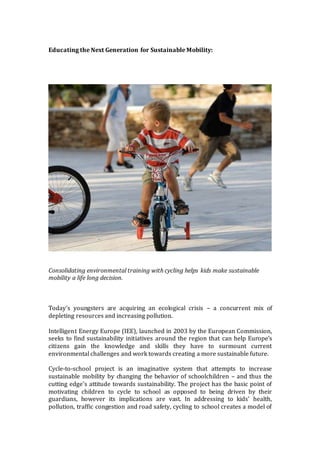
Consolidating environmental training with cycling helps kids make sustainable
mobility a life long decision.
Today's youngsters are acquiring an ecological crisis – a concurrent mix of
depleting resources and increasing pollution.
Intelligent Energy Europe (IEE), launched in 2003 by the European Commission,
seeks to find sustainability initiatives around the region that can help Europe's
citizens gain the knowledge and skills they have to surmount current
environmental challenges and work towards creating a more sustainable future.
Cycle-to-school project is an imaginative system that attempts to increase
sustainable mobility by changing the behavior of schoolchildren – and thus the
cutting edge's attitude towards sustainability. The project has the basic point of
motivating children to cycle to school as opposed to being driven by their
guardians, however its implications are vast. In addressing to kids' health,
pollution, traffic congestion and road safety, cycling to school creates a model of
sustainable education that can be used around the globe, and one that can have
tremendous positive results for the future.
A key part in uniting cycling and training is group-coordinated effort. From the
beginning, mentors, parents, school administrators, and cycling specialists must
discuss about the factors restraining kids from cycling to school. At that point,
they can distinguish approaches to encourage change with group purchase in.
Another key to successful cycling and training initiatives is to understand the
unique possibilities and limitations of a specific region, and change the general
model to suit the region's individual needs. Sometimes this means making small
adjustments to areas with histories of cycling; at different times, more extensive
measures are necessary.
The Comenius Project brings together small teams of students from different
countries to learn more about different biking cultures, and additionally how to
construct a stronger biking group in their country. Different projects, similar to
the British Schools Cycling Association, concentrates on making peer groups
within communities for after school activities. Numerous models have emerged
to serve the exceptional infrastructure and culture of each community and every
kid.
Cycle-to-school projects have the ability to encourage positive mindsets towards
cycling, as well as motivate communities to do the diligent work of changing
infrastructure to better suit cyclists of all ages.
This one of a kind cycle-to-school system is growing quickly, with partners
Mobiel 21 and GEA21 developing training materials to help new cities and
schools to implement the project around Europe, and one day, the rest of the
world.
In Beijing, TEDx events are used to simultaneously teach students about the
environmental advantages of biking – and rebrand it as "cool." Maharashtra,
India – home area to developing urban communities Mumbai, Pune, and Surat –
consolidates its cycling program with a devotion to balance, and perspectives
giving bikes and cycling classes as vital parts in expanding young ladies' access
to education and opportunity. All of these models can learn from each other, and
each can grow from the others' prosperity, so that all students across the globe
will see bicycling as a vehicle for community, equality, and sustainable mobility,
and an important component in their lives.

Article on Sustainable Mobility

  • 1.
    Educating the NextGeneration for Sustainable Mobility: Consolidating environmental training with cycling helps kids make sustainable mobility a life long decision. Today's youngsters are acquiring an ecological crisis – a concurrent mix of depleting resources and increasing pollution. Intelligent Energy Europe (IEE), launched in 2003 by the European Commission, seeks to find sustainability initiatives around the region that can help Europe's citizens gain the knowledge and skills they have to surmount current environmental challenges and work towards creating a more sustainable future. Cycle-to-school project is an imaginative system that attempts to increase sustainable mobility by changing the behavior of schoolchildren – and thus the cutting edge's attitude towards sustainability. The project has the basic point of motivating children to cycle to school as opposed to being driven by their guardians, however its implications are vast. In addressing to kids' health, pollution, traffic congestion and road safety, cycling to school creates a model of
  • 2.
    sustainable education thatcan be used around the globe, and one that can have tremendous positive results for the future. A key part in uniting cycling and training is group-coordinated effort. From the beginning, mentors, parents, school administrators, and cycling specialists must discuss about the factors restraining kids from cycling to school. At that point, they can distinguish approaches to encourage change with group purchase in. Another key to successful cycling and training initiatives is to understand the unique possibilities and limitations of a specific region, and change the general model to suit the region's individual needs. Sometimes this means making small adjustments to areas with histories of cycling; at different times, more extensive measures are necessary. The Comenius Project brings together small teams of students from different countries to learn more about different biking cultures, and additionally how to construct a stronger biking group in their country. Different projects, similar to the British Schools Cycling Association, concentrates on making peer groups within communities for after school activities. Numerous models have emerged to serve the exceptional infrastructure and culture of each community and every kid. Cycle-to-school projects have the ability to encourage positive mindsets towards cycling, as well as motivate communities to do the diligent work of changing infrastructure to better suit cyclists of all ages. This one of a kind cycle-to-school system is growing quickly, with partners Mobiel 21 and GEA21 developing training materials to help new cities and schools to implement the project around Europe, and one day, the rest of the world. In Beijing, TEDx events are used to simultaneously teach students about the environmental advantages of biking – and rebrand it as "cool." Maharashtra, India – home area to developing urban communities Mumbai, Pune, and Surat – consolidates its cycling program with a devotion to balance, and perspectives giving bikes and cycling classes as vital parts in expanding young ladies' access to education and opportunity. All of these models can learn from each other, and each can grow from the others' prosperity, so that all students across the globe will see bicycling as a vehicle for community, equality, and sustainable mobility, and an important component in their lives.