TOPIC- ĀRTAVAAND MODERN ASPECTS
Dr. ANURADHA ROY
DEPARTMENT OF PRASUTI TANTRA
FACULTY OF AYURVEDA
INSTITUTE OF MEDICAL SCIENCES
BANARAS HINDU UNIVERSITY
VARANASI
Dr.ANURADHA ROY,Ayurveda, BHU 1
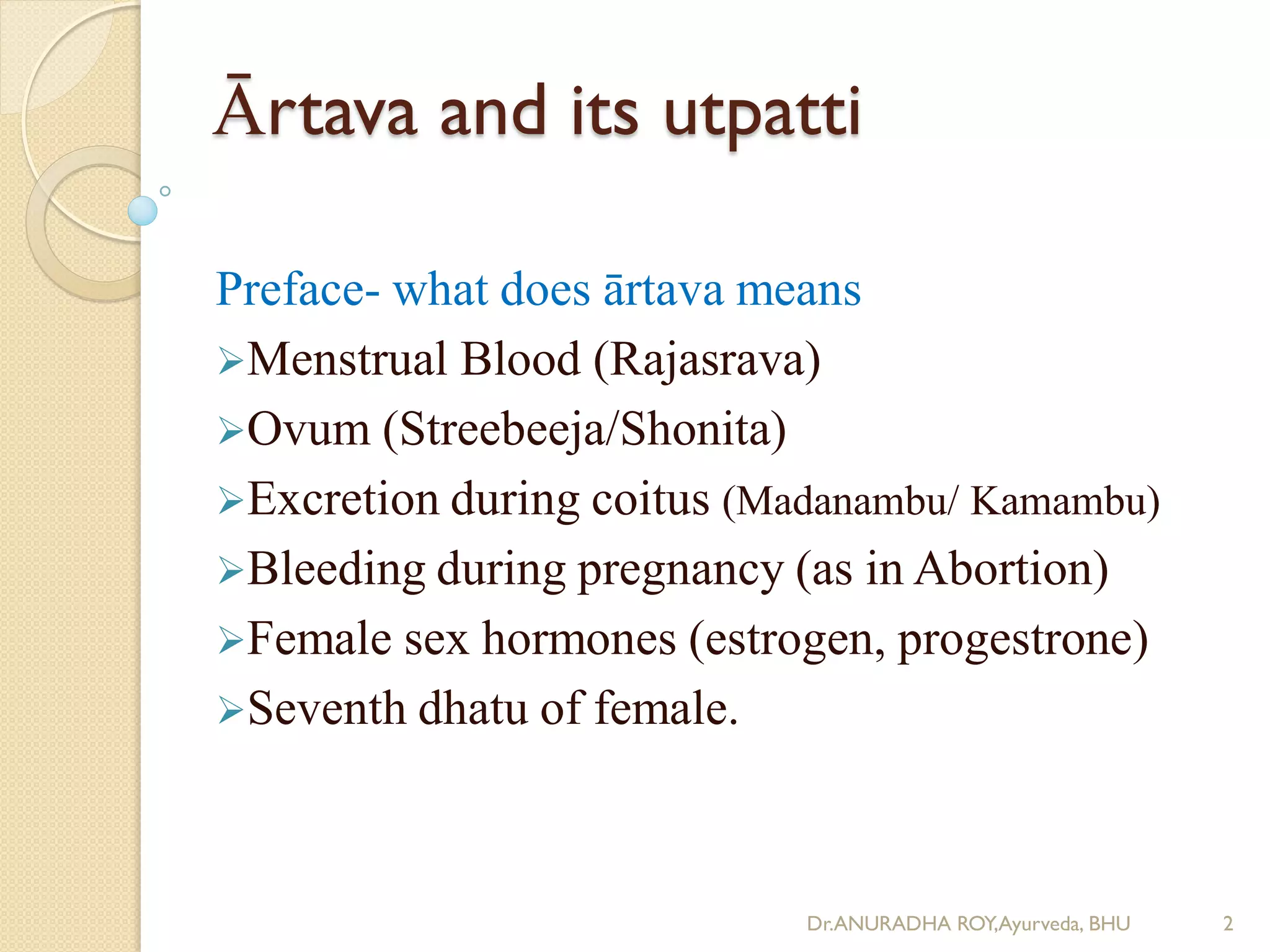
Ārtava and its utpatti
Preface- what does ārtava means
Menstrual Blood (Rajasrava)
Ovum (Streebeeja/Shonita)
Excretion during coitus (Madanambu/ Kamambu)
Bleeding during pregnancy (as in Abortion)
Female sex hormones (estrogen, progestrone)
Seventh dhatu of female.
2Dr.ANURADHA ROY,Ayurveda, BHU
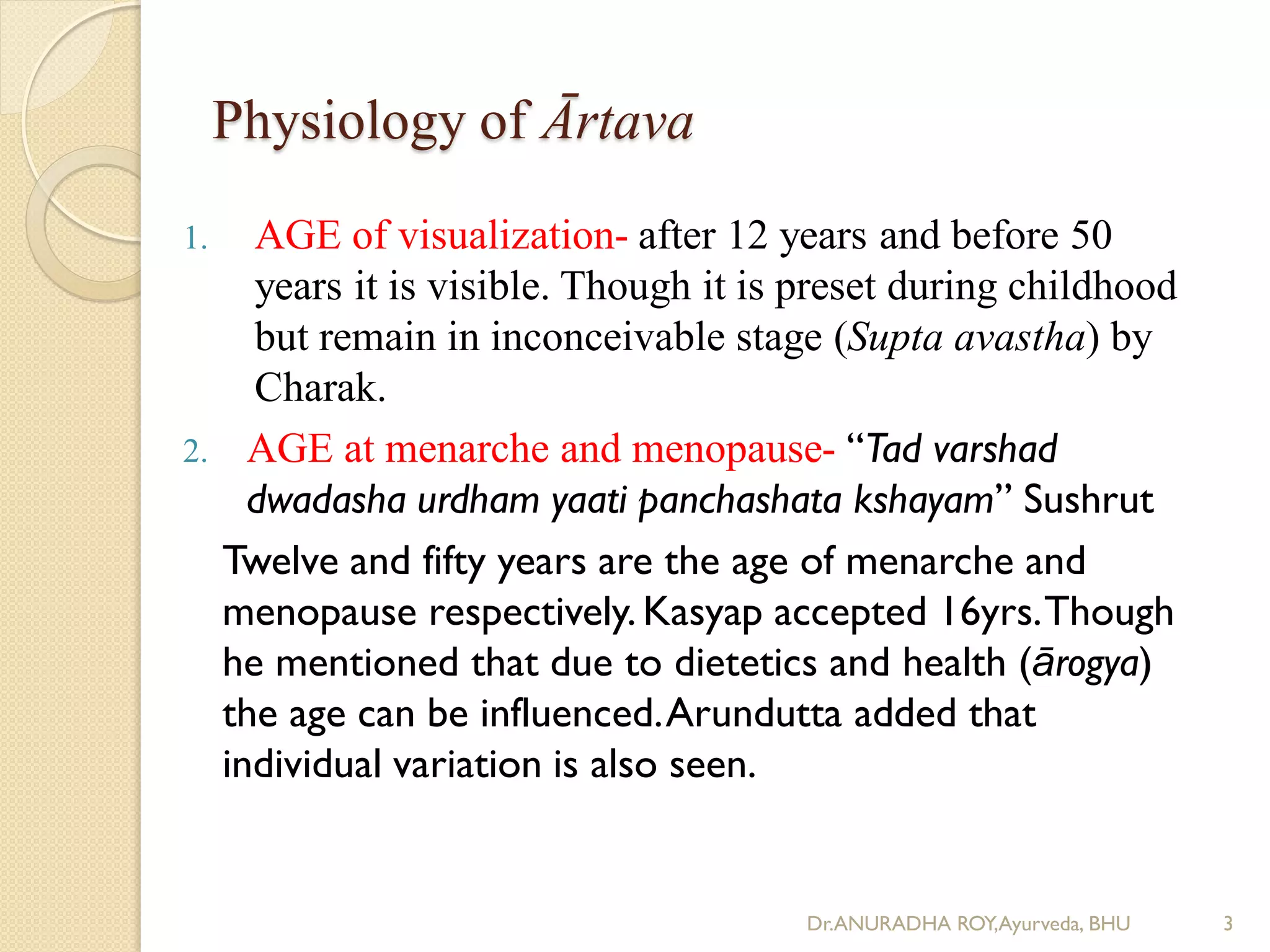
Physiology of Ārtava
1. AGE of visualization- after 12 years and before 50
years it is visible. Though it is preset during childhood
but remain in inconceivable stage (Supta avastha) by
Charak.
2. AGE at menarche and menopause- “Tad varshad
dwadasha urdham yaati panchashata kshayam” Sushrut
Twelve and fifty years are the age of menarche and
menopause respectively. Kasyap accepted 16yrs.Though
he mentioned that due to dietetics and health (ārogya)
the age can be influenced.Arundutta added that
individual variation is also seen.
3Dr.ANURADHA ROY,Ayurveda, BHU
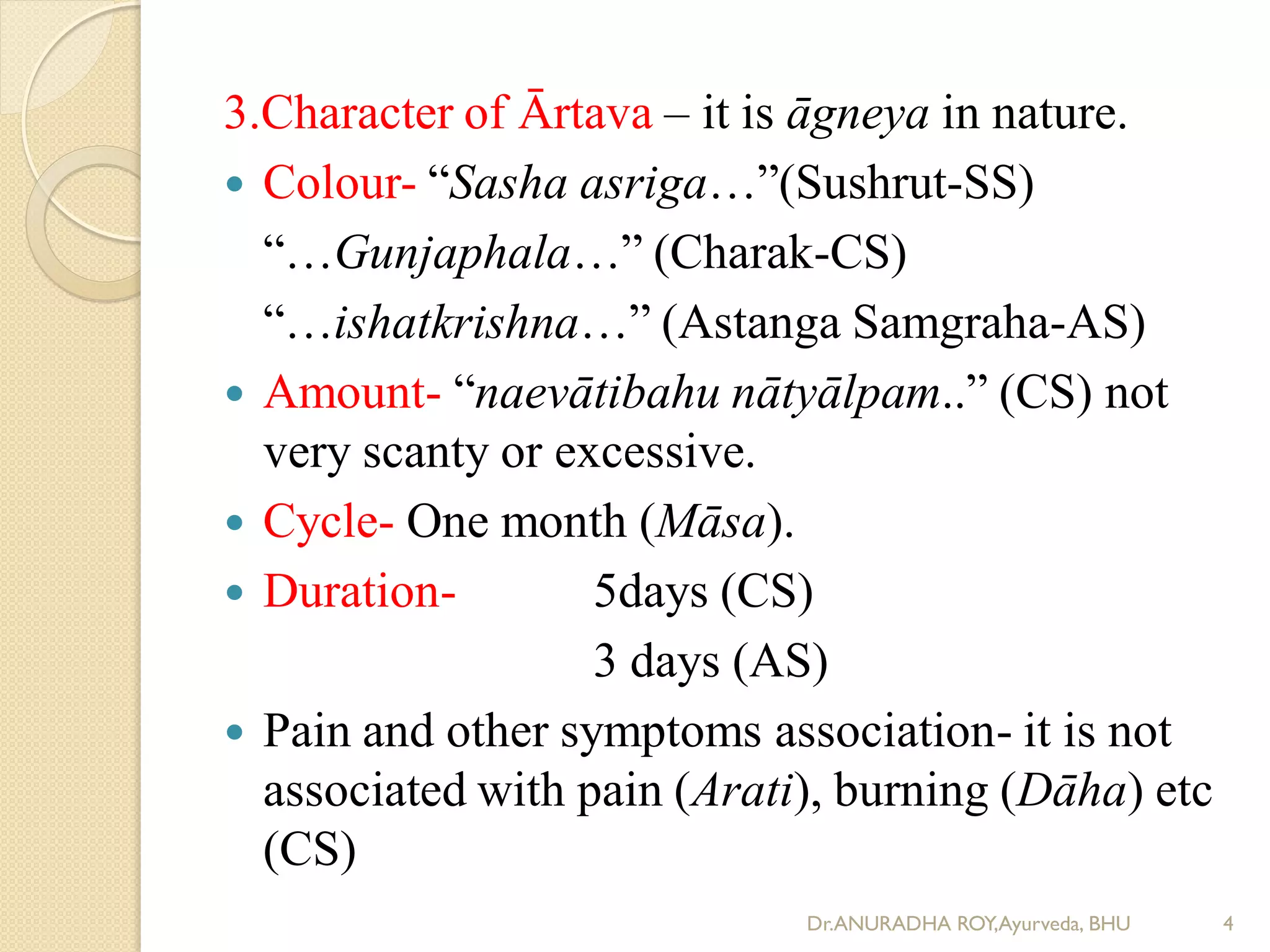
3.Character of Ārtava – it is āgneya in nature.
 Colour- “Sasha asriga…”(Sushrut-SS)
“…Gunjaphala…” (Charak-CS)
“…ishatkrishna…” (Astanga Samgraha-AS)
 Amount- “naevātibahu nātyālpam..” (CS) not
very scanty or excessive.
 Cycle- One month (Māsa).
 Duration- 5days (CS)
3 days (AS)
 Pain and other symptoms association- it is not
associated with pain (Arati), burning (Dāha) etc
(CS)
4Dr.ANURADHA ROY,Ayurveda, BHU
4. Function of ārtava-
 Garbhakritacha (SS)- forms Garbha
 Jeevanam karoti (Dal)- essential for life
 Formation of Āpara (placenta)
 Formation of Stanya (breast milk)
5Dr.ANURADHA ROY,Ayurveda, BHU
PHYSIOLOGY OF MENSTRUAL CYCLE
“ masenaupachitam raktam dhamanibhyam ritou
punah
eshatkrishnam vigandham cha vayoryonimukhat…”
The blood collected for whole month by both the
dhamanis (uterine vessels and their endometrial
capillaries), which is slight black in colour and
specific odour, is brought downwards to vaginal
orifice (yonimukha) for excretion with the help of
apāna vāyu.
This description indicates a cyclical (monthly)
changes in the vascular components of the
endometrium.
6Dr.ANURADHA ROY,Ayurveda, BHU
ĀRTVA UTPATTI
“rasādeva rajah streenam…” (SS)
“raktameva cha streenam…” (AS)
“rajahstreenam rasajam …” (AH)
In the classics the origin of ārtava has been
mentioned as-
 From rasa dhatu (SS, AH,Chak, Dal)
 Fron rakta dhatu (AS)
 From āhāra- rasa (AD)
 As upadhatu of rakta (BP & SS)
 As upadhatu of rasa (CS)
7Dr.ANURADHA ROY,Ayurveda, BHU
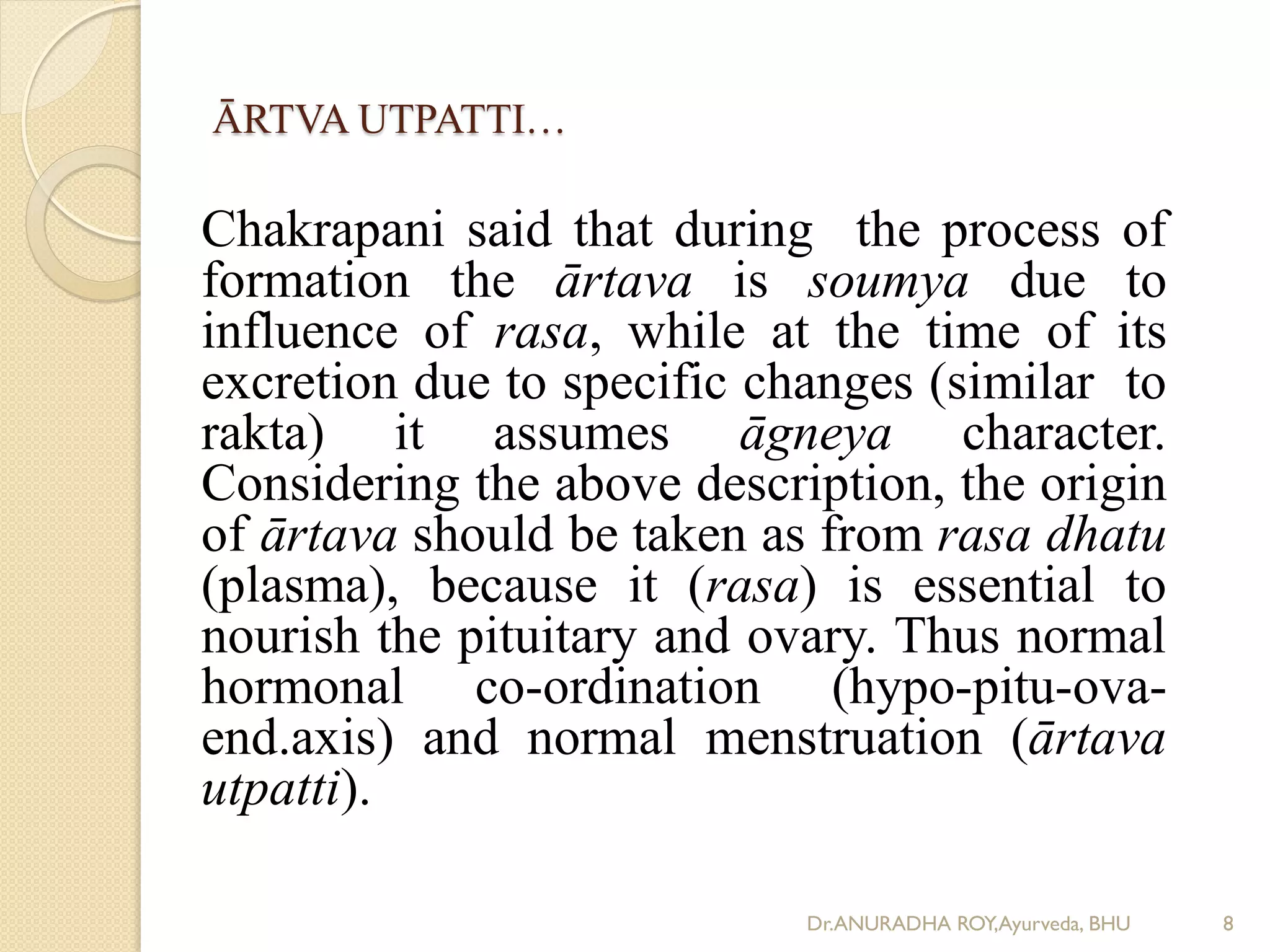
ĀRTVA UTPATTI…
Chakrapani said that during the process of
formation the ārtava is soumya due to
influence of rasa, while at the time of its
excretion due to specific changes (similar to
rakta) it assumes āgneya character.
Considering the above description, the origin
of ārtava should be taken as from rasa dhatu
(plasma), because it (rasa) is essential to
nourish the pituitary and ovary. Thus normal
hormonal co-ordination (hypo-pitu-ova-
end.axis) and normal menstruation (ārtava
utpatti).
8Dr.ANURADHA ROY,Ayurveda, BHU
MODERN CONCEPT
 The term ārtava can be correlated with
1) Female sex hormone (hormones responsible for
menstruation).
2) Ovum.
3) Menstrual blood.
 These above three will be discussed under menstrual
cycle below- In brief menstrual cycle consists of –
endocrinal mechanism, ovarian cycle and uterine cycle.
 Endocrinal mechanism: Hypothalamus GnRH & LHRH
(by peptidergic and aminergic neuron respectiely) through
pituitary portal vessels Anterior pituitary (gonadotroph
cells) FSH & LH Ovary (initiate the growth of O.F)
9Dr.ANURADHA ROY,Ayurveda, BHU
Ovarian cycle- 3 steps
- Growth of ovarian follicle (O.F)
- Estradiol secretion from mature O.F
- Ovulation –on 14th day followed by luteal phase
Uterine cycle- 3 steps
- Proliferative phase- 7th to 14th day of the cycle.
- Secretary phase- 15th to 26th ay of the cycle.
- Menstrual bleeding phase- for 4-5days after 28th
day regular cycle. Menstrual phase is caused by
withdrawal of both hormones (estrogen and
progesterone) from endometrium. FSH raises again
to start the new cycle.
10Dr.ANURADHA ROY,Ayurveda, BHU
Components of menstrual blood
Mainly arterial and partially venous. Unclotted dark reddish
with endometrial tissue bits. Disagreeable smell due to the
secretion of sebaceous glands and decomposition of blood
elements.
All elements of blood except prothrombin and fibrinogen
but rich in calcium, mucous from cervix, vaginal discharges
etc.
Microscopically it contains red cells, large number of
leucocytes, vaginal epithelium, cervical mucous, bits of
endometrium, macrophages, histiocytes, mast cells,
bacteria, cholesterol, prostaglandins, estrogen, lipids etc.
11Dr.ANURADHA ROY,Ayurveda, BHU

Artava and modern aspects

  • 1.
    TOPIC- ĀRTAVAAND MODERNASPECTS Dr. ANURADHA ROY DEPARTMENT OF PRASUTI TANTRA FACULTY OF AYURVEDA INSTITUTE OF MEDICAL SCIENCES BANARAS HINDU UNIVERSITY VARANASI Dr.ANURADHA ROY,Ayurveda, BHU 1
  • 2.
    Ārtava and itsutpatti Preface- what does ārtava means Menstrual Blood (Rajasrava) Ovum (Streebeeja/Shonita) Excretion during coitus (Madanambu/ Kamambu) Bleeding during pregnancy (as in Abortion) Female sex hormones (estrogen, progestrone) Seventh dhatu of female. 2Dr.ANURADHA ROY,Ayurveda, BHU
  • 3.
    Physiology of Ārtava 1.AGE of visualization- after 12 years and before 50 years it is visible. Though it is preset during childhood but remain in inconceivable stage (Supta avastha) by Charak. 2. AGE at menarche and menopause- “Tad varshad dwadasha urdham yaati panchashata kshayam” Sushrut Twelve and fifty years are the age of menarche and menopause respectively. Kasyap accepted 16yrs.Though he mentioned that due to dietetics and health (ārogya) the age can be influenced.Arundutta added that individual variation is also seen. 3Dr.ANURADHA ROY,Ayurveda, BHU
  • 4.
    3.Character of Ārtava– it is āgneya in nature.  Colour- “Sasha asriga…”(Sushrut-SS) “…Gunjaphala…” (Charak-CS) “…ishatkrishna…” (Astanga Samgraha-AS)  Amount- “naevātibahu nātyālpam..” (CS) not very scanty or excessive.  Cycle- One month (Māsa).  Duration- 5days (CS) 3 days (AS)  Pain and other symptoms association- it is not associated with pain (Arati), burning (Dāha) etc (CS) 4Dr.ANURADHA ROY,Ayurveda, BHU
  • 5.
    4. Function ofārtava-  Garbhakritacha (SS)- forms Garbha  Jeevanam karoti (Dal)- essential for life  Formation of Āpara (placenta)  Formation of Stanya (breast milk) 5Dr.ANURADHA ROY,Ayurveda, BHU
  • 6.
    PHYSIOLOGY OF MENSTRUALCYCLE “ masenaupachitam raktam dhamanibhyam ritou punah eshatkrishnam vigandham cha vayoryonimukhat…” The blood collected for whole month by both the dhamanis (uterine vessels and their endometrial capillaries), which is slight black in colour and specific odour, is brought downwards to vaginal orifice (yonimukha) for excretion with the help of apāna vāyu. This description indicates a cyclical (monthly) changes in the vascular components of the endometrium. 6Dr.ANURADHA ROY,Ayurveda, BHU
  • 7.
    ĀRTVA UTPATTI “rasādeva rajahstreenam…” (SS) “raktameva cha streenam…” (AS) “rajahstreenam rasajam …” (AH) In the classics the origin of ārtava has been mentioned as-  From rasa dhatu (SS, AH,Chak, Dal)  Fron rakta dhatu (AS)  From āhāra- rasa (AD)  As upadhatu of rakta (BP & SS)  As upadhatu of rasa (CS) 7Dr.ANURADHA ROY,Ayurveda, BHU
  • 8.
    ĀRTVA UTPATTI… Chakrapani saidthat during the process of formation the ārtava is soumya due to influence of rasa, while at the time of its excretion due to specific changes (similar to rakta) it assumes āgneya character. Considering the above description, the origin of ārtava should be taken as from rasa dhatu (plasma), because it (rasa) is essential to nourish the pituitary and ovary. Thus normal hormonal co-ordination (hypo-pitu-ova- end.axis) and normal menstruation (ārtava utpatti). 8Dr.ANURADHA ROY,Ayurveda, BHU
  • 9.
    MODERN CONCEPT  Theterm ārtava can be correlated with 1) Female sex hormone (hormones responsible for menstruation). 2) Ovum. 3) Menstrual blood.  These above three will be discussed under menstrual cycle below- In brief menstrual cycle consists of – endocrinal mechanism, ovarian cycle and uterine cycle.  Endocrinal mechanism: Hypothalamus GnRH & LHRH (by peptidergic and aminergic neuron respectiely) through pituitary portal vessels Anterior pituitary (gonadotroph cells) FSH & LH Ovary (initiate the growth of O.F) 9Dr.ANURADHA ROY,Ayurveda, BHU
  • 10.
    Ovarian cycle- 3steps - Growth of ovarian follicle (O.F) - Estradiol secretion from mature O.F - Ovulation –on 14th day followed by luteal phase Uterine cycle- 3 steps - Proliferative phase- 7th to 14th day of the cycle. - Secretary phase- 15th to 26th ay of the cycle. - Menstrual bleeding phase- for 4-5days after 28th day regular cycle. Menstrual phase is caused by withdrawal of both hormones (estrogen and progesterone) from endometrium. FSH raises again to start the new cycle. 10Dr.ANURADHA ROY,Ayurveda, BHU
  • 11.
    Components of menstrualblood Mainly arterial and partially venous. Unclotted dark reddish with endometrial tissue bits. Disagreeable smell due to the secretion of sebaceous glands and decomposition of blood elements. All elements of blood except prothrombin and fibrinogen but rich in calcium, mucous from cervix, vaginal discharges etc. Microscopically it contains red cells, large number of leucocytes, vaginal epithelium, cervical mucous, bits of endometrium, macrophages, histiocytes, mast cells, bacteria, cholesterol, prostaglandins, estrogen, lipids etc. 11Dr.ANURADHA ROY,Ayurveda, BHU