Art Before 1300 – Part II


                            1
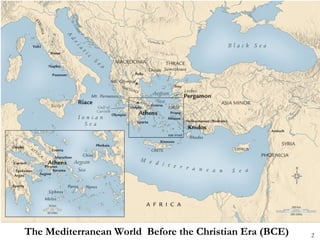
The Mediterranean World Before the Christian Era (BCE)   2
Religion and Mythology

Greek gods and goddesses had all the flaws that humanity had:
anger, jealousy, envy, and lust, as well as the virtues, nobility,
loyalty, courage, and wisdom.

The Romans adopted the Greek gods until circa 300 CE, when
the Roman Emperor Constantine named Christianity the religion
of the growing, powerful Roman Empire.

Christianity became associated with empire.


                                                                     3
Religion and Mythology

The Greek philosophical ideals of balance, harmony, and symmetry
are reflected in their art and architecture. The human body was the
visible means of conveying perfection.

With the rise of the Greek city-state came the concept of democracy,
with civic participation, civic responsibility, and rights.

Etymology of the word “democracy” comes from the Greek
word demokratia "popular government," [from demos"common
people," originally "district" (see demotic), + kratos "rule, strength"
(see -cracy)].


                                                                          4
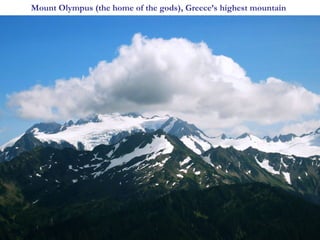
Mount Olympus (the home of the gods), Greece’s highest mountain


                                                                  5
Gods and Goddesses


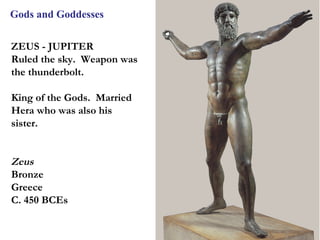
ZEUS - JUPITER
Ruled the sky. Weapon was
the thunderbolt.

King of the Gods. Married
Hera who was also his
sister.


Zeus
Bronze
Greece
C. 450 BCEs


                            6
Gods and Goddesses


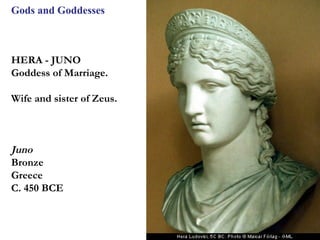
HERA - JUNO
Goddess of Marriage.

Wife and sister of Zeus.


Juno
Bronze
Greece
C. 450 BCE


                           7
Gods and Goddesses


POSEIDON - NEPTUNE
Lord of the Sea.

Ruled with 3-pronged
pitchfork called a Trident.

Brother of Zeus, etc.


Neptune
Marble
Artist Unknown
Statue located in Museum in
Copenhagen, Denmark


                              8
Gods and Goddesses


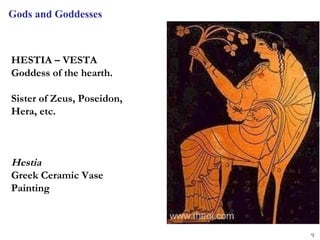
HESTIA – VESTA
Goddess of the hearth.

Sister of Zeus, Poseidon,
Hera, etc.


Hestia
Greek Ceramic Vase
Painting


                            9
Gods and Goddesses


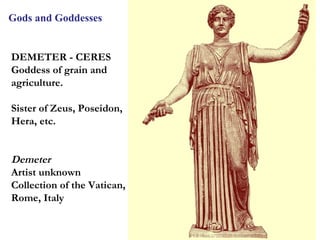
DEMETER - CERES
Goddess of grain and
agriculture.

Sister of Zeus, Poseidon,
Hera, etc.


Demeter
Artist unknown
Collection of the Vatican,
Rome, Italy


                             10
Gods and Goddesses

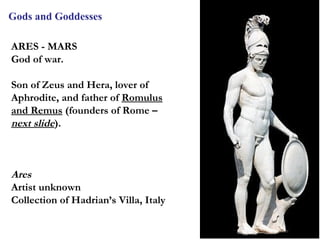
ARES - MARS
God of war.

Son of Zeus and Hera, lover of
Aphrodite, and father of Romulus
and Remus (founders of Rome –
next slide).


Ares
Artist unknown
Collection of Hadrian’s Villa, Italy


                                       11
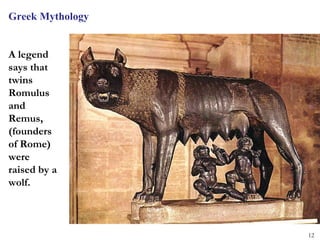
Greek Mythology


A legend
says that
twins
Romulus
and
Remus,
(founders
of Rome)
were
raised by a
wolf.


                  12
Gods and Goddesses


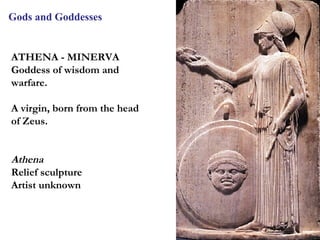
ATHENA - MINERVA
Goddess of wisdom and
warfare.

A virgin, born from the head
of Zeus.


Athena
Relief sculpture
Artist unknown


                               13
Gods and Goddesses


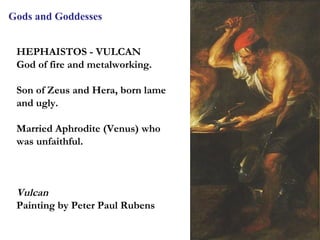
 HEPHAISTOS - VULCAN
 God of fire and metalworking.

 Son of Zeus and Hera, born lame
 and ugly.

 Married Aphrodite (Venus) who
 was unfaithful.


 Vulcan
 Painting by Peter Paul Rubens

                                   14
Gods and Goddesses


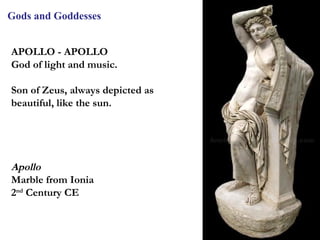
APOLLO - APOLLO
God of light and music.

Son of Zeus, always depicted as
beautiful, like the sun.


Apollo
Marble from Ionia
2nd Century CE


                                  15
Gods and Goddesses


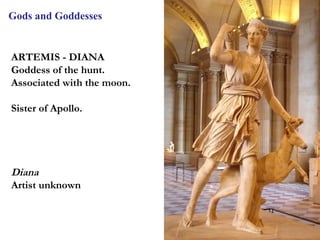
ARTEMIS - DIANA
Goddess of the hunt.
Associated with the moon.

Sister of Apollo.


Diana
Artist unknown


                            16
Gods and Goddesses


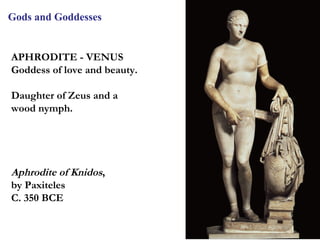
APHRODITE - VENUS
Goddess of love and beauty.

Daughter of Zeus and a
wood nymph.


Aphrodite of Knidos,
by Paxiteles
C. 350 BCE


                              17
Gods and Goddesses


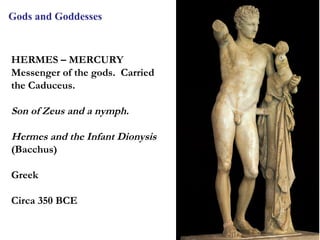
HERMES – MERCURY
Messenger of the gods. Carried
the Caduceus.

Son of Zeus and a nymph.

Hermes and the Infant Dionysis
(Bacchus)

Greek

Circa 350 BCE


                                 18
Gods and Goddesses


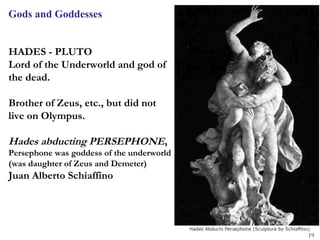
HADES - PLUTO
Lord of the Underworld and god of
the dead.

Brother of Zeus, etc., but did not
live on Olympus.

Hades abducting PERSEPHONE,
Persephone was goddess of the underworld
(was daughter of Zeus and Demeter)
Juan Alberto Schiaffino


                                           19
Gods and Goddesses


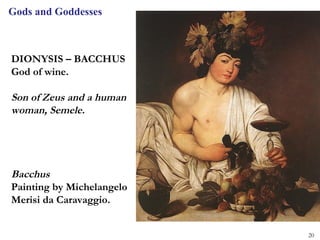
DIONYSIS – BACCHUS
God of wine.

Son of Zeus and a human
woman, Semele.


Bacchus
Painting by Michelangelo
Merisi da Caravaggio.


                           20
Gods and Goddesses


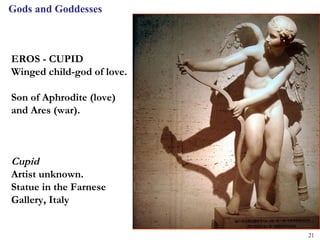
EROS - CUPID
Winged child-god of love.

Son of Aphrodite (love)
and Ares (war).


Cupid
Artist unknown.
Statue in the Farnese
Gallery, Italy


                            21
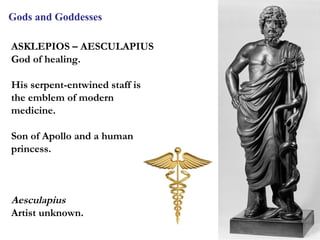
Gods and Goddesses

ASKLEPIOS – AESCULAPIUS
God of healing.

His serpent-entwined staff is
the emblem of modern
medicine.

Son of Apollo and a human
princess.


Aesculapius
Artist unknown.
                                22
The Life of Jesus in Art


                           23
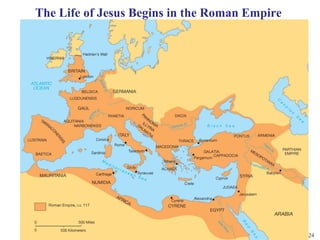
The Life of Jesus Begins in the Roman Empire


                                               24
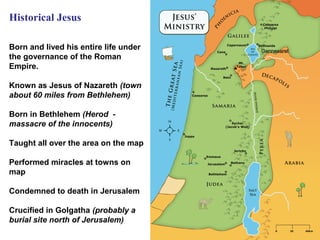
Historical Jesus

Born and lived his entire life under
the governance of the Roman
Empire.

Known as Jesus of Nazareth (town
about 60 miles from Bethlehem)

Born in Bethlehem (Herod -
massacre of the innocents)

Taught all over the area on the map

Performed miracles at towns on
map

Condemned to death in Jerusalem

Crucified in Golgatha (probably a
burial site north of Jerusalem)
                                       25
Historical Jesus

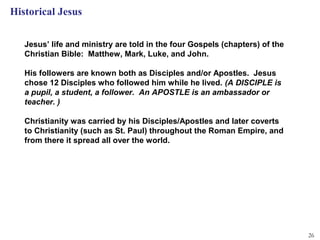
   Jesus’ life and ministry are told in the four Gospels (chapters) of the
   Christian Bible: Matthew, Mark, Luke, and John.

   His followers are known both as Disciples and/or Apostles. Jesus
   chose 12 Disciples who followed him while he lived. (A DISCIPLE is
   a pupil, a student, a follower. An APOSTLE is an ambassador or
   teacher. )

   Christianity was carried by his Disciples/Apostles and later coverts
   to Christianity (such as St. Paul) throughout the Roman Empire, and
   from there it spread all over the world.


                                                                             26
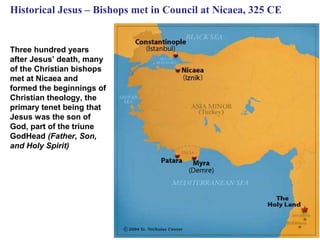
Historical Jesus – Bishops met in Council at Nicaea, 325 CE


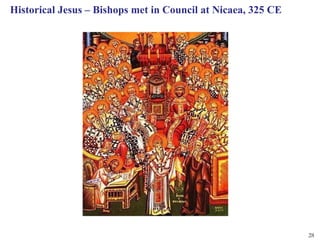
Three hundred years
after Jesus’ death, many
of the Christian bishops
met at Nicaea and
formed the beginnings of
Christian theology, the
primary tenet being that
Jesus was the son of
God, part of the triune
GodHead (Father, Son,
and Holy Spirit)


                                                              27
Historical Jesus – Bishops met in Council at Nicaea, 325 CE


                                                              28
The Life of Jesus in Art

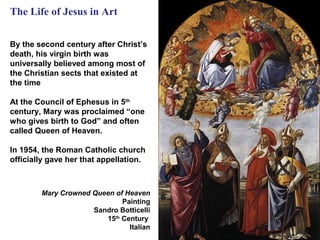
By the second century after Christ’s
death, his virgin birth was
universally believed among most of
the Christian sects that existed at
the time

At the Council of Ephesus in 5th
century, Mary was proclaimed “one
who gives birth to God” and often
called Queen of Heaven.

In 1954, the Roman Catholic church
officially gave her that appellation.


        Mary Crowned Queen of Heaven
                             Painting
                     Sandro Botticelli
                        15th Century
                               Italian
                                         29
The Life of Jesus in Art


Incarnation and Childhood (incarnation means to take on
a body – an embodiment)

‱Annunciation to Mary (annunciation=announcement)
‱Visitation to Elizabeth
‱Nativity (Adoration of the shepherds and the Magi)
(nativity=to be born, birth)
‱Presentation in the Temple
‱Massacre of the Innocents and Flight into Egypt


                                                          30
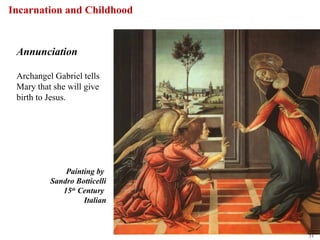
Incarnation and Childhood


 Annunciation

 Archangel Gabriel tells
 Mary that she will give
 birth to Jesus.


              Painting by
          Sandro Botticelli
             15th Century
                   Italian


                              31
The Life of Jesus in Art


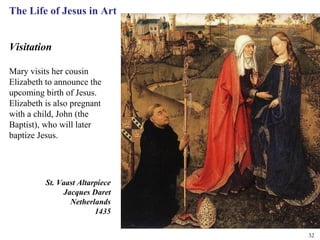
Visitation

Mary visits her cousin
Elizabeth to announce the
upcoming birth of Jesus.
Elizabeth is also pregnant
with a child, John (the
Baptist), who will later
baptize Jesus.


          St. Vaast Altarpiece
               Jacques Daret
                 Netherlands
                         1435

                                 32
Incarnation and Childhood

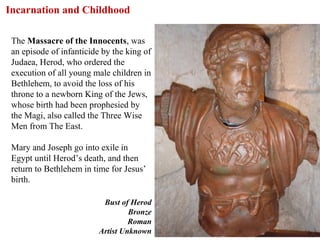
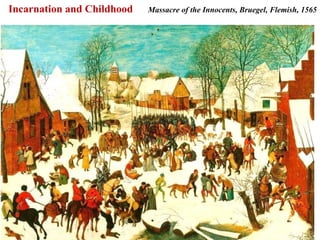
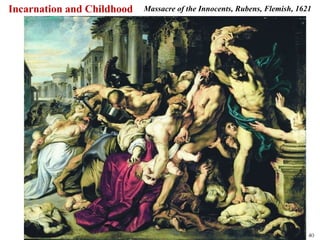
 The Massacre of the Innocents, was
 an episode of infanticide by the king of
 Judaea, Herod, who ordered the
 execution of all young male children in
 Bethlehem, to avoid the loss of his
 throne to a newborn King of the Jews,
 whose birth had been prophesied by
 the Magi, also called the Three Wise
 Men from The East.

 Mary and Joseph go into exile in
 Egypt until Herod’s death, and then
 return to Bethlehem in time for Jesus’
 birth.

                           Bust of Herod
                                   Bronze
                                   Roman
                          Artist Unknown    33
Incarnation and Childhood


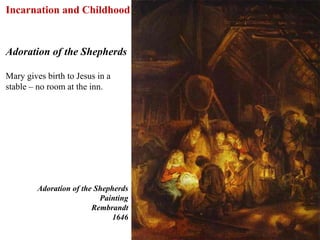
Adoration of the Shepherds

Mary gives birth to Jesus in a
stable – no room at the inn.


         Adoration of the Shepherds
                           Painting
                         Rembrandt
                               1646

                                      34
Incarnation and Childhood


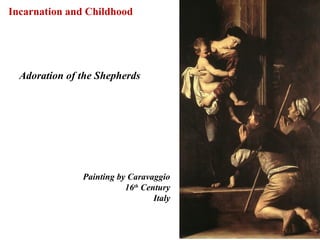
  Adoration of the Shepherds


               Painting by Caravaggio
                          16th Century
                                  Italy


                                          35
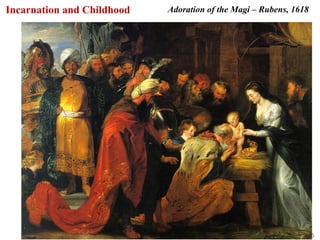
Incarnation and Childhood   Adoration of the Magi – Rubens, 1618


                                                               36
Incarnation and Childhood


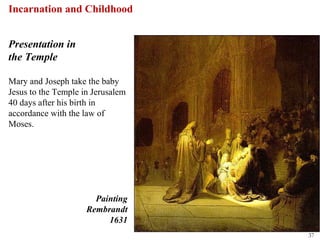
Presentation in
the Temple

Mary and Joseph take the baby
Jesus to the Temple in Jerusalem
40 days after his birth in
accordance with the law of
Moses.


                       Painting
                     Rembrandt
                          1631
                                   37
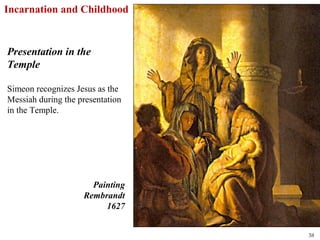
Incarnation and Childhood


Presentation in the
Temple

Simeon recognizes Jesus as the
Messiah during the presentation
in the Temple.


                      Painting
                    Rembrandt
                         1627


                                  38
Incarnation and Childhood   Massacre of the Innocents, Bruegel, Flemish, 1565


                                                                          39
Incarnation and Childhood   Massacre of the Innocents, Rubens, Flemish, 1621


                                                                           40
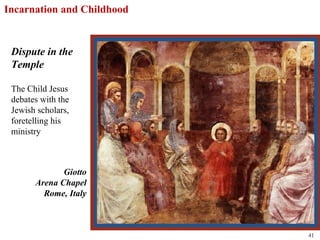
Incarnation and Childhood


 Dispute in the
 Temple

 The Child Jesus
 debates with the
 Jewish scholars,
 foretelling his
 ministry


              Giotto
       Arena Chapel
         Rome, Italy


                            41
The Life of Jesus in Art

    Public Ministry
    ‱Baptism by John the Baptist
    ‱Calling of Matthew
    ‱Miracles
    ‱Delivery of the Keys to Peter
    ‱Transfiguration (literally, to take on another body or rise out
    of the human body, to become changed)
    ‱Cleansing the Temple


                                                                       42
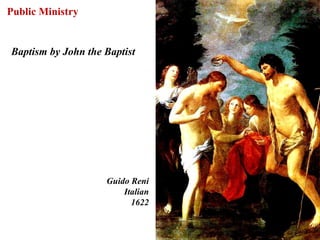
Public Ministry


Baptism by John the Baptist


                    Guido Reni
                        Italian
                          1622


                                  43
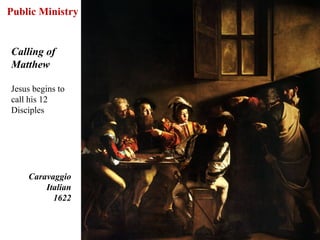
Public Ministry


Calling of
Matthew

Jesus begins to
call his 12
Disciples


    Caravaggio
        Italian
          1622


                  44
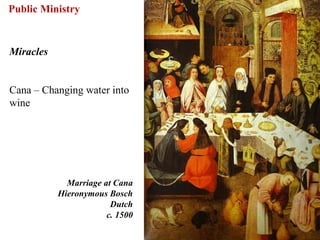
Public Ministry


Miracles


Cana – Changing water into
wine


             Marriage at Cana
           Hieronymous Bosch
                        Dutch
                       c. 1500

                                 45
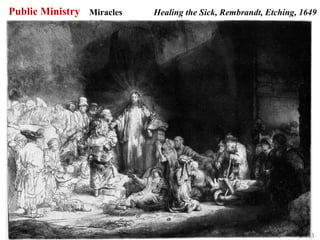
Public Ministry Miracles   Healing the Sick, Rembrandt, Etching, 1649


                                                                  46
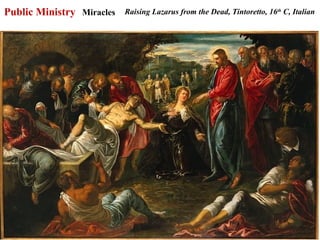
Public Ministry Miracles   Raising Lazarus from the Dead, Tintoretto, 16th C, Italian


                                                                                   47
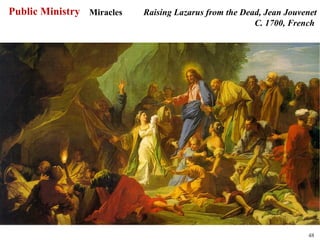
Public Ministry Miracles   Raising Lazarus from the Dead, Jean Jouvenet
                                                       C. 1700, French


                                                                    48
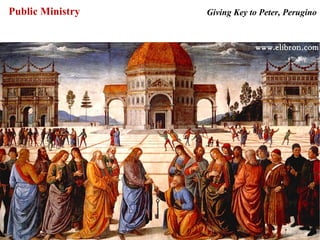
Public Ministry   Giving Key to Peter, Perugino


                                            49
Public Ministry


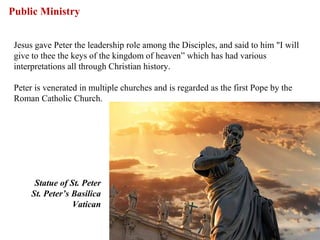
 Jesus gave Peter the leadership role among the Disciples, and said to him "I will
 give to thee the keys of the kingdom of heaven” which has had various
 interpretations all through Christian history.

 Peter is venerated in multiple churches and is regarded as the first Pope by the
 Roman Catholic Church.


       Statue of St. Peter
      St. Peter’s Basilica
                  Vatican


                                                                                     50
Public Ministry


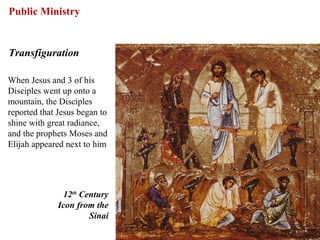
Transfiguration

When Jesus and 3 of his
Disciples went up onto a
mountain, the Disciples
reported that Jesus began to
shine with great radiance,
and the prophets Moses and
Elijah appeared next to him


                12th Century
              Icon from the
                       Sinai

                               51
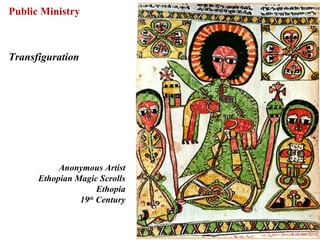
Public Ministry


Transfiguration


           Anonymous Artist
      Ethopian Magic Scrolls
                     Ethopia
                19th Century


                               52
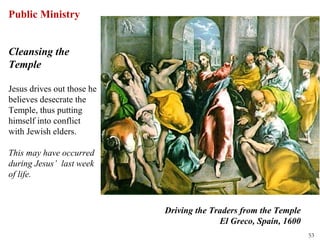
Public Ministry


Cleansing the
Temple

Jesus drives out those he
believes desecrate the
Temple, thus putting
himself into conflict
with Jewish elders.

This may have occurred
during Jesus’ last week
of life.


                            Driving the Traders from the Temple
                                          El Greco, Spain, 1600
                                                                  53
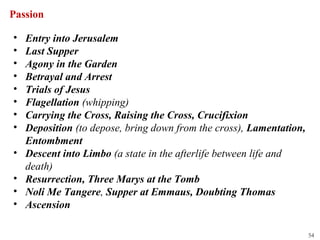
Passion

‱   Entry into Jerusalem
‱   Last Supper
‱   Agony in the Garden
‱   Betrayal and Arrest
‱   Trials of Jesus
‱   Flagellation (whipping)
‱   Carrying the Cross, Raising the Cross, Crucifixion
‱   Deposition (to depose, bring down from the cross), Lamentation,
    Entombment
‱   Descent into Limbo (a state in the afterlife between life and
    death)
‱   Resurrection, Three Marys at the Tomb
‱   Noli Me Tangere, Supper at Emmaus, Doubting Thomas
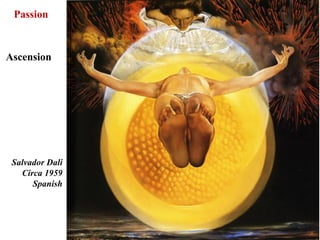
‱   Ascension

                                                                      54
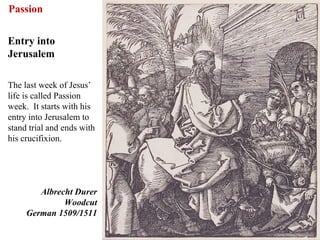
Passion

Entry into
Jerusalem

The last week of Jesus’
life is called Passion
week. It starts with his
entry into Jerusalem to
stand trial and ends with
his crucifixion.


        Albrecht Durer
              Woodcut
     German 1509/1511

                            55
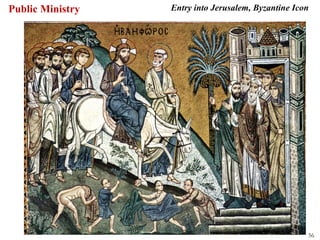
Public Ministry   Entry into Jerusalem, Byzantine Icon


                                                     56
Passion


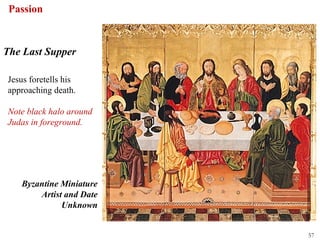
The Last Supper

Jesus foretells his
approaching death.

Note black halo around
Judas in foreground.


   Byzantine Miniature
       Artist and Date
             Unknown


                         57
Passion


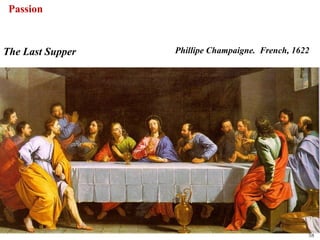
The Last Supper   Phillipe Champaigne. French, 1622


                                                  58
Passion


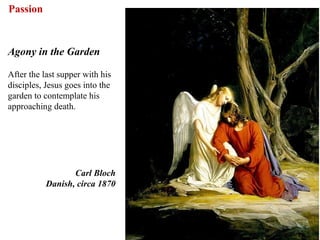
Agony in the Garden

After the last supper with his
disciples, Jesus goes into the
garden to contemplate his
approaching death.


                  Carl Bloch
           Danish, circa 1870


                                 59
Passion


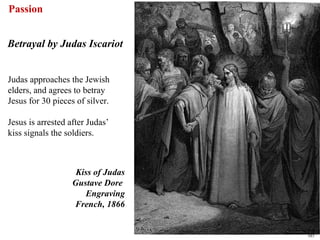
Betrayal by Judas Iscariot


Judas approaches the Jewish
elders, and agrees to betray
Jesus for 30 pieces of silver.

Jesus is arrested after Judas’
kiss signals the soldiers.


                    Kiss of Judas
                   Gustave Dore
                      Engraving
                   French, 1866


                                    60
Passion


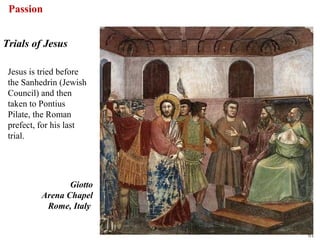
Trials of Jesus

 Jesus is tried before
 the Sanhedrin (Jewish
 Council) and then
 taken to Pontius
 Pilate, the Roman
 prefect, for his last
 trial.


                 Giotto
          Arena Chapel
           Rome, Italy


                          61
Passion


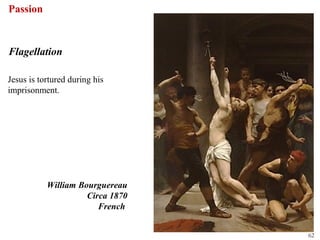
Flagellation

Jesus is tortured during his
imprisonment.


           William Bourguereau
                     Circa 1870
                        French


                                  62
Passion

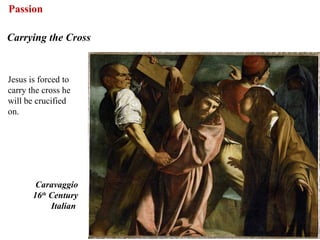
Carrying the Cross


Jesus is forced to
carry the cross he
will be crucified
on.


        Caravaggio
       16th Century
            Italian


                      63
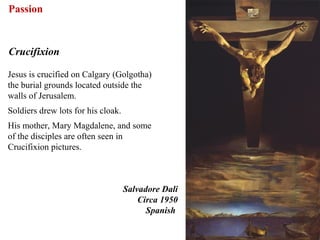
Passion


Crucifixion

Jesus is crucified on Calgary (Golgotha)
the burial grounds located outside the
walls of Jerusalem.
Soldiers drew lots for his cloak.
His mother, Mary Magdalene, and some
of the disciples are often seen in
Crucifixion pictures.


                                    Salvadore Dali
                                        Circa 1950
                                          Spanish

                                                     64
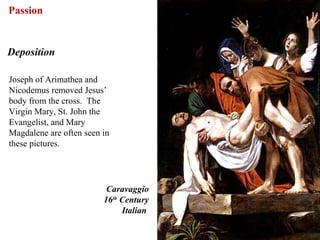
Passion


Deposition

Joseph of Arimathea and
Nicodemus removed Jesus’
body from the cross. The
Virgin Mary, St. John the
Evangelist, and Mary
Magdalene are often seen in
these pictures.


                          Caravaggio
                         16th Century
                              Italian

                                        65
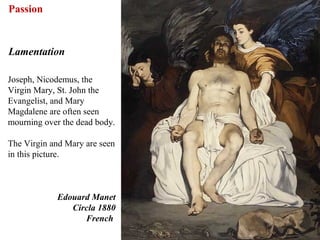
Passion


Lamentation

Joseph, Nicodemus, the
Virgin Mary, St. John the
Evangelist, and Mary
Magdalene are often seen
mourning over the dead body.

The Virgin and Mary are seen
in this picture.


            Edouard Manet
               Circla 1880
                  French
                               66
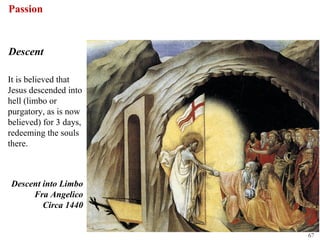
Passion


Descent

It is believed that
Jesus descended into
hell (limbo or
purgatory, as is now
believed) for 3 days,
redeeming the souls
there.


Descent into Limbo
     Fra Angelico
        Circa 1440


                        67
Passion


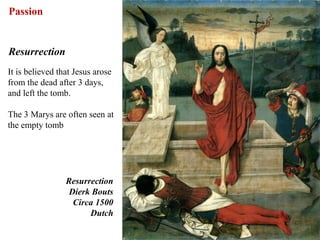
Resurrection
It is believed that Jesus arose
from the dead after 3 days,
and left the tomb.

The 3 Marys are often seen at
the empty tomb


                 Resurrection
                  Dierk Bouts
                   Circa 1500
                       Dutch

                                  68
Passion


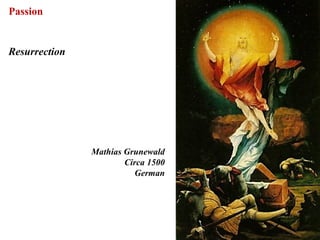
Resurrection


               Mathias Grunewald
                       Circa 1500
                          German


                                    69
Passion


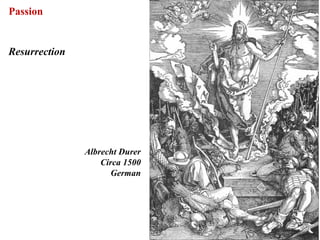
Resurrection


               Albrecht Durer
                   Circa 1500
                      German


                                70
Passion


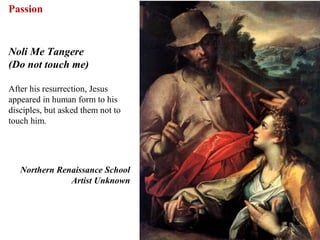
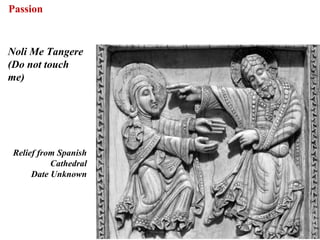
Noli Me Tangere
(Do not touch me)

After his resurrection, Jesus
appeared in human form to his
disciples, but asked them not to
touch him.


   Northern Renaissance School
               Artist Unknown


                                   71
Passion


Noli Me Tangere
(Do not touch
me)


 Relief from Spanish
           Cathedral
      Date Unknown


                       72
Passion
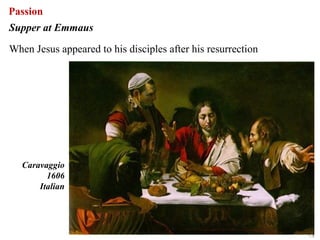
Supper at Emmaus

When Jesus appeared to his disciples after his resurrection


   Caravaggio
         1606
       Italian


                                                              73
Passion


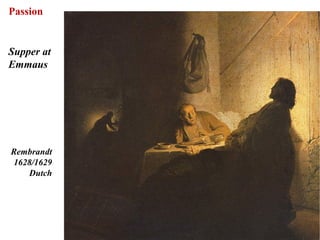
Supper at
Emmaus


Rembrandt
1628/1629
   Dutch


            74
Passion


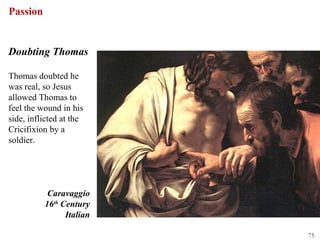
Doubting Thomas

Thomas doubted he
was real, so Jesus
allowed Thomas to
feel the wound in his
side, inflicted at the
Cricifixion by a
soldier.


           Caravaggio
          16th Century
                Italian

                          75
Passion


Ascension


 Salvador Dali
   Circa 1959
      Spanish


                 76

Art before 1300_part_ii

  • 1.
    Art Before 1300– Part II 1
  • 2.
    The Mediterranean WorldBefore the Christian Era (BCE) 2
  • 3.
    Religion and Mythology Greekgods and goddesses had all the flaws that humanity had: anger, jealousy, envy, and lust, as well as the virtues, nobility, loyalty, courage, and wisdom. The Romans adopted the Greek gods until circa 300 CE, when the Roman Emperor Constantine named Christianity the religion of the growing, powerful Roman Empire. Christianity became associated with empire. 3
  • 4.
    Religion and Mythology TheGreek philosophical ideals of balance, harmony, and symmetry are reflected in their art and architecture. The human body was the visible means of conveying perfection. With the rise of the Greek city-state came the concept of democracy, with civic participation, civic responsibility, and rights. Etymology of the word “democracy” comes from the Greek word demokratia "popular government," [from demos"common people," originally "district" (see demotic), + kratos "rule, strength" (see -cracy)]. 4
  • 5.
    Mount Olympus (thehome of the gods), Greece’s highest mountain 5
  • 6.
    Gods and Goddesses ZEUS- JUPITER Ruled the sky. Weapon was the thunderbolt. King of the Gods. Married Hera who was also his sister. Zeus Bronze Greece C. 450 BCEs 6
  • 7.
    Gods and Goddesses HERA- JUNO Goddess of Marriage. Wife and sister of Zeus. Juno Bronze Greece C. 450 BCE 7
  • 8.
    Gods and Goddesses POSEIDON- NEPTUNE Lord of the Sea. Ruled with 3-pronged pitchfork called a Trident. Brother of Zeus, etc. Neptune Marble Artist Unknown Statue located in Museum in Copenhagen, Denmark 8
  • 9.
    Gods and Goddesses HESTIA– VESTA Goddess of the hearth. Sister of Zeus, Poseidon, Hera, etc. Hestia Greek Ceramic Vase Painting 9
  • 10.
    Gods and Goddesses DEMETER- CERES Goddess of grain and agriculture. Sister of Zeus, Poseidon, Hera, etc. Demeter Artist unknown Collection of the Vatican, Rome, Italy 10
  • 11.
    Gods and Goddesses ARES- MARS God of war. Son of Zeus and Hera, lover of Aphrodite, and father of Romulus and Remus (founders of Rome – next slide). Ares Artist unknown Collection of Hadrian’s Villa, Italy 11
  • 12.
    Greek Mythology A legend saysthat twins Romulus and Remus, (founders of Rome) were raised by a wolf. 12
  • 13.
    Gods and Goddesses ATHENA- MINERVA Goddess of wisdom and warfare. A virgin, born from the head of Zeus. Athena Relief sculpture Artist unknown 13
  • 14.
    Gods and Goddesses HEPHAISTOS - VULCAN God of fire and metalworking. Son of Zeus and Hera, born lame and ugly. Married Aphrodite (Venus) who was unfaithful. Vulcan Painting by Peter Paul Rubens 14
  • 15.
    Gods and Goddesses APOLLO- APOLLO God of light and music. Son of Zeus, always depicted as beautiful, like the sun. Apollo Marble from Ionia 2nd Century CE 15
  • 16.
    Gods and Goddesses ARTEMIS- DIANA Goddess of the hunt. Associated with the moon. Sister of Apollo. Diana Artist unknown 16
  • 17.
    Gods and Goddesses APHRODITE- VENUS Goddess of love and beauty. Daughter of Zeus and a wood nymph. Aphrodite of Knidos, by Paxiteles C. 350 BCE 17
  • 18.
    Gods and Goddesses HERMES– MERCURY Messenger of the gods. Carried the Caduceus. Son of Zeus and a nymph. Hermes and the Infant Dionysis (Bacchus) Greek Circa 350 BCE 18
  • 19.
    Gods and Goddesses HADES- PLUTO Lord of the Underworld and god of the dead. Brother of Zeus, etc., but did not live on Olympus. Hades abducting PERSEPHONE, Persephone was goddess of the underworld (was daughter of Zeus and Demeter) Juan Alberto Schiaffino 19
  • 20.
    Gods and Goddesses DIONYSIS– BACCHUS God of wine. Son of Zeus and a human woman, Semele. Bacchus Painting by Michelangelo Merisi da Caravaggio. 20
  • 21.
    Gods and Goddesses EROS- CUPID Winged child-god of love. Son of Aphrodite (love) and Ares (war). Cupid Artist unknown. Statue in the Farnese Gallery, Italy 21
  • 22.
    Gods and Goddesses ASKLEPIOS– AESCULAPIUS God of healing. His serpent-entwined staff is the emblem of modern medicine. Son of Apollo and a human princess. Aesculapius Artist unknown. 22
  • 23.
    The Life ofJesus in Art 23
  • 24.
    The Life ofJesus Begins in the Roman Empire 24
  • 25.
    Historical Jesus Born andlived his entire life under the governance of the Roman Empire. Known as Jesus of Nazareth (town about 60 miles from Bethlehem) Born in Bethlehem (Herod - massacre of the innocents) Taught all over the area on the map Performed miracles at towns on map Condemned to death in Jerusalem Crucified in Golgatha (probably a burial site north of Jerusalem) 25
  • 26.
    Historical Jesus Jesus’ life and ministry are told in the four Gospels (chapters) of the Christian Bible: Matthew, Mark, Luke, and John. His followers are known both as Disciples and/or Apostles. Jesus chose 12 Disciples who followed him while he lived. (A DISCIPLE is a pupil, a student, a follower. An APOSTLE is an ambassador or teacher. ) Christianity was carried by his Disciples/Apostles and later coverts to Christianity (such as St. Paul) throughout the Roman Empire, and from there it spread all over the world. 26
  • 27.
    Historical Jesus –Bishops met in Council at Nicaea, 325 CE Three hundred years after Jesus’ death, many of the Christian bishops met at Nicaea and formed the beginnings of Christian theology, the primary tenet being that Jesus was the son of God, part of the triune GodHead (Father, Son, and Holy Spirit) 27
  • 28.
    Historical Jesus –Bishops met in Council at Nicaea, 325 CE 28
  • 29.
    The Life ofJesus in Art By the second century after Christ’s death, his virgin birth was universally believed among most of the Christian sects that existed at the time At the Council of Ephesus in 5th century, Mary was proclaimed “one who gives birth to God” and often called Queen of Heaven. In 1954, the Roman Catholic church officially gave her that appellation. Mary Crowned Queen of Heaven Painting Sandro Botticelli 15th Century Italian 29
  • 30.
    The Life ofJesus in Art Incarnation and Childhood (incarnation means to take on a body – an embodiment) ‱Annunciation to Mary (annunciation=announcement) ‱Visitation to Elizabeth ‱Nativity (Adoration of the shepherds and the Magi) (nativity=to be born, birth) ‱Presentation in the Temple ‱Massacre of the Innocents and Flight into Egypt 30
  • 31.
    Incarnation and Childhood Annunciation Archangel Gabriel tells Mary that she will give birth to Jesus. Painting by Sandro Botticelli 15th Century Italian 31
  • 32.
    The Life ofJesus in Art Visitation Mary visits her cousin Elizabeth to announce the upcoming birth of Jesus. Elizabeth is also pregnant with a child, John (the Baptist), who will later baptize Jesus. St. Vaast Altarpiece Jacques Daret Netherlands 1435 32
  • 33.
    Incarnation and Childhood The Massacre of the Innocents, was an episode of infanticide by the king of Judaea, Herod, who ordered the execution of all young male children in Bethlehem, to avoid the loss of his throne to a newborn King of the Jews, whose birth had been prophesied by the Magi, also called the Three Wise Men from The East. Mary and Joseph go into exile in Egypt until Herod’s death, and then return to Bethlehem in time for Jesus’ birth. Bust of Herod Bronze Roman Artist Unknown 33
  • 34.
    Incarnation and Childhood Adorationof the Shepherds Mary gives birth to Jesus in a stable – no room at the inn. Adoration of the Shepherds Painting Rembrandt 1646 34
  • 35.
    Incarnation and Childhood Adoration of the Shepherds Painting by Caravaggio 16th Century Italy 35
  • 36.
    Incarnation and Childhood Adoration of the Magi – Rubens, 1618 36
  • 37.
    Incarnation and Childhood Presentationin the Temple Mary and Joseph take the baby Jesus to the Temple in Jerusalem 40 days after his birth in accordance with the law of Moses. Painting Rembrandt 1631 37
  • 38.
    Incarnation and Childhood Presentationin the Temple Simeon recognizes Jesus as the Messiah during the presentation in the Temple. Painting Rembrandt 1627 38
  • 39.
    Incarnation and Childhood Massacre of the Innocents, Bruegel, Flemish, 1565 39
  • 40.
    Incarnation and Childhood Massacre of the Innocents, Rubens, Flemish, 1621 40
  • 41.
    Incarnation and Childhood Dispute in the Temple The Child Jesus debates with the Jewish scholars, foretelling his ministry Giotto Arena Chapel Rome, Italy 41
  • 42.
    The Life ofJesus in Art Public Ministry ‱Baptism by John the Baptist ‱Calling of Matthew ‱Miracles ‱Delivery of the Keys to Peter ‱Transfiguration (literally, to take on another body or rise out of the human body, to become changed) ‱Cleansing the Temple 42
  • 43.
    Public Ministry Baptism byJohn the Baptist Guido Reni Italian 1622 43
  • 44.
    Public Ministry Calling of Matthew Jesusbegins to call his 12 Disciples Caravaggio Italian 1622 44
  • 45.
    Public Ministry Miracles Cana –Changing water into wine Marriage at Cana Hieronymous Bosch Dutch c. 1500 45
  • 46.
    Public Ministry Miracles Healing the Sick, Rembrandt, Etching, 1649 46
  • 47.
    Public Ministry Miracles Raising Lazarus from the Dead, Tintoretto, 16th C, Italian 47
  • 48.
    Public Ministry Miracles Raising Lazarus from the Dead, Jean Jouvenet C. 1700, French 48
  • 49.
    Public Ministry Giving Key to Peter, Perugino 49
  • 50.
    Public Ministry Jesusgave Peter the leadership role among the Disciples, and said to him "I will give to thee the keys of the kingdom of heaven” which has had various interpretations all through Christian history. Peter is venerated in multiple churches and is regarded as the first Pope by the Roman Catholic Church. Statue of St. Peter St. Peter’s Basilica Vatican 50
  • 51.
    Public Ministry Transfiguration When Jesusand 3 of his Disciples went up onto a mountain, the Disciples reported that Jesus began to shine with great radiance, and the prophets Moses and Elijah appeared next to him 12th Century Icon from the Sinai 51
  • 52.
    Public Ministry Transfiguration Anonymous Artist Ethopian Magic Scrolls Ethopia 19th Century 52
  • 53.
    Public Ministry Cleansing the Temple Jesusdrives out those he believes desecrate the Temple, thus putting himself into conflict with Jewish elders. This may have occurred during Jesus’ last week of life. Driving the Traders from the Temple El Greco, Spain, 1600 53
  • 54.
    Passion ‱ Entry into Jerusalem ‱ Last Supper ‱ Agony in the Garden ‱ Betrayal and Arrest ‱ Trials of Jesus ‱ Flagellation (whipping) ‱ Carrying the Cross, Raising the Cross, Crucifixion ‱ Deposition (to depose, bring down from the cross), Lamentation, Entombment ‱ Descent into Limbo (a state in the afterlife between life and death) ‱ Resurrection, Three Marys at the Tomb ‱ Noli Me Tangere, Supper at Emmaus, Doubting Thomas ‱ Ascension 54
  • 55.
    Passion Entry into Jerusalem The lastweek of Jesus’ life is called Passion week. It starts with his entry into Jerusalem to stand trial and ends with his crucifixion. Albrecht Durer Woodcut German 1509/1511 55
  • 56.
    Public Ministry Entry into Jerusalem, Byzantine Icon 56
  • 57.
    Passion The Last Supper Jesusforetells his approaching death. Note black halo around Judas in foreground. Byzantine Miniature Artist and Date Unknown 57
  • 58.
    Passion The Last Supper Phillipe Champaigne. French, 1622 58
  • 59.
    Passion Agony in theGarden After the last supper with his disciples, Jesus goes into the garden to contemplate his approaching death. Carl Bloch Danish, circa 1870 59
  • 60.
    Passion Betrayal by JudasIscariot Judas approaches the Jewish elders, and agrees to betray Jesus for 30 pieces of silver. Jesus is arrested after Judas’ kiss signals the soldiers. Kiss of Judas Gustave Dore Engraving French, 1866 60
  • 61.
    Passion Trials of Jesus Jesus is tried before the Sanhedrin (Jewish Council) and then taken to Pontius Pilate, the Roman prefect, for his last trial. Giotto Arena Chapel Rome, Italy 61
  • 62.
    Passion Flagellation Jesus is torturedduring his imprisonment. William Bourguereau Circa 1870 French 62
  • 63.
    Passion Carrying the Cross Jesusis forced to carry the cross he will be crucified on. Caravaggio 16th Century Italian 63
  • 64.
    Passion Crucifixion Jesus is crucifiedon Calgary (Golgotha) the burial grounds located outside the walls of Jerusalem. Soldiers drew lots for his cloak. His mother, Mary Magdalene, and some of the disciples are often seen in Crucifixion pictures. Salvadore Dali Circa 1950 Spanish 64
  • 65.
    Passion Deposition Joseph of Arimatheaand Nicodemus removed Jesus’ body from the cross. The Virgin Mary, St. John the Evangelist, and Mary Magdalene are often seen in these pictures. Caravaggio 16th Century Italian 65
  • 66.
    Passion Lamentation Joseph, Nicodemus, the VirginMary, St. John the Evangelist, and Mary Magdalene are often seen mourning over the dead body. The Virgin and Mary are seen in this picture. Edouard Manet Circla 1880 French 66
  • 67.
    Passion Descent It is believedthat Jesus descended into hell (limbo or purgatory, as is now believed) for 3 days, redeeming the souls there. Descent into Limbo Fra Angelico Circa 1440 67
  • 68.
    Passion Resurrection It is believedthat Jesus arose from the dead after 3 days, and left the tomb. The 3 Marys are often seen at the empty tomb Resurrection Dierk Bouts Circa 1500 Dutch 68
  • 69.
    Passion Resurrection Mathias Grunewald Circa 1500 German 69
  • 70.
    Passion Resurrection Albrecht Durer Circa 1500 German 70
  • 71.
    Passion Noli Me Tangere (Donot touch me) After his resurrection, Jesus appeared in human form to his disciples, but asked them not to touch him. Northern Renaissance School Artist Unknown 71
  • 72.
    Passion Noli Me Tangere (Donot touch me) Relief from Spanish Cathedral Date Unknown 72
  • 73.
    Passion Supper at Emmaus WhenJesus appeared to his disciples after his resurrection Caravaggio 1606 Italian 73
  • 74.
  • 75.
    Passion Doubting Thomas Thomas doubtedhe was real, so Jesus allowed Thomas to feel the wound in his side, inflicted at the Cricifixion by a soldier. Caravaggio 16th Century Italian 75
  • 76.
    Passion Ascension Salvador Dali Circa 1959 Spanish 76