BANARAS HINDU UNIVERSITY
BA. HONS HISTORY OF ART
3RD YEAR 6TH SEMESTER
BAI: 323
ART AND ENVIRONMENT
TOPIC: AN ARTIST SHOWCASING THE DEVASTATING EFFECTS OF HUMAN IMPACT
ON OCEAN AND SEA WATER
NAME: SHIVANI GONDGE
ROLL NO. 514
ENROLLEMENT NO. 393514
GUIDED BY: KANU PRIYA MAM
ARTIST SHOWCASING THE DEVASTING EFFECTS OF HUMAN IMPACT ON OCEAN
AND SEA WATER
June 8 marks World Oceans Day a global celebration of the lungs of our planet, and all the creatures
who inhabit it. The worldwide movement aims to raise awareness of the importance of ocean
conservation and sustainable actions to counteract the effects of global warming and pollution.
Human-induced climate change, which certain politicians deny and many of us choose to ignore,
threatens the survival of every species on Earth. If emissions continue at their current rate, scientists
anticipate widespread coastal land loss, agricultural and economic collapse, food and water shortages,
frequent and severe natural disasters, and unprecedented refugee crises.
Many people around the world are doing their part to save our seas, including contemporary artists.
Through their art, they create powerful visualizations that pay homage to the beauty of the ocean, but
also showcase the devastating effects of human impact. From textile art and ceramics to painting and
paper sculptures, read on to discover there contribution on showcasing the effects of human on ocean
and sea water.
HERE ARE THE FEW EXAMPLES OF ARTIST WHO RAISE AWARENESS ABOUT
ENVIRONMENTAL ISSUES WITH THEIR ART
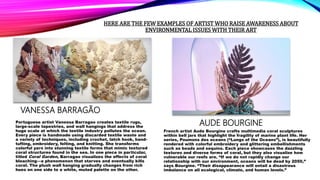
VANESSA BARRAGÃO
Portuguese artist Vanessa Barragao creates textile rugs,
large-scale tapestries, and wall hangings that address the
huge scale at which the textile industry pollutes the ocean.
Every piece is handmade using discarded textile waste and
a variety of techniques, including crochet, latch hook, hand-
tufting, embroidery, felting, and knitting. She transforms
colorful yarn into stunning textile forms that mimic textured
coral structures found in the sea. In one piece in particular,
titled Coral Garden, Barragao visualizes the effects of coral
bleaching—a phenomenon that starves and eventually kills
coral. The plush wall hanging gradually changes from rich
hues on one side to a white, muted palette on the other.
AUDE BOURGINE
French artist Aude Bourgine crafts multimedia coral sculptures
within bell jars that highlight the fragility of marine plant life. Her
series, Poumons des oceans (“Lungs of the Oceans”), is beautifully
rendered with colorful embroidery and glittering embellishments
such as beads and sequins. Each piece showcases the dazzling
textures and diverse forms of coral, but they also visualize how
vulnerable our reefs are. “If we do not rapidly change our
relationship with our environment, oceans will be dead by 2050,”
says Bourgine. “Their disappearance will entail a disastrous
imbalance on all ecological, climate, and human levels.”
COURTNEY MATTISON
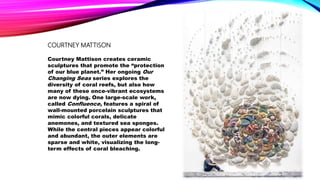
Courtney Mattison creates ceramic
sculptures that promote the “protection
of our blue planet.” Her ongoing Our
Changing Seas series explores the
diversity of coral reefs, but also how
many of these once-vibrant ecosystems
are now dying. One large-scale work,
called Confluence, features a spiral of
wall-mounted porcelain sculptures that
mimic colorful corals, delicate
anemones, and textured sea sponges.
While the central pieces appear colorful
and abundant, the outer elements are
sparse and white, visualizing the long-
term effects of coral bleaching.
MAT MILLER
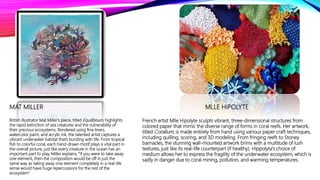
British illustrator Mat Miller’s piece, titled Equilibrium, highlights
the rapid extinction of sea creatures and the vulnerability of
their precious ecosystems. Rendered using fine liners,
watercolor paint, and acrylic ink, the talented artist captures a
vibrant underwater habitat that’s bursting with life. From tropical
fish to colorful coral, each hand-drawn motif plays a vital part in
the overall picture, just like every creature in the ocean has an
important part to play. Miller explains, “If you were to take away
one element, then the composition would be off in just the
same way as taking away one element completely in a real-life
sense would have huge repercussions for the rest of the
ecosystem”
MLLE HIPOLYTE
French artist Mlle Hipolyte sculpts vibrant, three-dimensional structures from
colored paper that mimic the diverse range of forms in coral reefs. Her artwork,
titled Coralium, is made entirely from hand using various paper craft techniques,
including quilling, scoring, and 3D modeling. From fringing reefs to Stoney
barnacles, the stunning wall-mounted artwork brims with a multitude of lush
textures, just like its real-life counterpart (if healthy). Hippolyta's choice of
medium allows her to express the fragility of the underwater ecosystem, which is
sadly in danger due to coral mining, pollution, and warming temperatures.
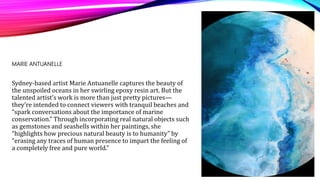
MARIE ANTUANELLE
Sydney-based artist Marie Antuanelle captures the beauty of
the unspoiled oceans in her swirling epoxy resin art. But the
talented artist’s work is more than just pretty pictures—
they’re intended to connect viewers with tranquil beaches and
“spark conversations about the importance of marine
conservation.” Through incorporating real natural objects such
as gemstones and seashells within her paintings, she
“highlights how precious natural beauty is to humanity” by
“erasing any traces of human presence to impart the feeling of
a completely free and pure world.”
WE WILL TAKE AN ARTIST AND DESCRIBE HIS WORKS
NATURE INSPIRED TEXTILE ARTWORK BY VANESSA BARRAGAO
Porto-based textile artist Vanessa Barragao creates three-dimensional textile art inspired by the
Earth’s coral reef ecosystem. The artist’s textured woolen rugs, tapestries, and wall hangings are
made using various hand-crafted, fiber art techniques, including latch hooking, crochet, weaving,
knitting, basketry, and felt. They mimic the organic textures, shapes, and structures found in the
diverse world of underwater flora and fauna, such as fringing reefs and barnacles.
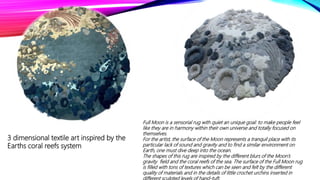
3 dimensional textile art inspired by the
Earths coral reefs system
Full Moon is a sensorial rug with quiet an unique goal: to make people feel
like they are in harmony within their own universe and totally focused on
themselves.
For the artist, the surface of the Moon represents a tranquil place with its
particular lack of sound and gravity and to find a similar environment on
Earth, one must dive deep into the ocean.
The shapes of this rug are inspired by the different blurs of the Moon’s
gravity field and the coral reefs of the sea. The surface of the Full Moon rug
is filled with tons of textures which can be seen and felt by the different
quality of materials and in the details of little crochet urchins inserted in
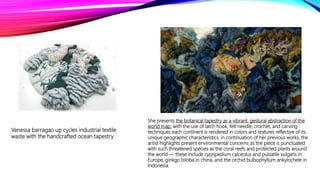
She presents the botanical tapestry as a vibrant, gestural abstraction of the
world map. with the use of latch hook, felt needle, crochet, and carving
techniques each continent is rendered in colors and textures reflective of its
unique geographic characteristics. in continuation of her previous works, the
artist highlights present environmental concerns as the piece is punctuated
with such threatened species as the coral reefs and protected plants around
the world — these include cypripedium calceolus and pulsatile vulgaris in
Europe, ginkgo biloba in china, and the orchid bulbophyllum ankylochele in
Indonesia.
Vanessa barragao up cycles industrial textile
waste with the handcrafted ocean tapestry
THANK YOU!

Art and environment

  • 1.
    BANARAS HINDU UNIVERSITY BA.HONS HISTORY OF ART 3RD YEAR 6TH SEMESTER BAI: 323 ART AND ENVIRONMENT TOPIC: AN ARTIST SHOWCASING THE DEVASTATING EFFECTS OF HUMAN IMPACT ON OCEAN AND SEA WATER NAME: SHIVANI GONDGE ROLL NO. 514 ENROLLEMENT NO. 393514 GUIDED BY: KANU PRIYA MAM
  • 2.
    ARTIST SHOWCASING THEDEVASTING EFFECTS OF HUMAN IMPACT ON OCEAN AND SEA WATER June 8 marks World Oceans Day a global celebration of the lungs of our planet, and all the creatures who inhabit it. The worldwide movement aims to raise awareness of the importance of ocean conservation and sustainable actions to counteract the effects of global warming and pollution. Human-induced climate change, which certain politicians deny and many of us choose to ignore, threatens the survival of every species on Earth. If emissions continue at their current rate, scientists anticipate widespread coastal land loss, agricultural and economic collapse, food and water shortages, frequent and severe natural disasters, and unprecedented refugee crises. Many people around the world are doing their part to save our seas, including contemporary artists. Through their art, they create powerful visualizations that pay homage to the beauty of the ocean, but also showcase the devastating effects of human impact. From textile art and ceramics to painting and paper sculptures, read on to discover there contribution on showcasing the effects of human on ocean and sea water.
  • 3.
    HERE ARE THEFEW EXAMPLES OF ARTIST WHO RAISE AWARENESS ABOUT ENVIRONMENTAL ISSUES WITH THEIR ART VANESSA BARRAGÃO Portuguese artist Vanessa Barragao creates textile rugs, large-scale tapestries, and wall hangings that address the huge scale at which the textile industry pollutes the ocean. Every piece is handmade using discarded textile waste and a variety of techniques, including crochet, latch hook, hand- tufting, embroidery, felting, and knitting. She transforms colorful yarn into stunning textile forms that mimic textured coral structures found in the sea. In one piece in particular, titled Coral Garden, Barragao visualizes the effects of coral bleaching—a phenomenon that starves and eventually kills coral. The plush wall hanging gradually changes from rich hues on one side to a white, muted palette on the other. AUDE BOURGINE French artist Aude Bourgine crafts multimedia coral sculptures within bell jars that highlight the fragility of marine plant life. Her series, Poumons des oceans (“Lungs of the Oceans”), is beautifully rendered with colorful embroidery and glittering embellishments such as beads and sequins. Each piece showcases the dazzling textures and diverse forms of coral, but they also visualize how vulnerable our reefs are. “If we do not rapidly change our relationship with our environment, oceans will be dead by 2050,” says Bourgine. “Their disappearance will entail a disastrous imbalance on all ecological, climate, and human levels.”
  • 4.
    COURTNEY MATTISON Courtney Mattisoncreates ceramic sculptures that promote the “protection of our blue planet.” Her ongoing Our Changing Seas series explores the diversity of coral reefs, but also how many of these once-vibrant ecosystems are now dying. One large-scale work, called Confluence, features a spiral of wall-mounted porcelain sculptures that mimic colorful corals, delicate anemones, and textured sea sponges. While the central pieces appear colorful and abundant, the outer elements are sparse and white, visualizing the long- term effects of coral bleaching.
  • 5.
    MAT MILLER British illustratorMat Miller’s piece, titled Equilibrium, highlights the rapid extinction of sea creatures and the vulnerability of their precious ecosystems. Rendered using fine liners, watercolor paint, and acrylic ink, the talented artist captures a vibrant underwater habitat that’s bursting with life. From tropical fish to colorful coral, each hand-drawn motif plays a vital part in the overall picture, just like every creature in the ocean has an important part to play. Miller explains, “If you were to take away one element, then the composition would be off in just the same way as taking away one element completely in a real-life sense would have huge repercussions for the rest of the ecosystem” MLLE HIPOLYTE French artist Mlle Hipolyte sculpts vibrant, three-dimensional structures from colored paper that mimic the diverse range of forms in coral reefs. Her artwork, titled Coralium, is made entirely from hand using various paper craft techniques, including quilling, scoring, and 3D modeling. From fringing reefs to Stoney barnacles, the stunning wall-mounted artwork brims with a multitude of lush textures, just like its real-life counterpart (if healthy). Hippolyta's choice of medium allows her to express the fragility of the underwater ecosystem, which is sadly in danger due to coral mining, pollution, and warming temperatures.
  • 6.
    MARIE ANTUANELLE Sydney-based artistMarie Antuanelle captures the beauty of the unspoiled oceans in her swirling epoxy resin art. But the talented artist’s work is more than just pretty pictures— they’re intended to connect viewers with tranquil beaches and “spark conversations about the importance of marine conservation.” Through incorporating real natural objects such as gemstones and seashells within her paintings, she “highlights how precious natural beauty is to humanity” by “erasing any traces of human presence to impart the feeling of a completely free and pure world.”
  • 7.
    WE WILL TAKEAN ARTIST AND DESCRIBE HIS WORKS NATURE INSPIRED TEXTILE ARTWORK BY VANESSA BARRAGAO Porto-based textile artist Vanessa Barragao creates three-dimensional textile art inspired by the Earth’s coral reef ecosystem. The artist’s textured woolen rugs, tapestries, and wall hangings are made using various hand-crafted, fiber art techniques, including latch hooking, crochet, weaving, knitting, basketry, and felt. They mimic the organic textures, shapes, and structures found in the diverse world of underwater flora and fauna, such as fringing reefs and barnacles.
  • 8.
    3 dimensional textileart inspired by the Earths coral reefs system Full Moon is a sensorial rug with quiet an unique goal: to make people feel like they are in harmony within their own universe and totally focused on themselves. For the artist, the surface of the Moon represents a tranquil place with its particular lack of sound and gravity and to find a similar environment on Earth, one must dive deep into the ocean. The shapes of this rug are inspired by the different blurs of the Moon’s gravity field and the coral reefs of the sea. The surface of the Full Moon rug is filled with tons of textures which can be seen and felt by the different quality of materials and in the details of little crochet urchins inserted in
  • 9.
    She presents thebotanical tapestry as a vibrant, gestural abstraction of the world map. with the use of latch hook, felt needle, crochet, and carving techniques each continent is rendered in colors and textures reflective of its unique geographic characteristics. in continuation of her previous works, the artist highlights present environmental concerns as the piece is punctuated with such threatened species as the coral reefs and protected plants around the world — these include cypripedium calceolus and pulsatile vulgaris in Europe, ginkgo biloba in china, and the orchid bulbophyllum ankylochele in Indonesia. Vanessa barragao up cycles industrial textile waste with the handcrafted ocean tapestry
  • 10.