Presented By: Eston Elliott, Joshua
Day, Jaelynn Maestas, Toby Poyer,
Noah Burns, Gage Nolan, Daniel
Letourneau, Brenna McGuirk
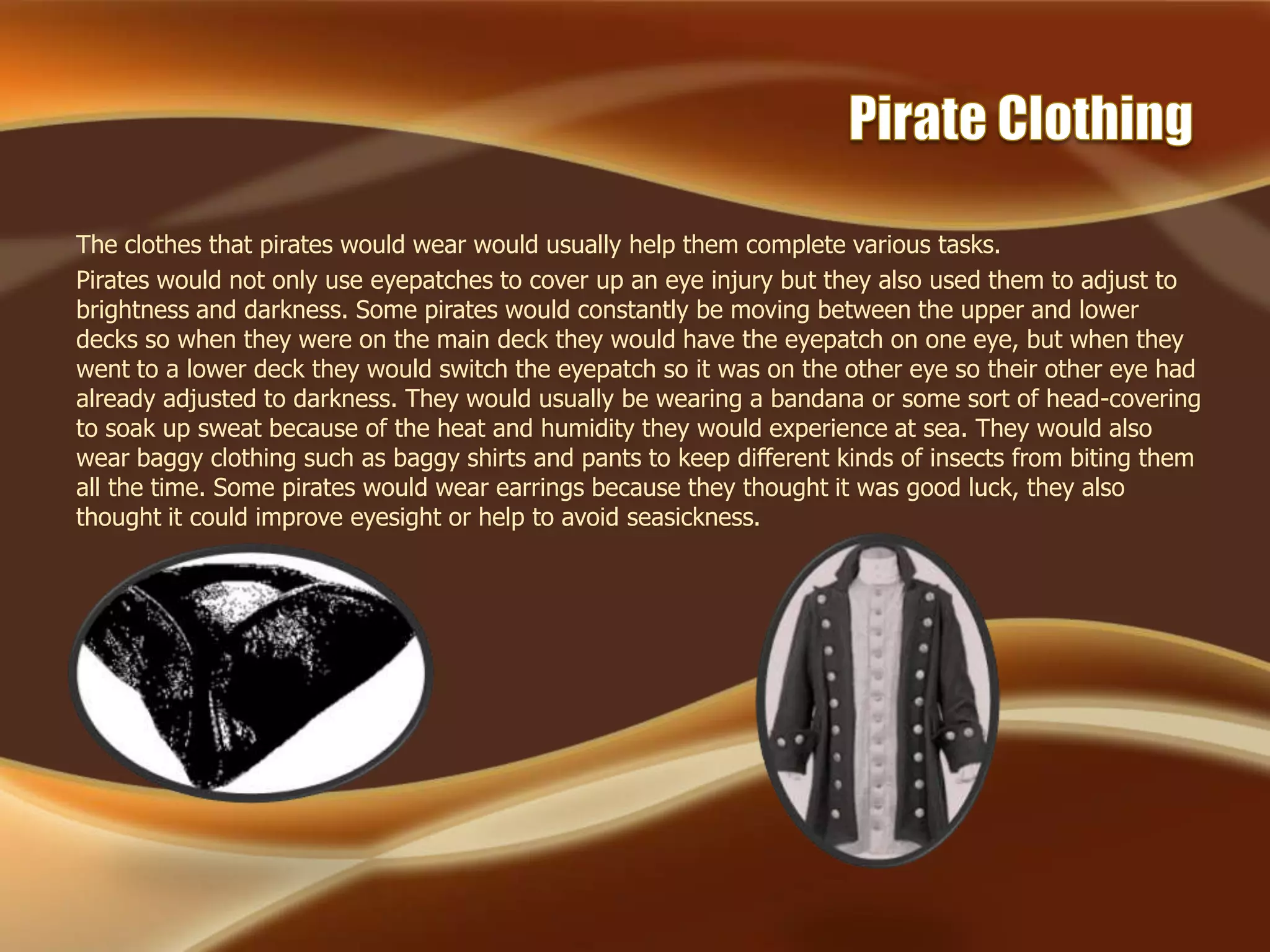
Edward Teach “Blackbeard”: Edward “Blackbeard” Teach was by far
the most famous pirate of his generation, if not the most successful.
He was famous for putting lit bomb fuses in his hat, which gave off
smoke and made him look like a demon in battle. He terrorized
Atlantic cargo shipping from 1717 to 1718 before he was killed in a
battle with pirate hunters in November of 1718.
Captain-William-Kidd: The infamous William Kidd originally started
out as a pirate hunter from England. He sailed from England in 1696
with orders to attack pirates and the French wherever him and his
crew could find them. He soon gave into pressure from his crew to
commit acts of piracy. He eventually returned to England to clear his
name but instead he was jailed and eventually hanged
Famous Pirates (cont.)
Pirates go High-Tech: Don't think that pirates aren't using 21st century
equipment, because, they are. GPS systems, satellite phones, night-vision
goggles, and many other items are essential for the course now for pirates.
They often check different blogs online to locate shipping routes and map
out how they will hijack a ship.
Financing Pirates Isn’t Very Expensive: Generally, three to five people will
join together to finance a voyage and they will take anywhere from 30-75%
of the final ransom. For these people, this is a great deal as the cost of
putting together an expedition, including vessels, may be only $30,000.
Smaller attacks can be just around a few hundred dollars. The money is
then given either to Somalia, or other countries such as Djbouti, Kenya and
the United Arab Emirates.
Pirates Are Involved in the Community: It may surprise you to find out that
Somali pirates often receive help from people on land, particularly local
communities. "The district gets a percentage of every ransom from ships that
have been released and is used mainly for construction of public
infrastructure, including their hospital and public schools. There is even a
Somali Pirate Stock Exchange to allow investors to contribute weapons or
other material and receive a share of the ransom in return.
Piracy has long been romanticized in the United States, from Peter Pan to
Halloween costumes. Off the coast of West Africa though, pirates
continue to roam the high seas, but they are nothing like what you'd
expect.
Buried Treasure: Most people who study piracy usually argue that maps to
buried treasure are a work of fiction. They also believe that pirate would not have
buried treasure on deserted islands. There are two legit reasons for not believing
in buried treasure. The first reason is that there has never been an actual or
accurate treasure map found and the second reason is that pirates would usually
spend all of their money as soon as they hit port and would return to pirating in
order to raise more money. Probably the most famous treasure map is the map of
Captain Flint, even though he is from a fictional story. Almost every famous pirate
captain has a legend about a treasure map to his secret stash of loot. Blackbeard
and Black Bart both have several legends about buried treasure
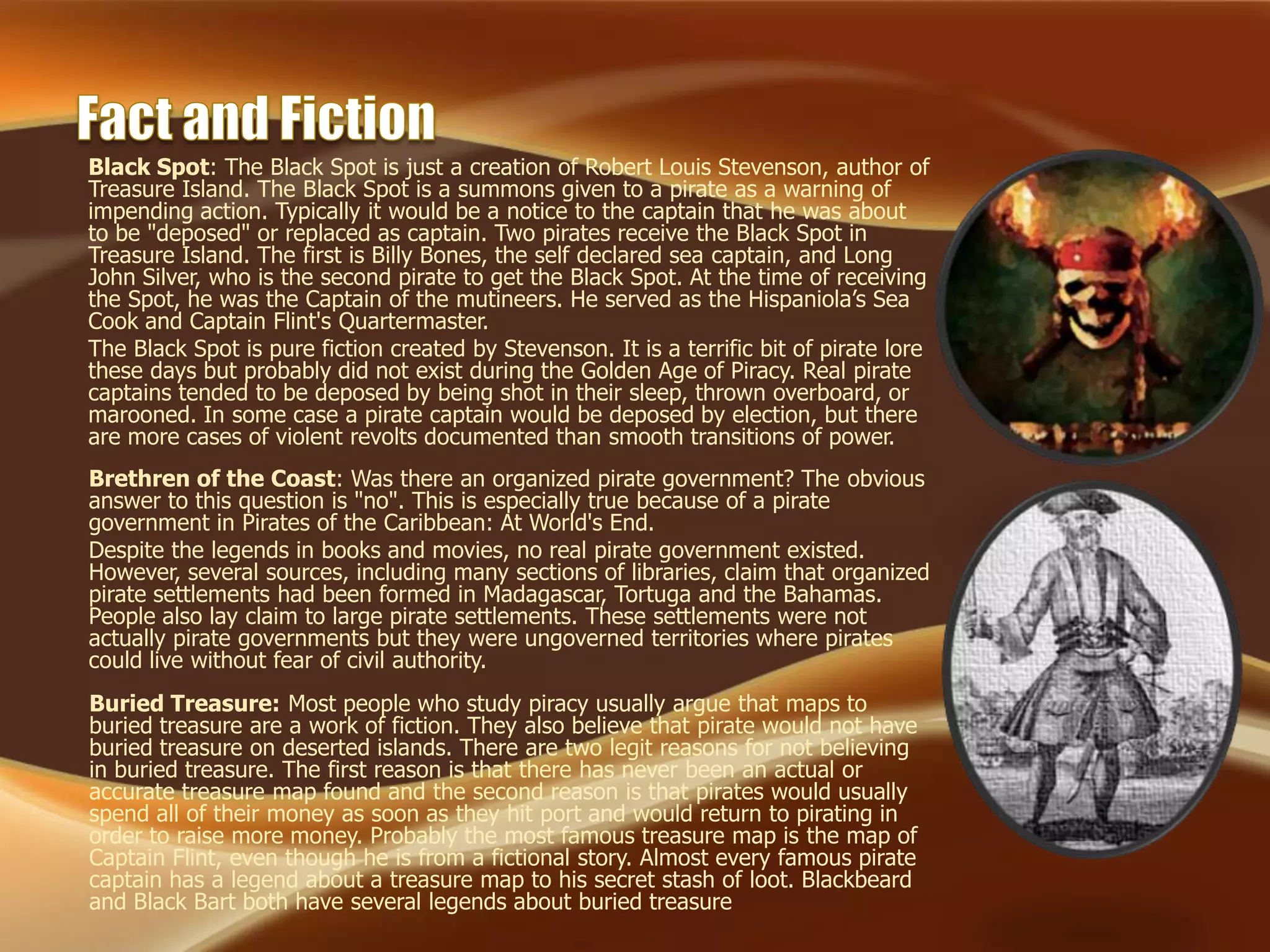
Black Spot: The Black Spot is just a creation of Robert Louis Stevenson, author of
Treasure Island. The Black Spot is a summons given to a pirate as a warning of
impending action. Typically it would be a notice to the captain that he was about
to be "deposed" or replaced as captain. Two pirates receive the Black Spot in
Treasure Island. The first is Billy Bones, the self declared sea captain, and Long
John Silver, who is the second pirate to get the Black Spot. At the time of receiving
the Spot, he was the Captain of the mutineers. He served as the Hispaniola’s Sea
Cook and Captain Flint's Quartermaster.
The Black Spot is pure fiction created by Stevenson. It is a terrific bit of pirate lore
these days but probably did not exist during the Golden Age of Piracy. Real pirate
captains tended to be deposed by being shot in their sleep, thrown overboard, or
marooned. In some case a pirate captain would be deposed by election, but there
are more cases of violent revolts documented than smooth transitions of power.
Brethren of the Coast: Was there an organized pirate government? The obvious
answer to this question is "no". This is especially true because of a pirate
government in Pirates of the Caribbean: At World's End.
Despite the legends in books and movies, no real pirate government existed.
However, several sources, including many sections of libraries, claim that organized
pirate settlements had been formed in Madagascar, Tortuga and the Bahamas.
People also lay claim to large pirate settlements. These settlements were not
actually pirate governments but they were ungoverned territories where pirates
could live without fear of civil authority.
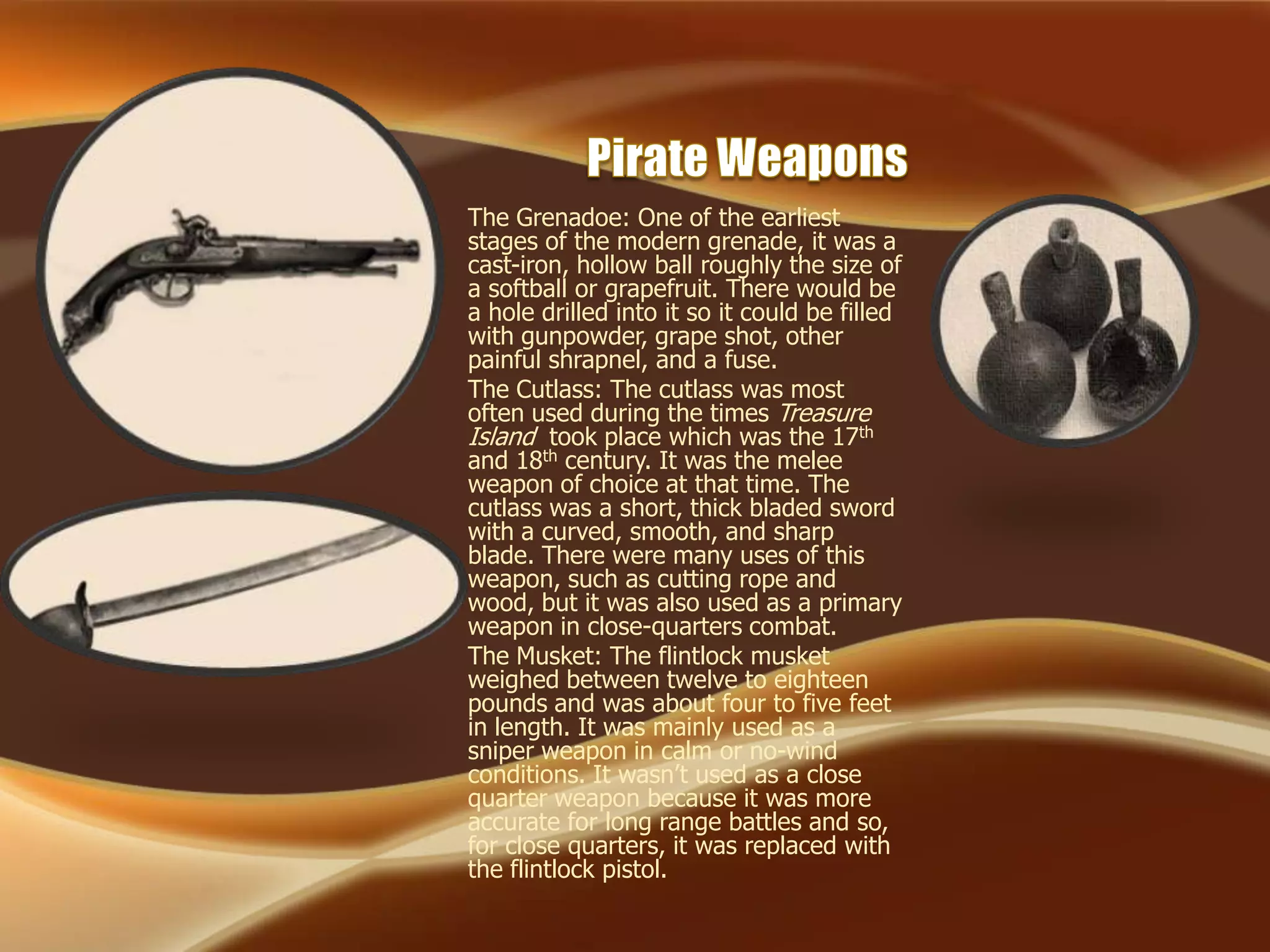
The clothes that pirates would wear would usually help them complete various tasks.
Pirates would not only use eyepatches to cover up an eye injury but they also used them to adjust to
brightness and darkness. Some pirates would constantly be moving between the upper and lower
decks so when they were on the main deck they would have the eyepatch on one eye, but when they
went to a lower deck they would switch the eyepatch so it was on the other eye so their other eye had
already adjusted to darkness. They would usually be wearing a bandana or some sort of head-covering
to soak up sweat because of the heat and humidity they would experience at sea. They would also
wear baggy clothing such as baggy shirts and pants to keep different kinds of insects from biting them
all the time. Some pirates would wear earrings because they thought it was good luck, they also
thought it could improve eyesight or help to avoid seasickness.
The Grenadoe: One of the earliest
stages of the modern grenade, it was a
cast-iron, hollow ball roughly the size of
a softball or grapefruit. There would be
a hole drilled into it so it could be filled
with gunpowder, grape shot, other
painful shrapnel, and a fuse.
The Cutlass: The cutlass was most
often used during the times Treasure
Island took place which was the 17th
and 18th century. It was the melee
weapon of choice at that time. The
cutlass was a short, thick bladed sword
with a curved, smooth, and sharp
blade. There were many uses of this
weapon, such as cutting rope and
wood, but it was also used as a primary
weapon in close-quarters combat.
The Musket: The flintlock musket
weighed between twelve to eighteen
pounds and was about four to five feet
in length. It was mainly used as a
sniper weapon in calm or no-wind
conditions. It wasn’t used as a close
quarter weapon because it was more
accurate for long range battles and so,
for close quarters, it was replaced with
the flintlock pistol.

arrgh pirates

  • 1.
    Presented By: EstonElliott, Joshua Day, Jaelynn Maestas, Toby Poyer, Noah Burns, Gage Nolan, Daniel Letourneau, Brenna McGuirk
  • 2.
    Edward Teach “Blackbeard”:Edward “Blackbeard” Teach was by far the most famous pirate of his generation, if not the most successful. He was famous for putting lit bomb fuses in his hat, which gave off smoke and made him look like a demon in battle. He terrorized Atlantic cargo shipping from 1717 to 1718 before he was killed in a battle with pirate hunters in November of 1718. Captain-William-Kidd: The infamous William Kidd originally started out as a pirate hunter from England. He sailed from England in 1696 with orders to attack pirates and the French wherever him and his crew could find them. He soon gave into pressure from his crew to commit acts of piracy. He eventually returned to England to clear his name but instead he was jailed and eventually hanged
  • 3.
  • 4.
    Pirates go High-Tech:Don't think that pirates aren't using 21st century equipment, because, they are. GPS systems, satellite phones, night-vision goggles, and many other items are essential for the course now for pirates. They often check different blogs online to locate shipping routes and map out how they will hijack a ship. Financing Pirates Isn’t Very Expensive: Generally, three to five people will join together to finance a voyage and they will take anywhere from 30-75% of the final ransom. For these people, this is a great deal as the cost of putting together an expedition, including vessels, may be only $30,000. Smaller attacks can be just around a few hundred dollars. The money is then given either to Somalia, or other countries such as Djbouti, Kenya and the United Arab Emirates. Pirates Are Involved in the Community: It may surprise you to find out that Somali pirates often receive help from people on land, particularly local communities. "The district gets a percentage of every ransom from ships that have been released and is used mainly for construction of public infrastructure, including their hospital and public schools. There is even a Somali Pirate Stock Exchange to allow investors to contribute weapons or other material and receive a share of the ransom in return. Piracy has long been romanticized in the United States, from Peter Pan to Halloween costumes. Off the coast of West Africa though, pirates continue to roam the high seas, but they are nothing like what you'd expect.
  • 5.
    Buried Treasure: Mostpeople who study piracy usually argue that maps to buried treasure are a work of fiction. They also believe that pirate would not have buried treasure on deserted islands. There are two legit reasons for not believing in buried treasure. The first reason is that there has never been an actual or accurate treasure map found and the second reason is that pirates would usually spend all of their money as soon as they hit port and would return to pirating in order to raise more money. Probably the most famous treasure map is the map of Captain Flint, even though he is from a fictional story. Almost every famous pirate captain has a legend about a treasure map to his secret stash of loot. Blackbeard and Black Bart both have several legends about buried treasure Black Spot: The Black Spot is just a creation of Robert Louis Stevenson, author of Treasure Island. The Black Spot is a summons given to a pirate as a warning of impending action. Typically it would be a notice to the captain that he was about to be "deposed" or replaced as captain. Two pirates receive the Black Spot in Treasure Island. The first is Billy Bones, the self declared sea captain, and Long John Silver, who is the second pirate to get the Black Spot. At the time of receiving the Spot, he was the Captain of the mutineers. He served as the Hispaniola’s Sea Cook and Captain Flint's Quartermaster. The Black Spot is pure fiction created by Stevenson. It is a terrific bit of pirate lore these days but probably did not exist during the Golden Age of Piracy. Real pirate captains tended to be deposed by being shot in their sleep, thrown overboard, or marooned. In some case a pirate captain would be deposed by election, but there are more cases of violent revolts documented than smooth transitions of power. Brethren of the Coast: Was there an organized pirate government? The obvious answer to this question is "no". This is especially true because of a pirate government in Pirates of the Caribbean: At World's End. Despite the legends in books and movies, no real pirate government existed. However, several sources, including many sections of libraries, claim that organized pirate settlements had been formed in Madagascar, Tortuga and the Bahamas. People also lay claim to large pirate settlements. These settlements were not actually pirate governments but they were ungoverned territories where pirates could live without fear of civil authority.
  • 6.
    The clothes thatpirates would wear would usually help them complete various tasks. Pirates would not only use eyepatches to cover up an eye injury but they also used them to adjust to brightness and darkness. Some pirates would constantly be moving between the upper and lower decks so when they were on the main deck they would have the eyepatch on one eye, but when they went to a lower deck they would switch the eyepatch so it was on the other eye so their other eye had already adjusted to darkness. They would usually be wearing a bandana or some sort of head-covering to soak up sweat because of the heat and humidity they would experience at sea. They would also wear baggy clothing such as baggy shirts and pants to keep different kinds of insects from biting them all the time. Some pirates would wear earrings because they thought it was good luck, they also thought it could improve eyesight or help to avoid seasickness.
  • 7.
    The Grenadoe: Oneof the earliest stages of the modern grenade, it was a cast-iron, hollow ball roughly the size of a softball or grapefruit. There would be a hole drilled into it so it could be filled with gunpowder, grape shot, other painful shrapnel, and a fuse. The Cutlass: The cutlass was most often used during the times Treasure Island took place which was the 17th and 18th century. It was the melee weapon of choice at that time. The cutlass was a short, thick bladed sword with a curved, smooth, and sharp blade. There were many uses of this weapon, such as cutting rope and wood, but it was also used as a primary weapon in close-quarters combat. The Musket: The flintlock musket weighed between twelve to eighteen pounds and was about four to five feet in length. It was mainly used as a sniper weapon in calm or no-wind conditions. It wasn’t used as a close quarter weapon because it was more accurate for long range battles and so, for close quarters, it was replaced with the flintlock pistol.