Real And Complex Singularities 1st Edition David Mond
Real And Complex Singularities 1st Edition David Mond
Real And Complex Singularities 1st Edition David Mond
Real And Complex Singularities 1st Edition David Mond
Real And Complex Singularities 1st Edition David Mond
1.
Real And ComplexSingularities 1st Edition David
Mond pdf download
https://ebookfinal.com/download/real-and-complex-
singularities-1st-edition-david-mond/
Explore and download more ebooks or textbooks
at ebookfinal.com
2.
Here are somerecommended products for you. Click the link to
download, or explore more at ebookfinal
Singularities Formation Structure and Propagation 1st
Edition Jens Eggers
https://ebookfinal.com/download/singularities-formation-structure-and-
propagation-1st-edition-jens-eggers/
Isolated Singularities in Partial Differential
Inequalities 1st Edition Marius Ghergu
https://ebookfinal.com/download/isolated-singularities-in-partial-
differential-inequalities-1st-edition-marius-ghergu/
Global real estate investment trusts people process and
management 1st ed Edition David Parker
https://ebookfinal.com/download/global-real-estate-investment-trusts-
people-process-and-management-1st-ed-edition-david-parker/
Methods for Analysis of Golgi Complex Function 1st Edition
Franck Perez And David J. Stephens (Eds.)
https://ebookfinal.com/download/methods-for-analysis-of-golgi-complex-
function-1st-edition-franck-perez-and-david-j-stephens-eds/
3.
Augmentative and AlternativeCommunication Supporting
Children and Adults with Complex Communication Needs 4th
Edition David Beukelman
https://ebookfinal.com/download/augmentative-and-alternative-
communication-supporting-children-and-adults-with-complex-
communication-needs-4th-edition-david-beukelman/
Analysis of Singularities for Partial Differential
Equations 1st Edition Shuxing Chen
https://ebookfinal.com/download/analysis-of-singularities-for-partial-
differential-equations-1st-edition-shuxing-chen/
Singularities Technoculture Transhumanism and Science
Fiction in the 21st Century 1st Edition Joshua Raulerson
https://ebookfinal.com/download/singularities-technoculture-
transhumanism-and-science-fiction-in-the-21st-century-1st-edition-
joshua-raulerson/
Commercial Real Estate Analysis and Investments with CD
ROM 2nd Edition David M. Geltner
https://ebookfinal.com/download/commercial-real-estate-analysis-and-
investments-with-cd-rom-2nd-edition-david-m-geltner/
Remote Research Real Users Real Time Real Research 1st
Edition Nate Bolt
https://ebookfinal.com/download/remote-research-real-users-real-time-
real-research-1st-edition-nate-bolt/
5.
Real And ComplexSingularities 1st Edition David Mond
Digital Instant Download
Author(s): David Mond, Marcelo Saia
ISBN(s): 9780824740917, 0824740912
Edition: 1
File Details: PDF, 14.63 MB
Year: 2003
Language: english
7.
Real and Complex
Singularities
thesixth workshop at Sao Carlos
edited by
David Mond
University of Warwick
Coventry, England
Marcela Jose 5aia
University of Sao Paulo
Sao Carlos, Sao Paulo, Brazil
MARCEL DEKKER, INC. NEW YORK • BASEL
PURE AND APPLIEDMATHEMATICS
AProgram of Monographs, Textbooks, and Lecture Notes
EXECUTIVE EDITORS
Earl J. Taft Zuhair Nashed
Rutgers University University of Delaware
New Brunswick, New Jersey Newark, Delaware
EDITORIAL BOARD
M. S. Baouendi Anil Nerode
University of California, Cornell University
San Diego
Donald Passman
Jane Cronin University of Wisconsin,
Rutgers University Madison
Jack K. Hale Fred S. Roberts
Georgia Institute of Technology Rutgers University
S. Kobayashi David L. Russell
University of California, Virginia Polytechnic Institute
Berkeley and State University
Marvin Marcus Walter Schempp
University of California, Universitdt Siegen
Santa Barbara
Mark Teply
W. S. Massey University of Wisconsin,
Yale University Milwaukee
10.
LECTURE NOTES INPURE AND APPLIED MATHEMATICS
1. N. Jacobson,Exceptional Lie Algebras
2. L.-A.Lindahl and F. Poulsen, Thin Sets in Harmonic Analysis
3. /. Satake,Classification Theory of Semi-Simple Algebraic Groups
4. F. Hirzebruch et a/., Differentiable Manifolds and Quadratic Forms
5. I. Chavel, Riemannian Symmetric Spaces of Rank One
6. R. B. Burckel, Characten'zation of C(X)Among Its Subalgebras
7. 6. R. McDonaldet a/., Ring Theory
8. Y.-T.Siu, Techniques of Extension on Analytic Objects
9. S. R. Caradus et a/., Calkin Algebras and Algebras of Operators on Banach Spaces
10. E. O. Roxin etal., Differential Games and Control Theory
11. M. Orzech and C. Small,The Brauer Group of Commutative Rings
12. S. Thornier, Topology and Its Applications
13. J. M. Lopezand K. A. Ross, Sidon Sets
14. W. W. Comfort and S. Negrepontis, Continuous Pseudometrics
15. K. McKennon and J. M. Robertson, Locally Convex Spaces
16. M. Carmeli and S. Malin, Representations of the Rotation and Lorentz Groups
17. G. B. Seligman, Rational Methods in Lie Algebras
18. D. G. de Figueiredo, Functional Analysis
19. L Cesari et a/., Nonlinear Functional Analysis and Differential Equations
20. J. J. Schaffer, Geometry of Spheres in Normed Spaces
21. K. Yano and M. Kon, Anti-Invariant Submanifolds
22. W. V. Vasconcelos, The Rings of Dimension Two
23. R. E. Chandler, Hausdorff Compactifications
24. S. P. Franklin and B. V. S. Thomas, Topology
25. S. K. Jain, Ring Theory
26. B. R. McDonaldand R. A. Morris, Ring Theory II
27. R. B. Mura and A. Rhemtulla, Orderable Groups
28. J. R Graef, Stability of Dynamical Systems
29. H.-C. Wang, Homogeneous Branch Algebras
30. E. O. Roxin et a/., Differential Games and Control Theory II
31. R. D. Porter, Introduction to Fibre Bundles
32. M. Altman, Contractors and Contractor Directions Theory and Applications
33. J. S. Golan, Decomposition and Dimension in Module Categories
34. G. Fairweather, Finite Element Galerkin Methods for Differential Equations
35. J. D. Sally, Numbers of Generators of Ideals in Local Rings
36. S. S. Miller, Complex Analysis
37. R. Gordon, Representation Theory of Algebras
38. M. Goto and F. D. Grosshans, Semisimple Lie Algebras
39. A. I. Arruda et a/., Mathematical Logic
40. F. Van Oystaeyen,Ring Theory
41. F. Van Oystaeyenand A. Verschoren, Reflectors and Localization
42. M. Satyanarayana,Positively Ordered Semigroups
43. D. L Russell, Mathematics of Finite-Dimensional Control Systems
44. P.-T. Liu and E. Roxin, Differential Games and Control Theory III
45. A. Geramita and J. Seberry, Orthogonal Designs
46. J. Cigler, V. Losert, and P. Michor, Banach Modules and Functors on Categories of Banach
Spaces
47. P.-T. Liu and J. G. Sutinen, Control Theory in Mathematical Economics
48. C. Byrnes, Partial Differential Equations and Geometry
49. G. Klambauer, Problems and Propositions in Analysis
50. J. Knopfmacher, Analytic Arithmetic of Algebraic Function Fields
51. F. Van Oystaeyen,Ring Theory
52. B. Kadem, Binary Time Series
53. J. Barros-Neto_and R. A. Artino, Hypoelliptic Boundary-Value Problems
54. R. L Stemberg et a/.. Nonlinear Partial Differential Equations in Engineering and Applied Science
55. B. R. McDonald,Ring Theory and Algebra III
56. J. S. Golan, Structure Sheaves Over a Noncommutative Ring
57. T. V. Narayanaet a/., Combinatorics, Representation Theory and Statistical Methods in Groups
58. T. A. Burton, Modeling and Differential Equations in Biology
59. K. H. Kim and F. W. Roush, Introduction to Mathematical Consensus Theory
11.
60. J. Banasand K. Goebel, Measures of Noncompactness in Banach Spaces
61. O. A. Me/son, Direct Integral Theory
62. J. E. Smith et a/., Ordered Groups
63. J. Cronin, Mathematics of Cell Electrophysiology
64. J. W. Brewer, Power Series Over Commutative Rings
65. P. K. Kamthan and M. Gupta, Sequence Spaces and Series
66. 7. G. McLaughlin, Regressive Sets and the Theory of Isols
67. T. L Herdman et a/., Integral and Functional Differential Equations
68. R. Draper, Commutative Algebra
69. W. G. McKay and J. Patera, Tables of Dimensions, Indices, and Branching Rules for Repre-
sentations of Simple Lie Algebras
70. R. L. Devaney and Z. H. Nitecki, Classical Mechanics and Dynamical Systems
71. J. Van Gee/, Places and Valuations in Noncommutative Ring Theory
72. C. Faith, Injective Modules and Injective Quotient Rings
73. A. Fiacco, Mathematical Programming with Data Perturbations I
74. P. Schultz et a/., Algebraic Structures and Applications
75. L Bican et a/., Rings, Modules, and Preradicals
76. D. C. Kay and M. Breen, Convexity and Related Combinatorial Geometry
77. P. Fletcher and W. F. Lindgren, Quasi-Uniform Spaces
78. C.-C. Yang, Factorization Theory of Meromorphic Functions
79. O. Taussky, Ternary Quadratic Forms and Norms
80. S. P. Singh and J. H. Burry, Nonlinear Analysis and Applications
81. K. B. Hannsgenet a/., Volterra and Functional Differential Equations
82. N. L. Johnson era/., Finite Geometries
83. G. /. Zapata, Functional Analysis, Holomorphy, and ApproximationTheory
84. S. Greco and G. Valla, Commutative Algebra
85. A. V. Fiacco, Mathematical Programming with Data Perturbations II
86. J.-8. Hin'art-Umityetal., Optimization
87. A. Figa Talamanca and M. A. Picardello, Harmonic Analysis on Free Groups
88. M. Harada, Factor Categories with Applications to Direct Decomposition of Modules
89. V. I. Istratescu, Strict Convexity and Complex Strict Convexity
90. V. Lakshmikantham, Trends in Theory and Practice of Nonlinear Differential Equations
91. H. L. Manocha and J. B. Srivastava, Algebra and Its Applications
92. D. V. Chudnovsky and G. V. Chudnovsky, Classical and Quantum Models and Arithmetic
Problems
93. J. W. Longley, Least Squares Computations Using Orthogonalization Methods
94. L P. de Alcantara, Mathematical Logic and Formal Systems
95. C. E. Aull, Rings of Continuous Functions
96. R. Chuaqui, Analysis, Geometry, and Probability
97. L. Fuchs and L. Salce, Modules Over Valuation Domains
98. P. Fischer and W. R. Smith, Chaos, Fractals, and Dynamics
99. W. B. Powell and C. Tsinakis, Ordered Algebraic Structures
100. G. M. Rassias and T. M. Rassias, Differential Geometry, Calculus of Variations, and Their
Applications
101. R.-E.Hoffmann and K. H. Hofmann, Continuous Lattices and Their Applications
102. J. H. Lightboume III and S. M. Rankin III, Physical Mathematics and Nonlinear PartialDifferential
Equations
103. C. A. Baker and L. M. Batten, Finite Geometries
104. J. W. Brewer et a/., Linear Systems Over Commutative Rings
105. C. McCrory and T. Shifrin, Geometry and Topology
106. D. W. Kueke et a/., Mathematical Logic and Theoretical Computer Science
107. B.-L. Lin and S. Simons, Nonlinear and Convex Analysis
108. S. J. Lee, Operator Methods for Optimal Control Problems
109. V. Lakshmikantham, Nonlinear Analysisand Applications
110. S. F. McCormick, Multigrid Methods
111. M. C. Tangora, Computers in Algebra
112. D. V. Chudnovsky and G. V. Chudnovsky, Search Theory
113. D. V. Chudnovsky and R. D. Jenks, ComputerAlgebra
114. M. C. Tangora, Computers in Geometry and Topology
115. P. Nelson et a/.. Transport Theory, Invariant Imbedding, and Integral Equations
116. P. Clement et a/., Semigroup Theory and Applications
117. J. Vinuesa, Orthogonal Polynomials and Their Applications
118. C. M. Dafermos et a/., Differential Equations
119. E. O. Roxin, Modem Optimal Control
120. J. C. Diaz, Mathematics for Large Scale Computing
12.
121. P. S.Milojevft Nonlinear Functional Analysis
122. C. Sadosky, Analysis and Partial Differential Equations
123. R. M. Shortt, General Topology and Applications
124. R. Wong, Asymptotic and Computational Analysis
125. D. V. Chudnovsky and R. D. Jenks, Computers in Mathematics
126. W. D. Wallis et al., Combinatorial Designs and Applications
127. S. Elaydi, Differential Equations
128. G. Chen et al., Distributed Parameter Control Systems
129. W. N. Everitt, Inequalities
130. H. G. Kaper and M. Garbey, Asymptotic Analysis and the Numerical Solution of Partial Differ-
ential Equations
131. O. Anno ef a/., Mathematical Population Dynamics
132. S. Coen, Geometry and Complex Variables
133. J. A. Goldstein et a/., Differential Equations with Applications in Biology, Physics, and Engineering
134. S. J. Andima et a/., General Topology and Applications
135. P Clement et al., Semigroup Theory and Evolution Equations
136. K. Jarosz, Function Spaces
137. J. M. Bayod et al., p-adic Functional Analysis
138. G. A. Anastassiou, Approximation Theory
139. R. S. Rees, Graphs, Matrices, and Designs
140. G. Abrams et al., Methods in Module Theory
141. G. L. Mullen and P. J.-S. Shiue, Finite Fields, Coding Theory, and Advances in Communications
and Computing
142. M. C. Joshi and A. V. Balakhshnan, Mathematical Theory of Control
143. G. Komatsu and Y, Sakane,Complex Geometry
144. /. J. Bakelman,Geometric Analysis and Nonlinear Partial DifferentialEquations
145. T. Mabuchi and S. Mukai, Einstein Metrics and Yang-Mills Connections
146. L. Fuchs and R. Gobel, Abelian Groups
147. A. D. Pollington and W. Moran, Number Theory with an Emphasis on the Markoff Spectrum
148. G. Dore et al., Differential Equations in Banach Spaces
149. T. West, Continuum Theory and Dynamical Systems
150. K. D. Bierstedt et al., Functional Analysis
151. K. G. Fischer et al., Computational Algebra
152. K. D. Elworthy et al., Differential Equations, Dynamical Systems, and Control Science
153. P.-J. Cahen, et al., Commutative Ring Theory
154. S. C. Cooper and W. J. Thron, Continued Fractions and Orthogonal Functions
155. P. Clement and G. Lumer, Evolution Equations, Control Theory, and Biomathematics
156. M. Gyllenberg and L Persson, Analysis, Algebra, and Computers in Mathematical Research
157. W. O. Brayetal., Fourier Analysis
158. J. Bergen and S. Montgomery, Advances in Hopf Algebras
159. A. R. Magid, Rings, Extensions, and Cohomology
160. N. H. Pavel, Optimal Control of Differential Equations
161. M. Ikawa, Spectral and Scattering Theory
162. X. Liu and D. Siegel, Comparison Methods and Stability Theory
163. J.-P.Zolesio, Boundary Control and Variation
164. M. Kfizeketal., Finite Element Methods
165. G. Da Prafo and L. Tubaro, Control of Partial Differential Equations
166. £ Ballico, Projective Geometry with Applications
167. M. Costabel et al., Boundary Value Problems and Integral Equations in Nonsmooth Domains
168. G. Ferreyra, G. R. Goldstein, and F. Neubrander, Evolution Equations
169. S. Huggett, Twistor Theory
170. H. Cook et al., Continua
171. D. F. Andersonand D. E. Dobbs, Zero-Dimensional Commutative Rings
172. K. Jarosz, Function Spaces
173. V. Ancona et al., Complex Analysis and Geometry
174. E. Casas, Control of Partial Differential Equations and Applications
175. N. Kalton et al., Interaction Between Functional Analysis, Harmonic Analysis, and Probability
176. Z. Deng et al., Differential Equations and Control Theory
177. P. Marcellini etal. Partial Differential Equations and Applications
178. A. Kartsatos, Theory and Applications of Nonlinear Operatorsof Accretive and Monotone Type
179. M. Maruyama, Moduli of Vector Bundles
180. A. Ursini and P. Agliano, Logic and Algebra
181. X. H. Cao et al., Rings, Groups, and Algebras
182. D. Arnold and R. M. Rangaswamy, Abelian Groups and Modules
183. S. R. Chakravarthy and A. S. Alfa, Matrix-Analytic Methods in Stochastic Models
13.
184. J. E.Andersen et al., Geometry and Physics
185. P.-J. Cahen et a/., Commutative Ring Theory
186. J. A. Goldstein et a/., Stochastic Processes and Functional Analysis
187. A. Sorbi, Complexity, Logic, and Recursion Theory
188. G. Da Prato and J.-P. Zolesio, Partial Differential Equation Methods in Control and Shape
Analysis
189. D. D. Anderson, Factorization in Integral Domains
190. N. L. Johnson, Mostly Finite Geometries
191. D. Hinton and P. W. Schaefer, Spectral Theory and Computational Methods of Sturm-Liouville
Problems
192. W. H. Schikhofet a/., p-adic Functional Analysis
193. S. Sertoz, Algebraic Geometry
194. G. Caristi and E. Mitidieri, Reaction Diffusion Systems
195. A. V. Fiacco, Mathematical Programming with Data Perturbations
196. M. Kfizek et a/., Finite Element Methods: Superconvergence, Post-Processing, and A Posteriori
Estimates
197. S. Caenepeel and A. Verschoren, Rings, Hopf Algebras, and Brauer Groups
198. V. Drensky et al., Methods in Ring Theory
199. W. B. Jones and A. Sri Ranga, Orthogonal Functions, Moment Theory, and Continued Fractions
200. P. E. Newstead, Algebraic Geometry
201. D. Dikranjan and L Salce, Abelian Groups, Module Theory, and Topology
202. Z. Chen et al., Advances in Computational Mathematics
203. X. Caicedo and C. H. Montenegro, Models, Algebras, and Proofs
204. C. Y. Yildirim and S. A. Stepanov, Number Theory and Its Applications
205. D. E. Dobbs et al., Advances in Commutative Ring Theory
206. F. Van Oystaeyen, Commutative Algebra and Algebraic Geometry
207. J. Kakol et al., p-adic FunctionalAnalysis
208. M. Boulagouaz and J.-P. Tignol, Algebra and Number Theory
209. S. Caenepeel and F. Van Oystaeyen, Hopf Algebras and Quantum Groups
210. F. Van Oystaeyen and M. Saorin, Interactions Between Ring Theory and Representations of
Algebras
211. R. Costa et al., Nonassociative Algebra and Its Applications
212. T.-X. He, Wavelet Analysis and Multiresolution Methods
213. H. Hudzik and L. Skrzypczak, Function Spaces: The Fifth Conference
214. J. Kajiwara et al., Finite or Infinite Dimensional Complex Analysis
215. G. Lumerand L. Weis, Evolution Equations and Their Applications in Physical and Life Sciences
216. J. Cagnol et al., Shape Optimization and Optimal Design
217. J. Herzog and G. Restuccia, Geometric and Combinatorial Aspects of Commutative Algebra
218. G. Chen et al., Control of Nonlinear Distributed Parameter Systems
219. F. AHMehmeti et al., Partial Differential Equations on Multistructures
220. D. D. Anderson and I. J. Papick, Ideal Theoretic Methods in Commutative Algebra
221. A. Gran/a et al., Ring Theory and Algebraic Geometry
222. A. K. Katsaras et al., p-adic Functional Analysis
223. R. Salvi, The Navier-Stokes Equations
224. F. U. Coelho and H. A. Merklen, Representations of Algebras
225. S. Aizicovici and N. H. Pavel, Differential Equations and Control Theory
226. G. Lyubeznik, Local Cohomology and Its Applications
227. G. Da Prato and L. Tubaro, Stochastic Partial Differential Equations and Applications
228. W. A. Carnielli et al., Paraconsistency
229. A. Benkirane and A. Touzani, Partial Differential Equations
230. A. Illanes et al., Continuum Theory
231. M. Fontana et al., Commutative Ring Theory and Applications
232. D. Mond and M. J. Saia, Real and Complex Singularities
233. V. Ancona and J. Vaillant, Hyperbolic Differential Operators
Additional Volumes in Preparation
14.
Preface
The Workshop onReal and Complex Singularities is a series, initiated in 1990 by
Maria A. S. Ruas, of biennial workshops organized by the Singularity Theory group
at the Institute of Mathematical Sciences and Computation, of the University of Sao
Paulo, Sao Carlos (ICMC-USP, Sao Carlos), Brazil. Its main purpose is to bring
together specialists in singularity theory and related fields.
This book contains papers presented at the 6th Workshop on Real and Complex Sin-
gularities. It focuses on the role of singularity theory in algebraic geometry, mathe-
matical physics, differential geometry, and dynamical systems.
The meeting consisted of 13 plenary sections and 30 sections divided into three cate-
gories. The first deals with algebro-geometric aspects of singularity theory, the second
is dedicated to singularity theory itself and the third is concerned with applications of
singularity theory to mathematical physics, dynamical systems, and geometry. Three
mini-courses were given also, one by Abramo Hefez, another by Terry Gaffney and
Steven Kleiman, and one by Glaus Hertling.
The papers presented here are a selection of those submitted to the editors. They
are grouped into three categories: the first consists of the notes of the mini-course
Irreducible Plane Curve Singularities by Abramo Hefez. This is in fact a small book
on this subject, covering the following topics: rings of power series and Hensel's
Lemma; the Preparation Theorem; the Hilbert-Riickert Basis Theorem; algebroid
plane curves; Newton-Puiseux Theorem; plane analytic curves; intersection ofcurves;
the semigroup of values; Apery sequences; resolution of singularities; Max Noether's
formula; Milnor's number and the conductor; contact among two plane branches;
intersection indices of two curves.
The second group, dedicated to singularity theory, starts with the paper of C.T.C.
Wall on Openness and multitransversality, followed by the paper of D. Barlet and A.
Jeddi, The distribution fA fs
D and the real asymptotic spectrum, and the papers of I.
Scherbak, Deformations of boundary singularities and non-crystallographic Coxeter
groups, S. Izumiya and K. Maruyama, Transversal Whitney topology and singularities
of Haefliger foliations, V. S. Kulikov, On a conjecture of Chisini for coverings of the
plane with A-D-E-singularities, R. G. W. Atique and D. Mond, Not all codimension 1
germs have good real pictures, J. Seade, On the topology of hypersurface singularities,
V. H. J. Perez, Polar multiplicities and equisingularity of map germs from C3
to C4
,
D. Hacon, C. Mendez de Jesus, and M. C. Romero Fuster, Topological invariants of
stable maps from a surface to the plane from a global viewpoint and R. Bulajich, L.
Kushner and S. Lopez de Medrano, Cubics in R and C.
The third category includes applications of singularity theory to mathematical physics,
dynamical systems, and differential geometry. We have the articles Indices of Newton
non-degenerate vector fields and a conjecture of Loewner for surfaces in R4
, by C.
Gutierrez and M. A. S. Ruas, Generic singularities of H-directions by L. F. Mello,
Vertices of curves on constant curvature manifolds by S. R. Costa and C. C. Pan-
sonato, and Projections of hypersurfaces in R4
to planes by A. C. Nabarro.
15.
iv Preface
Last, butnot least, we have the notes of Glaus Hertling's mini-course Frobenius man-
ifolds and hypersurface singularities. This introduces the general theory of Frobenius
manifolds, and then shows how to endow the base-space of a miniversal deforma-
tion of a hypersurface singularity with the structure of a Frobenius manifold. As
an application, the author constructs global moduli spaces for isolated hypersurface
singularities.
Thanks are due to many people and institutions. We start by thanking the members
of the organizing committee, Angela Sitta, Miriam Manoel, and Ton Marar and the
members of the scientific committee: Takuo Fukuda, Terry Gaffney, Carlos Gutierrez,
Steven Kleiman. and Alexandre Varchenko for their support. We also thank Maria
Ruas and all the staff of the ICMC. Without their help we could not have organized
the workshop.
The workshop was funded by FAPESP, CNPq, CAPES, USP, and SBM, whose sup-
port we gratefully acknowledge.
It is a pleasure to thank the speakers and the participants whose presence was the
real success of the Qth Workshop.
We thank the staff members of Marcel Dekker, Inc., involved with the preparation of
this book, and all those who have contributed in whatever way to these proceedings.
All the papers here have been refereed.
David Mond
Marcelo Jose Saia
16.
Contents
Preface Hi
Contributors vii
1.Irreducible Plane Curve Singularities 1
Abramo Hefez
2. Openness and Multitransversality ' 121
C. T. C. Wall
3. The Distribution fA fs n
and the Real Asymptotic Spectrum 137
Daniel Barlet and Ahmed Jeddi
4. Deformations of Boundary Singularities and Non-Crystallographic
Coxeter Groups 151
Ina Scherbak
5. Transversal Whitney Topology and Singularities of Haefliger Foliations 165
Shyuchi Izumiya and Kunihide Maruyama
6. . On a Conjecture of Chisini for Coverings of the Plane with
A-D-E-Singularities 175
Valentine S. Kulikov
I. Not All Codimension 1 Germs Have Good Real Pictures 189
David Mond and Roberta G. Wik Atique
8. On the Topology of Hypersurface Singularities 201
Jose Seade
9. Polar Multiplicities and Equisingularity of Map Germs from C3
to C4
207
Victor Hugo Jorge Perez
10. Topological Invariants of Stable Maps from a Surface to the Plane
from a Global Viewpoint 227
D. Hacon, C. Mendez de Jesus, and M. C. Romero Fuster
II. Cubics in R and C 237
Radmila Bulajich, Leon Kushner, and Santiago Lopez de Medrano
12. Indices of Newton Non-Degenerate Vector Fields and a Conjecture of
Loewner for Surfaces in R4
245
Carlo Gutierrez and Maria Aparecida Soares Ruas
13. Generic Singularities of H-Directions 255
Luis Fernando O. Mello
17.
vi Contents
14. Verticesof Curves on Constant Curvature Manifolds 267
Claudia C. Pansonato and Sueli I. R. Costa
15. Projections of Hypersurfaces in R4
to Planes 283
Ana Claudia Nabarro
16. Frobenius Manifolds and Hypersurface Singularities 301
Claus Hertling
18.
Contributors
Daniel Barlet UniversiteHenri Poincare and Institut Elie Cartan, Vandoeuvre-les-
Nancy, France
Radmila Bulajich Universidad Autonoma del Edo. de Morelos, Morelos, Mexico
Sueli I. R.Costa Institute di Matematica - Unicamp, Campinas - SP,Brazil
Carlos Gutierrez Vidalon Universidade de Sao Paulo, Sao Carlos, SP, Brazil
D. Hacon PUC-RIO, Gavea - Riode Janeiro, Brazil
Abramo Hefez Universidade Federal Fluminense, Niteroi, RJ, Brazil
Claus Hertling Universitat Bonn, Bonn, Germany
Shyuichi Izumiya Hokkaido University, Sapporo, Japan
Ahmed Jeddi Universite Henri Poincare and Institut Elie Cartan, Vandoeuvre-les-
Nancy, France
Valentine S. Kulikov Moscow State University of Printing, Moscow, Russia
Leon Kushner Universidad Nacional Autonoma de Mexico, Mexico DF, Mexico
Santiago Lopez de Medrano Universidad Nacional Autonoma de Mexico, Mexico
DF, Mexico
Kunihide Maruyama* Hokkaido University, Sapporo, Japan
Luis Fernando O. Mello Escola Federal de Engenharia de Itajuba, Itajuba, MG, Brazil
C. Mendes de Jesus PUC-RIO, Gavea - Riode Janeiro, Brazil
David Mond University of Warwick, Coventry, United Kingdom
Ana Claudia Nabarro Universidade de Sao Paulo, Sao Carlos, SP, Brazil
Claudia C.Pansonato CCNE - UFSM, Santa Maria-RS, Brazil
Victor Hugo Jorge Perez Universidade Estadual de Maringa, Maringa (PR), Brazil
^Current affiliation: NEC Nogawaryou, Kawasaki, Japan.
19.
viii Contributors
M. C.Romero Fuster Universitat de Valencia, Burjasot (Valencia), Spain
Ina Scherbak Tel Aviv University, Ramat Aviv, Israel
Jose Seade Universidad Nacional Autonoma de Mexico DF, Morelos, Mexico
Maria Aparecida Scares Ruas Universidade de Sao Paulo, Sao Carlos, SP, Brazil
C. T. C. Wall The University of Liverpool, Liverpool, United Kingdom
Roberta G. Wik Atique Universidade de Sao Paulo, Sao Carlos, SP, Brazil
Irreducible Plane CurveSingularities
ABRAMO HEFEZ Institute de Matematica, Universidade Federal Fluminense, R.
Mario Santos Braga s/n, 24020-140, Niteroi, R.J. Brasil. E-mail: hefez@mat.uff.br
To my parents from whom I learned the essence of life.
INTRODUCTION
The main objective of these notes is to introduce the reader to the local study of
singularities of plane curves from an algebraic point of view. This small book is a
kind oiformulaire where the working singularist can find the basic facts and formulas,
with their complete proofs, that exist in this context.
The subject, singularities of curves, has motivated for more than a century innu-
merable research work and is still a fertile field of investigation.
To motivate the framework in which we will place ourselves, suppose that a non-
constant polynomial f ( X , Y ) £(E[X,Y] is given and consider the algebraic complex
plane curve
C = CV = {(*,</) G(T2
; /(*,y)=0}.
The local study of the curve C in the neighborhood of a point P = (a, b) G C
depends whether the curve is regular or singular at P.
In case that C is regular at P, that is, when the partial derivatives fx and /y are
not simultaneously zero at P, say /y(P) 7^ 0, then the Implicit Function Theorem
tells us that in a neighborhood of P, wemay explicit Y in the relation f ( X , Y} = 0, as
23.
Hefez
a power seriesin X convergent in a neighborhood of a in(C. That is, in a neighborhood
of P, the curve C is the graph of an analytic function of one variable.
When C is singular at P. that is, when f ( P ) = fx (P] = f v ( P } = 0, Newton, in
his 1676 triangular correspondence with Leibniz via Oldenburg (see [5]), proposes a
solution for the problem expanding Y as a power series with fractional exponents in
X. The point of view of Xewton was purely formal without any concern about con-
vergence of series and without worrying about multivalued functions that appeal' in
this context, things that only later would be clarified by Riemann arid Puiseux. New-
ton's approach was constructive, giving an algorithm to determine such an expansion
using what is called nowadays Newton's polygon of the curve at P.
In 1850, M.V, Puiseux published a long article [11], where he studies from the point
of view of functions of a complex variable the solutions of the equation f ( X , Y) = 0,
where / is a polynomial function in two complex variables, in the neighborhood of an
arbitrary point. Puiseux succeeds to justify from an analytic point of view Newton's
manipulation on fractional exponents.
When the curve is regular, its behavior in a small neighborhood of P is entirely
known: it is locally isomorphic to the curve given by Y = 0.
When the point P is singular, the situation is quite different. Consider the
following examples, / = Y2
- X3
and g = Y2
- X2
(X + 1), where P = (0,0):
C c y
L
g
/
*
Figure 1
How to study a curve in a small neighborhood of a singular point? In particular,
how one could recognize algebraically the local reducibility of a singular curve, as for
example the above curve Cg at the point P = (0,0)? Certainly the ring Q[X, Y} is
not suitable for this purpose, since the polynomial g is irreducible in it. The idea
is to enlarge the ring (E[A", Y] in such a way that the local reducibility of Cg at P
appears. As a first attempt, we may consider the local ring
where Ai = (X, Y} is the maximal ideal of (D[X, Y], corresponding to the point
P = (0,0).
This is effectively a local ring, that is, a ring with a unique maximal ideal (in this
case, (X, Y)(£[X, Y ] M ) , which in a sense contains localized information at P — (0,0)
about all curves that contain P. Unfortunately, this is not sufficient since g is still
24.
Irreducible Plane CurveSingularities
irreducible in this ring. Another attempt is to complete the local ring (E[X, Y]M
respect to the topology associated to its maximal ideal, leading to the ring of formal
power series in two variables (K[[X, Y}}, where finally g splits into two irreducible
factors as follows:
g = (Y 4- X + terms of degree > 2)(F - X + terms of degree > 2).
It is in this ring that we get all infinitesimal algebraic information about an
algebraic curve at the point P = (0,0). In this way we retake Newton's point of view,
going back to the origins.
This book is a compilation of results of many mathematicians, starting in the
seventeenth century with Isaac Newton, passing through the nineteenth century with
the contribution of K. Weierstrass, M.V. Puiseux and M. Noether and ending in the
twentieth century with the contribution of O. Zariski, S.S. Abhyankar, R. Apery and
A. Azevedo, among many others. The reader interested in more modern material is
invited to consult [8].
The book is divided into eight chapters, which we describe below.
In Chapter 1, we introduce the rings of formal power series studying their units
and automorphisms. We end the chapter with the fundamental Hensel's Lemma.
In Chapter 2, we study the Weierstrass Preparation Theorem that reduces the
study of formal power series to that of certain polynomials. Most algebraic properties
of the rings of formal power series are deduced from this Theorem. We also include,
for the convenience of the reader, a section on elimination whose results will be used
essentially in Chapter 4.
In Chapter 3, we introduce our main object of study, the algebroid irreducible
plane curves or plane branches, and study their parametrization given by the Newton-
Puiseux Theorem. This theorem is a fundamental tool for the study of plane branches
defined over fields of characteristic zero. At the end of the chapter, we discuss some
properties of germs of plane analytic curves.
In Chapter 4, we introduce the local ring of a plane branch, studying some of
its properties. In the sequel we make a parenthetical presentation of some results in
Linear Algebra that will be essential for what will follow. After this, we define the
intersection index of two curves at a point and deduce its properties, showing several
ways it may be computed.
Chapter 5 is dedicated to the resolution of singularities of irreducible algebroid
plane curves by means of a sequence of quadratic transformations. In this way, we
get a finite sequence of multiplicities associated to these successive transforms of
the singularity, called the multiplicity sequence of the singularity and leading to the
notion of equiresolubility. At the end of the chapter we establish a formula due to Max
Noether that relates the intersection index of two curves with that of their quadratic
transforms.
In Chapter 6, we introduce the semigroup of values associated to a plane branch.
This is a semigroup of natural numbers with conductor and it is an important arith-
metic invariant associated to the branch, leading to the notion of equisingularity due
to Zariski. It is shown that equiresolubility and equisingularity for plane branches
are equivalent. We also show that the characteristic integers associated to a Puiseux
parametrization of the curve we introduced in Chapter 3 characterize as well the
equisingularity classes.
25.
4 Hefez
In Chapter7, we study some arithmetic associated to the sub-semigroups of the
natural numbers. We explore the notion of strongly increasing semigroup and intro-
duce the concept of symmetric semigroup, properties that are shared by the semi-
groups of values of plane branches. At the end of the chapter we apply these notions
to branches, relating Milnor's number introduced in [10] to the conductor of the
semigroup of the branch.
Finally, in Chapter 8 we study the contact among two plane branches and show-
how the intersection index of two such branches can be also computed by their Puiseux
expansions. We also describe all possible intersection indices two curves, each belong-
ing to a given equisingularity class. Finally, we discuss briefly the notion of maximal
contact among branches.
Along these notes, to refer to a certain result, we use the convention that the
numbers that appear after the words Theorem, Proposition, etc., indicate first the
number of the chapter and then the relative position of the result in the chapter. To
the problems are associated three numbers which represent in order, the chapter, the
section and the number of the problem itself.
I would like to thank the Organizing Committee of the Workshop for the invitation
to teach this mini-course and subsequently the Editors of this volume for inviting me
to publish these notes. Finally, it is a pleasure to thank M.E. Hernandes and V. Bayer
for sharing my interest on the subject and for reading carefully an early version of
the manuscript.
A shudder ofrevulsion swept over him. Tamis Ravitz, the dancer,
wasn't human!
"Who are you?" Joel asked in a low hoarse voice. "What are you?"
"Please! Softly!" She lay beside him, relaxed, breathing tremulously.
"What are you?" he repeated.
"I can't tell you."
"You'll tell me or I'll turn you over to the guards. What did you do to
your eyes?"
"This." She held up a pair of contact lenses. Realistic pupils and iris,
Joel saw, had been moulded into the thin slivers of glass. She
slipped them quickly into place. Her eyes looked normal, human.
They were a perfect disguise.
"What are you?" Joel asked fiercely.
"I'm a mutation."
"No, you're not. I can tell by your scent! You're not human!"
The girl went rigid. Then she began to kick and twist and squirm
desperately. Joel pinned down her legs, tightened his grip.
"D'you want me to yell for the guards?"
"No! No!" she breathed in panic.
"Then tell me what this is all about!"
"Have you the tattoo mark?"
Joel held up his left arm, being careful to retain a grip on her with
the other. She trained the cylinder at his elbow. The green spot
began to fluoresce.
"Ah," she breathed, relaxing limply. "You are a legitimate
maladjustment case. I thought you were a spy...." Her voice trailed
28.
off.
Joel remained silent.
"Believeme," she said. "I can't tell all. Not now. It's too dangerous.
Suppose someone should wake and find me here!"
"What are you?" he repeated stonily.
She hesitated; then, putting her lips against his ear, she breathed,
"Ganelon. I'm ganelon—not human. I—I am a native of the planet
you humans call Asgard."
"But how have you escaped detection? Why hasn't anyone ever seen
a Centaurian?"
"They've seen us—often." There was the suggestion of a giggle in
Tamis' low voice. "Perhaps, like Professor Liedl thinks, we're plants."
"No. You're animal. I can tell. Maybe you could fool my eyes but not
my nose."
"That nose of yours. It is unfair. You are the mutation!" She gave a
silvery chuckle and then clapped her hand over her mouth.
"Please," she begged. "I must go. We are courting discovery!"
"You haven't told me...."
"Tomorrow night," she interrupted. Suddenly she stiffened.
Joel heard it too. The faint noise of a heavy body shifting in one of
the bunks. His eyes darted across the darkened fo'cs'le!
Walt Eriss, the burly ex-surgeon, had raised himself to one elbow
and was staring across into their bunk.
Joel's heart stood still.
How long had Eriss been awake? Had he heard anything?
Joel could distinguish his features clearly but in shadings of gray and
black. Eriss' eyes were narrowed, his mouth open in an expression of
acute concentration.
29.
"Does he seeus?" Tamis breathed in terror.
"No." The word carried only as far as the girl's ear.
With a swift cat-like movement, Tamis slid to her feet and stood like
a gray statue.
The shaggy giant was swinging his legs silently over the edge of his
bunk. With infinite caution he began to creep towards them.
Joel stood up beside Tamis. Around him there was silence broken
only by the low breathing of the prisoners, the faint rumble of the
Zenith's jets.
He pressed himself against the foot of the bunk, waiting, waiting for
that stalking gray giant to creep within reach.
Joel didn't dare breathe. The ex-surgeon was so close that he could
see his lips drawn back from his teeth, his blind staring eyes trying
to probe the blackness. It took an effort of will to realize that it was
too dark for Eriss to see anything.
Another step.
Joel set himself.
Eriss' foot glided forward. He was within reach.
Joel's balled fist came up like a sledge-hammer, cracked solidly
against the point of Eriss' chin. There was a distinct "pop!" as the
ex-surgeon's jawbone broke. His head snapped back, his knees
buckled....
30.
Joel's balled fistcame up like a sledge-hammer.
Joel stepped forward, caught him beneath the arms. Walt Eriss was
out cold.
"Tamis!" Joel hissed.
"Yes?"
"Grab his feet. We'll lay him in his bunk."
Together they lifted the giant, hauled him across the deck, stowed
him in his bed.
"Tomorrow!" Tamis breathed.
31.
Joel saw herslide into her bunk. He retreated across the fo'cs'le and
lay down, but his brain was reeling.
What did the presence of a native Centaurian among the
malcontents signify? Then he thought of Walt Eriss and a coldness
flowed through his veins. How much had the ex-surgeon overheard
of this?
At length in utter emotional exhaustion, he dropped off to sleep.
Joel was awakened by lights and the angry sound of voices. He
opened his eyes. Beams of light were darting here, there. The
fo'cs'le seemed overflowing with guards in their gaudy blue and
yellow uniforms.
He caught sight of the third mate, tousle-haired and wearing a
lemon yellow dressing gown.
The third was saying, "By God, Captain Goplerud! What have we got
this voyage? A gang of homicidal maniacs?"
Walt Eriss, Joel saw, was sitting up mumbling inarticulately. His jaw
was swollen and queerly crooked. The ship's doctor was fussing over
him.
"Jaw's broken," the doctor diagnosed.
Captain Goplerud ran his fingers distractedly through his hair. "It's
that damned Hakkyt!" he said. "Hakkyt did this."
"Who's Hakkyt?" Mister Mullin wanted to know.
"He's the fellow who beat up Eriss before."
"Where is he?"
"Here," said Joel swinging his feet to the deck.
The beam of a flashlight struck him in the eyes.
32.
"D'you know anythingabout this?" Mister Mullin demanded.
Joel shook his head.
"Does anyone know anything about it?" the third mate cried
swinging the light beam in a flashing arc.
No one answered.
Captain Goplerud said, "It's no use. They're tight-mouthed as
clams."
Mullin cursed, then he said, "Get this man to the hospital."
Walt Eriss was bundled onto a stretcher. The guards moved off. The
doctor, Mullin, and Captain Goplerud disappeared with the lights.
Darkness settled once more over the fo'cs'le.
For a moment there was silence. Then a prisoner asked, "What
happened?"
A babble of voices answered. Somebody said, "The first I heard was
Eriss beating on the door to the guardroom. When it was opened he
fainted and they carried him in here."
Thorp leaned down from the bunk above.
"You hurt, Joel?"
"No. Why should I be?"
He was answered by a chuckle.
V
When Joel sat down to breakfast the next morning, Tamis shot him a
warning glance from beneath lowered lashes. The pallor of her
cheeks was accentuated by her sooty hair. She had the exotic look of
some temple harlot strayed through time from ancient Babylonia.
33.
Joel realized suddenlythat Professor Liedl was talking to him. "What
did you say?" he asked.
"That was a splendid service you performed last night."
"You mean Eriss? But I didn't do it."
"You're too modest." Liedl combed his black van dyke with long
brown fingers. "I'm a light sleeper, my boy. And my bunk, you may
recall, is next yours."
Joel's face stiffened. He glanced quickly at Tamis. The blood had
drained from the girl's countenance.
"What did you hear?" he asked in a frozen voice.
"Don't be embarrassed. Your voices didn't carry, and I'm quite
broadminded."
Joel stared at him bewildered. Then the blood began to burn in his
cheeks as it dawned on him what Liedl meant. "The old goat," he
thought. "So that's what he believes!" And he felt suddenly relieved.
Tamis' lashes were lowered. She bit her nether lip. But whether from
amusement or confusion, he couldn't decide.
Fortunately, at that moment the door to the guardroom opened.
Mister Mullin stuck his head inside; shouted:
"Get a move on. Inspection in fifteen minutes."
With relief Joel made his escape. He didn't like Liedl's insinuation. He
didn't like Liedl. There was something cold and repellant about the
black bearded professor. He wondered what crime he had committed
to be sentenced to the Experimental Station.
In exactly fifteen minutes Captain Goplerud, accompanied by Mister
Mullin entered the prisoners' quarters and lined them up at their
bunks. Then a dozen guards filed in and took posts about the fo'cs'le
with drawn paralyzers.
Joel wondered uneasily what was up. He wasn't left long in doubt.
34.
A stiff-backed manin a faultless olive-green uniform came through
the door. He was wearing the gold sunburst of a Star Ship
commander on his breast.
Nick Thorp nudged Joel. "The old man!" he said out of the corner of
his mouth. "What the devil brings him down here?"
The commandant ran his eyes over the prisoners. "Very good,
Mullin." He turned, said crisply, "This way, Governor."
Governor Cameron and his daughter came through the door
together. The governor was a big man with harassed gray eyes. He
faced his daughter in obvious exasperation. "Well, here they are,
Priscilla. Now why were you so confounded anxious to see them?"
The girl stared around with parted lips. There was a curious
eagerness in her green eyes. Then she discovered Joel and he was
suddenly conscious of that strange affinity between them.
She wore gold sandals and her toenails and fingernails were
lacquered green to match her eyes and hair. She had on a brief
pleated skirt, a matching monkey jacket of shimmering rose silkon.
Her bare midriff, the valley between her breasts, her long legs were
smooth golden tan.
"Which one," she asked in a breathless voice, "broke Walt Eriss'
jaw?"
"Hakkyt," Mullin informed her briskly. "The big ugly one over there."
He pointed at Joel.
Joel found himself staring into the girl's green eyes again. Her lashes
were long, black and curly. Her green hair was startling but it wasn't
garish.
Without taking her eyes from Joel's, she asked, "Could I see his
examination reports? I think he's a...."
The governor started nervously. "You're buying no more serfs
Priscilla!" he interrupted in haste. "That's final!"
35.
Joel felt hisface burn. Buy him? So that's what had brought them
down here to the prisoners' quarters!
The girl was staring at her father with a puzzled expression.
Something very like a warning flickered between them—something
in Governor Cameron's expression. Joel couldn't be sure.
But the girl's eyes widened.
For a moment there was a strained silence. Then she shrugged,
turned back to Joel, studied him brazenly detail by detail. He felt
naked beneath those probing green eyes. He felt like a prize
Hereford bull.
Priscilla said, "Nevertheless, I should like to glance over those
reports, Captain." Her voice didn't sound quite natural.
She had slipped into a part, Joel sensed; she was acting. But why?
He was too furious to care. He created a shocked disturbance by
saying in a cold voice, "I wouldn't be a good buy!"
Jaws dropped among the prisoners.
Mister Mullin shouted, "Speak when you're spoken to!"
Priscilla Cameron suddenly smiled. "Why not?" she asked him,
silencing the apoplectic mate with a wave.
"I'll damn well see to it that I'm not!"
Priscilla continued to regard him with delighted green eyes. "A
challenge!" She turned to the saturnine man wearing the gold
sunburst. "How much do you want for him, Commandant?"
The commandant had been observing the scene with cynical gray
eyes. He was the perfect Terran type; tall, brown-skinned, erect.
Now he said,
36.
"Sorry, Priscilla, buthe's not mine to sell. He's the property of the
Republic, and the laws are specific. He has to be sold at auction in
Eden."
Priscilla said, "Stuff! The governor can authorize the private sale of
any serf...."
"We're not on Asgard," the commandant reminded her dryly. "This is
a Star Ship."
Governor Cameron's visage had grown a rich plum shade. "This
farce has gone far enough!" he bellowed furiously. But his anger
didn't ring quite true. "I wouldn't authorize the sale of this fellow to
my daughter if I could!"
Priscilla said sweetly, "I'll buy him at public auction."
"You will not!"
"Exactly how, pater dear, do you propose to stop me?"
The governor looked as if he were about to have a stroke. Then he
swung around, stamped from the fo'cs'le.
It struck Joel as a shade overdrawn. As if Priscilla inadvertently had
been about to let something slip, and they'd staged this impromptu
fight to cover up.
He heard the commandant say, "Sorry, Priscilla, but I'm due on the
bridge."
Priscilla gave Joel a last searching look. Her green eyes sparkled. "I'll
see you at the slave block in Eden," she said as she preceded the
commandant through the door.
As soon as the guards had withdrawn, Nick Thorp gave a low
whistle.
Joel was still furious. "What was she driving at? Why the devil did
she pick me out?" He noticed that Professor Liedl was regarding him
with a frown. Tamis, too, was watching him, a speculative expression
on her elfin piquant features.
37.
Thorp shrugged. "That'shard to tell. She's got a reputation from one
end of Asgard to the other. There's even been talk that she's a
mutant."
"Mutant." Joel frowned. She certainly hadn't bred true to type. The
standard Terran female had light brown skin, black hair and gray
eyes. But hers were green—like cat eyes. Like his own eyes!
A startled expression passed over his likeable rugged features. "By
George!" he said aloud. "I wonder!"
Later, when the lights had been extinguished again, he lay awake in
the dark—tense, listening. The fo'cs'le was quiet. At length, satisfied
that everyone was asleep, he slid from his bunk, crossed the deck to
the mess-room.
The faint yellow night light was burning. He sat down at a table, lit a
cigarette, waited. He was chain-smoking his third cigarette before he
heard a step. He glanced up quickly. Tamis was standing in front of
him.
Joel said, "I thought you must have gone to sleep."
Tamis sat down facing him. She'd removed the contact lenses. The
liquid luminous depths of her eyes were hypnotic. "No. I couldn't
sleep. We need men like you too badly. You especially."
"Me?" he said, startled. "You need me?"
She smiled. "My people, Joel, are a timid race, unwarlike,
unaggressive. There are many differences between us. Not of an
organic nature. We are fundamentally alike. The differences lie in
our culture."
"How do you mean?"
"It is difficult to explain. But your race is so far advanced in the
physical sciences that it terrifies us. With your incomprehensible
38.
machines you couldsweep us into extinction in the wink of an eye.
"When the first Terran ship landed on Asgard, we were careful not to
show ourselves. Then we learned a queer thing. Although the
Terrans were amazingly clever in physics and chemistry, they knew
nothing about the potential of the machines that were their own
bodies. Nothing! So we continued to elude them and to study
them...."
"How?"
"I am not at liberty to tell you that. If the Thinkers accept you,
they'll inform you how it is done."
Joel stared at her narrow eyes. "But...."
"No. Don't interrupt. Your civilization, we learned, was a machine
civilization. Your race even went so far as to reject any individual
who differed from the norm. The Republic's goal was an ant-like
similarity of all its members."
Joel said, "I don't see...."
"Don't you? What becomes of any mutation who escapes the
vigilance of the Eugenics Board? What happened to you, Joel
Hakkyt?"
Joel was silent.
She looked at him searchingly. "Instead of concentrating on the
physical sciences, my people have studied—themselves! The
psychological sciences. We don't try to control our environment; we
fit ourselves to it."
Joel shook his head, still not comprehending.
She said, "You humans build elaborate shelters to protect yourselves
against the elements; we have developed our bodies to resist the
weather. We revel in rain. Sunlight is intoxicating.
"You have added speed to your legs with machines, wings to your
arms with machines. Your machines are like crutches. They give you
39.
an immense power,but they atrophy the natural endowments of
your body. Could you do this?"
She pointed with a bird-like gesture behind Joel. He swung around.
His eyes widened.
The bulkhead had disappeared! He was staring straight through the
ship as if it had ceased to exist. He could see the awesome black
infinity of deep space speckled with countless pinpoint suns.
Then the bulkhead gathered substance. And he was looking at the
blank wall again.
He let his breath escape. "How did you do that?"
"You were seeing with my eyes. Your people have invented machines
to do that—the X-ray machine, the fluoroscope. They are crutches.
They cannot do half so well as the eye alone!"
"But it's impossible!" he burst out.
She shook her head. "No. Consider the facts. Even in the densest
solid, there is more space than matter. Every atom is like a miniature
solar system. There is an infinity of space in that bulkhead but only a
drop of matter no bigger than a grain of sand. Is it not true?"
Joel nodded.
Tamis giggled. "You know that, and yet you let the grain of sand
obstruct your view!"
"But why hide yourselves?" he burst out. "With powers like that...."
"I didn't destroy the wall," she interrupted. "I recognized its
transparent qualities. That is all. We have no weapons, no science
that can destroy. We can only hide!"
"But why hide?" he persisted.
She regarded him sadly. "Your people are a hard grasping race—
ruthless. What has happened to the dominant life forms of Mars and
Venus? They are extinct!
40.
"We don't proposeto be driven into extinction. We have hidden
ourselves, waiting for a weapon to free Asgard. And now the
Republic itself has given us one!"
"The Republic has given you a weapon!"
"Yes. The maladjusted. The misfits. They are being organized. They
are our weapon!"
"Very interesting!" drawled a low voice from the doorway to the
fo'cs'le.
Tamis gave a startled gasp. Her face paled. Joel sprang to his feet.
Professor Gustav Liedl stood just inside the doorway. He held a small
poisoned needle automatic trained unwaveringly at Joel's belly.
VI
In the tense silence, Liedl moved into the mess-room.
"What are you going to do?" Joel demanded hoarsely.
Liedl grinned, his teeth glittering in the subdued night light.
"Spy!" said Tamis.
Liedl shrugged. "The word has a disagreeable sound. I prefer to call
myself a Government Investigator."
He was edging past them toward the door to the guardroom. The
muzzle of his gun hung to Joel's belly like the needle of a compass.
"Stop him, Joel!" Tamis begged wildly. "You are human. You can kill!"
Liedl had to pass within three feet of Joel down the narrow aisle
between the tables in order to reach the guardroom. Joel could see
the sweat standing out on his sallow forehead.
"Don't try anything!" the professor croaked and began to slide past.
41.
There was thesound of a step from the fo'cs'le. Then the voice of
Nick Thorp sang out softly, "Where are you going, Gus?"
Liedl blanched, jerked his head. For a second his eyes were off Joel.
Joel's hand whipped out, slapped the dart gun. It was torn from
Liedl's fingers, went slithering across the deck to fetch up with a
clatter against the bulkhead.
Liedl opened his mouth to yell. Joel's big hands closed about his
throat.
"Kill him!" said Nick Thorp in a brittle voice.
Liedl clawed wildly, spasmodically, at Joel's wrists. The ex-professor's
black goatee stuck straight out like a spear. His mouth was open. His
round gray eyes bulged.
The muscles of Joel's forearms stood out like cords. Sweat trickled
unheeded down his nose. His face was expressionless, his green
eyes narrowed morosely.
The only sounds were Nick Thorp's hoarse breathing and the muted
rumble of the jets. Tamis pressed herself against the bulkhead, a
fixed, horrified expression on her face.
Liedl's convulsive thrashing grew weaker. Suddenly his knees
buckled. He buckled. He slumped to the deck.
Joel followed him down, stooping over him bear-like, never relaxing
the throttling pressure. Sweat ran into his eyes.
He became aware of Thorp shaking his shoulder.
"He's dead!" Thorp was saying. "Dead. Do you hear me?"
Joel drew a gasping breath, stood up, wiped the sweat out of his
eyes. He didn't look at the crumpled figure on the deck. This was the
second man he'd killed. The first had been an accident, but not
Gustav Liedl.
Tamis said suddenly, "We can't leave him there!"
42.
"No," Thorp agreed."We'd better dump him down the waste chute.
The reconverters will dispose of him."
He picked up the body like a limp sack of potatoes. "Open the
chute."
The girl held up the lid while Thorp slid the body into it. There was a
faint swoosh. Tamis let the lid drop.
An awkward silence fell upon them.
"Well," Thorp broke it, "we're in this together. Liedl was a
government spy. There'll be hell to pay when he turns up missing."
"But they can't trace it to us," Tamis asked. "Can they?"
"No. The reconverters will take care of that."
Joel stood up abruptly, started for the fo'cs'le.
"Joel!" Tamis said.
He didn't answer.
Walt Eriss, the ex-surgeon, returned eventually from the ship's
hospital—a savage-eyed Eriss who obviously had been nursing his
grievances. Almost his first act was to confront Joel.
"Hakkyt," he said thinly, "that's twice you've struck me." He fingered
his jaw, his curious yellow-gray eyes aflame. "I'll kill you for this."
Everyone stopped talking, stared breathlessly at the shaggy haired
giant. Thorp moved beside Joel, but he didn't say anything.
Joel said dryly: "Well—what's stopping you?"
Walt Eriss began to tremble. "No," he said in a harsh voice. "I don't
want witnesses."
"Talk," said Joel. "You talk too much to do anything."
The ex-surgeon turned abruptly on his heel and stalked away.
43.
Thorp said, low-voiced,"Watch him. Don't ever let him get behind
you."
"He's a bluff."
"No. He's a killer. I've seen his kind before. He'll get you, Joel." The
spaceman's blue eyes were cold. "You're not safe while he's alive...."
Joel frowned. "What do you mean?"
"I mean we'd better dump him down the reconverters tonight!"
Joel was shocked. "I'm not a murderer!"
"It's not murder; it's self-defense."
"No!" said Joel and refused to hear any more about it.
The succession of days crept past as alike as beads on a string. Joel
tried to draw Tamis out about the Ganelons, but she had been too
badly frightened by Liedl's death.
She was afraid of him, too; he could see it in her eyes and it worried
him. One sleeping period he asked her about it with characteristic
bluntness.
Tamis bit her lip. "I—I never saw a man killed before. I can't get it
out of my mind. It's not you, Joel." And then she began to tell him
about her early life in the Ganelon village.
It was a life without sham—a simple joyous pagan existence close to
the primal forces of nature. Tamis' voice trembled with nostalgia.
Joel was fascinated. He was on fire with impatience to reach Asgard.
On the forty-third day the Zenith came out of the Stellar Drive and
began to fire her braking tubes.
Down, down she settled towards the surface of Asgard, second
planet of Alpha Centauri A. An electric excitement ran like flames
through the Unfit.
Joel couldn't eat. "How much longer?" he asked Thorp for the
hundredth time.
44.
"For Saturn's sake,sit down," the ex-spaceman exploded.
Joel dropped into a relaxer, lit a cigarette. His green eyes glittered
with anticipation. Tamis gave him an amused glance, but Joel sensed
that the Ganelon girl was as excited as himself.
"We should be landing in an hour," she informed him.
Joel felt the Zenith shiver from the violence of her braking blasts.
Minutes ticked past like hours. Then a bell began to ring and went
on ringing.
After an interminable wait, Joel was shaken by a heavy jar. The
Zenith rocked sickeningly. There was another blast of the jets.
Another jar.
The roar dwindled and fell silent. A strange hush pervaded the ship.
"Asgard!" Thorp shouted, leaping to his feet and slapping Joel on the
shoulder. "We're down!"
The prisoners were led straight from the Star Ship into the spaceport
where a robot surface bus was waiting to carry them into Eden. The
bus was constructed after a design strange to Joel. It was a half-
track with heavy mesh screens at the windows.
When he accidentally touched the screen, he received a jarring
electric shock. Tamis, who was seated beside him, giggled.
"Where do they think we'd escape to?" he demanded bitterly.
"They're not to keep us from escaping, Joel."
Just then the bus started smoothly, gathered momentum, burst out
into the brilliant light of Asgard's twin suns.
Joel forgot the electrified screens, craning his neck, trying to see
everything at once. The spaceport, he realized, must be located at
45.
some distance fromEden. The road ran straight ahead—a glittering
plastic ribbon cutting a channel through the fantastic jungle.
It was monstrous, that jungle. It writhed, twisted, swayed in great
swaths although there wasn't the faintest breeze. Suddenly the bus
stopped with a jerk to allow a herd of huge tree-like plants to swarm
across the road.
Joel gaped at them in amazement. They had thick flesh-like trunks
from which writhing tentacles sprouted like the arms of an octopus.
A mass of wriggling squirming thread-like roots propelled the plants
forward with startling speed.
"Ugh!" Joel shuddered, turned to Tamis. "What are those?"
"Nigel trees."
Joel wrenched back suddenly from the window. One of the nigel
trees had lashed out with a tentacle. It touched the screen. There
was a green spark. The tentacle jerked back.
"Now do you see why the screens are electrified?" Tamis asked. "The
nigel trees are carnivorous."
The bus started to move again. Joel was regarding the Ganelon girl
with a frown. "You actually live in the jungle with those things
roaming about?"
"Yes. They don't bother us."
He looked incredulous. "Why not? Don't they like your flavor?"
Tamis giggled. "We can control them—a little. They don't think. They
react to external stimuli."
"I see," said Joel. But he didn't.
He heard a wailing siren overhauling them fast from the direction of
the spaceport. The bus pulled over to let an escort of guards on
armored prowl-cycles roar past. Immediately following them, came a
plastic tear-drop tri-wheeler. The governor and his daughter were
lounging back in its roomy seats.
46.
Priscilla glimpsed Joeland waved mockingly. Then the procession
was gone, a second detachment of guards bringing up the rear.
Buildings, Joel noticed, had begun to replace the jungle, buildings of
thick opaque plastic without windows. The moving sidewalks,
shaded by gaudy awnings, were crowded with men and women clad
in little more than shorts and sandals.
The air, Joel realized, was stifling. The dazzling yellow ball that was
Alpha Centauri A rode high in the steel blue sky. Alpha Centauri B
was a smaller molten-orange sun swimming just above the horizon.
Joel had never felt such heat before. It was like the engine room of
a tramp spacer.
The bus slowed down, swung into the curb. Captain Goplerud
shouted, "Pile out!"
Joel saw a detachment of guards drawn up at the curb. They wore
white uniforms and pith helmets and carried small automatic
paralyzers. A crowd began to collect behind the double line of
guards, which ran like a gauntlet into a massive prison-like structure.
From behind him, Nick Thorp said, "Here's an old friend of yours."
"Who?" He glanced up in surprise, recognized Priscilla Cameron
grinning at him with an impish expression.
She was dressed in crisp white shorts and a brief jacket. Her green
hair wasn't so startling as it had been aboard ship. Joel had noticed
other women on the street of Eden with green hair, with yellow hair,
with cerise, vermillion, chartreuse hair. It obviously was the latest
mode of Asgard.
"That's the one, Colonel!" he heard Priscilla say to the man beside
her. "Be sure to notify me when he comes up for sale."
Joel reddened.
47.
The colonel touchedhis cap. "I'll be glad to, Miss Cameron." He
turned to Captain Goplerud.
"Move them inside, Captain. They're not used to the suns. Have a
good crossing?"
"Rotten," said Goplerud. "I'm glad to get 'em off my hands. Watch
that fellow Hakkyt, by the way. He's a killer."
Then the line began to move. He had been carried beyond earshot
into the dim warmth of the prison.
VII
The voice of Tamis Ravitz came softly, insistently through the
steaming prison twilight. "Joel. Joel!"
He swung away from the window through which he'd been staring at
the streams of pedestrians outside. "Yes?"
The Ganelon girl lowered her voice. "I've been in communication
with my people...."
"What?" Joel couldn't believe his ears. For two days the Unfit had
been locked in the prison. All of them in a single barracks-like room.
The girl hadn't been out of his sight. "How the devil...."
She smiled, tapped her forehead with a slim forefinger.
"Telepathy?"
She nodded.
Joel's green eyes narrowed. Tamis never failed to astonish him. The
suffocating heat didn't bother her in the least.
The other prisoners were sprawled about the floor, many of them
stark naked. Clothes of any kind were a torment. The slightest
exertion brought fountains of sweat pouring from the skin. But Tamis
wasn't even perspiring.
48.
She said, "I'vemade my report. I've been given permission to tell
you certain facts. Is there anything you particularly want to know?"
Joel scratched the bristles on his chin, frowned. "How is it," he asked
finally, "that the Ganelons have never been discovered?"
An impish grin crossed her smooth elfin features. "Professor Liedl
was almost right."
"Camouflage?"
"Yes. Mental camouflage. Is anyone watching?"
Joel glanced about swiftly. "No."
Tamis put her hand to her throat, unzipped the coveralls. With a
sinuous movement, she freed her shoulders. The baggy garment fell
about her ankles. She stepped out of them—and disappeared.
Literally!
It took Joel a full moment for the realization to penetrate. He'd
caught one arresting glimpse of Tamis, nude like a slim marble
statue. Then she'd disappeared into the hot, fertile smelling air like a
grain of sugar in a glass of water.
49.
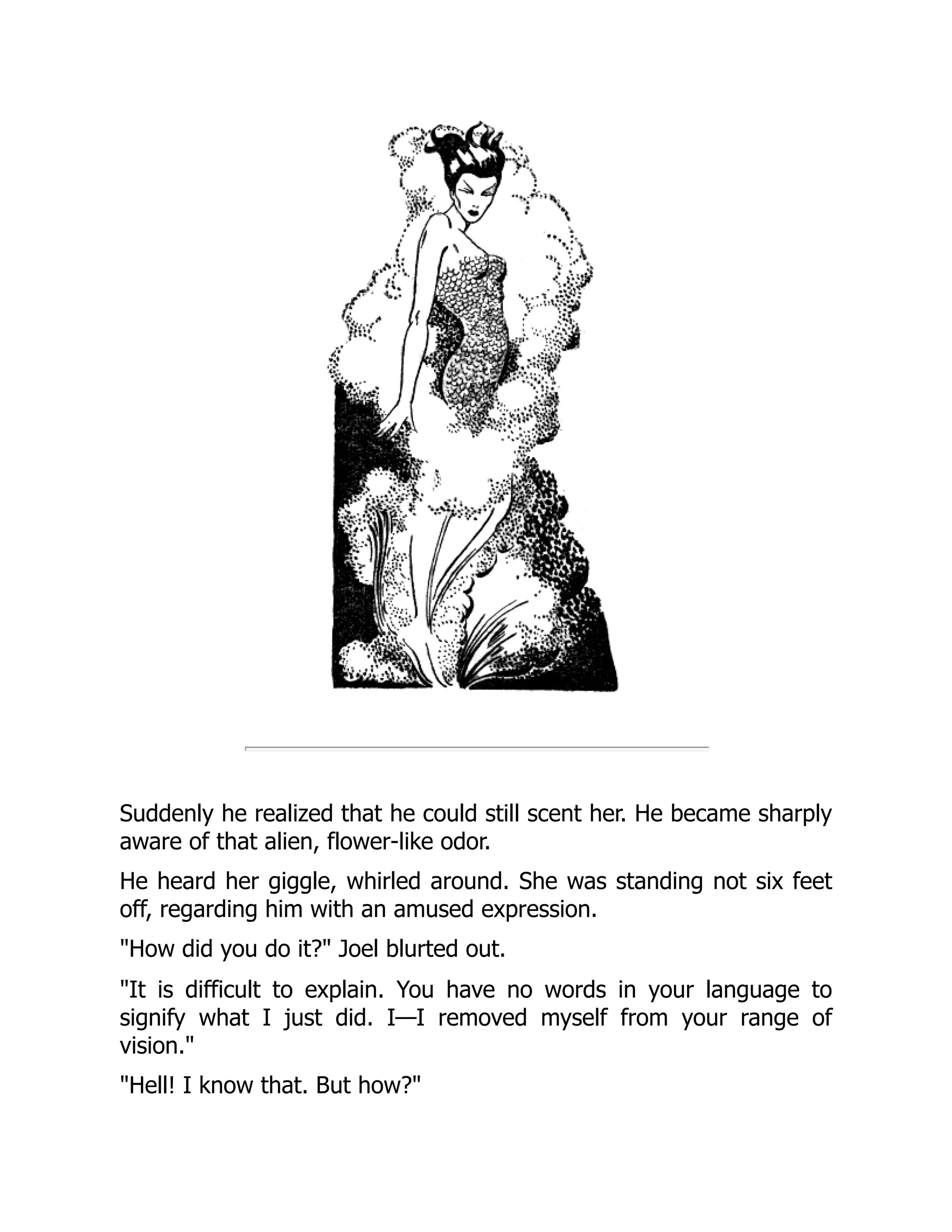
Suddenly he realizedthat he could still scent her. He became sharply
aware of that alien, flower-like odor.
He heard her giggle, whirled around. She was standing not six feet
off, regarding him with an amused expression.
"How did you do it?" Joel blurted out.
"It is difficult to explain. You have no words in your language to
signify what I just did. I—I removed myself from your range of
vision."
"Hell! I know that. But how?"
50.
She tapped herforehead again. "It's done with an understanding of
the nervous system."
Joel stared at her without any sign of comprehension.
"How can I make it clear?" she asked helplessly. "There are sounds
you can't hear because they extend beyond the range of human
ears. There are limits to your vision too. And I removed myself
beyond those limits."
He said, "Oh," continuing to regard her fixedly. Then, "You could
escape any time."
"Yes," she admitted. "But this is my job. I don't want to escape."
"What exactly is your job?" he demanded.
"Intelligence. There are many of us, both men and women disguised
as humans who circulate among the Unfit."
"Then—?" Joel prompted.
"Then we make our reports to the Thinkers."
"You've mentioned these Thinkers before. Who are they?"
"Our scientists. Our wise men." She paused, changed the subject
abruptly. "Today, Joel, we are to be sold."
"Damn!" He was appalled, remembering Priscilla Cameron's threat to
buy him.
"Joel," she went on earnestly, "you are one of us now. The Thinkers
have a job for you."
"For me?"
"Yes. Obviously Priscilla Cameron is interested in you, Joel. You must
play up to her. It's the first chance we've had to get a spy close to
Governor Cameron...."
"Hell, Tamis," he interrupted with an expression of distaste. "I can't
do that!"
51.
"But, Joel, youmust! Not even my people have been able to get into
the palace."
His green eyes quickened with interest. "Why not? They've been
able to insinuate themselves everywhere else."
Tamis shook her head. "We don't know! Dozens of Ganelons have
slipped into Governor Cameron's palace. For a while we continue to
receive their telepathic reports. Then nothing!"
He said: "Let me get this straight. The Ganelons have sent spies into
the palace and all of them have simply vanished?"
She nodded.
"But who detected them, if they were invisible?"
"We don't know. Oh, Joel, that's why it's so important for you to
obtain Priscilla Cameron's confidence. Women are—are indiscreet
with their lovers."
Joel looked shocked.
"But Joel, she'll buy you anyway! You'll have the run of the palace.
Slaves hear things and see things no one else can!"
She paused, saw him wavering, hurried on. "We're blind without
someone close to the governor. The Thinkers are worried. They're
holding off, afraid to give the word that'll start the revolt."
"How near is it?" he asked.
"We're ready to strike. The Unfit have stolen arms, built secret
laboratories in the jungle. But we don't dare go ahead until we find
out how much the governor knows. We may be blundering into a
trap."
Joel drew a deep breath. "All right," he agreed reluctantly, "I'll try.
How do I pass my information on—if I get any?"
52.
She looked relieved."The Thinkers will contact you."
A yell from outside their prison interrupted her. Somebody blew a
whistle. A chorus of shouts, muted by the thick walls, reached them
faintly.
Joel swung toward the door. The prisoners were all staring in that
direction too.
Nick Thorp scrambled to his feet, came over to Joel and Tamis.
"What's the fuss?"
Tamis shrugged naked ivory shoulders. She slipped into her
coveralls, a frown tugging at her eyebrows.
Suddenly a siren turned loose like a blast from the last trumpet. Joel
jumped involuntarily.
"Someone's escaped!" Tamis gasped.
The door burst open. Guards spilled into their prison. They wore
white shorts and tunics and carried paralyzers. The dapper colonel
was no longer jaunty. His face was red.
"Line up against the wall!" he shouted in a furious tone.
Joel fell into line beside Tamis and Thorp. The colonel opened the
muster, barked, "Allyn!"
"Here."
"Aus'l!"
"Here."
"Baden!"
"Here."
Through the open door, Joel could see a white uniformed guard
sprawled on the floor. Blood trickled from his mouth and nose and
the doctor was fussing over him.
The colonel reached the D's. Then he said, "Eriss."
53.
There was noanswer.
"Eriss!" he repeated. The silence was explosive. No one breathed.
Joel craned his neck, looked up and down the line. The shaggy ex-
surgeon was conspicuously absent!
The colonel swore. He turned on an under-officer at his elbow.
"That's the man!" he said savagely. "Get his dossier and put his
picture on the televisor immediately!"
The under-officer sprinted from the room, almost collided with a
man entering the prison. Joel saw that it was the guard who'd been
lying unconscious outside the door. His white uniform was blood-
spattered and he was holding a handkerchief to his nose.
The colonel caught sight of him at the same time, asked in a cold
voice, "What happened to you?"
The guard looked unhappy. "This fellow called me to the door. He
asked to see you."
"See me?"
"Yes, sir. He said some of the prisoners were planning to escape. He
wouldn't tell me about it. I was taking him to you...."
"Why did you let him out? Why didn't you send for me?" The
colonel's voice was brittle as ice.
"He acted frightened, sir. Said they would kill him if he wasn't taken
out."
"I see. Then he hit you. Is that it?"
"Yes, sir. As I was locking the door after him. I dropped the
paralyzer. He snatched it and turned it on me. I don't remember
anything else." The guard hesitated. "Did he get away, sir?"
"Yes. From the roof. Helicopter." The colonel turned on his heel,
marched from the room. The guards withdrew.
Joel could hear the wailing screams of sirens rising all over the city.
54.
"But where canhe escape to?" Joel asked.
Tamis gave him a sober glance, lowered her voice. "There are half a
dozen bands of escaped serfs in the jungle. My people have been
protecting them. He may be able to join them—if the nigel trees
don't get him first."
Thorp said, "Good riddance."
Joel didn't say anything. The ex-surgeon was a shrewd, brutal man.
He didn't think the nigel trees would be able to catch him.
The slave block was located in the principal square of Eden. Joel had
been escorted thither along with the other prisoners, stripped and
chained naked inside a long pavillion like the cattle sheds at a fair.
Streams of planters flowed through the pavillion, studying the
prisoners, discussing their good and bad points before bidding on
them. A good natured holiday air pervaded the throng. Alternately
Joel was white-lipped with fury and red with embarrassment at their
pointed observations.
All at once he stiffened, catching sight of Priscilla Cameron heading
straight for him through the crowd.
Joel flushed darkly. He had never disliked anyone with the passion
he felt for this girl with her defiant green hair, her slim cool
arrogance.
Tamis Ravitz was chained in the stall next to Joel. The Ganelon girl
leaned over and said, "Here she comes. Remember!"
"I see her. Who's the fellow with her?"
"General Roos. Fredrik Roos. He's head of the Asgardian Police."
Joel thought the police chief looked young and dashing in the white
Asgardian uniform. A tiny jeweled paralyzer was belted about his
waist.
55.
Welcome to ourwebsite – the ideal destination for book lovers and
knowledge seekers. With a mission to inspire endlessly, we offer a
vast collection of books, ranging from classic literary works to
specialized publications, self-development books, and children's
literature. Each book is a new journey of discovery, expanding
knowledge and enriching the soul of the reade
Our website is not just a platform for buying books, but a bridge
connecting readers to the timeless values of culture and wisdom. With
an elegant, user-friendly interface and an intelligent search system,
we are committed to providing a quick and convenient shopping
experience. Additionally, our special promotions and home delivery
services ensure that you save time and fully enjoy the joy of reading.
Let us accompany you on the journey of exploring knowledge and
personal growth!
ebookfinal.com


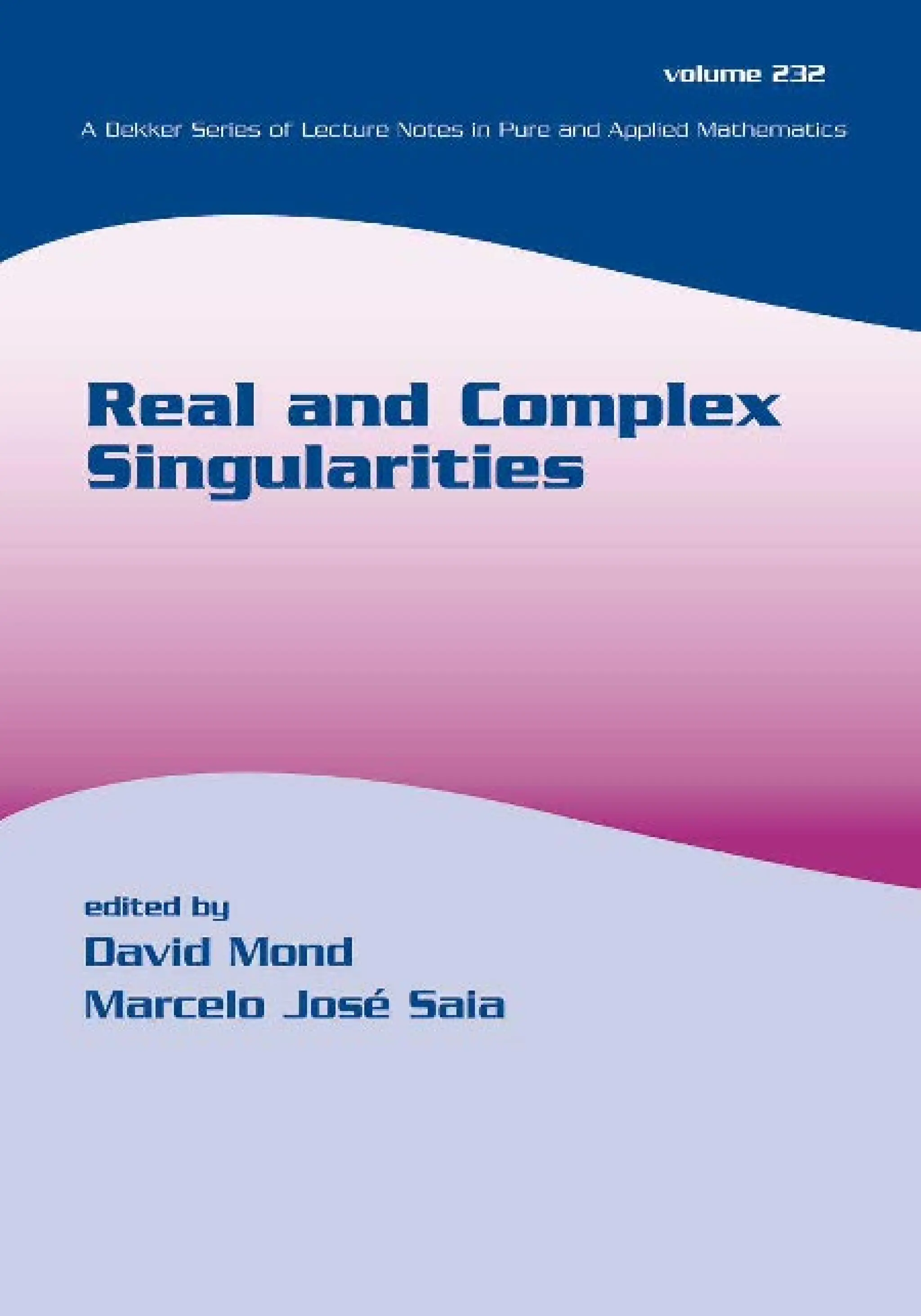






![Irreducible Plane Curve Singularities
ABRAMO HEFEZ Institute de Matematica, Universidade Federal Fluminense, R.
Mario Santos Braga s/n, 24020-140, Niteroi, R.J. Brasil. E-mail: hefez@mat.uff.br
To my parents from whom I learned the essence of life.
INTRODUCTION
The main objective of these notes is to introduce the reader to the local study of
singularities of plane curves from an algebraic point of view. This small book is a
kind oiformulaire where the working singularist can find the basic facts and formulas,
with their complete proofs, that exist in this context.
The subject, singularities of curves, has motivated for more than a century innu-
merable research work and is still a fertile field of investigation.
To motivate the framework in which we will place ourselves, suppose that a non-
constant polynomial f ( X , Y ) £(E[X,Y] is given and consider the algebraic complex
plane curve
C = CV = {(*,</) G(T2
; /(*,y)=0}.
The local study of the curve C in the neighborhood of a point P = (a, b) G C
depends whether the curve is regular or singular at P.
In case that C is regular at P, that is, when the partial derivatives fx and /y are
not simultaneously zero at P, say /y(P) 7^ 0, then the Implicit Function Theorem
tells us that in a neighborhood of P, wemay explicit Y in the relation f ( X , Y} = 0, as](https://image.slidesharecdn.com/75981-250416045917-b716576a/75/Real-And-Complex-Singularities-1st-Edition-David-Mond-22-2048.jpg)
![Hefez
a power series in X convergent in a neighborhood of a in(C. That is, in a neighborhood
of P, the curve C is the graph of an analytic function of one variable.
When C is singular at P. that is, when f ( P ) = fx (P] = f v ( P } = 0, Newton, in
his 1676 triangular correspondence with Leibniz via Oldenburg (see [5]), proposes a
solution for the problem expanding Y as a power series with fractional exponents in
X. The point of view of Xewton was purely formal without any concern about con-
vergence of series and without worrying about multivalued functions that appeal' in
this context, things that only later would be clarified by Riemann arid Puiseux. New-
ton's approach was constructive, giving an algorithm to determine such an expansion
using what is called nowadays Newton's polygon of the curve at P.
In 1850, M.V, Puiseux published a long article [11], where he studies from the point
of view of functions of a complex variable the solutions of the equation f ( X , Y) = 0,
where / is a polynomial function in two complex variables, in the neighborhood of an
arbitrary point. Puiseux succeeds to justify from an analytic point of view Newton's
manipulation on fractional exponents.
When the curve is regular, its behavior in a small neighborhood of P is entirely
known: it is locally isomorphic to the curve given by Y = 0.
When the point P is singular, the situation is quite different. Consider the
following examples, / = Y2
- X3
and g = Y2
- X2
(X + 1), where P = (0,0):
C c y
L
g
/
*
Figure 1
How to study a curve in a small neighborhood of a singular point? In particular,
how one could recognize algebraically the local reducibility of a singular curve, as for
example the above curve Cg at the point P = (0,0)? Certainly the ring Q[X, Y} is
not suitable for this purpose, since the polynomial g is irreducible in it. The idea
is to enlarge the ring (E[A", Y] in such a way that the local reducibility of Cg at P
appears. As a first attempt, we may consider the local ring
where Ai = (X, Y} is the maximal ideal of (D[X, Y], corresponding to the point
P = (0,0).
This is effectively a local ring, that is, a ring with a unique maximal ideal (in this
case, (X, Y)(£[X, Y ] M ) , which in a sense contains localized information at P — (0,0)
about all curves that contain P. Unfortunately, this is not sufficient since g is still](https://image.slidesharecdn.com/75981-250416045917-b716576a/75/Real-And-Complex-Singularities-1st-Edition-David-Mond-23-2048.jpg)
![Irreducible Plane Curve Singularities
irreducible in this ring. Another attempt is to complete the local ring (E[X, Y]M
respect to the topology associated to its maximal ideal, leading to the ring of formal
power series in two variables (K[[X, Y}}, where finally g splits into two irreducible
factors as follows:
g = (Y 4- X + terms of degree > 2)(F - X + terms of degree > 2).
It is in this ring that we get all infinitesimal algebraic information about an
algebraic curve at the point P = (0,0). In this way we retake Newton's point of view,
going back to the origins.
This book is a compilation of results of many mathematicians, starting in the
seventeenth century with Isaac Newton, passing through the nineteenth century with
the contribution of K. Weierstrass, M.V. Puiseux and M. Noether and ending in the
twentieth century with the contribution of O. Zariski, S.S. Abhyankar, R. Apery and
A. Azevedo, among many others. The reader interested in more modern material is
invited to consult [8].
The book is divided into eight chapters, which we describe below.
In Chapter 1, we introduce the rings of formal power series studying their units
and automorphisms. We end the chapter with the fundamental Hensel's Lemma.
In Chapter 2, we study the Weierstrass Preparation Theorem that reduces the
study of formal power series to that of certain polynomials. Most algebraic properties
of the rings of formal power series are deduced from this Theorem. We also include,
for the convenience of the reader, a section on elimination whose results will be used
essentially in Chapter 4.
In Chapter 3, we introduce our main object of study, the algebroid irreducible
plane curves or plane branches, and study their parametrization given by the Newton-
Puiseux Theorem. This theorem is a fundamental tool for the study of plane branches
defined over fields of characteristic zero. At the end of the chapter, we discuss some
properties of germs of plane analytic curves.
In Chapter 4, we introduce the local ring of a plane branch, studying some of
its properties. In the sequel we make a parenthetical presentation of some results in
Linear Algebra that will be essential for what will follow. After this, we define the
intersection index of two curves at a point and deduce its properties, showing several
ways it may be computed.
Chapter 5 is dedicated to the resolution of singularities of irreducible algebroid
plane curves by means of a sequence of quadratic transformations. In this way, we
get a finite sequence of multiplicities associated to these successive transforms of
the singularity, called the multiplicity sequence of the singularity and leading to the
notion of equiresolubility. At the end of the chapter we establish a formula due to Max
Noether that relates the intersection index of two curves with that of their quadratic
transforms.
In Chapter 6, we introduce the semigroup of values associated to a plane branch.
This is a semigroup of natural numbers with conductor and it is an important arith-
metic invariant associated to the branch, leading to the notion of equisingularity due
to Zariski. It is shown that equiresolubility and equisingularity for plane branches
are equivalent. We also show that the characteristic integers associated to a Puiseux
parametrization of the curve we introduced in Chapter 3 characterize as well the
equisingularity classes.](https://image.slidesharecdn.com/75981-250416045917-b716576a/75/Real-And-Complex-Singularities-1st-Edition-David-Mond-24-2048.jpg)
![4 Hefez
In Chapter 7, we study some arithmetic associated to the sub-semigroups of the
natural numbers. We explore the notion of strongly increasing semigroup and intro-
duce the concept of symmetric semigroup, properties that are shared by the semi-
groups of values of plane branches. At the end of the chapter we apply these notions
to branches, relating Milnor's number introduced in [10] to the conductor of the
semigroup of the branch.
Finally, in Chapter 8 we study the contact among two plane branches and show-
how the intersection index of two such branches can be also computed by their Puiseux
expansions. We also describe all possible intersection indices two curves, each belong-
ing to a given equisingularity class. Finally, we discuss briefly the notion of maximal
contact among branches.
Along these notes, to refer to a certain result, we use the convention that the
numbers that appear after the words Theorem, Proposition, etc., indicate first the
number of the chapter and then the relative position of the result in the chapter. To
the problems are associated three numbers which represent in order, the chapter, the
section and the number of the problem itself.
I would like to thank the Organizing Committee of the Workshop for the invitation
to teach this mini-course and subsequently the Editors of this volume for inviting me
to publish these notes. Finally, it is a pleasure to thank M.E. Hernandes and V. Bayer
for sharing my interest on the subject and for reading carefully an early version of
the manuscript.](https://image.slidesharecdn.com/75981-250416045917-b716576a/75/Real-And-Complex-Singularities-1st-Edition-David-Mond-25-2048.jpg)