Authors:
Bernard Pinglier
Kai Salas Rossenbach
Emmanuelle Bryas
Amala Marx
Federico Nurra
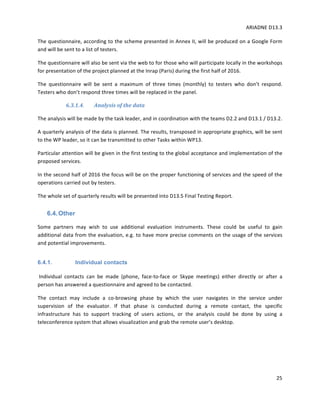
INRAP
Ariadne is funded by the European Commission’s
7th Framework Programme.
D13.3: Infrastructure services testing report
ARIADNE	D13.3	(Public)	


ARIADNE	is	a	project	funded	by	the	European	Commission	under	the	Community’s	Seventh	
Framework	Programme,	contract	no.	FP7-INFRASTRUCTURES-2012-1-313193.	The	views	and	
opinions	 expressed	 in	 this	 report	 are	 the	 sole	 responsibility	 of	 the	 authors	 and	 do	 not	
necessarily	reflect	the	views	of	the	European	Commission.	
Version:	1.0	(final)	 		11th
		January	2016	
Authors:	 Bernard	Pinglier	
Kai	Salas	Rossenbach	
Emmanuelle	Bryas	
Amala	Marx	
Federico	Nurra	
INRAP		
Contributing	Partners	 		Roberto	Scopigno,	CNR-ISTI	
		Matteo	Dellepiane,	CNR-ISTI	
		Holly	Wright,	ADS
ARIADNE	D13.3			
	
	
3	
Table of Contents	
1. Document	History	.......................................................................................................	5
2. Introduction	................................................................................................................	6
3. Related	Work	..............................................................................................................	8
3.1. User	Requirements	(D12.1)	........................................................................................................	8
3.2. Service	Design	(D13.1)	................................................................................................................	8
3.3. Second	report	on	users'	needs	(D2.2)	........................................................................................	8
3.4. Infrastructure	Design	(D12.2)	.....................................................................................................	9
4. Overview	of	design,	use	requirements	and	users'	specifications	..................................	9
5. Services	to	be	evaluated	............................................................................................	13
5.1. Ariadne	Portal	..........................................................................................................................	13
5.2. Services	provided	on	the	Ariadne	Catalogue	...........................................................................	13
5.2.1. Catalogue	search	................................................................................................................................	14
5.2.2. Spatial	search	and	display	...................................................................................................................	15
5.2.3. Timeline	search	and	display	................................................................................................................	17
5.3. Other	Services	created	within	the	ARIADNE	Project	................................................................	17
5.3.1. Visual	Media	Services	.........................................................................................................................	17
5.3.2. Visual	Media	in	archaeological	collections	.........................................................................................	19
5.3.3. Landscape	Services	.............................................................................................................................	20
5.4. Other	Services	provided	“as	is”	by	partners	.............................................................................	21
5.4.1. Data	Deposit	and	Preservation	Services	.............................................................................................	21
6. Methodology	used	for	evaluation	..............................................................................	22
6.1. Scope	of	the	testing	..................................................................................................................	22
6.2. General	aspects	on	methodology	.............................................................................................	22
6.3. Testing	scenarios	......................................................................................................................	22
ARIADNE	D13.3			
	
	
4	
6.3.1. Evaluation	questionnaires	..................................................................................................................	24
6.4. Other	........................................................................................................................................	25
6.4.1. Individual	contacts	..............................................................................................................................	25
6.4.2. Group	sessions	....................................................................................................................................	26
6.5. Feedback	to	the	implementation	teams	..................................................................................	26
6.6. Agenda	.....................................................................................................................................	26
6.6.1. Testing	of	individual	services	..............................................................................................................	26
6.6.2. Overall	testing	.....................................................................................................................................	27
6.7. Technical	infrastructure	issues	.................................................................................................	27
7. First	evaluation	results	..............................................................................................	27
7.1. Visual	Media	Services	...............................................................................................................	27
8. Conclusions	...............................................................................................................	27
9. References	................................................................................................................	28
10. Table	of	figures	..........................................................................................................	28
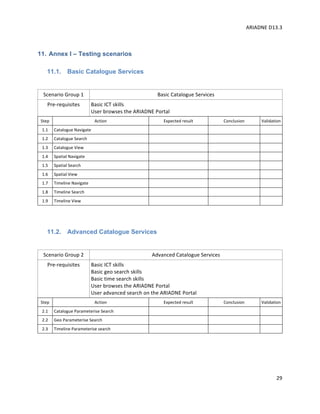
11. Annex	I	–	Testing	scenarios	........................................................................................	29
11.1. Basic	Catalogue	Services	..........................................................................................................	29
11.2. Advanced	Catalogue	Services	...................................................................................................	29
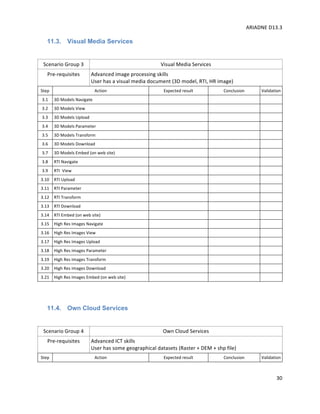
11.3. Visual	Media	Services	...............................................................................................................	30
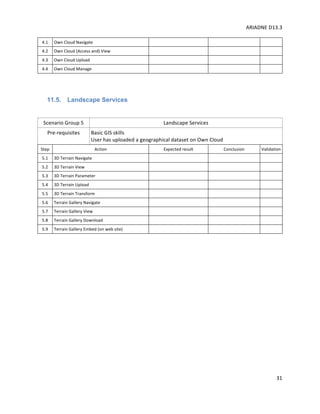
11.4. Own	Cloud	Services	..................................................................................................................	30
11.5. Landscape	Services	...................................................................................................................	31
12. Annex	II	–	Prototype	questionnaire	for	the	evaluation	of	the	ARIADNE	Services	........	32
ARIADNE	D13.3			
	
	
5	
1. Document History
Version	 Date	 Contributors	 Activity	
0.1	 July	29th
	2015	 Bernard	Pinglier	 Draft	structure	of	document	
0.2	 November	17th
	2015	 Roberto	Scopigno,	
Matteo	Dellepiane	
Review	
Proposed	structure	questionnaire	
Visual	Media	Service	
0.3	 December	11th
	2015	 Federico	Nurra	
Kai	Salas	Rossenbach	
Amala	Marx	
Emmanuelle	Bryas	
Added	Images		
Added	References	
Modified	Tables	
Added	test	prototype	
0.3.1	 December	18th
	2015	 Holly	Wright	 Quality	Control	
1.0	 January	11th
	2016	 Federico	Nurra	
	
Added	Captions	
Added	Table	of	Figures	
Final	editing
ARIADNE	D13.3			
	
	
6	
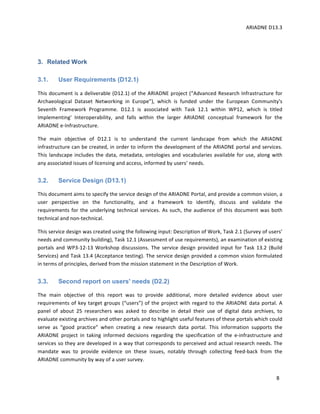
2. Introduction
This	deliverable	D13.3	presents	the	initial	results	of	Task	13.4	(T13.4),	which	is	part	of	Work	Package	13	
(WP13)	in	the	ARIADNE	Project.			
As	stated	in	the	Description	of	Work	(DoW)	of	the	ARIADNE	Project,	the	main	objectives	of	WP13	are:		
• To	 analyse,	 select,	 design	 and	 deploy	 the	 service	 components	 of	 the	 integrated	 infrastructure	 in	 order	 to	
improve	the	provision	of	the	online	services	to	the	researchers	
• To	take	into	account	in	the	design	and	the	deployment	further	enhancements	of	the	service	architecture	as	
required	by	the	additional	implementation	of	results	from	WP14-WP17	
	
The	tasks	of	the	WP13	are:	
Task	13.1	–	Service	Design	and	Specifications	
Task	13.2	–	Service	Implementation	
Task	13.3	–	Long-term	Preservation	Services	
Task	13.4	–	Acceptance	Testing	
The	Task	will	be	in	charge	of	testing	the	services	produced	in	Task	13.2	and	verify	their	correspondence	to	
design	(Task	13.1),	use	requirements	(Task	12.1)	and	users’	specifications	(Task	2.1	and	Task	2.2).	New	or	
improved	 services	 may	 be	 approved	 and	 passed	 to	 the	 next	 Task	 or	 returned	 to	 13.2	 for	 amendments.	
Testing	will	be	carried	out	on	a	specific	testing	environment	prepared	by	the	partners	in	charge	of	the	task.	
They	 will	 set	 up	 a	 number	 of	 simulated	 research	 contexts,	 relevant	 for	 archaeological	 research,	 and	 will	
compare	the	behaviour	of	the	system	with	the	expected	one.	They	will	furthermore	verify	overall	compliance	
with	 requirements	 and	 the	 performance	 of	 the	 system	 in	 simulated	 real	 conditions.	 Such	 tests	 will	 be	
performed	 regularly.	 Their	 outcomes	 will	 be	 reported	 to	 the	 lead	 partner	 of	 Task	 13.2	 for	 the	 necessary	
feedback.	The	testing	specifications	and	the	routine	testing	mechanism	will	be	detailed	in	Task	13.1.
ARIADNE	D13.3			
	
	
7	
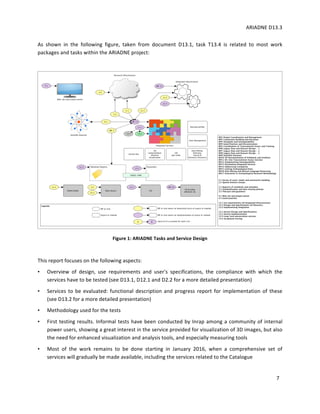
As	 shown	 in	 the	 following	 figure,	 taken	 from	 document	 D13.1,	 task	 T13.4	 is	 related	 to	 most	 work	
packages	and	tasks	within	the	ARIADNE	project:		
	
	
Figure	1:	ARIADNE	Tasks	and	Service	Design	
	
This	report	focuses	on	the	following	aspects:	
• Overview	 of	 design,	 use	 requirements	 and	 user's	 specifications,	 the	 compliance	 with	 which	 the	
services	have	to	be	tested	(see	D13.1,	D12.1	and	D2.2	for	a	more	detailed	presentation)	
• Services	to	be	evaluated:	functional	description	and	progress	report	for	implementation	of	these	
(see	D13.2	for	a	more	detailed	presentation)	
• Methodology	used	for	the	tests	
• First	testing	results.	Informal	tests	have	been	conducted	by	Inrap	among	a	community	of	internal	
power	users,	showing	a	great	interest	in	the	service	provided	for	visualization	of	3D	images,	but	also	
the	need	for	enhanced	visualization	and	analysis	tools,	and	especially	measuring	tools	
• Most	 of	 the	 work	 remains	 to	 be	 done	 starting	 in	 January	 2016,	 when	 a	 comprehensive	 set	 of	
services	will	gradually	be	made	available,	including	the	services	related	to	the	Catalogue
ARIADNE	D13.3			
	
	
8	
	
3. Related Work
3.1. User Requirements (D12.1)
This	document	is	a	deliverable	(D12.1)	of	the	ARIADNE	project	(“Advanced	Research	Infrastructure	for	
Archaeological	 Dataset	 Networking	 in	 Europe”),	 which	 is	 funded	 under	 the	 European	 Community's	
Seventh	 Framework	 Programme.	 D12.1	 is	 associated	 with	 Task	 12.1	 within	 WP12,	 which	 is	 titled	
Implementing'	 Interoperability,	 and	 falls	 within	 the	 larger	 ARIADNE	 conceptual	 framework	 for	 the	
ARIADNE	e-Infrastructure.	
The	 main	 objective	 of	 D12.1	 is	 to	 understand	 the	 current	 landscape	 from	 which	 the	 ARIADNE	
infrastructure	can	be	created,	in	order	to	inform	the	development	of	the	ARIADNE	portal	and	services.	
This	landscape	includes	the	data,	metadata,	ontologies	and	vocabularies	available	for	use,	along	with	
any	associated	issues	of	licensing	and	access,	informed	by	users’	needs.	
3.2. Service Design (D13.1)
This	document	aims	to	specify	the	service	design	of	the	ARIADNE	Portal,	and	provide	a	common	vision,	a	
user	 perspective	 on	 the	 functionality,	 and	 a	 framework	 to	 identify,	 discuss	 and	 validate	 the	
requirements	for	the	underlying	technical	services.	As	such,	the	audience	of	this	document	was	both	
technical	and	non-technical.	
This	service	design	was	created	using	the	following	input:	Description	of	Work,	Task	2.1	(Survey	of	users’	
needs	and	community	building),	Task	12.1	(Assessment	of	use	requirements),	an	examination	of	existing	
portals	and	WP3-12-13	Workshop	discussions.	The	service	design	provided	input	for	Task	13.2	(Build	
Services)	and	Task	13.4	(Acceptance	testing).	The	service	design	provided	a	common	vision	formulated	
in	terms	of	principles,	derived	from	the	mission	statement	in	the	Description	of	Work.	
3.3. Second report on users' needs (D2.2)
The	 main	 objective	 of	 this	 report	 was	 to	 provide	 additional,	 more	 detailed	 evidence	 about	 user	
requirements	of	key	target	groups	(“users”)	of	the	project	with	regard	to	the	ARIADNE	data	portal.	A	
panel	 of	 about	 25	 researchers	 was	 asked	 to	 describe	 in	 detail	 their	 use	 of	 digital	 data	 archives,	 to	
evaluate	existing	archives	and	other	portals	and	to	highlight	useful	features	of	these	portals	which	could	
serve	 as	 “good	 practice”	 when	 creating	 a	 new	 research	 data	 portal.	 This	 information	 supports	 the	
ARIADNE	 project	 in	 taking	 informed	 decisions	 regarding	 the	 specification	 of	 the	 e-infrastructure	 and	
services	so	they	are	developed	in	a	way	that	corresponds	to	perceived	and	actual	research	needs.	The	
mandate	 was	 to	 provide	 evidence	 on	 these	 issues,	 notably	 through	 collecting	 feed-back	 from	 the	
ARIADNE	community	by	way	of	a	user	survey.
ARIADNE	D13.3			
	
	
9	
	
3.4. Infrastructure Design (D12.2)
The	 main	 goal	 of	 Task	 12.2	 is	 to	 specify	 a	 resource	 integration	 and	 discovery	 mechanism	 for	 use	 in	
ARIADNE.		The	resources	to	be	integrated	are	datasets	and	collections,	GIS	data,	metadata	schemas,	
ontologies	 and	 vocabularies	 available	 from	 the	 project	 partners,	 as	 well	 as	 institutions	 outside	 the	
ARIADNE	consortium.	This	deliverable	provides	an	overview	of	the	ARIADNE	architecture,	including	a	
summary	 of	 the	 conformance	 of	 the	 architecture	 to	 the	 data	 and	 standards	 requirements	 set	 out	 in	
D12.1,	as	well	as	to	the	specifications	of	the	Services	of	the	ARIADNE	Infrastructure,	presented	in	D13.1.		
This	is	followed	by	a	content	analysis	of	the	main	content	types	defined	in	D12.1,	and	the	integration	
strategy	for	the	two	levels	of	content:		the	metadata	integration,	and	the	data	integration.		This	will	
attempt	 to	 integrate	 selected	 resources	 	 (datasets	 and/or	 metadata)	 from	 particular	 partners/data	
providers	 and	 provide	 cross-search	 and	 access	 mechanisms	 to	 integrated	 resources,	 using	 a	 facetted	
search	on	“what”,	“where”,	“when”	and	“resource	type”.				
4. Overview of design, use requirements and users' specifications
The	users'	needs	are	summarized	as	follows,	derived	from	D2.2:		
1.	Overall	focus	of	the	ARIADNE	project	is	on	data	discovery	and	access	services.		
2.	The	primary	focus	of	the	design	and	interfaces	of	the	data	portal	should	be	an	overview	of	what	data	
is	 accessible,	 including	 statistical	 information	 on	 quantity,	 types,	 and	 distribution	 (e.g.	 country/area,	
period).		
3.	The	portal	should	focus	on	the	European/international	dimension.	Lack	of	underlying	resources	(per	
country,	type	of	data,	etc.)	should	not	be	seen	as	a	deficit,	but	used	to	promote	data	mobilization	(e.g.	
implementation	of	national	data	archives).		
4.	Added	value	should	also	be	created	through	linking	data	and	publication	resources	not	held	within	
the	ARIADNE	Registry	(e.g.	metadata	of	document	archives	and	open	access	publishers).		
5.	 Linked	 Open	 Data	 (LOD)	 can	 play	 a	 core	 role	 for	 value	 generation,	 but	 further	 uptake	 of	 LOD	
principles	by	archaeological	institutions	and	projects	must	be	encouraged.		
6.	In	the	development	of	the	data	search,	access	and	other	services,	members	of	the	user	community	
must	 be	 thoroughly	 involved	 and	 regular	 feedback	 on	 implemented	 solutions	 sought	 by	 the	 wider	
community.		
7.	 User-focused	 development	 of	 the	 portal	 services	 and	 applications	 (relevance,	 usability,	 user-
friendliness)	should	be	at	the	top	of	the	project’s	priorities.
ARIADNE	D13.3			
	
	
10	
8.	 Services	 for	 websites	 for	 research	 communities	 in	 particular	 subjects	 or	 geographic	 regions	 (e.g.	
alerts	 on	 relevant	 datasets)	 could	 greatly	 expand	 the	 reach	 of	 the	 data	 portal	 and,	 in	 turn,	 promote	
further	data	mobilization.		
9.	Full	exploitation	of	the	data	resources	(incl.	metadata,	conceptual	knowledge)	should	be	enabled	by	
interfaces	for	external	applications	(e.g.	a	well-documented	API,	OAI-PMH	target,	SPARQL	endpoint).		
10.	Support	of	e-research/science	should,	in	the	first	instance,	be	provided	through	integrating	access	to	
data	resources	and	by	pointing	users	to	existing	tools	for	data	extraction,	processing	and	analysis.		
	
The	 use	 requirements	 (D12.1)	 refer	 to	 the	 requirements	 for	 the	 design	 and	 specification	 of	 the	
subsequent	tools	and	services	necessary	for	integration.	D12.1	produces	recommendations	for	Datasets;	
Metadata	Standards,	Schemas	and	Vocabularies;	and	Access	and	Sharing	Policies.	
Datasets		
• Site	 and	 monument	 databases:	 Most	 European	 countries	 and/or	 regions	 have	 them,	 and	
combining	them	may	be	useful	for	cross-border	searching	and	geo-location		
• Intervention	activity:	May	have	multiple	activities	associated	with	a	geo-locatable	site,	which	may	
allow	linking	of	various	activities	to	a	single	site	or	monument		
• Fieldwork	databases:	Usually	too	diverse,	so	individual	databases	may	not	be	useful	for	integration,	
but	may	be	worth	linking	to	intervention	activities	for	bibliographic	discovery		
• Other	categories	are	quite	specific,	but	may	be	useful	for	integration:		
o Scientific	Databases		
o Artefact	Databases		
o Burial	Databases		
	
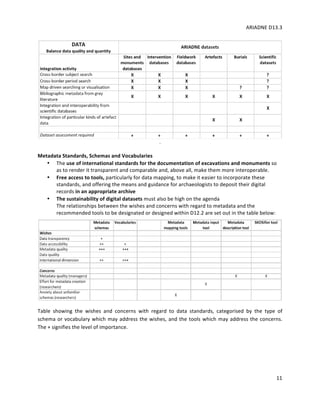
Balance	 data	 quality	 and	 quantity:	 specify	 requirements	 that	 datasets	 have	 to	 meet	 in	 order	 to	 be	
integrated,	preferably	using	formal	criteria.		
The	 relationships	 between	 the	 types	 of	 data	 available	 from	 the	 content	 providing	 partners	 and	 the	
recommended	integration	activity	to	be	designed	within	D12.2	are	set	out	in	the	table	below.
ARIADNE	D13.3			
	
	
11	
.	
		
Metadata	Standards,	Schemas	and	Vocabularies		
• The	use	of	international	standards	for	the	documentation	of	excavations	and	monuments	so	
as	to	render	it	transparent	and	comparable	and,	above	all,	make	them	more	interoperable.	
• Free	access	to	tools,	particularly	for	data	mapping,	to	make	it	easier	to	incorporate	these	
standards,	and	offering	the	means	and	guidance	for	archaeologists	to	deposit	their	digital	
records	in	an	appropriate	archive	
• The	sustainability	of	digital	datasets	must	also	be	high	on	the	agenda		
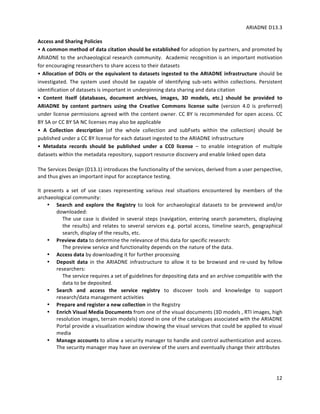
The	relationships	between	the	wishes	and	concerns	with	regard	to	metadata	and	the	
recommended	tools	to	be	designated	or	designed	within	D12.2	are	set	out	in	the	table	below:		
Table	 showing	 the	 wishes	 and	 concerns	 with	 regard	 to	 data	 standards,	 categorised	 by	 the	 type	 of	
schema	or	vocabulary	which	may	address	the	wishes,	and	the	tools	which	may	address	the	concerns.	
The	+	signifies	the	level	of	importance.
ARIADNE	D13.3			
	
	
12	
Access	and	Sharing	Policies		
•	A	common	method	of	data	citation	should	be	established	for	adoption	by	partners,	and	promoted	by	
ARIADNE	to	the	archaeological	research	community.		Academic	recognition	is	an	important	motivation	
for	encouraging	researchers	to	share	access	to	their	datasets		
•	Allocation	of	DOIs	or	the	equivalent	to	datasets	ingested	to	the	ARIADNE	infrastructure	should	be	
investigated.	The	system	used	should	be	capable	of	identifying	sub-sets	within	collections.	Persistent	
identification	of	datasets	is	important	in	underpinning	data	sharing	and	data	citation		
•	 Content	 itself	 (databases,	 document	 archives,	 images,	 3D	 models,	 etc.)	 should	 be	 provided	 to	
ARIADNE	 by	 content	 partners	 using	 the	 Creative	 Commons	 license	 suite	 (version	 4.0	 is	 preferred)	
under	license	permissions	agreed	with	the	content	owner.	CC	BY	is	recommended	for	open	access.	CC	
BY	SA	or	CC	BY	SA	NC	licenses	may	also	be	applicable	
•	 A	 Collection	 description	 (of	 the	 whole	 collection	 and	 subFsets	 within	 the	 collection)	 should	 be	
published	under	a	CC	BY	license	for	each	dataset	ingested	to	the	ARIADNE	infrastructure		
•	 Metadata	 records	 should	 be	 published	 under	 a	 CC0	 license	 –	 to	 enable	 integration	 of	 multiple	
datasets	within	the	metadata	repository,	support	resource	discovery	and	enable	linked	open	data		
	
The	Services	Design	(D13.1)	introduces	the	functionality	of	the	services,	derived	from	a	user	perspective,	
and	thus	gives	an	important	input	for	acceptance	testing.		
	
It	 presents	 a	 set	 of	 use	 cases	 representing	 various	 real	 situations	 encountered	 by	 members	 of	 the	
archaeological	community:		
• Search	 and	 explore	 the	 Registry	 to	 look	 for	 archaeological	 datasets	 to	 be	 previewed	 and/or	
downloaded:	
The	use	case	is	divided	in	several	steps	(navigation,	entering	search	parameters,	displaying	
the	results)	and	relates	to	several	services	e.g.	portal	access,	timeline	search,	geographical	
search,	display	of	the	results,	etc.		
• Preview	data	to	determine	the	relevance	of	this	data	for	specific	research:	
The	preview	service	and	functionality	depends	on	the	nature	of	the	data.			
• Access	data	by	downloading	it	for	further	processing		
• Deposit	 data	 in	 the	 ARIADNE	 infrastructure	 to	 allow	 it	 to	 be	 browsed	 and	 re-used	 by	 fellow	
researchers:		
The	service	requires	a	set	of	guidelines	for	depositing	data	and	an	archive	compatible	with	the	
data	to	be	deposited.		
• Search	 and	 access	 the	 service	 registry	 to	 discover	 tools	 and	 knowledge	 to	 support	
research/data	management	activities		
• Prepare	and	register	a	new	collection	in	the	Registry		
• Enrich	Visual	Media	Documents	from	one	of	the	visual	documents	(3D	models	,	RTI	images,	high	
resolution	images,	terrain	models)	stored	in	one	of	the	catalogues	associated	with	the	ARIADNE	
Portal	provide	a	visualization	window	showing	the	visual	services	that	could	be	applied	to	visual	
media	
• Manage	accounts	to	allow	a	security	manager	to	handle	and	control	authentication	and	access.	
The	security	manager	may	have	an	overview	of	the	users	and	eventually	change	their	attributes
ARIADNE	D13.3			
	
	
13	
5. Services to be evaluated
This	section	gives	an	overview	of	the	services	to	be	evaluated,	as	they	exist	to	date.	More	details	can	be	
found	in	document	D13.2	(Initial	Services	Implementation	Report).	
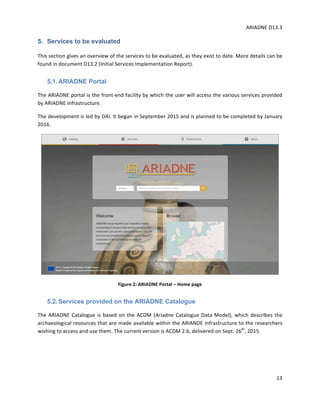
5.1.ARIADNE Portal
The	ARIADNE	portal	is	the	front-end	facility	by	which	the	user	will	access	the	various	services	provided	
by	ARIADNE	infrastructure.		
The	development	is	led	by	DAI.	It	began	in	September	2015	and	is	planned	to	be	completed	by	January	
2016.		
	
Figure	2:	ARIADNE	Portal	–	Home	page	
5.2.Services provided on the ARIADNE Catalogue
The	ARIADNE	Catalogue	is	based	on	the	ACDM	(Ariadne	Catalogue	Data	Model),	which	describes	the	
archaeological	resources	that	are	made	available	within	the	ARIANDE	infrastructure	to	the	researchers	
wishing	to	access	and	use	them.	The	current	version	is	ACDM	2.6,	delivered	on	Sept.	26th
,	2015.
ARIADNE	D13.3			
	
	
14	
5.2.1. Catalogue search
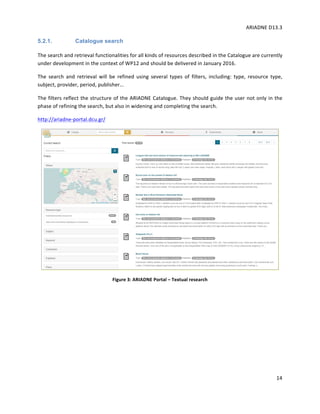
The	search	and	retrieval	functionalities	for	all	kinds	of	resources	described	in	the	Catalogue	are	currently	
under	development	in	the	context	of	WP12	and	should	be	delivered	in	January	2016.		
The	 search	 and	 retrieval	 will	 be	 refined	 using	 several	 types	 of	 filters,	 including:	 type,	 resource	 type,	
subject,	provider,	period,	publisher...	
The	filters	reflect	the	structure	of	the	ARIADNE	Catalogue.	They	should	guide	the	user	not	only	in	the	
phase	of	refining	the	search,	but	also	in	widening	and	completing	the	search.	
http://ariadne-portal.dcu.gr/	
	
Figure	3:	ARIADNE	Portal	–	Textual	research
ARIADNE	D13.3			
	
	
15	
	
	
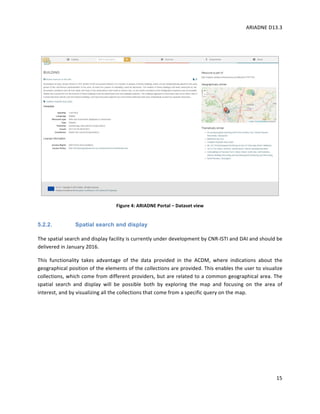
Figure	4:	ARIADNE	Portal	–	Dataset	view	
5.2.2. Spatial search and display
The	spatial	search	and	display	facility	is	currently	under	development	by	CNR-ISTI	and	DAI	and	should	be	
delivered	in	January	2016.		
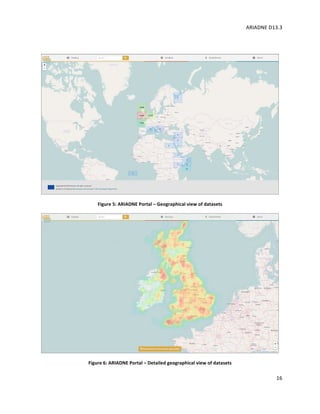
This	 functionality	 takes	 advantage	 of	 the	 data	 provided	 in	 the	 ACDM,	 where	 indications	 about	 the	
geographical	position	of	the	elements	of	the	collections	are	provided.	This	enables	the	user	to	visualize	
collections,	which	come	from	different	providers,	but	are	related	to	a	common	geographical	area.	The	
spatial	 search	 and	 display	 will	 be	 possible	 both	 by	 exploring	 the	 map	 and	 focusing	 on	 the	 area	 of	
interest,	and	by	visualizing	all	the	collections	that	come	from	a	specific	query	on	the	map.
ARIADNE	D13.3			
	
	
16	
	
	
Figure	5:	ARIADNE	Portal	–	Geographical	view	of	datasets	
	
Figure	6:	ARIADNE	Portal	–	Detailed	geographical	view	of	datasets
ARIADNE	D13.3			
	
	
17	
5.2.3. Timeline search and display
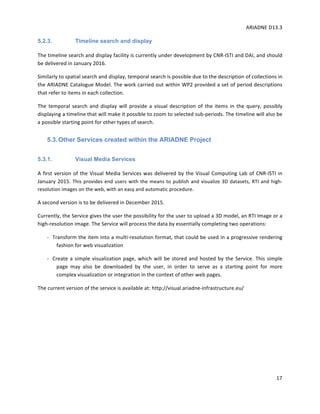
The	timeline	search	and	display	facility	is	currently	under	development	by	CNR-ISTI	and	DAI,	and	should	
be	delivered	in	January	2016.		
Similarly	to	spatial	search	and	display,	temporal	search	is	possible	due	to	the	description	of	collections	in	
the	ARIADNE	Catalogue	Model.	The	work	carried	out	within	WP2	provided	a	set	of	period	descriptions	
that	refer	to	items	in	each	collection.	
The	 temporal	 search	 and	 display	 will	 provide	 a	 visual	 description	 of	 the	 items	 in	 the	 query,	 possibly	
displaying	a	timeline	that	will	make	it	possible	to	zoom	to	selected	sub-periods.	The	timeline	will	also	be	
a	possible	starting	point	for	other	types	of	search.	
5.3.Other Services created within the ARIADNE Project
5.3.1. Visual Media Services
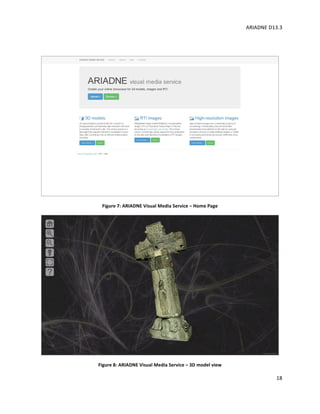
A	first	version	of	the	Visual	Media	Services	was	delivered	by	the	Visual	Computing	Lab	of	CNR-ISTI	in	
January	2015.	This	provides	end	users	with	the	means	to	publish	and	visualize	3D	datasets,	RTI	and	high-
resolution	images	on	the	web,	with	an	easy	and	automatic	procedure.		
A	second	version	is	to	be	delivered	in	December	2015.	
Currently,	the	Service	gives	the	user	the	possibility	for	the	user	to	upload	a	3D	model,	an	RTI	Image	or	a	
high-resolution	image.	The	Service	will	process	the	data	by	essentially	completing	two	operations:	
- Transform	the	item	into	a	multi-resolution	format,	that	could	be	used	in	a	progressive	rendering	
fashion	for	web	visualization	
- Create	a	simple	visualization	page,	which	will	be	stored	and	hosted	by	the	Service.	This	simple	
page	 may	 also	 be	 downloaded	 by	 the	 user,	 in	 order	 to	 serve	 as	 a	 starting	 point	 for	 more	
complex	visualization	or	integration	in	the	context	of	other	web	pages.	
The	current	version	of	the	service	is	available	at:	http://visual.ariadne-infrastructure.eu/
ARIADNE	D13.3			
	
	
18	
	
	
Figure	7:	ARIADNE	Visual	Media	Service	–	Home	Page	
	
Figure	8:	ARIADNE	Visual	Media	Service	–	3D	model	view
ARIADNE	D13.3			
	
	
19	
5.3.2. Visual Media in archaeological collections
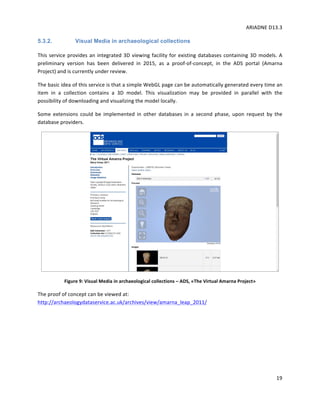
This	service	provides	an	integrated	3D	viewing	facility	for	existing	databases	containing	3D	models.	A	
preliminary	 version	 has	 been	 delivered	 in	 2015,	 as	 a	 proof-of-concept,	 in	 the	 ADS	 portal	 (Amarna	
Project)	and	is	currently	under	review.		
The	basic	idea	of	this	service	is	that	a	simple	WebGL	page	can	be	automatically	generated	every	time	an	
item	 in	 a	 collection	 contains	 a	 3D	 model.	 This	 visualization	 may	 be	 provided	 in	 parallel	 with	 the	
possibility	of	downloading	and	visualizing	the	model	locally.	
Some	 extensions	 could	 be	 implemented	 in	 other	 databases	 in	 a	 second	 phase,	 upon	 request	 by	 the	
database	providers.	
	
Figure	9:	Visual	Media	in	archaeological	collections	–	ADS,	«The	Virtual	Amarna	Project»	
The	proof	of	concept	can	be	viewed	at:		
http://archaeologydataservice.ac.uk/archives/view/amarna_leap_2011/
ARIADNE	D13.3			
	
	
20	
5.3.3. Landscape Services
Landscape	Services	were	developed	by	CNR-ITABC	and	was	delivered	in	July	2015.		
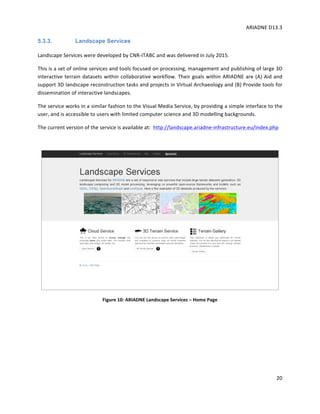
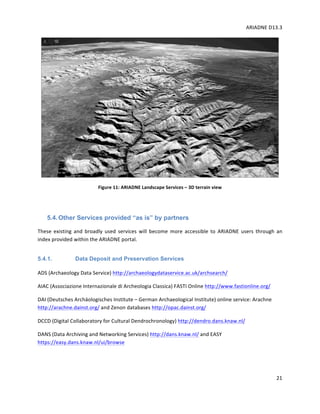
This	is	a	set	of	online	services	and	tools	focused	on	processing,	management	and	publishing	of	large	3D	
interactive	terrain	datasets	within	collaborative	workflow.	Their	goals	within	ARIADNE	are	(A)	Aid	and	
support	3D	landscape	reconstruction	tasks	and	projects	in	Virtual	Archaeology	and	(B)	Provide	tools	for	
dissemination	of	interactive	landscapes.	
The	service	works	in	a	similar	fashion	to	the	Visual	Media	Service,	by	providing	a	simple	interface	to	the	
user,	and	is	accessible	to	users	with	limited	computer	science	and	3D	modelling	backgrounds.	
The	current	version	of	the	service	is	available	at:		http://landscape.ariadne-infrastructure.eu/index.php	
	
	
Figure	10:	ARIADNE	Landscape	Services	–	Home	Page
ARIADNE	D13.3			
	
	
21	
	
Figure	11:	ARIADNE	Landscape	Services	–	3D	terrain	view	
	
5.4.Other Services provided “as is” by partners
These	 existing	 and	 broadly	 used	 services	 will	 become	 more	 accessible	 to	 ARIADNE	 users	 through	 an	
index	provided	within	the	ARIADNE	portal.		
5.4.1. Data Deposit and Preservation Services
ADS	(Archaeology	Data	Service)	http://archaeologydataservice.ac.uk/archsearch/		
AIAC	(Associazione	Internazionale	di	Archeologia	Classica)	FASTI	Online	http://www.fastionline.org/		
DAI	(Deutsches	Archäologisches	Institute	–	German	Archaeological	Institute)	online	service:	Arachne		
http://arachne.dainst.org/	and	Zenon	databases	http://opac.dainst.org/		
DCCD	(Digital	Collaboratory	for	Cultural	Dendrochronology)	http://dendro.dans.knaw.nl/		
DANS	(Data	Archiving	and	Networking	Services)	http://dans.knaw.nl/	and	EASY	
https://easy.dans.knaw.nl/ui/browse
ARIADNE	D13.3			
	
	
22	
6. Methodology used for evaluation
6.1.Scope of the testing
Testing	 is	 related	 to	 services	 implemented	 in	 the	 ARIADNE	 project	 and	 is	 briefly	 described	 in	 the	
previous	pages.				
No	 evaluation	 will	 be	 conducted	 for	 previously	 existing	 services	 operated	 by	 partners	 and	 made	
available	 through	 ARIADNE,	 only	 the	 newly	 provided	 access	 to	 these	 services	 through	 the	 ARIADNE	
Portal	will	be	evaluated	as	a	part	of	the	ARIADNE	portal	service.		
6.2.General aspects on methodology
The	evaluation	will	be	implemented	in	two	complementary	directions:		
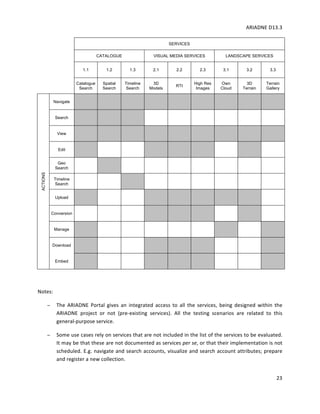
− Using	predefined	testing	scenarios	according	to	the	following	matrix		
− Using	open	evaluation	questionnaires	
The	evaluation	cycle	follows	several	steps:		
• Preliminary	tasks:		
− Creation	of	the	group	of	evaluators	
− Preparation	of	the	evaluation	scheme	
• Conducting	the	evaluation	
• Analysing	the	results		
• Producing	 a	 structured	 and	 commented	 feedback	 to	 the	 implementation	 team	 and	 (if	
necessary),	and	implementation	of	the	requested	changes	and	production	of	a	revised	version	
of	the	service/tool	
6.3.Testing scenarios
Each	testing	scenario	will	be	applied	to	one	or	several	services	for	which	this	testing	scenario	is	relevant,	
according	to	the	following	matrix:
ARIADNE	D13.3			
	
	
23	
SERVICES
CATALOGUE VISUAL MEDIA SERVICES LANDSCAPE SERVICES
1.1 1.2 1.3 2.1 2.2 2.3 3.1 3.2 3.3
Catalogue
Search
Spatial
Search
Timeline
Search
3D
Models
RTI
High Res
Images
Own
Cloud
3D
Terrain
Terrain
Gallery
ACTIONS
Navigate X X x X x X x X x
Search X X X
View X X X X X X X X X
Edit X X X X X
Geo
Search
X
Timeline
Search
X
Upload X X X X X
Conversion X X x X
Manage X
Download x x X X
Embed
	
Notes:		
− The	 ARIADNE	 Portal	 gives	 an	 integrated	 access	 to	 all	 the	 services,	 being	 designed	 within	 the	
ARIADNE	 project	 or	 not	 (pre-existing	 services).	 All	 the	 testing	 scenarios	 are	 related	 to	 this	
general-purpose	service.		
− Some	use	cases	rely	on	services	that	are	not	included	in	the	list	of	the	services	to	be	evaluated.		
It	may	be	that	these	are	not	documented	as	services	per	se,	or	that	their	implementation	is	not	
scheduled.	E.g.	navigate	and	search	accounts,	visualize	and	search	account	attributes;	prepare	
and	register	a	new	collection.
ARIADNE	D13.3			
	
	
24	
− Some	services	do	not	explicitly	correspond	to	use	cases.	D13.1	has	to	be	enriched	to	include	
these	services.		E.g.	Landscape	and	terrain	services.	Landscape	services	are	a	set	of	responsive	
web	 services	 that	 include	 large	 terrain	 datasets	 generation,	 3D	 landscape	 composing	 and	 3D	
model	processing.	
6.3.1. Evaluation questionnaires
6.3.1.1. Content	of	the	questionnaires	
The	aim	of	the	questionnaire	related	to	a	specific	service	is	to	determine	whether	the	service	meets	the	
expectations	of	the	users.		
Each	 service	 provider	 should	 provide,	 along	 with	 the	 service,	 an	 evaluation	 questionnaire	 giving	 the	
feedback	that	is	most	useful	for	the	implementation	team.		
The	useful	data	could	be:		
− The	answer	to	precise	questions	about	usability	of	the	service	
− Open	comments	about	the	service	(usability,	request	for	improvements,	a.s.o.)	
− A	note	given	to	the	service	(similar	to	what	could	be	found	in	the	AppStore)	
− Quantitative	data	about	usage	(e.g.	number	of	downloads	of	an	application,	number	of	clicks,	
number	of	files	uploaded,	...)	
The	questionnaire	prepared	by	the	service	provider	must	be	completed	by	an	evaluation	questionnaire	
prepared	by	the	teams	in	charge	of	designing	the	service	and/or	of	the	collection	of	users'	needs.		
A	prototype	of	the	test	that	will	be	submitted	is	attached	in	Annex	II.	
6.3.1.2. Translation		
The	questionnaires	were	created	in	English.		
A	partner	wishing	to	translate	them	in	another	language	may	do	so,	to	provide	them	to	their	community	
(practical	 aspects	 are	 to	 be	 developed.	 In	 particular,	 this	 is	 not	 suitable	 for	 questionnaires	 submitted	
online	 directly	 in	 the	 web-based	 service).	 In	 that	 case,	 the	 feedback	 to	 the	 task	 leader	 shall	 be	 fully	
translated	in	English,	including	the	comments	that	are	useful	for	evaluation	purposes.		
6.3.1.3. Operation	
The	questionnaire	will	be	sent	to	a	restricted	set	of	users,	previously	identified	as:		
− Persons	 who	 have	 shown	 an	 interest	 for	 ARIADNE	 (respondents	 to	 the	 survey	 conducted	 in	
WP2)	
− Users	of	the	specific	service	willing	to	answer	a	set	of	questions	online
ARIADNE	D13.3			
	
	
25	
The	questionnaire,	according	to	the	scheme	presented	in	Annex	II,	will	be	produced	on	a	Google	Form	
and	will	be	sent	to	a	list	of	testers.	
The	questionnaire	will	also	be	sent	via	the	web	to	for	those	who	will	participate	locally	in	the	workshops	
for	presentation	of	the	project	planned	at	the	Inrap	(Paris)	during	the	first	half	of	2016.	
The	 questionnaire	 will	 be	 sent	 a	 maximum	 of	 three	 times	 (monthly)	 to	 testers	 who	 don’t	 respond.	
Testers	who	don’t	respond	three	times	will	be	replaced	in	the	panel.	
6.3.1.4. Analysis	of	the	data	
The	analysis	will	be	made	by	the	task	leader,	and	in	coordination	with	the	teams	D2.2	and	D13.1	/	D13.2.		
A	quarterly	analysis	of	the	data	is	planned.	The	results,	transposed	in	appropriate	graphics,	will	be	sent	
to	the	WP	leader,	so	it	can	be	transmitted	to	other	Tasks	within	WP13.	
Particular	attention	will	be	given	in	the	first	testing	to	the	global	acceptance	and	implementation	of	the	
proposed	services.	
In	the	second	half	of	2016	the	focus	will	be	on	the	proper	functioning	of	services	and	the	speed	of	the	
operations	carried	out	by	testers.	
The	whole	set	of	quarterly	results	will	be	presented	into	D13.5	Final	Testing	Report.	
6.4.Other
Some	 partners	 may	 wish	 to	 use	 additional	 evaluation	 instruments.	 These	 could	 be	 useful	 to	 gain	
additional	data	from	the	evaluation,	e.g.	to	have	more	precise	comments	on	the	usage	of	the	services	
and	potential	improvements.		
6.4.1. Individual contacts
	Individual	 contacts	 can	 be	 made	 (phone,	 face-to-face	 or	 Skype	 meetings)	 either	 directly	 or	 after	 a	
person	has	answered	a	questionnaire	and	agreed	to	be	contacted.		
The	 contact	 may	 include	 a	 co-browsing	 phase	 by	 which	 the	 user	 navigates	 in	 the	 service	 under	
supervision	 of	 the	 evaluator.	 If	 that	 phase	 is	 conducted	 during	 a	 remote	 contact,	 the	 specific	
infrastructure	 has	 to	 support	 tracking	 of	 users	 actions,	 or	 the	 analysis	 could	 be	 done	 by	 using	 a	
teleconference	system	that	allows	visualization	and	grab	the	remote	user’s	desktop.
ARIADNE	D13.3			
	
	
26	
6.4.2. Group sessions
Partners	can	organize	a	group	session	with	several	users	of	a	service	to	collect	information	about	the	
usage	of	the	service.	A	group	session	allows	emulation	between	the	participants	and	allow	more	than	
single-contacts,	but	is	obviously	much	more	time-consuming.		
The	partner	should	take	care	of	the	organization	and,	if	applicable,	the	specific	costs	of	the	session.		
6.5.Feedback to the implementation teams
The	results	of	the	evaluation	process	will	be	sent	back	to	the	implementation	team:		
• Informal	feedback	will	be	sent	every	time	important	or	critical	feedback	is	received	(e.g.	to	allow	
the	service	developers	to	react	promptly	to	bug	notifications)	
• Formal	feedback	will	be	sent	as	part	of	the	services	testing	report	(D13.5,	draft	versions	and	
final	version,	see	hereafter	the	Agenda	section)		
6.6.Agenda
The	evaluation	process	for	any	service	obviously	requires	the	full	availability	of	the	service,	in	a	stable	
version	upon	which	the	implementation	team	has	already	conducted	preliminary	technical	tests.		
It	also	requires	the	availability	of	a	comprehensive	set	of	data	appropriate	to	using	the	service.		
Currently,	the	services	that	meet	these	criteria	are	the	Visual	Media	Services,	a	first	version	of	which	has	
been	delivered	and	upon	which	a	first	set	of	tests	has	been	conducted;	the	Landscape	Services	and	the	
Portal	prototype,	were	delivered	in	November	2015.	
The	other	services	are	still	under	implementation	and	may	not	be	tested	at	the	time	of	production	of	the	
first	release	of	this	report.		
6.6.1. Testing of individual services
A	 first	 testing	 phase,	 which	 began	 in	 November	 2015	 and	 will	 end	 at	 the	 latest	 June	 30th
	 2016,	 will	
consist	of	testing	all	individual	services	that	will	be	delivered	within	the	ARIADNE	project.		
The	testing	procedure	is	meant	to	last	for	six	months	from	the	date	of	availability	of	the	service,	which	
means	all	services	have	to	be	fully	ready	and	available	at	the	latest	by	the	end	of	December	2015.		
An	interim	testing	report,	summing	up	the	results	of	the	individual	evaluation	of	the	services,	will	be	
created	and	delivered	by	June	2016,	for	feedback	to	the	service	providers.
ARIADNE	D13.3			
	
	
27	
6.6.2. Overall testing
A	second	testing	phase	upon	the	whole	system	will	be	conducted	from	July	to	December,	2016.		
This	testing	phase	will	focus	on	the	usability	of	the	ARIADNE	service	infrastructure	taken	as	a	whole,	the	
ARIADNE	portal	being	the	entry	point.		
6.7.Technical infrastructure issues
Each	service	provider	will	take	care	of	the	provision	of	the	infrastructure	related	to	its	individual	service.		
The	 task	 leader	 will	 ensure	 that	 no	 part	 of	 the	 infrastructure	 is	 missing	 or	 under-implemented	 but	
should	not	have	to	provide	a	specific	technical	infrastructure.		
	
7. First evaluation results
7.1.Visual Media Services
Informal	tests	have	been	conducted	by	Inrap	among	a	community	of	internal	power	users,	showing	a	
great	interest	in	the	service	provided	for	visualization	of	3D	images,	but	also	the	need	for	enhanced	
visualization	and	analysis	tools,	and	especially	measuring	tools.		
This	feedback	meets	the	development	plan	of	the	Visual	Media	Services;	the	new	version	to	be	released	
in	the	first	half	of	2016	shall	answer	to	this	need.		
	
8. Conclusions
Most	of	the	work	remains	to	be	done	starting	in	January	2016,	when	a	comprehensive	set	of	services	
will	gradually	be	made	available,	including	the	services	related	to	the	Catalogue	which	are	the	central	
part	of	the	ARIADNE	project.
ARIADNE	D13.3			
	
	
28	
9. References
ARIADNE–	Project	Website,	http://www.ariadne-infrastructure.eu/		
ARIADNE,	2014,	D	12.1	"User	Requirements",	http://www.ariadne-infrastructure.eu/Resources/D12.1-
Use-Requirements		
ARIADNE,	2014,	D	13.1	"Service	Design",	http://www.ariadne-infrastructure.eu/Resources/D13.1-
Service-Design		
ARIADNE,	2015,	D	2.2	"Second	report	on	users'	needs",	http://www.ariadne-
infrastructure.eu/content/view/full/1188		
ARIADNE,	2015,	D	12.2	"Infrastructure	Design",	http://www.ariadne-infrastructure.eu/Resources/D12.2-
Infrastructure-Design		
	
10.Table of figures
Figure	1:	ARIADNE	Tasks	and	Service	Design	 7
Figure	2:	ARIADNE	Portal	–	Home	page	 13
Figure	3:	ARIADNE	Portal	–	Textual	research	 14
Figure	4:	ARIADNE	Portal	–	Dataset	view	 15
Figure	5:	ARIADNE	Portal	–	Geographical	view	of	datasets	 16
Figure	6:	ARIADNE	Portal	–	Detailed	geographical	view	of	datasets	 16
Figure	7:	ARIADNE	Visual	Media	Service	–	Home	Page	 18
Figure	8:	ARIADNE	Visual	Media	Service	–	3D	model	view	 18
Figure	9:	Visual	Media	in	archaeological	collections	–	ADS,	The	Virtual	Amarna	Project	 19
Figure	10:	ARIADNE	Landscape	Services	–	Home	Page	 20
Figure	11:	ARIADNE	Landscape	Services	–	3D	terrain	view	 21
ARIADNE	D13.3			
	
	
29	
11. Annex I – Testing scenarios
11.1. Basic Catalogue Services
	
Scenario	Group	1	 Basic	Catalogue	Services	
Pre-requisites	 Basic	ICT	skills	
User	browses	the	ARIADNE	Portal	
Step	 Action	 Expected	result	 Conclusion	 Validation	
1.1	 Catalogue	Navigate	 	 	 	
1.2	 Catalogue	Search	 	 	 	
1.3	 Catalogue	View	 	 	 	
1.4	 Spatial	Navigate	 	 	 	
1.5	 Spatial	Search	 	 	 	
1.6	 Spatial	View	 	 	 	
1.7	 Timeline	Navigate	 	 	 	
1.8	 Timeline	Search	 	 	 	
1.9	 Timeline	View	 	 	 	
	
11.2. Advanced Catalogue Services
	
Scenario	Group	2	 Advanced	Catalogue	Services	
Pre-requisites	 Basic	ICT	skills	
Basic	geo	search	skills	
Basic	time	search	skills	
User	browses	the	ARIADNE	Portal	
User	advanced	search	on	the	ARIADNE	Portal	
Step	 Action	 Expected	result	 Conclusion	 Validation	
2.1	 Catalogue	Parameterise	Search	 	 	 	
2.2	 Geo	Parameterise	Search	 	 	 	
2.3	 Timeline	Parameterise	search
ARIADNE	D13.3			
	
	
30	
11.3. Visual Media Services
	
Scenario	Group	3	 Visual	Media	Services	
Pre-requisites	 Advanced	image	processing	skills	
User	has	a	visual	media	document	(3D	model,	RTI,	HR	image)	
Step	 Action	 Expected	result	 Conclusion	 Validation	
3.1	 3D	Models	Navigate	 	 	 	
3.2	 3D	Models	View	 	 	 	
3.3	 3D	Models	Upload	 	 	 	
3.4	 3D	Models	Parameter	 	 	 	
3.5	 3D	Models	Transform	 	 	 	
3.6	 3D	Models	Download	 	 	 	
3.7	 3D	Models	Embed	(on	web	site)	 	 	 	
3.8	 RTI	Navigate	 	 	 	
3.9	 RTI		View	 	 	 	
3.10	 RTI	Upload	 	 	 	
3.11	 RTI	Parameter	 	 	 	
3.12	 RTI	Transform	 	 	 	
3.13	 RTI	Download	 	 	 	
3.14	 RTI	Embed	(on	web	site)	 	 	 	
3.15	 High	Res	Images	Navigate	 	 	 	
3.16	 High	Res	Images	View	 	 	 	
3.17	 High	Res	Images	Upload	 	 	 	
3.18	 High	Res	Images	Parameter	 	 	 	
3.19	 High	Res	Images	Transform	 	 	 	
3.20	 High	Res	Images	Download	 	 	 	
3.21	 High	Res	Images	Embed	(on	web	site)	 	 	 	
	
11.4. Own Cloud Services
	
Scenario	Group	4	 Own	Cloud	Services	
Pre-requisites	 Advanced	ICT	skills	
User	has	some	geographical	datasets	(Raster	+	DEM	+	shp	file)	
Step	 Action	 Expected	result	 Conclusion	 Validation
ARIADNE	D13.3			
	
	
31	
4.1	 Own	Cloud	Navigate	 	 	 	
4.2	 Own	Cloud	(Access	and)	View	 	 	 	
4.3	 Own	Cloud	Upload	 	 	 	
4.4	 Own	Cloud	Manage	 	 	 	
	
11.5. Landscape Services
	
Scenario	Group	5	 Landscape	Services	
Pre-requisites	 Basic	GIS	skills	
User	has	uploaded	a	geographical	dataset	on	Own	Cloud	
Step	 Action	 Expected	result	 Conclusion	 Validation	
5.1	 3D	Terrain	Navigate	 	 	 	
5.2	 3D	Terrain	View	 	 	 	
5.3	 3D	Terrain	Parameter	 	 	 	
5.4	 3D	Terrain	Upload	 	 	 	
5.5	 3D	Terrain	Transform	 	 	 	
5.6	 Terrain	Gallery	Navigate	 	 	 	
5.7	 Terrain	Gallery	View	 	 	 	
5.8	 Terrain	Gallery	Download	 	 	 	
5.9	 Terrain	Gallery	Embed	(on	web	site)
ARIADNE	D13.3			
	
	
32	
12. Annex II – Prototype questionnaire for the evaluation of the ARIADNE
Services
	
TESTER DATA
First Name
[Text]
Last Name
[Text]
Institution
[Text]
Country
[Text]
START
How was the web site reached?
[multiplle choice]
Google Direct Link Ariadne Site Other
Was the service description provided on the web clear?
YES NO
If NO, why?
[Text]
Was the provided service speed satisfactory?
YES NO
If NO, why?
[Text]
Used services
ARIADNE	D13.3			
	
	
33	
Catalog Visual Media Landscape
CATALOG VISUAL MEDIA LANDSCAPE
Kind of search Which data have been uploaded? Has the gallery been seen?
[multiplle choice] [multiplle choice] YES NO
Text Geo Timeline 3D Models
RTI
Images
HR Images
Was the models visualization
satisfactory?
How many searches have been done?
What was the total size (in Mb) of the
uploaded data?
YES NO
[multiplle choice] [Integer] If NO, why?
1-10 10-20 20-50 >50 [Text]
Was the results visualization satisfactory?
Do you want to answer to specific
questions about 3D models?
Have any process been run?
YES NO YES NO YES NO
If NO, why? What kind of output has been chosen?
[Text] 3D MODELS [multiplle choice]
Were the page navigation commands
clear?
Was the model
visualization
satisfactory?
1 2 3 4 5 6
YES NO If NO, why?
What kind of resolution has been
used?
If NO, why?
Was the
navigation speed
of the model
satisfactory?
Low Medium High
[Text] If NO, why?
Has been an area defined with a shp
file?
Were links used to reach the original data?
Was the model
quality
satisfactory?
YES NO
YES NO If NO, why? If YES, are you satisfied?
If YES, did they work properly? YES NO
YES NO
Do you want to answer to specific
questions about RTI Images?
If NO, why?
Were the results satisfactory? YES NO [Text]
YES NO
Have files in OWN Cloud been
uploaded?
If NO, why? RTI IMAGES YES NO
[Text]
Was the RTI
visualization
satisfactory?
ARIADNE	D13.3			
	
	
34	
Were filters used for the search? If NO, why? OWN CLOUD
YES NO
Was the response
speed of the light
satisfactory?
Which data types
have been
uploaded?
If NO, why? [multiplle choice]
ADVANCED
Was the
reflectance model
quality
satisfactory?
DEM Raster Shp
Which filters have
been used?
If NO, why?
What is the total
size (in Mb) of the
uploaded data?
[multiplle choice] [Integer]
Text Geo Timeline
Do you want to answer to specific
questions about HR Images?
Was the service
globally
satisfactory?
Did the filter work
properly?
YES NO YES NO
YES NO If NO, why?
If NO, why? HR IMAGES [Text]
[Text]
Was the HRI
visualization
satisfactory?
Has it been simple to
filter the results?
If NO, why?
YES NO
Was the zoom
response speed
satisfactory?
If NO, why? If NO, why?
[Text]
Was the image
definition quality
satisfactory?
If NO, why?
HELP SECTION
Has the help section been used? Has it been resolutive/helpful/satisfactory?
YES NO
If YES but it did not solve issues, why?
[Text]
Have problems/bugs been experimented using the system?
YES NO
In case problems/bugs have been experimented, have they been reported to the developers?
ARIADNE	D13.3			
	
	
35	
YES NO
If YES, has an answer from the developers been received?
YES NO
FINAL EVALUATION
Have been the service performances satisfactory?
YES NO
If NO, why?
[Text]
Have been the system used while connected to:
[multiple choice]
High speed network (>10MB) Ordinary network (3-10MB) Low speed connection (< 3MB)
Global judgement on the experience:
( * * * * * )
Experience description (optional)
[Text]
Are any suggestions for the developers possible? (Possible suggestions for the developers:)
YES NO
If YES, what?
[Text]
Which other data type should be managed by the Services? (Specify data type)
[Text]
Which visualization or interaction features should be considered while extending the Visual Media Service? (Please specify)
[Text]

Ariadne: Initial Services Testing Report

  • 1.
    Authors: Bernard Pinglier Kai SalasRossenbach Emmanuelle Bryas Amala Marx Federico Nurra INRAP Ariadne is funded by the European Commission’s 7th Framework Programme. D13.3: Infrastructure services testing report
  • 2.
    ARIADNE D13.3 (Public) ARIADNE is a project funded by the European Commission under the Community’s Seventh Framework Programme, contract no. FP7-INFRASTRUCTURES-2012-1-313193. The views and opinions expressed in this report are the sole responsibility of the authors and do not necessarily reflect the views of the European Commission. Version: 1.0 (final) 11th January 2016 Authors: Bernard Pinglier Kai Salas Rossenbach Emmanuelle Bryas Amala Marx Federico Nurra INRAP Contributing Partners Roberto Scopigno, CNR-ISTI Matteo Dellepiane, CNR-ISTI Holly Wright, ADS
  • 3.
    ARIADNE D13.3 3 Table of Contents 1.Document History ....................................................................................................... 5 2. Introduction ................................................................................................................ 6 3. Related Work .............................................................................................................. 8 3.1. User Requirements (D12.1) ........................................................................................................ 8 3.2. Service Design (D13.1) ................................................................................................................ 8 3.3. Second report on users' needs (D2.2) ........................................................................................ 8 3.4. Infrastructure Design (D12.2) ..................................................................................................... 9 4. Overview of design, use requirements and users' specifications .................................. 9 5. Services to be evaluated ............................................................................................ 13 5.1. Ariadne Portal .......................................................................................................................... 13 5.2. Services provided on the Ariadne Catalogue ........................................................................... 13 5.2.1. Catalogue search ................................................................................................................................ 14 5.2.2. Spatial search and display ................................................................................................................... 15 5.2.3. Timeline search and display ................................................................................................................ 17 5.3. Other Services created within the ARIADNE Project ................................................................ 17 5.3.1. Visual Media Services ......................................................................................................................... 17 5.3.2. Visual Media in archaeological collections ......................................................................................... 19 5.3.3. Landscape Services ............................................................................................................................. 20 5.4. Other Services provided “as is” by partners ............................................................................. 21 5.4.1. Data Deposit and Preservation Services ............................................................................................. 21 6. Methodology used for evaluation .............................................................................. 22 6.1. Scope of the testing .................................................................................................................. 22 6.2. General aspects on methodology ............................................................................................. 22 6.3. Testing scenarios ...................................................................................................................... 22
  • 4.
    ARIADNE D13.3 4 6.3.1. Evaluation questionnaires .................................................................................................................. 24 6.4. Other ........................................................................................................................................ 25 6.4.1.Individual contacts .............................................................................................................................. 25 6.4.2. Group sessions .................................................................................................................................... 26 6.5. Feedback to the implementation teams .................................................................................. 26 6.6. Agenda ..................................................................................................................................... 26 6.6.1. Testing of individual services .............................................................................................................. 26 6.6.2. Overall testing ..................................................................................................................................... 27 6.7. Technical infrastructure issues ................................................................................................. 27 7. First evaluation results .............................................................................................. 27 7.1. Visual Media Services ............................................................................................................... 27 8. Conclusions ............................................................................................................... 27 9. References ................................................................................................................ 28 10. Table of figures .......................................................................................................... 28 11. Annex I – Testing scenarios ........................................................................................ 29 11.1. Basic Catalogue Services .......................................................................................................... 29 11.2. Advanced Catalogue Services ................................................................................................... 29 11.3. Visual Media Services ............................................................................................................... 30 11.4. Own Cloud Services .................................................................................................................. 30 11.5. Landscape Services ................................................................................................................... 31 12. Annex II – Prototype questionnaire for the evaluation of the ARIADNE Services ........ 32
  • 5.
    ARIADNE D13.3 5 1. Document History Version Date Contributors Activity 0.1 July 29th 2015 Bernard Pinglier Draft structure of document 0.2 November 17th 2015 Roberto Scopigno, Matteo Dellepiane Review Proposed structure questionnaire Visual Media Service 0.3 December 11th 2015 Federico Nurra Kai Salas Rossenbach Amala Marx Emmanuelle Bryas Added Images Added References Modified Tables Added test prototype 0.3.1 December 18th 2015 Holly Wright Quality Control 1.0 January 11th 2016 Federico Nurra Added Captions Added Table of Figures Final editing
  • 6.
    ARIADNE D13.3 6 2. Introduction This deliverable D13.3 presents the initial results of Task 13.4 (T13.4), which is part of Work Package 13 (WP13) in the ARIADNE Project. As stated in the Description of Work (DoW) of the ARIADNE Project, the main objectives of WP13 are: • To analyse, select, design and deploy the service components of the integrated infrastructure in order to improve the provision of the online services to the researchers • To take into account in the design and the deployment further enhancements of the service architecture as required by the additional implementation of results from WP14-WP17 The tasks of the WP13 are: Task 13.1 – Service Design and Specifications Task 13.2 – Service Implementation Task 13.3 – Long-term Preservation Services Task 13.4 – Acceptance Testing The Task will be in charge of testing the services produced in Task 13.2 and verify their correspondence to design (Task 13.1), use requirements (Task 12.1) and users’ specifications (Task 2.1 and Task 2.2). New or improved services may be approved and passed to the next Task or returned to 13.2 for amendments. Testing will be carried out on a specific testing environment prepared by the partners in charge of the task. They will set up a number of simulated research contexts, relevant for archaeological research, and will compare the behaviour of the system with the expected one. They will furthermore verify overall compliance with requirements and the performance of the system in simulated real conditions. Such tests will be performed regularly. Their outcomes will be reported to the lead partner of Task 13.2 for the necessary feedback. The testing specifications and the routine testing mechanism will be detailed in Task 13.1.
  • 7.
    ARIADNE D13.3 7 As shown in the following figure, taken from document D13.1, task T13.4 is related to most work packages and tasks within the ARIADNE project: Figure 1: ARIADNE Tasks and Service Design This report focuses on the following aspects: • Overview of design, use requirements and user's specifications, the compliance with which the services have to be tested (see D13.1, D12.1 and D2.2 for a more detailed presentation) • Services to be evaluated: functional description and progress report for implementation of these (see D13.2 for a more detailed presentation) • Methodology used for the tests • First testing results. Informal tests have been conducted by Inrap among a community of internal power users, showing a great interest in the service provided for visualization of 3D images, but also the need for enhanced visualization and analysis tools, and especially measuring tools • Most of the work remains to be done starting in January 2016, when a comprehensive set of services will gradually be made available, including the services related to the Catalogue
  • 8.
    ARIADNE D13.3 8 3. Related Work 3.1.User Requirements (D12.1) This document is a deliverable (D12.1) of the ARIADNE project (“Advanced Research Infrastructure for Archaeological Dataset Networking in Europe”), which is funded under the European Community's Seventh Framework Programme. D12.1 is associated with Task 12.1 within WP12, which is titled Implementing' Interoperability, and falls within the larger ARIADNE conceptual framework for the ARIADNE e-Infrastructure. The main objective of D12.1 is to understand the current landscape from which the ARIADNE infrastructure can be created, in order to inform the development of the ARIADNE portal and services. This landscape includes the data, metadata, ontologies and vocabularies available for use, along with any associated issues of licensing and access, informed by users’ needs. 3.2. Service Design (D13.1) This document aims to specify the service design of the ARIADNE Portal, and provide a common vision, a user perspective on the functionality, and a framework to identify, discuss and validate the requirements for the underlying technical services. As such, the audience of this document was both technical and non-technical. This service design was created using the following input: Description of Work, Task 2.1 (Survey of users’ needs and community building), Task 12.1 (Assessment of use requirements), an examination of existing portals and WP3-12-13 Workshop discussions. The service design provided input for Task 13.2 (Build Services) and Task 13.4 (Acceptance testing). The service design provided a common vision formulated in terms of principles, derived from the mission statement in the Description of Work. 3.3. Second report on users' needs (D2.2) The main objective of this report was to provide additional, more detailed evidence about user requirements of key target groups (“users”) of the project with regard to the ARIADNE data portal. A panel of about 25 researchers was asked to describe in detail their use of digital data archives, to evaluate existing archives and other portals and to highlight useful features of these portals which could serve as “good practice” when creating a new research data portal. This information supports the ARIADNE project in taking informed decisions regarding the specification of the e-infrastructure and services so they are developed in a way that corresponds to perceived and actual research needs. The mandate was to provide evidence on these issues, notably through collecting feed-back from the ARIADNE community by way of a user survey.
  • 9.
    ARIADNE D13.3 9 3.4. Infrastructure Design(D12.2) The main goal of Task 12.2 is to specify a resource integration and discovery mechanism for use in ARIADNE. The resources to be integrated are datasets and collections, GIS data, metadata schemas, ontologies and vocabularies available from the project partners, as well as institutions outside the ARIADNE consortium. This deliverable provides an overview of the ARIADNE architecture, including a summary of the conformance of the architecture to the data and standards requirements set out in D12.1, as well as to the specifications of the Services of the ARIADNE Infrastructure, presented in D13.1. This is followed by a content analysis of the main content types defined in D12.1, and the integration strategy for the two levels of content: the metadata integration, and the data integration. This will attempt to integrate selected resources (datasets and/or metadata) from particular partners/data providers and provide cross-search and access mechanisms to integrated resources, using a facetted search on “what”, “where”, “when” and “resource type”. 4. Overview of design, use requirements and users' specifications The users' needs are summarized as follows, derived from D2.2: 1. Overall focus of the ARIADNE project is on data discovery and access services. 2. The primary focus of the design and interfaces of the data portal should be an overview of what data is accessible, including statistical information on quantity, types, and distribution (e.g. country/area, period). 3. The portal should focus on the European/international dimension. Lack of underlying resources (per country, type of data, etc.) should not be seen as a deficit, but used to promote data mobilization (e.g. implementation of national data archives). 4. Added value should also be created through linking data and publication resources not held within the ARIADNE Registry (e.g. metadata of document archives and open access publishers). 5. Linked Open Data (LOD) can play a core role for value generation, but further uptake of LOD principles by archaeological institutions and projects must be encouraged. 6. In the development of the data search, access and other services, members of the user community must be thoroughly involved and regular feedback on implemented solutions sought by the wider community. 7. User-focused development of the portal services and applications (relevance, usability, user- friendliness) should be at the top of the project’s priorities.
  • 10.
    ARIADNE D13.3 10 8. Services for websites for research communities in particular subjects or geographic regions (e.g. alerts on relevant datasets) could greatly expand the reach of the data portal and, in turn, promote further data mobilization. 9. Full exploitation of the data resources (incl. metadata, conceptual knowledge) should be enabled by interfaces for external applications (e.g. a well-documented API, OAI-PMH target, SPARQL endpoint). 10. Support of e-research/science should, in the first instance, be provided through integrating access to data resources and by pointing users to existing tools for data extraction, processing and analysis. The use requirements (D12.1) refer to the requirements for the design and specification of the subsequent tools and services necessary for integration. D12.1 produces recommendations for Datasets; Metadata Standards, Schemas and Vocabularies; and Access and Sharing Policies. Datasets • Site and monument databases: Most European countries and/or regions have them, and combining them may be useful for cross-border searching and geo-location • Intervention activity: May have multiple activities associated with a geo-locatable site, which may allow linking of various activities to a single site or monument • Fieldwork databases: Usually too diverse, so individual databases may not be useful for integration, but may be worth linking to intervention activities for bibliographic discovery • Other categories are quite specific, but may be useful for integration: o Scientific Databases o Artefact Databases o Burial Databases Balance data quality and quantity: specify requirements that datasets have to meet in order to be integrated, preferably using formal criteria. The relationships between the types of data available from the content providing partners and the recommended integration activity to be designed within D12.2 are set out in the table below.
  • 11.
    ARIADNE D13.3 11 . Metadata Standards, Schemas and Vocabularies • The use of international standards for the documentation of excavations and monuments so as to render it transparent and comparable and, above all, make them more interoperable. • Free access to tools, particularly for data mapping, to make it easier to incorporate these standards, and offering the means and guidance for archaeologists to deposit their digital records in an appropriate archive •The sustainability of digital datasets must also be high on the agenda The relationships between the wishes and concerns with regard to metadata and the recommended tools to be designated or designed within D12.2 are set out in the table below: Table showing the wishes and concerns with regard to data standards, categorised by the type of schema or vocabulary which may address the wishes, and the tools which may address the concerns. The + signifies the level of importance.
  • 12.
    ARIADNE D13.3 12 Access and Sharing Policies • A common method of data citation should be established for adoption by partners, and promoted by ARIADNE to the archaeological research community. Academic recognition is an important motivation for encouraging researchers to share access to their datasets • Allocation of DOIs or the equivalent to datasets ingested to the ARIADNE infrastructure should be investigated. The system used should be capable of identifying sub-sets within collections. Persistent identification of datasets is important in underpinning data sharing and data citation • Content itself (databases, document archives, images, 3D models, etc.) should be provided to ARIADNE by content partners using the Creative Commons license suite (version 4.0 is preferred) under license permissions agreed with the content owner. CC BY is recommended for open access. CC BY SA or CC BY SA NC licenses may also be applicable • A Collection description (of the whole collection and subFsets within the collection) should be published under a CC BY license for each dataset ingested to the ARIADNE infrastructure • Metadata records should be published under a CC0 license – to enable integration of multiple datasets within the metadata repository, support resource discovery and enable linked open data The Services Design (D13.1) introduces the functionality of the services, derived from a user perspective, and thus gives an important input for acceptance testing. It presents a set of use cases representing various real situations encountered by members of the archaeological community: • Search and explore the Registry to look for archaeological datasets to be previewed and/or downloaded: The use case is divided in several steps (navigation, entering search parameters, displaying the results) and relates to several services e.g. portal access, timeline search, geographical search, display of the results, etc. • Preview data to determine the relevance of this data for specific research: The preview service and functionality depends on the nature of the data. • Access data by downloading it for further processing • Deposit data in the ARIADNE infrastructure to allow it to be browsed and re-used by fellow researchers: The service requires a set of guidelines for depositing data and an archive compatible with the data to be deposited. • Search and access the service registry to discover tools and knowledge to support research/data management activities • Prepare and register a new collection in the Registry • Enrich Visual Media Documents from one of the visual documents (3D models , RTI images, high resolution images, terrain models) stored in one of the catalogues associated with the ARIADNE Portal provide a visualization window showing the visual services that could be applied to visual media • Manage accounts to allow a security manager to handle and control authentication and access. The security manager may have an overview of the users and eventually change their attributes
  • 13.
    ARIADNE D13.3 13 5. Services tobe evaluated This section gives an overview of the services to be evaluated, as they exist to date. More details can be found in document D13.2 (Initial Services Implementation Report). 5.1.ARIADNE Portal The ARIADNE portal is the front-end facility by which the user will access the various services provided by ARIADNE infrastructure. The development is led by DAI. It began in September 2015 and is planned to be completed by January 2016. Figure 2: ARIADNE Portal – Home page 5.2.Services provided on the ARIADNE Catalogue The ARIADNE Catalogue is based on the ACDM (Ariadne Catalogue Data Model), which describes the archaeological resources that are made available within the ARIANDE infrastructure to the researchers wishing to access and use them. The current version is ACDM 2.6, delivered on Sept. 26th , 2015.
  • 14.
    ARIADNE D13.3 14 5.2.1. Catalogue search The search and retrieval functionalities for all kinds of resources described in the Catalogue are currently under development in the context of WP12 and should be delivered in January 2016. The search and retrieval will be refined using several types of filters, including: type, resource type, subject, provider, period, publisher... The filters reflect the structure of the ARIADNE Catalogue. They should guide the user not only in the phase of refining the search, but also in widening and completing the search. http://ariadne-portal.dcu.gr/ Figure 3: ARIADNE Portal – Textual research
  • 15.
    ARIADNE D13.3 15 Figure 4: ARIADNE Portal – Dataset view 5.2.2. Spatial searchand display The spatial search and display facility is currently under development by CNR-ISTI and DAI and should be delivered in January 2016. This functionality takes advantage of the data provided in the ACDM, where indications about the geographical position of the elements of the collections are provided. This enables the user to visualize collections, which come from different providers, but are related to a common geographical area. The spatial search and display will be possible both by exploring the map and focusing on the area of interest, and by visualizing all the collections that come from a specific query on the map.
  • 16.
  • 17.
    ARIADNE D13.3 17 5.2.3. Timeline searchand display The timeline search and display facility is currently under development by CNR-ISTI and DAI, and should be delivered in January 2016. Similarly to spatial search and display, temporal search is possible due to the description of collections in the ARIADNE Catalogue Model. The work carried out within WP2 provided a set of period descriptions that refer to items in each collection. The temporal search and display will provide a visual description of the items in the query, possibly displaying a timeline that will make it possible to zoom to selected sub-periods. The timeline will also be a possible starting point for other types of search. 5.3.Other Services created within the ARIADNE Project 5.3.1. Visual Media Services A first version of the Visual Media Services was delivered by the Visual Computing Lab of CNR-ISTI in January 2015. This provides end users with the means to publish and visualize 3D datasets, RTI and high- resolution images on the web, with an easy and automatic procedure. A second version is to be delivered in December 2015. Currently, the Service gives the user the possibility for the user to upload a 3D model, an RTI Image or a high-resolution image. The Service will process the data by essentially completing two operations: - Transform the item into a multi-resolution format, that could be used in a progressive rendering fashion for web visualization - Create a simple visualization page, which will be stored and hosted by the Service. This simple page may also be downloaded by the user, in order to serve as a starting point for more complex visualization or integration in the context of other web pages. The current version of the service is available at: http://visual.ariadne-infrastructure.eu/
  • 18.
  • 19.
    ARIADNE D13.3 19 5.3.2. Visual Mediain archaeological collections This service provides an integrated 3D viewing facility for existing databases containing 3D models. A preliminary version has been delivered in 2015, as a proof-of-concept, in the ADS portal (Amarna Project) and is currently under review. The basic idea of this service is that a simple WebGL page can be automatically generated every time an item in a collection contains a 3D model. This visualization may be provided in parallel with the possibility of downloading and visualizing the model locally. Some extensions could be implemented in other databases in a second phase, upon request by the database providers. Figure 9: Visual Media in archaeological collections – ADS, «The Virtual Amarna Project» The proof of concept can be viewed at: http://archaeologydataservice.ac.uk/archives/view/amarna_leap_2011/
  • 20.
    ARIADNE D13.3 20 5.3.3. Landscape Services Landscape Services were developed by CNR-ITABC and was delivered in July 2015. This is a set of online services and tools focused on processing, management and publishing of large 3D interactive terrain datasets within collaborative workflow. Their goals within ARIADNE are (A) Aid and support 3D landscape reconstruction tasks and projects in Virtual Archaeology and (B) Provide tools for dissemination of interactive landscapes. The service works in a similar fashion to the Visual Media Service, by providing a simple interface to the user, and is accessible to users with limited computer science and 3D modelling backgrounds. The current version of the service is available at: http://landscape.ariadne-infrastructure.eu/index.php Figure 10: ARIADNE Landscape Services – Home Page
  • 21.
    ARIADNE D13.3 21 Figure 11: ARIADNE Landscape Services – 3D terrain view 5.4.Other Services provided“as is” by partners These existing and broadly used services will become more accessible to ARIADNE users through an index provided within the ARIADNE portal. 5.4.1. Data Deposit and Preservation Services ADS (Archaeology Data Service) http://archaeologydataservice.ac.uk/archsearch/ AIAC (Associazione Internazionale di Archeologia Classica) FASTI Online http://www.fastionline.org/ DAI (Deutsches Archäologisches Institute – German Archaeological Institute) online service: Arachne http://arachne.dainst.org/ and Zenon databases http://opac.dainst.org/ DCCD (Digital Collaboratory for Cultural Dendrochronology) http://dendro.dans.knaw.nl/ DANS (Data Archiving and Networking Services) http://dans.knaw.nl/ and EASY https://easy.dans.knaw.nl/ui/browse
  • 22.
    ARIADNE D13.3 22 6. Methodology usedfor evaluation 6.1.Scope of the testing Testing is related to services implemented in the ARIADNE project and is briefly described in the previous pages. No evaluation will be conducted for previously existing services operated by partners and made available through ARIADNE, only the newly provided access to these services through the ARIADNE Portal will be evaluated as a part of the ARIADNE portal service. 6.2.General aspects on methodology The evaluation will be implemented in two complementary directions: − Using predefined testing scenarios according to the following matrix − Using open evaluation questionnaires The evaluation cycle follows several steps: • Preliminary tasks: − Creation of the group of evaluators − Preparation of the evaluation scheme • Conducting the evaluation • Analysing the results • Producing a structured and commented feedback to the implementation team and (if necessary), and implementation of the requested changes and production of a revised version of the service/tool 6.3.Testing scenarios Each testing scenario will be applied to one or several services for which this testing scenario is relevant, according to the following matrix:
  • 23.
    ARIADNE D13.3 23 SERVICES CATALOGUE VISUAL MEDIASERVICES LANDSCAPE SERVICES 1.1 1.2 1.3 2.1 2.2 2.3 3.1 3.2 3.3 Catalogue Search Spatial Search Timeline Search 3D Models RTI High Res Images Own Cloud 3D Terrain Terrain Gallery ACTIONS Navigate X X x X x X x X x Search X X X View X X X X X X X X X Edit X X X X X Geo Search X Timeline Search X Upload X X X X X Conversion X X x X Manage X Download x x X X Embed Notes: − The ARIADNE Portal gives an integrated access to all the services, being designed within the ARIADNE project or not (pre-existing services). All the testing scenarios are related to this general-purpose service. − Some use cases rely on services that are not included in the list of the services to be evaluated. It may be that these are not documented as services per se, or that their implementation is not scheduled. E.g. navigate and search accounts, visualize and search account attributes; prepare and register a new collection.
  • 24.
    ARIADNE D13.3 24 − Some services do not explicitly correspond to use cases. D13.1 has to be enriched to include these services. E.g. Landscape and terrain services. Landscape services are a set of responsive web services that include large terrain datasets generation, 3D landscape composing and 3D model processing. 6.3.1. Evaluation questionnaires 6.3.1.1. Content of the questionnaires The aim of the questionnaire related to a specific service is to determine whether the service meets the expectations of the users. Each service provider should provide, along with the service, an evaluation questionnaire giving the feedback that is most useful for the implementation team. The useful data could be: − The answer to precise questions about usability of the service − Open comments about the service (usability, request for improvements, a.s.o.) − A note given to the service (similar to what could be found in the AppStore) − Quantitative data about usage (e.g. number of downloads of an application, number of clicks, number of files uploaded, ...) The questionnaire prepared by the service provider must be completed by an evaluation questionnaire prepared by the teams in charge of designing the service and/or of the collection of users' needs. A prototype of the test that will be submitted is attached in Annex II. 6.3.1.2. Translation The questionnaires were created in English. A partner wishing to translate them in another language may do so, to provide them to their community (practical aspects are to be developed. In particular, this is not suitable for questionnaires submitted online directly in the web-based service). In that case, the feedback to the task leader shall be fully translated in English, including the comments that are useful for evaluation purposes. 6.3.1.3. Operation The questionnaire will be sent to a restricted set of users, previously identified as: − Persons who have shown an interest for ARIADNE (respondents to the survey conducted in WP2) − Users of the specific service willing to answer a set of questions online
  • 25.
    ARIADNE D13.3 25 The questionnaire, according to the scheme presented in Annex II, will be produced on a Google Form and will be sent to a list of testers. The questionnaire will also be sent via the web to for those who will participate locally in the workshops for presentation of the project planned at the Inrap (Paris) during the first half of 2016. The questionnaire will be sent a maximum of three times (monthly) to testers who don’t respond. Testers who don’t respond three times will be replaced in the panel. 6.3.1.4. Analysis of the data The analysis will be made by the task leader, and in coordination with the teams D2.2 and D13.1 / D13.2. A quarterly analysis of the data is planned. The results, transposed in appropriate graphics, will be sent to the WP leader, so it can be transmitted to other Tasks within WP13. Particular attention will be given in the first testing to the global acceptance and implementation of the proposed services. In the second half of 2016 the focus will be on the proper functioning of services and the speed of the operations carried out by testers. The whole set of quarterly results will be presented into D13.5 Final Testing Report. 6.4.Other Some partners may wish to use additional evaluation instruments. These could be useful to gain additional data from the evaluation, e.g. to have more precise comments on the usage of the services and potential improvements. 6.4.1. Individual contacts Individual contacts can be made (phone, face-to-face or Skype meetings) either directly or after a person has answered a questionnaire and agreed to be contacted. The contact may include a co-browsing phase by which the user navigates in the service under supervision of the evaluator. If that phase is conducted during a remote contact, the specific infrastructure has to support tracking of users actions, or the analysis could be done by using a teleconference system that allows visualization and grab the remote user’s desktop.
  • 26.
    ARIADNE D13.3 26 6.4.2. Group sessions Partners can organize a group session with several users of a service to collect information about the usage of the service. A group session allows emulation between the participants and allow more than single-contacts, but is obviously much more time-consuming. The partner should take care of the organization and, if applicable, the specific costs of the session. 6.5.Feedbackto the implementation teams The results of the evaluation process will be sent back to the implementation team: • Informal feedback will be sent every time important or critical feedback is received (e.g. to allow the service developers to react promptly to bug notifications) • Formal feedback will be sent as part of the services testing report (D13.5, draft versions and final version, see hereafter the Agenda section) 6.6.Agenda The evaluation process for any service obviously requires the full availability of the service, in a stable version upon which the implementation team has already conducted preliminary technical tests. It also requires the availability of a comprehensive set of data appropriate to using the service. Currently, the services that meet these criteria are the Visual Media Services, a first version of which has been delivered and upon which a first set of tests has been conducted; the Landscape Services and the Portal prototype, were delivered in November 2015. The other services are still under implementation and may not be tested at the time of production of the first release of this report. 6.6.1. Testing of individual services A first testing phase, which began in November 2015 and will end at the latest June 30th 2016, will consist of testing all individual services that will be delivered within the ARIADNE project. The testing procedure is meant to last for six months from the date of availability of the service, which means all services have to be fully ready and available at the latest by the end of December 2015. An interim testing report, summing up the results of the individual evaluation of the services, will be created and delivered by June 2016, for feedback to the service providers.
  • 27.
    ARIADNE D13.3 27 6.6.2. Overall testing A second testing phase upon the whole system will be conducted from July to December, 2016. This testing phase will focus on the usability of the ARIADNE service infrastructure taken as a whole, the ARIADNE portal being the entry point. 6.7.Technicalinfrastructure issues Each service provider will take care of the provision of the infrastructure related to its individual service. The task leader will ensure that no part of the infrastructure is missing or under-implemented but should not have to provide a specific technical infrastructure. 7. First evaluation results 7.1.Visual Media Services Informal tests have been conducted by Inrap among a community of internal power users, showing a great interest in the service provided for visualization of 3D images, but also the need for enhanced visualization and analysis tools, and especially measuring tools. This feedback meets the development plan of the Visual Media Services; the new version to be released in the first half of 2016 shall answer to this need. 8. Conclusions Most of the work remains to be done starting in January 2016, when a comprehensive set of services will gradually be made available, including the services related to the Catalogue which are the central part of the ARIADNE project.
  • 28.
    ARIADNE D13.3 28 9. References ARIADNE– Project Website, http://www.ariadne-infrastructure.eu/ ARIADNE, 2014, D 12.1 "User Requirements", http://www.ariadne-infrastructure.eu/Resources/D12.1- Use-Requirements ARIADNE, 2014, D 13.1 "Service Design", http://www.ariadne-infrastructure.eu/Resources/D13.1- Service-Design ARIADNE, 2015, D 2.2 "Second report on users' needs", http://www.ariadne- infrastructure.eu/content/view/full/1188 ARIADNE, 2015, D 12.2 "Infrastructure Design", http://www.ariadne-infrastructure.eu/Resources/D12.2- Infrastructure-Design 10.Table offigures Figure 1: ARIADNE Tasks and Service Design 7 Figure 2: ARIADNE Portal – Home page 13 Figure 3: ARIADNE Portal – Textual research 14 Figure 4: ARIADNE Portal – Dataset view 15 Figure 5: ARIADNE Portal – Geographical view of datasets 16 Figure 6: ARIADNE Portal – Detailed geographical view of datasets 16 Figure 7: ARIADNE Visual Media Service – Home Page 18 Figure 8: ARIADNE Visual Media Service – 3D model view 18 Figure 9: Visual Media in archaeological collections – ADS, The Virtual Amarna Project 19 Figure 10: ARIADNE Landscape Services – Home Page 20 Figure 11: ARIADNE Landscape Services – 3D terrain view 21
  • 29.
    ARIADNE D13.3 29 11. Annex I– Testing scenarios 11.1. Basic Catalogue Services Scenario Group 1 Basic Catalogue Services Pre-requisites Basic ICT skills User browses the ARIADNE Portal Step Action Expected result Conclusion Validation 1.1 Catalogue Navigate 1.2 Catalogue Search 1.3 Catalogue View 1.4 Spatial Navigate 1.5 Spatial Search 1.6 Spatial View 1.7 Timeline Navigate 1.8 Timeline Search 1.9 Timeline View 11.2. Advanced Catalogue Services Scenario Group 2 Advanced Catalogue Services Pre-requisites Basic ICT skills Basic geo search skills Basic time search skills User browses the ARIADNE Portal User advanced search on the ARIADNE Portal Step Action Expected result Conclusion Validation 2.1 Catalogue Parameterise Search 2.2 Geo Parameterise Search 2.3 Timeline Parameterise search
  • 30.
    ARIADNE D13.3 30 11.3. Visual MediaServices Scenario Group 3 Visual Media Services Pre-requisites Advanced image processing skills User has a visual media document (3D model, RTI, HR image) Step Action Expected result Conclusion Validation 3.1 3D Models Navigate 3.2 3D Models View 3.3 3D Models Upload 3.4 3D Models Parameter 3.5 3D Models Transform 3.6 3D Models Download 3.7 3D Models Embed (on web site) 3.8 RTI Navigate 3.9 RTI View 3.10 RTI Upload 3.11 RTI Parameter 3.12 RTI Transform 3.13 RTI Download 3.14 RTI Embed (on web site) 3.15 High Res Images Navigate 3.16 High Res Images View 3.17 High Res Images Upload 3.18 High Res Images Parameter 3.19 High Res Images Transform 3.20 High Res Images Download 3.21 High Res Images Embed (on web site) 11.4. Own Cloud Services Scenario Group 4 Own Cloud Services Pre-requisites Advanced ICT skills User has some geographical datasets (Raster + DEM + shp file) Step Action Expected result Conclusion Validation
  • 31.
    ARIADNE D13.3 31 4.1 Own Cloud Navigate 4.2 Own Cloud (Access and) View 4.3 Own Cloud Upload 4.4 Own Cloud Manage 11.5. Landscape Services Scenario Group 5 Landscape Services Pre-requisites Basic GIS skills User has uploaded a geographical dataset on Own Cloud Step Action Expected result Conclusion Validation 5.1 3D Terrain Navigate 5.2 3D Terrain View 5.3 3D Terrain Parameter 5.4 3D Terrain Upload 5.5 3D Terrain Transform 5.6 Terrain Gallery Navigate 5.7 Terrain Gallery View 5.8 Terrain Gallery Download 5.9 Terrain Gallery Embed (on web site)
  • 32.
    ARIADNE D13.3 32 12. Annex II– Prototype questionnaire for the evaluation of the ARIADNE Services TESTER DATA First Name [Text] Last Name [Text] Institution [Text] Country [Text] START How was the web site reached? [multiplle choice] Google Direct Link Ariadne Site Other Was the service description provided on the web clear? YES NO If NO, why? [Text] Was the provided service speed satisfactory? YES NO If NO, why? [Text] Used services
  • 33.
    ARIADNE D13.3 33 Catalog Visual MediaLandscape CATALOG VISUAL MEDIA LANDSCAPE Kind of search Which data have been uploaded? Has the gallery been seen? [multiplle choice] [multiplle choice] YES NO Text Geo Timeline 3D Models RTI Images HR Images Was the models visualization satisfactory? How many searches have been done? What was the total size (in Mb) of the uploaded data? YES NO [multiplle choice] [Integer] If NO, why? 1-10 10-20 20-50 >50 [Text] Was the results visualization satisfactory? Do you want to answer to specific questions about 3D models? Have any process been run? YES NO YES NO YES NO If NO, why? What kind of output has been chosen? [Text] 3D MODELS [multiplle choice] Were the page navigation commands clear? Was the model visualization satisfactory? 1 2 3 4 5 6 YES NO If NO, why? What kind of resolution has been used? If NO, why? Was the navigation speed of the model satisfactory? Low Medium High [Text] If NO, why? Has been an area defined with a shp file? Were links used to reach the original data? Was the model quality satisfactory? YES NO YES NO If NO, why? If YES, are you satisfied? If YES, did they work properly? YES NO YES NO Do you want to answer to specific questions about RTI Images? If NO, why? Were the results satisfactory? YES NO [Text] YES NO Have files in OWN Cloud been uploaded? If NO, why? RTI IMAGES YES NO [Text] Was the RTI visualization satisfactory?
  • 34.
    ARIADNE D13.3 34 Were filters usedfor the search? If NO, why? OWN CLOUD YES NO Was the response speed of the light satisfactory? Which data types have been uploaded? If NO, why? [multiplle choice] ADVANCED Was the reflectance model quality satisfactory? DEM Raster Shp Which filters have been used? If NO, why? What is the total size (in Mb) of the uploaded data? [multiplle choice] [Integer] Text Geo Timeline Do you want to answer to specific questions about HR Images? Was the service globally satisfactory? Did the filter work properly? YES NO YES NO YES NO If NO, why? If NO, why? HR IMAGES [Text] [Text] Was the HRI visualization satisfactory? Has it been simple to filter the results? If NO, why? YES NO Was the zoom response speed satisfactory? If NO, why? If NO, why? [Text] Was the image definition quality satisfactory? If NO, why? HELP SECTION Has the help section been used? Has it been resolutive/helpful/satisfactory? YES NO If YES but it did not solve issues, why? [Text] Have problems/bugs been experimented using the system? YES NO In case problems/bugs have been experimented, have they been reported to the developers?
  • 35.
    ARIADNE D13.3 35 YES NO If YES,has an answer from the developers been received? YES NO FINAL EVALUATION Have been the service performances satisfactory? YES NO If NO, why? [Text] Have been the system used while connected to: [multiple choice] High speed network (>10MB) Ordinary network (3-10MB) Low speed connection (< 3MB) Global judgement on the experience: ( * * * * * ) Experience description (optional) [Text] Are any suggestions for the developers possible? (Possible suggestions for the developers:) YES NO If YES, what? [Text] Which other data type should be managed by the Services? (Specify data type) [Text] Which visualization or interaction features should be considered while extending the Visual Media Service? (Please specify) [Text]