D17.1 Report on E-Archaeology Frameworks
and Experiments
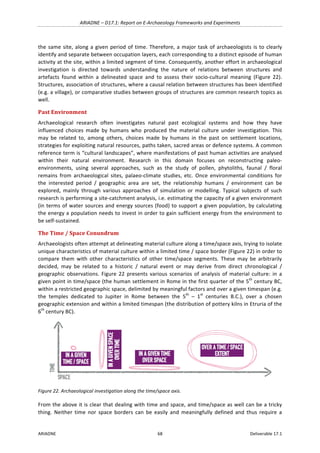
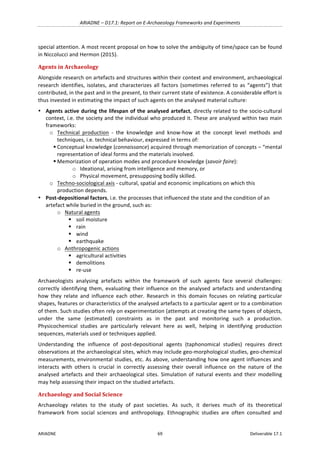
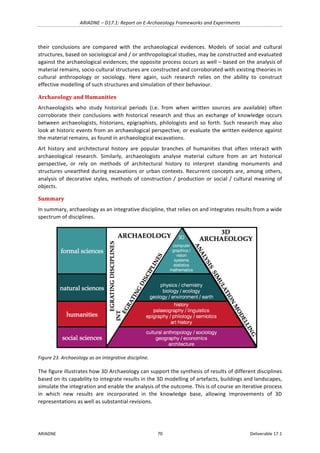
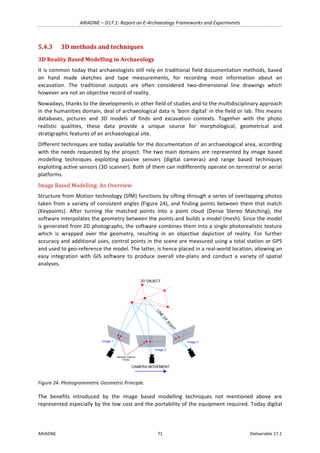
Authors:
Guntram Geser (SRFG)
Cesar Gonzalez-Perez (CSIC)
Ariadne is funded by the European Commission’s
7th Framework Programme.
The	views	and	opinions	expressed	in	this	report	are	the	sole	responsibility	of	the	author(s)	and	do	not	
necessarily	reflect	the	views	of	the	European	Commission.	
ARIADNE	–	D15.3:	Report	on	Semantic	Annotation	and	Linking	Prepared	 	by	USW			
	
	
About	this	document		
This	document	is	the	“Report	on	E-Archaeology	Frameworks	and	Experiments”,	a	contractual	deliverable	
(D17.1)	of	the	project	ARIADNE	-	Advanced	Research	Infrastructure	for	Archaeological	Dataset	Networking	
in	 Europe.	 The	 research	 leading	 to	 these	 results	 has	 received	 funding	 from	 the	 European	 Community’s	
Seventh	Framework	Programme	(FP7-INFRASTRUCTURES-2012-1)	under	grant	agreement	nÅã	313193.	


Version:	1.0	(final)	 28th
	January	2017	
Main	Authors:	 Guntram	Geser	(SRFG)	
Cesar	Gonzalez-Perez	(CSIC)	
	
Contributers	 Chapters	1-2:	Guntram	Geser	(SRFG)	and	C.sar	Gonzalez-Perez	(CSIC)	
Chapters	3-4:	Guntram	Geser	(SRFG)	
Chapter	5	–	Case	Studies:	
Archaeological	Methodology:		C.sar	Gonzalez-Perez	(CSIC)	
Archaeological	Ontology:		Achille	Felicetti	(PIN)	
3D	Archaeology:		Sorin	Hermon	(CYI-STARC)	
Geo-Physical	Field	Survey:		Simona	Simionescu	(ARHEO)	
Physical	Anthropology:		Orsolya	L.szl.	(MNM-NOK)	
Archaeobotanical	Research:		Guntram	Geser	(SRFG)	
VRE	for	Czech	Archaeology:		Martin	Kuna	(ARUP-CAS)	
Summary	of	Case	Studies	Results:		Guntram	Geser	(SRFG)	
Chapter	6:	Conclusions	and	Recommendations:	Guntram	Geser	
(SRFG)	
Chapter	7:	Main	References:	Guntram	Geser	(SRFG)	
	
Quality	review:	 Franco	Niccolucci	and	Paola	Ronzino	(PIN)
ARIADNE	–	D17.1:	Report	on	E-Archaeology	Frameworks	and	Experiments	
ARIADNE	 3	 Deliverable	17.1	
Table	of	Contents	
	
1	 Executive	Summary	............................................................................................................................	4	
2	 Introduction	and	overview	.................................................................................................................	7	
3	 E-Archaeology	Frameworks	.............................................................................................................	10	
3.1	 E-Archaeology	.........................................................................................................................................	10	
3.2	 Basic	E-Research	Frameworks	.................................................................................................................	10	
3.3	 Specific	E-Archaeology	Frameworks	.......................................................................................................	13	
3.4	 Summary	of	E-Archaeology	Frameworks	................................................................................................	18	
4	 Virtual	Research	Environments	........................................................................................................	21	
4.1	 Introduction	............................................................................................................................................	21	
4.2	 VRE	Definitions	........................................................................................................................................	21	
4.3	 VRE	Development	...................................................................................................................................	23	
4.4	 Taxonomies	of	VREs	and	Research	Activities	..........................................................................................	27	
4.5	 Current	State	of	VREs	in	Archaeology	.....................................................................................................	33	
4.6	 Summary	of	VREs	....................................................................................................................................	38	
5	 Case	Studies	.....................................................................................................................................	42	
5.1	 Introduction	and	Overview	.....................................................................................................................	42	
5.2	 Archaeological	Methodology	(CSIC)	........................................................................................................	43	
5.3	 Archaeological	Ontology	(PIN)	................................................................................................................	60	
5.4	 3D	Archaeology	(CyI-STARC)	...................................................................................................................	66	
5.5	 Geo-Physical	Field	Survey	(ArheoVest)	...................................................................................................	88	
5.6	 Physical	Anthropology	(MNM-NOK)	........................................................................................................	91	
5.7	 Archaeobotanical	Research	(SRFG)	.........................................................................................................	99	
5.8	 Virtual	Research	Environment	for	Czech	Archaeology	(ARUP-CAS)	......................................................	118	
5.9	 Summary	of	Case	Studies	Results	(SRFG)	..............................................................................................	128	
6	 Conclusions	and	Recommendations	..............................................................................................	132	
7	 Main	References	............................................................................................................................	136
ARIADNE	–	D17.1:	Report	on	E-Archaeology	Frameworks	and	Experiments	
ARIADNE	 4	 Deliverable	17.1	
1 Executive	Summary	
E-Archaeology	
In	this	study	e-archaeology	basically	means	the	use	of	web-based	digital	data,	tools	and	services	for	
research	purposes.	E-archaeology	may	be	subsumed	under	the	so	called	digital	humanities,	however	
has	its	own	disciplinary	challenges	and	some	different	characteristics.	The	study	includes	an	analysis	
of	 significant	 differences	 which	 should	 be	 taken	 account	 of	 when	 developing	 environments	 for	 e-
research	of	humanities	scholars	or	archaeologists.		
Enabling	Multi-Disciplinary	E-Archaeology	
Archaeology	is	a	multi-disciplinary	field	of	research	that	involves	researchers,	especially	find	experts,	
with	 different	 disciplinary	 backgrounds	 and	 research	 questions.	 They	 all	 contribute	 to	 the	
interpretation	 of	 archaeological	 sites,	 but	 their	 work	 requires	 different	 knowledge,	 methods	 and	
tools.	Therefore,	the	study	sees	a	need	of	two	types	of	collaborative	e-research	solutions:	
o An	environment	that	allows	bringing	together,	integrate	and	interpret	(synthesise)	the	results	of	
the	different	investigations	on	a	site,	of	the	core	team	of	archaeologists/excavators	and	of	the	
different	finds	experts	who	work	at	the	site	and/or	remotely.		
o Environments	 for	 researchers	 in	 specialities	 (e.g.	 physical	 anthropology,	 archaeobotany	 and	
others)	that	are	specialised	for	their	particular	data	and	terminology	and	include	services/tools	
for	the	identification,	description	and	analysis	of	their	finds.		
Both	environments	are	essential	for	collaborative	generation	of	research	results,	in	the	context	of	
archaeological	excavations	and	the	research	of	archaeological	specialities.	The	environments	should	
be	developed	in	view	of	wider	range	investigations	(i.e.	beyond	individual	sites)	based	on	sharing	of	
the	collected	data	through	the	ARIADNE	e-research	infrastructure.	
ARIADNE	and	Virtual	Research	Environments	
Virtual	 Research	 Environments	 (VREs)	 are	 web-based	 environments	 that	 provide	 research	
communities	 with	 tools,	 services	 and	 data	 resources	 which	 they	 need	 to	 carry	 out	 research	 work	
online.	 The	 ARIADNE	 data	 infrastructure	 currently	 allows	 discovery	 of	 and	 access	 to	 data	 across	
distributed	digital	archives.	One	next	step	could	be	to	provide	VREs	that	enable	carrying	out	 also	
other,	more	specific	research	tasks	online.	Such	VREs	may	range	from	loosely	coupled	services/tools	
and	 data	 resources	 to	 tightly	 integrated	 workbenches	 and	 databases	 for	 specific	 research	
communities.		
The	 study	 looked	 into	 the	 development	 of	 VREs	 for	 various	 disciplines,	 including	 taxonomies	 of	
different	types	of	VRE	and	research	activities	they	may	support.	The	investigation	found	that	there	
have	been	many	VRE	projects	for	humanities	scholars	who	study	textual	content,	but	few	attempts	
to	build	VREs	for	archaeology.	But,	archaeological	researchers	use	various	tools	to	carry	out,	analyse	
and	present	research	results.	Today	the	main	variant	of	an	archaeological	e-research	environment	
arguably	 is	 the	 Web	 GIS	 of	 an	 excavation	 project;	 also	 3D	 models	 are	 increasingly	 being	 used	 to	
present	research	results.		
Case	Studies	
The	case	studies	describe	exemplary	current	digital	practices	in	the	respective	area,	recent	progress	
and/or	existing	shortcomings,	and	outline	how	the	area	could	advance,	or	contribute	to	advancing,	
toward	innovative	e-archaeology.	A	common	perspective	of	the	studies	is	the	potential	development	
of	VREs	in	the	context	of	the	ARIADNE	e-infrastructure.	The	case	studies	cover	a	wide	range	of	e-
archaeology	topics	and	subject	matters:
ARIADNE	–	D17.1:	Report	on	E-Archaeology	Frameworks	and	Experiments	
ARIADNE	 5	 Deliverable	17.1	
o Archaeological	methodology		
o Archaeological	ontologies		
o E-infrastructure	VRE	at	the	national	level		
o 3D	archaeology		
o Geo-physical	surveying		
o Physical	anthropology	
o Archaeobotany	
The	conclusions	and	recommendations	of	the	case	studies	with	regard	to	potential	advances	in	e-
archaeology	 concern	 adoption	 of	 novel	 approaches,	 standards,	 methods,	 tools	 or	 other	 means,	
depending	on	the	subject	area	covered.	The	results	are	summarised	in	the	final	section	of	the	case	
studies	chapter	and	have	been	incorporated	in	the	overall	conclusions	and	recommendations.	
Main	Conclusions	and	Recommendations	
The	ARIADNE	e-infrastructure	helps	to	overcome	a	situation	of	high	fragmentation	of	archaeological	
data	in	Europe	(and	elsewhere).	At	the	same	time,	it	is	a	step	towards	the	even	more	ambitious	goal	
of	 providing	 a	 platform	 capable	 to	 support	 web-based	 research	 aimed	 to	 create	 new	 knowledge.	
Thus	a	major	next	step	could	be	to	implement	virtual	research	environments	(VREs)	that,	in	addition	
to	 data	 access,	 provide	 services	 and	 tools	 which	 allow	 archaeological	 researchers	 carrying	 out	
research	tasks	online.		
General	Recommendations	for	Data,	Tools/Services	and	VREs	
VREs	are	web-based	collaboration	environment	that	provide	a	set	of	integrated	tools	and	services	as	
well	as	data	resources	as	needed	by	research	communities	to	carry	out	research	tasks	online.	With	
regard	to	data,	tools/services	and	VREs	the	general	recommendations	of	this	study	are:	
o ARIADNE	 should	 focus	 on	 major	 archaeological	 data	 resources,	 in	 particular	 field	 survey	 and	
excavation	data,	including	data	of	research	specialties.		
o Concerning	data	of	research	specialities	ARIADNE	will	have	to	consider	which	fields	should	be	
focus	areas	of	future	incorporation	of	additional	data	resources.		
o With	regard	to	research	tools	the	focus	should	be	on	tools/services	of	particular	relevance	to	
archaeologists.	 One	 area	 already	 present	 in	 ARIADNE’s	 portfolio	 is	 online	 services	 for	 the	
generation,	 visualization	 and	 exploration	 of	 3D	 models	 (Visual	 Media	 Service	 and	 Landscape	
Factory).		
o Other	priority	areas	of	future	additional	tools/services	should	be	investigated.	These	could	focus	
on	certain	types	of	data	(e.g.	remote	sensing	data)	and/or	tasks	(e.g.	collaborative	building	of	
online	 reference	 collections).	 In	 general	 types	 of	 data	 and	 tasks	 that	 are	 relevant	 for	 broad	
segments	 of	 researchers	 are	 preferable,	 at	 least	 in	 a	 first	 phase	 of	 extension	 of	 the	 ARIADNE	
service	portfolio.	
o The	main	challenge	for	ARIADNE	to	support	e-archaeology	is	the	multi-disciplinary	of	archaeo-
logical	research.	This	challenge	may	be	addressed	by	providing	VREs	for	certain	domains	or	fields	
of	 research,	 and	 an	 environment	 that	 allows	 bringing	 together,	 integrate	 and	 synthesise	 the	
results	of	different	investigations,	i.e.	with	a	focus	on	archaeological	sites.	
o The	 environments	 should	 be	 developed	 in	 view	 of	 wider	 range	 investigations	 (i.e.	 beyond	
individual	 sites)	 based	 on	 sharing	 of	 the	 collected	 data	 through	 the	 ARIADNE	 e-research	
infrastructure.
ARIADNE	–	D17.1:	Report	on	E-Archaeology	Frameworks	and	Experiments	
ARIADNE	 6	 Deliverable	17.1	
Recommendations	for	the	Development	of	ARIADNE	VREs	
Use	 of	 VREs	 on	 top	 the	 ARIADNE	 e-infrastructure	 could	 bring	 about	 significant	 progress	 in	 e-
archaeology,	 in	 particular	 through	 enabling	 collaboration	 between	 and	 cross-fertilization	 of	
knowledge	and	research	agendas	of	scholars	of	different	domains.	With	regard	to	the	development	
of	ARIADNE	VREs	the	study	recommends:		
o Investigate	further	different	concepts	of	virtual	environments	for	archaeological	research,	e.g.	
which	 research	 tasks	 could	 research	 groups	 conduct	 more	 effectively	 online	 and	 which	
requirements	need	to	be	fulfilled.		
o Promote	 the	 development	 of	 relevant	 VREs	 with	 functionalities	 (tools,	 services)	 and	 data	
resources	required	by	archaeologists	to	carry	out	various	research	tasks	online.	
o Take	account	of	the	particular	requirements	of	archaeological	researchers	in	different	domains	
as	well	as	in	cross-domain/disciplinary	collaboration.	
o Consider	cases	where	researchers	use	data	mediated	by	ARIADNE	and	by	data	infrastructures	
and	services	of	other	disciplines	(e.g.	geo,	environmental,	biological	data).	For	the	development	
of	 cross-domain	 VREs	 collaboration	 between	 e-infrastructure	 initiatives	 of	 different	 disciplines	
may	be	necessary.		
o Support	 the	 use	 of	 domain-specific	 vocabulary	 as	 well	 as	 integrating	 ontologies	 such	 as	 the	
CIDOC	 Conceptual	 Reference	 Model	 (CIDOC	 CRM)	 and	 its	 recent	 extensions	 CRMsci,	
CRMarchaeo,	CRMba,	and	others.	
o Aim	to	develop	VREs	that	enable	collaboration	between	and	cross-fertilization	of	knowledge	and	
research	agendas	of	scholars	of	different	domains.	
o Foster	 cross-fertilization	 also	 between	 scholars	 and	 developers	 of	 software	 tools	 for	 research	
purposes,	in	which	developers	learn	about	the	requirements	of	scholars’	projects,	and	scholars	
how	to	apply	novel	technological	solutions.
ARIADNE	–	D17.1:	Report	on	E-Archaeology	Frameworks	and	Experiments	
ARIADNE	 7	 Deliverable	17.1	
2 Introduction	and	overview	
ARIADNE	has	implemented	an	e-infrastructure	platform	where	archaeological	data	resources	can	be	
uniformly	 described,	 discovered	 and	 accessed.	 The	 ARIADNE	 data	 registry	 and	 portal	 help	 to	
overcome	a	situation	of	high	fragmentation	of	archaeological	datasets	in	Europe	(and	elsewhere).	At	
the	 same	 time,	 the	 ARIADNE	 e-infrastructure	 is	 a	 step	 towards	 the	 even	 more	 ambitious	 goal	 of	
providing	an	environment	capable	to	support	web-based	research	aimed	to	create	new	knowledge	
(e-archaeology).		
Thus	a	major	next	step	could	be	to	implement	virtual	research	environments	(VREs)	that,	in	addition	
to	 data	 access,	 provide	 services	 and	 tools	 which	 allow	 archaeological	 researchers	 carrying	 out	
research	tasks	online.	Such	environments	may	range	from	loosely	coupled	services/tools	and	data	
resources	to	tightly	integrated	workbenches	for	researchers	of	different	domains	of	archaeology.	The	
current	 ARIADNE	 project	 has	 not	 been	 charged	 to	 develop	 VREs,	 but	 the	 implemented	 data	
infrastructure	and	portal	provide	a	basis	for	future	archaeological	VREs.		
E-archaeology		
In	this	report	the	term	“e-archaeology”	generally	refers	to	the	use	of	web-based	tools/services	and	
data	 resources	 for	 established	 and	 new	 forms	 of	 collaborative	 digital	 archaeological	 research	 (e-
research).	 In	 archaeology,	 e-research	 is	 conducted	 in	 fieldwork	 (e.g.	 capture	 of	 data	 with	 various	
digital	tools)	and	post-fieldwork	processing,	analysis,	publication	and	linking	of	data.	In	recent	years	
both	areas	have	experienced	an	increasing	use	of	digital	methods	and	tools.	
Field	surveys	and	excavations	
With	regard	to	fieldwork,	ever	more	data	capture	technologies	have	been	added	to	the	toolbox	of	
archaeologists.	 For	 example,	 the	 use	 of	 web-based	 geographic	 information	 systems	 (WebGIS)	 has	
become	 a	 standard	 practice	 in	 field	 surveys	 and	 excavations.	 Other	 developments	 focus	 on	
streamlining	data	workflows.	One	example	is	“paperless	archaeology”.	Mobile	applications	on	iPads	
or	 other	 tablets	 instead	 of	 paper-based	 recording	 templates	 are	 increasingly	 employed	 in	 field	
surveys	and	excavations.	This	avoids	the	“double	entry”	problem,	first	filling	paper	templates,	then	
entry	of	data	in	a	database.	The	goal	clearly	is	to	speed	up	data	collection	in	the	field	and	bring,	
where	possible,	also	the	data	processing	and	analysis	closer	to	the	trench.	
Thus	 the	 use	 of	 digital	 methods	 and	 tools	 has	 become	 an	 essential	 element	 of	 archaeological	
fieldwork.	But	it	is	not	a	focus	area	of	the	studies	presented	in	this	report.	ARIADNE	does	not	aim	to	
provide	archaeologists	with	novel	tools	for	capturing	and	processing	data	in	the	field,	but	focuses	on	
services	for	online	data	sharing,	discovery	and	re-use.	To	go	beyond	this,	future	developments	in	
ARIADNE	will	consider	how	web-based	research	tools/services	could	be	provided	in	addition	to	data	
resources,	ideally	integrated	as	VREs	for	different	areas	of	archaeological	research.		
This	said,	we	recognise	of	course	that	fieldwork	and	post-fieldwork	are	not	fully	separated	areas	of	
archaeological	 research.	 There	 are	 information	 loops,	 e.g.	 between	 excavators	 and	 finds	 experts	
working	remotely,	and	also	tools	such	as	project	wikis	which	allow	continued	documentation	and	
interpretation	during	and	after	the	fieldwork.	
Report	focus	on	post-fieldwork	e-archaeology	
The	 ARIADNE	 e-infrastructure	 allows	 registration,	 discovery,	 access	 to	 and	 use	 of	 data	 across	
distributed	 digital	 archives/repositories.	 The	 project	 does	 not	 provide	 services/tools	 for	 capturing	
data	in	the	field,	but	aims	to	support	e-research	based	on	already	produced	data	that	is	shared	and	
accessible	online.	The	support	currently	focuses	on	making	data	resources	better	discoverable	and	
accessible	for	researchers,	for	example,	based	on	enhanced	data	documentation,	sharing,	linking	and
ARIADNE	–	D17.1:	Report	on	E-Archaeology	Frameworks	and	Experiments	
ARIADNE	 8	 Deliverable	17.1	
access	for	re-use.	ARIADNE	services	such	as	data	registration,	search	and	access	are	generic	services,	
whereas	e-research	environments	provide	special	tools/services	for	research	tasks	of	researchers	of	
different	domains	of	archaeology.	Some	ARIADNE	services	already	signal	a	development	towards	e-
research	capability,	for	example,	the	services	for	publication	and	exploration	of	visual	media	(e.g.	
interactive	3D	models	of	objects	and	landscapes).	
Because	 ARIADNE	 services	 do	 not	 support	 fieldwork	 (or	 laboratory	 work),	 the	 WP17	 study	 group	
decided	to	focus	on	web-based	tools/services	and	data	resources	that	are	relevant	for	new	forms	of	
digital	 archaeological	 research.	 The	 study	 group	 recognised	 that	 there	 are	 many	 online	 platforms	
available	where	researchers	share	information,	social	media	sites	(e.g.	Flickr	or	YouTube)	as	well	as	
dedicated	professional	platforms,	i.e.	Academia.edu,	ResearchGate,	and	others.	Such	platforms	were	
not	considered	as	relevant	for	this	study.			
E-research	methodologies	and	case	studies	
ARIADNE	does	not	prescribe	e-research	methodologies,	but	aims	to	support	archaeological	research	
with	novel	approaches	and	useful	services	and	tools.	Therefore,	the	objectives	of	WP17	have	been	to	
collect	 and	 review	 innovative	 e-research	 frameworks	 and	 approaches	 and	 assess	 their	 current	
applications.	The	objectives	did	not	include	to	discuss	fundamental	questions	of	different	paradigms,	
theories,	methodologies,	etc.	that	are	present	in	the	archaeological	research	community.	Rather	the	
approach	should	be	to	look	into	current	practices	and	relevant	available	or	missing	applications	for	
innovative	e-archaeology.		
Furthermore,	a	number	of	case	studies	have	been	produced	as	pilot	investigations	for	the	develop-
ment	 of	 e-archaeology	 scenarios	 and	 future	 experiments	 in	 the	 context	 of	 the	 ARIADNE	 data	
infrastructure	 and	 portal.	 These	 investigations	 are	 different	 from	 those	 of	 the	 pilot	 deployment	
experiments	conducted	in	Work	Package	14.	The	WP14	demonstrators	employed	the	advanced	tools	
and	 services	 developed	 in	 ARIADNE	 to	 demonstrate	 their	 innovative	 capabilities;	 their	 results	 are	
presented	in	Deliverable	14.2.	Compared	to	these	most	WP17	case	studies	intentionally	address	a	
lower	 technological	 level	 to	 align	 with	 systems	 and	 tools	 archaeologists	 are	 familiar	 with.	
Furthermore,	different	archaeological	subjects	have	been	chosen	to	cover	together	a	wider	spectrum	
of	subjects.	
Brief	overview	
This	deliverable	presents	the	results	of	the	WP17	study	as	follows:		
Chapter	 3	 –	 E-Archaeology	 Frameworks:	 This	 chapter	 addresses	 basic	 elements	 of	 e-archaeology	
frameworks	which	include	the	general	research	and	data	lifecycles.	In	the	last	decades	the	cycles	
have	become	ever	more	supported	by	digital	tools	and	services,	so	that	e-research	frameworks	have	
emerged.	Where	digital	means	have	been	developed	or	specialised	for	use	by	particular	disciplines	or	
research	specialties	we	can	speak	of	specific	e-research	frameworks,	e.g.	e-archaeology	frameworks.	
The	chapter	also	identifies	differences	e-archaeology	and	other	“digital	humanities”	which	should	be	
taken	account	of	in	the	development	e-research	environments	for	 these	disciplines	as	well	as	for	
cross-/multi-disciplinary	e-research.	
Chapter	 4	 –	 Virtual	 Research	 Environments	 (VREs):	 This	 chapter	 looks	 into	 the	 definition	 and	
development	of	VREs	since	the	1990s,	including	taxonomies	of	different	types	of	VRE	and	research	
activities	they	may	support.	Furthermore,	a	section	on	the	current	state	of	development	and	use	of	
VREs	in	the	field	of	archaeology	is	included.		
Chapter	5	–	Case	Studies:	This	chapter	presents	several	case	studies	corresponding	to	different	e-
archaeology	settings	and	approaches,	however	with	existing	or	emerging	e-research	environments	as	
a	 common	 perspective.	 The	 case	 studies	 cover	 a	 wide	 range	 of	 e-archaeology	 subject	 matters,	
including	 archaeological	 methodology,	 archaeological	 ontologies,	 archaeological	 research	 infra-
ARIADNE	–	D17.1:	Report	on	E-Archaeology	Frameworks	and	Experiments	
ARIADNE	 9	 Deliverable	17.1	
structure	 and	 VREs	 at	 the	 national	 level,	 geo-physical	 surveying,	 3D	 archaeology,	 physical	
anthropology	and	archaeobotany.	
Chapter	 6:	 Conclusions	 and	 recommendations:	 Summarises	 the	 overall	 conclusions	 of	 this	 report,	
taking	account	of	the	results	concerning	e-archaeology	frameworks,	virtual	research	environments,	
and	the	related	thematic	or	domain-focused	case	studies.	The	recommendations	given	are	meant	for	
the	ARIADNE	network,	closely	related	and	other	organisations	in	fields	such	as	e-infrastructure,	data	
repositories	 and	 other	 service	 providers	 which	 are	 interested	 in	 the	 development	 of	 e-research/	
science	environments,	tools/services	and	data	resources.	
Chapter	7:	Literature	and	web-based	sources:	The	chapter	lists	the	references	for	chapters	1-4	and	6,	
as	well	as	includes	publications	of	general	interest	referenced	in	the	case	studies.	All	references	of	
the	individual	case	studies	are	given	in	the	respective	sections	of	chapter	5.	
Please	note	that	links	for	websites	of	important	organisations,	projects	and	other	sources	are	not	
given	in	footnotes	but	included	in	the	lists	of	references.
ARIADNE	–	D17.1:	Report	on	E-Archaeology	Frameworks	and	Experiments	
ARIADNE	 10	 Deliverable	17.1	
3 E-Archaeology	Frameworks	
This	 chapter	 addresses	 basic	 elements	 of	 e-archaeology	 frameworks	 which	 include	 the	 general	
research	and	data	lifecycles.	In	the	last	decades	the	cycles	have	become	ever	more	supported	by	
digital	tools	and	services,	so	that	e-research	frameworks	have	emerged.	Where	digital	means	have	
been	developed	or	specialised	for	use	by	particular	disciplines	or	research	specialties	we	can	speak	of	
specific	 e-research	 frameworks,	 e.g.	 e-archaeology	 frameworks.	 The	 chapter	 also	 identifies	
differences	e-archaeology	and	other	“digital	humanities”	which	should	be	taken	account	of	in	the	
development	e-research	environments	for	these	disciplines	as	well	as	for	cross-/multi-disciplinary	e-
research.	
3.1 E-Archaeology	
A	 core	 term	 throughout	 this	 report	 is	 “e-research”,	 which	 basically	 means	 the	 use	 of	 web-based	
digital	data,	tools	and	services	for	research	purposes.	We	prefer	“e-research”	to	“e-science”,	because	
the	latter	term	carries	with	it	notions	mainly	of	data-centric	computational	methods	with	a	focus	on	
quantitative/mathematical	analysis.	E-research	is	more	inclusive	of	a	variety	of	research	approaches	
and	methods.	Thus	the	variant	“e-archaeology”	stands	for	the	use	of	web-based	digital	data,	tools	
and	services	in	archaeological	research	for	any	quantitative	and/or	qualitative	research	methods.		
It	 can	 be	 said	 that	 today	 all	 archaeologists	 are	 “e-archaeologists”,	 because	 they	 generate	 various	
digital	 content	 with	 software	 tools,	 publish	 information	 on	 project	 websites	 and	 professional	
platforms	such	as	Academia.edu,	and	communicate	with	colleagues	directly	using	e-mail,	skype	and	
other	services.	But	in	this	study	we	are	looking	for	something	more	integrated,	which	supports	ICT-
based	collaborative	research	work,	i.e.	a	Virtual	Research	Environment	(VRE).		
E-archaeology	may	be	subsumed	under	the	“digital	humanities”,	although	digital	archaeology	has	its	
own	disciplinary	challenges	and	some	different	characteristics	(cf.	Huggett	2012a/b).	Indeed,	there	
are	 significant	 differences	 between	 archaeological	 and	 other	 humanities	 e-research	 practices.	 For	
example,	digital	humanities	scholars	mostly	work	with	cultural	content	from	archives,	libraries	and	
museums,	 while	 archaeologists	 produce	 most	 of	 their	 data	 themselves.	 This	 includes	 field	 and	
laboratory	work,	with	methods	and	tools	typically	not	used	in	other	humanities,	e.g.	data	capture	
and	analysis	methods	such	as	terrestrial	laser	scanning	and	chemical	analyses	of	micro-remains.	
We	 note,	 however,	 that	 there	 are	 also	 some	 commonalities	 or	 overlaps	 between	 historical	
humanities	 and	 archaeology.	 These	 can	 be	 found	 where	 researchers	 work	 with	 historical	 content	
(e.g.	archival	records)	and	analyses	of	material	remains,	i.e.	in	some	fields	of	the	Classics,	Medieval	
History/Archaeology,	or	Historical	Archaeology	(the	term	used	in	the	United	States	for	more	recent	
historical	periods).	
But	 existing	 differences	 are	 essential	 when	 it	 comes	 to	 specific	 e-research	 frameworks,	 data	 and	
tools	 afforded	 by	 the	 research	 in	 different	 scientific	 disciplines	 and	 specialities.	 For	 example,	
environmental	 archaeologists	 may	 need	 a	 set	 of	 tools	 which	 help	 them	 aggregate,	 visualise	 and	
analyse	 data	 on	 ancient	 vegetation	 and	 land	 use,	 whereas	 a	 research	 environment	 for	 classical	
studies	 could	 help	 researchers	 to	 create	 a	 digital	 scholarly	 edition	 of	 ancient	 texts.	 Therefore,	
essential	 differences	 between	 e-archaeology	 and	 other	 digital	 humanities	 are	 discussed	 further	
below.	The	next	sections	first	address	common	basic	elements	of	e-research.	
3.2 Basic	E-Research	Frameworks		
Under	basic	research	frameworks	we	subsume	the	general	research	process	(or	lifecycle)	and	the	
related	data	lifecycle.	In	the	last	decades	the	cycles	have	become	ever	more	supported	by	digital
ARIADNE	–	D17.1:	Report	on	E-Archaeology	Frameworks	and	Experiments	
ARIADNE	 11	 Deliverable	17.1	
tools	and	services,	so	that	e-research	frameworks	have	emerged.	These	e-frameworks	comprise	of	
digital	 means	 (i.e.	 services/tools)	 that	 are	 generic	 and	 used	 by	 researchers	 of	 all	 disciplines	 and	
elements	 which	 may	 be	 specific	 for	 one	 or	 a	 few	 disciplines.	 Where	 digital	 means	 have	 been	
developed	 or	 specialised	 for	 use	 by	 particular	 disciplines	 or	 research	 specialties	 we	 can	 speak	 of	
specific	e-research	frameworks,	e.g.	e-archaeology	frameworks.		
3.2.1 Research	Process/Lifecycle	
The	research	process	comprises	of	the	steps	from	a	project	idea	to	the	publication	of	the	final	results,	
including	the	research	data	lifecycle	(see	below).	Furthermore,	there	are	many	related	activities,	for	
example	reporting	of	project	financials	and	outcomes	to	funders,	or	use	of	project	results	in	research	
-based	education	and	training,	which	are	not	addressed	here.		
In	the	empirical	disciplines	the	research	process	in	general	comprises	of	the	following	steps,	which	
nowadays	are	all	supported	by	digital	means	that	are	generic	or	have	been	adapted	or	developed	for	
carrying	out	research	tasks	more	effectively	or	in	novel	ways.	The	latter	may	range	from	tools	that	
are	being	used	by	researchers	of	many	disciplines	(e.g.	GIS)	to	only	one	project	(e.g.	a	software	or	
algorithm	developed	for	a	particular	research	problem):	
o Identification	and	formulation	of	the	research	problem:	In	this	step	the	researchers	take	account	
of	the	state	of	knowledge	in	their	field/s	of	research,	i.e.	the	current	literature	and	own	previous	
research,	 and	 seek	 to	 identify	 a	 problem	 that	 is	 worth	 and	 possible	 to	 tackle.	 The	 specific	
research	problem	is	being	formulated,	including	the	objectives,	hypothesis	etc.	which	will	largely	
determine	the	appropriate	methodology.		
o Definition	of	the	research	methodology	and	design:	In	this	step	the	empirical	approach	to	address	
the	 research	 problem	 is	 being	 defined	 and	 designed,	 including	 the	 tools,	 procedures,	 data	
sources,	and	other	means	required	for	carrying	out	the	research.		
o Data	acquisition	and	organisation:	This	step	concerns	the	acquisition	of	the	data	with	particular	
tools	and	may	also	include	re-use	of	data	from	previous	own	or	other	projects.	The	data	is	being	
organised	 (e.g.	 in	 a	 database)	 and	 may	 need	 dedicated	 management	 if	 the	 research	 process	
extends	over	a	long	period.	
o Data	 processing,	 analysis	 and	 interpretation:	 In	 this	 step	 the	 data	 is	 being	 processed	 and	
analysed	with	appropriate	tools	and	procedures	(e.g.	statistical	analysis,	simulations,	etc.).	The	
results	are	scrutinized	and	interpreted	(i.e.	if	they	confirm	hypotheses),	including	comparison	to	
results	of	other	investigations,	and	conclusions	drawn	about	what	new	knowledge	they	provide	
about	the	research	problem	addressed.		
o Publication	of	the	research	results	and	data:	Finally,	the	results	of	the	investigation	are	formally	
published,	including	review	by	other	researchers,	and	become	part	of	the	scientific	record	and	
state	of	knowledge	in	respective	field	of	research.	Increasingly	this	also	includes	making	available	
the	data	which	underpin	the	published	research	results	through	a	publicly	accessible	repository,	
allowing	for	re-use	of	data	for	further	research.		
In	different	empirical	disciplines	and	specialities,	the	research	approaches	differ	with	regard	to	the	
methodologies,	 tools,	 data,	 etc.	 that	 are	 being	 employed	 to	 address	 research	 questions.	 Some	
disciplines	 and	 research	 specialities	 also	 have	 characteristics	 which	 they	 do	 not	 share	 with	 many	
others.	 For	 example	 in	 archaeology,	 in	 particular,	 excavation	 projects,	 the	 research	 process	 can	
extend	 over	 several	 excavation	 campaigns	 hence	 take	 many	 years.	 More	 importantly,	 excavation	
projects	involve	research	methods	and	results	of	different	specialties,	which	need	to	be	combined	to	
arrive	at	solid	conclusions	about	the	past	communities,	cultures	and	lifeways	whose	material	remains	
and	traces	are	preserved	in	the	so	called	archaeological	record	of	sites.
ARIADNE	–	D17.1:	Report	on	E-Archaeology	Frameworks	and	Experiments	
ARIADNE	 12	 Deliverable	17.1	
3.2.2 Research	Data	Lifecycle	
The	 research	 data	 lifecycle	 concerns	 the	 “active”	 phases	 of	 data	 in	 the	 research	 process,	 those	
phases	in	which	the	data	is	being	generated	and/or	existing	data	re-used,	processed,	interpreted,	
presented	 and	 used	 for	 underpinning	 publications.	 The	 lifecycle	 thus	 concerns	 the	 whole	 process	
from	data	acquisition	to	products	such	as	tables	or	charts	in	publications.		
The	research	data	lifecycle	largely	overlaps	with	the	research	process	model,	and	is	often	presented	
as	identical,	but	there	are	some	important	differences.	Firstly,	the	data	lifecycle	does	not	include	the	
research	design	phase,	except	where	re-use/purposing	of	available	data	is	considered.	Secondly,	the	
research	process	does	not	necessarily	include	data	archiving	for	long-term	curation	and	access	for	
everybody.	As	available	data	are	an	asset,	researchers	keep	it,	re-use/purpose	it	in	new	projects,	also	
sometimes	 share	 data	 directly	 with	 close	 colleagues.	 But	 such	 “active	 data”	 does	 not	 require	
depositing	it	in	a	data	archive,	including	preparation	and	description	(metadata),	so	that	it	can	be	
preserved	and	made	available	by	the	archive.	Furthermore,	the	research	process	includes	essential	
activities	 which	 do	 not	 necessarily	 involve	 data,	 communication	 between	 project	 partners,	 for	
instance.		
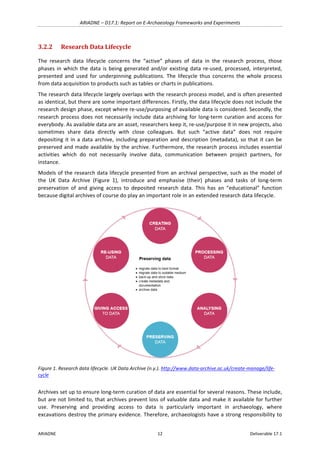
Models	of	the	research	data	lifecycle	presented	from	an	archival	perspective,	such	as	the	model	of	
the	 UK	 Data	 Archive	 (Figure	 1),	 introduce	 and	 emphasise	 (their)	 phases	 and	 tasks	 of	 long-term	
preservation	 of	 and	 giving	 access	 to	 deposited	 research	 data.	 This	 has	 an	 “educational”	 function	
because	digital	archives	of	course	do	play	an	important	role	in	an	extended	research	data	lifecycle.		
	
Figure	1.	Research	data	lifecycle.	UK	Data	Archive	(n.y.).	http://www.data-archive.ac.uk/create-manage/life-
cycle	
Archives	set	up	to	ensure	long-term	curation	of	data	are	essential	for	several	reasons.	These	include,	
but	are	not	limited	to,	that	archives	prevent	loss	of	valuable	data	and	make	it	available	for	further	
use.	 Preserving	 and	 providing	 access	 to	 data	 is	 particularly	 important	 in	 archaeology,	 where	
excavations	destroy	the	primary	evidence.	Therefore,	archaeologists	have	a	strong	responsibility	to
ARIADNE	–	D17.1:	Report	on	E-Archaeology	Frameworks	and	Experiments	
ARIADNE	 13	 Deliverable	17.1	
share	collected	data	with	the	research	community	to	enable	further	research,	for	example,	asking	
new	questions	from	combined	datasets.	
Through	long-term	curation	digital	archives	make	an	extended	“active	life”	of	data	possible.	Some	
data	lifecycle	models	understand	also	researchers	as	curators,	for	example	the	model	promoted	by	
the	Digital	Curation	Centre	UK	(Higgins	2008;	Ball	2012	compares	it	to	other	models).	One	basic	idea	
of	 all	 models	 is	 that	 the	 data	 should	 finally	 be	 deposited,	 well	 described,	 in	 a	 digital	 archive.	 But	
excavation	 projects	 often	 take	 many	 years,	 if	 not	 decades,	 therefore	 data	 curation	 is	 essential	
already	during	the	research	process.	
Some	 projects	 have	 looked	 into	 researchers’	 data	 curation	 practices	 with	 the	 aim	 to	 develop	
approaches	 and	 tools	 that	 may	 enhance	 data	 practices.	 For	 example,	 the	 Data	 Curation	 Profiles	
project	 (2008-2012)	 studied	 such	 practices	 extensively.	 The	 project	 invited	 researchers	 of	 several	
disciplines	to	document	how	they	work	with	data,	different	forms	and	stages	of	data,	tools	used,	and	
what	they	consider	as	sharable	forms	of	data	in	their	field	of	study	(Cragin	et	al.	2010;	Witt	et	al.	
2009).	 Researchers	 of	 ARIADNE	 partner	 Athena	 RC	 (Digital	 Curation	 Unit),	 have	 proposed	 an	
extended	 digital	 curation	 lifecycle	 model	 (Constantopoulos	 et	 al.	 2009).	 Also,	 they	 worked	 with	
humanities	researchers	to	better	understand	their	digital	curation	requirements	(e.g.	Benardou	et	al.	
2010).	Dallas	(2015)	considers	the	curation	of	archaeological	knowledge	“in	the	digital	continuum”	as	
a	grand	challenge	of	digital	archaeology.	
3.3 Specific	E-Archaeology	Frameworks	
Having	established	some	basic	elements	of	e-research	frameworks,	we	now	ask	if	there	are	any	e-
archaeology	 specific	 aspects.	 Archaeology	 studies	 past	 cultures	 based	 on	 their	 material	 remains.	
Therefore,	 the	 discipline	 is	 generally	 subsumed	 under	 the	 humanities.	 However,	 archaeology	 is	 a	
multi-disciplinary	field	of	research	that	involves	researchers,	especially	finds	experts	with	different	
disciplinary	backgrounds	who	identify	and	analyse	physical	and	biological	remains	such	as	ceramics,	
metals,	bones,	plants,	etc.	These	experts	come	from	different	research	specialities	(e.g.	zooarchaeo-
logy	in	the	case	of	animal	bones),	each	with	their	own	subject	knowledge	and	methodologies.	
Moreover,	the	material	remains	of	past	cultures	include	objects	such	as	cuneiform	tablets,	papyri,	
inscriptions,	 art	 works	 and	 others	 that	 are	 studied	 by	 scholars	 of	 ancient	 languages,	 literatures,	
religions,	philosophies,	etc.	In	turn,	these	can	contribute	to	the	interpretation	of	archaeological	sites.	
Hence,	there	is	the	question	of	where	to	draw	the	line	and	focus	on	e-archaeology	frameworks	and	
their	methods,	tools	and	data,	thereby	avoiding	less	relevant	fields	of	research.	
In	the	sections	that	follow,	first	we	address	archaeology	as	a	multi-disciplinary	field	of	research,	and	
then	 point	 out	 important	 differences	 (and	 commonalities)	 between	 archaeology	 and	 humanities	
disciplines	not	or	only	occasionally	involved	in	archaeological	research.	The	identified	differences	can	
help	 distinguishing	 between	 e-research	 frameworks,	 and	 to	 take	 them	 into	 account	 in	 the	
development	of	digital	research	environments	for	different	disciplines.	
3.3.1 Archaeology	as	a	Multi-Disciplinary	Field	of	Research	
The	classical	“tree	of	knowledge”	model	splits	the	scientific	and	scholarly	knowledge	into	different	
branches	 (i.e.	 natural	 sciences,	 social	 sciences,	 arts	 &	 humanities),	 major	 disciplines	 within	 these	
branches,	and	the	disciplines	into	sub-disciplines	and	research	specialties.	In	the	development	of	e-
research	infrastructures	it	is	very	important	to	take	account	of	differences	between	disciplines	with	
regard	to	research	practices.	Archaeology	poses	a	challenge	because	it	is	a	multi-disciplinary	field	of	
research,	in	which	theoretical	concepts,	models	and	methods	from	different	branches	of	knowledge
ARIADNE	–	D17.1:	Report	on	E-Archaeology	Frameworks	and	Experiments	
ARIADNE	 14	 Deliverable	17.1	
are	being	used.	Sinclair	(2014)	provides	a	visualisation	of	the	multi-disciplinary	map	of	archaeological	
research.		
Archaeology	covers	several	fields	of	the	humanities	as	well	as	has	close	ties	with	the	applied	natural	
sciences	 and	 other	 disciplines.	 In	 a	 volume	 of	 papers	 on	 “Archaeology	 2.0”,	 Eric	 C.	 Kansa	 notes:	
“Archaeology	 is	 an	 inherently	 multidisciplinary	 enterprise,	 with	 one	 foot	 in	 the	 humanities	 and	
interpretive	 social	 sciences	 and	 another	 in	 the	 natural	 sciences.	 As	 such,	 case	 studies	 in	 digital	
archaeology	can	help	illuminate	changing	patterns	in	scholarly	communications	across	a	wide	array	
of	 disciplinary	 contexts”	 (Kansa	 2011:	 2).	 With	 regard	 to	 the	 natural	 science	 component	 of	
archaeology	 Degryse	 &	 Shortland	 (2013)	 highlight	 that	 “there	 are	 very	 few	 sciences	 that	 have	 no	
relevance	 to	 archaeology”,	 and	 see	 an	 increasing	 influx	 of	 scientific	 methods	 in	 archaeological	
research.		
Archaeology	indeed	comprises	of	different	disciplinary	fields	of	research,	where	some	fields	present	
mainly	 characteristics	 of	 the	 humanities	 (e.g.	 history	 of	 arts	 and	 architecture,	 classical	 studies,	
medieval	 history),	 others	 lean	 heavily	 towards	 the	 natural	 sciences	 and	 employ	 methods	 of	
archaeometry	or	biological	sciences,	others	relate	to	the	earth	&	environmental	sciences,	while	still	
others	 use	 models	 and	 methods	 of	 the	 social	 sciences	 (e.g.	 models	 of	 social	 structure	 and	
ethnological	methods,	for	instance).	
The	 paradigmatic	 case	 of	 multi-disciplinary	 archaeological	 research	 is	 excavation	 projects.	 These	
projects	 are	 carried	 out	 by	 teams	 involving	 the	 excavating	 archaeologists	 and	 finds	 experts	 of	
different	 specialities	 who	 identify	 and	 analyse	 physical	 and	 biological	 remains	 such	 as	 ceramics,	
metals,	bones,	plants,	etc.	They	all	contribute	to	the	interpretation	of	archaeological	sites,	but	their	
work	requires	different	subject	knowledge	and	methodologies.	
Archaeological	excavation	projects	thus	are	essentially	team-based	and	multi-disciplinary.	There	has	
been	(and	still	often	is)	the	classical	figure	of	the	lead	archaeologist	at	a	site	(“his/her	site”).	Also	
traditional	divisions	are	still	present,	for	example	between	field	and	lab,	excavators	at	the	site	and	
specialists	working	remotely,	sending	reports	to	the	lead	archaeologist.	
Killick	 (2015)	 describes	 the	 traditional	 model	 and	 its	 erosion	 in	 recent	 years	 as	 follows:	 “The	 old	
model	of	site	excavation	resembled	a	wagon	wheel,	with	the	principal	archaeologist	(site	director)	at	
the	hub,	a	ring	of	specialists	around	the	rim,	and	the	spokes	of	the	wheel	representing	the	separate	
two-way	 communication	 between	 the	 site	 director	 and	 each	 specialist.	 Today	 the	 specialists	 often	
need	to	communicate	directly	with	each	other	to	do	their	job	–	for	example,	the	archaeometallurgist	
needs	 the	 geologist	 to	 identify	 ore	 samples,	 the	 botanist	 to	 identify	 charcoals,	 the	 lead	 isotope	
specialist	to	distinguish	local	from	exotic	metals.	Synthesis	and	interpretation	today	tends	to	be	made	
by	teams	rather	than	by	the	site	director.	Trends	in	publication	reflect	this	tendency;	scientific	studies	
now	tend	to	be	published	separately	rather	than	included	as	dry	appendices	in	the	site	monograph,	as	
used	to	be	the	case”	(Killick	2015:	170).	
First	efforts	towards	VREs	for	archaeological	excavations	(e.g.	the	VERA	project)	aimed	to	make	the	
traditional	 model	 more	 effective.	 However,	 as	 Killick’s	 describes,	 archaeological	 has	 become	 less	
centralised	 (around	 the	 principal	 archaeologist)	 and	 there	 is	 a	 need	 to	 support	 the	 interaction	
between	 researchers	 of	 different	 specialities.	 Moreover,	 different	 specialties	 could	 benefit	 from	
having	specialised	VREs	which	support	their	research	specifically.	Concerning	such	VREs	it	should	be	
noted	that	researchers	who	serve	as	finds	experts	are	also	scholars	in	their	specialties.	These	scholars	
seek	research	results,	often	derived	from	work	at	different	sites,	which	are	of	particular	interest	to	
their	own	specialty,	for	example,	physical	anthropology	or	archaeobotany.	
This	suggests	a	need	for	two	types	of	collaborative	e-research	solutions:	a)	a	VRE	that	allows	bringing	
together,	integrate	and	interpret	(synthesise)	the	results	of	the	different	investigations	on	a	site,	and	
b)	 VREs	 for	 researchers	 in	 specialities	 that	 are	 specialised	 for	 their	 particular	 data	 (incl.	 data
ARIADNE	–	D17.1:	Report	on	E-Archaeology	Frameworks	and	Experiments	
ARIADNE	 15	 Deliverable	17.1	
standards,	terminology)	and	include	services/tools	for	the	identification,	description	and	analysis	of	
their	 finds	 (e.g.	 access	 to	 reference	 collections	 for	 the	 identification	 of	 finds).	 Importantly,	 both	
should	 be	 developed	 in	 view	 of	 wider	 range	 investigations	 (i.e.	 beyond	 individual	 sites)	 based	 on	
sharing	of	the	collected	data	through	domain	e-research	infrastructures	(i.e.	ARIADNE).	
3.3.2 E-Archaeology	and/vs.	Digital	Humanities	
In	 a	 comparison	 of	 archaeology	 and	 humanities	 disciplines	 not	 or	 only	 occasionally	 involved	 in	
archaeological	research	we	identified	important	differences	and	significant	commonality	with	regard	
to	 digital	 practices.	 These	 can	 help	 to	 distinguish	 e-archaeology	 frameworks	 from	 others	 and	 to	
conceive	environments	for	e-research	of	scholars	in	different	disciplines.	
Contexts	of	work	
With	 regard	 to	 contexts	 of	 work,	 the	 difference	 between	 humanities	 studies	 and	 archaeological	
research	is	rather	clear.	Humanities	studies	are	mainly	an	activity	of	academics	with	few	external	
constraints	except	getting	access	to	relevant	content,	which	is	being	held	and	increasingly	digitised	
by	archives	and	museums.	In	contrast,	work	in	archaeology	is	conducted	in	contexts	which	include	
governmental	 administrations,	 national	 heritage	 agencies,	 infrastructure	 development	 companies,	
and	 commercial	 archaeology	 services	 (contract	 archaeologists).	 Excavations	 are	 subject	 to	
regulations,	requires	permit,	entail	reporting	duties,	etc.		
While	most	researchers	in	the	humanities	and	certainly	“digital	humanities”	would	not	agree	to	the	
image	of	the	“lone	scholar”,	in	archaeology	research	teams	are	common	practice.	Importantly,	in	
research	on	archaeological	sites	these	are	interdisciplinary	teams	involving	excavators,	finds	experts,	
laboratory-based	researchers,	data	managers,	and	others.	
Jeremy	 Huggett	 (2012b)	 sees	 few	 relations	 between	 e-archaeology	 and	 the	 “digital	 humanities”:	
“From	 an	 archaeological	 perspective,	 a	 relationship	 between	 Digital	 Archaeology	 and	 Digital	
Humanities	is	largely	absent	and	the	evidence	suggests	that	each	is	peripheral	with	respect	to	the	
other”.	He	notes	that	e-archaeology	does	not	need	the	digital	humanities	for	legitimacy	and	support	
because	 archaeology	 builds	 on	 its	 own	 arsenal	 of	 research	 approaches,	 including	 many	 well-
established	digital	methods	and	tools.		
One	example	Huggett	analyses	is	the	use	of	Geographic	Information	Systems	(GIS)	by	archaeologists	
compared	 to	 which	 “DH	 [digital	 humanities]	 applications	 of	 GIS	 can	 seem	 very	 limited,	 even	
simplistic,	 to	 archaeological	 eyes	 in	 that	 they	 often	 seem	 to	 focus	 on	 interactive	 hypermedia	
visualisation	with	little	use	of	GIS	analytical	tools”.	Even	better	examples	are	data	capture,	processing	
and	visualization	tools	which	are	essential	for	archaeological,	but	not	other	humanities	research,	e.g.	
terrestrial	laser	scanning	or	photogrammetry	and	software	for	the	creation	and	visualization	of	3D	
reconstructions	of	buildings	and	landscapes.		
Different	Research	Paradigms	
Most	“digital	humanities”	research	is	informed	by	paradigms	of	textual	and	visual	studies	of	historical	
and	modern	cultural	content.	Archaeologists	instead	focus	on	the	material	remains	of	past	cultures	
and	their	traces	in	the	environment,	including	remains	such	as	biological	material,	artefacts,	built	
structures	 as	 well	 as	 traces	 in	 the	 landscape	 (e.g.	 agriculture,	 routes	 between	 places,	 etc.).	
Accordingly,	the	paradigms	and	tools	for	“reading”	the	remains	and	traces	are	very	different	from	
textual	analysis	and	other	humanities	studies	of	cultural	content.	
Textual	information	plays	a	significant	role	in	archaeology	only	for	cultures	and	periods	for	which	
such	 information	 exists	 (e.g.	 cuneiform	 tablets,	 papyri,	 epigraphy,	 historical	 manuscripts).	 When	
considering	 texts,	 many	 archaeologists	 would	 first	 think	 of	 maybe	 available	 reports	 of	 fieldwork
ARIADNE	–	D17.1:	Report	on	E-Archaeology	Frameworks	and	Experiments	
ARIADNE	 16	 Deliverable	17.1	
already	conducted	at	a	site,	nearby	or	in	the	region.	As	Stuart	Dunn	elaborates,	“Texts	occupy	an	
important	place	in	archaeological	research,	chiefly	in	the	form	of	so-called	grey	literature	reports	of	
excavations,	 which	 are	 often	 the	 only	 extant	 records	 of	 those	 excavations,	 along	 with	 secondary	
literature	and	publications.	But	the	bulk	of	primary	archaeological	excavation	data	comes	in	the	form	
of	numeric,	graphic,	statistical,	and	formal	descriptions	of	the	material	record”	(Dunn	2011:	95).	
On	the	other	hand,	material	objects	and	traces	of	past	cultures	as	studied	by	archaeologists	usually	
are	“not	among	the	standard	resources	of	academic	research	in	the	humanities	and	social	sciences.	
Historians	are	used	to	dealing	with	literary	sources,	and	all	our	sophisticated	methodology	focuses	on	
the	investigation	of	these.	Meanwhile,	we	observe	the	march	of	images	into	the	historian’s	study,	but	
physical	objects	are	still	mostly	kept	at	arm’s	length”	(H.O.	Sibum	in	Auslander	et	al.	2009:	1384).		
But	there	are	some	commonalities	and	overlaps	between	archaeology	and	historical	humanities,	for	
example	in	some	research	fields	of	the	Classics	(Babeu	2011),	Medieval	History	(Graham-Campbell	&	
Valor	2007;	Carver	&	Klápštĕ	2011),	and	Historical	Archaeology,	i.e.	the	post-Columbian	history	of	the	
Americas	(Hall	&	Silliman	2006;	Mehler	2013).		
The	 overlaps	 can	 be	 found	 where	 humanities	 scholars	 work	 with	 texts	 and	 evidence	 for	 certain	
historical	developments	drawn	from	material	such	as	sculptures	and	architecture,	or	more	mundane	
objects	of	ancient	everyday	life.	The	overlap	is	particularly	clear	between	archaeological	research	and	
classical	studies,	and	also	the	adoption	of	information	technologies	in	specialties	of	the	Classics	is	
particularly	high.	The	Digital	Classicist	wiki	documents	over	300	projects	that	employ	ICT	for	ancient	
and	classical	research.	
Alison	Babeu	(2011)	gives	an	excellent	overview	of	the	field	of	“digital	classics”.	She	characterises	it	
as	 an	 interdisciplinary	 field	 of	 research	 which	 includes	 (digital)	 classical	 archaeology,	 philology	 of	
ancient	Greek	and	Latin	texts,	epigraphy,	papyrology	and	manuscript	studies,	numismatics,	classical	
art	and	architecture,	ancient	world	geography,	and	others	–	each	with	their	own	objects	of	study	and	
research	methods.	Many	of	the	projects	concern	the	collaborative	development	of	digital	resources	
and	scholarly	editions	of	classical	content.		
Different	Data	and	Tools	
E-research	practices	of	humanities	scholars	have	been	investigated	in	studies	on	the	actual	use	of	
digital	tools	and	data	in	different	fields	(e.g.	Benardou	et	al.	2010;	Research	Information	Network	
2011;	Rutner	&	Schonfeld	2012;	Svensson	2010).	One	significant	difference	between	archaeology	and	
other	humanities	disciplines	are	the	“data”	that	are	being	used.	
Scholars	in	the	so	called	digital	humanities	use	mainly	cultural	content,	e.g.	literary	texts,	paintings,	
photographs,	 music,	 films,	 etc.,	 most	 of	 comes	 from	 collections	 of	 libraries,	 media	 archives	 and	
museums.	Without	the	massive	digitisation	of	and	online	access	to	this	cultural	heritage	content,	and	
novel	 tools	 for	 studying,	 annotating	 and	 interlinking	 of	 various	 content	 (and	 pieces	 thereof),	 the	
recent	boom	of	digital	humanities	scholarship	would	not	have	been	possible.		
In	contrast,	archaeologists	generate	most	of	their	data	themselves,	various	data	produced	in	surveys,	
excavations,	laboratory	analyses	of	physical	and	biological	finds,	etc.	The	array	of	data	also	includes	
data	from	specialised	laboratories	which	serve	archaeologists	among	other	clients	(e.g.	synchrotron	
facilities	or	sequencing	labs	with	regard	to	ancient	DNA).	Furthermore,	data	not	produced	but	used	
by	archaeologists	(if	affordable)	are	airborne	or	satellite	remote	sensing	and	imaging	data.	Some	field	
surveys	and	archaeological	excavations	amass	large	volumes	of	various	data,	but	not	“big	data”	like	
the	 volumes	 of	 continuously	 collected	 data	 from	 environmental	 sensors	 or	 generated	 by	 high-
throughput	DNA	sequencing	technologies.		
Archaeologists	 and	 other	 humanities	 scholars	 need	 appropriate	 solutions	 for	 handling,	 bringing	
together	 and	 studying	 their	 data/content.	 In	 archaeology	 this	 often	 is	 a	 Geographic	 Information
ARIADNE	–	D17.1:	Report	on	E-Archaeology	Frameworks	and	Experiments	
ARIADNE	 17	 Deliverable	17.1	
System	(GIS)	on	top	of	a	database	of	geo-referenced	digital	content.	In	other	fields	of	the	humanities	
scholars	may	work	with	a	large	amount	of	high-resolution	images	or	audio-visual	material.	Therefore,	
the	scholars	could	benefit	from	using	advanced	e-infrastructure	and	tools.	Rather	than	for	massive	
computation,	 in	 the	 first	 place	 they	 would	 need	 it	 to	 store,	 manage,	 remotely	 retrieve,	 load	 and	
visualise	the	material	(e.g.	juxtaposed	display	of	images).	Then	comparison,	transcription,	annotation	
and	other	work	typical	for	scholarship	in	the	humanities	can	begin,	with	specific	tools	for	these	tasks.	
For	 example,	 Ainsworth	 &	 Meredith	 (2009)	 and	 de	 la	 Flor	 et	 al.	 (2010)	 describe	 prototypes	 for	
working	with	high-resolution	images	of	ancient	and	medieval	manuscripts.	
Many	“classic”	digital	humanities	products	are	so-called	digital	scholarly	editions,	one	or	a	few	richly	
annotated	cultural	works	(Cayless	et	al.	2009;	Porter	2013;	O’Donnell	et	al.	2015)	or	a	database	of	
hundreds	 or	 thousands	 of	 objects,	 including	 images,	 translations,	 literature	 references,	 etc.	 For	
example,	the	Epigraphic	Database	Heidelberg	documents	about	74,000	inscriptions.	Archaeologists	
do	 not	 create	 such	 works,	 but	 maybe	 look	 up	 an	 epigraphic	 database	 to	 compare	 a	 newly	 found	
inscription	 and	 contribute	 an	 image	 to	 the	 database.	 Indeed,	 the	 need	 to	 identify	 new	 finds	 by	
comparing	 them	 to	 specimens	 of	 reference	 collections	 is	 one	 essential	 commonality	 among	
researchers	in	different	specialities	of	archaeology	and	other	humanities.	
Little	Usage	of	Advanced	Computation	
One	 commonality	 of	 the	 digital	 humanities	 and	 archaeology	 is	 that	 researchers	 seldom	 employ	
advanced	 computation	 for	 their	 research.	 There	 has	 been	 much	 debate	 about	 the	 question	 if	 e-
infrastructure	for	advanced	data	processing	and	computation	as	developed	for	some	natural	science	
and	 engineering	 disciplines	 can	 be	 adjusted	 to	 the	 needs	 of	 the	 humanities.	 In	 the	 debate,	 most	
representatives	 from	 the	 humanities	 hold	 that	 scholarship	 in	 these	 disciplines	 affords	 different	
solutions	than	“heavy”	e-infrastructure	for	massive	Grid	or	Cloud	based	computing.	A	common	view	
is	that	innovation	in	the	digital	humanities	may	be	better	promoted	by	in	comparison	small	scale	but	
highly	research-focused	IT	applications	(e.g.	Svensson	2010;	Wouters	&	Beaulieu	2006;	van	Zundert	
2012).		
The	limited	use	of	advanced	computation	as	offered	by	Distributed	Computing	Infrastructures	(DCIs)	
by	humanities	researchers	supports	these	assumptions.	DCIs	provide	a	so	called	“Science	Gateway”	
to	(mostly)	Grid-based	e-infrastructure	and	software	applications	for	data	processing,	storage	and	
transfer.	 User	 groups	 can	 share	 data	 resources	 and	 computing	 applications	 (i.e.	 virtual	 machines)	
and,	 thereby,	 form	 a	 virtual	 research	 community.	 The	 leading	 promoter	 of	 DCIs	 is	 the	 EGI.eu	 -
European	Grid	Infrastructure.		
The	DCI	providers	have	sought	to	expand	their	user	base,	not	least	to	legitimate	the	high	investments	
in	 Grid	 and	 high-performance	 computing.	 But	 the	 demand	 for	 DCI	 has	 been	 limited	 in	 many	
disciplines	as	yet,	especially	in	the	humanities.	One	exception	is	research	groups	that	need	to	process	
large	corpora	of	texts,	and	there	are	some	other	examples	which	demonstrate	potential	for	wider	
usage.	For	example,	in	the	“Digging	into	Data	Challenge”	program	several	humanities	projects	are	
present	(http://diggingintodata.org).		
Major	 impediments	 to	 using	 DCI	 in	 archaeology	 arguably	 are	 the	 diverse	 and	 complex	 types	 of	
datasets,	lack	of	consistent	data	structures,	and	incomplete,	isolated	and	often	not	openly	available	
data	sources	(cf.	Hedges	2009).	However,	some	progress	may	be	achieved	at	the	level	of	metadata.	
For	 example,	 one	 project	 of	 the	 Digging	 into	 Data	 Challenge	 was	 DADAISM	 -	 Digging	 into	
Archaeological	 Data	 and	 Image	 Search	 Metadata.	 The	 project	 developed	 search	 and	 retrieval	
procedures	for	large	volumes	of	images	and	grey	literature.	
In	 recent	 years,	 as	 a	 response	 to	 market	 developments	 and	 user	 demand,	 DCI	 providers	 have	
included	 Cloud	 services	 in	 their	 offering	 (Curtis+Cartwright	 2010;	 EGI-InSPIRE	 2011;	 e-IRG	 2012).	
Indeed,	many	research	institutions	and	projects	may	be	attracted	by	(academic)	Cloud	services	for	a
ARIADNE	–	D17.1:	Report	on	E-Archaeology	Frameworks	and	Experiments	
ARIADNE	 18	 Deliverable	17.1	
variety	of	purposes.	Reliable	and	affordable	Cloud	services	could	be	a	solution	to	many	problems	of	
resource-poor	 institutions	 and	 collaborative	 projects.	 The	 services	 could	 allow	 them	 minimize	 the	
effort	needed	for	local	management	of	technology,	repository/collection	related	tasks,	as	well	as	the	
need	 for	 dedicated	 technical	 staff,	 that	 are	 often	 not	 available.	 These	 expectations	 however	 may	
underestimate	 factors	 such	 as	 still	 required	 technical	 knowhow,	 mandatory	 control	 over	 own	 or	
third-party	content,	and	others.	In	any	case,	adoption	of	Cloud-based	services,	in	particular,	content	
management	&	curation	systems,	requires	high	trust	of	users	in	the	service	provider.	
Finally,	 we	 briefly	 address	 High	 Performance	 Computing	 (HPC).	 HPC	 means	 advanced	 computing	
facilities	and	services	based	on	supercomputers.	In	Europe	the	field	of	HPC	is	represented	by	the	
Partnership	 for	 Advanced	 Computing	 in	 Europe	 (PRACE),	 which	 provides	 access	 to	 several	 HPC	
systems.	A	few	years	ago	PRACE	issued	their	report	“The	Scientific	Case	for	HPC	in	Europe”	(PRACE	
2012).	The	PRACE	expert	panels	for	this	report	covered	the	same	HPC	application	areas	as	a	white	
paper	 of	 the	 European	 HPC	 in	 Europe	 Initiative/Taskforce	 in	 2007.	 The	 five	 areas	 are:	 Weather,	
climatology	 and	 solid	 earth	 sciences;	 Astrophysics,	 high-energy	 and	 plasma	 physics;	 Materials	
science,	 chemistry	 and	 nanoscience;	 Life	 Sciences	 and	 medicine;	 and	 Engineering	 sciences	 and	
industrial	applications.	Thus	“the	scientific	case”	in	2007	and	2012	did	not	include	the	humanities,	
social	and	economic	sciences;	there	is	no	mention	of	these	disciplines,	for	example,	why	they	may	
not	need	HPC.	
In	 summary,	 the	 primary	 needs	 of	 humanities	 researchers	 with	 regard	 to	 e-research	 tools	 and	
services	clearly	concern	other	activities	than	processing	of	large	volumes	of	texts,	images	or	numeric	
data.	 Such	 activities	 for	 example	 are	 to	 search	 &	 retrieve,	 handle,	 decipher,	 compare,	 translate,	
describe,	annotate	and	link	together	digitised	cultural	objects.	The	variety	of	such	scholarly	digital	
practices	is	described	in	schemes	of	so	called	“scholarly	primitives”	(see	Section	4.4.3).	
While	we	see	little	relevance	of	massive	data	processing	and	computing	in	the	humanities,	we	note	
an	increasing	recognition	that	the	opposition	of	qualitative	vs.	quantitative	analysis,	close	reading	of	
individual	vs.	processing	of	large	corpora	of	texts,	individual	stories	vs.	impersonal	statistics	graphs	is	
unproductive	(cf.	Anderson	&	Blanke	2012).	
3.4 Summary	of	E-Archaeology	Frameworks	
E-Archaeology	
In	this	study	e-archaeology	basically	means	the	use	of	web-based	digital	data,	tools	and	services	for	
research	purposes.	E-archaeology	may	be	subsumed	under	the	so	called	digital	humanities,	however	
has	its	own	disciplinary	challenges	and	some	different	characteristics.	The	study	includes	an	analysis	
of	 significant	 differences	 which	 should	 be	 taken	 account	 of	 when	 developing	 environments	 for	 e-
research	of	humanities	scholars	or	archaeologists.		
Basic	E-Research	Frameworks	
Under	basic	research	frameworks	we	subsume	the	general	research	process	(or	lifecycle)	and	the	
related	data	lifecycle.	In	the	last	decades	these	cycles	have	become	ever	more	supported	by	digital	
tools	and	services,	so	that	e-research	frameworks	have	emerged.	Where	the	digital	means	have	been	
developed	or	adapted	for	particular	disciplines	or	research	specialties	we	can	speak	of	specific	e-
research	frameworks,	e.g.	e-archaeology	frameworks.	
Research	Process/Lifecycle	
The	research	process	comprises	of	the	steps	from	the	identification	of	a	research	idea/problem	to	
the	publication	of	the	final	results,	increasingly	also	the	data	that	underpins	the	published	research.
ARIADNE	–	D17.1:	Report	on	E-Archaeology	Frameworks	and	Experiments	
ARIADNE	 19	 Deliverable	17.1	
In	different	empirical	disciplines	and	specialities	the	approaches	for	addressing	research	problems	
differ	 with	 regard	 to	 the	 methodologies,	 tools,	 data,	 etc.	 that	 are	 being	 employed	 to	 address	
research	questions.		
Archaeology,	 in	 particular,	 excavation	 based	 research	 projects,	 involves	 research	 methods	 and	
results	of	different	specialties,	which	need	to	be	combined	to	arrive	at	rich	and	solid	conclusions	the	
site.	The	development	of	e-archaeology	frameworks	and	environments	needs	to	take	account	of	this	
multi-disciplinarity	of	archaeology.		
Research	Data	Lifecycle	
The	 research	 data	 lifecycle	 concerns	 the	 “active”	 phases	 of	 data	 in	 the	 research	 process,	 those	
phases	in	which	the	data	is	being	generated	and/or	existing	data	re-used,	processed,	interpreted,	
presented	 and	 used	 for	 underpinning	 publications.	 The	 lifecycle	 thus	 concerns	 the	 whole	 process	
from	data	acquisition	to	products	such	as	tables	or	charts	in	publications.		
The	research	data	lifecycle	largely	overlaps	with	the	research	process	model,	and	is	often	presented	
as	identical,	but	there	are	some	important	differences.	Firstly,	the	data	lifecycle	does	not	include	the	
research	design	phase,	except	where	re-use/purposing	of	available	data	is	considered.	Secondly,	the	
research	process	does	not	necessarily	include	data	archiving	for	long-term	curation	and	access	for	
everybody.	However,	this	is	essential	as	it	can	keep	extend	the	“active”	life	of	data	through	re-use.	
Archaeological	excavation	projects	often	take	many	years,	if	not	decades,	therefore	data	curation	is	
essential	 already	 during	 the	 research	 process.	 As	 excavation	 destroy	 the	 primary	 evidence	
archaeologists	have	a	strong	responsibility	to	share	collected	data	with	the	research	community	to	
enable	further	research,	for	example,	asking	new	questions	from	combined	datasets.	
E-Archaeology	vs/and	Other	Digital	Humanities	
A	 comparison	 between	 e-archaeology	 and	 other	 digital	 humanities	 shows	 some	 significant	
differences	and	commonalities:	
o Most	 digital	 humanities	 research	 is	 informed	 by	 paradigms	 of	 textual	 and	 visual	 studies	 of	
historical	and	modern	cultural	content.	Archaeologists	instead	focus	on	the	material	remains	of	
past	cultures	and	their	traces	in	the	environment,	including	remains	such	as	biological	material,	
artefacts,	built	structures	as	well	as	traces	in	the	landscape.	
o Digital	humanities	scholars	mostly	work	with	digitised	cultural	content	from	libraries,	archives	
and	 museums;	 (e.g.	 literary	 texts,	 paintings,	 photographs,	 music,	 films,	 etc.).	 Archaeologists	
produce	most	of	their	data	themselves,	carried	out	in	field	and	laboratory	work	with	methods	
and	tools	typically	not	used	by	other	humanities	researchers	(e.g.	terrestrial	laser	scanning	or	
chemical	analysis	of	materials).	
o Some	overlaps	between	archaeology	and	other	humanities	exist	where	researchers	use	textual	
content	 (e.g.	 historical	 manuscripts)	 and	 analyses	 of	 material	 remains,	 for	 example	 Medieval	
Archaeology	&	History,	but	also	earlier	periods	(except	of	course	prehistory).		
o Material	 remains	 of	 past	 cultures	 include	 objects	 such	 as	 cuneiform	 tablets,	 inscriptions,	 art	
works	 and	 others	 that	 are	 studied	 by	 scholars	 of	 ancient	 languages,	 literatures,	 religions,	
philosophies,	etc.	In	turn,	these	can	contribute	to	the	interpretation	of	archaeological	sites.		
o Both	e-archaeologists	and	digital	humanities	scholars	need	appropriate	solutions	for	collecting,	
handling,	 bringing	 together	 and	 studying	 their	 data/content.	 But,	 except	 generic	 technologies	
such	 as	 databases,	 the	 digital	 tools	 and	 products	 are	 different:	 Typical	 digital	 humanities	
products	 are	 scholarly	 editions	 (e.g.	 of	 literary	 works),	 which	 require	 tools	 that	 support	 tasks	
such	as	transcription,	translation,	annotation,	and	interlinking.	Typical	for	e-archaeology	is	GIS	
based	integration	of	data	of	sites	or	virtual	reconstruction	of	ancient	buildings.
ARIADNE	–	D17.1:	Report	on	E-Archaeology	Frameworks	and	Experiments	
ARIADNE	 20	 Deliverable	17.1	
o A	 common	 need	 is	 reference	 collections	 that	 allow	 comparison	 and	 identification	 of	 cultural	
products	(e.g.	pottery)	or	natural	specimens	(e.g.	remains	of	plants).		
o Another	 commonality	 is	 the	 little	 usage	 of	 advanced	 computation	 based	 on	 Grid-based	
Distributed	 Computing	 Infrastructures	 (DCIs)	 and	 supercomputers	 of	 High	 Performance	
Computing	(HPC)	centres.		
The	identified	differences	(and	commonalities)	allow	basic	distinctions	between	e-archaeology	and	
other	digital	humanities	and	should	be	taken	account	of	in	the	development	in	the	development	of	
environments	 for	 single	 discipline	 (or	 sub-domain/specialty)	 as	 well	 as	 cross-/multi-disciplinary	 e-
research.	
Enabling	Multi-Disciplinary	E-Archaeology	
Archaeology	is	a	multi-disciplinary	field	of	research	that	involves	researchers,	especially	find	experts,	
with	 different	 disciplinary	 backgrounds	 and	 research	 questions.	 They	 all	 contribute	 to	 the	
interpretation	 of	 archaeological	 sites,	 but	 their	 work	 requires	 different	 knowledge,	 methods	 and	
tools,	for	example,	to	identify	and	analyse	physical	and	biological	remains	such	as	pottery,	metals,	
bones,	plants,	etc.	Therefore,	we	see	a	need	of	two	types	of	collaborative	e-research	solutions:	
o An	environment	that	allows	bringing	together,	integrate	and	interpret	(synthesise)	the	results	of	
the	different	investigations	on	a	site,	of	the	core	team	of	archaeologists/excavators	and	of	the	
different	finds	experts	who	work	at	the	site	and/or	remotely.	Typically,	such	an	environment	will	
build	 on	 a	 relational	 database	 and	 GIS,	 a	 data	 model	 covering	 the	 excavation	 grid,	 different	
features,	stratigraphic	layers,	and	types	of	materials/finds	(i.e.	sediments,	soils,	bones,	plants,	
pottery,	metals	and	others).		
o Environments	 for	 researchers	 in	 specialities	 (e.g.	 physical	 anthropology,	 archaeobotany	 and	
others)	 that	 are	 specialised	 for	 their	 particular	 data	 (incl.	 data	 standards,	 terminology)	 and	
include	services/tools	for	the	identification,	description	and	analysis	of	their	finds	(e.g.	access	to	
reference	collections	for	the	identification	of	finds).		
Both	environments	are	essential	for	collaborative	generation	of	research	results,	in	the	context	of	
archaeological	excavations	and	the	research	of	archaeological	specialities.	The	environments	should	
be	developed	in	view	of	wider	range	investigations	(i.e.	beyond	individual	sites)	based	on	sharing	of	
the	collected	data	through	domain	e-research	infrastructures,	i.e.	ARIADNE.
ARIADNE	–	D17.1:	Report	on	E-Archaeology	Frameworks	and	Experiments	
ARIADNE	 21	 Deliverable	17.1	
4 Virtual	Research	Environments	
4.1 Introduction	
Virtual	 Research	 Environments	 (VREs)	 are	 web-based	 environments	 that	 provide	 research	
communities	 with	 tools,	 services	 and	 data	 resources	 which	 they	 need	 to	 carry	 out	 research	 work	
online.	The	ARIADNE	data	infrastructure	allows	discovery	of	and	access	to	data	across	distributed	
digital	archives.	The	rationale	for	a	focus	on	VREs	is	that	archaeological	researchers	in	addition	to	
data	search	and	access	need	services	and	tools	that	allow	them	carrying	out	research	tasks	online.		
Therefore,	 VREs	 will	 be	 one	 next	 step	 in	 the	 development	 of	 the	 ARIADNE	 e-infrastructure.	 VREs	
implemented	 on	 top	 of	 the	 e-infrastructure	 would	 support	 researchers	 in	 archaeology	 and	 other	
heritage	sciences	with	specific	services/tools	for	working	with	different	types	of	data	(e.g.	numeric	
data,	 images,	 3D	 models).	 Such	 VREs	 may	 range	 from	 loosely	 coupled	 services/tools	 and	 data	
resources	to	tightly	integrated	workbenches	and	databases	for	specific	research	communities.	The	
current	ARIADNE	project	is	not	charged	to	develop	VREs,	but	can	prepare	the	ground	and	present	
some	prototypic	examples	in	order	to	promote	further	development.	
The	 development	 of	 e-research	 environments	 has	 been	 driven	 by	 a	 scientific	 enterprise	 that	 has	
become	ever	more	collaborative,	distributed	and	data-intensive	(cf.	Wuchty	&	Uzzi	2007;	Frenken	et	
al.	2010;	Riding	the	Wave	2010;	Llewellyn-Smith	et	al.	2011).	Consequently,	there	is	an	increasing	
need	in	all	disciplines	to	enable	sharing	of	data	resources,	tools	and	services	over	e-infrastructures,	
aimed	 to	 support	 online	 team-based	 and	 cross-domain/disciplinary	 collaboration.	 For	 the	 online	
environments	 which	 allow	 such	 collaboration	 the	 term	 Virtual	 Research	 Environments	 (also	 VR	
Community	or	Collaboratory)	is	being	used.		
The	 topic	 of	 VREs	 has	 been	 around	 since	 several	 years	 and	 addressed	 by	 many	 study	 reports,	
research	 papers	 and	 edited	 volumes.	 Some	 noteworthy	 examples	 are	Allan	 (2009),	 Candela	 et	 al.	
(2013),	 Carusi	 &	 Reimer	 (2010),	 Dutton	 &	 Jeffreys	 (eds.,	 2010),	 eResearch2020	 (2010),	 Hine	 (ed.,	
2006),	Juan	et	al.	(eds.,	2012),	Jankowski	(ed.,	2009),	Olson	et	al.	(eds.,	2008);	Voß	&	Procter	(2009),	
Wouters	et	al.	(eds.,	2012).		
Indeed,	a	lot	of	research	has	already	been	carried	out	to	conceive,	develop	and	implement	virtual	
research	 environments.	 There	 is	 also	 a	 larger	 number	 of	 publications	 on	 such	 environments	 for	
scholars	in	the	humanities,	for	example	Anderson	et	al.	(2010),	Babeu	(2011),	Blanke	et	al.	(2010),	
Borgman	 (2009),	 Deegan	 &	 McCarty	 (eds.,	 2012),	 Dunn	 &	 Blanke	 (2009),	 Kansa	 et	 al.	 (2011),	
Svensson	(2010).		
With	regard	to	the	essential	collaborative	dimension	of	e-research	environments	Jirotka	et	al.	(2013)	
point	out	that	the	development	has	often	not	taken	account	of	the	knowledge	available	in	the	field	
of	Computer	Supported	Cooperative	Work	–	CSCW	(see	also	the	three	special	issues	on	VREs	in	the	
CSCW	journal:	Jirotka	et	al.	2006;	Lee	et	al.	2010;	Spencer	et	al.	2011).	
The	following	sections	look	into	the	definition	and	development	of	VREs	since	the	1990s,	including	
taxonomies	 of	 different	 types	 of	 VRE	 and	 research	 activities	 they	 may	 support.	 Furthermore,	 a	
section	on	the	current	state	of	development	and	use	of	VREs	in	the	field	of	archaeology	is	included.		
4.2 VRE	Definitions	
In	the	United	States	the	Computer	Science	and	Telecommunications	Board	of	the	National	Research	
Council	promoted	scientific	“collaboratories”	using	information	technology	as	early	as	1993	(NRC-
CSTB	1993).	The	aim	was	to	establish	national	research	&	IT	centres	as	hubs	for	the	collaboration	of
ARIADNE	–	D17.1:	Report	on	E-Archaeology	Frameworks	and	Experiments	
ARIADNE	 22	 Deliverable	17.1	
natural	scientists	and	their	computer	science	counterparts.	One	example	of	an	established	hub	is	the	
National	 Center	 for	 Biotechnology	 Information	 (NCBI)	 which	 provides	 access	 to	 biomedical	 and	
genomic	information.	
Around	2000,	as	an	effect	of	the	rapid	spread	of	the	Internet,	the	concept	of	IT-enabled	research	
collaboratories	had	become	much	broader.	Finholt	summarised	it	as,	“Using	distributed,	media-rich	
network	connections	to	link	people	to	each	other,	to	facilities,	and	to	information”	(Finholt	2002:	80;	
cf.	Finholt	&	Olson	2000).	In	Europe	the	term	collaboratories	has	been	adopted	in	some	countries	
(e.g.	the	Netherlands),	while	in	others	VRE	became	popular.	In	the	UK,	the	dedicated	VRE	programme	
of	the	Joint	Information	Systems	Committee	(JISC)	started	funding	projects	in	2004.		
The	often	referenced	definition	of	a	VRE	by	the	JISC	Programme	is,	“A	VRE	comprises	a	set	of	online	
tools	and	other	network	resources	and	technologies	interoperating	with	each	other	to	facilitate	or	
enhance	 the	 processes	 of	 research	 practitioners	 within	 and	 across	 institutional	 boundaries.	 A	 key	
characteristic	 of	 a	 VRE	 is	 that	 it	 facilitates	 collaboration	 amongst	 researchers	 and	 research	 teams	
providing	them	with	more	effective	means	of	collaboratively	collecting,	manipulating	and	managing	
data,	as	well	as	collaborative	knowledge	creation”	(JISC	2012).	The	JISC	definition	clearly	emphasises	
the	collaborative	dimension	of	a	VRE.		
In	recent	years,	the	interest	in	VREs	has	become	ever	more	centred	on	research	environments	based	
on	e-infrastructures,	most	strongly	in	the	framework	of	the	EU	Research	Infrastructures	Programme.	
The	latest	H2020	call	for	“e-Infrastructures	for	virtual	research	environments	(VRE)”	(H2020-EINFRA-
9-2015)	characterises	VREs	as	supporting	groups	of	researchers	of	a	specific	scientific	community,	
typically	 widely	 dispersed,	 who	 are	 working	 together	 in	 a	 virtual	 environment	 based	 on	 e-
infrastructure.	The	e-infrastructure/s	would	provide	ubiquitous,	trusted	and	easy	access	to	services	
for	networking,	data	access	and	computing.	The	development	of	the	VREs	should	be	community-led	
and	employ	user-oriented	services.	Overall	the	VREs	should	allow	easier	discovery,	access	and	re-use	
of	shared	and	integrated	research	resources	(data	from	multiple	sources,	software	tools,	computing)	
enabling	more	effective	collaboration	and	higher	productivity	of	researchers.	Also	emphasised	is	that	
VREs	should	foster	and	support	cross-/interdisciplinary	research.	
Eight	new	projects	for	VREs	of	different	research	domains	resulted	from	the	H2020-EINFRA-9-2015	
call,	including	two	with	a	focus	on	cultural	heritage	(see	Section	4.3.2).	Each	of	the	funded	projects	
characterises	the	intended	e-infrastructure	and	VRE/s	in	similar	terms	and	according	to	their	specific	
case.	Particularly	noteworthy	is	how	BlueBRIDGE,	a	marine	science	focused	project,	summarises	the	
key	features	of	a	VRE:	
o “i.	It	is	a	web-based	working	environment	
o ii.	It	is	tailored	to	serve	the	needs	of	a	Community	of	Practice	
o iii.	It	is	expected	to	provide	a	Community	of	Practice	with	the	whole	array	of	commodities	
needed	to	accomplish	the	community’s	goal(s)	
o iv.	It	is	open	and	flexible	with	respect	to	the	overall	service	offering	and	lifetime	
o v.	It	promotes	fine-grained	controlled	sharing	of	both	intermediate	and	final	research	results	
by	guaranteeing	ownership,	provenance,	and	attribution”	(BlueBRIDGE	2016a/b).	
BlueBRIDGE	employs	the	D4Science	infrastructure	which	has	been	developed	specifically	for	setting	
up	and	managing	research	environments	in	a	“VRE	as	a	service”	approach	(Candela	et	al.	2014).	At	
present	 the	 infrastructure	 supports	 mainly	 projects	 in	 fields	 of	 biodiversity,	 fisheries	 and	 marine	
research.
ARIADNE	–	D17.1:	Report	on	E-Archaeology	Frameworks	and	Experiments	
ARIADNE	 23	 Deliverable	17.1	
Summary	of	Definitions	
As	a	summary	of	the	various	attributes	of	a	VRE	mentioned	in	different	definitions:		
o A	VRE	is	as	a	web-based	collaboration	environment	that	provides	an	integrated	set	of	services	
and	 tools	 according	 to	 the	 needs	 of	 a	 community	 of	 researchers;	 the	 set	 comprises	 of	 data,	
communication	and	other	collaboration	support	services	and	tools.		
o In	 general,	 a	 VRE	 is	 not	 a	 stand-alone	 solution	 for	 one	 project	 or	 institution,	 but	 based	 on	
common	e-infrastructure.	
o There	are	some	contradictory	or	at	least	difficult	to	fulfil	expectations	from	a	VRE,	i.e.	open	vs.	
controlled,	 flexible	 vs.	 tailored,	 and	 domain	 vs.	 cross-domain.	 For	 example,	 a	 VRE	 for	 cross-
domain	research	will	tend	to	provide	generic	services/tools	or	require	much	tailoring	to	support	
collaborative	work	on	particular,	interdisciplinary	research	questions.	
4.3 VRE	Development	
Online	 environments	 for	 collaborative	 development,	 sharing	 and	 use	 for	 research	 purposes	 have	
been	 created	 since	 the	 1990s.	 This	 section	 presents	 results	 of	 an	 analysis	 of	 the	 compilation	 of	
information	about	such	projects	by	the	Science	of	Collaboratories	study,	and	of	projects	carried	out	
in	the	frameworks	of	VRE	programmes	in	Europe,	at	the	national	level	(Germany,	Netherlands,	UK)	
and	at	the	European	level.		
4.3.1 Research	Collaboratories	
The	 US-based	 Science	 of	 Collaboratories	 project	 (SoC,	 2001-2004)	 collected	 information	 about	
research	collaboratories	since	the	early	1990s.	Their	list	contains	about	700	projects,	including	over	
50	entries	added	after	2004,	up	to	2010.	Listed	are	projects	across	all	disciplines	and	of	various	types;	
the	 taxonomy	 SoC	 used	 for	 the	 different	 types	 is	 described	 in	 Section	 4.4.1.	 The	 compilation	 of	
collaboratories	 has	 a	 focus	 on	 Anglo-American	 countries,	 but	 includes	 also	 examples	 from	 others	
(e.g.	Germany	and	the	Netherlands),	and	of	course	international	projects.		
About	 50	 of	 the	 collaboratories	 can	 be	 subsumed	 under	 digital	 humanities.	 They	 range	 from	 the	
Project	Runeberg	(started	in	1992	and	still	active),	where	volunteers	create	digital	editions	of	classic	
Nordic	 literature,	 to	 the	 humanities	 e-infrastructures	 DARIAH	 (various	 arts	 and	 humanities)	 and	
CLARIN	(language	resources	and	tools),	which	have	been	built	since	2006.		
Many	of	the	projects	created	digital	libraries/collections	of	historical	literature	and/or	explored	the	
use	of	text	annotation,	search	and	mining	tools,	including	the	“e-science”	approach	of	Grid-based	
data	 processing.	 Other	 projects	 used	 various	 prototypic	 systems	 to	 describe,	 annotate,	 link	 etc.	
inscriptions,	 papyri,	 medieval	 manuscripts,	 historical	 maps,	 scholarly	 correspondence	 or	 historical	
newspapers	(e.g.	some	of	the	VRE	projects	developed	in	Germany,	the	Netherlands	and	UK).		
Other	 humanities	 entries	 on	 the	 SoC	 list	 are	 research	 centres,	 studios	 and	 labs,	 projects	 which	
collected	requirements	of	humanities	scholars	to	use	digital	resources	and	tools,	projects	devoted	to	
individual	 thinkers,	 writers	 and	 artists,	 and	 large	 online	 databases,	 for	 example,	 ArchNet	 (Islamic	
architecture)	and	Europeana.	Also	projects	for	digital	archiving	solutions	have	been	put	on	the	list.	
Concerning	 archaeology,	 only	 four	 projects	 are	 present.	 The	 projects	 are	 ArchaeoTools	 (UK),	 the	
archaeology	node	of	the	Arts	and	Humanities	Data	Service	(UK),	Transatlantic	Archaeology	Gateway	
(UK	and	USA),	and	Virtual	Environment	for	Research	in	Archaeology	-	VERA	(UK).	ArchaeoTools,	2007-
2009	 funded	 by	 a	 UK	 e-Science	 Research	 Grant,	 was	 a	 pioneer	 in	 the	 use	 of	 Natural	 Language	
Processing	and	Semantic	Web	standards	and	techniques	for	archaeological	information	(Jeffrey	et	al.
ARIADNE	–	D17.1:	Report	on	E-Archaeology	Frameworks	and	Experiments	
ARIADNE	 24	 Deliverable	17.1	
2008	and	2009).	But	the	project	outcome	certainly	was	not	an	online	collaboratory	or	VRE.	The	Arts	
and	 Humanities	 Data	 Service	 –	 Archaeology	 and	 the	 Transatlantic	 Archaeology	 Gateway	 are	
collaboratories	aimed	to	build	and	share	data	resources,	while	the	VERA	project	is	the	best	known	
example	of	an	archaeological	VRE	(see	Sections	4.5.5	and	4.5.6).	
4.3.2 VRE	Funding	Programmes	and	Projects	in	Europe	
In	 recent	 years,	 a	 major	 driver	 of	 VRE	 research	 &	 development	 has	 been	 dedicated	 funding	
programmes	in	some	European	countries.	In	the	UK,	the	JISC	VRE	Programme	started	in	2004	and	ran	
until	2011.	In	the	Netherlands,	the	SURFshare	programme	(2007-2011)	of	the	SURF	Foundation	had	a	
Colllaboratories	component,	but	other	funders	played	an	equally	important	role.	Among	the	funding	
programmes	 of	 the	 German	 Research	 Foundation	 from	 2009	 to	 2015	 there	 was	 one	 strand	 for	
“Virtuelle	 Forschungsumgebungen”	 (VREs).	 We	 briefly	 address	 the	 general	 patterns	 of	 these	
programmes	and	some	exemplary	projects.		
JISC	VRE	Programme,	UK,	2004-2011		
In	 the	 UK,	 the	 VRE	 Programme	 of	 the	 Joint	 Information	 Systems	 Committee	 (JISC,	 2004-2011)	 in	
three	 phases	 funded	 29	 projects	 (Brown	 2012;	 JISC	 2012).	 The	 projects	 produced	 requirements	
studies,	experimental	and	prototypic	applications	and,	in	the	final	phase,	aimed	to	broaden	the	use	
and	embed	solutions	in	actual	research	practice.		
Six	 projects	 had	 a	 humanities	 focus,	 including	 the	 VERA	 -	 Virtual	 Environment	 for	 Research	 in	
Archaeology,	 which	 is	 described	 in	 Section	 4.5.6.	 The	 other	 projects	 concerned	 mainly	 VREs	 for	
textual	studies.	For	example,	at	Oxford	University	the	user	requirements	definition	project	Building	a	
VRE	 for	 the	 Humanities	 (BVREH)	 was	 followed	 by	 the	 demonstrator	 project	 Virtual	 Research	
Environment	 for	 the	 Study	 of	 Documents	 and	 Manuscripts	 (VRE-SDM,	 2007-2009).	 The	 TextVRE	
project	 at	 Kings’	 College	 London	 (2009-2011)	 aimed	 to	 develop	 a	 collaborative	 environment	
supporting	 the	 complete	 research	 lifecycle	 of	 textual	 scholarship.	 The	 project	 built	 on	 the	 e-
infrastructure	of	the	German	TextGrid	project	(2006-2015).	The	“rapid	innovation”	project	gMan	at	
Kings’	College	London	(2010)	set	up	and	tested	a	prototypical	VRE	for	Classical	studies	(papyri	and	
inscriptions)	on	the	e-infrastructure	of	the	EU-funded	D4Science	project.		
As	these	examples	show	there	has	been	(and	still	is)	quite	some	collaboration	in	VRE	research	and	
development	across	Europe.	The	JISC	VRE	Programme	ended	in	2011,	but	thereafter	two	humanities	
VRE-related	 projects	 were	 funded	 under	 the	 Research	 Tools	 part	 of	 the	 JISC	 Digital	 Infrastructure	
Research	 programme	 (2011-2013).	 Increasing	 Interoperability	 between	 Corpus	 Tools	 was	 a	 highly	
technical	 project,	 while	 the	 Histore	 project	 aimed	 to	 raise	 the	 take-up	 of	 online	 research	 tools	
amongst	historians.		
DFG	VRE	Funding,	Germany,	2009-2015	
Among	 the	 funding	 programmes	 of	 German	 Research	 Foundation	 (DFG),	 the	 “Virtuelle	
Forschungsumgebungen”	(VREs)	strand	started	in	2009	and	ran	until	end	of	2015.	In	2016	it	became	
the	e-Research	Technologies	programme.	The	title	of	the	programme	may	be	misleading,	because	
the	focus	is	not	technological	research	but	consolidation	and	better	application	and	organisation	of	
existing	 systems,	 and	 fostering	 their	 wider	 use	 in	 the	 relevant	 domain/s.	 The	 first	 call	 invited	
proposals	concerning	the	sustainability	of	research	software.	
Unfortunately,	the	GEPRIS	database	of	projects	funded	by	the	DFG	does	not	allow	spotting	all	VRE	
projects	funded	in	the	years	2009	to	2015.	But	it	appears	that	DFG	supported	more	VRE	projects	than	
JISC	 in	 the	 UK	 (29).	 Already	 in	 the	 first	 two	 rounds	 in	 2009	 and	 2010	 DFG	 funded	 22	 projects	
(Schirmbacher	2011);	10	were	humanities	VRE	projects.	These	concerned	art	history,	literature	and
ARIADNE	–	D17.1:	Report	on	E-Archaeology	Frameworks	and	Experiments	
ARIADNE	 25	 Deliverable	17.1	
cultural	 studies,	 history	 of	 education,	 study	 of	 religions,	 early,	 medieval	 and	 recent	 history,	 and	
human	geography	/	cultural	landscapes.		
No	project	aimed	to	build	a	VRE	for	archaeological	research	specifically.	Two	projects	of	the	closest	
neighbour,	 Medieval	 history,	 focused	 on	 the	 content	 annotation	 aspect.	 For	 example,	 “Virtuelles	
deutsches	 Urkundennetzwerk”	 (2010-2013)	 built	 a	 networking	 environment	 for	 manuscripts	
archives,	 including	 content	 digitisation,	 organisation	 and	 annotation	 workflows;	 the	 project	
employed	 the	 platform	 of	 the	 EU-funded	 project	 Monasterium.	 In	 art	 history,	 the	 Meta-Image	
project	(2009-2014)	developed	the	collaborative	annotation	tools	for	the	Prometheus	portal,	which	
connects	 88	 databases	 of	 humanities	 research	 centres	 and	 museums.	 One	 project	 in	 the	 field	 of	
human	 geography,	 “VKLandLab”	 (2010-2014),	 developed	 a	 VRE	 for	 spatio-temporal	 research	 on	
cultural	landscapes,	including	interfaces	for	connecting	databases	and	digital	libraries,	WebGIS,	data-
tagging,	wikis/weblogs,	project	management,	and	other	components.		
The	 most	 interesting	 VRE	 project	 with	 a	 cultural	 heritage	 aspect	 is	 the	 WissKI	 -	 Scientific	
Communication	 Infrastructure	 (DFG-funded	 2009-12	 and	 2014-16).	 The	 modular	 VRE	 is	 based	 on	
Drupal	and	supports	semantic	annotation	(manual	and	semi-automatic),	integration,	and	querying	of	
content.	It	employs	the	CIDOC	CRM	as	semantic	backbone	which	can	be	extended	with	other	domain	
vocabularies	(i.e.	LIDO	for	museum	objects).	The	WissKi	environment	has	been	applied	to	cultural	
heritage	collections,	digital	humanities	and	biodiversity	research	use	cases.	The	project	provides	all	
of	the	WissKi	components	as	free	and	open	source	software	code	on	GitHub.	
It	 appears	 that	 no	 archaeological	 research	 environment	 has	 been	 funded	 in	 the	 VRE	 programme.	
DFG’s	 GEPRIS	 database	 allows	 searching	 of	 all	 projects	 for	 infrastructure	 and	 systems	 aimed	 to	
support	scholarly	communication,	research	data	and	e-research.	In	this	wide	array	of	ICT	applications	
only	two	archaeological	projects	have	been	funded,	in	the	category	“Information-infrastructures	for	
Research	 Data”:	 The	 projects	 are	 OpenInfRA,	 a	 web-based	 information	 system	 for	 the	
documentation	 and	 publication	 of	 archaeological	 research	 projects	 (Brandenburg	 University	 of	
Technology	 -	 Cottbus-Senftenberg,	 2011-2016);	 and	 the	 IANUS	 -	 Research	 Data	 Centre	 for	
Archaeology	and	Classical	Studies	(funded	since	2011).	The	IANUS	project	is	being	coordinated	by	the	
German	Archaeological	Institute	(DAI),	a	member	of	the	ARIADNE	consortium.	
SURFshare	Programme,	Netherlands,	2007-2011	
In	 the	 Netherlands,	 the	 SURFshare	 programme	 (2007-2011)	 of	 the	 SURF	 Foundation	 had	 a	 rather	
broad	 focus,	 including	 Collaboratories,	 e-infrastructures,	 open	 access	 publications	 and	 data,	 and	
others	 (van	 der	 Vaart	 2010).	 Humanities	 collaboratories	 were	 funded	 in	 the	 first	 funding	 rounds,	
2007-2009.	
Virtual	Knowledge	Studio	Collaboratory	(1	and	2)	was	a	collaboration	on	digital	scholarship	between	
the	 Virtual	 Knowledge	 Studios	 in	 Amsterdam,	 Maastricht	 and	 Rotterdam.	 The	 VKS	for	 Humanities	
and	Social	Sciences	in	Amsterdam	served	as	the	main	hub	of	the	studios	until	2010.	VKS	Amsterdam	
also	hosted	the	AlfaLab,	a	joint	project	of	five	institutes	of	the	Royal	Netherlands	Academy	of	Arts	
and	 Sciences	 (KNAW),	 which	 developed	 digital	 humanities	 resources	 and	 tools.	 In	 2011	 the	 VKS	
Amsterdam	 became	 the	 KNAW	 E-Humanities	 Group	 (until	 2016),	 from	 which	 emerged	 the	
Netherlands	Network	for	Humanities,	Social	Sciences	and	Technology	(eHumanities.nl).		
Hublab	 (1	 and	 2)	 developed	 a	 research	 environment	 for	 social	 and	 economic	 historians.	 This	
environment	 was	 implemented	 in	 the	 second	 project	 phase	 by	 the	 Virtual	 Knowledge	 Studio	
Rotterdam	 employing	 the	 Liferay	 collaboration	 platform.	 The	 Tales	 of	 the	 Revolt	 Collaboratory	 at	
Leiden	 University	 developed	 digital	 resources	 and	 tools	 for	 studying	 the	 role	 of	 memories	 of	 the	
Dutch	Revolt	for	personal	and	public	identities	in	the	seventeenth	century	Low	Countries.	The	project	
was	 continued	 until	 2013	 with	 funding	 by	 the	 Netherlands	 Organisation	 for	 Scientific	 Research	
(NWO)	and	Leiden	University.
ARIADNE	–	D17.1:	Report	on	E-Archaeology	Frameworks	and	Experiments	
ARIADNE	 26	 Deliverable	17.1	
An	archaeology	focus	had	the	SURFshare	project	Enriched	Publications	in	Dutch	Archaeology,	which	
explored	novel	forms	of	publishing	archaeological	research	results.	Project	partners	were	the	Journal	
of	 Archaeology	 in	 the	 Low	 Countries	 (open	 access	 e-journal),	 University	 of	 Amsterdam	 (Digital	
Production	 Centre),	 and	 the	 E-Depot	 for	 Dutch	 Archaeology	 (Adema	 2011a/b).	 The	 Digital	
Collaboratory	for	Cultural	Dendrochronology	(DCCD)	project	of	DANS	and	Utrecht	University,	hosted	
by	the	Cultural	Heritage	Agency,	was	funded	2008-2011	by	the	Humanities	section	of	NWO.	Since	
2010	other	European	partners	joined,	and	since	2013	some	work	on	the	DCCD	environment	has	been	
carried	out	within	ARIADNE.	
EU	Framework	Programmes	(FP7,	H2020)	
In	the	recent	EU	Framework	Programmes	the	VRE	theme	has	been	present	in	the	E-Infrastructures	
strand	 of	 the	 Research	 Infrastructures	 programmes,	 as	 “Virtual	 Research	 Communities”	 and	 “e-
Science	Environments”	in	FP7	and	“e-Infrastructures	for	Virtual	Research”	in	H2020.	The	latter	topic	
corresponds	to	the	increasing	interest	to	develop	e-infrastructure	based	VREs	with	advanced	services	
and	tools	for	research	in	and	across	different	disciplines.	
From	a	Research	Infrastructures	call	in	2010	(INFRA-2010-1.2.3),	ten	Virtual	Research	Communities	
projects	resulted,	but	none	concerned	cultural	heritage	or	archaeology.	One	example	is	ViBRANT,	the	
Virtual	 Biodiversity	 Research	 and	 Access	 Network	 for	 Taxonomy	 (12/2010-11/2013).	 ViBRANT	
developed	 further	 the	 Scratchpads	 environment	 which	 supports	 distributed	 groups	 of	 biodiversity	
researchers.	 Scratchpads	 could	 serve	 as	 VRE	 platform	 for	 archaeobotanical	 researchers	 (see	 Case	
Study,	Section	5.7.3).	
In	2011,	seven	e-Science	Environments	projects	resulted	from	the	call	INFRA-2011-1.2.1,	also	with	no	
project	focused	on	cultural	heritage	or	archaeology.	An	example	of	a	funded	project	is	BioVeL,	the	
Biodiversity	 Virtual	 e-Laboratory	 (9/2011-12/2014).	 The	 project	 developed	 data	 workflows	 and	
analysis	tools	for	use	cases	such	as	phylogeny,	population	and	niche	modelling	for	species,	and	eco-
systems	 analysis.	 BioVel	 deployed	 and	 customised	 the	 Taverna/myExperiment	 and	 BioCatalogue	
family	of	software.	
The	latest	H2020	call	for	“e-Infrastructures	for	Virtual	Research	Environments	(VRE)”	(H2020-EINFRA-
9-2015)	 led	 to	 eight	 funded	 projects.	 Two	 projects	 have	 a	 cultural	 heritage	 aspect:	 READ	 -	
Recognition	 and	 Enrichment	 of	 Archival	 Documents	 aims	 to	 make	 historical	 manuscripts	 better	
accessible	and	usable	for	researchers.	READ	is	a	follow-up	to	the	tranScriptorium	project	(FP7,	ICT,	
1/2013-12/2015).	 The	 future	 READ	 tools	 and	 services	 will	 be	 made	 available	 on	 their	 Transkribus	
platform.	The	second	project,	VI-SEEM,	has	use	cases	of	virtual	communities	in	climate,	life	sciences	
and	digital	cultural	heritage	research,	with	a	focus	on	researchers	in	Southeast	Europe	and	Eastern	
Mediterranean	regions.		
Considering	only	VRE	projects	funded	under	the	Research	Infrastructures	programmes	does	not	give	
a	full	picture	of	EU	funded	development	of	research	platforms	and	tools.	Like	transScriptorium,	the	
precursor	of	READ,	also	other	VRE	developments	have	been	supported	by	the	FP7	ICT	Programme.	
To	give	but	one	example	of	a	successful	development,	the	open	source	Pundit	environment	of	Net	
Seven	 (Italy)	 originated	 from	 the	 FP7-SME	 project	 Semantic	 Tools	 for	 Digital	 Libraries	 -	 SEMLIB	
(1/2011-12/2012).	 Pundit	 allows	 studying,	 annotating	 and	 linking	 together	 humanities	 research	
content	 such	 as	 historical	 documents	 (Grassi	 et	 al.	 2013).	 The	 environment	 has	 been	 adopted	 by	
other	 projects,	 for	 example,	 Digital	 Manuscripts	 to	 Europeana	 -	 DM2E	 (2012-2015)	 and	 European	
Correspondence	to	Jacob	Burckhardt	-	EUROCORR	(2010-2015).
ARIADNE	–	D17.1:	Report	on	E-Archaeology	Frameworks	and	Experiments	
ARIADNE	 27	 Deliverable	17.1	
4.4 Taxonomies	of	VREs	and	Research	Activities	
To	 provide	 some	 systematics	 we	 briefly	 present	 two	 different	 taxonomies	 developed	 for	 online	
collaboratories	 and	 VREs.	 Furthermore,	 taxonomies	 of	 so	 called	 “scholarly	 primitives”,	 which	 are	
activities	common	to	scholarly	work	across	disciplines,	are	addressed.	
4.4.1 A	Taxonomy	of	Research	“Collaboratories”	
The	 Science	 of	 Collaboratories	 (SoC)	 project	 employed	 a	 taxonomy	 to	 distinguish	 between	 nine	
categories	of	projects	on	their	list	of	research	collaboratories	(see	above).	Two	categories	proved	to	
be	 not	 useful,	 expert	 consultation	 and	 product	 development.	 Bos	 et	 al.	 (2007)	 present	 the	 other	
seven	categories	and	discuss	related	technical	and	organisational	issues.		
Table	1	shows	their	dimensional	classification	of	the	categories	based	on	the	type	of	resource	to	be	
shared	 (tools,	 information,	 knowledge)	 and	 the	 type	 of	 activity	 to	 be	 performed	 across	 distance	
(aggregate,	co-create).	The	latter	takes	account	of	the	observation	that	aggregation	and	organisation	
of	some	resources	can	be	done	in	a	loosely-coupled	setup,	while	others	require	tightly-coupled	work.	
For	 example,	 the	 distinction	 between	 a	 Community	 Data	 System	 and	 an	 Open	 Community	
Contribution	 System	 considers	 that	 in	 the	 former	 mainly	 data	 is	 being	 shared	 while	 in	 the	 latter	
efforts	toward	a	common	research	problem.		
	 Tools	(instruments)	 Information	(data)		 Knowledge	(new	findings)		
Aggregating	across	
distance	(loose	
coupling,	often	
asynchronously)		
Shared	Instrument		 Community	Data	
System		
Virtual	Learning	Community,	
Virtual	Community	of	
Practice		
Co-creating	across	
distance	(requires	
tighter	coupling,	often	
synchronously)		
Infrastructure		 Open	Community	
Contribution	System		
Distributed	Research	Center		
Table	1:		Collaboratory	types	by	resource	and	activity,	Bos	et	al.	2007.	
The	 authors	 hold	 that,	 in	 general,	 it	 is	 more	 difficult	 to	 share	 knowledge	 than	 data	 or	 tools,	 and	
easier	 to	 aggregate	 than	 co-create.	 Furthermore,	 that	 each	 category	 of	 collaboration	 requires	
different	technologies,	practices	and	organisational	structures.		
4.4.2 A	Taxonomy	of	“Virtual	Laboratories”	
David	&	Spence	suggest	a	taxonomy	of	“virtual	laboratories”	that	is	meant	as	useful	for	distinguishing	
e-science	VREs	(David	&	Spence	2003:	62-65).	Around	the	time	when	the	taxonomy	was	conceived	e-
science	was	understood	in	the	narrow	sense	of	using	advanced	computing	in	the	natural	sciences	
and	 engineering	 disciplines.	 However,	 David	 &	 Spence	 considered	 a	 wider	 range	 of	 VREs,	
distinguished	by	their	primary	function	and	activities	they	enable:	community-centric,	data-centric,	
computation-centric,	and	interaction-centric.	Furthermore,	they	divided	each	of	them	up	into	two	
sub-categories,	using	category-specific	characteristics.
ARIADNE	–	D17.1:	Report	on	E-Archaeology	Frameworks	and	Experiments	
ARIADNE	 28	 Deliverable	17.1	
	
Figure	2.	Taxonomy	of	on-line	collaborative	activities,	David	&	Spence	2003:	63.	
The	“species”	of	virtual	laboratories	can	be	briefly	described	as	follows.	
o Community-centric:	The	primary	function	is	bringing	researchers	together	for	collaboration.	The	
two	sub-categories	are	distinguished	considering	the	communication	tools	the	community	uses.	
The	category	synchronous	(real-time),	for	example,	uses	chat	rooms	or	a	video	conferencing	tool,	
the	asynchronous	category	mailing-lists	or	bulletin	boards.	An	important	other	characteristic	that	
should	be	considered	is	if	community	membership	is	open	or	restricted	to	a	certain	group	of	
researchers.	
o Data-centric:	 This	 category	 concerns	 data-focused	 tasks	 such	 as	 generation,	 management	 and	
sharing	of	data.	The	sub-categories	Share	and	Create	distinguish	between	“laboratories”	which	
mainly	 make	 existing	 data	 accessible	 to	 researchers	 (share),	 or	 generate	 new	 data,	 including	
modification,	 annotation,	 etc.	 of	 existing	 data	 (create).	 Taxonomies	 of	 “scholarly	 primitives”	
distinguish	between	many	more	data/content	related	tasks	(see	Section	4.4.3).	
o Computation-centric:	 The	 primary	 function	 is	 computer-based	 processing	 of	 data,	 which	 in	 e-
science	 would	 include	 high-performance	 computing.	 The	 sub-categories	 concern	 the	 technical	
question	if	the	computing	power	is	provided	to	clients	centrally	(e.g.	by	a	super-computer)	via	a	
Server	or	mobilised	from	many	distributed	computers	based	on	a	peer-to-peer	(P2P)	setup.		
o Interaction-centric:	 This	 category	 overlaps	 with	 the	 synchronous	 variant	 of	 community-centric	
virtual	laboratories,	i.e.	requires	real-time	interaction.	In	addition	to	communication	it	involves	
decision-making	or	interaction	with	specific	applications	(e.g.	control	of	instruments).	The	sub-
categories	concern	the	question	how	many	participants	are	involved	(≥	2).	
David	&	Spence	(2003)	applied	the	taxonomy	to	24	pilot	projects	of	the	UK	E-Science	Programme	
which	ran	from	2001-2009.	Interestingly	not	the	computation-centric	but	the	data-centric	category	
was	 by	 far	 the	 most	 populated.	 In	 the	 community-centric	 category	 there	 was	 only	 one	 project,	
myGrid,	 which	 is	 still	 alive	 and	 their	 tools	 (Taverna,	 myExperiment)	 are	 being	 used	 by	 many	
researchers	in	the	life	sciences.		
4.4.3 Taxonomies	of	“Scholarly	Primitives”	
The	taxonomies	presented	above	do	not	address	in	detail	the	wide	range	of	activities	which	may	be	
supported	by	VREs.	This	is	supplied	by	taxonomies	of	so	called	“scholarly	primitives”.	The	term	was	
coined	 by	 Unsworth	 (2000)	 and	 means	 activities	 common	 to	 scholarly	 work	 across	 disciplines,	
independent	of	theoretical	orientation,	e.g.	searching,	collecting,	comparing,	etc.	(cf.	Jessop	2004;	
Blanke	&	Hedges	2013).	Unsworth	referred	to	humanities	scholars’	use	of	digital	content/data	and	
tools	and	the	term	is	being	used	widely	especially	in	this	context.	Different	taxonomies	of	“scholarly	
primitives”	are	available,	e.g.	Palmer	et	al.	(2009),	the	Taxonomy	of	Digital	Research	Activities	in	the
ARIADNE	–	D17.1:	Report	on	E-Archaeology	Frameworks	and	Experiments	
ARIADNE	 29	 Deliverable	17.1	
Humanities	(TaDiRAH),	and	the	NeDiMAH	Methods	Ontology	(NEMO).	Below	we	briefly	describe	the	
latter	two	taxonomies.	
TaDiRAH	-	Taxonomy	of	Digital	Research	Activities	in	the	Humanities	
TaDiRAH	has	been	developed	2013-2014	by	researchers	of	the	German	branch	of	DARIAH	(Digital	
Research	Infrastructure	for	the	Arts	and	Humanities)	and	the	DiRT	-	Digital	Research	Tools	directory	
(Dombrowski	&	Perkins	2014;	Borek	et	al.	2016).	The	pragmatic	purpose	of	the	taxonomy	was	to	
improve	the	discovery	of	relevant	tools	in	the	large	DiRT	registry,	but	the	work	was	carried	out	also	in	
view	of	potential	adoption	of	the	taxonomy	by	other	directory-like	websites.	The	developers	took	
account	of	available	classifications,	i.e.	the	existing	DiRT	categories	of	tool	functions,	the	methods	
part	 of	 the	 extensive	 taxonomy	 of	 research	 projects	 of	 the	 UK	 arts-humanities.net	 (which	 ceased	
operation),	and	the	tag-set	of	DARIAH-DE’s	“Doing	Digital	Humanities”	bibliography	assembled	on	
the	 Zotero	 platform.	 Initial	 drafts	 of	 TaDiRAH	 were	 discussed	 and	 received	 suggestions	 by	 many	
community	members.		
TaDiRAH	 breaks	 down	 the	 research	 process	 (lifecycle)	 into	 high-level	 “goals”,	 each	 with	 a	 set	 of	
“methods”.	 The	 eight	 top-level	 categories	 represent	 broad	 goals:	 Capture,	 Creation,	 Enrichment,	
Analysis,	 Interpretation,	 Storage,	 and	 Dissemination;	 in	 addition	 there	 is	 a	 “meta”	 category	 that	
includes	activities	which	transcend	the	others	(e.g.	“Community	Building”).	Each	top-level	category	
includes	three	to	seven	methods,	in	total	40.	In	addition	to	these	closed	sets	of	concepts,	there	are	
two	open	lists:	one	list	covers	specific	research	techniques	(34),	e.g.	debugging	of	software	or	topic	
modelling,	the	other	list	digital	research	objects	(36),	e.g.	metadata	or	manuscript.	As	an	example,	
the	 goal	 Analysis	 includes	 the	 methods	 Content	 Analysis,	 Network	 Analysis,	 Relational	 Analysis,	
Spatial	Analysis,	Structural	Analysis,	Stylistic	Analysis,	and	Visualization.	A	particular	tool,	for	example	
the	 QGIS	 desktop	 GIS	 application	 could	 be	 tagged	 with	 the	 terms	 Analysis	 (goal),	 Spatial	 Analysis	
(method),	Georeferencing	(technique)	and	Maps	(object).	
To	 make	 available	 TaDiRAH	 in	 a	 standards-based,	 machine-readable	 format,	 the	 developers	
produced	 a	 W3C	 SKOS	 (Simple	 Knowledge	 Organization	 System)	 based	 version,	 employing	 an	
instance	of	the	TemaTres	Vocabulary	Server.	SKOS	is	being	used	widely	for	thesauri	and	classification	
systems	 to	 support	 Linked	 Data.	 The	 SKOS	 version	 of	 TaDiRAH	 is	 available	 on	 GitHub	 under	 the	
Creative	Commons	Attribution	license.	It	can	be	browsed	online	(http://tadirah.dariah.eu/vocab/),	
and	developers	may	access	it	through	an	available	TemaTres	SPARQL	endpoint.	
Borek	et	al.	(2016)	mention	some	examples	of	“early	adoption”	of	TaDiRAH.	The	largest	example	of	
actual	use	is	the	DiRT	directory.	Other	projects	plan	to	adopt	it	for	structuring	their	content.	Here	the	
largest	 project	 is	 the	 DHCommons	 directory	 of	 digital	 humanities	 projects,	 which	 intends	 to	 use	
TaDiRAH	in	a	new	project	profile	schema.	Currently	this	directory	documents	779	projects.	About	
10%	 are	 tagged	 with	 the	 keyword	 “archaeology”,	 35	 only	 with	 this	 keyword	 while	 others	 mainly	
include	“Classics	and	Ancient	History”	and	“History”.	
NeMO	-	NeDiMAH	Methods	Ontology	
The	NeDiMAH	Methods	Ontology	(NeMO)	has	been	developed	by	the	Network	for	Digital	Methods	in	
the	 Arts	 and	 Humanities	 project	 (5/2011-4/2015),	 funded	 under	 the	 Research	 Networking	
programme	 of	 the	 European	 Science	 Foundation.	 Experts	 of	 ARIADNE	 partner	 Athena	 Research	
Centre	(Digital	Curation	Unit)	had	a	major	role	in	the	development	of	NeMO.	The	ontology	models	
research	 actors	 and	 their	 goals,	 processes	 (activities	 and	 methods),	 and	 resources	 (content/data,	
concepts,	tools)	manifest	in	scholarly	digital	practices.	The	development	of	NeMO	took	account	of	
existing	 taxonomies	 of	 scholarly	 methods	 and	 tools,	 e.g.	 TaDiRAH	 and	 Oxford	 taxonomies	 of	 ICT	
methods,	but	had	higher	ambitions.	NeMO	is	an	ontology	with	defined	classes	(27)	and	properties
ARIADNE	–	D17.1:	Report	on	E-Archaeology	Frameworks	and	Experiments	
ARIADNE	 30	 Deliverable	17.1	
(42),	 which	 means	 that	 the	 semantic	 relations	 between	 the	 (abstract)	 entities	 involved	 in	 the	
modelled	scholarly	digital	practices	are	formally	defined/typed.	
NeMO	 comprises	 of	 27	 classes,	 for	 example,	 Actor,	 Activity/ActivityType,	 InformationResource/	
InformationResourceType,	MediaType,	Method,	Model,	Object,	Place,	Project,	Service,	Time,	Tool,	
Topic).	 Furthermore,	there	 are	 42	 properties,	 according	 to	 the	 different	 classes.	 For	 example,	 the	
class	 Method	 has	 eight	 properties,	 e.g.	 isUsedFor	 (ActivityType)	 or	 isReferencedIn	 (Information	
Resource);	the	class	InformationResource	has	seven	properties,	e.g.	isProductOf	(Activity),	hasTopic	
(Topic),	hasFormat	(MediaType).	Concepts	of	taxonomies	are	being	used	at	the	level	of	class	types,	
particularly	ActivityType	(161	concepts),	InformationResourceType	(106),	and	Media	Types	(1531).	
While	inspired	by	TaDiRAH,	the	class	types	are	structured	in	different	ways	and	the	taxonomies	are	
more	extensive,	for	example,	many	concepts	of	the	Oxford	taxonomies	of	ICT	methods	are	being	
used	for	Media	Types.	
NeMO	has	been	implemented	based	on	the	W3C	RDF	Schema	(RDFS)	specification,	with	the	type	
taxonomies	in	W3C	SKOS	(as	TaDiRAH).	Furthermore,	the	ontology	is	generally	compliant	with	the	
CIDOC	Conceptual	Reference	Model	(CIDOC-CRM).	NeMO	can	be	browsed	on	the	website	of	Athena-
DCU	(http://nemo.dcu.gr),	but	there	is	no	information	where	the	machine-readable	ontology	could	
be	downloaded	or	accessed	via	a	SPARQL	endpoint.	A	recent	paper	abstract	mentions	that	SPARQL	
queries	have	been	run	against	the	ontology,	but	not	if	any	content	has	actually	been	annotated	with	
the	 ontology	 (Constantopoulos	 et	 al.	 2016).	 One	 use	 case	 of	 the	 NeMO	 developers	 concerns	
documentation	 of	 scholarly	 research	 conducted	 in	 the	 course	 of	 a	 synthetic	 study	 of	 the	 socio-
economic	history	of	Classical	Corinthia	(Benardou	2007;	Benardou	et	al.	2015).	
4.4.4 VREs	and	Research	Workflows	
The	 taxonomies	 addressed	 in	 the	 previous	 section	 can	 be	 used	 to	 distinguish	 between	 different	
research	activities	that	may	be	supported	by	VREs.	For	example,	TaDiRAH	breaks	down	the	research	
process	 into	 steps	 such	 as	 data	 creation,	 enrichment,	 analysis,	 interpretation	 and	 dissemination,	
methods	and	techniques	that	are	being	used	in	these	steps,	and	various	research	objects	that	are	
being	 used	 in	 or	 result	 from	 the	 activities.	 However,	 the	 main	 purpose	 of	 this	 taxonomy	 is	 to	
structure	 and	 annotate	 tools,	 content	 and	 other	 research	 items	 in	 order	 to	 make	 them	 better	
discoverable.		
NeMO	 goes	 a	 step	 further	 by	 introducing	 semantic	 relations	 between	 activities,	 methods	 and	
resources	(content/data,	concepts,	tools)	of	scholarly	digital	practices.	A	further	step	would	be	that	
an	ontology	such	as	NeMO	can	be	used	to	effectively	support	research	workflows.	This	means	that	
the	 ontology	 would	 underpin	 ICT	 applications	 which	 suggest,	 link	 together,	 and	 help	 carrying	 out	
research	tasks	as	a	sequence	of	activities.	The	NeMO	developers	do	not	state	this	as	a	goal	of	the	
ontology,	 and	 such	 workflow	 engineering	 may	 also	 be	 perceived	 as	 inappropriate	 for	 humanities	
research,	which	very	much	relies	on	interpretative	acts	along	the	research	process.	
In	other	quarters	of	research	since	about	10	years	the	application	of	workflow	management	systems	
has	enabled	much	progress	in	the	systematic,	IT-supported	conduct	of	research	(Curcin	&	Ghanem	
2008;	Deelman	et	al.	2009;	Talia	2013;	Mork	et	al.	2015).	Most	systems	support	research	processes	
of	the	physical	and	biological	sciences,	but	some	are	being	used	also	in	other	domains	of	research	
(e.g.	Kepler	and	Pegasus).	However,	we	could	not	find	a	use	case	in	archaeological	research.		
All	 archaeological	 research	 activities	 in	 the	 field	 and	 laboratory	 of	 course	 consist	 of	 successive	
activities	(workflows),	are	guided	by	certain	methodologies,	and	supported	by	some	tools,	templates	
etc.	In	recent	years	the	use	of	“paperless”,	usually	mobile	recording	applications	has	become	more	
widespread	 in	 field	 surveys	 as	 well	 as	 excavations.	 Users	 in	 general	 report	 improvements	 in	 data	
collection,	processing	and	availability	to	team	members,	but	a	re-organisation	of	workflows	and	(re-
ARIADNE	–	D17.1:	Report	on	E-Archaeology	Frameworks	and	Experiments	
ARIADNE	 31	 Deliverable	17.1	
)training	of	staff	is	required	(cf.	Averett	et	al.	2014:	53-55;	Caraher	2013;	Goodale	et	al.	2013;	Motz	&	
Carrier	2012;	Wallrodt	2013).		
One	system	that	could	be	characterised	as	a	workflow	system	for	archaeological	fieldwork	is	FAIMS	-	
Field	Acquired	Information	Management	Systems	(Ross	et	al.	2013	and	2015).	FAIMS	provides	a	suite	
of	tools	for	all	stages	of	the	digital	data	collection	and	management	lifecycle.	Clear	candidates	for	
applying	 workflow	 management	 systems	 are	 also	 archaeometry	 laboratories,	 where	 such	 systems	
could	support	workflow	automation,	control	of	instruments,	and	capture,	storage	and	management	
of	information	obtained	in	the	course	of	the	laboratory	work.		
One	line	of	research	conducted	in	ARIADNE’s	Work	Package	17	specifically	studied	work	processes	
which	 archaeologists	 carry	 out	 when	 they	 “do	 archaeology”,	 the	 things	 they	 create	 or	 use,	 the	
temporal	organisation	of	the	work,	different	functions/roles	involved,	etc.	Methodological	practices	
of	 archaeological	 research	 partners	 have	 been	 analysed	 based	 on	 their	 documentation	 of	 work.	
References	to	methods	followed,	distinct	units	and	stages	of	work,	producers	and	things	involved,	
etc.	have	been	extracted	and	modelled	in	a	situational	method	engineering	approach.	The	formalized	
descriptions	of	methodological	practices	can	be	shared	and	used	for	different	purposes.	One	scenario	
is	a	methodology	composer	that	allows	archaeologists	to	select	the	methods	components	they	need	
for	a	project	and	assembles	them	in	a	VRE	which	supports	their	different	tasks	and	workflows.	
Example	VRE:	A	Methodology	Composer	for	Archaeology	(CSIC)	
It	is	often	said	that	a	good	product	can	only	come	from	a	good	process.	The	way	in	which	we	do	
things	affects	what	we	produce,	be	it	a	document,	an	idea,	or	a	physical	artefact.	For	this	reason,	
taking	care	to	employ	a	rigorous	and	well-known	methodology	when	carrying	out	research	work	is	
paramount.	Without	a	good-quality	methodology,	the	results	that	we	obtain	will	probably	be	difficult	
to	validate,	reproduce	and	reuse.	Archaeological	practice	has	traditionally	worried	about	this,	and	
the	literature	contains	many	examples	of	what	a	sound	archaeological	methodology	should	look	like.	
However,	 observation	 tells	 us	 that	 no	 comprehensive	 effort	 has	 been	 attempted	 so	 far	 to	 reuse	
methodological	knowledge	in	archaeology	in	a	systematic	manner.		
Reusing	Methodological	Knowledge		
Reusing	methodological	knowledge	has	an	obvious	benefit:	it	allows	us	to	proceed	along	lines	that	
have	been	shown	to	work	well	in	situations	like	ours,	and	discard	approaches	that	have	been	shown	
to	waste	time,	be	ineffective,	or	ill-adapted	to	our	needs.	In	any	case,	reuse	must	always	occur	in	a	
situated	context;	that	is,	not	every	approach	is	applicable	to	every	situation.	On	the	contrary,	each	
kind	of	project,	theoretical	approach,	or	research	line	needs	its	particular	methodology.	This	may	
seem	to	mean	that	archaeologists	are	condemned	to	creating	custom-made	methodologies	for	each	
new	project	they	tackle,	missing	the	benefits	of	reusing	well-established	knowledge.	However,	this	
does	not	need	to	be	the	case.	
As	described	in	the	case	study	by	CSIC	on	archaeological	methodology	(see	Section	5.2),	the	discipline	
of	 Situational	 Method	 Engineering	 (SME)	 has	 long	 proven	 that	 methodological	 knowledge	 can	 be	
systematically	 reused	 and	 enhanced	 over	 time	 by	 decomposing	 good	 practices	 into	 small,	 self-
contained	blocks	called	“method	components”.	A	method	component	may	describe	what	a	particular	
task	consists	of,	what	a	specific	interim	product	should	look	like,	or	what	responsibilities	a	particular	
role	or	team	is	expected	to	have.	A	methodology,	then,	is	conceived	as	an	organised	collection	of	
inter-connected	method	components	that	are	selected	and	assembled	for	a	specific	situation	such	as	
an	archaeological	project.		
A	VRE	Based	on	Methodology	Composition	
A	virtual	research	environment	(VRE)	based	on	methodology	composition	is	thus	suggested,	taking	
the	 Situational	 Method	 Engineering	 case	 study	 of	 CSIC	 as	 a	 basis.	 This	 VRE	 would	 allow	 an
ARIADNE	–	D17.1:	Report	on	E-Archaeology	Frameworks	and	Experiments	
ARIADNE	 32	 Deliverable	17.1	
archaeologist	to	describe	the	project	to	be	tackled	in	terms	of	some	variables	related	to	the	project	
itself	(e.g.	how	much	time	is	available),	the	products	to	be	generated	as	a	result	(e.g.	what	degree	of	
quality	assurance	they	need),	and	the	organisation	tackling	it	(e.g.	what	skills	are	present	or	absent	in	
the	team).	Once	this	is	done,	the	VRE	would	suggest	an	overall	methodological	approach,	ranging	
from	very	simple	“waterfall”-style	sequence	of	tasks	to	a	very	complex,	distributed,	parallel	project	
lifecycle.	 Then,	 the	 archaeologist	 would	 be	 able	 to	 browse	 a	 large	 catalogue	 (or	 “repository”)	 of	
method	 components,	 organised	 by	 type	 (tasks,	 techniques,	 documents,	 models,	 artefacts,	 ideas,	
teams,	roles,	tools,	phases,	milestones,	etc.),	source,	reliability	or	other	parameters,	and	select	the	
components	that	best	fit	the	project	needs	and	the	adopted	methodological	approach.		
Since	 method	 components	 are	 inter-linked	 in	 the	 repository,	 the	 VRE	 may	 suggest	 additional	
components	every	time	the	archaeologist	incorporates	one	to	the	methodology.	For	example,	the	
archaeologist	may	select	a	particular	precision	aerial	survey	technique	from	the	repository.	The	VRE,	
knowing	that	this	technique	needs	qualified	specialists	to	fly	the	craft,	would	suggest	incorporating	
them	to	the	team.	Similarly,	the	VRE,	knowing	that	vegetation	should	be	removed	from	the	areas	to	
be	surveyed	before	the	flights,	would	suggest	that	an	additional	land	clearance	task	is	carried	out,	
accompanied	 by	 the	 necessary	 timing	 and	 personnel	 requirements.	 Of	 course,	 the	 archaeologist	
would	always	have	the	last	word	on	what	is	adopted	as	part	of	the	methodology	and	what	is	not.	
Once	all	the	dependencies	between	method	components	have	been	resolved	and	the	archaeologist	
is	happy	with	the	result,	the	VRE	would	put	the	methodology	in	document	format,	or	in	the	form	of	a	
searchable	web	site,	or	distribute	it	to	interested	parties	in	any	suitable	manner.	
During	the	project,	the	VRE	would	continue	supporting	the	project	through	“just	in	time”	enactment	
of	the	methodology.	This	means	that	the	methodology	retains	a	high	flexibility.	It	is	only	“enacted”	
(i.e.	actually	carried	out)	gradually	and	component	by	component	as	the	necessary	conditions	are	
met.	 At	 any	 given	 time,	 any	 team	 member	 could	 view	 a	 list	 of	 what	 work	 is	 pending	 and	 to	 be	
tackled.	 Since	 the	 VRE	 knows	 the	 methodology	 being	 carried	 out,	 and	 the	 status	 of	 each	 interim	
product	is	kept	up	to	date	with	it,	it	would	be	able	to	evaluate	the	relevant	dependencies	and	spot	
bottlenecks,	new	needs,	and	even	future	issues	with	the	enactment.	For	example,	the	VRE	would	be	
able	 to	 suggest	 delaying	 lab	 work	 for	 a	 collection	 of	 samples	 by	 two	 weeks	 if	 the	 necessary	
excavation	and	preparation	works	are	not	progressing	at	the	expected	pace.	
Finally,	designated	team	members	would	be	able	to	provide	feedback	into	the	VRE	about	how	well	
each	selected	method	component	is	working,	and	suggest	ways	to	improve	it.	For	example,	a	task	
that	 was	 not	 well	 described,	 or	 which	 was	 missing	 an	 important	 aspect,	 can	 be	 suggested	 to	 be	
reformulated.	 In	 this	 manner,	 future	 projects	 that	 adopt	 that	 task	 would	 benefit	 from	 the	
accumulated	previous	experience	of	other	archaeologists.	
Major	Issues	and	Requirements	
A	toolset	not	too	different	from	the	VRE	here	described	was	proposed	and	specified	by	Gonzalez-
Perez	and	Henderson-Sellers	(2008).	The	major	barriers	for	adoption,	which	are	also	expected	to	play	
a	part	in	the	current	archaeological	proposal,	were	the	following:	
• A	 sizeable	 method	 component	 repository	 is	 needed	 before	 this	 approach	 can	 be	 useful.	
Developing	a	comprehensive	repository	is	expensive	and	time-consuming;	please	see	CSIC’s	case	
study	in	the	next	chapter	for	details.	
• Specialised	 software	 tools	 must	 be	 constructed	 in	 three	 areas:	 repository	 construction	 and	
maintenance,	methodology	composition,	and	methodology	enactment.	Without	tools,	applying	
Situational	Method	Engineering	is	very	tedious	and	error-prone.	
• Some	 kinds	 of	 organisations	 and	 disciplines	 have	 traditionally	 rejected	 automated	 or	 assisted	
approaches	 to	 planning	 and	 managing	 specialised	 work.	 This	 is	 probably	 based	 on	 the
ARIADNE	–	D17.1:	Report	on	E-Archaeology	Frameworks	and	Experiments	
ARIADNE	 33	 Deliverable	17.1	
assumption	 that	 these	 approaches	 are	 too	 rigid,	 and	 are	 thus	 seen	 as	 a	 straightjacket	 that	
hinders	progress	and	limits	creative	work.	However,	current	SME	techniques	are	far	from	this.	
Some	education	work	is	needed	to	make	potential	users	aware	of	realistic	benefits	and	costs	
before	an	SME-based	VRE	is	attempted.	
In	conclusion,	if	a	VRE	is	to	be	developed	for	archaeological	methodology	composition,	then	these	
issues	are	to	be	tackled.	All	of	them	entail	research	as	well	as	non-trivial	design	and	development	
work,	so	the	appropriate	funding	schemes	to	support	them	should	be	sought.	
4.5 Current	State	of	VREs	in	Archaeology	
In	the	previous	chapters	we	learned	that	Virtual	Research	Environment	(VRE)	is	an	umbrella	term	for	
different	 types	 of	 digital/ICT-based	 environments	 which	 support	 collaborative	 research	 of	 VR	
Communities	or	Collaboratories.	Among	the	common	features	of	VREs	are	that	they	are	intended	to	
help	 connecting	 researchers	 to	 each	 other,	 to	 content/data	 resources,	 and	 to	 research	 tools	 and	
services.	Some	VREs	may	centre	more	on	scholarly	communication	and	networking,	on	building	and	
sharing	data	resources,	or	providing	research	tools	and	services.		
An	international	online	survey	on	VREs	developed	until	2009/2010	asked	about	which	functions	they	
are	being	used	for.	According	to	the	86	respondents	most	often	this	was:	share	data	with	others	(72),	
support	communication	in	a	team	(64),	and	provide	access	to	tools,	services	or	an	infrastructure	(55).	
Somewhat	 less	 present	 were	 support	 of	 project	 management	 (44),	 collaboratively	 annotate	 data	
(41),	and	analyse	and	process	data	(32).	Most	of	the	86	respondents	were	located	in	Europe,	North	
America	and	Australia;	notably	the	arts	&	humanities	and	social	sciences	were	strongly	present	in	this	
survey	(Carusi	&	Reimer	2010:	9-10	and	19).	
In	this	chapter	we	look	into	the	current	state	of	VREs	in	archaeology.	Taking	the	general	features	of	
VREs	as	a	starting	point,	we	define	an	archaeological	VRE	simply	as	a	web-based	environment	that	
combines	digital	tools/services	and	content/data	resources	with	features	that	allow	collaboration	on	
some	tasks	of	archaeological	research.	The	latter	features	are	crucial	because	no	environment	would	
be	considered	as	a	VRE	which	does	not	have	a	collaborative	component,	i.e.	support	project-focused	
communication/	 interaction	 between	 researchers.	 On	 the	 other	 hand,	 communication/interaction	
tools	alone	do	not	represent	a	VRE.		
4.5.1 Web	2.0	/	Social	Media	Platforms	
In	 the	 discussion	 about	 e-science	 infrastructures	 so	 called	 Web	 2.0	 or	 social	 media	 tools	 and	
platforms	 are	 often	 mentioned	 as	 an	 alternative	 solution	 to	 enabling	 collaboration	 between	
researchers.	Such	tools	and	platforms	include	collaborative	weblogs,	content	sharing	platforms	such	
as	 Flickr	 and	 YouTube,	 and	 professional	 platforms	 such	 as	 Academia.edu.	 They	 are	 presented	 as	
bottom-up,	flexible	and	arguably	more	readily	accessible	solutions	for	researchers	and	practitioners	
than	VREs	developed	in	the	context	of	e-science	infrastructure.	However,	Web	2.0	or	social	media	
platforms	mainly	serve	the	need	of	professional	networking	and	information	exchange	(Colley	2013;	
Dunn	2011;	Kansa	2011),	whereas	the	building	and	usage	of	data	collections	and	processing	software	
require	other	systems.		
Eric	 Kansa	 notes:	 “While	 Web	 2.0’s	 impact	 is	 far	 reaching,	 it	 does	 seem	 to	 have	 limits.	 Web	 2.0	
platforms	 and	 services	 mainly	 facilitate	 informal	 communications	 among	 archaeologists.	 Web	 2.0	
systems	are	simple	to	use,	fast,	and	geared	to	content	that	requires	relatively	minimal	investment	to	
create.	Archaeologists	tend	not	to	use	Web	2.0	platforms	as	the	primary	dissemination	channel	for	
forms	of	content	that	take	a	great	deal	of	effort	and	expertise	to	create.	In	this	light,	data	sets	and
ARIADNE	–	D17.1:	Report	on	E-Archaeology	Frameworks	and	Experiments	
ARIADNE	 34	 Deliverable	17.1	
sophisticated	 scholarly	 manuscripts	 see	 less	 circulation	 in	 Web	 2.0	 channels.”	 (Kansa	 2011:	 5;	 cf.	
Dunn	2011).	
Results	of	substantial	surveys	on	the	use	of	such	tools	by	academics	confirm	that	they	are	mainly	
perceived	as	an	informal	supplement	to	academic	communication	channels.	Furthermore,	they	are	
actively	used	only	by	a	small	segment	of	researchers	and,	surprisingly	maybe,	young	scholars	are	not	
among	the	avid	users	(cf.	Procter	et	al.	2010a/b;	Research	Information	Network	2010;	UCL	&	Emerald	
2010).	In	short,	Web	2.0	or	social	media	platforms	support	professional	communication,	networking	
and	content	sharing	but	can	hardly	serve	as	VREs.	On	the	other	hand,	these	functionalities	should	
also	be	provided	by	VREs.	
4.5.2 Wiki-based	Collaboration	
Wikis	are	sometimes	subsumed	under	Web	2.0	or	social	media	applications,	but	they	are	a	distinct	
category	of	online	collaboration	with	much	potential	for	e-research	applications.	For	example,	in	the	
biological	 research	 community	 many	 Wiki-based	 environments	 have	 been	 developed	 for	 sharing	
models	 and	 descriptions	 of	 biological	 entities	 and	 processes	 (Waldrop	 2008).	 Some	 proposed	
solutions	did	not	make	it	into	actual	use	(i.e.	WikiGenes,	WikiProteins)	while	others	proved	to	be	
useful,	e.g.	EcoliWiki	(McIntosh	et	al.	2011),	WikiPathways	(Kutmon	et	al.	2015)	and	Proteopedia,	the	
“3D-encyclopedia”	of	proteins	&	other	molecules	(Prilusky	&	Sussman	2016).	
A	typical	example	of	Wiki	use	in	the	humanities	may	be	the	Digital	Classicist,	which	is	a	website	that	
links	 together	 several	 information	 resources	 and	 allows	 researchers	 to	 catalogue	 projects,	 tools,	
publications,	 etc.	 (Mahony	 2011).	 For	 research	 purposes	 a	 semantic	 Wiki	 can	 provide	 a	 useful	
collaborative	 environment.	 According	 to	 the	 WikiApiary	 the	 Semantic	 MediaWiki	 is	 being	 used	
worldwide	 by	 over	 1700	 projects,	 including	 many	 digital	 humanities	 projects,	 e.g.	 CARE	 -	 Corpus	
architecturae	religiosae	europeae,	IV-X	saec.	(Leclercq	&	Savonnet	2010	and	2011;	Chevalier	et	al.	
2013),	 and	 Semantic	 MediaWiki	 for	 Collaborative	 Corpora	 Analysis	 -	 SMW-CorA	 (Schindler	 et	 al.	
2011;	Ell	et	al.	2013).	
A	group	of	archaeologists	at	the	University	of	Siena,	Department	of	Historical	Sciences	and	Cultural	
Heritage	 since	 2006	 uses	 a	 MediaWiki,	 called	 GQBWiki,	 as	 the	 digital	 documentation	 and	
interpretation	platform	for	their	investigations	in	the	Byzantine	Quarter	near	the	Pythion	shrine	in	
Gortyn,	 Crete	 (Costa	 &	 Carabia	 2016).	 10-15	 team	 members	 used	 GQBWiki	 during	 and	 after	
excavation	 campaigns.	 They	 produced	 over	 2000	 wiki	 pages,	 with	 over	 28,000	 modifications,	 and	
about	16,000	internal	links.	The	wiki	pages	include	journal	entries,	documentation	of	stratigraphic	
units,	 context	 plans,	 find	 records,	 3200	 images,	 bibliographic	 and	 other	 references,	 often	 with	
extensive	notes	on	research	results	on	other	sites.		
The	GQBWiki	presents	a	case	of	wiki-based	Linked	Data,	with	a	unique	URI	for	each	journal	entry,	
stratigraphic	unit,	significant	find,	etc.	It	uses	the	Semantic	MediaWiki	extension	with	a	lightweight	
ontology	of	typed	internal	links,	for	example,	between	pages	describing	stratigraphic	units,	finds	and	
units,	etc.	The	excavation	has	been	prepared	for	a	traditional	narrative	and	synthetic	publication,	but	
with	accompanying	wiki-based	data.	The	GQBWiki	has	been	made	open	access	under	the	CC	BY-SA	
license	in	2015,	already	before	the	print	edition.	The	release	of	the	collaborative	work	aims	to	allow	
attribution	of	all	contributors	in	a	transparent	way.		
Huvila	 (2012)	 addresses	 challenges	 faced	 in	 the	 development	 of	 an	 archaeological	 e-research	
environment	 based	 on	 the	 Semantic	 MediaWiki.	 Some	 of	 the	 issues	 may	 have	 to	 do	 with	 the	
intended	user	group	of	contract	archaeologists	who	typically	work	on	short-term	projects	and	have	
particular	reporting	requirements	defined	by	their	clients.
ARIADNE	–	D17.1:	Report	on	E-Archaeology	Frameworks	and	Experiments	
ARIADNE	 35	 Deliverable	17.1	
4.5.3 GIS-based	Environments	
It	 may	 be	 argued	 that	 a	 web-based	 Geographic	 Information	 Systems	 (GIS)	 is	 the	 main	 e-research	
environment	 of	 many	 if	 not	 most	 archaeologists.	 A	 GIS	 allows	 them	 bringing	 together	 data	 of	
individual	 excavations	 as	 well	 as	 regional	 analyses	 of	 many	 sites	 (e.g.	 settlement	 patterns).	
Consequently,	 archaeologists	 have	 acquired	 great	 mastery	 in	 the	 use	 of	 GIS,	 much	 more	 so	 than	
other	 humanities	 scholars	 who’s	 usage	 of	 GIS	 “can	 seem	 very	 limited,	 even	 simplistic,	 to	
archaeological	eyes”	(Huggett	2012b).	However,	there	are	of	course	also	advanced	uses	of	GIS	by	
other	humanities,	for	example	among	the	over	150	examples	collected	by	the	GeoHumanities	SIG	of	
the	Alliance	of	Digital	Humanities	Organizations.	
Although	the	application	of	GIS	in	archaeological	projects	is	well	established	(Conolly	&	Lake	2006;	
Campana	 &	 Remondino	 2014),	 the	 proceedings	 of	 the	 Computer	 Applications	 &	 Quantitative	
Methods	 in	 Archaeology	 (CAA)	 conferences	 still	 regularly	 contain	 many	 papers	 on	 advances	 in	
archaeological	 GIS.	 Among	 the	 more	 recent	 developments	 is	 the	 integration	 of	 GIS	 and	 3D	
technologies	 for	 web-based	 presentation	 and	 exploration	 of	 archaeological	 sites	 and	 landscapes.	
Some	examples	are	the	3D-GIS	environment	of	the	Swedish	Pompeii	Project	for	the	Pompeian	city	
block,	Insula	V	1,	developed	since	2011	based	on	the	ESRI	ArcGIS	10	suite	(Landeschi	et	al.	2014);	the	
3D-GIS	 component	 of	 the	 Mapping	 the	 Via	 Appia	 project,	 which	 is	 led	 by	 the	 Spatial	 Information	
Laboratory	(SPINlab)	of	the	VU	University	(de	Kleijn	et	al.	2015);	and	the	MayaArch3D	web-based	
environment	for	archaeological	research	(von	Schwerin	et	al.	2016).	
MayaArch3D	is	presented	as	“a	virtual	research	environment	for	the	documentation	and	analysis	of	
complex	archaeological	sites	–	specifically,	it	is	a	web-based,	3D-GIS	that	can	integrate	3D	models	of	
cities,	 landscapes,	 and	 objects	 with	 associated,	 geo-referenced	 archaeological	 data”.	 The	
MayaArch3D	 project	 started	 in	 2009	 in	 work	 on	 the	 UNESCO	 World	 Heritage	 site	 of	 Copan	 in	
Honduras	and	became	an	international	project.	It	is	being	led	by	the	German	Archaeological	Institute	
and	 the	 GIScience	 Research	 Group	 at	 University	 of	 Heidelberg	 (funded	 by	 the	 German	 Federal	
Ministry	 of	 Education	 and	 Research).	 MayaArch3D	 offers	 tools	 for	 analysing	 3D	 models	 and	
associated	 spatio-temporal	 data	 online.	 The	 system	 is	 intended	 to	 support	 collaborative	 research,	
but	 it	 does	 not	 support	 live	 communication	 among	 researchers.	 Also	 the	 other	 GIS-based	
environments	lack	this	important	component	of	collaborative	VREs.	
4.5.4 3D	Virtual	Reality	Environments	
Beside	 the	 widespread	 use	 of	 GIS,	 virtual	 representation	 of	 archaeological	 monuments,	 sites	 and	
landscapes	 based	 on	 various	 3D	 recording	 and	 visualization	 technologies	 is	 a	 major	 field	 of	
archaeological	 IT.	 The	 case	 study	 on	 3D	 Archaeology	 gives	 an	 overview	 of	 several	 methods	 and	
techniques	that	are	being	employed	in	this	field	of	research	(see	Section	5.4).	
3D	technologies	have	been	applied	by	ever	more	projects	since	the	early	1990s,	were	already	rather	
well	established	10	years	ago	(Frischer	2008),	with	numerous	projects	reported	since	then	in	CAA	and	
other	conference	sessions	devoted	to	advances	in	3D	applications	for	archaeological	purposes.	As	
some	examples	in	the	field	of	classical	archaeology	Babeu	(2011)	mentions	Digital	Karnak,	Pompey	
Project	and	projects	focused	on	ancient	Rome,	Digital	Roman	Forum,	Plan	de	Rome,	Rome	Reborn	
and	Stanford	Digital	Forma	Urbis	Romae.	Projects	such	as	3D-ICONS	(EU,	ICT-PSP,	2/2012-1/2015),	
which	 provided	 3D	 content	 to	 Europeana,	 exemplify	 that	 the	 use	 of	 3D	 technologies	 for	 single	
objects	and	monuments	has	already	reached	a	high	degree	of	maturation.	Indeed,	in	recent	years	the	
emphasis	is	on	3D	virtual	reconstruction	and	visualization	of	complex	architectures	(cf.	the	3D-ARCH	
[ISPRS	&	CIPA]	workshops,	http://www.3d-arch.org).
ARIADNE	–	D17.1:	Report	on	E-Archaeology	Frameworks	and	Experiments	
ARIADNE	 36	 Deliverable	17.1	
As	 with	 other	 environments	 our	 key	 point	 with	 regards	 to	 archaeological	 3D	 virtual	 reality	
environments	 is	 that	 they	 usually	 do	 not	 support	 research	 collaboration,	 hence	 do	 not	 qualify	 as	
VREs.	This	includes	on-site	CAVEs	(e.g.	Gauge	et	al.	2014;	Knabb	et	al.	2014;	Smith	et	al.	2013)	as	well	
as	 many	 online	 3D	 environments.	 Exceptions	 are	 some	 online	 virtual	 reality	 environments	 which	
experimented	with	tele-immersive	approaches	involving	avatars	or	other	means	of	co-presence	of	
and	communication	between	researchers	(Forte	&	Pietroni	2009;	Kurillo	et	al.	2010;	Kurillo	&	Forte	
2012).	Bennett	et	al.	(2014)	conducted	experiments	with	archaeologists	to	evaluate	their	preference	
of	and	actual	capability	to	identify	archaeologically	relevant	features	with	a	GIS	desktop,	a	3D	web	
application,	and	a	CAVE-type	immersive	system.	They	found	that	the	archaeologists	tended	to	prefer	
the	CAVE	system	but	performed	better	with	the	3D	Web	application;	only	one	preferred	using	a	GIS	
desktop	application.	
4.5.5 Data	Archives	as	Collaboratories		
In	the	literature	data	archiving	and	publication	services	are	sometimes	presented	as	collaboratories	
or	potential	VREs.	For	example,	among	the	four	examples	of	archaeological	collaboratories	identified	
by	the	Science	of	Collaboratories	project	(see	Section	4.3.1)	is	the	former	UK	Arts	and	Humanities	
Data	Service	(AHDS)	and	the	Transatlantic	Archaeology	Gateway	(TAG)	project.	Among	the	five	digital	
archives	of	the	AHDS	was	one	for	archaeological	data.	When	the	AHDS	ceased	operation	in	2008	
(after	 cut	 of	 JISC	 funding)	 only	 this	 archive	 survived	 and	 became	 the	 Archaeological	 Data	 Service	
(ADS).	 The	 Transatlantic	 Archaeology	 Gateway	 investigated	 cross-searching	 of	 and	 semantic	
interoperability	 between	 digital	 records	 of	 the	 Archaeology	 Data	 Service	 (UK)	 and	 The	 Digital	
Archaeological	 Record	 (tDAR)	 archive	 of	 the	 Digital	 Antiquity	 consortium	 (USA).	 TAG	 also	
implemented	a	prototypic	search	portal.	The	project	was	carried	out	2009-2011,	jointly	funded	by	
the	JISC	(UK)	and	the	National	Endowment	for	the	Humanities	(USA).	
Alison	Babeu	provides	an	extensive	overview	e-research	environments	developed	for	Digital	Classics	
(Babeu	2011).	In	the	chapter	on	classical	archaeology	she	mentions	the	Archaeology	Data	Service,	
The	 Digital	 Archaeological	 Record	 (tDAR),	 and	 the	 archaeological	 data	 publication	 platform	 Open	
Context	(Alexandria	Archive	Institute).	Similarly,	articles	in	a	volume	on	Archaeology	2.0	(Kansa	et	al.	
2011)	address	the	Archaeology	Data	Service	and	Open	Context	as	innovative	services	for	data	sharing	
and	 access	 (Richards	 et	 al.	 2011;	 Kansa	 &	 Whitcher-Kansa	 2011).	 Data	 archives	 can	 indeed	 be	
understood	as	collaboratories	for	data	mobilization,	sharing	and	access	however	we	do	not	subsume	
them	under	VREs.	Their	activities	allow	the	“collaborative”	building	of	digital	resources,	but	there	is	
no	direct	interaction	between	the	data	sharers	and	users,	hence,	no	online	research	collaboration.		
However,	we	see	some	potential	for	data	archives	to	become	VREs,	if	they	incorporate	added	value	
services	for	research	tasks.	For	example,	the	Archaeology	Data	Service	has	implemented	a	3DHOP-
based	3D	viewer	for	accessing	and	exploring	3D	models	deposited	in	their	digital	archive.	The	viewer	
extends	 the	 web-based	 browsing	 functionality	 of	 the	 ADS	 project	 archives	 by	 enabling	 users	 to	
browse	 3D	 geometry	 directly.	 The	 greater	 ambition	 is	 to	 provide	 an	 interactive	 3D	 web-based	
working	 environment	 for	 the	 management,	 visualisation	 and	 analysis	 of	 archaeological	 data.	 This	
would	 include	 different	 layers	 of	 archaeological	 stratigraphy,	 e.g.	 3D	 metric	 reproductions	 of	 the	
excavation	process,	and	the	interpretations	made	by	different	scholars	of	the	same	context	(Galeazzi	
2015;	Galeazzi	et	al.	2016).
ARIADNE	–	D17.1:	Report	on	E-Archaeology	Frameworks	and	Experiments	
ARIADNE	 37	 Deliverable	17.1	
4.5.6 VERA	and	Various	Other	Examples	
VERA	-	Virtual	Environment	for	Research	in	Archaeology		
In	 the	 literature	 the	 most	 often	 described	 example	 of	 an	 archaeological	 VRE	 is	 VERA,	 the	 Virtual	
Environment	 for	 Research	 in	 Archaeology,	 which	 has	 been	 developed	 in	 the	 context	of	 the	 large-
scale	excavations	of	the	Silchester	Town	Life	Project	(UK).	VERA	was	funded	in	the	first	and	second	
phase	of	the	JISC	VRE	Programme	and	ran	from	December	2004	to	March	2009.	The	project	was	
carried	 out	 by	 the	 University	 Reading	 (Department	 of	 Archaeology	 and	 School	 of	 Systems	
Engineering)	 in	 partnership	 with	 the	 York	 Archaeological	 Trust	 and	 the	 University	 College	 London	
(School	of	Library,	Archive	and	Information	Studies).	The	UCL	researchers	conducted	the	user	testing	
and	analysis	in	the	second	phase	of	the	project.		
VERA	built	on	the	functionality	of	the	Integrated	Archaeological	Database	(IADB)	and	added	features	
which	improved	the	online	collaboration	of	the	excavators	and	finds	specialists,	particularly	those	
geographically	remote	from	the	project	base	or	involved	with	the	project	on	a	part-time	basis	(Rains	
2011	 and	 2015).	 Furthermore,	 the	 VERA	 project	 trialled	 data	 entry	 with	 digital	 pens	 and	 mobile	
devices.	Three	papers	at	the	CAA	2009	in	Williamsburg	describe	various	aspects	of	the	VERA	project,	
including	the	technical	infrastructure	(Mills	&	Baker	2009)	and	issues	in	the	integration	of	new	tools	
such	as	hand-held	devices	in	established	archaeological	practice	(Clarke	&	O’Riordan	2009;	Fisher	et	
al.	2009;	see	also	Warwick	et	al.	2009).	
Various	Other	Examples	
Here	 we	 briefly	 describe	 four	 examples	 that	 do	 not	 fit	 in	 the	 categories	 such	 as	 GIS	 or	 3D	
environments	addressed	above	but	present	some	interesting	aspects.	
BoneCommons	
BoneCommons	 is	 an	 open	 access	 system	 aimed	 to	 advance	 communication	 and	 sharing	 of	
information	within	the	zooarchaeological	community.	It	is	sponsored	by	the	International	Council	for	
Archaeozoology	 (ICAZ)	 and	 managed	 by	 the	 Alexandria	 Archive	 Institute	 (Whitcher-Kansa	 &	
Deblauwe	2011;	Whitcher-Kansa	&	Kansa	2011).	The	BoneCommons	website	is	based	on	the	Omeka	
open	 source	 content	 management	 software.	 It	 hosts	 information	 of	 the	 ICAZ	 Neotropical	
Zooarchaeology	Working	Group	(meetings,	newsletter,	bibliography)	and	offers	forums/collections	to	
which	 researchers	 can	 post	 announcements,	 publications	 and	 data	 (mainly	 images	 of	 bone	
specimens).	 The	 website	 also	 experimented	 with	 displaying	 a	 filtered	 subset	 of	 zooarchaeology	
related	content	from	the	Open	Context	data	publishing	platform.	All	information	comes	with	clear	
licensing	information	and	citation	and	is	archived	properly.	Particularly	interesting	is	the	data	sharing	
functionality	which	most	often	is	being	used	for	seeking	help	of	colleagues	with	the	identification	of	
bone	specimens.		
ETANA		
Babeu	(2011)	in	a	chapter	on	digital	classical	archaeology	mentions	the	ETANA	-	Electronic	Tools	and	
Ancient	 Near	 Eastern	 Archives.	 ETANA	 is	 an	 advanced	 digital	 library,	 built	 since	 2000	 in	 a	 multi-
institutional	 collaborative	 effort.	 It	 allows	 searching	 of	 various	 resources,	 but	 research	 tools	 are	
missing.	For	example,	the	eTACT	resource	(translations	of	Akkadian	materials),	could	benefit	from	
supporting	tools.	Currently	eTACT	contains	only	29	translations,	although	it	has	been	promoted	by	
the	International	Association	for	Assyriology.	
FAIMS	
The	FAIMS	-	Field	Acquired	Information	Management	Systems	(formerly	Federated	Archaeological	
Information	Management	Systems)	initiative	developed	e-infrastructure,	tools	and	services	for	the	
archaeology	 sector	 in	 Australia	 (Ross	 et	 al.	 2013	 and	 2015).	 The	 project	 has	 been	 funded	 by	 the
ARIADNE	–	D17.1:	Report	on	E-Archaeology	Frameworks	and	Experiments	
ARIADNE	 38	 Deliverable	17.1	
National	 eResearch	 Collaboration	 Tools	 and	 Resources	 (NeCTAR)	 program	 of	 the	 Australian	
Government.	 FAIMS	 provides	 a	 suite	 of	 digital	 tools	 and	 services,	 including	 advanced	 mobile	
recording	 applications,	 an	 online	 database	 system,	 and	 federated	 data	 services	 (i.e.	 The	 Digital	
Archaeological	Record	-	tDAR	archive),	which	replace	FAIMS’	own	data	repository.	FAIMS	is	not	a	VRE	
but	can	be	employed	to	build	one.	As	the	FAIMS	suite	of	integrated	tools/services	supports	several	
stages	of	the	data	lifecycle	it	may	serve	as	a	workflow	system	for	archaeological	surveys.		
OCHRE	
The	OCHRE	-	Online	Cultural	Heritage	Research	Environment	is	another	digital	classical	archaeology	
example	addressed	by	Babeu	(2011).	OCHRE	is	an	advanced	online	database	management	solution	
which	has	a	VRE	flavour.	The	developers	of	OCHRE	claim	that	it	is	particularly	well-suited	for	scholarly	
collaborative	projects.	They	emphasise	the	OCHRE	data	model	which,	among	other	features,	allows	
attribution	of	specific	content	to	the	contributing	scholar	and	distinct	interpretations	of	single	items	
by	different	scholars.	Furthermore,	various	options	to	share	and	access	data	as	well	as	interfaces	for	
different	users/audiences	are	provided.	Five	projects	are	present	with	an	openly	accessible	OCHRE	
instance,	including	digital	classics	(e.g.	Ras	Shamra	Tablet	Inventory)	and	archaeological	projects	(e.g.	
The	Leon	Levy	Expedition	to	Ashkelon).	It	is	also	worth	to	mention	that	the	Open	Context	platform	
uses	a	subset	of	the	OCHRE	data	model	to	support	diverse	cultural	heritage	content.	
4.6 Summary	of	VREs	
Definitions	
As	a	summary	of	the	various	attributes	of	a	VRE	mentioned	in	different	definitions:		
o A	VRE	is	as	a	web-based	collaboration	environment	that	provides	an	integrated	set	of	services	
and	 tools	 according	 to	 the	 needs	 of	 a	 community	 of	 researchers;	 the	 set	 comprises	 of	 data,	
communication	and	other	collaboration	support	services	and	tools.		
o In	 general,	 a	 VRE	 is	 not	 a	 stand-alone	 solution	 for	 one	 project	 or	 institution,	 but	 based	 on	
common	e-infrastructure.	
o There	are	some	contradictory	or	at	least	difficult	to	fulfil	expectations	from	a	VRE,	i.e.	open	vs.	
controlled,	 flexible	 vs.	 tailored,	 and	 domain	 vs.	 cross-domain.	 For	 example,	 a	 VRE	 for	 cross-
domain	research	will	tend	to	provide	generic	services/tools	or	require	much	tailoring	to	support	
collaborative	work	on	particular,	interdisciplinary	research	questions.	
VRE	Development	
Some	general	aspects	of	the	development	of	VREs	are:	
o There	have	been	a	large	number	of	projects	aimed	to	develop	a	VRE.	These	included	many	VREs	
for	humanities	scholars	and	the	main	focus	here	was	studies	of	textual	content	(e.g.	inscriptions,	
papyri,	manuscripts).		
o Only	few	VRE	projects	had	an	archaeological	focus.	The	main	example	is	the	Virtual	Environment	
for	 Research	 in	 Archaeology	 –	 VERA,	 developed	 in	 the	 UK,	 with	 funding	 from	 the	 JISC	 VRE	
Programme.		
o Other	projects	which	concerned	archaeological	data,	but	do	not	qualify	as	VREs,	for	example	are	
Arts	and	Humanities	Data	Service	–	Archaeology,	Transatlantic	Archaeology	Gateway	(UK/USA),	
Digital	 Collaboratory	 for	 Cultural	 Dendrochronology	 (Netherlands)	 and	 the	 IANUS	 -	 Research	
Data	Centre	for	Archaeology	and	Classical	Studies	(Germany).	These	are	collaboratories	aimed	to	
build	shared	data	resources.
ARIADNE	–	D17.1:	Report	on	E-Archaeology	Frameworks	and	Experiments	
ARIADNE	 39	 Deliverable	17.1	
o The	funding	of	VRE	projects	contributed	to	the	development	of	humanities	e-research	centres,	
for	 example	 the	 centres	 at	 Oxford	 University	 and	 King’s	 College	 London	 and	 the	 Virtual	
Knowledge	Studios	in	the	Netherlands.	
o As	typical	for	research	&	technological	development	there	were	projects	funded	more	than	once,	
ideally	to	proceed	from	a	prototype	to	a	productive	solution.	This,	however,	happened	only	in	a	
few	cases,	for	example	Pundit	and	Scratchpads.	These	are	solutions	for	building	VREs:	Pundit	for	
digital	humanities	research	with	a	focus	on	textual	content,	Scratchpads	for	taxonomy	and	other	
biodiversity	research.		
o The	current	development	trend	is	to	build	VREs	on	top	of	research	data	infrastructures.	This	is	
evident	 in	 the	 Research	 Infrastructures	 strand	 of	 the	 EU	 Horizon	 2020	 as	 well	 as	 in	 national	
funding	programmes.		
Taxonomies	of	VREs	and	Research	Activities	
Some	projects	have	developed	systematics	of	online	collaboratories,	virtual	laboratories	or	VREs,	and	
taxonomies	 of	 activities	 scholars	 could	 carry	 out	 with	 resources	 (services,	 tools,	 content/data)	
provided	by	such	environments:	
o The	Science	of	Collaboratories	(SoC)	project	categorised	a	large	number	online	collaboratories	
based	 on	 the	 type	 of	 resource	 to	 be	 shared	 and	 the	 type	 of	 activity	 to	 be	 performed.	 The	
resource	 could	 be	 tools,	 information	 or	 knowledge,	 and	 the	 type	 of	 activity	 to	 be	 performed	
online	either	aggregation	or	co-creation.	New	knowledge	would	be	brought	together	by	a	Virtual	
Community	of	Practice	while	co-creation	of	knowledge	by	a	(virtual)	Distributed	Research	Center.	
o In	 the	 context	 of	 the	 UK	 E-Science	 Programme	 a	 taxonomy	 of	 Virtual	 Laboratories	 has	 been	
proposed	and	applied	to	a	number	pilot	projects.	The	taxonomy	distinguishes	such	laboratories	
based	 on	 their	 primary	 function	 and	 activities	 in	 four	 categories:	 community-centric,	 data-
centric,	computation-centric,	and	interaction-centric.	Furthermore,	specific	characteristics	allow	
distinguishing	 different	 exemplars	 within	 these	 categories.	 For	 example,	 if	 a	 data-centric	
collaboration	focuses	more	on	creating	or	sharing	of	data.	
o Taxonomies	 of	 so	 called	 “scholarly	 primitives”	 distinguish	 different	 activities	 and	 sub-tasks	 of	
scholarly	 work	 in	 all	 or	 a	 larger	 number	 of	 research	 domains.	 While	 the	 previous	 two	
classification	schemes	focus	on	types	of	VREs,	these	taxonomies	detail	the	activities	that	a	VRE	
could	support.	We	looked	into	two	taxonomies	TaDiRAH	and	NeDiMAH	which	recently	have	been	
developed	for	digital	humanities.		
o The	 Taxonomy	 of	 Digital	 Research	 Activities	 in	 the	 Humanities	 (TaDiRAH)	 has	 been	 mainly	
developed	for	registries	of	research	resources,	i.e.	the	DiRT	directory	of	tools.	It	breaks	down	the	
research	process	(lifecycle)	into	eight	high-level	“goals”	(e.g.	Creation,	Analysis	or	Dissemination),	
each	with	a	set	of	“methods”	(e.g.	Spatial	Analysis).	Furthermore,	research	tool	based	activities	
can	be	distinguished	with	regard	specific	techniques	(e.g.	Georeferencing)	and	research	objects	
(e.g.	maps).	A	machine-readable	version	of	TaDiRAH	is	available	in	W3C	SKOS	(Simple	Knowledge	
Organization	System)	format.	Beside	the	DiRT	directory	adoption	of	the	taxonomy	is	reportedly	
intended	by	the	DHCommons	directory	of	digital	humanities	projects.	
o The	NeDiMAH	Methods	Ontology	(NEMO)	provides	a	model	of	research	actors	and	their	goals,	
processes	 (activities	 and	 methods),	 and	 resources	 (content/data,	 concepts,	 tools)	 manifest	 in	
scholarly	digital	practices.	As	an	ontology	it	has	defined	classes	(27)	and	properties	(42),	which	
means	 that	 the	 semantic	 relations	 between	 the	 (abstract)	 entities	 involved	 in	 the	 modelled	
practices	are	formally	defined/typed.	At	the	level	of	class	types	concepts	of	available	taxonomies	
can	 be	 used	 (e.g.	 161	 concepts	 for	 ActivityType).	 NeMO	 has	 been	 implemented	 in	 machine-
readable	W3C	RDF	Schema,	with	the	type	taxonomies	in	W3C	SKOS	(as	TaDiRAH).	Reportedly	it	is
ARIADNE	–	D17.1:	Report	on	E-Archaeology	Frameworks	and	Experiments	
ARIADNE	 40	 Deliverable	17.1	
also	 generally	 compliant	 with	 the	 CIDOC	 Conceptual	 Reference	 Model	 (CIDOC-CRM).	 One	 use	
case	has	been	reported	recently.		
o One	 motivation	 to	 look	 into	 TaDiRAH	 and	 NEMO	 has	 been	 that	 such	 knowledge	 organisation	
systems	might	be	used	for	processes	supported	VREs.	A	taxonomy	like	TaDiRAH	could	be	used	to	
structure	 and	 annotate	 available	 content,	 tools	 and	 other	 research	 resources	 to	 make	 them	
better	 discoverable.	 NeMO	 might	 be	 developed	 further	 to	 support	 research	 workflows.	 An	
application	 using	 such	 an	 ontology	 could	 help	 tie	 together	 sequences	 of	 VRE	 based	 activities,	
including	tools,	content/data	and	other	resources.	
o Workflow	management	systems	are	quite	common	in	the	physical	and	biological	sciences,	but	
not	 yet	 in	 the	 humanities.	 In	 archaeology	 “paperless”,	 usually	 mobile	 data	 recording	 in	 field	
surveys	and	excavations	is	one	of	the	recent	developments	to	make	workflows	more	seamless	
and	 effective.	 A	 suite	 of	 tools	 and	 services	 that	 supports	 several	 steps	 of	 the	 archaeological	
workflow	is	the	FAIMS	system.	
o We	expect	that	in	near	future	support	for	the	research	workflow	(or	lifecycle),	i.e.	the	whole	
research	data	lifecycle,	will	become	an	important	topic.	A	save	bet	here	is	that	it	will	require	
much	attention	to	standards,	including	data,	metadata	and	vocabularies.	
o At	the	higher	level	of	methodologies,	one	case	study	of	this	report	addresses	the	potential	of	
formalised	descriptions	of	methodological	practices.	One	scenario	is	a	methodology	composer	
that	 allows	 archaeologists	 to	 select	 the	 methods	 components	 they	 need	 for	 a	 project	 and	
assembles	them	in	a	VRE	which	supports	their	different	tasks	and	workflows.	
VREs	in	Current	Archaeology	
The	topic	of	virtual	research	environments	or	collaboratories	has	been	around	since	many	years	and	
a	 lot	 of	 research	 has	 already	 been	 carried	 out	 to	 conceive,	 develop	 and	 implement	 solutions,	
specifically	also	for	researchers	in	the	humanities.	However,	few	had	an	archaeological	focus	and	the	
main	example	of	a	VRE	is	the	VERA	Virtual	Environment	for	Research	in	Archaeology.	
Looked	 at	 from	 a	 wider	 perspective,	 there	 are	 various	 environments	 that	 archaeologists	 use	 for	
carrying	out	and	presenting	results	of	their	research.	These	include	GIS-based	environments,	3D	and	
Virtual	Reality	environments,	project	wikis,	and	domain	databases	and	archives,	among	others.	
In	our	review	we	applied	as	main	criterion	for	a	VRE	that	it	should	allow	web-based	collaborative	
research.	 An	 environment	 that	 lacks	 such	 a	 collaborative	 component,	 i.e.	 research-focused	
interaction	between	researchers,	would	not	be	considered	as	a	VRE.	On	the	other	hand,	a	platform	
mainly	for	research	communication	is	also	not	a	VRE.		
The	 main	 result	 of	 our	 survey	 is	 that	 most	 identified	 environments	 lack	 a	 component	 for	
collaborative	research	in	an	interactive	mode:		
o Data	 archiving	 and	 publication	 services:	 In	 the	 literature	 these	 are	 sometimes	 presented	 as	
research	 collaboratories.	 Their	 activities	 allow	 the	 building	 of	 content/data	 resources,	 but	
typically	there	is	no	direct	interaction	between	the	data	sharers	and	users	involved.	VREs	could	
include	such	services	for	such	interaction.		
o Web	 GIS-based	 environments:	 Are	 among	 the	 most	 widely	 employed	 environments	 archaeo-
logists	 are	 using.	 A	 Web	 GIS	 allows	 the	 visualization	 and	 exploration	 of	 geo-referenced	 data	
stored	 in	 the	 database	 underlying	 the	 online	 frontend.	 Project	 members	 collaborate	 through	
building	a	common	resource	by	adding	and	annotating	content	in	the	database.	
o Web	3D	environments:	These	are	mainly	employed	to	present	and	allow	exploration	of	products	
such	3D	models	of	objects,	buildings,	sites	and	landscapes,	including	virtual	reconstructions.	A	
more	recent	trend	is	increasing	use	of	3D	Web	GIS	in	archaeology.
ARIADNE	–	D17.1:	Report	on	E-Archaeology	Frameworks	and	Experiments	
ARIADNE	 41	 Deliverable	17.1	
o Online	Virtual	Reality	environments:	Can	allow	users	to	explore	the	represented	environment	and	
objects	within	it.	Avatars	or	other	means	of	co-presence	can	allow	user	to	communicate	with	
each	 other.	 There	 have	 been	 experiments	 with	 tele-immersive	 approaches	 for	 collaborative	
research,	but	it	seems	unlikely	that	are	adopted	by	practicing	archaeologists.	
o Wiki-based	collaboration:	Many	projects	use	wikis	to	describe	and	communicate	ongoing	work.	
There	 are	 also	 examples	 where	 a	 wiki	 is	 being	 used	 by	 archaeologists	 for	 the	 collaborative	
documentation	and	interpretation	of	the	research	content.			
o Social	 media	 platforms:	 This	 category	 includes	 content	 sharing	 and	 information	 dissemination	
platforms	such	as	Flickr,	SlideShare,	YouTube,	Facebook,	Twitter	(and	others)	which	clearly	are	
not	VREs.	Also	dedicated	platforms	such	as	Academia.edu	or	ResearchGate	are	not	VREs	as	these	
mainly	serve	professional	networking	and	information	sharing	purposes.		
Some	general	characteristics	of	the	digital	environment	of	archaeology	(seen	as	a	whole)	are		
o It	comprises	of	a	mix	of	various,	mostly	project-centred	environments,			
o These	environments	are	often	isolated,	not	or	only	loosely	connected	to	others,	
o Today	the	main	variant	of	an	archaeological	e-research	environment	arguably	is	the	Web	GIS	of	
an	excavation	project.
ARIADNE	–	D17.1:	Report	on	E-Archaeology	Frameworks	and	Experiments	
ARIADNE	 42	 Deliverable	17.1	
5 Case	Studies	
5.1 Introduction	and	Overview	
This	chapter	presents	several	case	studies	corresponding	to	different	digital	archaeology	settings	and	
approaches.	The	objectives	of	the	WP17	case	studies	have	been	to	collect	and	review	cases	of	e-
research	 systems	 and	 tools	 that	 are	 currently	 being	 used	 by	 the	 archaeological	 community	 and,	
based	on	this	review,	consider	what	is	required	for	advances	in	e-archaeology.		
The	case	studies	have	been	produced	as	pilot	investigations	for	the	development	of	e-archaeology	
scenarios	and	future	experiments	in	the	context	of	the	ARIADNE	data	infrastructure	and	portal.	A	
common	perspective	of	the	studies	is	the	potential	development	of	virtual	research	environments	on	
top	of	or	connected	to	the	data	infrastructure.		
The	WP17	investigations	are	different	from	those	of	the	pilot	deployment	experiments	conducted	in	
Work	Package	14.	The	WP14	demonstrators	employed	the	advanced	tools	and	services	developed	in	
ARIADNE	to	demonstrate	their	innovative	capabilities;	their	results	are	presented	in	Deliverable	14.2.	
Compared	to	these,	most	WP17	case	studies	intentionally	address	a	lower	technological	level	to	align	
with	systems	and	tools	archaeologists	are	familiar	with.		
The	case	studies	cover	a	wide	range	of	e-archaeology	topics	and	subject	matters,		
o Archaeological	methodology		
o Archaeological	ontologies		
o E-infrastructure	VRE	at	the	national	level		
o 3D	archaeology		
o Geo-physical	surveying		
o Physical	anthropology	
o Archaeobotany	
The	 studies	 describe	 exemplary	 current	 practices	 in	 the	 respective	 area,	 recent	 advances	 and/or	
existing	shortcomings,	and	outline	how	the	area	could	be	developed	further.	The	conclusions	and	
recommendations	 can	 concern	 adoption	 of	 novel	 approaches,	 standards,	 methods,	 tools	 or	 other	
means,	depending	on	the	topics	and	subject	areas	addressed.
ARIADNE	–	D17.1:	Report	on	E-Archaeology	Frameworks	and	Experiments	
ARIADNE	 43	 Deliverable	17.1	
5.2 Archaeological	Methodology	(CSIC)	
5.2.1 Introduction	and	Overview	
Archaeologists	not	only	document	the	physical	evidences	that	they	find	or	the	interpretations	and	
conclusions	that	they	draw.	They	also	need	to	document	the	research	process	itself;	in	other	words,	
what	they	do	and	how	they	do	it.	This	is	often	done	in	a	descriptive	manner,	so	that	a	record	is	
generated	of	the	work	that	was	done,	the	products	that	were	generated,	and	the	teams	and	tools	
involved,	 usually	 with	 the	 goal	 to	 provide	 context	 for	 whatever	 research	 question	 was	 being	
addressed.	However,	it	can	also	be	done	in	a	prescriptive	manner,	to	guide	future	projects	regarding	
what	work	is	to	be	done,	what	kinds	of	artefacts	should	be	generated,	and	who	should	tackle	what.	
Whatever	way	it	is	done,	the	rigorous	description	of	archaeological	methodologies	is	a	crucial	aspect	
of	archaeological	research,	and	comprises	the	focus	of	this	case	study.	
Through	this	case	study,	different	archaeological	practices	have	been	studied	and	analysed	with	the	
aim	 to	 create	 semi-formal	 models	 of	 them	 by	 using	 the	 Situational	 Method	 Engineering	 (SME)	
approach.	SME	acknowledges	that	“no	size	fits	all”,	that	is,	no	single	methodology	is	applicable	to	
every	situation,	and	therefore	methodologies	must	be	situated	in	a	context.	Also,	it	uses	an	approach	
by	 which	 methodologies	 are	 not	 considered	 to	 be	 monolithic,	 but	 made	 of	 individual	 method	
components	that	get	assembled	together	into	a	meaningful	whole.	These	components	are	usually	
taken	from	an	existing	repository	and	improved	during	use,	thus	achieving	a	virtuous	feedback	loop	
that	systematically	reuses	ever	improving	methodological	knowledge.	
A	 method	 component	 repository	 was	 created	 as	 part	 of	 the	 work,	 and	 populated	 with	 method	
components	derived	from	several	of	the	analysed	archaeological	practices.	This	constitutes	a	first	
step	towards	a	potential	virtual	research	environment	for	"method	composing",	as	described	in	a	
previous	chapter.	
5.2.2 Current	Digital	Practices	
Situational	Method	Engineering	
The	comprehensive	study	and	analysis	of	methodologies,	regardless	of	their	field	of	application,	has	
been	tackled	for	the	last	couple	of	decades	by	the	field	of	situational	method	engineering	(SME).	
Although	SME	was	born	as	a	discipline	inside	software	engineering	(Kumar	and	Welke	1992;	Rolland	
and	Prakash	1996),	it	has	since	been	applied	to	a	variety	of	fields,	such	as	business	process	modelling	
(Gonzalez-Perez	and	Henderson-Sellers	2010),	archaeology	(Gonzalez-Perez	and	Hug	2013)	and	other	
areas	 of	 the	 humanities	 (Hug	 et	 al.	 2011).	 The	 fact	 that	 it	 is	 the	 word	 “method”	 (rather	 than	
“methodology”)	which	appears	in	“situational	method	engineering”	obeys	to	historical	reasons,	and	
the	literature	has	repeatedly	remarked	that	“method”	and	“methodology”	should	be	understood	as	
synonyms	within	this	context	(ISO/IEC	2014,	section	3.2).	
SME	 acknowledges	 that	 each	 methodology	 needs	 to	 be	 specifically	 situated,	 or	 adjusted	 to	 the	
project	 or	 endeavour	 to	 which	 it	 is	 going	 to	 be	 applied.	 At	 the	 same	 time,	 it	 tries	 to	 avoid	
circumstances	that	involve	reinventing	the	wheel	every	time,	by	providing	a	solid	knowledge	reuse	
framework,	 so	 that	 methodologies	 are	 never	 created	 from	 scratch.	 In	 particular,	 and	 from	 the	
perspective	 of	 SME,	 a	 methodology	 is	 not	 a	 monolithic	 entity,	 but	 an	 assembly	 of	 method	
components	 that	 are	 carefully	 connected	 together	 after	 being	 selected	 from	 a	 pre-existing	
repository.	 Once	 a	 methodology	 has	 been	 created	 by	 assembling	 selected	 components,	 it	 can	 be	
enacted	 on	 an	 endeavour	 (i.e.	 applied	 to	 a	 project	 or	 other	 activity).	 During	 enactment,	 the	
performance	of	each	component	can	be	assessed,	and	the	result	of	this	evaluation	fed	back	into	the	
repository	in	the	form	of	improvements	to	the	components	stored	there.	This	way,	methodologies	
that	 are	 assembled	 in	 the	 future	 from	 the	 improved	 components	 will	 take	 advantage	 from	 the
ARIADNE	–	D17.1:	Report	on	E-Archaeology	Frameworks	and	Experiments	
ARIADNE	 44	 Deliverable	17.1	
accumulated	 enhancements	 that	 occur	 over	 time,	 thanks	 to	 the	 ongoing	 feedback	 loop.	 Figure	 3	
shows	an	overview	of	the	processes	involved.	
	
Figure	 3.	 Overview	 of	 the	 dynamics	 of	 Situational	 Method	 Engineering	 (SME).	 The	 three	 major	 processes	
involved	are	depicted	as	dark	blue	boxes.	Method	components	are	depicted	as	small	hexagons.	The	continuous	
improvement	loop	is	depicted	as	a	light	blue	circular	arrow	in	the	background.	
There	are	a	few	aspects	that	need	to	be	clarified.	First	of	all,	and	as	described	in	(Gonzalez-Perez	and	
Hug	2013;	Gonzalez-Perez	and	Henderson-Sellers	2008),	method	components	are	reusable,	atomic,	
self-contained	packages	of	methodological	knowledge,	i.e.	knowledge	that	is	related	to	how	things	
should	 be	 done,	 what	 artefacts	 are	 involved	 in	 doing	 them,	 who	 should	 do	 them,	 or	 similar	
methodological	aspects.	Different	colours	in	Figure	3	are	meant	to	depict	different	“kinds”	of	method	
components	(but	see	below	in	this	section	for	further	discussion	on	this	point).	
Secondly,	 and	 although	 it	 is	 often	 assumed	 that	 the	 collection	 of	 method	 components	 in	 the	
repository	changes	little	over	time,	the	specific	ways	in	which	method	components	are	combined	in	
order	to	make	up	methodologies	are	highly	diverse,	as	are	the	ways	in	which	said	methodologies	can	
be	later	enacted	on	specific	endeavours.	Method	construction	and	method	enactment,	therefore,	
rely	heavily	on	methodological	requirements,	shown	in	green	in	Figure	3.	These	requirements	are	
often	 described	 in	 terms	 of	 what	 outcomes	 (such	 as	 documents,	 theoretical	 models	 or	 physical	
objects)	the	endeavour	is	aiming	to	achieve,	the	conditions	of	the	environment	where	the	endeavour	
will	take	place	(such	as	any	time	or	resource	constraints	that	there	may	exist),	and	the	sociotechnical	
characteristics	of	the	organisational	environment	(such	as	team	management	style	or	even	personal	
preferences).	
Third	 and	last,	what	types	of	method	component	are	considered,	and	the	ways	in	which	method	
components	can	be	assembled	and	enacted	are	often	regulated	by	a	formalism	called	a	metamodel.	
This	 metamodel	 acts	 as	 a	 “grammar”	 that	 dictates	 what	 kinds	 of	 combinations	 are	 permissible,	
avoiding	 meaningless	 arrangements.	 The	 metamodel	 is	 not	 depicted	 in	 Figure	 3,	 but	 it	 can	 be	
thought	 of	 as	 a	 set	 of	 operating	 rules	 that	 permeate	 everything	 that	 one	 does	 in	 SME,	 like	 the	
grammar	rules	that	underpin	the	English	language	when	we	use	it	to	talk	or	write.	Thus,	having	a	
Requirements
Method	
Construction
Method	
Enactment
Repository
Maintenance
repository
new	components
performance
data
methodology
endeavour
method
components
ARIADNE	–	D17.1:	Report	on	E-Archaeology	Frameworks	and	Experiments	
ARIADNE	 45	 Deliverable	17.1	
solid	 and	 expressive	 metamodel	 is	 crucial	 for	 a	 successful	 application	 of	 SME.	 This	 case	 study	
selected	the	ISO/IEC	24744	standard	metamodel	for	this	purpose.	
Previous	Works	
The	application	of	situational	method	engineering	to	the	humanities	in	general,	and	archaeology	in	
particular,	has	been	very	scarce	so	far.	However,	some	initial	works	strongly	suggest	that	SME	can	
provide	significant	benefits	to	the	archaeological	practice.	
In	(Gonzalez-Perez	and	Hug	2013),	the	authors	propose	the	hypothesis	that	SME	"can	be	applied	to	
the	construction,	documentation	and	improvement	of	methodologies	in	archaeology	and,	possibly,	
the	 humanities	 and	 social	 sciences	 in	 general,	 as	 a	 response	 to	 a	 long-standing	 and	 increasing	
demand	for	attention	to	process-related	issues	within	these	communities".	Also,	they	identify	several	
benefits	 of	 doing	 so,	 including	 the	 fact	 that	 methodologies	 tailored	 to	 specific	 projects	 could	 be	
quickly	 assembled	 from	 well-known	 components;	 they	 would	 be	 easier	 to	 communicate	 and	
institutionalise,	because	the	components	they	are	made	of	would	be	already	documented;	and	they	
would	be	easier	to	improve	over	time.	
In	(Hug	et	al.	2011),	the	authors	show	that	the	process	models	that	are	often	used	in	the	humanities	
(and	 in	 archaeology	 in	 particular)	 are	 barely	 suitable,	 and	 that	 finding	 an	 adequate	 modelling	
language	to	describe	methodologies	is	very	important.	
In	 (Gonzalez-Perez	 and	 Martín-Rodilla	 2013),	 the	 authors	 describe	 the	 initial	 analysis	 of	 textual	
sources	 of	 methodological	 knowledge	 in	 archaeology	 in	 order	 to	 construct	 a	 method	 component	
repository.	Benefits	reported	include	obtaining	a	high-quality	record	of	what	was	done,	when,	how	
and	by	whom;	the	possibility	to	verify	that	every	artefact	produced	in	a	project	has	a	well-known	goal	
and	is	used	for	something;	and	the	fact	that	dynamic	replanning	becomes	much	easier.	Despite	these	
benefits,	 the	 authors	 identify	 some	 open	 issues,	 especially	 related	 to	 the	 fact	 that	 most	 of	 the	
sampled	 archaeological	 organisations	 rely	 heavily	 in	 tacit	 previous	 experience	 and	 develop	 very	
scarce	encoding	of	their	knowledge.	
In	(Gonzalez-Perez,	Martín-Rodilla,	and	Epure	2016),	the	authors	report	on	a	more	advance	stage	of	
the	same	work	as	above,	and	introduce	an	explicit	connection	to	natural	language	processing	(NLP)	
techniques	in	order	to	assist	the	analysis	of	the	textual	sources.	The	need	for	specific	tools	that	help	
archaeologists	exploit	method	component	repositories	is	highlighted.	
In	summary,	the	scarce	literature	on	the	topic	seems	to	suggest	that:	
• There	 is	 a	 need	 to	 develop	 and/or	 adopt	 suitable	 modelling	 languages	 to	 express	 and	
communicate	methodologies	in	archaeology.	
• Tacit	 knowledge	 "in	 the	 head"	 must	 be	 extracted	 and	 put	 "in	 the	 system",	 if	 we	 want	 to	
benefit	from	the	methodology	improvement	feedback	loop.	
• Specific	 tools	 to	 manipulate	 and	 exploit	 method	 components	 repositories	 are	 needed;	
without	them,	SME	is	difficult	to	apply.	
ISO/IEC	24744	
ISO/IEC	 24744	 Metamodel	 for	 Development	 Methodologies	 (ISO/IEC	 2014)	 is	 an	 international	
standard	that	defines	a	“grammar”	for	situational	method	engineering.	It	contains	a	formal	language,	
a	 recommended	 graphical	 notation,	 and	 a	 collection	 of	 usage	 and	 extension	 guidelines.	 ISO/IEC	
24744	is	highly	extensible,	so	that	shortcomings	with	regard	to	its	application	to	WP17	can	be	easily	
resolved	by	custom-made	extensions.	The	ISO/IEC	24744	extension	mechanism	is	highly	formal	and	
well	documented	as	part	of	the	standard	specification,	so	very	little	ambiguity	is	introduced	at	this	
point.
ARIADNE	–	D17.1:	Report	on	E-Archaeology	Frameworks	and	Experiments	
ARIADNE	 46	 Deliverable	17.1	
The	 most	 basic	 aspect	 that	 is	 regulated	 by	 a	 metamodel	 for	 SME	 is	 what	 types	 of	 method	
components	 may	 exist,	 and	 how	 they	 can	 be	 combined	 with	 one	 another.	 According	 to	 ISO/IEC	
24744,	the	essential	method	component	types	are	as	follows:	
• Work	units.	A	work	unit	is	a	job	that	is	carried	out,	or	intended	to	be	carried	out,	within	an	
endeavour.	 These	 include	 large-grained	 jobs	 that	 describe	 an	 area	 of	 expertise	 (called	
processes),	 small-grained	 jobs	 that	 focus	 on	 what	 is	 to	 be	 done	 (called	 tasks),	 and	 small-
grained	jobs	that	focus	on	how	to	do	it	(called	techniques).	
• Work	products.	A	work	product	is	a	thing	of	interest	to	the	endeavour,	either	because	it	is	
created	 by	 it	 or	 because	 it	 is	 used	 by	 it,	 or	 both.	 Pre-defined	 subtypes	 of	 work	 products	
include	documents	and	models.	Additional	archaeology-oriented	subtypes	were	defined	as	
through	extension,	as	described	in	the	next	section.	
• Producers.	A	producer	is	an	agent	that	has	the	responsibility	to	carry	out	work	units.	Types	of	
producers	include	the	individuals	involved	in	the	endeavour	(appropriately	called	persons),	
the	abstract	sets	of	responsibilities	that	are	defined	and	named	(called	roles),	any	organised	
set	 of	 producers	 that	 collectively	 focus	 on	 common	 work	 units	 (called	 teams),	 and	 even	
instruments	 that	 help	 other	 producers	 to	 better	 carry	 out	 their	 responsibilities	 in	 an	
automated	fashion	(called	tools).	
• Stages.	 A	 stage	 is	 a	 managed	 time	 frame	 within	 the	 endeavour.	 Work	 units	 (see	 above)	
describe	what	is	supposed	to	be	done,	but	they	do	not	say	when.	Stages,	on	the	contrary,	
establish	a	time	frame	for	work	units	to	occur.	The	major	types	of	stages	are	those	during	
which	the	endeavour	changes	levels	of	abstraction	(called	phases),	and	those	that	represent	
a	point	in	time	that	mark	a	significant	event	within	the	endeavour	(called	milestones).	
ISO/IEC	 24744	 also	 defines	 other	 relevant	 types	 of	 method	 components	 and	 additional	 concepts,	
such	as	actions,	outcomes,	guidelines,	languages	and	notations.	Additionally,	it	defines	attributes	
(i.e.	 properties)	 of	 each	 of	 these	 concepts;	 for	 example,	 it	 defines	 that	 every	 work	 product	
(regardless	of	its	subtype)	has	a	Title,	a	CreationTime,	and	a	Status,	which	can	be	Initial,	Complete,	
Accepted	or	Approved.	Similarly,	ISO/IEC	24744	defines	what	relationships	exist	between	concepts	
(thus	determining	how	method	components	of	each	type	may	be	assembled	together);	for	example,	
it	 defines	 that	 each	 task	 may	 cause	 effects	 on	 work	 products,	 and	 that	 these	 effects	 may	 be	 of	
several	types	(Create,	Modify,	ReadOnly	or	Delete).	A	comprehensive	description	of	ISO/IEC	24744	is	
beyond	the	scope	of	this	report;	the	relevant	aspects	that	are	needed	to	understand	each	section	will	
be	briefly	described	on	demand.	In	addition,	and	for	further	details	about	the	standard,	please	see	
(Gonzalez-Perez	and	Hug	2013)	for	a	specific	application	to	archaeological	methodologies,	(Gonzalez-
Perez	and	Henderson-Sellers	2006)	for	an	ontology-oriented	description,	or	(ISO/IEC	2014)	for	the	
complete	specification.	
5.2.3 Case	Study	
As	shown	in	Figure	3,	situational	method	engineering	(SME)	is	based	on	the	existence	of	a	method	
component	 repository,	 i.e.	 a	 database	 of	 suitable	 method	 components.	 In	 the	 case	 of	 WP17,	 this	
means	that	a	good	collection	of	archaeological	method	components	must	be	gathered	in	the	first	
place.	Without	this,	the	feedback	loop,	and	thus	the	added	value	of	SME,	will	not	work.	Much	of	the	
work	done	so	far	in	WP17	fits	into	the	“Repository	Maintenance”	box	in	Figure	3;	in	other	words,	it	
aims	 at	 the	 production	 of	 solid,	 reusable	 method	 components	 that	 can	 be	 later	 used	 by	
archaeologists	as	part	of	their	methodologies.	
The	SME	literature	shows	that	the	best	way	to	populate	a	repository	with	method	components	is	to	
“mine”	 them	 out	 of	 existing	 methodologies	 (Gonzalez-Perez	 et	 al.	 2004;	 Henderson-Sellers,	
Debenham,	and	Tran	2004),	which	are	often	expressed	in	natural	language.	Project	partners	were
ARIADNE	–	D17.1:	Report	on	E-Archaeology	Frameworks	and	Experiments	
ARIADNE	 47	 Deliverable	17.1	
asked	to	document	their	usual	practices	with	a	five-month	deadline,	and	were	given	the	following	
guidelines:	
Documentation	 should	 be	 concise	 and	 informal.	 Use	 plain	 English,	 diagrams,	 tables	 or	
whatever	other	means	you	find	necessary	to	describe	the	work	that	your	organisation	and/or	
your	partners	carry	out.	Please	focus	on	the	following	aspects:	
• The	process	that	you	follow,	i.e.	what	tasks,	activities	or	techniques	you	perform.	
• The	 products	 that	 you	 engage,	 i.e.	 what	 documents,	 models,	 artefacts	 and	 other	
relevant	things	you	use	and/or	create	during	said	process.	
• The	people	in	charge	of	the	former,	i.e.	what	teams,	roles	or	even	tools	are	employed.	
• The	stages	that	you	use	to	organise	all	of	the	above	over	time,	i.e.	what	major	phases	
or	milestones	are	important	in	your	work.	
A	 wide	 array	 of	 archaeological	 practices	 was	 documented	 in	 this	 manner,	 covering	 the	 following	
areas:	
• 2D	and	3D	documentation	of	features	and	landscapes	
• Site	location	analysis	
• Recording	during	surveying	
• Recording	during	excavation	
• Recording	of	rock	art	
• Recording	and	analysis	of	stratigraphy	
• Management	and	treatment	of	finds	
• Analysis	of	stone,	ceramic,	wood,	charcoal,	phytolith,	carpological,	human	anthropological,	
and	archaeozoological	finds	
• Strontium	and	oxygen	isotope	analysis	
• Archaeological	impact	management	
• Publication	of	archaeological	results	
All	input	was	collected	and	analysed	centrally.	The	documents	provided	were	in	plain	English	and	
made	heavy	use	of	graphics	and	other	non-discursive	material.	Most	of	the	documents	were	highly	
structured	around	the	four	suggested	axes	(process,	products,	people	and	stages).	The	level	of	detail	
varied	significantly	between	documents	and	between	sources,	and	even	within	the	same	document,	
ranging	 from	 very	 abstract	 descriptions	 of	 processes	 to	 highly	 detailed	 accounts	 of	 protocols	 and	
data	structures.	There	was	some	thematic	overlap	between	documents,	which	was	very	welcome	so	
that	multiple	approaches	to	solving	the	same	problems	could	be	obtained.	
Analysis	consisted	of	the	identification	of	discourse	elements	in	the	provided	documents	that	made	
clear	reference	to	individual	work	units,	work	products,	producers,	or	stages;	the	characterisation	of	
the	 corresponding	 method	 component;	 and	 its	 cross-referencing	 to	 other	 method	 components	
extracted	from	related	discourse	elements.	Figure	4	illustrates	this	process.
ARIADNE	–	D17.1:	Report	on	E-Archaeology	Frameworks	and	Experiments	
ARIADNE	 48	 Deliverable	17.1	
	
Figure	 4.	 Excerpt	 of	 the	 Charcoal	 Analysis	 document	 provided	 by	 one	 of	 the	 partners.	 Colours	 are	 used	 to	
highlight	different	elements	of	the	discourse	that	have	been	identified	as	making	reference	to	specific	method	
components.	The	text	annotations	around	the	coloured	excerpt	are	a	sample	of	the	analyst’s	notes.	
Analysis	 was	 conducted	 mostly	 by	 hand	 and	 by	 SME	 specialists	 with	 a	 significant	 experience	 in	
archaeology.	Also,	Natural	Language	Processing	(NLP)	techniques	were	employed	as	an	aid	to	find	
process-product	 relationships	 in	 the	 texts	 (Gonzalez-Perez,	 Martín-Rodilla	 and	 Epure,	 2016).	 As	
Figure	 4	 shows,	 the	 analysis	 process	 not	 only	 identified	 method	 components	 from	 the	 provided	
documents;	it	also	raised	interesting	questions	and	highlighted	further	areas	to	explore.	In	addition,	
the	 analysis	 process	 on	 the	 provided	 documentation	 suggested	 that	 ISO/IEC	 24744	 should	 be	
extended	 in	 order	 to	 cope	 with	 a	 number	 of	 new	 demands.	 The	 next	 section	 describes	 these	
technological	adaptations.	
Implemented	Extensions	to	ISO/IEC	24744	
When	applying	ISO/IEC	24744	to	a	domain	other	than	software	engineering,	it	is	to	be	expected	that	
an	 extension	 is	 necessary,	 in	 order	 to	 add	 the	 required	 concepts.	 WP17	 of	 ARIADNE	 entailed	 the	
analysis	of	a	small	corpus	of	texts	describing	different	portions	of	archaeological	methodologies,	and	
the	construction	of	a	database	to	store	and	manage	this	methodological	knowledge.	During	these	
works,	the	conceptual	needs	for	an	ISO/IEC	24744	extension	became	apparent.	These	needs	can	be	
summarised	as	follows.	
1. The	 subtypes	 of	 WorkProduct	 that	 are	 included	 in	 ISO/IEC	 24744	 were	 insufficient	 for	
archaeological	work.	In	particular,	two	kinds	of	work	products	were	found	missing:	purely	
cognitive	artefacts	that	exist	only	in	the	mind	of	a	producer,	such	as	a	plan	or	a	hypothesis;	
and	 physical	 objects	 that	 are	 relevant	 to	 the	 archaeological	 record,	 such	 as	 a	 rock,	 a	
construction	or	a	coal	fragment.	
2. The	standard	does	not	distinguish	between	work	products	that	are	created	by	the	endeavour	
team	from	those	that	are	provided	by	external	parties	or	are	readily	available	to	within	the	
organisation.	These	two	situations	turned	up	to	be	very	common	in	archaeological	works.	
3. Sometimes,	a	work	product	such	as	a	document	or	a	model	goes	through	different	states	as	
the	 endeavour	 progresses.	 The	 work	 product	 is	 still	 the	 same,	 but	 its	 state	 changes.	 For	
example,	a	3D	model	of	an	archaeological	feature	may	start	its	life	as	a	draft,	then	move	to	
revised,	and	end	up	as	final	as	more	details	are	added	and	checks	performed.	The	standard	
doesn’t	cater	for	work	product	states,	so	this	feature	needs	to	be	added.	
4. Work	 in	 WP17	 showed	 that,	 in	 some	 cases,	 the	 methodology	 being	 applied	 to	 an	
archaeological	 project	 is	 often	 a	 work	 product	 as	 well.	 This	 entails	 a	 non-trivial	 degree	 of	
recursiveness.	For	example,	some	decisions	that	an	excavation	director	may	make	on	what	
technique	to	use	to	continue	digging	depend	on	the	outcomes	of	previous	digging	work;	this	
means	 that	 the	 enactment	 of	 the	 methodology	 (what	 technique	 to	 use)	 is	 affected	 by	
Before	analysis	can	start,	a	 license	to	alter	(an	 archaeological	object)	has	
to	be	obtained	by	the	archaeologist	from	the	National	Museum	of	Ireland	
in	Dublin.	In	other	European	countries,	this	is	not	always	needed.
One	 charcoal	 fragment	 is	 randomly	 selected	 from	 a	 sample.	 Using	 a	
binocular	 microscope	 or	 lens	 with	 low	 magnification	 (usually	 x10-x90)	
general	observations	are	made	and	measurements	(length,	width,	height)	
taken	with	an	electronic	calliper	in	mm.	
The	charcoal	pieces	are	usually	held	with	the	fingers	but	when	charcoal	is	
very	 fragile	 it	 can	 be	 impregnated	 in	 polyethylene	 glycol	 and	 cut	 into	
slices.
Process
Task
Technique
Work	product
Tool
Process
“Permission	Request”,
to	be	described.
Task
“Select	fragment	from	sample”;
How	is	randomness	guaranteed?
Task
“Make	general	observations”;
What	is	the	focus/goal?
Technique
“Polyethylene	glycol	impregnation”;
Find	out	details.
ARIADNE	–	D17.1:	Report	on	E-Archaeology	Frameworks	and	Experiments	
ARIADNE	 49	 Deliverable	17.1	
information	generated	during	the	enactment	itself	(outcomes	of	previous	digging	work).	The	
standard	cannot	capture	this	information	in	its	base	form.	
Needs	 2	 and	 3	 are	 not	 particularly	 specific	 to	 archaeology,	 and	 can	 certainly	 be	 relevant	 to	 any	
domain.	For	this	reason,	we	have	noted	them	down	as	potential	improvements	for	a	future	revision	
of	ISO/IEC	24744.	Need	1,	on	the	other	hand,	is	specifically	archaeological.	Need	4,	in	turn,	may	be	
applicable	to	other	domains	as	well,	although	some	research	is	needed	to	ascertain	the	degree	to	
which	different	disciplines	employ	the	recursive	nature	of	enactment	as	described	above.	
This	section	contains	the	semi-formal	specification	of	the	ISO/IEC	2474	extension	for	archaeology,	
expressed	through	UML	class	diagrams	and	natural	language,	and	following	a	similar	structure	as	in	
the	standard	itself.	It	also	contains	matching	notational	extensions.	The	notational	graphical	families	
used	 by	 the	 standard	 have	 been	 maintained	 so	 that	 the	 new	 symbols	 integrate	 well	 with	 the	
standard	ones.	
Work	Product	Subtypes	
Four	classes	in	two	powertype	patterns	have	been	introduced,	as	shown	in	Figure	5	and	Figure	6.	This	
satisfies	need	number	1	above.	
	
Figure	5.	New	work	product	endeavour-level	classes,	highlighted	in	green.	
	
Figure	6.	New	work	product	method-level	classes,	highlighted	in	green.	Modified	classes	are	highlighted	in	blue.	
The	 powertype	 patterns	 are	 composed	 by	 name-matching	 classes,	 following	 the	 same	 naming	
convention	as	in	the	standard:	CognitiveElement/*Kind	and	PhysicalObject/*Kind.	
A	cognitive	element	is	a	purely	cognitive	work	product,	in	the	mind	of	a	producer.	Examples	include	a	
hypothesis	or	a	plan.	
A	physical	object	kind	is	a	specific	kind	of	physical	object,	characterised	by	its	type	according	to	any	
relevant	classification	scheme.	
	 	
+CreationTime
+LastChangeTime
+Status
WorkProduct
+Title
+Version
Document0..*
+RepresentedSubject
0..*
Model
SoftwareItem
HardwareItem
CompositeWorkProduct
0..*
1..*
CognitiveElement
PhysicalObject
+Description
+IsExternallyAvailable
+IsInternallyAvailable
WorkProductKind
DocumentKind
0..*
+RepresentedSubject
0..*
ModelKind
SoftwareItemKind
HardwareItemKind
CompositeWorkProductKind
+Composite
0..*
+Component
1..*
CognitiveElementKind
PhysicalObjectKind
ARIADNE	–	D17.1:	Report	on	E-Archaeology	Frameworks	and	Experiments	
ARIADNE	 50	 Deliverable	17.1	
Figure	7	shows	the	symbols	used	for	the	new	classes	PhysicalObjectKind	and	CognitiveElementKind.	
	
Figure	7.	Symbols	used	for	PhysicalObjectKind	and	CognitiveElementKind.	
Work	Product	Availability	
Two	attributes	have	been	added	to	WorkProductKind	in	order	to	satisfy	need	number	2	above,	as	
shown	in	Figure	6.	
IsExternallyAvailable	 (Boolean)	 specifies	 whether	 work	 products	 of	 this	 kind	 are	 readily	 available	
from	external	sources	during	enactment.	
IsInternallyAvailable	(Boolean)	specifies	whether	work	products	of	this	kind	are	internally	available	
in	the	organisation	during	enactment.	
Figure	8	shows	the	notation	employed	to	mark	work	product	kinds	that	are	externally	and	internally	
available,	respectively.	This	notation	is	based	on	that	of	action	kinds.	
	
Figure	8.	Symbols	used	for	externally	and	internally	available	work	product	kinds,	respectively.	The	"e"	inside	
the	circle	stands	for	"external",	whereas	the	"i"	stands	for	"internal".	
Work	Product	States	
Two	classes	in	one	powertype	pattern,	as	well	as	a	number	of	associations,	have	been	introduced	to	
cater	for	need	number	3	above.	This	is	shown	in	Figure	9	and	Figure	10.	
	
Figure	9.	New	endeavour-level	class	and	associations	for	work	product	states,	highlighted	in	green.	
A	 work	 product	 state	 is	 an	 endeavour	 element	 representing	 a	 specific	 state	 of	 a	 particular	 work	
product.	For	example,	if	a	particular	document	goes	from	draft	to	approved	within	a	project,	both	
draft	and	approved	are	work	product	states.	
<Physical
Object
Kind>
<Cognitive
Element
Kind>
Work
Product
Kind
A
e Work
Product
Kind
B i
+CreationTime
+LastChangeTime
WorkProductState
EndeavourElement
+CreationTime
+LastChangeTime
+Status
WorkProduct
1 0..*
Action
0..*
0..1
Took4	
0..*
0..1
Produced4
ARIADNE	–	D17.1:	Report	on	E-Archaeology	Frameworks	and	Experiments	
ARIADNE	 51	 Deliverable	17.1	
	
Figure	10.	New	method-level	class	and	associations	for	work	product	states,	highlighted	in	green.	
The	 powertype	 pattern	 is	 composed	 by	 name-matching	 classes,	 following	 the	 same	 naming	
convention	as	in	the	standard:	WorkProductState/*Kind.	
A	work	product	state	kind	is	a	specific	kind	of	work	product	state,	characterised	by	its	semantics	in	
relation	to	the	lifecycle	of	the	associated	work	product	kind.	
Note	that	actions	work	as	the	mechanism	that	entail	state	transitions	for	work	products	within	an	
endeavour.	In	this	regard,	each	action	may	take	a	particular	initial	state	and	produce	a	particular	final	
state	upon	completion.	Similarly,	action	kinds	can	be	used	to	model	what	work	product	kind	states	
are	required	upon	start	and	which	are	ensured	upon	successful	completion.	
The	different	states	that	a	work	product	kind	may	be	in	a	particular	methodological	situation	are	
depicted	as	labels	in	square	brackets	next	to	the	related	action	kind	circle,	as	shown	in	Figure	11.	
	
Figure	11.	Notation	example	for	work	product	states.	See	the	main	text	for	a	detailed	description.	
The	"[Raw]"	label	next	to	the	"C"	action	kind	indicates	that	the	"Export	total	station	data"	task	kind	
ensures	that	the	coordinate	list	file	produced	is	left	in	a	raw	state.	The	"[Raw]	:	[Fixed]"	label	next	to	
the	"M"	action	kind	indicates	that	the	"Post-process	total	station	data"	task	kind	requires	that	the	
coordinate	list	file	to	be	modified	is	in	a	raw	state,	and	ensures	that	it	is	left	in	a	fixed	state	upon	
successful	completion.	The	text	before	the	colon	indicates	a	required	or	taken	state,	whereas	the	
text	after	the	colon	indicates	an	ensured	or	produced	state.	
	 	
+Description
+IsExternallyAvailable
+IsInternallyAvailable
WorkProductKind
+Name
WorkProductStateKind
1 0..*
+Name
Template
+Type
+Optionality
+WorkProductRole
ActionKind
0..*
0..1
Requires4	
0..*
0..1
Ensures4	
Export total station data
Post-process total station
data
Coordinate	
List	File
C
M
~
:	[Raw]
[Raw]	:	[Fixed]
ARIADNE	–	D17.1:	Report	on	E-Archaeology	Frameworks	and	Experiments	
ARIADNE	 52	 Deliverable	17.1	
Recursiveness	of	Enactment	
Need	number	4	above	is	implemented	by	the	addition	of	an	association,	as	shown	in	Figure	12.	
	
Figure	12.	New	association	to	support	enactment	recursiveness,	highlighted	in	green.	
By	 using	 this	 association,	 situations	 can	 be	 modelled	 where	 a	 particular	 work	 product	 (such	 as	 a	
redesigned	 work	 plan	 or	 altered	 hypothesis)	 occurring	 during	 an	 enactment	 determines,	 fully	 or	
partially,	a	number	of	associated	work	units	(such	as	a	new	task	to	gather	extra	information	or	dig	in	
a	different	place).	
The	fact	that	work	products	of	a	particular	kind	may	determine	one	or	more	kinds	of	work	units	can	
be	depicted	by	using	a	labelled	generic	link	between	the	relevant	symbols,	as	shown	in	Figure	13.	
	
Figure	13.	Notation	example	for	enactment	recursiveness.	The	work	product	kind	is	the	one	which	determines	
the	work	unit	kind.	In	this	example,	the	occurrence	of	coal	fragments	determines	the	need	to	carry	out	a	coal	
analysis	process.	
Method	Component	Repository	
Once	the	necessary	extensions	to	ISO/IEC	24744	were	clear,	a	method	component	repository	was	
constructed.	 This	 was	 implemented	 as	 a	 Microsoft	 Jet	 relational	 database,	 which	 implemented	 a	
structure	 following	 the	 ISO/IEC	 24744	 plus	 the	 added	 extensions.	 The	 database	 contents	 were	
delivered	in	XML	form,	using	a	schema	chosen	for	maximum	interoperability.	
Repository	Structure	
The	XML	repository	that	is	attached	to	this	document	has	the	following	structure.	19	XML	files	are	
provided	in	a	ZIP	package,	corresponding	to	the	following:	
• 14	 files	 correspond	 to	 ISO/IEC	 24744	 (or	 extension)	 classes.	 These	 are	 named	 after	 the	
matching	class,	such	as	“ProcessKinds.xml”	(for	the	“Process”	class).	
• 4	files	correspond	to	ISO/IEC	24744	(or	extension)	associations.	These	are	named	after	the	
matching	owner	class	and	association	or	role,	such	as	“TeamKinds_Members.xml”	(for	the	
“TeamKind”	class	and	its	“Members”	role).	
• 1	file	corresponds	to	ISO/IEC	24744	(or	extension)	enumerated	types	and	items.	This	file	is	
named	“_Enums.xml”.	
Each	XML	file	contains	an	embedded	XSD	schema	plus	data.	Cross-references	are	managed	through	
repository-unique	codes.		
Content	Sample	
A	 small	 selection	 of	 the	 method	 components	 in	 the	 repository	 is	 shown	 below.	 These	 have	 been	
obtained	as	a	result	of	analysing	the	input	provided	by	partners	using	the	methodology	described	in	
previous	sections.	
According	 to	 the	 documents	 provided	 by	 one	 of	 the	 partners,	 the	 “Total	 Station	 and	 GPS	
Georeferencing”	 process	 comprises	 a	 series	 of	 tasks,	 such	 as	 “Create	 total	 station	 surveying	
+CreationTime
+LastChangeTime
+Status
WorkProduct
+StartTime
+EndTime
+Duration
WorkUnit+Cause
0..*
+Effect
0..*
Determines4	
Coal
Fragment
Coal Analysis
Determines
ARIADNE	–	D17.1:	Report	on	E-Archaeology	Frameworks	and	Experiments	
ARIADNE	 53	 Deliverable	17.1	
network”,	“Set	up	total	station	equipment”,	etc.	Roles	such	as	“Total	Station	Operator”	and	tools	
such	as	“Total	Station”	are	identified.	Figure	14	shows	a	diagram	depicting	this.	
	
Figure	14.	Process	diagram	for	the	“Total	Station	and	GPS	Georeferencing”	process	kind	of	one	of	the	partners.	
The	ISO/IEC	24744	graphical	notation	is	used.	Please	see	the	text	for	a	description	of	this	figure.	
For	 some	 tasks,	 a	 number	 of	 optional	 techniques	 are	 provided;	 in	 Figure	 14,	 three	 alternative	
techniques	are	shown	for	tasks	“Set	up	total	station	equipment”	and	“Collect	total	station	data”.	For	
example,	one	could	choose	to	carry	out	these	tasks	by	“Free	Station	in	Local	Coordinate	System”,	
“Positioning	by	Resection”,	or	“Positioning	by	GPS”.	
The	tasks	in	the	process,	in	turn,	operate	on	a	series	of	work	products	and,	in	doing	so,	these	work	
products	get	created,	changed	and	used.	Figure	15	shows	a	diagram	illustrating	this.	
Total Station and GPS
Georeferencing
ProK.2
Total
Station
TolK.1
Create total station surveying
network
TskK.1
Set up total station
equipment
TskK.2
Collect total station data
TskK.3
Export total station data
TskK.4
Create drawing from total
station data
TskK.6
Total	Station	
Operator
RolK.1
Surveying	
Assistant
RolK.2
Drawing
Software
Package
TolK.3
Spreadsheet
Software
Package
TolK.2
Post-process total station
data
TskK.5
Free Station in
Local Coordinate
System
TchK.1
Positioning by
Resection
TchK.2
Positioning by
GPS
TchK.3
1
2
~
ARIADNE	–	D17.1:	Report	on	E-Archaeology	Frameworks	and	Experiments	
ARIADNE	 54	 Deliverable	17.1	
	
Figure	15.	Action	diagram	for	“Total	Station	and	GPS	Georeferencing”.	The	ISO/IEC	24744	graphical	notation	is	
used.	Please	see	the	text	for	a	description	of	this	figure.	
In	 Figure	 15,	 the	 “Create	 total	 station	 surveying	 network”	 task	 is	 depicted	 as	 acting	 upon	 two	
different	work	products:	it	“reads”	(i.e.	uses	but	without	modifying)	the	“Physical	Cultural	Heritage	
Element”	being	documented	(which,	by	the	way,	is	externally	available,	as	marked	by	an	“e”);	and	it	
creates	 a	 new	 “Total	 Station	 Survey	 Network	 Parameters”.	 Other	 tasks	 operate	 on	 other	 work	
products	of	different	types	all	the	way	down	to	“Drawing	File”.	
These	two	examples	illustrate	two	different	levels	in	the	abstraction	scale:	from	a	very	abstract	view	
of	the	process	diagram	in	Figure	14	to	the	high	level	of	detail	of	the	action	diagram	in	Figure	15.	It	is	
not	always	possible	or	necessary	to	describe	methodologies	in	as	such	a	detailed	manner	as	that	
shown	in	Figure	15,	but	we	have	included	it	here	for	the	sake	of	illustration.	
Using	the	Method	Component	Repository	
The	method	component	repository	was	circulated	to	collaborating	partners,	and	several	attempts	
were	 made	 to	 use	 it	 in	 real-world	 settings	 to	 assist	 with	 the	 documentation	 of	 archaeological	
methodologies.	 In	 most	 cases,	 significant	 barriers	 were	 found	 for	 adoption	 by	 final	 users	 (i.e.	
archaeologists),	although	consulting	with	an	SME	specialist	alleviated	the	learning	curve	remarkably.	
Also,	 it	 was	 found	 that	 most	 methodological	 carried	 out	 by	 the	 involved	 archaeologists	 was	 of	 a	
descriptive,	 rather	 than	 prescriptive,	 nature.	 Although	 the	 SME	 approach	 and	 the	 method	
component	 repository	 can	 be	 applied	 in	 this	 kind	 of	 setting,	 the	 benefits	 of	 the	 continuous	
improvement	 loop	 are	 maximised	 in	 prescriptive	 situations.	 The	 lack	 of	 specialized	 software	 tools	
that	can	help	users	to	explore	the	repository	and	compose	methods	from	the	stored	components	
was	an	additional	issue.	
	
Physical
Cultural
Heritage
Element
PhoK.3
SwiK.9
Coordinate	
List	File
SwiK.10
Drawing	File
Total Station
Survey
Network
Parameters
CogK.8
SwiK.8
Raw	Total	
Station	Data
Create total station surveying
network
TskK.1
Set up total station
equipment
TskK.2
Collect total station data
TskK.3
Export total station data
TskK.4
Create drawing from total
station data
TskK.6
Post-process total station
data
TskK.5
CR
R
C
R
C
R
R
R
C
e
M~
ARIADNE	–	D17.1:	Report	on	E-Archaeology	Frameworks	and	Experiments	
ARIADNE	 55	 Deliverable	17.1	
5.2.4 Conclusions	and	Recommendations	
The	major	conclusions	of	this	work	are	three:	
• “Mining”	textual	descriptions	of	archaeological	practices	by	hand	is	extremely	tedious	and	
error-prone.	Although	natural	language	processing	techniques	can	help,	a	better	method	is	
needed	for	assisted	knowledge	extraction.	
• SME	works	well	in	a	humanities	setting,	despite	the	fact	that	it	was	ideated	for	engineering	
purposes.	 Through	 small	 extensions,	 ISO/IEC	 24744	 has	 proven	 capable	 of	 describing	
complex	archaeological	practices	as	described	by	the	actual	practitioners.	
• Adoption	of	a	method	component	repository	by	archaeologists	is	difficult	if	not	accompanied	
by	an	SME	specialist	who	can	coach	them	through.	This	is	very	likely	a	consequence	of	SME	
being	a	foreign	domain	to	archaeology,	as	well	as	the	lack	of	specialised	software	tools.	
Based	 on	 these,	 we	 can	 recommend	 the	 development	 of	 a	 comprehensive	 toolset	 for	 SME	 in	
archaeology.	 This	 would	 entail	 tools	 for	 repository	 creation	 and	 population,	 possibly	 from	 textual	
sources,	 as	 well	 as	 tools	 for	 repository	 usage	 and	 exploitation.	 Also,	 we	 suggest	 that	 the	 ISO/IEC	
24744	standard	is	augmented	to	adopt	some	of	the	extensions	that	were	implemented	in	this	case	
study	 as	 part	 of	 the	 standard.	 This	 is	 especially	 the	 case	 of	 internally/externally	 available	 work	
products,	work	product	state	machines,	and	methodological	self-referencing.	
Specific	Application	Scenarios	
Our	experience	with	applying	SME	to	archaeological	practice	suggests	that	the	following	scenarios	
are	good	candidates	for	SME	adoption	and	application,	and	can	be	used	as	a	guide	for	adoption.	
Simple	Project	
Let	us	imagine	a	simple	archaeological	project	where	a	small	team	led	by	an	individual	is	expected	to	
carry	out	some	work.	This	could	be	a	small	excavation,	a	survey,	or	a	lab	analysis,	for	example.	In	
situations	like	this,	major	methodological	issues	usually	involve	agreeing	on	who	does	what,	making	
sure	that	the	relevant	deadlines	are	observed,	and	ensuring	that	the	final	outcome	of	the	project	(an	
archaeological	report,	a	set	of	lab	results,	etc.)	is	delivered	with	acceptable	quality.	Small	projects	are	
usually	extremely	sensitive	to	irregularities	in	the	productivity	of	individuals;	for	example,	one	team	
member	falling	ill	usually	has	a	big	impact	in	the	overall	project.	For	this	reason,	a	clear	distribution	
of	tasks	and	responsibilities	is	crucial	in	small	projects.	
In	this	context,	the	project	leader	would	first	determine	what	the	final	project	outcomes	are	in	terms	
of	 work	 products,	 and	 then	 back	 track	 from	 them	 in	 order	 to	 define	 the	 necessary	 process	 and	
interim	products.	First,	the	project	leader	would	ask	themselves	"what	specific	task	do	we	need	to	
carry	out	in	order	to	obtain	these	products?"	The	answer	to	this	would	probably	involve	one	or	more	
interim	work	products.	For	each	of	them,	they	would	ask	again	"what	do	we	need	to	do	in	order	to	
obtain	this?",	and	so	on	and	so	forth,	until	the	necessary	inputs	are	all	available	from	internal	or	
external	sources.	For	example,	let	us	imagine	that	the	desired	final	outcome	is	an	excavation	report.	
When	asking	ourselves	"what	do	we	need	in	order	to	obtain	this?",	we	determine	that	we	can	only	
write	up	the	report	if	we	have	excavation	find	data,	a	Harris	matrix	of	the	site,	and	lab	results.	These	
are	intermediate	products.	Now	we	focus,	for	example,	on	the	Harris	matrix,	and	ask	again	what	we	
need	to	obtain	it.	We	answer	this	by	saying	that	we	need	an	excavated	site.	Again,	this	is	an	interim	
product.	 Eventually	 we	 would	 reach	 a	 point	 in	 which	 every	 new	 product	 that	 we	 need	 is	 either	
available	from	within	the	team	(such	as	maps	of	the	site	or	a	database	to	record	information)	or	from	
external	sources	(such	as	the	physical	site	itself).	
At	this	point	we	would	have	constructed	a	network	of	products	linked	by	dependency	relationships.	
Now	we	would	explore	what	tasks	are	necessary	to	fulfil	each	dependency.	For	example,	going	from
ARIADNE	–	D17.1:	Report	on	E-Archaeology	Frameworks	and	Experiments	
ARIADNE	 56	 Deliverable	17.1	
excavation	find	data,	the	Harris	matrix	of	the	site	plus	the	lab	results	to	the	final	report	would	need	
writing	the	report.	This	is	a	task.	Similarly,	going	from	the	excavated	site	to	the	Harris	matrix	would	
involve	digging	the	site.	By	repeating	this	logic	over	the	whole	network,	we	will	have	determined	the	
process	to	carry	out	in	terms	of	specific	tasks.	
Finally,	we	would	allocate	each	task	to	one	or	more	team	members	according	to	their	profiles	or	
expertise.	
This	process	can	easily	be	done	on	paper	for	a	small	project.	The	first	time	we	do	this,	we	would	
probably	 need	 to	 define	 most	 products	 and	 tasks	 from	 scratch,	 by	 drawing	 on	 our	 experience	 as	
archaeologists	and	perhaps	previous	projects	of	a	similar	nature.	The	value	of	SME	is	realised	when	
we	start	writing	down	the	tasks	and	products	that	we	identified	for	a	project	in	order	to	re-using	
them	 next	 time.	 To	 create	 a	 method	 component	 repository,	 we	 can	 write	 down	 a	 name	 and	
description	for	each	work	product,	as	well	as	a	name	and	purpose	for	each	task.	We	can	do	this	on	a	
small	database,	a	spreadsheet,	or	even	on	index	cards.	
During	 the	 project,	 we	 would	 observe	 how	 well	 each	 task	 and	 product	 works.	 We	 would	 look	 at	
issues	such	as	how	well	the	products	cover	the	expressive	needs	in	the	project,	whether	the	planned	
tasks	are	sufficient	to	convert	"input"	products	into	"outputs",	and	how	well	the	tasks	are	adjusted	to	
the	 skills	 of	 the	 team	 members.	 We	 would	 be	 able	 to	 correct	 defects	 and	 update	 the	 names	 or	
descriptions	of	the	components	in	the	repository	with	new	information	as	we	see	fit.	
Next	time	we	need	to	plan	for	a	project,	we	would	use	this	repository	as	a	starting	point.	We	would	
probably	find	that	some	of	the	work	products	that	we	need	for	the	new	project	have	already	been	
defined	in	the	repository,	so	that	we	can	take	them	as	they	are	to	get	an	immediate	overview	of	
what	the	associated	tasks	are	and	what	other	interim	products	are	needed.	In	this	regard,	the	more	
projects	we	approach	by	using	this	method,	the	fewer	tasks	and	products	we	will	need	to	define	from	
scratch,	because	we	will	be	finding	more	and	more	pre-defined	and	pre-tested	method	components	
in	the	repository.	
Co-Ordinated	Project	
Let	 us	 imagine	 a	 complex	 archaeological	 project	 where	 different	 teams	 carry	 out	 different	 sub-
projects	or	activities,	and	a	co-ordinating	team	or	individual	supervises	everything.	This	could	be	a	
large	excavation,	a	comparative	study	of	geographical-distributed	sites,	or	a	multidisciplinary	project	
involving	 archaeologists,	 anthropologists	 and	 sociologists,	 for	 example.	 In	 projects	 like	 these,	 the	
major	concerns	are	co-ordination	and	dependency	management,	so	that	no	one	is	stalled	because	a	
necessary	interim	product	is	not	available	when	it	should.	Additional	concerns	involve	the	clear	and	
unambiguous	 dissemination	 of	 what	 is	 expected	from	each	project	participant,	and	managing	the	
delegation	mechanisms	between	and	within	sub-teams.	
In	 this	 context,	 the	 project	 leaders	 would	 create	 an	 overall	 plan	 like	 in	 the	 previous	 case,	 but	
focussing	 on	 products	 and	 avoiding	 the	 specification	 of	 tasks	 as	 much	 as	 possible.	 If	 a	 method	
component	 repository	 exists	 from	 previous	 projects,	 they	 should	 use	 it	 to	 find	 already	 defined	
products.	Once	the	overall	plan	is	ready,	they	would	allocate	specific	products	to	specific	sub-teams.	
At	this	stage,	it	is	crucial	that	all	the	sub-teams	have	a	clear	idea	of	what	their	allocated	products	are,	
and	 what	 dependencies	 they	 have	 to	 other	 products,	 both	 upstream	 (what	 other	 products	 and	
therefore	sub-teams	they	depend	on)	and	downstream	(what	and	who	depend	on	them).	
Then,	each	sub-team	would	create	a	specific	plan	for	their	work,	by	taking	their	allocated	interim	
products	as	if	they	were	the	final	products	in	a	project,	and	determining	what	tasks,	and	perhaps	
additional	 interim	 products,	 are	 needed.	 Also,	 tasks	 would	 be	 allocated	 to	 individuals	 as	 in	 the	
previous	case.	The	backtracking	process	will	finish	once	every	new	product	that	is	needed	is	either	
available	from	within	the	sub-team,	the	environment,	or	upstream	sub-teams.	Again,	this	planning
ARIADNE	–	D17.1:	Report	on	E-Archaeology	Frameworks	and	Experiments	
ARIADNE	 57	 Deliverable	17.1	
process	is	best	carried	out	if	a	method	component	repository	is	available.	If	this	was	the	case	for	the	
leading	 team,	 then	 they	 should	 make	 the	 repository	 available	 to	 all	 sub-teams	 to	 facilitate	
methodological	integration.	
Sometimes,	 parallel	 collaboration	 on	 specific	products	 is	 necessary.	 This	 means	 that	 two	 or	 more	
sub-teams	work	at	the	same	time	on	the	same	product.	In	situations	like	this,	one	of	the	sub-teams	
must	be	designated	as	the	"owner"	of	the	product,	and	the	changes	or	interactions	of	other	sub-
teams	 must	 be	 clearly	 specified,	 in	 order	 to	 avoid	 clashes	 and	 instances	 of	 the	 "tragedy	 of	 the	
commons".	
During	the	project,	and	like	in	the	previous	case,	sub-team	members	would	update	the	repository	
with	the	necessary	adjustments	as	the	project	progresses.	
Organisational	Methodological	Guidelines	
Let	us	imagine	a	large	organisation,	such	as	a	sizeable	company	or	a	government	agency,	who	wants	
to	institutionalise	a	particular	approach	to	working	in	archaeology.	This	could	involve,	for	example,	a	
government	 agency	 establishing	 the	 minimum	 requirements	 for	 any	 approved	 excavation,	 or	 an	
intervention	company	establishing	the	standards	to	be	met	for	any	of	their	projects.	In	situations	like	
these,	 the	 focus	 is	 not	 carrying	 out	 a	 particular	 project,	 but	 setting	 up	 an	 infrastructure	 that,	
hopefully,	will	serve	multiple	projects	in	the	future	by	providing	common	bases	while,	at	the	same	
time,	allowing	them	to	diverge	in	approach	and	scope	as	much	as	necessary.	
In	this	context,	a	small	team	would	be	in	charge	of	setting	up	the	methodological	guidelines	for	the	
organisation.	 The	 guidelines	 themselves	 would	 probably	 take	 the	 form	 or	 a	 method	 component	
repository,	 perhaps	 together	 with	 some	 textual	 description	 of	 what	 is	 expected.	 Populating	 the	
method	 component	 repository	 would	 be	 carried	 out	 by	 "mining"	 previous	 projects	 that	 are	
considered	successful	or	exemplary	in	any	way	for	method	components.	This	will	often	involve	the	
analysis	of	reports	or	field	diaries	in	order	to	determine	what	tasks	were	carried	out,	what	products	
were	generated	and	used,	and	what	connection	existed	between	both.	The	objective	should	not	be	
to	cover	everything	that	every	successful	project	did	in	the	past,	but	to	construct	a	solid	backbone	on	
which	future	projects	can	develop.	In	this	regard,	the	team	should	better	focus	on	high-level	process-
oriented	constructs	such	as	phases	or	processes	rather	than	specific	tasks.	For	example,	the	team	
could	define	what	standard	phases	a	project	goes	through,	and	what	processes	are	usually	carried	
out	at	each	phase.	The	team	could	also	describe	the	major	typical	products,	especially	in	terms	of	
what	final	outcomes	are	expected,	and	with	which	kinds	of	contents	and	quality.	
Once	 the	 methodological	 guidelines	 are	 in	 place,	 any	 project	 that	 happened	 and	 to	 which	 the	
guidelines	were	applicable	would	need	access	to	the	associated	method	component	repository,	so	
that	they	would	be	able	to	incorporate	the	applicable	phases,	processes	and	products	in	their	plans,	
and	complete	them	with	customized	tasks	and	additional	products.	
Feedback	to	the	repository	would	be	probably	controlled	by	the	team	in	charge,	instead	of	being	
freely	available	to	anyone.	This	means	that	any	project	member	wishing	to	contribute	a	change	to	a	
method	 component	 in	 the	 corporate	 repository	 would	 probably	 need	 to	 go	 through	 a	 process	
supervised	by	the	team	in	charge,	in	order	to	maintain	the	consistency	of	the	changes	and	make	sure	
that	every	proposed	change	is	potentially	useful	to	all	the	parties	involved.	
Government	Recommendation	
Let	us	imagine	a	government	agency	that	wants	to	establish	a	recommendation	for	archaeological	
work	that	will	affect	third	parties	outside	the	agency.	This	is	the	case,	for	example,	when	specific	
requirements	on	standards,	contents	and	formats	of	archaeological	information	are	established	by	a	
government	agency	so	that	researchers	and	companies	working	on	the	archaeological	record	must	
comply	with	it.
ARIADNE	–	D17.1:	Report	on	E-Archaeology	Frameworks	and	Experiments	
ARIADNE	 58	 Deliverable	17.1	
This	situation	is	very	similar	to	the	previous	one,	but	incorporates	the	complication	that	the	method	
component	repository	must	be	made	publicly	available	so	that	anyone	can	draw	components	from	it,	
and	suggest	changes	to	the	existing	components	or	even	the	incorporation	of	new	components.	This	
often	involves	web-based	tools	and	software-assisted	planning	and	method	design	approaches.	For	
example,	the	government	agency	may	make	their	repository	available	through	a	collection	of	web	
services,	 and	 distribute	 a	 desktop	 app	 that	 archaeologists	 can	 use	 in	 order	 to	 plan	 their	 project,	
record	their	data,	and	upload	it	when	finished.	Alternatively,	this	can	be	done	fully	on	the	web.	
5.2.5 Summary	
In	 this	 case	 study	 we	 have	 briefly	 introduced	 situational	 method	 engineering	 (SME)	 as	 an	
infrastructural	solution	for	methodology	management	in	archaeology.	In	particular,	we	have	looked	
at	how	the	adoption	of	a	particular	modelling	language	to	express	and	communicate	methodologies	
in	archaeology	can	help,	and	we	have	recommended	ISO/IEC	24744.	We	have	also	described	how	
tacit	knowledge	“in	the	head”	can	be	partially	extracted	and	put	“in	the	system”	in	the	form	of	a	
method	component	repository	constructed	from	textual	accounts	of	archaeological	practices	from	
several	 partners.	 The	 repository	 was	 structured	 along	 the	 lines	 of	 the	 ISO/IEC	 24744	 standard	
metamodel	plus	some	custom	extensions	to	cater	for	the	archaeological	domain.	Although	adoption	
of	the	repository	for	actual	methodological	work	was	difficult	in	the	absence	of	an	SME	specialist,	a	
number	of	application	scenarios	have	been	identified.	The	need	for	software	tools	was	emphasised	
throughout	the	phases	of	the	SME	application.	
5.2.6 References	
Gonzalez-Perez,	Cesar,	and	Brian	Henderson-Sellers.	2006.	An	Ontology	for	Software	Development	
Methodologies	 and	 Endeavours.	 In	 Ontologies	 for	 Software	 Engineering	 and	 Software	 Technology,	
edited	by	F.	Ruiz	González,	C.	Calero	and	M.	Piattini:	Springer-Verlag.	
Gonzalez-Perez,	Cesar,	and	Brian	Henderson-Sellers.	2008.	Metamodelling	for	Software	Engineering.	
Chichester	(UK):	Wiley.	
Gonzalez-Perez,	 Cesar,	 and	 Brian	 Henderson-Sellers.	 2010.	 Specifying	 Business	 Methods	 with	 the	
Work	 Product	 Pool	 Approach.	 In	 Fourth	 International	 Conference	 on	 Research	 Challenges	 in	
Information	Science	(RCIS),	2010,	edited	by	P.	Loucopoulos	and	J.	L.	Cavarero:	IEEE	Computer	Society.	
Gonzalez-Perez,	 Cesar,	 Brian	 Henderson-Sellers,	 John	 Debenham,	 Graham	 Low,	 and	 Quynh-Nhu	
Numi	 Tran.	 2004.	 Incorporating	 Elements	 from	 CAMLE	 in	 the	 OPEN	 Repository.	 Paper	 read	 at	
International	 Conference	 on	 Intelligent	 Information	 Processing	 (IIP	 2004),	 21-23	 October	 2004,	 at	
New	York.	
Gonzalez-Perez,	Cesar,	and	Charlotte	Hug.	2013.	Crafting	Archaeological	Methodologies:	Suggesting	
Method	 Engineering	 for	 the	 Humanities	 and	 Social	 Sciences.	 In	 Archaeology	 in	 the	 Digital	 Era,	
Volume	II;	e-Papers	from	the	40th	Conference	on	Computer	Applications	and	Quantitative	Methods	in	
Archaeology,	 edited	 by	 G.	 Earl,	 T.	 Sly,	 A.	 Chrysanthi,	 P.	 Murrieta-Flores,	 C.	 Papadopoulos,	 I.	
Romanowska	and	D.	Wheatley:	Amsterdam	University	Press.	
Gonzalez-Perez,	 Cesar,	 Patricia	 Martín-Rodilla,	 and	 Elena	 Viorica	 Epure.	 2016.	 Formalization	 and	
Reuse	of	Methodological	Knowledge	on	Archaeology	across	European	Organizations.	Paper	read	at	
the	44th
	Conference	on	Computer	Applications	and	Quantitative	Methods	in	Archaeology	(CAA),	Oslo,	
Norway,	April	2016.	
Henderson-Sellers,	 Brian,	 John	 Debenham,	 and	 Quynh-Nhu	 Numi	 Tran.	 2004.	 Incorporating	 the	
Elements	of	the	MASE	Methodology	into	Agent	OPEN.	In	Procs.	of	the	6th
	International	Conference	on	
Enterprise	Information	Systems	2004.
ARIADNE	–	D17.1:	Report	on	E-Archaeology	Frameworks	and	Experiments	
ARIADNE	 59	 Deliverable	17.1	
Hug,	 Charlotte,	 Camille	 Salinesi,	 Rebecca	 Deneckère,	 and	 Stéphane	 Lamassé.	 2011.	 Process	
Modelling	for	Humanities:	Tracing	and	Analysing	Scientific	Processes.	In	Revive	the	Past:	Proceeding	
of	the	39th	Conference	on	Computer	Applications	and	Quantitative	Methods	in	Archaeology,	edited	
by	M.	Zhou,	I.	Romanowska,	Z.	Wu,	P.	Xu	and	P.	Verhagen:	Amsterdam	University	Press.	
ISO/IEC.	 2014.	 Software	 Engineering	 -	 Metamodel	 for	 Development	 Methodologies.	 Geneva:	
International	Standards	Organization	/	International	Electrotechnical	Commission.	
Kumar,	 Kuldeep,	 and	 Richard	 J.	 Welke.	 1992.	 Methodology	 Engineering:	 a	 Proposal	 for	 Situation-
Specific	 Methodology	 Construction.	 In	 Challenges	 and	 Strategies	 for	 Research	 in	 Systems	
Development,	edited	by	W.	W.	Cotterman	and	J.	A.	Senn.	Chichester	(UK):	John	Wiley	&	Sons.	
Rolland,	Colette,	and	Naveen	Prakash.	1996.	A	Proposal	for	Context-Specific	Method	Engineering.	In	
Procs.	 IFIP	 WG8	 International	 Conference	 on	 Method	 Engineering,	 edited	 by	 S.	 Brinkkemper,	 K.	
Lyytinen	and	R.	J.	Welke:	Springer.
ARIADNE	–	D17.1:	Report	on	E-Archaeology	Frameworks	and	Experiments	
ARIADNE	 60	 Deliverable	17.1	
5.3 Archaeological	Ontology	(PIN)	
5.3.1 Introduction	and	Overview	
PIN,	together	with	other	ARIADNE	partners,	has	been	involved	in	the	definition	of	CRMarchaeo,	an	
extension	of	CIDOC	CRM	created	to	support	the	archaeological	excavation	process	and	all	the	various	
entities	 and	 activities	 related	 to	 it.	 The	 model	 was	 created	 starting	 from	 standards	 and	 models	
already	in	use	by	national	and	international	cultural	heritage	institutions,	and	has	evolved	through	
deep	analysis	of	existing	metadata	from	real	archaeological	documentation.	It	has	been	enriched	by	
continuous	 collaboration	 with	 various	 communities	 of	 archaeologists	 from	 different	 countries	 and	
schools.	Furthermore,	it	takes	advantage	of	the	concepts	provided	by	CRMsci,	from	which	it	inherits	
most	of	the	geological	and	stratigraphic	principles	that	govern	archaeological	stratigraphy,	extending	
these	principles.	
CRMarchaeo	is	the	result	of	collaboration	between	archaeological	institutions	and	CRM	experts	of	
other	research	centres	involved	in	ARIADNE.	The	first	need	that	the	model	attempts	to	meet	is	to	
create	 a	 common	 ground	 for	 the	 integration	 of	 archaeological	 records	 on	 every	 level,	 from	 raw	
excavation	 data	 to	 official	 documentation	 produced	 according	 to	 national	 and	 institutional	
standards.	This	document	describes	a	community	model,	which	has	been	approved	by	the	CRM	SIG	
to	be	formally	and	methodologically	compatible	with	CIDOC	CRM.	However,	in	a	broader	sense,	it	is	
always	open	to	any	possible	integration	and	addition	that	may	become	necessary	as	a	result	of	its	
practical	 use	 on	 real	 archaeological	 problems	 on	 a	 large	 scale.	 The	 model	 is	 intended	 to	 be	
maintained	and	promoted	as	an	international	standard.	
5.3.2 Current	Digital	Practices	
The	CIDOC	CRM	is	already	in	wide	use	by	leading	institutions	of	the	cultural	heritage	sector.	Adoption	
in	archaeology	has	been	hampered	by	the	lack	of	an	extension	that	takes	account	of	the	specific	
requirements	of	archaeological	research,	particularly	the	documentation	of	excavations.	
CRMarchaeo		
CRMarchaeo	 is	 intended	 to	 provide	 all	 necessary	 tools	 to	 manage	 and	 integrate	 existing	
documentation	 in	 order	 to	 formalise	 knowledge	 extracted	 from	 observations	 made	 by	
archaeologists,	recorded	in	various	ways	and	adopting	different	standards.	In	this	sense,	its	purpose	
is	 to	 facilitate	 the	 semantic	 encoding,	 exchange,	 interoperability,	 and	 access	 of	 existing	
archaeological	documentation.	The	model	takes	inspiration	from	the	basic	idea	on	which	archaeology	
is	based	according	to	(Harris	1989),	that	the	features	of	an	archaeological	site	are	to	be	found	in	the	
stratified	context,	which	is	investigated	by	an	archaeological	excavation.	It	takes	into	consideration	
the	physical	arrangement	of	archaeological	stratification	and	the	events	that	led	to	the	formation	of	
a	 particular	 stratigraphic	 situation.	 The	 model	 comprises	 entities	 and	 properties	 for	 describing	
stratigraphic	genesis	and	modifications	and	the	natural	phenomena	or	human	intervention	that	led	
to	their	creation,	the	nature	and	shape	of	existing	stratifications	and	surfaces,	and	the	analysis	of	the	
human	remains	or	artefacts	found	within	the	strata.	This	will	enable	archaeologists	to	determine	the	
relative	 chronological	 order	 in	 which	 stratification	 was	 formed.	 The	 interpretation	 of	 the	
chronological	 sequences,	 also	 based	 on	 the	 space-time	 analysis	 of	 a	 specific	 site,	 provides	 all	 the	
elements	needed	for	the	reconstruction	of	the	identity,	life,	beliefs,	behaviour,	and	activities	of	a	
given	group	of	people	in	the	past	in	that	specific	place.	
Furthermore,	 the	 model	 documents,	 in	 a	 transparent	 way,	 the	 various	 aspects	 of	 archaeological	
excavation	process,	including	the	technical	details	concerning	different	methods	of	excavation,	the	
reasons	for	their	application	and	the	observations	made	by	archaeologists	during	their	activities	in	
the	field.	This	approach	allows	the	creation	of	an	objective	documentation	that	can	guarantee	the
ARIADNE	–	D17.1:	Report	on	E-Archaeology	Frameworks	and	Experiments	
ARIADNE	 61	 Deliverable	17.1	
scientific	validity	of	the	results,	making	them	revisable	following	further	investigations	and	reusable	
in	 different	 research	 contexts,	 in	 order	 to	 answer	 further	 (and	 potentially	 different)	 research	
questions.	
One	 of	 the	 most	 important	 goals	 of	 the	 model	 is	 to	 overcome	 the	 differences	 resulting	 from	 the	
application	 of	 different	 excavation	 techniques	 and	 procedures,	 e.g.	 from	 different	 traditions	 and	
schools	of	archaeology,	revealing	the	common	ways	of	thinking	that	characterise	the	stratigraphic	
excavation.	This	will	serve	to	provide	a	unified	view	that	can	express	the	common	concepts	without	
imposing	 any	 specific	 recording	 or	 investigation	 technique,	 on	 stratigraphic	 activity,	 and	 will	 also	
provide	a	sound	basis	for	the	integration	of	various	methods.	
The	Conceptual	Model	
CRMarchaeo,	 from	 a	 technical	 point	 of	 view,	 provides	 conceptual	 descriptions	 of	 classes	 and	
properties	in	an	encoding-agnostic	formalism,	inherited	from	CIDOC	CRM,	allowing	implementation	
of	 its	 concepts	 and	 relationships	 using	 various	 languages	 and	 formal	 encodings	 (such	 as	 RDF	 and	
OWL),	thereby	providing	maximum	flexibility	for	operations	of	mapping	and	conversion	and	giving	IT	
experts	the	freedom	to	implement	it	in	the	way	they	prefer.	
	
Figure	16.	The	ARIADNE	Reference	Model.	
The	 interpretation	 of	 the	 chronological	 sequences,	 based	 on	 the	 analysis	 of	 time	 and	 space	 of	 a	
specific	site,	offers	all	the	elements	to	reconstruct	the	identity	of	a	group	in	a	specific	place	and	a	
time-span.	One	of	the	fundamental	elements	of	CRMarchaeo	model	is,	in	fact,	to	offer	the	ability	to	
record	information	relating	to	the	physical	layout	of	the	archaeological	stratification	and	the	events	
that	led	to	its	formation,	in	order	to	allow	the	documentation	and	subsequently	the	interpretation	of	
the	 archaeological	 stratification.	 CRMarchaeo	 provides	 a	 tool	 for	 archaeologists	 to	 support	 the	
determination	of	a	relative	chronology	of	the	layers.	The	CRMarchaeo	has	been	developed	from	the	
definition	of	the	main	entities	involved	during	the	archaeological	excavation,	the	Stratigraphic	Units	
(SU)	and	the	Stratigraphic	Interface	(SI).
ARIADNE	–	D17.1:	Report	on	E-Archaeology	Frameworks	and	Experiments	
ARIADNE	 62	 Deliverable	17.1	
	
Figure	17.	The	Stratigraphic	Unit	representation	in	CRMarchaeo.	
Stratigraphic	 units,	 which	 comprise	 the	 minimum	 unit	 of	 information,	 are	 characterized	 by	 their	
space-time	 nature,	 being	 placed	 in	 a	 certain	 place	 for	 a	 certain	 period	 and	 linked	 with	 other	
stratigraphic	units.	In	CRMarchaeo,	Stratigraphic	Unit	has	been	represented	by	the	A8	Stratigraphic	
Unit	class,	subclass	of	S20	Physical	Feature.	This	entity	has	been	developed	within	another	extension	
of	the	CIDOC	CRM,	CRMsci,	originally	defined	to	describe	the	geological	stratigraphy	entities.	S20	is	a	
subclass	of	E18	Physical	Thing	and	E53	Place,	both	classes	of	the	CIDOC	CRM	model;	therefore,	A8	
Stratigraphic	Unit	inherits	the	physical	and	spatial	characteristics	of	them.	The	A8	Stratigraphic	Unit	
class	is	composed	of	a	volumetric	part	defined	with	the	A2	Volume	stratigraphic	unit	class,	and	from	
the	 stratigraphic	 interface,	 represented	 by	 the	 A3	 Stratigraphic	 Interface	 class.	 The	 activities	 and	
processes	related	to	the	creation	of	stratigraphic	units	have	been	represented	in	CRMarchaeo	with	
the	A4	Stratigraphic	Genesis	class,	while	the	processes,	which	have	subsequently	modified	the	shape	
and	position,	are	encoded	through	the	A5	Stratigraphic	Modification	class.	The	objects	found	in	the	
SU	are	encoded	by	CIDOC	CRM	E18	Physical	Thing	class.	Their	condition	to	be	"content"	within	a	
stratigraphic	unit	is	encoded	by	this	conceptual	triple:	E18	Physical	Thing	(physical	object)	->	AP18	is	
embedded	(is	included)	->	A7	Embedding	(Container).	
Stratigraphic	 relationships	 between	 different	 SU	 are	 expressed	 through	 the	 AP11	 has	 physical	
relations	property,	which,	through	the	AP11.1	has	type	property	describes	the	relations	between	US	
by	referring	to	a	common	archaeological	dictionary	to	document	the	relationship	between	SU.	The	
terms	used	by	CRMarchaeo	are	fills/is	filled	by,	cut	/is	cut	by,	is	bonded	with,	butted,	jointed,	above,	
below.	Stratigraphic	relationships	between	SU	are	encoded	with	the	AP13	has	stratigraphic	relation	
property,	represented	by	these	types	of	reports:	before/after/same	as.		
5.3.3 Case	Study	
Within	 ARIADNE,	 PIN	 and	 the	 Italian	 Central	 Institute	 for	 Catalogue	 and	 Documentation	 (ICCD)	
collaborated	in	order	to	facilitate	the	process	of	standardization	of	national	archaeological	data.	ICCD	
creates	 a	 series	 of	 resources	 and	 recommendations,	 which	 includes	 a	 set	 of	 schemas	 to	 collect	
information	in	a	structured	way,	thesauri	and	terminological	tools	to	ensure	language	homogeneity.	
Amongst	this	set	of	schemas,	the	RA	schema,	used	to	record	movable	objects,	is	one	of	the	most	
used	 for	 Italian	 archaeology	 because	 of	 the	 huge	 and	 ever	 increasing	 amount	 of	 artefacts	 found	
during	excavations.	Related	to	this	schema,	ICCD	provided	a	detailed	thesaurus	to	produce	a	correct	
encoding.		
The	 RA	 Schema	 contains	 a	 large	 number	 of	 descriptive	 information	 and	 “cross-sections”	 allowing	
cross	 references	 with	 other	 ICCD	 resources.	 The	 RA	 Schema,	 together	 with	 the	 RA	 Thesaurus,	
features	one	of	the	best	tools	of	this	kind	in	the	international	panorama	of	cataloguing	systems.
ARIADNE	–	D17.1:	Report	on	E-Archaeology	Frameworks	and	Experiments	
ARIADNE	 63	 Deliverable	17.1	
Over	the	past	years	of	research,	a	deep	analysis	of	RA	schema	and	thesaurus	was	conducted,	for	
mapping	to	CIDOC	CRM	and	other	international	standards.	
The	previous	mapping	work	was	carried	out	on	CIDOC	CRM	and	took	advantage	of	version	5	of	the	
model,	released	in	2013.	Version	6	and	the	CRMarchaeo	and	CRMsci	extensions,	much	more	suitable	
for	 the	 description	 of	 archaeological	 phenomena,	 have	 strongly	 enhanced	 the	 representation	 and	
mapping	of	excavation	entities.	Given	this,	it	has	been	decided	to	update	the	previous	mapping	in	
order	to	provide	a	stronger	archaeology-oriented	logic	to	the	various	concepts	and	relationships	that	
the	RA	Schema	presents.	
One	of	the	most	difficult	problems	to	solve	in	the	previous	mapping	was	the	representation	of	the	
“finding”	event,	intended	as	the	excavation	activity	during	which	objects	are	found.	This	event	is	of	
paramount	importance	in	archaeology	because	it	is	fundamental	to	trace	the	object’s	provenance	
and	to	reconstruct	its	history.	Following	the	CIDOC-CRM	model,	archaeological	objects	have	been	
represented	by	using	the	E22	Man-Made	Object	class.	However,	to	describe	their	relationships	with	
the	 two	 important	 activities	 of	 “survey”	 (corresponding	 to	 the	 “RE”	 field	 of	 the	 RA	 Schema)	 and	
“excavation”	(specified	in	the	“DSC”	field),	CIDOC	CRM	core	only	provided	a	"change	of	ownership”	
relationship	that	hardly	fits	here	but	we	decided	to	use	it	anyway.	Our	previous	mapping	appeared	as	
shown	in	Figure	18.	
	
Figure	18.	ICCD-RA/CIDOC-CRM	mapping.	
Thanks	to	the	release	of	the	new	extensions	and	a	deep	analysis	of	the	cross-section	relating	the	RA	
Schema,	 the	 new	 mapping	 shows	 a	 more	 accurate	 rendering	 of	 these	 concepts.	 To	 express	 the	
“object	found	during	an	excavation”	relationship,	CRMarchaeo	provides	the	O19i	was	object	found	
by	property,	through	which	it	is	possible	to	link	the	artefact	with	the	new	S19	Encounter	Event	class,	
expressly	designed	to	render	the	concept	of	“finding”	as	an	event	which	occurred	(P7	took	place	at)	
at	a	given	Site	(E7)	identified	by	a	given	appellation	(P57	is	identified	by	–	>	E44	Place	Appellation),	as	
shown	in	Figure	19.	This	constitutes	a	more	accurate	representation	of	these	concepts.	
	
Figure	19.	ICCD-RA/CIDOC-CRM-CRMarchaeo	mapping.	
Using	the	Mapping	Memory	Manager	Tool	
The	mapping	process	was	assisted	by	the	X3ML	mapping	framework	developed	by	FORTH,	and	it	was	
achieved	 by	 the	 close	 cooperation	 of	 the	 CIDOC	 CRM	 experts.	 The	 X3ML	 mapping	 framework	
includes	the	X3ML	mapping	definition	language,	the	3M	Mapping	Memory	Manager,	the	3M	Editor	
and	 the	 X3ML	 engine	 The	 X3ML	 framework	 takes	 a	 completely	 different	 approach	 to	 other	 data	
mapping	tools.	Designed	to	separate	out	many	of	the	technical	aspects	of	creating	Linked	Data,	it	
allows	 data	 experts	 to	 play	 a	 larger	 role	 in	 Linked	 Data	 generation	 creating	 better	 end	 results	
relevant	for	larger	and	wider	audiences.
ARIADNE	–	D17.1:	Report	on	E-Archaeology	Frameworks	and	Experiments	
ARIADNE	 64	 Deliverable	17.1	
	
Figure	20.	Using	3M	for	ICCD-RA	mapping.	
The	 3M	 Editor	 is	 specifically	 designed	 to	 support	 mapping	 to	 richer	 ontologies	 and	 the	 CIDOC	
Conceptual	 Reference	 Model.	 The	 3M	 Editor	 provides	 a	 simple	 user	 interface	 where	 the	 main	
mapping	screen	concentrates	simply	on	mapping	each	element	of	a	source	schema	to	an	appropriate	
sequence	(path)	of	CIDOC	CRM	relationships	and	entities.	The	specification	of	the	URI	(addresses)	
generation	is	a	completely	separate	process,	which	augments	the	X3ML	mapping	definition	file	with	
instance	generation	functions.	X3ML	provides	a	clear,	human	readable	format	for	defining	schema	
mappings.	
5.3.4 Conclusions	and	Recommendations	
Data	standardization	is	a	milestone	to	promote	the	long-term	preservation	of	archaeological	data.	
CRMarchaeo	has	been	realized	within	the	framework	of	the	ARIADNE	project,	in	which	CIDOC	CRM	
encoding	 of	 archaeological	 datasets	 has	 played	 the	 role	 of	 the	 “Electronic	 Esperanto”,	 ensuring	 a	
deeper	 standardization,	 looking	 towards	 the	 perspective	 of	 sustainability.	 CRMarchaeo	 has	 been	
created	to	support	the	archaeological	excavation	process	and	to	provide	an	instrument	to	manage	
and	 integrate	 existing	 archaeological	 documentation.	 The	 main	 goal	 is	 the	 formalization	 of	 the	
heterogeneous	knowledge	produced	by	archaeologists,	often	recorded	in	different	standards.	The	
mapping	of	a	complex	schema,	such	as	ICCD-RA,	has	already	demonstrated,	at	least	from	the	logical	
point	 of	 view,	 the	 coherence	 with	 CIDOC	 CRM	 /	 CRMarchaeo	 and	 a	 wide	 compatibility	 with	 its	
schema.	From	a	methodological	point	of	view,	the	work	carried	out	has	highlighted	both	conceptual	
and	procedural	challenges	that	arise	when	attempts	are	made	to	handle	a	complex	structure	in	a	
standard	tool.	The	results	achieved	are	considered	satisfactory.	ARIADNE	assisted	ICCD	in	building	
and	 evaluating	 this	 process	 in	 every	 phase,	 from	 logical	 mapping	 to	 physical	 conversion	 of	
archaeological	 data.	 ARIADNE	 carried	 out	 similar	 activities	 with	 other	 European	 archaeological	
institutions	(partners	of	the	project)	to	achieve	its	main	goal:	the	implementation	of	interoperability	
among	archaeological	data	at	a	European	level.		
Recommendations	
The	CIDOC	CRM	extension	CRMarchaeo	allows	addressing	better	the	complexity	of	archaeological	
documentation	in	efforts	aimed	to	integrate	such	documentation.	Therefore,	use	of	CRMarchaeo	(as	
well	as	CRMsci	and	other	CRM	extensions)	can	be	recommended	to	archaeological	research	centres	
and	projects	for	data	integration.	This	is	recommended	for	integration	at	the	local/project	level	as	
well	as	across	different	projects	and	institutions,	for	example	in	the	framework	of	ARIADNE.
ARIADNE	–	D17.1:	Report	on	E-Archaeology	Frameworks	and	Experiments	
ARIADNE	 65	 Deliverable	17.1	
Institutions	 and	 projects	 intending	 to	 apply	 the	 CRM,	 CRMarchaeo	 and	 other	 extensions	 are	
recommended	to	look	into	already	available	application	cases	and	use	the	proven	Mapping	Memory	
Manager	(3M)	for	database	mappings.		
5.3.5 Summary	
Over	the	last	years	of	research,	the	CIDOC	CRM	project	expanded	its	vision,	becoming	a	modular	
model.	The	CRM	collection	of	models	(extensions)	includes	CRMarchaeo	which	has	been	developed	
in	 the	 context	 of	 ARIADNE	 specifically	 for	 advanced	 integration	 of	 archaeological	 documentation.	
ARIADNE	recommends	utilizing	it	at	the	local/project	level	as	well	as	across	different	projects	and	
institutions,	and	provides	a	framework	for	integration	of	CRM	compliant	datasets	at	the	European	
level.	
5.3.6 References	
CIDOC	CRM	http://www.cidoc-crm.org/	
CRMarchaeo	http://www.ics.forth.gr/isl/index_main.php?l=e&c=711	
CRMsci	http://www.ics.forth.gr/isl/index_main.php?l=e&c=663	
Doerr	 M.,	 Theodoridou	 M.,	 Aspöck	 E.	 &	 Masur	 A.	 (2016):	 Mapping	 Archaeological	 Databases	 to	
CIDOC	 CRM,	 pp.	 443-451,	 in:	 CAA	 2015	 -	 Keep	 the	 Revolution	 Going:	 Proceedings	 of	 the	 43rd	
Conference	on	Computer	Applications	and	Quantitative	Methods	in	Archaeology	(Siena,	April	2015),	
Volume	1.	Oxford:	Archaeopress	
Felicetti,	A.,	Galluccio,	I.,	Luddi,	C.,	Mancinelli,	M.L.,	Scarselli,	T.,	Madonna,	A.D.	(2015):	Integrating	
Terminological	 Tools	 and	 Semantic	 Archaeological	 Information:	 the	 ICCD	 RA	 and	 Thesaurus,	
Proceedings	Workshop	EMF-CRM2015,	Poznań,	Poland,	September	17,	2015,	CEUR-WS.org,	online	
CEUR-WS.org/Vol-1656/paper3.pdf	
Felicetti,	A.,	Scarselli,	T.,	Mancinelli,	M.L.,	Niccolucci,	F.	(2013):	Mapping	ICCD	Archaeological	Data	to	
CIDOC-CRM:	 the	 RA	 Schema,	 Vladimir	 Alexiev,	 Vladimir	 Ivanov,	 Maurice	 Grinberg	 (eds.):	 Practical	
Experiences	 with	 CIDOC	 CRM	 and	 its	 Extensions	 (CRMEX	 2013)	 Workshop,	 17th	 International	
Conference	on	Theory	and	Practice	of	Digital	Libraries	(TPDL	2013),	Valetta,	Malta,	September	26,	
2013,	CEUR-WS.org/Vol-1117,	pp	11-22	
Harris,	E.:	Principles	of	Archaeological	Stratigraphy,	1979.	http://www.harrismatrix.com	
Ronzino,	 P.	 (2015):	 Standard	 e	 interoperabilità	 in	 ARIADNE,	 Proceedings	 Workshop	 InDarD	 2015	
L’integrazione	dei	dati	archeologici	digitali	-	Esperienze	e	prospettive	in	Italia	2015	Lecce,	Italia,	1-2	
Ottobre,	2015.	http://ceur-ws.org/Vol-1634/paper5.pdf			
Ronzino,	 P.	 (ed.,	 2015):	 Extending,	 Mapping	 and	 Focusing	 the	 CRM.	 Proceedings	 of	 the	 EMF-CRM	
workshop	 at	 the	 19th	 International	 Conference	 on	 Theory	 and	 Practice	 of	 Digital	 Libraries	 (TPDL	
2015),	Poznan,	Poland,	17	September	2015,	http://ceur-ws.org/Vol-1656/paper4.pdf
ARIADNE	–	D17.1:	Report	on	E-Archaeology	Frameworks	and	Experiments	
ARIADNE	 66	 Deliverable	17.1	
5.4 3D	Archaeology	(CyI-STARC)	
State-of-the-Art	and	Future	Directions	
3D	 Archaeology	 is	 the	 creation	 and	 use	 of	 3D	 models	 for	 representing,	 discussing	 and	 advancing	
archaeological	knowledge.	The	field	of	3D	Archaeology	presents	a	highly	advanced	state-of-the-art	
with	 regard	 to	 the	 technical	 capabilities	 to	 capture	 data,	 model	 and	 present	 3D	 models	 of	
archaeological	artefacts.	Much	less	advanced	is	the	use	of	3D	models	for	collaborative	research	that	
advances	archaeological	knowledge	about	past	cultures.	This	case	study	first	outlines	the	necessary	
components	for	detailed,	comprehensive	and	accurate	studies	of	artefactual	remains.	Second,	the	
various	current	practices	of	representing	archaeological	artefacts	are	presented.	We	note	that	these	
representations,	 as	 such,	 lack	 the	 capability	 for	 collaborative	 research	 allowing	 discussion	 and	
collaborative	 advancement	 of	 archaeological	 knowledge	 in	 an	 e-research	 mode.	 E-research	 here	
means	 online	 representation,	 critical	 discussion	 and	 knowledge	 creation	 involving	 the	 researchers	
who	propose	a	knowledge	representation	and	others	who	scrutinize	it,	annotate	it	with	additional	
information,	suggest	taking	a	different	research	perspective,	and	so	forth.	We	suggest	investigating	
e-research	environments	that	provide	such	capability	and	place	the	collaborative	research	process	in	
the	centre	of	3D	Archaeology.		
5.4.1 Archaeology	in	a	Nutshell		
Archaeology	is	the	study	of	material	culture	from	the	past.	Its	primary	objective	is	to	reconstruct	
social,	cultural,	economic	or	spiritual	aspects	of	past	societies	through	research	on	material	remains,	
products	 of	 these	 societies,	 within	 their	 anthropogenic	 and	 natural	 recovery	 context.	 The	 main	
assumption	 of	 archaeology	 is	 that	 matter,	 shape	 and	 decoration	 of	 artefacts	 reflect	 deliberate	
choices	made	by	the	artisans	producing	them,	within	given	social,	cultural	and	economic	constraints.	
Therefore,	 a	 detailed,	 comprehensive	 and	 accurate	 study	 of	 such	 remains	 may	 reveal	 these	
constraints	and	thus	enable	a	better	understanding	of	past	societies.		
	
Figure	21.	Archaeological	research,	by	components	and	investigation	approaches.	
Basic	research	starts	at	archaeological	sites	–	physical	places	where	a	deliberate	human	activity	in	the	
past	yielded	material	culture	remains	and	is	investigated	in	the	present.	The	focus	of	study	is	thus	on	
artefacts,	 built	 features	 and	 structure,	 their	 physical	 location	 and	 their	 relationships	 with	 other	
material	culture	assets.	Research	integrates	results	from	analytical	investigations,	such	as	chemical	
and	 physical	 properties,	 with	 geometrical	 measurements	 and	 shape	 comparisons	 and	 art	 history	
approaches	(e.g.	style).	Figure	21	describes	the	basic	framework	of	an	archaeological	investigation	
and	its	main	methodological	approaches.
ARIADNE	–	D17.1:	Report	on	E-Archaeology	Frameworks	and	Experiments	
ARIADNE	 67	 Deliverable	17.1	
5.4.2 Important	components	
Artefacts		
The	most	frequent	testimony	of	a	past	human	activity,	and	consequently	the	most	common	subject	
of	archaeological	investigation	is	the	artefact	–	an	intentionally	modified	object	from	the	past.	It	can	
be	studied	alone,	or,	as	often	occurs,	in	relation	with	other	objects	(association	of	artefacts).	These	
are	collections,	or	assemblages,	where	a	causal	relation	between	objects	must	be	formally	expressed	
and	 validated.	 Such	 relations	 often	 derive	 from	 a	 conjuncture	 of	 their	 discovery	 context	 (closely	
located	to	each	other,	repetitiveness	of	such	associations	in	several	archaeological	sites,	etc.).	While	
the	subject	of	study	of	such	objects	may	be	an	understanding	of	their	manufacture	process,	their	
possible	use	in	the	past	or	the	social	role	they	may	have	played,	the	study	of	association	of	artefacts	
is	a	key	component	for	establishing	cultural	affinity	of	archaeological	sites	and	their	chronological	
positioning.	Further	comparisons	between	assemblages	are	performed	to	assess	large-scale	cultural	
developments	or	changes	through	time	/	geographic	space	or	further	insights	into	social,	economic	
or	cultural	organisations	of	past	societies.		
A	 conceptual	 tool	 (chaine	 opératoire)	 has	 been	 proposed	 as	 a	 main	 framework	 for	 the	 study	 of	
artefacts.	It	focuses	research	on	describing	each	crucial	step	in	its	lifespan	and	on	the	relationships	
between	steps:		
Stage	 0	
Acquisition	
Which	 raw	 materials	 were	 used,	 their	 provenance	 and	 strategy	 of	
procurement.	
Stage	 1	
Production	
How	 and	 where	 objects	 were	 made	 –	 technical	 production	 and	
influencing	social	/	cultural	/	economic	factors.		
Stage	 4	
Utilization	
How	and	where	objects	were	utilized	and	in	which	manner.		
Stage	 5	
Discard	
How,	where	and	why	objects	were	discarded	and	what	happened	to	them	
until	their	recovery	in	modern	times.		
Table	1.	Main	stages	of	the	“chaine	opératoire”	conceptual	tool		
An	“operative	schema”	for	the	analysis	of	material	culture	remains	can	be	therefore	reconstructed.	
Its	descriptive	criteria	are:		
• Complexity	of	conceptual	scheme,	i.e.	the	mental	construction	that	guides	execution.	
• Degree	of	chaîne	opératoire	preconception	–	precision	of	forward	planning.		
• Discrepancy	between	a	project	and	its	achievement	–	indicative	of	ability	for	problem-solving.		
• Quality	of	production	–	the	result	of	the	compromise	between	technical	skills	and	the	planned	
work.		
• Utilitarian	productivity	–	the	capability	to	adjust	production	to	needs.	
Structures	and	Features	
Further	to	the	investigation	of	artefacts	themselves,	archaeology	is	concerned	with	the	context	of	
artefacts’	discovery,	within	archaeological	excavation	sites	or	when	collected	from	the	earth	surface	
during	reconnaissance	surveys.	Such	a	context	can	be	an	ancient	natural	landscape	or	habitat	(e.g.	a	
cave,	 rock	 shelter,	 palaeo-surface),	 a	 modified	 natural	 landscape	 (e.g.	 a	 rock-cut	 tomb,	 an	
underground	dwelling,	etc.)	or,	as	in	most	cases,	the	context	consists	of	built	remains	of	a	human	
settlement	(buildings	of	various	sizes	and	functions,	industrial	installations,	defence	constructions,	
water	systems,	etc.).	Such	remains	may	often	overlap,	testifying	for	several	episodes	of	habitation	at
ARIADNE	–	D17.1:	Report	on	E-Archaeology	Frameworks	and	Experiments	
ARIADNE	 68	 Deliverable	17.1	
the	same	site,	along	a	given	period	of	time.	Therefore,	a	major	task	of	archaeologists	is	to	clearly	
identify	and	separate	between	occupation	layers,	each	corresponding	to	a	distinct	episode	of	human	
activity	at	the	site,	within	a	limited	segment	of	time.	Consequently,	another	effort	in	archaeological	
investigation	 is	 directed	 towards	 understanding	 the	 nature	 of	 relations	 between	 structures	 and	
artefacts	 found	 within	 a	 delineated	 space	 and	 to	 assess	 their	 socio-cultural	 meaning	 (Figure	 22).	
Structures,	association	of	structures,	where	a	causal	relation	between	structures	has	been	identified	
(e.g.	a	village),	or	comparative	studies	between	groups	of	structures	are	common	research	topics	as	
well.			
Past	Environment		
Archaeological	 research	 often	 investigates	 natural	 past	 ecological	 systems	 and	 how	 they	 have	
influenced	 choices	 made	 by	 humans	 who	 produced	 the	 material	 culture	 under	 investigation.	 This	
may	 be	 related	 to,	 among	 others,	 choices	 made	 by	 humans	 in	 the	 past	 on	 settlement	 locations,	
strategies	for	exploiting	natural	resources,	paths	taken,	sacred	areas	or	defence	systems.	A	common	
reference	term	is	“cultural	landscapes”,	where	manifestations	of	past	human	activities	are	analysed	
within	 their	 natural	 environment.	 Research	 in	 this	 domain	 focuses	 on	 reconstructing	 paleo-
environments,	 using	 several	 approaches,	 such	 as	 the	 study	 of	 pollen,	 phytoliths,	 faunal	 /	 floral	
remains	 from	 archaeological	 sites,	 palaeo-climate	 studies,	 etc.	 Once	 environmental	 conditions	 for	
the	 interested	 period	 /	 geographic	 area	 are	 set,	 the	 relationship	 humans	 /	 environment	 can	 be	
explored,	 mainly	 through	 various	 approaches	 of	 simulation	 or	 modelling.	 Typical	 subjects	 of	 such	
research	is	performing	a	site-catchment	analysis,	i.e.	estimating	the	capacity	of	a	given	environment	
(in	terms	of	water	sources	and	energy	sources	(food)	to	support	a	given	population,	by	calculating	
the	energy	a	population	needs	to	invest	in	order	to	gain	sufficient	energy	from	the	environment	to	
be	self-sustained.		
The	Time	/	Space	Conundrum	
Archaeologists	often	attempt	at	delineating	material	culture	along	a	time/space	axis,	trying	to	isolate	
unique	characteristics	of	material	culture	within	a	limited	time	/	space	border	(Figure	22)	in	order	to	
compare	 them	 with	 other	 characteristics	 of	 other	 time/space	 segments.	 These	 may	 be	 arbitrarily	
decided,	 may	 be	 related	 to	 a	 historic	 /	 natural	 event	 or	 may	 derive	 from	 direct	 chronological	 /	
geographic	 observations.	Figure	 22	 presents	 various	 scenarios	 of	 analysis	 of	 material	 culture:	 in	 a	
given	point	in	time/space	(the	human	settlement	in	Rome	in	the	first	quarter	of	the	5th
	century	BC,	
within	a	restricted	geographic	space,	delimited	by	meaningful	factors	and	over	a	given	timespan	(e.g.	
the	 temples	 dedicated	 to	 Jupiter	 in	 Rome	 between	 the	 5th
	 –	 1st
	 centuries	 B.C.),	 over	 a	 chosen	
geographic	extension	and	within	a	limited	timespan	(the	distribution	of	pottery	kilns	in	Etruria	of	the	
6th
	century	BC).		
	
Figure	22.	Archaeological	investigation	along	the	time/space	axis.		
From	the	above	it	is	clear	that	dealing	with	time	and	space,	and	time/space	as	well	can	be	a	tricky	
thing.	 Neither	 time	 nor	 space	 borders	 can	 be	 easily	 and	 meaningfully	 defined	 and	 thus	 require	 a
ARIADNE	–	D17.1:	Report	on	E-Archaeology	Frameworks	and	Experiments	
ARIADNE	 69	 Deliverable	17.1	
special	attention.	A	most	recent	proposal	on	how	to	solve	the	ambiguity	of	time/space	can	be	found	
in	Niccolucci	and	Hermon	(2015).		
Agents	in	Archaeology	
Alongside	research	on	artefacts	and	structures	within	their	context	and	environment,	archaeological	
research	identifies,	isolates,	and	characterizes	all	factors	(sometimes	referred	to	as	“agents”)	that	
contributed,	in	the	past	and	in	the	present,	to	their	current	state	of	existence.	A	considerable	effort	is	
thus	invested	in	estimating	the	impact	of	such	agents	on	the	analysed	material	culture:	
• Agents	active	during	the	lifespan	of	the	analysed	artefact,	directly	related	to	the	socio-cultural	
context,	i.e.	the	society	and	the	individual	who	produced	it.	These	are	analysed	within	two	main	
frameworks:	
o Technical	 production	 -	 the	 knowledge	 and	 know-how	 at	 the	 concept	 level	 methods	 and	
techniques,	i.e.	technical	behaviour,	expressed	in	terms	of:	
§ Conceptual	knowledge	(connaissance)	acquired	through	memorization	of	concepts	–	“mental	
representation	of	ideal	forms	and	the	materials	involved.		
§ Memorization	of	operation	modes	and	procedure	knowledge	(savoir	faire):	
o Ideational,	arising	from	intelligence	and	memory,	or	
o Physical	movement,	presupposing	bodily	skilled.	
o Techno-sociological	axis	-	cultural,	spatial	and	economic	implications	on	which	this	
production	depends.	
• Post-depositional	factors,	i.e.	the	processes	that	influenced	the	state	and	the	condition	of	an	
artefact	while	buried	in	the	ground,	such	as:		
o Natural	agents		
§ soil	moisture	
§ rain	
§ wind	
§ earthquake	
o Anthropogenic	actions		
§ agricultural	activities	
§ demolitions	
§ re-use		
Archaeologists	 analysing	 artefacts	 within	 the	 framework	 of	 such	 agents	 face	 several	 challenges:	
correctly	identifying	them,	evaluating	their	influence	on	the	analysed	artefacts	and	understanding	
how	 they	 relate	 and	 influence	 each	 other.	 Research	 in	 this	 domain	 focuses	 on	 relating	 particular	
shapes,	features	or	characteristics	of	the	analysed	artefacts	to	a	particular	agent	or	to	a	combination	
of	them.	Such	studies	often	rely	on	experimentation	(attempts	at	creating	the	same	types	of	objects,	
under	 the	 same	 (estimated)	 constraints	 as	 in	 the	 past	 and	 monitoring	 such	 a	 production.	
Physicochemical	 studies	 are	 particularly	 relevant	 here	 as	 well,	 helping	 in	 identifying	 production	
sequences,	materials	used	or	techniques	applied.		
Understanding	 the	 influence	 of	 post-depositional	 agents	 (taphonomical	 studies)	 requires	 direct	
observations	at	the	archaeological	sites,	which	may	include	geo-morphological	studies,	geo-chemical	
measurements,	environmental	studies,	etc.	As	above,	understanding	how	one	agent	influences	and	
interacts	 with	 others	 is	 crucial	 in	 correctly	 assessing	 their	 overall	 influence	 on	 the	 nature	 of	 the	
analysed	artefacts	and	their	archaeological	sites.	Simulation	of	natural	events	and	their	modelling	
may	help	assessing	their	impact	on	the	studied	artefacts.		
Archaeology	and	Social	Science		
Archaeology	 relates	 to	 the	 study	 of	 past	 societies.	 As	 such,	 it	 derives	 much	 of	 its	 theoretical	
framework	 from	 social	 sciences	 and	 anthropology.	 Ethnographic	 studies	 are	 often	 consulted	 and
ARIADNE	–	D17.1:	Report	on	E-Archaeology	Frameworks	and	Experiments	
ARIADNE	 70	 Deliverable	17.1	
their	 conclusions	 are	 compared	 with	 the	 archaeological	 evidences.	 Models	 of	 social	 and	 cultural	
structures,	based	on	sociological	and	/	or	anthropological	studies,	may	be	constructed	and	evaluated	
against	the	archaeological	evidences;	the	opposite	process	occurs	as	well	–	based	on	the	analysis	of	
material	remains,	socio-cultural	structures	are	constructed	and	corroborated	with	existing	theories	in	
cultural	 anthropology	 or	 sociology.	 Here	 again,	 such	 research	 relies	 on	 the	 ability	 to	 construct	
effective	modelling	of	such	structures	and	simulation	of	their	behaviour.		
Archaeology	and	Humanities		
Archaeologists	 who	 study	 historical	 periods	 (i.e.	 from	 when	 written	 sources	 are	 available)	 often	
corroborate	 their	 conclusions	 with	 historical	 research	 and	 thus	 an	 exchange	 of	 knowledge	 occurs	
between	archaeologists,	historians,	epigraphists,	philologists	and	so	forth.	Such	research	may	also	
look	at	historic	events	from	an	archaeological	perspective,	or	evaluate	the	written	evidence	against	
the	material	remains,	as	found	in	archaeological	excavations.		
Art	 history	 and	 architectural	 history	 are	 popular	 branches	 of	 humanities	 that	 often	 interact	 with	
archaeological	 research.	 Similarly,	 archaeologists	 analyse	 material	 culture	 from	 an	 art	 historical	
perspective,	 or	 rely	 on	 methods	 of	 architectural	 history	 to	 interpret	 standing	 monuments	 and	
structures	unearthed	during	excavations	or	urban	contexts.	Recurrent	concepts	are,	among	others,	
analysis	of	decorative	styles,	methods	of	construction	/	production	or	social	/	cultural	meaning	of	
objects.					
Summary	
In	summary,	archaeology	as	an	integrative	discipline,	that	relies	on	and	integrates	results	from	a	wide	
spectrum	of	disciplines.	
	
Figure	23.	Archaeology	as	an	integrative	discipline.	
The	figure	illustrates	how	3D	Archaeology	can	support	the	synthesis	of	results	of	different	disciplines	
based	on	its	capability	to	integrate	results	in	the	3D	modelling	of	artefacts,	buildings	and	landscapes,	
simulate	the	integration	and	enable	the	analysis	of	the	outcome.	This	is	of	course	an	iterative	process	
in	 which	 new	 results	 are	 incorporated	 in	 the	 knowledge	 base,	 allowing	 improvements	 of	 3D	
representations	as	well	as	substantial	revisions.
ARIADNE	–	D17.1:	Report	on	E-Archaeology	Frameworks	and	Experiments	
ARIADNE	 71	 Deliverable	17.1	
5.4.3 3D	methods	and	techniques	
3D	Reality	Based	Modelling	in	Archaeology	
It	is	common	today	that	archaeologists	still	rely	on	traditional	field	documentation	methods,	based	
on	 hand	 made	 sketches	 and	 tape	 measurements,	 for	 recording	 most	 information	 about	 an	
excavation.	 The	 traditional	 outputs	 are	 often	 considered	 two-dimensional	 line	 drawings	 which	
however	are	not	an	objective	record	of	reality.		
Nowadays,	thanks	to	the	developments	in	other	field	of	studies	and	to	the	multidisciplinary	approach	
in	the	humanities	domain,	deal	of	archaeological	data	is	‘born	digital’	in	the	field	or	lab.	This	means	
databases,	 pictures	 and	 3D	 models	 of	 finds	 and	 excavation	 contexts.	 Together	 with	 the	 photo	
realistic	 qualities,	 these	 data	 provide	 a	 unique	 source	 for	 morphological,	 geometrical	 and	
stratigraphic	features	of	an	archaeological	site.	
Different	techniques	are	today	available	for	the	documentation	of	an	archaeological	area,	according	
with	the	needs	requested	by	the	project.	The	two	main	domains	are	represented	by	image	based	
modelling	 techniques	 exploiting	 passive	 sensors	 (digital	 cameras)	 and	 range	 based	 techniques	
exploiting	active	sensors	(3D	scanner).	Both	of	them	can	indifferently	operate	on	terrestrial	or	aerial	
platforms.	
Image	Based	Modelling:	An	Overview	
Structure	from	Motion	technology	(SfM)	functions	by	sifting	through	a	series	of	overlapping	photos	
taken	from	a	variety	of	consistent	angles	(Figure	24),	and	finding	points	between	them	that	match	
(Keypoints).	 After	 turning	 the	 matched	 points	 into	 a	 point	 cloud	 (Dense	 Stereo	 Matching),	 the	
software	interpolates	the	geometry	between	the	points	and	builds	a	model	(mesh).	Since	the	model	
is	generated	from	2D	photographs,	the	software	combines	them	into	a	single	photorealistic	texture	
which	 is	 wrapped	 over	 the	 geometry,	 resulting	 in	 an	 objective	 depiction	 of	 reality.	 For	 further	
accuracy	and	additional	uses,	control	points	in	the	scene	are	measured	using	a	total	station	or	GPS	
and	used	to	geo-reference	the	model.	The	latter,	is	hence	placed	in	a	real-world	location,	allowing	an	
easy	 integration	 with	 GIS	 software	 to	 produce	 overall	 site-plans	 and	 conduct	 a	 variety	 of	 spatial	
analyses.	
	
Figure	24.	Photogrammetric	Geometric	Principle.	
The	 benefits	 introduced	 by	 the	 image	 based	 modelling	 techniques	 not	 mentioned	 above	 are	
represented	especially	by	the	low	cost	and	the	portability	of	the	equipment	required.	Today	digital
ARIADNE	–	D17.1:	Report	on	E-Archaeology	Frameworks	and	Experiments	
ARIADNE	 72	 Deliverable	17.1	
photogrammetry	 can	 be	 a	 feasible	 and	 flexible	 solution	 and	 a	 quasi-standard	 procedure	 may	 be	
found	to	suggest	general	best	practices	for	systematic	3D	surveys.	
For	the	documentation	of	archaeological	sites,	which	could	in	details	range	from	the	layer	to	layer	3D	
recording,	 to	 complex	 area	 digitization,	 different	 user	 friendly	 software	 are	 today	 available	 and	
widely	 used	 by	 professionals	 without	 a	 specific	 IT	 background	 (Agisoft	 Photoscan,	 Pix4D,	 Capture	
Reality,	etc.).	
Range	Based	Modelling:	An	Overview	
Range	based	modelling	techniques	rely	on	the	use	of	3D	scanners	which	are	able	to	acquire	a	large	
amount	of	three	dimensional	data	and	therefore	are	able	to	describe	the	site	and	its	main	metrical	
features,	freezing	its	morphological	memory	at	the	time	of	the	survey.		
3D	scanners	fall	under	the	acronym	of	LiDAR	which	stand	for	Light	Detecting	and	Ranging	and	are	
mainly	divided	in	devices	which	exploit	laser	light	or	visible	light.	Each	technology	comes	with	its	own	
limitations,	advantages	and	costs.	Many	limitations	in	the	kind	of	objects	that	can	be	digitized	are	still	
present,	 for	 example,	 optical	 technologies	 encounter	 many	 difficulties	 with	 shiny,	 mirroring	 or	
transparent	objects.		
The	scanners	mainly	used	on	archaeological	sites	are	represented	by	Terrestrial	Laser	Scanners	(TLS),	
based	 respectively	 on	 Time	 of	 Flight	 (ToF)	 (Figure	25)	and	Phase	Shift	(PS)	principles	due	to	their	
range	of	acquisition.	A	time-of-flight	device	is	a	range	imaging	system	that	resolves	distance	based	on	
the	known	speed	of	light,	measuring	the	time-of-flight	of	a	light	signal	between	the	camera	and	the	
subject	for	each	point	of	the	image.	A	phase-shift	scanner	compares	the	intensity	of	phase	of	the	
laser	source	when	the	radiation	is	emitted	and	when	it	is	received	back	again	to	the	scanner	after	its	
reflection	on	object’s	surface-	
A	high	definition	3D	Scanner	survey	creates	a	model	(point	cloud)	where	the	object’s	shapes	and	
dimensions	are	described	by	millions	of	points.	From	the	point	cloud	data	is	possible	then	to	extract	
geometric	information,	with	the	main	aim	to	produce:		
-	traditional	2D	CAD	drawings	(plan;	vertical	and	longitudinal	sections);		
-	polygonal	mesh	to	create	interactive	photorealistic	3D	models	for	communication	purposes;		
-	images	from	different	point	of	views.	
	
Figure	25.	TOF	Working	System	(source:	Guidi	et	al.	2010).
ARIADNE	–	D17.1:	Report	on	E-Archaeology	Frameworks	and	Experiments	
ARIADNE	 73	 Deliverable	17.1	
In	order	to	digitize	objects	from	medium	to	small	size	different	kind	of	scanner	can	be	used,	namely	
Structured	Light	Scanner	or	Triangulated	Laser	Scanners.	
Structured	light	3D	scanners	project	a	pattern	of	light	on	the	subject	and	detect	the	deformation	of	
the	pattern	on	the	subject.	The	pattern	may	be	one	dimensional	or	two	dimensional.	An	example	of	a	
one-dimensional	pattern	is	a	line.	The	line	is	projected	onto	the	subject	using	either	an	LCD	projector	
or	a	sweeping	laser.	A	camera,	offset	slightly	from	the	pattern	projector,	records	the	shape	of	the	
line	(Figure	26).	
	
Figure	26.	Structured	light	system.	
A	Triangulation	Laser	Scanner	consists	of	a	transmitting	device,	sending	a	laser	beam	at	a	defined	
angle	from	one	end	of	a	mechanical	base	onto	the	object,	and	a	CCD	camera	at	the	other	end	of	this	
base	which	detects	the	laser	spot	(or	line)	on	the	object.	The	3D	position	of	the	reflecting	surface	
element	can	be	derived	from	the	resulting	triangle	(Figure	27).	Triangulated	LS	is	usually	used	when	
an	high	resolution	(micron)	is	required	and	the	dimension	of	the	object	to	digitize	is	less	than	few	
meters	(archaeological	artefacts,	statues,	etc.).
ARIADNE	–	D17.1:	Report	on	E-Archaeology	Frameworks	and	Experiments	
ARIADNE	 74	 Deliverable	17.1	
	
Figure	27.	Triangulation	LS	Working	System	(source:	Guidi	et	al.	2010).	
	
Use	for	Documentation		
Comprehensive	guidelines	for	the	use	of	three-dimensional	modelling	techniques	for	documentation	
of	cultural	heritage	have	been	developed	by	the	Getty	Conservation	Institute	(Letellier	2007)	in	Los	
Angeles	(USA)	and	by	the	English	Heritage	(Barber	&	Mills	2011)	in	the	UK	for	the	so-called	range-
based	techniques.	
During	the	archaeological	research	there	is	often	the	need	to	record,	detect	and	preserve	sites	and	
objects,	 as	 the	 documentation	 is	 an	 indispensable	 prerequisite	 for	 the	 analysis,	 the	 study	 and	
interpretation	of	artefacts	and	archaeological	areas.		
Nowadays	our	cultural	heritage	is	under	constant	threat	and	danger.	Architectonical	structures	and	
archaeological	 sites	 are	 threatened	 by	 pollution	 (Figure	 28	 A),	 mass	 tourism	 (Figure	 28	 B),	 wars	
(Figure	28	C)	as	well	as	environmental	disasters	like	earthquakes	or	floods	or	climatic	changes	(Figure	
28	D).	
A	 	 B
ARIADNE	–	D17.1:	Report	on	E-Archaeology	Frameworks	and	Experiments	
ARIADNE	 75	 Deliverable	17.1	
C		 	 D	 	
Figure	28.	Threatened	heritage.	
The	available	technologies	and	methodologies	for	digital	recording	of	archaeological	sites	and	objects	
are	 really	 promising	 and	 the	 whole	 heritage	 community	 is	 trying	 to	 adapt	 these	 approaches	 for	
fastest,	detailed	and	easy	3D	documentations.	Indeed	3D	modelling	could	be	extremely	powerful	to	
improve	identification,	monitoring,	conservation	and	restoration.	
It	has	become	evident	that	the	development	of	non-destructive	investigation	has	led,	together	with	
the	 corresponding	 increasing	 of	 archaeologist’s	 computer	 skills,	 to	 the	 creation	 of	 datasets	 of	
extremely	complex	structures.	The	activity	of	three-dimensional	documentation	is	radically	changing	
the	 documentation	 process	 in	 archaeology,	 as	 well	 as	 in	 architecture.	 We	 are	 moving	 from	 2D	
documentation	as	basic	data	for	the	knowledge	of	an	object	to	the	3D	documentation	from	which	it	
is	possible	to	extract	an	unlimited	amount	of	information	in	a	very	short	time.	
At	 the	 landscape	 scales,	 digital	 3D	 modelling	 and	 data	 analysis	 allow	 archaeologists	 to	 integrate,	
without	breaks,	different	archaeological	features	and	physical	context	and	better	document	the	area.	
At	the	monuments/sites	scale,	3D	can	give	accurate	measurements	and	objective	documentation	as	
well	 as	 a	 new	 view	 under	 a	 different	 point	 of	 view.	 At	 the	artefact	 scale,	 3D	 modelling	 allows	to	
reproduce	accurate	digital/physical	replica	of	every	artefact	that	can	be	studied,	measured,	showed.	
Environments	for	Data	Analysis	
Nowadays	 different	 software	 and	 platform	 environments	 are	 available	 to	 analyse	 archaeological	
digital	born	data,	even	though	some	of	them	were	not	specifically	designed	for	heritage	oriented	
tasks.	Four	different	areas	of	software	can	be	distinguished:	
o 3D	acquisition		
o 3D	post	processing	
o Data	analysis	
o Online	visualization	
This	section	briefly	presents	each	of	these	areas.	
Software	for	3D	Acquisition	
Most	of	the	products	available	for	the	acquisition	and	processing	of	digital	three	dimensional	data	
are	today	commercial	oriented.	
Few	 efforts	 have	 been	 done	 in	 the	 open	 source	 community.	 However,	 often	 the	 trade-off	 is	
represented	by	the	difficult	process	for	installation	and	setup	and	by	the	absence	of	a	GUI	which	
force	the	user	to	run	commands	through	traditional	command	lines	input.
ARIADNE	–	D17.1:	Report	on	E-Archaeology	Frameworks	and	Experiments	
ARIADNE	 76	 Deliverable	17.1	
In	 the	 range	 based	 modelling	 domain	 the	 acquisition	 software	 is	 always	 bound	 to	 the	 hardware	
(Figure	 29).	 The	 major	 scanner	 vendors	 indeed	 provide	 software	 packages	 which	 allow	 data	
acquisition	 and	 traditional	 post-processing	 tasks	 in	 the	 3D	 modelling	 pipeline	 (alignment,	 noise	
removal,	filtering	etc.).	
	
Figure	29.	SurphExpress	acquisition	software	user	interface	for	Surphaser	PS	scanner.	
For	what	concern	structure	from	motion	technique,	today	a	wide	panorama	of	solutions	are	available	
both	 open	 source	 (Visual	 Structure	 from	 Motion,	 MicMac,	 Open	 Multi	 View	 Geometry,	 Pyton	
Photogrammetry	 Toolbox,	 123DCatch)	 and	 commercial	 (Photomodeler,	 Agisoft	 Photoscan,	 Pix4D,	
Reality	Capture)	(Figure	30).	
	
Figure	30.	Agisoft	Photoscan	UI.	
However	 most	 of	 the	 products	 do	 not	 offer	 any	 tool,	 or	 a	 very	 limited	 number	 of	 options,	 for	
advanced	data	analysis	and	interpretation.
ARIADNE	–	D17.1:	Report	on	E-Archaeology	Frameworks	and	Experiments	
ARIADNE	 77	 Deliverable	17.1	
Software	for	3D	Post-Processing	
Post	processing	packages	(i.e.	Geomagic,	Polyworks,	JRC	Reconstructor)	are	available	as	standalone	
products	by	third-part	software	houses	(Figure	31).	Although	not	specifically	design	to	address	issues	
related	to	CH,	these	SW	suites	are	widely	used	by	institution	working	in	archaeology	due	to	their	
potentiality	 to	 extracts	 geometrical	 information	 such	 as	 sections,	 plans,	 elevation	 maps	 and	
performed	detailed	morphological	analysis.	
	
Figure	31.	JRC	Reconstructor	software.	
	
Software	for	Data	Analysis	
Beside	traditional	operations	described	above,	for	scientific	data	analysis	other	software	packages	
may	be	used	to	interpret	and	extrapolate	information	from	digital	archaeological	dataset.	
A	useful	resource	for	data	analysis	in	the	archaeological	domain	is	provided	by	the	BAJR	Archaeology	
Software	-	British	Archaeological	Jobs	Resource1
.	Despite	of	being	an	integrated	platform,	it	lists	a	
wide	 number	 of	 software	 useful	 for	 data	 interpretation	 and	 analysis,	 including	 GIS	 software,	
visualization	packages	and	geometrical	extracting	features	tools.	
A	 product	 widely	 used	 today	 by	 the	 3D	 heritage	 community	 is	 the	 open	 source	 software	
CloudCompare2
.	CloudCompare	is	a	3D	point	cloud	(and	triangular	mesh)	processing	software.	It	has	
been	originally	designed	to	perform	comparison	between	two	3D	point	clouds	or	between	a	point	
cloud	 and	 a	 triangular	 mesh.	 It	 relies	on	 a	 specific	 octree	 structure	 that	 enables	 great	
performances	in	this	particular	function.	It	was	also	meant	to	deal	with	huge	point	clouds.	
Many	algorithms	have	been	implemented	into	the	software	thanks	to	the	contribution	of	different	
research	institution	enabling	to	perform	a	wide	array	of	analysis	from	geometrical	accuracy	check	to	
object	and	features	classification	(Figure	32).	
	
																																																													
1
	http://www.bajr.org/bajrresources/software.asp	
2
	http://www.danielgm.net/cc/
ARIADNE	–	D17.1:	Report	on	E-Archaeology	Frameworks	and	Experiments	
ARIADNE	 78	 Deliverable	17.1	
	
Figure	32.	Cloud	Compare	UI.	
MeshLab	is	an	advanced	3D	mesh	processing	software	system	that	is	oriented	to	the	management	
and	processing	of	unstructured	large	meshes	and	provides	a	set	of	tools	for	editing,	cleaning,	healing,	
inspecting,	rendering,	and	converting	these	kinds	of	meshes3
.	It	is	well	known	in	the	more	technical	
fields	 of	 3D	 development	 and	 data	 handling	 but	 widely	 used	 by	 the	 heritage	 documentation	 and	
preservation	community	(Figure	33).	
	
Figure	33.	Meshlab	UI.	
	
Online	Visualization	Software	
Usually	today	archaeological	data	are	‘born	digital’.	This	means	databases,	pictures	and	3D	models	of	
finds	and	excavation	contexts	could	be	available	for	public	communication	and	sharing.	Researchers	
																																																													
3
	http://meshlab.sourceforge.net/
ARIADNE	–	D17.1:	Report	on	E-Archaeology	Frameworks	and	Experiments	
ARIADNE	 79	 Deliverable	17.1	
usually	restrict	access	to	their	data	to	a	small	group	of	people.	It	follows	that	data	sharing	is	not	so	
widespread	among	archaeologists,	and	dissemination	of	research	is	still	mostly	based	on	traditional	
pre-digital	means	like	scientific	papers,	journal	articles	and	books.		
Dissemination	and	communication	of	archaeological	data	online	through	the	web	is	today	possible	
thanks	to	many	platforms	for	data	sharing	and	3D	visualization.	However,	this	practice	is	prevented	
mainly	by	the	issues	related	to	Intellectual	Property	Rights	(IPR),	which	discourage	archaeologists	to	
publish	and	share	data	collected	on	site	and	elaborated	after	time	consuming	process.		
Beside	not	open	client	server	architecture,	today	are	available	free	tools	for	the	visualization	of	3D	
data	on	the	web.	
The	most	used	systems	adopted	by	the	virtual	archaeological	community	are	3DHop4
	and	Potree5
	
which	allow	creating	interactive	Web	presentations	of	high-resolution	3D	models,	oriented	to	the	
Cultural	Heritage	field	exploiting	traditional	web	browsers	(Figure	34).	They	are	developed	adopting	a	
user-friendly	approach	so	even	users	without	dedicated	IT	skills	are	able	to	customize	them.	Besides	
visualizing	3D	data,	freeing	the	user	(client)	from	any	configuration	issue,	these	WebGL	open	source	
packages	have	functionalities	for	basic	3D	geometric	features	extraction.	
	
Figure	34.	Point	cloud	visualization	with	Potree	through	Firefox	web	browser.	
The	 OpenSceneGraph	 library	 is	 an	 open	 source	 high	 performance	 3D	 graphics	 toolkit,	 used	 by	
application	developers	in	fields	such	as	visual	simulation,	games,	virtual	reality,	scientific	visualization	
and	 modelling.	 However,	 compared	 with	 the	 examples	 mentioned	 above	 it	 requires	 a	 deep	
background	in	IT	and	specifically	in	standard	C++	and	OpenGL	language.	
Simulation	
Simulating	events	and	actions	have	been	always	a	part	of	archaeological	research	which	have	largely	
benefits	from	the	application	of	complex	computer	algorithms.	
																																																													
4
	http://3dhop.net/	
5
	http://www.potree.org/
ARIADNE	–	D17.1:	Report	on	E-Archaeology	Frameworks	and	Experiments	
ARIADNE	 80	 Deliverable	17.1	
Mathematical	tools	have	been	used	to	describe	cultural	processes,	construct	and	evaluate	simulation	
models,	and	explore	the	potential	of	archaeology’s	unique	data	in	the	study	of	long-term	cultural	
change.	
Computer	 simulations	 in	 virtual	 archaeology	 can	 largely	 benefits	 from	 the	 use	 of	 Geographical	
Information	 System	 (GIS)	 software.	 This	 research	 methodology	 have	 been	 used	 successfully	 to	
reproduce,	simulate	and	analyse	ancient	spaces,	providing	an	interpretative	framework	which	allows	
archaeologists	to	detect	symbolic	meanings	embodied	in	the	material	evidence	of	the	past.	Especially	
in	recent	years,	advances	in	3D	visualization	and	GIS	technology	have	permitted	new	strategies	for	
investigating	human	perception	and	the	spatial	configuration	of	human	visual	space.		
3D	 simulation	 has	 shaded	 lights	 on	 the	 use	 of	 spaces	 and	 buildings	 by	 digital	 people	 performing	
specific	 rites,	 acting	 as	 guides	 or	 merely	 walking	 around.	 The	 use	 of	 virtual	 crowds	 for	 Cultural	
Heritage	 can	 help	 to	 predict	 behaviours	 or	 to	 help	 scholars	 draw	 more	 educated	 conclusions	 on	
unknown	matters	(Figure	35).	
	
Figure	35.	Rome	Reborn	project,	mass	people	simulation	(source:	http://romereborn.frischerconsulting.com).	
Reconstructing	ancient	buildings	and	cities	from	their	remains	has	been	one	of	the	main	applications	
of	computer	graphics	in	Archaeology	for	its	visual	potential.	Behind	a	generic	imaginative	effect	that	
might	be	considered	fake	or	purely	spectacular	by	a	branch	of	the	archaeological	scientists,	in	several	
cases	it	has	been	demonstrated	that	seeing	a	reconstructed	object	in	a	simulated	environment,	may	
allow	 obtaining	 new	 archaeological	 discoveries.	 The	 visualization	 of	 actual	 shapes	 and	 their	
geometrical	relationships	with	the	context	may	act	as	a	trigger	to	imagine	novel	scenarios	(Figure	
36).
ARIADNE	–	D17.1:	Report	on	E-Archaeology	Frameworks	and	Experiments	
ARIADNE	 81	 Deliverable	17.1	
	
Figure	36.	Villa	of	Livia,	virtual	reconstruction	(source:	Lucci	Baldassari	et	al.	2013).	
	
Direct	Analysis	(3D	Shape)	
Many	 analytical	 techniques	 are	 today	 available	 for	 geometrical	 analysis	 for	 heritage	 applications.	
These	techniques	are	directed	at	experts	in	archaeology,	history	and/or	conservation,	rather	than	for	
communication	with	or	engagement	of	the	general	public.		
The	majority	of	the	research	projects	related	to	micro-geometric	analysis	focus	on	two	main	cultural	
heritage	applications:	perception	enhancement	and	restoration.	
Traditional	questions	which	arise	in	the	CH	domain,	are	“how	was	this	object	was	made?”,	“why	was	
it	realized	this	way?”,	“how	has	this	changed	through	the	centuries?”,	and	“how	can	this	object	best	
be	protected	from	damage?”		
At	micro	scale,	geometric	operators	are	usually	applied	to	high-resolution	3D	models,	to	analyze,	
extract	small	features	and	structures,	and	enhance	the	details,	such	as	high-frequency	signals	that	
are	difficult	to	perceive	(Figure	37).
ARIADNE	–	D17.1:	Report	on	E-Archaeology	Frameworks	and	Experiments	
ARIADNE	 82	 Deliverable	17.1	
	
Figure	37.	Grinding	stone	micro	roughness	surface	analysis.	
Another	 general	 problem	 in	 cultural	 heritage	 is	 the	 monitoring	 of	 micro-geometric	 changes	 over	
time.	Many	3D	acquisitions	performed	in	a	designed	time	laps	are	useful	to	track	fine	deformation	
and	degradation	of	artworks	switching	the	concept	from	three	dimensional	to	fourth	dimensional	
modelling,	where	the	fourth	dimension	is	represented	by	the	time	(Figure	38).	
	 	
Figure	38.	Micro	fracture	monitoring	(Bathow	et	al.	2010).	
Micro-scale	 analysis	 and	 geometrical	 features	 extraction	 have	 proven	 to	 be	 a	 central	 part	 of	
reassembly	applications	in	the	restoration	field	of	study.	When	dealing	with	the	reconstruction	of	
fractured	physical	artefacts	often	the	pieces	have	generally	been	scattered	over	time,	so	that	no	a	
priori	information	is	available	about	the	original	aspect	and	shape.	Digital	fragments	re-composition	
is	a	topic	still	under	development	according	to	different	approaches	proposed	in	the	literature.	These	
applications	make	use	of	various	types	of	data	primarily	geometric,	but	RGB	information	and	surface
ARIADNE	–	D17.1:	Report	on	E-Archaeology	Frameworks	and	Experiments	
ARIADNE	 83	 Deliverable	17.1	
properties	are	also	used.	Many	methods	aim	to	be	fully	automatic,	while	others	make	infer	a	deep	
time	consuming	user	interaction	(Figure	39).	
	
Figure	39.	3D	fragments	models	re-assembly	(source:	GRAVITATE	project,	
https://staff.fnwi.uva.nl/l.dorst/gravitate.html).	
At	large	archaeological	scale,	geometrical	analysis	is	usually	used	to	compute	macro	measurements	
and	calculations	such	as	distances,	areas,	volumes	which	can	help	both	in	the	quantitative	analysis	of	
an	excavation	and/or	in	the	qualitative	assessment	of	the	data.	A	useful	tool	is	represented	by	the	
possibility	to	create	height	maps	which	can	enable	the	user	to	identify	clearly	archaeological	layers	
belonging	to	the	same	period	(Figure	40).	
	
Figure	40.	Height	map.
ARIADNE	–	D17.1:	Report	on	E-Archaeology	Frameworks	and	Experiments	
ARIADNE	 84	 Deliverable	17.1	
Geometry.	Comparison	and	Refitting		
Digital	metrological	methods,	techniques	and	procedures	can	be	fruitfully	used	for	a	comparative	
geometrical	analysis	and	evaluation	of	the	3D	data	(for	each	single	object/technique	and	between	
objects/techniques)	of	heritage	related	artefacts.		
The	data	can	be	compared	and	analysed	using	different	software	in	order	to	obtain	qualitative	data	
about	 a	 set	 of	 similar	 objects	 highlighting	 features	 otherwise	 difficult	 to	 understand	 like	 morpho-
logical	 similarities,	 manufacturing	 details	 (vases	 production,	 coins	 production	 etc.)	 or	 anatomical	
features	when	working	in	the	anthropological	field	(Figure	41).	


Figure	41.	3D	stone	tools	comparison.	
Many	 archaeological	 finds	 uncovered	 during	 excavations	 are	 fragments	 which	 may	 belong	 to	 the	
same	 artefact.	 Archaeologists	 select	 identifiable	 ones	 in	 order	 to	 assign	 their	 type,	 to	 understand	
cultural,	economic,	chronological	and	social	aspects	of	the	site	under	investigation.	The	main	steps	of	
potsherds	study	are:	orientation	of	fragments,	diameter	estimation,	profile	estimation	and	drawing	
(diameter,	vertical	projection,	profile).	
In	 order	 to	 accomplish	 the	 second	 task	 digital	 techniques	 can	 result	 an	 invaluable	 resource	 to	
produce	accurate	reconstruction	for	the	correct	identification	of	the	fragments	position	and	serve	as	
important	tool	for	the	restoration	which	will	take	over.	Thus	far,	virtual	reconstruction	has	been	the	
most	common	CH	application	of	3D	graphics.	The	focus	of	these	technologies	is	not	just	to	produce	
visual	representations,	but	to	permit	the	experimentation	and	assessment	of	different	reconstruction	
hypotheses.	 These	 technologies	 thus	 increase	 knowledge	 rather	 than	 just	 producing	 visualization-
related	results.	Such	3D	applications	can	also	assist	with	either	real	or	virtual	reassembly	of	broken	or	
dismantled	 artwork	 or	 be	 used	 as	 output	 for	 creation	 of	 physical	 replicas	 through	 3D	 printing	
techniques	(Figure	42).
ARIADNE	–	D17.1:	Report	on	E-Archaeology	Frameworks	and	Experiments	
ARIADNE	 85	 Deliverable	17.1	
	
Figure	42.	3D	virtual	restoration	(source:	Scopigno	et	al.	2011).	
Structural	Analysis	
The	introduction	of	new	measuring	devices	such	as	3D	laser	scanners,	spherical	photogrammetry,	
structure-from-motion	photogrammetry	and	the	latest	methods	of	image-based	modelling	produced	
a	 strong	 change	 in	 the	 mode	 of	 acquisition,	 treatment	 and	 restitution	 of	 metric	 information.	 The	
increasing	 reliability	 of	 these	 techniques	 has	 allowed	 to	 successfully	 implement	 their	 use	 in	 the	
building	surveying	and	structural	modelling	pipeline.	
Many	studies	have	shown	the	contribution	that	digital	technologies	can	provide	to:	
• understand	the	structural	behaviour	of	buildings;		
• identify	the	origins	and	significance	of	cracks	and	misplacement	of	architectonic	elements;		
• create	elaborated	simulation	using	Finite	Element	Analysis	(FEM)	software.		
In	 order	 for	 such	 contributions	 to	 effectively	 support	 decision	 making	 on	 different	 preservation	
approaches	for	complex	structures,	it	is	crucial	to	provide	accurate	and	complete	representations	
(Figure	43).	To	achieve	such	representations,	all	important	values	such	as	material	properties	and	
material	behaviours	under	stress	conditions	must	be	taken	into	account.		
	
Figure	43.	Structural	analysis.
ARIADNE	–	D17.1:	Report	on	E-Archaeology	Frameworks	and	Experiments	
ARIADNE	 86	 Deliverable	17.1	
Only	with	a	good	comprehension	of	the	way	the	entire	structure	behaves,	and	with	a	clear	picture	of	
the	 origins	 and	 reasons	 of	 damages,	 it	 is	 possible	 to	 diagnose	 and	 propose	 further	 preservation	
actions.	
5.4.4 Discussion	and	Future	Directions	
Discussion	of	the	Current	State	of	3D	Archaeology	
In	 the	 previous	 sections	 we	 have	 shown	 that	 the	 field	 of	 3D	 Archaeology	 has	 achieved	 highly	
advanced	 technical	 capabilities	 to	 capture	 data,	 model,	 present	 and	 analyse	 3D	 models	 of	
archaeological	 objects	 and	 buildings.	 These	 capabilities	 can	 be	 used	 for	 various	 research,	
documentation	and	conservation	purposes.		
Despite	this	successful	development	the	scientific	value	of	3D	representations	is	still	being	debated	
Lanjouw	(2016)	provides	an	overview	of	the	discussion	since	the	1990s.	As	a	brief	summary:	First	
there	 were	 mainly	 concerns	 about	 inaccurate	 and	 potentially	 deceptive	 3D	 reconstructions,	 i.e.	
artistic	3D	models	for	the	public.	This	was	followed	by	a	focus	on	scientific	criteria,	i.e.	finding	ways	
to	visualize	uncertainty	in	3D	models	and	providing	detailed	background	(so	called	“paradata”)	to	
allow	 scrutinizing	 representations	 (see	 London	 Charter	 2009).	 Furthermore,	 the	 need	 of	 going	
“beyond	 illustration”	 by	 developing	 3D	 based	 virtual	 reality	 into	 an	 experimental	 tool	 for	 digital	
heuristics	and	hypothesis	verification	has	been	emphasised	(Frischer	&	Dakouri-Hild	2008).	
The	 current	 situation	 presents	 a	 mixed	 picture.	 There	 are	 archaeologists	 who	 largely	 ignore	 the	
discussion	about	the	scientific	value	of	3D	representations	and	strive	to	improve	their	usefulness	for	
archaeological	 documentation,	 for	 example	 by	 integrating	 them	 in	 GIS,	 e.g.	 the	 3D-GIS	 projects	
MayaArch3D	(von	Schwerin	et	al.	2016)	and	Mapping	the	Via	Appia	(de	Kleijn	et	al.	2015).	Others	
highlight	advances	in	archaeological	3D	achieved	based	on	good	practice	and	suggest	areas	where	
technical	and	research	capabilities	might	be	developed	further	(Remondino	&	Campana	2014).	Still	
others	argue	that	3D	must	be	much	better	exploited	in	virtual	reality	environments	for	research,	for	
example	by	developing	tele-immersive	capability	(Forte	&	Pietroni	2009;	Kurillo	et	al.	2010;	Forte	
2014).	
In	 conclusion:	 There	 is	 a	 gap	 between	 the	 highly	 advanced	 technical	 state-of-the-art	 of	 3D	
Archaeology	and	its	capability	to	use	3D	representations	for	generating	new	knowledge,	for	example	
by	integrating	and	synthesising	results	of	different	disciplines.		
Future	Directions	
The	perceive	gap	between	the	technical	and	the	research	capability	of	3D	Archaeology	suggest	that	
we	need	a	different	approach	for	exploiting	3D	representations	as	research	tools.	Generating	new	
scientific	knowledge	is	a	collaborative	process	that	proceeds	based	on	scrutinizing	and	refuting	or	
accepting	 (always	 provisionally)	 knowledge	 claims.	 3D	 representations	 essentially	 are	 knowledge	
claims.	 This	 is	 most	 evident	 concerning	 3D	 virtual	 reconstructions	 of	 large	 objects,	 acknowledged	
when	 “adding”	 missing	 pieces	 to	 smaller	 objects,	 and	 ignored	 when	 the	 representation	 seems	 to	
present	an	objects	“as	is”.	
We	 suggest	 that	 3D	 Archaeology	 research	 should	 aim	 to	 provide	 advanced	 capability	 for	
collaborative	 development,	 critical	 discussion	 and	 verification	 of	 knowledge	 represented	 by	 3D	
models.	 This	 requires	 embedding	 the	 scientific	 process	 in	 the	 3D	 model	 generation	 and	
representation	environment.		
Online	services	recently	developed	in	ARIADNE	have	very	much	eased	the	generation,	publication	
and	visualization	(ARIADNE	Visual	Media	Service,	online).	Now	the	next	step	could	be	to	provide	a	
virtual	research	environment	that	enables	researchers	to	study	a	published	3D	model,	examine	the	
research	and	technical	background	of	this	knowledge	representation	(i.e.	meta/para-data),	propose
ARIADNE	–	D17.1:	Report	on	E-Archaeology	Frameworks	and	Experiments	
ARIADNE	 87	 Deliverable	17.1	
incorporation	 of	 new	 research	 results	 of	 different	 disciplines,	 discuss	 suggested	 revisions,	 and	
annotate	the	current	3D	model	with	information	for	a	such	revision.	This	information	could	then	be	
fed	back	into	the	3D	model	generation	to	be	integrated	in	a	new	version,	which	then	forms	the	basis	
the	next	loop	of	this	collaborative	e-research.		
Thus	we	suggest	investigating	e-research	environments	that	provide	such	capability	by	placing	the	
collaborative	process	of	knowledge	generation	and	validation	in	the	centre	of	3D	Archaeology.	
5.4.5 References	
Barber	D.	&	Mills	J.	(eds.,	2011):		3D	Laser	Scanning	for	Heritage.	Advice	and	guidance	to	users	on	
laser	scanning	in	archaeology	and	architecture.	2nd
	Edition,	October	2011.	English	Heritage	Publishing	
Bathow	C.,	Breuckmann	B.,	Callieri	M.,	Corsini	M.,	Dellepiane	M.,	Dercks	U.,	Scopigno	R.,	Sigismondi	
R.	(2010):	Documenting	and	Monitoring	Small	Fractures	on	Michelangelo’s	David.	In:	Proceedings	of	
Computer	Applications	and	Quantitative	Methods	in	Archaeology	-	CAA	2010,	Granada,	Spain.	
Bentkowski-Kafel	 A.,	 Denard	 H.	 &	 Baker	 D.	 (eds.,	 2014):	 Paradata	 and	 Transparency	 in	 Virtual	
Heritage.	Farnham:	Ashgate	
de	 Kleijn	 M.,	 de	 Hond	 R.,	 Martinez-Rubi	 O.	 &	 Svetachov	 P.	 (2015):	 A	 3D	 Geographic	 Information	
System	for	‘Mapping	the	Via	Appia’.	Research	Memorandum	2015-1,	Vrije	Universiteit	Amsterdam	
Forte	 M.	 &	 Pietroni	 E.	 (2009):	 3D	 Collaborative	 Environments	 in	 Archaeology:	 Experiencing	 the	
Reconstruction	of	the	Past.	In:	International	Journal	of	Architectural	Computing,	7(1):	57-75		
Forte,		M.		(2014):	Virtual		reality,		cyberarchaeology,		teleimmersive		archaeology.		In:		Remondino		F.	
&	Campana,	S.	(eds.):	3D	Recording	and	Modelling	in	Archaeology	and	Cultural	Heritage.	Theory	and	
best	practices.	Archaeopress	
Frischer	B.	&	Dakouri-Hild	A.	(eds.,	2008):		Beyond	Illustration:	2D	and	3D	Digital	Technologies	as	
Tools	for	Discovery	in	Archaeology.	Oxford:	Archaeopress	
Guidi,	 G.,	 Russo,	 M.,	 Beraldin,	 J-A	 (2010):	 Acquisizione	 3D	 e	 modellazione	 poligonale.	 Milano:	
McGraw	Hill.	
Kurillo	G.,	Forte	M.	&	Bajcsy	R.	(2010):	Cyber-archaeology	and	Virtual	Collaborative	Environments,	
pp.	109-117,	in:	Forte,	Maurizio	(ed.):	Introduction	to	Cyber-Archaeology.	Oxford:	Archeopress	
Lanjouw,	Tijm	(2016):	Discussing	the	obvious	or	defending	the	contested:	why	are	we	still	discussing	
the	 ‘scientific	 value’	 of	 3D	 applications	 in	 archaeology?	 In:	 Kamermans	 H.	et	 al.	 (eds.):	 The	 Three	
Dimensions	of	Archaeology.	XVII	UISPP	World	Congress	2016,	Burgos,	Spain.	Vol.	7.	Archaeopress.	
Letellier,	R.	(2007):	Recording,	Documentation,	and	Information	Management	for	the	Conservation	
of	Heritage	Places.	Guiding	principles.	Getty	Conservation	Institute	
London		Charter		for		the		computer-based		visualization		of		cultural		heritage.		Version		2.1,		February	
2009,	http://www.londoncharter.org		
Lucci	Baldassari	G.,	Demetrescu	E.,	Pescarin	S.,	Eriksson	J.,	Graf	H.	(2013):	Behind	Livia’s	Villa	-	A	Case	
Study	for	the	Devolution	of	Large	Scale	Interactive	“in-site”	to	“on-line”.		Proceedings	of	DUXU	2013	-
2nd
	Design,	User	Experience	and	Usability	Conf.,	Las	Vegas/USA,	Volume	4	
Remondino	F.	&	Campana	S.	(eds,	2014):	3D	Recording	and	Modelling	in	Archaeology	and	Cultural	
Heritage.	Theory	and	best	practices.	Oxford:	Archaeopress	
Scopigno	R.,	Callieri	M.,	Cignoni	P.,	Corsini	M.,	Dellepiane	M.,	Ponchio	F.,	Ranzuglia	G.	(2011):	3D	
Models	for	Cultural	Heritage:	Beyond	Plain	Visualization.	In:	IEEE	Computer,	Vol.	44(7),	July	2011.	
von	Schwerin	J.,	Lyons	M.,	Loos	L.,	Billen	N.,	Auer	M.	&	Zipf	A.	(2016):	Show	me	the	data!:	Structuring	
archaeological	data	to	deliver	interactive	transparent	3D	reconstructions	in	a	3D	WebGIS,	pp.	198-
230,	in:	Münster	S.	et	al.	(eds.):	3D	Research	Challenges	in	Cultural	Heritage	II.	Springer	(LNCS	10025)
ARIADNE	–	D17.1:	Report	on	E-Archaeology	Frameworks	and	Experiments	
ARIADNE	 88	 Deliverable	17.1	
5.5 Geo-Physical	Field	Survey	(ArheoVest)	
5.5.1 Introduction	and	Overview	
In	 recent	 years	 digital	 geo-physical	 resources,	 particularly	 open	 access	 resources	 available	 on	 the	
web,	have	created	a	solid	basis	for	various	research	activities.	With	the	application	of	different	non-
invasive	surveying	technologies,	the	availability	and	circulation	of	information	and	re-usable	data	on	
archaeological	sites	has	improved,	providing	advantages	for	both	the	scientific	community	and	the	
wider	public.	This	however	requires	proper	organisation	of	the	geo-physical	field	survey	results	in	
web-accessible	 databases.	 Such	 databases	 can	 focus	 on	 bibliographic	 information	 on	 scientific	
publications	 which	 present	 and	 discuss	 results	 of	 geo-physical	 prospections,	 technical	 reports	 on	
different	survey	methods	and	their	application,	and	the	geo-physical	data	generated	in	field	surveys.	
Furthermore,	 there	 are	 websites	 which	 offer	 access	 to	 specialized	 programs	 for	 data	 processing	
(mostly	based	on	a	commercial	license).	
In	general,	uploading	of	raw	data	of	geo-physical	prospections	onto	a	database	does	not	allow	for	
integrating	research	results.	Because	many	factors	need	to	be	taken	account	of	in	the	processing	and	
interpretation	of	survey	results,	which	can	result	from	different	methods	(e.g.	Ground	Penetrating	
Radar	 (GPR),	 Electrical	 Resistivity	 Tomography	 (ERT),	 Magnetometry,	 and	 others).	 Therefore,	 the	
development	 of	 unifying	 databases	 for	 geo-physical	 research	 requires	 the	 coverage	 of	 various	
possible	components	tied	together	by	a	precise	as	well	as	flexible	methodology.	Some	parts	of	the	
methodology	 may	 be	 rather	 common	 while	 others	 may	 differ	 considerably	 depending	 on	 the	
particular	 circumstances	 and	 techniques	 employed	 in	 different	 surveys	 (Becker	 1995;	 Becker	 &	
Fassbinder	2001;	British	Archaeological	Jobs	Resource	2005;	Clark	1997;	Kvamme	2006;	Schmidt	&	
Ernenwein	2009).	
5.5.2 Current	Digital	Practices	
Although	geo-physical	prospections	are	known	since	the	1970s,	and	have	been	increasingly	used	to	
obtain	data	on	archaeological	sites,	there	still	are	only	few	central,	unifying	databases	of	metadata	
and	datasets	of	such	prospections.	There	have	been	a	number	of	initiatives	for	a	more	centralised	
approach	to	prospection	data,	for	example	by	organizations	in	England	and	Ireland	(Historic	England	
2012;	National	Roads	Authority	Ireland	2014).	However,	no	database	exists	at	the	European	level	
which	integrates	the	metadata	or,	even,	datasets	of	prospections	conducted	in	different	countries	
and	regions.		
The	lack	of	databases	for	registering	datasets	on	the	national	level	is	due	to	the	specific	requirements	
and	often	restrictive	practice	of	sharing	results	of	geo-physical	prospection	projects.	Such	projects	
require	 a	 research	 methodology	 which	 comprises	 of	 systematic	 data	 acquisition,	 processing	 and	
interpretation,	taking	account	of	the	particularities	of	the	prospected	area.	Therefore,	geo-physical	
raw	data	as	such	has	limited	utility.	Rather	databases	must	provide	access	to	detailed	description	of	
the	research	methods,	tools	employed,	and	the	data	presented	according	to	established	standards.		
The	integration	of	the	results	of	such	research	work	in	databases	indeed	is	a	more	recent	practice.	In	
the	 mentioned	 cases,	 Historic	 England	 and	 National	 Roads	 Authority	 Ireland,	 access	 to	 the	
prospection	databases	has	been	mainly	motivated	by	the	need	of	making	publicly	funded	research	
data	available.	
5.5.3 Case	Studies	
Historic	England	Geophysical	Survey	Database		
The	Geophysical	Survey	Database	developed	by	Historic	England	(2012)	is	a	good	example	of	how	the	
results	of	geo-physical	prospections	can	be	integrated	in	a	database	(Linford	&	Cottrell	1997).	The
ARIADNE	–	D17.1:	Report	on	E-Archaeology	Frameworks	and	Experiments	
ARIADNE	 89	 Deliverable	17.1	
database	contains	records	of	more	than	2700	surveys	in	England	stretching	back	to	the	late	1960s;	
furthermore,	 a	 small	 number	 of	 surveys	 in	 Scotland	 have	 been	 included.	 The	 survey	 database	 is	
based	on	Oracle	7	with	a	web	front-end	that	facilitates	the	public	access	to	the	data.	Importantly,	the	
database	provides	unique	identifiers,	English	Heritage	Survey	Visit	No.	and	OASIS	(Online	Access	to	
the	 Index	 of	 Archaeological	 Investigations)	 identifiers,	 because	 in	 2006	 the	 survey	 database	 was	
merged	 with	 the	 OASIS	 system	 to	 create	 a	 more	 comprehensive	 record	 of	 UK	 archaeological	
geophysical	surveys.	
The	 survey	 database	 provides	 21	 interrogation	 possibilities,	 including	 location	 identifications	
(national	 or	 regional	 monument	 number,	 the	 administrative	 department,	 the	 area’s	 size	 given	 in	
geographical	coordinates	etc.);	methodology	elements	(instruments	type,	the	reading	frequency	of	
data,	the	electrodes	configuration	in	case	of	ERT,	etc.);	details	about	the	researched	monument	type,	
data	about	land	use	and	its	geology;	and	information	on	the	availability	of	related	reports	or	some	
bibliography	attached	to	the	survey	record.	Very	important	is	the	detailing,	within	the	database,	of	
the	work	methodology	following	the	standards	for	the	specific	methods	employed.	The	database	is	
accompanied	by	a	document	which	explains	its	structure	and	the	database	tables	can	be	downloaded	
in	CSV	format.	
Problems	and	Limitations	
One	limitation	of	the	Geophysical	Survey	Database	is	that	users	cannot	employ	it	for	own	research	
and	populate	it	with	new	data,	i.e.	only	the	available	data	as	of	2011	can	be	downloaded.	However	
the	database,	particularly	its	methodology	parts	are	very	useful,	so	that	it	can	serve	as	basis	for	other	
research,	with	some	adaptions	according	specific	requirements	of	research	projects	and/or	national	
guidelines.	
National	Roads	Authority	Archaeological	Geophysical	Survey	Database		
The	 database	 of	 the	 National	 Roads	 Authority	 makes	 publicly	 accessible	 results	 of	 geo-physical	
research	 conducted	 between	 2001	 and	 2010,	 commissioned	 to	 identify	 archaeological	 sites	 and	
monuments	 in	 advance	 of	 the	 construction	 of	 several	 roads	 in	 Ireland.	 The	 online	 database	 was	
launched	 in	 April	 2013.	 It	 records	 geo-physical	 surveys	 on	 73	 road	 schemes	 across	 the	 country,	
covering	 a	 total	 area	 of	 just	 over	 1,750	 hectares.	 733	 surveys	 were	 undertaken	 at	 individual	
locations,	 including	 Recorded	 Monuments	 or	 Areas	 of	 Archaeological	 Potential;	 surveys	 for	
prospecting	 purposes	 also	 took	 place	 along	 the	 entire	 length	 of	 26	 road	 schemes,	 over	 areas	 of	
unknown	archaeological	potential	(Bonsall	et	al.	2013).	
The	 database	 can	 be	 interrogated	 based	 on	 14	 criteria	 of	 which	 two	 merit	 special	 mention,	
investigation	method	(Magnetic	Gradiometry,	Earth	Resistance,	Ground	Penetrating	Radar,	etc.),	and	
geology	 type	 met	 (Igneous,	 Metamorphic	 &	 Igneous,	 Sedimentary,	 etc.).	 Practically,	 the	 database	
represents	a	collection	of	research	reports	in	.pdf	format,	which	contain	rich	information	about	each	
prospection	including,	for	example,	the	authorization	number,	geophysical	expert,	prospected	area,	
etc.	Based	on	geographic	coordinates,	some	information	can	also	be	browsed	on	an	interactive	map.	
Problems	and	Limitations	
The	database	represents	mainly	a	collection	of	research	reports.	Therefore,	it	does	not	offer	multiple	
possibilities	 to	 sort	 and	 access	 data.	 Furthermore,	 it	 cannot	 be	 used	 to	 document	 own	 research	
and/or	 to	 add	 data.	 Similar	 to	 the	 previous	 case,	 the	 database	 is	 primarily	 an	 instrument	 for	
disseminating	of	commissioned	research	results.	
5.5.4 Conclusions	and	Recommendations	
The	study	looked	into	two	databases	of	geo-physical	surveys	created	and	owned	by	national	public	
authorities.	Such	databases	are	useful	as	a	means	to	disseminate	available	results	of	research	work
ARIADNE	–	D17.1:	Report	on	E-Archaeology	Frameworks	and	Experiments	
ARIADNE	 90	 Deliverable	17.1	
commissioned	by	the	authorities.	There	are	not	many	such	central	databases	and	no	database	exists	
at	the	European	level	which	integrates	the	metadata	or,	even,	datasets	of	prospections	conducted	in	
different	 countries	 and	 regions.	 The	 content	 of	 the	 existing	 online	 databases	 may	 be	 used	 for	
research	 purposes,	 but	 the	 databases	 cannot	 be	 (re-)used	 for	 documenting	 research	 projects	 or	
contributing	 new	 results.	 For	 e-research	 in	 the	 field	 of	 geo-physical	 surveys	 there	 is	 a	 need	 of	
standardised	databases	dedicated	to	such	research.	
5.5.5 Summary	
E-research	in	the	field	of	geo-physical	surveys	requires	standardised	databases	capable	to	document	
the	 complex	 research	 methodology	 of	 such	 surveys,	 including	 the	 systematic	 data	 acquisition,	
processing	 and	 interpretation,	 taking	 account	 of	 the	 particularities	 of	 the	 prospected	 area.	 An	
appropriate	 research	 database	 should	 allow	 documenting	 all	 variables,	 for	 example,	 including	 the	
machines	 type	 employed,	 the	 surfaces	 sweep	 method,	 etc.	 For	 further	 progress	 in	 geo-physical	
surveying,	 research	 publications	 should	 come	 with	 access	 to	 the	 underlying	 datasets,	 ideally	
contained	in	a	shared	database	of	the	research	community.	This	would	allow	that	published	research	
results	can	be	scrutinized	and	corroborated	with	data	from	different	research	methods.	
5.5.6 References	
Becker	H.	&	Fassbinder	J.W.E.	(2001):	Combined	Caesium	Magnetometry	and	Resistivity	Survey	in	
Palmyra	(Syria)	1997	and	1998.	In:	Magnetic	Prospecting	in	Archaeological	Sites	(ICOMOS),	Vol.	6,	76-
80.	
Becker,	Helmut	(1995):	From	Nanotesla	to	Picotesla	-	a	New	Window	for	Magnetic	Prospecting	in	
Archaeology.	In:	Archaeological	Prospection	(University	of	Bradford,	Dept.	of	Archaeological	
Sciences),	Vol.	2.4,	217-228	
Bonsall	J.,	Gaffney	C.	&	Armit	I.	(2013):	Back	and	forth:	paving	the	way	forward	by	assessing	10	years	
of	geophysical	surveys	on	Irish	road	schemes.	In:	Kelly	B.	et	al.	(eds.):	Futures	and	Pasts:	
archaeological	science	on	Irish	road	schemes.	National	Roads	Authority,	http://www.tii.ie/technical-
services/archaeology/resources/Bonsall-et-al-paper.pdf		
British	Archaeological	Jobs	Resource	(2005):	Archaeological	Geophysics:	a	Short	Guide.	Abingdon	
Clark,	Anthony	O.	(1997):	Seeing	beneath	the	Soil:	Prospecting	Methods	in	Archaeology.	New	York:	
Routledge	
Historic	England	(2012):	The	Geophysical	Survey	Database.	ADS	Collection:	1091,	
http://archaeologydataservice.ac.uk/archives/view/ehgsdb_eh_2011/index.cfm	
Kvamme,	Kenneth	L.	(2006):	Data	processing	and	presentation.	In:	Johnson,	J.K.	(ed.):	Remote	
Sensing	in	Archaeology.	University	of	Alabama	Press	
Linford	 P.	 &	 Cottrell	 P.	 (1997):	 The	 English	 Heritage	 Geophysical	 Survey	 Database:	 Part	 I:	 Data	
Structure	 and	 Definitions,	 Ancient	 Monuments	 Laboratory	 Report	 72/96	 (updated	 02/07/97),	
http://archaeologydataservice.ac.uk/archives/view/ehgsdb_eh_2011/downloads.cfm		
National	Roads	Authority	(2014):	Archaeological	Geophysical	Survey	Database,	
http://field2archive.org/map.php	
Schmidt	A.	&	Ernenwein	E.	(2009):	Geophysical	Data	in	Archaeology.	2nd	edition.	Archaeology	Data	
Service	&	Digital	Antiquity	Guides	to	Good	Practice,	
http://guides.archaeologydataservice.ac.uk/g2gp/Geophysics_Toc
ARIADNE	–	D17.1:	Report	on	E-Archaeology	Frameworks	and	Experiments	
ARIADNE	 91	 Deliverable	17.1	
5.6 Physical	Anthropology	(MNM-NOK)	
To	enable	such	research,	advances	in	scholarly	practices	are	required	such	as	standardisation	of	data	
recording,	 data	 sharing	 and	 collaborative	 development	 of	 online	 databases.	 In	 the	 last	 decades,	
information	 about	 physical	 anthropology	 collections	 and	 research	 has	 generally	 become	 more	
accessible.	Researchers	have	also	shown	an	increased	interest	to	collaborate	online	since	sharing	of	
data	makes	cost-effective	research	on	larger	datasets	possible.	A	virtual	research	environment	would	
allow	 online	 collaboration	 of	 researchers	 for	 combining	 datasets	 and	 conducting	 more	 complex	
research	with	novel	analysis	tools.	But	this	will	require	substantial	advances	in	the	way	databases	for	
physical	anthropology	are	being	developed,	shared	and	researched	online.	
5.6.1 Introduction	and	Overview	
In	the	domain	of	physical	anthropology,	the	increasing	use	of	dedicated	databases	and	web-based	
solutions	for	the	dissemination	of	scientific	information	have	generated	fertile	ground	for	sharing	of	
data,	 which	 allows	 faster	 and	 more	 comprehensive	 research.	 The	 demand	 for	 effective	 data	
management	 and	 access	 first	 appeared	 in	 the	 context	 of	 large	 industrial	 developments	 that	 have	
largely	 increased	 the	 number	 of	 archaeological	 rescue	 excavations.	 There	 was	 strong	 need	 to	
conduct	excavations	at	large	scale	and	faster	as	well	as	to	employ	more	effective	data	management	
solutions	for	the	growing	stock	of	archaeological	documentation.		
Physical	 anthropologists	 have	 also	 been	 challenged	 because	 there	 was	 a	 significant	 increase	 of	
human	 skeletal	 remains	 from	 the	 rescue	 excavations.	 Therefore,	 the	 analytical	 process,	 data	
recording	 and	 other	 methods	 for	 these	 remains	 needed	 to	 be	 reassessed.	 Furthermore,	 these	
changes	 promoted	 the	 establishment	 of	 guidelines	 and	 protocols	 for	 standardized	 recording	 and	
analytical	methods	in	many	countries.	Different	solutions	have	been	developed	such	as	specialized	
databases	and	software	to	help	physical	anthropologists	record	more	comprehensive	data	and	fasten	
their	analyses	and	publication	(some	of	the	solutions	are	described	in	this	case	study).		
A	major	advance	brought	about	by	the	mentioned	changes	was	that,	in	most	cases,	the	analysis	of	
human	 remains	 became	 connected	 directly	 with	 the	 archaeological	 work	 process,	 both	 financially	
and	 logistically.	 This	 made	 possible	 that	 the	 anthropological	 investigations	 usually	 could	 start	
alongside	 the	 archaeological	 fieldwork.	 Furthermore,	 new	 and	 expensive	 analytical	 methods	 (e.g.	
DNA,	stable	isotope)	could	be	involved	which	previously	were	rather	exceptional.	
This	 new	 acquisitions	 of	 skeletal	 material	 allowed	 researchers	 to	 get	 acquainted	 with	 collection	
samples	 from	 different	 geographic	 area	 and	 periods,	 but	 there	 was	 a	 need	 for	 new	 technical	
solutions	to	store,	manage,	process	and	analyze	the	growing	volume	of	data.	Also	noteworthy	is	that	
new	 digital	 recording	 and	 visualization	 methods,	 especially	 3D,	 have	 been	 adopted	 that	 allow	 an	
advanced	analysis	of	skeletal	remains.		
Initiatives	have	soon	appeared	to	support	the	organization	and	study	of	data	in	digital	form.	Different	
database	 solutions	 have	 been	 developed	 to	 help	 researchers	 record	 and	 analyse	 samples	 (e.g.	
Bernert	 2005;	 Osteoware	 and	 others)	 and	 allow	 access	 their	 documentation	 (e.g.	 Museum	 of	
London’s	 Wellcome	 Osteological	 Research	 Database).	 Information	 and	 data	 have	 become	 more	
accessible	and	started	to	flow,	allowing	more	interaction	between	research	projects	and	institutes.		
Researchers	have	shown	an	increased	interest	in	these	new	advances	since	obtaining	larger	samples	
through	the	web	makes	cost	and	time	effective	large-scale	studies	possible.	Digital	forms	of	data	can	
be	applied	in	a	more	complex	way,	not	only	in	research	but	also	in	education	or	in	demonstrations	
for	the	public	(e.g.	3D	models).	Indeed,	where	classical,	paper-based	methods	came	to	an	end,	digital	
methods	have	opened	new	avenues	for	advancing	physical	anthropology	in	various	respects.
ARIADNE	–	D17.1:	Report	on	E-Archaeology	Frameworks	and	Experiments	
ARIADNE	 92	 Deliverable	17.1	
This	 case	 study	 looks	 into	 some	 examples	 of	 web-accessible	 databases	 in	 the	 field	 of	 physical	
anthropology.	The	study	aims	to	illustrate	current	approaches,	discusses	the	kind	of	research	fields	or	
phases	they	support,	and	indicates	existing	problems	and	limitations.	The	examples	include	database	
solutions	designed	to	permit	the	recording	and	querying	of	human	remains	data	for	research	and	
curation	 of	 museum	 collections,	 databases	 of	 pathological	 skeletal	 remains	 in	 new	 formats	 (3D),	
online	databases	of	excavated	human	remains	from	archaeological	sites,	and	solutions	proposed	for	
specific	archaeological	research	questions.	
5.6.2 Current	Digital	Practices	
Researchers	in	the	field	of	physical	anthropology	need	databases	for	various	purposes	which	include	
finding	 and	 selecting	 relevant	 samples	 for	 investigations,	 consultation	 of	 reference	 examples,	
documentation	 of	 samples	 from	 new	 excavations,	 and	 use	 of	 samples	 for	 addressing	 particular	
research	 topics.	 In	 recent	 years	 a	 number	 of	 databases	 have	 been	 developed	 which,	 however,	
present	some	problems.	Among	these	problems	are	that	most	have	been	created	mainly	for	use	by	
one	institute	and	that	the	coverage	of	samples	is	limited.	Therefore,	the	data	of	these	samples	are	
not	representative	regarding	the	geographical	area	and/or	time	periods.		
A	 major	 issue	 also	 is	 that	 the	 existing	 databases	 are	 not	 harmonized	 based	 on	 an	 international	
standard,	 which	 is	 missing,	 so	 that	 the	 data	 cannot	 be	 easily	 compared	 and	 combined	 for	
collaborative	projects.	Adding	to	this	is	that	the	preferred	methods	used	for	data	recording	can	differ	
between	institutes	of	different	countries	and,	even,	within	one	country.	In	different	countries	the	
same	 applied	 methods	 can	 vary	 while	 others	 match,	 so	 that	 a	 database	 specialised	 for	 certain	
research	groups	may	not	allow	recording	of	the	data	from	the	variety	of	methods	which	are	being	
applied.	However,	in	some	countries	guidelines	for	recording	human	remains	have	been	developed,	
for	example,	Buikstra	&	Ubelaker	(1994)	in	the	United	States,	Megan	&	McKinley	(2004)	in	the	UK	
and	Pap	et	al.	(2009)	in	Hungary.		
Still	 another	 problem	 is	 that	 the	 recording	 of	 certain	 skeletal	 data	 can	 be	 difficult	 (e.g.	 codes	 for	
lesions	 due	 to	 non-specific	 infections).	 Where	 this	 is	 the	 case,	 recordings	 can	 be	 interpreted	
comprehensively	only	with	the	integration	of	other	data	like	sex	and	age,	anatomical	elements	etc.	
Sometimes	 also	 the	 application	 of	 different	 statistical	 methods	 is	 necessary	 to	 get	 to	 a	 final	
conclusion.	 Therefore,	 databases	 are	 required	 which	 provide	 effective	 solutions	 for	 data	
export/import	and	combination	of	different	data	types	(both	quantitative	and	qualitative)	so	that	the	
required	route	towards	data	processing	and	analysis	can	be	taken.		
Moreover,	 due	 to	 new	 analytical	 methods	 some	 the	 recording	 of	 particular	 features	 of	 skeletal	
remains	 can	 change	 and	 become	 more	 detailed	 as	 well	 as	 more	 complex.	 This	 requires	 a	 flexible	
database	to	be	able	to	incorporate	methodological	and	technical	advances.	On	the	other	hand,	it	is	
also	difficult	to	define	how	detailed	and	complex	a	database	and	its	user	interface	should	be.	If	it	is	
not	user-friendly	the	data	entry	and	other	processes	can	be	cumbersome,	and	the	database	solution	
not	acceptable	for	a	wider	range	of	professionals.	In	that	case,	if	it	is	not	avoidable,	much	training	
and	support	must	be	provided.	In	conclusion,	a	standardized	database	and	widely	adopted	can	only	
be	established	by	a	cooperation	of	an	international	team	of	physical	anthropologists	with	significant	
IT	and	financial	background.	
5.6.3 Case	Studies	
Osteoware	
The	Osteoware	database	has	been	developed	by	the	Smithsonian	National	Natural	History	Museum	
(2011).	It	is	in	use	at	the	museum	and	available	for	installation	also	by	other	users.	Osteoware	is	a	
good	example	of	a	current	solution	for	recording	physical	anthropology	data.	In	technical	terms,	it
ARIADNE	–	D17.1:	Report	on	E-Archaeology	Frameworks	and	Experiments	
ARIADNE	 93	 Deliverable	17.1	
employs	 the	 Sybase	 Advantage	 Data	 Architect	 database,	 a	 data	 management	 system	 which	 is	
freeware	and	can	be	downloaded	from	the	Osteoware	website.		
Osteoware	 allows	 the	 systematic	 recording	 of	 human	 skeletal	 material	 from	 archaeological	 sites	
and/or	 creation	 of	 a	 museum	 collection	 catalogue	 according	 to	 basic	 and	 widely	 recognised	
guidelines	(Buikstra	&	Ubelaker	1994).	The	database	can	manage	datasets	of	different	sites	and	each	
site	and	even	individual	can	be	distinguished	by	an	identification	number	(called	‘catkey’).	Osteoware	
provides	twelve	data	entry	modules,	including	modules	for	inventory,	age	&	sex,	pathology,	cranial	
and	dental	data,	etc.	The	interface	provides	check	boxes	and	radio	buttons	for	standardised	data	
entry	which	follows	general	methods	which	are	named	in	the	relevant	module.	Additionally,	detailed	
descriptions	can	be	given	in	comment	fields.	There	are	also	some	special	functions,	for	example,	for	
managing	photo	and	x-ray	requests	to	laboratory	staff.		
The	entered	data	of	each	individual	can	be	summarised	in	reports	by	arranging	texts	and	comments	
from	 the	 modules	 in	 a	 designed	 paragraph.	 In	 order	 to	 efficiently	 query,	 extract	 and	 process	
aggregated	 data	 some	 knowledge	 of	 SQL	 is	 required.	 With	 SQL,	 there	 are	 options	 for	 creating	
complex	queries	based	on	joining	two	or	more	tables,	and	the	extraction	of	combined	data	allows	
subsequent	meta-analyses.	A	detailed	user	manual	is	available	on	the	website	which	provides	helpful	
step-by-step	instructions	with	good	quality	photos.	Registering	as	a	user	with	the	Osteoware	Forum	
allows	posting	questions	online,	reporting	bugs,	and	voicing	suggestions	for	future	versions.	
Problems	and	Limitations	
Using	Osteoware	for	data	of	our	skeletal	materials	catalogue,	for	example,	to	enter	our	catalogue	
numbers	and	data	subsets	(e.g.	archaeological	sites),	first	requires	installation	of	the	Advantage	Data	
Architect.	The	Osteoware	developers	note	that	setting	up	the	database	with	site	data	and	inventory	
codes	is	an	advanced	function	and	best	left	to	an	experienced	database	manager.	Such	a	manager	is	
not	 necessarily	 available	 at	 smaller	 museums	 or	 as	 a	 member	 of	 an	 archaeological	 project	 team,	
which	makes	the	database	difficult	to	adopt	by	many	potential	users.	However,	reportedly	an	easier	
to	implement	solution	is	in	development.	
The	 database	 is	 very	 detailed	 and	 complex,	 however,	 some	 parts	 are	 not	 compatible	 with	 the	
standards	of	institutes	in	other	countries	(e.g.	in	Hungary	sexing	of	samples	is	based	on	a	different	
standard	based	on	Éry	et	al.	1963).	Also,	it	would	be	an	advantage	if	certain	archaeological	data	could	
be	entered,	for	example,	cultural	periods,	whose	timespan	can	vary	in	different	countries.	This	would	
allow	users	filtering	sites	or	individuals	to	period	or	combine	skeletal	and	other	archaeological	data	
(e.g.	 like	 sacral	 pits).	 We	 note	 again	 that	 advanced	 processing	 of	 data	 with	 Osteoware	 requires	
knowledge	of	SQL	methods	to	query,	extract	and	analyse	data,	the	effectiveness	depending	on	the	
practical	skills.		
On-line	Collections	of	Pathological	Specimens	
Study	 of	 ancient	 diseases	 based	 on	 pathological	 skeletal	 material	 is	 a	 major	 field	 of	 research	 in	
physical	anthropology.	It	informs	far-ranging	archaeological	topics	such	as	the	impact	of	infectious	
diseases	on	communities	or	effects	of	different	dietary	practices	due	to	social	inequalities.	With	the	
introduction	of	digital	recording	of	specimens	many	new	possibilities	have	appeared.	These	include	
high-resolution	 images	 or	 3D	 replicas	 of	 pathological	 specimens	 that	 can	 be	 brought	 together	 as	
online	reference	collections	supporting	the	identification,	comparison	and	description	of	new	cases.	
The	investigations	can	be	carried	out	with	the	digital	representations	instead	of	the	physical	samples	
which	may	be	curated	by	different	collections.	We	briefly	describe	two	examples	of	online	accessible	
collections.	
The	Paleopathological	Database	of	Rizzi	Giovanni	&	Co.	Archaeological	Research	(Bressanone,	Italy)	is	
a	database	of	over	650	high-resolution	images	(including	some	x-rays	and	microscopic	images)	and
ARIADNE	–	D17.1:	Report	on	E-Archaeology	Frameworks	and	Experiments	
ARIADNE	 94	 Deliverable	17.1	
description	of	pathological	skeletal	remains.	The	skeletal	material	came	from	seven	excavation	sites	
in	the	Autonomous	Province	of	Bolzano	-	Alto	Adige,	Italy,	that	has	co-financed	the	production	of	the	
database.	The	database	includes	some	historical	background	on	the	different	sites.		
Digitised	Diseases	is	an	online	digital	resource	of	pathological	specimens	made	up	of	more	than	1600	
3D	models	of	human	remains.	This	database	has	been	developed	in	joint	initiative	of	the	University	
of	 Bradford	 (Anthropology	 Research	 Centre	 and	 Centre	 for	 Visual	 Computing),	 the	 Museum	 of	
London	Archaeology	and	the	Royal	College	of	Surgeons	of	England,	funded	by	JISC	(UK).	Digitised	
Diseases	contains	3D	laser	scanning,	computed	tomography	scans	and	high	resolution	photography	
with	new	clinical	descriptions	and	historical	illustrations.	The	many	web-accessible	photorealistic	3D	
models	 are	 a	 useful	 resource	 for	 various	 disciplines	 including	 osteologists,	 palaeo-pathologists,	
archaeologists	as	well	as	medical	historians	and	trainees.	However,	for	the	archaeological	specimens	
the	contextual	information	is	rather	limited.	Digitised	Diseases	enables	access	to	digital	replicas	of	
valuable	and	rare	materials	that	previously	may	have	been	available	only	for	certain	researchers	and	
studies.	 Pathological	 specimens	 are	 often	 the	 most	 handled	 bones	 within	 skeletal	 collections	 and	
therefore	 the	 most	 fragile	 ones.	 Therefore,	 initiatives	 such	 as	 Digitised	 Diseases	 can	 also	 play	 an	
important	role	in	conserving	scientific	resources	which	otherwise	are	at	risk	of	being	degraded	or	
damaged.	
Problems	and	Limitations	
The	main	problem	with	such	databases	from	an	archaeological	perspective	is	that	they	will	tend	to	
be	limited	with	regard	to	their	coverage.	This	concerns	either	the	range	of	pathological	specimens,	
i.e.	from	a	number	of	regional	sites	as	in	the	Italian	case,	or	limited	archaeological	information	as	
Digitised	 Diseases.	 The	 latter	 case	 arguably	 is	 due	 to	 an	 agreed	 minimal	 common	 description	
template.	Bradford’s	Anthropology	Research	Centre	and	Museum	of	London	Archaeology	may	have	
richer	 documentation	 of	 samples.	 However	 smaller	 centres	 due	 to	 lack	 of	 funds	 and	 technical	
support	will	find	it	difficult	to	contribute	3D	models	to	a	shared	database.	In	general,	representation	
of	 samples	 in	 3D	 of	 course	 exceeds	 the	 limits	 of	 standard	 recording	 by	 collections	 of	 skeletal	
material.	
Databases	of	Human	Skeletal	Remains	Collections	
New	 research	 on	 skeletal	 remains	 from	 sites	 in	 large	 or	 different	 countries	 could	 be	 eased	 by	
integrated	 databases	 of	 such	 remains	 held	 by	 collections	 of	 museums	 and	 other	 institutions.	 The	
databases	 would	 cross-searchable	 and	 include	 sufficient	 information	 about	 the	 archaeological	
context	 from	 which	 the	 stored	 remains	 come,	 if	 they	 have	 already	 been	 studied	 by	 a	 physical	
anthropologist,	where	study	reports	are	available,	etc.	 This	would	the	researchers	spotting	online	
relevant	 samples	 for	 their	 research,	 instead	 of	 visiting	 collections	 and	 going	 through	 specimen	
catalogues	or	older	finding	aids	to	(maybe)	identify	specimen	they	would	like	to	study.	
Unfortunately,	comprehensive	national	databases	of	skeleton	collections	and	samples	do	not	exist	as	
yet,	consequently	also	not	at	the	European	level.	Sometimes	referenced	as	an	existing	search	index	is	
a	“British	and	Irish	On-line	Database	Index	to	Excavated	human	remainS	(BODIES)”,	but	this	remained	
a	proposal	in	2004	to	create	such	an	index.	The	proposers	pointed	out	that	a	comprehensive	index	
could	allow	researchers	“locate	and	access	human	remains	germane	to	their	research	questions.	It	
will	also	enable	the	state	agencies	which	manage	archaeological	resources	to	know	what	has	been	
excavated,	to	identify	gaps	in	knowledge	(e.g.	by	period	or	funerary	context)	and	thus	to	place	new	or	
proposed	excavations	in	a	better	context”	(Millard	&	Roberts	2004).	A	recent	guidance	document	of	
the	 British	 Association	 of	 Biological	 Anthropology	 and	 Osteoarchaeology	 still	 cannot	 point	 to	 an	
available	index	but	advises	to	contact	the	Historic	Environment	Record	offices	and	relevant	museums	
(BABAO	2015).
ARIADNE	–	D17.1:	Report	on	E-Archaeology	Frameworks	and	Experiments	
ARIADNE	 95	 Deliverable	17.1	
Researchers	 can	 try	 and	 sift	 through	 online	 collection	 databases	 of	 individual	 museums	 that	 hold	
skeletal	material.	However,	often	they	do	not	include	information	about	such	material	in	the	publicly	
searchable	 catalogue,	 and	 allow	 access	 only	 to	 legitimate	 users	 upon	 request.	 Furthermore,	
researchers	may	explore	burial	databases	where	these	have	been	made	accessible	online.	Typically,	
such	databases	concern	one	excavation	(e.g.	an	urn	field	or	cemetery),	although	there	are	examples	
that	have	brought	together	results	of	a	larger	number	of	excavations.	For	example,	Past	People	of	
Oxfordshire,	launched	in	January	2016,	collated	over	7000	burials	excavated	from	archaeological	sites	
within	 the	 county	 of	 Oxfordshire,	 UK.	 The	 database	 documents	 archaeological	 background,	 burial	
practices	 and,	 where	 available,	 osteological	 information;	 also	 if	 remains	 were	 reburied	 or	 have	
become	part	of	a	collection	is	noted.	
Problems	and	Limitations	
The	 described	 situation	 is	 limiting	 the	 possibility	 of	 researchers	 to	 easily	 discover	 and	 collect	
information	 about	 available	 skeletal	 material	 that	 could	 be	 relevant	 to	 study	 for	 their	 research	
questions.	This	problem	is	present	in	countries	with	many	museums	and	other	institutions	that	hold	
skeletal	 remains	 and,	 subsequently,	 at	 the	 European	 level.	 Therefore,	 international	 research	
collaboration	 and	 projects	 are	 difficult	 to	 establish.	 Such	 projects,	 however,	 could	 increase	 our	
knowledge	about	past	cultures	and	lifeways	in	different	regions	and	periods	based	on	comparative	
studies	of	human	skeleton	remains.	
Databases	Designed	for	Special	Research	Questions	
Human	bioarchaeology	allows	posing	many	research	questions	that	can	be	addressed	by	combining	
information	of	physical	anthropology	and	other	archaeological	investigations.	The	information	may	
require	 detailed	 recording	 of	 the	 skeletal	 and	 other	 finds	 or	 features	 of	 the	 sites	 included	 in	 the	
investigation.		As	an	example	here	we	chose	Index	of	Care,	which	is	a	website	that	implements	the	
bioarchaeology	of	care	methodology	developed	by	Lorna	Tilley	(2013,	2015).	
Index	of	Care	invites	researchers	to	document	archaeological	cases	that	evidence	care	provision	to	
seriously	disabled	individuals	(Tilley	&	Cameron	2014).	The	web-based	database	application	is	free	to	
use	for	registered	users.	It	provides	different	sections	and	worksheets	designed	for	organizing	and	
recording	 available	 information,	 guides	 the	 user	 through	 the	 process,	 explains	 concepts	 of	 the	
methodology,	 and	 provides	 a	 template	 for	 systematic	 interpretation	 of	 the	 information.	 The	
application	suggests	reflecting	about	the	impact	of	the	disability	on	the	individual,	the	care	giving	and	
its	social	context.	As	individual	cases	are	analysed	the	application	supports	explicit	reasoning	to	allow	
transparency	in	analysis	and	review.	A	case	study	of	a	prehistoric	disabled	individual	illustrates	the	
approach.		
Problems	and	Limitations	
Many	 special	 studies	 in	 archaeology	 are	 based	 on	 individual	 cases	 collected	 from	 different	 sites.	
Online	environments	like	Index	of	Care	that	support	the	systematic	conduct	of	such	studies	are	rare.	
However,	 such	 solutions	 could	 help	 advancing	 the	 knowledge	 base	 of	 archaeological	 research	
specialties	whose	studies	depend	to	a	large	degree	on	qualitative	analysis.	In	case	base	studies	the	
cases	are	of	course	random	so	that	careful	reasoning	about	the	available	information,	its	provenance	
and	limitation	is	crucial.		
Increasing	the	knowledge	base	by	providing	an	online	facility	to	document	and	share	case,	ideally	
also	an	online	discussion	forum,	certainly	are	good	ways	of	collaborative	knowledge	generation.	A	
major	 issue	 is	 that	 researchers	 are	 often	 not	 willing	 to	 contribute	 data	 to	 a	 community	 online	
database.	 This	 problem	 is	 likely	 to	 be	 present	 even	 more	 where	 they	 are	 meant	 to	 follow	 a	
methodology	and	use	templates	developed	by	others.
ARIADNE	–	D17.1:	Report	on	E-Archaeology	Frameworks	and	Experiments	
ARIADNE	 96	 Deliverable	17.1	
5.6.4 Conclusions	and	Recommendations	
Projects	in	physical	anthropology	need	databases	that	support	the	discovery	of	relevant	samples	for	
investigations,	data	recording	and	analysis,	through	to	publication	of	results	(reports	and	data)	for	
further	research	on	various	research	topics.		
At	 the	 bottom,	 the	 catalogues	 of	 institutions	 that	 hold	 collections	 of	 or	 include	 skeletal	 material	
relevant	 for	 physical	 anthropology	 in	 the	 context	 of	 archaeology,	 present	 several	 difficulties:	 the	
catalogues,	if	digitised,	are	not	easy	to	access	online	(e.g.	only	for	legitimate	registered	users),	and	
are	not	yet	federated	to	allow	cross-catalogue	searches.		
Further,	at	the	level	of	research	databases,	those	which	have	been	developed	in	recent	years	also	
present	significant	problems:	These	include	lack	of	international	standardisation,	hence	differences	
in	the	data	recording;	individual	solutions	of	institutes,	hence	limited	coverage	of	analysed	samples	
with	regard	to	geographical	area	and/or	time	periods.	Also,	a	good	interoperability	of	these	solutions	
cannot	be	assumed.		
This	 leads	 to	 a	 situation	 where	 skeletal	 material	 samples	 and	 data	 cannot	 be	 easily	 discovered,	
compared	 and	 combined	 for	 collaborative	 projects,	 especially	 projects	 with	 a	 cross-country	 or	
European	scope.	Such	projects	would	have	a	lot	of	research	potential,	for	example	with	regard	to	
research	 on	 populations	 of	 cultures	 of	 which	 remains	 are	 distributed	 over	 several	 countries.	 Also	
osteopathological	research	based	on	data	from	different	countries	could	yield	important	results	(e.g.	
on	the	impact	of	infectious	diseases	on	cultures).		
Moreover,	integrated	databases	with	rich	documentation	could	allow	identifying	of	particular	cases	
which	 are	 relevant	 for	 special	 studies	 of	 bioarchaeologists,	 for	 example	 cases	 as	 required	 for	 the	
Index	of	Care	and	similar	online	research	solutions.		
Concerning	recent	initiatives	to	provide	3D	models	of	skeletal	material,	these	should	come	with	rich	
documentation	of	the	archaeological	context	from	which	the	material	has	been	collected.	Otherwise	
the	relevance	of	such	models	for	archaeological	researchers	is	limited.	
Conclusions	
o Collections	 of	 skeletal	 material:	 There	 is	 a	 need	 to	 federate	 the	 catalogues	 to	 allow	 cross-
collection	 search	 of	 samples	 relevant	 for	 research	 questions	 in	 physical	 anthropology	 and	
archaeology.		
o Research	 databases:	 Physical	 anthropology	 research	 databases	 should	 become	 more	
standardized	and	interoperable	to	allow	data	recording	and	integration	for	comparative	studies.	
This	requires	a	joint	initiative	of	major	institutions	at	the	European/international	level.		
o Virtual	research	environment:	Given	a	higher	interoperability	of	the	research	databases,	including	
databases	of	other	domains,	the	development	of	a	virtual	research	environment	for	comparative	
research	would	be	possible.	Independent	from	large-scale	database	integration,	VREs	could	also	
be	developed	for	case	study	based	investigations.		
Recommendations	for	ARIADNE	
o Coverage	of	physical	anthropology	research	data:	The	ARIADNE	dataset	catalogue	contains	only	a	
small	number	of	records	concerning	data	and	reports	of	studies	of	human	skeletal	remains.	Thus	
an	 important	 area	 of	 information	 for	 archaeological	 researchers	 is	 not	 well	 covered	 yet.	
Therefore,	 more	 sets	 of	 data	 and	 reports	 should	 be	 incorporated.	 This	 concerns	 research	
databases,	not	databases	of	skeletal	material.	
o Standardization	 of	 research	 data	 and	 databases:	 Standardization	 of	 data	 recording	 and	
databases	in	physical	anthropology	(and	any	other	primary	archaeological	data)	is	not	a	focus
ARIADNE	–	D17.1:	Report	on	E-Archaeology	Frameworks	and	Experiments	
ARIADNE	 97	 Deliverable	17.1	
area	 of	 ARIADNE.	 However,	 ARIADNE	 could	 promote	 and	 contribute	 to	 standardisation	
initiatives,	especially	from	the	perspective	of	dataset	registration,	federation	and	integration.	
o Development	of	virtual	research	environments	(VREs):	Demonstration	of	the	research	potential	of	
interoperable	physical	anthropology	databases	may	promote	further	standardisation	and	sharing	
of	databases.	Therefore,	a	VRE	would	be	beneficial	that	can	demonstrate	such	potential	based	on	
a	number	of	integrated	databases	of	physical	anthropology	and	other	archaeological	data.		
It	should	be	clear	that	the	proposed	activities	require	a	close	collaboration	between	anthropologists,	
archaeologists,	database	managers,	and	technical	researchers	and	developers.	
5.6.5 Summary	
The	 case	 study	 addresses	 the	 development	 of	 databases	 in	 the	 field	 of	 physical	 anthropology,	
describes	some	current	examples,	and	points	out	existing	issues	as	well	as	potential	for	advances	
towards	innovative	e-archaeology.		
Identified	 major	 challenges	 for	 e-archaeology	 are:	 data	 recording	 that	 is	 not	 based	 on	 an	
international	standard,	databases	that	have	been	developed	with	only	one	institution	in	mind,	and	
lack	 of	 federated,	 cross-searchable	 databases;	 the	 latter	 concerns	 both	 collections	 of	 skeletal	
material	and	research	databases.		
For	ARIADNE	the	case	study	recommends:	to	include	in	the	ARIADNE	registry/portal	more	sets	of	
research	data	and	reports	of	physical	anthropology;	to	contribute	to	the	standardisation	of	databases	
in	this	field	from	ARIADNE’s	perspective	of	dataset	registration,	federation	and	integration;	and	to	
consider	 the	 development	 of	 a	 virtual	 research	 environment	 that	 demonstrates	 the	 research	
potential	of	interoperable	physical	anthropology	and	other	archaeological	databases.	
The	 case	 study	 emphasises	 that	 these	 objectives	 require	 a	 close	 collaboration	 between	
anthropologists,	archaeologists,	database	managers,	and	technical	researchers	and	developers.	
5.6.6 References	
Websites	of	Selected	Databases	
Digitised	Diseases.	Accessed	2017/01/04	–	http://www.digitiseddiseases.org/mrn.php?mrn=xx	
Index	of	Care.	Content	and	design	by	Lorna	Tilley,	School	of	Archaeology	&	Anthropology,	Australian	
National	University).	Accessed	2017/01/04	–	http://www.indexofcare.org		
Osteoware:	Standardized	Skeletal	Documentation	Software.	Accessed	2017/07104	–	Smithsonian	
National	Museum	of	Natural	History.	2017/01/04	–	https://osteoware.si.edu/	
Past	People	of	Oxfordshire,	Oxford	University	-	School	of	Archaeology	et	al.	Accessed	2017/01/04	–	
http://pastpeopleoxon.uk	
Wellcome	Osteological	Research	Database	(WORD),	Centre	for	Human	Bioarchaeology,	Museum	of	
London.	Accessed	2017/01/04	–	http://archive.museumoflondon.org.uk/Centre-for-Human-
Bioarchaeology/Database/Bibliography.htm	
Paleopathological	Database.	Accessed	2017/01/04	-	Rizzi	Giovanni	&	Co.	Archaeological	Research,	
Bressanone	–	http://www.paleopatologia.com/en/home.html	
Bibliography	
BABAO	-	British	Association	of	Biological	Anthropology	and	Osteoarchaeology	(2015):	Advice	and	
guidance	about	accessing	collections	of	human	remains	in	the	United	Kingdom.	BABAO	Committee,	
August	2015	(http://babao.org.uk/docs/AGFACHRUK.pdf)
ARIADNE	–	D17.1:	Report	on	E-Archaeology	Frameworks	and	Experiments	
ARIADNE	 98	 Deliverable	17.1	
Bernert,	Zs.	2005.	Paleoanthropological	program	package	[Paleoantropológiai	programcsomag].	Folia	
Anthropologica,	3,	71–74.	
Brickley	M.	&	McKinley	J.I.	(eds.).	2004.	Guidelines	to	the	Standards	for	Recording	Human	Remains.	
IFA	Paper	No.	7.	BABAO	and	Institute	of	Field	Archaeologists,	UK	
Buikstra,	J.	E.,	Ubelaker,	D.	H.	(eds)	1994.	Standards	for	data	collection	from	human	skeletal	remains.	
Fayetteville,	AR,	Archaeological	Survey.	Research	Seminar	Series	44.	
Éry,	K.,	Kralovánszky,	A.,	Nemeskéri,	J.	1963.	Történeti	népességek	rekonstrukciójának	
reprezentációja.	Anthropológiai	Közlemények,	7,	41-90.		
Millard,	A.	&	Roberts,	C.	2004:	BODIES	-	The	British	and	Irish	On-line	Database	Index	to	Excavated	
human	remains.	Accessed	2016/07/04	–	https://community.dur.ac.uk/a.r.millard/BODIES/	
Pap	I.,	Fóthi	E.,	Józsa	L.,	Bernert	Zs.,	Hajdu	T.,	Molnár	E.,	Bereczki	Zs.,	Lovász	G.,	Pálfi	Gy.	2004.	
Historical	Anthropological	Protocol	for	recovering,	curation,	caring	and	preliminary	anthropological	
investigations	of	the	anthropological	materials	deriving	from	archaeological	excavation.	[Történeti	
Emebrtani	Protokoll	a	Régészeti	Feltárások	Embertani	Anyagainak	Kezelésére,	Alapszintű	
Feldolgozására	és	Elsődleges	Tudományos	Vizsgálatára].	Anthropolgiai	Közlemények,	50,	105-123.	
Tilley,	L.	&	Cameron,	T.	(2014):	Introducing	the	Index	of	Care:	A	web-based	application	supporting	
archaeological	research	into	health-related	care.	International	Journal	of	Palaeopathology,	6(1):	5-9.	
Tilley,	Lorna	(2013):	Towards	a	bioarchaeology	of	care:	a	contextualised	approach	for	identifying	and	
interpreting	health-related	care	in	prehistory.	PhD	Thesis,	Australian	National	University.	
Tilley,	Lorna	(2015):	Theory	and	Practice	in	the	Bioarchaeology	of	Care.	New	York:	Springer.
ARIADNE	–	D17.1:	Report	on	E-Archaeology	Frameworks	and	Experiments	
ARIADNE	 99	 Deliverable	17.1	
5.7 Archaeobotanical	Research	(SRFG)	
5.7.1 Introduction	and	Overview	
This	 case	 study	 first	 introduces	 archaeobotany	 with	 regard	 to	 its	 disciplinary	 scope	 and	 current	
developments.	 The	 latter	 include	 an	 increased	 accessibility	 of	 studies	 and	 data	 online,	 i.e.	 data	
shared	through	open	access	repositories,	which	contribute	to	research	questions	of	environmental	
archaeology.	 Next,	 the	 case	 study	 addresses	 archaeobotanical	 research	 in	 the	 context	 of	
archaeological	 sites.	 This	 concerns	 the	 investigation	 of	 remains	 of	 plants	 as	 a	 contribution	 to	 the	
overall	interpretation	of	sites.	The	study	focuses	on	the	identification	of	the	plant	remains,	which	
means	 determining	 the	 plant	 species.	 The	 task	 often	 requires	 comparison	 of	 samples	 to	
archaeobotanical	reference	material	as	well	as	asking	colleagues	for	help	with	the	identification.	This	
could	be	eased	by	a	virtual	reference	collection	and	environment	that	collects	images	and	context	
descriptions	 from	 many	 researchers	 and	 provides	 tools	 for	 discussion	 and	 collaborative	
identification.	However,	an	appropriate	solution	has	intricate	requirements	in	professional,	technical	
and	other	respects.	The	case	study	presents	a	specification	of	the	requirements	which	includes	also	
interoperability	of	data	with	research	e-infrastructures,	i.e.	ARIADNE.	
5.7.2 Current	Digital	Practices	
This	section	first	introduces	archaeobotany	as	a	research	specialty	within	the	wide,	multi-disciplinary	
field	of	archaeology	and	points	out	some	issues	of	archaeobotanists.	The	next	section	then	briefly	
describes	the	current	state	of	digital	practices	in	archaeobotany	as	seen	by	authors	of	a	major	recent	
volume	of	the	domain.	
Archaeobotany	–	Definition,	Disciplinary	Scope,	and	Issues	
Archaeobotany	 (also	 named	 Palaeobotany	 or	 Palaeoethnobotany)	 concerns	 the	 study	 of	 plant	
remains	preserved	on	archaeological	sites	and	their	wider	natural	environment.	These	can	be	macro-
remains	such	as	wood/charcoal	and	preserved	seeds	as	well	as	micro-remains	(e.g.	spores,	pollen,	
starch	 grains,	 phytoliths).	 In	 recent	 years,	 methods	 for	 the	 identification	 and	 analysis	 of	 micro-
remains	have	received	ever	more	attention,	including	molecular	analysis	(i.e.	ancient	DNA	analysis).	
The	archaeobotanical	study	results	are	being	used	to	analyse	what	people	gathered	and	cultivated	
for	their	subsistence,	including	how	and	where	it	was	stored,	processed	and	consumed.	Of	course	
agriculture,	 food	 supply	 and	 diets,	 and	 their	 change	 over	 time,	 are	 essential	 archaeobotanical	
research	 themes.	 Other	 research	 themes	 for	 example	 are	 the	 use	 of	 plants	 for	 constructions,	
decoration,	 drugs	 and	 medical	 treatment.	 Collected	 remains	 of	 wood	 are	 also	 being	 for	
dendrochronology.	 Moreover,	 archaeobotanical	 studies	 contribute	 to	 research	 questions	 of	
environmental	 archaeology.	 These	 concern	 past	 conditions	 and	 changes	 of	 landscapes	 and	
vegetation,	ecology/biodiversity,	land	use	etc.	with	a	focus	on	reconstructing	human	relationships	
with	the	natural	world.	
Archaeobotany	is	a	well-established	field	of	research,	with	its	own	topics,	methods	and	procedures	
(see	e.g.	Day	2013;	Pearsall	2016),	a	core	professional	association,	the	International	Work	Group	for	
Paleoethnobotany,	and	subgroups	of	wider	research	communities	(e.g.	International	Association	of	
Wood	 Anatomists,	 Society	 of	 Economic	 Botany,	 Society	 of	 Ethnobiology	 and	 others)	 as	 well	 as	
regionally	focused	groups	(i.e.	International	Workshop	for	African	Archaeobotany).	The	core	journal	
is	 Vegetation	 History	 and	 Archaeobotany	 and	 there	 are	 many	 others	 which	 regularly	 publish	
archaeobotanical	papers	(e.g.	Archaeological	and	Anthropological	Sciences,	Journal	of	Ethnobiology	
and	others).	To	give	an	impression	of	the	number	of	researchers	active	and/or	interested	to	be	up	to
ARIADNE	–	D17.1:	Report	on	E-Archaeology	Frameworks	and	Experiments	
ARIADNE	 100	 Deliverable	17.1	
date	 about	 publications	 in	 this	 field,	 on	 Academia.edu	 the	 topic	 of	 Archaeobotany	 has	 over	 7000	
followers.	
Some	years	ago	the	archaeobotanist	Naomi	Miller	conducted	an	online	survey	on	research	practices,	
issues	and	potential	improvements	in	the	field	(Miller	2010	and	2011).	120	respondents	completed	
the	 survey	 questionnaire,	 including	 contributions	 from	 Europe	 (65),	 North	 America	 (42),	 Latin	
America	(9)	and	other	countries	(4)	completed	the	survey	questionnaire.	63	lived	and	mostly	worked	
in	 Europe,	 42	 in	 North	 America	 and	 15	 in	 other	 regions.	 Most	 respondents	 were	 practicing	
archaeobotanists	with	a	Ph.D.	who	had	published	three	or	more	research	reports.	About	half	listed	
archaeology	as	their	highest	degree,	about	a	third	listed	anthropology,	and	the	remainder	studied	
botany,	ecology	and	earth	sciences.	Archaeobotanists	in	Europe	mostly	had	studied	archaeology	and	
botany	 or	 ecology.	 The	 research	 interests	 of	 most	 respondents	 were	 focused	 on	 small-scale	
agricultural	communities,	food	production	and	diet,	and	the	environment	of	archaeological	sites.	
The	survey	covered	all	phases	of	the	research	process	and	asked	for	suggestions	on	how	to	address	
perceived	challenges.	Issues	there	were	many,	including	not	enough	jobs,	inadequate	time	to	do	the	
work,	and	in	some	countries	need	of	better	training	and	laboratory	facilities.	The	main	phase	where	
the	archaeobotanists	faced	problems	in	their	research	was	the	identification	of	seeds	and	plant	parts	
(see	below).	Overall	respondents	wanted	to	have	their	work	and	results	better	integrated	with	the	
archaeological	 study,	 being	 part	 of	 the	 planning,	 execution,	 analysis	 and	 publication	 stages	 of	
projects,	“getting	the	dirt	archaeologists	to	understand	the	value	of	our	studies	and	stop	them	from	
sticking	us	into	appendices”	(as	one	respondent	summarised	the	issue).		
Current	State	of	Digital	Practices	
In	 2015	 the	 book	 Method	 and	 Theory	 in	 Paleoethnobotany	 (Marston	 et	 al.	 2015a)	 appeared,	
according	to	one	reviewer	“an	excellent	volume	that	is	the	first	of	its	kind	to	be	published	in	over	25	
years”	(Perrotti	2015).	In	the	first	chapter	the	editors	describe	the	establishment	of	archaeobotany	
as	a	discipline	and	end	with	three	future	directions	they	see	for	the	discipline	(Marston	et	al.	2015b).	
The	 directions	 are	 increased	 accessibility	 of	 data	 online,	 more	 training	 of	 archaeobotanists	 in	
developing	countries	(leading	to	more	publications	from	those	countries),	and	a	greater	relevance	of	
archaeobotanical	research	beyond	archaeology,	particularly	with	regard	to	issues	of	environmental	
and	climate	change.	Our	main	interest	here	is	in	the	first	direction,	which	can	also	support	the	other	
two.		
As	evidence	for	a	trend	towards	increased	publication	of	data	online	the	editors	mention	a	number	
of	resources	such	as	distributional	maps	(i.e.	Archaeobotanical	Database	of	Eastern	Mediterranean	
and	Near	Eastern	sites),	image	sharing	websites	(e.g.	Paleobot.org),	online	bibliographies	(e.g.	Kroll’s	
Literature	on	Archaeological	Remains	of	Cultivated	Plants	1981–2004,	and	the	JISC	Archaeobotany	
Listserv.	The	latter	is	not	really	that	new	because	this	Listserv	is	active	since	2002.	A	more	recent	
professional	practice	in	archaeobotany,	however,	is	the	archiving	of	entire	primary	data	sets	in	digital	
repositories	 such	 as	 DRYAD	 (biological	 data),	 PANGAEA	 (environmental	 data),	 Open	 Context	 and	
tDAR	 (archaeological	 repositories).	 This	 is	 increasingly	 being	 requested	 or	 at	 least	 encouraged	 by	
funding	bodies	and	journals.		
Obviously	the	editors	expect	most	from	this	development	because	“it	has	the	potential	to	reduce	
Balkanization	of	the	field”	and	enable	re-use	and	integration	of	published	primary	data	sets,	“which	
remains	uncommon	in	the	field”.	But	this	would	allow	larger-scale	analyses	and	regional	syntheses.	
Indeed,	the	editors	stress	that	mandatory	digital	archiving	in	established	repositories	(such	as	those	
mentioned	above)	would	allow	that	“large	numbers	of	botanical	data	sets	that	have	been	buried	in	
grey	literature	will	become	accessible	and	contribute	to	future	paleoethnobotanical	research”.	
The	 impression	 given	 by	 this	 account	 is	 that	 the	 landscape	 of	 digital	 practices	 and	 resources	 in	
archaeobotanical	research	presents	a	rather	patchy	picture.	However,	one	book	chapter	on	Digitizing
ARIADNE	–	D17.1:	Report	on	E-Archaeology	Frameworks	and	Experiments	
ARIADNE	 101	 Deliverable	17.1	
the	 Archaeobotanical	 Record	 describes	 the	 uptake	 of	 data	 recording	 (e.g.	 digital	 photography),	
communication	(e.g.	online	forums)	and	dissemination	tools	(e.g.	image	sharing	sites)	over	the	last	
30	years	and	addresses	some	examples	in	greater	detail	(Warinner	&	d’Alpoim	Guedes	2015).	
Naomi	Miller’s	survey	(Miller	2010	[appendix])	provides	a	valuable,	very	likely	still	valid	indicator	of	
which	kind	of	web-accessible	information	archaeobotanists	find	useful	when	they	are	working	on	a	
laboratory	analysis	and	report.	The	top	three	of	the	54	websites,	each	with	over	10	mentions	were:	
USDA	 Plants	 Database	 (16),	 Digital	 Seed	 Atlas	 of	 the	 Netherlands	 (12),	 and	 InsideWood	 (11).	 The	
Atlas	may	require	some	explanation:	it	contains	over	4000	full	colour	digital	photographs	taken	with	
a	microscope	and	represents	1828	taxa,	mainly	of	wild	plant	species.	The	high-quality	images	and	
descriptions	 are	 not	 only	 relevant	 for	 plant	 identification	 of	 Dutch	 archaeobotanists	 (of	 which	 3	
participated	in	the	survey),	but	for	many	others	in	Europe	and	beyond.	Most	of	the	other	websites	
were	mentioned	by	only	one	or	two	survey	participants:	“representative”	with	regard	to	the	type	of	
content	 are	 regionally	 focused	 databases	 (e.g.	 Tropicos),	 seeds	 characteristics/images	 (many),	
ethnobotany,	including	plant	names	(Hawaiian	Ethnobotany	Online	Database),	and	scientific	plant	
names	(e.g.	International	Plant	Name	Index).	
5.7.3 Case	Study		
The	 case	 study	 addresses	 archaeobotanical	 research	 in	 the	 context	 of	 archaeological	 sites.	 This	
concerns	the	investigation	of	remains	of	plants	as	a	contribution	to	the	overall	interpretation	of	sites.	
The	 study	 focuses	 on	 the	 identification	 of	 the	 plant	 remains,	 which	 means	 determining	 the	 plant	
species.	The	task	often	requires	comparison	of	samples	to	archaeobotanical	reference	material	as	
well	as	asking	colleagues	for	help	with	the	identification.	This	could	be	eased	by	a	virtual	reference	
collection	and	environment	that	collects	images	and	context	descriptions	from	many	researchers	and	
provides	tools	for	discussion	and	collaborative	identification.	But	such	a	collection	environment	is	not	
easy	 to	 build.	 The	 case	 study	 looks	 into	 a	 number	 of	 available	 options,	 including	 a	 collection	
management	system	(Adlib	Museum),	a	wiki-based	environment	(MediaWiki),	a	system	for	specimen	
based	biological	research	projects	(Morphbank),	the	Scratchpads	platform,	and	Paleobot.org,	a	web-
site	developed	by	a	group	of	archaeobotanists.	Based	on	the	results	of	the	case	study	a	specification	
of	 the	 requirements	 of	 an	 appropriate	 virtual	 environment	 has	 been	 developed.	 The	 set	 of	
requirements	is	presented	and	discussed	in	next	section.			
Digital	Practices	in	the	Research	Process	
The	case	study	looks	into	the	process	of	archaeobotanical	research	in	the	context	of	archaeological	
sites.	The	research	process	comprises	of		
o collection	of	samples	of	plant	remains	from	excavated	soil,		
o identification,	description	and	quantification	of	finds,		
o analysis	and	interpretation	of	the	data,		
o writing	a	report	which	presents	and	summarises	the	results	(which	are	included	in	an	interim	or	
final	report	on	the	excavation),	and	
o use	of	the	research	results	for	academic	publications.	
This	 study	 mainly	 addresses	 digital	 practices	 and	 means	 which	 are	 or	 could	 be	 involved	 in	 the	
process,	leaving	aside	general	purpose	tools	for	tabular	data	and	text.	The	focus	is	on	digital	images	
which	are	very	important	for	the	documentation	and	identification	of	plant	remains.	Indeed,	digital	
images	of	samples	play	a	key	role	when	archaeobotanists	must	look	for	reference	specimens	or	ask	
remote	 colleagues	 for	 help	 with	 the	 identification	 of	 finds.	 The	 main	 focus	 of	 this	 study	 is	 the	
identification	phase	of	archaeobotanical	studies.
ARIADNE	–	D17.1:	Report	on	E-Archaeology	Frameworks	and	Experiments	
ARIADNE	 102	 Deliverable	17.1	
Reports,	Publications	and	Data	Sharing	
One	 general	 topic	 worth	 addressing	 concerns	 the	 archaeobotanical	 research	 results,	 i.e.	 reports,	
papers,	and	data	of	investigations.	Archaeobotanists	often	complain	that	their	contribution	to	the	
interpretation	 of	 a	 site	 is	 not	 being	 recognised	 appropriately,	 and	 that	 their	 data,	 analysis	 and	
interpretation	end	up	as	appendices	to	site	excavations	reports.	This	is	a	problem	mainly	of	contract	
based	work,	where	the	outcomes	are	not	carried	forward	to	academic	archaeobotanical	papers	or,	
maybe	as	a	first	step,	a	PhD	thesis.		
Research	 papers:	 These	 typically	 are	 short	 research	 reports	 on	 some	 interesting	 archaeobotanical	
results	from	one	site	in	conference	proceedings	or	journals,	or	a	long	journal	paper	presenting	the	
major	 final	 results	 (and	 detailed	 evidence)	 for	 one	 or	 several	 sites.	 Professional	 contract	
archaeobotanists	may	have	problems	to	exploit	their	data	for	publications	because	of	contractual	
conditions,	 lack	 of	 time,	 or	 lost	 interest	 in	 academic	 recognition.	 A	 PhD	 candidate	 working	 at	 an	
excavation	site	(see	example	below)	is	typically	allowed	and,	indeed,	encouraged	to	publish	results	
based	on	his/her	data,	because	it	extends	the	academic	record	of	that	excavation.	The	final	results	
on	the	PhD’s	archaeobotanical	topic,	for	one	or	several	sites,	here	is	the	PhD	thesis,	which	is	also	
exploited	for	short	papers	and	at	least	one	long	paper,	ideally	in	a	core	journal	of	the	domain.		
Research	 data:	 The	 full	 research	 data	 of	 archaeobotanical	 and	 other	 archaeological	 studies	 is	
typically	not	made	available	or	only	after	publication	of	the	final	results,	i.e.	by	depositing	it	in	a	
publicly	 accessible	 repository.	 In	 recent	 years	 the	 latter	 has	 become	 a	 digital	 practice	 because	 of	
open	 data	 mandates	 of	 funding	 bodies,	 which	 means	 that	 publicly	 funded	 research	 projects	 are	
obliged	to	make	the	data	available.		
Researchers’	reference	collections:	Archaeobotanical	researchers	typically	have	an	own	collection	of	
selected	physical	material	and	a	lot	of	digital	images	of	samples,	which	they	use	for	the	identification	
of	new	finds	whose	species	they	cannot	easily	determine.	These	images,	produced	over	many	years	
under	 sometimes	 difficult	 circumstances,	 are	 an	 essential	 professional	 asset	 of	 archaeobotanists.	
Even	more	valuable	is	their	expert	knowledge	when	plant	finds	are	difficult	to	identify.	Experts	in	the	
field	often	help	colleagues	who	ask	for	help,	for	example,	on	the	JISC	Archaeobotany	e-mailing	list.	
Sharing	 of	 many	 own	 images,	 e.g.	 to	 build	 a	 community	 reference	 collection	 is	 a	 different	 story,	
which	we	address	in	later	sections	of	this	case	study.		
Digital	Images	
Digital	images	of	plant	remains	are	regularly	produced	in	the	laboratory,	which	in	larger	excavations	
can	also	be	established	on-site.	The	images	are	being	used	to	document	samples,	identify	unclear	
finds,	present	and	discuss	finds,	and	as	evidence	in	reports	and	publications.	
Figure	44	shows	the	work	environment	of	a	British	PhD	student	taking	images	of	charred	seeds	in	a	
lab	at	the	large-scale	excavation	of	the	Neolithic	settlement	site	Çatalhöyük	in	Turkey	(Green	2015).	
The	 researcher	 specialises	 in	 wild	 plant	 species	 (weeds),	 which	 may	 be	 well-preserved	 in	 charred	
form	 (i.e.	 in	 the	 context	 of	 hearths	 or	 burned	 down	 grains	 storage).	 A	 typical	 work	 day	 of	 the	
researcher	consisted	of	sorting	through	samples	of	excavated	and	sieved/flotated	soil,	picking	out	
what	appeared	to	be	charred	seeds,	and	use	a	light	microscope	with	digital	camera	to	examine	and	
photograph	 relevant	 specimens.	 The	 detailed	 identification,	 documentation	 and	 analysis	 she	
conducted	back	home	based	on	these	images.
ARIADNE	–	D17.1:	Report	on	E-Archaeology	Frameworks	and	Experiments	
ARIADNE	 103	 Deliverable	17.1	
	
Figure	 44.	 Photographing	 charred	 ‘weed’	 seeds	 at	
Çatalhöyük.	Source:	Green	2015.	
The	set	up	comprises	of	a	Leica	light	microscope	with	a	
digital	 camera	 on	 top	 from	 which	 images	 taken	 are	
transferred	via	an	USB	cable	onto	the	laptop;	the	laptop	
is	 equipped	 with	 software	 for	 managing	 the	 image	
collection.	 In	 interviews	 of	 the	 eIUS	 project	 with	
researchers	 of	 the	 large-scale	 excavations	 of	 the	
Silchester	 Town	 Life	 Project	 (UK)	 an	 archaeobotanist	
described	a	similar	set	up.	There	the	microscope	images	
were	also	uploaded	to	a	central	excavation	database	and	
the	 researcher	 could	 give	 others	 a	 context	 or	 sample	
number	to	look	them	up	(eIUS	2009	[interviewee	5]).	
	
“I	 also	 spent	 parts	 of	 the	 day	 photographing	 some	 of	 the	 wild	 taxa	 that	 I	 found,	 using	 a	 special	
camera	that	fits	onto	the	microscope,	in	order	for	them	to	be	more	accurately	identified	back	in	the	
UK.	Identifying	seeds	to	species	can	be	very	time	consuming,	particularly	for	wild	taxa,	and	it	often	
requires	a	comprehensive	modern	seed	reference	collection.	Unfortunately,	this	is	not	something	that	
can	be	brought	along	with	me,	nor	did	I	have	enough	time	this	visit,	so	quality	photos	of	the	charred	
specimens	for	identification	back	home	are	the	next	best	thing.	(…)	Now	back	in	(rainy)	Oxford,	I	am	
currently	 processing	 through	 the	 many	 images	 taken	 during	 my	 fieldwork	 and	 sorting	 them	 into	
different	weed	types.	The	lengthy	process	of	identification	now	begins…”	(Green	2015).	
Identification	as	the	Main	Problem	
Identification	of	the	species	of	the	plant	remains	is	the	most	important	phase	in	the	archaeobotanical	
research	 process	 as	 all	 further	 steps	 and	 their	 outcomes	 depend	 on	 this.	 According	 to	 the	 Miller	
survey	it	is	the	main	phase	in	which	the	researchers	face	problems	(Miller	2010	and	2011).	Here	the	
survey	 respondents	 wanted	 to	 have	 better	 online	 reference	 collections/	 databases	 aiding	 the	
taxonomic	 identification.	 Also	 online	 access	 to	 other	 resources	 (reports,	 datasets)	 was	 on	
respondents’	wish	lists.	But	reference	collections/databases	for	seed	and	plant	part	identification,	
with	adequate	specimens,	images	and	description,	was	clearly	the	most	pressing	need.	This	need	was	
expressed	also	by	respondents	who	work	in	regions	where	ancient	floras	are	generally	well	known.		
Naomi	 Miller	 notes	 important	 requirements	 for	 appropriate	 online	 databases,	 which	 “need	 to	 be	
institutionally	and/or	communally	maintained	and	should	be	set	up	so	that	content	could	be	added	by	
individuals”,	 and	 emphasises,	 “what	 we	 really	 need	 are	 databases	 that	 can	 be	 contributed	 to	
collectively	by	practitioners	and	that	will	outlive	their	creators”	(Miller	2010:	3	and	21).	
Why	Typical	Botanical	Reference	Collections	are	Often	Not	Adequate	
Since	 the	 later	 1990s	 natural	 history	 museums,	 botanical	 gardens	 and	 herbaria	 have	 increasingly	
digitised	and	brought	online	their	botanical	collection	records.	These	records	present	and	describe	
well-preserved	specimens,	collected	for	taxonomic	and	reference	purposes,	i.e.	some	are	so	called	
type	specimens	associated	with	the	authoritative	scientific	name	of	the	species.	Although	there	have	
been	quite	some	efforts	to	aggregate	and	integrate	botanical	reference	collections	online,	many	are	
still	isolated	web	versions	of	the	institutions’	collection	databases.	These	research	resources	are	in	
general	 openly	 accessible,	 but	 structured	 in	 different	 ways,	 and	 varied	 coverage	 of	 species	 and	
regions	as	well	as	quality	of	specimen	documentation	(images,	description,	literature	references).	
However,	the	core	problem	in	our	study	context	is	that	records	of	such	online	reference	collections	
are	of	limited	relevance	to	archaeobotanists.	Their	visual	content	is	scans	of	botanical	sheets	and	
drawings	or	photographs	of	carefully	selected	and	stored	specimens.	This	content	may	be	helpful	in	
some	 cases	 to	 identify	 well-preserved	 plant	 remains	 recovered	 in	 excavations.	 But	 archaeological
ARIADNE	–	D17.1:	Report	on	E-Archaeology	Frameworks	and	Experiments	
ARIADNE	 104	 Deliverable	17.1	
plant	remains	typically	have	undergone	processes	such	as	desiccation	and	carbonization,	which	can	
alter	 their	 appearance	 and	 often	 poses	 a	 challenge	 for	 their	 taxonomic	 identification.	 Therefore,	
archaeobotanists	 need	 online	 reference	 material	 for	 such	 remains	 with	 high-quality	 images,	
contextual	information,	and,	ideally,	identification	keys	for	such	remains.		
Warinner	et	al.	(2011)	note	that	the	reference	material	of	botanical	online	collections	(e.g.	botanical	
sheets),	“are	generally	not	useful	for	aiding	in	the	identification	of	macro-	or	micro-fossils”.	They	are	
“biased	toward	common	taxa”	(i.e.	may	not	include	ancient	species)	and	lack	the	images	required	for	
the	 identification	 of	 such	 plant	 remains.	 With	 regard	 to	 the	 (few)	 online	 resources	 which	 contain	
images	for	archaeobotanical	research,	the	authors	note	that	their	geographic	coverage	“is	generally	
restricted	 to	 only	 a	 few,	 mostly	 Old	 World,	 cultural	 areas”.	 Archaeobotanists	 who	 work	 in	 under-
studied	 regions	 or	 are	 engaged	 in	 cross-regional	 projects	 will	 find	 little	 for	 their	 research	 online.	
Moreover,	 the	 existing	 resources	 are	 “heavily	 biased	 toward	 macro-botanical	 remains”.	 Micro-
remains	such	as	starch	and	phytoliths	are	of	course	also	not	covered	by	standard	botanical	reference	
collections.		
Asking	colleagues	for	help	
The	situation	described	above	raises	the	question	what	archaeobotanists	do	when	they	are	facing	
difficult	to	identify	plant	remains.	The	answer	of	course	is	asking	colleagues	for	help.	There	are	not	
many	 archaeobotanical	 specialists	 around	 even	 at	 a	 large	 excavation	 or	 institute.	 Therefore,	 they	
often	contact	experts	of	their	circle	of	peers.	Before	the	Internet	researchers	had	to	send	colleagues	
copies	of	slides	of	unidentified	finds	physically	by	mail	or	arrange	an	in-person	visit.		
One	opportunity	to	ask	several	colleagues	for	help	directly	are	dedicated	workshops.	For	example,	
the	 Archaeological	 Soil	 Micromorphology	 Working	 Group	 has	 organised	 such	 meetings	 since	 the	
early	 1990s	 as	 “hands	 on”	 workshops	 where	 participants	 bring	 thin	 sections	 of	 material	 for	
microscope-based	examination,	discussion	and	collaborative	identification.	
In	 a	 focus	 group	 interview	 with	 archaeologists	 working	 on	 the	 large-scale	 excavations	 of	 the	
Silchester	Town	Life	Project	(UK),	one	archaeobotanist	explained:	“The	way	I	interact	with	people	is	
going	 to	 workshops	 with	 all	 my	 slides.	 They	 have	 them	 quite	 regularly,	 it’s	 the	 International	 Soil	
Micromorphology	Working	Group,	which	happens	usually	yearly,	so	I	tend	to	go	to	those.	Then	you	
can	take	all	your	slides	and	ask	for	other	people’s	opinions.	And	everyone	else	brings	their	slides	as	
well	[…].	You	could	[share	the	images	online],	but	I	think	the	problem	with	looking	at	this	stuff	online	
is	that	you’re	looking	at	microscope	images,	so	it’s	often	difficult	to	interpret	something	just	from	a	
photograph.	[…]	Because	[if	you	are	there]	you	can	look	at	the	slide	as	a	whole,	also	the	person	might	
have	photographs	of	the	site	that	it’s	come	from,	but	I	really	need	to	look	at	the	whole	slide	rather	
than	 just	 one	 little	 bit.	 [...]	 I	 do	 email	 backward	 and	 forwards	 the	 odd	 photo	 and	 ask	 for	 their	
comments	or	whatever,	but	it’s	not	the	same	as	being	there.	[...]	I	email	individual	people	[rather	than	
mailing	lists],	I	usually	know	who	to	target	to	ask	specific	things”	(eIUS	2009	[interviewee	5])	
The	Internet	provided	new	ways	to	ask	peers	for	help	by	e-mailing	close	colleagues	digital	images	
and/or	post	a	request	to	subscribers	of	a	mailing	list	of	the	research	community.	
Mailing	Lists	
The	 internationally	 most	 widely	 used	 mailing	 list	 is	 the	 JISC	 Archaeobotany	 Listserv	 (over	 700	
subscribers),	 which	 facilitates	 the	 exchange	 of	 information	 on	 all	 relevant	 topics.	 Since	 2002,	
hundreds	of	requests	for	help	with	identification	of	plant	remains	have	been	posted	and,	obviously,	
useful	help	has	been	provided.	
Identification	requests	typically	concern	one	or	a	few	finds	and	include	images,	general	contextual	
information	 (i.e.	 region	 and	 historical	 period	 of	 the	 project),	 and	 further	 details	 relevant	 for	 the	
identification	of	the	plant	remain.	Also	posters	often	mention	an	assumption	of	what	it	might	be.	In
ARIADNE	–	D17.1:	Report	on	E-Archaeology	Frameworks	and	Experiments	
ARIADNE	 105	 Deliverable	17.1	
October	2016,	5	of	14	JISC	listserv	messages,	in	November	6	of	18	were	such	requests	for	help.	Other	
messages	 concerned	 calls	 for	 papers,	 post	 doc	 positions,	 upcoming	 workshops,	 change	 of	 e-mail	
addresses,	etc.	Some	requests	initiated	threads	of	discussion	by	several	experts,	others	received	at	
least	one	suggestion	(most	often	2-4),	and	one	request	concerning	seeds	from	central	Thailand	by	an	
American	researcher	did	not	get	a	response.			
Below	 one	 example	 of	 a	 request	 and	 suggestions	 is	 presented	 (without	 the	 names,	 institutional	
affiliation,	and	courtesies	of	the	participants).	The	request	was	on	the	17th
	of	October	2016,	around	9	
am,	and	the	suggestions	given	during	the	same	day.	
ID	help	Medieval	Oslo:	“I	need	help	with	the	identification	of	two	seeds	from	the	Follo	Line	Project	in	
Oslo.	The	first	looks	a	lot	like	several	seeds	found	in	the	Lamiaceae	family,	just	not	exactly	like	any	
one	in	my	literature.	The	other	is	unfamiliar	to	me,	and	it	is	plentiful	in	only	one	of	our	samples.	The	
scale	in	the	photos	is	1	mm”.	
	
Figure	45.	Varia	
	
Figure	46.	Lamiaceae	
R1	[Germany]:	“Two	seeds	of	Daphnia	in	a	pod	...	
Animal	kingdom!”	
R2	[Germany]:	“Varia	are	ephippia	of	Daphnidae	/	
Daphnia	(water	fleas),	the	Lamiaceae	could	be	a	
bit	corroded	Prunella	vulgaris,	a	bit	difficult	to	
identify	from	the	foto”.	
Response	to	R2:	“As	others	have	also	suggested,	
my	picture	shows	dormant	Ephippia	from	Daphnia.	
This	is	very	useful	to	the	interpretation	of	the	
structure	the	sample	is	taken	from.	As	for	the	
Lamiaceae,	it	is	not	a	Prunella.	These	occur	
frequently	in	my	samples,	so	I’ve	had	the	
opportunity	to	compare	the	two”.	
R3	[Netherlands]:	“I	would	think	towards	the	
Stachys	direction…arvensis/sylvatica?”	
R4	[Norway]:	“I	agree	with	[R3]	for	both	finds.	
Finds	of	Daphnia	are	indicators	of	fresh	water	
and	local	hydrology,	and	thus	of	help	in	the	
interpretation	of	past	environment.			
Response	to	R3	and	R4:	“I	have	compared	the	
seeds	with	Stachys	in	the	literature	before,	and	
also	with	Stachys	sylvatica	that	I	have	in	my	
reference	collection.	They	seem	a	bit	too	round	
to	be	a	match,	but	still	it	may	be	variations	
within	the	species.	I	have	no	better	suggestion	
myself”.	
Some	interesting	aspects	of	the	conversation	are:	The	researcher	has	an	own	reference	collection	
and	also	uses	the	literature,	but	in	the	case	of	these	rather	well	preserved	two	Lamiaceae	(of	the	
mint	 family	 of	 flowering	 plants)	 no	 conclusion	 was	 reached,	 also	 not	 with	 the	 help	 of	 other	
specialists.	 The	 Daphnia	 (water	 fleas),	 easily	 identified	 by	 two	 experts,	 illustrate	 that	
archaeobotanists	of	course	also	face	remains	of	animals.	For	example,	a	thread	in	November	2016,	
“Euphorbia	lathyris?”,	discussed	the	question	if	images	of	an	(assumed)	assemblage	of	caper	spurge	
seeds	from	a	late	medieval	French	settlement	may	not	show	plant	tubers	or	sheep/goat	or	rabbit	
faecal	pellets.	The	seed	and	tuber	suggestions	were	refuted.
ARIADNE	–	D17.1:	Report	on	E-Archaeology	Frameworks	and	Experiments	
ARIADNE	 106	 Deliverable	17.1	
What	is	of	particular	importance	in	such	discussions	(or	single	responses	to	an	identification	request)	
is	 that	 specialists	 give	 advice	 on	 how	 to	 identify	 unknown	 remains.	 For	 example,	 “a	 closer	 look	
reveals	the	presence	of	detachment	scars,	which	suggests	they	are	actually	tubers.	To	confirm	you	
can	break	one	in	transverse	section	and	look	for	parenchyma	on	it”,	or	“Tuber	should	have	a	clear	
‘lower’	 crown	 related	 to	 where	 the	 roots	 were	 and	 I	 can’t	 see	 this”.	 One	 specialist	 also	 offered	 a	
suggestion	on	how	to	maybe	distinguish	between	sheep	and	goat	pellets.	
Therefore,	 a	 collaborative,	 community-built	 virtual	 reference	 collection	 aimed	 to	 help	 with	 the	
identification	of	remains	should	also	retain	the	suggestions	and	advice	given,	not	only	the	conclusion.		
The	key	conclusion	with	regard	to	the	JiscM@il	Archaeobotany	Listserv	(and	other	such	mailing	lists)	
is	that	it	does	not	build	a	reference	collection.	Hundreds	of	identification	requests,	images	and	expert	
suggestions	 are	 buried	 among	 other	 messages,	 do	 not	 follow	 a	 common	 template,	 and	 are	 not	
structured	systematically	to	allow	for	easy	search	and	consultation.	
Towards	a	community	online	reference	collection	
The	previous	sections	made	clear	that	the	identification	of	the	species	of	all	collected	plant	remains	
is	the	most	important	step	in	the	archaeobotanical	research	process.	Archaeobotanists	with	a	lot	of	
experience	sometimes	cannot	do	this	or	are	unsure	about	some	finds,	and	even	more	so	younger	
scholars.	 Consulting	 online	 reference	 collections	 of	 museums	 and	 herbaria	 is	 not	 helpful	 in	 such	
cases.	Therefore	the	researchers	ask	close	colleagues	for	their	opinion	and/or	use	the	JISC	Archaeo-
botany	 mailing	 list	 to	 solicit	 assistance	 from	 other	 experts.	 This	 does	 not	 generate	 a	 community	
online	reference	collection	which	practitioners	perceive	as	an	urgent	need,	i.e.,	“what	we	really	need	
are	 databases	 that	 can	 be	 contributed	 to	 collectively	 by	 practitioners	 and	 that	 will	 outlive	 their	
creators”	(Miller	2010:	21).	
Such	 an	 online	 archaeobotanical	 reference	 collection,	 developed	 collaboratively	 based	 on	 digital	
images	and	description	shared	by	many	domain	researchers,	does	not	exist	as	yet.	There	have	been	
attempts	by	individual	and	small	groups	of	researchers	to	promote	one,	but	these	were	of	limited	
success.	 There	 are	 several	 reasons	 for	 this	 concerning	 professional	 issues	 and	 collection	 system	
requirements.	Among	the	professional	reasons	are	that	archaeobotanists	are	willing	to	share	content	
and	 expertise,	 but	 within	 certain	 limits.	 With	 regard	 to	 the	 system	 setup	 a	 community-built	
knowledge	 resource	 has	 many	 requirements	 which	 are	 not	 fulfilled	 well	 by	 current	 solutions,	
particularly	not	the	ones	practitioners	implemented.		
We	 looked	 into	 a	 number	 of	 implemented	 as	 well	 as	 other	 options	 to	 build	 a	 community	 online	
reference	 collection	 of	 archaebotanical	 material	 which	 fulfils	 most	 or	 at	 least	 some	 of	 the	
requirements	 identified	 in	 this	 case	 study.	 The	 full	 set	 is	 given	 in	 the	 section	 Requirements	
Specification.	 We	 did	 not	 systematically	 apply	 the	 specification	 to	 the	 examples	 discussed	 below,	
because	 there	 are	 many,	 mostly	 not	 fulfilled	 requirements.	 The	 specification	 includes	 also	 data	
infrastructure	 requirements,	 in	 view	 of	 promoting	 interoperability	 between	 community	 reference	
collections	and	such	infrastructures,	i.e.	ARIADNE.	
In	the	sections	that	follow	first	websites	of	individual	researchers	are	addressed.	These	of	course	do	
not	 fulfil	 the	 core	 requirement	 of	 being	 community-built,	 although	 researchers	 often	 invite	
contributions.	 The	 main	 purpose	 of	 including	 such	 websites	 is	 to	 make	 clear	 why	 an	 individual	
approach	is	not	appropriate	for	the	task	at	hand.	Other	examples	concern	available	solutions	with	a	
focus	on	scientific	images	and/or	collaborative	online	work.	We	excluded	the	possibility	to	create	a	
collaborative	environment	from	scratch.		
Websites	of	Individual	Researchers	
Archaeobotanical	practitioners	emphasise	that	a	community	reference	collection	must	be	brought	
together	from	“bottom	up”	contributions	of	individual	researchers	and	research	groups	in	the	field.
ARIADNE	–	D17.1:	Report	on	E-Archaeology	Frameworks	and	Experiments	
ARIADNE	 107	 Deliverable	17.1	
Due	in	part	to	the	fact	that	a	solution	which	support	this	was	missing,	many	individual	researchers	
created	their	own	websites	to	share	useful	information	and	invite	contributions	by	others.	There	are	
quite	some	problems	with	this	approach.		
Individual	websites	are	necessarily	limited	with	regard	to	the	coverage	of	types	of	archaeobotanical	
remains	and/or	regional	coverage.	With	regard	to	the	technical	realization	they	tend	to	be	rather	
simple	HTML	based	websites,	with	no	functionality	to	allow	structured	input	by	other	scholars.	But	
creating	 and	 maintaining	 a	 state-of-the-art	 solution	 would	 be	 costly.	 There	 are	 freely	 available	
popular	content	sharing	platforms	like	Flickr	for	images.	But	these	may	not	allow	the	structured	input	
and	presentation	required	for	a	reference	collection,	and	also	seem	not	the	appropriate	place	for	an	
online	collection	of	scientific	content.	Also	there	is	no	guarantee	that	free	content	sharing	platforms	
will	continue	to	provide	their	service	into	the	future.	Law	&	Morgan	(2014)	have	analysed	the	loss	of	
useful	websites	with	the	closure	in	2009	of	Geocities,	which	was	one	of	the	world’s	largest	provider	
of	free	web	hosting,	used	also	by	many	archaeologists.		
These	 issues	 have	 contributed	 to	 the	proliferation	 of	individual	reference	material	sites	dispersed	
across	the	Internet.	Most	often	these	take	the	form	of	an	annotated	list	of	links	to	useful	resources.	
One	 initiative,	 WikiArc,	 intended	 to	 collect	 such	 websites	 to	 allow	 an	 overview	 and	 possibly	
implement	a	search	engine	capable	of	finding	results	across	the	different	resources	(Law	et	al.	2013).	
The	idea	was	to	crowd-source	contributions	of	links	and	descriptions.	Unfortunately,	WikiArc	became	
another	 link	 list	 with	 a	 few	 seed	 references	 and	 no	 possibility	 for	 researchers	 to	 effectively	
contribute.	
Among	the	general	problems	with	individual	website	also	are	that	researchers	who	started	building	a	
useful	resource	simple	do	not	find	enough	time	to	extend	the	information.	If	a	funded	project	allows	
improving	 the	 website,	 the	 initiative	 often	 stalls	 when	 the	 funding	 ends	 and	 the	 resource	 is	 not	
maintained	 and	 extended.	 In	 many	 cases	 resources	 also	 go	 offline	 when	 the	 creators	 move	 to	
another	 institution,	 change	 research	 interests,	 etc.	 Important	 to	 note	 is	 also	 that	 providing	 an	
information	 website	 or,	 even,	 rich	 database	 is	 typically	 not	 assigned	 academic	 recognition.	
Nevertheless,	 many	 individual	 archaeobotanists	 provide	 very	 useful	 information	 online	 and	 are	
recognised	by	colleagues	for	doing	so.		
Museum	Collection	Management	Systems		
In	the	survey	it	became	clear	that	using	an	existing	museum	collection	management	system	would	
not	 fit	 well	 for	 the	 purpose	 of	 a	 “bottom-up”,	 researcher-managed	 archaeobotanical	 reference	
collection.	 One	 point	 here	 is	 limited	 support	 of	 essential	 community	 features	 for	 discussion	 and	
collaborative	 identification	 of	 finds.	 To	 provide	 but	 one	 example,	 representative	 for	 many	 others:	
The	Adlib	CMS	(customized	for	museums	as	well	as	archives	and	libraries)	is	an	advanced	system	that	
is	 in	 wide	 use	 in	 the	 sector.	 Adlib	 Museum	 is	 specifically	 designed	 for	 recording,	 managing	 and	
displaying	 collections	 information.	 The	 Adlib	 Internet	 Server	 includes	 tagging	 and	 commenting	
features.	Museums	can	“engage”	web	visitors	to	apply	keywords	to	database	records	(to	improve	
search	results)	or	submit	comments	on	collection	material;	also	upload	of	media	files	can	be	allowed.	
Also	what	visitors	can	do	with	search	results	is	exceptional:	the	gallery	option	allows	users	to	select	
search	results	which	can	printed,	e-mailed	or	downloaded.	However,	these	features	are	for	individual	
users,	collaborative	activities	for	building	a	shared	collection	are	not	enabled.	
Another	important	point	is	that	it	seems	inappropriate	to	feed	community	content	into	a	museum	
collection	 management	 system.	 The	 museum	 would	 not	 feel	 comfortable	 with	 information	 about	
specimens	it	does	not	hold	and	curate.	The	collection	catalogue	of	a	museum	of	archaeology	might	
be	an	exception,	but	the	lack	of	essential	features	(as	mentioned)	would	pose	a	problem.	On	the	
other	hand,	such	a	solution	would	not	necessarily	generate	the	sense	of	ownership	required	for	a	
community-generated	resource,	which	promotes	shared	responsibility	and	contributions.	However,
ARIADNE	–	D17.1:	Report	on	E-Archaeology	Frameworks	and	Experiments	
ARIADNE	 108	 Deliverable	17.1	
an	archaeology	or	natural	history	museum	might	still	be	an	appropriate	institution	for	hosting	an	
online	archaeobotanical	reference	collection	of	the	wider	community.	An	even	better	solution	would	
be	a	botanical	research	centre	that	has	a	focus	on	archaeobotany	and	also	carries	out	projects	in	this	
field,	 for	 example	 institutions	 like	 the	 W.	 Szafer	 Institute	 of	 Botany	 of	 the	 Polish	 Academy	 of	
Sciences.	
Scientific	Wikis-based	Systems	
A	 rather	 easy	 to	 use	 solution	 for	 building	 a	 reference	 collection	 is	 a	 Wiki.	 Wikis	 fall	 under	 the	
category	 of	 solutions	 for	 computer	 supported	 collaborative	 work.	 Beside	 collaborative	 online	
authoring	 and	 editing	 functionality	 many	 also	 provide	 good	 support	 for	 communication	 and	
discussion.	The	biological	research	community	has	developed	several	Wiki-based	systems	to	advance	
the	collaborative	building	of	collections	of	research	models	and	data	(see	Section	4.5.2).	Examples	
are	 EcoliWiki	 and	 Proteopedia,	 which	 are	 based	 on	 the	 MediaWiki,	 or	 the	 custom-built	 Wiki-
Pathways.	 It	 would	 be	 possible	 to	 create	 a	 Wiki-based	 collection	 of	 structured	 archaeobotanical	
images	and	descriptions,	including	collaborative	annotation,	discussion	and	other	functionality.	For	
example,	EcoliWiki	uses	the	categorisation	functionality	of	MediaWiki	and	pairs	content	pages	with	
pages	where	users	can	discuss	content.	However,	it	seems	difficult	to	re-use	customized	MediaWikis	
for	our	purpose,	and	building	one	from	scratch	is	not	intended.		
Morphbank	and	MorphoBank	
MorphBank	and	MorphoBank	we	included	in	our	sample	because	both	are	established	systems	for	
specimen-based	 biological	 research	 projects	 and	 therefore	 support	 the	 annotation	 of	 scientific	
images.	Both	systems	have	been	developed	and	are	maintained	in	the	United	States	(based	on	NSF	
funding)	but	are	being	heavily	used	also	by	researchers	around	the	world.	Morphbank	has	a	broad	
scope	 including	 comparative	 studies	 of	 animals	 and	 plants,	 morphology	 of	 species,	 taxonomy,	
phylogenetics	 and	 other	 fields.	 MorphoBank	 focuses	 on	 morphology	 specifically	 and	 provides	 full	
support	to	collaboratively	produce,	edit,	illustrate,	and	annotate	morphological	character	matrices	
for	morphological	phylogenetics	(Werning	2014).	
The	problem	with	these	systems	in	our	context	is	that	they	do	not	support	well	the	building	of	a	
reference	 collection,	 certainly	 not	 MorphoBank,	 whose	 data	 repository	 is	 meant	 for	 content	
associated	 with	 peer-reviewed	 publications.	 The	 data	 is	 released	 upon	 publication.	 It	 cannot	 be	
cross-searched,	 only	 accessed	 per	 project.	 Morphbank	 allows	 researchers	 to	 upload/deposit,	
organise	 and	 describe	 images	 they	 use	 for	 their	 studies.	 It	 provides	 a	 template	 to	 describe	 the	
specimens,	 e.g.	 taxon	 name,	 locality,	 specimen	 part,	 sex,	 stage,	 etc.	 The	 Morphbank	 database	
schema	is	mapped	to	Darwin	Core	and	ABCD.	Support	for	collaborative	work	is	limited.	Researchers	
may	use	the	same	collection	and	annotate	images,	but	there	appears	to	be	no	discussion	function.	
The	full-text	search	works	well,	the	taxonomic	tree	allows	(cumbersome)	filtering	of	content;	map-
based	search	is	not	available.	A	positive	aspect	is	that	the	content	can	be	linked	externally	at	high	
granularity.	This	would	allow	creating	a	list	of	species	taxons	externally	and	link	to	content	pages	
within	 Morphbank.	 Thereby	 images	 of	 specimens	 could	 be	 discussed	 externally,	 but	 annotations	
would	have	to	be	done	by	registered	users.		
Scratchpads	
A	virtual	research	environment	which	fulfils	several	of	our	requirements	is	the	Scratchpads	platform.	
The	platform	has	been	created	and	is	being	maintained	by	researchers	and	developers	of	the	Natural	
History	Museum	London	(Smith	et	al.	2011).	It	is	in	productive	use	since	2007	and	at	present	freely	
supports	 over	 1000	 Scratchpads	 sites	 of	 large	 and	 small	 user	 groups	 (up	 from	 300	 in	 September	
2011).	Only	few	have	more	50	contributors,	many	one	or	two,	but	sites	of	small	groups	are	among	
the	 most	 visited.	 In	 December	 2016	 there	 have	 over	 4800	 active	 users,	 people	 who	 signed	 in	 to
ARIADNE	–	D17.1:	Report	on	E-Archaeology	Frameworks	and	Experiments	
ARIADNE	 109	 Deliverable	17.1	
modify	a	site’s	content.	Visitors	browsing	the	site	without	being	logged	in	are	not	included	in	this	
figure,	but	for	views	of	site	objects	of	which	there	were	2.7	million.	
The	 platform	 offers	 various	 functionalities	 for	 biodiversity	 researchers	 and	 could	 also	 be	 used	 for	
building	 an	 archaeobotanical	 reference	 collection.	 Some	 of	 the	 functionalities	 specifically	 for	
taxonomists	 have	 been	 developed	 in	 EU	 funded	 projects,	 e.g.	 Virtual	 Biodiversity	 Research	 and	
Access	 Network	 for	 Taxonomy	 –	 ViBRANT	 (EU,	 FP7,	 2010-2013).	 However,	 Scratchpads	 are	 being	
used	 for	 different	 purposes,	 including	 online	 reference	 collections.	 The	 individual	 sites	
(collaboratories)	are	maintained	and	managed	by	their	owners.	They	can	choose	to	what	extent	they	
make	the	content	of	their	website	publicly	available.	For	sharing	content	the	Scratchpads	platform	
recommends	the	Creative	Commons	Attribution-NonCommercial-ShareAlike	(CC	BY-NC-SA)	license.	
Technically	 the	 Scratchpads	 platform	 offers	 users	 a	 Drupal	 based	 site	 which	 comes	 with	 various	
general	and	biodiversity	research	specific	tools.	Scratchpads	offer	users	tools	to	manage	biological	
classifications,	 rich	 taxon	 pages	 (with	 structured	 descriptions,	 specimen	 records,	 and	 distribution	
data/maps),	media	(images,	audio-/visual	content)	and	bibliography.	Furthermore,	various	ways	of	
communicating	with	site	members	and	visitors	such	as	newsletters,	blogs,	forums	and	a	commenting	
system.	In	our	context	particularly	important	is	that	a	Scratchpad	allows	easy	creation	(or	re-use)	of	
web	forms	to	gather	user-contributed	content	such	as	specimen	images	and	descriptions,	link	them	
to	 taxonomic	 names/terms,	 and	 curate	 this	 collection	 online.	 Also	 a	 number	 of	 web	 services	 are	
provided	 of	 which	 the	 option	 to	 include	 Encyclopedia	 of	 Life	 species	 pages	 arguably	 is	 the	 most	
relevant.	As	metadata	standard	for	Scratchpads	records	Darwin	Core	(DwC-A)	is	being	used.	Darwin	
Core	 is	 the	 main	 standard	 in	 the	 field	 biodiversity	 and	 natural	 history	 which	 allows	 exchange	 of	
information	between	many	systems	in	the	sector	and	beyond.	I	
Paleobot.org	
A	solution	that	fulfils	some	of	our	requirements	is	Paleobot.org	which,	finally,	is	a	website	that	has	
been	 developed	 by	 a	 group	 of	 archaeobotanists	 (Warinner	 et	 al.	 2011).	 Paleobot.org	 has	 been	
founded	 and	 launched	 in	 2010	 by	 two	 PhD	 students	 while	 at	 Harvard	 University,	 Jade	 d’Alpoim	
Guedes	(now	Paleoethnobotany	Laboratory	at	Washington	State	University)	and	Christina	Warinner	
(now	Laboratories	of	Molecular	Anthropology	and	Microbiome	Research,	University	of	Oklahoma).	
The	website	states	that	the	goal	of	Paleobot.org	is	“to	bring	together	the	archaeobotany	community	
to	share	data,	information,	and	expertise	for	the	common	purpose	of	improving	the	identification	of	
archaeobotanical	specimens.	We	provide	a	platform	for	researchers	to	upload	and	share	reference	
collection	 images	 and	 to	 engage	 in	 collaborative	 identification	 of	 unknown	 archaeobotanical	
specimens”.		
Paleobot.org	is	based	on	the	Drupal	framework.	The	website	has	sections	for	macro-remains	(e.g.	
seeds),	pollen,	phytoliths,	starch,	and	stable	isotopes.	At	present	it	contains	112	records	of	which	103	
concern	 macro-remains,	 2	 starch,	 4	 phytoliths,	 3	 pollen	 and	 no	 one	 isotopes.	 41	 records	 concern	
unknown	 macro-remains.	 A	 record	 of	 a	 macro-remain	 comprises	 of	 the	 following	 information,	
illustrated	 by	 a	 seed	 collected	 and	 identified	 by	 Robert	 N.	 Spengler	 III	 (uploaded	 06/10/2010):	
http://paleobot.org/node/127		
Polygonaceae	Polygonum	1		
o Taxonomy:	Polygonaceae	>	Polygonum	
o Common	Name:	Knot	Weed		
o Region:	Central	Asia		
o Location	Collected:	Tuzusai	Alatau,	Kazakhstan	
o Collection	Type:	Archaeological
ARIADNE	–	D17.1:	Report	on	E-Archaeology	Frameworks	and	Experiments	
ARIADNE	 110	 Deliverable	17.1	
o Collection	Context:	Hearth		
o Cultural	Affiliation:	-800	to	-100		
o Cultural	Period:	Iron	Age		
o Collection	Origin:	Archaeological	Excavation		
o Species	Native	Homeland:	Native	Species		
o Collector:	Robert	N	Spengler	III		
Seed	Macro	1	Macro	Seed	
	
o Image	Type:	Photo		
o Image	Credit:	Self		
o Analyst:	Robert	N	Spengler	III	
o Botanical	Part:	Seed	
[thumbnail	image,	but	a	large	one	is	given]		
The	website	and	publications	of	the	Paleobot.org	team	do	not	mention	if	the	records	are	based	on	a	
metadata	standard.	Most	specimen	records,	47	identified	while	23	not,	come	from	the	Paleoethno-
botany	Laboratory	at	Washington	State	University	which	is	led	by	Jade	d'Alpoim	Guedes	and	employs	
further	five	researchers.	The	laboratory	has	reference	collections	and	state	of	the	art	facilities	for	the	
extraction,	identification	and	interpretation	of	archaeobotanical	materials,	including	micro-remains	
(pollen,	phytoliths,	starch	grains),	and	stable	isotopes	of	such	materials	and	sediments.	
16	 other	 researchers	 uploaded	 42	 records	 of	 macro-remains,	 23	 identified	 and	 19	 unknown.	 141	
“profiles”	of	contributors	are	listed,	many	with	photo	and	affiliation,	and	a	link	to	contributions	to	
Paleobot.org,	 but	 most	 with	 none.	 Importantly,	 the	 website	 does	 not	 provide	 a	 feature	 for	
annotating	or	discussing	unknown	material,	also	not	how	to	download	information.	Maybe	this	is	
possible	 for	 registered	 users,	 but	 not	 mentioned	 under	 FAQ.	 The	 website	 mentions	 plans	 to	
supplement	 the	 database	 with	 additional	 resources,	 such	 as	 publications,	 identification	 guides,	
laboratory	protocols,	and	instructional	videos.	But	there	is	a	long	list	of	selected	links	of	herbaria	and	
online	botanical	information,	websites	on	macro-	and	micro-remains,	etc.	
In	summary,	the	Paleobot.org	project	must	be	lauded	for	providing	access	to	relevant	information.	
But	it	has	not	yet	achieved	its	main	objective	to	bring	together	the	archaeobotany	community	to	
share	information	and	expertise	and	engage	in	collaborative	identification	of	unknown	specimens.		
Linking	Records	and	Discussion		
Surprisingly	 Paleobot.org	 does	 not	 refer	 contributors	 to	 the	 JISC	 Archaeobotany	 mailing	 list	 to	
possibly	 receive	 suggestions	 for	 the	 identification	 of	 unknown	 material.	 The	 BoneCommons	
zooarchaeology	 community	 website	 (see	 Section	 4.5.6)	 utilizes	 the	 JISC	 ZOOARCH	 list	 for	 this	
purpose.	BoneCommons	invites	researchers	to	upload	identified	and	unknown	samples	and	in	the	
latter	case	post	a	request	for	help	by	specialists.	The	ZOOARCH	list,	which	has	over	1200	subscribers	
worldwide,	does	not	allow	posting	images.	But	researchers	can	use	the	link	for	the	sample	record	in	
the	Bone	Commons	database	to	point	colleagues	on	the	mailing	list	to	the	material	to	be	discussed	
and	 identified	 (there	 are	 nearly	 300	 such	 “ZOOARCH	 Attachments”).	 However,	 the	 material	 on	
BoneCommons	 and	 the	 suggestions	 and	 discussion	 on	 the	 ZOOARCH	 list	 remain	 separated.	
Mckechnie	&	Whitcher-Kansa	(2011)	describe	the	setup	and	mention	that	BoneCommons	displays	a	
feed	of	the	discussion	threat.	Such	feeds	are	not	there	anymore,	maybe	too	difficult	to	maintain	or	
due	 to	 other	 reasons.	 However,	 the	 BoneCommons	 website	 notes	 that	 a	 feed	 of	 the	 ZOOARCH	
discussion	 about	 samples	 is	 available	 via	 the	 Zooarchaeology	 Ning	 Network	 (which	 is	 a	 closed	
members-only	social	network).	The	reasons	for	this	complex	setup	remain	unclear.
ARIADNE	–	D17.1:	Report	on	E-Archaeology	Frameworks	and	Experiments	
ARIADNE	 111	 Deliverable	17.1	
5.7.4 Requirements	Specification	
This	section	specifies	requirements	of	an	online	reference	collection	of	archaeobotanical	material,	
developed	 and	 maintained	 by	 members	 of	 the	 research	 community,	 but	 interoperable	 with	 the	
ARIADNE	e-infrastructure.	The	requirements	specification	is	part	of	a	pilot	investigation	for	a	virtual	
archaeobotanical	 research	 environment	 within	 the	 wider	 network	 of	 the	 ARIADNE	 data	 infra-
structure	and	services.	
We	distinguish	between	the	following	requirements:	
o Data	infrastructure	&	standards	requirements	
o Social	&	technical	system	requirements	
o Content	requirements	
o Organisational	and	professional	training	requirements	
Some	items	in	this	set	of	requirements	are	of	course	closely	intertwined.	
Data	Infrastructure	&	Standards		
A	potential	interplay	of	digital	reference	collections	with	research	e-infrastructures	arguably	is	not	
yet	on	the	radar	of	many	archaeological	researchers	as	well	as	curators	of	museum	collections.	Geser	
&	Niccolucci	(2012)	address	the	topic	with	regard	to	virtual	museums	in	the	field	of	cultural	heritage	
and	natural	history.	The	paper	distinguishes	three	current	variants	of	virtual	museums	which	focus	
on	 content,	 communication	 or	 collaboration,	 but	 in	 rather	 self-contained	 ways.	 A	 new	 variant	 is	
suggested	 which	 is	 part	 of	 an	 e-infrastructure	 network	 and	 highlight	 the	 important	 role	 of	 digital	
reference	 collections	 as	 e-research	 resources	 of	 arts	 &	 humanities,	 natural	 history	 and	 other	
disciplines.		
As	 a	 crucial	 requirement	 for	 the	 realization	 of	 this	 scenario	 the	 paper	 emphasises	 to	 pay	 careful	
attention	 to	 conceptual	 reference	 models	 (ontologies)	 and	 vocabularies.	 These	 should	 allow	 to	
reflect	 the	 richness	 of	 heritage	 content	 and	 contexts	 (including	 archaeological)	 to	 allow	 for	
intelligent,	concepts-based	discovery,	navigation	and	access.	In	this	regard	use	of	CIDOC-CRM,	LIDO	
(museum	metadata	standard)	and	other	standards	(e.g.	W3C	Linked	Data	recommendations)	is	being	
suggested.	
This	requirement	becomes	even	more	important	in	the	context	of	digital	reference	collections	which	
are	 intended	 to	 be	 developed	 “bottom-up”	 by	 researchers	 based	 on	 their	 own	 content	 (i.e.	 not	
museum	collection	content).	Obviously	most	researchers	are	not	familiar	with	metadata	standards	
and	 formalised	 vocabulary.	 For	 example,	 articles	 of	 proponents	 of	 researcher-generated/curated	
digital	reference	collections	of	plant	and	animal	remains	do	not	mention	standards	and	vocabularies,	
except	of	course	scientific	names	of	species	(e.g.	Law	et	al.	2013;	Warinner	et	al.	2011).	Therefore,	
support	by	experts	in	these	matters	is	necessary,	ideally	experts	in	the	respective	research	domain	
and	with	careful	attention	to	data	interoperability	
The	 same,	 however,	 concerns	 developers	 of	 e-infrastructures	 which	 are	 meant	 to	 serve	 a	 whole	
discipline	and,	even	more	so,	in	the	case	of	multi-disciplinary	fields	of	research	such	as	archaeology.	
If	the	ARIADNE	project	aims	to	incorporate	research	resources	of	domains	such	as	archaeobotany	
and	 zooarchaeology,	 the	 ARIADNE	 e-infrastructure	 and	 services	 must	 be	 able	 to	 support	 at	 least	
essential	 standards	 such	 as	 Darwin	 Core,	 nomenclature	 and	 taxonomies	 (i.e.	 scientific	 names	 of	
plants	and	animals).	These	are	the	major	pillars	on	which	most	biodiversity	informatics	applications	
rely.	
Therefore	ARIADNE,	among	other	requirements,	would	have	to	include	in	the	data	registration	and	
portal	services	a	taxonomic	backbone	(Catalogue	of	Life),	so	that	records	contain	the	proper	scientific
ARIADNE	–	D17.1:	Report	on	E-Archaeology	Frameworks	and	Experiments	
ARIADNE	 112	 Deliverable	17.1	
names	of	species	(also	vernaculars)	and	the	portal	users	can	search	&	browse	data	resources	based	
on	these	names	and	taxonomic	hierarchy.	The	same	of	course	applies	to	VREs	with	regard	to	the	data	
organisation	of	underlying	databases	and/or	annotation	of	any	new	digital	content	that	is	being	used	
or	generated	in	such	VREs,	for	example,	in	our	case,	a	digital	reference	collection	of	archaeobotanical	
material.	This	would	also	include	specialised	vocabularies	for	material	such	as	phytoliths	(Madella	et	
al.	2005).	
Requirements	summary:	
o A	tight	interplay	between	reference	collections,	VREs	and	e-infrastructure	services	is	required.	
The	interoperability	must	be	ensured	bottom	up	by	community	reference	collections	that	are	
based	on	essential	domain	standards.	
o In	 the	 case	 of	 archaeobotany	 (and	 zooarchaeology)	 the	 general	 biodiversity	 standard	 Darwin	
Core	might	fit	best	(see	Wieczorek	et	al.	2012),	although	it	seems	that	it	is	not	in	wide	use	yet	in	
the	 field	 of	 archaeobotany.	 Another	 option	 is	 Dublin	 Core	 with	 a	 few	 additional	 elements,	 if	
required.	
o Use	of	vocabularies	needs	careful	attention,	especially	scientific	names,	type	of	plant	remains,	
etc.,	but	also	general	ones	such	as	gazetteers	for	places,	periods,	and	others.		
o Most	archaeological	researchers	(i.e.	archaeobotanists)	are	not	familiar	with	metadata	standards	
and	formalize	vocabularies	or,	even,	semantic	Linked	Data.	Therefore	“bottom	up”	initiatives	for	
researcher-generated/curated	 digital	 reference	 collections	 need	 support	 by	 experts	 in	 these	
matters.	
o E-infrastructure	 systems	 and	 services	 (i.e.	 ARIADNE)	 must	 be	 capable	 to	 support	 the	 main	
standards	in	the	domains	they	aim	to	serve.	A	key	role	in	the	domains	addressed	play	scientific	
names	of	plants	(and	animals)	which	must	be	included	in	records	of	specimen	datasets.		
o A	taxonomic	backbone	is	necessary	for	data	registration	and	portal	services	so	that	users	can	
search	 &	 browse	 data	 resources	 based	 on	 scientific	 names	 (also	 vernaculars)	 and	 taxonomic	
hierarchy.	The	richest	and	regularly	updated	backbone	is	the	Catalogue	of	Life.	
o All	 of	 the	 above	 applies	 also	 to	 VREs	 for	 the	 domains	 addressed,	 with	 regard	 to	 underlying	
databases	and	annotation	of	any	new	digital	content	that	is	being	generated,	shared	and	used	in	
such	VREs	(in	our	case,	a	digital	reference	collection	system).	
Social	&	Technical	System	Requirements		
Some	of	these	requirements	are	mentioned,	albeit	often	implicitly,	in	publications	of	proponents	of	
researcher-generated	digital	reference	collections	of	plant	and	animal	remain	(i.e.	Law	et	al.	2013;	
Miller	2010	and	2011;	Warinner	et	al.	2011):		
o The	core	requirement	is	that	an	online	archaeobotanical	reference	collection	must	be	developed	
collaboratively	based	on	content	(digital	images	and	description)	shared	by	domain	researchers.		
o It	is	understood	that	the	reference	collection	should	be	an	open	access	resource	that	allows	free	
access	to	the	content.	While	free/open	access	content,	the	terms	and	conditions	of	(re-)use	must	
be	clear	(i.e.	open	content	licensing).		
o The	reference	collection	system	must	 allow	individual	researchers	(but	also	research	groups	/	
projects)	 to	 upload	 images	 and	 description	 (i.e.	 site	 information)	 of	 plant	 remains	 they	 have	
identified	or	are	unknown	/	unclear	to	them.		The	shared	identifications	of	the	plant	species	of	
“difficult”	archaeobotanical	remains	can	then	help	to	with	other	such	cases.			
o The	system	should	allow	and	request	proper	citation	(attribution)	of	records	based	on	a	standard	
“how	to	cite”	form,	including	the	link	for	the	record.
ARIADNE	–	D17.1:	Report	on	E-Archaeology	Frameworks	and	Experiments	
ARIADNE	 113	 Deliverable	17.1	
o The	system	must	provide	a	stable	link	(URL/URI)	for	this	purpose	and	for	pointing	researchers	to	
reference	material	as	well	as	specimen	which	have	yet	to	be	identified.		
o The	system	should	also	enable	researchers	to	solicit	assistance	with	difficult	identifications	by	
other	 experts	 in	 the	 field.	 Therefore	 the	 system	 needs	 to	 allow	 comments	 and	 discussion,	
capture	this	information	(i.e.	discussion	threads)	and	add	it	to	the	record	of	the	sample.	
Here	some	explanation	may	be	helpful	to	understand	important	professional	implications	of	these	
requirements:	 Promoters	 of	 a	 community-based	 reference	 collection	 for	 archaeobotanists	 will	 be	
aware,	 but	 do	 not	 make	 explicit,	 that	 identifications	 of	 difficult	 materials,	 including	 images	 and	
archaeological	 context	 information,	 are	 valuable	 assets	 of	 researchers	 who	 work	 as	 professional	
archaeobotanists.	Also	of	course	the	special	knowledge,	which	experts	sometimes	share,	when	they	
help	others	on	e-mail	lists	with	detailed	suggestions	on	how	to	identify	difficult	samples.	Therefore,	
identifications	 they	 share	 deserve	 recognition,	 attribution,	 and	 proper	 citation	 in	 any	 use	 made	
thereof.	A	system	which	does	not	very	well	support	this	is	unlikely	to	receive	many	contributions.	
Content	requirements	
The	 content	 for	 the	 main	 purposes	 of	 the	 reference	 collections	 are	 high-quality	 images	 of	 plant	
remains	and	sufficient	context	information.		
Descriptive	information:	
o Key	among	the	descriptive	information	of	a	specimen	record	is	the	scientific	name	of	the	species,	
where	 the	 specimen	 has	 been	 collected,	 and	 who	 collected	 and	 identified	 it.	 The	 descriptive	
elements	of	the	Paleobot.org	records	(see	the	example	above)	could	be	a	good	starting	point	for	
a	standardised	record.		
o For	 the	 purposes	 of	 the	 online	 reference	 collection	 a	 much	 more	 detailed	 record	 is	 not	
necessary.	For	example,	various	measurements	as	expected	for	physical	specimens	by	the	UQ	
Archaeobotany	Reference	Collection	would	not	be	required.		
o For	the	relatively	small	set	of	sufficient	context	information	support	of	several	languages	will	not	
be	necessary.		
Requirements	concerning	images	and	coverage:	
o High-quality	 images	 of	 specimens	 are	 required	 to	 allow	 comparison	 to	 (and	 possibly	 identifi-
cation	of)	collected	remains	of	plants	whose	species	is	often	difficult	to	determine.	For	micro-
remains	 these	 would	 for	 example	 be	 high-quality	 light	 microscope	 or	 scanning	 electron	
microscope	(SEM)	images	which	contain	the	distinguishing	features	of	the	species.		
o Thus	 high-quality	 here	 does	 not	 mean	 the	 state	 of	 preservation	 of	 the	 specimens,	 rather	 the	
images	should	present	plant	remains	as	encountered	by	archaeobotanists,	which	often	means	
poorly	preserved	specimens.	
o Images	of	well-preserved	specimens	of	museum	and	herbaria	collections	are	often	not	helpful	
for	the	identification	task.	This	does	not	mean	that	such	images	are	irrelevant.	There	may	be	
cases	where	linking	of	museum/herbaria	records	can	be	beneficial.	For	example,	researchers	may	
encounter	remains	of	old	plant	species,	but	no	or	only	few	archaeobotanical	images	are	in	the	
community	system.	
o Archaeobotanists	 mention	 as	 particularly	 relevant	 reference	 material	 images	 of	 “old”,	 “rare”,	
“under-recorded”	and	“unusual	cases”.	It	is	also	often	assumed	that	researchers	lack	reference	
material	for	some	regions	more	than	for	others.	Therefore,	the	reference	collection	should	make	
clear	for	which	cases	contributions	are	most	welcome.
ARIADNE	–	D17.1:	Report	on	E-Archaeology	Frameworks	and	Experiments	
ARIADNE	 114	 Deliverable	17.1	
Organisational	and	professional	training	requirements	
Building	and	maintaining	the	community	reference	collection	requires	community	and	institutional	
support,	furthermore	its	professional	training	function	should	be	highlighted:		
o Community	 support	 means	 many	 researchers	 who	 wish	 to	 have	 and	 will	 contribute	 to	 the	
collection	and	support	by	associations	in	this	field	(i.e.	International	Work	Group	for	Paleoethno-
botany,	Society	of	Economic	Botany,	Society	of	Ethnobiology,	and	others).	
o Institutional	support	means	an	institution	that	hosts	the	collection	and	provides	some	technical	
assistance	(IT	services,	data	storage,	etc.).	A	good	candidate	could	be	a	botanical	research	centre	
that	 has	 a	 focus	 on	 archaeobotany	 and	 also	 carries	 out	 projects	 in	 this	 field;	 also	 a	 major	
archaeology	or	natural	history	museum	may	fit.	
o The	described	reference	collection	could	greatly	support	professional	training:	it	provides	cases	
of	 difficult	 to	 identify	 material	 (which	 have	 been	 solved),	 captures	 experts	 often	 “implicit	
knowledge”	 (here	 expressed	 when	 advising	 on	 how	 to	 tackle	 difficult	 cases),	 and	 promotes	
mutual	assistance	and	open	data.		
o Training	programmes	/	workshops	could	benefit	from	the	system	as	well	as	contribute	to	it	(i.e.	
identification	of	plant	remains	in	workshops	and	upload	of	the	results);	the	system	could	also	
offer	a	central	digital	library	of	identification	keys	and	other	relevant	material.		
o We	do	not	address	approaches	for	ensuring	the	sustainability	of	the	system,	but	meeting	the	
above	requirements	could	help.	
5.7.5 Conclusions	and	Recommendations	
The	study	investigates	the	requirements	of	an	online	reference	collection	and	research	environment	
for	archaeobotanists.	The	online	collection	and	environment	would	allow	archaeobotanists	to	tackle	
a	common	problem	collaboratively:	the	often	difficult	identification	of	the	species	of	plant	remains	
from	excavations.	The	study	presents	a	specification	of	the	requirements.		
For	the	ARIADNE	project	mainly	the	requirements	concerning	the	interplay	of	its	data	infrastructure	
and	services	with	online	reference	collections	are	important.	These	requirements	are	essential	not	
only	in	the	case	of	archaeobotany,	but	concern	all	cases	where	ARIADNE	aims	to	incorporate	data	
resources	and	to	support	scholars	in	special	fields	of	archaeological	research.		
These	can	be	briefly	summarises	as	follows:	
o It	is	necessary	to	investigate	how	a	tight	interplay	between	the	ARIADNE	e-infrastructure	and	the	
environments	 and	 resources	 of	 special	 fields	 of	 research	 can	 be	 achieved.	 In	 each	 case	 the	
research	resources	(i.e.	numerical	data,	3D	models,	reference	material,	etc.)	may	be	different	
and	the	virtual	research	environments	have	a	focus	on	particular	tasks.	
o In	 the	 present	 case	 the	 resources	 are	 relatively	 simple:	 images	 of	 plant	 remains	 and	 basic	
information	 of	 the	 archaeological	 context.	 The	 main	 task	 (identification)	 is	 demanding	 and	
requires	 expert	 knowledge.	 Some	 of	 this	 expertise	 is	 explicit	 (identification	 keys),	 but	 hardly	
knowledge	in	the	sense	of	formalised,	machine-processible	semantics.	
o The	 focus	 of	 ARIADNE	 in	 each	 case	 should	 be	 on	 ensuring	 interoperability	 with	 regard	 to	 the	
data,	 metadata	 and	 knowledge	 organization	 systems	 (KOSs),	 i.e.	 thesauri	 and	 ontologies.	 This	
concerns	Linked	Data	solutions,	while	other	technologies	will	be	required	for	specific	tasks	(i.e.	
3D	or	image	recognition	technologies).			
o With	 regard	 to	 interoperability	 at	 the	 level	 of	 metadata	 and	 KOSs,	 the	 research	 field	 of	
archaeobotany	presents	a	disciplinary	overlap	of	applied	botany,	biodiversity	and	archaeology.	If
ARIADNE	–	D17.1:	Report	on	E-Archaeology	Frameworks	and	Experiments	
ARIADNE	 115	 Deliverable	17.1	
the	ARIADNE	project	aims	to	cover	such	fields,	its	e-infrastructure	system	and	services	must	be	
capable	to	align	with	the	main	standards	(metadata,	KOSs)	of	the	involved	disciplines.	
o In	 the	 present	 case	 these	 are	 Darwin	 Core,	 the	 core	 standard	 for	 biodiversity	 data,	 botanical	
nomenclature	 (scientific	 names	 of	 species)	 and	 taxonomy,	 and	 archaeological	 metadata	 and	
KOSs	as	required.		
o For	the	ARIADNE	e-infrastructure	capability	to	use	scientific	names	of	species	(animals,	plants	
and	 others)	 and	 taxonomy	 for	 various	 services	 can	 be	 recommended.	 Data	 records	 in	
archaeobotany	 and	 zooarchaeology	 will	 generally	 include	 the	 scientific	 species	 names	 and	 of	
course	 all	 records	 in	 biodiversity	 and	 many	 other	 disciplines.	 Furthermore,	 records	 of	 various	
archaeological	investigations	may	include	such	names.	
o Use	of	a	taxonomic	backbone	is	recommended	for	data	registration	and	portal	services	so	that	
users	can	search	&	browse	data	resources	based	on	scientific	names	(also	common	names)	and	
taxonomic	hierarchy.	The	richest	and	regularly	updated	backbone	is	the	Catalogue	of	Life.	
o Datasets	 of	 archaeobotanical	 reference	 collections	 and	 investigations	 will	 generally	 include	
information	on	locations,	cultural	period	(date	range)	and	basic	contexts	(cf.	the	metadata	of	the	
Paleobot.org	system).	Vocabulary	support	in	dataset	registration	and	search	based	on	locations	
(i.e.	GeoNames	gazetter),	periods	(PeriodO)	and	related	subjects	(i.e.	AAT)	are	already	available	
in	the	ARIADNE	registry	and	portal.	
5.7.6 Summary	
The	study	addresses	archaeobotanical	investigations	and	data	which	contribute	to	the	interpretation	
of	archaeological	sites	as	well	as	research	questions	of	environmental	archaeology.	The	study	found	
that	the	most	important	step	in	the	archaeobotanical	research	process	is	the	identification	of	the	
plant	remains.	Researchers	often	cannot	easily	determine	the	plant	species,	need	specific	reference	
material	as	well	as	ask	colleagues	for	help	with	the	identification.		
This	 could	 be	 eased	 by	 a	 virtual	 reference	 collection	 and	 environment	 that	 collects	 images	 and	
context	 descriptions	 from	 many	 researchers	 and	 provides	 tools	 for	 discussion	 and	 collaborative	
identification.	However,	an	appropriate	solution	has	intricate	requirements	in	professional,	technical	
and	other	respects.	The	study	presents	a	specification	of	the	requirements.	Essential	for	ARIADNE	are	
mainly	 the	 requirements	 concerning	 the	 interoperability	 of	 e-infrastructure	 and	 virtual	 research	
environments	(VREs),	including	reference	collections.		
With	regard	to	this	interoperability	the	study	recommends	taking	account	of	the	main	metadata	and	
knowledge	 organization	 systems	 in	 the	 respective	 field	 of	 research.	 Archaeobotany	 presents	 a	
disciplinary	overlap	of	applied	botany,	biodiversity	and	archaeology.	Therefore,	the	study	suggests	
that	 the	 ARIADNE	 e-infrastructure	 and	 services	 (data	 registry/portal)	 should	 provide	 support	 for	
Darwin	Core,	the	core	standard	for	biodiversity	data,	and	botanical	nomenclature	(scientific	names	of	
species)	and	taxonomy	(i.e.	Catalogue	of	Life).		
5.7.7 References	
Websites	
Academia.edu:	Archaeobotany,	followers,	http://www.academia.edu/People/Archaeobotany			
Adlib:	Adlib	Internet	Server,	http://www.adlibsoft.com/products/internetserver-uk		
Archaeobotanical	Database	of	Eastern	Mediterranean	and	Near	Eastern	Sites,	
http://www.cuminum.de/archaeobotany
ARIADNE	–	D17.1:	Report	on	E-Archaeology	Frameworks	and	Experiments	
ARIADNE	 116	 Deliverable	17.1	
BoneCommons,	http://alexandriaarchive.org/bonecommons/		
Catalogue	of	Life,	http://www.catalogueoflife.org		
Digital	Seed	Atlas	of	the	Netherlands,	http://seeds.eldoc.ub.rug.nl		
Encyclopedia	of	Life	(EOL),	http://eol.org		
Hawaiian	Ethnobotany	Online	Database	(Bishop	Museum),	
http://www2.bishopmuseum.org/ethnobotanydb/		
InsideWood	(North	Carolina	State	University),	http://insidewood.lib.ncsu.edu		
International	Plant	Name	Index,	http://www.ipni.org		
JISC	Archaeobotany	Listserv,	https://www.jiscmail.ac.uk/cgi-bin/webadmin?A0=ARCHAEOBOTANY		
JISC	ZOOARCH	Listserv,	https://www.jiscmail.ac.uk/cgi-bin/webadmin?A0=zooarch		
Kroll,	Helmut:	Literature	on	Archaeological	Remains	of	Cultivated	Plants	1981–2004,	
http://www.archaeobotany.de	
Morphbank	-	Biological	Imaging,	http://www.morphbank.net		
MorphoBank,	http://www.morphobank.org		
Paleoethnobotany	Laboratory	at	Washington	State	University,	https://labs.wsu.edu/guedes/the-
paleoethnobotany-laboratory/	
Scratchpads	(Natural	History	Museum	London),	http://scratchpads.eu	
Tropicos	(Missouri	Botanical	Garden),	http://www.tropicos.org		
UQ	Archaeobotany	Reference	Collection	(University	of	Queensland),	
http://uqarchaeologyreference.metadata.net/archaeobotany/	
USDA	Plants	Database,	http://plants.usda.gov		
ViBRANT	-	Virtual	Biodiversity	Research	and	Access	Network	for	Taxonomy	(EU,	FP7,	
Infrastructures/Virtual	Research	Communities,	12/2010-11/2013),	http://vbrant.eu	
W.	Szafer	Institute	of	Botany	of	the	Polish	Academy	of	Sciences,	Department	of	Palaeobotany,	
http://www.botany.pl/index.php/en/departments-lab/department-of-palaeobotany		
WikiArc,	http://www.wikiarc.org	
Bibliography	
Day,	Jo	(2013):	Botany	meets	archaeology:	people	and	plants	in	the	past.	In:	Journal	of	Experimental	
Botany,	64(18):	5805-16,	https://doi.org/10.1093/jxb/ert068		
eIUS	-	e-Infrastructure	Use	Cases	and	Service	Usage	Models	project	(2009):	Archaeology	Experience	
Report,	July	2009,	http://projects.oucs.ox.ac.uk/eius/outputs/Archaeology_ExpRep-pub.pdf	
Geser	G.	&	Niccolucci	F.	(2012):	Virtual	museums,	digital	reference	collections	and	e-science	
environments.	In:	Uncommon	Culture,	Vol.	3,	no.	5/6,	12-37,	
http://uncommonculture.org/ojs/index.php/UC/article/view/4714/3677	
Green,	Laura	(2015):	Life	as	an	Archaeobotanist	at	Neolithic	Çatalhöyük,	Turkey.	In:	Association	for	
Environmental	Archaeology	weblog,	10	August	2015,	http://envarch.net/student-blog-life-as-an-
archaeobotanist-at-neolithic-catalhoyuk-turkey/		
Law	M.	&	Morgan	C.	(2014):	The	Archaeology	of	Digital	Abandonment:	Online	Sustainability	and	
Archaeological	Sites.	In:	Present	Pasts,	6(1),	http://www.presentpasts.info/article/10.5334/pp.58/
ARIADNE	–	D17.1:	Report	on	E-Archaeology	Frameworks	and	Experiments	
ARIADNE	 117	 Deliverable	17.1	
Law	M.,	Sykes	N.,	Warinner	C.	&	d’Alpoim	Guedes	J.	(2013):	The	Case	for	Digital	Reference	
Collections	in	Environmental	Archaeology.	Poster	presented	at	the	UK	Archaeological	Science	(UKAS)	
Biennial	Conference	in	Cardiff,	England,	11-14	April	2013,	
https://www.academia.edu/3384133/The_Case_for_Digital_Reference_Collections_in_Environment
al_Archaeology_poster_with_Naomi_Sykes_Christina_Warinner_and_Jade_dAlpoim_Guedes_		
Madella	M.,	Alexandre	A.	&	Ball	T.	(2005):	International	Code	for	Phytolith	Nomenclature	1.0.	In:	
Annals	of	Botany	96(2):253-60,	http://aob.oxfordjournals.org/content/96/2/253.full.pdf		
Marston	J.M.,	d’Alpoim	Guedes	J.	&	Warinner	C.	(eds.)	(2015a):	Method	and	Theory	in	
Paleoethnobotany.	University	Press	of	Colorado		
Marston	J.M.,	Warinner	C.	&	d’Alpoim	Guedes	J.	(2015b):	Paleoethnobotanical	Method	and	Theory	in	
the	Twenty-First	Century,	pp.	1-15,	in:	Marston	J.M.	et	al.	(eds.):	Method	and	Theory	in	
Paleoethnobotany.	University	Press	of	Colorado,	http://upcolorado.com/university-press-of-
colorado/item/download/413_71219af18691cb3bc3bd4d441a092430		
Mckechnie	I.	&	Whitcher	Kansa	S.	(2011):	Transformations	in	Digital	Communication	and	
Collaboration:	Recent	Perspectives	From	Zooarchaeology.	In:	The	SAA	Archaeological	Record,	11(1):	
26-29,	http://alexandriaarchive.org/bonecommons/archive/files/kansa-and-mckechnie-2011-special-
issue_3f9061d26f.pdf	
Miller,	Naomi	F.	(2010):	Archaeobotany	Questionnaire	Preliminary	Results.	Prepared	for	Society	for	
American	Archaeology	Forum:	Quantification	and	Presentation:	Effective	Means	of	Presenting	Plant	
Evidence	in	Archaeology	(16	April	2010),	UPM	Ethnobotanical	Laboratory	Report	49,	
https://www.sas.upenn.edu/~nmiller0/papers/AbotQ.pdf	
Miller,	Naomi	F.	(2011):	Archaeobotanical	Methodology:	Results	of	an	Archaeobotany	Questionnaire.	
In:	the	SAA	Archaeological	Record	11(4):	8-10,	
http://www.saa.org/Portals/0/SAA/Publications/thesaaarchrec/Sept_2011.pdf		
Pearsall,	Deborah	M.	(2016):	Paleoethnobotany:	A	Handbook	of	Procedures.	Third	Edition.	Routledge	
Perrotti,	Angelina	(2015):	New	Outlooks	in	Paleoethnobotany.	In:	Anthropology	Book	Forum.	2015,	
http://journals.sfu.ca/abf/index.php/abf/article/download/22/42	
Smith	V.S.,	Rycroft	S.D.,	Brake	I.	et	al.	(2011):	Scratchpads	2.0:	a	Virtual	Research	Environment	
supporting	scholarly	collaboration,	communication	and	data	publication	in	biodiversity	science.	In:	
Zookeys	150:	53–70,	http://dx.doi.org/10.3897/zookeys.150.2193		
Warinner	C.	&	d’Alpoim	Guedes	J.	(2015):	Digitizing	the	Archaeobotanical	Record,	pp.	147-162,	in:	
Marston	J.M.	et	al.	(eds.):	Method	and	Theory	in	Paleoethnobotany.	University	Press	of	Colorado		
Warinner	C.,	d’Alpoim	Guedes	J.	&	Goode	D.	(2011):	Paleobot.org:	Establishing	open-access	online	
reference	collections	for	archaeobotanical	research.	In:	Vegetation	History	and	Archaeobotany,	
20(3):	241-244;	prepr.,	https://www.academia.edu/3497484/Paleobot.org_establishing_open-
access_online_reference_collections_for_archaeobotanical_research	
Werning,	Sarah	(2014):	Sharing	Paleodata:	MorphoBank.	In:	The	Integrative	Paleontologists	weblog,	
17	March	2014,	http://blogs.plos.org/paleo/2014/03/17/sharing-paleodata-part-3-morphobank/	
Wieczorek	J.,	Bloom	D.,	Guralnick	R.,	Blum	S.	et	al.	(2012):	Darwin	Core:	An	Evolving	Community-
Developed	Biodiversity	Data	Standard.	In:	PLoS	ONE,	7(1):	e29715,					
http://dx.doi.org/10.1371/journal.pone.0029715
ARIADNE	–	D17.1:	Report	on	E-Archaeology	Frameworks	and	Experiments	
ARIADNE	 118	 Deliverable	17.1	
5.8 Virtual	Research	Environment	for	Czech	Archaeology	(ARUP-CAS)	
5.8.1 Introduction	and	Overview	
The	 case	 study	 comprises	 of	 two	 main	 parts:	 The	 first	 part	 presents	 recent	 e-infrastructure	
developments	 for	 the	 archaeological	 sector	 of	 the	 Czech	 Republic.	 As	 a	 specific	 case	 the	 Aerial	
Archaeology	Archive	(AAA)	of	the	Institute	of	Archaeology	is	described,	as	an	element	of	the	Digital	
Archive	of	the	Institute	and	the	recently	launched	Archaeological	Map	of	the	Czech	Republic	(AMČR).		
The	AMČR	aims	to	integrate	the	various	data	resources	generated	by	archaeological	research	and	
heritage	management	institutions;	furthermore,	advanced	services	and	tools	are	being	developed	for	
the	tasks	of	the	institutions,	archaeologists	and	heritage	managers.	It	is	envisaged	that	the	AMČR	will	
become	a	virtual	research	environment	for	the	whole	sector	of	archaeology	in	the	Czech	Republic.	
Therefore,	the	second	part	of	the	case	study	addresses	major	requirements	of	such	an	integrating	
environment,	 with	 a	 particular	 focus	 on	 requirements	 for	 progress	 and	 innovation	 in	 the	 area	 of	
research.	
5.8.2 Current	Digital	Practices	
The	 last	 twenty	 years	 have	 proven	 ever	 clearer	 that	 high-quality,	 complete	 and	 easily-available	
archaeological	 data	 are	 a	 key	 factor	 in	 the	 effective	 scientific	 research	 and	 the	 management	 of	
archaeological	heritage.	It	has	also	been	demonstrated	that	it	does	not	suffice	to	merely	collect	data,	
it	is	necessary	to	describe	it	using	reliable	metadata	and	to	interconnect	data	of	various	categories.	
Systematic	 collecting,	 organizing	 and	 presentation	 represent	 an	 imperative	 demand	 of	 the	
archaeological	discipline:	if	not	done	in	due	course,	the	archaeological	sector,	research	and	resource	
management	 will	 be	 severely	 restricted	 in	 their	 capability	 to	 address	 effectively	 existing	 and	
emerging	challenges,	for	example,	increased	development	work,	pressure	on	historic	landscapes,	and	
costs	of	heritage	preservation.	
Aerial	 photography,	 both	 historical	 and	 newly	 generated,	 contributes	 to	 our	 understanding	 of	
landscape	 development,	 monitoring	 of	 known	 archaeological	 sites	 as	 well	 as	 discovery	 of	 new	
locations.	Thus	archives	of	aerial	photography	can	play	an	important	role	in	archaeology;	however,	
more	needs	to	be	done	to	improve	their	accessibility	(i.e.	digitisation,	state-of-the-art	metadata)	and	
integration	in	digital	research	environments	(Cowley	and	Stichelbaut	2012,	Hanson	and	Oltean	2013;	
Standring	et	al.	2010).	For	both,	digitised	historical	material	as	well	as	newly	collected	images	novel	
tools	will	be	necessary	to	identify,	interpret	and	annotate	relevant	features.	
Aearial	photography	is	of	course	still	a	booming	field	of	research,	thanks	to	easy	employable	new	
data	capture	vehicles	such	as	drones	(The	SAA	Archaeological	Record	2016),	or	the	application	of	
advance	 sensing	 technologies	 such	 as	 LiDAR,	 which	 allow	 rediscovering	 archaeological	 sites	 and	
landscapes	(Chase	et	al.	2012;	Edgeworth	2014;	Johnson	&	Quimet	2014).	
5.8.3 Case	Studies	
Part	1:	Building	Systems	
The	first	part	of	the	case	study	describes	the	Aerial	Archaeology	Archive	as	a	part	of	both,	the	Digital	
Archive	of	the	Institute	of	Archaeology	and	the	Archaeological	Map	of	the	Czech	Republic	(AMČR).	
The	setup,	data	models	and	integration	of	the	systems	is	outlined	and	their	role	as	e-infrastructure	
components	highlighted.	
The	Archaeological	Map	of	the	Czech	Republic	(AMČR)	
The	Archaeological	Map	of	the	Czech	Republic	system	(henceforth	AMČR)	has	been	developed	as	a	
part	 of	 the	 spinal	 infrastructure	 for	 Czech	 archaeology.	 It	 combines	 the	 daily	 duties	 of	 the
ARIADNE	–	D17.1:	Report	on	E-Archaeology	Frameworks	and	Experiments	
ARIADNE	 119	 Deliverable	17.1	
management	of	archaeological	fieldwork	(i.e.	registry	of	field	interventions,	a	means	for	assigning	
rescue	 excavations	 to	 the	 organizations	 authorized	 to	 carry	 them	 out)	 with	 the	 summarizing	
database	of	archaeological	data.	Furthermore,	it	supports	the	retrospective	collection	of	information	
on	archaeological	fieldwork,	sites	and	finds	in	the	19th	century	(which	means	a	database	of	the	‘sites	
and	monuments	record’	type).		
The	 structure	 and	 functions	 of	 the	 AMČR	 System	 were	 designed	 at	 the	 Institute	 of	 Archaeology,	
Prague	(henceforth	IAP),	in	the	course	of	a	project	of	the	same	name	in	the	years	2012–5;	in	2017	
this	system	will	be	put	into	full	operation.	It	is	a	desktop	application	working	with	data	stored	in	the	
net	and	allowing	the	users	to	draw	database	information	or	to	contribute	to	it.	
The	 system	 is	 based	 on	 a	 dynamic	 model	 of	 archaeological	 fieldwork	 as	 the	 means	 of	 obtaining	
specialized	scientific	information	(Figure	47).	Typically,	archaeological	fieldwork	undergoes	a	number	
of	phases	from	defining	its	aims	and	spatial	planning,	including	the	fieldwork	itself,	a	functional	and	
chronological	analysis	of	the	results,	up	to	a	synthesis	of	the	data	and	its	interpretation.		
	
Figure	47.	A	generalized	model	of	the	information	flow	and	data	classes	of	the	AMČR.	
Each	phase	uses	specific	terminology	and	evidence	units	corresponding	to	individual	categories	of	
the	system:	‘projects’,	‘fieldwork	events’	and	‘sites’,	‘components’	and	‘landscape	entities’	(the	last-
mentioned	category	has	only	been	suggested	and	does	not	bear	any	contents	yet).	Apart	from	these	
categories,	the	AMČR	offers	additional	four	data	categories,	which	serve	the	detailed	description	and	
contextual	 classification	 of	 the	 former	 categories.	 These	 are	 the	 ‘finds’	 (details	 on	 the	
archaeologically	 recorded	 movable	 and	 immovable	 items),	 ‘PIAN	 spatial	 units’	 (PIAN	 being	 an	
abbreviation	 of	 the	 Czech	 phrase	 for	 ‘spatial	 identification	 of	 archaeological	 finds’),	 ‘documents’	
(metadata	of	the	field	records)	and	‘external	sources’,	i.e.	bibliographic	entries.	
The	AMČR	system	understands	aerial	photographs,	of	which	about	20,000	are	stored	at	the	Institute	
of	Archaeology,	as	a	sort	of	‘documents’	that	share	the	same	way	of	description	and	storage	as	other	
documents.	 The	 analogue	 aerial	 images	 (slides	 and	 negatives)	 and	 associated	 documents	 (maps,	
positive	enlarged	copies,	print	views,	etc.)	are	stored	in	the	Aerial	Archaeology	Archive,	a	part	of	the	
Archive	 of	 the	 IAP.	 In	 the	 AMČR	 project,	 digital	 (digital-born)	 images	 and	 electronic	 copies	 of
ARIADNE	–	D17.1:	Report	on	E-Archaeology	Frameworks	and	Experiments	
ARIADNE	 120	 Deliverable	17.1	
analogue	 images	 have	 been	 integrated	 into	 the	 Digital	 Archive	 of	 the	 IAP	 as	 a	 part	 of	 the	 AMČR	
system	(see	below).	
Aerial	Archaeology	Archive	of	the	IAP	
The	Aerial	Archaeology	Archive	(AAA)	was	founded	in	1992	in	view	of	storing	the	photographs	from	
aerial	prospection	(Gojda	2008).	In	the	1990s	aerial	prospection	was	wholeheartedly	promoted	in	the	
IAP	(until	1989	this	activity	had	been	more	or	less	forbidden	under	the	communist	regime);	between	
1998	and	2016	the	IAP	even	owned	a	Cessna	172	for	its	surveys.	Currently,	as	charter	flights	have	
become	more	affordable,	owning	an	aircraft	is	not	favourable	anymore;	apart	from	this,	other	means	
are	used	in	aerial	survey,	such	as	drones.	Of	growing	importance	is	also	the	information	that	can	be	
obtained	from	publically	available	map	servers	(e.g.	Google	Earth,	and	www.mapy.cz	for	the	Czech	
Republic),	 which	 offer	 permanent	 access	 to	 geo-referential	 surveying	 aerial	 photographs	
continuously	 covering	 the	 surface	 of	 the	 whole	 continent	 (in	 some	 countries	 available	 even	 in	 a	
number	 of	 time	 series)	 and	 most	 recently	 even	 digital	 contour	 models	 of	 the	 earth	 surface	 (LLS	
images,	hitherto	only	in	a	number	of	countries	including	the	Czech	Republic).	
After	 2002,	 in	 connection	 with	 the	 consequences	 of	 the	 Prague	 Flood,	 we	 started	 to	 digitize	 all	
archival	 material	 of	 the	 IAP,	 which	 concerned	 the	 aerial	 photographs	 as	 well.	 The	 digitization	
(scanning)	 of	 analogue	 documents	 in	 the	 archive	 of	 the	 IAP	 was	 accomplished	 in	 2012.	
Simultaneously	we	also	made	a	transition	from	analogue	documents	to	digital	technologies	as	the	
main	way	of	collecting	primary	data	(digital-born	data;	especially	photographs,	gradually	also	plans	
and	database	files).	Currently	all	images	in	the	AAA	are	part	of	the	Digital	Archive	of	the	IAP,	for	
which	(partially	also	with	the	support	of	the	ARIADNE	project)	the	web	application	has	been	created.		
Data	Model	for	Aerial	Archaeology	
The	AAA	data	model	consists	of	a	number	of	interconnected	tables	linked	to	three	basic	categories	of	
data:	photographed	sites,	individual	photographs	(documents)	and	flights	(‘events’	of	aerial	surveys;	
cf.	 Figure	 48).	 In	 the	 sites	 data	 class	 (SITES),	 individual	 spatial	 units	 with	 archaeological	 marks	 or	
features	 are	 identified.	 They	 are	 also	 assigned	 unambiguous	 identifiers	 and	 a	 basic	 description	
including	the	name	of	the	site,	the	cadastre	(parish),	region,	PIAN	spatial	unit	and	other	information.	
The	AMČR	distinguishes	between	two	main	sorts	of	sites:	(i)	sites	intrinsic	to	aerial	archaeology	and	
mostly	newly	discovered	using	this	method	(mainly	through	crop	or	soil	marks,	etc.)	and	(ii)	sites	that	
were	primarily	recorded	by	other	methods	of	archaeological	and/or	historical	survey.	In	the	case	of	
the	 latter	 category	 the	 aerial	 photography	 just	 provides	 additional	 information	 or	 attractive	
illustrations	(mostly	standing	buildings	or	ruins	surviving	above	the	ground	such	as	castles,	hillforts,	
etc.).	Therefore	attention	must	be	paid	to	the	harmonization	of	identifiers	that	must	be	shared	with	
other	parts	of	the	information	system.	
Individual	sites	can	be	described	in	more	detail	using	so-called	documentation	units	(spatial	units;	
data	class	DOCUMENTATION	UNITS)	and	components	(data	class	COMPONENTS),	which	are	spatial	
groups	of	finds	tied	to	specific	periods	and	functions	(specific	‘activity	areas’	in	the	terminology	of	
Neustupný	 1998).	 In	 the	 case	 of	 sites	 that	 are	 recognised	 by	 aerial	 photographs	 only,	 the	
chronological	and	functional	specification	can	of	course	be	difficult;	it	is,	however,	not	impossible	
(see	below).	Anyway,	we	suppose	that	the	identification	of	components	at	sites	determined	by	aerial	
survey	 will	 be	 carried	 out	 as	 automatically	 generated	 summarization	 of	 the	 information	 from	 the	
components	 of	 individual	 aerial	 photographs.	 A	 further	 data	 class	 is	 FLIGHTS,	 which	 contains	
information	on	the	date	and	hour	of	the	flight,	the	name	of	the	pilot	and	surveyor,	departure	and	
arrival	airport,	weather	conditions,	visibility,	etc.
ARIADNE	–	D17.1:	Report	on	E-Archaeology	Frameworks	and	Experiments	
ARIADNE	 121	 Deliverable	17.1	
	
Figure	48.	The	AMČR	data	model:	tables	concerning	aerial	archaeology.	
In	the	AMČR,	aerial	photographs	(PHOTOS)	represent	a	subcategory	of	the	DOCUMENTS	data	class	
and	its	EXTRA	DATA	extension.	We	will	mainly	include	information	on	the	photographer	and	his/her	
organisation,	date	of	the	photograph,	description	of	the	image	and	the	definition	of	its	‘access’,	i.e.	
the	 group	 of	 persons	 that	 will	 be	 allowed	 access.	 In	 the	 case	 of	 aerial	 photographs	 the	 last	
mentioned	aspect	is	especially	important	since	the	images	may	often	include	information	that	could	
be	misused,	for	example,	by	looters	with	metal	detectors.	In	all	cases	it	is	necessary	to	decide,	who	
may	see	them:	a	choice	will	be	done	between	‘all	users’,	‘registered	users’,	‘research	specialists	only’	
or	‘nobody	except	the	archivist	or	system	administrator’.		
The	aerial	photographs	are	described	from	the	view	of	their	scientific	contents.	If	chronological	and	
functional	 categories	 of	 the	 finds	 can	 be	 deduced,	 they	 will	 be	 inserted	 into	 the	 data	 classes	 of	
DOCUMENT	COMPONENTS	and	FINDS.	If	we	can	identify,	for	example,	a	Neolithic	settlement	with	
characteristic	ground	plans	of	houses,	we	will	enter	‘Neolithic-settlement’,	the	second	will	contain	
‘immovable	object-building/building-dwelling	+	pole/post	construction’.	Apart	from	this,	the	SHAPES	
data	 class	 will	 provide	 a	 formal	 description	 of	 the	 surveyed	 features	 using	 descriptive	 categories	
specific	to	aerial	survey	(for	example	‘maculae’,	‘large	rectangular	enclosure’,	etc.).		
The	metadata	in	the	PHOTOS	data	class	are	linked	to	physical	files	in	the	digital	repository	of	the	IAP.	
The	FILES	description	linked	to	these	files	contains	technical	details	of	the	associated	files,	as,	for	
example,	its	size	in	MB,	the	file	type	and	last	modified	date.		
The	Digital	Archive	of	the	IAP	Web	Application	
The	above	description	of	the	aerial	photographs	of	the	IAP	was	also	applied	to	the	data	file	provided	
for	 the	 vast	 network	 of	 the	 ARIADNE	 research	 infrastructure.	 The	 web	 application	 of	 the	 Digital	
Archive	 (Figure	 49)	 was	 developed	 with	 support	 by	 the	 ARIADNE	 project;	 it	 makes	 the	 aerial	
photographs	 from	 AAA	 and	 other	 documents	 of	 the	 AMČR	 available	 to	 the	 scientific	 and	 lay	
community.	 The	 web	 application	 of	 the	 Digital	 Archive	 is	 linked	 to	 the	 AMČR,	 from	 which	 it
ARIADNE	–	D17.1:	Report	on	E-Archaeology	Frameworks	and	Experiments	
ARIADNE	 122	 Deliverable	17.1	
automatically	transfers	documents	and	metadata.	The	application	offers	a	multi-criteria	search	of	the	
documents,	their	sorting	and	display,	as	well	as	a	spatial	query	using	a	map.	
	
Figure	49.	One	of	the	screens	of	the	Digital	Archive	web	application.	
The	 Digital	 Archive	 divides	 the	 documents	 into	 five	 categories	 (TEXTS,	 PHOTOS,	 AERIAL	 PHOTOS,	
PLANS	 AND	 MAPS	 and	 DIGITAL	 DATA);	 as	 soon	 as	 the	 data	 will	 be	 ready	 and	 transferred,	 the	
application	will	contain	about	250K	files.	AERIAL	PHOTOS	can	further	be	indexed	using	filters	and	
facets	 (for	 example	 by	 author,	 year,	 cadastre,	 site	 type	 and	 others)	 or	 they	 can	 be	 subjected	
according	 to	 similar	 principles	 to	 an	 advanced	 multi-criteria	 search.	 Each	 document	 is	 assigned	
information	on	the	site,	the	document,	its	contents	(components),	etc.	that	were	extracted	from	the	
data	categories	of	the	AMČR.	
The	metadata	of	the	selected	documents	can	be	displayed	in	a	number	of	different	ways:	table	with	
miniatures,	gallery	or	the	metadata	table	alone.	Clicking	the	buttons	will	unfold	information	on	the	
contents	of	the	documents	and	the	according	site;	clicking	the	miniatures	opens	a	window	with	a	
view	 of	 the	 document.	 The	 viewer	 window	 has	 sufficient	 resolution	 to	 enable	 viewing	 the	
photographs	in	greater	detail	and	to	read	the	text	documents;	the	current	setting	of	the	application	
does	not	allow	downloading	documents.	A	movable	timeline	to	define	the	chronological	scope	of	the	
documents	according	to	historical	periods	represents	a	utility	rather	for	the	broader	public.	The	map	
window	shows	the	position	of	the	site,	from	which	the	images	are	taken;	using	this	window,	we	can	
also	perform	a	geographic	query	of	the	documents.	
To	show	the	geographic	location	of	aerial	photographs	can	be	forbidden	by	system	administrator	if	
the	presentation	could	endanger	the	site.	Access	can	be	limited	in	two	ways:	either	it	is	not	possible	
to	open	a	certain	document	in	the	viewer	window	(the	user	will	be	provided	only	with	metadata	and	
miniatures	of	the	document)	or	the	link	to	the	appropriate	site	is	interrupted	 (the	image	may	be	
viewed,	but	the	user	can	view	information	on	the	cadastral	area	only,	not	the	site).
ARIADNE	–	D17.1:	Report	on	E-Archaeology	Frameworks	and	Experiments	
ARIADNE	 123	 Deliverable	17.1	
We	consider	the	Digital	Archive	application	an	important	step	towards	the	opening	up	of	archaeology	
to	 a	 broader	 audience.	 Currently	 the	 application	 is	 being	 translated	 into	 English.	 The	 translation	
considers	the	screens,	filters,	facets	and	all	index-like	metadata.	This	way,	the	AMČR	Digital	Archive	
will	 allow	 persistent	 linking	 to	 individual	 documents.	 The	 web	 application	 will	 be	 released	
simultaneously	with	the	AMČR	system	in	mid-2017.	
Part	2:	From	Information	Systems	to	an	Integrating	VRE	
It	is	envisaged	that	the	AMČR	will	become	a	virtual	research	environment	for	the	whole	sector	of	
archaeology	in	the	Czech	Republic.	 Therefore,	the	second	part	of	the	case	study	addresses	major	
requirements	 of	 such	 an	 environment,	 with	 a	 particular	 focus	 on	 requirements	 for	 progress	 and	
innovation	in	the	area	of	research.	
Towards	a	Qualitative	Shift	in	Archaeology	
The	 fundamental	 courses	 for	 any	 future	 development	 in	 the	 field	 of	 “digital	 archaeology”	 include	
multidisciplinary	 approaches,	 implementation	 of	 international	 standards,	 Open	 Source	 as	 well	 as	
Open	 Access	 concepts,	 ensuring	 broader	 application	 of	 archaeological	 data,	 and,	 mainly,	 creative	
infrastructure	utilisation	in	the	field	of	research	as	well	as	archaeological	heritage	management.	
The	 authors	 believe	 that	 the	 development	 of	 archaeological	 information	 sources	 in	 the	 Czech	
Republic	should	aim	at	the	integration	of	departmental	information	systems	both	in	terms	of	data	
connectivity	and	user	interfaces	in	order	to	design	and	deliver	this	data	with	common	heuristic	and	
analytic	tools.	These	efforts	should	result	in	the	creation	of	a	unified	virtual	research	environment.		
A	qualitative	shift	can	occur	in	Czech	archaeology	only	if	the	approach	to	processing	primary	data	is	
fundamentally	changed.	The	quantity	of	commonly	processed	data	should	increase	along	with	their	
accessibility;	 the	 variety	 of	 analytical	 procedures	 and	 tools	 should	 expand	 and,	 last	 but	 not	 least,	
fundamental	theoretical	and	methodological	concepts	should	be	codified.	In	the	following	sections	
we	address	some	of	the	requirements	of	this	qualitative	shift.	
Ensuring	Appropriate	Licensing	Conditions	
The	decisive	factors	in	creating	e-infrastructures,	among	other	things,	are	the	stipulation	of	licensing	
terms,	 the	 editing	 of	 user	 rights	 as	 well	 as	 arrangements	 applied	 for	 the	 sharing	 and	 secondary	
application	 of	 the	 content.	 One	 of	 the	 most	 important	 problems	 hindering	 the	 development	 of	
existing	 digital	 services	 appears	 to	 be	 a	 dependency	 on	 particular	 software	 providers,	 their	
competence	to	meet	the	needs	of	research	infrastructures	as	well	as	the	long-term	sustainability	of	
the	resulting	solutions.	The	application	of	Open	Source	concepts	can	provide	an	answer	to	these	as	
well	 as	 other	 challenges.	 Software	 based	 on	 the	 Open	 Source	 code	 is	 open	 both	 in	 terms	 of	
accessibility	and	licenses	for	sharing	and	changing.	Thus,	its	further	development	is	independent	of	
the	original	suppliers	and	there	are	no	problems	regarding	its	replication	in	other	systems.	
Data	provided	within	the	scope	of	e-infrastructures	are	protected	in	the	same	way	as	the	software	
itself.	Currently,	Czech	archaeology	suffers	in	this	respect	by	a	certain	vacuum	stemming	from	(i)	the	
ill-defined	relationships	between	the	providers	and	the	data	administrators	and	(ii)	the	application	of	
common	 copyright	 law	 protection	 instead	 of	 specifically	 defined	 licensing	 terms.	 The	 general	
intention	is,	however,	providing	the	largest	possible	amount	of	research	data	to	the	general	public	
for	use	and	distribution	in	the	Open	Access	mode.	This	approach	manifests	itself	in	an	increase	in	
freely	available	digital	resources.	Research	data	should	be	understood	as	a	product	of	public	service	
and	their	concealing	cannot	be	rationally	based,	as	it	only	burdens	the	academic	environment.
ARIADNE	–	D17.1:	Report	on	E-Archaeology	Frameworks	and	Experiments	
ARIADNE	 124	 Deliverable	17.1	
Bringing	Together	the	Archaeological	and	IT	Expertise	
Further	 development	 of	 archaeological	 e-infrastructures	 will	 lead	 to	 the	 direct	 involvement	 of	 IT	
specialists	in	scientific	projects	and,	at	the	same	time,	the	strengthening	of	similar	competencies	of	
professional	archaeological	staff	will	be	also	supported.	We	are	currently	facing	a	situation	in	which	
information	 science	 in	 archaeology	 is	 not	 only	 the	 matter	 of	 archaeologists	 but	 also	 technically-
oriented	 professionals	 with	 an	 interdisciplinary	 overlap.	 In	 a	 longer	 perspective,	 it	 will	 probably	
become	standard	procedure	to	employ	software	developers	in	the	academic	institutions.	Moreover,	
it	will	be	necessary	for	such	specialists	to	have	direct	insight	into	archaeology	and	a	close	mutual	
cooperation	within	the	scope	of	joint	multidisciplinary	teams.	
Enabling	Advanced	Interoperability	of	Digital	Resources	
The	 integration	 and	 interoperability	 of	 digital	 resources	 requires	 not	 only	 the	 coordination	 of	 the	
activities	 of	 institutions	 involved	 in	 building	 common	 information	 systems,	 but	 also	 the	
establishment	of	long-term	existing	rules	and	regulations	that	allow	orientation	within	the	data	and	
metadata.	The	aim	is	to	unite	the	data	models	of	the	related	but	still	independent	systems	in	such	a	
way	 that	 the	 extraction	 of	 information	 will	 not	 require	 any	 additional	 user	 intervention,	 but	 will	
proceed	on	a	semiautomatic	or	fully	automated	level.		
To	achieve	this	goal,	nationally	and	mainly	internationally	recognized	standards	need	to	be	applied;	
their	observance	helps	to	streamline	the	digital	space.	The	standards	can	be	applied	in	two	ways:	
either	by	building	the	system	directly	on	the	basis	of	the	standard,	or	by	utilizing	specific	tools	for	
mapping	 the	 data	 classes	 into	 standard	 forms.	 Standardization	 is	 one	 of	 the	 key	 pillars	 of	 data	
integration	in	heritage	management,	promoting	networking	services	and	contents	that	can	be	very	
heterogeneous.	At	the	same	time,	standardization	encourages	the	creation	and	growth	of	catalogue	
and	aggregation	services	that	combine	independently	generated	data,	open	up	new	possibilities	for	
the	comparative	study	of	different	data	sets,	and,	thanks	to	uniform	semantics,	reduce	the	impact	of	
language	barriers.		
The	 AMČR	 system	 was	 built	 to	 include	 basic	 components	 of	 international	 standards	 (e.g.	 Dublin	
Core),	but	it	will	be	necessary	to	establish	new	procedures	for	the	mapping	of	individual	schemes	
within	the	framework	of	the	planned	public	API.	The	standardization	of	outputs	mainly	in	the	form	of	
machine-readable	data	represents	a	task	that	requires	the	further	conceptual	development	of	the	
system.	The	rapid	spread	and	efficiency	of	the	CIDOC-CRM	reference	model	shows	that	in	the	course	
of	the	development	of	the	branch	infrastructures	standardization	will	necessarily	have	to	come	into	
focus.	
Preventing	Information	Loss	
While	 looking	 at	 the	 complex	 system	 and	 immense	 volumes	 of	 information	 and	 considering	 the	
development	 of	 digital	 infrastructures	 we	 are	 inevitably	 led	 to	 ponder	 how	 much	 information	
escapes	our	current	scope.	Unquestionably,	it	is	a	problem	we	have	tried	to	solve	for	years,	but	it	
was	 only	 the	 complex	 approach	 and	 the	 insight	 (that	 could	 never	 be	 achieved	 in	 the	 analogue	
environment)	that	has	revealed	the	wide	range	of	topics	whose	solution	represents	a	task	for	the	
coming	 years.	 These	 problems	 were	 caused	 by	 the	 methods	 of	 existing	 evidence	 systems,	 their	
historical	 and	 regionally	 conditioned	 development	 as	 well	 as	 by	 the	 nature	 of	 archaeology.	 The	
creation	 of	 integration	 of	 information	 resources	 has	 been	 hindered	 by	 division	 of	 competences,	
different	 institutional	 arrangements	 of	 archaeological	 fieldwork,	 varying	 technical	 capabilities	 and	
information	management	systems,	selective	access	to	the	data,	varying	funding,	and	other	aspects.	
Developing	the	idea	of	a	unified	platform	is	anchored	in	an	attempt	to	reduce	the	information	loss	
rate	within	archaeological	fieldwork	as	well	as	to	ensure	a	stable	position	for	Czech	archaeology	in	an	
interdisciplinary	and	international	environment.	However,	this	path	also	envisages	the	development	
of	new	competencies	among	archaeologists,	notably	in	the	field	of	digital	resources	management.
ARIADNE	–	D17.1:	Report	on	E-Archaeology	Frameworks	and	Experiments	
ARIADNE	 125	 Deliverable	17.1	
Recognising	Additional	Sources	of	Evidence	
The	contextualisation	through	data	and	resources	built	on	alternative	source	evidence	is	a	task	that	is	
as	equally	important	as	the	collection	of	old	and	the	creation	of	new	archaeological	data.	Written	
historical	 records	 of	 a	 narrative	 and	 official	 nature	 describing	 independently	 from	 archaeological	
evidence	the	past	landscape	as	well	as	the	distribution	of	human	activity	areas,	represent	a	natural	
source	of	information	that	have	not	been	significantly	and	systematically	exploited	in	the	CR	so	far.	A	
significant	amount	of	critical	editions	of	historical	documents	that	have	been	published	already	for	
over	two	centuries	and	that	especially	for	the	earlier	part	of	the	Middle	Ages	have	covered	most	
relevant	sources	for	the	territory	of	the	CR	may	serve	as	a	good	starting	point	to	meet	such	a	goal.	
The	problem	with	this	group	of	sources	lies,	of	course,	in	the	different	level	of	editorial	practice	and	
editorial	apparatus	(e.g.	local	and	data	indexes,	etc.)	and	the	almost	complete	absence	of	efforts	to	
present	 the	 data	 in	 a	 spatial	 manner.	 In	 this	 regard,	 it	 is	 necessary	 to	 perform	 a	 great	 deal	 of	
methodological	 work	 that	 will	 be	 followed	 up	 by	 a	 demanding	 retrieval	 of	 structured	 data	 from	
various	sources.		
Required	Advances	in	Research	Tools	
With	the	exception	of	securing	the	infrastructure	itself,	system	management	and	data	collection,	it	is	
crucial	 for	 any	 further	 development	 to	 offer	 utilities	 that	 will	 be	 helpful	 (1)	 in	 the	 course	 of	
theoretical	research;	(2)	as	methodological	and	practical	support	for	archaeological	data	collection;	
and	(3)	as	an	efficient	tool	for	data	analysis.	The	fulfilment	of	these	tasks	is	an	ongoing	and	never-
ending	process	that	will	actually	react	to	and	ideally	also	anticipate	the	needs	of	the	target	groups	as	
well	as	the	professional	environment	as	a	whole.	
At	the	theoretical	level	it	is	necessary	to	further	develop	the	idea	of	the	landscape	as	an	area	given	
meaning	in	the	course	of	human	activities	(landscape	as	“an	environment	with	purpose”,	a	complex	
artefact).	The	landscape	can	be	seen	as	a	set	of	chronologically	and	spatially	overlapping	areas	(i.e.	
artefacts)	 which	 underwent	 dynamic	 development,	 the	 static	 reflections	 of	 which	 are	 depicted	 in	
various	 categories	 of	 sources.	 The	 existing	 evidence,	 including	 the	 AMČR,	 is	 primarily	 based	 on	
collecting	 these	 static	 images.	 If	 you	 wish	 to	 understand	 the	 landscape’s	 past	 dynamics,	 it	 is	
necessary	to	model	these	processes	on	the	basis	of	acquired	data.	The	resulting	models	have	to	again	
undergo	further	critical	discussion.	To	reach	viable	models	we	have	to	agree	on	the	basic	concepts	
and	to	modify	the	existing	infrastructures	to	match	their	applications.		
Thus,	we	see	three	basic	directions	for	further	development	that	are	complementary	and	validate	
each	other,	they	are	as	follows:	
• The	 creation	 and	 application	 of	 a	 common	 data	 model	 for	 sciences	 studying	 the	 past	
landscapes	 (archaeology,	 history,	 historical	 geography,	 etc.)	 that	 will	 allow	 fundamental	
syntheses	of	data	independently	of	the	source	category.	
• The	application	of	archaeological	remote	sensing	as	a	source	of	new	information	on	the	past	
landscape.	
• The	 creation	 of	 tools	 for	 predictive	 modelling,	 which	 must	 be	 based	 on	 a	 set	 of	 complex	
criteria,	respecting	the	nature	of	archaeological	data	(transformation	processes,	the	process	
of	their	collection,	etc.).	
However,	 neither	 of	 these	 approaches	 can	 be	 meaningfully	 applied	 without	 enough	 quality	 data	
collected	 by	 a	 uniform	 method.	 Data	 acquisition	 is	 time-consuming	 and	 the	 most	 personnel	
demanding	phase	of	building	an	archaeological	infrastructure.	Thus,	it	cannot	be	assumed	that	one	
organisation	or	any	of	its	working	groups	will	be	able	to	consistently	cover	this	activity	institutionally	
or	even	just	within	the	scope	of	short-term	projects.	The	temporary	suspension	or	interruption	of	
data	 collection	 will	 always	 cause	 a	 gap	 in	 their	 consistency,	 and	 its	 reverse	 filling	 is	 usually	 very
ARIADNE	–	D17.1:	Report	on	E-Archaeology	Frameworks	and	Experiments	
ARIADNE	 126	 Deliverable	17.1	
difficult.	 For	 this	 reason,	 it	 is	 necessary	 to	 lay	 the	 weight	 of	 data	 acquisition	 upon	 the	 whole	
community	of	users	(data	consumers),	i.e.	to	apply	a	kind	of	crowdsourcing	principle.	The	concept	
should	cover	as	many	as	possible	areas,	especially	considering	the	huge	increase	in	data	collected	by	
the	uncoordinated	application	of	the	remote	sensing,	the	need	to	process	the	as	yet	non-digitized	
lists	and	surveys	(published	and	unpublished	as	well)	and	the	need	to	initiate	intensive	cooperation	
in	the	integration	of	interdisciplinary	data.	Data	sharing	by	the	whole	community	also	represents	an	
extremely	valuable	opportunity	to	professionally	engage	amateur	archaeologists,	mainly	the	users	of	
metal	detectors.	
Unlike	a	special-purpose	information	system,	the	creation	of	infrastructures	is	only	meaningful	in	the	
long-term	perspective.	This	aspect	should	also	be	reflected	in	the	significance	given	to	such	task	in	
the	 evaluation	 of	 professional	 institutions	 engaged	 both	 in	 theoretical	 and	 applied	 research	 (i.e.	
heritage	management	in	the	case	of	archaeology).	On	the	other	hand,	research	infrastructures	need	
to	 be	 understood	 as	 an	 integral	 and	 necessary	 part	 of	 the	 cycle	 of	 scientific	 cognition,	 not	 as	 its	
alternative.	They	are	a	welcome	tool,	not	a	goal	in	and	of	themselves.	
5.8.4 Conclusions	and	Recommendations	
Whether	the	development	of	the	AMCR	and	other	archaeological	infrastructures	will	take	any	of	the	
outlined	directions	or	not,	it	is	necessary	to	repay	the	debt	resulting	from	the	underestimation	of	this	
sphere	 of	 archaeology	 in	 the	 long-term	 perspective.	 In	 the	 text	 above,	 several	 topics	 have	 been	
mentioned	which	are	seen	as	crucial	for	a	proper	development	of	a	VRE	in	Czech	archaeology.	In	the	
following	paragraphs,	let	us	summarize	the	main	points.		
Currently,	the	key	task	represents	the	effective	involvement	of	users.	If	we	really	want	to	talk	about	
the	 provision	 of	 services	 within	 the	 framework	 of	 archaeological	 VREs,	 users	 must	 be	 seen	 as	 an	
integral	part	of	them	and	must,	therefore,	be	given	the	same	attention	as	system	administration,	
technical	solutions	and	the	contained	data.	Practice	has	clearly	shown	that	addressing	such	crucial	
tasks	in	the	Czech	Republic	cannot	be	carried	out	within	the	current	arrangement	of	decentralized	
data	management.	Thus,	the	formation	of	a	coordination	platform	in	the	form	of	a	working	group,	
where	representatives	of	the	main	institutions	and	projects	will	take	part,	must	be	initiated.	Such	a	
working	 group	 should	 disseminate	 information	 about	 the	 current	 state	 as	 well	 as	 planned	
developments	 in	 the	 field	 of	 archaeological	 informatics.	 Moreover,	 it	 can	 act	 as	 a	 spokesperson	
representing	the	archaeological	infrastructures	as	a	whole	to	not	only	state	administration	and	other	
humanities,	 but	 mainly	 to	 the	 wider	 archaeological	 environment	 and	 educational	 institutions.	 It	
should	 also	 be	 a	 partner	 on	 the	 international	 level	 and	 serve	 as	 a	 medium	 for	 the	 transfer	 of	
appropriate	models,	ideas	and	standards	that	will	be	actively	sought	after	through	participation	in	
relevant	international	fora.	
Unlike	a	special-purpose	information	system,	the	creation	of	infrastructures	is	only	meaningful	in	the	
long-term	perspective.	This	aspect	should	also	be	reflected	in	the	significance	given	to	such	task	in	
the	 evaluation	 of	 professional	 institutions	 engaged	 both	 in	 theoretical	 and	 applied	 research	 (i.e.	
heritage	management	in	the	case	of	archaeology).	On	the	other	hand,	research	infrastructures	need	
to	 be	 understood	 as	 an	 integral	 and	 necessary	 part	 of	 the	 cycle	 of	 scientific	 cognition,	 not	 as	 its	
alternative.	They	are	a	welcome	tool,	not	a	goal	in	and	of	themselves.	
Conclusions:	
o It	is	necessary	to	pay	more	attention	to	data;	in	archaeology,	if	data	is	not	properly	collected,	
recorded	and	protected,	major	parts	of	it	may	be	soon	lost	forever.		
o Integration	and	standardization	of	information	on	a	national	(or	even	wider)	level	is	urgently	
needed.	
o Users	must	be	seen	as	part	of	the	VREs.
ARIADNE	–	D17.1:	Report	on	E-Archaeology	Frameworks	and	Experiments	
ARIADNE	 127	 Deliverable	17.1	
Recommendations:	
o New	types	of	data	available	should	be	considered	(e.g.	LLS	images)	and	its	impact	on	the	
general	data	model	should	be	discussed.	
o National	and/or	international	platforms	(working	groups)	should	be	created.		
o Long-term	visions	of	the	VRE	scopes	and	development	should	be	articulated	and	followed.		
o Critical	evaluations	of	the	achievements	within	the	VREs	should	be	carried	out.		
o Archaeology	should	be	open	to	the	public	as	much	as	possible;	it	is	necessary	to	persuade	
the	public	that	“archaeological	knowledge	matters”.		
5.8.5 Summary	
Archaeological	research	infrastructures	must	be	developed	with	a	vision	for	the	needs	of	the	future	
professional	 community.	 The	 authors	 from	 the	 ARUP-CAS	 team	 are	 convinced	 that	 it	 is	 crucial	 to	
systemize	access	to	archaeological	knowledge	at	the	central	level	and	to	involve	users	directly	in	the	
process	of	data	creation.	They	put	an	emphasis	on	the	importance	of	a	suitable	legal	framework	and	
institutional	 cooperation,	 the	 advantages	 of	 Open	 Access,	 Open	 Source	 and	 data	 standardization,	
and	outline	directions	of	data	harvesting	and	new	tool	development.	These	“future	visons”	may	be	
considered	as	a	roadmap	sketch	of	the	process	leading	to	a	national	archaeological	virtual	research	
environment.	
5.8.6 References	
Archaeological	Map	of	the	Czech	Republic	(AMČR),	http://archeologickamapa.cz	
Chase	A.F.,	Chase	D.Z.,	Fisher	C.T.	et	al.	2012.	Geospatial	revolution	and	remote	sensing	LiDAR	in	
Mesoamerican	 archaeology.	 In:	 PNAS	 -	 Proceedings	 of	 the	 National	 Academy	 of	 Sciences,	 109(3):	
12916-21.		
Cowley,	 D.C.	 &	 Stichelbaut,	 B.B.	 2012.	 Historic	 Aerial	 Photographic	 Archives	 for	 European	
Archaeology.	In:	European	Journal	of	Archaeology,	15(2):	217-236.	
Edgeworth,	M.	2014.	From	Spade-Work	to	Screen-Work:	New	Forms	of	Archaeological	Discovery	in	
Digital	 Space,	 pp.	 40-58,	 in:	 Carusi,	 A.	 et	 al.	 (eds.):	 Visualization	 in	 the	 Age	 of	 Computerization.	
Routledge.	
Gojda,	 M.	 2008:	 Archiv	 leteckých	 snímků	 Archeologického	 ústavu	 AV	 ČR	 v	 Praze	 1992-2007	 (The	
Archive	of	Aerial	Images	in	the	Prague	Institute	of	Archaeology	1992-2007).	Archeologické	rozhledy	
60,	144-146.	
Hanson,	W.	&	Oltean,	I.	(eds.).	2013.	Archaeology	from	Historical	Aerial	and	Satellite	Archives.	New	
York:	Springer.		
Johnson,	 K.M.	 &	 Quimet,	 W.B.	 2014:	 Rediscovering	 the	 lost	 archaeological	 landscape	 of	 southern	
New	 England	 using	 airborne	 light	 detection	 and	 ranging	 (LiDAR).	 In:	 Journal	 of	 Archaeological	
Science,	43:	9-20.	
Kuna,	 M.,	 Hasil,	 J.,	 Novák,	 D.,	 Boháčová,	 I.	 et	 al.	 2015:	 Structuring	 archaeological	 evidence.	 The	
Archaeological	Map	of	the	Czech	Republic	and	related	information	systems.	Prague:	ARUP	CAS.		
Neustupný,	E.	(ed.)	1998:	Space	in	prehistoric	Bohemia.	Praha:	Institute	of	Archaeology	CAS.	
Standring,	 R.A.,	 Cowley	 D.C	 &	 Abicht,	 M.J.	 (eds.).	 2010.	 Landscapes	 Through	 the	 Lens:	 Aerial	
Photographs	and	the	Historic	Environment.	Oxford:	Oxbow	Books.	
The	SAA	Archaeological	Record,	16(2),	March	2016,	Special	Issue:	Drones	in	Archaeology.
ARIADNE	–	D17.1:	Report	on	E-Archaeology	Frameworks	and	Experiments	
ARIADNE	 128	 Deliverable	17.1	
5.9 Summary	of	Case	Studies	Results	(SRFG)	
The	case	studies	describe	exemplary	current	practices	in	the	respective	area,	recent	advances	and/or	
existing	shortcomings,	and	outline	how	the	area	could	be	developed	further.	The	conclusions	and	
recommendations	 can	 concern	 adoption	 of	 novel	 approaches,	 standards,	 methods,	 tools	 or	 other	
means,	depending	on	the	subject	area	covered.		
Summary	of	individual	case	studies	
We	 briefly	 summarise	 the	 individual	 case	 studies	 with	 regard	 to	 their	 subjects,	 perspectives,	 and	
main	conclusions.		
Archaeological	Methodology:	The	case	study	addresses	the	methodologies	which	are	being	used	in	
archaeological	 research.	 The	 study	 does	 not	 focus	 on	 methodological	 theory,	 but	 extraction	 of	
methods	components	from	actual	practice	and	description	in	a	form	that	could	allow	better	support	
by	e-archaeology	applications.	The	work	takes	a	Situational	Method	Engineering	(SME)	approach	and	
applies	the	ISO/IEC	24744	standard	(Metamodel	for	Development	Methodologies)	which	defines	a	
“grammar”	 for	 SME.	 The	 study	 then	 shows	 that	 this	 modelling	 language	 allows	 expressing	 and	
communicating	in	a	formalised	way	methodologies	in	archaeology.	This	work	involved	the	extraction	
of	 methods	 components	 from	 textual	 accounts	 of	 actual	 archaeological	 practices,	 and	 the	
development	 of	 a	 repository	 to	 store	 and	 manage	 their	 formalised	 descriptions.	 Furthermore	 a	
number	of	application	scenarios	have	been	identified.		
Archaeological	Ontology:	The	case	study	presents	an	application	case	of	CRMarchaeo,	an	extension	
of	the	ISO	standard	CIDOC	CRM	specifically	designed	to	model	the	archaeological	excavation	process	
and	to	integrate	the	complex	documentation	of	excavations	which	are	often	recorded	according	to	
different	 standards.	 The	 study	 presents	 the	 application	 of	 CIDOC-CRM/CRMarchaeo	 to	 a	 very	
complex	 documentation	 schema,	 which	 has	 been	 achieved	 with	 good	 results,	 and	 suggests	 that	
CRMarchaeo	arguably	can	be	utilized	in	most	other	cases.	Indeed,	work	is	underway	on	a	number	of	
cases.	Importantly,	a	tool,	the	Mapping	Memory	Manager	(3M)	is	available	for	this	work.	The	case	
study	 concludes	 that	 CIDOC-CRM/CRMarchaeo	 allow	 addressing	 better	 the	 complexity	 of	
archaeological	 documentation	 in	 efforts	 aimed	 to	 integrate	 such	 documentation.	 Therefore	 their	
application	 can	 be	 recommended	 to	 archaeological	 research	 centres	 and	 projects	 for	 data	
integration.	This	is	recommended	for	integration	at	the	local/project	level	as	well	as	across	different	
projects	and	institutions,	for	example	in	the	framework	of	ARIADNE.	
3D	Archaeology:	The	case	study	first	describes	a	framework	of	3D	Archaeology	in	which	3D	models	
would	represent	and	allow	scrutinizing	the	result	of	bringing	together	knowledge	from	researchers	of	
different	disciplines	concerning	archaeological	artefacts.	Next	the	study	describes	the	wide	range	of	
3D	 methods	 that	 are	 being	 used	 by	 archaeologists,	 however,	 mainly	 to	 represent,	 not	 to	 enable	
advancement	of	archaeological	knowledge	in	collaborative	e-archaeology.	Such	e-archaeology	would	
use	online	representation,	annotation	and	critical	discussion	of	knowledge	claims,	feeding	the	results	
back	into	the	3D	model	development	process.	Thus	the	scientific,	essentially	collaborative	process	of	
knowledge	 generation,	 in	 which	 researchers	 scrutinize,	 refute	 or	 accept	 (always	 provisionally)	
knowledge	 claims	 should	 be	 built	 into	 the	 3D	 environment.	 The	 study	 suggests	 investigating	 e-
research	environments	that	provide	such	capability	and	place	the	collaborative	research	process	in	
the	centre	of	3D	Archaeology.		
Geo-Physical	 Field	 Survey:	 The	 case	 study	 addresses	 the	 situation	 of	 databases	 of	 geo-physical	
survey	data	which	can	provide	essential	information	for	studies	on	archaeological	sites	and	areas.	As	
examples	two	databases	of	national	authorities	have	been	inspected,	showing	limited	capability	to	
(re-)use	the	databases	for	documenting	research	projects	or	to	directly	contribute	new	results.	The	
study	notes	that	are	not	many	such	central	databases	and	no	database	exists	at	the	European	level
ARIADNE	–	D17.1:	Report	on	E-Archaeology	Frameworks	and	Experiments	
ARIADNE	 129	 Deliverable	17.1	
which	integrates	the	metadata	or,	even,	datasets	of	prospections	conducted	in	different	countries	
and	regions.	The	study	suggests	that	for	e-archaeology	involving	geo-physical	surveys	there	is	a	need	
of	standardised	databases	dedicated	to	such	research.	Such	databases	should	allow	documenting	the	
systematic	data	acquisition,	processing	and	interpretation,	taking	account	of	the	particularities	of	the	
prospected	area.	Furthermore,	to	allow	further	progress	in	the	research	field	of	geo-physical	surveys	
for	archaeological	purposes,	scientific	publications	should	be	published	with	the	underlying	datasets	
(i.e.	 in	 a	 publicly	 accessible	 repository),	 so	 that	 results	 can	 be	 scrutinized	 and	 the	 data	 used	 for	
investigations	with	different	methods.	
Physical	 Anthropology:	 The	 case	 study	 addresses	 the	 development	 of	 databases	 in	 the	 field	 of	
physical	anthropology,	describes	some	current	examples,	and	points	out	existing	issues	as	well	as	
potential	 for	 advances	 towards	 innovative	 e-archaeology.	 Identified	 major	 challenges	 for	 e-
archaeology	are:	data	recording	that	is	not	based	on	an	international	standard,	databases	that	have	
been	developed	with	only	one	institution	in	mind,	and	lack	of	federated,	cross-searchable	databases;	
the	latter	concerns	both	collections	of	skeletal	material	and	research	databases.	For	ARIADNE	the	
case	study	recommends:	to	include	in	the	ARIADNE	registry/portal	more	sets	of	research	data	and	
reports	of	physical	anthropology;	to	contribute	to	the	standardisation	of	databases	in	this	field	from	
ARIADNE’s	 perspective	 of	 dataset	 registration,	 federation	 and	 integration;	 and	 to	 consider	 the	
development	 of	 a	 virtual	 research	 environment	 that	 demonstrates	 the	 research	 potential	 of	
interoperable	physical	anthropology	and	other	archaeological	databases.	The	case	study	emphasises	
that	 these	 objectives	 require	 a	 close	 collaboration	 between	 anthropologists,	 archaeologists,	
database	managers,	and	technical	researchers	and	developers.	
Archaeobotanical	Research:	The	case	study	introduces	archaeobotany	with	regard	to	its	disciplinary	
scope	and	current	developments.	The	latter	include	an	increased	accessibility	of	studies	and	data	
online,	i.e.	data	shared	through	open	access	repositories,	which	contribute	to	research	questions	of	
environmental	archaeology.	The	case	study	addresses	archaeobotanical	research	in	the	context	of	
archaeological	 sites.	 This	 concerns	 the	 investigation	 of	 remains	 of	 plants	 as	 a	 contribution	 to	 the	
overall	interpretation	of	sites.	The	study	focuses	on	the	identification	of	the	plant	remains,	which	
often	 requires	 comparison	 to	 archaeobotanical	 reference	 material	 and	 asking	 colleagues	 for	 help	
with	the	identification.	This	could	be	eased	by	a	virtual	reference	collection	and	environment	that	
collects	images	and	context	descriptions	by	many	researchers	and	provides	tools	for	discussion	and	
collaborative	 identification.	 However,	 an	 appropriate	 solution	 has	 intricate	 requirements	 in	
professional,	 technical	 and	 other	 respects.	 The	 case	 study	 presents	 a	 specification	 of	 the	
requirements	 which	 includes	 also	 interoperability	 of	 data	 with	 research	 e-infrastructures,	 i.e.	
ARIADNE.	
VRE	for	Czech	Archaeology:	The	case	study	first	presents	recent	e-infrastructure	developments	for	
the	 archaeological	 sector	 of	 the	 Czech	 Republic,	 the	 Archaeological	 Map	 of	 the	 Czech	 Republic	
(AMČR)	 and	 ARUP-CAS’	 Digital	 Archive,	 including	 the	 Aerial	 Archaeology	 Archive.	 The	 case	 study	
argues	 that	 these,	 particularly	 the	 AMČR,	 are	 elements	 of	 an	 emerging	 comprehensive	 VRE	 for	
archaeological	research	at	the	national	level.	The	study	then	addresses	important	perspectives	and	
requirements	of	such	an	integrating	virtual	environment.	These	include:	that	the	long-term	vision	of	
the	VRE	scope	and	development	must	be	communicated,	followed,	and	evaluated;	standardisation	
and	integration	of	information	across	the	sector	in	the	country	(and	beyond);	and	the	users	must	be	
seen	 as	 part	 of	 the	 emerging	 VRE	 (i.e.	 national	 working	 groups).	 The	 study	 also	 stresses	 that	
archaeology	should	be	open	to	the	public	as	much	as	possible,	contributing	to	the	recognition	that	
“archaeological	knowledge	matters”.
ARIADNE	–	D17.1:	Report	on	E-Archaeology	Frameworks	and	Experiments	
ARIADNE	 130	 Deliverable	17.1	
Summary	of	results	and	recommendations	
We	briefly	summarise	the	overall	results	and	recommendations	of	the	cases	studies:		
Common	themes	of	the	case	studies	
o The	 case	 studies	 looked	 into	 current	 practices	 and	 solutions	 for	 e-archaeology,	 including	
shortcomings	and	potential	for	improvements.		
o One	 theme	 that	 is	 present	 in	 most	 cases	 studies	 is	 that	 any	 solution,	 VREs	 or	 other,	 should	
support	collaboration	between	researchers	aimed	to	generate,	validate	and	integrate	archaeo-
logical	knowledge.		
o Various	 resources	 are	 addressed	 including	 methods,	 models,	 databases,	 reference	 collections,	
and	others.	Among	the	identified	needs	for	e-archaeology	especially	are	standardization	of	data	
and	databases	as	well	as	better	coverage	and	access.	Furthermore,	databases	should	allow	easy	
contribution	as	well	as	re-use	of	data.	Also	there	is	a	need	of	data	federation	initiatives	to	allow	
cross-searching	of	existing	databases.	
o Case	 studies	 also	 stressed	 that	 enabling	 advanced	 e-research	 capability	 will	 require	 a	 close	
collaboration	between	archaeological	researchers,	database	managers,	and	technical	researchers	
and	developers.	
Databases		
o Databases	are	essential	elements	of	VREs	as	they	allow	researchers	collect,	share	and	expand	the	
factual	evidence	in	their	fields	of	study	collaboratively.	The	current	state	of	databases	in	various	
fields	of	study	presents	a	difficult	situation,	which	also	limits	their	potential	integration	in	the	
ARIADNE	e-infrastructure	and	portfolio	of	services.		
o Standardization	of	data	recording	and	databases	in	particular	fields	of	archaeological	research	is	
not	 a	 focus	 area	 of	 ARIADNE.	 However,	 ARIADNE	 could	 promote	 and	 contribute	 to	
standardisation	initiatives,	especially	from	the	perspective	of	dataset	registration,	federation	and	
integration.		
o Demonstration	of	the	research	potential	of	interoperable	databases,	i.e.	based	on	CIDOC-CRM	
and	its	recent	extensions	(i.e.	CRMsci,	CRMarchaeo	and	others),	and	dedicated	VREs	for	certain	
types	of	studies,	may	promote	further	standardisation	and	sharing	of	databases.		
Scientific	reference	collections	
o A	common	need	is	reference	collections	that	allow	comparison	and	identification	of	remains	of	
cultural	products,	humans,	animals	and	plants	as	well	as	physical	material	(i.e.	soils,	sediments)	
in	the	archaeological	record.	
o Some	 of	 these	 need	 to	 be	 developed	 by	 expert	 in	 the	 respective	 specialties	 to	 ensure	 their	
practical	usefulness	in	archaeological	practice	(i.e.	archaeobotany,	zooarchaeology,	and	others);	
existing	 reference	 collections	 of	 natural	 history	 museums	 are	 not	 necessarily	 helpful	 for	 the	
identification	of	archaeological	samples.		
o Similar	to	databases	of	research	results,	the	development	of	these	research	resources	is	not	a	
task	 in	 the	 remit	 of	 ARIADNE.	 However,	 ARIADNE	 could	 promote	 the	 creation	 of	 VREs	 that	
support	the	building	of	reference	collections.	Furthermore,	explore	if	virtual	reference	collections	
could	be	generated	from	samples	documented	in	datasets	shared	through	the	ARIADNE	registry.	
3D	representation	of	archaeological	knowledge	
o 3D	 models	 and	 other	 visual	 media	 are	 increasingly	 employed	 to	 present	 outcomes	 of	
archaeological	 research.	 In	 ARIADNE	 this	 has	 been	 supported	 by	 the	 development	 of	 online
ARIADNE	–	D17.1:	Report	on	E-Archaeology	Frameworks	and	Experiments	
ARIADNE	 131	 Deliverable	17.1	
services	which	ease	the	generation,	publication	and	visualization	of	3D	models	of	objects	and	
landscapes	(Visual	Media	Service,	Landscape	Factory).		
o Now	the	next	step	could	be	to	provide	a	collaborative	VRE	that	enables	researchers	to	examine	a	
model	 (i.e.	 meta/para-data	 of	 research	 and	 technical	 background),	 discuss	 the	 model	 and	
suggest	improvements	taking	account	of	new	research	results,	if	required.		
Formal	description	of	e-research	activities,	methods	and	data	
o To	build	effective	e-archaeology	environments	there	is	a	need	to	describe	various	elements	of	e-
research	(i.e.	methods,	tools,	data)	in	a	way	that	allows	(semi-)automatic	support	of	tasks	and	
outcomes.	
o ARIADNE	recommends	using	the	CIDOC-CRM	(with	the	recent	extensions	CRMsci,	CRMarchaeo,	
CRMba	 and	 others)	 for	 the	 description	 and	 integration	 of	 archaeological	 documentation.	 For	
VREs	 in	 addition	 ontologies	 and	 applications	 are	 necessary	 which	 support	 the	 actual	 research	
process.	The	research	process	comprises	of	sequences	of	different	activities	(i.e.	workflow)	which	
involve	certain	methods,	tools,	data	and	other	resources.	Applications	that	support	the	research	
process	would	suggest	available	resources,	link	them	together,	and	also	provide	other	support	to	
carry	out	research	tasks.
ARIADNE	–	D17.1:	Report	on	E-Archaeology	Frameworks	and	Experiments	
ARIADNE	 132	 Deliverable	17.1	
6 Conclusions	and	Recommendations	
Positioning	of	the	ARIADNE	data	infrastructure	
Research	e-infrastructures	are	implemented	based	on	a	multi-layered	architecture	with	many	data	
resources	(i.e.	repositories)	at	the	bottom,	a	layer	of	common	e-infrastructure	and	services	in	the	
middle,	and	flexible	combinations	of	more	specific	services	and	tools	on	top.	The	top	level	can	be	
virtual	 research	 environments	 (VREs)	 tailored	 to	 the	 needs	 of	 research	 communities	 of	 particular	
domains	or	cross-domain,	multi-disciplinary	research	projects.	
ARIADNE	provides	a	data	infrastructure	in	the	middle	layer	which	incorporates	data	resources	from	
many	archaeological	institutions	in	Europe	and	provides	cross-resource	data	discovery,	access	and	
other	services.	ARIADNE	has	implemented	a	platform	where	dispersed	archaeological	data	resources	
can	 be	 uniformly	 registered/described,	 discovered	 and	 accessed.	 The	 data	 is	 being	 shared	 by	
archaeological	research	centres	and	projects	to	allow	use	and	re-use	further	research,	for	example,	
asking	new	questions	from	combined	datasets.	
The	ARIADNE	e-infrastructure	helps	to	overcome	a	situation	of	high	fragmentation	of	archaeological	
data	in	Europe	(and	elsewhere).	At	the	same	time,	it	is	a	step	towards	the	even	more	ambitious	goal	
of	providing	a	platform	capable	to	support	web-based	research	aimed	to	create	new	knowledge.		
Thus	a	major	next	step	could	be	to	implement	VREs	that,	in	addition	to	data	access,	provide	services	
and	tools	which	allow	archaeological	researchers	carrying	out	research	tasks	online.	Such	VREs	may	
range	from	loosely	coupled	services/tools	and	data	resources	to	tightly	integrated	workbenches	for	
researchers	of	different	domains	of	archaeology.	
The	 current	 ARIADNE	 project	 has	 not	 been	 charged	 to	 develop	 VREs,	 but	 the	 implemented	 data	
infrastructure	and	services	provide	a	basis	for	future	archaeological	VREs.	
ARIADNE	and	e-archaeology	
The	present	report	presents	an	investigation	of	general	and	domain-specific	e-research	frameworks,	
especially	of	e-archaeology.	E-archaeology	in	general	means	the	use	of	web-based	digital	data,	tools	
and	services	for	archaeological	research	purposes.		
The	 investigation	 compared	 e-archaeology	 to	 other	 “digital	 humanities”	 and	 identified	 several	
important	differences.	For	example:	digital	humanities	scholars	mostly	work	with	digitised	cultural	
content	from	cultural	heritage	institutions,	archaeologists	work	with	data	they	produce	themselves,	
generated	 in	 field	 and	 laboratory	 work	 with	 methods	 and	 tools	 typically	 not	 used	 by	 other	
humanities	researchers.		
Both	 e-archaeologists	 and	 digital	 humanities	 scholars	 need	 appropriate	 solutions	 for	 collecting,	
handling,	bringing	together	and	studying	their	data/content.	But,	except	generic	technologies	such	as	
databases,	 the	 digital	 tools	 and	 products	 are	 different:	 Typical	 digital	 humanities	 products	 are	
scholarly	editions	(e.g.	of	literary	works),	which	require	tools	that	support	tasks	such	as	transcription,	
translation,	 annotation	 etc.	 Typical	 for	 e-archaeology	 is	 GIS	 based	 integration	 of	 data	 of	 sites	 or	
virtual	reconstruction	of	ancient	built	structures	or	landscapes.	
With	regard	to	support	of	e-archaeology	the	study	concludes	and	recommends:		
o ARIADNE	would	not	incorporate	cultural	heritage	 collections,	as	for	example	Europeana	does,	
and	not	provide	tools	for	digital	humanities	products	such	as	scholarly	editions.		
o ARIADNE	 should	 focus	 on	 major	 archaeological	 data	 resources,	 in	 particular	 field	 survey	 and	
excavation	data,	including	data	of	research	specialties.
ARIADNE	–	D17.1:	Report	on	E-Archaeology	Frameworks	and	Experiments	
ARIADNE	 133	 Deliverable	17.1	
o Concerning	data	of	research	specialities	ARIADNE	will	have	to	consider	which	fields	should	be	
focus	areas	of	future	incorporation	of	additional	data	resources.	For	example,	one	case	study	in	
this	 report	 suggests	 mobilizing	 physical	 anthropology	 research	 data	 (but,	 similar	 to	 cultural	
heritage	collections,	not	catalogues	of	skeletal	material	collections).	
o Concerning	 research	 tools	 the	 focus	 should	 be	 on	 tools/services	 of	 particular	 relevance	 to	
archaeologists:	
- One	 area	 already	 present	 in	 ARIADNE’s	 portfolio	 is	 online	 services	 for	 the	 generation,	
visualization	 and	 exploration	 of	 3D	 models	 (Visual	 Media	 Service	 and	 Landscape	 Factory).	
The	 case	 study	 on	 3D	 Archaeology	 suggests	 that	 a	 step	 towards	 advanced	 e-archaeology	
could	 be	 addition	 of	 capability	 for	 online	 discussion	 and	 verification	 of	 the	 knowledge	
represented	by	3D	models,	with	the	outcome	fed	back	into	the	knowledge	representation	
process.		
- Other	priority	areas	of	future	additional	tools/services	should	be	investigated.	These	could	
focus	 on	 certain	 types	 of	 data	 (e.g.	 remote	 sensing	 data)	 and/or	 tasks	 (e.g.	 collaborative	
building	of	online	reference	collections).	In	general	types	of	data	and	tasks	that	are	relevant	
for	broad	segments	of	researchers	are	preferable,	at	least	in	a	first	phase	of	extension	of	the	
ARIADNE	service	portfolio.	
Multi-disciplinary	E-archaeology	as	the	Main	Challenge	
The	main	challenge	for	ARIADNE	to	support	e-archaeology	is	the	multi-disciplinary	of	archaeological	
research.	Archaeology	indeed	utilizes	knowledge,	methods	and	data	from	different	disciplinary	fields	
of	 which	 some	 present	 mainly	 characteristics	 of	 the	 humanities	 (e.g.	 ancient	 languages,	 classical	
studies),	others	lean	heavily	towards	the	natural	sciences	and	employ	methods	of	archaeometry	or	
biological	sciences,	others	relate	to	the	earth	&	environmental	sciences,	while	still	others	use	models	
and	methods	of	the	social	sciences	(e.g.	models	of	social	structure	and	ethnological	methods,	for	
instance).	
Archaeology	studies	past	cultures	based	on	their	material	remains	and	traces	in	the	environment,	
including	 remains	 such	 as	 biological	 material,	 artefacts,	 built	 structures	 as	 well	 as	 traces	 in	 the	
landscape	 (e.g.	 agriculture,	 routes	 between	 places,	 etc.).	 Knowledge,	 methods	 and	 results	 of	
different	disciplines	need	to	be	combined	to	arrive	at	rich	and	solid	conclusions.	
The	 paradigmatic	 case	 of	 this	 multi-disciplinary	 of	 archaeological	 research	 is	 excavation	 projects.	
These	projects	are	carried	out	by	teams	involving	the	excavating	archaeologists	and	finds	experts	of	
different	 specialities	 who	 identify	 and	 analyse	 physical	 and	 biological	 remains	 such	 as	 ceramics,	
metals,	bones,	plants,	etc.	They	all	contribute	to	the	interpretation	of	archaeological	sites,	but	their	
work	requires	different	subject	knowledge,	methods	and	tools.		
With	regard	to	multi-disciplinary	e-archaeology	the	study	concludes	and	recommends:		
o There	is	a	need	for	two	types	of	collaborative	virtual	research	environments	(VREs):		
a)	VREs	that	allow	to	bringing	together,	integrate	and	interpret	(synthesise)	the	results	of	the	
different	investigations	on	archaeological	sites,	and		
b)	 VREs	 for	 researchers	 in	 specialities	 (e.g.	 physical	 anthropology,	 archaeobotany	 and	 others)	
that	 are	 specialised	 for	 their	 particular	 data	 (incl.	 data	 standards,	 terminology)	 and	 include	
services/tools	 for	 the	 identification,	 description	 and	 analysis	 of	 their	 finds	 (e.g.	 access	 to	
reference	collections	for	the	identification	of	finds).		
o Both	 should	 be	 developed	 in	 view	 of	 wider	 range	 investigations	 (i.e.	 beyond	 individual	 sites)	
based	on	sharing	of	the	collected	data	through	ARIADNE.
ARIADNE	–	D17.1:	Report	on	E-Archaeology	Frameworks	and	Experiments	
ARIADNE	 134	 Deliverable	17.1	
o Also	important	to	consider	is	that	unearthed	material	remains	of	past	cultures	include	objects	
such	 as	 cuneiform	 tablets,	 inscriptions,	 papyri	 and	 others.	 These	 are	 studied	 by	 scholars	 of	
ancient	languages,	literatures,	religions,	etc.	In	turn,	they	can	contribute	to	the	interpretation	of	
archaeological	sites.		
o However,	the	study	does	not	recommend	ARIADNE	to	engage	in	the	development	of	VREs	for	
such	 humanities	 scholars.	 But	 to	 explore	 how	 information	 from	 existing	 databases	 might	 be	
integrated.	One	area	of	interest	here	could	be	epigraphical	databases.	
Development	of	ARIADNE	VREs	
VREs	are	web-based	collaboration	environment	that	provide	a	set	of	integrated	tools	and	services	as	
well	as	data	resources	as	needed	by	research	communities	to	carry	out	research	tasks	online.	There	
are	some	contradictory	or	at	least	difficult	to	fulfil	expectations	from	a	VRE,	i.e.	open	vs.	controlled,	
flexible	 vs.	 tailored,	 and	 domain	 vs.	 cross-domain.	 In	 any	 case,	 VREs	 should	 not	 be	 stand-alone	
solution	for	one	project	or	institution,	but	based	on	common	e-infrastructure.		
Use	 of	 VREs	 on	 top	 the	 ARIADNE	 e-infrastructure	 could	 bring	 about	 significant	 progress	 in	 e-
archaeology,	 in	 particular	 through	 enabling	 collaboration	 between	 and	 cross-fertilization	 of	
knowledge	and	research	agendas	of	scholars	of	different	domains.		
Sharing	 and	 linking	 through	 the	 ARIADNE	 e-infrastructure	 various	 data	 generates	 some	 (limited)	
potential	to	stimulate	such	cross-domain	fertilization.	The	potential	could	be	expanded	by	VREs	for	
cross-domain	research.	
Different	 areas	 of	 the	 multi-disciplinary	 map	 of	 archaeological	 research	 will	 present	 distinctly	
different	 needs	 with	 regard	 to	 data,	 services	 or	 tools,	 classical	 archaeology	 versus	 environmental	
archaeology,	for	instance.	Therefore	VREs	will	tend	to	become	area-specific,	e.g.	support	to	build	and	
study	a	database	of	classical	texts	(e.g.	epigraphy)	or,	in	the	case	of	environmental	archaeology,	for	
example	aggregation,	visualization	and	analysis	of	vegetation,	land	use	and	other	data.		
Alternatively,	VREs	for	cross-domain	research	will	tend	to	provide	generic	services/tools	or	need	to	
be	built	specifically	to	support	such	research.	Therefore	an	essential	question	is	how	VREs	could	be	
developed	 which	 enable	 effective	 cross-domain	 research	 aimed	 at	 archaeological	 knowledge	
generation,	integration	and	synthesis.	
With	regard	to	the	development	of	ARIADNE	VREs	the	study	concludes	and	recommends:		
o Investigate	further	different	concepts	of	virtual	environments	for	archaeological	research,	e.g.	
which	 research	 tasks	 could	 research	 groups	 conduct	 more	 effectively	 online	 and	 which	
requirements	need	to	be	fulfilled.		
o Promote	 the	 development	 of	 relevant	 VREs	 with	 functionalities	 (tools,	 services)	 and	 data	
resources	required	by	archaeologists	to	carry	out	various	research	tasks	online.	
o Take	account	of	the	particular	requirements	of	archaeological	researchers	in	different	domains	
as	well	as	in	cross-domain/disciplinary	collaboration.	
o Consider	cases	where	researchers	use	data	mediated	by	ARIADNE	and	by	data	infrastructures	
and	services	of	other	disciplines	(e.g.	geo,	environmental,	biological	data).	For	the	development	
of	 cross-domain	 VREs	 collaboration	 between	 e-infrastructure	 initiatives	 of	 different	 disciplines	
may	be	necessary.		
o Support	 the	 use	 of	 domain-specific	 vocabulary	 as	 well	 as	 integrating	 ontologies	 such	 as	 the	
CIDOC	 Conceptual	 Reference	 Model	 (CIDOC	 CRM)	 and	 its	 recent	 extensions	 CRMsci,	
CRMarchaeo,	CRMba,	and	others.
ARIADNE	–	D17.1:	Report	on	E-Archaeology	Frameworks	and	Experiments	
ARIADNE	 135	 Deliverable	17.1	
o Aim	to	develop	VREs	that	enable	collaboration	between	and	cross-fertilization	of	knowledge	and	
research	agendas	of	scholars	of	different	domains.	
o Foster	 cross-fertilization	 also	 between	 scholars	 and	 developers	 of	 software	 tools	 for	 research	
purposes,	in	which	developers	learn	about	the	requirements	of	scholars’	projects,	and	scholars	
how	to	apply	novel	technological	solutions.	
o Consider	that	archaeological	researchers	currently	seldom	use	advanced	computation	offered	by	
Grid/Cloud-based	 Distributed	 Computing	 Infrastructures	 (DCIs),	 and	 explore	 where	 such	
computation	may	be	needed	by	VREs	for	“big	data”	based	research.
ARIADNE	–	D17.1:	Report	on	E-Archaeology	Frameworks	and	Experiments	
ARIADNE	 136	 Deliverable	17.1	
7 Main	References	
This	chapter	lists	the	references	from	chapters	1-4	and	6,	as	well	as	includes	publications	of	general	
interest	referenced	in	the	case	studies.	All	references	of	the	individual	case	studies	are	given	in	the	
respective	sections	of	chapter	5.	
	
3D-ARCH	workshops	(ISPRS	&	CIPA),	http://www.3d-arch.org		
3D-ICONS	(EU,	ICT-PSP,	2/2012-1/2015),	http://3dicons-project.eu			
Adema,	Janneke	(2010a):	JALC	User	Needs:	External	Evaluation	Report.	SURFshare	project	Enriched	
publications	in	Dutch	Archaeology.	Leiden	University,	10	January	2010,	
https://openreflections.files.wordpress.com/2008/10/wp8-external-evaluation-report.pdf		
Adema,	Janneke	(2010b):	Enriched	publications	in	Dutch	archaeology.	In:	Open	Knowledge	Blog,	20	
September	2010,	http://blog.okfn.org/2010/09/20/enriched-publications-in-dutch-
archaeology/		
Ainsworth	P.	&	Meredith	M.	(2009):	e-Science	for	Medievalists:	Options,	Challenges,	Solutions	and	
Opportunities.	In:	Digital	Humanities	Quarterly	3.4,	
http://www.digitalhumanities.org/dhq/vol/3/4/000071/000071.html		
AlfaLab	(Virtual	Knowledge	Studio	Amsterdam),	http://alfalab.ehumanities.nl				
Allan,	Robert	(2009):	Virtual	Research	Environments:	From	Portals	to	Science	Gateways.	Oxford:	
Chandos	Publishing	
ALLEA	E-Humanities	Working	Group	(2015):	Going	Digital:	Creating	Change	in	the	Humanities.	ALL	
European	Academies	(ALLEA),	Berlin,	http://dri.ie/sites/default/files/files/Going-Digital-digital-
version.pdf		
Alliance	of	Digital	Humanities	Organizations	(ADHO),	http://adho.org		
Aloia	N.,	Papatheodorou	C.,	Gavrilis	D.,	Debole	F.	&	Meghini	C.	(2014):	Describing	Research	Data:	A	
Case	Study	for	Archaeology,	pp.	768–775,	in:	Meersman	R.	et	al.	(eds.):	On	the	Move	to	
Meaningful	Internet	Systems:	OTM	2014	Conferences.	Springer	(LNCS	8841),	pre-print,	
https://www.academia.edu/19889230/Describing_Research_Data_A_Case_Study_for_Archaeol
ogy		
Anderson	S.	&	Blanke	T.	(2012):	Taking	the	Long	View:	From	e-Science	Humanities	to	Humanities	
Digital	Ecosystems.	In:	Historical	Social	Research	37.3:	147-164,	http://nbn-
resolving.de/urn:nbn:de:0168-ssoar-378350		
Anderson	S.,	Blanke	T.	&	Dunn	S.	(2010):	Methodological	commons:	arts	and	humanities	e-Science	
fundamentals,	in:	Watson,	P.	et	al.	(eds.):	e-Science:	past,	present	and	future,	I.	Phil.	Trans.	R.	
Soc.	A,	368:	3779-96,	http://rsta.royalsocietypublishing.org/content/368/1925/3779.full.pdf		
Anderson,	Sheila	(2007):	The	Arts	and	Humanities	and	e-Science:	Scoping	Survey	Report	and	Findings.	
Commissioned	by	the	UK	Arts	and	Humanities	e-Science	Initiative.	King’s	College	London,	
Department	Centre	for	e-Research,	December	2007,	http://rae2007.cch.kcl.ac.uk/scoping-sa/e-
science_report_final.pdf		
Archaeology	Data	Service	(University	of	York,	UK),	http://archaeologydataservice.ac.uk		
ArchaeoTools	-	Data	mining,	facetted	classification	and	E-archaeology	(UK,	e-Science	Research	Grant,	
2007-2009),	http://archaeologydataservice.ac.uk/research/archaeotools
ARIADNE	–	D17.1:	Report	on	E-Archaeology	Frameworks	and	Experiments	
ARIADNE	 137	 Deliverable	17.1	
ARIADNE	-	D14.2:	Pilot	Deployment	Experiments,	January	2017,	http://www.ariadne-
infrastructure.eu/Resources		
ARIADNE	-	D2.1:	First	Report	on	Users’	Needs,	April	2014,	http://www.ariadne-
infrastructure.eu/Resources/D2.1-First-report-on-users-needs		
ARIADNE	-	D2.2:	Second	Report	on	Users’	Needs,	February	2015,	http://www.ariadne-
infrastructure.eu/content/view/full/1188		
ARIADNE	-	D2.3:	Preliminary	Innovation	Agenda	and	Action	Plan	(November	2015),	
http://www.ariadne-infrastructure.eu/Resources/D2.3-Preliminary-Innovation-Agenda-and-
Action-Plan	
ARIADNE	-	Expert	Forum:	Digital	Futures	of	Archaeological	Practice	2020-2025	(Athens,	2-3	July	
2015),	http://summerschool.dcu.gr/?page_id=19#expert-forum	
ARIADNE	Landscape	Services	(CNR-ITABC),	http://landscape.ariadne-infrastructure.eu	
ARIADNE	Reference	Model:	Comprises	of	the	CIDOC	CRM	and	extensions,	http://www.ariadne-
infrastructure.eu/Resources/Ariadne-Reference-Model	
ARIADNE	Visual	Media	Services	(CNR-ISTI),	http://visual.ariadne-infrastructure.eu		
Arthur	P.L.	&	Bode	K.	(eds.,	2014):	Advancing	Digital	Humanities:	Research,	Methods,	Theories.	
Basingstoke:	Palgrave	Macmillan,	http://www.palgrave.com/us/book/9781137336996		
Aspöck	E.	&	Geser	G.	(2014):	What	is	an	archaeological	research	infrastructure	and	why	do	we	need	
it?	Aims	and	challenges	of	ARIADNE.	In:	Proceedings	of	the	18th	International	Conference	on	
Cultural	Heritage	and	New	Technologies	(CHNT	18),	Vienna,	November	2013,	
http://www.chnt.at/wp-content/uploads/Aspoeck_Geser_2014.pdf		
Auslander	L.,	Bentley	A.,	Halevi	L.,	Sibum	H.O.	&	Witmore	C.	(2009):	AHR	Conversation:	Historians	
and	the	Study	of	Material	Culture.	In:	American	Historical	Review,	114	(5):	1355-1404,	
http://ahr.oxfordjournals.org/content/114/5/1355.full.pdf+html		
Averett	E.W.,	Counts	D.	&	Gordon	J.	(2014):	Mobilizing	the	Past	for	a	Digital	Future:	The	Potential	of	
Digital	Archaeology.	National	Endowment	for	the	Humanities,	Office	of	Digital	Humanities	–	
Digital	Humanities	Start-Up	Grants,	Level	1,	application,	
http://www.neh.gov/files/grants/creighton_university_the_potential_of_digital_archaeology.p
df	
Babeu,	Alison	(2011):	Rome	Wasn’t	Digitized	in	a	Day:	Building	a	Cyberinfrastructure	for	Digital	
Classicists.	Washington,	DC:	Council	on	Library	and	Information	Resources,	
http://www.clir.org/pubs/reports/pub150/pub150.pdf		
Babeu,	Alison	(2014):	Classics,	“Digital	Classics”	and	Issues	for	Data	Curation	(December	2014).	In:	
Digital	Humanities	Data	Curation,	https://guide.dhcuration.org/contents/classics-digital-classics-
and-issues-for-data-curation/	
Ball,	Alex	(2012):	Review	of	Data	Management	Lifecycle	Models.	REDm-MED	Project,	University	of	
Bath,	UK,	13/02/2012,	http://opus.bath.ac.uk/28587/1/redm1rep120110ab10.pdf	
Beaulieu	A.	&	Wouters	P.	(2009):	e-Research	as	Intervention,	chapter	3,	in:	E-Research:	
Transformation	in	Scholarly	Practice	(New	York:	Routledge),	enhanced	online	publication,	
http://scholarly-transformations.virtualknowledgestudio.nl/table-of-contents/chapter3	
Benardou	A.,	Constantopoulos	P.,	Dallas	C.	&	Gavrilis	D.	(2010):	Understanding	the	Information	
Requirements	of	Arts	and	Humanities	Scholarship.	In:	The	International	Journal	of	Digital	
Curation,	5(1):	18-33,	http://www.ijdc.net/index.php/ijdc/article/viewFile/144/206
ARIADNE	–	D17.1:	Report	on	E-Archaeology	Frameworks	and	Experiments	
ARIADNE	 138	 Deliverable	17.1	
Benardou	A.,	Dallas	C.,	Angelis	A.,	Chatzidiakou	N.,	Constantopoulos	P.,	Hughes	L.,	Papachristopoulos	
L.,	Papaki	E.	&	Pertsas	V.	(2015):	Documenting	Research	in	the	Ancient	Corinthia	Using	the	
NeDiMAH	Methods	Ontology.	Abstract	for	CAA	2015	Siena,	DCU	Ontology	Team,	V1.0,	
17/04/2015,	http://nemo.dcu.gr/resources/usecases/UseCaseCAA2015.pdf		
Benardou,	Agiatis	(2007):	The	social	and	economic	history	of	the	Corinthia	from	the	beginning	of	the	
Peloponnesian	League	until	the	King’s	Peace.	Doctoral	Thesis,	Kings’	College	London.	
Benardou,	Agiatis	(2011):	Classical	studies	facing	digital	research	infrastructures:	from	practice	to	
requirements.	Digital	Classicist	&	Institute	of	Classical	Studies	Seminar,	London,	July	1st,	2011,	
http://www.digitalclassicist.org/wip/wip2011-05ab.pdf		
Bennett	R.,	Zielinski	D.J.	&	Kopper	R.	(2014):	Comparison	of	Interactive	Environments	for	the	
Archaeological	Exploration	of	3D	Landscape	Data,	pp.	67-71,	in:	IEEE	VIS	International	Workshop	
on	3DVis,	Paris,	9	November	2014;	pre-print,	
http://people.duke.edu/~djzielin/papers/3DVIS_2014_Landscape.pdf	
Berry,	David	M.	(ed.,	2012):	Understanding	Digital	Humanities.	Palgrave	Macmillan,	
http://www.palgrave.com/us/book/9780230292642		
Bevan	A.H.	&	Lake	M.W	(eds.,	2013):	Computational	Approaches	to	Archaeological	Spaces.	Walnut	
Creek,	CA:	Left	Coast	Press	(Publications	of	the	UCL	Institute	of	Archaeology,	60)	
BioVeL	-	Biodiversity	Virtual	e-Laboratory	(EU,	FP7,	Infrastructures/eScience	Environments,	CP-CSA,	
9/2011-12/2014),	https://www.biovel.eu		
Blanke	T.	&	Hedges	M.	(2013):	Scholarly	primitives:	Building	institutional	infrastructure	for	
humanities	e-Science.	In:	Future	Generation	Computer	Systems,	29(2):	654-661,	
https://kclpure.kcl.ac.uk/portal/files/6253556/BlankeHedges_Humanities_eScience_FGCS_1.pd
f		
Blanke	T.,	Bodard	G.,	Bryant	M.,	Dunn	S.,	Hedges	M.,	Jackson	M.	&	Scott	D.	(2012):	Linked	data	for	
humanities	research	–	The	SPQR	experiment.	In:	6th	IEEE	International	Conference	on	Digital	
Ecosystems	Technologies	(DEST),	Campione	d’Italia,	Italy,	18-20	June	2012;	pre-print,	
http://kclpure.kcl.ac.uk/portal/files/6789501/SPQR_paper.pdf	
Blanke	T.,	Candela	L.,	Hedges	M.,	Priddy	M.	&	Simeoni	F.	(2010):	Deploying	general-purpose	virtual	
research	environments	for	humanities	research.	In:	Royal	Society,	Philosophical	Transactions	A,	
Vol.	368,	Issue	1925	(Theme	Issue:	e-Science:	past,	present	and	future	I),	
http://rsta.royalsocietypublishing.org/content/368/1925/3813	
BlueBRIDGE	(2016a):	VRE:	three	letters	to	enhance	the	cooperation	and	collaboration	amongst	
researchers	in	modern	science	(1	March	2014),	http://www.bluebridge-vres.eu/news/vre-three-
letters-enhance-cooperation-and-collaboration-amongst-researchers-modern-science		
BlueBRIDGE	(2016b):	What	are	VREs?,	http://www.bluebridge-vres.eu/vre-three-letters-enhance-
cooperation-and-collaboration-amongst-researchers-modern-science		
BlueBRIDGE	(H2020,	EINFRA-9-2015	-	e-Infrastructures	for	virtual	research	environments,	9/2015-
2/2018),	http://www.bluebridge-vres.eu			
BoneCommons	(Alexandria	Archive	Institute),	http://alexandriaarchive.org/bonecommons/		
Borda	A.,	Careless	J.,	Dimitrova	M.	et	al.	(2006):	Report	of	the	Working	Group	on	Virtual	Research	
Communities	for	the	OST	e-Infrastructure	Steering	Group,	31	March	2006.	London:	Office	of	
Science	and	Technology,	http://eprints.soton.ac.uk/42074/1/VRC_final_report.doc	
Borek	L.,	Dombrowski	Q.,	Perkins	J.	&	Schöch	C.	(2016):	TaDiRAH:	a	Case	Study	in	Pragmatic	
Classification.	In:	Digital	Humanities	Quarterly,	10(1),	
http://www.digitalhumanities.org/dhq/vol/10/1/000235/000235.html
ARIADNE	–	D17.1:	Report	on	E-Archaeology	Frameworks	and	Experiments	
ARIADNE	 139	 Deliverable	17.1	
Borgman,	Christine	(2007):	Scholarship	in	the	Digital	Age:	Information,	Infrastructure,	and	the	
Internet.	Cambridge,	MA:	MIT	Press	
Borgman,	Christine	L.	(2009):	The	Digital	Future	is	Now:	A	Call	to	Action	for	the	Humanities.	In:	Digital	
Humanities	Quarterly,	3(4),	http://digitalhumanities.org/dhq/vol/3/4/000077/000077.html		
Borgman,	Christine	L.	(2010):	Research	Data:	Who	will	share	what,	with	whom,	when,	and	why?	Fifth	
China	–	North	America	Library	Conference	2010,	Beijing,	8-12	September	2010,	
http://works.bepress.com/borgman/238		
Borgman,	Christine	L.	(2012):	The	Conundrum	of	Sharing	Research	Data.	In:	Journal	of	the	American	
Society	for	Information	Science	and	Technology,	63(6):	1059-1078,	
http://dx.doi.org/10.1002/asi.22634		
Bos	N.,	Zimmerman	A.,	Olson	J.S.,	Yew	J.	et	al.	(2007):	From	shared	databases	to	communities	of	
practice:	A	taxonomy	of	collaboratories.	In:	Journal	of	Computer-Mediated	Communication,	
12(2),	article	16,	http://onlinelibrary.wiley.com/doi/10.1111/j.1083-6101.2007.00343.x/full		
Bradley,	John	(2012):	No	job	for	techies:	Technical	contributions	to	research	in	digital	humanities,	pp.	
11-26,	in:	Deegan	M.	&	McCarty	W.	(eds.):	Collaborative	Research	in	the	Digital	Humanities.	
Farnham:	Ashgate	(DH2009	conference	script	online:	
https://www.yumpu.com/en/document/view/5530294/script-no-job-for-techies-kings-college-
london)		
Brickley	M.	&	McKinley	J.I.	(eds.,	2004):	Guidelines	to	the	Standards	for	Recording	Human	Remains.	
IFA	Paper	No.	7.	BABAO	and	Institute	of	Field	Archaeologists,	UK,	
http://dro.dur.ac.uk/6160/1/6160.pdf?DDD6+drk0car+d67a9y		
Brown,	Christopher	(2012):	JISC’s	VRE	Programme	–	supporting	collaborative	research	(21/03/2012),	
http://de.slideshare.net/chriscb/jisc-vreresearch-tools-presentation		
Buckland	P.I.,	Eriksson	E.J.	&	Palm	F.	(2014):	SEAD	-	The	Strategic	Environmental	Archaeology	
Database.	MAL	Report	nr.	2014-13.	Environmental	Archaeology	Lab.	Umeå	University,	
http://www.sead.se/files/buckland_et_al_2014_sead_progress_report_spring_2014.pdf			
Buckland,	Philip	I.	(2014):	SEAD	-	The	Strategic	Environmental	Archaeology	Database.	Inter-linking	
multiproxy	environmental	data	with	archaeological	investigations	and	ecology.	In:	Graeme	E.	et	
al.	(eds.):	Proceedings	of	CAA2012	Southampton,	
http://bugscep.com/phil/publications/buckland2014_caa.pdf				
Buddenbohm	S.,	Enke	H.,	Hofmann	M.	et	al.	(2015):	Success	Criteria	for	the	Development	and	
Sustainable	Operation	of	Virtual	Research	Environments.	In:	D-Lib	Magazine,	21(9/10),	
http://www.dlib.org/dlib/september15/buddenbohm/09buddenbohm.html	
Burdick	A.,	Drucker	J.,	Lunenfeld	P.	et	al.	(2012):	Digital	Humanities.	MIT	Press	
BVREH	-	Building	a	VRE	for	the	Humanities	(UK,	JISC	VRE	project,	Oxford	University,	2005-2006),	
http://bvreh.humanities.ox.ac.uk	
Campana	S.	&	Remondino	F.	(eds.,	2014):	3D	Recording	and	Modeling	in	Archaeology	and	Cultural	
Heritage.	Theory	and	Best	Practices.	Oxford:	Archaeopress	
Candela	L.,	Castelli	D.	&	Pagano	P.	(2009):	On-demand	virtual	research	environments	and	the	
changing	roles	of	librarians.	In:	Library	Hi	Tech,	27(2):	239–251,	
http://www.nmis.isti.cnr.it/candela/Leonardo_Candela_Website/my_Papers/Entries/2009/3/14
_On_Demand_Virtual_Research_Environments_..._files/Library%20hi%20tech.pdf			
Candela	L.,	Castelli	D.	&	Pagano	P.	(2013):	Virtual	Research	Environments:	An	Overview	and	a	
Research	Agenda.	In:	Data	Science	Journal,	Volume	12,	July	2013,	
http://datascience.codata.org/articles/abstract/10.2481/dsj.GRDI-013/
ARIADNE	–	D17.1:	Report	on	E-Archaeology	Frameworks	and	Experiments	
ARIADNE	 140	 Deliverable	17.1	
Candela	L.,	Castelli	D.,	Pagano	P.	&	Manzi	A.	(2014):	Realising	Virtual	Research	Environments	by	
Hybrid	Data	Infrastructures:	the	D4Science	Experience.	International	Symposium	on	Grids	and	
Clouds	(ISGC)	2014,	Academia	Sinica,	Taipei,	Taiwan,	23-28	March	2014,	
https://b2share.eudat.eu/record/154/files/ISGC2014_022.pdf		
Candela,	Leonardo	(2010):	Data	Use	-	Virtual	Research	Environments,	pp.	91-98,	in:	GRDI2020	-	
Global	Research	Data	Infrastructures:	Towards	a	10-year	vision	for	global	research	data	
infrastructures.	GRDI2020	Consortium,	
http://www.grdi2020.eu/Repository/FileScaricati/9a85ca56-c548-47e4-8b0e-86c3534ad21d.pdf	
Caraher,	Bill	(2012):	Small	Archaeological	Projects	and	the	Social	Context	of	their	Data.	In:	
MediterraneanWorld	weblog,	17	December	2012,	
http://mediterraneanworld.wordpress.com/2012/12/17/small-archaeological-projects-and-the-
social-context-of-their-data/	
Caraher,	Bill	(2013):	iPads	in	the	Field	and	Reflections	on	Archaeology’s	Digital	Future	[Pyla-
Koutsopetria	Project].	In:	Archaeology	of	the	Mediterranean	World	weblog,	23	May	2013,	
https://mediterraneanworld.wordpress.com/2013/05/23/ipads-in-the-field-and-reflections-on-
archaeologys-digital-future/		
Caraher,	Bill	(2013):	Some	More	Thoughts	on	Digital	History.	In:	MediterraneanWorld	weblog,	7	
January	2013,	http://mediterraneanworld.wordpress.com/2013/01/07/2382/		
CARE	-	Corpus	architecturae	religiosae	europeae,	IV-X	saec.,	http://care.huma-num.fr		
Carusi	A.	&	Jirotka	M.	(2010):	Reshaping	Research	Collaboration:	The	case	of	Virtual	Research	
Environments,	pp.	277-294,	in:	Dutton	W.H.	&	Jeffreys	P.W.	(eds.):	World	Wide	Research:	
Reshaping	the	Sciences	and	Humanities.	Cambridge,	MA:	The	MIT	Press	
Carusi	A.	&	Reimer	T.	(2010):	Virtual	Research	Environment	-	Collaborative	Landscape	Study.	A	JISC	
funded	study.	Oxford	e-Research	Centre	and	Centre	for	e-Research,	King's	College	London,	
http://www.jisc.ac.uk/media/documents/publications/vrelandscapereport.pdf		
Carver	M.O.H.	&	Klápštĕ	J.	(eds.,	2011):	The	Archaeology	of	Medieval	Europe.	Volume	2:	Twelfth	to	
Sixteenth	Centuries.	Aarhus	University	Press	
Cayless	H.,	Roueché	C.,	Elliott	T.	&	Bodard	G.	(2009):	Epigraphy	in	2017.	In:	Digital	Humanities	
Quarterly,	Winter	2009	(Special	Issue:	Changing	the	Center	of	Gravity:	Transforming	Classical	
Studies	Through	Cyberinfrastructure),	
http://www.digitalhumanities.org/dhq/vol/3/1/000030.html	
centerNet	-	An	international	network	of	digital	humanities	centers,	http://dhcenternet.org/	
CHARM	-	Cultural	Heritage	Abstract	Reference	Model	(Cesar	Gonzalez-Perez	et	al.,	Institute	of	
Heritage	Sciences	[Incipit],	Spain),	http://www.charminfo.org	
Chevalier	P.,	Leclercq	E.,	Millereux,	A.,	Sapin	C.	&	Savonnet	M.	(2013):	WikiBridge:	a	Semantic	Wiki	
for	Archaeological	Applications,	pp.	259-265,	in:	CAA	2010	-	Proceedings	of	the	38th	Conference	
on	Computer	Applications	and	Quantitative	Methods	in	Archaeology,	Granada,	Spain,	April	
2010.	Oxford:	Archaeopress	2013,	https://publikationen.uni-
tuebingen.de/xmlui/handle/10900/60840		
CIDOC	Conceptual	Reference	Model	(CIDOC	CRM),	http://www.cidoc-crm.org		
Clarke	A.	&	O’Riordan	E.	(2009):	Managing	Change:	Introducing	innovation	into	well-established	
systems.	CAA2009	-	37th	Annual	Computer	Applications	and	Quantitative	Methods	in	
Archaeology	conference,	22-26	March	2009,	Williamsburg,	Virginia,	USA,	paper,	
http://archive.caaconference.org/2009/articles/Clarke_Contribution203_a.pdf
ARIADNE	–	D17.1:	Report	on	E-Archaeology	Frameworks	and	Experiments	
ARIADNE	 141	 Deliverable	17.1	
CLIR	-	Council	on	Library	and	Information	Resources	(2009):	Working	Together	or	Apart:	Promoting	
the	Next	Generation	of	Digital	Scholarship.	Washington:	CLIR,	
http://www.clir.org/pubs/reports/pub145/pub145.pdf		
Colley,	Sarah	(2013):	Social	media	and	archaeological	communication:	an	Australian	survey.	In:	
Archäologische	Informationen,	Bd.	36,	https://journals.ub.uni-heidelberg.de/index.php/arch-
inf/article/view/15385		
Computer	Applications	&	Quantitative	Methods	in	Archaeology	(CAA),	proceedings,	http://caa-
international.org/proceedings/published/		
Conolly	J.	&	Lake	M.	(2006):	Geographical	Information	Systems	in	Archaeology.	Cambridge:	
Cambridge	University	Press	
Constantopoulos	P.,	Dallas	C.,	Androutsopoulos	I.,	Angelis	S.,	Deligiannakis	A.,	Gavrilis	D.	et	al.	(2009):	
DCC&U:	An	extended	digital	curation	lifecycle	model.	In:	International	Journal	of	Digital	
Curation,	4(1):	34-45,	http://www.ijdc.net/index.php/ijdc/article/view/100/75		
Constantopoulos	P.,	Hughes	L.,	Dallas	C.,	Pertsas	V.,	Papachristopoulos	L.	&	Christodoulou	T.	(2016):	
Contextualized	Integration	of	Digital	Humanities	Research:	Using	the	NeMO	Ontology	of	Digital	
Humanities	Methods,	pp.	161-163,	in:	Digital	Humanities	2016:	Conference	Abstracts.	
Jagiellonian	University	&	Pedagogical	University,	Kraków,	11-16	July	2016,	
http://dh2016.adho.org/abstracts/134	
Costa	S.	&	Carabia	A.	(2016):	GQBWiki	goes	open,	pp.	1033-36,	in:	CAA	2015	-	Proceedings	of	the	
43rd	Annual	Conference	on	Computer	Applications	and	Quantitative	Methods	in	Archaeology,	
Volume	1.	Archaeopress;	https://zenodo.org/record/50117/files/CAA2015_GQBWiki.pdf		
Cragin	M.,	Palmer	C.,	Carlson	J.	&	Witt	M.	(2010):	Data	sharing,	small	science	and	institutional	
repositories.	In:	Transactions	of	the	Royal	Society,	A-368:	4023-4038.	
http://rsta.royalsocietypublishing.org/content/368/1926/4023.full.pdf		
Crane	G.,	Babeu	A.	&	Bamman	D.	(2007):	eScience	and	the	humanities.	In:	International	Journal	on	
Digital	Libraries,	7(1):	117–122,	
http://www.perseus.tufts.edu/~amahoney/jdlesciencecomm.pdf	
CULTURA	project	(EU,	FP7,	ICT,	03/2011-02/2014,	http://www.cultura-strep.eu		
Curcin	V.	&	Ghanem	M.	(2008):	Scientific	workflow	systems	-	can	one	size	fit	all?	In:	Proceedings	of	
the	IEEE,	CIBEC'08	-	Cairo	International	Biomedical	Engineering	Conference;	preprint,	
http://www.doc.ic.ac.uk/~vc100/papers/Scientific_workflow_systems.pdf	
Curtis+Cartwright	Consulting	(2010):	Using	the	Cloud	for	Research.	Final	Report.	Guildford,	UK,	
http://www.jisc.ac.uk/whatwedo/programmes/researchinfrastructure/usingcloudcomp.aspx		
D4Science	II	(EU,	FP7,	2009-2011,	http://www.d4science.eu	
DADAISM	-	Digging	into	Archaeological	Data	and	Image	Search	Metadata	(Digging	Into	Data	
Challenge,	round	3,	UK	AHRC/ESRC	funded,	6/2014-12/2015),	http://dadaism-did.org		
Dallas,	Costis	(2015):	Curating	Archaeological	Knowledge	in	the	Digital	Continuum:	from	Practice	to	
Infrastructure.	In:	Open	Archaeology,	1(1),	176–207,	
http://www.degruyter.com/view/j/opar.2014.1.issue-1/opar-2015-0011/opar-2015-
0011.xml?format=INT		
DARIAH	-	Digital	Research	Infrastructure	for	the	Arts	and	Humanities	(ERIC),	https://www.dariah.eu		
Data	Curation	Profiles	project	(2008-2012,	Purdue	University	/	Distributed	Data	Curation	Center	and	
University	of	Illinois	at	Urbana-Champaign	/	Graduate	School	of	Library	and	Information	
Science),	http://docs.lib.purdue.edu/datacurationprofiles/
ARIADNE	–	D17.1:	Report	on	E-Archaeology	Frameworks	and	Experiments	
ARIADNE	 142	 Deliverable	17.1	
David	P.A.	&	Spence	M.	(2003):	Towards	Institutional	Infrastructures	for	e-Science:	The	Scope	of	the	
Challenge.	Final	Report	to	the	Joint	Information	System	Committee	of	the	UK	Research	Councils,	
Oxford	Internet	Institute,	Research	Report	No.	2,	
http://www.oii.ox.ac.uk/resources/publications/OIIRR_E-Science_0903.pdf		
Dávidházi,	Péter	(ed.,	2014):	New	Publication	Cultures	in	the	Humanities:	Exploring	the	Paradigm	
Shift.	Amsterdam	UP,	https://oapen.org/download?type=document&docid=515678		
Day,	Jo	(2013):	Botany	meets	archaeology:	people	and	plants	in	the	past.	In:	Journal	of	Experimental	
Botany,	64(18):	5805-16,	https://doi.org/10.1093/jxb/ert068		
DCCD	-	Digital	Collaboratory	for	Cultural	Dendrochronology,	http://dendro.dans.knaw.nl	
de	Kleijn	M.,	de	Hond	R.,	Martinez-Rubi	O.	&	Svetachov	P.	(2015):	A	3D	Geographic	Information	
System	for	‘Mapping	the	Via	Appia’.	Research	Memorandum	2015-1,	Vrije	Universiteit	
Amsterdam,	
https://www.academia.edu/10511048/A_3D_Geographic_Information_System_for_Mapping_t
he_Via_Appia		
de	la	Flor	G.,	Luff	P.,	Jirotka	M.,	Pybus	J.,	Kirkham	R.	&	Carusi	A.	(2010):	The	Case	of	the	Disappearing	
Ox:	Seeing	Through	Digital	Images	to	an	Analysis	of	Ancient	Texts,	pp.	473-482,	in:	Proceedings	
of	the	28th	ACM	Conference	on	Human	Factors	in	Computing	Systems	(CHI	2010),	Atlanta,	USA,	
http://ora.ox.ac.uk/objects/uuid:8c4181f2-88c5-497d-9485-bc0e7a6d7b5e		
Deegan	M.	&	McCarty	W.	(eds.,	2012):	Collaborative	Research	in	the	Digital	Humanities.	Ashgate	
Deelman	E.,	Gannon	D.,	Shields	M.	&	Taylor	I.	(2009):	Workflows	and	e-Science:	An	overview	of	
workflow	system	features	and	capabilities.	In:	Future	Generation	Computer	Systems,	25(5):	528-
540;	preprint,	https://www.researchgate.net/publication/220284915_Workflows_and_e-
Science_An_overview_of_workflow_system_features_and_capabilities		
Degryse	P.	&	Shortland	A.J.	(2013):	Nourishing	archaeology	and	science.	In:	PNAS	-	Proceedings	of	the	
National	Academy	of	Sciences	of	the	United	States	of	America,	110(51),	
https://lirias.kuleuven.be/bitstream/123456789/437071/1/PNAS-2013-Degryse-20352-3.pdf		
DHCommons	initiative	(centerNet),	http://dhcommons.org		
Digging	into	Data	Challenge,	http://diggingintodata.org	
Digital	Classicist	wiki:	Projects	(ancient	and	classical	research	projects	applying	ICT),	
https://wiki.digitalclassicist.org/Category:Projects	
Digital	Classicist,	http://www.digitalclassicist.org	
Digital	Curation	Centre	(UK):	Curation	Lifecycle	Model	[accessed	21/11/2016],	
http://www.dcc.ac.uk/resources/curation-lifecycle-model		
Digital	Curation	Centre	(UK):	What	is	digital	curation?	[accessed	21/11/2016],	
http://www.dcc.ac.uk/digital-curation/what-digital-curation		
Digital	Humanities	Conference,	http://adho.org/conference		
Digital	Humanities	Quarterly	(since	2007),	http://www.digitalhumanities.org/dhq/		
Digital	Karnak	(University	of	California,	Los	Angeles),	http://dlib.etc.ucla.edu/projects/Karnak/			
Digital	Roman	Forum	(University	of	California,	Los	Angeles),	http://dlib.etc.ucla.edu/projects/Forum		
DiRT	(Digital	Research	Tools)	directory,	http://dirtdirectory.org		
DM2E	-	Digital	Manuscripts	to	Europeana	(EU,	ICT-PSP,	2/2012-1/2015),	http://dm2e.eu
ARIADNE	–	D17.1:	Report	on	E-Archaeology	Frameworks	and	Experiments	
ARIADNE	 143	 Deliverable	17.1	
Dombrowski	Q.	&	Perkins	J.	(2014):	TaDiRAH:	Building	Capacity	for	Integrated	Access.	In:	dh+lib	
weblog,	21	May	2014,	http://acrl.ala.org/dh/2014/05/21/tadirah-building-capacity-integrated-
access/		
Dunn	S.	&	Blanke	T.	(2009):	Special	Cluster	on	Arts	and	Humanities	e-Science.	In:	Digital	Humanities	
Quarterly,	3(4),	http://www.digitalhumanities.org/dhq/vol/3/4/000079/000079.html	(several	
papers)	
Dunn,	Stuart	(2011):	Poor	Relatives	or	Favorite	Uncles?	Cyberinfrastructure	and	Web	2.0:	A	Critical	
Comparison	for	Archaeological	Research,	pp.	95-117,	in:	Kansa	E.	et	al.	(eds.):	Archaeology	2.0:	
New	Approaches	to	Communication	and	Collaboration.	Cotsen	Institute	of	Archaeology,	UC	Los	
Angeles,	http://escholarship.org/uc/item/1r6137tb		
Duşa	A.	et	al.	(2014):	Facing	the	Future:	European	Research	Infrastructures	for	the	Humanities	and	
Social	Sciences.	Berlin:	Scivero,	
http://www.akademienunion.de/fileadmin/redaktion/user_upload/Publikationen/Tagungsbaen
de/FACING_THE_FUTURE.pdf	
Dutton	W.H.	&	Jeffreys	P.W	(eds.,	2010):	World	Wide	Research:	Reshaping	the	Sciences	and	
Humanities.	Cambridge,	MA:	The	MIT	Press		
Dutton	W.H.	&	Meyer	E.T.	(2009):	Experience	with	New	Tools	and	Infrastructures	of	Research:	An	
exploratory	study	of	distance	from,	and	attitudes	toward,	e-Research.	In:	Prometheus,	27(3):	
223-238,	http://www.tandfonline.com/doi/abs/10.1080/08109020903127802	
Dutton,	William	H.	(2013):	The	social	shaping	of	digital	research.	In:	International	Journal	of	Social	
Research	Methodology,	16(3):	177-195,	
http://www.researchgate.net/publication/256014826_The_Social_Shaping_of_Digital_Research		
EcoliWiki,	http://ecoliwiki.net			
Eden	G.	&	Jirotka	M.	(2012):	Digital	images	of	medieval	music	documents:	transforming	research	
processes	and	knowledge	production	in	musicology.	In:	45th	Hawaii	International	Conference	
on	System	Sciences	(HICSS),	4-7	January	2012‚	Maui	HI.,	
https://www.computer.org/csdl/proceedings/hicss/2012/4525/00/4525b646.pdf		
Eden	G.,	Jirotka	M.	&	Meyer	E.	(2012):	Interpreting	Digital	Images	Beyond	Just	the	Visual:	Crossmodal	
Practices	in	Medieval	Musicology.	In:	Interdisciplinary	Science	Reviews,	37(1):	69-85,	
http://ora.ox.ac.uk/objects/uuid:825a24bc-0e91-4ca7-9b9b-4fe7422ded2c		
Edgeworth,	Matt	(2014):	From	Spade-Work	to	Screen-Work:	New	Forms	of	Archaeological	Discovery	
in	Digital	Space,	pp.	40-58,	in:	Carusi	A.,	Hoel	A.S.,	Webmoor	T.	&	Woolgar	S.	(eds):	Visualization	
in	the	Age	of	Computerization.	Routledge;	manuscript,	
https://www.academia.edu/6566988/From_Spadework_to_Screenwork_new_forms_of_archae
ological_discovery_in_digital_space	
Edwards	P.N.	et	al.	(2007):	Understanding	Infrastructure:	Dynamics,	Tensions,	and	Design.	Workshop	
report,	NSF	Office	of	Cyberinfrastructure,	
http://cohesion.rice.edu/Conferences/Hewlett/emplibrary/UI_Final_Report.pdf		
EGI.eu	-European	Grid	Infrastructure,	http://www.egi.eu	
EGI-InSPIRE	(2011):	Integration	of	clouds	and	virtualization	into	the	European	production	
infrastructure.	Project	deliverable	2.6,	March	2011,	https://documents.egi.eu/document/258/		
E-Humanities	Group	(Royal	Netherlands	Academy	of	Arts	and	Sciences	–	KNAW),	
http://www.ehumanities.nl/archive/2013-2016/		
eHumanities.nl	-	Netherlands	Network	for	Humanities,	Social	Sciences	and	Technology,	
http://www.ehumanities.nl
ARIADNE	–	D17.1:	Report	on	E-Archaeology	Frameworks	and	Experiments	
ARIADNE	 144	 Deliverable	17.1	
Eichmann	N.,	Jorgensen	J.	&	Weingart	S.B.	(2016):	Representation	at	Digital	Humanities	Conferences	
(2000-2015).	Figshare,	1	March	2016,	http://dx.doi.org/10.6084/m9.figshare.3120610.v1		
e-IRG	-	e-Infrastructures	Reflection	Group	(2012):	Cloud	Computing	for	research	and	science:	a	
holistic	overview,	policy,	and	recommendations.	e-IRG	Taskforce,	http://www.e-
irg.eu/images/stories/dissemination/e-irg_cloud_computing_paper_v.final.pdf		
e-IRG	-	e-Infrastructures	Reflection	Group	(2013):	White	Paper	2013.	The	Hague,	The	Netherlands,	
http://e-irg.eu/white-papers		
Eiteljorg,	Harrison	(2004):	Computing	for	Archaeologists,	pp.	20-30,	in:	Schreibman	S.	et	al.	(eds.):	A	
Companion	to	Digital	Humanities.	Wiley-Blackwell	
Ell	B.,	Schindler	C.	&	Rittberger	M.	(2013):	Semantically	enhanced	interactions	between	
heterogeneous	data	life-cycles:	analyzing	educational	lexica	in	a	virtual	research	environment,	
pp.	277-288,	in:	Garoufallou	E.	&	Greenberg	J.	(eds.):	Proceedings	of	the	7th	Metadata	and	
Semantics	Research	Conference,	Thessaloniki,	November	2013.	Springer	(CCIS	390);	preprint,	
http://www.aifb.kit.edu/web/Inproceedings3392/en	
Encyclopedia	of	Egyptology	(University	of	California),	https://escholarship.org/uc/nelc_uee	
Epigraphic	Database	Heidelberg,	http://www.epigraphische-datenbank-heidelberg.de	
eResearch2020	(2010):	The	Role	of	e-Infrastructures	in	the	Creation	of	Global	Virtual	Research	
Communities.	Study	for	the	European	Commission.	Empirica et	al.	Final	Report,	Bonn	and	
Brussels,	February	2010		
ETANA	-	Electronic	Tools	and	Ancient	Near	Eastern	Archives,	http://www.etana.org		
EUROCORR	–	European	Correspondence	to	Jacob	Burckhardt	(EU,	ERC	Advanced	Grant,	6/2010-
5/2015),	http://burckhardtsource.org	
European	Science	Foundation	(2011):	Research	Infrastructures	in	the	Digital	Humanities.	Science	
Policy	Briefing	42.	Strasbourg,	
http://www.esf.org/fileadmin/Public_documents/Publications/spb42_RI_DigitalHumanities.pdf		
Europeana	Cloud	-	eCloud	(EU,	ICT-PSP,	2/2013-1/2016),	http://pro.europeana.eu/web/europeana-
cloud		
Europeana,	http://www.europeana.eu		
EVER-EST	-	European	Virtual	Environment	for	Research	-	Earth	Science	Themes	(H2020,	EINFRA-9-
2015	-	e-Infrastructures	for	virtual	research	environments,	10/2015-9/2018),	http://www.ever-
est.eu		
FAIMS	-	Field	Acquired	Information	Management	Systems	(Australia),	https://www.fedarch.org	
Fecher	B.	&	Friesike	S.	(2014):	Open	Science:	One	Term,	Five	Schools	of	Thought.	In:	Bartling	S.	&	
Friesike	S.	(eds.):	Opening	Science,	
http://book.openingscience.org/basics_background/open_science_one_term_five_schools_of_
thought.html		
Finholt	T.A.	&	Olson	G.M.	(2000):	From	laboratories	to	collaboratories:	A	new	organizational	form	for	
scientific	collaboration.	University	of	Michigan,	22	September	2000,	manuscript,	
http://soc.ics.uci.edu/WorkshopStuff/June2001/pdfs/Finholt_From_laboratories_t.pdf		
Finholt,	Thomas	A.	(2002):	Collaboratories,	pp.	73-107,	in:	Cronin,	Blaise	(ed.):	Annual	Review	of	
Information	Science	and	Technology,	vol.	36,	
https://deepblue.lib.umich.edu/bitstream/handle/2027.42/34569/1440360103_ftp.pdf?sequen
ce=1
ARIADNE	–	D17.1:	Report	on	E-Archaeology	Frameworks	and	Experiments	
ARIADNE	 145	 Deliverable	17.1	
Fisher	C.,	Terras	M.	&	Warwick	C.	(2009):	Integrating	New	Technologies	into	Established	Systems:	a	
case	study	from	Roman	Silchester.	In:	CAA2009	-	Proceedings	of	the	37th	Annual	Computer	
Applications	and	Quantitative	Methods	in	Archaeology	conference,	22-26	March	2009,	
Williamsburg,	Virginia,	USA,	paper,	
http://archive.caaconference.org/2009/articles/Fisher_Contribution191_c%20%281%29.pdf		
Forte	M.	&	Kurillo	G.	(2010):	Cyberarchaeology:		Experimenting	with	teleimmersive	archaeology.		In:	
VSMMM	2010	-	16th	International	Conference	on	Virtual	Systems	and	Multimedia,	20-23	
October	2010,	Seoul,	South	Korea;	preprint,	http://citris-uc.org/files/vsmm2010_final.pdf			
Forte	M.	&	Pietroni	E.	(2009):	3D	Collaborative	Environments	in	Archaeology:	Experiencing	the	
Reconstruction	of	the	Past.	In:	International	Journal	of	Architectural	Computing,	7(1):	57-75,	
http://papers.cumincad.org/data/works/att/ijac20097104.content.pdf		
Forte,	Maurizio	(2011):		Cyber-Archaeology:		Notes	on	the	simulation	of	the	past.	In:	Virtual		
Archeology	Review,	2(4):	7-18,	http://polipapers.upv.es/index.php/var/article/view/4543/4675			
Fraser,	 Michael	 (2005):	 Virtual	 research	 environments:	 overview	 and	 activity.	 Ariadne	 44:31–40,	
http://www.ariadne.ac.uk/issue44/fraser		
Frenken	K.,	Hoekman	J.	&	Hardeman	S.	(2010):	The	globalization	of	research	collaboration,	pp.	144-
148,	in:	World	Social	Science	Report.	Knowledge	Divides.	UNESCO	and	International	Social	
Science	Council,	http://unesdoc.unesco.org/images/0018/001883/188333e.pdf		
Frischer,	Bernard	(2008):	Introduction:	From	Digital	Illustration	to	Digital	Heuristics,	pp.	5-24,	in:	
Frischer	B.	&	Dakouri-Hild	A.	(eds.):	Beyond	Illustration.	2D	and	3D	Digital	Technologies	as	Tools	
for	Discovery	in	Archaeology.	Oxford:	Archaeopress;	pre-print,	http://frischer.org/wp-
content/uploads/2016/03/Frischer_Heuristics.pdf		
Fry,	Jenny	(2006):	Coordination	and	control	of	research	practices	across	scientific	fields:	Implications	
for	a	differentiated	e-science,	pp.	167-188,	in	Hine	C.	(ed.):	New	infrastructure	for	knowledge	
production:	Understanding	e-science.	London:	IDEA	Group	
Fulford	M.	&	Rains	M.	(2007):	Silchester:	A	Virtual	Research	Environment	for	Archaeology	(OGHAM).	
Final	Report,	February	2007,	
http://www.immagic.com/eLibrary/ARCHIVES/GENERAL/JISC_UK/V070206F.pdf		
Galeazzi	F.,	Callieri	M.,	Dellepiane	M.,	Charno	M.,	Richards	J.,	Daryl	J.	&	Scopigno	R.	(2016):	Web-
based	Visualization	for	3D	Data	in	Archaeology:	The	ADS	3D	Viewer.	In:	Journal	of	
Archaeological	Science:	Reports,	Volume	9:	1-11;	preprint,	
http://eprints.whiterose.ac.uk/102438/	
Galeazzi,	Fabrizio	(2015):	ADS	3D	Viewer	-	A	3D	web-based	dynamic	working	environment	for	the	
management	and	analysis	of	archaeological	data.	In:	ADS	news,	Issue	27,	Spring	2015,	8-9,	
https://archaeologydataservice.ac.uk/attach/newsletter/ADSNewsletter27_v2.pdf		
Gaugne	R.,	Gouranton	V.,	Dumont	G.,	Chauaut	A.	&	Arnaldi	B.	(2014):	Immersia,	an	open	immersive	
infrastructure:	doing	archaeology	in	virtual	reality.	In:	Archeologia	e	Calcolatori,	suppl.	5,	
https://hal.archives-ouvertes.fr/hal-01003383			
GeoHumanities	SIG:	Humanities	GIS	Projects,	http://geohumanities.org/gis		
Geser	G.	&	Niccolucci	F.	(2012):	Virtual	museums,	digital	reference	collections	and	e-science	
environments.	In:	Uncommon	Culture,	Vol.	3,	no.	5/6,	12-37,	
http://uncommonculture.org/ojs/index.php/UC/article/view/4714/3677	
gMan	(UK,	JISC	Engage	project,	Kings’	College	London,	1-7/2010),		http://gman.cerch.kcl.ac.uk;	see	
also	D4Science:	gMan	–	Project	description,	http://www.d4science.eu/node/631
ARIADNE	–	D17.1:	Report	on	E-Archaeology	Frameworks	and	Experiments	
ARIADNE	 146	 Deliverable	17.1	
Gold	M.K.	&	Klein	L.F.	(eds.,	2012):	Debates	in	Digital	Humanities.	University	of	Minnesota	Press,	
http://dhdebates.gc.cuny.edu/		
Gonzalez-Perez	C.	&	Henderson-Sellers	B.	(2008):	A	work	product	pool	approach	to	methodology	
specification	and	enactment.	In:	Journal	of	Systems	and	Software,	81:8:	1288-1305,	
http://www.sciencedirect.com/science/article/pii/S0164121207002439		
Gonzalez-Perez	C.	&	Hug	C.	(2013):	Crafting	Archaeological	Methodologies:	Suggesting	Situational	
Method	Engineering	for	the	Humanities	and	Social	Sciences,	pp.	807-820,	in:	Proceedings	of	CAA	
2012,	Southampton,	UK,	Volume	II,	Amsterdam	University	Press,	https://www.diva-
portal.org/smash/get/diva2:993413/FULLTEXT01.pdf		
Gonzalez-Perez	C.	&	Martín-Rodilla	P.	(2014):	Integration	of	Archaeological	Datasets	Through	the	
Gradual	Refinement	of	Models,	193-204,	in:	Proceedings	of	CAA	2014,	Paris,	22-25	April	2014,	
http://www.archaeopress.com/ArchaeopressShop/Public/download.asp?id={5CACE285-4C48-
41AE-809E-E98B65C9E4CD}	
Goodale	N.,	Bailey	D.,	Fondak	T.	&	Nauman	A.	(2013):	iTrowel:	Mobel	Devices	as	Transformative	
Technology	in	Archaeological	Field	Research.	In:	SAA	Archaeological	Record,	13.3:	18-22,	
http://www.saa.org/portals/0/saa/publications/thesaaarchrec/may2013.pdf	
GQBWiki	 (University	 of	 Siena,	 Department	 of	 Historical	 Sciences	 and	 Cultural	 Heritage),	
http://www.gortinabizantina.it/wiki/	
Graham-Campbell	J.	&	Valor	M.	(eds.,	2007):	The	Archaeology	of	Medieval	Europe.	Volume	1.	The	
Eighth	to	Twelfth	Centuries	AD.	Aarhus	University	Press	
Grassi	M.,	Morbidoni	C.,	Nucci	M.	et	al.	(2013):	Pundit:	Augmenting	Web	Contents	with	Semantics.	
Literary	and	Linguisting	Computing,	28(4):	640-659,	http://dm2e.eu/files/Graasi-et-al.-2013-
Pundit-augmenting-web-contents-with-semantics.pdf	
H2020-EINFRA-9-2015:	e-Infrastructures	for	virtual	research	environments	(VRE),	call	text,	
http://ec.europa.eu/research/participants/portal/desktop/en/opportunities/h2020/topics/328-
einfra-9-2015.html	
Hall	M.	&	Silliman,	S.W.	(2006):	Introduction:	Archaeology	of	the	Modern	World.	In:	Historical	
Archaeology.	Oxford:	Blackwell,	
http://www.faculty.umb.edu/stephen_silliman/Articles/Introduction%20%28Hall%20and%20Sill
iman%29.pdf	
Harley,	Diane	et	al.	(2010):	Assessing	the	Future	Landscape	of	Scholarly	Communication:	An	
Exploration	of	Faculty	Values	and	Needs	in	Seven	Disciplines.	–	Archaeology	Case	Study.	
University	of	California	Berkeley,	http://escholarship.org/uc/item/15x7385g#page-37		
Hedges,	Mark	(2009):	Grid-enabling	Humanities	Datasets.	In:	Digital	Humanities	Quarterly,	3(4),	
http://digitalhumanities.org/dhq/vol/3/4/000078/000078.html		
Higgins,	Sarah	(2008):	The	DCC	Curation	Lifecycle	Model.	In:	International	Journal	of	Digital	Curation,	
3(1):	134-140,	http://dx.doi.org/10.2218/ijdc.v3i1.48	
Hine,	Christine	(ed.,	2006):	New	infrastructures	for	knowledge	production:	understanding	E-science.	
London:	Information	Science	Publishing,	http://www.igi-global.com/book/new-infrastructures-
knowledge-production/800		
Hoffmann,	Robert	(2008):	WikiGenes	-	A	wiki	for	the	life	sciences	where	authorship	matters.	In:	
Nature	Genetics	40:	1047-51,	http://www.nature.com/ng/journal/v40/n9/full/ng.f.217.html;	
WikiGenes,	http://www.wikigenes.org
ARIADNE	–	D17.1:	Report	on	E-Archaeology	Frameworks	and	Experiments	
ARIADNE	 147	 Deliverable	17.1	
Hu,	Di	(2012):	Advancing	Theory?	Landscape	Archaeology	and	Geographical	Information	Systems.	In:	
Papers	 from	 the	 Institute	 of	 Archaeology,	 21:	 80-90,	 http://www.pia-
journal.co.uk/articles/10.5334/pia.381/		
Hug	C.,	Salinesi	C.,	Deneckère	R.	&	Lamassé	S.	(2011):	Process	Modelling	for	Humanities:	Tracing	and	
Analysing	Scientific	Processes,	pp.	245-255,	in:	Proceedings	of	CAA	2011,	Beijing,	China.	
Amsterdam	University	Press,	https://hal-paris1.archives-
ouvertes.fr/file/index/docid/662699/filename/CAA2011_Hug_et_al.pdf	
Huggett,	Jeremy	(2012a):	Disciplinary	Issues:	Challenging	the	Research	and	Practice	of	Computer	
Applications	in	Archaeology,	pp.	13-24,	in:	Archaeology	in	the	Digital	Era.	Papers	from	the	CAA	
2012,	Southampton,	26-29	March	2012.	Amsterdam	University	Press,	
http://dare.uva.nl/cgi/arno/show.cgi?fid=516092		
Huggett,	Jeremy	(2012b):	Core	or	Periphery?	-	Digital	Humanities	from	an	Archaeological	Perspective.	
In:	Thaller	M.	(ed.):	The	Cologne	Dialogue	on	Digital	Humanities	2012	–	Controversies	around	
the	Digital	Humanities	(Special	Issue	of	Historical	Social	Research,	Vol.	37/3),	
http://www.cceh.uni-koeln.de/files/Huggett_final.pdf		
Huggett,	Jeremy	(2012c):	What	lies	beneath:	lifting	the	lid	on	archaeological	computing,	pp.	204-214,	
in:	Chrysanthi	A.,	Murrietta	Flores	P.	&	Papadopoulos	C.	(eds.):	Thinking	Beyond	the	Tool:	
Archaeological	Computing	and	the	Interpretative	Process.	Archaeopress,	
http://eprints.gla.ac.uk/61333/1/61333.pdf	
Huggett,	Jeremy	(2015a):	Challenging	Digital	Archaeology.	In:	Open	Archaeology,	1(1):	79-85,	
http://www.degruyter.com/view/j/opar.2014.1.issue-1/opar-2015-0003/opar-2015-
0003.xml?format=INT		
Huggett,	Jeremy	(2015b):	A	Manifesto	for	an	Introspective	Digital	Archaeology.	In:	Open	
Archaeology,	1(1):	86-95,	http://www.degruyter.com/view/j/opar.2014.1.issue-1/opar-2015-
0002/opar-2015-0002.xml?format=INT		
Huvila,	Isto	(2012):	Being	formal	and	flexible:	semantic	Wiki	as	an	archaeological	e-science	
infrastructure,	pp.	186-197,	in:	CAA	2011	-	Proceedings	of	39th	Conference	on	Computer	
Applications	and	Quantitative	Methods	in	Archaeology,	Beijing,	12-16	April	2011,	Amsterdam	
University	Press,	http://proceedings.caaconference.org/files/2011/21_Huvila_CAA2011.pdf	
IANUS	-	Research	Data	Centre	for	Archaeology	and	Classical	Studies	(Germany,	DFG-funded	project	
since	2011,	coord.	German	Archaeological	Institute),	http://www.ianus-fdz.de		
Integrated	Archaeological	Database	(IADB),	http://www.iadb.org.uk		
ISO/IEC	24744:2007,2014:	Software	Engineering	-	Metamodel	for	Development	Methodologies,	
http://www.iso.org/iso/home/store/catalogue_ics/catalogue_detail_ics.htm?csnumber=62644		
Jankowski,	Nicholas	W.	(ed.,	2009):	E-Research:	Transformation	in	Scholarly	Practice.	New	York:	
Routledge;	enhanced	online	publication,	http://scholarly-
transformations.virtualknowledgestudio.nl/		
Jeffrey	S.,	Richards	J.,	Ciravegna	F.	et	al.	(2008):	When	Ontology	and	Reality	Collide:	The	Archaeotools	
Project	-	Faceted	Classification	and	Natural	Language	Processing	in	an	Archaeological	Context.	
36th	CAA	Conference,	Budapest,	2-6	April	2008,	proceedings,	
http://proceedings.caaconference.org/files/2008/CD37_Jeffrey_et_al_CAA2008.pdf		
Jeffrey	S.,	Richards	J.,	Ciravegna	F.	et	al.	(2009):	The	Archaeotools	project:	faceted	classification	and	
natural	language	processing	in	an	archaeological	context.	Philosophical	Transactions	of	the	
Royal	Society	A,	2009	-	367,	pp.	2507–2519,	
http://rsta.royalsocietypublishing.org/content/367/1897/2507.full.pdf
ARIADNE	–	D17.1:	Report	on	E-Archaeology	Frameworks	and	Experiments	
ARIADNE	 148	 Deliverable	17.1	
Jessop,	Martyn	(2004):	Computing	or	Humanities?	In:	Ubiquity,	December	2004,	
http://ubiquity.acm.org/article.cfm?id=1040561		
Jirotka	M.,	Lee	C.P.	&	Olson	G.M.	(2013):	Supporting	Scientific	Collaboration:	Methods,	Tools	and	
Concepts.	In:	Computer	Supported	Cooperative	Work	(CSCW),	22(4):	667-715;	pre-print,	
https://www.researchgate.net/profile/Gary_Olson/publication/257552426_Supporting_Scientif
ic_Collaboration_Methods_Tools_and_Concepts/links/53ee3e050cf23733e80b3d1d.pdf	
Jirotka	M.,	Proctor	R.,	Rodden	T.	&	Bowker	G.	(eds.,	2006):	Special	Issue:	Collaboration	in	e-Research.	
Computer	Supported	Cooperative	Work	(CSCW),	15(4),	
http://link.springer.com/journal/10606/15/4/page/1		
JISC	(2012):	Implementing	a	virtual	research	environment	(VRE),	
https://www.jisc.ac.uk/guides/implementing-a-virtual-research-environment-vre	
Juan	 A.A.,	 Daradoumis	 T.,	 Roca	 M.	 et	 al.	 (eds.,	 2012):	 Collaborative	 and	 Distributed	 E-Research:	
Innovations	 in	 Technologies,	 Strategies	 and	 Applications.	 IGI	 Global,	 http://www.igi-
global.com/chapter/collaborative-distributed-research-environment-supporting/63504		
Kansa	E.	&	Whitcher-Kansa	S.	(2011):	Toward	a	Do-It-Yourself	Cyberinfrastructure:	Open	Data,	
Incentives,	and	Reducing	Costs	and	Complexities	of	Data	Sharing,	pp.	57-91,	in:	Kansa	E.	et	al.	
(eds.):	Archaeology	2.0:	New	Approaches	to	Communication	and	Collaboration.	Cotsen	Institute	
of	Archaeology,	UC	Los	Angeles,	http://escholarship.org/uc/item/1r6137tb	
Kansa	E.,	Whitcher-Kansa	S.	&	Watrall	E.	(eds.,	2011):	Archaeology	2.0:	New	Approaches	to	
Communication	and	Collaboration.	Cotsen	Institute	of	Archaeology,	UC	Los	Angeles,	
http://escholarship.org/uc/item/1r6137tb		
Kansa,	Eric	(2011):	Introduction:	New	directions	for	the	digital	past,	pp.	1-25,	in:	Kansa	E.	et	al.	(eds.):	
Archaeology	2.0:	New	Approaches	to	Communication	and	Collaboration.	Cotsen	Institute	of	
Archaeology,	UC	Los	Angeles,	http://escholarship.org/uc/item/1r6137tb	
Kansa,	Eric	(2012):	Openness	and	archaeology’s	information	ecosystem.	In:	World	Archaeology,	
44(4):	498-520;	preprint,	http://escholarship.org/uc/item/4bt04063		
Kepler	(workflow	management	system),	https://kepler-project.org/users/projects-using-kepler			
Kilbride,	William	(2006):	Grand	challenges:	Grand	opportunities?	Archaeology,	the	historic	
environment	sector	and	the	E-science	programme.	UK	AHDS	E-science	Scoping	Study,	expert	
seminar,	24	July	2006,	http://www.ahds.ac.uk/e-science/documents/Archaeology-grand-
challenges.pdf	
Killick,	David	(2015):	Using	evidence	from	natural	sciences	in	archaeology,	pp.	159-172,	in:	Chapman	
R.	&	Wylie	A.	(eds.):	Material	Evidence.	Learning	from	archaeological	practice.	London	&	New	
York:	Routledge	
Kirschenbaum,	Matthew	(2014):	What	is	“Digital	Humanities",	and	why	are	they	saying	such	terrible	
things	about	It?	In:	differences	25.1	(Special	issue:	In	the	Shadows	of	the	Digital	Humanities),	
http://differences.dukejournals.org/content/25/1.toc	
Knabb	K.A.,	Schulze	J.P,	Kuester	F.,	Defanti	T.A.	&	Levy	T.E.	(2014):	Scientific	visualization,	3D	
immersive	virtual	reality	environments,	and	archaeology	in	Jordan	and	the	Near	East.	In:	Near	
Eastern	Archaeology,	77(3):	228-232,	http://escholarship.org/uc/item/84n0s1np#page-5	
Knowledge	 Exchange	 (2010):	 Virtual	 Research	 Environments	 -	 The	 Next	 Steps.	 Report	 on	 the	
Knowledge	 Exchange	 Workshop,	 Rotterdam,	 23-24	 June	 2010,	 http://ke-
archive.stage.aerian.com/admin/public/dwsdownload.aspx%3Ffile=%252ffiles%252ffiler%252fd
ownloads%252fvre+workshop+next+steps%252freport_vre_workshop.pdf
ARIADNE	–	D17.1:	Report	on	E-Archaeology	Frameworks	and	Experiments	
ARIADNE	 149	 Deliverable	17.1	
Knowledge	Exchange	(2011):	Virtual	Research	Environments	-	Catalysts	of	Change.	Report	on	the	
workshop	in	Birmingham,	17–18	November	2011,	http://ke-
archive.stage.aerian.com/admin/public/dwsdownload.aspx%3Ffile=%252ffiles%252ffiler%252fd
ownloads%252fvre+workshop+2011%252freport_vre_workshop_2011.pdf	
Kurillo	G.	&	Forte	M.	(2012):	Telearch	–	Integrated	Visual	Simulation	Environment	for	Collaborative	
Virtual		Archaeology.	In:	Mediterranean	Archaeology	and	Archaeometry,	12(1):	11-20,	
http://maajournal.com/Issues/2012/Vol12-1/Full2.pdf		
Kurillo	G.,	Forte	M.	&	Bajcsy	R.	(2010):	Cyber-archaeology	and	Virtual	Collaborative	Environments,	
pp.	109-117,	in:	Forte,	Maurizio	(ed.):	Introduction	to	Cyber-Archaeology.	Oxford:	Archeopress,	
https://www.academia.edu/393635/Cyber-
archaeology_and_Virtual_Collaborative_Environments		
Kutmon	M.,	Riutta	A.,	Nunes	N.	et	al.	(2015):	WikiPathways:	capturing	the	full	diversity	of	pathway	
knowledge.	In:	Nucleid	Acids	Research,	44	(D1):	D488-D494,	
https://doi.org/10.1093/nar/gkv1024			
Landeschi	G.,	dell‘Unto	N.,	Ferdani	D.	et	al.	(2014):	Enhanced	3D-GIS:	Documenting	Insula	V	1	in	
Pompeii,	pp.	349-360,	in:	CAA	2014	-	42nd	Annual	Conference	on	Computer	Applications	and	
Quantitative	Methods	in	Archaeology,	Paris,	
http://www.archaeopress.com/ArchaeopressShop/Public/displayProductDetail.asp?id={E35F99
54-5653-493D-884B-4A7D2DE66610}	
Law	M.	&	Morgan	C.	(2014):	The	Archaeology	of	Digital	Abandonment:	Online	Sustainability	and	
Archaeological	Sites.	In:	Present	Pasts,	6(1),	
http://www.presentpasts.info/article/10.5334/pp.58/			
Leclercq	E.	&	Savonnet	M.	(2010):	Access	and	annotation	of	archaeological	corpus	via	a	semantic	
wiki.	In:	Fifth	Workshop	on	Semantic	Wikis	-	Linking	Data	and	People	(Semwiki),	Hersonissos,	
Crete,	Greece,	31	May	2010,	https://hal-univ-bourgogne.archives-ouvertes.fr/hal-
00934980/document		
Leclercq	E.	&	Savonnet	M.	(2011):	Adding	Semantic	Extension	to	Wikis	for	Enhancing	Cultural	
Heritage	Applications,	pp.	348-361,	in:	Proceedings	of	DICTAP-2011	-	International	Conference	
on	Digital	Information	and	Communication	Technology	and	its	Applications,	Dijon,	France,	June	
2010,	Part	2,	Springer	(CCIS	167);	preprint,	https://hal.archives-
ouvertes.fr/file/index/docid/934969/filename/Leclercq-231.pdf		
Lee	C.,	Ribes	D,	Bietz	M.,	Karasti	H.	&	Jirotka	M.	(eds.,	2010):	Special	Issue:	Sociotechnical	Studies	of	
Cyberinfrastructure	and	e-Research:	Supporting	Collaborative	Research.	Computer	Supported	
Cooperative	Work	(CSCW),	19(3/4),	http://link.springer.com/journal/10606/19/3/page/1		
Llewellyn-Smith	C.,	Borysiewicz	L.,	Casselton	L.	et	al.	(2011):	Knowledge,	Networks	and	Nations:	
Global	Scientific	Collaboration	in	the	21st	Century.	The	Royal	Society,	RS	Policy	document,	
March	2011,	http://www.interacademies.net/File.aspx?id=25069		
Mahony,	Simon	(2011):	Research	Communities	and	Open	Collaboration:	the	Example	of	the	Digital	
Classicist	Wiki.	In:	Digital	Medievalist	6,	http://www.digitalmedievalist.org/journal/6/mahony/	
Mapping	the	Via	Appia:	3D	GIS,	http://mappingtheviaappia.nl/3dgis/	
Markauskaite	L.,	Kennan	M.A.,	Richardson	J.	et	al.	(2012):	Investigating	eResearch:	Collaboration	
Practices	and	Future	Challenges,	pp.	1-33,	in:	Juan	A.A.	et	al.	(eds.):	Collaborative	and	
Distributed	E-Research:	Innovations	in	Technologies,	Strategies	and	Applications.	IGI	Global;	
https://www.researchgate.net/publication/235696494_Investigating_eResearch_Collaboration
_practices_and_future_challenges
ARIADNE	–	D17.1:	Report	on	E-Archaeology	Frameworks	and	Experiments	
ARIADNE	 150	 Deliverable	17.1	
Marston	J.M.,	Warinner	C.	&	d’Alpoim	Guedes	J.	(2015):	Paleoethnobotanical	Method	and	Theory	in	
the	Twenty-First	Century,	pp.	1-15,	in:	Marston	J.M.	et	al.	(eds.):	Method	and	Theory	in	
Paleoethnobotany.	University	Press	of	Colorado,	http://upcolorado.com/university-press-of-
colorado/item/download/413_71219af18691cb3bc3bd4d441a092430			
MayaArch3D	-	A	web-based	3D	GIS	for	archaeological	research,	http://www.mayaarch3d.org		
McIntosh	B.K.,	Renfro	D.O,	Knapp	G.S.	et	al.	(2011):	EcoliWiki:	a	wiki-based	community	resource	for	
Escherichia	coli.	In:	Nucleic	Acids	Research,	40	(Database	issue),	D1270–D1277,	
http://dx.doi.org/10.1093/nar/gkr880		
Mckechnie	I.	&	Whitcher	Kansa	S.	(2011):	Transformations	in	Digital	Communication	and	
Collaboration:	Recent	Perspectives	From	Zooarchaeology.	In:	The	SAA	Archaeological	Record,	
11(1):	26-29,	http://alexandriaarchive.org/bonecommons/archive/files/kansa-and-mckechnie-
2011-special-issue_3f9061d26f.pdf		
Mehler,	Natascha	(2013):	Breaking	new	Ground:	Historical	Archaeology	in	Central	Europe,	pp.	11-29,	
in:	Historical	Archaeology	in	Central	Europe.	Rockville:	Society	for	Historical	Archaeology,	
Special	Publication	10,	https://histarch.univie.ac.at/fileadmin/user_upload/ag_histarch/PDF-
Dateien/Mehler/SHA_H-A_Central_Europe_Mehler.pdf		
Melanie-Becquet	F.,	Ferguth	J.,	Gruel	K.	&	Poibeau	T.	(2015):	Archaeology	in	the	Digital	Age:	From	
Paper	to	Databases.	DH2015	-	Digital	Humanities	conference,	29.6.-2.7.2015,	Sydney,	Australia,	
http://dh2015.org/abstracts/xml/POIBEAU_Thierry_Archaeology_in_the_Digital_Age__F/POIBE
AU_Thierry_Archaeology_in_the_Digital_Age__From_Pa.html	
Meta-Image	-	Forschungsumgebung	für	den	Bilddiskurs	in	der	Kunstgeschichte	(Germany,	DFG-
funded	project,	2009-2014),	http://www.meta-image.de		
Mills	H.	&	Baker	M.	(2009):	The	VERA	Information	Environment.	CAA2009	-	37th	Annual	Computer	
Applications	and	Quantitative	Methods	in	Archaeology	conference,	22-26	March	2009,	
Williamsburg,	Virginia,	USA,	paper,	
http://archive.caaconference.org/2009/articles/Mills_Contribution277_a.pdf		
Monasterium.net	/	ICARUS	community,	http://icar-us.eu/cooperation/online-portals/monasterium-
net/		
Mork	R.,	Martin	P.	&	Zhao	Z.	(2015):	Contemporary	Challenges	for	Data-Intensive	Scientific	Workflow	
Management	Systems.	In:	Proceeding	of	WORKS'15	-	10th	Workshop	on	Workflows	in	Support	
of	Large-Scale	Science,	Austin,	Texas,	15	November	2015,	Article	4;	preprint,	
http://www.switchproject.eu/wp-content/uploads/2016/04/uva-2.pdf		
Motz	C.	&	Carrier	S.C.	(2012):	Paperless	Recording	at	the	Sangro	Valley	Project,	pp.	25-30,	in:	
Archaeology	in	the	Digital	Era:	Papers	from	CAA	2012	conference,	Southampton,	26-29	March	
2012.	Amsterdam	University	Press,	http://dare.uva.nl/cgi/arno/show.cgi?fid=516092	
Nawrotzki	K.	&	Dougherty	J.	(2013):	Writing	History	in	the	Digital	Age.	Ann	Arbor:	University	of	
Michigan	Press,	online	publication,	http://dx.doi.org/10.3998/dh.12230987.0001.001	
NeDiMAH	-	Network	for	Digital	Methods	in	the	Arts	and	Humanities	(European	Science	Foundation,	
Research	Networking	Programme,	5/2011-4/2015),	http://www.nedimah.eu		
NeDiMAH	Methods	Ontology	(NEMO),	http://nemo.dcu.gr;	see	also:	
http://www.nedimah.eu/workgroups/development-ict-methods-taxonomy		
Neuroth	H.,	Lohmeier	F.	&	Smith	K.M.	(2011):	TextGrid	-	Virtual	Research	Environment	for	the	
Humanities.	In:	International	Journal	of	Digital	Curation,	6(2):	222-231,	
http://www.ijdc.net/index.php/ijdc/article/view/193
ARIADNE	–	D17.1:	Report	on	E-Archaeology	Frameworks	and	Experiments	
ARIADNE	 151	 Deliverable	17.1	
NRC-CSTB	–	National	Research	Council,	Computer	Science	and	Telecommunications	Board	(1993):	
National	Collaboratories:	Applying	Information	Technology	for	Scientific	Research.	Washington,	
D.C.:	National	Academy	Press,	http://www.nap.edu/catalog/2109/national-collaboratories-
applying-information-technology-for-scientific-research	
O’Donnell	D.P.,	Singh	G.	&	Rosselli	Del	Turco	R.	(2015):	The	Old	Familiar	Faces:	On	the	Consumption	
of	Digital	Scholarship.	DH2015	-	Digital	Humanities	conference,	Sydney,	Australia,	
http://dh2015.org/abstracts/xml/O_DONNELL_Daniel_Paul_The_Old_Familiar_Faces__On_/O_
DONNELL_Daniel_Paul_The_Old_Familiar_Faces__On_The_Co.html	
OCHRE	-	Online	Cultural	Heritage	Research	Environment	(Oriental	Institute,	University	of	Chicago,	
USA),	https://ochre.uchicago.edu	
Olson	G.M.,	Zimmerman	A.	&	Bos	N.	(eds.,	2008):	Scientific	Collaboration	on	the	Internet.	Cambridge,	
Mass.:	MIT	Press		
Open	Context	(Alexandria	Archive	Institute,	USA),	https://opencontext.org		
OpenInfRA	-	An	Open	Information	System	for	Research	in	Archaeology	(Germany,	Brandenburg	
University	of	Technology	-	Cottbus-Senftenberg,	DFG-funded	project,	2011-2016),	
https://www.b-tu.de/openinfra/		
Ostia	-	Harbour	City	of	Ancient	Rome	194	(community	project),	http://www.ostia-antica.org	
Palmer	C.L.,	Teffeau	L.C.	&	Pirmann	C.M.	(2009):	Scholarly	information	practices	in	the	online	
environment.	Dublin,	OH:	OCLC,	
http://www.oclc.org/content/dam/research/publications/library/2009/2009-02.pdf	
Pearsall,	Deborah	M.	(2016):	Paleoethnobotany:	A	Handbook	of	Procedures.	Third	Edition.	Routledge	
Pegasus	(workflow	management	system),	https://pegasus.isi.edu/applications			
Plan	de	Rome	(Université	de	Caen	Basse-Normandie,	France),	
https://www.unicaen.fr/cireve/rome/index.php		
Pokorná	A.,	Dreslerová	D.,	Křivánková	D.	(2011):	Archaeobotanical	Database	of	the	Czech	Republic,	
an	Interim	Report.	[includes	an	overview	of	the	content	of	the	database	around	2010].	In:	
Interdisciplinaria	Archaeologica	-	Natural	Sciences	in	Archaeology	(IANSA)	1/II,	49-53,	
http://www.iansa.eu/papers/IANSA-2011-01-pokorna.pdf			
Pompey	Project	(Kings’	College	London),	http://www.pompey.cch.kcl.ac.uk		
Porter,	Dorothy	(2013):	Medievalists	and	the	Scholarly	Digital	Edition.	In:	Scholarly	Editing	-	The	
Annual	of	the	Association	for	Documentary	Editing,	Vol.	34,	
http://www.scholarlyediting.org/2013/essays/essay.porter.html	
PRACE	-	Partnership	for	Advanced	Computing	in	Europe,	http://www.prace-project.eu			
PRACE	/	Guest	M.	et	al.	(2012):	The	Scientific	Case	for	HPC	in	Europe.	PRACE,	October	2012,	
http://www.prace-ri.eu/IMG/pdf/prace_-_the_scientific_case_-_full_text_-.pdf	
PRACE-RI	-	Research	Infrastructure	(since	2010),	http://www.prace-ri.eu		
Prilusky	J.	&	Sussman	J.L.	(2016):		Presenting	Proteopedia	for	sharing	macromolecule	concepts	
online.	eLife	Labs	weblog,	29	June	2016,	https://elifesciences.org/elife-news/elife-labs-
presenting-proteopedia-sharing-macromolecule-concepts-online			
Procter	R.,	Williams	R.,	Stewart	J.	et	al.	(2010a):	If	you	build	it,	will	they	come?	How	researchers	
perceive	and	use	web	2.0.	London:	Research	Network	Information,	
http://wrap.warwick.ac.uk/56246/
ARIADNE	–	D17.1:	Report	on	E-Archaeology	Frameworks	and	Experiments	
ARIADNE	 152	 Deliverable	17.1	
Procter	R.,	Williams	R.,	Stewart	S.	et	al.	(2010b):	Adoption	and	use	of	Web	2.0	in	scholarly	
communications.	In:	Phil.	Trans.	R.	Soc.	A	2010,	368	:	4039-56,	
http://rsta.royalsocietypublishing.org/content/368/1926/4039.full.html#		
Prometheus	(art	history	image	archive),	http://www.prometheus-bildarchiv.de	
Proteopedia,	http://proteopedia.org			
Pundit	(Net	Seven,	Italy),	http://www.thepund.it			
Rains,	Michael	(2011):	Creating	a	virtual	research	environment	for	archaeology,	pp.	159-169,	in:	
Kansa	E.	et	al.	(eds.):	Archaeology	2.0:	New	Approaches	to	Communication	and	Collaboration.	
Cotsen	Institute	of	Archaeology,	UC	Los	Angeles,	http://escholarship.org/uc/item/1r6137tb	
Rains,	Michael	(2015):	Integrated	database	design	and	use	into	recording	methodologies,	pp.	79-91,	
in:	Chapman	R.	&	Wylie	A.	(eds.):	Material	evidence.	Learning	from	archaeological	practice.	
London:	Routledge	
READ	-	Recognition	and	Enrichment	of	Archival	Documents	(H2020,	EINFRA-9-2015	-	e-
Infrastructures	for	virtual	research	environments,	1/2016-6/2019),	http://transkribus.eu		
Research	Information	Network	–	RIN	(2011):	Reinventing	Research?	Information	Practices	in	the	
Humanities.	London:	RIN,	http://papers.ssrn.com/sol3/papers.cfm?abstract_id=1859267		
Research	Information	Network	(2010):	If	you	build	it,	will	they	come?	How	researchers	perceive	and	
use	web	2.0.	London:	RIN,	http://wrap.warwick.ac.uk/56246/1/WRAP_Procter_If	you	build	it	
will	they	come.pdf		
Research	Trends	(2013):	New	Perspectives	on	the	Arts	&	Humanities.	In:	Research	Trends,	Issue	32,	
15-19,	http://www.researchtrends.com/wp-
content/uploads/2013/02/Research_Trends_Issue32.pdf		
Richards	J.,	Jeffrey	S.,	Waller	S.,	Ciravegna	F.,	Chapman	S.	&	Zhang	Z.	(2011):	The	Archaeology	Data	
Service	and	the	Archaeotools	Project:	Faceted	Classification	and	Natural	Language	Processing,	
pp.	31-56,	in:	Kansa	E.	et	al.	(eds.):	Archaeology	2.0:	New	Approaches	to	Communication	and	
Collaboration.	Cotsen	Institute	of	Archaeology,	UC	Los	Angeles,	
http://escholarship.org/uc/item/1r6137tb	
Richardson,	Matthew	(2013):	Multidisciplinarity:	Mapping	the	multidisciplinarity	of	the	Arts	&	
Humanities,	pp.	15-19,	in:	Research	Trends,	Issue	32:	New	Perspectives	on	the	Arts	&	
Humanities,	http://www.researchtrends.com/wp-
content/uploads/2013/02/Research_Trends_Issue32.pdf	
Riding	the	Wave	(2010):	How	Europe	can	gain	from	the	rising	tide	of	scientific	data.	Final	report	of	
the	European	High-level	Expert	Group	on	Scientific	Data.	A	submission	to	the	European	
Commission,	http://cordis.europa.eu/fp7/ict/e-infrastructure/docs/hlg-sdi-report.pdf		
Romanello	M.,	Berra,	A.	&	Trachsel	A.	(2014a):	Rethinking	Text	Reuse	as	Digital	Classicists	panel	
session	at	the	2014	Digital	Humanities	Conference,	Lausanne,	10	July	2014,	
http://dharchive.org/paper/DH2014/Panel-106.xml		
Romanello	M.,	Berra,	A.	&	Trachsel	A.	(2014b):	Text	Reuse	Panel	at	DH	2014.	In:	Digitalclassicist.org	
wiki,	https://wiki.digitalclassicist.org/Text_Reuse		
Rome	Reborn	-	A	Digital	Model	of	Ancient	Rome	(maintained	by	Frischer	Consulting,	USA),	
http://romereborn.frischerconsulting.com		
Ross	S.,	Ballsun-Stanton	B.,	Sobotkova	A.	&	Crook	P.	(2015):	Building	the	Bazaar:	Enhancing	
Archaeological	Field	Recording	Through	an	Open	Source	Approach,	pp.	111-129,	in:	Wilson	A.T.	
&	Edwards	B.	(eds.,	2015):	Open	Source	Archaeology.	Ethics	and	Practice.	De	Gruyter	Open,
ARIADNE	–	D17.1:	Report	on	E-Archaeology	Frameworks	and	Experiments	
ARIADNE	 153	 Deliverable	17.1	
https://www.degruyter.com/downloadpdf/books/9783110440171/9783110440171-
009/9783110440171-009.xml	
Ross	S.,	Sobotkova	A.,	Ballsun-Stanton	B,	&	Crook	P.	(2013):	Creating	eResearch	Tools	for	
Archaeologists:	The	Federated	Archaeological	Information	Management	Systems	project	
(FAIMS).	In:	Australian	Archaeology,	No.	77,	December	2013,	
https://www.academia.edu/5690498/Creating_eResearch_Tools_for_Archaeologists_The_Fede
rated_Archaeological_Information_Management_Systems_project	
Rutner	J.	&	Schonfeld	R.C.	(2012):	Supporting	the	Changing	Research	Practices	of	Historians.	Final	
Report	from	ITHAKA	S+R.	10	December	2012,	http://www.sr.ithaka.org/wp-
content/uploads/2015/08/supporting-the-changing-research-practices-of-historians.pdf		
Schindler	C.,	Veja	C.,	Rittberger	M.	&	Vrandecic	D.	(2011):	How	to	teach	digital	library	data	to	swim	
into	research,	pp.	142-149,	in:	Ghidini	et	al.	(eds.):	I-Semantics	'11	-	Proceedings	of	the	7th	
International	Conference	on	Semantic	Systems,	7-9	September	2011,	Graz,	Austria;	preprint,	
http://www.pedocs.de/volltexte/2012/6629/pdf/Schindler_Veja_Rittberger_Vrandecic_2011_D
igital_Library_Data_D_A.pdf	
Schirmbacher,	Peter	(2011):	Virtual	Research	Environments	in	Germany	-	An	Overview.	Presentation,	
Humboldt-Universität	zu	Berlin,	7	April	2011,	https://www.ibi.hu-
berlin.de/de/forschung/publikationen/infomanagement/pdfs/Schirmbacher2011.pdf		
Schreibman	S.,	Siemens	R.	&	Unsworth	J.	(2016):	A	New	Companion	to	Digital	Humanities.	2nd	
Edition.	Wiley-Blackwell,	http://eu.wiley.com/WileyCDA/WileyTitle/productCd-
1118680596.html	
Science	of	Collaboratories	-	SoC	(USA,	NSF-funded	project,	2001-2004),	http://soc.ics.uci.edu	(list	of	
collaboratory	projects,	http://soc.ics.uci.edu/Resources/colisting.php	
Semantic	MediaWiki	for	Collaborative	Corpora	Analysis	-	SMW-CorA	(Germany,	DFG-funded	project,	
1/2011-10/2014),	http://www.semantic-cora.org	
SEMLIB	-	Semantic	Tools	for	Digital	Libraries	(EU,	FP7-SME,	1/2011-12/2012),	
http://www.semlibproject.eu			
Silchester	Roman	Town	Project,	http://www.reading.ac.uk/silchester/			
Sinclair,	Anthony	(2014):	Archaeology	Is...?	Mapping	Archaeological	Research	2004-2013.	Current	
Research	in	British	Prehistory:	a	Liverpool	symposium,	21-22	August	2014,	Liverpool,	
https://www.researchgate.net/publication/266638775_Archaeology_Is..._Mapping_Archaeolog
ical_Research_2004-2013		
Smith	M.E.,	Feinman	G.M.,	Drennan	R.D.	et	al.	(2012):	Archaeology	as	a	social	science.	In:	PNAS	-	
Proceedings	of	the	National	Academy	of	Sciences:	Current	Issue,	109(20),	
http://www.pnas.org/content/109/20/7617.full.pdf		
Smith	N.G.,	Knabb	K.,	DeFanti	C.	et	al.	(2013):	ArtifactVis2:	Managing	real-time	archaeological	data	in	
immersive	3D	environments,	pp.	363-370,	in:	Digital	Heritage	International	Congress	2013,	
28.10.-1.11.2013,	Marseille,	Volume	1;	preprint,	
http://web.eng.ucsd.edu/~jschulze/publications/Smith2013b.pdf				
Spencer	D.,	Zimmerman	A.	&	Abramson	D.	(eds.,	2011):		Special	Theme:	Project	Management	in	E-
Science:	Challenges	and	Opportunities.	Computer	Supported	Cooperative	Work	(CSCW),	20(3),	
http://link.springer.com/article/10.1007%2Fs10606-011-9140-4	
Stanford	Digital	Forma	Urbis	Romae	(Stanford	University,	USA),	http://formaurbis.stanford.edu		
Stuijts	I.,	O'Donnell	L.	&	Lyons	S.	(2012):	Cloud-computing	in	Anthracology	–	Experiences	with	the	
WODAN	online	database	in	Ireland,	pp.	291-299,	in:	Badal	E.	et	al.	(eds.):	Wood	and	Charcoal:
ARIADNE	–	D17.1:	Report	on	E-Archaeology	Frameworks	and	Experiments	
ARIADNE	 154	 Deliverable	17.1	
Evidence	for	Human	and	Natural	history.	SAGVNTVM,	Extra	13,	Universitat	de	València,	
Departament	de	Prehistòria	i	d’Arqueologia,	
https://www.sapac.es/charcoal/saguntum/extra13/se13_291.pdf					
Stuijts,	Ingelise	(2012):	Cloud-computing	in	anthracology	–	developing	the	WODAN	online	database	
in	Ireland.	Presentation	at	Archaeological	and	Historical	Wood	Utilization	meeting,	Egmond	aan	
Zee,	29	Sept.	2012,	http://holzverwendung.boku.ac.at/dokumente/secondworkshop/Stuijts.pdf			
Svensson,	Patrik	(2010):	The	Landscape	of	Digital	Humanities.	In:	Digital	Humanities	Quarterly,	4.1,	
http://www.digitalhumanities.org/dhq/vol/4/1/000080/000080.html		
Svensson,	Patrik	(2011):	From	Optical	Fiber	to	Conceptual	Cyberinfrastructure.	In:	Digital	Humanities	
Quarterly,	5.1,	http://digitalhumanities.org/dhq/vol/5/1/000090/000090.html		
Swedish	Pompeii	Project,	http://www.pompejiprojektet.se	
TaDiRAH	-	Taxonomy	of	Digital	Research	Activities	in	the	Humanities	(v.	0.5.1,	05/2014),	available	on	
Github,	https://github.com/dhtaxonomy/TaDiRAH		
Talia,	Domenico	(2013):	Workflow	Systems	for	Science:	Concepts	and	Tools.	In:	ISRN	Software	
Engineering,	Volume	2013,	Article	ID	404525,	
https://www.researchgate.net/publication/258393324_Workflow_Systems_for_Science_Conce
pts_and_Tools		
Terras	M.,	Nyhan	J.	&	Vanhoutte	E.	(2013):	Defining	Digital	Humanities.	A	Reader.	Ashgate,	
http://www.ashgate.com/isbn/9781409469636	
TextGrid	-	Virtuelle	Forschungsumgebung	für	die	Geisteswissenschaften	(BMBF-funded,	2016-2015),	
https://textgrid.de/en/	
TextVRE	(UK,	JISC	VRE	project,	Kings’	College	London,	2009-2011),	
http://www.kcl.ac.uk/artshums/depts/ddh/research/projects/completed/text.aspx	
Thaller,	Manfred	(ed.):	The	Cologne	Dialogue	on	Digital	Humanities	2012	–	Controversies	around	the	
Digital	Humanities,	http://www.cceh.uni-koeln.de/events/CologneDialogue		
The	Digital	Archaeological	Record	–	tDAR	(Digital	Antiquity,	USA),	https://www.tdar.org		
The	Royal	Society	(2011):	Knowledge,	Networks	and	Nations:	Global	scientific	collaboration	in	the	
21st	century,	RS	Policy	document	03/11,	March	2011,	
http://www.interacademies.net/File.aspx?id=25069		
The	Royal	Society	(2012a):	Science	as	an	Open	Enterprise.	Final	Report,	June	2012,	
https://royalsociety.org/policy/projects/science-public-enterprise/Report/		
Transatlantic	Archaeology	Gateway	–	TAG	(Archaeology	Data	Service	[UK]	and	Digital	Antiquity	[USA],	
2009-2011),	http://archaeologydataservice.ac.uk/research/tag	
tranScriptorium	(EU,	FP7,	ICT	for	access	to	cultural	resources,	1/2013-12/2015),	http://transkribus.eu	
Trognitz	M.,	Niven	K.,	Gilissen	V.	et	al.	(2016):	3D	Models	in	Archaeology	(Guide,	November	2016).	In:	
Archaeology	Data	Service	&	Digital	Antiquity:	Guides	to	Good	Practice,	
http://guides.archaeologydataservice.ac.uk/g2gp/3d_Toc	
UCL	&	Emerald	-	University	College	London	&	Emerald	Group	Publishing	Ltd	(2010):	Social	media	and	
research	workflow	(14	December	2010),	http://ciber-research.eu/download/20101111-social-
media-report.pdf		
UK	Data	Archive	(n.y.):	Research	data	lifecycle,	http://www.data-archive.ac.uk/create-manage/life-
cycle
ARIADNE	–	D17.1:	Report	on	E-Archaeology	Frameworks	and	Experiments	
ARIADNE	 155	 Deliverable	17.1	
Unsworth,	John	M.	(2000):	Scholarly	Primitives:	what	methods	do	humanities	researchers	have	in	
common,	and	how	might	our	tools	reflect	this?	Part	of	a	symposium	on	Humanities	Computing:	
Formal	Methods,	Experimental	Practice,	King’s	College,	London,	13	May	2000,	
http://people.brandeis.edu/~unsworth/Kings.5-00/primitives.html	
van	der	Vaart,	Lilian	(2010):	Collaboratories:	Connecting	Researchers.	How	to	facilitate	choice,	design	
and	uptake	of	online	research	collaboratories.	April	2010.	Utrecht:	SURFfoundation,	
https://www.surf.nl/binaries/content/assets/surf/en/knowledgebase/2010/Collaboratories+Co
nnecting+Researchers9april.pdf	
Van	Zundert,	Joris	(2012):	If	You	Build	It,	Will	We	Come?	Large	Scale	Digital	Infrastructures	as	a	Dead	
End	for	Digital	Humanities.	In:	Historical	Social	Research,	37(3):	165-86,	http://www.cceh.uni-
koeln.de/files/vanZundert_0.pdf	
ViBRANT	-	Virtual	Biodiversity	Research	and	Access	Network	for	Taxonomy	(EU,	FP7,	
Infrastructures/Virtual	Research	Communities,	CP-CSA,	12/2010-11/2013),	http://vbrant.eu	
Virtual	Knowledge	Studio	(Amsterdam),	http://virtualknowledgestudio.nl		
Virtuelles	deutsches	Urkundennetzwerk	(Germany,	DFG	funded	project,	2010-2013,	now	part	of	
Monasterium.net),	www.vdu.uni-koeln.de	
VI-SEEM	-	VRE	for	regional	Interdisciplinary	communities	in	Southeast	Europe	and	the	Eastern	
Mediterranean	(H2020,	EINFRA-9-2015	-	e-Infrastructures	for	virtual	research	environments,	
10/2015-9/2018),	https://vi-seem.eu		
VKLandLab	–	Spatio-temporal	Landscape	Research	in	a	Virtual	Research	Environment	(Germany,	DFG	
funded	project,	2010-2014),	http://www.vklandlab.uni-rostock.de/en/		
von	Schwerin	J.,	Lyons	M.,	Loos	L.,	Billen	N.,	Auer	M.	&	Zipf	A.	(2016):	Show	me	the	data!:	Structuring	
archaeological	data	to	deliver	interactive	transparent	3D	reconstructions	in	a	3D	WebGIS,	pp.	
198-230,	in:	Münster	S.	et	al.	(eds.):	3D	Research	Challenges	in	Cultural	Heritage	II.	Springer	
(LNCS	10025)	
Voß	A.	&	Procter	R.N.	(2009):	Virtual	research	environments	in	scholarly	work	and	communications.	
In:	Library	Hi	Tech,	27(2):	174-190;	manuscript,	
https://www.researchgate.net/publication/220364202_Virtual_research_environments_in_sch
olarly_work_and_communications		
VRE-SDM	-	Virtual	Research	Environment	for	the	Study	of	Documents	and	Manuscripts	(UK,	JISC	VRE	
project,	Oxford	University,	2007-2009),	http://bvreh.humanities.ox.ac.uk/VRE-SDM	
Waldrop,	Mitchell	(2008):	Big	data:	Wikiomics.	In:	Nature	455:	22-25,	
http://www.nature.com/news/2008/080903/full/455022a.html		
Wallrodt,	John	(2013):	Beyond	Tablet	Computers	as	a	Tool	for	Data	Collection:	Three	Seasons	of	
Processing	and	Curating	Digital	Data	in	a	Paperless	World	[PARP:PS	project].	In:	
Paperlessarchaeology.com,	weblog,	25	March	2013,	
http://paperlessarchaeology.com/2013/03/25/beyond-tablet-computers-as-a-tool-for-data-
collection-three-seasons-of-processing-and-curating-digital-data-in-a-paperless-world/	
Warwick	C.,	Fisher	C.,	Terras	M.	et	al.	(2009):	iTrench:		A		Study	of		User		Reactions		to		the		use		of		
Information		Technology	in		Field	Archaeology.	In:	Literary	and	Linguistic	Computing,	24(2):	211-
223;	manuscript,	http://discovery.ucl.ac.uk/13916/1/13916.pdf	
Warwick	C.,	Terras	M.	&	Nyhan	J.	(eds.,	2012):	Digital	Humanities	in	Practice.	London:	fact	publishing	
Whitcher-Kansa	S.	&	Deblauwe	(2011):	User-Generated	Content	in	Zooarchaeology:	Exploring	the	
“Middle	Space”	of	Scholarly	Communication,	pp.	185-2006,	in:	Kansa	E.	et	al.	(eds.):
ARIADNE	–	D17.1:	Report	on	E-Archaeology	Frameworks	and	Experiments	
ARIADNE	 156	 Deliverable	17.1	
Archaeology	2.0:	New	Approaches	to	Communication	and	Collaboration.	Cotsen	Institute	of	
Archaeology,	UC	Los	Angeles,	http://escholarship.org/uc/item/1r6137tb	
Whitcher-Kansa	S.	&	Kansa	E.	(2011):	Beyond	BoneCommons.	Recent	developments	in	
zooarchaeological	data	sharing.	In:	The	SAA	Archaeological	Record,	January	2011,	26-29,	
http://alexandriaarchive.org/bonecommons/archive/files/kansa_kansa_icaz_saa_jan2011_d7f3
8e2b2b.pdf		
Wieczorek	J.,	Bloom	D.,	Guralnick	R.,	Blum	S.	et	al.	(2012):	Darwin	Core:	An	Evolving	Community-
Developed	Biodiversity	Data	Standard.	In:	PLoS	ONE,	7(1):	e29715,					
http://dx.doi.org/10.1371/journal.pone.0029715			
WikiApiary	(see	statistics	for	Semantic	MediaWiki,	https://wikiapiary.com/wiki/Semantic_statistics	
Williford	C.	&	Henry	C.	/	CLIR	-	Council	on	Library	and	Information	Resources	(2012):	One	Culture:	
Computationally	Intensive	Research	in	the	Humanities	and	Social	Sciences.	A	Report	on	the	
Experiences	of	First	Respondents	to	the	Digging	Into	Data	Challenge.	CLIR:	Washington,	D.C.,	
June	2012,	http://www.clir.org/pubs/reports/pub151	
Wilson	A.T.	&	Edwards	B.	(eds.,	2015):	Open	Source	Archaeology.	Ethics	and	Practice.	De	Gruyter	
Open,	https://www.degruyter.com/viewbooktoc/product/460080		
WissKI	-	Scientific	Communication	Infrastructure	(Germany,	DFG-funded	project,	2009-12,	2014-16),	
http://wiss-ki.eu	
Witt	M.,	Carlson	J.,	Brandt	D.S	&	Cragin	M.H.	(2009):	Constructing	Data	Curation	Profiles.	In:	
International	Journal	of	Digital	Curation,	4(3),	
http://www.ijdc.net/index.php/ijdc/article/view/137		
Wouters	P.	&	Beaulieu	A.	(2006):	Imagining	e-science	beyond	computation,	pp.	48-70,	in:	Hine	C.	
(ed.):	New	infrastructures	for	knowledge	production:	Understanding	e-science.	London:	
Information	Science	Publishing,	
http://virtualknowledgestudio.nl/documents/_annebeaulieu/new-infrastructures-for-
knowledge-production.pdf	
Wouters	P.,	Beaulieu	A.	Scharnhorst	A.	&	Wyatt	S.	(eds.,	2012):	Virtual	Knowledge.	Experimenting	in	
the	Humanities	and	Social	Sciences.	Cambridge:	MIT	Press	
Wuchty	S.,	Jones	B.	&	Uzzi	B.	(2007):	The	Increasing	Dominance	of	Teams	in	Knowledge	Production.	
In:	Science,	vol.	316:	1036-1039,	http://www.sciencemag.org/content/316/5827/1036

Ariadne: Report on E-Archaeology Frameworks and Experiments

  • 1.
    D17.1 Report onE-Archaeology Frameworks and Experiments Authors: Guntram Geser (SRFG) Cesar Gonzalez-Perez (CSIC) Ariadne is funded by the European Commission’s 7th Framework Programme.
  • 2.
    The views and opinions expressed in this report are the sole responsibility of the author(s) and do not necessarily reflect the views of the European Commission. ARIADNE – D15.3: Report on Semantic Annotation and Linking Prepared by USW About this document This document is the “Report on E-Archaeology Frameworks and Experiments”, a contractual deliverable (D17.1) of the project ARIADNE - Advanced Research Infrastructure for Archaeological Dataset Networking in Europe. The research leading to these results has received funding from the European Community’s Seventh Framework Programme (FP7-INFRASTRUCTURES-2012-1) under grant agreement nÅã 313193. Version: 1.0 (final) 28th January 2017 Main Authors: Guntram Geser (SRFG) Cesar Gonzalez-Perez (CSIC) Contributers Chapters 1-2: Guntram Geser (SRFG) and C.sar Gonzalez-Perez (CSIC) Chapters 3-4: Guntram Geser (SRFG) Chapter 5 – Case Studies: Archaeological Methodology: C.sar Gonzalez-Perez (CSIC) Archaeological Ontology: Achille Felicetti (PIN) 3D Archaeology: Sorin Hermon (CYI-STARC) Geo-Physical Field Survey: Simona Simionescu (ARHEO) Physical Anthropology: Orsolya L.szl. (MNM-NOK) Archaeobotanical Research: Guntram Geser (SRFG) VRE for Czech Archaeology: Martin Kuna (ARUP-CAS) Summary of Case Studies Results: Guntram Geser (SRFG) Chapter 6: Conclusions and Recommendations: Guntram Geser (SRFG) Chapter 7: Main References: Guntram Geser (SRFG) Quality review: Franco Niccolucci and Paola Ronzino (PIN)
  • 3.
    ARIADNE – D17.1: Report on E-Archaeology Frameworks and Experiments ARIADNE 3 Deliverable 17.1 Table of Contents 1 Executive Summary ............................................................................................................................ 4 2 Introduction and overview ................................................................................................................. 7 3 E-Archaeology Frameworks ............................................................................................................. 10 3.1 E-Archaeology ......................................................................................................................................... 10 3.2 Basic E-Research Frameworks ................................................................................................................. 10 3.3 Specific E-Archaeology Frameworks ....................................................................................................... 13 3.4 Summary of E-Archaeology Frameworks ................................................................................................ 18 4 Virtual Research Environments ........................................................................................................ 21 4.1 Introduction ............................................................................................................................................ 21 4.2 VRE Definitions ........................................................................................................................................ 21 4.3 VRE Development ................................................................................................................................... 23 4.4 Taxonomies of VREs and Research Activities .......................................................................................... 27 4.5 Current State of VREs in Archaeology ..................................................................................................... 33 4.6 Summary of VREs .................................................................................................................................... 38 5 Case Studies ..................................................................................................................................... 42 5.1 Introduction and Overview ..................................................................................................................... 42 5.2 Archaeological Methodology (CSIC) ........................................................................................................ 43 5.3 Archaeological Ontology (PIN) ................................................................................................................ 60 5.4 3D Archaeology (CyI-STARC) ................................................................................................................... 66 5.5 Geo-Physical Field Survey (ArheoVest) ................................................................................................... 88 5.6 Physical Anthropology (MNM-NOK) ........................................................................................................ 91 5.7 Archaeobotanical Research (SRFG) ......................................................................................................... 99 5.8 Virtual Research Environment for Czech Archaeology (ARUP-CAS) ...................................................... 118 5.9 Summary of Case Studies Results (SRFG) .............................................................................................. 128 6 Conclusions and Recommendations .............................................................................................. 132 7 Main References ............................................................................................................................ 136
  • 4.
    ARIADNE – D17.1: Report on E-Archaeology Frameworks and Experiments ARIADNE 4 Deliverable 17.1 1Executive Summary E-Archaeology In this study e-archaeology basically means the use of web-based digital data, tools and services for research purposes. E-archaeology may be subsumed under the so called digital humanities, however has its own disciplinary challenges and some different characteristics. The study includes an analysis of significant differences which should be taken account of when developing environments for e- research of humanities scholars or archaeologists. Enabling Multi-Disciplinary E-Archaeology Archaeology is a multi-disciplinary field of research that involves researchers, especially find experts, with different disciplinary backgrounds and research questions. They all contribute to the interpretation of archaeological sites, but their work requires different knowledge, methods and tools. Therefore, the study sees a need of two types of collaborative e-research solutions: o An environment that allows bringing together, integrate and interpret (synthesise) the results of the different investigations on a site, of the core team of archaeologists/excavators and of the different finds experts who work at the site and/or remotely. o Environments for researchers in specialities (e.g. physical anthropology, archaeobotany and others) that are specialised for their particular data and terminology and include services/tools for the identification, description and analysis of their finds. Both environments are essential for collaborative generation of research results, in the context of archaeological excavations and the research of archaeological specialities. The environments should be developed in view of wider range investigations (i.e. beyond individual sites) based on sharing of the collected data through the ARIADNE e-research infrastructure. ARIADNE and Virtual Research Environments Virtual Research Environments (VREs) are web-based environments that provide research communities with tools, services and data resources which they need to carry out research work online. The ARIADNE data infrastructure currently allows discovery of and access to data across distributed digital archives. One next step could be to provide VREs that enable carrying out also other, more specific research tasks online. Such VREs may range from loosely coupled services/tools and data resources to tightly integrated workbenches and databases for specific research communities. The study looked into the development of VREs for various disciplines, including taxonomies of different types of VRE and research activities they may support. The investigation found that there have been many VRE projects for humanities scholars who study textual content, but few attempts to build VREs for archaeology. But, archaeological researchers use various tools to carry out, analyse and present research results. Today the main variant of an archaeological e-research environment arguably is the Web GIS of an excavation project; also 3D models are increasingly being used to present research results. Case Studies The case studies describe exemplary current digital practices in the respective area, recent progress and/or existing shortcomings, and outline how the area could advance, or contribute to advancing, toward innovative e-archaeology. A common perspective of the studies is the potential development of VREs in the context of the ARIADNE e-infrastructure. The case studies cover a wide range of e- archaeology topics and subject matters:
  • 5.
    ARIADNE – D17.1: Report on E-Archaeology Frameworks and Experiments ARIADNE 5 Deliverable 17.1 oArchaeological methodology o Archaeological ontologies o E-infrastructure VRE at the national level o 3D archaeology o Geo-physical surveying o Physical anthropology o Archaeobotany The conclusions and recommendations of the case studies with regard to potential advances in e- archaeology concern adoption of novel approaches, standards, methods, tools or other means, depending on the subject area covered. The results are summarised in the final section of the case studies chapter and have been incorporated in the overall conclusions and recommendations. Main Conclusions and Recommendations The ARIADNE e-infrastructure helps to overcome a situation of high fragmentation of archaeological data in Europe (and elsewhere). At the same time, it is a step towards the even more ambitious goal of providing a platform capable to support web-based research aimed to create new knowledge. Thus a major next step could be to implement virtual research environments (VREs) that, in addition to data access, provide services and tools which allow archaeological researchers carrying out research tasks online. General Recommendations for Data, Tools/Services and VREs VREs are web-based collaboration environment that provide a set of integrated tools and services as well as data resources as needed by research communities to carry out research tasks online. With regard to data, tools/services and VREs the general recommendations of this study are: o ARIADNE should focus on major archaeological data resources, in particular field survey and excavation data, including data of research specialties. o Concerning data of research specialities ARIADNE will have to consider which fields should be focus areas of future incorporation of additional data resources. o With regard to research tools the focus should be on tools/services of particular relevance to archaeologists. One area already present in ARIADNE’s portfolio is online services for the generation, visualization and exploration of 3D models (Visual Media Service and Landscape Factory). o Other priority areas of future additional tools/services should be investigated. These could focus on certain types of data (e.g. remote sensing data) and/or tasks (e.g. collaborative building of online reference collections). In general types of data and tasks that are relevant for broad segments of researchers are preferable, at least in a first phase of extension of the ARIADNE service portfolio. o The main challenge for ARIADNE to support e-archaeology is the multi-disciplinary of archaeo- logical research. This challenge may be addressed by providing VREs for certain domains or fields of research, and an environment that allows bringing together, integrate and synthesise the results of different investigations, i.e. with a focus on archaeological sites. o The environments should be developed in view of wider range investigations (i.e. beyond individual sites) based on sharing of the collected data through the ARIADNE e-research infrastructure.
  • 6.
    ARIADNE – D17.1: Report on E-Archaeology Frameworks and Experiments ARIADNE 6 Deliverable 17.1 Recommendations for the Development of ARIADNE VREs Use of VREs on top the ARIADNE e-infrastructure could bring about significant progress in e- archaeology, in particular through enabling collaboration between and cross-fertilization of knowledge and research agendas of scholars of different domains. With regard to the development of ARIADNE VREs the study recommends: o Investigate further different concepts of virtual environments for archaeological research, e.g. which research tasks could research groups conduct more effectively online and which requirements need to be fulfilled. o Promote the development of relevant VREs with functionalities (tools, services) and data resources required by archaeologists to carry out various research tasks online. o Take account of the particular requirements of archaeological researchers in different domains as well as in cross-domain/disciplinary collaboration. o Consider cases where researchers use data mediated by ARIADNE and by data infrastructures and services of other disciplines (e.g. geo, environmental, biological data). For the development of cross-domain VREs collaboration between e-infrastructure initiatives of different disciplines may be necessary. o Support the use of domain-specific vocabulary as well as integrating ontologies such as the CIDOC Conceptual Reference Model (CIDOC CRM) and its recent extensions CRMsci, CRMarchaeo, CRMba, and others. o Aim to develop VREs that enable collaboration between and cross-fertilization of knowledge and research agendas of scholars of different domains. o Foster cross-fertilization also between scholars and developers of software tools for research purposes, in which developers learn about the requirements of scholars’ projects, and scholars how to apply novel technological solutions.
  • 7.
    ARIADNE – D17.1: Report on E-Archaeology Frameworks and Experiments ARIADNE 7 Deliverable 17.1 2Introduction and overview ARIADNE has implemented an e-infrastructure platform where archaeological data resources can be uniformly described, discovered and accessed. The ARIADNE data registry and portal help to overcome a situation of high fragmentation of archaeological datasets in Europe (and elsewhere). At the same time, the ARIADNE e-infrastructure is a step towards the even more ambitious goal of providing an environment capable to support web-based research aimed to create new knowledge (e-archaeology). Thus a major next step could be to implement virtual research environments (VREs) that, in addition to data access, provide services and tools which allow archaeological researchers carrying out research tasks online. Such environments may range from loosely coupled services/tools and data resources to tightly integrated workbenches for researchers of different domains of archaeology. The current ARIADNE project has not been charged to develop VREs, but the implemented data infrastructure and portal provide a basis for future archaeological VREs. E-archaeology In this report the term “e-archaeology” generally refers to the use of web-based tools/services and data resources for established and new forms of collaborative digital archaeological research (e- research). In archaeology, e-research is conducted in fieldwork (e.g. capture of data with various digital tools) and post-fieldwork processing, analysis, publication and linking of data. In recent years both areas have experienced an increasing use of digital methods and tools. Field surveys and excavations With regard to fieldwork, ever more data capture technologies have been added to the toolbox of archaeologists. For example, the use of web-based geographic information systems (WebGIS) has become a standard practice in field surveys and excavations. Other developments focus on streamlining data workflows. One example is “paperless archaeology”. Mobile applications on iPads or other tablets instead of paper-based recording templates are increasingly employed in field surveys and excavations. This avoids the “double entry” problem, first filling paper templates, then entry of data in a database. The goal clearly is to speed up data collection in the field and bring, where possible, also the data processing and analysis closer to the trench. Thus the use of digital methods and tools has become an essential element of archaeological fieldwork. But it is not a focus area of the studies presented in this report. ARIADNE does not aim to provide archaeologists with novel tools for capturing and processing data in the field, but focuses on services for online data sharing, discovery and re-use. To go beyond this, future developments in ARIADNE will consider how web-based research tools/services could be provided in addition to data resources, ideally integrated as VREs for different areas of archaeological research. This said, we recognise of course that fieldwork and post-fieldwork are not fully separated areas of archaeological research. There are information loops, e.g. between excavators and finds experts working remotely, and also tools such as project wikis which allow continued documentation and interpretation during and after the fieldwork. Report focus on post-fieldwork e-archaeology The ARIADNE e-infrastructure allows registration, discovery, access to and use of data across distributed digital archives/repositories. The project does not provide services/tools for capturing data in the field, but aims to support e-research based on already produced data that is shared and accessible online. The support currently focuses on making data resources better discoverable and accessible for researchers, for example, based on enhanced data documentation, sharing, linking and
  • 8.
    ARIADNE – D17.1: Report on E-Archaeology Frameworks and Experiments ARIADNE 8 Deliverable 17.1 access for re-use. ARIADNE services such as data registration, search and access are generic services, whereas e-research environments provide special tools/services for research tasks of researchers of different domains of archaeology. Some ARIADNE services already signal a development towards e- research capability, for example, the services for publication and exploration of visual media (e.g. interactive 3D models of objects and landscapes). Because ARIADNE services do not support fieldwork (or laboratory work), the WP17 study group decided to focus on web-based tools/services and data resources that are relevant for new forms of digital archaeological research. The study group recognised that there are many online platforms available where researchers share information, social media sites (e.g. Flickr or YouTube) as well as dedicated professional platforms, i.e. Academia.edu, ResearchGate, and others. Such platforms were not considered as relevant for this study. E-research methodologies and case studies ARIADNE does not prescribe e-research methodologies, but aims to support archaeological research with novel approaches and useful services and tools. Therefore, the objectives of WP17 have been to collect and review innovative e-research frameworks and approaches and assess their current applications. The objectives did not include to discuss fundamental questions of different paradigms, theories, methodologies, etc. that are present in the archaeological research community. Rather the approach should be to look into current practices and relevant available or missing applications for innovative e-archaeology. Furthermore, a number of case studies have been produced as pilot investigations for the develop- ment of e-archaeology scenarios and future experiments in the context of the ARIADNE data infrastructure and portal. These investigations are different from those of the pilot deployment experiments conducted in Work Package 14. The WP14 demonstrators employed the advanced tools and services developed in ARIADNE to demonstrate their innovative capabilities; their results are presented in Deliverable 14.2. Compared to these most WP17 case studies intentionally address a lower technological level to align with systems and tools archaeologists are familiar with. Furthermore, different archaeological subjects have been chosen to cover together a wider spectrum of subjects. Brief overview This deliverable presents the results of the WP17 study as follows: Chapter 3 – E-Archaeology Frameworks: This chapter addresses basic elements of e-archaeology frameworks which include the general research and data lifecycles. In the last decades the cycles have become ever more supported by digital tools and services, so that e-research frameworks have emerged. Where digital means have been developed or specialised for use by particular disciplines or research specialties we can speak of specific e-research frameworks, e.g. e-archaeology frameworks. The chapter also identifies differences e-archaeology and other “digital humanities” which should be taken account of in the development e-research environments for these disciplines as well as for cross-/multi-disciplinary e-research. Chapter 4 – Virtual Research Environments (VREs): This chapter looks into the definition and development of VREs since the 1990s, including taxonomies of different types of VRE and research activities they may support. Furthermore, a section on the current state of development and use of VREs in the field of archaeology is included. Chapter 5 – Case Studies: This chapter presents several case studies corresponding to different e- archaeology settings and approaches, however with existing or emerging e-research environments as a common perspective. The case studies cover a wide range of e-archaeology subject matters, including archaeological methodology, archaeological ontologies, archaeological research infra-
  • 9.
    ARIADNE – D17.1: Report on E-Archaeology Frameworks and Experiments ARIADNE 9 Deliverable 17.1 structure and VREs at the national level, geo-physical surveying, 3D archaeology, physical anthropology and archaeobotany. Chapter 6: Conclusions and recommendations: Summarises the overall conclusions of this report, taking account of the results concerning e-archaeology frameworks, virtual research environments, and the related thematic or domain-focused case studies. The recommendations given are meant for the ARIADNE network, closely related and other organisations in fields such as e-infrastructure, data repositories and other service providers which are interested in the development of e-research/ science environments, tools/services and data resources. Chapter 7: Literature and web-based sources: The chapter lists the references for chapters 1-4 and 6, as well as includes publications of general interest referenced in the case studies. All references of the individual case studies are given in the respective sections of chapter 5. Please note that links for websites of important organisations, projects and other sources are not given in footnotes but included in the lists of references.
  • 10.
    ARIADNE – D17.1: Report on E-Archaeology Frameworks and Experiments ARIADNE 10 Deliverable 17.1 3E-Archaeology Frameworks This chapter addresses basic elements of e-archaeology frameworks which include the general research and data lifecycles. In the last decades the cycles have become ever more supported by digital tools and services, so that e-research frameworks have emerged. Where digital means have been developed or specialised for use by particular disciplines or research specialties we can speak of specific e-research frameworks, e.g. e-archaeology frameworks. The chapter also identifies differences e-archaeology and other “digital humanities” which should be taken account of in the development e-research environments for these disciplines as well as for cross-/multi-disciplinary e- research. 3.1 E-Archaeology A core term throughout this report is “e-research”, which basically means the use of web-based digital data, tools and services for research purposes. We prefer “e-research” to “e-science”, because the latter term carries with it notions mainly of data-centric computational methods with a focus on quantitative/mathematical analysis. E-research is more inclusive of a variety of research approaches and methods. Thus the variant “e-archaeology” stands for the use of web-based digital data, tools and services in archaeological research for any quantitative and/or qualitative research methods. It can be said that today all archaeologists are “e-archaeologists”, because they generate various digital content with software tools, publish information on project websites and professional platforms such as Academia.edu, and communicate with colleagues directly using e-mail, skype and other services. But in this study we are looking for something more integrated, which supports ICT- based collaborative research work, i.e. a Virtual Research Environment (VRE). E-archaeology may be subsumed under the “digital humanities”, although digital archaeology has its own disciplinary challenges and some different characteristics (cf. Huggett 2012a/b). Indeed, there are significant differences between archaeological and other humanities e-research practices. For example, digital humanities scholars mostly work with cultural content from archives, libraries and museums, while archaeologists produce most of their data themselves. This includes field and laboratory work, with methods and tools typically not used in other humanities, e.g. data capture and analysis methods such as terrestrial laser scanning and chemical analyses of micro-remains. We note, however, that there are also some commonalities or overlaps between historical humanities and archaeology. These can be found where researchers work with historical content (e.g. archival records) and analyses of material remains, i.e. in some fields of the Classics, Medieval History/Archaeology, or Historical Archaeology (the term used in the United States for more recent historical periods). But existing differences are essential when it comes to specific e-research frameworks, data and tools afforded by the research in different scientific disciplines and specialities. For example, environmental archaeologists may need a set of tools which help them aggregate, visualise and analyse data on ancient vegetation and land use, whereas a research environment for classical studies could help researchers to create a digital scholarly edition of ancient texts. Therefore, essential differences between e-archaeology and other digital humanities are discussed further below. The next sections first address common basic elements of e-research. 3.2 Basic E-Research Frameworks Under basic research frameworks we subsume the general research process (or lifecycle) and the related data lifecycle. In the last decades the cycles have become ever more supported by digital
  • 11.
    ARIADNE – D17.1: Report on E-Archaeology Frameworks and Experiments ARIADNE 11 Deliverable 17.1 tools and services, so that e-research frameworks have emerged. These e-frameworks comprise of digital means (i.e. services/tools) that are generic and used by researchers of all disciplines and elements which may be specific for one or a few disciplines. Where digital means have been developed or specialised for use by particular disciplines or research specialties we can speak of specific e-research frameworks, e.g. e-archaeology frameworks. 3.2.1 Research Process/Lifecycle The research process comprises of the steps from a project idea to the publication of the final results, including the research data lifecycle (see below). Furthermore, there are many related activities, for example reporting of project financials and outcomes to funders, or use of project results in research -based education and training, which are not addressed here. In the empirical disciplines the research process in general comprises of the following steps, which nowadays are all supported by digital means that are generic or have been adapted or developed for carrying out research tasks more effectively or in novel ways. The latter may range from tools that are being used by researchers of many disciplines (e.g. GIS) to only one project (e.g. a software or algorithm developed for a particular research problem): o Identification and formulation of the research problem: In this step the researchers take account of the state of knowledge in their field/s of research, i.e. the current literature and own previous research, and seek to identify a problem that is worth and possible to tackle. The specific research problem is being formulated, including the objectives, hypothesis etc. which will largely determine the appropriate methodology. o Definition of the research methodology and design: In this step the empirical approach to address the research problem is being defined and designed, including the tools, procedures, data sources, and other means required for carrying out the research. o Data acquisition and organisation: This step concerns the acquisition of the data with particular tools and may also include re-use of data from previous own or other projects. The data is being organised (e.g. in a database) and may need dedicated management if the research process extends over a long period. o Data processing, analysis and interpretation: In this step the data is being processed and analysed with appropriate tools and procedures (e.g. statistical analysis, simulations, etc.). The results are scrutinized and interpreted (i.e. if they confirm hypotheses), including comparison to results of other investigations, and conclusions drawn about what new knowledge they provide about the research problem addressed. o Publication of the research results and data: Finally, the results of the investigation are formally published, including review by other researchers, and become part of the scientific record and state of knowledge in respective field of research. Increasingly this also includes making available the data which underpin the published research results through a publicly accessible repository, allowing for re-use of data for further research. In different empirical disciplines and specialities, the research approaches differ with regard to the methodologies, tools, data, etc. that are being employed to address research questions. Some disciplines and research specialities also have characteristics which they do not share with many others. For example in archaeology, in particular, excavation projects, the research process can extend over several excavation campaigns hence take many years. More importantly, excavation projects involve research methods and results of different specialties, which need to be combined to arrive at solid conclusions about the past communities, cultures and lifeways whose material remains and traces are preserved in the so called archaeological record of sites.
  • 12.
    ARIADNE – D17.1: Report on E-Archaeology Frameworks and Experiments ARIADNE 12 Deliverable 17.1 3.2.2Research Data Lifecycle The research data lifecycle concerns the “active” phases of data in the research process, those phases in which the data is being generated and/or existing data re-used, processed, interpreted, presented and used for underpinning publications. The lifecycle thus concerns the whole process from data acquisition to products such as tables or charts in publications. The research data lifecycle largely overlaps with the research process model, and is often presented as identical, but there are some important differences. Firstly, the data lifecycle does not include the research design phase, except where re-use/purposing of available data is considered. Secondly, the research process does not necessarily include data archiving for long-term curation and access for everybody. As available data are an asset, researchers keep it, re-use/purpose it in new projects, also sometimes share data directly with close colleagues. But such “active data” does not require depositing it in a data archive, including preparation and description (metadata), so that it can be preserved and made available by the archive. Furthermore, the research process includes essential activities which do not necessarily involve data, communication between project partners, for instance. Models of the research data lifecycle presented from an archival perspective, such as the model of the UK Data Archive (Figure 1), introduce and emphasise (their) phases and tasks of long-term preservation of and giving access to deposited research data. This has an “educational” function because digital archives of course do play an important role in an extended research data lifecycle. Figure 1. Research data lifecycle. UK Data Archive (n.y.). http://www.data-archive.ac.uk/create-manage/life- cycle Archives set up to ensure long-term curation of data are essential for several reasons. These include, but are not limited to, that archives prevent loss of valuable data and make it available for further use. Preserving and providing access to data is particularly important in archaeology, where excavations destroy the primary evidence. Therefore, archaeologists have a strong responsibility to
  • 13.
    ARIADNE – D17.1: Report on E-Archaeology Frameworks and Experiments ARIADNE 13 Deliverable 17.1 share collected data with the research community to enable further research, for example, asking new questions from combined datasets. Through long-term curation digital archives make an extended “active life” of data possible. Some data lifecycle models understand also researchers as curators, for example the model promoted by the Digital Curation Centre UK (Higgins 2008; Ball 2012 compares it to other models). One basic idea of all models is that the data should finally be deposited, well described, in a digital archive. But excavation projects often take many years, if not decades, therefore data curation is essential already during the research process. Some projects have looked into researchers’ data curation practices with the aim to develop approaches and tools that may enhance data practices. For example, the Data Curation Profiles project (2008-2012) studied such practices extensively. The project invited researchers of several disciplines to document how they work with data, different forms and stages of data, tools used, and what they consider as sharable forms of data in their field of study (Cragin et al. 2010; Witt et al. 2009). Researchers of ARIADNE partner Athena RC (Digital Curation Unit), have proposed an extended digital curation lifecycle model (Constantopoulos et al. 2009). Also, they worked with humanities researchers to better understand their digital curation requirements (e.g. Benardou et al. 2010). Dallas (2015) considers the curation of archaeological knowledge “in the digital continuum” as a grand challenge of digital archaeology. 3.3 Specific E-Archaeology Frameworks Having established some basic elements of e-research frameworks, we now ask if there are any e- archaeology specific aspects. Archaeology studies past cultures based on their material remains. Therefore, the discipline is generally subsumed under the humanities. However, archaeology is a multi-disciplinary field of research that involves researchers, especially finds experts with different disciplinary backgrounds who identify and analyse physical and biological remains such as ceramics, metals, bones, plants, etc. These experts come from different research specialities (e.g. zooarchaeo- logy in the case of animal bones), each with their own subject knowledge and methodologies. Moreover, the material remains of past cultures include objects such as cuneiform tablets, papyri, inscriptions, art works and others that are studied by scholars of ancient languages, literatures, religions, philosophies, etc. In turn, these can contribute to the interpretation of archaeological sites. Hence, there is the question of where to draw the line and focus on e-archaeology frameworks and their methods, tools and data, thereby avoiding less relevant fields of research. In the sections that follow, first we address archaeology as a multi-disciplinary field of research, and then point out important differences (and commonalities) between archaeology and humanities disciplines not or only occasionally involved in archaeological research. The identified differences can help distinguishing between e-research frameworks, and to take them into account in the development of digital research environments for different disciplines. 3.3.1 Archaeology as a Multi-Disciplinary Field of Research The classical “tree of knowledge” model splits the scientific and scholarly knowledge into different branches (i.e. natural sciences, social sciences, arts & humanities), major disciplines within these branches, and the disciplines into sub-disciplines and research specialties. In the development of e- research infrastructures it is very important to take account of differences between disciplines with regard to research practices. Archaeology poses a challenge because it is a multi-disciplinary field of research, in which theoretical concepts, models and methods from different branches of knowledge
  • 14.
    ARIADNE – D17.1: Report on E-Archaeology Frameworks and Experiments ARIADNE 14 Deliverable 17.1 are being used. Sinclair (2014) provides a visualisation of the multi-disciplinary map of archaeological research. Archaeology covers several fields of the humanities as well as has close ties with the applied natural sciences and other disciplines. In a volume of papers on “Archaeology 2.0”, Eric C. Kansa notes: “Archaeology is an inherently multidisciplinary enterprise, with one foot in the humanities and interpretive social sciences and another in the natural sciences. As such, case studies in digital archaeology can help illuminate changing patterns in scholarly communications across a wide array of disciplinary contexts” (Kansa 2011: 2). With regard to the natural science component of archaeology Degryse & Shortland (2013) highlight that “there are very few sciences that have no relevance to archaeology”, and see an increasing influx of scientific methods in archaeological research. Archaeology indeed comprises of different disciplinary fields of research, where some fields present mainly characteristics of the humanities (e.g. history of arts and architecture, classical studies, medieval history), others lean heavily towards the natural sciences and employ methods of archaeometry or biological sciences, others relate to the earth & environmental sciences, while still others use models and methods of the social sciences (e.g. models of social structure and ethnological methods, for instance). The paradigmatic case of multi-disciplinary archaeological research is excavation projects. These projects are carried out by teams involving the excavating archaeologists and finds experts of different specialities who identify and analyse physical and biological remains such as ceramics, metals, bones, plants, etc. They all contribute to the interpretation of archaeological sites, but their work requires different subject knowledge and methodologies. Archaeological excavation projects thus are essentially team-based and multi-disciplinary. There has been (and still often is) the classical figure of the lead archaeologist at a site (“his/her site”). Also traditional divisions are still present, for example between field and lab, excavators at the site and specialists working remotely, sending reports to the lead archaeologist. Killick (2015) describes the traditional model and its erosion in recent years as follows: “The old model of site excavation resembled a wagon wheel, with the principal archaeologist (site director) at the hub, a ring of specialists around the rim, and the spokes of the wheel representing the separate two-way communication between the site director and each specialist. Today the specialists often need to communicate directly with each other to do their job – for example, the archaeometallurgist needs the geologist to identify ore samples, the botanist to identify charcoals, the lead isotope specialist to distinguish local from exotic metals. Synthesis and interpretation today tends to be made by teams rather than by the site director. Trends in publication reflect this tendency; scientific studies now tend to be published separately rather than included as dry appendices in the site monograph, as used to be the case” (Killick 2015: 170). First efforts towards VREs for archaeological excavations (e.g. the VERA project) aimed to make the traditional model more effective. However, as Killick’s describes, archaeological has become less centralised (around the principal archaeologist) and there is a need to support the interaction between researchers of different specialities. Moreover, different specialties could benefit from having specialised VREs which support their research specifically. Concerning such VREs it should be noted that researchers who serve as finds experts are also scholars in their specialties. These scholars seek research results, often derived from work at different sites, which are of particular interest to their own specialty, for example, physical anthropology or archaeobotany. This suggests a need for two types of collaborative e-research solutions: a) a VRE that allows bringing together, integrate and interpret (synthesise) the results of the different investigations on a site, and b) VREs for researchers in specialities that are specialised for their particular data (incl. data
  • 15.
    ARIADNE – D17.1: Report on E-Archaeology Frameworks and Experiments ARIADNE 15 Deliverable 17.1 standards, terminology) and include services/tools for the identification, description and analysis of their finds (e.g. access to reference collections for the identification of finds). Importantly, both should be developed in view of wider range investigations (i.e. beyond individual sites) based on sharing of the collected data through domain e-research infrastructures (i.e. ARIADNE). 3.3.2 E-Archaeology and/vs. Digital Humanities In a comparison of archaeology and humanities disciplines not or only occasionally involved in archaeological research we identified important differences and significant commonality with regard to digital practices. These can help to distinguish e-archaeology frameworks from others and to conceive environments for e-research of scholars in different disciplines. Contexts of work With regard to contexts of work, the difference between humanities studies and archaeological research is rather clear. Humanities studies are mainly an activity of academics with few external constraints except getting access to relevant content, which is being held and increasingly digitised by archives and museums. In contrast, work in archaeology is conducted in contexts which include governmental administrations, national heritage agencies, infrastructure development companies, and commercial archaeology services (contract archaeologists). Excavations are subject to regulations, requires permit, entail reporting duties, etc. While most researchers in the humanities and certainly “digital humanities” would not agree to the image of the “lone scholar”, in archaeology research teams are common practice. Importantly, in research on archaeological sites these are interdisciplinary teams involving excavators, finds experts, laboratory-based researchers, data managers, and others. Jeremy Huggett (2012b) sees few relations between e-archaeology and the “digital humanities”: “From an archaeological perspective, a relationship between Digital Archaeology and Digital Humanities is largely absent and the evidence suggests that each is peripheral with respect to the other”. He notes that e-archaeology does not need the digital humanities for legitimacy and support because archaeology builds on its own arsenal of research approaches, including many well- established digital methods and tools. One example Huggett analyses is the use of Geographic Information Systems (GIS) by archaeologists compared to which “DH [digital humanities] applications of GIS can seem very limited, even simplistic, to archaeological eyes in that they often seem to focus on interactive hypermedia visualisation with little use of GIS analytical tools”. Even better examples are data capture, processing and visualization tools which are essential for archaeological, but not other humanities research, e.g. terrestrial laser scanning or photogrammetry and software for the creation and visualization of 3D reconstructions of buildings and landscapes. Different Research Paradigms Most “digital humanities” research is informed by paradigms of textual and visual studies of historical and modern cultural content. Archaeologists instead focus on the material remains of past cultures and their traces in the environment, including remains such as biological material, artefacts, built structures as well as traces in the landscape (e.g. agriculture, routes between places, etc.). Accordingly, the paradigms and tools for “reading” the remains and traces are very different from textual analysis and other humanities studies of cultural content. Textual information plays a significant role in archaeology only for cultures and periods for which such information exists (e.g. cuneiform tablets, papyri, epigraphy, historical manuscripts). When considering texts, many archaeologists would first think of maybe available reports of fieldwork
  • 16.
    ARIADNE – D17.1: Report on E-Archaeology Frameworks and Experiments ARIADNE 16 Deliverable 17.1 already conducted at a site, nearby or in the region. As Stuart Dunn elaborates, “Texts occupy an important place in archaeological research, chiefly in the form of so-called grey literature reports of excavations, which are often the only extant records of those excavations, along with secondary literature and publications. But the bulk of primary archaeological excavation data comes in the form of numeric, graphic, statistical, and formal descriptions of the material record” (Dunn 2011: 95). On the other hand, material objects and traces of past cultures as studied by archaeologists usually are “not among the standard resources of academic research in the humanities and social sciences. Historians are used to dealing with literary sources, and all our sophisticated methodology focuses on the investigation of these. Meanwhile, we observe the march of images into the historian’s study, but physical objects are still mostly kept at arm’s length” (H.O. Sibum in Auslander et al. 2009: 1384). But there are some commonalities and overlaps between archaeology and historical humanities, for example in some research fields of the Classics (Babeu 2011), Medieval History (Graham-Campbell & Valor 2007; Carver & Klápštĕ 2011), and Historical Archaeology, i.e. the post-Columbian history of the Americas (Hall & Silliman 2006; Mehler 2013). The overlaps can be found where humanities scholars work with texts and evidence for certain historical developments drawn from material such as sculptures and architecture, or more mundane objects of ancient everyday life. The overlap is particularly clear between archaeological research and classical studies, and also the adoption of information technologies in specialties of the Classics is particularly high. The Digital Classicist wiki documents over 300 projects that employ ICT for ancient and classical research. Alison Babeu (2011) gives an excellent overview of the field of “digital classics”. She characterises it as an interdisciplinary field of research which includes (digital) classical archaeology, philology of ancient Greek and Latin texts, epigraphy, papyrology and manuscript studies, numismatics, classical art and architecture, ancient world geography, and others – each with their own objects of study and research methods. Many of the projects concern the collaborative development of digital resources and scholarly editions of classical content. Different Data and Tools E-research practices of humanities scholars have been investigated in studies on the actual use of digital tools and data in different fields (e.g. Benardou et al. 2010; Research Information Network 2011; Rutner & Schonfeld 2012; Svensson 2010). One significant difference between archaeology and other humanities disciplines are the “data” that are being used. Scholars in the so called digital humanities use mainly cultural content, e.g. literary texts, paintings, photographs, music, films, etc., most of comes from collections of libraries, media archives and museums. Without the massive digitisation of and online access to this cultural heritage content, and novel tools for studying, annotating and interlinking of various content (and pieces thereof), the recent boom of digital humanities scholarship would not have been possible. In contrast, archaeologists generate most of their data themselves, various data produced in surveys, excavations, laboratory analyses of physical and biological finds, etc. The array of data also includes data from specialised laboratories which serve archaeologists among other clients (e.g. synchrotron facilities or sequencing labs with regard to ancient DNA). Furthermore, data not produced but used by archaeologists (if affordable) are airborne or satellite remote sensing and imaging data. Some field surveys and archaeological excavations amass large volumes of various data, but not “big data” like the volumes of continuously collected data from environmental sensors or generated by high- throughput DNA sequencing technologies. Archaeologists and other humanities scholars need appropriate solutions for handling, bringing together and studying their data/content. In archaeology this often is a Geographic Information
  • 17.
    ARIADNE – D17.1: Report on E-Archaeology Frameworks and Experiments ARIADNE 17 Deliverable 17.1 System (GIS) on top of a database of geo-referenced digital content. In other fields of the humanities scholars may work with a large amount of high-resolution images or audio-visual material. Therefore, the scholars could benefit from using advanced e-infrastructure and tools. Rather than for massive computation, in the first place they would need it to store, manage, remotely retrieve, load and visualise the material (e.g. juxtaposed display of images). Then comparison, transcription, annotation and other work typical for scholarship in the humanities can begin, with specific tools for these tasks. For example, Ainsworth & Meredith (2009) and de la Flor et al. (2010) describe prototypes for working with high-resolution images of ancient and medieval manuscripts. Many “classic” digital humanities products are so-called digital scholarly editions, one or a few richly annotated cultural works (Cayless et al. 2009; Porter 2013; O’Donnell et al. 2015) or a database of hundreds or thousands of objects, including images, translations, literature references, etc. For example, the Epigraphic Database Heidelberg documents about 74,000 inscriptions. Archaeologists do not create such works, but maybe look up an epigraphic database to compare a newly found inscription and contribute an image to the database. Indeed, the need to identify new finds by comparing them to specimens of reference collections is one essential commonality among researchers in different specialities of archaeology and other humanities. Little Usage of Advanced Computation One commonality of the digital humanities and archaeology is that researchers seldom employ advanced computation for their research. There has been much debate about the question if e- infrastructure for advanced data processing and computation as developed for some natural science and engineering disciplines can be adjusted to the needs of the humanities. In the debate, most representatives from the humanities hold that scholarship in these disciplines affords different solutions than “heavy” e-infrastructure for massive Grid or Cloud based computing. A common view is that innovation in the digital humanities may be better promoted by in comparison small scale but highly research-focused IT applications (e.g. Svensson 2010; Wouters & Beaulieu 2006; van Zundert 2012). The limited use of advanced computation as offered by Distributed Computing Infrastructures (DCIs) by humanities researchers supports these assumptions. DCIs provide a so called “Science Gateway” to (mostly) Grid-based e-infrastructure and software applications for data processing, storage and transfer. User groups can share data resources and computing applications (i.e. virtual machines) and, thereby, form a virtual research community. The leading promoter of DCIs is the EGI.eu - European Grid Infrastructure. The DCI providers have sought to expand their user base, not least to legitimate the high investments in Grid and high-performance computing. But the demand for DCI has been limited in many disciplines as yet, especially in the humanities. One exception is research groups that need to process large corpora of texts, and there are some other examples which demonstrate potential for wider usage. For example, in the “Digging into Data Challenge” program several humanities projects are present (http://diggingintodata.org). Major impediments to using DCI in archaeology arguably are the diverse and complex types of datasets, lack of consistent data structures, and incomplete, isolated and often not openly available data sources (cf. Hedges 2009). However, some progress may be achieved at the level of metadata. For example, one project of the Digging into Data Challenge was DADAISM - Digging into Archaeological Data and Image Search Metadata. The project developed search and retrieval procedures for large volumes of images and grey literature. In recent years, as a response to market developments and user demand, DCI providers have included Cloud services in their offering (Curtis+Cartwright 2010; EGI-InSPIRE 2011; e-IRG 2012). Indeed, many research institutions and projects may be attracted by (academic) Cloud services for a
  • 18.
    ARIADNE – D17.1: Report on E-Archaeology Frameworks and Experiments ARIADNE 18 Deliverable 17.1 variety of purposes. Reliable and affordable Cloud services could be a solution to many problems of resource-poor institutions and collaborative projects. The services could allow them minimize the effort needed for local management of technology, repository/collection related tasks, as well as the need for dedicated technical staff, that are often not available. These expectations however may underestimate factors such as still required technical knowhow, mandatory control over own or third-party content, and others. In any case, adoption of Cloud-based services, in particular, content management & curation systems, requires high trust of users in the service provider. Finally, we briefly address High Performance Computing (HPC). HPC means advanced computing facilities and services based on supercomputers. In Europe the field of HPC is represented by the Partnership for Advanced Computing in Europe (PRACE), which provides access to several HPC systems. A few years ago PRACE issued their report “The Scientific Case for HPC in Europe” (PRACE 2012). The PRACE expert panels for this report covered the same HPC application areas as a white paper of the European HPC in Europe Initiative/Taskforce in 2007. The five areas are: Weather, climatology and solid earth sciences; Astrophysics, high-energy and plasma physics; Materials science, chemistry and nanoscience; Life Sciences and medicine; and Engineering sciences and industrial applications. Thus “the scientific case” in 2007 and 2012 did not include the humanities, social and economic sciences; there is no mention of these disciplines, for example, why they may not need HPC. In summary, the primary needs of humanities researchers with regard to e-research tools and services clearly concern other activities than processing of large volumes of texts, images or numeric data. Such activities for example are to search & retrieve, handle, decipher, compare, translate, describe, annotate and link together digitised cultural objects. The variety of such scholarly digital practices is described in schemes of so called “scholarly primitives” (see Section 4.4.3). While we see little relevance of massive data processing and computing in the humanities, we note an increasing recognition that the opposition of qualitative vs. quantitative analysis, close reading of individual vs. processing of large corpora of texts, individual stories vs. impersonal statistics graphs is unproductive (cf. Anderson & Blanke 2012). 3.4 Summary of E-Archaeology Frameworks E-Archaeology In this study e-archaeology basically means the use of web-based digital data, tools and services for research purposes. E-archaeology may be subsumed under the so called digital humanities, however has its own disciplinary challenges and some different characteristics. The study includes an analysis of significant differences which should be taken account of when developing environments for e- research of humanities scholars or archaeologists. Basic E-Research Frameworks Under basic research frameworks we subsume the general research process (or lifecycle) and the related data lifecycle. In the last decades these cycles have become ever more supported by digital tools and services, so that e-research frameworks have emerged. Where the digital means have been developed or adapted for particular disciplines or research specialties we can speak of specific e- research frameworks, e.g. e-archaeology frameworks. Research Process/Lifecycle The research process comprises of the steps from the identification of a research idea/problem to the publication of the final results, increasingly also the data that underpins the published research.
  • 19.
    ARIADNE – D17.1: Report on E-Archaeology Frameworks and Experiments ARIADNE 19 Deliverable 17.1 In different empirical disciplines and specialities the approaches for addressing research problems differ with regard to the methodologies, tools, data, etc. that are being employed to address research questions. Archaeology, in particular, excavation based research projects, involves research methods and results of different specialties, which need to be combined to arrive at rich and solid conclusions the site. The development of e-archaeology frameworks and environments needs to take account of this multi-disciplinarity of archaeology. Research Data Lifecycle The research data lifecycle concerns the “active” phases of data in the research process, those phases in which the data is being generated and/or existing data re-used, processed, interpreted, presented and used for underpinning publications. The lifecycle thus concerns the whole process from data acquisition to products such as tables or charts in publications. The research data lifecycle largely overlaps with the research process model, and is often presented as identical, but there are some important differences. Firstly, the data lifecycle does not include the research design phase, except where re-use/purposing of available data is considered. Secondly, the research process does not necessarily include data archiving for long-term curation and access for everybody. However, this is essential as it can keep extend the “active” life of data through re-use. Archaeological excavation projects often take many years, if not decades, therefore data curation is essential already during the research process. As excavation destroy the primary evidence archaeologists have a strong responsibility to share collected data with the research community to enable further research, for example, asking new questions from combined datasets. E-Archaeology vs/and Other Digital Humanities A comparison between e-archaeology and other digital humanities shows some significant differences and commonalities: o Most digital humanities research is informed by paradigms of textual and visual studies of historical and modern cultural content. Archaeologists instead focus on the material remains of past cultures and their traces in the environment, including remains such as biological material, artefacts, built structures as well as traces in the landscape. o Digital humanities scholars mostly work with digitised cultural content from libraries, archives and museums; (e.g. literary texts, paintings, photographs, music, films, etc.). Archaeologists produce most of their data themselves, carried out in field and laboratory work with methods and tools typically not used by other humanities researchers (e.g. terrestrial laser scanning or chemical analysis of materials). o Some overlaps between archaeology and other humanities exist where researchers use textual content (e.g. historical manuscripts) and analyses of material remains, for example Medieval Archaeology & History, but also earlier periods (except of course prehistory). o Material remains of past cultures include objects such as cuneiform tablets, inscriptions, art works and others that are studied by scholars of ancient languages, literatures, religions, philosophies, etc. In turn, these can contribute to the interpretation of archaeological sites. o Both e-archaeologists and digital humanities scholars need appropriate solutions for collecting, handling, bringing together and studying their data/content. But, except generic technologies such as databases, the digital tools and products are different: Typical digital humanities products are scholarly editions (e.g. of literary works), which require tools that support tasks such as transcription, translation, annotation, and interlinking. Typical for e-archaeology is GIS based integration of data of sites or virtual reconstruction of ancient buildings.
  • 20.
    ARIADNE – D17.1: Report on E-Archaeology Frameworks and Experiments ARIADNE 20 Deliverable 17.1 oA common need is reference collections that allow comparison and identification of cultural products (e.g. pottery) or natural specimens (e.g. remains of plants). o Another commonality is the little usage of advanced computation based on Grid-based Distributed Computing Infrastructures (DCIs) and supercomputers of High Performance Computing (HPC) centres. The identified differences (and commonalities) allow basic distinctions between e-archaeology and other digital humanities and should be taken account of in the development in the development of environments for single discipline (or sub-domain/specialty) as well as cross-/multi-disciplinary e- research. Enabling Multi-Disciplinary E-Archaeology Archaeology is a multi-disciplinary field of research that involves researchers, especially find experts, with different disciplinary backgrounds and research questions. They all contribute to the interpretation of archaeological sites, but their work requires different knowledge, methods and tools, for example, to identify and analyse physical and biological remains such as pottery, metals, bones, plants, etc. Therefore, we see a need of two types of collaborative e-research solutions: o An environment that allows bringing together, integrate and interpret (synthesise) the results of the different investigations on a site, of the core team of archaeologists/excavators and of the different finds experts who work at the site and/or remotely. Typically, such an environment will build on a relational database and GIS, a data model covering the excavation grid, different features, stratigraphic layers, and types of materials/finds (i.e. sediments, soils, bones, plants, pottery, metals and others). o Environments for researchers in specialities (e.g. physical anthropology, archaeobotany and others) that are specialised for their particular data (incl. data standards, terminology) and include services/tools for the identification, description and analysis of their finds (e.g. access to reference collections for the identification of finds). Both environments are essential for collaborative generation of research results, in the context of archaeological excavations and the research of archaeological specialities. The environments should be developed in view of wider range investigations (i.e. beyond individual sites) based on sharing of the collected data through domain e-research infrastructures, i.e. ARIADNE.
  • 21.
    ARIADNE – D17.1: Report on E-Archaeology Frameworks and Experiments ARIADNE 21 Deliverable 17.1 4Virtual Research Environments 4.1 Introduction Virtual Research Environments (VREs) are web-based environments that provide research communities with tools, services and data resources which they need to carry out research work online. The ARIADNE data infrastructure allows discovery of and access to data across distributed digital archives. The rationale for a focus on VREs is that archaeological researchers in addition to data search and access need services and tools that allow them carrying out research tasks online. Therefore, VREs will be one next step in the development of the ARIADNE e-infrastructure. VREs implemented on top of the e-infrastructure would support researchers in archaeology and other heritage sciences with specific services/tools for working with different types of data (e.g. numeric data, images, 3D models). Such VREs may range from loosely coupled services/tools and data resources to tightly integrated workbenches and databases for specific research communities. The current ARIADNE project is not charged to develop VREs, but can prepare the ground and present some prototypic examples in order to promote further development. The development of e-research environments has been driven by a scientific enterprise that has become ever more collaborative, distributed and data-intensive (cf. Wuchty & Uzzi 2007; Frenken et al. 2010; Riding the Wave 2010; Llewellyn-Smith et al. 2011). Consequently, there is an increasing need in all disciplines to enable sharing of data resources, tools and services over e-infrastructures, aimed to support online team-based and cross-domain/disciplinary collaboration. For the online environments which allow such collaboration the term Virtual Research Environments (also VR Community or Collaboratory) is being used. The topic of VREs has been around since several years and addressed by many study reports, research papers and edited volumes. Some noteworthy examples are Allan (2009), Candela et al. (2013), Carusi & Reimer (2010), Dutton & Jeffreys (eds., 2010), eResearch2020 (2010), Hine (ed., 2006), Juan et al. (eds., 2012), Jankowski (ed., 2009), Olson et al. (eds., 2008); Voß & Procter (2009), Wouters et al. (eds., 2012). Indeed, a lot of research has already been carried out to conceive, develop and implement virtual research environments. There is also a larger number of publications on such environments for scholars in the humanities, for example Anderson et al. (2010), Babeu (2011), Blanke et al. (2010), Borgman (2009), Deegan & McCarty (eds., 2012), Dunn & Blanke (2009), Kansa et al. (2011), Svensson (2010). With regard to the essential collaborative dimension of e-research environments Jirotka et al. (2013) point out that the development has often not taken account of the knowledge available in the field of Computer Supported Cooperative Work – CSCW (see also the three special issues on VREs in the CSCW journal: Jirotka et al. 2006; Lee et al. 2010; Spencer et al. 2011). The following sections look into the definition and development of VREs since the 1990s, including taxonomies of different types of VRE and research activities they may support. Furthermore, a section on the current state of development and use of VREs in the field of archaeology is included. 4.2 VRE Definitions In the United States the Computer Science and Telecommunications Board of the National Research Council promoted scientific “collaboratories” using information technology as early as 1993 (NRC- CSTB 1993). The aim was to establish national research & IT centres as hubs for the collaboration of
  • 22.
    ARIADNE – D17.1: Report on E-Archaeology Frameworks and Experiments ARIADNE 22 Deliverable 17.1 natural scientists and their computer science counterparts. One example of an established hub is the National Center for Biotechnology Information (NCBI) which provides access to biomedical and genomic information. Around 2000, as an effect of the rapid spread of the Internet, the concept of IT-enabled research collaboratories had become much broader. Finholt summarised it as, “Using distributed, media-rich network connections to link people to each other, to facilities, and to information” (Finholt 2002: 80; cf. Finholt & Olson 2000). In Europe the term collaboratories has been adopted in some countries (e.g. the Netherlands), while in others VRE became popular. In the UK, the dedicated VRE programme of the Joint Information Systems Committee (JISC) started funding projects in 2004. The often referenced definition of a VRE by the JISC Programme is, “A VRE comprises a set of online tools and other network resources and technologies interoperating with each other to facilitate or enhance the processes of research practitioners within and across institutional boundaries. A key characteristic of a VRE is that it facilitates collaboration amongst researchers and research teams providing them with more effective means of collaboratively collecting, manipulating and managing data, as well as collaborative knowledge creation” (JISC 2012). The JISC definition clearly emphasises the collaborative dimension of a VRE. In recent years, the interest in VREs has become ever more centred on research environments based on e-infrastructures, most strongly in the framework of the EU Research Infrastructures Programme. The latest H2020 call for “e-Infrastructures for virtual research environments (VRE)” (H2020-EINFRA- 9-2015) characterises VREs as supporting groups of researchers of a specific scientific community, typically widely dispersed, who are working together in a virtual environment based on e- infrastructure. The e-infrastructure/s would provide ubiquitous, trusted and easy access to services for networking, data access and computing. The development of the VREs should be community-led and employ user-oriented services. Overall the VREs should allow easier discovery, access and re-use of shared and integrated research resources (data from multiple sources, software tools, computing) enabling more effective collaboration and higher productivity of researchers. Also emphasised is that VREs should foster and support cross-/interdisciplinary research. Eight new projects for VREs of different research domains resulted from the H2020-EINFRA-9-2015 call, including two with a focus on cultural heritage (see Section 4.3.2). Each of the funded projects characterises the intended e-infrastructure and VRE/s in similar terms and according to their specific case. Particularly noteworthy is how BlueBRIDGE, a marine science focused project, summarises the key features of a VRE: o “i. It is a web-based working environment o ii. It is tailored to serve the needs of a Community of Practice o iii. It is expected to provide a Community of Practice with the whole array of commodities needed to accomplish the community’s goal(s) o iv. It is open and flexible with respect to the overall service offering and lifetime o v. It promotes fine-grained controlled sharing of both intermediate and final research results by guaranteeing ownership, provenance, and attribution” (BlueBRIDGE 2016a/b). BlueBRIDGE employs the D4Science infrastructure which has been developed specifically for setting up and managing research environments in a “VRE as a service” approach (Candela et al. 2014). At present the infrastructure supports mainly projects in fields of biodiversity, fisheries and marine research.
  • 23.
    ARIADNE – D17.1: Report on E-Archaeology Frameworks and Experiments ARIADNE 23 Deliverable 17.1 Summary of Definitions As a summary of the various attributes of a VRE mentioned in different definitions: oA VRE is as a web-based collaboration environment that provides an integrated set of services and tools according to the needs of a community of researchers; the set comprises of data, communication and other collaboration support services and tools. o In general, a VRE is not a stand-alone solution for one project or institution, but based on common e-infrastructure. o There are some contradictory or at least difficult to fulfil expectations from a VRE, i.e. open vs. controlled, flexible vs. tailored, and domain vs. cross-domain. For example, a VRE for cross- domain research will tend to provide generic services/tools or require much tailoring to support collaborative work on particular, interdisciplinary research questions. 4.3 VRE Development Online environments for collaborative development, sharing and use for research purposes have been created since the 1990s. This section presents results of an analysis of the compilation of information about such projects by the Science of Collaboratories study, and of projects carried out in the frameworks of VRE programmes in Europe, at the national level (Germany, Netherlands, UK) and at the European level. 4.3.1 Research Collaboratories The US-based Science of Collaboratories project (SoC, 2001-2004) collected information about research collaboratories since the early 1990s. Their list contains about 700 projects, including over 50 entries added after 2004, up to 2010. Listed are projects across all disciplines and of various types; the taxonomy SoC used for the different types is described in Section 4.4.1. The compilation of collaboratories has a focus on Anglo-American countries, but includes also examples from others (e.g. Germany and the Netherlands), and of course international projects. About 50 of the collaboratories can be subsumed under digital humanities. They range from the Project Runeberg (started in 1992 and still active), where volunteers create digital editions of classic Nordic literature, to the humanities e-infrastructures DARIAH (various arts and humanities) and CLARIN (language resources and tools), which have been built since 2006. Many of the projects created digital libraries/collections of historical literature and/or explored the use of text annotation, search and mining tools, including the “e-science” approach of Grid-based data processing. Other projects used various prototypic systems to describe, annotate, link etc. inscriptions, papyri, medieval manuscripts, historical maps, scholarly correspondence or historical newspapers (e.g. some of the VRE projects developed in Germany, the Netherlands and UK). Other humanities entries on the SoC list are research centres, studios and labs, projects which collected requirements of humanities scholars to use digital resources and tools, projects devoted to individual thinkers, writers and artists, and large online databases, for example, ArchNet (Islamic architecture) and Europeana. Also projects for digital archiving solutions have been put on the list. Concerning archaeology, only four projects are present. The projects are ArchaeoTools (UK), the archaeology node of the Arts and Humanities Data Service (UK), Transatlantic Archaeology Gateway (UK and USA), and Virtual Environment for Research in Archaeology - VERA (UK). ArchaeoTools, 2007- 2009 funded by a UK e-Science Research Grant, was a pioneer in the use of Natural Language Processing and Semantic Web standards and techniques for archaeological information (Jeffrey et al.
  • 24.
    ARIADNE – D17.1: Report on E-Archaeology Frameworks and Experiments ARIADNE 24 Deliverable 17.1 2008 and 2009). But the project outcome certainly was not an online collaboratory or VRE. The Arts and Humanities Data Service – Archaeology and the Transatlantic Archaeology Gateway are collaboratories aimed to build and share data resources, while the VERA project is the best known example of an archaeological VRE (see Sections 4.5.5 and 4.5.6). 4.3.2 VRE Funding Programmes and Projects in Europe In recent years, a major driver of VRE research & development has been dedicated funding programmes in some European countries. In the UK, the JISC VRE Programme started in 2004 and ran until 2011. In the Netherlands, the SURFshare programme (2007-2011) of the SURF Foundation had a Colllaboratories component, but other funders played an equally important role. Among the funding programmes of the German Research Foundation from 2009 to 2015 there was one strand for “Virtuelle Forschungsumgebungen” (VREs). We briefly address the general patterns of these programmes and some exemplary projects. JISC VRE Programme, UK, 2004-2011 In the UK, the VRE Programme of the Joint Information Systems Committee (JISC, 2004-2011) in three phases funded 29 projects (Brown 2012; JISC 2012). The projects produced requirements studies, experimental and prototypic applications and, in the final phase, aimed to broaden the use and embed solutions in actual research practice. Six projects had a humanities focus, including the VERA - Virtual Environment for Research in Archaeology, which is described in Section 4.5.6. The other projects concerned mainly VREs for textual studies. For example, at Oxford University the user requirements definition project Building a VRE for the Humanities (BVREH) was followed by the demonstrator project Virtual Research Environment for the Study of Documents and Manuscripts (VRE-SDM, 2007-2009). The TextVRE project at Kings’ College London (2009-2011) aimed to develop a collaborative environment supporting the complete research lifecycle of textual scholarship. The project built on the e- infrastructure of the German TextGrid project (2006-2015). The “rapid innovation” project gMan at Kings’ College London (2010) set up and tested a prototypical VRE for Classical studies (papyri and inscriptions) on the e-infrastructure of the EU-funded D4Science project. As these examples show there has been (and still is) quite some collaboration in VRE research and development across Europe. The JISC VRE Programme ended in 2011, but thereafter two humanities VRE-related projects were funded under the Research Tools part of the JISC Digital Infrastructure Research programme (2011-2013). Increasing Interoperability between Corpus Tools was a highly technical project, while the Histore project aimed to raise the take-up of online research tools amongst historians. DFG VRE Funding, Germany, 2009-2015 Among the funding programmes of German Research Foundation (DFG), the “Virtuelle Forschungsumgebungen” (VREs) strand started in 2009 and ran until end of 2015. In 2016 it became the e-Research Technologies programme. The title of the programme may be misleading, because the focus is not technological research but consolidation and better application and organisation of existing systems, and fostering their wider use in the relevant domain/s. The first call invited proposals concerning the sustainability of research software. Unfortunately, the GEPRIS database of projects funded by the DFG does not allow spotting all VRE projects funded in the years 2009 to 2015. But it appears that DFG supported more VRE projects than JISC in the UK (29). Already in the first two rounds in 2009 and 2010 DFG funded 22 projects (Schirmbacher 2011); 10 were humanities VRE projects. These concerned art history, literature and
  • 25.
    ARIADNE – D17.1: Report on E-Archaeology Frameworks and Experiments ARIADNE 25 Deliverable 17.1 cultural studies, history of education, study of religions, early, medieval and recent history, and human geography / cultural landscapes. No project aimed to build a VRE for archaeological research specifically. Two projects of the closest neighbour, Medieval history, focused on the content annotation aspect. For example, “Virtuelles deutsches Urkundennetzwerk” (2010-2013) built a networking environment for manuscripts archives, including content digitisation, organisation and annotation workflows; the project employed the platform of the EU-funded project Monasterium. In art history, the Meta-Image project (2009-2014) developed the collaborative annotation tools for the Prometheus portal, which connects 88 databases of humanities research centres and museums. One project in the field of human geography, “VKLandLab” (2010-2014), developed a VRE for spatio-temporal research on cultural landscapes, including interfaces for connecting databases and digital libraries, WebGIS, data- tagging, wikis/weblogs, project management, and other components. The most interesting VRE project with a cultural heritage aspect is the WissKI - Scientific Communication Infrastructure (DFG-funded 2009-12 and 2014-16). The modular VRE is based on Drupal and supports semantic annotation (manual and semi-automatic), integration, and querying of content. It employs the CIDOC CRM as semantic backbone which can be extended with other domain vocabularies (i.e. LIDO for museum objects). The WissKi environment has been applied to cultural heritage collections, digital humanities and biodiversity research use cases. The project provides all of the WissKi components as free and open source software code on GitHub. It appears that no archaeological research environment has been funded in the VRE programme. DFG’s GEPRIS database allows searching of all projects for infrastructure and systems aimed to support scholarly communication, research data and e-research. In this wide array of ICT applications only two archaeological projects have been funded, in the category “Information-infrastructures for Research Data”: The projects are OpenInfRA, a web-based information system for the documentation and publication of archaeological research projects (Brandenburg University of Technology - Cottbus-Senftenberg, 2011-2016); and the IANUS - Research Data Centre for Archaeology and Classical Studies (funded since 2011). The IANUS project is being coordinated by the German Archaeological Institute (DAI), a member of the ARIADNE consortium. SURFshare Programme, Netherlands, 2007-2011 In the Netherlands, the SURFshare programme (2007-2011) of the SURF Foundation had a rather broad focus, including Collaboratories, e-infrastructures, open access publications and data, and others (van der Vaart 2010). Humanities collaboratories were funded in the first funding rounds, 2007-2009. Virtual Knowledge Studio Collaboratory (1 and 2) was a collaboration on digital scholarship between the Virtual Knowledge Studios in Amsterdam, Maastricht and Rotterdam. The VKS for Humanities and Social Sciences in Amsterdam served as the main hub of the studios until 2010. VKS Amsterdam also hosted the AlfaLab, a joint project of five institutes of the Royal Netherlands Academy of Arts and Sciences (KNAW), which developed digital humanities resources and tools. In 2011 the VKS Amsterdam became the KNAW E-Humanities Group (until 2016), from which emerged the Netherlands Network for Humanities, Social Sciences and Technology (eHumanities.nl). Hublab (1 and 2) developed a research environment for social and economic historians. This environment was implemented in the second project phase by the Virtual Knowledge Studio Rotterdam employing the Liferay collaboration platform. The Tales of the Revolt Collaboratory at Leiden University developed digital resources and tools for studying the role of memories of the Dutch Revolt for personal and public identities in the seventeenth century Low Countries. The project was continued until 2013 with funding by the Netherlands Organisation for Scientific Research (NWO) and Leiden University.
  • 26.
    ARIADNE – D17.1: Report on E-Archaeology Frameworks and Experiments ARIADNE 26 Deliverable 17.1 An archaeology focus had the SURFshare project Enriched Publications in Dutch Archaeology, which explored novel forms of publishing archaeological research results. Project partners were the Journal of Archaeology in the Low Countries (open access e-journal), University of Amsterdam (Digital Production Centre), and the E-Depot for Dutch Archaeology (Adema 2011a/b). The Digital Collaboratory for Cultural Dendrochronology (DCCD) project of DANS and Utrecht University, hosted by the Cultural Heritage Agency, was funded 2008-2011 by the Humanities section of NWO. Since 2010 other European partners joined, and since 2013 some work on the DCCD environment has been carried out within ARIADNE. EU Framework Programmes (FP7, H2020) In the recent EU Framework Programmes the VRE theme has been present in the E-Infrastructures strand of the Research Infrastructures programmes, as “Virtual Research Communities” and “e- Science Environments” in FP7 and “e-Infrastructures for Virtual Research” in H2020. The latter topic corresponds to the increasing interest to develop e-infrastructure based VREs with advanced services and tools for research in and across different disciplines. From a Research Infrastructures call in 2010 (INFRA-2010-1.2.3), ten Virtual Research Communities projects resulted, but none concerned cultural heritage or archaeology. One example is ViBRANT, the Virtual Biodiversity Research and Access Network for Taxonomy (12/2010-11/2013). ViBRANT developed further the Scratchpads environment which supports distributed groups of biodiversity researchers. Scratchpads could serve as VRE platform for archaeobotanical researchers (see Case Study, Section 5.7.3). In 2011, seven e-Science Environments projects resulted from the call INFRA-2011-1.2.1, also with no project focused on cultural heritage or archaeology. An example of a funded project is BioVeL, the Biodiversity Virtual e-Laboratory (9/2011-12/2014). The project developed data workflows and analysis tools for use cases such as phylogeny, population and niche modelling for species, and eco- systems analysis. BioVel deployed and customised the Taverna/myExperiment and BioCatalogue family of software. The latest H2020 call for “e-Infrastructures for Virtual Research Environments (VRE)” (H2020-EINFRA- 9-2015) led to eight funded projects. Two projects have a cultural heritage aspect: READ - Recognition and Enrichment of Archival Documents aims to make historical manuscripts better accessible and usable for researchers. READ is a follow-up to the tranScriptorium project (FP7, ICT, 1/2013-12/2015). The future READ tools and services will be made available on their Transkribus platform. The second project, VI-SEEM, has use cases of virtual communities in climate, life sciences and digital cultural heritage research, with a focus on researchers in Southeast Europe and Eastern Mediterranean regions. Considering only VRE projects funded under the Research Infrastructures programmes does not give a full picture of EU funded development of research platforms and tools. Like transScriptorium, the precursor of READ, also other VRE developments have been supported by the FP7 ICT Programme. To give but one example of a successful development, the open source Pundit environment of Net Seven (Italy) originated from the FP7-SME project Semantic Tools for Digital Libraries - SEMLIB (1/2011-12/2012). Pundit allows studying, annotating and linking together humanities research content such as historical documents (Grassi et al. 2013). The environment has been adopted by other projects, for example, Digital Manuscripts to Europeana - DM2E (2012-2015) and European Correspondence to Jacob Burckhardt - EUROCORR (2010-2015).
  • 27.
    ARIADNE – D17.1: Report on E-Archaeology Frameworks and Experiments ARIADNE 27 Deliverable 17.1 4.4Taxonomies of VREs and Research Activities To provide some systematics we briefly present two different taxonomies developed for online collaboratories and VREs. Furthermore, taxonomies of so called “scholarly primitives”, which are activities common to scholarly work across disciplines, are addressed. 4.4.1 A Taxonomy of Research “Collaboratories” The Science of Collaboratories (SoC) project employed a taxonomy to distinguish between nine categories of projects on their list of research collaboratories (see above). Two categories proved to be not useful, expert consultation and product development. Bos et al. (2007) present the other seven categories and discuss related technical and organisational issues. Table 1 shows their dimensional classification of the categories based on the type of resource to be shared (tools, information, knowledge) and the type of activity to be performed across distance (aggregate, co-create). The latter takes account of the observation that aggregation and organisation of some resources can be done in a loosely-coupled setup, while others require tightly-coupled work. For example, the distinction between a Community Data System and an Open Community Contribution System considers that in the former mainly data is being shared while in the latter efforts toward a common research problem. Tools (instruments) Information (data) Knowledge (new findings) Aggregating across distance (loose coupling, often asynchronously) Shared Instrument Community Data System Virtual Learning Community, Virtual Community of Practice Co-creating across distance (requires tighter coupling, often synchronously) Infrastructure Open Community Contribution System Distributed Research Center Table 1: Collaboratory types by resource and activity, Bos et al. 2007. The authors hold that, in general, it is more difficult to share knowledge than data or tools, and easier to aggregate than co-create. Furthermore, that each category of collaboration requires different technologies, practices and organisational structures. 4.4.2 A Taxonomy of “Virtual Laboratories” David & Spence suggest a taxonomy of “virtual laboratories” that is meant as useful for distinguishing e-science VREs (David & Spence 2003: 62-65). Around the time when the taxonomy was conceived e- science was understood in the narrow sense of using advanced computing in the natural sciences and engineering disciplines. However, David & Spence considered a wider range of VREs, distinguished by their primary function and activities they enable: community-centric, data-centric, computation-centric, and interaction-centric. Furthermore, they divided each of them up into two sub-categories, using category-specific characteristics.
  • 28.
    ARIADNE – D17.1: Report on E-Archaeology Frameworks and Experiments ARIADNE 28 Deliverable 17.1 Figure 2. Taxonomy of on-line collaborative activities, David & Spence 2003: 63. The “species” of virtual laboratories can be briefly described as follows. oCommunity-centric: The primary function is bringing researchers together for collaboration. The two sub-categories are distinguished considering the communication tools the community uses. The category synchronous (real-time), for example, uses chat rooms or a video conferencing tool, the asynchronous category mailing-lists or bulletin boards. An important other characteristic that should be considered is if community membership is open or restricted to a certain group of researchers. o Data-centric: This category concerns data-focused tasks such as generation, management and sharing of data. The sub-categories Share and Create distinguish between “laboratories” which mainly make existing data accessible to researchers (share), or generate new data, including modification, annotation, etc. of existing data (create). Taxonomies of “scholarly primitives” distinguish between many more data/content related tasks (see Section 4.4.3). o Computation-centric: The primary function is computer-based processing of data, which in e- science would include high-performance computing. The sub-categories concern the technical question if the computing power is provided to clients centrally (e.g. by a super-computer) via a Server or mobilised from many distributed computers based on a peer-to-peer (P2P) setup. o Interaction-centric: This category overlaps with the synchronous variant of community-centric virtual laboratories, i.e. requires real-time interaction. In addition to communication it involves decision-making or interaction with specific applications (e.g. control of instruments). The sub- categories concern the question how many participants are involved (≥ 2). David & Spence (2003) applied the taxonomy to 24 pilot projects of the UK E-Science Programme which ran from 2001-2009. Interestingly not the computation-centric but the data-centric category was by far the most populated. In the community-centric category there was only one project, myGrid, which is still alive and their tools (Taverna, myExperiment) are being used by many researchers in the life sciences. 4.4.3 Taxonomies of “Scholarly Primitives” The taxonomies presented above do not address in detail the wide range of activities which may be supported by VREs. This is supplied by taxonomies of so called “scholarly primitives”. The term was coined by Unsworth (2000) and means activities common to scholarly work across disciplines, independent of theoretical orientation, e.g. searching, collecting, comparing, etc. (cf. Jessop 2004; Blanke & Hedges 2013). Unsworth referred to humanities scholars’ use of digital content/data and tools and the term is being used widely especially in this context. Different taxonomies of “scholarly primitives” are available, e.g. Palmer et al. (2009), the Taxonomy of Digital Research Activities in the
  • 29.
    ARIADNE – D17.1: Report on E-Archaeology Frameworks and Experiments ARIADNE 29 Deliverable 17.1 Humanities (TaDiRAH), and the NeDiMAH Methods Ontology (NEMO). Below we briefly describe the latter two taxonomies. TaDiRAH - Taxonomy of Digital Research Activities in the Humanities TaDiRAH has been developed 2013-2014 by researchers of the German branch of DARIAH (Digital Research Infrastructure for the Arts and Humanities) and the DiRT - Digital Research Tools directory (Dombrowski & Perkins 2014; Borek et al. 2016). The pragmatic purpose of the taxonomy was to improve the discovery of relevant tools in the large DiRT registry, but the work was carried out also in view of potential adoption of the taxonomy by other directory-like websites. The developers took account of available classifications, i.e. the existing DiRT categories of tool functions, the methods part of the extensive taxonomy of research projects of the UK arts-humanities.net (which ceased operation), and the tag-set of DARIAH-DE’s “Doing Digital Humanities” bibliography assembled on the Zotero platform. Initial drafts of TaDiRAH were discussed and received suggestions by many community members. TaDiRAH breaks down the research process (lifecycle) into high-level “goals”, each with a set of “methods”. The eight top-level categories represent broad goals: Capture, Creation, Enrichment, Analysis, Interpretation, Storage, and Dissemination; in addition there is a “meta” category that includes activities which transcend the others (e.g. “Community Building”). Each top-level category includes three to seven methods, in total 40. In addition to these closed sets of concepts, there are two open lists: one list covers specific research techniques (34), e.g. debugging of software or topic modelling, the other list digital research objects (36), e.g. metadata or manuscript. As an example, the goal Analysis includes the methods Content Analysis, Network Analysis, Relational Analysis, Spatial Analysis, Structural Analysis, Stylistic Analysis, and Visualization. A particular tool, for example the QGIS desktop GIS application could be tagged with the terms Analysis (goal), Spatial Analysis (method), Georeferencing (technique) and Maps (object). To make available TaDiRAH in a standards-based, machine-readable format, the developers produced a W3C SKOS (Simple Knowledge Organization System) based version, employing an instance of the TemaTres Vocabulary Server. SKOS is being used widely for thesauri and classification systems to support Linked Data. The SKOS version of TaDiRAH is available on GitHub under the Creative Commons Attribution license. It can be browsed online (http://tadirah.dariah.eu/vocab/), and developers may access it through an available TemaTres SPARQL endpoint. Borek et al. (2016) mention some examples of “early adoption” of TaDiRAH. The largest example of actual use is the DiRT directory. Other projects plan to adopt it for structuring their content. Here the largest project is the DHCommons directory of digital humanities projects, which intends to use TaDiRAH in a new project profile schema. Currently this directory documents 779 projects. About 10% are tagged with the keyword “archaeology”, 35 only with this keyword while others mainly include “Classics and Ancient History” and “History”. NeMO - NeDiMAH Methods Ontology The NeDiMAH Methods Ontology (NeMO) has been developed by the Network for Digital Methods in the Arts and Humanities project (5/2011-4/2015), funded under the Research Networking programme of the European Science Foundation. Experts of ARIADNE partner Athena Research Centre (Digital Curation Unit) had a major role in the development of NeMO. The ontology models research actors and their goals, processes (activities and methods), and resources (content/data, concepts, tools) manifest in scholarly digital practices. The development of NeMO took account of existing taxonomies of scholarly methods and tools, e.g. TaDiRAH and Oxford taxonomies of ICT methods, but had higher ambitions. NeMO is an ontology with defined classes (27) and properties
  • 30.
    ARIADNE – D17.1: Report on E-Archaeology Frameworks and Experiments ARIADNE 30 Deliverable 17.1 (42), which means that the semantic relations between the (abstract) entities involved in the modelled scholarly digital practices are formally defined/typed. NeMO comprises of 27 classes, for example, Actor, Activity/ActivityType, InformationResource/ InformationResourceType, MediaType, Method, Model, Object, Place, Project, Service, Time, Tool, Topic). Furthermore, there are 42 properties, according to the different classes. For example, the class Method has eight properties, e.g. isUsedFor (ActivityType) or isReferencedIn (Information Resource); the class InformationResource has seven properties, e.g. isProductOf (Activity), hasTopic (Topic), hasFormat (MediaType). Concepts of taxonomies are being used at the level of class types, particularly ActivityType (161 concepts), InformationResourceType (106), and Media Types (1531). While inspired by TaDiRAH, the class types are structured in different ways and the taxonomies are more extensive, for example, many concepts of the Oxford taxonomies of ICT methods are being used for Media Types. NeMO has been implemented based on the W3C RDF Schema (RDFS) specification, with the type taxonomies in W3C SKOS (as TaDiRAH). Furthermore, the ontology is generally compliant with the CIDOC Conceptual Reference Model (CIDOC-CRM). NeMO can be browsed on the website of Athena- DCU (http://nemo.dcu.gr), but there is no information where the machine-readable ontology could be downloaded or accessed via a SPARQL endpoint. A recent paper abstract mentions that SPARQL queries have been run against the ontology, but not if any content has actually been annotated with the ontology (Constantopoulos et al. 2016). One use case of the NeMO developers concerns documentation of scholarly research conducted in the course of a synthetic study of the socio- economic history of Classical Corinthia (Benardou 2007; Benardou et al. 2015). 4.4.4 VREs and Research Workflows The taxonomies addressed in the previous section can be used to distinguish between different research activities that may be supported by VREs. For example, TaDiRAH breaks down the research process into steps such as data creation, enrichment, analysis, interpretation and dissemination, methods and techniques that are being used in these steps, and various research objects that are being used in or result from the activities. However, the main purpose of this taxonomy is to structure and annotate tools, content and other research items in order to make them better discoverable. NeMO goes a step further by introducing semantic relations between activities, methods and resources (content/data, concepts, tools) of scholarly digital practices. A further step would be that an ontology such as NeMO can be used to effectively support research workflows. This means that the ontology would underpin ICT applications which suggest, link together, and help carrying out research tasks as a sequence of activities. The NeMO developers do not state this as a goal of the ontology, and such workflow engineering may also be perceived as inappropriate for humanities research, which very much relies on interpretative acts along the research process. In other quarters of research since about 10 years the application of workflow management systems has enabled much progress in the systematic, IT-supported conduct of research (Curcin & Ghanem 2008; Deelman et al. 2009; Talia 2013; Mork et al. 2015). Most systems support research processes of the physical and biological sciences, but some are being used also in other domains of research (e.g. Kepler and Pegasus). However, we could not find a use case in archaeological research. All archaeological research activities in the field and laboratory of course consist of successive activities (workflows), are guided by certain methodologies, and supported by some tools, templates etc. In recent years the use of “paperless”, usually mobile recording applications has become more widespread in field surveys as well as excavations. Users in general report improvements in data collection, processing and availability to team members, but a re-organisation of workflows and (re-
  • 31.
    ARIADNE – D17.1: Report on E-Archaeology Frameworks and Experiments ARIADNE 31 Deliverable 17.1 )training of staff is required (cf. Averett et al. 2014: 53-55; Caraher 2013; Goodale et al. 2013; Motz & Carrier 2012; Wallrodt 2013). One system that could be characterised as a workflow system for archaeological fieldwork is FAIMS - Field Acquired Information Management Systems (Ross et al. 2013 and 2015). FAIMS provides a suite of tools for all stages of the digital data collection and management lifecycle. Clear candidates for applying workflow management systems are also archaeometry laboratories, where such systems could support workflow automation, control of instruments, and capture, storage and management of information obtained in the course of the laboratory work. One line of research conducted in ARIADNE’s Work Package 17 specifically studied work processes which archaeologists carry out when they “do archaeology”, the things they create or use, the temporal organisation of the work, different functions/roles involved, etc. Methodological practices of archaeological research partners have been analysed based on their documentation of work. References to methods followed, distinct units and stages of work, producers and things involved, etc. have been extracted and modelled in a situational method engineering approach. The formalized descriptions of methodological practices can be shared and used for different purposes. One scenario is a methodology composer that allows archaeologists to select the methods components they need for a project and assembles them in a VRE which supports their different tasks and workflows. Example VRE: A Methodology Composer for Archaeology (CSIC) It is often said that a good product can only come from a good process. The way in which we do things affects what we produce, be it a document, an idea, or a physical artefact. For this reason, taking care to employ a rigorous and well-known methodology when carrying out research work is paramount. Without a good-quality methodology, the results that we obtain will probably be difficult to validate, reproduce and reuse. Archaeological practice has traditionally worried about this, and the literature contains many examples of what a sound archaeological methodology should look like. However, observation tells us that no comprehensive effort has been attempted so far to reuse methodological knowledge in archaeology in a systematic manner. Reusing Methodological Knowledge Reusing methodological knowledge has an obvious benefit: it allows us to proceed along lines that have been shown to work well in situations like ours, and discard approaches that have been shown to waste time, be ineffective, or ill-adapted to our needs. In any case, reuse must always occur in a situated context; that is, not every approach is applicable to every situation. On the contrary, each kind of project, theoretical approach, or research line needs its particular methodology. This may seem to mean that archaeologists are condemned to creating custom-made methodologies for each new project they tackle, missing the benefits of reusing well-established knowledge. However, this does not need to be the case. As described in the case study by CSIC on archaeological methodology (see Section 5.2), the discipline of Situational Method Engineering (SME) has long proven that methodological knowledge can be systematically reused and enhanced over time by decomposing good practices into small, self- contained blocks called “method components”. A method component may describe what a particular task consists of, what a specific interim product should look like, or what responsibilities a particular role or team is expected to have. A methodology, then, is conceived as an organised collection of inter-connected method components that are selected and assembled for a specific situation such as an archaeological project. A VRE Based on Methodology Composition A virtual research environment (VRE) based on methodology composition is thus suggested, taking the Situational Method Engineering case study of CSIC as a basis. This VRE would allow an
  • 32.
    ARIADNE – D17.1: Report on E-Archaeology Frameworks and Experiments ARIADNE 32 Deliverable 17.1 archaeologist to describe the project to be tackled in terms of some variables related to the project itself (e.g. how much time is available), the products to be generated as a result (e.g. what degree of quality assurance they need), and the organisation tackling it (e.g. what skills are present or absent in the team). Once this is done, the VRE would suggest an overall methodological approach, ranging from very simple “waterfall”-style sequence of tasks to a very complex, distributed, parallel project lifecycle. Then, the archaeologist would be able to browse a large catalogue (or “repository”) of method components, organised by type (tasks, techniques, documents, models, artefacts, ideas, teams, roles, tools, phases, milestones, etc.), source, reliability or other parameters, and select the components that best fit the project needs and the adopted methodological approach. Since method components are inter-linked in the repository, the VRE may suggest additional components every time the archaeologist incorporates one to the methodology. For example, the archaeologist may select a particular precision aerial survey technique from the repository. The VRE, knowing that this technique needs qualified specialists to fly the craft, would suggest incorporating them to the team. Similarly, the VRE, knowing that vegetation should be removed from the areas to be surveyed before the flights, would suggest that an additional land clearance task is carried out, accompanied by the necessary timing and personnel requirements. Of course, the archaeologist would always have the last word on what is adopted as part of the methodology and what is not. Once all the dependencies between method components have been resolved and the archaeologist is happy with the result, the VRE would put the methodology in document format, or in the form of a searchable web site, or distribute it to interested parties in any suitable manner. During the project, the VRE would continue supporting the project through “just in time” enactment of the methodology. This means that the methodology retains a high flexibility. It is only “enacted” (i.e. actually carried out) gradually and component by component as the necessary conditions are met. At any given time, any team member could view a list of what work is pending and to be tackled. Since the VRE knows the methodology being carried out, and the status of each interim product is kept up to date with it, it would be able to evaluate the relevant dependencies and spot bottlenecks, new needs, and even future issues with the enactment. For example, the VRE would be able to suggest delaying lab work for a collection of samples by two weeks if the necessary excavation and preparation works are not progressing at the expected pace. Finally, designated team members would be able to provide feedback into the VRE about how well each selected method component is working, and suggest ways to improve it. For example, a task that was not well described, or which was missing an important aspect, can be suggested to be reformulated. In this manner, future projects that adopt that task would benefit from the accumulated previous experience of other archaeologists. Major Issues and Requirements A toolset not too different from the VRE here described was proposed and specified by Gonzalez- Perez and Henderson-Sellers (2008). The major barriers for adoption, which are also expected to play a part in the current archaeological proposal, were the following: • A sizeable method component repository is needed before this approach can be useful. Developing a comprehensive repository is expensive and time-consuming; please see CSIC’s case study in the next chapter for details. • Specialised software tools must be constructed in three areas: repository construction and maintenance, methodology composition, and methodology enactment. Without tools, applying Situational Method Engineering is very tedious and error-prone. • Some kinds of organisations and disciplines have traditionally rejected automated or assisted approaches to planning and managing specialised work. This is probably based on the
  • 33.
    ARIADNE – D17.1: Report on E-Archaeology Frameworks and Experiments ARIADNE 33 Deliverable 17.1 assumption that these approaches are too rigid, and are thus seen as a straightjacket that hinders progress and limits creative work. However, current SME techniques are far from this. Some education work is needed to make potential users aware of realistic benefits and costs before an SME-based VRE is attempted. In conclusion, if a VRE is to be developed for archaeological methodology composition, then these issues are to be tackled. All of them entail research as well as non-trivial design and development work, so the appropriate funding schemes to support them should be sought. 4.5 Current State of VREs in Archaeology In the previous chapters we learned that Virtual Research Environment (VRE) is an umbrella term for different types of digital/ICT-based environments which support collaborative research of VR Communities or Collaboratories. Among the common features of VREs are that they are intended to help connecting researchers to each other, to content/data resources, and to research tools and services. Some VREs may centre more on scholarly communication and networking, on building and sharing data resources, or providing research tools and services. An international online survey on VREs developed until 2009/2010 asked about which functions they are being used for. According to the 86 respondents most often this was: share data with others (72), support communication in a team (64), and provide access to tools, services or an infrastructure (55). Somewhat less present were support of project management (44), collaboratively annotate data (41), and analyse and process data (32). Most of the 86 respondents were located in Europe, North America and Australia; notably the arts & humanities and social sciences were strongly present in this survey (Carusi & Reimer 2010: 9-10 and 19). In this chapter we look into the current state of VREs in archaeology. Taking the general features of VREs as a starting point, we define an archaeological VRE simply as a web-based environment that combines digital tools/services and content/data resources with features that allow collaboration on some tasks of archaeological research. The latter features are crucial because no environment would be considered as a VRE which does not have a collaborative component, i.e. support project-focused communication/ interaction between researchers. On the other hand, communication/interaction tools alone do not represent a VRE. 4.5.1 Web 2.0 / Social Media Platforms In the discussion about e-science infrastructures so called Web 2.0 or social media tools and platforms are often mentioned as an alternative solution to enabling collaboration between researchers. Such tools and platforms include collaborative weblogs, content sharing platforms such as Flickr and YouTube, and professional platforms such as Academia.edu. They are presented as bottom-up, flexible and arguably more readily accessible solutions for researchers and practitioners than VREs developed in the context of e-science infrastructure. However, Web 2.0 or social media platforms mainly serve the need of professional networking and information exchange (Colley 2013; Dunn 2011; Kansa 2011), whereas the building and usage of data collections and processing software require other systems. Eric Kansa notes: “While Web 2.0’s impact is far reaching, it does seem to have limits. Web 2.0 platforms and services mainly facilitate informal communications among archaeologists. Web 2.0 systems are simple to use, fast, and geared to content that requires relatively minimal investment to create. Archaeologists tend not to use Web 2.0 platforms as the primary dissemination channel for forms of content that take a great deal of effort and expertise to create. In this light, data sets and
  • 34.
    ARIADNE – D17.1: Report on E-Archaeology Frameworks and Experiments ARIADNE 34 Deliverable 17.1 sophisticated scholarly manuscripts see less circulation in Web 2.0 channels.” (Kansa 2011: 5; cf. Dunn 2011). Results of substantial surveys on the use of such tools by academics confirm that they are mainly perceived as an informal supplement to academic communication channels. Furthermore, they are actively used only by a small segment of researchers and, surprisingly maybe, young scholars are not among the avid users (cf. Procter et al. 2010a/b; Research Information Network 2010; UCL & Emerald 2010). In short, Web 2.0 or social media platforms support professional communication, networking and content sharing but can hardly serve as VREs. On the other hand, these functionalities should also be provided by VREs. 4.5.2 Wiki-based Collaboration Wikis are sometimes subsumed under Web 2.0 or social media applications, but they are a distinct category of online collaboration with much potential for e-research applications. For example, in the biological research community many Wiki-based environments have been developed for sharing models and descriptions of biological entities and processes (Waldrop 2008). Some proposed solutions did not make it into actual use (i.e. WikiGenes, WikiProteins) while others proved to be useful, e.g. EcoliWiki (McIntosh et al. 2011), WikiPathways (Kutmon et al. 2015) and Proteopedia, the “3D-encyclopedia” of proteins & other molecules (Prilusky & Sussman 2016). A typical example of Wiki use in the humanities may be the Digital Classicist, which is a website that links together several information resources and allows researchers to catalogue projects, tools, publications, etc. (Mahony 2011). For research purposes a semantic Wiki can provide a useful collaborative environment. According to the WikiApiary the Semantic MediaWiki is being used worldwide by over 1700 projects, including many digital humanities projects, e.g. CARE - Corpus architecturae religiosae europeae, IV-X saec. (Leclercq & Savonnet 2010 and 2011; Chevalier et al. 2013), and Semantic MediaWiki for Collaborative Corpora Analysis - SMW-CorA (Schindler et al. 2011; Ell et al. 2013). A group of archaeologists at the University of Siena, Department of Historical Sciences and Cultural Heritage since 2006 uses a MediaWiki, called GQBWiki, as the digital documentation and interpretation platform for their investigations in the Byzantine Quarter near the Pythion shrine in Gortyn, Crete (Costa & Carabia 2016). 10-15 team members used GQBWiki during and after excavation campaigns. They produced over 2000 wiki pages, with over 28,000 modifications, and about 16,000 internal links. The wiki pages include journal entries, documentation of stratigraphic units, context plans, find records, 3200 images, bibliographic and other references, often with extensive notes on research results on other sites. The GQBWiki presents a case of wiki-based Linked Data, with a unique URI for each journal entry, stratigraphic unit, significant find, etc. It uses the Semantic MediaWiki extension with a lightweight ontology of typed internal links, for example, between pages describing stratigraphic units, finds and units, etc. The excavation has been prepared for a traditional narrative and synthetic publication, but with accompanying wiki-based data. The GQBWiki has been made open access under the CC BY-SA license in 2015, already before the print edition. The release of the collaborative work aims to allow attribution of all contributors in a transparent way. Huvila (2012) addresses challenges faced in the development of an archaeological e-research environment based on the Semantic MediaWiki. Some of the issues may have to do with the intended user group of contract archaeologists who typically work on short-term projects and have particular reporting requirements defined by their clients.
  • 35.
    ARIADNE – D17.1: Report on E-Archaeology Frameworks and Experiments ARIADNE 35 Deliverable 17.1 4.5.3GIS-based Environments It may be argued that a web-based Geographic Information Systems (GIS) is the main e-research environment of many if not most archaeologists. A GIS allows them bringing together data of individual excavations as well as regional analyses of many sites (e.g. settlement patterns). Consequently, archaeologists have acquired great mastery in the use of GIS, much more so than other humanities scholars who’s usage of GIS “can seem very limited, even simplistic, to archaeological eyes” (Huggett 2012b). However, there are of course also advanced uses of GIS by other humanities, for example among the over 150 examples collected by the GeoHumanities SIG of the Alliance of Digital Humanities Organizations. Although the application of GIS in archaeological projects is well established (Conolly & Lake 2006; Campana & Remondino 2014), the proceedings of the Computer Applications & Quantitative Methods in Archaeology (CAA) conferences still regularly contain many papers on advances in archaeological GIS. Among the more recent developments is the integration of GIS and 3D technologies for web-based presentation and exploration of archaeological sites and landscapes. Some examples are the 3D-GIS environment of the Swedish Pompeii Project for the Pompeian city block, Insula V 1, developed since 2011 based on the ESRI ArcGIS 10 suite (Landeschi et al. 2014); the 3D-GIS component of the Mapping the Via Appia project, which is led by the Spatial Information Laboratory (SPINlab) of the VU University (de Kleijn et al. 2015); and the MayaArch3D web-based environment for archaeological research (von Schwerin et al. 2016). MayaArch3D is presented as “a virtual research environment for the documentation and analysis of complex archaeological sites – specifically, it is a web-based, 3D-GIS that can integrate 3D models of cities, landscapes, and objects with associated, geo-referenced archaeological data”. The MayaArch3D project started in 2009 in work on the UNESCO World Heritage site of Copan in Honduras and became an international project. It is being led by the German Archaeological Institute and the GIScience Research Group at University of Heidelberg (funded by the German Federal Ministry of Education and Research). MayaArch3D offers tools for analysing 3D models and associated spatio-temporal data online. The system is intended to support collaborative research, but it does not support live communication among researchers. Also the other GIS-based environments lack this important component of collaborative VREs. 4.5.4 3D Virtual Reality Environments Beside the widespread use of GIS, virtual representation of archaeological monuments, sites and landscapes based on various 3D recording and visualization technologies is a major field of archaeological IT. The case study on 3D Archaeology gives an overview of several methods and techniques that are being employed in this field of research (see Section 5.4). 3D technologies have been applied by ever more projects since the early 1990s, were already rather well established 10 years ago (Frischer 2008), with numerous projects reported since then in CAA and other conference sessions devoted to advances in 3D applications for archaeological purposes. As some examples in the field of classical archaeology Babeu (2011) mentions Digital Karnak, Pompey Project and projects focused on ancient Rome, Digital Roman Forum, Plan de Rome, Rome Reborn and Stanford Digital Forma Urbis Romae. Projects such as 3D-ICONS (EU, ICT-PSP, 2/2012-1/2015), which provided 3D content to Europeana, exemplify that the use of 3D technologies for single objects and monuments has already reached a high degree of maturation. Indeed, in recent years the emphasis is on 3D virtual reconstruction and visualization of complex architectures (cf. the 3D-ARCH [ISPRS & CIPA] workshops, http://www.3d-arch.org).
  • 36.
    ARIADNE – D17.1: Report on E-Archaeology Frameworks and Experiments ARIADNE 36 Deliverable 17.1 As with other environments our key point with regards to archaeological 3D virtual reality environments is that they usually do not support research collaboration, hence do not qualify as VREs. This includes on-site CAVEs (e.g. Gauge et al. 2014; Knabb et al. 2014; Smith et al. 2013) as well as many online 3D environments. Exceptions are some online virtual reality environments which experimented with tele-immersive approaches involving avatars or other means of co-presence of and communication between researchers (Forte & Pietroni 2009; Kurillo et al. 2010; Kurillo & Forte 2012). Bennett et al. (2014) conducted experiments with archaeologists to evaluate their preference of and actual capability to identify archaeologically relevant features with a GIS desktop, a 3D web application, and a CAVE-type immersive system. They found that the archaeologists tended to prefer the CAVE system but performed better with the 3D Web application; only one preferred using a GIS desktop application. 4.5.5 Data Archives as Collaboratories In the literature data archiving and publication services are sometimes presented as collaboratories or potential VREs. For example, among the four examples of archaeological collaboratories identified by the Science of Collaboratories project (see Section 4.3.1) is the former UK Arts and Humanities Data Service (AHDS) and the Transatlantic Archaeology Gateway (TAG) project. Among the five digital archives of the AHDS was one for archaeological data. When the AHDS ceased operation in 2008 (after cut of JISC funding) only this archive survived and became the Archaeological Data Service (ADS). The Transatlantic Archaeology Gateway investigated cross-searching of and semantic interoperability between digital records of the Archaeology Data Service (UK) and The Digital Archaeological Record (tDAR) archive of the Digital Antiquity consortium (USA). TAG also implemented a prototypic search portal. The project was carried out 2009-2011, jointly funded by the JISC (UK) and the National Endowment for the Humanities (USA). Alison Babeu provides an extensive overview e-research environments developed for Digital Classics (Babeu 2011). In the chapter on classical archaeology she mentions the Archaeology Data Service, The Digital Archaeological Record (tDAR), and the archaeological data publication platform Open Context (Alexandria Archive Institute). Similarly, articles in a volume on Archaeology 2.0 (Kansa et al. 2011) address the Archaeology Data Service and Open Context as innovative services for data sharing and access (Richards et al. 2011; Kansa & Whitcher-Kansa 2011). Data archives can indeed be understood as collaboratories for data mobilization, sharing and access however we do not subsume them under VREs. Their activities allow the “collaborative” building of digital resources, but there is no direct interaction between the data sharers and users, hence, no online research collaboration. However, we see some potential for data archives to become VREs, if they incorporate added value services for research tasks. For example, the Archaeology Data Service has implemented a 3DHOP- based 3D viewer for accessing and exploring 3D models deposited in their digital archive. The viewer extends the web-based browsing functionality of the ADS project archives by enabling users to browse 3D geometry directly. The greater ambition is to provide an interactive 3D web-based working environment for the management, visualisation and analysis of archaeological data. This would include different layers of archaeological stratigraphy, e.g. 3D metric reproductions of the excavation process, and the interpretations made by different scholars of the same context (Galeazzi 2015; Galeazzi et al. 2016).
  • 37.
    ARIADNE – D17.1: Report on E-Archaeology Frameworks and Experiments ARIADNE 37 Deliverable 17.1 4.5.6VERA and Various Other Examples VERA - Virtual Environment for Research in Archaeology In the literature the most often described example of an archaeological VRE is VERA, the Virtual Environment for Research in Archaeology, which has been developed in the context of the large- scale excavations of the Silchester Town Life Project (UK). VERA was funded in the first and second phase of the JISC VRE Programme and ran from December 2004 to March 2009. The project was carried out by the University Reading (Department of Archaeology and School of Systems Engineering) in partnership with the York Archaeological Trust and the University College London (School of Library, Archive and Information Studies). The UCL researchers conducted the user testing and analysis in the second phase of the project. VERA built on the functionality of the Integrated Archaeological Database (IADB) and added features which improved the online collaboration of the excavators and finds specialists, particularly those geographically remote from the project base or involved with the project on a part-time basis (Rains 2011 and 2015). Furthermore, the VERA project trialled data entry with digital pens and mobile devices. Three papers at the CAA 2009 in Williamsburg describe various aspects of the VERA project, including the technical infrastructure (Mills & Baker 2009) and issues in the integration of new tools such as hand-held devices in established archaeological practice (Clarke & O’Riordan 2009; Fisher et al. 2009; see also Warwick et al. 2009). Various Other Examples Here we briefly describe four examples that do not fit in the categories such as GIS or 3D environments addressed above but present some interesting aspects. BoneCommons BoneCommons is an open access system aimed to advance communication and sharing of information within the zooarchaeological community. It is sponsored by the International Council for Archaeozoology (ICAZ) and managed by the Alexandria Archive Institute (Whitcher-Kansa & Deblauwe 2011; Whitcher-Kansa & Kansa 2011). The BoneCommons website is based on the Omeka open source content management software. It hosts information of the ICAZ Neotropical Zooarchaeology Working Group (meetings, newsletter, bibliography) and offers forums/collections to which researchers can post announcements, publications and data (mainly images of bone specimens). The website also experimented with displaying a filtered subset of zooarchaeology related content from the Open Context data publishing platform. All information comes with clear licensing information and citation and is archived properly. Particularly interesting is the data sharing functionality which most often is being used for seeking help of colleagues with the identification of bone specimens. ETANA Babeu (2011) in a chapter on digital classical archaeology mentions the ETANA - Electronic Tools and Ancient Near Eastern Archives. ETANA is an advanced digital library, built since 2000 in a multi- institutional collaborative effort. It allows searching of various resources, but research tools are missing. For example, the eTACT resource (translations of Akkadian materials), could benefit from supporting tools. Currently eTACT contains only 29 translations, although it has been promoted by the International Association for Assyriology. FAIMS The FAIMS - Field Acquired Information Management Systems (formerly Federated Archaeological Information Management Systems) initiative developed e-infrastructure, tools and services for the archaeology sector in Australia (Ross et al. 2013 and 2015). The project has been funded by the
  • 38.
    ARIADNE – D17.1: Report on E-Archaeology Frameworks and Experiments ARIADNE 38 Deliverable 17.1 National eResearch Collaboration Tools and Resources (NeCTAR) program of the Australian Government. FAIMS provides a suite of digital tools and services, including advanced mobile recording applications, an online database system, and federated data services (i.e. The Digital Archaeological Record - tDAR archive), which replace FAIMS’ own data repository. FAIMS is not a VRE but can be employed to build one. As the FAIMS suite of integrated tools/services supports several stages of the data lifecycle it may serve as a workflow system for archaeological surveys. OCHRE The OCHRE - Online Cultural Heritage Research Environment is another digital classical archaeology example addressed by Babeu (2011). OCHRE is an advanced online database management solution which has a VRE flavour. The developers of OCHRE claim that it is particularly well-suited for scholarly collaborative projects. They emphasise the OCHRE data model which, among other features, allows attribution of specific content to the contributing scholar and distinct interpretations of single items by different scholars. Furthermore, various options to share and access data as well as interfaces for different users/audiences are provided. Five projects are present with an openly accessible OCHRE instance, including digital classics (e.g. Ras Shamra Tablet Inventory) and archaeological projects (e.g. The Leon Levy Expedition to Ashkelon). It is also worth to mention that the Open Context platform uses a subset of the OCHRE data model to support diverse cultural heritage content. 4.6 Summary of VREs Definitions As a summary of the various attributes of a VRE mentioned in different definitions: o A VRE is as a web-based collaboration environment that provides an integrated set of services and tools according to the needs of a community of researchers; the set comprises of data, communication and other collaboration support services and tools. o In general, a VRE is not a stand-alone solution for one project or institution, but based on common e-infrastructure. o There are some contradictory or at least difficult to fulfil expectations from a VRE, i.e. open vs. controlled, flexible vs. tailored, and domain vs. cross-domain. For example, a VRE for cross- domain research will tend to provide generic services/tools or require much tailoring to support collaborative work on particular, interdisciplinary research questions. VRE Development Some general aspects of the development of VREs are: o There have been a large number of projects aimed to develop a VRE. These included many VREs for humanities scholars and the main focus here was studies of textual content (e.g. inscriptions, papyri, manuscripts). o Only few VRE projects had an archaeological focus. The main example is the Virtual Environment for Research in Archaeology – VERA, developed in the UK, with funding from the JISC VRE Programme. o Other projects which concerned archaeological data, but do not qualify as VREs, for example are Arts and Humanities Data Service – Archaeology, Transatlantic Archaeology Gateway (UK/USA), Digital Collaboratory for Cultural Dendrochronology (Netherlands) and the IANUS - Research Data Centre for Archaeology and Classical Studies (Germany). These are collaboratories aimed to build shared data resources.
  • 39.
    ARIADNE – D17.1: Report on E-Archaeology Frameworks and Experiments ARIADNE 39 Deliverable 17.1 oThe funding of VRE projects contributed to the development of humanities e-research centres, for example the centres at Oxford University and King’s College London and the Virtual Knowledge Studios in the Netherlands. o As typical for research & technological development there were projects funded more than once, ideally to proceed from a prototype to a productive solution. This, however, happened only in a few cases, for example Pundit and Scratchpads. These are solutions for building VREs: Pundit for digital humanities research with a focus on textual content, Scratchpads for taxonomy and other biodiversity research. o The current development trend is to build VREs on top of research data infrastructures. This is evident in the Research Infrastructures strand of the EU Horizon 2020 as well as in national funding programmes. Taxonomies of VREs and Research Activities Some projects have developed systematics of online collaboratories, virtual laboratories or VREs, and taxonomies of activities scholars could carry out with resources (services, tools, content/data) provided by such environments: o The Science of Collaboratories (SoC) project categorised a large number online collaboratories based on the type of resource to be shared and the type of activity to be performed. The resource could be tools, information or knowledge, and the type of activity to be performed online either aggregation or co-creation. New knowledge would be brought together by a Virtual Community of Practice while co-creation of knowledge by a (virtual) Distributed Research Center. o In the context of the UK E-Science Programme a taxonomy of Virtual Laboratories has been proposed and applied to a number pilot projects. The taxonomy distinguishes such laboratories based on their primary function and activities in four categories: community-centric, data- centric, computation-centric, and interaction-centric. Furthermore, specific characteristics allow distinguishing different exemplars within these categories. For example, if a data-centric collaboration focuses more on creating or sharing of data. o Taxonomies of so called “scholarly primitives” distinguish different activities and sub-tasks of scholarly work in all or a larger number of research domains. While the previous two classification schemes focus on types of VREs, these taxonomies detail the activities that a VRE could support. We looked into two taxonomies TaDiRAH and NeDiMAH which recently have been developed for digital humanities. o The Taxonomy of Digital Research Activities in the Humanities (TaDiRAH) has been mainly developed for registries of research resources, i.e. the DiRT directory of tools. It breaks down the research process (lifecycle) into eight high-level “goals” (e.g. Creation, Analysis or Dissemination), each with a set of “methods” (e.g. Spatial Analysis). Furthermore, research tool based activities can be distinguished with regard specific techniques (e.g. Georeferencing) and research objects (e.g. maps). A machine-readable version of TaDiRAH is available in W3C SKOS (Simple Knowledge Organization System) format. Beside the DiRT directory adoption of the taxonomy is reportedly intended by the DHCommons directory of digital humanities projects. o The NeDiMAH Methods Ontology (NEMO) provides a model of research actors and their goals, processes (activities and methods), and resources (content/data, concepts, tools) manifest in scholarly digital practices. As an ontology it has defined classes (27) and properties (42), which means that the semantic relations between the (abstract) entities involved in the modelled practices are formally defined/typed. At the level of class types concepts of available taxonomies can be used (e.g. 161 concepts for ActivityType). NeMO has been implemented in machine- readable W3C RDF Schema, with the type taxonomies in W3C SKOS (as TaDiRAH). Reportedly it is
  • 40.
    ARIADNE – D17.1: Report on E-Archaeology Frameworks and Experiments ARIADNE 40 Deliverable 17.1 also generally compliant with the CIDOC Conceptual Reference Model (CIDOC-CRM). One use case has been reported recently. o One motivation to look into TaDiRAH and NEMO has been that such knowledge organisation systems might be used for processes supported VREs. A taxonomy like TaDiRAH could be used to structure and annotate available content, tools and other research resources to make them better discoverable. NeMO might be developed further to support research workflows. An application using such an ontology could help tie together sequences of VRE based activities, including tools, content/data and other resources. o Workflow management systems are quite common in the physical and biological sciences, but not yet in the humanities. In archaeology “paperless”, usually mobile data recording in field surveys and excavations is one of the recent developments to make workflows more seamless and effective. A suite of tools and services that supports several steps of the archaeological workflow is the FAIMS system. o We expect that in near future support for the research workflow (or lifecycle), i.e. the whole research data lifecycle, will become an important topic. A save bet here is that it will require much attention to standards, including data, metadata and vocabularies. o At the higher level of methodologies, one case study of this report addresses the potential of formalised descriptions of methodological practices. One scenario is a methodology composer that allows archaeologists to select the methods components they need for a project and assembles them in a VRE which supports their different tasks and workflows. VREs in Current Archaeology The topic of virtual research environments or collaboratories has been around since many years and a lot of research has already been carried out to conceive, develop and implement solutions, specifically also for researchers in the humanities. However, few had an archaeological focus and the main example of a VRE is the VERA Virtual Environment for Research in Archaeology. Looked at from a wider perspective, there are various environments that archaeologists use for carrying out and presenting results of their research. These include GIS-based environments, 3D and Virtual Reality environments, project wikis, and domain databases and archives, among others. In our review we applied as main criterion for a VRE that it should allow web-based collaborative research. An environment that lacks such a collaborative component, i.e. research-focused interaction between researchers, would not be considered as a VRE. On the other hand, a platform mainly for research communication is also not a VRE. The main result of our survey is that most identified environments lack a component for collaborative research in an interactive mode: o Data archiving and publication services: In the literature these are sometimes presented as research collaboratories. Their activities allow the building of content/data resources, but typically there is no direct interaction between the data sharers and users involved. VREs could include such services for such interaction. o Web GIS-based environments: Are among the most widely employed environments archaeo- logists are using. A Web GIS allows the visualization and exploration of geo-referenced data stored in the database underlying the online frontend. Project members collaborate through building a common resource by adding and annotating content in the database. o Web 3D environments: These are mainly employed to present and allow exploration of products such 3D models of objects, buildings, sites and landscapes, including virtual reconstructions. A more recent trend is increasing use of 3D Web GIS in archaeology.
  • 41.
    ARIADNE – D17.1: Report on E-Archaeology Frameworks and Experiments ARIADNE 41 Deliverable 17.1 oOnline Virtual Reality environments: Can allow users to explore the represented environment and objects within it. Avatars or other means of co-presence can allow user to communicate with each other. There have been experiments with tele-immersive approaches for collaborative research, but it seems unlikely that are adopted by practicing archaeologists. o Wiki-based collaboration: Many projects use wikis to describe and communicate ongoing work. There are also examples where a wiki is being used by archaeologists for the collaborative documentation and interpretation of the research content. o Social media platforms: This category includes content sharing and information dissemination platforms such as Flickr, SlideShare, YouTube, Facebook, Twitter (and others) which clearly are not VREs. Also dedicated platforms such as Academia.edu or ResearchGate are not VREs as these mainly serve professional networking and information sharing purposes. Some general characteristics of the digital environment of archaeology (seen as a whole) are o It comprises of a mix of various, mostly project-centred environments, o These environments are often isolated, not or only loosely connected to others, o Today the main variant of an archaeological e-research environment arguably is the Web GIS of an excavation project.
  • 42.
    ARIADNE – D17.1: Report on E-Archaeology Frameworks and Experiments ARIADNE 42 Deliverable 17.1 5Case Studies 5.1 Introduction and Overview This chapter presents several case studies corresponding to different digital archaeology settings and approaches. The objectives of the WP17 case studies have been to collect and review cases of e- research systems and tools that are currently being used by the archaeological community and, based on this review, consider what is required for advances in e-archaeology. The case studies have been produced as pilot investigations for the development of e-archaeology scenarios and future experiments in the context of the ARIADNE data infrastructure and portal. A common perspective of the studies is the potential development of virtual research environments on top of or connected to the data infrastructure. The WP17 investigations are different from those of the pilot deployment experiments conducted in Work Package 14. The WP14 demonstrators employed the advanced tools and services developed in ARIADNE to demonstrate their innovative capabilities; their results are presented in Deliverable 14.2. Compared to these, most WP17 case studies intentionally address a lower technological level to align with systems and tools archaeologists are familiar with. The case studies cover a wide range of e-archaeology topics and subject matters, o Archaeological methodology o Archaeological ontologies o E-infrastructure VRE at the national level o 3D archaeology o Geo-physical surveying o Physical anthropology o Archaeobotany The studies describe exemplary current practices in the respective area, recent advances and/or existing shortcomings, and outline how the area could be developed further. The conclusions and recommendations can concern adoption of novel approaches, standards, methods, tools or other means, depending on the topics and subject areas addressed.
  • 43.
    ARIADNE – D17.1: Report on E-Archaeology Frameworks and Experiments ARIADNE 43 Deliverable 17.1 5.2Archaeological Methodology (CSIC) 5.2.1 Introduction and Overview Archaeologists not only document the physical evidences that they find or the interpretations and conclusions that they draw. They also need to document the research process itself; in other words, what they do and how they do it. This is often done in a descriptive manner, so that a record is generated of the work that was done, the products that were generated, and the teams and tools involved, usually with the goal to provide context for whatever research question was being addressed. However, it can also be done in a prescriptive manner, to guide future projects regarding what work is to be done, what kinds of artefacts should be generated, and who should tackle what. Whatever way it is done, the rigorous description of archaeological methodologies is a crucial aspect of archaeological research, and comprises the focus of this case study. Through this case study, different archaeological practices have been studied and analysed with the aim to create semi-formal models of them by using the Situational Method Engineering (SME) approach. SME acknowledges that “no size fits all”, that is, no single methodology is applicable to every situation, and therefore methodologies must be situated in a context. Also, it uses an approach by which methodologies are not considered to be monolithic, but made of individual method components that get assembled together into a meaningful whole. These components are usually taken from an existing repository and improved during use, thus achieving a virtuous feedback loop that systematically reuses ever improving methodological knowledge. A method component repository was created as part of the work, and populated with method components derived from several of the analysed archaeological practices. This constitutes a first step towards a potential virtual research environment for "method composing", as described in a previous chapter. 5.2.2 Current Digital Practices Situational Method Engineering The comprehensive study and analysis of methodologies, regardless of their field of application, has been tackled for the last couple of decades by the field of situational method engineering (SME). Although SME was born as a discipline inside software engineering (Kumar and Welke 1992; Rolland and Prakash 1996), it has since been applied to a variety of fields, such as business process modelling (Gonzalez-Perez and Henderson-Sellers 2010), archaeology (Gonzalez-Perez and Hug 2013) and other areas of the humanities (Hug et al. 2011). The fact that it is the word “method” (rather than “methodology”) which appears in “situational method engineering” obeys to historical reasons, and the literature has repeatedly remarked that “method” and “methodology” should be understood as synonyms within this context (ISO/IEC 2014, section 3.2). SME acknowledges that each methodology needs to be specifically situated, or adjusted to the project or endeavour to which it is going to be applied. At the same time, it tries to avoid circumstances that involve reinventing the wheel every time, by providing a solid knowledge reuse framework, so that methodologies are never created from scratch. In particular, and from the perspective of SME, a methodology is not a monolithic entity, but an assembly of method components that are carefully connected together after being selected from a pre-existing repository. Once a methodology has been created by assembling selected components, it can be enacted on an endeavour (i.e. applied to a project or other activity). During enactment, the performance of each component can be assessed, and the result of this evaluation fed back into the repository in the form of improvements to the components stored there. This way, methodologies that are assembled in the future from the improved components will take advantage from the
  • 44.
    ARIADNE – D17.1: Report on E-Archaeology Frameworks and Experiments ARIADNE 44 Deliverable 17.1 accumulated enhancements that occur over time, thanks to the ongoing feedback loop. Figure 3 shows an overview of the processes involved. Figure 3. Overview of the dynamics of Situational Method Engineering (SME). The three major processes involved are depicted as dark blue boxes. Method components are depicted as small hexagons. The continuous improvement loop is depicted as a light blue circular arrow in the background. There are a few aspects that need to be clarified. First of all, and as described in (Gonzalez-Perez and Hug 2013; Gonzalez-Perez and Henderson-Sellers 2008), method components are reusable, atomic, self-contained packages of methodological knowledge, i.e. knowledge that is related to how things should be done, what artefacts are involved in doing them, who should do them, or similar methodological aspects. Different colours in Figure 3 are meant to depict different “kinds” of method components (but see below in this section for further discussion on this point). Secondly, and although it is often assumed that the collection of method components in the repository changes little over time, the specific ways in which method components are combined in order to make up methodologies are highly diverse, as are the ways in which said methodologies can be later enacted on specific endeavours. Method construction and method enactment, therefore, rely heavily on methodological requirements, shown in green in Figure 3. These requirements are often described in terms of what outcomes (such as documents, theoretical models or physical objects) the endeavour is aiming to achieve, the conditions of the environment where the endeavour will take place (such as any time or resource constraints that there may exist), and the sociotechnical characteristics of the organisational environment (such as team management style or even personal preferences). Third and last, what types of method component are considered, and the ways in which method components can be assembled and enacted are often regulated by a formalism called a metamodel. This metamodel acts as a “grammar” that dictates what kinds of combinations are permissible, avoiding meaningless arrangements. The metamodel is not depicted in Figure 3, but it can be thought of as a set of operating rules that permeate everything that one does in SME, like the grammar rules that underpin the English language when we use it to talk or write. Thus, having a Requirements Method Construction Method Enactment Repository Maintenance repository new components performance data methodology endeavour method components
  • 45.
    ARIADNE – D17.1: Report on E-Archaeology Frameworks and Experiments ARIADNE 45 Deliverable 17.1 solid and expressive metamodel is crucial for a successful application of SME. This case study selected the ISO/IEC 24744 standard metamodel for this purpose. Previous Works The application of situational method engineering to the humanities in general, and archaeology in particular, has been very scarce so far. However, some initial works strongly suggest that SME can provide significant benefits to the archaeological practice. In (Gonzalez-Perez and Hug 2013), the authors propose the hypothesis that SME "can be applied to the construction, documentation and improvement of methodologies in archaeology and, possibly, the humanities and social sciences in general, as a response to a long-standing and increasing demand for attention to process-related issues within these communities". Also, they identify several benefits of doing so, including the fact that methodologies tailored to specific projects could be quickly assembled from well-known components; they would be easier to communicate and institutionalise, because the components they are made of would be already documented; and they would be easier to improve over time. In (Hug et al. 2011), the authors show that the process models that are often used in the humanities (and in archaeology in particular) are barely suitable, and that finding an adequate modelling language to describe methodologies is very important. In (Gonzalez-Perez and Martín-Rodilla 2013), the authors describe the initial analysis of textual sources of methodological knowledge in archaeology in order to construct a method component repository. Benefits reported include obtaining a high-quality record of what was done, when, how and by whom; the possibility to verify that every artefact produced in a project has a well-known goal and is used for something; and the fact that dynamic replanning becomes much easier. Despite these benefits, the authors identify some open issues, especially related to the fact that most of the sampled archaeological organisations rely heavily in tacit previous experience and develop very scarce encoding of their knowledge. In (Gonzalez-Perez, Martín-Rodilla, and Epure 2016), the authors report on a more advance stage of the same work as above, and introduce an explicit connection to natural language processing (NLP) techniques in order to assist the analysis of the textual sources. The need for specific tools that help archaeologists exploit method component repositories is highlighted. In summary, the scarce literature on the topic seems to suggest that: • There is a need to develop and/or adopt suitable modelling languages to express and communicate methodologies in archaeology. • Tacit knowledge "in the head" must be extracted and put "in the system", if we want to benefit from the methodology improvement feedback loop. • Specific tools to manipulate and exploit method components repositories are needed; without them, SME is difficult to apply. ISO/IEC 24744 ISO/IEC 24744 Metamodel for Development Methodologies (ISO/IEC 2014) is an international standard that defines a “grammar” for situational method engineering. It contains a formal language, a recommended graphical notation, and a collection of usage and extension guidelines. ISO/IEC 24744 is highly extensible, so that shortcomings with regard to its application to WP17 can be easily resolved by custom-made extensions. The ISO/IEC 24744 extension mechanism is highly formal and well documented as part of the standard specification, so very little ambiguity is introduced at this point.
  • 46.
    ARIADNE – D17.1: Report on E-Archaeology Frameworks and Experiments ARIADNE 46 Deliverable 17.1 The most basic aspect that is regulated by a metamodel for SME is what types of method components may exist, and how they can be combined with one another. According to ISO/IEC 24744, the essential method component types are as follows: • Work units. A work unit is a job that is carried out, or intended to be carried out, within an endeavour. These include large-grained jobs that describe an area of expertise (called processes), small-grained jobs that focus on what is to be done (called tasks), and small- grained jobs that focus on how to do it (called techniques). • Work products. A work product is a thing of interest to the endeavour, either because it is created by it or because it is used by it, or both. Pre-defined subtypes of work products include documents and models. Additional archaeology-oriented subtypes were defined as through extension, as described in the next section. • Producers. A producer is an agent that has the responsibility to carry out work units. Types of producers include the individuals involved in the endeavour (appropriately called persons), the abstract sets of responsibilities that are defined and named (called roles), any organised set of producers that collectively focus on common work units (called teams), and even instruments that help other producers to better carry out their responsibilities in an automated fashion (called tools). • Stages. A stage is a managed time frame within the endeavour. Work units (see above) describe what is supposed to be done, but they do not say when. Stages, on the contrary, establish a time frame for work units to occur. The major types of stages are those during which the endeavour changes levels of abstraction (called phases), and those that represent a point in time that mark a significant event within the endeavour (called milestones). ISO/IEC 24744 also defines other relevant types of method components and additional concepts, such as actions, outcomes, guidelines, languages and notations. Additionally, it defines attributes (i.e. properties) of each of these concepts; for example, it defines that every work product (regardless of its subtype) has a Title, a CreationTime, and a Status, which can be Initial, Complete, Accepted or Approved. Similarly, ISO/IEC 24744 defines what relationships exist between concepts (thus determining how method components of each type may be assembled together); for example, it defines that each task may cause effects on work products, and that these effects may be of several types (Create, Modify, ReadOnly or Delete). A comprehensive description of ISO/IEC 24744 is beyond the scope of this report; the relevant aspects that are needed to understand each section will be briefly described on demand. In addition, and for further details about the standard, please see (Gonzalez-Perez and Hug 2013) for a specific application to archaeological methodologies, (Gonzalez- Perez and Henderson-Sellers 2006) for an ontology-oriented description, or (ISO/IEC 2014) for the complete specification. 5.2.3 Case Study As shown in Figure 3, situational method engineering (SME) is based on the existence of a method component repository, i.e. a database of suitable method components. In the case of WP17, this means that a good collection of archaeological method components must be gathered in the first place. Without this, the feedback loop, and thus the added value of SME, will not work. Much of the work done so far in WP17 fits into the “Repository Maintenance” box in Figure 3; in other words, it aims at the production of solid, reusable method components that can be later used by archaeologists as part of their methodologies. The SME literature shows that the best way to populate a repository with method components is to “mine” them out of existing methodologies (Gonzalez-Perez et al. 2004; Henderson-Sellers, Debenham, and Tran 2004), which are often expressed in natural language. Project partners were
  • 47.
    ARIADNE – D17.1: Report on E-Archaeology Frameworks and Experiments ARIADNE 47 Deliverable 17.1 asked to document their usual practices with a five-month deadline, and were given the following guidelines: Documentation should be concise and informal. Use plain English, diagrams, tables or whatever other means you find necessary to describe the work that your organisation and/or your partners carry out. Please focus on the following aspects: • The process that you follow, i.e. what tasks, activities or techniques you perform. • The products that you engage, i.e. what documents, models, artefacts and other relevant things you use and/or create during said process. • The people in charge of the former, i.e. what teams, roles or even tools are employed. • The stages that you use to organise all of the above over time, i.e. what major phases or milestones are important in your work. A wide array of archaeological practices was documented in this manner, covering the following areas: • 2D and 3D documentation of features and landscapes • Site location analysis • Recording during surveying • Recording during excavation • Recording of rock art • Recording and analysis of stratigraphy • Management and treatment of finds • Analysis of stone, ceramic, wood, charcoal, phytolith, carpological, human anthropological, and archaeozoological finds • Strontium and oxygen isotope analysis • Archaeological impact management • Publication of archaeological results All input was collected and analysed centrally. The documents provided were in plain English and made heavy use of graphics and other non-discursive material. Most of the documents were highly structured around the four suggested axes (process, products, people and stages). The level of detail varied significantly between documents and between sources, and even within the same document, ranging from very abstract descriptions of processes to highly detailed accounts of protocols and data structures. There was some thematic overlap between documents, which was very welcome so that multiple approaches to solving the same problems could be obtained. Analysis consisted of the identification of discourse elements in the provided documents that made clear reference to individual work units, work products, producers, or stages; the characterisation of the corresponding method component; and its cross-referencing to other method components extracted from related discourse elements. Figure 4 illustrates this process.
  • 48.
    ARIADNE – D17.1: Report on E-Archaeology Frameworks and Experiments ARIADNE 48 Deliverable 17.1 Figure 4. Excerpt of the Charcoal Analysis document provided by one of the partners. Colours are used to highlight different elements of the discourse that have been identified as making reference to specific method components. The text annotations around the coloured excerpt are a sample of the analyst’s notes. Analysis was conducted mostly by hand and by SME specialists with a significant experience in archaeology. Also, Natural Language Processing (NLP) techniques were employed as an aid to find process-product relationships in the texts (Gonzalez-Perez, Martín-Rodilla and Epure, 2016). As Figure 4 shows, the analysis process not only identified method components from the provided documents; it also raised interesting questions and highlighted further areas to explore. In addition, the analysis process on the provided documentation suggested that ISO/IEC 24744 should be extended in order to cope with a number of new demands. The next section describes these technological adaptations. Implemented Extensions to ISO/IEC 24744 When applying ISO/IEC 24744 to a domain other than software engineering, it is to be expected that an extension is necessary, in order to add the required concepts. WP17 of ARIADNE entailed the analysis of a small corpus of texts describing different portions of archaeological methodologies, and the construction of a database to store and manage this methodological knowledge. During these works, the conceptual needs for an ISO/IEC 24744 extension became apparent. These needs can be summarised as follows. 1. The subtypes of WorkProduct that are included in ISO/IEC 24744 were insufficient for archaeological work. In particular, two kinds of work products were found missing: purely cognitive artefacts that exist only in the mind of a producer, such as a plan or a hypothesis; and physical objects that are relevant to the archaeological record, such as a rock, a construction or a coal fragment. 2. The standard does not distinguish between work products that are created by the endeavour team from those that are provided by external parties or are readily available to within the organisation. These two situations turned up to be very common in archaeological works. 3. Sometimes, a work product such as a document or a model goes through different states as the endeavour progresses. The work product is still the same, but its state changes. For example, a 3D model of an archaeological feature may start its life as a draft, then move to revised, and end up as final as more details are added and checks performed. The standard doesn’t cater for work product states, so this feature needs to be added. 4. Work in WP17 showed that, in some cases, the methodology being applied to an archaeological project is often a work product as well. This entails a non-trivial degree of recursiveness. For example, some decisions that an excavation director may make on what technique to use to continue digging depend on the outcomes of previous digging work; this means that the enactment of the methodology (what technique to use) is affected by Before analysis can start, a license to alter (an archaeological object) has to be obtained by the archaeologist from the National Museum of Ireland in Dublin. In other European countries, this is not always needed. One charcoal fragment is randomly selected from a sample. Using a binocular microscope or lens with low magnification (usually x10-x90) general observations are made and measurements (length, width, height) taken with an electronic calliper in mm. The charcoal pieces are usually held with the fingers but when charcoal is very fragile it can be impregnated in polyethylene glycol and cut into slices. Process Task Technique Work product Tool Process “Permission Request”, to be described. Task “Select fragment from sample”; How is randomness guaranteed? Task “Make general observations”; What is the focus/goal? Technique “Polyethylene glycol impregnation”; Find out details.
  • 49.
    ARIADNE – D17.1: Report on E-Archaeology Frameworks and Experiments ARIADNE 49 Deliverable 17.1 information generated during the enactment itself (outcomes of previous digging work). The standard cannot capture this information in its base form. Needs 2 and 3 are not particularly specific to archaeology, and can certainly be relevant to any domain. For this reason, we have noted them down as potential improvements for a future revision of ISO/IEC 24744. Need 1, on the other hand, is specifically archaeological. Need 4, in turn, may be applicable to other domains as well, although some research is needed to ascertain the degree to which different disciplines employ the recursive nature of enactment as described above. This section contains the semi-formal specification of the ISO/IEC 2474 extension for archaeology, expressed through UML class diagrams and natural language, and following a similar structure as in the standard itself. It also contains matching notational extensions. The notational graphical families used by the standard have been maintained so that the new symbols integrate well with the standard ones. Work Product Subtypes Four classes in two powertype patterns have been introduced, as shown in Figure 5 and Figure 6. This satisfies need number 1 above. Figure 5. New work product endeavour-level classes, highlighted in green. Figure 6. New work product method-level classes, highlighted in green. Modified classes are highlighted in blue. The powertype patterns are composed by name-matching classes, following the same naming convention as in the standard: CognitiveElement/*Kind and PhysicalObject/*Kind. A cognitive element is a purely cognitive work product, in the mind of a producer. Examples include a hypothesis or a plan. A physical object kind is a specific kind of physical object, characterised by its type according to any relevant classification scheme. +CreationTime +LastChangeTime +Status WorkProduct +Title +Version Document0..* +RepresentedSubject 0..* Model SoftwareItem HardwareItem CompositeWorkProduct 0..* 1..* CognitiveElement PhysicalObject +Description +IsExternallyAvailable +IsInternallyAvailable WorkProductKind DocumentKind 0..* +RepresentedSubject 0..* ModelKind SoftwareItemKind HardwareItemKind CompositeWorkProductKind +Composite 0..* +Component 1..* CognitiveElementKind PhysicalObjectKind
  • 50.
    ARIADNE – D17.1: Report on E-Archaeology Frameworks and Experiments ARIADNE 50 Deliverable 17.1 Figure 7 shows the symbols used for the new classes PhysicalObjectKind and CognitiveElementKind. Figure 7. Symbols used for PhysicalObjectKind and CognitiveElementKind. Work Product Availability Two attributes have been added to WorkProductKind in order to satisfy need number 2 above, as shown in Figure 6. IsExternallyAvailable (Boolean) specifies whether work products of this kind are readily available from external sources during enactment. IsInternallyAvailable (Boolean) specifies whether work products of this kind are internally available in the organisation during enactment. Figure 8 shows the notation employed to mark work product kinds that are externally and internally available, respectively. This notation is based on that of action kinds. Figure 8. Symbols used for externally and internally available work product kinds, respectively. The "e" inside the circle stands for "external", whereas the "i" stands for "internal". Work Product States Two classes in one powertype pattern, as well as a number of associations, have been introduced to cater for need number 3 above. This is shown in Figure 9 and Figure 10. Figure 9. New endeavour-level class and associations for work product states, highlighted in green. A work product state is an endeavour element representing a specific state of a particular work product. For example, if a particular document goes from draft to approved within a project, both draft and approved are work product states. <Physical Object Kind> <Cognitive Element Kind> Work Product Kind A e Work Product Kind B i +CreationTime +LastChangeTime WorkProductState EndeavourElement +CreationTime +LastChangeTime +Status WorkProduct 1 0..* Action 0..* 0..1 Took4 0..* 0..1 Produced4
  • 51.
    ARIADNE – D17.1: Report on E-Archaeology Frameworks and Experiments ARIADNE 51 Deliverable 17.1 Figure 10. New method-level class and associations for work product states, highlighted in green. The powertype pattern is composed by name-matching classes, following the same naming convention as in the standard: WorkProductState/*Kind. A work product state kind is a specific kind of work product state, characterised by its semantics in relation to the lifecycle of the associated work product kind. Note that actions work as the mechanism that entail state transitions for work products within an endeavour. In this regard, each action may take a particular initial state and produce a particular final state upon completion. Similarly, action kinds can be used to model what work product kind states are required upon start and which are ensured upon successful completion. The different states that a work product kind may be in a particular methodological situation are depicted as labels in square brackets next to the related action kind circle, as shown in Figure 11. Figure 11. Notation example for work product states. See the main text for a detailed description. The "[Raw]" label next to the "C" action kind indicates that the "Export total station data" task kind ensures that the coordinate list file produced is left in a raw state. The "[Raw] : [Fixed]" label next to the "M" action kind indicates that the "Post-process total station data" task kind requires that the coordinate list file to be modified is in a raw state, and ensures that it is left in a fixed state upon successful completion. The text before the colon indicates a required or taken state, whereas the text after the colon indicates an ensured or produced state. +Description +IsExternallyAvailable +IsInternallyAvailable WorkProductKind +Name WorkProductStateKind 1 0..* +Name Template +Type +Optionality +WorkProductRole ActionKind 0..* 0..1 Requires4 0..* 0..1 Ensures4 Export total station data Post-process total station data Coordinate List File C M ~ : [Raw] [Raw] : [Fixed]
  • 52.
    ARIADNE – D17.1: Report on E-Archaeology Frameworks and Experiments ARIADNE 52 Deliverable 17.1 Recursiveness of Enactment Need number 4 above is implemented by the addition of an association, as shown in Figure 12. Figure 12. New association to support enactment recursiveness, highlighted in green. By using this association, situations can be modelled where a particular work product (such as a redesigned work plan or altered hypothesis) occurring during an enactment determines, fully or partially, a number of associated work units (such as a new task to gather extra information or dig in a different place). The fact that work products of a particular kind may determine one or more kinds of work units can be depicted by using a labelled generic link between the relevant symbols, as shown in Figure 13. Figure 13. Notation example for enactment recursiveness. The work product kind is the one which determines the work unit kind. In this example, the occurrence of coal fragments determines the need to carry out a coal analysis process. Method Component Repository Once the necessary extensions to ISO/IEC 24744 were clear, a method component repository was constructed. This was implemented as a Microsoft Jet relational database, which implemented a structure following the ISO/IEC 24744 plus the added extensions. The database contents were delivered in XML form, using a schema chosen for maximum interoperability. Repository Structure The XML repository that is attached to this document has the following structure. 19 XML files are provided in a ZIP package, corresponding to the following: • 14 files correspond to ISO/IEC 24744 (or extension) classes. These are named after the matching class, such as “ProcessKinds.xml” (for the “Process” class). • 4 files correspond to ISO/IEC 24744 (or extension) associations. These are named after the matching owner class and association or role, such as “TeamKinds_Members.xml” (for the “TeamKind” class and its “Members” role). • 1 file corresponds to ISO/IEC 24744 (or extension) enumerated types and items. This file is named “_Enums.xml”. Each XML file contains an embedded XSD schema plus data. Cross-references are managed through repository-unique codes. Content Sample A small selection of the method components in the repository is shown below. These have been obtained as a result of analysing the input provided by partners using the methodology described in previous sections. According to the documents provided by one of the partners, the “Total Station and GPS Georeferencing” process comprises a series of tasks, such as “Create total station surveying +CreationTime +LastChangeTime +Status WorkProduct +StartTime +EndTime +Duration WorkUnit+Cause 0..* +Effect 0..* Determines4 Coal Fragment Coal Analysis Determines
  • 53.
    ARIADNE – D17.1: Report on E-Archaeology Frameworks and Experiments ARIADNE 53 Deliverable 17.1 network”, “Set up total station equipment”, etc. Roles such as “Total Station Operator” and tools such as “Total Station” are identified. Figure 14 shows a diagram depicting this. Figure 14. Process diagram for the “Total Station and GPS Georeferencing” process kind of one of the partners. The ISO/IEC 24744 graphical notation is used. Please see the text for a description of this figure. For some tasks, a number of optional techniques are provided; in Figure 14, three alternative techniques are shown for tasks “Set up total station equipment” and “Collect total station data”. For example, one could choose to carry out these tasks by “Free Station in Local Coordinate System”, “Positioning by Resection”, or “Positioning by GPS”. The tasks in the process, in turn, operate on a series of work products and, in doing so, these work products get created, changed and used. Figure 15 shows a diagram illustrating this. Total Station and GPS Georeferencing ProK.2 Total Station TolK.1 Create total station surveying network TskK.1 Set up total station equipment TskK.2 Collect total station data TskK.3 Export total station data TskK.4 Create drawing from total station data TskK.6 Total Station Operator RolK.1 Surveying Assistant RolK.2 Drawing Software Package TolK.3 Spreadsheet Software Package TolK.2 Post-process total station data TskK.5 Free Station in Local Coordinate System TchK.1 Positioning by Resection TchK.2 Positioning by GPS TchK.3 1 2 ~
  • 54.
    ARIADNE – D17.1: Report on E-Archaeology Frameworks and Experiments ARIADNE 54 Deliverable 17.1 Figure 15. Action diagram for “Total Station and GPS Georeferencing”. The ISO/IEC 24744 graphical notation is used. Please see the text for a description of this figure. In Figure 15, the “Create total station surveying network” task is depicted as acting upon two different work products: it “reads” (i.e. uses but without modifying) the “Physical Cultural Heritage Element” being documented (which, by the way, is externally available, as marked by an “e”); and it creates a new “Total Station Survey Network Parameters”. Other tasks operate on other work products of different types all the way down to “Drawing File”. These two examples illustrate two different levels in the abstraction scale: from a very abstract view of the process diagram in Figure 14 to the high level of detail of the action diagram in Figure 15. It is not always possible or necessary to describe methodologies in as such a detailed manner as that shown in Figure 15, but we have included it here for the sake of illustration. Using the Method Component Repository The method component repository was circulated to collaborating partners, and several attempts were made to use it in real-world settings to assist with the documentation of archaeological methodologies. In most cases, significant barriers were found for adoption by final users (i.e. archaeologists), although consulting with an SME specialist alleviated the learning curve remarkably. Also, it was found that most methodological carried out by the involved archaeologists was of a descriptive, rather than prescriptive, nature. Although the SME approach and the method component repository can be applied in this kind of setting, the benefits of the continuous improvement loop are maximised in prescriptive situations. The lack of specialized software tools that can help users to explore the repository and compose methods from the stored components was an additional issue. Physical Cultural Heritage Element PhoK.3 SwiK.9 Coordinate List File SwiK.10 Drawing File Total Station Survey Network Parameters CogK.8 SwiK.8 Raw Total Station Data Create total station surveying network TskK.1 Set up total station equipment TskK.2 Collect total station data TskK.3 Export total station data TskK.4 Create drawing from total station data TskK.6 Post-process total station data TskK.5 CR R C R C R R R C e M~
  • 55.
    ARIADNE – D17.1: Report on E-Archaeology Frameworks and Experiments ARIADNE 55 Deliverable 17.1 5.2.4Conclusions and Recommendations The major conclusions of this work are three: • “Mining” textual descriptions of archaeological practices by hand is extremely tedious and error-prone. Although natural language processing techniques can help, a better method is needed for assisted knowledge extraction. • SME works well in a humanities setting, despite the fact that it was ideated for engineering purposes. Through small extensions, ISO/IEC 24744 has proven capable of describing complex archaeological practices as described by the actual practitioners. • Adoption of a method component repository by archaeologists is difficult if not accompanied by an SME specialist who can coach them through. This is very likely a consequence of SME being a foreign domain to archaeology, as well as the lack of specialised software tools. Based on these, we can recommend the development of a comprehensive toolset for SME in archaeology. This would entail tools for repository creation and population, possibly from textual sources, as well as tools for repository usage and exploitation. Also, we suggest that the ISO/IEC 24744 standard is augmented to adopt some of the extensions that were implemented in this case study as part of the standard. This is especially the case of internally/externally available work products, work product state machines, and methodological self-referencing. Specific Application Scenarios Our experience with applying SME to archaeological practice suggests that the following scenarios are good candidates for SME adoption and application, and can be used as a guide for adoption. Simple Project Let us imagine a simple archaeological project where a small team led by an individual is expected to carry out some work. This could be a small excavation, a survey, or a lab analysis, for example. In situations like this, major methodological issues usually involve agreeing on who does what, making sure that the relevant deadlines are observed, and ensuring that the final outcome of the project (an archaeological report, a set of lab results, etc.) is delivered with acceptable quality. Small projects are usually extremely sensitive to irregularities in the productivity of individuals; for example, one team member falling ill usually has a big impact in the overall project. For this reason, a clear distribution of tasks and responsibilities is crucial in small projects. In this context, the project leader would first determine what the final project outcomes are in terms of work products, and then back track from them in order to define the necessary process and interim products. First, the project leader would ask themselves "what specific task do we need to carry out in order to obtain these products?" The answer to this would probably involve one or more interim work products. For each of them, they would ask again "what do we need to do in order to obtain this?", and so on and so forth, until the necessary inputs are all available from internal or external sources. For example, let us imagine that the desired final outcome is an excavation report. When asking ourselves "what do we need in order to obtain this?", we determine that we can only write up the report if we have excavation find data, a Harris matrix of the site, and lab results. These are intermediate products. Now we focus, for example, on the Harris matrix, and ask again what we need to obtain it. We answer this by saying that we need an excavated site. Again, this is an interim product. Eventually we would reach a point in which every new product that we need is either available from within the team (such as maps of the site or a database to record information) or from external sources (such as the physical site itself). At this point we would have constructed a network of products linked by dependency relationships. Now we would explore what tasks are necessary to fulfil each dependency. For example, going from
  • 56.
    ARIADNE – D17.1: Report on E-Archaeology Frameworks and Experiments ARIADNE 56 Deliverable 17.1 excavation find data, the Harris matrix of the site plus the lab results to the final report would need writing the report. This is a task. Similarly, going from the excavated site to the Harris matrix would involve digging the site. By repeating this logic over the whole network, we will have determined the process to carry out in terms of specific tasks. Finally, we would allocate each task to one or more team members according to their profiles or expertise. This process can easily be done on paper for a small project. The first time we do this, we would probably need to define most products and tasks from scratch, by drawing on our experience as archaeologists and perhaps previous projects of a similar nature. The value of SME is realised when we start writing down the tasks and products that we identified for a project in order to re-using them next time. To create a method component repository, we can write down a name and description for each work product, as well as a name and purpose for each task. We can do this on a small database, a spreadsheet, or even on index cards. During the project, we would observe how well each task and product works. We would look at issues such as how well the products cover the expressive needs in the project, whether the planned tasks are sufficient to convert "input" products into "outputs", and how well the tasks are adjusted to the skills of the team members. We would be able to correct defects and update the names or descriptions of the components in the repository with new information as we see fit. Next time we need to plan for a project, we would use this repository as a starting point. We would probably find that some of the work products that we need for the new project have already been defined in the repository, so that we can take them as they are to get an immediate overview of what the associated tasks are and what other interim products are needed. In this regard, the more projects we approach by using this method, the fewer tasks and products we will need to define from scratch, because we will be finding more and more pre-defined and pre-tested method components in the repository. Co-Ordinated Project Let us imagine a complex archaeological project where different teams carry out different sub- projects or activities, and a co-ordinating team or individual supervises everything. This could be a large excavation, a comparative study of geographical-distributed sites, or a multidisciplinary project involving archaeologists, anthropologists and sociologists, for example. In projects like these, the major concerns are co-ordination and dependency management, so that no one is stalled because a necessary interim product is not available when it should. Additional concerns involve the clear and unambiguous dissemination of what is expected from each project participant, and managing the delegation mechanisms between and within sub-teams. In this context, the project leaders would create an overall plan like in the previous case, but focussing on products and avoiding the specification of tasks as much as possible. If a method component repository exists from previous projects, they should use it to find already defined products. Once the overall plan is ready, they would allocate specific products to specific sub-teams. At this stage, it is crucial that all the sub-teams have a clear idea of what their allocated products are, and what dependencies they have to other products, both upstream (what other products and therefore sub-teams they depend on) and downstream (what and who depend on them). Then, each sub-team would create a specific plan for their work, by taking their allocated interim products as if they were the final products in a project, and determining what tasks, and perhaps additional interim products, are needed. Also, tasks would be allocated to individuals as in the previous case. The backtracking process will finish once every new product that is needed is either available from within the sub-team, the environment, or upstream sub-teams. Again, this planning
  • 57.
    ARIADNE – D17.1: Report on E-Archaeology Frameworks and Experiments ARIADNE 57 Deliverable 17.1 process is best carried out if a method component repository is available. If this was the case for the leading team, then they should make the repository available to all sub-teams to facilitate methodological integration. Sometimes, parallel collaboration on specific products is necessary. This means that two or more sub-teams work at the same time on the same product. In situations like this, one of the sub-teams must be designated as the "owner" of the product, and the changes or interactions of other sub- teams must be clearly specified, in order to avoid clashes and instances of the "tragedy of the commons". During the project, and like in the previous case, sub-team members would update the repository with the necessary adjustments as the project progresses. Organisational Methodological Guidelines Let us imagine a large organisation, such as a sizeable company or a government agency, who wants to institutionalise a particular approach to working in archaeology. This could involve, for example, a government agency establishing the minimum requirements for any approved excavation, or an intervention company establishing the standards to be met for any of their projects. In situations like these, the focus is not carrying out a particular project, but setting up an infrastructure that, hopefully, will serve multiple projects in the future by providing common bases while, at the same time, allowing them to diverge in approach and scope as much as necessary. In this context, a small team would be in charge of setting up the methodological guidelines for the organisation. The guidelines themselves would probably take the form or a method component repository, perhaps together with some textual description of what is expected. Populating the method component repository would be carried out by "mining" previous projects that are considered successful or exemplary in any way for method components. This will often involve the analysis of reports or field diaries in order to determine what tasks were carried out, what products were generated and used, and what connection existed between both. The objective should not be to cover everything that every successful project did in the past, but to construct a solid backbone on which future projects can develop. In this regard, the team should better focus on high-level process- oriented constructs such as phases or processes rather than specific tasks. For example, the team could define what standard phases a project goes through, and what processes are usually carried out at each phase. The team could also describe the major typical products, especially in terms of what final outcomes are expected, and with which kinds of contents and quality. Once the methodological guidelines are in place, any project that happened and to which the guidelines were applicable would need access to the associated method component repository, so that they would be able to incorporate the applicable phases, processes and products in their plans, and complete them with customized tasks and additional products. Feedback to the repository would be probably controlled by the team in charge, instead of being freely available to anyone. This means that any project member wishing to contribute a change to a method component in the corporate repository would probably need to go through a process supervised by the team in charge, in order to maintain the consistency of the changes and make sure that every proposed change is potentially useful to all the parties involved. Government Recommendation Let us imagine a government agency that wants to establish a recommendation for archaeological work that will affect third parties outside the agency. This is the case, for example, when specific requirements on standards, contents and formats of archaeological information are established by a government agency so that researchers and companies working on the archaeological record must comply with it.
  • 58.
    ARIADNE – D17.1: Report on E-Archaeology Frameworks and Experiments ARIADNE 58 Deliverable 17.1 This situation is very similar to the previous one, but incorporates the complication that the method component repository must be made publicly available so that anyone can draw components from it, and suggest changes to the existing components or even the incorporation of new components. This often involves web-based tools and software-assisted planning and method design approaches. For example, the government agency may make their repository available through a collection of web services, and distribute a desktop app that archaeologists can use in order to plan their project, record their data, and upload it when finished. Alternatively, this can be done fully on the web. 5.2.5 Summary In this case study we have briefly introduced situational method engineering (SME) as an infrastructural solution for methodology management in archaeology. In particular, we have looked at how the adoption of a particular modelling language to express and communicate methodologies in archaeology can help, and we have recommended ISO/IEC 24744. We have also described how tacit knowledge “in the head” can be partially extracted and put “in the system” in the form of a method component repository constructed from textual accounts of archaeological practices from several partners. The repository was structured along the lines of the ISO/IEC 24744 standard metamodel plus some custom extensions to cater for the archaeological domain. Although adoption of the repository for actual methodological work was difficult in the absence of an SME specialist, a number of application scenarios have been identified. The need for software tools was emphasised throughout the phases of the SME application. 5.2.6 References Gonzalez-Perez, Cesar, and Brian Henderson-Sellers. 2006. An Ontology for Software Development Methodologies and Endeavours. In Ontologies for Software Engineering and Software Technology, edited by F. Ruiz González, C. Calero and M. Piattini: Springer-Verlag. Gonzalez-Perez, Cesar, and Brian Henderson-Sellers. 2008. Metamodelling for Software Engineering. Chichester (UK): Wiley. Gonzalez-Perez, Cesar, and Brian Henderson-Sellers. 2010. Specifying Business Methods with the Work Product Pool Approach. In Fourth International Conference on Research Challenges in Information Science (RCIS), 2010, edited by P. Loucopoulos and J. L. Cavarero: IEEE Computer Society. Gonzalez-Perez, Cesar, Brian Henderson-Sellers, John Debenham, Graham Low, and Quynh-Nhu Numi Tran. 2004. Incorporating Elements from CAMLE in the OPEN Repository. Paper read at International Conference on Intelligent Information Processing (IIP 2004), 21-23 October 2004, at New York. Gonzalez-Perez, Cesar, and Charlotte Hug. 2013. Crafting Archaeological Methodologies: Suggesting Method Engineering for the Humanities and Social Sciences. In Archaeology in the Digital Era, Volume II; e-Papers from the 40th Conference on Computer Applications and Quantitative Methods in Archaeology, edited by G. Earl, T. Sly, A. Chrysanthi, P. Murrieta-Flores, C. Papadopoulos, I. Romanowska and D. Wheatley: Amsterdam University Press. Gonzalez-Perez, Cesar, Patricia Martín-Rodilla, and Elena Viorica Epure. 2016. Formalization and Reuse of Methodological Knowledge on Archaeology across European Organizations. Paper read at the 44th Conference on Computer Applications and Quantitative Methods in Archaeology (CAA), Oslo, Norway, April 2016. Henderson-Sellers, Brian, John Debenham, and Quynh-Nhu Numi Tran. 2004. Incorporating the Elements of the MASE Methodology into Agent OPEN. In Procs. of the 6th International Conference on Enterprise Information Systems 2004.
  • 59.
    ARIADNE – D17.1: Report on E-Archaeology Frameworks and Experiments ARIADNE 59 Deliverable 17.1 Hug, Charlotte, Camille Salinesi, Rebecca Deneckère, and Stéphane Lamassé. 2011. Process Modelling for Humanities: Tracing and Analysing Scientific Processes. In Revive the Past: Proceeding of the 39th Conference on Computer Applications and Quantitative Methods in Archaeology, edited by M. Zhou, I. Romanowska, Z. Wu, P. Xu and P. Verhagen: Amsterdam University Press. ISO/IEC. 2014. Software Engineering - Metamodel for Development Methodologies. Geneva: International Standards Organization / International Electrotechnical Commission. Kumar, Kuldeep, and Richard J. Welke. 1992. Methodology Engineering: a Proposal for Situation- Specific Methodology Construction. In Challenges and Strategies for Research in Systems Development, edited by W. W. Cotterman and J. A. Senn. Chichester (UK): John Wiley & Sons. Rolland, Colette, and Naveen Prakash. 1996. A Proposal for Context-Specific Method Engineering. In Procs. IFIP WG8 International Conference on Method Engineering, edited by S. Brinkkemper, K. Lyytinen and R. J. Welke: Springer.
  • 60.
    ARIADNE – D17.1: Report on E-Archaeology Frameworks and Experiments ARIADNE 60 Deliverable 17.1 5.3Archaeological Ontology (PIN) 5.3.1 Introduction and Overview PIN, together with other ARIADNE partners, has been involved in the definition of CRMarchaeo, an extension of CIDOC CRM created to support the archaeological excavation process and all the various entities and activities related to it. The model was created starting from standards and models already in use by national and international cultural heritage institutions, and has evolved through deep analysis of existing metadata from real archaeological documentation. It has been enriched by continuous collaboration with various communities of archaeologists from different countries and schools. Furthermore, it takes advantage of the concepts provided by CRMsci, from which it inherits most of the geological and stratigraphic principles that govern archaeological stratigraphy, extending these principles. CRMarchaeo is the result of collaboration between archaeological institutions and CRM experts of other research centres involved in ARIADNE. The first need that the model attempts to meet is to create a common ground for the integration of archaeological records on every level, from raw excavation data to official documentation produced according to national and institutional standards. This document describes a community model, which has been approved by the CRM SIG to be formally and methodologically compatible with CIDOC CRM. However, in a broader sense, it is always open to any possible integration and addition that may become necessary as a result of its practical use on real archaeological problems on a large scale. The model is intended to be maintained and promoted as an international standard. 5.3.2 Current Digital Practices The CIDOC CRM is already in wide use by leading institutions of the cultural heritage sector. Adoption in archaeology has been hampered by the lack of an extension that takes account of the specific requirements of archaeological research, particularly the documentation of excavations. CRMarchaeo CRMarchaeo is intended to provide all necessary tools to manage and integrate existing documentation in order to formalise knowledge extracted from observations made by archaeologists, recorded in various ways and adopting different standards. In this sense, its purpose is to facilitate the semantic encoding, exchange, interoperability, and access of existing archaeological documentation. The model takes inspiration from the basic idea on which archaeology is based according to (Harris 1989), that the features of an archaeological site are to be found in the stratified context, which is investigated by an archaeological excavation. It takes into consideration the physical arrangement of archaeological stratification and the events that led to the formation of a particular stratigraphic situation. The model comprises entities and properties for describing stratigraphic genesis and modifications and the natural phenomena or human intervention that led to their creation, the nature and shape of existing stratifications and surfaces, and the analysis of the human remains or artefacts found within the strata. This will enable archaeologists to determine the relative chronological order in which stratification was formed. The interpretation of the chronological sequences, also based on the space-time analysis of a specific site, provides all the elements needed for the reconstruction of the identity, life, beliefs, behaviour, and activities of a given group of people in the past in that specific place. Furthermore, the model documents, in a transparent way, the various aspects of archaeological excavation process, including the technical details concerning different methods of excavation, the reasons for their application and the observations made by archaeologists during their activities in the field. This approach allows the creation of an objective documentation that can guarantee the
  • 61.
    ARIADNE – D17.1: Report on E-Archaeology Frameworks and Experiments ARIADNE 61 Deliverable 17.1 scientific validity of the results, making them revisable following further investigations and reusable in different research contexts, in order to answer further (and potentially different) research questions. One of the most important goals of the model is to overcome the differences resulting from the application of different excavation techniques and procedures, e.g. from different traditions and schools of archaeology, revealing the common ways of thinking that characterise the stratigraphic excavation. This will serve to provide a unified view that can express the common concepts without imposing any specific recording or investigation technique, on stratigraphic activity, and will also provide a sound basis for the integration of various methods. The Conceptual Model CRMarchaeo, from a technical point of view, provides conceptual descriptions of classes and properties in an encoding-agnostic formalism, inherited from CIDOC CRM, allowing implementation of its concepts and relationships using various languages and formal encodings (such as RDF and OWL), thereby providing maximum flexibility for operations of mapping and conversion and giving IT experts the freedom to implement it in the way they prefer. Figure 16. The ARIADNE Reference Model. The interpretation of the chronological sequences, based on the analysis of time and space of a specific site, offers all the elements to reconstruct the identity of a group in a specific place and a time-span. One of the fundamental elements of CRMarchaeo model is, in fact, to offer the ability to record information relating to the physical layout of the archaeological stratification and the events that led to its formation, in order to allow the documentation and subsequently the interpretation of the archaeological stratification. CRMarchaeo provides a tool for archaeologists to support the determination of a relative chronology of the layers. The CRMarchaeo has been developed from the definition of the main entities involved during the archaeological excavation, the Stratigraphic Units (SU) and the Stratigraphic Interface (SI).
  • 62.
    ARIADNE – D17.1: Report on E-Archaeology Frameworks and Experiments ARIADNE 62 Deliverable 17.1 Figure 17. The Stratigraphic Unit representation in CRMarchaeo. Stratigraphic units, which comprise the minimum unit of information, are characterized by their space-time nature, being placed in a certain place for a certain period and linked with other stratigraphic units. In CRMarchaeo, Stratigraphic Unit has been represented by the A8 Stratigraphic Unit class, subclass of S20 Physical Feature. This entity has been developed within another extension of the CIDOC CRM, CRMsci, originally defined to describe the geological stratigraphy entities. S20 is a subclass of E18 Physical Thing and E53 Place, both classes of the CIDOC CRM model; therefore, A8 Stratigraphic Unit inherits the physical and spatial characteristics of them. The A8 Stratigraphic Unit class is composed of a volumetric part defined with the A2 Volume stratigraphic unit class, and from the stratigraphic interface, represented by the A3 Stratigraphic Interface class. The activities and processes related to the creation of stratigraphic units have been represented in CRMarchaeo with the A4 Stratigraphic Genesis class, while the processes, which have subsequently modified the shape and position, are encoded through the A5 Stratigraphic Modification class. The objects found in the SU are encoded by CIDOC CRM E18 Physical Thing class. Their condition to be "content" within a stratigraphic unit is encoded by this conceptual triple: E18 Physical Thing (physical object) -> AP18 is embedded (is included) -> A7 Embedding (Container). Stratigraphic relationships between different SU are expressed through the AP11 has physical relations property, which, through the AP11.1 has type property describes the relations between US by referring to a common archaeological dictionary to document the relationship between SU. The terms used by CRMarchaeo are fills/is filled by, cut /is cut by, is bonded with, butted, jointed, above, below. Stratigraphic relationships between SU are encoded with the AP13 has stratigraphic relation property, represented by these types of reports: before/after/same as. 5.3.3 Case Study Within ARIADNE, PIN and the Italian Central Institute for Catalogue and Documentation (ICCD) collaborated in order to facilitate the process of standardization of national archaeological data. ICCD creates a series of resources and recommendations, which includes a set of schemas to collect information in a structured way, thesauri and terminological tools to ensure language homogeneity. Amongst this set of schemas, the RA schema, used to record movable objects, is one of the most used for Italian archaeology because of the huge and ever increasing amount of artefacts found during excavations. Related to this schema, ICCD provided a detailed thesaurus to produce a correct encoding. The RA Schema contains a large number of descriptive information and “cross-sections” allowing cross references with other ICCD resources. The RA Schema, together with the RA Thesaurus, features one of the best tools of this kind in the international panorama of cataloguing systems.
  • 63.
    ARIADNE – D17.1: Report on E-Archaeology Frameworks and Experiments ARIADNE 63 Deliverable 17.1 Over the past years of research, a deep analysis of RA schema and thesaurus was conducted, for mapping to CIDOC CRM and other international standards. The previous mapping work was carried out on CIDOC CRM and took advantage of version 5 of the model, released in 2013. Version 6 and the CRMarchaeo and CRMsci extensions, much more suitable for the description of archaeological phenomena, have strongly enhanced the representation and mapping of excavation entities. Given this, it has been decided to update the previous mapping in order to provide a stronger archaeology-oriented logic to the various concepts and relationships that the RA Schema presents. One of the most difficult problems to solve in the previous mapping was the representation of the “finding” event, intended as the excavation activity during which objects are found. This event is of paramount importance in archaeology because it is fundamental to trace the object’s provenance and to reconstruct its history. Following the CIDOC-CRM model, archaeological objects have been represented by using the E22 Man-Made Object class. However, to describe their relationships with the two important activities of “survey” (corresponding to the “RE” field of the RA Schema) and “excavation” (specified in the “DSC” field), CIDOC CRM core only provided a "change of ownership” relationship that hardly fits here but we decided to use it anyway. Our previous mapping appeared as shown in Figure 18. Figure 18. ICCD-RA/CIDOC-CRM mapping. Thanks to the release of the new extensions and a deep analysis of the cross-section relating the RA Schema, the new mapping shows a more accurate rendering of these concepts. To express the “object found during an excavation” relationship, CRMarchaeo provides the O19i was object found by property, through which it is possible to link the artefact with the new S19 Encounter Event class, expressly designed to render the concept of “finding” as an event which occurred (P7 took place at) at a given Site (E7) identified by a given appellation (P57 is identified by – > E44 Place Appellation), as shown in Figure 19. This constitutes a more accurate representation of these concepts. Figure 19. ICCD-RA/CIDOC-CRM-CRMarchaeo mapping. Using the Mapping Memory Manager Tool The mapping process was assisted by the X3ML mapping framework developed by FORTH, and it was achieved by the close cooperation of the CIDOC CRM experts. The X3ML mapping framework includes the X3ML mapping definition language, the 3M Mapping Memory Manager, the 3M Editor and the X3ML engine The X3ML framework takes a completely different approach to other data mapping tools. Designed to separate out many of the technical aspects of creating Linked Data, it allows data experts to play a larger role in Linked Data generation creating better end results relevant for larger and wider audiences.
  • 64.
    ARIADNE – D17.1: Report on E-Archaeology Frameworks and Experiments ARIADNE 64 Deliverable 17.1 Figure 20. Using 3M for ICCD-RA mapping. The 3M Editor is specifically designed to support mapping to richer ontologies and the CIDOC Conceptual Reference Model. The 3M Editor provides a simple user interface where the main mapping screen concentrates simply on mapping each element of a source schema to an appropriate sequence (path) of CIDOC CRM relationships and entities. The specification of the URI (addresses) generation is a completely separate process, which augments the X3ML mapping definition file with instance generation functions. X3ML provides a clear, human readable format for defining schema mappings. 5.3.4 Conclusions and Recommendations Data standardization is a milestone to promote the long-term preservation of archaeological data. CRMarchaeo has been realized within the framework of the ARIADNE project, in which CIDOC CRM encoding of archaeological datasets has played the role of the “Electronic Esperanto”, ensuring a deeper standardization, looking towards the perspective of sustainability. CRMarchaeo has been created to support the archaeological excavation process and to provide an instrument to manage and integrate existing archaeological documentation. The main goal is the formalization of the heterogeneous knowledge produced by archaeologists, often recorded in different standards. The mapping of a complex schema, such as ICCD-RA, has already demonstrated, at least from the logical point of view, the coherence with CIDOC CRM / CRMarchaeo and a wide compatibility with its schema. From a methodological point of view, the work carried out has highlighted both conceptual and procedural challenges that arise when attempts are made to handle a complex structure in a standard tool. The results achieved are considered satisfactory. ARIADNE assisted ICCD in building and evaluating this process in every phase, from logical mapping to physical conversion of archaeological data. ARIADNE carried out similar activities with other European archaeological institutions (partners of the project) to achieve its main goal: the implementation of interoperability among archaeological data at a European level. Recommendations The CIDOC CRM extension CRMarchaeo allows addressing better the complexity of archaeological documentation in efforts aimed to integrate such documentation. Therefore, use of CRMarchaeo (as well as CRMsci and other CRM extensions) can be recommended to archaeological research centres and projects for data integration. This is recommended for integration at the local/project level as well as across different projects and institutions, for example in the framework of ARIADNE.
  • 65.
    ARIADNE – D17.1: Report on E-Archaeology Frameworks and Experiments ARIADNE 65 Deliverable 17.1 Institutions and projects intending to apply the CRM, CRMarchaeo and other extensions are recommended to look into already available application cases and use the proven Mapping Memory Manager (3M) for database mappings. 5.3.5 Summary Over the last years of research, the CIDOC CRM project expanded its vision, becoming a modular model. The CRM collection of models (extensions) includes CRMarchaeo which has been developed in the context of ARIADNE specifically for advanced integration of archaeological documentation. ARIADNE recommends utilizing it at the local/project level as well as across different projects and institutions, and provides a framework for integration of CRM compliant datasets at the European level. 5.3.6 References CIDOC CRM http://www.cidoc-crm.org/ CRMarchaeo http://www.ics.forth.gr/isl/index_main.php?l=e&c=711 CRMsci http://www.ics.forth.gr/isl/index_main.php?l=e&c=663 Doerr M., Theodoridou M., Aspöck E. & Masur A. (2016): Mapping Archaeological Databases to CIDOC CRM, pp. 443-451, in: CAA 2015 - Keep the Revolution Going: Proceedings of the 43rd Conference on Computer Applications and Quantitative Methods in Archaeology (Siena, April 2015), Volume 1. Oxford: Archaeopress Felicetti, A., Galluccio, I., Luddi, C., Mancinelli, M.L., Scarselli, T., Madonna, A.D. (2015): Integrating Terminological Tools and Semantic Archaeological Information: the ICCD RA and Thesaurus, Proceedings Workshop EMF-CRM2015, Poznań, Poland, September 17, 2015, CEUR-WS.org, online CEUR-WS.org/Vol-1656/paper3.pdf Felicetti, A., Scarselli, T., Mancinelli, M.L., Niccolucci, F. (2013): Mapping ICCD Archaeological Data to CIDOC-CRM: the RA Schema, Vladimir Alexiev, Vladimir Ivanov, Maurice Grinberg (eds.): Practical Experiences with CIDOC CRM and its Extensions (CRMEX 2013) Workshop, 17th International Conference on Theory and Practice of Digital Libraries (TPDL 2013), Valetta, Malta, September 26, 2013, CEUR-WS.org/Vol-1117, pp 11-22 Harris, E.: Principles of Archaeological Stratigraphy, 1979. http://www.harrismatrix.com Ronzino, P. (2015): Standard e interoperabilità in ARIADNE, Proceedings Workshop InDarD 2015 L’integrazione dei dati archeologici digitali - Esperienze e prospettive in Italia 2015 Lecce, Italia, 1-2 Ottobre, 2015. http://ceur-ws.org/Vol-1634/paper5.pdf Ronzino, P. (ed., 2015): Extending, Mapping and Focusing the CRM. Proceedings of the EMF-CRM workshop at the 19th International Conference on Theory and Practice of Digital Libraries (TPDL 2015), Poznan, Poland, 17 September 2015, http://ceur-ws.org/Vol-1656/paper4.pdf
  • 66.
    ARIADNE – D17.1: Report on E-Archaeology Frameworks and Experiments ARIADNE 66 Deliverable 17.1 5.43D Archaeology (CyI-STARC) State-of-the-Art and Future Directions 3D Archaeology is the creation and use of 3D models for representing, discussing and advancing archaeological knowledge. The field of 3D Archaeology presents a highly advanced state-of-the-art with regard to the technical capabilities to capture data, model and present 3D models of archaeological artefacts. Much less advanced is the use of 3D models for collaborative research that advances archaeological knowledge about past cultures. This case study first outlines the necessary components for detailed, comprehensive and accurate studies of artefactual remains. Second, the various current practices of representing archaeological artefacts are presented. We note that these representations, as such, lack the capability for collaborative research allowing discussion and collaborative advancement of archaeological knowledge in an e-research mode. E-research here means online representation, critical discussion and knowledge creation involving the researchers who propose a knowledge representation and others who scrutinize it, annotate it with additional information, suggest taking a different research perspective, and so forth. We suggest investigating e-research environments that provide such capability and place the collaborative research process in the centre of 3D Archaeology. 5.4.1 Archaeology in a Nutshell Archaeology is the study of material culture from the past. Its primary objective is to reconstruct social, cultural, economic or spiritual aspects of past societies through research on material remains, products of these societies, within their anthropogenic and natural recovery context. The main assumption of archaeology is that matter, shape and decoration of artefacts reflect deliberate choices made by the artisans producing them, within given social, cultural and economic constraints. Therefore, a detailed, comprehensive and accurate study of such remains may reveal these constraints and thus enable a better understanding of past societies. Figure 21. Archaeological research, by components and investigation approaches. Basic research starts at archaeological sites – physical places where a deliberate human activity in the past yielded material culture remains and is investigated in the present. The focus of study is thus on artefacts, built features and structure, their physical location and their relationships with other material culture assets. Research integrates results from analytical investigations, such as chemical and physical properties, with geometrical measurements and shape comparisons and art history approaches (e.g. style). Figure 21 describes the basic framework of an archaeological investigation and its main methodological approaches.
  • 67.
    ARIADNE – D17.1: Report on E-Archaeology Frameworks and Experiments ARIADNE 67 Deliverable 17.1 5.4.2Important components Artefacts The most frequent testimony of a past human activity, and consequently the most common subject of archaeological investigation is the artefact – an intentionally modified object from the past. It can be studied alone, or, as often occurs, in relation with other objects (association of artefacts). These are collections, or assemblages, where a causal relation between objects must be formally expressed and validated. Such relations often derive from a conjuncture of their discovery context (closely located to each other, repetitiveness of such associations in several archaeological sites, etc.). While the subject of study of such objects may be an understanding of their manufacture process, their possible use in the past or the social role they may have played, the study of association of artefacts is a key component for establishing cultural affinity of archaeological sites and their chronological positioning. Further comparisons between assemblages are performed to assess large-scale cultural developments or changes through time / geographic space or further insights into social, economic or cultural organisations of past societies. A conceptual tool (chaine opératoire) has been proposed as a main framework for the study of artefacts. It focuses research on describing each crucial step in its lifespan and on the relationships between steps: Stage 0 Acquisition Which raw materials were used, their provenance and strategy of procurement. Stage 1 Production How and where objects were made – technical production and influencing social / cultural / economic factors. Stage 4 Utilization How and where objects were utilized and in which manner. Stage 5 Discard How, where and why objects were discarded and what happened to them until their recovery in modern times. Table 1. Main stages of the “chaine opératoire” conceptual tool An “operative schema” for the analysis of material culture remains can be therefore reconstructed. Its descriptive criteria are: • Complexity of conceptual scheme, i.e. the mental construction that guides execution. • Degree of chaîne opératoire preconception – precision of forward planning. • Discrepancy between a project and its achievement – indicative of ability for problem-solving. • Quality of production – the result of the compromise between technical skills and the planned work. • Utilitarian productivity – the capability to adjust production to needs. Structures and Features Further to the investigation of artefacts themselves, archaeology is concerned with the context of artefacts’ discovery, within archaeological excavation sites or when collected from the earth surface during reconnaissance surveys. Such a context can be an ancient natural landscape or habitat (e.g. a cave, rock shelter, palaeo-surface), a modified natural landscape (e.g. a rock-cut tomb, an underground dwelling, etc.) or, as in most cases, the context consists of built remains of a human settlement (buildings of various sizes and functions, industrial installations, defence constructions, water systems, etc.). Such remains may often overlap, testifying for several episodes of habitation at
  • 68.
    ARIADNE – D17.1: Report on E-Archaeology Frameworks and Experiments ARIADNE 68 Deliverable 17.1 the same site, along a given period of time. Therefore, a major task of archaeologists is to clearly identify and separate between occupation layers, each corresponding to a distinct episode of human activity at the site, within a limited segment of time. Consequently, another effort in archaeological investigation is directed towards understanding the nature of relations between structures and artefacts found within a delineated space and to assess their socio-cultural meaning (Figure 22). Structures, association of structures, where a causal relation between structures has been identified (e.g. a village), or comparative studies between groups of structures are common research topics as well. Past Environment Archaeological research often investigates natural past ecological systems and how they have influenced choices made by humans who produced the material culture under investigation. This may be related to, among others, choices made by humans in the past on settlement locations, strategies for exploiting natural resources, paths taken, sacred areas or defence systems. A common reference term is “cultural landscapes”, where manifestations of past human activities are analysed within their natural environment. Research in this domain focuses on reconstructing paleo- environments, using several approaches, such as the study of pollen, phytoliths, faunal / floral remains from archaeological sites, palaeo-climate studies, etc. Once environmental conditions for the interested period / geographic area are set, the relationship humans / environment can be explored, mainly through various approaches of simulation or modelling. Typical subjects of such research is performing a site-catchment analysis, i.e. estimating the capacity of a given environment (in terms of water sources and energy sources (food) to support a given population, by calculating the energy a population needs to invest in order to gain sufficient energy from the environment to be self-sustained. The Time / Space Conundrum Archaeologists often attempt at delineating material culture along a time/space axis, trying to isolate unique characteristics of material culture within a limited time / space border (Figure 22) in order to compare them with other characteristics of other time/space segments. These may be arbitrarily decided, may be related to a historic / natural event or may derive from direct chronological / geographic observations. Figure 22 presents various scenarios of analysis of material culture: in a given point in time/space (the human settlement in Rome in the first quarter of the 5th century BC, within a restricted geographic space, delimited by meaningful factors and over a given timespan (e.g. the temples dedicated to Jupiter in Rome between the 5th – 1st centuries B.C.), over a chosen geographic extension and within a limited timespan (the distribution of pottery kilns in Etruria of the 6th century BC). Figure 22. Archaeological investigation along the time/space axis. From the above it is clear that dealing with time and space, and time/space as well can be a tricky thing. Neither time nor space borders can be easily and meaningfully defined and thus require a
  • 69.
    ARIADNE – D17.1: Report on E-Archaeology Frameworks and Experiments ARIADNE 69 Deliverable 17.1 special attention. A most recent proposal on how to solve the ambiguity of time/space can be found in Niccolucci and Hermon (2015). Agents in Archaeology Alongside research on artefacts and structures within their context and environment, archaeological research identifies, isolates, and characterizes all factors (sometimes referred to as “agents”) that contributed, in the past and in the present, to their current state of existence. A considerable effort is thus invested in estimating the impact of such agents on the analysed material culture: •Agents active during the lifespan of the analysed artefact, directly related to the socio-cultural context, i.e. the society and the individual who produced it. These are analysed within two main frameworks: o Technical production - the knowledge and know-how at the concept level methods and techniques, i.e. technical behaviour, expressed in terms of: § Conceptual knowledge (connaissance) acquired through memorization of concepts – “mental representation of ideal forms and the materials involved. § Memorization of operation modes and procedure knowledge (savoir faire): o Ideational, arising from intelligence and memory, or o Physical movement, presupposing bodily skilled. o Techno-sociological axis - cultural, spatial and economic implications on which this production depends. • Post-depositional factors, i.e. the processes that influenced the state and the condition of an artefact while buried in the ground, such as: o Natural agents § soil moisture § rain § wind § earthquake o Anthropogenic actions § agricultural activities § demolitions § re-use Archaeologists analysing artefacts within the framework of such agents face several challenges: correctly identifying them, evaluating their influence on the analysed artefacts and understanding how they relate and influence each other. Research in this domain focuses on relating particular shapes, features or characteristics of the analysed artefacts to a particular agent or to a combination of them. Such studies often rely on experimentation (attempts at creating the same types of objects, under the same (estimated) constraints as in the past and monitoring such a production. Physicochemical studies are particularly relevant here as well, helping in identifying production sequences, materials used or techniques applied. Understanding the influence of post-depositional agents (taphonomical studies) requires direct observations at the archaeological sites, which may include geo-morphological studies, geo-chemical measurements, environmental studies, etc. As above, understanding how one agent influences and interacts with others is crucial in correctly assessing their overall influence on the nature of the analysed artefacts and their archaeological sites. Simulation of natural events and their modelling may help assessing their impact on the studied artefacts. Archaeology and Social Science Archaeology relates to the study of past societies. As such, it derives much of its theoretical framework from social sciences and anthropology. Ethnographic studies are often consulted and
  • 70.
    ARIADNE – D17.1: Report on E-Archaeology Frameworks and Experiments ARIADNE 70 Deliverable 17.1 their conclusions are compared with the archaeological evidences. Models of social and cultural structures, based on sociological and / or anthropological studies, may be constructed and evaluated against the archaeological evidences; the opposite process occurs as well – based on the analysis of material remains, socio-cultural structures are constructed and corroborated with existing theories in cultural anthropology or sociology. Here again, such research relies on the ability to construct effective modelling of such structures and simulation of their behaviour. Archaeology and Humanities Archaeologists who study historical periods (i.e. from when written sources are available) often corroborate their conclusions with historical research and thus an exchange of knowledge occurs between archaeologists, historians, epigraphists, philologists and so forth. Such research may also look at historic events from an archaeological perspective, or evaluate the written evidence against the material remains, as found in archaeological excavations. Art history and architectural history are popular branches of humanities that often interact with archaeological research. Similarly, archaeologists analyse material culture from an art historical perspective, or rely on methods of architectural history to interpret standing monuments and structures unearthed during excavations or urban contexts. Recurrent concepts are, among others, analysis of decorative styles, methods of construction / production or social / cultural meaning of objects. Summary In summary, archaeology as an integrative discipline, that relies on and integrates results from a wide spectrum of disciplines. Figure 23. Archaeology as an integrative discipline. The figure illustrates how 3D Archaeology can support the synthesis of results of different disciplines based on its capability to integrate results in the 3D modelling of artefacts, buildings and landscapes, simulate the integration and enable the analysis of the outcome. This is of course an iterative process in which new results are incorporated in the knowledge base, allowing improvements of 3D representations as well as substantial revisions.
  • 71.
    ARIADNE – D17.1: Report on E-Archaeology Frameworks and Experiments ARIADNE 71 Deliverable 17.1 5.4.33D methods and techniques 3D Reality Based Modelling in Archaeology It is common today that archaeologists still rely on traditional field documentation methods, based on hand made sketches and tape measurements, for recording most information about an excavation. The traditional outputs are often considered two-dimensional line drawings which however are not an objective record of reality. Nowadays, thanks to the developments in other field of studies and to the multidisciplinary approach in the humanities domain, deal of archaeological data is ‘born digital’ in the field or lab. This means databases, pictures and 3D models of finds and excavation contexts. Together with the photo realistic qualities, these data provide a unique source for morphological, geometrical and stratigraphic features of an archaeological site. Different techniques are today available for the documentation of an archaeological area, according with the needs requested by the project. The two main domains are represented by image based modelling techniques exploiting passive sensors (digital cameras) and range based techniques exploiting active sensors (3D scanner). Both of them can indifferently operate on terrestrial or aerial platforms. Image Based Modelling: An Overview Structure from Motion technology (SfM) functions by sifting through a series of overlapping photos taken from a variety of consistent angles (Figure 24), and finding points between them that match (Keypoints). After turning the matched points into a point cloud (Dense Stereo Matching), the software interpolates the geometry between the points and builds a model (mesh). Since the model is generated from 2D photographs, the software combines them into a single photorealistic texture which is wrapped over the geometry, resulting in an objective depiction of reality. For further accuracy and additional uses, control points in the scene are measured using a total station or GPS and used to geo-reference the model. The latter, is hence placed in a real-world location, allowing an easy integration with GIS software to produce overall site-plans and conduct a variety of spatial analyses. Figure 24. Photogrammetric Geometric Principle. The benefits introduced by the image based modelling techniques not mentioned above are represented especially by the low cost and the portability of the equipment required. Today digital
  • 72.
    ARIADNE – D17.1: Report on E-Archaeology Frameworks and Experiments ARIADNE 72 Deliverable 17.1 photogrammetry can be a feasible and flexible solution and a quasi-standard procedure may be found to suggest general best practices for systematic 3D surveys. For the documentation of archaeological sites, which could in details range from the layer to layer 3D recording, to complex area digitization, different user friendly software are today available and widely used by professionals without a specific IT background (Agisoft Photoscan, Pix4D, Capture Reality, etc.). Range Based Modelling: An Overview Range based modelling techniques rely on the use of 3D scanners which are able to acquire a large amount of three dimensional data and therefore are able to describe the site and its main metrical features, freezing its morphological memory at the time of the survey. 3D scanners fall under the acronym of LiDAR which stand for Light Detecting and Ranging and are mainly divided in devices which exploit laser light or visible light. Each technology comes with its own limitations, advantages and costs. Many limitations in the kind of objects that can be digitized are still present, for example, optical technologies encounter many difficulties with shiny, mirroring or transparent objects. The scanners mainly used on archaeological sites are represented by Terrestrial Laser Scanners (TLS), based respectively on Time of Flight (ToF) (Figure 25) and Phase Shift (PS) principles due to their range of acquisition. A time-of-flight device is a range imaging system that resolves distance based on the known speed of light, measuring the time-of-flight of a light signal between the camera and the subject for each point of the image. A phase-shift scanner compares the intensity of phase of the laser source when the radiation is emitted and when it is received back again to the scanner after its reflection on object’s surface- A high definition 3D Scanner survey creates a model (point cloud) where the object’s shapes and dimensions are described by millions of points. From the point cloud data is possible then to extract geometric information, with the main aim to produce: - traditional 2D CAD drawings (plan; vertical and longitudinal sections); - polygonal mesh to create interactive photorealistic 3D models for communication purposes; - images from different point of views. Figure 25. TOF Working System (source: Guidi et al. 2010).
  • 73.
    ARIADNE – D17.1: Report on E-Archaeology Frameworks and Experiments ARIADNE 73 Deliverable 17.1 In order to digitize objects from medium to small size different kind of scanner can be used, namely Structured Light Scanner or Triangulated Laser Scanners. Structured light 3D scanners project a pattern of light on the subject and detect the deformation of the pattern on the subject. The pattern may be one dimensional or two dimensional. An example of a one-dimensional pattern is a line. The line is projected onto the subject using either an LCD projector or a sweeping laser. A camera, offset slightly from the pattern projector, records the shape of the line (Figure 26). Figure 26. Structured light system. A Triangulation Laser Scanner consists of a transmitting device, sending a laser beam at a defined angle from one end of a mechanical base onto the object, and a CCD camera at the other end of this base which detects the laser spot (or line) on the object. The 3D position of the reflecting surface element can be derived from the resulting triangle (Figure 27). Triangulated LS is usually used when an high resolution (micron) is required and the dimension of the object to digitize is less than few meters (archaeological artefacts, statues, etc.).
  • 74.
    ARIADNE – D17.1: Report on E-Archaeology Frameworks and Experiments ARIADNE 74 Deliverable 17.1 Figure 27. Triangulation LS Working System (source: Guidi et al. 2010). Use for Documentation Comprehensive guidelines for the use of three-dimensional modelling techniques for documentation of cultural heritage have been developed by the Getty Conservation Institute (Letellier 2007) in Los Angeles (USA) and by the English Heritage (Barber & Mills 2011) in the UK for the so-called range- based techniques. During the archaeological research there is often the need to record, detect and preserve sites and objects, as the documentation is an indispensable prerequisite for the analysis, the study and interpretation of artefacts and archaeological areas. Nowadays our cultural heritage is under constant threat and danger. Architectonical structures and archaeological sites are threatened by pollution (Figure 28 A), mass tourism (Figure 28 B), wars (Figure 28 C) as well as environmental disasters like earthquakes or floods or climatic changes (Figure 28 D). A B
  • 75.
    ARIADNE – D17.1: Report on E-Archaeology Frameworks and Experiments ARIADNE 75 Deliverable 17.1 C D Figure 28. Threatened heritage. The available technologies and methodologies for digital recording of archaeological sites and objects are really promising and the whole heritage community is trying to adapt these approaches for fastest, detailed and easy 3D documentations. Indeed 3D modelling could be extremely powerful to improve identification, monitoring, conservation and restoration. It has become evident that the development of non-destructive investigation has led, together with the corresponding increasing of archaeologist’s computer skills, to the creation of datasets of extremely complex structures. The activity of three-dimensional documentation is radically changing the documentation process in archaeology, as well as in architecture. We are moving from 2D documentation as basic data for the knowledge of an object to the 3D documentation from which it is possible to extract an unlimited amount of information in a very short time. At the landscape scales, digital 3D modelling and data analysis allow archaeologists to integrate, without breaks, different archaeological features and physical context and better document the area. At the monuments/sites scale, 3D can give accurate measurements and objective documentation as well as a new view under a different point of view. At the artefact scale, 3D modelling allows to reproduce accurate digital/physical replica of every artefact that can be studied, measured, showed. Environments for Data Analysis Nowadays different software and platform environments are available to analyse archaeological digital born data, even though some of them were not specifically designed for heritage oriented tasks. Four different areas of software can be distinguished: o 3D acquisition o 3D post processing o Data analysis o Online visualization This section briefly presents each of these areas. Software for 3D Acquisition Most of the products available for the acquisition and processing of digital three dimensional data are today commercial oriented. Few efforts have been done in the open source community. However, often the trade-off is represented by the difficult process for installation and setup and by the absence of a GUI which force the user to run commands through traditional command lines input.
  • 76.
    ARIADNE – D17.1: Report on E-Archaeology Frameworks and Experiments ARIADNE 76 Deliverable 17.1 In the range based modelling domain the acquisition software is always bound to the hardware (Figure 29). The major scanner vendors indeed provide software packages which allow data acquisition and traditional post-processing tasks in the 3D modelling pipeline (alignment, noise removal, filtering etc.). Figure 29. SurphExpress acquisition software user interface for Surphaser PS scanner. For what concern structure from motion technique, today a wide panorama of solutions are available both open source (Visual Structure from Motion, MicMac, Open Multi View Geometry, Pyton Photogrammetry Toolbox, 123DCatch) and commercial (Photomodeler, Agisoft Photoscan, Pix4D, Reality Capture) (Figure 30). Figure 30. Agisoft Photoscan UI. However most of the products do not offer any tool, or a very limited number of options, for advanced data analysis and interpretation.
  • 77.
    ARIADNE – D17.1: Report on E-Archaeology Frameworks and Experiments ARIADNE 77 Deliverable 17.1 Software for 3D Post-Processing Post processing packages (i.e. Geomagic, Polyworks, JRC Reconstructor) are available as standalone products by third-part software houses (Figure 31). Although not specifically design to address issues related to CH, these SW suites are widely used by institution working in archaeology due to their potentiality to extracts geometrical information such as sections, plans, elevation maps and performed detailed morphological analysis. Figure 31. JRC Reconstructor software. Software for Data Analysis Beside traditional operations described above, for scientific data analysis other software packages may be used to interpret and extrapolate information from digital archaeological dataset. A useful resource for data analysis in the archaeological domain is provided by the BAJR Archaeology Software - British Archaeological Jobs Resource1 . Despite of being an integrated platform, it lists a wide number of software useful for data interpretation and analysis, including GIS software, visualization packages and geometrical extracting features tools. A product widely used today by the 3D heritage community is the open source software CloudCompare2 . CloudCompare is a 3D point cloud (and triangular mesh) processing software. It has been originally designed to perform comparison between two 3D point clouds or between a point cloud and a triangular mesh. It relies on a specific octree structure that enables great performances in this particular function. It was also meant to deal with huge point clouds. Many algorithms have been implemented into the software thanks to the contribution of different research institution enabling to perform a wide array of analysis from geometrical accuracy check to object and features classification (Figure 32). 1 http://www.bajr.org/bajrresources/software.asp 2 http://www.danielgm.net/cc/
  • 78.
    ARIADNE – D17.1: Report on E-Archaeology Frameworks and Experiments ARIADNE 78 Deliverable 17.1 Figure 32. Cloud Compare UI. MeshLab is an advanced 3D mesh processing software system that is oriented to the management and processing of unstructured large meshes and provides a set of tools for editing, cleaning, healing, inspecting, rendering, and converting these kinds of meshes3 . It is well known in the more technical fields of 3D development and data handling but widely used by the heritage documentation and preservation community (Figure 33). Figure 33. Meshlab UI. Online Visualization Software Usually today archaeological data are ‘born digital’. This means databases, pictures and 3D models of finds and excavation contexts could be available for public communication and sharing. Researchers 3 http://meshlab.sourceforge.net/
  • 79.
    ARIADNE – D17.1: Report on E-Archaeology Frameworks and Experiments ARIADNE 79 Deliverable 17.1 usually restrict access to their data to a small group of people. It follows that data sharing is not so widespread among archaeologists, and dissemination of research is still mostly based on traditional pre-digital means like scientific papers, journal articles and books. Dissemination and communication of archaeological data online through the web is today possible thanks to many platforms for data sharing and 3D visualization. However, this practice is prevented mainly by the issues related to Intellectual Property Rights (IPR), which discourage archaeologists to publish and share data collected on site and elaborated after time consuming process. Beside not open client server architecture, today are available free tools for the visualization of 3D data on the web. The most used systems adopted by the virtual archaeological community are 3DHop4 and Potree5 which allow creating interactive Web presentations of high-resolution 3D models, oriented to the Cultural Heritage field exploiting traditional web browsers (Figure 34). They are developed adopting a user-friendly approach so even users without dedicated IT skills are able to customize them. Besides visualizing 3D data, freeing the user (client) from any configuration issue, these WebGL open source packages have functionalities for basic 3D geometric features extraction. Figure 34. Point cloud visualization with Potree through Firefox web browser. The OpenSceneGraph library is an open source high performance 3D graphics toolkit, used by application developers in fields such as visual simulation, games, virtual reality, scientific visualization and modelling. However, compared with the examples mentioned above it requires a deep background in IT and specifically in standard C++ and OpenGL language. Simulation Simulating events and actions have been always a part of archaeological research which have largely benefits from the application of complex computer algorithms. 4 http://3dhop.net/ 5 http://www.potree.org/
  • 80.
    ARIADNE – D17.1: Report on E-Archaeology Frameworks and Experiments ARIADNE 80 Deliverable 17.1 Mathematical tools have been used to describe cultural processes, construct and evaluate simulation models, and explore the potential of archaeology’s unique data in the study of long-term cultural change. Computer simulations in virtual archaeology can largely benefits from the use of Geographical Information System (GIS) software. This research methodology have been used successfully to reproduce, simulate and analyse ancient spaces, providing an interpretative framework which allows archaeologists to detect symbolic meanings embodied in the material evidence of the past. Especially in recent years, advances in 3D visualization and GIS technology have permitted new strategies for investigating human perception and the spatial configuration of human visual space. 3D simulation has shaded lights on the use of spaces and buildings by digital people performing specific rites, acting as guides or merely walking around. The use of virtual crowds for Cultural Heritage can help to predict behaviours or to help scholars draw more educated conclusions on unknown matters (Figure 35). Figure 35. Rome Reborn project, mass people simulation (source: http://romereborn.frischerconsulting.com). Reconstructing ancient buildings and cities from their remains has been one of the main applications of computer graphics in Archaeology for its visual potential. Behind a generic imaginative effect that might be considered fake or purely spectacular by a branch of the archaeological scientists, in several cases it has been demonstrated that seeing a reconstructed object in a simulated environment, may allow obtaining new archaeological discoveries. The visualization of actual shapes and their geometrical relationships with the context may act as a trigger to imagine novel scenarios (Figure 36).
  • 81.
    ARIADNE – D17.1: Report on E-Archaeology Frameworks and Experiments ARIADNE 81 Deliverable 17.1 Figure 36. Villa of Livia, virtual reconstruction (source: Lucci Baldassari et al. 2013). Direct Analysis (3D Shape) Many analytical techniques are today available for geometrical analysis for heritage applications. These techniques are directed at experts in archaeology, history and/or conservation, rather than for communication with or engagement of the general public. The majority of the research projects related to micro-geometric analysis focus on two main cultural heritage applications: perception enhancement and restoration. Traditional questions which arise in the CH domain, are “how was this object was made?”, “why was it realized this way?”, “how has this changed through the centuries?”, and “how can this object best be protected from damage?” At micro scale, geometric operators are usually applied to high-resolution 3D models, to analyze, extract small features and structures, and enhance the details, such as high-frequency signals that are difficult to perceive (Figure 37).
  • 82.
    ARIADNE – D17.1: Report on E-Archaeology Frameworks and Experiments ARIADNE 82 Deliverable 17.1 Figure 37. Grinding stone micro roughness surface analysis. Another general problem in cultural heritage is the monitoring of micro-geometric changes over time. Many 3D acquisitions performed in a designed time laps are useful to track fine deformation and degradation of artworks switching the concept from three dimensional to fourth dimensional modelling, where the fourth dimension is represented by the time (Figure 38). Figure 38. Micro fracture monitoring (Bathow et al. 2010). Micro-scale analysis and geometrical features extraction have proven to be a central part of reassembly applications in the restoration field of study. When dealing with the reconstruction of fractured physical artefacts often the pieces have generally been scattered over time, so that no a priori information is available about the original aspect and shape. Digital fragments re-composition is a topic still under development according to different approaches proposed in the literature. These applications make use of various types of data primarily geometric, but RGB information and surface
  • 83.
    ARIADNE – D17.1: Report on E-Archaeology Frameworks and Experiments ARIADNE 83 Deliverable 17.1 properties are also used. Many methods aim to be fully automatic, while others make infer a deep time consuming user interaction (Figure 39). Figure 39. 3D fragments models re-assembly (source: GRAVITATE project, https://staff.fnwi.uva.nl/l.dorst/gravitate.html). At large archaeological scale, geometrical analysis is usually used to compute macro measurements and calculations such as distances, areas, volumes which can help both in the quantitative analysis of an excavation and/or in the qualitative assessment of the data. A useful tool is represented by the possibility to create height maps which can enable the user to identify clearly archaeological layers belonging to the same period (Figure 40). Figure 40. Height map.
  • 84.
    ARIADNE – D17.1: Report on E-Archaeology Frameworks and Experiments ARIADNE 84 Deliverable 17.1 Geometry. Comparison and Refitting Digital metrological methods, techniques and procedures can be fruitfully used for a comparative geometrical analysis and evaluation of the 3D data (for each single object/technique and between objects/techniques) of heritage related artefacts. The data can be compared and analysed using different software in order to obtain qualitative data about a set of similar objects highlighting features otherwise difficult to understand like morpho- logical similarities, manufacturing details (vases production, coins production etc.) or anatomical features when working in the anthropological field (Figure 41). Figure 41. 3D stone tools comparison. Many archaeological finds uncovered during excavations are fragments which may belong to the same artefact. Archaeologists select identifiable ones in order to assign their type, to understand cultural, economic, chronological and social aspects of the site under investigation. The main steps of potsherds study are: orientation of fragments, diameter estimation, profile estimation and drawing (diameter, vertical projection, profile). In order to accomplish the second task digital techniques can result an invaluable resource to produce accurate reconstruction for the correct identification of the fragments position and serve as important tool for the restoration which will take over. Thus far, virtual reconstruction has been the most common CH application of 3D graphics. The focus of these technologies is not just to produce visual representations, but to permit the experimentation and assessment of different reconstruction hypotheses. These technologies thus increase knowledge rather than just producing visualization- related results. Such 3D applications can also assist with either real or virtual reassembly of broken or dismantled artwork or be used as output for creation of physical replicas through 3D printing techniques (Figure 42).
  • 85.
    ARIADNE – D17.1: Report on E-Archaeology Frameworks and Experiments ARIADNE 85 Deliverable 17.1 Figure 42. 3D virtual restoration (source: Scopigno et al. 2011). Structural Analysis The introduction of new measuring devices such as 3D laser scanners, spherical photogrammetry, structure-from-motion photogrammetry and the latest methods of image-based modelling produced a strong change in the mode of acquisition, treatment and restitution of metric information. The increasing reliability of these techniques has allowed to successfully implement their use in the building surveying and structural modelling pipeline. Many studies have shown the contribution that digital technologies can provide to: • understand the structural behaviour of buildings; • identify the origins and significance of cracks and misplacement of architectonic elements; • create elaborated simulation using Finite Element Analysis (FEM) software. In order for such contributions to effectively support decision making on different preservation approaches for complex structures, it is crucial to provide accurate and complete representations (Figure 43). To achieve such representations, all important values such as material properties and material behaviours under stress conditions must be taken into account. Figure 43. Structural analysis.
  • 86.
    ARIADNE – D17.1: Report on E-Archaeology Frameworks and Experiments ARIADNE 86 Deliverable 17.1 Only with a good comprehension of the way the entire structure behaves, and with a clear picture of the origins and reasons of damages, it is possible to diagnose and propose further preservation actions. 5.4.4 Discussion and Future Directions Discussion of the Current State of 3D Archaeology In the previous sections we have shown that the field of 3D Archaeology has achieved highly advanced technical capabilities to capture data, model, present and analyse 3D models of archaeological objects and buildings. These capabilities can be used for various research, documentation and conservation purposes. Despite this successful development the scientific value of 3D representations is still being debated Lanjouw (2016) provides an overview of the discussion since the 1990s. As a brief summary: First there were mainly concerns about inaccurate and potentially deceptive 3D reconstructions, i.e. artistic 3D models for the public. This was followed by a focus on scientific criteria, i.e. finding ways to visualize uncertainty in 3D models and providing detailed background (so called “paradata”) to allow scrutinizing representations (see London Charter 2009). Furthermore, the need of going “beyond illustration” by developing 3D based virtual reality into an experimental tool for digital heuristics and hypothesis verification has been emphasised (Frischer & Dakouri-Hild 2008). The current situation presents a mixed picture. There are archaeologists who largely ignore the discussion about the scientific value of 3D representations and strive to improve their usefulness for archaeological documentation, for example by integrating them in GIS, e.g. the 3D-GIS projects MayaArch3D (von Schwerin et al. 2016) and Mapping the Via Appia (de Kleijn et al. 2015). Others highlight advances in archaeological 3D achieved based on good practice and suggest areas where technical and research capabilities might be developed further (Remondino & Campana 2014). Still others argue that 3D must be much better exploited in virtual reality environments for research, for example by developing tele-immersive capability (Forte & Pietroni 2009; Kurillo et al. 2010; Forte 2014). In conclusion: There is a gap between the highly advanced technical state-of-the-art of 3D Archaeology and its capability to use 3D representations for generating new knowledge, for example by integrating and synthesising results of different disciplines. Future Directions The perceive gap between the technical and the research capability of 3D Archaeology suggest that we need a different approach for exploiting 3D representations as research tools. Generating new scientific knowledge is a collaborative process that proceeds based on scrutinizing and refuting or accepting (always provisionally) knowledge claims. 3D representations essentially are knowledge claims. This is most evident concerning 3D virtual reconstructions of large objects, acknowledged when “adding” missing pieces to smaller objects, and ignored when the representation seems to present an objects “as is”. We suggest that 3D Archaeology research should aim to provide advanced capability for collaborative development, critical discussion and verification of knowledge represented by 3D models. This requires embedding the scientific process in the 3D model generation and representation environment. Online services recently developed in ARIADNE have very much eased the generation, publication and visualization (ARIADNE Visual Media Service, online). Now the next step could be to provide a virtual research environment that enables researchers to study a published 3D model, examine the research and technical background of this knowledge representation (i.e. meta/para-data), propose
  • 87.
    ARIADNE – D17.1: Report on E-Archaeology Frameworks and Experiments ARIADNE 87 Deliverable 17.1 incorporation of new research results of different disciplines, discuss suggested revisions, and annotate the current 3D model with information for a such revision. This information could then be fed back into the 3D model generation to be integrated in a new version, which then forms the basis the next loop of this collaborative e-research. Thus we suggest investigating e-research environments that provide such capability by placing the collaborative process of knowledge generation and validation in the centre of 3D Archaeology. 5.4.5 References Barber D. & Mills J. (eds., 2011): 3D Laser Scanning for Heritage. Advice and guidance to users on laser scanning in archaeology and architecture. 2nd Edition, October 2011. English Heritage Publishing Bathow C., Breuckmann B., Callieri M., Corsini M., Dellepiane M., Dercks U., Scopigno R., Sigismondi R. (2010): Documenting and Monitoring Small Fractures on Michelangelo’s David. In: Proceedings of Computer Applications and Quantitative Methods in Archaeology - CAA 2010, Granada, Spain. Bentkowski-Kafel A., Denard H. & Baker D. (eds., 2014): Paradata and Transparency in Virtual Heritage. Farnham: Ashgate de Kleijn M., de Hond R., Martinez-Rubi O. & Svetachov P. (2015): A 3D Geographic Information System for ‘Mapping the Via Appia’. Research Memorandum 2015-1, Vrije Universiteit Amsterdam Forte M. & Pietroni E. (2009): 3D Collaborative Environments in Archaeology: Experiencing the Reconstruction of the Past. In: International Journal of Architectural Computing, 7(1): 57-75 Forte, M. (2014): Virtual reality, cyberarchaeology, teleimmersive archaeology. In: Remondino F. & Campana, S. (eds.): 3D Recording and Modelling in Archaeology and Cultural Heritage. Theory and best practices. Archaeopress Frischer B. & Dakouri-Hild A. (eds., 2008): Beyond Illustration: 2D and 3D Digital Technologies as Tools for Discovery in Archaeology. Oxford: Archaeopress Guidi, G., Russo, M., Beraldin, J-A (2010): Acquisizione 3D e modellazione poligonale. Milano: McGraw Hill. Kurillo G., Forte M. & Bajcsy R. (2010): Cyber-archaeology and Virtual Collaborative Environments, pp. 109-117, in: Forte, Maurizio (ed.): Introduction to Cyber-Archaeology. Oxford: Archeopress Lanjouw, Tijm (2016): Discussing the obvious or defending the contested: why are we still discussing the ‘scientific value’ of 3D applications in archaeology? In: Kamermans H. et al. (eds.): The Three Dimensions of Archaeology. XVII UISPP World Congress 2016, Burgos, Spain. Vol. 7. Archaeopress. Letellier, R. (2007): Recording, Documentation, and Information Management for the Conservation of Heritage Places. Guiding principles. Getty Conservation Institute London Charter for the computer-based visualization of cultural heritage. Version 2.1, February 2009, http://www.londoncharter.org Lucci Baldassari G., Demetrescu E., Pescarin S., Eriksson J., Graf H. (2013): Behind Livia’s Villa - A Case Study for the Devolution of Large Scale Interactive “in-site” to “on-line”. Proceedings of DUXU 2013 - 2nd Design, User Experience and Usability Conf., Las Vegas/USA, Volume 4 Remondino F. & Campana S. (eds, 2014): 3D Recording and Modelling in Archaeology and Cultural Heritage. Theory and best practices. Oxford: Archaeopress Scopigno R., Callieri M., Cignoni P., Corsini M., Dellepiane M., Ponchio F., Ranzuglia G. (2011): 3D Models for Cultural Heritage: Beyond Plain Visualization. In: IEEE Computer, Vol. 44(7), July 2011. von Schwerin J., Lyons M., Loos L., Billen N., Auer M. & Zipf A. (2016): Show me the data!: Structuring archaeological data to deliver interactive transparent 3D reconstructions in a 3D WebGIS, pp. 198- 230, in: Münster S. et al. (eds.): 3D Research Challenges in Cultural Heritage II. Springer (LNCS 10025)
  • 88.
    ARIADNE – D17.1: Report on E-Archaeology Frameworks and Experiments ARIADNE 88 Deliverable 17.1 5.5Geo-Physical Field Survey (ArheoVest) 5.5.1 Introduction and Overview In recent years digital geo-physical resources, particularly open access resources available on the web, have created a solid basis for various research activities. With the application of different non- invasive surveying technologies, the availability and circulation of information and re-usable data on archaeological sites has improved, providing advantages for both the scientific community and the wider public. This however requires proper organisation of the geo-physical field survey results in web-accessible databases. Such databases can focus on bibliographic information on scientific publications which present and discuss results of geo-physical prospections, technical reports on different survey methods and their application, and the geo-physical data generated in field surveys. Furthermore, there are websites which offer access to specialized programs for data processing (mostly based on a commercial license). In general, uploading of raw data of geo-physical prospections onto a database does not allow for integrating research results. Because many factors need to be taken account of in the processing and interpretation of survey results, which can result from different methods (e.g. Ground Penetrating Radar (GPR), Electrical Resistivity Tomography (ERT), Magnetometry, and others). Therefore, the development of unifying databases for geo-physical research requires the coverage of various possible components tied together by a precise as well as flexible methodology. Some parts of the methodology may be rather common while others may differ considerably depending on the particular circumstances and techniques employed in different surveys (Becker 1995; Becker & Fassbinder 2001; British Archaeological Jobs Resource 2005; Clark 1997; Kvamme 2006; Schmidt & Ernenwein 2009). 5.5.2 Current Digital Practices Although geo-physical prospections are known since the 1970s, and have been increasingly used to obtain data on archaeological sites, there still are only few central, unifying databases of metadata and datasets of such prospections. There have been a number of initiatives for a more centralised approach to prospection data, for example by organizations in England and Ireland (Historic England 2012; National Roads Authority Ireland 2014). However, no database exists at the European level which integrates the metadata or, even, datasets of prospections conducted in different countries and regions. The lack of databases for registering datasets on the national level is due to the specific requirements and often restrictive practice of sharing results of geo-physical prospection projects. Such projects require a research methodology which comprises of systematic data acquisition, processing and interpretation, taking account of the particularities of the prospected area. Therefore, geo-physical raw data as such has limited utility. Rather databases must provide access to detailed description of the research methods, tools employed, and the data presented according to established standards. The integration of the results of such research work in databases indeed is a more recent practice. In the mentioned cases, Historic England and National Roads Authority Ireland, access to the prospection databases has been mainly motivated by the need of making publicly funded research data available. 5.5.3 Case Studies Historic England Geophysical Survey Database The Geophysical Survey Database developed by Historic England (2012) is a good example of how the results of geo-physical prospections can be integrated in a database (Linford & Cottrell 1997). The
  • 89.
    ARIADNE – D17.1: Report on E-Archaeology Frameworks and Experiments ARIADNE 89 Deliverable 17.1 database contains records of more than 2700 surveys in England stretching back to the late 1960s; furthermore, a small number of surveys in Scotland have been included. The survey database is based on Oracle 7 with a web front-end that facilitates the public access to the data. Importantly, the database provides unique identifiers, English Heritage Survey Visit No. and OASIS (Online Access to the Index of Archaeological Investigations) identifiers, because in 2006 the survey database was merged with the OASIS system to create a more comprehensive record of UK archaeological geophysical surveys. The survey database provides 21 interrogation possibilities, including location identifications (national or regional monument number, the administrative department, the area’s size given in geographical coordinates etc.); methodology elements (instruments type, the reading frequency of data, the electrodes configuration in case of ERT, etc.); details about the researched monument type, data about land use and its geology; and information on the availability of related reports or some bibliography attached to the survey record. Very important is the detailing, within the database, of the work methodology following the standards for the specific methods employed. The database is accompanied by a document which explains its structure and the database tables can be downloaded in CSV format. Problems and Limitations One limitation of the Geophysical Survey Database is that users cannot employ it for own research and populate it with new data, i.e. only the available data as of 2011 can be downloaded. However the database, particularly its methodology parts are very useful, so that it can serve as basis for other research, with some adaptions according specific requirements of research projects and/or national guidelines. National Roads Authority Archaeological Geophysical Survey Database The database of the National Roads Authority makes publicly accessible results of geo-physical research conducted between 2001 and 2010, commissioned to identify archaeological sites and monuments in advance of the construction of several roads in Ireland. The online database was launched in April 2013. It records geo-physical surveys on 73 road schemes across the country, covering a total area of just over 1,750 hectares. 733 surveys were undertaken at individual locations, including Recorded Monuments or Areas of Archaeological Potential; surveys for prospecting purposes also took place along the entire length of 26 road schemes, over areas of unknown archaeological potential (Bonsall et al. 2013). The database can be interrogated based on 14 criteria of which two merit special mention, investigation method (Magnetic Gradiometry, Earth Resistance, Ground Penetrating Radar, etc.), and geology type met (Igneous, Metamorphic & Igneous, Sedimentary, etc.). Practically, the database represents a collection of research reports in .pdf format, which contain rich information about each prospection including, for example, the authorization number, geophysical expert, prospected area, etc. Based on geographic coordinates, some information can also be browsed on an interactive map. Problems and Limitations The database represents mainly a collection of research reports. Therefore, it does not offer multiple possibilities to sort and access data. Furthermore, it cannot be used to document own research and/or to add data. Similar to the previous case, the database is primarily an instrument for disseminating of commissioned research results. 5.5.4 Conclusions and Recommendations The study looked into two databases of geo-physical surveys created and owned by national public authorities. Such databases are useful as a means to disseminate available results of research work
  • 90.
    ARIADNE – D17.1: Report on E-Archaeology Frameworks and Experiments ARIADNE 90 Deliverable 17.1 commissioned by the authorities. There are not many such central databases and no database exists at the European level which integrates the metadata or, even, datasets of prospections conducted in different countries and regions. The content of the existing online databases may be used for research purposes, but the databases cannot be (re-)used for documenting research projects or contributing new results. For e-research in the field of geo-physical surveys there is a need of standardised databases dedicated to such research. 5.5.5 Summary E-research in the field of geo-physical surveys requires standardised databases capable to document the complex research methodology of such surveys, including the systematic data acquisition, processing and interpretation, taking account of the particularities of the prospected area. An appropriate research database should allow documenting all variables, for example, including the machines type employed, the surfaces sweep method, etc. For further progress in geo-physical surveying, research publications should come with access to the underlying datasets, ideally contained in a shared database of the research community. This would allow that published research results can be scrutinized and corroborated with data from different research methods. 5.5.6 References Becker H. & Fassbinder J.W.E. (2001): Combined Caesium Magnetometry and Resistivity Survey in Palmyra (Syria) 1997 and 1998. In: Magnetic Prospecting in Archaeological Sites (ICOMOS), Vol. 6, 76- 80. Becker, Helmut (1995): From Nanotesla to Picotesla - a New Window for Magnetic Prospecting in Archaeology. In: Archaeological Prospection (University of Bradford, Dept. of Archaeological Sciences), Vol. 2.4, 217-228 Bonsall J., Gaffney C. & Armit I. (2013): Back and forth: paving the way forward by assessing 10 years of geophysical surveys on Irish road schemes. In: Kelly B. et al. (eds.): Futures and Pasts: archaeological science on Irish road schemes. National Roads Authority, http://www.tii.ie/technical- services/archaeology/resources/Bonsall-et-al-paper.pdf British Archaeological Jobs Resource (2005): Archaeological Geophysics: a Short Guide. Abingdon Clark, Anthony O. (1997): Seeing beneath the Soil: Prospecting Methods in Archaeology. New York: Routledge Historic England (2012): The Geophysical Survey Database. ADS Collection: 1091, http://archaeologydataservice.ac.uk/archives/view/ehgsdb_eh_2011/index.cfm Kvamme, Kenneth L. (2006): Data processing and presentation. In: Johnson, J.K. (ed.): Remote Sensing in Archaeology. University of Alabama Press Linford P. & Cottrell P. (1997): The English Heritage Geophysical Survey Database: Part I: Data Structure and Definitions, Ancient Monuments Laboratory Report 72/96 (updated 02/07/97), http://archaeologydataservice.ac.uk/archives/view/ehgsdb_eh_2011/downloads.cfm National Roads Authority (2014): Archaeological Geophysical Survey Database, http://field2archive.org/map.php Schmidt A. & Ernenwein E. (2009): Geophysical Data in Archaeology. 2nd edition. Archaeology Data Service & Digital Antiquity Guides to Good Practice, http://guides.archaeologydataservice.ac.uk/g2gp/Geophysics_Toc
  • 91.
    ARIADNE – D17.1: Report on E-Archaeology Frameworks and Experiments ARIADNE 91 Deliverable 17.1 5.6Physical Anthropology (MNM-NOK) To enable such research, advances in scholarly practices are required such as standardisation of data recording, data sharing and collaborative development of online databases. In the last decades, information about physical anthropology collections and research has generally become more accessible. Researchers have also shown an increased interest to collaborate online since sharing of data makes cost-effective research on larger datasets possible. A virtual research environment would allow online collaboration of researchers for combining datasets and conducting more complex research with novel analysis tools. But this will require substantial advances in the way databases for physical anthropology are being developed, shared and researched online. 5.6.1 Introduction and Overview In the domain of physical anthropology, the increasing use of dedicated databases and web-based solutions for the dissemination of scientific information have generated fertile ground for sharing of data, which allows faster and more comprehensive research. The demand for effective data management and access first appeared in the context of large industrial developments that have largely increased the number of archaeological rescue excavations. There was strong need to conduct excavations at large scale and faster as well as to employ more effective data management solutions for the growing stock of archaeological documentation. Physical anthropologists have also been challenged because there was a significant increase of human skeletal remains from the rescue excavations. Therefore, the analytical process, data recording and other methods for these remains needed to be reassessed. Furthermore, these changes promoted the establishment of guidelines and protocols for standardized recording and analytical methods in many countries. Different solutions have been developed such as specialized databases and software to help physical anthropologists record more comprehensive data and fasten their analyses and publication (some of the solutions are described in this case study). A major advance brought about by the mentioned changes was that, in most cases, the analysis of human remains became connected directly with the archaeological work process, both financially and logistically. This made possible that the anthropological investigations usually could start alongside the archaeological fieldwork. Furthermore, new and expensive analytical methods (e.g. DNA, stable isotope) could be involved which previously were rather exceptional. This new acquisitions of skeletal material allowed researchers to get acquainted with collection samples from different geographic area and periods, but there was a need for new technical solutions to store, manage, process and analyze the growing volume of data. Also noteworthy is that new digital recording and visualization methods, especially 3D, have been adopted that allow an advanced analysis of skeletal remains. Initiatives have soon appeared to support the organization and study of data in digital form. Different database solutions have been developed to help researchers record and analyse samples (e.g. Bernert 2005; Osteoware and others) and allow access their documentation (e.g. Museum of London’s Wellcome Osteological Research Database). Information and data have become more accessible and started to flow, allowing more interaction between research projects and institutes. Researchers have shown an increased interest in these new advances since obtaining larger samples through the web makes cost and time effective large-scale studies possible. Digital forms of data can be applied in a more complex way, not only in research but also in education or in demonstrations for the public (e.g. 3D models). Indeed, where classical, paper-based methods came to an end, digital methods have opened new avenues for advancing physical anthropology in various respects.
  • 92.
    ARIADNE – D17.1: Report on E-Archaeology Frameworks and Experiments ARIADNE 92 Deliverable 17.1 This case study looks into some examples of web-accessible databases in the field of physical anthropology. The study aims to illustrate current approaches, discusses the kind of research fields or phases they support, and indicates existing problems and limitations. The examples include database solutions designed to permit the recording and querying of human remains data for research and curation of museum collections, databases of pathological skeletal remains in new formats (3D), online databases of excavated human remains from archaeological sites, and solutions proposed for specific archaeological research questions. 5.6.2 Current Digital Practices Researchers in the field of physical anthropology need databases for various purposes which include finding and selecting relevant samples for investigations, consultation of reference examples, documentation of samples from new excavations, and use of samples for addressing particular research topics. In recent years a number of databases have been developed which, however, present some problems. Among these problems are that most have been created mainly for use by one institute and that the coverage of samples is limited. Therefore, the data of these samples are not representative regarding the geographical area and/or time periods. A major issue also is that the existing databases are not harmonized based on an international standard, which is missing, so that the data cannot be easily compared and combined for collaborative projects. Adding to this is that the preferred methods used for data recording can differ between institutes of different countries and, even, within one country. In different countries the same applied methods can vary while others match, so that a database specialised for certain research groups may not allow recording of the data from the variety of methods which are being applied. However, in some countries guidelines for recording human remains have been developed, for example, Buikstra & Ubelaker (1994) in the United States, Megan & McKinley (2004) in the UK and Pap et al. (2009) in Hungary. Still another problem is that the recording of certain skeletal data can be difficult (e.g. codes for lesions due to non-specific infections). Where this is the case, recordings can be interpreted comprehensively only with the integration of other data like sex and age, anatomical elements etc. Sometimes also the application of different statistical methods is necessary to get to a final conclusion. Therefore, databases are required which provide effective solutions for data export/import and combination of different data types (both quantitative and qualitative) so that the required route towards data processing and analysis can be taken. Moreover, due to new analytical methods some the recording of particular features of skeletal remains can change and become more detailed as well as more complex. This requires a flexible database to be able to incorporate methodological and technical advances. On the other hand, it is also difficult to define how detailed and complex a database and its user interface should be. If it is not user-friendly the data entry and other processes can be cumbersome, and the database solution not acceptable for a wider range of professionals. In that case, if it is not avoidable, much training and support must be provided. In conclusion, a standardized database and widely adopted can only be established by a cooperation of an international team of physical anthropologists with significant IT and financial background. 5.6.3 Case Studies Osteoware The Osteoware database has been developed by the Smithsonian National Natural History Museum (2011). It is in use at the museum and available for installation also by other users. Osteoware is a good example of a current solution for recording physical anthropology data. In technical terms, it
  • 93.
    ARIADNE – D17.1: Report on E-Archaeology Frameworks and Experiments ARIADNE 93 Deliverable 17.1 employs the Sybase Advantage Data Architect database, a data management system which is freeware and can be downloaded from the Osteoware website. Osteoware allows the systematic recording of human skeletal material from archaeological sites and/or creation of a museum collection catalogue according to basic and widely recognised guidelines (Buikstra & Ubelaker 1994). The database can manage datasets of different sites and each site and even individual can be distinguished by an identification number (called ‘catkey’). Osteoware provides twelve data entry modules, including modules for inventory, age & sex, pathology, cranial and dental data, etc. The interface provides check boxes and radio buttons for standardised data entry which follows general methods which are named in the relevant module. Additionally, detailed descriptions can be given in comment fields. There are also some special functions, for example, for managing photo and x-ray requests to laboratory staff. The entered data of each individual can be summarised in reports by arranging texts and comments from the modules in a designed paragraph. In order to efficiently query, extract and process aggregated data some knowledge of SQL is required. With SQL, there are options for creating complex queries based on joining two or more tables, and the extraction of combined data allows subsequent meta-analyses. A detailed user manual is available on the website which provides helpful step-by-step instructions with good quality photos. Registering as a user with the Osteoware Forum allows posting questions online, reporting bugs, and voicing suggestions for future versions. Problems and Limitations Using Osteoware for data of our skeletal materials catalogue, for example, to enter our catalogue numbers and data subsets (e.g. archaeological sites), first requires installation of the Advantage Data Architect. The Osteoware developers note that setting up the database with site data and inventory codes is an advanced function and best left to an experienced database manager. Such a manager is not necessarily available at smaller museums or as a member of an archaeological project team, which makes the database difficult to adopt by many potential users. However, reportedly an easier to implement solution is in development. The database is very detailed and complex, however, some parts are not compatible with the standards of institutes in other countries (e.g. in Hungary sexing of samples is based on a different standard based on Éry et al. 1963). Also, it would be an advantage if certain archaeological data could be entered, for example, cultural periods, whose timespan can vary in different countries. This would allow users filtering sites or individuals to period or combine skeletal and other archaeological data (e.g. like sacral pits). We note again that advanced processing of data with Osteoware requires knowledge of SQL methods to query, extract and analyse data, the effectiveness depending on the practical skills. On-line Collections of Pathological Specimens Study of ancient diseases based on pathological skeletal material is a major field of research in physical anthropology. It informs far-ranging archaeological topics such as the impact of infectious diseases on communities or effects of different dietary practices due to social inequalities. With the introduction of digital recording of specimens many new possibilities have appeared. These include high-resolution images or 3D replicas of pathological specimens that can be brought together as online reference collections supporting the identification, comparison and description of new cases. The investigations can be carried out with the digital representations instead of the physical samples which may be curated by different collections. We briefly describe two examples of online accessible collections. The Paleopathological Database of Rizzi Giovanni & Co. Archaeological Research (Bressanone, Italy) is a database of over 650 high-resolution images (including some x-rays and microscopic images) and
  • 94.
    ARIADNE – D17.1: Report on E-Archaeology Frameworks and Experiments ARIADNE 94 Deliverable 17.1 description of pathological skeletal remains. The skeletal material came from seven excavation sites in the Autonomous Province of Bolzano - Alto Adige, Italy, that has co-financed the production of the database. The database includes some historical background on the different sites. Digitised Diseases is an online digital resource of pathological specimens made up of more than 1600 3D models of human remains. This database has been developed in joint initiative of the University of Bradford (Anthropology Research Centre and Centre for Visual Computing), the Museum of London Archaeology and the Royal College of Surgeons of England, funded by JISC (UK). Digitised Diseases contains 3D laser scanning, computed tomography scans and high resolution photography with new clinical descriptions and historical illustrations. The many web-accessible photorealistic 3D models are a useful resource for various disciplines including osteologists, palaeo-pathologists, archaeologists as well as medical historians and trainees. However, for the archaeological specimens the contextual information is rather limited. Digitised Diseases enables access to digital replicas of valuable and rare materials that previously may have been available only for certain researchers and studies. Pathological specimens are often the most handled bones within skeletal collections and therefore the most fragile ones. Therefore, initiatives such as Digitised Diseases can also play an important role in conserving scientific resources which otherwise are at risk of being degraded or damaged. Problems and Limitations The main problem with such databases from an archaeological perspective is that they will tend to be limited with regard to their coverage. This concerns either the range of pathological specimens, i.e. from a number of regional sites as in the Italian case, or limited archaeological information as Digitised Diseases. The latter case arguably is due to an agreed minimal common description template. Bradford’s Anthropology Research Centre and Museum of London Archaeology may have richer documentation of samples. However smaller centres due to lack of funds and technical support will find it difficult to contribute 3D models to a shared database. In general, representation of samples in 3D of course exceeds the limits of standard recording by collections of skeletal material. Databases of Human Skeletal Remains Collections New research on skeletal remains from sites in large or different countries could be eased by integrated databases of such remains held by collections of museums and other institutions. The databases would cross-searchable and include sufficient information about the archaeological context from which the stored remains come, if they have already been studied by a physical anthropologist, where study reports are available, etc. This would the researchers spotting online relevant samples for their research, instead of visiting collections and going through specimen catalogues or older finding aids to (maybe) identify specimen they would like to study. Unfortunately, comprehensive national databases of skeleton collections and samples do not exist as yet, consequently also not at the European level. Sometimes referenced as an existing search index is a “British and Irish On-line Database Index to Excavated human remainS (BODIES)”, but this remained a proposal in 2004 to create such an index. The proposers pointed out that a comprehensive index could allow researchers “locate and access human remains germane to their research questions. It will also enable the state agencies which manage archaeological resources to know what has been excavated, to identify gaps in knowledge (e.g. by period or funerary context) and thus to place new or proposed excavations in a better context” (Millard & Roberts 2004). A recent guidance document of the British Association of Biological Anthropology and Osteoarchaeology still cannot point to an available index but advises to contact the Historic Environment Record offices and relevant museums (BABAO 2015).
  • 95.
    ARIADNE – D17.1: Report on E-Archaeology Frameworks and Experiments ARIADNE 95 Deliverable 17.1 Researchers can try and sift through online collection databases of individual museums that hold skeletal material. However, often they do not include information about such material in the publicly searchable catalogue, and allow access only to legitimate users upon request. Furthermore, researchers may explore burial databases where these have been made accessible online. Typically, such databases concern one excavation (e.g. an urn field or cemetery), although there are examples that have brought together results of a larger number of excavations. For example, Past People of Oxfordshire, launched in January 2016, collated over 7000 burials excavated from archaeological sites within the county of Oxfordshire, UK. The database documents archaeological background, burial practices and, where available, osteological information; also if remains were reburied or have become part of a collection is noted. Problems and Limitations The described situation is limiting the possibility of researchers to easily discover and collect information about available skeletal material that could be relevant to study for their research questions. This problem is present in countries with many museums and other institutions that hold skeletal remains and, subsequently, at the European level. Therefore, international research collaboration and projects are difficult to establish. Such projects, however, could increase our knowledge about past cultures and lifeways in different regions and periods based on comparative studies of human skeleton remains. Databases Designed for Special Research Questions Human bioarchaeology allows posing many research questions that can be addressed by combining information of physical anthropology and other archaeological investigations. The information may require detailed recording of the skeletal and other finds or features of the sites included in the investigation. As an example here we chose Index of Care, which is a website that implements the bioarchaeology of care methodology developed by Lorna Tilley (2013, 2015). Index of Care invites researchers to document archaeological cases that evidence care provision to seriously disabled individuals (Tilley & Cameron 2014). The web-based database application is free to use for registered users. It provides different sections and worksheets designed for organizing and recording available information, guides the user through the process, explains concepts of the methodology, and provides a template for systematic interpretation of the information. The application suggests reflecting about the impact of the disability on the individual, the care giving and its social context. As individual cases are analysed the application supports explicit reasoning to allow transparency in analysis and review. A case study of a prehistoric disabled individual illustrates the approach. Problems and Limitations Many special studies in archaeology are based on individual cases collected from different sites. Online environments like Index of Care that support the systematic conduct of such studies are rare. However, such solutions could help advancing the knowledge base of archaeological research specialties whose studies depend to a large degree on qualitative analysis. In case base studies the cases are of course random so that careful reasoning about the available information, its provenance and limitation is crucial. Increasing the knowledge base by providing an online facility to document and share case, ideally also an online discussion forum, certainly are good ways of collaborative knowledge generation. A major issue is that researchers are often not willing to contribute data to a community online database. This problem is likely to be present even more where they are meant to follow a methodology and use templates developed by others.
  • 96.
    ARIADNE – D17.1: Report on E-Archaeology Frameworks and Experiments ARIADNE 96 Deliverable 17.1 5.6.4Conclusions and Recommendations Projects in physical anthropology need databases that support the discovery of relevant samples for investigations, data recording and analysis, through to publication of results (reports and data) for further research on various research topics. At the bottom, the catalogues of institutions that hold collections of or include skeletal material relevant for physical anthropology in the context of archaeology, present several difficulties: the catalogues, if digitised, are not easy to access online (e.g. only for legitimate registered users), and are not yet federated to allow cross-catalogue searches. Further, at the level of research databases, those which have been developed in recent years also present significant problems: These include lack of international standardisation, hence differences in the data recording; individual solutions of institutes, hence limited coverage of analysed samples with regard to geographical area and/or time periods. Also, a good interoperability of these solutions cannot be assumed. This leads to a situation where skeletal material samples and data cannot be easily discovered, compared and combined for collaborative projects, especially projects with a cross-country or European scope. Such projects would have a lot of research potential, for example with regard to research on populations of cultures of which remains are distributed over several countries. Also osteopathological research based on data from different countries could yield important results (e.g. on the impact of infectious diseases on cultures). Moreover, integrated databases with rich documentation could allow identifying of particular cases which are relevant for special studies of bioarchaeologists, for example cases as required for the Index of Care and similar online research solutions. Concerning recent initiatives to provide 3D models of skeletal material, these should come with rich documentation of the archaeological context from which the material has been collected. Otherwise the relevance of such models for archaeological researchers is limited. Conclusions o Collections of skeletal material: There is a need to federate the catalogues to allow cross- collection search of samples relevant for research questions in physical anthropology and archaeology. o Research databases: Physical anthropology research databases should become more standardized and interoperable to allow data recording and integration for comparative studies. This requires a joint initiative of major institutions at the European/international level. o Virtual research environment: Given a higher interoperability of the research databases, including databases of other domains, the development of a virtual research environment for comparative research would be possible. Independent from large-scale database integration, VREs could also be developed for case study based investigations. Recommendations for ARIADNE o Coverage of physical anthropology research data: The ARIADNE dataset catalogue contains only a small number of records concerning data and reports of studies of human skeletal remains. Thus an important area of information for archaeological researchers is not well covered yet. Therefore, more sets of data and reports should be incorporated. This concerns research databases, not databases of skeletal material. o Standardization of research data and databases: Standardization of data recording and databases in physical anthropology (and any other primary archaeological data) is not a focus
  • 97.
    ARIADNE – D17.1: Report on E-Archaeology Frameworks and Experiments ARIADNE 97 Deliverable 17.1 area of ARIADNE. However, ARIADNE could promote and contribute to standardisation initiatives, especially from the perspective of dataset registration, federation and integration. o Development of virtual research environments (VREs): Demonstration of the research potential of interoperable physical anthropology databases may promote further standardisation and sharing of databases. Therefore, a VRE would be beneficial that can demonstrate such potential based on a number of integrated databases of physical anthropology and other archaeological data. It should be clear that the proposed activities require a close collaboration between anthropologists, archaeologists, database managers, and technical researchers and developers. 5.6.5 Summary The case study addresses the development of databases in the field of physical anthropology, describes some current examples, and points out existing issues as well as potential for advances towards innovative e-archaeology. Identified major challenges for e-archaeology are: data recording that is not based on an international standard, databases that have been developed with only one institution in mind, and lack of federated, cross-searchable databases; the latter concerns both collections of skeletal material and research databases. For ARIADNE the case study recommends: to include in the ARIADNE registry/portal more sets of research data and reports of physical anthropology; to contribute to the standardisation of databases in this field from ARIADNE’s perspective of dataset registration, federation and integration; and to consider the development of a virtual research environment that demonstrates the research potential of interoperable physical anthropology and other archaeological databases. The case study emphasises that these objectives require a close collaboration between anthropologists, archaeologists, database managers, and technical researchers and developers. 5.6.6 References Websites of Selected Databases Digitised Diseases. Accessed 2017/01/04 – http://www.digitiseddiseases.org/mrn.php?mrn=xx Index of Care. Content and design by Lorna Tilley, School of Archaeology & Anthropology, Australian National University). Accessed 2017/01/04 – http://www.indexofcare.org Osteoware: Standardized Skeletal Documentation Software. Accessed 2017/07104 – Smithsonian National Museum of Natural History. 2017/01/04 – https://osteoware.si.edu/ Past People of Oxfordshire, Oxford University - School of Archaeology et al. Accessed 2017/01/04 – http://pastpeopleoxon.uk Wellcome Osteological Research Database (WORD), Centre for Human Bioarchaeology, Museum of London. Accessed 2017/01/04 – http://archive.museumoflondon.org.uk/Centre-for-Human- Bioarchaeology/Database/Bibliography.htm Paleopathological Database. Accessed 2017/01/04 - Rizzi Giovanni & Co. Archaeological Research, Bressanone – http://www.paleopatologia.com/en/home.html Bibliography BABAO - British Association of Biological Anthropology and Osteoarchaeology (2015): Advice and guidance about accessing collections of human remains in the United Kingdom. BABAO Committee, August 2015 (http://babao.org.uk/docs/AGFACHRUK.pdf)
  • 98.
    ARIADNE – D17.1: Report on E-Archaeology Frameworks and Experiments ARIADNE 98 Deliverable 17.1 Bernert, Zs. 2005. Paleoanthropological program package [Paleoantropológiai programcsomag]. Folia Anthropologica, 3, 71–74. Brickley M. & McKinley J.I. (eds.). 2004. Guidelines to the Standards for Recording Human Remains. IFA Paper No. 7. BABAO and Institute of Field Archaeologists, UK Buikstra, J. E., Ubelaker, D. H. (eds) 1994. Standards for data collection from human skeletal remains. Fayetteville, AR, Archaeological Survey. Research Seminar Series 44. Éry, K., Kralovánszky, A., Nemeskéri, J. 1963. Történeti népességek rekonstrukciójának reprezentációja. Anthropológiai Közlemények, 7, 41-90. Millard, A. & Roberts, C. 2004: BODIES - The British and Irish On-line Database Index to Excavated human remains. Accessed 2016/07/04 – https://community.dur.ac.uk/a.r.millard/BODIES/ Pap I., Fóthi E., Józsa L., Bernert Zs., Hajdu T., Molnár E., Bereczki Zs., Lovász G., Pálfi Gy. 2004. Historical Anthropological Protocol for recovering, curation, caring and preliminary anthropological investigations of the anthropological materials deriving from archaeological excavation. [Történeti Emebrtani Protokoll a Régészeti Feltárások Embertani Anyagainak Kezelésére, Alapszintű Feldolgozására és Elsődleges Tudományos Vizsgálatára]. Anthropolgiai Közlemények, 50, 105-123. Tilley, L. & Cameron, T. (2014): Introducing the Index of Care: A web-based application supporting archaeological research into health-related care. International Journal of Palaeopathology, 6(1): 5-9. Tilley, Lorna (2013): Towards a bioarchaeology of care: a contextualised approach for identifying and interpreting health-related care in prehistory. PhD Thesis, Australian National University. Tilley, Lorna (2015): Theory and Practice in the Bioarchaeology of Care. New York: Springer.
  • 99.
    ARIADNE – D17.1: Report on E-Archaeology Frameworks and Experiments ARIADNE 99 Deliverable 17.1 5.7Archaeobotanical Research (SRFG) 5.7.1 Introduction and Overview This case study first introduces archaeobotany with regard to its disciplinary scope and current developments. The latter include an increased accessibility of studies and data online, i.e. data shared through open access repositories, which contribute to research questions of environmental archaeology. Next, the case study addresses archaeobotanical research in the context of archaeological sites. This concerns the investigation of remains of plants as a contribution to the overall interpretation of sites. The study focuses on the identification of the plant remains, which means determining the plant species. The task often requires comparison of samples to archaeobotanical reference material as well as asking colleagues for help with the identification. This could be eased by a virtual reference collection and environment that collects images and context descriptions from many researchers and provides tools for discussion and collaborative identification. However, an appropriate solution has intricate requirements in professional, technical and other respects. The case study presents a specification of the requirements which includes also interoperability of data with research e-infrastructures, i.e. ARIADNE. 5.7.2 Current Digital Practices This section first introduces archaeobotany as a research specialty within the wide, multi-disciplinary field of archaeology and points out some issues of archaeobotanists. The next section then briefly describes the current state of digital practices in archaeobotany as seen by authors of a major recent volume of the domain. Archaeobotany – Definition, Disciplinary Scope, and Issues Archaeobotany (also named Palaeobotany or Palaeoethnobotany) concerns the study of plant remains preserved on archaeological sites and their wider natural environment. These can be macro- remains such as wood/charcoal and preserved seeds as well as micro-remains (e.g. spores, pollen, starch grains, phytoliths). In recent years, methods for the identification and analysis of micro- remains have received ever more attention, including molecular analysis (i.e. ancient DNA analysis). The archaeobotanical study results are being used to analyse what people gathered and cultivated for their subsistence, including how and where it was stored, processed and consumed. Of course agriculture, food supply and diets, and their change over time, are essential archaeobotanical research themes. Other research themes for example are the use of plants for constructions, decoration, drugs and medical treatment. Collected remains of wood are also being for dendrochronology. Moreover, archaeobotanical studies contribute to research questions of environmental archaeology. These concern past conditions and changes of landscapes and vegetation, ecology/biodiversity, land use etc. with a focus on reconstructing human relationships with the natural world. Archaeobotany is a well-established field of research, with its own topics, methods and procedures (see e.g. Day 2013; Pearsall 2016), a core professional association, the International Work Group for Paleoethnobotany, and subgroups of wider research communities (e.g. International Association of Wood Anatomists, Society of Economic Botany, Society of Ethnobiology and others) as well as regionally focused groups (i.e. International Workshop for African Archaeobotany). The core journal is Vegetation History and Archaeobotany and there are many others which regularly publish archaeobotanical papers (e.g. Archaeological and Anthropological Sciences, Journal of Ethnobiology and others). To give an impression of the number of researchers active and/or interested to be up to
  • 100.
    ARIADNE – D17.1: Report on E-Archaeology Frameworks and Experiments ARIADNE 100 Deliverable 17.1 date about publications in this field, on Academia.edu the topic of Archaeobotany has over 7000 followers. Some years ago the archaeobotanist Naomi Miller conducted an online survey on research practices, issues and potential improvements in the field (Miller 2010 and 2011). 120 respondents completed the survey questionnaire, including contributions from Europe (65), North America (42), Latin America (9) and other countries (4) completed the survey questionnaire. 63 lived and mostly worked in Europe, 42 in North America and 15 in other regions. Most respondents were practicing archaeobotanists with a Ph.D. who had published three or more research reports. About half listed archaeology as their highest degree, about a third listed anthropology, and the remainder studied botany, ecology and earth sciences. Archaeobotanists in Europe mostly had studied archaeology and botany or ecology. The research interests of most respondents were focused on small-scale agricultural communities, food production and diet, and the environment of archaeological sites. The survey covered all phases of the research process and asked for suggestions on how to address perceived challenges. Issues there were many, including not enough jobs, inadequate time to do the work, and in some countries need of better training and laboratory facilities. The main phase where the archaeobotanists faced problems in their research was the identification of seeds and plant parts (see below). Overall respondents wanted to have their work and results better integrated with the archaeological study, being part of the planning, execution, analysis and publication stages of projects, “getting the dirt archaeologists to understand the value of our studies and stop them from sticking us into appendices” (as one respondent summarised the issue). Current State of Digital Practices In 2015 the book Method and Theory in Paleoethnobotany (Marston et al. 2015a) appeared, according to one reviewer “an excellent volume that is the first of its kind to be published in over 25 years” (Perrotti 2015). In the first chapter the editors describe the establishment of archaeobotany as a discipline and end with three future directions they see for the discipline (Marston et al. 2015b). The directions are increased accessibility of data online, more training of archaeobotanists in developing countries (leading to more publications from those countries), and a greater relevance of archaeobotanical research beyond archaeology, particularly with regard to issues of environmental and climate change. Our main interest here is in the first direction, which can also support the other two. As evidence for a trend towards increased publication of data online the editors mention a number of resources such as distributional maps (i.e. Archaeobotanical Database of Eastern Mediterranean and Near Eastern sites), image sharing websites (e.g. Paleobot.org), online bibliographies (e.g. Kroll’s Literature on Archaeological Remains of Cultivated Plants 1981–2004, and the JISC Archaeobotany Listserv. The latter is not really that new because this Listserv is active since 2002. A more recent professional practice in archaeobotany, however, is the archiving of entire primary data sets in digital repositories such as DRYAD (biological data), PANGAEA (environmental data), Open Context and tDAR (archaeological repositories). This is increasingly being requested or at least encouraged by funding bodies and journals. Obviously the editors expect most from this development because “it has the potential to reduce Balkanization of the field” and enable re-use and integration of published primary data sets, “which remains uncommon in the field”. But this would allow larger-scale analyses and regional syntheses. Indeed, the editors stress that mandatory digital archiving in established repositories (such as those mentioned above) would allow that “large numbers of botanical data sets that have been buried in grey literature will become accessible and contribute to future paleoethnobotanical research”. The impression given by this account is that the landscape of digital practices and resources in archaeobotanical research presents a rather patchy picture. However, one book chapter on Digitizing
  • 101.
    ARIADNE – D17.1: Report on E-Archaeology Frameworks and Experiments ARIADNE 101 Deliverable 17.1 the Archaeobotanical Record describes the uptake of data recording (e.g. digital photography), communication (e.g. online forums) and dissemination tools (e.g. image sharing sites) over the last 30 years and addresses some examples in greater detail (Warinner & d’Alpoim Guedes 2015). Naomi Miller’s survey (Miller 2010 [appendix]) provides a valuable, very likely still valid indicator of which kind of web-accessible information archaeobotanists find useful when they are working on a laboratory analysis and report. The top three of the 54 websites, each with over 10 mentions were: USDA Plants Database (16), Digital Seed Atlas of the Netherlands (12), and InsideWood (11). The Atlas may require some explanation: it contains over 4000 full colour digital photographs taken with a microscope and represents 1828 taxa, mainly of wild plant species. The high-quality images and descriptions are not only relevant for plant identification of Dutch archaeobotanists (of which 3 participated in the survey), but for many others in Europe and beyond. Most of the other websites were mentioned by only one or two survey participants: “representative” with regard to the type of content are regionally focused databases (e.g. Tropicos), seeds characteristics/images (many), ethnobotany, including plant names (Hawaiian Ethnobotany Online Database), and scientific plant names (e.g. International Plant Name Index). 5.7.3 Case Study The case study addresses archaeobotanical research in the context of archaeological sites. This concerns the investigation of remains of plants as a contribution to the overall interpretation of sites. The study focuses on the identification of the plant remains, which means determining the plant species. The task often requires comparison of samples to archaeobotanical reference material as well as asking colleagues for help with the identification. This could be eased by a virtual reference collection and environment that collects images and context descriptions from many researchers and provides tools for discussion and collaborative identification. But such a collection environment is not easy to build. The case study looks into a number of available options, including a collection management system (Adlib Museum), a wiki-based environment (MediaWiki), a system for specimen based biological research projects (Morphbank), the Scratchpads platform, and Paleobot.org, a web- site developed by a group of archaeobotanists. Based on the results of the case study a specification of the requirements of an appropriate virtual environment has been developed. The set of requirements is presented and discussed in next section. Digital Practices in the Research Process The case study looks into the process of archaeobotanical research in the context of archaeological sites. The research process comprises of o collection of samples of plant remains from excavated soil, o identification, description and quantification of finds, o analysis and interpretation of the data, o writing a report which presents and summarises the results (which are included in an interim or final report on the excavation), and o use of the research results for academic publications. This study mainly addresses digital practices and means which are or could be involved in the process, leaving aside general purpose tools for tabular data and text. The focus is on digital images which are very important for the documentation and identification of plant remains. Indeed, digital images of samples play a key role when archaeobotanists must look for reference specimens or ask remote colleagues for help with the identification of finds. The main focus of this study is the identification phase of archaeobotanical studies.
  • 102.
    ARIADNE – D17.1: Report on E-Archaeology Frameworks and Experiments ARIADNE 102 Deliverable 17.1 Reports, Publications and Data Sharing One general topic worth addressing concerns the archaeobotanical research results, i.e. reports, papers, and data of investigations. Archaeobotanists often complain that their contribution to the interpretation of a site is not being recognised appropriately, and that their data, analysis and interpretation end up as appendices to site excavations reports. This is a problem mainly of contract based work, where the outcomes are not carried forward to academic archaeobotanical papers or, maybe as a first step, a PhD thesis. Research papers: These typically are short research reports on some interesting archaeobotanical results from one site in conference proceedings or journals, or a long journal paper presenting the major final results (and detailed evidence) for one or several sites. Professional contract archaeobotanists may have problems to exploit their data for publications because of contractual conditions, lack of time, or lost interest in academic recognition. A PhD candidate working at an excavation site (see example below) is typically allowed and, indeed, encouraged to publish results based on his/her data, because it extends the academic record of that excavation. The final results on the PhD’s archaeobotanical topic, for one or several sites, here is the PhD thesis, which is also exploited for short papers and at least one long paper, ideally in a core journal of the domain. Research data: The full research data of archaeobotanical and other archaeological studies is typically not made available or only after publication of the final results, i.e. by depositing it in a publicly accessible repository. In recent years the latter has become a digital practice because of open data mandates of funding bodies, which means that publicly funded research projects are obliged to make the data available. Researchers’ reference collections: Archaeobotanical researchers typically have an own collection of selected physical material and a lot of digital images of samples, which they use for the identification of new finds whose species they cannot easily determine. These images, produced over many years under sometimes difficult circumstances, are an essential professional asset of archaeobotanists. Even more valuable is their expert knowledge when plant finds are difficult to identify. Experts in the field often help colleagues who ask for help, for example, on the JISC Archaeobotany e-mailing list. Sharing of many own images, e.g. to build a community reference collection is a different story, which we address in later sections of this case study. Digital Images Digital images of plant remains are regularly produced in the laboratory, which in larger excavations can also be established on-site. The images are being used to document samples, identify unclear finds, present and discuss finds, and as evidence in reports and publications. Figure 44 shows the work environment of a British PhD student taking images of charred seeds in a lab at the large-scale excavation of the Neolithic settlement site Çatalhöyük in Turkey (Green 2015). The researcher specialises in wild plant species (weeds), which may be well-preserved in charred form (i.e. in the context of hearths or burned down grains storage). A typical work day of the researcher consisted of sorting through samples of excavated and sieved/flotated soil, picking out what appeared to be charred seeds, and use a light microscope with digital camera to examine and photograph relevant specimens. The detailed identification, documentation and analysis she conducted back home based on these images.
  • 103.
    ARIADNE – D17.1: Report on E-Archaeology Frameworks and Experiments ARIADNE 103 Deliverable 17.1 Figure 44. Photographing charred ‘weed’ seeds at Çatalhöyük. Source: Green 2015. The set up comprises of a Leica light microscope with a digital camera on top from which images taken are transferred via an USB cable onto the laptop; the laptop is equipped with software for managing the image collection. In interviews of the eIUS project with researchers of the large-scale excavations of the Silchester Town Life Project (UK) an archaeobotanist described a similar set up. There the microscope images were also uploaded to a central excavation database and the researcher could give others a context or sample number to look them up (eIUS 2009 [interviewee 5]). “I also spent parts of the day photographing some of the wild taxa that I found, using a special camera that fits onto the microscope, in order for them to be more accurately identified back in the UK. Identifying seeds to species can be very time consuming, particularly for wild taxa, and it often requires a comprehensive modern seed reference collection. Unfortunately, this is not something that can be brought along with me, nor did I have enough time this visit, so quality photos of the charred specimens for identification back home are the next best thing. (…) Now back in (rainy) Oxford, I am currently processing through the many images taken during my fieldwork and sorting them into different weed types. The lengthy process of identification now begins…” (Green 2015). Identification as the Main Problem Identification of the species of the plant remains is the most important phase in the archaeobotanical research process as all further steps and their outcomes depend on this. According to the Miller survey it is the main phase in which the researchers face problems (Miller 2010 and 2011). Here the survey respondents wanted to have better online reference collections/ databases aiding the taxonomic identification. Also online access to other resources (reports, datasets) was on respondents’ wish lists. But reference collections/databases for seed and plant part identification, with adequate specimens, images and description, was clearly the most pressing need. This need was expressed also by respondents who work in regions where ancient floras are generally well known. Naomi Miller notes important requirements for appropriate online databases, which “need to be institutionally and/or communally maintained and should be set up so that content could be added by individuals”, and emphasises, “what we really need are databases that can be contributed to collectively by practitioners and that will outlive their creators” (Miller 2010: 3 and 21). Why Typical Botanical Reference Collections are Often Not Adequate Since the later 1990s natural history museums, botanical gardens and herbaria have increasingly digitised and brought online their botanical collection records. These records present and describe well-preserved specimens, collected for taxonomic and reference purposes, i.e. some are so called type specimens associated with the authoritative scientific name of the species. Although there have been quite some efforts to aggregate and integrate botanical reference collections online, many are still isolated web versions of the institutions’ collection databases. These research resources are in general openly accessible, but structured in different ways, and varied coverage of species and regions as well as quality of specimen documentation (images, description, literature references). However, the core problem in our study context is that records of such online reference collections are of limited relevance to archaeobotanists. Their visual content is scans of botanical sheets and drawings or photographs of carefully selected and stored specimens. This content may be helpful in some cases to identify well-preserved plant remains recovered in excavations. But archaeological
  • 104.
    ARIADNE – D17.1: Report on E-Archaeology Frameworks and Experiments ARIADNE 104 Deliverable 17.1 plant remains typically have undergone processes such as desiccation and carbonization, which can alter their appearance and often poses a challenge for their taxonomic identification. Therefore, archaeobotanists need online reference material for such remains with high-quality images, contextual information, and, ideally, identification keys for such remains. Warinner et al. (2011) note that the reference material of botanical online collections (e.g. botanical sheets), “are generally not useful for aiding in the identification of macro- or micro-fossils”. They are “biased toward common taxa” (i.e. may not include ancient species) and lack the images required for the identification of such plant remains. With regard to the (few) online resources which contain images for archaeobotanical research, the authors note that their geographic coverage “is generally restricted to only a few, mostly Old World, cultural areas”. Archaeobotanists who work in under- studied regions or are engaged in cross-regional projects will find little for their research online. Moreover, the existing resources are “heavily biased toward macro-botanical remains”. Micro- remains such as starch and phytoliths are of course also not covered by standard botanical reference collections. Asking colleagues for help The situation described above raises the question what archaeobotanists do when they are facing difficult to identify plant remains. The answer of course is asking colleagues for help. There are not many archaeobotanical specialists around even at a large excavation or institute. Therefore, they often contact experts of their circle of peers. Before the Internet researchers had to send colleagues copies of slides of unidentified finds physically by mail or arrange an in-person visit. One opportunity to ask several colleagues for help directly are dedicated workshops. For example, the Archaeological Soil Micromorphology Working Group has organised such meetings since the early 1990s as “hands on” workshops where participants bring thin sections of material for microscope-based examination, discussion and collaborative identification. In a focus group interview with archaeologists working on the large-scale excavations of the Silchester Town Life Project (UK), one archaeobotanist explained: “The way I interact with people is going to workshops with all my slides. They have them quite regularly, it’s the International Soil Micromorphology Working Group, which happens usually yearly, so I tend to go to those. Then you can take all your slides and ask for other people’s opinions. And everyone else brings their slides as well […]. You could [share the images online], but I think the problem with looking at this stuff online is that you’re looking at microscope images, so it’s often difficult to interpret something just from a photograph. […] Because [if you are there] you can look at the slide as a whole, also the person might have photographs of the site that it’s come from, but I really need to look at the whole slide rather than just one little bit. [...] I do email backward and forwards the odd photo and ask for their comments or whatever, but it’s not the same as being there. [...] I email individual people [rather than mailing lists], I usually know who to target to ask specific things” (eIUS 2009 [interviewee 5]) The Internet provided new ways to ask peers for help by e-mailing close colleagues digital images and/or post a request to subscribers of a mailing list of the research community. Mailing Lists The internationally most widely used mailing list is the JISC Archaeobotany Listserv (over 700 subscribers), which facilitates the exchange of information on all relevant topics. Since 2002, hundreds of requests for help with identification of plant remains have been posted and, obviously, useful help has been provided. Identification requests typically concern one or a few finds and include images, general contextual information (i.e. region and historical period of the project), and further details relevant for the identification of the plant remain. Also posters often mention an assumption of what it might be. In
  • 105.
    ARIADNE – D17.1: Report on E-Archaeology Frameworks and Experiments ARIADNE 105 Deliverable 17.1 October 2016, 5 of 14 JISC listserv messages, in November 6 of 18 were such requests for help. Other messages concerned calls for papers, post doc positions, upcoming workshops, change of e-mail addresses, etc. Some requests initiated threads of discussion by several experts, others received at least one suggestion (most often 2-4), and one request concerning seeds from central Thailand by an American researcher did not get a response. Below one example of a request and suggestions is presented (without the names, institutional affiliation, and courtesies of the participants). The request was on the 17th of October 2016, around 9 am, and the suggestions given during the same day. ID help Medieval Oslo: “I need help with the identification of two seeds from the Follo Line Project in Oslo. The first looks a lot like several seeds found in the Lamiaceae family, just not exactly like any one in my literature. The other is unfamiliar to me, and it is plentiful in only one of our samples. The scale in the photos is 1 mm”. Figure 45. Varia Figure 46. Lamiaceae R1 [Germany]: “Two seeds of Daphnia in a pod ... Animal kingdom!” R2 [Germany]: “Varia are ephippia of Daphnidae / Daphnia (water fleas), the Lamiaceae could be a bit corroded Prunella vulgaris, a bit difficult to identify from the foto”. Response to R2: “As others have also suggested, my picture shows dormant Ephippia from Daphnia. This is very useful to the interpretation of the structure the sample is taken from. As for the Lamiaceae, it is not a Prunella. These occur frequently in my samples, so I’ve had the opportunity to compare the two”. R3 [Netherlands]: “I would think towards the Stachys direction…arvensis/sylvatica?” R4 [Norway]: “I agree with [R3] for both finds. Finds of Daphnia are indicators of fresh water and local hydrology, and thus of help in the interpretation of past environment. Response to R3 and R4: “I have compared the seeds with Stachys in the literature before, and also with Stachys sylvatica that I have in my reference collection. They seem a bit too round to be a match, but still it may be variations within the species. I have no better suggestion myself”. Some interesting aspects of the conversation are: The researcher has an own reference collection and also uses the literature, but in the case of these rather well preserved two Lamiaceae (of the mint family of flowering plants) no conclusion was reached, also not with the help of other specialists. The Daphnia (water fleas), easily identified by two experts, illustrate that archaeobotanists of course also face remains of animals. For example, a thread in November 2016, “Euphorbia lathyris?”, discussed the question if images of an (assumed) assemblage of caper spurge seeds from a late medieval French settlement may not show plant tubers or sheep/goat or rabbit faecal pellets. The seed and tuber suggestions were refuted.
  • 106.
    ARIADNE – D17.1: Report on E-Archaeology Frameworks and Experiments ARIADNE 106 Deliverable 17.1 What is of particular importance in such discussions (or single responses to an identification request) is that specialists give advice on how to identify unknown remains. For example, “a closer look reveals the presence of detachment scars, which suggests they are actually tubers. To confirm you can break one in transverse section and look for parenchyma on it”, or “Tuber should have a clear ‘lower’ crown related to where the roots were and I can’t see this”. One specialist also offered a suggestion on how to maybe distinguish between sheep and goat pellets. Therefore, a collaborative, community-built virtual reference collection aimed to help with the identification of remains should also retain the suggestions and advice given, not only the conclusion. The key conclusion with regard to the JiscM@il Archaeobotany Listserv (and other such mailing lists) is that it does not build a reference collection. Hundreds of identification requests, images and expert suggestions are buried among other messages, do not follow a common template, and are not structured systematically to allow for easy search and consultation. Towards a community online reference collection The previous sections made clear that the identification of the species of all collected plant remains is the most important step in the archaeobotanical research process. Archaeobotanists with a lot of experience sometimes cannot do this or are unsure about some finds, and even more so younger scholars. Consulting online reference collections of museums and herbaria is not helpful in such cases. Therefore the researchers ask close colleagues for their opinion and/or use the JISC Archaeo- botany mailing list to solicit assistance from other experts. This does not generate a community online reference collection which practitioners perceive as an urgent need, i.e., “what we really need are databases that can be contributed to collectively by practitioners and that will outlive their creators” (Miller 2010: 21). Such an online archaeobotanical reference collection, developed collaboratively based on digital images and description shared by many domain researchers, does not exist as yet. There have been attempts by individual and small groups of researchers to promote one, but these were of limited success. There are several reasons for this concerning professional issues and collection system requirements. Among the professional reasons are that archaeobotanists are willing to share content and expertise, but within certain limits. With regard to the system setup a community-built knowledge resource has many requirements which are not fulfilled well by current solutions, particularly not the ones practitioners implemented. We looked into a number of implemented as well as other options to build a community online reference collection of archaebotanical material which fulfils most or at least some of the requirements identified in this case study. The full set is given in the section Requirements Specification. We did not systematically apply the specification to the examples discussed below, because there are many, mostly not fulfilled requirements. The specification includes also data infrastructure requirements, in view of promoting interoperability between community reference collections and such infrastructures, i.e. ARIADNE. In the sections that follow first websites of individual researchers are addressed. These of course do not fulfil the core requirement of being community-built, although researchers often invite contributions. The main purpose of including such websites is to make clear why an individual approach is not appropriate for the task at hand. Other examples concern available solutions with a focus on scientific images and/or collaborative online work. We excluded the possibility to create a collaborative environment from scratch. Websites of Individual Researchers Archaeobotanical practitioners emphasise that a community reference collection must be brought together from “bottom up” contributions of individual researchers and research groups in the field.
  • 107.
    ARIADNE – D17.1: Report on E-Archaeology Frameworks and Experiments ARIADNE 107 Deliverable 17.1 Due in part to the fact that a solution which support this was missing, many individual researchers created their own websites to share useful information and invite contributions by others. There are quite some problems with this approach. Individual websites are necessarily limited with regard to the coverage of types of archaeobotanical remains and/or regional coverage. With regard to the technical realization they tend to be rather simple HTML based websites, with no functionality to allow structured input by other scholars. But creating and maintaining a state-of-the-art solution would be costly. There are freely available popular content sharing platforms like Flickr for images. But these may not allow the structured input and presentation required for a reference collection, and also seem not the appropriate place for an online collection of scientific content. Also there is no guarantee that free content sharing platforms will continue to provide their service into the future. Law & Morgan (2014) have analysed the loss of useful websites with the closure in 2009 of Geocities, which was one of the world’s largest provider of free web hosting, used also by many archaeologists. These issues have contributed to the proliferation of individual reference material sites dispersed across the Internet. Most often these take the form of an annotated list of links to useful resources. One initiative, WikiArc, intended to collect such websites to allow an overview and possibly implement a search engine capable of finding results across the different resources (Law et al. 2013). The idea was to crowd-source contributions of links and descriptions. Unfortunately, WikiArc became another link list with a few seed references and no possibility for researchers to effectively contribute. Among the general problems with individual website also are that researchers who started building a useful resource simple do not find enough time to extend the information. If a funded project allows improving the website, the initiative often stalls when the funding ends and the resource is not maintained and extended. In many cases resources also go offline when the creators move to another institution, change research interests, etc. Important to note is also that providing an information website or, even, rich database is typically not assigned academic recognition. Nevertheless, many individual archaeobotanists provide very useful information online and are recognised by colleagues for doing so. Museum Collection Management Systems In the survey it became clear that using an existing museum collection management system would not fit well for the purpose of a “bottom-up”, researcher-managed archaeobotanical reference collection. One point here is limited support of essential community features for discussion and collaborative identification of finds. To provide but one example, representative for many others: The Adlib CMS (customized for museums as well as archives and libraries) is an advanced system that is in wide use in the sector. Adlib Museum is specifically designed for recording, managing and displaying collections information. The Adlib Internet Server includes tagging and commenting features. Museums can “engage” web visitors to apply keywords to database records (to improve search results) or submit comments on collection material; also upload of media files can be allowed. Also what visitors can do with search results is exceptional: the gallery option allows users to select search results which can printed, e-mailed or downloaded. However, these features are for individual users, collaborative activities for building a shared collection are not enabled. Another important point is that it seems inappropriate to feed community content into a museum collection management system. The museum would not feel comfortable with information about specimens it does not hold and curate. The collection catalogue of a museum of archaeology might be an exception, but the lack of essential features (as mentioned) would pose a problem. On the other hand, such a solution would not necessarily generate the sense of ownership required for a community-generated resource, which promotes shared responsibility and contributions. However,
  • 108.
    ARIADNE – D17.1: Report on E-Archaeology Frameworks and Experiments ARIADNE 108 Deliverable 17.1 an archaeology or natural history museum might still be an appropriate institution for hosting an online archaeobotanical reference collection of the wider community. An even better solution would be a botanical research centre that has a focus on archaeobotany and also carries out projects in this field, for example institutions like the W. Szafer Institute of Botany of the Polish Academy of Sciences. Scientific Wikis-based Systems A rather easy to use solution for building a reference collection is a Wiki. Wikis fall under the category of solutions for computer supported collaborative work. Beside collaborative online authoring and editing functionality many also provide good support for communication and discussion. The biological research community has developed several Wiki-based systems to advance the collaborative building of collections of research models and data (see Section 4.5.2). Examples are EcoliWiki and Proteopedia, which are based on the MediaWiki, or the custom-built Wiki- Pathways. It would be possible to create a Wiki-based collection of structured archaeobotanical images and descriptions, including collaborative annotation, discussion and other functionality. For example, EcoliWiki uses the categorisation functionality of MediaWiki and pairs content pages with pages where users can discuss content. However, it seems difficult to re-use customized MediaWikis for our purpose, and building one from scratch is not intended. Morphbank and MorphoBank MorphBank and MorphoBank we included in our sample because both are established systems for specimen-based biological research projects and therefore support the annotation of scientific images. Both systems have been developed and are maintained in the United States (based on NSF funding) but are being heavily used also by researchers around the world. Morphbank has a broad scope including comparative studies of animals and plants, morphology of species, taxonomy, phylogenetics and other fields. MorphoBank focuses on morphology specifically and provides full support to collaboratively produce, edit, illustrate, and annotate morphological character matrices for morphological phylogenetics (Werning 2014). The problem with these systems in our context is that they do not support well the building of a reference collection, certainly not MorphoBank, whose data repository is meant for content associated with peer-reviewed publications. The data is released upon publication. It cannot be cross-searched, only accessed per project. Morphbank allows researchers to upload/deposit, organise and describe images they use for their studies. It provides a template to describe the specimens, e.g. taxon name, locality, specimen part, sex, stage, etc. The Morphbank database schema is mapped to Darwin Core and ABCD. Support for collaborative work is limited. Researchers may use the same collection and annotate images, but there appears to be no discussion function. The full-text search works well, the taxonomic tree allows (cumbersome) filtering of content; map- based search is not available. A positive aspect is that the content can be linked externally at high granularity. This would allow creating a list of species taxons externally and link to content pages within Morphbank. Thereby images of specimens could be discussed externally, but annotations would have to be done by registered users. Scratchpads A virtual research environment which fulfils several of our requirements is the Scratchpads platform. The platform has been created and is being maintained by researchers and developers of the Natural History Museum London (Smith et al. 2011). It is in productive use since 2007 and at present freely supports over 1000 Scratchpads sites of large and small user groups (up from 300 in September 2011). Only few have more 50 contributors, many one or two, but sites of small groups are among the most visited. In December 2016 there have over 4800 active users, people who signed in to
  • 109.
    ARIADNE – D17.1: Report on E-Archaeology Frameworks and Experiments ARIADNE 109 Deliverable 17.1 modify a site’s content. Visitors browsing the site without being logged in are not included in this figure, but for views of site objects of which there were 2.7 million. The platform offers various functionalities for biodiversity researchers and could also be used for building an archaeobotanical reference collection. Some of the functionalities specifically for taxonomists have been developed in EU funded projects, e.g. Virtual Biodiversity Research and Access Network for Taxonomy – ViBRANT (EU, FP7, 2010-2013). However, Scratchpads are being used for different purposes, including online reference collections. The individual sites (collaboratories) are maintained and managed by their owners. They can choose to what extent they make the content of their website publicly available. For sharing content the Scratchpads platform recommends the Creative Commons Attribution-NonCommercial-ShareAlike (CC BY-NC-SA) license. Technically the Scratchpads platform offers users a Drupal based site which comes with various general and biodiversity research specific tools. Scratchpads offer users tools to manage biological classifications, rich taxon pages (with structured descriptions, specimen records, and distribution data/maps), media (images, audio-/visual content) and bibliography. Furthermore, various ways of communicating with site members and visitors such as newsletters, blogs, forums and a commenting system. In our context particularly important is that a Scratchpad allows easy creation (or re-use) of web forms to gather user-contributed content such as specimen images and descriptions, link them to taxonomic names/terms, and curate this collection online. Also a number of web services are provided of which the option to include Encyclopedia of Life species pages arguably is the most relevant. As metadata standard for Scratchpads records Darwin Core (DwC-A) is being used. Darwin Core is the main standard in the field biodiversity and natural history which allows exchange of information between many systems in the sector and beyond. I Paleobot.org A solution that fulfils some of our requirements is Paleobot.org which, finally, is a website that has been developed by a group of archaeobotanists (Warinner et al. 2011). Paleobot.org has been founded and launched in 2010 by two PhD students while at Harvard University, Jade d’Alpoim Guedes (now Paleoethnobotany Laboratory at Washington State University) and Christina Warinner (now Laboratories of Molecular Anthropology and Microbiome Research, University of Oklahoma). The website states that the goal of Paleobot.org is “to bring together the archaeobotany community to share data, information, and expertise for the common purpose of improving the identification of archaeobotanical specimens. We provide a platform for researchers to upload and share reference collection images and to engage in collaborative identification of unknown archaeobotanical specimens”. Paleobot.org is based on the Drupal framework. The website has sections for macro-remains (e.g. seeds), pollen, phytoliths, starch, and stable isotopes. At present it contains 112 records of which 103 concern macro-remains, 2 starch, 4 phytoliths, 3 pollen and no one isotopes. 41 records concern unknown macro-remains. A record of a macro-remain comprises of the following information, illustrated by a seed collected and identified by Robert N. Spengler III (uploaded 06/10/2010): http://paleobot.org/node/127 Polygonaceae Polygonum 1 o Taxonomy: Polygonaceae > Polygonum o Common Name: Knot Weed o Region: Central Asia o Location Collected: Tuzusai Alatau, Kazakhstan o Collection Type: Archaeological
  • 110.
    ARIADNE – D17.1: Report on E-Archaeology Frameworks and Experiments ARIADNE 110 Deliverable 17.1 oCollection Context: Hearth o Cultural Affiliation: -800 to -100 o Cultural Period: Iron Age o Collection Origin: Archaeological Excavation o Species Native Homeland: Native Species o Collector: Robert N Spengler III Seed Macro 1 Macro Seed o Image Type: Photo o Image Credit: Self o Analyst: Robert N Spengler III o Botanical Part: Seed [thumbnail image, but a large one is given] The website and publications of the Paleobot.org team do not mention if the records are based on a metadata standard. Most specimen records, 47 identified while 23 not, come from the Paleoethno- botany Laboratory at Washington State University which is led by Jade d'Alpoim Guedes and employs further five researchers. The laboratory has reference collections and state of the art facilities for the extraction, identification and interpretation of archaeobotanical materials, including micro-remains (pollen, phytoliths, starch grains), and stable isotopes of such materials and sediments. 16 other researchers uploaded 42 records of macro-remains, 23 identified and 19 unknown. 141 “profiles” of contributors are listed, many with photo and affiliation, and a link to contributions to Paleobot.org, but most with none. Importantly, the website does not provide a feature for annotating or discussing unknown material, also not how to download information. Maybe this is possible for registered users, but not mentioned under FAQ. The website mentions plans to supplement the database with additional resources, such as publications, identification guides, laboratory protocols, and instructional videos. But there is a long list of selected links of herbaria and online botanical information, websites on macro- and micro-remains, etc. In summary, the Paleobot.org project must be lauded for providing access to relevant information. But it has not yet achieved its main objective to bring together the archaeobotany community to share information and expertise and engage in collaborative identification of unknown specimens. Linking Records and Discussion Surprisingly Paleobot.org does not refer contributors to the JISC Archaeobotany mailing list to possibly receive suggestions for the identification of unknown material. The BoneCommons zooarchaeology community website (see Section 4.5.6) utilizes the JISC ZOOARCH list for this purpose. BoneCommons invites researchers to upload identified and unknown samples and in the latter case post a request for help by specialists. The ZOOARCH list, which has over 1200 subscribers worldwide, does not allow posting images. But researchers can use the link for the sample record in the Bone Commons database to point colleagues on the mailing list to the material to be discussed and identified (there are nearly 300 such “ZOOARCH Attachments”). However, the material on BoneCommons and the suggestions and discussion on the ZOOARCH list remain separated. Mckechnie & Whitcher-Kansa (2011) describe the setup and mention that BoneCommons displays a feed of the discussion threat. Such feeds are not there anymore, maybe too difficult to maintain or due to other reasons. However, the BoneCommons website notes that a feed of the ZOOARCH discussion about samples is available via the Zooarchaeology Ning Network (which is a closed members-only social network). The reasons for this complex setup remain unclear.
  • 111.
    ARIADNE – D17.1: Report on E-Archaeology Frameworks and Experiments ARIADNE 111 Deliverable 17.1 5.7.4Requirements Specification This section specifies requirements of an online reference collection of archaeobotanical material, developed and maintained by members of the research community, but interoperable with the ARIADNE e-infrastructure. The requirements specification is part of a pilot investigation for a virtual archaeobotanical research environment within the wider network of the ARIADNE data infra- structure and services. We distinguish between the following requirements: o Data infrastructure & standards requirements o Social & technical system requirements o Content requirements o Organisational and professional training requirements Some items in this set of requirements are of course closely intertwined. Data Infrastructure & Standards A potential interplay of digital reference collections with research e-infrastructures arguably is not yet on the radar of many archaeological researchers as well as curators of museum collections. Geser & Niccolucci (2012) address the topic with regard to virtual museums in the field of cultural heritage and natural history. The paper distinguishes three current variants of virtual museums which focus on content, communication or collaboration, but in rather self-contained ways. A new variant is suggested which is part of an e-infrastructure network and highlight the important role of digital reference collections as e-research resources of arts & humanities, natural history and other disciplines. As a crucial requirement for the realization of this scenario the paper emphasises to pay careful attention to conceptual reference models (ontologies) and vocabularies. These should allow to reflect the richness of heritage content and contexts (including archaeological) to allow for intelligent, concepts-based discovery, navigation and access. In this regard use of CIDOC-CRM, LIDO (museum metadata standard) and other standards (e.g. W3C Linked Data recommendations) is being suggested. This requirement becomes even more important in the context of digital reference collections which are intended to be developed “bottom-up” by researchers based on their own content (i.e. not museum collection content). Obviously most researchers are not familiar with metadata standards and formalised vocabulary. For example, articles of proponents of researcher-generated/curated digital reference collections of plant and animal remains do not mention standards and vocabularies, except of course scientific names of species (e.g. Law et al. 2013; Warinner et al. 2011). Therefore, support by experts in these matters is necessary, ideally experts in the respective research domain and with careful attention to data interoperability The same, however, concerns developers of e-infrastructures which are meant to serve a whole discipline and, even more so, in the case of multi-disciplinary fields of research such as archaeology. If the ARIADNE project aims to incorporate research resources of domains such as archaeobotany and zooarchaeology, the ARIADNE e-infrastructure and services must be able to support at least essential standards such as Darwin Core, nomenclature and taxonomies (i.e. scientific names of plants and animals). These are the major pillars on which most biodiversity informatics applications rely. Therefore ARIADNE, among other requirements, would have to include in the data registration and portal services a taxonomic backbone (Catalogue of Life), so that records contain the proper scientific
  • 112.
    ARIADNE – D17.1: Report on E-Archaeology Frameworks and Experiments ARIADNE 112 Deliverable 17.1 names of species (also vernaculars) and the portal users can search & browse data resources based on these names and taxonomic hierarchy. The same of course applies to VREs with regard to the data organisation of underlying databases and/or annotation of any new digital content that is being used or generated in such VREs, for example, in our case, a digital reference collection of archaeobotanical material. This would also include specialised vocabularies for material such as phytoliths (Madella et al. 2005). Requirements summary: oA tight interplay between reference collections, VREs and e-infrastructure services is required. The interoperability must be ensured bottom up by community reference collections that are based on essential domain standards. o In the case of archaeobotany (and zooarchaeology) the general biodiversity standard Darwin Core might fit best (see Wieczorek et al. 2012), although it seems that it is not in wide use yet in the field of archaeobotany. Another option is Dublin Core with a few additional elements, if required. o Use of vocabularies needs careful attention, especially scientific names, type of plant remains, etc., but also general ones such as gazetteers for places, periods, and others. o Most archaeological researchers (i.e. archaeobotanists) are not familiar with metadata standards and formalize vocabularies or, even, semantic Linked Data. Therefore “bottom up” initiatives for researcher-generated/curated digital reference collections need support by experts in these matters. o E-infrastructure systems and services (i.e. ARIADNE) must be capable to support the main standards in the domains they aim to serve. A key role in the domains addressed play scientific names of plants (and animals) which must be included in records of specimen datasets. o A taxonomic backbone is necessary for data registration and portal services so that users can search & browse data resources based on scientific names (also vernaculars) and taxonomic hierarchy. The richest and regularly updated backbone is the Catalogue of Life. o All of the above applies also to VREs for the domains addressed, with regard to underlying databases and annotation of any new digital content that is being generated, shared and used in such VREs (in our case, a digital reference collection system). Social & Technical System Requirements Some of these requirements are mentioned, albeit often implicitly, in publications of proponents of researcher-generated digital reference collections of plant and animal remain (i.e. Law et al. 2013; Miller 2010 and 2011; Warinner et al. 2011): o The core requirement is that an online archaeobotanical reference collection must be developed collaboratively based on content (digital images and description) shared by domain researchers. o It is understood that the reference collection should be an open access resource that allows free access to the content. While free/open access content, the terms and conditions of (re-)use must be clear (i.e. open content licensing). o The reference collection system must allow individual researchers (but also research groups / projects) to upload images and description (i.e. site information) of plant remains they have identified or are unknown / unclear to them. The shared identifications of the plant species of “difficult” archaeobotanical remains can then help to with other such cases. o The system should allow and request proper citation (attribution) of records based on a standard “how to cite” form, including the link for the record.
  • 113.
    ARIADNE – D17.1: Report on E-Archaeology Frameworks and Experiments ARIADNE 113 Deliverable 17.1 oThe system must provide a stable link (URL/URI) for this purpose and for pointing researchers to reference material as well as specimen which have yet to be identified. o The system should also enable researchers to solicit assistance with difficult identifications by other experts in the field. Therefore the system needs to allow comments and discussion, capture this information (i.e. discussion threads) and add it to the record of the sample. Here some explanation may be helpful to understand important professional implications of these requirements: Promoters of a community-based reference collection for archaeobotanists will be aware, but do not make explicit, that identifications of difficult materials, including images and archaeological context information, are valuable assets of researchers who work as professional archaeobotanists. Also of course the special knowledge, which experts sometimes share, when they help others on e-mail lists with detailed suggestions on how to identify difficult samples. Therefore, identifications they share deserve recognition, attribution, and proper citation in any use made thereof. A system which does not very well support this is unlikely to receive many contributions. Content requirements The content for the main purposes of the reference collections are high-quality images of plant remains and sufficient context information. Descriptive information: o Key among the descriptive information of a specimen record is the scientific name of the species, where the specimen has been collected, and who collected and identified it. The descriptive elements of the Paleobot.org records (see the example above) could be a good starting point for a standardised record. o For the purposes of the online reference collection a much more detailed record is not necessary. For example, various measurements as expected for physical specimens by the UQ Archaeobotany Reference Collection would not be required. o For the relatively small set of sufficient context information support of several languages will not be necessary. Requirements concerning images and coverage: o High-quality images of specimens are required to allow comparison to (and possibly identifi- cation of) collected remains of plants whose species is often difficult to determine. For micro- remains these would for example be high-quality light microscope or scanning electron microscope (SEM) images which contain the distinguishing features of the species. o Thus high-quality here does not mean the state of preservation of the specimens, rather the images should present plant remains as encountered by archaeobotanists, which often means poorly preserved specimens. o Images of well-preserved specimens of museum and herbaria collections are often not helpful for the identification task. This does not mean that such images are irrelevant. There may be cases where linking of museum/herbaria records can be beneficial. For example, researchers may encounter remains of old plant species, but no or only few archaeobotanical images are in the community system. o Archaeobotanists mention as particularly relevant reference material images of “old”, “rare”, “under-recorded” and “unusual cases”. It is also often assumed that researchers lack reference material for some regions more than for others. Therefore, the reference collection should make clear for which cases contributions are most welcome.
  • 114.
    ARIADNE – D17.1: Report on E-Archaeology Frameworks and Experiments ARIADNE 114 Deliverable 17.1 Organisational and professional training requirements Building and maintaining the community reference collection requires community and institutional support, furthermore its professional training function should be highlighted: oCommunity support means many researchers who wish to have and will contribute to the collection and support by associations in this field (i.e. International Work Group for Paleoethno- botany, Society of Economic Botany, Society of Ethnobiology, and others). o Institutional support means an institution that hosts the collection and provides some technical assistance (IT services, data storage, etc.). A good candidate could be a botanical research centre that has a focus on archaeobotany and also carries out projects in this field; also a major archaeology or natural history museum may fit. o The described reference collection could greatly support professional training: it provides cases of difficult to identify material (which have been solved), captures experts often “implicit knowledge” (here expressed when advising on how to tackle difficult cases), and promotes mutual assistance and open data. o Training programmes / workshops could benefit from the system as well as contribute to it (i.e. identification of plant remains in workshops and upload of the results); the system could also offer a central digital library of identification keys and other relevant material. o We do not address approaches for ensuring the sustainability of the system, but meeting the above requirements could help. 5.7.5 Conclusions and Recommendations The study investigates the requirements of an online reference collection and research environment for archaeobotanists. The online collection and environment would allow archaeobotanists to tackle a common problem collaboratively: the often difficult identification of the species of plant remains from excavations. The study presents a specification of the requirements. For the ARIADNE project mainly the requirements concerning the interplay of its data infrastructure and services with online reference collections are important. These requirements are essential not only in the case of archaeobotany, but concern all cases where ARIADNE aims to incorporate data resources and to support scholars in special fields of archaeological research. These can be briefly summarises as follows: o It is necessary to investigate how a tight interplay between the ARIADNE e-infrastructure and the environments and resources of special fields of research can be achieved. In each case the research resources (i.e. numerical data, 3D models, reference material, etc.) may be different and the virtual research environments have a focus on particular tasks. o In the present case the resources are relatively simple: images of plant remains and basic information of the archaeological context. The main task (identification) is demanding and requires expert knowledge. Some of this expertise is explicit (identification keys), but hardly knowledge in the sense of formalised, machine-processible semantics. o The focus of ARIADNE in each case should be on ensuring interoperability with regard to the data, metadata and knowledge organization systems (KOSs), i.e. thesauri and ontologies. This concerns Linked Data solutions, while other technologies will be required for specific tasks (i.e. 3D or image recognition technologies). o With regard to interoperability at the level of metadata and KOSs, the research field of archaeobotany presents a disciplinary overlap of applied botany, biodiversity and archaeology. If
  • 115.
    ARIADNE – D17.1: Report on E-Archaeology Frameworks and Experiments ARIADNE 115 Deliverable 17.1 the ARIADNE project aims to cover such fields, its e-infrastructure system and services must be capable to align with the main standards (metadata, KOSs) of the involved disciplines. oIn the present case these are Darwin Core, the core standard for biodiversity data, botanical nomenclature (scientific names of species) and taxonomy, and archaeological metadata and KOSs as required. o For the ARIADNE e-infrastructure capability to use scientific names of species (animals, plants and others) and taxonomy for various services can be recommended. Data records in archaeobotany and zooarchaeology will generally include the scientific species names and of course all records in biodiversity and many other disciplines. Furthermore, records of various archaeological investigations may include such names. o Use of a taxonomic backbone is recommended for data registration and portal services so that users can search & browse data resources based on scientific names (also common names) and taxonomic hierarchy. The richest and regularly updated backbone is the Catalogue of Life. o Datasets of archaeobotanical reference collections and investigations will generally include information on locations, cultural period (date range) and basic contexts (cf. the metadata of the Paleobot.org system). Vocabulary support in dataset registration and search based on locations (i.e. GeoNames gazetter), periods (PeriodO) and related subjects (i.e. AAT) are already available in the ARIADNE registry and portal. 5.7.6 Summary The study addresses archaeobotanical investigations and data which contribute to the interpretation of archaeological sites as well as research questions of environmental archaeology. The study found that the most important step in the archaeobotanical research process is the identification of the plant remains. Researchers often cannot easily determine the plant species, need specific reference material as well as ask colleagues for help with the identification. This could be eased by a virtual reference collection and environment that collects images and context descriptions from many researchers and provides tools for discussion and collaborative identification. However, an appropriate solution has intricate requirements in professional, technical and other respects. The study presents a specification of the requirements. Essential for ARIADNE are mainly the requirements concerning the interoperability of e-infrastructure and virtual research environments (VREs), including reference collections. With regard to this interoperability the study recommends taking account of the main metadata and knowledge organization systems in the respective field of research. Archaeobotany presents a disciplinary overlap of applied botany, biodiversity and archaeology. Therefore, the study suggests that the ARIADNE e-infrastructure and services (data registry/portal) should provide support for Darwin Core, the core standard for biodiversity data, and botanical nomenclature (scientific names of species) and taxonomy (i.e. Catalogue of Life). 5.7.7 References Websites Academia.edu: Archaeobotany, followers, http://www.academia.edu/People/Archaeobotany Adlib: Adlib Internet Server, http://www.adlibsoft.com/products/internetserver-uk Archaeobotanical Database of Eastern Mediterranean and Near Eastern Sites, http://www.cuminum.de/archaeobotany
  • 116.
    ARIADNE – D17.1: Report on E-Archaeology Frameworks and Experiments ARIADNE 116 Deliverable 17.1 BoneCommons, http://alexandriaarchive.org/bonecommons/ Catalogue of Life, http://www.catalogueoflife.org Digital Seed Atlas of the Netherlands, http://seeds.eldoc.ub.rug.nl Encyclopedia of Life (EOL), http://eol.org Hawaiian Ethnobotany Online Database (Bishop Museum), http://www2.bishopmuseum.org/ethnobotanydb/ InsideWood (North Carolina State University), http://insidewood.lib.ncsu.edu International Plant Name Index, http://www.ipni.org JISC Archaeobotany Listserv, https://www.jiscmail.ac.uk/cgi-bin/webadmin?A0=ARCHAEOBOTANY JISC ZOOARCH Listserv, https://www.jiscmail.ac.uk/cgi-bin/webadmin?A0=zooarch Kroll, Helmut: Literature on Archaeological Remains of Cultivated Plants 1981–2004, http://www.archaeobotany.de Morphbank - Biological Imaging, http://www.morphbank.net MorphoBank, http://www.morphobank.org Paleoethnobotany Laboratory at Washington State University, https://labs.wsu.edu/guedes/the- paleoethnobotany-laboratory/ Scratchpads (Natural History Museum London), http://scratchpads.eu Tropicos (Missouri Botanical Garden), http://www.tropicos.org UQ Archaeobotany Reference Collection (University of Queensland), http://uqarchaeologyreference.metadata.net/archaeobotany/ USDA Plants Database, http://plants.usda.gov ViBRANT - Virtual Biodiversity Research and Access Network for Taxonomy (EU, FP7, Infrastructures/Virtual Research Communities, 12/2010-11/2013), http://vbrant.eu W. Szafer Institute of Botany of the Polish Academy of Sciences, Department of Palaeobotany, http://www.botany.pl/index.php/en/departments-lab/department-of-palaeobotany WikiArc, http://www.wikiarc.org Bibliography Day, Jo (2013): Botany meets archaeology: people and plants in the past. In: Journal of Experimental Botany, 64(18): 5805-16, https://doi.org/10.1093/jxb/ert068 eIUS - e-Infrastructure Use Cases and Service Usage Models project (2009): Archaeology Experience Report, July 2009, http://projects.oucs.ox.ac.uk/eius/outputs/Archaeology_ExpRep-pub.pdf Geser G. & Niccolucci F. (2012): Virtual museums, digital reference collections and e-science environments. In: Uncommon Culture, Vol. 3, no. 5/6, 12-37, http://uncommonculture.org/ojs/index.php/UC/article/view/4714/3677 Green, Laura (2015): Life as an Archaeobotanist at Neolithic Çatalhöyük, Turkey. In: Association for Environmental Archaeology weblog, 10 August 2015, http://envarch.net/student-blog-life-as-an- archaeobotanist-at-neolithic-catalhoyuk-turkey/ Law M. & Morgan C. (2014): The Archaeology of Digital Abandonment: Online Sustainability and Archaeological Sites. In: Present Pasts, 6(1), http://www.presentpasts.info/article/10.5334/pp.58/
  • 117.
    ARIADNE – D17.1: Report on E-Archaeology Frameworks and Experiments ARIADNE 117 Deliverable 17.1 Law M., Sykes N., Warinner C. & d’Alpoim Guedes J. (2013): The Case for Digital Reference Collections in Environmental Archaeology. Poster presented at the UK Archaeological Science (UKAS) Biennial Conference in Cardiff, England, 11-14 April 2013, https://www.academia.edu/3384133/The_Case_for_Digital_Reference_Collections_in_Environment al_Archaeology_poster_with_Naomi_Sykes_Christina_Warinner_and_Jade_dAlpoim_Guedes_ Madella M., Alexandre A. & Ball T. (2005): International Code for Phytolith Nomenclature 1.0. In: Annals of Botany 96(2):253-60, http://aob.oxfordjournals.org/content/96/2/253.full.pdf Marston J.M., d’Alpoim Guedes J. & Warinner C. (eds.) (2015a): Method and Theory in Paleoethnobotany. University Press of Colorado Marston J.M., Warinner C. & d’Alpoim Guedes J. (2015b): Paleoethnobotanical Method and Theory in the Twenty-First Century, pp. 1-15, in: Marston J.M. et al. (eds.): Method and Theory in Paleoethnobotany. University Press of Colorado, http://upcolorado.com/university-press-of- colorado/item/download/413_71219af18691cb3bc3bd4d441a092430 Mckechnie I. & Whitcher Kansa S. (2011): Transformations in Digital Communication and Collaboration: Recent Perspectives From Zooarchaeology. In: The SAA Archaeological Record, 11(1): 26-29, http://alexandriaarchive.org/bonecommons/archive/files/kansa-and-mckechnie-2011-special- issue_3f9061d26f.pdf Miller, Naomi F. (2010): Archaeobotany Questionnaire Preliminary Results. Prepared for Society for American Archaeology Forum: Quantification and Presentation: Effective Means of Presenting Plant Evidence in Archaeology (16 April 2010), UPM Ethnobotanical Laboratory Report 49, https://www.sas.upenn.edu/~nmiller0/papers/AbotQ.pdf Miller, Naomi F. (2011): Archaeobotanical Methodology: Results of an Archaeobotany Questionnaire. In: the SAA Archaeological Record 11(4): 8-10, http://www.saa.org/Portals/0/SAA/Publications/thesaaarchrec/Sept_2011.pdf Pearsall, Deborah M. (2016): Paleoethnobotany: A Handbook of Procedures. Third Edition. Routledge Perrotti, Angelina (2015): New Outlooks in Paleoethnobotany. In: Anthropology Book Forum. 2015, http://journals.sfu.ca/abf/index.php/abf/article/download/22/42 Smith V.S., Rycroft S.D., Brake I. et al. (2011): Scratchpads 2.0: a Virtual Research Environment supporting scholarly collaboration, communication and data publication in biodiversity science. In: Zookeys 150: 53–70, http://dx.doi.org/10.3897/zookeys.150.2193 Warinner C. & d’Alpoim Guedes J. (2015): Digitizing the Archaeobotanical Record, pp. 147-162, in: Marston J.M. et al. (eds.): Method and Theory in Paleoethnobotany. University Press of Colorado Warinner C., d’Alpoim Guedes J. & Goode D. (2011): Paleobot.org: Establishing open-access online reference collections for archaeobotanical research. In: Vegetation History and Archaeobotany, 20(3): 241-244; prepr., https://www.academia.edu/3497484/Paleobot.org_establishing_open- access_online_reference_collections_for_archaeobotanical_research Werning, Sarah (2014): Sharing Paleodata: MorphoBank. In: The Integrative Paleontologists weblog, 17 March 2014, http://blogs.plos.org/paleo/2014/03/17/sharing-paleodata-part-3-morphobank/ Wieczorek J., Bloom D., Guralnick R., Blum S. et al. (2012): Darwin Core: An Evolving Community- Developed Biodiversity Data Standard. In: PLoS ONE, 7(1): e29715, http://dx.doi.org/10.1371/journal.pone.0029715
  • 118.
    ARIADNE – D17.1: Report on E-Archaeology Frameworks and Experiments ARIADNE 118 Deliverable 17.1 5.8Virtual Research Environment for Czech Archaeology (ARUP-CAS) 5.8.1 Introduction and Overview The case study comprises of two main parts: The first part presents recent e-infrastructure developments for the archaeological sector of the Czech Republic. As a specific case the Aerial Archaeology Archive (AAA) of the Institute of Archaeology is described, as an element of the Digital Archive of the Institute and the recently launched Archaeological Map of the Czech Republic (AMČR). The AMČR aims to integrate the various data resources generated by archaeological research and heritage management institutions; furthermore, advanced services and tools are being developed for the tasks of the institutions, archaeologists and heritage managers. It is envisaged that the AMČR will become a virtual research environment for the whole sector of archaeology in the Czech Republic. Therefore, the second part of the case study addresses major requirements of such an integrating environment, with a particular focus on requirements for progress and innovation in the area of research. 5.8.2 Current Digital Practices The last twenty years have proven ever clearer that high-quality, complete and easily-available archaeological data are a key factor in the effective scientific research and the management of archaeological heritage. It has also been demonstrated that it does not suffice to merely collect data, it is necessary to describe it using reliable metadata and to interconnect data of various categories. Systematic collecting, organizing and presentation represent an imperative demand of the archaeological discipline: if not done in due course, the archaeological sector, research and resource management will be severely restricted in their capability to address effectively existing and emerging challenges, for example, increased development work, pressure on historic landscapes, and costs of heritage preservation. Aerial photography, both historical and newly generated, contributes to our understanding of landscape development, monitoring of known archaeological sites as well as discovery of new locations. Thus archives of aerial photography can play an important role in archaeology; however, more needs to be done to improve their accessibility (i.e. digitisation, state-of-the-art metadata) and integration in digital research environments (Cowley and Stichelbaut 2012, Hanson and Oltean 2013; Standring et al. 2010). For both, digitised historical material as well as newly collected images novel tools will be necessary to identify, interpret and annotate relevant features. Aearial photography is of course still a booming field of research, thanks to easy employable new data capture vehicles such as drones (The SAA Archaeological Record 2016), or the application of advance sensing technologies such as LiDAR, which allow rediscovering archaeological sites and landscapes (Chase et al. 2012; Edgeworth 2014; Johnson & Quimet 2014). 5.8.3 Case Studies Part 1: Building Systems The first part of the case study describes the Aerial Archaeology Archive as a part of both, the Digital Archive of the Institute of Archaeology and the Archaeological Map of the Czech Republic (AMČR). The setup, data models and integration of the systems is outlined and their role as e-infrastructure components highlighted. The Archaeological Map of the Czech Republic (AMČR) The Archaeological Map of the Czech Republic system (henceforth AMČR) has been developed as a part of the spinal infrastructure for Czech archaeology. It combines the daily duties of the
  • 119.
    ARIADNE – D17.1: Report on E-Archaeology Frameworks and Experiments ARIADNE 119 Deliverable 17.1 management of archaeological fieldwork (i.e. registry of field interventions, a means for assigning rescue excavations to the organizations authorized to carry them out) with the summarizing database of archaeological data. Furthermore, it supports the retrospective collection of information on archaeological fieldwork, sites and finds in the 19th century (which means a database of the ‘sites and monuments record’ type). The structure and functions of the AMČR System were designed at the Institute of Archaeology, Prague (henceforth IAP), in the course of a project of the same name in the years 2012–5; in 2017 this system will be put into full operation. It is a desktop application working with data stored in the net and allowing the users to draw database information or to contribute to it. The system is based on a dynamic model of archaeological fieldwork as the means of obtaining specialized scientific information (Figure 47). Typically, archaeological fieldwork undergoes a number of phases from defining its aims and spatial planning, including the fieldwork itself, a functional and chronological analysis of the results, up to a synthesis of the data and its interpretation. Figure 47. A generalized model of the information flow and data classes of the AMČR. Each phase uses specific terminology and evidence units corresponding to individual categories of the system: ‘projects’, ‘fieldwork events’ and ‘sites’, ‘components’ and ‘landscape entities’ (the last- mentioned category has only been suggested and does not bear any contents yet). Apart from these categories, the AMČR offers additional four data categories, which serve the detailed description and contextual classification of the former categories. These are the ‘finds’ (details on the archaeologically recorded movable and immovable items), ‘PIAN spatial units’ (PIAN being an abbreviation of the Czech phrase for ‘spatial identification of archaeological finds’), ‘documents’ (metadata of the field records) and ‘external sources’, i.e. bibliographic entries. The AMČR system understands aerial photographs, of which about 20,000 are stored at the Institute of Archaeology, as a sort of ‘documents’ that share the same way of description and storage as other documents. The analogue aerial images (slides and negatives) and associated documents (maps, positive enlarged copies, print views, etc.) are stored in the Aerial Archaeology Archive, a part of the Archive of the IAP. In the AMČR project, digital (digital-born) images and electronic copies of
  • 120.
    ARIADNE – D17.1: Report on E-Archaeology Frameworks and Experiments ARIADNE 120 Deliverable 17.1 analogue images have been integrated into the Digital Archive of the IAP as a part of the AMČR system (see below). Aerial Archaeology Archive of the IAP The Aerial Archaeology Archive (AAA) was founded in 1992 in view of storing the photographs from aerial prospection (Gojda 2008). In the 1990s aerial prospection was wholeheartedly promoted in the IAP (until 1989 this activity had been more or less forbidden under the communist regime); between 1998 and 2016 the IAP even owned a Cessna 172 for its surveys. Currently, as charter flights have become more affordable, owning an aircraft is not favourable anymore; apart from this, other means are used in aerial survey, such as drones. Of growing importance is also the information that can be obtained from publically available map servers (e.g. Google Earth, and www.mapy.cz for the Czech Republic), which offer permanent access to geo-referential surveying aerial photographs continuously covering the surface of the whole continent (in some countries available even in a number of time series) and most recently even digital contour models of the earth surface (LLS images, hitherto only in a number of countries including the Czech Republic). After 2002, in connection with the consequences of the Prague Flood, we started to digitize all archival material of the IAP, which concerned the aerial photographs as well. The digitization (scanning) of analogue documents in the archive of the IAP was accomplished in 2012. Simultaneously we also made a transition from analogue documents to digital technologies as the main way of collecting primary data (digital-born data; especially photographs, gradually also plans and database files). Currently all images in the AAA are part of the Digital Archive of the IAP, for which (partially also with the support of the ARIADNE project) the web application has been created. Data Model for Aerial Archaeology The AAA data model consists of a number of interconnected tables linked to three basic categories of data: photographed sites, individual photographs (documents) and flights (‘events’ of aerial surveys; cf. Figure 48). In the sites data class (SITES), individual spatial units with archaeological marks or features are identified. They are also assigned unambiguous identifiers and a basic description including the name of the site, the cadastre (parish), region, PIAN spatial unit and other information. The AMČR distinguishes between two main sorts of sites: (i) sites intrinsic to aerial archaeology and mostly newly discovered using this method (mainly through crop or soil marks, etc.) and (ii) sites that were primarily recorded by other methods of archaeological and/or historical survey. In the case of the latter category the aerial photography just provides additional information or attractive illustrations (mostly standing buildings or ruins surviving above the ground such as castles, hillforts, etc.). Therefore attention must be paid to the harmonization of identifiers that must be shared with other parts of the information system. Individual sites can be described in more detail using so-called documentation units (spatial units; data class DOCUMENTATION UNITS) and components (data class COMPONENTS), which are spatial groups of finds tied to specific periods and functions (specific ‘activity areas’ in the terminology of Neustupný 1998). In the case of sites that are recognised by aerial photographs only, the chronological and functional specification can of course be difficult; it is, however, not impossible (see below). Anyway, we suppose that the identification of components at sites determined by aerial survey will be carried out as automatically generated summarization of the information from the components of individual aerial photographs. A further data class is FLIGHTS, which contains information on the date and hour of the flight, the name of the pilot and surveyor, departure and arrival airport, weather conditions, visibility, etc.
  • 121.
    ARIADNE – D17.1: Report on E-Archaeology Frameworks and Experiments ARIADNE 121 Deliverable 17.1 Figure 48. The AMČR data model: tables concerning aerial archaeology. In the AMČR, aerial photographs (PHOTOS) represent a subcategory of the DOCUMENTS data class and its EXTRA DATA extension. We will mainly include information on the photographer and his/her organisation, date of the photograph, description of the image and the definition of its ‘access’, i.e. the group of persons that will be allowed access. In the case of aerial photographs the last mentioned aspect is especially important since the images may often include information that could be misused, for example, by looters with metal detectors. In all cases it is necessary to decide, who may see them: a choice will be done between ‘all users’, ‘registered users’, ‘research specialists only’ or ‘nobody except the archivist or system administrator’. The aerial photographs are described from the view of their scientific contents. If chronological and functional categories of the finds can be deduced, they will be inserted into the data classes of DOCUMENT COMPONENTS and FINDS. If we can identify, for example, a Neolithic settlement with characteristic ground plans of houses, we will enter ‘Neolithic-settlement’, the second will contain ‘immovable object-building/building-dwelling + pole/post construction’. Apart from this, the SHAPES data class will provide a formal description of the surveyed features using descriptive categories specific to aerial survey (for example ‘maculae’, ‘large rectangular enclosure’, etc.). The metadata in the PHOTOS data class are linked to physical files in the digital repository of the IAP. The FILES description linked to these files contains technical details of the associated files, as, for example, its size in MB, the file type and last modified date. The Digital Archive of the IAP Web Application The above description of the aerial photographs of the IAP was also applied to the data file provided for the vast network of the ARIADNE research infrastructure. The web application of the Digital Archive (Figure 49) was developed with support by the ARIADNE project; it makes the aerial photographs from AAA and other documents of the AMČR available to the scientific and lay community. The web application of the Digital Archive is linked to the AMČR, from which it
  • 122.
    ARIADNE – D17.1: Report on E-Archaeology Frameworks and Experiments ARIADNE 122 Deliverable 17.1 automatically transfers documents and metadata. The application offers a multi-criteria search of the documents, their sorting and display, as well as a spatial query using a map. Figure 49. One of the screens of the Digital Archive web application. The Digital Archive divides the documents into five categories (TEXTS, PHOTOS, AERIAL PHOTOS, PLANS AND MAPS and DIGITAL DATA); as soon as the data will be ready and transferred, the application will contain about 250K files. AERIAL PHOTOS can further be indexed using filters and facets (for example by author, year, cadastre, site type and others) or they can be subjected according to similar principles to an advanced multi-criteria search. Each document is assigned information on the site, the document, its contents (components), etc. that were extracted from the data categories of the AMČR. The metadata of the selected documents can be displayed in a number of different ways: table with miniatures, gallery or the metadata table alone. Clicking the buttons will unfold information on the contents of the documents and the according site; clicking the miniatures opens a window with a view of the document. The viewer window has sufficient resolution to enable viewing the photographs in greater detail and to read the text documents; the current setting of the application does not allow downloading documents. A movable timeline to define the chronological scope of the documents according to historical periods represents a utility rather for the broader public. The map window shows the position of the site, from which the images are taken; using this window, we can also perform a geographic query of the documents. To show the geographic location of aerial photographs can be forbidden by system administrator if the presentation could endanger the site. Access can be limited in two ways: either it is not possible to open a certain document in the viewer window (the user will be provided only with metadata and miniatures of the document) or the link to the appropriate site is interrupted (the image may be viewed, but the user can view information on the cadastral area only, not the site).
  • 123.
    ARIADNE – D17.1: Report on E-Archaeology Frameworks and Experiments ARIADNE 123 Deliverable 17.1 We consider the Digital Archive application an important step towards the opening up of archaeology to a broader audience. Currently the application is being translated into English. The translation considers the screens, filters, facets and all index-like metadata. This way, the AMČR Digital Archive will allow persistent linking to individual documents. The web application will be released simultaneously with the AMČR system in mid-2017. Part 2: From Information Systems to an Integrating VRE It is envisaged that the AMČR will become a virtual research environment for the whole sector of archaeology in the Czech Republic. Therefore, the second part of the case study addresses major requirements of such an environment, with a particular focus on requirements for progress and innovation in the area of research. Towards a Qualitative Shift in Archaeology The fundamental courses for any future development in the field of “digital archaeology” include multidisciplinary approaches, implementation of international standards, Open Source as well as Open Access concepts, ensuring broader application of archaeological data, and, mainly, creative infrastructure utilisation in the field of research as well as archaeological heritage management. The authors believe that the development of archaeological information sources in the Czech Republic should aim at the integration of departmental information systems both in terms of data connectivity and user interfaces in order to design and deliver this data with common heuristic and analytic tools. These efforts should result in the creation of a unified virtual research environment. A qualitative shift can occur in Czech archaeology only if the approach to processing primary data is fundamentally changed. The quantity of commonly processed data should increase along with their accessibility; the variety of analytical procedures and tools should expand and, last but not least, fundamental theoretical and methodological concepts should be codified. In the following sections we address some of the requirements of this qualitative shift. Ensuring Appropriate Licensing Conditions The decisive factors in creating e-infrastructures, among other things, are the stipulation of licensing terms, the editing of user rights as well as arrangements applied for the sharing and secondary application of the content. One of the most important problems hindering the development of existing digital services appears to be a dependency on particular software providers, their competence to meet the needs of research infrastructures as well as the long-term sustainability of the resulting solutions. The application of Open Source concepts can provide an answer to these as well as other challenges. Software based on the Open Source code is open both in terms of accessibility and licenses for sharing and changing. Thus, its further development is independent of the original suppliers and there are no problems regarding its replication in other systems. Data provided within the scope of e-infrastructures are protected in the same way as the software itself. Currently, Czech archaeology suffers in this respect by a certain vacuum stemming from (i) the ill-defined relationships between the providers and the data administrators and (ii) the application of common copyright law protection instead of specifically defined licensing terms. The general intention is, however, providing the largest possible amount of research data to the general public for use and distribution in the Open Access mode. This approach manifests itself in an increase in freely available digital resources. Research data should be understood as a product of public service and their concealing cannot be rationally based, as it only burdens the academic environment.
  • 124.
    ARIADNE – D17.1: Report on E-Archaeology Frameworks and Experiments ARIADNE 124 Deliverable 17.1 Bringing Together the Archaeological and IT Expertise Further development of archaeological e-infrastructures will lead to the direct involvement of IT specialists in scientific projects and, at the same time, the strengthening of similar competencies of professional archaeological staff will be also supported. We are currently facing a situation in which information science in archaeology is not only the matter of archaeologists but also technically- oriented professionals with an interdisciplinary overlap. In a longer perspective, it will probably become standard procedure to employ software developers in the academic institutions. Moreover, it will be necessary for such specialists to have direct insight into archaeology and a close mutual cooperation within the scope of joint multidisciplinary teams. Enabling Advanced Interoperability of Digital Resources The integration and interoperability of digital resources requires not only the coordination of the activities of institutions involved in building common information systems, but also the establishment of long-term existing rules and regulations that allow orientation within the data and metadata. The aim is to unite the data models of the related but still independent systems in such a way that the extraction of information will not require any additional user intervention, but will proceed on a semiautomatic or fully automated level. To achieve this goal, nationally and mainly internationally recognized standards need to be applied; their observance helps to streamline the digital space. The standards can be applied in two ways: either by building the system directly on the basis of the standard, or by utilizing specific tools for mapping the data classes into standard forms. Standardization is one of the key pillars of data integration in heritage management, promoting networking services and contents that can be very heterogeneous. At the same time, standardization encourages the creation and growth of catalogue and aggregation services that combine independently generated data, open up new possibilities for the comparative study of different data sets, and, thanks to uniform semantics, reduce the impact of language barriers. The AMČR system was built to include basic components of international standards (e.g. Dublin Core), but it will be necessary to establish new procedures for the mapping of individual schemes within the framework of the planned public API. The standardization of outputs mainly in the form of machine-readable data represents a task that requires the further conceptual development of the system. The rapid spread and efficiency of the CIDOC-CRM reference model shows that in the course of the development of the branch infrastructures standardization will necessarily have to come into focus. Preventing Information Loss While looking at the complex system and immense volumes of information and considering the development of digital infrastructures we are inevitably led to ponder how much information escapes our current scope. Unquestionably, it is a problem we have tried to solve for years, but it was only the complex approach and the insight (that could never be achieved in the analogue environment) that has revealed the wide range of topics whose solution represents a task for the coming years. These problems were caused by the methods of existing evidence systems, their historical and regionally conditioned development as well as by the nature of archaeology. The creation of integration of information resources has been hindered by division of competences, different institutional arrangements of archaeological fieldwork, varying technical capabilities and information management systems, selective access to the data, varying funding, and other aspects. Developing the idea of a unified platform is anchored in an attempt to reduce the information loss rate within archaeological fieldwork as well as to ensure a stable position for Czech archaeology in an interdisciplinary and international environment. However, this path also envisages the development of new competencies among archaeologists, notably in the field of digital resources management.
  • 125.
    ARIADNE – D17.1: Report on E-Archaeology Frameworks and Experiments ARIADNE 125 Deliverable 17.1 Recognising Additional Sources of Evidence The contextualisation through data and resources built on alternative source evidence is a task that is as equally important as the collection of old and the creation of new archaeological data. Written historical records of a narrative and official nature describing independently from archaeological evidence the past landscape as well as the distribution of human activity areas, represent a natural source of information that have not been significantly and systematically exploited in the CR so far. A significant amount of critical editions of historical documents that have been published already for over two centuries and that especially for the earlier part of the Middle Ages have covered most relevant sources for the territory of the CR may serve as a good starting point to meet such a goal. The problem with this group of sources lies, of course, in the different level of editorial practice and editorial apparatus (e.g. local and data indexes, etc.) and the almost complete absence of efforts to present the data in a spatial manner. In this regard, it is necessary to perform a great deal of methodological work that will be followed up by a demanding retrieval of structured data from various sources. Required Advances in Research Tools With the exception of securing the infrastructure itself, system management and data collection, it is crucial for any further development to offer utilities that will be helpful (1) in the course of theoretical research; (2) as methodological and practical support for archaeological data collection; and (3) as an efficient tool for data analysis. The fulfilment of these tasks is an ongoing and never- ending process that will actually react to and ideally also anticipate the needs of the target groups as well as the professional environment as a whole. At the theoretical level it is necessary to further develop the idea of the landscape as an area given meaning in the course of human activities (landscape as “an environment with purpose”, a complex artefact). The landscape can be seen as a set of chronologically and spatially overlapping areas (i.e. artefacts) which underwent dynamic development, the static reflections of which are depicted in various categories of sources. The existing evidence, including the AMČR, is primarily based on collecting these static images. If you wish to understand the landscape’s past dynamics, it is necessary to model these processes on the basis of acquired data. The resulting models have to again undergo further critical discussion. To reach viable models we have to agree on the basic concepts and to modify the existing infrastructures to match their applications. Thus, we see three basic directions for further development that are complementary and validate each other, they are as follows: • The creation and application of a common data model for sciences studying the past landscapes (archaeology, history, historical geography, etc.) that will allow fundamental syntheses of data independently of the source category. • The application of archaeological remote sensing as a source of new information on the past landscape. • The creation of tools for predictive modelling, which must be based on a set of complex criteria, respecting the nature of archaeological data (transformation processes, the process of their collection, etc.). However, neither of these approaches can be meaningfully applied without enough quality data collected by a uniform method. Data acquisition is time-consuming and the most personnel demanding phase of building an archaeological infrastructure. Thus, it cannot be assumed that one organisation or any of its working groups will be able to consistently cover this activity institutionally or even just within the scope of short-term projects. The temporary suspension or interruption of data collection will always cause a gap in their consistency, and its reverse filling is usually very
  • 126.
    ARIADNE – D17.1: Report on E-Archaeology Frameworks and Experiments ARIADNE 126 Deliverable 17.1 difficult. For this reason, it is necessary to lay the weight of data acquisition upon the whole community of users (data consumers), i.e. to apply a kind of crowdsourcing principle. The concept should cover as many as possible areas, especially considering the huge increase in data collected by the uncoordinated application of the remote sensing, the need to process the as yet non-digitized lists and surveys (published and unpublished as well) and the need to initiate intensive cooperation in the integration of interdisciplinary data. Data sharing by the whole community also represents an extremely valuable opportunity to professionally engage amateur archaeologists, mainly the users of metal detectors. Unlike a special-purpose information system, the creation of infrastructures is only meaningful in the long-term perspective. This aspect should also be reflected in the significance given to such task in the evaluation of professional institutions engaged both in theoretical and applied research (i.e. heritage management in the case of archaeology). On the other hand, research infrastructures need to be understood as an integral and necessary part of the cycle of scientific cognition, not as its alternative. They are a welcome tool, not a goal in and of themselves. 5.8.4 Conclusions and Recommendations Whether the development of the AMCR and other archaeological infrastructures will take any of the outlined directions or not, it is necessary to repay the debt resulting from the underestimation of this sphere of archaeology in the long-term perspective. In the text above, several topics have been mentioned which are seen as crucial for a proper development of a VRE in Czech archaeology. In the following paragraphs, let us summarize the main points. Currently, the key task represents the effective involvement of users. If we really want to talk about the provision of services within the framework of archaeological VREs, users must be seen as an integral part of them and must, therefore, be given the same attention as system administration, technical solutions and the contained data. Practice has clearly shown that addressing such crucial tasks in the Czech Republic cannot be carried out within the current arrangement of decentralized data management. Thus, the formation of a coordination platform in the form of a working group, where representatives of the main institutions and projects will take part, must be initiated. Such a working group should disseminate information about the current state as well as planned developments in the field of archaeological informatics. Moreover, it can act as a spokesperson representing the archaeological infrastructures as a whole to not only state administration and other humanities, but mainly to the wider archaeological environment and educational institutions. It should also be a partner on the international level and serve as a medium for the transfer of appropriate models, ideas and standards that will be actively sought after through participation in relevant international fora. Unlike a special-purpose information system, the creation of infrastructures is only meaningful in the long-term perspective. This aspect should also be reflected in the significance given to such task in the evaluation of professional institutions engaged both in theoretical and applied research (i.e. heritage management in the case of archaeology). On the other hand, research infrastructures need to be understood as an integral and necessary part of the cycle of scientific cognition, not as its alternative. They are a welcome tool, not a goal in and of themselves. Conclusions: o It is necessary to pay more attention to data; in archaeology, if data is not properly collected, recorded and protected, major parts of it may be soon lost forever. o Integration and standardization of information on a national (or even wider) level is urgently needed. o Users must be seen as part of the VREs.
  • 127.
    ARIADNE – D17.1: Report on E-Archaeology Frameworks and Experiments ARIADNE 127 Deliverable 17.1 Recommendations: oNew types of data available should be considered (e.g. LLS images) and its impact on the general data model should be discussed. o National and/or international platforms (working groups) should be created. o Long-term visions of the VRE scopes and development should be articulated and followed. o Critical evaluations of the achievements within the VREs should be carried out. o Archaeology should be open to the public as much as possible; it is necessary to persuade the public that “archaeological knowledge matters”. 5.8.5 Summary Archaeological research infrastructures must be developed with a vision for the needs of the future professional community. The authors from the ARUP-CAS team are convinced that it is crucial to systemize access to archaeological knowledge at the central level and to involve users directly in the process of data creation. They put an emphasis on the importance of a suitable legal framework and institutional cooperation, the advantages of Open Access, Open Source and data standardization, and outline directions of data harvesting and new tool development. These “future visons” may be considered as a roadmap sketch of the process leading to a national archaeological virtual research environment. 5.8.6 References Archaeological Map of the Czech Republic (AMČR), http://archeologickamapa.cz Chase A.F., Chase D.Z., Fisher C.T. et al. 2012. Geospatial revolution and remote sensing LiDAR in Mesoamerican archaeology. In: PNAS - Proceedings of the National Academy of Sciences, 109(3): 12916-21. Cowley, D.C. & Stichelbaut, B.B. 2012. Historic Aerial Photographic Archives for European Archaeology. In: European Journal of Archaeology, 15(2): 217-236. Edgeworth, M. 2014. From Spade-Work to Screen-Work: New Forms of Archaeological Discovery in Digital Space, pp. 40-58, in: Carusi, A. et al. (eds.): Visualization in the Age of Computerization. Routledge. Gojda, M. 2008: Archiv leteckých snímků Archeologického ústavu AV ČR v Praze 1992-2007 (The Archive of Aerial Images in the Prague Institute of Archaeology 1992-2007). Archeologické rozhledy 60, 144-146. Hanson, W. & Oltean, I. (eds.). 2013. Archaeology from Historical Aerial and Satellite Archives. New York: Springer. Johnson, K.M. & Quimet, W.B. 2014: Rediscovering the lost archaeological landscape of southern New England using airborne light detection and ranging (LiDAR). In: Journal of Archaeological Science, 43: 9-20. Kuna, M., Hasil, J., Novák, D., Boháčová, I. et al. 2015: Structuring archaeological evidence. The Archaeological Map of the Czech Republic and related information systems. Prague: ARUP CAS. Neustupný, E. (ed.) 1998: Space in prehistoric Bohemia. Praha: Institute of Archaeology CAS. Standring, R.A., Cowley D.C & Abicht, M.J. (eds.). 2010. Landscapes Through the Lens: Aerial Photographs and the Historic Environment. Oxford: Oxbow Books. The SAA Archaeological Record, 16(2), March 2016, Special Issue: Drones in Archaeology.
  • 128.
    ARIADNE – D17.1: Report on E-Archaeology Frameworks and Experiments ARIADNE 128 Deliverable 17.1 5.9Summary of Case Studies Results (SRFG) The case studies describe exemplary current practices in the respective area, recent advances and/or existing shortcomings, and outline how the area could be developed further. The conclusions and recommendations can concern adoption of novel approaches, standards, methods, tools or other means, depending on the subject area covered. Summary of individual case studies We briefly summarise the individual case studies with regard to their subjects, perspectives, and main conclusions. Archaeological Methodology: The case study addresses the methodologies which are being used in archaeological research. The study does not focus on methodological theory, but extraction of methods components from actual practice and description in a form that could allow better support by e-archaeology applications. The work takes a Situational Method Engineering (SME) approach and applies the ISO/IEC 24744 standard (Metamodel for Development Methodologies) which defines a “grammar” for SME. The study then shows that this modelling language allows expressing and communicating in a formalised way methodologies in archaeology. This work involved the extraction of methods components from textual accounts of actual archaeological practices, and the development of a repository to store and manage their formalised descriptions. Furthermore a number of application scenarios have been identified. Archaeological Ontology: The case study presents an application case of CRMarchaeo, an extension of the ISO standard CIDOC CRM specifically designed to model the archaeological excavation process and to integrate the complex documentation of excavations which are often recorded according to different standards. The study presents the application of CIDOC-CRM/CRMarchaeo to a very complex documentation schema, which has been achieved with good results, and suggests that CRMarchaeo arguably can be utilized in most other cases. Indeed, work is underway on a number of cases. Importantly, a tool, the Mapping Memory Manager (3M) is available for this work. The case study concludes that CIDOC-CRM/CRMarchaeo allow addressing better the complexity of archaeological documentation in efforts aimed to integrate such documentation. Therefore their application can be recommended to archaeological research centres and projects for data integration. This is recommended for integration at the local/project level as well as across different projects and institutions, for example in the framework of ARIADNE. 3D Archaeology: The case study first describes a framework of 3D Archaeology in which 3D models would represent and allow scrutinizing the result of bringing together knowledge from researchers of different disciplines concerning archaeological artefacts. Next the study describes the wide range of 3D methods that are being used by archaeologists, however, mainly to represent, not to enable advancement of archaeological knowledge in collaborative e-archaeology. Such e-archaeology would use online representation, annotation and critical discussion of knowledge claims, feeding the results back into the 3D model development process. Thus the scientific, essentially collaborative process of knowledge generation, in which researchers scrutinize, refute or accept (always provisionally) knowledge claims should be built into the 3D environment. The study suggests investigating e- research environments that provide such capability and place the collaborative research process in the centre of 3D Archaeology. Geo-Physical Field Survey: The case study addresses the situation of databases of geo-physical survey data which can provide essential information for studies on archaeological sites and areas. As examples two databases of national authorities have been inspected, showing limited capability to (re-)use the databases for documenting research projects or to directly contribute new results. The study notes that are not many such central databases and no database exists at the European level
  • 129.
    ARIADNE – D17.1: Report on E-Archaeology Frameworks and Experiments ARIADNE 129 Deliverable 17.1 which integrates the metadata or, even, datasets of prospections conducted in different countries and regions. The study suggests that for e-archaeology involving geo-physical surveys there is a need of standardised databases dedicated to such research. Such databases should allow documenting the systematic data acquisition, processing and interpretation, taking account of the particularities of the prospected area. Furthermore, to allow further progress in the research field of geo-physical surveys for archaeological purposes, scientific publications should be published with the underlying datasets (i.e. in a publicly accessible repository), so that results can be scrutinized and the data used for investigations with different methods. Physical Anthropology: The case study addresses the development of databases in the field of physical anthropology, describes some current examples, and points out existing issues as well as potential for advances towards innovative e-archaeology. Identified major challenges for e- archaeology are: data recording that is not based on an international standard, databases that have been developed with only one institution in mind, and lack of federated, cross-searchable databases; the latter concerns both collections of skeletal material and research databases. For ARIADNE the case study recommends: to include in the ARIADNE registry/portal more sets of research data and reports of physical anthropology; to contribute to the standardisation of databases in this field from ARIADNE’s perspective of dataset registration, federation and integration; and to consider the development of a virtual research environment that demonstrates the research potential of interoperable physical anthropology and other archaeological databases. The case study emphasises that these objectives require a close collaboration between anthropologists, archaeologists, database managers, and technical researchers and developers. Archaeobotanical Research: The case study introduces archaeobotany with regard to its disciplinary scope and current developments. The latter include an increased accessibility of studies and data online, i.e. data shared through open access repositories, which contribute to research questions of environmental archaeology. The case study addresses archaeobotanical research in the context of archaeological sites. This concerns the investigation of remains of plants as a contribution to the overall interpretation of sites. The study focuses on the identification of the plant remains, which often requires comparison to archaeobotanical reference material and asking colleagues for help with the identification. This could be eased by a virtual reference collection and environment that collects images and context descriptions by many researchers and provides tools for discussion and collaborative identification. However, an appropriate solution has intricate requirements in professional, technical and other respects. The case study presents a specification of the requirements which includes also interoperability of data with research e-infrastructures, i.e. ARIADNE. VRE for Czech Archaeology: The case study first presents recent e-infrastructure developments for the archaeological sector of the Czech Republic, the Archaeological Map of the Czech Republic (AMČR) and ARUP-CAS’ Digital Archive, including the Aerial Archaeology Archive. The case study argues that these, particularly the AMČR, are elements of an emerging comprehensive VRE for archaeological research at the national level. The study then addresses important perspectives and requirements of such an integrating virtual environment. These include: that the long-term vision of the VRE scope and development must be communicated, followed, and evaluated; standardisation and integration of information across the sector in the country (and beyond); and the users must be seen as part of the emerging VRE (i.e. national working groups). The study also stresses that archaeology should be open to the public as much as possible, contributing to the recognition that “archaeological knowledge matters”.
  • 130.
    ARIADNE – D17.1: Report on E-Archaeology Frameworks and Experiments ARIADNE 130 Deliverable 17.1 Summary of results and recommendations We briefly summarise the overall results and recommendations of the cases studies: Common themes of the case studies oThe case studies looked into current practices and solutions for e-archaeology, including shortcomings and potential for improvements. o One theme that is present in most cases studies is that any solution, VREs or other, should support collaboration between researchers aimed to generate, validate and integrate archaeo- logical knowledge. o Various resources are addressed including methods, models, databases, reference collections, and others. Among the identified needs for e-archaeology especially are standardization of data and databases as well as better coverage and access. Furthermore, databases should allow easy contribution as well as re-use of data. Also there is a need of data federation initiatives to allow cross-searching of existing databases. o Case studies also stressed that enabling advanced e-research capability will require a close collaboration between archaeological researchers, database managers, and technical researchers and developers. Databases o Databases are essential elements of VREs as they allow researchers collect, share and expand the factual evidence in their fields of study collaboratively. The current state of databases in various fields of study presents a difficult situation, which also limits their potential integration in the ARIADNE e-infrastructure and portfolio of services. o Standardization of data recording and databases in particular fields of archaeological research is not a focus area of ARIADNE. However, ARIADNE could promote and contribute to standardisation initiatives, especially from the perspective of dataset registration, federation and integration. o Demonstration of the research potential of interoperable databases, i.e. based on CIDOC-CRM and its recent extensions (i.e. CRMsci, CRMarchaeo and others), and dedicated VREs for certain types of studies, may promote further standardisation and sharing of databases. Scientific reference collections o A common need is reference collections that allow comparison and identification of remains of cultural products, humans, animals and plants as well as physical material (i.e. soils, sediments) in the archaeological record. o Some of these need to be developed by expert in the respective specialties to ensure their practical usefulness in archaeological practice (i.e. archaeobotany, zooarchaeology, and others); existing reference collections of natural history museums are not necessarily helpful for the identification of archaeological samples. o Similar to databases of research results, the development of these research resources is not a task in the remit of ARIADNE. However, ARIADNE could promote the creation of VREs that support the building of reference collections. Furthermore, explore if virtual reference collections could be generated from samples documented in datasets shared through the ARIADNE registry. 3D representation of archaeological knowledge o 3D models and other visual media are increasingly employed to present outcomes of archaeological research. In ARIADNE this has been supported by the development of online
  • 131.
    ARIADNE – D17.1: Report on E-Archaeology Frameworks and Experiments ARIADNE 131 Deliverable 17.1 services which ease the generation, publication and visualization of 3D models of objects and landscapes (Visual Media Service, Landscape Factory). oNow the next step could be to provide a collaborative VRE that enables researchers to examine a model (i.e. meta/para-data of research and technical background), discuss the model and suggest improvements taking account of new research results, if required. Formal description of e-research activities, methods and data o To build effective e-archaeology environments there is a need to describe various elements of e- research (i.e. methods, tools, data) in a way that allows (semi-)automatic support of tasks and outcomes. o ARIADNE recommends using the CIDOC-CRM (with the recent extensions CRMsci, CRMarchaeo, CRMba and others) for the description and integration of archaeological documentation. For VREs in addition ontologies and applications are necessary which support the actual research process. The research process comprises of sequences of different activities (i.e. workflow) which involve certain methods, tools, data and other resources. Applications that support the research process would suggest available resources, link them together, and also provide other support to carry out research tasks.
  • 132.
    ARIADNE – D17.1: Report on E-Archaeology Frameworks and Experiments ARIADNE 132 Deliverable 17.1 6Conclusions and Recommendations Positioning of the ARIADNE data infrastructure Research e-infrastructures are implemented based on a multi-layered architecture with many data resources (i.e. repositories) at the bottom, a layer of common e-infrastructure and services in the middle, and flexible combinations of more specific services and tools on top. The top level can be virtual research environments (VREs) tailored to the needs of research communities of particular domains or cross-domain, multi-disciplinary research projects. ARIADNE provides a data infrastructure in the middle layer which incorporates data resources from many archaeological institutions in Europe and provides cross-resource data discovery, access and other services. ARIADNE has implemented a platform where dispersed archaeological data resources can be uniformly registered/described, discovered and accessed. The data is being shared by archaeological research centres and projects to allow use and re-use further research, for example, asking new questions from combined datasets. The ARIADNE e-infrastructure helps to overcome a situation of high fragmentation of archaeological data in Europe (and elsewhere). At the same time, it is a step towards the even more ambitious goal of providing a platform capable to support web-based research aimed to create new knowledge. Thus a major next step could be to implement VREs that, in addition to data access, provide services and tools which allow archaeological researchers carrying out research tasks online. Such VREs may range from loosely coupled services/tools and data resources to tightly integrated workbenches for researchers of different domains of archaeology. The current ARIADNE project has not been charged to develop VREs, but the implemented data infrastructure and services provide a basis for future archaeological VREs. ARIADNE and e-archaeology The present report presents an investigation of general and domain-specific e-research frameworks, especially of e-archaeology. E-archaeology in general means the use of web-based digital data, tools and services for archaeological research purposes. The investigation compared e-archaeology to other “digital humanities” and identified several important differences. For example: digital humanities scholars mostly work with digitised cultural content from cultural heritage institutions, archaeologists work with data they produce themselves, generated in field and laboratory work with methods and tools typically not used by other humanities researchers. Both e-archaeologists and digital humanities scholars need appropriate solutions for collecting, handling, bringing together and studying their data/content. But, except generic technologies such as databases, the digital tools and products are different: Typical digital humanities products are scholarly editions (e.g. of literary works), which require tools that support tasks such as transcription, translation, annotation etc. Typical for e-archaeology is GIS based integration of data of sites or virtual reconstruction of ancient built structures or landscapes. With regard to support of e-archaeology the study concludes and recommends: o ARIADNE would not incorporate cultural heritage collections, as for example Europeana does, and not provide tools for digital humanities products such as scholarly editions. o ARIADNE should focus on major archaeological data resources, in particular field survey and excavation data, including data of research specialties.
  • 133.
    ARIADNE – D17.1: Report on E-Archaeology Frameworks and Experiments ARIADNE 133 Deliverable 17.1 oConcerning data of research specialities ARIADNE will have to consider which fields should be focus areas of future incorporation of additional data resources. For example, one case study in this report suggests mobilizing physical anthropology research data (but, similar to cultural heritage collections, not catalogues of skeletal material collections). o Concerning research tools the focus should be on tools/services of particular relevance to archaeologists: - One area already present in ARIADNE’s portfolio is online services for the generation, visualization and exploration of 3D models (Visual Media Service and Landscape Factory). The case study on 3D Archaeology suggests that a step towards advanced e-archaeology could be addition of capability for online discussion and verification of the knowledge represented by 3D models, with the outcome fed back into the knowledge representation process. - Other priority areas of future additional tools/services should be investigated. These could focus on certain types of data (e.g. remote sensing data) and/or tasks (e.g. collaborative building of online reference collections). In general types of data and tasks that are relevant for broad segments of researchers are preferable, at least in a first phase of extension of the ARIADNE service portfolio. Multi-disciplinary E-archaeology as the Main Challenge The main challenge for ARIADNE to support e-archaeology is the multi-disciplinary of archaeological research. Archaeology indeed utilizes knowledge, methods and data from different disciplinary fields of which some present mainly characteristics of the humanities (e.g. ancient languages, classical studies), others lean heavily towards the natural sciences and employ methods of archaeometry or biological sciences, others relate to the earth & environmental sciences, while still others use models and methods of the social sciences (e.g. models of social structure and ethnological methods, for instance). Archaeology studies past cultures based on their material remains and traces in the environment, including remains such as biological material, artefacts, built structures as well as traces in the landscape (e.g. agriculture, routes between places, etc.). Knowledge, methods and results of different disciplines need to be combined to arrive at rich and solid conclusions. The paradigmatic case of this multi-disciplinary of archaeological research is excavation projects. These projects are carried out by teams involving the excavating archaeologists and finds experts of different specialities who identify and analyse physical and biological remains such as ceramics, metals, bones, plants, etc. They all contribute to the interpretation of archaeological sites, but their work requires different subject knowledge, methods and tools. With regard to multi-disciplinary e-archaeology the study concludes and recommends: o There is a need for two types of collaborative virtual research environments (VREs): a) VREs that allow to bringing together, integrate and interpret (synthesise) the results of the different investigations on archaeological sites, and b) VREs for researchers in specialities (e.g. physical anthropology, archaeobotany and others) that are specialised for their particular data (incl. data standards, terminology) and include services/tools for the identification, description and analysis of their finds (e.g. access to reference collections for the identification of finds). o Both should be developed in view of wider range investigations (i.e. beyond individual sites) based on sharing of the collected data through ARIADNE.
  • 134.
    ARIADNE – D17.1: Report on E-Archaeology Frameworks and Experiments ARIADNE 134 Deliverable 17.1 oAlso important to consider is that unearthed material remains of past cultures include objects such as cuneiform tablets, inscriptions, papyri and others. These are studied by scholars of ancient languages, literatures, religions, etc. In turn, they can contribute to the interpretation of archaeological sites. o However, the study does not recommend ARIADNE to engage in the development of VREs for such humanities scholars. But to explore how information from existing databases might be integrated. One area of interest here could be epigraphical databases. Development of ARIADNE VREs VREs are web-based collaboration environment that provide a set of integrated tools and services as well as data resources as needed by research communities to carry out research tasks online. There are some contradictory or at least difficult to fulfil expectations from a VRE, i.e. open vs. controlled, flexible vs. tailored, and domain vs. cross-domain. In any case, VREs should not be stand-alone solution for one project or institution, but based on common e-infrastructure. Use of VREs on top the ARIADNE e-infrastructure could bring about significant progress in e- archaeology, in particular through enabling collaboration between and cross-fertilization of knowledge and research agendas of scholars of different domains. Sharing and linking through the ARIADNE e-infrastructure various data generates some (limited) potential to stimulate such cross-domain fertilization. The potential could be expanded by VREs for cross-domain research. Different areas of the multi-disciplinary map of archaeological research will present distinctly different needs with regard to data, services or tools, classical archaeology versus environmental archaeology, for instance. Therefore VREs will tend to become area-specific, e.g. support to build and study a database of classical texts (e.g. epigraphy) or, in the case of environmental archaeology, for example aggregation, visualization and analysis of vegetation, land use and other data. Alternatively, VREs for cross-domain research will tend to provide generic services/tools or need to be built specifically to support such research. Therefore an essential question is how VREs could be developed which enable effective cross-domain research aimed at archaeological knowledge generation, integration and synthesis. With regard to the development of ARIADNE VREs the study concludes and recommends: o Investigate further different concepts of virtual environments for archaeological research, e.g. which research tasks could research groups conduct more effectively online and which requirements need to be fulfilled. o Promote the development of relevant VREs with functionalities (tools, services) and data resources required by archaeologists to carry out various research tasks online. o Take account of the particular requirements of archaeological researchers in different domains as well as in cross-domain/disciplinary collaboration. o Consider cases where researchers use data mediated by ARIADNE and by data infrastructures and services of other disciplines (e.g. geo, environmental, biological data). For the development of cross-domain VREs collaboration between e-infrastructure initiatives of different disciplines may be necessary. o Support the use of domain-specific vocabulary as well as integrating ontologies such as the CIDOC Conceptual Reference Model (CIDOC CRM) and its recent extensions CRMsci, CRMarchaeo, CRMba, and others.
  • 135.
    ARIADNE – D17.1: Report on E-Archaeology Frameworks and Experiments ARIADNE 135 Deliverable 17.1 oAim to develop VREs that enable collaboration between and cross-fertilization of knowledge and research agendas of scholars of different domains. o Foster cross-fertilization also between scholars and developers of software tools for research purposes, in which developers learn about the requirements of scholars’ projects, and scholars how to apply novel technological solutions. o Consider that archaeological researchers currently seldom use advanced computation offered by Grid/Cloud-based Distributed Computing Infrastructures (DCIs), and explore where such computation may be needed by VREs for “big data” based research.
  • 136.
    ARIADNE – D17.1: Report on E-Archaeology Frameworks and Experiments ARIADNE 136 Deliverable 17.1 7Main References This chapter lists the references from chapters 1-4 and 6, as well as includes publications of general interest referenced in the case studies. All references of the individual case studies are given in the respective sections of chapter 5. 3D-ARCH workshops (ISPRS & CIPA), http://www.3d-arch.org 3D-ICONS (EU, ICT-PSP, 2/2012-1/2015), http://3dicons-project.eu Adema, Janneke (2010a): JALC User Needs: External Evaluation Report. SURFshare project Enriched publications in Dutch Archaeology. Leiden University, 10 January 2010, https://openreflections.files.wordpress.com/2008/10/wp8-external-evaluation-report.pdf Adema, Janneke (2010b): Enriched publications in Dutch archaeology. In: Open Knowledge Blog, 20 September 2010, http://blog.okfn.org/2010/09/20/enriched-publications-in-dutch- archaeology/ Ainsworth P. & Meredith M. (2009): e-Science for Medievalists: Options, Challenges, Solutions and Opportunities. In: Digital Humanities Quarterly 3.4, http://www.digitalhumanities.org/dhq/vol/3/4/000071/000071.html AlfaLab (Virtual Knowledge Studio Amsterdam), http://alfalab.ehumanities.nl Allan, Robert (2009): Virtual Research Environments: From Portals to Science Gateways. Oxford: Chandos Publishing ALLEA E-Humanities Working Group (2015): Going Digital: Creating Change in the Humanities. ALL European Academies (ALLEA), Berlin, http://dri.ie/sites/default/files/files/Going-Digital-digital- version.pdf Alliance of Digital Humanities Organizations (ADHO), http://adho.org Aloia N., Papatheodorou C., Gavrilis D., Debole F. & Meghini C. (2014): Describing Research Data: A Case Study for Archaeology, pp. 768–775, in: Meersman R. et al. (eds.): On the Move to Meaningful Internet Systems: OTM 2014 Conferences. Springer (LNCS 8841), pre-print, https://www.academia.edu/19889230/Describing_Research_Data_A_Case_Study_for_Archaeol ogy Anderson S. & Blanke T. (2012): Taking the Long View: From e-Science Humanities to Humanities Digital Ecosystems. In: Historical Social Research 37.3: 147-164, http://nbn- resolving.de/urn:nbn:de:0168-ssoar-378350 Anderson S., Blanke T. & Dunn S. (2010): Methodological commons: arts and humanities e-Science fundamentals, in: Watson, P. et al. (eds.): e-Science: past, present and future, I. Phil. Trans. R. Soc. A, 368: 3779-96, http://rsta.royalsocietypublishing.org/content/368/1925/3779.full.pdf Anderson, Sheila (2007): The Arts and Humanities and e-Science: Scoping Survey Report and Findings. Commissioned by the UK Arts and Humanities e-Science Initiative. King’s College London, Department Centre for e-Research, December 2007, http://rae2007.cch.kcl.ac.uk/scoping-sa/e- science_report_final.pdf Archaeology Data Service (University of York, UK), http://archaeologydataservice.ac.uk ArchaeoTools - Data mining, facetted classification and E-archaeology (UK, e-Science Research Grant, 2007-2009), http://archaeologydataservice.ac.uk/research/archaeotools
  • 137.
    ARIADNE – D17.1: Report on E-Archaeology Frameworks and Experiments ARIADNE 137 Deliverable 17.1 ARIADNE - D14.2: Pilot Deployment Experiments, January 2017, http://www.ariadne- infrastructure.eu/Resources ARIADNE - D2.1: First Report on Users’ Needs, April 2014, http://www.ariadne- infrastructure.eu/Resources/D2.1-First-report-on-users-needs ARIADNE - D2.2: Second Report on Users’ Needs, February 2015, http://www.ariadne- infrastructure.eu/content/view/full/1188 ARIADNE - D2.3: Preliminary Innovation Agenda and Action Plan (November 2015), http://www.ariadne-infrastructure.eu/Resources/D2.3-Preliminary-Innovation-Agenda-and- Action-Plan ARIADNE - Expert Forum: Digital Futures of Archaeological Practice 2020-2025 (Athens, 2-3 July 2015), http://summerschool.dcu.gr/?page_id=19#expert-forum ARIADNE Landscape Services (CNR-ITABC), http://landscape.ariadne-infrastructure.eu ARIADNE Reference Model: Comprises of the CIDOC CRM and extensions, http://www.ariadne- infrastructure.eu/Resources/Ariadne-Reference-Model ARIADNE Visual Media Services (CNR-ISTI), http://visual.ariadne-infrastructure.eu Arthur P.L. & Bode K. (eds., 2014): Advancing Digital Humanities: Research, Methods, Theories. Basingstoke: Palgrave Macmillan, http://www.palgrave.com/us/book/9781137336996 Aspöck E. & Geser G. (2014): What is an archaeological research infrastructure and why do we need it? Aims and challenges of ARIADNE. In: Proceedings of the 18th International Conference on Cultural Heritage and New Technologies (CHNT 18), Vienna, November 2013, http://www.chnt.at/wp-content/uploads/Aspoeck_Geser_2014.pdf Auslander L., Bentley A., Halevi L., Sibum H.O. & Witmore C. (2009): AHR Conversation: Historians and the Study of Material Culture. In: American Historical Review, 114 (5): 1355-1404, http://ahr.oxfordjournals.org/content/114/5/1355.full.pdf+html Averett E.W., Counts D. & Gordon J. (2014): Mobilizing the Past for a Digital Future: The Potential of Digital Archaeology. National Endowment for the Humanities, Office of Digital Humanities – Digital Humanities Start-Up Grants, Level 1, application, http://www.neh.gov/files/grants/creighton_university_the_potential_of_digital_archaeology.p df Babeu, Alison (2011): Rome Wasn’t Digitized in a Day: Building a Cyberinfrastructure for Digital Classicists. Washington, DC: Council on Library and Information Resources, http://www.clir.org/pubs/reports/pub150/pub150.pdf Babeu, Alison (2014): Classics, “Digital Classics” and Issues for Data Curation (December 2014). In: Digital Humanities Data Curation, https://guide.dhcuration.org/contents/classics-digital-classics- and-issues-for-data-curation/ Ball, Alex (2012): Review of Data Management Lifecycle Models. REDm-MED Project, University of Bath, UK, 13/02/2012, http://opus.bath.ac.uk/28587/1/redm1rep120110ab10.pdf Beaulieu A. & Wouters P. (2009): e-Research as Intervention, chapter 3, in: E-Research: Transformation in Scholarly Practice (New York: Routledge), enhanced online publication, http://scholarly-transformations.virtualknowledgestudio.nl/table-of-contents/chapter3 Benardou A., Constantopoulos P., Dallas C. & Gavrilis D. (2010): Understanding the Information Requirements of Arts and Humanities Scholarship. In: The International Journal of Digital Curation, 5(1): 18-33, http://www.ijdc.net/index.php/ijdc/article/viewFile/144/206
  • 138.
    ARIADNE – D17.1: Report on E-Archaeology Frameworks and Experiments ARIADNE 138 Deliverable 17.1 Benardou A., Dallas C., Angelis A., Chatzidiakou N., Constantopoulos P., Hughes L., Papachristopoulos L., Papaki E. & Pertsas V. (2015): Documenting Research in the Ancient Corinthia Using the NeDiMAH Methods Ontology. Abstract for CAA 2015 Siena, DCU Ontology Team, V1.0, 17/04/2015, http://nemo.dcu.gr/resources/usecases/UseCaseCAA2015.pdf Benardou, Agiatis (2007): The social and economic history of the Corinthia from the beginning of the Peloponnesian League until the King’s Peace. Doctoral Thesis, Kings’ College London. Benardou, Agiatis (2011): Classical studies facing digital research infrastructures: from practice to requirements. Digital Classicist & Institute of Classical Studies Seminar, London, July 1st, 2011, http://www.digitalclassicist.org/wip/wip2011-05ab.pdf Bennett R., Zielinski D.J. & Kopper R. (2014): Comparison of Interactive Environments for the Archaeological Exploration of 3D Landscape Data, pp. 67-71, in: IEEE VIS International Workshop on 3DVis, Paris, 9 November 2014; pre-print, http://people.duke.edu/~djzielin/papers/3DVIS_2014_Landscape.pdf Berry, David M. (ed., 2012): Understanding Digital Humanities. Palgrave Macmillan, http://www.palgrave.com/us/book/9780230292642 Bevan A.H. & Lake M.W (eds., 2013): Computational Approaches to Archaeological Spaces. Walnut Creek, CA: Left Coast Press (Publications of the UCL Institute of Archaeology, 60) BioVeL - Biodiversity Virtual e-Laboratory (EU, FP7, Infrastructures/eScience Environments, CP-CSA, 9/2011-12/2014), https://www.biovel.eu Blanke T. & Hedges M. (2013): Scholarly primitives: Building institutional infrastructure for humanities e-Science. In: Future Generation Computer Systems, 29(2): 654-661, https://kclpure.kcl.ac.uk/portal/files/6253556/BlankeHedges_Humanities_eScience_FGCS_1.pd f Blanke T., Bodard G., Bryant M., Dunn S., Hedges M., Jackson M. & Scott D. (2012): Linked data for humanities research – The SPQR experiment. In: 6th IEEE International Conference on Digital Ecosystems Technologies (DEST), Campione d’Italia, Italy, 18-20 June 2012; pre-print, http://kclpure.kcl.ac.uk/portal/files/6789501/SPQR_paper.pdf Blanke T., Candela L., Hedges M., Priddy M. & Simeoni F. (2010): Deploying general-purpose virtual research environments for humanities research. In: Royal Society, Philosophical Transactions A, Vol. 368, Issue 1925 (Theme Issue: e-Science: past, present and future I), http://rsta.royalsocietypublishing.org/content/368/1925/3813 BlueBRIDGE (2016a): VRE: three letters to enhance the cooperation and collaboration amongst researchers in modern science (1 March 2014), http://www.bluebridge-vres.eu/news/vre-three- letters-enhance-cooperation-and-collaboration-amongst-researchers-modern-science BlueBRIDGE (2016b): What are VREs?, http://www.bluebridge-vres.eu/vre-three-letters-enhance- cooperation-and-collaboration-amongst-researchers-modern-science BlueBRIDGE (H2020, EINFRA-9-2015 - e-Infrastructures for virtual research environments, 9/2015- 2/2018), http://www.bluebridge-vres.eu BoneCommons (Alexandria Archive Institute), http://alexandriaarchive.org/bonecommons/ Borda A., Careless J., Dimitrova M. et al. (2006): Report of the Working Group on Virtual Research Communities for the OST e-Infrastructure Steering Group, 31 March 2006. London: Office of Science and Technology, http://eprints.soton.ac.uk/42074/1/VRC_final_report.doc Borek L., Dombrowski Q., Perkins J. & Schöch C. (2016): TaDiRAH: a Case Study in Pragmatic Classification. In: Digital Humanities Quarterly, 10(1), http://www.digitalhumanities.org/dhq/vol/10/1/000235/000235.html
  • 139.
    ARIADNE – D17.1: Report on E-Archaeology Frameworks and Experiments ARIADNE 139 Deliverable 17.1 Borgman, Christine (2007): Scholarship in the Digital Age: Information, Infrastructure, and the Internet. Cambridge, MA: MIT Press Borgman, Christine L. (2009): The Digital Future is Now: A Call to Action for the Humanities. In: Digital Humanities Quarterly, 3(4), http://digitalhumanities.org/dhq/vol/3/4/000077/000077.html Borgman, Christine L. (2010): Research Data: Who will share what, with whom, when, and why? Fifth China – North America Library Conference 2010, Beijing, 8-12 September 2010, http://works.bepress.com/borgman/238 Borgman, Christine L. (2012): The Conundrum of Sharing Research Data. In: Journal of the American Society for Information Science and Technology, 63(6): 1059-1078, http://dx.doi.org/10.1002/asi.22634 Bos N., Zimmerman A., Olson J.S., Yew J. et al. (2007): From shared databases to communities of practice: A taxonomy of collaboratories. In: Journal of Computer-Mediated Communication, 12(2), article 16, http://onlinelibrary.wiley.com/doi/10.1111/j.1083-6101.2007.00343.x/full Bradley, John (2012): No job for techies: Technical contributions to research in digital humanities, pp. 11-26, in: Deegan M. & McCarty W. (eds.): Collaborative Research in the Digital Humanities. Farnham: Ashgate (DH2009 conference script online: https://www.yumpu.com/en/document/view/5530294/script-no-job-for-techies-kings-college- london) Brickley M. & McKinley J.I. (eds., 2004): Guidelines to the Standards for Recording Human Remains. IFA Paper No. 7. BABAO and Institute of Field Archaeologists, UK, http://dro.dur.ac.uk/6160/1/6160.pdf?DDD6+drk0car+d67a9y Brown, Christopher (2012): JISC’s VRE Programme – supporting collaborative research (21/03/2012), http://de.slideshare.net/chriscb/jisc-vreresearch-tools-presentation Buckland P.I., Eriksson E.J. & Palm F. (2014): SEAD - The Strategic Environmental Archaeology Database. MAL Report nr. 2014-13. Environmental Archaeology Lab. Umeå University, http://www.sead.se/files/buckland_et_al_2014_sead_progress_report_spring_2014.pdf Buckland, Philip I. (2014): SEAD - The Strategic Environmental Archaeology Database. Inter-linking multiproxy environmental data with archaeological investigations and ecology. In: Graeme E. et al. (eds.): Proceedings of CAA2012 Southampton, http://bugscep.com/phil/publications/buckland2014_caa.pdf Buddenbohm S., Enke H., Hofmann M. et al. (2015): Success Criteria for the Development and Sustainable Operation of Virtual Research Environments. In: D-Lib Magazine, 21(9/10), http://www.dlib.org/dlib/september15/buddenbohm/09buddenbohm.html Burdick A., Drucker J., Lunenfeld P. et al. (2012): Digital Humanities. MIT Press BVREH - Building a VRE for the Humanities (UK, JISC VRE project, Oxford University, 2005-2006), http://bvreh.humanities.ox.ac.uk Campana S. & Remondino F. (eds., 2014): 3D Recording and Modeling in Archaeology and Cultural Heritage. Theory and Best Practices. Oxford: Archaeopress Candela L., Castelli D. & Pagano P. (2009): On-demand virtual research environments and the changing roles of librarians. In: Library Hi Tech, 27(2): 239–251, http://www.nmis.isti.cnr.it/candela/Leonardo_Candela_Website/my_Papers/Entries/2009/3/14 _On_Demand_Virtual_Research_Environments_..._files/Library%20hi%20tech.pdf Candela L., Castelli D. & Pagano P. (2013): Virtual Research Environments: An Overview and a Research Agenda. In: Data Science Journal, Volume 12, July 2013, http://datascience.codata.org/articles/abstract/10.2481/dsj.GRDI-013/
  • 140.
    ARIADNE – D17.1: Report on E-Archaeology Frameworks and Experiments ARIADNE 140 Deliverable 17.1 Candela L., Castelli D., Pagano P. & Manzi A. (2014): Realising Virtual Research Environments by Hybrid Data Infrastructures: the D4Science Experience. International Symposium on Grids and Clouds (ISGC) 2014, Academia Sinica, Taipei, Taiwan, 23-28 March 2014, https://b2share.eudat.eu/record/154/files/ISGC2014_022.pdf Candela, Leonardo (2010): Data Use - Virtual Research Environments, pp. 91-98, in: GRDI2020 - Global Research Data Infrastructures: Towards a 10-year vision for global research data infrastructures. GRDI2020 Consortium, http://www.grdi2020.eu/Repository/FileScaricati/9a85ca56-c548-47e4-8b0e-86c3534ad21d.pdf Caraher, Bill (2012): Small Archaeological Projects and the Social Context of their Data. In: MediterraneanWorld weblog, 17 December 2012, http://mediterraneanworld.wordpress.com/2012/12/17/small-archaeological-projects-and-the- social-context-of-their-data/ Caraher, Bill (2013): iPads in the Field and Reflections on Archaeology’s Digital Future [Pyla- Koutsopetria Project]. In: Archaeology of the Mediterranean World weblog, 23 May 2013, https://mediterraneanworld.wordpress.com/2013/05/23/ipads-in-the-field-and-reflections-on- archaeologys-digital-future/ Caraher, Bill (2013): Some More Thoughts on Digital History. In: MediterraneanWorld weblog, 7 January 2013, http://mediterraneanworld.wordpress.com/2013/01/07/2382/ CARE - Corpus architecturae religiosae europeae, IV-X saec., http://care.huma-num.fr Carusi A. & Jirotka M. (2010): Reshaping Research Collaboration: The case of Virtual Research Environments, pp. 277-294, in: Dutton W.H. & Jeffreys P.W. (eds.): World Wide Research: Reshaping the Sciences and Humanities. Cambridge, MA: The MIT Press Carusi A. & Reimer T. (2010): Virtual Research Environment - Collaborative Landscape Study. A JISC funded study. Oxford e-Research Centre and Centre for e-Research, King's College London, http://www.jisc.ac.uk/media/documents/publications/vrelandscapereport.pdf Carver M.O.H. & Klápštĕ J. (eds., 2011): The Archaeology of Medieval Europe. Volume 2: Twelfth to Sixteenth Centuries. Aarhus University Press Cayless H., Roueché C., Elliott T. & Bodard G. (2009): Epigraphy in 2017. In: Digital Humanities Quarterly, Winter 2009 (Special Issue: Changing the Center of Gravity: Transforming Classical Studies Through Cyberinfrastructure), http://www.digitalhumanities.org/dhq/vol/3/1/000030.html centerNet - An international network of digital humanities centers, http://dhcenternet.org/ CHARM - Cultural Heritage Abstract Reference Model (Cesar Gonzalez-Perez et al., Institute of Heritage Sciences [Incipit], Spain), http://www.charminfo.org Chevalier P., Leclercq E., Millereux, A., Sapin C. & Savonnet M. (2013): WikiBridge: a Semantic Wiki for Archaeological Applications, pp. 259-265, in: CAA 2010 - Proceedings of the 38th Conference on Computer Applications and Quantitative Methods in Archaeology, Granada, Spain, April 2010. Oxford: Archaeopress 2013, https://publikationen.uni- tuebingen.de/xmlui/handle/10900/60840 CIDOC Conceptual Reference Model (CIDOC CRM), http://www.cidoc-crm.org Clarke A. & O’Riordan E. (2009): Managing Change: Introducing innovation into well-established systems. CAA2009 - 37th Annual Computer Applications and Quantitative Methods in Archaeology conference, 22-26 March 2009, Williamsburg, Virginia, USA, paper, http://archive.caaconference.org/2009/articles/Clarke_Contribution203_a.pdf
  • 141.
    ARIADNE – D17.1: Report on E-Archaeology Frameworks and Experiments ARIADNE 141 Deliverable 17.1 CLIR - Council on Library and Information Resources (2009): Working Together or Apart: Promoting the Next Generation of Digital Scholarship. Washington: CLIR, http://www.clir.org/pubs/reports/pub145/pub145.pdf Colley, Sarah (2013): Social media and archaeological communication: an Australian survey. In: Archäologische Informationen, Bd. 36, https://journals.ub.uni-heidelberg.de/index.php/arch- inf/article/view/15385 Computer Applications & Quantitative Methods in Archaeology (CAA), proceedings, http://caa- international.org/proceedings/published/ Conolly J. & Lake M. (2006): Geographical Information Systems in Archaeology. Cambridge: Cambridge University Press Constantopoulos P., Dallas C., Androutsopoulos I., Angelis S., Deligiannakis A., Gavrilis D. et al. (2009): DCC&U: An extended digital curation lifecycle model. In: International Journal of Digital Curation, 4(1): 34-45, http://www.ijdc.net/index.php/ijdc/article/view/100/75 Constantopoulos P., Hughes L., Dallas C., Pertsas V., Papachristopoulos L. & Christodoulou T. (2016): Contextualized Integration of Digital Humanities Research: Using the NeMO Ontology of Digital Humanities Methods, pp. 161-163, in: Digital Humanities 2016: Conference Abstracts. Jagiellonian University & Pedagogical University, Kraków, 11-16 July 2016, http://dh2016.adho.org/abstracts/134 Costa S. & Carabia A. (2016): GQBWiki goes open, pp. 1033-36, in: CAA 2015 - Proceedings of the 43rd Annual Conference on Computer Applications and Quantitative Methods in Archaeology, Volume 1. Archaeopress; https://zenodo.org/record/50117/files/CAA2015_GQBWiki.pdf Cragin M., Palmer C., Carlson J. & Witt M. (2010): Data sharing, small science and institutional repositories. In: Transactions of the Royal Society, A-368: 4023-4038. http://rsta.royalsocietypublishing.org/content/368/1926/4023.full.pdf Crane G., Babeu A. & Bamman D. (2007): eScience and the humanities. In: International Journal on Digital Libraries, 7(1): 117–122, http://www.perseus.tufts.edu/~amahoney/jdlesciencecomm.pdf CULTURA project (EU, FP7, ICT, 03/2011-02/2014, http://www.cultura-strep.eu Curcin V. & Ghanem M. (2008): Scientific workflow systems - can one size fit all? In: Proceedings of the IEEE, CIBEC'08 - Cairo International Biomedical Engineering Conference; preprint, http://www.doc.ic.ac.uk/~vc100/papers/Scientific_workflow_systems.pdf Curtis+Cartwright Consulting (2010): Using the Cloud for Research. Final Report. Guildford, UK, http://www.jisc.ac.uk/whatwedo/programmes/researchinfrastructure/usingcloudcomp.aspx D4Science II (EU, FP7, 2009-2011, http://www.d4science.eu DADAISM - Digging into Archaeological Data and Image Search Metadata (Digging Into Data Challenge, round 3, UK AHRC/ESRC funded, 6/2014-12/2015), http://dadaism-did.org Dallas, Costis (2015): Curating Archaeological Knowledge in the Digital Continuum: from Practice to Infrastructure. In: Open Archaeology, 1(1), 176–207, http://www.degruyter.com/view/j/opar.2014.1.issue-1/opar-2015-0011/opar-2015- 0011.xml?format=INT DARIAH - Digital Research Infrastructure for the Arts and Humanities (ERIC), https://www.dariah.eu Data Curation Profiles project (2008-2012, Purdue University / Distributed Data Curation Center and University of Illinois at Urbana-Champaign / Graduate School of Library and Information Science), http://docs.lib.purdue.edu/datacurationprofiles/
  • 142.
    ARIADNE – D17.1: Report on E-Archaeology Frameworks and Experiments ARIADNE 142 Deliverable 17.1 David P.A. & Spence M. (2003): Towards Institutional Infrastructures for e-Science: The Scope of the Challenge. Final Report to the Joint Information System Committee of the UK Research Councils, Oxford Internet Institute, Research Report No. 2, http://www.oii.ox.ac.uk/resources/publications/OIIRR_E-Science_0903.pdf Dávidházi, Péter (ed., 2014): New Publication Cultures in the Humanities: Exploring the Paradigm Shift. Amsterdam UP, https://oapen.org/download?type=document&docid=515678 Day, Jo (2013): Botany meets archaeology: people and plants in the past. In: Journal of Experimental Botany, 64(18): 5805-16, https://doi.org/10.1093/jxb/ert068 DCCD - Digital Collaboratory for Cultural Dendrochronology, http://dendro.dans.knaw.nl de Kleijn M., de Hond R., Martinez-Rubi O. & Svetachov P. (2015): A 3D Geographic Information System for ‘Mapping the Via Appia’. Research Memorandum 2015-1, Vrije Universiteit Amsterdam, https://www.academia.edu/10511048/A_3D_Geographic_Information_System_for_Mapping_t he_Via_Appia de la Flor G., Luff P., Jirotka M., Pybus J., Kirkham R. & Carusi A. (2010): The Case of the Disappearing Ox: Seeing Through Digital Images to an Analysis of Ancient Texts, pp. 473-482, in: Proceedings of the 28th ACM Conference on Human Factors in Computing Systems (CHI 2010), Atlanta, USA, http://ora.ox.ac.uk/objects/uuid:8c4181f2-88c5-497d-9485-bc0e7a6d7b5e Deegan M. & McCarty W. (eds., 2012): Collaborative Research in the Digital Humanities. Ashgate Deelman E., Gannon D., Shields M. & Taylor I. (2009): Workflows and e-Science: An overview of workflow system features and capabilities. In: Future Generation Computer Systems, 25(5): 528- 540; preprint, https://www.researchgate.net/publication/220284915_Workflows_and_e- Science_An_overview_of_workflow_system_features_and_capabilities Degryse P. & Shortland A.J. (2013): Nourishing archaeology and science. In: PNAS - Proceedings of the National Academy of Sciences of the United States of America, 110(51), https://lirias.kuleuven.be/bitstream/123456789/437071/1/PNAS-2013-Degryse-20352-3.pdf DHCommons initiative (centerNet), http://dhcommons.org Digging into Data Challenge, http://diggingintodata.org Digital Classicist wiki: Projects (ancient and classical research projects applying ICT), https://wiki.digitalclassicist.org/Category:Projects Digital Classicist, http://www.digitalclassicist.org Digital Curation Centre (UK): Curation Lifecycle Model [accessed 21/11/2016], http://www.dcc.ac.uk/resources/curation-lifecycle-model Digital Curation Centre (UK): What is digital curation? [accessed 21/11/2016], http://www.dcc.ac.uk/digital-curation/what-digital-curation Digital Humanities Conference, http://adho.org/conference Digital Humanities Quarterly (since 2007), http://www.digitalhumanities.org/dhq/ Digital Karnak (University of California, Los Angeles), http://dlib.etc.ucla.edu/projects/Karnak/ Digital Roman Forum (University of California, Los Angeles), http://dlib.etc.ucla.edu/projects/Forum DiRT (Digital Research Tools) directory, http://dirtdirectory.org DM2E - Digital Manuscripts to Europeana (EU, ICT-PSP, 2/2012-1/2015), http://dm2e.eu
  • 143.
    ARIADNE – D17.1: Report on E-Archaeology Frameworks and Experiments ARIADNE 143 Deliverable 17.1 Dombrowski Q. & Perkins J. (2014): TaDiRAH: Building Capacity for Integrated Access. In: dh+lib weblog, 21 May 2014, http://acrl.ala.org/dh/2014/05/21/tadirah-building-capacity-integrated- access/ Dunn S. & Blanke T. (2009): Special Cluster on Arts and Humanities e-Science. In: Digital Humanities Quarterly, 3(4), http://www.digitalhumanities.org/dhq/vol/3/4/000079/000079.html (several papers) Dunn, Stuart (2011): Poor Relatives or Favorite Uncles? Cyberinfrastructure and Web 2.0: A Critical Comparison for Archaeological Research, pp. 95-117, in: Kansa E. et al. (eds.): Archaeology 2.0: New Approaches to Communication and Collaboration. Cotsen Institute of Archaeology, UC Los Angeles, http://escholarship.org/uc/item/1r6137tb Duşa A. et al. (2014): Facing the Future: European Research Infrastructures for the Humanities and Social Sciences. Berlin: Scivero, http://www.akademienunion.de/fileadmin/redaktion/user_upload/Publikationen/Tagungsbaen de/FACING_THE_FUTURE.pdf Dutton W.H. & Jeffreys P.W (eds., 2010): World Wide Research: Reshaping the Sciences and Humanities. Cambridge, MA: The MIT Press Dutton W.H. & Meyer E.T. (2009): Experience with New Tools and Infrastructures of Research: An exploratory study of distance from, and attitudes toward, e-Research. In: Prometheus, 27(3): 223-238, http://www.tandfonline.com/doi/abs/10.1080/08109020903127802 Dutton, William H. (2013): The social shaping of digital research. In: International Journal of Social Research Methodology, 16(3): 177-195, http://www.researchgate.net/publication/256014826_The_Social_Shaping_of_Digital_Research EcoliWiki, http://ecoliwiki.net Eden G. & Jirotka M. (2012): Digital images of medieval music documents: transforming research processes and knowledge production in musicology. In: 45th Hawaii International Conference on System Sciences (HICSS), 4-7 January 2012‚ Maui HI., https://www.computer.org/csdl/proceedings/hicss/2012/4525/00/4525b646.pdf Eden G., Jirotka M. & Meyer E. (2012): Interpreting Digital Images Beyond Just the Visual: Crossmodal Practices in Medieval Musicology. In: Interdisciplinary Science Reviews, 37(1): 69-85, http://ora.ox.ac.uk/objects/uuid:825a24bc-0e91-4ca7-9b9b-4fe7422ded2c Edgeworth, Matt (2014): From Spade-Work to Screen-Work: New Forms of Archaeological Discovery in Digital Space, pp. 40-58, in: Carusi A., Hoel A.S., Webmoor T. & Woolgar S. (eds): Visualization in the Age of Computerization. Routledge; manuscript, https://www.academia.edu/6566988/From_Spadework_to_Screenwork_new_forms_of_archae ological_discovery_in_digital_space Edwards P.N. et al. (2007): Understanding Infrastructure: Dynamics, Tensions, and Design. Workshop report, NSF Office of Cyberinfrastructure, http://cohesion.rice.edu/Conferences/Hewlett/emplibrary/UI_Final_Report.pdf EGI.eu -European Grid Infrastructure, http://www.egi.eu EGI-InSPIRE (2011): Integration of clouds and virtualization into the European production infrastructure. Project deliverable 2.6, March 2011, https://documents.egi.eu/document/258/ E-Humanities Group (Royal Netherlands Academy of Arts and Sciences – KNAW), http://www.ehumanities.nl/archive/2013-2016/ eHumanities.nl - Netherlands Network for Humanities, Social Sciences and Technology, http://www.ehumanities.nl
  • 144.
    ARIADNE – D17.1: Report on E-Archaeology Frameworks and Experiments ARIADNE 144 Deliverable 17.1 Eichmann N., Jorgensen J. & Weingart S.B. (2016): Representation at Digital Humanities Conferences (2000-2015). Figshare, 1 March 2016, http://dx.doi.org/10.6084/m9.figshare.3120610.v1 e-IRG - e-Infrastructures Reflection Group (2012): Cloud Computing for research and science: a holistic overview, policy, and recommendations. e-IRG Taskforce, http://www.e- irg.eu/images/stories/dissemination/e-irg_cloud_computing_paper_v.final.pdf e-IRG - e-Infrastructures Reflection Group (2013): White Paper 2013. The Hague, The Netherlands, http://e-irg.eu/white-papers Eiteljorg, Harrison (2004): Computing for Archaeologists, pp. 20-30, in: Schreibman S. et al. (eds.): A Companion to Digital Humanities. Wiley-Blackwell Ell B., Schindler C. & Rittberger M. (2013): Semantically enhanced interactions between heterogeneous data life-cycles: analyzing educational lexica in a virtual research environment, pp. 277-288, in: Garoufallou E. & Greenberg J. (eds.): Proceedings of the 7th Metadata and Semantics Research Conference, Thessaloniki, November 2013. Springer (CCIS 390); preprint, http://www.aifb.kit.edu/web/Inproceedings3392/en Encyclopedia of Egyptology (University of California), https://escholarship.org/uc/nelc_uee Epigraphic Database Heidelberg, http://www.epigraphische-datenbank-heidelberg.de eResearch2020 (2010): The Role of e-Infrastructures in the Creation of Global Virtual Research Communities. Study for the European Commission. Empiricaet al. Final Report, Bonn and Brussels, February 2010 ETANA - Electronic Tools and Ancient Near Eastern Archives, http://www.etana.org EUROCORR – European Correspondence to Jacob Burckhardt (EU, ERC Advanced Grant, 6/2010- 5/2015), http://burckhardtsource.org European Science Foundation (2011): Research Infrastructures in the Digital Humanities. Science Policy Briefing 42. Strasbourg, http://www.esf.org/fileadmin/Public_documents/Publications/spb42_RI_DigitalHumanities.pdf Europeana Cloud - eCloud (EU, ICT-PSP, 2/2013-1/2016), http://pro.europeana.eu/web/europeana- cloud Europeana, http://www.europeana.eu EVER-EST - European Virtual Environment for Research - Earth Science Themes (H2020, EINFRA-9- 2015 - e-Infrastructures for virtual research environments, 10/2015-9/2018), http://www.ever- est.eu FAIMS - Field Acquired Information Management Systems (Australia), https://www.fedarch.org Fecher B. & Friesike S. (2014): Open Science: One Term, Five Schools of Thought. In: Bartling S. & Friesike S. (eds.): Opening Science, http://book.openingscience.org/basics_background/open_science_one_term_five_schools_of_ thought.html Finholt T.A. & Olson G.M. (2000): From laboratories to collaboratories: A new organizational form for scientific collaboration. University of Michigan, 22 September 2000, manuscript, http://soc.ics.uci.edu/WorkshopStuff/June2001/pdfs/Finholt_From_laboratories_t.pdf Finholt, Thomas A. (2002): Collaboratories, pp. 73-107, in: Cronin, Blaise (ed.): Annual Review of Information Science and Technology, vol. 36, https://deepblue.lib.umich.edu/bitstream/handle/2027.42/34569/1440360103_ftp.pdf?sequen ce=1
  • 145.
    ARIADNE – D17.1: Report on E-Archaeology Frameworks and Experiments ARIADNE 145 Deliverable 17.1 Fisher C., Terras M. & Warwick C. (2009): Integrating New Technologies into Established Systems: a case study from Roman Silchester. In: CAA2009 - Proceedings of the 37th Annual Computer Applications and Quantitative Methods in Archaeology conference, 22-26 March 2009, Williamsburg, Virginia, USA, paper, http://archive.caaconference.org/2009/articles/Fisher_Contribution191_c%20%281%29.pdf Forte M. & Kurillo G. (2010): Cyberarchaeology: Experimenting with teleimmersive archaeology. In: VSMMM 2010 - 16th International Conference on Virtual Systems and Multimedia, 20-23 October 2010, Seoul, South Korea; preprint, http://citris-uc.org/files/vsmm2010_final.pdf Forte M. & Pietroni E. (2009): 3D Collaborative Environments in Archaeology: Experiencing the Reconstruction of the Past. In: International Journal of Architectural Computing, 7(1): 57-75, http://papers.cumincad.org/data/works/att/ijac20097104.content.pdf Forte, Maurizio (2011): Cyber-Archaeology: Notes on the simulation of the past. In: Virtual Archeology Review, 2(4): 7-18, http://polipapers.upv.es/index.php/var/article/view/4543/4675 Fraser, Michael (2005): Virtual research environments: overview and activity. Ariadne 44:31–40, http://www.ariadne.ac.uk/issue44/fraser Frenken K., Hoekman J. & Hardeman S. (2010): The globalization of research collaboration, pp. 144- 148, in: World Social Science Report. Knowledge Divides. UNESCO and International Social Science Council, http://unesdoc.unesco.org/images/0018/001883/188333e.pdf Frischer, Bernard (2008): Introduction: From Digital Illustration to Digital Heuristics, pp. 5-24, in: Frischer B. & Dakouri-Hild A. (eds.): Beyond Illustration. 2D and 3D Digital Technologies as Tools for Discovery in Archaeology. Oxford: Archaeopress; pre-print, http://frischer.org/wp- content/uploads/2016/03/Frischer_Heuristics.pdf Fry, Jenny (2006): Coordination and control of research practices across scientific fields: Implications for a differentiated e-science, pp. 167-188, in Hine C. (ed.): New infrastructure for knowledge production: Understanding e-science. London: IDEA Group Fulford M. & Rains M. (2007): Silchester: A Virtual Research Environment for Archaeology (OGHAM). Final Report, February 2007, http://www.immagic.com/eLibrary/ARCHIVES/GENERAL/JISC_UK/V070206F.pdf Galeazzi F., Callieri M., Dellepiane M., Charno M., Richards J., Daryl J. & Scopigno R. (2016): Web- based Visualization for 3D Data in Archaeology: The ADS 3D Viewer. In: Journal of Archaeological Science: Reports, Volume 9: 1-11; preprint, http://eprints.whiterose.ac.uk/102438/ Galeazzi, Fabrizio (2015): ADS 3D Viewer - A 3D web-based dynamic working environment for the management and analysis of archaeological data. In: ADS news, Issue 27, Spring 2015, 8-9, https://archaeologydataservice.ac.uk/attach/newsletter/ADSNewsletter27_v2.pdf Gaugne R., Gouranton V., Dumont G., Chauaut A. & Arnaldi B. (2014): Immersia, an open immersive infrastructure: doing archaeology in virtual reality. In: Archeologia e Calcolatori, suppl. 5, https://hal.archives-ouvertes.fr/hal-01003383 GeoHumanities SIG: Humanities GIS Projects, http://geohumanities.org/gis Geser G. & Niccolucci F. (2012): Virtual museums, digital reference collections and e-science environments. In: Uncommon Culture, Vol. 3, no. 5/6, 12-37, http://uncommonculture.org/ojs/index.php/UC/article/view/4714/3677 gMan (UK, JISC Engage project, Kings’ College London, 1-7/2010), http://gman.cerch.kcl.ac.uk; see also D4Science: gMan – Project description, http://www.d4science.eu/node/631
  • 146.
    ARIADNE – D17.1: Report on E-Archaeology Frameworks and Experiments ARIADNE 146 Deliverable 17.1 Gold M.K. & Klein L.F. (eds., 2012): Debates in Digital Humanities. University of Minnesota Press, http://dhdebates.gc.cuny.edu/ Gonzalez-Perez C. & Henderson-Sellers B. (2008): A work product pool approach to methodology specification and enactment. In: Journal of Systems and Software, 81:8: 1288-1305, http://www.sciencedirect.com/science/article/pii/S0164121207002439 Gonzalez-Perez C. & Hug C. (2013): Crafting Archaeological Methodologies: Suggesting Situational Method Engineering for the Humanities and Social Sciences, pp. 807-820, in: Proceedings of CAA 2012, Southampton, UK, Volume II, Amsterdam University Press, https://www.diva- portal.org/smash/get/diva2:993413/FULLTEXT01.pdf Gonzalez-Perez C. & Martín-Rodilla P. (2014): Integration of Archaeological Datasets Through the Gradual Refinement of Models, 193-204, in: Proceedings of CAA 2014, Paris, 22-25 April 2014, http://www.archaeopress.com/ArchaeopressShop/Public/download.asp?id={5CACE285-4C48- 41AE-809E-E98B65C9E4CD} Goodale N., Bailey D., Fondak T. & Nauman A. (2013): iTrowel: Mobel Devices as Transformative Technology in Archaeological Field Research. In: SAA Archaeological Record, 13.3: 18-22, http://www.saa.org/portals/0/saa/publications/thesaaarchrec/may2013.pdf GQBWiki (University of Siena, Department of Historical Sciences and Cultural Heritage), http://www.gortinabizantina.it/wiki/ Graham-Campbell J. & Valor M. (eds., 2007): The Archaeology of Medieval Europe. Volume 1. The Eighth to Twelfth Centuries AD. Aarhus University Press Grassi M., Morbidoni C., Nucci M. et al. (2013): Pundit: Augmenting Web Contents with Semantics. Literary and Linguisting Computing, 28(4): 640-659, http://dm2e.eu/files/Graasi-et-al.-2013- Pundit-augmenting-web-contents-with-semantics.pdf H2020-EINFRA-9-2015: e-Infrastructures for virtual research environments (VRE), call text, http://ec.europa.eu/research/participants/portal/desktop/en/opportunities/h2020/topics/328- einfra-9-2015.html Hall M. & Silliman, S.W. (2006): Introduction: Archaeology of the Modern World. In: Historical Archaeology. Oxford: Blackwell, http://www.faculty.umb.edu/stephen_silliman/Articles/Introduction%20%28Hall%20and%20Sill iman%29.pdf Harley, Diane et al. (2010): Assessing the Future Landscape of Scholarly Communication: An Exploration of Faculty Values and Needs in Seven Disciplines. – Archaeology Case Study. University of California Berkeley, http://escholarship.org/uc/item/15x7385g#page-37 Hedges, Mark (2009): Grid-enabling Humanities Datasets. In: Digital Humanities Quarterly, 3(4), http://digitalhumanities.org/dhq/vol/3/4/000078/000078.html Higgins, Sarah (2008): The DCC Curation Lifecycle Model. In: International Journal of Digital Curation, 3(1): 134-140, http://dx.doi.org/10.2218/ijdc.v3i1.48 Hine, Christine (ed., 2006): New infrastructures for knowledge production: understanding E-science. London: Information Science Publishing, http://www.igi-global.com/book/new-infrastructures- knowledge-production/800 Hoffmann, Robert (2008): WikiGenes - A wiki for the life sciences where authorship matters. In: Nature Genetics 40: 1047-51, http://www.nature.com/ng/journal/v40/n9/full/ng.f.217.html; WikiGenes, http://www.wikigenes.org
  • 147.
    ARIADNE – D17.1: Report on E-Archaeology Frameworks and Experiments ARIADNE 147 Deliverable 17.1 Hu, Di (2012): Advancing Theory? Landscape Archaeology and Geographical Information Systems. In: Papers from the Institute of Archaeology, 21: 80-90, http://www.pia- journal.co.uk/articles/10.5334/pia.381/ Hug C., Salinesi C., Deneckère R. & Lamassé S. (2011): Process Modelling for Humanities: Tracing and Analysing Scientific Processes, pp. 245-255, in: Proceedings of CAA 2011, Beijing, China. Amsterdam University Press, https://hal-paris1.archives- ouvertes.fr/file/index/docid/662699/filename/CAA2011_Hug_et_al.pdf Huggett, Jeremy (2012a): Disciplinary Issues: Challenging the Research and Practice of Computer Applications in Archaeology, pp. 13-24, in: Archaeology in the Digital Era. Papers from the CAA 2012, Southampton, 26-29 March 2012. Amsterdam University Press, http://dare.uva.nl/cgi/arno/show.cgi?fid=516092 Huggett, Jeremy (2012b): Core or Periphery? - Digital Humanities from an Archaeological Perspective. In: Thaller M. (ed.): The Cologne Dialogue on Digital Humanities 2012 – Controversies around the Digital Humanities (Special Issue of Historical Social Research, Vol. 37/3), http://www.cceh.uni-koeln.de/files/Huggett_final.pdf Huggett, Jeremy (2012c): What lies beneath: lifting the lid on archaeological computing, pp. 204-214, in: Chrysanthi A., Murrietta Flores P. & Papadopoulos C. (eds.): Thinking Beyond the Tool: Archaeological Computing and the Interpretative Process. Archaeopress, http://eprints.gla.ac.uk/61333/1/61333.pdf Huggett, Jeremy (2015a): Challenging Digital Archaeology. In: Open Archaeology, 1(1): 79-85, http://www.degruyter.com/view/j/opar.2014.1.issue-1/opar-2015-0003/opar-2015- 0003.xml?format=INT Huggett, Jeremy (2015b): A Manifesto for an Introspective Digital Archaeology. In: Open Archaeology, 1(1): 86-95, http://www.degruyter.com/view/j/opar.2014.1.issue-1/opar-2015- 0002/opar-2015-0002.xml?format=INT Huvila, Isto (2012): Being formal and flexible: semantic Wiki as an archaeological e-science infrastructure, pp. 186-197, in: CAA 2011 - Proceedings of 39th Conference on Computer Applications and Quantitative Methods in Archaeology, Beijing, 12-16 April 2011, Amsterdam University Press, http://proceedings.caaconference.org/files/2011/21_Huvila_CAA2011.pdf IANUS - Research Data Centre for Archaeology and Classical Studies (Germany, DFG-funded project since 2011, coord. German Archaeological Institute), http://www.ianus-fdz.de Integrated Archaeological Database (IADB), http://www.iadb.org.uk ISO/IEC 24744:2007,2014: Software Engineering - Metamodel for Development Methodologies, http://www.iso.org/iso/home/store/catalogue_ics/catalogue_detail_ics.htm?csnumber=62644 Jankowski, Nicholas W. (ed., 2009): E-Research: Transformation in Scholarly Practice. New York: Routledge; enhanced online publication, http://scholarly- transformations.virtualknowledgestudio.nl/ Jeffrey S., Richards J., Ciravegna F. et al. (2008): When Ontology and Reality Collide: The Archaeotools Project - Faceted Classification and Natural Language Processing in an Archaeological Context. 36th CAA Conference, Budapest, 2-6 April 2008, proceedings, http://proceedings.caaconference.org/files/2008/CD37_Jeffrey_et_al_CAA2008.pdf Jeffrey S., Richards J., Ciravegna F. et al. (2009): The Archaeotools project: faceted classification and natural language processing in an archaeological context. Philosophical Transactions of the Royal Society A, 2009 - 367, pp. 2507–2519, http://rsta.royalsocietypublishing.org/content/367/1897/2507.full.pdf
  • 148.
    ARIADNE – D17.1: Report on E-Archaeology Frameworks and Experiments ARIADNE 148 Deliverable 17.1 Jessop, Martyn (2004): Computing or Humanities? In: Ubiquity, December 2004, http://ubiquity.acm.org/article.cfm?id=1040561 Jirotka M., Lee C.P. & Olson G.M. (2013): Supporting Scientific Collaboration: Methods, Tools and Concepts. In: Computer Supported Cooperative Work (CSCW), 22(4): 667-715; pre-print, https://www.researchgate.net/profile/Gary_Olson/publication/257552426_Supporting_Scientif ic_Collaboration_Methods_Tools_and_Concepts/links/53ee3e050cf23733e80b3d1d.pdf Jirotka M., Proctor R., Rodden T. & Bowker G. (eds., 2006): Special Issue: Collaboration in e-Research. Computer Supported Cooperative Work (CSCW), 15(4), http://link.springer.com/journal/10606/15/4/page/1 JISC (2012): Implementing a virtual research environment (VRE), https://www.jisc.ac.uk/guides/implementing-a-virtual-research-environment-vre Juan A.A., Daradoumis T., Roca M. et al. (eds., 2012): Collaborative and Distributed E-Research: Innovations in Technologies, Strategies and Applications. IGI Global, http://www.igi- global.com/chapter/collaborative-distributed-research-environment-supporting/63504 Kansa E. & Whitcher-Kansa S. (2011): Toward a Do-It-Yourself Cyberinfrastructure: Open Data, Incentives, and Reducing Costs and Complexities of Data Sharing, pp. 57-91, in: Kansa E. et al. (eds.): Archaeology 2.0: New Approaches to Communication and Collaboration. Cotsen Institute of Archaeology, UC Los Angeles, http://escholarship.org/uc/item/1r6137tb Kansa E., Whitcher-Kansa S. & Watrall E. (eds., 2011): Archaeology 2.0: New Approaches to Communication and Collaboration. Cotsen Institute of Archaeology, UC Los Angeles, http://escholarship.org/uc/item/1r6137tb Kansa, Eric (2011): Introduction: New directions for the digital past, pp. 1-25, in: Kansa E. et al. (eds.): Archaeology 2.0: New Approaches to Communication and Collaboration. Cotsen Institute of Archaeology, UC Los Angeles, http://escholarship.org/uc/item/1r6137tb Kansa, Eric (2012): Openness and archaeology’s information ecosystem. In: World Archaeology, 44(4): 498-520; preprint, http://escholarship.org/uc/item/4bt04063 Kepler (workflow management system), https://kepler-project.org/users/projects-using-kepler Kilbride, William (2006): Grand challenges: Grand opportunities? Archaeology, the historic environment sector and the E-science programme. UK AHDS E-science Scoping Study, expert seminar, 24 July 2006, http://www.ahds.ac.uk/e-science/documents/Archaeology-grand- challenges.pdf Killick, David (2015): Using evidence from natural sciences in archaeology, pp. 159-172, in: Chapman R. & Wylie A. (eds.): Material Evidence. Learning from archaeological practice. London & New York: Routledge Kirschenbaum, Matthew (2014): What is “Digital Humanities", and why are they saying such terrible things about It? In: differences 25.1 (Special issue: In the Shadows of the Digital Humanities), http://differences.dukejournals.org/content/25/1.toc Knabb K.A., Schulze J.P, Kuester F., Defanti T.A. & Levy T.E. (2014): Scientific visualization, 3D immersive virtual reality environments, and archaeology in Jordan and the Near East. In: Near Eastern Archaeology, 77(3): 228-232, http://escholarship.org/uc/item/84n0s1np#page-5 Knowledge Exchange (2010): Virtual Research Environments - The Next Steps. Report on the Knowledge Exchange Workshop, Rotterdam, 23-24 June 2010, http://ke- archive.stage.aerian.com/admin/public/dwsdownload.aspx%3Ffile=%252ffiles%252ffiler%252fd ownloads%252fvre+workshop+next+steps%252freport_vre_workshop.pdf
  • 149.
    ARIADNE – D17.1: Report on E-Archaeology Frameworks and Experiments ARIADNE 149 Deliverable 17.1 Knowledge Exchange (2011): Virtual Research Environments - Catalysts of Change. Report on the workshop in Birmingham, 17–18 November 2011, http://ke- archive.stage.aerian.com/admin/public/dwsdownload.aspx%3Ffile=%252ffiles%252ffiler%252fd ownloads%252fvre+workshop+2011%252freport_vre_workshop_2011.pdf Kurillo G. & Forte M. (2012): Telearch – Integrated Visual Simulation Environment for Collaborative Virtual Archaeology. In: Mediterranean Archaeology and Archaeometry, 12(1): 11-20, http://maajournal.com/Issues/2012/Vol12-1/Full2.pdf Kurillo G., Forte M. & Bajcsy R. (2010): Cyber-archaeology and Virtual Collaborative Environments, pp. 109-117, in: Forte, Maurizio (ed.): Introduction to Cyber-Archaeology. Oxford: Archeopress, https://www.academia.edu/393635/Cyber- archaeology_and_Virtual_Collaborative_Environments Kutmon M., Riutta A., Nunes N. et al. (2015): WikiPathways: capturing the full diversity of pathway knowledge. In: Nucleid Acids Research, 44 (D1): D488-D494, https://doi.org/10.1093/nar/gkv1024 Landeschi G., dell‘Unto N., Ferdani D. et al. (2014): Enhanced 3D-GIS: Documenting Insula V 1 in Pompeii, pp. 349-360, in: CAA 2014 - 42nd Annual Conference on Computer Applications and Quantitative Methods in Archaeology, Paris, http://www.archaeopress.com/ArchaeopressShop/Public/displayProductDetail.asp?id={E35F99 54-5653-493D-884B-4A7D2DE66610} Law M. & Morgan C. (2014): The Archaeology of Digital Abandonment: Online Sustainability and Archaeological Sites. In: Present Pasts, 6(1), http://www.presentpasts.info/article/10.5334/pp.58/ Leclercq E. & Savonnet M. (2010): Access and annotation of archaeological corpus via a semantic wiki. In: Fifth Workshop on Semantic Wikis - Linking Data and People (Semwiki), Hersonissos, Crete, Greece, 31 May 2010, https://hal-univ-bourgogne.archives-ouvertes.fr/hal- 00934980/document Leclercq E. & Savonnet M. (2011): Adding Semantic Extension to Wikis for Enhancing Cultural Heritage Applications, pp. 348-361, in: Proceedings of DICTAP-2011 - International Conference on Digital Information and Communication Technology and its Applications, Dijon, France, June 2010, Part 2, Springer (CCIS 167); preprint, https://hal.archives- ouvertes.fr/file/index/docid/934969/filename/Leclercq-231.pdf Lee C., Ribes D, Bietz M., Karasti H. & Jirotka M. (eds., 2010): Special Issue: Sociotechnical Studies of Cyberinfrastructure and e-Research: Supporting Collaborative Research. Computer Supported Cooperative Work (CSCW), 19(3/4), http://link.springer.com/journal/10606/19/3/page/1 Llewellyn-Smith C., Borysiewicz L., Casselton L. et al. (2011): Knowledge, Networks and Nations: Global Scientific Collaboration in the 21st Century. The Royal Society, RS Policy document, March 2011, http://www.interacademies.net/File.aspx?id=25069 Mahony, Simon (2011): Research Communities and Open Collaboration: the Example of the Digital Classicist Wiki. In: Digital Medievalist 6, http://www.digitalmedievalist.org/journal/6/mahony/ Mapping the Via Appia: 3D GIS, http://mappingtheviaappia.nl/3dgis/ Markauskaite L., Kennan M.A., Richardson J. et al. (2012): Investigating eResearch: Collaboration Practices and Future Challenges, pp. 1-33, in: Juan A.A. et al. (eds.): Collaborative and Distributed E-Research: Innovations in Technologies, Strategies and Applications. IGI Global; https://www.researchgate.net/publication/235696494_Investigating_eResearch_Collaboration _practices_and_future_challenges
  • 150.
    ARIADNE – D17.1: Report on E-Archaeology Frameworks and Experiments ARIADNE 150 Deliverable 17.1 Marston J.M., Warinner C. & d’Alpoim Guedes J. (2015): Paleoethnobotanical Method and Theory in the Twenty-First Century, pp. 1-15, in: Marston J.M. et al. (eds.): Method and Theory in Paleoethnobotany. University Press of Colorado, http://upcolorado.com/university-press-of- colorado/item/download/413_71219af18691cb3bc3bd4d441a092430 MayaArch3D - A web-based 3D GIS for archaeological research, http://www.mayaarch3d.org McIntosh B.K., Renfro D.O, Knapp G.S. et al. (2011): EcoliWiki: a wiki-based community resource for Escherichia coli. In: Nucleic Acids Research, 40 (Database issue), D1270–D1277, http://dx.doi.org/10.1093/nar/gkr880 Mckechnie I. & Whitcher Kansa S. (2011): Transformations in Digital Communication and Collaboration: Recent Perspectives From Zooarchaeology. In: The SAA Archaeological Record, 11(1): 26-29, http://alexandriaarchive.org/bonecommons/archive/files/kansa-and-mckechnie- 2011-special-issue_3f9061d26f.pdf Mehler, Natascha (2013): Breaking new Ground: Historical Archaeology in Central Europe, pp. 11-29, in: Historical Archaeology in Central Europe. Rockville: Society for Historical Archaeology, Special Publication 10, https://histarch.univie.ac.at/fileadmin/user_upload/ag_histarch/PDF- Dateien/Mehler/SHA_H-A_Central_Europe_Mehler.pdf Melanie-Becquet F., Ferguth J., Gruel K. & Poibeau T. (2015): Archaeology in the Digital Age: From Paper to Databases. DH2015 - Digital Humanities conference, 29.6.-2.7.2015, Sydney, Australia, http://dh2015.org/abstracts/xml/POIBEAU_Thierry_Archaeology_in_the_Digital_Age__F/POIBE AU_Thierry_Archaeology_in_the_Digital_Age__From_Pa.html Meta-Image - Forschungsumgebung für den Bilddiskurs in der Kunstgeschichte (Germany, DFG- funded project, 2009-2014), http://www.meta-image.de Mills H. & Baker M. (2009): The VERA Information Environment. CAA2009 - 37th Annual Computer Applications and Quantitative Methods in Archaeology conference, 22-26 March 2009, Williamsburg, Virginia, USA, paper, http://archive.caaconference.org/2009/articles/Mills_Contribution277_a.pdf Monasterium.net / ICARUS community, http://icar-us.eu/cooperation/online-portals/monasterium- net/ Mork R., Martin P. & Zhao Z. (2015): Contemporary Challenges for Data-Intensive Scientific Workflow Management Systems. In: Proceeding of WORKS'15 - 10th Workshop on Workflows in Support of Large-Scale Science, Austin, Texas, 15 November 2015, Article 4; preprint, http://www.switchproject.eu/wp-content/uploads/2016/04/uva-2.pdf Motz C. & Carrier S.C. (2012): Paperless Recording at the Sangro Valley Project, pp. 25-30, in: Archaeology in the Digital Era: Papers from CAA 2012 conference, Southampton, 26-29 March 2012. Amsterdam University Press, http://dare.uva.nl/cgi/arno/show.cgi?fid=516092 Nawrotzki K. & Dougherty J. (2013): Writing History in the Digital Age. Ann Arbor: University of Michigan Press, online publication, http://dx.doi.org/10.3998/dh.12230987.0001.001 NeDiMAH - Network for Digital Methods in the Arts and Humanities (European Science Foundation, Research Networking Programme, 5/2011-4/2015), http://www.nedimah.eu NeDiMAH Methods Ontology (NEMO), http://nemo.dcu.gr; see also: http://www.nedimah.eu/workgroups/development-ict-methods-taxonomy Neuroth H., Lohmeier F. & Smith K.M. (2011): TextGrid - Virtual Research Environment for the Humanities. In: International Journal of Digital Curation, 6(2): 222-231, http://www.ijdc.net/index.php/ijdc/article/view/193
  • 151.
    ARIADNE – D17.1: Report on E-Archaeology Frameworks and Experiments ARIADNE 151 Deliverable 17.1 NRC-CSTB – National Research Council, Computer Science and Telecommunications Board (1993): National Collaboratories: Applying Information Technology for Scientific Research. Washington, D.C.: National Academy Press, http://www.nap.edu/catalog/2109/national-collaboratories- applying-information-technology-for-scientific-research O’Donnell D.P., Singh G. & Rosselli Del Turco R. (2015): The Old Familiar Faces: On the Consumption of Digital Scholarship. DH2015 - Digital Humanities conference, Sydney, Australia, http://dh2015.org/abstracts/xml/O_DONNELL_Daniel_Paul_The_Old_Familiar_Faces__On_/O_ DONNELL_Daniel_Paul_The_Old_Familiar_Faces__On_The_Co.html OCHRE - Online Cultural Heritage Research Environment (Oriental Institute, University of Chicago, USA), https://ochre.uchicago.edu Olson G.M., Zimmerman A. & Bos N. (eds., 2008): Scientific Collaboration on the Internet. Cambridge, Mass.: MIT Press Open Context (Alexandria Archive Institute, USA), https://opencontext.org OpenInfRA - An Open Information System for Research in Archaeology (Germany, Brandenburg University of Technology - Cottbus-Senftenberg, DFG-funded project, 2011-2016), https://www.b-tu.de/openinfra/ Ostia - Harbour City of Ancient Rome 194 (community project), http://www.ostia-antica.org Palmer C.L., Teffeau L.C. & Pirmann C.M. (2009): Scholarly information practices in the online environment. Dublin, OH: OCLC, http://www.oclc.org/content/dam/research/publications/library/2009/2009-02.pdf Pearsall, Deborah M. (2016): Paleoethnobotany: A Handbook of Procedures. Third Edition. Routledge Pegasus (workflow management system), https://pegasus.isi.edu/applications Plan de Rome (Université de Caen Basse-Normandie, France), https://www.unicaen.fr/cireve/rome/index.php Pokorná A., Dreslerová D., Křivánková D. (2011): Archaeobotanical Database of the Czech Republic, an Interim Report. [includes an overview of the content of the database around 2010]. In: Interdisciplinaria Archaeologica - Natural Sciences in Archaeology (IANSA) 1/II, 49-53, http://www.iansa.eu/papers/IANSA-2011-01-pokorna.pdf Pompey Project (Kings’ College London), http://www.pompey.cch.kcl.ac.uk Porter, Dorothy (2013): Medievalists and the Scholarly Digital Edition. In: Scholarly Editing - The Annual of the Association for Documentary Editing, Vol. 34, http://www.scholarlyediting.org/2013/essays/essay.porter.html PRACE - Partnership for Advanced Computing in Europe, http://www.prace-project.eu PRACE / Guest M. et al. (2012): The Scientific Case for HPC in Europe. PRACE, October 2012, http://www.prace-ri.eu/IMG/pdf/prace_-_the_scientific_case_-_full_text_-.pdf PRACE-RI - Research Infrastructure (since 2010), http://www.prace-ri.eu Prilusky J. & Sussman J.L. (2016): Presenting Proteopedia for sharing macromolecule concepts online. eLife Labs weblog, 29 June 2016, https://elifesciences.org/elife-news/elife-labs- presenting-proteopedia-sharing-macromolecule-concepts-online Procter R., Williams R., Stewart J. et al. (2010a): If you build it, will they come? How researchers perceive and use web 2.0. London: Research Network Information, http://wrap.warwick.ac.uk/56246/
  • 152.
    ARIADNE – D17.1: Report on E-Archaeology Frameworks and Experiments ARIADNE 152 Deliverable 17.1 Procter R., Williams R., Stewart S. et al. (2010b): Adoption and use of Web 2.0 in scholarly communications. In: Phil. Trans. R. Soc. A 2010, 368 : 4039-56, http://rsta.royalsocietypublishing.org/content/368/1926/4039.full.html# Prometheus (art history image archive), http://www.prometheus-bildarchiv.de Proteopedia, http://proteopedia.org Pundit (Net Seven, Italy), http://www.thepund.it Rains, Michael (2011): Creating a virtual research environment for archaeology, pp. 159-169, in: Kansa E. et al. (eds.): Archaeology 2.0: New Approaches to Communication and Collaboration. Cotsen Institute of Archaeology, UC Los Angeles, http://escholarship.org/uc/item/1r6137tb Rains, Michael (2015): Integrated database design and use into recording methodologies, pp. 79-91, in: Chapman R. & Wylie A. (eds.): Material evidence. Learning from archaeological practice. London: Routledge READ - Recognition and Enrichment of Archival Documents (H2020, EINFRA-9-2015 - e- Infrastructures for virtual research environments, 1/2016-6/2019), http://transkribus.eu Research Information Network – RIN (2011): Reinventing Research? Information Practices in the Humanities. London: RIN, http://papers.ssrn.com/sol3/papers.cfm?abstract_id=1859267 Research Information Network (2010): If you build it, will they come? How researchers perceive and use web 2.0. London: RIN, http://wrap.warwick.ac.uk/56246/1/WRAP_Procter_If you build it will they come.pdf Research Trends (2013): New Perspectives on the Arts & Humanities. In: Research Trends, Issue 32, 15-19, http://www.researchtrends.com/wp- content/uploads/2013/02/Research_Trends_Issue32.pdf Richards J., Jeffrey S., Waller S., Ciravegna F., Chapman S. & Zhang Z. (2011): The Archaeology Data Service and the Archaeotools Project: Faceted Classification and Natural Language Processing, pp. 31-56, in: Kansa E. et al. (eds.): Archaeology 2.0: New Approaches to Communication and Collaboration. Cotsen Institute of Archaeology, UC Los Angeles, http://escholarship.org/uc/item/1r6137tb Richardson, Matthew (2013): Multidisciplinarity: Mapping the multidisciplinarity of the Arts & Humanities, pp. 15-19, in: Research Trends, Issue 32: New Perspectives on the Arts & Humanities, http://www.researchtrends.com/wp- content/uploads/2013/02/Research_Trends_Issue32.pdf Riding the Wave (2010): How Europe can gain from the rising tide of scientific data. Final report of the European High-level Expert Group on Scientific Data. A submission to the European Commission, http://cordis.europa.eu/fp7/ict/e-infrastructure/docs/hlg-sdi-report.pdf Romanello M., Berra, A. & Trachsel A. (2014a): Rethinking Text Reuse as Digital Classicists panel session at the 2014 Digital Humanities Conference, Lausanne, 10 July 2014, http://dharchive.org/paper/DH2014/Panel-106.xml Romanello M., Berra, A. & Trachsel A. (2014b): Text Reuse Panel at DH 2014. In: Digitalclassicist.org wiki, https://wiki.digitalclassicist.org/Text_Reuse Rome Reborn - A Digital Model of Ancient Rome (maintained by Frischer Consulting, USA), http://romereborn.frischerconsulting.com Ross S., Ballsun-Stanton B., Sobotkova A. & Crook P. (2015): Building the Bazaar: Enhancing Archaeological Field Recording Through an Open Source Approach, pp. 111-129, in: Wilson A.T. & Edwards B. (eds., 2015): Open Source Archaeology. Ethics and Practice. De Gruyter Open,
  • 153.
    ARIADNE – D17.1: Report on E-Archaeology Frameworks and Experiments ARIADNE 153 Deliverable 17.1 https://www.degruyter.com/downloadpdf/books/9783110440171/9783110440171- 009/9783110440171-009.xml Ross S., Sobotkova A., Ballsun-Stanton B, & Crook P. (2013): Creating eResearch Tools for Archaeologists: The Federated Archaeological Information Management Systems project (FAIMS). In: Australian Archaeology, No. 77, December 2013, https://www.academia.edu/5690498/Creating_eResearch_Tools_for_Archaeologists_The_Fede rated_Archaeological_Information_Management_Systems_project Rutner J. & Schonfeld R.C. (2012): Supporting the Changing Research Practices of Historians. Final Report from ITHAKA S+R. 10 December 2012, http://www.sr.ithaka.org/wp- content/uploads/2015/08/supporting-the-changing-research-practices-of-historians.pdf Schindler C., Veja C., Rittberger M. & Vrandecic D. (2011): How to teach digital library data to swim into research, pp. 142-149, in: Ghidini et al. (eds.): I-Semantics '11 - Proceedings of the 7th International Conference on Semantic Systems, 7-9 September 2011, Graz, Austria; preprint, http://www.pedocs.de/volltexte/2012/6629/pdf/Schindler_Veja_Rittberger_Vrandecic_2011_D igital_Library_Data_D_A.pdf Schirmbacher, Peter (2011): Virtual Research Environments in Germany - An Overview. Presentation, Humboldt-Universität zu Berlin, 7 April 2011, https://www.ibi.hu- berlin.de/de/forschung/publikationen/infomanagement/pdfs/Schirmbacher2011.pdf Schreibman S., Siemens R. & Unsworth J. (2016): A New Companion to Digital Humanities. 2nd Edition. Wiley-Blackwell, http://eu.wiley.com/WileyCDA/WileyTitle/productCd- 1118680596.html Science of Collaboratories - SoC (USA, NSF-funded project, 2001-2004), http://soc.ics.uci.edu (list of collaboratory projects, http://soc.ics.uci.edu/Resources/colisting.php Semantic MediaWiki for Collaborative Corpora Analysis - SMW-CorA (Germany, DFG-funded project, 1/2011-10/2014), http://www.semantic-cora.org SEMLIB - Semantic Tools for Digital Libraries (EU, FP7-SME, 1/2011-12/2012), http://www.semlibproject.eu Silchester Roman Town Project, http://www.reading.ac.uk/silchester/ Sinclair, Anthony (2014): Archaeology Is...? Mapping Archaeological Research 2004-2013. Current Research in British Prehistory: a Liverpool symposium, 21-22 August 2014, Liverpool, https://www.researchgate.net/publication/266638775_Archaeology_Is..._Mapping_Archaeolog ical_Research_2004-2013 Smith M.E., Feinman G.M., Drennan R.D. et al. (2012): Archaeology as a social science. In: PNAS - Proceedings of the National Academy of Sciences: Current Issue, 109(20), http://www.pnas.org/content/109/20/7617.full.pdf Smith N.G., Knabb K., DeFanti C. et al. (2013): ArtifactVis2: Managing real-time archaeological data in immersive 3D environments, pp. 363-370, in: Digital Heritage International Congress 2013, 28.10.-1.11.2013, Marseille, Volume 1; preprint, http://web.eng.ucsd.edu/~jschulze/publications/Smith2013b.pdf Spencer D., Zimmerman A. & Abramson D. (eds., 2011): Special Theme: Project Management in E- Science: Challenges and Opportunities. Computer Supported Cooperative Work (CSCW), 20(3), http://link.springer.com/article/10.1007%2Fs10606-011-9140-4 Stanford Digital Forma Urbis Romae (Stanford University, USA), http://formaurbis.stanford.edu Stuijts I., O'Donnell L. & Lyons S. (2012): Cloud-computing in Anthracology – Experiences with the WODAN online database in Ireland, pp. 291-299, in: Badal E. et al. (eds.): Wood and Charcoal:
  • 154.
    ARIADNE – D17.1: Report on E-Archaeology Frameworks and Experiments ARIADNE 154 Deliverable 17.1 Evidence for Human and Natural history. SAGVNTVM, Extra 13, Universitat de València, Departament de Prehistòria i d’Arqueologia, https://www.sapac.es/charcoal/saguntum/extra13/se13_291.pdf Stuijts, Ingelise (2012): Cloud-computing in anthracology – developing the WODAN online database in Ireland. Presentation at Archaeological and Historical Wood Utilization meeting, Egmond aan Zee, 29 Sept. 2012, http://holzverwendung.boku.ac.at/dokumente/secondworkshop/Stuijts.pdf Svensson, Patrik (2010): The Landscape of Digital Humanities. In: Digital Humanities Quarterly, 4.1, http://www.digitalhumanities.org/dhq/vol/4/1/000080/000080.html Svensson, Patrik (2011): From Optical Fiber to Conceptual Cyberinfrastructure. In: Digital Humanities Quarterly, 5.1, http://digitalhumanities.org/dhq/vol/5/1/000090/000090.html Swedish Pompeii Project, http://www.pompejiprojektet.se TaDiRAH - Taxonomy of Digital Research Activities in the Humanities (v. 0.5.1, 05/2014), available on Github, https://github.com/dhtaxonomy/TaDiRAH Talia, Domenico (2013): Workflow Systems for Science: Concepts and Tools. In: ISRN Software Engineering, Volume 2013, Article ID 404525, https://www.researchgate.net/publication/258393324_Workflow_Systems_for_Science_Conce pts_and_Tools Terras M., Nyhan J. & Vanhoutte E. (2013): Defining Digital Humanities. A Reader. Ashgate, http://www.ashgate.com/isbn/9781409469636 TextGrid - Virtuelle Forschungsumgebung für die Geisteswissenschaften (BMBF-funded, 2016-2015), https://textgrid.de/en/ TextVRE (UK, JISC VRE project, Kings’ College London, 2009-2011), http://www.kcl.ac.uk/artshums/depts/ddh/research/projects/completed/text.aspx Thaller, Manfred (ed.): The Cologne Dialogue on Digital Humanities 2012 – Controversies around the Digital Humanities, http://www.cceh.uni-koeln.de/events/CologneDialogue The Digital Archaeological Record – tDAR (Digital Antiquity, USA), https://www.tdar.org The Royal Society (2011): Knowledge, Networks and Nations: Global scientific collaboration in the 21st century, RS Policy document 03/11, March 2011, http://www.interacademies.net/File.aspx?id=25069 The Royal Society (2012a): Science as an Open Enterprise. Final Report, June 2012, https://royalsociety.org/policy/projects/science-public-enterprise/Report/ Transatlantic Archaeology Gateway – TAG (Archaeology Data Service [UK] and Digital Antiquity [USA], 2009-2011), http://archaeologydataservice.ac.uk/research/tag tranScriptorium (EU, FP7, ICT for access to cultural resources, 1/2013-12/2015), http://transkribus.eu Trognitz M., Niven K., Gilissen V. et al. (2016): 3D Models in Archaeology (Guide, November 2016). In: Archaeology Data Service & Digital Antiquity: Guides to Good Practice, http://guides.archaeologydataservice.ac.uk/g2gp/3d_Toc UCL & Emerald - University College London & Emerald Group Publishing Ltd (2010): Social media and research workflow (14 December 2010), http://ciber-research.eu/download/20101111-social- media-report.pdf UK Data Archive (n.y.): Research data lifecycle, http://www.data-archive.ac.uk/create-manage/life- cycle
  • 155.
    ARIADNE – D17.1: Report on E-Archaeology Frameworks and Experiments ARIADNE 155 Deliverable 17.1 Unsworth, John M. (2000): Scholarly Primitives: what methods do humanities researchers have in common, and how might our tools reflect this? Part of a symposium on Humanities Computing: Formal Methods, Experimental Practice, King’s College, London, 13 May 2000, http://people.brandeis.edu/~unsworth/Kings.5-00/primitives.html van der Vaart, Lilian (2010): Collaboratories: Connecting Researchers. How to facilitate choice, design and uptake of online research collaboratories. April 2010. Utrecht: SURFfoundation, https://www.surf.nl/binaries/content/assets/surf/en/knowledgebase/2010/Collaboratories+Co nnecting+Researchers9april.pdf Van Zundert, Joris (2012): If You Build It, Will We Come? Large Scale Digital Infrastructures as a Dead End for Digital Humanities. In: Historical Social Research, 37(3): 165-86, http://www.cceh.uni- koeln.de/files/vanZundert_0.pdf ViBRANT - Virtual Biodiversity Research and Access Network for Taxonomy (EU, FP7, Infrastructures/Virtual Research Communities, CP-CSA, 12/2010-11/2013), http://vbrant.eu Virtual Knowledge Studio (Amsterdam), http://virtualknowledgestudio.nl Virtuelles deutsches Urkundennetzwerk (Germany, DFG funded project, 2010-2013, now part of Monasterium.net), www.vdu.uni-koeln.de VI-SEEM - VRE for regional Interdisciplinary communities in Southeast Europe and the Eastern Mediterranean (H2020, EINFRA-9-2015 - e-Infrastructures for virtual research environments, 10/2015-9/2018), https://vi-seem.eu VKLandLab – Spatio-temporal Landscape Research in a Virtual Research Environment (Germany, DFG funded project, 2010-2014), http://www.vklandlab.uni-rostock.de/en/ von Schwerin J., Lyons M., Loos L., Billen N., Auer M. & Zipf A. (2016): Show me the data!: Structuring archaeological data to deliver interactive transparent 3D reconstructions in a 3D WebGIS, pp. 198-230, in: Münster S. et al. (eds.): 3D Research Challenges in Cultural Heritage II. Springer (LNCS 10025) Voß A. & Procter R.N. (2009): Virtual research environments in scholarly work and communications. In: Library Hi Tech, 27(2): 174-190; manuscript, https://www.researchgate.net/publication/220364202_Virtual_research_environments_in_sch olarly_work_and_communications VRE-SDM - Virtual Research Environment for the Study of Documents and Manuscripts (UK, JISC VRE project, Oxford University, 2007-2009), http://bvreh.humanities.ox.ac.uk/VRE-SDM Waldrop, Mitchell (2008): Big data: Wikiomics. In: Nature 455: 22-25, http://www.nature.com/news/2008/080903/full/455022a.html Wallrodt, John (2013): Beyond Tablet Computers as a Tool for Data Collection: Three Seasons of Processing and Curating Digital Data in a Paperless World [PARP:PS project]. In: Paperlessarchaeology.com, weblog, 25 March 2013, http://paperlessarchaeology.com/2013/03/25/beyond-tablet-computers-as-a-tool-for-data- collection-three-seasons-of-processing-and-curating-digital-data-in-a-paperless-world/ Warwick C., Fisher C., Terras M. et al. (2009): iTrench: A Study of User Reactions to the use of Information Technology in Field Archaeology. In: Literary and Linguistic Computing, 24(2): 211- 223; manuscript, http://discovery.ucl.ac.uk/13916/1/13916.pdf Warwick C., Terras M. & Nyhan J. (eds., 2012): Digital Humanities in Practice. London: fact publishing Whitcher-Kansa S. & Deblauwe (2011): User-Generated Content in Zooarchaeology: Exploring the “Middle Space” of Scholarly Communication, pp. 185-2006, in: Kansa E. et al. (eds.):
  • 156.
    ARIADNE – D17.1: Report on E-Archaeology Frameworks and Experiments ARIADNE 156 Deliverable 17.1 Archaeology 2.0: New Approaches to Communication and Collaboration. Cotsen Institute of Archaeology, UC Los Angeles, http://escholarship.org/uc/item/1r6137tb Whitcher-Kansa S. & Kansa E. (2011): Beyond BoneCommons. Recent developments in zooarchaeological data sharing. In: The SAA Archaeological Record, January 2011, 26-29, http://alexandriaarchive.org/bonecommons/archive/files/kansa_kansa_icaz_saa_jan2011_d7f3 8e2b2b.pdf Wieczorek J., Bloom D., Guralnick R., Blum S. et al. (2012): Darwin Core: An Evolving Community- Developed Biodiversity Data Standard. In: PLoS ONE, 7(1): e29715, http://dx.doi.org/10.1371/journal.pone.0029715 WikiApiary (see statistics for Semantic MediaWiki, https://wikiapiary.com/wiki/Semantic_statistics Williford C. & Henry C. / CLIR - Council on Library and Information Resources (2012): One Culture: Computationally Intensive Research in the Humanities and Social Sciences. A Report on the Experiences of First Respondents to the Digging Into Data Challenge. CLIR: Washington, D.C., June 2012, http://www.clir.org/pubs/reports/pub151 Wilson A.T. & Edwards B. (eds., 2015): Open Source Archaeology. Ethics and Practice. De Gruyter Open, https://www.degruyter.com/viewbooktoc/product/460080 WissKI - Scientific Communication Infrastructure (Germany, DFG-funded project, 2009-12, 2014-16), http://wiss-ki.eu Witt M., Carlson J., Brandt D.S & Cragin M.H. (2009): Constructing Data Curation Profiles. In: International Journal of Digital Curation, 4(3), http://www.ijdc.net/index.php/ijdc/article/view/137 Wouters P. & Beaulieu A. (2006): Imagining e-science beyond computation, pp. 48-70, in: Hine C. (ed.): New infrastructures for knowledge production: Understanding e-science. London: Information Science Publishing, http://virtualknowledgestudio.nl/documents/_annebeaulieu/new-infrastructures-for- knowledge-production.pdf Wouters P., Beaulieu A. Scharnhorst A. & Wyatt S. (eds., 2012): Virtual Knowledge. Experimenting in the Humanities and Social Sciences. Cambridge: MIT Press Wuchty S., Jones B. & Uzzi B. (2007): The Increasing Dominance of Teams in Knowledge Production. In: Science, vol. 316: 1036-1039, http://www.sciencemag.org/content/316/5827/1036