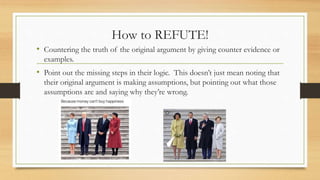
This document provides guidance on argumentation and refutation. It instructs the reader to pick a side on a debate resolution and make three arguments to support their side and refute the other side. It describes the structure of an argument, including making a claim, providing a warrant to support the claim, and explaining the impact or importance. Different types of warrants like analytical, empirical, and psychological are also outlined. The document concludes by providing examples of how to refute an opponent's arguments, such as by providing counter evidence, pointing out logical flaws or missing assumptions, showing a lack of warrant, or demonstrating that the problem cannot be uniquely solved by one side.