Architecture of Web Servers
By Nicolas Vanhoren
Not all web
servers are
made equal
There are different types of
architecture resulting in difference
in performances and resource
usage.
But first a little bit of definitions.
Do you know the difference between a program and
a process ?
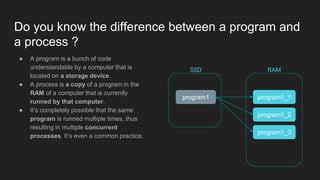
● A program is a bunch of code
understandable by a computer that is
located on a storage device.
● A process is a copy of a program in the
RAM of a computer that is currently
runned by that computer.
● It’s completely possible that the same
program is runned multiple times, thus
resulting in multiple concurrent
processes. It’s even a common practice.
SSD
program1
RAM
program1_1
program1_2
program1_3
A few facts about
processes
● They all have their own RAM allocated by
the operating system.
● They can communicate with each other
with means similar to network
connections.
I also heard about a thing called “Threads” ?
● They are a feature of all modern
operating systems.
● Threads allow to have multiple
threads of execution within a
single process.
● They share the same memory.
● Due to the risk of inconsistency
with sharing that same memory
they have to rely on locks.
RAM
process1
thread1 thread2 thread3
Now for the web servers architectures
One process, one thread
● Can handle only one request at
a time.
● Is very simple to implement.
● Examples: PHP dev server, a
lot of other dev servers…
● No one really uses this in
production, the inability to
handle concurrent requests
makes this model only suitable
for quick tests.
Client
Process
Multiple processes, one thread per process
● Each process handles one
request max at any given time.
● Number of concurrent requests
is limited by the amount of
processes.
● Relatively high usage of RAM
per max number of concurrent
requests.
● Technologies using it: PHP
Client
Process Process Process
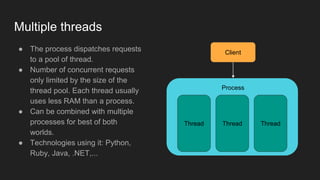
Multiple threads
● The process dispatches requests
to a pool of thread.
● Number of concurrent requests
only limited by the size of the
thread pool. Each thread usually
uses less RAM than a process.
● Can be combined with multiple
processes for best of both
worlds.
● Technologies using it: Python,
Ruby, Java, .NET,...
Client
Thread Thread Thread
Process
Models using alternatives to
threads
Multi-threads applications are nice, but some people still
complain about their performances and limitations. That’s
why multiple technologies (Go, Erlang, Haskell, Node.js,...)
offer alternatives. Here we will focus on one specific model...
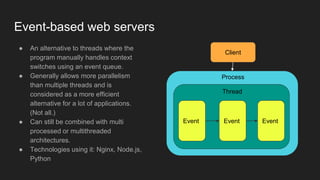
Event-based web servers
● An alternative to threads where the
program manually handles context
switches using an event queue.
● Generally allows more parallelism
than multiple threads and is
considered as a more efficient
alternative for a lot of applications.
(Not all.)
● Can still be combined with multi
processed or multithreaded
architectures.
● Technologies using it: Nginx, Node.js,
Python
Client
Process
Thread
Event Event Event
A word about WebSockets
● They are a new specification implemented on all modern browsers.
● Instead of working on a “per request” basis, they allow persistent bi-
directional connexions between a browser and a web server.
● They are immensely useful for a lot of applications (instant messaging,
collaborative applications, notifications, video games,...)
● Multi-processes architectures are almost unable to use them as each
connexion monopolize a full process persistently.
● Multi-threads architectures are not very efficient either because there is still a
limit to the number of threads on a Linux server.
● Event-based architectures are usually considered very effective to use
WebSockets.
Any questions?

Architecture of web servers

  • 1.
    Architecture of WebServers By Nicolas Vanhoren
  • 2.
    Not all web serversare made equal There are different types of architecture resulting in difference in performances and resource usage. But first a little bit of definitions.
  • 3.
    Do you knowthe difference between a program and a process ? ● A program is a bunch of code understandable by a computer that is located on a storage device. ● A process is a copy of a program in the RAM of a computer that is currently runned by that computer. ● It’s completely possible that the same program is runned multiple times, thus resulting in multiple concurrent processes. It’s even a common practice. SSD program1 RAM program1_1 program1_2 program1_3
  • 4.
    A few factsabout processes ● They all have their own RAM allocated by the operating system. ● They can communicate with each other with means similar to network connections.
  • 5.
    I also heardabout a thing called “Threads” ? ● They are a feature of all modern operating systems. ● Threads allow to have multiple threads of execution within a single process. ● They share the same memory. ● Due to the risk of inconsistency with sharing that same memory they have to rely on locks. RAM process1 thread1 thread2 thread3
  • 6.
    Now for theweb servers architectures
  • 7.
    One process, onethread ● Can handle only one request at a time. ● Is very simple to implement. ● Examples: PHP dev server, a lot of other dev servers… ● No one really uses this in production, the inability to handle concurrent requests makes this model only suitable for quick tests. Client Process
  • 8.
    Multiple processes, onethread per process ● Each process handles one request max at any given time. ● Number of concurrent requests is limited by the amount of processes. ● Relatively high usage of RAM per max number of concurrent requests. ● Technologies using it: PHP Client Process Process Process
  • 9.
    Multiple threads ● Theprocess dispatches requests to a pool of thread. ● Number of concurrent requests only limited by the size of the thread pool. Each thread usually uses less RAM than a process. ● Can be combined with multiple processes for best of both worlds. ● Technologies using it: Python, Ruby, Java, .NET,... Client Thread Thread Thread Process
  • 10.
    Models using alternativesto threads Multi-threads applications are nice, but some people still complain about their performances and limitations. That’s why multiple technologies (Go, Erlang, Haskell, Node.js,...) offer alternatives. Here we will focus on one specific model...
  • 11.
    Event-based web servers ●An alternative to threads where the program manually handles context switches using an event queue. ● Generally allows more parallelism than multiple threads and is considered as a more efficient alternative for a lot of applications. (Not all.) ● Can still be combined with multi processed or multithreaded architectures. ● Technologies using it: Nginx, Node.js, Python Client Process Thread Event Event Event
  • 12.
    A word aboutWebSockets ● They are a new specification implemented on all modern browsers. ● Instead of working on a “per request” basis, they allow persistent bi- directional connexions between a browser and a web server. ● They are immensely useful for a lot of applications (instant messaging, collaborative applications, notifications, video games,...) ● Multi-processes architectures are almost unable to use them as each connexion monopolize a full process persistently. ● Multi-threads architectures are not very efficient either because there is still a limit to the number of threads on a Linux server. ● Event-based architectures are usually considered very effective to use WebSockets.
  • 13.