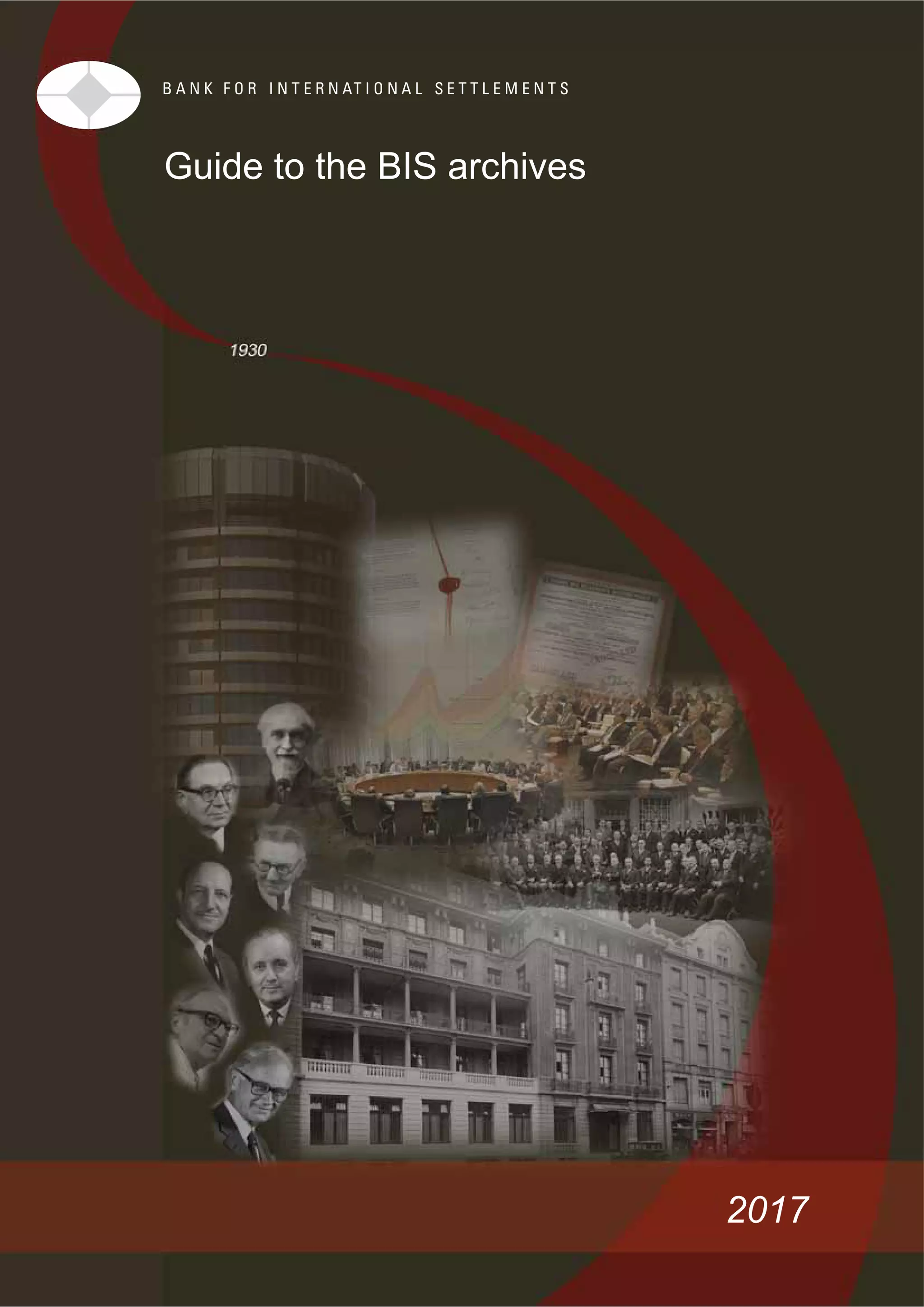
Guide to the BIS archives
2017
Guide to the BIS Archives
© BIS Archives, 2017
Bank for International Settlements
CH-4002 Basel
archive@bis.org
www.bis.org
Cover design: Tobias Huber
Cover portrait pictures (from the top): Montagu Norman (Governor Bank of England, 1920-44);
Per Jacobsson (BIS Economic Adviser, 1931-56); Hjalmar Schacht (President Reichsbank,
1924-30 and 1933-39); Roger Auboin (BIS General Manager, 1937-58); Gabriel Ferras (BIS
General Manager, 1963-70); Milton Gilbert (BIS Economic Adviser, 1960-75); Alexandre
Lamfalussy (BIS Economic Adviser, 1976-85 and BIS General Manager, 1985-93)
iii
Foreword
This guide to the BIS Archives is the key to the Bank for International Settlements’ (BIS)
collection of historical records that are over thirty years old and can be freely accessed by
researchers.
The BIS was created in 1930 by the Hague Conference as an international financial
organisation. Ever since, its key mandate has been to foster cooperation among central banks
and other agencies in pursuit of monetary and financial stability. Initially mainly focused on
Europe, the BIS, from the 1960s onward, became increasingly global in its activities and
outreach. Today it brings together sixty member central banks, representing countries from
around the world that together make up about 95% of world GDP. Apart from its headquarters
in Basel, Switzerland, the BIS has two representative offices, one for Asia and the Pacific in
Hong Kong SAR (since 1998), and one for the Americas in Mexico City (since 2002).
Throughout its history, the BIS has been involved in many historical events and developments
in the monetary and financial sphere. These include the repercussions of the world financial
crisis of 1931, the rebuilding of European multilateral payments in the 1950s, the transatlantic
management of the Bretton Woods system in the 1960s, and the international efforts to deal
with the fall-out of inflation and of the banking and debt crises in the 1970s through the 1990s.
The BIS played an important role in the early history of European monetary unification (before
the foundation of the European Monetary Institute in Frankfurt in 1994). It also hosts the
experts from the global banking regulation and supervision community, who have been
responsible for developing an International Capital Framework (known consecutively as Basel
Accord, Basel II and Basel III), a global agreement aimed at strengthening capital adequacy
rules for internationally active banks.
History can only be studied on the basis of properly organised and accessible source material.
Although the BIS as an international organisation is not bound by any national freedom of
information legislation, its Board of Directors decided in 1997 to voluntarily open for research
the Bank’s historical files that are over thirty years old. It is our hope that the publication of this
guide to the BIS Archives will provide a useful tool to any researcher wanting to shed light on
the history of international monetary and financial cooperation in general and of the BIS in
particular.
Basel, September 2017
1
The Bank for International Settlements
Organisation and history
The Bank for International Settlements (BIS) was established in 1930, and its head office is in
Basel, Switzerland. The BIS is an international organisation which fosters international
monetary and financial cooperation and serves as a bank for central banks. The Bank fulfils
this mandate by acting as: a forum for discussion and decision-making among central banks
and within the international financial and supervisory community; a centre for economic and
monetary research; a prime counterparty for central banks in their financial transactions; and
an agent or trustee in connection with international financial operations.
Legal status and organisational structure of the BIS
The BIS was created by an international treaty signed by governments (The Hague,
20 January 1930), but it has been set up and is exclusively controlled by central banks. At the
same time, as a bank, the BIS is a limited liability company incorporated under Swiss law, with
an issued share capital. The administration of the BIS is vested in the Board of Directors, and
the Board appoints – on the proposal of its Chairman – a General Manager who is responsible
for the operations of the Bank and is the chief of its operational staff. In addition, the Bank
previously had a President, who for most of the BIS’s history was also the Chairman of the
Board, except for the years 1937-48. The position of BIS President was abolished in 2005. In
addition to the Board of Directors, the Bank’s main decision-making body is the Annual
General Meeting of member central banks.
The Bank’s initial capital was issued to its member central banks, which had the option to offer
those shares for subscription to the public (although attendance and voting rights at the BIS
General Meeting remained restricted to the member central banks). As a result, in the early
1930s privately held BIS shares made up nearly a third of the total issued capital. This
proportion diminished thereafter and fell below 16% after 1975, when the Bank made a
voluntary share repurchase offer to private shareholders. In 2001, it was decided to limit the
right to hold shares in the BIS exclusively to central banks, and a mandatory repurchase of all
privately held shares was undertaken. In 2016, sixty institutions had rights of voting and
representation at the BIS General Meetings.1
The organisational structure of the BIS has undergone considerable change since its creation
in 1930, but the three main departments have always been: the Banking Department; the
Monetary and Economic Department (MED); and the General Secretariat. The Banking
1
Bank of Algeria, Central Bank of Argentina, Reserve Bank of Australia, Central Bank of the Republic of Austria,
National Bank of Belgium, Central Bank of Bosnia and Herzegovina, Central Bank of Brazil, Bulgarian National
Bank, Bank of Canada, Central Bank of Chile, People’s Bank of China, Bank of the Republic (Colombia),
Croatian National Bank, Czech National Bank, Danmarks Nationalbank (Denmark), Bank of Estonia, European
Central Bank, Bank of Finland, Bank of France, Deutsche Bundesbank (Germany), Bank of Greece, Hong Kong
Monetary Authority, Magyar Nemzeti Bank (Hungary), Central Bank of Iceland, Reserve Bank of India, Bank
Indonesia, Central Bank of Ireland, Bank of Israel, Bank of Italy, Bank of Japan, Bank of Korea, Bank of Latvia,
Bank of Lithuania, Central Bank of Luxembourg, National Bank of the Republic of Macedonia, Central Bank of
Malaysia, Bank of Mexico, Netherlands Bank, Reserve Bank of New Zealand, Central Bank of Norway, Central
Reserve Bank of Peru, Bangko Sentral ng Pilipinas (Philippines), National Bank of Poland, Bank of Portugal,
National Bank of Romania, Central Bank of the Russian Federation, Saudi Arabian Monetary Agency, National
Bank of Serbia, Monetary Authority of Singapore, National Bank of Slovakia, Bank of Slovenia, South African
Reserve Bank, Bank of Spain, Sveriges Riksbank (Sweden), Swiss National Bank, Bank of Thailand, Central
Bank of the Republic of Turkey, Central Bank of the United Arab Emirates, Bank of England, Board of Governors
of the Federal Reserve System (United States).
2
Department’s function is to carry out banking transactions on behalf of central bank customers,
including the investment of central bank foreign exchange reserves on the market. The MED
performs economic and monetary research, best known through the Bank’s Annual Report,
Quarterly Reviews and Working Papers. It compiles and disseminates international financial
and banking statistics, and provides secretarial support for central bank experts’ meetings
hosted at the BIS. The General Secretariat is responsible for the Bank’s internal support
services and administration.
Several committees and organisations focusing on monetary and financial stability and on the
international financial system have secretariats at the BIS and interact closely with the Bank.
Those which were originally set up by the Group of Ten (G10) central bank governors are the
Markets Committee (originally: Gold and Foreign Exchange Experts Committee; 1964), the
Committee on the Global Financial System (originally: Euro-currency Standing Committee;
1971), the Basel Committee on Banking Supervision (1974) and the Committee on Payments
and Market Infrastructures (originally: Committee on Payment and Settlement Systems; 1990).
Three other secretariats operate out of the BIS: the International Association of Insurance
Supervisors (IAIS; since 1996), the Financial Stability Board (originally Financial Stability
Forum; since 1999) and the International Association of Deposit Insurers (IADI; since 2002).
In 1999, the BIS and the Basel Committee on Banking Supervision jointly created the Financial
Stability Institute in order to promote financial stability worldwide, primarily by strengthening
financial sector supervision. Since 2006, the BIS also hosts the secretariat of the Irving Fisher
Committee on Central Bank Statistics.
In July 1998 the BIS opened its first ever representative office in the Hong Kong SAR, to better
serve the central banking and supervisory community in Asia and the Pacific. In November
2002 the BIS Representative Office for the Americas was opened in Mexico City.
A brief history of the BIS, 1930-2017
Before 1914 central banks of the western industrialised world had occasionally cooperated
under the classical gold standard. The financial disruption and the strenuous efforts to restore
the gold standard after the First World War further underlined the need for close cooperation.
It was not until the Young Plan was elaborated in 1928-9 that the idea took concrete shape.
The Young Plan, adopted in January 1930 at The Hague Conference, primarily dealt with the
reparation payments imposed on Germany by the Treaty of Versailles (1919). In order to give
the reparations issue a more commercial, and thus politically less sensitive, character, the
Hague Agreement entailed the creation of the Bank for International Settlements to take over
the functions previously performed by the Agent General for Reparations in Berlin and to act
as a trustee for the Dawes and Young Loans, the proceeds of which were partly reinvested in
the German economy. In addition, the BIS would promote central bank cooperation in general.
The practical role and organisational features of the BIS were discussed by an Organisation
Committee (COBRI), meeting in Baden-Baden, Germany, in October-November 1929. The
Bank’s location in Basel, Switzerland, was the outcome of a compromise between the founding
central banks. The BIS opened its doors for business in Basel on 17 May 1930. By June 1931,
24 European central banks had subscribed to the BIS’s capital. However, the high hopes were
soon dashed by the 1931-33 financial crises, in which the BIS failed to play the role of lender
of last resort, notwithstanding noteworthy attempts at organising support credits for both the
Austrian and German central banks in 1931. Moreover, the financial crisis brought the
reparations issue to an abrupt end (1932 Lausanne Conference), thus eliminating one of the
Bank’s original raisons d’être. After the devaluation of the pound sterling in September 1931
and of the US dollar in March 1933, the BIS participated in a number of – unsuccessful –
attempts to end exchange rate instability by restoring the gold standard, culminating in the
League of Nations’ World Monetary and Economic Conference of June-July 1933 in London.
After 1933, and definitely after the collapse of the Gold Bloc in 1935-36, the BIS had little
3
choice but to limit itself to undertaking banking transactions for the account of central banks
and providing a forum for central bank governors to help them maintain contact in a world
increasingly dominated by the pursuit of autarky and by international confrontation rather than
cooperation.
At the outbreak of the Second World War in September 1939, the BIS decided to suspend all
Board meetings for the duration of hostilities and to limit its banking operations to those that
would not compromise its neutrality. Business activity dwindled to an all-time low and by 1945
the Bank, for the first and only time in its history, was operating at a loss. The precariousness
of wartime financial neutrality was underlined when after the war it transpired that the gold
used by the German Reichsbank during the war to honour its prewar obligations towards the
BIS partly originated from the looted gold reserves of the Belgian and Dutch central banks.
This gold was subsequently returned by the BIS to its rightful owners (Agreement with the
Tripartite Commission for the Restitution of Monetary Gold, Washington, 1948).
In July 1944, the United Nations Bretton Woods Conference adopted a resolution calling for
the liquidation of the BIS, on the grounds of its supposed domination by the Axis Powers during
the war and because its traditional field of activity would henceforth be largely covered by the
newly created International Monetary Fund (IMF) and the International Bank for
Reconstruction and Development (IBRD, or World Bank). However, in 1946 European central
bank governors started to meet regularly in Basel once again. Soon it became clear that the
BIS had an important role to play in making the Bretton Woods system work in the European
context, and in 1948 the liquidation resolution was officially revoked.
In the 1950s, the BIS acted as agent for the European Payments Union (EPU). Inaugurated in
1950 within the framework of the Organisation for European Economic Co-operation (OEEC,
later OECD), the EPU was designed to assist the European countries in restoring exchange
rate convertibility, as intended by the Bretton Woods agreement. The EPU system operated
by offsetting trade balances between countries through multilateral compensation, initially
largely in credit but increasingly in gold or gold-convertible dollars. By 1958, the participating
European currencies had achieved full current account convertibility, thus removing the need
for multilateral compensation and bringing the EPU to a successful end.
The Bretton Woods system of free currency convertibility at fixed exchange rates coincided
with an era of monetary stability, expanding international trade, and unprecedented output and
productivity growth at near-full employment levels (“golden sixties”). Soon, however, strains
became apparent. In fact, throughout the 1960s, the growing inherent instability in the Bretton
Woods system called for close monetary cooperation to try to counter recurring problems such
as the weakness of the pound sterling and, most importantly, the increasing pressure on the
gold parity of the US dollar (fixed at $35 per ounce since 1934). Pressure on the dollar’s gold
parity resulted from an insufficient supply of gold and from the weakening of the US balance
of payments. In the context of the BIS, an array of instruments was put into place to relieve
these strains. These included the so-called Gold Pool, whereby central banks intervened
directly on the London gold market, and a network of mutual support facilities (swaps) between
the major central banks. Special support credits were arranged through the BIS as the need
arose: for the pound sterling in 1961 (“Basel Agreement”) and in subsequent years, for the
French franc in 1968, and two so-called Sterling Group Arrangements in 1966 and 1968 to
help resolve the sterling balances problem. These joint initiatives ultimately proved insufficient
to prevent the breakdown of the Bretton Woods system in August 1971, when President Nixon
closed the US “gold window”. They did, however, contribute to the establishment of the Group
of Ten (G10) of central bank governors as an important forum for discussing and coordinating
international monetary policy.2
Likewise, the increase of central bank cooperation in the 1960s
2
Members of the G10 were: Belgium, Canada, France, Germany, Italy, Japan, the Netherlands, Sweden,
Switzerland (initially only an associated member), the United Kingdom and the United States.
4
led to the return of the US central bank (Federal Reserve) to the regular meetings at the BIS
for the first time since the early 1930s.
With the collapse of the Bretton Woods system, central banks found themselves confronted
with the very different reality of managed floating. Political factors compounded by the 1973
oil crisis prevented a market-induced return to stability and prompted continued central bank
intervention. In the context of the BIS, financial stability issues gained increasing prominence.
The G10 central banks set up a Euro-currency Market Standing Committee to monitor the
rapidly expanding euro-currency market (1971). The globalisation of financial markets and the
highly publicised failure of a number of international banks in the wake of the 1973 crisis led
to the establishment of the Basel Committee on Banking Supervision to discuss the prudential
aspects of international banking (1974). These efforts led to the 1975 Basel Concordat on the
sharing of supervisory responsibilities of banks’ foreign activities between host and home-
country authorities as well as the 1988 Basel Capital Accord, recommending a risk-weighted
capital ratio for internationally active banks. Negotiations to review and update the Basel
Capital Accord started in 1997, and led to the endorsement by the G10 central bank governors
and heads of supervision of a new capital measurement and capital standards framework
(Basel II) in 2004. Throughout this period, the BIS continued to provide emergency assistance
where needed, increasingly on a global scale as witnessed by the credit facilities provided to
the central bank of Mexico in 1982 and 1995 and to Brazil in 1998. Following the global
financial crisis that started in 2007-2008, a revised international regulatory framework for
banks was developed over the years 2010-2014 (Basel III). It entails a comprehensive set of
reform measures, developed by the Basel Committee on Banking Supervision, to strengthen
regulation, supervision and risk management in the banking sector.
Parallel to these developments, the BIS was closely involved in the process of European
monetary integration. From 1964, the Committee of Governors of the central banks of the
member states of the EEC regularly met in Basel. From 1972, the BIS administered the so-
called “snake”, a common EEC mechanism designed to narrow the margins of exchange rate
fluctuations between EEC currencies. In 1979, the European Monetary System (EMS) was
established and the European currency unit (ECU) launched. The BIS provided the secretariat
for the EMS and acted as its agent. In the late 1980s, the EEC central bank governors, meeting
in Basel, were instrumental in formulating the framework for the monetary union embodied in
the 1991 Maastricht Treaty (“Delors Committee”). As a result of this treaty the European
Monetary Institute (EMI), the precursor of the European Central Bank (ECB), was created on
1 January 1994. The EMI’s move from Basel to Frankfurt in November 1994 brought the BIS’s
direct involvement in European monetary unification to an end.
The increase in globalisation, deregulation and sophistication of financial markets have
focused the attention of the BIS firmly on issues related to the soundness of the international
financial architecture and the threats posed by systemic risks. These issues, as discussed and
studied in the various central bank expert meetings and groups set up in the context of the
BIS, are of interest to the central bank community worldwide. The global commitment of the
BIS has been illustrated by the extension of BIS central bank shareholder membership since
1996 away from its traditionally European-dominated base to include systemically important
emerging markets (see footnote 1), and by the opening of BIS representative offices in Hong
Kong SAR (1998) and Mexico (2002).
The 2007-2008 global financial crisis had a major influence on the BIS’s research and on the
work of the Basel-based committees and secretariats. It has led to a renewed and heightened
emphasis on financial stability issues, particularly the need for a macroprudential approach to
financial stability. The work of the Basel-based committees – the BCBS, CGFS, CPMI and
Markets Committee – has been shaped by the need to address the challenges posed by the
global financial crisis and has expanded accordingly. Another focus, resulting directly from the
crisis, has been on providing timely and more relevant financial statistics. The BIS banking
statistics have long provided a unique means of assessing key vulnerabilities. As part of
continuous enhancement efforts, a central data hub was established at the BIS in 2013, with
the aim of providing national supervisory authorities with improved data on the credit
exposures of global systemically important banks. The 2007-2008 crisis has also affected the
5
governance structure of the international financial system: the G10 countries comprising the
United States, Canada, Japan and a number of European countries, which had been the main
organisational grouping in international financial diplomacy (including at the BIS) since the
early 1960s, was superseded by the G20 group of major advanced and emerging economies.
At the same time, the work carried out not only by the BIS but also by the IMF, the OECD and
other organisations has become more integrated, not least thanks to the efforts of the Financial
Stability Board, which has its secretariat at the BIS.
References
The Bank for International Settlements and the Basle meetings, published on the occasion of
the fiftieth anniversary 1930-1980, Basel, 1980.
Kaplan, Jacob J and Günther Schleiminger (1989), The European Payments Union, Financial
Diplomacy in the 1950s, Oxford: Oxford University Press.
Baer, Gunter D (1999), “Sixty-five Years of Central Bank Cooperation at the Bank for
International Settlements”, in Holtfrerich, Carl-L., Jaime Reis and Gianni Toniolo (eds.), The
Emergence of Modern Central Banking from 1918 to the Present, Aldershot: Ashgate.
Clement, Piet (2004), “’The touchstone of German credit’: Nazi Germany and the service of
the Dawes and Young Loans”, in Financial History Review, Cambridge: Cambridge University
Press, vol. 11, 1, pp. 33-50.
Toniolo, Gianni, with the assistance of Piet Clement (2005), Central Bank Cooperation at the
Bank for International Settlements, 1930-1973, Cambridge-New York: Cambridge University
Press.
Borio, Claudio; Toniolo, Gianni and Piet Clement (eds.) (2008), Past and Future of Central
Bank Cooperation, Cambridge – New York: Cambridge University Press.
Goodhart, Charles (2011), The Basel Committee on Banking Supervision, A History of the
Early Years 1974-1997, Cambridge – New York: Cambridge University Press.
James, Harold (2012), Making the European Monetary Union, The Role of the Committee of
Central Bank Governors and the Origins of the European Central Bank, Cambridge – London:
The Belknap Press of Harvard University Press.
http://www.bis.org/about/history.htm
6
The Bank for International Settlements
Historical Archives
Introduction to the BIS Archives
The Archives of the Bank for International Settlements (BIS) enjoy special protection under
the Bank’s Headquarters Agreement (art 3,2). The BIS Archives are not public archives and
the BIS does not have a legal obligation to grant access to its records. However, in the interest
of openness and academic research, the BIS decided to voluntarily open its historical archives
to the public in March 1998. Under the BIS open archives rule, records relating to the Bank’s
business and operational activities which are over 30 years old are available for consultation,
with the exception of a limited number of records that remain private or confidential even after
30 years have elapsed. It is within the BIS’s discretion to determine which records will not be
released for public consultation. Any such decision will normally be based on the protection of
personal privacy and of legitimate third party interests. All files open for consultation are listed
in this guide to the BIS Archives.
BIS archival holdings
The records currently available for consultation are mainly paper-based. The BIS Archives
also contain a small photographic collection.
The records of the BIS are organized in seven record groups, partly reflecting the BIS
organizational structure:
1. Organization and Management of the BIS
2. Banking Department
3. Monetary and Economic Department
4. Accounting and Loans
5. Establishment - Building, Security, HR policies, IT Systems, etc. (This record group
is not open to the public)
6. Finance and Economics
7. History and photo archives
Groups 1 to 6 were created by the BIS central registry, which was gradually decentralised
between 1998 and 2000. Group 7 was created by the BIS Archives for materials which did not
pass through the BIS central registry. Groups 1-7 consist largely of various types of
correspondence, internal communication and reports.
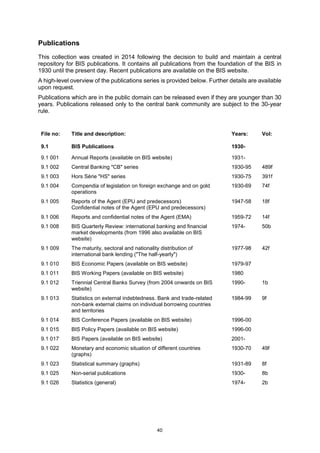
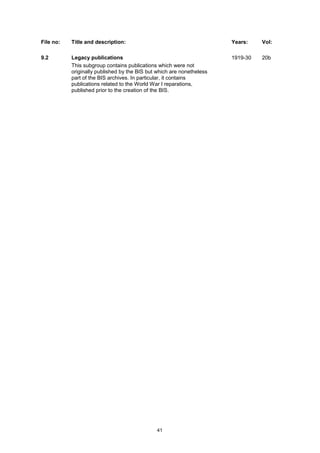
In addition the BIS has a publications collection (group 9) containing past publications,
including discontinued series, from the foundation of the BIS in 1930 until the present day.
Conditions for using the BIS Archives
The BIS Archives are located in the BIS tower at Centralbahnplatz 2, 4051 Basel, Switzerland
and are open to researchers by appointment only. Opening times are normally Monday to
Friday 09:00 to 12:30 and 14:00 to 17:30. The Archives are closed on bank holidays, BIS
Board meeting days and the day of the BIS Annual General Meeting.
7
A maximum of two researchers are permitted access at any given time, and then only when
they are working on the same project. Researchers are permitted to use their own laptop or
mobile device and a digital camera for photocopying (no flash). The BIS Archives do not
provide a photocopying service.
How to apply for access to the BIS Archives
Applications for access to the BIS Archives should be made in writing by email as follows:
archive@bis.org
Or via post:
BIS Archives
Bank for International Settlements
Centralbahnplatz 2
CH-4002 Basel
See also: www.bis.org
Applications should include a preliminary selection of the materials to be consulted using this
guide and a preferred date range for the visit.
Researchers must provide the names, addresses and contact information of two referees
when they apply for access. In the case of students one referee should be their dissertation or
research supervisor. Researchers will normally be sent a letter of invitation, which they must
bring with them at the time of their visit, as well as either their valid passport or national identity
card bearing a photograph.
Citation of BIS archival material
When referring to BIS archival material, please do this in a uniform manner. We suggest the
following format:
Bank for International Settlements Archives, Basel, [file number] + [file title], [if given: archives
box code and/or number and title of folder], [date].
Or, in short: BISA, [file number + date].
8
Record Group Descriptions
9
Abbreviations used in record group descriptions
b = archives box
f = folder/file
l = ledger
The number of boxes, files and ledgers included in descriptions are intended as a guide only.
For more information please contact the BIS Archives.
10
Record Group 1 - Organisation and management of the BIS
Record Group 1 consists of files on the organisation and management of the BIS. This record
group was created by the BIS Registry, so it largely consists of incoming and outgoing
correspondence. It also contains some reports, internal notes and meeting minutes.
Record Group 1 also includes the files of the central bank expert committees, originally set up
by the Group of Ten (G10), and which have their secretariats at the BIS. The files of these
committee secretariats are included under “1.3a(3) Meetings of Experts” since some of the
meetings were initially of an ad hoc nature resulting from BIS Board initiatives and were thus
classified under “1.3 Board of Directors of the BIS”. However, these records are held in custody
by the BIS Archives, and not owned by it, therefore specific restrictions may apply.
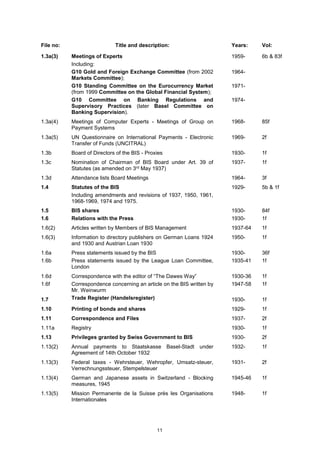
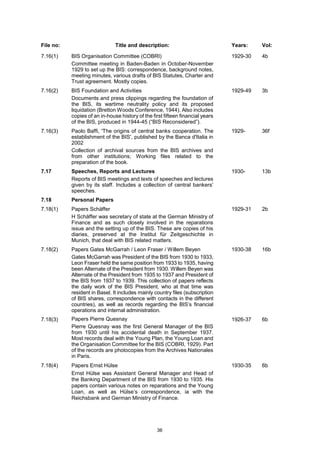
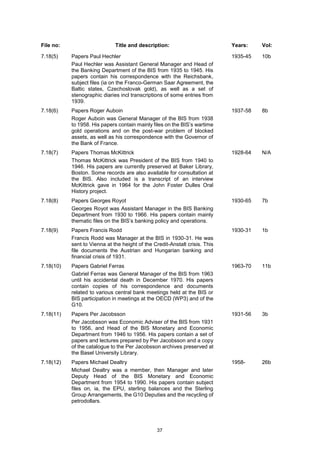
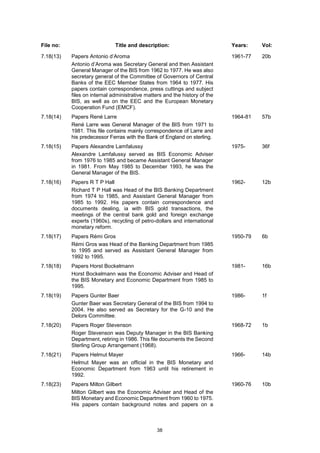
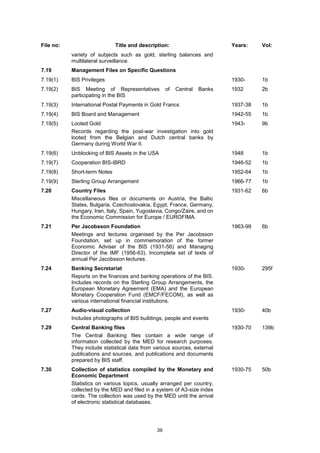
File no: Title and description: Years: Vol:
1.1 Foundation of the BIS
including legal texts, decrees etc 1930- 4f
1.1(1) Removal of BIS offices to Château-d’Oex - May 1940 1940 1f
1.1(2) Investigations into the BIS 1942-43 1f
1.1(3) Planned establishment of temporary office in Portugal 1951-53 1f
1.1(4) Emergency security arrangement with Federal Reserve
Bank re BIS assets
1953 1f
1.1(5) 25th Anniversary of the BIS 1955-60 1f
1.1(6) Young Plan and organisation of the BIS - Comments of the
German Press 1929-1930
1929-30 1f
1.1(7)
1.1(13)
1.1a
50th anniversary of the BIS 1980
Foundation of the BIS, minutes of meetings
Protection of BIS style
1978-83
1929-30
1963
4b & 3f
1f
1f
1.2 Transfer of powers of Reparation Commission to the BIS
including transfer of accounting and economic documents to
BIS
1930 1f
1.3 Board of Directors of the BIS - General correspondence 1930- 1f
1.3(1) Nominations to/resignations from BIS Board 1930- 15f
1.3(2) Lists of members of BIS Board 1931- 1f
1.3(3) Management of the BIS - Nominations, resignations 1930- 2f
1.3(4) Report on BIS operations 1939-46 7f
1.3(5) Banking policy of the BIS during Second World War
including Report of the Management to the Board of
Directors
1939-47 1f
1.3a Meetings of the Board of Directors of the BIS
including Meetings with Eastern European central banks
1930- 5f
1.3a(1) Meetings on Misuse of Lower-Value Coins 1969-70 1f
11
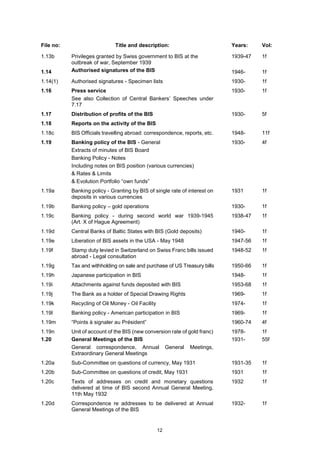
File no: Title and description: Years: Vol:
1.3a(3) Meetings of Experts
Including:
G10 Gold and Foreign Exchange Committee (from 2002
Markets Committee);
G10 Standing Committee on the Eurocurrency Market
(from 1999 Committee on the Global Financial System);
G10 Committee on Banking Regulations and
Supervisory Practices (later Basel Committee on
Banking Supervision).
1959-
1964-
1971-
1974-
6b & 83f
1.3a(4) Meetings of Computer Experts - Meetings of Group on
Payment Systems
1968- 85f
1.3a(5) UN Questionnaire on International Payments - Electronic
Transfer of Funds (UNCITRAL)
1969- 2f
1.3b Board of Directors of the BIS - Proxies 1930- 1f
1.3c Nomination of Chairman of BIS Board under Art. 39 of
Statutes (as amended on 3rd May 1937)
1937- 1f
1.3d Attendance lists Board Meetings 1964- 3f
1.4 Statutes of the BIS
Including amendments and revisions of 1937, 1950, 1961,
1968-1969, 1974 and 1975.
1929- 5b & 1f
1.5
1.6
BIS shares
Relations with the Press
1930-
1930-
84f
1f
1.6(2) Articles written by Members of BIS Management 1937-64 1f
1.6(3) Information to directory publishers on German Loans 1924
and 1930 and Austrian Loan 1930
1950- 1f
1.6a
1.6b
Press statements issued by the BIS
Press statements issued by the League Loan Committee,
London
1930-
1935-41
36f
1f
1.6d
1.6f
1.7
Correspondence with the editor of “The Dawes Way”
Correspondence concerning an article on the BIS written by
Mr. Weinwurm
Trade Register (Handelsregister)
1930-36
1947-58
1930-
1f
1f
1f
1.10 Printing of bonds and shares 1929- 1f
1.11 Correspondence and Files 1937- 2f
1.11a Registry 1930- 1f
1.13 Privileges granted by Swiss Government to BIS 1930- 2f
1.13(2) Annual payments to Staatskasse Basel-Stadt under
Agreement of 14th October 1932
1932- 1f
1.13(3) Federal taxes - Wehrsteuer, Wehropfer, Umsatz-steuer,
Verrechnungssteuer, Stempelsteuer
1931- 2f
1.13(4) German and Japanese assets in Switzerland - Blocking
measures, 1945
1945-46 1f
1.13(5) Mission Permanente de la Suisse près les Organisations
Internationales
1948- 1f
12
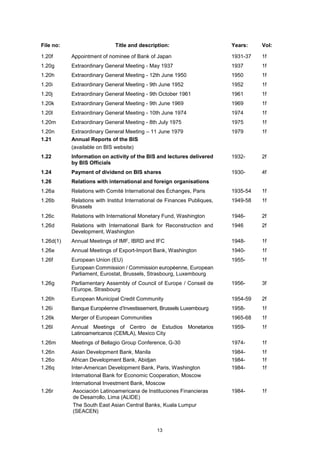
File no: Title and description: Years: Vol:
1.13b
1.14
Privileges granted by Swiss government to BIS at the
outbreak of war, September 1939
Authorised signatures of the BIS
1939-47
1946-
1f
1f
1.14(1) Authorised signatures - Specimen lists 1930- 1f
1.16 Press service
See also Collection of Central Bankers’ Speeches under
7.17
1930- 1f
1.17 Distribution of profits of the BIS 1930- 5f
1.18 Reports on the activity of the BIS
1.18c BIS Officials travelling abroad: correspondence, reports, etc. 1948- 11f
1.19 Banking policy of the BIS - General
Extracts of minutes of BIS Board
Banking Policy - Notes
Including notes on BIS position (various currencies)
& Rates & Limits
& Evolution Portfolio “own funds”
1930- 4f
1.19a Banking policy - Granting by BIS of single rate of interest on
deposits in various currencies
1931 1f
1.19b Banking policy – gold operations 1930- 1f
1.19c Banking policy - during second world war 1939-1945
(Art. X of Hague Agreement)
1938-47 1f
1.19d Central Banks of Baltic States with BIS (Gold deposits) 1940- 1f
1.19e Liberation of BIS assets in the USA - May 1948 1947-56 1f
1.19f Stamp duty levied in Switzerland on Swiss Franc bills issued
abroad - Legal consultation
1948-52 1f
1.19g Tax and withholding on sale and purchase of US Treasury bills 1950-66 1f
1.19h Japanese participation in BIS 1948- 1f
1.19i Attachments against funds deposited with BIS 1953-68 1f
1.19j The Bank as a holder of Special Drawing Rights 1969- 1f
1.19k Recycling of Oil Money - Oil Facility 1974- 1f
1.19l Banking policy - American participation in BIS 1969- 1f
1.19m “Points à signaler au Président” 1960-74 4f
1.19n
1.20
Unit of account of the BIS (new conversion rate of gold franc)
General Meetings of the BIS
General correspondence, Annual General Meetings,
Extraordinary General Meetings
1978-
1931-
1f
55f
1.20a Sub-Committee on questions of currency, May 1931 1931-35 1f
1.20b Sub-Committee on questions of credit, May 1931 1931 1f
1.20c Texts of addresses on credit and monetary questions
delivered at time of BIS second Annual General Meeting,
11th May 1932
1932 1f
1.20d Correspondence re addresses to be delivered at Annual
General Meetings of the BIS
1932- 1f
13
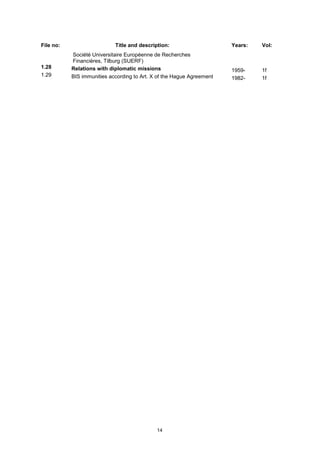
File no: Title and description: Years: Vol:
1.20f Appointment of nominee of Bank of Japan 1931-37 1f
1.20g Extraordinary General Meeting - May 1937 1937 1f
1.20h Extraordinary General Meeting - 12th June 1950 1950 1f
1.20i Extraordinary General Meeting - 9th June 1952 1952 1f
1.20j Extraordinary General Meeting - 9th October 1961 1961 1f
1.20k Extraordinary General Meeting - 9th June 1969 1969 1f
1.20l Extraordinary General Meeting - 10th June 1974 1974 1f
1.20m Extraordinary General Meeting - 8th July 1975 1975 1f
1.20n
1.21
Extraordinary General Meeting – 11 June 1979
Annual Reports of the BIS
(available on BIS website)
1979 1f
1.22 Information on activity of the BIS and lectures delivered
by BIS Officials
1932- 2f
1.24 Payment of dividend on BIS shares 1930- 4f
1.26 Relations with international and foreign organisations
1.26a Relations with Comité International des Échanges, Paris 1935-54 1f
1.26b Relations with Institut International de Finances Publiques,
Brussels
1949-58 1f
1.26c Relations with International Monetary Fund, Washington 1946- 2f
1.26d Relations with International Bank for Reconstruction and
Development, Washington
1946 2f
1.26d(1) Annual Meetings of IMF, IBRD and IFC 1948- 1f
1.26e Annual Meetings of Export-Import Bank, Washington 1940- 1f
1.26f European Union (EU)
European Commission / Commission européenne, European
Parliament, Eurostat, Brussels, Strasbourg, Luxembourg
1955- 1f
1.26g Parliamentary Assembly of Council of Europe / Conseil de
l’Europe, Strasbourg
1956- 3f
1.26h European Municipal Credit Community 1954-59 2f
1.26i Banque Européenne d’Investissement, Brussels Luxembourg 1958- 1f
1.26k Merger of European Communities 1965-68 1f
1.26l Annual Meetings of Centro de Estudios Monetarios
Latinoamericanos (CEMLA), Mexico City
1959- 1f
1.26m Meetings of Bellagio Group Conference, G-30 1974- 1f
1.26n
1.26o
1.26q
1.26r
Asian Development Bank, Manila
African Development Bank, Abidjan
Inter-American Development Bank, Paris, Washington
International Bank for Economic Cooperation, Moscow
International Investment Bank, Moscow
Asociación Latinoamericana de Instituciones Financieras
de Desarrollo, Lima (ALIDE)
The South East Asian Central Banks, Kuala Lumpur
(SEACEN)
1984-
1984-
1984-
1984-
1f
1f
1f
1f
14
File no: Title and description: Years: Vol:
1.28
1.29
Société Universitaire Européenne de Recherches
Financières, Tilburg (SUERF)
Relations with diplomatic missions
BIS immunities according to Art. X of the Hague Agreement
1959-
1982-
1f
1f
15
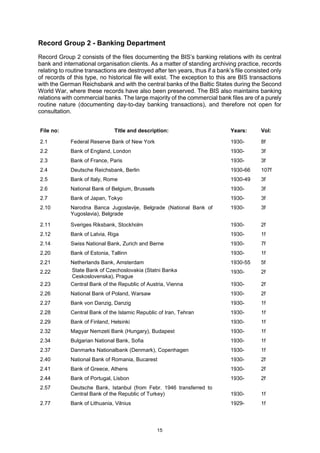
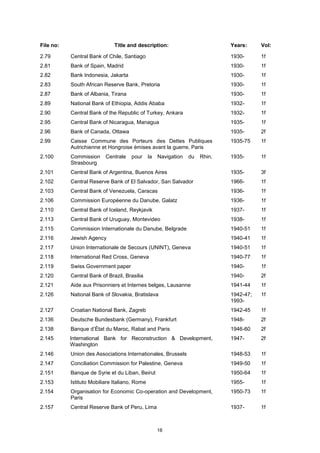
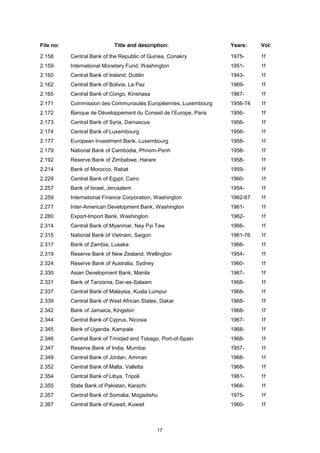
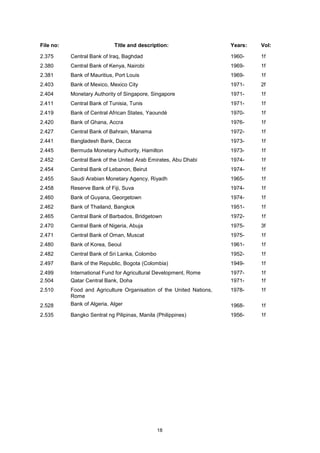
Record Group 2 - Banking Department
Record Group 2 consists of the files documenting the BIS’s banking relations with its central
bank and international organisation clients. As a matter of standing archiving practice, records
relating to routine transactions are destroyed after ten years, thus if a bank’s file consisted only
of records of this type, no historical file will exist. The exception to this are BIS transactions
with the German Reichsbank and with the central banks of the Baltic States during the Second
World War, where these records have also been preserved. The BIS also maintains banking
relations with commercial banks. The large majority of the commercial bank files are of a purely
routine nature (documenting day-to-day banking transactions), and therefore not open for
consultation.
File no: Title and description: Years: Vol:
2.1 Federal Reserve Bank of New York 1930- 8f
2.2 Bank of England, London 1930- 3f
2.3 Bank of France, Paris 1930- 3f
2.4 Deutsche Reichsbank, Berlin 1930-66 107f
2.5 Bank of Italy, Rome 1930-49 3f
2.6 National Bank of Belgium, Brussels 1930- 3f
2.7 Bank of Japan, Tokyo 1930- 3f
2.10 Narodna Banca Jugoslavije, Belgrade (National Bank of
Yugoslavia), Belgrade
1930- 3f
2.11 Sveriges Riksbank, Stockholm 1930- 2f
2.12 Bank of Latvia, Riga 1930- 1f
2.14 Swiss National Bank, Zurich and Berne 1930- 7f
2.20 Bank of Estonia, Tallinn 1930- 1f
2.21 Netherlands Bank, Amsterdam 1930-55 5f
2.22 State Bank of Czechoslovakia (Statni Banka
Ceskoslovenska), Prague
1930- 2f
2.23 Central Bank of the Republic of Austria, Vienna 1930- 2f
2.26 National Bank of Poland, Warsaw 1930- 2f
2.27 Bank von Danzig, Danzig 1930- 1f
2.28 Central Bank of the Islamic Republic of Iran, Tehran 1930- 1f
2.29 Bank of Finland, Helsinki 1930- 1f
2.32 Magyar Nemzeti Bank (Hungary), Budapest 1930- 1f
2.34 Bulgarian National Bank, Sofia 1930- 1f
2.37 Danmarks Nationalbank (Denmark), Copenhagen 1930- 1f
2.40 National Bank of Romania, Bucarest 1930- 2f
2.41 Bank of Greece, Athens 1930- 2f
2.44 Bank of Portugal, Lisbon 1930- 2f
2.57 Deutsche Bank, Istanbul (from Febr. 1946 transferred to
Central Bank of the Republic of Turkey) 1930- 1f
2.77 Bank of Lithuania, Vilnius 1929- 1f
16
File no: Title and description: Years: Vol:
2.79 Central Bank of Chile, Santiago 1930- 1f
2.81 Bank of Spain, Madrid 1930- 1f
2.82 Bank Indonesia, Jakarta 1930- 1f
2.83 South African Reserve Bank, Pretoria 1930- 1f
2.87 Bank of Albania, Tirana 1930- 1f
2.89 National Bank of Ethiopia, Addis Ababa 1932- 1f
2.90 Central Bank of the Republic of Turkey, Ankara 1932- 1f
2.95 Central Bank of Nicaragua, Managua 1935- 1f
2.96 Bank of Canada, Ottawa 1935- 2f
2.99 Caisse Commune des Porteurs des Dettes Publiques
Autrichienne et Hongroise émises avant la guerre, Paris
1935-75 1f
2.100 Commission Centrale pour la Navigation du Rhin,
Strasbourg
1935- 1f
2.101 Central Bank of Argentina, Buenos Aires 1935- 3f
2.102 Central Reserve Bank of El Salvador, San Salvador 1966- 1f
2.103 Central Bank of Venezuela, Caracas 1936- 1f
2.106 Commission Européenne du Danube, Galatz 1936- 1f
2.110 Central Bank of Iceland, Reykjavik 1937- 1f
2.113 Central Bank of Uruguay, Montevideo 1938- 1f
2.115 Commission Internationale du Danube, Belgrade 1940-51 1f
2.116 Jewish Agency 1940-41 1f
2.117 Union Internationale de Secours (UNINT), Geneva 1940-51 1f
2.118 International Red Cross, Geneva 1940-77 1f
2.119 Swiss Government paper 1940- 1f
2.120 Central Bank of Brazil, Brasilia 1940- 2f
2.121 Aide aux Prisonniers et Internes belges, Lausanne 1941-44 1f
2.126 National Bank of Slovakia, Bratislava 1942-47;
1993-
1f
2.127 Croatian National Bank, Zagreb 1942-45 1f
2.136 Deutsche Bundesbank (Germany), Frankfurt 1948- 2f
2.138 Banque d’État du Maroc, Rabat and Paris 1946-60 2f
2.145 International Bank for Reconstruction & Development,
Washington
1947- 2f
2.146 Union des Associations Internationales, Brussels 1948-53 1f
2.147 Conciliation Commission for Palestine, Geneva 1949-50 1f
2.151 Banque de Syrie et du Liban, Beirut 1950-64 1f
2.153 Istituto Mobiliare Italiano, Rome 1955- 1f
2.154 Organisation for Economic Co-operation and Development,
Paris
1950-73 1f
2.157 Central Reserve Bank of Peru, Lima 1937- 1f
17
File no: Title and description: Years: Vol:
2.158 Central Bank of the Republic of Guinea, Conakry 1975- 1f
2.159 International Monetary Fund, Washington 1951- 1f
2.160 Central Bank of Ireland, Dublin 1943- 1f
2.162 Central Bank of Bolivia, La Paz 1969- 1f
2.165 Central Bank of Congo, Kinshasa 1967- 1f
2.171 Commission des Communautés Européennes, Luxembourg 1956-74 1f
2.172 Banque de Développement du Conseil de l’Europe, Paris 1956- 1f
2.173 Central Bank of Syria, Damascus 1956- 1f
2.174 Central Bank of Luxembourg 1956- 1f
2.177 European Investment Bank, Luxembourg 1958- 1f
2.179 National Bank of Cambodia, Phnom-Penh 1958- 1f
2.192 Reserve Bank of Zimbabwe, Harare 1958- 1f
2.214 Bank of Morocco, Rabat 1959- 1f
2.229 Central Bank of Egypt, Cairo 1960- 1f
2.257 Bank of Israel, Jerusalem 1954- 1f
2.259 International Finance Corporation, Washington 1962-67 1f
2.277 Inter-American Development Bank, Washington 1961- 1f
2.280 Export-Import Bank, Washington 1962- 1f
2.314 Central Bank of Myanmar, Nay Pyi Taw 1966- 1f
2.315 National Bank of Vietnam, Saigon 1961-76 1f
2.317 Bank of Zambia, Lusaka 1966- 1f
2.319 Reserve Bank of New Zealand, Wellington 1954- 1f
2.324 Reserve Bank of Australia, Sydney 1960- 1f
2.330 Asian Development Bank, Manila 1967- 1f
2.331 Bank of Tanzania, Dar-es-Salaam 1968- 1f
2.337 Central Bank of Malaysia, Kuala Lumpur 1968- 1f
2.339 Central Bank of West African States, Dakar 1968- 1f
2.342 Bank of Jamaica, Kingston 1968- 1f
2.344 Central Bank of Cyprus, Nicosia 1967- 1f
2.345 Bank of Uganda, Kampala 1968- 1f
2.346 Central Bank of Trinidad and Tobago, Port-of-Spain 1968- 1f
2.347 Reserve Bank of India, Mumbai 1957- 1f
2.349 Central Bank of Jordan, Amman 1968- 1f
2.352 Central Bank of Malta, Valletta 1968- 1f
2.354 Central Bank of Libya, Tripoli 1961- 1f
2.355 State Bank of Pakistan, Karachi 1968- 1f
2.357 Central Bank of Somalia, Mogadishu 1975- 1f
2.367 Central Bank of Kuwait, Kuwait 1960- 1f
18
File no: Title and description: Years: Vol:
2.375 Central Bank of Iraq, Baghdad 1960- 1f
2.380 Central Bank of Kenya, Nairobi 1969- 1f
2.381 Bank of Mauritius, Port Louis 1969- 1f
2.403 Bank of Mexico, Mexico City 1971- 2f
2.404 Monetary Authority of Singapore, Singapore 1971- 1f
2.411 Central Bank of Tunisia, Tunis 1971- 1f
2.419 Bank of Central African States, Yaoundé 1970- 1f
2.420 Bank of Ghana, Accra 1976- 1f
2.427 Central Bank of Bahrain, Manama 1972- 1f
2.441 Bangladesh Bank, Dacca 1973- 1f
2.445 Bermuda Monetary Authority, Hamilton 1973- 1f
2.452 Central Bank of the United Arab Emirates, Abu Dhabi 1974- 1f
2.454 Central Bank of Lebanon, Beirut 1974- 1f
2.455 Saudi Arabian Monetary Agency, Riyadh 1965- 1f
2.458 Reserve Bank of Fiji, Suva 1974- 1f
2.460 Bank of Guyana, Georgetown 1974- 1f
2.462 Bank of Thailand, Bangkok 1951- 1f
2.465 Central Bank of Barbados, Bridgetown 1972- 1f
2.470 Central Bank of Nigeria, Abuja 1975- 3f
2.471 Central Bank of Oman, Muscat 1975- 1f
2.480 Bank of Korea, Seoul 1961- 1f
2.482 Central Bank of Sri Lanka, Colombo 1952- 1f
2.497 Bank of the Republic, Bogota (Colombia) 1949- 1f
2.499
2.504
International Fund for Agricultural Development, Rome
Qatar Central Bank, Doha
1977-
1971-
1f
1f
2.510
2.528
Food and Agriculture Organisation of the United Nations,
Rome
Bank of Algeria, Alger
1978-
1968-
1f
1f
2.535 Bangko Sentral ng Pilipinas, Manila (Philippines) 1956- 1f
19
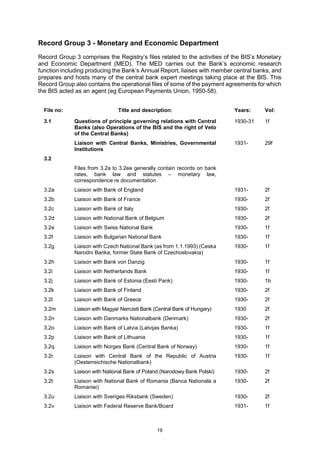
Record Group 3 - Monetary and Economic Department
Record Group 3 comprises the Registry’s files related to the activities of the BIS’s Monetary
and Economic Department (MED). The MED carries out the Bank’s economic research
function including producing the Bank’s Annual Report, liaises with member central banks, and
prepares and hosts many of the central bank expert meetings taking place at the BIS. This
Record Group also contains the operational files of some of the payment agreements for which
the BIS acted as an agent (eg European Payments Union, 1950-58).
File no: Title and description: Years: Vol:
3.1 Questions of principle governing relations with Central
Banks (also Operations of the BIS and the right of Veto
of the Central Banks)
1930-31 1f
3.2
Liaison with Central Banks, Ministries, Governmental
Institutions
1931- 29f
Files from 3.2a to 3.2ee generally contain records on bank
rates, bank law and statutes – monetary law,
correspondence re documentation
3.2a Liaison with Bank of England 1931- 2f
3.2b Liaison with Bank of France 1930- 2f
3.2c Liaison with Bank of Italy 1930- 2f
3.2d Liaison with National Bank of Belgium 1930- 2f
3.2e Liaison with Swiss National Bank 1930- 1f
3.2f Liaison with Bulgarian National Bank 1930- 1f
3.2g Liaison with Czech National Bank (as from 1.1.1993) (Ceska
Narodni Banka, former State Bank of Czechoslovakia)
1930- 1f
3.2h Liaison with Bank von Danzig 1930- 1f
3.2i Liaison with Netherlands Bank 1930- 1f
3.2j Liaison with Bank of Estonia (Eesti Pank) 1930- 1b
3.2k Liaison with Bank of Finland 1930- 2f
3.2l Liaison with Bank of Greece 1930- 2f
3.2m Liaison with Magyar Nemzeti Bank (Central Bank of Hungary) 1930 2f
3.2n Liaison with Danmarks Nationalbank (Denmark) 1930- 2f
3.2o Liaison with Bank of Latvia (Latvijas Banka) 1930- 1f
3.2p Liaison with Bank of Lithuania 1930- 1f
3.2q Liaison with Norges Bank (Central Bank of Norway) 1930- 1f
3.2r Liaison with Central Bank of the Republic of Austria
(Oesterreichische Nationalbank)
1930- 1f
3.2s Liaison with National Bank of Poland (Narodowy Bank Polski) 1930- 2f
3.2t Liaison with National Bank of Romania (Banca Nationala a
Romaniei)
1930- 2f
3.2u Liaison with Sveriges Riksbank (Sweden) 1930- 2f
3.2v Liaison with Federal Reserve Bank/Board 1931- 1f
20
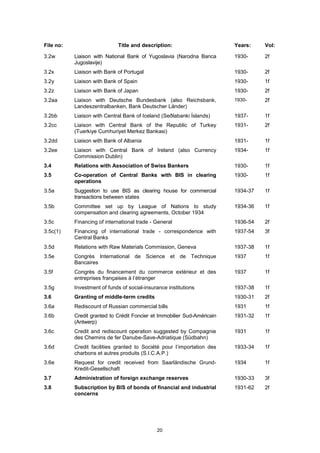
File no: Title and description: Years: Vol:
3.2w Liaison with National Bank of Yugoslavia (Narodna Banca
Jugoslavije)
1930- 2f
3.2x Liaison with Bank of Portugal 1930- 2f
3.2y Liaison with Bank of Spain 1930- 1f
3.2z Liaison with Bank of Japan 1930- 2f
3.2aa Liaison with Deutsche Bundesbank (also Reichsbank,
Landeszentralbanken, Bank Deutscher Länder)
1930- 2f
3.2bb Liaison with Central Bank of Iceland (Seðlabanki Íslands) 1937- 1f
3.2cc Liaison with Central Bank of the Republic of Turkey
(Tuerkiye Cumhuriyet Merkez Bankasi)
1931- 2f
3.2dd Liaison with Bank of Albania 1931- 1f
3.2ee Liaison with Central Bank of Ireland (also Currency
Commission Dublin)
1934- 1f
3.4 Relations with Association of Swiss Bankers 1930- 1f
3.5 Co-operation of Central Banks with BIS in clearing
operations
1930- 1f
3.5a Suggestion to use BIS as clearing house for commercial
transactions between states
1934-37 1f
3.5b Committee set up by League of Nations to study
compensation and clearing agreements, October 1934
1934-36 1f
3.5c Financing of international trade - General 1936-54 2f
3.5c(1) Financing of international trade - correspondence with
Central Banks
1937-54 3f
3.5d Relations with Raw Materials Commission, Geneva 1937-38 1f
3.5e Congrès International de Science et de Technique
Bancaires
1937 1f
3.5f Congrès du financement du commerce extérieur et des
entreprises françaises à l’étranger
1937 1f
3.5g Investment of funds of social-insurance institutions 1937-38 1f
3.6 Granting of middle-term credits 1930-31 2f
3.6a Rediscount of Russian commercial bills 1931 1f
3.6b Credit granted to Crédit Foncier et Immobilier Sud-Américain
(Antwerp)
1931-32 1f
3.6c Credit and rediscount operation suggested by Compagnie
des Chemins de fer Danube-Save-Adriatique (Südbahn)
1931 1f
3.6d Credit facilities granted to Société pour l’importation des
charbons et autres produits (S.I.C.A.P.)
1933-34 1f
3.6e Request for credit received from Saarländische Grund-
Kredit-Gesellschaft
1934 1f
3.7 Administration of foreign exchange reserves 1930-33 3f
3.8 Subscription by BIS of bonds of financial and industrial
concerns
1931-62 2f
21
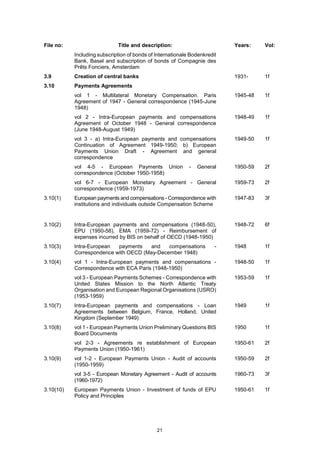
File no: Title and description: Years: Vol:
Including subscription of bonds of Internationale Bodenkredit
Bank, Basel and subscription of bonds of Compagnie des
Prêts Fonciers, Amsterdam
3.9 Creation of central banks 1931- 1f
3.10 Payments Agreements
vol 1 - Multilateral Monetary Compensation. Paris
Agreement of 1947 - General correspondence (1945-June
1948)
1945-48 1f
vol 2 - Intra-European payments and compensations
Agreement of October 1948 - General correspondence
(June 1948-August 1949)
1948-49 1f
vol 3 - a) Intra-European payments and compensations
Continuation of Agreement 1949-1950; b) European
Payments Union Draft - Agreement and general
correspondence
1949-50 1f
vol 4-5 - European Payments Union - General
correspondence (October 1950-1958)
1950-59 2f
vol 6-7 - European Monetary Agreement - General
correspondence (1959-1973)
1959-73 2f
3.10(1) European payments and compensations - Correspondence with
institutions and individuals outside Compensation Scheme
1947-83 3f
3.10(2) Intra-European payments and compensations (1948-50),
EPU (1950-58), EMA (1959-72) - Reimbursement of
expenses incurred by BIS on behalf of OECD (1948-1950)
1948-72 6f
3.10(3) Intra-European payments and compensations -
Correspondence with OECD (May-December 1948)
1948 1f
3.10(4) vol 1 - Intra-European payments and compensations -
Correspondence with ECA Paris (1948-1950)
1948-50 1f
vol 3 - European Payments Schemes - Correspondence with
United States Mission to the North Atlantic Treaty
Organisation and European Regional Organisations (USRO)
(1953-1959)
1953-59 1f
3.10(7) Intra-European payments and compensations - Loan
Agreements between Belgium, France, Holland, United
Kingdom (September 1949)
1949 1f
3.10(8) vol 1 - European Payments Union Preliminary Questions BIS
Board Documents
1950 1f
vol 2-3 - Agreements re establishment of European
Payments Union (1950-1961)
1950-61 2f
3.10(9) vol 1-2 - European Payments Union - Audit of accounts
(1950-1959)
1950-59 2f
vol 3-5 - European Monetary Agreement - Audit of accounts
(1960-1972)
1960-73 3f
3.10(10) European Payments Union - Investment of funds of EPU
Policy and Principles
1950-61 1f
22
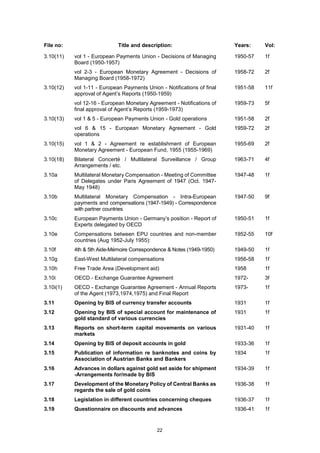
File no: Title and description: Years: Vol:
3.10(11) vol 1 - European Payments Union - Decisions of Managing
Board (1950-1957)
1950-57 1f
vol 2-3 - European Monetary Agreement - Decisions of
Managing Board (1958-1972)
1958-72 2f
3.10(12) vol 1-11 - European Payments Union - Notifications of final
approval of Agent’s Reports (1950-1959)
1951-58 11f
vol 12-16 - European Monetary Agreement - Notifications of
final approval of Agent’s Reports (1959-1973)
1959-73 5f
3.10(13) vol 1 & 5 - European Payments Union - Gold operations 1951-58 2f
vol 6 & 15 - European Monetary Agreement - Gold
operations
1959-72 2f
3.10(15) vol 1 & 2 - Agreement re establishment of European
Monetary Agreement - European Fund, 1955 (1955-1969)
1955-69 2f
3.10(18) Bilateral Concerté / Multilateral Surveillance / Group
Arrangements / etc.
1963-71 4f
3.10a Multilateral Monetary Compensation - Meeting of Committee
of Delegates under Paris Agreement of 1947 (Oct. 1947-
May 1948)
1947-48 1f
3.10b Multilateral Monetary Compensation - Intra-European
payments and compensations (1947-1949) - Correspondence
with partner countries
1947-50 9f
3.10c European Payments Union - Germany’s position - Report of
Experts delegated by OECD
1950-51 1f
3.10e Compensations between EPU countries and non-member
countries (Aug 1952-July 1955):
1952-55 10f
3.10f 4th & 5th Aide-Mémoire Correspondence & Notes (1949-1950) 1949-50 1f
3.10g East-West Multilateral compensations 1956-58 1f
3.10h Free Trade Area (Development aid) 1958 1f
3.10i OECD - Exchange Guarantee Agreement 1972- 3f
3.10i(1) OECD - Exchange Guarantee Agreement - Annual Reports
of the Agent (1973,1974,1975) and Final Report
1973- 1f
3.11 Opening by BIS of currency transfer accounts 1931 1f
3.12 Opening by BIS of special account for maintenance of
gold standard of various currencies
1931 1f
3.13 Reports on short-term capital movements on various
markets
1931-40 1f
3.14 Opening by BIS of deposit accounts in gold 1933-36 1f
3.15 Publication of information re banknotes and coins by
Association of Austrian Banks and Bankers
1934 1f
3.16 Advances in dollars against gold set aside for shipment
-Arrangements for/made by BIS
1934-39 1f
3.17 Development of the Monetary Policy of Central Banks as
regards the sale of gold coins
1936-38 1f
3.18 Legislation in different countries concerning cheques 1936-37 1f
3.19 Questionnaire on discounts and advances 1936-41 1f
23
File no: Title and description: Years: Vol:
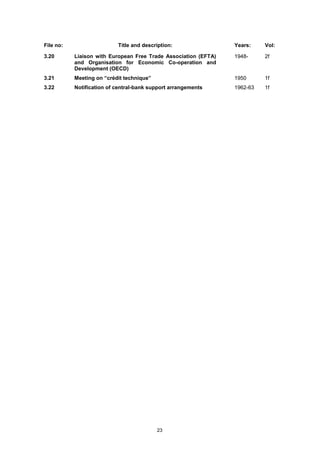
3.20 Liaison with European Free Trade Association (EFTA)
and Organisation for Economic Co-operation and
Development (OECD)
1948- 2f
3.21 Meeting on “crédit technique” 1950 1f
3.22 Notification of central-bank support arrangements 1962-63 1f
24
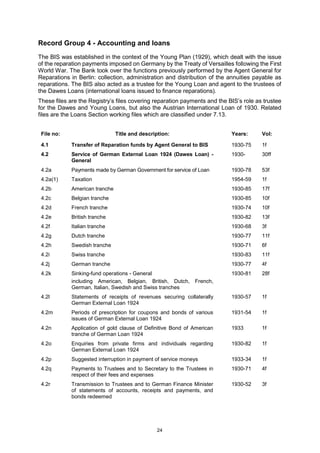
Record Group 4 - Accounting and loans
The BIS was established in the context of the Young Plan (1929), which dealt with the issue
of the reparation payments imposed on Germany by the Treaty of Versailles following the First
World War. The Bank took over the functions previously performed by the Agent General for
Reparations in Berlin: collection, administration and distribution of the annuities payable as
reparations. The BIS also acted as a trustee for the Young Loan and agent to the trustees of
the Dawes Loans (international loans issued to finance reparations).
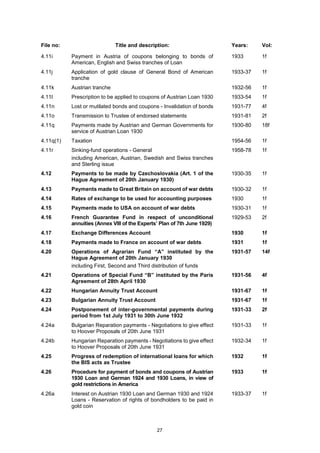
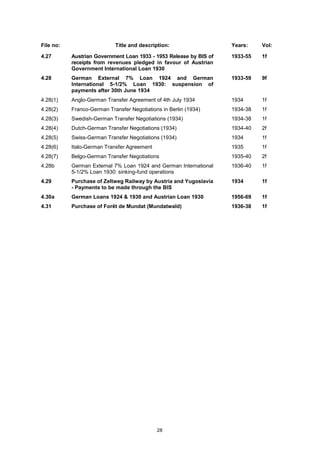
These files are the Registry’s files covering reparation payments and the BIS’s role as trustee
for the Dawes and Young Loans, but also the Austrian International Loan of 1930. Related
files are the Loans Section working files which are classified under 7.13.
File no: Title and description: Years: Vol:
4.1 Transfer of Reparation funds by Agent General to BIS 1930-75 1f
4.2 Service of German External Loan 1924 (Dawes Loan) -
General
1930- 30ff
4.2a Payments made by German Government for service of Loan 1930-78 53f
4.2a(1) Taxation 1954-59 1f
4.2b American tranche 1930-85 17f
4.2c Belgian tranche 1930-85 10f
4.2d French tranche 1930-74 10f
4.2e British tranche 1930-82 13f
4.2f Italian tranche 1930-68 3f
4.2g Dutch tranche 1930-77 11f
4.2h Swedish tranche 1930-71 6f
4.2i Swiss tranche 1930-83 11f
4.2j German tranche 1930-77 4f
4.2k Sinking-fund operations - General
including American, Belgian, British, Dutch, French,
German, Italian, Swedish and Swiss tranches
1930-81 28f
4.2l Statements of receipts of revenues securing collaterally
German External Loan 1924
1930-57 1f
4.2m Periods of prescription for coupons and bonds of various
issues of German External Loan 1924
1931-54 1f
4.2n Application of gold clause of Definitive Bond of American
tranche of German Loan 1924
1933 1f
4.2o Enquiries from private firms and individuals regarding
German External Loan 1924
1930-82 1f
4.2p Suggested interruption in payment of service moneys 1933-34 1f
4.2q Payments to Trustees and to Secretary to the Trustees in
respect of their fees and expenses
1930-71 4f
4.2r Transmission to Trustees and to German Finance Minister
of statements of accounts, receipts and payments, and
bonds redeemed
1930-52 3f
25
File no: Title and description: Years: Vol:
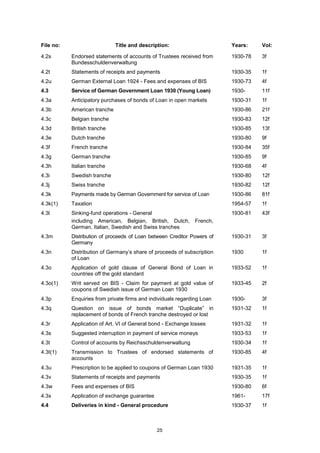
4.2s Endorsed statements of accounts of Trustees received from
Bundesschuldenverwaltung
1930-78 3f
4.2t Statements of receipts and payments 1930-35 1f
4.2u German External Loan 1924 - Fees and expenses of BIS 1930-73 4f
4.3 Service of German Government Loan 1930 (Young Loan) 1930- 11f
4.3a Anticipatory purchases of bonds of Loan in open markets 1930-31 1f
4.3b American tranche 1930-86 21f
4.3c Belgian tranche 1930-83 12f
4.3d British tranche 1930-85 13f
4.3e Dutch tranche 1930-80 9f
4.3f French tranche 1930-84 35f
4.3g German tranche 1930-85 9f
4.3h Italian tranche 1930-68 4f
4.3i Swedish tranche 1930-80 12f
4.3j Swiss tranche 1930-82 12f
4.3k Payments made by German Government for service of Loan 1930-86 81f
4.3k(1) Taxation 1954-57 1f
4.3l Sinking-fund operations - General
including American, Belgian, British, Dutch, French,
German, Italian, Swedish and Swiss tranches
1930-81 43f
4.3m Distribution of proceeds of Loan between Creditor Powers of
Germany
1930-31 3f
4.3n Distribution of Germany’s share of proceeds of subscription
of Loan
1930 1f
4.3o Application of gold clause of General Bond of Loan in
countries off the gold standard
1933-52 1f
4.3o(1) Writ served on BIS - Claim for payment at gold value of
coupons of Swedish issue of German Loan 1930
1933-45 2f
4.3p Enquiries from private firms and individuals regarding Loan 1930- 3f
4.3q Question on issue of bonds market “Duplicate” in
replacement of bonds of French tranche destroyed or lost
1931-32 1f
4.3r Application of Art. VI of General bond - Exchange losses 1931-32 1f
4.3s Suggested interruption in payment of service moneys 1933-53 1f
4.3t Control of accounts by Reichsschuldenverwaltung 1930-34 1f
4.3t(1) Transmission to Trustees of endorsed statements of
accounts
1930-85 4f
4.3u Prescription to be applied to coupons of German Loan 1930 1931-35 1f
4.3v Statements of receipts and payments 1930-35 1f
4.3w Fees and expenses of BIS 1930-80 6f
4.3x Application of exchange guarantee 1961- 17f
4.4 Deliveries in kind - General procedure 1930-37 1f
26
File no: Title and description: Years: Vol:
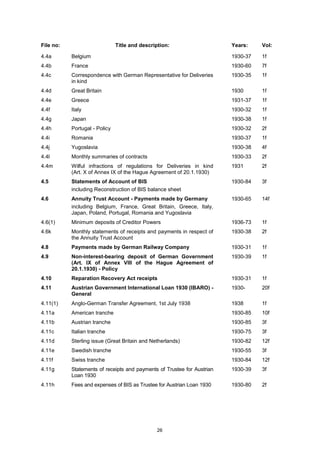
4.4a Belgium 1930-37 1f
4.4b France 1930-60 7f
4.4c Correspondence with German Representative for Deliveries
in kind
1930-35 1f
4.4d Great Britain 1930 1f
4.4e Greece 1931-37 1f
4.4f Italy 1930-32 1f
4.4g Japan 1930-38 1f
4.4h Portugal - Policy 1930-32 2f
4.4i Romania 1930-37 1f
4.4j Yugoslavia 1930-38 4f
4.4l Monthly summaries of contracts 1930-33 2f
4.4m Wilful infractions of regulations for Deliveries in kind
(Art. X of Annex IX of the Hague Agreement of 20.1.1930)
1931 2f
4.5 Statements of Account of BIS
including Reconstruction of BIS balance sheet
1930-84 3f
4.6 Annuity Trust Account - Payments made by Germany
including Belgium, France, Great Britain, Greece, Italy,
Japan, Poland, Portugal, Romania and Yugoslavia
1930-65 14f
4.6(1) Minimum deposits of Creditor Powers 1936-73 1f
4.6k Monthly statements of receipts and payments in respect of
the Annuity Trust Account
1930-38 2f
4.8 Payments made by German Railway Company 1930-31 1f
4.9 Non-interest-bearing deposit of German Government
(Art. IX of Annex VIII of the Hague Agreement of
20.1.1930) - Policy
1930-39 1f
4.10 Reparation Recovery Act receipts 1930-31 1f
4.11 Austrian Government International Loan 1930 (IBARO) -
General
1930- 20f
4.11(1) Anglo-German Transfer Agreement, 1st July 1938 1938 1f
4.11a American tranche 1930-85 10f
4.11b Austrian tranche 1930-85 3f
4.11c Italian tranche 1930-75 3f
4.11d Sterling issue (Great Britain and Netherlands) 1930-82 12f
4.11e Swedish tranche 1930-55 3f
4.11f Swiss tranche 1930-84 12f
4.11g Statements of receipts and payments of Trustee for Austrian
Loan 1930
1930-39 3f
4.11h Fees and expenses of BIS as Trustee for Austrian Loan 1930 1930-80 2f
27
File no: Title and description: Years: Vol:
4.11i Payment in Austria of coupons belonging to bonds of
American, English and Swiss tranches of Loan
1933 1f
4.11j Application of gold clause of General Bond of American
tranche
1933-37 1f
4.11k Austrian tranche 1932-56 1f
4.11l Prescription to be applied to coupons of Austrian Loan 1930 1933-54 1f
4.11n Lost or mutilated bonds and coupons - Invalidation of bonds 1931-77 4f
4.11o Transmission to Trustee of endorsed statements 1931-81 2f
4.11q Payments made by Austrian and German Governments for
service of Austrian Loan 1930
1930-80 18f
4.11q(1) Taxation 1954-56 1f
4.11r Sinking-fund operations - General
including American, Austrian, Swedish and Swiss tranches
and Sterling issue
1958-78 1f
4.12 Payments to be made by Czechoslovakia (Art. 1 of the
Hague Agreement of 20th January 1930)
1930-35 1f
4.13 Payments made to Great Britain on account of war debts 1930-32 1f
4.14 Rates of exchange to be used for accounting purposes 1930 1f
4.15 Payments made to USA on account of war debts 1930-31 1f
4.16 French Guarantee Fund in respect of unconditional
annuities (Annex VIII of the Experts’ Plan of 7th June 1929)
1929-53 2f
4.17 Exchange Differences Account 1930 1f
4.18 Payments made to France on account of war debts 1931 1f
4.20 Operations of Agrarian Fund “A” instituted by the
Hague Agreement of 20th January 1930
including First, Second and Third distribution of funds
1931-57 14f
4.21 Operations of Special Fund “B” instituted by the Paris
Agreement of 28th April 1930
1931-56 4f
4.22 Hungarian Annuity Trust Account 1931-67 1f
4.23 Bulgarian Annuity Trust Account 1931-67 1f
4.24 Postponement of inter-governmental payments during
period from 1st July 1931 to 30th June 1932
1931-33 2f
4.24a Bulgarian Reparation payments - Negotiations to give effect
to Hoover Proposals of 20th June 1931
1931-33 1f
4.24b Hungarian Reparation payments - Negotiations to give effect
to Hoover Proposals of 20th June 1931
1932-34 1f
4.25 Progress of redemption of international loans for which
the BIS acts as Trustee
1932 1f
4.26 Procedure for payment of bonds and coupons of Austrian
1930 Loan and German 1924 and 1930 Loans, in view of
gold restrictions in America
1933 1f
4.26a Interest on Austrian 1930 Loan and German 1930 and 1924
Loans - Reservation of rights of bondholders to be paid in
gold coin
1933-37 1f
28
File no: Title and description: Years: Vol:
4.27 Austrian Government Loan 1933 - 1953 Release by BIS of
receipts from revenues pledged in favour of Austrian
Government International Loan 1930
1933-55 1f
4.28 German External 7% Loan 1924 and German
International 5-1/2% Loan 1930: suspension of
payments after 30th June 1934
1933-59 9f
4.28(1) Anglo-German Transfer Agreement of 4th July 1934 1934 1f
4.28(2) Franco-German Transfer Negotiations in Berlin (1934) 1934-38 1f
4.28(3) Swedish-German Transfer Negotiations (1934) 1934-38 1f
4.28(4) Dutch-German Transfer Negotiations (1934) 1934-40 2f
4.28(5) Swiss-German Transfer Negotiations (1934) 1934 1f
4.28(6) Italo-German Transfer Agreement 1935 1f
4.28(7) Belgo-German Transfer Negotiations 1935-40 2f
4.28b German External 7% Loan 1924 and German International
5-1/2% Loan 1930: sinking-fund operations
1936-40 1f
4.29 Purchase of Zeltweg Railway by Austria and Yugoslavia
- Payments to be made through the BIS
1934 1f
4.30a German Loans 1924 & 1930 and Austrian Loan 1930 1956-69 1f
4.31 Purchase of Forêt de Mundat (Mundatwald) 1936-38 1f
29
Record Group 5 - Establishment
building, security, HR policies, IT systems, etc.
This record group consists of files concerning the Bank’s internal functioning. It is not open to
the public since it is of limited historical interest, in order to protect the privacy of current and
former staff and not to compromise the BIS’s physical and IT security.
30
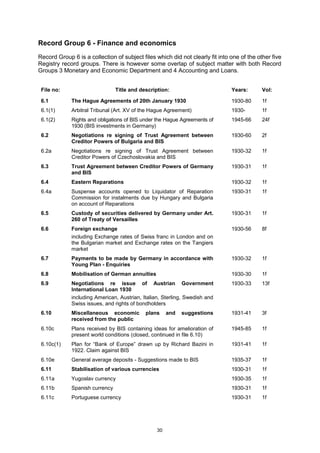
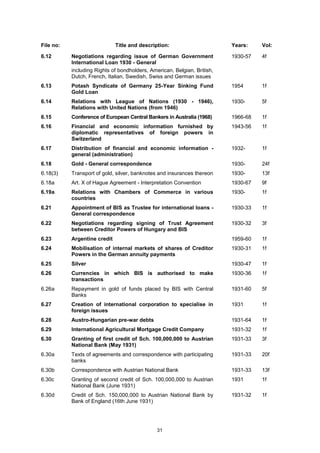
Record Group 6 - Finance and economics
Record Group 6 is a collection of subject files which did not clearly fit into one of the other five
Registry record groups. There is however some overlap of subject matter with both Record
Groups 3 Monetary and Economic Department and 4 Accounting and Loans.
File no: Title and description: Years: Vol:
6.1 The Hague Agreements of 20th January 1930 1930-80 1f
6.1(1) Arbitral Tribunal (Art. XV of the Hague Agreement) 1930- 1f
6.1(2) Rights and obligations of BIS under the Hague Agreements of
1930 (BIS investments in Germany)
1945-66 24f
6.2 Negotiations re signing of Trust Agreement between
Creditor Powers of Bulgaria and BIS
1930-60 2f
6.2a Negotiations re signing of Trust Agreement between
Creditor Powers of Czechoslovakia and BIS
1930-32 1f
6.3 Trust Agreement between Creditor Powers of Germany
and BIS
1930-31 1f
6.4 Eastern Reparations 1930-32 1f
6.4a Suspense accounts opened to Liquidator of Reparation
Commission for instalments due by Hungary and Bulgaria
on account of Reparations
1930-31 1f
6.5 Custody of securities delivered by Germany under Art.
260 of Treaty of Versailles
1930-31 1f
6.6 Foreign exchange
including Exchange rates of Swiss franc in London and on
the Bulgarian market and Exchange rates on the Tangiers
market
1930-56 8f
6.7 Payments to be made by Germany in accordance with
Young Plan - Enquiries
1930-32 1f
6.8 Mobilisation of German annuities 1930-30 1f
6.9 Negotiations re issue of Austrian Government
International Loan 1930
including American, Austrian, Italian, Sterling, Swedish and
Swiss issues, and rights of bondholders
1930-33 13f
6.10 Miscellaneous economic plans and suggestions
received from the public
1931-41 3f
6.10c Plans received by BIS containing ideas for amelioration of
present world conditions (closed, continued in file 6.10)
1945-85 1f
6.10c(1) Plan for “Bank of Europe” drawn up by Richard Bazini in
1922. Claim against BIS
1931-41 1f
6.10e General average deposits - Suggestions made to BIS 1935-37 1f
6.11 Stabilisation of various currencies 1930-31 1f
6.11a Yugoslav currency 1930-35 1f
6.11b Spanish currency 1930-31 1f
6.11c Portuguese currency 1930-31 1f
31
File no: Title and description: Years: Vol:
6.12 Negotiations regarding issue of German Government
International Loan 1930 - General
including Rights of bondholders, American, Belgian, British,
Dutch, French, Italian, Swedish, Swiss and German issues
1930-57 4f
6.13 Potash Syndicate of Germany 25-Year Sinking Fund
Gold Loan
1954 1f
6.14 Relations with League of Nations (1930 - 1946),
Relations with United Nations (from 1946)
1930- 5f
6.15 Conference of European Central Bankers in Australia (1968) 1966-68 1f
6.16 Financial and economic information furnished by
diplomatic representatives of foreign powers in
Switzerland
1943-56 1f
6.17 Distribution of financial and economic information -
general (administration)
1932- 1f
6.18 Gold - General correspondence 1930- 24f
6.18(3) Transport of gold, silver, banknotes and insurances thereon 1930- 13f
6.18a Art. X of Hague Agreement - Interpretation Convention 1930-67 9f
6.19a Relations with Chambers of Commerce in various
countries
1930- 1f
6.21 Appointment of BIS as Trustee for international loans -
General correspondence
1930-33 1f
6.22 Negotiations regarding signing of Trust Agreement
between Creditor Powers of Hungary and BIS
1930-32 3f
6.23 Argentine credit 1959-60 1f
6.24 Mobilisation of internal markets of shares of Creditor
Powers in the German annuity payments
1930-31 1f
6.25 Silver 1930-47 1f
6.26 Currencies in which BIS is authorised to make
transactions
1930-36 1f
6.26a Repayment in gold of funds placed by BIS with Central
Banks
1931-60 5f
6.27 Creation of international corporation to specialise in
foreign issues
1931 1f
6.28 Austro-Hungarian pre-war debts 1931-64 1f
6.29 International Agricultural Mortgage Credit Company 1931-32 1f
6.30 Granting of first credit of Sch. 100,000,000 to Austrian
National Bank (May 1931)
1931-33 3f
6.30a Texts of agreements and correspondence with participating
banks
1931-33 20f
6.30b Correspondence with Austrian National Bank 1931-33 13f
6.30c Granting of second credit of Sch. 100,000,000 to Austrian
National Bank (June 1931)
1931 1f
6.30d Credit of Sch. 150,000,000 to Austrian National Bank by
Bank of England (16th June 1931)
1931-32 1f
32
File no: Title and description: Years: Vol:
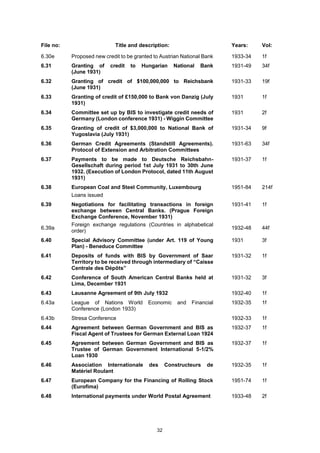
6.30e Proposed new credit to be granted to Austrian National Bank 1933-34 1f
6.31 Granting of credit to Hungarian National Bank
(June 1931)
1931-49 34f
6.32 Granting of credit of $100,000,000 to Reichsbank
(June 1931)
1931-33 19f
6.33 Granting of credit of £150,000 to Bank von Danzig (July
1931)
1931 1f
6.34 Committee set up by BIS to investigate credit needs of
Germany (London conference 1931) - Wiggin Committee
1931 2f
6.35 Granting of credit of $3,000,000 to National Bank of
Yugoslavia (July 1931)
1931-34 9f
6.36 German Credit Agreements (Standstill Agreements).
Protocol of Extension and Arbitration Committees
1931-63 34f
6.37 Payments to be made to Deutsche Reichsbahn-
Gesellschaft during period 1st July 1931 to 30th June
1932. (Execution of London Protocol, dated 11th August
1931)
1931-37 1f
6.38 European Coal and Steel Community, Luxembourg
Loans issued
1951-84 214f
6.39
6.39a
Negotiations for facilitating transactions in foreign
exchange between Central Banks. (Prague Foreign
Exchange Conference, November 1931)
Foreign exchange regulations (Countries in alphabetical
order)
1931-41
1932-48
1f
44f
6.40 Special Advisory Committee (under Art. 119 of Young
Plan) - Beneduce Committee
1931 3f
6.41 Deposits of funds with BIS by Government of Saar
Territory to be received through intermediary of “Caisse
Centrale des Dépôts”
1931-32 1f
6.42 Conference of South American Central Banks held at
Lima, December 1931
1931-32 3f
6.43 Lausanne Agreement of 9th July 1932 1932-40 1f
6.43a League of Nations World Economic and Financial
Conference (London 1933)
1932-35 1f
6.43b Stresa Conference 1932-33 1f
6.44 Agreement between German Government and BIS as
Fiscal Agent of Trustees for German External Loan 1924
1932-37 1f
6.45 Agreement between German Government and BIS as
Trustee of German Government International 5-1/2%
Loan 1930
1932-37 1f
6.46 Association Internationale des Constructeurs de
Matériel Roulant
1932-35 1f
6.47 European Company for the Financing of Rolling Stock
(Eurofima)
1951-74 1f
6.48 International payments under World Postal Agreement 1933-48 2f
33
File no: Title and description: Years: Vol:
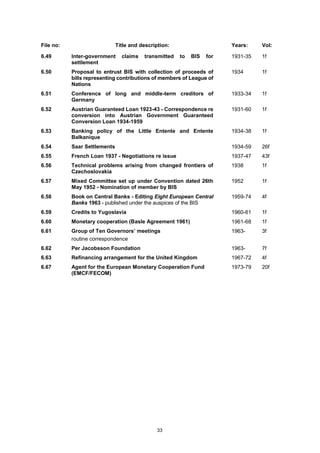
6.49 Inter-government claims transmitted to BIS for
settlement
1931-35 1f
6.50 Proposal to entrust BIS with collection of proceeds of
bills representing contributions of members of League of
Nations
1934 1f
6.51 Conference of long and middle-term creditors of
Germany
1933-34 1f
6.52 Austrian Guaranteed Loan 1923-43 - Correspondence re
conversion into Austrian Government Guaranteed
Conversion Loan 1934-1959
1931-60 1f
6.53 Banking policy of the Little Entente and Entente
Balkanique
1934-38 1f
6.54 Saar Settlements 1934-59 26f
6.55 French Loan 1937 - Negotiations re issue 1937-47 43f
6.56 Technical problems arising from changed frontiers of
Czechoslovakia
1938 1f
6.57 Mixed Committee set up under Convention dated 26th
May 1952 - Nomination of member by BIS
1952 1f
6.58 Book on Central Banks - Editing Eight European Central
Banks 1963 - published under the auspices of the BIS
1959-74 4f
6.59 Credits to Yugoslavia 1960-61 1f
6.60 Monetary cooperation (Basle Agreement 1961) 1961-68 1f
6.61 Group of Ten Governors’ meetings
routine correspondence
1963- 3f
6.62 Per Jacobsson Foundation 1963- 7f
6.63 Refinancing arrangement for the United Kingdom 1967-72 4f
6.67 Agent for the European Monetary Cooperation Fund
(EMCF/FECOM)
1973-79 20f
34
Record Group 7 - BIS history
Record Group 7 consists of records that did not originally pass through the BIS’s Registry.
These are mostly files that were compiled by individual staff members or business areas, often
dealing with specific topics and sometimes put together a considerable time after the events
they describe took place. These files were usually only integrated into the BIS’s corporate
archives at a much later date. A typical example would be the personal files of members of
senior management, which are normally only transferred to the central archives after they
leave the BIS. As a result Record Group 7 is a rather eclectic, but historically valuable,
collection.
File no: Title and description: Years: Vol:
7.1 BIS Board Meetings 1930-
7.1(3) Board Secretariat
Working files of the secretariat to the BIS Board of Directors.
These contain, inter alia, reports prepared for the Board
meetings, prepared remarks of the Chairman, budget
estimates, or documentation on specific issues discussed by
the Board (eg nomination of German directors after the
Second World War, possible USSR State Bank
membership).
1931- 37b
7.2 BIS Annual General Meetings
Correspondence re attendees and signed attendance lists
1930-75 22b
7.4 BIS Immunities
Documents regarding the immunities enjoyed by the BIS
under Article X of the Hague Agreement and specified by the
Brussels Protocol of 1936. Includes list of countries in which
the Brussels Protocol is in effect.
1930-57 1b
7.5 BIS Dividend and Capital
Board documents
1930- 3b
7.6 BIS Shares
Documents relating to BIS shares held by central banks.
Correspondence on special issues such as the exercise of
the rights attached to BIS shares held by the German
Reichsbank and by a consortium of Japanese banks after
the Second World War; representation at the BIS Annual
General Meetings of the shares held by American private
banks, etc
1930-69 2b
7.7 Attachments
Claims on funds deposited at BIS
1930-59 2b
7.8 BIS Funds in Germany
Documents regarding the BIS assets held in Germany in
connection with the 1930 Hague Agreement. Includes Final
Act of the Hague Agreement and debt certificate of the
German Government. Correspondence and documents
dealing with the treatment and final settlement of BIS assets
held in Germany after the Second World War. Includes
statement of BIS claims on the German market; London
Agreement on German External Debts 1953; Contract
between the BIS and the German Government 1953;
Memorandum concerning assets and liabilities of the BIS
under the Hague Agreements, 3 June 1965.
1929-65 18b
35
File no: Title and description: Years: Vol:
7.12 Treaties, Agreements and International Conferences
Texts of treaties and conferences, some not directly
involving the BIS.
1919-57 20b
7.13 Reparations and Trustee for International Loans
7.13(1) Reparations and Deliveries in Kind. First World War.
Documents originating from the Agent General for
Reparations’ office (Commission des Transfers), and
transferred to the BIS in 1930.
1924-30 2b
7.13(2) Dawes and Young Loans.
Files originating from the secretariat of the Trustees to the
1924 Dawes Loan and 1930 Young Loan. Individual trustees
were appointed for the Dawes Loan in 1924, from 1930 the
BIS acted as Agent to the Trustees of the Dawes Loan. From
1930, the BIS acted as Trustee for the Young Loan. From
1970 the BIS acted additionally as Trustee for the Dawes
Loan.
1924-70 23b
7.13(3) Dawes and Young Loans. Austrian Government Loan 1930.
Administration and accounting documents in respect of
these three international loans.
1924- 98b
34l & 4f
7.13(4) Dawes and Young Loans: Gold Clause / Währungsgarantie 1953-80 10b
7.13(5) Emprunt français de Sécurité Nationale 1937. 1937-42 3l
7.14 European Payments Union (EPU). European Monetary
Agreement (EMA)
In order to restore a system of multilateral payments in Europe
after the Second World War and to prepare the return to full
currency convertibility, a first, limited Agreement on Multilateral
Monetary Compensation was signed between the Benelux
countries, France and Italy in November 1947. This was
followed by a broader Agreement for Intra-European Payments
and Compensations in 1948-49, and then replaced by the
European Payments Union (EPU), in which from 1950 until its
dissolution at the end of 1958 17 European countries
participated. In 1958, the EPU was replaced by the European
Monetary Agreement (EMA, 1958-1972). This file contains the
Reports of the Agent (BIS) to the Managing Board (OECD),
including monthly balances and regular confidential notes. See
also file 3.10.
1947-1969 5b
7.15 Group of Ten (G10).
7.15(1) G10 Deputies
The Group of Ten (G10) was established as a result of the
IMF’s General Arrangement to Borrow (GAB, 1961). The BIS
became involved with the G10’s work in 1964, when it was
asked by the G10 Deputies to provide background
information on the gold and eurocurrency markets and on
short-term credit arrangements among central banks. From
1964 onward a BIS representative participated in the G10
Deputies meetings (mostly held in Paris) with observer
status. The BIS also compiled the statistical input for the
G10’s multilateral surveillance exercise. These files contain
correspondence, background notes, meeting minutes and
published statements of the G10 Deputies meetings.
1964- 22b
7.16 BIS Foundation and History
36
File no: Title and description: Years: Vol:
7.16(1) BIS Organisation Committee (COBRI)
Committee meeting in Baden-Baden in October-November
1929 to set up the BIS: correspondence, background notes,
meeting minutes, various drafts of BIS Statutes, Charter and
Trust agreement. Mostly copies.
1929-30 4b
7.16(2) BIS Foundation and Activities
Documents and press clippings regarding the foundation of
the BIS, its wartime neutrality policy and its proposed
liquidation (Bretton Woods Conference, 1944). Also includes
copies of an in-house history of the first fifteen financial years
of the BIS, produced in 1944-45 (“BIS Reconsidered”).
1929-49 3b
7.16(3) Paolo Baffi, 'The origins of central banks cooperation. The
establishment of the BIS', published by the Banca d'Italia in
2002
Collection of archival sources from the BIS archives and
from other institutions; Working files related to the
preparation of the book.
1929- 36f
7.17 Speeches, Reports and Lectures
Reports of BIS meetings and texts of speeches and lectures
given by its staff. Includes a collection of central bankers’
speeches.
1930- 13b
7.18 Personal Papers
7.18(1) Papers Schäffer
H Schäffer was secretary of state at the German Ministry of
Finance and as such closely involved in the reparations
issue and the setting up of the BIS. These are copies of his
diaries, preserved at the Institut für Zeitgeschichte in
Munich, that deal with BIS related matters.
1929-31 2b
7.18(2) Papers Gates McGarrah / Leon Fraser / Willem Beyen
Gates McGarrah was President of the BIS from 1930 to 1933,
Leon Fraser held the same position from 1933 to 1935, having
been Alternate of the President from 1930. Willem Beyen was
Alternate of the President from 1935 to 1937 and President of
the BIS from 1937 to 1939. This collection of papers reflects
the daily work of the BIS President, who at that time was
resident in Basel. It includes mainly country files (subscription
of BIS shares, correspondence with contacts in the different
countries), as well as records regarding the BIS’s financial
operations and internal administration.
1930-38 16b
7.18(3) Papers Pierre Quesnay
Pierre Quesnay was the first General Manager of the BIS
from 1930 until his accidental death in September 1937.
Most records deal with the Young Plan, the Young Loan and
the Organisation Committee for the BIS (COBRI, 1929). Part
of the records are photocopies from the Archives Nationales
in Paris.
1926-37 6b
7.18(4) Papers Ernst Hülse
Ernst Hülse was Assistant General Manager and Head of
the Banking Department of the BIS from 1930 to 1935. His
papers contain various notes on reparations and the Young
Loan, as well as Hülse’s correspondence, ia with the
Reichsbank and German Ministry of Finance.
1930-35 6b
37
File no: Title and description: Years: Vol:
7.18(5) Papers Paul Hechler
Paul Hechler was Assistant General Manager and Head of
the Banking Department of the BIS from 1935 to 1945. His
papers contain his correspondence with the Reichsbank,
subject files (ia on the Franco-German Saar Agreement, the
Baltic states, Czechoslovak gold), as well as a set of
stenographic diaries incl transcriptions of some entries from
1939.
1935-45 10b
7.18(6) Papers Roger Auboin
Roger Auboin was General Manager of the BIS from 1938
to 1958. His papers contain mainly files on the BIS’s wartime
gold operations and on the post-war problem of blocked
assets, as well as his correspondence with the Governor of
the Bank of France.
1937-58 8b
7.18(7) Papers Thomas McKittrick
Thomas McKittrick was President of the BIS from 1940 to
1946. His papers are currently preserved at Baker Library,
Boston. Some records are also available for consultation at
the BIS. Also included is a transcript of an interview
McKittrick gave in 1964 for the John Foster Dulles Oral
History project.
1928-64 N/A
7.18(8) Papers Georges Royot
Georges Royot was Assistant Manager in the BIS Banking
Department from 1930 to 1966. His papers contain mainly
thematic files on the BIS’s banking policy and operations.
1930-65 7b
7.18(9) Papers Francis Rodd
Francis Rodd was Manager at the BIS in 1930-31. He was
sent to Vienna at the height of the Credit-Anstalt crisis. This
file documents the Austrian and Hungarian banking and
financial crisis of 1931.
1930-31 1b
7.18(10) Papers Gabriel Ferras
Gabriel Ferras was General Manager of the BIS from 1963
until his accidental death in December 1970. His papers
contain copies of his correspondence and documents
related to various central bank meetings held at the BIS or
BIS participation in meetings at the OECD (WP3) and of the
G10.
1963-70 11b
7.18(11) Papers Per Jacobsson
Per Jacobsson was Economic Adviser of the BIS from 1931
to 1956, and Head of the BIS Monetary and Economic
Department from 1946 to 1956. His papers contain a set of
papers and lectures prepared by Per Jacobsson and a copy
of the catalogue to the Per Jacobsson archives preserved at
the Basel University Library.
1931-56 3b
7.18(12) Papers Michael Dealtry
Michael Dealtry was a member, then Manager and later
Deputy Head of the BIS Monetary and Economic
Department from 1954 to 1990. His papers contain subject
files on, ia, the EPU, sterling balances and the Sterling
Group Arrangements, the G10 Deputies and the recycling of
petrodollars.
1958- 26b
38
File no: Title and description: Years: Vol:
7.18(13) Papers Antonio d’Aroma
Antonio d’Aroma was Secretary General and then Assistant
General Manager of the BIS from 1962 to 1977. He was also
secretary general of the Committee of Governors of Central
Banks of the EEC Member States from 1964 to 1977. His
papers contain correspondence, press cuttings and subject
files on internal administrative matters and the history of the
BIS, as well as on the EEC and the European Monetary
Cooperation Fund (EMCF).
1961-77 20b
7.18(14) Papers René Larre
René Larre was General Manager of the BIS from 1971 to
1981. This file contains mainly correspondence of Larre and
his predecessor Ferras with the Bank of England on sterling.
1964-81 57b
7.18(15) Papers Alexandre Lamfalussy
Alexandre Lamfalussy served as BIS Economic Adviser
from 1976 to 1985 and became Assistant General Manager
in 1981. From May 1985 to December 1993, he was the
General Manager of the BIS.
1975- 36f
7.18(16) Papers R T P Hall
Richard T P Hall was Head of the BIS Banking Department
from 1974 to 1985, and Assistant General Manager from
1985 to 1992. His papers contain correspondence and
documents dealing, ia with BIS gold transactions, the
meetings of the central bank gold and foreign exchange
experts (1960s), recycling of petro-dollars and international
monetary reform.
1962- 12b
7.18(17) Papers Rémi Gros
Rémi Gros was Head of the Banking Department from 1985
to 1995 and served as Assistant General Manager from
1992 to 1995.
1950-79 6b
7.18(18) Papers Horst Bockelmann
Horst Bockelmann was the Economic Adviser and Head of
the BIS Monetary and Economic Department from 1985 to
1995.
1981- 16b
7.18(19) Papers Gunter Baer
Gunter Baer was Secretary General of the BIS from 1994 to
2004. He also served as Secretary for the G-10 and the
Delors Committee.
1986- 1f
7.18(20) Papers Roger Stevenson
Roger Stevenson was Deputy Manager in the BIS Banking
Department, retiring in 1986. This file documents the Second
Sterling Group Arrangement (1968).
1968-72 1b
7.18(21) Papers Helmut Mayer
Helmut Mayer was an official in the BIS Monetary and
Economic Department from 1963 until his retirement in
1992.
1966- 14b
7.18(23) Papers Milton Gilbert
Milton Gilbert was the Economic Adviser and Head of the
BIS Monetary and Economic Department from 1960 to 1975.
His papers contain background notes and papers on a
1960-76 10b
39
File no: Title and description: Years: Vol:
variety of subjects such as gold, sterling balances and
multilateral surveillance.
7.19 Management Files on Specific Questions
7.19(1) BIS Privileges 1930- 1b
7.19(2) BIS Meeting of Representatives of Central Banks
participating in the BIS
1932 2b
7.19(3) International Postal Payments in Gold Francs 1937-38 1b
7.19(4) BIS Board and Management 1942-55 1b
7.19(5) Looted Gold
Records regarding the post-war investigation into gold
looted from the Belgian and Dutch central banks by
Germany during World War II.
1943- 9b
7.19(6) Unblocking of BIS Assets in the USA 1948 1b
7.19(7) Cooperation BIS-IBRD 1946-52 1b
7.19(8) Short-term Notes 1952-64 1b
7.19(9) Sterling Group Arrangement 1966-77 1b
7.20 Country Files
Miscellaneous files or documents on Austria, the Baltic
States, Bulgaria, Czechoslovakia, Egypt, France, Germany,
Hungary, Iran, Italy, Spain, Yugoslavia, Congo/Zaire, and on
the Economic Commission for Europe / EUROFIMA.
1931-62 6b
7.21 Per Jacobsson Foundation
Meetings and lectures organised by the Per Jacobsson
Foundation, set up in commemoration of the former
Economic Adviser of the BIS (1931-56) and Managing
Director of the IMF (1956-63). Incomplete set of texts of
annual Per Jacobsson lectures.
1963-99 6b
7.24 Banking Secretariat
Reports on the finances and banking operations of the BIS.
Includes records on the Sterling Group Arrangements, the
European Monetary Agreement (EMA) and the European
Monetary Cooperation Fund (EMCF/FECOM), as well as
various international financial institutions.
1930- 295f
7.27 Audio-visual collection
Includes photographs of BIS buildings, people and events
1930- 40b
7.29 Central Banking files
The Central Banking files contain a wide range of
information collected by the MED for research purposes.
They include statistical data from various sources, external
publications and sources, and publications and documents
prepared by BIS staff.
1930-70 139b
7.30 Collection of statistics compiled by the Monetary and
Economic Department
Statistics on various topics, usually arranged per country,
collected by the MED and filed in a system of A3-size index
cards. The collection was used by the MED until the arrival
of electronic statistical databases.
1930-75 50b
40
Publications
This collection was created in 2014 following the decision to build and maintain a central
repository for BIS publications. It contains all publications from the foundation of the BIS in
1930 until the present day. Recent publications are available on the BIS website.
A high-level overview of the publications series is provided below. Further details are available
upon request.
Publications which are in the public domain can be released even if they are younger than 30
years. Publications released only to the central bank community are subject to the 30-year
rule.
File no: Title and description: Years: Vol:
9.1 BIS Publications 1930-
9.1 001 Annual Reports (available on BIS website) 1931-
9.1 002 Central Banking "CB" series 1930-95 489f
9.1 003 Hors Série "HS" series 1930-75 391f
9.1 004 Compendia of legislation on foreign exchange and on gold
operations
1930-69 74f
9.1 005 Reports of the Agent (EPU and predecessors)
Confidential notes of the Agent (EPU and predecessors)
1947-58 18f
9.1 006 Reports and confidential notes of the Agent (EMA) 1959-72 14f
9.1 008 BIS Quarterly Review: international banking and financial
market developments (from 1996 also available on BIS
website)
1974- 50b
9.1 009 The maturity, sectoral and nationality distribution of
international bank lending ("The half-yearly")
1977-98 42f
9.1 010 BIS Economic Papers (available on BIS website) 1979-97
9.1 011 BIS Working Papers (available on BIS website) 1980
9.1 012 Triennial Central Banks Survey (from 2004 onwards on BIS
website)
1990- 1b
9.1 013 Statistics on external indebtedness. Bank and trade-related
non-bank external claims on individual borrowing countries
and territories
1984-99 9f
9.1 014 BIS Conference Papers (available on BIS website) 1996-00
9.1 015 BIS Policy Papers (available on BIS website) 1996-00
9.1 017 BIS Papers (available on BIS website) 2001-
9.1 022 Monetary and economic situation of different countries
(graphs)
1930-70 49f
9.1 023 Statistical summary (graphs) 1931-89 8f
9.1 025 Non-serial publications 1930- 8b
9.1 026 Statistics (general) 1974- 2b
41
File no:
9.2
Title and description:
Legacy publications
This subgroup contains publications which were not
originally published by the BIS but which are nonetheless
part of the BIS archives. In particular, it contains
publications related to the World War I reparations,
published prior to the creation of the BIS.
Years:
1919-30
Vol:
20b

Arch guide (1) Guide to the BIS archives

  • 1.
    Guide to theBIS archives 2017
  • 2.
    Guide to theBIS Archives
  • 3.
    © BIS Archives,2017 Bank for International Settlements CH-4002 Basel archive@bis.org www.bis.org Cover design: Tobias Huber Cover portrait pictures (from the top): Montagu Norman (Governor Bank of England, 1920-44); Per Jacobsson (BIS Economic Adviser, 1931-56); Hjalmar Schacht (President Reichsbank, 1924-30 and 1933-39); Roger Auboin (BIS General Manager, 1937-58); Gabriel Ferras (BIS General Manager, 1963-70); Milton Gilbert (BIS Economic Adviser, 1960-75); Alexandre Lamfalussy (BIS Economic Adviser, 1976-85 and BIS General Manager, 1985-93)
  • 4.
    iii Foreword This guide tothe BIS Archives is the key to the Bank for International Settlements’ (BIS) collection of historical records that are over thirty years old and can be freely accessed by researchers. The BIS was created in 1930 by the Hague Conference as an international financial organisation. Ever since, its key mandate has been to foster cooperation among central banks and other agencies in pursuit of monetary and financial stability. Initially mainly focused on Europe, the BIS, from the 1960s onward, became increasingly global in its activities and outreach. Today it brings together sixty member central banks, representing countries from around the world that together make up about 95% of world GDP. Apart from its headquarters in Basel, Switzerland, the BIS has two representative offices, one for Asia and the Pacific in Hong Kong SAR (since 1998), and one for the Americas in Mexico City (since 2002). Throughout its history, the BIS has been involved in many historical events and developments in the monetary and financial sphere. These include the repercussions of the world financial crisis of 1931, the rebuilding of European multilateral payments in the 1950s, the transatlantic management of the Bretton Woods system in the 1960s, and the international efforts to deal with the fall-out of inflation and of the banking and debt crises in the 1970s through the 1990s. The BIS played an important role in the early history of European monetary unification (before the foundation of the European Monetary Institute in Frankfurt in 1994). It also hosts the experts from the global banking regulation and supervision community, who have been responsible for developing an International Capital Framework (known consecutively as Basel Accord, Basel II and Basel III), a global agreement aimed at strengthening capital adequacy rules for internationally active banks. History can only be studied on the basis of properly organised and accessible source material. Although the BIS as an international organisation is not bound by any national freedom of information legislation, its Board of Directors decided in 1997 to voluntarily open for research the Bank’s historical files that are over thirty years old. It is our hope that the publication of this guide to the BIS Archives will provide a useful tool to any researcher wanting to shed light on the history of international monetary and financial cooperation in general and of the BIS in particular. Basel, September 2017
  • 5.
    1 The Bank forInternational Settlements Organisation and history The Bank for International Settlements (BIS) was established in 1930, and its head office is in Basel, Switzerland. The BIS is an international organisation which fosters international monetary and financial cooperation and serves as a bank for central banks. The Bank fulfils this mandate by acting as: a forum for discussion and decision-making among central banks and within the international financial and supervisory community; a centre for economic and monetary research; a prime counterparty for central banks in their financial transactions; and an agent or trustee in connection with international financial operations. Legal status and organisational structure of the BIS The BIS was created by an international treaty signed by governments (The Hague, 20 January 1930), but it has been set up and is exclusively controlled by central banks. At the same time, as a bank, the BIS is a limited liability company incorporated under Swiss law, with an issued share capital. The administration of the BIS is vested in the Board of Directors, and the Board appoints – on the proposal of its Chairman – a General Manager who is responsible for the operations of the Bank and is the chief of its operational staff. In addition, the Bank previously had a President, who for most of the BIS’s history was also the Chairman of the Board, except for the years 1937-48. The position of BIS President was abolished in 2005. In addition to the Board of Directors, the Bank’s main decision-making body is the Annual General Meeting of member central banks. The Bank’s initial capital was issued to its member central banks, which had the option to offer those shares for subscription to the public (although attendance and voting rights at the BIS General Meeting remained restricted to the member central banks). As a result, in the early 1930s privately held BIS shares made up nearly a third of the total issued capital. This proportion diminished thereafter and fell below 16% after 1975, when the Bank made a voluntary share repurchase offer to private shareholders. In 2001, it was decided to limit the right to hold shares in the BIS exclusively to central banks, and a mandatory repurchase of all privately held shares was undertaken. In 2016, sixty institutions had rights of voting and representation at the BIS General Meetings.1 The organisational structure of the BIS has undergone considerable change since its creation in 1930, but the three main departments have always been: the Banking Department; the Monetary and Economic Department (MED); and the General Secretariat. The Banking 1 Bank of Algeria, Central Bank of Argentina, Reserve Bank of Australia, Central Bank of the Republic of Austria, National Bank of Belgium, Central Bank of Bosnia and Herzegovina, Central Bank of Brazil, Bulgarian National Bank, Bank of Canada, Central Bank of Chile, People’s Bank of China, Bank of the Republic (Colombia), Croatian National Bank, Czech National Bank, Danmarks Nationalbank (Denmark), Bank of Estonia, European Central Bank, Bank of Finland, Bank of France, Deutsche Bundesbank (Germany), Bank of Greece, Hong Kong Monetary Authority, Magyar Nemzeti Bank (Hungary), Central Bank of Iceland, Reserve Bank of India, Bank Indonesia, Central Bank of Ireland, Bank of Israel, Bank of Italy, Bank of Japan, Bank of Korea, Bank of Latvia, Bank of Lithuania, Central Bank of Luxembourg, National Bank of the Republic of Macedonia, Central Bank of Malaysia, Bank of Mexico, Netherlands Bank, Reserve Bank of New Zealand, Central Bank of Norway, Central Reserve Bank of Peru, Bangko Sentral ng Pilipinas (Philippines), National Bank of Poland, Bank of Portugal, National Bank of Romania, Central Bank of the Russian Federation, Saudi Arabian Monetary Agency, National Bank of Serbia, Monetary Authority of Singapore, National Bank of Slovakia, Bank of Slovenia, South African Reserve Bank, Bank of Spain, Sveriges Riksbank (Sweden), Swiss National Bank, Bank of Thailand, Central Bank of the Republic of Turkey, Central Bank of the United Arab Emirates, Bank of England, Board of Governors of the Federal Reserve System (United States).
  • 6.
    2 Department’s function isto carry out banking transactions on behalf of central bank customers, including the investment of central bank foreign exchange reserves on the market. The MED performs economic and monetary research, best known through the Bank’s Annual Report, Quarterly Reviews and Working Papers. It compiles and disseminates international financial and banking statistics, and provides secretarial support for central bank experts’ meetings hosted at the BIS. The General Secretariat is responsible for the Bank’s internal support services and administration. Several committees and organisations focusing on monetary and financial stability and on the international financial system have secretariats at the BIS and interact closely with the Bank. Those which were originally set up by the Group of Ten (G10) central bank governors are the Markets Committee (originally: Gold and Foreign Exchange Experts Committee; 1964), the Committee on the Global Financial System (originally: Euro-currency Standing Committee; 1971), the Basel Committee on Banking Supervision (1974) and the Committee on Payments and Market Infrastructures (originally: Committee on Payment and Settlement Systems; 1990). Three other secretariats operate out of the BIS: the International Association of Insurance Supervisors (IAIS; since 1996), the Financial Stability Board (originally Financial Stability Forum; since 1999) and the International Association of Deposit Insurers (IADI; since 2002). In 1999, the BIS and the Basel Committee on Banking Supervision jointly created the Financial Stability Institute in order to promote financial stability worldwide, primarily by strengthening financial sector supervision. Since 2006, the BIS also hosts the secretariat of the Irving Fisher Committee on Central Bank Statistics. In July 1998 the BIS opened its first ever representative office in the Hong Kong SAR, to better serve the central banking and supervisory community in Asia and the Pacific. In November 2002 the BIS Representative Office for the Americas was opened in Mexico City. A brief history of the BIS, 1930-2017 Before 1914 central banks of the western industrialised world had occasionally cooperated under the classical gold standard. The financial disruption and the strenuous efforts to restore the gold standard after the First World War further underlined the need for close cooperation. It was not until the Young Plan was elaborated in 1928-9 that the idea took concrete shape. The Young Plan, adopted in January 1930 at The Hague Conference, primarily dealt with the reparation payments imposed on Germany by the Treaty of Versailles (1919). In order to give the reparations issue a more commercial, and thus politically less sensitive, character, the Hague Agreement entailed the creation of the Bank for International Settlements to take over the functions previously performed by the Agent General for Reparations in Berlin and to act as a trustee for the Dawes and Young Loans, the proceeds of which were partly reinvested in the German economy. In addition, the BIS would promote central bank cooperation in general. The practical role and organisational features of the BIS were discussed by an Organisation Committee (COBRI), meeting in Baden-Baden, Germany, in October-November 1929. The Bank’s location in Basel, Switzerland, was the outcome of a compromise between the founding central banks. The BIS opened its doors for business in Basel on 17 May 1930. By June 1931, 24 European central banks had subscribed to the BIS’s capital. However, the high hopes were soon dashed by the 1931-33 financial crises, in which the BIS failed to play the role of lender of last resort, notwithstanding noteworthy attempts at organising support credits for both the Austrian and German central banks in 1931. Moreover, the financial crisis brought the reparations issue to an abrupt end (1932 Lausanne Conference), thus eliminating one of the Bank’s original raisons d’être. After the devaluation of the pound sterling in September 1931 and of the US dollar in March 1933, the BIS participated in a number of – unsuccessful – attempts to end exchange rate instability by restoring the gold standard, culminating in the League of Nations’ World Monetary and Economic Conference of June-July 1933 in London. After 1933, and definitely after the collapse of the Gold Bloc in 1935-36, the BIS had little
  • 7.
    3 choice but tolimit itself to undertaking banking transactions for the account of central banks and providing a forum for central bank governors to help them maintain contact in a world increasingly dominated by the pursuit of autarky and by international confrontation rather than cooperation. At the outbreak of the Second World War in September 1939, the BIS decided to suspend all Board meetings for the duration of hostilities and to limit its banking operations to those that would not compromise its neutrality. Business activity dwindled to an all-time low and by 1945 the Bank, for the first and only time in its history, was operating at a loss. The precariousness of wartime financial neutrality was underlined when after the war it transpired that the gold used by the German Reichsbank during the war to honour its prewar obligations towards the BIS partly originated from the looted gold reserves of the Belgian and Dutch central banks. This gold was subsequently returned by the BIS to its rightful owners (Agreement with the Tripartite Commission for the Restitution of Monetary Gold, Washington, 1948). In July 1944, the United Nations Bretton Woods Conference adopted a resolution calling for the liquidation of the BIS, on the grounds of its supposed domination by the Axis Powers during the war and because its traditional field of activity would henceforth be largely covered by the newly created International Monetary Fund (IMF) and the International Bank for Reconstruction and Development (IBRD, or World Bank). However, in 1946 European central bank governors started to meet regularly in Basel once again. Soon it became clear that the BIS had an important role to play in making the Bretton Woods system work in the European context, and in 1948 the liquidation resolution was officially revoked. In the 1950s, the BIS acted as agent for the European Payments Union (EPU). Inaugurated in 1950 within the framework of the Organisation for European Economic Co-operation (OEEC, later OECD), the EPU was designed to assist the European countries in restoring exchange rate convertibility, as intended by the Bretton Woods agreement. The EPU system operated by offsetting trade balances between countries through multilateral compensation, initially largely in credit but increasingly in gold or gold-convertible dollars. By 1958, the participating European currencies had achieved full current account convertibility, thus removing the need for multilateral compensation and bringing the EPU to a successful end. The Bretton Woods system of free currency convertibility at fixed exchange rates coincided with an era of monetary stability, expanding international trade, and unprecedented output and productivity growth at near-full employment levels (“golden sixties”). Soon, however, strains became apparent. In fact, throughout the 1960s, the growing inherent instability in the Bretton Woods system called for close monetary cooperation to try to counter recurring problems such as the weakness of the pound sterling and, most importantly, the increasing pressure on the gold parity of the US dollar (fixed at $35 per ounce since 1934). Pressure on the dollar’s gold parity resulted from an insufficient supply of gold and from the weakening of the US balance of payments. In the context of the BIS, an array of instruments was put into place to relieve these strains. These included the so-called Gold Pool, whereby central banks intervened directly on the London gold market, and a network of mutual support facilities (swaps) between the major central banks. Special support credits were arranged through the BIS as the need arose: for the pound sterling in 1961 (“Basel Agreement”) and in subsequent years, for the French franc in 1968, and two so-called Sterling Group Arrangements in 1966 and 1968 to help resolve the sterling balances problem. These joint initiatives ultimately proved insufficient to prevent the breakdown of the Bretton Woods system in August 1971, when President Nixon closed the US “gold window”. They did, however, contribute to the establishment of the Group of Ten (G10) of central bank governors as an important forum for discussing and coordinating international monetary policy.2 Likewise, the increase of central bank cooperation in the 1960s 2 Members of the G10 were: Belgium, Canada, France, Germany, Italy, Japan, the Netherlands, Sweden, Switzerland (initially only an associated member), the United Kingdom and the United States.
  • 8.
    4 led to thereturn of the US central bank (Federal Reserve) to the regular meetings at the BIS for the first time since the early 1930s. With the collapse of the Bretton Woods system, central banks found themselves confronted with the very different reality of managed floating. Political factors compounded by the 1973 oil crisis prevented a market-induced return to stability and prompted continued central bank intervention. In the context of the BIS, financial stability issues gained increasing prominence. The G10 central banks set up a Euro-currency Market Standing Committee to monitor the rapidly expanding euro-currency market (1971). The globalisation of financial markets and the highly publicised failure of a number of international banks in the wake of the 1973 crisis led to the establishment of the Basel Committee on Banking Supervision to discuss the prudential aspects of international banking (1974). These efforts led to the 1975 Basel Concordat on the sharing of supervisory responsibilities of banks’ foreign activities between host and home- country authorities as well as the 1988 Basel Capital Accord, recommending a risk-weighted capital ratio for internationally active banks. Negotiations to review and update the Basel Capital Accord started in 1997, and led to the endorsement by the G10 central bank governors and heads of supervision of a new capital measurement and capital standards framework (Basel II) in 2004. Throughout this period, the BIS continued to provide emergency assistance where needed, increasingly on a global scale as witnessed by the credit facilities provided to the central bank of Mexico in 1982 and 1995 and to Brazil in 1998. Following the global financial crisis that started in 2007-2008, a revised international regulatory framework for banks was developed over the years 2010-2014 (Basel III). It entails a comprehensive set of reform measures, developed by the Basel Committee on Banking Supervision, to strengthen regulation, supervision and risk management in the banking sector. Parallel to these developments, the BIS was closely involved in the process of European monetary integration. From 1964, the Committee of Governors of the central banks of the member states of the EEC regularly met in Basel. From 1972, the BIS administered the so- called “snake”, a common EEC mechanism designed to narrow the margins of exchange rate fluctuations between EEC currencies. In 1979, the European Monetary System (EMS) was established and the European currency unit (ECU) launched. The BIS provided the secretariat for the EMS and acted as its agent. In the late 1980s, the EEC central bank governors, meeting in Basel, were instrumental in formulating the framework for the monetary union embodied in the 1991 Maastricht Treaty (“Delors Committee”). As a result of this treaty the European Monetary Institute (EMI), the precursor of the European Central Bank (ECB), was created on 1 January 1994. The EMI’s move from Basel to Frankfurt in November 1994 brought the BIS’s direct involvement in European monetary unification to an end. The increase in globalisation, deregulation and sophistication of financial markets have focused the attention of the BIS firmly on issues related to the soundness of the international financial architecture and the threats posed by systemic risks. These issues, as discussed and studied in the various central bank expert meetings and groups set up in the context of the BIS, are of interest to the central bank community worldwide. The global commitment of the BIS has been illustrated by the extension of BIS central bank shareholder membership since 1996 away from its traditionally European-dominated base to include systemically important emerging markets (see footnote 1), and by the opening of BIS representative offices in Hong Kong SAR (1998) and Mexico (2002). The 2007-2008 global financial crisis had a major influence on the BIS’s research and on the work of the Basel-based committees and secretariats. It has led to a renewed and heightened emphasis on financial stability issues, particularly the need for a macroprudential approach to financial stability. The work of the Basel-based committees – the BCBS, CGFS, CPMI and Markets Committee – has been shaped by the need to address the challenges posed by the global financial crisis and has expanded accordingly. Another focus, resulting directly from the crisis, has been on providing timely and more relevant financial statistics. The BIS banking statistics have long provided a unique means of assessing key vulnerabilities. As part of continuous enhancement efforts, a central data hub was established at the BIS in 2013, with the aim of providing national supervisory authorities with improved data on the credit exposures of global systemically important banks. The 2007-2008 crisis has also affected the
  • 9.
    5 governance structure ofthe international financial system: the G10 countries comprising the United States, Canada, Japan and a number of European countries, which had been the main organisational grouping in international financial diplomacy (including at the BIS) since the early 1960s, was superseded by the G20 group of major advanced and emerging economies. At the same time, the work carried out not only by the BIS but also by the IMF, the OECD and other organisations has become more integrated, not least thanks to the efforts of the Financial Stability Board, which has its secretariat at the BIS. References The Bank for International Settlements and the Basle meetings, published on the occasion of the fiftieth anniversary 1930-1980, Basel, 1980. Kaplan, Jacob J and Günther Schleiminger (1989), The European Payments Union, Financial Diplomacy in the 1950s, Oxford: Oxford University Press. Baer, Gunter D (1999), “Sixty-five Years of Central Bank Cooperation at the Bank for International Settlements”, in Holtfrerich, Carl-L., Jaime Reis and Gianni Toniolo (eds.), The Emergence of Modern Central Banking from 1918 to the Present, Aldershot: Ashgate. Clement, Piet (2004), “’The touchstone of German credit’: Nazi Germany and the service of the Dawes and Young Loans”, in Financial History Review, Cambridge: Cambridge University Press, vol. 11, 1, pp. 33-50. Toniolo, Gianni, with the assistance of Piet Clement (2005), Central Bank Cooperation at the Bank for International Settlements, 1930-1973, Cambridge-New York: Cambridge University Press. Borio, Claudio; Toniolo, Gianni and Piet Clement (eds.) (2008), Past and Future of Central Bank Cooperation, Cambridge – New York: Cambridge University Press. Goodhart, Charles (2011), The Basel Committee on Banking Supervision, A History of the Early Years 1974-1997, Cambridge – New York: Cambridge University Press. James, Harold (2012), Making the European Monetary Union, The Role of the Committee of Central Bank Governors and the Origins of the European Central Bank, Cambridge – London: The Belknap Press of Harvard University Press. http://www.bis.org/about/history.htm
  • 10.
    6 The Bank forInternational Settlements Historical Archives Introduction to the BIS Archives The Archives of the Bank for International Settlements (BIS) enjoy special protection under the Bank’s Headquarters Agreement (art 3,2). The BIS Archives are not public archives and the BIS does not have a legal obligation to grant access to its records. However, in the interest of openness and academic research, the BIS decided to voluntarily open its historical archives to the public in March 1998. Under the BIS open archives rule, records relating to the Bank’s business and operational activities which are over 30 years old are available for consultation, with the exception of a limited number of records that remain private or confidential even after 30 years have elapsed. It is within the BIS’s discretion to determine which records will not be released for public consultation. Any such decision will normally be based on the protection of personal privacy and of legitimate third party interests. All files open for consultation are listed in this guide to the BIS Archives. BIS archival holdings The records currently available for consultation are mainly paper-based. The BIS Archives also contain a small photographic collection. The records of the BIS are organized in seven record groups, partly reflecting the BIS organizational structure: 1. Organization and Management of the BIS 2. Banking Department 3. Monetary and Economic Department 4. Accounting and Loans 5. Establishment - Building, Security, HR policies, IT Systems, etc. (This record group is not open to the public) 6. Finance and Economics 7. History and photo archives Groups 1 to 6 were created by the BIS central registry, which was gradually decentralised between 1998 and 2000. Group 7 was created by the BIS Archives for materials which did not pass through the BIS central registry. Groups 1-7 consist largely of various types of correspondence, internal communication and reports. In addition the BIS has a publications collection (group 9) containing past publications, including discontinued series, from the foundation of the BIS in 1930 until the present day. Conditions for using the BIS Archives The BIS Archives are located in the BIS tower at Centralbahnplatz 2, 4051 Basel, Switzerland and are open to researchers by appointment only. Opening times are normally Monday to Friday 09:00 to 12:30 and 14:00 to 17:30. The Archives are closed on bank holidays, BIS Board meeting days and the day of the BIS Annual General Meeting.
  • 11.
    7 A maximum oftwo researchers are permitted access at any given time, and then only when they are working on the same project. Researchers are permitted to use their own laptop or mobile device and a digital camera for photocopying (no flash). The BIS Archives do not provide a photocopying service. How to apply for access to the BIS Archives Applications for access to the BIS Archives should be made in writing by email as follows: archive@bis.org Or via post: BIS Archives Bank for International Settlements Centralbahnplatz 2 CH-4002 Basel See also: www.bis.org Applications should include a preliminary selection of the materials to be consulted using this guide and a preferred date range for the visit. Researchers must provide the names, addresses and contact information of two referees when they apply for access. In the case of students one referee should be their dissertation or research supervisor. Researchers will normally be sent a letter of invitation, which they must bring with them at the time of their visit, as well as either their valid passport or national identity card bearing a photograph. Citation of BIS archival material When referring to BIS archival material, please do this in a uniform manner. We suggest the following format: Bank for International Settlements Archives, Basel, [file number] + [file title], [if given: archives box code and/or number and title of folder], [date]. Or, in short: BISA, [file number + date].
  • 12.
  • 13.
    9 Abbreviations used inrecord group descriptions b = archives box f = folder/file l = ledger The number of boxes, files and ledgers included in descriptions are intended as a guide only. For more information please contact the BIS Archives.
  • 14.
    10 Record Group 1- Organisation and management of the BIS Record Group 1 consists of files on the organisation and management of the BIS. This record group was created by the BIS Registry, so it largely consists of incoming and outgoing correspondence. It also contains some reports, internal notes and meeting minutes. Record Group 1 also includes the files of the central bank expert committees, originally set up by the Group of Ten (G10), and which have their secretariats at the BIS. The files of these committee secretariats are included under “1.3a(3) Meetings of Experts” since some of the meetings were initially of an ad hoc nature resulting from BIS Board initiatives and were thus classified under “1.3 Board of Directors of the BIS”. However, these records are held in custody by the BIS Archives, and not owned by it, therefore specific restrictions may apply. File no: Title and description: Years: Vol: 1.1 Foundation of the BIS including legal texts, decrees etc 1930- 4f 1.1(1) Removal of BIS offices to Château-d’Oex - May 1940 1940 1f 1.1(2) Investigations into the BIS 1942-43 1f 1.1(3) Planned establishment of temporary office in Portugal 1951-53 1f 1.1(4) Emergency security arrangement with Federal Reserve Bank re BIS assets 1953 1f 1.1(5) 25th Anniversary of the BIS 1955-60 1f 1.1(6) Young Plan and organisation of the BIS - Comments of the German Press 1929-1930 1929-30 1f 1.1(7) 1.1(13) 1.1a 50th anniversary of the BIS 1980 Foundation of the BIS, minutes of meetings Protection of BIS style 1978-83 1929-30 1963 4b & 3f 1f 1f 1.2 Transfer of powers of Reparation Commission to the BIS including transfer of accounting and economic documents to BIS 1930 1f 1.3 Board of Directors of the BIS - General correspondence 1930- 1f 1.3(1) Nominations to/resignations from BIS Board 1930- 15f 1.3(2) Lists of members of BIS Board 1931- 1f 1.3(3) Management of the BIS - Nominations, resignations 1930- 2f 1.3(4) Report on BIS operations 1939-46 7f 1.3(5) Banking policy of the BIS during Second World War including Report of the Management to the Board of Directors 1939-47 1f 1.3a Meetings of the Board of Directors of the BIS including Meetings with Eastern European central banks 1930- 5f 1.3a(1) Meetings on Misuse of Lower-Value Coins 1969-70 1f
  • 15.
    11 File no: Titleand description: Years: Vol: 1.3a(3) Meetings of Experts Including: G10 Gold and Foreign Exchange Committee (from 2002 Markets Committee); G10 Standing Committee on the Eurocurrency Market (from 1999 Committee on the Global Financial System); G10 Committee on Banking Regulations and Supervisory Practices (later Basel Committee on Banking Supervision). 1959- 1964- 1971- 1974- 6b & 83f 1.3a(4) Meetings of Computer Experts - Meetings of Group on Payment Systems 1968- 85f 1.3a(5) UN Questionnaire on International Payments - Electronic Transfer of Funds (UNCITRAL) 1969- 2f 1.3b Board of Directors of the BIS - Proxies 1930- 1f 1.3c Nomination of Chairman of BIS Board under Art. 39 of Statutes (as amended on 3rd May 1937) 1937- 1f 1.3d Attendance lists Board Meetings 1964- 3f 1.4 Statutes of the BIS Including amendments and revisions of 1937, 1950, 1961, 1968-1969, 1974 and 1975. 1929- 5b & 1f 1.5 1.6 BIS shares Relations with the Press 1930- 1930- 84f 1f 1.6(2) Articles written by Members of BIS Management 1937-64 1f 1.6(3) Information to directory publishers on German Loans 1924 and 1930 and Austrian Loan 1930 1950- 1f 1.6a 1.6b Press statements issued by the BIS Press statements issued by the League Loan Committee, London 1930- 1935-41 36f 1f 1.6d 1.6f 1.7 Correspondence with the editor of “The Dawes Way” Correspondence concerning an article on the BIS written by Mr. Weinwurm Trade Register (Handelsregister) 1930-36 1947-58 1930- 1f 1f 1f 1.10 Printing of bonds and shares 1929- 1f 1.11 Correspondence and Files 1937- 2f 1.11a Registry 1930- 1f 1.13 Privileges granted by Swiss Government to BIS 1930- 2f 1.13(2) Annual payments to Staatskasse Basel-Stadt under Agreement of 14th October 1932 1932- 1f 1.13(3) Federal taxes - Wehrsteuer, Wehropfer, Umsatz-steuer, Verrechnungssteuer, Stempelsteuer 1931- 2f 1.13(4) German and Japanese assets in Switzerland - Blocking measures, 1945 1945-46 1f 1.13(5) Mission Permanente de la Suisse près les Organisations Internationales 1948- 1f
  • 16.
    12 File no: Titleand description: Years: Vol: 1.13b 1.14 Privileges granted by Swiss government to BIS at the outbreak of war, September 1939 Authorised signatures of the BIS 1939-47 1946- 1f 1f 1.14(1) Authorised signatures - Specimen lists 1930- 1f 1.16 Press service See also Collection of Central Bankers’ Speeches under 7.17 1930- 1f 1.17 Distribution of profits of the BIS 1930- 5f 1.18 Reports on the activity of the BIS 1.18c BIS Officials travelling abroad: correspondence, reports, etc. 1948- 11f 1.19 Banking policy of the BIS - General Extracts of minutes of BIS Board Banking Policy - Notes Including notes on BIS position (various currencies) & Rates & Limits & Evolution Portfolio “own funds” 1930- 4f 1.19a Banking policy - Granting by BIS of single rate of interest on deposits in various currencies 1931 1f 1.19b Banking policy – gold operations 1930- 1f 1.19c Banking policy - during second world war 1939-1945 (Art. X of Hague Agreement) 1938-47 1f 1.19d Central Banks of Baltic States with BIS (Gold deposits) 1940- 1f 1.19e Liberation of BIS assets in the USA - May 1948 1947-56 1f 1.19f Stamp duty levied in Switzerland on Swiss Franc bills issued abroad - Legal consultation 1948-52 1f 1.19g Tax and withholding on sale and purchase of US Treasury bills 1950-66 1f 1.19h Japanese participation in BIS 1948- 1f 1.19i Attachments against funds deposited with BIS 1953-68 1f 1.19j The Bank as a holder of Special Drawing Rights 1969- 1f 1.19k Recycling of Oil Money - Oil Facility 1974- 1f 1.19l Banking policy - American participation in BIS 1969- 1f 1.19m “Points à signaler au Président” 1960-74 4f 1.19n 1.20 Unit of account of the BIS (new conversion rate of gold franc) General Meetings of the BIS General correspondence, Annual General Meetings, Extraordinary General Meetings 1978- 1931- 1f 55f 1.20a Sub-Committee on questions of currency, May 1931 1931-35 1f 1.20b Sub-Committee on questions of credit, May 1931 1931 1f 1.20c Texts of addresses on credit and monetary questions delivered at time of BIS second Annual General Meeting, 11th May 1932 1932 1f 1.20d Correspondence re addresses to be delivered at Annual General Meetings of the BIS 1932- 1f
  • 17.
    13 File no: Titleand description: Years: Vol: 1.20f Appointment of nominee of Bank of Japan 1931-37 1f 1.20g Extraordinary General Meeting - May 1937 1937 1f 1.20h Extraordinary General Meeting - 12th June 1950 1950 1f 1.20i Extraordinary General Meeting - 9th June 1952 1952 1f 1.20j Extraordinary General Meeting - 9th October 1961 1961 1f 1.20k Extraordinary General Meeting - 9th June 1969 1969 1f 1.20l Extraordinary General Meeting - 10th June 1974 1974 1f 1.20m Extraordinary General Meeting - 8th July 1975 1975 1f 1.20n 1.21 Extraordinary General Meeting – 11 June 1979 Annual Reports of the BIS (available on BIS website) 1979 1f 1.22 Information on activity of the BIS and lectures delivered by BIS Officials 1932- 2f 1.24 Payment of dividend on BIS shares 1930- 4f 1.26 Relations with international and foreign organisations 1.26a Relations with Comité International des Échanges, Paris 1935-54 1f 1.26b Relations with Institut International de Finances Publiques, Brussels 1949-58 1f 1.26c Relations with International Monetary Fund, Washington 1946- 2f 1.26d Relations with International Bank for Reconstruction and Development, Washington 1946 2f 1.26d(1) Annual Meetings of IMF, IBRD and IFC 1948- 1f 1.26e Annual Meetings of Export-Import Bank, Washington 1940- 1f 1.26f European Union (EU) European Commission / Commission européenne, European Parliament, Eurostat, Brussels, Strasbourg, Luxembourg 1955- 1f 1.26g Parliamentary Assembly of Council of Europe / Conseil de l’Europe, Strasbourg 1956- 3f 1.26h European Municipal Credit Community 1954-59 2f 1.26i Banque Européenne d’Investissement, Brussels Luxembourg 1958- 1f 1.26k Merger of European Communities 1965-68 1f 1.26l Annual Meetings of Centro de Estudios Monetarios Latinoamericanos (CEMLA), Mexico City 1959- 1f 1.26m Meetings of Bellagio Group Conference, G-30 1974- 1f 1.26n 1.26o 1.26q 1.26r Asian Development Bank, Manila African Development Bank, Abidjan Inter-American Development Bank, Paris, Washington International Bank for Economic Cooperation, Moscow International Investment Bank, Moscow Asociación Latinoamericana de Instituciones Financieras de Desarrollo, Lima (ALIDE) The South East Asian Central Banks, Kuala Lumpur (SEACEN) 1984- 1984- 1984- 1984- 1f 1f 1f 1f
  • 18.
    14 File no: Titleand description: Years: Vol: 1.28 1.29 Société Universitaire Européenne de Recherches Financières, Tilburg (SUERF) Relations with diplomatic missions BIS immunities according to Art. X of the Hague Agreement 1959- 1982- 1f 1f
  • 19.
    15 Record Group 2- Banking Department Record Group 2 consists of the files documenting the BIS’s banking relations with its central bank and international organisation clients. As a matter of standing archiving practice, records relating to routine transactions are destroyed after ten years, thus if a bank’s file consisted only of records of this type, no historical file will exist. The exception to this are BIS transactions with the German Reichsbank and with the central banks of the Baltic States during the Second World War, where these records have also been preserved. The BIS also maintains banking relations with commercial banks. The large majority of the commercial bank files are of a purely routine nature (documenting day-to-day banking transactions), and therefore not open for consultation. File no: Title and description: Years: Vol: 2.1 Federal Reserve Bank of New York 1930- 8f 2.2 Bank of England, London 1930- 3f 2.3 Bank of France, Paris 1930- 3f 2.4 Deutsche Reichsbank, Berlin 1930-66 107f 2.5 Bank of Italy, Rome 1930-49 3f 2.6 National Bank of Belgium, Brussels 1930- 3f 2.7 Bank of Japan, Tokyo 1930- 3f 2.10 Narodna Banca Jugoslavije, Belgrade (National Bank of Yugoslavia), Belgrade 1930- 3f 2.11 Sveriges Riksbank, Stockholm 1930- 2f 2.12 Bank of Latvia, Riga 1930- 1f 2.14 Swiss National Bank, Zurich and Berne 1930- 7f 2.20 Bank of Estonia, Tallinn 1930- 1f 2.21 Netherlands Bank, Amsterdam 1930-55 5f 2.22 State Bank of Czechoslovakia (Statni Banka Ceskoslovenska), Prague 1930- 2f 2.23 Central Bank of the Republic of Austria, Vienna 1930- 2f 2.26 National Bank of Poland, Warsaw 1930- 2f 2.27 Bank von Danzig, Danzig 1930- 1f 2.28 Central Bank of the Islamic Republic of Iran, Tehran 1930- 1f 2.29 Bank of Finland, Helsinki 1930- 1f 2.32 Magyar Nemzeti Bank (Hungary), Budapest 1930- 1f 2.34 Bulgarian National Bank, Sofia 1930- 1f 2.37 Danmarks Nationalbank (Denmark), Copenhagen 1930- 1f 2.40 National Bank of Romania, Bucarest 1930- 2f 2.41 Bank of Greece, Athens 1930- 2f 2.44 Bank of Portugal, Lisbon 1930- 2f 2.57 Deutsche Bank, Istanbul (from Febr. 1946 transferred to Central Bank of the Republic of Turkey) 1930- 1f 2.77 Bank of Lithuania, Vilnius 1929- 1f
  • 20.
    16 File no: Titleand description: Years: Vol: 2.79 Central Bank of Chile, Santiago 1930- 1f 2.81 Bank of Spain, Madrid 1930- 1f 2.82 Bank Indonesia, Jakarta 1930- 1f 2.83 South African Reserve Bank, Pretoria 1930- 1f 2.87 Bank of Albania, Tirana 1930- 1f 2.89 National Bank of Ethiopia, Addis Ababa 1932- 1f 2.90 Central Bank of the Republic of Turkey, Ankara 1932- 1f 2.95 Central Bank of Nicaragua, Managua 1935- 1f 2.96 Bank of Canada, Ottawa 1935- 2f 2.99 Caisse Commune des Porteurs des Dettes Publiques Autrichienne et Hongroise émises avant la guerre, Paris 1935-75 1f 2.100 Commission Centrale pour la Navigation du Rhin, Strasbourg 1935- 1f 2.101 Central Bank of Argentina, Buenos Aires 1935- 3f 2.102 Central Reserve Bank of El Salvador, San Salvador 1966- 1f 2.103 Central Bank of Venezuela, Caracas 1936- 1f 2.106 Commission Européenne du Danube, Galatz 1936- 1f 2.110 Central Bank of Iceland, Reykjavik 1937- 1f 2.113 Central Bank of Uruguay, Montevideo 1938- 1f 2.115 Commission Internationale du Danube, Belgrade 1940-51 1f 2.116 Jewish Agency 1940-41 1f 2.117 Union Internationale de Secours (UNINT), Geneva 1940-51 1f 2.118 International Red Cross, Geneva 1940-77 1f 2.119 Swiss Government paper 1940- 1f 2.120 Central Bank of Brazil, Brasilia 1940- 2f 2.121 Aide aux Prisonniers et Internes belges, Lausanne 1941-44 1f 2.126 National Bank of Slovakia, Bratislava 1942-47; 1993- 1f 2.127 Croatian National Bank, Zagreb 1942-45 1f 2.136 Deutsche Bundesbank (Germany), Frankfurt 1948- 2f 2.138 Banque d’État du Maroc, Rabat and Paris 1946-60 2f 2.145 International Bank for Reconstruction & Development, Washington 1947- 2f 2.146 Union des Associations Internationales, Brussels 1948-53 1f 2.147 Conciliation Commission for Palestine, Geneva 1949-50 1f 2.151 Banque de Syrie et du Liban, Beirut 1950-64 1f 2.153 Istituto Mobiliare Italiano, Rome 1955- 1f 2.154 Organisation for Economic Co-operation and Development, Paris 1950-73 1f 2.157 Central Reserve Bank of Peru, Lima 1937- 1f
  • 21.
    17 File no: Titleand description: Years: Vol: 2.158 Central Bank of the Republic of Guinea, Conakry 1975- 1f 2.159 International Monetary Fund, Washington 1951- 1f 2.160 Central Bank of Ireland, Dublin 1943- 1f 2.162 Central Bank of Bolivia, La Paz 1969- 1f 2.165 Central Bank of Congo, Kinshasa 1967- 1f 2.171 Commission des Communautés Européennes, Luxembourg 1956-74 1f 2.172 Banque de Développement du Conseil de l’Europe, Paris 1956- 1f 2.173 Central Bank of Syria, Damascus 1956- 1f 2.174 Central Bank of Luxembourg 1956- 1f 2.177 European Investment Bank, Luxembourg 1958- 1f 2.179 National Bank of Cambodia, Phnom-Penh 1958- 1f 2.192 Reserve Bank of Zimbabwe, Harare 1958- 1f 2.214 Bank of Morocco, Rabat 1959- 1f 2.229 Central Bank of Egypt, Cairo 1960- 1f 2.257 Bank of Israel, Jerusalem 1954- 1f 2.259 International Finance Corporation, Washington 1962-67 1f 2.277 Inter-American Development Bank, Washington 1961- 1f 2.280 Export-Import Bank, Washington 1962- 1f 2.314 Central Bank of Myanmar, Nay Pyi Taw 1966- 1f 2.315 National Bank of Vietnam, Saigon 1961-76 1f 2.317 Bank of Zambia, Lusaka 1966- 1f 2.319 Reserve Bank of New Zealand, Wellington 1954- 1f 2.324 Reserve Bank of Australia, Sydney 1960- 1f 2.330 Asian Development Bank, Manila 1967- 1f 2.331 Bank of Tanzania, Dar-es-Salaam 1968- 1f 2.337 Central Bank of Malaysia, Kuala Lumpur 1968- 1f 2.339 Central Bank of West African States, Dakar 1968- 1f 2.342 Bank of Jamaica, Kingston 1968- 1f 2.344 Central Bank of Cyprus, Nicosia 1967- 1f 2.345 Bank of Uganda, Kampala 1968- 1f 2.346 Central Bank of Trinidad and Tobago, Port-of-Spain 1968- 1f 2.347 Reserve Bank of India, Mumbai 1957- 1f 2.349 Central Bank of Jordan, Amman 1968- 1f 2.352 Central Bank of Malta, Valletta 1968- 1f 2.354 Central Bank of Libya, Tripoli 1961- 1f 2.355 State Bank of Pakistan, Karachi 1968- 1f 2.357 Central Bank of Somalia, Mogadishu 1975- 1f 2.367 Central Bank of Kuwait, Kuwait 1960- 1f
  • 22.
    18 File no: Titleand description: Years: Vol: 2.375 Central Bank of Iraq, Baghdad 1960- 1f 2.380 Central Bank of Kenya, Nairobi 1969- 1f 2.381 Bank of Mauritius, Port Louis 1969- 1f 2.403 Bank of Mexico, Mexico City 1971- 2f 2.404 Monetary Authority of Singapore, Singapore 1971- 1f 2.411 Central Bank of Tunisia, Tunis 1971- 1f 2.419 Bank of Central African States, Yaoundé 1970- 1f 2.420 Bank of Ghana, Accra 1976- 1f 2.427 Central Bank of Bahrain, Manama 1972- 1f 2.441 Bangladesh Bank, Dacca 1973- 1f 2.445 Bermuda Monetary Authority, Hamilton 1973- 1f 2.452 Central Bank of the United Arab Emirates, Abu Dhabi 1974- 1f 2.454 Central Bank of Lebanon, Beirut 1974- 1f 2.455 Saudi Arabian Monetary Agency, Riyadh 1965- 1f 2.458 Reserve Bank of Fiji, Suva 1974- 1f 2.460 Bank of Guyana, Georgetown 1974- 1f 2.462 Bank of Thailand, Bangkok 1951- 1f 2.465 Central Bank of Barbados, Bridgetown 1972- 1f 2.470 Central Bank of Nigeria, Abuja 1975- 3f 2.471 Central Bank of Oman, Muscat 1975- 1f 2.480 Bank of Korea, Seoul 1961- 1f 2.482 Central Bank of Sri Lanka, Colombo 1952- 1f 2.497 Bank of the Republic, Bogota (Colombia) 1949- 1f 2.499 2.504 International Fund for Agricultural Development, Rome Qatar Central Bank, Doha 1977- 1971- 1f 1f 2.510 2.528 Food and Agriculture Organisation of the United Nations, Rome Bank of Algeria, Alger 1978- 1968- 1f 1f 2.535 Bangko Sentral ng Pilipinas, Manila (Philippines) 1956- 1f
  • 23.
    19 Record Group 3- Monetary and Economic Department Record Group 3 comprises the Registry’s files related to the activities of the BIS’s Monetary and Economic Department (MED). The MED carries out the Bank’s economic research function including producing the Bank’s Annual Report, liaises with member central banks, and prepares and hosts many of the central bank expert meetings taking place at the BIS. This Record Group also contains the operational files of some of the payment agreements for which the BIS acted as an agent (eg European Payments Union, 1950-58). File no: Title and description: Years: Vol: 3.1 Questions of principle governing relations with Central Banks (also Operations of the BIS and the right of Veto of the Central Banks) 1930-31 1f 3.2 Liaison with Central Banks, Ministries, Governmental Institutions 1931- 29f Files from 3.2a to 3.2ee generally contain records on bank rates, bank law and statutes – monetary law, correspondence re documentation 3.2a Liaison with Bank of England 1931- 2f 3.2b Liaison with Bank of France 1930- 2f 3.2c Liaison with Bank of Italy 1930- 2f 3.2d Liaison with National Bank of Belgium 1930- 2f 3.2e Liaison with Swiss National Bank 1930- 1f 3.2f Liaison with Bulgarian National Bank 1930- 1f 3.2g Liaison with Czech National Bank (as from 1.1.1993) (Ceska Narodni Banka, former State Bank of Czechoslovakia) 1930- 1f 3.2h Liaison with Bank von Danzig 1930- 1f 3.2i Liaison with Netherlands Bank 1930- 1f 3.2j Liaison with Bank of Estonia (Eesti Pank) 1930- 1b 3.2k Liaison with Bank of Finland 1930- 2f 3.2l Liaison with Bank of Greece 1930- 2f 3.2m Liaison with Magyar Nemzeti Bank (Central Bank of Hungary) 1930 2f 3.2n Liaison with Danmarks Nationalbank (Denmark) 1930- 2f 3.2o Liaison with Bank of Latvia (Latvijas Banka) 1930- 1f 3.2p Liaison with Bank of Lithuania 1930- 1f 3.2q Liaison with Norges Bank (Central Bank of Norway) 1930- 1f 3.2r Liaison with Central Bank of the Republic of Austria (Oesterreichische Nationalbank) 1930- 1f 3.2s Liaison with National Bank of Poland (Narodowy Bank Polski) 1930- 2f 3.2t Liaison with National Bank of Romania (Banca Nationala a Romaniei) 1930- 2f 3.2u Liaison with Sveriges Riksbank (Sweden) 1930- 2f 3.2v Liaison with Federal Reserve Bank/Board 1931- 1f
  • 24.
    20 File no: Titleand description: Years: Vol: 3.2w Liaison with National Bank of Yugoslavia (Narodna Banca Jugoslavije) 1930- 2f 3.2x Liaison with Bank of Portugal 1930- 2f 3.2y Liaison with Bank of Spain 1930- 1f 3.2z Liaison with Bank of Japan 1930- 2f 3.2aa Liaison with Deutsche Bundesbank (also Reichsbank, Landeszentralbanken, Bank Deutscher Länder) 1930- 2f 3.2bb Liaison with Central Bank of Iceland (Seðlabanki Íslands) 1937- 1f 3.2cc Liaison with Central Bank of the Republic of Turkey (Tuerkiye Cumhuriyet Merkez Bankasi) 1931- 2f 3.2dd Liaison with Bank of Albania 1931- 1f 3.2ee Liaison with Central Bank of Ireland (also Currency Commission Dublin) 1934- 1f 3.4 Relations with Association of Swiss Bankers 1930- 1f 3.5 Co-operation of Central Banks with BIS in clearing operations 1930- 1f 3.5a Suggestion to use BIS as clearing house for commercial transactions between states 1934-37 1f 3.5b Committee set up by League of Nations to study compensation and clearing agreements, October 1934 1934-36 1f 3.5c Financing of international trade - General 1936-54 2f 3.5c(1) Financing of international trade - correspondence with Central Banks 1937-54 3f 3.5d Relations with Raw Materials Commission, Geneva 1937-38 1f 3.5e Congrès International de Science et de Technique Bancaires 1937 1f 3.5f Congrès du financement du commerce extérieur et des entreprises françaises à l’étranger 1937 1f 3.5g Investment of funds of social-insurance institutions 1937-38 1f 3.6 Granting of middle-term credits 1930-31 2f 3.6a Rediscount of Russian commercial bills 1931 1f 3.6b Credit granted to Crédit Foncier et Immobilier Sud-Américain (Antwerp) 1931-32 1f 3.6c Credit and rediscount operation suggested by Compagnie des Chemins de fer Danube-Save-Adriatique (Südbahn) 1931 1f 3.6d Credit facilities granted to Société pour l’importation des charbons et autres produits (S.I.C.A.P.) 1933-34 1f 3.6e Request for credit received from Saarländische Grund- Kredit-Gesellschaft 1934 1f 3.7 Administration of foreign exchange reserves 1930-33 3f 3.8 Subscription by BIS of bonds of financial and industrial concerns 1931-62 2f
  • 25.
    21 File no: Titleand description: Years: Vol: Including subscription of bonds of Internationale Bodenkredit Bank, Basel and subscription of bonds of Compagnie des Prêts Fonciers, Amsterdam 3.9 Creation of central banks 1931- 1f 3.10 Payments Agreements vol 1 - Multilateral Monetary Compensation. Paris Agreement of 1947 - General correspondence (1945-June 1948) 1945-48 1f vol 2 - Intra-European payments and compensations Agreement of October 1948 - General correspondence (June 1948-August 1949) 1948-49 1f vol 3 - a) Intra-European payments and compensations Continuation of Agreement 1949-1950; b) European Payments Union Draft - Agreement and general correspondence 1949-50 1f vol 4-5 - European Payments Union - General correspondence (October 1950-1958) 1950-59 2f vol 6-7 - European Monetary Agreement - General correspondence (1959-1973) 1959-73 2f 3.10(1) European payments and compensations - Correspondence with institutions and individuals outside Compensation Scheme 1947-83 3f 3.10(2) Intra-European payments and compensations (1948-50), EPU (1950-58), EMA (1959-72) - Reimbursement of expenses incurred by BIS on behalf of OECD (1948-1950) 1948-72 6f 3.10(3) Intra-European payments and compensations - Correspondence with OECD (May-December 1948) 1948 1f 3.10(4) vol 1 - Intra-European payments and compensations - Correspondence with ECA Paris (1948-1950) 1948-50 1f vol 3 - European Payments Schemes - Correspondence with United States Mission to the North Atlantic Treaty Organisation and European Regional Organisations (USRO) (1953-1959) 1953-59 1f 3.10(7) Intra-European payments and compensations - Loan Agreements between Belgium, France, Holland, United Kingdom (September 1949) 1949 1f 3.10(8) vol 1 - European Payments Union Preliminary Questions BIS Board Documents 1950 1f vol 2-3 - Agreements re establishment of European Payments Union (1950-1961) 1950-61 2f 3.10(9) vol 1-2 - European Payments Union - Audit of accounts (1950-1959) 1950-59 2f vol 3-5 - European Monetary Agreement - Audit of accounts (1960-1972) 1960-73 3f 3.10(10) European Payments Union - Investment of funds of EPU Policy and Principles 1950-61 1f
  • 26.
    22 File no: Titleand description: Years: Vol: 3.10(11) vol 1 - European Payments Union - Decisions of Managing Board (1950-1957) 1950-57 1f vol 2-3 - European Monetary Agreement - Decisions of Managing Board (1958-1972) 1958-72 2f 3.10(12) vol 1-11 - European Payments Union - Notifications of final approval of Agent’s Reports (1950-1959) 1951-58 11f vol 12-16 - European Monetary Agreement - Notifications of final approval of Agent’s Reports (1959-1973) 1959-73 5f 3.10(13) vol 1 & 5 - European Payments Union - Gold operations 1951-58 2f vol 6 & 15 - European Monetary Agreement - Gold operations 1959-72 2f 3.10(15) vol 1 & 2 - Agreement re establishment of European Monetary Agreement - European Fund, 1955 (1955-1969) 1955-69 2f 3.10(18) Bilateral Concerté / Multilateral Surveillance / Group Arrangements / etc. 1963-71 4f 3.10a Multilateral Monetary Compensation - Meeting of Committee of Delegates under Paris Agreement of 1947 (Oct. 1947- May 1948) 1947-48 1f 3.10b Multilateral Monetary Compensation - Intra-European payments and compensations (1947-1949) - Correspondence with partner countries 1947-50 9f 3.10c European Payments Union - Germany’s position - Report of Experts delegated by OECD 1950-51 1f 3.10e Compensations between EPU countries and non-member countries (Aug 1952-July 1955): 1952-55 10f 3.10f 4th & 5th Aide-Mémoire Correspondence & Notes (1949-1950) 1949-50 1f 3.10g East-West Multilateral compensations 1956-58 1f 3.10h Free Trade Area (Development aid) 1958 1f 3.10i OECD - Exchange Guarantee Agreement 1972- 3f 3.10i(1) OECD - Exchange Guarantee Agreement - Annual Reports of the Agent (1973,1974,1975) and Final Report 1973- 1f 3.11 Opening by BIS of currency transfer accounts 1931 1f 3.12 Opening by BIS of special account for maintenance of gold standard of various currencies 1931 1f 3.13 Reports on short-term capital movements on various markets 1931-40 1f 3.14 Opening by BIS of deposit accounts in gold 1933-36 1f 3.15 Publication of information re banknotes and coins by Association of Austrian Banks and Bankers 1934 1f 3.16 Advances in dollars against gold set aside for shipment -Arrangements for/made by BIS 1934-39 1f 3.17 Development of the Monetary Policy of Central Banks as regards the sale of gold coins 1936-38 1f 3.18 Legislation in different countries concerning cheques 1936-37 1f 3.19 Questionnaire on discounts and advances 1936-41 1f
  • 27.
    23 File no: Titleand description: Years: Vol: 3.20 Liaison with European Free Trade Association (EFTA) and Organisation for Economic Co-operation and Development (OECD) 1948- 2f 3.21 Meeting on “crédit technique” 1950 1f 3.22 Notification of central-bank support arrangements 1962-63 1f
  • 28.
    24 Record Group 4- Accounting and loans The BIS was established in the context of the Young Plan (1929), which dealt with the issue of the reparation payments imposed on Germany by the Treaty of Versailles following the First World War. The Bank took over the functions previously performed by the Agent General for Reparations in Berlin: collection, administration and distribution of the annuities payable as reparations. The BIS also acted as a trustee for the Young Loan and agent to the trustees of the Dawes Loans (international loans issued to finance reparations). These files are the Registry’s files covering reparation payments and the BIS’s role as trustee for the Dawes and Young Loans, but also the Austrian International Loan of 1930. Related files are the Loans Section working files which are classified under 7.13. File no: Title and description: Years: Vol: 4.1 Transfer of Reparation funds by Agent General to BIS 1930-75 1f 4.2 Service of German External Loan 1924 (Dawes Loan) - General 1930- 30ff 4.2a Payments made by German Government for service of Loan 1930-78 53f 4.2a(1) Taxation 1954-59 1f 4.2b American tranche 1930-85 17f 4.2c Belgian tranche 1930-85 10f 4.2d French tranche 1930-74 10f 4.2e British tranche 1930-82 13f 4.2f Italian tranche 1930-68 3f 4.2g Dutch tranche 1930-77 11f 4.2h Swedish tranche 1930-71 6f 4.2i Swiss tranche 1930-83 11f 4.2j German tranche 1930-77 4f 4.2k Sinking-fund operations - General including American, Belgian, British, Dutch, French, German, Italian, Swedish and Swiss tranches 1930-81 28f 4.2l Statements of receipts of revenues securing collaterally German External Loan 1924 1930-57 1f 4.2m Periods of prescription for coupons and bonds of various issues of German External Loan 1924 1931-54 1f 4.2n Application of gold clause of Definitive Bond of American tranche of German Loan 1924 1933 1f 4.2o Enquiries from private firms and individuals regarding German External Loan 1924 1930-82 1f 4.2p Suggested interruption in payment of service moneys 1933-34 1f 4.2q Payments to Trustees and to Secretary to the Trustees in respect of their fees and expenses 1930-71 4f 4.2r Transmission to Trustees and to German Finance Minister of statements of accounts, receipts and payments, and bonds redeemed 1930-52 3f
  • 29.
    25 File no: Titleand description: Years: Vol: 4.2s Endorsed statements of accounts of Trustees received from Bundesschuldenverwaltung 1930-78 3f 4.2t Statements of receipts and payments 1930-35 1f 4.2u German External Loan 1924 - Fees and expenses of BIS 1930-73 4f 4.3 Service of German Government Loan 1930 (Young Loan) 1930- 11f 4.3a Anticipatory purchases of bonds of Loan in open markets 1930-31 1f 4.3b American tranche 1930-86 21f 4.3c Belgian tranche 1930-83 12f 4.3d British tranche 1930-85 13f 4.3e Dutch tranche 1930-80 9f 4.3f French tranche 1930-84 35f 4.3g German tranche 1930-85 9f 4.3h Italian tranche 1930-68 4f 4.3i Swedish tranche 1930-80 12f 4.3j Swiss tranche 1930-82 12f 4.3k Payments made by German Government for service of Loan 1930-86 81f 4.3k(1) Taxation 1954-57 1f 4.3l Sinking-fund operations - General including American, Belgian, British, Dutch, French, German, Italian, Swedish and Swiss tranches 1930-81 43f 4.3m Distribution of proceeds of Loan between Creditor Powers of Germany 1930-31 3f 4.3n Distribution of Germany’s share of proceeds of subscription of Loan 1930 1f 4.3o Application of gold clause of General Bond of Loan in countries off the gold standard 1933-52 1f 4.3o(1) Writ served on BIS - Claim for payment at gold value of coupons of Swedish issue of German Loan 1930 1933-45 2f 4.3p Enquiries from private firms and individuals regarding Loan 1930- 3f 4.3q Question on issue of bonds market “Duplicate” in replacement of bonds of French tranche destroyed or lost 1931-32 1f 4.3r Application of Art. VI of General bond - Exchange losses 1931-32 1f 4.3s Suggested interruption in payment of service moneys 1933-53 1f 4.3t Control of accounts by Reichsschuldenverwaltung 1930-34 1f 4.3t(1) Transmission to Trustees of endorsed statements of accounts 1930-85 4f 4.3u Prescription to be applied to coupons of German Loan 1930 1931-35 1f 4.3v Statements of receipts and payments 1930-35 1f 4.3w Fees and expenses of BIS 1930-80 6f 4.3x Application of exchange guarantee 1961- 17f 4.4 Deliveries in kind - General procedure 1930-37 1f
  • 30.
    26 File no: Titleand description: Years: Vol: 4.4a Belgium 1930-37 1f 4.4b France 1930-60 7f 4.4c Correspondence with German Representative for Deliveries in kind 1930-35 1f 4.4d Great Britain 1930 1f 4.4e Greece 1931-37 1f 4.4f Italy 1930-32 1f 4.4g Japan 1930-38 1f 4.4h Portugal - Policy 1930-32 2f 4.4i Romania 1930-37 1f 4.4j Yugoslavia 1930-38 4f 4.4l Monthly summaries of contracts 1930-33 2f 4.4m Wilful infractions of regulations for Deliveries in kind (Art. X of Annex IX of the Hague Agreement of 20.1.1930) 1931 2f 4.5 Statements of Account of BIS including Reconstruction of BIS balance sheet 1930-84 3f 4.6 Annuity Trust Account - Payments made by Germany including Belgium, France, Great Britain, Greece, Italy, Japan, Poland, Portugal, Romania and Yugoslavia 1930-65 14f 4.6(1) Minimum deposits of Creditor Powers 1936-73 1f 4.6k Monthly statements of receipts and payments in respect of the Annuity Trust Account 1930-38 2f 4.8 Payments made by German Railway Company 1930-31 1f 4.9 Non-interest-bearing deposit of German Government (Art. IX of Annex VIII of the Hague Agreement of 20.1.1930) - Policy 1930-39 1f 4.10 Reparation Recovery Act receipts 1930-31 1f 4.11 Austrian Government International Loan 1930 (IBARO) - General 1930- 20f 4.11(1) Anglo-German Transfer Agreement, 1st July 1938 1938 1f 4.11a American tranche 1930-85 10f 4.11b Austrian tranche 1930-85 3f 4.11c Italian tranche 1930-75 3f 4.11d Sterling issue (Great Britain and Netherlands) 1930-82 12f 4.11e Swedish tranche 1930-55 3f 4.11f Swiss tranche 1930-84 12f 4.11g Statements of receipts and payments of Trustee for Austrian Loan 1930 1930-39 3f 4.11h Fees and expenses of BIS as Trustee for Austrian Loan 1930 1930-80 2f
  • 31.
    27 File no: Titleand description: Years: Vol: 4.11i Payment in Austria of coupons belonging to bonds of American, English and Swiss tranches of Loan 1933 1f 4.11j Application of gold clause of General Bond of American tranche 1933-37 1f 4.11k Austrian tranche 1932-56 1f 4.11l Prescription to be applied to coupons of Austrian Loan 1930 1933-54 1f 4.11n Lost or mutilated bonds and coupons - Invalidation of bonds 1931-77 4f 4.11o Transmission to Trustee of endorsed statements 1931-81 2f 4.11q Payments made by Austrian and German Governments for service of Austrian Loan 1930 1930-80 18f 4.11q(1) Taxation 1954-56 1f 4.11r Sinking-fund operations - General including American, Austrian, Swedish and Swiss tranches and Sterling issue 1958-78 1f 4.12 Payments to be made by Czechoslovakia (Art. 1 of the Hague Agreement of 20th January 1930) 1930-35 1f 4.13 Payments made to Great Britain on account of war debts 1930-32 1f 4.14 Rates of exchange to be used for accounting purposes 1930 1f 4.15 Payments made to USA on account of war debts 1930-31 1f 4.16 French Guarantee Fund in respect of unconditional annuities (Annex VIII of the Experts’ Plan of 7th June 1929) 1929-53 2f 4.17 Exchange Differences Account 1930 1f 4.18 Payments made to France on account of war debts 1931 1f 4.20 Operations of Agrarian Fund “A” instituted by the Hague Agreement of 20th January 1930 including First, Second and Third distribution of funds 1931-57 14f 4.21 Operations of Special Fund “B” instituted by the Paris Agreement of 28th April 1930 1931-56 4f 4.22 Hungarian Annuity Trust Account 1931-67 1f 4.23 Bulgarian Annuity Trust Account 1931-67 1f 4.24 Postponement of inter-governmental payments during period from 1st July 1931 to 30th June 1932 1931-33 2f 4.24a Bulgarian Reparation payments - Negotiations to give effect to Hoover Proposals of 20th June 1931 1931-33 1f 4.24b Hungarian Reparation payments - Negotiations to give effect to Hoover Proposals of 20th June 1931 1932-34 1f 4.25 Progress of redemption of international loans for which the BIS acts as Trustee 1932 1f 4.26 Procedure for payment of bonds and coupons of Austrian 1930 Loan and German 1924 and 1930 Loans, in view of gold restrictions in America 1933 1f 4.26a Interest on Austrian 1930 Loan and German 1930 and 1924 Loans - Reservation of rights of bondholders to be paid in gold coin 1933-37 1f
  • 32.
    28 File no: Titleand description: Years: Vol: 4.27 Austrian Government Loan 1933 - 1953 Release by BIS of receipts from revenues pledged in favour of Austrian Government International Loan 1930 1933-55 1f 4.28 German External 7% Loan 1924 and German International 5-1/2% Loan 1930: suspension of payments after 30th June 1934 1933-59 9f 4.28(1) Anglo-German Transfer Agreement of 4th July 1934 1934 1f 4.28(2) Franco-German Transfer Negotiations in Berlin (1934) 1934-38 1f 4.28(3) Swedish-German Transfer Negotiations (1934) 1934-38 1f 4.28(4) Dutch-German Transfer Negotiations (1934) 1934-40 2f 4.28(5) Swiss-German Transfer Negotiations (1934) 1934 1f 4.28(6) Italo-German Transfer Agreement 1935 1f 4.28(7) Belgo-German Transfer Negotiations 1935-40 2f 4.28b German External 7% Loan 1924 and German International 5-1/2% Loan 1930: sinking-fund operations 1936-40 1f 4.29 Purchase of Zeltweg Railway by Austria and Yugoslavia - Payments to be made through the BIS 1934 1f 4.30a German Loans 1924 & 1930 and Austrian Loan 1930 1956-69 1f 4.31 Purchase of Forêt de Mundat (Mundatwald) 1936-38 1f
  • 33.
    29 Record Group 5- Establishment building, security, HR policies, IT systems, etc. This record group consists of files concerning the Bank’s internal functioning. It is not open to the public since it is of limited historical interest, in order to protect the privacy of current and former staff and not to compromise the BIS’s physical and IT security.
  • 34.
    30 Record Group 6- Finance and economics Record Group 6 is a collection of subject files which did not clearly fit into one of the other five Registry record groups. There is however some overlap of subject matter with both Record Groups 3 Monetary and Economic Department and 4 Accounting and Loans. File no: Title and description: Years: Vol: 6.1 The Hague Agreements of 20th January 1930 1930-80 1f 6.1(1) Arbitral Tribunal (Art. XV of the Hague Agreement) 1930- 1f 6.1(2) Rights and obligations of BIS under the Hague Agreements of 1930 (BIS investments in Germany) 1945-66 24f 6.2 Negotiations re signing of Trust Agreement between Creditor Powers of Bulgaria and BIS 1930-60 2f 6.2a Negotiations re signing of Trust Agreement between Creditor Powers of Czechoslovakia and BIS 1930-32 1f 6.3 Trust Agreement between Creditor Powers of Germany and BIS 1930-31 1f 6.4 Eastern Reparations 1930-32 1f 6.4a Suspense accounts opened to Liquidator of Reparation Commission for instalments due by Hungary and Bulgaria on account of Reparations 1930-31 1f 6.5 Custody of securities delivered by Germany under Art. 260 of Treaty of Versailles 1930-31 1f 6.6 Foreign exchange including Exchange rates of Swiss franc in London and on the Bulgarian market and Exchange rates on the Tangiers market 1930-56 8f 6.7 Payments to be made by Germany in accordance with Young Plan - Enquiries 1930-32 1f 6.8 Mobilisation of German annuities 1930-30 1f 6.9 Negotiations re issue of Austrian Government International Loan 1930 including American, Austrian, Italian, Sterling, Swedish and Swiss issues, and rights of bondholders 1930-33 13f 6.10 Miscellaneous economic plans and suggestions received from the public 1931-41 3f 6.10c Plans received by BIS containing ideas for amelioration of present world conditions (closed, continued in file 6.10) 1945-85 1f 6.10c(1) Plan for “Bank of Europe” drawn up by Richard Bazini in 1922. Claim against BIS 1931-41 1f 6.10e General average deposits - Suggestions made to BIS 1935-37 1f 6.11 Stabilisation of various currencies 1930-31 1f 6.11a Yugoslav currency 1930-35 1f 6.11b Spanish currency 1930-31 1f 6.11c Portuguese currency 1930-31 1f
  • 35.
    31 File no: Titleand description: Years: Vol: 6.12 Negotiations regarding issue of German Government International Loan 1930 - General including Rights of bondholders, American, Belgian, British, Dutch, French, Italian, Swedish, Swiss and German issues 1930-57 4f 6.13 Potash Syndicate of Germany 25-Year Sinking Fund Gold Loan 1954 1f 6.14 Relations with League of Nations (1930 - 1946), Relations with United Nations (from 1946) 1930- 5f 6.15 Conference of European Central Bankers in Australia (1968) 1966-68 1f 6.16 Financial and economic information furnished by diplomatic representatives of foreign powers in Switzerland 1943-56 1f 6.17 Distribution of financial and economic information - general (administration) 1932- 1f 6.18 Gold - General correspondence 1930- 24f 6.18(3) Transport of gold, silver, banknotes and insurances thereon 1930- 13f 6.18a Art. X of Hague Agreement - Interpretation Convention 1930-67 9f 6.19a Relations with Chambers of Commerce in various countries 1930- 1f 6.21 Appointment of BIS as Trustee for international loans - General correspondence 1930-33 1f 6.22 Negotiations regarding signing of Trust Agreement between Creditor Powers of Hungary and BIS 1930-32 3f 6.23 Argentine credit 1959-60 1f 6.24 Mobilisation of internal markets of shares of Creditor Powers in the German annuity payments 1930-31 1f 6.25 Silver 1930-47 1f 6.26 Currencies in which BIS is authorised to make transactions 1930-36 1f 6.26a Repayment in gold of funds placed by BIS with Central Banks 1931-60 5f 6.27 Creation of international corporation to specialise in foreign issues 1931 1f 6.28 Austro-Hungarian pre-war debts 1931-64 1f 6.29 International Agricultural Mortgage Credit Company 1931-32 1f 6.30 Granting of first credit of Sch. 100,000,000 to Austrian National Bank (May 1931) 1931-33 3f 6.30a Texts of agreements and correspondence with participating banks 1931-33 20f 6.30b Correspondence with Austrian National Bank 1931-33 13f 6.30c Granting of second credit of Sch. 100,000,000 to Austrian National Bank (June 1931) 1931 1f 6.30d Credit of Sch. 150,000,000 to Austrian National Bank by Bank of England (16th June 1931) 1931-32 1f
  • 36.
    32 File no: Titleand description: Years: Vol: 6.30e Proposed new credit to be granted to Austrian National Bank 1933-34 1f 6.31 Granting of credit to Hungarian National Bank (June 1931) 1931-49 34f 6.32 Granting of credit of $100,000,000 to Reichsbank (June 1931) 1931-33 19f 6.33 Granting of credit of £150,000 to Bank von Danzig (July 1931) 1931 1f 6.34 Committee set up by BIS to investigate credit needs of Germany (London conference 1931) - Wiggin Committee 1931 2f 6.35 Granting of credit of $3,000,000 to National Bank of Yugoslavia (July 1931) 1931-34 9f 6.36 German Credit Agreements (Standstill Agreements). Protocol of Extension and Arbitration Committees 1931-63 34f 6.37 Payments to be made to Deutsche Reichsbahn- Gesellschaft during period 1st July 1931 to 30th June 1932. (Execution of London Protocol, dated 11th August 1931) 1931-37 1f 6.38 European Coal and Steel Community, Luxembourg Loans issued 1951-84 214f 6.39 6.39a Negotiations for facilitating transactions in foreign exchange between Central Banks. (Prague Foreign Exchange Conference, November 1931) Foreign exchange regulations (Countries in alphabetical order) 1931-41 1932-48 1f 44f 6.40 Special Advisory Committee (under Art. 119 of Young Plan) - Beneduce Committee 1931 3f 6.41 Deposits of funds with BIS by Government of Saar Territory to be received through intermediary of “Caisse Centrale des Dépôts” 1931-32 1f 6.42 Conference of South American Central Banks held at Lima, December 1931 1931-32 3f 6.43 Lausanne Agreement of 9th July 1932 1932-40 1f 6.43a League of Nations World Economic and Financial Conference (London 1933) 1932-35 1f 6.43b Stresa Conference 1932-33 1f 6.44 Agreement between German Government and BIS as Fiscal Agent of Trustees for German External Loan 1924 1932-37 1f 6.45 Agreement between German Government and BIS as Trustee of German Government International 5-1/2% Loan 1930 1932-37 1f 6.46 Association Internationale des Constructeurs de Matériel Roulant 1932-35 1f 6.47 European Company for the Financing of Rolling Stock (Eurofima) 1951-74 1f 6.48 International payments under World Postal Agreement 1933-48 2f
  • 37.
    33 File no: Titleand description: Years: Vol: 6.49 Inter-government claims transmitted to BIS for settlement 1931-35 1f 6.50 Proposal to entrust BIS with collection of proceeds of bills representing contributions of members of League of Nations 1934 1f 6.51 Conference of long and middle-term creditors of Germany 1933-34 1f 6.52 Austrian Guaranteed Loan 1923-43 - Correspondence re conversion into Austrian Government Guaranteed Conversion Loan 1934-1959 1931-60 1f 6.53 Banking policy of the Little Entente and Entente Balkanique 1934-38 1f 6.54 Saar Settlements 1934-59 26f 6.55 French Loan 1937 - Negotiations re issue 1937-47 43f 6.56 Technical problems arising from changed frontiers of Czechoslovakia 1938 1f 6.57 Mixed Committee set up under Convention dated 26th May 1952 - Nomination of member by BIS 1952 1f 6.58 Book on Central Banks - Editing Eight European Central Banks 1963 - published under the auspices of the BIS 1959-74 4f 6.59 Credits to Yugoslavia 1960-61 1f 6.60 Monetary cooperation (Basle Agreement 1961) 1961-68 1f 6.61 Group of Ten Governors’ meetings routine correspondence 1963- 3f 6.62 Per Jacobsson Foundation 1963- 7f 6.63 Refinancing arrangement for the United Kingdom 1967-72 4f 6.67 Agent for the European Monetary Cooperation Fund (EMCF/FECOM) 1973-79 20f
  • 38.
    34 Record Group 7- BIS history Record Group 7 consists of records that did not originally pass through the BIS’s Registry. These are mostly files that were compiled by individual staff members or business areas, often dealing with specific topics and sometimes put together a considerable time after the events they describe took place. These files were usually only integrated into the BIS’s corporate archives at a much later date. A typical example would be the personal files of members of senior management, which are normally only transferred to the central archives after they leave the BIS. As a result Record Group 7 is a rather eclectic, but historically valuable, collection. File no: Title and description: Years: Vol: 7.1 BIS Board Meetings 1930- 7.1(3) Board Secretariat Working files of the secretariat to the BIS Board of Directors. These contain, inter alia, reports prepared for the Board meetings, prepared remarks of the Chairman, budget estimates, or documentation on specific issues discussed by the Board (eg nomination of German directors after the Second World War, possible USSR State Bank membership). 1931- 37b 7.2 BIS Annual General Meetings Correspondence re attendees and signed attendance lists 1930-75 22b 7.4 BIS Immunities Documents regarding the immunities enjoyed by the BIS under Article X of the Hague Agreement and specified by the Brussels Protocol of 1936. Includes list of countries in which the Brussels Protocol is in effect. 1930-57 1b 7.5 BIS Dividend and Capital Board documents 1930- 3b 7.6 BIS Shares Documents relating to BIS shares held by central banks. Correspondence on special issues such as the exercise of the rights attached to BIS shares held by the German Reichsbank and by a consortium of Japanese banks after the Second World War; representation at the BIS Annual General Meetings of the shares held by American private banks, etc 1930-69 2b 7.7 Attachments Claims on funds deposited at BIS 1930-59 2b 7.8 BIS Funds in Germany Documents regarding the BIS assets held in Germany in connection with the 1930 Hague Agreement. Includes Final Act of the Hague Agreement and debt certificate of the German Government. Correspondence and documents dealing with the treatment and final settlement of BIS assets held in Germany after the Second World War. Includes statement of BIS claims on the German market; London Agreement on German External Debts 1953; Contract between the BIS and the German Government 1953; Memorandum concerning assets and liabilities of the BIS under the Hague Agreements, 3 June 1965. 1929-65 18b
  • 39.
    35 File no: Titleand description: Years: Vol: 7.12 Treaties, Agreements and International Conferences Texts of treaties and conferences, some not directly involving the BIS. 1919-57 20b 7.13 Reparations and Trustee for International Loans 7.13(1) Reparations and Deliveries in Kind. First World War. Documents originating from the Agent General for Reparations’ office (Commission des Transfers), and transferred to the BIS in 1930. 1924-30 2b 7.13(2) Dawes and Young Loans. Files originating from the secretariat of the Trustees to the 1924 Dawes Loan and 1930 Young Loan. Individual trustees were appointed for the Dawes Loan in 1924, from 1930 the BIS acted as Agent to the Trustees of the Dawes Loan. From 1930, the BIS acted as Trustee for the Young Loan. From 1970 the BIS acted additionally as Trustee for the Dawes Loan. 1924-70 23b 7.13(3) Dawes and Young Loans. Austrian Government Loan 1930. Administration and accounting documents in respect of these three international loans. 1924- 98b 34l & 4f 7.13(4) Dawes and Young Loans: Gold Clause / Währungsgarantie 1953-80 10b 7.13(5) Emprunt français de Sécurité Nationale 1937. 1937-42 3l 7.14 European Payments Union (EPU). European Monetary Agreement (EMA) In order to restore a system of multilateral payments in Europe after the Second World War and to prepare the return to full currency convertibility, a first, limited Agreement on Multilateral Monetary Compensation was signed between the Benelux countries, France and Italy in November 1947. This was followed by a broader Agreement for Intra-European Payments and Compensations in 1948-49, and then replaced by the European Payments Union (EPU), in which from 1950 until its dissolution at the end of 1958 17 European countries participated. In 1958, the EPU was replaced by the European Monetary Agreement (EMA, 1958-1972). This file contains the Reports of the Agent (BIS) to the Managing Board (OECD), including monthly balances and regular confidential notes. See also file 3.10. 1947-1969 5b 7.15 Group of Ten (G10). 7.15(1) G10 Deputies The Group of Ten (G10) was established as a result of the IMF’s General Arrangement to Borrow (GAB, 1961). The BIS became involved with the G10’s work in 1964, when it was asked by the G10 Deputies to provide background information on the gold and eurocurrency markets and on short-term credit arrangements among central banks. From 1964 onward a BIS representative participated in the G10 Deputies meetings (mostly held in Paris) with observer status. The BIS also compiled the statistical input for the G10’s multilateral surveillance exercise. These files contain correspondence, background notes, meeting minutes and published statements of the G10 Deputies meetings. 1964- 22b 7.16 BIS Foundation and History
  • 40.
    36 File no: Titleand description: Years: Vol: 7.16(1) BIS Organisation Committee (COBRI) Committee meeting in Baden-Baden in October-November 1929 to set up the BIS: correspondence, background notes, meeting minutes, various drafts of BIS Statutes, Charter and Trust agreement. Mostly copies. 1929-30 4b 7.16(2) BIS Foundation and Activities Documents and press clippings regarding the foundation of the BIS, its wartime neutrality policy and its proposed liquidation (Bretton Woods Conference, 1944). Also includes copies of an in-house history of the first fifteen financial years of the BIS, produced in 1944-45 (“BIS Reconsidered”). 1929-49 3b 7.16(3) Paolo Baffi, 'The origins of central banks cooperation. The establishment of the BIS', published by the Banca d'Italia in 2002 Collection of archival sources from the BIS archives and from other institutions; Working files related to the preparation of the book. 1929- 36f 7.17 Speeches, Reports and Lectures Reports of BIS meetings and texts of speeches and lectures given by its staff. Includes a collection of central bankers’ speeches. 1930- 13b 7.18 Personal Papers 7.18(1) Papers Schäffer H Schäffer was secretary of state at the German Ministry of Finance and as such closely involved in the reparations issue and the setting up of the BIS. These are copies of his diaries, preserved at the Institut für Zeitgeschichte in Munich, that deal with BIS related matters. 1929-31 2b 7.18(2) Papers Gates McGarrah / Leon Fraser / Willem Beyen Gates McGarrah was President of the BIS from 1930 to 1933, Leon Fraser held the same position from 1933 to 1935, having been Alternate of the President from 1930. Willem Beyen was Alternate of the President from 1935 to 1937 and President of the BIS from 1937 to 1939. This collection of papers reflects the daily work of the BIS President, who at that time was resident in Basel. It includes mainly country files (subscription of BIS shares, correspondence with contacts in the different countries), as well as records regarding the BIS’s financial operations and internal administration. 1930-38 16b 7.18(3) Papers Pierre Quesnay Pierre Quesnay was the first General Manager of the BIS from 1930 until his accidental death in September 1937. Most records deal with the Young Plan, the Young Loan and the Organisation Committee for the BIS (COBRI, 1929). Part of the records are photocopies from the Archives Nationales in Paris. 1926-37 6b 7.18(4) Papers Ernst Hülse Ernst Hülse was Assistant General Manager and Head of the Banking Department of the BIS from 1930 to 1935. His papers contain various notes on reparations and the Young Loan, as well as Hülse’s correspondence, ia with the Reichsbank and German Ministry of Finance. 1930-35 6b
  • 41.
    37 File no: Titleand description: Years: Vol: 7.18(5) Papers Paul Hechler Paul Hechler was Assistant General Manager and Head of the Banking Department of the BIS from 1935 to 1945. His papers contain his correspondence with the Reichsbank, subject files (ia on the Franco-German Saar Agreement, the Baltic states, Czechoslovak gold), as well as a set of stenographic diaries incl transcriptions of some entries from 1939. 1935-45 10b 7.18(6) Papers Roger Auboin Roger Auboin was General Manager of the BIS from 1938 to 1958. His papers contain mainly files on the BIS’s wartime gold operations and on the post-war problem of blocked assets, as well as his correspondence with the Governor of the Bank of France. 1937-58 8b 7.18(7) Papers Thomas McKittrick Thomas McKittrick was President of the BIS from 1940 to 1946. His papers are currently preserved at Baker Library, Boston. Some records are also available for consultation at the BIS. Also included is a transcript of an interview McKittrick gave in 1964 for the John Foster Dulles Oral History project. 1928-64 N/A 7.18(8) Papers Georges Royot Georges Royot was Assistant Manager in the BIS Banking Department from 1930 to 1966. His papers contain mainly thematic files on the BIS’s banking policy and operations. 1930-65 7b 7.18(9) Papers Francis Rodd Francis Rodd was Manager at the BIS in 1930-31. He was sent to Vienna at the height of the Credit-Anstalt crisis. This file documents the Austrian and Hungarian banking and financial crisis of 1931. 1930-31 1b 7.18(10) Papers Gabriel Ferras Gabriel Ferras was General Manager of the BIS from 1963 until his accidental death in December 1970. His papers contain copies of his correspondence and documents related to various central bank meetings held at the BIS or BIS participation in meetings at the OECD (WP3) and of the G10. 1963-70 11b 7.18(11) Papers Per Jacobsson Per Jacobsson was Economic Adviser of the BIS from 1931 to 1956, and Head of the BIS Monetary and Economic Department from 1946 to 1956. His papers contain a set of papers and lectures prepared by Per Jacobsson and a copy of the catalogue to the Per Jacobsson archives preserved at the Basel University Library. 1931-56 3b 7.18(12) Papers Michael Dealtry Michael Dealtry was a member, then Manager and later Deputy Head of the BIS Monetary and Economic Department from 1954 to 1990. His papers contain subject files on, ia, the EPU, sterling balances and the Sterling Group Arrangements, the G10 Deputies and the recycling of petrodollars. 1958- 26b
  • 42.
    38 File no: Titleand description: Years: Vol: 7.18(13) Papers Antonio d’Aroma Antonio d’Aroma was Secretary General and then Assistant General Manager of the BIS from 1962 to 1977. He was also secretary general of the Committee of Governors of Central Banks of the EEC Member States from 1964 to 1977. His papers contain correspondence, press cuttings and subject files on internal administrative matters and the history of the BIS, as well as on the EEC and the European Monetary Cooperation Fund (EMCF). 1961-77 20b 7.18(14) Papers René Larre René Larre was General Manager of the BIS from 1971 to 1981. This file contains mainly correspondence of Larre and his predecessor Ferras with the Bank of England on sterling. 1964-81 57b 7.18(15) Papers Alexandre Lamfalussy Alexandre Lamfalussy served as BIS Economic Adviser from 1976 to 1985 and became Assistant General Manager in 1981. From May 1985 to December 1993, he was the General Manager of the BIS. 1975- 36f 7.18(16) Papers R T P Hall Richard T P Hall was Head of the BIS Banking Department from 1974 to 1985, and Assistant General Manager from 1985 to 1992. His papers contain correspondence and documents dealing, ia with BIS gold transactions, the meetings of the central bank gold and foreign exchange experts (1960s), recycling of petro-dollars and international monetary reform. 1962- 12b 7.18(17) Papers Rémi Gros Rémi Gros was Head of the Banking Department from 1985 to 1995 and served as Assistant General Manager from 1992 to 1995. 1950-79 6b 7.18(18) Papers Horst Bockelmann Horst Bockelmann was the Economic Adviser and Head of the BIS Monetary and Economic Department from 1985 to 1995. 1981- 16b 7.18(19) Papers Gunter Baer Gunter Baer was Secretary General of the BIS from 1994 to 2004. He also served as Secretary for the G-10 and the Delors Committee. 1986- 1f 7.18(20) Papers Roger Stevenson Roger Stevenson was Deputy Manager in the BIS Banking Department, retiring in 1986. This file documents the Second Sterling Group Arrangement (1968). 1968-72 1b 7.18(21) Papers Helmut Mayer Helmut Mayer was an official in the BIS Monetary and Economic Department from 1963 until his retirement in 1992. 1966- 14b 7.18(23) Papers Milton Gilbert Milton Gilbert was the Economic Adviser and Head of the BIS Monetary and Economic Department from 1960 to 1975. His papers contain background notes and papers on a 1960-76 10b
  • 43.
    39 File no: Titleand description: Years: Vol: variety of subjects such as gold, sterling balances and multilateral surveillance. 7.19 Management Files on Specific Questions 7.19(1) BIS Privileges 1930- 1b 7.19(2) BIS Meeting of Representatives of Central Banks participating in the BIS 1932 2b 7.19(3) International Postal Payments in Gold Francs 1937-38 1b 7.19(4) BIS Board and Management 1942-55 1b 7.19(5) Looted Gold Records regarding the post-war investigation into gold looted from the Belgian and Dutch central banks by Germany during World War II. 1943- 9b 7.19(6) Unblocking of BIS Assets in the USA 1948 1b 7.19(7) Cooperation BIS-IBRD 1946-52 1b 7.19(8) Short-term Notes 1952-64 1b 7.19(9) Sterling Group Arrangement 1966-77 1b 7.20 Country Files Miscellaneous files or documents on Austria, the Baltic States, Bulgaria, Czechoslovakia, Egypt, France, Germany, Hungary, Iran, Italy, Spain, Yugoslavia, Congo/Zaire, and on the Economic Commission for Europe / EUROFIMA. 1931-62 6b 7.21 Per Jacobsson Foundation Meetings and lectures organised by the Per Jacobsson Foundation, set up in commemoration of the former Economic Adviser of the BIS (1931-56) and Managing Director of the IMF (1956-63). Incomplete set of texts of annual Per Jacobsson lectures. 1963-99 6b 7.24 Banking Secretariat Reports on the finances and banking operations of the BIS. Includes records on the Sterling Group Arrangements, the European Monetary Agreement (EMA) and the European Monetary Cooperation Fund (EMCF/FECOM), as well as various international financial institutions. 1930- 295f 7.27 Audio-visual collection Includes photographs of BIS buildings, people and events 1930- 40b 7.29 Central Banking files The Central Banking files contain a wide range of information collected by the MED for research purposes. They include statistical data from various sources, external publications and sources, and publications and documents prepared by BIS staff. 1930-70 139b 7.30 Collection of statistics compiled by the Monetary and Economic Department Statistics on various topics, usually arranged per country, collected by the MED and filed in a system of A3-size index cards. The collection was used by the MED until the arrival of electronic statistical databases. 1930-75 50b
  • 44.
    40 Publications This collection wascreated in 2014 following the decision to build and maintain a central repository for BIS publications. It contains all publications from the foundation of the BIS in 1930 until the present day. Recent publications are available on the BIS website. A high-level overview of the publications series is provided below. Further details are available upon request. Publications which are in the public domain can be released even if they are younger than 30 years. Publications released only to the central bank community are subject to the 30-year rule. File no: Title and description: Years: Vol: 9.1 BIS Publications 1930- 9.1 001 Annual Reports (available on BIS website) 1931- 9.1 002 Central Banking "CB" series 1930-95 489f 9.1 003 Hors Série "HS" series 1930-75 391f 9.1 004 Compendia of legislation on foreign exchange and on gold operations 1930-69 74f 9.1 005 Reports of the Agent (EPU and predecessors) Confidential notes of the Agent (EPU and predecessors) 1947-58 18f 9.1 006 Reports and confidential notes of the Agent (EMA) 1959-72 14f 9.1 008 BIS Quarterly Review: international banking and financial market developments (from 1996 also available on BIS website) 1974- 50b 9.1 009 The maturity, sectoral and nationality distribution of international bank lending ("The half-yearly") 1977-98 42f 9.1 010 BIS Economic Papers (available on BIS website) 1979-97 9.1 011 BIS Working Papers (available on BIS website) 1980 9.1 012 Triennial Central Banks Survey (from 2004 onwards on BIS website) 1990- 1b 9.1 013 Statistics on external indebtedness. Bank and trade-related non-bank external claims on individual borrowing countries and territories 1984-99 9f 9.1 014 BIS Conference Papers (available on BIS website) 1996-00 9.1 015 BIS Policy Papers (available on BIS website) 1996-00 9.1 017 BIS Papers (available on BIS website) 2001- 9.1 022 Monetary and economic situation of different countries (graphs) 1930-70 49f 9.1 023 Statistical summary (graphs) 1931-89 8f 9.1 025 Non-serial publications 1930- 8b 9.1 026 Statistics (general) 1974- 2b
  • 45.
    41 File no: 9.2 Title anddescription: Legacy publications This subgroup contains publications which were not originally published by the BIS but which are nonetheless part of the BIS archives. In particular, it contains publications related to the World War I reparations, published prior to the creation of the BIS. Years: 1919-30 Vol: 20b