<Insert Picture Here>
Mobile QoS Management using Complex
Event Processing
Distributed Event-Based Systems (DEBS) 2013
Conference
Mauricio Arango
July 1, 2013
2
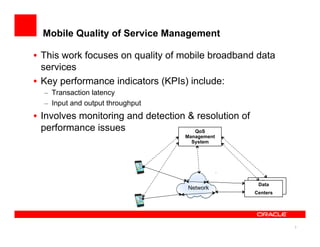
Mobile Quality of Service Management
•  This work focuses on quality of mobile broadband data
services
•  Key performance indicators (KPIs) include:
–  Transaction latency
–  Input and output throughput
•  Involves monitoring and detection & resolution of
performance issues
Network
Data
Centers
Data
Centers
QoS
Management
System
3
Mobile Network Quality of Service
User experience-driven trend
•  Success of mobile applications largely depends on performance
perceived by end-users
•  Involves device-based monitoring vs. network-only monitoring
•  Very large scale of monitoring and analysis – from from 10s of
thousands network elements to 10s of millions devices
•  Mobile networks are large-scale sensor networks – mobile
devices are sensors
Networ
k
Data
Centers
Data
Centers
QoS
Management
System
Networ
k
Data
Centers
Data
Centers
QoS
Management
System
4
Mobile Network Quality of Service
Near real-time trend
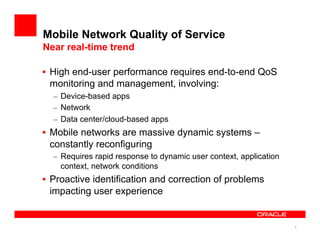
•  High end-user performance requires end-to-end QoS
monitoring and management, involving:
–  Device-based apps
–  Network
–  Data center/cloud-based apps
•  Mobile networks are massive dynamic systems –
constantly reconfiguring
–  Requires rapid response to dynamic user context, application
context, network conditions
•  Proactive identification and correction of problems
impacting user experience
5
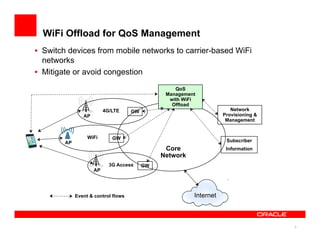
WiFi Offload for QoS Management
•  Switch devices from mobile networks to carrier-based WiFi
networks
•  Mitigate or avoid congestion
GW3G Access
AP
GW4G/LTE
AP
GWWiFi
AP
Core
Network
Internet
QoS
Management
with WiFi
Offload
Network
Provisioning &
Management
Subscriber
Information
Event & control flows
6
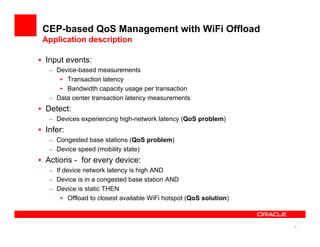
CEP-based QoS Management with WiFi Offload
Application description
•  Input events:
–  Device-based measurements
•  Transaction latency
•  Bandwidth capacity usage per transaction
–  Data center transaction latency measurements
•  Detect:
–  Devices experiencing high-network latency (QoS problem)
•  Infer:
–  Congested base stations (QoS problem)
–  Device speed (mobility state)
•  Actions - for every device:
–  If device network latency is high AND
–  Device is in a congested base station AND
–  Device is static THEN
•  Offload to closest available WiFi hotspot (QoS solution)
7
Implementation Architecture
Oracle OEP
MASON multi-
agent simulation
toolkit
Oracle WLS Oracle
MapViewer
8
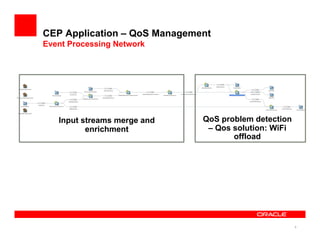
CEP Application – QoS Management
Event Processing Network
QoS problem detection
– Qos solution: WiFi
offload
Input streams merge and
enrichment
9
Input stream correlation and enrichment
Join device stream with
mobile base station table
Join device stream
with data center
stream
Derive
device
speed
from
location
stream
10
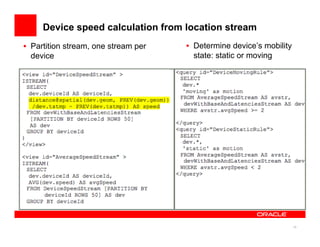
Device speed calculation from location stream
•  Partition stream, one stream per
device
•  Determine device’s mobility
state: static or moving
11
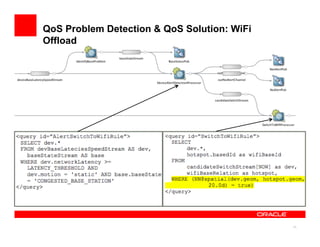
QoS Problem Detection & QoS Solution: WiFi
Offload
12
Geospatial processing and CEP
•  Mobile QoS management is a location-based
application
•  Processing highly simplified with use of a geospatial
library integrated with CEP platform
•  Oracle Event Processing library
–  Input events and internal events mapped to a geospatial grid
–  Simplified definition of queries involving location, eg:
•  Nearest neighbor
•  Distance
•  Inclusion within boundary
13
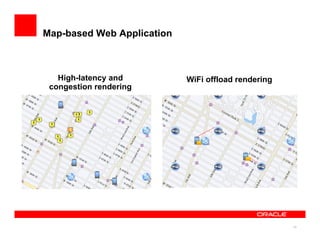
Map-based Web Application
High-latency and
congestion rendering
WiFi offload rendering
14
Future work
•  Predictions – mobile network infrastructure is
becoming more more reconfigurable; predict
congestion & react on time:
–  Identify boundaries around high density areas – city, centers,
airports, stadiums, etc and obtain early predictions of the load
that is heading towards them.
–  Identification of the speed, intensity, direction of load
movement – location and time to congestion
•  Map location of points where WiFi offload would be
required
–  For carriers planning to deploy WiFi offload, measure events
where there were congestion/service issues that could be
solved by offload.
15
Future work – cont.
•  Interactions with other infrastructure systems, eg.
transportation, power utilities
–  Receive key events from them
–  Provide key events to them – congestion near airport,
congestion in part of city
•  Interactions with services systems and the
environment:
–  Weather
–  Sports
–  Media programming
•  Privacy is a fundamental issue:
–  All of above can be and should done with anonymized data
16
Key Messages
•  Event processing and CEP platforms simplify
development of real-time monitoring and
management systems for mobile communications,
requiring:
–  Monitoring and tracking location context of very large
numbers of moving and reconfigurable components
–  Very high scalability
•  Geospatial processing is a key requirement for CEP
platforms supporting location-based applications
•  Mobile monitoring intersects with and can benefit
other infrastructure systems

Mobile QoS Management using Complex Event Processing

  • 1.
    <Insert Picture Here> MobileQoS Management using Complex Event Processing Distributed Event-Based Systems (DEBS) 2013 Conference Mauricio Arango July 1, 2013
  • 2.
    2 Mobile Quality ofService Management •  This work focuses on quality of mobile broadband data services •  Key performance indicators (KPIs) include: –  Transaction latency –  Input and output throughput •  Involves monitoring and detection & resolution of performance issues Network Data Centers Data Centers QoS Management System
  • 3.
    3 Mobile Network Qualityof Service User experience-driven trend •  Success of mobile applications largely depends on performance perceived by end-users •  Involves device-based monitoring vs. network-only monitoring •  Very large scale of monitoring and analysis – from from 10s of thousands network elements to 10s of millions devices •  Mobile networks are large-scale sensor networks – mobile devices are sensors Networ k Data Centers Data Centers QoS Management System Networ k Data Centers Data Centers QoS Management System
  • 4.
    4 Mobile Network Qualityof Service Near real-time trend •  High end-user performance requires end-to-end QoS monitoring and management, involving: –  Device-based apps –  Network –  Data center/cloud-based apps •  Mobile networks are massive dynamic systems – constantly reconfiguring –  Requires rapid response to dynamic user context, application context, network conditions •  Proactive identification and correction of problems impacting user experience
  • 5.
    5 WiFi Offload forQoS Management •  Switch devices from mobile networks to carrier-based WiFi networks •  Mitigate or avoid congestion GW3G Access AP GW4G/LTE AP GWWiFi AP Core Network Internet QoS Management with WiFi Offload Network Provisioning & Management Subscriber Information Event & control flows
  • 6.
    6 CEP-based QoS Managementwith WiFi Offload Application description •  Input events: –  Device-based measurements •  Transaction latency •  Bandwidth capacity usage per transaction –  Data center transaction latency measurements •  Detect: –  Devices experiencing high-network latency (QoS problem) •  Infer: –  Congested base stations (QoS problem) –  Device speed (mobility state) •  Actions - for every device: –  If device network latency is high AND –  Device is in a congested base station AND –  Device is static THEN •  Offload to closest available WiFi hotspot (QoS solution)
  • 7.
    7 Implementation Architecture Oracle OEP MASONmulti- agent simulation toolkit Oracle WLS Oracle MapViewer
  • 8.
    8 CEP Application –QoS Management Event Processing Network QoS problem detection – Qos solution: WiFi offload Input streams merge and enrichment
  • 9.
    9 Input stream correlationand enrichment Join device stream with mobile base station table Join device stream with data center stream Derive device speed from location stream
  • 10.
    10 Device speed calculationfrom location stream •  Partition stream, one stream per device •  Determine device’s mobility state: static or moving
  • 11.
    11 QoS Problem Detection& QoS Solution: WiFi Offload
  • 12.
    12 Geospatial processing andCEP •  Mobile QoS management is a location-based application •  Processing highly simplified with use of a geospatial library integrated with CEP platform •  Oracle Event Processing library –  Input events and internal events mapped to a geospatial grid –  Simplified definition of queries involving location, eg: •  Nearest neighbor •  Distance •  Inclusion within boundary
  • 13.
    13 Map-based Web Application High-latencyand congestion rendering WiFi offload rendering
  • 14.
    14 Future work •  Predictions– mobile network infrastructure is becoming more more reconfigurable; predict congestion & react on time: –  Identify boundaries around high density areas – city, centers, airports, stadiums, etc and obtain early predictions of the load that is heading towards them. –  Identification of the speed, intensity, direction of load movement – location and time to congestion •  Map location of points where WiFi offload would be required –  For carriers planning to deploy WiFi offload, measure events where there were congestion/service issues that could be solved by offload.
  • 15.
    15 Future work –cont. •  Interactions with other infrastructure systems, eg. transportation, power utilities –  Receive key events from them –  Provide key events to them – congestion near airport, congestion in part of city •  Interactions with services systems and the environment: –  Weather –  Sports –  Media programming •  Privacy is a fundamental issue: –  All of above can be and should done with anonymized data
  • 16.
    16 Key Messages •  Eventprocessing and CEP platforms simplify development of real-time monitoring and management systems for mobile communications, requiring: –  Monitoring and tracking location context of very large numbers of moving and reconfigurable components –  Very high scalability •  Geospatial processing is a key requirement for CEP platforms supporting location-based applications •  Mobile monitoring intersects with and can benefit other infrastructure systems