Application state 
tomas.kulich@vacuumlabs.com
Some background
What is application state
What is application state 
All the data that determines how application 
looks and how application behaves
Application state of a REST­based 
web­page 
typical REST architecture: 
● DB 
● session? 
● client's URL 
● cookies 
server 
client 
What about some JS widget?
Application state of a typical 
heterogeneous server/client app 
● some objects here and there 
● event listeners installed here and there 
● private attributes, local vars in hidden 
scopes, ... 
● DOM 
● plus all of the RESTfull stuff
function counter(init){ 
var curr=init; 
return function(){ 
return curr++; 
} 
}
What can REST teach us 
● state is concentrated in a very FEW places, 
everything else is a FUNCTION of state 
● state is accessible to many parts of code (although 
there should be some rules to who­can­do­what) 
● state is mutated in a “nice” way 
– ACID, transactions 
– it does not matter how many threads do we have 
● (plain) objects are poor in holding mutable state
Wait, but... 
● I shouldn't create objects? 
● I shouldn't manipulate DOM? 
● What CAN I do? 
● Can I even code, pleeeeease?
Data in 
DOM 
(pure 
jquery) 
Collection 
/ smart 
object 
(Backbone 
) 
Angular 
­ish 
scope / 
model 
In 
memory 
DB 
Signals, 
FRP 
Persistent 
Epochal 
state 
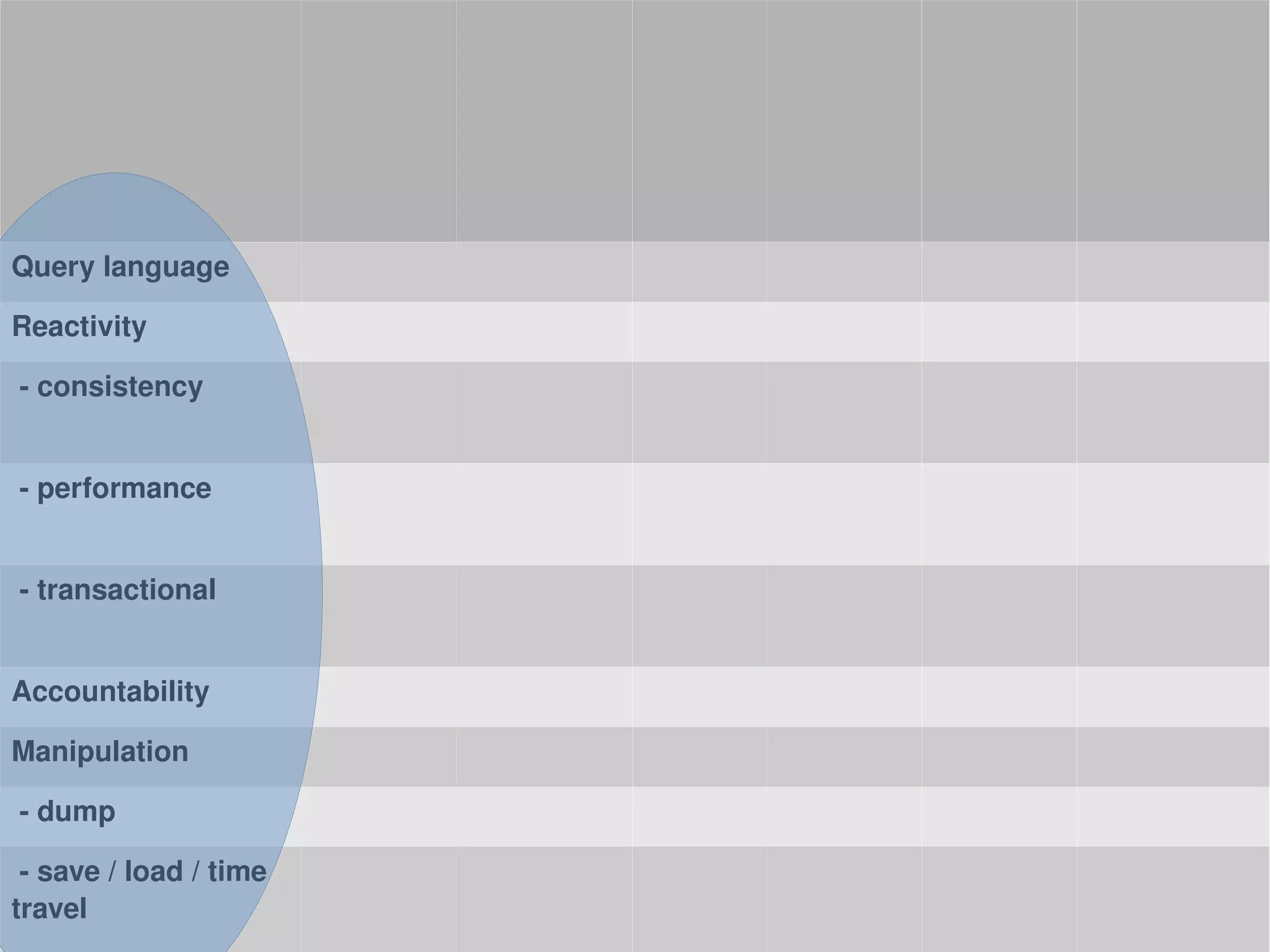
Query language poor good good perfect good good 
Reactivity no yes yes no yes yes 
­consistency 
N/A no quite 
good 
N/A perfect perfect 
­performance 
N/A good dirty 
checks 
N/A perfect perfect 
­transactional 
N/A no mostly 
yes 
N/A yes yes 
Accountability no ~yes no ~yes no ~yes 
Manipulation 
­dump 
hard easy hard easy hard easy 
­save 
/ load / time 
travel 
hard&cost 
ly 
costly hard&co 
stly 
costly quite fine fine
Data in 
DOM 
(pure 
jquery) 
Collection 
/ smart 
object 
(Backbone 
) 
Angular 
­ish 
scope / 
model 
In 
memory 
DB 
Signals, 
FRP 
Persistent 
Epochal 
state 
Query language 
Reactivity 
­consistency 
­performance 
­transactional 
Accountability 
Manipulation 
­dump 
­save 
/ load / time 
travel
Data in 
DOM 
(pure 
jquery) 
Collection 
/ smart 
object 
(Backbone 
) 
Angular 
­ish 
scope / 
model 
In 
memory 
DB 
Signals, 
FRP 
Persistent 
Epochal 
state
● Data in DOM (pure jQuery) 
● Some “smart” data structure, such as Backbone 
collection 
● Angular­ish 
scope 
● In memory DB 
● Signals, FRP 
● Persistent state, Epochal time model
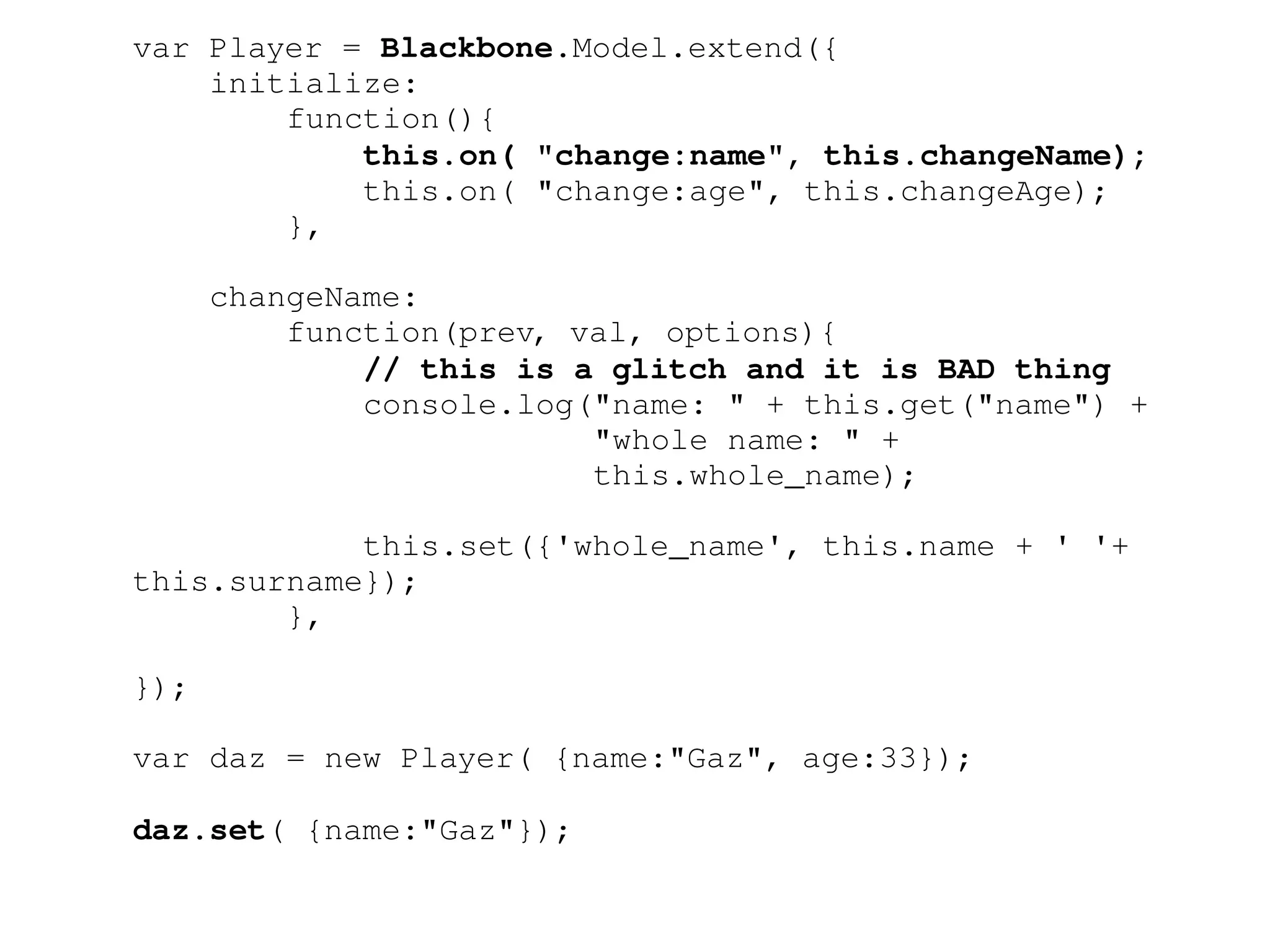
var Player = Blackbone.Model.extend({ 
initialize: 
function(){ 
this.on( "change:name", this.changeName); 
this.on( "change:age", this.changeAge); 
}, 
changeName: 
function(prev, val, options){ 
// this is a glitch and it is BAD thing 
console.log("name: " + this.get("name") + 
"whole name: " + 
this.whole_name); 
this.set({'whole_name', this.name + ' '+ 
this.surname}); 
}, 
}); 
var daz = new Player( {name:"Gaz", age:33}); 
daz.set( {name:"Daz"});
Signals, FRP 
x'=x+1 
y'=y+1 
tot=x+y 
mouse click 
key press
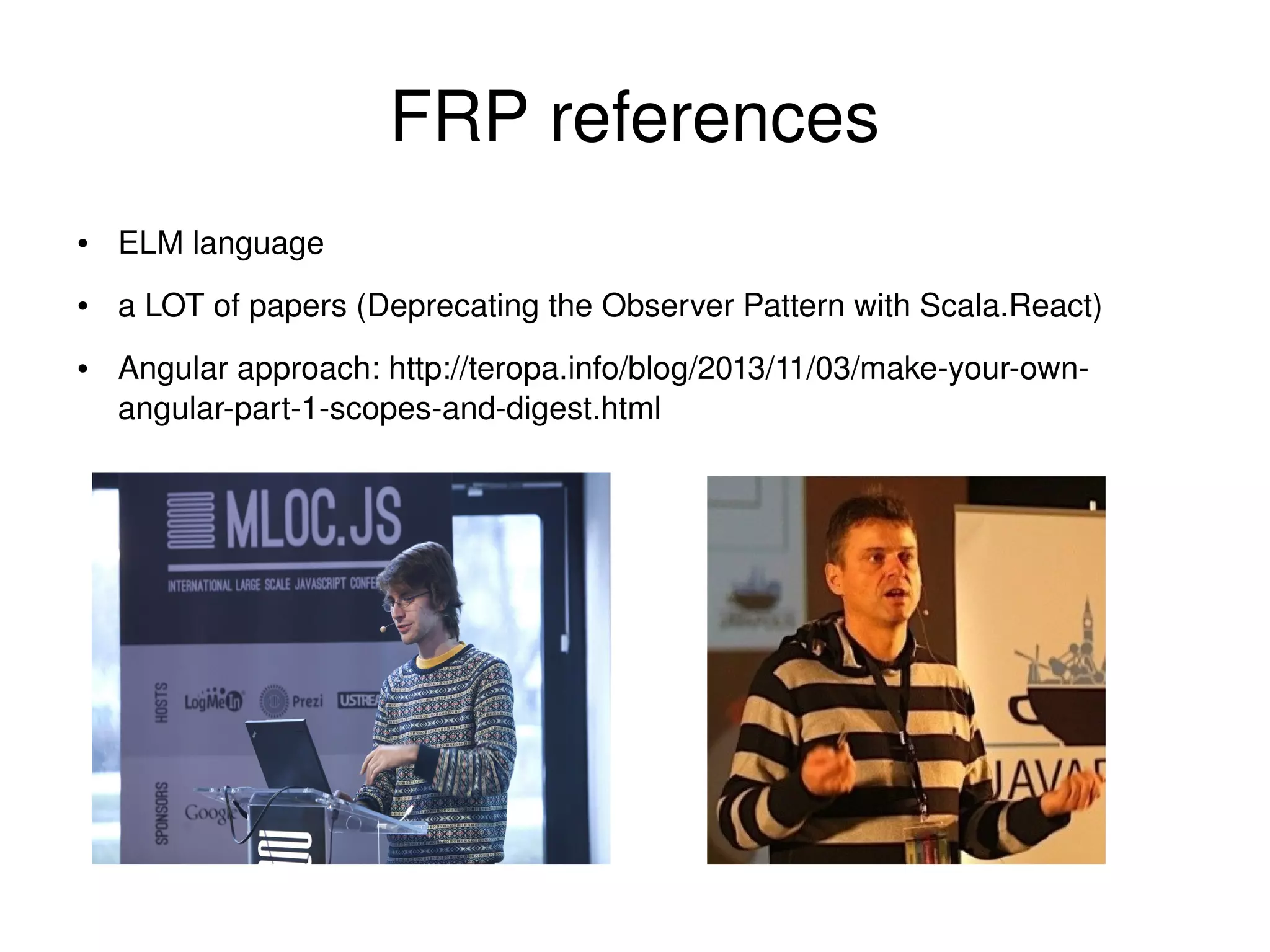
FRP references 
● ELM language 
● a LOT of papers (Deprecating the Observer Pattern with Scala.React) 
● Angular approach: http://teropa.info/blog/2013/11/03/make­your­own­angular­part­1­scopes­and­digest. 
html
Query language 
Reactivity 
­consistency 
­performance 
­transactional 
Accountability 
Manipulation 
­dump 
­save 
/ load / time 
travel
Query language 
● direct working with objects (maps) 
– usually OK with some fine helpers 
● SQL, datalog, MongoDB QL
Reactivity/Observability 
● How do we address this in REST? 
– well, we don't.. 
– Typically, we refresh / poll
Reactivity: Consistency 
● Programmers deserves stability 
– aka: Programátori si zaslúžia istoty 
– can partially­updated 
state be observable? 
Glitches are bad.
Reactivity: transactional 
jozo.set({name: "jozin z bazin"}); 
jozo.set({age: 18}); // wanna get some naughty pics 
jozo.set({name: "jozo again"}); 
● How many notifications there'll be? 
● How many do we want? 
● Can we somehow perform all the changes as one atomical change?
var Player = Blackbone.Model.extend({ 
initialize: 
function(){ 
this.on( "change:name", this.changeName); 
this.on( "change:age", this.changeAge); 
}, 
changeName: 
function(prev, val, options){ 
// this is a glitch and it is BAD thing 
console.log("name: " + this.get("name") + 
"whole name: " + 
this.whole_name); 
this.set({'whole_name', this.name + ' '+ 
this.surname}); 
}, 
}); 
var daz = new Player( {name:"Gaz", age:33}); 
daz.set( {name:"Gaz"});
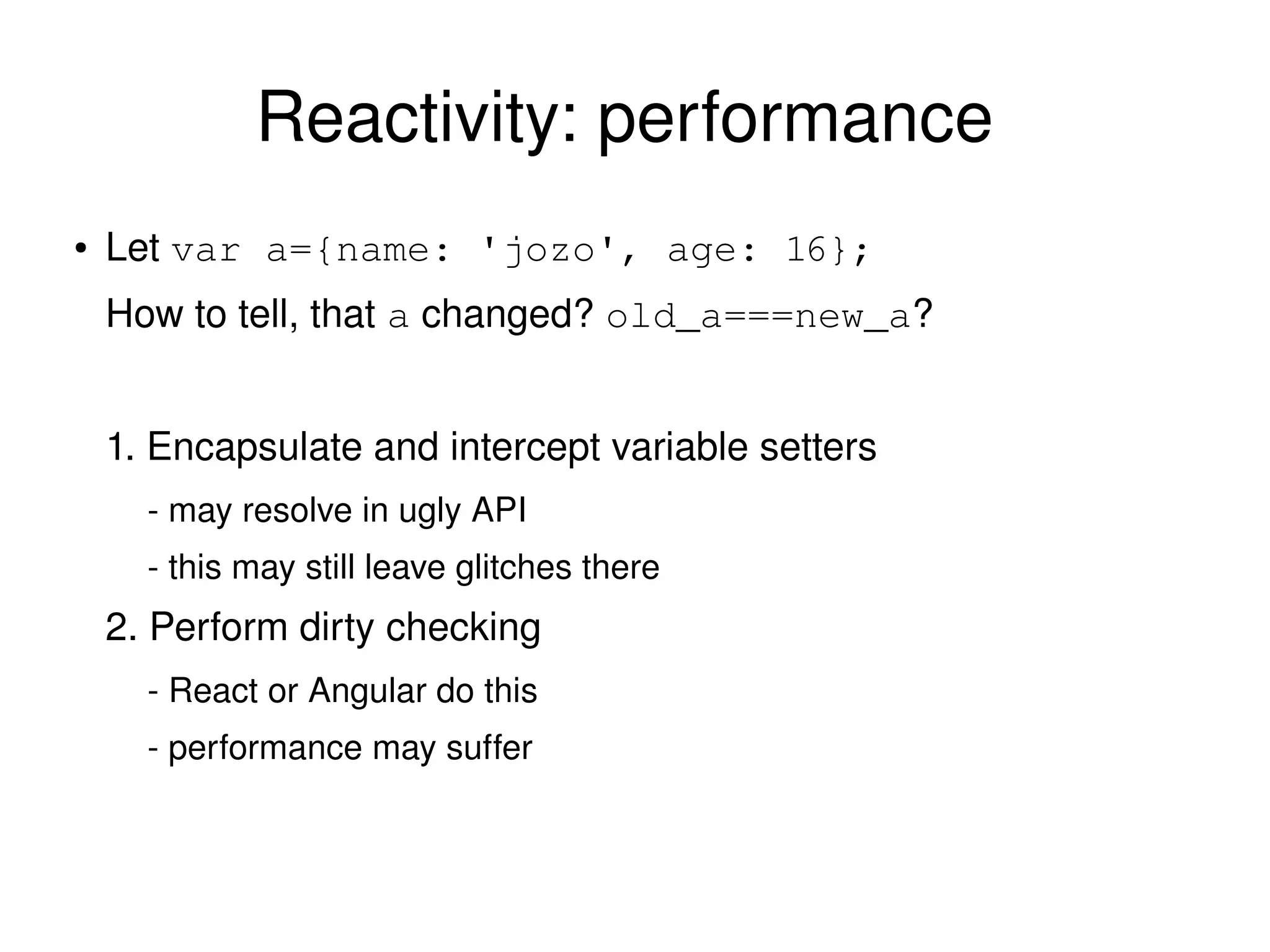
Reactivity: performance 
● Let var a={name: 'jozo', age: 16}; 
How to tell, that a changed? old_a===new_a? 
1. Encapsulate and intercept variable setters 
­may 
resolve in ugly API 
­this 
may still leave glitches there 
2. Perform dirty checking 
­React 
or Angular do this 
­performance 
may suffer
Accountability of changes 
● Who is responsible for changing of some piece of state? 
1. Anyone, who feels it's a good idea 
<input value = {{x | transform1}} > 
<input value = {{x | transform2}} > 
2. There exists a dedicated controller for this piece of state 
­such 
as Flux's store
Manipulation 
state.dump(); // EVERYTHING is here 
file.write(curr_state); 
// poor man's undo 
curr_state_index­­; 
var state = states[curr_state_index]; 
app.render(state);
Data in 
DOM 
(pure 
jquery) 
Collection 
/ smart 
object 
(Backbone 
) 
Angular 
­ish 
scope / 
model 
In 
memory 
DB 
Signals, 
FRP 
Persistent 
Epochal 
state 
Query language poor good good perfect good good 
Reactivity no yes yes no yes yes 
­consistency 
N/A no quite 
good 
N/A perfect perfect 
­performance 
N/A good dirty 
checks 
N/A perfect perfect 
­transactional 
N/A no mostly 
yes 
N/A yes yes 
Accountability no ~yes no ~yes no ~yes 
Manipulation 
­dump 
hard easy hard easy hard easy 
­save 
/ load / time 
travel 
hard&cost 
ly 
costly hard&co 
stly 
costly quite fine fine
http://www.infoq.com/presentations/Are­We­There­Yet­Rich­Hickey
Author: Rich Hickey
Thank you for your attention 
● this is not just about web anymore! 
● check out Dart User Group on FB

Appstate

  • 1.
  • 2.
  • 3.
  • 4.
    What is applicationstate All the data that determines how application looks and how application behaves
  • 5.
    Application state ofa REST­based web­page typical REST architecture: ● DB ● session? ● client's URL ● cookies server client What about some JS widget?
  • 6.
    Application state ofa typical heterogeneous server/client app ● some objects here and there ● event listeners installed here and there ● private attributes, local vars in hidden scopes, ... ● DOM ● plus all of the RESTfull stuff
  • 7.
    function counter(init){ varcurr=init; return function(){ return curr++; } }
  • 10.
    What can RESTteach us ● state is concentrated in a very FEW places, everything else is a FUNCTION of state ● state is accessible to many parts of code (although there should be some rules to who­can­do­what) ● state is mutated in a “nice” way – ACID, transactions – it does not matter how many threads do we have ● (plain) objects are poor in holding mutable state
  • 11.
    Wait, but... ●I shouldn't create objects? ● I shouldn't manipulate DOM? ● What CAN I do? ● Can I even code, pleeeeease?
  • 12.
    Data in DOM (pure jquery) Collection / smart object (Backbone ) Angular ­ish scope / model In memory DB Signals, FRP Persistent Epochal state Query language poor good good perfect good good Reactivity no yes yes no yes yes ­consistency N/A no quite good N/A perfect perfect ­performance N/A good dirty checks N/A perfect perfect ­transactional N/A no mostly yes N/A yes yes Accountability no ~yes no ~yes no ~yes Manipulation ­dump hard easy hard easy hard easy ­save / load / time travel hard&cost ly costly hard&co stly costly quite fine fine
  • 13.
    Data in DOM (pure jquery) Collection / smart object (Backbone ) Angular ­ish scope / model In memory DB Signals, FRP Persistent Epochal state Query language Reactivity ­consistency ­performance ­transactional Accountability Manipulation ­dump ­save / load / time travel
  • 14.
    Data in DOM (pure jquery) Collection / smart object (Backbone ) Angular ­ish scope / model In memory DB Signals, FRP Persistent Epochal state
  • 15.
    ● Data inDOM (pure jQuery) ● Some “smart” data structure, such as Backbone collection ● Angular­ish scope ● In memory DB ● Signals, FRP ● Persistent state, Epochal time model
  • 16.
    var Player =Blackbone.Model.extend({ initialize: function(){ this.on( "change:name", this.changeName); this.on( "change:age", this.changeAge); }, changeName: function(prev, val, options){ // this is a glitch and it is BAD thing console.log("name: " + this.get("name") + "whole name: " + this.whole_name); this.set({'whole_name', this.name + ' '+ this.surname}); }, }); var daz = new Player( {name:"Gaz", age:33}); daz.set( {name:"Daz"});
  • 17.
    Signals, FRP x'=x+1 y'=y+1 tot=x+y mouse click key press
  • 18.
    FRP references ●ELM language ● a LOT of papers (Deprecating the Observer Pattern with Scala.React) ● Angular approach: http://teropa.info/blog/2013/11/03/make­your­own­angular­part­1­scopes­and­digest. html
  • 19.
    Query language Reactivity ­consistency ­performance ­transactional Accountability Manipulation ­dump ­save / load / time travel
  • 20.
    Query language ●direct working with objects (maps) – usually OK with some fine helpers ● SQL, datalog, MongoDB QL
  • 21.
    Reactivity/Observability ● Howdo we address this in REST? – well, we don't.. – Typically, we refresh / poll
  • 22.
    Reactivity: Consistency ●Programmers deserves stability – aka: Programátori si zaslúžia istoty – can partially­updated state be observable? Glitches are bad.
  • 23.
    Reactivity: transactional jozo.set({name:"jozin z bazin"}); jozo.set({age: 18}); // wanna get some naughty pics jozo.set({name: "jozo again"}); ● How many notifications there'll be? ● How many do we want? ● Can we somehow perform all the changes as one atomical change?
  • 24.
    var Player =Blackbone.Model.extend({ initialize: function(){ this.on( "change:name", this.changeName); this.on( "change:age", this.changeAge); }, changeName: function(prev, val, options){ // this is a glitch and it is BAD thing console.log("name: " + this.get("name") + "whole name: " + this.whole_name); this.set({'whole_name', this.name + ' '+ this.surname}); }, }); var daz = new Player( {name:"Gaz", age:33}); daz.set( {name:"Gaz"});
  • 25.
    Reactivity: performance ●Let var a={name: 'jozo', age: 16}; How to tell, that a changed? old_a===new_a? 1. Encapsulate and intercept variable setters ­may resolve in ugly API ­this may still leave glitches there 2. Perform dirty checking ­React or Angular do this ­performance may suffer
  • 26.
    Accountability of changes ● Who is responsible for changing of some piece of state? 1. Anyone, who feels it's a good idea <input value = {{x | transform1}} > <input value = {{x | transform2}} > 2. There exists a dedicated controller for this piece of state ­such as Flux's store
  • 27.
    Manipulation state.dump(); //EVERYTHING is here file.write(curr_state); // poor man's undo curr_state_index­­; var state = states[curr_state_index]; app.render(state);
  • 28.
    Data in DOM (pure jquery) Collection / smart object (Backbone ) Angular ­ish scope / model In memory DB Signals, FRP Persistent Epochal state Query language poor good good perfect good good Reactivity no yes yes no yes yes ­consistency N/A no quite good N/A perfect perfect ­performance N/A good dirty checks N/A perfect perfect ­transactional N/A no mostly yes N/A yes yes Accountability no ~yes no ~yes no ~yes Manipulation ­dump hard easy hard easy hard easy ­save / load / time travel hard&cost ly costly hard&co stly costly quite fine fine
  • 29.
  • 30.
  • 33.
    Thank you foryour attention ● this is not just about web anymore! ● check out Dart User Group on FB