Approach to abnormal
RENAL FUNCTION TEST
PRESENTER: RANJIT TIWARI (JR -2)
MODERATOR: DR. RANJIT DAS
CONTENTS:
 Physiology of kidney
 Methods of estimating kidney function
 urinalysis: dipstick, microscopy, urinary electrolytes, 24 h urine citrate, oxalate
 GFR
 BUN, Cr
 Imaging
 Radionuclide studies
 Renal biopsy
 Approach to Hematuria, pyuria, elevated BUN and creatinine
 case scenario
1
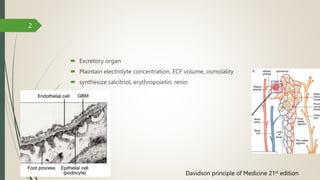
 Excretory organ
 Maintain electrolyte concentration, ECF volume, osmolality
 synthesize calcitriol, erythropoietin, renin
2
Davidson principle of Medicine 21st edition
Tests for analyzing Renal function
 Urine output
 Assessment of tubular function: urine concentration and dilution test
 Urinalysis
 Serum: Urea, creatinine, sodium, potassium
 Adjunctive tests in serum:
 uric acid, phosphorus, calcium, bicarbonate, Hemoglobin
 Imaging
 Nuclear scan
 Renal biopsy
3
Harrison principle of internal medicine 21st edition
URINE OUTPUT
 Oliguria: <400ml/d
 Anuria: <100ml/d
 Polyuria: >3L/day
4
Harrison principle of internal medicine 21st edition
urinalysis
 Spot urine analysis
 24hour urine analysis
5
Harrison principle of internal medicine 21st edition
SPOT URINE ANALYSIS
-urine dipstick
-urine Microscopy
-UACR, UPCR
-urinary sodium, potassium,
calcium
-eAER/ ePER
24hour urine analysis
-protein
creatinine
-sodium, potassium,
calcium, oxalate
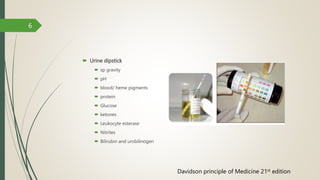
 Urine dipstick
 sp gravity
 pH
 blood/ heme pigments
 protein
 Glucose
 ketones
 Leukocyte esterase
 Nitrites
 Bilirubin and urobilinogen
6
Davidson principle of Medicine 21st edition
7
Urine Specific gravity: 1.008-1.012
<1.008: hyposthenuria
>1.012: hypersthenuria
 Urine dipstick
 sp gravity
 pH
 blood/ heme pigments
 protein
 Glucose
 ketones
 Leukocyte esterase
 Nitrites
 Bilirubin and urobilinogen
8
Davidson principle of Medicine 21st edition
9
Urine pH: Normal : 4.5-8.0
High urine pH
-urease producing bacteria
-vegetarian diet
-RTA
Low urine PH
-High protein dietred meat diet
-volume depletion leading to aldosterone stimulation
-metabolic acidosis
 Urine dipstick
 sp gravity
 pH
 blood/ heme pigments
 protein
 Glucose
 ketones
 Leukocyte esterase
 Nitrites
 Bilirubin and urobilinogen
10
Davidson principle of Medicine 21st edition
 Urine microscopy
 RBC
 WBC
 Eosinophils
 Epithelial cells
 casts
 crystals
11
Davidson principle of Medicine 21st edition
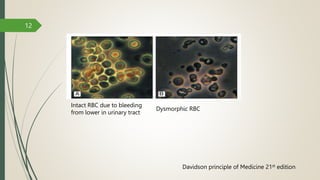
Intact RBC due to bleeding
from lower in urinary tract
Dysmorphic RBC
12
Davidson principle of Medicine 21st edition
 Urine microscopy
 RBC
 WBC
 Eosinophils
 Epithelial cells
 casts
 crystals
13
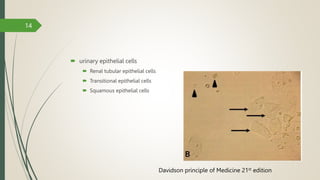
 urinary epithelial cells
 Renal tubular epithelial cells
 Transitional epithelial cells
 Squamous epithelial cells
14
Davidson principle of Medicine 21st edition
 Urine microscopy
 RBC
 WBC
 Eosinophils
 Epithelial cells
 casts
 crystals
15
 urinary casts
Hyaline cast
Granular cast
RBC cast Leukocyte cast
16
th
Muddy brown casts
17
Davidson principle of Medicine 21st edition
 Urine microscopy
 RBC
 WBC: sterile pyuria
 Eosinophils
 Epithelial cells
 casts
 crystals
18
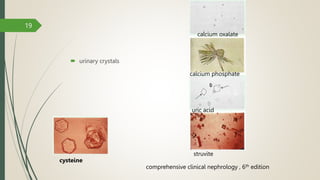
 urinary crystals
calcium oxalate
calcium phosphate
uric acid
struvite
cysteine
19
comprehensive clinical nephrology , 6th edition
 UACR and UPCR
 urine electrolyte
 24h urine assessment
20
 Measurement of Albumin and protein excretion
 urinary ACR
 Urinary PCR
 eAER / ePER
 24-hour urine protein
21
comprehensive clinical nephrology , 6th edition
collection method Normal clinical proteinuria
24 hour excretion <150mg/24h ≥150mg/24h
spot Urine PCR <50mg/g ≥150mg/g
urine protein
collection method Normal Moderately increased
Albuminuria
Severely increased
albuminuria
24 h urine excretion <30mg/24h 30-300mg/24h >300mg/24h
conventional spot urine
dipstick
negative negative positive
Albumin specific spot urine
dipstick
<3mg/dl
negative
≥3mg/dl
positive
positive
spot UACR <30mg/g 30-300mg/g >300mg/g
Urine albumin
22
comprehensive clinical nephrology , 6th edition
 urine protein electrophoresis
 urine free light chain assay
23
comprehensive clinical nephrology , 6th edition
what tests we can do from serum?
 Serum Creatinine, BUN
 sodium, potassium, calcium, phosphorus, magnesium, uric acid
 serum protein, albumin
24
 Immunological tests
 ANA
 ENA panel
 anti-ds DNA
 Anti-PLA2R antibodies
25
comprehensive clinical nephrology, 6th edition
Serum creatinine
 Limitation of eGFR
 Only an estimate
 Underestimate true GFR at normal or near normal function
 Affected by muscle mass, drugs, creatine supplement
 Not valid in assessing AKI
 Not valid under 18s or during pregnancy
Davidson principle of Medicine, 24th edition
26
 Relationship of serum cr to GFR
27
Davidson principle of internal medicine, 22nd edition
Blood Urea Nitrogen (BUN)
 Use BUN along with creatinine
29
comprehensive clinical nephrology, 6th edition
High BUN/SCr ratio ≥20:1 with minimal
change in GFR
-High protein intake, TPN
-Enhanced tissue breakdown
mild intravascular volume depletion
-moderately severe heart failure
High BUN/SCr ratio ≥20:1 with reduced GFR
-markedly reduced CO
-Shock: septic, hypovolemic
-Urinary tract obstruction
30
BUN/SCr ratio between 10:1 and 20:1
Look for hypovolemia
Hypovolemia present
-very low dietary
protein intake or
advanced liver disease
-increased creatinine
production (e.g.
rhabdomyolysis)
NO hypovolemia
-ATN
-Interstitial
nephritis
-GN
Low BUN/SCr ratio
-decreased urea production (low protein
diet, advanced liver disease)
-increased creatinine production (e.g. high
intake of cooked meat, creatine supplements,
extremely large muscle mass, rhabodomyolysis
Dynamic tests of tubular function
 water deprivation test
 water load test
31
comprehensive clinical nephrology, 6th edition
Imaging studies
 USG
 Renal vessel doppler
 CT
 CT UROGRAPHY (contrast enhanced kidney specific CT)
 MRI with contrast
 MR angiography
 Radionuclide imaging
32
comprehensive clinical nephrology, 6th edition
Usg of kidney, ureter, bladder
Davidson principle of internal medicine, 24th edition
Radionuclide imaging
34
Davidson principle of internal medicine, 24thed
Renal biopsy: when to do?
 Glomerular hematuria
 Severely increased albuminuria
 Acute or chronic kidney disease of unclear cause
 When to do biopsy in Diabetic kidney disease
 Kidney transplant dysfunction and monitoring
35
comprehensive clinical nephrology, 6th edition
Approach to some urinary
abnormalities
Approach to hematuria
 Contaminated sample?
 Any RBC casts or dysmorphic RBC in urine?
 Associated urinary abnormalities like proteinuria, WBC ?
 Cystoscopy required ?
36
Approach to pyuria
 D/D:
 Infection: UTI, genitourinary TB,
 Intersitial nephritis
 Glomerulonephritis
 Obstruction in renal tract
37
comprehensive clinical nephrology, 6th ed
Approach to isolated proteinuria
 Is it transient or persistent proteinuria?
 source of proteinuria: glomerular, tubular, overflow, postrenal
 Glomerular cause: RBC casts, dysmorphic RBC, lipiduria
 Major proteins : Albumin vs non-albumin
 Heterogeneous low molecular weight protein:
 Evaluate for Tubulo interstial disease
1
Case 1:
 62 year old female with chronic liver disease (Ethanol related) Decompensated with
ascites without SBP. She had no urinary symptoms and no fever. Call given for
persistent AKI. No prior hospitalization.
 24hour urine output 1.5 L/day
38
 usg abd/ pelvis (Jan 23): Only significant for moderate ascites
 serology for HIV, HCV, HBV: neg
 Total protein/ albumin: 6.8/2.2
 AST/ALT: X 1.5/ 24
 total/ conj. bilirubin: 2.6/1.8
 ALP/GGT: 116/109
 PT INR: 1.7
 stool for occult blood: neg
1
9/21 9/22 9/23 9/24 9/25 9/26 9/28 9/30
urea 43 114 135 131 135 123 114
cr 1.3 0.8 2.0 2.3 3.6 3.8 3.2
urinalyisis
RBC - Plenty 50-55 plenty
WBC 1-3 10-15 6-8 1-2
Protein 2+ 2+ 2+ +
glucose -
bacteria seen Seen
yeast seen
crystals amorphous
phosphate
urine ph 6 6
TLC 11610
DLC N93L02
1
ceftriaxone 1g bd
piperacillin-tazo and levofloxacin Meropenem
urine c/s sterile
 Is it RPGN ?
 Points not favoring RPGN:
 Bacteria and yeast present
 no comment on RBC casts
 Points not favoring UTI
 No renal angle tenderness, no constituitional s/s
 rapidly progressive renal failure
40
41
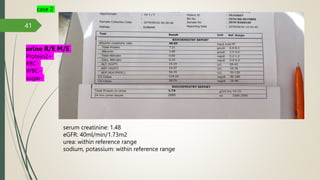
serum creatinine: 1.48
eGFR: 40ml/min/1.73m2
urea: within reference range
sodium, potassium: within reference range
case 2
urine R/E M/E
Protein2+
RBC-
WBC-
sugar-
 TAKE HOME MESSAGE
 For clinical practice, use CKD-EPI equation for GFR estimation
 CKD-EPI 2021 incorporating cystatin c and creatinine is more accurate.
 Absence of protein in dipstick does not mean no proteinuria
 Absence of dysmorphic RBC does not mean no glomerulonephritis
 Good correlation between UACR/ UPCR and 24h urine protein
42
 References:
 Harrison principle of Internal Medicine, 21st edition
 Davidson principle of Medicine, 22nd edition
 Nephrology, American college of Physician
 Comprehensive clinical nephrology 6th edition, John Feehally
 Brenner Textbook of The kidney, 7th edition
43
Approach to abnormal RENAL FUNCTION TEST.pptx

Approach to abnormal RENAL FUNCTION TEST.pptx

  • 1.
    Approach to abnormal RENALFUNCTION TEST PRESENTER: RANJIT TIWARI (JR -2) MODERATOR: DR. RANJIT DAS
  • 2.
    CONTENTS:  Physiology ofkidney  Methods of estimating kidney function  urinalysis: dipstick, microscopy, urinary electrolytes, 24 h urine citrate, oxalate  GFR  BUN, Cr  Imaging  Radionuclide studies  Renal biopsy  Approach to Hematuria, pyuria, elevated BUN and creatinine  case scenario 1
  • 3.
     Excretory organ Maintain electrolyte concentration, ECF volume, osmolality  synthesize calcitriol, erythropoietin, renin 2 Davidson principle of Medicine 21st edition
  • 4.
    Tests for analyzingRenal function  Urine output  Assessment of tubular function: urine concentration and dilution test  Urinalysis  Serum: Urea, creatinine, sodium, potassium  Adjunctive tests in serum:  uric acid, phosphorus, calcium, bicarbonate, Hemoglobin  Imaging  Nuclear scan  Renal biopsy 3 Harrison principle of internal medicine 21st edition
  • 5.
    URINE OUTPUT  Oliguria:<400ml/d  Anuria: <100ml/d  Polyuria: >3L/day 4 Harrison principle of internal medicine 21st edition
  • 6.
    urinalysis  Spot urineanalysis  24hour urine analysis 5 Harrison principle of internal medicine 21st edition SPOT URINE ANALYSIS -urine dipstick -urine Microscopy -UACR, UPCR -urinary sodium, potassium, calcium -eAER/ ePER 24hour urine analysis -protein creatinine -sodium, potassium, calcium, oxalate
  • 7.
     Urine dipstick sp gravity  pH  blood/ heme pigments  protein  Glucose  ketones  Leukocyte esterase  Nitrites  Bilirubin and urobilinogen 6 Davidson principle of Medicine 21st edition
  • 8.
    7 Urine Specific gravity:1.008-1.012 <1.008: hyposthenuria >1.012: hypersthenuria
  • 9.
     Urine dipstick sp gravity  pH  blood/ heme pigments  protein  Glucose  ketones  Leukocyte esterase  Nitrites  Bilirubin and urobilinogen 8 Davidson principle of Medicine 21st edition
  • 10.
    9 Urine pH: Normal: 4.5-8.0 High urine pH -urease producing bacteria -vegetarian diet -RTA Low urine PH -High protein dietred meat diet -volume depletion leading to aldosterone stimulation -metabolic acidosis
  • 11.
     Urine dipstick sp gravity  pH  blood/ heme pigments  protein  Glucose  ketones  Leukocyte esterase  Nitrites  Bilirubin and urobilinogen 10 Davidson principle of Medicine 21st edition
  • 12.
     Urine microscopy RBC  WBC  Eosinophils  Epithelial cells  casts  crystals 11 Davidson principle of Medicine 21st edition
  • 13.
    Intact RBC dueto bleeding from lower in urinary tract Dysmorphic RBC 12 Davidson principle of Medicine 21st edition
  • 14.
     Urine microscopy RBC  WBC  Eosinophils  Epithelial cells  casts  crystals 13
  • 15.
     urinary epithelialcells  Renal tubular epithelial cells  Transitional epithelial cells  Squamous epithelial cells 14 Davidson principle of Medicine 21st edition
  • 16.
     Urine microscopy RBC  WBC  Eosinophils  Epithelial cells  casts  crystals 15
  • 17.
     urinary casts Hyalinecast Granular cast RBC cast Leukocyte cast 16 th
  • 18.
    Muddy brown casts 17 Davidsonprinciple of Medicine 21st edition
  • 19.
     Urine microscopy RBC  WBC: sterile pyuria  Eosinophils  Epithelial cells  casts  crystals 18
  • 20.
     urinary crystals calciumoxalate calcium phosphate uric acid struvite cysteine 19 comprehensive clinical nephrology , 6th edition
  • 21.
     UACR andUPCR  urine electrolyte  24h urine assessment 20
  • 22.
     Measurement ofAlbumin and protein excretion  urinary ACR  Urinary PCR  eAER / ePER  24-hour urine protein 21 comprehensive clinical nephrology , 6th edition
  • 23.
    collection method Normalclinical proteinuria 24 hour excretion <150mg/24h ≥150mg/24h spot Urine PCR <50mg/g ≥150mg/g urine protein collection method Normal Moderately increased Albuminuria Severely increased albuminuria 24 h urine excretion <30mg/24h 30-300mg/24h >300mg/24h conventional spot urine dipstick negative negative positive Albumin specific spot urine dipstick <3mg/dl negative ≥3mg/dl positive positive spot UACR <30mg/g 30-300mg/g >300mg/g Urine albumin 22 comprehensive clinical nephrology , 6th edition
  • 24.
     urine proteinelectrophoresis  urine free light chain assay 23 comprehensive clinical nephrology , 6th edition
  • 25.
    what tests wecan do from serum?  Serum Creatinine, BUN  sodium, potassium, calcium, phosphorus, magnesium, uric acid  serum protein, albumin 24
  • 26.
     Immunological tests ANA  ENA panel  anti-ds DNA  Anti-PLA2R antibodies 25 comprehensive clinical nephrology, 6th edition
  • 27.
    Serum creatinine  Limitationof eGFR  Only an estimate  Underestimate true GFR at normal or near normal function  Affected by muscle mass, drugs, creatine supplement  Not valid in assessing AKI  Not valid under 18s or during pregnancy Davidson principle of Medicine, 24th edition 26
  • 28.
     Relationship ofserum cr to GFR 27 Davidson principle of internal medicine, 22nd edition
  • 29.
    Blood Urea Nitrogen(BUN)  Use BUN along with creatinine 29 comprehensive clinical nephrology, 6th edition High BUN/SCr ratio ≥20:1 with minimal change in GFR -High protein intake, TPN -Enhanced tissue breakdown mild intravascular volume depletion -moderately severe heart failure High BUN/SCr ratio ≥20:1 with reduced GFR -markedly reduced CO -Shock: septic, hypovolemic -Urinary tract obstruction
  • 30.
    30 BUN/SCr ratio between10:1 and 20:1 Look for hypovolemia Hypovolemia present -very low dietary protein intake or advanced liver disease -increased creatinine production (e.g. rhabdomyolysis) NO hypovolemia -ATN -Interstitial nephritis -GN Low BUN/SCr ratio -decreased urea production (low protein diet, advanced liver disease) -increased creatinine production (e.g. high intake of cooked meat, creatine supplements, extremely large muscle mass, rhabodomyolysis
  • 31.
    Dynamic tests oftubular function  water deprivation test  water load test 31 comprehensive clinical nephrology, 6th edition
  • 32.
    Imaging studies  USG Renal vessel doppler  CT  CT UROGRAPHY (contrast enhanced kidney specific CT)  MRI with contrast  MR angiography  Radionuclide imaging 32 comprehensive clinical nephrology, 6th edition
  • 33.
    Usg of kidney,ureter, bladder Davidson principle of internal medicine, 24th edition
  • 34.
    Radionuclide imaging 34 Davidson principleof internal medicine, 24thed
  • 35.
    Renal biopsy: whento do?  Glomerular hematuria  Severely increased albuminuria  Acute or chronic kidney disease of unclear cause  When to do biopsy in Diabetic kidney disease  Kidney transplant dysfunction and monitoring 35 comprehensive clinical nephrology, 6th edition
  • 36.
    Approach to someurinary abnormalities
  • 37.
    Approach to hematuria Contaminated sample?  Any RBC casts or dysmorphic RBC in urine?  Associated urinary abnormalities like proteinuria, WBC ?  Cystoscopy required ? 36
  • 38.
    Approach to pyuria D/D:  Infection: UTI, genitourinary TB,  Intersitial nephritis  Glomerulonephritis  Obstruction in renal tract 37 comprehensive clinical nephrology, 6th ed
  • 39.
    Approach to isolatedproteinuria  Is it transient or persistent proteinuria?  source of proteinuria: glomerular, tubular, overflow, postrenal  Glomerular cause: RBC casts, dysmorphic RBC, lipiduria  Major proteins : Albumin vs non-albumin  Heterogeneous low molecular weight protein:  Evaluate for Tubulo interstial disease 1
  • 40.
    Case 1:  62year old female with chronic liver disease (Ethanol related) Decompensated with ascites without SBP. She had no urinary symptoms and no fever. Call given for persistent AKI. No prior hospitalization.  24hour urine output 1.5 L/day 38
  • 41.
     usg abd/pelvis (Jan 23): Only significant for moderate ascites  serology for HIV, HCV, HBV: neg  Total protein/ albumin: 6.8/2.2  AST/ALT: X 1.5/ 24  total/ conj. bilirubin: 2.6/1.8  ALP/GGT: 116/109  PT INR: 1.7  stool for occult blood: neg 1
  • 42.
    9/21 9/22 9/239/24 9/25 9/26 9/28 9/30 urea 43 114 135 131 135 123 114 cr 1.3 0.8 2.0 2.3 3.6 3.8 3.2 urinalyisis RBC - Plenty 50-55 plenty WBC 1-3 10-15 6-8 1-2 Protein 2+ 2+ 2+ + glucose - bacteria seen Seen yeast seen crystals amorphous phosphate urine ph 6 6 TLC 11610 DLC N93L02 1 ceftriaxone 1g bd piperacillin-tazo and levofloxacin Meropenem urine c/s sterile
  • 43.
     Is itRPGN ?  Points not favoring RPGN:  Bacteria and yeast present  no comment on RBC casts  Points not favoring UTI  No renal angle tenderness, no constituitional s/s  rapidly progressive renal failure 40
  • 44.
    41 serum creatinine: 1.48 eGFR:40ml/min/1.73m2 urea: within reference range sodium, potassium: within reference range case 2 urine R/E M/E Protein2+ RBC- WBC- sugar-
  • 45.
     TAKE HOMEMESSAGE  For clinical practice, use CKD-EPI equation for GFR estimation  CKD-EPI 2021 incorporating cystatin c and creatinine is more accurate.  Absence of protein in dipstick does not mean no proteinuria  Absence of dysmorphic RBC does not mean no glomerulonephritis  Good correlation between UACR/ UPCR and 24h urine protein 42
  • 46.
     References:  Harrisonprinciple of Internal Medicine, 21st edition  Davidson principle of Medicine, 22nd edition  Nephrology, American college of Physician  Comprehensive clinical nephrology 6th edition, John Feehally  Brenner Textbook of The kidney, 7th edition 43