- Professionalism
- Teamwork
- Innovation
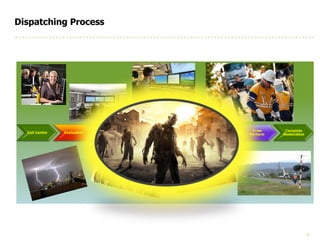
Applying Process Mining to a
Dispatching Process
Presenter Name: Abs Amiri
Date: 10-June-2016
2
Disclaimer
❏ I am here representing myself and the projects that I have initiated and worked on.
❏ By no means I am representing these companies and therefore no liabilities expected on them.
3
Outline
❏ About me.
❏ About SPARKLE
❏ Case Study (Dispatching Process)
¢ In brief about Dispatching Process.
¢ How and where the idea initiated.
¢ Efficiency Targets.
¢ Outcome
❏ Process Mining penetration strategy & plan in the organisation.
❏ Summary
❏ Questions?
8
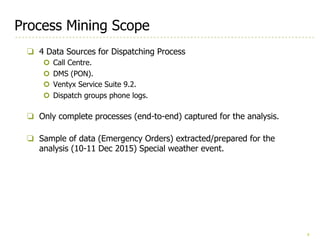
Process Mining Scope
❏ 4 Data Sources for Dispatching Process
¢ Call Centre.
¢ DMS (PON).
¢ Ventyx Service Suite 9.2.
¢ Dispatch groups phone logs.
❏ Only complete processes (end-to-end) captured for the analysis.
❏ Sample of data (Emergency Orders) extracted/prepared for the
analysis (10-11 Dec 2015) Special weather event.
Project Approach
9
10
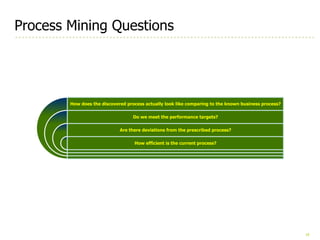
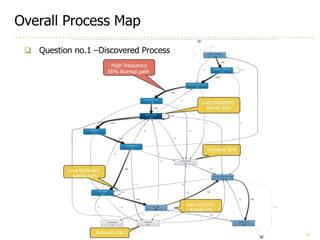
Process Mining Questions
How does the discovered process actually look like comparing to the known business process?
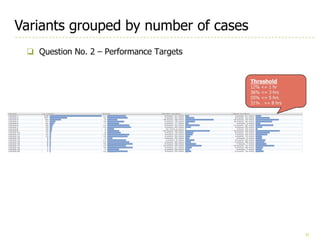
Do we meet the performance targets?
Are there deviations from the prescribed process?
How efficient is the current process?
11
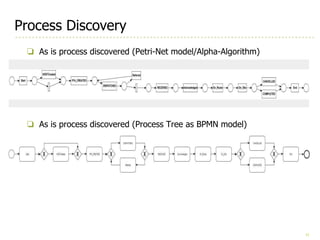
Process Discovery
❏ As is process discovered (Petri-Net model/Alpha-Algorithm)
❏ As is process discovered (Process Tree as BPMN model)
12
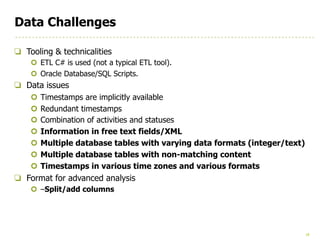
Data Challenges
❏ Tooling & technicalities
¢ ETL C# is used (not a typical ETL tool).
¢ Oracle Database/SQL Scripts.
❏ Data issues
¢ Timestamps are implicitly available
13
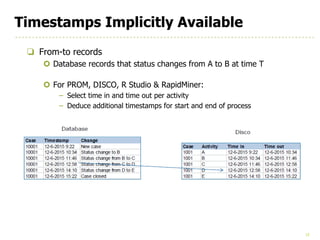
Timestamps Implicitly Available
❏ From-to records
¢ Database records that status changes from A to B at time T
¢ For PROM, DISCO, R Studio & RapidMiner:
– Select time in and time out per activity
– Deduce additional timestamps for start and end of process
14
Data Challenges
❏ Tooling & technicalities
¢ ETL C# is used (not a typical ETL tool).
¢ Oracle Database/SQL Scripts.
❏ Data issues
¢ Timestamps are implicitly available
¢ Redundant timestamps
15
Redundant Timestamps
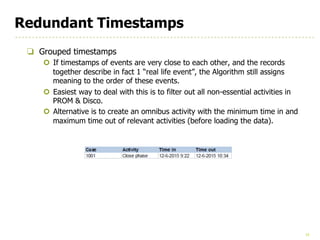
❏ Grouped timestamps
¢ If timestamps of events are very close to each other, and the records
together describe in fact 1 “real life event”, the Algorithm still assigns
meaning to the order of these events.
¢ Easiest way to deal with this is to filter out all non-essential activities in
PROM & Disco.
¢ Alternative is to create an omnibus activity with the minimum time in and
maximum time out of relevant activities (before loading the data).
16
Data Challenges
❏ Tooling & technicalities
¢ ETL C# is used (not a typical ETL tool).
¢ Oracle Database/SQL Scripts.
❏ Data issues
¢ Timestamps are implicitly available
¢ Redundant timestamps
¢ Combination of activities and statuses
17
Combination of Activities and Statuses
❏ Activities and statuses
¢ Data wrangling challenge
– Activities only have time in, Statuses have time and time out.
– Activities happen during Statuses.
¢ PROM & DISCO:
– Mixing Status and Activity information does not give expected results.
– For now, we often use start times only
18
Data Challenges
❏ Tooling & technicalities
¢ ETL C# is used (not a typical ETL tool).
¢ Oracle Database/SQL Scripts.
❏ Data issues
¢ Timestamps are implicitly available
¢ Redundant timestamps
¢ Combination of activities and statuses
¢ Information in free text fields/XML
¢ Multiple database tables with varying data formats (integer/text)
¢ Multiple database tables with non-matching content
¢ Timestamps in various time zones and various formats
❏ Format for advanced analysis
¢ –Split/add columns
20
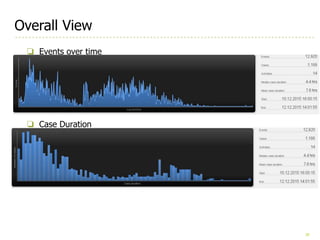
Overall View
❏ Events over time
❏ Case Duration
22
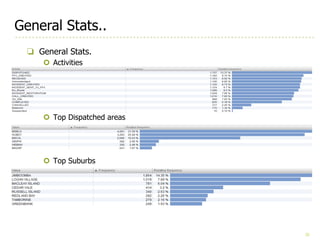
General Stats..
❏ General Stats.
¢ Activities
¢ Top Dispatched areas
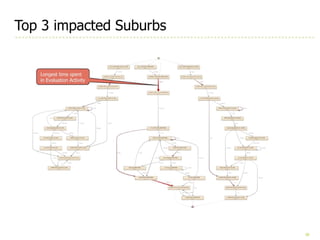
¢ Top Suburbs
23
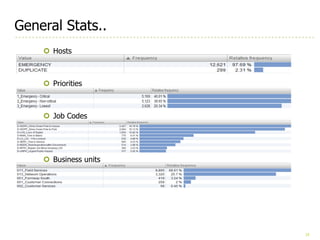
General Stats..
¢ Hosts
¢ Priorities
¢ Job Codes
¢ Business units
27
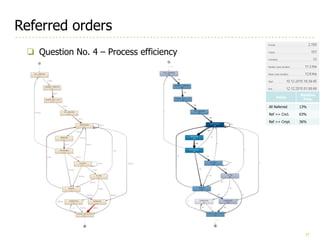
Referred orders
❏ Question No. 4 – Process efficiency
Value
Relative
Freq.
All Referred 13%
Ref >> Cncl. 63%
Ref >> Cmpl. 36%
31
Process/Data Mining Analysis continue..
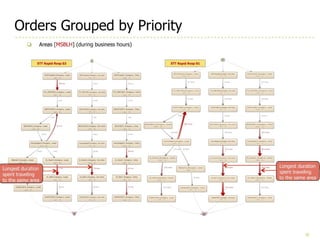
❏ Orders Grouped by Priority (Top 2 areas [MSBLH] [MSGSP] 18% of total orders)
34
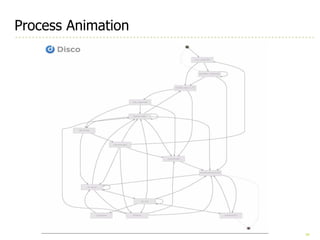
Process Animation
35
Summary
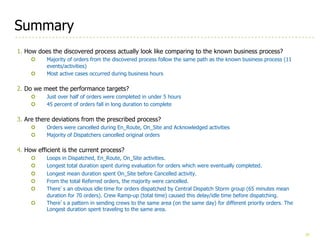
1. How does the discovered process actually look like comparing to the known business process?
¢ Majority of orders from the discovered process follow the same path as the known business process (11
events/activities)
¢ Most active cases occurred during business hours
2. Do we meet the performance targets?
¢ Just over half of orders were completed in under 5 hours
¢ 45 percent of orders fall in long duration to complete
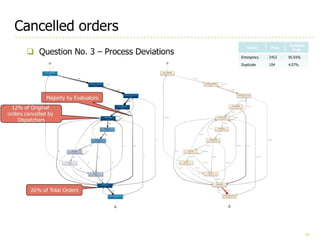
3. Are there deviations from the prescribed process?
¢ Orders were cancelled during En_Route, On_Site and Acknowledged activities
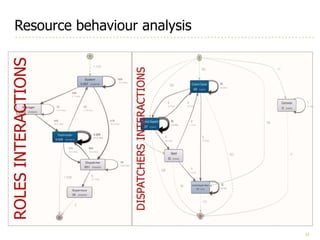
¢ Majority of Dispatchers cancelled original orders
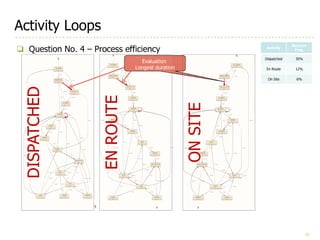
4. How efficient is the current process?
¢ Loops in Dispatched, En_Route, On_Site activities.
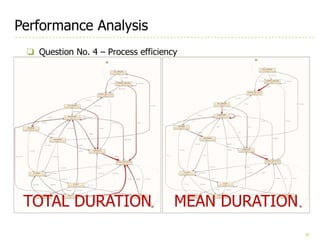
¢ Longest total duration spent during evaluation for orders which were eventually completed.
¢ Longest mean duration spent On_Site before Cancelled activity.
¢ From the total Referred orders, the majority were cancelled.
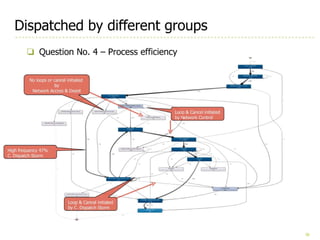
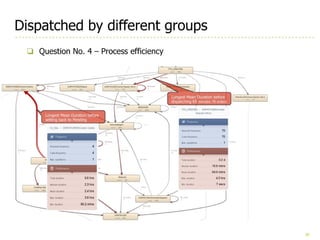
¢ There’s an obvious idle time for orders dispatched by Central Dispatch Storm group (65 minutes mean
duration for 70 orders). Crew Ramp-up (total time) caused this delay/idle time before dispatching.
¢ There’s a pattern in sending crews to the same area (on the same day) for different priority orders. The
Longest duration spent traveling to the same area.
36
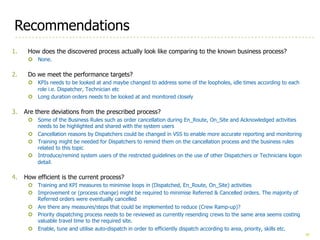
Recommendations
1. How does the discovered process actually look like comparing to the known business process?
¢ None.
2. Do we meet the performance targets?
¢ KPIs needs to be looked at and maybe changed to address some of the loopholes, idle times according to each
role i.e. Dispatcher, Technician etc
¢ Long duration orders needs to be looked at and monitored closely
3. Are there deviations from the prescribed process?
¢ Some of the Business Rules such as order cancellation during En_Route, On_Site and Acknowledged activities
needs to be highlighted and shared with the system users
¢ Cancellation reasons by Dispatchers could be changed in VSS to enable more accurate reporting and monitoring
¢ Training might be needed for Dispatchers to remind them on the cancellation process and the business rules
related to this topic
¢ Introduce/remind system users of the restricted guidelines on the use of other Dispatchers or Technicians logon
detail.
4. How efficient is the current process?
¢ Training and KPI measures to minimise loops in (Dispatched, En_Route, On_Site) activities
¢ Improvement or (process change) might be required to minimise Referred & Cancelled orders. The majority of
Referred orders were eventually cancelled
¢ Are there any measures/steps that could be implemented to reduce (Crew Ramp-up)?
¢ Priority dispatching process needs to be reviewed as currently resending crews to the same area seems costing
valuable travel time to the required site.
¢ Enable, tune and utilise auto-dispatch in order to efficiently dispatch according to area, priority, skills etc.
38
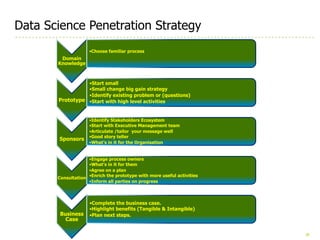
Data Science Penetration Strategy
Domain
Knowledge
•Choose familiar process
Prototype
•Start small
•Small change big gain strategy
•Identify existing problem or (questions)
•Start with high level activities
Sponsors
•Identify Stakeholders Ecosystem
•Start with Executive Management team
•Articulate /tailor your message well
•Good story teller
•What’s in it for the Organisation
Consultation
•Engage process owners
•What’s in it for them
•Agree on a plan
•Enrich the prototype with more useful activities
•Inform all parties on progress
Business
Case
•Complete the business case.
•Highlight benefits (Tangible & Intangible)
•Plan next steps.
39
Beware
Engineering Science
40
Q&A..

Applying Process Mining to a Dispatching Process

  • 1.
    - Professionalism - Teamwork -Innovation Applying Process Mining to a Dispatching Process Presenter Name: Abs Amiri Date: 10-June-2016
  • 2.
    2 Disclaimer ❏ I amhere representing myself and the projects that I have initiated and worked on. ❏ By no means I am representing these companies and therefore no liabilities expected on them.
  • 3.
    3 Outline ❏ About me. ❏About SPARKLE ❏ Case Study (Dispatching Process) ¢ In brief about Dispatching Process. ¢ How and where the idea initiated. ¢ Efficiency Targets. ¢ Outcome ❏ Process Mining penetration strategy & plan in the organisation. ❏ Summary ❏ Questions?
  • 8.
    8 Process Mining Scope ❏4 Data Sources for Dispatching Process ¢ Call Centre. ¢ DMS (PON). ¢ Ventyx Service Suite 9.2. ¢ Dispatch groups phone logs. ❏ Only complete processes (end-to-end) captured for the analysis. ❏ Sample of data (Emergency Orders) extracted/prepared for the analysis (10-11 Dec 2015) Special weather event.
  • 9.
  • 10.
    10 Process Mining Questions Howdoes the discovered process actually look like comparing to the known business process? Do we meet the performance targets? Are there deviations from the prescribed process? How efficient is the current process?
  • 11.
    11 Process Discovery ❏ Asis process discovered (Petri-Net model/Alpha-Algorithm) ❏ As is process discovered (Process Tree as BPMN model)
  • 12.
    12 Data Challenges ❏ Tooling& technicalities ¢ ETL C# is used (not a typical ETL tool). ¢ Oracle Database/SQL Scripts. ❏ Data issues ¢ Timestamps are implicitly available
  • 13.
    13 Timestamps Implicitly Available ❏From-to records ¢ Database records that status changes from A to B at time T ¢ For PROM, DISCO, R Studio & RapidMiner: – Select time in and time out per activity – Deduce additional timestamps for start and end of process
  • 14.
    14 Data Challenges ❏ Tooling& technicalities ¢ ETL C# is used (not a typical ETL tool). ¢ Oracle Database/SQL Scripts. ❏ Data issues ¢ Timestamps are implicitly available ¢ Redundant timestamps
  • 15.
    15 Redundant Timestamps ❏ Groupedtimestamps ¢ If timestamps of events are very close to each other, and the records together describe in fact 1 “real life event”, the Algorithm still assigns meaning to the order of these events. ¢ Easiest way to deal with this is to filter out all non-essential activities in PROM & Disco. ¢ Alternative is to create an omnibus activity with the minimum time in and maximum time out of relevant activities (before loading the data).
  • 16.
    16 Data Challenges ❏ Tooling& technicalities ¢ ETL C# is used (not a typical ETL tool). ¢ Oracle Database/SQL Scripts. ❏ Data issues ¢ Timestamps are implicitly available ¢ Redundant timestamps ¢ Combination of activities and statuses
  • 17.
    17 Combination of Activitiesand Statuses ❏ Activities and statuses ¢ Data wrangling challenge – Activities only have time in, Statuses have time and time out. – Activities happen during Statuses. ¢ PROM & DISCO: – Mixing Status and Activity information does not give expected results. – For now, we often use start times only
  • 18.
    18 Data Challenges ❏ Tooling& technicalities ¢ ETL C# is used (not a typical ETL tool). ¢ Oracle Database/SQL Scripts. ❏ Data issues ¢ Timestamps are implicitly available ¢ Redundant timestamps ¢ Combination of activities and statuses ¢ Information in free text fields/XML ¢ Multiple database tables with varying data formats (integer/text) ¢ Multiple database tables with non-matching content ¢ Timestamps in various time zones and various formats ❏ Format for advanced analysis ¢ –Split/add columns
  • 20.
    20 Overall View ❏ Eventsover time ❏ Case Duration
  • 22.
    22 General Stats.. ❏ GeneralStats. ¢ Activities ¢ Top Dispatched areas ¢ Top Suburbs
  • 23.
    23 General Stats.. ¢ Hosts ¢Priorities ¢ Job Codes ¢ Business units
  • 27.
    27 Referred orders ❏ QuestionNo. 4 – Process efficiency Value Relative Freq. All Referred 13% Ref >> Cncl. 63% Ref >> Cmpl. 36%
  • 31.
    31 Process/Data Mining Analysiscontinue.. ❏ Orders Grouped by Priority (Top 2 areas [MSBLH] [MSGSP] 18% of total orders)
  • 34.
  • 35.
    35 Summary 1. How doesthe discovered process actually look like comparing to the known business process? ¢ Majority of orders from the discovered process follow the same path as the known business process (11 events/activities) ¢ Most active cases occurred during business hours 2. Do we meet the performance targets? ¢ Just over half of orders were completed in under 5 hours ¢ 45 percent of orders fall in long duration to complete 3. Are there deviations from the prescribed process? ¢ Orders were cancelled during En_Route, On_Site and Acknowledged activities ¢ Majority of Dispatchers cancelled original orders 4. How efficient is the current process? ¢ Loops in Dispatched, En_Route, On_Site activities. ¢ Longest total duration spent during evaluation for orders which were eventually completed. ¢ Longest mean duration spent On_Site before Cancelled activity. ¢ From the total Referred orders, the majority were cancelled. ¢ There’s an obvious idle time for orders dispatched by Central Dispatch Storm group (65 minutes mean duration for 70 orders). Crew Ramp-up (total time) caused this delay/idle time before dispatching. ¢ There’s a pattern in sending crews to the same area (on the same day) for different priority orders. The Longest duration spent traveling to the same area.
  • 36.
    36 Recommendations 1. How doesthe discovered process actually look like comparing to the known business process? ¢ None. 2. Do we meet the performance targets? ¢ KPIs needs to be looked at and maybe changed to address some of the loopholes, idle times according to each role i.e. Dispatcher, Technician etc ¢ Long duration orders needs to be looked at and monitored closely 3. Are there deviations from the prescribed process? ¢ Some of the Business Rules such as order cancellation during En_Route, On_Site and Acknowledged activities needs to be highlighted and shared with the system users ¢ Cancellation reasons by Dispatchers could be changed in VSS to enable more accurate reporting and monitoring ¢ Training might be needed for Dispatchers to remind them on the cancellation process and the business rules related to this topic ¢ Introduce/remind system users of the restricted guidelines on the use of other Dispatchers or Technicians logon detail. 4. How efficient is the current process? ¢ Training and KPI measures to minimise loops in (Dispatched, En_Route, On_Site) activities ¢ Improvement or (process change) might be required to minimise Referred & Cancelled orders. The majority of Referred orders were eventually cancelled ¢ Are there any measures/steps that could be implemented to reduce (Crew Ramp-up)? ¢ Priority dispatching process needs to be reviewed as currently resending crews to the same area seems costing valuable travel time to the required site. ¢ Enable, tune and utilise auto-dispatch in order to efficiently dispatch according to area, priority, skills etc.
  • 38.
    38 Data Science PenetrationStrategy Domain Knowledge •Choose familiar process Prototype •Start small •Small change big gain strategy •Identify existing problem or (questions) •Start with high level activities Sponsors •Identify Stakeholders Ecosystem •Start with Executive Management team •Articulate /tailor your message well •Good story teller •What’s in it for the Organisation Consultation •Engage process owners •What’s in it for them •Agree on a plan •Enrich the prototype with more useful activities •Inform all parties on progress Business Case •Complete the business case. •Highlight benefits (Tangible & Intangible) •Plan next steps.
  • 39.
  • 40.