Applied Spatial Data Science:
A Complete Workflow
Lauren Bennett (she/her)
Flora Vale (she/her)
Alberto Nieto (he/him)
esriurl.com/spatialstats
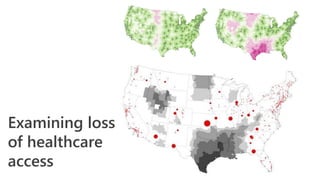
Examining loss
of healthcare
access
What’s our goal?
What’s our goal?
Understand how new state policies will
impact access to healthcare
So what’s our analysis question?
So what are our analysis questions?
How will healthcare access change?
• What were the travel times to women's healthcare clinics across
the country before the recent Supreme Court decision?
• How will those travel times change after the decision?
• Where do people have the most cumulative burdens?
So what are our analysis questions?
How will demand be redistributed?
• What was the demand on women's clinics across the country
before the Supreme Court decision?
• How will demand change for remaining clinics after state laws
go into effect?
What data do we need?
Locations of women’s clinics
Locations of people
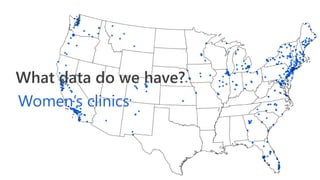
What data do we have?
Women’s clinics
What data do we have?
Census tract centroids
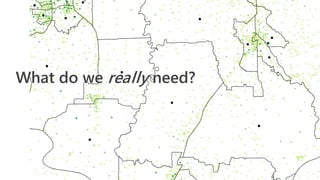
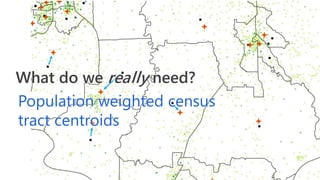
What do we really need?
Population weighted census
tract centroids
How do we get it?
How do we get it?
Block population data
…so that we can calculate a population weighted mean center for each census tract and calculate a
more representative distance from people to women’s clinics
Demo: Prepare Data
Calculate population-weighted mean center for each census tract
Then what?
Then what?
• Calculate changes in travel times resulting from state
level policies (access)
• Evaluate cumulative burden
• Calculate changes in service area population for
remaining clinics (demand)
“Ada Marie did what scientists do:
She asked a small question, and
then she asked two.
And each of those led her to three
questions more,
and some of those questions
resulted in four.”
Andrea Beaty
• Define goal
• Gather and prepare data
• Evaluate access at the tract level
• Evaluate cumulative burden
• Evaluate demand at the clinic level
Today’s analysis workflow
• Define goal
• Gather and prepare data
• Evaluate access at the tract level
• Evaluate cumulative burden
• Evaluate demand at the clinic level
Today’s analysis workflow
Demo: Evaluate access at the tract level
• What were the travel times to women's healthcare clinics
across the country before the recent Supreme Court
decision?
• How will those travel times change after the decision?
Demo: Evaluate Cumulative Burdens
• Where do people have the most cumulative
burdens?
• % poverty
• % no internet access
• % no access to vehicles
• % w/ insurance coverage
• Travel time to nearest clinic
Demo: Evaluate demand at the
clinic level
• What was the demand on women's clinics across the
country before the Supreme Court decision?
• How will demand change for remaining clinics after state
laws go into effect?
Demo: Communicate results
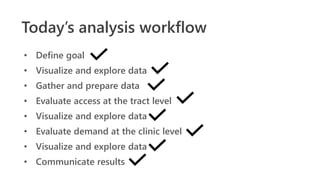
• Define goal
• Visualize and explore data
• Gather and prepare data
• Evaluate access at the tract level
• Visualize and explore data
• Evaluate demand at the clinic level
• Visualize and explore data
• Communicate results
Today’s analysis workflow
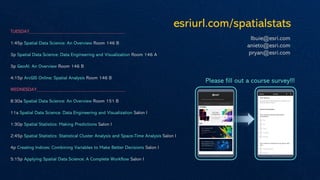
esriurl.com/spatialstats
TUESDAY_________________________________________
1:45p Spatial Data Science: An Overview Room 146 B
3p Spatial Data Science: Data Engineering and Visualization Room 146 A
3p GeoAI: An Overview Room 146 B
4:15p ArcGIS Online: Spatial Analysis Room 146 B
WEDNESDAY______________________________________
8:30a Spatial Data Science: An Overview Room 151 B
11a Spatial Data Science: Data Engineering and Visualization Salon I
1:30p Spatial Statistics: Making Predictions Salon I
2:45p Spatial Statistics: Statistical Cluster Analysis and Space-Time Analysis Salon I
4p Creating Indices: Combining Variables to Make Better Decisions Salon I
5:15p Applying Spatial Data Science: A Complete Workflow Salon I
Please fill out a course survey!!!
lbuie@esri.com
anieto@esri.com
pryan@esri.com
Applied_Spatial_Data_Science_A_Complete_Workflow.pdf

Applied_Spatial_Data_Science_A_Complete_Workflow.pdf

  • 1.
    Applied Spatial DataScience: A Complete Workflow Lauren Bennett (she/her) Flora Vale (she/her) Alberto Nieto (he/him) esriurl.com/spatialstats
  • 2.
  • 3.
  • 4.
    What’s our goal? Understandhow new state policies will impact access to healthcare
  • 5.
    So what’s ouranalysis question?
  • 6.
    So what areour analysis questions? How will healthcare access change? • What were the travel times to women's healthcare clinics across the country before the recent Supreme Court decision? • How will those travel times change after the decision? • Where do people have the most cumulative burdens?
  • 7.
    So what areour analysis questions? How will demand be redistributed? • What was the demand on women's clinics across the country before the Supreme Court decision? • How will demand change for remaining clinics after state laws go into effect?
  • 8.
    What data dowe need?
  • 9.
    What data dowe need? Locations of women’s clinics Locations of people
  • 10.
    What data dowe have?
  • 11.
    What data dowe have? Women’s clinics
  • 12.
    What data dowe have? Census tract centroids
  • 13.
    What do wereally need?
  • 14.
    What do wereally need? Population weighted census tract centroids
  • 15.
    How do weget it?
  • 16.
    How do weget it? Block population data …so that we can calculate a population weighted mean center for each census tract and calculate a more representative distance from people to women’s clinics
  • 17.
    Demo: Prepare Data Calculatepopulation-weighted mean center for each census tract
  • 18.
  • 19.
    Then what? • Calculatechanges in travel times resulting from state level policies (access) • Evaluate cumulative burden • Calculate changes in service area population for remaining clinics (demand)
  • 20.
    “Ada Marie didwhat scientists do: She asked a small question, and then she asked two. And each of those led her to three questions more, and some of those questions resulted in four.” Andrea Beaty
  • 21.
    • Define goal •Gather and prepare data • Evaluate access at the tract level • Evaluate cumulative burden • Evaluate demand at the clinic level Today’s analysis workflow
  • 22.
    • Define goal •Gather and prepare data • Evaluate access at the tract level • Evaluate cumulative burden • Evaluate demand at the clinic level Today’s analysis workflow
  • 23.
    Demo: Evaluate accessat the tract level • What were the travel times to women's healthcare clinics across the country before the recent Supreme Court decision? • How will those travel times change after the decision?
  • 24.
    Demo: Evaluate CumulativeBurdens • Where do people have the most cumulative burdens? • % poverty • % no internet access • % no access to vehicles • % w/ insurance coverage • Travel time to nearest clinic
  • 25.
    Demo: Evaluate demandat the clinic level • What was the demand on women's clinics across the country before the Supreme Court decision? • How will demand change for remaining clinics after state laws go into effect?
  • 26.
  • 27.
    • Define goal •Visualize and explore data • Gather and prepare data • Evaluate access at the tract level • Visualize and explore data • Evaluate demand at the clinic level • Visualize and explore data • Communicate results Today’s analysis workflow
  • 28.
    esriurl.com/spatialstats TUESDAY_________________________________________ 1:45p Spatial DataScience: An Overview Room 146 B 3p Spatial Data Science: Data Engineering and Visualization Room 146 A 3p GeoAI: An Overview Room 146 B 4:15p ArcGIS Online: Spatial Analysis Room 146 B WEDNESDAY______________________________________ 8:30a Spatial Data Science: An Overview Room 151 B 11a Spatial Data Science: Data Engineering and Visualization Salon I 1:30p Spatial Statistics: Making Predictions Salon I 2:45p Spatial Statistics: Statistical Cluster Analysis and Space-Time Analysis Salon I 4p Creating Indices: Combining Variables to Make Better Decisions Salon I 5:15p Applying Spatial Data Science: A Complete Workflow Salon I Please fill out a course survey!!! lbuie@esri.com anieto@esri.com pryan@esri.com