www.nmagroup.in
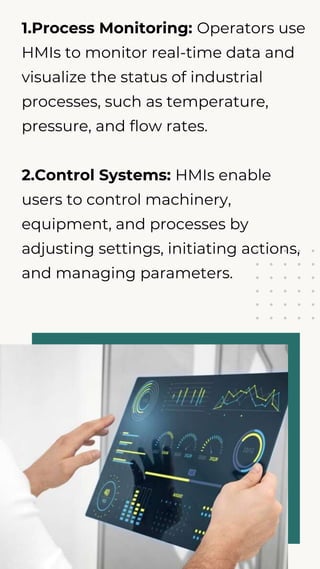
1.Process Monitoring: Operators use
HMIs to monitor real-time data and
visualize the status of industrial
processes, such as temperature,
pressure, and flow rates.
2.Control Systems: HMIs enable
users to control machinery,
equipment, and processes by
adjusting settings, initiating actions,
and managing parameters.
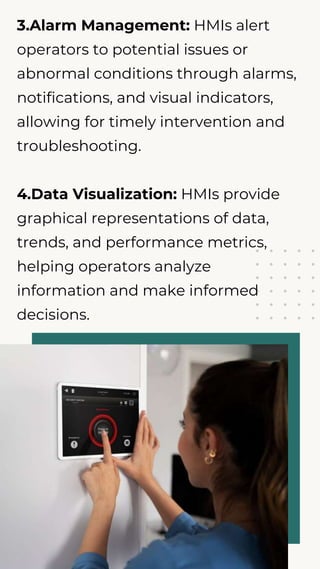
3.Alarm Management: HMIs alert
operators to potential issues or
abnormal conditions through alarms,
notifications, and visual indicators,
allowing for timely intervention and
troubleshooting.
4.Data Visualization: HMIs provide
graphical representations of data,
trends, and performance metrics,
helping operators analyze
information and make informed
decisions.
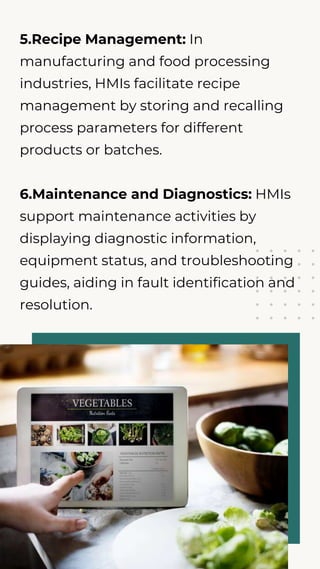
5.Recipe Management: In
manufacturing and food processing
industries, HMIs facilitate recipe
management by storing and recalling
process parameters for different
products or batches.
6.Maintenance and Diagnostics: HMIs
support maintenance activities by
displaying diagnostic information,
equipment status, and troubleshooting
guides, aiding in fault identification and
resolution.
7.User Authentication: HMIs can
implement user authentication
mechanisms to restrict access to
sensitive functions or settings,
ensuring security and compliance
with operational protocols.
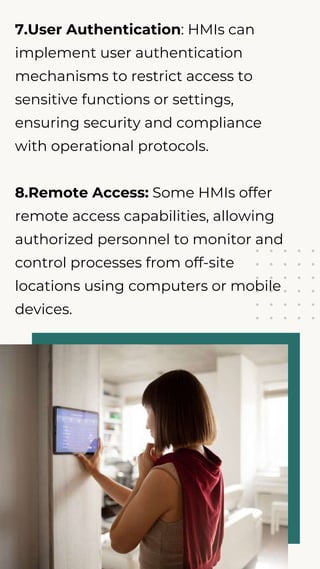
8.Remote Access: Some HMIs offer
remote access capabilities, allowing
authorized personnel to monitor and
control processes from off-site
locations using computers or mobile
devices.
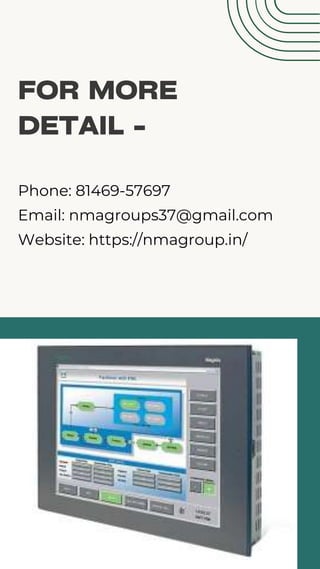
9.Integration with PLCs: HMIs
seamlessly integrate with PLCs
(Programmable Logic Controllers)
and other automation systems,
exchanging data and commands to
coordinate and synchronize
operations.
10.Customization: HMIs can be
customized to meet specific user
requirements, including the layout,
appearance, and functionality, to
optimize usability and efficiency in
different applications.
Phone: 81469-57697
Email: nmagroups37@gmail.com
Website: https://nmagroup.in/

Applications of Human Machine Interface.pptx

  • 1.
  • 2.
    1.Process Monitoring: Operatorsuse HMIs to monitor real-time data and visualize the status of industrial processes, such as temperature, pressure, and flow rates. 2.Control Systems: HMIs enable users to control machinery, equipment, and processes by adjusting settings, initiating actions, and managing parameters.
  • 3.
    3.Alarm Management: HMIsalert operators to potential issues or abnormal conditions through alarms, notifications, and visual indicators, allowing for timely intervention and troubleshooting. 4.Data Visualization: HMIs provide graphical representations of data, trends, and performance metrics, helping operators analyze information and make informed decisions.
  • 4.
    5.Recipe Management: In manufacturingand food processing industries, HMIs facilitate recipe management by storing and recalling process parameters for different products or batches. 6.Maintenance and Diagnostics: HMIs support maintenance activities by displaying diagnostic information, equipment status, and troubleshooting guides, aiding in fault identification and resolution.
  • 5.
    7.User Authentication: HMIscan implement user authentication mechanisms to restrict access to sensitive functions or settings, ensuring security and compliance with operational protocols. 8.Remote Access: Some HMIs offer remote access capabilities, allowing authorized personnel to monitor and control processes from off-site locations using computers or mobile devices.
  • 6.
    9.Integration with PLCs:HMIs seamlessly integrate with PLCs (Programmable Logic Controllers) and other automation systems, exchanging data and commands to coordinate and synchronize operations. 10.Customization: HMIs can be customized to meet specific user requirements, including the layout, appearance, and functionality, to optimize usability and efficiency in different applications.
  • 7.