Application of morphological concepts to 
characterize German immigration’s 
nucleus in Brazil 
Laboratório Patrimônio & Desenvolvimento (Patri_Lab) 
patri_lab@car.ufes.br 
patrilabufes@gmail.com 
Bruno Amaral de Andade 
Mestrando em Arquitetura e Urbanismo pela UFES, e Pesquisador do Patri_Lab. Vitória [ES], Brasil. 
andrade.bruno@live.com 
Elisa Machado Taveira 
Màster en Urbanismo/UPC/Espanha, Patri_Lab/UFES 
elisataveira@gmail.com 
Renata Hermanny de Almeida 
Arquiteta Urbanista; Doutora em Arquitetura e Urbanismo, pela UFBA (2005), Coordenadora do Patri_Lab. 
Vitória [ES], Brasil. <renatahermanny@gmail.com> 
Red Baloon 
Paul Klee ‘s painting
Source: 
http://www.mcm-sr.com.br/assistencia_tecnica.php?uf=es; 
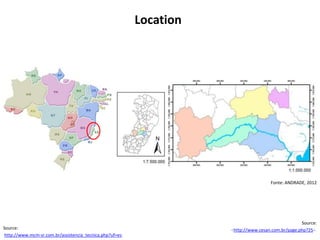
Location 
Fonte: ANDRADE, 2012 
Source: 
<http://www.cesan.com.br/page.php?25>.
• This article seeks to analyze comparatively morphological 
structures as a result from German immigration’s occupation 
in Espírito Santo, from middle XIX century. For this 
investigation, Gunter Weimer’s advanced studies it’s assumed 
as reference, concentrated in the decades of 1970 and 1980, 
about German architecture in Brazil’s southern region. The 
intention is to recognize and present by mappings some 
morphological configuration’s particularities of urban sites 
located in Espírito Santo; 
• It is recognized, in the territory’s dimension, both the 
adoption of courses of rivers as structural elements of land 
parceling, as the location of settlements in high and cold 
lands. In urban dimension, it is identified three types of 
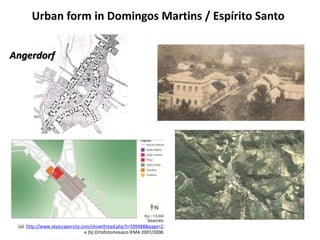
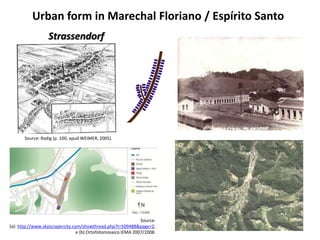
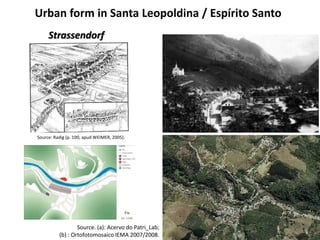
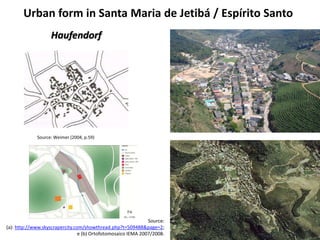
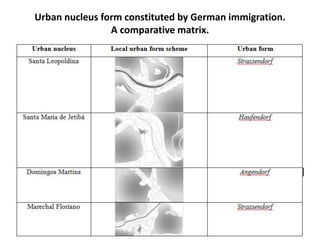
nucleation: Strassendorf, urban form structured by central 
trade route; Angerdorf, urban form that the central trade 
route widens open to a square; and Haufendorf, urban form 
derived from a spontaneous growth.
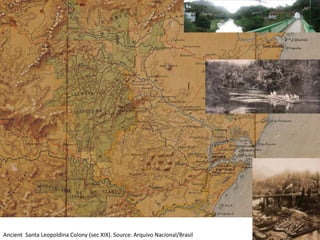
Ancient Santa Leopoldina Colony (sec XIX). Source: Arquivo Nacional/Brasil
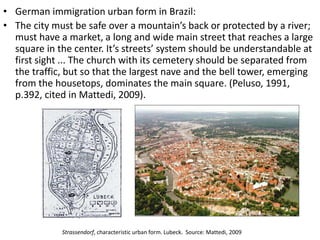
• German immigration urban form in Brazil: 
• The city must be safe over a mountain’s back or protected by a river; 
must have a market, a long and wide main street that reaches a large 
square in the center. It’s streets’ system should be understandable at 
first sight ... The church with its cemetery should be separated from 
the traffic, but so that the largest nave and the bell tower, emerging 
from the housetops, dominates the main square. (Peluso, 1991, 
p.392, cited in Mattedi, 2009). 
Strassendorf, characteristic urban form. Lubeck. Source: Mattedi, 2009
Urban form in Domingos Martins / Espírito Santo 
Sources: 
(a): http://www.skyscrapercity.com/showthread.php?t=509488&page=2; 
e (b) Ortofotomosaico IEMA 2007/2008. 
Angerdorf
Urban form in Marechal Floriano / Espírito Santo 
Source: 
Strassendorf 
Source: Radig (p. 100, apud WEIMER, 2005). 
(a): http://www.skyscrapercity.com/showthread.php?t=509488&page=2; 
e (b) Ortofotomosaico IEMA 2007/2008.
Urban form in Santa Leopoldina / Espírito Santo 
Strassendorf 
Source: Radig (p. 100, apud WEIMER, 2005). 
Source. (a): Acervo do Patri_Lab; 
(b) : Ortofotomosaico IEMA 2007/2008.
Urban form in Santa Maria de Jetibá / Espírito Santo 
Haufendorf 
Source: 
Source: Weimer (2004, p.59) 
(a): http://www.skyscrapercity.com/showthread.php?t=509488&page=2; 
e (b) Ortofotomosaico IEMA 2007/2008.
Urban nucleus form constituted by German immigration. 
A comparative matrix.
Conclusion 
• Importantly, this is an initial approach to German colonization in Brazil urban 
heritage studies, especially in Espírito Santo experience. 
• The urban context stands out the settlement from nucleation, and the 
structured pathway dominance surrounding a road, generally central and 
characterized functionally by the prevalence of commercial activity. The built 
settle, consisting of peculiar architecture and detached and distant position, 
distinguished the single central tower church, if any. 
• The urban morphology analysis, from Günter Weimer, in Santa Leopoldina and 
Santa Maria de Jetibá, in Espírito Santo, presents a Strassendorf formal type 
predominant, ie the urban design structured from a main street, commercial, 
one of the German colonization central marks in Brazil, in addition, it’s noted the 
river role in choosing the occupation locus, however, is not a protagonist urban 
form role. 
• As future deployments, it’s pointed out urban morphology related 
investigations in other immigrants cities (Weimer, 2004) in Espírito Santo; from a 
deepening in specific literature, focused on Werner Radig, in German language, 
with the objective of identifying and mapping the immigration nucleus settle in 
Espírito Santo, from the nineteenth century, territorialized in the Santa Maria da 
Vitoria and Jucu river basins.

Application of morphological concepts to characterize German immigrantion's nucleus in Brazil

  • 1.
    Application of morphologicalconcepts to characterize German immigration’s nucleus in Brazil Laboratório Patrimônio & Desenvolvimento (Patri_Lab) patri_lab@car.ufes.br patrilabufes@gmail.com Bruno Amaral de Andade Mestrando em Arquitetura e Urbanismo pela UFES, e Pesquisador do Patri_Lab. Vitória [ES], Brasil. andrade.bruno@live.com Elisa Machado Taveira Màster en Urbanismo/UPC/Espanha, Patri_Lab/UFES elisataveira@gmail.com Renata Hermanny de Almeida Arquiteta Urbanista; Doutora em Arquitetura e Urbanismo, pela UFBA (2005), Coordenadora do Patri_Lab. Vitória [ES], Brasil. <renatahermanny@gmail.com> Red Baloon Paul Klee ‘s painting
  • 2.
    Source: http://www.mcm-sr.com.br/assistencia_tecnica.php?uf=es; Location Fonte: ANDRADE, 2012 Source: <http://www.cesan.com.br/page.php?25>.
  • 3.
    • This articleseeks to analyze comparatively morphological structures as a result from German immigration’s occupation in Espírito Santo, from middle XIX century. For this investigation, Gunter Weimer’s advanced studies it’s assumed as reference, concentrated in the decades of 1970 and 1980, about German architecture in Brazil’s southern region. The intention is to recognize and present by mappings some morphological configuration’s particularities of urban sites located in Espírito Santo; • It is recognized, in the territory’s dimension, both the adoption of courses of rivers as structural elements of land parceling, as the location of settlements in high and cold lands. In urban dimension, it is identified three types of nucleation: Strassendorf, urban form structured by central trade route; Angerdorf, urban form that the central trade route widens open to a square; and Haufendorf, urban form derived from a spontaneous growth.
  • 4.
    Ancient Santa LeopoldinaColony (sec XIX). Source: Arquivo Nacional/Brasil
  • 5.
    • German immigrationurban form in Brazil: • The city must be safe over a mountain’s back or protected by a river; must have a market, a long and wide main street that reaches a large square in the center. It’s streets’ system should be understandable at first sight ... The church with its cemetery should be separated from the traffic, but so that the largest nave and the bell tower, emerging from the housetops, dominates the main square. (Peluso, 1991, p.392, cited in Mattedi, 2009). Strassendorf, characteristic urban form. Lubeck. Source: Mattedi, 2009
  • 6.
    Urban form inDomingos Martins / Espírito Santo Sources: (a): http://www.skyscrapercity.com/showthread.php?t=509488&page=2; e (b) Ortofotomosaico IEMA 2007/2008. Angerdorf
  • 7.
    Urban form inMarechal Floriano / Espírito Santo Source: Strassendorf Source: Radig (p. 100, apud WEIMER, 2005). (a): http://www.skyscrapercity.com/showthread.php?t=509488&page=2; e (b) Ortofotomosaico IEMA 2007/2008.
  • 8.
    Urban form inSanta Leopoldina / Espírito Santo Strassendorf Source: Radig (p. 100, apud WEIMER, 2005). Source. (a): Acervo do Patri_Lab; (b) : Ortofotomosaico IEMA 2007/2008.
  • 9.
    Urban form inSanta Maria de Jetibá / Espírito Santo Haufendorf Source: Source: Weimer (2004, p.59) (a): http://www.skyscrapercity.com/showthread.php?t=509488&page=2; e (b) Ortofotomosaico IEMA 2007/2008.
  • 10.
    Urban nucleus formconstituted by German immigration. A comparative matrix.
  • 11.
    Conclusion • Importantly,this is an initial approach to German colonization in Brazil urban heritage studies, especially in Espírito Santo experience. • The urban context stands out the settlement from nucleation, and the structured pathway dominance surrounding a road, generally central and characterized functionally by the prevalence of commercial activity. The built settle, consisting of peculiar architecture and detached and distant position, distinguished the single central tower church, if any. • The urban morphology analysis, from Günter Weimer, in Santa Leopoldina and Santa Maria de Jetibá, in Espírito Santo, presents a Strassendorf formal type predominant, ie the urban design structured from a main street, commercial, one of the German colonization central marks in Brazil, in addition, it’s noted the river role in choosing the occupation locus, however, is not a protagonist urban form role. • As future deployments, it’s pointed out urban morphology related investigations in other immigrants cities (Weimer, 2004) in Espírito Santo; from a deepening in specific literature, focused on Werner Radig, in German language, with the objective of identifying and mapping the immigration nucleus settle in Espírito Santo, from the nineteenth century, territorialized in the Santa Maria da Vitoria and Jucu river basins.