DIFFERENTIAL
DIFFERENTIAL
CALCULUS AND ITS
CALCULUS AND ITS
APPLICATIONS
APPLICATIONS
Shivani Sharma
Shivani Sharma
Assistant Professor
Assistant Professor
Department of Mathematics
G.D.C. for Women, Kathua
Origin
Origin
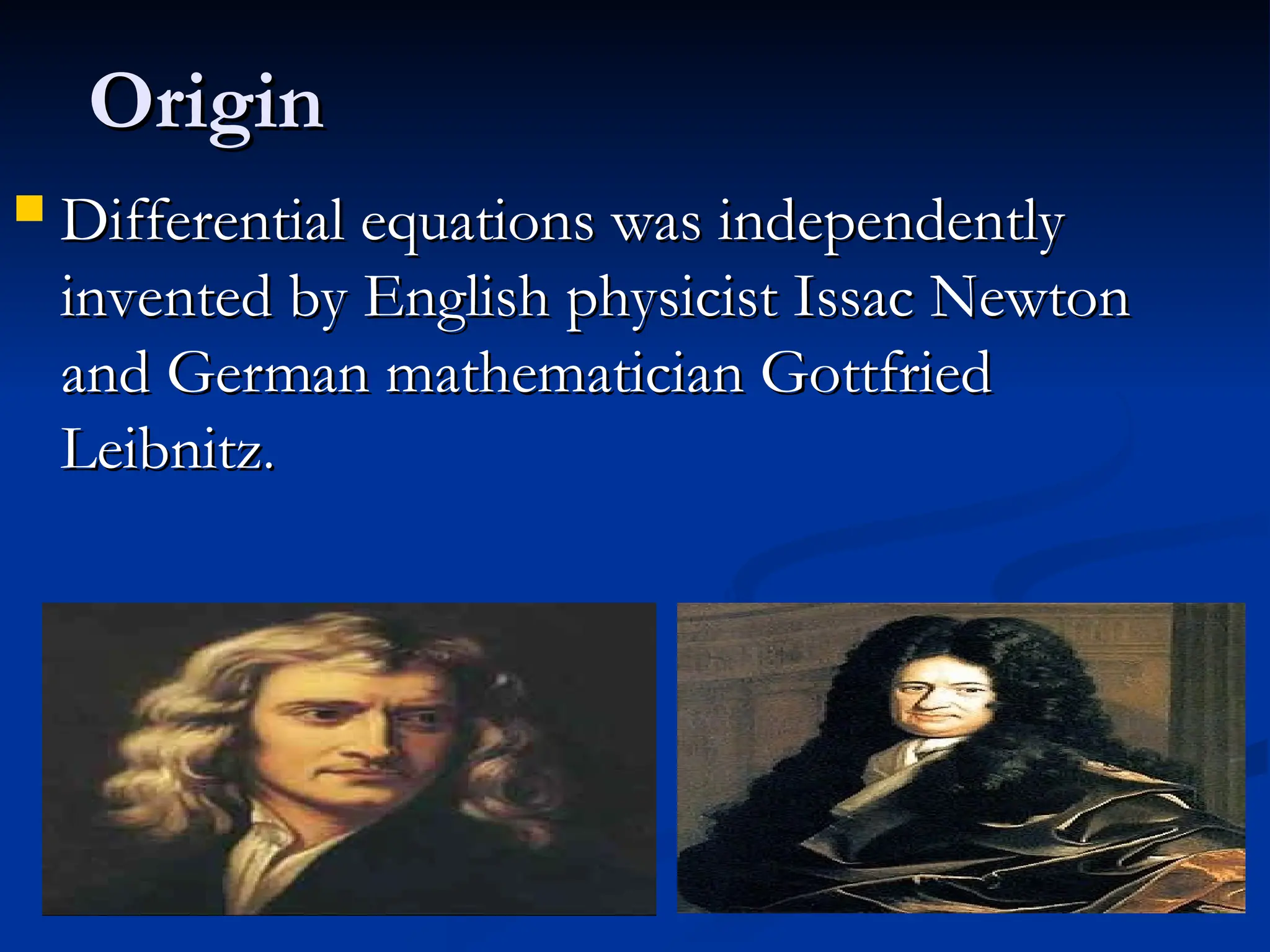
 Differential equations was independently
Differential equations was independently
invented by English physicist Issac Newton
and German mathematician Gottfried
Leibnitz
Leibnitz.
.
DIFFERENTIAL
DIFFERENTIAL
CALCULUS IS
CALCULUS IS
EVERYWHERE
EVERYWHERE
Wherever we study how something
changes with respect to something else
is an application of calculus
DIFFERENTIAL EQUATION:
 An equation involving derivatives of one
An equation involving derivatives of one
or more dependent variables with respect
to one or more independent variables is
called a differential equation.
 In simple words, we can say that it is the
In simple words, we can say that it is the
rate of change of one or more quantities
with respect to another quantities.
CLASSIFICATION
CLASSIFICATION
 According to the number of
According to the number of
independent variables involved.
 According to their order of the
According to their order of the
highest derivative they are
classified as first order , second
order and so on.
order and so on.
APPLICATIONS :
APPLICATIONS :
IT IS USED IN
IT IS USED IN
1.
1. Determining the motion of a projectile, rocket,
Determining the motion of a projectile, rocket,
satellite or planet
satellite or planet
2.
2. LCR circuits
LCR circuits
3.
3. Studying the rate of decomposition of a
Studying the rate of decomposition of a
radioactive substance
4.
4. In mechanics
In mechanics
IN MECHANICS
IN MECHANICS
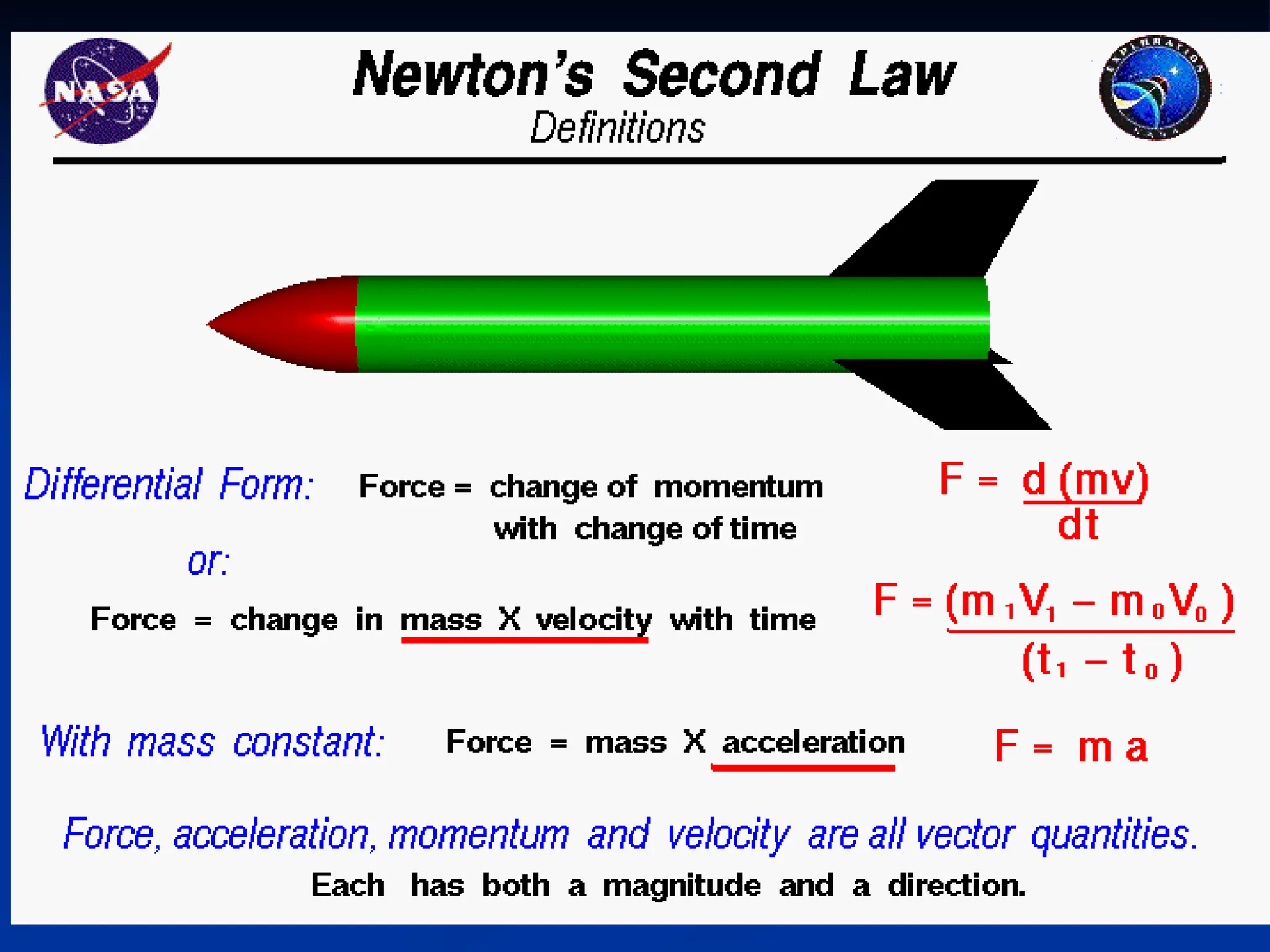
 We all read about NEWTONS SECOND LAW which states that the time
We all read about NEWTONS SECOND LAW which states that the time
rate of change of momentum of a body is proportional to the resultant force
acting on the body
acting on the body
 In mathematical language, this law states that
In mathematical language, this law states that
 d∕dt (mv)=KF
d∕dt (mv)=KF
 It is a differential eqn in which the dependent variable is v and independent
It is a differential eqn in which the dependent variable is v and independent
variable is t.
variable is t.
 Where m is the mass of the body ,v is its velocity ,F is the resultant force
Where m is the mass of the body ,v is its velocity ,F is the resultant force
acting upon it ,and K is constant of proportionality .
 If m is constant then
If m is constant then
 mdv/dt=KF
mdv/dt=KF
 a = KF/m
a = KF/m
 F = Kma
F = Kma
 And for K=1,
And for K=1,
 F = ma
F = ma
IN LCR CIRCUITS
IN LCR CIRCUITS
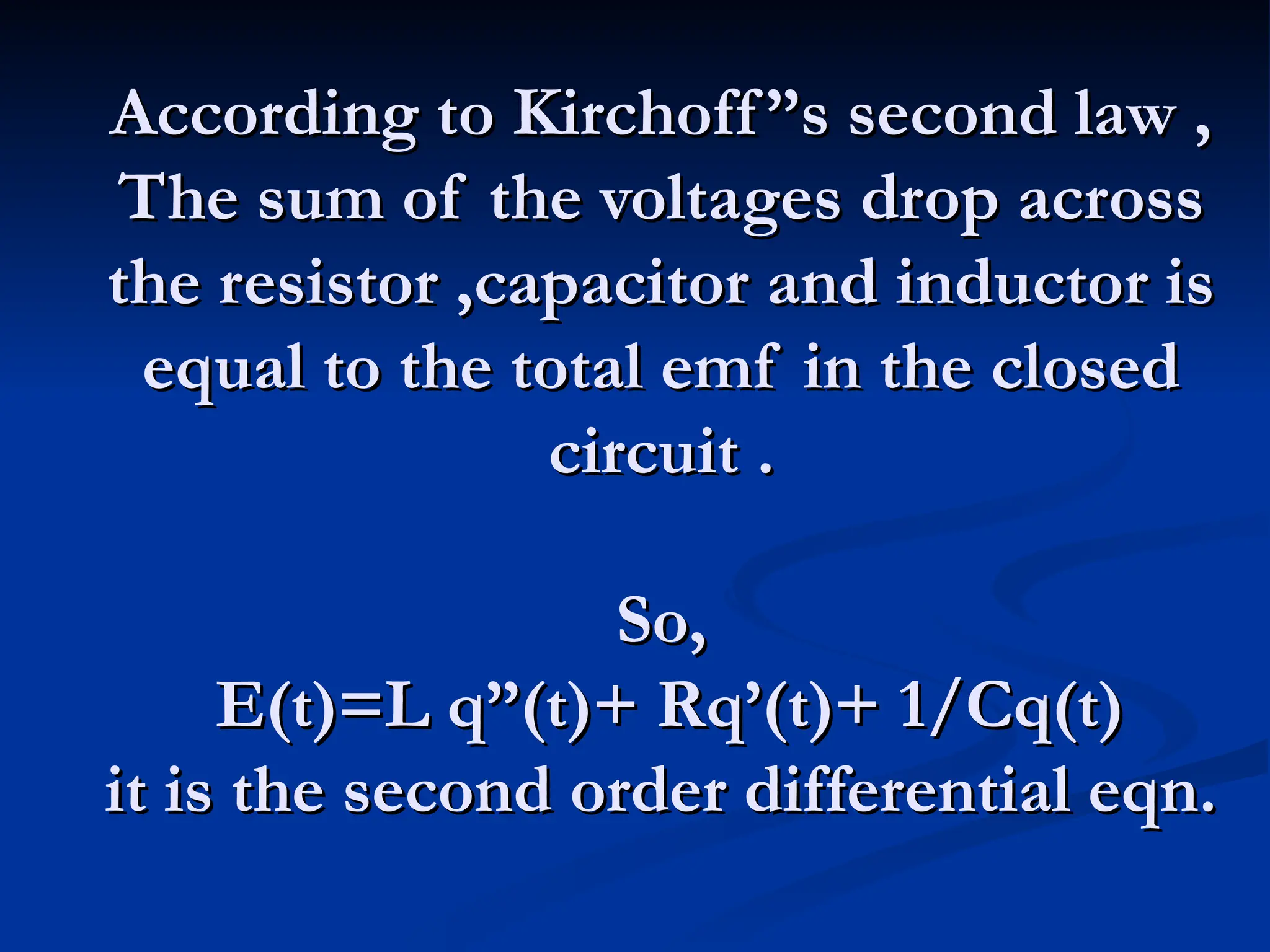
 A LCR circuit is a circuit consisting of an inductor ,capacitor, and a resistor along with
A LCR circuit is a circuit consisting of an inductor ,capacitor, and a resistor along with
electromotive force .
 The emf produces a flow of current in a closed circuit and this current produces voltage
The emf produces a flow of current in a closed circuit and this current produces voltage
drop across each resistor ,inductor,and capacitor.
 We know that in a capacitor ,
We know that in a capacitor ,
The charge q(t)stored in a capacitor at any time t is directly
proportional to the applied voltage
q(t) = CV
q(t) = CV
V = q(t)/C
V = q(t)/C
Where C is the capacitance
Also the voltage drop across resistor
By ohms law,
By ohms law,
V = IR
V = IR
also I = dq/dt
also I = dq/dt
So V =R dq/dt
So V =R dq/dt
That is the current produces is directly proportional to the applied voltage where R is the
resistance.
resistance.
The voltage drop across an inductor is given by
V = LdI/dt
V = LdI/dt
V = Ld”q/dt
V = Ld”q/dt
where L Is the inductance.
According to Kirchoff”s second law ,
The sum of the voltages drop across
the resistor ,capacitor and inductor is
equal to the total emf in the closed
circuit .
circuit .
So,
So,
E(t)=L q”(t)+ Rq’(t)+ 1/Cq(t)
it is the second order differential eqn.
Radioactivity
Radioactivity decay
decay
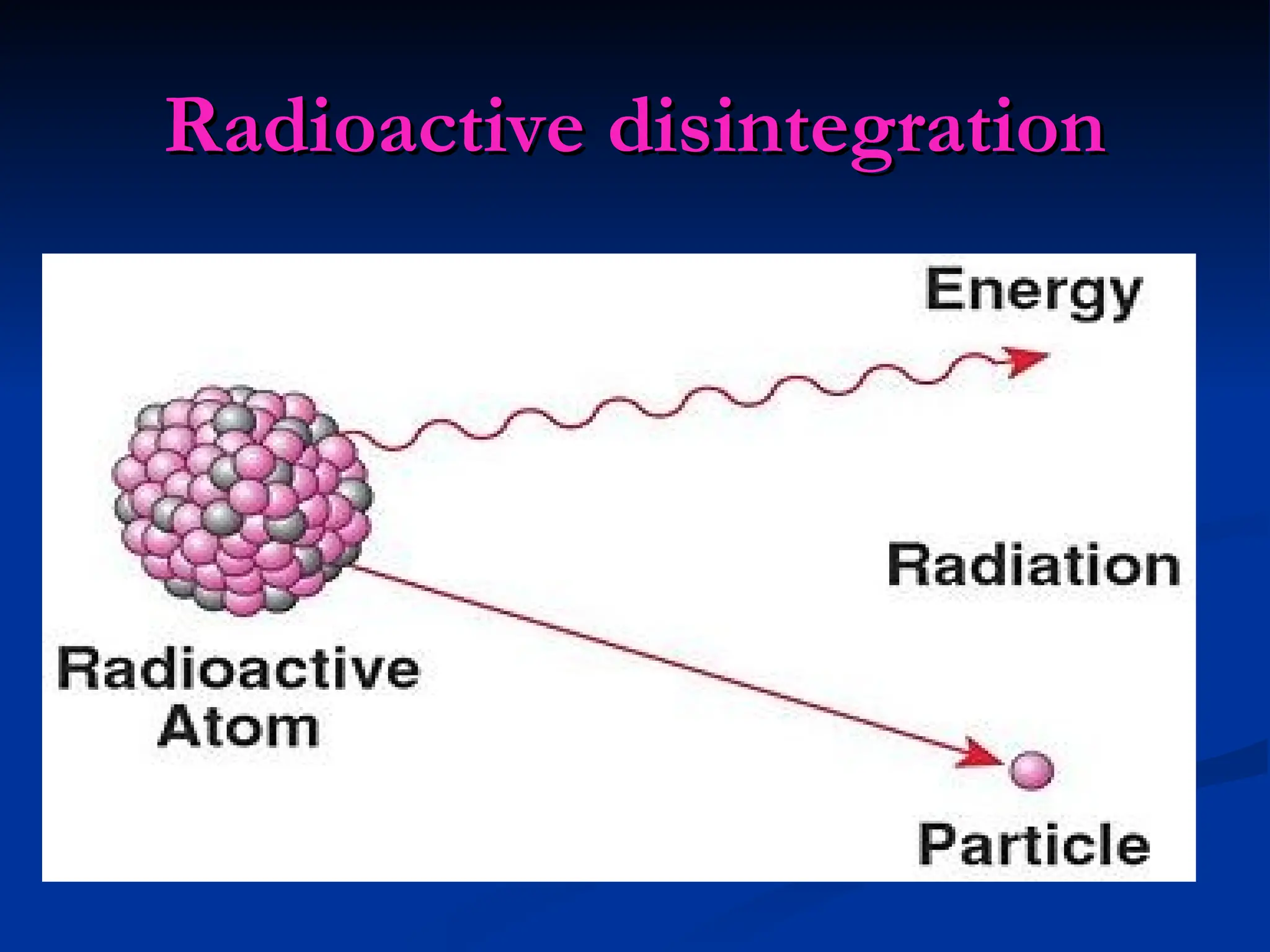
The emission of particles like alpha, beta particles or gamma
radiations by any radioactive element is called radioactive
decay or radioactive disintegration. It is known that rate of
disintegration or decay of any radioactive material at any time
depends upon the number of atoms of the radioactive
elements present at that time.
This can be expressed as a differential equation.
Rate of disintegration at time t
dN/dt = KN
dN/dt = KN
Where N is the no. of atoms present after time t and k is the
constant of proptionality.
Since N is decresing dN/dt<0
Radioactive disintegration
Solution
Solution
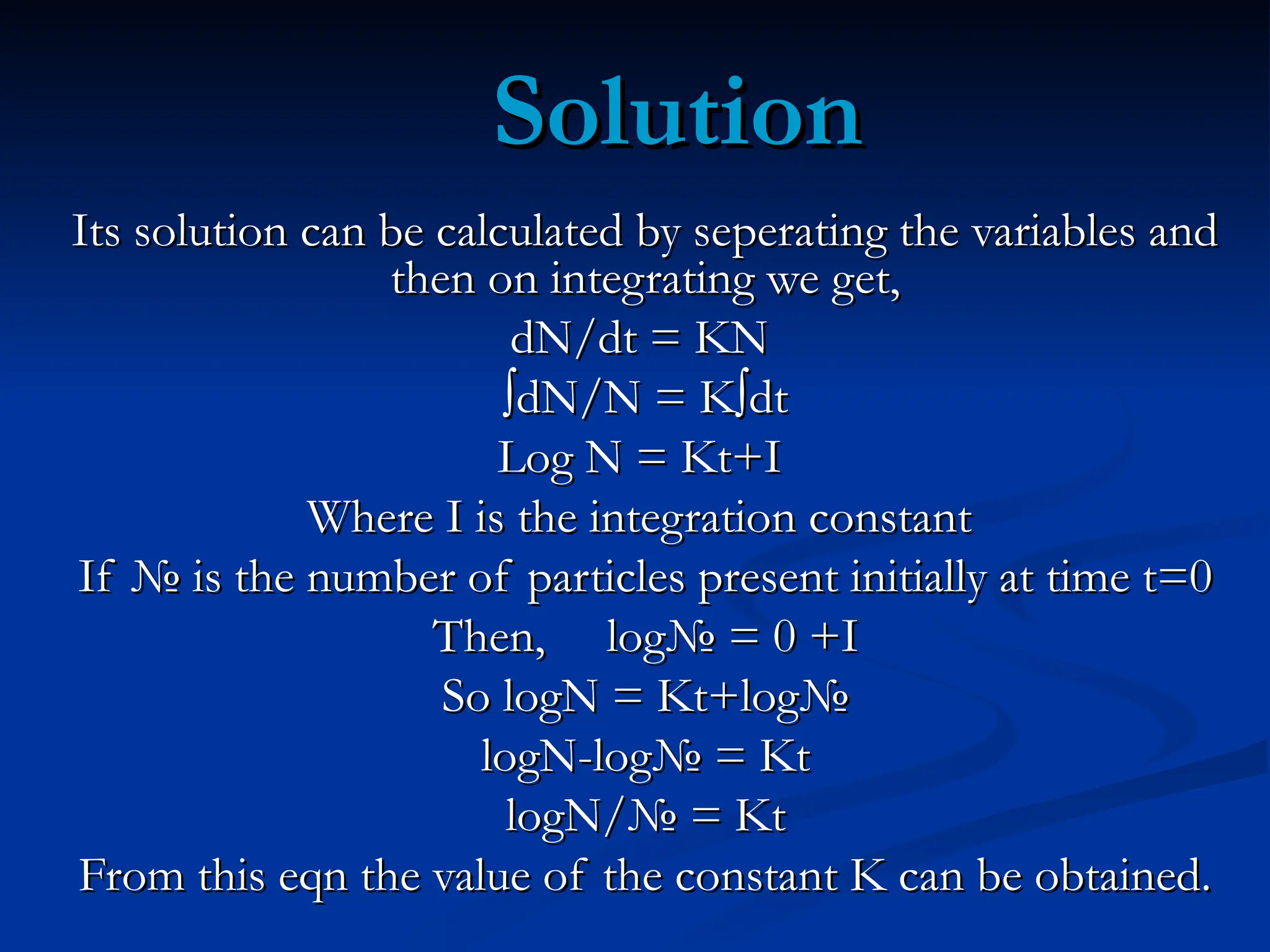
Its solution can be calculated by seperating the variables and
then on integrating we get,
dN/dt = KN
dN/dt = KN
∫
∫dN/N = K∫dt
dN/N = K∫dt
Log N = Kt+I
Log N = Kt+I
Where I is the integration constant
If № is the number of particles present initially at time t=0
Then, log№ = 0 +I
Then, log№ = 0 +I
So logN = Kt+log№
So logN = Kt+log№
logN-log№ = Kt
logN-log№ = Kt
logN/№ = Kt
logN/№ = Kt
From this eqn the value of the constant K can be obtained.
THANK YOU
THANK YOU

Application of Differential Equations .ppt

  • 1.
    DIFFERENTIAL DIFFERENTIAL CALCULUS AND ITS CALCULUSAND ITS APPLICATIONS APPLICATIONS Shivani Sharma Shivani Sharma Assistant Professor Assistant Professor Department of Mathematics Department of Mathematics G.D.C. for Women, Kathua G.D.C. for Women, Kathua
  • 2.
    Origin Origin  Differential equationswas independently Differential equations was independently invented by English physicist Issac Newton invented by English physicist Issac Newton and German mathematician Gottfried and German mathematician Gottfried Leibnitz Leibnitz. .
  • 3.
    DIFFERENTIAL DIFFERENTIAL CALCULUS IS CALCULUS IS EVERYWHERE EVERYWHERE Whereverwe study how something Wherever we study how something changes with respect to something else changes with respect to something else is an application of calculus is an application of calculus
  • 4.
    DIFFERENTIAL EQUATION: DIFFERENTIAL EQUATION: An equation involving derivatives of one An equation involving derivatives of one or more dependent variables with respect or more dependent variables with respect to one or more independent variables is to one or more independent variables is called a differential equation. called a differential equation.  In simple words, we can say that it is the In simple words, we can say that it is the rate of change of one or more quantities rate of change of one or more quantities with respect to another quantities. with respect to another quantities.
  • 5.
    CLASSIFICATION CLASSIFICATION  According tothe number of According to the number of independent variables involved. independent variables involved.  According to their order of the According to their order of the highest derivative they are highest derivative they are classified as first order , second classified as first order , second order and so on. order and so on.
  • 6.
    APPLICATIONS : APPLICATIONS : ITIS USED IN IT IS USED IN 1. 1. Determining the motion of a projectile, rocket, Determining the motion of a projectile, rocket, satellite or planet satellite or planet 2. 2. LCR circuits LCR circuits 3. 3. Studying the rate of decomposition of a Studying the rate of decomposition of a radioactive substance radioactive substance 4. 4. In mechanics In mechanics
  • 7.
    IN MECHANICS IN MECHANICS We all read about NEWTONS SECOND LAW which states that the time We all read about NEWTONS SECOND LAW which states that the time rate of change of momentum of a body is proportional to the resultant force rate of change of momentum of a body is proportional to the resultant force acting on the body acting on the body  In mathematical language, this law states that In mathematical language, this law states that  d∕dt (mv)=KF d∕dt (mv)=KF  It is a differential eqn in which the dependent variable is v and independent It is a differential eqn in which the dependent variable is v and independent variable is t. variable is t.  Where m is the mass of the body ,v is its velocity ,F is the resultant force Where m is the mass of the body ,v is its velocity ,F is the resultant force acting upon it ,and K is constant of proportionality . acting upon it ,and K is constant of proportionality .  If m is constant then If m is constant then  mdv/dt=KF mdv/dt=KF  a = KF/m a = KF/m  F = Kma F = Kma  And for K=1, And for K=1,  F = ma F = ma
  • 9.
    IN LCR CIRCUITS INLCR CIRCUITS  A LCR circuit is a circuit consisting of an inductor ,capacitor, and a resistor along with A LCR circuit is a circuit consisting of an inductor ,capacitor, and a resistor along with electromotive force . electromotive force .  The emf produces a flow of current in a closed circuit and this current produces voltage The emf produces a flow of current in a closed circuit and this current produces voltage drop across each resistor ,inductor,and capacitor. drop across each resistor ,inductor,and capacitor.  We know that in a capacitor , We know that in a capacitor , The charge q(t)stored in a capacitor at any time t is directly The charge q(t)stored in a capacitor at any time t is directly proportional to the applied voltage proportional to the applied voltage q(t) = CV q(t) = CV V = q(t)/C V = q(t)/C Where C is the capacitance Where C is the capacitance Also the voltage drop across resistor Also the voltage drop across resistor By ohms law, By ohms law, V = IR V = IR also I = dq/dt also I = dq/dt So V =R dq/dt So V =R dq/dt That is the current produces is directly proportional to the applied voltage where R is the That is the current produces is directly proportional to the applied voltage where R is the resistance. resistance. The voltage drop across an inductor is given by The voltage drop across an inductor is given by V = LdI/dt V = LdI/dt V = Ld”q/dt V = Ld”q/dt where L Is the inductance. where L Is the inductance.
  • 10.
    According to Kirchoff”ssecond law , According to Kirchoff”s second law , The sum of the voltages drop across The sum of the voltages drop across the resistor ,capacitor and inductor is the resistor ,capacitor and inductor is equal to the total emf in the closed equal to the total emf in the closed circuit . circuit . So, So, E(t)=L q”(t)+ Rq’(t)+ 1/Cq(t) E(t)=L q”(t)+ Rq’(t)+ 1/Cq(t) it is the second order differential eqn. it is the second order differential eqn.
  • 11.
    Radioactivity Radioactivity decay decay The emissionof particles like alpha, beta particles or gamma The emission of particles like alpha, beta particles or gamma radiations by any radioactive element is called radioactive radiations by any radioactive element is called radioactive decay or radioactive disintegration. It is known that rate of decay or radioactive disintegration. It is known that rate of disintegration or decay of any radioactive material at any time disintegration or decay of any radioactive material at any time depends upon the number of atoms of the radioactive depends upon the number of atoms of the radioactive elements present at that time. elements present at that time. This can be expressed as a differential equation. This can be expressed as a differential equation. Rate of disintegration at time t Rate of disintegration at time t dN/dt = KN dN/dt = KN Where N is the no. of atoms present after time t and k is the Where N is the no. of atoms present after time t and k is the constant of proptionality. constant of proptionality. Since N is decresing dN/dt<0 Since N is decresing dN/dt<0
  • 12.
  • 13.
    Solution Solution Its solution canbe calculated by seperating the variables and Its solution can be calculated by seperating the variables and then on integrating we get, then on integrating we get, dN/dt = KN dN/dt = KN ∫ ∫dN/N = K∫dt dN/N = K∫dt Log N = Kt+I Log N = Kt+I Where I is the integration constant Where I is the integration constant If № is the number of particles present initially at time t=0 If № is the number of particles present initially at time t=0 Then, log№ = 0 +I Then, log№ = 0 +I So logN = Kt+log№ So logN = Kt+log№ logN-log№ = Kt logN-log№ = Kt logN/№ = Kt logN/№ = Kt From this eqn the value of the constant K can be obtained. From this eqn the value of the constant K can be obtained.
  • 14.