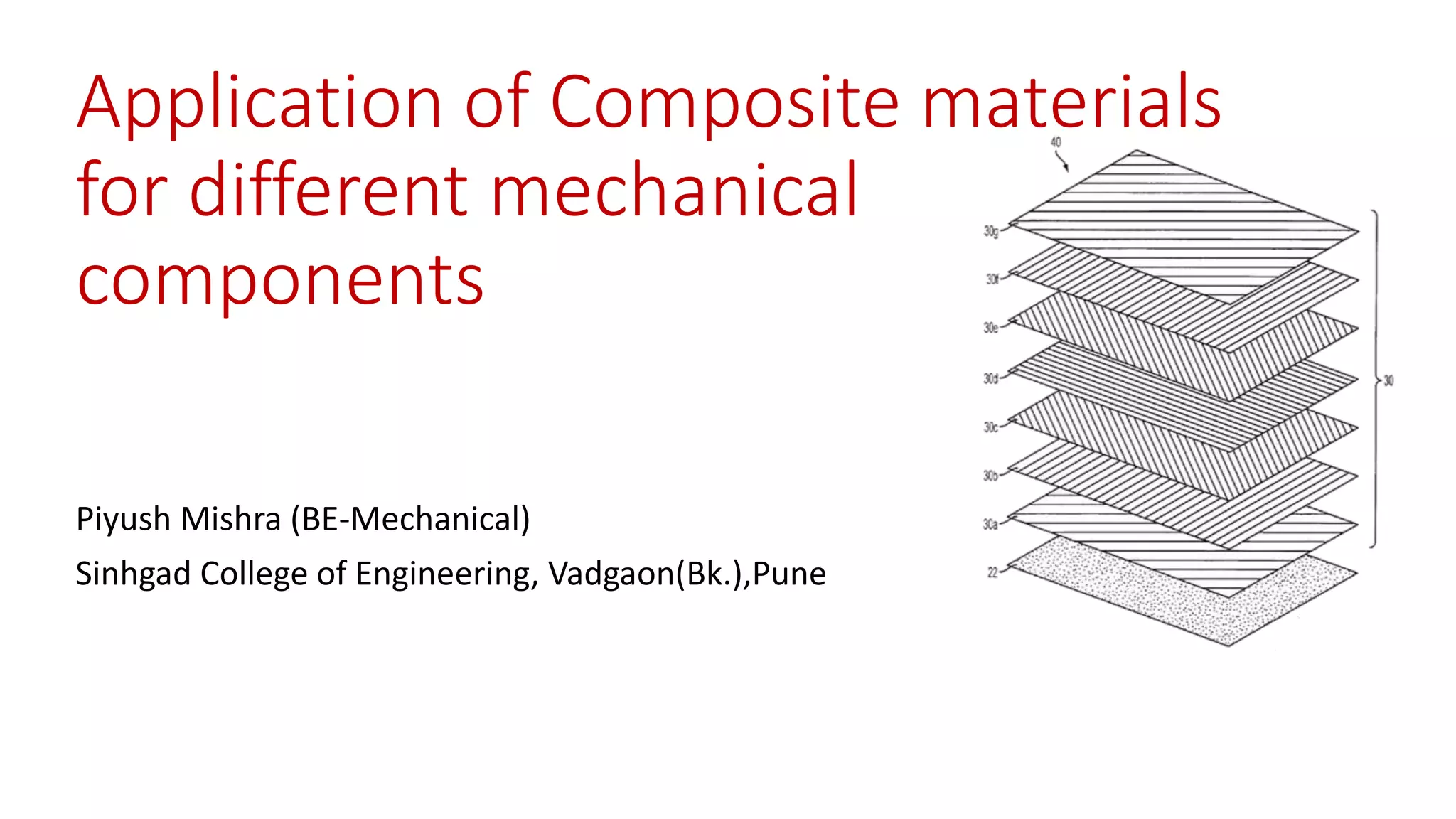
Application of Composite materials
for different mechanical
components
Piyush Mishra (BE-Mechanical)
Sinhgad College of Engineering, Vadgaon(Bk.),Pune
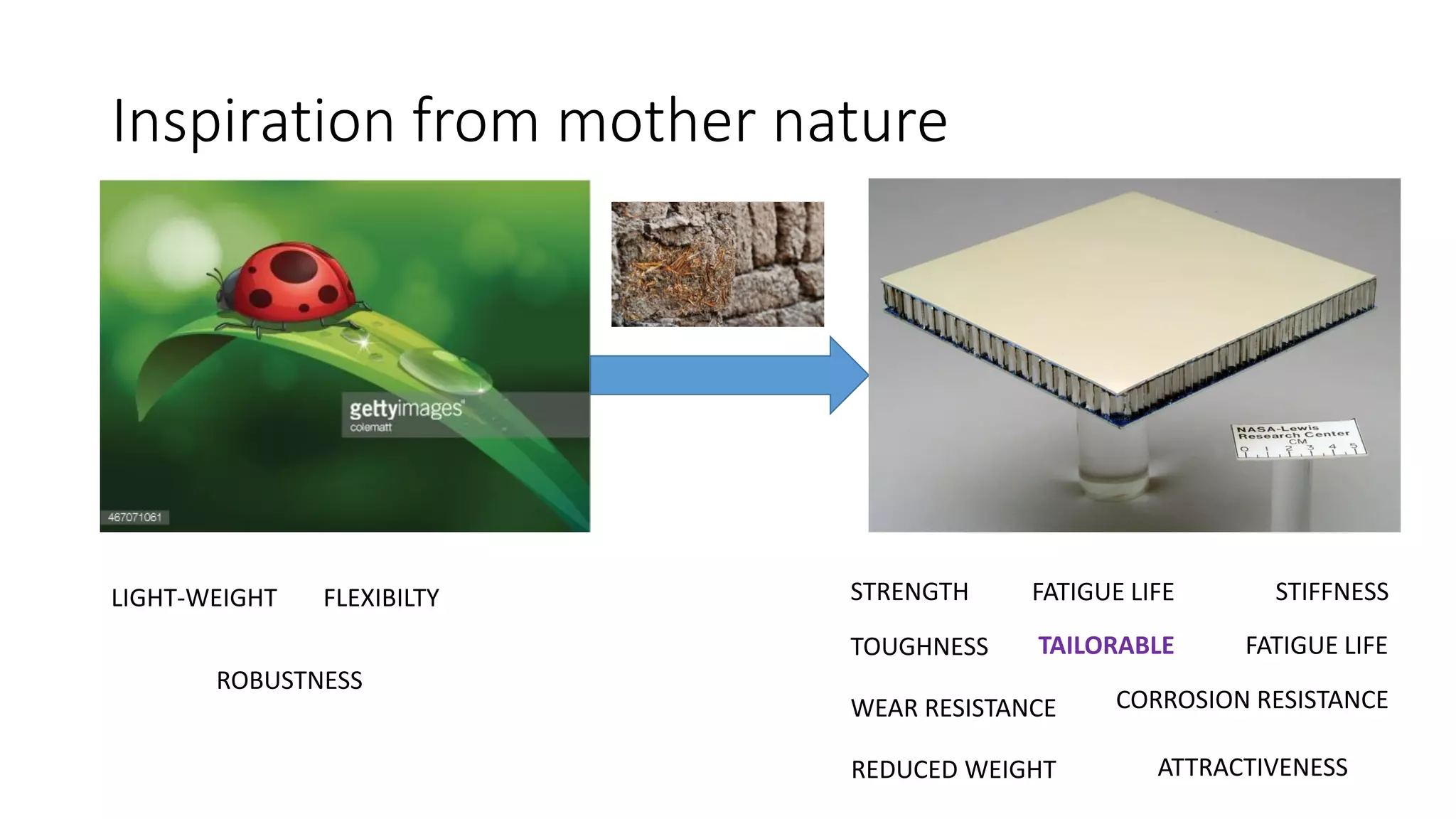
Inspiration from mother nature
LIGHT-WEIGHT FLEXIBILTY
ROBUSTNESS
STRENGTH STIFFNESS
TOUGHNESS
CORROSION RESISTANCE
FATIGUE LIFE
WEAR RESISTANCE
FATIGUE LIFETAILORABLE
REDUCED WEIGHT ATTRACTIVENESS
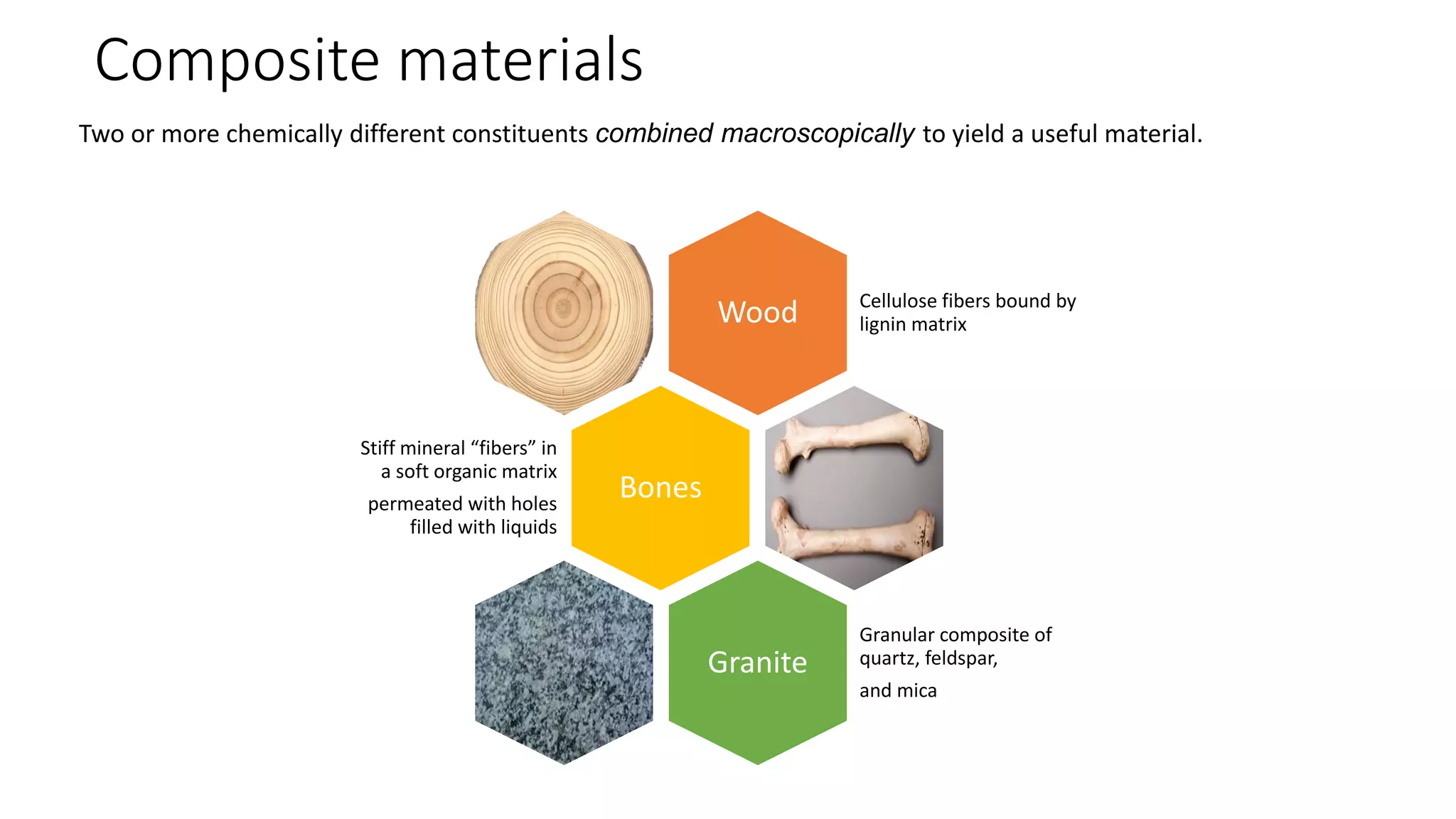
Composite materials
Wood Cellulose fibers bound by
lignin matrix
Bones
Stiff mineral “fibers” in
a soft organic matrix
permeated with holes
filled with liquids
Granite
Granular composite of
quartz, feldspar,
and mica
Two or more chemically different constituents combined macroscopically to yield a useful material.
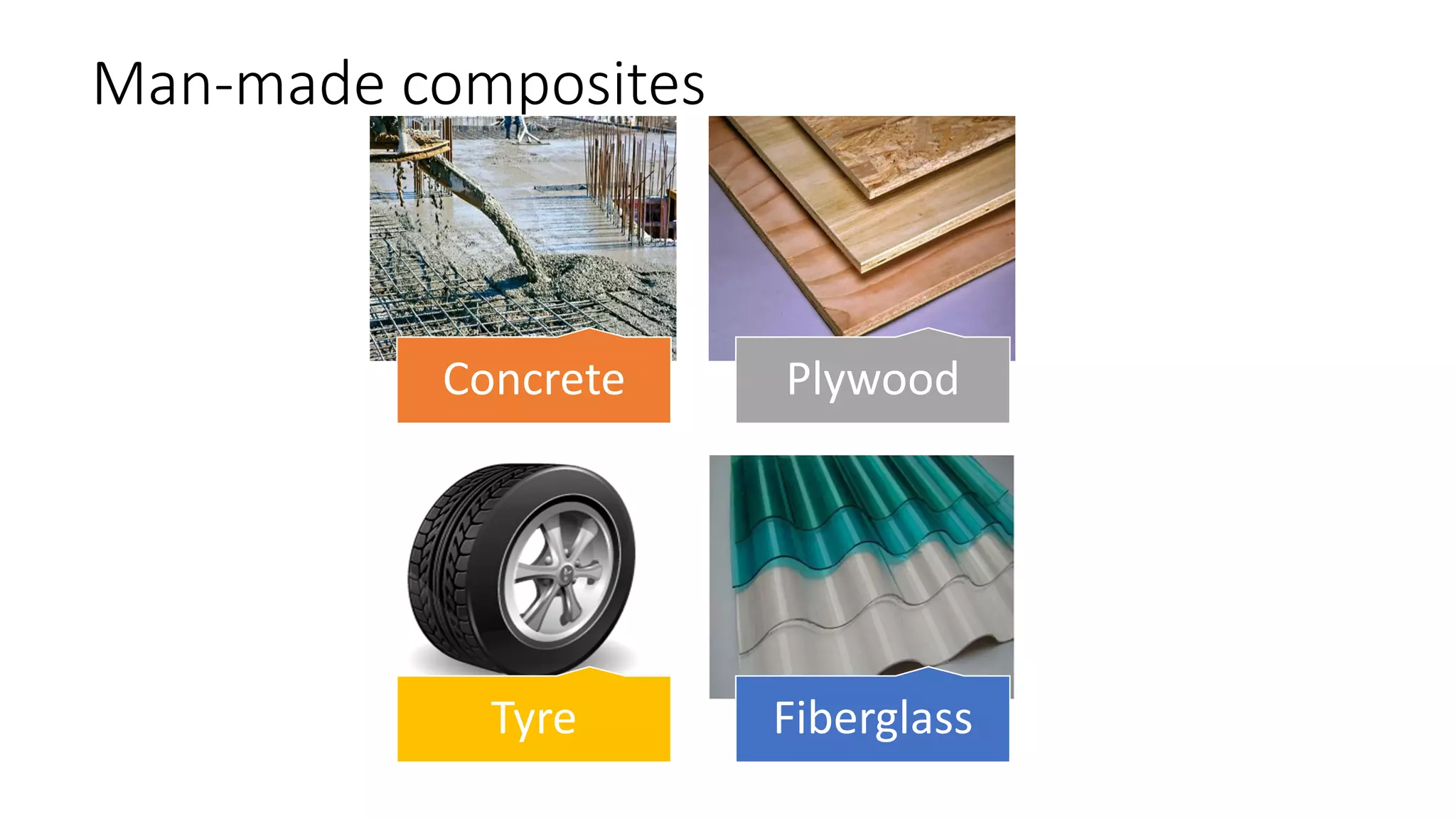
Man-made composites
Concrete Plywood
Tyre Fiberglass
Definition:
• A material which is composed of two or more materials at a microscopic
scale and have chemically distinct phases.
• Heterogeneous at a microscopic scale but statistically homogeneous at
macroscopic scale.
• Constituent materials have significantly different properties.
• Conditions for a material to qualify as a composite:
1. Combination of materials should result in significant property changes.
2. Content of the constituents is generally more than 10 %
3. In general, property of one constituent is much greater ( ≥ 5 times) than
the other.
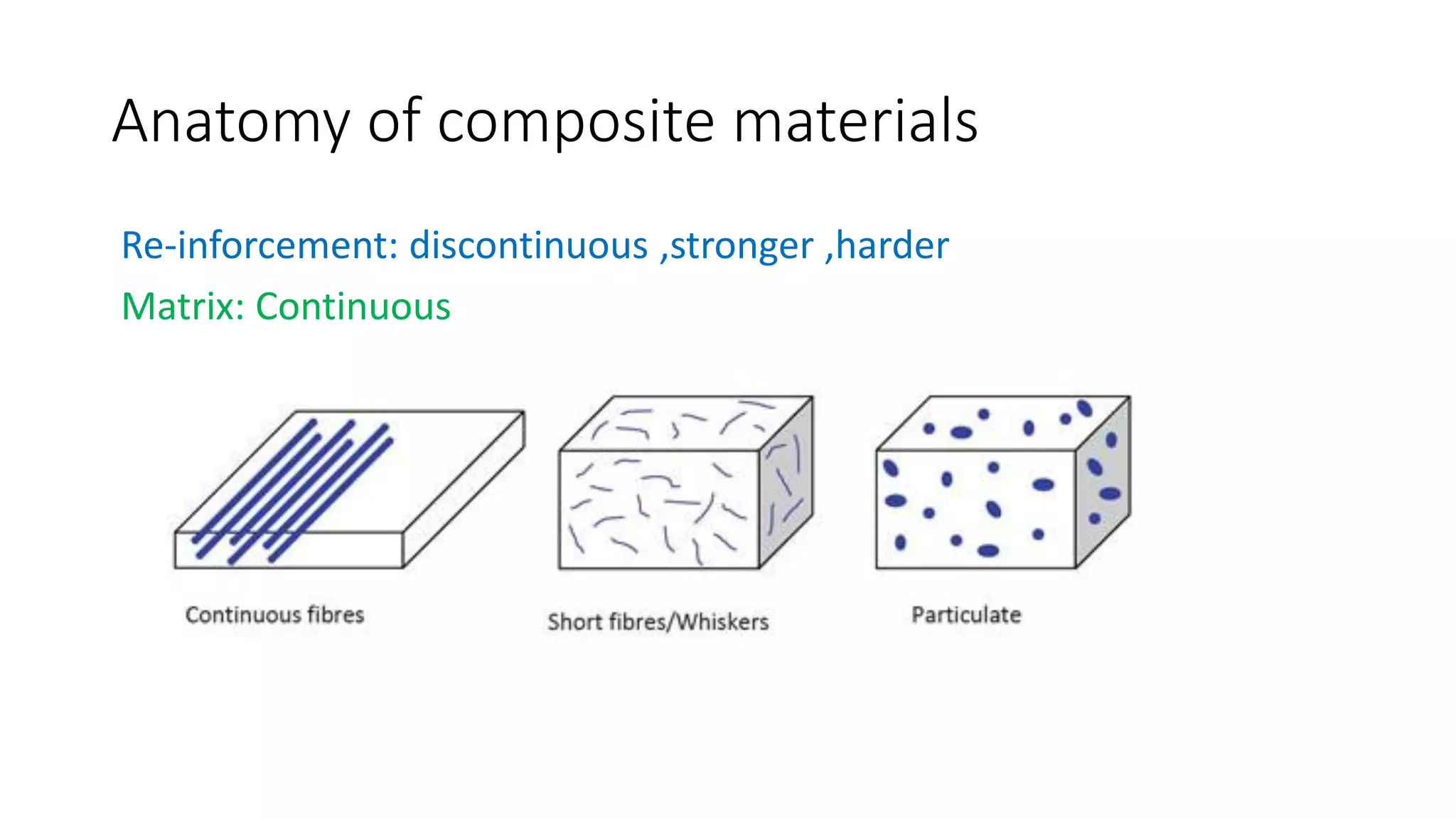
Anatomy of composite materials
Re-inforcement: discontinuous ,stronger ,harder
Matrix: Continuous
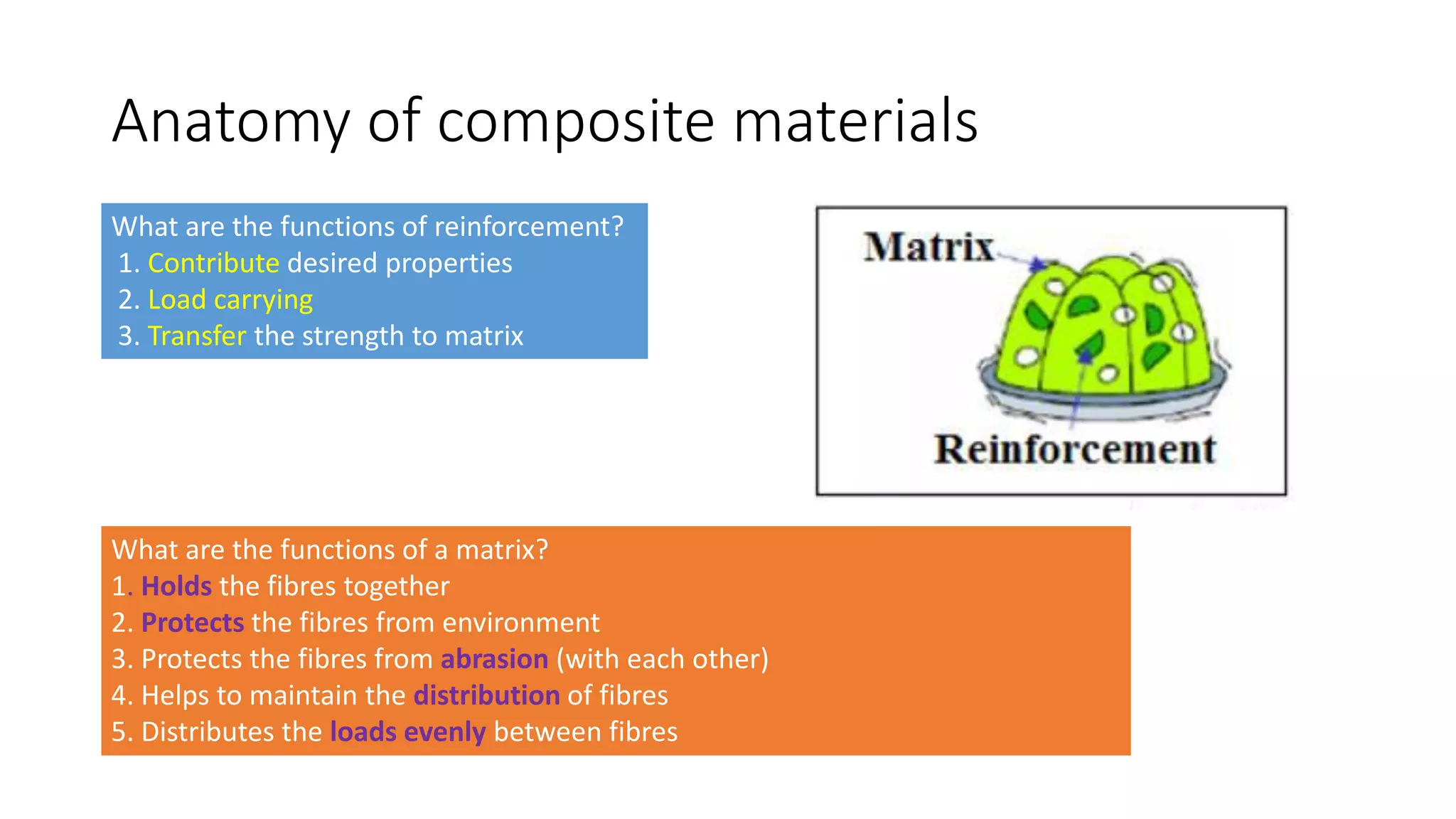
Anatomy of composite materials
What are the functions of reinforcement?
1. Contribute desired properties
2. Load carrying
3. Transfer the strength to matrix
What are the functions of a matrix?
1. Holds the fibres together
2. Protects the fibres from environment
3. Protects the fibres from abrasion (with each other)
4. Helps to maintain the distribution of fibres
5. Distributes the loads evenly between fibres
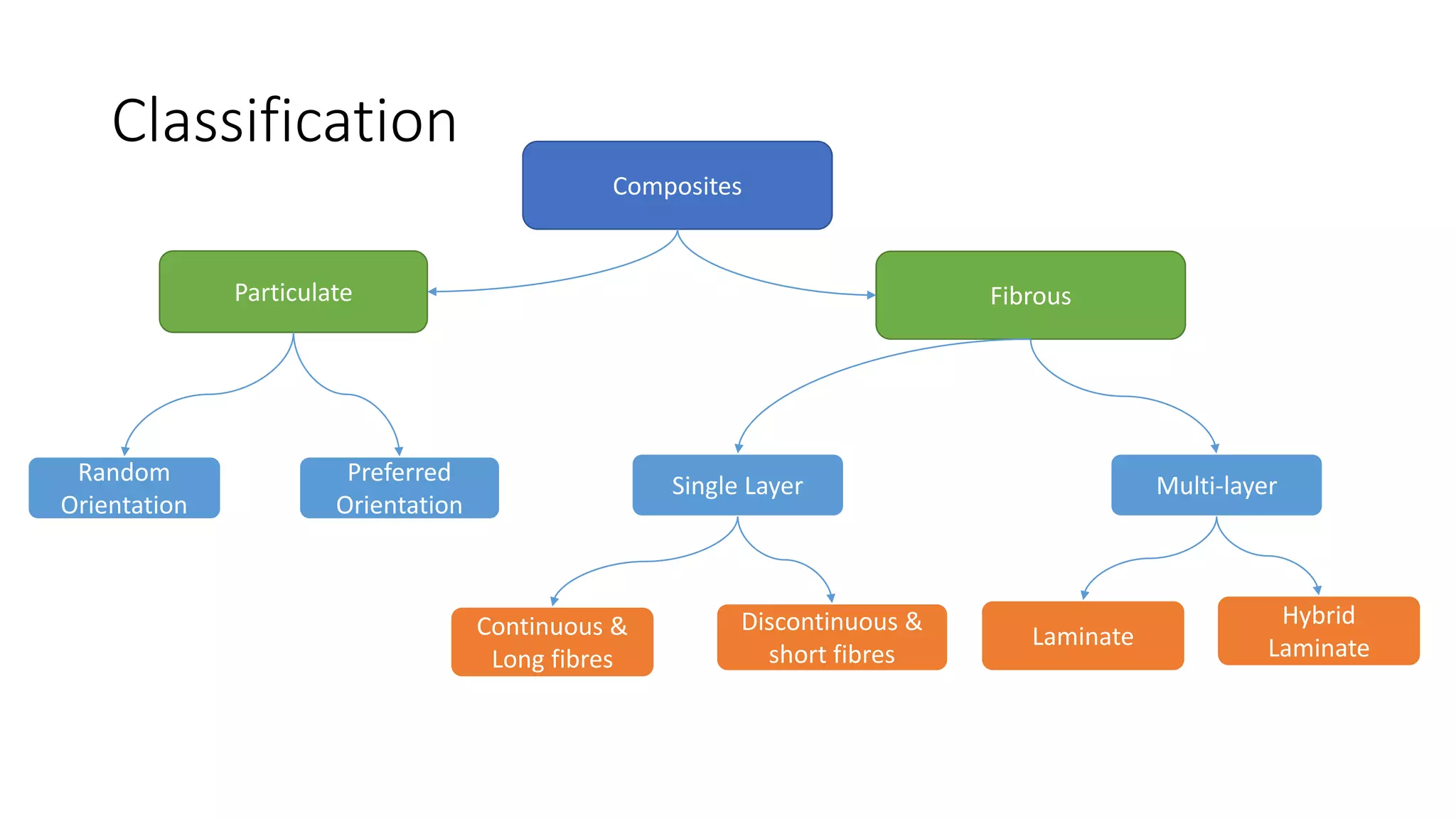
Classification
Composites
Random
Orientation
Preferred
Orientation
Particulate Fibrous
Single Layer Multi-layer
Continuous &
Long fibres
Discontinuous &
short fibres
Hybrid
LaminateLaminate
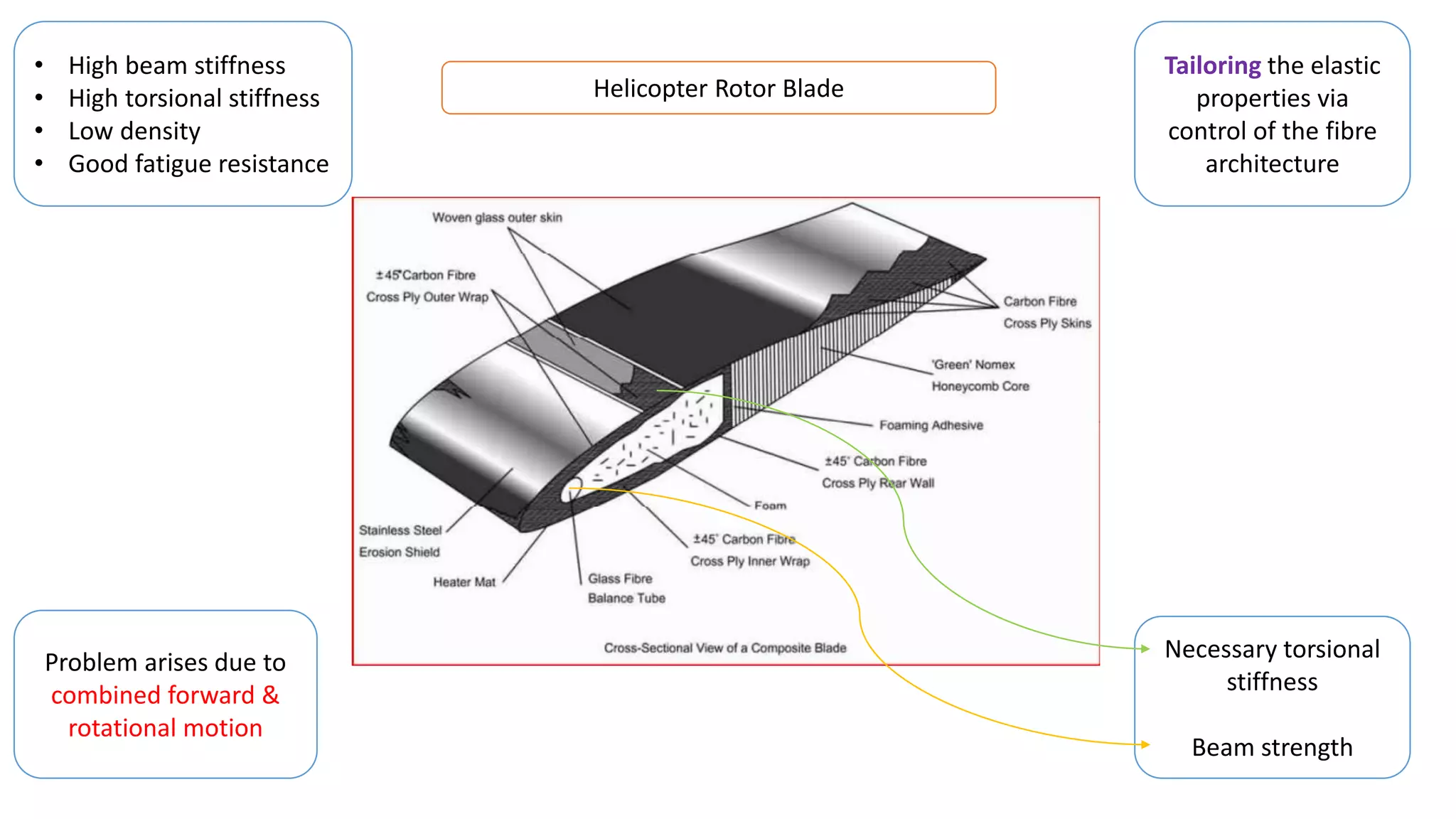
• High beam stiffness
• High torsional stiffness
• Low density
• Good fatigue resistance
Tailoring the elastic
properties via
control of the fibre
architecture
Problem arises due to
combined forward &
rotational motion
Necessary torsional
stiffness
Beam strength
Helicopter Rotor Blade
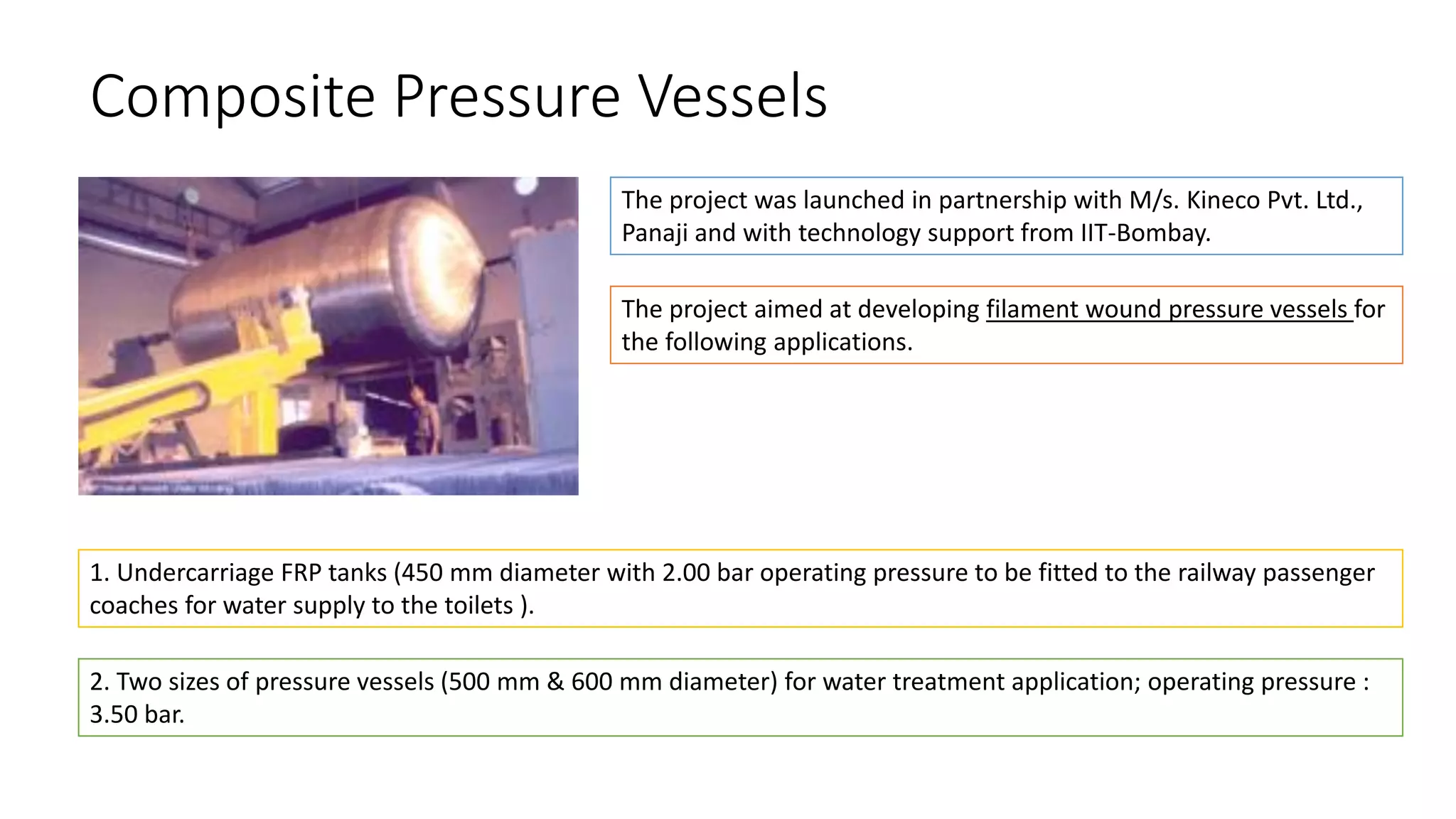
Composite Pressure Vessels
The project was launched in partnership with M/s. Kineco Pvt. Ltd.,
Panaji and with technology support from IIT-Bombay.
The project aimed at developing filament wound pressure vessels for
the following applications.
1. Undercarriage FRP tanks (450 mm diameter with 2.00 bar operating pressure to be fitted to the railway passenger
coaches for water supply to the toilets ).
2. Two sizes of pressure vessels (500 mm & 600 mm diameter) for water treatment application; operating pressure :
3.50 bar.
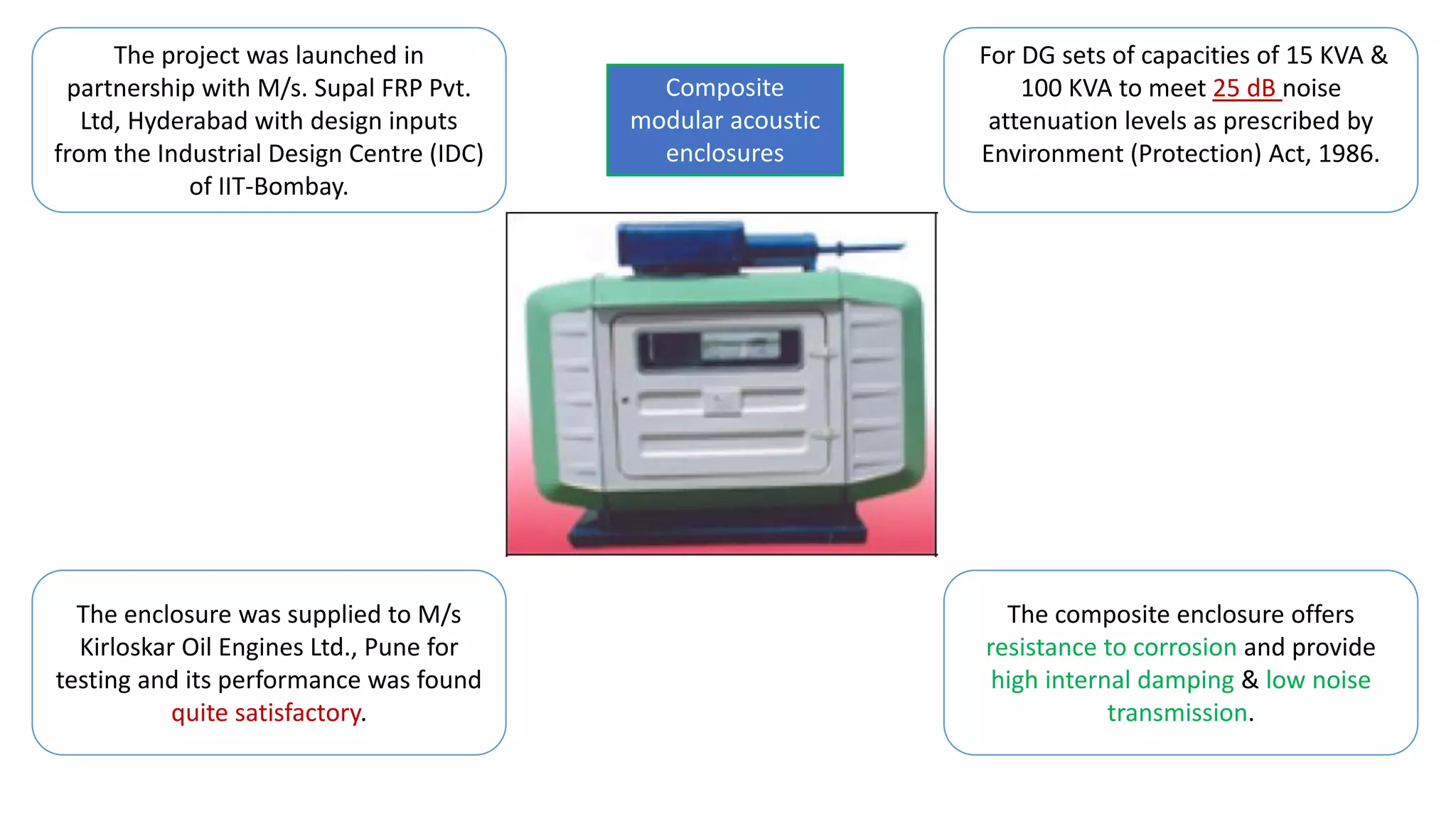
The project was launched in
partnership with M/s. Supal FRP Pvt.
Ltd, Hyderabad with design inputs
from the Industrial Design Centre (IDC)
of IIT-Bombay.
For DG sets of capacities of 15 KVA &
100 KVA to meet 25 dB noise
attenuation levels as prescribed by
Environment (Protection) Act, 1986.
The enclosure was supplied to M/s
Kirloskar Oil Engines Ltd., Pune for
testing and its performance was found
quite satisfactory.
The composite enclosure offers
resistance to corrosion and provide
high internal damping & low noise
transmission.
Composite
modular acoustic
enclosures
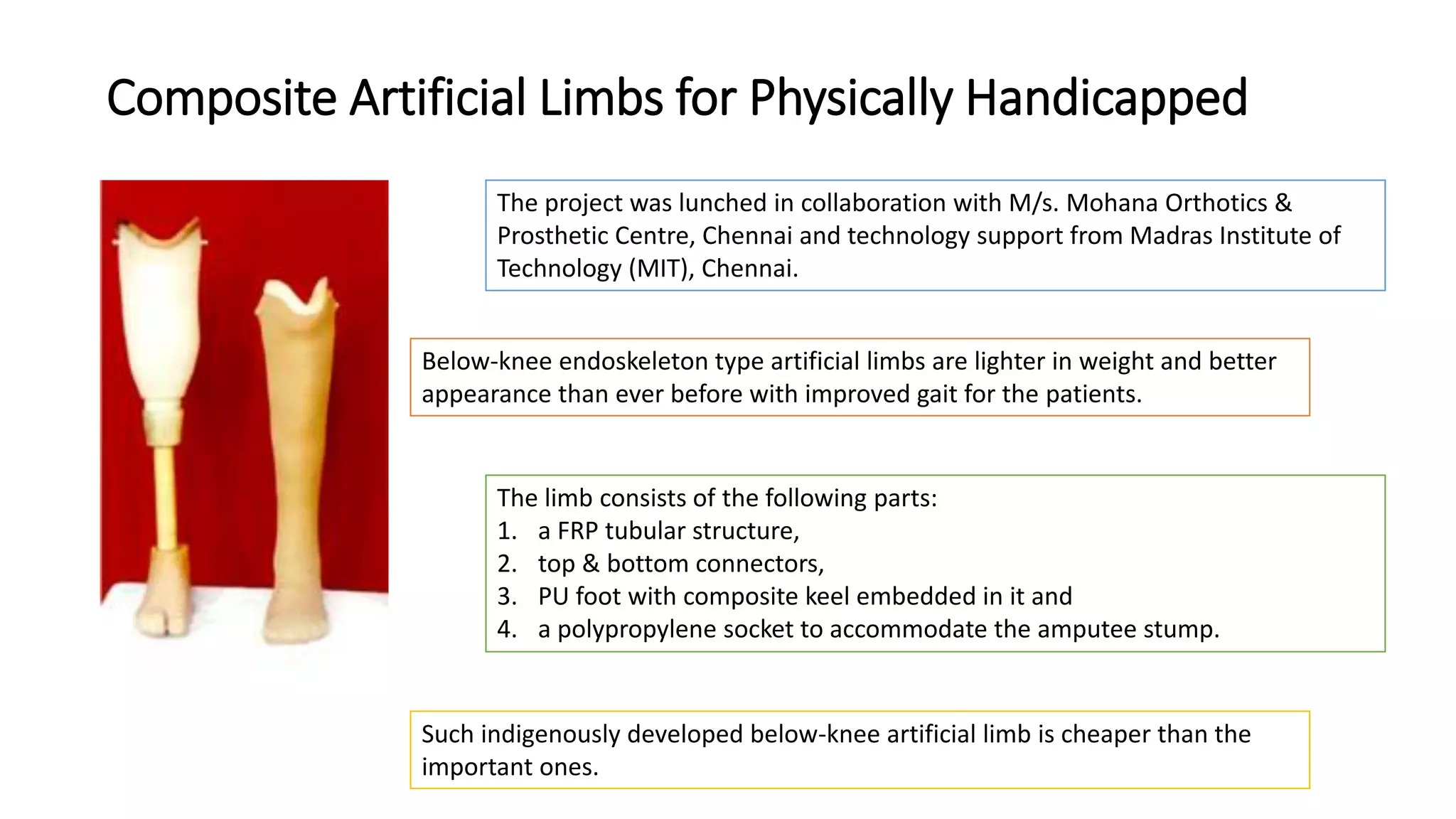
Composite Artificial Limbs for Physically Handicapped
The project was lunched in collaboration with M/s. Mohana Orthotics &
Prosthetic Centre, Chennai and technology support from Madras Institute of
Technology (MIT), Chennai.
Below-knee endoskeleton type artificial limbs are lighter in weight and better
appearance than ever before with improved gait for the patients.
The limb consists of the following parts:
1. a FRP tubular structure,
2. top & bottom connectors,
3. PU foot with composite keel embedded in it and
4. a polypropylene socket to accommodate the amputee stump.
Such indigenously developed below-knee artificial limb is cheaper than the
important ones.
References
• An Introduction to Composite Materials, D.Hull & T.W.Clyne, Second
Edition, Cambridge Solid State Science series
• Introduction to Composite Materials and Structures ,
nptel.ac.in/courses/112104168/L01, Nachiketa Tiwari, Indian Institute
of Technology Kanpur
• http://nptel.ac.in/courses/105108124/11#, Dr.P.C.Pandey, IISc
Bangalore, Composite materials; Civil Engineering
• https://youtu.be/tZhH2B-EI1I

Application of Composite Materials for different mechanical components

  • 1.
    Application of Compositematerials for different mechanical components Piyush Mishra (BE-Mechanical) Sinhgad College of Engineering, Vadgaon(Bk.),Pune
  • 2.
    Inspiration from mothernature LIGHT-WEIGHT FLEXIBILTY ROBUSTNESS STRENGTH STIFFNESS TOUGHNESS CORROSION RESISTANCE FATIGUE LIFE WEAR RESISTANCE FATIGUE LIFETAILORABLE REDUCED WEIGHT ATTRACTIVENESS
  • 3.
    Composite materials Wood Cellulosefibers bound by lignin matrix Bones Stiff mineral “fibers” in a soft organic matrix permeated with holes filled with liquids Granite Granular composite of quartz, feldspar, and mica Two or more chemically different constituents combined macroscopically to yield a useful material.
  • 4.
  • 5.
    Definition: • A materialwhich is composed of two or more materials at a microscopic scale and have chemically distinct phases. • Heterogeneous at a microscopic scale but statistically homogeneous at macroscopic scale. • Constituent materials have significantly different properties. • Conditions for a material to qualify as a composite: 1. Combination of materials should result in significant property changes. 2. Content of the constituents is generally more than 10 % 3. In general, property of one constituent is much greater ( ≥ 5 times) than the other.
  • 6.
    Anatomy of compositematerials Re-inforcement: discontinuous ,stronger ,harder Matrix: Continuous
  • 7.
    Anatomy of compositematerials What are the functions of reinforcement? 1. Contribute desired properties 2. Load carrying 3. Transfer the strength to matrix What are the functions of a matrix? 1. Holds the fibres together 2. Protects the fibres from environment 3. Protects the fibres from abrasion (with each other) 4. Helps to maintain the distribution of fibres 5. Distributes the loads evenly between fibres
  • 8.
    Classification Composites Random Orientation Preferred Orientation Particulate Fibrous Single LayerMulti-layer Continuous & Long fibres Discontinuous & short fibres Hybrid LaminateLaminate
  • 9.
    • High beamstiffness • High torsional stiffness • Low density • Good fatigue resistance Tailoring the elastic properties via control of the fibre architecture Problem arises due to combined forward & rotational motion Necessary torsional stiffness Beam strength Helicopter Rotor Blade
  • 10.
    Composite Pressure Vessels Theproject was launched in partnership with M/s. Kineco Pvt. Ltd., Panaji and with technology support from IIT-Bombay. The project aimed at developing filament wound pressure vessels for the following applications. 1. Undercarriage FRP tanks (450 mm diameter with 2.00 bar operating pressure to be fitted to the railway passenger coaches for water supply to the toilets ). 2. Two sizes of pressure vessels (500 mm & 600 mm diameter) for water treatment application; operating pressure : 3.50 bar.
  • 11.
    The project waslaunched in partnership with M/s. Supal FRP Pvt. Ltd, Hyderabad with design inputs from the Industrial Design Centre (IDC) of IIT-Bombay. For DG sets of capacities of 15 KVA & 100 KVA to meet 25 dB noise attenuation levels as prescribed by Environment (Protection) Act, 1986. The enclosure was supplied to M/s Kirloskar Oil Engines Ltd., Pune for testing and its performance was found quite satisfactory. The composite enclosure offers resistance to corrosion and provide high internal damping & low noise transmission. Composite modular acoustic enclosures
  • 12.
    Composite Artificial Limbsfor Physically Handicapped The project was lunched in collaboration with M/s. Mohana Orthotics & Prosthetic Centre, Chennai and technology support from Madras Institute of Technology (MIT), Chennai. Below-knee endoskeleton type artificial limbs are lighter in weight and better appearance than ever before with improved gait for the patients. The limb consists of the following parts: 1. a FRP tubular structure, 2. top & bottom connectors, 3. PU foot with composite keel embedded in it and 4. a polypropylene socket to accommodate the amputee stump. Such indigenously developed below-knee artificial limb is cheaper than the important ones.
  • 13.
    References • An Introductionto Composite Materials, D.Hull & T.W.Clyne, Second Edition, Cambridge Solid State Science series • Introduction to Composite Materials and Structures , nptel.ac.in/courses/112104168/L01, Nachiketa Tiwari, Indian Institute of Technology Kanpur • http://nptel.ac.in/courses/105108124/11#, Dr.P.C.Pandey, IISc Bangalore, Composite materials; Civil Engineering • https://youtu.be/tZhH2B-EI1I