COMPOSITE MATERIALS
GROUP 5(BSME 3-A)
MEMBERS:
RAÑOLA, KRISTA NIÑA SAYAT
REBETA, LOUIS IAN ENCISO
REMALLA , JHORENCE BENAID
REMALLA, JOHN PAUL
INSTRUCTOR:
ENGR. ANGELO V. RAMOS
2.
Composite materials arethose which are created
artificially by combining two or more materials which
usually have dissimilar characteristics.
or
Materials system composed of a combination of two or
more constituents that differ in form and chemical
composition and which are insoluble in each other.
3.
Composite materials isformed when one or more
material distributed or re-inforced in a continuous
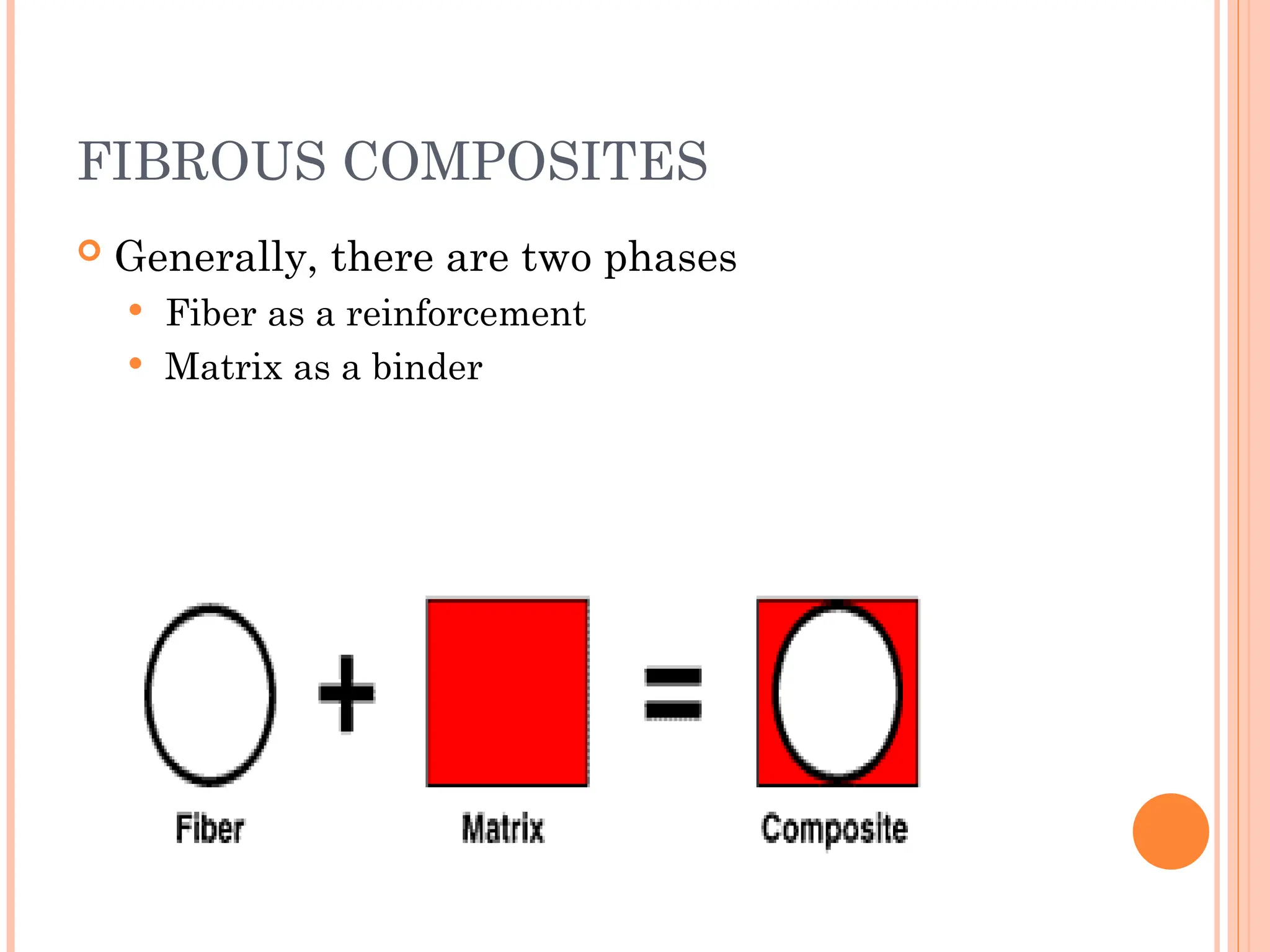
second phase called ‘matrix’.
The matrix phase surrounds the other phase which
is called the dispersoid or re-inforcement.
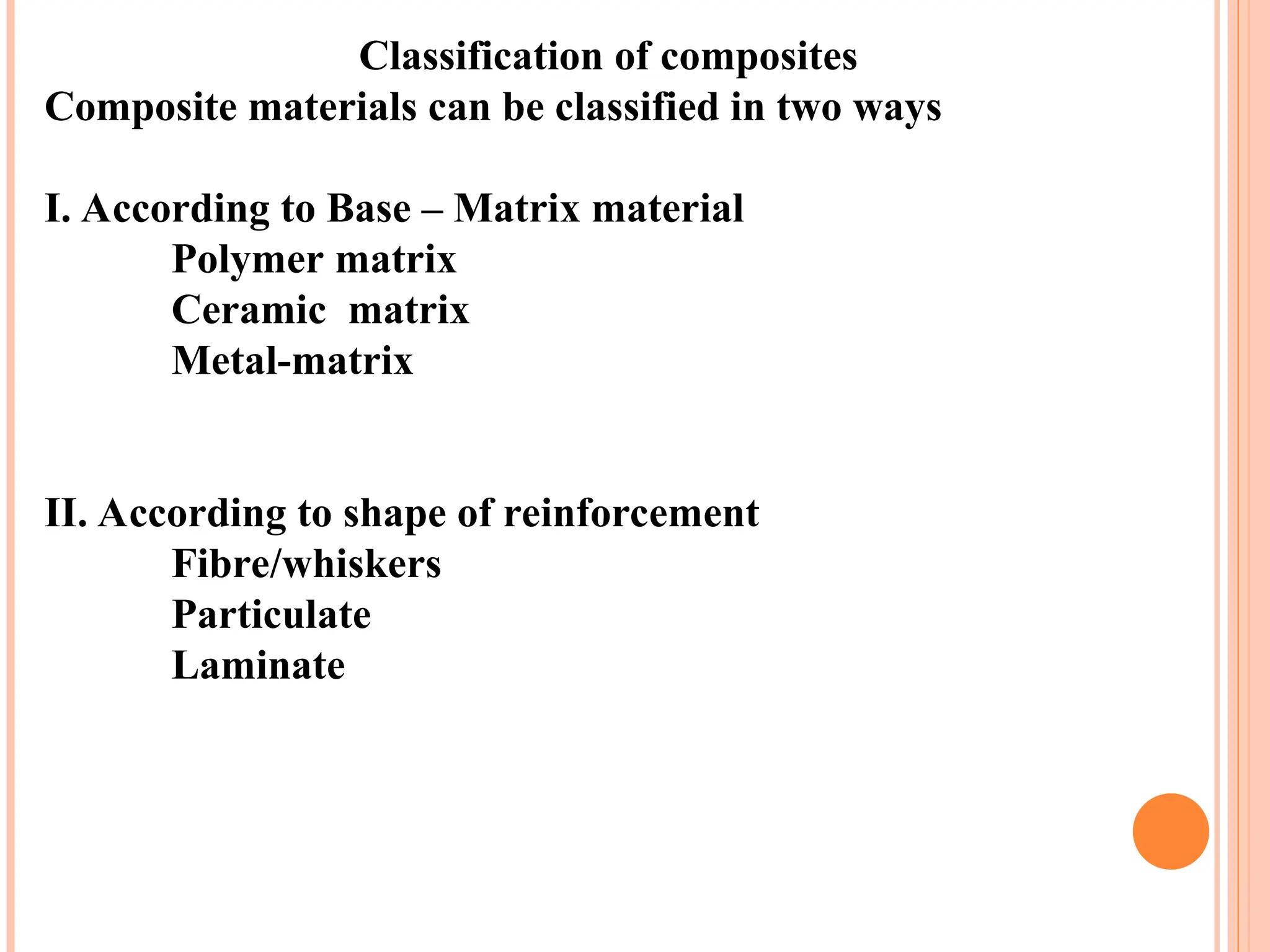
Classification of composites
Compositematerials can be classified in two ways
I. According to Base – Matrix material
Polymer matrix
Ceramic matrix
Metal-matrix
II. According to shape of reinforcement
Fibre/whiskers
Particulate
Laminate
6.
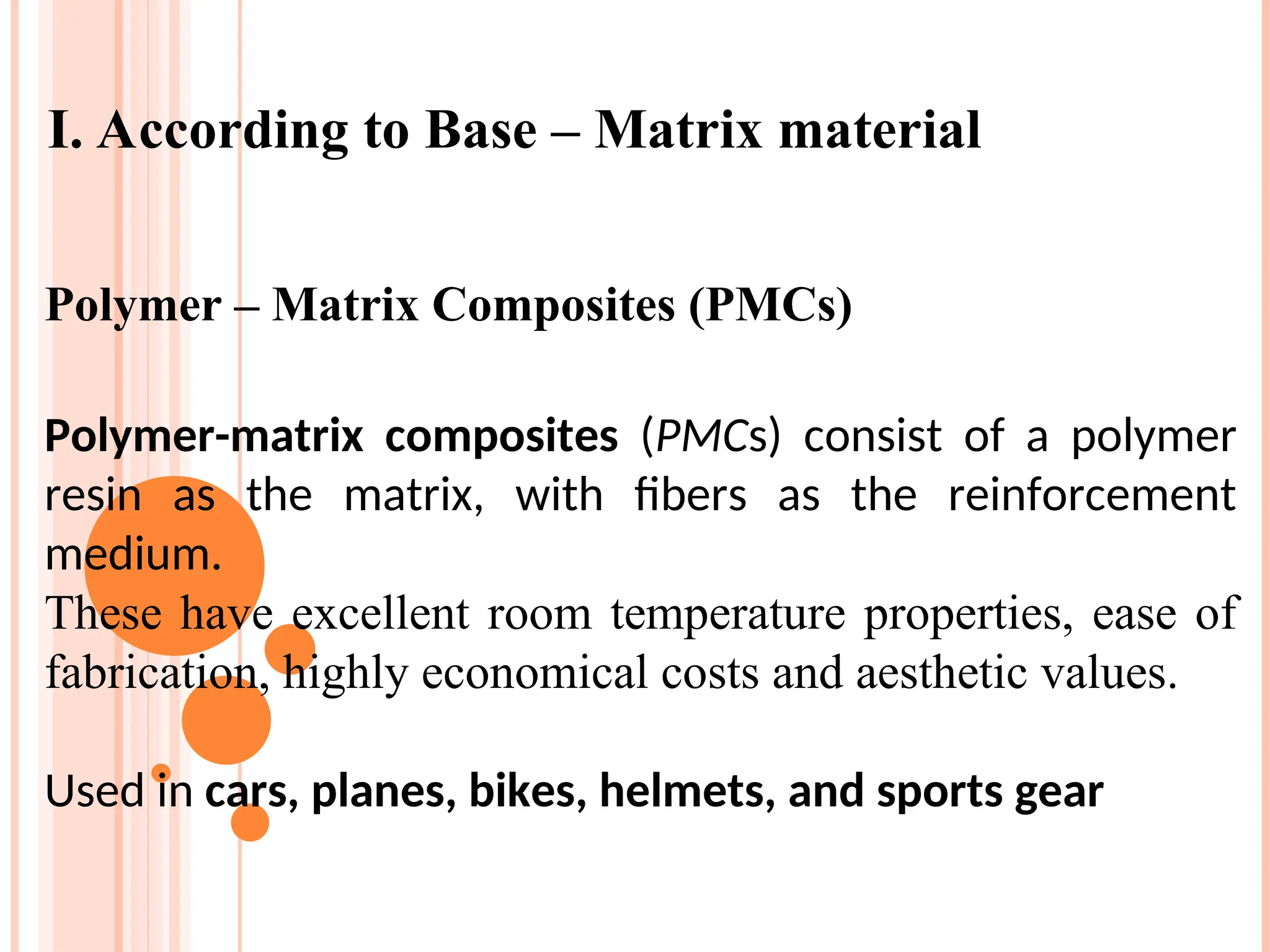
Polymer – MatrixComposites (PMCs)
Polymer-matrix composites (PMCs) consist of a polymer
resin as the matrix, with fibers as the reinforcement
medium.
These have excellent room temperature properties, ease of
fabrication, highly economical costs and aesthetic values.
Used in cars, planes, bikes, helmets, and sports gear
I. According to Base – Matrix material
7.
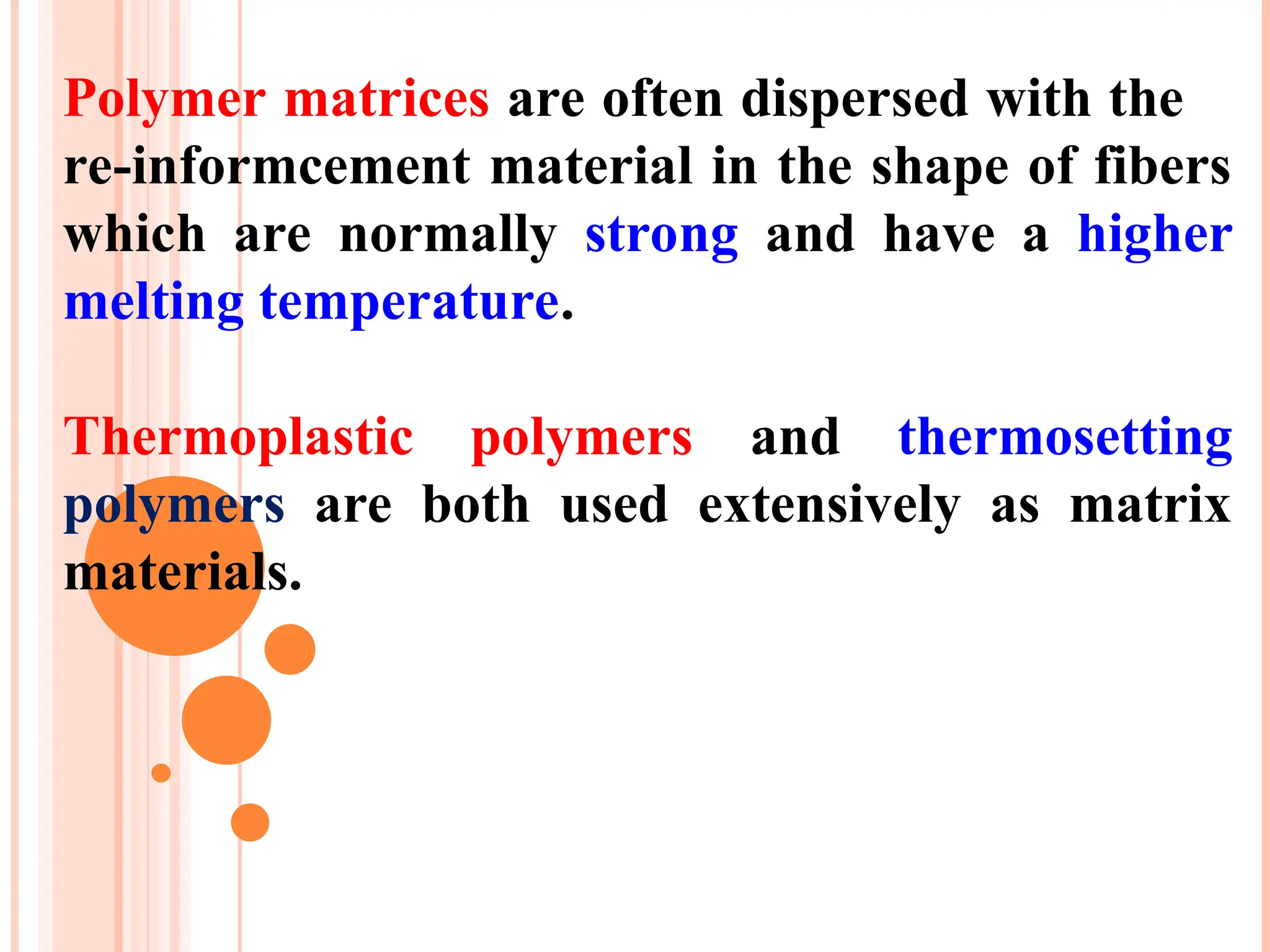
Polymer matrices areoften dispersed with the
re-informcement material in the shape of fibers
which are normally strong and have a higher
melting temperature.
Thermoplastic polymers and thermosetting
polymers are both used extensively as matrix
materials.
8.
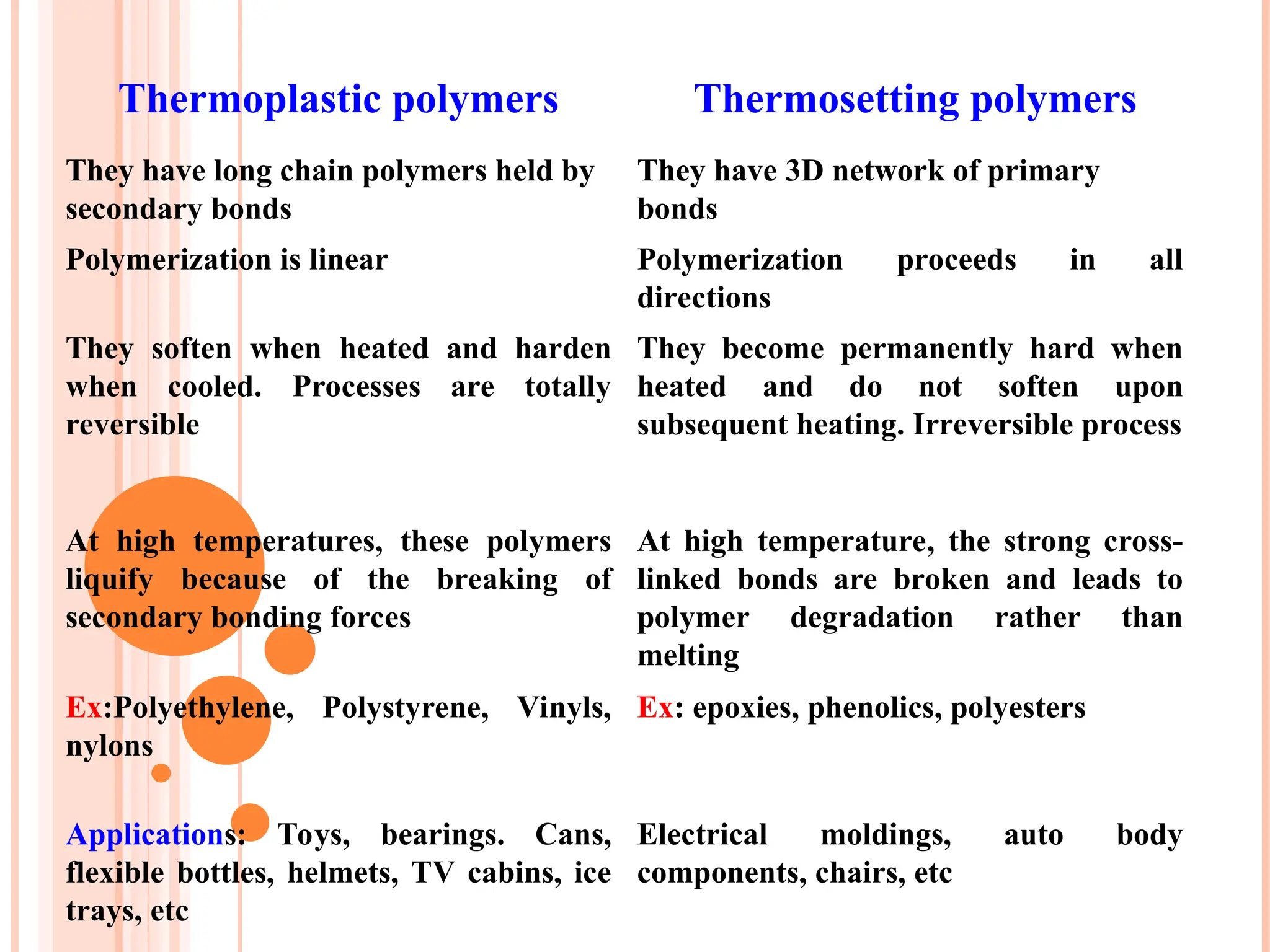
Thermoplastic polymers Thermosettingpolymers
They have long chain polymers held by
secondary bonds
They have 3D network of primary
bonds
Polymerization is linear Polymerization proceeds in all
directions
They soften when heated and harden
when cooled. Processes are totally
reversible
They become permanently hard when
heated and do not soften upon
subsequent heating. Irreversible process
At high temperatures, these polymers
liquify because of the breaking of
secondary bonding forces
At high temperature, the strong cross-
linked bonds are broken and leads to
polymer degradation rather than
melting
Ex:Polyethylene, Polystyrene, Vinyls,
nylons
Ex: epoxies, phenolics, polyesters
Applications: Toys, bearings. Cans,
flexible bottles, helmets, TV cabins, ice
trays, etc
Electrical moldings, auto body
components, chairs, etc
• Some examplesof man made composites
‐
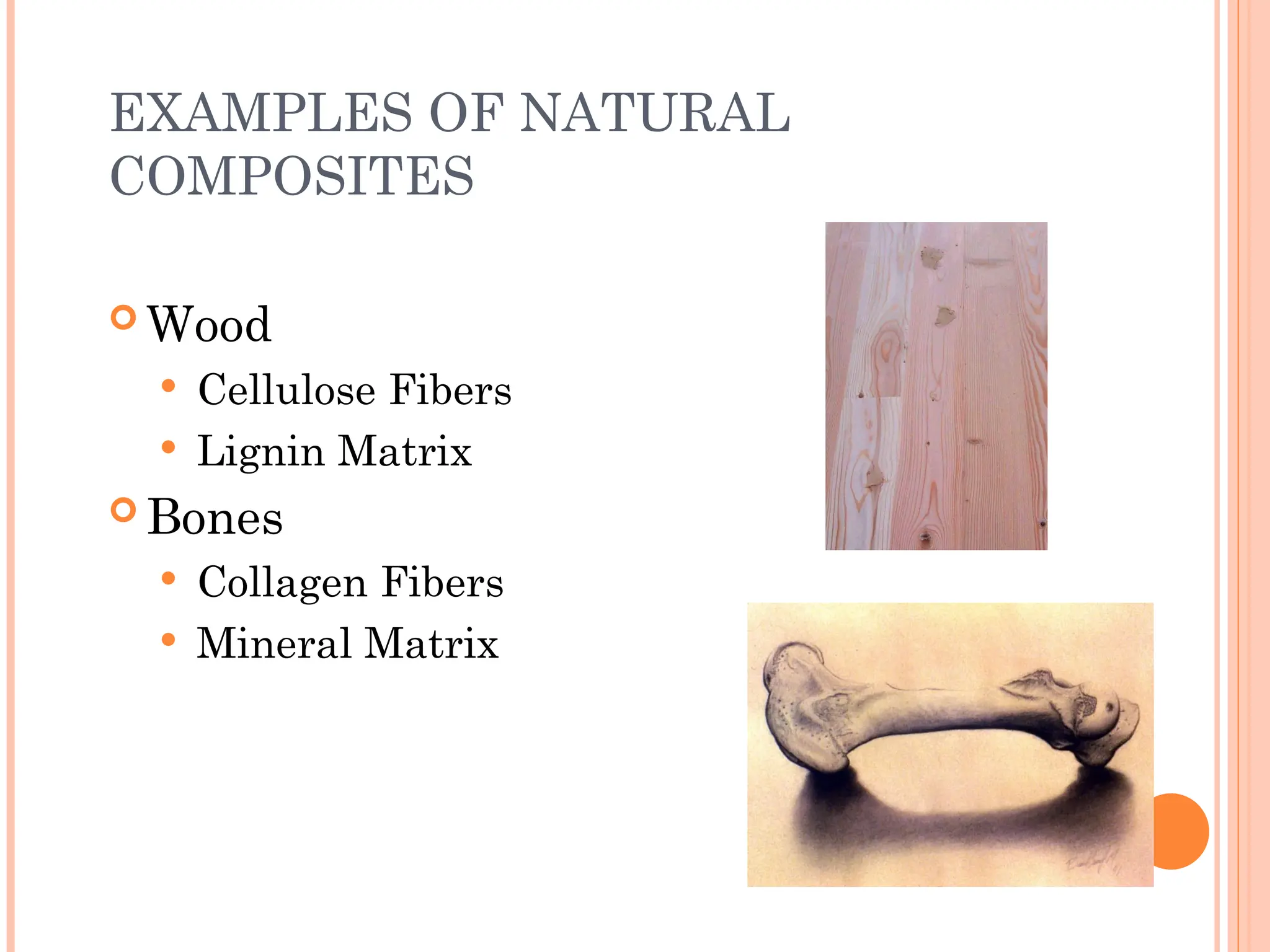
– Concrete: Particulate composite of aggregates (limestone or granite),
sand, cement and water
– Plywood: Several layers of wood veneer glued together
– Fiberglass: Plastic matrix reinforced by glass fibers
– Fibrous composites:Variety of fibers (glass, graphite, nylon, etc.)
bound together by a polymeric matrix
11.
Classifications of PMCsare discussed according to
reinforcement type (i.e., glass and carbon,)
1.Glass Fiber–Reinforced Polymer (GFRP) Composites
2.Carbon Fiber–Reinforced Polymer (CFRP) Composites
12.
Glass Fiber–Reinforced Polymer(GFRP) Composites:
•Fiberglass is simply a composite consisting of glass fibers, either
continuous or discontinuous, contained within a polymer matrix
•Glass is popular as a fiber reinforcement material for several
reasons:
1. It is easily drawn into high-strength fibers from the molten
state.
2. It is readily available
3. As a fiber it is relatively strong, and when embedded in a
plastic matrix
Many fiberglass applications are familiar: automotive and
marine bodies, plastic pipes, etc.
13.
2. Carbon Fiber–ReinforcedPolymer (CFRP) Composites
• Carbon is a high-performance fiber material that is the most used
reinforcement in advanced (i.e., non fiberglass) polymer-matrix
composites.
• The reasons for this are as follows:
1. Carbon fibers have the highest specific strength of all
reinforcing fiber materials.
2. They retain their high tensile modulus and high strength at
elevated temperatures;
3. At room temperature, carbon fibers are not affected by
moisture or a wide variety of solvents, acids, and bases.
• Carbon-reinforced polymer composites are currently being used
extensively in sports, pressure vessels, and aircraft structural
components—both military and commercial, fixed-wing and
helicopters
14.
Ceramic Matric Composites(CMC)
Ceramic materials are very well known for their high temperature
properties as well as their resistance to oxidation. But they are very
brittle which limits their applications.
The fracture toughness's of ceramics have been improved
significantly by the development of a new generation of ceramic-
matrix composites (CMCs)
Ceramic matrix materials used are :
Silicon nitride (Si3N4)
Silicon carbide (SiC)
Alumina (Al2O3)
Zirconium dioxide (ZrO2)
But it is fact that ceramics make better reinforcement materials than
matrix materials
15.
Metal Matrix Composites(MMC)
Here, metals are alloys used as Matrix materials.
Metals used are usually ductile in nature and reinforced with
strong and low-density materials of all shapes – fibers, whiskers
and particulate.
Such combination improves materials stiffness, abrasion
resistance, creep resistance, thermal conductivity and
dimensional stability.
Alloys of Al, Mg, Ti and Cu are generally employed as matrix
materials.
The reinforcement in the form of fibers, whiskers or particulates
are in MMC’s in the range of 10 and 60% by volume.
Popular reinforcement include C, SiC, Boron, Alumina
Ex: Al-alloy matrix with alumina & C fibers used in automobiles as engine
components.
16.
II. According toshape of reinforcement
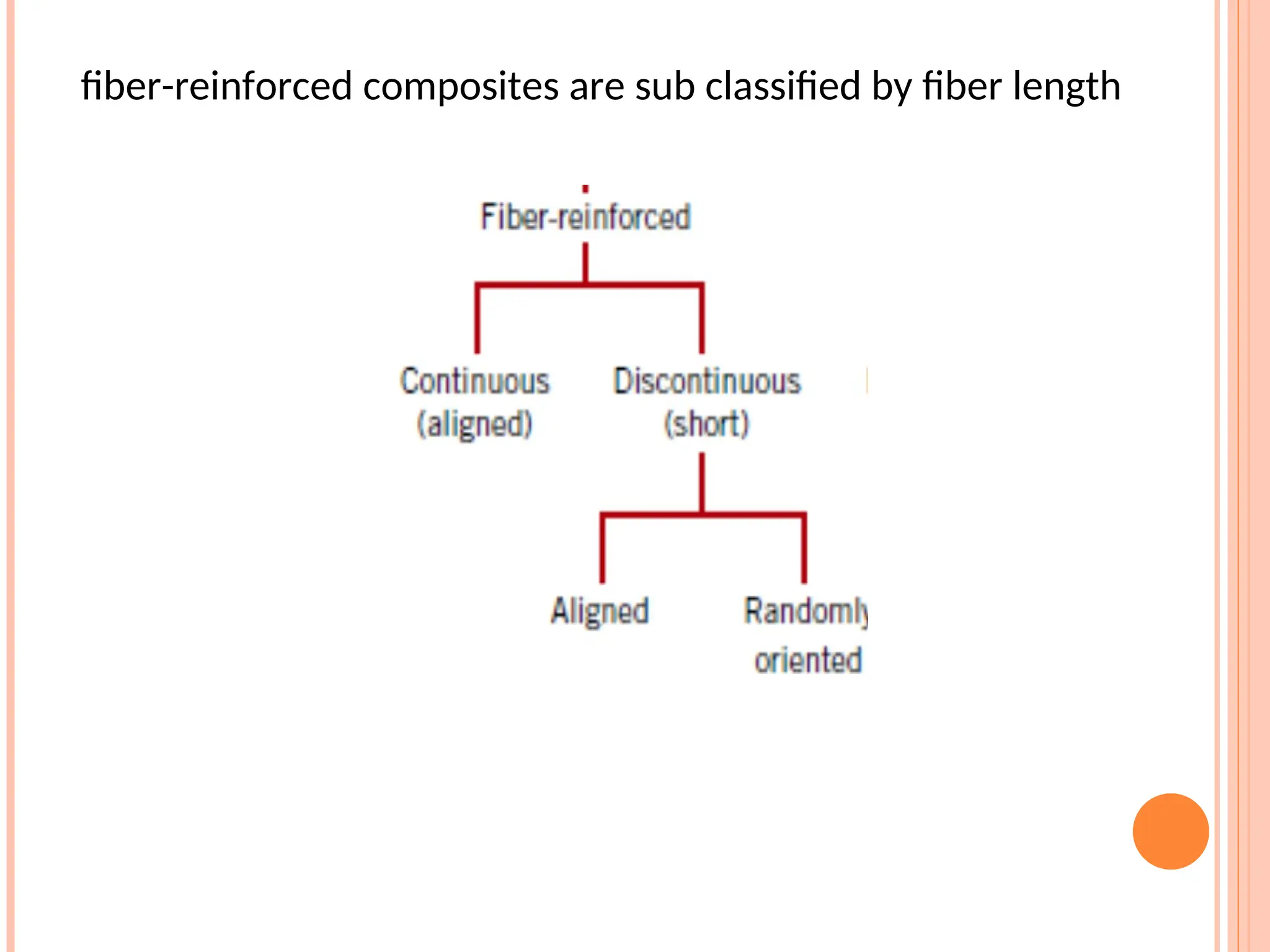
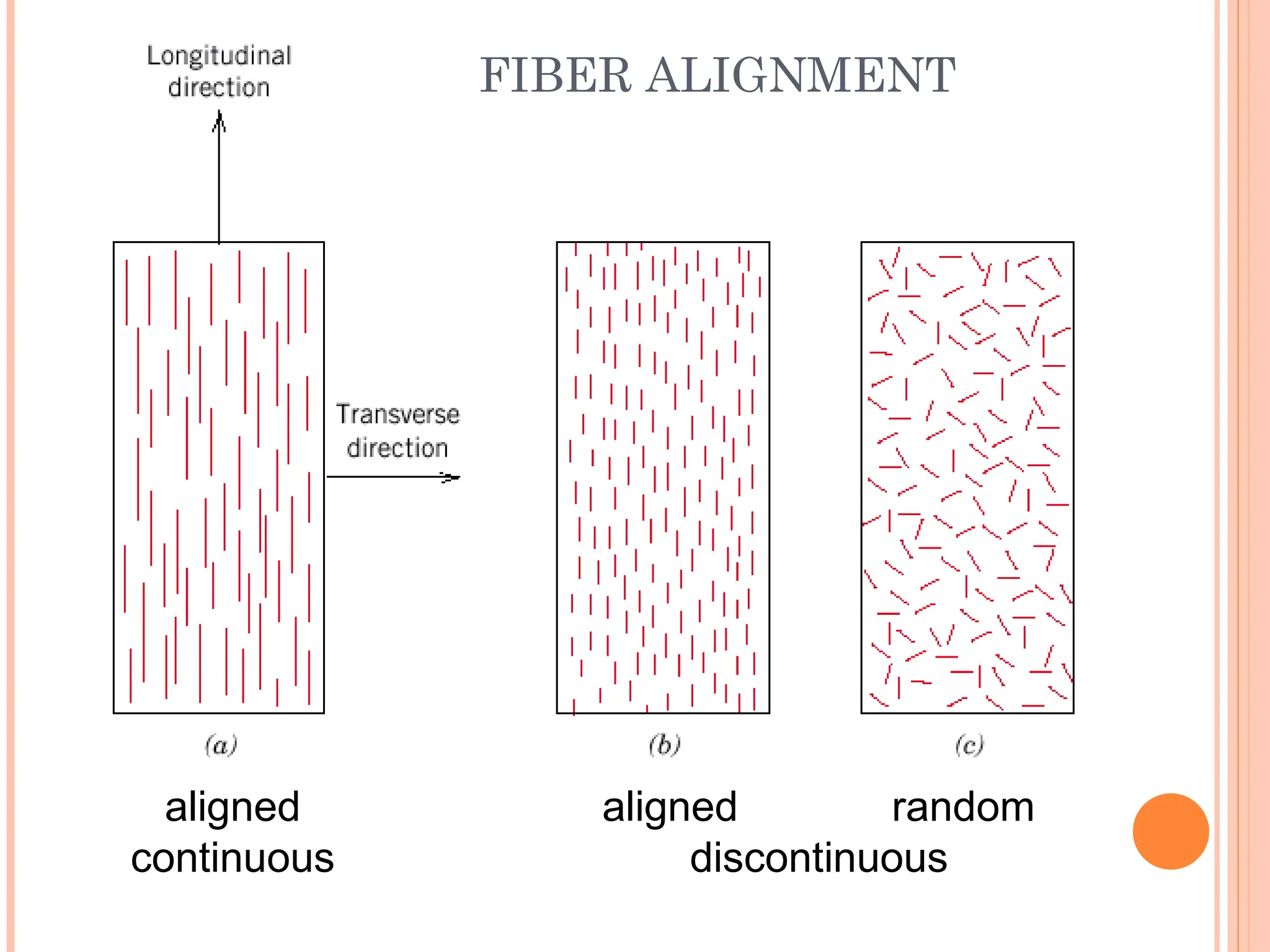
• Most fiber-reinforced composites provide improved strength and
other mechanical properties and strength-to-weight ratio .
• The characteristics of Fiber-Reinforced Composites are expressed
in terms of specific strength and specific modulus
• specific strength is the ratios of tensile strength to specific
gravity
• specific modulus is modulus of elasticity to specific gravity.
The matrix material acts as a medium to transfer the load to the
fibers, which carry most off the applied load. The matrix also
provides protection to fibers from external loads and atmosphere
1. Fiber-Reinforced Composites
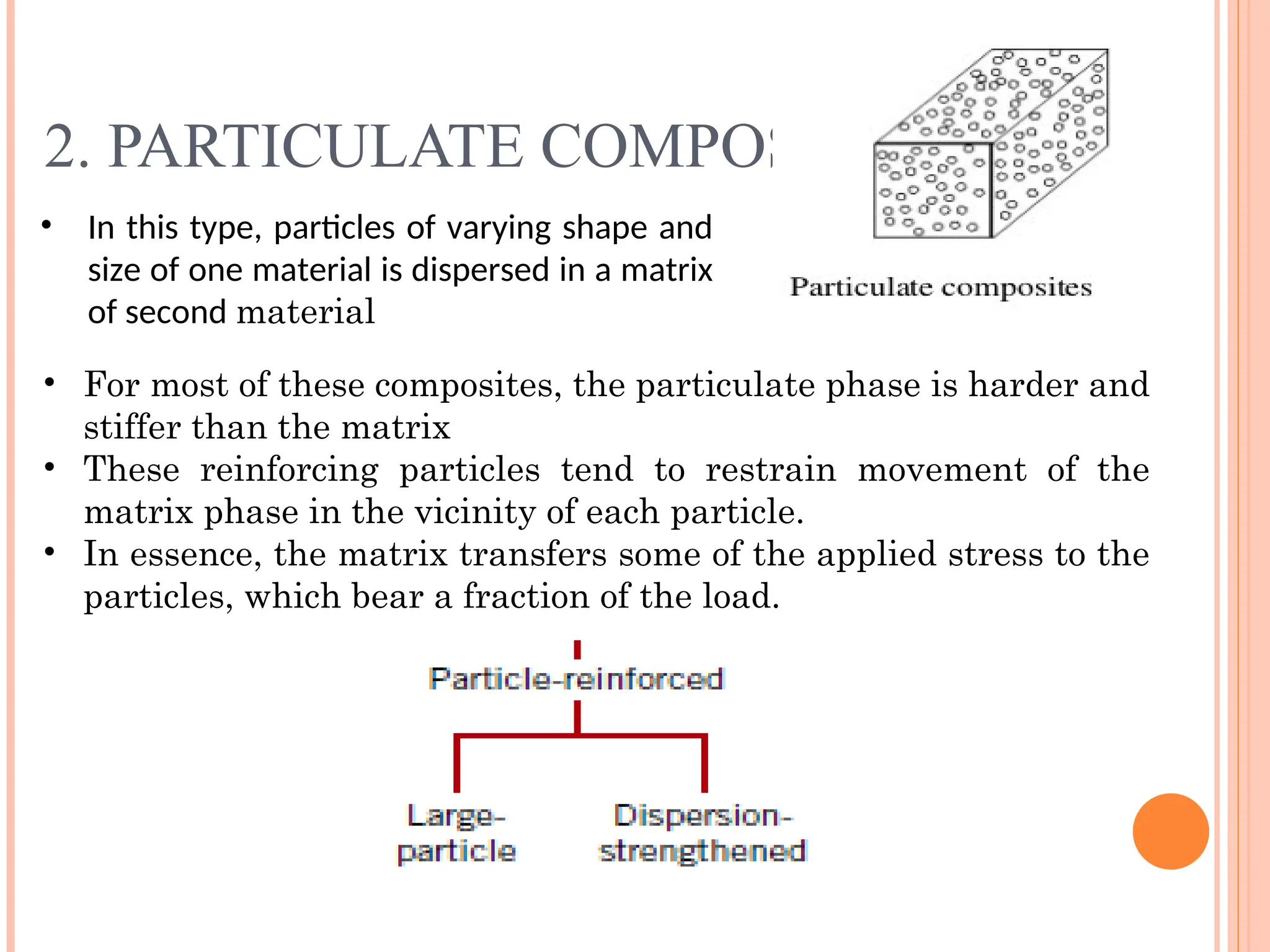
2. PARTICULATE COMPOSITE
•In this type, particles of varying shape and
size of one material is dispersed in a matrix
of second material
• For most of these composites, the particulate phase is harder and
stiffer than the matrix
• These reinforcing particles tend to restrain movement of the
matrix phase in the vicinity of each particle.
• In essence, the matrix transfers some of the applied stress to the
particles, which bear a fraction of the load.
20.
Large-particle composite:
Example oflarge-particle composite is concrete, which is
composed of cement (the matrix) and sand and gravel
(the particulates).
Large-particle composites are used with all three
material types (metals, polymers, and ceramics).
21.
Dispersion-strengthened composites:
For dispersion-strengthenedcomposites, particles
are normally much smaller, with diameters
between 0.01 and 0.1 μm (10 and 100 nm).
The matrix bears the major portion of an applied
load, then small dispersed particles hinder or
impede the motion of dislocations.
The dispersed phase may be metallic or
nonmetallic; oxide materials are often used
22.
3. LAMINAR COMPOSITES
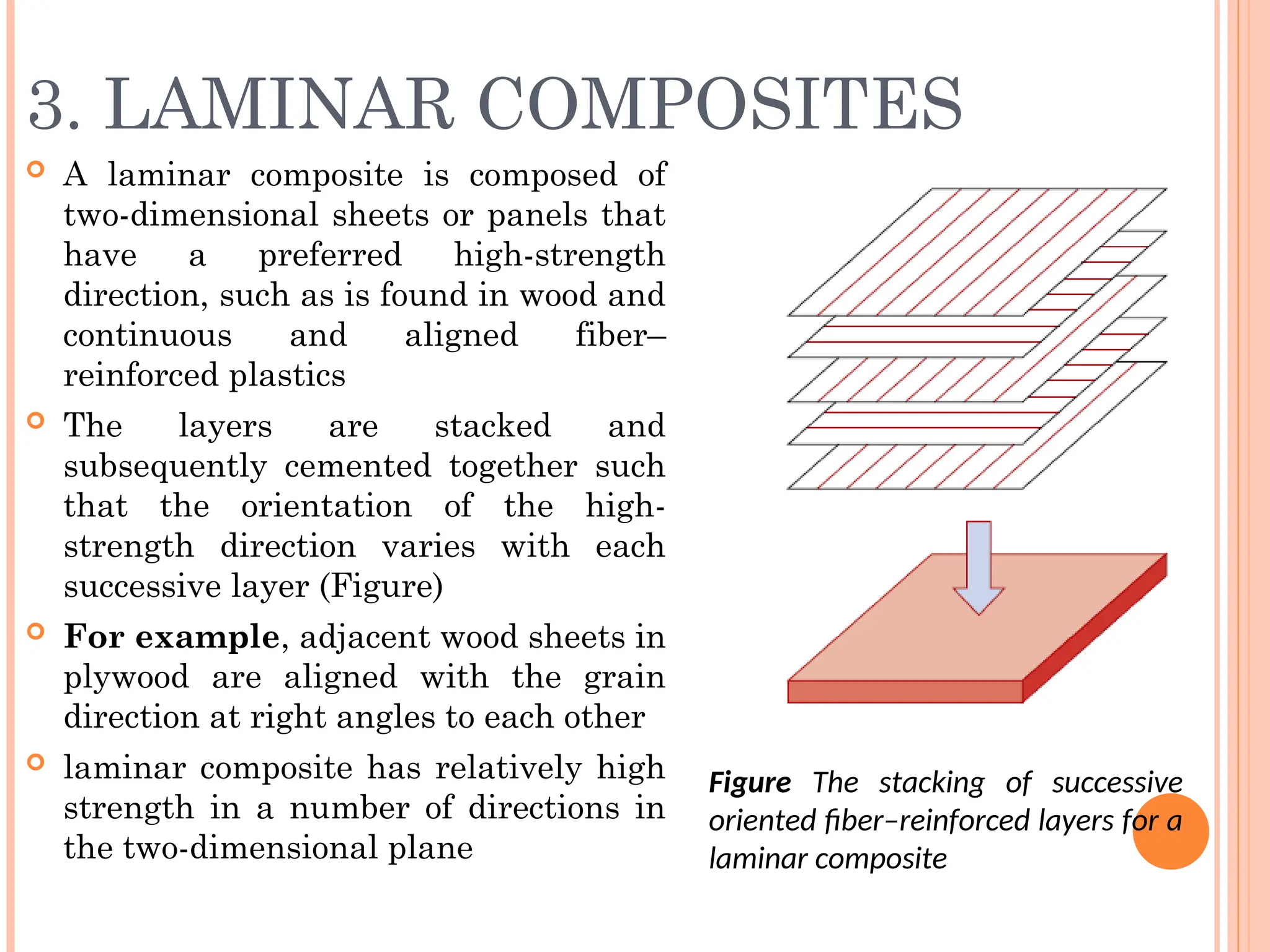
A laminar composite is composed of
two-dimensional sheets or panels that
have a preferred high-strength
direction, such as is found in wood and
continuous and aligned fiber–
reinforced plastics
The layers are stacked and
subsequently cemented together such
that the orientation of the high-
strength direction varies with each
successive layer (Figure)
For example, adjacent wood sheets in
plywood are aligned with the grain
direction at right angles to each other
laminar composite has relatively high
strength in a number of directions in
the two-dimensional plane
Figure The stacking of successive
oriented fiber–reinforced layers for a
laminar composite
23.
ROLE OF MATRIX,REINFORCEMENT,
INTERFACE IN COMPOSITE
MATERIAL
Role of matrix
Holds the fibers together.
To transfer the load to the reinforcement
Protects the fibers from environment.
Distributes the loads evenly between fibers so that all fibers are subjected
to the same amount of strain.
Enhances transverse properties of a laminate.
Improves impact and fracture resistance of a component.
Helps to avoid propagation of crack growth through the fibers
24.
Role of reinforcement
toCarry the load in the composite system
The role of the reinforcement in a composite
material is fundamentally one of increasing the
mechanical properties of the neat resin system
To strengthen and stiffen the composite through
prevention of matrix deformation by mechanical
restraint.
the reinforcement also serves to reduce the
density of the composite, thus enhancing properties
such as specific strength.
25.
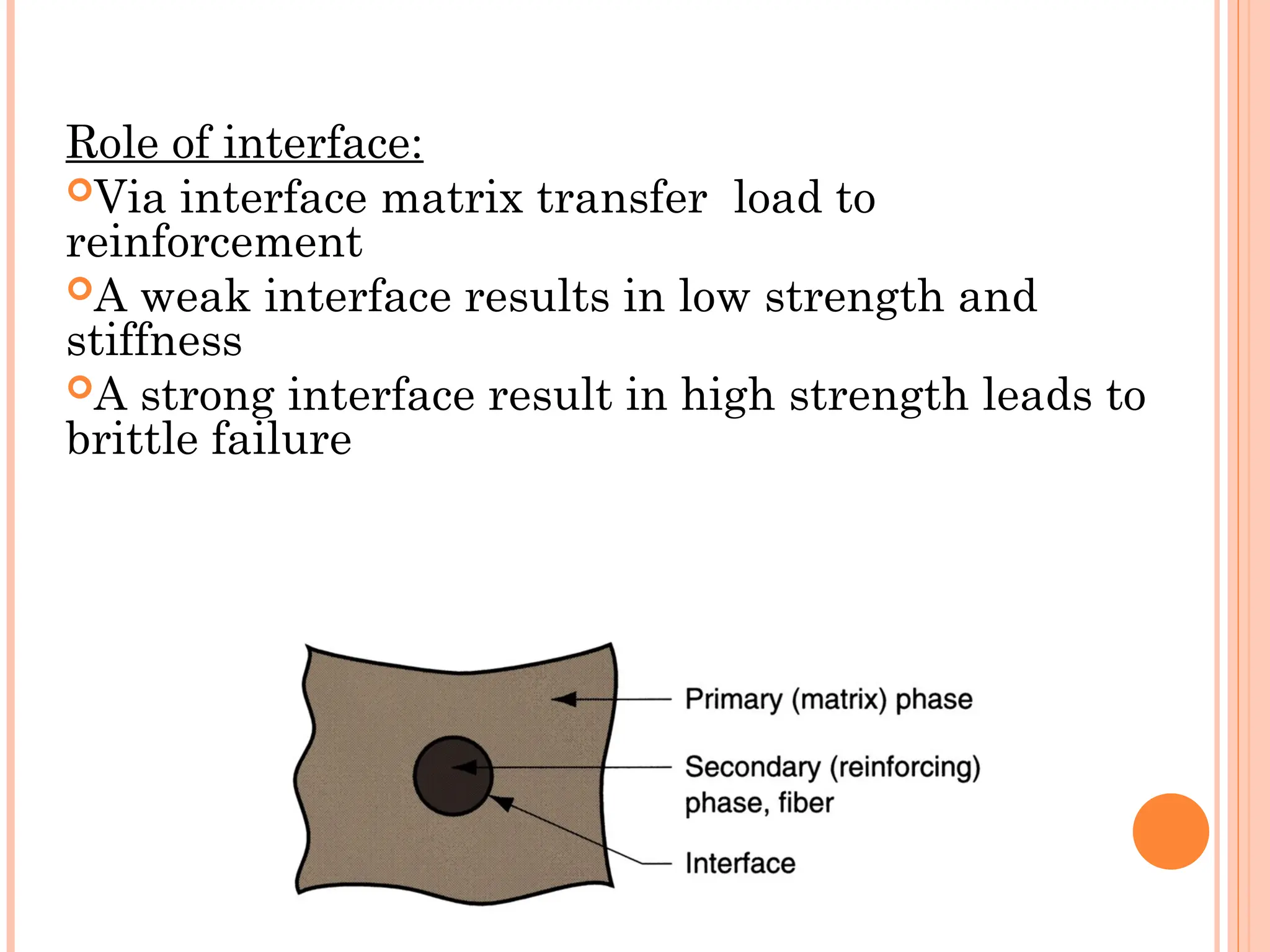
Role of interface:
Viainterface matrix transfer load to
reinforcement
A weak interface results in low strength and
stiffness
A strong interface result in high strength leads to
brittle failure
HYBRID COMPOSITE
Newfiber-reinforced composite is the hybrid, which is
obtained by using two or more different kinds of fibers in a
single matrix;
In the most common system, both carbon and glass fibers
are incorporated into a polymeric resin.
The carbon fibers are strong and relatively stiff and provide
a low-density reinforcement; however, they are expensive.
Glass fibers are inexpensive and lack the stiffness of
carbon.
28.
The glass–carbonhybrid is stronger and tougher,
has a higher impact resistance, and may be
produced at a lower cost than either of the
comparable all-carbon or all-glass reinforced
plastics
Principal applications for hybrid composites are
lightweight land, water, and air transport
structural components, sporting goods, and
lightweight orthopedic components
29.
COMMERCIALLY AVAILABLE
FORMS OFREINFORCEMENT
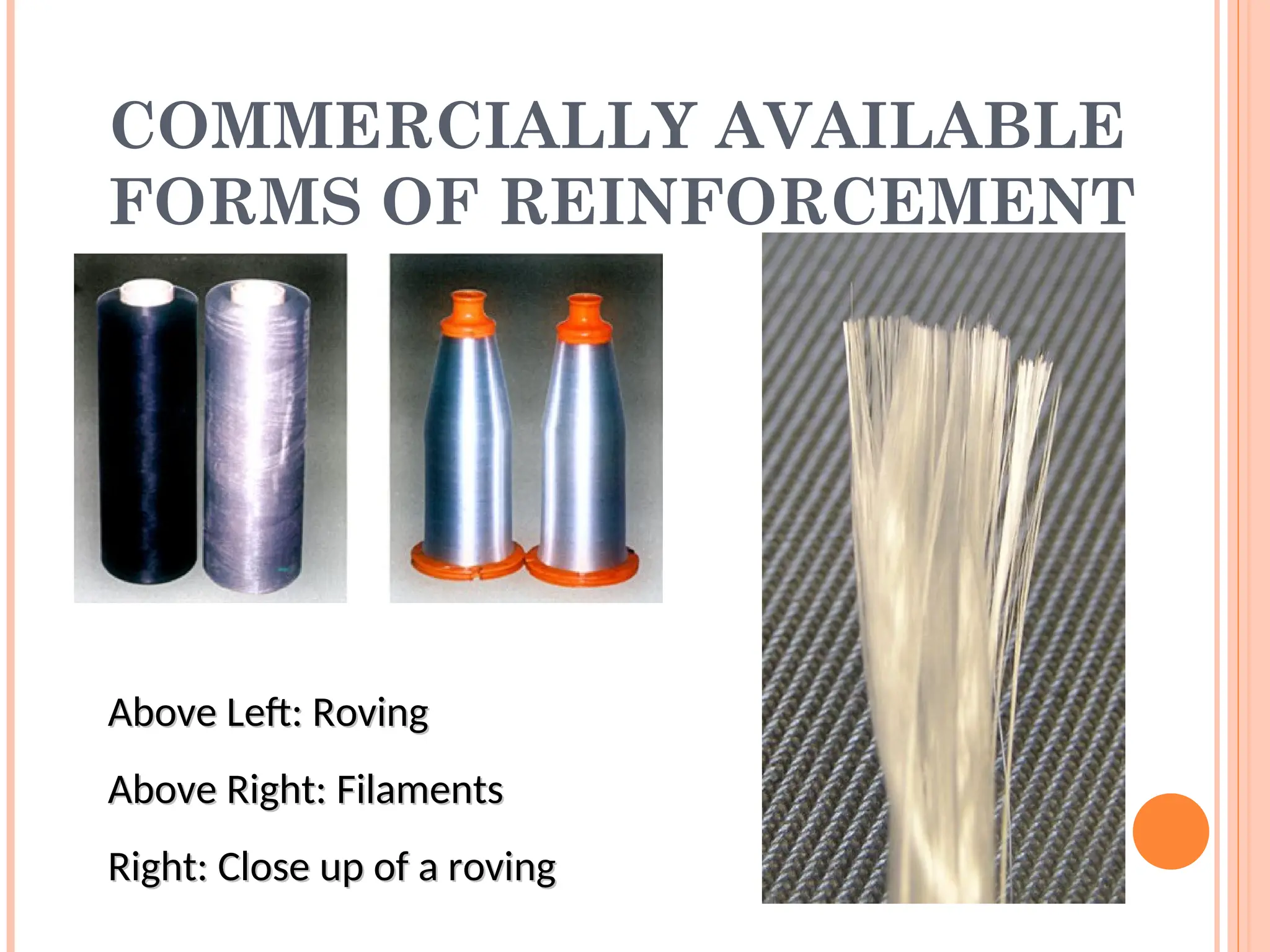
-Filament: a single thread like fiber
-Roving: a bundle of filaments wound to form a large
strand
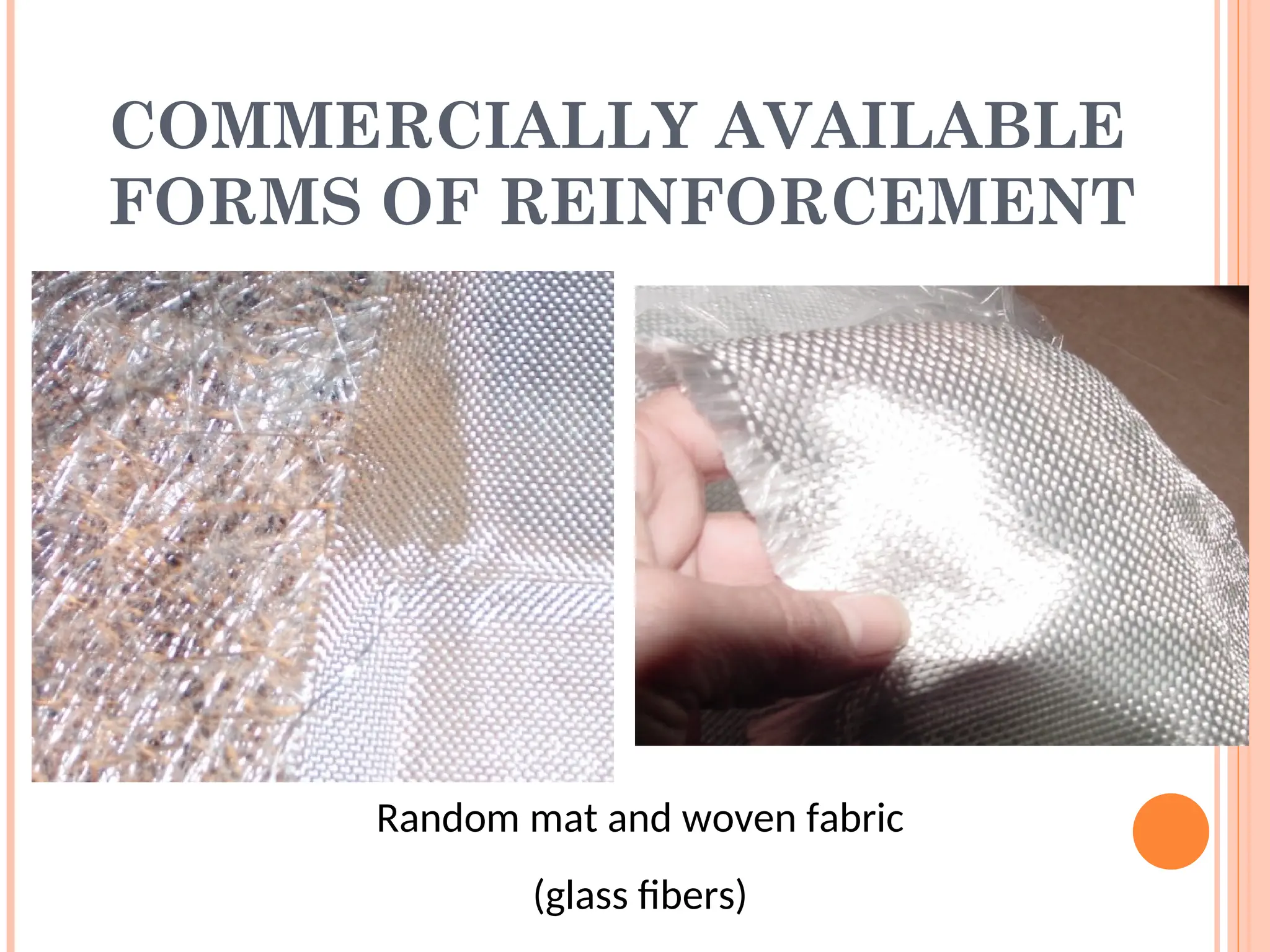
-Chopped strand mat: assembled from chopped
filaments bound with a binder
-Continuous filament random mat: assembled from
continuous filaments bound with a binder
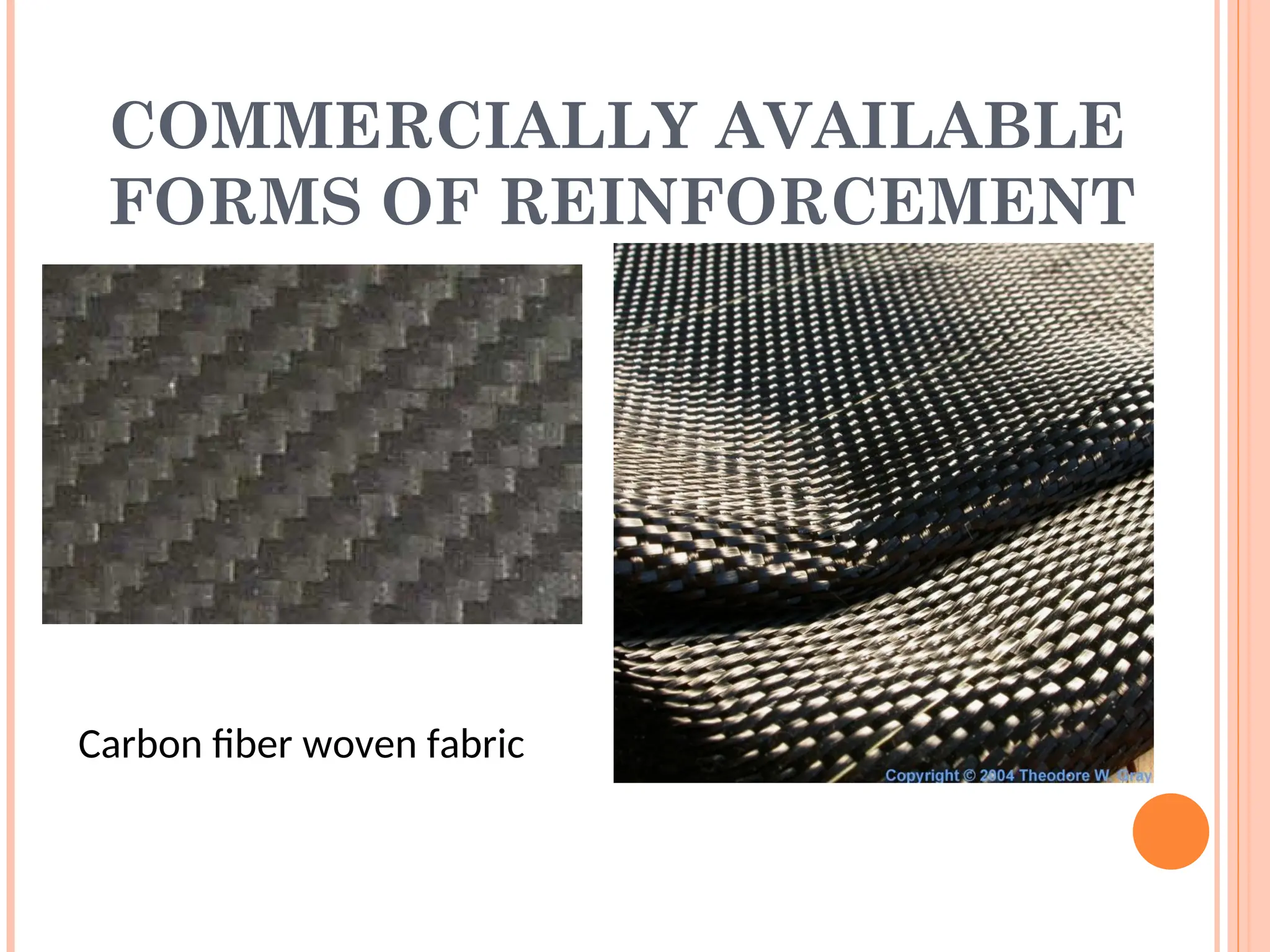
-Many varieties of woven fabrics: woven from
rovings
30.
COMMERCIALLY AVAILABLE
FORMS OFREINFORCEMENT
Above Left: Roving
Above Left: Roving
Above Right: Filaments
Above Right: Filaments
Right: Close up of a roving
Right: Close up of a roving
FUNDAMENTALS OF PRODUCTION
OFFIBER-REINFORCED
COMPOSITES
1. Open Mould Processes
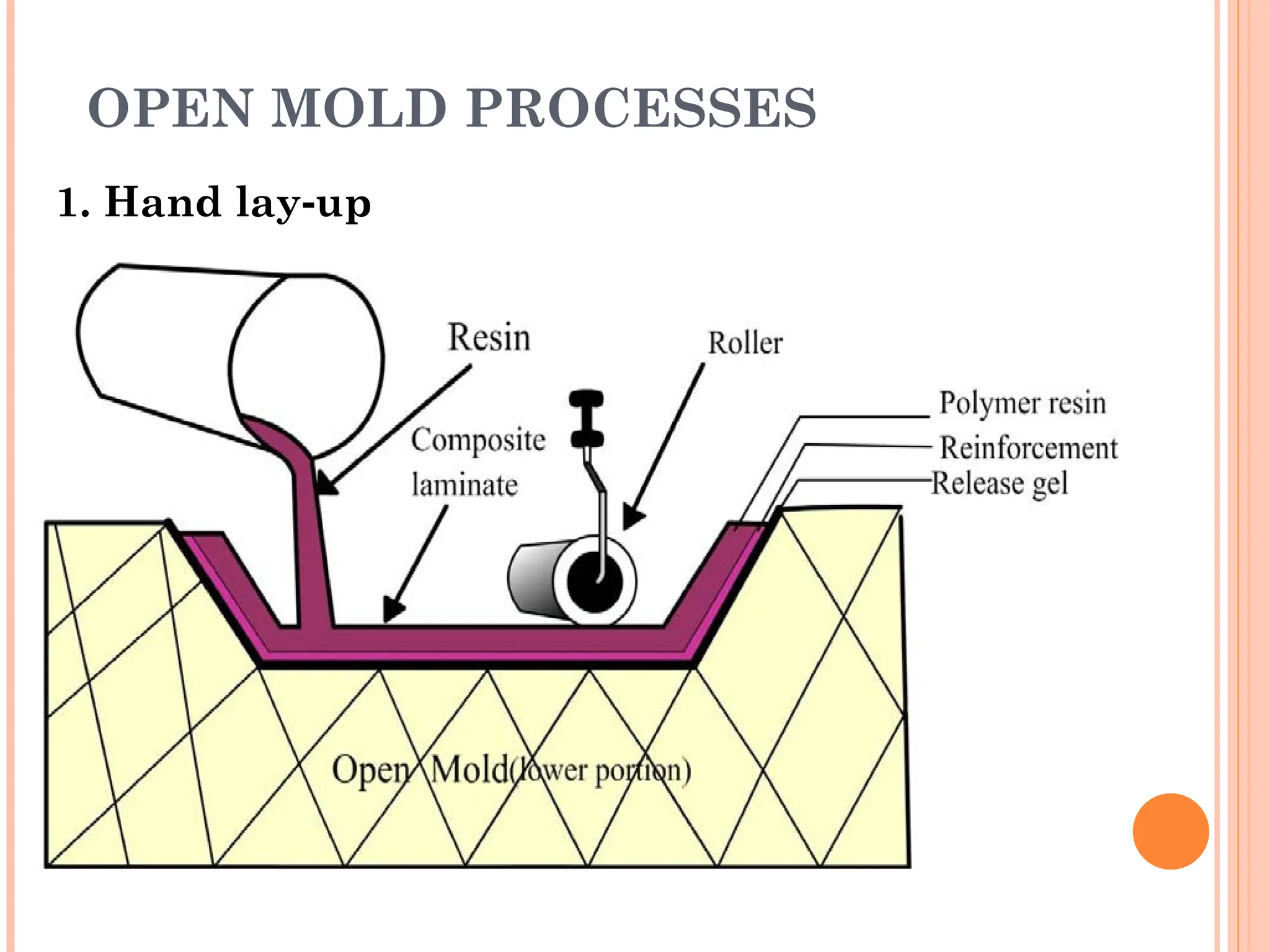
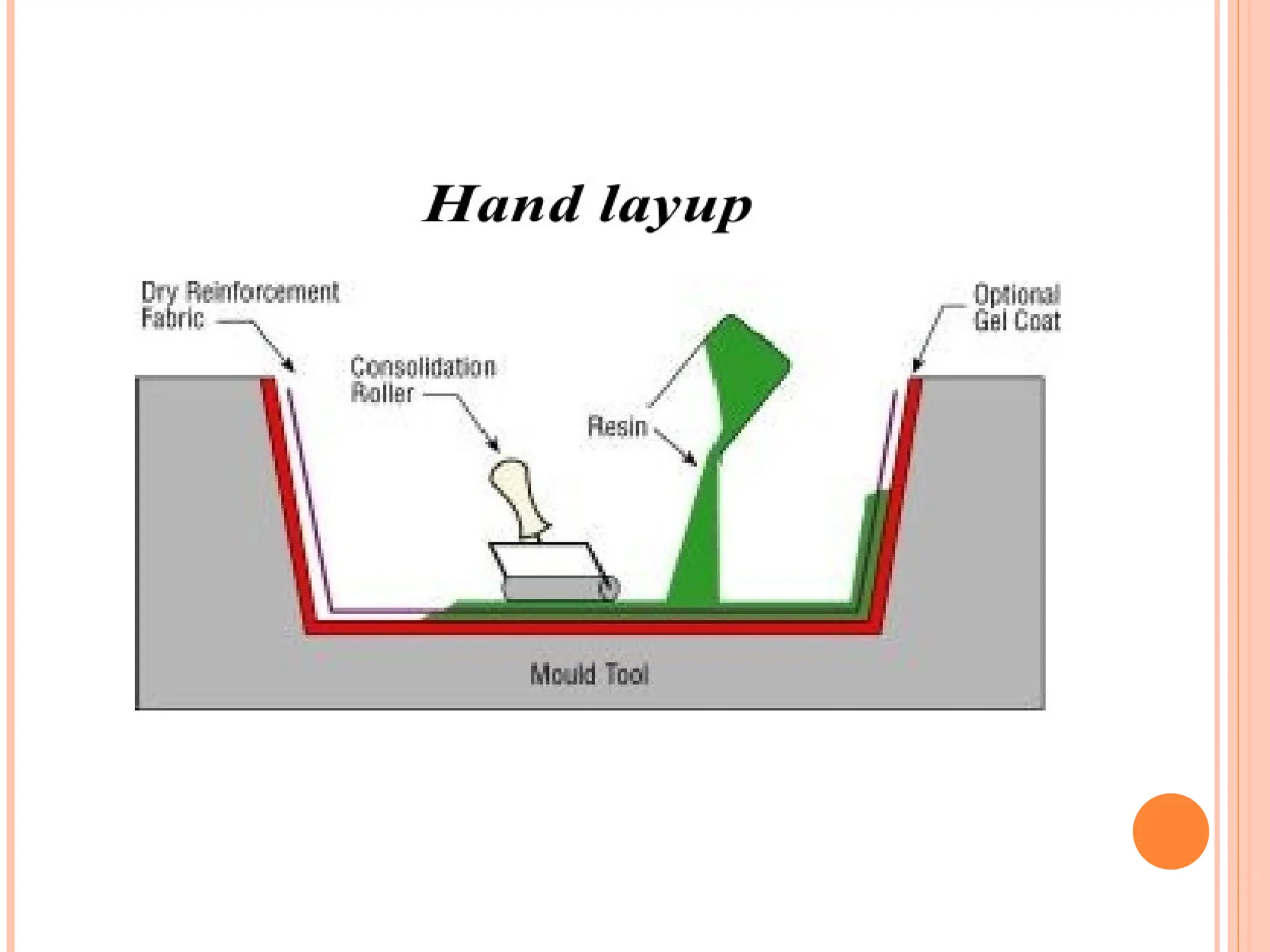
1. Hand lay up
‑
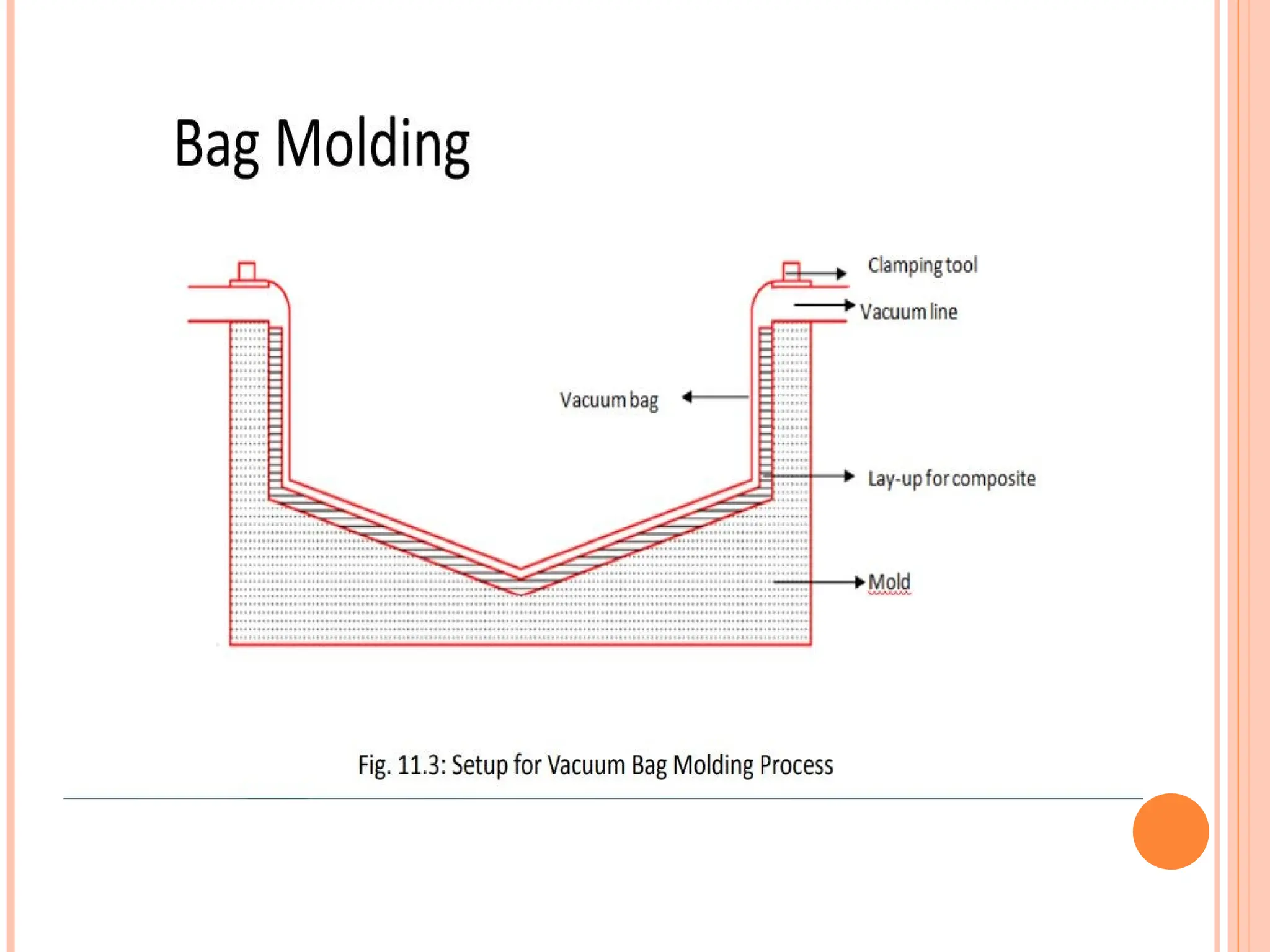
2. Bag moulding process
1. Pressure-bag moulding
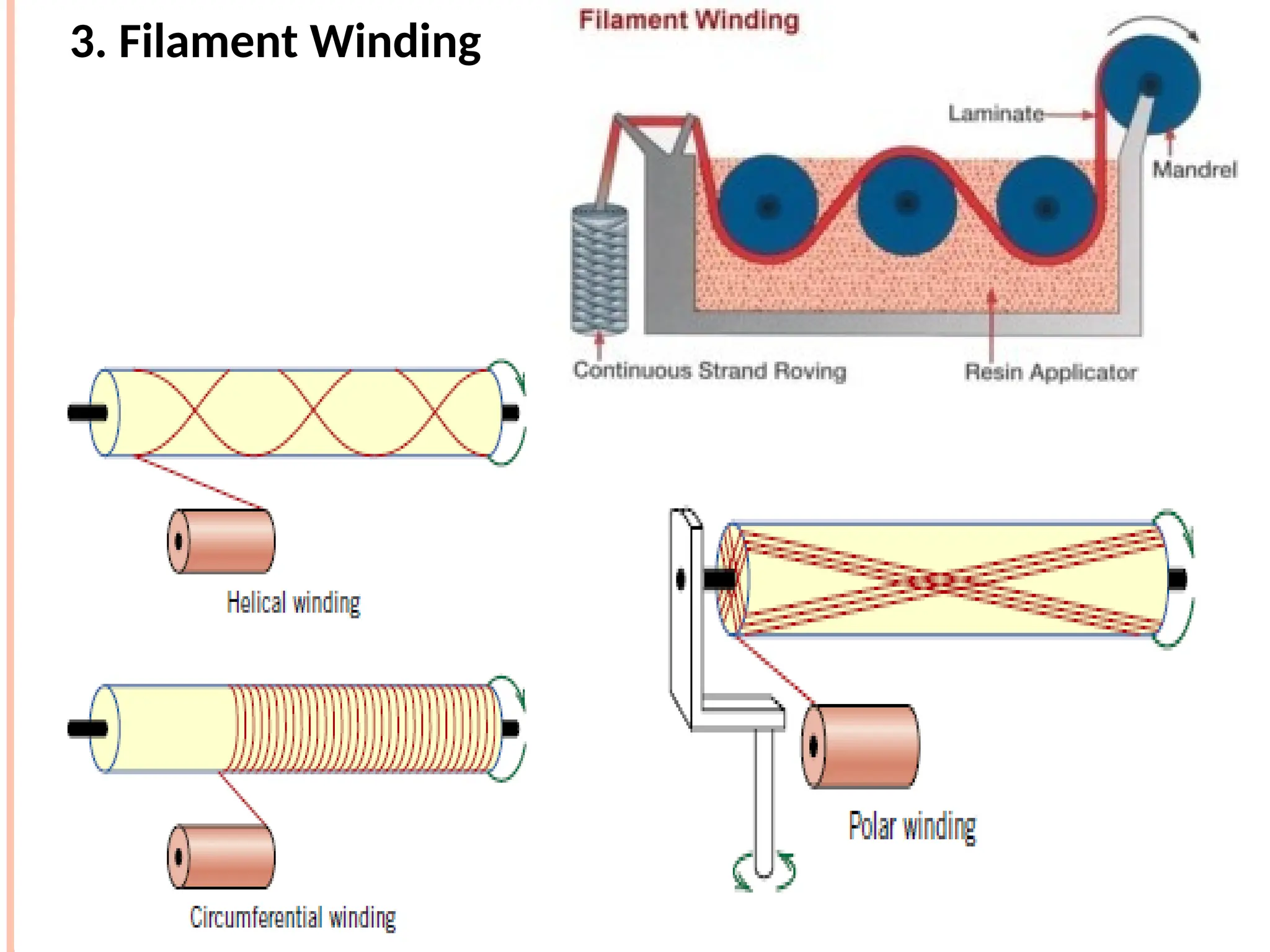
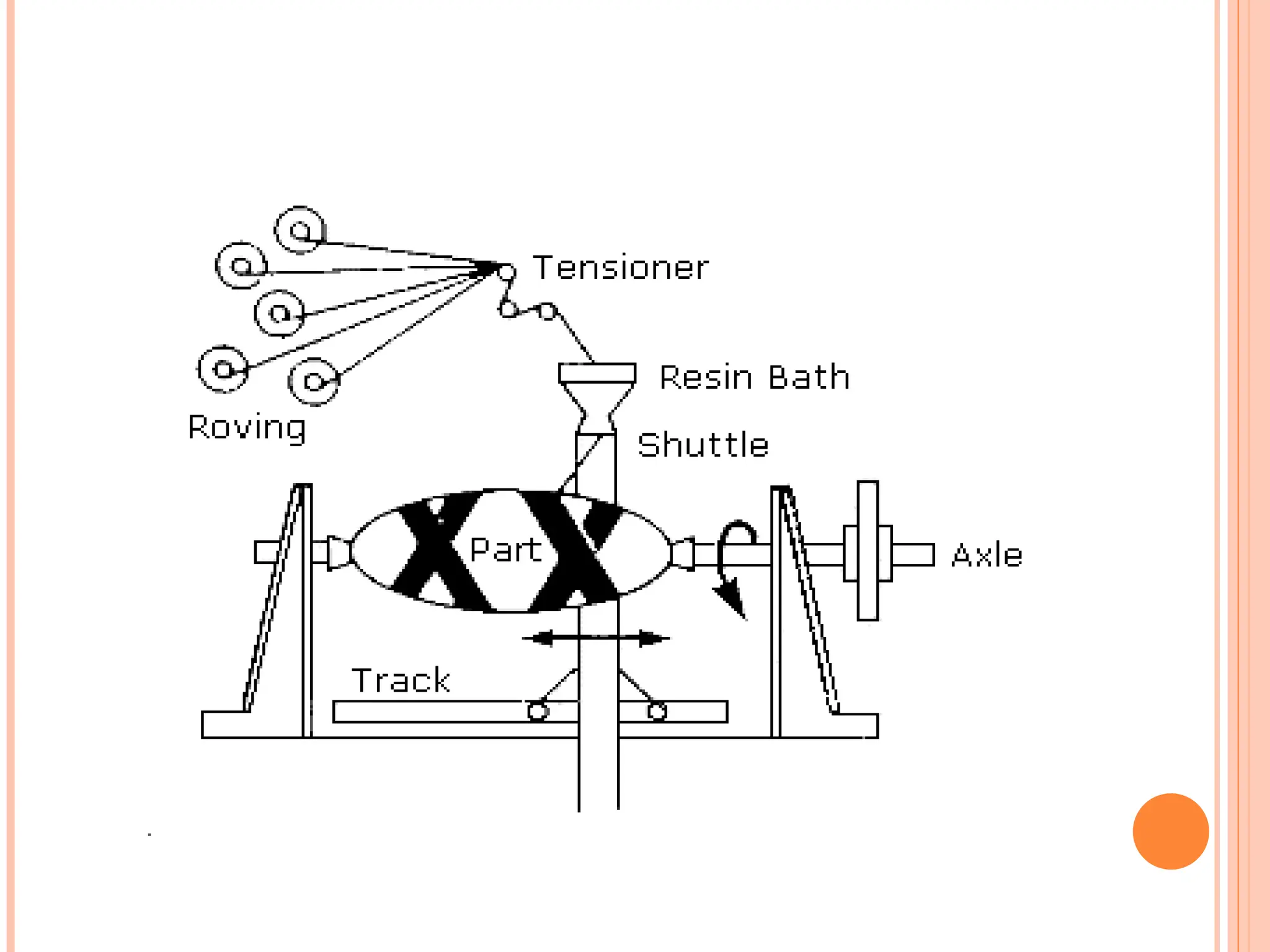
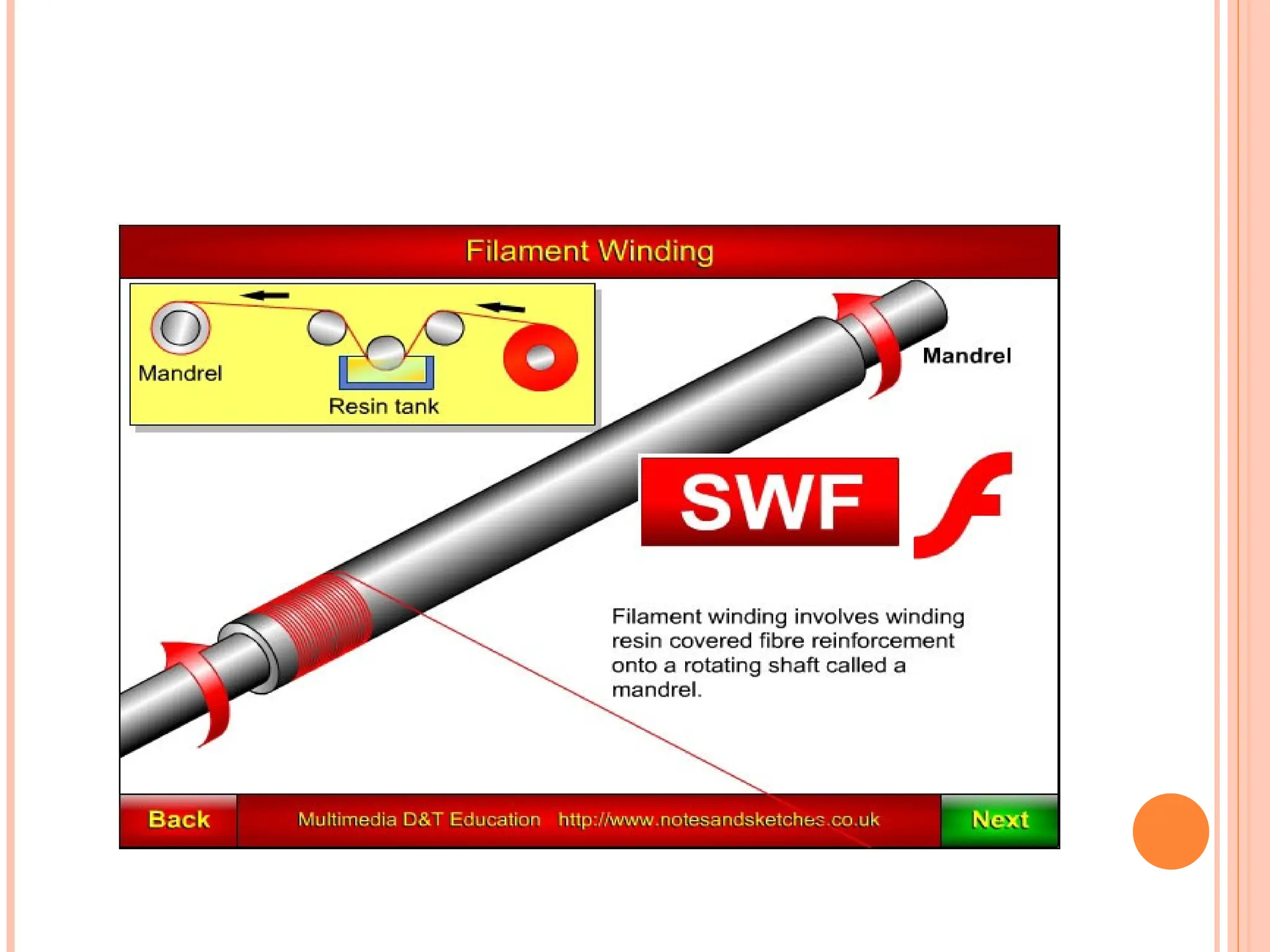
3. Filament Winding
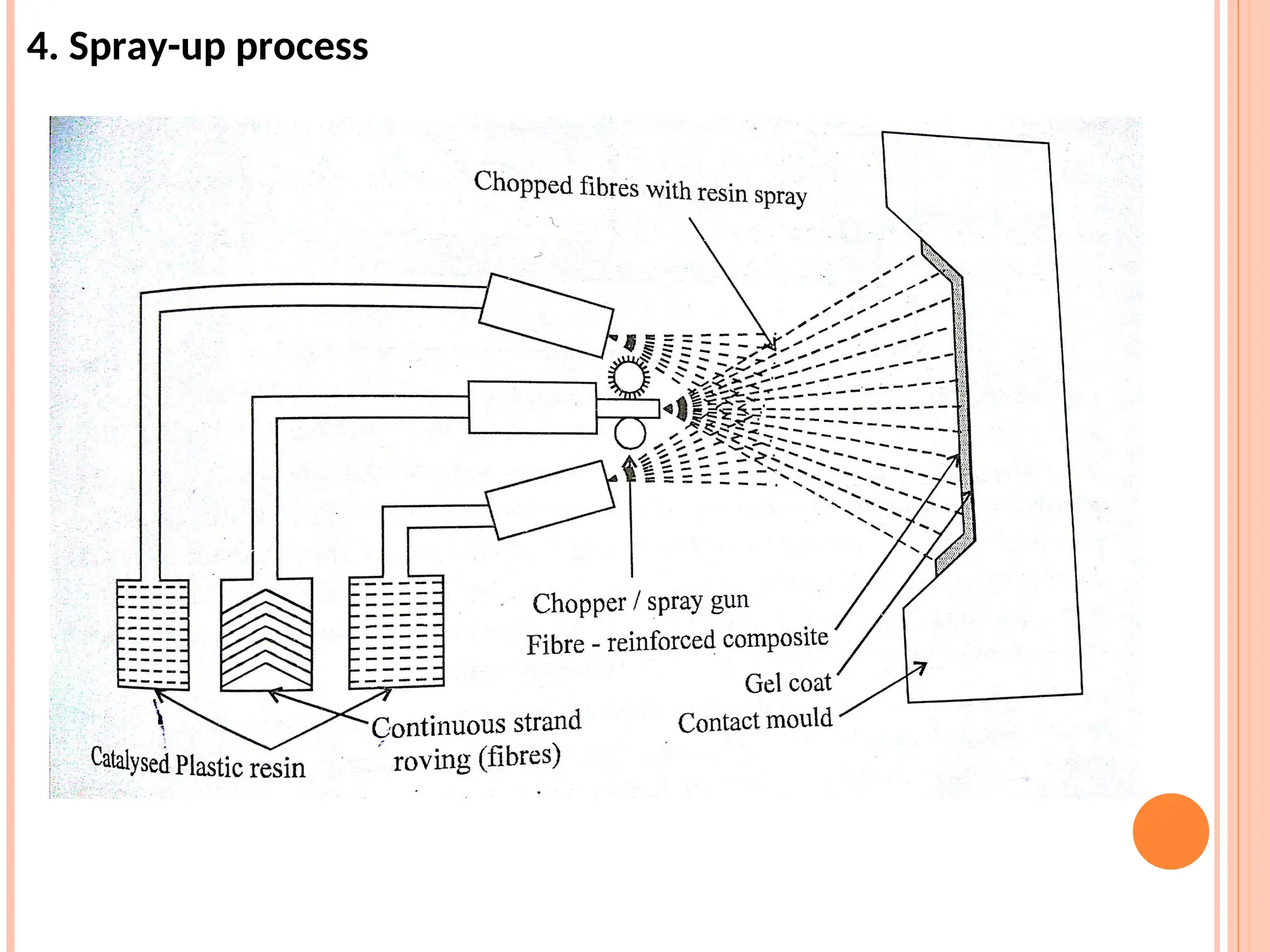
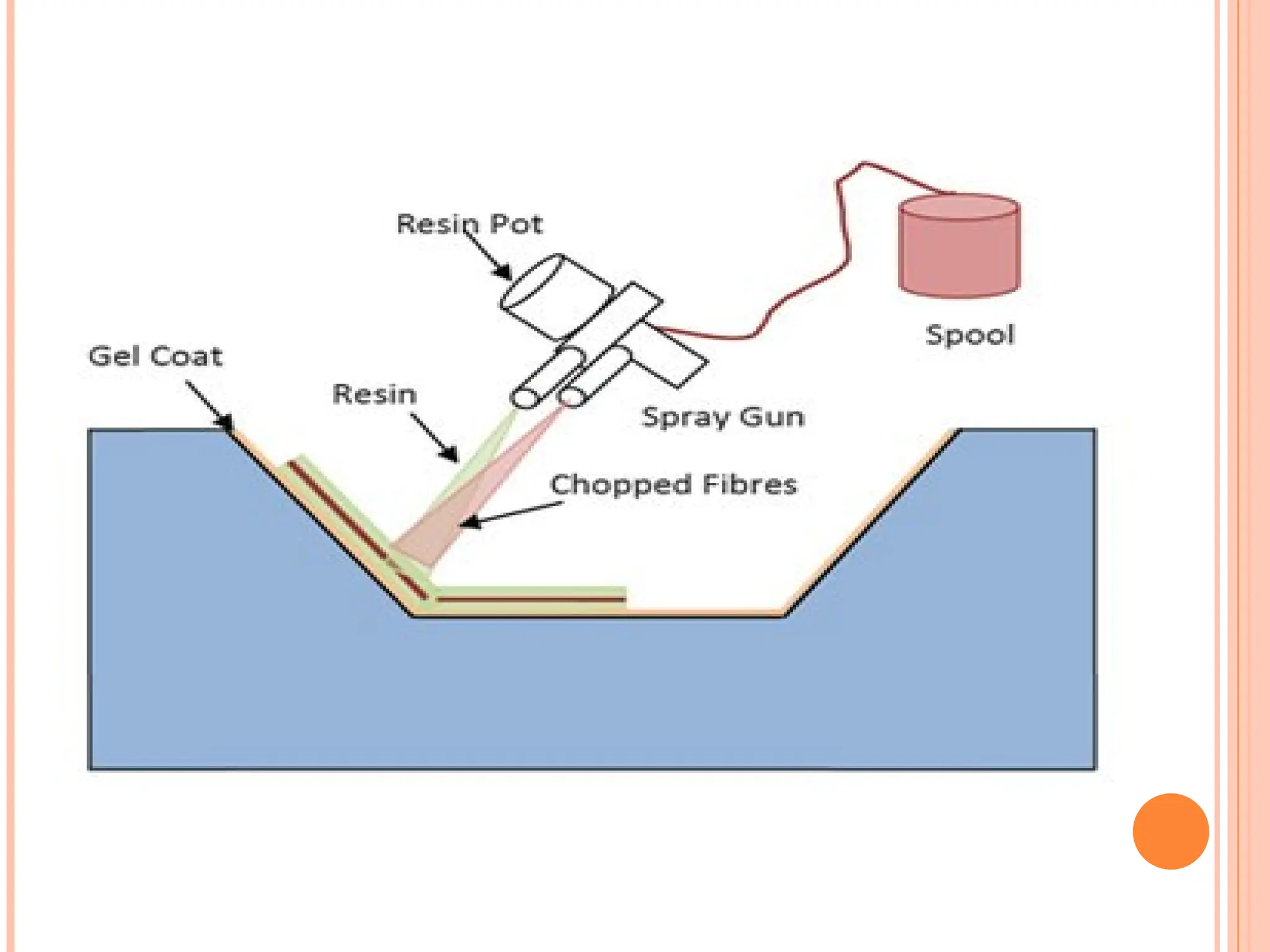
4. Spray-up process
2. Closed-mould process
1. Pultrusion process
2. Sheet-moulding compound process
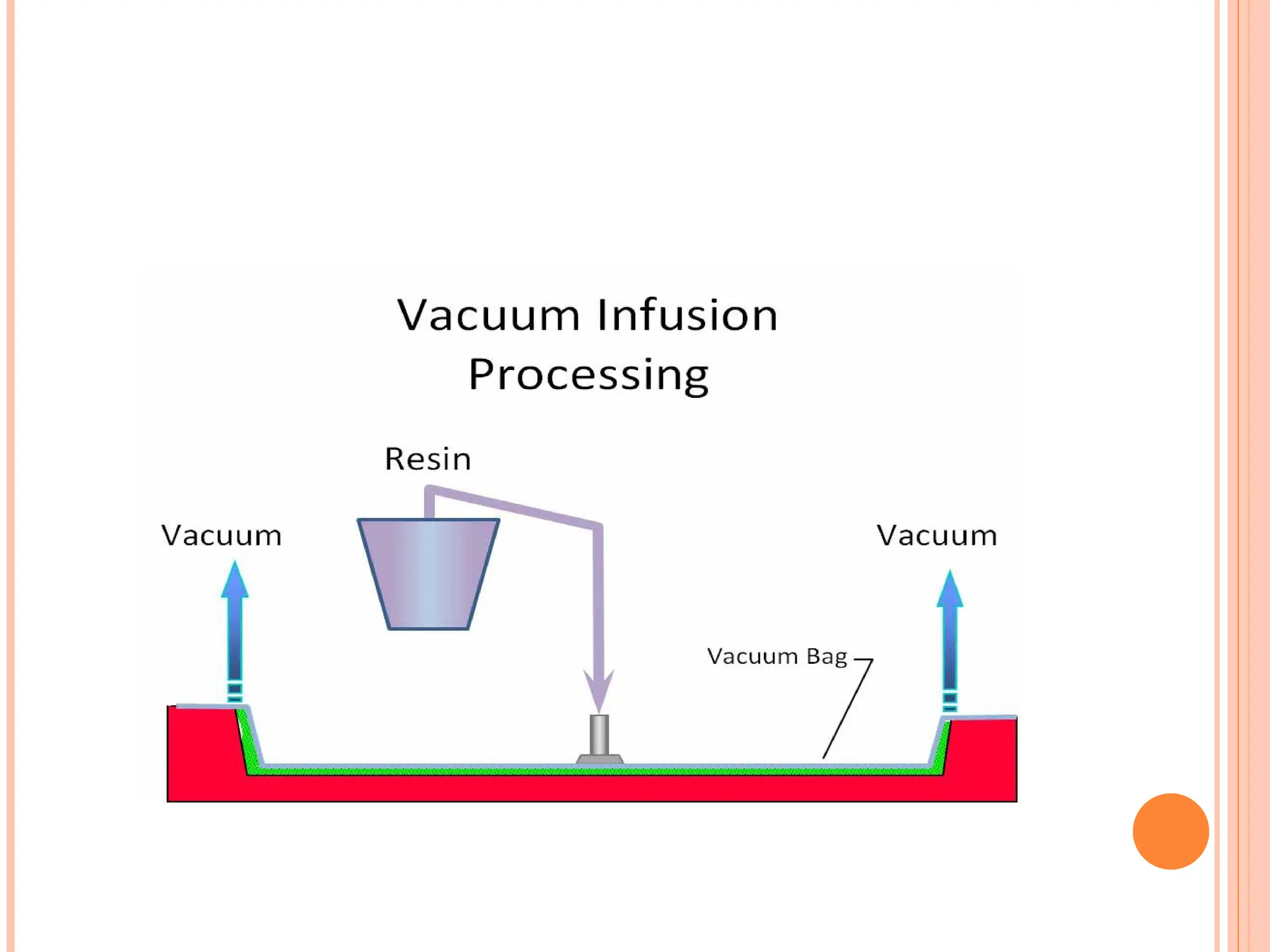
Tapes and fabricscan also be placed in a die and formed by bag
molding. High-pressure gases or a vacuum are introduced to
force the individual plies together so that good bonding is
achieved during curing. Large polymer matrix components for
the skins of military aircraft have been produced by these
techniques.
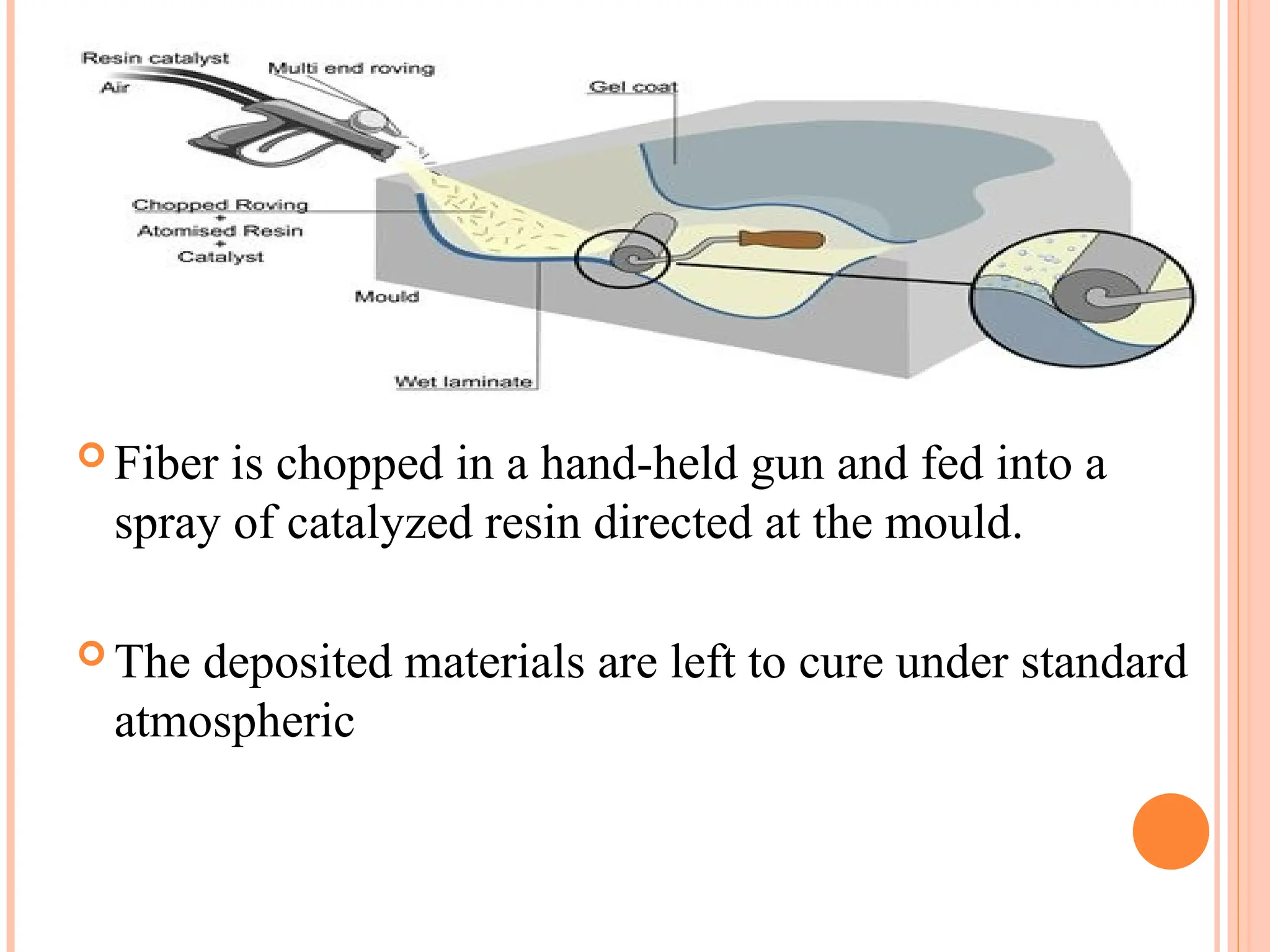
Fiber ischopped in a hand-held gun and fed into a
spray of catalyzed resin directed at the mould.
The deposited materials are left to cure under standard
atmospheric
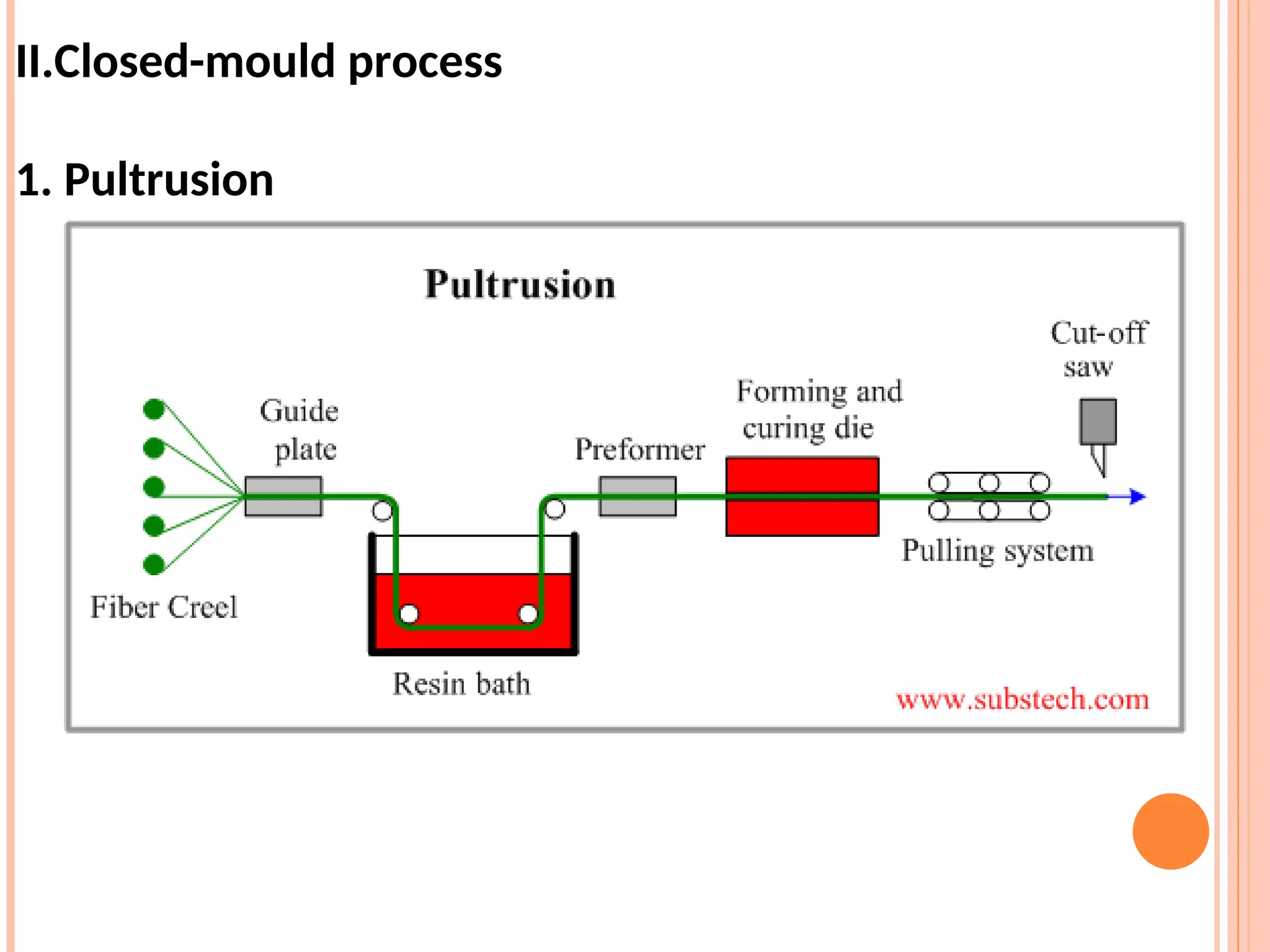
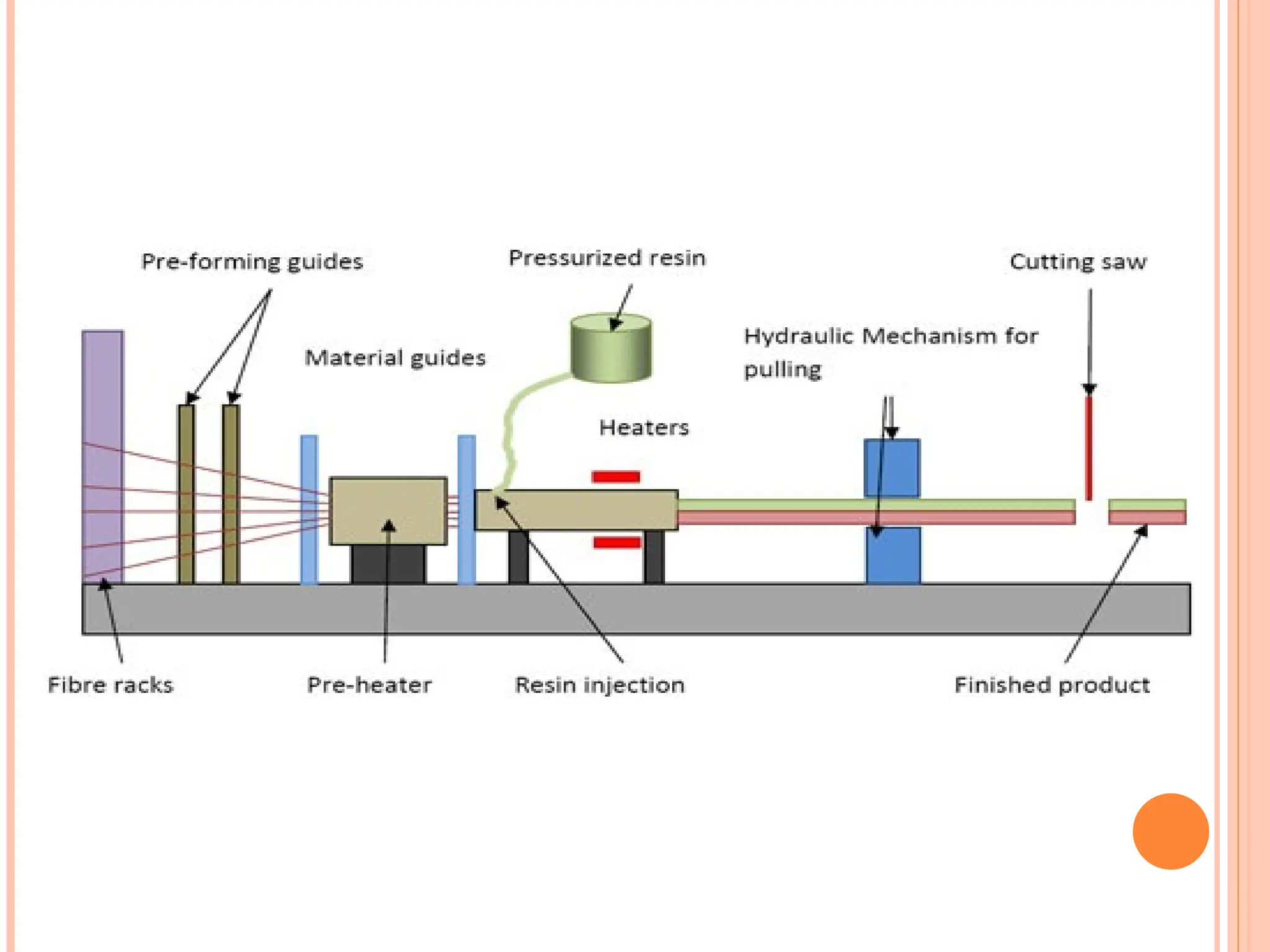
Process:
•Continuous-fiber rovings, ortows, are first impregnated with a
thermosetting resin;
•These are then pulled through a steel die that preforms to the
desired shape and also establishes the resin/fiber ratio.
•The stock then passes through a curing die that is precision
machined so as to impart the final shape;
•This die is also heated to initiate curing of the resin matrix. A
pulling device draws the stock through the dies and also determines
the production speed.
•The cured product is cut on the desired length by the cut-off saw.
•Principal reinforcements are glass, carbon, and aramid fibers,
normally added in concentrations between 40 and 70 vol%.
Commonly used matrix materials include polyesters, vinyl esters,
and epoxy resins.
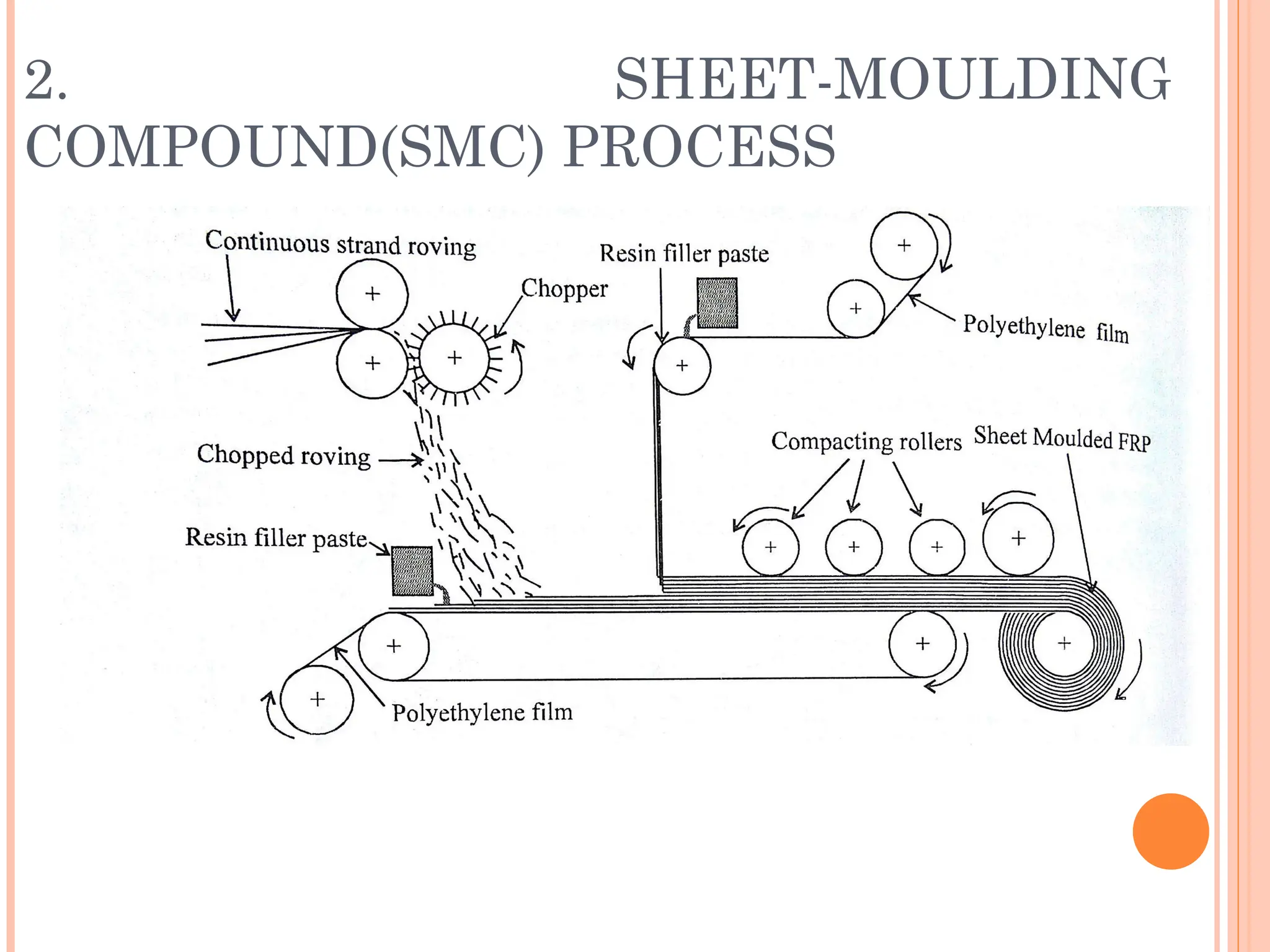
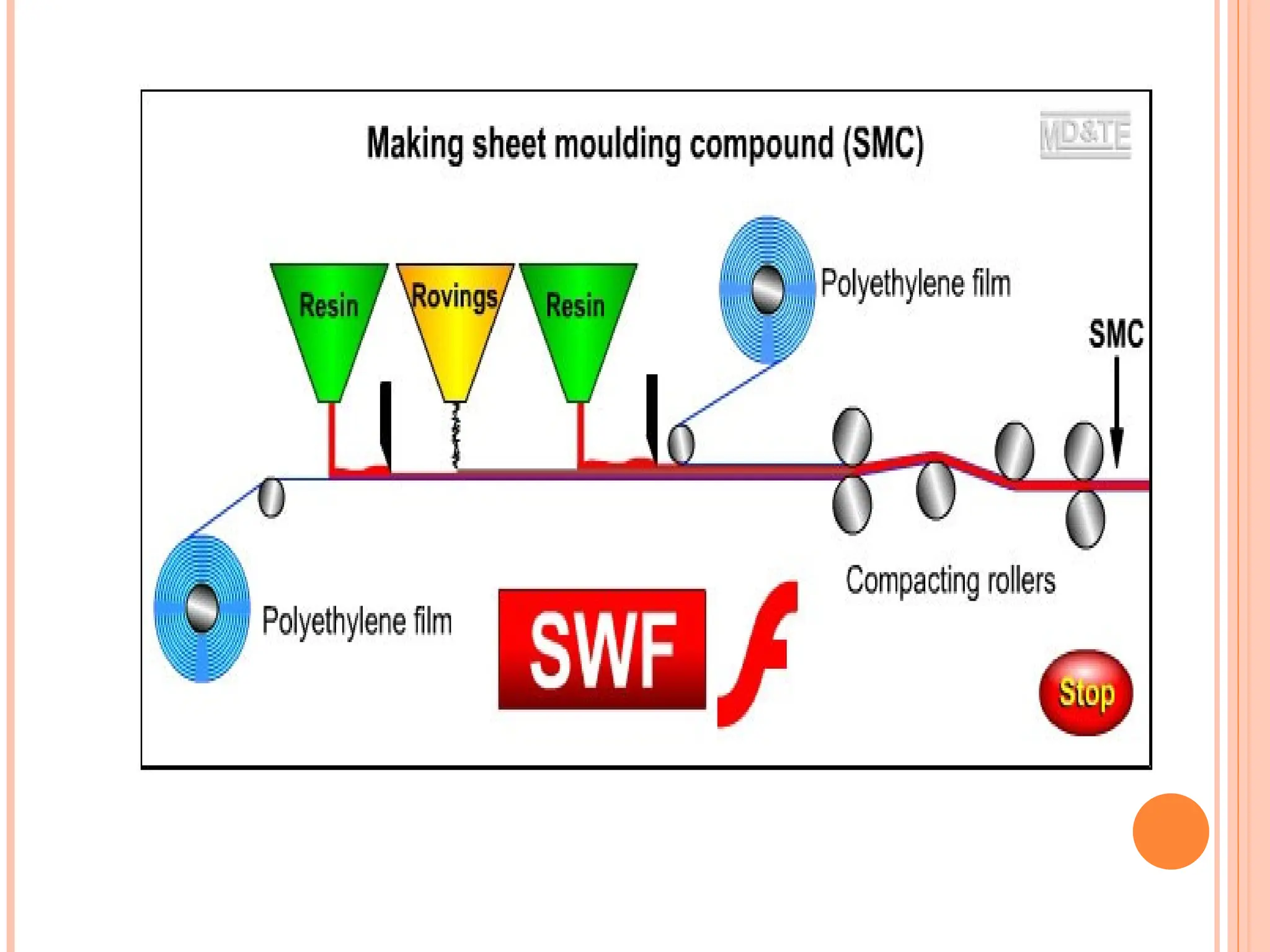
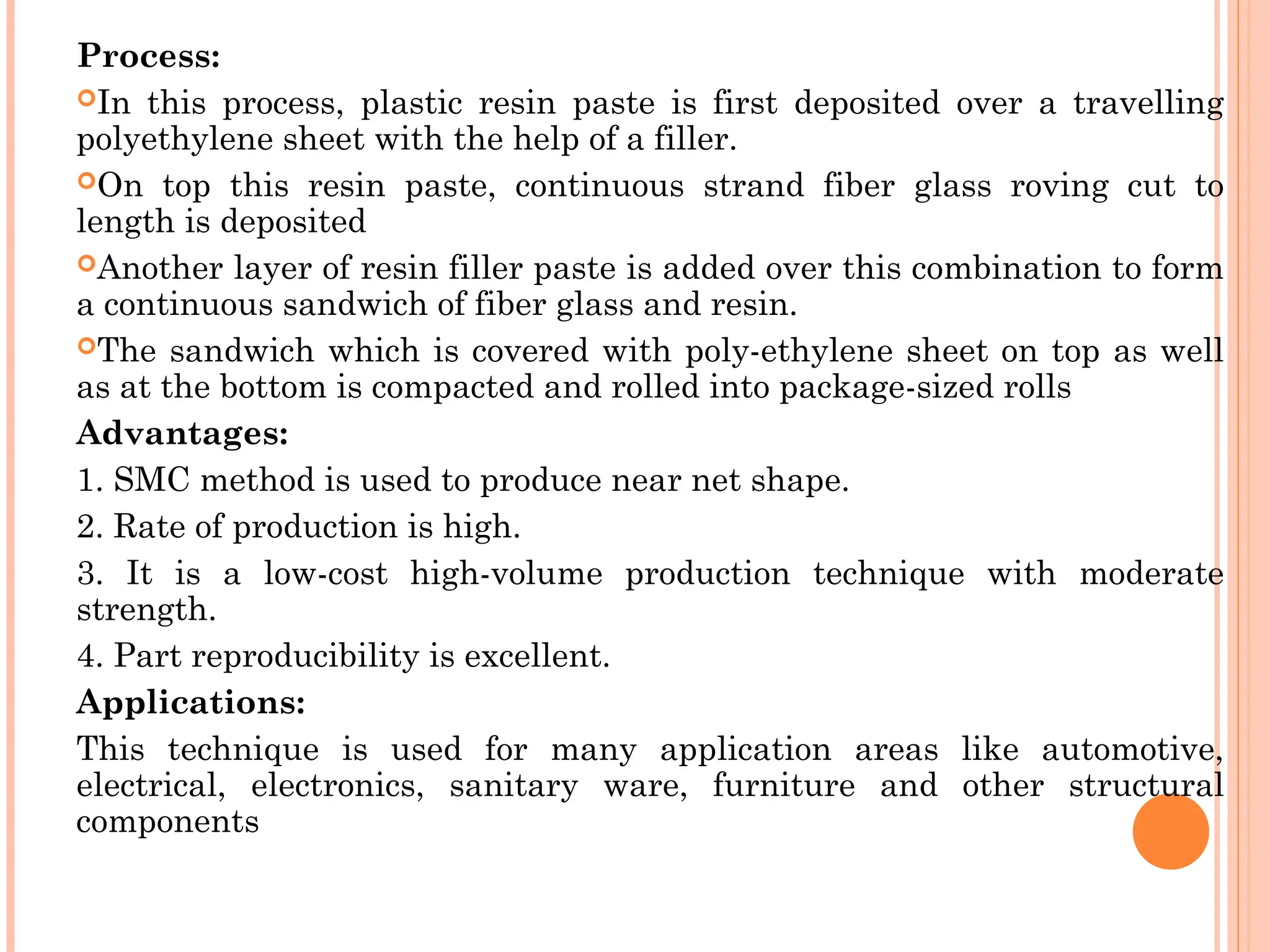
Process:
In this process,plastic resin paste is first deposited over a travelling
polyethylene sheet with the help of a filler.
On top this resin paste, continuous strand fiber glass roving cut to
length is deposited
Another layer of resin filler paste is added over this combination to form
a continuous sandwich of fiber glass and resin.
The sandwich which is covered with poly-ethylene sheet on top as well
as at the bottom is compacted and rolled into package-sized rolls
Advantages:
1. SMC method is used to produce near net shape.
2. Rate of production is high.
3. It is a low-cost high-volume production technique with moderate
strength.
4. Part reproducibility is excellent.
Applications:
This technique is used for many application areas like automotive,
electrical, electronics, sanitary ware, furniture and other structural
components
53.
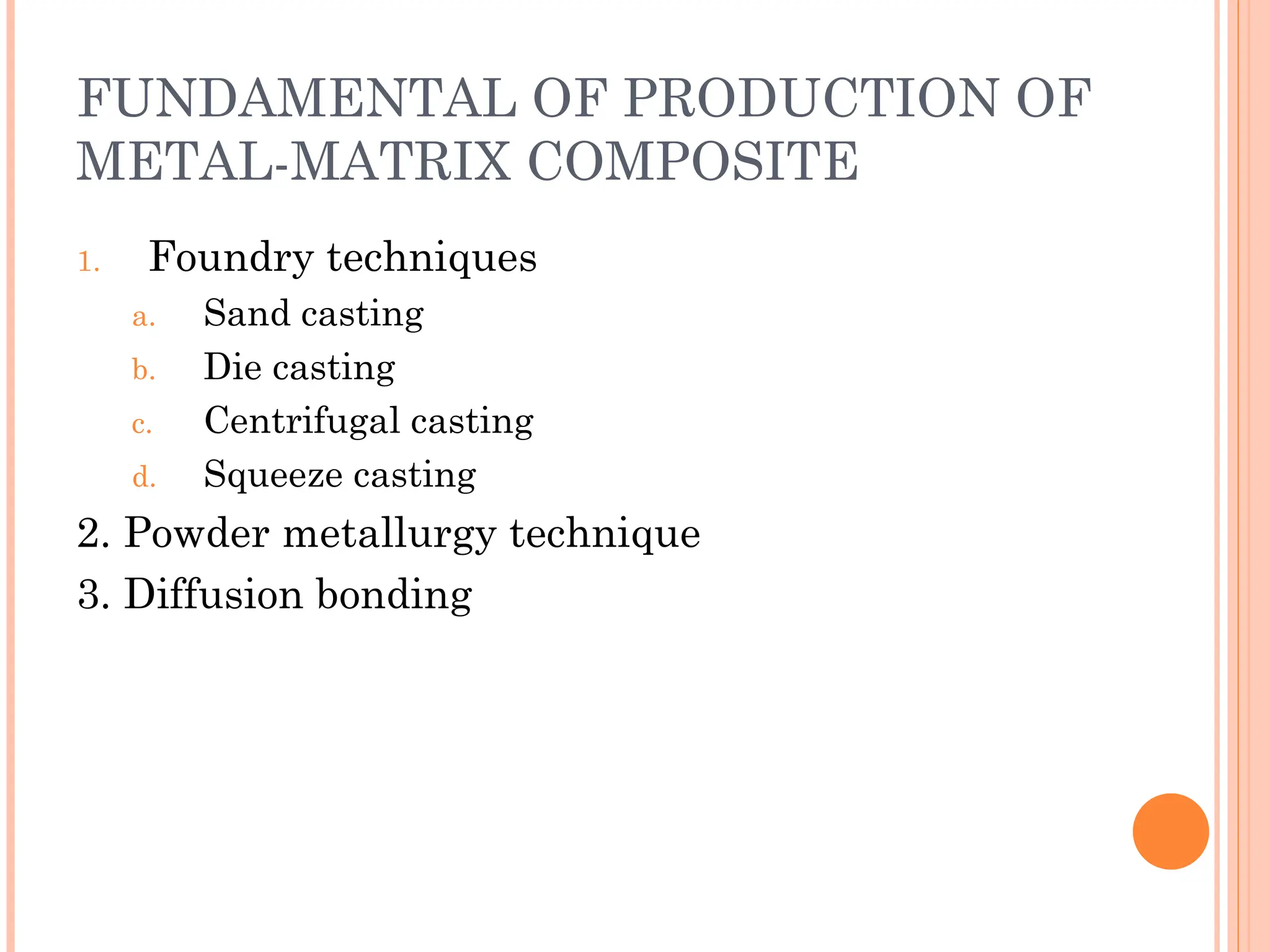
FUNDAMENTAL OF PRODUCTIONOF
METAL-MATRIX COMPOSITE
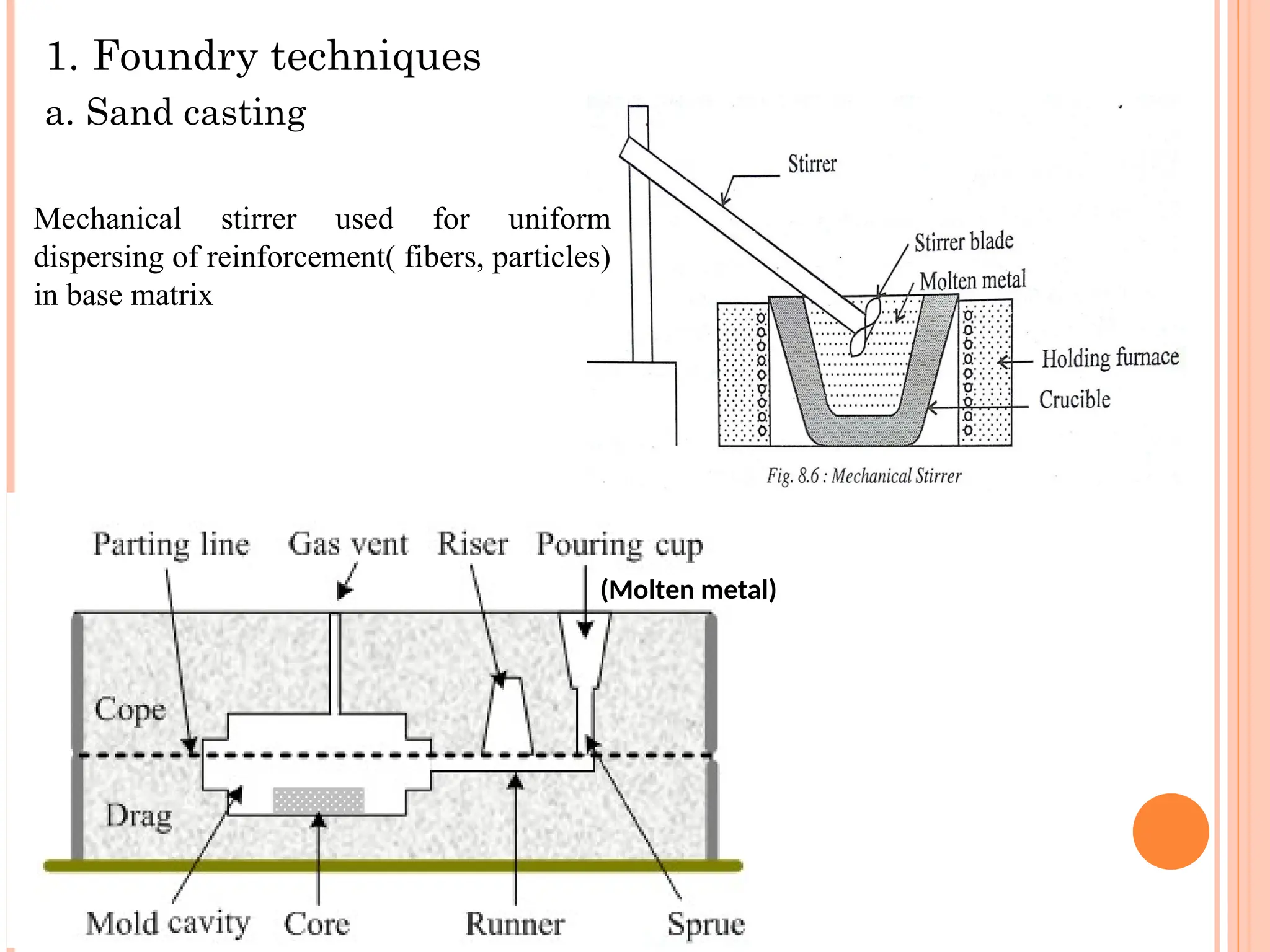
1. Foundry techniques
a. Sand casting
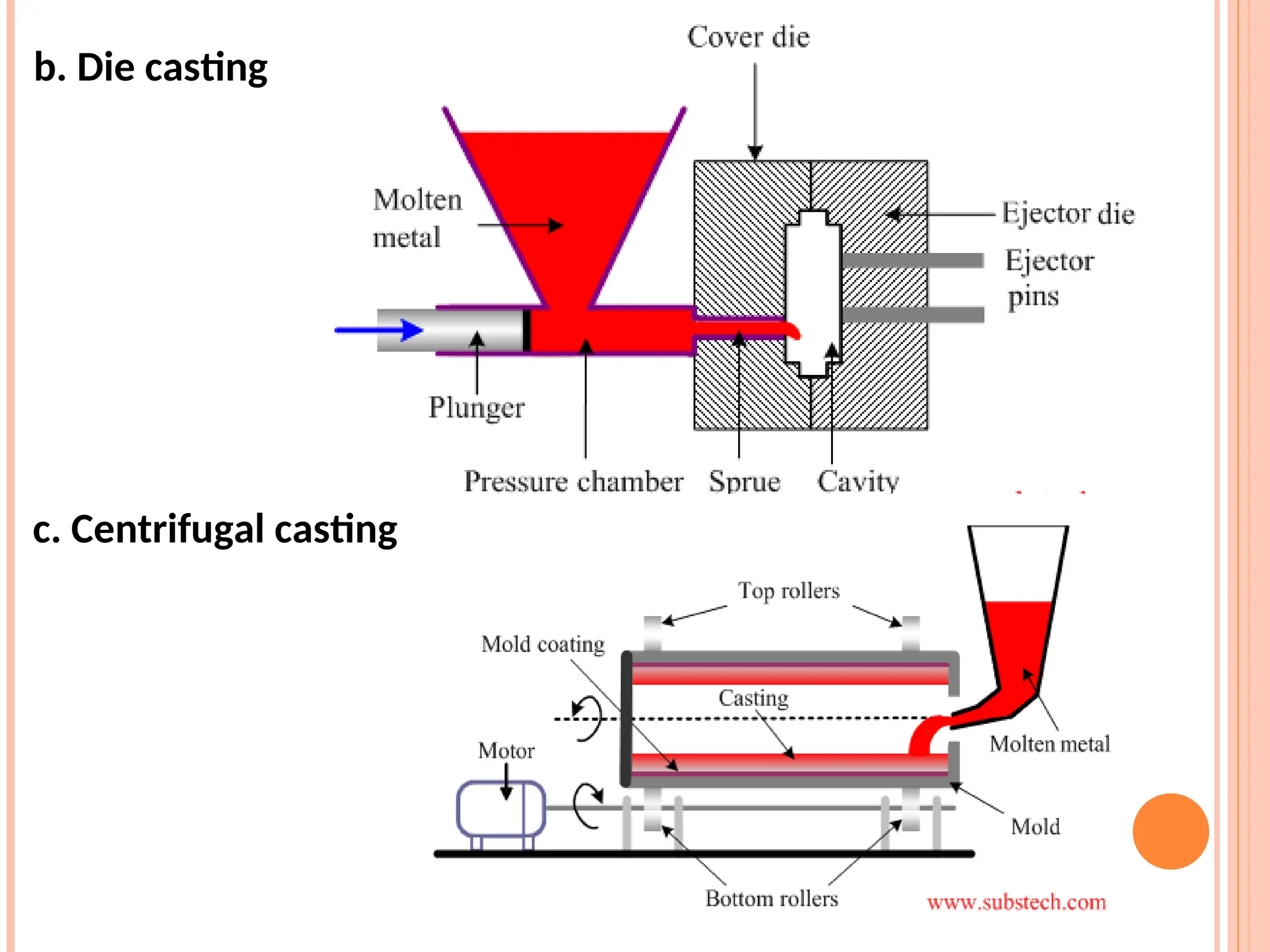
b. Die casting
c. Centrifugal casting
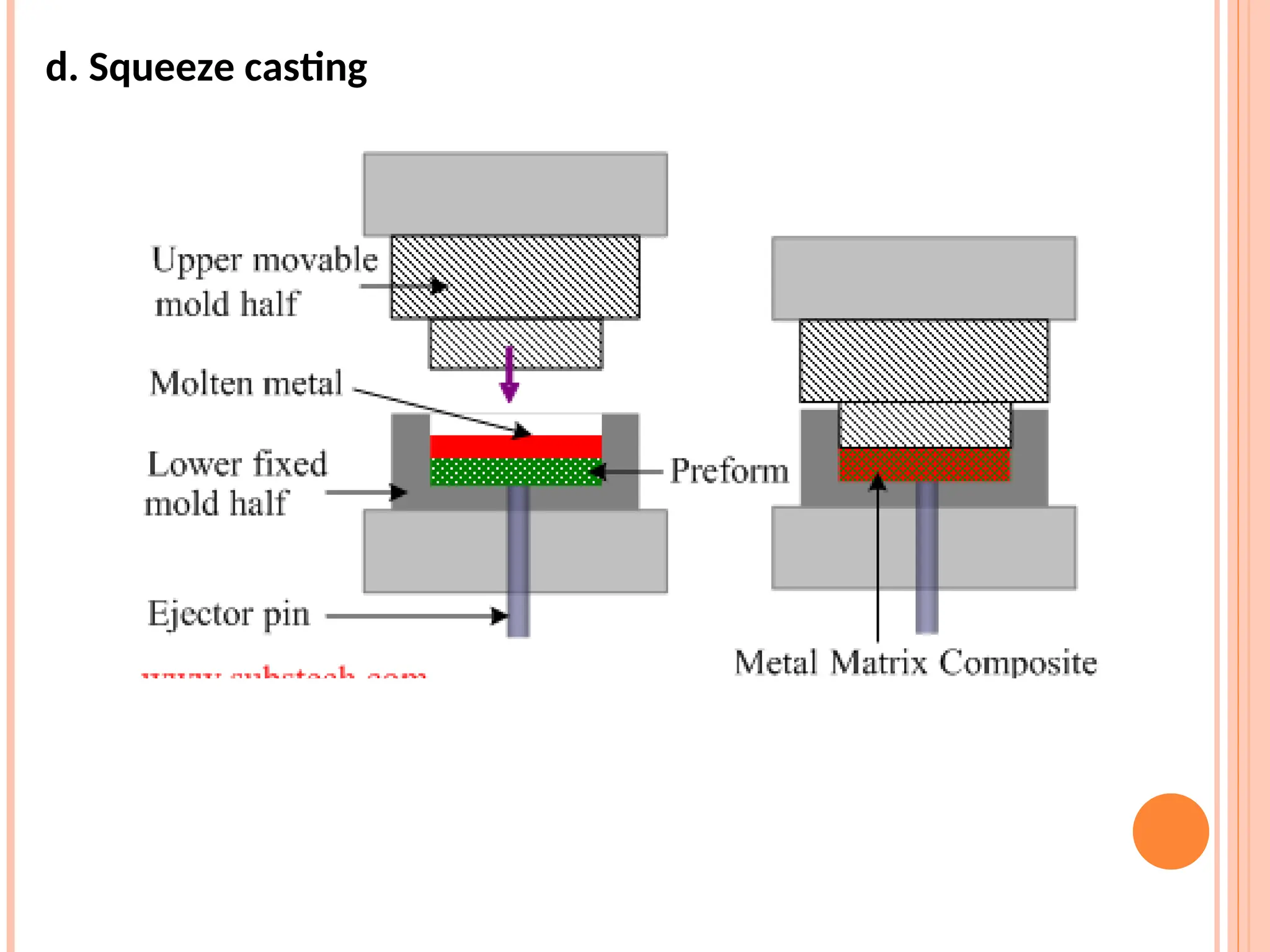
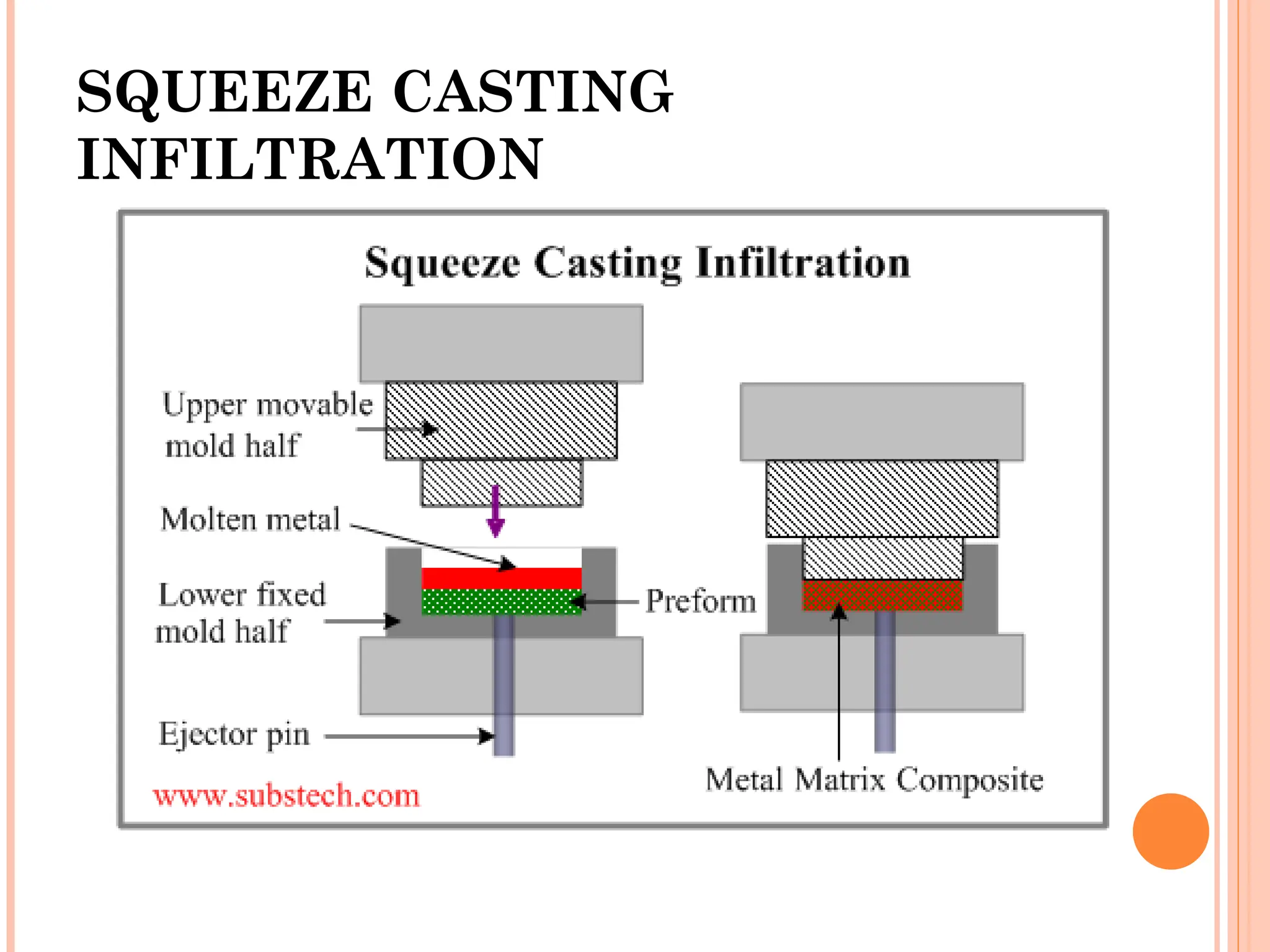
d. Squeeze casting
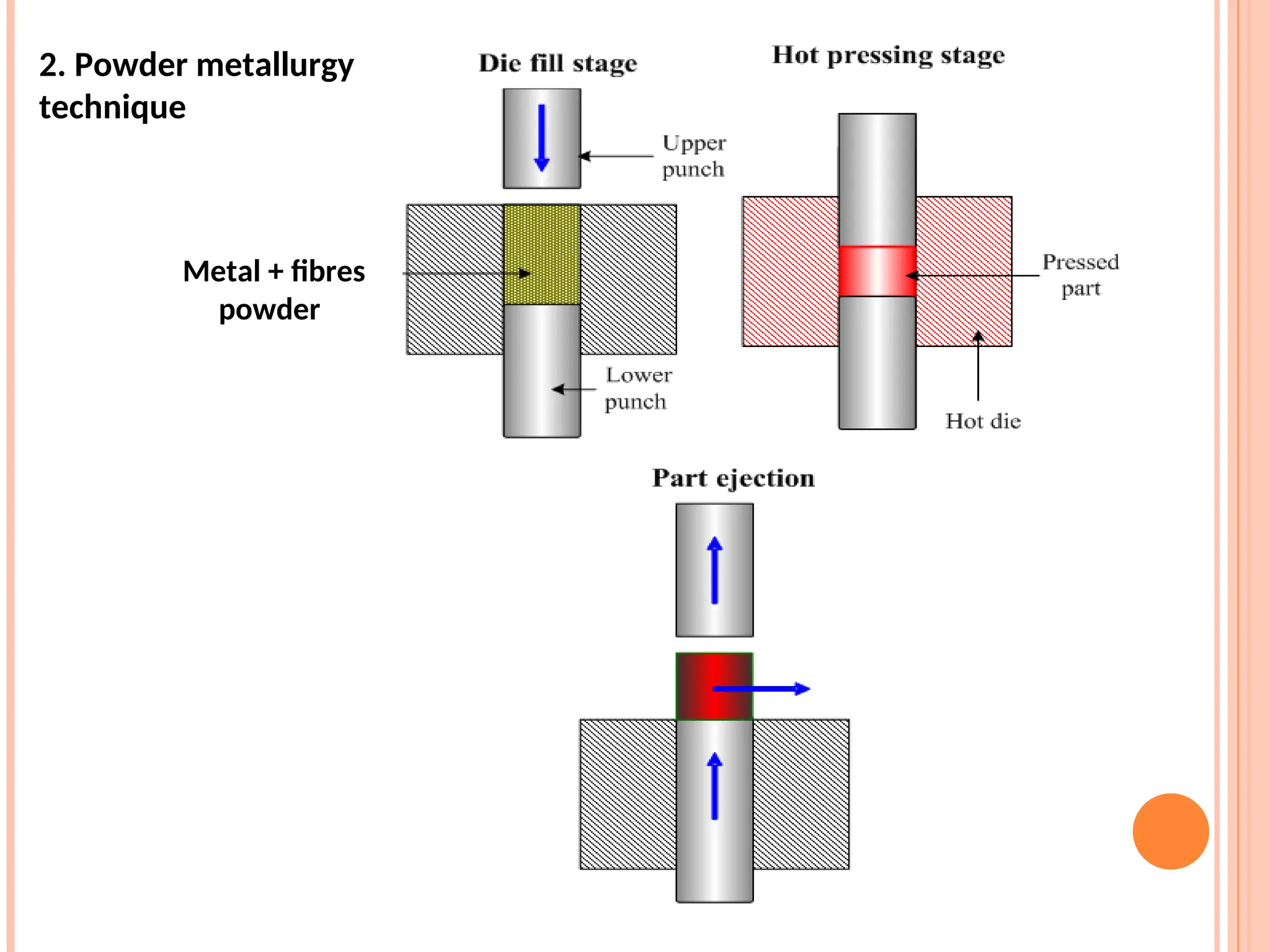
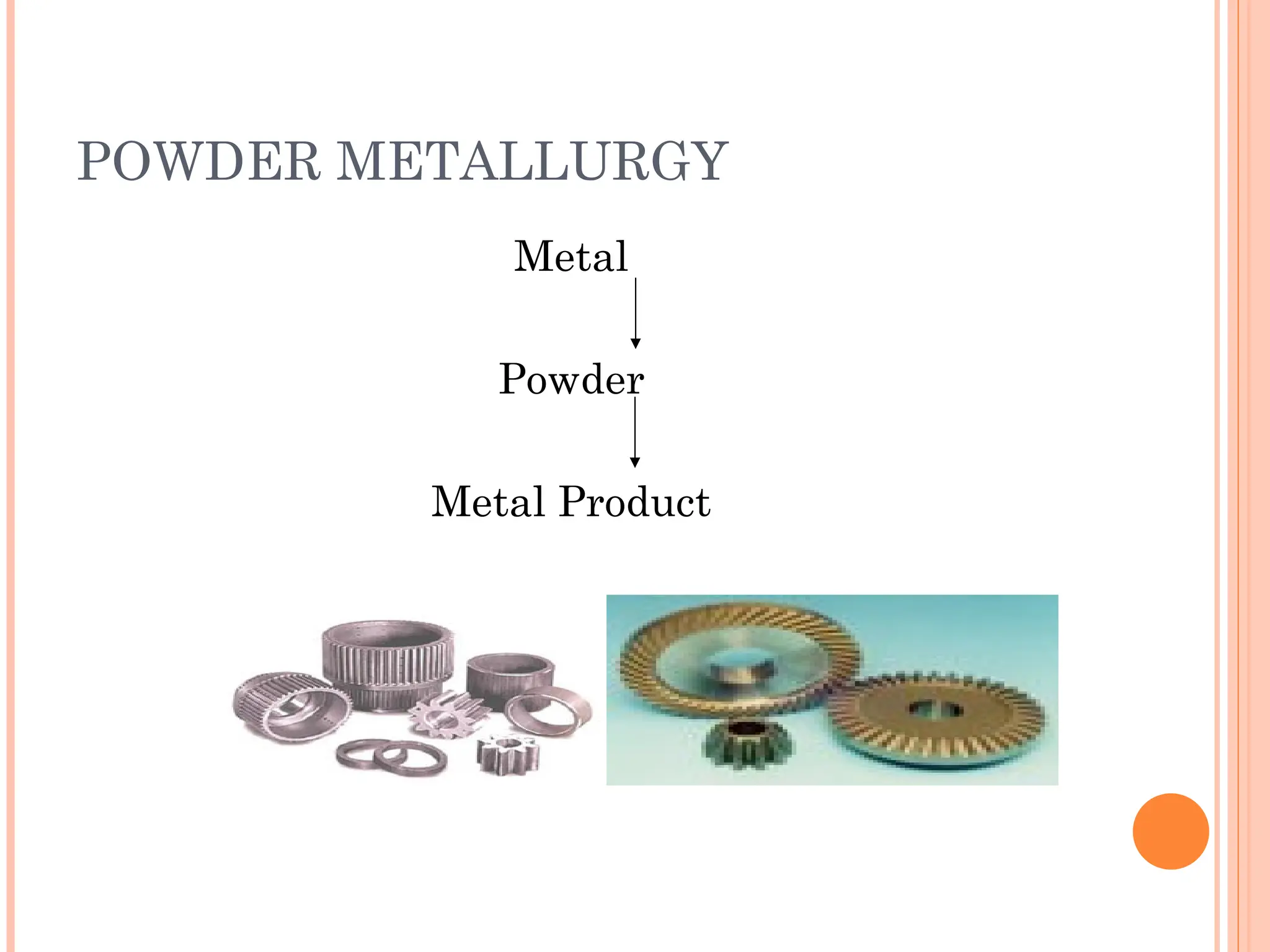
2. Powder metallurgy technique
3. Diffusion bonding
54.
1. Foundry techniques
a.Sand casting
(Molten metal)
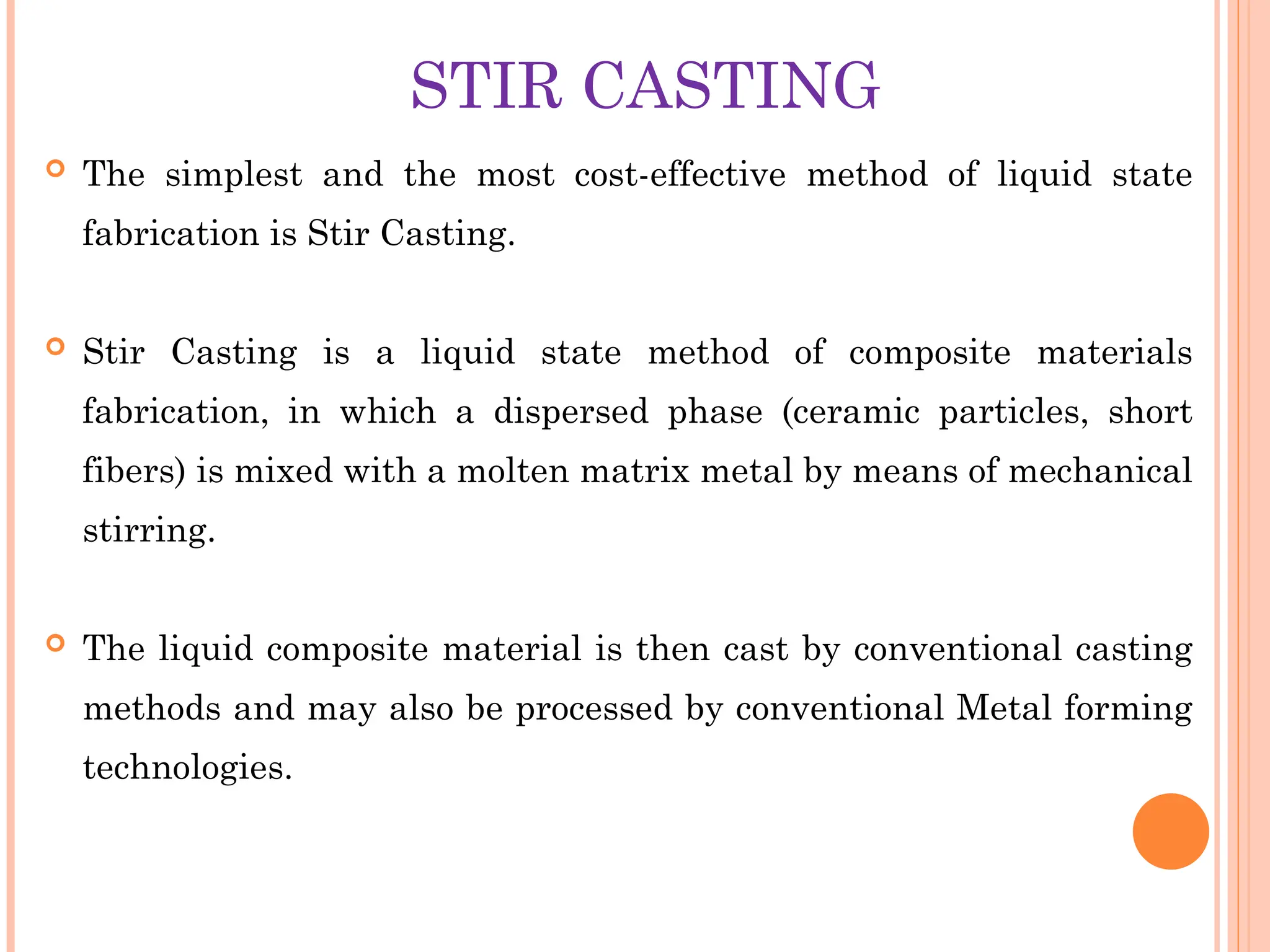
Mechanical stirrer used for uniform
dispersing of reinforcement( fibers, particles)
in base matrix
Die castingis a metal casting process that is
characterized by forcing molten metal under high
pressure into a mold cavity. The mold cavity is created
using two hardened tool steel dies which have been
machined into shape and work similarly to an injection
mold during the process
57.
Centrifugal casting,sometimes called rotocasting, is
a metal casting process that uses centrifugal force to
form cylindrical parts. This differs from most metal
casting processes, which use gravity or pressure to fill
the mold. In centrifugal casting, a permanent mold
made from steel, cast iron, or graphite is typically
used. However, the use of expendable sand molds is
also possible.
58.
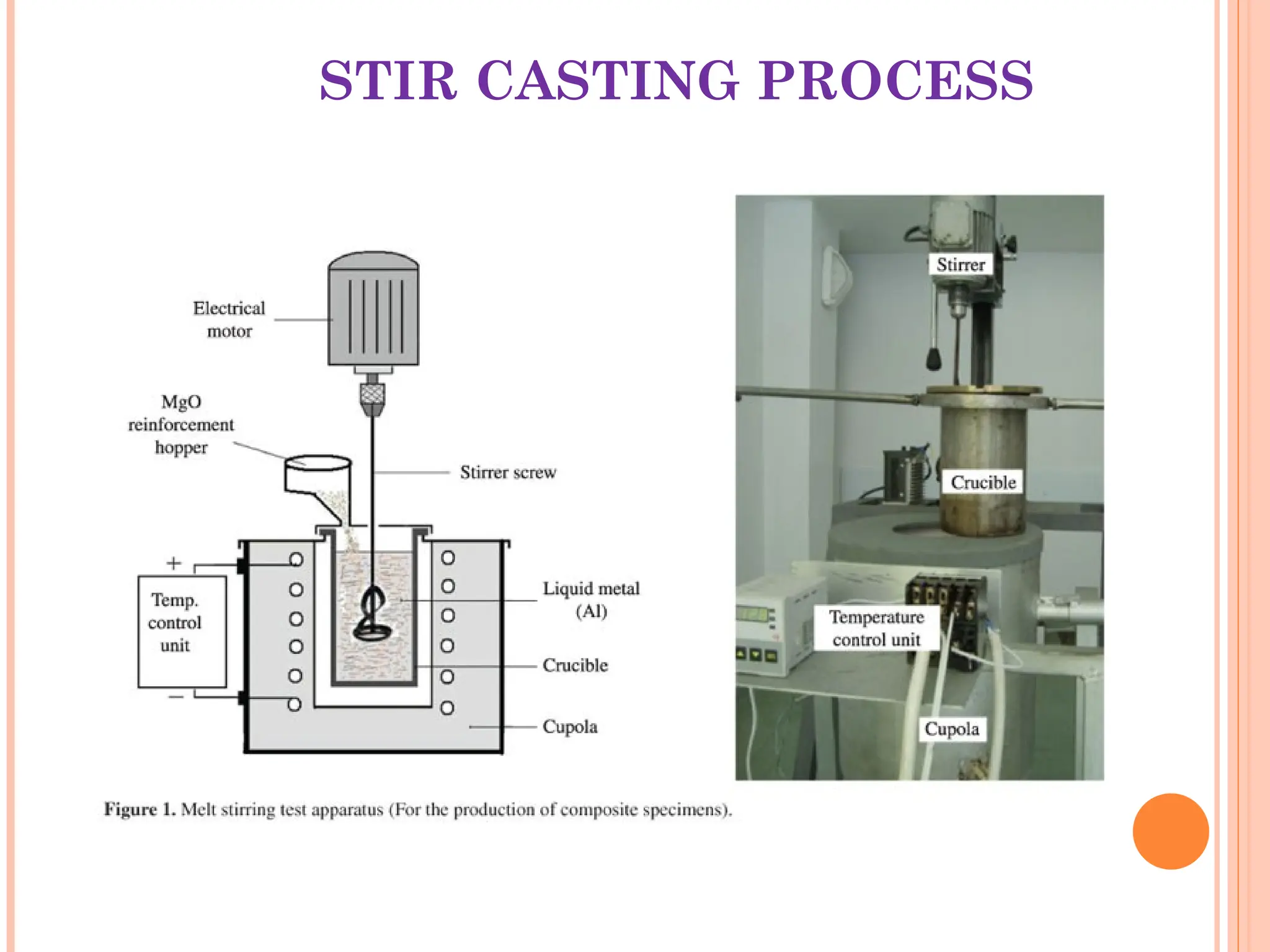
STIR CASTING
Thesimplest and the most cost-effective method of liquid state
fabrication is Stir Casting.
Stir Casting is a liquid state method of composite materials
fabrication, in which a dispersed phase (ceramic particles, short
fibers) is mixed with a molten matrix metal by means of mechanical
stirring.
The liquid composite material is then cast by conventional casting
methods and may also be processed by conventional Metal forming
technologies.
ADVANTAGES, LIMITATIONS
AND APPLICATIONSOF
COMPOSITE MATERIALS
Advantages:
1. High strength to weight ratio (low density high tensile
strength) High creep resistance
2. High tensile strength at elevated temperatures
3. High toughness
4. Fatigue strength and creep is better
5. Generally, perform better than steel or aluminum in
applications where cyclic loads are encountered leading
to potential fatigue failure (designing helicopter blades).
6. Impact loads or vibration – composites can be specially
formulated with high toughness and high damping to
reduce these load inputs.
7. Some composites can have much higher wear resistance
than metals.
8. Corrosion resistance
9. Dimensional changes due to temp changes can be much
less.
10. Anisotropic – bi-directional properties can be designing
advantage (i.e. helicopter blades)
65.
ADVANTAGES OF COMPOSITES
Specific Strength and Stiffness
Tailored Design
Fatigue Life
Dimensional Stability
Corrosion Resistance
Cost-Effective Fabrication
66.
Disadvantages (or limitations):
1.Material costs
2. Fabrication/ manufacturing difficulties
3. Repair can be difficult
4. Wider range of variability (statistical spread)
5. Operating temperature can be an issue for
polymeric matrix . Less an issue for metal matrix .
6. Properties non-isotropic makes design difficult!
7. Inspection and testing typically more complex.
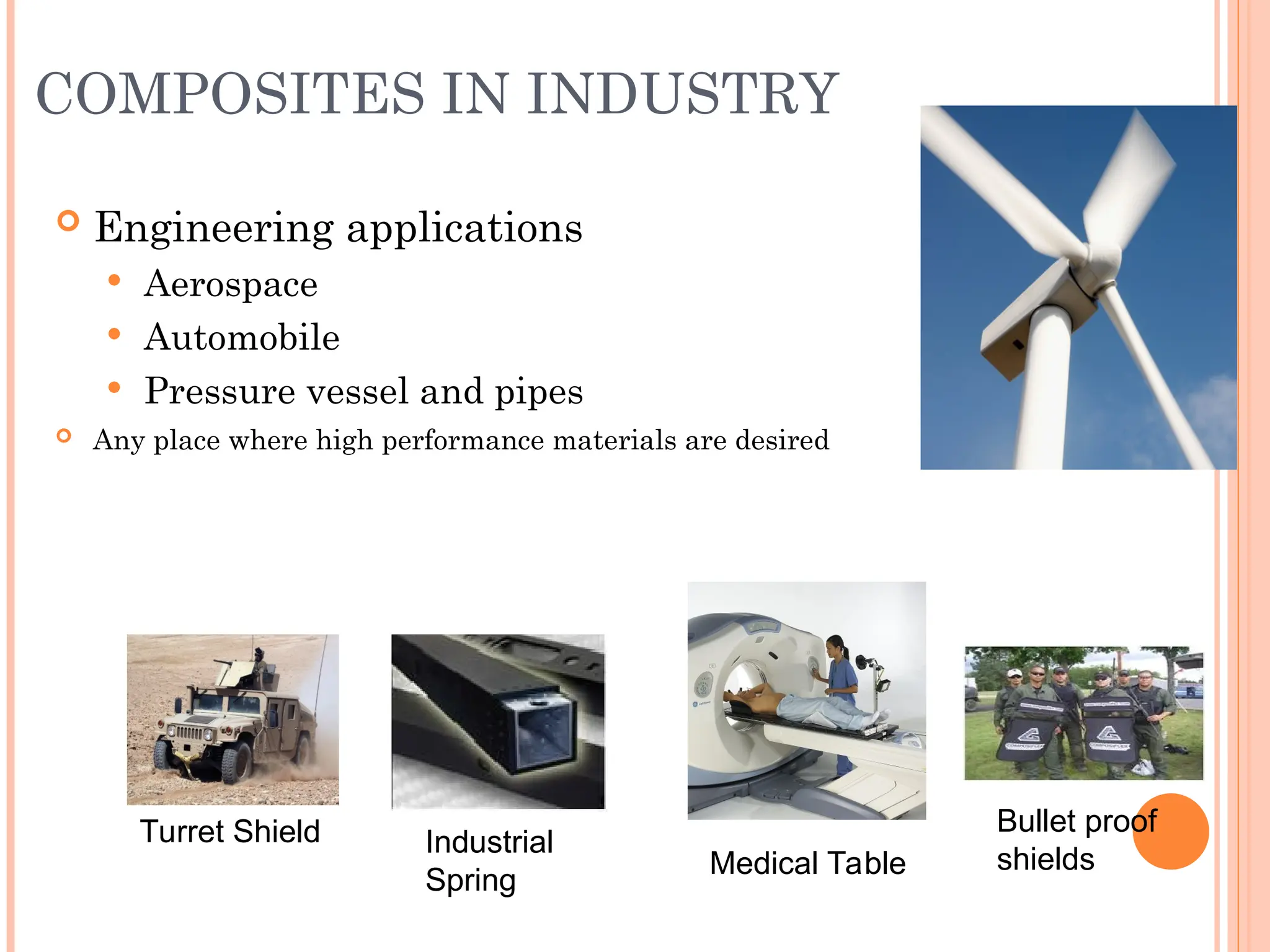
COMPOSITES IN INDUSTRY
Engineering applications
Aerospace
Automobile
Pressure vessel and pipes
Any place where high performance materials are desired
Turret Shield Industrial
Spring
Medical Table
Bullet proof
shields
69.
Applications
Polymer-matrix composites withcontinuous fiber
reinforcement are widely used for lightweight structures, such
as airframes.
Polymer-matrix composites with metal particles (e.g., silver
particles) are used for electrical interconnections
Rubber-matrix composites reinforced with carbon black
particles are used for automotive tires
Cement-matrix composites in the form of concrete are widely
used for civil infrastructure
Metal-matrix composites known as cermets (meaning
ceramic-metal combinations) that contain a low volume
fraction (e.g., 15%) of ceramic (e.g., tungsten carbide) particles
are used in cutting tools such as drills.
Metal-matrix composites containing graphite flakes as the
filler are also used as self-lubricating piston cylinders for
automobile engines due to the lubricity of graphite.