Composite Material
G.Gopinath
Assist.Prof - Mechanical
Composite Material Defined
A materials system composed of two or more physically
distinct phases whose combination produces aggregate
properties that are different from those of its constituents
Examples:
Cemented carbides (WC with Co binder)
Plastic molding compounds containing fillers
Rubber mixed with carbon black
Wood (a natural composite as distinguished from a synthesized
composite)
Why Composites are Important
Composites can be very strong and stiff, yet very light in
weight, so ratios of strength to weight and‑ ‑
stiffness to weight are several times greater than steel or‑ ‑
aluminum
Fatigue properties are generally better than for common
engineering metals
Toughness is often greater too
Composites can be designed that do not corrode like steel
Possible to achieve combinations of properties not attainable
with metals, ceramics, or polymers alone
Disadvantages and Limitations of
Composite Materials
Properties of many important composites are anisotropic ‑
the properties differ depending on the direction in which
they are measured – this may be an advantage or a
disadvantage
Many of the polymer based composites are subject to attack‑
by chemicals or solvents, just as the polymers themselves are
susceptible to attack
Composite materials are generally expensive
Manufacturing methods for shaping composite materials are
often slow and costly
One Possible Classification of
Composite Materials
Traditional composites – composite materials that occur in
nature or have been produced by civilizations for many years
Examples: wood, concrete, asphalt
Synthetic composites - modern material systems normally
associated with the manufacturing industries, in which the
components are first produced separately and then combined
in a controlled way to achieve the desired structure,
properties, and part geometry
Classification based on reinforcement
Classification based on
Matrix
 PMC – Polymer Matrix composites
 MMC – Metal Matrix composites
 CMC – Ceramic Matrix composites
Functions of the Matrix Material
(Primary Phase)
Protect phases from environment.
Transfer Stresses to phases.
When a load is applied, the matrix shares the load with the
secondary phase, in some cases deforming so that the stress is
essentially born by the reinforcing agent.
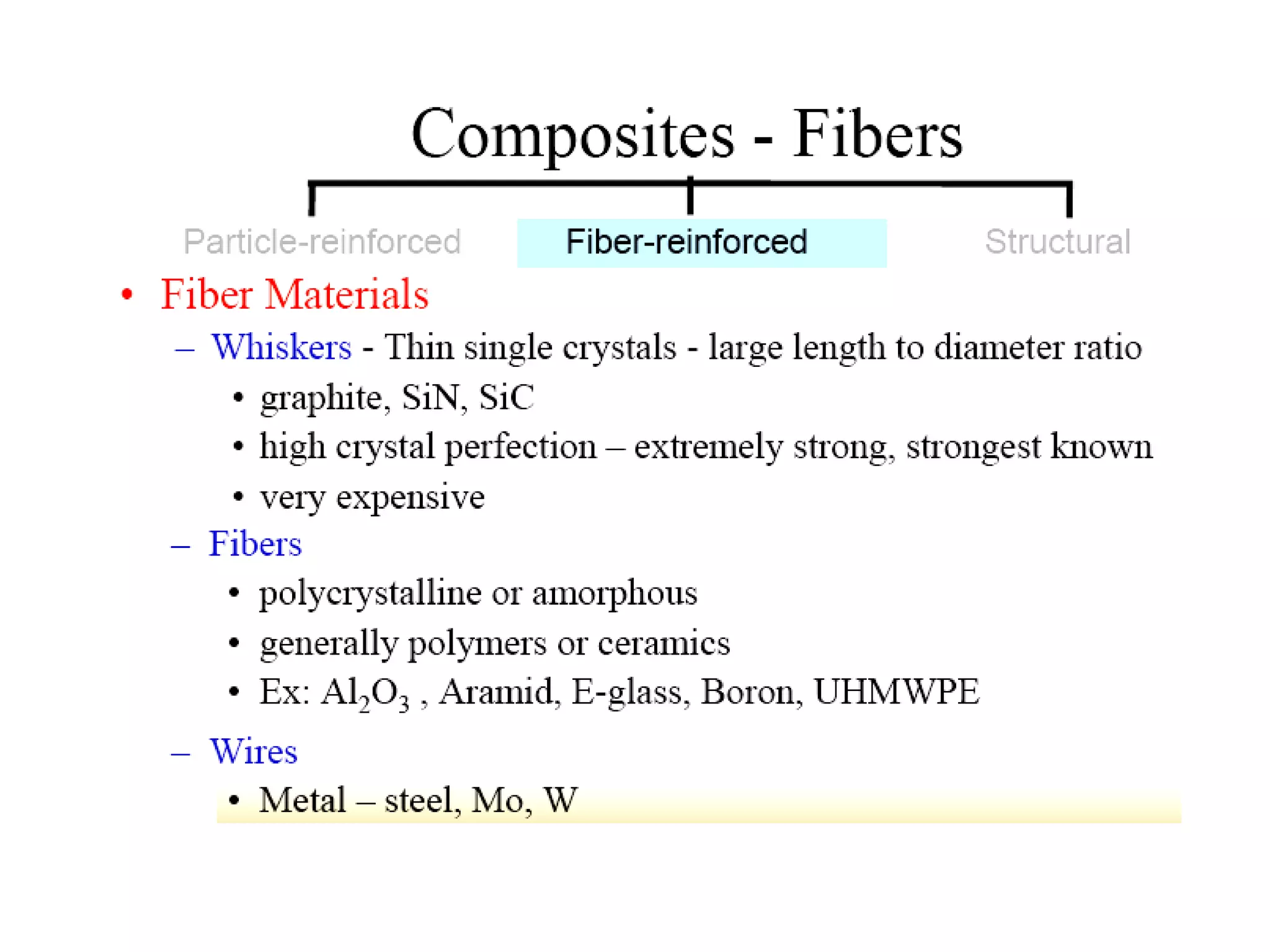
Materials for Fibers
Fiber materials in fiber reinforced composites:‑
Glass – most widely used filament
Carbon – high elastic modulus
Boron – very high elastic modulus
Polymers - Kevlar
Ceramics – SiC andAl2O3
Metals - steel
The most important commercial use of fibers is in polymer
composites
Fiber Reinforced Polymers‑
(FRPs)
A PMC consisting of a polymer matrix imbedded with
high strength fibers‑
Polymer matrix materials:
Usually a thermosetting (TS) plastic such as unsaturated
polyester or epoxy
Can also be thermoplastic (TP), such as nylons (polyamides),
polycarbonate, polystyrene, and polyvinylchloride
Fiber reinforcement is widely used in rubber products such as
tires and conveyor belts
Fibers in PMCs
Various forms: discontinuous (chopped), continuous, or
woven as a fabric
Principal fiber materials in FRPs are glass, carbon, and
Kevlar 49
Less common fibers include boron, SiC, andAl2O3, and
steel
Glass (in particular E glass) is the most common fiber‑
material in today's FRPs; its use to reinforce plastics dates
from around 1920
FRP Properties
High strength to weight and modulus to weight ratios‑ ‑ ‑ ‑
Low specific gravity - a typical FRP weighs only about 1/5 as
much as steel; yet, strength and modulus are comparable in fiber
direction
Good fatigue strength
Good corrosion resistance, although polymers are soluble in
various chemicals
Low thermal expansion - for many FRPs, leading to good
dimensional stability
Significant anisotropy in properties
FRP Applications
Aerospace – much of the structural weight of todays airplanes and
helicopters consist of advanced FRPs
Automotive – somebody panels for cars and truck cabs
Continued use of low-carbon sheet steel in cars is evidence of
its low cost and ease of processing
Sports and recreation
Fiberglass reinforced plastic has been used for boat hulls since
the 1940s
Fishing rods, tennis rackets, golf club shafts, helmets, skis, bows
and arrows.
Metal Matrix Composites (MMCs)
A metal matrix reinforced by a second phase
Reinforcing phases:
Particles of ceramic (these MMCs are commonly called
cermets)
Fibers of various materials: other metals, ceramics, carbon, and
boron
Cermets
MMC with ceramic contained in a metallic matrix
The ceramic often dominates the mixture, sometimes up to
96% by volume
Bonding can be enhanced by slight solubility between phases
at elevated temperatures used in processing
Cermets can be subdivided into
Cemented carbides – most common
Oxide based cermets – less common‑
Cemented Carbides
One or more carbide compounds bonded in a metallic matrix
The term cermet is not used for all of these materials, even though it is
technically correct
Common cemented carbides are based on tungsten carbide (WC),
titanium carbide (TiC), and chromium carbide (Cr3C2)
Tantalum carbide (TaC) and others are less common
Metallic binders: usually cobalt (Co) or nickel (Ni)
Applications
Space:The space shuttle uses boron/aluminum tubes to
support its fuselage frame. In addition to decreasing the
mass of the space shuttle by more than 145 kg,
boron/aluminum also reduced the thermal insulation
requirements because of its low thermal conductivity.The
mast of the HubbleTelescope uses carbon-reinforced
aluminum.
Military: Precision components of missile guidance systems
demand dimensional stability — that is, the geometries of
the components cannot change during use. Metal matrix
composites such as SiC/aluminum composites satisfy this
requirement because they have high microyield strength.
In addition, the volume fraction of SiC can be varied to
have a coef cient of thermal expansion compatible withfi
other parts of the system assembly.
Applications
Transportation: Metal matrix composites are nding usefi
now in automotive engines that are lighter than their metal
counterparts.Also, because of their high strength and low
weight, metal matrix composites are the material of choice
for gas turbine engines.
structural applications, the matrix is usually a lighter
metal such as aluminum, magnesium, or titanium, and
provides a compliant support for the reinforcement.
Applications
Other Composite Structures
Laminar composite structure – conventional
Sandwich structure
Honeycomb sandwich structure

Composite materials

  • 1.
  • 2.
    Composite Material Defined Amaterials system composed of two or more physically distinct phases whose combination produces aggregate properties that are different from those of its constituents Examples: Cemented carbides (WC with Co binder) Plastic molding compounds containing fillers Rubber mixed with carbon black Wood (a natural composite as distinguished from a synthesized composite)
  • 3.
    Why Composites areImportant Composites can be very strong and stiff, yet very light in weight, so ratios of strength to weight and‑ ‑ stiffness to weight are several times greater than steel or‑ ‑ aluminum Fatigue properties are generally better than for common engineering metals Toughness is often greater too Composites can be designed that do not corrode like steel Possible to achieve combinations of properties not attainable with metals, ceramics, or polymers alone
  • 4.
    Disadvantages and Limitationsof Composite Materials Properties of many important composites are anisotropic ‑ the properties differ depending on the direction in which they are measured – this may be an advantage or a disadvantage Many of the polymer based composites are subject to attack‑ by chemicals or solvents, just as the polymers themselves are susceptible to attack Composite materials are generally expensive Manufacturing methods for shaping composite materials are often slow and costly
  • 5.
    One Possible Classificationof Composite Materials Traditional composites – composite materials that occur in nature or have been produced by civilizations for many years Examples: wood, concrete, asphalt Synthetic composites - modern material systems normally associated with the manufacturing industries, in which the components are first produced separately and then combined in a controlled way to achieve the desired structure, properties, and part geometry
  • 6.
  • 7.
    Classification based on Matrix PMC – Polymer Matrix composites  MMC – Metal Matrix composites  CMC – Ceramic Matrix composites
  • 8.
    Functions of theMatrix Material (Primary Phase) Protect phases from environment. Transfer Stresses to phases. When a load is applied, the matrix shares the load with the secondary phase, in some cases deforming so that the stress is essentially born by the reinforcing agent.
  • 13.
    Materials for Fibers Fibermaterials in fiber reinforced composites:‑ Glass – most widely used filament Carbon – high elastic modulus Boron – very high elastic modulus Polymers - Kevlar Ceramics – SiC andAl2O3 Metals - steel The most important commercial use of fibers is in polymer composites
  • 14.
    Fiber Reinforced Polymers‑ (FRPs) APMC consisting of a polymer matrix imbedded with high strength fibers‑ Polymer matrix materials: Usually a thermosetting (TS) plastic such as unsaturated polyester or epoxy Can also be thermoplastic (TP), such as nylons (polyamides), polycarbonate, polystyrene, and polyvinylchloride Fiber reinforcement is widely used in rubber products such as tires and conveyor belts
  • 15.
    Fibers in PMCs Variousforms: discontinuous (chopped), continuous, or woven as a fabric Principal fiber materials in FRPs are glass, carbon, and Kevlar 49 Less common fibers include boron, SiC, andAl2O3, and steel Glass (in particular E glass) is the most common fiber‑ material in today's FRPs; its use to reinforce plastics dates from around 1920
  • 16.
    FRP Properties High strengthto weight and modulus to weight ratios‑ ‑ ‑ ‑ Low specific gravity - a typical FRP weighs only about 1/5 as much as steel; yet, strength and modulus are comparable in fiber direction Good fatigue strength Good corrosion resistance, although polymers are soluble in various chemicals Low thermal expansion - for many FRPs, leading to good dimensional stability Significant anisotropy in properties
  • 17.
    FRP Applications Aerospace –much of the structural weight of todays airplanes and helicopters consist of advanced FRPs Automotive – somebody panels for cars and truck cabs Continued use of low-carbon sheet steel in cars is evidence of its low cost and ease of processing Sports and recreation Fiberglass reinforced plastic has been used for boat hulls since the 1940s Fishing rods, tennis rackets, golf club shafts, helmets, skis, bows and arrows.
  • 18.
    Metal Matrix Composites(MMCs) A metal matrix reinforced by a second phase Reinforcing phases: Particles of ceramic (these MMCs are commonly called cermets) Fibers of various materials: other metals, ceramics, carbon, and boron
  • 19.
    Cermets MMC with ceramiccontained in a metallic matrix The ceramic often dominates the mixture, sometimes up to 96% by volume Bonding can be enhanced by slight solubility between phases at elevated temperatures used in processing Cermets can be subdivided into Cemented carbides – most common Oxide based cermets – less common‑
  • 20.
    Cemented Carbides One ormore carbide compounds bonded in a metallic matrix The term cermet is not used for all of these materials, even though it is technically correct Common cemented carbides are based on tungsten carbide (WC), titanium carbide (TiC), and chromium carbide (Cr3C2) Tantalum carbide (TaC) and others are less common Metallic binders: usually cobalt (Co) or nickel (Ni)
  • 21.
    Applications Space:The space shuttleuses boron/aluminum tubes to support its fuselage frame. In addition to decreasing the mass of the space shuttle by more than 145 kg, boron/aluminum also reduced the thermal insulation requirements because of its low thermal conductivity.The mast of the HubbleTelescope uses carbon-reinforced aluminum.
  • 22.
    Military: Precision componentsof missile guidance systems demand dimensional stability — that is, the geometries of the components cannot change during use. Metal matrix composites such as SiC/aluminum composites satisfy this requirement because they have high microyield strength. In addition, the volume fraction of SiC can be varied to have a coef cient of thermal expansion compatible withfi other parts of the system assembly. Applications
  • 23.
    Transportation: Metal matrixcomposites are nding usefi now in automotive engines that are lighter than their metal counterparts.Also, because of their high strength and low weight, metal matrix composites are the material of choice for gas turbine engines. structural applications, the matrix is usually a lighter metal such as aluminum, magnesium, or titanium, and provides a compliant support for the reinforcement. Applications
  • 24.
    Other Composite Structures Laminarcomposite structure – conventional Sandwich structure Honeycomb sandwich structure