Applications of Composite materials in
Biomedical Field
1
Contents
1. Composite definition :04
2. Biochemical composites and their application :05
3. Orthopedic applications :06
4. Important considerations :07
5. Dentistry applications :12
6. Important considerations :13
7. Application in soft tissue Engineering :14
8. External Prosthetics and Orthotics :15
9. Applications in diagnostic devices :17
10. Application for cancer curing :19
11. Refrences :20
2
What Are Composites?
 A composite material consists of two or more physically
and/or chemically distinct, suitably arranged or distributed
materials with an interface separating them. It has
characteristics that are not depicted by any of the
components in isolation, these specific characteristics being
the purpose of combining the materials.
4
Bio-medical composite and their
Application
 In Medical- A composite is a nonviable material used in a
medical device and intended to interact with biological system
 Biomedical applications encompass those that pertain to the
diagnosis and treatment of conditions, diseases and
disabilities.
 They include implants ,surgical and diagnostic devices,
pacemakers , electrodes for collecting or sending electrical or
optical signals for diagnosis or treatment, wheelchairs,
devices for helping the disabled, exercise equipment,
pharmaceutical packaging (for controlled release of the drug
into the body, or for other purposes) and instrumentation for
diagnosis and chemical analysis .
4
ORTHOPEDIC APPLICATIONS
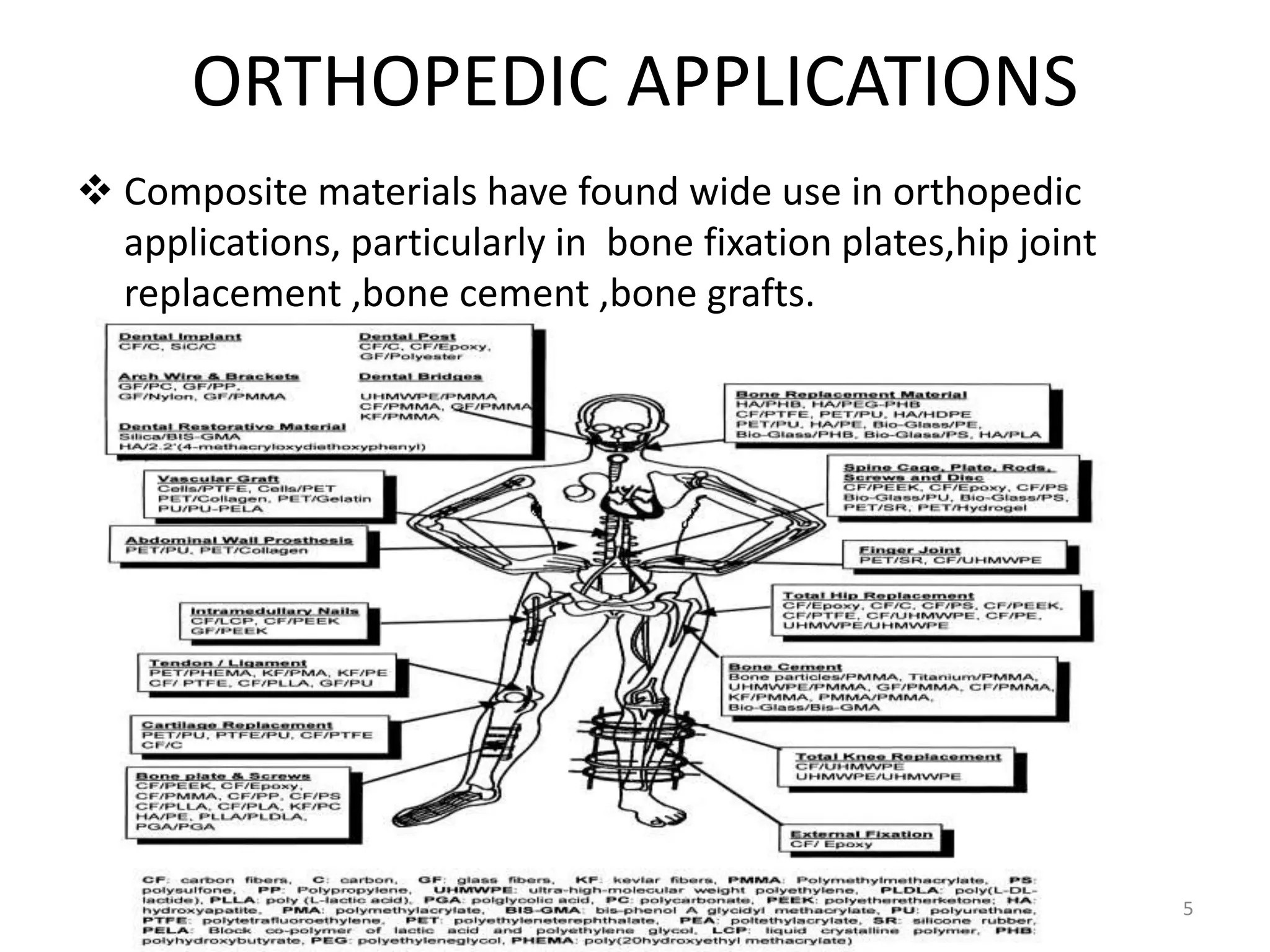
 Composite materials have found wide use in orthopedic
applications, particularly in bone fixation plates,hip joint
replacement ,bone cement ,bone grafts.
5
Important considerations
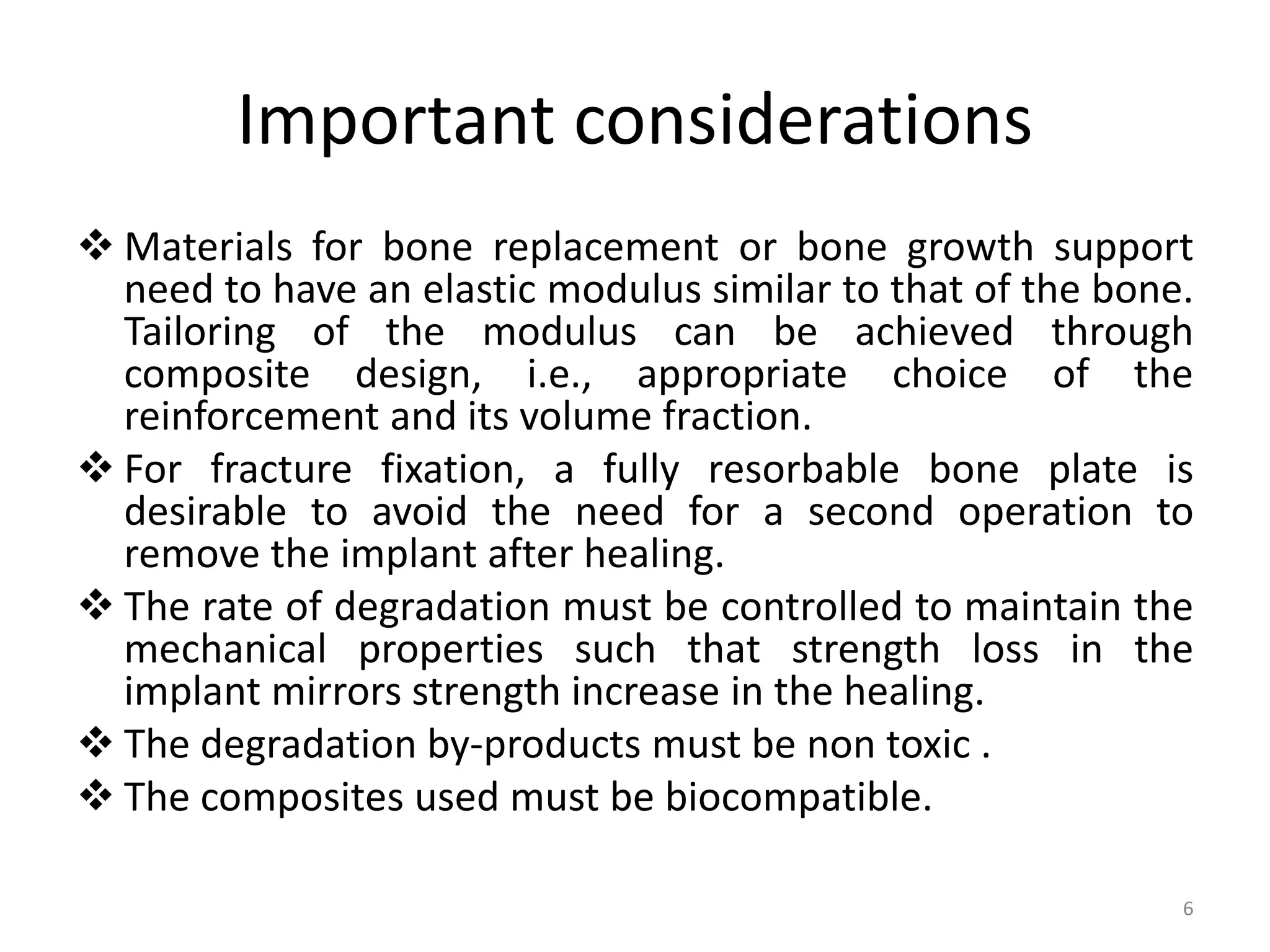
 Materials for bone replacement or bone growth support
need to have an elastic modulus similar to that of the bone.
Tailoring of the modulus can be achieved through
composite design, i.e., appropriate choice of the
reinforcement and its volume fraction.
 For fracture fixation, a fully resorbable bone plate is
desirable to avoid the need for a second operation to
remove the implant after healing.
 The rate of degradation must be controlled to maintain the
mechanical properties such that strength loss in the
implant mirrors strength increase in the healing.
 The degradation by-products must be non toxic .
 The composites used must be biocompatible.
6
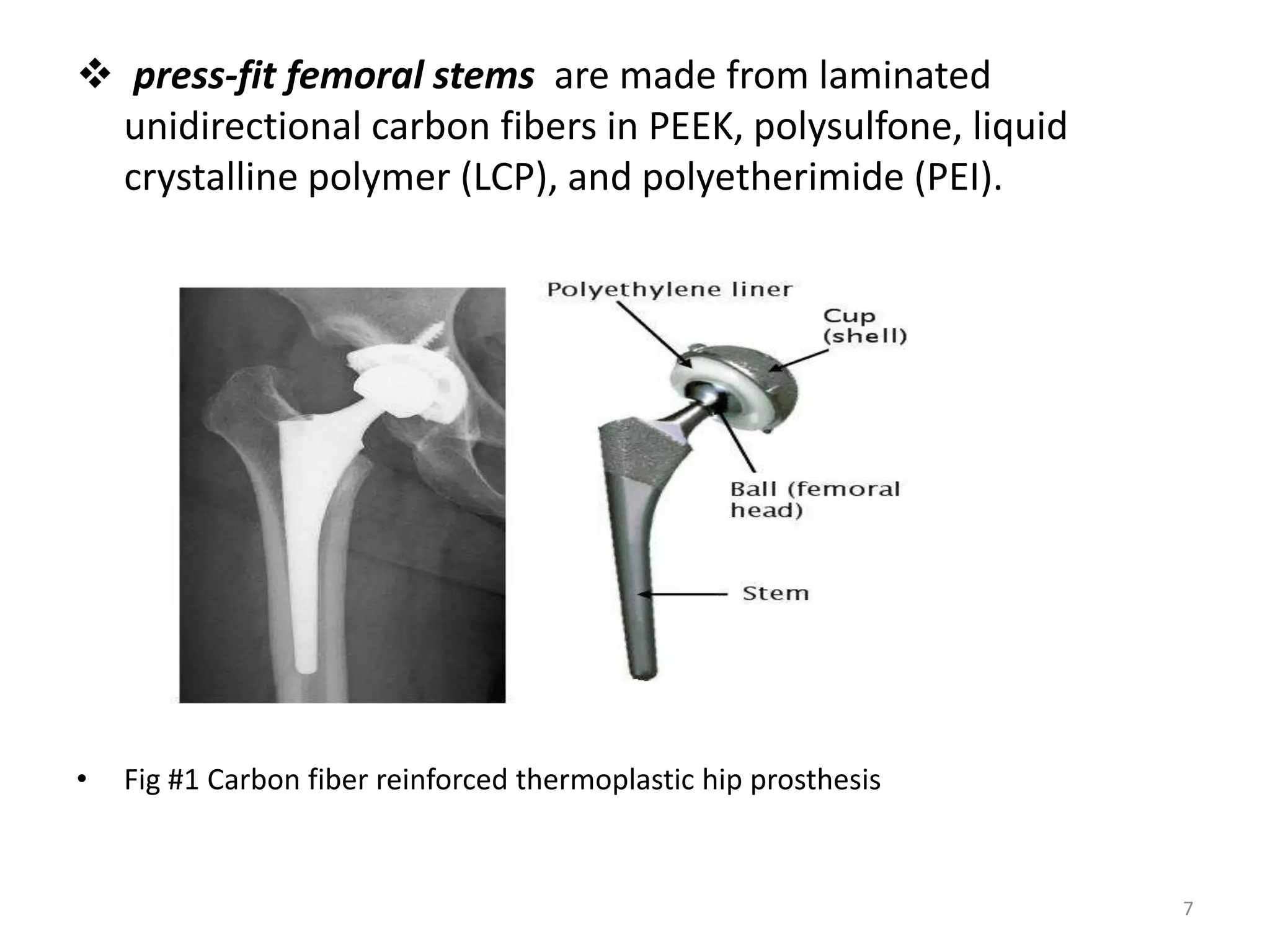
 press-fit femoral stems are made from laminated
unidirectional carbon fibers in PEEK, polysulfone, liquid
crystalline polymer (LCP), and polyetherimide (PEI).
• Fig #1 Carbon fiber reinforced thermoplastic hip prosthesis
7
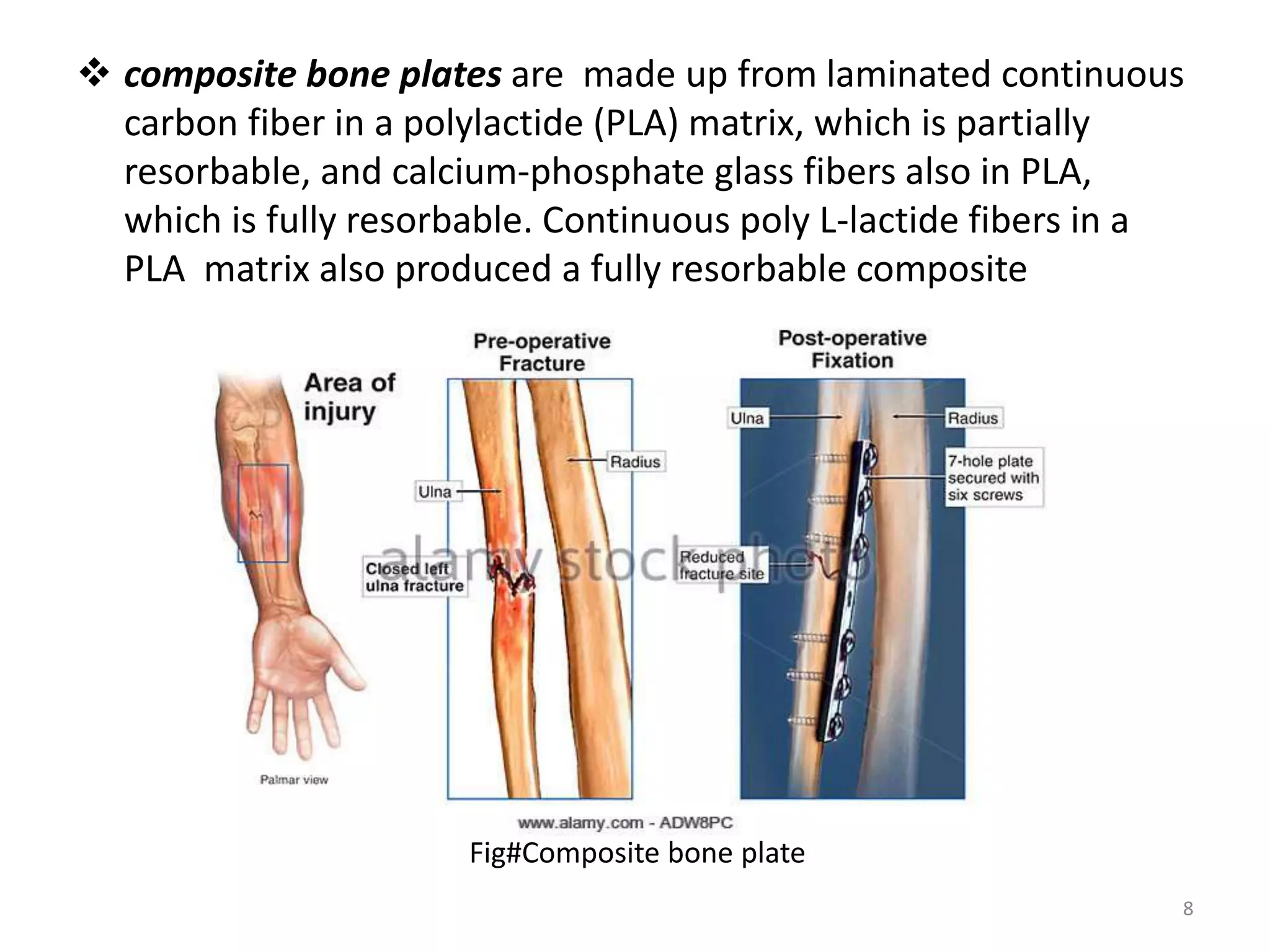
 composite bone plates are made up from laminated continuous
carbon fiber in a polylactide (PLA) matrix, which is partially
resorbable, and calcium-phosphate glass fibers also in PLA,
which is fully resorbable. Continuous poly L-lactide fibers in a
PLA matrix also produced a fully resorbable composite
Fig#Composite bone plate
8
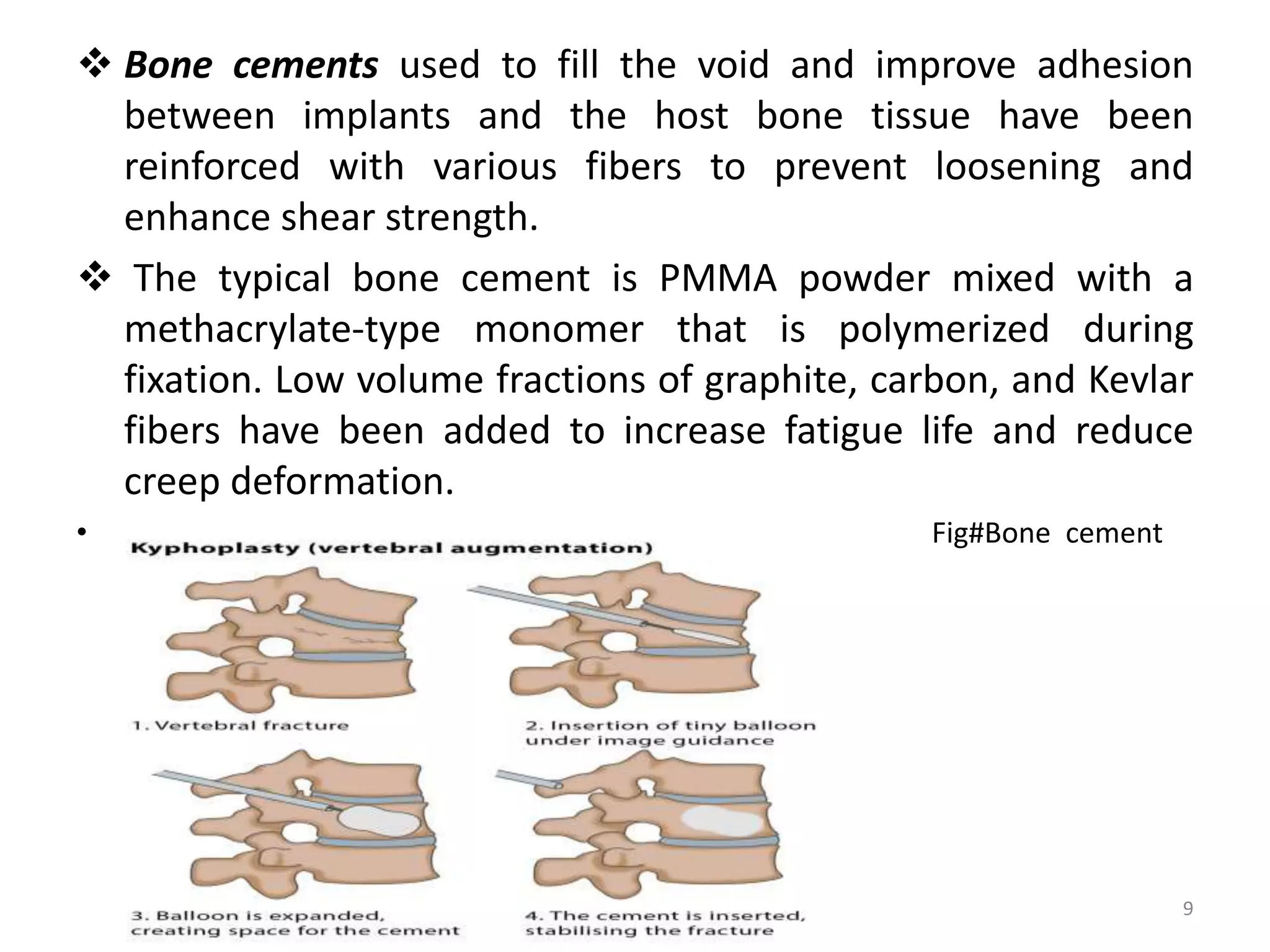
 Bone cements used to fill the void and improve adhesion
between implants and the host bone tissue have been
reinforced with various fibers to prevent loosening and
enhance shear strength.
 The typical bone cement is PMMA powder mixed with a
methacrylate-type monomer that is polymerized during
fixation. Low volume fractions of graphite, carbon, and Kevlar
fibers have been added to increase fatigue life and reduce
creep deformation.
• Fig#Bone cement
9
Dentistry applications
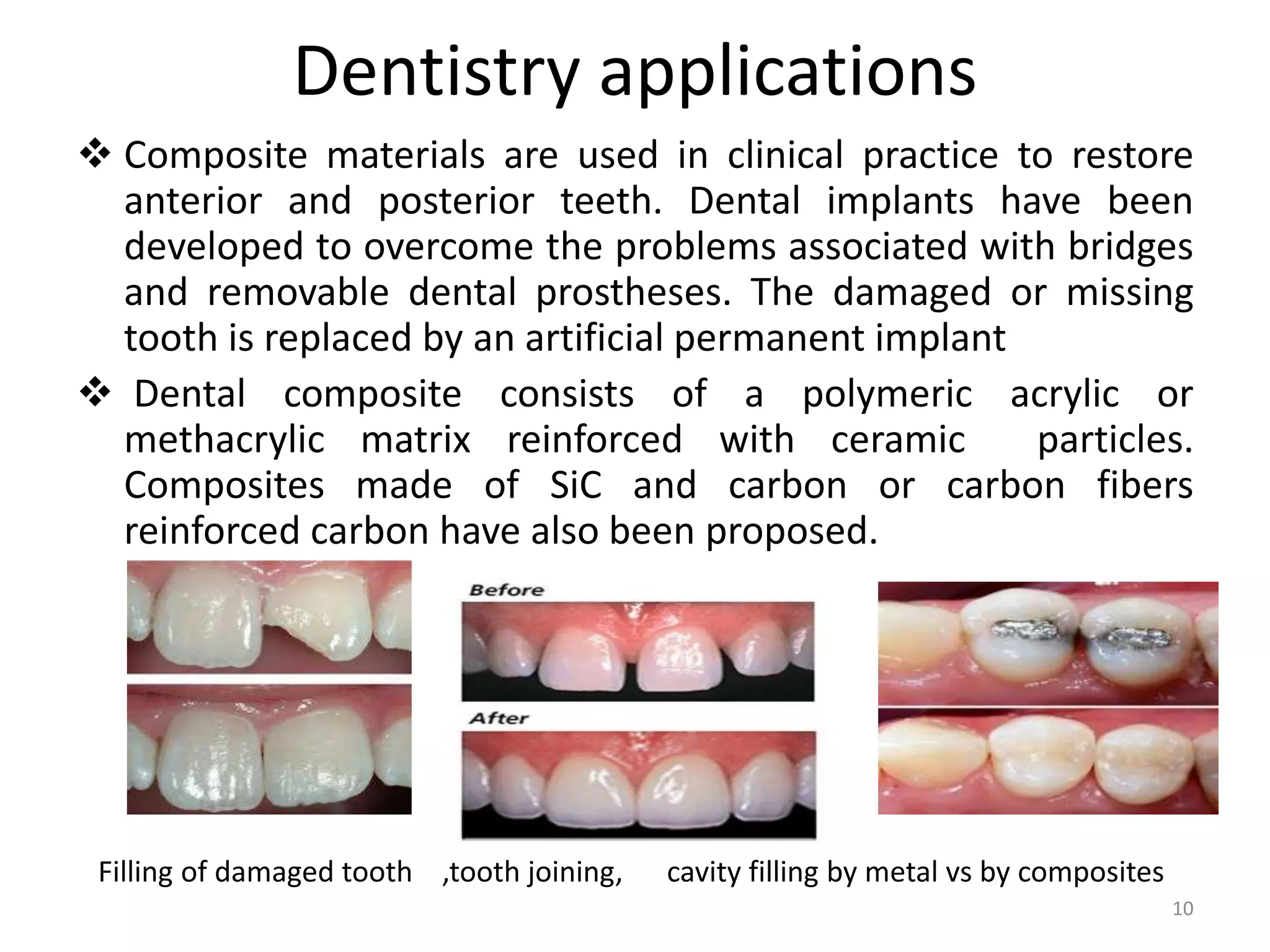
 Composite materials are used in clinical practice to restore
anterior and posterior teeth. Dental implants have been
developed to overcome the problems associated with bridges
and removable dental prostheses. The damaged or missing
tooth is replaced by an artificial permanent implant
 Dental composite consists of a polymeric acrylic or
methacrylic matrix reinforced with ceramic particles.
Composites made of SiC and carbon or carbon fibers
reinforced carbon have also been proposed.
Filling of damaged tooth ,tooth joining, cavity filling by metal vs by composites
10
Important considerations
The product needs to be aesthetically matched in
color and translucence with other teeth and
retain its gloss.
 It must match the hardness of the opposing
tooth and be resistant to wear or fatigue fracture.
 It must be dimensionally stable and withstand
the largely varying thermal stresses in the mouth.
 It also has to have short processing time and
near-net shape.
It should be biocompatible.
11
Application in soft tissue Engineering
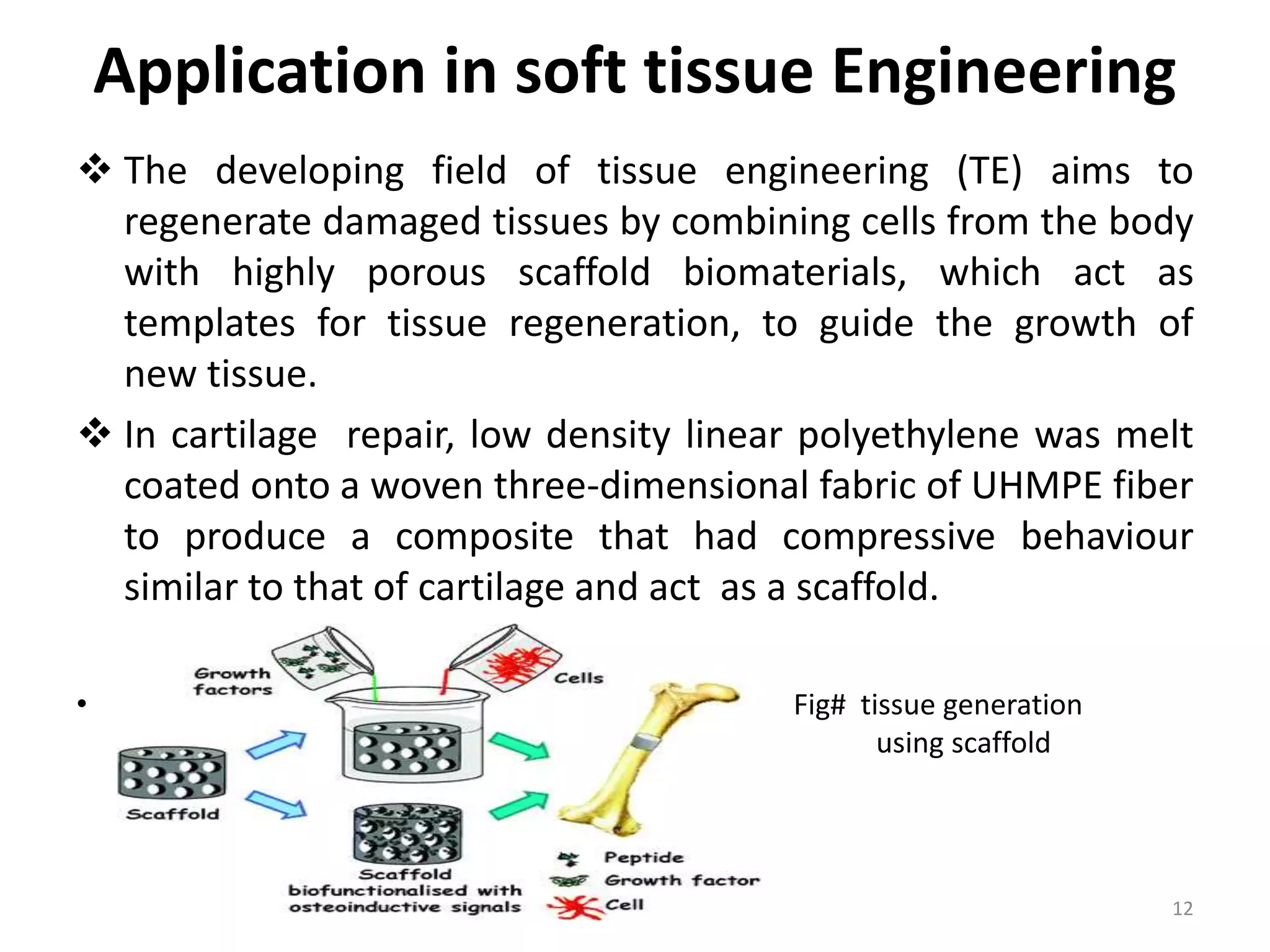
 The developing field of tissue engineering (TE) aims to
regenerate damaged tissues by combining cells from the body
with highly porous scaffold biomaterials, which act as
templates for tissue regeneration, to guide the growth of
new tissue.
 In cartilage repair, low density linear polyethylene was melt
coated onto a woven three-dimensional fabric of UHMPE fiber
to produce a composite that had compressive behaviour
similar to that of cartilage and act as a scaffold.
• Fig# tissue generation
using using scaffold
12
External Prosthetics and Orthotics
 With all the specific and individual forces and stress
involved the required properties of a composite would
be:
• Light weight
• Strong under tension
• Strong under compression
• Flexible, to absorb torque
• Stiff, to resist bending and shear stress
• Durable, to resist fracture under impact
• Capable of resisting stress in all planes
• Cost effective
• Easy to apply
• Bio compatible
13
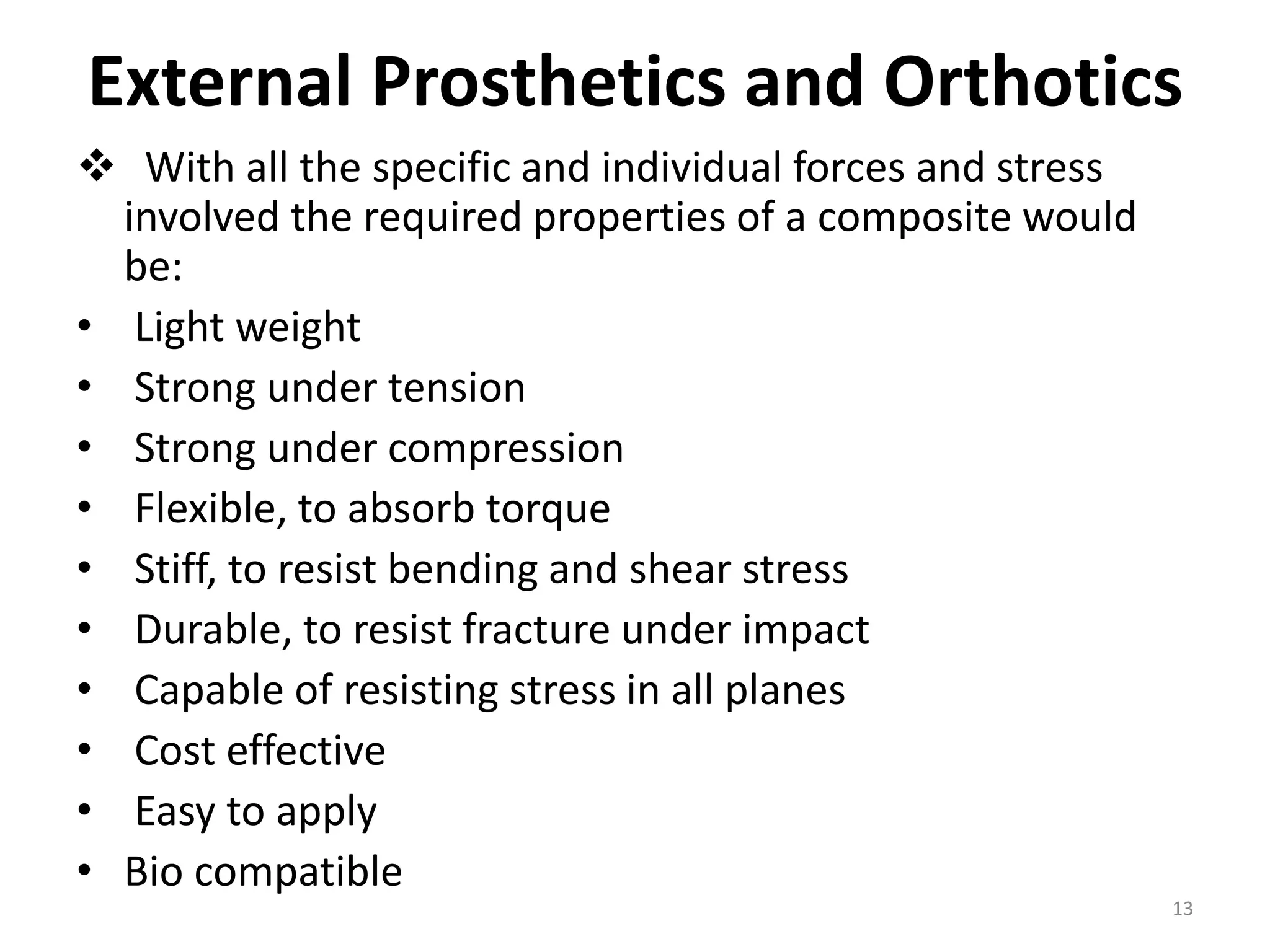
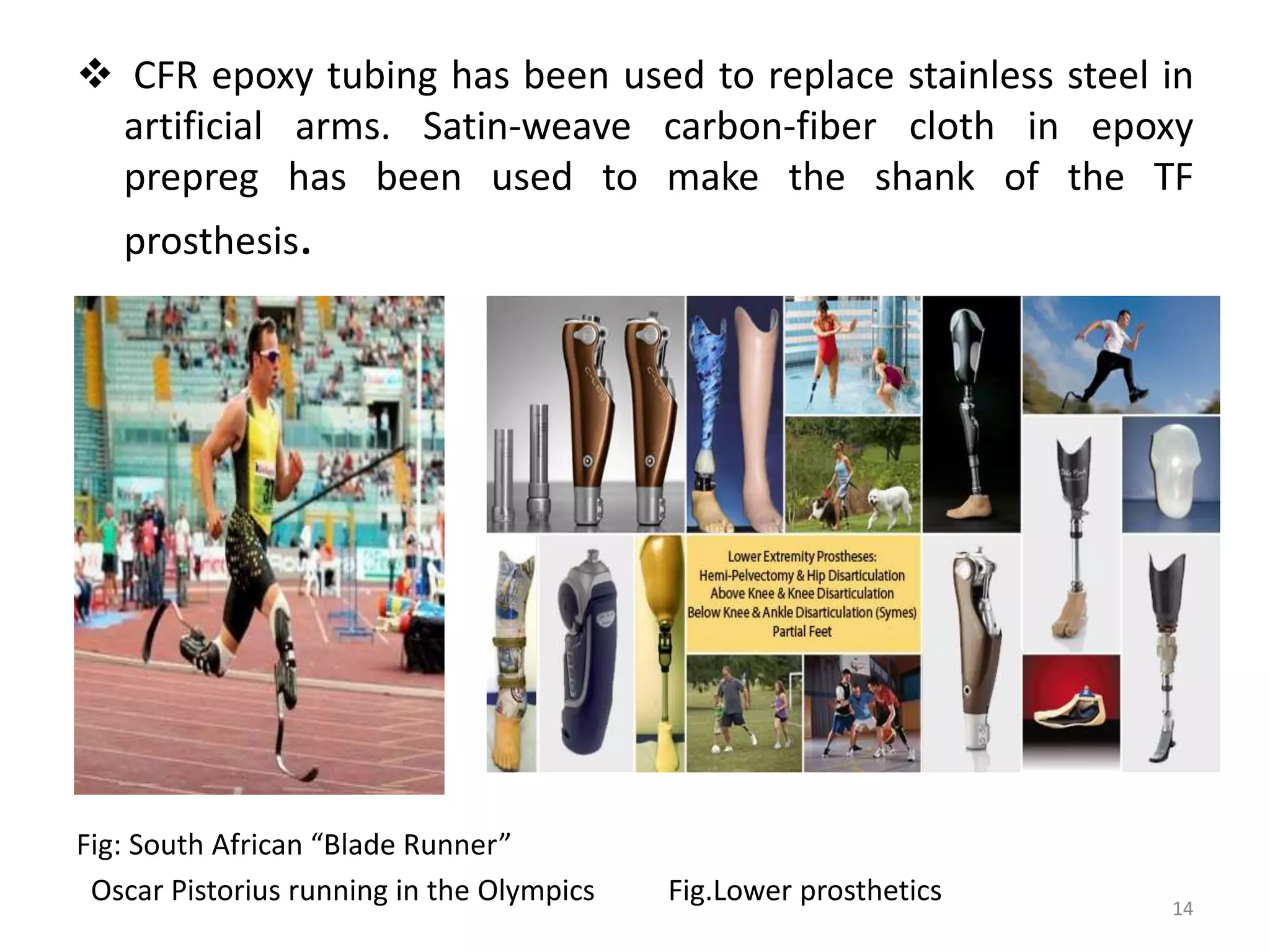
 CFR epoxy tubing has been used to replace stainless steel in
artificial arms. Satin-weave carbon-fiber cloth in epoxy
prepreg has been used to make the shank of the TF
prosthesis.
Fig: South African “Blade Runner”
Oscar Pistorius running in the Olympics Fig.Lower prosthetics 14
Applications in diagnostic devices
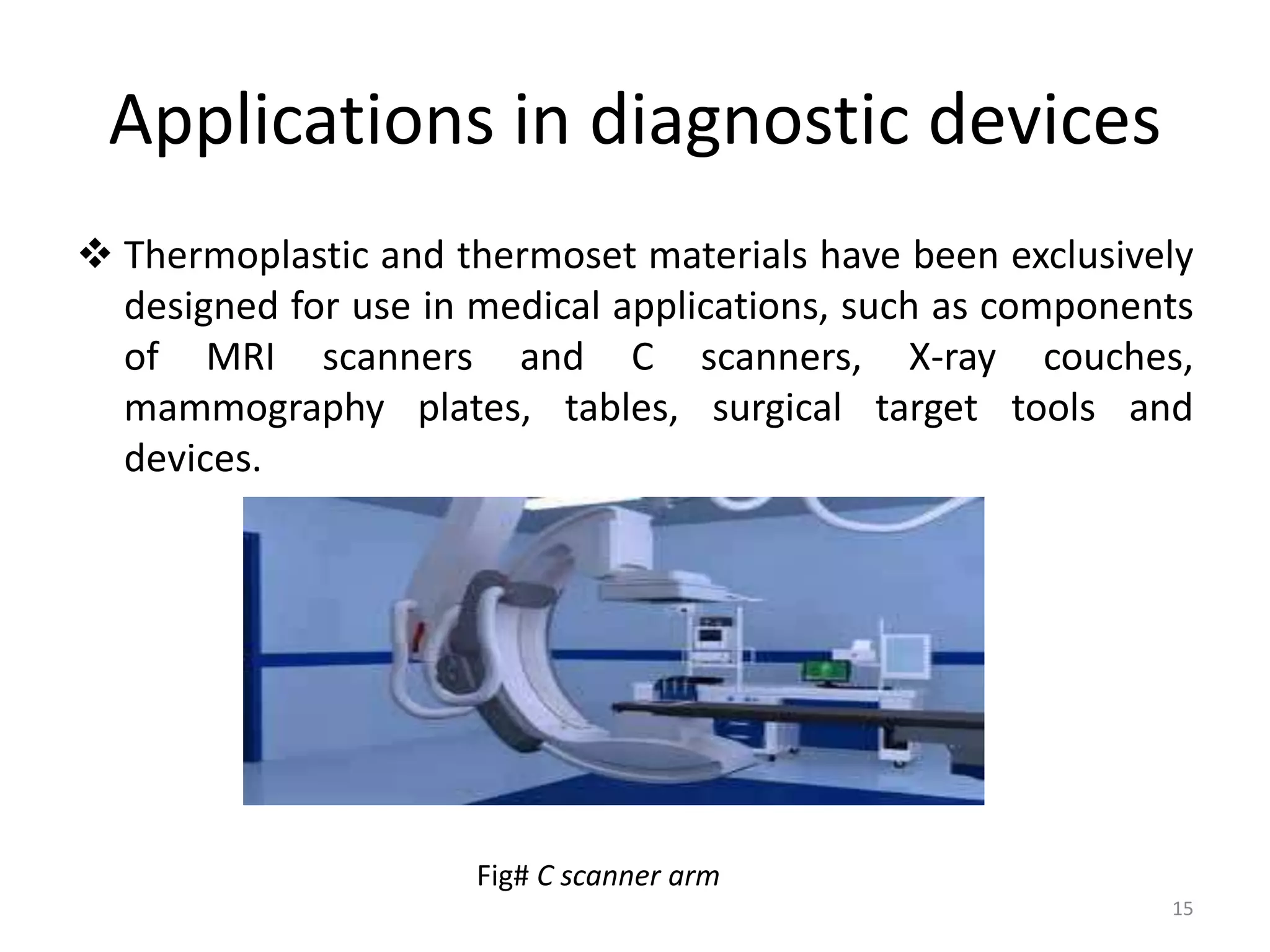
 Thermoplastic and thermoset materials have been exclusively
designed for use in medical applications, such as components
of MRI scanners and C scanners, X-ray couches,
mammography plates, tables, surgical target tools and
devices.
Fig# C scanner arm
15
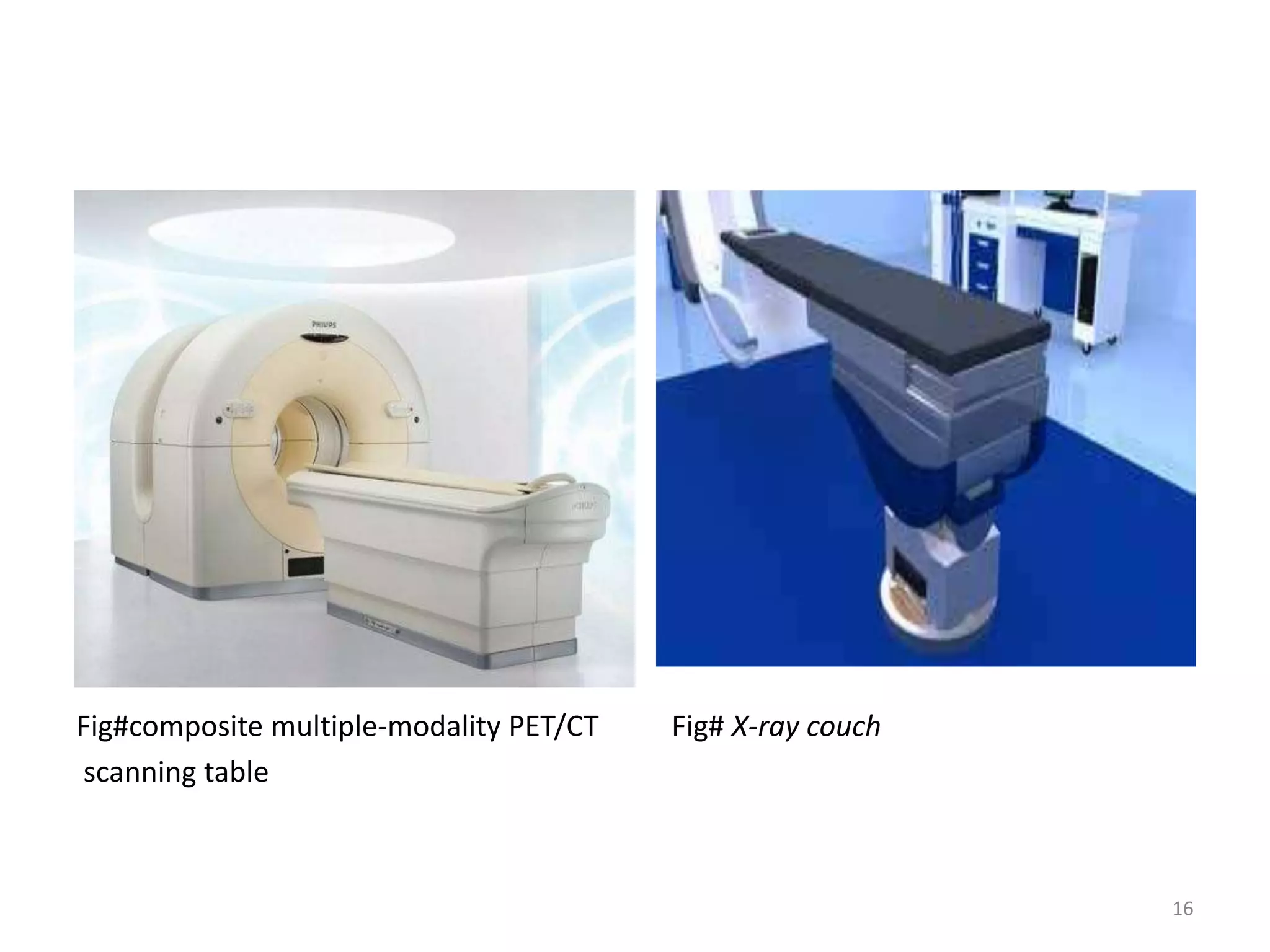
Fig#composite multiple-modality PET/CT Fig# X-ray couch
scanning table
16
Application for cancer curing
 An Ongoing research at Yale University demonstrates that
carbon nanotubes may provide an optimal surface for growing
cancer-fighting cells.
 The researchers are using carbon nanotube (CNT) polymer
composites to incubate cytoxic T-cells – nicknamed “killer
cells” because these white blood cells attack and kill infected
or cancerous cells. The novel technique is being tested for use
in adoptive immunotherapy, an emerging treatment in which
cells are removed from a patient, enhanced in the lab and
then injected back into the bloodstream to boost the patient’s
ability to fight infection or cancer.
17
Refrences
 https://www.azom.com/article.aspx?ArticleID=12194
 20-05-2018 7:42pm
 http://compositesmanufacturingmagazine.com/2015/11/com
posite-remedies-in-the-medical-market/2/ 20-05-2018
7:53pm
 Composite materials for biomedical applications Journal of
Applied Biomaterials & Biomechanics 2003; 1: 3-18
 Application and Future of Composite Materials International
Journal of Innovative Research in Science,Engineering and
TechnologyVol. 5, Issue 5, May 2016
 D. D. L. Chung, Composite Materials
 STANDARD HANDBOOK OF BIOMEDICAL ENGINEERING AND
DESIGN
18

application of composite material in biomedical fild

  • 1.
    Applications of Compositematerials in Biomedical Field 1
  • 2.
    Contents 1. Composite definition:04 2. Biochemical composites and their application :05 3. Orthopedic applications :06 4. Important considerations :07 5. Dentistry applications :12 6. Important considerations :13 7. Application in soft tissue Engineering :14 8. External Prosthetics and Orthotics :15 9. Applications in diagnostic devices :17 10. Application for cancer curing :19 11. Refrences :20 2
  • 3.
    What Are Composites? A composite material consists of two or more physically and/or chemically distinct, suitably arranged or distributed materials with an interface separating them. It has characteristics that are not depicted by any of the components in isolation, these specific characteristics being the purpose of combining the materials. 4
  • 4.
    Bio-medical composite andtheir Application  In Medical- A composite is a nonviable material used in a medical device and intended to interact with biological system  Biomedical applications encompass those that pertain to the diagnosis and treatment of conditions, diseases and disabilities.  They include implants ,surgical and diagnostic devices, pacemakers , electrodes for collecting or sending electrical or optical signals for diagnosis or treatment, wheelchairs, devices for helping the disabled, exercise equipment, pharmaceutical packaging (for controlled release of the drug into the body, or for other purposes) and instrumentation for diagnosis and chemical analysis . 4
  • 5.
    ORTHOPEDIC APPLICATIONS  Compositematerials have found wide use in orthopedic applications, particularly in bone fixation plates,hip joint replacement ,bone cement ,bone grafts. 5
  • 6.
    Important considerations  Materialsfor bone replacement or bone growth support need to have an elastic modulus similar to that of the bone. Tailoring of the modulus can be achieved through composite design, i.e., appropriate choice of the reinforcement and its volume fraction.  For fracture fixation, a fully resorbable bone plate is desirable to avoid the need for a second operation to remove the implant after healing.  The rate of degradation must be controlled to maintain the mechanical properties such that strength loss in the implant mirrors strength increase in the healing.  The degradation by-products must be non toxic .  The composites used must be biocompatible. 6
  • 7.
     press-fit femoralstems are made from laminated unidirectional carbon fibers in PEEK, polysulfone, liquid crystalline polymer (LCP), and polyetherimide (PEI). • Fig #1 Carbon fiber reinforced thermoplastic hip prosthesis 7
  • 8.
     composite boneplates are made up from laminated continuous carbon fiber in a polylactide (PLA) matrix, which is partially resorbable, and calcium-phosphate glass fibers also in PLA, which is fully resorbable. Continuous poly L-lactide fibers in a PLA matrix also produced a fully resorbable composite Fig#Composite bone plate 8
  • 9.
     Bone cementsused to fill the void and improve adhesion between implants and the host bone tissue have been reinforced with various fibers to prevent loosening and enhance shear strength.  The typical bone cement is PMMA powder mixed with a methacrylate-type monomer that is polymerized during fixation. Low volume fractions of graphite, carbon, and Kevlar fibers have been added to increase fatigue life and reduce creep deformation. • Fig#Bone cement 9
  • 10.
    Dentistry applications  Compositematerials are used in clinical practice to restore anterior and posterior teeth. Dental implants have been developed to overcome the problems associated with bridges and removable dental prostheses. The damaged or missing tooth is replaced by an artificial permanent implant  Dental composite consists of a polymeric acrylic or methacrylic matrix reinforced with ceramic particles. Composites made of SiC and carbon or carbon fibers reinforced carbon have also been proposed. Filling of damaged tooth ,tooth joining, cavity filling by metal vs by composites 10
  • 11.
    Important considerations The productneeds to be aesthetically matched in color and translucence with other teeth and retain its gloss.  It must match the hardness of the opposing tooth and be resistant to wear or fatigue fracture.  It must be dimensionally stable and withstand the largely varying thermal stresses in the mouth.  It also has to have short processing time and near-net shape. It should be biocompatible. 11
  • 12.
    Application in softtissue Engineering  The developing field of tissue engineering (TE) aims to regenerate damaged tissues by combining cells from the body with highly porous scaffold biomaterials, which act as templates for tissue regeneration, to guide the growth of new tissue.  In cartilage repair, low density linear polyethylene was melt coated onto a woven three-dimensional fabric of UHMPE fiber to produce a composite that had compressive behaviour similar to that of cartilage and act as a scaffold. • Fig# tissue generation using using scaffold 12
  • 13.
    External Prosthetics andOrthotics  With all the specific and individual forces and stress involved the required properties of a composite would be: • Light weight • Strong under tension • Strong under compression • Flexible, to absorb torque • Stiff, to resist bending and shear stress • Durable, to resist fracture under impact • Capable of resisting stress in all planes • Cost effective • Easy to apply • Bio compatible 13
  • 14.
     CFR epoxytubing has been used to replace stainless steel in artificial arms. Satin-weave carbon-fiber cloth in epoxy prepreg has been used to make the shank of the TF prosthesis. Fig: South African “Blade Runner” Oscar Pistorius running in the Olympics Fig.Lower prosthetics 14
  • 15.
    Applications in diagnosticdevices  Thermoplastic and thermoset materials have been exclusively designed for use in medical applications, such as components of MRI scanners and C scanners, X-ray couches, mammography plates, tables, surgical target tools and devices. Fig# C scanner arm 15
  • 16.
    Fig#composite multiple-modality PET/CTFig# X-ray couch scanning table 16
  • 17.
    Application for cancercuring  An Ongoing research at Yale University demonstrates that carbon nanotubes may provide an optimal surface for growing cancer-fighting cells.  The researchers are using carbon nanotube (CNT) polymer composites to incubate cytoxic T-cells – nicknamed “killer cells” because these white blood cells attack and kill infected or cancerous cells. The novel technique is being tested for use in adoptive immunotherapy, an emerging treatment in which cells are removed from a patient, enhanced in the lab and then injected back into the bloodstream to boost the patient’s ability to fight infection or cancer. 17
  • 18.
    Refrences  https://www.azom.com/article.aspx?ArticleID=12194  20-05-20187:42pm  http://compositesmanufacturingmagazine.com/2015/11/com posite-remedies-in-the-medical-market/2/ 20-05-2018 7:53pm  Composite materials for biomedical applications Journal of Applied Biomaterials & Biomechanics 2003; 1: 3-18  Application and Future of Composite Materials International Journal of Innovative Research in Science,Engineering and TechnologyVol. 5, Issue 5, May 2016  D. D. L. Chung, Composite Materials  STANDARD HANDBOOK OF BIOMEDICAL ENGINEERING AND DESIGN 18