Ground heat exchanger for rootzone cooling of crops in vertical aeroponics
1.
Christopher S. Pascual,PhD
Associate Professor
Ground Heat Exchanger
(GHE) System for Rootzone
Cooling of Crops in Vertical
Aeroponics
2.
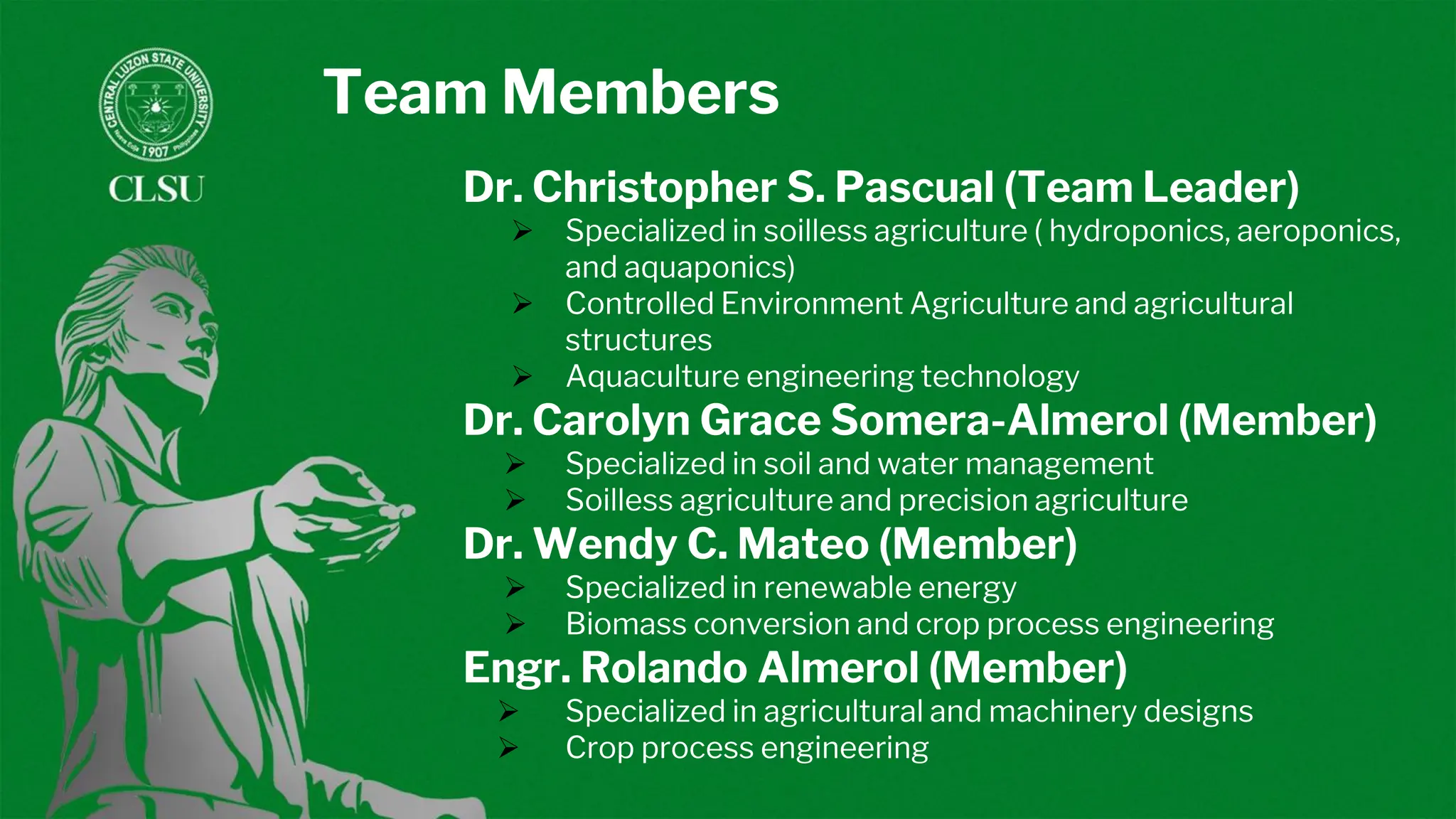
Team Members
Dr. ChristopherS. Pascual (Team Leader)
➢ Specialized in soilless agriculture ( hydroponics, aeroponics,
and aquaponics)
➢ Controlled Environment Agriculture and agricultural
structures
➢ Aquaculture engineering technology
Dr. Carolyn Grace Somera-Almerol (Member)
➢ Specialized in soil and water management
➢ Soilless agriculture and precision agriculture
Dr. Wendy C. Mateo (Member)
➢ Specialized in renewable energy
➢ Biomass conversion and crop process engineering
Engr. Rolando Almerol (Member)
➢ Specialized in agricultural and machinery designs
➢ Crop process engineering
3.
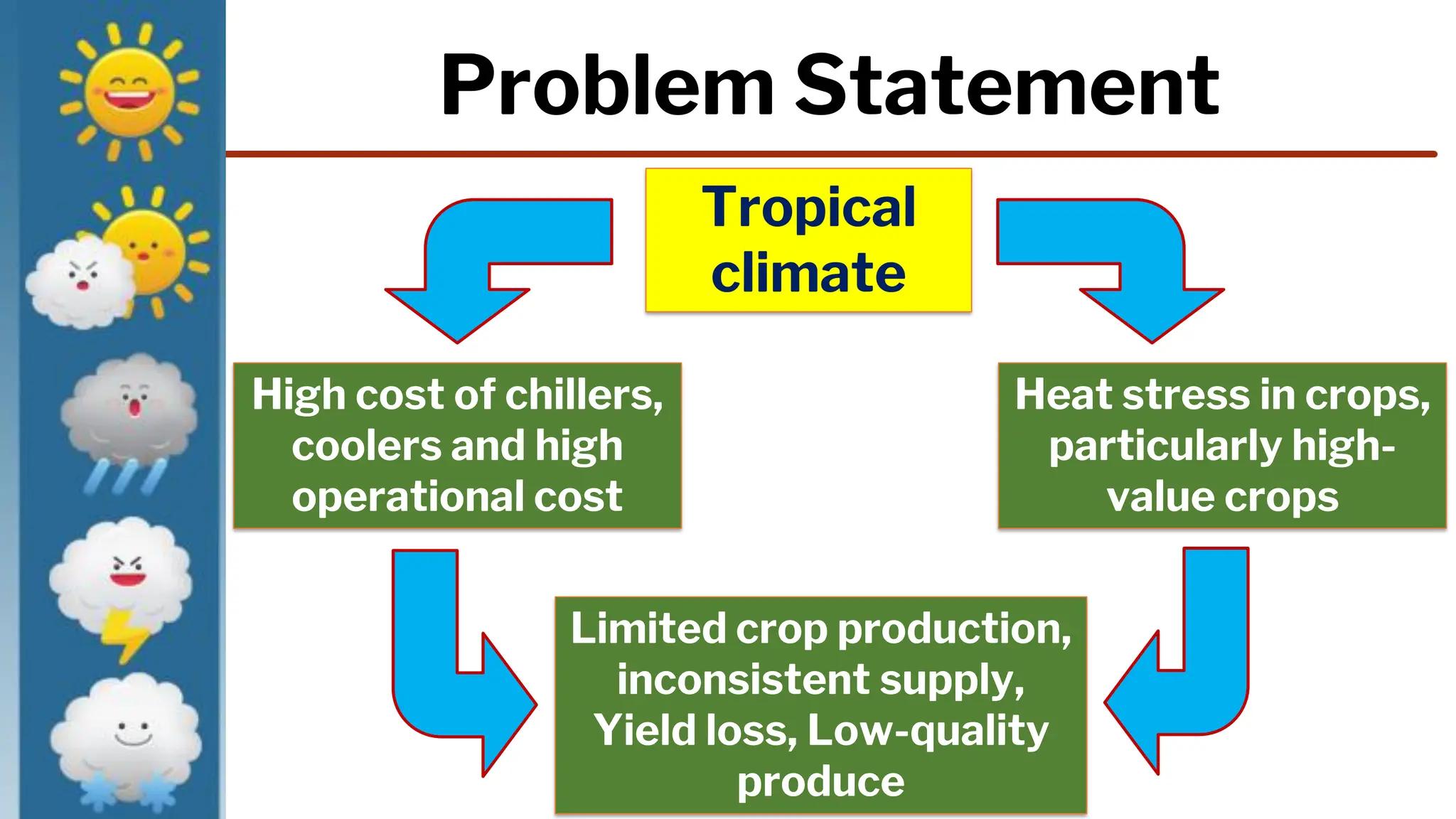
Problem Statement
Tropical
climate
Heat stressin crops,
particularly high-
value crops
Limited crop production,
inconsistent supply,
Yield loss, Low-quality
produce
High cost of chillers,
coolers and high
operational cost
4.
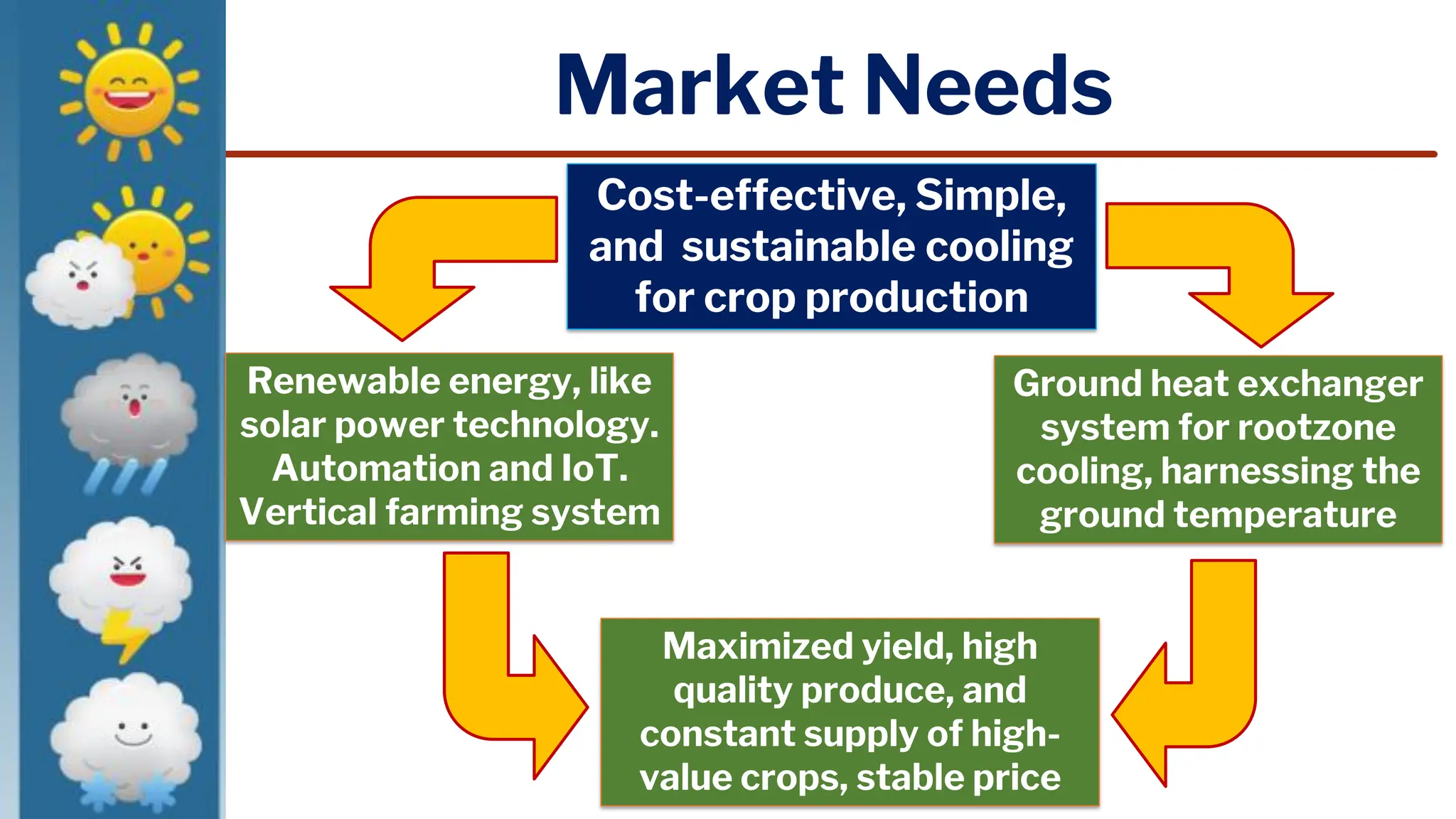
Market Needs
Cost-effective, Simple,
andsustainable cooling
for crop production
Ground heat exchanger
system for rootzone
cooling, harnessing the
ground temperature
Maximized yield, high
quality produce, and
constant supply of high-
value crops, stable price
Renewable energy, like
solar power technology.
Automation and IoT.
Vertical farming system
5.
CENTRAL LUZON STATEUNIVERSITY
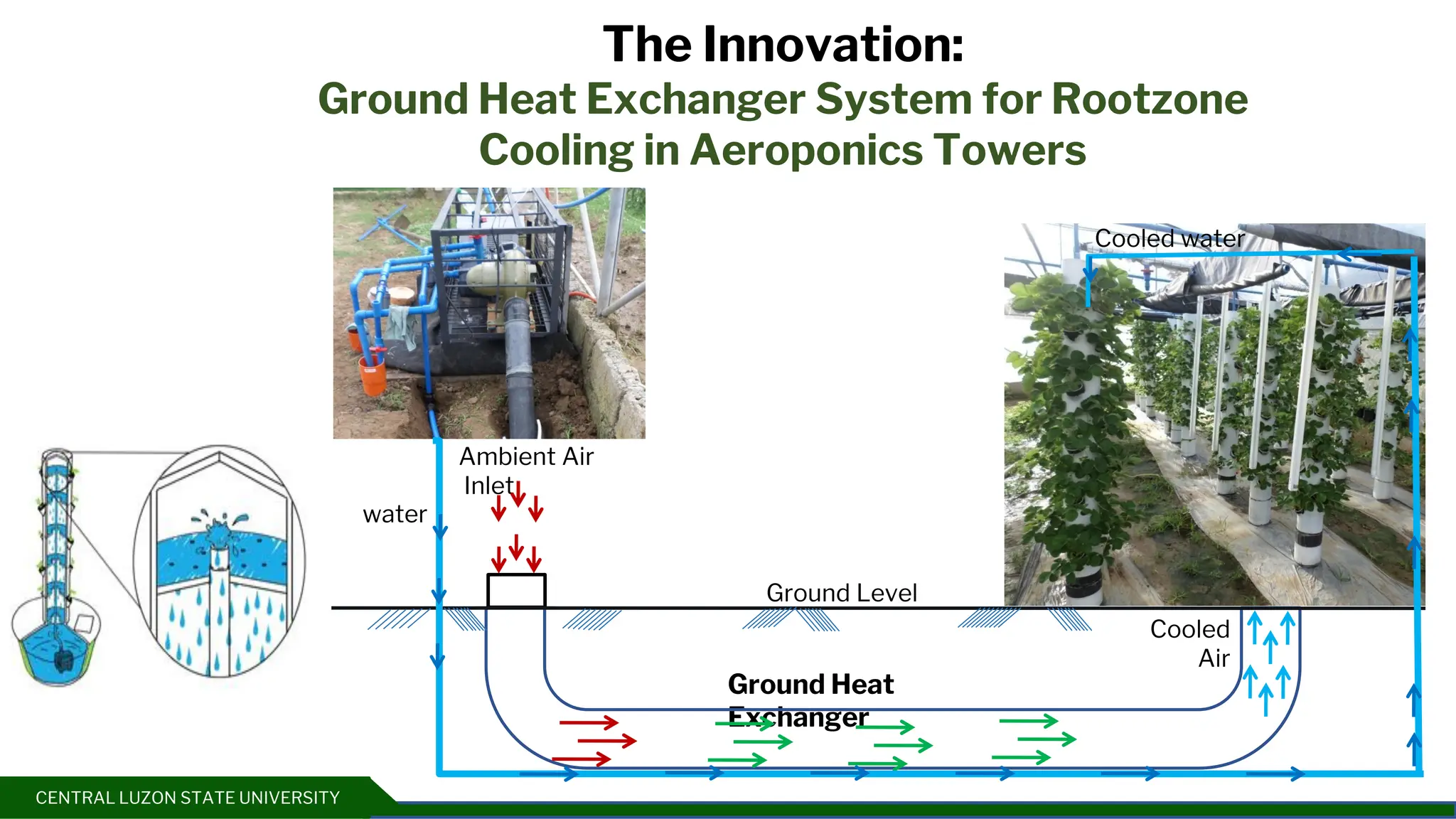
The Innovation:
Ground Heat Exchanger System for Rootzone
Cooling in Aeroponics Towers
Ambient Air
Inlet
Ground Heat
Exchanger
Cooled
Air
Ground Level
water
Cooled water
6.
6
CENTRAL LUZON STATEUNIVERSITY
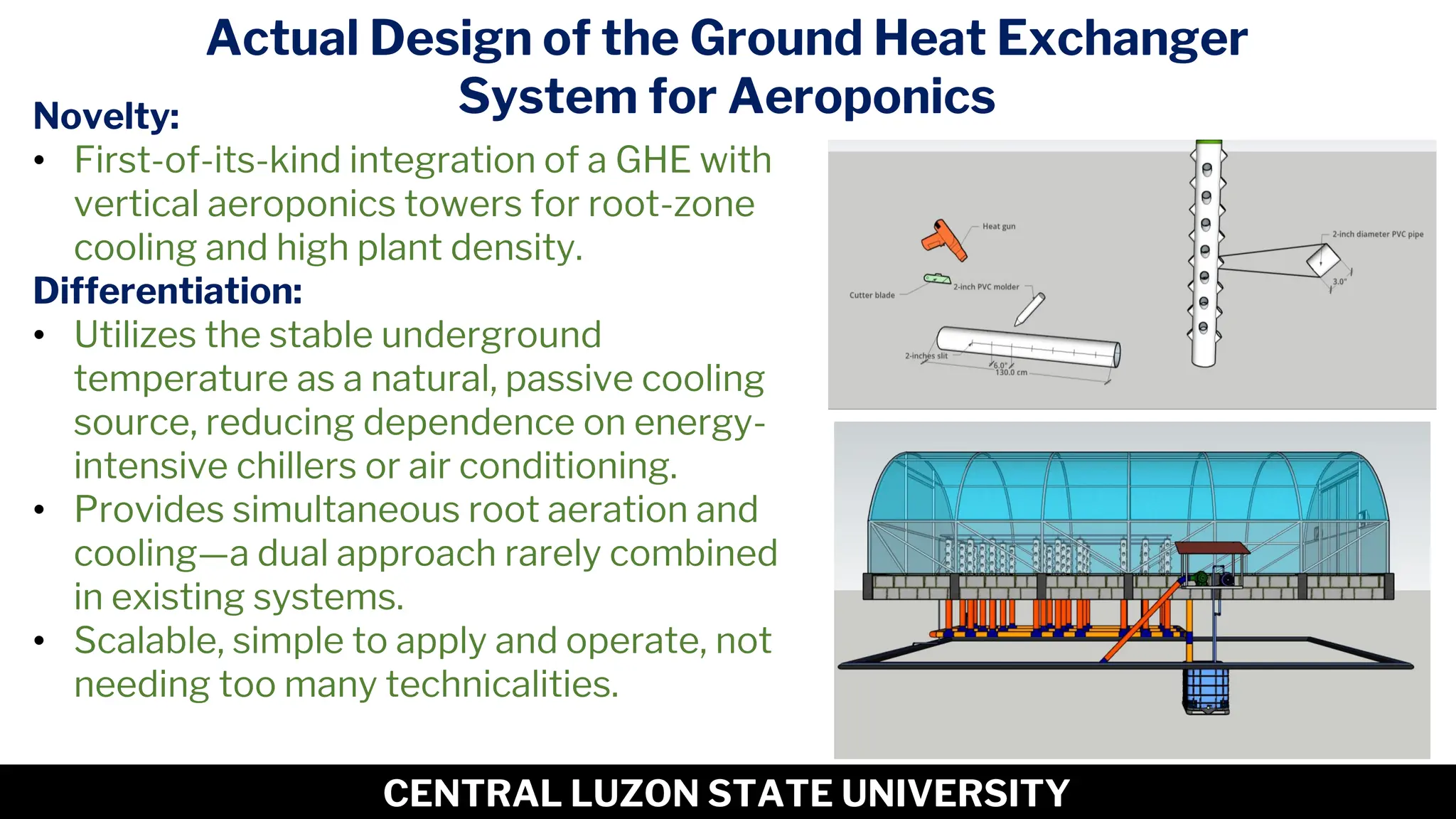
Actual Design of the Ground Heat Exchanger
System for Aeroponics
Novelty:
• First-of-its-kind integration of a GHE with
vertical aeroponics towers for root-zone
cooling and high plant density.
Differentiation:
• Utilizes the stable underground
temperature as a natural, passive cooling
source, reducing dependence on energy-
intensive chillers or air conditioning.
• Provides simultaneous root aeration and
cooling—a dual approach rarely combined
in existing systems.
• Scalable, simple to apply and operate, not
needing too many technicalities.
7.
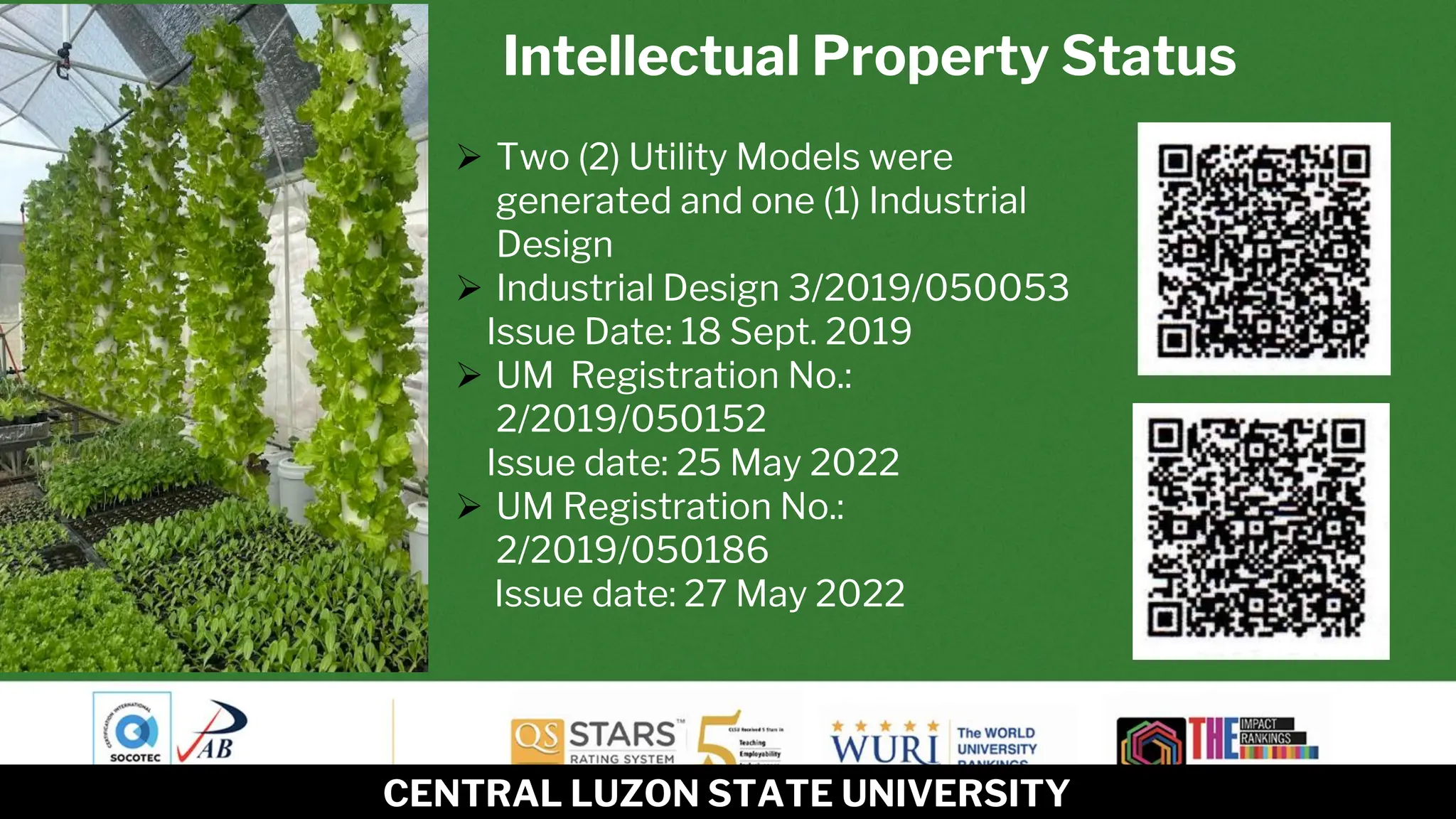
Intellectual Property Status
➢Two (2) Utility Models were
generated and one (1) Industrial
Design
➢ Industrial Design 3/2019/050053
Issue Date: 18 Sept. 2019
➢ UM Registration No.:
2/2019/050152
Issue date: 25 May 2022
➢ UM Registration No.:
2/2019/050186
Issue date: 27 May 2022
CENTRAL LUZON STATE UNIVERSITY
8.
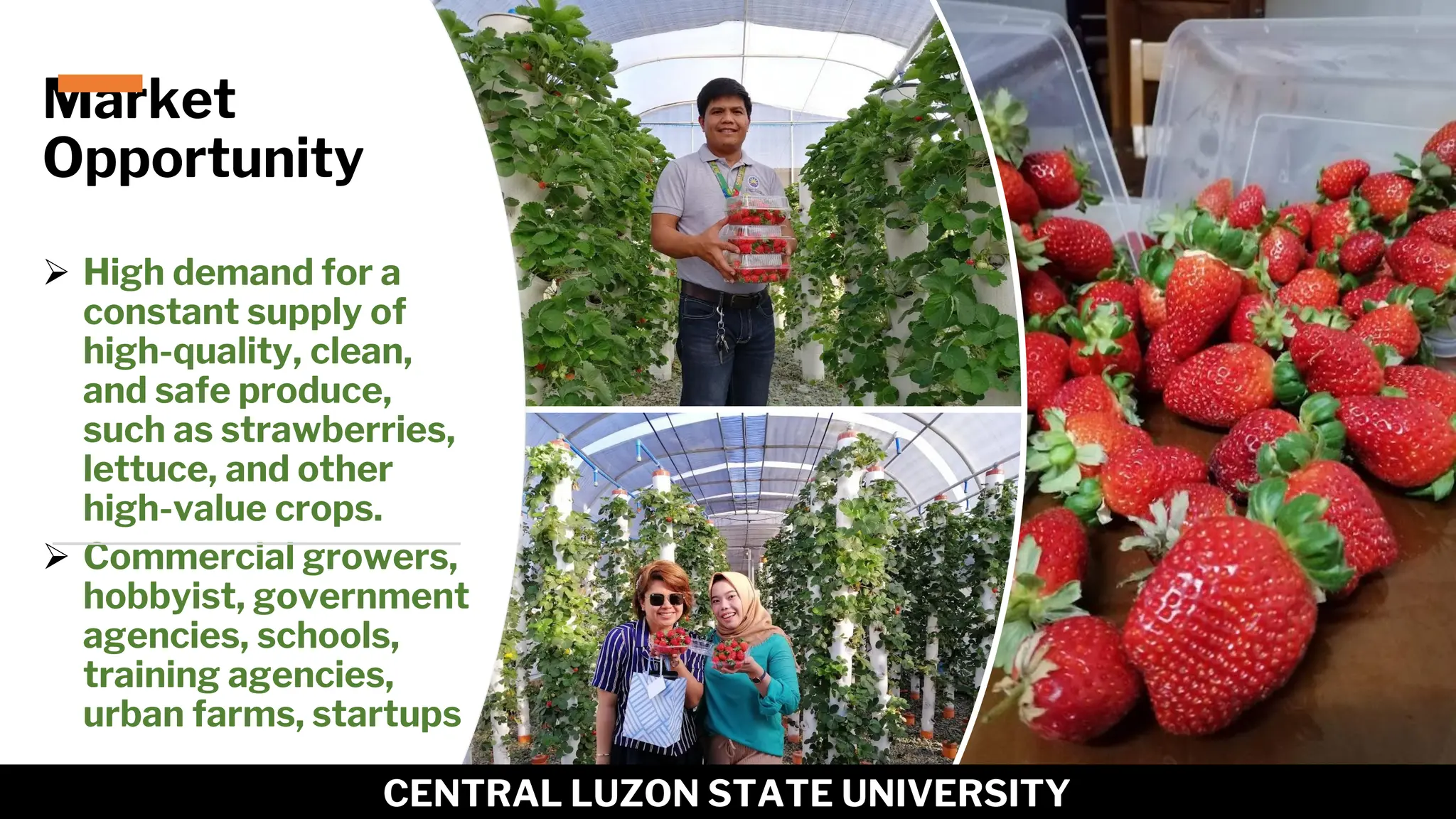
Market
Opportunity
➢ High demandfor a
constant supply of
high-quality, clean,
and safe produce,
such as strawberries,
lettuce, and other
high-value crops.
➢ Commercial growers,
hobbyist, government
agencies, schools,
training agencies,
urban farms, startups
8
CENTRAL LUZON STATE UNIVERSITY
9.
9
CENTRAL LUZON STATEUNIVERSITY
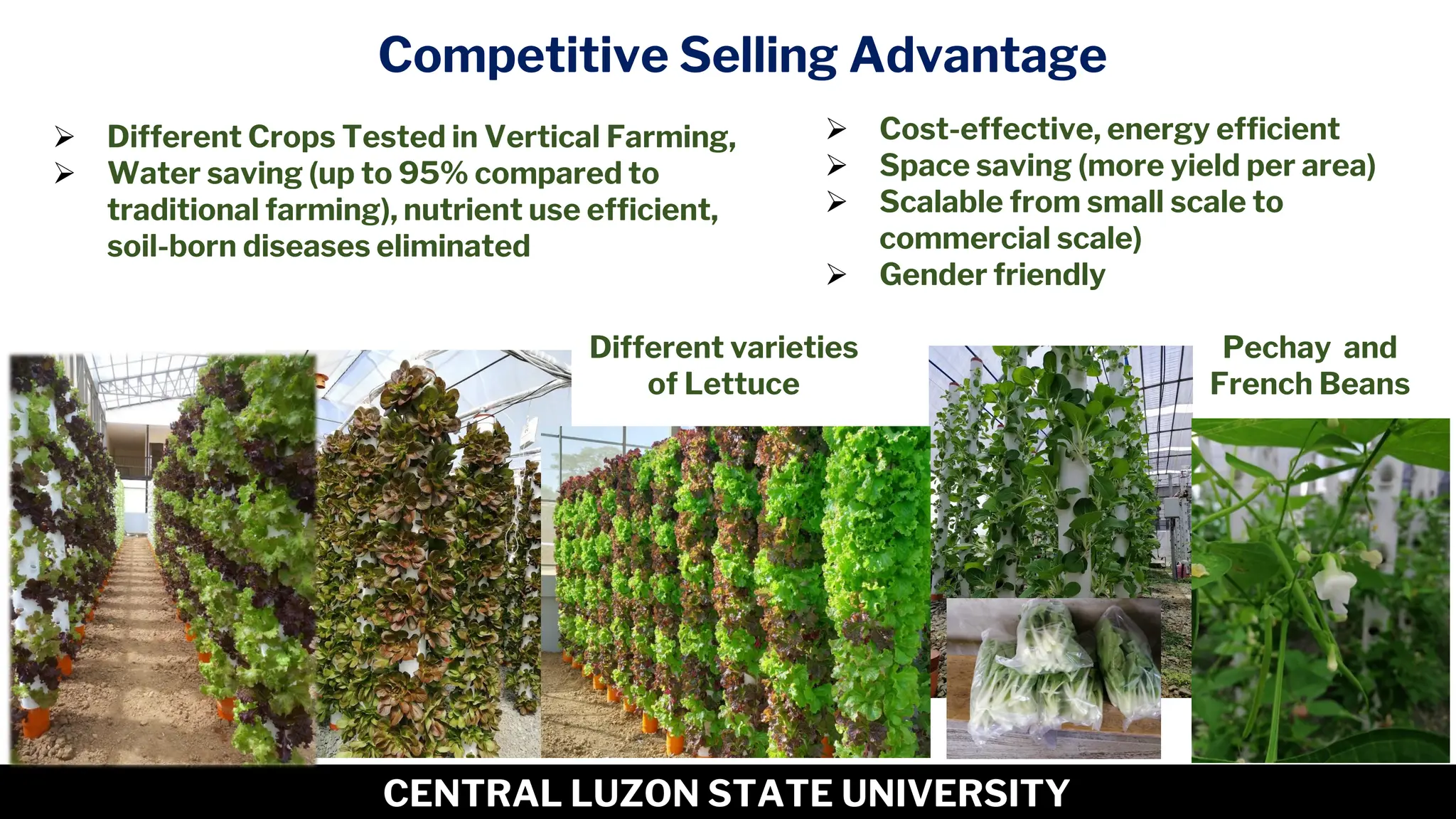
Competitive Selling Advantage
Different varieties
of Lettuce
Pechay and
French Beans
➢ Different Crops Tested in Vertical Farming,
➢ Water saving (up to 95% compared to
traditional farming), nutrient use efficient,
soil-born diseases eliminated
➢ Cost-effective, energy efficient
➢ Space saving (more yield per area)
➢ Scalable from small scale to
commercial scale)
➢ Gender friendly
10.
10
CENTRAL LUZON STATEUNIVERSITY
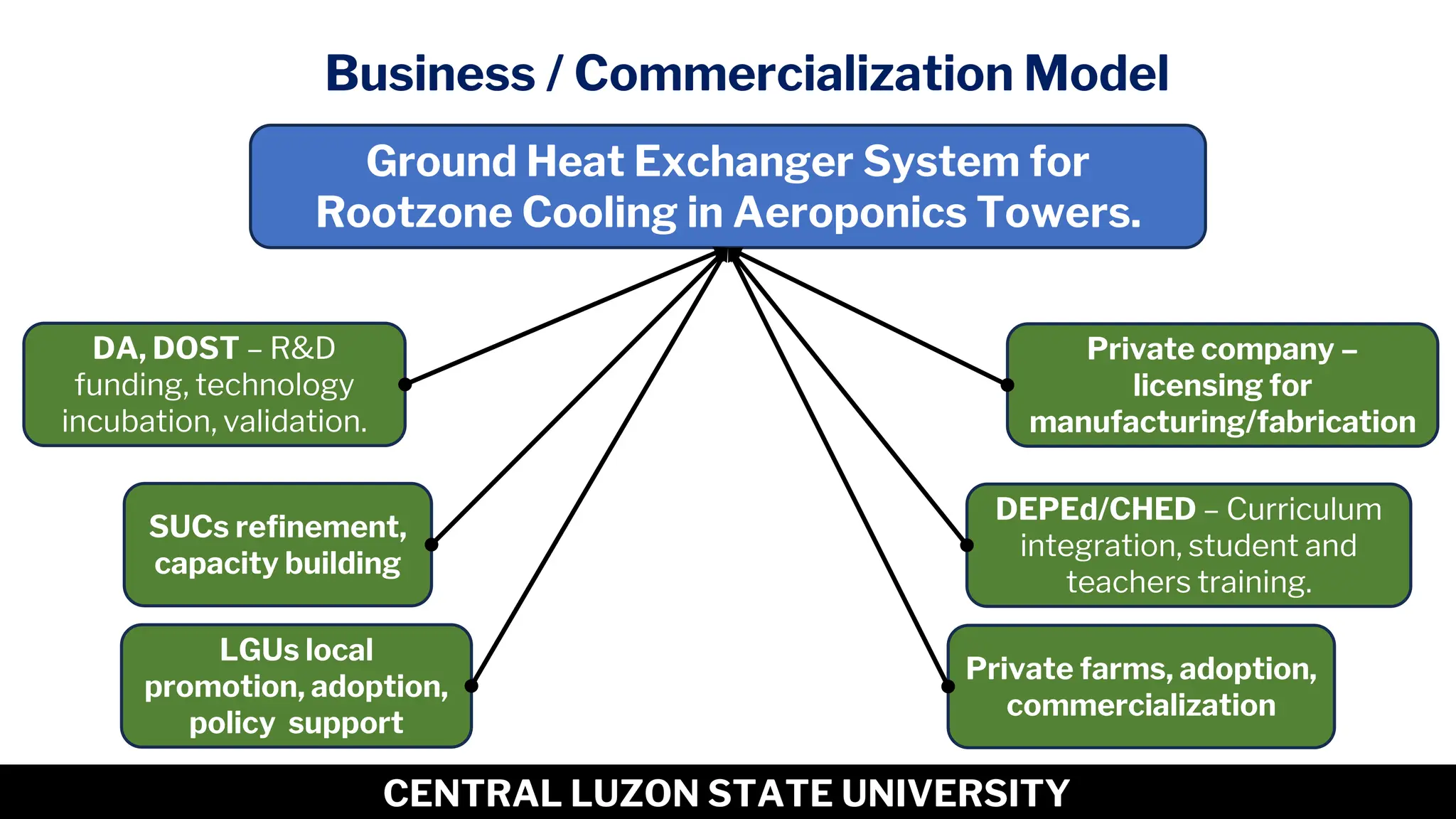
Business / Commercialization Model
Ground Heat Exchanger System for
Rootzone Cooling in Aeroponics Towers.
DA, DOST – R&D
funding, technology
incubation, validation.
SUCs refinement,
capacity building
LGUs local
promotion, adoption,
policy support
Private company –
licensing for
manufacturing/fabrication
DEPEd/CHED – Curriculum
integration, student and
teachers training.
Private farms, adoption,
commercialization
11.
11
CENTRAL LUZON STATEUNIVERSITY
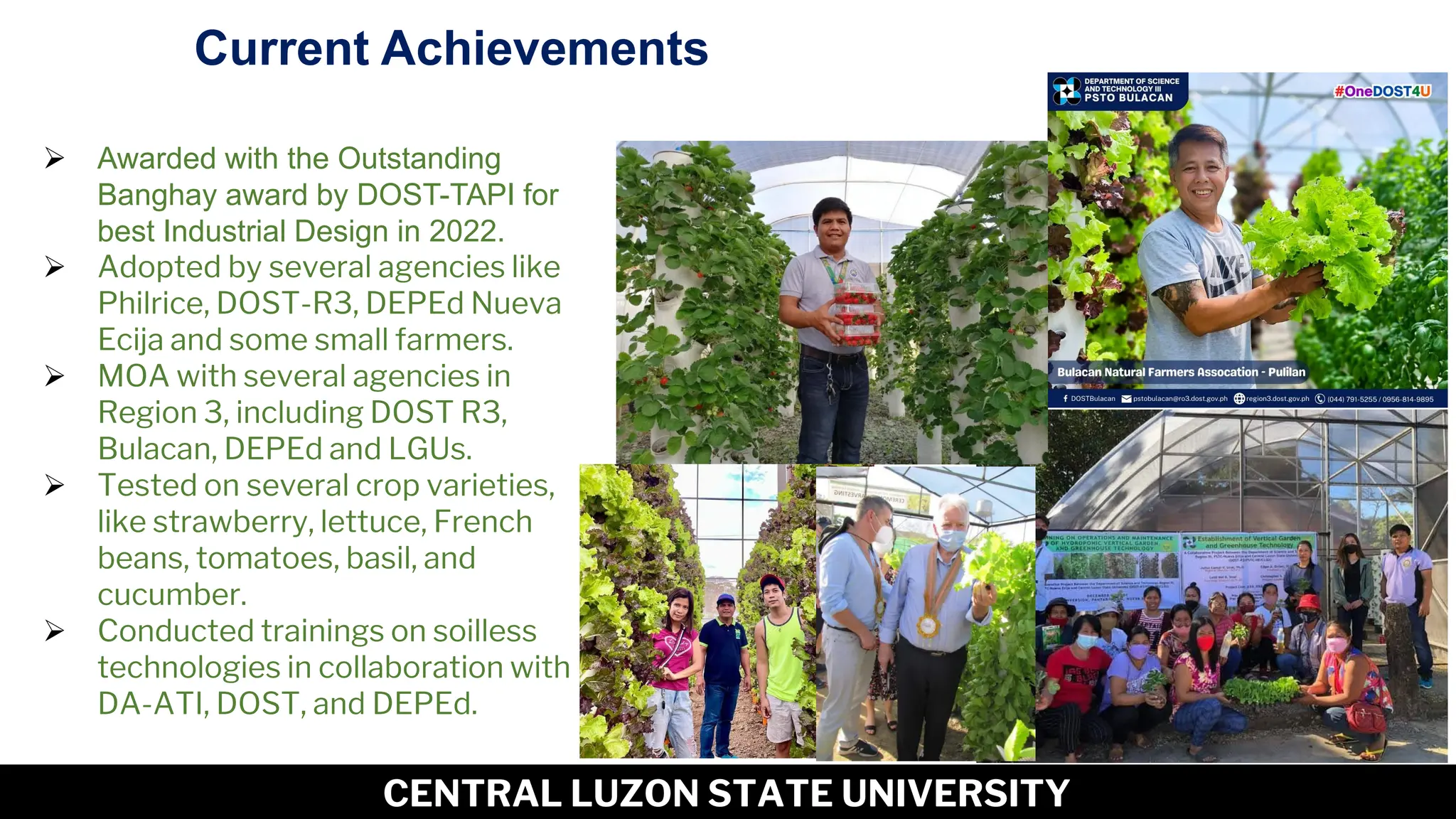
Current Achievements
➢ Awarded with the Outstanding
Banghay award by DOST-TAPI for
best Industrial Design in 2022.
➢ Adopted by several agencies like
Philrice, DOST-R3, DEPEd Nueva
Ecija and some small farmers.
➢ MOA with several agencies in
Region 3, including DOST R3,
Bulacan, DEPEd and LGUs.
➢ Tested on several crop varieties,
like strawberry, lettuce, French
beans, tomatoes, basil, and
cucumber.
➢ Conducted trainings on soilless
technologies in collaboration with
DA-ATI, DOST, and DEPEd.
12.
12
CENTRAL LUZON STATEUNIVERSITY
What is Next?
➢ Continue partnership with DA-ATI through
trainings, seminars, and farmer
demonstrations.Seek funding to build a
fabrication facility and enhance the
prototype at CLSU.
➢ Pursue licensing agreements for
commercialization and wider deployment.
➢ Build the capacity of fabricators, extension
workers, and farmer-groups for adoption.
➢ Improve and diversify prototypes for greater
efficiency.
➢ Engage the private sector to co-develop
affordable business models.
➢ Collaborate with LGUs, SUCs, and
DepEd/CHED to integrate technology into
curricula, projects, and food security
programs.
Social Impact:
➢ Empowers farmers through training and
access to climate-resilient technology.
➢ Strengthens community food security and
inclusive growth.
Economic Impact:
➢ Creates jobs in fabrication, operation, and
maintenance.
➢ Increases farm income and supports
agripreneurship.
Environmental Impact
➢ Reduces water, land, and energy footprint.
➢ Enables sustainable, climate-smart crop
production year-round.
➢ Use of renewable energy for cleaner and
environmentally sustainable production.
Social, Economic,
Environmental Impact
13.
The GHE andvertical aeroponics technology is
a simple, sustainable, and scalable crop
production technology that has the capacity to
adapt to a changing climate. Automation and
IoT can increase its efficiency, but even
without it, ordinary farmers can still be able to
use it.
Thank you!