
App-Centric
Operators on the
Rise
Allot MobileTrends
Charging Report H1/2014
© 2014 Allot Communications. All rights reserved.Allot MobileTrends Report H1/2014
Executive Summary
Since the last Allot MobileTrends Charging Report was published in H1 2012, we
have seen the introduction of many new mobile service plan offerings based on
creative ecosystem partnerships between service providers and content providers.
It is apparent that operators around the globe are transforming into much more
than Internet data pipes selling bandwidth. They are now on the path to becoming
providers of digital lifestyle services to their subscribers. Operators are cooperating
with content providers to offer application-centric plans together with some of
today’s most popular Internet giants. It seems the tide is beginning to turn as
operators see that unique plans for popular apps and are valuable assets in local
markets.
OTTs have become more a friend than a foe. It is common to see operators offer
zero-rated Facebook or Twitter or WhatsApp. Change has come to the digital
lifestyle ecosystem as OTTs and carriers work together to increase subscription and
customer loyalty to both the app and the network that delivers it.
Globally, operators offering application-centric plans have a higher average ARPU
and a lower average churn rate. This significant finding is even more prevalent in
developing countries.
As the evolution of data plans continues, unlimited data plans are becoming an
offering of the past. Operators are moving away from actions that degrade QoE such
as throttling Internet speed and when usage exceeds the volume cap; they simply
charge the overage and maintain QoE. As tablets have proliferated during the last
two years, shared data plans have taken off (especially on LTE networks) and now
come with various data sharing options. Data plans are evolving to accommodate
the different devices connecting to the mobile Internet, including tablets, dongles,
and smartphones.
Findings that we explore further in this MobileTrends Charging Report H1, 2014,
include the following highlights:
•	 85% of operators are leveraging OTT apps to attract customers, increase
ARPU
	 On average, operators who offer application-centric plans show higher ARPU and
lower churn.
•	 More mobile operators are choosing to collaborate with OTT app and content
providers
	 37% of operators had at least one OTT partnership, up from 26% in 2012.
•	 Facebook is mobile operators’ top choice for zero-rated apps
	 45% of operators offer at least one zero-rated app, and 65% of those zero-rate
Facebook.
•	 Unlimited data plans are in decline. Shared data plans are on the rise
	 Operators offering unlimited data plans have diminished from 35% in 2012 to
15% in 2014, while operators offering shared data plans with shared data caps
increased from 29% in 2012 to 42% in 2014.
Allot MobileTrends Report H1/2014 © 2014 Allot Communications. All rights reserved. 1
Main Findings
Operators are becoming digital
lifestyle providers!
The percentage of operators offering value-
based plans, which include premium services
such as video, music, cloud storage, location
based, etc. grew from 35% in 2011 to 59%
in 2012 and to 85% in 2014! Of all operators
sampled – we see a definite trend toward
matching their offering to the digital lifestyle.
Application-centric plans are the driving force
behind this growth with 55% of operators
globally offering these services and with
European operators leading the trend at
63%. Sponsored/toll-free data, zero-rated
data, media streaming services and cloud
services are leading examples of operators
and content providers coming together
to create popular offerings that generate
incremental revenue.
Operators and OTTs are
choosing collaboration
More operators globally are leveraging
popular apps and content to create new
service plans based on the digital lifestyle
segmentation of their subscribers.
37% of operators sampled had at least one
OTT partnership, up from only 26% in 2012.
The ecosystem is evolving in this direction
because every byte counts more when
partnering with OTTs. This partnership trend
appears to benefit all three stakeholders in
this ecosystem. Operators are attracting
subscribers and improving ARPU; OTTs are
gaining loyal mobile users; and subscribers
are enjoying a better experience with their
favorite apps.
Application-centric plans
increase revenues
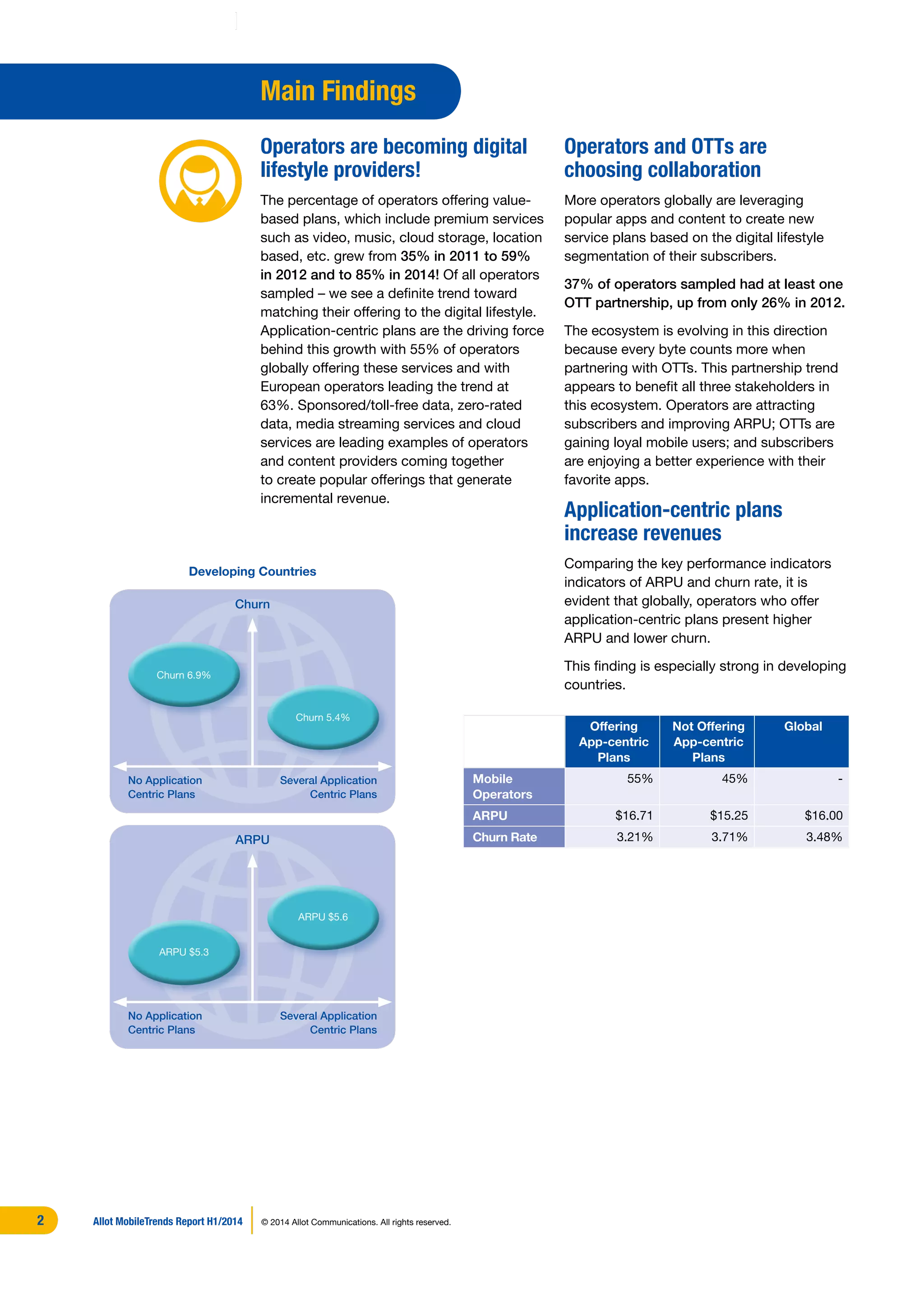
Comparing the key performance indicators
indicators of ARPU and churn rate, it is
evident that globally, operators who offer
application-centric plans present higher
ARPU and lower churn.
This finding is especially strong in developing
countries.
Offering
App-centric
Plans
Not Offering
App-centric
Plans
Global
Mobile
Operators
55% 45% -
ARPU $16.71 $15.25 $16.00
Churn Rate 3.21% 3.71% 3.48%
No Application
Centric Plans
No Application
Centric Plans
Several Application
Centric Plans
Several Application
Centric Plans
ARPU
Churn
Churn 6.9%
ARPU $5.3
Churn 5.4%
ARPU $5.6
Developing Countries
Allot MobileTrends Report H1/2014 © 2014 Allot Communications. All rights reserved.2
Facebook is leading the trend of
zero-rated apps
The leading social media OTT applications
report that over 60% of social media
engagement is via a mobile device. This trend
is a clear motivation to attract customers to a
given operator and to lower churn rates.
•	 55% of operators in our study offer
application-centric plans
•	 49% of operators offer at least one zero-
rated application and 65% of these zero
rate Facebook usage
•	 In general, free social media access is
a strong marketing tool for operators in
developing countries
Context Matters! Not all zero-rating for
social applications is the same. Some offer
free Facebook only for newsfeed text and
text postings. Some offer free Facebook
messenger and some offer zero-rating on all
Facebook traffic.
Shared Data Plans
Sharing data volume allowances between
multiple devices of the same subscriber and
between devices of different subscribers
on the same account is a growing trend.
42% of operators sampled offered postpaid
sharing plans, pre-paid sharing plans or
device-aware sharing plans. 87% of North
American operators offer shared data plans
that include tablets - especially on LTE
networks. This region is leading the shared
data trend.
Tethering is OK with operators
The number of operators charging for
tethering almost doubled from 15% in 2011
to 29% in 2012 and stayed steady at 29%
in 2014, which indicates that mobile service
providers are maintaining their ability to
monitor multi-device usage. However, this
charging trend is not growing. The need to
charge more for tethering or to block tethered
traffic has diminished because unlimited
plans are fast disappearing (The percent of
operators offering unlimited data plans has
diminished from 33% in 2011 and 35%
in 2012 to only 15% in 2014) and most
data plans have volume limits and overage
charges built in. Tethered traffic is simply
aggregated with the subscriber’s total volume
usage. Furthermore, blocking the tethering
capability is seen as a negative policy and
operators prefer to avoid this.
Parental Control/ Clean Data
59% of European operators versus 27%
of the global sample offer opt-in parental
control plans at additional (and minimal)
cost. European operators appear to be
leading the trend of social responsibility by
enabling parents to take actions to safeguard
their children’s digital lifestyles.
Our report takes a closer look at each of
these trends.
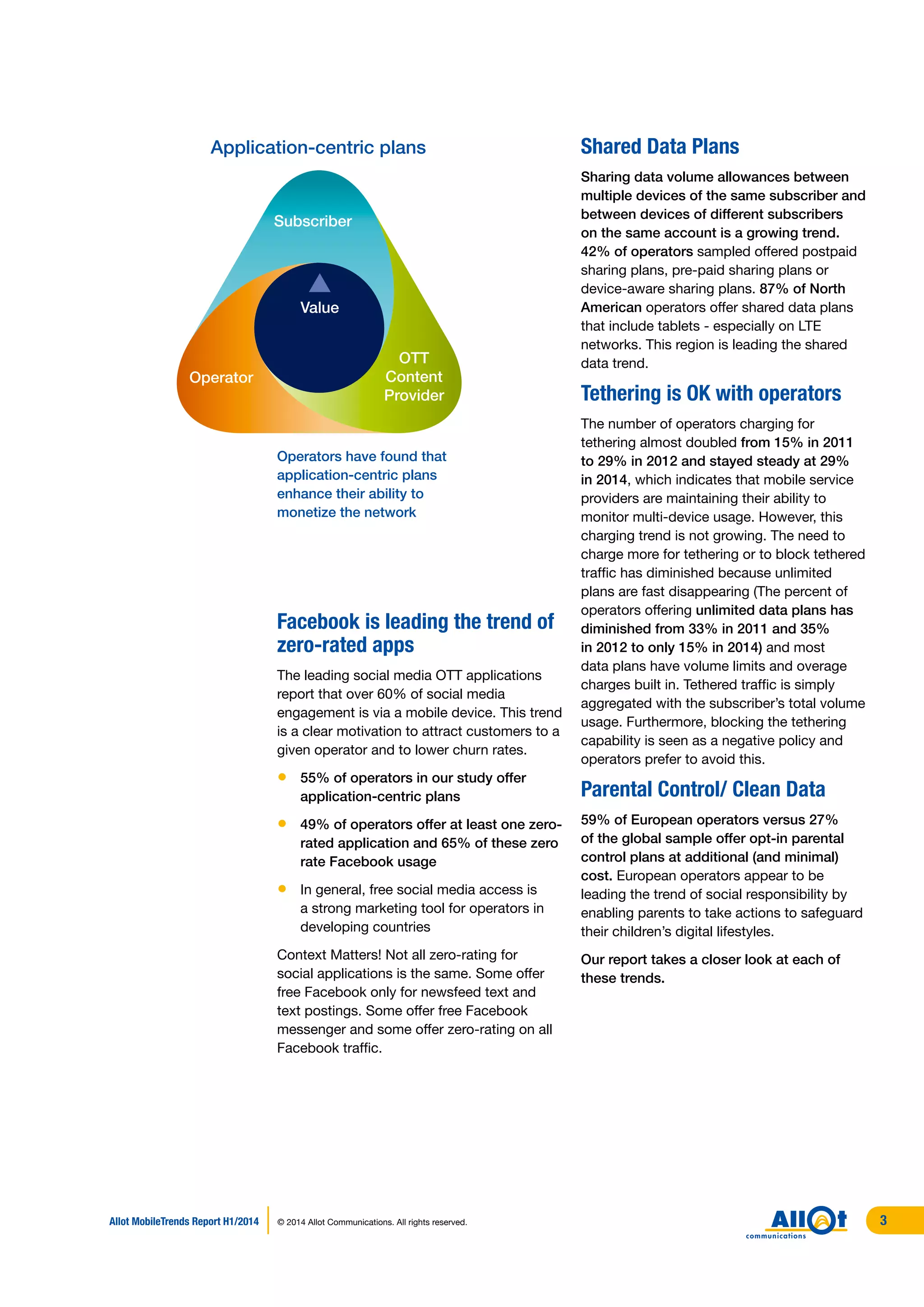
Operators have found that
application-centric plans
enhance their ability to
monetize the network
Application-centric plans
Operator
Subscriber
OTT
Content
Provider
Value
Allot MobileTrends Report H1/2014 © 2014 Allot Communications. All rights reserved. 3
OTT players realize that if their applications
don’t run well on mobile devices, consumers
will stop using their app. Customer retention
and customer engagement are critical to
apps, websites and content providers. Since
many OTT business models are dependent
on keeping users interested and engaged
with the apps, they must also focus on
how well their content is delivered to the
consumer. OTTs want to be seen as part of
the mobile world; with an app that works well
on mobile devices. Consumers will abandon
apps if they have connectivity problems that
create an unacceptable quality of experience.
OTT players understand that the service
providers have the ability to help them
deliver a good user experience. Since mobile
operators and OTTs realize that they have to
work together to deliver quality content to
customers, application-centric plans have
become more prevalent.
Since our last Allot MobileTrends Charging
Report in 2012, we have witnessed a change
in the way service providers and OTT
players address mobile Internet customers.
Our research shows that operators are
responding to the digital lifestyle by evolving
their data pricing plans and introducing a
variety of opt-in services based on content,
applications.
Background
Mobile Internet is driving the digital lifestyle.
People all over the world are using the
Internet anytime, anywhere and mostly via
mobile apps. Furthermore, in developing
countries where fixed networks are not
available to the mass market or may never be
deployed; people have Internet connectivity
only via mobile devices. In emerging markets,
the adoption of the digital lifestyle is even
more prevalent than mature markets.
Consumers are using advanced applications
such as mobile wallet, mobile payments
(mCommerce), mobile gifting and mobile
medical services (mHealth).
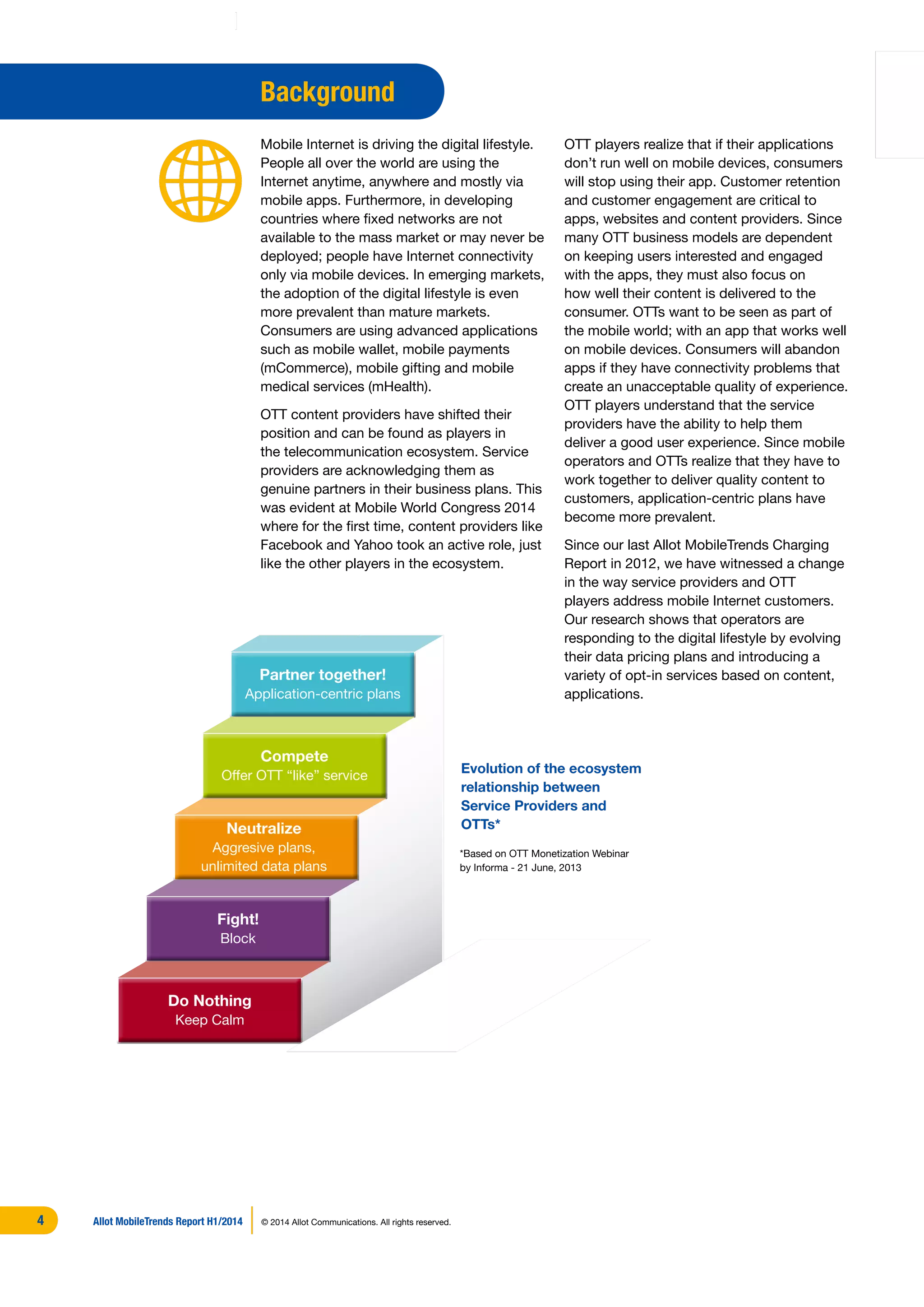
OTT content providers have shifted their
position and can be found as players in
the telecommunication ecosystem. Service
providers are acknowledging them as
genuine partners in their business plans. This
was evident at Mobile World Congress 2014
where for the first time, content providers like
Facebook and Yahoo took an active role, just
like the other players in the ecosystem.
Do Nothing
Keep Calm
Fight!
Block
Neutralize
Aggresive plans,
unlimited data plans
Compete
Offer OTT “like” service
Partner together!
Application-centric plans
Evolution of the ecosystem
relationship between
Service Providers and
OTTs*
*Based on OTT Monetization Webinar
by Informa - 21 June, 2013
Allot MobileTrends Report H1/2014 © 2014 Allot Communications. All rights reserved.4
Detailed Findings
Digital Lifestyle Data plans –
charging for value
Operators who segment their market based
on the digital lifestyle of their customers have
been introducing value-based plans, making
it possible to charge for the value of the
service to the customer, and not just speed.
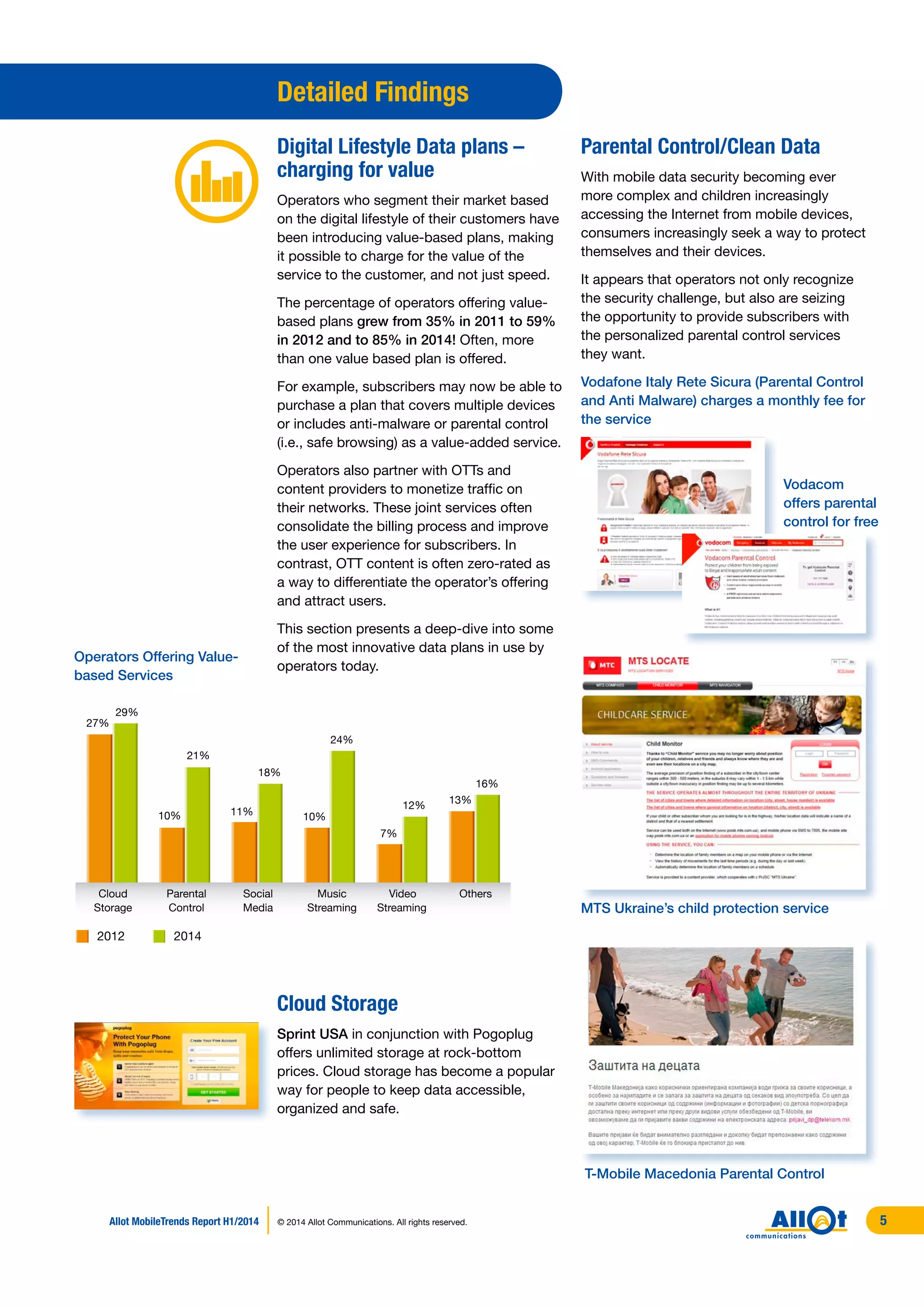
The percentage of operators offering value-
based plans grew from 35% in 2011 to 59%
in 2012 and to 85% in 2014! Often, more
than one value based plan is offered.
For example, subscribers may now be able to
purchase a plan that covers multiple devices
or includes anti-malware or parental control
(i.e., safe browsing) as a value-added service.
Operators also partner with OTTs and
content providers to monetize traffic on
their networks. These joint services often
consolidate the billing process and improve
the user experience for subscribers. In
contrast, OTT content is often zero-rated as
a way to differentiate the operator’s offering
and attract users.
This section presents a deep-dive into some
of the most innovative data plans in use by
operators today.
Cloud Storage
Sprint USA in conjunction with Pogoplug
offers unlimited storage at rock-bottom
prices. Cloud storage has become a popular
way for people to keep data accessible,
organized and safe.
Parental Control/Clean Data
With mobile data security becoming ever
more complex and children increasingly
accessing the Internet from mobile devices,
consumers increasingly seek a way to protect
themselves and their devices.
It appears that operators not only recognize
the security challenge, but also are seizing
the opportunity to provide subscribers with
the personalized parental control services
they want.
Operators Offering Value-
based Services
27%
13%
11% 10%10%
29%
16%
7%
12%
18%
24%
21%
Cloud
Storage
Parental
Control
Social
Media
Music
Streaming
OthersVideo
Streaming
2012 2014
T-Mobile Macedonia Parental Control
MTS Ukraine’s child protection service
Vodacom
offers parental
control for free
Vodafone Italy Rete Sicura (Parental Control
and Anti Malware) charges a monthly fee for
the service
Allot MobileTrends Report H1/2014 © 2014 Allot Communications. All rights reserved. 5
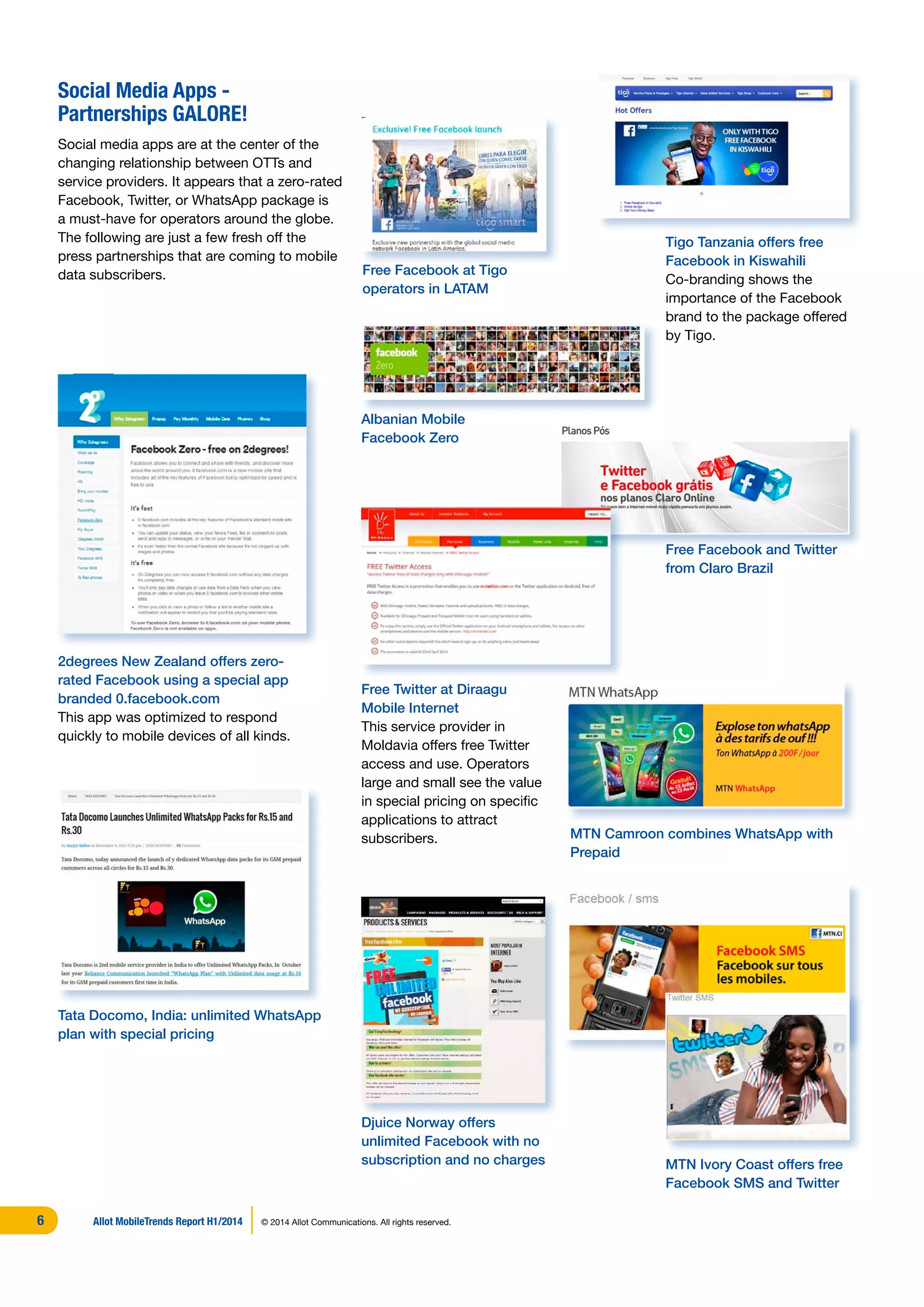
Social Media Apps -
Partnerships GALORE!
Social media apps are at the center of the
changing relationship between OTTs and
service providers. It appears that a zero-rated
Facebook, Twitter, or WhatsApp package is
a must-have for operators around the globe.
The following are just a few fresh off the
press partnerships that are coming to mobile
data subscribers. Free Facebook at Tigo
operators in LATAM
Albanian Mobile
Facebook Zero
Free Facebook and Twitter
from Claro Brazil
Free Twitter at Diraagu
Mobile Internet
This service provider in
Moldavia offers free Twitter
access and use. Operators
large and small see the value
in special pricing on specific
applications to attract
subscribers.
2degrees New Zealand offers zero-
rated Facebook using a special app
branded 0.facebook.com
This app was optimized to respond
quickly to mobile devices of all kinds.
Tata Docomo, India: unlimited WhatsApp
plan with special pricing
Djuice Norway offers
unlimited Facebook with no
subscription and no charges
Tigo Tanzania offers free
Facebook in Kiswahili
Co-branding shows the
importance of the Facebook
brand to the package offered
by Tigo.
MTN Camroon combines WhatsApp with
Prepaid
MTN Ivory Coast offers free
Facebook SMS and Twitter
Allot MobileTrends Report H1/2014 © 2014 Allot Communications. All rights reserved.6
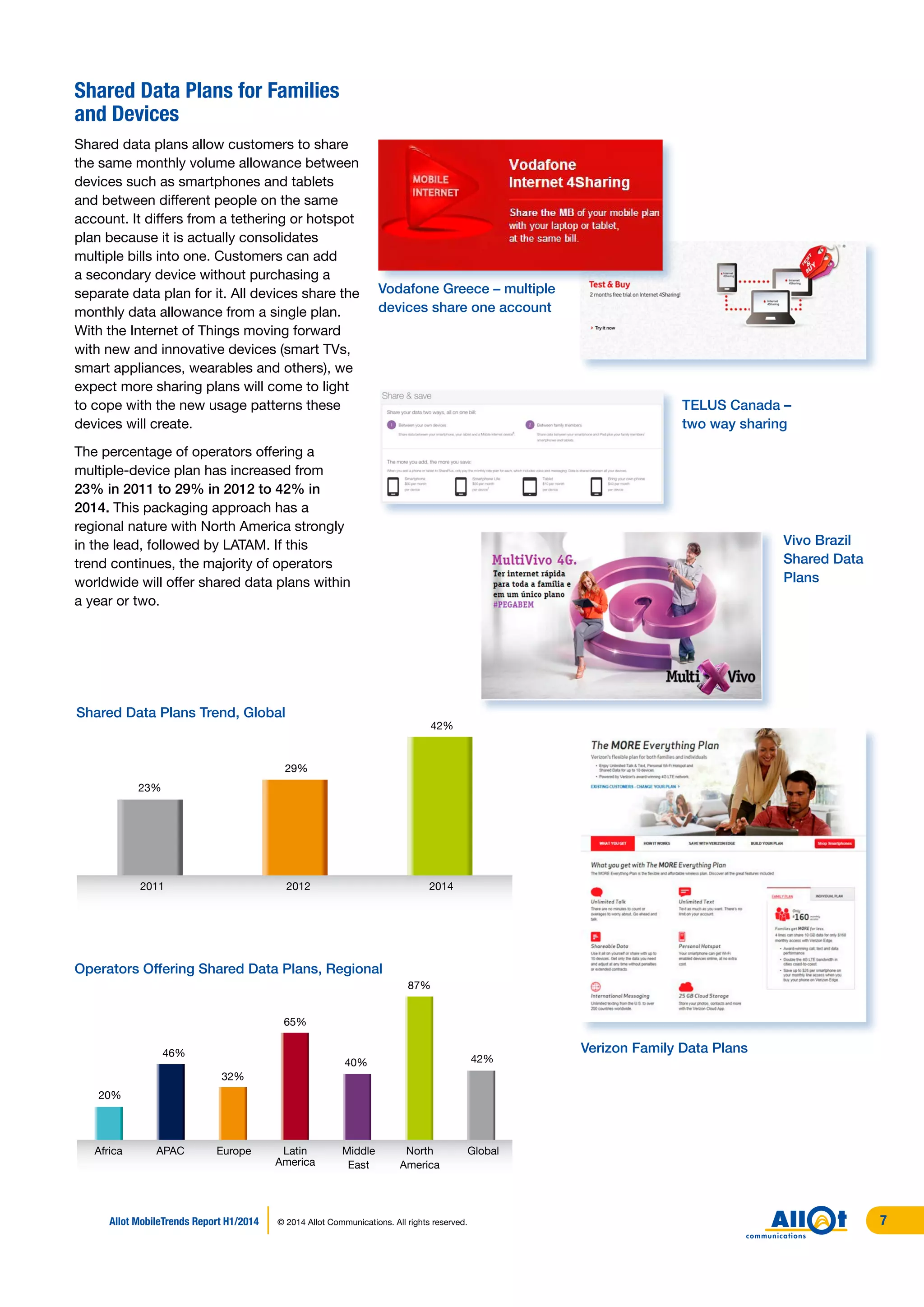
Shared Data Plans Trend, Global
Shared Data Plans for Families
and Devices
Shared data plans allow customers to share
the same monthly volume allowance between
devices such as smartphones and tablets
and between different people on the same
account. It differs from a tethering or hotspot
plan because it is actually consolidates
multiple bills into one. Customers can add
a secondary device without purchasing a
separate data plan for it. All devices share the
monthly data allowance from a single plan.
With the Internet of Things moving forward
with new and innovative devices (smart TVs,
smart appliances, wearables and others), we
expect more sharing plans will come to light
to cope with the new usage patterns these
devices will create.
The percentage of operators offering a
multiple-device plan has increased from
23% in 2011 to 29% in 2012 to 42% in
2014. This packaging approach has a
regional nature with North America strongly
in the lead, followed by LATAM. If this
trend continues, the majority of operators
worldwide will offer shared data plans within
a year or two.
 
2011 2012 2014
42%
23%
29%
Africa APAC Europe Latin
America
Middle
East
North
America
Global
20%
42%40%
87%
65%
32%
46%
TELUS Canada –
two way sharing
Verizon Family Data Plans
Vivo Brazil
Shared Data
Plans
Operators Offering Shared Data Plans, Regional
Vodafone Greece – multiple
devices share one account
Allot MobileTrends Report H1/2014 © 2014 Allot Communications. All rights reserved. 7
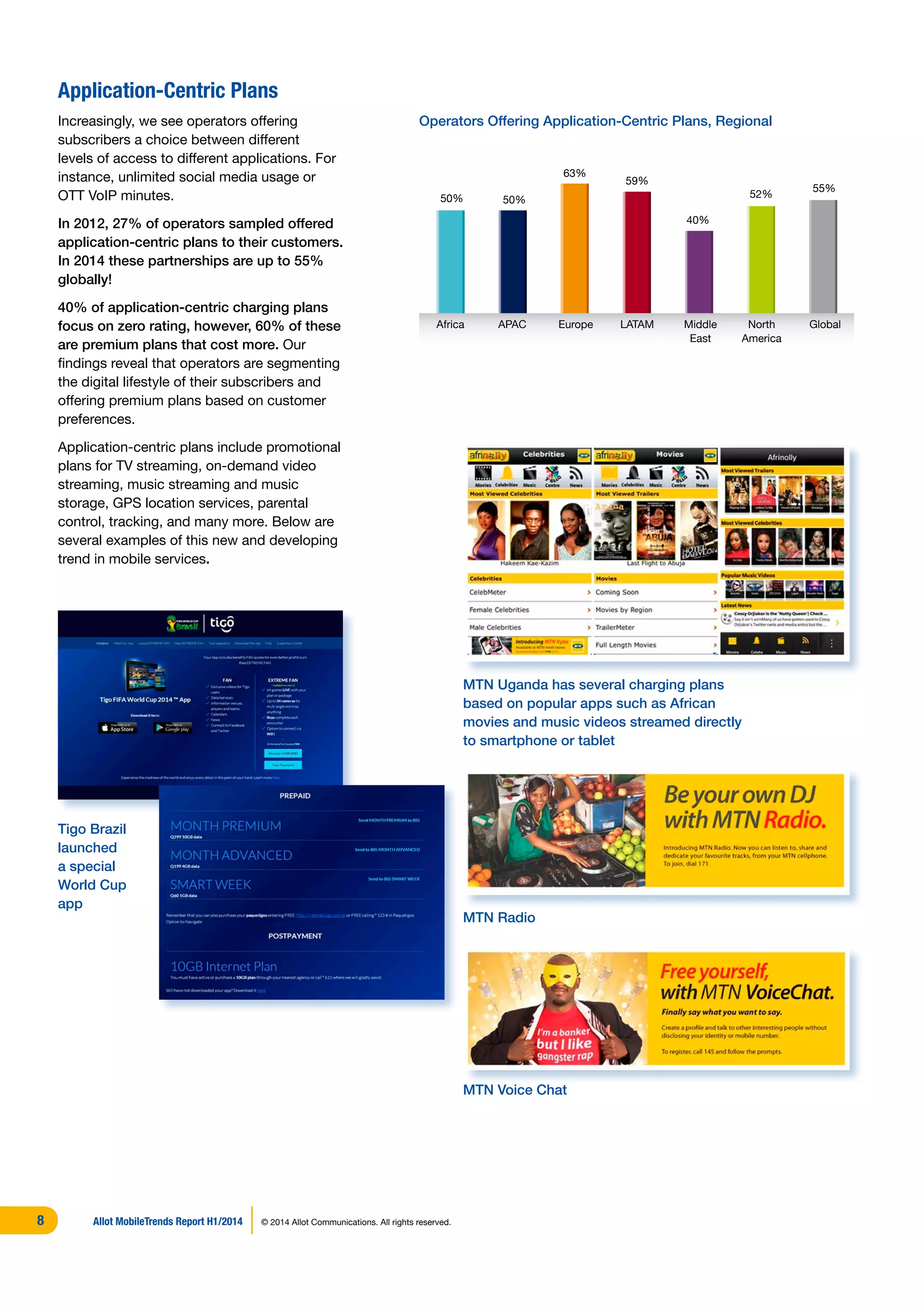
Application-Centric Plans
Increasingly, we see operators offering
subscribers a choice between different
levels of access to different applications. For
instance, unlimited social media usage or
OTT VoIP minutes.
In 2012, 27% of operators sampled offered
application-centric plans to their customers.
In 2014 these partnerships are up to 55%
globally!
40% of application-centric charging plans
focus on zero rating, however, 60% of these
are premium plans that cost more. Our
findings reveal that operators are segmenting
the digital lifestyle of their subscribers and
offering premium plans based on customer
preferences.
Application-centric plans include promotional
plans for TV streaming, on-demand video
streaming, music streaming and music
storage, GPS location services, parental
control, tracking, and many more. Below are
several examples of this new and developing
trend in mobile services.
Africa APAC Europe LATAM Middle
East
North
America
Global
50%
55%
40%
52%
59%
63%
50%
Operators Offering Application-Centric Plans, Regional
Tigo Brazil
launched
a special
World Cup
app
MTN Uganda has several charging plans
based on popular apps such as African
movies and music videos streamed directly
to smartphone or tablet
MTN Radio
MTN Voice Chat
Allot MobileTrends Report H1/2014 © 2014 Allot Communications. All rights reserved.8
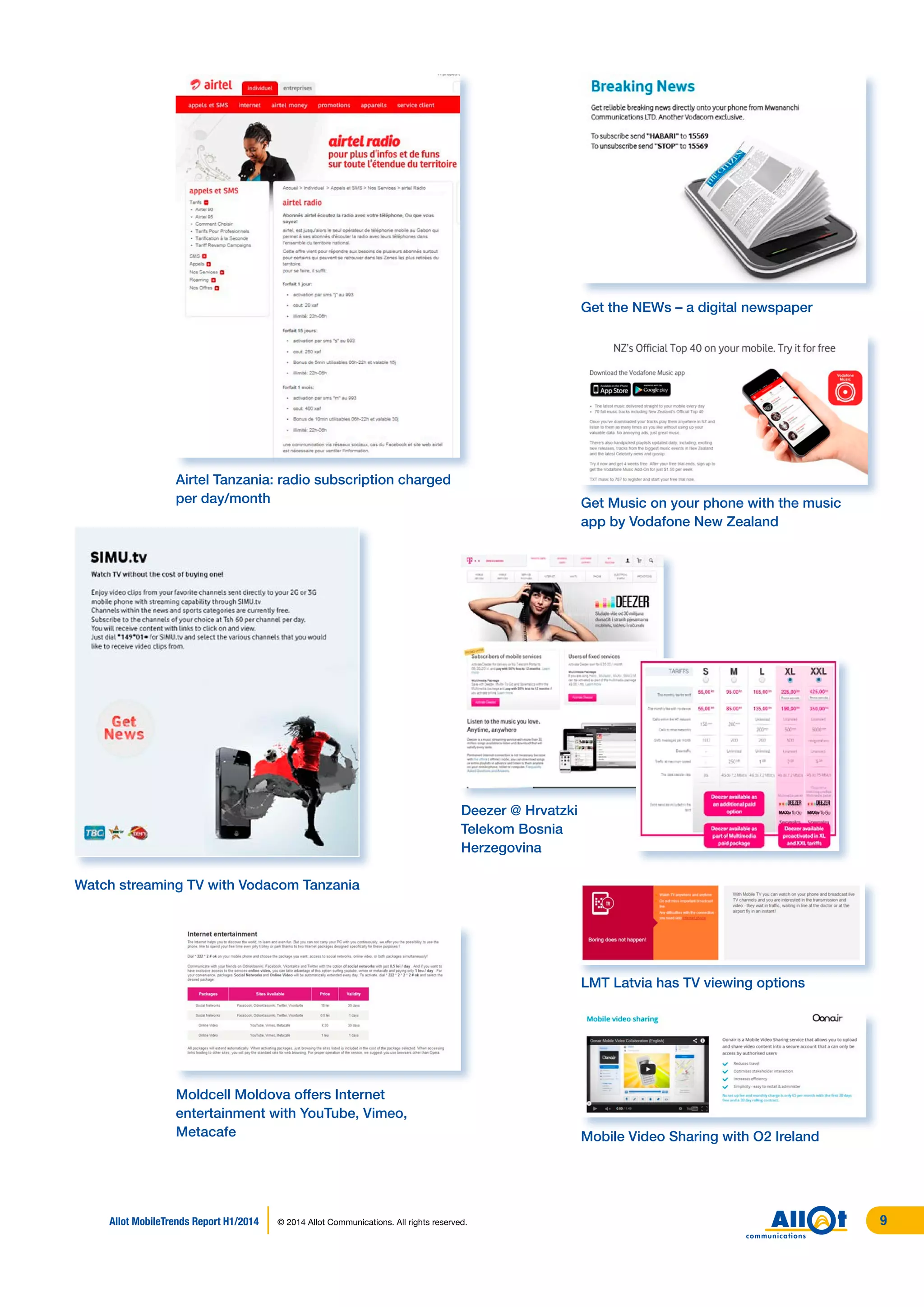
Airtel Tanzania: radio subscription charged
per day/month
Watch streaming TV with Vodacom Tanzania
Get the NEWs – a digital newspaper
Get Music on your phone with the music
app by Vodafone New Zealand
Deezer @ Hrvatzki
Telekom Bosnia
Herzegovina
Moldcell Moldova offers Internet
entertainment with YouTube, Vimeo,
Metacafe
LMT Latvia has TV viewing options
Mobile Video Sharing with O2 Ireland
Allot MobileTrends Report H1/2014 © 2014 Allot Communications. All rights reserved. 9
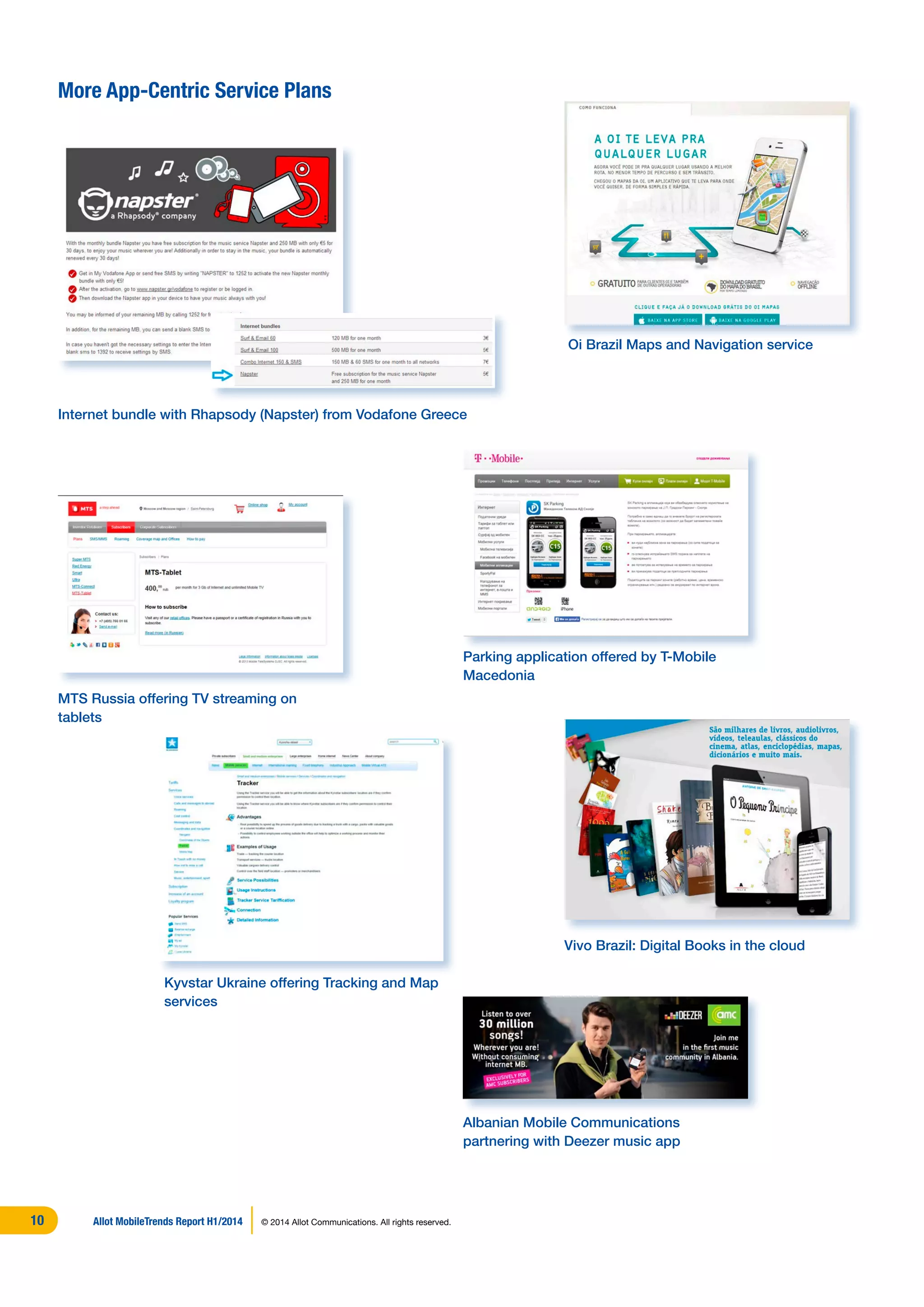
More App-Centric Service Plans
Oi Brazil Maps and Navigation service
Kyvstar Ukraine offering Tracking and Map
services
Parking application offered by T-Mobile
Macedonia
Vivo Brazil: Digital Books in the cloud
Albanian Mobile Communications
partnering with Deezer music app
MTS Russia offering TV streaming on
tablets
Internet bundle with Rhapsody (Napster) from Vodafone Greece
Allot MobileTrends Report H1/2014 © 2014 Allot Communications. All rights reserved.10
Overage Policies Have Evolved
Overage policies were created for
mobile operators to control mobile data
consumption or to monetize it when became
“excessive.” Also, overage notifications
and fees allow subscribers to control their
monthly costs. The challenge has always
been that mobile data subscribers do not
know and cannot control the weight and
length of the data sessions they create,
thus making it very hard for consumers to
control their usage and costs. Policy control
and charging (PCC) solutions have been
developed to assist operators in a variety of
ways and we see definite trends in the top
overage policies chosen by mobile service
providers around the world.
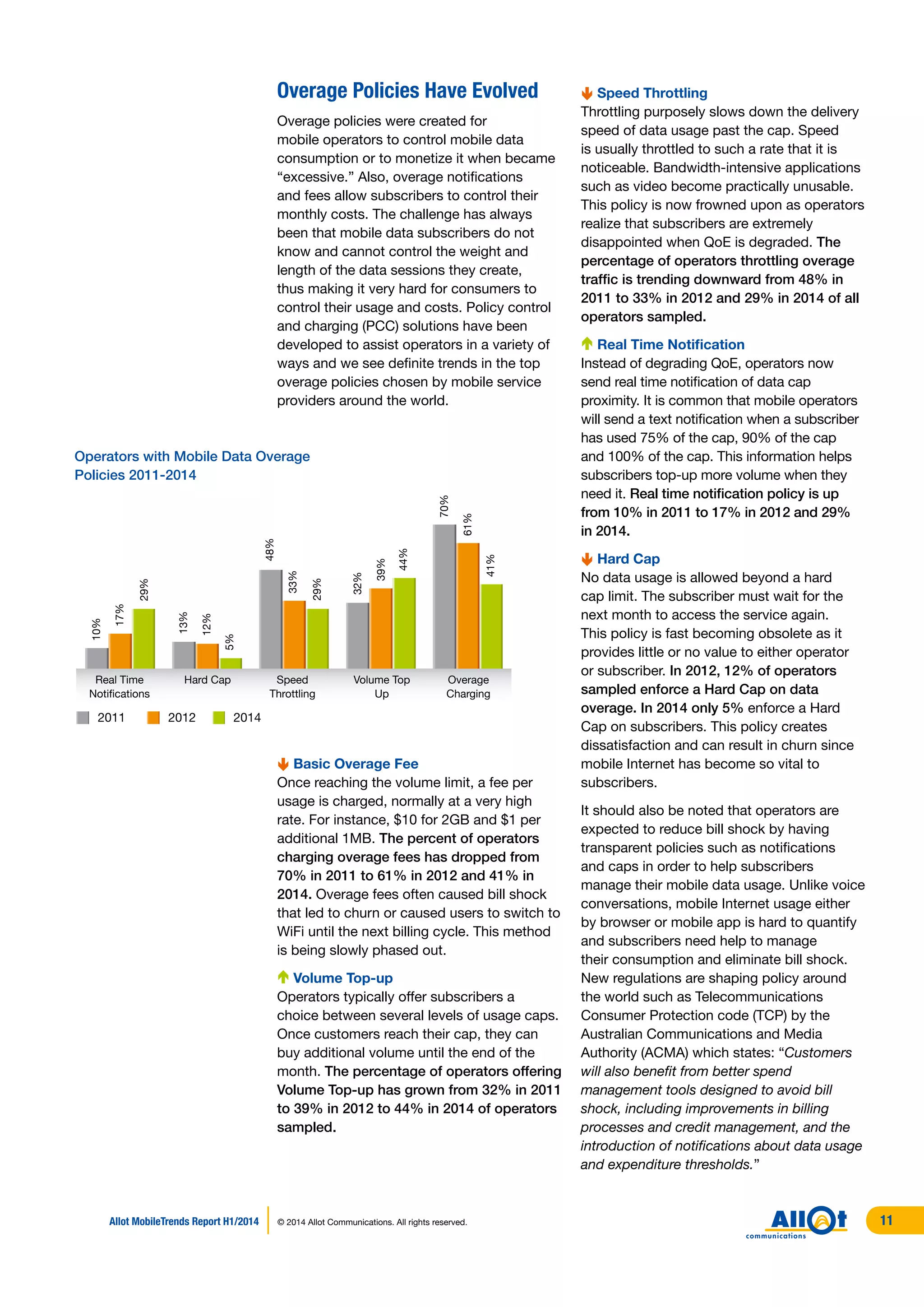
ä Basic Overage Fee
Once reaching the volume limit, a fee per
usage is charged, normally at a very high
rate. For instance, $10 for 2GB and $1 per
additional 1MB. The percent of operators
charging overage fees has dropped from
70% in 2011 to 61% in 2012 and 41% in
2014. Overage fees often caused bill shock
that led to churn or caused users to switch to
WiFi until the next billing cycle. This method
is being slowly phased out.
ã Volume Top-up
Operators typically offer subscribers a
choice between several levels of usage caps.
Once customers reach their cap, they can
buy additional volume until the end of the
month. The percentage of operators offering
Volume Top-up has grown from 32% in 2011
to 39% in 2012 to 44% in 2014 of operators
sampled.
ä Speed Throttling
Throttling purposely slows down the delivery
speed of data usage past the cap. Speed
is usually throttled to such a rate that it is
noticeable. Bandwidth-intensive applications
such as video become practically unusable.
This policy is now frowned upon as operators
realize that subscribers are extremely
disappointed when QoE is degraded. The
percentage of operators throttling overage
traffic is trending downward from 48% in
2011 to 33% in 2012 and 29% in 2014 of all
operators sampled.
ã Real Time Notification
Instead of degrading QoE, operators now
send real time notification of data cap
proximity. It is common that mobile operators
will send a text notification when a subscriber
has used 75% of the cap, 90% of the cap
and 100% of the cap. This information helps
subscribers top-up more volume when they
need it. Real time notification policy is up
from 10% in 2011 to 17% in 2012 and 29%
in 2014.
ä Hard Cap
No data usage is allowed beyond a hard
cap limit. The subscriber must wait for the
next month to access the service again.
This policy is fast becoming obsolete as it
provides little or no value to either operator
or subscriber. In 2012, 12% of operators
sampled enforce a Hard Cap on data
overage. In 2014 only 5% enforce a Hard
Cap on subscribers. This policy creates
dissatisfaction and can result in churn since
mobile Internet has become so vital to
subscribers.
It should also be noted that operators are
expected to reduce bill shock by having
transparent policies such as notifications
and caps in order to help subscribers
manage their mobile data usage. Unlike voice
conversations, mobile Internet usage either
by browser or mobile app is hard to quantify
and subscribers need help to manage
their consumption and eliminate bill shock.
New regulations are shaping policy around
the world such as Telecommunications
Consumer Protection code (TCP) by the
Australian Communications and Media
Authority (ACMA) which states: “Customers
will also benefit from better spend
management tools designed to avoid bill
shock, including improvements in billing
processes and credit management, and the
introduction of notifications about data usage
and expenditure thresholds.”
Operators with Mobile Data Overage
Policies 2011-2014
10%
17%
29%
13%
12%
5%
48%
33%
29%
32%
39%
44%
70%
61%
41%
2011 2012 2014
Real Time
Notifications
Hard Cap Speed
Throttling
Volume Top
Up
Overage
Charging
Allot MobileTrends Report H1/2014 © 2014 Allot Communications. All rights reserved. 11
The statistics presented in this report are
based on data collected during the first half
of 2014 from almost 180 mobile operators
worldwide.
Our global sample covers 2.4 billion
subscribers.
The networks surveyed had an
overall ARPU of $16 USD per
month, churn rate of 3.5% and
percent-of-income-from-data at an
average of 37.5%.
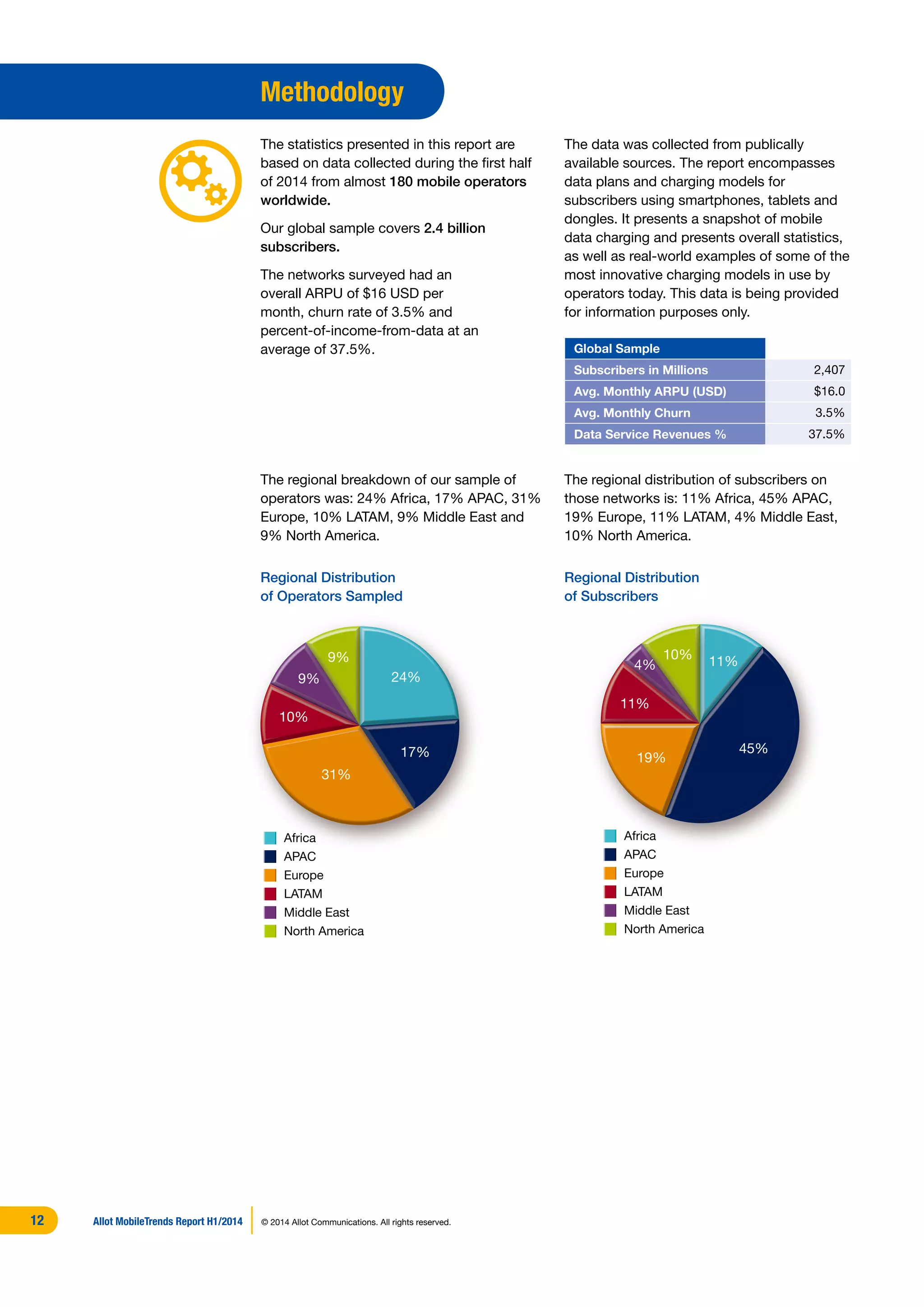
The regional breakdown of our sample of
operators was: 24% Africa, 17% APAC, 31%
Europe, 10% LATAM, 9% Middle East and
9% North America.
Methodology
The data was collected from publically
available sources. The report encompasses
data plans and charging models for
subscribers using smartphones, tablets and
dongles. It presents a snapshot of mobile
data charging and presents overall statistics,
as well as real-world examples of some of the
most innovative charging models in use by
operators today. This data is being provided
for information purposes only.
The regional distribution of subscribers on
those networks is: 11% Africa, 45% APAC,
19% Europe, 11% LATAM, 4% Middle East,
10% North America.
Global Sample
Subscribers in Millions 2,407
Avg. Monthly ARPU (USD) $16.0
Avg. Monthly Churn 3.5%
Data Service Revenues % 37.5%
24%9%
10%
17%
9%
31%
Africa
APAC
Europe
LATAM
Middle East
North America
11%4%
11%
45%
10%
19%
Africa
APAC
Europe
LATAM
Middle East
North America
Regional Distribution
of Operators Sampled
Regional Distribution
of Subscribers
Allot MobileTrends Report H1/2014 © 2014 Allot Communications. All rights reserved.12
digital lifestyle ecosystem providing limitless
ways to:
Generate new revenue from a variety of
application-centric services and charging
schemes that integrate seamlessly in the
network and are managed from a single focal
point.
Reduce costs by optimizing the delivery and
performance of OTT content and cloud/data
center services.
Improve customer retention by personalizing
operator offerings with a vibrant choice of
value-added digital lifestyle services.
Glossary
Prepaid Mobile Data Plan
is a data plan for which credit
is purchased in advance of
Internet use. The purchased
credit is used to pay for mobile
Internet services at the point at
which the service is accessed
or consumed. If there is no
available credit then Internet
access is denied by the mobile
network. Users are able to
top-up their credit at any time
using a variety of payment
mechanisms.
Postpaid Mobile Data Plan
(also referred to as a mobile
contract) is a plan that requires
the user to enter into a credit-
based billing arrangement with
a mobile network operator. The
plan typically includes usage
policies such as ‘no-tethering’
as well as details of any data
caps and overage charges. The
user is billed once in every billing
period.
Value-Based Charging
is the ability to differentiate and
charge for types of data usage.
By implementing Value-based
Charging models, operators can
offer personalized service plans
that best reflect the unique value
of different applications and
usage patterns to different types
of subscribers.
Application-Based
Charging
is the ability to charge/not
charge for access, usage,
QoE of individual applications.
App-based charging enables/
supports app-centric services.
Volume-Based Charging
refers to data plans in which
subscribers are charged
according to the Gigabyte
volume of data that they
consume.
 
Summary
Application-centric services are often the
result of collaboration between OTTs and
network operators. Mobile operators need
application-aware solutions that support a
dynamic variety of partnerships, policy, and
charging requirements, and facilitate rapid
rollout of new service plans.
Allot facilitates the partnerships between OTT
content providers and mobile operators by
providing a clear picture of OTT application
usage and by optimizing the end user
experience.
Allot’s intelligent broadband solutions allow
mobile operators to elevate their role in the
Allot MobileTrends Report H1/2014 © 2014 Allot Communications. All rights reserved. 13
Americas: 300 TradeCenter, Suite 4680, Woburn, MA 01801 USA · Tel: (781) 939-9300 · Toll free: 877-255-6826 · Fax: (781) 939-9393
Europe: NCI – Les Centres d’Affaires Village d’Entreprises ‘Green Side’, 400 Avenue Roumanille, BP309,
06906 Sophia Antipolis Cedex, France · Tel: 33 (0) 4-93-001160 · Fax: 33 (0) 4-93-001165
Asia Pacific: 25 Tai Seng Avenue, #03-03, Scorpio East Building, Singapore 534104 Tel: +65 67490213 Fax: +65 68481015
Japan: 4-2-3-301 Kanda Surugadai, Chiyoda-ku, Tokyo 101-0062 · Tel: 81 (3) 5297-7668 · Fax: 81(3) 5297-7669
Middle East and Africa: 22 Hanagar Street, Industrial Zone B, Hod-Hasharon, 4501317, Israel · Tel: 972 (9) 761-9200 · Fax: 972 (9) 744-3626
www.allot.com info@allot.com
About Allot Communications
Allot Communications is a leading global provider of intelligent broadband solutions that put mobile, fixed and enterprise
networks at the center of the digital lifestyle and workstyle. Allot’s DPI-based solutions identify and leverage the business
intelligence in data networks, empowering operators to analyze, protect, improve and monetize the digital lifestyle services
they deliver. Allot’s unique blend of innovative technology, proven know-how and collaborative approach to industry standards
and partnerships enables network operators worldwide to elevate their role in the digital lifestyle ecosystem and to open the
door to a wealth of new business opportunities. D265026Rev1©2014AllotCommunications,Ltd.Allrightsreserved.Specificationssubjecttochangewithoutnotice.AllotCommunicationsandtheAllotlogoareregisteredtrademarksofAllotCommunications.Allotherbrandorproductnamesaretrademarksoftheirrespectiveholders.
Allot MobileTrends
Charging Report
H1 2014

App-Centric Operators on the Rise mobile trends_charging_report_h1_2014_lr_publish

  • 1.
    App-Centric Operators on the Rise AllotMobileTrends Charging Report H1/2014
  • 2.
    © 2014 AllotCommunications. All rights reserved.Allot MobileTrends Report H1/2014
  • 3.
    Executive Summary Since thelast Allot MobileTrends Charging Report was published in H1 2012, we have seen the introduction of many new mobile service plan offerings based on creative ecosystem partnerships between service providers and content providers. It is apparent that operators around the globe are transforming into much more than Internet data pipes selling bandwidth. They are now on the path to becoming providers of digital lifestyle services to their subscribers. Operators are cooperating with content providers to offer application-centric plans together with some of today’s most popular Internet giants. It seems the tide is beginning to turn as operators see that unique plans for popular apps and are valuable assets in local markets. OTTs have become more a friend than a foe. It is common to see operators offer zero-rated Facebook or Twitter or WhatsApp. Change has come to the digital lifestyle ecosystem as OTTs and carriers work together to increase subscription and customer loyalty to both the app and the network that delivers it. Globally, operators offering application-centric plans have a higher average ARPU and a lower average churn rate. This significant finding is even more prevalent in developing countries. As the evolution of data plans continues, unlimited data plans are becoming an offering of the past. Operators are moving away from actions that degrade QoE such as throttling Internet speed and when usage exceeds the volume cap; they simply charge the overage and maintain QoE. As tablets have proliferated during the last two years, shared data plans have taken off (especially on LTE networks) and now come with various data sharing options. Data plans are evolving to accommodate the different devices connecting to the mobile Internet, including tablets, dongles, and smartphones. Findings that we explore further in this MobileTrends Charging Report H1, 2014, include the following highlights: • 85% of operators are leveraging OTT apps to attract customers, increase ARPU On average, operators who offer application-centric plans show higher ARPU and lower churn. • More mobile operators are choosing to collaborate with OTT app and content providers 37% of operators had at least one OTT partnership, up from 26% in 2012. • Facebook is mobile operators’ top choice for zero-rated apps 45% of operators offer at least one zero-rated app, and 65% of those zero-rate Facebook. • Unlimited data plans are in decline. Shared data plans are on the rise Operators offering unlimited data plans have diminished from 35% in 2012 to 15% in 2014, while operators offering shared data plans with shared data caps increased from 29% in 2012 to 42% in 2014. Allot MobileTrends Report H1/2014 © 2014 Allot Communications. All rights reserved. 1
  • 4.
    Main Findings Operators arebecoming digital lifestyle providers! The percentage of operators offering value- based plans, which include premium services such as video, music, cloud storage, location based, etc. grew from 35% in 2011 to 59% in 2012 and to 85% in 2014! Of all operators sampled – we see a definite trend toward matching their offering to the digital lifestyle. Application-centric plans are the driving force behind this growth with 55% of operators globally offering these services and with European operators leading the trend at 63%. Sponsored/toll-free data, zero-rated data, media streaming services and cloud services are leading examples of operators and content providers coming together to create popular offerings that generate incremental revenue. Operators and OTTs are choosing collaboration More operators globally are leveraging popular apps and content to create new service plans based on the digital lifestyle segmentation of their subscribers. 37% of operators sampled had at least one OTT partnership, up from only 26% in 2012. The ecosystem is evolving in this direction because every byte counts more when partnering with OTTs. This partnership trend appears to benefit all three stakeholders in this ecosystem. Operators are attracting subscribers and improving ARPU; OTTs are gaining loyal mobile users; and subscribers are enjoying a better experience with their favorite apps. Application-centric plans increase revenues Comparing the key performance indicators indicators of ARPU and churn rate, it is evident that globally, operators who offer application-centric plans present higher ARPU and lower churn. This finding is especially strong in developing countries. Offering App-centric Plans Not Offering App-centric Plans Global Mobile Operators 55% 45% - ARPU $16.71 $15.25 $16.00 Churn Rate 3.21% 3.71% 3.48% No Application Centric Plans No Application Centric Plans Several Application Centric Plans Several Application Centric Plans ARPU Churn Churn 6.9% ARPU $5.3 Churn 5.4% ARPU $5.6 Developing Countries Allot MobileTrends Report H1/2014 © 2014 Allot Communications. All rights reserved.2
  • 5.
    Facebook is leadingthe trend of zero-rated apps The leading social media OTT applications report that over 60% of social media engagement is via a mobile device. This trend is a clear motivation to attract customers to a given operator and to lower churn rates. • 55% of operators in our study offer application-centric plans • 49% of operators offer at least one zero- rated application and 65% of these zero rate Facebook usage • In general, free social media access is a strong marketing tool for operators in developing countries Context Matters! Not all zero-rating for social applications is the same. Some offer free Facebook only for newsfeed text and text postings. Some offer free Facebook messenger and some offer zero-rating on all Facebook traffic. Shared Data Plans Sharing data volume allowances between multiple devices of the same subscriber and between devices of different subscribers on the same account is a growing trend. 42% of operators sampled offered postpaid sharing plans, pre-paid sharing plans or device-aware sharing plans. 87% of North American operators offer shared data plans that include tablets - especially on LTE networks. This region is leading the shared data trend. Tethering is OK with operators The number of operators charging for tethering almost doubled from 15% in 2011 to 29% in 2012 and stayed steady at 29% in 2014, which indicates that mobile service providers are maintaining their ability to monitor multi-device usage. However, this charging trend is not growing. The need to charge more for tethering or to block tethered traffic has diminished because unlimited plans are fast disappearing (The percent of operators offering unlimited data plans has diminished from 33% in 2011 and 35% in 2012 to only 15% in 2014) and most data plans have volume limits and overage charges built in. Tethered traffic is simply aggregated with the subscriber’s total volume usage. Furthermore, blocking the tethering capability is seen as a negative policy and operators prefer to avoid this. Parental Control/ Clean Data 59% of European operators versus 27% of the global sample offer opt-in parental control plans at additional (and minimal) cost. European operators appear to be leading the trend of social responsibility by enabling parents to take actions to safeguard their children’s digital lifestyles. Our report takes a closer look at each of these trends. Operators have found that application-centric plans enhance their ability to monetize the network Application-centric plans Operator Subscriber OTT Content Provider Value Allot MobileTrends Report H1/2014 © 2014 Allot Communications. All rights reserved. 3
  • 6.
    OTT players realizethat if their applications don’t run well on mobile devices, consumers will stop using their app. Customer retention and customer engagement are critical to apps, websites and content providers. Since many OTT business models are dependent on keeping users interested and engaged with the apps, they must also focus on how well their content is delivered to the consumer. OTTs want to be seen as part of the mobile world; with an app that works well on mobile devices. Consumers will abandon apps if they have connectivity problems that create an unacceptable quality of experience. OTT players understand that the service providers have the ability to help them deliver a good user experience. Since mobile operators and OTTs realize that they have to work together to deliver quality content to customers, application-centric plans have become more prevalent. Since our last Allot MobileTrends Charging Report in 2012, we have witnessed a change in the way service providers and OTT players address mobile Internet customers. Our research shows that operators are responding to the digital lifestyle by evolving their data pricing plans and introducing a variety of opt-in services based on content, applications. Background Mobile Internet is driving the digital lifestyle. People all over the world are using the Internet anytime, anywhere and mostly via mobile apps. Furthermore, in developing countries where fixed networks are not available to the mass market or may never be deployed; people have Internet connectivity only via mobile devices. In emerging markets, the adoption of the digital lifestyle is even more prevalent than mature markets. Consumers are using advanced applications such as mobile wallet, mobile payments (mCommerce), mobile gifting and mobile medical services (mHealth). OTT content providers have shifted their position and can be found as players in the telecommunication ecosystem. Service providers are acknowledging them as genuine partners in their business plans. This was evident at Mobile World Congress 2014 where for the first time, content providers like Facebook and Yahoo took an active role, just like the other players in the ecosystem. Do Nothing Keep Calm Fight! Block Neutralize Aggresive plans, unlimited data plans Compete Offer OTT “like” service Partner together! Application-centric plans Evolution of the ecosystem relationship between Service Providers and OTTs* *Based on OTT Monetization Webinar by Informa - 21 June, 2013 Allot MobileTrends Report H1/2014 © 2014 Allot Communications. All rights reserved.4
  • 7.
    Detailed Findings Digital LifestyleData plans – charging for value Operators who segment their market based on the digital lifestyle of their customers have been introducing value-based plans, making it possible to charge for the value of the service to the customer, and not just speed. The percentage of operators offering value- based plans grew from 35% in 2011 to 59% in 2012 and to 85% in 2014! Often, more than one value based plan is offered. For example, subscribers may now be able to purchase a plan that covers multiple devices or includes anti-malware or parental control (i.e., safe browsing) as a value-added service. Operators also partner with OTTs and content providers to monetize traffic on their networks. These joint services often consolidate the billing process and improve the user experience for subscribers. In contrast, OTT content is often zero-rated as a way to differentiate the operator’s offering and attract users. This section presents a deep-dive into some of the most innovative data plans in use by operators today. Cloud Storage Sprint USA in conjunction with Pogoplug offers unlimited storage at rock-bottom prices. Cloud storage has become a popular way for people to keep data accessible, organized and safe. Parental Control/Clean Data With mobile data security becoming ever more complex and children increasingly accessing the Internet from mobile devices, consumers increasingly seek a way to protect themselves and their devices. It appears that operators not only recognize the security challenge, but also are seizing the opportunity to provide subscribers with the personalized parental control services they want. Operators Offering Value- based Services 27% 13% 11% 10%10% 29% 16% 7% 12% 18% 24% 21% Cloud Storage Parental Control Social Media Music Streaming OthersVideo Streaming 2012 2014 T-Mobile Macedonia Parental Control MTS Ukraine’s child protection service Vodacom offers parental control for free Vodafone Italy Rete Sicura (Parental Control and Anti Malware) charges a monthly fee for the service Allot MobileTrends Report H1/2014 © 2014 Allot Communications. All rights reserved. 5
  • 8.
    Social Media Apps- Partnerships GALORE! Social media apps are at the center of the changing relationship between OTTs and service providers. It appears that a zero-rated Facebook, Twitter, or WhatsApp package is a must-have for operators around the globe. The following are just a few fresh off the press partnerships that are coming to mobile data subscribers. Free Facebook at Tigo operators in LATAM Albanian Mobile Facebook Zero Free Facebook and Twitter from Claro Brazil Free Twitter at Diraagu Mobile Internet This service provider in Moldavia offers free Twitter access and use. Operators large and small see the value in special pricing on specific applications to attract subscribers. 2degrees New Zealand offers zero- rated Facebook using a special app branded 0.facebook.com This app was optimized to respond quickly to mobile devices of all kinds. Tata Docomo, India: unlimited WhatsApp plan with special pricing Djuice Norway offers unlimited Facebook with no subscription and no charges Tigo Tanzania offers free Facebook in Kiswahili Co-branding shows the importance of the Facebook brand to the package offered by Tigo. MTN Camroon combines WhatsApp with Prepaid MTN Ivory Coast offers free Facebook SMS and Twitter Allot MobileTrends Report H1/2014 © 2014 Allot Communications. All rights reserved.6
  • 9.
    Shared Data PlansTrend, Global Shared Data Plans for Families and Devices Shared data plans allow customers to share the same monthly volume allowance between devices such as smartphones and tablets and between different people on the same account. It differs from a tethering or hotspot plan because it is actually consolidates multiple bills into one. Customers can add a secondary device without purchasing a separate data plan for it. All devices share the monthly data allowance from a single plan. With the Internet of Things moving forward with new and innovative devices (smart TVs, smart appliances, wearables and others), we expect more sharing plans will come to light to cope with the new usage patterns these devices will create. The percentage of operators offering a multiple-device plan has increased from 23% in 2011 to 29% in 2012 to 42% in 2014. This packaging approach has a regional nature with North America strongly in the lead, followed by LATAM. If this trend continues, the majority of operators worldwide will offer shared data plans within a year or two.   2011 2012 2014 42% 23% 29% Africa APAC Europe Latin America Middle East North America Global 20% 42%40% 87% 65% 32% 46% TELUS Canada – two way sharing Verizon Family Data Plans Vivo Brazil Shared Data Plans Operators Offering Shared Data Plans, Regional Vodafone Greece – multiple devices share one account Allot MobileTrends Report H1/2014 © 2014 Allot Communications. All rights reserved. 7
  • 10.
    Application-Centric Plans Increasingly, wesee operators offering subscribers a choice between different levels of access to different applications. For instance, unlimited social media usage or OTT VoIP minutes. In 2012, 27% of operators sampled offered application-centric plans to their customers. In 2014 these partnerships are up to 55% globally! 40% of application-centric charging plans focus on zero rating, however, 60% of these are premium plans that cost more. Our findings reveal that operators are segmenting the digital lifestyle of their subscribers and offering premium plans based on customer preferences. Application-centric plans include promotional plans for TV streaming, on-demand video streaming, music streaming and music storage, GPS location services, parental control, tracking, and many more. Below are several examples of this new and developing trend in mobile services. Africa APAC Europe LATAM Middle East North America Global 50% 55% 40% 52% 59% 63% 50% Operators Offering Application-Centric Plans, Regional Tigo Brazil launched a special World Cup app MTN Uganda has several charging plans based on popular apps such as African movies and music videos streamed directly to smartphone or tablet MTN Radio MTN Voice Chat Allot MobileTrends Report H1/2014 © 2014 Allot Communications. All rights reserved.8
  • 11.
    Airtel Tanzania: radiosubscription charged per day/month Watch streaming TV with Vodacom Tanzania Get the NEWs – a digital newspaper Get Music on your phone with the music app by Vodafone New Zealand Deezer @ Hrvatzki Telekom Bosnia Herzegovina Moldcell Moldova offers Internet entertainment with YouTube, Vimeo, Metacafe LMT Latvia has TV viewing options Mobile Video Sharing with O2 Ireland Allot MobileTrends Report H1/2014 © 2014 Allot Communications. All rights reserved. 9
  • 12.
    More App-Centric ServicePlans Oi Brazil Maps and Navigation service Kyvstar Ukraine offering Tracking and Map services Parking application offered by T-Mobile Macedonia Vivo Brazil: Digital Books in the cloud Albanian Mobile Communications partnering with Deezer music app MTS Russia offering TV streaming on tablets Internet bundle with Rhapsody (Napster) from Vodafone Greece Allot MobileTrends Report H1/2014 © 2014 Allot Communications. All rights reserved.10
  • 13.
    Overage Policies HaveEvolved Overage policies were created for mobile operators to control mobile data consumption or to monetize it when became “excessive.” Also, overage notifications and fees allow subscribers to control their monthly costs. The challenge has always been that mobile data subscribers do not know and cannot control the weight and length of the data sessions they create, thus making it very hard for consumers to control their usage and costs. Policy control and charging (PCC) solutions have been developed to assist operators in a variety of ways and we see definite trends in the top overage policies chosen by mobile service providers around the world. ä Basic Overage Fee Once reaching the volume limit, a fee per usage is charged, normally at a very high rate. For instance, $10 for 2GB and $1 per additional 1MB. The percent of operators charging overage fees has dropped from 70% in 2011 to 61% in 2012 and 41% in 2014. Overage fees often caused bill shock that led to churn or caused users to switch to WiFi until the next billing cycle. This method is being slowly phased out. ã Volume Top-up Operators typically offer subscribers a choice between several levels of usage caps. Once customers reach their cap, they can buy additional volume until the end of the month. The percentage of operators offering Volume Top-up has grown from 32% in 2011 to 39% in 2012 to 44% in 2014 of operators sampled. ä Speed Throttling Throttling purposely slows down the delivery speed of data usage past the cap. Speed is usually throttled to such a rate that it is noticeable. Bandwidth-intensive applications such as video become practically unusable. This policy is now frowned upon as operators realize that subscribers are extremely disappointed when QoE is degraded. The percentage of operators throttling overage traffic is trending downward from 48% in 2011 to 33% in 2012 and 29% in 2014 of all operators sampled. ã Real Time Notification Instead of degrading QoE, operators now send real time notification of data cap proximity. It is common that mobile operators will send a text notification when a subscriber has used 75% of the cap, 90% of the cap and 100% of the cap. This information helps subscribers top-up more volume when they need it. Real time notification policy is up from 10% in 2011 to 17% in 2012 and 29% in 2014. ä Hard Cap No data usage is allowed beyond a hard cap limit. The subscriber must wait for the next month to access the service again. This policy is fast becoming obsolete as it provides little or no value to either operator or subscriber. In 2012, 12% of operators sampled enforce a Hard Cap on data overage. In 2014 only 5% enforce a Hard Cap on subscribers. This policy creates dissatisfaction and can result in churn since mobile Internet has become so vital to subscribers. It should also be noted that operators are expected to reduce bill shock by having transparent policies such as notifications and caps in order to help subscribers manage their mobile data usage. Unlike voice conversations, mobile Internet usage either by browser or mobile app is hard to quantify and subscribers need help to manage their consumption and eliminate bill shock. New regulations are shaping policy around the world such as Telecommunications Consumer Protection code (TCP) by the Australian Communications and Media Authority (ACMA) which states: “Customers will also benefit from better spend management tools designed to avoid bill shock, including improvements in billing processes and credit management, and the introduction of notifications about data usage and expenditure thresholds.” Operators with Mobile Data Overage Policies 2011-2014 10% 17% 29% 13% 12% 5% 48% 33% 29% 32% 39% 44% 70% 61% 41% 2011 2012 2014 Real Time Notifications Hard Cap Speed Throttling Volume Top Up Overage Charging Allot MobileTrends Report H1/2014 © 2014 Allot Communications. All rights reserved. 11
  • 14.
    The statistics presentedin this report are based on data collected during the first half of 2014 from almost 180 mobile operators worldwide. Our global sample covers 2.4 billion subscribers. The networks surveyed had an overall ARPU of $16 USD per month, churn rate of 3.5% and percent-of-income-from-data at an average of 37.5%. The regional breakdown of our sample of operators was: 24% Africa, 17% APAC, 31% Europe, 10% LATAM, 9% Middle East and 9% North America. Methodology The data was collected from publically available sources. The report encompasses data plans and charging models for subscribers using smartphones, tablets and dongles. It presents a snapshot of mobile data charging and presents overall statistics, as well as real-world examples of some of the most innovative charging models in use by operators today. This data is being provided for information purposes only. The regional distribution of subscribers on those networks is: 11% Africa, 45% APAC, 19% Europe, 11% LATAM, 4% Middle East, 10% North America. Global Sample Subscribers in Millions 2,407 Avg. Monthly ARPU (USD) $16.0 Avg. Monthly Churn 3.5% Data Service Revenues % 37.5% 24%9% 10% 17% 9% 31% Africa APAC Europe LATAM Middle East North America 11%4% 11% 45% 10% 19% Africa APAC Europe LATAM Middle East North America Regional Distribution of Operators Sampled Regional Distribution of Subscribers Allot MobileTrends Report H1/2014 © 2014 Allot Communications. All rights reserved.12
  • 15.
    digital lifestyle ecosystemproviding limitless ways to: Generate new revenue from a variety of application-centric services and charging schemes that integrate seamlessly in the network and are managed from a single focal point. Reduce costs by optimizing the delivery and performance of OTT content and cloud/data center services. Improve customer retention by personalizing operator offerings with a vibrant choice of value-added digital lifestyle services. Glossary Prepaid Mobile Data Plan is a data plan for which credit is purchased in advance of Internet use. The purchased credit is used to pay for mobile Internet services at the point at which the service is accessed or consumed. If there is no available credit then Internet access is denied by the mobile network. Users are able to top-up their credit at any time using a variety of payment mechanisms. Postpaid Mobile Data Plan (also referred to as a mobile contract) is a plan that requires the user to enter into a credit- based billing arrangement with a mobile network operator. The plan typically includes usage policies such as ‘no-tethering’ as well as details of any data caps and overage charges. The user is billed once in every billing period. Value-Based Charging is the ability to differentiate and charge for types of data usage. By implementing Value-based Charging models, operators can offer personalized service plans that best reflect the unique value of different applications and usage patterns to different types of subscribers. Application-Based Charging is the ability to charge/not charge for access, usage, QoE of individual applications. App-based charging enables/ supports app-centric services. Volume-Based Charging refers to data plans in which subscribers are charged according to the Gigabyte volume of data that they consume.   Summary Application-centric services are often the result of collaboration between OTTs and network operators. Mobile operators need application-aware solutions that support a dynamic variety of partnerships, policy, and charging requirements, and facilitate rapid rollout of new service plans. Allot facilitates the partnerships between OTT content providers and mobile operators by providing a clear picture of OTT application usage and by optimizing the end user experience. Allot’s intelligent broadband solutions allow mobile operators to elevate their role in the Allot MobileTrends Report H1/2014 © 2014 Allot Communications. All rights reserved. 13
  • 16.
    Americas: 300 TradeCenter,Suite 4680, Woburn, MA 01801 USA · Tel: (781) 939-9300 · Toll free: 877-255-6826 · Fax: (781) 939-9393 Europe: NCI – Les Centres d’Affaires Village d’Entreprises ‘Green Side’, 400 Avenue Roumanille, BP309, 06906 Sophia Antipolis Cedex, France · Tel: 33 (0) 4-93-001160 · Fax: 33 (0) 4-93-001165 Asia Pacific: 25 Tai Seng Avenue, #03-03, Scorpio East Building, Singapore 534104 Tel: +65 67490213 Fax: +65 68481015 Japan: 4-2-3-301 Kanda Surugadai, Chiyoda-ku, Tokyo 101-0062 · Tel: 81 (3) 5297-7668 · Fax: 81(3) 5297-7669 Middle East and Africa: 22 Hanagar Street, Industrial Zone B, Hod-Hasharon, 4501317, Israel · Tel: 972 (9) 761-9200 · Fax: 972 (9) 744-3626 www.allot.com info@allot.com About Allot Communications Allot Communications is a leading global provider of intelligent broadband solutions that put mobile, fixed and enterprise networks at the center of the digital lifestyle and workstyle. Allot’s DPI-based solutions identify and leverage the business intelligence in data networks, empowering operators to analyze, protect, improve and monetize the digital lifestyle services they deliver. Allot’s unique blend of innovative technology, proven know-how and collaborative approach to industry standards and partnerships enables network operators worldwide to elevate their role in the digital lifestyle ecosystem and to open the door to a wealth of new business opportunities. D265026Rev1©2014AllotCommunications,Ltd.Allrightsreserved.Specificationssubjecttochangewithoutnotice.AllotCommunicationsandtheAllotlogoareregisteredtrademarksofAllotCommunications.Allotherbrandorproductnamesaretrademarksoftheirrespectiveholders. Allot MobileTrends Charging Report H1 2014