Copyright © 2001-2012 SOA Software, Inc. All Rights Reserved. All content subject to confidentiality agreement between SOA Software and Customer.
APIs and Services
One Platform
or Two?
Common Misconceptions
• APIs and Web Services are distinguished by the
technology they use, JSON vs. SOAP
• APIs have become the external interface to an
organization while Web Services have become
components for internal collaborations
What is an API
• Has become a broader term than web service, it is
not exclusive to JSON/HTTP as some may lead us
to believe
• Can utilize different data formats such as XML,
SOAP, JSON, or plain text
• Can utilize different transports such as
WebSockets, HTTP, TCP, MLLP, JMS, or MQ
• Does not exclude Web Services, SOAP, XML, JMS
Differentiating through Exposure
• The choice of technology should be dictated by the
client:
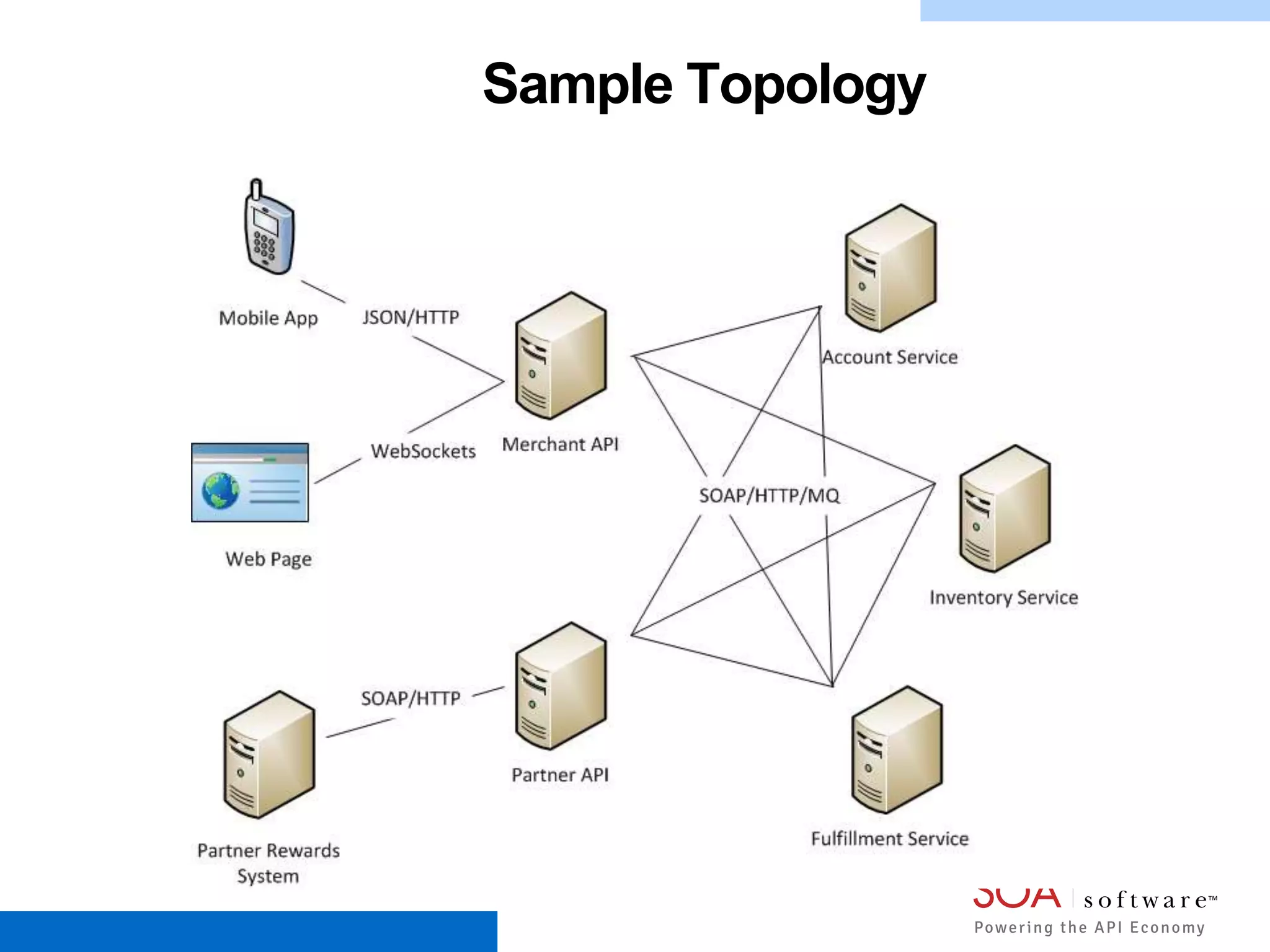
– Web/JavaScript – JSON/HTTP, WebSockets
– Mobile – JSON/HTTP
– Java A2A – XML over the most relevant protocol
• You may need to expose multiple types depending
on the channel
Simplifying the Landscape
• APIs are a superset of Web Services – it is a
business differentiation, not a technical one
• You need a single platform that is flexible enough
to handle multiple:
– Transports and Protocols
– Message types
– Descriptors and Documentation Standards
Sample Topology
Common Challenges
• Publication
• Mediation and Integration
• Monitoring and Remediation
• Lifecycle management
Publication
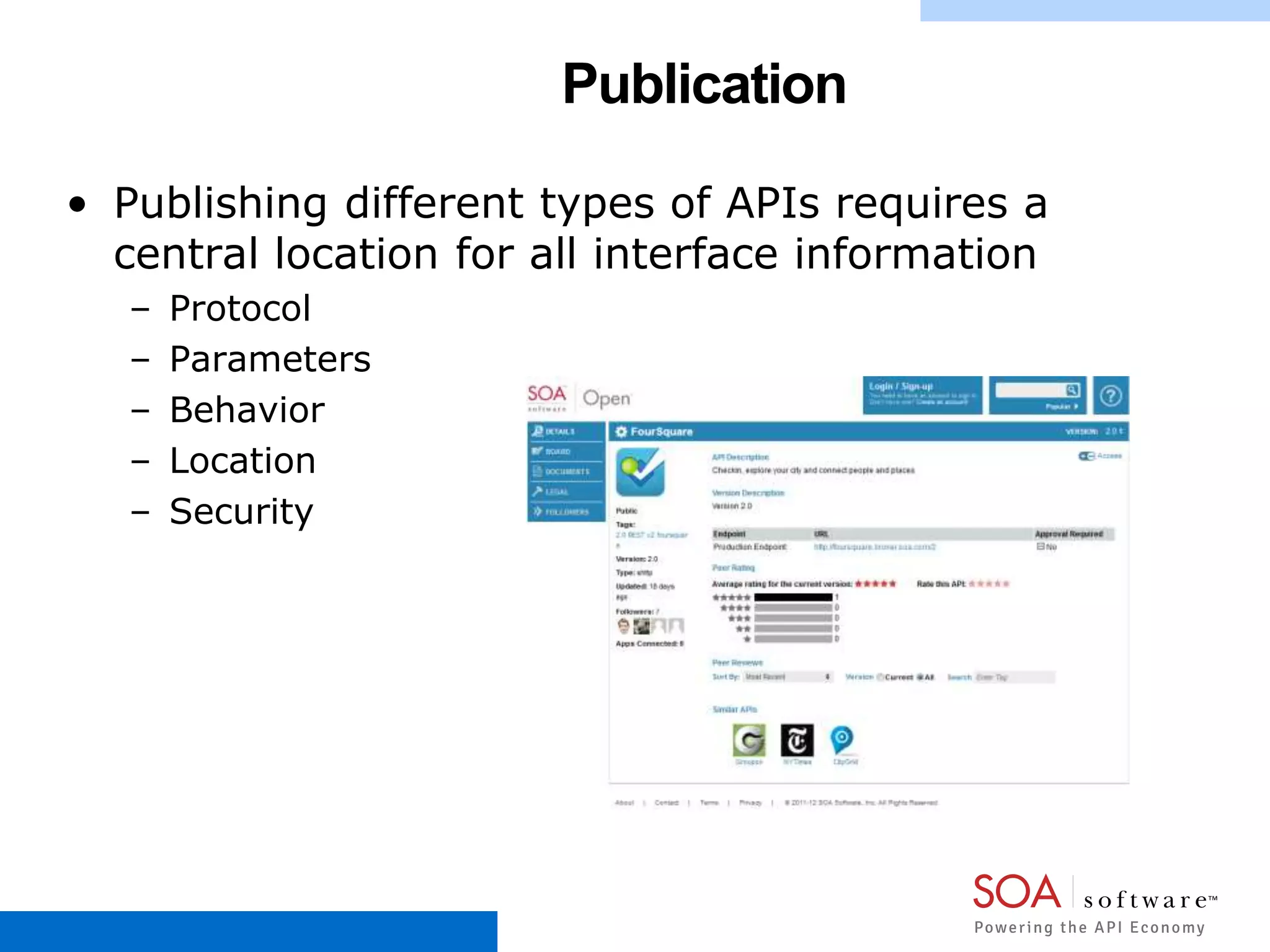
• Publishing different types of APIs requires a
central location for all interface information
– Protocol
– Parameters
– Behavior
– Location
– Security
Publication
• A single platform can:
– Present different descriptor and documentation models
– Mediate between them: Swagger, WSDL, Schema, JSON
Schema
• A single platform can support a cohesive
developer community
Mediation and Integration
• Publishing an API often requires mediation:
– API is currently XML but clients also need JSON
– API is currently SOAP but client applications can benefit from
WebSockets
– Trust domains (Identities) may be different
– API uses OAuth but Service uses WS-Security
• A platform that supports mediation of a wide variety of
protocols provides a needed bridge between APIs and
Services
– Needs native understanding to eliminate custom coding
Mediation and Integration
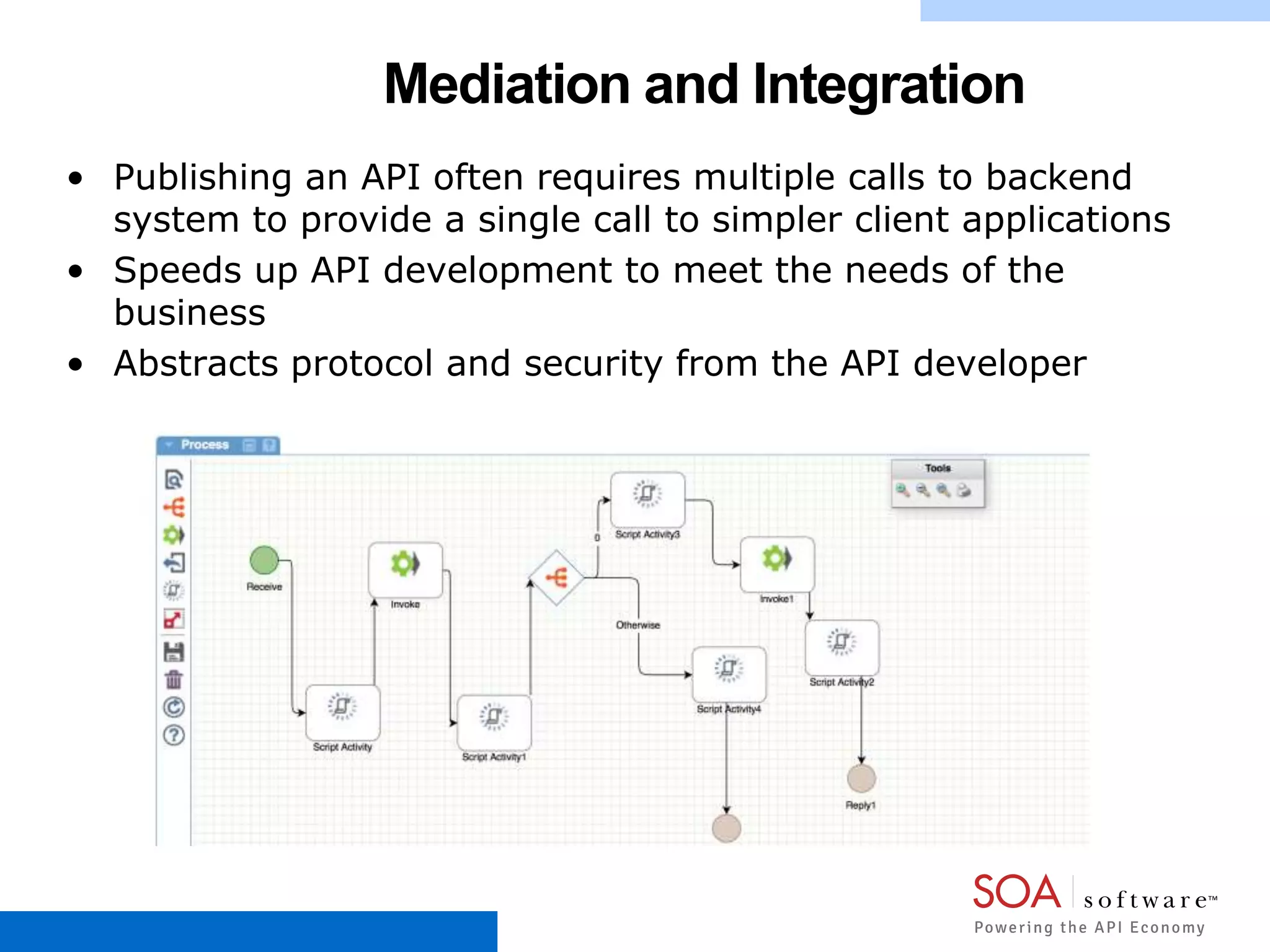
• Publishing an API often requires multiple calls to backend
system to provide a single call to simpler client applications
• Speeds up API development to meet the needs of the
business
• Abstracts protocol and security from the API developer
Using a Gateway
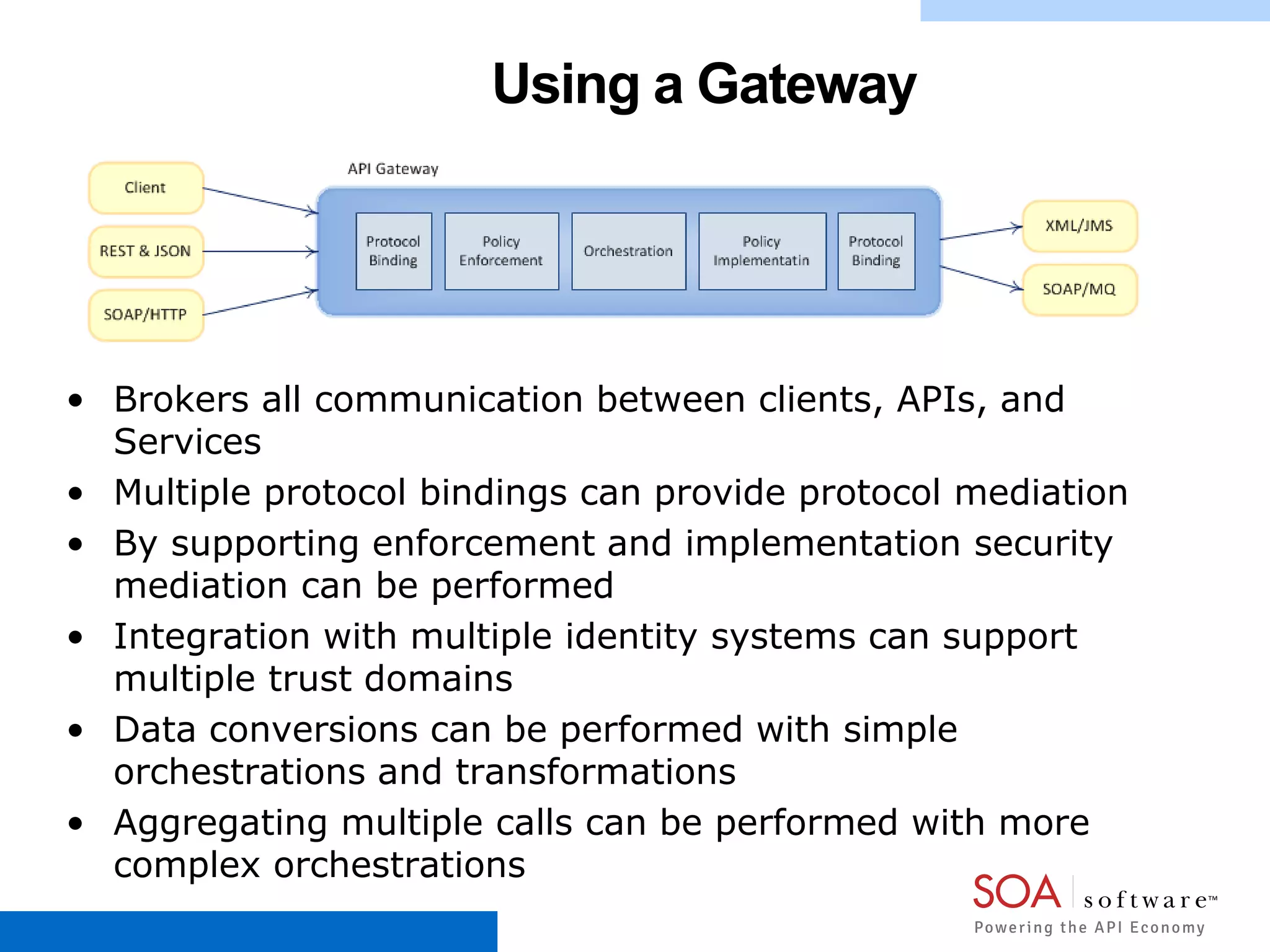
• Brokers all communication between clients, APIs, and
Services
• Multiple protocol bindings can provide protocol mediation
• By supporting enforcement and implementation security
mediation can be performed
• Integration with multiple identity systems can support
multiple trust domains
• Data conversions can be performed with simple
orchestrations and transformations
• Aggregating multiple calls can be performed with more
complex orchestrations
Monitoring and Remediation
• Performance and failures are often driven by downstream
APIs and Services
• Root Cause Analysis
– With a common platform performance and failures can be
traced to their root cause
• Capacity Planning
– A single platform aids in collecting capacity information from all
dependent APIs
– Easily compare committed vs. existing capacity
• Throttling and QoS Managements
– A single platform utilizes throttling at different integration
points to ensure SLA’s are met at each level
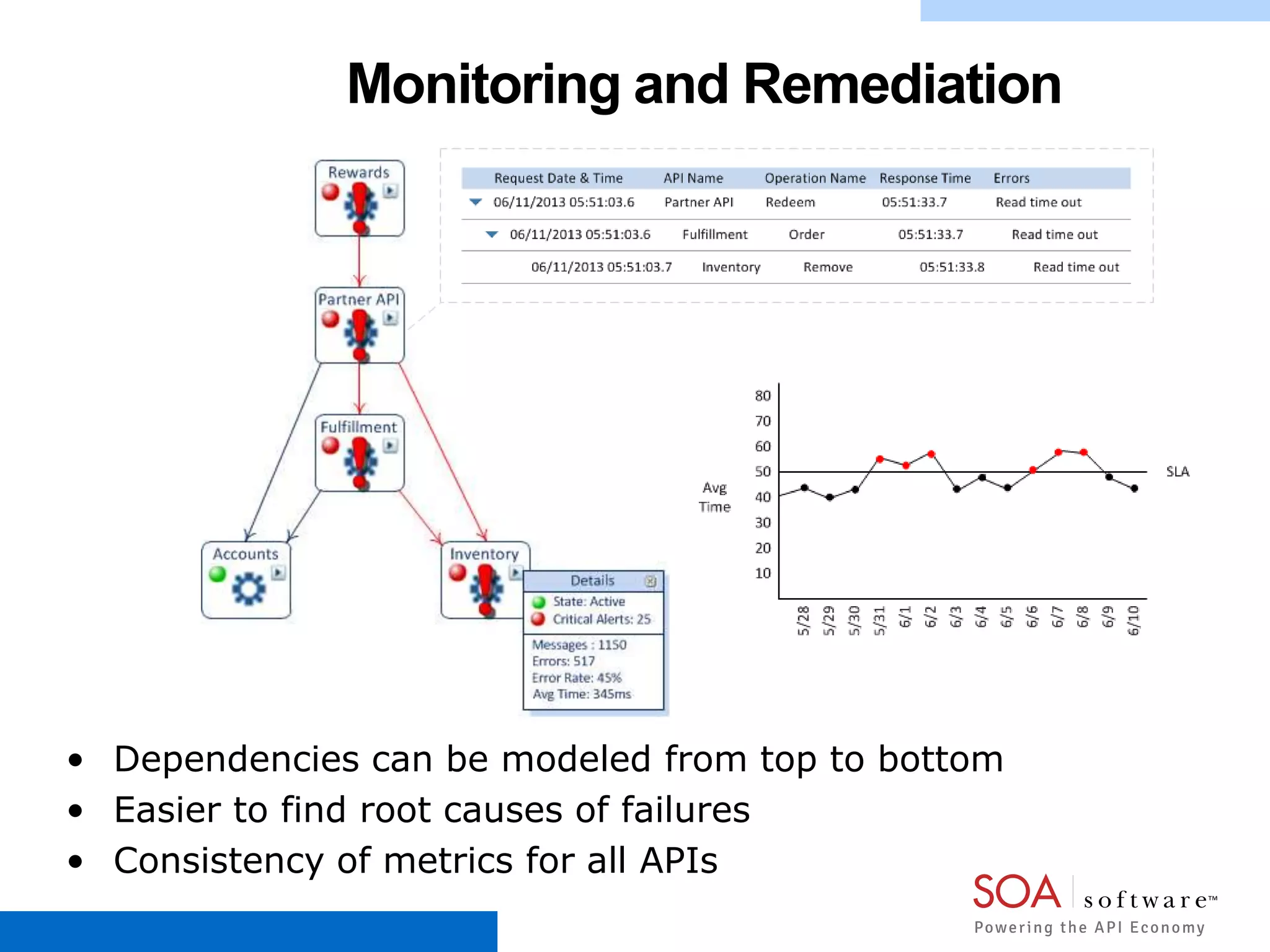
Monitoring and Remediation
• Dependencies can be modeled from top to bottom
• Easier to find root causes of failures
• Consistency of metrics for all APIs
Lifecycle Management
• At their core, APIs and Services are both just software
• Templates and Standards
– Standards for the use of protocols, documentation, security
should be established and adhered to
• Best Practices
– Business justification, requirements gathering, dependency
management, integration testing, compliance testing should be
performed consistently for both
• Control
– A single platform can provide centralized control and reporting
Conclusion
• APIs are a superset of Services, albeit with more
business focus
• API standards are constantly evolving, so be
careful when investing in a constrained technology
platform (e.g. XML-focused)
• Irrespective of the standards, APIs need a single
platform for:
– Publication
– Integration and Mediation
– Monitoring and Remediation
– Lifecycle management
Thanks…
Alistair Farquharson, CTO, SOA Software
ajf@soa.com
www.soa.com
@afarqu
@SOASoftwareInc

APIs and Services: One Platform or Two?

  • 1.
    Copyright © 2001-2012SOA Software, Inc. All Rights Reserved. All content subject to confidentiality agreement between SOA Software and Customer. APIs and Services One Platform or Two?
  • 2.
    Common Misconceptions • APIsand Web Services are distinguished by the technology they use, JSON vs. SOAP • APIs have become the external interface to an organization while Web Services have become components for internal collaborations
  • 3.
    What is anAPI • Has become a broader term than web service, it is not exclusive to JSON/HTTP as some may lead us to believe • Can utilize different data formats such as XML, SOAP, JSON, or plain text • Can utilize different transports such as WebSockets, HTTP, TCP, MLLP, JMS, or MQ • Does not exclude Web Services, SOAP, XML, JMS
  • 4.
    Differentiating through Exposure •The choice of technology should be dictated by the client: – Web/JavaScript – JSON/HTTP, WebSockets – Mobile – JSON/HTTP – Java A2A – XML over the most relevant protocol • You may need to expose multiple types depending on the channel
  • 5.
    Simplifying the Landscape •APIs are a superset of Web Services – it is a business differentiation, not a technical one • You need a single platform that is flexible enough to handle multiple: – Transports and Protocols – Message types – Descriptors and Documentation Standards
  • 6.
  • 7.
    Common Challenges • Publication •Mediation and Integration • Monitoring and Remediation • Lifecycle management
  • 8.
    Publication • Publishing differenttypes of APIs requires a central location for all interface information – Protocol – Parameters – Behavior – Location – Security
  • 9.
    Publication • A singleplatform can: – Present different descriptor and documentation models – Mediate between them: Swagger, WSDL, Schema, JSON Schema • A single platform can support a cohesive developer community
  • 10.
    Mediation and Integration •Publishing an API often requires mediation: – API is currently XML but clients also need JSON – API is currently SOAP but client applications can benefit from WebSockets – Trust domains (Identities) may be different – API uses OAuth but Service uses WS-Security • A platform that supports mediation of a wide variety of protocols provides a needed bridge between APIs and Services – Needs native understanding to eliminate custom coding
  • 11.
    Mediation and Integration •Publishing an API often requires multiple calls to backend system to provide a single call to simpler client applications • Speeds up API development to meet the needs of the business • Abstracts protocol and security from the API developer
  • 12.
    Using a Gateway •Brokers all communication between clients, APIs, and Services • Multiple protocol bindings can provide protocol mediation • By supporting enforcement and implementation security mediation can be performed • Integration with multiple identity systems can support multiple trust domains • Data conversions can be performed with simple orchestrations and transformations • Aggregating multiple calls can be performed with more complex orchestrations
  • 13.
    Monitoring and Remediation •Performance and failures are often driven by downstream APIs and Services • Root Cause Analysis – With a common platform performance and failures can be traced to their root cause • Capacity Planning – A single platform aids in collecting capacity information from all dependent APIs – Easily compare committed vs. existing capacity • Throttling and QoS Managements – A single platform utilizes throttling at different integration points to ensure SLA’s are met at each level
  • 14.
    Monitoring and Remediation •Dependencies can be modeled from top to bottom • Easier to find root causes of failures • Consistency of metrics for all APIs
  • 15.
    Lifecycle Management • Attheir core, APIs and Services are both just software • Templates and Standards – Standards for the use of protocols, documentation, security should be established and adhered to • Best Practices – Business justification, requirements gathering, dependency management, integration testing, compliance testing should be performed consistently for both • Control – A single platform can provide centralized control and reporting
  • 16.
    Conclusion • APIs area superset of Services, albeit with more business focus • API standards are constantly evolving, so be careful when investing in a constrained technology platform (e.g. XML-focused) • Irrespective of the standards, APIs need a single platform for: – Publication – Integration and Mediation – Monitoring and Remediation – Lifecycle management
  • 17.
    Thanks… Alistair Farquharson, CTO,SOA Software ajf@soa.com www.soa.com @afarqu @SOASoftwareInc