API Testing Lessons
from the
Insurance Domain
API Days India
October 8, 2025
© Karate Labs Inc. | Confidential & Proprietary
About
Corporate Background Open Source Contributions Startup Innovation
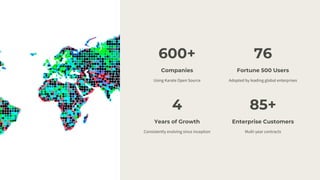
600+
Companies
Using Karate Open Source
76
Fortune 500 Users
Adopted by leading global enterprises
4
Years of Growth
Consistently evolving since inception
85+
Enterprise Customers
Multi-year contracts
© Karate Labs Inc. | Confidential & Proprietary
Agenda
01
How do you approach testing in
complex domains?
02
How can Business-IT
collaboration be better?
03
How can AI help?
© Karate Labs Inc. | Confidential & Proprietary
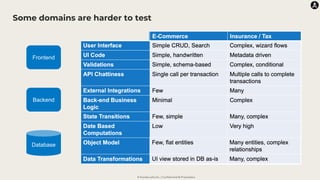
Some domains are harder to test
Database
Backend
Frontend
© Karate Labs Inc. | Confidential & Proprietary
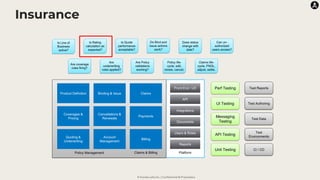
Insurance
Product Definition
Coverages &
Pricing
Binding & Issue
Billing
Account
Management
Claims
Quoting &
Underwriting
Cancellations &
Renewals
Payments
Policy Management Claims & Billing
Front End / UX
API
Integrations
Documents
Users & Roles
Reports
Platform
Is Line of
Business
active?
Are coverage
rules firing?
Is Rating
calculation as
expected?
Is Quote
performance
acceptable?
Are
underwriting
rules applied?
Are Policy
validations
working?
Do Bind and
Issue actions
work?
Policy life-
cycle, edit,
renew, cancel.
Does status
change with
date?
Claims life-
cycle, FNOL,
adjust, settle.
Can un-
authorized
users access?
UI Testing
Messaging
Testing
API Testing
Unit Testing
Perf Testing Test Reports
Test Authoring
Test Data
CI / CD
Test
Environments
© Karate Labs Inc. | Confidential & Proprietary
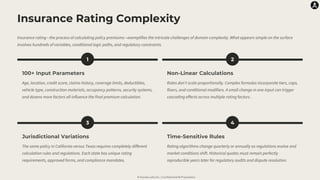
Insurance Rating Complexity
Insurance rating—the process of calculating policy premiums—exemplifies the intricate challenges of domain complexity. What appears simple on the surface
involves hundreds of variables, conditional logic paths, and regulatory constraints.
1
100+ Input Parameters
Age, location, credit score, claims history, coverage limits, deductibles,
vehicle type, construction materials, occupancy patterns, security systems,
and dozens more factors all influence the final premium calculation.
2
Non-Linear Calculations
Rates don't scale proportionally. Complex formulas incorporate tiers, caps,
floors, and conditional modifiers. A small change in one input can trigger
cascading effects across multiple rating factors.
3
Jurisdictional Variations
The same policy in California versus Texas requires completely different
calculation rules and regulations. Each state has unique rating
requirements, approved forms, and compliance mandates.
4
Time-Sensitive Rules
Rating algorithms change quarterly or annually as regulations evolve and
market conditions shift. Historical quotes must remain perfectly
reproducible years later for regulatory audits and dispute resolution.
© Karate Labs Inc. | Confidential & Proprietary
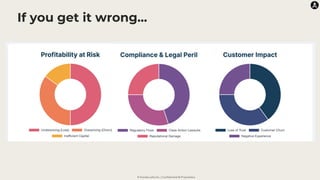
If you get it wrong...
© Karate Labs Inc. | Confidential & Proprietary
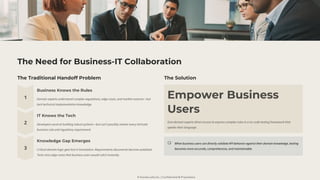
The Need for Business-IT Collaboration
The Traditional Handoff Problem
Business Knows the Rules
Domain experts understand complex regulations, edge cases, and market nuances—but
lack technical implementation knowledge.
IT Knows the Tech
Developers excel at building robust systems—but can't possibly master every intricate
business rule and regulatory requirement.
Knowledge Gap Emerges
Critical domain logic gets lost in translation. Requirements documents become outdated.
Tests miss edge cases that business users would catch instantly.
The Solution
Empower Business
Users
Give domain experts direct access to express complex rules in a no-code testing framework that
speaks their language.
When business users can directly validate API behavior against their domain knowledge, testing
becomes more accurate, comprehensive, and maintainable.
© Karate Labs Inc. | Confidential & Proprietary
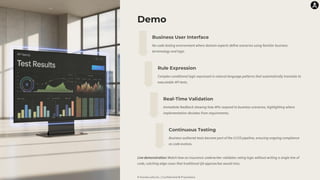
Demo
Business User Interface
No-code testing environment where domain experts define scenarios using familiar business
terminology and logic.
Rule Expression
Complex conditional logic expressed in natural language patterns that automatically translate to
executable API tests.
Real-Time Validation
Immediate feedback showing how APIs respond to business scenarios, highlighting where
implementation deviates from requirements.
Continuous Testing
Business-authored tests become part of the CI/CD pipeline, ensuring ongoing compliance
as code evolves.
Live demonstration: Watch how an insurance underwriter validates rating logic without writing a single line of
code, catching edge cases that traditional QA approaches would miss.
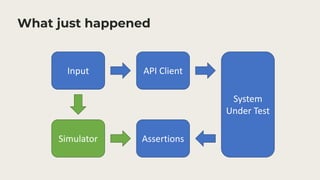
What just happened
API Client
Input
System
Under Test
Assertions
Simulator
© Karate Labs Inc. | Confidential & Proprietary
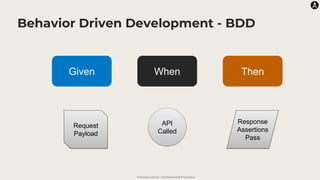
Behavior Driven Development - BDD
Given When Then
Request
Payload
API
Called
Response
Assertions
Pass
© Karate Labs Inc. | Confidential & Proprietary
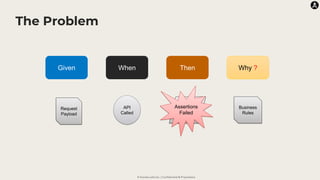
The Problem
Given When Then
Request
Payload
API
Called
Response
Assertions
Pass
Assertions
Failed
Because
Business
Rules
Why ?
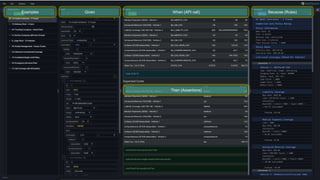
Examples Given When (API call)
Then (Assertions)
Because (Rules)
© Karate Labs Inc. | Confidential & Proprietary
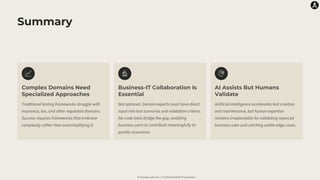
Summary
Complex Domains Need
Specialized Approaches
Traditional testing frameworks struggle with
insurance, tax, and other regulated domains.
Success requires frameworks that embrace
complexity rather than oversimplifying it.
Business-IT Collaboration Is
Essential
Not optional. Domain experts must have direct
input into test scenarios and validation criteria.
No-code tools bridge the gap, enabling
business users to contribute meaningfully to
quality assurance.
AI Assists But Humans
Validate
Artificial intelligence accelerates test creation
and maintenance, but human expertise
remains irreplaceable for validating nuanced
business rules and catching subtle edge cases.
THANK YOU!
Let's connect and continue the conversation
info@karatelabs.io

API Testing Lessons from the Insurance Domain

  • 1.
    API Testing Lessons fromthe Insurance Domain API Days India October 8, 2025
  • 2.
    © Karate LabsInc. | Confidential & Proprietary About Corporate Background Open Source Contributions Startup Innovation
  • 3.
    600+ Companies Using Karate OpenSource 76 Fortune 500 Users Adopted by leading global enterprises 4 Years of Growth Consistently evolving since inception 85+ Enterprise Customers Multi-year contracts
  • 4.
    © Karate LabsInc. | Confidential & Proprietary Agenda 01 How do you approach testing in complex domains? 02 How can Business-IT collaboration be better? 03 How can AI help?
  • 5.
    © Karate LabsInc. | Confidential & Proprietary Some domains are harder to test Database Backend Frontend
  • 6.
    © Karate LabsInc. | Confidential & Proprietary Insurance Product Definition Coverages & Pricing Binding & Issue Billing Account Management Claims Quoting & Underwriting Cancellations & Renewals Payments Policy Management Claims & Billing Front End / UX API Integrations Documents Users & Roles Reports Platform Is Line of Business active? Are coverage rules firing? Is Rating calculation as expected? Is Quote performance acceptable? Are underwriting rules applied? Are Policy validations working? Do Bind and Issue actions work? Policy life- cycle, edit, renew, cancel. Does status change with date? Claims life- cycle, FNOL, adjust, settle. Can un- authorized users access? UI Testing Messaging Testing API Testing Unit Testing Perf Testing Test Reports Test Authoring Test Data CI / CD Test Environments
  • 7.
    © Karate LabsInc. | Confidential & Proprietary Insurance Rating Complexity Insurance rating—the process of calculating policy premiums—exemplifies the intricate challenges of domain complexity. What appears simple on the surface involves hundreds of variables, conditional logic paths, and regulatory constraints. 1 100+ Input Parameters Age, location, credit score, claims history, coverage limits, deductibles, vehicle type, construction materials, occupancy patterns, security systems, and dozens more factors all influence the final premium calculation. 2 Non-Linear Calculations Rates don't scale proportionally. Complex formulas incorporate tiers, caps, floors, and conditional modifiers. A small change in one input can trigger cascading effects across multiple rating factors. 3 Jurisdictional Variations The same policy in California versus Texas requires completely different calculation rules and regulations. Each state has unique rating requirements, approved forms, and compliance mandates. 4 Time-Sensitive Rules Rating algorithms change quarterly or annually as regulations evolve and market conditions shift. Historical quotes must remain perfectly reproducible years later for regulatory audits and dispute resolution.
  • 8.
    © Karate LabsInc. | Confidential & Proprietary If you get it wrong...
  • 9.
    © Karate LabsInc. | Confidential & Proprietary The Need for Business-IT Collaboration The Traditional Handoff Problem Business Knows the Rules Domain experts understand complex regulations, edge cases, and market nuances—but lack technical implementation knowledge. IT Knows the Tech Developers excel at building robust systems—but can't possibly master every intricate business rule and regulatory requirement. Knowledge Gap Emerges Critical domain logic gets lost in translation. Requirements documents become outdated. Tests miss edge cases that business users would catch instantly. The Solution Empower Business Users Give domain experts direct access to express complex rules in a no-code testing framework that speaks their language. When business users can directly validate API behavior against their domain knowledge, testing becomes more accurate, comprehensive, and maintainable.
  • 10.
    © Karate LabsInc. | Confidential & Proprietary Demo Business User Interface No-code testing environment where domain experts define scenarios using familiar business terminology and logic. Rule Expression Complex conditional logic expressed in natural language patterns that automatically translate to executable API tests. Real-Time Validation Immediate feedback showing how APIs respond to business scenarios, highlighting where implementation deviates from requirements. Continuous Testing Business-authored tests become part of the CI/CD pipeline, ensuring ongoing compliance as code evolves. Live demonstration: Watch how an insurance underwriter validates rating logic without writing a single line of code, catching edge cases that traditional QA approaches would miss.
  • 12.
    What just happened APIClient Input System Under Test Assertions Simulator
  • 13.
    © Karate LabsInc. | Confidential & Proprietary Behavior Driven Development - BDD Given When Then Request Payload API Called Response Assertions Pass
  • 14.
    © Karate LabsInc. | Confidential & Proprietary The Problem Given When Then Request Payload API Called Response Assertions Pass Assertions Failed Because Business Rules Why ?
  • 15.
    Examples Given When(API call) Then (Assertions) Because (Rules)
  • 17.
    © Karate LabsInc. | Confidential & Proprietary Summary Complex Domains Need Specialized Approaches Traditional testing frameworks struggle with insurance, tax, and other regulated domains. Success requires frameworks that embrace complexity rather than oversimplifying it. Business-IT Collaboration Is Essential Not optional. Domain experts must have direct input into test scenarios and validation criteria. No-code tools bridge the gap, enabling business users to contribute meaningfully to quality assurance. AI Assists But Humans Validate Artificial intelligence accelerates test creation and maintenance, but human expertise remains irreplaceable for validating nuanced business rules and catching subtle edge cases.
  • 18.
    THANK YOU! Let's connectand continue the conversation info@karatelabs.io