Creating an Effective Enterprise
Testing Strategy: Best Practices and
Considerations
In today’s competitive landscape, enterprises are constantly striving
for greater efficiency and agility. Achieving such improvements often
requires modernizing applications and adopting innovative
technologies. These applications not only facilitate seamless
operations but also forge connections between businesses,
customers, and vendors, and ensure employee collaboration and
alignment. This comprehensive guide explores the intricacies of
enterprise software testing, unveiling its key aspects and equipping
you with the knowledge to navigate its complex landscape.
What Is Enterprise Testing & Why is it
Important?
Enterprise testing refers to the process of ensuring the quality,
performance, and security of Software systems and applications in
large-scale organizations. It goes beyond basic testing and focuses on
ensuring that applications are thoroughly tested to maintain optimal
performance, security, and user experience.
The Enterprise Testing Strategy is a collaborative effort by Project
Management, Business Analysts, and Development teams, which
outlines a comprehensive approach to reducing quality costs while
seamlessly integrating quality into product launches.
Here’s why enterprise testing is an essential investment for any
modern business:
● Ensures quality and reliability, preventing disruptions and user
frustration.
● Boosts performance and efficiency, streamlining workflows and
improving user productivity.
● Protects data and security, safeguarding sensitive information
from malicious actors.
● Enhances stakeholder confidence, building trust and confidence
across all levels.
● Drives innovation and agility, empowering organizations to adapt
and thrive in a dynamic market.
Why Testing Enterprise Software is More
Complex Than Traditional Applications
Testing enterprise software is significantly more complex than testing
traditional applications Because of its complex architecture, broader
user base, and critical business function it supports, any malfunction
can lead to significant operational disruptions and financial losses.
Increased Scope and Complexity:
● Enterprise software typically handles a broader range of
functionalities and integrates with various other systems making
it challenging to test thoroughly and effectively.
● Enterprise software that serves different types of users with
different roles and access levels must be tested in-depth for
each user group.
2. High Stakes and Criticality:
● Enterprise application downtime, errors or security breaches can
cause significant financial loss and reputational damage.
● Most enterprises operate in regulated industries like financial
services and healthcare, which must comply with stringent
security standards and industry regulations. This adds another
layer of complexity to the testing process.
3. Extensive Performance and Scalability Demands:
● Enterprise apps require thorough performance testing to ensure
they handle huge data loads and multiple users effectively,
ensuring responsiveness and scalability under heavy workloads.
● Protecting sensitive data from unauthorized access and
breaches requires comprehensive security testing throughout the
entire development cycle.
4. Continuously Adapting to Feature Evolution
● Enterprise software frequently updates to meet changing
business needs and incorporate new functionalities.
● This constant evolution necessitates rigorous testing for rigorous
testing to address regression issues from new developments,
ensure compatibility between features and assess performance
impact.
Key Elements of an Effective Enterprise Testing
Strategy
– Identifying the different types of testing required for enterprise
software
– Establishing clear goals and objectives for testing activities
– Ensuring proper documentation and traceability of test cases and
results
– Incorporating risk-based testing approaches
– Leveraging automation and tools to streamline testing processes
Designing a Roadmap for Quality Excellence in
Your Enterprise Application Testing
Delivering quality enterprise applications requires rigorous testing
practices across all stages of the development lifecycle. From
gathering requirements to designing test cases to executing tests and
analyzing results, a comprehensive roadmap is essential. This
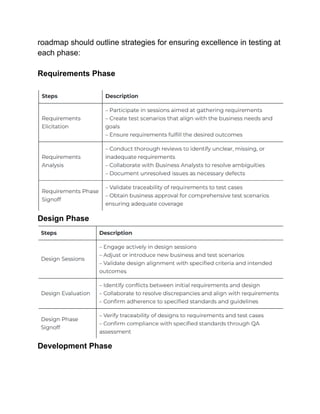
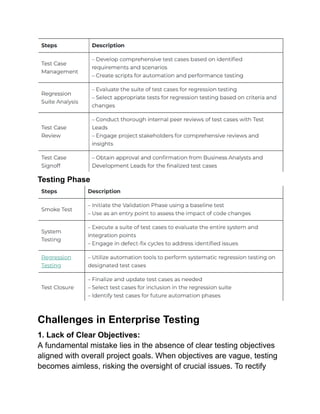
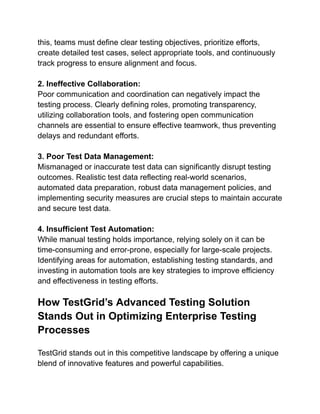
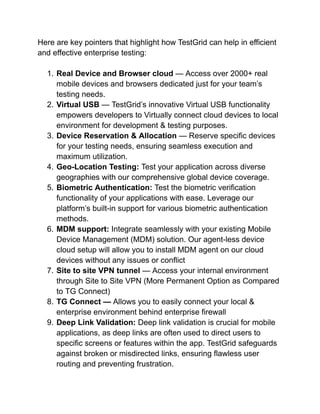
roadmap should outline strategies for ensuring excellence in testing at
each phase:
Requirements Phase
Design Phase
Development Phase
Testing Phase
Challenges in Enterprise Testing
1. Lack of Clear Objectives:
A fundamental mistake lies in the absence of clear testing objectives
aligned with overall project goals. When objectives are vague, testing
becomes aimless, risking the oversight of crucial issues. To rectify
this, teams must define clear testing objectives, prioritize efforts,
create detailed test cases, select appropriate tools, and continuously
track progress to ensure alignment and focus.
2. Ineffective Collaboration:
Poor communication and coordination can negatively impact the
testing process. Clearly defining roles, promoting transparency,
utilizing collaboration tools, and fostering open communication
channels are essential to ensure effective teamwork, thus preventing
delays and redundant efforts.
3. Poor Test Data Management:
Mismanaged or inaccurate test data can significantly disrupt testing
outcomes. Realistic test data reflecting real-world scenarios,
automated data preparation, robust data management policies, and
implementing security measures are crucial steps to maintain accurate
and secure test data.
4. Insufficient Test Automation:
While manual testing holds importance, relying solely on it can be
time-consuming and error-prone, especially for large-scale projects.
Identifying areas for automation, establishing testing standards, and
investing in automation tools are key strategies to improve efficiency
and effectiveness in testing efforts.
How TestGrid’s Advanced Testing Solution
Stands Out in Optimizing Enterprise Testing
Processes
TestGrid stands out in this competitive landscape by offering a unique
blend of innovative features and powerful capabilities.
Here are key pointers that highlight how TestGrid can help in efficient
and effective enterprise testing:
1. Real Device and Browser cloud — Access over 2000+ real
mobile devices and browsers dedicated just for your team’s
testing needs.
2. Virtual USB — TestGrid’s innovative Virtual USB functionality
empowers developers to Virtually connect cloud devices to local
environment for development & testing purposes.
3. Device Reservation & Allocation — Reserve specific devices
for your testing needs, ensuring seamless execution and
maximum utilization.
4. Geo-Location Testing: Test your application across diverse
geographies with our comprehensive global device coverage.
5. Biometric Authentication: Test the biometric verification
functionality of your applications with ease. Leverage our
platform’s built-in support for various biometric authentication
methods.
6. MDM support: Integrate seamlessly with your existing Mobile
Device Management (MDM) solution. Our agent-less device
cloud setup will allow you to install MDM agent on our cloud
devices without any issues or conflict
7. Site to site VPN tunnel — Access your internal environment
through Site to Site VPN (More Permanent Option as Compared
to TG Connect)
8. TG Connect — Allows you to easily connect your local &
enterprise environment behind enterprise firewall
9. Deep Link Validation: Deep link validation is crucial for mobile
applications, as deep links are often used to direct users to
specific screens or features within the app. TestGrid safeguards
against broken or misdirected links, ensuring flawless user
routing and preventing frustration.
Visual Regression Testing: Ensure your application’s visual
appearance and user experience remain consistent throughout
development cycles. Detect even the smallest visual deviations with
automated screenshot comparisons.
Device lock & unlock — Set pin and lock and unlock devices as
needed
LDAP, MFA, SSO, etc — Integrate with enterprise authentication
protocols like LDAP, MFA, and SSO to eliminate the need for
remembering multiple passwords during testing.
Network Throttling — Test the app on different network conditions to
expose app vulnerabilities and optimize performance under diverse
conditions.
In-built Performance metrics for apps — Monitor key performance
indicators like memory usage, CPU utilization, and network logs in real
time during testing.
For enterprise clients with complex systems and custom needs,
TestGrid offers customizable solutions tailored to their unique testing
workflows and processes. Our experts partner with enterprises to
understand their constraints and goals to build the optimal testing
environments.
Conclusion
In today’s fast-changing business landscape, the quality bar for
enterprise applications continues to rise. To meet customer
expectations and achieve competitive advantage, a modern and
strategic approach to Enterprise Testing is indispensable.
Source: This article was originally published at testgrid.io.
Creating an Effective Enterprise Testing Strategy_ Best Practices and Considerations.pdf

Creating an Effective Enterprise Testing Strategy_ Best Practices and Considerations.pdf

  • 2.
    Creating an EffectiveEnterprise Testing Strategy: Best Practices and Considerations In today’s competitive landscape, enterprises are constantly striving for greater efficiency and agility. Achieving such improvements often requires modernizing applications and adopting innovative technologies. These applications not only facilitate seamless operations but also forge connections between businesses, customers, and vendors, and ensure employee collaboration and alignment. This comprehensive guide explores the intricacies of enterprise software testing, unveiling its key aspects and equipping you with the knowledge to navigate its complex landscape.
  • 3.
    What Is EnterpriseTesting & Why is it Important? Enterprise testing refers to the process of ensuring the quality, performance, and security of Software systems and applications in large-scale organizations. It goes beyond basic testing and focuses on ensuring that applications are thoroughly tested to maintain optimal performance, security, and user experience. The Enterprise Testing Strategy is a collaborative effort by Project Management, Business Analysts, and Development teams, which outlines a comprehensive approach to reducing quality costs while seamlessly integrating quality into product launches. Here’s why enterprise testing is an essential investment for any modern business: ● Ensures quality and reliability, preventing disruptions and user frustration. ● Boosts performance and efficiency, streamlining workflows and improving user productivity. ● Protects data and security, safeguarding sensitive information from malicious actors. ● Enhances stakeholder confidence, building trust and confidence across all levels. ● Drives innovation and agility, empowering organizations to adapt and thrive in a dynamic market.
  • 4.
    Why Testing EnterpriseSoftware is More Complex Than Traditional Applications Testing enterprise software is significantly more complex than testing traditional applications Because of its complex architecture, broader user base, and critical business function it supports, any malfunction can lead to significant operational disruptions and financial losses. Increased Scope and Complexity: ● Enterprise software typically handles a broader range of functionalities and integrates with various other systems making it challenging to test thoroughly and effectively. ● Enterprise software that serves different types of users with different roles and access levels must be tested in-depth for each user group. 2. High Stakes and Criticality: ● Enterprise application downtime, errors or security breaches can cause significant financial loss and reputational damage. ● Most enterprises operate in regulated industries like financial services and healthcare, which must comply with stringent security standards and industry regulations. This adds another layer of complexity to the testing process. 3. Extensive Performance and Scalability Demands: ● Enterprise apps require thorough performance testing to ensure they handle huge data loads and multiple users effectively, ensuring responsiveness and scalability under heavy workloads.
  • 5.
    ● Protecting sensitivedata from unauthorized access and breaches requires comprehensive security testing throughout the entire development cycle. 4. Continuously Adapting to Feature Evolution ● Enterprise software frequently updates to meet changing business needs and incorporate new functionalities. ● This constant evolution necessitates rigorous testing for rigorous testing to address regression issues from new developments, ensure compatibility between features and assess performance impact. Key Elements of an Effective Enterprise Testing Strategy – Identifying the different types of testing required for enterprise software – Establishing clear goals and objectives for testing activities – Ensuring proper documentation and traceability of test cases and results – Incorporating risk-based testing approaches – Leveraging automation and tools to streamline testing processes Designing a Roadmap for Quality Excellence in Your Enterprise Application Testing Delivering quality enterprise applications requires rigorous testing practices across all stages of the development lifecycle. From gathering requirements to designing test cases to executing tests and analyzing results, a comprehensive roadmap is essential. This
  • 6.
    roadmap should outlinestrategies for ensuring excellence in testing at each phase: Requirements Phase Design Phase Development Phase
  • 7.
    Testing Phase Challenges inEnterprise Testing 1. Lack of Clear Objectives: A fundamental mistake lies in the absence of clear testing objectives aligned with overall project goals. When objectives are vague, testing becomes aimless, risking the oversight of crucial issues. To rectify
  • 8.
    this, teams mustdefine clear testing objectives, prioritize efforts, create detailed test cases, select appropriate tools, and continuously track progress to ensure alignment and focus. 2. Ineffective Collaboration: Poor communication and coordination can negatively impact the testing process. Clearly defining roles, promoting transparency, utilizing collaboration tools, and fostering open communication channels are essential to ensure effective teamwork, thus preventing delays and redundant efforts. 3. Poor Test Data Management: Mismanaged or inaccurate test data can significantly disrupt testing outcomes. Realistic test data reflecting real-world scenarios, automated data preparation, robust data management policies, and implementing security measures are crucial steps to maintain accurate and secure test data. 4. Insufficient Test Automation: While manual testing holds importance, relying solely on it can be time-consuming and error-prone, especially for large-scale projects. Identifying areas for automation, establishing testing standards, and investing in automation tools are key strategies to improve efficiency and effectiveness in testing efforts. How TestGrid’s Advanced Testing Solution Stands Out in Optimizing Enterprise Testing Processes TestGrid stands out in this competitive landscape by offering a unique blend of innovative features and powerful capabilities.
  • 9.
    Here are keypointers that highlight how TestGrid can help in efficient and effective enterprise testing: 1. Real Device and Browser cloud — Access over 2000+ real mobile devices and browsers dedicated just for your team’s testing needs. 2. Virtual USB — TestGrid’s innovative Virtual USB functionality empowers developers to Virtually connect cloud devices to local environment for development & testing purposes. 3. Device Reservation & Allocation — Reserve specific devices for your testing needs, ensuring seamless execution and maximum utilization. 4. Geo-Location Testing: Test your application across diverse geographies with our comprehensive global device coverage. 5. Biometric Authentication: Test the biometric verification functionality of your applications with ease. Leverage our platform’s built-in support for various biometric authentication methods. 6. MDM support: Integrate seamlessly with your existing Mobile Device Management (MDM) solution. Our agent-less device cloud setup will allow you to install MDM agent on our cloud devices without any issues or conflict 7. Site to site VPN tunnel — Access your internal environment through Site to Site VPN (More Permanent Option as Compared to TG Connect) 8. TG Connect — Allows you to easily connect your local & enterprise environment behind enterprise firewall 9. Deep Link Validation: Deep link validation is crucial for mobile applications, as deep links are often used to direct users to specific screens or features within the app. TestGrid safeguards against broken or misdirected links, ensuring flawless user routing and preventing frustration.
  • 10.
    Visual Regression Testing:Ensure your application’s visual appearance and user experience remain consistent throughout development cycles. Detect even the smallest visual deviations with automated screenshot comparisons. Device lock & unlock — Set pin and lock and unlock devices as needed LDAP, MFA, SSO, etc — Integrate with enterprise authentication protocols like LDAP, MFA, and SSO to eliminate the need for remembering multiple passwords during testing. Network Throttling — Test the app on different network conditions to expose app vulnerabilities and optimize performance under diverse conditions. In-built Performance metrics for apps — Monitor key performance indicators like memory usage, CPU utilization, and network logs in real time during testing. For enterprise clients with complex systems and custom needs, TestGrid offers customizable solutions tailored to their unique testing workflows and processes. Our experts partner with enterprises to understand their constraints and goals to build the optimal testing environments. Conclusion In today’s fast-changing business landscape, the quality bar for enterprise applications continues to rise. To meet customer expectations and achieve competitive advantage, a modern and strategic approach to Enterprise Testing is indispensable. Source: This article was originally published at testgrid.io.