Generative AI in API Testing:
Revolutionizing Quality
Assurance
Discover how artificial intelligence is transforming the way development teams
approach API testing, enabling unprecedented speed, accuracy, and coverage in
quality assurance processes.
CHALLENGE
The Growing Challenge of API
Testing
Application Programming Interfaces have become the
fundamental building blocks of modern software
architecture, serving as critical connectors that enable
seamless integration and communication between
diverse systems, applications, and services across
the digital ecosystem.
Traditional manual API testing approaches are
increasingly inadequate for today's fast-paced
development environments. Teams face significant
bottlenecks as manual processes prove slow,
resource-intensive, and highly susceptible to human
error, making it nearly impossible to maintain quality
standards while keeping pace with agile development
cycles and continuous deployment demands.
$2.41T
Annual Cost
Poor software quality cost in the
US according to CISQ report
INNOVATION
What is Generative AI in API Testing?
Generative AI represents a paradigm shift in how we approach API testing, leveraging sophisticated machine
learning models to automatically create, execute, and validate comprehensive test cases with minimal human
intervention.
Intelligent Generation
AI models analyze API specifications, real traffic
patterns, and historical data to autonomously
generate diverse, contextually relevant test
scenarios
Smart Data Creation
Generates realistic test data including edge
cases, boundary conditions, and complex
payload variations automatically
Adaptive Workflows
Creates smarter, faster testing processes that continuously learn and evolve based on API behavior and
test outcomes
BENEFITS
Key Benefits of Generative AI for API Testing
1
Accelerated Test Case Generation
AI algorithms rapidly create diverse, context-aware test scenarios by analyzing
API documentation, traffic patterns, and usage data. The technology identifies
and generates edge cases that human testers might overlook, including
unusual parameter combinations, boundary conditions, and complex multi-
step workflows that stress-test API resilience.
2
Improved Test Coverage
Dynamic data generation ensures comprehensive testing across all API
endpoints, methods, and response scenarios. AI models automatically test
multi-version compatibility, validate backward compatibility across API
versions, and ensure consistent behavior across different environments and
configurations.
3
Enhanced Automation
Execute sophisticated lockstep API orchestrations involving multiple
dependent services and complex workflows. AI validates responses across
various formats including JSON, XML, REST, SOAP, and GraphQL, ensuring
data integrity and structural correctness without manual intervention.
4
Reduced Manual Effort
By automating repetitive testing tasks, generative AI liberates quality
assurance teams from tedious manual work. Teams can redirect their
expertise toward strategic initiatives, exploratory testing, user experience
validation, and high-value activities that require human judgment and
creativity.
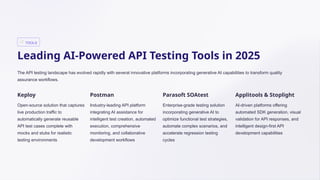
TOOLS
Leading AI-Powered API Testing Tools in 2025
The API testing landscape has evolved rapidly with several innovative platforms incorporating generative AI capabilities to transform quality
assurance workflows.
Keploy
Open-source solution that captures
live production traffic to
automatically generate reusable
API test cases complete with
mocks and stubs for realistic
testing environments
Postman
Industry-leading API platform
integrating AI assistance for
intelligent test creation, automated
execution, comprehensive
monitoring, and collaborative
development workflows
Parasoft SOAtest
Enterprise-grade testing solution
incorporating generative AI to
optimize functional test strategies,
automate complex scenarios, and
accelerate regression testing
cycles
Applitools & Stoplight
AI-driven platforms offering
automated SDK generation, visual
validation for API responses, and
intelligent design-first API
development capabilities
IMPACT
Real-World Impact: Case Examples
95%
Time Reduction
API test creation compressed from weeks to hours
3x
Bug Detection
Increase in hidden bugs discovered in complex environments
40%
Quality Maintained
Despite workforce reductions through automation
Organizations implementing generative AI in their API testing workflows have experienced transformative results across multiple dimensions of software quality and
team productivity.
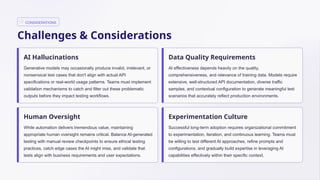
CONSIDERATIONS
Challenges & Considerations
AI Hallucinations
Generative models may occasionally produce invalid, irrelevant, or
nonsensical test cases that don't align with actual API
specifications or real-world usage patterns. Teams must implement
validation mechanisms to catch and filter out these problematic
outputs before they impact testing workflows.
Data Quality Requirements
AI effectiveness depends heavily on the quality,
comprehensiveness, and relevance of training data. Models require
extensive, well-structured API documentation, diverse traffic
samples, and contextual configuration to generate meaningful test
scenarios that accurately reflect production environments.
Human Oversight
While automation delivers tremendous value, maintaining
appropriate human oversight remains critical. Balance AI-generated
testing with manual review checkpoints to ensure ethical testing
practices, catch edge cases the AI might miss, and validate that
tests align with business requirements and user expectations.
Experimentation Culture
Successful long-term adoption requires organizational commitment
to experimentation, iteration, and continuous learning. Teams must
be willing to test different AI approaches, refine prompts and
configurations, and gradually build expertise in leveraging AI
capabilities effectively within their specific context.
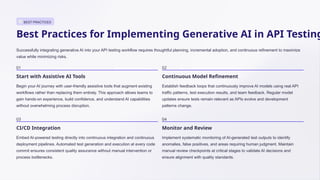
BEST PRACTICES
Best Practices for Implementing Generative AI in API Testing
Successfully integrating generative AI into your API testing workflow requires thoughtful planning, incremental adoption, and continuous refinement to maximize
value while minimizing risks.
01
Start with Assistive AI Tools
Begin your AI journey with user-friendly assistive tools that augment existing
workflows rather than replacing them entirely. This approach allows teams to
gain hands-on experience, build confidence, and understand AI capabilities
without overwhelming process disruption.
02
Continuous Model Refinement
Establish feedback loops that continuously improve AI models using real API
traffic patterns, test execution results, and team feedback. Regular model
updates ensure tests remain relevant as APIs evolve and development
patterns change.
03
CI/CD Integration
Embed AI-powered testing directly into continuous integration and continuous
deployment pipelines. Automated test generation and execution at every code
commit ensures consistent quality assurance without manual intervention or
process bottlenecks.
04
Monitor and Review
Implement systematic monitoring of AI-generated test outputs to identify
anomalies, false positives, and areas requiring human judgment. Maintain
manual review checkpoints at critical stages to validate AI decisions and
ensure alignment with quality standards.
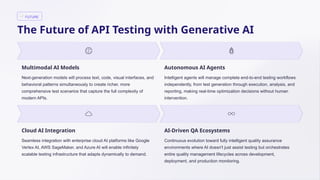
FUTURE
The Future of API Testing with Generative AI
Multimodal AI Models
Next-generation models will process text, code, visual interfaces, and
behavioral patterns simultaneously to create richer, more
comprehensive test scenarios that capture the full complexity of
modern APIs.
Autonomous AI Agents
Intelligent agents will manage complete end-to-end testing workflows
independently, from test generation through execution, analysis, and
reporting, making real-time optimization decisions without human
intervention.
Cloud AI Integration
Seamless integration with enterprise cloud AI platforms like Google
Vertex AI, AWS SageMaker, and Azure AI will enable infinitely
scalable testing infrastructure that adapts dynamically to demand.
AI-Driven QA Ecosystems
Continuous evolution toward fully intelligent quality assurance
environments where AI doesn't just assist testing but orchestrates
entire quality management lifecycles across development,
deployment, and production monitoring.
Embrace Generative AI to Transform API Testing
Generative AI represents a fundamental transformation in how quality
assurance teams deliver software excellence. By combining the speed,
consistency, and pattern-recognition capabilities of artificial intelligence with
human expertise, creativity, and strategic thinking, organizations unlock
unprecedented levels of testing efficiency and effectiveness.
The technology empowers QA professionals to deliver higher quality software
faster and with fewer resources, while maintaining or even improving coverage
depth. AI handles the repetitive, time-consuming aspects of test creation and
execution, freeing human experts to focus on exploratory testing, user
experience validation, and strategic quality initiatives that require judgment and
creativity.
The future of API testing is intelligent, automated, and adaptive. The
organizations that embrace this transformation today will lead their
industries tomorrow.
Ready to Transform?
Start with assistive AI tools and gradually expand adoption
as your team builds expertise and confidence
The Time is Now
Early adopters gain competitive advantages in speed,
quality, and resource efficiency that compound over time