RICS Assessment of Professional Competence – Valuation Final
Assessment Submission
Candidate and Counsellor/Supervisor declaration
Candidate details:
Candidate Name:
xxx
xxx
RICS Membership Number:
Date of Birth:
Pathway: Valuation
Employer / organisation:
Savills (UK) Ltd
Previously Referred? No
Case Study Title: Valuation of xxxxxxxxxxx
Candidate Declaration:
I confirm that I have completed this document in line with the
Assessment of Professional Competence candidate guide
and understand the competencies and levels required in my
pathway guide. I confirm that all documentation is based on
my own experience.
Candidate Signature: Date:
2
Counsellor/Supervisor details:
Counsellor Declaration:
By countersigning this document you confirm that to the best
of your knowledge that the candidate has understood the
requirements and this document complies with RICS
guidance.
Also that the content of this submission is a true
representation of the candidates own work and involvement
in the projects details herein.
Counsellor Name:
Counsellor Signature: Date:
RICS Membership number:
Supervisor name: (optional role)
Job title/role:
Supervisor signature: Date:
Submission content – please ensure you have completed or attached all relevant
elements:
Qualifications and Employment
Information:
Summary of experience:
Case study:
CPD:
Log book (if applicable):
Referral report (if applicable):
Declared disability to RICS (if
applicable):
Qualification and Employment Information
3
Please insert more rows or delete as applicable
Qualifications:
Name of
Educational
establishment
City/Country
Please confirm full title of
qualification
Date
started
Date
completed
xxxxxxxxxx
Any other relevant professional qualification(s):
Name of
organisation
Current grade
How membership was achieved
(e.g. examination)
Year gained
n.a
Professional experience (Please list all relevant employment details, starting with the most recent)
Employer
Position held
(job title) Date from: Date to:
Savills (UK)
Brief overview of scope and responsibilities:
Throughout my time at Savills I have worked in the development team, involved in valuation,
consultancy and agency roles. My work has focused mainly on development projects in the
residential sector.
4
Valuation Pathway
Summary of Experience - Mandatory Competencies (1500 words in total)
Competency Leve
l
Summary of Experience Date
achieved
(mm/yyyy)
Conduct
rules, ethics
and
professional
practice
1 I am aware of the role of the RICS in promoting and
maintaining the highest standards of professional practice,
education and advice in the management of land, property,
construction and the built environment, protecting
consumers through strict regulation of the highest
standards. I am also aware of the RICS Professional and
Ethical Standards, which provide a clear appreciation of the
expectations of professional practice in my day to day role.
As a graduate surveyor, I always endeavour to act
professionally and honestly and am conscious of my
limitations and not taking on more than I am qualified to do
so, seeking the advice and guidance from others where
appropriate.
10/03/2014
2 When undertaking valuations, I work in accordance with
the RICS Valuation Professional Standards (Red Book)
and refer to relevant RICS guidance where necessary. I
ensure that my client receives the best possible advice
throughout the instruction, in line with the terms of
engagement that have been agreed.
When asked to provide a valuation of a mixed residential
and extra-care development in Keynsham, I sought the
help of a colleague who specialised in extra care and
retirement scheme valuations, knowing my experience in
this sector was fairly limited and therefore provided the
client with the best service and advice available.
27/11/2014
3 When carrying out a valuation of a residential development
site in XXXX, Bath, the borrower made numerous efforts to
influence and increase our opinions of value. I was unable
to find any supporting evidence for this and acknowledging
my duty to act objectively and independently in producing
our valuation, I politely dismissed his appeals for a higher
valuation. This taught me the importance of integrity in my
role.
When completing valuations I have always sought to
ensure my assumptions are clearly defined and well
05/05/2015
5
Competency Level Summary of Experience Date achieved
(mm/yyyy)
Client care 1 I recognise that a high level of client care is vital to
strengthening existing client relationships and being
able to secure repeat business. From my induction
training upon joining the company, I have learnt to
manage my clients’ expectations and objectives and
the importance of providing timely and frequent
communication. By actively using my company’s
CRM database system, I can record details of all
clients and contacts and have accurate data
regarding their role and company information.
In accordance with the RICS Rules of Conduct, I am
aware that my company operates a formal
complaints handling procedure and I ensure that
clients are made aware of this within all terms of
engagement.
27/11/2015
2 I am involved in a junior business development
group that seeks to strengthen existing client
relationships, as well as identify new clients and
contacts through organising social engagements
and CPD events.
When providing strategic consultancy advice it is
important to understand the client’s longer term
business objectives, as well as the short term
requirements of the instruction. Consultancy
instructions often form the basis of the client’s
decision making for a particular site or business
case, therefore when creating reports I endeavour to
ensure that the report is comprehensive and tailored
to their wider business needs. I also send the client
a draft report in order to seek feedback before final
issue.
05/05/2015
researched, in order to provide a true representation of
Market Value. In line with RICS guidance, I ensure all
valuation reports are reviewed and countersigned by two
Registered Valuers and in addition often gain a third peer
review for higher risk valuations, maintaining a high level of
service at all times.
6
Competency Level Summary of Experience Date achieved
(mm/yyyy)
Communication and
negotiation
1 As part of my graduate induction, I received training
on how to network and communicate effectively. As
my knowledge and experience has developed, my
communication skills have improved through regular
contact with clients, colleagues and peers within the
industry.
I am aware of when to appropriately use the main
methods of communication with the client, throughout
the lifespan of a job and the importance of providing
advice that meets the requirements and is properly
understood.
I have also received training on various Microsoft
Office programs such as Excel and Powerpoint,
which have improved my written and graphic skills.
27/11/2014
2 I have been able to gain some experience of
negotiating directly with clients. When undertaking a
residential market report for a site in Bath, I consulted
with the client through telephone conversations to
negotiate and agree a fee and strategy for the report
before I commenced work. I then sent the client
written confirmation of our agreed report structure
and fee before undertaking the instruction. The report
included detailed research and a ‘SWOT’ analysis,
supported by graphs and a written report, which was
provided to the client and also verbally discussed
over the phone.
05/05/2015
Competency Level Summary of Experience Date achieved
(mm/yyyy)
Health and safety 1 I understand the Health and Safety Act 1974 is the
primary piece of legislation covering occupational
health and safety in the UK and that the act makes
provisions to protect and provide a duty of care to
clients, colleagues and others. At work I act in
accordance with my company’s most recent health
and safety manual where appropriate. I have regard to
the RICS guidance note Surveying Safely and from my
health and safety briefing, I understand the need to be
aware of health and safety risks at the workplace and
when working alone and outside of the office.
10/03/2014
7
2 When attending site visits and working outside of the
office I always ensure my appointment locations,
times, client/contact are always accurately recorded in
my work calendar. I always carry a mobile phone on
me at all times and where necessary undertake risk
assessments before leaving the office.
When inspecting development sites, I ensure that I am
familiar with construction site protocols including
reporting to the site office and being briefed by the site
manager, so that I understand the risks and
appropriate way I should undertake my visit and when
it is appropriate to wear PPE. For example, when
inspecting a student development site in Bristol, I wore
a hard hat, steel toe capped boots and high visibility
jacket.
27/11/2014
Competency Level Summary of Experience Date achieved
(mm/yyyy)
Accounting
principles and
procedures
1 I understand the importance of accounting practice
to assess and summarise the financial health of the
business and am familiar with my company’s
financial reporting structure. I have reviewed my
company’s Plc accounts and understand that they
are prepared in accordance with UK GAAP
(Generally Accepted Accounting Practice in the UK).
I regularly receive divisional management account
reports which show my department’s billings against
forecasts and include profit and loss summaries for
each team within the division.
I have an understanding of basic accounting
concepts, including profit and loss statements, cash
flow statements and balance sheets.
05/05/2015
Competency Level Summary of Experience Date achieved
(mm/yyyy)
Business planning 1 I participate in my regular department meetings to
review the status of our monthly billings and current
instructions. I am aware of my teams cost base and
our forecasted year end target. I appreciate the
importance of keeping billings up to date in order to
27/11/2014
8
plan and monitor the income stream of the
department and in the context of divisional
organisational structure.
I have recently attended a divisional development
services conference, which covered financial and
business highlights, areas for growth and rationale
behind key decisions such as the acquisition of new
businesses. The conference also provided an
opportunity to create new contacts in my division.
Competency Level Summary of Experience Date
achieved
(mm/yyyy)
Conflict avoidance,
management and
dispute resolution
procedures
1 From undertaking compliance training, I appreciate
the importance of undertaking conflict of interest
checks before accepting instructions from a client. I
use my company’s internal database, which has
records of all current and historic instructions and
involvements with both clients and properties. If an
internal check proves inconclusive and there is
potential for conflict, an office or company wide email
could be sent for completeness.
My company received instructions to value a
development site in xxxxxx. Through internal
enquiries I discovered that my company had
submitted the planning application for the site. After
discussing with my supervisor, we determined that
there was no conflict of interest, either with the
property or with the client preventing us from
providing an independent valuation in accordance
with the RICS Red Book. This was stated within the
confirmation of instruction letter and our report.
27/11/2014
Competency Level Summary of Experience Date
achieved
(mm/yyyy)
Data management 1 I have received training on my company’s IT systems
to enable me to access and manipulate data from
various databases and understand how departmental
and company data is stored, both electronically and
10/03/2014
9
in hard copy.
I use a number of systems and sources of information
to carry out due diligence enquiries such as Land
Registry house price indices, Local Authority planning
enquiries and BCIS cost analysis. I also regularly
refer to isurv.com for guidance on the technical
aspects of practice.
From undertaking compliance training, I am aware
that the Data Protection Act 1998 is the main piece of
legislation that governs the protection of personal
data in the UK.
Competency Level Summary of Experience Date
achieved
(mm/yyyy)
Sustainability 1 I am aware that the property industry is under
increasing pressure to embrace sustainability. Energy
Performance Certificates (EPCs) and BREEAM
ratings are the key indicators of energy and
sustainability performance of buildings and are
becoming increasingly important to owners and
occupiers.
I have developed my knowledge of how sustainability
is an integral part of a company’s CSR policy through
attending sustainability CPD workshops. My agency
experience has also made me aware that it is a
requirement for energy performance ratings to be
displayed on property particulars.
I am conscious of my role within the company’s wider
sustainability objectives. I am aware of the
importance of recycling materials and reducing
printing to improve the sustainability of my office.
27/11/2014
10
Competency Level Summary of Experience Date
achieved
(mm/yyyy)
Teamworking 1 Effective teamwork is essential to the success of my
department and the company as a whole. I
understand the need to be approachable and assist
others where possible to build on and maintain
relationships. I understand the key dynamics of
effective teamworking such as open and efficient
communication, sharing information and being
respectful and supportive of others’ ideas.
I have taken part in a regional business development
day, which involved meeting colleagues from various
offices, across a range of disciplines. This provided a
great opportunity to cross sell and network within my
company.
10/03/2014
11
Summary of Experience - Technical Competencies
Core competencies
Competency Level Summary of Experience Date
achieved
(mm/yyyy)
Inspection
1 Inspection is a fundamental part of my role and I
recognise the importance of physically inspecting a
property in order to provide appropriate and accurate
advice. I adhere to the guidance of Surveying Safely
(2011) and my company’s guidance and policies
regarding health and safety and inspection and have
been taught about these at health and safety
briefings, as well as through development site
induction protocols.
I have gained experience in the inspection of a range
of property types, to include development sites,
residential property, office and industrial premises for
valuation, agency, building surveying and consultancy
purposes. I recognise the importance of investigating
the surrounding areas to the subject property in order
to gain a better understanding of the location and
situation, as this can have fundamental implications
on value. I have also obtained basic knowledge of the
different types of building construction.
10/03/2014
2 During inspections, I endeavour to take accurate
records of all building and site characteristics. Whilst
undertaking an inspection of a site in xxxxxx, Bath, I
noted the nature of the location of the site in a
peaceful and rural setting on the edge of the village
and commented upon the condition of the existing
buildings on site and their construction. I also took
note of potential negative issues with the site, such as
proximity to the river which could pose a potential
flood risk and also redundant machinery and
materials left on site, which could pose possible
contamination risks. These potential issues could
then be investigated in more detail after the
inspection. The inspection notes were backed up by
numerous photographs and my findings were noted
within the valuation report.
I am aware of how to spot common defects within
27/11/2014
12
different property types. Whilst inspecting and
measuring an industrial building in Bristol, I noticed
some cracking in the concrete floor and that it had
sunk slightly, indicating a potential ground movement
problem. I ensured to take photographs of the defect,
informed the client of my findings and recommended
specialist advice from a building surveyor or structural
engineer.
3 When undertaking an inspection of a development
site in Clevedon, Bristol, I advised that the Property
was located within the more desirable part of the town
representing the ‘prime’ residential market. The
property had impressive uninterrupted views across
the Bristol Channel, which I reflected positively in my
pricing advice and report to the client.
In carrying out a valuation inspection of a former
factory building in xxxxxxx proposed for conversion to
residential apartments, it was clear that due to its
previous industrial use and having been left vacant
for a number of years that extensive repair and
refurbishment works would be required. The building
was in a reasonably poor condition and I was
informed that there was asbestos present within the
building. I advised the client of my findings and
allocated some additional cost for this within in my
appraisal, by applying a higher main build conversion
cost estimate and after discussion with my supervisor
an additional estimated cost to cover the asbestos
removal. I advised the client that the extent of the
asbestos was not clear and advised that further
investigation from a specialist would be required to
comment on the exact costing and extent of the
removal works required.
05/05/2015
Competency Level Summary of Experience Date
achieved
(mm/yyyy)
Valuation
1 I have undertaken valuations for a variety of
purposes, including, loan security, inheritance
taxation, agency and company internal purposes.
I have a good understanding of the five main methods
of valuation and have experience of using
comparable, investment and residual methods of
valuation.
27/11/2014
13
I am aware of the minimum terms of engagement to
be confirmed prior to commencing a Red Book
valuation and have drafted confirmation of instruction
letters in line with client requirements. I have a good
level of experience of inspecting and measuring
property, undertaking due diligence enquiries and
interpreting comparable evidence.
From attending internal valuation seminars and best
practice meetings, I recognise the importance of the
RICS Valuation Professional Standards and the need
to maintain independence and objectivity throughout
the valuation process. From attending a planning law
seminar, I appreciate how planning status and
property law can affect value, particularly with
development valuations, as well as other factors such
as location, condition, and general supply and
demand criteria.
2 In carrying out the valuation of a residential
development site in Portishead for secured lending
purposes, I used the comparable method to establish
an appropriate GDV, by using both new and second
hand comparables. I created a hierarchy of evidence
in order to value the proposed units, taking into
consideration, location, size, condition, specification
and date of transaction. I then used the residual
method to determine the land value of the site and
cross checked this value with local development site
transactions, on a per plot and per acre basis.
When undertaking a valuation of a student
accommodation scheme in xxxxxxxx, Bath, I adopted
the comparable method to arrive at my opinion of
Market Rent. In order to arrive at my opinion of GDV, I
subsequently used the investment method and
applied an appropriate yield to the Market Rent in
order to arrive at a capital value. This was then fed
into the residual appraisal to achieve a land value for
the site. Which was cross checked with local
transactions on a per bed basis.
I have also gained experience of calculating
reinstatement cost estimates using BCIS. I am aware
that the replacement cost is provided for insurance
cost purposes and is not a written opinion of value
and therefore not required to be Red Book compliant.
27/11/2014
3 When undertaking the valuation of three residential
properties in Bristol for inheritance tax purposes, I
adopted a different definition of market value, as
05/05/2015
14
defined in the Inheritance Tax Act 1984, I also used
the date of death as the valuation date. My valuation
also allowed for the different shares that the
deceased held in the three properties, including
deductions for the joint undivided nature of those
shares.
I have carried out a number of valuations for loan
security purposes. As well as the minimum
requirements of a valuation report, I ensure to provide
further information to the client regarding the
instruction, in order to allow them to make a clear
judgment as to whether to allow the loan. I often seek
to comment on the suitability of the property for
lending purposes, as well as noting any
circumstances that could affect the value and state
any enquiries which did not reveal sufficient
information.
When undertaking a valuation of a development site
in xxxxxxx, after consulting with my planning
colleagues, I advised the client that there was a high
planning risk due to the site being formerly used as
an employment site and having a historical consent
for a live-work scheme. This was reflected in the
comments from the Local Authority on the application,
which was undetermined at the time of our valuation.
We subsequently advised the client on the value of
the site both with the benefit of planning consent and
without consent, to demonstrate the differences in
value. I advised the client that there was some
uncertainty in our figures, highlighting the risk to loan
security.
Competency Level Summary of Experience Date
achieved
(mm/yyyy)
Measurement of
land, property and
other assets
1 The RICS Code of Measuring Practice 6th
Edition
(2007) provides guidance and definitions to ensure
that the measurement of land and buildings is
accurate and consistent and I have regular regard to
it whilst measuring property.
I am aware of the different methods of measurement
including GEA, GIA and NIA and understand that the
basis of measurement is dependant on the property
and purpose for which it is being measured.
I have measured a range of property types using
10/03/2014
15
techniques involving laser distance meters and
measuring tapes on site as well as using computer
mapping and measuring off plans.
When measuring larger development sites, my
Promap training has enabled me to calculate site
areas by using digital OS mapping, after physical
boundaries were confirmed on inspection.
2 In measuring a penthouse flat in Clifton, Bristol for
loan security purposes, I used a laser distance meter
to measure each room and calculate the GIA. I also
measured the external balconies to note within my
report and for reference to comparables, however
excluded these external areas from my GIA
calculations. Prior to the inspection I ensured the
distance meter was fully charged and had been
calibrated. For longer measurements, where the laser
aim can be inconsistent, I was careful to take the
measurement more than once as a sense check.
I have also gained experience of measuring an office
building in Cheltenham on a Net Internal Area basis
for marketing purposes. I was fortunate to have the
floor plans available, which I used as a guide. The
property was a period style property and I ensured to
remove internal features such as chimney breasts
from my NIA calculations and also on the third (top)
floor, where rooms were partly within the sloping roof,
I only measured where the height from floor to ceiling
was greater than 1.5 metres.
27/11/2014
16
Optional competencies
Competency Level Summary of Experience Date
achieved
(mm/yyyy)
Development
appraisals
1 I am aware that development appraisals are used as
a tool in order to financially assess development
schemes and establish a residual site value. I have
produced development appraisals using Argus
Developer for a variety of purposes, such as
valuations, agency acquisition and disposal and
assessing development viability.
The main variables contained within appraisals
include the GDV, build costs, profit margin, finance,
timescale and ‘abnormal’ costs such as ground
conditions and planning obligations. I am aware that
minor adjustments to the various inputs of an
appraisal can collectively create a significant
adjustment in the outputs. From attending valuation
seminars and conferences, I understand the
importance of using well researched and accurate
information to input into the appraisals. I also am
aware of the importance of sensitivity analysis in
order to illustrate the influence of the fundamental
appraisal inputs, such as GDV or build costs, on the
land value or profit amount.
27/11/2014
2 I use a variety of sources in order to identify and
select appropriate data to inform my appraisal inputs.
In order to establish a GDV, I would use property
databases such as Rightmove Plus, Land Registry,
EGI and Focus, as well as through conversations with
local agents. When analysing build costs, I have
regard to BCIS and if available consultant cost
estimates. I often examine Local Authority planning
documents to define CIL charges, affordable housing
requirements and housing mix.
When valuing a mixed use development site in
xxxxxx, Bristol, I researched the relevant build costs
for the various elements of the proposed scheme, to
include, basement parking, retail and residential and
inputted them into my appraisal.
I also researched the relevant Community
Infrastructure Levy (CIL) charges applicable to the
different uses within the scheme and applied them as
appropriate, reflecting affordable housing relief where
necessary. These inputs were reflected clearly within
27/11/2014
17
my appraisal.
3 In undertaking viability work, I frequently run a range
of appraisal scenarios in order to demonstrate the
impact of planning obligations upon the site value. In
assisting in viability negotiations for a site in
Portishead, after researching all appropriate inputs
and applying a policy compliant level of affordable
housing, it was clear that the scheme was unviable in
the context of the land value versus the existing use. I
subsequently ran a range of appraisal scenarios to
present and advise the impact on scheme viability to
the client in order to inform future viability
negotiations with the Local Authority.
To assist in the disposal of a large site on the xxxxxxx
in Bath, where there was no live planning consent in
place, I produced a number of appraisals for the site
based on the client’s requirements to reflect changes
in affordable housing quantities, scale and massing
and also different basement parking scenarios.
I undertook a sensitivity analysis of the final
appraisals to advise the client to the impact on land
value when adjusting the build costs and gross
development revenues up and down, enabling the
client to review respective potential risks and
rewards, which informed their strategy for the future
of the site.
05/05/2015
Competency Level Summary of Experience Date
achieved
(mm/yyyy)
Property
records/information
systems
1 I appreciate that the use of property records and
information systems is extremely important in the
role of a surveyor, in terms of selecting the most
relevant, accurate and up to date information for
the task, in order to provide the best possible
advice to clients.
I have contributed to and understand how data in
my department is organised and filed both
electronically and in hard copy. I have attended
internal seminars and discussions on best practice
and file management. I regularly use my
company’s internal systems, including a database
of development sites and client contacts.
I am aware that there are limitations of some
10/03/2014
18
databases such as EGI or Costar, where
information could be subject to human error or
could exclude important information such as lease
incentives, so it is therefore important to confirm
data with the respective agents where possible.
2 I have experience of using the Rightmove
Automated Valuation Model (AVM). This can
provide estimated property valuations using
mathematical modelling and computing high
amounts of property data.
I have often had to interpret plans and use
mapping tools, such as Promap in order to verify or
measure land and building areas. When valuing a
single residential development plot in xxxx,
Gloucestershire, where no measurements were
provided, I measured off scaled plans in order to
calculate the GIA of the proposed dwelling. I have
also had experience of interpreting map data at an
OS level in order to identify site areas, and building
footprints.
I am aware of the Data Protection Act 1998 which
ensures that personal data is handled correctly. I
understand that for example data should be fairly
and lawfully processed; adequate, accurate and up
to date, not kept for longer than is necessary and
secure.
27/11/2014
3 I have assisted in the development of an Excel
cash flow model in order to calculate the estimated
value of a large scale development over a 10 year
timescale, in order to inform viability discussions.
The model allowed us to asses and advise the
client on how different affordable housing
thresholds and housing density inputs, along with
varying the timings of major costs such as
infrastructure, resulted in different net present land
values. The outputs were then tabulated and
summarised on a per acre and per plot basis and
presented to the client.
I have worked on market reports for predominantly
large scale residential sites within the South West.
The reports typically contain analysis of the local
housing market - housing stock and tenure (ONS),
demographics, average house price trends – by
property type and new build premium (Land
05/05/2015
19
Registry data), a detailed analysis of comparables
(Rightmove plus) and a review of housing supply
and demand (Local Authority annual completion
data and core strategy evidence base). Graphs,
tables and maps then summarise this data, in order
to advise the client on local pricing and supply and
demand factors in relation to the site.
Competency Level Summary of Experience Date
achieved
(mm/yyyy)
Planning
1 I am aware of the decision making process on
planning applications and have reviewed planning
decisions for numerous valuations. As part of the
valuation process I regularly search for planning
history, listed building status and check the status of
the Local Authority’s local plan. I have attended CPD
sessions, both in house and externally providing
updates and guidance on planning policy and
providing me with a better understanding of topics
such as planning obligations. I have subsequently
been able to successfully review and calculate a
number of developments S106 obligations, CIL
charging schedules and affordable housing
requirements.
I have an awareness of special planning powers for
conservation areas and listed buildings. I am aware
that Conservation Area designation introduces
controls over the total demolition of most buildings
and strengthens some planning controls. Similarly I
am aware that the carrying out of works, signage,
permitted development rights, and demolition can all
be affected by listing status.
27/11/2014
20
2 I have experience of interpreting strategic planning
policies and documents. In producing residential
market reports for a site in Bristol, I had regard to the
Local Authorities key planning policy documents,
such as the Core Strategy, SHLAA and SHMA in
order to review and report the council’s 5 year
housing land supply.
I am aware that viability is a common issue in the
delivery of housing. Being involved in a development
viability assessment for a site in central Bristol has
shown me the role of land value as one of the main
battlefields within appeals and the issue of whether a
policy compliant level of planning obligation can be
supported by a scheme whilst also ensuring an
acceptable return to the landowner. After extensive
due diligence and running numerous residual
appraisals, no affordable housing was able to be
provided without significantly impacting upon the site
value. These appraisals were sensitivity tested to
ensure that a sound judgment was formulated on
viability.
I worked alongside a colleague in the planning team
on the submission of an application for residential
development on xxxxxx, Bristol. Following a pre-
application meeting, the planning officer responded
with a number of comments and changes were made
to our application to incorporate the planning officer’s
feedback.
05/05/2015
Competency Level Summary of Experience Date
achieved
(mm/yyyy)
Strategic real
estate consultancy
1 I am aware of the need to provide different styles of
consultancy advice to match different clients’ needs
and to research thoroughly clients’ backgrounds and
objectives and match this to the advice given. After
attending the RICS & BPAA Delivering Future
Housing Seminar, I increased my knowledge of
stakeholder interests in the residential development
sector and it helped me understand how I could apply
my role as a strategic advisor to different
stakeholders. I have produced a number of
consultancy style reports for different clients to
27/11/2014
21
include; national house builders, registered providers,
medium sized developers and non-property
organisations.
Through consultancy jobs I have been able to assist
clients in maximising the value of their assets,
creating a market facing product and tailoring advice
to be both location and product specific.
2 I have undertaken an options analysis for a national
housebuilder on a scheme in xxxxxxx to assist the
client in achieving the optimum value. By analysing
the market and preparing relevant data, I produced a
series of appraisals to demonstrate, the value of
different land uses at the site, to include a comparison
between residential, student and extra care
apartments. I successfully advised the client on the
mix, density and market demand for two masterplan
options, understanding my client’s objectives to gain
best value from the site.
I have also undertaken a review of a portfolio of sites
for a registered housing provider, whose objectives
were to increase the value of their assets, whilst also
considering the existing communities at the sites. By
effectively using my market knowledge of the housing
market, build costs and the planning system I advised
the client that through effective regeneration and
tenure change, they could increase the value of their
assets without causing too much disruption to the
tenants and communities who lived in the areas in
question. I created a comprehensive report with
relevant data to support my advice.
Competency Level Summary of Experience Date
achieved
(mm/yyyy)
Purchase and Sale
*Purchase and
sale
1 I have a good understanding of the different methods
of sale including auction, private treaty, informal
tender and formal tender. I am aware that each
method may have its advantages and disadvantages
and the decision as to which method to use is
dependant upon numerous factors, including
timescales, market conditions and client
requirements.
10/03/2014
22
In assisting at a Savills auction, I witnessed how sale
by way of auction can offer a swift and transparent
process in comparison to private treaty, however
there is less flexibility and control over the process.
I understand that the value of property can be
influenced by a range of factors including location,
condition, size, situation, planning status and supply
and demand factors, as well as external market
conditions.
2 I have assisted with the sale of a freehold
development site in Weston Super Mare. After
discussing the client’s requirements, it was decided
that informal tender was the most appropriate method
of sale for the site. The informal tender process was
chosen to allow more flexibility, as the vendor was
under no obligation to accept any offer received and
further negotiation with individual bidders could take
place if required. I was involved in drafting marketing
particulars and sending details to an agreed list of
potential purchasers.
The sale of this site brought to my attention how
externalities in the market can influence value.
Following the receipt of the site investigation report,
which came to light during the marketing process, it
was revealed that there were abnormal ground
conditions at the site and a requirement for piled
foundations, which meant higher than expected build
costs, which in turn had a negative impact upon the
bids received for the site.
05/05/2015
Word count – 3,524 words
23
Case study
Name of case study: The Valuation of xxxxxxxxxxxx
Date the project or piece(s) of work were carried out: 24 April 2014
Confidentiality statement
The following case study contains confidential information included for the purpose of the
Assessment of Professional Competence. (xxxxxxxxxxxxx), hereinafter termed “the client” and
(xxxxxxxx) have given their consent to disclose details for the case study on the basis that the
information is not to be used for any other purpose or by any person other than those authorised by
the Royal Institution of Chartered Surveyors (e.g. staff and assessors).
Contents:
1. Introduction
2. My Approach
3. My Achievements
4. Conclusion
Appendices
A – Competencies Achieved
B – Location and Site Plan
C- Photographs
D – Schedule of GDV
E – Schedule of Comparables
F – Residual Appraisal
Total Word Count: 3,059 words (Not including content list, tables or appendices)
24
1. Introduction
This case study reflects on my involvement in the valuation of xxxxxxxxxxxxxx, (‘the Property’) in April 2014.
The Property comprised a freehold Georgian style building with Grade I listed facade, which extended across
5 storeys and formed the eastern end of the north elevation of xxxxxxxx. The Property was formerly used as
offices and had planning consent for change of use from office (B1) use to residential use (C3) for 17
apartments.
I undertook the valuation in accordance with the RICS Red Book on behalf of xxxxxxxx and xxxxxxxx(‘the
Client’). xxxxxx (‘my Company’) was instructed to carry out a valuation of the Property for loan security
purposes in respect of a proposed loan facility to be granted to the Borrower. My work was supervised by
xxxxxxx MRICS, RICS Registered Valuer, Director, (‘my Supervisor’).
1.1 The Instruction
My Company received instructions from the Client on 14 April 2014 to provide a valuation of the Property on
the following bases:
 The current Market Value of the freehold interest of the proposed scheme.
 The Market Value of the completed units (the Gross Development Value).
Prior to accepting the instruction I carried out a conflict of interest check, which indicated that my Company
had no relevant prior or current involvement with the Property or the Borrower and therefore there was no
conflict of interest in providing an independent valuation in accordance with the RICS Red Book.
I carried out an inspection of the Property with my Supervisor on 17 April. We were able to inspect the majority
of the Property, both internally and externally, but limited to those areas that were easily accessible or visible.
Conversion works had commenced on the date of our inspection.
1.2 Property Location
The Property is located on the north side of xxxxxxx, a Georgian square in the St Pauls area of Bristol
approximately 0.7 miles to the north east of the city centre. St Pauls, along with other areas of Bristol, was
heavily bombed during the 2
nd
World War, resulting in extensive damage to a number of buildings. I was
informed that the Property was partially destroyed and subsequently rebuilt in its present form in the 1970’s.
St Pauls has historically suffered from a poor reputation linked to issues of social and economic deprivation.
There is also a high proportion of social housing in the area which can have a negative influence on
residential house prices; however, there has been significant progress in regenerating the area in recent
years. A location and site plan is attached at Appendix B.
25
1.3 Property Description
The Property had an ashlar stone facade which was Grade I listed in a classic Georgian style, behind which
was a concrete frame structure and concrete floors. The ground and first floor levels had high ceilings and
large windows. The second floor ceiling height was slightly lower, whilst the third floor and lower ground floor
levels reduced in height further. The front elevation had traditional single glazed timber sash windows, whilst
to the rear were metal framed single glazed windows. Photographs of the Property taken on the inspection are
attached at Appendix C.
1.4 Scheme Proposals
I was provided with scaled plans and a schedule of accommodation by the Borrower’s architect. Due to
construction works, it was not practical to measure the whole building, I therefore undertook some check
measurements, to ensure that the schedule and plans provided was a true reflection of the proposed floor
area. I relied on the schedule and architect’s plans for the purpose of the valuation and stated this clearly
within my report.
A schedule of accommodation as proposed is shown below:
Unit Floor Beds Sq M Sq Ft
1 Lower Ground 1 63 674
2 Lower Ground 1 55 595
3 Lower Ground 1 64 694
4 Ground Floor 3 100 1,079
5 Ground Floor 4 159 1,716
6 First Floor 2 71 762
7 First Floor 1 45 486
8 First Floor 2 64 692
9 First Floor 3 96 1,037
10 Second Floor 2 71 762
11 Second Floor 1 45 486
12 Second Floor 2 64 692
14 Second Floor 3 96 1,037
15 Third Floor 2 71 763
16 Third Floor 2 62 665
17 Third Floor 2 60 646
18 Third Floor 2 59 637
17 TOTAL: 1,247 13,423
26
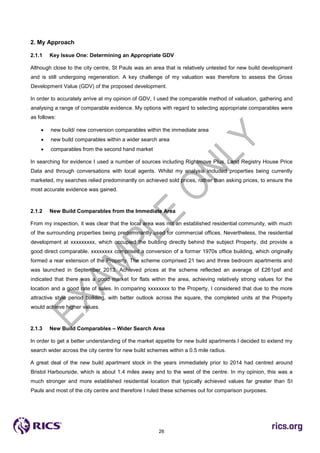
2. My Approach
2.1.1 Key Issue One: Determining an Appropriate GDV
Although close to the city centre, St Pauls was an area that is relatively untested for new build development
and is still undergoing regeneration. A key challenge of my valuation was therefore to assess the Gross
Development Value (GDV) of the proposed development.
In order to accurately arrive at my opinion of GDV, I used the comparable method of valuation, gathering and
analysing a range of comparable evidence. My options with regard to selecting appropriate comparables were
as follows:
 new build/ new conversion comparables within the immediate area
 new build comparables within a wider search area
 comparables from the second hand market
In searching for evidence I used a number of sources including Rightmove Plus, Land Registry House Price
Data and through conversations with local agents. Whilst my analysis included properties being currently
marketed, my searches relied predominantly on achieved sold prices, rather than asking prices, to ensure the
most accurate evidence was gained.
2.1.2 New Build Comparables from the Immediate Area
From my inspection, it was clear that the local area was not an established residential community, with much
of the surrounding properties being predominantly used for commercial offices. Nevertheless, the residential
development at xxxxxxxxx, which occupied the building directly behind the subject Property, did provide a
good direct comparable. xxxxxxxx comprised a conversion of a former 1970s office building, which originally
formed a rear extension of the Property. The scheme comprised 21 two and three bedroom apartments and
was launched in September 2013. Achieved prices at the scheme reflected an average of £261psf and
indicated that there was a good market for flats within the area, achieving relatively strong values for the
location and a good rate of sales. In comparing xxxxxxxx to the Property, I considered that due to the more
attractive style period building, with better outlook across the square, the completed units at the Property
would achieve higher values.
2.1.3 New Build Comparables – Wider Search Area
In order to get a better understanding of the market appetite for new build apartments I decided to extend my
search wider across the city centre for new build schemes within a 0.5 mile radius.
A great deal of the new build apartment stock in the years immediately prior to 2014 had centred around
Bristol Harbourside, which is about 1.4 miles away and to the west of the centre. In my opinion, this was a
much stronger and more established residential location that typically achieved values far greater than St
Pauls and most of the city centre and therefore I ruled these schemes out for comparison purposes.
27
I identified Horizon and Eclipse, a recent development associated with the Cabot Circus shopping centre
scheme. The development was only about 0.3 m away from the Property, but more centrally located and with
views across Castle Park. After talking with in house and external agents, I concluded that this was
considered a much more prestigious scheme and in a better location and therefore more valuable than the
proposed units at the Property on a ‘ticket price’ basis and at £xxxx psf considerably more on a £ psf basis,
due to slightly smaller unit sizes at Horizon and Eclipse.
2.1.4 Second Hand Comparables
Having researched relevant new build comparable evidence nearby, which was particularly relevant to the 1, 2
and 3 bedroom units in the scheme, I widened my search area in order to find evidence relevant to the 4
bedroom flat. This was somewhat more of an unusual product, with limited evidence in the area. I therefore
considered the values achieved by second hand four bedroom houses as well as large three bedroom flats,
where relevant.
My research found that there was a strong demand for period style properties within the nearby districts of
Cotham and Montpelier and I identified a reasonable amount of evidence of period style conversions. These
areas were typically more valuable locations than St Pauls and xxxxxxx, being more established and sought
after residential areas with a better quality of housing stock. It was also clear that houses commanded a
premium over flats.
2.1.5 Valuation Considerations
After all my data was collected, I created a hierarchy of evidence in order to determine the most relevant
comparables for the proposed units at the Property. A schedule of comparables is attached at Appendix E.
Taking all evidence into consideration, it was clear that xxxxxxxxx was an impressive setting and the
consented scheme with its period style would be attractive to purchasers. However, due to its proximity to
surrounding areas of St Pauls, with mixed quality of existing housing stock, I concluded that its location may
be a deterrent for some purchasers and that there would potentially be some constraint in achieving the
values set by schemes such as Horizon and Eclipse and the second hand values from the more established
residential areas slightly further afield. At the time of the valuation in April 2014 there was some uplift in
market activity within Bristol and agents reported increasing interest in the market, which was reflected in
some price increases. I also took this into consideration.
After interpreting the scheme plans and using my hierarchy of evidence, I discussed with my Supervisor and
arrived at a value for each unit. In calculating the GDV, some of the principal valuation considerations
included size of unit, apartment configuration and position within the building, with premiums reflected for
outlook, ceiling height and floor within the building.
My conclusions were reviewed with my supervisor and then discussed with the client and clearly stated within
the report. My opinion of GDV for the proposed development on completion, as at 24 April 2014 was £xxxxx a
breakdown is shown at Appendix D.
28
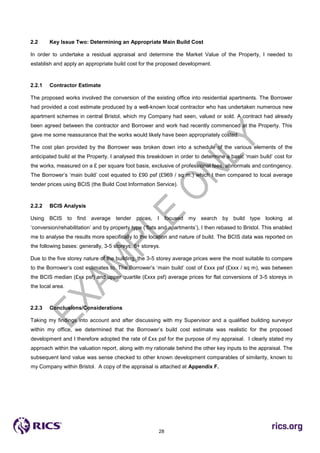
2.2 Key Issue Two: Determining an Appropriate Main Build Cost
In order to undertake a residual appraisal and determine the Market Value of the Property, I needed to
establish and apply an appropriate build cost for the proposed development.
2.2.1 Contractor Estimate
The proposed works involved the conversion of the existing office into residential apartments. The Borrower
had provided a cost estimate produced by a well-known local contractor who has undertaken numerous new
apartment schemes in central Bristol, which my Company had seen, valued or sold. A contract had already
been agreed between the contractor and Borrower and work had recently commenced at the Property. This
gave me some reassurance that the works would likely have been appropriately costed.
The cost plan provided by the Borrower was broken down into a schedule of the various elements of the
anticipated build at the Property. I analysed this breakdown in order to determine a basic ‘main build’ cost for
the works, measured on a £ per square foot basis, exclusive of professional fees, abnormals and contingency.
The Borrower’s ‘main build’ cost equated to £90 psf (£969 / sq m.) which I then compared to local average
tender prices using BCIS (the Build Cost Information Service).
2.2.2 BCIS Analysis
Using BCIS to find average tender prices, I focused my search by build type looking at
‘conversion/rehabilitation’ and by property type (‘flats and apartments’), I then rebased to Bristol. This enabled
me to analyse the results more specifically to the location and nature of build. The BCIS data was reported on
the following bases: generally, 3-5 storeys, 6+ storeys.
Due to the five storey nature of the building, the 3-5 storey average prices were the most suitable to compare
to the Borrower’s cost estimates to. The Borrower’s ‘main build’ cost of £xxx psf (£xxx / sq m), was between
the BCIS median (£xx psf) and upper quartile (£xxx psf) average prices for flat conversions of 3-5 storeys in
the local area.
2.2.3 Conclusions/Considerations
Taking my findings into account and after discussing with my Supervisor and a qualified building surveyor
within my office, we determined that the Borrower’s build cost estimate was realistic for the proposed
development and I therefore adopted the rate of £xx psf for the purpose of my appraisal. I clearly stated my
approach within the valuation report, along with my rationale behind the other key inputs to the appraisal. The
subsequent land value was sense checked to other known development comparables of similarity, known to
my Company within Bristol. A copy of the appraisal is attached at Appendix F.
29
3. My Achievements
Reflecting on the achievements of this instruction I have successfully produced a report in accordance with
the Red Book, which was reviewed and signed by both my Supervisor and another RICS Registered Valuer in
my office. I achieved this through effective due diligence, following the appropriate guidance and asking for
assistance and verification from my Supervisor where necessary.
I was involved in the instruction from start to finish, from assisting in drafting a confirmation of instructions
letter, to inspecting the Property, through the due diligence process and finally to reporting to the Client and
advising on the value and suitability for loan security of the Property.
With the support of my Supervisor, I was able to provide advice to the Client on various elements of the
valuation and establish good relationships through acting professionally and engaging in effective
communication throughout the process, most notably in relation to timescales and discussing our findings.
After inspecting the Property, I gained a better appreciation of the local area and nature and setting of the
building, which I considered in relation to my comparables and reflected in my opinion of value. From my
inspection, I was also able to comment on the general condition of the building and current extent of building
works undertaken to date.
One of the key requirements of the Client was to ensure the Property was valued in accordance with the
current planning consent. After due diligence enquiries into the planning history in relation to the Property, I
advised the Client on the current planning status at the Property and ensured my opinion of value reflected
the current consent and not any pending or historic decisions.
Following a detailed comparison of the Borrower’s cost estimates, against those of local average prices and
liaising with an experienced building surveyor in my office, I was able to establish an appropriate main build
cost for the works at the Property. This, along with my opinion of GDV and other well researched inputs
formed the basis of my development appraisal for the proposed development. I advised the Client on the
various other inputs used and the subsequent Market Value of the freehold interest of the Property. I ensured
all data provided was from accurate sources and presented to client in a clear format.
4. Conclusion
4.1 Critical Analysis
The report for xxxx was a rewarding exercise which enabled me to gain a good understanding of a building’s
conversion from commercial to residential use whilst also developing my valuation skills.
Overall, I was pleased with the outcome of the instruction. The report was comprehensive and detailed, it met
the requirements set and was provided within our anticipated timescale. Any assumptions or key findings
were highlighted and discussed with the Client before being noted in the report, including my interpretation of
comparable evidence. This ensured all key information was clearly defined and the Client was happy, with no
further questions surrounding our report when it was issued.
30
My assessment of the development’s GDV was somewhat challenging as there was only limited evidence of
newly converted property within the vicinity. Despite this, I was still able to gather sufficient comparables, both
new build and second hand, to create a robust evidence base for my assessment and calculations, which
included judgement on the potentially negative influence of the surrounding area when compared to other
traditional residential areas. Since the report sign off in April 2014, there has been further market improvement
witnessed within Bristol and sales at the scheme have subsequently achieved higher values than those
reported.
Due to relatively short time constraints in reporting, I found the timing of gaining comparable evidence was
crucial. A local agent who had details of a few comparables was unable to be contacted until two days before
the report was due for issue. In future I shall endeavour to allow more time for comparable research and to
undertake some enquiries prior to my inspection, in order to undertake a ‘drive by’ of relevant comparables.
With regards to the Property inspection, I feel I could have improved upon my level of inspection notes and
photographs. Due to insufficient lighting and work taking place, some photographs did not come out perfectly
or capture all desired aspects of the Property. I would also have benefitted from taking more
notes/photographs relating to the aspect on each floor of the building, as this turned out to be an influence on
my opinion of value for each unit. On reflection, I shall in future take more care when taking relevant and
clear photographs and ensure that I back these up with detailed inspection notes.
4.2 Reflective Analysis
From this instruction, I have a better understanding of how to draft a valuation report in accordance with the
RICS Valuation Professional Standards 2014. The instruction improved my knowledge of the comparable and
residual method of valuation and when it is appropriate to use these methods, as well as improving my ability
to critically evaluate and interpret comparable evidence. My research into the Bristol city centre residential
market and immediate areas has also provided me with a more detailed understanding of relative values in
and around the city.
I carried out the inspection following the principles of the RICS guidance note Surveying Safely (2011) and my
Company’s Health and Safety Policy. I now have a better understanding of the health and safety procedures
required prior to and during an inspection and what personal protective equipment (PPE) is required when on
a development site, particularly when construction activity is underway.
I have also gained a better understanding of the planning system and the content of planning applications. By
carrying out statutory enquiries I developed a greater understanding of use classes and listing status, as well
as planning obligations such as the community infrastructure levy (CIL) after reviewing the Council’s CIL
charging schedule.
For the purpose of my data collection and due diligence, I consulted a variety of sources to collect information
to assist with my valuation. This improved my use of property records and information systems and the
recording and storing of data, as well as highlighting the advantages and disadvantages of online databases.
31
Given the challenges of this instruction, I have appreciated the benefits of working within a multi-disciplinary
company and the ability to consult my colleagues from various specialisms in order to assist with my valuation
and ensure the best and most informed advice was provided to the Client.
Total word count - 3,059 – Excludes contents, tables and appendices
32
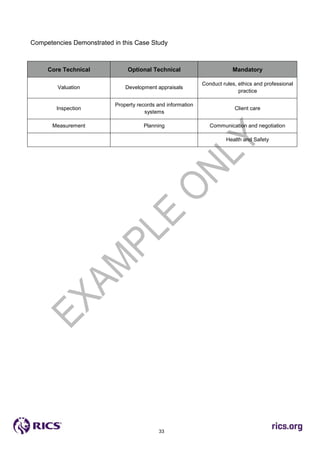
Appendix A
Competencies Demonstrated in this Case Study
33
Competencies Demonstrated in this Case Study
Core Technical Optional Technical Mandatory
Valuation Development appraisals
Conduct rules, ethics and professional
practice
Inspection
Property records and information
systems
Client care
Measurement Planning Communication and negotiation
Health and Safety
34
Appendix B
Location Plan and Site Plan
35
Appendix C
Photographs
36
Appendix D
Schedule of GDV
37
Appendix E
Schedule of Comparables
38
Appendix F
Residual Appraisal
39
Continuing professional development (CPD) record
If you are undertaking structured training you must complete a minimum of 48 hours per 12 months of structured training.
If you are not required to complete structured training, you need to demonstrate a minimum of 20 hours in the 12 months
prior to your final assessment. At least 50% of your CPD must be dedicated to formal development.
Date
09/07/2013 Title: Professional Ethics for RICS Members
Activity type: Online training course
Purpose: To enhance my understanding of the RICS Professional and
Ethical Standards.
Description: A series of modules and case studies covering ethics topics
and standards, followed by a test of my knowledge on the topic.
Learning Outcomes: I now understand the importance of ethics to RICS,
the five global professional and ethical standards that RICS members
observe and understand how the standards relate to the regulatory
framework of RICS.
Formal or Informal: Formal
2.0
24/07/2015 Title: National Auction
Activity type: Internal auction
Purpose: To improve my agency knowledge and learn about the auction
process. .
Description: Assisting at a residential property auction in London, by
undertaking telephone bidding and helping within the contract room to get
purchaser details and ensure correct forms of identification were provided.
Learning Outcomes: I now have a better understanding of the auction
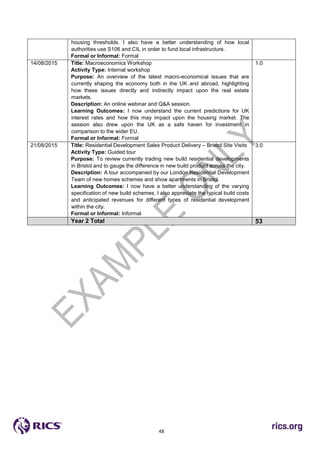
process and the differences between this and other methods of sale.
Formal or Informal: Informal
3.0
29/07/2013 Title: Graduate Health and Safety Briefing
Activity Type: Internal workshop
Purpose: To better understand my company’s health and safety policy, as
well as key legislation and guidance.
Description: An interactive workshop with a Q&A session on health and
safety.
Learning Outcomes: I am now aware of where to find details of my
company’s health and safety policy and guidelines. I have a clear
understanding of the health and safety procedures when going on an
inspection and working alone. I have also been made aware of the RICS
Surveying Safely guidance note (2011), which considers health and safety
responsibilities at both a corporate level and at the level of the individual
property professional.
Formal or Informal: Formal
3.0
29/07/2013 Title: APC workshop
Activity Type: Internal workshop
Purpose: To improve knowledge of mandatory competencies.
Description: An interactive workshop covering general information about
the RICS and mandatory competencies.
Learning Outcomes: I am now aware of the 5 RICS Professional and
Ethical Standards (Core Values) and have a better understanding of
conflict checking and terms of engagement.
Formal or Informal: Informal
2.0
30/09/2013 Title: Graduate Induction Day
Activity Type: In house workshop
Purpose: An induction day for new joiners to learn more about the
graduate program and company processes.
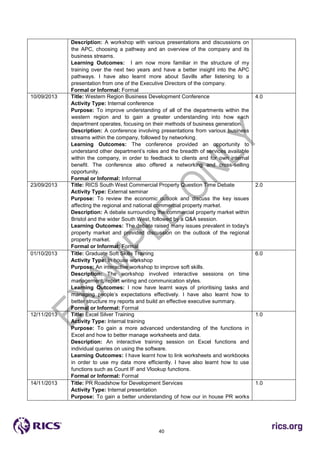
6.0
40
Description: A workshop with various presentations and discussions on
the APC, choosing a pathway and an overview of the company and its
business streams.
Learning Outcomes: I am now more familiar in the structure of my
training over the next two years and have a better insight into the APC
pathways. I have also learnt more about Savills after listening to a
presentation from one of the Executive Directors of the company.
Formal or Informal: Formal
10/09/2013 Title: Western Region Business Development Conference
Activity Type: Internal conference
Purpose: To improve understanding of all of the departments within the
western region and to gain a greater understanding into how each
department operates, focusing on their methods of business generation.
Description: A conference involving presentations from various business
streams within the company, followed by networking.
Learning Outcomes: The conference provided an opportunity to
understand other department’s roles and the breadth of services available
within the company, in order to feedback to clients and for own internal
benefit. The conference also offered a networking and cross-selling
opportunity.
Formal or Informal: Informal
4.0
23/09/2013 Title: RICS South West Commercial Property Question Time Debate
Activity Type: External seminar
Purpose: To review the economic outlook and discuss the key issues
affecting the regional and national commercial property market.
Description: A debate surrounding the commercial property market within
Bristol and the wider South West, followed by a Q&A session.
Learning Outcomes: The debate raised many issues prevalent in today's
property market and provided discussion on the outlook of the regional
property market.
Formal or Informal: Formal
2.0
01/10/2013 Title: Graduate Soft Skills Training
Activity Type: In house workshop
Purpose: An interactive workshop to improve soft skills.
Description: The workshop involved interactive sessions on time
management, report writing and communication styles.
Learning Outcomes: I now have learnt ways of prioritising tasks and
managing people’s expectations effectively. I have also learnt how to
better structure my reports and build an effective executive summary.
Formal or Informal: Formal
6.0
12/11/2013 Title: Excel Silver Training
Activity Type: Internal training
Purpose: To gain a more advanced understanding of the functions in
Excel and how to better manage worksheets and data.
Description: An interactive training session on Excel functions and
individual queries on using the software.
Learning Outcomes: I have learnt how to link worksheets and workbooks
in order to use my data more efficiently. I have also learnt how to use
functions such as Count IF and Vlookup functions.
Formal or Informal: Formal
1.0
14/11/2013 Title: PR Roadshow for Development Services
Activity Type: Internal presentation
Purpose: To gain a better understanding of how our in house PR works
1.0
41
and how they can assist with our PR requirements.
Description: An overview of recent PR success stories in the
development sector. Examples of when PR can go wrong.
Learning Outcomes: I now understand the importance and benefit of
good PR and how it can be an additional service to offer to clients and to
help promote sites and new build schemes. I am also aware of the
importance of ensuring the correct information and message is portrayed
and all parties are consulted before issuing a piece of PR.
Formal or Informal: Informal
08/01/2014 Title: International Standards Organisation (ISO) Awareness Training
Activity Type: Internal training
Purpose: To understand further about ISO Standards and why it is
beneficial to my company.
Description: A presentation on the ISO Standards with our in house risk
and compliance auditor.
Learning Outcomes: I now have a better understanding of the ISO9001
(Quality) and ISO14001 (Environment) standards. I also now appreciate
both my company’s and my individual role in complying with the standards.
Formal or Informal: Formal
2.0
21/01/2014 Title: Graduate Assessment Day
Activity Type: Internal assessment centre and presentation
Purpose: To assist and present at the graduate assessment day for
potential candidates onto the graduate scheme.
Description: My role was to present to the group of candidates on the
work I undertake within development and answer any questions they have
about Savills and the APC.
Learning Outcomes: By preparing and conducting a presentation and
Q&A session with the candidates, I have been able improve my
presentation and communication skills.
Formal or Informal: Informal
1.0
23/01/2014 Title: Development Graduate Event
Activity Type: In house workshop
Purpose: To widen my subject knowledge, meet graduates from other
offices and further understand the APC assessment.
Description: Presentations on strategic land and option agreements,
building styles and assessing the APC.
Learning Outcomes: I now have a better understanding of how to identify
architectural styles and periods. I have also been able to make contacts
within other offices across the UK and understand the differences and
similarities in our work.
Formal or Informal: Informal
6.0
26.02.2014 Title: Compliance Training
Activity Type: In house workshop
Purpose: To improve understanding of compliance procedures and
regulations.
Description: The session involved presentations and interactive tasks,
with key topics based around relevant Acts of Parliament, Regulations and
Codes of Practice.
Learning Outcomes: I have a good understanding of the compliance
procedures required to perform my day to day role. I also have a better
understanding of the Data Protection Act and The Estate Agents Act.
Formal or Informal: Formal
2.0
27/02/2014 Title: RICS South West Residential Property Market Question Time
Activity Type: External seminar
2.0
42
Purpose: To discuss how our profession can seize opportunities and help
address the major challenges facing the residential sector today, both
nationally and in the South West.
Description: A presentation by guest speakers from the residential
industry followed by a Q&A session.
Learning Outcomes: I have a better understanding of the barriers to the
delivery of housing and the implementation of planning consents. The
discussion also drew upon how student property and HMOs can influence
property values, specifically within Bristol due to take up of family housing
and rental price increases.
Formal or Informal: Formal
19/03/2014 Title: Pathways to Property University Careers Fair
Activity Type: External presentation and mentoring
Purpose: To assist with a careers stall in order to inform students of
opportunities within the property sector and surveying.
Description: Assisting at a pathways to property career stand. My role
was to present and inform interested students about my role and other
roles available in surveying and the various routes to membership of the
RICS.
Learning Outcomes: I have improved my knowledge of the different
routes into surveying and improved my communication and presentation
skills.
Formal or Informal: Informal
2.0
23/03/2014 Title: Valuation Roadshow
Activity Type: Internal presentation
Purpose: To provide an overview of company internal valuation processes
and procedures.
Description: A presentation from two Best Practice Board Members from
the Valuation department to discuss recent initiatives on best practice
followed by a Q&A session.
Learning Outcomes: I now have a better understanding of the valuation
report sign off procedure, including peer review and the use of checklists
in order to make sure files are kept up to date and a good paper trail is in
place.
Formal or Informal: Informal
1.0
07/05/2014 Title: Development Database Training
Activity type: Internal presentation
Purpose: To understand how the dynamics development database can be
used in my day to day role. To understand how to add and retrieve site
data from the system.
Description: A presentation guide of how to use the software.
Learning Outcomes: I can now undertake specific site searches using
the database in order to track site progress and search for land
comparables. I also understand how to input data onto the system and to
manage site data that I am responsible for.
Formal or Informal: Informal
1.0
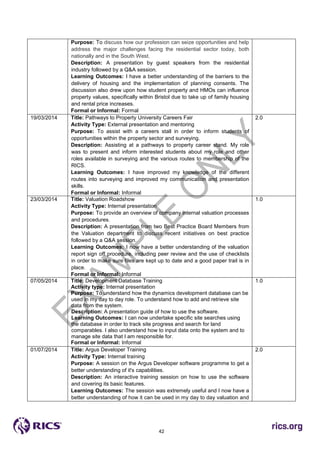
01/07/2014 Title: Argus Developer Training
Activity Type: Internal training
Purpose: A session on the Argus Developer software programme to get a
better understanding of it's capabilities.
Description: An interactive training session on how to use the software
and covering its basic features.
Learning Outcomes: The session was extremely useful and I now have a
better understanding of how it can be used in my day to day valuation and
2.0
43
agency work, including how to create appraisals from scratch and how to
use more advanced features such as, phasing and undertaking sensitivity
analysis.
Formal or Informal: Informal
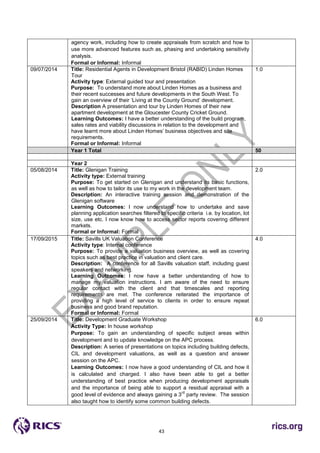
09/07/2014 Title: Residential Agents in Development Bristol (RABID) Linden Homes
Tour
Activity type: External guided tour and presentation
Purpose: To understand more about Linden Homes as a business and
their recent successes and future developments in the South West. To
gain an overview of their ‘Living at the County Ground’ development.
Description A presentation and tour by Linden Homes of their new
apartment development at the Gloucester County Cricket Ground.
Learning Outcomes: I have a better understanding of the build program,
sales rates and viability discussions in relation to the development and
have learnt more about Linden Homes’ business objectives and site
requirements.
Formal or Informal: Informal
1.0
Year 1 Total 50
Year 2
05/08/2014 Title: Glenigan Training
Activity type: External training
Purpose: To get started on Glenigan and understand its basic functions,
as well as how to tailor its use to my work in the development team.
Description: An interactive training session and demonstration of the
Glenigan software
Learning Outcomes: I now understand how to undertake and save
planning application searches filtered to specific criteria i.e. by location, lot
size, use etc. I now know how to access sector reports covering different
markets.
Formal or Informal: Formal
2.0
17/09/2015 Title: Savills UK Valuation Conference
Activity type: Internal conference
Purpose: To provide a valuation business overview, as well as covering
topics such as best practice in valuation and client care.
Description: A conference for all Savills valuation staff, including guest
speakers and networking.
Learning Outcomes: I now have a better understanding of how to
manage my valuation instructions. I am aware of the need to ensure
regular contact with the client and that timescales and reporting
requirements are met. The conference reiterated the importance of
providing a high level of service to clients in order to ensure repeat
business and good brand reputation.
Formal or Informal: Formal
4.0
25/09/2014 Title: Development Graduate Workshop
Activity Type: In house workshop
Purpose: To gain an understanding of specific subject areas within
development and to update knowledge on the APC process.
Description: A series of presentations on topics including building defects,
CIL and development valuations, as well as a question and answer
session on the APC.
Learning Outcomes: I now have a good understanding of CIL and how it
is calculated and charged. I also have been able to get a better
understanding of best practice when producing development appraisals
and the importance of being able to support a residual appraisal with a
good level of evidence and always gaining a 3
rd
party review. The session
also taught how to identify some common building defects.
6.0
44
Formal or Informal: Informal
02/10/2014 Title: South West Development Team Strategy Day
Activity type: Internal workshop
Purpose: To appreciate the wider strategy for the South West
Development Team. To cover new business generation ideas and
teamwork initiates.
Description: A series of presentations, tasks and strategy discussions
with colleagues in the Cardiff, Exeter and Bristol development teams, who
make up the south west development division.
Learning Outcomes: I am now up to date with the team’s cost base and
turnover and profit targets. The day produced a helpful SWOT analysis
surrounding the team strategy. Initiatives considered were to increase
communication and cross selling between offices, to be more proactive
with business generation and to increase admin efficiency and
organisation.
Formal or Informal: Informal
4.0
17/10/2015 Title: APC 12 Month Review with xxxxxxxx
Activity Type: Internal Workshop
Purpose: Review of my progress for the APC and a health check on
where I should be with my APC preparation.
Description: An informal workshop covering the critical analysis, CPD
recording and recording relevant experience.
Learning Outcomes: I gained a better understanding of how to choose a
critical analysis topic and complete my experience record.
Formal or Informal: Informal
4.0
20/11/2014 Title: Women in Property Network Better, Better Networking Workshop
Activity type: External workshop
Purpose: To enable networking more effectively and easily and develop
communication skills.
Description: A workshop on networking skills that involved interaction
between attendees and group tasks.
Learning Outcomes: I learnt the importance of positive body language
and communication in a networking situation and learnt ways of
remembering and keeping a record of key contacts and clients I have met
for follow ups and future events.
Formal or Informal: Informal
1.0
19/11/2014 Title: EGi, a 360° View of Property
Activity type: Online workshop
Purpose: An overview of how to use the EGi website and
database/research facility.
Description: An online training session, including elements relating to
both commercial and residential property.
Learning Outcomes: I found the workshop of great use, as it enabled me
to navigate the EGi property database more efficiently and highlighted
many of the complex ways that the database can be used to assist in
agency and valuation tasks.
Formal or Informal: Formal
1.0
26/01/2015 Title: Student Accommodation Team Presentation
Activity type: Internal Presentation
Purpose: An insight into the student accommodation market and how our
student agency and valuation team operate.
Description: A presentation from the Student Team, followed by question
and answer session.
Learning Outcomes: The presentation provided me with a good
understanding of supply and demand factors affecting the student market,
as well as the key inputs and methods to use when undertaking a
valuation of a student accommodation development.
Formal or Informal: Formal
1.0
45
16/03/2015 Title: Bristol Planning Team Presentation
Activity Type: In house presentation
Purpose: To gain an insight in to recent changes in planning and gain a
better insight into the role of the Bristol Planning Team.
Description: Attended an in-house presentation provided by the Savills
Planning Team.
Learning Outcomes: I am now aware of the recent updates and topical
issues regarding CIL, permitted development rights and local authority 5
year housing land supply requirements.
Formal or Informal: Formal
1.0
17/03/2015 Title: Commercial Property Seminar
Activity Type: External seminar
Purpose: To provide practical solutions and relevant updates on
commercial property law.
Description: An external seminar provided by Thrings solicitors on
commercial and development property law.
Learning Outcomes: The seminar provided good examples of how to use
‘subject to contract’ appropriately, as well as updating on the current status
of permitted development rights, including change of use from office to
residential.
Formal or Informal: Formal
1.0
24/03/2015 Title: RICS & BPAA Delivering Future Housing Seminar
Activity Type: External seminar
Purpose: A seminar and debate to cover current and potential future
issues within the housing market.
Description: Networking followed by presentations from various areas of
the housing sector (registered provider, housebuilder and smaller scale
developer) and debate on current issues within the housing market.
Learning Outcomes: The seminar covered the key issues within the
housing market such as land supply, the planning system and delivery
issues. The session provided a good insight to the differing views of the
stakeholders within the housing and development sector.
Formal or Informal: Formal
2.0
26/03/2015 Title: Development Services Conference
Activity Type: In house conference
Purpose: To understand and learn more about the various disciplines
within the development services division.
Description: A conference for all Savills planning, development and new
homes teams.
Learning Outcomes: I am now more informed of the work covered by
various sectors with Savills development services and have been able to
network with colleagues in other teams and offices, in order to create
potential connections and cross selling opportunities in the future.
Formal or Informal: Informal
4.0
14/04/2015 Title: Residential Agents in Bristol in Development (RABID) Housing Land
Supply and Vacant Building Credit (VBC) Seminar
Activity Type: External presentation
Purpose: To provide an update on current vacant building credit policy
and housing land supply issues.
Description: A planning presentation on housing and land supply issues
focusing particularly on the constraints of North Somerset. A further
presentation from a law perspective, regarding the updates to the vacant
buildings credit policy.
1.0
46
Learning Outcomes: I am now aware of the current policy on VBC and
have been able to understand further the practical and political constraints
upon housing supply within North Somerset and Bristol. The seminar also
enabled me to be able to network with other professionals and discuss the
topics further.
Formal or Informal: Formal
22/04/2015 Title: APC session with xxxxxxx
Activity Type: In house workshop
Purpose: To review the current progress of my APC and understand the
recent changes to the process.
Description: A preparation course for the APC focusing on written
submissions and an overview of the new APC templates.
Learning Outcomes: I have a better insight into what is required for the
written element of the APC assessment and now understand how the new
APC templates differ from the historic submission format. I am now more
confident in choosing a case study topic.
Formal or Informal: Formal
6.0
10/06/2015 Title: RICS Bank of England Annual Update
Activity Type: External Seminar
Purpose: To summarise the Bank’s current thinking on short to medium
term prospects for the UK economy.
Description: A seminar with guest speaker from the Bank of England
covering various topics on the UK economy.
Learning Outcomes: I am now aware of the Bank of England’s
predictions for the UK base rate and inflation, as well as predictions on
wage growth.
Formal or Informal: Formal
2.0
17/06/2015 Title: Thrings Planning Law Update Seminar
Activity Type: External Seminar
Purpose: To provide an update on relevant planning and planning law
issues and changes.
Description: The seminar involved talks on the recent and proposed
legislative changes in planning post election. A planning case law update
and a developer perspective on the current challenges in the planning
system.
Learning Outcomes: A clearer idea of developer challenges in relation to
the planning system, such as land availability, affordability of purchasers
and the logistics and resourcing of the planning system. I also have a
better understanding of the 5 year housing land supply calculation and the
consequences of shortfalls in supply.
Formal or Informal: Formal
2.0
21/07/2015 Title: Residential Valuation Tutorial
Activity Type: Internal workshop
Purpose: To provide a tutorial and revision session focussing on
residential property valuation.
Description: The workshop focused upon premiums associated with
residential properties, development appraisal inputs inspection.
Learning Outcomes: I am now more aware of what to do if a defect is
spotted upon inspection and have a better understanding of how to justify
and understand the inputs of a development appraisal, such as level of
professional fees.
Formal or Informal: Formal
1.0
22/07/2015 Title: Commercial Valuation Tutorial 1.0
47
Activity Type: Internal Workshop
Purpose: To revise topics such as the investment, profits and residual
method of valuation.
Description: An online webinar surrounding key topics in commercial
valuation.
Learning Outcomes: The session reiterated my knowledge of the
hardcore and topslice investment method. It also provided an overview of
development appraisals for commercial buildings and how to reflect
situations such as pre-lettings by reducing profit on cost.
Formal or Informal: Formal
28/07/2015 Title: Bristol Harbourside Tour
Activity Type: Guided presentation Tour
Purpose: To inform of recent deals and market activity in the Bristol
Harbourside area.
Description: An informative tour and presentation of commercial and
residential market activity in Bristol Harbourside.
Learning Outcomes: I now have a clear understanding of recent
residential developments and values being achieved at Bristol’s waterfront
properties and the premiums associated with location and aspect of the
developments. I am also now more aware of the values of Grade A and B
office space within Bristol City Centre.
Formal or Informal: Informal
2.0
31/07/2015 Title: Sustainability refresher workshop
Activity Type: Internal webinar
Purpose: To better understand key legislation and understand the impact
sustainability has upon property.
Description: A webinar covering the hot topics in sustainability, including
legislation, corporate objectives and recent and future changes to policy.
Learning Outcomes: The session taught me about the 2018 changes
surrounding Energy Performance certificates (EPC) and refreshed my
knowledge of BREEAM. I also learnt about the desire for companies to fit
sustainability into their CSR objectives and the recent shift to wanting to
own or lease a highly sustainable building.
Formal or Informal: Formal
1.0
03/08/2015 Title: Health and Safety
Activity Type: Internal Workshop
Purpose: To cover in detail specific health and safety topics relevant to
my area of practice.
Description: An online training session by my company’s Health and
Safety Administrator, covering asbestos, H+S on development sites and at
work.
Learning Outcomes: I am now more aware of where Asbestos can be
found and what two types of surveys are used to deal with Asbestos. The
session also reiterated my appreciation of the hazards upon development
sites.
Formal or Informal: Formal
1.0
07/08/2015 Title: Planning Workshop
Activity Type: Internal Workshop
Purpose: To cover topics such as the NPPF, plan making, neighbourhood
planning and funding infrastructure.
Description: An online workshop provided by the Savills Planning Team.
Learning Outcomes: I have been brought up to date on the recent High
Court Judgement on the removal of vacant building credits and affordable
1.0
48
housing thresholds. I also have a better understanding of how local
authorities use S106 and CIL in order to fund local infrastructure.
Formal or Informal: Formal
14/08/2015 Title: Macroeconomics Workshop
Activity Type: Internal workshop
Purpose: An overview of the latest macro-economical issues that are
currently shaping the economy both in the UK and abroad, highlighting
how these issues directly and indirectly impact upon the real estate
markets.
Description: An online webinar and Q&A session.
Learning Outcomes: I now understand the current predictions for UK
interest rates and how this may impact upon the housing market. The
session also drew upon the UK as a safe haven for investment in
comparison to the wider EU.
Formal or Informal: Formal
1.0
21/08/2015 Title: Residential Development Sales Product Delivery – Bristol Site Visits
Activity Type: Guided tour
Purpose: To review currently trading new build residential developments
in Bristol and to gauge the difference in new build product across the city.
Description: A tour accompanied by our London Residential Development
Team of new homes schemes and show apartments in Bristol.
Learning Outcomes: I now have a better understanding of the varying
specification of new build schemes. I also appreciate the typical build costs
and anticipated revenues for different types of residential development
within the city.
Formal or Informal: Informal
3.0
Year 2 Total 53

APC Submission RICS Valuation Pathway PDF

  • 1.
    RICS Assessment ofProfessional Competence – Valuation Final Assessment Submission Candidate and Counsellor/Supervisor declaration Candidate details: Candidate Name: xxx xxx RICS Membership Number: Date of Birth: Pathway: Valuation Employer / organisation: Savills (UK) Ltd Previously Referred? No Case Study Title: Valuation of xxxxxxxxxxx Candidate Declaration: I confirm that I have completed this document in line with the Assessment of Professional Competence candidate guide and understand the competencies and levels required in my pathway guide. I confirm that all documentation is based on my own experience. Candidate Signature: Date:
  • 2.
    2 Counsellor/Supervisor details: Counsellor Declaration: Bycountersigning this document you confirm that to the best of your knowledge that the candidate has understood the requirements and this document complies with RICS guidance. Also that the content of this submission is a true representation of the candidates own work and involvement in the projects details herein. Counsellor Name: Counsellor Signature: Date: RICS Membership number: Supervisor name: (optional role) Job title/role: Supervisor signature: Date: Submission content – please ensure you have completed or attached all relevant elements: Qualifications and Employment Information: Summary of experience: Case study: CPD: Log book (if applicable): Referral report (if applicable): Declared disability to RICS (if applicable): Qualification and Employment Information
  • 3.
    3 Please insert morerows or delete as applicable Qualifications: Name of Educational establishment City/Country Please confirm full title of qualification Date started Date completed xxxxxxxxxx Any other relevant professional qualification(s): Name of organisation Current grade How membership was achieved (e.g. examination) Year gained n.a Professional experience (Please list all relevant employment details, starting with the most recent) Employer Position held (job title) Date from: Date to: Savills (UK) Brief overview of scope and responsibilities: Throughout my time at Savills I have worked in the development team, involved in valuation, consultancy and agency roles. My work has focused mainly on development projects in the residential sector.
  • 4.
    4 Valuation Pathway Summary ofExperience - Mandatory Competencies (1500 words in total) Competency Leve l Summary of Experience Date achieved (mm/yyyy) Conduct rules, ethics and professional practice 1 I am aware of the role of the RICS in promoting and maintaining the highest standards of professional practice, education and advice in the management of land, property, construction and the built environment, protecting consumers through strict regulation of the highest standards. I am also aware of the RICS Professional and Ethical Standards, which provide a clear appreciation of the expectations of professional practice in my day to day role. As a graduate surveyor, I always endeavour to act professionally and honestly and am conscious of my limitations and not taking on more than I am qualified to do so, seeking the advice and guidance from others where appropriate. 10/03/2014 2 When undertaking valuations, I work in accordance with the RICS Valuation Professional Standards (Red Book) and refer to relevant RICS guidance where necessary. I ensure that my client receives the best possible advice throughout the instruction, in line with the terms of engagement that have been agreed. When asked to provide a valuation of a mixed residential and extra-care development in Keynsham, I sought the help of a colleague who specialised in extra care and retirement scheme valuations, knowing my experience in this sector was fairly limited and therefore provided the client with the best service and advice available. 27/11/2014 3 When carrying out a valuation of a residential development site in XXXX, Bath, the borrower made numerous efforts to influence and increase our opinions of value. I was unable to find any supporting evidence for this and acknowledging my duty to act objectively and independently in producing our valuation, I politely dismissed his appeals for a higher valuation. This taught me the importance of integrity in my role. When completing valuations I have always sought to ensure my assumptions are clearly defined and well 05/05/2015
  • 5.
    5 Competency Level Summaryof Experience Date achieved (mm/yyyy) Client care 1 I recognise that a high level of client care is vital to strengthening existing client relationships and being able to secure repeat business. From my induction training upon joining the company, I have learnt to manage my clients’ expectations and objectives and the importance of providing timely and frequent communication. By actively using my company’s CRM database system, I can record details of all clients and contacts and have accurate data regarding their role and company information. In accordance with the RICS Rules of Conduct, I am aware that my company operates a formal complaints handling procedure and I ensure that clients are made aware of this within all terms of engagement. 27/11/2015 2 I am involved in a junior business development group that seeks to strengthen existing client relationships, as well as identify new clients and contacts through organising social engagements and CPD events. When providing strategic consultancy advice it is important to understand the client’s longer term business objectives, as well as the short term requirements of the instruction. Consultancy instructions often form the basis of the client’s decision making for a particular site or business case, therefore when creating reports I endeavour to ensure that the report is comprehensive and tailored to their wider business needs. I also send the client a draft report in order to seek feedback before final issue. 05/05/2015 researched, in order to provide a true representation of Market Value. In line with RICS guidance, I ensure all valuation reports are reviewed and countersigned by two Registered Valuers and in addition often gain a third peer review for higher risk valuations, maintaining a high level of service at all times.
  • 6.
    6 Competency Level Summaryof Experience Date achieved (mm/yyyy) Communication and negotiation 1 As part of my graduate induction, I received training on how to network and communicate effectively. As my knowledge and experience has developed, my communication skills have improved through regular contact with clients, colleagues and peers within the industry. I am aware of when to appropriately use the main methods of communication with the client, throughout the lifespan of a job and the importance of providing advice that meets the requirements and is properly understood. I have also received training on various Microsoft Office programs such as Excel and Powerpoint, which have improved my written and graphic skills. 27/11/2014 2 I have been able to gain some experience of negotiating directly with clients. When undertaking a residential market report for a site in Bath, I consulted with the client through telephone conversations to negotiate and agree a fee and strategy for the report before I commenced work. I then sent the client written confirmation of our agreed report structure and fee before undertaking the instruction. The report included detailed research and a ‘SWOT’ analysis, supported by graphs and a written report, which was provided to the client and also verbally discussed over the phone. 05/05/2015 Competency Level Summary of Experience Date achieved (mm/yyyy) Health and safety 1 I understand the Health and Safety Act 1974 is the primary piece of legislation covering occupational health and safety in the UK and that the act makes provisions to protect and provide a duty of care to clients, colleagues and others. At work I act in accordance with my company’s most recent health and safety manual where appropriate. I have regard to the RICS guidance note Surveying Safely and from my health and safety briefing, I understand the need to be aware of health and safety risks at the workplace and when working alone and outside of the office. 10/03/2014
  • 7.
    7 2 When attendingsite visits and working outside of the office I always ensure my appointment locations, times, client/contact are always accurately recorded in my work calendar. I always carry a mobile phone on me at all times and where necessary undertake risk assessments before leaving the office. When inspecting development sites, I ensure that I am familiar with construction site protocols including reporting to the site office and being briefed by the site manager, so that I understand the risks and appropriate way I should undertake my visit and when it is appropriate to wear PPE. For example, when inspecting a student development site in Bristol, I wore a hard hat, steel toe capped boots and high visibility jacket. 27/11/2014 Competency Level Summary of Experience Date achieved (mm/yyyy) Accounting principles and procedures 1 I understand the importance of accounting practice to assess and summarise the financial health of the business and am familiar with my company’s financial reporting structure. I have reviewed my company’s Plc accounts and understand that they are prepared in accordance with UK GAAP (Generally Accepted Accounting Practice in the UK). I regularly receive divisional management account reports which show my department’s billings against forecasts and include profit and loss summaries for each team within the division. I have an understanding of basic accounting concepts, including profit and loss statements, cash flow statements and balance sheets. 05/05/2015 Competency Level Summary of Experience Date achieved (mm/yyyy) Business planning 1 I participate in my regular department meetings to review the status of our monthly billings and current instructions. I am aware of my teams cost base and our forecasted year end target. I appreciate the importance of keeping billings up to date in order to 27/11/2014
  • 8.
    8 plan and monitorthe income stream of the department and in the context of divisional organisational structure. I have recently attended a divisional development services conference, which covered financial and business highlights, areas for growth and rationale behind key decisions such as the acquisition of new businesses. The conference also provided an opportunity to create new contacts in my division. Competency Level Summary of Experience Date achieved (mm/yyyy) Conflict avoidance, management and dispute resolution procedures 1 From undertaking compliance training, I appreciate the importance of undertaking conflict of interest checks before accepting instructions from a client. I use my company’s internal database, which has records of all current and historic instructions and involvements with both clients and properties. If an internal check proves inconclusive and there is potential for conflict, an office or company wide email could be sent for completeness. My company received instructions to value a development site in xxxxxx. Through internal enquiries I discovered that my company had submitted the planning application for the site. After discussing with my supervisor, we determined that there was no conflict of interest, either with the property or with the client preventing us from providing an independent valuation in accordance with the RICS Red Book. This was stated within the confirmation of instruction letter and our report. 27/11/2014 Competency Level Summary of Experience Date achieved (mm/yyyy) Data management 1 I have received training on my company’s IT systems to enable me to access and manipulate data from various databases and understand how departmental and company data is stored, both electronically and 10/03/2014
  • 9.
    9 in hard copy. Iuse a number of systems and sources of information to carry out due diligence enquiries such as Land Registry house price indices, Local Authority planning enquiries and BCIS cost analysis. I also regularly refer to isurv.com for guidance on the technical aspects of practice. From undertaking compliance training, I am aware that the Data Protection Act 1998 is the main piece of legislation that governs the protection of personal data in the UK. Competency Level Summary of Experience Date achieved (mm/yyyy) Sustainability 1 I am aware that the property industry is under increasing pressure to embrace sustainability. Energy Performance Certificates (EPCs) and BREEAM ratings are the key indicators of energy and sustainability performance of buildings and are becoming increasingly important to owners and occupiers. I have developed my knowledge of how sustainability is an integral part of a company’s CSR policy through attending sustainability CPD workshops. My agency experience has also made me aware that it is a requirement for energy performance ratings to be displayed on property particulars. I am conscious of my role within the company’s wider sustainability objectives. I am aware of the importance of recycling materials and reducing printing to improve the sustainability of my office. 27/11/2014
  • 10.
    10 Competency Level Summaryof Experience Date achieved (mm/yyyy) Teamworking 1 Effective teamwork is essential to the success of my department and the company as a whole. I understand the need to be approachable and assist others where possible to build on and maintain relationships. I understand the key dynamics of effective teamworking such as open and efficient communication, sharing information and being respectful and supportive of others’ ideas. I have taken part in a regional business development day, which involved meeting colleagues from various offices, across a range of disciplines. This provided a great opportunity to cross sell and network within my company. 10/03/2014
  • 11.
    11 Summary of Experience- Technical Competencies Core competencies Competency Level Summary of Experience Date achieved (mm/yyyy) Inspection 1 Inspection is a fundamental part of my role and I recognise the importance of physically inspecting a property in order to provide appropriate and accurate advice. I adhere to the guidance of Surveying Safely (2011) and my company’s guidance and policies regarding health and safety and inspection and have been taught about these at health and safety briefings, as well as through development site induction protocols. I have gained experience in the inspection of a range of property types, to include development sites, residential property, office and industrial premises for valuation, agency, building surveying and consultancy purposes. I recognise the importance of investigating the surrounding areas to the subject property in order to gain a better understanding of the location and situation, as this can have fundamental implications on value. I have also obtained basic knowledge of the different types of building construction. 10/03/2014 2 During inspections, I endeavour to take accurate records of all building and site characteristics. Whilst undertaking an inspection of a site in xxxxxx, Bath, I noted the nature of the location of the site in a peaceful and rural setting on the edge of the village and commented upon the condition of the existing buildings on site and their construction. I also took note of potential negative issues with the site, such as proximity to the river which could pose a potential flood risk and also redundant machinery and materials left on site, which could pose possible contamination risks. These potential issues could then be investigated in more detail after the inspection. The inspection notes were backed up by numerous photographs and my findings were noted within the valuation report. I am aware of how to spot common defects within 27/11/2014
  • 12.
    12 different property types.Whilst inspecting and measuring an industrial building in Bristol, I noticed some cracking in the concrete floor and that it had sunk slightly, indicating a potential ground movement problem. I ensured to take photographs of the defect, informed the client of my findings and recommended specialist advice from a building surveyor or structural engineer. 3 When undertaking an inspection of a development site in Clevedon, Bristol, I advised that the Property was located within the more desirable part of the town representing the ‘prime’ residential market. The property had impressive uninterrupted views across the Bristol Channel, which I reflected positively in my pricing advice and report to the client. In carrying out a valuation inspection of a former factory building in xxxxxxx proposed for conversion to residential apartments, it was clear that due to its previous industrial use and having been left vacant for a number of years that extensive repair and refurbishment works would be required. The building was in a reasonably poor condition and I was informed that there was asbestos present within the building. I advised the client of my findings and allocated some additional cost for this within in my appraisal, by applying a higher main build conversion cost estimate and after discussion with my supervisor an additional estimated cost to cover the asbestos removal. I advised the client that the extent of the asbestos was not clear and advised that further investigation from a specialist would be required to comment on the exact costing and extent of the removal works required. 05/05/2015 Competency Level Summary of Experience Date achieved (mm/yyyy) Valuation 1 I have undertaken valuations for a variety of purposes, including, loan security, inheritance taxation, agency and company internal purposes. I have a good understanding of the five main methods of valuation and have experience of using comparable, investment and residual methods of valuation. 27/11/2014
  • 13.
    13 I am awareof the minimum terms of engagement to be confirmed prior to commencing a Red Book valuation and have drafted confirmation of instruction letters in line with client requirements. I have a good level of experience of inspecting and measuring property, undertaking due diligence enquiries and interpreting comparable evidence. From attending internal valuation seminars and best practice meetings, I recognise the importance of the RICS Valuation Professional Standards and the need to maintain independence and objectivity throughout the valuation process. From attending a planning law seminar, I appreciate how planning status and property law can affect value, particularly with development valuations, as well as other factors such as location, condition, and general supply and demand criteria. 2 In carrying out the valuation of a residential development site in Portishead for secured lending purposes, I used the comparable method to establish an appropriate GDV, by using both new and second hand comparables. I created a hierarchy of evidence in order to value the proposed units, taking into consideration, location, size, condition, specification and date of transaction. I then used the residual method to determine the land value of the site and cross checked this value with local development site transactions, on a per plot and per acre basis. When undertaking a valuation of a student accommodation scheme in xxxxxxxx, Bath, I adopted the comparable method to arrive at my opinion of Market Rent. In order to arrive at my opinion of GDV, I subsequently used the investment method and applied an appropriate yield to the Market Rent in order to arrive at a capital value. This was then fed into the residual appraisal to achieve a land value for the site. Which was cross checked with local transactions on a per bed basis. I have also gained experience of calculating reinstatement cost estimates using BCIS. I am aware that the replacement cost is provided for insurance cost purposes and is not a written opinion of value and therefore not required to be Red Book compliant. 27/11/2014 3 When undertaking the valuation of three residential properties in Bristol for inheritance tax purposes, I adopted a different definition of market value, as 05/05/2015
  • 14.
    14 defined in theInheritance Tax Act 1984, I also used the date of death as the valuation date. My valuation also allowed for the different shares that the deceased held in the three properties, including deductions for the joint undivided nature of those shares. I have carried out a number of valuations for loan security purposes. As well as the minimum requirements of a valuation report, I ensure to provide further information to the client regarding the instruction, in order to allow them to make a clear judgment as to whether to allow the loan. I often seek to comment on the suitability of the property for lending purposes, as well as noting any circumstances that could affect the value and state any enquiries which did not reveal sufficient information. When undertaking a valuation of a development site in xxxxxxx, after consulting with my planning colleagues, I advised the client that there was a high planning risk due to the site being formerly used as an employment site and having a historical consent for a live-work scheme. This was reflected in the comments from the Local Authority on the application, which was undetermined at the time of our valuation. We subsequently advised the client on the value of the site both with the benefit of planning consent and without consent, to demonstrate the differences in value. I advised the client that there was some uncertainty in our figures, highlighting the risk to loan security. Competency Level Summary of Experience Date achieved (mm/yyyy) Measurement of land, property and other assets 1 The RICS Code of Measuring Practice 6th Edition (2007) provides guidance and definitions to ensure that the measurement of land and buildings is accurate and consistent and I have regular regard to it whilst measuring property. I am aware of the different methods of measurement including GEA, GIA and NIA and understand that the basis of measurement is dependant on the property and purpose for which it is being measured. I have measured a range of property types using 10/03/2014
  • 15.
    15 techniques involving laserdistance meters and measuring tapes on site as well as using computer mapping and measuring off plans. When measuring larger development sites, my Promap training has enabled me to calculate site areas by using digital OS mapping, after physical boundaries were confirmed on inspection. 2 In measuring a penthouse flat in Clifton, Bristol for loan security purposes, I used a laser distance meter to measure each room and calculate the GIA. I also measured the external balconies to note within my report and for reference to comparables, however excluded these external areas from my GIA calculations. Prior to the inspection I ensured the distance meter was fully charged and had been calibrated. For longer measurements, where the laser aim can be inconsistent, I was careful to take the measurement more than once as a sense check. I have also gained experience of measuring an office building in Cheltenham on a Net Internal Area basis for marketing purposes. I was fortunate to have the floor plans available, which I used as a guide. The property was a period style property and I ensured to remove internal features such as chimney breasts from my NIA calculations and also on the third (top) floor, where rooms were partly within the sloping roof, I only measured where the height from floor to ceiling was greater than 1.5 metres. 27/11/2014
  • 16.
    16 Optional competencies Competency LevelSummary of Experience Date achieved (mm/yyyy) Development appraisals 1 I am aware that development appraisals are used as a tool in order to financially assess development schemes and establish a residual site value. I have produced development appraisals using Argus Developer for a variety of purposes, such as valuations, agency acquisition and disposal and assessing development viability. The main variables contained within appraisals include the GDV, build costs, profit margin, finance, timescale and ‘abnormal’ costs such as ground conditions and planning obligations. I am aware that minor adjustments to the various inputs of an appraisal can collectively create a significant adjustment in the outputs. From attending valuation seminars and conferences, I understand the importance of using well researched and accurate information to input into the appraisals. I also am aware of the importance of sensitivity analysis in order to illustrate the influence of the fundamental appraisal inputs, such as GDV or build costs, on the land value or profit amount. 27/11/2014 2 I use a variety of sources in order to identify and select appropriate data to inform my appraisal inputs. In order to establish a GDV, I would use property databases such as Rightmove Plus, Land Registry, EGI and Focus, as well as through conversations with local agents. When analysing build costs, I have regard to BCIS and if available consultant cost estimates. I often examine Local Authority planning documents to define CIL charges, affordable housing requirements and housing mix. When valuing a mixed use development site in xxxxxx, Bristol, I researched the relevant build costs for the various elements of the proposed scheme, to include, basement parking, retail and residential and inputted them into my appraisal. I also researched the relevant Community Infrastructure Levy (CIL) charges applicable to the different uses within the scheme and applied them as appropriate, reflecting affordable housing relief where necessary. These inputs were reflected clearly within 27/11/2014
  • 17.
    17 my appraisal. 3 Inundertaking viability work, I frequently run a range of appraisal scenarios in order to demonstrate the impact of planning obligations upon the site value. In assisting in viability negotiations for a site in Portishead, after researching all appropriate inputs and applying a policy compliant level of affordable housing, it was clear that the scheme was unviable in the context of the land value versus the existing use. I subsequently ran a range of appraisal scenarios to present and advise the impact on scheme viability to the client in order to inform future viability negotiations with the Local Authority. To assist in the disposal of a large site on the xxxxxxx in Bath, where there was no live planning consent in place, I produced a number of appraisals for the site based on the client’s requirements to reflect changes in affordable housing quantities, scale and massing and also different basement parking scenarios. I undertook a sensitivity analysis of the final appraisals to advise the client to the impact on land value when adjusting the build costs and gross development revenues up and down, enabling the client to review respective potential risks and rewards, which informed their strategy for the future of the site. 05/05/2015 Competency Level Summary of Experience Date achieved (mm/yyyy) Property records/information systems 1 I appreciate that the use of property records and information systems is extremely important in the role of a surveyor, in terms of selecting the most relevant, accurate and up to date information for the task, in order to provide the best possible advice to clients. I have contributed to and understand how data in my department is organised and filed both electronically and in hard copy. I have attended internal seminars and discussions on best practice and file management. I regularly use my company’s internal systems, including a database of development sites and client contacts. I am aware that there are limitations of some 10/03/2014
  • 18.
    18 databases such asEGI or Costar, where information could be subject to human error or could exclude important information such as lease incentives, so it is therefore important to confirm data with the respective agents where possible. 2 I have experience of using the Rightmove Automated Valuation Model (AVM). This can provide estimated property valuations using mathematical modelling and computing high amounts of property data. I have often had to interpret plans and use mapping tools, such as Promap in order to verify or measure land and building areas. When valuing a single residential development plot in xxxx, Gloucestershire, where no measurements were provided, I measured off scaled plans in order to calculate the GIA of the proposed dwelling. I have also had experience of interpreting map data at an OS level in order to identify site areas, and building footprints. I am aware of the Data Protection Act 1998 which ensures that personal data is handled correctly. I understand that for example data should be fairly and lawfully processed; adequate, accurate and up to date, not kept for longer than is necessary and secure. 27/11/2014 3 I have assisted in the development of an Excel cash flow model in order to calculate the estimated value of a large scale development over a 10 year timescale, in order to inform viability discussions. The model allowed us to asses and advise the client on how different affordable housing thresholds and housing density inputs, along with varying the timings of major costs such as infrastructure, resulted in different net present land values. The outputs were then tabulated and summarised on a per acre and per plot basis and presented to the client. I have worked on market reports for predominantly large scale residential sites within the South West. The reports typically contain analysis of the local housing market - housing stock and tenure (ONS), demographics, average house price trends – by property type and new build premium (Land 05/05/2015
  • 19.
    19 Registry data), adetailed analysis of comparables (Rightmove plus) and a review of housing supply and demand (Local Authority annual completion data and core strategy evidence base). Graphs, tables and maps then summarise this data, in order to advise the client on local pricing and supply and demand factors in relation to the site. Competency Level Summary of Experience Date achieved (mm/yyyy) Planning 1 I am aware of the decision making process on planning applications and have reviewed planning decisions for numerous valuations. As part of the valuation process I regularly search for planning history, listed building status and check the status of the Local Authority’s local plan. I have attended CPD sessions, both in house and externally providing updates and guidance on planning policy and providing me with a better understanding of topics such as planning obligations. I have subsequently been able to successfully review and calculate a number of developments S106 obligations, CIL charging schedules and affordable housing requirements. I have an awareness of special planning powers for conservation areas and listed buildings. I am aware that Conservation Area designation introduces controls over the total demolition of most buildings and strengthens some planning controls. Similarly I am aware that the carrying out of works, signage, permitted development rights, and demolition can all be affected by listing status. 27/11/2014
  • 20.
    20 2 I haveexperience of interpreting strategic planning policies and documents. In producing residential market reports for a site in Bristol, I had regard to the Local Authorities key planning policy documents, such as the Core Strategy, SHLAA and SHMA in order to review and report the council’s 5 year housing land supply. I am aware that viability is a common issue in the delivery of housing. Being involved in a development viability assessment for a site in central Bristol has shown me the role of land value as one of the main battlefields within appeals and the issue of whether a policy compliant level of planning obligation can be supported by a scheme whilst also ensuring an acceptable return to the landowner. After extensive due diligence and running numerous residual appraisals, no affordable housing was able to be provided without significantly impacting upon the site value. These appraisals were sensitivity tested to ensure that a sound judgment was formulated on viability. I worked alongside a colleague in the planning team on the submission of an application for residential development on xxxxxx, Bristol. Following a pre- application meeting, the planning officer responded with a number of comments and changes were made to our application to incorporate the planning officer’s feedback. 05/05/2015 Competency Level Summary of Experience Date achieved (mm/yyyy) Strategic real estate consultancy 1 I am aware of the need to provide different styles of consultancy advice to match different clients’ needs and to research thoroughly clients’ backgrounds and objectives and match this to the advice given. After attending the RICS & BPAA Delivering Future Housing Seminar, I increased my knowledge of stakeholder interests in the residential development sector and it helped me understand how I could apply my role as a strategic advisor to different stakeholders. I have produced a number of consultancy style reports for different clients to 27/11/2014
  • 21.
    21 include; national housebuilders, registered providers, medium sized developers and non-property organisations. Through consultancy jobs I have been able to assist clients in maximising the value of their assets, creating a market facing product and tailoring advice to be both location and product specific. 2 I have undertaken an options analysis for a national housebuilder on a scheme in xxxxxxx to assist the client in achieving the optimum value. By analysing the market and preparing relevant data, I produced a series of appraisals to demonstrate, the value of different land uses at the site, to include a comparison between residential, student and extra care apartments. I successfully advised the client on the mix, density and market demand for two masterplan options, understanding my client’s objectives to gain best value from the site. I have also undertaken a review of a portfolio of sites for a registered housing provider, whose objectives were to increase the value of their assets, whilst also considering the existing communities at the sites. By effectively using my market knowledge of the housing market, build costs and the planning system I advised the client that through effective regeneration and tenure change, they could increase the value of their assets without causing too much disruption to the tenants and communities who lived in the areas in question. I created a comprehensive report with relevant data to support my advice. Competency Level Summary of Experience Date achieved (mm/yyyy) Purchase and Sale *Purchase and sale 1 I have a good understanding of the different methods of sale including auction, private treaty, informal tender and formal tender. I am aware that each method may have its advantages and disadvantages and the decision as to which method to use is dependant upon numerous factors, including timescales, market conditions and client requirements. 10/03/2014
  • 22.
    22 In assisting ata Savills auction, I witnessed how sale by way of auction can offer a swift and transparent process in comparison to private treaty, however there is less flexibility and control over the process. I understand that the value of property can be influenced by a range of factors including location, condition, size, situation, planning status and supply and demand factors, as well as external market conditions. 2 I have assisted with the sale of a freehold development site in Weston Super Mare. After discussing the client’s requirements, it was decided that informal tender was the most appropriate method of sale for the site. The informal tender process was chosen to allow more flexibility, as the vendor was under no obligation to accept any offer received and further negotiation with individual bidders could take place if required. I was involved in drafting marketing particulars and sending details to an agreed list of potential purchasers. The sale of this site brought to my attention how externalities in the market can influence value. Following the receipt of the site investigation report, which came to light during the marketing process, it was revealed that there were abnormal ground conditions at the site and a requirement for piled foundations, which meant higher than expected build costs, which in turn had a negative impact upon the bids received for the site. 05/05/2015 Word count – 3,524 words
  • 23.
    23 Case study Name ofcase study: The Valuation of xxxxxxxxxxxx Date the project or piece(s) of work were carried out: 24 April 2014 Confidentiality statement The following case study contains confidential information included for the purpose of the Assessment of Professional Competence. (xxxxxxxxxxxxx), hereinafter termed “the client” and (xxxxxxxx) have given their consent to disclose details for the case study on the basis that the information is not to be used for any other purpose or by any person other than those authorised by the Royal Institution of Chartered Surveyors (e.g. staff and assessors). Contents: 1. Introduction 2. My Approach 3. My Achievements 4. Conclusion Appendices A – Competencies Achieved B – Location and Site Plan C- Photographs D – Schedule of GDV E – Schedule of Comparables F – Residual Appraisal Total Word Count: 3,059 words (Not including content list, tables or appendices)
  • 24.
    24 1. Introduction This casestudy reflects on my involvement in the valuation of xxxxxxxxxxxxxx, (‘the Property’) in April 2014. The Property comprised a freehold Georgian style building with Grade I listed facade, which extended across 5 storeys and formed the eastern end of the north elevation of xxxxxxxx. The Property was formerly used as offices and had planning consent for change of use from office (B1) use to residential use (C3) for 17 apartments. I undertook the valuation in accordance with the RICS Red Book on behalf of xxxxxxxx and xxxxxxxx(‘the Client’). xxxxxx (‘my Company’) was instructed to carry out a valuation of the Property for loan security purposes in respect of a proposed loan facility to be granted to the Borrower. My work was supervised by xxxxxxx MRICS, RICS Registered Valuer, Director, (‘my Supervisor’). 1.1 The Instruction My Company received instructions from the Client on 14 April 2014 to provide a valuation of the Property on the following bases:  The current Market Value of the freehold interest of the proposed scheme.  The Market Value of the completed units (the Gross Development Value). Prior to accepting the instruction I carried out a conflict of interest check, which indicated that my Company had no relevant prior or current involvement with the Property or the Borrower and therefore there was no conflict of interest in providing an independent valuation in accordance with the RICS Red Book. I carried out an inspection of the Property with my Supervisor on 17 April. We were able to inspect the majority of the Property, both internally and externally, but limited to those areas that were easily accessible or visible. Conversion works had commenced on the date of our inspection. 1.2 Property Location The Property is located on the north side of xxxxxxx, a Georgian square in the St Pauls area of Bristol approximately 0.7 miles to the north east of the city centre. St Pauls, along with other areas of Bristol, was heavily bombed during the 2 nd World War, resulting in extensive damage to a number of buildings. I was informed that the Property was partially destroyed and subsequently rebuilt in its present form in the 1970’s. St Pauls has historically suffered from a poor reputation linked to issues of social and economic deprivation. There is also a high proportion of social housing in the area which can have a negative influence on residential house prices; however, there has been significant progress in regenerating the area in recent years. A location and site plan is attached at Appendix B.
  • 25.
    25 1.3 Property Description TheProperty had an ashlar stone facade which was Grade I listed in a classic Georgian style, behind which was a concrete frame structure and concrete floors. The ground and first floor levels had high ceilings and large windows. The second floor ceiling height was slightly lower, whilst the third floor and lower ground floor levels reduced in height further. The front elevation had traditional single glazed timber sash windows, whilst to the rear were metal framed single glazed windows. Photographs of the Property taken on the inspection are attached at Appendix C. 1.4 Scheme Proposals I was provided with scaled plans and a schedule of accommodation by the Borrower’s architect. Due to construction works, it was not practical to measure the whole building, I therefore undertook some check measurements, to ensure that the schedule and plans provided was a true reflection of the proposed floor area. I relied on the schedule and architect’s plans for the purpose of the valuation and stated this clearly within my report. A schedule of accommodation as proposed is shown below: Unit Floor Beds Sq M Sq Ft 1 Lower Ground 1 63 674 2 Lower Ground 1 55 595 3 Lower Ground 1 64 694 4 Ground Floor 3 100 1,079 5 Ground Floor 4 159 1,716 6 First Floor 2 71 762 7 First Floor 1 45 486 8 First Floor 2 64 692 9 First Floor 3 96 1,037 10 Second Floor 2 71 762 11 Second Floor 1 45 486 12 Second Floor 2 64 692 14 Second Floor 3 96 1,037 15 Third Floor 2 71 763 16 Third Floor 2 62 665 17 Third Floor 2 60 646 18 Third Floor 2 59 637 17 TOTAL: 1,247 13,423
  • 26.
    26 2. My Approach 2.1.1Key Issue One: Determining an Appropriate GDV Although close to the city centre, St Pauls was an area that is relatively untested for new build development and is still undergoing regeneration. A key challenge of my valuation was therefore to assess the Gross Development Value (GDV) of the proposed development. In order to accurately arrive at my opinion of GDV, I used the comparable method of valuation, gathering and analysing a range of comparable evidence. My options with regard to selecting appropriate comparables were as follows:  new build/ new conversion comparables within the immediate area  new build comparables within a wider search area  comparables from the second hand market In searching for evidence I used a number of sources including Rightmove Plus, Land Registry House Price Data and through conversations with local agents. Whilst my analysis included properties being currently marketed, my searches relied predominantly on achieved sold prices, rather than asking prices, to ensure the most accurate evidence was gained. 2.1.2 New Build Comparables from the Immediate Area From my inspection, it was clear that the local area was not an established residential community, with much of the surrounding properties being predominantly used for commercial offices. Nevertheless, the residential development at xxxxxxxxx, which occupied the building directly behind the subject Property, did provide a good direct comparable. xxxxxxxx comprised a conversion of a former 1970s office building, which originally formed a rear extension of the Property. The scheme comprised 21 two and three bedroom apartments and was launched in September 2013. Achieved prices at the scheme reflected an average of £261psf and indicated that there was a good market for flats within the area, achieving relatively strong values for the location and a good rate of sales. In comparing xxxxxxxx to the Property, I considered that due to the more attractive style period building, with better outlook across the square, the completed units at the Property would achieve higher values. 2.1.3 New Build Comparables – Wider Search Area In order to get a better understanding of the market appetite for new build apartments I decided to extend my search wider across the city centre for new build schemes within a 0.5 mile radius. A great deal of the new build apartment stock in the years immediately prior to 2014 had centred around Bristol Harbourside, which is about 1.4 miles away and to the west of the centre. In my opinion, this was a much stronger and more established residential location that typically achieved values far greater than St Pauls and most of the city centre and therefore I ruled these schemes out for comparison purposes.
  • 27.
    27 I identified Horizonand Eclipse, a recent development associated with the Cabot Circus shopping centre scheme. The development was only about 0.3 m away from the Property, but more centrally located and with views across Castle Park. After talking with in house and external agents, I concluded that this was considered a much more prestigious scheme and in a better location and therefore more valuable than the proposed units at the Property on a ‘ticket price’ basis and at £xxxx psf considerably more on a £ psf basis, due to slightly smaller unit sizes at Horizon and Eclipse. 2.1.4 Second Hand Comparables Having researched relevant new build comparable evidence nearby, which was particularly relevant to the 1, 2 and 3 bedroom units in the scheme, I widened my search area in order to find evidence relevant to the 4 bedroom flat. This was somewhat more of an unusual product, with limited evidence in the area. I therefore considered the values achieved by second hand four bedroom houses as well as large three bedroom flats, where relevant. My research found that there was a strong demand for period style properties within the nearby districts of Cotham and Montpelier and I identified a reasonable amount of evidence of period style conversions. These areas were typically more valuable locations than St Pauls and xxxxxxx, being more established and sought after residential areas with a better quality of housing stock. It was also clear that houses commanded a premium over flats. 2.1.5 Valuation Considerations After all my data was collected, I created a hierarchy of evidence in order to determine the most relevant comparables for the proposed units at the Property. A schedule of comparables is attached at Appendix E. Taking all evidence into consideration, it was clear that xxxxxxxxx was an impressive setting and the consented scheme with its period style would be attractive to purchasers. However, due to its proximity to surrounding areas of St Pauls, with mixed quality of existing housing stock, I concluded that its location may be a deterrent for some purchasers and that there would potentially be some constraint in achieving the values set by schemes such as Horizon and Eclipse and the second hand values from the more established residential areas slightly further afield. At the time of the valuation in April 2014 there was some uplift in market activity within Bristol and agents reported increasing interest in the market, which was reflected in some price increases. I also took this into consideration. After interpreting the scheme plans and using my hierarchy of evidence, I discussed with my Supervisor and arrived at a value for each unit. In calculating the GDV, some of the principal valuation considerations included size of unit, apartment configuration and position within the building, with premiums reflected for outlook, ceiling height and floor within the building. My conclusions were reviewed with my supervisor and then discussed with the client and clearly stated within the report. My opinion of GDV for the proposed development on completion, as at 24 April 2014 was £xxxxx a breakdown is shown at Appendix D.
  • 28.
    28 2.2 Key IssueTwo: Determining an Appropriate Main Build Cost In order to undertake a residual appraisal and determine the Market Value of the Property, I needed to establish and apply an appropriate build cost for the proposed development. 2.2.1 Contractor Estimate The proposed works involved the conversion of the existing office into residential apartments. The Borrower had provided a cost estimate produced by a well-known local contractor who has undertaken numerous new apartment schemes in central Bristol, which my Company had seen, valued or sold. A contract had already been agreed between the contractor and Borrower and work had recently commenced at the Property. This gave me some reassurance that the works would likely have been appropriately costed. The cost plan provided by the Borrower was broken down into a schedule of the various elements of the anticipated build at the Property. I analysed this breakdown in order to determine a basic ‘main build’ cost for the works, measured on a £ per square foot basis, exclusive of professional fees, abnormals and contingency. The Borrower’s ‘main build’ cost equated to £90 psf (£969 / sq m.) which I then compared to local average tender prices using BCIS (the Build Cost Information Service). 2.2.2 BCIS Analysis Using BCIS to find average tender prices, I focused my search by build type looking at ‘conversion/rehabilitation’ and by property type (‘flats and apartments’), I then rebased to Bristol. This enabled me to analyse the results more specifically to the location and nature of build. The BCIS data was reported on the following bases: generally, 3-5 storeys, 6+ storeys. Due to the five storey nature of the building, the 3-5 storey average prices were the most suitable to compare to the Borrower’s cost estimates to. The Borrower’s ‘main build’ cost of £xxx psf (£xxx / sq m), was between the BCIS median (£xx psf) and upper quartile (£xxx psf) average prices for flat conversions of 3-5 storeys in the local area. 2.2.3 Conclusions/Considerations Taking my findings into account and after discussing with my Supervisor and a qualified building surveyor within my office, we determined that the Borrower’s build cost estimate was realistic for the proposed development and I therefore adopted the rate of £xx psf for the purpose of my appraisal. I clearly stated my approach within the valuation report, along with my rationale behind the other key inputs to the appraisal. The subsequent land value was sense checked to other known development comparables of similarity, known to my Company within Bristol. A copy of the appraisal is attached at Appendix F.
  • 29.
    29 3. My Achievements Reflectingon the achievements of this instruction I have successfully produced a report in accordance with the Red Book, which was reviewed and signed by both my Supervisor and another RICS Registered Valuer in my office. I achieved this through effective due diligence, following the appropriate guidance and asking for assistance and verification from my Supervisor where necessary. I was involved in the instruction from start to finish, from assisting in drafting a confirmation of instructions letter, to inspecting the Property, through the due diligence process and finally to reporting to the Client and advising on the value and suitability for loan security of the Property. With the support of my Supervisor, I was able to provide advice to the Client on various elements of the valuation and establish good relationships through acting professionally and engaging in effective communication throughout the process, most notably in relation to timescales and discussing our findings. After inspecting the Property, I gained a better appreciation of the local area and nature and setting of the building, which I considered in relation to my comparables and reflected in my opinion of value. From my inspection, I was also able to comment on the general condition of the building and current extent of building works undertaken to date. One of the key requirements of the Client was to ensure the Property was valued in accordance with the current planning consent. After due diligence enquiries into the planning history in relation to the Property, I advised the Client on the current planning status at the Property and ensured my opinion of value reflected the current consent and not any pending or historic decisions. Following a detailed comparison of the Borrower’s cost estimates, against those of local average prices and liaising with an experienced building surveyor in my office, I was able to establish an appropriate main build cost for the works at the Property. This, along with my opinion of GDV and other well researched inputs formed the basis of my development appraisal for the proposed development. I advised the Client on the various other inputs used and the subsequent Market Value of the freehold interest of the Property. I ensured all data provided was from accurate sources and presented to client in a clear format. 4. Conclusion 4.1 Critical Analysis The report for xxxx was a rewarding exercise which enabled me to gain a good understanding of a building’s conversion from commercial to residential use whilst also developing my valuation skills. Overall, I was pleased with the outcome of the instruction. The report was comprehensive and detailed, it met the requirements set and was provided within our anticipated timescale. Any assumptions or key findings were highlighted and discussed with the Client before being noted in the report, including my interpretation of comparable evidence. This ensured all key information was clearly defined and the Client was happy, with no further questions surrounding our report when it was issued.
  • 30.
    30 My assessment ofthe development’s GDV was somewhat challenging as there was only limited evidence of newly converted property within the vicinity. Despite this, I was still able to gather sufficient comparables, both new build and second hand, to create a robust evidence base for my assessment and calculations, which included judgement on the potentially negative influence of the surrounding area when compared to other traditional residential areas. Since the report sign off in April 2014, there has been further market improvement witnessed within Bristol and sales at the scheme have subsequently achieved higher values than those reported. Due to relatively short time constraints in reporting, I found the timing of gaining comparable evidence was crucial. A local agent who had details of a few comparables was unable to be contacted until two days before the report was due for issue. In future I shall endeavour to allow more time for comparable research and to undertake some enquiries prior to my inspection, in order to undertake a ‘drive by’ of relevant comparables. With regards to the Property inspection, I feel I could have improved upon my level of inspection notes and photographs. Due to insufficient lighting and work taking place, some photographs did not come out perfectly or capture all desired aspects of the Property. I would also have benefitted from taking more notes/photographs relating to the aspect on each floor of the building, as this turned out to be an influence on my opinion of value for each unit. On reflection, I shall in future take more care when taking relevant and clear photographs and ensure that I back these up with detailed inspection notes. 4.2 Reflective Analysis From this instruction, I have a better understanding of how to draft a valuation report in accordance with the RICS Valuation Professional Standards 2014. The instruction improved my knowledge of the comparable and residual method of valuation and when it is appropriate to use these methods, as well as improving my ability to critically evaluate and interpret comparable evidence. My research into the Bristol city centre residential market and immediate areas has also provided me with a more detailed understanding of relative values in and around the city. I carried out the inspection following the principles of the RICS guidance note Surveying Safely (2011) and my Company’s Health and Safety Policy. I now have a better understanding of the health and safety procedures required prior to and during an inspection and what personal protective equipment (PPE) is required when on a development site, particularly when construction activity is underway. I have also gained a better understanding of the planning system and the content of planning applications. By carrying out statutory enquiries I developed a greater understanding of use classes and listing status, as well as planning obligations such as the community infrastructure levy (CIL) after reviewing the Council’s CIL charging schedule. For the purpose of my data collection and due diligence, I consulted a variety of sources to collect information to assist with my valuation. This improved my use of property records and information systems and the recording and storing of data, as well as highlighting the advantages and disadvantages of online databases.
  • 31.
    31 Given the challengesof this instruction, I have appreciated the benefits of working within a multi-disciplinary company and the ability to consult my colleagues from various specialisms in order to assist with my valuation and ensure the best and most informed advice was provided to the Client. Total word count - 3,059 – Excludes contents, tables and appendices
  • 32.
  • 33.
    33 Competencies Demonstrated inthis Case Study Core Technical Optional Technical Mandatory Valuation Development appraisals Conduct rules, ethics and professional practice Inspection Property records and information systems Client care Measurement Planning Communication and negotiation Health and Safety
  • 34.
  • 35.
  • 36.
  • 37.
  • 38.
  • 39.
    39 Continuing professional development(CPD) record If you are undertaking structured training you must complete a minimum of 48 hours per 12 months of structured training. If you are not required to complete structured training, you need to demonstrate a minimum of 20 hours in the 12 months prior to your final assessment. At least 50% of your CPD must be dedicated to formal development. Date 09/07/2013 Title: Professional Ethics for RICS Members Activity type: Online training course Purpose: To enhance my understanding of the RICS Professional and Ethical Standards. Description: A series of modules and case studies covering ethics topics and standards, followed by a test of my knowledge on the topic. Learning Outcomes: I now understand the importance of ethics to RICS, the five global professional and ethical standards that RICS members observe and understand how the standards relate to the regulatory framework of RICS. Formal or Informal: Formal 2.0 24/07/2015 Title: National Auction Activity type: Internal auction Purpose: To improve my agency knowledge and learn about the auction process. . Description: Assisting at a residential property auction in London, by undertaking telephone bidding and helping within the contract room to get purchaser details and ensure correct forms of identification were provided. Learning Outcomes: I now have a better understanding of the auction process and the differences between this and other methods of sale. Formal or Informal: Informal 3.0 29/07/2013 Title: Graduate Health and Safety Briefing Activity Type: Internal workshop Purpose: To better understand my company’s health and safety policy, as well as key legislation and guidance. Description: An interactive workshop with a Q&A session on health and safety. Learning Outcomes: I am now aware of where to find details of my company’s health and safety policy and guidelines. I have a clear understanding of the health and safety procedures when going on an inspection and working alone. I have also been made aware of the RICS Surveying Safely guidance note (2011), which considers health and safety responsibilities at both a corporate level and at the level of the individual property professional. Formal or Informal: Formal 3.0 29/07/2013 Title: APC workshop Activity Type: Internal workshop Purpose: To improve knowledge of mandatory competencies. Description: An interactive workshop covering general information about the RICS and mandatory competencies. Learning Outcomes: I am now aware of the 5 RICS Professional and Ethical Standards (Core Values) and have a better understanding of conflict checking and terms of engagement. Formal or Informal: Informal 2.0 30/09/2013 Title: Graduate Induction Day Activity Type: In house workshop Purpose: An induction day for new joiners to learn more about the graduate program and company processes. 6.0
  • 40.
    40 Description: A workshopwith various presentations and discussions on the APC, choosing a pathway and an overview of the company and its business streams. Learning Outcomes: I am now more familiar in the structure of my training over the next two years and have a better insight into the APC pathways. I have also learnt more about Savills after listening to a presentation from one of the Executive Directors of the company. Formal or Informal: Formal 10/09/2013 Title: Western Region Business Development Conference Activity Type: Internal conference Purpose: To improve understanding of all of the departments within the western region and to gain a greater understanding into how each department operates, focusing on their methods of business generation. Description: A conference involving presentations from various business streams within the company, followed by networking. Learning Outcomes: The conference provided an opportunity to understand other department’s roles and the breadth of services available within the company, in order to feedback to clients and for own internal benefit. The conference also offered a networking and cross-selling opportunity. Formal or Informal: Informal 4.0 23/09/2013 Title: RICS South West Commercial Property Question Time Debate Activity Type: External seminar Purpose: To review the economic outlook and discuss the key issues affecting the regional and national commercial property market. Description: A debate surrounding the commercial property market within Bristol and the wider South West, followed by a Q&A session. Learning Outcomes: The debate raised many issues prevalent in today's property market and provided discussion on the outlook of the regional property market. Formal or Informal: Formal 2.0 01/10/2013 Title: Graduate Soft Skills Training Activity Type: In house workshop Purpose: An interactive workshop to improve soft skills. Description: The workshop involved interactive sessions on time management, report writing and communication styles. Learning Outcomes: I now have learnt ways of prioritising tasks and managing people’s expectations effectively. I have also learnt how to better structure my reports and build an effective executive summary. Formal or Informal: Formal 6.0 12/11/2013 Title: Excel Silver Training Activity Type: Internal training Purpose: To gain a more advanced understanding of the functions in Excel and how to better manage worksheets and data. Description: An interactive training session on Excel functions and individual queries on using the software. Learning Outcomes: I have learnt how to link worksheets and workbooks in order to use my data more efficiently. I have also learnt how to use functions such as Count IF and Vlookup functions. Formal or Informal: Formal 1.0 14/11/2013 Title: PR Roadshow for Development Services Activity Type: Internal presentation Purpose: To gain a better understanding of how our in house PR works 1.0
  • 41.
    41 and how theycan assist with our PR requirements. Description: An overview of recent PR success stories in the development sector. Examples of when PR can go wrong. Learning Outcomes: I now understand the importance and benefit of good PR and how it can be an additional service to offer to clients and to help promote sites and new build schemes. I am also aware of the importance of ensuring the correct information and message is portrayed and all parties are consulted before issuing a piece of PR. Formal or Informal: Informal 08/01/2014 Title: International Standards Organisation (ISO) Awareness Training Activity Type: Internal training Purpose: To understand further about ISO Standards and why it is beneficial to my company. Description: A presentation on the ISO Standards with our in house risk and compliance auditor. Learning Outcomes: I now have a better understanding of the ISO9001 (Quality) and ISO14001 (Environment) standards. I also now appreciate both my company’s and my individual role in complying with the standards. Formal or Informal: Formal 2.0 21/01/2014 Title: Graduate Assessment Day Activity Type: Internal assessment centre and presentation Purpose: To assist and present at the graduate assessment day for potential candidates onto the graduate scheme. Description: My role was to present to the group of candidates on the work I undertake within development and answer any questions they have about Savills and the APC. Learning Outcomes: By preparing and conducting a presentation and Q&A session with the candidates, I have been able improve my presentation and communication skills. Formal or Informal: Informal 1.0 23/01/2014 Title: Development Graduate Event Activity Type: In house workshop Purpose: To widen my subject knowledge, meet graduates from other offices and further understand the APC assessment. Description: Presentations on strategic land and option agreements, building styles and assessing the APC. Learning Outcomes: I now have a better understanding of how to identify architectural styles and periods. I have also been able to make contacts within other offices across the UK and understand the differences and similarities in our work. Formal or Informal: Informal 6.0 26.02.2014 Title: Compliance Training Activity Type: In house workshop Purpose: To improve understanding of compliance procedures and regulations. Description: The session involved presentations and interactive tasks, with key topics based around relevant Acts of Parliament, Regulations and Codes of Practice. Learning Outcomes: I have a good understanding of the compliance procedures required to perform my day to day role. I also have a better understanding of the Data Protection Act and The Estate Agents Act. Formal or Informal: Formal 2.0 27/02/2014 Title: RICS South West Residential Property Market Question Time Activity Type: External seminar 2.0
  • 42.
    42 Purpose: To discusshow our profession can seize opportunities and help address the major challenges facing the residential sector today, both nationally and in the South West. Description: A presentation by guest speakers from the residential industry followed by a Q&A session. Learning Outcomes: I have a better understanding of the barriers to the delivery of housing and the implementation of planning consents. The discussion also drew upon how student property and HMOs can influence property values, specifically within Bristol due to take up of family housing and rental price increases. Formal or Informal: Formal 19/03/2014 Title: Pathways to Property University Careers Fair Activity Type: External presentation and mentoring Purpose: To assist with a careers stall in order to inform students of opportunities within the property sector and surveying. Description: Assisting at a pathways to property career stand. My role was to present and inform interested students about my role and other roles available in surveying and the various routes to membership of the RICS. Learning Outcomes: I have improved my knowledge of the different routes into surveying and improved my communication and presentation skills. Formal or Informal: Informal 2.0 23/03/2014 Title: Valuation Roadshow Activity Type: Internal presentation Purpose: To provide an overview of company internal valuation processes and procedures. Description: A presentation from two Best Practice Board Members from the Valuation department to discuss recent initiatives on best practice followed by a Q&A session. Learning Outcomes: I now have a better understanding of the valuation report sign off procedure, including peer review and the use of checklists in order to make sure files are kept up to date and a good paper trail is in place. Formal or Informal: Informal 1.0 07/05/2014 Title: Development Database Training Activity type: Internal presentation Purpose: To understand how the dynamics development database can be used in my day to day role. To understand how to add and retrieve site data from the system. Description: A presentation guide of how to use the software. Learning Outcomes: I can now undertake specific site searches using the database in order to track site progress and search for land comparables. I also understand how to input data onto the system and to manage site data that I am responsible for. Formal or Informal: Informal 1.0 01/07/2014 Title: Argus Developer Training Activity Type: Internal training Purpose: A session on the Argus Developer software programme to get a better understanding of it's capabilities. Description: An interactive training session on how to use the software and covering its basic features. Learning Outcomes: The session was extremely useful and I now have a better understanding of how it can be used in my day to day valuation and 2.0
  • 43.
    43 agency work, includinghow to create appraisals from scratch and how to use more advanced features such as, phasing and undertaking sensitivity analysis. Formal or Informal: Informal 09/07/2014 Title: Residential Agents in Development Bristol (RABID) Linden Homes Tour Activity type: External guided tour and presentation Purpose: To understand more about Linden Homes as a business and their recent successes and future developments in the South West. To gain an overview of their ‘Living at the County Ground’ development. Description A presentation and tour by Linden Homes of their new apartment development at the Gloucester County Cricket Ground. Learning Outcomes: I have a better understanding of the build program, sales rates and viability discussions in relation to the development and have learnt more about Linden Homes’ business objectives and site requirements. Formal or Informal: Informal 1.0 Year 1 Total 50 Year 2 05/08/2014 Title: Glenigan Training Activity type: External training Purpose: To get started on Glenigan and understand its basic functions, as well as how to tailor its use to my work in the development team. Description: An interactive training session and demonstration of the Glenigan software Learning Outcomes: I now understand how to undertake and save planning application searches filtered to specific criteria i.e. by location, lot size, use etc. I now know how to access sector reports covering different markets. Formal or Informal: Formal 2.0 17/09/2015 Title: Savills UK Valuation Conference Activity type: Internal conference Purpose: To provide a valuation business overview, as well as covering topics such as best practice in valuation and client care. Description: A conference for all Savills valuation staff, including guest speakers and networking. Learning Outcomes: I now have a better understanding of how to manage my valuation instructions. I am aware of the need to ensure regular contact with the client and that timescales and reporting requirements are met. The conference reiterated the importance of providing a high level of service to clients in order to ensure repeat business and good brand reputation. Formal or Informal: Formal 4.0 25/09/2014 Title: Development Graduate Workshop Activity Type: In house workshop Purpose: To gain an understanding of specific subject areas within development and to update knowledge on the APC process. Description: A series of presentations on topics including building defects, CIL and development valuations, as well as a question and answer session on the APC. Learning Outcomes: I now have a good understanding of CIL and how it is calculated and charged. I also have been able to get a better understanding of best practice when producing development appraisals and the importance of being able to support a residual appraisal with a good level of evidence and always gaining a 3 rd party review. The session also taught how to identify some common building defects. 6.0
  • 44.
    44 Formal or Informal:Informal 02/10/2014 Title: South West Development Team Strategy Day Activity type: Internal workshop Purpose: To appreciate the wider strategy for the South West Development Team. To cover new business generation ideas and teamwork initiates. Description: A series of presentations, tasks and strategy discussions with colleagues in the Cardiff, Exeter and Bristol development teams, who make up the south west development division. Learning Outcomes: I am now up to date with the team’s cost base and turnover and profit targets. The day produced a helpful SWOT analysis surrounding the team strategy. Initiatives considered were to increase communication and cross selling between offices, to be more proactive with business generation and to increase admin efficiency and organisation. Formal or Informal: Informal 4.0 17/10/2015 Title: APC 12 Month Review with xxxxxxxx Activity Type: Internal Workshop Purpose: Review of my progress for the APC and a health check on where I should be with my APC preparation. Description: An informal workshop covering the critical analysis, CPD recording and recording relevant experience. Learning Outcomes: I gained a better understanding of how to choose a critical analysis topic and complete my experience record. Formal or Informal: Informal 4.0 20/11/2014 Title: Women in Property Network Better, Better Networking Workshop Activity type: External workshop Purpose: To enable networking more effectively and easily and develop communication skills. Description: A workshop on networking skills that involved interaction between attendees and group tasks. Learning Outcomes: I learnt the importance of positive body language and communication in a networking situation and learnt ways of remembering and keeping a record of key contacts and clients I have met for follow ups and future events. Formal or Informal: Informal 1.0 19/11/2014 Title: EGi, a 360° View of Property Activity type: Online workshop Purpose: An overview of how to use the EGi website and database/research facility. Description: An online training session, including elements relating to both commercial and residential property. Learning Outcomes: I found the workshop of great use, as it enabled me to navigate the EGi property database more efficiently and highlighted many of the complex ways that the database can be used to assist in agency and valuation tasks. Formal or Informal: Formal 1.0 26/01/2015 Title: Student Accommodation Team Presentation Activity type: Internal Presentation Purpose: An insight into the student accommodation market and how our student agency and valuation team operate. Description: A presentation from the Student Team, followed by question and answer session. Learning Outcomes: The presentation provided me with a good understanding of supply and demand factors affecting the student market, as well as the key inputs and methods to use when undertaking a valuation of a student accommodation development. Formal or Informal: Formal 1.0
  • 45.
    45 16/03/2015 Title: BristolPlanning Team Presentation Activity Type: In house presentation Purpose: To gain an insight in to recent changes in planning and gain a better insight into the role of the Bristol Planning Team. Description: Attended an in-house presentation provided by the Savills Planning Team. Learning Outcomes: I am now aware of the recent updates and topical issues regarding CIL, permitted development rights and local authority 5 year housing land supply requirements. Formal or Informal: Formal 1.0 17/03/2015 Title: Commercial Property Seminar Activity Type: External seminar Purpose: To provide practical solutions and relevant updates on commercial property law. Description: An external seminar provided by Thrings solicitors on commercial and development property law. Learning Outcomes: The seminar provided good examples of how to use ‘subject to contract’ appropriately, as well as updating on the current status of permitted development rights, including change of use from office to residential. Formal or Informal: Formal 1.0 24/03/2015 Title: RICS & BPAA Delivering Future Housing Seminar Activity Type: External seminar Purpose: A seminar and debate to cover current and potential future issues within the housing market. Description: Networking followed by presentations from various areas of the housing sector (registered provider, housebuilder and smaller scale developer) and debate on current issues within the housing market. Learning Outcomes: The seminar covered the key issues within the housing market such as land supply, the planning system and delivery issues. The session provided a good insight to the differing views of the stakeholders within the housing and development sector. Formal or Informal: Formal 2.0 26/03/2015 Title: Development Services Conference Activity Type: In house conference Purpose: To understand and learn more about the various disciplines within the development services division. Description: A conference for all Savills planning, development and new homes teams. Learning Outcomes: I am now more informed of the work covered by various sectors with Savills development services and have been able to network with colleagues in other teams and offices, in order to create potential connections and cross selling opportunities in the future. Formal or Informal: Informal 4.0 14/04/2015 Title: Residential Agents in Bristol in Development (RABID) Housing Land Supply and Vacant Building Credit (VBC) Seminar Activity Type: External presentation Purpose: To provide an update on current vacant building credit policy and housing land supply issues. Description: A planning presentation on housing and land supply issues focusing particularly on the constraints of North Somerset. A further presentation from a law perspective, regarding the updates to the vacant buildings credit policy. 1.0
  • 46.
    46 Learning Outcomes: Iam now aware of the current policy on VBC and have been able to understand further the practical and political constraints upon housing supply within North Somerset and Bristol. The seminar also enabled me to be able to network with other professionals and discuss the topics further. Formal or Informal: Formal 22/04/2015 Title: APC session with xxxxxxx Activity Type: In house workshop Purpose: To review the current progress of my APC and understand the recent changes to the process. Description: A preparation course for the APC focusing on written submissions and an overview of the new APC templates. Learning Outcomes: I have a better insight into what is required for the written element of the APC assessment and now understand how the new APC templates differ from the historic submission format. I am now more confident in choosing a case study topic. Formal or Informal: Formal 6.0 10/06/2015 Title: RICS Bank of England Annual Update Activity Type: External Seminar Purpose: To summarise the Bank’s current thinking on short to medium term prospects for the UK economy. Description: A seminar with guest speaker from the Bank of England covering various topics on the UK economy. Learning Outcomes: I am now aware of the Bank of England’s predictions for the UK base rate and inflation, as well as predictions on wage growth. Formal or Informal: Formal 2.0 17/06/2015 Title: Thrings Planning Law Update Seminar Activity Type: External Seminar Purpose: To provide an update on relevant planning and planning law issues and changes. Description: The seminar involved talks on the recent and proposed legislative changes in planning post election. A planning case law update and a developer perspective on the current challenges in the planning system. Learning Outcomes: A clearer idea of developer challenges in relation to the planning system, such as land availability, affordability of purchasers and the logistics and resourcing of the planning system. I also have a better understanding of the 5 year housing land supply calculation and the consequences of shortfalls in supply. Formal or Informal: Formal 2.0 21/07/2015 Title: Residential Valuation Tutorial Activity Type: Internal workshop Purpose: To provide a tutorial and revision session focussing on residential property valuation. Description: The workshop focused upon premiums associated with residential properties, development appraisal inputs inspection. Learning Outcomes: I am now more aware of what to do if a defect is spotted upon inspection and have a better understanding of how to justify and understand the inputs of a development appraisal, such as level of professional fees. Formal or Informal: Formal 1.0 22/07/2015 Title: Commercial Valuation Tutorial 1.0
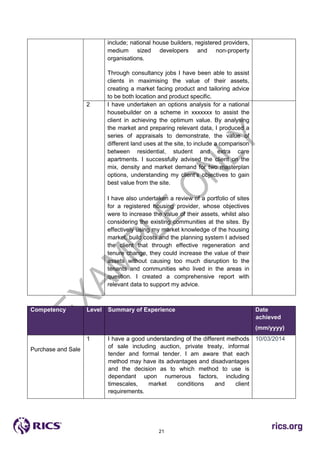
  • 47.
    47 Activity Type: InternalWorkshop Purpose: To revise topics such as the investment, profits and residual method of valuation. Description: An online webinar surrounding key topics in commercial valuation. Learning Outcomes: The session reiterated my knowledge of the hardcore and topslice investment method. It also provided an overview of development appraisals for commercial buildings and how to reflect situations such as pre-lettings by reducing profit on cost. Formal or Informal: Formal 28/07/2015 Title: Bristol Harbourside Tour Activity Type: Guided presentation Tour Purpose: To inform of recent deals and market activity in the Bristol Harbourside area. Description: An informative tour and presentation of commercial and residential market activity in Bristol Harbourside. Learning Outcomes: I now have a clear understanding of recent residential developments and values being achieved at Bristol’s waterfront properties and the premiums associated with location and aspect of the developments. I am also now more aware of the values of Grade A and B office space within Bristol City Centre. Formal or Informal: Informal 2.0 31/07/2015 Title: Sustainability refresher workshop Activity Type: Internal webinar Purpose: To better understand key legislation and understand the impact sustainability has upon property. Description: A webinar covering the hot topics in sustainability, including legislation, corporate objectives and recent and future changes to policy. Learning Outcomes: The session taught me about the 2018 changes surrounding Energy Performance certificates (EPC) and refreshed my knowledge of BREEAM. I also learnt about the desire for companies to fit sustainability into their CSR objectives and the recent shift to wanting to own or lease a highly sustainable building. Formal or Informal: Formal 1.0 03/08/2015 Title: Health and Safety Activity Type: Internal Workshop Purpose: To cover in detail specific health and safety topics relevant to my area of practice. Description: An online training session by my company’s Health and Safety Administrator, covering asbestos, H+S on development sites and at work. Learning Outcomes: I am now more aware of where Asbestos can be found and what two types of surveys are used to deal with Asbestos. The session also reiterated my appreciation of the hazards upon development sites. Formal or Informal: Formal 1.0 07/08/2015 Title: Planning Workshop Activity Type: Internal Workshop Purpose: To cover topics such as the NPPF, plan making, neighbourhood planning and funding infrastructure. Description: An online workshop provided by the Savills Planning Team. Learning Outcomes: I have been brought up to date on the recent High Court Judgement on the removal of vacant building credits and affordable 1.0
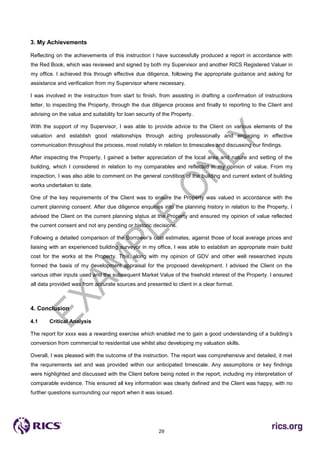
  • 48.
    48 housing thresholds. Ialso have a better understanding of how local authorities use S106 and CIL in order to fund local infrastructure. Formal or Informal: Formal 14/08/2015 Title: Macroeconomics Workshop Activity Type: Internal workshop Purpose: An overview of the latest macro-economical issues that are currently shaping the economy both in the UK and abroad, highlighting how these issues directly and indirectly impact upon the real estate markets. Description: An online webinar and Q&A session. Learning Outcomes: I now understand the current predictions for UK interest rates and how this may impact upon the housing market. The session also drew upon the UK as a safe haven for investment in comparison to the wider EU. Formal or Informal: Formal 1.0 21/08/2015 Title: Residential Development Sales Product Delivery – Bristol Site Visits Activity Type: Guided tour Purpose: To review currently trading new build residential developments in Bristol and to gauge the difference in new build product across the city. Description: A tour accompanied by our London Residential Development Team of new homes schemes and show apartments in Bristol. Learning Outcomes: I now have a better understanding of the varying specification of new build schemes. I also appreciate the typical build costs and anticipated revenues for different types of residential development within the city. Formal or Informal: Informal 3.0 Year 2 Total 53