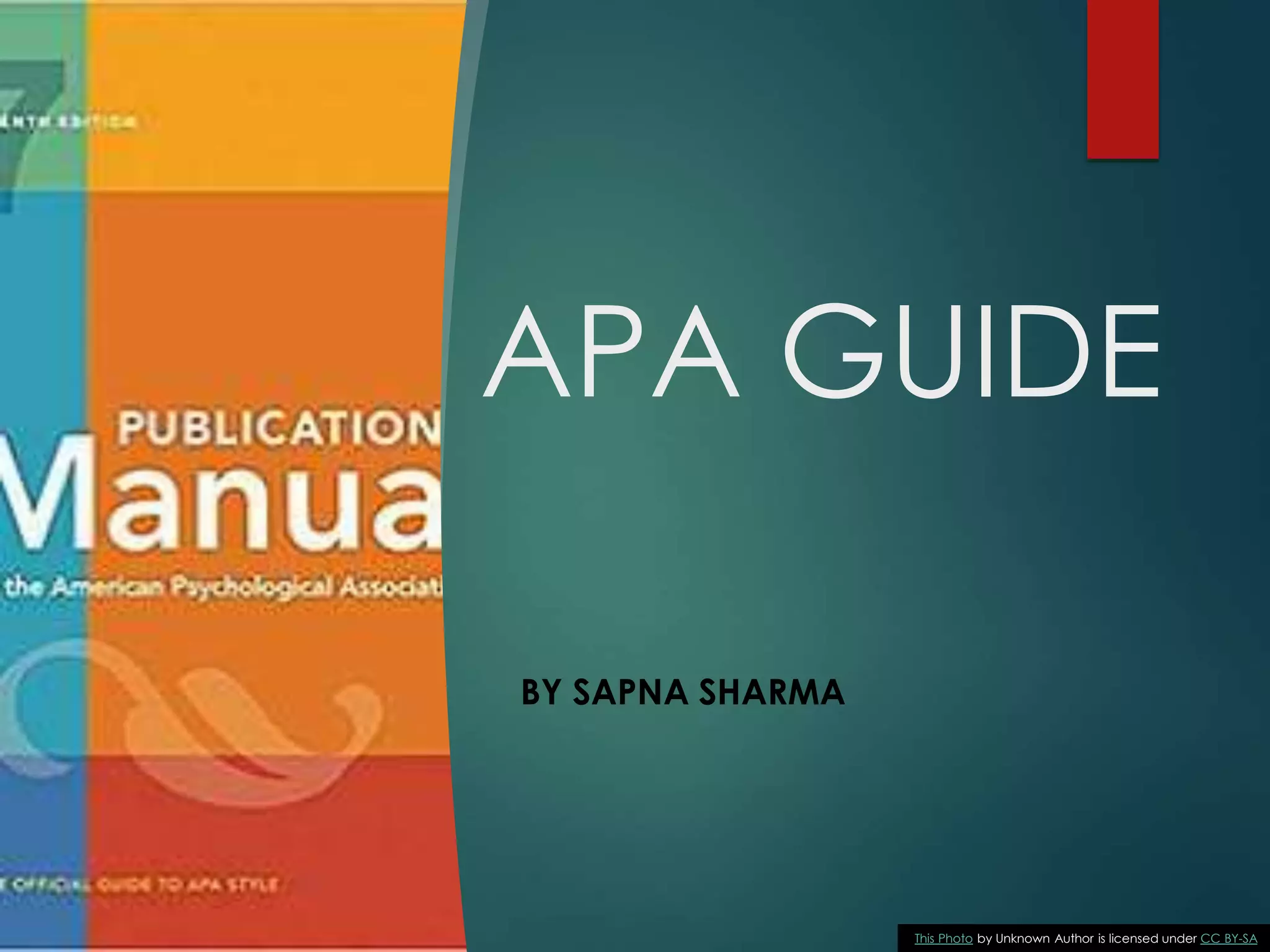
APA GUIDE
BY SAPNA SHARMA
This Photo by Unknown Author is licensed under CC BY-SA
Different Writing Styles
APA
MLA CMS
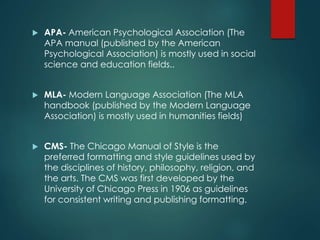
 APA- American Psychological Association (The
APA manual (published by the American
Psychological Association) is mostly used in social
science and education fields..
 MLA- Modern Language Association (The MLA
handbook (published by the Modern Language
Association) is mostly used in humanities fields)
 CMS- The Chicago Manual of Style is the
preferred formatting and style guidelines used by
the disciplines of history, philosophy, religion, and
the arts. The CMS was first developed by the
University of Chicago Press in 1906 as guidelines
for consistent writing and publishing formatting.
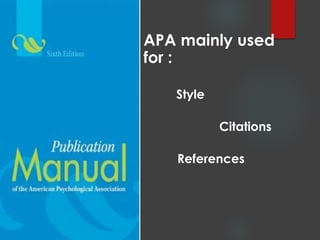
APA mainly used
for :
Style
Citations
References
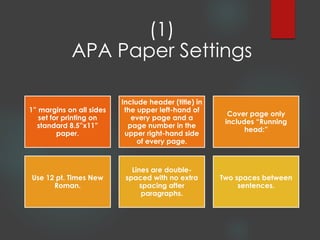
(1)
APA Paper Settings
1” margins on all sides
set for printing on
standard 8.5”x11”
paper.
Include header (title) in
the upper left-hand of
every page and a
page number in the
upper right-hand side
of every page.
Cover page only
includes “Running
head:”
Use 12 pt. Times New
Roman.
Lines are double-
spaced with no extra
spacing after
paragraphs.
Two spaces between
sentences.
(2)
APA Paper Sections
Each Essay/Paper should include
 four major sections
References
Main Body
Abstract
Title page
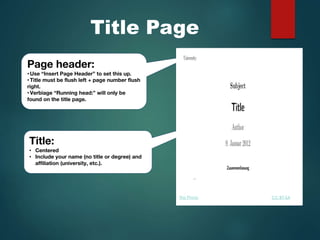
Title Page
Page header:
•Use “Insert Page Header” to set this up.
•Title must be flush left + page number flush
right.
•Verbiage “Running head:” will only be
found on the title page.
Title:
• Centered
• Include your name (no title or degree) and
affiliation (university, etc.).
This Photo by Unknown Author is licensed under CC BY-SA
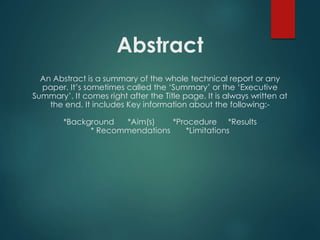
Abstract
An Abstract is a summary of the whole technical report or any
paper. It’s sometimes called the ‘Summary’ or the ‘Executive
Summary’. It comes right after the Title page. It is always written at
the end. It includes Key information about the following:-
*Background *Aim(s) *Procedure *Results
* Recommendations *Limitations
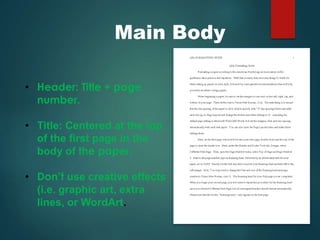
Main Body
• Header: Title + page
number.
• Title: Centered at the top
of the first page in the
body of the paper.
• Don’t use creative effects
(i.e. graphic art, extra
lines, or WordArt.
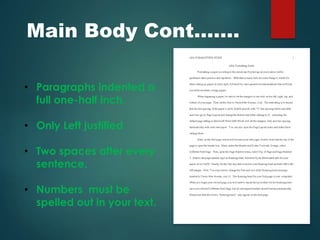
Main Body Cont…….
• Paragraphs indented a
full one-half inch.
• Only Left justified
• Two spaces after every
sentence.
• Numbers must be
spelled out in your text.
• Clear: be specific in descriptions and explanations.
• Concise: Describe in brief.
• Plain: use simple, descriptive adjectives and avoid
figurative language (i.e. Idioms).
Avoid writing Christianese, legalese, or any other
jargons
(3)
Language in an APA paper
Use mostly Active voice – less use of passive voice).
• Very limited use of personal pronoun.
(never use “you should/must/will . . .”)
Language Cont.………….
(4)
APA Citation Basics
Introduce quotations with signal phrases.
According to Adam Smith (1776), “. . .” (p. 3).
Keynes (1936) has argued that “ . . .” (p. 3).
* APA requires the use of the past tense or the present
perfect tense of verbs (i.e. has/have + past participle) in
signal phrases.
Citation Cont.………..
Provide in parenthesis, whenever you use a source:
• Author’s name and the date of publication
Example: (Smith, 1811)
• Add a page number to quotation
Example: (Smith, 2011, p. 110)
Direct Quotation
Single Author
Smith (2011) wrote in his book, Courage and Calling,
Embracing Your God-Given Potential, “we first need
to know that what we are doing comes from God” (p.
110).
In the book, Courage and Calling, Embracing Your
God-Given Potential, we are reminded “we first need
to know that what we are doing comes from God”
(Smith, 2011, p. 110).
When quoting, introduce the quotation with a signal
phrase. This can include the author’s name, the year of
publication, the page number, but keep the citation
brief—do not repeat the information.
Direct Quotation
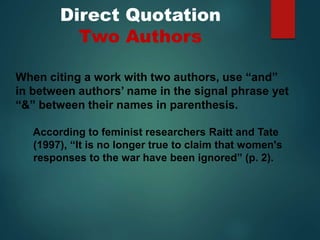
Two Authors
When citing a work with two authors, use “and”
in between authors’ name in the signal phrase yet
“&” between their names in parenthesis.
According to feminist researchers Raitt and Tate
(1997), “It is no longer true to claim that women's
responses to the war have been ignored” (p. 2).
Direct Quotation
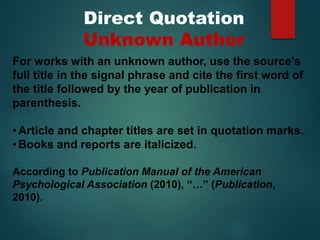
Unknown Author
For works with an unknown author, use the source’s
full title in the signal phrase and cite the first word of
the title followed by the year of publication in
parenthesis.
•Article and chapter titles are set in quotation marks.
•Books and reports are italicized.
According to Publication Manual of the American
Psychological Association (2010), “…” (Publication,
2010).
Direct Quotation
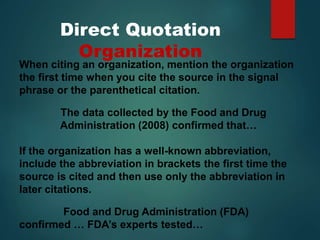
Organization
When citing an organization, mention the organization
the first time when you cite the source in the signal
phrase or the parenthetical citation.
The data collected by the Food and Drug
Administration (2008) confirmed that…
If the organization has a well-known abbreviation,
include the abbreviation in brackets the first time the
source is cited and then use only the abbreviation in
later citations.
Food and Drug Administration (FDA)
confirmed … FDA’s experts tested…
Direct Quotation
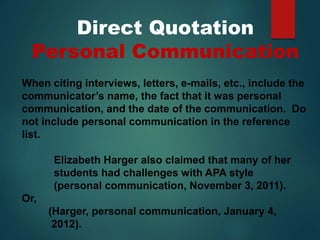
Personal Communication
When citing interviews, letters, e-mails, etc., include the
communicator’s name, the fact that it was personal
communication, and the date of the communication. Do
not include personal communication in the reference
list.
Elizabeth Harger also claimed that many of her
students had challenges with APA style
(personal communication, November 3, 2011).
Or,
(Harger, personal communication, January 4,
2012).
(5)
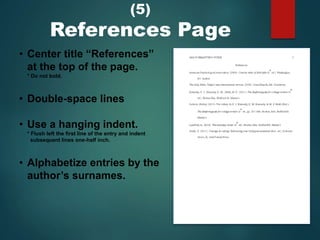
References Page
• Center title “References”
at the top of the page.
* Do not bold.
• Double-space lines
• Use a hanging indent.
* Flush left the first line of the entry and indent
subsequent lines one-half inch.
• Alphabetize entries by the
author’s surnames.
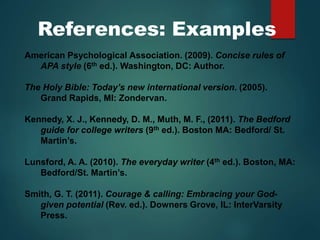
References: Examples
American Psychological Association. (2009). Concise rules of
APA style (6th ed.). Washington, DC: Author.
The Holy Bible: Today’s new international version. (2005).
Grand Rapids, MI: Zondervan.
Kennedy, X. J., Kennedy, D. M., Muth, M. F., (2011). The Bedford
guide for college writers (9th ed.). Boston MA: Bedford/ St.
Martin’s.
Lunsford, A. A. (2010). The everyday writer (4th ed.). Boston, MA:
Bedford/St. Martin’s.
Smith, G. T. (2011). Courage & calling: Embracing your God-
given potential (Rev. ed.). Downers Grove, IL: InterVarsity
Press.
APA Guide

APA Guide

  • 1.
    APA GUIDE BY SAPNASHARMA This Photo by Unknown Author is licensed under CC BY-SA
  • 2.
  • 3.
     APA- AmericanPsychological Association (The APA manual (published by the American Psychological Association) is mostly used in social science and education fields..  MLA- Modern Language Association (The MLA handbook (published by the Modern Language Association) is mostly used in humanities fields)  CMS- The Chicago Manual of Style is the preferred formatting and style guidelines used by the disciplines of history, philosophy, religion, and the arts. The CMS was first developed by the University of Chicago Press in 1906 as guidelines for consistent writing and publishing formatting.
  • 5.
    APA mainly used for: Style Citations References
  • 6.
    (1) APA Paper Settings 1”margins on all sides set for printing on standard 8.5”x11” paper. Include header (title) in the upper left-hand of every page and a page number in the upper right-hand side of every page. Cover page only includes “Running head:” Use 12 pt. Times New Roman. Lines are double- spaced with no extra spacing after paragraphs. Two spaces between sentences.
  • 7.
    (2) APA Paper Sections EachEssay/Paper should include  four major sections References Main Body Abstract Title page
  • 8.
    Title Page Page header: •Use“Insert Page Header” to set this up. •Title must be flush left + page number flush right. •Verbiage “Running head:” will only be found on the title page. Title: • Centered • Include your name (no title or degree) and affiliation (university, etc.). This Photo by Unknown Author is licensed under CC BY-SA
  • 9.
    Abstract An Abstract isa summary of the whole technical report or any paper. It’s sometimes called the ‘Summary’ or the ‘Executive Summary’. It comes right after the Title page. It is always written at the end. It includes Key information about the following:- *Background *Aim(s) *Procedure *Results * Recommendations *Limitations
  • 10.
    Main Body • Header:Title + page number. • Title: Centered at the top of the first page in the body of the paper. • Don’t use creative effects (i.e. graphic art, extra lines, or WordArt.
  • 11.
    Main Body Cont……. •Paragraphs indented a full one-half inch. • Only Left justified • Two spaces after every sentence. • Numbers must be spelled out in your text.
  • 12.
    • Clear: bespecific in descriptions and explanations. • Concise: Describe in brief. • Plain: use simple, descriptive adjectives and avoid figurative language (i.e. Idioms). Avoid writing Christianese, legalese, or any other jargons (3) Language in an APA paper
  • 13.
    Use mostly Activevoice – less use of passive voice). • Very limited use of personal pronoun. (never use “you should/must/will . . .”) Language Cont.………….
  • 14.
    (4) APA Citation Basics Introducequotations with signal phrases. According to Adam Smith (1776), “. . .” (p. 3). Keynes (1936) has argued that “ . . .” (p. 3). * APA requires the use of the past tense or the present perfect tense of verbs (i.e. has/have + past participle) in signal phrases.
  • 15.
    Citation Cont.……….. Provide inparenthesis, whenever you use a source: • Author’s name and the date of publication Example: (Smith, 1811) • Add a page number to quotation Example: (Smith, 2011, p. 110)
  • 16.
    Direct Quotation Single Author Smith(2011) wrote in his book, Courage and Calling, Embracing Your God-Given Potential, “we first need to know that what we are doing comes from God” (p. 110). In the book, Courage and Calling, Embracing Your God-Given Potential, we are reminded “we first need to know that what we are doing comes from God” (Smith, 2011, p. 110). When quoting, introduce the quotation with a signal phrase. This can include the author’s name, the year of publication, the page number, but keep the citation brief—do not repeat the information.
  • 17.
    Direct Quotation Two Authors Whenciting a work with two authors, use “and” in between authors’ name in the signal phrase yet “&” between their names in parenthesis. According to feminist researchers Raitt and Tate (1997), “It is no longer true to claim that women's responses to the war have been ignored” (p. 2).
  • 18.
    Direct Quotation Unknown Author Forworks with an unknown author, use the source’s full title in the signal phrase and cite the first word of the title followed by the year of publication in parenthesis. •Article and chapter titles are set in quotation marks. •Books and reports are italicized. According to Publication Manual of the American Psychological Association (2010), “…” (Publication, 2010).
  • 19.
    Direct Quotation Organization When citingan organization, mention the organization the first time when you cite the source in the signal phrase or the parenthetical citation. The data collected by the Food and Drug Administration (2008) confirmed that… If the organization has a well-known abbreviation, include the abbreviation in brackets the first time the source is cited and then use only the abbreviation in later citations. Food and Drug Administration (FDA) confirmed … FDA’s experts tested…
  • 20.
    Direct Quotation Personal Communication Whenciting interviews, letters, e-mails, etc., include the communicator’s name, the fact that it was personal communication, and the date of the communication. Do not include personal communication in the reference list. Elizabeth Harger also claimed that many of her students had challenges with APA style (personal communication, November 3, 2011). Or, (Harger, personal communication, January 4, 2012).
  • 21.
    (5) References Page • Centertitle “References” at the top of the page. * Do not bold. • Double-space lines • Use a hanging indent. * Flush left the first line of the entry and indent subsequent lines one-half inch. • Alphabetize entries by the author’s surnames.
  • 22.
    References: Examples American PsychologicalAssociation. (2009). Concise rules of APA style (6th ed.). Washington, DC: Author. The Holy Bible: Today’s new international version. (2005). Grand Rapids, MI: Zondervan. Kennedy, X. J., Kennedy, D. M., Muth, M. F., (2011). The Bedford guide for college writers (9th ed.). Boston MA: Bedford/ St. Martin’s. Lunsford, A. A. (2010). The everyday writer (4th ed.). Boston, MA: Bedford/St. Martin’s. Smith, G. T. (2011). Courage & calling: Embracing your God- given potential (Rev. ed.). Downers Grove, IL: InterVarsity Press.