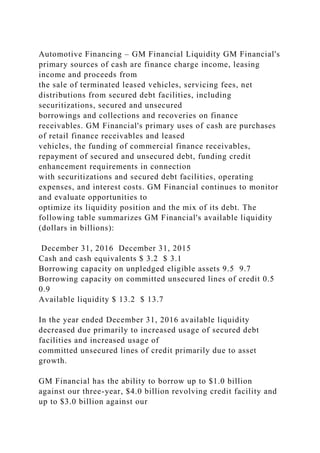
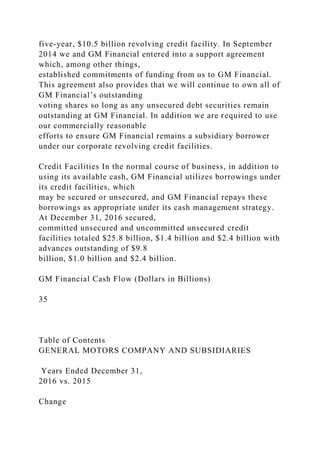
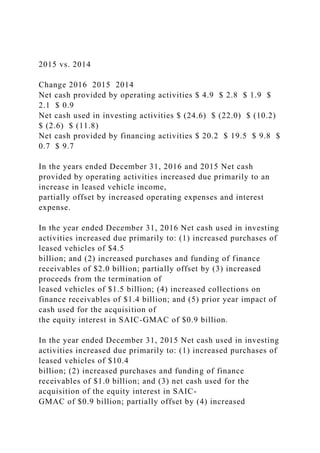
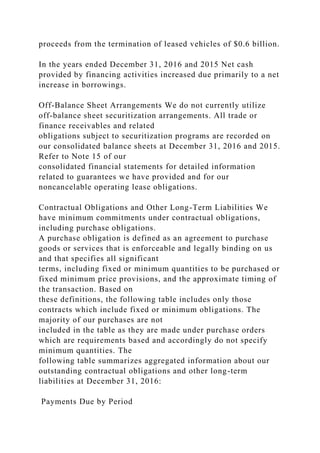
****APA FORMAT****
10-15 pages in length, double spaced.
All margins are to be one inch.
The font should be 12 point and Times New Roman.
The paper should contain the following parts: Table of
Contents, Abstract, Reference Page, Appendix,
Headings & subheadings required.
Papers should include four sections: historical background,
description of the problem necessitating the
policy, description of the policy, and policy analysis
Historical Background (heading)
What historical problems led to the creation of the policy?
How important have these problems been historically?
How was the problem handled previously?
What is the historical background of the policy?
When did the policy originate?
How has the original policy changed over time?
What is the legislative history of the policy—how have this
issue or similar issues been discussed and debated in
legislative bodies?
What has been the fate of similar policies adopted in the past?
Does the National Association of Social Workers or another
national organization have a policy statement on this
issue? Include a critical review of the position in your
discussion.
Description of the Problem that Necessitates the Policy
(heading)
What is the nature of the problem?
How widespread is the problem?
How many people are affected?
Who is affected and how? (Include analysis of differential
effects based on race, socioeconomic class, gender,
religious, or regional differences.)
What are the causes of the problem?
How will the policy help address the problem?
Description of the Policy (heading)
How is the policy intended to work?
On what scientific theory and knowledge is the policy based?
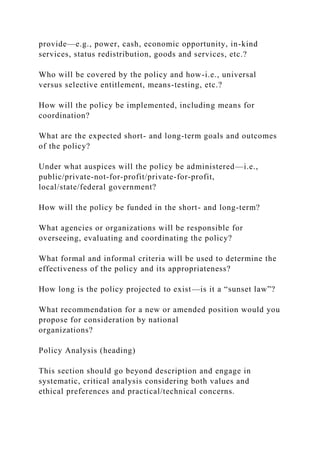
What resources or opportunities is the policy expected to
provide—e.g., power, cash, economic opportunity, in-kind
services, status redistribution, goods and services, etc.?
Who will be covered by the policy and how-i.e., universal
versus selective entitlement, means-testing, etc.?
How will the policy be implemented, including means for
coordination?
What are the expected short- and long-term goals and outcomes
of the policy?
Under what auspices will the policy be administered—i.e.,
public/private-not-for-profit/private-for-profit,
local/state/federal government?
How will the policy be funded in the short- and long-term?
What agencies or organizations will be responsible for
overseeing, evaluating and coordinating the policy?
What formal and informal criteria will be used to determine the
effectiveness of the policy and its appropriateness?
How long is the policy projected to exist—is it a “sunset law”?
What recommendation for a new or amended position would you
propose for consideration by national
organizations?
Policy Analysis (heading)
This section should go beyond description and engage in
systematic, critical analysis considering both values and
ethical preferences and practical/technical concerns.
Goals
Are the goals of the policy legal? Are the goals just and
democratic? Do the goals contribute to greater social
equality? Do the goals positively affect the redistribution of
income, resources, rights, entitlements, opportunities
and status? Does the policy represent the continuation of or a
departure from the status quo? Is the policy intended to
foster real social change or merely to placate a potentially
insurgent group?
What social vision, if any, does the policy represent? Are the
goals of the policy consistent with the values of
professional social work—e.g., social justice, dignity and worth
of the person, self-determination, client rights,
respect for cultural and social diversity, etc.?
What are the hidden ideological suppositions hidden within the
policy? How do dominant American values manifest
themselves in relationship to this issue? How do competing or
minority social values come into play in response to
this issue?
How is the target population viewed in the context of the
policy? How would the issue be defined or manifested
differently if society looked at individual and family strengths,
rather than focusing on deficits or deviance from
social norms? Does the policy seem to ignore, impede, or
strengthen the social functions of families? Do the goals
contribute to a better quality of life for the target population?
Will the goals adversely affect the quality of life of the
target group? Does the policy contribute to positive social
relations between the target population and the overall
society?
What does research say about effectiveness of reaching stated
goals and the actual outcomes of past or current policy
approaches?
How is the policy politically feasible? Economically feasible?
Administratively feasible?
Politically Feasibility (heading)
“Subjective assessment” (?)
Assess which groups will oppose or support a policy
Estimate constituency & power base of each group
Political viability is subject to the public’s perception-for a
policy to be feasible it must be perceived feasible (public
sentiment)
Economically Feasibility (heading)
Refers to direct or indirect funding
Ask on: funding needed for successful implementation
Does adequate funding exist
Estimate future funding needs
What is “Pay-go financing”?
Administratively Feasibility (heading)
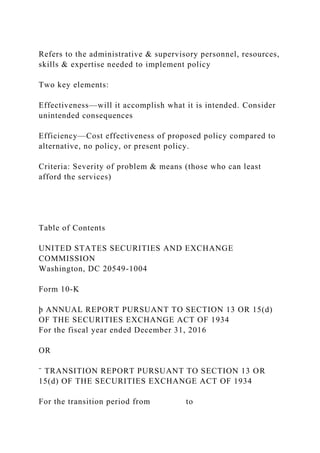
Refers to the administrative & supervisory personnel, resources,
skills & expertise needed to implement policy
Refers to the administrative & supervisory personnel, resources,
skills & expertise needed to implement policy
Two key elements:
Effectiveness—will it accomplish what it is intended. Consider
unintended consequences
Efficiency—Cost effectiveness of proposed policy compared to
alternative, no policy, or present policy.
Criteria: Severity of problem & means (those who can least
afford the services)
Table of Contents
UNITED STATES SECURITIES AND EXCHANGE
COMMISSION
Washington, DC 20549-1004
Form 10-K
þ ANNUAL REPORT PURSUANT TO SECTION 13 OR 15(d)
OF THE SECURITIES EXCHANGE ACT OF 1934
For the fiscal year ended December 31, 2016
OR
¨ TRANSITION REPORT PURSUANT TO SECTION 13 OR
15(d) OF THE SECURITIES EXCHANGE ACT OF 1934
For the transition period from to
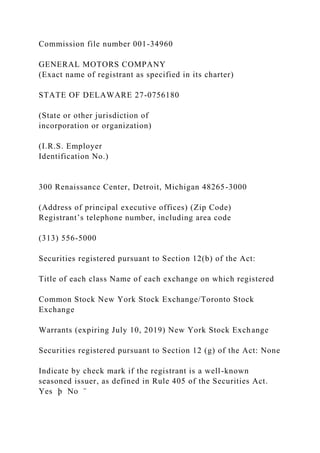
Commission file number 001-34960
GENERAL MOTORS COMPANY
(Exact name of registrant as specified in its charter)
STATE OF DELAWARE 27-0756180
(State or other jurisdiction of
incorporation or organization)
(I.R.S. Employer
Identification No.)
300 Renaissance Center, Detroit, Michigan 48265-3000
(Address of principal executive offices) (Zip Code)
Registrant’s telephone number, including area code
(313) 556-5000
Securities registered pursuant to Section 12(b) of the Act:
Title of each class Name of each exchange on which registered
Common Stock New York Stock Exchange/Toronto Stock
Exchange
Warrants (expiring July 10, 2019) New York Stock Exchange
Securities registered pursuant to Section 12 (g) of the Act: None
Indicate by check mark if the registrant is a well-known
seasoned issuer, as defined in Rule 405 of the Securities Act.
Yes þ No ¨
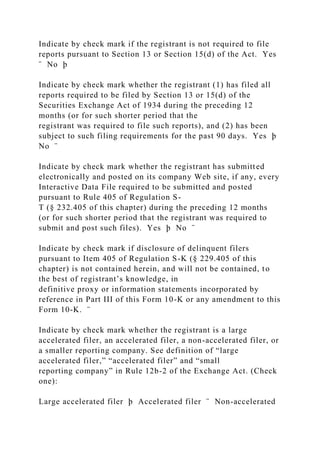
Indicate by check mark if the registrant is not required to file
reports pursuant to Section 13 or Section 15(d) of the Act. Yes
¨ No þ
Indicate by check mark whether the registrant (1) has filed all
reports required to be filed by Section 13 or 15(d) of the
Securities Exchange Act of 1934 during the preceding 12
months (or for such shorter period that the
registrant was required to file such reports), and (2) has been
subject to such filing requirements for the past 90 days. Yes þ
No ¨
Indicate by check mark whether the registrant has submitted
electronically and posted on its company Web site, if any, every
Interactive Data File required to be submitted and posted
pursuant to Rule 405 of Regulation S-
T (§ 232.405 of this chapter) during the preceding 12 months
(or for such shorter period that the registrant was required to
submit and post such files). Yes þ No ¨
Indicate by check mark if disclosure of delinquent filers
pursuant to Item 405 of Regulation S-K (§ 229.405 of this
chapter) is not contained herein, and will not be contained, to
the best of registrant’s knowledge, in
definitive proxy or information statements incorporated by
reference in Part III of this Form 10-K or any amendment to this
Form 10-K. ¨
Indicate by check mark whether the registrant is a large
accelerated filer, an accelerated filer, a non-accelerated filer, or
a smaller reporting company. See definition of “large
accelerated filer,” “accelerated filer” and “small
reporting company” in Rule 12b-2 of the Exchange Act. (Check
one):
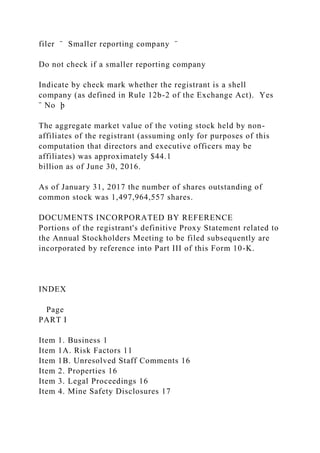
Large accelerated filer þ Accelerated filer ¨ Non-accelerated
filer ¨ Smaller reporting company ¨
Do not check if a smaller reporting company
Indicate by check mark whether the registrant is a shell
company (as defined in Rule 12b-2 of the Exchange Act). Yes
¨ No þ
The aggregate market value of the voting stock held by non-
affiliates of the registrant (assuming only for purposes of this
computation that directors and executive officers may be
affiliates) was approximately $44.1
billion as of June 30, 2016.
As of January 31, 2017 the number of shares outstanding of
common stock was 1,497,964,557 shares.
DOCUMENTS INCORPORATED BY REFERENCE
Portions of the registrant's definitive Proxy Statement related to
the Annual Stockholders Meeting to be filed subsequently are
incorporated by reference into Part III of this Form 10-K.
INDEX
Page
PART I
Item 1. Business 1
Item 1A. Risk Factors 11
Item 1B. Unresolved Staff Comments 16
Item 2. Properties 16
Item 3. Legal Proceedings 16
Item 4. Mine Safety Disclosures 17
PART II
Item 5. Market for Registrant’s Common Equity, Related
Stockholder Matters and Issuer Purchases of Equity Securities
17
Item 6. Selected Financial Data 18
Item 7. Management’s Discussion and Analysis of Financial
Condition and Results of Operations 18
Item 7A. Quantitative and Qualitative Disclosures About Market
Risk 40
Item 8. Financial Statements and Supplementary Data 45
Consolidated Income Statements 45
Consolidated Statements of Comprehensive Income 45
Consolidated Balance Sheets 46
Consolidated Statements of Cash Flows 47
Consolidated Statements of Equity 48
Notes to Consolidated Financial Statements 49
Note 1. Nature of Operations and Basis of Presentation 49
Note 2. Significant Accounting Policies 49
Note 3. Marketable Securities 56
Note 4. GM Financial Receivables 58
Note 5. Inventories 59
Note 6. Equipment on Operating Leases 59
Note 7. Equity in Net Assets of Nonconsolidated Affiliates 60
Note 8. Property 62
Note 9. Acquisition of Business 62
Note 10. Goodwill and Intangible Assets 63
Note 11. Variable Interest Entities 63
Note 12. Accrued and Other Liabilities 64
Note 13. Automotive and GM Financial Debt 64
Note 14. Pensions and Other Postretirement Benefits 67
Note 15. Commitments and Contingencies 73
Note 16. Income Taxes 78
Note 17. Restructuring and Other Initiatives 80
Note 18. Interest Income and Other Non-Operating Income 81
Note 19. Stockholders’ Equity and Noncontrolling Interests 81
Note 20. Earnings Per Share 82
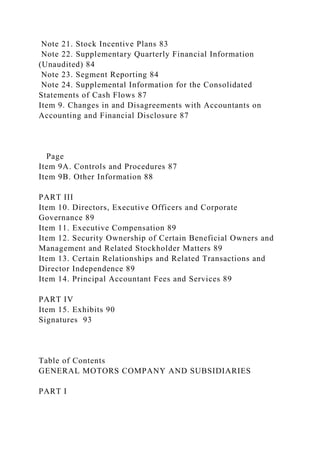
Note 21. Stock Incentive Plans 83
Note 22. Supplementary Quarterly Financial Information
(Unaudited) 84
Note 23. Segment Reporting 84
Note 24. Supplemental Information for the Consolidated
Statements of Cash Flows 87
Item 9. Changes in and Disagreements with Accountants on
Accounting and Financial Disclosure 87
Page
Item 9A. Controls and Procedures 87
Item 9B. Other Information 88
PART III
Item 10. Directors, Executive Officers and Corporate
Governance 89
Item 11. Executive Compensation 89
Item 12. Security Ownership of Certain Beneficial Owners and
Management and Related Stockholder Matters 89
Item 13. Certain Relationships and Related Transactions and
Director Independence 89
Item 14. Principal Accountant Fees and Services 89
PART IV
Item 15. Exhibits 90
Signatures 93
Table of Contents
GENERAL MOTORS COMPANY AND SUBSIDIARIES
PART I
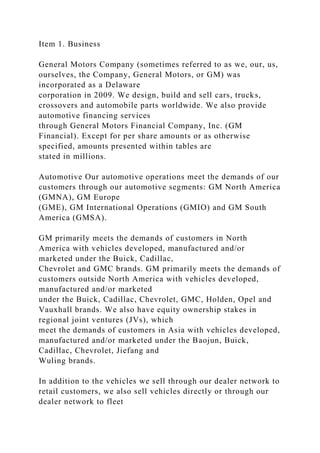
Item 1. Business
General Motors Company (sometimes referred to as we, our, us,
ourselves, the Company, General Motors, or GM) was
incorporated as a Delaware
corporation in 2009. We design, build and sell cars, trucks,
crossovers and automobile parts worldwide. We also provide
automotive financing services
through General Motors Financial Company, Inc. (GM
Financial). Except for per share amounts or as otherwise
specified, amounts presented within tables are
stated in millions.
Automotive Our automotive operations meet the demands of our
customers through our automotive segments: GM North America
(GMNA), GM Europe
(GME), GM International Operations (GMIO) and GM South
America (GMSA).
GM primarily meets the demands of customers in North
America with vehicles developed, manufactured and/or
marketed under the Buick, Cadillac,
Chevrolet and GMC brands. GM primarily meets the demands of
customers outside North America with vehicles developed,
manufactured and/or marketed
under the Buick, Cadillac, Chevrolet, GMC, Holden, Opel and
Vauxhall brands. We also have equity ownership stakes in
regional joint ventures (JVs), which
meet the demands of customers in Asia with vehicles developed,
manufactured and/or marketed under the Baojun, Buick,
Cadillac, Chevrolet, Jiefang and
Wuling brands.
In addition to the vehicles we sell through our dealer network to
retail customers, we also sell vehicles directly or through our
dealer network to fleet
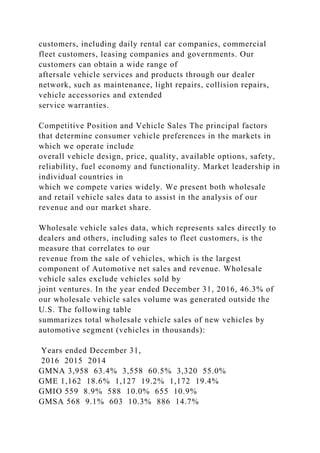
customers, including daily rental car companies, commercial
fleet customers, leasing companies and governments. Our
customers can obtain a wide range of
aftersale vehicle services and products through our dealer
network, such as maintenance, light repairs, collision repairs,
vehicle accessories and extended
service warranties.
Competitive Position and Vehicle Sales The principal factors
that determine consumer vehicle preferences in the markets in
which we operate include
overall vehicle design, price, quality, available options, safety,
reliability, fuel economy and functionality. Market leadership in
individual countries in
which we compete varies widely. We present both wholesale
and retail vehicle sales data to assist in the analysis of our
revenue and our market share.
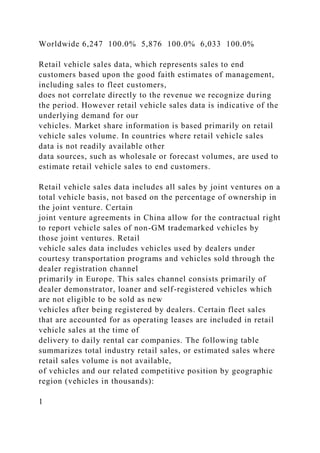
Wholesale vehicle sales data, which represents sales directly to
dealers and others, including sales to fleet customers, is the
measure that correlates to our
revenue from the sale of vehicles, which is the largest
component of Automotive net sales and revenue. Wholesale
vehicle sales exclude vehicles sold by
joint ventures. In the year ended December 31, 2016, 46.3% of
our wholesale vehicle sales volume was generated outside the
U.S. The following table
summarizes total wholesale vehicle sales of new vehicles by
automotive segment (vehicles in thousands):
Years ended December 31,
2016 2015 2014
GMNA 3,958 63.4% 3,558 60.5% 3,320 55.0%
GME 1,162 18.6% 1,127 19.2% 1,172 19.4%
GMIO 559 8.9% 588 10.0% 655 10.9%
GMSA 568 9.1% 603 10.3% 886 14.7%
Worldwide 6,247 100.0% 5,876 100.0% 6,033 100.0%
Retail vehicle sales data, which represents sales to end
customers based upon the good faith estimates of management,
including sales to fleet customers,
does not correlate directly to the revenue we recognize during
the period. However retail vehicle sales data is indicative of the
underlying demand for our
vehicles. Market share information is based primarily on retail
vehicle sales volume. In countries where retail vehicle sales
data is not readily available other
data sources, such as wholesale or forecast volumes, are used to
estimate retail vehicle sales to end customers.
Retail vehicle sales data includes all sales by joint ventures on a
total vehicle basis, not based on the percentage of ownership in
the joint venture. Certain
joint venture agreements in China allow for the contractual right
to report vehicle sales of non-GM trademarked vehicles by
those joint ventures. Retail
vehicle sales data includes vehicles used by dealers under
courtesy transportation programs and vehicles sold through the
dealer registration channel
primarily in Europe. This sales channel consists primarily of
dealer demonstrator, loaner and self-registered vehicles which
are not eligible to be sold as new
vehicles after being registered by dealers. Certain fleet sales
that are accounted for as operating leases are included in retail
vehicle sales at the time of
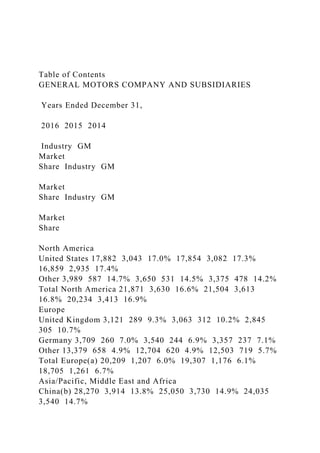
delivery to daily rental car companies. The following table
summarizes total industry retail sales, or estimated sales where
retail sales volume is not available,
of vehicles and our related competitive position by geographic
region (vehicles in thousands):
1
Table of Contents
GENERAL MOTORS COMPANY AND SUBSIDIARIES
Years Ended December 31,
2016 2015 2014
Industry GM
Market
Share Industry GM
Market
Share Industry GM
Market
Share
North America
United States 17,882 3,043 17.0% 17,854 3,082 17.3%
16,859 2,935 17.4%
Other 3,989 587 14.7% 3,650 531 14.5% 3,375 478 14.2%
Total North America 21,871 3,630 16.6% 21,504 3,613
16.8% 20,234 3,413 16.9%
Europe
United Kingdom 3,121 289 9.3% 3,063 312 10.2% 2,845
305 10.7%
Germany 3,709 260 7.0% 3,540 244 6.9% 3,357 237 7.1%
Other 13,379 658 4.9% 12,704 620 4.9% 12,503 719 5.7%
Total Europe(a) 20,209 1,207 6.0% 19,307 1,176 6.1%
18,705 1,261 6.7%
Asia/Pacific, Middle East and Africa
China(b) 28,270 3,914 13.8% 25,050 3,730 14.9% 24,035
3,540 14.7%
Other 18,905 673 3.6% 19,527 795 4.1% 19,722 840 4.3%
Total Asia/Pacific, Middle East and Africa 47,175 4,587 9.7%
44,577 4,525 10.2% 43,757 4,380 10.0%
South America
Brazil 2,048 346 16.9% 2,568 388 15.1% 3,498 579 16.6%
Other 1,623 238 14.6% 1,616 257 15.9% 1,815 299 16.5%
Total South America 3,671 584 15.9% 4,184 645 15.4%
5,313 878 16.5%
Total Worldwide(c) 92,926 10,008 10.8% 89,572 9,959
11.1% 88,009 9,932 11.3%
United States
Cars 6,895 890 12.9% 7,483 931 12.4% 7,617 1,085 14.2%
Trucks 5,464 1,325 24.2% 5,181 1,274 24.6% 4,754 1,113
23.4%
Crossovers 5,523 828 15.0% 5,190 877 16.9% 4,488 737
16.4%
Total United States 17,882 3,043 17.0% 17,854 3,082 17.3%
16,859 2,935 17.4%
China(b)
SGMS 1,806 1,711 1,710
SGMW and FAW-GM 2,108 2,019 1,830
Total China 28,270 3,914 13.8% 25,050 3,730 14.9% 24,035
3,540 14.7%
__________
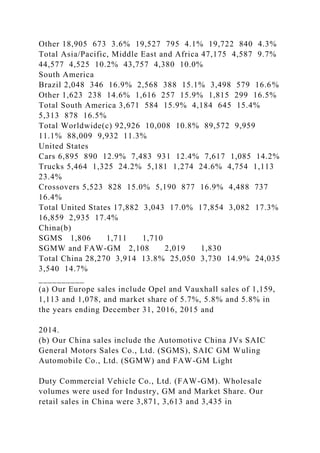
(a) Our Europe sales include Opel and Vauxhall sales of 1,159,
1,113 and 1,078, and market share of 5.7%, 5.8% and 5.8% in
the years ending December 31, 2016, 2015 and
2014.
(b) Our China sales include the Automotive China JVs SAIC
General Motors Sales Co., Ltd. (SGMS), SAIC GM Wuling
Automobile Co., Ltd. (SGMW) and FAW-GM Light
Duty Commercial Vehicle Co., Ltd. (FAW-GM). Wholesale
volumes were used for Industry, GM and Market Share. Our
retail sales in China were 3,871, 3,613 and 3,435 in
the years ended December 31, 2016, 2015 and 2014. In 2017,
we will begin using vehicle registrations data as the basis for
calculating industry volume and market share in
China on a prospective basis.
(c) We do not currently export vehicles to Cuba, Iran, North
Korea, Sudan or Syria. Accordingly these countries are
excluded from industry sales data and corresponding
calculation of market share.
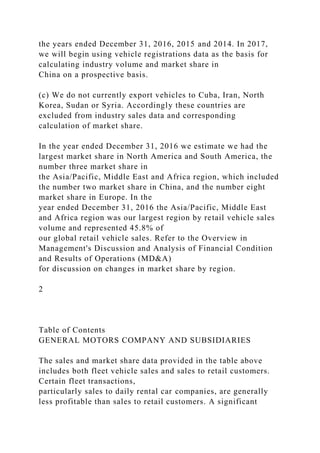
In the year ended December 31, 2016 we estimate we had the
largest market share in North America and South America, the
number three market share in
the Asia/Pacific, Middle East and Africa region, which included
the number two market share in China, and the number eight
market share in Europe. In the
year ended December 31, 2016 the Asia/Pacific, Middle East
and Africa region was our largest region by retail vehicle sales
volume and represented 45.8% of
our global retail vehicle sales. Refer to the Overview in
Management's Discussion and Analysis of Financial Condition
and Results of Operations (MD&A)
for discussion on changes in market share by region.
2
Table of Contents
GENERAL MOTORS COMPANY AND SUBSIDIARIES
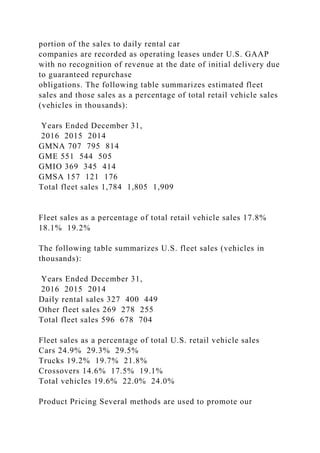
The sales and market share data provided in the table above
includes both fleet vehicle sales and sales to retail customers.
Certain fleet transactions,
particularly sales to daily rental car companies, are generally
less profitable than sales to retail customers. A significant
portion of the sales to daily rental car
companies are recorded as operating leases under U.S. GAAP
with no recognition of revenue at the date of initial delivery due
to guaranteed repurchase
obligations. The following table summarizes estimated fleet
sales and those sales as a percentage of total retail vehicle sales
(vehicles in thousands):
Years Ended December 31,
2016 2015 2014
GMNA 707 795 814
GME 551 544 505
GMIO 369 345 414
GMSA 157 121 176
Total fleet sales 1,784 1,805 1,909
Fleet sales as a percentage of total retail vehicle sales 17.8%
18.1% 19.2%
The following table summarizes U.S. fleet sales (vehicles in
thousands):
Years Ended December 31,
2016 2015 2014
Daily rental sales 327 400 449
Other fleet sales 269 278 255
Total fleet sales 596 678 704
Fleet sales as a percentage of total U.S. retail vehicle sales
Cars 24.9% 29.3% 29.5%
Trucks 19.2% 19.7% 21.8%
Crossovers 14.6% 17.5% 19.1%
Total vehicles 19.6% 22.0% 24.0%
Product Pricing Several methods are used to promote our
products, including the use of dealer, retail and fleet incentives
such as customer rebates and
finance rate support. The level of incentives is dependent in
large part upon the level of competition in the markets in which
we operate and the level of
demand for our products. In 2017 we plan to continue to price
vehicles competitively, including offering incentives as
required. We believe this strategy,
coupled with sound inventory management, will continue to
strengthen our brands.
Cyclical Nature of Business Retail sales are cyclical and
production varies from month to month. Vehicle model
changeovers occur throughout the year as
a result of new market entries. The market for vehicles depends
on general economic conditions, credit availability and
consumer spending.
Relationship with Dealers We market vehicles worldwide
primarily through a network of independent authorized retail
dealers. These outlets include
distributors, dealers and authorized sales, service and parts
outlets.
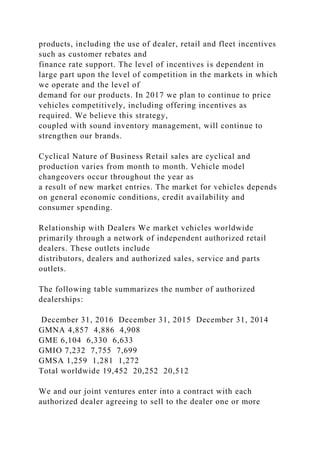
The following table summarizes the number of authorized
dealerships:
December 31, 2016 December 31, 2015 December 31, 2014
GMNA 4,857 4,886 4,908
GME 6,104 6,330 6,633
GMIO 7,232 7,755 7,699
GMSA 1,259 1,281 1,272
Total worldwide 19,452 20,252 20,512
We and our joint ventures enter into a contract with each
authorized dealer agreeing to sell to the dealer one or more
specified product lines at wholesale
prices and granting the dealer the right to sell those vehicles to
retail customers from an approved
3
Table of Contents
GENERAL MOTORS COMPANY AND SUBSIDIARIES
location. Our dealers often offer more than one GM brand at a
single dealership in a number of our markets in order to enhance
dealer profitability.
Authorized dealers offer parts, accessories, service and repairs
for GM vehicles in the product lines that they sell using GM
parts and accessories. Our dealers
are authorized to service GM vehicles under our limited
warranty program and those repairs are made only with GM
parts. Our dealers generally provide their
customers with access to credit or lease financing, vehicle
insurance and extended service contracts provided by GM
Financial and other financial
institutions.
The quality of GM dealerships and our relationship with our
dealers and distributors are critical to our success as dealers
maintain the primary sales and
service interface with the end consumer of our products. In
addition to the terms of our contracts with our dealers we are
regulated by various country and
state franchise laws that may supersede those contractual terms
and impose specific regulatory requirements and standards for
initiating dealer network
changes, pursuing terminations for cause and other contractual
matters.
Research, Product and Business Development and Intellectual
Property Costs for research, manufacturing engineering, product
engineering and design
and development activities relate primarily to developing new
products or services or improving existing products or services
including activities related to
vehicle emissions control, improved fuel economy, the safety of
drivers and passengers, urban mobility and autonomous
vehicles. In the years ended
December 31, 2016, 2015 and 2014 research and development
expenses were $8.1 billion, $7.5 billion and $7.4 billion.
Product Development The Product Development organization is
responsible for designing and integrating vehicle and powertrain
components to
maximize part sharing across multiple vehicle segments. Global
teams in Design, Program Management, Component &
Subsystem Engineering, Product
Integrity, Safety, Propulsion and Purchasing & Supply Chain
collaborate to meet customer requirements and maximize global
economies of scale.
Our global vehicle architecture development has been
consolidated and headquartered at our Global Technical Center
in Warren, Michigan, to further the
standardization of our overall vehicle development process.
Cross-segment part sharing is an essential enabler to our
Vehicle Set Strategy, designed to reduce
our overall number of global vehicle architectures to four major
vehicle sets. As we implement the four vehicle sets, we will
continue to leverage our current
architecture portfolio to accommodate our customers around the
world while achieving our financial goals.
Hybrid, Plug-In, Extended Range and Battery Electric Vehicles
We are investing in multiple technologies offering increasing
levels of vehicle
electrification including eAssist, plug-in hybrid, full hybrid,
extended range and battery electric vehicles. We currently offer
six models in the U.S. featuring
some form of electrification and continue to develop plug-in
hybrid electric vehicle technology and extended range electric
vehicles such as the Chevrolet
Volt. In 2016 we began production and sales of the Chevrolet
Bolt EV, which provides an EPA-rated 238 miles of range on a
full charge.
Car- and Ride-Sharing In 2016, we executed several steps in our
strategy to redefine personal mobility. In January 2016 we
announced a new car-sharing
service called Maven, which combines our multiple car-sharing
programs under a single brand. Maven gives customers access to
highly personalized, on-
demand mobility services. During 2016 we expanded our Maven
offerings to 16 cities across the U.S. In January 2016 we also
purchased a 9% equity
ownership interest in Lyft, Inc. (Lyft), a privately held
company, for $0.5 billion. In March 2016 we announced a new
program called Express Drive, which
leverages our Lyft relationship to expand our ride-sharing
offerings. Under the Express Drive program, Lyft drivers in
multiple cities across the U.S. can rent
General Motors vehicles on a weekly basis. We are also
considering additional options to expand our ride-sharing
offerings. In November 2016 we
announced that we are partnering with Uber Technologies Inc.
(Uber) to pilot a program under which Uber drivers can rent
General Motors vehicles on a
weekly basis. Additionally, we plan to develop an integrated
network of on-demand autonomous vehicles in the U.S.
Autonomous Technology We see autonomous technology
leading to significant advances in convenience, mobility and
safety, since more than 90% of
crashes are caused by driver error. We have millions of miles of
real-world experience with embedded connectivity through
OnStar, LLC (OnStar) and
advanced safety features that are the building blocks to more
advanced automation features that we believe will eventually
lead to fully autonomous
vehicles. An example of advanced automation is Super Cruise, a
hands-free driving customer convenience feature that will debut
in 2017 on the Cadillac
CT6 sedan.
In May 2016 we acquired all of the outstanding capital stock of
Cruise Automation Inc. (Cruise), an autonomous vehicle
technology company, to further
accelerate our development of autonomous vehicles. We are
also actively testing autonomous vehicles on public roads in San
Francisco, California,
Scottsdale, Arizona and Warren, Michigan.
4
Table of Contents
GENERAL MOTORS COMPANY AND SUBSIDIARIES
Alternative Fuel Vehicles We believe alternative fuels offer
significant potential to reduce petroleum consumption in the
transportation sector. By
leveraging experience and capability developed around these
technologies in our global operations we continue to develop
FlexFuel vehicles that can run
on gasoline-ethanol blend fuels as well as vehicles that run on
compressed natural gas (CNG) and liquefied petroleum gas
(LPG).
We currently offer 11 FlexFuel vehicles in the U.S. for the 2017
model year to retail customers plus an additional seven models
to fleet and commercial
customers capable of operating on gasoline, E85 ethanol or any
combination of the two. In Brazil a substantial majority of
vehicles sold were FlexFuel
vehicles capable of running on 100% ethanol blends. We also
market FlexFuel vehicles in other global markets where biofuels
have emerged in the
marketplace. In addition, we are studying ethanol-based fuels as
well as other high-octane fuel blends and the role they can play
in maximizing efficiencies
of future internal combustion engine technology development to
meet the escalating fuel economy and greenhouse gas emission
regulations in the U.S. and
other markets.
We produce CNG bi-fuel capable vehicles in Europe such as the
Opel Zafira Tourer and the Opel Combo van. In the U.S. we are
developing a program to
offer a wide selection of truck and van options through a
specialty vehicle manufacturing program, operating on CNG or
LPG, which are suitable for fleet and
commercial applications and retail customers alike. Availability
is scheduled to begin in 2017. Globally, we offer CNG and LPG
capable vehicles in select
markets reflecting the infrastructure, regulatory focus and
natural resource availability of the markets in which they are
sold. We support the development of
biodiesel blend fuels, which are alternative diesel fuels
produced from renewable sources.
Hydrogen Fuel Cell Technology As part of our long-term
strategy to reduce petroleum consumption and greenhouse gas
emissions we are committed to
development of our hydrogen fuel cell technology. Our
Chevrolet Equinox fuel cell electric vehicle demonstration
programs, such as Project Driveway, have
accumulated more than 3 million miles of real-world driving by
consumers, celebrities, business partners and government
agencies. These programs are
helping us identify consumer and infrastructure needs to
understand the business case for potential production of
vehicles with this technology. We are
exploring non-traditional automotive uses for fuel cells in
several areas, including demonstrations with the U.S. Army and
U.S. Navy.
We signed a co-development agreement with Honda Motor
Company in October 2016 for a next-generation fuel cell system
and hydrogen storage
technologies, aiming for the 2020 timeframe for
commercialization. The collaboration expects to succeed by
sharing expertise, economies of scale and
common sourcing strategies and builds upon GM's and Honda
Motor Company's strengths as leaders in hydrogen fuel cell
technology.
Fuel Efficiency We are committed to improving fuel efficiency
and meeting regulatory standards through a combination of
strategies including:
(1) extensive technology improvements to conventional
powertrains; (2) increased use of smaller displacement engines
and improved and advanced
automatic transmissions; and (3) vehicle improvements
including increased use of lighter, front-wheel drive
architectures.
OnStar OnStar is a wholly-owned subsidiary of GM serving
more than 7.2 million subscribers in the U.S., Canada, Mexico,
China (through a joint venture),
South America and Europe. OnStar is a provider of connected
safety, security and mobility solutions and advanced
information technology and is available
on the majority of our 2017 model year vehicles. OnStar's key
services include automatic crash response, stolen vehicle
assistance, remote door unlock, turn-
by-turn navigation, vehicle diagnostics, hands-free calling and
4G LTE wireless connectivity.
Intellectual Property We generate and hold a significant number
of patents in a number of countries in connection with the
operation of our business.
While none of these patents are individually material to our
business as a whole, these patents are important to our
operations and continued technological
development. We hold a number of trademarks and service
marks that are very important to our identity and recognition in
the marketplace.
Raw Materials, Services and Supplies We purchase a wide
variety of raw materials, parts, supplies, energy, freight,
transportation and other services from
numerous suppliers to manufacture our products. The raw
materials primarily include steel, aluminum, resins, copper, lead
and platinum group metals. We
have not experienced any significant shortages of raw materials
and normally do not carry substantial inventories of such raw
materials in excess of levels
reasonably required to meet our production requirements.
In some instances, we purchase systems, components, parts and
supplies from a single source and may be at an increased risk
for supply disruptions. The
inability or unwillingness of these sources to supply us with
parts and supplies could have a material adverse effect on our
production capacity. Refer to Item
1A. Risk Factors for further discussion of these risks. Combined
purchases
5
Table of Contents
GENERAL MOTORS COMPANY AND SUBSIDIARIES
from our two largest suppliers have ranged from approximately
11% to 12% of our total purchases in the years ended December
31, 2016, 2015 and 2014.
Environmental and Regulatory Matters
Automotive Emissions Control We are subject to laws and
regulations that require us to control automotive emissions,
including vehicle exhaust emission
standards, vehicle evaporative emission standards and onboard
diagnostic (OBD) system requirements. Advanced OBD systems
are used to identify and
diagnose problems with emission control systems. Problems
detected by the OBD system and in-use compliance monitoring
may increase warranty costs and
the likelihood of recall. Emission and OBD requirements
become more stringent each year as vehicles must meet lower
emission standards and new
diagnostics are required throughout the world with very little
harmonization of global regulations. Zero emission vehicle
(ZEV) requirements have been
adopted by some U.S. states as well as the Canadian Province of
Quebec and there is the possibility that additional jurisdictions
could adopt ZEV
requirements in the future. While we believe all our products
are designed and manufactured in material compliance with
substantially all vehicle emissions
requirements, regulatory authorities may conduct ongoing
evaluations of the emissions compliance of products from all
manufacturers. This includes vehicle
emissions testing, including CO2 and nitrogen oxide emissions
testing, and review of emission control strategies.
The U.S. federal government imposes stringent emission control
requirements on vehicles sold in the U.S. and various state
governments impose additional
requirements. Canada’s federal government vehicle emission
requirements are generally aligned with the U.S. federal
requirements. Each model year we must
obtain certification for each test group that our vehicles will
meet emission requirements from the U.S. Environmental
Protection Agency (EPA) before we can
sell vehicles in the U.S. and Canada and from the California Air
Resources Board (CARB) before we can sell vehicles in
California and other states that have
adopted the California emissions requirements.
CARB's latest emission requirements include more stringent
exhaust emission and evaporative emission standards including
an increase in ZEVs which
must be offered for sale in California. CARB has adopted 2018
model year and later requirements for increasing volumes of
ZEVs to achieve greenhouse gas
as well as criteria pollutant emission reductions to help achieve
the state's long-term greenhouse gas reduction goals. The EPA
has adopted similar exhaust
emission and evaporative emission standards which phase in
with the 2017 model year, but do not include ZEV requirements.
These new requirements will
also increase the time and mileage periods over which
manufacturers are responsible for a vehicle's emission
performance.
The Clean Air Act permits states that have areas with air quality
compliance issues to adopt the California car and light-duty
truck emission standards in
lieu of the federal requirements. Thirteen states currently have
these standards in effect and 10 of these 13 states have adopted
the ZEV requirements.
Emissions in the European Union are regulated by the European
Commission (EC) and by governmental authorities in each
European Union Member State
(EU Member States). The EC imposes emission control
requirements on vehicles sold in all 28 EU Member States. We
must demonstrate that vehicles will
meet emission requirements from an approval authority in one
EU Member State before we can sell vehicles in any EU
Member State. The regulatory
requirements include random testing of newly assembled
vehicles and a manufacturer in-use surveillance program. The
European Union requirements are
equivalent in terms of stringency and implementation to the
framework of the United Nations Economic Commission for
Europe.
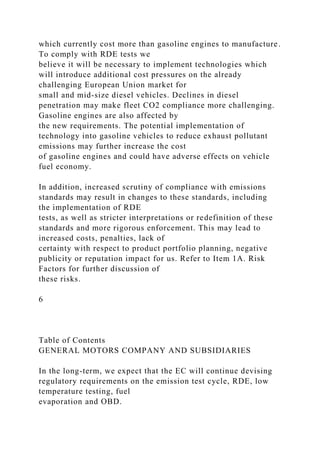
The existing level of European Union exhaust emission
standards for cars and light-duty trucks, Euro 6, was effective in
2014 for new vehicle approvals
and 2015 for new vehicle registrations. Future emission
standards focus particularly on further reducing emissions from
diesel vehicles by introducing new
testing criteria based on “real world driving” emissions (RDE).
RDE tests will become effective in 2017. The new requirements
will require additional
technologies and further increase the cost of diesel engines,
which currently cost more than gasoline engines to manufacture.
To comply with RDE tests we
believe it will be necessary to implement technologies which
will introduce additional cost pressures on the already
challenging European Union market for
small and mid-size diesel vehicles. Declines in diesel
penetration may make fleet CO2 compliance more challenging.
Gasoline engines are also affected by
the new requirements. The potential implementation of
technology into gasoline vehicles to reduce exhaust pollutant
emissions may further increase the cost
of gasoline engines and could have adverse effects on vehicle
fuel economy.
In addition, increased scrutiny of compliance with emissions
standards may result in changes to these standards, including
the implementation of RDE
tests, as well as stricter interpretations or redefinition of these
standards and more rigorous enforcement. This may lead to
increased costs, penalties, lack of
certainty with respect to product portfolio planning, negative
publicity or reputation impact for us. Refer to Item 1A. Risk
Factors for further discussion of
these risks.
6
Table of Contents
GENERAL MOTORS COMPANY AND SUBSIDIARIES
In the long-term, we expect that the EC will continue devising
regulatory requirements on the emission test cycle, RDE, low
temperature testing, fuel
evaporation and OBD.
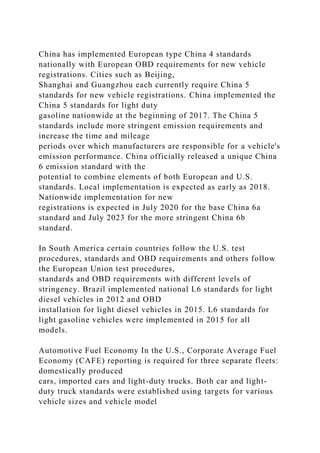
China has implemented European type China 4 standards
nationally with European OBD requirements for new vehicle
registrations. Cities such as Beijing,
Shanghai and Guangzhou each currently require China 5
standards for new vehicle registrations. China implemented the
China 5 standards for light duty
gasoline nationwide at the beginning of 2017. The China 5
standards include more stringent emission requirements and
increase the time and mileage
periods over which manufacturers are responsible for a vehicle's
emission performance. China officially released a unique China
6 emission standard with the
potential to combine elements of both European and U.S.
standards. Local implementation is expected as early as 2018.
Nationwide implementation for new
registrations is expected in July 2020 for the base China 6a
standard and July 2023 for the more stringent China 6b
standard.
In South America certain countries follow the U.S. test
procedures, standards and OBD requirements and others follow
the European Union test procedures,
standards and OBD requirements with different levels of
stringency. Brazil implemented national L6 standards for light
diesel vehicles in 2012 and OBD
installation for light diesel vehicles in 2015. L6 standards for
light gasoline vehicles were implemented in 2015 for all
models.
Automotive Fuel Economy In the U.S., Corporate Average Fuel
Economy (CAFE) reporting is required for three separate fleets:
domestically produced
cars, imported cars and light-duty trucks. Both car and light-
duty truck standards were established using targets for various
vehicle sizes and vehicle model
sales volumes. In 2017 our domestic car standard is estimated to
be 38.1 mpg, our import car standard is estimated to be 41.7
mpg, and our light-duty truck
standard is estimated to be 27.6 mpg. Our current product plan
is expected to be compliant with the federal CAFE program
through the 2017 model year. In
addition to federal CAFE reporting, the EPA requires
compliance with greenhouse gas requirements that are similar to
the CAFE program. Our current product
plan is expected to be compliant with the federal greenhouse
gas program through the 2017 model year. CARB has agreed
that compliance with the federal
program is deemed to be compliant with the California program
for the 2012 through 2017 model years. Although Canada has no
parallel CAFE-style fuel
economy regulations there are Canadian greenhouse gas
regulations that are aligned with the U.S. EPA regulations and
Canadian fleets are expected to be
compliant with these regulations through the 2017 model year.
We regularly evaluate our current and future product plans and
strategies for compliance with
fuel economy and greenhouse gas regulations.
Unlike other jurisdictions, the European Union's climate change
policy framework focuses on fleet average CO2 emissions rather
than fuel economy. The
European Union has implemented legislation regulating fleet
average CO2 emissions in Europe and has adopted an even more
stringent fleet average CO2
target for 2020. Requirements must be met through the
introduction of CO2 reducing technologies on conventional
gasoline and diesel engines or through
ultra-low CO2 vehicles. We are developing a compliance plan
by adopting operational CO2 targets for each market entry in
Europe. The EC will also devise
regulatory requirements on the CO2 emission test cycle as of
2017.
China has both an individual vehicle pass-fail type approval
requirement based on Phase 3 standards and a fleet fuel
consumption requirement based on
Phase 4 standards effective in 2016. The China Phase 4 fleet
fuel consumption standard is based on curb weight with full
compliance to 5.0 L/100 km
required by 2020. China has continued subsidies for plug-in
hybrid, battery electric and fuel cell vehicles. China proposes a
Phase 5 fleet fuel consumption
standard effective beginning in 2021 with full compliance to
4.0L/100km required by 2025.
In Brazil the government has set fuel economy requirements
called Inovar Auto. Original equipment manufacturers have
mandatory fleet average
compliance required by October 2017 resulting in a reduction
from 2012 levels. The Brazilian government provides indirect
tax incentives to eligible
participant companies that meet certain requirements including
these fuel economy targets. The level of potential indirect tax
incentives varies based on the
timing and degree to which the targets are met. Participating
companies that fail to meet the required criteria are subject to
clawback provisions and specific
fines.
Industrial Environmental Control Our operations are subject to
a wide range of environmental protection laws including those
regulating air emissions,
water discharge, waste management and environmental cleanup.
Certain environmental statutes require that responsible parties
fund remediation actions
regardless of fault, legality of original disposal or ownership of
a disposal site. Under certain circumstances these laws impose
joint and several liability as
well as liability for related damages to natural resources.
To mitigate the effects our worldwide operations have on the
environment and reduce greenhouse gas emissions associated
with waste disposal, we are
committed to converting as many of our worldwide operations
as possible to landfill-free operations. At December 31, 2016,
100 (or approximately 60%) of
our manufacturing operations were landfill-free. Additionally
we have 52
7
Table of Contents
GENERAL MOTORS COMPANY AND SUBSIDIARIES
non-manufacturing operations that are landfill-free. At our
landfill-free manufacturing operations approximately 90% of
waste materials are reused or
recycled and approximately 10% are converted to energy at
waste-to-energy facilities. Including construction, demolition
and remediation wastes, we
estimate that we reused, recycled or composted over 2.5 million
metric tons of waste materials at our global manufacturing
operations, converted over
137,000 metric tons of waste materials to energy at waste-to-
energy facilities and avoided approximately 9 million metric
tons of greenhouse gas emissions
in the year ended December 31, 2016.
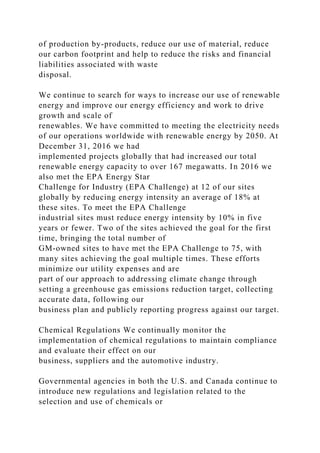
In addition to minimizing our impact on the environment our
landfill-free program and total waste reduction commitments
generate revenue from the sale
of production by-products, reduce our use of material, reduce
our carbon footprint and help to reduce the risks and financial
liabilities associated with waste
disposal.
We continue to search for ways to increase our use of renewable
energy and improve our energy efficiency and work to drive
growth and scale of
renewables. We have committed to meeting the electricity needs
of our operations worldwide with renewable energy by 2050. At
December 31, 2016 we had
implemented projects globally that had increased our total
renewable energy capacity to over 167 megawatts. In 2016 we
also met the EPA Energy Star
Challenge for Industry (EPA Challenge) at 12 of our sites
globally by reducing energy intensity an average of 18% at
these sites. To meet the EPA Challenge
industrial sites must reduce energy intensity by 10% in five
years or fewer. Two of the sites achieved the goal for the first
time, bringing the total number of
GM-owned sites to have met the EPA Challenge to 75, with
many sites achieving the goal multiple times. These efforts
minimize our utility expenses and are
part of our approach to addressing climate change through
setting a greenhouse gas emissions reduction target, collecting
accurate data, following our
business plan and publicly reporting progress against our target.
Chemical Regulations We continually monitor the
implementation of chemical regulations to maintain compliance
and evaluate their effect on our
business, suppliers and the automotive industry.
Governmental agencies in both the U.S. and Canada continue to
introduce new regulations and legislation related to the
selection and use of chemicals or
substances of concern by mandating broad prohibitions, green
chemistry, life cycle analysis and product stewardship
initiatives. These initiatives give broad
regulatory authority to ban or restrict the use of certain
chemical substances and potentially affect automobile
manufacturers' responsibilities for vehicle
components at the end of a vehicle's life, as well as chemical
selection for product development and manufacturing. Chemical
restrictions in Canada are
progressing rapidly as a result of Environment Canada’s
Chemical Management Plan to assess existing substances and
implement risk management controls
on any chemical deemed toxic. In June 2016, the U.S. enacted
the Chemical Safety for the 21st Century Act that grants the
EPA more authority to regulate
and ban chemicals from use in the U.S. and is expected to
increase the level of regulation of chemicals in vehicles. These
emerging regulations will
potentially lead to increases in costs and supply chain
complexity. We believe that we are materially in compliance
with substantially all of these
requirements or expect to be materially in compliance by the
required date.
In 2007 the European Union implemented its regulatory
requirements, the EU REACH regulation among others, to
register, evaluate, authorize and restrict
the use of chemical substances. This regulation requires
chemical substances manufactured in or imported into the
European Union to be registered with the
European Chemicals Agency before 2018. Under this regulation,
“substances of very high concern” may either require
authorization for further use or may be
restricted in the future. This could potentially increase the cost
of certain alternative substances that are used to manufacture
vehicles and parts, or result in a
supply chain disruption when a substance is no longer available
to meet production timelines. Our research and development
initiatives may be used to
address future requirements. We believe that we are materially
in compliance with substantially all of these requirements or
expect to be materially in
compliance by the required date.
There are various regulations in China stipulating the
requirements for chemical management. Among other things,
these regulations catalogue and restrict
the use and the import and export of various chemical
substances. The failure of our joint venture partners or our
suppliers to comply with these regulations
could disrupt production in China or prevent our joint venture
partners from selling the affected products in the China market.
Safety In the U.S. the National Traffic and Motor Vehicle
Safety Act of 1966 prohibits the sale of any new vehicle or
equipment in the U.S. that does not
conform to applicable vehicle safety standards established by
the National Highway Traffic Safety Administration (NHTSA).
If we or NHTSA determine that
either a vehicle or vehicle equipment does not comply with a
safety standard or if a vehicle defect creates an unreasonable
safety risk the manufacturer is
required to notify owners and provide a remedy. We are
required to report certain information relating to certain
customer complaints, warranty claims, field
reports and notices and claims involving property damage,
injuries and fatalities in the U.S. and claims involving fatalities
outside the U.S. We are also
required to report certain information concerning safety recalls
and other safety campaigns outside the U.S.
8
Table of Contents
GENERAL MOTORS COMPANY AND SUBSIDIARIES
Outside the U.S. safety standards and recall regulations often
have the same purpose as the U.S. standards but may differ in
their requirements and test
procedures, adding complexity to regulatory compliance.
Automotive Financing - GM Financial GM Financial is our
global captive automotive finance company and our global
provider of automobile finance
solutions. GM Financial conducts its business in North America,
Europe, South America and through a joint venture in China.
GM Financial provides retail loan and lease lending across the
credit spectrum. Additionally GM Financial offers commercial
products to dealers that
include new and used vehicle inventory financing, inventory
insurance, working capital, capital improvement loans, and
storage center financing.
In North America GM Financial's retail automobile finance
programs include prime and sub-prime lending and full credit
spectrum leasing. The sub-prime
lending program is primarily offered to consumers with FICO
scores less than 620 who have limited access to automobile
financing through banks and credit
unions and is expected to sustain a higher level of credit losses
than prime lending. The leasing product is offered through our
franchised dealers and
primarily targets prime consumers leasing new vehicles. GM
Financial has expanded its leasing, near prime and prime
lending programs through our
franchised dealers, and as a result, leasing and prime lending
have become a larger percentage of originations and the retail
portfolio balance.
Internationally GM Financial’s retail automobile finance
programs focus on prime quality financing through loan and
lease products.
Generally GM Financial seeks to fund its operations in each
country through local sources to minimize currency and country
risk. GM Financial primarily
finances its loan, lease and commercial origination volume
through the use of secured and unsecured credit facilities,
through securitization transactions
where such markets are developed and through the issuance of
unsecured debt in public markets including accepting deposits
from retail banking customers
in Germany.
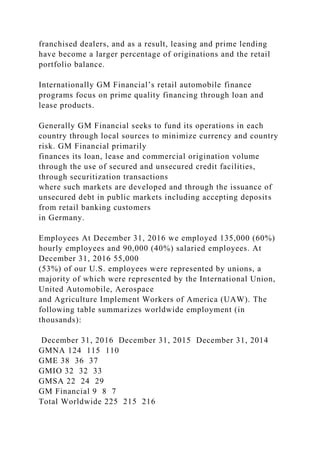
Employees At December 31, 2016 we employed 135,000 (60%)
hourly employees and 90,000 (40%) salaried employees. At
December 31, 2016 55,000
(53%) of our U.S. employees were represented by unions, a
majority of which were represented by the International Union,
United Automobile, Aerospace
and Agriculture Implement Workers of America (UAW). The
following table summarizes worldwide employment (in
thousands):
December 31, 2016 December 31, 2015 December 31, 2014
GMNA 124 115 110
GME 38 36 37
GMIO 32 32 33
GMSA 22 24 29
GM Financial 9 8 7
Total Worldwide 225 215 216
U.S. - Salaried 50 45 40
U.S. - Hourly 55 52 51
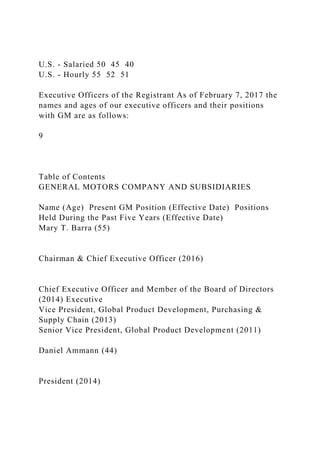
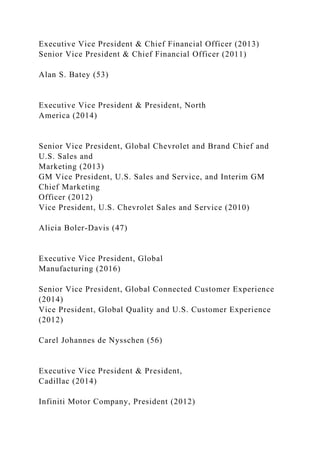
Executive Officers of the Registrant As of February 7, 2017 the
names and ages of our executive officers and their positions
with GM are as follows:
9
Table of Contents
GENERAL MOTORS COMPANY AND SUBSIDIARIES
Name (Age) Present GM Position (Effective Date) Positions
Held During the Past Five Years (Effective Date)
Mary T. Barra (55)
Chairman & Chief Executive Officer (2016)
Chief Executive Officer and Member of the Board of Directors
(2014) Executive
Vice President, Global Product Development, Purchasing &
Supply Chain (2013)
Senior Vice President, Global Product Development (2011)
Daniel Ammann (44)
President (2014)
Executive Vice President & Chief Financial Officer (2013)
Senior Vice President & Chief Financial Officer (2011)
Alan S. Batey (53)
Executive Vice President & President, North
America (2014)
Senior Vice President, Global Chevrolet and Brand Chief and
U.S. Sales and
Marketing (2013)
GM Vice President, U.S. Sales and Service, and Interim GM
Chief Marketing
Officer (2012)
Vice President, U.S. Chevrolet Sales and Service (2010)
Alicia Boler-Davis (47)
Executive Vice President, Global
Manufacturing (2016)
Senior Vice President, Global Connected Customer Experience
(2014)
Vice President, Global Quality and U.S. Customer Experience
(2012)
Carel Johannes de Nysschen (56)
Executive Vice President & President,
Cadillac (2014)
Infiniti Motor Company, President (2012)
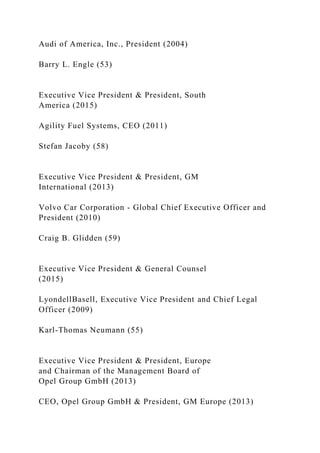
Audi of America, Inc., President (2004)
Barry L. Engle (53)
Executive Vice President & President, South
America (2015)
Agility Fuel Systems, CEO (2011)
Stefan Jacoby (58)
Executive Vice President & President, GM
International (2013)
Volvo Car Corporation - Global Chief Executive Officer and
President (2010)
Craig B. Glidden (59)
Executive Vice President & General Counsel
(2015)
LyondellBasell, Executive Vice President and Chief Legal
Officer (2009)
Karl-Thomas Neumann (55)
Executive Vice President & President, Europe
and Chairman of the Management Board of
Opel Group GmbH (2013)
CEO, Opel Group GmbH & President, GM Europe (2013)
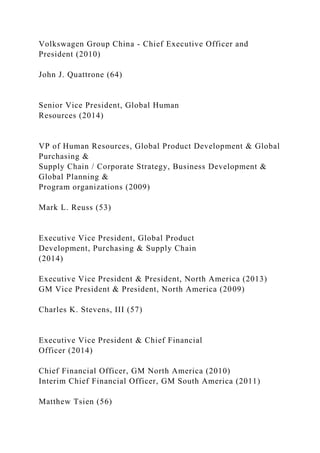
Volkswagen Group China - Chief Executive Officer and
President (2010)
John J. Quattrone (64)
Senior Vice President, Global Human
Resources (2014)
VP of Human Resources, Global Product Development & Global
Purchasing &
Supply Chain / Corporate Strategy, Business Development &
Global Planning &
Program organizations (2009)
Mark L. Reuss (53)
Executive Vice President, Global Product
Development, Purchasing & Supply Chain
(2014)
Executive Vice President & President, North America (2013)
GM Vice President & President, North America (2009)
Charles K. Stevens, III (57)
Executive Vice President & Chief Financial
Officer (2014)
Chief Financial Officer, GM North America (2010)
Interim Chief Financial Officer, GM South America (2011)
Matthew Tsien (56)
Executive Vice President & President, GM
China (2014)
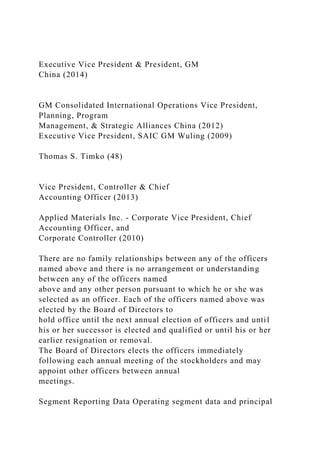
GM Consolidated International Operations Vice President,
Planning, Program
Management, & Strategic Alliances China (2012)
Executive Vice President, SAIC GM Wuling (2009)
Thomas S. Timko (48)
Vice President, Controller & Chief
Accounting Officer (2013)
Applied Materials Inc. - Corporate Vice President, Chief
Accounting Officer, and
Corporate Controller (2010)
There are no family relationships between any of the officers
named above and there is no arrangement or understanding
between any of the officers named
above and any other person pursuant to which he or she was
selected as an officer. Each of the officers named above was
elected by the Board of Directors to
hold office until the next annual election of officers and until
his or her successor is elected and qualified or until his or her
earlier resignation or removal.
The Board of Directors elects the officers immediately
following each annual meeting of the stockholders and may
appoint other officers between annual
meetings.
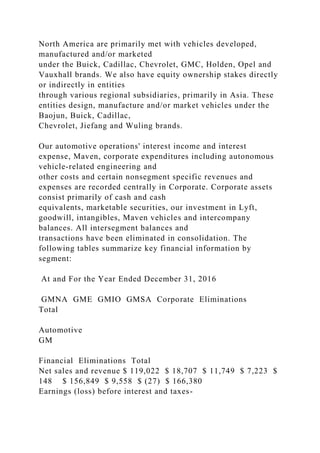
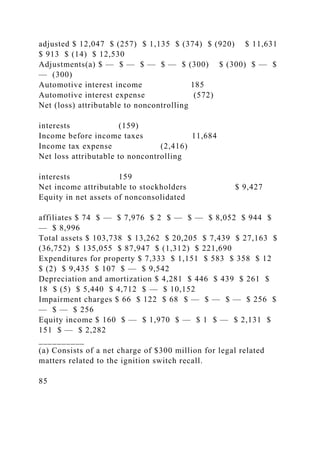
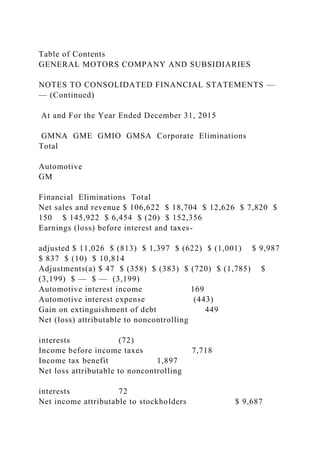
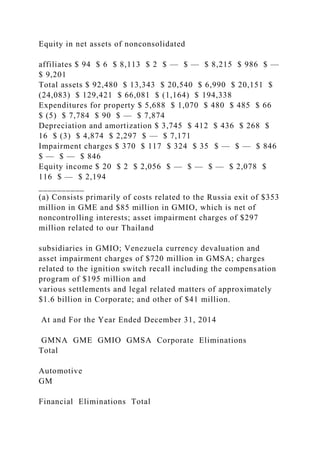
Segment Reporting Data Operating segment data and principal
geographic area data for the years ended December 31, 2016,
2015 and 2014 are summarized
in Note 23 to our consolidated financial statements.
Website Access to Our Reports Our internet website address is
www.gm.com. In addition to the information about us and our
subsidiaries contained in this
2016 Form 10-K information about us can be found on our
website including information on our corporate governance
principles and practices. Our Investor
Relations website at www.gm.com/investors contains a
significant amount of information about us, including financial
and other information for investors.
We encourage investors to visit our website,
10
Table of Contents
GENERAL MOTORS COMPANY AND SUBSIDIARIES
as we frequently update and post new information about our
company on our website and it is possible that this information
could be deemed to be material
information. Our website and information included in or linked
to our website are not part of this 2016 Form 10-K.
Our annual reports on Form 10-K, quarterly reports on Form 10-
Q, current reports on Form 8-K and amendments to those
reports filed or furnished pursuant
to Section 13(a) or 15(d) of the Securities Exchange Act of
1934, as amended (Exchange Act) are available free of charge
through our website as soon as
reasonably practicable after they are electronically filed with or
furnished to the Securities and Exchange Commission (SEC).
The public may read and copy
the materials we file with the SEC at the SEC's Public
Reference Room at 100 F Street, NE, Washington, DC 20549.
The public may obtain information on
the operation of the Public Reference Room by calling the SEC
at 1-800-SEC-0330. Additionally the SEC maintains an internet
site that contains reports,
proxy and information statements and other information. The
address of the SEC's website is www.sec.gov.
* * * * * * *
Item 1A. Risk Factors
We face a number of significant risks and uncertainties in
connection with our operations. Our business and the results of
our operations could be
materially adversely affected by the factors described below.
The risks described below are not the only risks facing our
operations. Risks and uncertainties
not currently known to us or that we currently deem to be
immaterial also could have a material adverse impact on our
business and results of operations.
If we do not deliver new products, services and customer
experiences in response to new participants in the automotive
industry, our business could
suffer. We believe that the automotive industry will experience
significant and continued change in the coming years. In
addition to our traditional
competitors, we must also be responsive to the entrance of non-
traditional participants in the automotive industry. These non-
traditional participants may
seek to disrupt the historic business model of the industry
through the introduction of new technologies, new products or
services, new business models or
new methods of travel. It is strategically significant that we
lead the technological disruption occurring in our industry. As
our business evolves, the pressure
to innovate will encompass a wider range of products and
services, including products and services that may be outside of
our historically core business, such
as autonomous vehicles, car- and ride-sharing and
transportation as a service. If we do not accurately predict,
prepare for and respond to new kinds of
technological innovations, market developments and changing
customer needs, our sales, profitability and long-term
competitiveness may be harmed.
Our ability to maintain profitability is dependent upon our
ability to fund and introduce new and improved vehicle models
that are able to attract a
sufficient number of consumers. We operate in a very
competitive industry with market participants routinely
introducing new and improved vehicle models
designed to meet rapidly evolving consumer expectations.
Producing new and improved vehicle models competitively and
preserving our reputation for
designing, building and selling high quality cars and trucks is
critical to our long-term profitability. We will launch a
substantial number of new vehicles in
2017. Successful launches of our new vehicles are critical to our
short-term profitability. In addition, our growth strategies
require us to make significant
investment in our brands to appeal to new markets.
Our long-term profitability depends upon successfully creating
and funding technological innovations in design, engineering
and manufacturing, which
requires extensive capital investment and the ability to retain
and recruit talent. In some cases the technologies that we plan
to employ are not yet
commercially practical and depend on significant future
technological advances by us and by our suppliers. Although we
will seek to obtain intellectual
property protection for our innovations to protect our
competitive position, it is possible we may not be able to
protect some of these innovations. There can
be no assurance that advances in technology will occur in a
timely or feasible way, or that others will not acquire similar or
superior technologies sooner than
we do or that we will acquire technologies on an exclusive basis
or at a significant price advantage.
It generally takes two years or more to design and develop a
new vehicle, and a number of factors may lengthen that time
period. Because of this product
development cycle and the various elements that may contribute
to consumers’ acceptance of new vehicle designs, including
competitors’ product
introductions, technological innovations, fuel prices, general
economic conditions and changes in styling preferences, an
initial product concept or design
may not result in a vehicle that generates sales in sufficient
quantities and at high enough prices to be profitable. Our high
proportion of fixed costs, both due
to our significant investment in property, plant and equipment
as well as other requirements of our collective bargaining
agreements, which limit our
flexibility to adjust personnel costs to changes in demands for
our products, may further exacerbate the risks associated with
incorrectly assessing demand for
our vehicles.
11
Table of Contents
GENERAL MOTORS COMPANY AND SUBSIDIARIES
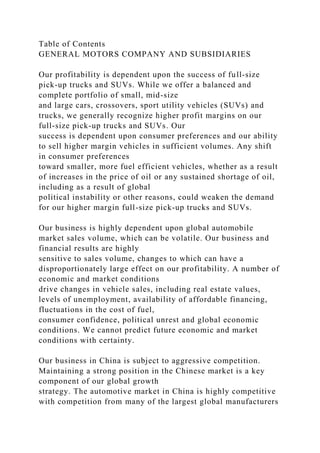
Our profitability is dependent upon the success of full-size
pick-up trucks and SUVs. While we offer a balanced and
complete portfolio of small, mid-size
and large cars, crossovers, sport utility vehicles (SUVs) and
trucks, we generally recognize higher profit margins on our
full-size pick-up trucks and SUVs. Our
success is dependent upon consumer preferences and our ability
to sell higher margin vehicles in sufficient volumes. Any shift
in consumer preferences
toward smaller, more fuel efficient vehicles, whether as a result
of increases in the price of oil or any sustained shortage of oil,
including as a result of global
political instability or other reasons, could weaken the demand
for our higher margin full-size pick-up trucks and SUVs.
Our business is highly dependent upon global automobile
market sales volume, which can be volatile. Our business and
financial results are highly
sensitive to sales volume, changes to which can have a
disproportionately large effect on our profitability. A number of
economic and market conditions
drive changes in vehicle sales, including real estate values,
levels of unemployment, availability of affordable financing,
fluctuations in the cost of fuel,
consumer confidence, political unrest and global economic
conditions. We cannot predict future economic and market
conditions with certainty.
Our business in China is subject to aggressive competition.
Maintaining a strong position in the Chinese market is a key
component of our global growth
strategy. The automotive market in China is highly competitive
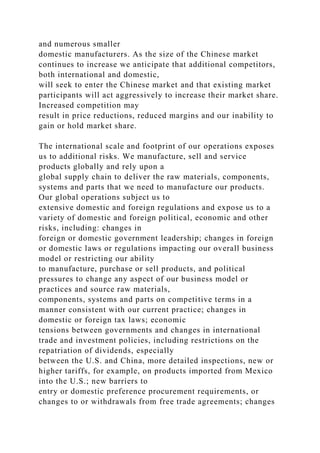
with competition from many of the largest global manufacturers
and numerous smaller
domestic manufacturers. As the size of the Chinese market
continues to increase we anticipate that additional competitors,
both international and domestic,
will seek to enter the Chinese market and that existing market
participants will act aggressively to increase their market share.
Increased competition may
result in price reductions, reduced margins and our inability to
gain or hold market share.
The international scale and footprint of our operations exposes
us to additional risks. We manufacture, sell and service
products globally and rely upon a
global supply chain to deliver the raw materials, components,
systems and parts that we need to manufacture our products.
Our global operations subject us to
extensive domestic and foreign regulations and expose us to a
variety of domestic and foreign political, economic and other
risks, including: changes in
foreign or domestic government leadership; changes in foreign
or domestic laws or regulations impacting our overall business
model or restricting our ability
to manufacture, purchase or sell products, and political
pressures to change any aspect of our business model or
practices and source raw materials,
components, systems and parts on competitive terms in a
manner consistent with our current practice; changes in
domestic or foreign tax laws; economic
tensions between governments and changes in international
trade and investment policies, including restrictions on the
repatriation of dividends, especially
between the U.S. and China, more detailed inspections, new or
higher tariffs, for example, on products imported from Mexico
into the U.S.; new barriers to
entry or domestic preference procurement requirements, or
changes to or withdrawals from free trade agreements; changes
in foreign currency exchange rates
and interest rates; economic downturns in foreign countries or
geographic regions where we have significant operations, such
as China; significant changes
in conditions in the countries in which we operate with the
effect of competition from new market entrants and in the
United Kingdom (U.K.) with passage of
a referendum to discontinue membership in the European Union;
differing local product preferences and product requirements,
including fuel economy,
vehicle emissions and safety; impact of compliance with U.S.
and other foreign countries’ export controls and economic
sanctions; liabilities resulting from
U.S. and foreign laws and regulations, including those related to
the Foreign Corrupt Practices Act and certain other anti-
corruption laws; differing labor
regulations and union relationships; and difficulties in obtaining
financing in foreign countries for local operations.
A significant amount of our operations are conducted by joint
ventures that we cannot operate solely for our benefit. Many of
our operations, primarily in
China, are carried out by joint ventures. In joint ventures we
share ownership and management of a company with one or
more parties who may not have the
same goals, strategies, priorities or resources as we do and may
compete with us outside the joint venture. Joint ventures are
intended to be operated for the
equal benefit of all co-owners, rather than for our exclusive
benefit. Operating a business as a joint venture often requires
additional organizational
formalities as well as time-consuming procedures for sharing
information and making decisions. In joint ventures we are
required to foster our relationships
with our co-owners as well as promote the overall success of the
joint venture, and if a co-owner changes or relationships
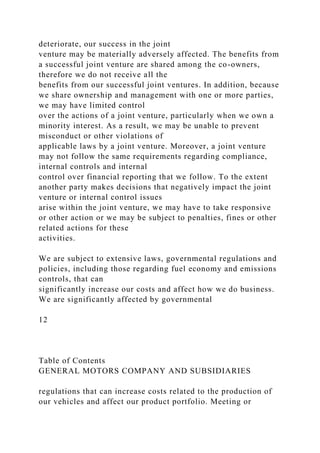
deteriorate, our success in the joint
venture may be materially adversely affected. The benefits from
a successful joint venture are shared among the co-owners,
therefore we do not receive all the
benefits from our successful joint ventures. In addition, because
we share ownership and management with one or more parties,
we may have limited control
over the actions of a joint venture, particularly when we own a
minority interest. As a result, we may be unable to prevent
misconduct or other violations of
applicable laws by a joint venture. Moreover, a joint venture
may not follow the same requirements regarding compliance,
internal controls and internal
control over financial reporting that we follow. To the extent
another party makes decisions that negatively impact the joint
venture or internal control issues
arise within the joint venture, we may have to take responsive
or other action or we may be subject to penalties, fines or other
related actions for these
activities.
We are subject to extensive laws, governmental regulations and
policies, including those regarding fuel economy and emissions
controls, that can
significantly increase our costs and affect how we do business.
We are significantly affected by governmental
12
Table of Contents
GENERAL MOTORS COMPANY AND SUBSIDIARIES
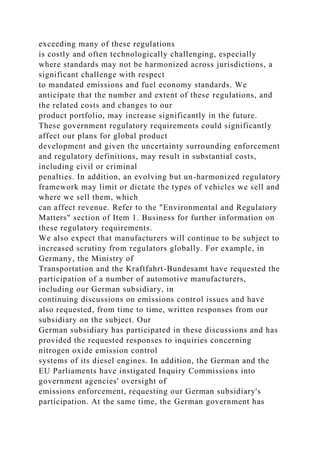
regulations that can increase costs related to the production of
our vehicles and affect our product portfolio. Meeting or
exceeding many of these regulations
is costly and often technologically challenging, especially
where standards may not be harmonized across jurisdictions, a
significant challenge with respect
to mandated emissions and fuel economy standards. We
anticipate that the number and extent of these regulations, and
the related costs and changes to our
product portfolio, may increase significantly in the future.
These government regulatory requirements could significantly
affect our plans for global product
development and given the uncertainty surrounding enforcement
and regulatory definitions, may result in substantial costs,
including civil or criminal
penalties. In addition, an evolving but un-harmonized regulatory
framework may limit or dictate the types of vehicles we sell and
where we sell them, which
can affect revenue. Refer to the "Environmental and Regulatory
Matters" section of Item 1. Business for further information on
these regulatory requirements.
We also expect that manufacturers will continue to be subject to
increased scrutiny from regulators globally. For example, in
Germany, the Ministry of
Transportation and the Kraftfahrt-Bundesamt have requested the
participation of a number of automotive manufacturers,
including our German subsidiary, in
continuing discussions on emissions control issues and have
also requested, from time to time, written responses from our
subsidiary on the subject. Our
German subsidiary has participated in these discussions and has
provided the requested responses to inquiries concerning
nitrogen oxide emission control
systems of its diesel engines. In addition, the German and the
EU Parliaments have instigated Inquiry Commissions into
government agencies' oversight of
emissions enforcement, requesting our German subsidiary's
participation. At the same time, the German government has
initiated further industry-wide
inquiries about CO2 emissions. This scrutiny, regulatory
changes or novel interpretations of current regulations, as well
as increased enforcement has led to
and may result in further increased testing and re-testing of our
vehicles and analysis of their emissions control systems, which
could lead to increased costs,
penalties, negative publicity or reputational impact, and recall
activity if regulators determine that emission levels and
required regulatory compliance
should be based on either a wider spectrum of driving
conditions for future testing parameters or stricter or novel
interpretations and consequent enforcement
of existing requirements. No assurance can be given that the
ultimate outcome of any potential investigations or increased
testing resulting from this scrutiny
would not materially and adversely affect us.
We expect that to comply with fuel economy and emission
control requirements we will be required to sell a significant
volume of hybrid electric vehicles,
as well as develop and implement new technologies for
conventional internal combustion engines, all at increased cost
levels. There is no assurance that we
will be able to produce and sell vehicles that use such
technologies on a profitable basis or that our customers will
purchase such vehicles in the quantities
necessary for us to comply with these regulatory programs.
Alternative compliance measures may not be sufficiently
available in the marketplace to meet
volume driven compliance requirements.
In the current uncertain regulatory framework, environmental
liabilities for which we may be responsible and that are not
reasonably estimable could be
substantial. Alleged violations of safety or emissions standards
could result in legal proceedings, the recall of one or more of
our products, negotiated
remedial actions, fines, restricted product offerings or a
combination of any of those items. Any of these actions could
have substantial adverse effects on our
operations including facility idling, reduced employment,
increased costs and loss of revenue.
We could be materially adversely affected by a negative
outcome in unusual or significant litigation, governmental
investigations or other legal
proceedings. We are subject to legal proceedings involving
various issues, including product liability lawsuits, stockholder
litigation and governmental
investigations, such as the legal proceedings related to the
Ignition Switch Recall. Such legal proceedings could in the
future result in the imposition of
damages, including punitive damages, substantial fines, civil
lawsuits and criminal penalties, interruptions of business,
modification of business practices,
equitable remedies and other sanctions against us or our
personnel as well as significant legal and other costs. For a
further discussion of these matters refer to
Note 15 to our consolidated financial statements.
If, in the discretion of the U.S. Attorney’s Office for the
Southern District of New York (the Office), we do not comply
with the terms of the Deferred
Prosecution Agreement (the DPA), the Office may prosecute us
for charges alleged by the Office including those relating to
faulty ignition switches. On
September 17, 2015 we announced that we entered into the DPA
with the Office regarding its investigation of the events leading
up to certain recalls
announced in February and March of 2014 relating to faulty
ignition switches. Under the DPA, we consented to, among
other things, the filing of a two-count
information (the Information) in the U.S. District Court for the
Southern District of New York charging GM with a scheme to
conceal material facts from a
government regulator and wire fraud. We pled not guilty to the
charges alleged in the Information. The DPA further provides
that, in the event the Office
determines during the period of deferral of prosecution (or any
extensions thereof) that we have violated any provision of the
DPA, including violating any
U.S. federal law or our obligation to cooperate with and assist
the independent monitor, the Office may, in its discretion,
either prosecute us on the charges
alleged in the Information or impose an extension of the period
of deferral of prosecution of up to one additional year. Under
such circumstance, the Office
would be permitted to rely
13
Table of Contents
GENERAL MOTORS COMPANY AND SUBSIDIARIES
upon the admissions we made in the DPA and would benefit
from our waiver of certain procedural and evidentiary defenses.
Such a criminal prosecution
could subject us to penalties.
The costs and effect on our reputation of product safety recalls
could materially adversely affect our business. Government
safety standards require
manufacturers to remedy certain product safety defects through
recall campaigns. Under these standards, we could be subject to
civil or criminal penalties or
may incur various costs, including significant costs for free
repairs. At present, the costs we incur in connection with these
recalls typically include the cost of
the part being replaced and labor to remove and replace the
defective part. We currently source a variety of systems,
components, raw materials and parts,
including but not limited to air bag inflators, from third parties.
From time to time these items may have performance or quality
issues that could harm our
reputation and cause us to incur significant costs. For example,
we are currently conducting recalls for certain Takata
Corporation (Takata) air bag inflators
used in some of our prior model year vehicles. We are
continuing to assess the situation. Further recalls, if any, that
may be required to remediate Takata air
bag inflators in our vehicles could have a material impact on
our business. In addition, product recalls can harm our
reputation and cause us to lose
customers, particularly if those recalls cause consumers to
question the safety or reliability of our products. Conversely not
issuing a recall or not issuing a
recall on a timely basis can harm our reputation, potentially
expose us to significant monetary penalties, and cause us to lose
customers for the same reasons
as expressed above.
Any disruption in our suppliers' operations could disrupt our
production schedule. Our automotive operations are dependent
upon the continued ability
of our suppliers to deliver the systems, components, raw
materials and parts that we need to manufacture our products.
Our use of “just-in-time”
manufacturing processes allows us to maintain minimal
inventory quantities of systems, components, raw materials and
parts. As a result our ability to
maintain production is dependent upon our suppliers delivering
sufficient quantities of systems, components, raw materials and
parts on time to meet our
production schedules. In some instances we purchase systems,
components, raw materials and parts from a single source and
may be at an increased risk for
supply disruptions. Financial difficulties or solvency problems
with our suppliers, including Takata, which may be exacerbated
by the cost of remediating
quality issues with these items, could lead to uncertainty in our
supply chain or cause supply disruptions for us which could, in
turn, disrupt our operations,
including production of certain of our higher margin vehicles.
Where we experience supply disruptions, we may not be able to
develop alternate sourcing
quickly. Any disruption of our production schedule caused by
an unexpected shortage of systems, components, raw materials
or parts even for a relatively
short period of time could cause us to alter production
schedules or suspend production entirely.
We are dependent on our manufacturing facilities around the
world. We assemble vehicles at various facilities around the
world. These facilities are
typically designed to produce particular models for particular
geographic markets. No single facility is designed to
manufacture our full range of vehicles. In
some cases certain facilities produce products that
disproportionately contribute a greater degree to our
profitability than others. Should these or other
facilities become unavailable either temporarily or permanently
for any number of reasons, including labor disruptions, the
inability to manufacture vehicles
there may result in harm to our reputation, increased costs,
lower revenues and the loss of customers. We may not be able
to easily shift production of vehicles
at an inoperable facility to other facilities or to make up for lost
production. Any new facility needed to replace an inoperable
manufacturing facility would
need to comply with the necessary regulatory requirements,
need to satisfy our specialized manufacturing requirements and
require specialized
equipment. Even though we carry business interruption
insurance policies, we may suffer losses as a result of business
interruptions that exceed the coverage
available or any losses which may be excluded under our
insurance policies.
We operate in a highly competitive industry that has excess
manufacturing capacity and attempts by our competitors to sell
more vehicles could have a
significant negative effect on our vehicle pricing, market share
and operating results. The global automotive industry is highly
competitive and overall
manufacturing capacity in the industry exceeds demand. Many
manufacturers have relatively high fixed labor costs as well as
significant limitations on their
ability to close facilities and reduce fixed costs. Our
competitors may respond to these relatively high fixed costs by
providing subsidized financing or
leasing programs, offering marketing incentives or reducing
vehicle prices. Our competitors may also seek to benefit from
economies of scale by
consolidating or entering into other strategic agreements such as
alliances intended to enhance their competitiveness.
Domestic manufacturers in lower cost countries, such as China
and India, have become competitors in key emerging markets
and announced their intention
to export their products to established markets as a low cost
alternative to established entry-level automobiles. In addition,
foreign governments may decide
to implement tax and other policies that favor their domestic
manufacturers at the expense of international manufacturers,
including GM and its joint venture
partners. These actions have had, and are expected to continue
to have, a significant negative effect on our vehicle pricing,
market share and operating
results, and present a significant risk to our ability to enhance
our revenue per vehicle.
14
Table of Contents
GENERAL MOTORS COMPANY AND SUBSIDIARIES
We may continue to restructure or divest our operations in
various countries, but we may not succeed in doing so. We face
difficult market and operating
conditions in certain parts of the world that may require us to
restructure or rationalize these operations, which may result in
impairments. In many countries
across our regions we have experienced challenges in our
operations and continue to strategically assess the manner in
which we operate in certain countries.
As we continue to assess our performance throughout our
regions, additional restructuring and rationalization actions may
be required and may be material.
Our future competitiveness and ability to achieve long-term
profitability depends on our ability to control our costs, which
requires us to successfully
implement operating effectiveness initiatives throughout our
automotive operations. We are continuing to implement a
number of operating effectiveness
initiatives to improve productivity and reduce costs. Our future
competitiveness depends upon our continued success in
implementing these initiatives
throughout our automotive operations. While some of the
elements of cost reduction are within our control, others, such
as interest rates or return on
investments, which influence our expense for pensions, depend
more on external factors, and there can be no assurance that
such external factors will not
materially adversely affect our ability to reduce our costs.
Reducing costs may prove difficult due to our focus on
increasing advertising and our belief that
engineering and other expenses necessary to improve the
performance, safety and customer satisfaction of our vehicles
and to continue to innovate our
technology and product offerings to meet changing customer
needs and market developments are likely to increase.
Security breaches and other disruptions to our vehicles,
information technology networks and systems could interfere
with the safety of our customers or
our operations and could compromise the confidentiality of
private customer data or our proprietary information. We rely
upon information technology
networks and systems, including in-vehicle systems and mobile
devices, some of which are managed by third-parties, to
process, transmit and store electronic
information, and to manage or support a variety of vehicle or
business processes and activities. Additionally we collect and
store sensitive data, including
intellectual property, proprietary business information,
proprietary business information of our dealers and suppliers, as
well as personally identifiable
information of our customers and employees, in data centers and
on information technology networks. The secure operation of
these information technology
networks and in-vehicle systems, and the processing and
maintenance of this information, is critical to our business
operations and strategy. Despite security
measures and business continuity plans, our information
technology networks and systems and in-vehicle systems may be
vulnerable to damage, disruptions
or shutdowns due to attacks by hackers or breaches due to errors
or malfeasance by employees, contractors and others who have
access to our networks and
systems or computer viruses. The occurrence of any of these
events could compromise our networks and the information
stored there could be accessed,
publicly disclosed, lost or stolen. These occurrences could also
impact vehicle safety. We have been the target of these types of
attacks in the past and future
attacks are likely to occur. If successful, these types of attacks
on our network or systems, including in-vehicle systems and
mobile devices, or service failures
could result in, among other things, the loss of proprietary data,
interruptions or delays in our business operations and damage to
our reputation. In addition,
any such access, disruption, technological failures, disclosure or
other loss of information could result in legal claims or
proceedings, liability or regulatory
penalties under laws protecting the privacy of personal
information, disrupt operations and reduce the competitive
advantage we hope to derive from our
investment in advanced technologies.
We rely on GM Financial to provide financial services to our
dealers and customers in a majority of the markets in which we
sell vehicles. GM Financial
faces a number of business, economic and financial risks that
could impair its access to capital and negatively affect its
business and operations and its
ability to provide leasing and financing to retail consumers and
commercial lending to our dealers to support additional sales of
our vehicles. We rely on
GM Financial in North America, Europe, South America and
China to support leasing and sales of our vehicles to consumers
requiring vehicle financing and
also to provide commercial lending to our dealers. Any
reduction in GM Financial's ability to provide such financial
services would negatively affect our
efforts to support additional sales of our vehicles and expand
our market penetration among consumers and dealers.
As an entity operating in the financial services sector, GM
Financial is required to comply with a wide variety of laws and
regulations that may be costly to
adhere to and may affect our consolidated operating results.
Compliance with these laws and regulations requires that GM
Financial maintain forms,
processes, procedures, controls and the infrastructure to support
these requirements and these laws and regulations often create
operational constraints both
on GM Financial’s ability to implement servicing procedures
and on pricing. Laws in the financial services industry are
designed primarily for the protection
of consumers. The failure to comply with these laws could
result in significant statutory civil and criminal penalties,
monetary damages, attorneys’ fees and
costs, possible revocation of licenses and damage to reputation,
brand and valued customer relationships.
The primary factors that could adversely affect GM Financial's
business and operations and reduce its ability to provide
financing services at competitive
rates include the availability of borrowings under its credit
facilities to fund its retail and commercial finance activities; its
ability to access a variety of
financing sources including the asset-backed securities market
and other secured
15
Table of Contents
GENERAL MOTORS COMPANY AND SUBSIDIARIES
and unsecured debt markets; the performance of loans and
leases in its portfolio, which could be materially affected by
delinquencies, defaults or
prepayments; wholesale auction values of used vehicles; higher
than expected vehicle return rates and the residual value
performance on vehicles GM
Financial leases to customers; fluctuations in interest rates and
currencies; and changes to regulation, supervision and licensing
across various jurisdictions,
including new regulations or sanctions imposed in the U.S. by
the Department of Justice, SEC and Consumer Financial
Protection Bureau.
Our defined benefit pension plans are currently underfunded and
our pension funding requirements could increase significantly
due to a reduction in
funded status as a result of a variety of factors, including weak
performance of financial markets, declining interest rates,
changes in laws or regulations,
changes in assumptions or investments that do not achieve
adequate returns. Our employee benefit plans currently hold a
significant amount of equity and
fixed income securities. A detailed description of the
investment funds and strategies is disclosed in Note 14 to our
consolidated financial statements, which
also describes significant concentrations of risk to the plan
investments.
There are additional risks due to the complexity and magnitude
of our investments. Examples include implementation of
significant changes in investment
policy, insufficient market liquidity in particular asset classes
and the inability to quickly rebalance illiquid and long-term
investments.
Our future funding requirements for our U.S. defined benefit
pension plans depend upon the future performance of assets
placed in trusts for these plans, the
level of interest rates used to determine funding levels, the level
of benefits provided for by the plans and any changes in
government laws and regulations.
Future funding requirements generally increase if the discount
rate decreases or if actual asset returns are lower than expected
asset returns, assuming other
factors are held constant. Our potential funding requirements
are described in Note 14 to our consolidated financial
statements.
Factors which affect future funding requirements for our U.S.
defined benefit plans generally affect the required funding for
non-U.S. plans. Certain plans
outside the U.S. do not have assets and therefore the obligation
is funded as benefits are paid. If local legal authorities increase
the minimum funding
requirements for our non-U.S. plans, we could be required to
contribute more funds.
* * * * * * *
Item 1B. Unresolved Staff Comments
None
* * * * * * *
Item 2. Properties
At December 31, 2016 we had over 100 locations in the U.S.,
excluding our automotive financing operations and dealerships,
which are primarily for
manufacturing, assembly, distribution, warehousing,
engineering and testing. Leased properties are primarily
composed of warehouses and administration,
engineering and sales offices.
We have manufacturing, assembly, distribution, office or
warehousing operations in 61 countries, including equity
interests in associated companies which
perform manufacturing, assembly, or distribution operations.
The major facilities outside the U.S., which are principally
vehicle manufacturing and assembly
operations, are located in Argentina, Australia, Brazil, Canada,
China, Colombia, Ecuador, Egypt, Germany, Kenya, Mexico,
Poland, South Africa, South
Korea, Spain, Thailand and the U.K.
GM Financial leases facilities for administration and regional
credit centers. GM Financial has 50 facilities, of which 25 are
located in the U.S. The major
facilities outside the U.S. are located in Brazil, Canada, China,
Germany, Mexico and the U.K.
We, our subsidiaries, or associated companies in which we own
an equity interest, own most of the above facilities.
* * * * * * *
Item 3. Legal Proceedings
16
Table of Contents
GENERAL MOTORS COMPANY AND SUBSIDIARIES
Refer to the discussion in the Litigation-Related Liability and
Tax Administrative Matters section in Note 15 to our
consolidated financial statements for
information relating to legal proceedings.
* * * * * * *
Item 4. Mine Safety Disclosures
Not applicable
* * * * * * *
PART II
Item 5. Market for Registrant’s Common Equity, Related
Stockholder Matters and Issuer Purchases of Equity Securities
Market Information Shares of our common stock have been
publicly traded since November 18, 2010 when our common
stock was listed and began trading
on the New York Stock Exchange and the Toronto Stock
Exchange. The following table summarizes the quarterly price
ranges of our common stock based on
high and low prices from intraday trades on the New York Stock
Exchange, the principal market on which the stock is traded:
Years Ended December 31,
2016 2015
High Low High Low
First quarter $ 33.54 $ 26.69 $ 38.99 $ 32.36
Second quarter $ 33.41 $ 27.34 $ 37.45 $ 33.06
Third quarter $ 32.87 $ 27.52 $ 33.61 $ 24.62
Fourth quarter $ 37.74 $ 30.21 $ 36.88 $ 29.98
Holders At January 31, 2017 we had 1.5 billion issued and
outstanding shares of common stock held by 591 holders of
record.
Dividends Our Board of Directors began declaring quarterly
dividends on our common stock in the three months ended
March 31, 2014. It is anticipated that
dividends on our common stock will continue to be declared and
paid quarterly. However the declaration of any dividend on our
common stock is a matter to
be acted upon by our Board of Directors in its sole discretion.
Any dividend will be paid out of funds legally available for that
purpose. Our payment of
dividends in the future will depend on business conditions, our
financial condition, earnings, liquidity and capital requirements
and other factors. Refer to
Item 6. Selected Financial Data for cash dividends declared on
our common stock for the years ended December 31, 2016, 2015
and 2014.
Purchases of Equity Securities The following table summarizes
our purchases of common stock in the three months ended
December 31, 2016:
Total Number of
Shares
Purchased(a)
Average
Price Paid
per Share
Total Number of
Shares Purchased
Under Announced
Programs(b)
Approximate Dollar Value of
Shares That May Yet be
Purchased Under Announced
Programs
October 1, 2016 through October 31, 2016 41,719 $ 32.06 —
$4.0 billion
November 1, 2016 through November 30, 2016 18,532,366 $
32.92 17,906,695 $3.4 billion
December 1, 2016 through December 31, 2016 11,537,206 $
36.25 11,311,477 $3.0 billion
Total 30,111,291 $ 34.19 29,218,172
__________
(a) Shares purchased consist of: (1) shares purchased under our
previously announced common stock repurchase program; (2)
shares retained by us for the payment of the
exercise price upon the exercise of warrants; and (3) shares
delivered by employees or directors to us for the payment of
taxes resulting from issuance of common stock upon
the vesting of Restricted Stock Units (RSUs) and Restricted
Stock Awards (RSAs) relating to compensation plans. Refer to
Note 21 to our consolidated financial statements
for additional details on employee stock incentive plans and
Note 19 to our consolidated financial statements for additional
details on warrants issued.
(b) In January 2016 our Board of Directors authorized the
purchase of up to an additional $4 billion of our common stock
under our previously announced common stock
repurchase program before the end of 2017. In January 2017 we
announced that our Board of Directors had authorized the
purchase of up to an additional $5 billion of our
common stock with no expiration date.
17
Table of Contents
GENERAL MOTORS COMPANY AND SUBSIDIARIES
* * * * * * *
Item 6. Selected Financial Data
At and for the Years Ended December 31,
2016 2015 2014 2013 2012
Income Statement Data:
Total net sales and revenue $ 166,380 $ 152,356 $ 155,929 $
155,427 $ 152,256
Net income(a) $ 9,268 $ 9,615 $ 4,018 $ 5,331 $ 6,136
Net income attributable to stockholders $ 9,427 $ 9,687 $
3,949 $ 5,346 $ 6,188
Net income attributable to common stockholders(b) $ 9,427 $
9,687 $ 2,804 $ 3,770 $ 4,859
Basic earnings per common share(a)(b) $ 6.12 $ 6.11 $ 1.75 $
2.71 $ 3.10
Diluted earnings per common share(a)(b) $ 6.00 $ 5.91 $ 1.65
$ 2.38 $ 2.92
Dividends declared per common share $ 1.52 $ 1.38 $ 1.20 $
— $ —
Balance Sheet Data:
Total assets(c) $ 221,690 $ 194,338 $ 177,311 $ 166,231 $
149,422
Automotive notes and loans payable $ 10,752 $ 8,765 $ 9,350
$ 7,098 $ 5,172
GM Financial notes and loans payable(c) $ 73,876 $ 54,346 $
37,315 $ 28,972 $ 10,878
Total equity $ 44,075 $ 40,323 $ 36,024 $ 43,174 $ 37,000
_________
(a) In the year ended December 31, 2015 we recorded the
reversal of deferred tax asset valuation allowances of $3.9
billion in GME and recorded charges related to the Ignition
Switch Recall for various legal matters of approximately $1.6
billion. In the year ended December 31, 2014 we recorded
charges of approximately $2.9 billion in Automotive
cost of sales related to recall campaigns and courtesy
transportation, a catch-up adjustment of $0.9 billion related to
the change in estimate for recall campaigns and a charge of
$0.4 billion related to the Ignition Switch Recall compensation
program. In the year ended December 31, 2012 we recorded
Goodwill impairment charges of $27.1 billion, the
reversal of deferred tax asset valuation allowances of $36.3
billion in the U.S. and Canada, pension settlement charges of
$2.7 billion and GME long-lived asset impairment
charges of $5.5 billion.
(b) In December 2014 we redeemed all of the remaining shares
of our Series A Preferred Stock for $3.9 billion, which reduced
Net income attributable to common stockholders
by $0.8 billion. In September 2013 we purchased 120 million
shares of our Series A Preferred Stock held by the UAW Retiree
Medical Benefits Trust (New VEBA) for $3.2
billion, which reduced Net income attributable to common
stockholders by $0.8 billion.
(c) In the year ended December 31, 2013 GM Financial acquired
Ally Financial Inc.'s international operations in Europe and
Latin America.
* * * * * * *
Item 7. Management’s Discussion and Analysis of Financial
Condition and Results of Operations
This Management's Discussion and Analysis of Financial
Condition and Results of Operations (MD&A) should be read in
conjunction with the
accompanying audited consolidated financial statements and
notes. Forward-looking statements in this MD&A are not
guarantees of future performance and
may involve risks and uncertainties that could cause actual
results to differ materially from those projected. Refer to the
"Forward-Looking Statements"
section of this MD&A and Item 1A. "Risk Factors" for a
discussion of these risks and uncertainties.
18
Table of Contents
GENERAL MOTORS COMPANY AND SUBSIDIARIES
Non-GAAP Measures Our non-GAAP measures include earnings
before interest and taxes (EBIT)-adjusted presented net of
noncontrolling interests, EPS-
diluted-adjusted, return on invested capital-adjusted (ROIC-
adjusted) and adjusted automotive free cash flow. Our
calculation of these non-GAAP measures
may not be comparable to similarly titled measures of other
companies due to potential differences between companies in
the method of calculation. As a
result, the use of these non-GAAP measures has limitations and
should not be considered superior to, in isolation from, or as a
substitute for, related U.S.
GAAP measures.
These non-GAAP measures allow management and investors to
view operating trends, perform analytical comparisons and
benchmark performance
between periods and among geographic regions to understand
operating performance without regard to items we do not
consider a component of our core
operating performance. Furthermore, these non-GAAP measures
allow investors the opportunity to measure and monitor our
performance against our
externally communicated targets and evaluate the investment
decisions being made by management to improve ROIC-
adjusted. Management uses these
measures in its financial, investment and operational decision-
making processes, for internal reporting and as part of its
forecasting and budgeting processes.
Further, our Board of Directors uses these and other measures
as key metrics to determine management performance under our
performance-based
compensation plans. For these reasons we believe these non-
GAAP measures are useful for our investors.
EBIT-adjusted is used by management and can be used by
investors to review our consolidated operating results because it
excludes automotive interest
income, automotive interest expense and income taxes as well
as certain additional adjustments that are not considered part of
our core operations. Examples
of adjustments to EBIT include but are not limited to
impairment charges related to goodwill; impairment charges on
long-lived assets and other exit costs
resulting from strategic shifts in our operations or discrete
market and business conditions; costs arising from the ignition
switch recall and related legal
matters; and certain currency devaluations associated with
hyperinflationary economies. For EBIT-adjusted and our other
non-GAAP measures, once we have
made an adjustment in the current period for an item, we will
also adjust the related non-GAAP measure in any future periods
in which there is an impact from
the item.
EPS-diluted-adjusted is used by management and can be used by
investors to review our consolidated diluted earnings per share
results on a consistent
basis. EPS-diluted-adjusted is calculated as net income
attributable to common stockholders-diluted less certain
adjustments noted above for EBIT-adjusted
and gains or losses on the extinguishment of debt obligations on
an after-tax basis as well as redemptions of preferred stock and
certain income tax
adjustments divided by weighted-average common shares
outstanding-diluted. Examples of income tax adjustments
include the establishment or reversal of
significant deferred tax asset valuation allowances.
ROIC-adjusted is used by management and can be used by
investors to review our investment and capital allocation
decisions. We define ROIC-adjusted
as EBIT-adjusted for the trailing four quarters divided by
average net assets, which is considered to be the average equity
balances adjusted for average
automotive debt and interest liabilities, exclusive of capital
leases; average automotive net pension and other postretirement
benefits (OPEB) liabilities; and
average automotive net income tax assets during the same
period.
Adjusted automotive free cash flow is used by management and
can be used by investors to review the liquidity of our
automotive operations and to
measure and monitor our performance against our capital
allocation program and evaluate our automotive liquidity
against the substantial cash requirements
of our automotive operations. We measure adjusted automotive
free cash flow as automotive cash flow from operations less
capital expenditures adjusted for
management actions, primarily related to strengthening our
balance sheet, such as prepayments of debt and discretionary
contributions to employee benefit
plans. Refer to the “Liquidity and Capital Resources” section of
this MD&A for our reconciliation of Net Automotive cash
provided by (used in) operating
activities under U.S. GAAP to this non-GAAP measure.
The following table reconciles Net income attributable to
stockholders under U.S. GAAP to EBIT-adjusted used in the
calculation of ROIC-adjusted:
19
Table of Contents
GENERAL MOTORS COMPANY AND SUBSIDIARIES
Years Ended December 31,
2016 2015 2014
Net income attributable to stockholders $ 9,427 $ 9,687 $
3,949
Income tax expense (benefit) 2,416 (1,897) 228
Gain on extinguishment of debt — (449) (202)
Automotive interest expense 572 443 403
Automotive interest income (185) (169) (211)
Adjustments
Ignition switch recall and related legal matters(a) 300 1,785
400
Recall campaign catch-up adjustment(b) — — 874
Thailand asset impairments(c) — 297 158
Venezuela currency devaluation and asset impairment(d) —
720 419
Russia exit costs and asset impairment(e) — 438 245
Goodwill impairment — — 120
Other — (41) 111
Total adjustments 300 3,199 2,327
EBIT-adjusted $ 12,530 $ 10,814 $ 6,494
________
(a) These adjustments were excluded because of the unique
events associated with the ignition switch recall. These events
included the creation of the ignition switch recall
compensation program, as well as various investigations,
inquiries, and complaints from various constituents.
(b) This adjustment was excluded because it resulted from our
decision to change the method we use to estimate costs
associated with recall campaigns in GMNA.
(c) These adjustments were excluded because of the significant
restructuring of our Thailand operations and the strategic
actions taken to focus on the production of pick-up trucks
and SUVs.
(d) This adjustment was excluded because of the devaluation of
the Venezuela Bolivar Fuerte (BsF), our inability to transact at
the Complementary System of Foreign Currency
Administration (SICAD) rate to obtain U.S. Dollars and the
market restrictions imposed by the Venezuelan government.
(e) These adjustments were excluded because they were driven
by deteriorating market conditions in Russia, which led to asset
impairments in 2014 and our decision to exit the
Russia market in 2015. The Russia exit costs primarily
consisted of sales incentives, dealer restructuring and other
contract cancellation costs, and asset impairments.
The following table reconciles diluted earnings per common
share under U.S. GAAP to EPS-diluted-adjusted:
Years Ended December 31,
2016 2015 2014
Amount Per Share Amount Per Share Amount Per Share
Diluted earnings per common share $ 9,427 $ 6.00 $ 9,686 $
5.91 $ 2,786 $ 1.65
Adjustments
Gain on extinguishment of debt — — (449) (0.27) (202)
(0.12)
Redemption and purchase of Series A preferred stock — — —
— 794 0.47
All other adjustments(a) 300 0.19 3,199 1.95 2,327 1.38
Total adjustments 300 0.19 2,750 1.68 2,919 1.73
Tax effect on adjustments(b) (114) (0.07) (201) (0.13) (561)
(0.33)
Tax adjustments(c) — — (4,001) (2.44) — —
EPS-diluted-adjusted $ 9,613 $ 6.12 $ 8,234 $ 5.02 $ 5,144 $
3.05
________
(a) Refer to the reconciliation of Net income attributable to
stockholders under U.S. GAAP to EBIT-adjusted within this
section of MD&A for the details of each individual
adjustment.
(b) The tax effect of each adjustment is determined based on the
tax laws and valuation allowance status of the jurisdiction in
which the adjustment relates.
20
Table of Contents
GENERAL MOTORS COMPANY AND SUBSIDIARIES
(c) These adjustments primarily consist of the tax benefit
related to the valuation allowance reversal in Europe. The
adjustment was excluded because valuation allowance reversals
are not considered part of our core operations.
We define return on equity (ROE) as Net income attributable to
stockholders for the trailing four quarters divided by average
equity for the same period.
Management uses average equity to provide comparable
amounts in the calculation of ROE. The following table
summarizes the calculation of ROE (dollars
in billions):
Years Ended December 31,
2016 2015 2014
Net income attributable to stockholders $ 9.4 $ 9.7 $ 3.9
Average equity $ 43.6 $ 37.0 $ 41.3
ROE 21.6% 26.2% 9.6%
The following table summarizes the calculation of ROIC-
adjusted (dollars in billions):
Years Ended December 31,
2016 2015 2014
EBIT-adjusted(a) $ 12.5 $ 10.8 $ 6.5
Average equity $ 43.6 $ 37.0 $ 41.3
Add: Average automotive debt and interest liabilities (excluding
capital leases) 10.0 8.1 6.8
Add: Average automotive net pension & OPEB liability 24.5
28.3 26.5
Less: Average automotive net income tax asset (34.8) (33.6)
(32.4)
ROIC-adjusted average net assets $ 43.3 $ 39.8 $ 42.2
ROIC-adjusted 28.9% 27.2% 15.4%
________
(a) Refer to the reconciliation of Net income attributable to
stockholders under U.S. GAAP to EBIT-adjusted within this
section of MD&A.
Overview Our strategic plan includes several major initiatives
that we anticipate will help us achieve our goal of 9% to 10%
margins on an EBIT-adjusted
basis (EBIT-adjusted margins, calculated as EBIT-adjusted
divided by Net sales and revenue) by early next decade: earn
customers for life by delivering great
products to our customers, leading the industry in quality and
safety and improving the customer ownership experience; lead
in technology and innovation,
including OnStar 4G LTE and connected car, alternative
propulsion, urban mobility including ride- and car-sharing
through Maven and our investment in
Lyft, active safety features and autonomous vehicles; grow our
brands, particularly the Cadillac brand in the U.S. and China
and the Chevrolet brand
globally; continue our growth in China; continue the growth of
GM Financial into our full captive automotive financing
company; and deliver core
operating efficiencies.
In addition to our EBIT-adjusted margin improvement goal, our
overall financial targets include expected total annual
operational and functional cost
savings of $6.5 billion through 2018 compared to 2014 costs, of
which approximately $4 billion has been realized as of
December 31, 2016, and which we
expect will more than offset our incremental investments in
brand building, engineering and technology as we launch new
products in 2017 and beyond; and
execution of our capital allocation program as described in the
"Liquidity and Capital Resources" section of this MD&A.
For the year ending December 31, 2017 we expect to continue to
generate strong consolidated financial results including
improved total net sales and
revenue, EBIT-adjusted and EBIT-adjusted margins that equal
or exceed the corresponding amounts in 2016, ROIC-adjusted of
greater than 25%,
Automotive operating cash flow of approximately $15 billion,
adjusted automotive free cash flow of approximately $6 billion
and EPS-diluted and EPS-
diluted-adjusted of between $6.00 and $6.50. We do not
consider the potential future impact of adjustments on our
expected financial results. We expect
these financial results in part to be driven by favorable shifts in
mix for our new or refreshed product launches, including
crossovers.
The following table reconciles expected automotive net cash
provided by operating activities under U.S. GAAP to expected
adjusted automotive free cash
flow (dollars in billions):
21
Table of Contents
GENERAL MOTORS COMPANY AND SUBSIDIARIES
Year Ending December 31,
2017
Automotive net cash provided by operating activities $ 15
Less: expected capital expenditures (9)
Adjusted automotive free cash flow $ 6
We face continuing challenges from a market, operating and
regulatory standpoint in a number of countries across the globe
due to, among other factors,
weak economic conditions, competitive pressures, our product
portfolio offerings, emissions standards, foreign exchange
volatility and political uncertainty.
As a result of these conditions, we continue to strategically
assess our performance and ability to achieve acceptable returns
on our invested capital. As we
continue to assess our performance, additional restructuring and
rationalization actions may be required or a determination may
be made that the carrying
amount of our long-lived assets may not be recoverable in
certain of these countries. Such a determination may give rise to
future asset impairments or other
charges which may have a material impact on our results of
operations.
GMNA In the year ended December 31, 2016 industry sales to
retail and fleet customers were 21.9 million units representing a
1.7% increase compared to
the corresponding period in 2015 due to strong consumer
demand driven by credit availability, low interest rates and low
fuel prices.
In the year ended December 31, 2016 our vehicle sales in the
U.S., our largest market in North America, totaled 3.0 million
units for market share of 17.0%,
representing a decrease of 0.3 percentage points compared to
the corresponding period in 2015. The decrease in our U.S.
market share was driven primarily by
lower fleet market share due to a planned reduction in rental
deliveries, partially offset by higher retail market share. U.S.
retail sales, generally more
profitable than fleet sales, generated an increase of 0.5
percentage points in market share, primarily driven by
Chevrolet.
We achieved EBIT-adjusted margins of 10.1% during 2016 on
continued strength of U.S. industry light vehicle sales, new
product launches and material
and other cost savings, which partially offset launch related
costs. Based on our current cost structure, we continue to
estimate GMNA’s breakeven point at
the U.S. industry level to be in the range of 10.0 - 11.0 million
units. We expect to sustain an EBIT-adjusted margin of 10% in
2017 on continued strength of
U.S. industry light vehicle sales, key product launches and
continued focus on overall cost savings.
GM E As a result of moderate economic growth across Europe
(excluding Russia) automotive industry sales to retail and fleet
customers continued
improving in the year ended December 31, 2016 with industry
sales to retail and fleet customers of 18.8 million units
representing a 6.1% increase compared
to the corresponding period in 2015.
Our European operations are benefiting from this trend and
vehicle sales continue to show signs of improvement
underscored by further improvement in
our Opel and Vauxhall retail vehicle sales of 1.2 million units
for market share of 5.7% in the year ended December 31, 2016
consistent with the
corresponding period in 2015. We continue to implement
various strategic actions to strengthen our operations and
increase our competitiveness.
Despite the improvements we experienced through most of 2016
we were unable to overcome the impacts of the U.K. referendum
vote to leave the
European Union (Brexit) resulting in a $0.3 billion unfavorable
impact due primarily to adverse movement in the British Pound
against the U.S. Dollar.
We anticipate the impacts of Brexit to continue through 2017.
We also anticipate headwinds associated with industry pricing
pressures and increased costs
associated with depreciation, amortization, marketing and costs
associated with our new product launches. We intend to mitigate
these headwinds with the
full benefit of our recently launched Astra and Mokka X along
with the 2017 launches of the Insignia, Ampera E, and two new
crossovers that we believe will
substantially increase our competitiveness in this growing
market.
The German Ministry of Transportation and the Kraftfahrt-
Bundesamt have requested the participation of a number of
automotive manufacturers, including
our German subsidiary, in continuing discussions on emissions
control issues and have also requested, from time to time,
written responses from our
subsidiary on the subject. Our German subsidiary has
participated in these discussions and has provided the requested
responses to inquiries concerning
nitrogen oxide emission control systems of its diesel engines. In
addition, the German and the EU Parliaments have instigated
Inquiry Commissions into
government agencies' oversight of emissions enforcement,
requesting our German subsidiary's participation. At the same
time, the German government has
instigated further industry-wide inquiries about CO2 emissions.
This scrutiny, regulatory changes and increased enforcement has
led to
22
Table of Contents
GENERAL MOTORS COMPANY AND SUBSIDIARIES
increased testing and re-testing of our vehicles and analysis of
their emissions control systems, which could lead to increased
costs, penalties, negative
publicity or reputational impact, and recall activity if regulators
determine that emission levels and required regulatory
compliance should be based on either
a wider spectrum of driving conditions for future testing
parameters or stricter or novel interpretations and consequent
enforcement of existing requirements.
No assurance can be given that the ultimate outcome of any
potential investigations or increased testing resulting from this
scrutiny would not materially and
adversely affect us.
GMIO In the year ended December 31, 2016 China industry
sales were 28.3 million units, representing an increase of 12.9%
compared to the corresponding
period in 2015. In the year ended December 31, 2016 our China
wholesale volumes increased by 4.9% compared to the
corresponding period in 2015. Our
market share decreased to 13.8%, down 1.1 percentage points as
our volume growth was less than that of the industry. Strong
growth in Cadillac, Buick and
Baojun passenger vehicles, including SUVs, were partially
offset by lower Chevrolet sales because of model changeover
and lower Wuling sales because of a
continued segment shift away from mini commercial vehicles.
In the year ended December 31, 2016 our Automotive China JVs
generated equity income of
$2.0 billion. We expect moderate industry growth in 2017 and
continuation of pricing pressures which will continue to
pressure margins. We continue to
expect an increase in vehicle sales driven by new launches and
expect to sustain strong China equity income by focusing on
vehicle mix improvements, cost
improvements and efficiencies, and downstream performance
optimization.
A weaker economy due partially to lower oil prices and foreign
exchange volatility, among other factors, negatively impacted
the overall automotive
industry in the rest of Asia Pacific, Africa and the Middle East
and led to industry sales to retail and fleet customers of 18.9
million units, representing a
decrease of 3.2% in the year ended December 31, 2016
compared to the corresponding period in 2015. In the year
ended December 31, 2016 our retail sales
totaled 0.7 million units leading to a market share of 3.6%,
representing a decrease of 0.5 percentage points compared to
the corresponding period in 2015.
The decrease in retail sales volumes was due primarily to
overall industry volume declines, foreign currency availability
and economic challenges in the
Middle East, Egypt and South Africa.
In 2017 we expect the operating environment to remain
challenging. As we strategically assess our performance and the
manner in which we operate in
certain countries, additional restructuring and rationalization
actions may be required and may have a material impact on our
results of operations.
GMSA The South American automotive industry continues to be
challenged by weak economic conditions and lack of consumer
confidence. Industry sales
to retail and fleet customers were 3.7 million units in the year
ended December 31, 2016 representing a 12.3% decrease
compared to the corresponding period
in 2015. In the year ended December 31, 2016, our vehicle sales
in Brazil, our largest market in South America, totaled 0.3
million units for market share of
16.9%, representing an increase of 1.8 percentage points
compared to the corresponding period in 2015 primarily driven
by a refreshed portfolio.
In 2017 we expect conditions in South America to improve as
the economy recovers driven by higher consumer confidence
and lower interest rates. We
will continue to monitor conditions in South America and take
actions to address challenges in the region.
Corporate In connection with our capital allocation program, as
detailed in the "Liquidity and Capital Resources" section of this
MD&A, we previously
announced that our Board of Directors had authorized programs
to purchase up to $5 billion and $4 billion of our common stock
before the end of 2016 and
2017. We completed the $5 billion program in the three months
ended September 30, 2016 and $1 billion of the $4 billion
program in the three months
ended December 31, 2016. In January 2017 we announced that
our Board of Directors had authorized the purchase of up to an
additional $5 billion of our
common stock with no expiration date, subsequent to
completing the remaining portion of the previously announced
programs. Through February 1, 2017
we had purchased 180 million shares of our outstanding
common stock under our common stock repurchase program for
$6.0 billion.
The Ignition Switch Recall has led to various inquiries,
investigations, subpoenas, requests for information and
complaints from agencies or other
representatives of U.S., federal, state and Canadian
governments. In addition these and other recalls have resulted
in a number of claims and lawsuits. Such
lawsuits and investigations could in the future result in the
imposition of material damages, fines, civil consent orders,
civil and criminal penalties or other
remedies. Refer to Note 15 to our consolidated financial
statements for additional information.
Takata Matters On May 4, 2016 NHTSA issued an amended
consent order requiring Takata to file defect information reports
(DIRs) for previously
unrecalled front airbag inflators that contain an ammonium
nitrate-based propellant without a moisture absorbing desiccant
on a multi-year, risk-based
schedule through 2019 impacting tens of millions of vehicles
produced by numerous automotive manufacturers. NHTSA
concluded that the likely root cause
of the rupturing of the airbag inflators is a function of
23
Table of Contents
GENERAL MOTORS COMPANY AND SUBSIDIARIES
time, temperature cycling and environmental moisture. On May
16, 2016 Takata issued its first DIR in connection with the
amended consent order, and on
January 3, 2017, Takata issued its second set of DIRs.
Although we do not believe there is a safety defect at this time
in any GM vehicles within the scope of the Takata DIR, in
cooperation with NHTSA we
filed Preliminary DIRs on May 27, 2016, updated as of June 13,
2016, covering 2.5 million of certain of our GMT900 vehicles,
which are full-size pick-up
trucks and SUVs. On November 15, 2016, we filed a petition for
inconsequentiality and request for deferral of determination
regarding certain GMT900
vehicles equipped with Takata inflators. On November 28,
2016, NHTSA granted GM’s deferral request in connection with
this petition. The deferral
provides GM until August 31, 2017 to present evidence and
analysis that our vehicles do not pose an unreasonable risk to
motor vehicle safety. We believe
that this timeline will permit us to complete our testing of the
relevant non-desiccated Takata inflators in GMT900 vehicles
and to prove to NHTSA that the
inflators in these vehicles do not present an unreasonable risk to
safety and that no repair will ultimately be required.
Takata filed a second set of equipment DIRs on January 3, 2017
and we filed a second set of Preliminary DIRs for certain
GMT900 vehicles on January 10,
2017. These January 2017 DIRs are consistent with GM’s May
2016 DIRs. On the same day, we also filed a second petition for
inconsequentiality and
deferral of decision with respect to the vehicles subject to our
January 2017 DIRs. On January 18, 2017, NHTSA consolidated
our first and second petitions
for inconsequentiality and will rule on both at the same time.
We believe these vehicles are currently performing as designed
and ongoing testing continues to support the belief that the
vehicles' unique design and
integration mitigates against inflator degradation. For example,
the airbag inflators used in the vehicles are a variant engineered
specifically for our vehicles,
and include features such as greater venting, unique propellant
wafer configurations, and machined steel end caps. The
inflators are packaged in the
instrument panel in such a way as to minimize exposure to
moisture from the climate control system. Also, these vehicles
have features that minimize the
maximum temperature to which the inflator will be exposed,
such as larger interior volumes and standard solar absorbing
windshields and side glass. We
believe that the results of further testing and analysis will
demonstrate that the vehicles do not present an unreasonable
risk to safety and that no repair will
ultimately be required. Accordingly, no warranty provision has
been made for any repair associated with our vehicles subject to
the Preliminary DIRs and
amended consent order. However, in the event we are ultimately
obligated to repair the inflators in these vehicles, we estimate a
reasonably possible cost of
up to $880 million for the 6.9 million vehicles subject to either
the Preliminary DIRs or future Takata DIRs under the amended
consent order.
Through January 27, 2017 we were aware of one putative class
action pending against GM in federal court in the U.S., one
putative class action in Mexico
and seven putative class actions pending in various Provincial
Courts in Canada arising out of allegations that airbag inflators
manufactured by Takata are
defective. In addition, the New Mexico Attorney General has
initiated litigation against Takata and numerous automotive
manufacturers, including GM. At
this early stage of these proceedings, we are unable to provide
an evaluation of the likelihood that a loss will be incurred or an
estimate of the amounts or
range of possible loss.
Automotive Financing - GM Financial Summary and Outlook
GM Financial has expanded its leasing, near prime and prime
lending programs in North
America; therefore, leasing and prime lending have become a
larger percentage of the originations and retail portfolio
balance. GM Financial's retail
penetration in North America grew to approximately 33% in the
year ended December 31, 2016 from approximately 30% in the
corresponding period in
2015 as a result of the expanded leasing and lending programs.
In the year ended December 31, 2016 GM Financial's revenue
consisted of leased vehicle
income of 62%, retail finance charge income of 30%,
commercial finance charge income of 5% and other income of
3%. We believe that offering a
comprehensive suite of financing products will generate
incremental sales of our vehicles, drive incremental GM
Financial earnings and help support our
sales throughout various economic cycles.
Consolidated Results We review changes in our results of
operations under five categories: volume, mix, price, cost and
other. Volume measures the impact
of changes in wholesale vehicle volumes driven by industry
volume, market share and changes in dealer stock levels. Mix
measures the impact of changes to
the regional portfolio due to product, model, trim, country and
option penetration in current year wholesale vehicle volumes.
Price measures the impact of
changes related to Manufacturer’s Suggested Retail Price and
various sales allowances. Cost includes primarily: (1) material
and freight; (2) manufacturing,
engineering, advertising, administrative and selling and
warranty expense; and (3) non-vehicle related activity. Other
includes primarily foreign exchange
and non-vehicle related automotive revenues as well as equity
income or loss from our nonconsolidated affiliates. Refer to the
regional sections of this
MD&A for additional information.
Total Net Sales and Revenue
24
Table of Contents
GENERAL MOTORS COMPANY AND SUBSIDIARIES
Years Ended December 31,
Favorable/
(Unfavorable)
Variance Due To
2016 2015 % Volume Mix Price Other
(Dollars in billions)
GMNA $ 119,022 $ 106,622 $ 12,400 11.6 % $ 11.0 $ 0.5 $
1.7 $ (0.8)
GME 18,707 18,704 3 — % $ 0.5 $ (0.3) $ 0.4 $ (0.7)
GMIO 11,749 12,626 (877) (6.9)% $ (0.5) $ (0.1) $ 0.1 $
(0.4)
GMSA 7,223 7,820 (597) (7.6)% $ (0.5) $ 0.2 $ 0.9 $ (1.2)
Corporate 148 150 (2) (1.3)% $ —
Automotive 156,849 145,922 10,927 7.5 % $ 10.6 $ 0.2 $
3.2 $ (3.0)
GM Financial 9,531 6,434 3,097 48.1 % $ 3.1
Total net sales and revenue $ 166,380 $ 152,356 $ 14,024 9.2
% $ 10.6 $ 0.2 $ 3.2 $ 0.1
Years Ended December 31,
Favorable/
(Unfavorable)
Variance Due To
2015 2014 % Volume Mix Price Other
(Dollars in billions)
GMNA $ 106,622 $ 101,199 $ 5,423 5.4 % $ 6.8 $ 1.0 $
(1.1) $ (1.2)
GME 18,704 22,235 (3,531) (15.9)% $ (0.7) $ (0.1) $ 0.6 $
(3.3)
GMIO 12,626 14,392 (1,766) (12.3)% $ (1.2) $ 0.7 $ 0.1 $
(1.4)
GMSA 7,820 13,115 (5,295) (40.4)% $ (3.9) $ 0.6 $ 0.9 $
(2.9)
Corporate 150 151 (1) (0.7)% $ —
Automotive 145,922 151,092 (5,170) (3.4)% $ 1.0 $ 2.1 $
0.6 $ (8.8)
GM Financial 6,434 4,837 1,597 33.0 % $ 1.6
Total net sales and revenue $ 152,356 $ 155,929 $ (3,573)
(2.3)% $ 1.0 $ 2.1 $ 0.6 $ (7.2)
Automotive Cost of Sales
Years Ended December 31,
Favorable/
(Unfavorable)
Variance Due To
2016 2015 % Volume Mix Cost Other
(Dollars in billions)
GMNA $ 100,028 $ 89,173 $ (10,855) (12.2)% $ (7.6) $
(2.0) $ (1.7) $ 0.5
GME 17,557 18,062 505 2.8 % $ (0.4) $ 0.1 $ 0.7 $ 0.1
GMIO 11,590 12,506 916 7.3 % $ 0.4 $ (0.2) $ 0.4 $ 0.3
GMSA 6,950 8,416 1,466 17.4 % $ 0.4 $ (0.3) $ 0.2 $ 1.2
Corporate and eliminations 208 164 (44) (26.8)% $ (0.2)
$ 0.1
Total automotive cost of sales $ 136,333 $ 128,321 $ (8,012)
(6.2)% $ (7.3) $ (2.4) $ (0.6) $ 2.2
Years Ended December 31,
Favorable/
(Unfavorable)
Variance Due To
2015 2014 % Volume Mix Cost Other
(Dollars in billions)
GMNA $ 89,173 $ 89,371 $ 198 0.2% $ (4.7) $ (0.5) $ 3.7
$ 1.6
GME 18,062 21,712 3,650 16.8% $ 0.6 $ — $ 0.3 $ 2.7
GMIO 12,506 14,009 1,503 10.7% $ 1.0 $ (0.6) $ 0.6 $ 0.5
GMSA 8,416 12,736 4,320 33.9% $ 3.2 $ (0.5) $ (0.1) $
1.7
Corporate and eliminations 164 254 90 35.4% $ 0.1
Total automotive cost of sales $ 128,321 $ 138,082 $ 9,761
7.1% $ — $ (1.5) $ 4.6 $ 6.7
The most significant element of our Automotive cost of sales is
material cost which makes up approximately two-thirds of the
total amount. The remaining
portion includes labor costs, depreciation and amortization,
engineering, and product warranty and recall campaigns.
25
Table of Contents
GENERAL MOTORS COMPANY AND SUBSIDIARIES
Factors which most significantly influence a region's
profitability are industry volume, market share, and the relative
mix of vehicles (cars, trucks,
crossovers) sold. Variable profit is a key indicator of product
profitability. Variable profit is defined as revenue less material
cost, freight, the variable
component of manufacturing expense and warranty and recall-
related costs. Vehicles with higher selling prices generally have
higher variable profit.
Refer to the regional sections of this MD&A for additional
information on volume and mix.
In the year ended December 31, 2016 unfavorable Cost was due
primarily to: (1) increased other costs of $2.1 billion primarily
manufacturing, engineering,
depreciation and amortization and warranty which are inclusive
of launch costs; partially offset by (2) decreased material and
freight costs of $2.8 billion
related to carryover vehicles, partially offset by increased
material and freight costs of $1.7 billion related to vehicles
launched within the last twelve months
incorporating significant exterior and/or interior changes
(Majors); and (3) impairments of $0.4 billion related to
Thailand and Venezuela in 2015. In the year
ended December 31, 2016 favorable Other was due primarily to
the foreign currency effect of $2.1 billion due primarily to the
BsF devaluation in 2015 and
the weakening of the Argentine Peso, Canadian Dollar and other
currencies against the U.S. Dollar; and costs related to our exit
of Russia of $0.2 billion in
2015.
In the year ended December 31, 2015 favorable Cost was due
primarily to (1) a decrease in recall campaign and courtesy
transportation charges of $2.8
billion, including the $0.9 billion catch-up adjustment; (2)
decreased material and freight costs of $2.9 billion related to
carryover vehicles, partially offset
by increased material and freight costs of $0.7 billion related to
Majors; (3) a net decrease in separation charges of $0.4 billion
primarily related to the
Bochum plant closing in GME in 2014; (4) favorable intangible
asset amortization of $0.3 billion; and (5) decreased costs of
$0.3 billion related to parts and
accessories sales; partially offset by (6) an increase in
engineering expense of $0.4 billion; and (7) an increase in
warranty costs of $0.3 billion. In the year
ended December 31, 2015 favorable Other was due primarily to
favorable net foreign currency effect of $6.9 billion due
primarily to the weakening of the
Euro, Brazilian Real, Canadian Dollar, British Pound and
Mexican Peso against the U.S. Dollar, partially offset by further
BsF devaluation.
Automotive Selling, General and Administrative
Expense
Years Ended December 31,
Year Ended 2016 vs. 2015 Change
Year Ended 2015 vs. 2014 Change
2016 2015 2014
Favorable/
(Unfavorable) %
Favorable/
(Unfavorable) %
Automotive selling, general and
administrative expense $ 11,710 $ 13,405 $ 12,158 $ 1,695
12.6% $ (1,247) (10.3)%
In the year ended December 31, 2016 Automotive selling,
general and administrative expense decreased due primarily to:
(1) a net decrease in charges of
$1.5 billion for matters related to the ignition switch recall; and
(2) favorable net foreign currency effect of $0.2 billion due
primarily to the weakening of
various currencies against the U.S. Dollar.
In the year ended December 31, 2015 Automotive selling,
general and administrative expense increased due primarily to:
(1) charges related to the Ignition
Switch Recall of $1.4 billion; (2) increased advertising expense
of $0.2 billion; (3) an increase in employee related costs of $0.1
billion; and (4) costs related
to the Russia exit of $0.1 billion; partially offset by (5)
favorable net foreign currency effect of $0.7 billion due
primarily to the weakening of the Euro and
Brazilian Real against the U.S. Dollar.
Income Tax Expense (Benefit)
Years Ended December 31,
Year Ended 2016 vs. 2015 Change
Year Ended 2015 vs. 2014 Change
2016 2015 2014
Favorable/
(Unfavorable) %
Favorable/
(Unfavorable) %
Income tax expense (benefit) $ 2,416 $ (1,897) $ 228 $
(4,313) n.m. $ 2,125 n.m.
________
n.m. = not meaningful
In the year ended December 31, 2016 Income tax expense
increased due primarily to the absence of the 2015 income tax
benefit from the release of GME's
valuation allowance of $3.9 billion and an increase in income
tax expense of $1.0 billion due primarily to an increase in pre-
tax income; partially offset by
$0.6 billion in tax benefits related to foreign currency losses.
26
Table of Contents
GENERAL MOTORS COMPANY AND SUBSIDIARIES
In the year ended December 31, 2015 Income tax expense
decreased due primarily to the income tax benefit from the
release of GME's valuation
allowances of $3.9 billion; partially offset by an increase in
income tax expense of $1.8 billion due primarily to an increase
in pre-tax income.
For the year ended December 31, 2016 our effective tax rate
was 21%, and we expect the effective tax rate to be similar for
the year ending December 31,
2017. Refer to Note 16 to our consolidated financial statements
for additional information related to Income tax expense
(benefit).
GM North America
Years Ended December 31,
Favorable/
(Unfavorable)
Variance Due To
2016 2015 % Volume Mix Price Cost Other
(Dollars in billions)
Total net sales and revenue $ 119,022 $ 106,622 $ 12,400
11.6% $ 11.0 $ 0.5 $ 1.7 $ (0.8)
EBIT-adjusted $ 12,047 $ 11,026 $ 1,021 9.3% $ 3.4 $ (1.5)
$ 1.7 $ (2.2) $ (0.3)
EBIT-adjusted margin 10.1% 10.3% (0.2)%
(Vehicles in thousands)
Wholesale vehicle sales 3,958 3,558 400 11.2%
Years Ended December 31,
Favorable/
(Unfavorable)
Variance Due To
2015 2014 % Volume Mix Price Cost Other
(Dollars in billions)
Total net sales and revenue $ 106,622 $ 101,199 $ 5,423 5.4%
$ 6.8 $ 1.0 $ (1.1) $ (1.2)
EBIT-adjusted $ 11,026 $ 6,603 $ 4,423 67.0% $ 2.1 $ 0.5
$ (1.1) $ 2.9 $ 0.1
EBIT-adjusted margin 10.3% 6.5% 3.8%
(Vehicles in thousands)
Wholesale vehicle sales 3,558 3,320 238 7.2%
GMNA Total Net Sales and Revenue In the year ended
December 31, 2016 Total net sales and revenue increased due
primarily to: (1) increased net
wholesale volumes reflecting our strategic decision to reduce
daily rental activity, strong retail demand for the Chevrolet
Malibu and Spark, full-size trucks
and SUVs and the Buick Envision; (2) favorable pricing for
Majors of $1.8 billion; and (3) favorable mix associated with
full-size trucks and SUVs and a
reduction in rental car activities, partially offset by the
Chevrolet Malibu and Spark; partially offset by (4) unfavorable
Other due primarily to the foreign
currency effect resulting from the weakening of the Mexican
Peso and Canadian Dollar against the U.S. Dollar.
In the year ended December 31, 2015 Total net sales and
revenue increased due primarily to: (1) increased net wholesale
volumes associated with full-size
SUVs, mid-size pick-ups and the Chevrolet Trax, Impala and
Cruze, partially offset by decreases in the Chevrolet Malibu;
and (2) favorable mix due to full-
size SUVs and full-size pick-ups partially offset by an increase
in rental cars sold at auction and the Chevrolet Trax; partially
offset by (3) unfavorable pricing
primarily related to carryovers including passenger cars and
compact SUVs; and (4) unfavorable Other due primarily to
unfavorable foreign currency effect
related to the weakening of the Canadian Dollar and the
Mexican Peso against the U.S. Dollar of $1.7 billion, partially
offset by increased revenue related to
OnStar of $0.2 billion.
GMNA EBIT-Adjusted The most significant factors which
influence profitability are industry volume and market share.
While not as significant as
industry volume and market share, another factor affecting
profitability is the relative mix of vehicles sold. Trucks,
crossovers and cars sold currently have a
variable profit of approximately 180%, 70% and 30% of our
GMNA portfolio on a weighted-average basis.
In the year ended December 31, 2016 EBIT-adjusted increased
due primarily to: (1) increased net wholesale volumes; and (2)
favorable pricing; partially
offset by (3) unfavorable Cost including increased material
costs for Majors of $1.1 billion, restructuring charges of $0.2
billion related to the UAW cash
severance incentive program and increased other costs of $2.8
billion primarily engineering, depreciation and amortization,
manufacturing, warranty and
marketing which are inclusive of launch costs, partially offset
by favorable material and freight costs related to carryover
vehicles of $2.0 billion; (4)
unfavorable mix associated with the Chevrolet Malibu, Volt and
Spark, partially offset by full-size trucks and SUVs and a
reduction in rental car activities;
and (5) unfavorable Other due primarily to the foreign currency
effect resulting from the weakening of the Mexican Peso and
Canadian Dollar against the U.S.
Dollar.
27
Table of Contents
GENERAL MOTORS COMPANY AND SUBSIDIARIES
In the year ended December 31, 2015 EBIT-adjusted increased
due primarily to: (1) favorable Cost of $2.9 billion including
decreased material and freight
costs of $2.2 billion and a decrease in recall-related charges of
$1.9 billion, partially offset by warranty of $0.3 billion,
engineering of $0.3 billion, General
Motors of Canada Company (GM Canada) pension curtailment
and restructuring charges of $0.2 billion and advertising of $0.2
billion; (2) increased net
wholesale volumes; and (3) favorable mix; partially offset by
(4) unfavorable pricing.
GM Europe
Years Ended December 31,
Favorable/
(Unfavorable)
Variance Due To
2016 2015 % Volume Mix Price Cost Other
(Dollars in billions)
Total net sales and revenue $ 18,707 $ 18,704 $ 3 —% $ 0.5 $
(0.3) $ 0.4 $ (0.7)
EBIT (loss)-adjusted $ (257) $ (813) $ 556 68.4% $ 0.1 $ (0.2)
$ 0.3 $ 0.8 $ (0.4)
EBIT (loss)-adjusted margin (1.4)% (4.3)% 2.9%
(Vehicles in thousands)
Wholesale vehicle sales 1,162 1,127 35 3.1%
Years Ended December 31,
Favorable/
(Unfavorable)
Variance Due To
2015 2014 % Volume Mix Price Cost Other
(Dollars in billions)
Total net sales and revenue $ 18,704 $ 22,235 $ (3,531) (15.9)%
$ (0.7) $ (0.1) $ 0.6 $ (3.3)
EBIT (loss)-adjusted $ (813) $ (1,369) $ 556 40.6 % $ (0.2) $
(0.1) $ 0.8 $ 0.3 $ (0.2)
EBIT (loss)-adjusted margin (4.3)% (6.2)% 1.9%
(Vehicles in thousands)
Wholesale vehicle sales 1,127 1,172 (45) (3.8)%
GME Total Net Sales and Revenue In the year ended December
31, 2016 Total net sales and revenue remained flat due
primarily to: (1) increased net
wholesale volumes associated with higher demand primarily for
the Astra across the region, partially offset by decreases across
the Russian portfolio and
decreased sales of the Corsa and Insignia in the U.K.; and (2)
favorable pricing for Majors primarily related to the Astra;
offset by (3) unfavorable country and
vehicle mix; and (4) unfavorable Other due primarily to the
foreign currency effect resulting from the weakening of the
British Pound against the U.S. Dollar.
In the year ended December 31, 2015 Total net sales and
revenue decreased due primarily to: (1) decreased net wholesale
volumes associated with
decreases across the Russian portfolio and lower demand for the
Zafira multipurpose vehicle across the region, partially offset
by higher demand primarily for
the Vivaro commercial van, the Mokka crossover and the Astra
and the recently launched KARL passenger vehicles across the
region; and (2) unfavorable
Other due primarily to the foreign currency effect resulting
from the weakening of the Euro, British Pound and Russian
Ruble against the U.S. Dollar;
partially offset by (3) favorable pricing primarily related to the
next generation Corsa passenger vehicle and Vivaro and the
recently launched next
generation Astra.
GME EBIT (Loss)-Adjusted In the year ended December 31,
2016 EBIT (loss)-adjusted decreased due primarily to: (1)
favorable Cost due primarily to
favorable material and freight costs related to carryover
vehicles of $0.5 billion and fixed cost improvements of $0.5
billion, partially offset by unfavorable
material performance for Majors related to the Astra of $0.4
billion; (2) favorable pricing; and (3) increased net wholesale
volumes; partially offset by (4)
unfavorable country and vehicle mix; and (5) unfavorable Other
due primarily to the foreign currency effect resulting from the
weakening of the British
Pound against the U.S. Dollar as a result of Brexit.
In the year ended December 31, 2015 EBIT (loss)-adjusted
decreased due primarily to: (1) favorable pricing; and (2)
favorable Cost due primarily to a net
decrease in restructuring related charges of $0.7 billion,
partially offset by unfavorable material costs of $0.2 billion
primarily related to the next generation
Corsa and Vivaro; partially offset by (3) decreased net
wholesale volumes; and (4) unfavorable Other due to
unfavorable foreign currency effect of $0.2
billion.
GM International Operations
28
Table of Contents
GENERAL MOTORS COMPANY AND SUBSIDIARIES
Years Ended December 31,
Favorable/
(Unfavorable)
Variance Due To
2016 2015 % Volume Mix Price Cost Other
(Dollars in billions)
Total net sales and revenue $ 11,749 $ 12,626 $ (877) (6.9)%
$ (0.5) $ (0.1) $ 0.1 $ (0.4)
EBIT-adjusted $ 1,135 $ 1,397 $ (262) (18.8)% $ (0.1) $
(0.3) $ 0.1 $ 0.2 $ (0.2)
EBIT-adjusted margin 9.7% 11.1% (1.4)%
Equity income — Automotive China
JVs $ 1,973 $ 2,057 $ (84) (4.1)%
EBIT (loss)-adjusted — excluding
Equity income $ (838) $ (660) $ (178) (27.0)%
(Vehicles in thousands)
Wholesale vehicle sales 559 588 (29) (4.9)%
Years Ended December 31,
Favorable/
(Unfavorable)
Variance Due To
2015 2014 % Volume Mix Price Cost Other
(Dollars in billions)
Total net sales and revenue $ 12,626 $ 14,392 $ (1,766)
(12.3)% $ (1.2) $ 0.7 $ 0.1 $ (1.4)
EBIT-adjusted $ 1,397 $ 1,222 $ 175 14.3 % $ (0.2) $ 0.1 $
0.2 $ 0.3 $ (0.2)
EBIT-adjusted margin 11.1% 8.5% 2.6%
Equity income — Automotive China
JVs $ 2,057 $ 2,066 $ (9) (0.4)%
EBIT (loss)-adjusted —excluding
Equity income $ (660) $ (844) $ 184 21.8 %
(Vehicles in thousands)
Wholesale vehicle sales 588 655 (67) (10.2)%
The vehicle sales of our Automotive China JVs are not recorded
in Total net sales and revenue. The results of our joint ventures
are recorded in Equity
income, which is included in EBIT-adjusted above.
GMIO Total Net Sales and Revenue In the year ended December
31, 2016 Total net sales and revenue decreased due primarily to:
(1) decreased wholesale
volumes of pick-up trucks and passenger cars in Egypt and
South Africa and full-size trucks and SUVs in the Middle East
due to low oil prices, partially
offset by increased sales of the Chevrolet Spark and Malibu in
Korea and the Middle East; and (2) unfavorable Other of $0.4
billion due primarily to the
foreign currency effect resulting from the weakening of the
Egyptian Pound and South African Rand against the U.S.
Dollar.
In the year ended December 31, 2015 Total net sales and
revenue decreased due primarily to: (1) decreased wholesale
volumes associated with the
withdrawal of the Chevrolet brand from Europe, decreased sales
in Korea, India, Southeast Asia and South Africa, partially
offset by increased wholesale
volumes of new full-size trucks and SUVs in the Middle East;
and (2) unfavorable Other due primarily to the foreign currency
effect of $1.0 billion resulting
from the weakening of the Australian Dollar, South Korean Won
and South African Rand against the U.S. Dollar and decreased
sales of components, parts and
accessories of $0.4 billion; partially offset by (3) favorable mix
and pricing primarily due to increased sales of full-size trucks
and SUVs in the Middle East.
GMIO EBIT-Adjusted In the year ended December 31, 2016
EBIT-adjusted decreased due primarily to: (1) unfavorable mix
due primarily to decreased
sales of full size trucks and SUVs in the Middle East as a result
of a weaker economy due to low oil prices; (2) unfavorable
Other due primarily to the foreign
currency effect resulting from the weakening of the Egyptian
Pound and South African Rand against the U.S. Dollar; and (3)
decreased wholesale volume;
partially offset by (4) favorable Cost associated with material
and freight performance related to carryover vehicles.
In the year ended December 31, 2015 EBIT-adjusted increased
due primarily to: (1) favorable pricing and mix in the Middle
East due primarily to sales of
new full-size trucks and SUVs; and (2) favorable cost due
primarily to favorable material and freight performance of $0.3
billion; partially offset by (3)
decreased net wholesale volumes; and (4) unfavorable Other due
to the foreign currency effect.
29
Table of Contents
GENERAL MOTORS COMPANY AND SUBSIDIARIES
We view the Chinese market as important to our global growth
strategy and are employing a multi-brand strategy led by our
Buick and Chevrolet brands.
In the coming years we plan to increasingly leverage our global
architectures to increase the number of product offerings under
the Buick, Chevrolet and
Cadillac brands in China and continue to grow our business
under the local Baojun and Wuling brands, with Baojun seizing
the growth opportunities in less
developed cities and markets. We operate in the Chinese market
through a number of joint ventures and maintaining good
relations with our joint venture
partners, which are affiliated with the Chinese government, is
an important part of our China growth strategy.
The following tables summarize certain key operational and
financial data for the Automotive China JVs (vehicles in
thousands):
Years Ended December 31,
2016 2015 2014
Wholesale vehicles including vehicles exported to markets
outside of China 4,013 3,794 3,613
Total net sales and revenue $ 47,150 $ 44,959 $ 43,853
Net income $ 4,117 $ 4,290 $ 4,312
December 31, 2016 December 31, 2015
Cash and cash equivalents $ 8,197 $ 5,939
Debt $ 246 $ 184
GM South America
Years Ended December 31,
Favorable/
(Unfavorable)
Variance Due To
2016 2015 % Volume Mix Price Cost Other
(Dollars in billions)
Total net sales and revenue $ 7,223 $ 7,820 $ (597) (7.6)% $
(0.5) $ 0.2 $ 0.9 $ (1.2)
EBIT (loss)-adjusted $ (374) $ (622) $ 248 39.9 % $ (0.1) $
(0.2) $ 0.9 $ 0.1 $ (0.5)
EBIT (loss)-adjusted margin (5.2)% (8.0)% 2.8%
(Vehicles in thousands)
Wholesale vehicle sales 568 603 (35) (5.8)%
Years Ended December 31,
Favorable/
(Unfavorable)
Variance Due To
2015 2014 % Volume Mix Price Cost Other
(Dollars in billions)
Total net sales and revenue $ 7,820 $ 13,115 $ (5,295)
(40.4)% $ (3.9) $ 0.6 $ 0.9 $ (2.9)
EBIT (loss)-adjusted $ (622) $ (180) $ (442) (245.6)% $
(0.7) $ 0.1 $ 0.9 $ (0.1) $ (0.7)
EBIT (loss)-adjusted margin (8.0)% (1.4)% (6.6)%
(Vehicles in thousands)
Wholesale vehicle sales 603 886 (283) (31.9)%
GMSA Total Net Sales and Revenue In the year ended
December 31, 2016 Total net sales and revenue decreased due
primarily to: (1) decreased wholesale
volumes due to difficult economic conditions in Brazil and
Venezuela that drove an industry reduction of 12.3% compared
to the same period in 2015 offset
by a gain in market share of 1.8% in Brazil; (2) unfavorable
Other due primarily to the foreign currency effect resulting
from the weakening of all currencies
across the region against the U.S. Dollar; partially offset by (3)
favorable pricing related to carryover vehicles due primarily to
high inflation in Argentina;
and (4) favorable mix due to the launch of Chevrolet Cruze in
Brazil and increased sales of pick-up trucks in Argentina.
In the year ended December 31, 2015 Total net sales and
revenue decreased due primarily to: (1) decreased wholesale
volumes associated with lower
demand for the Chevrolet Celta, Onix and Prisma small vehicles
and Cobalt sedan in Brazil and decreases across the portfolio
primarily in Chile and
Colombia caused by difficult economic conditions; and (2)
unfavorable Other due primarily to unfavorable foreign
currency effect due to the weakening of
all currencies across the region against the U.S. Dollar;
partially offset by (3) favorable pricing due primarily to high
inflation in Venezuela and Argentina;
and (4) favorable vehicle mix due to decreased sales of lower
priced vehicles in Brazil and increased sales of the Chevrolet
Silverado and Cruze in Venezuela.
GMSA EBIT (Loss)-Adjusted In the year ended December 31,
2016 EBIT (loss)-adjusted decreased due primarily to: (1)
favorable pricing; and (2)
favorable Cost due primarily to lower engineering expenses;
partially offset by (3) unfavorable mix due
30
Table of Contents
GENERAL MOTORS COMPANY AND SUBSIDIARIES
primarily to the lack of vehicle sales in Venezuela; (4)
unfavorable wholesale volumes; and (5) unfavorable Other due
primarily to the foreign currency effect
resulting from the weakening of all currencies across the region
against the U.S. Dollar.
In the year ended December 31, 2015 EBIT (loss)-adjusted
increased due primarily to: (1) decreased wholesale volumes;
and (2) unfavorable Other due
primarily to the foreign currency effect due to the weakening of
all currencies across the region against the U.S. Dollar; and (3)
unfavorable Cost due
primarily to IT expenses; partially offset by (4) favorable
pricing.
Venezuelan Operations Our operations in Venezuela, which
remain consolidated, continue to be negatively impacted by
economic recession and political
instability in the country. During the years ended December 31,
2015 and 2014 we recorded devaluation and asset impairment
charges of $0.7 billion and
$0.4 billion in Automotive cost of sales related to our inability
to transact at the SICAD rate to obtain U.S. Dollars and the
market restrictions imposed by the
Venezuelan government. We monitor the environment in
Venezuela closely to assess whether changes evolve such that
we no longer maintain a controlling
financial interest. Absent ongoing vehicle production, our
Venezuelan subsidiaries may require additional financial
support. At this time no decision has
been made whether we will provide further financial support if
required. If a determination is made in the future that we no
longer maintain control, we may
incur a charge based on exchange rates at December 31, 2016 of
up to $0.1 billion.
GM Financial
Years Ended December 31, 2016 vs. 2015 Change 2015 vs.
2014 Change
2016 2015 2014 Amount % Amount %
Total revenue $ 9,558 $ 6,454 $ 4,854 $ 3,104 48.1% $
1,600 33.0%
Provision for loan losses $ 669 $ 624 $ 604 $ 45 7.2% $ 20
3.3%
Earnings before income taxes-adjusted $ 913 $ 837 $ 803 $ 76
9.1% $ 34 4.2%
(Dollars in billions)
Average debt outstanding $ 64.2 $ 44.6 $ 32.2 $ 19.6 43.9%
$ 12.4 38.5%
Effective rate of interest paid 3.3% 3.6% 4.4% (0.3)%
(0.8)%
GM Financial Revenue In the year ended December 31, 2016
Total revenue increased due primarily to increased leased
vehicle income of $3.1 billion due
to a larger lease portfolio.
In the year ended December 31, 2015 Total revenue increased
due primarily to: (1) increased leased vehicle income of $1.7
billion due to a larger lease
portfolio; partially offset by (2) net decrease in finance charge
income and other income of $0.1 billion which consists of a
decrease of $0.3 billion outside of
North America, partially offset by an increase of $0.2 billion in
North America.
GM Financial Earnings Before Income Taxes-Adjusted In the
year ended December 31, 2016 Earnings before income taxes-
adjusted increased due
primarily to: (1) increased revenue of $3.1 billion; partially
offset by (2) increased leased vehicle expenses of $2.3 billion
due to a larger lease portfolio; (3)
net increase in interest expense of $0.5 billion due to an
increase in average debt outstanding; and (4) increased
operating expenses of $0.2 billion.
In the year ended December 31, 2015 Earnings before income
taxes-adjusted remained flat due primarily to: (1) increased
revenue of $1.6 billion; and (2)
increased equity income of $0.1 billion from SAIC-GMAC
Automotive Finance Company Limited (SAIC-GMAC); offset
by (3) increased leased vehicle
expenses of $1.4 billion due to a larger lease portfolio; (4) net
increase in interest expense of $0.2 billion which consists of an
increase of $0.4 billion in
North America due to an increase in average debt outstanding,
partially offset by a decrease of $0.2 billion outside of North
America; and (5) net increase in
operating expenses of $0.1 billion which consists of an increase
of $0.2 billion in North America, partially offset by a decrease
of $0.1 billion outside of
North America.
Liquidity and Capital Resources We believe that our current
level of cash and cash equivalents, marketable securities and
availability under our revolving
credit facilities will be sufficient to meet our liquidity needs.
We expect to have substantial cash requirements going forward
which we plan to fund through
total available liquidity and cash flows generated from
operations. We also maintain access to the capital markets and
may issue debt or equity securities
from time to time, which may provide an additional source of
liquidity. Our future uses of cash, which may vary from time to
time based on market conditions
and other factors, are focused on three objectives: (1) reinvest
in our business; (2) maintain an investment-grade balance sheet;
and (3) return excess cash to
stockholders. Our known future material uses of cash include,
among other possible demands: (1) capital expenditures of
approximately $9 billion annually
as well as payments for engineering and product development
activities; (2) payments
31
Table of Contents
GENERAL MOTORS COMPANY AND SUBSIDIARIES
associated with previously announced vehicle recalls, the
settlements of the multidistrict litigation and any other recall-
related contingencies; (3) payments
to service debt and other long-term obligations, including
discretionary and mandatory contributions to our pension plans;
(4) dividend payments on our
common stock that are declared by our Board of Directors; and
(5) payments to purchase shares of our common stock
authorized by our Board of Directors.
Our liquidity plans are subject to a number of risks and
uncertainties, including those described in the "Forward-
Looking Statements" section of this
MD&A and Item 1A. Risk Factors, some of which are outside of
our control.
We continue to monitor and evaluate opportunities to strengthen
our competitive position over the long-term while maintaining
an investment-grade
balance sheet. These actions may include opportunistic
payments to reduce our long-term obligations as well as the
possibility of acquisitions, dispositions,
investments with joint venture partners and strategic alliances
that we believe would generate significant advantages and
substantially strengthen our
business. These actions may negatively impact our liquidity in
the short term.
Our senior management evaluates our capital allocation program
on an ongoing basis and recommends any modifications to the
program to our Board of
Directors not less than once annually. Over the last six months
of 2016, management conducted an extensive review of various
capital allocation strategies
including consideration of potential variations in our capital
structure, changes in the pacing and/or nature of return of
capital to shareholders (including a
potential increase in our share repurchase program) and
issuance or distribution of preferred or other securities. We
regularly engage with our shareholders
and received input as to the views of certain of our shareholders
on capital allocation during this review. Ultimately,
management reaffirmed and our Board of
Directors approved the capital allocation program, which
includes reinvesting in our business at an average target ROIC-
adjusted rate of 20% or greater,
maintaining a strong investment grade balance sheet, including
a target cash balance of $20 billion, and returning remaining
free cash flow to shareholders.
We also announced in January 2017 that our Board of Directors
had authorized the purchase of up to an additional $5 billion of
our common stock with no
expiration date, subsequent to completing the remaining portion
of the previously announced programs.
As part of our capital allocation program we previously
announced that our Board of Directors had authorized programs
to purchase up to $5 billion and $4
billion of our common stock before the end of 2016 and 2017.
We completed the $5 billion program in the three months ended
September 30, 2016 and $1
billion of the $4 billion program in the three months ended
December 31, 2016. Through February 1, 2017 we had
purchased an aggregate of 180 million
shares of our outstanding common stock under our common
stock repurchase program for $6.0 billion. In the year ended
December 31, 2016, we returned
total cash to shareholders of $4.8 billion, consisting of
dividends paid on our common stock and purchases of our
common stock.
In February 2016 we issued $2.0 billion in aggregate principal
amount of automotive senior unsecured notes and used the
entire net proceeds to fund
discretionary contributions to our U.S. hourly pension plan in
the year ended December 31, 2016 to improve its funded status.
Refer to Note 13 to our
consolidated financial statements for additional information on
the senior unsecured notes.
In May 2016 we amended our two primary revolving credit
facilities, increasing our aggregate borrowing capacity from
$12.5 billion to $14.5 billion.
These facilities consist of a three-year, $4.0 billion facility and
a five-year, $10.5 billion facility. Both facilities are available
to us as well as certain wholly-
owned subsidiaries, including GM Financial. The three-year,
$4.0 billion facility allows for borrowings in U.S. Dollars and
other currencies and includes a
GM Financial borrowing sub-limit of $1.0 billion and a letter of
credit sub-facility of $1.0 billion. The five-year, $10.5 billion
facility allows for borrowings
in U.S. Dollars and other currencies and includes a GM
Financial borrowing sub-limit of $3.0 billion and a letter of
credit sub-limit of $500 million.
Automotive Liquidity Total available liquidity includes cash,
cash equivalents, marketable securities and funds available
under credit facilities. The
amount of available liquidity is subject to intra-month and
seasonal fluctuations and includes balances held by various
business units and subsidiaries
worldwide that are needed to fund their operations.
We manage our liquidity primarily at our treasury centers as
well as at certain of our significant consolidated overseas
subsidiaries. Over 90% of our
available liquidity excluding funds available under credit
facilities was held within North America and at our regional
treasury centers at December 31, 2016.
Our available liquidity includes approximately $0.6 billion
deemed indefinitely reinvested in our foreign subsidiaries. We
have used and will continue to
use other methods including intercompany loans to utilize these
funds across our global operations as needed.
Our cash equivalents and marketable securities balances are
primarily denominated in U.S. Dollars and include investments
in U.S. government and agency
obligations, foreign government securities, time deposits,
corporate debt securities and mortgage
32
Table of Contents
GENERAL MOTORS COMPANY AND SUBSIDIARIES
and asset-backed securities. Our investment guidelines, which
we may change from time to time, prescribe certain minimum
credit worthiness thresholds and
limit our exposures to any particular sector, asset class,
issuance or security type. The majority of our current
investments in debt securities are with A/A2 or
better rated issuers.
We use credit facilities as a mechanism to provide additional
flexibility in managing our global liquidity. The total size of
our credit facilities was $14.6
billion and $12.6 billion at December 31, 2016 and 2015, which
consisted principally of our two primary revolving credit
facilities. We did not have any
borrowings against our primary facilities, but had letters of
credit outstanding under our sub-facility of $0.6 billion at
December 31, 2016. GM Financial had
access to our revolving credit facilities at December 31, 2016
and 2015 but did not borrow against them. Refer to Note 13 to
our consolidated financial
statements for additional information on credit facilities. At
December 31, 2016 and 2015 we had intercompany loans from
GM Financial of $0.5 billion and
$0.4 billion, which consisted primarily of commercial loans to
dealers we consolidate, and we had no intercompany loans to
GM Financial. The following
table summarizes our automotive available liquidity (dollars in
billions):
December 31, 2016 December 31, 2015
Cash and cash equivalents $ 9.8 $ 12.1
Marketable securities 11.8 8.2
Available liquidity 21.6 20.3
Available under credit facilities 14.0 12.2
Total automotive available liquidity $ 35.6 $ 32.5
The following table summarizes the changes in our automotive
available liquidity (dollars in billions):
Year Ended December 31,
2016
Operating cash flow $ 14.3
Capital expenditures (9.4)
Dividends paid and payments to purchase common stock (4.8)
Investment in Lyft (0.5)
Acquisition of Cruise (0.3)
Issuance of senior unsecured notes 2.0
Increase in available credit facilities 1.8
Total change in automotive available liquidity $ 3.1
Automotive Cash Flow (Dollars in Billions)
Years Ended December 31,
2016 vs. 2015
Change
2015 vs. 2014
Change 2016 2015 2014
Operating Activities
Net income $ 8.4 $ 8.9 $ 3.5 $ (0.5) $ 5.4
Depreciation, amortization and impairments charges 5.7 5.7
6.3 — (0.6)
Pension and OPEB activities (4.0) (1.3) (0.9) (2.7) (0.4)
Working capital 2.2 0.2 (1.6) 2.0 1.8
Equipment on operating leases 0.5 0.2 (1.9) 0.3 2.1
Accrued and other liabilities 0.8 (1.0) 6.0 1.8 (7.0)
Income taxes 1.7 (2.7) (0.9) 4.4 (1.8)
Undistributed earnings of nonconsolidated affiliates, net — —
(0.3) — 0.3
Other (1.0) — (0.1) (1.0) 0.1
Net automotive cash provided by operating activities $ 14.3 $
10.0 $ 10.1 $ 4.3 $ (0.1)
In the year ended December 31, 2016 the change in Pension and
OPEB activities was due primarily to discretionary
contributions of $2.0 billion made to
our U.S. hourly pension plan and pension income from the
refinement to the discount rate methodology
33
Table of Contents
GENERAL MOTORS COMPANY AND SUBSIDIARIES
for service and interest cost. The change in Working capital was
due primarily to increased accounts payable due to increased
production volumes and
decreased inventories due to lower repurchased rental car
activity. The change in Accrued and other liabilities was due
primarily to an increase in sales
incentives of $1.6 billion. The change in Income taxes was due
primarily to the reversal of valuation allowances in 2015. The
change in Other was due
primarily to foreign exchange and increase in deposits.
In the year ended December 31, 2015 the change in Working
capital was due primarily to increased accounts payable due to
increased production volumes.
The change in Equipment on operating leases was due primarily
to the reduction of units provided to rental car companies. The
change in Accrued and other
liabilities was due primarily to recalls and deposits from rental
car companies. The change in Income taxes was due primarily
to the reversal of valuation
allowances, partially offset by deferred tax expense in 2015
compared to deferred tax benefit in 2014.
Years Ended December 31,
2016 vs. 2015
Change
2015 vs. 2014
Change 2016 2015 2014
Investing Activities
Capital expenditures $ (9.4) $ (7.8) $ (7.0) $ (1.6) $ (0.8)
Acquisitions and liquidations of marketable securities, net (3.7)
0.9 (0.4) (4.6) 1.3
Investment in Lyft (0.5) — — (0.5) —
Acquisition of Cruise (0.3) — — (0.3) —
Other 0.1 — 0.3 0.1 (0.3)
Net automotive cash used in investing activities $ (13.8) $
(6.9) $ (7.1) $ (6.9) $ 0.2
In the year ended December 31, 2016 the change in Acquisitions
and liquidations of marketable securities, net was due primarily
to the acquisition of
sovereign debt and corporate debt available-for-sale securities.
In the year ended December 31, 2015 the change in Acquisitions
and liquidations of
marketable securities, net was due primarily to the liquidation
of our sovereign debt trading securities.
Years Ended December 31,
2016 vs. 2015
Change
2015 vs. 2014
Change 2016 2015 2014
Financing Activities
Issuance of senior unsecured notes $ 2.0 $ — $ 2.5 $ 2.0 $
(2.5)
Redemption and purchase of Series A Preferred Stock — —
(3.9) — 3.9
Payments to purchase common stock (2.5) (3.5) (0.2) 1.0
(3.3)
Dividends paid (excluding charge related to redemption and
purchase
of Series A Preferred Stock) (2.3) (2.2) (2.4) (0.1) 0.2
Other (0.3) (0.1) (0.1) (0.2) —
Net automotive cash used in financing activities $ (3.1) $ (5.8)
$ (4.1) $ 2.7 $ (1.7)
In the year ended December 31, 2016 the change in Net
automotive cash used in financing activities was due primarily
to the issuance of senior unsecured
notes and the purchase of common stock as part of the common
stock repurchase program. In the year ended December 31, 2015
the change in Net
automotive cash used in financing activities was due primarily
to the purchase of common stock as part of the common stock
repurchase program.
Adjusted Automotive Free Cash Flow (Dollars in Billions)
Years Ended December 31,
2016 2015 2014
Net automotive cash provided by operating activities $ 14.3 $
10.0 $ 10.1
Less: capital expenditures (9.4) (7.8) (7.0)
Adjustment – discretionary pension plan contributions 2.0 —
—
Adjusted automotive free cash flow $ 6.9 $ 2.2 $ 3.1
34
Table of Contents
GENERAL MOTORS COMPANY AND SUBSIDIARIES
Status of Credit Ratings We receive ratings from four
independent credit rating agencies: DBRS Limited, Fitch
Ratings (Fitch), Moody's Investor Service
(Moody's) and Standard & Poor's (S&P). All four credit rating
agencies currently rate our corporate credit at investment grade.
The following table
summarizes our credit ratings at February 1, 2017:
Corporate
Revolving Credit
Facilities Senior Unsecured Outlook
DBRS Limited BBB BBB N/A Stable
Fitch BBB- BBB- BBB- Positive
Moody's Investment Grade Baa2 Baa3 Stable
S&P BBB BBB BBB Stable
Rating actions taken by each of the credit rating agencies from
January 1, 2016 through February 1, 2017 were as follows: (1)
Moody’s revised their
outlook to Positive from Stable in February 2016, and upgraded
our debt rating, including the revolving credit facilities, to Baa2
from Baa3, and revised their
outlook to Stable from Positive in January 2017. Our senior
unsecured bonds were upgraded to Baa3 from Ba1 and remain
notched below our revolving
credit facilities rating; (2) S&P revised their outlook to Positive
from Stable in April 2016, and upgraded our corporate rating,
revolving credit facilities
rating and senior unsecured rating to BBB from BBB- and
revised their outlook to Stable from Positive in January 2017;
(3) Fitch revised their outlook to
Positive from Stable in June 2016; and (4) DBRS Limited
upgraded our corporate rating and revolving credit facilities
rating to BBB from BBB (low) and
revised their outlook to Stable from Positive in March 2016.
Automotive Financing – GM Financial Liquidity GM Financial's
primary sources of cash are finance charge income, leasing
income and proceeds from
the sale of terminated leased vehicles, servicing fees, net
distributions from secured debt facilities, including
securitizations, secured and unsecured
borrowings and collections and recoveries on finance
receivables. GM Financial's primary uses of cash are purchases
of retail finance receivables and leased
vehicles, the funding of commercial finance receivables,
repayment of secured and unsecured debt, funding credit
enhancement requirements in connection
with securitizations and secured debt facilities, operating
expenses, and interest costs. GM Financial continues to monitor
and evaluate opportunities to
optimize its liquidity position and the mix of its debt. The
following table summarizes GM Financial's available liquidity
(dollars in billions):
December 31, 2016 December 31, 2015
Cash and cash equivalents $ 3.2 $ 3.1
Borrowing capacity on unpledged eligible assets 9.5 9.7
Borrowing capacity on committed unsecured lines of credit 0.5
0.9
Available liquidity $ 13.2 $ 13.7
In the year ended December 31, 2016 available liquidity
decreased due primarily to increased usage of secured debt
facilities and increased usage of
committed unsecured lines of credit primarily due to asset
growth.
GM Financial has the ability to borrow up to $1.0 billion
against our three-year, $4.0 billion revolving credit facility and
up to $3.0 billion against our
five-year, $10.5 billion revolving credit facility. In September
2014 we and GM Financial entered into a support agreement
which, among other things,
established commitments of funding from us to GM Financial.
This agreement also provides that we will continue to own all of
GM Financial’s outstanding
voting shares so long as any unsecured debt securities remain
outstanding at GM Financial. In addition we are required to use
our commercially reasonable
efforts to ensure GM Financial remains a subsidiary borrower
under our corporate revolving credit facilities.
Credit Facilities In the normal course of business, in addition to
using its available cash, GM Financial utilizes borrowings under
its credit facilities, which
may be secured or unsecured, and GM Financial repays these
borrowings as appropriate under its cash management strategy.
At December 31, 2016 secured,
committed unsecured and uncommitted unsecured credit
facilities totaled $25.8 billion, $1.4 billion and $2.4 billion with
advances outstanding of $9.8
billion, $1.0 billion and $2.4 billion.
GM Financial Cash Flow (Dollars in Billions)
35
Table of Contents
GENERAL MOTORS COMPANY AND SUBSIDIARIES
Years Ended December 31,
2016 vs. 2015
Change
2015 vs. 2014
Change 2016 2015 2014
Net cash provided by operating activities $ 4.9 $ 2.8 $ 1.9 $
2.1 $ 0.9
Net cash used in investing activities $ (24.6) $ (22.0) $ (10.2)
$ (2.6) $ (11.8)
Net cash provided by financing activities $ 20.2 $ 19.5 $ 9.8 $
0.7 $ 9.7
In the years ended December 31, 2016 and 2015 Net cash
provided by operating activities increased due primarily to an
increase in leased vehicle income,
partially offset by increased operating expenses and interest
expense.
In the year ended December 31, 2016 Net cash used in investing
activities increased due primarily to: (1) increased purchases of
leased vehicles of $4.5
billion; and (2) increased purchases and funding of finance
receivables of $2.0 billion; partially offset by (3) increased
proceeds from the termination of
leased vehicles of $1.5 billion; (4) increased collections on
finance receivables of $1.4 billion; and (5) prior year impact of
cash used for the acquisition of
the equity interest in SAIC-GMAC of $0.9 billion.
In the year ended December 31, 2015 Net cash used in investing
activities increased due primarily to: (1) increased purchases of
leased vehicles of $10.4
billion; (2) increased purchases and funding of finance
receivables of $1.0 billion; and (3) net cash used for the
acquisition of the equity interest in SAIC-
GMAC of $0.9 billion; partially offset by (4) increased
proceeds from the termination of leased vehicles of $0.6 billion.
In the years ended December 31, 2016 and 2015 Net cash
provided by financing activities increased due primarily to a net
increase in borrowings.
Off-Balance Sheet Arrangements We do not currently utilize
off-balance sheet securitization arrangements. All trade or
finance receivables and related
obligations subject to securitization programs are recorded on
our consolidated balance sheets at December 31, 2016 and 2015.
Refer to Note 15 of our
consolidated financial statements for detailed information
related to guarantees we have provided and for our
noncancelable operating lease obligations.
Contractual Obligations and Other Long-Term Liabilities We
have minimum commitments under contractual obligations,
including purchase obligations.
A purchase obligation is defined as an agreement to purchase
goods or services that is enforceable and legally binding on us
and that specifies all significant
terms, including fixed or minimum quantities to be purchased or
fixed minimum price provisions, and the approximate timing of
the transaction. Based on
these definitions, the following table includes only those
contracts which include fixed or minimum obligations. The
majority of our purchases are not
included in the table as they are made under purchase orders
which are requirements based and accordingly do not specify
minimum quantities. The
following table summarizes aggregated information about our
outstanding contractual obligations and other long-term
liabilities at December 31, 2016:
Payments Due by Period
2017 2018-2019 2020-2021 2022 and after Total
Automotive debt $ 819 $ 1,584 $ 77 $ 7,950 $ 10,430
Automotive Financing debt 28,596 26,971 11,012 7,791
74,370
Capital lease obligations 356 197 50 218 821
Automotive interest payments(a) 582 1,030 934 6,927 9,473
Automotive Financing interest payments(b) 1,624 2,003 949
793 5,369
Postretirement benefits(c) 240 482 20 — 742
Operating lease obligations, net 232 411 278 272 1,193
Other contractual commitments:
Material 788 956 107 144 1,995
Marketing 776 487 197 32 1,492
Rental car repurchases 2,965 — — — 2,965
Other 939 738 213 240 2,130
Total contractual commitments(d) $ 37,917 $ 34,859 $ 13,837
$ 24,367 $ 110,980
Non-contractual postretirement benefits(e) $ 140 $ 261 $ 707
$ 9,673 $ 10,781
36
Table of Contents
GENERAL MOTORS COMPANY AND SUBSIDIARIES
__________
(a) Amounts include automotive interest payments based on
contractual terms and current interest rates on our debt and
capital lease obligations. Automotive interest payments
based on variable interest rates were determined using the
interest rate in effect at December 31, 2016.
(b) GM Financial interest payments were determined using the
interest rate in effect at December 31, 2016 for floating rate
debt and the contractual rates for fixed rate debt. GM
Financial interest payments on floating rate tranches of the
securitization notes payable were converted to a fixed rate
based on the floating rate plus any expected hedge
payments.
(c) Amounts include OPEB payments under the current U.S.
contractual labor agreements through 2019 and Canada labor
agreements through 2020. These agreements are
generally renegotiated in the year of expiration. Amounts do not
include pension funding obligations, which are discussed in
Note 14 to our consolidated financial statements.
(d) Amounts do not include future cash payments for long-term
purchase obligations and other accrued expenditures (unless
specifically listed in the table above) which were
recorded in Accounts payable or Accrued liabilities at
December 31, 2016.
(e) Amounts include all expected future payments for both
current and expected future service at December 31, 2016 for
OPEB obligations for salaried and hourly employees
extending beyond the current North American union contract
agreements. Amounts do not include pension funding
obligations, which are discussed in Note 14 to our
consolidated financial statements.
The table above does not reflect product warranty and related
liabilities of $9.7 billion and unrecognized tax benefits of $1.2
billion due to the uncertainty
regarding the future cash outflows potentially associated with
these amounts.
Critical Accounting Estimates Accounting estimates are an
integral part of the consolidated financial statements. These
estimates require the use of
judgments and assumptions that affect the reported amounts of
assets and liabilities, the disclosure of contingent assets and
liabilities at the date of the
financial statements and the reported amounts of revenues and
expenses in the periods presented. We believe the accounting
estimates employed are
appropriate and the resulting balances are reasonable; however,
due to the inherent uncertainties in developing estimates actual
results could differ from the
original estimates, requiring adjustments to these balances in
future periods. Refer to Note 2 to our consolidated financial
statements for our significant
accounting policies related to our critical accounting estimates.
Pension and OPEB Plans Our defined benefit pension plans are
accounted for on an actuarial basis, which requires the selection
of various assumptions,
including an expected long-term rate of return on plan assets, a
discount rate, mortality rates of participants and expectation of
mortality improvement. The
expected long-term rate of return on U.S. plan assets that is
utilized in determining pension expense is derived from
periodic studies, which include a review
of asset allocation strategies, anticipated future long-term
performance of individual asset classes, risks using standard
deviations and correlations of returns
among the asset classes that comprise the plans' asset mix.
While the studies give appropriate consideration to recent plan
performance and historical returns,
the assumptions are primarily long-term, prospective rates of
return.
In December 2016 an investment policy study was completed
for the U.S. pension plans. The study resulted in new target
asset allocations being approved
for the U.S. pension plans with resulting changes to the
expected long-term rate of return on assets. The weighted-
average long-term rate of return on assets
decreased from 6.3% at December 31, 2015 to 6.2% at
December 31, 2016. The expected long-term rate of return on
plan assets used in determining pension
expense for non-U.S. plans is determined in a similar manner to
the U.S. plans.
Another key assumption in determining net pension and OPEB
expense is the assumed discount rate used to discount plan
obligations. We estimate the
assumed discount rate for U.S. plans using a cash flow matching
approach, which uses projected cash flows matched to spot rates
along a high quality
corporate yield curve to determine the weighted-average
discount rate for the calculation of the present value of cash
flows. Effective 2016 we applied the
individual annual yield curve rates instead of the assumed
discount rate to determine the service cost and interest cost.
This refinement more specifically
links the cash flows related to service cost and interest cost to
bonds maturing in their year of payment. The refinement
reduced the service cost and interest
cost in 2016 by $0.8 billion. There was no effect on the
determination of the plan obligations which continues to be
calculated using the assumed discount
rate.
We have reviewed and incorporated the mortality improvement
tables published by the Society of Actuaries in the three months
ended December 31, 2016
that lowered life expectancies and thereby indicated the amount
of estimated aggregate benefit payments to our U.S. pension
plans' participants was
decreasing. This change in assumption decreased the December
31, 2016 U.S. pension and OPEB plans’ benefit obligations by
$0.9 billion.
Significant differences in actual experience or significant
changes in assumptions may materially affect the pension
obligations. The effects of actual
results differing from assumptions and the changing of
assumptions are included in unamortized net actuarial gains and
losses that are subject to amortization
to pension expense over future periods. The unamortized pre-tax
actuarial loss on our pension plans was $4.8 billion and $3.7
billion at December 31, 2016
and 2015. The year-over-year change is primarily due
37
Table of Contents
GENERAL MOTORS COMPANY AND SUBSIDIARIES
to the decrease in discount rates partially offset by assumption
changes, primarily the U.S. mortality improvement scale. At
December 31, 2016 $2.9 billion of
the unamortized pre-tax actuarial loss is outside the corridor
(10% of the projected benefit obligation (PBO)) and subject to
amortization. The weighted-
average amortization period is approximately twelve years
resulting in amortization expense of $0.2 billion in 2017.
The underfunded status of the U.S. pension plans decreased by
$3.2 billion in the year ended December 31, 2016 to $7.2 billion
due primarily to: (1) a
favorable effect of actual returns on plan assets of $4.0 billion;
(2) contributions of $2.1 billion; and (3) favorable assumption
changes, primarily the U.S.
mortality improvement scale of $0.9 billion; partially offset by
(4) interest and service cost of $2.4 billion; and (5) an
unfavorable effect due to a decrease in
discount rates of $1.5 billion.
The following table illustrates the sensitivity to a change in
certain assumptions for the pension plans, holding all other
assumptions constant:
U.S. Plans(a) Non-U.S. Plans(a)
Effect on 2017
Pension Expense
Effect on
December 31,
2016 PBO
Effect on 2017
Pension Expense
Effect on
December 31,
2016 PBO
25 basis point decrease in discount rate -$78 +$1,726 +$39
+$788
25 basis point increase in discount rate +$59 -$1,652 -$13 -
$745
25 basis point decrease in expected rate of return on assets
+$147 N/A +$31 N/A
25 basis point increase in expected rate of return on assets -
$147 N/A -$31 N/A
__________
(a) The sensitivity does not include the effects of the individual
annual yield curve rates applied for the calculation of the
service cost and interest cost effective in 2016.
Refer to Note 14 to our consolidated financial statements for
additional information on pension contributions, investment
strategies, assumptions, the
change in benefit obligations and related plan assets, pension
funding requirements and future net benefit payments. Refer to
Note 2 to our consolidated
financial statements for a discussion of the inputs used to
determine fair value for each significant asset class or category.
Valuation of Deferred Tax Assets The ability to realize deferred
tax assets depends on the ability to generate sufficient taxable
income within the
carryback or carryforward periods provided for in the tax law
for each applicable tax jurisdiction. The assessment regarding
whether a valuation allowance is
required or should be adjusted is based on an evaluation of
possible sources of taxable income and also considers all
available positive and negative
evidence factors. Our accounting for the valuation of deferred
tax assets represents our best estimate of future events. Changes
in our current estimates, due to
unanticipated market conditions, governmental legislative
actions or events, could have a material effect on our ability to
utilize deferred tax assets.
At December 31, 2016 total deferred tax assets were $40 billion
and valuation allowances against those deferred tax assets were
$4.6 billion. Refer to Note
16 to our consolidated financial statements for additional
information on the composition of these valuation allowances.
If law is enacted that reduces the U.S. statutory tax rate, we
would record a significant, one-time reduction to the net
deferred tax assets and related increase
to income tax expense in the period that includes the enactment
date of the tax rate change.
Valuation of GM Financial Equipment on Operating Leases
Assets and Residuals GM Financial has investments in leased
vehicles recorded as operating
leases, which relate to vehicle leases to retail customers with
lease terms ranging from two to five years. At the beginning of
the lease contract a determination
is made of the estimated realizable value (i.e., residual value) of
the vehicle at the end of the lease term, which is the critical
assumption underlying the
estimated carrying value of leased assets. The estimated
realizable value is based on the lower of the contracted residual
value or the current market estimate
of residual value based on independent lease guides. Since the
customer is not obligated to purchase the vehicle at the end of
the contract, GM Financial is
exposed to a risk of loss to the extent the value of the vehicle at
the end of the lease term is below the residual value estimated
at contract inception. Over the
life of the lease GM Financial evaluates the adequacy of the
estimate of the residual value and may make adjustments to the
extent the expected value of the
vehicle at lease termination changes. Adjustments could result
in a change in the depreciation rate of the leased asset or if an
impairment exists, an
impairment charge.
The following table summarizes vehicles included in GM
Financial equipment on operating leases, net (vehicles in
thousands):
38
Table of Contents
GENERAL MOTORS COMPANY AND SUBSIDIARIES
December 31, 2016 December 31, 2015
Cars 430 271
Trucks 224 121
Crossovers 681 401
Total 1,335 793
At December 31, 2016 GM Financial's estimated residual value
of the leased assets at the end of the lease term was $23.6
billion. The following table
illustrates the effect of a 1% change in the estimated residual
values at December 31, 2016, which will increase or decrease
depreciation expense over the
remaining term of GM Financial's operating leases, holding all
other assumptions constant:
Impact to Depreciation
Expense
Cars $ 53
Trucks 52
Crossovers 131
Total $ 236
Product Warranty and Recall Campaigns The estimates related
to product warranties are established using historical
information on the nature, frequency
and average cost of claims of each vehicle line or each model
year of the vehicle line and assumptions about future activity
and events. When little or no
claims experience exists for a model year or a vehicle line, the
estimate is based on comparable models.
In GMNA we primarily accrue the costs for recall campaigns at
the time of vehicle sale. In the other regions, there is not
sufficient historical data to support
the application of an actuarial-based estimation technique and
the estimated costs are accrued at the time when they are
probable and reasonably estimable,
which typically occurs once it is determined a specific recall
campaign is needed and announced.
The estimates related to recall campaigns accrued at the time of
vehicle sale are established by applying a frequency times
severity approach that considers
the number of recall events, the number of vehicles per recall
event, the assumed number of vehicles that will be brought in
by customers for repair (take rate)
and the cost per vehicle for each recall event. These estimates
consider the nature, frequency and magnitude of historical
recall campaigns. Costs associated
with recall campaigns not accrued at the time of vehicle sale are
estimated based on the estimated cost of repairs and the
estimated vehicles to be repaired.
Depending on part availability and time to complete repairs we
may, from time to time, offer courtesy transportation at no cost
to our customers. These
estimates are re-evaluated on an ongoing basis and based on the
best available information. Revisions are made when necessary
based on changes in these
factors.
The estimated amount accrued for recall campaigns at the time
of vehicle sale is most sensitive to the estimated number of
recall events, the number of
vehicles per recall event, the take rate, and the cost per vehicle
for each recall event. The estimated cost of a recall campaign
that is accrued on an individual
basis is most sensitive to our estimated assumed take rate that is
primarily developed based on our historical take rate
experience. A 10% increase in the
estimated take rate for all recall campaigns would increase the
estimated cost by approximately $0.3 billion.
Actual experience could differ from the amounts estimated
requiring adjustments to these liabilities in future periods. Due
to the uncertainty and potential
volatility of the factors contributing to developing estimates,
changes in our assumptions could materially affect our results
of operations.
Sales Incentives The estimated effect of sales incentives offered
to dealers and end customers is recorded as a reduction of
Automotive net sales and
revenue at the later of the time of sale or announcement of an
incentive program to dealers. There may be numerous types of
incentives available at any
particular time, including a choice of incentives for a specific
model. Incentive programs are generally brand specific, model
specific or sales region specific
and are for specified time periods, which may be extended.
Significant factors used in estimating the cost of incentives
include the volume of vehicles that
will be affected by the incentive programs offered by product,
the product mix, the rate of customer acceptance of any
incentive program and the likelihood
that an incentive program will be extended, all of which are
estimated based on historical experience and assumptions
concerning customer behavior and
future market conditions. When an incentive program is
announced, the number of vehicles in dealer
39
Table of Contents
GENERAL MOTORS COMPANY AND SUBSIDIARIES
inventory eligible for the incentive program is determined and a
reduction of Automotive net sales and revenue is recorded in
the period in which the
program is announced. If the actual number of affected vehicles
differs from this estimate, or if a different mix of incentives is
actually paid, the reduction in
Automotive net sales and revenue due to incentives could be
affected. There are a multitude of inputs affecting the
calculation of the estimate for sales
incentives and an increase or decrease in any of these variables
could have a significant effect on recorded sales incentives.
Forward-Looking Statements In this 2016 Form 10-K and in
reports we subsequently file and have previously filed with the
SEC on Forms 10-K and 10-Q
and file or furnish on Form 8-K, and in related comments by our
management, we use words like “anticipate,” “appears,”
“approximately,” “believe,”
“continue,” “could,” “designed,” “effect,” “estimate,”
“evaluate,” “expect,” “forecast,” “goal,” “initiative,” “intend,”
“may,” “objective,” “outlook,” “plan,”
“potential,” “priorities,” “project,” “pursue,” “seek,” “should,”
“target,” “when,” “will,” “would,” or the negative of any of
those words or similar expressions
to identify forward-looking statements that represent our current
judgment about possible future events. In making these
statements we rely on assumptions
and analyses based on our experience and perception of
historical trends, current conditions and expected future
developments as well as other factors we
consider appropriate under the circumstances. We believe these
judgments are reasonable, but these statements are not
guarantees of any events or financial
results, and our actual results may differ materially due to a
variety of important factors, both positive and negative. These
factors, which may be revised or
supplemented in subsequent reports on SEC Forms 10-Q and 8-
K, include among others the following: (1) our ability to deliver
new products, services and
customer experiences in response to new participants in the
automotive industry; (2) our ability to fund and introduce new
and improved vehicle models that
are able to attract a sufficient number of consumers; (3) the
success of our full-size pick-up trucks and SUVs, which may be
affected by increases in the price
of oil; (4) global automobile market sales volume, which can be
volatile; (5) aggressive competition in China; (6) the
international scale and footprint of our
operations which exposes us to a variety of domestic and
foreign political, economic and regulatory risks, including the
risk of changes in existing, the
adoption of new, or the introduction of novel interpretations of,
laws regulations, policies or other activities of governments,
agencies and similar
organizations particularly laws, regulations and policies relating
to free trade agreements, vehicle safety including recalls, and,
including such actions that
may affect the production, licensing, distribution or sale of our
products, the cost thereof or applicable tax rates; (7) our joint
ventures, which we cannot
operate solely for our benefit and over which we may have
limited control; (8) our ability to comply with extensive laws
and regulations applicable to our
industry, including those regarding fuel economy and emissions;
(9) costs and risks associated with litigation and government
investigations including the
potential imposition of damages, substantial fines, civil lawsuits
and criminal penalties, interruptions of business, modification
of business practices,
equitable remedies and other sanctions against us in connection
with various legal proceedings and investigations relating to our
various recalls; (10) our
ability to comply with the terms of the DPA; (11) our ability to
maintain quality control over our vehicles and avoid material
vehicle recalls and the cost and
effect on our reputation and products; (12) the ability of our
suppliers to deliver parts, systems and components without
disruption and at such times to allow
us to meet production schedules; (13) our dependence on our
manufacturing facilities around the world; (14) our highly
competitive industry, which is
characterized by excess manufacturing capacity and the use of
incentives and the introduction of new and improved vehicle
models by our competitors; (15)
our ability to realize production efficiencies and to achieve
reductions in costs as we implement operating effectiveness
initiatives throughout our
automotive operations; (16) our ability to successfully
restructure our operations in various countries; (17) our ability
to manage risks related to security
breaches and other disruptions to our vehicles, information
technology networks and systems; (18) our continued ability to
develop captive financing
capability through GM Financial; (19) significant increases in
our pension expense or projected pension contributions
resulting from changes in the value of
plan assets, the discount rate applied to value the pension
liabilities or mortality or other assumption changes; and (20)
significant changes in economic,
political, regulatory environment, market conditions, foreign
currency exchange rates or political stability in the countries in
which we operate, particularly
China, with the effect of competition from new market entrants
and in the United Kingdom with passage of a referendum to
discontinue membership in the
European Union.
We caution readers not to place undue reliance on forward-
looking statements. We undertake no obligation to update
publicly or otherwise revise any
forward-looking statements, whether as a result of new
information, future events or other factors that affect the subject
of these statements, except where we
are expressly required to do so by law.
* * * * * * *
Item 7A. Quantitative and Qualitative Disclosures About Market
Risk
Automotive The overall financial risk management program is
under the responsibility of the Chief Financial Officer with
support from the Financial Risk
Council which reviews and, where appropriate, approves
strategies to be pursued to mitigate these risks. The Financial
Risk Council comprises members of
our management and functions under the oversight of the Audit
Committee and Finance Committee of the Board of Directors.
The Audit Committee and
Finance Committee assist and guide the Board of
40
Table of Contents
GENERAL MOTORS COMPANY AND SUBSIDIARIES
Directors in its oversight of our financial and risk management
strategies. A risk management control framework is utilized to
monitor the strategies, risks and
related hedge positions in accordance with the policies and
procedures approved by the Financial Risk Council. Our
financial risk management policy is
designed to protect against risk arising from extreme adverse
market movements on our key exposures.
The following analyses provide quantitative information
regarding exposure to foreign currency exchange rate risk and
interest rate risk. Sensitivity
analysis is used to measure the potential loss in the fair value of
financial instruments with exposure to market risk. The models
used assume instantaneous,
parallel shifts in exchange rates and interest rate yield curves.
For options and other instruments with nonlinear returns,
models appropriate to these types of
instruments are utilized to determine the effect of market shifts.
There are certain shortcomings inherent in the sensitivity
analyses presented, due primarily to
the assumption that interest rates change in a parallel fashion
and that spot exchange rates change instantaneously. In addition
the analyses are unable to
reflect the complex market reactions that normally would arise
from the market shifts modeled and do not contemplate the
effects of correlations between
foreign currency pairs or offsetting long-short positions in
currency pairs which may significantly reduce the potential loss
in value.
Foreign Currency Exchange Rate Risk We have foreign
currency exposures related to buying, selling and financing in
currencies other than the
functional currencies of our operations. At December 31, 2016
our most significant foreign currency exposures were the
Euro/British Pound, U.S.
Dollar/Canadian Dollar, Euro/U.S. Dollar, U.S. Dollar/Mexican
Peso, Euro/South Korean Won and U.S. Dollar/South Korean
Won. Derivative instruments
such as foreign currency forwards, swaps and options are used
primarily to hedge exposures with respect to forecasted
revenues, costs and commitments
denominated in foreign currencies. At December 31, 2016 such
contracts had remaining maturities of up to 12 months.
At December 31, 2016 and 2015 the net fair value liability of
financial instruments with exposure to foreign currency risk was
$1.0 billion and $0.8 billion.
These amounts are calculated utilizing a population of foreign
currency exchange derivatives, embedded derivatives and
foreign currency denominated debt
and exclude the offsetting effect of foreign currency cash, cash
equivalents and other assets. The potential loss in fair value for
such financial instruments
from a 10% adverse change in all quoted foreign currency
exchange rates would have been $0.2 billion and $0.3 billion at
December 31, 2016 and 2015.
We are exposed to foreign currency risk due to the translation
and remeasurement of the results of certain international
operations into U.S. Dollars as part
of the consolidation process. Fluctuations in foreign currency
exchange rates can therefore create volatility in the results of
operations and may adversely
affect our financial condition.
The following table summarizes the amounts of automotive
foreign currency translation and transaction and remeasurement
losses:
Years Ended December 31,
2016 2015
Translation losses recorded in Accumulated other
comprehensive loss $ 176 $ 302
Transaction and remeasurement losses recorded in earnings $
345 $ 813
Interest Rate Risk We are subject to market risk from exposure
to changes in interest rates related to certain financial
instruments, primarily debt, capital
lease obligations and certain marketable securities. At
December 31, 2016 and 2015 we did not have any interest rate
swap positions to manage interest rate
exposures in our automotive operations. At December 31, 2016
and 2015 the fair value liability of debt and capital leases was
$11.6 billion and $9.1 billion.
The potential increase in fair value resulting from a 10%
decrease in quoted interest rates would have been $0.5 billion
and $0.4 billion at December 31,
2016 and 2015.
At December 31, 2016 and 2015 we had marketable securities of
$11.8 billion and $7.6 billion classified as available-for-sale
and an insignificant amount
an d $0.6 billion classified as trading. The potential decrease in
fair value from a 50 basis point increase in interest rates would
have had an insignificant
effect at December 31, 2016 and 2015.
Automotive Financing - GM Financial
Interest Rate Risk Fluctuations in market interest rates can
affect GM Financial's gross interest rate spread, which is the
difference between interest earned
on finance receivables and interest paid on debt. Typically retail
finance receivables purchased by GM Financial bear fixed
interest rates and are funded by
variable or fixed rate debt. Commercial finance receivables
originated by GM Financial bear variable interest rates and are
funded by variable rate debt. The
variable rate debt is subject to adjustments to reflect
41
Table of Contents
GENERAL MOTORS COMPANY AND SUBSIDIARIES
prevailing market interest rates. To help mitigate interest rate
risk or mismatched funding, GM Financial may employ hedging
strategies to lock in the
interest rate spread.
Fixed interest rate receivables purchased by GM Financial may
be pledged to secure borrowings under its credit facilities.
Amounts borrowed under these
credit facilities bear interest at variable rates that are subject to
frequent adjustments to reflect prevailing market interest rates.
To protect the interest rate
spread within each credit facility, GM Financial is contractually
required to enter into interest rate cap agreements in connection
with borrowings under its
credit facilities.
In GM Financial's securitization transactions it can transfer
fixed rate finance receivables to securitization trusts that, in
turn, sell either fixed rate or
floating rate securities to investors. Derivative financial
instruments, such as interest rate swaps and caps, are used to
manage the gross interest rate spread on
the floating rate transactions.
GM Financial had interest rate swaps and caps in asset positions
with notional amounts of $22.7 billion and $10.4 billion and in
liability positions with
notional amounts of $29.5 billion and $13.9 billion at December
31, 2016 and 2015. The fair value of these derivative financial
instruments in asset
positions was insignificant and in liability positions was $341
million and insignificant at December 31, 2016 and 2015.
The following table summarizes GM Financial's interest rate
sensitive assets and liabilities, excluding derivatives, by year of
expected maturity and the fair
value of those assets and liabilities at December 31, 2016:
2017 2018 2019 2020 2021 Thereafter Fair Value
Assets
Retail finance receivables
Principal amounts $ 12,978 $ 9,169 $ 5,866 $ 3,189 $ 1,425
$ 559 $ 32,067
Weighted-average annual percentage rate 8.26% 8.17% 8.10%
8.05% 8.28% 10.51%
Commercial finance receivables
Principal amounts $ 10,395 $ 109 $ 103 $ 96 $ 157 $ 136 $
10,672
Weighted-average annual percentage rate 5.06% 4.13% 4.14%
4.16% 4.20% 4.14%
Liabilities
Secured Debt:
Credit facilities
Principal amounts $ 8,582 $ 873 $ 314 $ 41 $ 7 $ — $ 9,812
Weighted-average interest rate 2.60% 5.56% 5.78% 9.48%
8.65% —%
Securitization notes
Principal amounts $ 12,686 $ 10,700 $ 4,566 $ 1,223 $ 341 $
— $ 29,545
Weighted-average interest rate 1.94% 2.10% 2.38% 2.85%
2.80% —%
Unsecured Debt:
Senior notes
Principal amounts $ 2,854 $ 3,086 $ 5,877 $ 4,650 $ 4,750 $
7,791 $ 29,182
Weighted-average interest rate 3.48% 3.08% 2.65% 3.02%
3.83% 3.81%
Credit facilities and other unsecured debt
Principal amounts $ 4,474 $ 1,081 $ 474 $ — $ — $ — $
6,038
Weighted-average interest rate 6.23% 6.13% 3.03% —% —%
—%
The impact of GM Financial's discount rate,
prepayment and credit loss assumptions is consistent with
assumptions applied to interest rate sensitive assets
and liabilities reported at December 31, 2015. GM Financial
estimates the realization of finance receivables in future periods
using discount rate, prepayment
and credit loss assumptions similar to its historical experience.
Credit facilities and securitization notes payable amounts have
been classified based on
expected payoff. Senior notes principal amounts have been
classified based on maturity.
Foreign Currency Exchange Rate Risk GM Financial is exposed
to foreign currency risk due to the translation and
remeasurement of the results of certain
international operations into U.S. Dollars as part of the
consolidation process. Fluctuations in foreign currency
exchange rates can therefore create volatility
in the results of operations and may adversely affect GM
Financial's financial condition.
42
Table of Contents
GENERAL MOTORS COMPANY AND SUBSIDIARIES
GM Financial primarily finances its receivables and leased
assets with debt in the same currency. When a different
currency is used GM Financial may use
foreign currency swaps to convert substantially all of its foreign
currency debt obligations to the local currency of the
receivables and lease assets to
minimize any impact to earnings.
GM Financial had foreign currency swaps in asset positions
with notional amounts of $1.6 billion and $1.5 billion and in
liability positions with notional
amounts of $910 million and an insignificant amount at
December 31, 2016 and 2015. The fair value of these derivative
financial instruments was
insignificant.
The following table summarizes GM Financial's foreign
currency translation and transaction and remeasurement losses:
Years Ended December 31,
2016 2015
Translation losses recorded in Accumulated other
comprehensive loss $ 144 $ 669
Transaction and remeasurement losses recorded in earnings $ 13
$ 16
* * * * * * *
43
Table of Contents
REPORT OF INDEPENDENT REGISTERED PUBLIC
ACCOUNTING FIRM
General Motors Company, its Directors, and Stockholders:
We have audited the accompanying Consolidated Balance
Sheets of General Motors Company and subsidiaries (the
"Company") as of December 31, 2016
and 2015, and the related Consolidated Statements of Income,
Comprehensive Income, Cash Flows, and Equity for each of the
three years in the period ended
December 31, 2016. We also have audited the Company's
internal control over financial reporting as of December 31,
2016, based on criteria established in
Internal Control - Integrated Framework (2013) issued by the
Committee of Sponsoring Organizations of the Treadway
Commission. The Company's
management is responsible for these financial statements, for
maintaining effective internal control over financial reporting,
and for its assessment of the
effectiveness of internal control over financial reporting,
included in the accompanying Management’s Report on Internal
Control over Financial Reporting.
Our responsibility is to express an opinion on these financial
statements and an opinion on the Company's internal control
over financial reporting based on
our audits.
We conducted our audits in accordance with the standards of the
Public Company Accounting Oversight Board (United States).
Those standards require
that we plan and perform the audit to obtain reasonable
assurance about whether the financial statements are free of
material misstatement and whether
effective internal control over financial reporting was
maintained in all material respects. Our audits of the financial
statements included examining, on a test
basis, evidence supporting the amounts and disclosures in the
financial statements, assessing the accounting principles used
and significant estimates made
by management, and evaluating the overall financial statement
presentation. Our audit of internal control over financial
reporting included obtaining an
understanding of internal control over financial reporting,
assessing the risk that a material weakness exists, and testing
and evaluating the design and
operating effectiveness of internal control based on the assessed
risk. Our audits also included performing such other procedures
as we considered necessary
in the circumstances. We believe that our audits provides a
reasonable basis for our opinions.
A company’s internal control over financial reporting is a
process designed by, or under the supervision of, the company’s
principal executive and
principal financial officers, or persons performing similar
functions, and effected by the company’s board of directors,
management, and other personnel to
provide reasonable assurance regarding the reliability of
financial reporting and the preparation of financial statements
for external purposes in accordance
with generally accepted accounting principles. A company’s
internal control over financial reporting includes those policies
and procedures that (1) pertain
to the maintenance of records that, in reasonable detail,
accurately and fairly reflect the transactions and dispositions of
the assets of the company;
(2) provide reasonable assurance that transactions are recorded
as necessary to permit preparation of financial statements in
accordance with generally
accepted accounting principles, and that receipts and
expenditures of the company are being made only in accordance
with authorizations of management
and directors of the company; and (3) provide reasonable
assurance regarding prevention or timely detection of
unauthorized acquisition, use, or disposition
of the company’s assets that could have a material effect on the
financial statements.
Because of the inherent limitations of internal control over
financial reporting, including the possibility of collusion or
improper management override of
controls, material misstatements due to error or fraud may not
be prevented or detected on a timely basis. Also, projections of
any evaluation of the
effectiveness of the internal control over financial reporting to
future periods are subject to the risk that the controls may
become inadequate because of
changes in conditions, or that the degree of compliance with the
policies or procedures may deteriorate.
In our opinion, the consolidated financial statements referred to
above present fairly, in all material respects, the financial
position of General Motors
Company and subsidiaries as of December 31, 2016 and 2015,
and the results of their operations and their cash flows for each
of the three years in the period
ended December 31, 2016, in conformity with accounting
principles generally accepted in the United States of America.
Also, in our opinion, the Company
maintained, in all material respects, effective internal control
over financial reporting as of December 31, 2016, based on the
criteria established in Internal
Control - Integrated Framework (2013) issued by the Committee
of Sponsoring Organizations of the Treadway Commission.
/s/ DELOITTE & TOUCHE LLP
Detroit, Michigan
February 7, 2017
44
Table of Contents
GENERAL MOTORS COMPANY AND SUBSIDIARIES
Item 8. Financial Statements and Supplementary Data
CONSOLIDATED INCOME STATEMENTS
(In millions, except per share amounts)
Years Ended December 31,
2016 2015 2014
Net sales and revenue
Automotive $ 156,849 $ 145,922 $ 151,092
GM Financial 9,531 6,434 4,837
Total net sales and revenue 166,380 152,356 155,929
Costs and expenses
Automotive cost of sales 136,333 128,321 138,082
GM Financial interest, operating and other expenses 8,792
5,733 4,039
Automotive selling, general and administrative expense 11,710
13,405 12,158
Goodwill impairment charges — — 120
Total costs and expenses 156,835 147,459 154,399
Operating income 9,545 4,897 1,530
Automotive interest expense 572 443 403
Interest income and other non-operating income, net (Note 18)
429 621 823
Gain on extinguishment of debt (Note 13) — 449 202
Equity income (Note 7) 2,282 2,194 2,094
Income before income taxes 11,684 7,718 4,246
Income tax expense (benefit) (Note 16) 2,416 (1,897) 228
Net income 9,268 9,615 4,018
Net (income) loss attributable to noncontrolling interests 159
72 (69)
Net income attributable to stockholders $ 9,427 $ 9,687 $
3,949
Net income attributable to common stockholders $ 9,427 $
9,687 $ 2,804
Earnings per share (Note 20)
Basic
Basic earnings per common share $ 6.12 $ 6.11 $ 1.75
Weighted-average common shares outstanding 1,540 1,586
1,605
Diluted
Diluted earnings per common share $ 6.00 $ 5.91 $ 1.65
Weighted-average common shares outstanding 1,570 1,640
1,687
CONSOLIDATED STATEMENTS OF COMPREHENSIVE
INCOME
(In millions)
Years Ended December 31,
2016 2015 2014
Net income $ 9,268 $ 9,615 $ 4,018
Other comprehensive income (loss), net of tax (Note 19)
Foreign currency translation adjustments and other (384) (955)
(478)
Defined benefit plans (969) 1,011 (4,505)
Other comprehensive income (loss), net of tax (1,353) 56
(4,983)
Comprehensive income (loss) 7,915 9,671 (965)
Comprehensive (income) loss attributable to noncontrolling
interests 218 53 (46)
Comprehensive income (loss) attributable to stockholders $
8,133 $ 9,724 $ (1,011)
Reference should be made to the notes to consolidated financial
statements.
45
Table of Contents
GENERAL MOTORS COMPANY AND SUBSIDIARIES
CONSOLIDATED BALANCE SHEETS
(In millions, except per share amounts)
December 31, 2016 December 31, 2015
ASSETS
Current Assets
Cash and cash equivalents $ 12,960 $ 15,238
Marketable securities (Note 3) 11,841 8,163
Accounts and notes receivable (net of allowance of $303 and
$327) 9,638 8,337
GM Financial receivables, net (Note 4; Note 11 at VIEs) 22,065
18,051
Inventories (Note 5) 13,788 13,764
Equipment on operating leases, net (Note 6) 1,896 2,783
Other current assets (Note 3; Note 11 at VIEs) 4,015 3,072
Total current assets 76,203 69,408
Non-current Assets
GM Financial receivables, net (Note 4; Note 11 at VIEs) 20,724
18,500
Equity in net assets of nonconsolidated affiliates (Note 7) 8,996
9,201
Property, net (Note 8) 35,820 31,229
Goodwill and intangible assets, net (Note 10) 6,259 5,947
GM Financial equipment on operating leases, net (Note 6; Note
11 at VIEs) 34,526 20,172
Deferred income taxes (Note 16) 35,092 36,860
Other assets (Note 3; Note 11 at VIEs) 4,070 3,021
Total non-current assets 145,487 124,930
Total Assets $ 221,690 $ 194,338
LIABILITIES AND EQUITY
Current Liabilities
Accounts payable (principally trade) $ 26,961 $ 24,062
Short-term debt and current portion of long-term debt (Note 13)
Automotive 1,167 817
GM Financial (Note 11 at VIEs) 27,861 18,745
Accrued liabilities (Note 12) 29,192 27,593
Total current liabilities 85,181 71,217
Non-current Liabilities
Long-term debt (Note 13)
Automotive 9,585 7,948
GM Financial (Note 11 at VIEs) 46,015 35,601
Postretirement benefits other than pensions (Note 14) 5,803
5,685
Pensions (Note 14) 17,951 20,911
Other liabilities (Note 12) 13,080 12,653
Total non-current liabilities 92,434 82,798
Total Liabilities 177,615 154,015
Commitments and contingencies (Note 15)
Equity (Note 19)
Common stock, $0.01 par value 15 15
Additional paid-in capital 26,983 27,607
Retained earnings 26,168 20,285
Accumulated other comprehensive loss (9,330) (8,036)
Total stockholders’ equity 43,836 39,871
Noncontrolling interests 239 452
Total Equity 44,075 40,323
Total Liabilities and Equity $ 221,690 $ 194,338
Reference should be made to the notes to consolidated financial
statements.
46
Table of Contents
GENERAL MOTORS COMPANY AND SUBSIDIARIES
CONSOLIDATED STATEMENTS OF CASH FLOWS
(In millions)
Years Ended December 31,
2016 2015 2014
Cash flows from operating activities
Net income $ 9,268 $ 9,615 $ 4,018
Depreciation, amortization and impairment charges 10,408
8,017 7,238
Foreign currency remeasurement and transaction losses 358 829
437
Undistributed earnings of nonconsolidated affiliates, net (15)
(147) (301)
Pension contributions and OPEB payments (3,465) (1,600)
(1,315)
Pension and OPEB (income) expense, net (553) 321 439
Gains on extinguishment of debt — (449) (202)
Provision (benefit) for deferred taxes 1,886 (2,757) (574)
Change in other operating assets and liabilities (Note 24) (438)
(2,025) 247
Other operating activities (904) (113) 74
Net cash provided by operating activities 16,545 11,691
10,061
Cash flows from investing activities
Expenditures for property (9,542) (7,874) (7,091)
Available-for-sale marketable securities, acquisitions (15,182)
(8,113) (7,636)
Trading marketable securities, acquisitions (262) (1,250)
(1,518)
Available-for-sale marketable securities, liquidations 10,871
8,463 6,874
Trading marketable securities, liquidations 872 1,758 1,881
Acquisition of companies/investments, net of cash acquired
(809) (928) (53)
Purchases of finance receivables, net (17,869) (17,495)
(14,744)
Principal collections and recoveries on finance receivables
13,172 11,726 10,860
Purchases of leased vehicles, net (19,624) (15,158) (4,776)
Proceeds from termination of leased vehicles 2,557 1,096 533
Other investing activities 173 65 311
Net cash used in investing activities (35,643) (27,710)
(15,359)
Cash flows from financing activities
Net increase in short-term debt 798 1,128 391
Proceeds from issuance of debt (original maturities greater than
three months) 45,141 35,679 31,373
Payments on debt (original maturities greater than three
months) (23,815) (17,256) (19,524)
Payments to purchase stock (2,500) (3,520) (3,277)
Dividends paid (including charge related to redemption of
Series A Preferred Stock) (2,368) (2,242) (3,165)
Other financing activities (117) (103) (123)
Net cash provided by financing activities 17,139 13,686 5,675
Effect of exchange rate changes on cash, cash equivalents and
restricted cash (213) (1,524) (1,230)
Net decrease in cash, cash equivalents and restricted cash
(2,172) (3,857) (853)
Cash, cash equivalents and restricted cash at beginning of
period 17,332 21,189 22,042
Cash, cash equivalents and restricted cash at end of period $
15,160 $ 17,332 $ 21,189
Significant Non-cash Investing and Financing Activity
Non-cash property additions $ 4,765 $ 4,676 $ 3,313
Non-cash business acquisition (Note 9) $ 290
Reference should be made to the notes to consolidated financial
statements.
47
Table of Contents
GENERAL MOTORS COMPANY AND SUBSIDIARIES
CONSOLIDATED STATEMENTS OF EQUITY
(In millions)
Series A
Preferred
Stock
Common Stockholders’
Noncontrolling
Interests Total Equity
Common
Stock
Additional
Paid-in
Capital
Retained
Earnings
Accumulated Other
Comprehensive Loss
Balance at January 1, 2014 $ 3,109 $ 15 $ 28,780 $ 13,816 $
(3,113) $ 567 $ 43,174
Net income — — — 3,949 — 69 4,018
Other comprehensive loss — — — — (4,960) (23) (4,983)
Redemption and cancellation of Series A Preferred Stock
(3,109) — — — — — (3,109)
Purchase of common stock — — (85) (83) — — (168)
Exercise of common stock warrants — 1 38 — — — 39
Stock based compensation — — 206 (17) — — 189
Cash dividends paid on Series A Preferred Stock and charge
related
to redemption of Series A Preferred Stock — — — (1,160) —
— (1,160)
Cash dividends paid on common stock — — — (1,928) — —
(1,928)
Dividends declared or paid to noncontrolling interests — — —
— — (73) (73)
Other — — (2) — — 27 25
Balance at December 31, 2014 $ — 16 28,937 14,577 (8,073)
567 36,024
Net income — — 9,687 — (72) 9,615
Other comprehensive income — — — 37 19 56
Purchase of common stock (1) (1,745) (1,774) — —
(3,520)
Exercise of common stock warrants — 46 — — — 46
Stock based compensation — 369 (31) — — 338
Cash dividends paid on common stock — — (2,174) — —
(2,174)
Dividends declared or paid to noncontrolling interests — —
— — (75) (75)
Other — — — — 13 13
Balance at December 31, 2015 15 27,607 20,285 (8,036)
452 40,323
Net income — — 9,427 — (159) 9,268
Other comprehensive loss — — — (1,294) (59) (1,353)
Issuance of common stock — 290 — — — 290
Purchase of common stock — (1,320) (1,180) — — (2,500)
Exercise of common stock warrants — 89 — — — 89
Stock based compensation — 317 (27) — — 290
Cash dividends paid on common stock — — (2,337) — —
(2,337)
Dividends declared or paid to noncontrolling interests — —
— — (31) (31)
Other — — — — 36 36
Balance at December 31, 2016 $ 15 $ 26,983 $ 26,168 $
(9,330) $ 239 $ 44,075
Reference should be made to the notes to consolidated financial
statements.
48
Table of Contents
GENERAL MOTORS COMPANY AND SUBSIDIARIES
NOTES TO CONSOLIDATED FINANCIAL STATEMENTS
Note 1. Nature of Operations and Basis of Presentation
General Motors Company was incorporated as a Delaware
corporation in 2009. We design, build and sell cars, trucks,
crossovers and automobile parts
worldwide. We also provide automotive financing services
through GM Financial. We analyze the results of our business
through the following segments:
GMNA, GME, GMIO, GMSA and GM Financial. Nonsegment
operations and Maven, our ride- and car-sharing business, are
classified as Corporate. Corporate
includes certain centrally recorded income and costs such as
interest, income taxes, corporate expenditures including
autonomous vehicle-related
engineering costs and certain nonsegment specific revenues and
expenses.
Principles of Consolidation The consolidated financial
statements are prepared in conformity with U.S. GAAP. All
intercompany balances and transactions
have been eliminated in consolidation. Except for per share
amounts or as otherwise specified, amounts presented within
tables are stated in millions.
We consolidate entities that we control due to ownership of a
majority voting interest and we consolidate variable interest
entities (VIEs) when we have
variable interests and are the primary beneficiary. We
continually evaluate our involvement with VIEs to determine
when these criteria are met. Our share of
earnings or losses of nonconsolidated affiliates is included in
our consolidated operating results using the equity method of
accounting when we are able to
exercise significant influence over the operating and financial
decisions of the affiliate. We use the cost method of accounting
if we are not able to exercise
significant influence over the operating and financial decisions
of the affiliate.
Use of Estimates in the Preparation of the Financial Statements
Accounting estimates are an integral part of the consolidated
financial statements. These
estimates require the use of judgments and assumptions that
affect the reported amounts of assets and liabilities, the
disclosure of contingent assets and
liabilities at the date of the financial statements and the
reported amounts of revenues and expenses in the periods
presented. We believe that the accounting
estimates employed are appropriate and the resulting balances
are reasonable; however, due to the inherent uncertainties in
making estimates actual results
could differ from the original estimates, requiring adjustments
to these balances in future periods.
GM Financial The amounts presented for GM Financial have
been adjusted to include the effect of our tax attributes on GM
Financial's deferred tax
positions and provision for income taxes, which are not
applicable to GM Financial on a stand-alone basis, and to
eliminate the effect of transactions between
GM Financial and the other members of the consolidated group.
Accordingly, the amounts presented will differ from those
presented by GM Financial on a
stand-alone basis.
Note 2. Significant Accounting Policies
The accounting policies which follow are utilized by our
automotive and automotive financing operations, unless
otherwise indicated.
Revenue Recognition
Automotive Automotive net sales and revenue primarily consist
of revenue generated from the sale of vehicles. Vehicle sales are
recorded when title and
risks and rewards of ownership have passed to our customers.
For the majority of our automotive sales this occurs when a
vehicle is released to the carrier
responsible for transporting it to a dealer and when
collectability is reasonably assured. Vehicle sales are recorded
when the vehicle is delivered to the dealer
in most remaining cases. Provisions for recurring or announced
dealer and customer sales and leasing incentives, consisting of
allowances and rebates, are
recorded as reductions to Automotive net sales and revenue at
the time of vehicle sale. All other incentives, allowances and
rebates related to vehicles
previously sold are recorded as reductions to Automotive net
sales and revenue when announced. Taxes assessed by various
government entities, such as
sales, use and value-added taxes, collected at the time of sale
are excluded from Automotive net sales and revenue.
Vehicle sales to daily rental car companies with guaranteed
repurchase obligations are accounted for as operating leases.
Estimated lease revenue is
recorded ratably over the estimated term of the lease based on
the difference between net sales proceeds and the guaranteed
repurchase amount. The
difference between the cost of the vehicle and estimated
residual value is depreciated on a straight-line basis over the
estimated term of the lease.
Automotive Financing - GM Financial Finance charge income
earned on receivables is recognized using the effective interest
method. Fees and
commissions (including incentive payments) received and direct
costs of originating loans are deferred and amortized over the
term of the related finance
receivables using the effective interest method and are removed
from the consolidated
49
Table of Contents
GENERAL MOTORS COMPANY AND SUBSIDIARIES
NOTES TO CONSOLIDATED FINANCIAL STATEMENTS —
— (Continued)
balance sheets when the related finance receivables are sold,
charged off or paid in full. Accrual of finance charge income on
retail finance receivables is
generally suspended on accounts that are more than 60 days
delinquent, accounts in bankruptcy and accounts in
repossession. Payments received on
nonaccrual loans are first applied to any fees due, then to any
interest due and then any remaining amounts are recorded to
principal. Interest accrual
generally resumes once an account has received payments
bringing the delinquency to less than 60 days past due. Accrual
of finance charge income on
commercial finance receivables is generally suspended on
accounts that are more than 90 days delinquent, upon receipt of
a bankruptcy notice from a
borrower, or where reasonable doubt exists about the full
collectability of contractually agreed upon principal and
interest. Payments received on nonaccrual
loans are first applied to principal. Interest accrual resumes
once an account has received payments bringing the account
fully current and collection of
contractual principal and interest is reasonably assured
(including amounts previously charged off).
Income from operating lease assets, which includes lease
origination fees, net of lease origination costs and incentives, is
recorded as operating lease
revenue on a straight-line basis over the term of the lease
agreement.
Advertising and Promotion Expenditures Advertising and
promotion expenditures, which are expensed as incurred in
Automotive selling, general and
administrative expense, were $5.3 billion, $5.1 billion and $5.2
billion in the years ended December 31, 2016, 2015 and 2014.
Research and Development Expenditures Research and
development expenditures, which are expensed as incurred in
Automotive cost of sales, were $8.1
billion, $7.5 billion and $7.4 billion in the years ended
December 31, 2016, 2015 and 2014.
Cash Equivalents and Restricted Cash Cash equivalents are
defined as short-term, highly-liquid investments with original
maturities of 90 days or less. Cash
and cash equivalents subject to contractual restrictions and not
readily available are classified as restricted cash. We are
required to post cash as collateral as
part of certain agreements that we enter into as part of our
operations. Restricted cash is invested in accordance with the
terms of the underlying agreements
and include amounts related to various deposits, escrows and
other cash collateral. Restricted cash is included in Other
current assets and Other assets in the
consolidated balance sheets.
Fair Value Measurements A three-level valuation hierarchy,
based upon observable and unobservable inputs, is used for fair
value measurements.
Observable inputs reflect market data obtained from
independent sources, while unobservable inputs reflect market
assumptions based on the best evidence
available. These two types of inputs create the following fair
value hierarchy: Level 1 - Quoted prices for identical
instruments in active markets; Level 2 -
Quoted prices for similar instruments in active markets, quoted
prices for identical or similar instruments in markets that are
not active and model-derived
valuations whose significant inputs are observable; and Level 3
- Instruments whose significant inputs are unobservable.
Financial instruments are transferred
in and/or out of Level 1, 2 or 3 at the beginning of the
accounting period in which there is a change in the valuation
inputs.
Marketable Securities We classify marketable securities as
available-for-sale or trading. Various factors, including
turnover of holdings and investment
guidelines, are considered in determining the classification of
securities. Available-for-sale securities are recorded at fair
value with unrealized gains and
losses recorded net of related income taxes in Accumulated
other comprehensive loss until realized. Trading securities are
recorded at fair value with changes
in fair value recorded in Interest income and other non-
operating income, net. We determine realized gains and losses
for all securities using the specific
identification method.
We measure the fair value of our marketable securities using a
market approach where identical or comparable prices are
available and an income approach
in other cases. If quoted market prices are not available, fair
values of securities are determined using prices from a pricing
service, pricing models, quoted
prices of securities with similar characteristics or discounted
cash flow models. These prices represent non-binding quotes.
Our pricing service utilizes
industry-standard pricing models that consider various inputs.
We conduct an annual review of our pricing service and believe
the prices received from our
pricing service are a reliable representation of exit prices.
An evaluation is made quarterly to determine if unrealized
losses related to non-trading investments in securities are other-
than-temporary. Factors
considered include the length of time and extent to which the
fair value has been below cost, the financial condition and near-
term prospects of the issuer
and the intent to sell or likelihood to be forced to sell the
security before any anticipated recovery.
GM Financial Receivables Finance receivables are carried at
amortized cost, net of allowance for loan losses. The component
of the allowance for retail
finance receivables that is collectively evaluated for impairment
is based on a statistical calculation
50
Table of Contents
GENERAL MOTORS COMPANY AND SUBSIDIARIES
NOTES TO CONSOLIDATED FINANCIAL STATEMENTS —
— (Continued)
which is supplemented by management judgment. GM Financial
uses a combination of forecasting models to determine the
allowance for loan losses. Factors
that are considered when estimating the allowance include
historical delinquency migration to loss, probability of default
and loss given default. The loss
confirmation period is a key assumption within the models and
represents the average amount of time from when a loss event
first occurs to when the
receivable is charged off. GM Financial also considers an
evaluation of overall portfolio credit quality based on various
indicators.
Retail finance receivables that become classified as troubled
debt restructurings (TDRs) are separately assessed for
impairment. A specific allowance is
estimated based on the present value of the expected future cash
flows of the receivable discounted at the loan's original
effective interest rate. Finance
charge income from loans classified as TDRs is accounted for in
the same manner as other accruing loans. Cash collections on
these loans are allocated
according to the same payment hierarchy methodology applied
to loans that are not classified as TDRs.
Retail finance receivables are generally charged off in the
month in which the account becomes 120 days contractually
delinquent if GM Financial has not
yet recorded a repossession charge-off. A charge-off generally
represents the difference between the estimated net sales
proceeds and the amount of the
contract, including accrued interest.
Inventories Inventories are stated at the lower of cost or net
realizable value. Net realizable value is the estimated selling
price in the ordinary course of
business less cost to sell, and considers general market and
economic conditions, periodic reviews of current profitability of
vehicles, product warranty costs
and the effect of current and expected incentive offers at the
balance sheet date. Net realizable value for off-lease and other
vehicles is current auction sales
proceeds less disposal and warranty costs. Productive material,
work in process, supplies and service parts are reviewed to
determine if inventory quantities
are in excess of forecasted usage or if they have become
obsolete.
Equipment on Operating Leases Equipment on operating leases,
net is reported at cost, less accumulated depreciation and
impairment, net of origination
fees or costs and lease incentives. Estimated income from
operating lease assets, which includes lease origination fees, net
of lease origination costs, is
recorded as operating lease revenue on a straight-line basis over
the term of the lease agreement. Leased vehicles are depreciated
on a straight-line basis to an
estimated residual value over the term of the lease agreements.
We have significant investments in vehicle operating lease
portfolios, which consist of vehicle leases to retail customers
with lease terms of two to five
years and vehicles leased to rental car companies with lease
terms that average eight months. We are exposed to changes in
the residual values of these assets.
For impairment purposes the residual values represent estimates
of the values of the vehicles leased at the end of the lease
contracts and are determined based
on forecasted auction proceeds when there is a reliable basis to
make such a determination. Realization of the residual values is
dependent on the future
ability to market the vehicles under prevailing market
conditions. The adequacy of the estimate of the residual value is
evaluated over the life of the lease
and adjustments may be made to the extent the expected value
of the vehicle at lease termination changes. Adjustments may be
in the form of revisions to the
depreciation rate or recognition of an impairment charge.
Impairment is determined to exist if an impairment indicator
exists and the expected future cash
flows, which include estimated residual values, are lower than
the carrying amount of the vehicles leased. If the carrying
amount is considered impaired an
impairment charge is recorded for the amount by which the
carrying amount exceeds fair value. Fair value is determined
primarily using the anticipated cash
flows, including estimated residual values.
In our automotive operations when a leased vehicle is returned
the asset is reclassified from Equipment on operating leases, net
to Inventories at the lower
of cost or estimated selling price, less cost to sell. Upon
disposition, proceeds are recorded in Automotive net sales and
revenue and costs are recorded in
Automotive cost of sales. In our automotive finance operations
when a leased vehicle is returned or repossessed the asset is
recorded in Other assets at the
lower of cost or estimated selling price, less costs to sell. Upon
disposition a gain or loss is recorded in GM Financial interest,
operating and other expenses
for any difference between the net book value of the leased
asset and the proceeds from the disposition of the asset.
Depreciation expense and impairment charges related to
Equipment on operating leases, net are recorded in Automotive
cost of sales or GM Financial
interest, operating and other expenses.
Valuation of Cost and Equity Method Investments When events
and circumstances warrant, investments accounted for under the
cost or equity method of
accounting are evaluated for impairment. An impairment charge
is recorded whenever a decline in value of an investment below
its carrying amount is
determined to be other-than-temporary. Impairment charges
related to equity
51
Table of Contents
GENERAL MOTORS COMPANY AND SUBSIDIARIES
NOTES TO CONSOLIDATED FINANCIAL STATEMENTS —
— (Continued)
method investments are recorded in Equity income. Impairment
charges related to cost method investments are recorded in
Interest income and other non-
operating income, net.
Property, net Property, plant and equipment, including internal
use software, is recorded at cost. Major improvements that
extend the useful life or add
functionality are capitalized. The gross amount of assets under
capital leases is included in property, plant and equipment.
Expenditures for repairs and
maintenance are charged to expense as incurred. We depreciate
all depreciable property using the straight-line method.
Leasehold improvements are
amortized over the period of lease or the life of the asset,
whichever is shorter. The amortization of the assets under
capital leases is included in depreciation
expense. Upon retirement or disposition of property, plant and
equipment, the cost and related accumulated depreciation are
eliminated and any resulting
gain or loss is recorded in earnings. Impairment charges related
to property are recorded in Automotive cost of sales,
Automotive selling, general and
administrative expense or GM Financial interest, operating and
other expenses.
Special Tools Special tools represent product-specific
powertrain and non-powertrain related tools, dies, molds and
other items used in the vehicle
manufacturing process. Expenditures for special tools are
recorded at cost and are capitalized. We amortize special tools
over their estimated useful lives
using the straight-line method or an accelerated amortization
method based on their historical and estimated production
volume. Impairment charges related
to special tools are recorded in Automotive cost of sales.
Goodwill Goodwill is tested for impairment annually on
October 1 or when events occur or circumstances change that
would trigger such a review. A two-
step impairment test is used to identify potential goodwill
impairment. Impairment exists when the carrying amount of
goodwill exceeds its implied fair
value. When performing our goodwill impairment testing, the
fair values of our reporting units are determined based on
valuation techniques using the best
available information, primarily discounted cash flow
projections. Because the fair value of goodwill can be measured
only as a residual amount and cannot
be determined directly we calculate the implied goodwill for
those reporting units failing Step 1 in the same manner that
goodwill is recognized in a business
combination pursuant to Accounting Standards Codification
(ASC) 805.
Intangible Assets, net Intangible assets, excluding goodwill,
primarily include brand names, technology and intellectual
property, customer relationships
and dealer networks. Intangible assets are amortized on a
straight-line or an accelerated method of amortization over their
estimated useful lives. An
accelerated amortization method reflecting the pattern in which
the asset will be consumed is utilized if that pattern can be
reliably determined. We consider
the period of expected cash flows and underlying data used to
measure the fair value of the intangible assets when selecting a
useful life. Impairment charges
related to intangible assets are recorded in Automotive selling,
general and administrative expense or Automotive cost of sales.
Amortization of developed
technology and intellectual property is recorded in Automotive
cost of sales. Amortization of brand names, customer
relationships and our dealer networks is
recorded in Automotive selling, general and administrative
expense or GM Financial interest, operating and other expenses.
Valuation of Long-Lived Assets The carrying amount of long-
lived assets and finite-lived intangible assets to be held and
used in the business are evaluated
for impairment when events and circumstances warrant. If the
carrying amount of a long-lived asset group is considered
impaired, a loss is recorded based on
the amount by which the carrying amount exceeds fair value.
Product-specific long-lived asset groups and non-product
specific long-lived assets are
separately tested for impairment on an asset group basis. Fair
value is determined using either the market or sales comparison
approach, cost approach or
anticipated cash flows discounted at a rate commensurate with
the risk involved. Long-lived assets to be disposed of other than
by sale are considered held
for use until disposition.
Pension and OPEB Plans
Attribution, Methods and Assumptions The cost of benefits
provided by defined benefit pension plans is recorded in the
period employees provide service.
The cost of pension plan amendments that provide for benefits
already earned by plan participants is amortized over the
expected period of benefit which
may be the duration of the applicable collective bargaining
agreement specific to the plan, the expected future working
lifetime or the life expectancy of the
plan participants.
The cost of medical, dental, legal service and life insurance
benefits provided through postretirement benefit plans is
recorded in the period employees
provide service. The cost of postretirement plan amendments
that provide for benefits already earned by plan participants is
amortized over the expected
period of benefit which may be the average period to full
eligibility or the average life expectancy of the plan
participants.
52
Table of Contents
GENERAL MOTORS COMPANY AND SUBSIDIARIES
NOTES TO CONSOLIDATED FINANCIAL STATEMENTS —
— (Continued)
An expected return on plan asset methodology is utilized to
calculate future pension expense for certain significant funded
benefit plans. A market-related
value of plan assets methodology is also utilized that averages
gains and losses on the plan assets over a period of years to
determine future pension expense.
The methodology recognizes 60% of the difference between the
fair value of assets and the expected calculated value in the first
year and 10% of that
difference over each of the next four years.
The discount rate assumption is established for each of the
retirement-related benefit plans at their respective measurement
dates. In the U.S. we use a cash
flow matching approach that uses projected cash flows matched
to spot rates along a high quality corporate bond yield curve to
determine the present value
of cash flows to calculate a single equivalent discount rate.
Effective 2016 we applied the individual annual yield curve
rates instead of the single equivalent
discount rate to determine the service cost and interest cost for
our pension and OPEB plans. This refinement more specifically
links the cash flows related to
service cost and interest cost to bonds maturing in their year of
payment.
The benefit obligation for pension plans in Canada, the U.K.
and Germany represents 91% of the non-U.S. pension benefit
obligation at December 31,
2016. The discount rates for plans in Canada, the U.K. and
Germany are determined using a cash flow matching approach
similar to the U.S. approach.
Plan Asset Valuation Due to the lack of timely available market
information for certain investments in the asset classes
described below as well as the
inherent uncertainty of valuation, reported fair values may
differ from fair values that would have been used had timely
available market information been
available.
Common and Preferred Stock Common and preferred stock for
which market prices are readily available at the measurement
date are valued at the last
reported sale price or official closing price on the primary
market or exchange on which they are actively traded and are
classified in Level 1. Such equity
securities for which the market is not considered to be active
are valued via the use of observable inputs, which may include,
among others, the use of
adjusted market prices last available, bids or last available sales
prices and/or other observable inputs and are classified in Level
2. Common and preferred
stock classified in Level 3 are privately issued securities or
other issues that are valued via the use of valuation models
using significant unobservable inputs
that generally consider, among others, aged (stale) pricing,
earnings multiples, discounted cash flows and/or other
qualitative and quantitative factors.
Debt Securities Valuations for debt securities are based on
quotations received from independent pricing services or from
dealers who make markets in
such securities. Debt securities priced via pricing services that
utilize matrix pricing which considers readily observable inputs
such as the yield or price of
bonds of comparable quality, coupon, maturity and type as well
as dealer supplied prices, are classified in Level 2. Debt
securities that are typically priced by
dealers and pricing services via the use of proprietary pricing
models which incorporate significant unobservable inputs are
classified in Level 3. These
inputs primarily consist of yield and credit spread assumptions,
discount rates, prepayment curves, default assumptions and
recovery rates.
Investment Funds, Private Equity and Debt Investments and
Real Estate Investments Investment funds, private equity and
debt investments and real estate
investments are valued based on the Net Asset Value (NAV) per
Share (or its equivalent) as a practical expedient to estimate fair
value due to the absence of
readily available market prices.
NAV's are provided by the respective investment sponsors or
investment advisers and are subsequently reviewed and
approved by management. In the
event management concludes a reported NAV does not reflect
fair value or is not determined as of the financial reporting
measurement date, we will consider
whether and when deemed necessary to make an adjustment at
the balance sheet date. In determining whether an adjustment to
the external valuation is
required, we will review material factors that could affect the
valuation, such as changes in the composition or performance of
the underlying investments or
comparable investments, overall market conditions, expected
sale prices for private investments which are probable of being
sold in the short-term and other
economic factors that may possibly have a favorable or
unfavorable effect on the reported external valuation.
Stock Incentive Plans Our stock incentive plans include RSUs,
RSAs, Performance Share Units (PSUs) and stock options. We
measure and record
compensation expense based on the fair value of our common
stock on the date of grant for RSUs, RSAs and PSUs and the
grant date fair value of stock
options determined utilizing a lattice model or the Black-
Scholes-Merton formula. Compensation cost for awards that do
not have an established accounting
grant date is based on the fair value of our common stock at the
end of each reporting period. We record compensation cost for
RSUs, RSAs and PSUs on a
straight-line basis over the entire vesting period, or for
retirement eligible employees over the requisite service period.
We use the graded vesting method to
record compensation cost for stock options over the lesser of
the vesting period or the time period an employee becomes
eligible
53
Table of Contents
GENERAL MOTORS COMPANY AND SUBSIDIARIES
NOTES TO CONSOLIDATED FINANCIAL STATEMENTS —
— (Continued)
to retain the award at retirement. The liability for stock
incentive plan awards settled in cash is remeasured to fair value
at the end of each reporting period.
Product Warranty and Recall Campaigns The estimated costs
related to product warranties are accrued at the time products
are sold and are charged to
Automotive cost of sales. These estimates are established using
historical information on the nature, frequency and average cost
of claims of each vehicle line
or each model year of the vehicle line and assumptions about
future activity and events. Revisions are made when necessary
and are based on changes in
these factors.
The estimated costs related to recall campaigns are generally
accrued at the time of vehicle sale in GMNA by applying a
frequency times severity approach
that considers the number of historical recall campaigns, the
number of vehicles per recall campaign, the estimated number
of vehicles to be repaired and the
cost per vehicle for each recall campaign. The estimated costs
associated with recall campaigns in other geographical regions
are accrued when probable and
estimable using the estimated costs of repairs and the estimated
number of vehicles to be repaired. Costs associated with recall
campaigns are charged to
Automotive cost of sales. Revisions are made when necessary
based on changes in these factors.
Income Taxes The liability method is used in accounting for
income taxes. Deferred tax assets and liabilities are recorded for
temporary differences between
the tax basis of assets and liabilities and their reported amounts
in the consolidated financial statements using the statutory tax
rates in effect for the year in
which the differences are expected to reverse. The effect on
deferred tax assets and liabilities of a change in tax rates is
recorded in the results of operations in
the period that includes the enactment date under the law.
Deferred income tax assets are evaluated quarterly to determine
if valuation allowances are required or should be adjusted. We
establish valuation
allowances for deferred tax assets based on a more likely than
not standard. The ability to realize deferred tax assets depends
on the ability to generate
sufficient taxable income within the carryback or carryforward
periods provided for in the tax law for each applicable tax
jurisdiction. The assessment
regarding whether a valuation allowance is required or should
be adjusted also considers all available positive and negative
evidence factors. It is difficult to
conclude a valuation allowance is not required when there is
significant objective and verifiable negative evidence, such as
cumulative losses in recent years.
We utilize a rolling three years of actual and current year
results as the primary measure of cumulative losses in recent
years.
Income tax expense (benefit) for the year is allocated between
continuing operations and other categories of income such as
Other comprehensive income
(loss). In periods in which there is a pre-tax loss from
continuing operations and pre-tax income in another income
category, the tax benefit allocated to
continuing operations is determined by taking into account the
pre-tax income of other categories.
We record uncertain tax positions on the basis of a two-step
process whereby we determine whether it is more likely than not
that the tax positions will be
sustained based on the technical merits of the position, and for
those tax positions that meet the more likely than not
recognition, we recognize the largest
amount of tax benefit that is greater than 50% likely to be
realized upon ultimate settlement with the related tax authority.
We record interest and penalties
on uncertain tax positions in Income tax expense (benefit).
Foreign Currency Transactions and Translation The assets and
liabilities of foreign subsidiaries that use the local currency as
their functional currency are
translated to U.S. Dollars based on the current exchange rate
prevailing at each balance sheet date and any resulting
translation adjustments are included in
Accumulated other comprehensive loss. The assets and
liabilities of foreign subsidiaries whose local currency is not
their functional currency are remeasured
from their local currency to their functional currency and then
translated to U.S. Dollars. Revenues and expenses are translated
into U.S. Dollars using the
average exchange rates prevailing for each period presented.
Gains and losses arising from foreign currency transactions and
the effects of remeasurements discussed in the preceding
paragraph are recorded in
Automotive cost of sales and GM Financial interest, operating
and other expenses unless related to Automotive debt, which are
recorded in Interest income
and other non-operating income, net. Foreign currency
transaction and remeasurement losses were $358 million, $829
million and $437 million in the years
ended December 31, 2016, 2015 and 2014.
Derivative Financial Instruments Derivative financial
instruments are recognized as either assets or liabilities at fair
value. The accounting for changes in
the fair value of each derivative financial instrument depends on
whether it has been designated and qualifies as an accounting
hedge, as well as the type of
hedging relationship identified. Derivative instruments are not
used for trading or speculative purposes.
54
Table of Contents
GENERAL MOTORS COMPANY AND SUBSIDIARIES
NOTES TO CONSOLIDATED FINANCIAL STATEMENTS —
— (Continued)
Automotive We utilize options, swaps and forward contracts to
manage foreign currency and commodity price risks. The change
in fair value of option and
forward contracts not designated as hedges is recorded in
Interest income and other non-operating income, net. Cash
flows for all derivative financial
instruments are classified in cash flows from operating
activities. At December 31, 2016 and 2015 we had derivative
instruments not designated as hedges in
asset positions with notional amounts of $5.7 billion and $6.8
billion and in liability positions with notional amounts of $651
million and $264 million. The
fair value of these derivative instruments was insignificant at
December 31, 2016 and 2015.
Certain foreign currency and commodity forward contracts have
been designated as cash flow hedges. The risk being hedged is
the foreign currency and
commodity price risk related to forecasted transactions. If the
contract has been designated as a cash flow hedge, the effective
portion of changes in the fair
value of the cash flow hedge is deferred in Accumulated other
comprehensive loss and is recognized in Automotive cost of
sales when the hedged item affects
earnings. Any ineffective portion is recorded in Automotive
cost of sales in the period of remeasurement. At December 31,
2016 the notional amount of these
derivative instruments in asset positions was $909 million and
was insignificant at December 31, 2015. The fair value of these
derivative instruments was
insignificant at December 31, 2016 and 2015.
Automotive Financing - GM Financial GM Financial utilizes
interest rate option and swap agreements to manage interest rate
risk and foreign currency
swap agreements to manage foreign currency risk. The change
in fair value of the option and swap agreements not designated
as hedges is recorded in GM
Financial interest, operating and other expenses. Cash flows for
all derivative financial instruments are classified in cash flows
from operating activities. At
December 31, 2016 and 2015 GM Financial had derivative
instruments not designated as hedges in asset positions with
notional amounts of $20.7 billion
an d $11.9 billion and liability positions with notional amounts
of $20.6 billion and $13.9 billion. The fair value of these
derivatives was insignificant at
December 31, 2016 and 2015.
Certain interest rate swap agreements have been designated as
fair value hedges of fixed-rate debt. At December 31, 2016 and
2015 the notional amounts of
these instruments in liability positions were $7.7 billion and
$1.0 billion. The fair value of these derivative instruments in
liability positions was $276
million at December 31, 2016 and was insignificant at
December 31, 2015. The risk being hedged is the risk of
changes in the fair value of the hedged debt
attributable to changes in the benchmark interest rate. If the
swap has been designated as a fair value hedge, the changes in
the fair value of the hedged debt
are recorded in Interest expense. The change in fair value of the
related derivative (excluding accrued interest) is also recorded
in Interest expense.
Beginning in 2016 certain interest rate swap and foreign
currency swap agreements have been designated as cash flow
hedges. At December 31, 2016 the
notional amount of these designated instruments in asset
positions was $3.5 billion and in liability positions was $2.1
billion. The fair value of these
derivative instruments was insignificant at December 31, 2016.
The risk being hedged is the foreign currency and interest rate
risk related to forecasted
transactions. If the contract has been designated as a cash flow
hedge, the effective portion of changes in the fair value of the
cash flow hedge is deferred in
Accumulated other comprehensive loss and is recognized in GM
Financial interest, operating and other expenses when the
hedged item affects earnings. Any
ineffective portion is recorded in GM Financial interest,
operating and other expenses in the period of remeasurement.
The gains or losses on all derivative instruments included in the
consolidated income statements and Accumulated other
comprehensive loss were
insignificant in the years ended December 31, 2016, 2015 and
2014.
Recently Adopted Accounting Standards Effective January 1,
2016 we retrospectively adopted Accounting Standards Update
(ASU) 2015-17, "Balance
Sheet Classification of Deferred Taxes", which requires all
deferred tax assets and liabilities to be classified as non-current.
As a result current Deferred
income taxes and Accrued liabilities decreased by $8.6 billion
and $249 million and non-current Deferred income taxes
increased by $8.4 billion at
December 31, 2015 in our consolidated balance sheets.
In November 2016 the Financial Accounting Standards Board
(FASB) issued ASU 2016-18, "Statement of Cash Flows (Topic
230): Restricted Cash" (ASU
2016-18), which clarifies the presentation of restricted cash and
restricted cash equivalents in the statements of cash flows.
Under ASU 2016-18 restricted
cash and restricted cash equivalents are included with cash and
cash equivalents when reconciling the beginning-of-period and
end-of-period total amounts
shown on the statements of cash flows. We adopted ASU 2016-
18 during the three months ended December 31, 2016 on a
retrospective basis. As a result Net
cash provided by operating activities decreased by $287 million
in the year ended December 31, 2015 and increased by an
insignificant amount in the year
ended December 31, 2014. Net cash used in investing activities
decreased by $325 million and $339 million in the years ended
December 31, 2015 and 2014
and beginning-of-period cash, cash equivalents and restricted
cash increased by $2.1 billion, $2.2 billion and $2.0 billion in
2016, 2015 and 2014.
55
Table of Contents
GENERAL MOTORS COMPANY AND SUBSIDIARIES
NOTES TO CONSOLIDATED FINANCIAL STATEMENTS —
— (Continued)
Accounting Standards Not Yet Adopted In May 2014 the FASB
issued ASU 2014-09, “Revenue from Contracts with Customers”
(ASU 2014-09), which
requires us to recognize revenue when a customer obtains
control rather than when we have transferred substantially all
risks and rewards of a good or service
and requires expanded disclosures. ASU 2014-09, as amended,
is effective for us beginning January 1, 2018. ASU 2014-09 will
affect the amount and timing
of certain revenue related transactions primarily resulting from
the earlier recognition of certain sales incentives and fixed fee
license arrangements. Upon
adoption of ASU 2014-09 sales incentives will be recorded at
the time of sale rather than at the later of sale or announcement
and fixed fee license
arrangements will be recognized when the customer is granted
access to intellectual property instead of over the contract
period. Certain transactions with
daily rental car companies may also qualify to be accounted for
as a sale as opposed to the current accounting as an operating
lease. We have not yet
determined whether we will adopt the provisions of ASU 2014-
09 on a retrospective basis or through a cumulative adjustment
to equity. We do not expect
the adoption of ASU 2014-09 to be material to our consolidated
financial statements. We continue to assess the overall impact
the adoption of ASU 2014-09
will have on our consolidated financial statements, and
anticipate testing our new controls and processes designed to
comply with ASU 2014-09 throughout
2017 to permit adoption by January 1, 2018.
In January 2016 the FASB issued ASU 2016-01, “Recognition
and Measurement of Financial Assets and Financial Liabilities”
(ASU 2016-01), which
requires, among other items, equity investments that are not
accounted for under the equity method of accounting to be
measured at fair value with changes
recognized in net income and updates certain presentation and
disclosure requirements. ASU 2016-01 is effective for us
beginning January 1, 2018. At
December 31, 2016 the carrying value of equity investments
that are not accounted for under the equity method of
accounting totaled $526 million and
unrealized gains or losses were insignificant. Currently we do
not believe the adoption of ASU 2016-01 will have a material
impact on our consolidated
financial statements, however changes in future market
conditions and equity investment balances prior to the
implementation date will affect the impact the
adoption may have on our consolidated financial statements.
In February 2016 the FASB issued ASU 2016-02, "Leases"
(ASU 2016-02), which requires us as the lessee to recognize
most leases on the balance sheet
thereby resulting in the recognition of lease assets and
liabilities for those leases currently classified as operating
leases. The accounting for leases where we
are the lessor remains largely unchanged. ASU 2016-02 is
effective for us beginning January 1, 2019 with early adoption
permitted. While we are currently
assessing the impact ASU 2016-02 will have on our
consolidated financial statements, we expect the primary impact
to our consolidated financial position
upon adoption will be the recognition, on a discounted basis, of
our minimum commitments under noncancelable operating
leases on our consolidated
balance sheets resulting in the recording of right of use assets
and lease obligations. Our current minimum commitments under
noncancelable operating
leases are disclosed in Note 15.
In June 2016 the FASB issued ASU 2016-13, "Financial
Instruments – Credit Losses (Topic 326): Measurement of
Credit Losses on Financial Instruments"
(ASU 2016-13), that requires entities to use a new impairment
model based on expected losses. Under this new model an entity
would recognize an
impairment allowance equal to its current estimate of credit
losses on financial assets measured at amortized cost. ASU
2016-13 is effective for us beginning
January 1, 2020 with early adoption permitted January 1, 2019.
Credit losses under the new model will consider relevant
information about past events,
current conditions and reasonable and supportable forecasts,
resulting in recognition of lifetime expected credit losses by
GM Financial upon loan
origination as compared to our current accounting that
recognizes credit losses as incurred. We are currently evaluating
new processes to calculate credit
losses in accordance with ASU 2016-13 that, once completed,
will determine the impact on our consolidated financial
statements which at the date of
adoption will increase the allowance for credit losses with a
resulting negative adjustment to retained earnings.
Note 3. Marketable Securities
The following table summarizes the fair value of cash
equivalents and marketable securities which approximates cost:
56
Table of Contents
GENERAL MOTORS COMPANY AND SUBSIDIARIES
NOTES TO CONSOLIDATED FINANCIAL STATEMENTS —
— (Continued)
Fair Value
Level December 31, 2016 December 31, 2015
Cash and cash equivalents
Cash, cash equivalents and time deposits $ 6,077 $ 7,730
Available-for-sale securities
U.S. government and agencies 2 1,158 —
Corporate debt 2 2,524 4,071
Money market funds 1 1,802 2,275
Sovereign debt 2 1,399 1,162
Total available-for-sale securities – cash equivalents 6,883
7,508
Total cash and cash equivalents $ 12,960 $ 15,238
Marketable securities
Available-for-sale securities
U.S. government and agencies 2 $ 5,886 $ 5,329
Corporate debt 2 3,611 2,196
Mortgage and asset-backed 2 197 —
Sovereign debt 2 2,147 57
Total available-for-sale securities – marketable securities
11,841 7,582
Trading securities – sovereign debt 2 — 581
Total marketable securities $ 11,841 $ 8,163
Restricted cash
Cash, cash equivalents and time deposits $ 531 $ 833
Available-for-sale securities, primarily money market funds 1
1,687 1,340
Total restricted cash $ 2,218 $ 2,173
Available-for-sale securities included above with contractual
maturities (excluding mortgage
and asset-backed securities)
Due in one year or less $ 10,957
Due between one and five years 5,786
Total available-for-sale securities with contractual maturities $
16,743
Sales proceeds from investments classified as available-for-sale
and sold prior to maturity were $8.5 billion, $7.9 billion and
$5.9 billion in the years ended
December 31, 2016, 2015 and 2014. Net unrealized gains and
losses on trading securities were insignificant in the years
ended December 31, 2016, 2015 and
2014.
The following table provides a reconciliation of cash, cash
equivalents and restricted cash reported within the consolidated
balance sheets that sum to the
total of the same amounts shown in the consolidated statements
of cash flows:
December 31, 2016 December 31, 2015
Cash and cash equivalents $ 12,960 $ 15,238
Restricted cash included in Other current assets 1,613 1,529
Restricted cash included in Other assets 587 565
Total cash, cash equivalents and restricted cash as shown in the
consolidated statements of cash flows $ 15,160 $ 17,332
57
Table of Contents
GENERAL MOTORS COMPANY AND SUBSIDIARIES
NOTES TO CONSOLIDATED FINANCIAL STATEMENTS —
— (Continued)
Note 4. GM Financial Receivables
December 31, 2016 December 31, 2015
Retail Commercial Total Retail Commercial Total
Finance receivables, collectively evaluated for impairment, net
of fees $ 30,989 $ 10,652 $ 41,641 $ 27,512 $ 8,127 $
35,639
Finance receivables, individually evaluated for impairment, net
of fees 1,921 70 1,991 1,612 82 1,694
GM Financial receivables 32,910 10,722 43,632 29,124 8,209
37,333
Less: allowance for loan losses (793) (50) (843) (735) (47)
(782)
GM Financial receivables, net $ 32,117 $ 10,672 $ 42,789 $
28,389 $ 8,162 $ 36,551
Fair value of GM Financial receivables $ 42,739 $ 36,707
GM Financial estimates the fair value of retail finance
receivables using observable and unobservable Level 3 inputs
within a cash flow model. The inputs
reflect assumptions regarding expected prepayments, deferrals,
delinquencies, recoveries and charge-offs of the loans within
the portfolio. The cash flow
model produces an estimated amortization schedule of the
finance receivables. The projected cash flows are then
discounted using current risk-adjusted rates
to derive the fair value of the portfolio. Macroeconomic factors
could affect the credit performance of the portfolio and
therefore could potentially affect the
assumptions used in GM Financial's cash flow model. A
substantial majority of GM Financial's commercial finance
receivables have variable interest rates
and maturities of one year or less. Therefore, the carrying
amount, a level 2 input, is considered to be a reasonable
estimate of fair value.
Years Ended December 31,
2016 2015 2014
Allowance for loan losses at beginning of period $ 782 $ 695 $
548
Provision for loan losses 669 624 604
Charge-offs (1,173) (999) (914)
Recoveries 561 487 470
Effect of foreign currency 4 (25) (13)
Allowance for loan losses at end of period $ 843 $ 782 $ 695
The allowance for loan losses on retail and commercial finance
receivables included a collective allowance of $560 million,
$553 million and $518
million and a specific allowance of $283 million, $229 million
and $177 million at December 31, 2016, 2015 and 2014.
Retail Finance Receivables GM Financial uses proprietary
scoring systems in its underwriting process that measure the
credit quality of retail finance
receivables using several factors, such as credit bureau
information, consumer credit risk scores (e.g. FICO scores or its
equivalent) and contract
characteristics. In addition to GM Financial's proprietary
scoring systems GM Financial considers other individual
consumer factors such as employment
history, financial stability and capacity to pay. Subsequent to
origination GM Financial reviews the credit quality of retail
finance receivables based on
customer payment activity. In North America, while we
historically focused on consumers with lower than prime credit
scores, we have expanded our prime
lending programs. At December 31, 2016 and 2015, 48% and
60% of the retail finance receivables in North America were
from consumers with sub-prime
credit scores, which are defined as FICO scores or its equivalent
of less than 620 at the time of loan origination. At the time of
loan origination, substantially
all of GM Financial's international consumers have the
equivalent of prime credit scores.
GM Financial purchases retail finance contracts from
automobile dealers without recourse, and accordingly, the
dealer has no liability to GM Financial if
the consumer defaults on the contract. Finance receivables are
collateralized by vehicle titles and GM Financial has the right
to repossess the vehicle in the
event the consumer defaults on the payment terms of the
contract.
An account is considered delinquent if a substantial portion of a
scheduled payment has not been received by the date such
payment was contractually
due. At December 31, 2016 and 2015 the accrual of finance
charge income had been suspended on delinquent retail finance
receivables with contractual
amounts due of $807 million and $778 million. The following
table
58
Table of Contents
GENERAL MOTORS COMPANY AND SUBSIDIARIES
NOTES TO CONSOLIDATED FINANCIAL STATEMENTS —
— (Continued)
summarizes the contractual amount of delinquent retail finance
receivables, which is not significantly different than the
recorded investment of the retail
finance receivables:
December 31, 2016 December 31, 2015
Amount
Percent of
Contractual
Amount Due Amount
Percent of
Contractual
Amount Due
31-to-60 days delinquent $ 1,235 3.7% $ 1,237 4.2%
Greater-than-60 days delinquent 542 1.7% 481 1.6%
Total finance receivables more than 30 days delinquent 1,777
5.4% 1,718 5.8%
In repossession 51 0.1% 46 0.2%
Total finance receivables more than 30 days delinquent or in
repossession $ 1,828 5.5% $ 1,764 6.0%
At December 31, 2016 and 2015 retail finance receivables
classified as TDRs and individually evaluated for impairment
were $1.9 billion and $1.6 billion
and the allowance for loan losses included $276 million and
$220 million of specific allowances on these receivables.
Commercial Finance Receivables GM Financial's commercial
finance receivables consist of dealer financings, primarily for
inventory purchases. A
proprietary model is used to assign a risk rating to each dealer.
A credit review of each dealer is performed at least annually,
and if necessary, the dealer's risk
rating is adjusted on the basis of the review. Dealers in Group
VI are subject to additional restrictions on funding, up to
suspension of lines of credit and
liquidation of assets. At December 31, 2016 and 2015 the
commercial finance receivables on non-accrual status were
insignificant. The following table
summarizes the credit risk profile by dealer grouping of the
commercial finance receivables:
December 31, 2016 December 31, 2015
Group I – Dealers with superior financial metrics $ 1,576 $
1,298
Group II – Dealers with strong financial metrics 3,299 2,573
Group III – Dealers with fair financial metrics 3,842 2,597
Group IV – Dealers with weak financial metrics 1,201 1,058
Group V – Dealers warranting special mention due to potential
weaknesses 636 501
Group VI – Dealers with loans classified as substandard,
doubtful or impaired 168 182
$ 10,722 $ 8,209
Note 5. Inventories
December 31, 2016
GMNA GME GMIO GMSA Total
Total productive material, supplies and work in process $ 3,226
$ 684 $ 974 $ 759 $ 5,643
Finished product, including service parts 4,108 2,229 1,107
701 8,145
Total inventories $ 7,334 $ 2,913 $ 2,081 $ 1,460 $ 13,788
December 31, 2015
GMNA GME GMIO GMSA Total
Total productive material, supplies and work in process $ 2,705
$ 713 $ 1,113 $ 616 $ 5,147
Finished product, including service parts 4,884 2,166 954 613
8,617
Total inventories $ 7,589 $ 2,879 $ 2,067 $ 1,229 $ 13,764
Note 6. Equipment on Operating Leases
Equipment on operating leases in our automotive operations
consists of vehicle sales to daily rental car companies with a
guaranteed repurchase
obligation.
59
Table of Contents
GENERAL MOTORS COMPANY AND SUBSIDIARIES
NOTES TO CONSOLIDATED FINANCIAL STATEMENTS —
— (Continued)
December 31, 2016 December 31, 2015
Equipment on operating leases $ 2,076 $ 3,037
Less: accumulated depreciation (180) (254)
Equipment on operating leases, net $ 1,896 $ 2,783
Years Ended December 31,
2016 2015 2014
Depreciation expense $ 167 $ 341 $ 507
Impairment charges $ 188 $ 215 $ 155
GM Financial originates leases to retail customers that are
recorded as operating leases.
December 31, 2016 December 31, 2015
GM Financial equipment on operating leases $ 40,875 $ 23,005
Less: accumulated depreciation (6,349) (2,833)
GM Financial equipment on operating leases, net $ 34,526 $
20,172
Depreciation expense related to GM Financial equipment on
operating leases, net was $4.6 billion, $2.3 billion and $868
million in the years ended
December 31, 2016, 2015 and 2014.
The following table summarizes minimum rental payments due
to GM Financial on leases to retail customers:
2017 2018 2019 2020 2021
Minimum rental receipts under operating leases $ 5,649 $ 4,176
$ 1,869 $ 180 $ 4
Note 7. Equity in Net Assets of Nonconsolidated Affiliates
Nonconsolidated affiliates are entities in which an equity
ownership interest is maintained and for which the equity
method of accounting is used due to
our ability to exert significant influence over decisions relating
to their operating and financial affairs. Revenue and expenses
of our joint ventures are not
consolidated into our financial statements; rather, our
proportionate share of the earnings of each joint venture is
reflected as Equity income.
Years Ended December 31,
2016 2015 2014
Automotive China JVs equity income $ 1,973 $ 2,057 $ 2,066
Other joint ventures equity income 309 137 28
Total Equity income $ 2,282 $ 2,194 $ 2,094
Investments in Nonconsolidated Affiliates
December 31, 2016 December 31, 2015
Automotive China JVs carrying amount $ 7,859 $ 7,997
Other investments carrying amount 1,137 1,204
Total equity in net assets of nonconsolidated affiliates $ 8,996
$ 9,201
At December 31, 2016 and 2015 the carrying amount of our
investments in certain joint ventures exceeded our share of the
underlying net assets by $4.3
billion primarily related to goodwill from the application of
fresh-start reporting and purchase of additional interests in
nonconsolidated affiliates.
The following table summarizes our direct ownership interests
in China JVs at December 31, 2016 and 2015:
60
Table of Contents
GENERAL MOTORS COMPANY AND SUBSIDIARIES
NOTES TO CONSOLIDATED FINANCIAL STATEMENTS —
— (Continued)
Direct Ownership
Automotive China JVs
SAIC General Motors Corp., Ltd. (SGM) 50%
SAIC GM (Shenyang) Norsom Motors Co., Ltd. (SGM Norsom)
25%
SAIC GM Dong Yue Motors Co., Ltd. (SGM DY) 25%
SAIC GM Dong Yue Powertrain Co., Ltd. (SGM DYPT) 25%
SAIC GM Wuling Automobile Co., Ltd. 44%
FAW-GM Light Duty Commercial Vehicle Co., Ltd. 50%
Pan Asia Technical Automotive Center Co., Ltd. 50%
Shanghai OnStar Telematics Co., Ltd. (Shanghai OnStar) 40%
Shanghai Chengxin Used Car Operation and Management Co.,
Ltd. (Shanghai Chengxin Used Car) 33%
SAIC General Motors Sales Co., Ltd. 49%
Other joint ventures
SAIC-GMAC 35%
SGM is a joint venture we established with Shanghai
Automotive Industry Corporation (SAIC) (50%). SGM has
interests in three other joint ventures in
China: SGM Norsom, SGM DY and SGM DYPT. These three
joint ventures are jointly held by SGM (50%), SAIC (25%) and
ourselves. These four joint
ventures are engaged in the production, import and sale of a
range of products under the Buick, Chevrolet and Cadillac
brands. SGM also has interests in
Shanghai OnStar (20%), Shanghai Chengxin Used Car (33%)
and SAIC-GMAC (20%). Shanghai Automotive Group Finance
Company Ltd., a subsidiary of
SAIC, owns 45% of SAIC-GMAC.
Summarized Financial Data of Nonconsolidated Affiliates
December 31, 2016 December 31, 2015
Automotive China
JVs Others Total
Automotive China
JVs Others Total
Summarized Balance Sheet Data
Current assets $ 17,325 $ 8,383 $ 25,708 $ 17,270 $ 9,358 $
26,628
Non-current assets 12,712 5,991 18,703 10,801 4,266 15,067
Total assets $ 30,037 $ 14,374 $ 44,411 $ 28,071 $ 13,624 $
41,695
Current liabilities $ 21,428 $ 7,277 $ 28,705 $ 19,141 $
8,477 $ 27,618
Non-current liabilities 1,393 3,898 5,291 1,132 1,933 3,065
Total liabilities $ 22,821 $ 11,175 $ 33,996 $ 20,273 $
10,410 $ 30,683
Noncontrolling interests $ 856 $ 1 $ 857 $ 907 $ 6 $ 913
Years Ended December 31,
2016 2015 2014
Summarized Operating Data
Automotive China JVs' net sales $ 47,150 $ 44,959 $ 43,853
Others' net sales 2,412 3,571 3,171
Total net sales $ 49,562 $ 48,530 $ 47,024
Automotive China JVs' net income $ 4,117 $ 4,290 $ 4,312
Others' net income 378 435 91
Total net income $ 4,495 $ 4,725 $ 4,403
Transactions with Nonconsolidated Affiliates Our
nonconsolidated affiliates are involved in various aspects of the
development, production and
marketing of cars, trucks, crossovers and automobile parts. We
enter into transactions with certain nonconsolidated
61
Table of Contents
GENERAL MOTORS COMPANY AND SUBSIDIARIES
NOTES TO CONSOLIDATED FINANCIAL STATEMENTS —
— (Continued)
affiliates to purchase and sell component parts and vehicles.
The following tables summarize transactions with and balances
related to our nonconsolidated
affiliates:
Years Ended December 31,
2016 2015 2014
Automotive sales and revenue $ 913 $ 1,764 $ 2,762
Automotive purchases, net $ 806 $ 93 $ 311
Dividends received $ 2,120 $ 2,047 $ 1,793
Operating cash flows $ 2,532 $ 3,782 $ 4,321
December 31, 2016 December 31, 2015
Accounts and notes receivable, net $ 818 $ 721
Accounts payable $ 554 $ 179
Undistributed earnings $ 2,172 $ 2,158
Note 8. Property
Estimated Useful Lives in
Years December 31, 2016 December 31, 2015
Land $ 1,645 $ 1,636
Buildings and improvements 5-40 6,655 5,562
Machinery and equipment 3-27 22,855 19,338
Construction in progress 5,347 4,633
Real estate, plants and equipment 36,502 31,169
Less: accumulated depreciation (11,614) (9,516)
Real estate, plants and equipment, net 24,888 21,653
Special tools, net 1-9 10,932 9,576
Total property, net $ 35,820 $ 31,229
The amount of capitalized software included in Property, net
was $1.1 billion and $907 million at December 31, 2016 and
2015. The amount of interest
capitalized and excluded from Automotive interest expense
related to Property, net was insignificant in the years ended
December 31, 2016, 2015 and 2014.
Years Ended December 31,
2016 2015 2014
Depreciation and amortization expense $ 5,015 $ 4,251 $ 4,187
Impairment charges $ 68 $ 628 $ 709
Capitalized software amortization expense(a) $ 466 $ 378 $
295
__________
(a) Included in depreciation and amortization expense.
Note 9. Acquisition of Business
O n May 12, 2016 we acquired all of the outstanding capital
stock of Cruise, an autonomous vehicle technology company, to
further accelerate our
development of autonomous vehicles. The deal consideration at
closing was $581 million, of which $291 million was paid in
cash and approximately $290
million was paid through the issuance of new common stock.
The fair value of the common stock issued was determined
based on the closing price of our
common stock on May 12, 2016. In conjunction with the
acquisition, we entered into other agreements that will result in
future costs contingent upon the
continued employment of key individuals and additional
performance-based awards contingent upon the achievement of
specific technology and
commercialization milestones.
62
Table of Contents
GENERAL MOTORS COMPANY AND SUBSIDIARIES
NOTES TO CONSOLIDATED FINANCIAL STATEMENTS —
— (Continued)
Of the total consideration, $130 million was allocated to
intangible assets, primarily in-process research and
development with an indefinite life until fully
developed and commercialized, $39 million was allocated to
deferred tax liabilities, net of other assets, and $490 million was
allocated to non-tax-deductible
goodwill in Corporate primarily related to the synergies
expected to arise as a result of the acquisition.
The results of operations associated with this acquisition were
not significant to our consolidated financial statements.
Accordingly, pro forma financial
information is not presented. We have included the financial
results of Cruise in our consolidated financial statements from
the date of acquisition.
Note 10. Goodwill and Intangible Assets
At December 31, 2016 our total goodwill balance of $1.9 billion
consisted of $1.4 billion recorded in GM Financial and $490
million included in
Corporate. At December 31, 2015 our goodwill balance of $1.4
billion was recorded in GM Financial.
December 31, 2016 December 31, 2015
Gross
Carrying
Amount
Accumulated
Amortization
Net
Carrying
Amount
Gross
Carrying
Amount
Accumulated
Amortization
Net
Carrying
Amount
Technology and intellectual property $ 8,399 $ 7,940 $ 459 $
8,263 $ 7,838 $ 425
Brands 4,421 933 3,488 4,427 808 3,619
Dealer network, customer relationships and other 1,356 912
444 1,346 814 532
Total intangible assets $ 14,176 $ 9,785 $ 4,391 $ 14,036 $
9,460 $ 4,576
Our amortization expense related to Intangible assets was $328
million, $327 million, and $676 million in the years ended
December 31, 2016, 2015 and
2014.
Amortization expense related to Intangible assets is estimated to
be approximately $200 million in each of the next five years.
Note 11. Variable Interest Entities
GM Financial uses special purpose entities (SPEs) that are
considered VIEs to issue variable funding notes to third party
bank-sponsored warehouse
facilities or asset-backed securities to investors in securitization
transactions. The debt issued by these VIEs is backed by
finance receivables and leasing
related assets transferred by GM Financial to the VIEs
(Securitized Assets). GM Financial determined that it is the
primary beneficiary of the SPEs because the
servicing responsibilities for the Securitized Assets give GM
Financial the power to direct the activities that most
significantly impact the performance of the
VIEs and the variable interests in the VIEs give GM Financial
the obligation to absorb losses and the right to receive residual
returns that could potentially
be significant. The assets serve as the sole source of repayment
for the debt issued by these entities. Investors in the notes
issued by the VIEs do not have
recourse to GM Financial or its other assets, with the exception
of customary representation and warranty repurchase provisions
and indemnities that GM
Financial provides as the servicer. GM Financial is not required
and does not currently intend to provide additional financial
support to these SPEs. While
these subsidiaries are included in GM Financial's consolidated
financial statements, they are separate legal entities and their
assets are legally owned by them
and are not available to GM Financial's creditors. The following
table summarizes the assets and liabilities related to GM
Financial's consolidated VIEs:
December 31, 2016 December 31, 2015
Restricted cash – current $ 1,532 $ 1,345
Restricted cash – non-current $ 535 $ 531
GM Financial receivables, net of fees – current $ 15,220 $
12,224
GM Financial receivables, net of fees – non-current $ 14,151 $
12,597
GM Financial equipment on operating leases, net $ 19,341 $
11,684
GM Financial short-term debt and current portion of long-term
debt $ 20,005 $ 13,545
GM Financial long-term debt $ 18,239 $ 15,841
GM Financial recognizes finance charge, leased vehicle and fee
income on the Securitized Assets and interest expense on the
secured debt issued in a
securitization transaction and records a provision for loan losses
to recognize probable loan losses inherent in the finance
receivables.
63
Table of Contents
GENERAL MOTORS COMPANY AND SUBSIDIARIES
NOTES TO CONSOLIDATED FINANCIAL STATEMENTS —
— (Continued)
Note 12. Accrued and Other Liabilities
December 31, 2016 December 31, 2015
Accrued liabilities
Dealer and customer allowances, claims and discounts $ 9,934
$ 8,076
Deposits primarily from rental car companies 3,010 5,051
Deferred revenue 2,755 2,227
Product warranty and related liabilities 3,517 3,487
Payrolls and employee benefits excluding postemployment
benefits 3,067 2,378
Other 6,909 6,374
Total accrued liabilities $ 29,192 $ 27,593
Other liabilities
Deferred revenue $ 2,362 $ 2,007
Product warranty and related liabilities 6,184 5,792
Employee benefits excluding postemployment benefits 926 896
Postemployment benefits including facility idling reserves 798
833
Other 2,810 3,125
Total other liabilities $ 13,080 $ 12,653
Years Ended December 31,
2016 2015 2014
Product Warranty and Related Liabilities
Warranty balance at beginning of period $ 9,279 $ 9,646 $
7,601
Warranties issued and assumed in period – recall campaigns and
courtesy transportation 982 986 2,910
Warranties issued and assumed in period – product warranty
2,552 2,325 2,540
Payments (3,710) (3,987) (4,326)
Adjustments to pre-existing warranties 625 588 1,187
Effect of foreign currency and other (27) (279) (266)
Warranty balance at end of period $ 9,701 $ 9,279 $ 9,646
During the three months ended September 30, 2014 we began
accruing the costs for recall campaigns at the time of vehicle
sale in GMNA, which resulted
in a charge due to a change in estimate for previously sold
vehicles of $874 million recorded in the three months ended
June 30, 2014. We had historically
accrued estimated costs related to recall campaigns in GMNA
when probable and reasonably estimable, which typically
occurred once it was determined a
specific recall campaign was needed and announced. We
estimate our reasonably possible loss in excess of amounts
accrued for recall campaigns to be an
insignificant amount at December 31, 2016.
Note 13. Automotive and GM Financial Debt
64
Table of Contents
GENERAL MOTORS COMPANY AND SUBSIDIARIES
NOTES TO CONSOLIDATED FINANCIAL STATEMENTS —
— (Continued)
December 31, 2016 December 31, 2015
Secured debt $ 136 $ 220
Unsecured debt 9,795 7,619
Capital leases 821 926
Total automotive debt(a) $ 10,752 $ 8,765
Fair value utilizing Level 1 inputs $ 9,515 $ 6,972
Fair value utilizing Level 2 inputs 2,097 2,116
Fair value of automotive debt $ 11,612 $ 9,088
Available under credit facility agreements $ 14,035 $ 12,168
Interest rate range on outstanding debt(b) 0.0-18.0% 0.0-18.0%
Weighted-average interest rate on outstanding short-term
debt(b) 10.5% 9.6%
Weighted-average interest rate on outstanding long-term debt(b)
5.2% 4.7%
__________
(a) Includes net discount and debt issuance costs of $499
million and $549 million at December 31, 2016 and 2015.
(b) Includes coupon rates on debt denominated in various
foreign currencies and interest free loans.
The fair value of automotive debt measured utilizing Level 1
inputs was based on quoted prices in active markets for
identical instruments that a market
participant can access at the measurement date. The fair value
of automotive debt measured utilizing Level 2 inputs was based
on a discounted cash flow
model using observable inputs. This model utilizes observable
inputs such as contractual repayment terms and benchmark yield
curves, plus a spread based
on our senior unsecured notes that is intended to represent our
nonperformance risk. We obtain the benchmark yield curves and
yields on unsecured notes
from independent sources that are widely used in the financial
industry. At December 31, 2016 and December 31, 2015 the fair
value of automotive debt
exceeded its carrying amount due primarily to a decrease in
bond yields compared to yields at the time of issuance.
In February 2016 we issued $2.0 billion in aggregate principal
amount of senior unsecured notes comprising $1.25 billion of
6.60% notes due in 2036 and
$750 million of 6.75% notes due in 2046. These notes contain
terms and covenants customary of these types of securities
including limitations on the
amount of certain secured debt we may incur. The net proceeds
from the issuance of these senior unsecured notes were used to
fund discretionary
contributions to our U.S. hourly pension plan as described in
Note 14.
In May 2016 we amended and restated our two primary
revolving credit facilities, increasing our aggregate borrowing
capacity from $12.5 billion to $14.5
billion. These facilities consist of a three-year, $4.0 billion
facility and a five-year, $10.5 billion facility. Both facilities are
available to us as well as certain
wholly-owned subsidiaries, including GM Financial. The three-
year, $4.0 billion facility allows for borrowings in U.S. Dollars
and other currencies and
includes a GM Financial borrowing sub-limit of $1.0 billion and
a letter of credit sub-facility of $1.0 billion. The five-year,
$10.5 billion facility allows for
borrowings in U.S. Dollars and other currencies and includes a
GM Financial borrowing sub-limit of $3.0 billion and a letter of
credit sub-limit of $500
million.
The revolving credit facilities require us to maintain at least
$4.0 billion in global liquidity and at least $2.0 billion in U.S.
liquidity. If we fail to maintain
an investment grade corporate rating from at least two of the
following credit rating agencies: Fitch, Moody's and S&P,
certain subsidiaries of ours will be
required to provide guarantees under the terms of the revolving
credit facilities. Interest rates on obligations under the
revolving credit facilities are based on
prevailing annual interest rates for Eurodollar loans or an
alternative base rate, plus an applicable margin.
In the years ended December 2015 and 2014 we prepaid and
retired debt obligations with a total carrying amount of $538
million and $325 million which
primarily represented unsecured debt in Brazil and recorded a
net gain on extinguishment of debt of $449 million and $202
million.
65
Table of Contents
GENERAL MOTORS COMPANY AND SUBSIDIARIES
NOTES TO CONSOLIDATED FINANCIAL STATEMENTS —
— (Continued)
December 31, 2016 December 31, 2015
Carrying
Amount Fair Value
Carrying
Amount Fair Value
Secured debt $ 39,270 $ 39,357 $ 30,689 $ 30,671
Unsecured debt 34,606 35,220 23,657 23,726
Total GM Financial debt $ 73,876 $ 74,577 $ 54,346 $
54,397
Fair value utilizing Level 2 inputs $ 69,990 $ 48,716
Fair value utilizing Level 3 inputs $ 4,587 $ 5,681
The fair value of GM Financial debt measured utilizing Level 2
inputs was based on quoted market prices for identical
instruments and if unavailable,
quoted market prices of similar instruments. For debt that has
terms of one year or less or has been priced within the last six
months, the carrying amount or
par value is considered to be a reasonable estimate of fair value.
The fair value of GM Financial debt measured utilizing Level 3
inputs was based on the
discounted future net cash flows expected to be settled using
current risk-adjusted rates.
Secured debt consists of revolving credit facilities and
securitization notes payable. Most of the secured debt was
issued by VIEs and is repayable only
from proceeds related to the underlying pledged Securitized
Assets. Refer to Note 11 for additional information on GM
Financial's involvement with VIEs.
The weighted-average interest rate on secured debt was 2.09%
at December 31, 2016. The revolving credit facilities have
maturity dates over periods ranging
up to six years. At the end of the revolving period, if not
renewed, the debt will amortize over a defined period. GM
Financial is required to hold certain funds
in restricted cash accounts to provide additional collateral for
borrowings under certain secured credit facilities. Securitization
notes payable at December 31,
2016 are due beginning in 2018 through 2024. In the year ended
December 31, 2016 GM Financial issued securitization notes
payable of $16.9 billion and
entered into new or renewed credit facilities with a total net
additional borrowing capacity of $4.0 billion, which had
substantially the same terms as existing
debt.
Unsecured debt consists of senior notes, credit facilities, retail
customer deposits and other unsecured debt. Senior notes
outstanding at December 31, 2016
are due beginning in 2017 through 2026 and have a weighted-
average interest rate of 3.33%. In March 2016 GM Financial
issued $2.75 billion in aggregate
principal amount of senior notes comprising $1.5 billion of
4.20% notes due in March 2021 and $1.25 billion of 5.25%
notes due in March 2026. In May
2016 GM Financial issued $3.0 billion in aggregate principal
amount of senior notes comprising $1.4 billion of 2.40% notes
due in May 2019, $1.2 billion
o f 3.70% notes due in May 2023 and $400 million of floating
rate notes due in May 2019. Also in May 2016 GM Financial
issued Euro 500 million of
1.168% term notes due in May 2020. In July 2016 GM Financial
issued $2.0 billion of 3.20% senior notes due in July 2021. In
September 2016 GM
Financial issued Euro 750 million of 0.955% term notes due in
September 2023. In October 2016 GM Financial issued $1.75
billion in aggregate principal
amount of senior notes comprising $750 million of 2.35% notes
due in October 2019, $750 million of 4.00% notes due in
October 2026 and $250 million of
floating rate notes due in October 2019. In November 2016 GM
Financial issued Euro 100 million of floating rate notes due in
December 2017. In January
2017 GM Financial issued $2.5 billion in aggregate principal
amount of senior notes comprising $1.25 billion of 3.45% notes
due in January 2022, $750
million of 4.35% due in January 2027 and $500 million of
floating rate notes due in January 2022. Each of these notes
contain terms and covenants
including limitations on GM Financial's ability to incur certain
liens.
GM Financial accepts deposits from retail banking customers in
Germany. At December 31, 2016 and December 31, 2015 the
outstanding balance of these
deposits was $1.9 billion and $1.3 billion, of which 42% and
44% were overnight deposits, and had weighted-average interest
rates of 0.91% and 1.25%.
The terms of advances on revolving credit facilities and other
unsecured debt have original maturities of up to five years. The
weighted-average interest
rate on credit facilities and other unsecured debt was 7.50% at
December 31, 2016.
Years Ended December 31,
2016 2015 2014
Automotive interest expense $ 572 $ 443 $ 403
Automotive Financing - GM Financial interest expense 2,108
1,616 1,426
Total interest expense $ 2,680 $ 2,059 $ 1,829
66
Table of Contents
GENERAL MOTORS COMPANY AND SUBSIDIARIES
NOTES TO CONSOLIDATED FINANCIAL STATEMENTS —
— (Continued)
The following table summarizes contractual maturities including
capital leases at December 31, 2016:
Automotive
Automotive
Financing(a) Total
2017 $ 1,175 $ 28,596 $ 29,771
2018 1,655 15,740 17,395
2019 126 11,231 11,357
2020 71 5,914 5,985
2021 56 5,098 5,154
Thereafter 8,168 7,791 15,959
$ 11,251 $ 74,370 $ 85,621
________
(a) Secured debt, credit facilities and other unsecured debt are
based on expected payoff date. Senior notes principal amounts
are based on maturity.
At December 31, 2016 future interest payments on automotive
capital lease obligations were $371 million. GM Financial had
no capital lease obligations
at December 31, 2016.
Compliance with Debt Covenants Several of our loan facilities,
including our revolving credit facilities, require compliance
with certain financial and
operational covenants as well as regular reporting to lenders,
including providing certain subsidiary financial statements.
Some of GM Financial’s secured
and unsecured debt agreements also contain various covenants,
including maintaining portfolio performance ratios as well as
limits on deferment levels.
Failure to meet certain of these requirements may result in a
covenant violation or an event of default depending on the
terms of the agreement. An event of
default may allow lenders to declare amounts outstanding under
these agreements immediately due and payable, to enforce their
interests against collateral
pledged under these agreements or restrict our ability or GM
Financial's ability to obtain additional borrowings. No technical
defaults or covenant violations
existed at December 31, 2016.
Note 14. Pensions and Other Postretirement Benefits
Employee Pension and Other Postretirement Benefit Plans
Defined Benefit Pension Plans Defined benefit pension plans
covering eligible U.S. hourly employees (hired prior to October
2007) and Canadian hourly
employees (hired prior to October 2016) generally provide
benefits of negotiated, stated amounts for each year of service
and supplemental benefits for
employees who retire with 30 years of service before normal
retirement age. The benefits provided by the defined benefit
pension plans covering eligible U.S.
(hired prior to January 1, 2001) and Canadian salaried
employees and employees in certain other non-U.S. locations
are generally based on years of service
and compensation history. Accrual of defined pension benefits
ceased in 2012 for U.S. and Canadian salaried employees. There
is also an unfunded
nonqualified pension plan covering primarily U.S. executives
for service prior to January 1, 2007 and it is based on an
“excess plan” for service after that
date.
The funding policy for qualified defined benefit pension plans
is to contribute annually not less than the minimum required by
applicable laws and
regulations or to directly pay benefit payments where
appropriate. In the year ended December 31, 2016 all legal
funding requirements were met;
additionally we made discretionary contributions to our U.S.
hourly pension plan of $2.0 billion. These discretionary
contributions were funded with the net
proceeds from the issuance of the automotive senior unsecured
notes described in Note 13. The following table summarizes
contributions made to the defined
benefit pension plans:
Years Ended December 31,
2016 2015 2014
U.S. hourly and salaried $ 2,054 $ 95 $ 143
Non-U.S. 1,033 1,120 770
Total $ 3,087 $ 1,215 $ 913
We expect to contribute $73 million to our U.S. non-qualified
plans and $970 million to our non-U.S. pension plans in 2017.
67
Table of Contents
GENERAL MOTORS COMPANY AND SUBSIDIARIES
NOTES TO CONSOLIDATED FINANCIAL STATEMENTS —
— (Continued)
Based on our current assumptions, over the next five years we
expect no significant mandatory contributions to our U.S.
qualified pension plans and
mandatory contributions totaling $1.8 billion to our Canada and
U.K. pension plans.
Other Postretirement Benefit Plans Certain hourly and salaried
defined benefit plans provide postretirement medical, dental,
legal service and life
insurance to eligible U.S. and Canadian retirees and their
eligible dependents. Certain other non-U.S. subsidiaries have
postretirement benefit plans, although
most non-U.S. employees are covered by government sponsored
or administered programs. We made contributions to the U.S.
OPEB plans of $335 million,
$340 million and $354 million in the years ended December 31,
2016, 2015 and 2014. Plan participants' contributions were
insignificant in the years ended
December 31, 2016, 2015 and 2014.
Defined Contribution Plans We have defined contribution plans
for eligible U.S. salaried and hourly employees that provide
discretionary matching
contributions. Contributions are also made to certain non-U.S.
defined contribution plans. We made contributions to our
defined contribution plans of $594
million, $535 million and $513 million in the years ended
December 31, 2016, 2015 and 2014.
Significant Plan Amendments, Benefit Modifications and
Related Events
Other Remeasurements We incorporated the mortality
improvement tables issued by the Society of Actuaries (SOA) in
the three months ended December
31, 2016 that lowered life expectancies and thereby indicated
the amount of estimated aggregate benefit payments to our U.S.
pension plans' participants was
decreasing. This change in assumption decreased the December
31, 2016 U.S. pension and OPEB plans’ obligations by $888
million. In the three months
ended December 31, 2014 the SOA issued new mortality and
mortality improvement tables that raised life expectancies and
thereby indicated the amount of
estimated aggregate benefit payments to our U.S. pension plans'
participants was increasing. We incorporated these SOA
mortality and mortality
improvement tables into our December 31, 2014 measurement of
our U.S. pension and OPEB plans' benefit obligations. The
change in these assumptions
increased the December 31, 2014 U.S. pension and OPEB plans'
obligations by $2.2 billion.
Pension and OPEB Obligations and Plan Assets
68
Table of Contents
GENERAL MOTORS COMPANY AND SUBSIDIARIES
NOTES TO CONSOLIDATED FINANCIAL STATEMENTS —
— (Continued)
Year Ended December 31, 2016 Year Ended December 31,
2015
Pension Benefits
Global
OPEB Plans
Pension Benefits
Global
OPEB Plans U.S. Non-U.S. U.S. Non-U.S.
Change in benefit obligations
Beginning benefit obligation $ 71,486 $ 23,763 $ 6,066 $
76,724 $ 27,897 $ 6,625
Service cost 220 371 18 272 405 24
Interest cost 2,212 578 201 2,754 763 238
Actuarial (gains) losses 416 1,508 230 (2,623) (256) (209)
Benefits paid (5,507) (1,474) (400) (5,641) (1,332) (407)
Foreign currency translation adjustments — (638) 45 —
(3,332) (225)
Curtailments, settlements and other — (58) 20 — (382) 20
Ending benefit obligation 68,827 24,050 6,180 71,486 23,763
6,066
Change in plan assets
Beginning fair value of plan assets 61,072 12,990 — 65,823
14,669 —
Actual return on plan assets 4,004 762 — 795 997 —
Employer contributions 2,054 1,033 378 95 1,120 385
Benefits paid (5,507) (1,474) (400) (5,641) (1,332) (407)
Foreign currency translation adjustments — (232) — —
(2,017) —
Settlements and other (1) (81) 22 — (447) 22
Ending fair value of plan assets 61,622 12,998 — 61,072
12,990 —
Ending funded status $ (7,205) $ (11,052) $ (6,180) $
(10,414) $ (10,773) $ (6,066)
Amounts recorded in the consolidated balance sheets
Non-current assets $ — $ 91 $ — $ — $ 125 $ —
Current liabilities (73) (324) (377) (67) (334) (381)
Non-current liabilities (7,132) (10,819) (5,803) (10,347)
(10,564) (5,685)
Net amount recorded $ (7,205) $ (11,052) $ (6,180) $
(10,414) $ (10,773) $ (6,066)
Amounts recorded in Accumulated other comprehensive loss
Net actuarial gain (loss) $ 55 $ (4,904) $ (901) $ 116 $
(3,796) $ (689)
Net prior service (cost) credit 27 (21) 54 31 (33) 63
Total recorded in Accumulated other comprehensive loss $ 82 $
(4,925) $ (847) $ 147 $ (3,829) $ (626)
The following table summarizes the total accumulated benefit
obligations (ABO), the ABO and fair value of plan assets for
defined benefit pension plans
with ABO in excess of plan assets, and the PBO and fair value
of plan assets for defined benefit pension plans with PBO in
excess of plan assets:
December 31, 2016 December 31, 2015
U.S. Non-U.S. U.S. Non-U.S.
ABO $ 68,813 $ 23,711 $ 71,475 $ 23,388
Plans with ABO in excess of plan assets
ABO $ 68,813 $ 23,010 $ 71,475 $ 22,683
Fair value of plan assets $ 61,622 $ 12,205 $ 61,072 $ 12,160
Plans with PBO in excess of plan assets
PBO $ 68,827 $ 23,352 $ 71,486 $ 23,052
Fair value of plan assets $ 61,622 $ 12,209 $ 61,072 $ 12,170
The following table summarizes the components of net periodic
pension and OPEB expense along with the assumptions used to
determine benefit
obligations:
69
Table of Contents
GENERAL MOTORS COMPANY AND SUBSIDIARIES
NOTES TO CONSOLIDATED FINANCIAL STATEMENTS —
— (Continued)
Year Ended December 31, 2016 Year Ended December 31,
2015 Year Ended December 31, 2014
Pension Benefits
Global OPEB
Plans
Pension Benefits
Global OPEB
Plans
Pension Benefits
Global OPEB
Plans U.S. Non-U.S. U.S. Non-U.S. U.S. Non-U.S.
Components of expense
Service cost $ 381 $ 390 $ 18 $ 406 $ 431 $ 24 $ 380 $ 389
$ 23
Interest cost 2,212 578 201 2,754 763 238 3,060 1,031 273
Expected return on plan assets (3,778) (737) — (3,896) (798)
— (3,914) (873) —
Amortization of prior service cost (credit) (4) 14 (13) (4) 15
(14) (4) 17 (16)
Amortization of net actuarial (gains) losses (25) 189 19 8 233
37 (91) 154 8
Curtailments, settlements and other(a) — 2 — — 124 — (1)
3 —
Net periodic pension and OPEB (income) expense $ (1,214) $
436 $ 225 $ (732) $ 768 $ 285 $ (570) $ 721 $ 288
Weighted-average assumptions used to determine benefit
obligations
Discount rate 3.92% 2.72% 3.93% 4.06% 3.20% 4.13%
3.73% 3.14% 3.83%
Rate of compensation increase(b) N/A 2.79% N/A N/A 2.79%
4.21% N/A 2.85% 4.21%
Weighted-average assumptions used to determine net expense
Discount rate 3.36% 2.99% 3.49% 3.73% 3.15% 3.83%
4.46% 4.10% 4.56%
Expected rate of return on plan assets 6.33% 5.98% N/A
6.38% 6.23% N/A 6.53% 6.28% N/A
Rate of compensation increase(b) N/A 2.80% N/A N/A 2.85%
4.21% N/A 2.90% 4.21%
_________
(a) The curtailment charges recorded in the year ended
December 31, 2015 were due primarily to the GM Canada
hourly pension plan that was remeasured as a result of a
voluntary separation program.
(b) As a result of ceasing the accrual of additional benefits for
salaried plan participants, the rate of compensation increase
does not have a significant effect on our U.S. pension
and OPEB plans.
Effective January 2016 the discount rate used to determine the
service cost and interest cost for our pension and OPEB plans
was based on individual
annual yield curve rates. This refinement was considered a
change in estimate and applied prospectively. The use of the
individual annual yield curve rates
has reduced the service cost and interest cost by $768 million in
the year ended December 31, 2016, which was offset in the
actuarial gains and losses upon
the December 31, 2016 remeasurement of the plans' obligations.
U.S. pension plan service cost includes administrative expenses
and Pension Benefit Guarantee Corporation premiums which
were insignificant in the
years ended December 31, 2016, 2015 and 2014. Weighted-
average assumptions used to determine net expense are
determined at the beginning of the period
and updated for remeasurements. Non-U.S. pension plan
administrative expenses included in service cost were
insignificant in the years ended December 31,
2016, 2015 and 2014.
Estimated amounts to be amortized from Accumulated other
comprehensive loss into net periodic benefit cost in the year
ending December 31, 2017 based
on December 31, 2016 plan measurements are $261 million,
consisting primarily of amortization of the net actuarial loss in
the non-U.S. pension plans.
Assumptions
Investment Strategies and Long-Term Rate of Return Detailed
periodic studies are conducted by our internal asset management
group as well as outside
actuaries and are used to determine the long-term strategic mix
among asset classes, risk mitigation strategies and the expected
long-term return on asset
assumptions for the U.S. pension plans. The U.S. study includes
a review of alternative asset allocation and risk mitigation
strategies, anticipated future long-
term performance and risk of the individual asset classes that
comprise the plans' asset mix. Similar studies are performed for
the significant non-U.S. pension
plans with the assistance of outside actuaries and asset
managers. While the studies incorporate data from recent plan
performance and historical returns, the
expected long-term return on plan asset assumptions are
determined based on long-term prospective rates of return.
We continue to pursue various options to fund and derisk our
pension plans, including continued changes to the pension asset
portfolio mix to reduce
funded status volatility. The strategic asset mix and risk
mitigation strategies for the plans are tailored specifically for
each plan. Individual plans have
distinct liabilities, liquidity needs and regulatory requirements.
Consequently there are different investment policies set by
individual plan fiduciaries.
Although investment policies and risk mitigation strategies may
differ among plans, each investment strategy is considered to be
appropriate in the context
of the specific factors affecting each plan.
70
Table of Contents
GENERAL MOTORS COMPANY AND SUBSIDIARIES
NOTES TO CONSOLIDATED FINANCIAL STATEMENTS —
— (Continued)
In setting new strategic asset mixes, consideration is given to
the likelihood that the selected asset mixes will effectively fund
the projected pension plan
liabilities, while aligning with the risk tolerance of the plans'
fiduciaries. The strategic asset mixes for U.S. defined benefit
pension plans are increasingly
designed to satisfy the competing objectives of improving
funded positions (market value of assets equal to or greater than
the present value of the liabilities)
and mitigating the possibility of a deterioration in funded
status.
Derivatives may be used to provide cost effective solutions for
rebalancing investment portfolios, increasing or decreasing
exposure to various asset classes
and for mitigating risks, primarily interest rate and currency
risks. Equity and fixed income managers are permitted to utilize
derivatives as efficient
substitutes for traditional securities. Interest rate derivatives
may be used to adjust portfolio duration to align with a plan's
targeted investment policy.
Alternative investment managers are permitted to employ
leverage, including through the use of derivatives, which may
alter economic exposure.
In December 2016 an investment policy study was completed
for the U.S. pension plans. The study resulted in new target
asset allocations being approved
for the U.S. pension plans with resulting changes to the
expected long-term rate of return on assets. The weighted-
average long-term rate of return on assets
decreased from 6.3% at December 31, 2015 to 6.2% at
December 31, 2016. The expected long-term rate of return on
plan assets used in determining pension
expense for non-U.S. plans is determined in a similar manner to
the U.S. plans.
Target Allocation Percentages The following table summarizes
the target allocations by asset category for U.S. and non-U.S.
defined benefit pension
plans:
December 31, 2016 December 31, 2015
U.S. Non-U.S. U.S. Non-U.S.
Equity 15% 21% 14% 21%
Debt 61% 50% 62% 50%
Other(a) 24% 29% 24% 29%
Total 100% 100% 100% 100%
__________
(a) Primarily includes private equity, real estate and absolute
return strategies which mainly consist of hedge funds.
Assets and Fair Value Measurements The following tables
summarize the fair value of U.S. and non-U.S. defined benefit
pension plan assets by asset class:
December 31, 2016 December 31, 2015
Level 1 Level 2 Level 3 Total Level 1 Level 2 Level 3
Total
U.S. Pension Plan Assets
Common and preferred stocks $ 8,288 $ 35 $ 3 $ 8,326 $
7,637 $ 18 $ 8 $ 7,663
Government and agency debt securities(a) — 11,374 —
11,374 — 14,318 — 14,318
Corporate and other debt securities — 25,452 — 25,452 —
22,963 1 22,964
Other investments, net 486 288 403 1,177 466 130 472
1,068
Net plan assets subject to leveling $ 8,774 $ 37,149 $ 406
46,329 $ 8,103 $ 37,429 $ 481 46,013
Plan assets measured at net asset value
Investment funds 6,509 6,321
Private equity and debt investments 4,012 4,529
Real estate investments 3,634 3,828
Total plan assets measured at net asset value 14,155
14,678
Other plan assets, net(b) 1,138 381
Net plan assets $ 61,622 $ 61,072
71
Table of Contents
GENERAL MOTORS COMPANY AND SUBSIDIARIES
NOTES TO CONSOLIDATED FINANCIAL STATEMENTS —
— (Continued)
December 31, 2016 December 31, 2015
Level 1 Level 2 Level 3 Total Level 1 Level 2 Level 3
Total
Non-U.S. Pension Plan Assets
Common and preferred stocks $ 984 $ 3 $ — $ 987 $ 1,079 $
1 $ 1 $ 1,081
Government and agency debt securities(a) — 3,222 — 3,222
— 3,258 — 3,258
Corporate and other debt securities — 2,044 3 2,047 —
1,953 1 1,954
Other investments, net 37 152 595 784 47 47 642 736
Net plan assets subject to leveling $ 1,021 $ 5,421 $ 598
7,040 $ 1,126 $ 5,259 $ 644 7,029
Plan assets measured at net asset value
Investment funds 4,449 4,475
Private equity and debt investments 546 529
Real estate investments 1,092 1,095
Total plan assets measured at net asset value 6,087
6,099
Other plan assets (liabilities), net(b) (129) (138)
Net plan assets $ 12,998 $ 12,990
__________
(a) Includes U.S. and sovereign government and agency issues.
(b) Cash held by the plans, net of amounts receivable/payable
for unsettled security transactions and payables for investment
manager fees, custody fees and other expenses.
The activity attributable to U.S. and non-U.S. Level 3 defined
benefit pension plan investments was insignificant in the years
ended December 31, 2016
and 2015.
Alternative Investment Strategies Investment funds include
hedge funds, funds of hedge funds, equity funds and fixed
income funds. Hedge funds and
funds of hedge funds managers typically seek to achieve their
objectives by allocating capital across a broad array of funds
and/or investment managers.
Equity funds invest in U.S. common and preferred stocks as
well as similar equity securities issued by companies
incorporated, listed or domiciled in
developed and/or emerging market countries. Fixed income
funds include investments in high quality funds and, to a lesser
extent, high yield funds. High
quality fixed income funds invest in government securities,
investment-grade corporate bonds and mortgage and asset-
backed securities. High yield fixed
income funds invest in high yield fixed income securities issued
by corporations which are rated below investment grade. Other
investment funds also
included in this category primarily represent multi-strategy
funds that invest in broadly diversified portfolios of equity,
fixed income and derivative
instruments.
Private equity and debt investments primarily consist of
investments in private equity and debt funds. These investments
provide exposure to and benefit
from long-term equity investments in private companies,
including leveraged buy-outs, venture capital and distressed
debt strategies.
Real estate investments include funds that invest in entities
which are primarily engaged in the ownership, acquisition,
development, financing, sale and/or
management of income-producing real estate properties, both
commercial and residential. These funds typically seek long-
term growth of capital and current
income that is above average relative to public equity funds.
Significant Concentrations of Risk The assets of the pension
plans include certain investment funds, private equity and debt
investments and real estate
investments. Investment managers may be unable to quickly sell
or redeem some or all of these investments at an amount close
or equal to fair value in order
to meet a plan's liquidity requirements or to respond to specific
events such as deterioration in the creditworthiness of any
particular issuer or counterparty.
Illiquid investments held by the plans are generally long-term
investments that complement the long-term nature of pension
obligations and are not used
to fund benefit payments when currently due. Plan management
monitors liquidity risk on an ongoing basis and has procedures
in place that are designed to
maintain flexibility in addressing plan-specific, broader
industry and market liquidity events.
The pension plans may invest in financial instruments
denominated in foreign currencies and may be exposed to risks
that the foreign currency exchange
rates might change in a manner that has an adverse effect on the
value of the foreign currency denominated assets or liabilities.
Forward currency contracts
may be used to manage and mitigate foreign currency risk.
72
Table of Contents
GENERAL MOTORS COMPANY AND SUBSIDIARIES
NOTES TO CONSOLIDATED FINANCIAL STATEMENTS —
— (Continued)
The pension plans may invest in debt securities for which any
change in the relevant interest rates for particular securities
might result in an investment
manager being unable to secure similar returns upon the
maturity or the sale of securities. In addition changes to
prevailing interest rates or changes in
expectations of future interest rates might result in an increase
or decrease in the fair value of the securities held. Interest rate
swaps and other financial
derivative instruments may be used to manage interest rate risk.
Benefit Payments Benefits for most U.S. pension plans and
certain non-U.S. pension plans are paid out of plan assets rather
than our Cash and cash
equivalents. The following table summarizes net benefit
payments expected to be paid in the future, which include
assumptions related to estimated future
employee service:
Pension Benefits Other Benefits
U.S. Plans Non-U.S. Plans Global Plans
2017 $ 5,476 $ 1,382 $ 380
2018 $ 5,195 $ 1,247 $ 374
2019 $ 5,068 $ 1,242 $ 369
2020 $ 4,953 $ 1,234 $ 365
2021 $ 4,762 $ 1,230 $ 362
2022 - 2026 $ 22,157 $ 5,909 $ 1,775
Note 15. Commitments and Contingencies
Litigation-Related Liability and Tax Administrative Matters In
the normal course of business, we are named from time to time
as a defendant in various
legal actions, including arbitrations, class actions and other
litigation, that arise in connection with our business as a global
company. We identify below the
material individual proceedings and investigations in
connection with which we believe a material loss is reasonably
possible or probable. We accrue for
matters when we believe that losses are probable and can be
reasonably estimated. At December 31, 2016 and 2015, accruals
were $1.3 billion and $1.2
billion and were recorded in Accrued liabilities and Other
liabilities. In many proceedings, it is inherently difficult to
determine whether any loss is probable
or even reasonably possible or to estimate the size or range of
the possible loss. Accordingly an adverse outcome from such
proceedings could exceed the
amounts accrued by an amount that could be material to our
results of operations or cash flows in any particular reporting
period.
Proceedings Related to Ignition Switch Recall and Other Recalls
In 2014 we announced various recalls relating to safety,
customer satisfaction and other
matters. Those recalls included recalls to repair ignition
switches that could under certain circumstances unintentionally
move from the “run” position to the
“accessory” or “off” position with a corresponding loss of
power, which could in turn prevent airbags from deploying in
the event of a crash.
Through January 27, 2017 we were aware of 100 putative class
actions pending against GM in various federal and state trial
courts in the U.S. and 21
putative class actions pending in various Provincial Courts in
Canada alleging that consumers who purchased or leased
vehicles manufactured by GM or
General Motors Corporation had been economically harmed by
one or more of the recalls announced in 2014 and/or the
underlying vehicle conditions
associated with those recalls (economic-loss cases). In general,
these economic-loss cases seek recovery for purported
compensatory damages, such as alleged
benefit-of-the-bargain damages or damages related to alleged
diminution in value of the vehicles, as well as punitive
damages, injunctive relief and other
relief. There are also two civil actions brought by state
governmental entities relating to the 2014 recalls that seek
injunctive relief as well as civil penalties
and attorneys' fees for alleged violations of state laws.
Through January 27, 2017 we were aware of 284 actions
pending in various federal and state trial courts in the U.S. and
14 actions pending in various
Provincial Courts in Canada alleging injury or death as a result
of defects that may be the subject of recalls announced in 2014
(personal injury cases). In
general, these personal injury cases seek recovery for purported
compensatory damages, punitive damages and other relief.
During 2016, the U.S. District Court for the Southern District of
New York (the district court) and a Texas court administering a
Texas state multidistrict
litigation scheduled a combined eight ignition-switch personal
injury cases for bellwether trials. None of those resulted in a
finding of liability against GM;
juries in two cases returned verdicts in favor of GM, a court
dismissed one case on summary judgment, plaintiffs dismissed
two cases with prejudice before
trial, and the parties settled the remaining three
73
Table of Contents
GENERAL MOTORS COMPANY AND SUBSIDIARIES
NOTES TO CONSOLIDATED FINANCIAL STATEMENTS —
— (Continued)
cases. The district court has scheduled additional personal
injury bellwether trials for 2017 and 2018. Each bellwether trial
will be tried on its facts and the
result of any subsequent bellwether trial may be different from
the earlier bellwether trials.
On July 15, 2016 the district court granted in part and denied in
part GM's motion to dismiss plaintiffs' complaint seeking
damages for alleged economic
loss relating to the ignition switch and other recalls by GM in
2014. The district court dismissed plaintiffs' claims brought
under the Racketeer Influenced
and Corrupt Organization Act (RICO), and those brought by any
plaintiff whose vehicle was not allegedly defective when sold.
The district court also
rejected Plaintiffs' broadest theory of damages – that plaintiffs
could seek recovery for alleged reduction in the value of their
vehicles due to damage to GM's
reputation and brand as a result of the ignition switch matter.
The district court also held that plaintiffs did not have a
common basis for their claims across all
defects and models to proceed as a single class, and that the
remaining claims may have to proceed individually or in
subclasses of vehicles affected by a
common defect. Further, the district court held that the named
plaintiffs may assert claims only on behalf of owners of the
same vehicle models that they
themselves purchased (or leased) or models with sufficiently
similar defects, and that it will not specify the specific
permissible class claims until the class-
certification stage. Finally, the district court granted GM's
motion to dismiss with respect to certain state law claims but
denied it as to other state law claims.
The court held that the viability of state law claims will depend
on each state's specific laws and plaintiffs' specific factual
allegations. While the ruling
addressed post-bankruptcy claims, we believe the district court's
legal holdings should apply to limit plaintiffs' pre-bankruptcy
claims similarly. On
September 15, 2016, Plaintiffs filed a Fourth Amended
Consolidated Complaint amending their economic-loss claims.
On December 7, 2016 GM moved to
dismiss certain claims in that complaint as well.
Because many plaintiffs in the actions described in the above
paragraphs are suing over the conduct of General Motors
Corporation or vehicles
manufactured by that entity for liabilities not expressly assumed
by GM, we moved to enforce the terms of the July 2009 Sale
Order and Injunction (2009
Sale Order) issued by the United States Bankruptcy Court for
the Southern District of New York (Bankruptcy Court) to
preclude claims from being asserted
against us for, among other things, personal injuries based on
pre-sale accidents, any economic-loss claims based on acts or
conduct of General Motors
Corporation and claims asserting successor liability for
obligations owed by General Motors Corporation (successor
liability claims). On April 15, 2015 the
Bankruptcy Court issued a decision precluding claims against us
based upon pre-sale accidents, claims based upon the acts or
conduct by General Motors
Corporation and successor liability claims, except for claims
asserting liabilities that had been expressly assumed by us in
the July 2009 Sale Agreement, and
claims that could be asserted against us only if they were
otherwise viable and arose solely out of our own independent
post-closing acts and did not in any
way rely on acts or conduct by General Motors Corporation.
Plaintiffs appealed the Bankruptcy Court’s decision and we
cross appealed with respect to
certain issues to preserve our rights.
On July 13, 2016 a three judge panel of the United States Court
of Appeals for the Second Circuit (Second Circuit) issued a
decision and judgment
affirming in part, reversing in part, and vacating portions of the
Bankruptcy Court's April 15, 2015 decision and subsequent
judgment. Among other things,
the Second Circuit held that the 2009 Sale Order could not be
enforced to bar claims against GM asserted by either plaintiffs
who purchased used vehicles
after the sale closing or against purchasers who asserted claims
relating to the ignition switch defect, including pre-closing
personal injury claims and
economic-loss claims. The Second Circuit also vacated that
portion of the Bankruptcy Court judgment enforcing the 2009
Sale Order against plaintiffs with
pre-sale claims based on defects other than the ignition switch
and remanded that issue to the Bankruptcy Court for further
proceedings. The Second Circuit
denied our request for an en banc review of the panel's decision
and judgment. On December 13, 2016 we petitioned for
certiorari to the United States
Supreme Court. In 2014 GM voluntarily established the Ignition
Switch Recall Compensation Program (the Program),
administered by an independent
administrator, which provided compensation for individuals
who died or suffered personal injuries (or for their families) as
a result of the ignition switch
defect, both before and after bankruptcy. The Program
completed its claims review process in the three months ended
September 30, 2015, but continues to
process acceptances that require court approval and resolve
liens related to accepted claims. Accident victims (or their
families) that accept a payment under
the Program agree to settle all claims against GM related to the
accident. As a result, certain pre-closing personal injury claims
relating to the ignition switch
defect were resolved through this program.
In the putative shareholder class action filed in the United
States District Court for the Eastern District of Michigan
(Eastern District) on behalf of
purchasers of our common stock from November 17, 2010 to
July 24, 2014 (Shareholder Class Action), the lead plaintiff, the
New York State Teachers'
Retirement System, alleged that GM and several current and
former officers and employees made material misstatements and
omissions relating to problems
with the ignition switch and other matters in SEC filings and
other public statements. On May 23, 2016 the Eastern District
entered a judgment approving a
class-wide settlement of the Shareholder Class Action for $300
million. One shareholder has filed an appeal of the decision
approving the settlement.
On February 11, 2016 the Delaware Supreme Court affirmed the
dismissal of four consolidated shareholder derivative actions
that had been pending in the
Delaware Chancery Court. In light of the Delaware Supreme
Court’s decision, proceedings have
74
Table of Contents
GENERAL MOTORS COMPANY AND SUBSIDIARIES
NOTES TO CONSOLIDATED FINANCIAL STATEMENTS —
— (Continued)
resumed in the two consolidated shareholder derivative actions
in the Eastern District that had been stayed pending disposition
of the Delaware cases and the
Eastern District is now considering our motion to dismiss in
those actions. In early 2016 an additional shareholder derivative
action was filed in the Eastern
District against certain current and former GM directors and
officers making similar allegations to the two other shareholder
derivative actions that are
pending in the Eastern District. This new derivative action has
been transferred to the same judge handling those two other
shareholder derivative actions.
Two derivative actions filed in the Circuit Court of Wayne
County, Michigan, which have been consolidated, are stayed
pending disposition of the federal
derivative actions.
In connection with the 2014 recalls, we have from time to time
received subpoenas and other requests for information related to
investigations by agencies
or other representatives of U.S. federal, state and the Canadian
governments. On January 18, 2017, GM resolved an SEC
investigation. On December 15,
2016, we received notice of a Final Decision and Order from the
Federal Trade Commission closing its investigation into GM's
certified pre-owned vehicle
advertising. The Final Decision and Order does not require any
payment by GM, but it does require GM to make certain
advertising disclosures and send
notices to certain customers who purchased certified pre-owned
vehicles. Ongoing matters of investigations as of December 31,
2016 include litigation
initiated by the Arizona Attorney General, litigation initiated by
the Orange County District Attorney, and investigations by 49
state attorneys general which
may result in litigation. We believe we are cooperating fully
with all reasonable pending requests for information. We have
accrued for these matters to the
extent required by law and regulations. Such matters could in
the future result in the imposition of material damages, fines,
civil consent orders, civil and
criminal penalties or other remedies.
Under the DPA we consented to the filing of a two-count
information (the information) in the district court charging GM
with a scheme to conceal material
facts from a government regulator, in violation of Title 18,
United States Code, Section 1001, and wire fraud, in violation
of Title 18, United States Code,
Section 1343. We have pled not guilty to the charges alleged in
the information. Under the DPA we paid the United States $900
million as a financial
penalty. Payment was made in the three months ended
September 30, 2015.
Pursuant to the DPA, the Office agreed to recommend to the
district court that prosecution of GM on the information be
deferred for three years. The Office
also agreed that if we are in compliance with all of our
obligations under the DPA, the Office will, within 30 days after
the expiration of the period of deferral
(including any extensions thereto), seek dismissal with
prejudice of the information filed against GM. The DPA further
provides that, in the event the Office
determines during the period of deferral of prosecution (or any
extensions thereof) that we have violated any provision of the
DPA, the Office may in its
discretion either prosecute GM on the charges alleged in the
information or impose an extension of the period of deferral of
prosecution of up to one
additional year, but in no event will the total term of the
deferral-of-prosecution period under the DPA exceed four years.
In the DPA, we also agreed to retain an independent monitor
(the Monitor) for a period of three years to review and assess
our policies, practices or
procedures related to statements about motor vehicle safety, the
provision of information to those responsible for recall
decisions, recall processes and
addressing known defects in certified pre-owned vehicles. The
Office has the authority to lengthen the Monitor's term up to
one year if the Office determines
we have violated the DPA. Likewise, the Office may shorten the
Monitor's term if the Office determines that a monitor is no
longer necessary. We are required
to pay the compensation and expenses of the Monitor and of the
persons hired under his or her authority. The Monitor
commenced his term in November
2015.
The total amount accrued at December 31, 2016 reflects
amounts for a combination of settled but unpaid matters, and for
the remaining unsettled
investigations, claims and/or lawsuits relating to the ignition
switch recalls and other related recalls represents a combination
of our best single point
estimates where determinable and, where no such single point
estimate is determinable, our estimate of the low end of the
range of probable loss with regard
to such matters, if that is determinable. We believe it is
probable that we will incur additional liabilities beyond what
has already been accrued with regard to
at least a portion of the remaining matters, whether through
settlement or judgment; however, we are currently unable to
estimate an overall amount or range
of loss because these matters involve significant uncertainties,
including the legal theory or the nature of the investigations,
claims and/or lawsuits, the
complexity of the facts, the lack of documentation available to
us with respect to particular cases or groups of cases, the results
of any investigation or
litigation and the timing of resolution of the investigation or
litigations, including any appeals, further proceedings following
the Supreme Court's decision
as to whether it will grant review of the Second Circuit's July
13, 2016 decision, and further proceedings following the district
court's July 15, 2016 decision
and its decision on GM's motion to dismiss the Fourth Amended
and Consolidated Complaint in the multidistrict litigation. We
will continue to consider
resolution of pending matters involving ignition switch recalls
and other recalls where it makes sense to do so.
GM Canada Dealers' Claim On February 12, 2010 a claim was
filed in the Ontario Superior Court of Justice against GM
Canada on behalf of a purported
class of over 200 former GM Canada dealers (the Plaintiff
Dealers) which had entered into wind-
75
Table of Contents
GENERAL MOTORS COMPANY AND SUBSIDIARIES
NOTES TO CONSOLIDATED FINANCIAL STATEMENTS —
— (Continued)
down agreements with GM Canada. In May 2009 in the context
of the global restructuring of GM's business and the possibility
that GM Canada might be
required to initiate insolvency proceedings, GM Canada offered
the Plaintiff Dealers the wind-down agreements to assist with
their exit from the GM Canada
dealer network and to facilitate winding down their operations
in an orderly fashion. The Plaintiff Dealers allege that their
Dealer Sales and Service
Agreements were wrongly terminated by GM Canada and that
GM Canada failed to comply with certain disclosure
obligations, breached its statutory duty of
fair dealing and unlawfully interfered with the Plaintiff Dealers'
statutory right to associate in an attempt to coerce the Plaintiff
Dealers into accepting the
wind-down agreements. The Plaintiff Dealers seek damages and
assert that the wind-down agreements are rescindable. The
Plaintiff Dealers' initial pleading
makes reference to a claim “not exceeding” 750 million
Canadian Dollars, without explanation of any specific measure
of damages. On March 1, 2011 the
court approved certification of a class for the purpose of
deciding a number of specifically defined issues. A number of
former dealers opted out of
participation in the litigation, leaving 181 dealers in the
certified class. On July 8, 2015 the Ontario Superior Court
dismissed the Plaintiff Dealers’ claim
against GM Canada. The court also dismissed GM Canada’s
counterclaim against the Plaintiff Dealers for repayment of the
wind-down payments made to
them by GM Canada as well as for other relief. All parties have
filed notices of appeal. The appeals and cross appeals were
heard by the Ontario Court of
Appeal in January 2017.
GM Korea Wage Litigation Commencing on or about September
29, 2010 current and former hourly employees of GM Korea
Company (GM Korea) filed
eight separate group actions in the Incheon District Court in
Incheon, Korea. The cases, which in aggregate involve more
than 10,000 employees, allege that
GM Korea failed to include bonuses and certain allowances in
its calculation of Ordinary Wages due under the Presidential
Decree of the Korean Labor
Standards Act. On November 23, 2012 the Seoul High Court (an
intermediate level appellate court) affirmed a decision of the
Incheon District Court in a case
involving five GM Korea employees which was contrary to GM
Korea's position. GM Korea appealed to the Supreme Court of
the Republic of Korea
(Supreme Court). On May 29, 2014 the Supreme Court
remanded the case to the Seoul High Court for consideration
consistent with earlier Supreme Court
precedent holding that while fixed bonuses should be included
in the calculation of Ordinary Wages, claims for retroactive
application of this rule would be
barred under certain circumstances. On reconsideration, the
Seoul High Court held in GM Korea's favor on October 30,
2015, after which the plaintiffs
appealed to the Supreme Court. In July 2014 GM Korea and its
labor union also agreed to include bonuses and certain
allowances in Ordinary Wages
retroactive to March 1, 2014. Therefore our accrual related to
these cases was reclassified from a contingent liability to the
Pensions liability. We estimate our
reasonably possible loss in excess of amounts accrued to be 611
billion South Korean Won (equivalent to $506 million) at
December 31, 2016, which relates
to periods before March 1, 2014. We are also party to litigation
with current and former salaried employees over allegations
relating to Ordinary Wages
regulation. On November 26 and 27, 2015 the Supreme Court
remanded two salary cases to the Seoul High Court for a review
of the merits. At December 31,
2016 we identified a reasonably possible loss for salary cases in
excess of the amounts accrued to be 186 billion South Korean
Won (equivalent to $154
million). Both the scope of claims asserted and GM Korea's
assessment of any or all of the individual claim elements may
change if new information becomes
available. These cases are currently pending before various
courts in Korea.
Other Litigation-Related Liability and Tax Administrative
Matters Various other legal actions, governmental
investigations, claims and proceedings are
pending against us or our related companies or joint ventures,
including matters arising out of alleged product defects;
employment-related matters;
governmental regulations relating to product and workplace
safety, emissions and fuel economy; product warranties;
financial services; dealer, supplier and
other contractual relationships; government regulations relating
to payments to foreign companies; government regulations
relating to competition issues;
tax-related matters not subject to the provision of ASC 740,
Income Taxes (indirect tax-related matters); and environmental
protection laws, including laws
regulating air emissions, water discharges, waste management
and environmental remediation. We believe that appropriate
accruals have been established for
losses that are probable and can be reasonably estimated. It is
possible that the resolution of one or more of these matters
could exceed the amounts accrued
in an amount that could be material to our results of operations.
Indirect tax-related matters are being litigated globally
pertaining to value added taxes, customs, duties, sales, property
taxes and other non-income tax
related tax exposures. The various non-U.S. labor-related
matters include claims from current and former employees
related to alleged unpaid wage, benefit,
severance and other compensation matters. Certain South
American administrative proceedings are indirect tax-related
and may require that we deposit funds
in escrow or provide an alternative form of security which may
range from $200 million to $600 million at December 31, 2016.
Some of the matters may
involve compensatory, punitive or other treble damage claims,
environmental remediation programs or sanctions that, if
granted, could require us to pay
damages or make other expenditures in amounts that could not
be reasonably estimated at December 31, 2016. We believe that
appropriate accruals have
been established for losses that are probable and can be
reasonably estimated. For indirect tax-related matters we
estimate our reasonably possible loss in
excess of amounts accrued to be up to approximately $1.1
billion at December 31, 2016.
76
Table of Contents
GENERAL MOTORS COMPANY AND SUBSIDIARIES
NOTES TO CONSOLIDATED FINANCIAL STATEMENTS —
— (Continued)
Takata Matters On May 4, 2016 NHTSA issued an amended
consent order requiring Takata to file DIRs for previously
unrecalled front airbag inflators that
contain an ammonium nitrate-based propellant without a
moisture absorbing desiccant on a multi-year, risk-based
schedule through 2019 impacting tens of
millions of vehicles produced by numerous automotive
manufacturers. NHTSA concluded that the likely root cause of
the rupturing of the airbag inflators is
a function of time, temperature cycling and environmental
moisture. On May 16, 2016 Takata issued its first DIR in
connection with the amended consent
order, and on January 3, 2017, Takata issued its second set of
DIRs.
Although we do not believe there is a safety defect at this time
in any GM vehicles within scope of the Takata DIR, in
cooperation with NHTSA we filed
Preliminary DIRs on May 27, 2016, updated as of June 13,
2016, covering 2.5 million of certain of our GMT900 vehicles,
which are full-size pick-up trucks
and SUVs. On November 15, 2016 we filed a petition for
inconsequentiality and request for deferral of determination
regarding certain GMT900 vehicles
equipped with Takata inflators. On November 28, 2016 NHTSA
granted GM's deferral request in connection with this petition.
The deferral provides GM
until August 31, 2017 to present evidence and analysis that our
vehicles do not pose an unreasonable risk to motor vehicle
safety. We believe that this
timeline will permit us to complete our testing of the relevant
non-desiccated Takata inflators in GMT900 vehicles and to
prove to NHTSA that the inflators
in these vehicles do not present an unreasonable risk to safety
and that no repair will ultimately be required.
Takata filed a second set of equipment DIRs on January 3, 2017
and we filed a second set of Preliminary DIRs for certain
GMT900 vehicles on January 10,
2017. These January 2017 DIRs are consistent with GM’s May
2016 DIRs. On the same day, we also filed a second petition for
inconsequentiality and
deferral of decision with respect to the vehicles subject to our
January 2017 DIRs. On January 18, 2017, NHTSA consolidated
our first and second petitions
for inconsequentiality and will rule on both at the same time.
We believe these vehicles are currently performing as designed
and ongoing testing continues to support the belief that the
vehicles' unique design and
integration mitigates against inflator degradation. We believe
that the results of further testing and analysis will demonstrate
that the vehicles do not present
an unreasonable risk to safety and that no repair will ultimately
be required. Accordingly, no warranty provision has been made
for any repair associated with
our vehicles subject to the Preliminary DIRs and amended
consent order. However, in the event we are ultimately
obligated to repair the inflators in these
vehicles, we estimate a reasonably possible cost of up to $880
million for the 6.9 million vehicles subject to either the
Preliminary DIRs or future Takata
DIRs under the amended consent order.
Through January 27, 2017 we were aware of one putative class
action pending against GM in federal court in the U.S., one
putative class action in Mexico
and seven putative class actions pending in various Provincial
Courts in Canada arising out of allegations that airbag inflators
manufactured by Takata are
defective. In addition, the New Mexico Attorney General has
initiated litigation against Takata and numerous automotive
manufacturers, including GM. At
this early stage of these proceedings, we are unable to provide
an evaluation of the likelihood that a loss will be incurred or an
estimate of the amounts or
range of possible loss.
Product Liability With respect to product liability claims (other
than claims relating to the ignition switch recalls discussed
above) involving our and
General Motors Corporation products, we believe that any
judgment against us for actual damages will be adequately
covered by our recorded accruals and,
where applicable, excess liability insurance coverage. In
addition we indemnify dealers for certain product liability
related claims including products sold by
General Motors Corporation's dealers. At December 31, 2016
and 2015 liabilities of $656 million and $712 million were
recorded in Accrued liabilities and
Other liabilities for the expected cost of all known product
liability claims plus an estimate of the expected cost for product
liability claims that have already
been incurred and are expected to be filed in the future for
which we are self-insured. In light of vehicle recalls in recent
years it is reasonably possible that
our accruals for product liability claims may increase in future
periods in material amounts, although we cannot estimate a
reasonable range of incremental
loss based on currently available information.
Guarantees We enter into indemnification agreements for
liability claims involving products manufactured primarily by
certain joint ventures. We also
provide vehicle repurchase guarantees and payment guarantees
on commercial loans outstanding with third parties such as
dealers. These guarantees
terminate in years ranging from 2017 to 2031 or upon the
occurrence of specific events or are ongoing. We believe that
the related potential costs incurred
are adequately covered and our recorded accruals are
insignificant. The maximum liability, calculated as future
undiscounted payments, was $4.4 billion and
$2.6 billion for these guarantees at December 31, 2016 and
2015, the majority of which relate to the indemnification
agreements.
77
Table of Contents
GENERAL MOTORS COMPANY AND SUBSIDIARIES
NOTES TO CONSOLIDATED FINANCIAL STATEMENTS —
— (Continued)
In some instances certain assets of the party whose debt or
performance we have guaranteed may offset, to some degree,
the amount of certain guarantees.
Our payables to the party whose debt or performance we have
guaranteed may also reduce the amount of certain guarantees. If
vehicles are required to be
repurchased under vehicle repurchase obligations, the total
exposure would be reduced to the extent vehicles are able to be
resold to another dealer.
We periodically enter into agreements that incorporate
indemnification provisions in the normal course of business. It
is not possible to estimate our
maximum exposure under these indemnifications or guarantees
due to the conditional nature of these obligations. Insignificant
amounts have been recorded
for such obligations as the majority of them are not probable or
estimable at this time and the fair value of the guarantees at
issuance was insignificant.
Credit Cards Credit card programs offer rebates that can be
applied primarily against the purchase or lease of our vehicles.
At December 31, 2016 and 2015,
our redemption liability was insignificant, our deferred revenue
was $286 million and $258 million, and qualified cardholders
had rebates available, net of
deferred program revenue, of $1.9 billion and $2.0 billion. Our
redemption liability and deferred revenue are recorded in
Accrued liabilities and Other
liabilities.
Noncancelable Operating Leases The following table
summarizes our minimum commitments under noncancelable
operating leases having initial terms in
excess of one year, primarily for property:
2017 2018 2019 2020 2021 Thereafter
Minimum commitments(a) $ 294 $ 280 $ 249 $ 196 $ 166 $
482
Sublease income (62) (61) (57) (45) (39) (210)
Net minimum commitments $ 232 $ 219 $ 192 $ 151 $ 127 $
272
__________
(a) Certain leases contain escalation clauses and renewal or
purchase options.
Rental expense under operating leases was $308 million, $357
million and $444 million in the years ended December 31, 2016,
2015 and 2014.
Note 16. Income Taxes
Years Ended December 31,
2016 2015 2014
U.S. income $ 8,943 $ 5,594 $ 1,683
Non-U.S. income (loss) 459 (70) 469
Income before income taxes and equity income $ 9,402 $ 5,524
$ 2,152
Years Ended December 31,
2016 2015 2014
Current income tax expense (benefit)
U.S. federal $ (126) $ 5 $ (23)
U.S. state and local 38 (5) 154
Non-U.S. 618 860 671
Total current income tax expense 530 860 802
Deferred income tax expense (benefit)
U.S. federal 1,372 1,001 (581)
U.S. state and local 223 199 (60)
Non-U.S. 291 (3,957) 67
Total deferred income tax expense (benefit) 1,886 (2,757)
(574)
Total income tax expense (benefit) $ 2,416 $ (1,897) $ 228
Provisions are made for estimated U.S. and non-U.S. income
taxes, less available tax credits and deductions, which may be
incurred on the remittance of
our basis differences in investments in foreign subsidiaries and
corporate joint ventures not deemed
78
Table of Contents
GENERAL MOTORS COMPANY AND SUBSIDIARIES
NOTES TO CONSOLIDATED FINANCIAL STATEMENTS —
— (Continued)
to be indefinitely reinvested. Taxes have not been provided on
basis differences in investments primarily as a result of
earnings in foreign subsidiaries which
are deemed indefinitely reinvested of $2.4 billion and $2.8
billion at December 31, 2016 and 2015. Additional basis
differences related to investments in
nonconsolidated China JVs exist of $4.1 billion at December 31,
2016 and 2015 as a result of fresh-start reporting.
Quantification of the deferred tax liability,
if any, associated with indefinitely reinvested basis differences
is not practicable. The non-U.S. deferred income tax benefit in
the year ended December 31,
2015 relates primarily to the release of valuation allowances in
GME.
Years Ended December 31,
2016 2015 2014
Income tax expense at U.S. federal statutory income tax rate $
3,291 $ 1,933 $ 753
State and local tax expense 144 115 73
Non-U.S. income taxed at other than 35% (125) (28) (72)
U.S. tax on Non-U.S. income (1,026) (417) (8)
Change in valuation allowances (103) (3,666) (402)
Change in tax laws 147 29 602
Research and manufacturing incentives 177 (367) (279)
Goodwill impairment — — 41
Settlements of prior year tax matters (46) — (275)
Realization of basis differences in affiliates (94) — (256)
Foreign currency remeasurement (2) 209 124
Financial penalty under the DPA(a) — 315 —
Other adjustments 53 (20) (73)
Total income tax expense (benefit) $ 2,416 $ (1,897) $ 228
_________
(a) Refer to Note 15 for additional information on the DPA.
Deferred Income Tax Assets and Liabilities Deferred income tax
assets and liabilities at December 31, 2016 and 2015 reflect the
effect of temporary
differences between amounts of assets, liabilities and equity for
financial reporting purposes and the bases of such assets,
liabilities and equity as measured
based on tax laws, as well as tax loss and tax credit
carryforwards. The following table summarizes the components
of temporary differences and carryforwards
that give rise to deferred tax assets and liabilities:
December 31, 2016 December 31, 2015
Deferred tax assets
Postretirement benefits other than pensions $ 2,720 $ 2,712
Pension and other employee benefit plans 5,701 6,502
Warranties, dealer and customer allowances, claims and
discounts(a) 8,102 6,725
Property, plants and equipment 756 1,981
U.S. capitalized research expenditures 6,127 7,413
U.S. operating loss and tax credit carryforwards(b) 8,987 8,623
Non-U.S. operating loss and tax credit carryforwards(c) 5,621
5,826
Miscellaneous(a) 1,950 2,086
Total deferred tax assets before valuation allowances 39,964
41,868
Less: valuation allowances (4,644) (5,021)
Total deferred tax assets 35,320 36,847
Deferred tax liabilities
Intangible assets 732 590
Net deferred tax assets $ 34,588 $ 36,257
_________
79
Table of Contents
GENERAL MOTORS COMPANY AND SUBSIDIARIES
NOTES TO CONSOLIDATED FINANCIAL STATEMENTS —
— (Continued)
(a) At December 31, 2015 deferred tax assets related to certain
sales incentives were reclassified from Miscellaneous to
Warranties, dealer and customer allowances, claims and
discounts to conform to the current period presentation.
(b) At December 31, 2016 U.S. operating loss and tax credit
carryforwards of $8.7 billion expire by 2036 if not utilized and
the remaining balance of $0.3 billion may be carried
forward indefinitely.
(c) At December 31, 2016 Non-U.S. operating loss and tax
credit carryforwards of $1.3 billion expire by 2036 if not
utilized and the remaining balance of $4.3 billion may be
carried forward indefinitely.
Valuation Allowances At December 31, 2016 valuation
allowances against deferred tax assets of $4.6 billion were
comprised of cumulative losses and tax
credits, primarily in GME, South Korea and certain U.S. states.
At December 31, 2015 as a result of business restructuring and
improving profitability in certain European businesses
evidenced by three years of adjusted
cumulative earnings and the completion of our near- and
medium-term business plans in the three months ended
December 31, 2015 that forecast continuing
improvement in profitability, we determined that it was more
likely than not that our future earnings will be sufficient to
realize the deferred tax assets in
these European businesses. Accordingly we reversed $3.9
billion of GME's valuation allowances resulting in an income
tax benefit.
Uncertain Tax Positions The following table summarizes
activity of the total amounts of unrecognized tax benefits:
Years Ended December 31,
2016 2015 2014
Beginning balance $ 1,385 $ 1,877 $ 2,530
Additions to current year tax positions 49 54 184
Additions to prior years' tax positions 97 115 149
Reductions to prior years' tax positions (193) (378) (603)
Reductions in tax positions due to lapse of statutory limitations
(108) (201) (164)
Settlements (1) (3) (138)
Other (7) (79) (81)
Ending balance $ 1,222 $ 1,385 $ 1,877
At December 31, 2016 and 2015 there were $712 million and
$896 million of unrecognized tax benefits that if recognized
would favorably affect our
effective tax rate in the future. In the years ended December 31,
2016, 2015 and 2014 income tax related interest and penalties
were insignificant. At
December 31, 2016 and 2015 we had liabilities of $172 million
and $183 million for income tax related interest and penalties.
At December 31, 2016 it is not possible to reasonably estimate
the expected change to the total amount of unrecognized tax
benefits in the next twelve
months.
Other Matters Income tax returns are filed in multiple
jurisdictions and are subject to examination by taxing
authorities throughout the world. We have
open tax years from 2006 to 2016 with various significant tax
jurisdictions. Tax authorities may have the ability to review and
adjust net operating loss or
tax credit carryforwards that were generated prior to these
periods if utilized in an open tax year. These open years contain
matters that could be subject to
differing interpretations of applicable tax laws and regulations
as they relate to the amount, character, timing or inclusion of
revenue and expenses or the
sustainability of income tax credits for a given audit cycle.
Given the global nature of our operations there is a risk that
transfer pricing disputes may arise.
We have net operating loss carryforwards in Germany through
November 30, 2009 that, as a result of reorganizations that took
place in 2008 and 2009,
were not recorded as deferred tax assets. Depending on the
outcome of pending European court decisions these loss
carryforwards may be available to reduce
future taxable income in Germany.
Note 17. Restructuring and Other Initiatives
We have executed various restructuring and other initiatives and
we plan to execute additional initiatives in the future, if
necessary, to align manufacturing
capacity and other costs with prevailing global automotive
production and to improve the utilization of remaining
facilities. To the extent these programs
involve voluntary separations, no liabilities are generally
recorded until offers to employees are accepted. If employees
are involuntarily terminated, a
liability is generally recorded at the communication date.
80
Table of Contents
GENERAL MOTORS COMPANY AND SUBSIDIARIES
NOTES TO CONSOLIDATED FINANCIAL STATEMENTS —
— (Continued)
Related charges are recorded in Automotive cost of sales and
Automotive selling, general and administrative expense. The
following table summarizes the
reserves and charges related to restructuring and other
initiatives, including postemployment benefit reserves and
charges:
Years Ended December 31,
2016 2015 2014
Balance at beginning of period $ 581 $ 1,378 $ 1,349
Additions, interest accretion and other 456 566 1,013
Payments (649) (883) (862)
Revisions to estimates and effect of foreign currency (38) (480)
(122)
Balance at end of period(a) $ 350 $ 581 $ 1,378
__________
(a) Included temporary layoff benefits of $354 million at
December 31, 2014 for GMNA.
In the year ended December 31, 2016 restructuring and
other initiatives related primarily to charges of $240 million at
GMNA related to the cash severance
incentive program to qualified U.S. hourly employees under our
2015 labor agreement with the UAW, and separation and other
programs in Australia, Korea
and India and the withdrawal of the Chevrolet brand from
Europe which had costs of $110 million, a total cost since
inception in 2013 of $805 million and
affected a total of approximately 4,510 employees in GMIO
through December 31, 2016. We expect to complete these
previously announced programs in
GMIO in 2017 and incur additional restructuring and other
charges related to these programs of approximately $65 million.
In the year ended December 31, 2015 restructuring and other
initiatives related primarily to the reversal of the U.S.
Supplemental Unemployment Benefit
Plan accrual for temporary layoff benefits of $317 million
resulting from a plan amendment in the 2015 UAW Agreement
at GMNA and the separation and
other programs in Australia, Korea, Thailand, Indonesia and
India and the withdrawal of the Chevrolet brand from Europe
which had costs incurred of $208
million, a total cost since inception of $722 million and affected
a total of approximately 5,490 employees in GMIO through
December 31, 2015.
In the year ended December 31, 2014 restructuring and other
initiatives related primarily to the termination of all vehicle and
transmission production at
our Bochum, Germany facility completed in December 2014
which had costs incurred of $620 million and a total cost since
inception of $841 million at
GME through December 31, 2014 and the separation programs
in Australia and Korea, the withdrawal of the Chevrolet brand
from Europe and the cessation
of manufacturing in Australia which had costs incurred of $193
million and a total cost since inception of $514 million at GMIO
through December 31, 2014.
Exit of Russia In March 2015 we announced plans to exit Russia
and ceased manufacturing, eliminated Opel brand distribution
and reduced Chevrolet brand
distribution in the year ended December 31, 2015. This decision
impacted 300 dealers and distributors and 1,130 employees. As
a result we recorded pre-tax
charges of $443 million at GME and GMIO through December
31, 2015, net of noncontrolling interests of $56 million.
Note 18. Interest Income and Other Non-Operating Income
Years Ended December 31,
2016 2015 2014
Interest income $ 185 $ 169 $ 211
Foreign currency transaction and remeasurement gains 3 297
378
Other 241 155 234
Total interest income and other non-operating income, net $ 429
$ 621 $ 823
Note 19. Stockholders’ Equity and Noncontrolling Interests
Preferred and Common Stock We have 2.0 billion shares of
preferred stock and 5.0 billion shares of common stock
authorized for issuance. At December 31,
2016 and 2015 we had 1.5 billion shares of common stock
issued and outstanding.
81
Table of Contents
GENERAL MOTORS COMPANY AND SUBSIDIARIES
NOTES TO CONSOLIDATED FINANCIAL STATEMENTS —
— (Continued)
Common Stock Holders of our common stock are entitled to
dividends at the sole discretion of our Board of Directors. Our
dividends declared per common
share were $1.52, $1.38 and $1.20 and our total dividends paid
on common stock were $2.3 billion, $2.2 billion and $1.9
billion for the years ended
December 31, 2016, 2015 and 2014. Holders of common stock
are entitled to one vote per share on all matters submitted to our
stockholders for a vote. The
liquidation rights of holders of our common stock are secondary
to the payment or provision for payment of all our debts and
liabilities and to holders of our
preferred stock, if any such shares are then outstanding.
In the years ended December 31, 2016 and 2015 we purchased
77 million and 102 million shares of our outstanding common
stock for $2.5 billion and
$3.5 billion as part of the common stock repurchase program
announced in March 2015, which our Board of Directors
increased and extended in January
2016 and January 2017.
Warrants At December 31, 2015 the number of warrants
outstanding was 70 million consisting of two tranches of
warrants that we issued in July 2009. The
first tranche expired on July 10, 2016. The second tranche is
exercisable at any time prior to July 10, 2019 at an exercise
price of $18.33 per share. We had 42
million of these warrants outstanding at December 31, 2016.
Series A Preferred Stock In December 2014 we redeemed all of
the remaining outstanding shares of our Series A Preferred
Stock at a price equal to the
aggregate liquidation amount, including accumulated dividends,
of $3.9 billion, which reduced Net income attributable to
common stockholders by $809
million.
The following table summarizes the significant components of
Accumulated other comprehensive loss:
Years Ended December 31,
2016 2015 2014
Foreign Currency Translation Adjustments
Balance at beginning of period $ (2,034) $ (1,064) $ (614)
Other comprehensive loss before reclassification adjustment,
net of tax(a) (375) (1,153) (475)
Reclassification adjustment, net of tax(a)(b) (4) 198 2
Other comprehensive loss, net of tax(a) (379) (955) (473)
Other comprehensive income (loss) attributable to
noncontrolling interests, net of tax(a) 58 (15) 23
Balance at end of period $ (2,355) $ (2,034) $ (1,064)
Defined Benefit Plans
Balance at beginning of period $ (5,999) $ (7,006) $ (2,501)
Other comprehensive income (loss) before reclassification
adjustment (1,546) 817 (6,477)
Tax expense (benefit) (459) 41 (1,854)
Other comprehensive income (loss) before reclassification
adjustment, net of tax (1,087) 776 (4,623)
Reclassification adjustment, net of tax(a)(c) 118 235 118
Other comprehensive income (loss), net of tax (969) 1,011
(4,505)
Other comprehensive loss attributable to noncontrolling
interests, net of tax(a) — (4) —
Balance at end of period $ (6,968) $ (5,999) $ (7,006)
__________
(a) The income tax effect was insignificant in the years ended
December 31, 2016, 2015 and 2014.
(b) Related to the Russia exit in the year ended December 31,
2015. Included in Automotive cost of sales. Refer to Note 17 for
additional information.
(c) Included in the computation of net periodic pension and
OPEB (income) expense. Refer to Note 14 for additional
information.
Note 20. Earnings Per Share
Basic and diluted earnings per share are computed by dividing
Net income attributable to common stockholders by the
weighted-average common shares
outstanding in the period. Diluted earnings per share is
computed by giving effect to all potentially dilutive securities
that are outstanding.
82
Table of Contents
GENERAL MOTORS COMPANY AND SUBSIDIARIES
NOTES TO CONSOLIDATED FINANCIAL STATEMENTS —
— (Continued)
Years Ended December 31,
2016 2015 2014
Basic earnings per share
Net income attributable to stockholders $ 9,427 $ 9,687 $
3,949
Less: cumulative dividends on preferred stock and charge
related to redemption and purchase of
preferred stock (1,145)
Net income attributable to common stockholders $ 9,427 $
9,687 $ 2,804
Weighted-average common shares outstanding 1,540 1,586
1,605
Basic earnings per common share $ 6.12 $ 6.11 $ 1.75
Diluted earnings per share
Net income attributable to common stockholders – diluted $
9,427 $ 9,686 $ 2,786
Weighted-average common shares outstanding – basic 1,540
1,586 1,605
Dilutive effect of warrants and awards under stock incentive
plans 30 54 82
Weighted-average common shares outstanding – diluted 1,570
1,640 1,687
Diluted earnings per common share $ 6.00 $ 5.91 $ 1.65
Potentially dilutive securities(a) — 72 46
__________
(a) Potentially dilutive securities attributable to outstanding
warrants and stock options were excluded from the computation
of diluted earnings per share because the securities
would have had an antidilutive effect.
Note 21. Stock Incentive Plans
We grant to certain employees RSUs, RSAs, PSUs and stock
options (collectively, stock incentive awards) under our 2016
Equity Incentive Plan, our 2014
Long-Term Incentive Plan and, prior to our 2014 Long-Term
Incentive Plan, RSUs under our 2009 Long-Term Incentive
Plan. Shares awarded under the plans
are subject to forfeiture if the participant leaves the company
for reasons other than those permitted under the plans such as
retirement, death or disability.
RSU awards granted either cliff vest or ratably vest
generally over a three-year service period, as defined in the
terms of each award. PSU awards vest at the
end of a three-year performance period, based on performance
criteria determined by the Executive Compensation Committee
of the Board of Directors at the
time of award. The number of shares earned may equal, exceed
or be less than the targeted number of shares depending on
whether the performance criteria
are met, surpassed or not met. Stock options granted expire 10
years from the grant date, with two-fifths of the award
becoming exercisable approximately 19
months after the date of grant and the remainder vest ratably
over the next three years based on the performance of our
common stock relative to that of a
specified peer group.
In connection with our acquisition described in Note 9, RSAs
and PSUs were granted. The RSAs vest ratably, generally over a
three-year service period.
The PSUs are contingent upon achievement of specific
technology and commercialization milestones.
Stock Incentive Awards
Stock Incentive Awards(a)
Shares
Weighted-Average Grant
Date Fair Value
Weighted-Average
Remaining Contractual
Term in Years
Units outstanding at January 1, 2016 44.0 $ 16.48 3.0
Granted 21.2 $ 31.80
Settled (8.4) $ 33.18
Forfeited or expired (1.7) $ 22.45
Units outstanding at December 31, 2016 55.1 $ 19.77 2.5
__________
(a) Includes the target amount of PSUs.
83
Table of Contents
GENERAL MOTORS COMPANY AND SUBSIDIARIES
NOTES TO CONSOLIDATED FINANCIAL STATEMENTS —
— (Continued)
Total compensation expense related to the above awards was
$650 million, $446 million and $245 million in the years ended
December 31, 2016, 2015
and 2014.
At December 31, 2016 the total unrecognized compensation
expense for nonvested equity awards granted was $323 million.
This expense is expected to
be recorded over a weighted-average period of 2.4 years. The
total fair value of stock incentive awards vested was $325
million, $228 million and $221
million in the years ended December 31, 2016, 2015 and 2014.
Note 22. Supplementary Quarterly Financial Information
(Unaudited)
The following tables summarize supplementary quarterly
financial information:
1st Quarter 2nd Quarter 3rd Quarter 4th Quarter
2016
Total net sales and revenue $ 37,265 $ 42,372 $ 42,825 $
43,918
Automotive gross margin $ 4,606 $ 5,663 $ 5,556 $ 4,691
Net income $ 1,931 $ 2,850 $ 2,712 $ 1,775
Net income attributable to stockholders $ 1,953 $ 2,866 $
2,773 $ 1,835
Basic earnings per common share $ 1.26 $ 1.85 $ 1.79 $ 1.21
Diluted earnings per common share $ 1.24 $ 1.81 $ 1.76 $
1.19
1st Quarter 2nd Quarter 3rd Quarter 4th Quarter
2015
Total net sales and revenue $ 35,712 $ 38,180 $ 38,843 $
39,621
Automotive gross margin $ 3,690 $ 4,073 $ 5,082 $ 4,756
Net income $ 908 $ 1,140 $ 1,341 $ 6,226
Net income attributable to stockholders $ 945 $ 1,117 $ 1,359
$ 6,266
Basic earnings per common share $ 0.58 $ 0.70 $ 0.86 $ 4.03
Diluted earnings per common share $ 0.56 $ 0.67 $ 0.84 $
3.92
The three months ended December 31, 2015 included an income
tax benefit of $3.9 billion related to the reversal of deferred tax
asset valuation
allowances at GME, and a gain on extinguishment of debt of
$449 million related to unsecured debt in Brazil in GMSA on a
pre-tax basis. The three months
ended September 30, 2015 included charges for various legal
matters of approximately $1.5 billion related to the Ignition
Switch Recall in Corporate on a
pre-tax basis. The three months ended June 30, 2015 included
asset impairment charges of $297 million related to our
Thailand subsidiaries in GMIO, and a
charge of $604 million for the Venezuela currency devaluation
in GMSA, each on a pre-tax basis. The three months ended
March 31, 2015 included costs
related to the Russia exit of $337 million in GME and $91
million in GMIO and a charge of $150 million for the Ignition
Switch Recall compensation
program in Corporate, each on a pre-tax basis.
Note 23. Segment Reporting
We analyze the results of our business through the following
segments: GMNA, GME, GMIO, GMSA and GM Financial. The
chief operating decision
maker evaluates the operating results and performance of our
automotive segments through earnings before interest and
income taxes-adjusted, which is
presented net of noncontrolling interests. The chief operating
decision maker evaluates GM Financial through earnings before
income taxes-adjusted because
interest income and interest expense are part of operating
results when assessing and measuring the operational and
financial performance of the segment.
Each segment has a manager responsible for executing our
strategies. Our automotive manufacturing operations are
integrated within the segments, benefit
from broad-based trade agreements and are subject to regulatory
requirements. While not all vehicles within a segment are
individually profitable on a fully
allocated cost basis, those vehicles attract customers to dealer
showrooms and help maintain sales volumes for other, more
profitable vehicles and contribute
towards meeting required fuel efficiency standards. As a result
of these and other factors, we do not manage our business on an
individual brand or vehicle
basis.
84
Table of Contents
GENERAL MOTORS COMPANY AND SUBSIDIARIES
NOTES TO CONSOLIDATED FINANCIAL STATEMENTS —
— (Continued)
Substantially all of the cars, trucks, crossovers and automobile
parts produced are marketed through retail dealers in North
America and through
distributors and dealers outside of North America, the
substantial majority of which are independently owned. In
addition to the products sold to dealers for
consumer retail sales, cars, trucks and crossovers are also sold
to fleet customers, including daily rental car companies,
commercial fleet customers, leasing
companies and governments. Fleet sales are completed through
the dealer network and in some cases directly with fleet
customers. Retail and fleet customers
can obtain a wide range of after-sale vehicle services and
products through the dealer network, such as maintenance, light
repairs, collision repairs, vehicle
accessories and extended service warranties.
GMNA primarily meets the demands of customers in North
America with vehicles developed, manufactured and/or
marketed under the Buick, Cadillac,
Chevrolet and GMC brands. The demands of customers outside
North America are primarily met with vehicles developed,
manufactured and/or marketed
under the Buick, Cadillac, Chevrolet, GMC, Holden, Opel and
Vauxhall brands. We also have equity ownership stakes directly
or indirectly in entities
through various regional subsidiaries, primarily in Asia. These
entities design, manufacture and/or market vehicles under the
Baojun, Buick, Cadillac,
Chevrolet, Jiefang and Wuling brands.
Our automotive operations' interest income and interest
expense, Maven, corporate expenditures including autonomous
vehicle-related engineering and
other costs and certain nonsegment specific revenues and
expenses are recorded centrally in Corporate. Corporate assets
consist primarily of cash and cash
equivalents, marketable securities, our investment in Lyft,
goodwill, intangibles, Maven vehicles and intercompany
balances. All intersegment balances and
transactions have been eliminated in consolidation. The
following tables summarize key financial information by
segment:
At and For the Year Ended December 31, 2016
GMNA GME GMIO GMSA Corporate Eliminations
Total
Automotive
GM
Financial Eliminations Total
Net sales and revenue $ 119,022 $ 18,707 $ 11,749 $ 7,223 $
148 $ 156,849 $ 9,558 $ (27) $ 166,380
Earnings (loss) before interest and taxes-
adjusted $ 12,047 $ (257) $ 1,135 $ (374) $ (920) $ 11,631
$ 913 $ (14) $ 12,530
Adjustments(a) $ — $ — $ — $ — $ (300) $ (300) $ — $
— (300)
Automotive interest income 185
Automotive interest expense (572)
Net (loss) attributable to noncontrolling
interests (159)
Income before income taxes 11,684
Income tax expense (2,416)
Net loss attributable to noncontrolling
interests 159
Net income attributable to stockholders $ 9,427
Equity in net assets of nonconsolidated
affiliates $ 74 $ — $ 7,976 $ 2 $ — $ — $ 8,052 $ 944 $
— $ 8,996
Total assets $ 103,738 $ 13,262 $ 20,205 $ 7,439 $ 27,163 $
(36,752) $ 135,055 $ 87,947 $ (1,312) $ 221,690
Expenditures for property $ 7,333 $ 1,151 $ 583 $ 358 $ 12
$ (2) $ 9,435 $ 107 $ — $ 9,542
Depreciation and amortization $ 4,281 $ 446 $ 439 $ 261 $
18 $ (5) $ 5,440 $ 4,712 $ — $ 10,152
Impairment charges $ 66 $ 122 $ 68 $ — $ — $ — $ 256 $
— $ — $ 256
Equity income $ 160 $ — $ 1,970 $ — $ 1 $ — $ 2,131 $
151 $ — $ 2,282
__________
(a) Consists of a net charge of $300 million for legal related
matters related to the ignition switch recall.
85
Table of Contents
GENERAL MOTORS COMPANY AND SUBSIDIARIES
NOTES TO CONSOLIDATED FINANCIAL STATEMENTS —
— (Continued)
At and For the Year Ended December 31, 2015
GMNA GME GMIO GMSA Corporate Eliminations
Total
Automotive
GM
Financial Eliminations Total
Net sales and revenue $ 106,622 $ 18,704 $ 12,626 $ 7,820 $
150 $ 145,922 $ 6,454 $ (20) $ 152,356
Earnings (loss) before interest and taxes-
adjusted $ 11,026 $ (813) $ 1,397 $ (622) $ (1,001) $ 9,987
$ 837 $ (10) $ 10,814
Adjustments(a) $ 47 $ (358) $ (383) $ (720) $ (1,785) $
(3,199) $ — $ — (3,199)
Automotive interest income 169
Automotive interest expense (443)
Gain on extinguishment of debt 449
Net (loss) attributable to noncontrolling
interests (72)
Income before income taxes 7,718
Income tax benefit 1,897
Net loss attributable to noncontrolling
interests 72
Net income attributable to stockholders $ 9,687
Equity in net assets of nonconsolidated
affiliates $ 94 $ 6 $ 8,113 $ 2 $ — $ — $ 8,215 $ 986 $ —
$ 9,201
Total assets $ 92,480 $ 13,343 $ 20,540 $ 6,990 $ 20,151 $
(24,083) $ 129,421 $ 66,081 $ (1,164) $ 194,338
Expenditures for property $ 5,688 $ 1,070 $ 480 $ 485 $ 66
$ (5) $ 7,784 $ 90 $ — $ 7,874
Depreciation and amortization $ 3,745 $ 412 $ 436 $ 268 $
16 $ (3) $ 4,874 $ 2,297 $ — $ 7,171
Impairment charges $ 370 $ 117 $ 324 $ 35 $ — $ — $ 846
$ — $ — $ 846
Equity income $ 20 $ 2 $ 2,056 $ — $ — $ — $ 2,078 $
116 $ — $ 2,194
__________
(a) Consists primarily of costs related to the Russia exit of $353
million in GME and $85 million in GMIO, which is net of
noncontrolling interests; asset impairment charges of $297
million related to our Thailand
subsidiaries in GMIO; Venezuela currency devaluation and
asset impairment charges of $720 million in GMSA; charges
related to the ignition switch recall including the compensation
program of $195 million and
various settlements and legal related matters of approximately
$1.6 billion in Corporate; and other of $41 million.
At and For the Year Ended December 31, 2014
GMNA GME GMIO GMSA Corporate Eliminations
Total
Automotive
GM
Financial Eliminations Total
Net sales and revenue $ 101,199 $ 22,235 $ 14,392 $ 13,115
$ 151 $ 151,092 $ 4,854 $ (17) $ 155,929
Earnings (loss) before interest and taxes-
adjusted $ 6,603 $ (1,369) $ 1,222 $ (180) $ (580) $ 5,696
$ 803 $ (5) $ 6,494
Adjustments(a) $ (975) $ (245) $ (180) $ (539) $ (400) $
(2,339) $ 12 $ — (2,327)
Automotive interest income 211
Automotive interest expense (403)
Gain on extinguishment of debt 202
Net income attributable to noncontrolling
interests 69
Income before income taxes 4,246
Income tax expense (228)
Net (income) attributable to noncontrolling
interests (69)
Net income attributable to stockholders $ 3,949
Equity in net assets of nonconsolidated
affiliates $ 88 $ 6 $ 8,254 $ 2 $ — $ — $ 8,350 $ — $ —
$ 8,350
Total assets $ 92,781 $ 10,460 $ 22,910 $ 10,066 $ 24,308 $
(29,041) $ 131,484 $ 47,745 $ (1,918) $ 177,311
Expenditures for property $ 4,985 $ 887 $ 681 $ 359 $ 127 $
— $ 7,039 $ 52 $ — $ 7,091
Depreciation and amortization $ 4,122 $ 325 $ 419 $ 383 $
75 $ (4) $ 5,320 $ 918 $ — $ 6,238
Impairment charges, excluding goodwill $ 254 $ 302 $ 321 $
3 $ — $ — $ 880 $ — $ — $ 880
Equity income $ 19 $ (45) $ 2,120 $ — $ — $ — $ 2,094 $
— $ — $ 2,094
__________
(a) Consists of a catch-up adjustment related to the change in
estimate for recall campaigns of $874 million in GMNA; asset
impairment charges of $245 million related to our Russian
subsidiaries in GME; asset
impairment charges of $158 million related to our Thailand
subsidiary in GMIO; Venezuela currency devaluation charges of
$419 million and Goodwill impairment charges of $120 million
in GMSA; a charge
related to the ignition switch recall compensation program of
$400 million in Corporate; and other of $111 million.
Automotive revenue is attributed to geographic areas based on
the country in which our subsidiary is located. GM Financial
revenue is attributed to the
geographic area where the financing is originated. The
following table summarizes information concerning principal
geographic areas:
86
Table of Contents
GENERAL MOTORS COMPANY AND SUBSIDIARIES
NOTES TO CONSOLIDATED FINANCIAL STATEMENTS —
— (Continued)
At and For the Years Ended December 31,
2016 2015 2014
Net Sales &
Revenue Long-Lived Assets
Net Sales &
Revenue Long-Lived Assets
Net Sales &
Revenue Long-Lived Assets
Automotive
U.S. $ 110,848 $ 22,241 $ 100,008 $ 21,091 $ 93,559 $
18,813
Non-U.S. 46,001 15,196 45,914 12,742 57,533 12,355
GM Financial
U.S. 7,462 32,506 4,357 18,501 2,549 5,477
Non-U.S. 2,069 2,299 2,077 1,890 2,288 1,755
Total consolidated $ 166,380 $ 72,242 $ 152,356 $ 54,224 $
155,929 $ 38,400
No individual country other than the U.S. represented more than
10% of our total Net sales and revenue or Long-lived assets.
Note 24. Supplemental Information for the Consolidated
Statements of Cash Flows
The following table summarizes the sources (uses) of cash
provided by Change in other operating assets and liabilities and
Cash paid for income taxes and
interest:
Years Ended December 31,
2016 2015 2014
Accounts receivable $ (1,285) $ (254) $ (1,248)
Wholesale receivables funded by GM Financial, net (2,723)
(1,124) (2,000)
Inventories (320) (1,350) (309)
Automotive equipment on operating leases 492 159 (1,949)
Change in other assets (859) (668) (210)
Accounts payable 3,469 1,953 19
Income taxes payable (227) 60 (145)
Accrued and other liabilities 1,015 (801) 6,089
Total $ (438) $ (2,025) $ 247
Cash paid for income taxes and interest
Cash paid for income taxes $ 757 $ 800 $ 947
Cash paid for interest (net of amounts capitalized) – Automotive
466 348 301
Cash paid for interest (net of amounts capitalized) – GM
Financial 1,857 1,295 1,120
Total cash paid for interest (net of amounts capitalized) $ 2,323
$ 1,643 $ 1,421
* * * * * * *
Item 9. Changes in and Disagreements with Accountants on
Accounting and Financial Disclosure
None
* * * * * * *
Item 9A. Controls and Procedures
Disclosure Controls and Procedures We maintain disclosure
controls and procedures designed to provide reasonable
assurance that information required to
be disclosed in reports filed under the Exchange Act is
recorded, processed, summarized and reported within the
specified time periods and accumulated and
communicated to our management, including our principal
executive officer and principal financial officer, as appropriate,
to allow timely decisions
regarding required disclosure.
87
Table of Contents
GENERAL MOTORS COMPANY AND SUBSIDIARIES
Our management, with the participation of our CEO and CFO,
evaluated the effectiveness of our disclosure controls and
procedures (as defined in Rules
13a-15(e) or 15d-15(e) promulgated under the Exchange Act) at
December 31, 2016. Based on this evaluation required by
paragraph (b) of Rules 13a-15 or
15d-15, our CEO and CFO concluded that our disclosure
controls and procedures were effective as of December 31,
2016.
Management's Report on Internal Control over Financial
Reporting Our management is responsible for establishing and
maintaining effective internal
control over financial reporting as defined in Rules 13a-15(f)
and 15d-15(f) under the Exchange Act. This system is designed
to provide reasonable assurance
regarding the reliability of financial reporting and the
preparation of consolidated financial statements for external
purposes in accordance with U.S. GAAP.
Because of the inherent limitations of internal control over
financial reporting, including the possibility of collusion or
improper management override of
controls, misstatements due to error or fraud may not be
prevented or detected on a timely basis.
Our management performed an assessment of the effectiveness
of our internal control over financial reporting at December 31,
2016, utilizing the criteria
discussed in the “Internal Control – Integrated Framework
(2013)” issued by the Committee of Sponsoring Organizations
of the Treadway Commission. The
objective of this assessment was to determine whether our
internal control over financial reporting was effective at
December 31, 2016. Based on
management's assessment, we have concluded that our internal
control over financial reporting was effective at December 31,
2016.
The effectiveness of our internal control over financial
reporting has been audited by Deloitte & Touche LLP, an
independent registered public
accounting firm, as stated in its report which is included herein.
Changes in Internal Control over Financial Reporting There
have not been any changes in our internal control over financial
reporting during the three
months ended December 31, 2016 that have materially affected,
or are reasonably likely to materially affect, our internal control
over financial reporting.
/s/ MARY T. BARRA /s/ CHARLES K. STEVENS III
Mary T. Barra
Chairman & Chief Executive Officer
Charles K. Stevens III
Executive Vice President and Chief Financial Officer
February 7, 2017 February 7, 2017
* * * * * * *
Item 9B. Other Information
None
* * * * * * *
88
Table of Contents
GENERAL MOTORS COMPANY AND SUBSIDIARIES
PART III
Item 10. Directors, Executive Officers and Corporate
Governance
We have adopted a code of ethics that applies to the Company's
directors, officers, and employees, including the CEO, CFO,
Controller and Chief
Accounting Officer and any other persons performing similar
functions. The text of our code of ethics, “Winning With
Integrity,” has been posted on our
website at www.gm.com/company/investors at Corporate
Governance. We will provide a copy of the code of ethics
without charge upon request to Corporate
Secretary, General Motors Company, Mail Code 482-C25-A36,
300 Renaissance Center, P.O. Box 300, Detroit, MI 48265-3000.
We will disclose on our
website any amendment to or waiver from our code of ethics on
behalf of any of our executive officers or directors.
* * * * * * *
Items 10, 11, 12, 13 and 14
Information required by (Items 10, 11, 12, 13 and 14) of this
Form 10-K is incorporated by reference from our definitive
Proxy Statement for our 2017
Annual Meeting of Stockholders, which will be filed with the
SEC, pursuant to Regulation 14A, not later than 120 days after
the end of the 2016 fiscal year,
all of which information is hereby incorporated by reference in,
and made part of, this Form 10-K, except the information
required by Item 10 with respect to
our code of ethics in Item 10 above and disclosure of our
executive officers, which is included in Item 1 of this report.
* * * * * * *
89
Table of Contents
GENERAL MOTORS COMPANY AND SUBSIDIARIES
PART IV
ITEM 15. Exhibits
(a) 1. All Financial Statements and Supplemental Information
2. Financial Statement Schedules
All financial statement schedules are omitted as the required
information is inapplicable or the information is presented in
the consolidated
financial statements and notes thereto in Item 8.
3. Exhibits
(b) Exhibits
Exhibit
Number Exhibit Name
3.1
Restated Certificate of Incorporation of General Motors
Company dated December 7, 2010, incorporated herein by
reference to
Exhibit 3.2 to the Current Report on Form 8-K of General
Motors Company filed December 13, 2010
Incorporated by Reference
3.2
Amended and Restated Bylaws of General Motors Company,
dated as of March 4, 2016, incorporated herein by reference to
Exhibit
3.1 to the Current Report on Form 8-K of General Motors
Company filed March 8, 2016
Incorporated by Reference
4.1
Indenture dated as of September 27, 2013, between General
Motors Company and the Bank of New York Mellon, as Trustee,
incorporated herein by reference to Exhibit 4.2 to the
Registration Statement on Form S-3 of General Motors
Company filed April 30,
2014
Incorporated by Reference
4.2
First Supplemental Indenture dated as of September 27, 2013 to
the Indenture dated as of September 27, 2013 between General
Motors Company and the Bank of New York Mellon, as Trustee,
incorporated herein by reference to Exhibit 4.3 to the
Registration
Statement on Form S-4 of General Motors Company filed May
22, 2014
Incorporated by Reference
4.3
Second Supplemental Indenture dated as of November 12, 2014
to the Indenture dated as of September 27, 2013 between
General
Motors Company and the Bank of New York Mellon, as Trustee,
incorporated herein by reference to Exhibit 4.4 to the Current
Report on Form 8-K of General Motors Company filed
November 12, 2014
Incorporated by Reference
4.4
Third Supplemental Indenture, dated as of February 23, 2016, to
the Indenture, dated as of September 27, 2013, between General
Motors Company, as issuer, and The Bank of New York Mellon,
as Trustee, incorporated herein by reference to Exhibit 4.1 to
the
Current Report on Form 8-K of General Motors Company filed
February 23, 2016
Incorporated by Reference
10.1
Stockholders Agreement, dated as of October 15, 2009 between
General Motors Company, the United States Department of the
Treasury, Canada GEN Investment Corporation (fka 7176384
Canada Inc.), the UAW Retiree Medical Benefits Trust, and, for
limited
purposes, General Motors LLC, incorporated herein by
reference to Exhibit 10.8 to the Current Report on Form 8-K of
General
Motors Company filed November 16, 2009
Incorporated by Reference
10.2*
Equity Registration Rights Agreement, dated as of October 15,
2009, between General Motors Company, the United States
Department of Treasury, Canada GEN Investment Corporation
(fka 7176384 Canada Inc.), the UAW Retiree Medical Benefits
Trust,
Motors Liquidation Company, and, for limited purposes,
General Motors LLC, incorporated herein by reference to
Exhibit 10.1 to the
Current Report on Form 8-K of Motors Liquidation Company
filed October 21, 2009
Incorporated by Reference
10.3*
Letter Agreement regarding Equity Registration Rights
Agreement, dated October 21, 2010, among General Motors
Company, the
United States Department of Treasury, Canada GEN Investment
Corporation, the UAW Retiree Medical Benefits Trust and
Motors
Liquidation Company, incorporated herein by reference to
Exhibit 10.43 to Amendment No. 5 to the Registration
Statement on Form
S-1 (File No. 333-168919) of General Motors Company filed
November 3, 2010
Incorporated by Reference
10.4*
Form of Compensation Statement, incorporated herein by
reference to Exhibit 10.14 to the Annual Report on Form 10-K
of General
Motors Company filed April 7, 2010
Incorporated by Reference
10.5*
General Motors Company 2009 Long-Term Incentive Plan, as
amended January 13, 2014, incorporated herein by reference to
Exhibit
10.7 to the Annual Report on Form 10-K of General Motors
Company filed February 6, 2014
Incorporated by Reference
10.6*
The General Motors Company Deferred Compensation Plan for
Non-Employee Directors, incorporated herein by reference to
Exhibit
10.1 to the Quarterly Report on Form 10-Q of General Motors
Company filed May 6, 2011
Incorporated by Reference
10.7*
General Motors Company Executive Retirement Plan, with
modifications through October 10, 2012, incorporated herein by
reference
to Exhibit 10.12 to the Annual Report on Form 10-K of General
Motors Company filed February 15, 2013
Incorporated by Reference
90
Table of Contents
GENERAL MOTORS COMPANY AND SUBSIDIARIES
Exhibit
Number Exhibit Name
10.8*
Amendment No. 1 to General Motors Company Executive
Retirement Plan, with modifications through October 10, 2012,
incorporated herein by reference to Exhibit 10.2 to the Current
Report on Form 8-K of General Motors Company filed February
3,
2016
Incorporated by Reference
10.9*
General Motors Company Salary Stock Plan, as amended
January 13, 2014, incorporated herein by reference to Exhibit
10.10 to the
Annual Report on Form 10-K of General Motors Company filed
February 6, 2014
Incorporated by Reference
10.10*
General Motors Company 2014 Short-Term Incentive Plan,
incorporated herein by reference to Exhibit 10.2 to the Current
Report on
Form 8-K of General Motors Company filed June 12, 2014
Incorporated by Reference
10.11*
Amendment No. 1 to General Motors Company Short-Term
Incentive Plan, incorporated herein by reference to Exhibit 10.3
to the
Current Report on Form 8-K of General Motors Company filed
February 3, 2016
Incorporated by Reference
10.12*
General Motors Company 2014 Long-Term Incentive Plan,
incorporated herein by reference to Exhibit 10.1 to the Current
Report on
Form 8-K of General Motors Company filed June 12, 2014
Incorporated by Reference
10.13*
General Motors Company 2016 Equity Incentive Plan,
incorporated herein by reference to Exhibit 99.1 to the
Registration Statement
on Form S-8 of General Motors Company filed May 13, 2016
Incorporated by Reference
10.14*
Form of General Motors Company Restricted Stock Unit
Agreement (cash settlement) dated December 15, 2011 under the
2009
Long-Term Incentive Plan, incorporated herein by reference to
Exhibit 10.26 to the Annual Report on Form 10-K of General
Motors
Company filed February 27, 2012
Incorporated by Reference
10.15*
Form of General Motors Company Restated Stock Agreement
(share settlement) dated December 15, 2011 under the 2009
Long-
Term Incentive Plan, incorporated herein by reference to
Exhibit 10.27 to the Annual Report on Form 10-K of General
Motors
Company filed February 27, 2012
Incorporated by Reference
10.16*
General Motors Company Vehicle Operations - Senior
Management Vehicle Program (SMVP) Supplement, revised
December 15,
2005, incorporated herein by reference to Exhibit 10(g) to the
Annual Report on Form 10-K of Motors Liquidation Company
filed
March 28, 2006
Incorporated by Reference
10.17*
General Motors LLC U.S. Executive Severance Program,
incorporated herein by reference to Exhibit 10.1 to the Current
Report on
Form 8-K of General Motors Company filed February 3, 2016
Incorporated by Reference
10.18
Amended and Restated Warrant Agreement, dated as of October
16, 2009, between General Motors Company and U.S. Bank
National Association, including Form of Warrant Certificate
attached as Exhibit D thereto, relating to warrants with a $30
original
($10 after stock split) exercise price and a July 10, 2016
expiration date, incorporated herein by reference to Exhibit
10.29 to the
Annual Report on Form 10-K of General Motors Company filed
April 7, 2010
Incorporated by Reference
10.19
Amended and Restated Warrant Agreement, dated as of October
16, 2009, between General Motors Company and U.S. Bank
National Association, as Warrant Agent, including a Form of
Warrant Certificate attached as Exhibit D thereto, relating to
warrants
with a $55 original ($18.33 after stock split) exercise price and
a July 10, 2019 expiration date, incorporated herein by
reference to
Exhibit 10.30 to the Annual Report on Form 10-K of General
Motors Company filed April 7, 2010
Incorporated by Reference
10.20†
Amended and Restated Master Agreement, dated as of
December 19, 2012, between General Motors Holdings LLC and
Peugeot
S.A., incorporated herein by reference to Exhibit 10.24 to the
Annual Report on Form 10-K of General Motors Company filed
February 6, 2014
Incorporated by Reference
10.21†
Second Amended and Restated 3-Year Revolving Credit
Agreement, dated as of May 26, 2016, among General Motors
Company,
General Motors Financial Company, Inc., GM Europe Treasury
Company AB, General Motors do Brasil Ltda., the subsidiary
borrowers from time to time parties thereto, the several lenders
from time to time parties thereto, JPMorgan Chase Bank, N.A.,
as
administrative agent, and Citibank, N.A., as syndication agent,
incorporated herein by reference to Exhibit 10.1 to the Current
Report
on Form 8-K of General Motors Company filed June 2, 2016
Incorporated by Reference
10.22†
Second Amended and Restated 5-Year Revolving Credit
Agreement, dated as of May 26, 2016, among General Motors
Company,
General Motors Financial Company, Inc., General Motors do
Brasil Ltda., the subsidiary borrowers from time to time parties
thereto,
the several lenders from time to time parties thereto, JPMorgan
Chase Bank, N.A., as administrative agent, and Citibank, N.A.,
as
syndication agent, incorporated herein by reference to Exhibit
10.2 to the Current Report on Form 8-K of General Motors
Company
filed June 2, 2016
Incorporated by Reference
10.23*
Director's Service Agreement between Adam Opel AG and Dr.
Karl-Thomas Neumann, incorporated herein by reference to
Exhibit
10.28 to the Annual Report on Form 10-K of General Motors
Company filed February 6, 2014
Incorporated by Reference
10.24
Amendment to Warrant Agreements between General Motors
Company and U.S. Bank National Association, incorporated
herein by
reference to Exhibit 10.1 to the Quarterly Report on Form 10-Q
of General Motors Company filed April 24, 2014
Incorporated by Reference
10.25*
Form of General Motors Company Restricted Stock Unit Award
Agreement under the 2014 Long-Term Incentive Plan,
incorporated
herein by reference to Exhibit 10.1 to the Quarterly Report on
Form 10-Q of General Motors Company filed July 24, 2014
Incorporated by Reference
10.26*
Form of General Motors Company Performance Stock Unit
Award Agreement under the 2014 Long-Term Incentive Plan,
incorporated herein by reference to Exhibit 10.2 to the
Quarterly Report on Form 10-Q of General Motors Company
filed July 24,
2014
Incorporated by Reference
91
Table of Contents
GENERAL MOTORS COMPANY AND SUBSIDIARIES
Exhibit
Number Exhibit Name
10.27*
Form of Non-Qualified Stock Option Agreement under the 2014
Long-Term Incentive Plan, incorporated herein by reference to
Exhibit 10.1 to the Current Report on Form 8-K of General
Motors Company filed July 30, 2015
Incorporated by Reference
10.28*
Form of General Motors Company Restricted Stock Unit Award
Agreement under the 2014 Long-Term Incentive Plan,
incorporated
herein by reference to Exhibit 10.4 to the Quarterly Report on
Form 10-Q of General Motors Company filed April 21, 2016
Incorporated by Reference
10.29*
Form of General Motors Company Performance Stock Unit
Award Agreement under the 2014 Long-Term Incentive Plan,
incorporated herein by reference to Exhibit 10.5 to the
Quarterly Report on Form 10-Q of General Motors Company
filed April 21,
2016
Incorporated by Reference
10.30*
Form of Director and Officer Indemnification Agreement,
incorporated herein by reference to Exhibit 10.6 to the
Quarterly Report on
Form 10-Q of General Motors Company filed April 21, 2016
Incorporated by Reference
12
Computations of Ratio of Earnings to Fixed Charges and Ratio
of Earnings to Combined Fixed Charges
and Preferred Stock Dividends for the Years Ended December
31, 2016, 2015, 2014, 2013 and 2012
Filed Herewith
21 Subsidiaries and Joint Ventures of the Registrant as of
December 31, 2016 Filed Herewith
23.1 Consent of Independent Registered Public Accounting
Firm for audited financial statements of General Motors
Company Filed Herewith
23.2 Consent of Independent Auditors for audited financial
statements of SAIC General Motors Corp., Ltd. Filed Herewith
24 Power of Attorney for Directors of General Motors
Company Filed Herewith
31.1 Section 302 Certification of the Chief Executive Officer
Filed Herewith
31.2 Section 302 Certification of the Chief Financial Officer
Filed Herewith
32
Certification Pursuant to 18 U.S.C. Section 1350, As Adopted
Pursuant to Section 906 of the Sarbanes-Oxley Act of 2002
Furnished with this
Report
99.1
SAIC General Motors Corp., Ltd. (F.K.A. Shanghai General
Motors Corp., Ltd.) and subsidiaries audited consolidated
financial
statements including the consolidated balance sheet as of
December 31, 2016 and 2015, and the related consolidated
statements of
income and comprehensive income, equity and cash flow for the
years then ended
Filed Herewith
101.INS XBRL Instance Document Filed Herewith
101.SCH XBRL Taxonomy Extension Schema Document Filed
Herewith
101.CAL XBRL Taxonomy Extension Calculation Linkbase
Document Filed Herewith
101.DEF XBRL Taxonomy Extension Definition Linkbase
Document Filed Herewith
101.LAB XBRL Taxonomy Extension Label Linkbase
Document Filed Herewith
101.PRE XBRL Taxonomy Extension Presentation Linkbase
Document Filed Herewith
† Certain confidential portions have been omitted pursuant to a
granted request for confidential treatment, which has been
separately filed with the SEC.
* Management contracts and compensatory plans and
arrangements required to be filed as exhibits pursuant to Item
15(b) of this Report.
* * * * * * *
92
Table of Contents
GENERAL MOTORS COMPANY AND SUBSIDIARIES
SIGNATURES
Pursuant to the requirements of Section 13 of the Securities
Exchange Act of 1934, the registrant has duly caused this report
to be signed on its behalf by
the undersigned, hereunto duly authorized.
GENERAL MOTORS COMPANY
(Registrant)
By: /s/ MARY T. BARRA
Mary T. Barra
Chairman & Chief Executive Officer
Date: February 7, 2017
93
Table of Contents
GENERAL MOTORS COMPANY AND SUBSIDIARIES
Pursuant to the requirements of the Securities Exchange Act of
1934, this report has been signed below on this 7th day of
February 2017 by the following
persons on behalf of the registrant and in the capacities
indicated, including a majority of the directors.
Signature Title
/s/ MARY T. BARRA Chairman & Chief Executive Officer
Mary T. Barra
/s/ CHARLES K. STEVENS III Executive Vice President and
Chief Financial Officer
Charles K. Stevens III
/s/ THOMAS S. TIMKO Vice President, Controller and Chief
Accounting Officer
Thomas S. Timko
/s/ THEODORE M. SOLSO* Lead Director
Theodore M. Solso
/s/ JOSEPH J. ASHTON* Director
Joseph J. Ashton
/s/ LINDA R. GOODEN* Director
Linda R. Gooden
/s/ JOSEPH JIMENEZ* Director
Joseph Jimenez
/s/ JANE L. MENDILLO* Director
Jane L. Mendillo
/s/ ADMIRAL MICHAEL G. MULLEN, USN (ret.)* Director
Admiral Michael G. Mullen, USN (ret.)
/s/ JAMES J. MULVA* Director
James J. Mulva
/s/ PATRICIA F. RUSSO* Director
Patricia F. Russo
/s/ THOMAS M. SCHOEWE* Director
Thomas M. Schoewe
/s/ CAROL M. STEPHENSON* Director
Carol M. Stephenson
*By: /s/ JILL E. SUTTON
Jill E. Sutton
Attorney-in-Fact
94
Exhibit 12
GENERAL MOTORS COMPANY AND SUBSIDIARIES
COMPUTATIONS OF RATIO OF EARNINGS TO FIXED
CHARGES AND RATIO OF EARNINGS TO COMBINED
FIXED CHARGES AND
PREFERRED STOCK DIVIDENDS
(Dollars in millions)
Years Ended December 31,
2016 2015 2014 2013 2012
Income from continuing operations before income taxes and
equity income $ 9,402 $ 5,524 $ 2,152 $ 5,648 $ (30,257)
Fixed charges excluding capitalized interest 2,776 2,164 1,925
1,206 943
Amortization of capitalized interest 31 24 22 18 12
Dividends from nonconsolidated affiliates 2,131 2,127 1,827
661 1,544
Earnings available for fixed charges $ 14,340 $ 9,839 $ 5,926
$ 7,533 $ (27,758)
Interest and related charges on debt $ 2,680 $ 2,044 $ 1,798 $
1,070 $ 805
Portion of rentals deemed to be interest 96 119 127 136 138
Interest capitalized in period 140 101 70 81 117
Total fixed charges 2,916 2,264 1,995 1,287 1,060
Preferred stock dividends grossed up to a pre-tax basis 1,281
2,528 859
Combined fixed charges and preferred stock dividends $ 2,916
$ 2,264 $ 3,276 $ 3,815 $ 1,919
Ratio of earnings to fixed charges 4.92 4.35 2.97 5.85
Ratio of earnings to combined fixed charges and preferred stock
dividends 1.81 1.97
Earnings in the year ended December 31, 2012 were inadequate
to cover fixed charges by $28.8 billion and combined fixed
charges and preferred stock
dividends by $29.7 billion.
Exhibit 21
GENERAL MOTORS COMPANY
SUBSIDIARIES AND JOINT VENTURES OF THE
REGISTRANT
AS OF DECEMBER 31, 2016
Company Name
State or Sovereign Power of
Incorporation
2140879 Ontario Inc. Canada
ACAR Leasing Ltd. Delaware
ACF Investment Corp. Delaware
Adam Opel AG Germany
AFS SenSub Corp. Nevada
Aftermarket (UK) Limited England
AmeriCredit Consumer Loan Company, Inc. Nevada
AmeriCredit Financial Services, Inc. Delaware
AmeriCredit Funding Corp. XI Delaware
AmeriCredit Syndicated Warehouse Trust Delaware
Annunciata Corporation Delaware
APGO Trust Delaware
Argonaut Holdings LLC Delaware
Banco GMAC S.A. Brazil
Baylis (Gloucester) Limited England and Wales
Bochum Perspektive 2022 GmbH Germany
BOCO (Proprietary) Limited South Africa
Boco Trust South Africa
Boden Brussels NV Belgium
Cadillac Europe GmbH Switzerland
Carve-Out Ownership Cooperative LLC Delaware
Chevrolet Sales (Thailand) Limited Thailand
Chevrolet Sales India Private Ltd. India
Chevrolet Sociedad Anonima de Ahorro para Fines
Determinados Argentina
CHEVYPLAN, CA Venezuela
CHEVYPLAN S.A. Sociedad Administradora de Planes de
Autofinanciamiento Comercial Colombia
Controladora General Motors, S.A. de C.V. Mexico
DCJ1 LLC Delaware
Dealership Liquidations, Inc. Delaware
Delphi Energy and Engine Management Systems UK Overseas
Corporation Delaware
DMAX, Ltd. Ohio
FAW-GM Light Duty Commercial Vehicle Co., Ltd. China
G.M.A.C. Financiera de Colombia S.A. Compania de
Financiamiento Comercial Colombia
General Motors (China) Investment Company Limited China
General Motors (Thailand) Limited Thailand
General Motors - Colmotores S.A. Colombia
General Motors Africa and Middle East FZE United Arab
Emirates
General Motors Asia Pacific Holdings, LLC Delaware
General Motors Asia, Inc. Delaware
General Motors Asset Management Corporation Delaware
General Motors Australia Ltd. Australia
General Motors Austria GmbH Austria
GENERAL MOTORS COMPANY
SUBSIDIARIES AND JOINT VENTURES OF THE
REGISTRANT
AS OF DECEMBER 31, 2016
Company Name
State or Sovereign Power of
Incorporation
General Motors Auto LLC Russian Federation
General Motors Automobiles Philippines, Inc. Philippines
General Motors Automotive Holdings, S.L. Spain
General Motors Belgium N.V. Belgium
General Motors Chile Industria Automotriz Limitada Chile
General Motors China LLC Delaware
General Motors Daewoo Auto and Technology CIS LLC Russian
Federation
General Motors de Argentina S.r.l. Argentina
General Motors de Mexico, S. de R.L. de C.V. Mexico
General Motors del Ecuador S.A. Ecuador
General Motors do Brasil Ltda. Brazil
General Motors East Africa Limited Kenya
General Motors Egypt, S.A.E. Egypt
General Motors Espana, S.L.U. Spain
General Motors Europe Holdings, S.L.U. Spain
General Motors Europe Limited England and Wales
General Motors Financial Chile Limitada Chile
General Motors Financial Chile S.A. Chile
General Motors Financial Company, Inc. Texas
General Motors Financial International B.V. Netherlands
General Motors Financial Italia S.p.A. Italy
General Motors Financial of Canada, Ltd. Canada
General Motors Financial Suisse SA Switzerland
General Motors Financial UK Limited England and Wales
General Motors Finland Oy Finland
General Motors France France
General Motors GBS Hungary Kft. Hungary
General Motors Global Service Operations, Inc. Delaware
General Motors Hellas S.A. Greece
General Motors Holden Australia Ltd. Australia
General Motors Holden Australia NSC Ltd. Australia
General Motors Holdings LLC Delaware
General Motors India Private Limited India
General Motors International Holdings, Inc. Delaware
General Motors International Operations Pte. Ltd. Singapore
General Motors International Services Company SAS Colombia
General Motors Investment Management Corporation Delaware
General Motors Investment Participacoes Ltda. Brazil
General Motors Investments Pty. Ltd. Australia
General Motors Ireland Limited Ireland
General Motors Israel Ltd. Israel
General Motors Italia S.r.l. Italy
GENERAL MOTORS COMPANY
SUBSIDIARIES AND JOINT VENTURES OF THE
REGISTRANT
AS OF DECEMBER 31, 2016
Company Name
State or Sovereign Power of
Incorporation
General Motors Japan Limited Japan
General Motors Limited England
General Motors LLC Delaware
General Motors Manufacturing Poland Sp. z o.o. Poland
General Motors Nederland B.V. Netherlands
General Motors New Zealand Pensions Limited New Zealand
General Motors of Canada Company Canada
General Motors Overseas Commercial Vehicle Corporation
Delaware
General Motors Overseas Corporation Delaware
General Motors Overseas Distribution LLC Delaware
General Motors Peru S.A. Peru
General Motors Poland Spolka, z o. o. Poland
General Motors Portugal Lda. Portugal
General Motors Powertrain (Thailand) Limited Thailand
General Motors Research Corporation Delaware
General Motors South Africa (Pty) Limited South Africa
General Motors Suisse S.A. Switzerland
General Motors Taiwan Ltd. Taiwan
General Motors Technical Centre India Private Limited India
General Motors Treasury Center, LLC Delaware
General Motors Turkiye Limited Sirketi Turkey
General Motors UK Limited England
General Motors Uruguay S.A. Uruguay
General Motors Venezolana, C.A. Venezuela
General Motors Ventures LLC Delaware
General Motors Warehousing and Trading (Shanghai) Co. Ltd.
China
General Motors-Holden's Sales Pty. Limited Australia
Global Services Detroit LLC Delaware
Global Tooling Service Company Europe Limited England and
Wales
GM (UK) Pension Trustees Limited England
GM Administradora de Bens Ltda. Brazil
GM APO Holdings, LLC Delaware
GM Auslandsprojekte GmbH Germany
GM Automotive Services Belgium NV Belgium
GM Automotive UK England
GM Canada Holdings LLC Delaware
GM Canada Limited Partnership Canada
GM CME Holdings C.V. Netherlands
GM Components Holdings, LLC Delaware
GM Cruise LLC Delaware
GM Eurometals, Inc. Delaware
GM Europe Treasury Company AB Sweden
GENERAL MOTORS COMPANY
SUBSIDIARIES AND JOINT VENTURES OF THE
REGISTRANT
AS OF DECEMBER 31, 2016
Company Name
State or Sovereign Power of
Incorporation
GM Finance Co. Holdings LLC Delaware
GM Financial AB Sweden
GM Financial Canada Leasing Ltd. Canada
GM Financial Consumer Discount Company Pennsylvania
GM Financial de Mexico, S.A. de C.V. SOFOM E.R. Mexico
GM Financial Del Peru S.A.C. Peru
GM Financial GmbH Germany
GM Financial Insurance Services GmbH Germany
GM Financial Mexico Holdings LLC Delaware
GM Financial Real Estate GmbH & Co KG Germany
GM Global Business Services Philippines, Inc. Philippines
GM Global Purchasing and Supply Chain Romania Srl Romania
GM Global Technology Operations LLC Delaware
GM Global Tooling Company LLC Delaware
GM Holden Ltd. Australia
GM Holdings U.K. No.1 Limited England and Wales
GM Holdings U.K. No.3 Limited England and Wales
GM Inversiones Santiago Limitada Chile
GM Investment Trustees Limited England
GM Korea Company Korea, Republic of
GM Korea Ltd. Korea, Republic of
GM LAAM Holdings, LLC Delaware
GM Mexico Holdings B.V. Netherlands
GM Personnel Services, Inc. Delaware
GM Plats (Proprietary) Limited South Africa
GM PSA Purchasing Services S.A. Belgium
GM Regional Holdings LLC Delaware
GM Retirees Pension Trustees Limited England
GM Subsystems Manufacturing, LLC Delaware
GM Viet Nam Motor Company Ltd. Vietnam
GM-DI Leasing LLC Delaware
GMAC Administradora de Consorcios Ltda. Brazil
GMAC Banque S.A. France
GMAC Continental Corporation Delaware
GMAC de Venezuela, C.A. Venezuela
GMAC Espana de Financiacion, S.A. Unipersonal Spain
GMAC Holdings (U.K.) Limited England
GMAC - Instituicao Financeira de Credito, S.A. Portugal
GMAC Lease B.V. (aka Masterlease Europe) Netherlands
GMAC Nederland N.V. Netherlands
GMAC Servicios S.A.S. Colombia
GMAC UK plc England
GENERAL MOTORS COMPANY
SUBSIDIARIES AND JOINT VENTURES OF THE
REGISTRANT
AS OF DECEMBER 31, 2016
Company Name
State or Sovereign Power of
Incorporation
GMAC-Prestadora de Servios de Mo-de-Obra Ltda. Brazil
GMACI Corretora de Seguros Ltda Brazil
GMAM Real Estate I, LLC Delaware
GMCH&SP Private Equity II L.P. Canada
GMF Europe Holdco Limited United Kingdom
GMF Europe LLP England and Wales
GMF Floorplan Owner Revolving Trust Delaware
GMF Funding Corp. Delaware
GMF Germany Holdings GmbH Germany
GMF Global Assignment LLC Delaware
GMF International LLC Delaware
GMF Leasing LLC Delaware
GMF Leasing Warehousing Trust Delaware
GMF Wholesale Receivables LLC Delaware
GMGP Holdings LLC Delaware
Go Motor Retailing Limited England and Wales
Go Trade Parts Limited England and Wales
Grand Pointe Holdings, Inc. Michigan
Grand Pointe Park Condominium Association Michigan
H.S.H. Limited England and Wales
Haines & Strange Limited England and Wales
Holden New Zealand Limited New Zealand
IBC Pension Trustees Limited England
IBC Vehicles Limited England
Lease Ownership Cooperative LLC Delaware
Lidlington Engineering Company, Ltd. Delaware
Limited Liability Company "General Motors CIS" Russian
Federation
Master Lease Germany GmbH Germany
Maven Drive LLC Delaware
Millbrook Pension Management Limited England
Monetization of Carve-Out, LLC Delaware
Motor Repris Automocio S.L. Spain
Motors Holding LLC Delaware
Motors Properties (Trading) Limited England and Wales
Motors Properties Limited England and Wales
Multi-Use Lease Entity Trust Delaware
North American New Cars LLC Delaware
Omnibus BB Transportes, S. A. Ecuador
OnStar de Mexico S. de R.L. de C.V. Mexico
OnStar Europe Ltd. England and Wales
OnStar Global Services Corporation Delaware
OnStar, LLC Delaware
GENERAL MOTORS COMPANY
SUBSIDIARIES AND JOINT VENTURES OF THE
REGISTRANT
AS OF DECEMBER 31, 2016
Company Name
State or Sovereign Power of
Incorporation
Opel Bank GmbH Germany
Opel Danmark A/S Denmark
Opel Group GmbH Germany
Opel Group Warehousing GmbH Germany
Opel Leasing GmbH (German entity) Germany
Opel Norge AS Norway
Opel Sonderdienste GmbH Germany
Opel Southeast Europe LLC Hungary
Opel Sverige AB Sweden
Opel Szentgotthard Automotive Manufacturing LLC Hungary
Opel Wien GmbH Austria
P.T. G M AutoWorld Indonesia Indonesia
P.T. General Motors Indonesia Indonesia
Pan Asia Technical Automotive Center Company, Ltd. China
PIMS Co. Delaware
PT. General Motors Indonesia Manufacturing Indonesia
Riverfront Holdings III, Inc. Delaware
Riverfront Holdings Phase II, Inc. Delaware
Riverfront Holdings, Inc. Delaware
SAIC General Motors Corporation Limited China
SAIC General Motors Investment Limited Hong Kong
SAIC General Motors Sales Company Limited China
SAIC GM Dong Yue Motors Company Limited China
SAIC GM Dong Yue Powertrain Company Limited China
SAIC GM (Shenyang) Norsom Motors Co., Ltd. China
SAIC GM Wuling Automobile Company Limited China
SAIC-GMAC Automotive Finance Company Limited China
Servicios GMAC S.A. de C.V. Mexico
Shanghai Chengxin Used Car Operation and Management
Company Limited China
Shanghai OnStar Telematics Co. Ltd. China
Sherwoods (Darlington) Limited England and Wales
Skurrays Limited England
Stam-Terberg Autobedrijven B. V. Netherlands
Vauxhall Defined Contribution Pension Plan Trustees Limited
England and Wales
Vehicle Asset Universal Leasing Trust Delaware
VHC Sub-Holdings (UK) England
Vickers (Lakeside) Limited England and Wales
Vision Motors Limited England and Wales
WRE, Inc. Michigan
Zona Franca Industrial Colmotores SAS Colombia
Total - 250
GENERAL MOTORS COMPANY
SUBSIDIARIES AND JOINT VENTURES OF THE
REGISTRANT
AS OF DECEMBER 31, 2016
Pursuant to Item 601(b)(21) of Regulation S-K we have omitted
certain subsidiaries which, considered in the aggregate as a
single subsidiary, would not
constitute a significant subsidiary at December 31, 2016.
Additionally 58 subsidiaries of General Motors Financial
Company, Inc. have been omitted that
operate in the U.S. in the same line of business as General
Motors Financial Company, Inc. at December 31, 2016.
Exhibit 23.1
CONSENT OF INDEPENDENT REGISTERED PUBLIC
ACCOUNTING FIRM
We consent to the incorporation by reference in Registration
Statement No. 333-211344 and 333-196812 on Form S-8 and
Registration Statement No. 333-
188153 and 333-195601 on Form S-3 of our report dated
February 7, 2017 relating to the consolidated financial
statements of General Motors Company and
subsidiaries (the Company) and the effectiveness of the
Company's internal control over financial reporting, appearing
in this Annual Report on Form 10-K
of General Motors Company for the year ended December 31,
2016.
/s/ DELOITTE & TOUCHE LLP
Detroit, Michigan
February 7, 2017
Exhibit 23.2
CONSENT OF INDEPENDENT AUDITORS
We consent to the incorporation by reference in Registration
Statement No. 333-211344 and 333-196812 on Form S-8 and
Registration Statement No. 333-
188153 and 333-195601 on Form S-3 of our report dated
January 26, 2017 relating to the consolidated financial
statements of SAIC General Motors Corp.,
Ltd and subsidiaries, appearing in this Annual Report on Form
10-K of General Motors Company for the year ended December
31, 2016.
/s/ DELOITTE TOUCHE TOHMATSU CERTIFIED PUBLIC
ACCOUNTANTS LLP
Shanghai, People’s Republic of China
February 3, 2017
Exhibit 24
POWER OF ATTORNEY
The undersigned, a director of General Motors Company
("GM"), hereby constitutes and appoints Thomas S. Timko, Jill
E. Sutton, Kyle D. Crockett and Rick
E. Hansen, and each of them, my true and lawful attorneys-in-
fact and agents, with full power of substitution and
resubstitution, for me and in my name, place
and stead, in any and all capacities (including my capacity as a
director of GM), to sign:
SEC Report(s) on Covering
Form 10-K Year Ended December 31, 2016
and any or all amendments to such Annual Report on Form 10-
K, and to file the same, with all exhibits thereto, and other
documents in connection therewith,
with the U.S. Securities and Exchange Commission, granting
unto said attorneys-in-fact and agents, and each of them, full
power and authority to do and
perform each and every act and thing requisite and necessary to
be done in and about the premises, as fully to all intents and
purposes as I might or could do
in person, hereby ratifying and confirming all that said
attorneys-in-fact and agents or any of them, or their or my
substitute or substitutes, may lawfully do or
cause to be done by virtue hereof.
Pursuant to the requirements of the Securities Act of 1934, this
power of attorney has been executed by the undersigned.
/s/ JOSEPH J. ASHTON
Joseph J. Ashton
December 21, 2016
Date
POWER OF ATTORNEY
The undersigned, a director of General Motors Company
("GM"), hereby constitutes and appoints Thomas S. Timko, Jill
E. Sutton, Kyle D. Crockett and Rick
E. Hansen, and each of them, my true and lawful attorneys-in-
fact and agents, with full power of substitution and
resubstitution, for me and in my name, place
and stead, in any and all capacities (including my capacity as a
director of GM), to sign:
SEC Report(s) on Covering
Form 10-K Year Ended December 31, 2016
and any or all amendments to such Annual Report on Form 10-
K, and to file the same, with all exhibits thereto, and other
documents in connection therewith,
with the U.S. Securities and Exchange Commission, granting
unto said attorneys-in-fact and agents, and each of them, full
power and authority to do and
perform each and every act and thing requisite and necessary to
be done in and about the premises, as fully to all intents and
purposes as I might or could do
in person, hereby ratifying and confirming all that said
attorneys-in-fact and agents or any of them, or their or my
substitute or substitutes, may lawfully do or
cause to be done by virtue hereof.
Pursuant to the requirements of the Securities Act of 1934, this
power of attorney has been executed by the undersigned.
/s/ JANE L. MENDILLO
Jane L. Mendillo
December 14, 2016
Date
POWER OF ATTORNEY
The undersigned, a director of General Motors Company
("GM"), hereby constitutes and appoints Thomas S. Timko, Jill
E. Sutton, Kyle D. Crockett and Rick
E. Hansen, and each of them, my true and lawful attorneys-in-
fact and agents, with full power of substitution and
resubstitution, for me and in my name, place
and stead, in any and all capacities (including my capacity as a
director of GM), to sign.
SEC Report(s) on Covering
Form 10-K Year Ended December 31, 2016
and any or all amendments to such Annual Report on Form 10-
K, and to file the same, with all exhibits thereto, and other
documents in connection therewith,
with the U.S. Securities and Exchange Commission, granting
unto said attorneys-in-fact and agents, and each of them, full
power and authority to do and
perform each and every act and thing requisite and necessary to
be done in and about the premises, as fully to all intents and
purposes as I might or could do
in person, hereby ratifying and confirming all that said
attorneys-in-fact and agents or any of them, or their or my
substitute or substitutes, may lawfully do or
cause to be done by virtue hereof.
Pursuant to the requirements of the Securities Act of 1934, this
power of attorney has been executed by the undersigned.
/s/ LINDA R. GOODEN
Linda R. Gooden
December 14, 2016
Date
POWER OF ATTORNEY
The undersigned, a director of General Motors Company
("GM"), hereby constitutes and appoints Thomas S. Timko, Jill
E. Sutton, Kyle D. Crockett and Rick
E. Hansen, and each of them, my true and lawful attorneys-in-
fact and agents, with full power of substitution and
resubstitution, for me and in my name, place
and stead, in any and all capacities (including my capacity as a
director of GM), to sign:
SEC Report(s) on Covering
Form 10-K Year Ended December 31, 2016
and any or all amendments to such Annual Report on Form 10-
K, and to file the same, with all exhibits thereto, and other
documents in connection therewith,
with the U.S. Securities and Exchange Commission, granting
unto said attorneys-in-fact and agents, and each of them, full
power and authority to do and
perform each and every act and thing requisite and necessary to
be done in and about the premises, as fully to all intents and
purposes as I might or could do
in person, hereby ratifying and confirming all that said
attorneys-in-fact and agents or any of them, or their or my
substitute or substitutes, may lawfully do or
cause to be done by virtue hereof.
Pursuant to the requirements of the Securities Act of 1934, this
power of attorney has been executed by the undersigned.
/s/ JOSEPH JIMENEZ
Joseph Jimenez
December 15, 2016
Date
POWER OF ATTORNEY
The undersigned, a director of General Motors Company
("GM"), hereby constitutes and appoints Thomas S. Timko, Jill
E. Sutton, Kyle D. Crockett and Rick
E. Hansen, and each of them, my true and lawful attorneys-in-
fact and agents, with full power of substitution and
resubstitution, for me and in my name, place
and stead, in any and all capacities (including my capacity as a
director of GM), to sign:
SEC Report(s) on Covering
Form 10-K Year Ended December 31, 2016
and any or all amendments to such Annual Report on Form 10-
K, and to file the same, with all exhibits thereto, and other
documents in connection therewith,
with the U.S. Securities and Exchange Commission, granting
unto said attorneys-in-fact and agents, and each of them, full
power and authority to do and
perform each and every act and thing requisite and necessary to
be done in and about the premises, as fully to all intents and
purposes as I might or could do
in person, hereby ratifying and confirming all that said
attorneys-in-fact and agents or any of them, or their or my
substitute or substitutes, may lawfully do or
cause to be done by virtue hereof.
Pursuant to the requirements of the Securities Act of 1934, this
power of attorney has been executed by the undersigned.
/s/ ADMIRAL MICHAEL G. MULLEN, USN (ret.)
Admiral Michael G. Mullen, USN (ret.)
December 14, 2016
Date
POWER OF ATTORNEY
The undersigned, a director of General Motors Company
("GM"), hereby constitutes and appoints Thomas S. Timko, Jill
E. Sutton, Kyle D. Crockett and Rick
E. Hansen, and each of them, my true and lawful attorneys-in-
fact and agents, with full power of substitution and
resubstitution, for me and in my name, place
and stead, in any and all capacities (including my capacity as a
director of GM), to sign:
SEC Report(s) on Covering
Form 10-K Year Ended December 31, 2016
and any or all amendments to such Annual Report on Form 10-
K, and to file the same, with all exhibits thereto, and other
documents in connection therewith,
with the U.S. Securities and Exchange Commission, granting
unto said attorneys-in-fact and agents, and each of them, full
power and authority to do and
perform each and every act and thing requisite and necessary to
be done in and about the premises, as fully to all intents and
purposes as I might or could do
in person, hereby ratifying and confirming all that said
attorneys-in-fact and agents or any of them, or their or my
substitute or substitutes, may lawfully do or
cause to be done by virtue hereof.
Pursuant to the requirements of the Securities Act of 1934, this
power of attorney has been executed by the undersigned.
/s/ JAMES J. MULVA
James J. Mulva
December 20, 2016
Date
POWER OF ATTORNEY
The undersigned, a director of General Motors Company
("GM"), hereby constitutes and appoints Thomas S. Timko, Jill
E. Sutton, Kyle D. Crockett and Rick
E. Hansen, and each of them, my true and lawful attorneys-in-
fact and agents, with full power of substitution and
resubstitution, for me and in my name, place
and stead, in any and all capacities (including my capacity as a
director of GM), to sign:
SEC Report(s) on Covering
Form 10-K Year Ended December 31, 2016
and any or all amendments to such Annual Report on Form 10-
K, and to file the same, with all exhibits thereto, and other
documents in connection therewith,
with the U.S. Securities and Exchange Commission, granting
unto said attorneys-in-fact and agents, and each of them, full
power and authority to do and
perform each and every act and thing requisite and necessary to
be done in and about the premises, as fully to all intents and
purposes as I might or could do
in person, hereby ratifying and confirming all that said
attorneys-in-fact and agents or any of them, or their or my
substitute or substitutes, may lawfully do or
cause to be done by virtue hereof.
Pursuant to the requirements of the Securities Act of 1934, this
power of attorney has been executed by the undersigned.
/s/ PATRICIA F. RUSSO
Patricia F. Russo
December 13, 2016
Date
POWER OF ATTORNEY
The undersigned, a director of General Motors Company
("GM"), hereby constitutes and appoints Thomas S. Timko, Jill
E. Sutton, Kyle D. Crockett and Rick
E. Hansen, and each of them, my true and lawful attorneys-in-
fact and agents, with full power of substitution and
resubstitution, for me and in my name, place
and stead, in any and all capacities (including my capacity as a
director of GM), to sign:
SEC Report(s) on Covering
Form 10-K Year Ended December 31, 2016
and any or all amendments to such Annual Report on Form 10-
K, and to file the same, with all exhibits thereto, and other
documents in connection therewith,
with the U.S. Securities and Exchange Commission, granting
unto said attorneys-in-fact and agents, and each of them, full
power and authority to do and
perform each and every act and thing requisite and necessary to
be done in and about the premises, as fully to all intents and
purposes as I might or could do
in person, hereby ratifying and confirming all that said
attorneys-in-fact and agents or any of them, or their or my
substitute or substitutes, may lawfully do or
cause to be done by virtue hereof.
Pursuant to the requirements of the Securities Act of 1934, this
power of attorney has been executed by the undersigned.
/s/ THOMAS M. SCHOEWE
Thomas M. Schoewe
December 14, 2016
Date
POWER OF ATTORNEY
The undersigned, a director of General Motors Company
("GM"), hereby constitutes and appoints Thomas S. Timko, Jill
E. Sutton, Kyle D. Crockett and Rick
E. Hansen, and each of them, my true and lawful attorneys-in-
fact and agents, with full power of substitution and
resubstitution, for me and in my name, place
and stead, in any and all capacities (including my capacity as a
director of GM), to sign:
SEC Report(s) on Covering
Form 10-K Year Ended December 31, 2016
and any or all amendments to such Annual Report on Form 10-
K, and to file the same, with all exhibits thereto, and other
documents in connection therewith,
with the U.S. Securities and Exchange Commission, granting
unto said attorneys-in-fact and agents, and each of them, full
power and authority to do and
perform each and every act and thing requisite and necessary to
be done in and about the premises, as fully to all intents and
purposes as I might or could do
in person, hereby ratifying and confirming all that said
attorneys-in-fact and agents or any of them, or their or my
substitute or substitutes, may lawfully do or
cause to be done by virtue hereof.
Pursuant to the requirements of the Securities Act of 1934, this
power of attorney has been executed by the undersigned.
/s/ CAROL M. STEPHENSON
Carol M. Stephenson
December 14, 2016
Date
POWER OF ATTORNEY
The undersigned, a director of General Motors Company
("GM"), hereby constitutes and appoints Thomas S. Timko, Jill
E. Sutton, Kyle D. Crockett and Rick
E. Hansen, and each of them, my true and lawful attorneys-in-
fact and agents, with full power of substitution and
resubstitution, for me and in my name, place
and stead, in any and all capacities (including my capacity as a
director of GM), to sign:
SEC Report(s) on Covering
Form 10-K Year Ended December 31, 2016
and any or all amendments to such Annual Report on Form 10-
K, and to file the same, with all exhibits thereto, and other
documents in connection therewith,
with the U.S. Securities and Exchange Commission, granting
unto said attorneys-in-fact and agents, and each of them, full
power and authority to do and
perform each and every act and thing requisite and necessary to
be done in and about the premises, as fully to all intents and
purposes as I might or could do
in person, hereby ratifying and confirming all that said
attorneys-in-fact and agents or any of them, or their or my
substitute or substitutes, may lawfully do or
cause to be done by virtue hereof.
Pursuant to the requirements of the Securities Act of 1934, this
power of attorney has been executed by the undersigned.
/s/ THEODORE M. SOLSO
Theodore M. Solso
December 13, 2016
Date
GENERAL MOTORS COMPANY AND SUBSIDIARIES
Exhibit 31.1
CERTIFICATION
I, Mary T. Barra, certify that:
1. I have reviewed this Annual Report on Form 10-K of General
Motors Company;
2. Based on my knowledge, this report does not contain any
untrue statement of a material fact or omit to state a material
fact necessary to make the
statements made, in light of the circumstances under which such
statements were made, not misleading with respect to the period
covered by this report;
3. Based on my knowledge, the financial statements, and other
financial information included in this report, fairly present in
all material respects the
financial condition, results of operations and cash flows of the
registrant as of, and for, the periods presented in this report;
4. The registrant's other certifying officer and I are responsible
for establishing and maintaining disclosure controls and
procedures (as defined in Exchange
Act Rules 13a-15(e) and 15d-15(e)) and internal control over
financial reporting (as defined in Exchange Act Rules 13a-15(f)
and 15d-15(f)) for the registrant
and have:
a) Designed such disclosure controls and procedures, or caused
such disclosure controls and procedures to be designed under
our supervision, to
ensure that material information relating to the registrant,
including its consolidated subsidiaries, is made known to us by
others within those entities,
particularly during the period in which this report is being
prepared;
b) Designed such internal control over financial reporting, or
caused such internal control over financial reporting to be
designed under our
supervision, to provide reasonable assurance regarding the
reliability of financial reporting and the preparation of financial
statements for external
purposes in accordance with generally accepted accounting
principles;
c) Evaluated the effectiveness of the registrant's disclosure
controls and procedures and presented in this report our
conclusions about the
effectiveness of the disclosure controls and procedures, as of
the end of the period covered by this report based on such
evaluation; and
d) Disclosed in this report any change in the registrant's internal
control over financial reporting that occurred during the
registrant's most recent fiscal
quarter (the registrant's fourth fiscal quarter in the case of an
annual report) that has materially affected, or is reasonably
likely to materially affect, the
registrant's internal control over financial reporting; and
5. The registrant's other certifying officer and I have disclosed,
based on our most recent evaluation of internal control over
financial reporting, to the
registrant's auditors and the Audit Committee of the registrant's
Board of Directors (or persons performing the equivalent
functions):
a) All significant deficiencies and material weaknesses in the
design or operation of internal control over financial reporting
which are reasonably
likely to adversely affect the registrant's ability to record,
process, summarize and report financial information; and
b) Any fraud, whether or not material, that involves
management or other employees who have a significant role in
the registrant's internal control
over financial reporting.
/s/ MARY T. BARRA
Mary T. Barra
Chairman & Chief Executive Officer
Date: February 7, 2017
GENERAL MOTORS COMPANY AND SUBSIDIARIES
Exhibit 31.2
CERTIFICATION
I, Charles K. Stevens III, certify that:
1. I have reviewed this Annual Report on Form 10-K of General
Motors Company;
2. Based on my knowledge, this report does not contain any
untrue statement of a material fact or omit to state a material
fact necessary to make the
statements made, in light of the circumstances under which such
statements were made, not misleading with respect to the period
covered by this report;
3. Based on my knowledge, the financial statements, and other
financial information included in this report, fairly present in
all material respects the
financial condition, results of operations and cash flows of the
registrant as of, and for, the periods presented in this report;
4. The registrant's other certifying officer and I are responsible
for establishing and maintaining disclosure controls and
procedures (as defined in Exchange
Act Rules 13a-15(e) and 15d-15(e)) and internal control over
financial reporting (as defined in Exchange Act Rules 13a-15(f)
and 15d-15(f)) for the registrant
and have:
a) Designed such disclosure controls and procedures, or caused
such disclosure controls and procedures to be designed under
our supervision, to
ensure that material information relating to the registrant,
including its consolidated subsidiaries, is made known to us by
others within those entities,
particularly during the period in which this report is being
prepared;
b) Designed such internal control over financial reporting, or
caused such internal control over financial reporting to be
designed under our
supervision, to provide reasonable assurance regarding the
reliability of financial reporting and the preparation of financial
statements for external
purposes in accordance with generally accepted accounting
principles;
c) Evaluated the effectiveness of the registrant's disclosure
controls and procedures and presented in this report our
conclusions about the
effectiveness of the disclosure controls and procedures, as of
the end of the period covered by this report based on such
evaluation; and
d) Disclosed in this report any change in the registrant's internal
control over financial reporting that occurred during the
registrant's most recent fiscal
quarter (the registrant's fourth fiscal quarter in the case of an
annual report) that has materially affected, or is reasonably
likely to materially affect, the
registrant's internal control over financial reporting; and
5. The registrant's other certifying officer and I have disclosed,
based on our most recent evaluation of internal control over
financial reporting, to the
registrant's auditors and the Audit Committee of the registrant's
Board of Directors (or persons performing the equivalent
functions):
a) All significant deficiencies and material weaknesses in the
design or operation of internal control over financial reporting
which are reasonably
likely to adversely affect the registrant's ability to record,
process, summarize and report financial information; and
b) Any fraud, whether or not material, that involves
management or other employees who have a significant role in
the registrant's internal control
over financial reporting.
/s/ CHARLES K. STEVENS III
Charles K. Stevens III
Executive Vice President and Chief Financial Officer
Date: February 7, 2017
GENERAL MOTORS COMPANY AND SUBSIDIARIES
Exhibit 32
CERTIFICATION PURSUANT TO
18 U.S.C. SECTION 1350,
AS ADOPTED PURSUANT TO
SECTION 906 OF THE SARBANES-OXLEY ACT OF 2002
In connection with the Annual Report of General Motors
Company (the “Company”) on Form 10-K for the period ended
December 31, 2016 as filed with
the Securities and Exchange Commission on the date hereof (the
“Report”), each of the undersigned officers of the Company,
certify, pursuant to 18 U.S.C. §
1350, as adopted pursuant to § 906 of the Sarbanes-Oxley Act
of 2002, that to the best of such officer's knowledge:
1. The Report fully complies with the requirements of section
13(a) or 15(d) of the Securities Exchange Act of 1934; and
2. The information contained in the Report fairly presents, in all
material respects, the financial condition and results of
operations of the Company.
/s/ MARY T. BARRA
Mary T. Barra
Chairman & Chief Executive Officer
/s/ CHARLES K. STEVENS III
Charles K. Stevens III
Executive Vice President and Chief Financial Officer
Date: February 7, 2017
Exhibit 99.1
SAIC GENERAL MOTORS CORP., LTD.
AND SUBSIDIARIES
Consolidated Financial Statements as of and for the Years
Ended
December 31, 2016, 2015 and 2014 and Independent Auditors’
Report
SAIC GENERAL MOTORS CORP., LTD. AND SUBSIDIARIES
CONTENTS PAGE(S)
INDEPENDENT AUDITORS' REPORT 1 - 2
CONSOLIDATED BALANCE SHEETS 3 - 4
CONSOLIDATED STATEMENTS OF INCOME
AND COMPREHENSIVE INCOME 5
CONSOLIDATED STATEMENTS OF EQUITY 6
CONSOLIDATED STATEMENTS OF CASH FLOWS 7 - 8
NOTES TO THE CONSOLIDATED FINANCIAL
STATEMENTS 9 - 19
DTT(A)(17)U00001
INDEPENDENT AUDITORS' REPORT
To the Board of Directors of SAIC General Motors Corp., Ltd.:
We have audited the accompanying consolidated financial
statements of SAIC General Motors Corp., Ltd. and its
subsidiaries (the
"Company"), which comprise the consolidated balance sheets as
of December 31, 2016 and 2015, and the related consolidated
statements of income and comprehensive income, equity, and
cash flows for each of the three years in the period ended
December
31, 2016, and the related notes to the consolidated financial
statements.
Management's Responsibility for the Consolidated Financial
Statements
Management is responsible for the preparation and fair
presentation of these consolidated financial statements in
accordance with
accounting principles generally accepted in the United States of
America; this includes the design, implementation, and
maintenance of internal control relevant to the preparation and
fair presentation of consolidated financial statements that are
free
from material misstatement, whether due to fraud or error.
Auditors' Responsibility
Our responsibility is to express an opinion on these
consolidated financial statements based on our audits. We
conducted our
audits in accordance with auditing standards generally accepted
in the United States of America. Those standards require that
we
plan and perform the audit to obtain reasonable assurance about
whether the consolidated financial statements are free from
material misstatement.
An audit involves performing procedures to obtain audit
evidence about the amounts and disclosures in the consolidated
financial
statements. The procedures selected depend on the auditors'
judgment, including the assessment of the risks of material
misstatement of the consolidated financial statements, whether
due to fraud or error. In making those risk assessments, the
auditor
considers internal control relevant to the Company's preparation
and fair presentation of the consolidated financial statements in
order to design audit procedures that are appropriate in the
circumstances, but not for the purpose of expressing an opinion
on the
effectiveness of the Company's internal control. Accordingly,
we express no such opinion. An audit also includes evaluating
the
appropriateness of accounting policies used and the
reasonableness of significant accounting estimates made by
management, as
well as evaluating the overall presentation of the consolidated
financial statements.
We believe that the audit evidence we have obtained is
sufficient and appropriate to provide a basis for our audit
opinion.
- 1 -
Opinion
In our opinion, the consolidated financial statements referred to
above present fairly, in all material respects, the financial
position
of SAIC General Motors Corp., Ltd. and its subsidiaries as of
December 31, 2016 and 2015, and the results of their operations
and their cash flows for each of the three years in the period
ended December 31, 2016, in accordance with accounting
principles
generally accepted in the United States of America.
/s/ DELOITTE TOUCHE TOHMATSU CERTIFIED PUBLIC
ACCOUNTANTS LLP
Deloitte Touche Tohmatsu Certified Public Accountants LLP
Shanghai, People's Republic of China
January 26, 2017
- 2 -
SAIC GENERAL MOTORS CORP., LTD. AND SUBSIDIARIES
Consolidated Balance Sheets
(Expressed in Renminbi)
ASSETS
December 31
2016 2015
Current assets:
Cash and cash equivalents (note 1(e)) 32,969,999,234
23,583,750,107
Trade accounts receivable, net of allowance
for doubtful accounts of 32,695 and 1,762,790
for 2016 and 2015, respectively 25,106,686 18,653,079
Due from related parties 4,976,879,575 11,484,457,813
Inventories (note 2) 6,491,168,127 5,767,903,628
Other current assets 757,562,182 532,749,502
Total current assets 45,220,715,804 41,387,514,129
Non-current assets:
Equity in net assets of nonconsolidated
affiliates (note 3) 2,495,191,042 2,427,613,212
Prepaid land use rights (note 1 (n)) 3,649,300,686
3,732,362,617
Property, net (note 4) 44,694,128,626 38,180,494,024
Intangible assets (note 5) 3,036,097,282 3,170,622,312
Goodwill (note 1 (m)) 367,474,296 367,474,296
Deferred tax assets (note 7) 3,802,682,764 2,507,632,536
Other non-current assets 2,886,610 23,189,666
Total non-current assets 58,047,761,306 50,409,388,663
Total assets 103,268,477,110 91,796,902,792
(Continued)
See accompanying notes to the consolidated financial
statements.
- 3 -
SAIC GENERAL MOTORS CORP., LTD. AND SUBSIDIARIES
Consolidated Balance Sheets
(Expressed in Renminbi)
LIABILITIES AND EQUITY
December 31
2016 2015
Current liabilities:
Trade accounts payable 34,887,034,846 29,803,717,918
Due to related parties 14,422,958,592 10,826,457,662
Payroll payable 3,779,258,642 3,363,424,411
Income taxes payable 2,195,708,965 3,512,951,655
Dividends payable 2,365,179,532 2,534,187,396
Other current liabilities 7,138,021,037 3,722,989,563
Total current liabilities 64,788,161,614 53,763,728,605
Long-term liabilities:
Accrued and other long-term liabilities 1,196,972,083
188,234,059
Total liabilities 65,985,133,697 53,951,962,664
Commitment and contingencies (note 9)
Equity
Statutory capital 8,802,006,138 8,802,006,138
Additional paid-in capital 1,174,131 1,174,131
Retained earnings 22,880,427,650 23,338,020,279
Total SAIC General Motors Corp., Ltd.'s equity 31,683,607,919
32,141,200,548
Non-controlling interests 5,599,735,494 5,703,739,580
Total equity 37,283,343,413 37,844,940,128
Total liabilities and equity 103,268,477,110 91,796,902,792
See accompanying notes to consolidated financial statements.
- 4 -
SAIC GENERAL MOTORS CORP., LTD AND SUBSIDIARIES
Consolidated Statements of Income and Comprehensive Income
(Expressed in Renminbi)
Year ended December 31
2016 2015 2014
Net sales 194,159,337,182 168,716,257,269 157,884,662,493
Cost of goods sold (162,257,106,888) (137,347,334,128)
(129,155,500,543)
Gross profit 31,902,230,294 31,368,923,141 28,729,161,950
Selling, general and administrative expenses (7,982,381,467)
(6,761,117,080) (7,122,923,845)
Operating profit 23,919,848,827 24,607,806,061
21,606,238,105
Interest income 299,307,399 428,504,304 755,400,797
Other income and expense, net (87,870,913) (124,957,109)
14,937,405
Income before income taxes and equity income 24,131,285,313
24,911,353,256 22,376,576,307
Income tax expense (note 7) (5,684,376,621) (5,881,350,456)
(5,136,447,549)
Equity income, net of tax 581,814,216 451,723,297
389,419,130
Net income and comprehensive income 19,028,722,908
19,481,726,097 17,629,547,888
Net income and comprehensive income
attributable to non-controlling interests (2,571,679,668)
(3,061,024,429) (3,019,100,786)
Net income and comprehensive income
attributable to shareholders 16,457,043,240 16,420,701,668
14,610,447,102
See accompanying notes to consolidated financial statements.
- 5 -
SAIC GENERAL MOTORS CORP., LTD AND SUBSIDIARIES
Consolidated Statements of Equity
(Expressed in Renminbi)
Additional
Statutory paid-in Retained Non-controlling Total
capital capital earnings interests equity
Balance at January 1, 2014
(Unaudited) 8,802,006,138 1,174,131 17,913,428,077
6,288,646,124 33,005,254,470
Net Income and comprehensive income — — 14,610,447,102
3,019,100,786 17,629,547,888
Dividends Declared — — (11,506,551,711) (2,846,197,002)
(14,352,748,713)
Balance at December 31, 2014 8,802,006,138 1,174,131
21,017,323,468 6,461,549,908 36,282,053,645
Net Income and comprehensive income — — 16,420,701,668
3,061,024,429 19,481,726,097
Dividends Declared — — (14,100,004,857) (3,818,834,757)
(17,918,839,614)
Balance at December 31, 2015 8,802,006,138 1,174,131
23,338,020,279 5,703,739,580 37,844,940,128
Net Income and comprehensive income — — 16,457,043,240
2,571,679,668 19,028,722,908
Dividends Declared — — (16,914,635,869) (2,675,683,754)
(19,590,319,623)
Balance at December 31, 2016 8,802,006,138 1,174,131
22,880,427,650 5,599,735,494 37,283,343,413
See accompanying notes to consolidated financial statements.
- 6 -
SAIC GENERAL MOTORS CORP., LTD AND SUBSIDIARIES
Consolidated Statements of Cash Flows
(Expressed in Renminbi)
Year ended December 31
2016 2015 2014
Cash flows from operating activities:
Net income 19,028,722,908 19,481,726,097 17,629,547,888
Adjustments to reconcile net income to
net cash provided by operating activities:
Depreciation 7,119,981,911 5,549,988,627 3,889,243,783
Amortization 643,036,694 153,542,616 213,867,004
Benefit for deferred taxes (1,295,050,228) (261,643,536)
(530,482,621)
Decrease (increase) in
trade and other receivables 6,296,615,008 (11,205,018,641)
259,484,582
Increase in inventories (723,264,499) (62,310,471)
(1,838,408,783)
Increase (decrease)
in trade and other payables 9,846,458,044 8,233,386,388
(599,753,710)
Other operating activities (69,683,241) (355,053,347)
(363,436,849)
Net cash provided by operating activities 40,846,816,597
21,534,617,733 18,660,061,294
- 7 -
SAIC GENERAL MOTORS CORP., LTD AND SUBSIDIARIES
Consolidated Statements of Cash Flows
(Expressed in Renminbi)
Year ended December 31
2016 2015 2014
Investing activities:
Proceeds from sale of property 27,206,685 11,660,085
14,556,229
Purchase of assets (11,722,472,518) (10,821,306,185)
(10,703,711,804)
Net cash used in investing activities (11,695,265,833)
(10,809,646,100) (10,689,155,575)
Financing activities:
Short-term loans 150,000,000 — —
Dividends paid (19,759,327,487) (17,065,591,430)
(13,906,333,328)
Repayment of short-term loans (150,000,000) — —
Payments on capital leases (5,974,150) (4,595,500)
(5,055,100)
Net cash used in financing activities (19,765,301,637)
(17,070,186,930) (13,911,388,428)
Net (decrease) / increase
in cash and cash equivalents 9,386,249,127 (6,345,215,297)
(5,940,482,709)
Cash and cash equivalents at the beginning
of the year 23,583,750,107 29,928,965,404 35,869,448,113
Cash and cash equivalents at the end of the year 32,969,999,234
23,583,750,107 29,928,965,404
Supplemental information:
Income taxes paid 8,296,669,539 4,133,524,058
4,742,570,852
Non-cash investing activities:
Increase in payables relating to
purchase of assets 2,363,953,070 542,110,845
3,576,790,216
See accompanying notes to consolidated financial statements.
- 8 -
SAIC GENERAL MOTORS CORP., LTD AND SUBSIDIARIES
December 31, 2016, 2015 and 2014
Notes to The Consolidated Financial Statements
1. SUMMARY OF SIGNIFICANT ACCOUNTING POLICIES
AND PRACTICES
(a) Description of Business
SAIC General Motors Corp., Ltd. (the "Company") was
established in Shanghai, People's Republic of China ("PRC")
by SAIC Motor Corporation Limited ("SAIC") with General
Motors China LLC (f.k.a General Motors China, Inc.) and
General Motors (China) Investment Corp., Ltd. as a Sino-
foreign equity joint venture. The Company was established on
May 16, 1997 with an operating period of 30 years. The
Company and subsidiaries are mainly engaged in the
manufacturing and selling of vehicles, engines, transmissions,
and their components and parts.
As of December 31, 2016, the Company's subsidiaries include
SAIC GM Dong Yue Motors Co., Ltd. ("DY"), SAIC
GM Dong Yue Powertrain Co., Ltd. ("PT") and SAIC GM
(Shenyang) Norsom Motors Co., Ltd. ("Norsom").
(b) Basis of Presentation
The consolidated financial statements have been prepared in
accordance with accounting principles generally accepted in
the United States of America ("US GAAP").
(c) Basis of consolidation
The consolidated financial statements include the accounts of
the Company and its controlled subsidiaries. The Company
has no involvement with variable interest entities. The
Company's share of earnings or losses of nonconsolidated
affiliates
is included in the consolidated operating results using the
equity method of accounting when the Company is able to
exercise significant influence over the operating and financial
decisions of the affiliates. All intercompany balances and
transactions have been eliminated in consolidation.
Details of the subsidiaries who are controlled by the Company
and whose financial statements are consolidated are as
follows:
Name of the entity Ownership percentage Date of acquisition
DY 50% February 10, 2003
PT 50% March 7, 2004
Norsom 50% July 19, 2004
(d) Use of estimates
The consolidated financial statements are prepared in
conformity with US GAAP, which require the use of estimates,
judgments, and assumptions that affect the reported amounts of
assets and liabilities and disclosure of contingent assets
and liabilities at the date of the financial statements and the
reported amounts of revenue and expenses in the periods
presented. The Company believes that the accounting estimates
employed are appropriate and the resulting balances are
reasonable; however, due to the inherent uncertainties in
making estimates, actual results could differ from the original
estimates, requiring adjustments to these balances in future
periods.
- 9 -
SAIC GENERAL MOTORS CORP., LTD AND SUBSIDIARIES
December 31, 2016, 2015 and 2014
Notes to The Consolidated Financial Statements
1. SUMMARY OF SIGNIFICANT ACCOUNTING POLICIES
AND PRACTICES - continued
(e) Cash and cash equivalents
Cash and cash equivalents consist of cash on hand and in banks,
and time deposits with financial institutions that are
short-term in nature and available at any time, and money
market funds which are short-term and highly-liquid
investments with original maturities of 90 days or less. The
Company considers all highly liquid debt instruments with
original maturities of three months or less to be cash
equivalents. The Company deposits most of its cash in PRC
state-
owned banks, Shanghai Automotive Industrial Group Finance
Co., Ltd ("SAIC-Finance"), a SAIC related party and
SAIC-GMAC Automotive Finance Co., Ltd. ("SAIC-GMAC"),
an equity investment of the Company.
(f) Inventories
Inventories are stated at lower of cost or market. Market, which
represents selling price less cost to sell, considers general
market and economic conditions, periodic reviews of current
profitability of vehicles and the effect of current incentive
offers at the balance sheet date. Productive material, work-in-
process, supplies and service parts are reviewed to
determine if inventory quantities are in excess of forecasted
usage, or if they have become obsolete.
(g) Fair Value Measurements
A three-level valuation hierarchy, based upon observable and
unobservable inputs, is used for fair value measurements.
Observable inputs reflect market data obtained from
independent sources, while unobservable inputs reflect market
assumptions based on the best evidence available. These two
types of inputs create the following fair value hierarchy:
• Level 1 - Quoted prices for identical instruments in active
markets;
• Level 2 - Quoted prices for similar instruments in active
markets; quoted prices for identical or similar instruments
in markets that are not active; and model-derived valuations
whose significant inputs are observable; and
• Level 3 - Instruments whose significant inputs are
unobservable.
Financial instruments are transferred in and/or out of Level 1, 2
or 3 at the beginning of the accounting period in which
there is a change in the valuation inputs.
The Company believes the fair value of its financial
instruments, principally cash and cash equivalents, trade
accounts
receivable and trade accounts payable, approximate their
recorded values due to the short-term nature of the instruments
or interest rates, which are comparable with current rates.
(h) Equity in net assets of nonconsolidated affiliates
Nonconsolidated affiliates are entities in which an equity
ownership interest is maintained and for which the equity
method of accounting is used, due to the ability to exert
significant influence over their operating and financial affairs.
- 10 -
SAIC GENERAL MOTORS CORP., LTD AND SUBSIDIARIES
December 31, 2016, 2015 and 2014
Notes to The Consolidated Financial Statements
1. SUMMARY OF SIGNIFICANT ACCOUNTING POLICIES
AND PRACTICES - continued
(i) Valuation of equity method investments
When events and circumstances warrant, investments accounted
for under the cost or equity method of accounting are
evaluated for impairment. An impairment charge is recorded
whenever a decline in value of an investment below its
carrying amount is determined to be other than temporary. In
determining if a decline is other than temporary, factors
such as the length of time and extent to which the fair value of
the investment has been less than the carrying amount of
the investment, the near-term and long-term operating and
financial prospects of the affiliate and the intent and ability to
hold the investment for a period of time sufficient to allow for
any anticipated recovery are considered.
No impairments were recognized for the years ended December
31, 2016, 2015 and 2014.
(j) Property, net
Property, plant and equipment is recorded at cost. Major
improvements that extend the useful life of property are
capitalized. Expenditures for repairs and maintenance are
charged to expense as incurred.
The Company's depreciation method is summarized in the
following table:
Category Depreciation method Estimated useful lives
Buildings Straight-line 25 years
Furniture, fixtures and equipment Straight-line 3 to 5 years
Machinery Straight-line 5 to 20 years
Toolings other than
non-powertrain tools Straight-line 5 years
Non-powertrain special tools Accelerated depreciation 5 years
The Company assumes no salvage value on its computation of
depreciation.
The Company's policy is to review the estimated useful lives of
property on an annual basis. Upon retirement or disposal
of property, plant and equipment, the cost and related
accumulated depreciation are removed from the accounts and
any
resulting gain or loss is recognized in cost of sales.
(k) Intangible assets
Intangible assets include technology licenses and are amortized
on a straight-line basis over the shorter of the life of
license or the planned life-cycle of the vehicles or products
associated with the license, ranging from 45 months to 98
months.
- 11 -
SAIC GENERAL MOTORS CORP., LTD AND SUBSIDIARIES
December 31, 2016, 2015 and 2014
Notes to The Consolidated Financial Statements
1. SUMMARY OF SIGNIFICANT ACCOUNTING POLICIES
AND PRACTICES - continued
(l) Impairment of long-lived assets
Long-lived assets and intangible assets subject to amortization
are reviewed for impairment whenever events or changes
in circumstances indicate that the carrying amount of an asset
may not be recoverable. When events and circumstances
warrant, the Company evaluates the carrying value of long-lived
assets to be held and used in the business, other than
goodwill. If the carrying value of a long-lived asset group is
considered impaired, a loss is recognized based on the
amount by which the carrying value exceeds the fair value for
assets to be held and used. Fair value is determined
primarily using the anticipated cash flows discounted at a rate
commensurate with the risk involved. Long-lived assets to
be disposed of other than by sale are considered held for use
until disposition.
(m) Goodwill
Goodwill represents the excess of the cost of an acquisition
over the fair value of net assets acquired. Goodwill and
intangible assets acquired in a business combination that are
determined to have an indefinite useful life are not
amortized, but instead tested for impairment at least annually.
The Company completes a two-step goodwill impairment
test, on an annual basis as of December 31, or more frequently
when events occur or circumstances change such that it is
reasonably possible that impairment may exist. The first step of
the impairment test requires the identification of our
reporting units and comparison of the fair value of each of these
reporting units to their respective carrying value. The fair
values of the reporting units are determined based on valuation
techniques using the best information that is available,
such as discounted cash flow projections. If the carrying value
is less than the fair value, no impairment exists and the
second step is not performed. If the carrying value is higher
than the fair value, there is an indication that impairment may
exist and the second step must be performed to compute the
amount of the impairment. In the second step, the impairment
is computed by estimating the fair values of all recognized and
unrecognized assets and liabilities of the reporting unit and
comparing the implied fair value of the reporting unit's
goodwill with the carrying amount of that unit's goodwill. The
annual impairment tests are performed in the fourth quarter of
each year.
No impairments were recognized in the years ended December
31, 2016, 2015 and 2014.
(n) Prepaid land use rights
All land in China is owned by the government, who, according
to the laws, may sell the right to use the land for a
specified period of time. Prepaid land use rights are amortized
on a straight-line method over the effective period of land
use rights.
(o) Revenue recognition
Automotive sales consist primarily of revenue generated from
the sale of vehicles. Vehicle sales are recorded when title
and risks and rewards of ownership have passed to our
customers.
- 12 -
SAIC GENERAL MOTORS CORP., LTD AND SUBSIDIARIES
December 31, 2016, 2015 and 2014
Notes to The Consolidated Financial Statements
1. SUMMARY OF SIGNIFICANT ACCOUNTING POLICIES
AND PRACTICES - continued
(p) Sales and Sales-Related Taxes
The Company collects and remits taxes assessed by different
governmental authorities that are both imposed on and
concurrent with a revenue-producing transaction between the
Company and its customers. These taxes mainly include
the consumption taxes of RMB 8,799,445,126, RMB
8,986,941,822 and RMB 9,450,509,601 for the years ended
December 31, 2016, 2015 and 2014, respectively.
(q) Research and development costs
Research and development costs are expensed when incurred.
Expenditures for research activities relating to product
development and improvement are charged to expense as
incurred. Such expenditures amounted to RMB 5,152,768,659,
RMB 3,771,754,277 and RMB 3,442,856,072 for the years
ended December 31, 2016, 2015 and 2014, respectively.
(r) Government grants
The Company receives grants from the government mainly to
support infrastructure construction and capital
expenditures. Such grants are deferred and are generally
refundable to the extent the Company does not utilize the funds
for qualifying expenditures. Once earned, the Company records
the grants as a contra amount to the assets and amortizes
such amount over the useful lives of the related assets as a
reduction to depreciation expense. For grants received not
relating to infrastructure construction and capital expenditures,
they are recorded as a reduction of expenses according to
the nature.
(s) Income taxes
The Company uses the asset and liability method in accounting
for income taxes. Deferred tax assets and liabilities are
recorded for temporary differences between the tax basis of
assets and liabilities and their reported amounts in the
consolidated financial statements, using the statutory tax rates
in effect for the year in which the differences are expected
to reverse. The effect on deferred tax assets and liabilities of a
change in tax rates is recognized in the results of
operations in the period that includes the enactment date under
the law. A valuation allowance is recorded to reduce the
carrying amounts of deferred tax assets unless it is more likely
than not that such asset will be realized.
- 13 -
SAIC GENERAL MOTORS CORP., LTD AND SUBSIDIARIES
December 31, 2016, 2015 and 2014
Notes to The Consolidated Financial Statements
1. SUMMARY OF SIGNIFICANT ACCOUNTING POLICIES
AND PRACTICES - continued
(t) Restricted reserves
Pursuant to laws applicable to entities incorporated in the PRC,
the Company and its subsidiaries must make
appropriations from after-tax profit to a surplus reserve fund,
enterprise expansion fund and staff welfare fund. The
amount allocated to each of these funds is at the discretion of
the Company's board of directors. For the year ended
December 31, 2016 and 2015, appropriation of 0.5%, 0.5% and
1% of after-tax profit has been made to surplus reserve
fund, enterprise expansion fund and staff welfare fund,
respectively (2014: 1% for each fund). The surplus reserve fund
can only be used to increase the registered capital and eliminate
future losses of the respective companies under PRC
regulations. The enterprise expansion fund was RMB
1,578,174,536 and RMB 1,479,953,772 as of December 31,
2016
and 2015 respectively, and the surplus reserve fund was RMB
1,587,500,609 and RMB 1,489,279,845 as of December
31, 2016 and 2015 respectively. During the years ended
December 31, 2016, 2015 and 2014, the Company contributed
RMB 222,528,467, RMB 234,557,894 and RMB 206,506,851 to
the staff welfare fund, all of which was recorded in
general and administrative expenses. In addition, due to the
restrictions on the distribution of statutory capital from the
Company, statutory capital of RMB 8,802,006,138 at December
31, 2016 and 2015 is considered restricted.
(u) Concentration of credit risk
Financial instruments that potentially expose the Company to
concentrations of credit risk consist primarily of cash and
cash equivalents and accounts receivable.
The Company places cash and cash equivalents with financial
institutions with high credit ratings and quality.
The Company conducts credit evaluations of customers and
generally does not require collateral or other security from
the customers. The Company has no significant credit risk
associated with accounts receivable.
(v) Recently issued accounting standards
In 2016 we adopted ASU 2015-17, "Balance Sheet
Classification of Deferred Taxes", which is effective for annual
reporting periods beginning on or after December 15, 2016,
with early adoption permitted. ASU 2015-17 requires all
deferred tax assets and liabilities to be classified as non-current.
Deferred tax assets amounted to RMB 1,004,934,862 as
of December 31, 2015 were reclassified from current assets to
non-current assets to conform to our current year
presentation.
In 2015 we adopted ASU 2015-02, "Amendments to the
Consolidation Analysis", which is effective for annual reporting
periods beginning on or after December 15, 2015, with early
adoption permitted. ASU 2015-02 requires us to reassess
whether certain entities should be consolidated. The adoption of
ASU 2015-02 did not have a material impact on our
consolidated financial statements.
- 14 -
SAIC GENERAL MOTORS CORP., LTD AND SUBSIDIARIES
December 31, 2016, 2015 and 2014
Notes to The Consolidated Financial Statements
1. SUMMARY OF SIGNIFICANT ACCOUNTING POLICIES
AND PRACTICES - continued
(w) Accounting Standards Not Yet Adopted
In May 2014 the Financial Accounting Standards Board (FASB)
issued ASU 2014-09, "Revenue from Contracts with
Customers" (ASU 2014-09), which requires us to recognize
revenue when a customer obtains control rather than when
we have transferred substantially all risks and rewards of a good
or service and requires expanded disclosures. ASU
2014-09, as amended, is effective for us beginning January 1,
2018. ASU 2014-09 will affect the amount and timing of
certain revenue related transactions primarily resulting from the
earlier recognition of certain sales incentives. Upon
adoption of ASU 2014-09 sales incentives will be recorded at
the time of sale rather than at the later of sale or
announcement. We continue to assess the overall impact the
adoption of ASU 2014-09 will have on our consolidated
financial statements. We do not expect the adoption of ASU
2014-09 to be material to our consolidated financial
statements. We have not yet determined whether we will adopt
the provisions of ASU 2014-09 on a retrospective basis
or through a cumulative adjustments to equity.
In February 2016 the FASB issued ASU 2016-02, "Leases",
which requires the lessee to recognize most leases on the
balance sheet thereby resulting in the recognition of lease assets
and liabilities for those leases currently classified as
operating leases. ASU 2016-02 is effective beginning after
January 1, 2019 with early adoption permitted. While we are
currently assessing the impact the adoption will have on our
consolidated financial statements, we expect the primary
impact to our consolidated financial position upon adoption will
be the recognition, on a discounted basis, of our
minimum commitments under noncancelable operating leases on
our consolidated balance sheets resulting in the
recording of right of use assets and lease obligations. Our
current minimum commitments under noncancelable operating
leases are disclosed in Note 9.
2. INVENTORIES
The following table summarizes the components of inventory
(in RMB).
Balance at December 31
2016 2015
Productive material and supplies 5,973,532,657 5,102,815,152
Work in process and semi-products 387,939,161 543,062,743
Finished product, including service parts 129,696,309
122,025,733
Total inventories 6,491,168,127 5,767,903,628
3. EQUITY IN NET ASSETS OF NONCONSOLIDATED
AFFLIATES
The Company has direct ownership interests in SAIC-GMAC,
Shanghai OnStar Telematics Company Limited ("Shanghai
OnStar") and Shanghai Chengxin Used Car Operation and
Management Company Limited ("Chengxin") of 20%, 20% and
33%, respectively, as of December 31, 2016 and 2015.
- 15 -
SAIC GENERAL MOTORS CORP., LTD AND SUBSIDIARIES
December 31, 2016, 2015 and 2014
Notes to The Consolidated Financial Statements
4. PROPERTY, NET
Property, plant and equipment
The following table summarizes the components of property,
plant and equipment (in RMB).
Balance at December 31
2016 2015
Buildings 9,650,673,664 9,387,462,782
Machinery 38,219,094,896 31,164,652,691
Furniture, fixtures and equipment 1,563,361,481 1,393,592,627
Tooling 23,986,204,266 21,381,291,972
Total 73,419,334,307 63,327,000,072
Accumulated depreciation (37,397,585,652) (32,495,296,047)
Subtotal 36,021,748,655 30,831,704,025
Construction in progress 8,672,379,971 7,348,789,999
Total property, net 44,694,128,626 38,180,494,024
For the years ended December 31, 2016, 2015 and 2014,
depreciation expense was RMB 7,119,981,911, RMB
5,549,988,627
and RMB 3,889,243,783, of which about 96%, 98% and 95%
were charged to cost of sales and 4%, 2% and 5% to selling,
general and administrative expenses for the years ended
December 31, 2016, 2015 and 2014, respectively.
Capital lease
Property, plant, and equipment include assets acquired under
capital leases.
At the end of December 31, 2016, the leased property had a
gross value of RMB 53,600,269 and accumulated depreciation
of
RMB 40,200,202. Future minimum lease payment under capital
leases are as follows (In RMB):
Year ended December 31:
2017 5,514,600
2018 5,514,600
2019 5,514,600
2020 5,514,600
2021 5,514,600
2022 1,378,640
Total minimum lease payments 28,951,640
Unrecognised finance costs (5,633,395)
Finance lease payables 23,318,245
Comprising:
Finance lease payments due within one year 3,729,633
Finance lease payments due after one year 19,588,612
- 16 -
SAIC GENERAL MOTORS CORP., LTD AND SUBSIDIARIES
December 31, 2016, 2015 and 2014
Notes to The Consolidated Financial Statements
5. INTANGIBLE ASSETS
Intangible assets include technology license fees, summarized
as follows (in RMB).
Balance at December 31
2016 2015
Technology license fee - gross 5,172,428,910 4,746,979,177
Accumulated amortization (2,136,331,628) (1,576,356,865)
Technology license fee - net 3,036,097,282 3,170,622,312
6. FAIR VALUE MEASUREMENT
Fair value measurements on a recurring basis
The Company measures money market fund at fair value on a
recurring basis using quoted prices in active markets for
identical
assets (Level 1). The carrying amounts are RMB 1,976,000,426
and RMB 1,492,894,524 as of December 31, 2016 and 2015
respectively, which approximates its fair values.
7. INCOME TAX
Income tax expense is summarized as follows (in RMB):
Year ended December 31
2016 2015 2014
Current tax expense 6,979,426,849 6,142,993,992
5,666,930,170
Deferred tax expense (benefit) (1,295,050,228) (261,643,536)
(530,482,621)
Total income tax expense 5,684,376,621 5,881,350,456
5,136,447,549
A reconciliation of the provision for income taxes with amounts
determined by applying the statutory income tax rate to income
before income tax is as follows (in RMB):
- 17 -
SAIC GENERAL MOTORS CORP., LTD AND SUBSIDIARIES
December 31, 2016, 2015 and 2014
Notes to The Consolidated Financial Statements
7. INCOME TAX - continued
Year ended December 31
2016 2015 2014
Statutory income tax rate 25% 25% 25%
Computed tax at the statutory tax rate 6,178,274,882
6,340,769,138 5,691,498,859
Effect of expenses that are not deductible
for tax purposes 96,793,763 71,679,519 53,734,139
Effect of non-taxable income (153,699,248) (123,514,282)
(107,605,649)
Effect of expenses adjustable
for tax purpose (436,992,776) (407,583,919) (501,179,800)
Income tax expense 5,684,376,621 5,881,350,456
5,136,447,549
Effective income tax rate 23% 23% 23%
Significant components of the Company's deferred tax assets
and liabilities are as follows (in RMB):
Balance at December 31
2016 2015
Deferred tax assets:
Provision for impairment loss on property
and depreciation difference 1,410,407,444 1,224,652,401
Accrued expense and estimated liabilities 2,094,891,305
991,038,099
Provision for decline in value of inventories
and accounts receivable 33,735,945 35,732,236
Others 263,834,855 256,708,529
Subtotal 3,802,869,549 2,508,131,265
Deferred tax liabilities: (186,785) (498,729)
Net deferred tax assets 3,802,682,764 2,507,632,536
8. RELATED PARTY TRANSACTIONS AND BALANCES
Sales to affiliates amounted to RMB 193,939,189,688, RMB
168,477,769,109 and RMB 157,556,930,214 for the years ended
December 31, 2016, 2015 and 2014, respectively. Interest
income from affiliates amounted to RMB 57,763,725, RMB
152,427,022 and RMB 258,420,591 for the years ended
December 31, 2016, 2015 and 2014, respectively.
- 18 -
SAIC GENERAL MOTORS CORP., LTD AND SUBSIDIARIES
December 31, 2016, 2015 and 2014
Notes to The Consolidated Financial Statements
9. COMMITMENTS AND CONTINGENCIES
a) Lease commitments
Future minimum lease payments under non-cancelable operating
lease as of December 31, 2016 are (RMB in thousands):
Within one year 22,450
After one year 158,511
Total minimum lease payments 180,961
b) Capital commitments
As of December 31, 2016, the Company has entered into various
firm purchase commitments for the acquisition of long-lived
assets, which have not been recognized in the financial
statements, totalling RMB 10,144,068,000 (2015: RMB
13,246,787,000).
* * * * *
- 19 -
10-K (General Motors Co) (February 07, 2017)10-K - 10-
KPART IItem 1.BusinessPART IIIItem 10.Directors, Executive
Officers and Corporate GovernancePART IItem 1. BusinessItem
1A. Risk FactorsItem 1B. Unresolved Staff CommentsItem 2.
PropertiesItem 3. Legal ProceedingsItem 4. Mine Safety
DisclosuresPART IIItem 5. Market for Registrant s Common
Equity, Related Stockholder Matters and Issuer Purchases of
Equity SecuritiesItem 6. Selected Financial DataItem 7.
Management s Discussion and Analysis of Financial Condition
and Results of OperationsItem 7A. Quantitative and Qualitative
Disclosures About Market RiskItem 8. Financial Statements and
Supplementary DataItem 9. Changes in and Disagreements with
Accountants on Accounting and Financial DisclosureItem 9A.
Controls and ProceduresItem 9B. Other InformationPART
IIIItem 10. Directors, Executive Officers and Corporate
GovernancePART IVITEM 15. ExhibitsSIGNATURESEX-12
(EXHIBIT - RATIO OF EARNINGS TO COMBINED FIXED
CHARGES AND PREFERRED DIVIDENDS)EX-21 (EXHIBIT -
SUBSIDIARIES)EX-23.1 (EXHIBIT - CONSENT)EX-23.2
(EXHIBIT - CONSENT)EX-24 (EXHIBIT - POA)EX-31.1
(EXHIBIT - SECTION 302 CERTIFICATION OF CEO)EX-31.2
(EXHIBIT - SECTION 302 CERTIFICATION OF CFO)EX-32
(EXHIBIT - SECTION 1350 CERTIFICATION)EX-99.1
(EXHIBIT - SGM AUDITED FINANCIAL STATEMENTS)

APA FORMAT 10-15 pages in length, double spaced..docx

  • 1.
    ****APA FORMAT**** 10-15 pagesin length, double spaced. All margins are to be one inch. The font should be 12 point and Times New Roman. The paper should contain the following parts: Table of Contents, Abstract, Reference Page, Appendix, Headings & subheadings required. Papers should include four sections: historical background, description of the problem necessitating the policy, description of the policy, and policy analysis Historical Background (heading) What historical problems led to the creation of the policy? How important have these problems been historically? How was the problem handled previously? What is the historical background of the policy? When did the policy originate? How has the original policy changed over time? What is the legislative history of the policy—how have this
  • 2.
    issue or similarissues been discussed and debated in legislative bodies? What has been the fate of similar policies adopted in the past? Does the National Association of Social Workers or another national organization have a policy statement on this issue? Include a critical review of the position in your discussion. Description of the Problem that Necessitates the Policy (heading) What is the nature of the problem? How widespread is the problem? How many people are affected? Who is affected and how? (Include analysis of differential effects based on race, socioeconomic class, gender, religious, or regional differences.) What are the causes of the problem? How will the policy help address the problem? Description of the Policy (heading) How is the policy intended to work? On what scientific theory and knowledge is the policy based? What resources or opportunities is the policy expected to
  • 3.
    provide—e.g., power, cash,economic opportunity, in-kind services, status redistribution, goods and services, etc.? Who will be covered by the policy and how-i.e., universal versus selective entitlement, means-testing, etc.? How will the policy be implemented, including means for coordination? What are the expected short- and long-term goals and outcomes of the policy? Under what auspices will the policy be administered—i.e., public/private-not-for-profit/private-for-profit, local/state/federal government? How will the policy be funded in the short- and long-term? What agencies or organizations will be responsible for overseeing, evaluating and coordinating the policy? What formal and informal criteria will be used to determine the effectiveness of the policy and its appropriateness? How long is the policy projected to exist—is it a “sunset law”? What recommendation for a new or amended position would you propose for consideration by national organizations? Policy Analysis (heading) This section should go beyond description and engage in systematic, critical analysis considering both values and ethical preferences and practical/technical concerns.
  • 4.
    Goals Are the goalsof the policy legal? Are the goals just and democratic? Do the goals contribute to greater social equality? Do the goals positively affect the redistribution of income, resources, rights, entitlements, opportunities and status? Does the policy represent the continuation of or a departure from the status quo? Is the policy intended to foster real social change or merely to placate a potentially insurgent group? What social vision, if any, does the policy represent? Are the goals of the policy consistent with the values of professional social work—e.g., social justice, dignity and worth of the person, self-determination, client rights, respect for cultural and social diversity, etc.? What are the hidden ideological suppositions hidden within the policy? How do dominant American values manifest themselves in relationship to this issue? How do competing or minority social values come into play in response to this issue? How is the target population viewed in the context of the policy? How would the issue be defined or manifested differently if society looked at individual and family strengths, rather than focusing on deficits or deviance from social norms? Does the policy seem to ignore, impede, or strengthen the social functions of families? Do the goals contribute to a better quality of life for the target population? Will the goals adversely affect the quality of life of the target group? Does the policy contribute to positive social relations between the target population and the overall society?
  • 5.
    What does researchsay about effectiveness of reaching stated goals and the actual outcomes of past or current policy approaches? How is the policy politically feasible? Economically feasible? Administratively feasible? Politically Feasibility (heading) “Subjective assessment” (?) Assess which groups will oppose or support a policy Estimate constituency & power base of each group Political viability is subject to the public’s perception-for a policy to be feasible it must be perceived feasible (public sentiment) Economically Feasibility (heading) Refers to direct or indirect funding Ask on: funding needed for successful implementation Does adequate funding exist Estimate future funding needs What is “Pay-go financing”? Administratively Feasibility (heading) Refers to the administrative & supervisory personnel, resources, skills & expertise needed to implement policy
  • 6.
    Refers to theadministrative & supervisory personnel, resources, skills & expertise needed to implement policy Two key elements: Effectiveness—will it accomplish what it is intended. Consider unintended consequences Efficiency—Cost effectiveness of proposed policy compared to alternative, no policy, or present policy. Criteria: Severity of problem & means (those who can least afford the services) Table of Contents UNITED STATES SECURITIES AND EXCHANGE COMMISSION Washington, DC 20549-1004 Form 10-K þ ANNUAL REPORT PURSUANT TO SECTION 13 OR 15(d) OF THE SECURITIES EXCHANGE ACT OF 1934 For the fiscal year ended December 31, 2016 OR ¨ TRANSITION REPORT PURSUANT TO SECTION 13 OR 15(d) OF THE SECURITIES EXCHANGE ACT OF 1934 For the transition period from to
  • 7.
    Commission file number001-34960 GENERAL MOTORS COMPANY (Exact name of registrant as specified in its charter) STATE OF DELAWARE 27-0756180 (State or other jurisdiction of incorporation or organization) (I.R.S. Employer Identification No.) 300 Renaissance Center, Detroit, Michigan 48265-3000 (Address of principal executive offices) (Zip Code) Registrant’s telephone number, including area code (313) 556-5000 Securities registered pursuant to Section 12(b) of the Act: Title of each class Name of each exchange on which registered Common Stock New York Stock Exchange/Toronto Stock Exchange Warrants (expiring July 10, 2019) New York Stock Exchange Securities registered pursuant to Section 12 (g) of the Act: None Indicate by check mark if the registrant is a well-known seasoned issuer, as defined in Rule 405 of the Securities Act. Yes þ No ¨
  • 8.
    Indicate by checkmark if the registrant is not required to file reports pursuant to Section 13 or Section 15(d) of the Act. Yes ¨ No þ Indicate by check mark whether the registrant (1) has filed all reports required to be filed by Section 13 or 15(d) of the Securities Exchange Act of 1934 during the preceding 12 months (or for such shorter period that the registrant was required to file such reports), and (2) has been subject to such filing requirements for the past 90 days. Yes þ No ¨ Indicate by check mark whether the registrant has submitted electronically and posted on its company Web site, if any, every Interactive Data File required to be submitted and posted pursuant to Rule 405 of Regulation S- T (§ 232.405 of this chapter) during the preceding 12 months (or for such shorter period that the registrant was required to submit and post such files). Yes þ No ¨ Indicate by check mark if disclosure of delinquent filers pursuant to Item 405 of Regulation S-K (§ 229.405 of this chapter) is not contained herein, and will not be contained, to the best of registrant’s knowledge, in definitive proxy or information statements incorporated by reference in Part III of this Form 10-K or any amendment to this Form 10-K. ¨ Indicate by check mark whether the registrant is a large accelerated filer, an accelerated filer, a non-accelerated filer, or a smaller reporting company. See definition of “large accelerated filer,” “accelerated filer” and “small reporting company” in Rule 12b-2 of the Exchange Act. (Check one): Large accelerated filer þ Accelerated filer ¨ Non-accelerated
  • 9.
    filer ¨ Smallerreporting company ¨ Do not check if a smaller reporting company Indicate by check mark whether the registrant is a shell company (as defined in Rule 12b-2 of the Exchange Act). Yes ¨ No þ The aggregate market value of the voting stock held by non- affiliates of the registrant (assuming only for purposes of this computation that directors and executive officers may be affiliates) was approximately $44.1 billion as of June 30, 2016. As of January 31, 2017 the number of shares outstanding of common stock was 1,497,964,557 shares. DOCUMENTS INCORPORATED BY REFERENCE Portions of the registrant's definitive Proxy Statement related to the Annual Stockholders Meeting to be filed subsequently are incorporated by reference into Part III of this Form 10-K. INDEX Page PART I Item 1. Business 1 Item 1A. Risk Factors 11 Item 1B. Unresolved Staff Comments 16 Item 2. Properties 16 Item 3. Legal Proceedings 16 Item 4. Mine Safety Disclosures 17
  • 10.
    PART II Item 5.Market for Registrant’s Common Equity, Related Stockholder Matters and Issuer Purchases of Equity Securities 17 Item 6. Selected Financial Data 18 Item 7. Management’s Discussion and Analysis of Financial Condition and Results of Operations 18 Item 7A. Quantitative and Qualitative Disclosures About Market Risk 40 Item 8. Financial Statements and Supplementary Data 45 Consolidated Income Statements 45 Consolidated Statements of Comprehensive Income 45 Consolidated Balance Sheets 46 Consolidated Statements of Cash Flows 47 Consolidated Statements of Equity 48 Notes to Consolidated Financial Statements 49 Note 1. Nature of Operations and Basis of Presentation 49 Note 2. Significant Accounting Policies 49 Note 3. Marketable Securities 56 Note 4. GM Financial Receivables 58 Note 5. Inventories 59 Note 6. Equipment on Operating Leases 59 Note 7. Equity in Net Assets of Nonconsolidated Affiliates 60 Note 8. Property 62 Note 9. Acquisition of Business 62 Note 10. Goodwill and Intangible Assets 63 Note 11. Variable Interest Entities 63 Note 12. Accrued and Other Liabilities 64 Note 13. Automotive and GM Financial Debt 64 Note 14. Pensions and Other Postretirement Benefits 67 Note 15. Commitments and Contingencies 73 Note 16. Income Taxes 78 Note 17. Restructuring and Other Initiatives 80 Note 18. Interest Income and Other Non-Operating Income 81 Note 19. Stockholders’ Equity and Noncontrolling Interests 81 Note 20. Earnings Per Share 82
  • 11.
    Note 21. StockIncentive Plans 83 Note 22. Supplementary Quarterly Financial Information (Unaudited) 84 Note 23. Segment Reporting 84 Note 24. Supplemental Information for the Consolidated Statements of Cash Flows 87 Item 9. Changes in and Disagreements with Accountants on Accounting and Financial Disclosure 87 Page Item 9A. Controls and Procedures 87 Item 9B. Other Information 88 PART III Item 10. Directors, Executive Officers and Corporate Governance 89 Item 11. Executive Compensation 89 Item 12. Security Ownership of Certain Beneficial Owners and Management and Related Stockholder Matters 89 Item 13. Certain Relationships and Related Transactions and Director Independence 89 Item 14. Principal Accountant Fees and Services 89 PART IV Item 15. Exhibits 90 Signatures 93 Table of Contents GENERAL MOTORS COMPANY AND SUBSIDIARIES PART I
  • 12.
    Item 1. Business GeneralMotors Company (sometimes referred to as we, our, us, ourselves, the Company, General Motors, or GM) was incorporated as a Delaware corporation in 2009. We design, build and sell cars, trucks, crossovers and automobile parts worldwide. We also provide automotive financing services through General Motors Financial Company, Inc. (GM Financial). Except for per share amounts or as otherwise specified, amounts presented within tables are stated in millions. Automotive Our automotive operations meet the demands of our customers through our automotive segments: GM North America (GMNA), GM Europe (GME), GM International Operations (GMIO) and GM South America (GMSA). GM primarily meets the demands of customers in North America with vehicles developed, manufactured and/or marketed under the Buick, Cadillac, Chevrolet and GMC brands. GM primarily meets the demands of customers outside North America with vehicles developed, manufactured and/or marketed under the Buick, Cadillac, Chevrolet, GMC, Holden, Opel and Vauxhall brands. We also have equity ownership stakes in regional joint ventures (JVs), which meet the demands of customers in Asia with vehicles developed, manufactured and/or marketed under the Baojun, Buick, Cadillac, Chevrolet, Jiefang and Wuling brands. In addition to the vehicles we sell through our dealer network to retail customers, we also sell vehicles directly or through our dealer network to fleet
  • 13.
    customers, including dailyrental car companies, commercial fleet customers, leasing companies and governments. Our customers can obtain a wide range of aftersale vehicle services and products through our dealer network, such as maintenance, light repairs, collision repairs, vehicle accessories and extended service warranties. Competitive Position and Vehicle Sales The principal factors that determine consumer vehicle preferences in the markets in which we operate include overall vehicle design, price, quality, available options, safety, reliability, fuel economy and functionality. Market leadership in individual countries in which we compete varies widely. We present both wholesale and retail vehicle sales data to assist in the analysis of our revenue and our market share. Wholesale vehicle sales data, which represents sales directly to dealers and others, including sales to fleet customers, is the measure that correlates to our revenue from the sale of vehicles, which is the largest component of Automotive net sales and revenue. Wholesale vehicle sales exclude vehicles sold by joint ventures. In the year ended December 31, 2016, 46.3% of our wholesale vehicle sales volume was generated outside the U.S. The following table summarizes total wholesale vehicle sales of new vehicles by automotive segment (vehicles in thousands): Years ended December 31, 2016 2015 2014 GMNA 3,958 63.4% 3,558 60.5% 3,320 55.0% GME 1,162 18.6% 1,127 19.2% 1,172 19.4% GMIO 559 8.9% 588 10.0% 655 10.9% GMSA 568 9.1% 603 10.3% 886 14.7%
  • 14.
    Worldwide 6,247 100.0%5,876 100.0% 6,033 100.0% Retail vehicle sales data, which represents sales to end customers based upon the good faith estimates of management, including sales to fleet customers, does not correlate directly to the revenue we recognize during the period. However retail vehicle sales data is indicative of the underlying demand for our vehicles. Market share information is based primarily on retail vehicle sales volume. In countries where retail vehicle sales data is not readily available other data sources, such as wholesale or forecast volumes, are used to estimate retail vehicle sales to end customers. Retail vehicle sales data includes all sales by joint ventures on a total vehicle basis, not based on the percentage of ownership in the joint venture. Certain joint venture agreements in China allow for the contractual right to report vehicle sales of non-GM trademarked vehicles by those joint ventures. Retail vehicle sales data includes vehicles used by dealers under courtesy transportation programs and vehicles sold through the dealer registration channel primarily in Europe. This sales channel consists primarily of dealer demonstrator, loaner and self-registered vehicles which are not eligible to be sold as new vehicles after being registered by dealers. Certain fleet sales that are accounted for as operating leases are included in retail vehicle sales at the time of delivery to daily rental car companies. The following table summarizes total industry retail sales, or estimated sales where retail sales volume is not available, of vehicles and our related competitive position by geographic region (vehicles in thousands): 1
  • 15.
    Table of Contents GENERALMOTORS COMPANY AND SUBSIDIARIES Years Ended December 31, 2016 2015 2014 Industry GM Market Share Industry GM Market Share Industry GM Market Share North America United States 17,882 3,043 17.0% 17,854 3,082 17.3% 16,859 2,935 17.4% Other 3,989 587 14.7% 3,650 531 14.5% 3,375 478 14.2% Total North America 21,871 3,630 16.6% 21,504 3,613 16.8% 20,234 3,413 16.9% Europe United Kingdom 3,121 289 9.3% 3,063 312 10.2% 2,845 305 10.7% Germany 3,709 260 7.0% 3,540 244 6.9% 3,357 237 7.1% Other 13,379 658 4.9% 12,704 620 4.9% 12,503 719 5.7% Total Europe(a) 20,209 1,207 6.0% 19,307 1,176 6.1% 18,705 1,261 6.7% Asia/Pacific, Middle East and Africa China(b) 28,270 3,914 13.8% 25,050 3,730 14.9% 24,035 3,540 14.7%
  • 16.
    Other 18,905 6733.6% 19,527 795 4.1% 19,722 840 4.3% Total Asia/Pacific, Middle East and Africa 47,175 4,587 9.7% 44,577 4,525 10.2% 43,757 4,380 10.0% South America Brazil 2,048 346 16.9% 2,568 388 15.1% 3,498 579 16.6% Other 1,623 238 14.6% 1,616 257 15.9% 1,815 299 16.5% Total South America 3,671 584 15.9% 4,184 645 15.4% 5,313 878 16.5% Total Worldwide(c) 92,926 10,008 10.8% 89,572 9,959 11.1% 88,009 9,932 11.3% United States Cars 6,895 890 12.9% 7,483 931 12.4% 7,617 1,085 14.2% Trucks 5,464 1,325 24.2% 5,181 1,274 24.6% 4,754 1,113 23.4% Crossovers 5,523 828 15.0% 5,190 877 16.9% 4,488 737 16.4% Total United States 17,882 3,043 17.0% 17,854 3,082 17.3% 16,859 2,935 17.4% China(b) SGMS 1,806 1,711 1,710 SGMW and FAW-GM 2,108 2,019 1,830 Total China 28,270 3,914 13.8% 25,050 3,730 14.9% 24,035 3,540 14.7% __________ (a) Our Europe sales include Opel and Vauxhall sales of 1,159, 1,113 and 1,078, and market share of 5.7%, 5.8% and 5.8% in the years ending December 31, 2016, 2015 and 2014. (b) Our China sales include the Automotive China JVs SAIC General Motors Sales Co., Ltd. (SGMS), SAIC GM Wuling Automobile Co., Ltd. (SGMW) and FAW-GM Light Duty Commercial Vehicle Co., Ltd. (FAW-GM). Wholesale volumes were used for Industry, GM and Market Share. Our retail sales in China were 3,871, 3,613 and 3,435 in
  • 17.
    the years endedDecember 31, 2016, 2015 and 2014. In 2017, we will begin using vehicle registrations data as the basis for calculating industry volume and market share in China on a prospective basis. (c) We do not currently export vehicles to Cuba, Iran, North Korea, Sudan or Syria. Accordingly these countries are excluded from industry sales data and corresponding calculation of market share. In the year ended December 31, 2016 we estimate we had the largest market share in North America and South America, the number three market share in the Asia/Pacific, Middle East and Africa region, which included the number two market share in China, and the number eight market share in Europe. In the year ended December 31, 2016 the Asia/Pacific, Middle East and Africa region was our largest region by retail vehicle sales volume and represented 45.8% of our global retail vehicle sales. Refer to the Overview in Management's Discussion and Analysis of Financial Condition and Results of Operations (MD&A) for discussion on changes in market share by region. 2 Table of Contents GENERAL MOTORS COMPANY AND SUBSIDIARIES The sales and market share data provided in the table above includes both fleet vehicle sales and sales to retail customers. Certain fleet transactions, particularly sales to daily rental car companies, are generally less profitable than sales to retail customers. A significant
  • 18.
    portion of thesales to daily rental car companies are recorded as operating leases under U.S. GAAP with no recognition of revenue at the date of initial delivery due to guaranteed repurchase obligations. The following table summarizes estimated fleet sales and those sales as a percentage of total retail vehicle sales (vehicles in thousands): Years Ended December 31, 2016 2015 2014 GMNA 707 795 814 GME 551 544 505 GMIO 369 345 414 GMSA 157 121 176 Total fleet sales 1,784 1,805 1,909 Fleet sales as a percentage of total retail vehicle sales 17.8% 18.1% 19.2% The following table summarizes U.S. fleet sales (vehicles in thousands): Years Ended December 31, 2016 2015 2014 Daily rental sales 327 400 449 Other fleet sales 269 278 255 Total fleet sales 596 678 704 Fleet sales as a percentage of total U.S. retail vehicle sales Cars 24.9% 29.3% 29.5% Trucks 19.2% 19.7% 21.8% Crossovers 14.6% 17.5% 19.1% Total vehicles 19.6% 22.0% 24.0% Product Pricing Several methods are used to promote our
  • 19.
    products, including theuse of dealer, retail and fleet incentives such as customer rebates and finance rate support. The level of incentives is dependent in large part upon the level of competition in the markets in which we operate and the level of demand for our products. In 2017 we plan to continue to price vehicles competitively, including offering incentives as required. We believe this strategy, coupled with sound inventory management, will continue to strengthen our brands. Cyclical Nature of Business Retail sales are cyclical and production varies from month to month. Vehicle model changeovers occur throughout the year as a result of new market entries. The market for vehicles depends on general economic conditions, credit availability and consumer spending. Relationship with Dealers We market vehicles worldwide primarily through a network of independent authorized retail dealers. These outlets include distributors, dealers and authorized sales, service and parts outlets. The following table summarizes the number of authorized dealerships: December 31, 2016 December 31, 2015 December 31, 2014 GMNA 4,857 4,886 4,908 GME 6,104 6,330 6,633 GMIO 7,232 7,755 7,699 GMSA 1,259 1,281 1,272 Total worldwide 19,452 20,252 20,512 We and our joint ventures enter into a contract with each authorized dealer agreeing to sell to the dealer one or more
  • 20.
    specified product linesat wholesale prices and granting the dealer the right to sell those vehicles to retail customers from an approved 3 Table of Contents GENERAL MOTORS COMPANY AND SUBSIDIARIES location. Our dealers often offer more than one GM brand at a single dealership in a number of our markets in order to enhance dealer profitability. Authorized dealers offer parts, accessories, service and repairs for GM vehicles in the product lines that they sell using GM parts and accessories. Our dealers are authorized to service GM vehicles under our limited warranty program and those repairs are made only with GM parts. Our dealers generally provide their customers with access to credit or lease financing, vehicle insurance and extended service contracts provided by GM Financial and other financial institutions. The quality of GM dealerships and our relationship with our dealers and distributors are critical to our success as dealers maintain the primary sales and service interface with the end consumer of our products. In addition to the terms of our contracts with our dealers we are regulated by various country and state franchise laws that may supersede those contractual terms and impose specific regulatory requirements and standards for initiating dealer network changes, pursuing terminations for cause and other contractual matters.
  • 21.
    Research, Product andBusiness Development and Intellectual Property Costs for research, manufacturing engineering, product engineering and design and development activities relate primarily to developing new products or services or improving existing products or services including activities related to vehicle emissions control, improved fuel economy, the safety of drivers and passengers, urban mobility and autonomous vehicles. In the years ended December 31, 2016, 2015 and 2014 research and development expenses were $8.1 billion, $7.5 billion and $7.4 billion. Product Development The Product Development organization is responsible for designing and integrating vehicle and powertrain components to maximize part sharing across multiple vehicle segments. Global teams in Design, Program Management, Component & Subsystem Engineering, Product Integrity, Safety, Propulsion and Purchasing & Supply Chain collaborate to meet customer requirements and maximize global economies of scale. Our global vehicle architecture development has been consolidated and headquartered at our Global Technical Center in Warren, Michigan, to further the standardization of our overall vehicle development process. Cross-segment part sharing is an essential enabler to our Vehicle Set Strategy, designed to reduce our overall number of global vehicle architectures to four major vehicle sets. As we implement the four vehicle sets, we will continue to leverage our current architecture portfolio to accommodate our customers around the world while achieving our financial goals. Hybrid, Plug-In, Extended Range and Battery Electric Vehicles
  • 22.
    We are investingin multiple technologies offering increasing levels of vehicle electrification including eAssist, plug-in hybrid, full hybrid, extended range and battery electric vehicles. We currently offer six models in the U.S. featuring some form of electrification and continue to develop plug-in hybrid electric vehicle technology and extended range electric vehicles such as the Chevrolet Volt. In 2016 we began production and sales of the Chevrolet Bolt EV, which provides an EPA-rated 238 miles of range on a full charge. Car- and Ride-Sharing In 2016, we executed several steps in our strategy to redefine personal mobility. In January 2016 we announced a new car-sharing service called Maven, which combines our multiple car-sharing programs under a single brand. Maven gives customers access to highly personalized, on- demand mobility services. During 2016 we expanded our Maven offerings to 16 cities across the U.S. In January 2016 we also purchased a 9% equity ownership interest in Lyft, Inc. (Lyft), a privately held company, for $0.5 billion. In March 2016 we announced a new program called Express Drive, which leverages our Lyft relationship to expand our ride-sharing offerings. Under the Express Drive program, Lyft drivers in multiple cities across the U.S. can rent General Motors vehicles on a weekly basis. We are also considering additional options to expand our ride-sharing offerings. In November 2016 we announced that we are partnering with Uber Technologies Inc. (Uber) to pilot a program under which Uber drivers can rent General Motors vehicles on a weekly basis. Additionally, we plan to develop an integrated network of on-demand autonomous vehicles in the U.S.
  • 23.
    Autonomous Technology Wesee autonomous technology leading to significant advances in convenience, mobility and safety, since more than 90% of crashes are caused by driver error. We have millions of miles of real-world experience with embedded connectivity through OnStar, LLC (OnStar) and advanced safety features that are the building blocks to more advanced automation features that we believe will eventually lead to fully autonomous vehicles. An example of advanced automation is Super Cruise, a hands-free driving customer convenience feature that will debut in 2017 on the Cadillac CT6 sedan. In May 2016 we acquired all of the outstanding capital stock of Cruise Automation Inc. (Cruise), an autonomous vehicle technology company, to further accelerate our development of autonomous vehicles. We are also actively testing autonomous vehicles on public roads in San Francisco, California, Scottsdale, Arizona and Warren, Michigan. 4 Table of Contents GENERAL MOTORS COMPANY AND SUBSIDIARIES Alternative Fuel Vehicles We believe alternative fuels offer significant potential to reduce petroleum consumption in the transportation sector. By leveraging experience and capability developed around these technologies in our global operations we continue to develop FlexFuel vehicles that can run on gasoline-ethanol blend fuels as well as vehicles that run on
  • 24.
    compressed natural gas(CNG) and liquefied petroleum gas (LPG). We currently offer 11 FlexFuel vehicles in the U.S. for the 2017 model year to retail customers plus an additional seven models to fleet and commercial customers capable of operating on gasoline, E85 ethanol or any combination of the two. In Brazil a substantial majority of vehicles sold were FlexFuel vehicles capable of running on 100% ethanol blends. We also market FlexFuel vehicles in other global markets where biofuels have emerged in the marketplace. In addition, we are studying ethanol-based fuels as well as other high-octane fuel blends and the role they can play in maximizing efficiencies of future internal combustion engine technology development to meet the escalating fuel economy and greenhouse gas emission regulations in the U.S. and other markets. We produce CNG bi-fuel capable vehicles in Europe such as the Opel Zafira Tourer and the Opel Combo van. In the U.S. we are developing a program to offer a wide selection of truck and van options through a specialty vehicle manufacturing program, operating on CNG or LPG, which are suitable for fleet and commercial applications and retail customers alike. Availability is scheduled to begin in 2017. Globally, we offer CNG and LPG capable vehicles in select markets reflecting the infrastructure, regulatory focus and natural resource availability of the markets in which they are sold. We support the development of biodiesel blend fuels, which are alternative diesel fuels produced from renewable sources. Hydrogen Fuel Cell Technology As part of our long-term
  • 25.
    strategy to reducepetroleum consumption and greenhouse gas emissions we are committed to development of our hydrogen fuel cell technology. Our Chevrolet Equinox fuel cell electric vehicle demonstration programs, such as Project Driveway, have accumulated more than 3 million miles of real-world driving by consumers, celebrities, business partners and government agencies. These programs are helping us identify consumer and infrastructure needs to understand the business case for potential production of vehicles with this technology. We are exploring non-traditional automotive uses for fuel cells in several areas, including demonstrations with the U.S. Army and U.S. Navy. We signed a co-development agreement with Honda Motor Company in October 2016 for a next-generation fuel cell system and hydrogen storage technologies, aiming for the 2020 timeframe for commercialization. The collaboration expects to succeed by sharing expertise, economies of scale and common sourcing strategies and builds upon GM's and Honda Motor Company's strengths as leaders in hydrogen fuel cell technology. Fuel Efficiency We are committed to improving fuel efficiency and meeting regulatory standards through a combination of strategies including: (1) extensive technology improvements to conventional powertrains; (2) increased use of smaller displacement engines and improved and advanced automatic transmissions; and (3) vehicle improvements including increased use of lighter, front-wheel drive architectures. OnStar OnStar is a wholly-owned subsidiary of GM serving
  • 26.
    more than 7.2million subscribers in the U.S., Canada, Mexico, China (through a joint venture), South America and Europe. OnStar is a provider of connected safety, security and mobility solutions and advanced information technology and is available on the majority of our 2017 model year vehicles. OnStar's key services include automatic crash response, stolen vehicle assistance, remote door unlock, turn- by-turn navigation, vehicle diagnostics, hands-free calling and 4G LTE wireless connectivity. Intellectual Property We generate and hold a significant number of patents in a number of countries in connection with the operation of our business. While none of these patents are individually material to our business as a whole, these patents are important to our operations and continued technological development. We hold a number of trademarks and service marks that are very important to our identity and recognition in the marketplace. Raw Materials, Services and Supplies We purchase a wide variety of raw materials, parts, supplies, energy, freight, transportation and other services from numerous suppliers to manufacture our products. The raw materials primarily include steel, aluminum, resins, copper, lead and platinum group metals. We have not experienced any significant shortages of raw materials and normally do not carry substantial inventories of such raw materials in excess of levels reasonably required to meet our production requirements. In some instances, we purchase systems, components, parts and supplies from a single source and may be at an increased risk for supply disruptions. The inability or unwillingness of these sources to supply us with
  • 27.
    parts and suppliescould have a material adverse effect on our production capacity. Refer to Item 1A. Risk Factors for further discussion of these risks. Combined purchases 5 Table of Contents GENERAL MOTORS COMPANY AND SUBSIDIARIES from our two largest suppliers have ranged from approximately 11% to 12% of our total purchases in the years ended December 31, 2016, 2015 and 2014. Environmental and Regulatory Matters Automotive Emissions Control We are subject to laws and regulations that require us to control automotive emissions, including vehicle exhaust emission standards, vehicle evaporative emission standards and onboard diagnostic (OBD) system requirements. Advanced OBD systems are used to identify and diagnose problems with emission control systems. Problems detected by the OBD system and in-use compliance monitoring may increase warranty costs and the likelihood of recall. Emission and OBD requirements become more stringent each year as vehicles must meet lower emission standards and new diagnostics are required throughout the world with very little harmonization of global regulations. Zero emission vehicle (ZEV) requirements have been adopted by some U.S. states as well as the Canadian Province of Quebec and there is the possibility that additional jurisdictions could adopt ZEV
  • 28.
    requirements in thefuture. While we believe all our products are designed and manufactured in material compliance with substantially all vehicle emissions requirements, regulatory authorities may conduct ongoing evaluations of the emissions compliance of products from all manufacturers. This includes vehicle emissions testing, including CO2 and nitrogen oxide emissions testing, and review of emission control strategies. The U.S. federal government imposes stringent emission control requirements on vehicles sold in the U.S. and various state governments impose additional requirements. Canada’s federal government vehicle emission requirements are generally aligned with the U.S. federal requirements. Each model year we must obtain certification for each test group that our vehicles will meet emission requirements from the U.S. Environmental Protection Agency (EPA) before we can sell vehicles in the U.S. and Canada and from the California Air Resources Board (CARB) before we can sell vehicles in California and other states that have adopted the California emissions requirements. CARB's latest emission requirements include more stringent exhaust emission and evaporative emission standards including an increase in ZEVs which must be offered for sale in California. CARB has adopted 2018 model year and later requirements for increasing volumes of ZEVs to achieve greenhouse gas as well as criteria pollutant emission reductions to help achieve the state's long-term greenhouse gas reduction goals. The EPA has adopted similar exhaust emission and evaporative emission standards which phase in with the 2017 model year, but do not include ZEV requirements. These new requirements will also increase the time and mileage periods over which
  • 29.
    manufacturers are responsiblefor a vehicle's emission performance. The Clean Air Act permits states that have areas with air quality compliance issues to adopt the California car and light-duty truck emission standards in lieu of the federal requirements. Thirteen states currently have these standards in effect and 10 of these 13 states have adopted the ZEV requirements. Emissions in the European Union are regulated by the European Commission (EC) and by governmental authorities in each European Union Member State (EU Member States). The EC imposes emission control requirements on vehicles sold in all 28 EU Member States. We must demonstrate that vehicles will meet emission requirements from an approval authority in one EU Member State before we can sell vehicles in any EU Member State. The regulatory requirements include random testing of newly assembled vehicles and a manufacturer in-use surveillance program. The European Union requirements are equivalent in terms of stringency and implementation to the framework of the United Nations Economic Commission for Europe. The existing level of European Union exhaust emission standards for cars and light-duty trucks, Euro 6, was effective in 2014 for new vehicle approvals and 2015 for new vehicle registrations. Future emission standards focus particularly on further reducing emissions from diesel vehicles by introducing new testing criteria based on “real world driving” emissions (RDE). RDE tests will become effective in 2017. The new requirements will require additional technologies and further increase the cost of diesel engines,
  • 30.
    which currently costmore than gasoline engines to manufacture. To comply with RDE tests we believe it will be necessary to implement technologies which will introduce additional cost pressures on the already challenging European Union market for small and mid-size diesel vehicles. Declines in diesel penetration may make fleet CO2 compliance more challenging. Gasoline engines are also affected by the new requirements. The potential implementation of technology into gasoline vehicles to reduce exhaust pollutant emissions may further increase the cost of gasoline engines and could have adverse effects on vehicle fuel economy. In addition, increased scrutiny of compliance with emissions standards may result in changes to these standards, including the implementation of RDE tests, as well as stricter interpretations or redefinition of these standards and more rigorous enforcement. This may lead to increased costs, penalties, lack of certainty with respect to product portfolio planning, negative publicity or reputation impact for us. Refer to Item 1A. Risk Factors for further discussion of these risks. 6 Table of Contents GENERAL MOTORS COMPANY AND SUBSIDIARIES In the long-term, we expect that the EC will continue devising regulatory requirements on the emission test cycle, RDE, low temperature testing, fuel evaporation and OBD.
  • 31.
    China has implementedEuropean type China 4 standards nationally with European OBD requirements for new vehicle registrations. Cities such as Beijing, Shanghai and Guangzhou each currently require China 5 standards for new vehicle registrations. China implemented the China 5 standards for light duty gasoline nationwide at the beginning of 2017. The China 5 standards include more stringent emission requirements and increase the time and mileage periods over which manufacturers are responsible for a vehicle's emission performance. China officially released a unique China 6 emission standard with the potential to combine elements of both European and U.S. standards. Local implementation is expected as early as 2018. Nationwide implementation for new registrations is expected in July 2020 for the base China 6a standard and July 2023 for the more stringent China 6b standard. In South America certain countries follow the U.S. test procedures, standards and OBD requirements and others follow the European Union test procedures, standards and OBD requirements with different levels of stringency. Brazil implemented national L6 standards for light diesel vehicles in 2012 and OBD installation for light diesel vehicles in 2015. L6 standards for light gasoline vehicles were implemented in 2015 for all models. Automotive Fuel Economy In the U.S., Corporate Average Fuel Economy (CAFE) reporting is required for three separate fleets: domestically produced cars, imported cars and light-duty trucks. Both car and light- duty truck standards were established using targets for various vehicle sizes and vehicle model
  • 32.
    sales volumes. In2017 our domestic car standard is estimated to be 38.1 mpg, our import car standard is estimated to be 41.7 mpg, and our light-duty truck standard is estimated to be 27.6 mpg. Our current product plan is expected to be compliant with the federal CAFE program through the 2017 model year. In addition to federal CAFE reporting, the EPA requires compliance with greenhouse gas requirements that are similar to the CAFE program. Our current product plan is expected to be compliant with the federal greenhouse gas program through the 2017 model year. CARB has agreed that compliance with the federal program is deemed to be compliant with the California program for the 2012 through 2017 model years. Although Canada has no parallel CAFE-style fuel economy regulations there are Canadian greenhouse gas regulations that are aligned with the U.S. EPA regulations and Canadian fleets are expected to be compliant with these regulations through the 2017 model year. We regularly evaluate our current and future product plans and strategies for compliance with fuel economy and greenhouse gas regulations. Unlike other jurisdictions, the European Union's climate change policy framework focuses on fleet average CO2 emissions rather than fuel economy. The European Union has implemented legislation regulating fleet average CO2 emissions in Europe and has adopted an even more stringent fleet average CO2 target for 2020. Requirements must be met through the introduction of CO2 reducing technologies on conventional gasoline and diesel engines or through ultra-low CO2 vehicles. We are developing a compliance plan by adopting operational CO2 targets for each market entry in Europe. The EC will also devise regulatory requirements on the CO2 emission test cycle as of
  • 33.
    2017. China has bothan individual vehicle pass-fail type approval requirement based on Phase 3 standards and a fleet fuel consumption requirement based on Phase 4 standards effective in 2016. The China Phase 4 fleet fuel consumption standard is based on curb weight with full compliance to 5.0 L/100 km required by 2020. China has continued subsidies for plug-in hybrid, battery electric and fuel cell vehicles. China proposes a Phase 5 fleet fuel consumption standard effective beginning in 2021 with full compliance to 4.0L/100km required by 2025. In Brazil the government has set fuel economy requirements called Inovar Auto. Original equipment manufacturers have mandatory fleet average compliance required by October 2017 resulting in a reduction from 2012 levels. The Brazilian government provides indirect tax incentives to eligible participant companies that meet certain requirements including these fuel economy targets. The level of potential indirect tax incentives varies based on the timing and degree to which the targets are met. Participating companies that fail to meet the required criteria are subject to clawback provisions and specific fines. Industrial Environmental Control Our operations are subject to a wide range of environmental protection laws including those regulating air emissions, water discharge, waste management and environmental cleanup. Certain environmental statutes require that responsible parties fund remediation actions regardless of fault, legality of original disposal or ownership of a disposal site. Under certain circumstances these laws impose
  • 34.
    joint and severalliability as well as liability for related damages to natural resources. To mitigate the effects our worldwide operations have on the environment and reduce greenhouse gas emissions associated with waste disposal, we are committed to converting as many of our worldwide operations as possible to landfill-free operations. At December 31, 2016, 100 (or approximately 60%) of our manufacturing operations were landfill-free. Additionally we have 52 7 Table of Contents GENERAL MOTORS COMPANY AND SUBSIDIARIES non-manufacturing operations that are landfill-free. At our landfill-free manufacturing operations approximately 90% of waste materials are reused or recycled and approximately 10% are converted to energy at waste-to-energy facilities. Including construction, demolition and remediation wastes, we estimate that we reused, recycled or composted over 2.5 million metric tons of waste materials at our global manufacturing operations, converted over 137,000 metric tons of waste materials to energy at waste-to- energy facilities and avoided approximately 9 million metric tons of greenhouse gas emissions in the year ended December 31, 2016. In addition to minimizing our impact on the environment our landfill-free program and total waste reduction commitments generate revenue from the sale
  • 35.
    of production by-products,reduce our use of material, reduce our carbon footprint and help to reduce the risks and financial liabilities associated with waste disposal. We continue to search for ways to increase our use of renewable energy and improve our energy efficiency and work to drive growth and scale of renewables. We have committed to meeting the electricity needs of our operations worldwide with renewable energy by 2050. At December 31, 2016 we had implemented projects globally that had increased our total renewable energy capacity to over 167 megawatts. In 2016 we also met the EPA Energy Star Challenge for Industry (EPA Challenge) at 12 of our sites globally by reducing energy intensity an average of 18% at these sites. To meet the EPA Challenge industrial sites must reduce energy intensity by 10% in five years or fewer. Two of the sites achieved the goal for the first time, bringing the total number of GM-owned sites to have met the EPA Challenge to 75, with many sites achieving the goal multiple times. These efforts minimize our utility expenses and are part of our approach to addressing climate change through setting a greenhouse gas emissions reduction target, collecting accurate data, following our business plan and publicly reporting progress against our target. Chemical Regulations We continually monitor the implementation of chemical regulations to maintain compliance and evaluate their effect on our business, suppliers and the automotive industry. Governmental agencies in both the U.S. and Canada continue to introduce new regulations and legislation related to the selection and use of chemicals or
  • 36.
    substances of concernby mandating broad prohibitions, green chemistry, life cycle analysis and product stewardship initiatives. These initiatives give broad regulatory authority to ban or restrict the use of certain chemical substances and potentially affect automobile manufacturers' responsibilities for vehicle components at the end of a vehicle's life, as well as chemical selection for product development and manufacturing. Chemical restrictions in Canada are progressing rapidly as a result of Environment Canada’s Chemical Management Plan to assess existing substances and implement risk management controls on any chemical deemed toxic. In June 2016, the U.S. enacted the Chemical Safety for the 21st Century Act that grants the EPA more authority to regulate and ban chemicals from use in the U.S. and is expected to increase the level of regulation of chemicals in vehicles. These emerging regulations will potentially lead to increases in costs and supply chain complexity. We believe that we are materially in compliance with substantially all of these requirements or expect to be materially in compliance by the required date. In 2007 the European Union implemented its regulatory requirements, the EU REACH regulation among others, to register, evaluate, authorize and restrict the use of chemical substances. This regulation requires chemical substances manufactured in or imported into the European Union to be registered with the European Chemicals Agency before 2018. Under this regulation, “substances of very high concern” may either require authorization for further use or may be restricted in the future. This could potentially increase the cost of certain alternative substances that are used to manufacture vehicles and parts, or result in a
  • 37.
    supply chain disruptionwhen a substance is no longer available to meet production timelines. Our research and development initiatives may be used to address future requirements. We believe that we are materially in compliance with substantially all of these requirements or expect to be materially in compliance by the required date. There are various regulations in China stipulating the requirements for chemical management. Among other things, these regulations catalogue and restrict the use and the import and export of various chemical substances. The failure of our joint venture partners or our suppliers to comply with these regulations could disrupt production in China or prevent our joint venture partners from selling the affected products in the China market. Safety In the U.S. the National Traffic and Motor Vehicle Safety Act of 1966 prohibits the sale of any new vehicle or equipment in the U.S. that does not conform to applicable vehicle safety standards established by the National Highway Traffic Safety Administration (NHTSA). If we or NHTSA determine that either a vehicle or vehicle equipment does not comply with a safety standard or if a vehicle defect creates an unreasonable safety risk the manufacturer is required to notify owners and provide a remedy. We are required to report certain information relating to certain customer complaints, warranty claims, field reports and notices and claims involving property damage, injuries and fatalities in the U.S. and claims involving fatalities outside the U.S. We are also required to report certain information concerning safety recalls and other safety campaigns outside the U.S. 8
  • 38.
    Table of Contents GENERALMOTORS COMPANY AND SUBSIDIARIES Outside the U.S. safety standards and recall regulations often have the same purpose as the U.S. standards but may differ in their requirements and test procedures, adding complexity to regulatory compliance. Automotive Financing - GM Financial GM Financial is our global captive automotive finance company and our global provider of automobile finance solutions. GM Financial conducts its business in North America, Europe, South America and through a joint venture in China. GM Financial provides retail loan and lease lending across the credit spectrum. Additionally GM Financial offers commercial products to dealers that include new and used vehicle inventory financing, inventory insurance, working capital, capital improvement loans, and storage center financing. In North America GM Financial's retail automobile finance programs include prime and sub-prime lending and full credit spectrum leasing. The sub-prime lending program is primarily offered to consumers with FICO scores less than 620 who have limited access to automobile financing through banks and credit unions and is expected to sustain a higher level of credit losses than prime lending. The leasing product is offered through our franchised dealers and primarily targets prime consumers leasing new vehicles. GM Financial has expanded its leasing, near prime and prime lending programs through our
  • 39.
    franchised dealers, andas a result, leasing and prime lending have become a larger percentage of originations and the retail portfolio balance. Internationally GM Financial’s retail automobile finance programs focus on prime quality financing through loan and lease products. Generally GM Financial seeks to fund its operations in each country through local sources to minimize currency and country risk. GM Financial primarily finances its loan, lease and commercial origination volume through the use of secured and unsecured credit facilities, through securitization transactions where such markets are developed and through the issuance of unsecured debt in public markets including accepting deposits from retail banking customers in Germany. Employees At December 31, 2016 we employed 135,000 (60%) hourly employees and 90,000 (40%) salaried employees. At December 31, 2016 55,000 (53%) of our U.S. employees were represented by unions, a majority of which were represented by the International Union, United Automobile, Aerospace and Agriculture Implement Workers of America (UAW). The following table summarizes worldwide employment (in thousands): December 31, 2016 December 31, 2015 December 31, 2014 GMNA 124 115 110 GME 38 36 37 GMIO 32 32 33 GMSA 22 24 29 GM Financial 9 8 7 Total Worldwide 225 215 216
  • 40.
    U.S. - Salaried50 45 40 U.S. - Hourly 55 52 51 Executive Officers of the Registrant As of February 7, 2017 the names and ages of our executive officers and their positions with GM are as follows: 9 Table of Contents GENERAL MOTORS COMPANY AND SUBSIDIARIES Name (Age) Present GM Position (Effective Date) Positions Held During the Past Five Years (Effective Date) Mary T. Barra (55) Chairman & Chief Executive Officer (2016) Chief Executive Officer and Member of the Board of Directors (2014) Executive Vice President, Global Product Development, Purchasing & Supply Chain (2013) Senior Vice President, Global Product Development (2011) Daniel Ammann (44) President (2014)
  • 41.
    Executive Vice President& Chief Financial Officer (2013) Senior Vice President & Chief Financial Officer (2011) Alan S. Batey (53) Executive Vice President & President, North America (2014) Senior Vice President, Global Chevrolet and Brand Chief and U.S. Sales and Marketing (2013) GM Vice President, U.S. Sales and Service, and Interim GM Chief Marketing Officer (2012) Vice President, U.S. Chevrolet Sales and Service (2010) Alicia Boler-Davis (47) Executive Vice President, Global Manufacturing (2016) Senior Vice President, Global Connected Customer Experience (2014) Vice President, Global Quality and U.S. Customer Experience (2012) Carel Johannes de Nysschen (56) Executive Vice President & President, Cadillac (2014) Infiniti Motor Company, President (2012)
  • 42.
    Audi of America,Inc., President (2004) Barry L. Engle (53) Executive Vice President & President, South America (2015) Agility Fuel Systems, CEO (2011) Stefan Jacoby (58) Executive Vice President & President, GM International (2013) Volvo Car Corporation - Global Chief Executive Officer and President (2010) Craig B. Glidden (59) Executive Vice President & General Counsel (2015) LyondellBasell, Executive Vice President and Chief Legal Officer (2009) Karl-Thomas Neumann (55) Executive Vice President & President, Europe and Chairman of the Management Board of Opel Group GmbH (2013) CEO, Opel Group GmbH & President, GM Europe (2013)
  • 43.
    Volkswagen Group China- Chief Executive Officer and President (2010) John J. Quattrone (64) Senior Vice President, Global Human Resources (2014) VP of Human Resources, Global Product Development & Global Purchasing & Supply Chain / Corporate Strategy, Business Development & Global Planning & Program organizations (2009) Mark L. Reuss (53) Executive Vice President, Global Product Development, Purchasing & Supply Chain (2014) Executive Vice President & President, North America (2013) GM Vice President & President, North America (2009) Charles K. Stevens, III (57) Executive Vice President & Chief Financial Officer (2014) Chief Financial Officer, GM North America (2010) Interim Chief Financial Officer, GM South America (2011) Matthew Tsien (56)
  • 44.
    Executive Vice President& President, GM China (2014) GM Consolidated International Operations Vice President, Planning, Program Management, & Strategic Alliances China (2012) Executive Vice President, SAIC GM Wuling (2009) Thomas S. Timko (48) Vice President, Controller & Chief Accounting Officer (2013) Applied Materials Inc. - Corporate Vice President, Chief Accounting Officer, and Corporate Controller (2010) There are no family relationships between any of the officers named above and there is no arrangement or understanding between any of the officers named above and any other person pursuant to which he or she was selected as an officer. Each of the officers named above was elected by the Board of Directors to hold office until the next annual election of officers and until his or her successor is elected and qualified or until his or her earlier resignation or removal. The Board of Directors elects the officers immediately following each annual meeting of the stockholders and may appoint other officers between annual meetings. Segment Reporting Data Operating segment data and principal
  • 45.
    geographic area datafor the years ended December 31, 2016, 2015 and 2014 are summarized in Note 23 to our consolidated financial statements. Website Access to Our Reports Our internet website address is www.gm.com. In addition to the information about us and our subsidiaries contained in this 2016 Form 10-K information about us can be found on our website including information on our corporate governance principles and practices. Our Investor Relations website at www.gm.com/investors contains a significant amount of information about us, including financial and other information for investors. We encourage investors to visit our website, 10 Table of Contents GENERAL MOTORS COMPANY AND SUBSIDIARIES as we frequently update and post new information about our company on our website and it is possible that this information could be deemed to be material information. Our website and information included in or linked to our website are not part of this 2016 Form 10-K. Our annual reports on Form 10-K, quarterly reports on Form 10- Q, current reports on Form 8-K and amendments to those reports filed or furnished pursuant to Section 13(a) or 15(d) of the Securities Exchange Act of 1934, as amended (Exchange Act) are available free of charge through our website as soon as reasonably practicable after they are electronically filed with or furnished to the Securities and Exchange Commission (SEC).
  • 46.
    The public mayread and copy the materials we file with the SEC at the SEC's Public Reference Room at 100 F Street, NE, Washington, DC 20549. The public may obtain information on the operation of the Public Reference Room by calling the SEC at 1-800-SEC-0330. Additionally the SEC maintains an internet site that contains reports, proxy and information statements and other information. The address of the SEC's website is www.sec.gov. * * * * * * * Item 1A. Risk Factors We face a number of significant risks and uncertainties in connection with our operations. Our business and the results of our operations could be materially adversely affected by the factors described below. The risks described below are not the only risks facing our operations. Risks and uncertainties not currently known to us or that we currently deem to be immaterial also could have a material adverse impact on our business and results of operations. If we do not deliver new products, services and customer experiences in response to new participants in the automotive industry, our business could suffer. We believe that the automotive industry will experience significant and continued change in the coming years. In addition to our traditional competitors, we must also be responsive to the entrance of non- traditional participants in the automotive industry. These non- traditional participants may seek to disrupt the historic business model of the industry through the introduction of new technologies, new products or services, new business models or
  • 47.
    new methods oftravel. It is strategically significant that we lead the technological disruption occurring in our industry. As our business evolves, the pressure to innovate will encompass a wider range of products and services, including products and services that may be outside of our historically core business, such as autonomous vehicles, car- and ride-sharing and transportation as a service. If we do not accurately predict, prepare for and respond to new kinds of technological innovations, market developments and changing customer needs, our sales, profitability and long-term competitiveness may be harmed. Our ability to maintain profitability is dependent upon our ability to fund and introduce new and improved vehicle models that are able to attract a sufficient number of consumers. We operate in a very competitive industry with market participants routinely introducing new and improved vehicle models designed to meet rapidly evolving consumer expectations. Producing new and improved vehicle models competitively and preserving our reputation for designing, building and selling high quality cars and trucks is critical to our long-term profitability. We will launch a substantial number of new vehicles in 2017. Successful launches of our new vehicles are critical to our short-term profitability. In addition, our growth strategies require us to make significant investment in our brands to appeal to new markets. Our long-term profitability depends upon successfully creating and funding technological innovations in design, engineering and manufacturing, which requires extensive capital investment and the ability to retain and recruit talent. In some cases the technologies that we plan to employ are not yet
  • 48.
    commercially practical anddepend on significant future technological advances by us and by our suppliers. Although we will seek to obtain intellectual property protection for our innovations to protect our competitive position, it is possible we may not be able to protect some of these innovations. There can be no assurance that advances in technology will occur in a timely or feasible way, or that others will not acquire similar or superior technologies sooner than we do or that we will acquire technologies on an exclusive basis or at a significant price advantage. It generally takes two years or more to design and develop a new vehicle, and a number of factors may lengthen that time period. Because of this product development cycle and the various elements that may contribute to consumers’ acceptance of new vehicle designs, including competitors’ product introductions, technological innovations, fuel prices, general economic conditions and changes in styling preferences, an initial product concept or design may not result in a vehicle that generates sales in sufficient quantities and at high enough prices to be profitable. Our high proportion of fixed costs, both due to our significant investment in property, plant and equipment as well as other requirements of our collective bargaining agreements, which limit our flexibility to adjust personnel costs to changes in demands for our products, may further exacerbate the risks associated with incorrectly assessing demand for our vehicles. 11
  • 49.
    Table of Contents GENERALMOTORS COMPANY AND SUBSIDIARIES Our profitability is dependent upon the success of full-size pick-up trucks and SUVs. While we offer a balanced and complete portfolio of small, mid-size and large cars, crossovers, sport utility vehicles (SUVs) and trucks, we generally recognize higher profit margins on our full-size pick-up trucks and SUVs. Our success is dependent upon consumer preferences and our ability to sell higher margin vehicles in sufficient volumes. Any shift in consumer preferences toward smaller, more fuel efficient vehicles, whether as a result of increases in the price of oil or any sustained shortage of oil, including as a result of global political instability or other reasons, could weaken the demand for our higher margin full-size pick-up trucks and SUVs. Our business is highly dependent upon global automobile market sales volume, which can be volatile. Our business and financial results are highly sensitive to sales volume, changes to which can have a disproportionately large effect on our profitability. A number of economic and market conditions drive changes in vehicle sales, including real estate values, levels of unemployment, availability of affordable financing, fluctuations in the cost of fuel, consumer confidence, political unrest and global economic conditions. We cannot predict future economic and market conditions with certainty. Our business in China is subject to aggressive competition. Maintaining a strong position in the Chinese market is a key component of our global growth strategy. The automotive market in China is highly competitive with competition from many of the largest global manufacturers
  • 50.
    and numerous smaller domesticmanufacturers. As the size of the Chinese market continues to increase we anticipate that additional competitors, both international and domestic, will seek to enter the Chinese market and that existing market participants will act aggressively to increase their market share. Increased competition may result in price reductions, reduced margins and our inability to gain or hold market share. The international scale and footprint of our operations exposes us to additional risks. We manufacture, sell and service products globally and rely upon a global supply chain to deliver the raw materials, components, systems and parts that we need to manufacture our products. Our global operations subject us to extensive domestic and foreign regulations and expose us to a variety of domestic and foreign political, economic and other risks, including: changes in foreign or domestic government leadership; changes in foreign or domestic laws or regulations impacting our overall business model or restricting our ability to manufacture, purchase or sell products, and political pressures to change any aspect of our business model or practices and source raw materials, components, systems and parts on competitive terms in a manner consistent with our current practice; changes in domestic or foreign tax laws; economic tensions between governments and changes in international trade and investment policies, including restrictions on the repatriation of dividends, especially between the U.S. and China, more detailed inspections, new or higher tariffs, for example, on products imported from Mexico into the U.S.; new barriers to entry or domestic preference procurement requirements, or changes to or withdrawals from free trade agreements; changes
  • 51.
    in foreign currencyexchange rates and interest rates; economic downturns in foreign countries or geographic regions where we have significant operations, such as China; significant changes in conditions in the countries in which we operate with the effect of competition from new market entrants and in the United Kingdom (U.K.) with passage of a referendum to discontinue membership in the European Union; differing local product preferences and product requirements, including fuel economy, vehicle emissions and safety; impact of compliance with U.S. and other foreign countries’ export controls and economic sanctions; liabilities resulting from U.S. and foreign laws and regulations, including those related to the Foreign Corrupt Practices Act and certain other anti- corruption laws; differing labor regulations and union relationships; and difficulties in obtaining financing in foreign countries for local operations. A significant amount of our operations are conducted by joint ventures that we cannot operate solely for our benefit. Many of our operations, primarily in China, are carried out by joint ventures. In joint ventures we share ownership and management of a company with one or more parties who may not have the same goals, strategies, priorities or resources as we do and may compete with us outside the joint venture. Joint ventures are intended to be operated for the equal benefit of all co-owners, rather than for our exclusive benefit. Operating a business as a joint venture often requires additional organizational formalities as well as time-consuming procedures for sharing information and making decisions. In joint ventures we are required to foster our relationships with our co-owners as well as promote the overall success of the joint venture, and if a co-owner changes or relationships
  • 52.
    deteriorate, our successin the joint venture may be materially adversely affected. The benefits from a successful joint venture are shared among the co-owners, therefore we do not receive all the benefits from our successful joint ventures. In addition, because we share ownership and management with one or more parties, we may have limited control over the actions of a joint venture, particularly when we own a minority interest. As a result, we may be unable to prevent misconduct or other violations of applicable laws by a joint venture. Moreover, a joint venture may not follow the same requirements regarding compliance, internal controls and internal control over financial reporting that we follow. To the extent another party makes decisions that negatively impact the joint venture or internal control issues arise within the joint venture, we may have to take responsive or other action or we may be subject to penalties, fines or other related actions for these activities. We are subject to extensive laws, governmental regulations and policies, including those regarding fuel economy and emissions controls, that can significantly increase our costs and affect how we do business. We are significantly affected by governmental 12 Table of Contents GENERAL MOTORS COMPANY AND SUBSIDIARIES regulations that can increase costs related to the production of our vehicles and affect our product portfolio. Meeting or
  • 53.
    exceeding many ofthese regulations is costly and often technologically challenging, especially where standards may not be harmonized across jurisdictions, a significant challenge with respect to mandated emissions and fuel economy standards. We anticipate that the number and extent of these regulations, and the related costs and changes to our product portfolio, may increase significantly in the future. These government regulatory requirements could significantly affect our plans for global product development and given the uncertainty surrounding enforcement and regulatory definitions, may result in substantial costs, including civil or criminal penalties. In addition, an evolving but un-harmonized regulatory framework may limit or dictate the types of vehicles we sell and where we sell them, which can affect revenue. Refer to the "Environmental and Regulatory Matters" section of Item 1. Business for further information on these regulatory requirements. We also expect that manufacturers will continue to be subject to increased scrutiny from regulators globally. For example, in Germany, the Ministry of Transportation and the Kraftfahrt-Bundesamt have requested the participation of a number of automotive manufacturers, including our German subsidiary, in continuing discussions on emissions control issues and have also requested, from time to time, written responses from our subsidiary on the subject. Our German subsidiary has participated in these discussions and has provided the requested responses to inquiries concerning nitrogen oxide emission control systems of its diesel engines. In addition, the German and the EU Parliaments have instigated Inquiry Commissions into government agencies' oversight of emissions enforcement, requesting our German subsidiary's participation. At the same time, the German government has
  • 54.
    initiated further industry-wide inquiriesabout CO2 emissions. This scrutiny, regulatory changes or novel interpretations of current regulations, as well as increased enforcement has led to and may result in further increased testing and re-testing of our vehicles and analysis of their emissions control systems, which could lead to increased costs, penalties, negative publicity or reputational impact, and recall activity if regulators determine that emission levels and required regulatory compliance should be based on either a wider spectrum of driving conditions for future testing parameters or stricter or novel interpretations and consequent enforcement of existing requirements. No assurance can be given that the ultimate outcome of any potential investigations or increased testing resulting from this scrutiny would not materially and adversely affect us. We expect that to comply with fuel economy and emission control requirements we will be required to sell a significant volume of hybrid electric vehicles, as well as develop and implement new technologies for conventional internal combustion engines, all at increased cost levels. There is no assurance that we will be able to produce and sell vehicles that use such technologies on a profitable basis or that our customers will purchase such vehicles in the quantities necessary for us to comply with these regulatory programs. Alternative compliance measures may not be sufficiently available in the marketplace to meet volume driven compliance requirements. In the current uncertain regulatory framework, environmental liabilities for which we may be responsible and that are not reasonably estimable could be substantial. Alleged violations of safety or emissions standards
  • 55.
    could result inlegal proceedings, the recall of one or more of our products, negotiated remedial actions, fines, restricted product offerings or a combination of any of those items. Any of these actions could have substantial adverse effects on our operations including facility idling, reduced employment, increased costs and loss of revenue. We could be materially adversely affected by a negative outcome in unusual or significant litigation, governmental investigations or other legal proceedings. We are subject to legal proceedings involving various issues, including product liability lawsuits, stockholder litigation and governmental investigations, such as the legal proceedings related to the Ignition Switch Recall. Such legal proceedings could in the future result in the imposition of damages, including punitive damages, substantial fines, civil lawsuits and criminal penalties, interruptions of business, modification of business practices, equitable remedies and other sanctions against us or our personnel as well as significant legal and other costs. For a further discussion of these matters refer to Note 15 to our consolidated financial statements. If, in the discretion of the U.S. Attorney’s Office for the Southern District of New York (the Office), we do not comply with the terms of the Deferred Prosecution Agreement (the DPA), the Office may prosecute us for charges alleged by the Office including those relating to faulty ignition switches. On September 17, 2015 we announced that we entered into the DPA with the Office regarding its investigation of the events leading up to certain recalls announced in February and March of 2014 relating to faulty ignition switches. Under the DPA, we consented to, among
  • 56.
    other things, thefiling of a two-count information (the Information) in the U.S. District Court for the Southern District of New York charging GM with a scheme to conceal material facts from a government regulator and wire fraud. We pled not guilty to the charges alleged in the Information. The DPA further provides that, in the event the Office determines during the period of deferral of prosecution (or any extensions thereof) that we have violated any provision of the DPA, including violating any U.S. federal law or our obligation to cooperate with and assist the independent monitor, the Office may, in its discretion, either prosecute us on the charges alleged in the Information or impose an extension of the period of deferral of prosecution of up to one additional year. Under such circumstance, the Office would be permitted to rely 13 Table of Contents GENERAL MOTORS COMPANY AND SUBSIDIARIES upon the admissions we made in the DPA and would benefit from our waiver of certain procedural and evidentiary defenses. Such a criminal prosecution could subject us to penalties. The costs and effect on our reputation of product safety recalls could materially adversely affect our business. Government safety standards require manufacturers to remedy certain product safety defects through recall campaigns. Under these standards, we could be subject to civil or criminal penalties or
  • 57.
    may incur variouscosts, including significant costs for free repairs. At present, the costs we incur in connection with these recalls typically include the cost of the part being replaced and labor to remove and replace the defective part. We currently source a variety of systems, components, raw materials and parts, including but not limited to air bag inflators, from third parties. From time to time these items may have performance or quality issues that could harm our reputation and cause us to incur significant costs. For example, we are currently conducting recalls for certain Takata Corporation (Takata) air bag inflators used in some of our prior model year vehicles. We are continuing to assess the situation. Further recalls, if any, that may be required to remediate Takata air bag inflators in our vehicles could have a material impact on our business. In addition, product recalls can harm our reputation and cause us to lose customers, particularly if those recalls cause consumers to question the safety or reliability of our products. Conversely not issuing a recall or not issuing a recall on a timely basis can harm our reputation, potentially expose us to significant monetary penalties, and cause us to lose customers for the same reasons as expressed above. Any disruption in our suppliers' operations could disrupt our production schedule. Our automotive operations are dependent upon the continued ability of our suppliers to deliver the systems, components, raw materials and parts that we need to manufacture our products. Our use of “just-in-time” manufacturing processes allows us to maintain minimal inventory quantities of systems, components, raw materials and parts. As a result our ability to maintain production is dependent upon our suppliers delivering
  • 58.
    sufficient quantities ofsystems, components, raw materials and parts on time to meet our production schedules. In some instances we purchase systems, components, raw materials and parts from a single source and may be at an increased risk for supply disruptions. Financial difficulties or solvency problems with our suppliers, including Takata, which may be exacerbated by the cost of remediating quality issues with these items, could lead to uncertainty in our supply chain or cause supply disruptions for us which could, in turn, disrupt our operations, including production of certain of our higher margin vehicles. Where we experience supply disruptions, we may not be able to develop alternate sourcing quickly. Any disruption of our production schedule caused by an unexpected shortage of systems, components, raw materials or parts even for a relatively short period of time could cause us to alter production schedules or suspend production entirely. We are dependent on our manufacturing facilities around the world. We assemble vehicles at various facilities around the world. These facilities are typically designed to produce particular models for particular geographic markets. No single facility is designed to manufacture our full range of vehicles. In some cases certain facilities produce products that disproportionately contribute a greater degree to our profitability than others. Should these or other facilities become unavailable either temporarily or permanently for any number of reasons, including labor disruptions, the inability to manufacture vehicles there may result in harm to our reputation, increased costs, lower revenues and the loss of customers. We may not be able to easily shift production of vehicles at an inoperable facility to other facilities or to make up for lost
  • 59.
    production. Any newfacility needed to replace an inoperable manufacturing facility would need to comply with the necessary regulatory requirements, need to satisfy our specialized manufacturing requirements and require specialized equipment. Even though we carry business interruption insurance policies, we may suffer losses as a result of business interruptions that exceed the coverage available or any losses which may be excluded under our insurance policies. We operate in a highly competitive industry that has excess manufacturing capacity and attempts by our competitors to sell more vehicles could have a significant negative effect on our vehicle pricing, market share and operating results. The global automotive industry is highly competitive and overall manufacturing capacity in the industry exceeds demand. Many manufacturers have relatively high fixed labor costs as well as significant limitations on their ability to close facilities and reduce fixed costs. Our competitors may respond to these relatively high fixed costs by providing subsidized financing or leasing programs, offering marketing incentives or reducing vehicle prices. Our competitors may also seek to benefit from economies of scale by consolidating or entering into other strategic agreements such as alliances intended to enhance their competitiveness. Domestic manufacturers in lower cost countries, such as China and India, have become competitors in key emerging markets and announced their intention to export their products to established markets as a low cost alternative to established entry-level automobiles. In addition, foreign governments may decide to implement tax and other policies that favor their domestic
  • 60.
    manufacturers at theexpense of international manufacturers, including GM and its joint venture partners. These actions have had, and are expected to continue to have, a significant negative effect on our vehicle pricing, market share and operating results, and present a significant risk to our ability to enhance our revenue per vehicle. 14 Table of Contents GENERAL MOTORS COMPANY AND SUBSIDIARIES We may continue to restructure or divest our operations in various countries, but we may not succeed in doing so. We face difficult market and operating conditions in certain parts of the world that may require us to restructure or rationalize these operations, which may result in impairments. In many countries across our regions we have experienced challenges in our operations and continue to strategically assess the manner in which we operate in certain countries. As we continue to assess our performance throughout our regions, additional restructuring and rationalization actions may be required and may be material. Our future competitiveness and ability to achieve long-term profitability depends on our ability to control our costs, which requires us to successfully implement operating effectiveness initiatives throughout our automotive operations. We are continuing to implement a number of operating effectiveness initiatives to improve productivity and reduce costs. Our future competitiveness depends upon our continued success in
  • 61.
    implementing these initiatives throughoutour automotive operations. While some of the elements of cost reduction are within our control, others, such as interest rates or return on investments, which influence our expense for pensions, depend more on external factors, and there can be no assurance that such external factors will not materially adversely affect our ability to reduce our costs. Reducing costs may prove difficult due to our focus on increasing advertising and our belief that engineering and other expenses necessary to improve the performance, safety and customer satisfaction of our vehicles and to continue to innovate our technology and product offerings to meet changing customer needs and market developments are likely to increase. Security breaches and other disruptions to our vehicles, information technology networks and systems could interfere with the safety of our customers or our operations and could compromise the confidentiality of private customer data or our proprietary information. We rely upon information technology networks and systems, including in-vehicle systems and mobile devices, some of which are managed by third-parties, to process, transmit and store electronic information, and to manage or support a variety of vehicle or business processes and activities. Additionally we collect and store sensitive data, including intellectual property, proprietary business information, proprietary business information of our dealers and suppliers, as well as personally identifiable information of our customers and employees, in data centers and on information technology networks. The secure operation of these information technology networks and in-vehicle systems, and the processing and maintenance of this information, is critical to our business
  • 62.
    operations and strategy.Despite security measures and business continuity plans, our information technology networks and systems and in-vehicle systems may be vulnerable to damage, disruptions or shutdowns due to attacks by hackers or breaches due to errors or malfeasance by employees, contractors and others who have access to our networks and systems or computer viruses. The occurrence of any of these events could compromise our networks and the information stored there could be accessed, publicly disclosed, lost or stolen. These occurrences could also impact vehicle safety. We have been the target of these types of attacks in the past and future attacks are likely to occur. If successful, these types of attacks on our network or systems, including in-vehicle systems and mobile devices, or service failures could result in, among other things, the loss of proprietary data, interruptions or delays in our business operations and damage to our reputation. In addition, any such access, disruption, technological failures, disclosure or other loss of information could result in legal claims or proceedings, liability or regulatory penalties under laws protecting the privacy of personal information, disrupt operations and reduce the competitive advantage we hope to derive from our investment in advanced technologies. We rely on GM Financial to provide financial services to our dealers and customers in a majority of the markets in which we sell vehicles. GM Financial faces a number of business, economic and financial risks that could impair its access to capital and negatively affect its business and operations and its ability to provide leasing and financing to retail consumers and commercial lending to our dealers to support additional sales of our vehicles. We rely on
  • 63.
    GM Financial inNorth America, Europe, South America and China to support leasing and sales of our vehicles to consumers requiring vehicle financing and also to provide commercial lending to our dealers. Any reduction in GM Financial's ability to provide such financial services would negatively affect our efforts to support additional sales of our vehicles and expand our market penetration among consumers and dealers. As an entity operating in the financial services sector, GM Financial is required to comply with a wide variety of laws and regulations that may be costly to adhere to and may affect our consolidated operating results. Compliance with these laws and regulations requires that GM Financial maintain forms, processes, procedures, controls and the infrastructure to support these requirements and these laws and regulations often create operational constraints both on GM Financial’s ability to implement servicing procedures and on pricing. Laws in the financial services industry are designed primarily for the protection of consumers. The failure to comply with these laws could result in significant statutory civil and criminal penalties, monetary damages, attorneys’ fees and costs, possible revocation of licenses and damage to reputation, brand and valued customer relationships. The primary factors that could adversely affect GM Financial's business and operations and reduce its ability to provide financing services at competitive rates include the availability of borrowings under its credit facilities to fund its retail and commercial finance activities; its ability to access a variety of financing sources including the asset-backed securities market and other secured
  • 64.
    15 Table of Contents GENERALMOTORS COMPANY AND SUBSIDIARIES and unsecured debt markets; the performance of loans and leases in its portfolio, which could be materially affected by delinquencies, defaults or prepayments; wholesale auction values of used vehicles; higher than expected vehicle return rates and the residual value performance on vehicles GM Financial leases to customers; fluctuations in interest rates and currencies; and changes to regulation, supervision and licensing across various jurisdictions, including new regulations or sanctions imposed in the U.S. by the Department of Justice, SEC and Consumer Financial Protection Bureau. Our defined benefit pension plans are currently underfunded and our pension funding requirements could increase significantly due to a reduction in funded status as a result of a variety of factors, including weak performance of financial markets, declining interest rates, changes in laws or regulations, changes in assumptions or investments that do not achieve adequate returns. Our employee benefit plans currently hold a significant amount of equity and fixed income securities. A detailed description of the investment funds and strategies is disclosed in Note 14 to our consolidated financial statements, which also describes significant concentrations of risk to the plan investments. There are additional risks due to the complexity and magnitude
  • 65.
    of our investments.Examples include implementation of significant changes in investment policy, insufficient market liquidity in particular asset classes and the inability to quickly rebalance illiquid and long-term investments. Our future funding requirements for our U.S. defined benefit pension plans depend upon the future performance of assets placed in trusts for these plans, the level of interest rates used to determine funding levels, the level of benefits provided for by the plans and any changes in government laws and regulations. Future funding requirements generally increase if the discount rate decreases or if actual asset returns are lower than expected asset returns, assuming other factors are held constant. Our potential funding requirements are described in Note 14 to our consolidated financial statements. Factors which affect future funding requirements for our U.S. defined benefit plans generally affect the required funding for non-U.S. plans. Certain plans outside the U.S. do not have assets and therefore the obligation is funded as benefits are paid. If local legal authorities increase the minimum funding requirements for our non-U.S. plans, we could be required to contribute more funds. * * * * * * * Item 1B. Unresolved Staff Comments None * * * * * * *
  • 66.
    Item 2. Properties AtDecember 31, 2016 we had over 100 locations in the U.S., excluding our automotive financing operations and dealerships, which are primarily for manufacturing, assembly, distribution, warehousing, engineering and testing. Leased properties are primarily composed of warehouses and administration, engineering and sales offices. We have manufacturing, assembly, distribution, office or warehousing operations in 61 countries, including equity interests in associated companies which perform manufacturing, assembly, or distribution operations. The major facilities outside the U.S., which are principally vehicle manufacturing and assembly operations, are located in Argentina, Australia, Brazil, Canada, China, Colombia, Ecuador, Egypt, Germany, Kenya, Mexico, Poland, South Africa, South Korea, Spain, Thailand and the U.K. GM Financial leases facilities for administration and regional credit centers. GM Financial has 50 facilities, of which 25 are located in the U.S. The major facilities outside the U.S. are located in Brazil, Canada, China, Germany, Mexico and the U.K. We, our subsidiaries, or associated companies in which we own an equity interest, own most of the above facilities. * * * * * * * Item 3. Legal Proceedings 16
  • 67.
    Table of Contents GENERALMOTORS COMPANY AND SUBSIDIARIES Refer to the discussion in the Litigation-Related Liability and Tax Administrative Matters section in Note 15 to our consolidated financial statements for information relating to legal proceedings. * * * * * * * Item 4. Mine Safety Disclosures Not applicable * * * * * * * PART II Item 5. Market for Registrant’s Common Equity, Related Stockholder Matters and Issuer Purchases of Equity Securities Market Information Shares of our common stock have been publicly traded since November 18, 2010 when our common stock was listed and began trading on the New York Stock Exchange and the Toronto Stock Exchange. The following table summarizes the quarterly price ranges of our common stock based on high and low prices from intraday trades on the New York Stock Exchange, the principal market on which the stock is traded: Years Ended December 31, 2016 2015 High Low High Low First quarter $ 33.54 $ 26.69 $ 38.99 $ 32.36
  • 68.
    Second quarter $33.41 $ 27.34 $ 37.45 $ 33.06 Third quarter $ 32.87 $ 27.52 $ 33.61 $ 24.62 Fourth quarter $ 37.74 $ 30.21 $ 36.88 $ 29.98 Holders At January 31, 2017 we had 1.5 billion issued and outstanding shares of common stock held by 591 holders of record. Dividends Our Board of Directors began declaring quarterly dividends on our common stock in the three months ended March 31, 2014. It is anticipated that dividends on our common stock will continue to be declared and paid quarterly. However the declaration of any dividend on our common stock is a matter to be acted upon by our Board of Directors in its sole discretion. Any dividend will be paid out of funds legally available for that purpose. Our payment of dividends in the future will depend on business conditions, our financial condition, earnings, liquidity and capital requirements and other factors. Refer to Item 6. Selected Financial Data for cash dividends declared on our common stock for the years ended December 31, 2016, 2015 and 2014. Purchases of Equity Securities The following table summarizes our purchases of common stock in the three months ended December 31, 2016: Total Number of Shares Purchased(a) Average Price Paid
  • 69.
    per Share Total Numberof Shares Purchased Under Announced Programs(b) Approximate Dollar Value of Shares That May Yet be Purchased Under Announced Programs October 1, 2016 through October 31, 2016 41,719 $ 32.06 — $4.0 billion November 1, 2016 through November 30, 2016 18,532,366 $ 32.92 17,906,695 $3.4 billion December 1, 2016 through December 31, 2016 11,537,206 $ 36.25 11,311,477 $3.0 billion Total 30,111,291 $ 34.19 29,218,172 __________ (a) Shares purchased consist of: (1) shares purchased under our previously announced common stock repurchase program; (2) shares retained by us for the payment of the exercise price upon the exercise of warrants; and (3) shares delivered by employees or directors to us for the payment of taxes resulting from issuance of common stock upon the vesting of Restricted Stock Units (RSUs) and Restricted Stock Awards (RSAs) relating to compensation plans. Refer to Note 21 to our consolidated financial statements for additional details on employee stock incentive plans and Note 19 to our consolidated financial statements for additional details on warrants issued.
  • 70.
    (b) In January2016 our Board of Directors authorized the purchase of up to an additional $4 billion of our common stock under our previously announced common stock repurchase program before the end of 2017. In January 2017 we announced that our Board of Directors had authorized the purchase of up to an additional $5 billion of our common stock with no expiration date. 17 Table of Contents GENERAL MOTORS COMPANY AND SUBSIDIARIES * * * * * * * Item 6. Selected Financial Data At and for the Years Ended December 31, 2016 2015 2014 2013 2012 Income Statement Data: Total net sales and revenue $ 166,380 $ 152,356 $ 155,929 $ 155,427 $ 152,256 Net income(a) $ 9,268 $ 9,615 $ 4,018 $ 5,331 $ 6,136 Net income attributable to stockholders $ 9,427 $ 9,687 $ 3,949 $ 5,346 $ 6,188 Net income attributable to common stockholders(b) $ 9,427 $ 9,687 $ 2,804 $ 3,770 $ 4,859 Basic earnings per common share(a)(b) $ 6.12 $ 6.11 $ 1.75 $ 2.71 $ 3.10 Diluted earnings per common share(a)(b) $ 6.00 $ 5.91 $ 1.65 $ 2.38 $ 2.92
  • 71.
    Dividends declared percommon share $ 1.52 $ 1.38 $ 1.20 $ — $ — Balance Sheet Data: Total assets(c) $ 221,690 $ 194,338 $ 177,311 $ 166,231 $ 149,422 Automotive notes and loans payable $ 10,752 $ 8,765 $ 9,350 $ 7,098 $ 5,172 GM Financial notes and loans payable(c) $ 73,876 $ 54,346 $ 37,315 $ 28,972 $ 10,878 Total equity $ 44,075 $ 40,323 $ 36,024 $ 43,174 $ 37,000 _________ (a) In the year ended December 31, 2015 we recorded the reversal of deferred tax asset valuation allowances of $3.9 billion in GME and recorded charges related to the Ignition Switch Recall for various legal matters of approximately $1.6 billion. In the year ended December 31, 2014 we recorded charges of approximately $2.9 billion in Automotive cost of sales related to recall campaigns and courtesy transportation, a catch-up adjustment of $0.9 billion related to the change in estimate for recall campaigns and a charge of $0.4 billion related to the Ignition Switch Recall compensation program. In the year ended December 31, 2012 we recorded Goodwill impairment charges of $27.1 billion, the reversal of deferred tax asset valuation allowances of $36.3 billion in the U.S. and Canada, pension settlement charges of $2.7 billion and GME long-lived asset impairment charges of $5.5 billion. (b) In December 2014 we redeemed all of the remaining shares of our Series A Preferred Stock for $3.9 billion, which reduced Net income attributable to common stockholders by $0.8 billion. In September 2013 we purchased 120 million shares of our Series A Preferred Stock held by the UAW Retiree Medical Benefits Trust (New VEBA) for $3.2 billion, which reduced Net income attributable to common
  • 72.
    stockholders by $0.8billion. (c) In the year ended December 31, 2013 GM Financial acquired Ally Financial Inc.'s international operations in Europe and Latin America. * * * * * * * Item 7. Management’s Discussion and Analysis of Financial Condition and Results of Operations This Management's Discussion and Analysis of Financial Condition and Results of Operations (MD&A) should be read in conjunction with the accompanying audited consolidated financial statements and notes. Forward-looking statements in this MD&A are not guarantees of future performance and may involve risks and uncertainties that could cause actual results to differ materially from those projected. Refer to the "Forward-Looking Statements" section of this MD&A and Item 1A. "Risk Factors" for a discussion of these risks and uncertainties. 18 Table of Contents GENERAL MOTORS COMPANY AND SUBSIDIARIES Non-GAAP Measures Our non-GAAP measures include earnings before interest and taxes (EBIT)-adjusted presented net of noncontrolling interests, EPS- diluted-adjusted, return on invested capital-adjusted (ROIC- adjusted) and adjusted automotive free cash flow. Our calculation of these non-GAAP measures
  • 73.
    may not becomparable to similarly titled measures of other companies due to potential differences between companies in the method of calculation. As a result, the use of these non-GAAP measures has limitations and should not be considered superior to, in isolation from, or as a substitute for, related U.S. GAAP measures. These non-GAAP measures allow management and investors to view operating trends, perform analytical comparisons and benchmark performance between periods and among geographic regions to understand operating performance without regard to items we do not consider a component of our core operating performance. Furthermore, these non-GAAP measures allow investors the opportunity to measure and monitor our performance against our externally communicated targets and evaluate the investment decisions being made by management to improve ROIC- adjusted. Management uses these measures in its financial, investment and operational decision- making processes, for internal reporting and as part of its forecasting and budgeting processes. Further, our Board of Directors uses these and other measures as key metrics to determine management performance under our performance-based compensation plans. For these reasons we believe these non- GAAP measures are useful for our investors. EBIT-adjusted is used by management and can be used by investors to review our consolidated operating results because it excludes automotive interest income, automotive interest expense and income taxes as well as certain additional adjustments that are not considered part of our core operations. Examples of adjustments to EBIT include but are not limited to
  • 74.
    impairment charges relatedto goodwill; impairment charges on long-lived assets and other exit costs resulting from strategic shifts in our operations or discrete market and business conditions; costs arising from the ignition switch recall and related legal matters; and certain currency devaluations associated with hyperinflationary economies. For EBIT-adjusted and our other non-GAAP measures, once we have made an adjustment in the current period for an item, we will also adjust the related non-GAAP measure in any future periods in which there is an impact from the item. EPS-diluted-adjusted is used by management and can be used by investors to review our consolidated diluted earnings per share results on a consistent basis. EPS-diluted-adjusted is calculated as net income attributable to common stockholders-diluted less certain adjustments noted above for EBIT-adjusted and gains or losses on the extinguishment of debt obligations on an after-tax basis as well as redemptions of preferred stock and certain income tax adjustments divided by weighted-average common shares outstanding-diluted. Examples of income tax adjustments include the establishment or reversal of significant deferred tax asset valuation allowances. ROIC-adjusted is used by management and can be used by investors to review our investment and capital allocation decisions. We define ROIC-adjusted as EBIT-adjusted for the trailing four quarters divided by average net assets, which is considered to be the average equity balances adjusted for average automotive debt and interest liabilities, exclusive of capital leases; average automotive net pension and other postretirement benefits (OPEB) liabilities; and
  • 75.
    average automotive netincome tax assets during the same period. Adjusted automotive free cash flow is used by management and can be used by investors to review the liquidity of our automotive operations and to measure and monitor our performance against our capital allocation program and evaluate our automotive liquidity against the substantial cash requirements of our automotive operations. We measure adjusted automotive free cash flow as automotive cash flow from operations less capital expenditures adjusted for management actions, primarily related to strengthening our balance sheet, such as prepayments of debt and discretionary contributions to employee benefit plans. Refer to the “Liquidity and Capital Resources” section of this MD&A for our reconciliation of Net Automotive cash provided by (used in) operating activities under U.S. GAAP to this non-GAAP measure. The following table reconciles Net income attributable to stockholders under U.S. GAAP to EBIT-adjusted used in the calculation of ROIC-adjusted: 19 Table of Contents GENERAL MOTORS COMPANY AND SUBSIDIARIES Years Ended December 31, 2016 2015 2014 Net income attributable to stockholders $ 9,427 $ 9,687 $ 3,949 Income tax expense (benefit) 2,416 (1,897) 228
  • 76.
    Gain on extinguishmentof debt — (449) (202) Automotive interest expense 572 443 403 Automotive interest income (185) (169) (211) Adjustments Ignition switch recall and related legal matters(a) 300 1,785 400 Recall campaign catch-up adjustment(b) — — 874 Thailand asset impairments(c) — 297 158 Venezuela currency devaluation and asset impairment(d) — 720 419 Russia exit costs and asset impairment(e) — 438 245 Goodwill impairment — — 120 Other — (41) 111 Total adjustments 300 3,199 2,327 EBIT-adjusted $ 12,530 $ 10,814 $ 6,494 ________ (a) These adjustments were excluded because of the unique events associated with the ignition switch recall. These events included the creation of the ignition switch recall compensation program, as well as various investigations, inquiries, and complaints from various constituents. (b) This adjustment was excluded because it resulted from our decision to change the method we use to estimate costs associated with recall campaigns in GMNA. (c) These adjustments were excluded because of the significant restructuring of our Thailand operations and the strategic actions taken to focus on the production of pick-up trucks and SUVs. (d) This adjustment was excluded because of the devaluation of the Venezuela Bolivar Fuerte (BsF), our inability to transact at the Complementary System of Foreign Currency
  • 77.
    Administration (SICAD) rateto obtain U.S. Dollars and the market restrictions imposed by the Venezuelan government. (e) These adjustments were excluded because they were driven by deteriorating market conditions in Russia, which led to asset impairments in 2014 and our decision to exit the Russia market in 2015. The Russia exit costs primarily consisted of sales incentives, dealer restructuring and other contract cancellation costs, and asset impairments. The following table reconciles diluted earnings per common share under U.S. GAAP to EPS-diluted-adjusted: Years Ended December 31, 2016 2015 2014 Amount Per Share Amount Per Share Amount Per Share Diluted earnings per common share $ 9,427 $ 6.00 $ 9,686 $ 5.91 $ 2,786 $ 1.65 Adjustments Gain on extinguishment of debt — — (449) (0.27) (202) (0.12) Redemption and purchase of Series A preferred stock — — — — 794 0.47 All other adjustments(a) 300 0.19 3,199 1.95 2,327 1.38 Total adjustments 300 0.19 2,750 1.68 2,919 1.73 Tax effect on adjustments(b) (114) (0.07) (201) (0.13) (561) (0.33) Tax adjustments(c) — — (4,001) (2.44) — — EPS-diluted-adjusted $ 9,613 $ 6.12 $ 8,234 $ 5.02 $ 5,144 $ 3.05 ________ (a) Refer to the reconciliation of Net income attributable to
  • 78.
    stockholders under U.S.GAAP to EBIT-adjusted within this section of MD&A for the details of each individual adjustment. (b) The tax effect of each adjustment is determined based on the tax laws and valuation allowance status of the jurisdiction in which the adjustment relates. 20 Table of Contents GENERAL MOTORS COMPANY AND SUBSIDIARIES (c) These adjustments primarily consist of the tax benefit related to the valuation allowance reversal in Europe. The adjustment was excluded because valuation allowance reversals are not considered part of our core operations. We define return on equity (ROE) as Net income attributable to stockholders for the trailing four quarters divided by average equity for the same period. Management uses average equity to provide comparable amounts in the calculation of ROE. The following table summarizes the calculation of ROE (dollars in billions): Years Ended December 31, 2016 2015 2014 Net income attributable to stockholders $ 9.4 $ 9.7 $ 3.9 Average equity $ 43.6 $ 37.0 $ 41.3 ROE 21.6% 26.2% 9.6% The following table summarizes the calculation of ROIC- adjusted (dollars in billions):
  • 79.
    Years Ended December31, 2016 2015 2014 EBIT-adjusted(a) $ 12.5 $ 10.8 $ 6.5 Average equity $ 43.6 $ 37.0 $ 41.3 Add: Average automotive debt and interest liabilities (excluding capital leases) 10.0 8.1 6.8 Add: Average automotive net pension & OPEB liability 24.5 28.3 26.5 Less: Average automotive net income tax asset (34.8) (33.6) (32.4) ROIC-adjusted average net assets $ 43.3 $ 39.8 $ 42.2 ROIC-adjusted 28.9% 27.2% 15.4% ________ (a) Refer to the reconciliation of Net income attributable to stockholders under U.S. GAAP to EBIT-adjusted within this section of MD&A. Overview Our strategic plan includes several major initiatives that we anticipate will help us achieve our goal of 9% to 10% margins on an EBIT-adjusted basis (EBIT-adjusted margins, calculated as EBIT-adjusted divided by Net sales and revenue) by early next decade: earn customers for life by delivering great products to our customers, leading the industry in quality and safety and improving the customer ownership experience; lead in technology and innovation, including OnStar 4G LTE and connected car, alternative propulsion, urban mobility including ride- and car-sharing through Maven and our investment in Lyft, active safety features and autonomous vehicles; grow our brands, particularly the Cadillac brand in the U.S. and China and the Chevrolet brand globally; continue our growth in China; continue the growth of GM Financial into our full captive automotive financing
  • 80.
    company; and delivercore operating efficiencies. In addition to our EBIT-adjusted margin improvement goal, our overall financial targets include expected total annual operational and functional cost savings of $6.5 billion through 2018 compared to 2014 costs, of which approximately $4 billion has been realized as of December 31, 2016, and which we expect will more than offset our incremental investments in brand building, engineering and technology as we launch new products in 2017 and beyond; and execution of our capital allocation program as described in the "Liquidity and Capital Resources" section of this MD&A. For the year ending December 31, 2017 we expect to continue to generate strong consolidated financial results including improved total net sales and revenue, EBIT-adjusted and EBIT-adjusted margins that equal or exceed the corresponding amounts in 2016, ROIC-adjusted of greater than 25%, Automotive operating cash flow of approximately $15 billion, adjusted automotive free cash flow of approximately $6 billion and EPS-diluted and EPS- diluted-adjusted of between $6.00 and $6.50. We do not consider the potential future impact of adjustments on our expected financial results. We expect these financial results in part to be driven by favorable shifts in mix for our new or refreshed product launches, including crossovers. The following table reconciles expected automotive net cash provided by operating activities under U.S. GAAP to expected adjusted automotive free cash flow (dollars in billions):
  • 81.
    21 Table of Contents GENERALMOTORS COMPANY AND SUBSIDIARIES Year Ending December 31, 2017 Automotive net cash provided by operating activities $ 15 Less: expected capital expenditures (9) Adjusted automotive free cash flow $ 6 We face continuing challenges from a market, operating and regulatory standpoint in a number of countries across the globe due to, among other factors, weak economic conditions, competitive pressures, our product portfolio offerings, emissions standards, foreign exchange volatility and political uncertainty. As a result of these conditions, we continue to strategically assess our performance and ability to achieve acceptable returns on our invested capital. As we continue to assess our performance, additional restructuring and rationalization actions may be required or a determination may be made that the carrying amount of our long-lived assets may not be recoverable in certain of these countries. Such a determination may give rise to future asset impairments or other charges which may have a material impact on our results of operations. GMNA In the year ended December 31, 2016 industry sales to retail and fleet customers were 21.9 million units representing a
  • 82.
    1.7% increase comparedto the corresponding period in 2015 due to strong consumer demand driven by credit availability, low interest rates and low fuel prices. In the year ended December 31, 2016 our vehicle sales in the U.S., our largest market in North America, totaled 3.0 million units for market share of 17.0%, representing a decrease of 0.3 percentage points compared to the corresponding period in 2015. The decrease in our U.S. market share was driven primarily by lower fleet market share due to a planned reduction in rental deliveries, partially offset by higher retail market share. U.S. retail sales, generally more profitable than fleet sales, generated an increase of 0.5 percentage points in market share, primarily driven by Chevrolet. We achieved EBIT-adjusted margins of 10.1% during 2016 on continued strength of U.S. industry light vehicle sales, new product launches and material and other cost savings, which partially offset launch related costs. Based on our current cost structure, we continue to estimate GMNA’s breakeven point at the U.S. industry level to be in the range of 10.0 - 11.0 million units. We expect to sustain an EBIT-adjusted margin of 10% in 2017 on continued strength of U.S. industry light vehicle sales, key product launches and continued focus on overall cost savings. GM E As a result of moderate economic growth across Europe (excluding Russia) automotive industry sales to retail and fleet customers continued improving in the year ended December 31, 2016 with industry sales to retail and fleet customers of 18.8 million units representing a 6.1% increase compared
  • 83.
    to the correspondingperiod in 2015. Our European operations are benefiting from this trend and vehicle sales continue to show signs of improvement underscored by further improvement in our Opel and Vauxhall retail vehicle sales of 1.2 million units for market share of 5.7% in the year ended December 31, 2016 consistent with the corresponding period in 2015. We continue to implement various strategic actions to strengthen our operations and increase our competitiveness. Despite the improvements we experienced through most of 2016 we were unable to overcome the impacts of the U.K. referendum vote to leave the European Union (Brexit) resulting in a $0.3 billion unfavorable impact due primarily to adverse movement in the British Pound against the U.S. Dollar. We anticipate the impacts of Brexit to continue through 2017. We also anticipate headwinds associated with industry pricing pressures and increased costs associated with depreciation, amortization, marketing and costs associated with our new product launches. We intend to mitigate these headwinds with the full benefit of our recently launched Astra and Mokka X along with the 2017 launches of the Insignia, Ampera E, and two new crossovers that we believe will substantially increase our competitiveness in this growing market. The German Ministry of Transportation and the Kraftfahrt- Bundesamt have requested the participation of a number of automotive manufacturers, including our German subsidiary, in continuing discussions on emissions control issues and have also requested, from time to time,
  • 84.
    written responses fromour subsidiary on the subject. Our German subsidiary has participated in these discussions and has provided the requested responses to inquiries concerning nitrogen oxide emission control systems of its diesel engines. In addition, the German and the EU Parliaments have instigated Inquiry Commissions into government agencies' oversight of emissions enforcement, requesting our German subsidiary's participation. At the same time, the German government has instigated further industry-wide inquiries about CO2 emissions. This scrutiny, regulatory changes and increased enforcement has led to 22 Table of Contents GENERAL MOTORS COMPANY AND SUBSIDIARIES increased testing and re-testing of our vehicles and analysis of their emissions control systems, which could lead to increased costs, penalties, negative publicity or reputational impact, and recall activity if regulators determine that emission levels and required regulatory compliance should be based on either a wider spectrum of driving conditions for future testing parameters or stricter or novel interpretations and consequent enforcement of existing requirements. No assurance can be given that the ultimate outcome of any potential investigations or increased testing resulting from this scrutiny would not materially and adversely affect us. GMIO In the year ended December 31, 2016 China industry
  • 85.
    sales were 28.3million units, representing an increase of 12.9% compared to the corresponding period in 2015. In the year ended December 31, 2016 our China wholesale volumes increased by 4.9% compared to the corresponding period in 2015. Our market share decreased to 13.8%, down 1.1 percentage points as our volume growth was less than that of the industry. Strong growth in Cadillac, Buick and Baojun passenger vehicles, including SUVs, were partially offset by lower Chevrolet sales because of model changeover and lower Wuling sales because of a continued segment shift away from mini commercial vehicles. In the year ended December 31, 2016 our Automotive China JVs generated equity income of $2.0 billion. We expect moderate industry growth in 2017 and continuation of pricing pressures which will continue to pressure margins. We continue to expect an increase in vehicle sales driven by new launches and expect to sustain strong China equity income by focusing on vehicle mix improvements, cost improvements and efficiencies, and downstream performance optimization. A weaker economy due partially to lower oil prices and foreign exchange volatility, among other factors, negatively impacted the overall automotive industry in the rest of Asia Pacific, Africa and the Middle East and led to industry sales to retail and fleet customers of 18.9 million units, representing a decrease of 3.2% in the year ended December 31, 2016 compared to the corresponding period in 2015. In the year ended December 31, 2016 our retail sales totaled 0.7 million units leading to a market share of 3.6%, representing a decrease of 0.5 percentage points compared to the corresponding period in 2015. The decrease in retail sales volumes was due primarily to
  • 86.
    overall industry volumedeclines, foreign currency availability and economic challenges in the Middle East, Egypt and South Africa. In 2017 we expect the operating environment to remain challenging. As we strategically assess our performance and the manner in which we operate in certain countries, additional restructuring and rationalization actions may be required and may have a material impact on our results of operations. GMSA The South American automotive industry continues to be challenged by weak economic conditions and lack of consumer confidence. Industry sales to retail and fleet customers were 3.7 million units in the year ended December 31, 2016 representing a 12.3% decrease compared to the corresponding period in 2015. In the year ended December 31, 2016, our vehicle sales in Brazil, our largest market in South America, totaled 0.3 million units for market share of 16.9%, representing an increase of 1.8 percentage points compared to the corresponding period in 2015 primarily driven by a refreshed portfolio. In 2017 we expect conditions in South America to improve as the economy recovers driven by higher consumer confidence and lower interest rates. We will continue to monitor conditions in South America and take actions to address challenges in the region. Corporate In connection with our capital allocation program, as detailed in the "Liquidity and Capital Resources" section of this MD&A, we previously announced that our Board of Directors had authorized programs to purchase up to $5 billion and $4 billion of our common stock before the end of 2016 and
  • 87.
    2017. We completedthe $5 billion program in the three months ended September 30, 2016 and $1 billion of the $4 billion program in the three months ended December 31, 2016. In January 2017 we announced that our Board of Directors had authorized the purchase of up to an additional $5 billion of our common stock with no expiration date, subsequent to completing the remaining portion of the previously announced programs. Through February 1, 2017 we had purchased 180 million shares of our outstanding common stock under our common stock repurchase program for $6.0 billion. The Ignition Switch Recall has led to various inquiries, investigations, subpoenas, requests for information and complaints from agencies or other representatives of U.S., federal, state and Canadian governments. In addition these and other recalls have resulted in a number of claims and lawsuits. Such lawsuits and investigations could in the future result in the imposition of material damages, fines, civil consent orders, civil and criminal penalties or other remedies. Refer to Note 15 to our consolidated financial statements for additional information. Takata Matters On May 4, 2016 NHTSA issued an amended consent order requiring Takata to file defect information reports (DIRs) for previously unrecalled front airbag inflators that contain an ammonium nitrate-based propellant without a moisture absorbing desiccant on a multi-year, risk-based schedule through 2019 impacting tens of millions of vehicles produced by numerous automotive manufacturers. NHTSA concluded that the likely root cause of the rupturing of the airbag inflators is a function of
  • 88.
    23 Table of Contents GENERALMOTORS COMPANY AND SUBSIDIARIES time, temperature cycling and environmental moisture. On May 16, 2016 Takata issued its first DIR in connection with the amended consent order, and on January 3, 2017, Takata issued its second set of DIRs. Although we do not believe there is a safety defect at this time in any GM vehicles within the scope of the Takata DIR, in cooperation with NHTSA we filed Preliminary DIRs on May 27, 2016, updated as of June 13, 2016, covering 2.5 million of certain of our GMT900 vehicles, which are full-size pick-up trucks and SUVs. On November 15, 2016, we filed a petition for inconsequentiality and request for deferral of determination regarding certain GMT900 vehicles equipped with Takata inflators. On November 28, 2016, NHTSA granted GM’s deferral request in connection with this petition. The deferral provides GM until August 31, 2017 to present evidence and analysis that our vehicles do not pose an unreasonable risk to motor vehicle safety. We believe that this timeline will permit us to complete our testing of the relevant non-desiccated Takata inflators in GMT900 vehicles and to prove to NHTSA that the inflators in these vehicles do not present an unreasonable risk to safety and that no repair will ultimately be required. Takata filed a second set of equipment DIRs on January 3, 2017 and we filed a second set of Preliminary DIRs for certain GMT900 vehicles on January 10,
  • 89.
    2017. These January2017 DIRs are consistent with GM’s May 2016 DIRs. On the same day, we also filed a second petition for inconsequentiality and deferral of decision with respect to the vehicles subject to our January 2017 DIRs. On January 18, 2017, NHTSA consolidated our first and second petitions for inconsequentiality and will rule on both at the same time. We believe these vehicles are currently performing as designed and ongoing testing continues to support the belief that the vehicles' unique design and integration mitigates against inflator degradation. For example, the airbag inflators used in the vehicles are a variant engineered specifically for our vehicles, and include features such as greater venting, unique propellant wafer configurations, and machined steel end caps. The inflators are packaged in the instrument panel in such a way as to minimize exposure to moisture from the climate control system. Also, these vehicles have features that minimize the maximum temperature to which the inflator will be exposed, such as larger interior volumes and standard solar absorbing windshields and side glass. We believe that the results of further testing and analysis will demonstrate that the vehicles do not present an unreasonable risk to safety and that no repair will ultimately be required. Accordingly, no warranty provision has been made for any repair associated with our vehicles subject to the Preliminary DIRs and amended consent order. However, in the event we are ultimately obligated to repair the inflators in these vehicles, we estimate a reasonably possible cost of up to $880 million for the 6.9 million vehicles subject to either the Preliminary DIRs or future Takata DIRs under the amended consent order.
  • 90.
    Through January 27,2017 we were aware of one putative class action pending against GM in federal court in the U.S., one putative class action in Mexico and seven putative class actions pending in various Provincial Courts in Canada arising out of allegations that airbag inflators manufactured by Takata are defective. In addition, the New Mexico Attorney General has initiated litigation against Takata and numerous automotive manufacturers, including GM. At this early stage of these proceedings, we are unable to provide an evaluation of the likelihood that a loss will be incurred or an estimate of the amounts or range of possible loss. Automotive Financing - GM Financial Summary and Outlook GM Financial has expanded its leasing, near prime and prime lending programs in North America; therefore, leasing and prime lending have become a larger percentage of the originations and retail portfolio balance. GM Financial's retail penetration in North America grew to approximately 33% in the year ended December 31, 2016 from approximately 30% in the corresponding period in 2015 as a result of the expanded leasing and lending programs. In the year ended December 31, 2016 GM Financial's revenue consisted of leased vehicle income of 62%, retail finance charge income of 30%, commercial finance charge income of 5% and other income of 3%. We believe that offering a comprehensive suite of financing products will generate incremental sales of our vehicles, drive incremental GM Financial earnings and help support our sales throughout various economic cycles. Consolidated Results We review changes in our results of operations under five categories: volume, mix, price, cost and
  • 91.
    other. Volume measuresthe impact of changes in wholesale vehicle volumes driven by industry volume, market share and changes in dealer stock levels. Mix measures the impact of changes to the regional portfolio due to product, model, trim, country and option penetration in current year wholesale vehicle volumes. Price measures the impact of changes related to Manufacturer’s Suggested Retail Price and various sales allowances. Cost includes primarily: (1) material and freight; (2) manufacturing, engineering, advertising, administrative and selling and warranty expense; and (3) non-vehicle related activity. Other includes primarily foreign exchange and non-vehicle related automotive revenues as well as equity income or loss from our nonconsolidated affiliates. Refer to the regional sections of this MD&A for additional information. Total Net Sales and Revenue 24 Table of Contents GENERAL MOTORS COMPANY AND SUBSIDIARIES Years Ended December 31, Favorable/ (Unfavorable) Variance Due To 2016 2015 % Volume Mix Price Other
  • 92.
    (Dollars in billions) GMNA$ 119,022 $ 106,622 $ 12,400 11.6 % $ 11.0 $ 0.5 $ 1.7 $ (0.8) GME 18,707 18,704 3 — % $ 0.5 $ (0.3) $ 0.4 $ (0.7) GMIO 11,749 12,626 (877) (6.9)% $ (0.5) $ (0.1) $ 0.1 $ (0.4) GMSA 7,223 7,820 (597) (7.6)% $ (0.5) $ 0.2 $ 0.9 $ (1.2) Corporate 148 150 (2) (1.3)% $ — Automotive 156,849 145,922 10,927 7.5 % $ 10.6 $ 0.2 $ 3.2 $ (3.0) GM Financial 9,531 6,434 3,097 48.1 % $ 3.1 Total net sales and revenue $ 166,380 $ 152,356 $ 14,024 9.2 % $ 10.6 $ 0.2 $ 3.2 $ 0.1 Years Ended December 31, Favorable/ (Unfavorable) Variance Due To 2015 2014 % Volume Mix Price Other (Dollars in billions) GMNA $ 106,622 $ 101,199 $ 5,423 5.4 % $ 6.8 $ 1.0 $ (1.1) $ (1.2) GME 18,704 22,235 (3,531) (15.9)% $ (0.7) $ (0.1) $ 0.6 $ (3.3) GMIO 12,626 14,392 (1,766) (12.3)% $ (1.2) $ 0.7 $ 0.1 $ (1.4) GMSA 7,820 13,115 (5,295) (40.4)% $ (3.9) $ 0.6 $ 0.9 $ (2.9) Corporate 150 151 (1) (0.7)% $ — Automotive 145,922 151,092 (5,170) (3.4)% $ 1.0 $ 2.1 $ 0.6 $ (8.8) GM Financial 6,434 4,837 1,597 33.0 % $ 1.6
  • 93.
    Total net salesand revenue $ 152,356 $ 155,929 $ (3,573) (2.3)% $ 1.0 $ 2.1 $ 0.6 $ (7.2) Automotive Cost of Sales Years Ended December 31, Favorable/ (Unfavorable) Variance Due To 2016 2015 % Volume Mix Cost Other (Dollars in billions) GMNA $ 100,028 $ 89,173 $ (10,855) (12.2)% $ (7.6) $ (2.0) $ (1.7) $ 0.5 GME 17,557 18,062 505 2.8 % $ (0.4) $ 0.1 $ 0.7 $ 0.1 GMIO 11,590 12,506 916 7.3 % $ 0.4 $ (0.2) $ 0.4 $ 0.3 GMSA 6,950 8,416 1,466 17.4 % $ 0.4 $ (0.3) $ 0.2 $ 1.2 Corporate and eliminations 208 164 (44) (26.8)% $ (0.2) $ 0.1 Total automotive cost of sales $ 136,333 $ 128,321 $ (8,012) (6.2)% $ (7.3) $ (2.4) $ (0.6) $ 2.2 Years Ended December 31, Favorable/ (Unfavorable) Variance Due To 2015 2014 % Volume Mix Cost Other (Dollars in billions) GMNA $ 89,173 $ 89,371 $ 198 0.2% $ (4.7) $ (0.5) $ 3.7 $ 1.6 GME 18,062 21,712 3,650 16.8% $ 0.6 $ — $ 0.3 $ 2.7 GMIO 12,506 14,009 1,503 10.7% $ 1.0 $ (0.6) $ 0.6 $ 0.5 GMSA 8,416 12,736 4,320 33.9% $ 3.2 $ (0.5) $ (0.1) $
  • 94.
    1.7 Corporate and eliminations164 254 90 35.4% $ 0.1 Total automotive cost of sales $ 128,321 $ 138,082 $ 9,761 7.1% $ — $ (1.5) $ 4.6 $ 6.7 The most significant element of our Automotive cost of sales is material cost which makes up approximately two-thirds of the total amount. The remaining portion includes labor costs, depreciation and amortization, engineering, and product warranty and recall campaigns. 25 Table of Contents GENERAL MOTORS COMPANY AND SUBSIDIARIES Factors which most significantly influence a region's profitability are industry volume, market share, and the relative mix of vehicles (cars, trucks, crossovers) sold. Variable profit is a key indicator of product profitability. Variable profit is defined as revenue less material cost, freight, the variable component of manufacturing expense and warranty and recall- related costs. Vehicles with higher selling prices generally have higher variable profit. Refer to the regional sections of this MD&A for additional information on volume and mix. In the year ended December 31, 2016 unfavorable Cost was due primarily to: (1) increased other costs of $2.1 billion primarily manufacturing, engineering, depreciation and amortization and warranty which are inclusive of launch costs; partially offset by (2) decreased material and
  • 95.
    freight costs of$2.8 billion related to carryover vehicles, partially offset by increased material and freight costs of $1.7 billion related to vehicles launched within the last twelve months incorporating significant exterior and/or interior changes (Majors); and (3) impairments of $0.4 billion related to Thailand and Venezuela in 2015. In the year ended December 31, 2016 favorable Other was due primarily to the foreign currency effect of $2.1 billion due primarily to the BsF devaluation in 2015 and the weakening of the Argentine Peso, Canadian Dollar and other currencies against the U.S. Dollar; and costs related to our exit of Russia of $0.2 billion in 2015. In the year ended December 31, 2015 favorable Cost was due primarily to (1) a decrease in recall campaign and courtesy transportation charges of $2.8 billion, including the $0.9 billion catch-up adjustment; (2) decreased material and freight costs of $2.9 billion related to carryover vehicles, partially offset by increased material and freight costs of $0.7 billion related to Majors; (3) a net decrease in separation charges of $0.4 billion primarily related to the Bochum plant closing in GME in 2014; (4) favorable intangible asset amortization of $0.3 billion; and (5) decreased costs of $0.3 billion related to parts and accessories sales; partially offset by (6) an increase in engineering expense of $0.4 billion; and (7) an increase in warranty costs of $0.3 billion. In the year ended December 31, 2015 favorable Other was due primarily to favorable net foreign currency effect of $6.9 billion due primarily to the weakening of the Euro, Brazilian Real, Canadian Dollar, British Pound and Mexican Peso against the U.S. Dollar, partially offset by further BsF devaluation.
  • 96.
    Automotive Selling, Generaland Administrative Expense Years Ended December 31, Year Ended 2016 vs. 2015 Change Year Ended 2015 vs. 2014 Change 2016 2015 2014 Favorable/ (Unfavorable) % Favorable/ (Unfavorable) % Automotive selling, general and administrative expense $ 11,710 $ 13,405 $ 12,158 $ 1,695 12.6% $ (1,247) (10.3)% In the year ended December 31, 2016 Automotive selling, general and administrative expense decreased due primarily to: (1) a net decrease in charges of $1.5 billion for matters related to the ignition switch recall; and (2) favorable net foreign currency effect of $0.2 billion due primarily to the weakening of various currencies against the U.S. Dollar. In the year ended December 31, 2015 Automotive selling, general and administrative expense increased due primarily to: (1) charges related to the Ignition
  • 97.
    Switch Recall of$1.4 billion; (2) increased advertising expense of $0.2 billion; (3) an increase in employee related costs of $0.1 billion; and (4) costs related to the Russia exit of $0.1 billion; partially offset by (5) favorable net foreign currency effect of $0.7 billion due primarily to the weakening of the Euro and Brazilian Real against the U.S. Dollar. Income Tax Expense (Benefit) Years Ended December 31, Year Ended 2016 vs. 2015 Change Year Ended 2015 vs. 2014 Change 2016 2015 2014 Favorable/ (Unfavorable) % Favorable/ (Unfavorable) % Income tax expense (benefit) $ 2,416 $ (1,897) $ 228 $ (4,313) n.m. $ 2,125 n.m. ________ n.m. = not meaningful In the year ended December 31, 2016 Income tax expense increased due primarily to the absence of the 2015 income tax benefit from the release of GME's valuation allowance of $3.9 billion and an increase in income tax expense of $1.0 billion due primarily to an increase in pre-
  • 98.
    tax income; partiallyoffset by $0.6 billion in tax benefits related to foreign currency losses. 26 Table of Contents GENERAL MOTORS COMPANY AND SUBSIDIARIES In the year ended December 31, 2015 Income tax expense decreased due primarily to the income tax benefit from the release of GME's valuation allowances of $3.9 billion; partially offset by an increase in income tax expense of $1.8 billion due primarily to an increase in pre-tax income. For the year ended December 31, 2016 our effective tax rate was 21%, and we expect the effective tax rate to be similar for the year ending December 31, 2017. Refer to Note 16 to our consolidated financial statements for additional information related to Income tax expense (benefit). GM North America Years Ended December 31, Favorable/ (Unfavorable) Variance Due To 2016 2015 % Volume Mix Price Cost Other (Dollars in billions) Total net sales and revenue $ 119,022 $ 106,622 $ 12,400 11.6% $ 11.0 $ 0.5 $ 1.7 $ (0.8)
  • 99.
    EBIT-adjusted $ 12,047$ 11,026 $ 1,021 9.3% $ 3.4 $ (1.5) $ 1.7 $ (2.2) $ (0.3) EBIT-adjusted margin 10.1% 10.3% (0.2)% (Vehicles in thousands) Wholesale vehicle sales 3,958 3,558 400 11.2% Years Ended December 31, Favorable/ (Unfavorable) Variance Due To 2015 2014 % Volume Mix Price Cost Other (Dollars in billions) Total net sales and revenue $ 106,622 $ 101,199 $ 5,423 5.4% $ 6.8 $ 1.0 $ (1.1) $ (1.2) EBIT-adjusted $ 11,026 $ 6,603 $ 4,423 67.0% $ 2.1 $ 0.5 $ (1.1) $ 2.9 $ 0.1 EBIT-adjusted margin 10.3% 6.5% 3.8% (Vehicles in thousands) Wholesale vehicle sales 3,558 3,320 238 7.2% GMNA Total Net Sales and Revenue In the year ended December 31, 2016 Total net sales and revenue increased due primarily to: (1) increased net wholesale volumes reflecting our strategic decision to reduce daily rental activity, strong retail demand for the Chevrolet Malibu and Spark, full-size trucks and SUVs and the Buick Envision; (2) favorable pricing for Majors of $1.8 billion; and (3) favorable mix associated with full-size trucks and SUVs and a reduction in rental car activities, partially offset by the Chevrolet Malibu and Spark; partially offset by (4) unfavorable Other due primarily to the foreign currency effect resulting from the weakening of the Mexican Peso and Canadian Dollar against the U.S. Dollar.
  • 100.
    In the yearended December 31, 2015 Total net sales and revenue increased due primarily to: (1) increased net wholesale volumes associated with full-size SUVs, mid-size pick-ups and the Chevrolet Trax, Impala and Cruze, partially offset by decreases in the Chevrolet Malibu; and (2) favorable mix due to full- size SUVs and full-size pick-ups partially offset by an increase in rental cars sold at auction and the Chevrolet Trax; partially offset by (3) unfavorable pricing primarily related to carryovers including passenger cars and compact SUVs; and (4) unfavorable Other due primarily to unfavorable foreign currency effect related to the weakening of the Canadian Dollar and the Mexican Peso against the U.S. Dollar of $1.7 billion, partially offset by increased revenue related to OnStar of $0.2 billion. GMNA EBIT-Adjusted The most significant factors which influence profitability are industry volume and market share. While not as significant as industry volume and market share, another factor affecting profitability is the relative mix of vehicles sold. Trucks, crossovers and cars sold currently have a variable profit of approximately 180%, 70% and 30% of our GMNA portfolio on a weighted-average basis. In the year ended December 31, 2016 EBIT-adjusted increased due primarily to: (1) increased net wholesale volumes; and (2) favorable pricing; partially offset by (3) unfavorable Cost including increased material costs for Majors of $1.1 billion, restructuring charges of $0.2 billion related to the UAW cash severance incentive program and increased other costs of $2.8 billion primarily engineering, depreciation and amortization, manufacturing, warranty and
  • 101.
    marketing which areinclusive of launch costs, partially offset by favorable material and freight costs related to carryover vehicles of $2.0 billion; (4) unfavorable mix associated with the Chevrolet Malibu, Volt and Spark, partially offset by full-size trucks and SUVs and a reduction in rental car activities; and (5) unfavorable Other due primarily to the foreign currency effect resulting from the weakening of the Mexican Peso and Canadian Dollar against the U.S. Dollar. 27 Table of Contents GENERAL MOTORS COMPANY AND SUBSIDIARIES In the year ended December 31, 2015 EBIT-adjusted increased due primarily to: (1) favorable Cost of $2.9 billion including decreased material and freight costs of $2.2 billion and a decrease in recall-related charges of $1.9 billion, partially offset by warranty of $0.3 billion, engineering of $0.3 billion, General Motors of Canada Company (GM Canada) pension curtailment and restructuring charges of $0.2 billion and advertising of $0.2 billion; (2) increased net wholesale volumes; and (3) favorable mix; partially offset by (4) unfavorable pricing. GM Europe Years Ended December 31, Favorable/ (Unfavorable)
  • 102.
    Variance Due To 20162015 % Volume Mix Price Cost Other (Dollars in billions) Total net sales and revenue $ 18,707 $ 18,704 $ 3 —% $ 0.5 $ (0.3) $ 0.4 $ (0.7) EBIT (loss)-adjusted $ (257) $ (813) $ 556 68.4% $ 0.1 $ (0.2) $ 0.3 $ 0.8 $ (0.4) EBIT (loss)-adjusted margin (1.4)% (4.3)% 2.9% (Vehicles in thousands) Wholesale vehicle sales 1,162 1,127 35 3.1% Years Ended December 31, Favorable/ (Unfavorable) Variance Due To 2015 2014 % Volume Mix Price Cost Other (Dollars in billions) Total net sales and revenue $ 18,704 $ 22,235 $ (3,531) (15.9)% $ (0.7) $ (0.1) $ 0.6 $ (3.3) EBIT (loss)-adjusted $ (813) $ (1,369) $ 556 40.6 % $ (0.2) $ (0.1) $ 0.8 $ 0.3 $ (0.2) EBIT (loss)-adjusted margin (4.3)% (6.2)% 1.9% (Vehicles in thousands) Wholesale vehicle sales 1,127 1,172 (45) (3.8)% GME Total Net Sales and Revenue In the year ended December 31, 2016 Total net sales and revenue remained flat due primarily to: (1) increased net wholesale volumes associated with higher demand primarily for
  • 103.
    the Astra acrossthe region, partially offset by decreases across the Russian portfolio and decreased sales of the Corsa and Insignia in the U.K.; and (2) favorable pricing for Majors primarily related to the Astra; offset by (3) unfavorable country and vehicle mix; and (4) unfavorable Other due primarily to the foreign currency effect resulting from the weakening of the British Pound against the U.S. Dollar. In the year ended December 31, 2015 Total net sales and revenue decreased due primarily to: (1) decreased net wholesale volumes associated with decreases across the Russian portfolio and lower demand for the Zafira multipurpose vehicle across the region, partially offset by higher demand primarily for the Vivaro commercial van, the Mokka crossover and the Astra and the recently launched KARL passenger vehicles across the region; and (2) unfavorable Other due primarily to the foreign currency effect resulting from the weakening of the Euro, British Pound and Russian Ruble against the U.S. Dollar; partially offset by (3) favorable pricing primarily related to the next generation Corsa passenger vehicle and Vivaro and the recently launched next generation Astra. GME EBIT (Loss)-Adjusted In the year ended December 31, 2016 EBIT (loss)-adjusted decreased due primarily to: (1) favorable Cost due primarily to favorable material and freight costs related to carryover vehicles of $0.5 billion and fixed cost improvements of $0.5 billion, partially offset by unfavorable material performance for Majors related to the Astra of $0.4 billion; (2) favorable pricing; and (3) increased net wholesale volumes; partially offset by (4) unfavorable country and vehicle mix; and (5) unfavorable Other
  • 104.
    due primarily tothe foreign currency effect resulting from the weakening of the British Pound against the U.S. Dollar as a result of Brexit. In the year ended December 31, 2015 EBIT (loss)-adjusted decreased due primarily to: (1) favorable pricing; and (2) favorable Cost due primarily to a net decrease in restructuring related charges of $0.7 billion, partially offset by unfavorable material costs of $0.2 billion primarily related to the next generation Corsa and Vivaro; partially offset by (3) decreased net wholesale volumes; and (4) unfavorable Other due to unfavorable foreign currency effect of $0.2 billion. GM International Operations 28 Table of Contents GENERAL MOTORS COMPANY AND SUBSIDIARIES Years Ended December 31, Favorable/ (Unfavorable) Variance Due To 2016 2015 % Volume Mix Price Cost Other (Dollars in billions) Total net sales and revenue $ 11,749 $ 12,626 $ (877) (6.9)% $ (0.5) $ (0.1) $ 0.1 $ (0.4) EBIT-adjusted $ 1,135 $ 1,397 $ (262) (18.8)% $ (0.1) $ (0.3) $ 0.1 $ 0.2 $ (0.2)
  • 105.
    EBIT-adjusted margin 9.7%11.1% (1.4)% Equity income — Automotive China JVs $ 1,973 $ 2,057 $ (84) (4.1)% EBIT (loss)-adjusted — excluding Equity income $ (838) $ (660) $ (178) (27.0)% (Vehicles in thousands) Wholesale vehicle sales 559 588 (29) (4.9)% Years Ended December 31, Favorable/ (Unfavorable) Variance Due To 2015 2014 % Volume Mix Price Cost Other (Dollars in billions) Total net sales and revenue $ 12,626 $ 14,392 $ (1,766) (12.3)% $ (1.2) $ 0.7 $ 0.1 $ (1.4) EBIT-adjusted $ 1,397 $ 1,222 $ 175 14.3 % $ (0.2) $ 0.1 $ 0.2 $ 0.3 $ (0.2) EBIT-adjusted margin 11.1% 8.5% 2.6% Equity income — Automotive China JVs $ 2,057 $ 2,066 $ (9) (0.4)% EBIT (loss)-adjusted —excluding Equity income $ (660) $ (844) $ 184 21.8 % (Vehicles in thousands) Wholesale vehicle sales 588 655 (67) (10.2)% The vehicle sales of our Automotive China JVs are not recorded in Total net sales and revenue. The results of our joint ventures are recorded in Equity income, which is included in EBIT-adjusted above.
  • 106.
    GMIO Total NetSales and Revenue In the year ended December 31, 2016 Total net sales and revenue decreased due primarily to: (1) decreased wholesale volumes of pick-up trucks and passenger cars in Egypt and South Africa and full-size trucks and SUVs in the Middle East due to low oil prices, partially offset by increased sales of the Chevrolet Spark and Malibu in Korea and the Middle East; and (2) unfavorable Other of $0.4 billion due primarily to the foreign currency effect resulting from the weakening of the Egyptian Pound and South African Rand against the U.S. Dollar. In the year ended December 31, 2015 Total net sales and revenue decreased due primarily to: (1) decreased wholesale volumes associated with the withdrawal of the Chevrolet brand from Europe, decreased sales in Korea, India, Southeast Asia and South Africa, partially offset by increased wholesale volumes of new full-size trucks and SUVs in the Middle East; and (2) unfavorable Other due primarily to the foreign currency effect of $1.0 billion resulting from the weakening of the Australian Dollar, South Korean Won and South African Rand against the U.S. Dollar and decreased sales of components, parts and accessories of $0.4 billion; partially offset by (3) favorable mix and pricing primarily due to increased sales of full-size trucks and SUVs in the Middle East. GMIO EBIT-Adjusted In the year ended December 31, 2016 EBIT-adjusted decreased due primarily to: (1) unfavorable mix due primarily to decreased sales of full size trucks and SUVs in the Middle East as a result of a weaker economy due to low oil prices; (2) unfavorable Other due primarily to the foreign
  • 107.
    currency effect resultingfrom the weakening of the Egyptian Pound and South African Rand against the U.S. Dollar; and (3) decreased wholesale volume; partially offset by (4) favorable Cost associated with material and freight performance related to carryover vehicles. In the year ended December 31, 2015 EBIT-adjusted increased due primarily to: (1) favorable pricing and mix in the Middle East due primarily to sales of new full-size trucks and SUVs; and (2) favorable cost due primarily to favorable material and freight performance of $0.3 billion; partially offset by (3) decreased net wholesale volumes; and (4) unfavorable Other due to the foreign currency effect. 29 Table of Contents GENERAL MOTORS COMPANY AND SUBSIDIARIES We view the Chinese market as important to our global growth strategy and are employing a multi-brand strategy led by our Buick and Chevrolet brands. In the coming years we plan to increasingly leverage our global architectures to increase the number of product offerings under the Buick, Chevrolet and Cadillac brands in China and continue to grow our business under the local Baojun and Wuling brands, with Baojun seizing the growth opportunities in less developed cities and markets. We operate in the Chinese market through a number of joint ventures and maintaining good relations with our joint venture partners, which are affiliated with the Chinese government, is an important part of our China growth strategy.
  • 108.
    The following tablessummarize certain key operational and financial data for the Automotive China JVs (vehicles in thousands): Years Ended December 31, 2016 2015 2014 Wholesale vehicles including vehicles exported to markets outside of China 4,013 3,794 3,613 Total net sales and revenue $ 47,150 $ 44,959 $ 43,853 Net income $ 4,117 $ 4,290 $ 4,312 December 31, 2016 December 31, 2015 Cash and cash equivalents $ 8,197 $ 5,939 Debt $ 246 $ 184 GM South America Years Ended December 31, Favorable/ (Unfavorable) Variance Due To 2016 2015 % Volume Mix Price Cost Other (Dollars in billions) Total net sales and revenue $ 7,223 $ 7,820 $ (597) (7.6)% $ (0.5) $ 0.2 $ 0.9 $ (1.2) EBIT (loss)-adjusted $ (374) $ (622) $ 248 39.9 % $ (0.1) $ (0.2) $ 0.9 $ 0.1 $ (0.5) EBIT (loss)-adjusted margin (5.2)% (8.0)% 2.8% (Vehicles in thousands) Wholesale vehicle sales 568 603 (35) (5.8)% Years Ended December 31, Favorable/
  • 109.
    (Unfavorable) Variance Due To 20152014 % Volume Mix Price Cost Other (Dollars in billions) Total net sales and revenue $ 7,820 $ 13,115 $ (5,295) (40.4)% $ (3.9) $ 0.6 $ 0.9 $ (2.9) EBIT (loss)-adjusted $ (622) $ (180) $ (442) (245.6)% $ (0.7) $ 0.1 $ 0.9 $ (0.1) $ (0.7) EBIT (loss)-adjusted margin (8.0)% (1.4)% (6.6)% (Vehicles in thousands) Wholesale vehicle sales 603 886 (283) (31.9)% GMSA Total Net Sales and Revenue In the year ended December 31, 2016 Total net sales and revenue decreased due primarily to: (1) decreased wholesale volumes due to difficult economic conditions in Brazil and Venezuela that drove an industry reduction of 12.3% compared to the same period in 2015 offset by a gain in market share of 1.8% in Brazil; (2) unfavorable Other due primarily to the foreign currency effect resulting from the weakening of all currencies across the region against the U.S. Dollar; partially offset by (3) favorable pricing related to carryover vehicles due primarily to high inflation in Argentina; and (4) favorable mix due to the launch of Chevrolet Cruze in Brazil and increased sales of pick-up trucks in Argentina. In the year ended December 31, 2015 Total net sales and revenue decreased due primarily to: (1) decreased wholesale volumes associated with lower demand for the Chevrolet Celta, Onix and Prisma small vehicles and Cobalt sedan in Brazil and decreases across the portfolio primarily in Chile and Colombia caused by difficult economic conditions; and (2)
  • 110.
    unfavorable Other dueprimarily to unfavorable foreign currency effect due to the weakening of all currencies across the region against the U.S. Dollar; partially offset by (3) favorable pricing due primarily to high inflation in Venezuela and Argentina; and (4) favorable vehicle mix due to decreased sales of lower priced vehicles in Brazil and increased sales of the Chevrolet Silverado and Cruze in Venezuela. GMSA EBIT (Loss)-Adjusted In the year ended December 31, 2016 EBIT (loss)-adjusted decreased due primarily to: (1) favorable pricing; and (2) favorable Cost due primarily to lower engineering expenses; partially offset by (3) unfavorable mix due 30 Table of Contents GENERAL MOTORS COMPANY AND SUBSIDIARIES primarily to the lack of vehicle sales in Venezuela; (4) unfavorable wholesale volumes; and (5) unfavorable Other due primarily to the foreign currency effect resulting from the weakening of all currencies across the region against the U.S. Dollar. In the year ended December 31, 2015 EBIT (loss)-adjusted increased due primarily to: (1) decreased wholesale volumes; and (2) unfavorable Other due primarily to the foreign currency effect due to the weakening of all currencies across the region against the U.S. Dollar; and (3) unfavorable Cost due primarily to IT expenses; partially offset by (4) favorable pricing.
  • 111.
    Venezuelan Operations Ouroperations in Venezuela, which remain consolidated, continue to be negatively impacted by economic recession and political instability in the country. During the years ended December 31, 2015 and 2014 we recorded devaluation and asset impairment charges of $0.7 billion and $0.4 billion in Automotive cost of sales related to our inability to transact at the SICAD rate to obtain U.S. Dollars and the market restrictions imposed by the Venezuelan government. We monitor the environment in Venezuela closely to assess whether changes evolve such that we no longer maintain a controlling financial interest. Absent ongoing vehicle production, our Venezuelan subsidiaries may require additional financial support. At this time no decision has been made whether we will provide further financial support if required. If a determination is made in the future that we no longer maintain control, we may incur a charge based on exchange rates at December 31, 2016 of up to $0.1 billion. GM Financial Years Ended December 31, 2016 vs. 2015 Change 2015 vs. 2014 Change 2016 2015 2014 Amount % Amount % Total revenue $ 9,558 $ 6,454 $ 4,854 $ 3,104 48.1% $ 1,600 33.0% Provision for loan losses $ 669 $ 624 $ 604 $ 45 7.2% $ 20 3.3% Earnings before income taxes-adjusted $ 913 $ 837 $ 803 $ 76 9.1% $ 34 4.2% (Dollars in billions) Average debt outstanding $ 64.2 $ 44.6 $ 32.2 $ 19.6 43.9% $ 12.4 38.5%
  • 112.
    Effective rate ofinterest paid 3.3% 3.6% 4.4% (0.3)% (0.8)% GM Financial Revenue In the year ended December 31, 2016 Total revenue increased due primarily to increased leased vehicle income of $3.1 billion due to a larger lease portfolio. In the year ended December 31, 2015 Total revenue increased due primarily to: (1) increased leased vehicle income of $1.7 billion due to a larger lease portfolio; partially offset by (2) net decrease in finance charge income and other income of $0.1 billion which consists of a decrease of $0.3 billion outside of North America, partially offset by an increase of $0.2 billion in North America. GM Financial Earnings Before Income Taxes-Adjusted In the year ended December 31, 2016 Earnings before income taxes- adjusted increased due primarily to: (1) increased revenue of $3.1 billion; partially offset by (2) increased leased vehicle expenses of $2.3 billion due to a larger lease portfolio; (3) net increase in interest expense of $0.5 billion due to an increase in average debt outstanding; and (4) increased operating expenses of $0.2 billion. In the year ended December 31, 2015 Earnings before income taxes-adjusted remained flat due primarily to: (1) increased revenue of $1.6 billion; and (2) increased equity income of $0.1 billion from SAIC-GMAC Automotive Finance Company Limited (SAIC-GMAC); offset by (3) increased leased vehicle expenses of $1.4 billion due to a larger lease portfolio; (4) net increase in interest expense of $0.2 billion which consists of an increase of $0.4 billion in
  • 113.
    North America dueto an increase in average debt outstanding, partially offset by a decrease of $0.2 billion outside of North America; and (5) net increase in operating expenses of $0.1 billion which consists of an increase of $0.2 billion in North America, partially offset by a decrease of $0.1 billion outside of North America. Liquidity and Capital Resources We believe that our current level of cash and cash equivalents, marketable securities and availability under our revolving credit facilities will be sufficient to meet our liquidity needs. We expect to have substantial cash requirements going forward which we plan to fund through total available liquidity and cash flows generated from operations. We also maintain access to the capital markets and may issue debt or equity securities from time to time, which may provide an additional source of liquidity. Our future uses of cash, which may vary from time to time based on market conditions and other factors, are focused on three objectives: (1) reinvest in our business; (2) maintain an investment-grade balance sheet; and (3) return excess cash to stockholders. Our known future material uses of cash include, among other possible demands: (1) capital expenditures of approximately $9 billion annually as well as payments for engineering and product development activities; (2) payments 31 Table of Contents GENERAL MOTORS COMPANY AND SUBSIDIARIES
  • 114.
    associated with previouslyannounced vehicle recalls, the settlements of the multidistrict litigation and any other recall- related contingencies; (3) payments to service debt and other long-term obligations, including discretionary and mandatory contributions to our pension plans; (4) dividend payments on our common stock that are declared by our Board of Directors; and (5) payments to purchase shares of our common stock authorized by our Board of Directors. Our liquidity plans are subject to a number of risks and uncertainties, including those described in the "Forward- Looking Statements" section of this MD&A and Item 1A. Risk Factors, some of which are outside of our control. We continue to monitor and evaluate opportunities to strengthen our competitive position over the long-term while maintaining an investment-grade balance sheet. These actions may include opportunistic payments to reduce our long-term obligations as well as the possibility of acquisitions, dispositions, investments with joint venture partners and strategic alliances that we believe would generate significant advantages and substantially strengthen our business. These actions may negatively impact our liquidity in the short term. Our senior management evaluates our capital allocation program on an ongoing basis and recommends any modifications to the program to our Board of Directors not less than once annually. Over the last six months of 2016, management conducted an extensive review of various capital allocation strategies including consideration of potential variations in our capital structure, changes in the pacing and/or nature of return of
  • 115.
    capital to shareholders(including a potential increase in our share repurchase program) and issuance or distribution of preferred or other securities. We regularly engage with our shareholders and received input as to the views of certain of our shareholders on capital allocation during this review. Ultimately, management reaffirmed and our Board of Directors approved the capital allocation program, which includes reinvesting in our business at an average target ROIC- adjusted rate of 20% or greater, maintaining a strong investment grade balance sheet, including a target cash balance of $20 billion, and returning remaining free cash flow to shareholders. We also announced in January 2017 that our Board of Directors had authorized the purchase of up to an additional $5 billion of our common stock with no expiration date, subsequent to completing the remaining portion of the previously announced programs. As part of our capital allocation program we previously announced that our Board of Directors had authorized programs to purchase up to $5 billion and $4 billion of our common stock before the end of 2016 and 2017. We completed the $5 billion program in the three months ended September 30, 2016 and $1 billion of the $4 billion program in the three months ended December 31, 2016. Through February 1, 2017 we had purchased an aggregate of 180 million shares of our outstanding common stock under our common stock repurchase program for $6.0 billion. In the year ended December 31, 2016, we returned total cash to shareholders of $4.8 billion, consisting of dividends paid on our common stock and purchases of our common stock. In February 2016 we issued $2.0 billion in aggregate principal
  • 116.
    amount of automotivesenior unsecured notes and used the entire net proceeds to fund discretionary contributions to our U.S. hourly pension plan in the year ended December 31, 2016 to improve its funded status. Refer to Note 13 to our consolidated financial statements for additional information on the senior unsecured notes. In May 2016 we amended our two primary revolving credit facilities, increasing our aggregate borrowing capacity from $12.5 billion to $14.5 billion. These facilities consist of a three-year, $4.0 billion facility and a five-year, $10.5 billion facility. Both facilities are available to us as well as certain wholly- owned subsidiaries, including GM Financial. The three-year, $4.0 billion facility allows for borrowings in U.S. Dollars and other currencies and includes a GM Financial borrowing sub-limit of $1.0 billion and a letter of credit sub-facility of $1.0 billion. The five-year, $10.5 billion facility allows for borrowings in U.S. Dollars and other currencies and includes a GM Financial borrowing sub-limit of $3.0 billion and a letter of credit sub-limit of $500 million. Automotive Liquidity Total available liquidity includes cash, cash equivalents, marketable securities and funds available under credit facilities. The amount of available liquidity is subject to intra-month and seasonal fluctuations and includes balances held by various business units and subsidiaries worldwide that are needed to fund their operations. We manage our liquidity primarily at our treasury centers as well as at certain of our significant consolidated overseas subsidiaries. Over 90% of our available liquidity excluding funds available under credit
  • 117.
    facilities was heldwithin North America and at our regional treasury centers at December 31, 2016. Our available liquidity includes approximately $0.6 billion deemed indefinitely reinvested in our foreign subsidiaries. We have used and will continue to use other methods including intercompany loans to utilize these funds across our global operations as needed. Our cash equivalents and marketable securities balances are primarily denominated in U.S. Dollars and include investments in U.S. government and agency obligations, foreign government securities, time deposits, corporate debt securities and mortgage 32 Table of Contents GENERAL MOTORS COMPANY AND SUBSIDIARIES and asset-backed securities. Our investment guidelines, which we may change from time to time, prescribe certain minimum credit worthiness thresholds and limit our exposures to any particular sector, asset class, issuance or security type. The majority of our current investments in debt securities are with A/A2 or better rated issuers. We use credit facilities as a mechanism to provide additional flexibility in managing our global liquidity. The total size of our credit facilities was $14.6 billion and $12.6 billion at December 31, 2016 and 2015, which consisted principally of our two primary revolving credit facilities. We did not have any borrowings against our primary facilities, but had letters of
  • 118.
    credit outstanding underour sub-facility of $0.6 billion at December 31, 2016. GM Financial had access to our revolving credit facilities at December 31, 2016 and 2015 but did not borrow against them. Refer to Note 13 to our consolidated financial statements for additional information on credit facilities. At December 31, 2016 and 2015 we had intercompany loans from GM Financial of $0.5 billion and $0.4 billion, which consisted primarily of commercial loans to dealers we consolidate, and we had no intercompany loans to GM Financial. The following table summarizes our automotive available liquidity (dollars in billions): December 31, 2016 December 31, 2015 Cash and cash equivalents $ 9.8 $ 12.1 Marketable securities 11.8 8.2 Available liquidity 21.6 20.3 Available under credit facilities 14.0 12.2 Total automotive available liquidity $ 35.6 $ 32.5 The following table summarizes the changes in our automotive available liquidity (dollars in billions): Year Ended December 31, 2016 Operating cash flow $ 14.3 Capital expenditures (9.4) Dividends paid and payments to purchase common stock (4.8) Investment in Lyft (0.5) Acquisition of Cruise (0.3) Issuance of senior unsecured notes 2.0 Increase in available credit facilities 1.8
  • 119.
    Total change inautomotive available liquidity $ 3.1 Automotive Cash Flow (Dollars in Billions) Years Ended December 31, 2016 vs. 2015 Change 2015 vs. 2014 Change 2016 2015 2014 Operating Activities Net income $ 8.4 $ 8.9 $ 3.5 $ (0.5) $ 5.4 Depreciation, amortization and impairments charges 5.7 5.7 6.3 — (0.6) Pension and OPEB activities (4.0) (1.3) (0.9) (2.7) (0.4) Working capital 2.2 0.2 (1.6) 2.0 1.8 Equipment on operating leases 0.5 0.2 (1.9) 0.3 2.1 Accrued and other liabilities 0.8 (1.0) 6.0 1.8 (7.0) Income taxes 1.7 (2.7) (0.9) 4.4 (1.8) Undistributed earnings of nonconsolidated affiliates, net — — (0.3) — 0.3 Other (1.0) — (0.1) (1.0) 0.1 Net automotive cash provided by operating activities $ 14.3 $ 10.0 $ 10.1 $ 4.3 $ (0.1) In the year ended December 31, 2016 the change in Pension and OPEB activities was due primarily to discretionary contributions of $2.0 billion made to our U.S. hourly pension plan and pension income from the refinement to the discount rate methodology 33
  • 120.
    Table of Contents GENERALMOTORS COMPANY AND SUBSIDIARIES for service and interest cost. The change in Working capital was due primarily to increased accounts payable due to increased production volumes and decreased inventories due to lower repurchased rental car activity. The change in Accrued and other liabilities was due primarily to an increase in sales incentives of $1.6 billion. The change in Income taxes was due primarily to the reversal of valuation allowances in 2015. The change in Other was due primarily to foreign exchange and increase in deposits. In the year ended December 31, 2015 the change in Working capital was due primarily to increased accounts payable due to increased production volumes. The change in Equipment on operating leases was due primarily to the reduction of units provided to rental car companies. The change in Accrued and other liabilities was due primarily to recalls and deposits from rental car companies. The change in Income taxes was due primarily to the reversal of valuation allowances, partially offset by deferred tax expense in 2015 compared to deferred tax benefit in 2014. Years Ended December 31, 2016 vs. 2015 Change 2015 vs. 2014
  • 121.
    Change 2016 20152014 Investing Activities Capital expenditures $ (9.4) $ (7.8) $ (7.0) $ (1.6) $ (0.8) Acquisitions and liquidations of marketable securities, net (3.7) 0.9 (0.4) (4.6) 1.3 Investment in Lyft (0.5) — — (0.5) — Acquisition of Cruise (0.3) — — (0.3) — Other 0.1 — 0.3 0.1 (0.3) Net automotive cash used in investing activities $ (13.8) $ (6.9) $ (7.1) $ (6.9) $ 0.2 In the year ended December 31, 2016 the change in Acquisitions and liquidations of marketable securities, net was due primarily to the acquisition of sovereign debt and corporate debt available-for-sale securities. In the year ended December 31, 2015 the change in Acquisitions and liquidations of marketable securities, net was due primarily to the liquidation of our sovereign debt trading securities. Years Ended December 31, 2016 vs. 2015 Change 2015 vs. 2014 Change 2016 2015 2014 Financing Activities Issuance of senior unsecured notes $ 2.0 $ — $ 2.5 $ 2.0 $ (2.5) Redemption and purchase of Series A Preferred Stock — — (3.9) — 3.9 Payments to purchase common stock (2.5) (3.5) (0.2) 1.0 (3.3)
  • 122.
    Dividends paid (excludingcharge related to redemption and purchase of Series A Preferred Stock) (2.3) (2.2) (2.4) (0.1) 0.2 Other (0.3) (0.1) (0.1) (0.2) — Net automotive cash used in financing activities $ (3.1) $ (5.8) $ (4.1) $ 2.7 $ (1.7) In the year ended December 31, 2016 the change in Net automotive cash used in financing activities was due primarily to the issuance of senior unsecured notes and the purchase of common stock as part of the common stock repurchase program. In the year ended December 31, 2015 the change in Net automotive cash used in financing activities was due primarily to the purchase of common stock as part of the common stock repurchase program. Adjusted Automotive Free Cash Flow (Dollars in Billions) Years Ended December 31, 2016 2015 2014 Net automotive cash provided by operating activities $ 14.3 $ 10.0 $ 10.1 Less: capital expenditures (9.4) (7.8) (7.0) Adjustment – discretionary pension plan contributions 2.0 — — Adjusted automotive free cash flow $ 6.9 $ 2.2 $ 3.1 34 Table of Contents GENERAL MOTORS COMPANY AND SUBSIDIARIES
  • 123.
    Status of CreditRatings We receive ratings from four independent credit rating agencies: DBRS Limited, Fitch Ratings (Fitch), Moody's Investor Service (Moody's) and Standard & Poor's (S&P). All four credit rating agencies currently rate our corporate credit at investment grade. The following table summarizes our credit ratings at February 1, 2017: Corporate Revolving Credit Facilities Senior Unsecured Outlook DBRS Limited BBB BBB N/A Stable Fitch BBB- BBB- BBB- Positive Moody's Investment Grade Baa2 Baa3 Stable S&P BBB BBB BBB Stable Rating actions taken by each of the credit rating agencies from January 1, 2016 through February 1, 2017 were as follows: (1) Moody’s revised their outlook to Positive from Stable in February 2016, and upgraded our debt rating, including the revolving credit facilities, to Baa2 from Baa3, and revised their outlook to Stable from Positive in January 2017. Our senior unsecured bonds were upgraded to Baa3 from Ba1 and remain notched below our revolving credit facilities rating; (2) S&P revised their outlook to Positive from Stable in April 2016, and upgraded our corporate rating, revolving credit facilities rating and senior unsecured rating to BBB from BBB- and revised their outlook to Stable from Positive in January 2017; (3) Fitch revised their outlook to Positive from Stable in June 2016; and (4) DBRS Limited upgraded our corporate rating and revolving credit facilities rating to BBB from BBB (low) and revised their outlook to Stable from Positive in March 2016.
  • 124.
    Automotive Financing –GM Financial Liquidity GM Financial's primary sources of cash are finance charge income, leasing income and proceeds from the sale of terminated leased vehicles, servicing fees, net distributions from secured debt facilities, including securitizations, secured and unsecured borrowings and collections and recoveries on finance receivables. GM Financial's primary uses of cash are purchases of retail finance receivables and leased vehicles, the funding of commercial finance receivables, repayment of secured and unsecured debt, funding credit enhancement requirements in connection with securitizations and secured debt facilities, operating expenses, and interest costs. GM Financial continues to monitor and evaluate opportunities to optimize its liquidity position and the mix of its debt. The following table summarizes GM Financial's available liquidity (dollars in billions): December 31, 2016 December 31, 2015 Cash and cash equivalents $ 3.2 $ 3.1 Borrowing capacity on unpledged eligible assets 9.5 9.7 Borrowing capacity on committed unsecured lines of credit 0.5 0.9 Available liquidity $ 13.2 $ 13.7 In the year ended December 31, 2016 available liquidity decreased due primarily to increased usage of secured debt facilities and increased usage of committed unsecured lines of credit primarily due to asset growth. GM Financial has the ability to borrow up to $1.0 billion against our three-year, $4.0 billion revolving credit facility and up to $3.0 billion against our
  • 125.
    five-year, $10.5 billionrevolving credit facility. In September 2014 we and GM Financial entered into a support agreement which, among other things, established commitments of funding from us to GM Financial. This agreement also provides that we will continue to own all of GM Financial’s outstanding voting shares so long as any unsecured debt securities remain outstanding at GM Financial. In addition we are required to use our commercially reasonable efforts to ensure GM Financial remains a subsidiary borrower under our corporate revolving credit facilities. Credit Facilities In the normal course of business, in addition to using its available cash, GM Financial utilizes borrowings under its credit facilities, which may be secured or unsecured, and GM Financial repays these borrowings as appropriate under its cash management strategy. At December 31, 2016 secured, committed unsecured and uncommitted unsecured credit facilities totaled $25.8 billion, $1.4 billion and $2.4 billion with advances outstanding of $9.8 billion, $1.0 billion and $2.4 billion. GM Financial Cash Flow (Dollars in Billions) 35 Table of Contents GENERAL MOTORS COMPANY AND SUBSIDIARIES Years Ended December 31, 2016 vs. 2015 Change
  • 126.
    2015 vs. 2014 Change2016 2015 2014 Net cash provided by operating activities $ 4.9 $ 2.8 $ 1.9 $ 2.1 $ 0.9 Net cash used in investing activities $ (24.6) $ (22.0) $ (10.2) $ (2.6) $ (11.8) Net cash provided by financing activities $ 20.2 $ 19.5 $ 9.8 $ 0.7 $ 9.7 In the years ended December 31, 2016 and 2015 Net cash provided by operating activities increased due primarily to an increase in leased vehicle income, partially offset by increased operating expenses and interest expense. In the year ended December 31, 2016 Net cash used in investing activities increased due primarily to: (1) increased purchases of leased vehicles of $4.5 billion; and (2) increased purchases and funding of finance receivables of $2.0 billion; partially offset by (3) increased proceeds from the termination of leased vehicles of $1.5 billion; (4) increased collections on finance receivables of $1.4 billion; and (5) prior year impact of cash used for the acquisition of the equity interest in SAIC-GMAC of $0.9 billion. In the year ended December 31, 2015 Net cash used in investing activities increased due primarily to: (1) increased purchases of leased vehicles of $10.4 billion; (2) increased purchases and funding of finance receivables of $1.0 billion; and (3) net cash used for the acquisition of the equity interest in SAIC- GMAC of $0.9 billion; partially offset by (4) increased
  • 127.
    proceeds from thetermination of leased vehicles of $0.6 billion. In the years ended December 31, 2016 and 2015 Net cash provided by financing activities increased due primarily to a net increase in borrowings. Off-Balance Sheet Arrangements We do not currently utilize off-balance sheet securitization arrangements. All trade or finance receivables and related obligations subject to securitization programs are recorded on our consolidated balance sheets at December 31, 2016 and 2015. Refer to Note 15 of our consolidated financial statements for detailed information related to guarantees we have provided and for our noncancelable operating lease obligations. Contractual Obligations and Other Long-Term Liabilities We have minimum commitments under contractual obligations, including purchase obligations. A purchase obligation is defined as an agreement to purchase goods or services that is enforceable and legally binding on us and that specifies all significant terms, including fixed or minimum quantities to be purchased or fixed minimum price provisions, and the approximate timing of the transaction. Based on these definitions, the following table includes only those contracts which include fixed or minimum obligations. The majority of our purchases are not included in the table as they are made under purchase orders which are requirements based and accordingly do not specify minimum quantities. The following table summarizes aggregated information about our outstanding contractual obligations and other long-term liabilities at December 31, 2016: Payments Due by Period
  • 128.
    2017 2018-2019 2020-20212022 and after Total Automotive debt $ 819 $ 1,584 $ 77 $ 7,950 $ 10,430 Automotive Financing debt 28,596 26,971 11,012 7,791 74,370 Capital lease obligations 356 197 50 218 821 Automotive interest payments(a) 582 1,030 934 6,927 9,473 Automotive Financing interest payments(b) 1,624 2,003 949 793 5,369 Postretirement benefits(c) 240 482 20 — 742 Operating lease obligations, net 232 411 278 272 1,193 Other contractual commitments: Material 788 956 107 144 1,995 Marketing 776 487 197 32 1,492 Rental car repurchases 2,965 — — — 2,965 Other 939 738 213 240 2,130 Total contractual commitments(d) $ 37,917 $ 34,859 $ 13,837 $ 24,367 $ 110,980 Non-contractual postretirement benefits(e) $ 140 $ 261 $ 707 $ 9,673 $ 10,781 36 Table of Contents GENERAL MOTORS COMPANY AND SUBSIDIARIES __________ (a) Amounts include automotive interest payments based on contractual terms and current interest rates on our debt and capital lease obligations. Automotive interest payments
  • 129.
    based on variableinterest rates were determined using the interest rate in effect at December 31, 2016. (b) GM Financial interest payments were determined using the interest rate in effect at December 31, 2016 for floating rate debt and the contractual rates for fixed rate debt. GM Financial interest payments on floating rate tranches of the securitization notes payable were converted to a fixed rate based on the floating rate plus any expected hedge payments. (c) Amounts include OPEB payments under the current U.S. contractual labor agreements through 2019 and Canada labor agreements through 2020. These agreements are generally renegotiated in the year of expiration. Amounts do not include pension funding obligations, which are discussed in Note 14 to our consolidated financial statements. (d) Amounts do not include future cash payments for long-term purchase obligations and other accrued expenditures (unless specifically listed in the table above) which were recorded in Accounts payable or Accrued liabilities at December 31, 2016. (e) Amounts include all expected future payments for both current and expected future service at December 31, 2016 for OPEB obligations for salaried and hourly employees extending beyond the current North American union contract agreements. Amounts do not include pension funding obligations, which are discussed in Note 14 to our consolidated financial statements. The table above does not reflect product warranty and related liabilities of $9.7 billion and unrecognized tax benefits of $1.2 billion due to the uncertainty regarding the future cash outflows potentially associated with
  • 130.
    these amounts. Critical AccountingEstimates Accounting estimates are an integral part of the consolidated financial statements. These estimates require the use of judgments and assumptions that affect the reported amounts of assets and liabilities, the disclosure of contingent assets and liabilities at the date of the financial statements and the reported amounts of revenues and expenses in the periods presented. We believe the accounting estimates employed are appropriate and the resulting balances are reasonable; however, due to the inherent uncertainties in developing estimates actual results could differ from the original estimates, requiring adjustments to these balances in future periods. Refer to Note 2 to our consolidated financial statements for our significant accounting policies related to our critical accounting estimates. Pension and OPEB Plans Our defined benefit pension plans are accounted for on an actuarial basis, which requires the selection of various assumptions, including an expected long-term rate of return on plan assets, a discount rate, mortality rates of participants and expectation of mortality improvement. The expected long-term rate of return on U.S. plan assets that is utilized in determining pension expense is derived from periodic studies, which include a review of asset allocation strategies, anticipated future long-term performance of individual asset classes, risks using standard deviations and correlations of returns among the asset classes that comprise the plans' asset mix. While the studies give appropriate consideration to recent plan performance and historical returns, the assumptions are primarily long-term, prospective rates of return.
  • 131.
    In December 2016an investment policy study was completed for the U.S. pension plans. The study resulted in new target asset allocations being approved for the U.S. pension plans with resulting changes to the expected long-term rate of return on assets. The weighted- average long-term rate of return on assets decreased from 6.3% at December 31, 2015 to 6.2% at December 31, 2016. The expected long-term rate of return on plan assets used in determining pension expense for non-U.S. plans is determined in a similar manner to the U.S. plans. Another key assumption in determining net pension and OPEB expense is the assumed discount rate used to discount plan obligations. We estimate the assumed discount rate for U.S. plans using a cash flow matching approach, which uses projected cash flows matched to spot rates along a high quality corporate yield curve to determine the weighted-average discount rate for the calculation of the present value of cash flows. Effective 2016 we applied the individual annual yield curve rates instead of the assumed discount rate to determine the service cost and interest cost. This refinement more specifically links the cash flows related to service cost and interest cost to bonds maturing in their year of payment. The refinement reduced the service cost and interest cost in 2016 by $0.8 billion. There was no effect on the determination of the plan obligations which continues to be calculated using the assumed discount rate. We have reviewed and incorporated the mortality improvement tables published by the Society of Actuaries in the three months ended December 31, 2016
  • 132.
    that lowered lifeexpectancies and thereby indicated the amount of estimated aggregate benefit payments to our U.S. pension plans' participants was decreasing. This change in assumption decreased the December 31, 2016 U.S. pension and OPEB plans’ benefit obligations by $0.9 billion. Significant differences in actual experience or significant changes in assumptions may materially affect the pension obligations. The effects of actual results differing from assumptions and the changing of assumptions are included in unamortized net actuarial gains and losses that are subject to amortization to pension expense over future periods. The unamortized pre-tax actuarial loss on our pension plans was $4.8 billion and $3.7 billion at December 31, 2016 and 2015. The year-over-year change is primarily due 37 Table of Contents GENERAL MOTORS COMPANY AND SUBSIDIARIES to the decrease in discount rates partially offset by assumption changes, primarily the U.S. mortality improvement scale. At December 31, 2016 $2.9 billion of the unamortized pre-tax actuarial loss is outside the corridor (10% of the projected benefit obligation (PBO)) and subject to amortization. The weighted- average amortization period is approximately twelve years resulting in amortization expense of $0.2 billion in 2017. The underfunded status of the U.S. pension plans decreased by $3.2 billion in the year ended December 31, 2016 to $7.2 billion
  • 133.
    due primarily to:(1) a favorable effect of actual returns on plan assets of $4.0 billion; (2) contributions of $2.1 billion; and (3) favorable assumption changes, primarily the U.S. mortality improvement scale of $0.9 billion; partially offset by (4) interest and service cost of $2.4 billion; and (5) an unfavorable effect due to a decrease in discount rates of $1.5 billion. The following table illustrates the sensitivity to a change in certain assumptions for the pension plans, holding all other assumptions constant: U.S. Plans(a) Non-U.S. Plans(a) Effect on 2017 Pension Expense Effect on December 31, 2016 PBO Effect on 2017 Pension Expense Effect on December 31, 2016 PBO 25 basis point decrease in discount rate -$78 +$1,726 +$39 +$788 25 basis point increase in discount rate +$59 -$1,652 -$13 -
  • 134.
    $745 25 basis pointdecrease in expected rate of return on assets +$147 N/A +$31 N/A 25 basis point increase in expected rate of return on assets - $147 N/A -$31 N/A __________ (a) The sensitivity does not include the effects of the individual annual yield curve rates applied for the calculation of the service cost and interest cost effective in 2016. Refer to Note 14 to our consolidated financial statements for additional information on pension contributions, investment strategies, assumptions, the change in benefit obligations and related plan assets, pension funding requirements and future net benefit payments. Refer to Note 2 to our consolidated financial statements for a discussion of the inputs used to determine fair value for each significant asset class or category. Valuation of Deferred Tax Assets The ability to realize deferred tax assets depends on the ability to generate sufficient taxable income within the carryback or carryforward periods provided for in the tax law for each applicable tax jurisdiction. The assessment regarding whether a valuation allowance is required or should be adjusted is based on an evaluation of possible sources of taxable income and also considers all available positive and negative evidence factors. Our accounting for the valuation of deferred tax assets represents our best estimate of future events. Changes in our current estimates, due to unanticipated market conditions, governmental legislative actions or events, could have a material effect on our ability to utilize deferred tax assets. At December 31, 2016 total deferred tax assets were $40 billion
  • 135.
    and valuation allowancesagainst those deferred tax assets were $4.6 billion. Refer to Note 16 to our consolidated financial statements for additional information on the composition of these valuation allowances. If law is enacted that reduces the U.S. statutory tax rate, we would record a significant, one-time reduction to the net deferred tax assets and related increase to income tax expense in the period that includes the enactment date of the tax rate change. Valuation of GM Financial Equipment on Operating Leases Assets and Residuals GM Financial has investments in leased vehicles recorded as operating leases, which relate to vehicle leases to retail customers with lease terms ranging from two to five years. At the beginning of the lease contract a determination is made of the estimated realizable value (i.e., residual value) of the vehicle at the end of the lease term, which is the critical assumption underlying the estimated carrying value of leased assets. The estimated realizable value is based on the lower of the contracted residual value or the current market estimate of residual value based on independent lease guides. Since the customer is not obligated to purchase the vehicle at the end of the contract, GM Financial is exposed to a risk of loss to the extent the value of the vehicle at the end of the lease term is below the residual value estimated at contract inception. Over the life of the lease GM Financial evaluates the adequacy of the estimate of the residual value and may make adjustments to the extent the expected value of the vehicle at lease termination changes. Adjustments could result in a change in the depreciation rate of the leased asset or if an impairment exists, an impairment charge.
  • 136.
    The following tablesummarizes vehicles included in GM Financial equipment on operating leases, net (vehicles in thousands): 38 Table of Contents GENERAL MOTORS COMPANY AND SUBSIDIARIES December 31, 2016 December 31, 2015 Cars 430 271 Trucks 224 121 Crossovers 681 401 Total 1,335 793 At December 31, 2016 GM Financial's estimated residual value of the leased assets at the end of the lease term was $23.6 billion. The following table illustrates the effect of a 1% change in the estimated residual values at December 31, 2016, which will increase or decrease depreciation expense over the remaining term of GM Financial's operating leases, holding all other assumptions constant: Impact to Depreciation Expense Cars $ 53 Trucks 52 Crossovers 131 Total $ 236
  • 137.
    Product Warranty andRecall Campaigns The estimates related to product warranties are established using historical information on the nature, frequency and average cost of claims of each vehicle line or each model year of the vehicle line and assumptions about future activity and events. When little or no claims experience exists for a model year or a vehicle line, the estimate is based on comparable models. In GMNA we primarily accrue the costs for recall campaigns at the time of vehicle sale. In the other regions, there is not sufficient historical data to support the application of an actuarial-based estimation technique and the estimated costs are accrued at the time when they are probable and reasonably estimable, which typically occurs once it is determined a specific recall campaign is needed and announced. The estimates related to recall campaigns accrued at the time of vehicle sale are established by applying a frequency times severity approach that considers the number of recall events, the number of vehicles per recall event, the assumed number of vehicles that will be brought in by customers for repair (take rate) and the cost per vehicle for each recall event. These estimates consider the nature, frequency and magnitude of historical recall campaigns. Costs associated with recall campaigns not accrued at the time of vehicle sale are estimated based on the estimated cost of repairs and the estimated vehicles to be repaired. Depending on part availability and time to complete repairs we may, from time to time, offer courtesy transportation at no cost to our customers. These estimates are re-evaluated on an ongoing basis and based on the best available information. Revisions are made when necessary
  • 138.
    based on changesin these factors. The estimated amount accrued for recall campaigns at the time of vehicle sale is most sensitive to the estimated number of recall events, the number of vehicles per recall event, the take rate, and the cost per vehicle for each recall event. The estimated cost of a recall campaign that is accrued on an individual basis is most sensitive to our estimated assumed take rate that is primarily developed based on our historical take rate experience. A 10% increase in the estimated take rate for all recall campaigns would increase the estimated cost by approximately $0.3 billion. Actual experience could differ from the amounts estimated requiring adjustments to these liabilities in future periods. Due to the uncertainty and potential volatility of the factors contributing to developing estimates, changes in our assumptions could materially affect our results of operations. Sales Incentives The estimated effect of sales incentives offered to dealers and end customers is recorded as a reduction of Automotive net sales and revenue at the later of the time of sale or announcement of an incentive program to dealers. There may be numerous types of incentives available at any particular time, including a choice of incentives for a specific model. Incentive programs are generally brand specific, model specific or sales region specific and are for specified time periods, which may be extended. Significant factors used in estimating the cost of incentives include the volume of vehicles that will be affected by the incentive programs offered by product, the product mix, the rate of customer acceptance of any
  • 139.
    incentive program andthe likelihood that an incentive program will be extended, all of which are estimated based on historical experience and assumptions concerning customer behavior and future market conditions. When an incentive program is announced, the number of vehicles in dealer 39 Table of Contents GENERAL MOTORS COMPANY AND SUBSIDIARIES inventory eligible for the incentive program is determined and a reduction of Automotive net sales and revenue is recorded in the period in which the program is announced. If the actual number of affected vehicles differs from this estimate, or if a different mix of incentives is actually paid, the reduction in Automotive net sales and revenue due to incentives could be affected. There are a multitude of inputs affecting the calculation of the estimate for sales incentives and an increase or decrease in any of these variables could have a significant effect on recorded sales incentives. Forward-Looking Statements In this 2016 Form 10-K and in reports we subsequently file and have previously filed with the SEC on Forms 10-K and 10-Q and file or furnish on Form 8-K, and in related comments by our management, we use words like “anticipate,” “appears,” “approximately,” “believe,” “continue,” “could,” “designed,” “effect,” “estimate,” “evaluate,” “expect,” “forecast,” “goal,” “initiative,” “intend,” “may,” “objective,” “outlook,” “plan,” “potential,” “priorities,” “project,” “pursue,” “seek,” “should,”
  • 140.
    “target,” “when,” “will,”“would,” or the negative of any of those words or similar expressions to identify forward-looking statements that represent our current judgment about possible future events. In making these statements we rely on assumptions and analyses based on our experience and perception of historical trends, current conditions and expected future developments as well as other factors we consider appropriate under the circumstances. We believe these judgments are reasonable, but these statements are not guarantees of any events or financial results, and our actual results may differ materially due to a variety of important factors, both positive and negative. These factors, which may be revised or supplemented in subsequent reports on SEC Forms 10-Q and 8- K, include among others the following: (1) our ability to deliver new products, services and customer experiences in response to new participants in the automotive industry; (2) our ability to fund and introduce new and improved vehicle models that are able to attract a sufficient number of consumers; (3) the success of our full-size pick-up trucks and SUVs, which may be affected by increases in the price of oil; (4) global automobile market sales volume, which can be volatile; (5) aggressive competition in China; (6) the international scale and footprint of our operations which exposes us to a variety of domestic and foreign political, economic and regulatory risks, including the risk of changes in existing, the adoption of new, or the introduction of novel interpretations of, laws regulations, policies or other activities of governments, agencies and similar organizations particularly laws, regulations and policies relating to free trade agreements, vehicle safety including recalls, and, including such actions that may affect the production, licensing, distribution or sale of our
  • 141.
    products, the costthereof or applicable tax rates; (7) our joint ventures, which we cannot operate solely for our benefit and over which we may have limited control; (8) our ability to comply with extensive laws and regulations applicable to our industry, including those regarding fuel economy and emissions; (9) costs and risks associated with litigation and government investigations including the potential imposition of damages, substantial fines, civil lawsuits and criminal penalties, interruptions of business, modification of business practices, equitable remedies and other sanctions against us in connection with various legal proceedings and investigations relating to our various recalls; (10) our ability to comply with the terms of the DPA; (11) our ability to maintain quality control over our vehicles and avoid material vehicle recalls and the cost and effect on our reputation and products; (12) the ability of our suppliers to deliver parts, systems and components without disruption and at such times to allow us to meet production schedules; (13) our dependence on our manufacturing facilities around the world; (14) our highly competitive industry, which is characterized by excess manufacturing capacity and the use of incentives and the introduction of new and improved vehicle models by our competitors; (15) our ability to realize production efficiencies and to achieve reductions in costs as we implement operating effectiveness initiatives throughout our automotive operations; (16) our ability to successfully restructure our operations in various countries; (17) our ability to manage risks related to security breaches and other disruptions to our vehicles, information technology networks and systems; (18) our continued ability to develop captive financing capability through GM Financial; (19) significant increases in
  • 142.
    our pension expenseor projected pension contributions resulting from changes in the value of plan assets, the discount rate applied to value the pension liabilities or mortality or other assumption changes; and (20) significant changes in economic, political, regulatory environment, market conditions, foreign currency exchange rates or political stability in the countries in which we operate, particularly China, with the effect of competition from new market entrants and in the United Kingdom with passage of a referendum to discontinue membership in the European Union. We caution readers not to place undue reliance on forward- looking statements. We undertake no obligation to update publicly or otherwise revise any forward-looking statements, whether as a result of new information, future events or other factors that affect the subject of these statements, except where we are expressly required to do so by law. * * * * * * * Item 7A. Quantitative and Qualitative Disclosures About Market Risk Automotive The overall financial risk management program is under the responsibility of the Chief Financial Officer with support from the Financial Risk Council which reviews and, where appropriate, approves strategies to be pursued to mitigate these risks. The Financial Risk Council comprises members of our management and functions under the oversight of the Audit Committee and Finance Committee of the Board of Directors. The Audit Committee and Finance Committee assist and guide the Board of
  • 143.
    40 Table of Contents GENERALMOTORS COMPANY AND SUBSIDIARIES Directors in its oversight of our financial and risk management strategies. A risk management control framework is utilized to monitor the strategies, risks and related hedge positions in accordance with the policies and procedures approved by the Financial Risk Council. Our financial risk management policy is designed to protect against risk arising from extreme adverse market movements on our key exposures. The following analyses provide quantitative information regarding exposure to foreign currency exchange rate risk and interest rate risk. Sensitivity analysis is used to measure the potential loss in the fair value of financial instruments with exposure to market risk. The models used assume instantaneous, parallel shifts in exchange rates and interest rate yield curves. For options and other instruments with nonlinear returns, models appropriate to these types of instruments are utilized to determine the effect of market shifts. There are certain shortcomings inherent in the sensitivity analyses presented, due primarily to the assumption that interest rates change in a parallel fashion and that spot exchange rates change instantaneously. In addition the analyses are unable to reflect the complex market reactions that normally would arise from the market shifts modeled and do not contemplate the effects of correlations between foreign currency pairs or offsetting long-short positions in
  • 144.
    currency pairs whichmay significantly reduce the potential loss in value. Foreign Currency Exchange Rate Risk We have foreign currency exposures related to buying, selling and financing in currencies other than the functional currencies of our operations. At December 31, 2016 our most significant foreign currency exposures were the Euro/British Pound, U.S. Dollar/Canadian Dollar, Euro/U.S. Dollar, U.S. Dollar/Mexican Peso, Euro/South Korean Won and U.S. Dollar/South Korean Won. Derivative instruments such as foreign currency forwards, swaps and options are used primarily to hedge exposures with respect to forecasted revenues, costs and commitments denominated in foreign currencies. At December 31, 2016 such contracts had remaining maturities of up to 12 months. At December 31, 2016 and 2015 the net fair value liability of financial instruments with exposure to foreign currency risk was $1.0 billion and $0.8 billion. These amounts are calculated utilizing a population of foreign currency exchange derivatives, embedded derivatives and foreign currency denominated debt and exclude the offsetting effect of foreign currency cash, cash equivalents and other assets. The potential loss in fair value for such financial instruments from a 10% adverse change in all quoted foreign currency exchange rates would have been $0.2 billion and $0.3 billion at December 31, 2016 and 2015. We are exposed to foreign currency risk due to the translation and remeasurement of the results of certain international operations into U.S. Dollars as part of the consolidation process. Fluctuations in foreign currency
  • 145.
    exchange rates cantherefore create volatility in the results of operations and may adversely affect our financial condition. The following table summarizes the amounts of automotive foreign currency translation and transaction and remeasurement losses: Years Ended December 31, 2016 2015 Translation losses recorded in Accumulated other comprehensive loss $ 176 $ 302 Transaction and remeasurement losses recorded in earnings $ 345 $ 813 Interest Rate Risk We are subject to market risk from exposure to changes in interest rates related to certain financial instruments, primarily debt, capital lease obligations and certain marketable securities. At December 31, 2016 and 2015 we did not have any interest rate swap positions to manage interest rate exposures in our automotive operations. At December 31, 2016 and 2015 the fair value liability of debt and capital leases was $11.6 billion and $9.1 billion. The potential increase in fair value resulting from a 10% decrease in quoted interest rates would have been $0.5 billion and $0.4 billion at December 31, 2016 and 2015. At December 31, 2016 and 2015 we had marketable securities of $11.8 billion and $7.6 billion classified as available-for-sale and an insignificant amount an d $0.6 billion classified as trading. The potential decrease in fair value from a 50 basis point increase in interest rates would have had an insignificant effect at December 31, 2016 and 2015.
  • 146.
    Automotive Financing -GM Financial Interest Rate Risk Fluctuations in market interest rates can affect GM Financial's gross interest rate spread, which is the difference between interest earned on finance receivables and interest paid on debt. Typically retail finance receivables purchased by GM Financial bear fixed interest rates and are funded by variable or fixed rate debt. Commercial finance receivables originated by GM Financial bear variable interest rates and are funded by variable rate debt. The variable rate debt is subject to adjustments to reflect 41 Table of Contents GENERAL MOTORS COMPANY AND SUBSIDIARIES prevailing market interest rates. To help mitigate interest rate risk or mismatched funding, GM Financial may employ hedging strategies to lock in the interest rate spread. Fixed interest rate receivables purchased by GM Financial may be pledged to secure borrowings under its credit facilities. Amounts borrowed under these credit facilities bear interest at variable rates that are subject to frequent adjustments to reflect prevailing market interest rates. To protect the interest rate spread within each credit facility, GM Financial is contractually required to enter into interest rate cap agreements in connection with borrowings under its credit facilities.
  • 147.
    In GM Financial'ssecuritization transactions it can transfer fixed rate finance receivables to securitization trusts that, in turn, sell either fixed rate or floating rate securities to investors. Derivative financial instruments, such as interest rate swaps and caps, are used to manage the gross interest rate spread on the floating rate transactions. GM Financial had interest rate swaps and caps in asset positions with notional amounts of $22.7 billion and $10.4 billion and in liability positions with notional amounts of $29.5 billion and $13.9 billion at December 31, 2016 and 2015. The fair value of these derivative financial instruments in asset positions was insignificant and in liability positions was $341 million and insignificant at December 31, 2016 and 2015. The following table summarizes GM Financial's interest rate sensitive assets and liabilities, excluding derivatives, by year of expected maturity and the fair value of those assets and liabilities at December 31, 2016: 2017 2018 2019 2020 2021 Thereafter Fair Value Assets Retail finance receivables Principal amounts $ 12,978 $ 9,169 $ 5,866 $ 3,189 $ 1,425 $ 559 $ 32,067 Weighted-average annual percentage rate 8.26% 8.17% 8.10% 8.05% 8.28% 10.51% Commercial finance receivables Principal amounts $ 10,395 $ 109 $ 103 $ 96 $ 157 $ 136 $ 10,672 Weighted-average annual percentage rate 5.06% 4.13% 4.14%
  • 148.
    4.16% 4.20% 4.14% Liabilities SecuredDebt: Credit facilities Principal amounts $ 8,582 $ 873 $ 314 $ 41 $ 7 $ — $ 9,812 Weighted-average interest rate 2.60% 5.56% 5.78% 9.48% 8.65% —% Securitization notes Principal amounts $ 12,686 $ 10,700 $ 4,566 $ 1,223 $ 341 $ — $ 29,545 Weighted-average interest rate 1.94% 2.10% 2.38% 2.85% 2.80% —% Unsecured Debt: Senior notes Principal amounts $ 2,854 $ 3,086 $ 5,877 $ 4,650 $ 4,750 $ 7,791 $ 29,182 Weighted-average interest rate 3.48% 3.08% 2.65% 3.02% 3.83% 3.81% Credit facilities and other unsecured debt Principal amounts $ 4,474 $ 1,081 $ 474 $ — $ — $ — $ 6,038 Weighted-average interest rate 6.23% 6.13% 3.03% —% —% —% The impact of GM Financial's discount rate, prepayment and credit loss assumptions is consistent with assumptions applied to interest rate sensitive assets and liabilities reported at December 31, 2015. GM Financial estimates the realization of finance receivables in future periods
  • 149.
    using discount rate,prepayment and credit loss assumptions similar to its historical experience. Credit facilities and securitization notes payable amounts have been classified based on expected payoff. Senior notes principal amounts have been classified based on maturity. Foreign Currency Exchange Rate Risk GM Financial is exposed to foreign currency risk due to the translation and remeasurement of the results of certain international operations into U.S. Dollars as part of the consolidation process. Fluctuations in foreign currency exchange rates can therefore create volatility in the results of operations and may adversely affect GM Financial's financial condition. 42 Table of Contents GENERAL MOTORS COMPANY AND SUBSIDIARIES GM Financial primarily finances its receivables and leased assets with debt in the same currency. When a different currency is used GM Financial may use foreign currency swaps to convert substantially all of its foreign currency debt obligations to the local currency of the receivables and lease assets to minimize any impact to earnings. GM Financial had foreign currency swaps in asset positions with notional amounts of $1.6 billion and $1.5 billion and in liability positions with notional amounts of $910 million and an insignificant amount at December 31, 2016 and 2015. The fair value of these derivative
  • 150.
    financial instruments was insignificant. Thefollowing table summarizes GM Financial's foreign currency translation and transaction and remeasurement losses: Years Ended December 31, 2016 2015 Translation losses recorded in Accumulated other comprehensive loss $ 144 $ 669 Transaction and remeasurement losses recorded in earnings $ 13 $ 16 * * * * * * * 43 Table of Contents REPORT OF INDEPENDENT REGISTERED PUBLIC ACCOUNTING FIRM General Motors Company, its Directors, and Stockholders: We have audited the accompanying Consolidated Balance Sheets of General Motors Company and subsidiaries (the "Company") as of December 31, 2016 and 2015, and the related Consolidated Statements of Income, Comprehensive Income, Cash Flows, and Equity for each of the three years in the period ended December 31, 2016. We also have audited the Company's internal control over financial reporting as of December 31, 2016, based on criteria established in
  • 151.
    Internal Control -Integrated Framework (2013) issued by the Committee of Sponsoring Organizations of the Treadway Commission. The Company's management is responsible for these financial statements, for maintaining effective internal control over financial reporting, and for its assessment of the effectiveness of internal control over financial reporting, included in the accompanying Management’s Report on Internal Control over Financial Reporting. Our responsibility is to express an opinion on these financial statements and an opinion on the Company's internal control over financial reporting based on our audits. We conducted our audits in accordance with the standards of the Public Company Accounting Oversight Board (United States). Those standards require that we plan and perform the audit to obtain reasonable assurance about whether the financial statements are free of material misstatement and whether effective internal control over financial reporting was maintained in all material respects. Our audits of the financial statements included examining, on a test basis, evidence supporting the amounts and disclosures in the financial statements, assessing the accounting principles used and significant estimates made by management, and evaluating the overall financial statement presentation. Our audit of internal control over financial reporting included obtaining an understanding of internal control over financial reporting, assessing the risk that a material weakness exists, and testing and evaluating the design and operating effectiveness of internal control based on the assessed risk. Our audits also included performing such other procedures as we considered necessary in the circumstances. We believe that our audits provides a
  • 152.
    reasonable basis forour opinions. A company’s internal control over financial reporting is a process designed by, or under the supervision of, the company’s principal executive and principal financial officers, or persons performing similar functions, and effected by the company’s board of directors, management, and other personnel to provide reasonable assurance regarding the reliability of financial reporting and the preparation of financial statements for external purposes in accordance with generally accepted accounting principles. A company’s internal control over financial reporting includes those policies and procedures that (1) pertain to the maintenance of records that, in reasonable detail, accurately and fairly reflect the transactions and dispositions of the assets of the company; (2) provide reasonable assurance that transactions are recorded as necessary to permit preparation of financial statements in accordance with generally accepted accounting principles, and that receipts and expenditures of the company are being made only in accordance with authorizations of management and directors of the company; and (3) provide reasonable assurance regarding prevention or timely detection of unauthorized acquisition, use, or disposition of the company’s assets that could have a material effect on the financial statements. Because of the inherent limitations of internal control over financial reporting, including the possibility of collusion or improper management override of controls, material misstatements due to error or fraud may not be prevented or detected on a timely basis. Also, projections of any evaluation of the effectiveness of the internal control over financial reporting to
  • 153.
    future periods aresubject to the risk that the controls may become inadequate because of changes in conditions, or that the degree of compliance with the policies or procedures may deteriorate. In our opinion, the consolidated financial statements referred to above present fairly, in all material respects, the financial position of General Motors Company and subsidiaries as of December 31, 2016 and 2015, and the results of their operations and their cash flows for each of the three years in the period ended December 31, 2016, in conformity with accounting principles generally accepted in the United States of America. Also, in our opinion, the Company maintained, in all material respects, effective internal control over financial reporting as of December 31, 2016, based on the criteria established in Internal Control - Integrated Framework (2013) issued by the Committee of Sponsoring Organizations of the Treadway Commission. /s/ DELOITTE & TOUCHE LLP Detroit, Michigan February 7, 2017 44 Table of Contents GENERAL MOTORS COMPANY AND SUBSIDIARIES Item 8. Financial Statements and Supplementary Data CONSOLIDATED INCOME STATEMENTS (In millions, except per share amounts)
  • 154.
    Years Ended December31, 2016 2015 2014 Net sales and revenue Automotive $ 156,849 $ 145,922 $ 151,092 GM Financial 9,531 6,434 4,837 Total net sales and revenue 166,380 152,356 155,929 Costs and expenses Automotive cost of sales 136,333 128,321 138,082 GM Financial interest, operating and other expenses 8,792 5,733 4,039 Automotive selling, general and administrative expense 11,710 13,405 12,158 Goodwill impairment charges — — 120 Total costs and expenses 156,835 147,459 154,399 Operating income 9,545 4,897 1,530 Automotive interest expense 572 443 403 Interest income and other non-operating income, net (Note 18) 429 621 823 Gain on extinguishment of debt (Note 13) — 449 202 Equity income (Note 7) 2,282 2,194 2,094 Income before income taxes 11,684 7,718 4,246 Income tax expense (benefit) (Note 16) 2,416 (1,897) 228 Net income 9,268 9,615 4,018 Net (income) loss attributable to noncontrolling interests 159 72 (69) Net income attributable to stockholders $ 9,427 $ 9,687 $ 3,949 Net income attributable to common stockholders $ 9,427 $ 9,687 $ 2,804
  • 155.
    Earnings per share(Note 20) Basic Basic earnings per common share $ 6.12 $ 6.11 $ 1.75 Weighted-average common shares outstanding 1,540 1,586 1,605 Diluted Diluted earnings per common share $ 6.00 $ 5.91 $ 1.65 Weighted-average common shares outstanding 1,570 1,640 1,687 CONSOLIDATED STATEMENTS OF COMPREHENSIVE INCOME (In millions) Years Ended December 31, 2016 2015 2014 Net income $ 9,268 $ 9,615 $ 4,018 Other comprehensive income (loss), net of tax (Note 19) Foreign currency translation adjustments and other (384) (955) (478) Defined benefit plans (969) 1,011 (4,505) Other comprehensive income (loss), net of tax (1,353) 56 (4,983) Comprehensive income (loss) 7,915 9,671 (965) Comprehensive (income) loss attributable to noncontrolling interests 218 53 (46) Comprehensive income (loss) attributable to stockholders $ 8,133 $ 9,724 $ (1,011) Reference should be made to the notes to consolidated financial
  • 156.
    statements. 45 Table of Contents GENERALMOTORS COMPANY AND SUBSIDIARIES CONSOLIDATED BALANCE SHEETS (In millions, except per share amounts) December 31, 2016 December 31, 2015 ASSETS Current Assets Cash and cash equivalents $ 12,960 $ 15,238 Marketable securities (Note 3) 11,841 8,163 Accounts and notes receivable (net of allowance of $303 and $327) 9,638 8,337 GM Financial receivables, net (Note 4; Note 11 at VIEs) 22,065 18,051 Inventories (Note 5) 13,788 13,764 Equipment on operating leases, net (Note 6) 1,896 2,783 Other current assets (Note 3; Note 11 at VIEs) 4,015 3,072 Total current assets 76,203 69,408 Non-current Assets GM Financial receivables, net (Note 4; Note 11 at VIEs) 20,724 18,500 Equity in net assets of nonconsolidated affiliates (Note 7) 8,996 9,201 Property, net (Note 8) 35,820 31,229 Goodwill and intangible assets, net (Note 10) 6,259 5,947 GM Financial equipment on operating leases, net (Note 6; Note 11 at VIEs) 34,526 20,172
  • 157.
    Deferred income taxes(Note 16) 35,092 36,860 Other assets (Note 3; Note 11 at VIEs) 4,070 3,021 Total non-current assets 145,487 124,930 Total Assets $ 221,690 $ 194,338 LIABILITIES AND EQUITY Current Liabilities Accounts payable (principally trade) $ 26,961 $ 24,062 Short-term debt and current portion of long-term debt (Note 13) Automotive 1,167 817 GM Financial (Note 11 at VIEs) 27,861 18,745 Accrued liabilities (Note 12) 29,192 27,593 Total current liabilities 85,181 71,217 Non-current Liabilities Long-term debt (Note 13) Automotive 9,585 7,948 GM Financial (Note 11 at VIEs) 46,015 35,601 Postretirement benefits other than pensions (Note 14) 5,803 5,685 Pensions (Note 14) 17,951 20,911 Other liabilities (Note 12) 13,080 12,653 Total non-current liabilities 92,434 82,798 Total Liabilities 177,615 154,015 Commitments and contingencies (Note 15) Equity (Note 19) Common stock, $0.01 par value 15 15 Additional paid-in capital 26,983 27,607 Retained earnings 26,168 20,285
  • 158.
    Accumulated other comprehensiveloss (9,330) (8,036) Total stockholders’ equity 43,836 39,871 Noncontrolling interests 239 452 Total Equity 44,075 40,323 Total Liabilities and Equity $ 221,690 $ 194,338 Reference should be made to the notes to consolidated financial statements. 46 Table of Contents GENERAL MOTORS COMPANY AND SUBSIDIARIES CONSOLIDATED STATEMENTS OF CASH FLOWS (In millions) Years Ended December 31, 2016 2015 2014 Cash flows from operating activities Net income $ 9,268 $ 9,615 $ 4,018 Depreciation, amortization and impairment charges 10,408 8,017 7,238 Foreign currency remeasurement and transaction losses 358 829 437 Undistributed earnings of nonconsolidated affiliates, net (15) (147) (301) Pension contributions and OPEB payments (3,465) (1,600) (1,315) Pension and OPEB (income) expense, net (553) 321 439 Gains on extinguishment of debt — (449) (202)
  • 159.
    Provision (benefit) fordeferred taxes 1,886 (2,757) (574) Change in other operating assets and liabilities (Note 24) (438) (2,025) 247 Other operating activities (904) (113) 74 Net cash provided by operating activities 16,545 11,691 10,061 Cash flows from investing activities Expenditures for property (9,542) (7,874) (7,091) Available-for-sale marketable securities, acquisitions (15,182) (8,113) (7,636) Trading marketable securities, acquisitions (262) (1,250) (1,518) Available-for-sale marketable securities, liquidations 10,871 8,463 6,874 Trading marketable securities, liquidations 872 1,758 1,881 Acquisition of companies/investments, net of cash acquired (809) (928) (53) Purchases of finance receivables, net (17,869) (17,495) (14,744) Principal collections and recoveries on finance receivables 13,172 11,726 10,860 Purchases of leased vehicles, net (19,624) (15,158) (4,776) Proceeds from termination of leased vehicles 2,557 1,096 533 Other investing activities 173 65 311 Net cash used in investing activities (35,643) (27,710) (15,359) Cash flows from financing activities Net increase in short-term debt 798 1,128 391 Proceeds from issuance of debt (original maturities greater than three months) 45,141 35,679 31,373 Payments on debt (original maturities greater than three months) (23,815) (17,256) (19,524)
  • 160.
    Payments to purchasestock (2,500) (3,520) (3,277) Dividends paid (including charge related to redemption of Series A Preferred Stock) (2,368) (2,242) (3,165) Other financing activities (117) (103) (123) Net cash provided by financing activities 17,139 13,686 5,675 Effect of exchange rate changes on cash, cash equivalents and restricted cash (213) (1,524) (1,230) Net decrease in cash, cash equivalents and restricted cash (2,172) (3,857) (853) Cash, cash equivalents and restricted cash at beginning of period 17,332 21,189 22,042 Cash, cash equivalents and restricted cash at end of period $ 15,160 $ 17,332 $ 21,189 Significant Non-cash Investing and Financing Activity Non-cash property additions $ 4,765 $ 4,676 $ 3,313 Non-cash business acquisition (Note 9) $ 290 Reference should be made to the notes to consolidated financial statements. 47 Table of Contents GENERAL MOTORS COMPANY AND SUBSIDIARIES CONSOLIDATED STATEMENTS OF EQUITY (In millions)
  • 161.
    Series A Preferred Stock Common Stockholders’ Noncontrolling InterestsTotal Equity Common Stock Additional Paid-in Capital Retained Earnings Accumulated Other Comprehensive Loss Balance at January 1, 2014 $ 3,109 $ 15 $ 28,780 $ 13,816 $ (3,113) $ 567 $ 43,174 Net income — — — 3,949 — 69 4,018 Other comprehensive loss — — — — (4,960) (23) (4,983) Redemption and cancellation of Series A Preferred Stock (3,109) — — — — — (3,109) Purchase of common stock — — (85) (83) — — (168) Exercise of common stock warrants — 1 38 — — — 39 Stock based compensation — — 206 (17) — — 189 Cash dividends paid on Series A Preferred Stock and charge related
  • 162.
    to redemption ofSeries A Preferred Stock — — — (1,160) — — (1,160) Cash dividends paid on common stock — — — (1,928) — — (1,928) Dividends declared or paid to noncontrolling interests — — — — — (73) (73) Other — — (2) — — 27 25 Balance at December 31, 2014 $ — 16 28,937 14,577 (8,073) 567 36,024 Net income — — 9,687 — (72) 9,615 Other comprehensive income — — — 37 19 56 Purchase of common stock (1) (1,745) (1,774) — — (3,520) Exercise of common stock warrants — 46 — — — 46 Stock based compensation — 369 (31) — — 338 Cash dividends paid on common stock — — (2,174) — — (2,174) Dividends declared or paid to noncontrolling interests — — — — (75) (75) Other — — — — 13 13 Balance at December 31, 2015 15 27,607 20,285 (8,036) 452 40,323 Net income — — 9,427 — (159) 9,268 Other comprehensive loss — — — (1,294) (59) (1,353) Issuance of common stock — 290 — — — 290 Purchase of common stock — (1,320) (1,180) — — (2,500) Exercise of common stock warrants — 89 — — — 89 Stock based compensation — 317 (27) — — 290 Cash dividends paid on common stock — — (2,337) — — (2,337) Dividends declared or paid to noncontrolling interests — — — — (31) (31) Other — — — — 36 36 Balance at December 31, 2016 $ 15 $ 26,983 $ 26,168 $ (9,330) $ 239 $ 44,075
  • 163.
    Reference should bemade to the notes to consolidated financial statements. 48 Table of Contents GENERAL MOTORS COMPANY AND SUBSIDIARIES NOTES TO CONSOLIDATED FINANCIAL STATEMENTS Note 1. Nature of Operations and Basis of Presentation General Motors Company was incorporated as a Delaware corporation in 2009. We design, build and sell cars, trucks, crossovers and automobile parts worldwide. We also provide automotive financing services through GM Financial. We analyze the results of our business through the following segments: GMNA, GME, GMIO, GMSA and GM Financial. Nonsegment operations and Maven, our ride- and car-sharing business, are classified as Corporate. Corporate includes certain centrally recorded income and costs such as interest, income taxes, corporate expenditures including autonomous vehicle-related engineering costs and certain nonsegment specific revenues and expenses. Principles of Consolidation The consolidated financial statements are prepared in conformity with U.S. GAAP. All intercompany balances and transactions have been eliminated in consolidation. Except for per share amounts or as otherwise specified, amounts presented within tables are stated in millions.
  • 164.
    We consolidate entitiesthat we control due to ownership of a majority voting interest and we consolidate variable interest entities (VIEs) when we have variable interests and are the primary beneficiary. We continually evaluate our involvement with VIEs to determine when these criteria are met. Our share of earnings or losses of nonconsolidated affiliates is included in our consolidated operating results using the equity method of accounting when we are able to exercise significant influence over the operating and financial decisions of the affiliate. We use the cost method of accounting if we are not able to exercise significant influence over the operating and financial decisions of the affiliate. Use of Estimates in the Preparation of the Financial Statements Accounting estimates are an integral part of the consolidated financial statements. These estimates require the use of judgments and assumptions that affect the reported amounts of assets and liabilities, the disclosure of contingent assets and liabilities at the date of the financial statements and the reported amounts of revenues and expenses in the periods presented. We believe that the accounting estimates employed are appropriate and the resulting balances are reasonable; however, due to the inherent uncertainties in making estimates actual results could differ from the original estimates, requiring adjustments to these balances in future periods. GM Financial The amounts presented for GM Financial have been adjusted to include the effect of our tax attributes on GM Financial's deferred tax positions and provision for income taxes, which are not applicable to GM Financial on a stand-alone basis, and to eliminate the effect of transactions between
  • 165.
    GM Financial andthe other members of the consolidated group. Accordingly, the amounts presented will differ from those presented by GM Financial on a stand-alone basis. Note 2. Significant Accounting Policies The accounting policies which follow are utilized by our automotive and automotive financing operations, unless otherwise indicated. Revenue Recognition Automotive Automotive net sales and revenue primarily consist of revenue generated from the sale of vehicles. Vehicle sales are recorded when title and risks and rewards of ownership have passed to our customers. For the majority of our automotive sales this occurs when a vehicle is released to the carrier responsible for transporting it to a dealer and when collectability is reasonably assured. Vehicle sales are recorded when the vehicle is delivered to the dealer in most remaining cases. Provisions for recurring or announced dealer and customer sales and leasing incentives, consisting of allowances and rebates, are recorded as reductions to Automotive net sales and revenue at the time of vehicle sale. All other incentives, allowances and rebates related to vehicles previously sold are recorded as reductions to Automotive net sales and revenue when announced. Taxes assessed by various government entities, such as sales, use and value-added taxes, collected at the time of sale are excluded from Automotive net sales and revenue. Vehicle sales to daily rental car companies with guaranteed repurchase obligations are accounted for as operating leases.
  • 166.
    Estimated lease revenueis recorded ratably over the estimated term of the lease based on the difference between net sales proceeds and the guaranteed repurchase amount. The difference between the cost of the vehicle and estimated residual value is depreciated on a straight-line basis over the estimated term of the lease. Automotive Financing - GM Financial Finance charge income earned on receivables is recognized using the effective interest method. Fees and commissions (including incentive payments) received and direct costs of originating loans are deferred and amortized over the term of the related finance receivables using the effective interest method and are removed from the consolidated 49 Table of Contents GENERAL MOTORS COMPANY AND SUBSIDIARIES NOTES TO CONSOLIDATED FINANCIAL STATEMENTS — — (Continued) balance sheets when the related finance receivables are sold, charged off or paid in full. Accrual of finance charge income on retail finance receivables is generally suspended on accounts that are more than 60 days delinquent, accounts in bankruptcy and accounts in repossession. Payments received on nonaccrual loans are first applied to any fees due, then to any interest due and then any remaining amounts are recorded to principal. Interest accrual
  • 167.
    generally resumes oncean account has received payments bringing the delinquency to less than 60 days past due. Accrual of finance charge income on commercial finance receivables is generally suspended on accounts that are more than 90 days delinquent, upon receipt of a bankruptcy notice from a borrower, or where reasonable doubt exists about the full collectability of contractually agreed upon principal and interest. Payments received on nonaccrual loans are first applied to principal. Interest accrual resumes once an account has received payments bringing the account fully current and collection of contractual principal and interest is reasonably assured (including amounts previously charged off). Income from operating lease assets, which includes lease origination fees, net of lease origination costs and incentives, is recorded as operating lease revenue on a straight-line basis over the term of the lease agreement. Advertising and Promotion Expenditures Advertising and promotion expenditures, which are expensed as incurred in Automotive selling, general and administrative expense, were $5.3 billion, $5.1 billion and $5.2 billion in the years ended December 31, 2016, 2015 and 2014. Research and Development Expenditures Research and development expenditures, which are expensed as incurred in Automotive cost of sales, were $8.1 billion, $7.5 billion and $7.4 billion in the years ended December 31, 2016, 2015 and 2014. Cash Equivalents and Restricted Cash Cash equivalents are defined as short-term, highly-liquid investments with original maturities of 90 days or less. Cash
  • 168.
    and cash equivalentssubject to contractual restrictions and not readily available are classified as restricted cash. We are required to post cash as collateral as part of certain agreements that we enter into as part of our operations. Restricted cash is invested in accordance with the terms of the underlying agreements and include amounts related to various deposits, escrows and other cash collateral. Restricted cash is included in Other current assets and Other assets in the consolidated balance sheets. Fair Value Measurements A three-level valuation hierarchy, based upon observable and unobservable inputs, is used for fair value measurements. Observable inputs reflect market data obtained from independent sources, while unobservable inputs reflect market assumptions based on the best evidence available. These two types of inputs create the following fair value hierarchy: Level 1 - Quoted prices for identical instruments in active markets; Level 2 - Quoted prices for similar instruments in active markets, quoted prices for identical or similar instruments in markets that are not active and model-derived valuations whose significant inputs are observable; and Level 3 - Instruments whose significant inputs are unobservable. Financial instruments are transferred in and/or out of Level 1, 2 or 3 at the beginning of the accounting period in which there is a change in the valuation inputs. Marketable Securities We classify marketable securities as available-for-sale or trading. Various factors, including turnover of holdings and investment guidelines, are considered in determining the classification of securities. Available-for-sale securities are recorded at fair value with unrealized gains and
  • 169.
    losses recorded netof related income taxes in Accumulated other comprehensive loss until realized. Trading securities are recorded at fair value with changes in fair value recorded in Interest income and other non- operating income, net. We determine realized gains and losses for all securities using the specific identification method. We measure the fair value of our marketable securities using a market approach where identical or comparable prices are available and an income approach in other cases. If quoted market prices are not available, fair values of securities are determined using prices from a pricing service, pricing models, quoted prices of securities with similar characteristics or discounted cash flow models. These prices represent non-binding quotes. Our pricing service utilizes industry-standard pricing models that consider various inputs. We conduct an annual review of our pricing service and believe the prices received from our pricing service are a reliable representation of exit prices. An evaluation is made quarterly to determine if unrealized losses related to non-trading investments in securities are other- than-temporary. Factors considered include the length of time and extent to which the fair value has been below cost, the financial condition and near- term prospects of the issuer and the intent to sell or likelihood to be forced to sell the security before any anticipated recovery. GM Financial Receivables Finance receivables are carried at amortized cost, net of allowance for loan losses. The component of the allowance for retail finance receivables that is collectively evaluated for impairment is based on a statistical calculation
  • 170.
    50 Table of Contents GENERALMOTORS COMPANY AND SUBSIDIARIES NOTES TO CONSOLIDATED FINANCIAL STATEMENTS — — (Continued) which is supplemented by management judgment. GM Financial uses a combination of forecasting models to determine the allowance for loan losses. Factors that are considered when estimating the allowance include historical delinquency migration to loss, probability of default and loss given default. The loss confirmation period is a key assumption within the models and represents the average amount of time from when a loss event first occurs to when the receivable is charged off. GM Financial also considers an evaluation of overall portfolio credit quality based on various indicators. Retail finance receivables that become classified as troubled debt restructurings (TDRs) are separately assessed for impairment. A specific allowance is estimated based on the present value of the expected future cash flows of the receivable discounted at the loan's original effective interest rate. Finance charge income from loans classified as TDRs is accounted for in the same manner as other accruing loans. Cash collections on these loans are allocated according to the same payment hierarchy methodology applied to loans that are not classified as TDRs.
  • 171.
    Retail finance receivablesare generally charged off in the month in which the account becomes 120 days contractually delinquent if GM Financial has not yet recorded a repossession charge-off. A charge-off generally represents the difference between the estimated net sales proceeds and the amount of the contract, including accrued interest. Inventories Inventories are stated at the lower of cost or net realizable value. Net realizable value is the estimated selling price in the ordinary course of business less cost to sell, and considers general market and economic conditions, periodic reviews of current profitability of vehicles, product warranty costs and the effect of current and expected incentive offers at the balance sheet date. Net realizable value for off-lease and other vehicles is current auction sales proceeds less disposal and warranty costs. Productive material, work in process, supplies and service parts are reviewed to determine if inventory quantities are in excess of forecasted usage or if they have become obsolete. Equipment on Operating Leases Equipment on operating leases, net is reported at cost, less accumulated depreciation and impairment, net of origination fees or costs and lease incentives. Estimated income from operating lease assets, which includes lease origination fees, net of lease origination costs, is recorded as operating lease revenue on a straight-line basis over the term of the lease agreement. Leased vehicles are depreciated on a straight-line basis to an estimated residual value over the term of the lease agreements. We have significant investments in vehicle operating lease portfolios, which consist of vehicle leases to retail customers
  • 172.
    with lease termsof two to five years and vehicles leased to rental car companies with lease terms that average eight months. We are exposed to changes in the residual values of these assets. For impairment purposes the residual values represent estimates of the values of the vehicles leased at the end of the lease contracts and are determined based on forecasted auction proceeds when there is a reliable basis to make such a determination. Realization of the residual values is dependent on the future ability to market the vehicles under prevailing market conditions. The adequacy of the estimate of the residual value is evaluated over the life of the lease and adjustments may be made to the extent the expected value of the vehicle at lease termination changes. Adjustments may be in the form of revisions to the depreciation rate or recognition of an impairment charge. Impairment is determined to exist if an impairment indicator exists and the expected future cash flows, which include estimated residual values, are lower than the carrying amount of the vehicles leased. If the carrying amount is considered impaired an impairment charge is recorded for the amount by which the carrying amount exceeds fair value. Fair value is determined primarily using the anticipated cash flows, including estimated residual values. In our automotive operations when a leased vehicle is returned the asset is reclassified from Equipment on operating leases, net to Inventories at the lower of cost or estimated selling price, less cost to sell. Upon disposition, proceeds are recorded in Automotive net sales and revenue and costs are recorded in Automotive cost of sales. In our automotive finance operations when a leased vehicle is returned or repossessed the asset is recorded in Other assets at the
  • 173.
    lower of costor estimated selling price, less costs to sell. Upon disposition a gain or loss is recorded in GM Financial interest, operating and other expenses for any difference between the net book value of the leased asset and the proceeds from the disposition of the asset. Depreciation expense and impairment charges related to Equipment on operating leases, net are recorded in Automotive cost of sales or GM Financial interest, operating and other expenses. Valuation of Cost and Equity Method Investments When events and circumstances warrant, investments accounted for under the cost or equity method of accounting are evaluated for impairment. An impairment charge is recorded whenever a decline in value of an investment below its carrying amount is determined to be other-than-temporary. Impairment charges related to equity 51 Table of Contents GENERAL MOTORS COMPANY AND SUBSIDIARIES NOTES TO CONSOLIDATED FINANCIAL STATEMENTS — — (Continued) method investments are recorded in Equity income. Impairment charges related to cost method investments are recorded in Interest income and other non- operating income, net. Property, net Property, plant and equipment, including internal
  • 174.
    use software, isrecorded at cost. Major improvements that extend the useful life or add functionality are capitalized. The gross amount of assets under capital leases is included in property, plant and equipment. Expenditures for repairs and maintenance are charged to expense as incurred. We depreciate all depreciable property using the straight-line method. Leasehold improvements are amortized over the period of lease or the life of the asset, whichever is shorter. The amortization of the assets under capital leases is included in depreciation expense. Upon retirement or disposition of property, plant and equipment, the cost and related accumulated depreciation are eliminated and any resulting gain or loss is recorded in earnings. Impairment charges related to property are recorded in Automotive cost of sales, Automotive selling, general and administrative expense or GM Financial interest, operating and other expenses. Special Tools Special tools represent product-specific powertrain and non-powertrain related tools, dies, molds and other items used in the vehicle manufacturing process. Expenditures for special tools are recorded at cost and are capitalized. We amortize special tools over their estimated useful lives using the straight-line method or an accelerated amortization method based on their historical and estimated production volume. Impairment charges related to special tools are recorded in Automotive cost of sales. Goodwill Goodwill is tested for impairment annually on October 1 or when events occur or circumstances change that would trigger such a review. A two- step impairment test is used to identify potential goodwill impairment. Impairment exists when the carrying amount of
  • 175.
    goodwill exceeds itsimplied fair value. When performing our goodwill impairment testing, the fair values of our reporting units are determined based on valuation techniques using the best available information, primarily discounted cash flow projections. Because the fair value of goodwill can be measured only as a residual amount and cannot be determined directly we calculate the implied goodwill for those reporting units failing Step 1 in the same manner that goodwill is recognized in a business combination pursuant to Accounting Standards Codification (ASC) 805. Intangible Assets, net Intangible assets, excluding goodwill, primarily include brand names, technology and intellectual property, customer relationships and dealer networks. Intangible assets are amortized on a straight-line or an accelerated method of amortization over their estimated useful lives. An accelerated amortization method reflecting the pattern in which the asset will be consumed is utilized if that pattern can be reliably determined. We consider the period of expected cash flows and underlying data used to measure the fair value of the intangible assets when selecting a useful life. Impairment charges related to intangible assets are recorded in Automotive selling, general and administrative expense or Automotive cost of sales. Amortization of developed technology and intellectual property is recorded in Automotive cost of sales. Amortization of brand names, customer relationships and our dealer networks is recorded in Automotive selling, general and administrative expense or GM Financial interest, operating and other expenses. Valuation of Long-Lived Assets The carrying amount of long- lived assets and finite-lived intangible assets to be held and
  • 176.
    used in thebusiness are evaluated for impairment when events and circumstances warrant. If the carrying amount of a long-lived asset group is considered impaired, a loss is recorded based on the amount by which the carrying amount exceeds fair value. Product-specific long-lived asset groups and non-product specific long-lived assets are separately tested for impairment on an asset group basis. Fair value is determined using either the market or sales comparison approach, cost approach or anticipated cash flows discounted at a rate commensurate with the risk involved. Long-lived assets to be disposed of other than by sale are considered held for use until disposition. Pension and OPEB Plans Attribution, Methods and Assumptions The cost of benefits provided by defined benefit pension plans is recorded in the period employees provide service. The cost of pension plan amendments that provide for benefits already earned by plan participants is amortized over the expected period of benefit which may be the duration of the applicable collective bargaining agreement specific to the plan, the expected future working lifetime or the life expectancy of the plan participants. The cost of medical, dental, legal service and life insurance benefits provided through postretirement benefit plans is recorded in the period employees provide service. The cost of postretirement plan amendments that provide for benefits already earned by plan participants is amortized over the expected period of benefit which may be the average period to full eligibility or the average life expectancy of the plan
  • 177.
    participants. 52 Table of Contents GENERALMOTORS COMPANY AND SUBSIDIARIES NOTES TO CONSOLIDATED FINANCIAL STATEMENTS — — (Continued) An expected return on plan asset methodology is utilized to calculate future pension expense for certain significant funded benefit plans. A market-related value of plan assets methodology is also utilized that averages gains and losses on the plan assets over a period of years to determine future pension expense. The methodology recognizes 60% of the difference between the fair value of assets and the expected calculated value in the first year and 10% of that difference over each of the next four years. The discount rate assumption is established for each of the retirement-related benefit plans at their respective measurement dates. In the U.S. we use a cash flow matching approach that uses projected cash flows matched to spot rates along a high quality corporate bond yield curve to determine the present value of cash flows to calculate a single equivalent discount rate. Effective 2016 we applied the individual annual yield curve rates instead of the single equivalent discount rate to determine the service cost and interest cost for our pension and OPEB plans. This refinement more specifically links the cash flows related to service cost and interest cost to bonds maturing in their year of
  • 178.
    payment. The benefit obligationfor pension plans in Canada, the U.K. and Germany represents 91% of the non-U.S. pension benefit obligation at December 31, 2016. The discount rates for plans in Canada, the U.K. and Germany are determined using a cash flow matching approach similar to the U.S. approach. Plan Asset Valuation Due to the lack of timely available market information for certain investments in the asset classes described below as well as the inherent uncertainty of valuation, reported fair values may differ from fair values that would have been used had timely available market information been available. Common and Preferred Stock Common and preferred stock for which market prices are readily available at the measurement date are valued at the last reported sale price or official closing price on the primary market or exchange on which they are actively traded and are classified in Level 1. Such equity securities for which the market is not considered to be active are valued via the use of observable inputs, which may include, among others, the use of adjusted market prices last available, bids or last available sales prices and/or other observable inputs and are classified in Level 2. Common and preferred stock classified in Level 3 are privately issued securities or other issues that are valued via the use of valuation models using significant unobservable inputs that generally consider, among others, aged (stale) pricing, earnings multiples, discounted cash flows and/or other qualitative and quantitative factors.
  • 179.
    Debt Securities Valuationsfor debt securities are based on quotations received from independent pricing services or from dealers who make markets in such securities. Debt securities priced via pricing services that utilize matrix pricing which considers readily observable inputs such as the yield or price of bonds of comparable quality, coupon, maturity and type as well as dealer supplied prices, are classified in Level 2. Debt securities that are typically priced by dealers and pricing services via the use of proprietary pricing models which incorporate significant unobservable inputs are classified in Level 3. These inputs primarily consist of yield and credit spread assumptions, discount rates, prepayment curves, default assumptions and recovery rates. Investment Funds, Private Equity and Debt Investments and Real Estate Investments Investment funds, private equity and debt investments and real estate investments are valued based on the Net Asset Value (NAV) per Share (or its equivalent) as a practical expedient to estimate fair value due to the absence of readily available market prices. NAV's are provided by the respective investment sponsors or investment advisers and are subsequently reviewed and approved by management. In the event management concludes a reported NAV does not reflect fair value or is not determined as of the financial reporting measurement date, we will consider whether and when deemed necessary to make an adjustment at the balance sheet date. In determining whether an adjustment to the external valuation is required, we will review material factors that could affect the valuation, such as changes in the composition or performance of the underlying investments or
  • 180.
    comparable investments, overallmarket conditions, expected sale prices for private investments which are probable of being sold in the short-term and other economic factors that may possibly have a favorable or unfavorable effect on the reported external valuation. Stock Incentive Plans Our stock incentive plans include RSUs, RSAs, Performance Share Units (PSUs) and stock options. We measure and record compensation expense based on the fair value of our common stock on the date of grant for RSUs, RSAs and PSUs and the grant date fair value of stock options determined utilizing a lattice model or the Black- Scholes-Merton formula. Compensation cost for awards that do not have an established accounting grant date is based on the fair value of our common stock at the end of each reporting period. We record compensation cost for RSUs, RSAs and PSUs on a straight-line basis over the entire vesting period, or for retirement eligible employees over the requisite service period. We use the graded vesting method to record compensation cost for stock options over the lesser of the vesting period or the time period an employee becomes eligible 53 Table of Contents GENERAL MOTORS COMPANY AND SUBSIDIARIES NOTES TO CONSOLIDATED FINANCIAL STATEMENTS — — (Continued) to retain the award at retirement. The liability for stock
  • 181.
    incentive plan awardssettled in cash is remeasured to fair value at the end of each reporting period. Product Warranty and Recall Campaigns The estimated costs related to product warranties are accrued at the time products are sold and are charged to Automotive cost of sales. These estimates are established using historical information on the nature, frequency and average cost of claims of each vehicle line or each model year of the vehicle line and assumptions about future activity and events. Revisions are made when necessary and are based on changes in these factors. The estimated costs related to recall campaigns are generally accrued at the time of vehicle sale in GMNA by applying a frequency times severity approach that considers the number of historical recall campaigns, the number of vehicles per recall campaign, the estimated number of vehicles to be repaired and the cost per vehicle for each recall campaign. The estimated costs associated with recall campaigns in other geographical regions are accrued when probable and estimable using the estimated costs of repairs and the estimated number of vehicles to be repaired. Costs associated with recall campaigns are charged to Automotive cost of sales. Revisions are made when necessary based on changes in these factors. Income Taxes The liability method is used in accounting for income taxes. Deferred tax assets and liabilities are recorded for temporary differences between the tax basis of assets and liabilities and their reported amounts in the consolidated financial statements using the statutory tax rates in effect for the year in which the differences are expected to reverse. The effect on
  • 182.
    deferred tax assetsand liabilities of a change in tax rates is recorded in the results of operations in the period that includes the enactment date under the law. Deferred income tax assets are evaluated quarterly to determine if valuation allowances are required or should be adjusted. We establish valuation allowances for deferred tax assets based on a more likely than not standard. The ability to realize deferred tax assets depends on the ability to generate sufficient taxable income within the carryback or carryforward periods provided for in the tax law for each applicable tax jurisdiction. The assessment regarding whether a valuation allowance is required or should be adjusted also considers all available positive and negative evidence factors. It is difficult to conclude a valuation allowance is not required when there is significant objective and verifiable negative evidence, such as cumulative losses in recent years. We utilize a rolling three years of actual and current year results as the primary measure of cumulative losses in recent years. Income tax expense (benefit) for the year is allocated between continuing operations and other categories of income such as Other comprehensive income (loss). In periods in which there is a pre-tax loss from continuing operations and pre-tax income in another income category, the tax benefit allocated to continuing operations is determined by taking into account the pre-tax income of other categories. We record uncertain tax positions on the basis of a two-step process whereby we determine whether it is more likely than not that the tax positions will be sustained based on the technical merits of the position, and for
  • 183.
    those tax positionsthat meet the more likely than not recognition, we recognize the largest amount of tax benefit that is greater than 50% likely to be realized upon ultimate settlement with the related tax authority. We record interest and penalties on uncertain tax positions in Income tax expense (benefit). Foreign Currency Transactions and Translation The assets and liabilities of foreign subsidiaries that use the local currency as their functional currency are translated to U.S. Dollars based on the current exchange rate prevailing at each balance sheet date and any resulting translation adjustments are included in Accumulated other comprehensive loss. The assets and liabilities of foreign subsidiaries whose local currency is not their functional currency are remeasured from their local currency to their functional currency and then translated to U.S. Dollars. Revenues and expenses are translated into U.S. Dollars using the average exchange rates prevailing for each period presented. Gains and losses arising from foreign currency transactions and the effects of remeasurements discussed in the preceding paragraph are recorded in Automotive cost of sales and GM Financial interest, operating and other expenses unless related to Automotive debt, which are recorded in Interest income and other non-operating income, net. Foreign currency transaction and remeasurement losses were $358 million, $829 million and $437 million in the years ended December 31, 2016, 2015 and 2014. Derivative Financial Instruments Derivative financial instruments are recognized as either assets or liabilities at fair value. The accounting for changes in the fair value of each derivative financial instrument depends on
  • 184.
    whether it hasbeen designated and qualifies as an accounting hedge, as well as the type of hedging relationship identified. Derivative instruments are not used for trading or speculative purposes. 54 Table of Contents GENERAL MOTORS COMPANY AND SUBSIDIARIES NOTES TO CONSOLIDATED FINANCIAL STATEMENTS — — (Continued) Automotive We utilize options, swaps and forward contracts to manage foreign currency and commodity price risks. The change in fair value of option and forward contracts not designated as hedges is recorded in Interest income and other non-operating income, net. Cash flows for all derivative financial instruments are classified in cash flows from operating activities. At December 31, 2016 and 2015 we had derivative instruments not designated as hedges in asset positions with notional amounts of $5.7 billion and $6.8 billion and in liability positions with notional amounts of $651 million and $264 million. The fair value of these derivative instruments was insignificant at December 31, 2016 and 2015. Certain foreign currency and commodity forward contracts have been designated as cash flow hedges. The risk being hedged is the foreign currency and commodity price risk related to forecasted transactions. If the contract has been designated as a cash flow hedge, the effective portion of changes in the fair
  • 185.
    value of thecash flow hedge is deferred in Accumulated other comprehensive loss and is recognized in Automotive cost of sales when the hedged item affects earnings. Any ineffective portion is recorded in Automotive cost of sales in the period of remeasurement. At December 31, 2016 the notional amount of these derivative instruments in asset positions was $909 million and was insignificant at December 31, 2015. The fair value of these derivative instruments was insignificant at December 31, 2016 and 2015. Automotive Financing - GM Financial GM Financial utilizes interest rate option and swap agreements to manage interest rate risk and foreign currency swap agreements to manage foreign currency risk. The change in fair value of the option and swap agreements not designated as hedges is recorded in GM Financial interest, operating and other expenses. Cash flows for all derivative financial instruments are classified in cash flows from operating activities. At December 31, 2016 and 2015 GM Financial had derivative instruments not designated as hedges in asset positions with notional amounts of $20.7 billion an d $11.9 billion and liability positions with notional amounts of $20.6 billion and $13.9 billion. The fair value of these derivatives was insignificant at December 31, 2016 and 2015. Certain interest rate swap agreements have been designated as fair value hedges of fixed-rate debt. At December 31, 2016 and 2015 the notional amounts of these instruments in liability positions were $7.7 billion and $1.0 billion. The fair value of these derivative instruments in liability positions was $276 million at December 31, 2016 and was insignificant at December 31, 2015. The risk being hedged is the risk of
  • 186.
    changes in thefair value of the hedged debt attributable to changes in the benchmark interest rate. If the swap has been designated as a fair value hedge, the changes in the fair value of the hedged debt are recorded in Interest expense. The change in fair value of the related derivative (excluding accrued interest) is also recorded in Interest expense. Beginning in 2016 certain interest rate swap and foreign currency swap agreements have been designated as cash flow hedges. At December 31, 2016 the notional amount of these designated instruments in asset positions was $3.5 billion and in liability positions was $2.1 billion. The fair value of these derivative instruments was insignificant at December 31, 2016. The risk being hedged is the foreign currency and interest rate risk related to forecasted transactions. If the contract has been designated as a cash flow hedge, the effective portion of changes in the fair value of the cash flow hedge is deferred in Accumulated other comprehensive loss and is recognized in GM Financial interest, operating and other expenses when the hedged item affects earnings. Any ineffective portion is recorded in GM Financial interest, operating and other expenses in the period of remeasurement. The gains or losses on all derivative instruments included in the consolidated income statements and Accumulated other comprehensive loss were insignificant in the years ended December 31, 2016, 2015 and 2014. Recently Adopted Accounting Standards Effective January 1, 2016 we retrospectively adopted Accounting Standards Update (ASU) 2015-17, "Balance Sheet Classification of Deferred Taxes", which requires all
  • 187.
    deferred tax assetsand liabilities to be classified as non-current. As a result current Deferred income taxes and Accrued liabilities decreased by $8.6 billion and $249 million and non-current Deferred income taxes increased by $8.4 billion at December 31, 2015 in our consolidated balance sheets. In November 2016 the Financial Accounting Standards Board (FASB) issued ASU 2016-18, "Statement of Cash Flows (Topic 230): Restricted Cash" (ASU 2016-18), which clarifies the presentation of restricted cash and restricted cash equivalents in the statements of cash flows. Under ASU 2016-18 restricted cash and restricted cash equivalents are included with cash and cash equivalents when reconciling the beginning-of-period and end-of-period total amounts shown on the statements of cash flows. We adopted ASU 2016- 18 during the three months ended December 31, 2016 on a retrospective basis. As a result Net cash provided by operating activities decreased by $287 million in the year ended December 31, 2015 and increased by an insignificant amount in the year ended December 31, 2014. Net cash used in investing activities decreased by $325 million and $339 million in the years ended December 31, 2015 and 2014 and beginning-of-period cash, cash equivalents and restricted cash increased by $2.1 billion, $2.2 billion and $2.0 billion in 2016, 2015 and 2014. 55 Table of Contents GENERAL MOTORS COMPANY AND SUBSIDIARIES
  • 188.
    NOTES TO CONSOLIDATEDFINANCIAL STATEMENTS — — (Continued) Accounting Standards Not Yet Adopted In May 2014 the FASB issued ASU 2014-09, “Revenue from Contracts with Customers” (ASU 2014-09), which requires us to recognize revenue when a customer obtains control rather than when we have transferred substantially all risks and rewards of a good or service and requires expanded disclosures. ASU 2014-09, as amended, is effective for us beginning January 1, 2018. ASU 2014-09 will affect the amount and timing of certain revenue related transactions primarily resulting from the earlier recognition of certain sales incentives and fixed fee license arrangements. Upon adoption of ASU 2014-09 sales incentives will be recorded at the time of sale rather than at the later of sale or announcement and fixed fee license arrangements will be recognized when the customer is granted access to intellectual property instead of over the contract period. Certain transactions with daily rental car companies may also qualify to be accounted for as a sale as opposed to the current accounting as an operating lease. We have not yet determined whether we will adopt the provisions of ASU 2014- 09 on a retrospective basis or through a cumulative adjustment to equity. We do not expect the adoption of ASU 2014-09 to be material to our consolidated financial statements. We continue to assess the overall impact the adoption of ASU 2014-09 will have on our consolidated financial statements, and anticipate testing our new controls and processes designed to comply with ASU 2014-09 throughout 2017 to permit adoption by January 1, 2018. In January 2016 the FASB issued ASU 2016-01, “Recognition
  • 189.
    and Measurement ofFinancial Assets and Financial Liabilities” (ASU 2016-01), which requires, among other items, equity investments that are not accounted for under the equity method of accounting to be measured at fair value with changes recognized in net income and updates certain presentation and disclosure requirements. ASU 2016-01 is effective for us beginning January 1, 2018. At December 31, 2016 the carrying value of equity investments that are not accounted for under the equity method of accounting totaled $526 million and unrealized gains or losses were insignificant. Currently we do not believe the adoption of ASU 2016-01 will have a material impact on our consolidated financial statements, however changes in future market conditions and equity investment balances prior to the implementation date will affect the impact the adoption may have on our consolidated financial statements. In February 2016 the FASB issued ASU 2016-02, "Leases" (ASU 2016-02), which requires us as the lessee to recognize most leases on the balance sheet thereby resulting in the recognition of lease assets and liabilities for those leases currently classified as operating leases. The accounting for leases where we are the lessor remains largely unchanged. ASU 2016-02 is effective for us beginning January 1, 2019 with early adoption permitted. While we are currently assessing the impact ASU 2016-02 will have on our consolidated financial statements, we expect the primary impact to our consolidated financial position upon adoption will be the recognition, on a discounted basis, of our minimum commitments under noncancelable operating leases on our consolidated balance sheets resulting in the recording of right of use assets and lease obligations. Our current minimum commitments under
  • 190.
    noncancelable operating leases aredisclosed in Note 15. In June 2016 the FASB issued ASU 2016-13, "Financial Instruments – Credit Losses (Topic 326): Measurement of Credit Losses on Financial Instruments" (ASU 2016-13), that requires entities to use a new impairment model based on expected losses. Under this new model an entity would recognize an impairment allowance equal to its current estimate of credit losses on financial assets measured at amortized cost. ASU 2016-13 is effective for us beginning January 1, 2020 with early adoption permitted January 1, 2019. Credit losses under the new model will consider relevant information about past events, current conditions and reasonable and supportable forecasts, resulting in recognition of lifetime expected credit losses by GM Financial upon loan origination as compared to our current accounting that recognizes credit losses as incurred. We are currently evaluating new processes to calculate credit losses in accordance with ASU 2016-13 that, once completed, will determine the impact on our consolidated financial statements which at the date of adoption will increase the allowance for credit losses with a resulting negative adjustment to retained earnings. Note 3. Marketable Securities The following table summarizes the fair value of cash equivalents and marketable securities which approximates cost: 56
  • 191.
    Table of Contents GENERALMOTORS COMPANY AND SUBSIDIARIES NOTES TO CONSOLIDATED FINANCIAL STATEMENTS — — (Continued) Fair Value Level December 31, 2016 December 31, 2015 Cash and cash equivalents Cash, cash equivalents and time deposits $ 6,077 $ 7,730 Available-for-sale securities U.S. government and agencies 2 1,158 — Corporate debt 2 2,524 4,071 Money market funds 1 1,802 2,275 Sovereign debt 2 1,399 1,162 Total available-for-sale securities – cash equivalents 6,883 7,508 Total cash and cash equivalents $ 12,960 $ 15,238 Marketable securities Available-for-sale securities U.S. government and agencies 2 $ 5,886 $ 5,329 Corporate debt 2 3,611 2,196 Mortgage and asset-backed 2 197 — Sovereign debt 2 2,147 57 Total available-for-sale securities – marketable securities 11,841 7,582 Trading securities – sovereign debt 2 — 581 Total marketable securities $ 11,841 $ 8,163
  • 192.
    Restricted cash Cash, cashequivalents and time deposits $ 531 $ 833 Available-for-sale securities, primarily money market funds 1 1,687 1,340 Total restricted cash $ 2,218 $ 2,173 Available-for-sale securities included above with contractual maturities (excluding mortgage and asset-backed securities) Due in one year or less $ 10,957 Due between one and five years 5,786 Total available-for-sale securities with contractual maturities $ 16,743 Sales proceeds from investments classified as available-for-sale and sold prior to maturity were $8.5 billion, $7.9 billion and $5.9 billion in the years ended December 31, 2016, 2015 and 2014. Net unrealized gains and losses on trading securities were insignificant in the years ended December 31, 2016, 2015 and 2014. The following table provides a reconciliation of cash, cash equivalents and restricted cash reported within the consolidated balance sheets that sum to the total of the same amounts shown in the consolidated statements of cash flows: December 31, 2016 December 31, 2015 Cash and cash equivalents $ 12,960 $ 15,238 Restricted cash included in Other current assets 1,613 1,529 Restricted cash included in Other assets 587 565 Total cash, cash equivalents and restricted cash as shown in the consolidated statements of cash flows $ 15,160 $ 17,332
  • 193.
    57 Table of Contents GENERALMOTORS COMPANY AND SUBSIDIARIES NOTES TO CONSOLIDATED FINANCIAL STATEMENTS — — (Continued) Note 4. GM Financial Receivables December 31, 2016 December 31, 2015 Retail Commercial Total Retail Commercial Total Finance receivables, collectively evaluated for impairment, net of fees $ 30,989 $ 10,652 $ 41,641 $ 27,512 $ 8,127 $ 35,639 Finance receivables, individually evaluated for impairment, net of fees 1,921 70 1,991 1,612 82 1,694 GM Financial receivables 32,910 10,722 43,632 29,124 8,209 37,333 Less: allowance for loan losses (793) (50) (843) (735) (47) (782) GM Financial receivables, net $ 32,117 $ 10,672 $ 42,789 $ 28,389 $ 8,162 $ 36,551 Fair value of GM Financial receivables $ 42,739 $ 36,707 GM Financial estimates the fair value of retail finance receivables using observable and unobservable Level 3 inputs within a cash flow model. The inputs reflect assumptions regarding expected prepayments, deferrals,
  • 194.
    delinquencies, recoveries andcharge-offs of the loans within the portfolio. The cash flow model produces an estimated amortization schedule of the finance receivables. The projected cash flows are then discounted using current risk-adjusted rates to derive the fair value of the portfolio. Macroeconomic factors could affect the credit performance of the portfolio and therefore could potentially affect the assumptions used in GM Financial's cash flow model. A substantial majority of GM Financial's commercial finance receivables have variable interest rates and maturities of one year or less. Therefore, the carrying amount, a level 2 input, is considered to be a reasonable estimate of fair value. Years Ended December 31, 2016 2015 2014 Allowance for loan losses at beginning of period $ 782 $ 695 $ 548 Provision for loan losses 669 624 604 Charge-offs (1,173) (999) (914) Recoveries 561 487 470 Effect of foreign currency 4 (25) (13) Allowance for loan losses at end of period $ 843 $ 782 $ 695 The allowance for loan losses on retail and commercial finance receivables included a collective allowance of $560 million, $553 million and $518 million and a specific allowance of $283 million, $229 million and $177 million at December 31, 2016, 2015 and 2014. Retail Finance Receivables GM Financial uses proprietary scoring systems in its underwriting process that measure the credit quality of retail finance receivables using several factors, such as credit bureau information, consumer credit risk scores (e.g. FICO scores or its
  • 195.
    equivalent) and contract characteristics.In addition to GM Financial's proprietary scoring systems GM Financial considers other individual consumer factors such as employment history, financial stability and capacity to pay. Subsequent to origination GM Financial reviews the credit quality of retail finance receivables based on customer payment activity. In North America, while we historically focused on consumers with lower than prime credit scores, we have expanded our prime lending programs. At December 31, 2016 and 2015, 48% and 60% of the retail finance receivables in North America were from consumers with sub-prime credit scores, which are defined as FICO scores or its equivalent of less than 620 at the time of loan origination. At the time of loan origination, substantially all of GM Financial's international consumers have the equivalent of prime credit scores. GM Financial purchases retail finance contracts from automobile dealers without recourse, and accordingly, the dealer has no liability to GM Financial if the consumer defaults on the contract. Finance receivables are collateralized by vehicle titles and GM Financial has the right to repossess the vehicle in the event the consumer defaults on the payment terms of the contract. An account is considered delinquent if a substantial portion of a scheduled payment has not been received by the date such payment was contractually due. At December 31, 2016 and 2015 the accrual of finance charge income had been suspended on delinquent retail finance receivables with contractual amounts due of $807 million and $778 million. The following table
  • 196.
    58 Table of Contents GENERALMOTORS COMPANY AND SUBSIDIARIES NOTES TO CONSOLIDATED FINANCIAL STATEMENTS — — (Continued) summarizes the contractual amount of delinquent retail finance receivables, which is not significantly different than the recorded investment of the retail finance receivables: December 31, 2016 December 31, 2015 Amount Percent of Contractual Amount Due Amount Percent of Contractual Amount Due 31-to-60 days delinquent $ 1,235 3.7% $ 1,237 4.2% Greater-than-60 days delinquent 542 1.7% 481 1.6% Total finance receivables more than 30 days delinquent 1,777 5.4% 1,718 5.8% In repossession 51 0.1% 46 0.2% Total finance receivables more than 30 days delinquent or in repossession $ 1,828 5.5% $ 1,764 6.0%
  • 197.
    At December 31,2016 and 2015 retail finance receivables classified as TDRs and individually evaluated for impairment were $1.9 billion and $1.6 billion and the allowance for loan losses included $276 million and $220 million of specific allowances on these receivables. Commercial Finance Receivables GM Financial's commercial finance receivables consist of dealer financings, primarily for inventory purchases. A proprietary model is used to assign a risk rating to each dealer. A credit review of each dealer is performed at least annually, and if necessary, the dealer's risk rating is adjusted on the basis of the review. Dealers in Group VI are subject to additional restrictions on funding, up to suspension of lines of credit and liquidation of assets. At December 31, 2016 and 2015 the commercial finance receivables on non-accrual status were insignificant. The following table summarizes the credit risk profile by dealer grouping of the commercial finance receivables: December 31, 2016 December 31, 2015 Group I – Dealers with superior financial metrics $ 1,576 $ 1,298 Group II – Dealers with strong financial metrics 3,299 2,573 Group III – Dealers with fair financial metrics 3,842 2,597 Group IV – Dealers with weak financial metrics 1,201 1,058 Group V – Dealers warranting special mention due to potential weaknesses 636 501 Group VI – Dealers with loans classified as substandard, doubtful or impaired 168 182 $ 10,722 $ 8,209 Note 5. Inventories
  • 198.
    December 31, 2016 GMNAGME GMIO GMSA Total Total productive material, supplies and work in process $ 3,226 $ 684 $ 974 $ 759 $ 5,643 Finished product, including service parts 4,108 2,229 1,107 701 8,145 Total inventories $ 7,334 $ 2,913 $ 2,081 $ 1,460 $ 13,788 December 31, 2015 GMNA GME GMIO GMSA Total Total productive material, supplies and work in process $ 2,705 $ 713 $ 1,113 $ 616 $ 5,147 Finished product, including service parts 4,884 2,166 954 613 8,617 Total inventories $ 7,589 $ 2,879 $ 2,067 $ 1,229 $ 13,764 Note 6. Equipment on Operating Leases Equipment on operating leases in our automotive operations consists of vehicle sales to daily rental car companies with a guaranteed repurchase obligation. 59 Table of Contents GENERAL MOTORS COMPANY AND SUBSIDIARIES NOTES TO CONSOLIDATED FINANCIAL STATEMENTS — — (Continued) December 31, 2016 December 31, 2015 Equipment on operating leases $ 2,076 $ 3,037 Less: accumulated depreciation (180) (254)
  • 199.
    Equipment on operatingleases, net $ 1,896 $ 2,783 Years Ended December 31, 2016 2015 2014 Depreciation expense $ 167 $ 341 $ 507 Impairment charges $ 188 $ 215 $ 155 GM Financial originates leases to retail customers that are recorded as operating leases. December 31, 2016 December 31, 2015 GM Financial equipment on operating leases $ 40,875 $ 23,005 Less: accumulated depreciation (6,349) (2,833) GM Financial equipment on operating leases, net $ 34,526 $ 20,172 Depreciation expense related to GM Financial equipment on operating leases, net was $4.6 billion, $2.3 billion and $868 million in the years ended December 31, 2016, 2015 and 2014. The following table summarizes minimum rental payments due to GM Financial on leases to retail customers: 2017 2018 2019 2020 2021 Minimum rental receipts under operating leases $ 5,649 $ 4,176 $ 1,869 $ 180 $ 4 Note 7. Equity in Net Assets of Nonconsolidated Affiliates Nonconsolidated affiliates are entities in which an equity ownership interest is maintained and for which the equity method of accounting is used due to our ability to exert significant influence over decisions relating to their operating and financial affairs. Revenue and expenses
  • 200.
    of our jointventures are not consolidated into our financial statements; rather, our proportionate share of the earnings of each joint venture is reflected as Equity income. Years Ended December 31, 2016 2015 2014 Automotive China JVs equity income $ 1,973 $ 2,057 $ 2,066 Other joint ventures equity income 309 137 28 Total Equity income $ 2,282 $ 2,194 $ 2,094 Investments in Nonconsolidated Affiliates December 31, 2016 December 31, 2015 Automotive China JVs carrying amount $ 7,859 $ 7,997 Other investments carrying amount 1,137 1,204 Total equity in net assets of nonconsolidated affiliates $ 8,996 $ 9,201 At December 31, 2016 and 2015 the carrying amount of our investments in certain joint ventures exceeded our share of the underlying net assets by $4.3 billion primarily related to goodwill from the application of fresh-start reporting and purchase of additional interests in nonconsolidated affiliates. The following table summarizes our direct ownership interests in China JVs at December 31, 2016 and 2015: 60 Table of Contents GENERAL MOTORS COMPANY AND SUBSIDIARIES
  • 201.
    NOTES TO CONSOLIDATEDFINANCIAL STATEMENTS — — (Continued) Direct Ownership Automotive China JVs SAIC General Motors Corp., Ltd. (SGM) 50% SAIC GM (Shenyang) Norsom Motors Co., Ltd. (SGM Norsom) 25% SAIC GM Dong Yue Motors Co., Ltd. (SGM DY) 25% SAIC GM Dong Yue Powertrain Co., Ltd. (SGM DYPT) 25% SAIC GM Wuling Automobile Co., Ltd. 44% FAW-GM Light Duty Commercial Vehicle Co., Ltd. 50% Pan Asia Technical Automotive Center Co., Ltd. 50% Shanghai OnStar Telematics Co., Ltd. (Shanghai OnStar) 40% Shanghai Chengxin Used Car Operation and Management Co., Ltd. (Shanghai Chengxin Used Car) 33% SAIC General Motors Sales Co., Ltd. 49% Other joint ventures SAIC-GMAC 35% SGM is a joint venture we established with Shanghai Automotive Industry Corporation (SAIC) (50%). SGM has interests in three other joint ventures in China: SGM Norsom, SGM DY and SGM DYPT. These three joint ventures are jointly held by SGM (50%), SAIC (25%) and ourselves. These four joint ventures are engaged in the production, import and sale of a range of products under the Buick, Chevrolet and Cadillac brands. SGM also has interests in Shanghai OnStar (20%), Shanghai Chengxin Used Car (33%) and SAIC-GMAC (20%). Shanghai Automotive Group Finance Company Ltd., a subsidiary of SAIC, owns 45% of SAIC-GMAC. Summarized Financial Data of Nonconsolidated Affiliates
  • 202.
    December 31, 2016December 31, 2015 Automotive China JVs Others Total Automotive China JVs Others Total Summarized Balance Sheet Data Current assets $ 17,325 $ 8,383 $ 25,708 $ 17,270 $ 9,358 $ 26,628 Non-current assets 12,712 5,991 18,703 10,801 4,266 15,067 Total assets $ 30,037 $ 14,374 $ 44,411 $ 28,071 $ 13,624 $ 41,695 Current liabilities $ 21,428 $ 7,277 $ 28,705 $ 19,141 $ 8,477 $ 27,618 Non-current liabilities 1,393 3,898 5,291 1,132 1,933 3,065 Total liabilities $ 22,821 $ 11,175 $ 33,996 $ 20,273 $ 10,410 $ 30,683 Noncontrolling interests $ 856 $ 1 $ 857 $ 907 $ 6 $ 913 Years Ended December 31, 2016 2015 2014 Summarized Operating Data Automotive China JVs' net sales $ 47,150 $ 44,959 $ 43,853 Others' net sales 2,412 3,571 3,171 Total net sales $ 49,562 $ 48,530 $ 47,024 Automotive China JVs' net income $ 4,117 $ 4,290 $ 4,312 Others' net income 378 435 91
  • 203.
    Total net income$ 4,495 $ 4,725 $ 4,403 Transactions with Nonconsolidated Affiliates Our nonconsolidated affiliates are involved in various aspects of the development, production and marketing of cars, trucks, crossovers and automobile parts. We enter into transactions with certain nonconsolidated 61 Table of Contents GENERAL MOTORS COMPANY AND SUBSIDIARIES NOTES TO CONSOLIDATED FINANCIAL STATEMENTS — — (Continued) affiliates to purchase and sell component parts and vehicles. The following tables summarize transactions with and balances related to our nonconsolidated affiliates: Years Ended December 31, 2016 2015 2014 Automotive sales and revenue $ 913 $ 1,764 $ 2,762 Automotive purchases, net $ 806 $ 93 $ 311 Dividends received $ 2,120 $ 2,047 $ 1,793 Operating cash flows $ 2,532 $ 3,782 $ 4,321 December 31, 2016 December 31, 2015 Accounts and notes receivable, net $ 818 $ 721 Accounts payable $ 554 $ 179 Undistributed earnings $ 2,172 $ 2,158 Note 8. Property
  • 204.
    Estimated Useful Livesin Years December 31, 2016 December 31, 2015 Land $ 1,645 $ 1,636 Buildings and improvements 5-40 6,655 5,562 Machinery and equipment 3-27 22,855 19,338 Construction in progress 5,347 4,633 Real estate, plants and equipment 36,502 31,169 Less: accumulated depreciation (11,614) (9,516) Real estate, plants and equipment, net 24,888 21,653 Special tools, net 1-9 10,932 9,576 Total property, net $ 35,820 $ 31,229 The amount of capitalized software included in Property, net was $1.1 billion and $907 million at December 31, 2016 and 2015. The amount of interest capitalized and excluded from Automotive interest expense related to Property, net was insignificant in the years ended December 31, 2016, 2015 and 2014. Years Ended December 31, 2016 2015 2014 Depreciation and amortization expense $ 5,015 $ 4,251 $ 4,187 Impairment charges $ 68 $ 628 $ 709 Capitalized software amortization expense(a) $ 466 $ 378 $ 295 __________ (a) Included in depreciation and amortization expense. Note 9. Acquisition of Business O n May 12, 2016 we acquired all of the outstanding capital stock of Cruise, an autonomous vehicle technology company, to further accelerate our
  • 205.
    development of autonomousvehicles. The deal consideration at closing was $581 million, of which $291 million was paid in cash and approximately $290 million was paid through the issuance of new common stock. The fair value of the common stock issued was determined based on the closing price of our common stock on May 12, 2016. In conjunction with the acquisition, we entered into other agreements that will result in future costs contingent upon the continued employment of key individuals and additional performance-based awards contingent upon the achievement of specific technology and commercialization milestones. 62 Table of Contents GENERAL MOTORS COMPANY AND SUBSIDIARIES NOTES TO CONSOLIDATED FINANCIAL STATEMENTS — — (Continued) Of the total consideration, $130 million was allocated to intangible assets, primarily in-process research and development with an indefinite life until fully developed and commercialized, $39 million was allocated to deferred tax liabilities, net of other assets, and $490 million was allocated to non-tax-deductible goodwill in Corporate primarily related to the synergies expected to arise as a result of the acquisition. The results of operations associated with this acquisition were not significant to our consolidated financial statements. Accordingly, pro forma financial
  • 206.
    information is notpresented. We have included the financial results of Cruise in our consolidated financial statements from the date of acquisition. Note 10. Goodwill and Intangible Assets At December 31, 2016 our total goodwill balance of $1.9 billion consisted of $1.4 billion recorded in GM Financial and $490 million included in Corporate. At December 31, 2015 our goodwill balance of $1.4 billion was recorded in GM Financial. December 31, 2016 December 31, 2015 Gross Carrying Amount Accumulated Amortization Net Carrying Amount Gross Carrying Amount Accumulated Amortization Net Carrying Amount
  • 207.
    Technology and intellectualproperty $ 8,399 $ 7,940 $ 459 $ 8,263 $ 7,838 $ 425 Brands 4,421 933 3,488 4,427 808 3,619 Dealer network, customer relationships and other 1,356 912 444 1,346 814 532 Total intangible assets $ 14,176 $ 9,785 $ 4,391 $ 14,036 $ 9,460 $ 4,576 Our amortization expense related to Intangible assets was $328 million, $327 million, and $676 million in the years ended December 31, 2016, 2015 and 2014. Amortization expense related to Intangible assets is estimated to be approximately $200 million in each of the next five years. Note 11. Variable Interest Entities GM Financial uses special purpose entities (SPEs) that are considered VIEs to issue variable funding notes to third party bank-sponsored warehouse facilities or asset-backed securities to investors in securitization transactions. The debt issued by these VIEs is backed by finance receivables and leasing related assets transferred by GM Financial to the VIEs (Securitized Assets). GM Financial determined that it is the primary beneficiary of the SPEs because the servicing responsibilities for the Securitized Assets give GM Financial the power to direct the activities that most significantly impact the performance of the VIEs and the variable interests in the VIEs give GM Financial the obligation to absorb losses and the right to receive residual returns that could potentially be significant. The assets serve as the sole source of repayment for the debt issued by these entities. Investors in the notes
  • 208.
    issued by theVIEs do not have recourse to GM Financial or its other assets, with the exception of customary representation and warranty repurchase provisions and indemnities that GM Financial provides as the servicer. GM Financial is not required and does not currently intend to provide additional financial support to these SPEs. While these subsidiaries are included in GM Financial's consolidated financial statements, they are separate legal entities and their assets are legally owned by them and are not available to GM Financial's creditors. The following table summarizes the assets and liabilities related to GM Financial's consolidated VIEs: December 31, 2016 December 31, 2015 Restricted cash – current $ 1,532 $ 1,345 Restricted cash – non-current $ 535 $ 531 GM Financial receivables, net of fees – current $ 15,220 $ 12,224 GM Financial receivables, net of fees – non-current $ 14,151 $ 12,597 GM Financial equipment on operating leases, net $ 19,341 $ 11,684 GM Financial short-term debt and current portion of long-term debt $ 20,005 $ 13,545 GM Financial long-term debt $ 18,239 $ 15,841 GM Financial recognizes finance charge, leased vehicle and fee income on the Securitized Assets and interest expense on the secured debt issued in a securitization transaction and records a provision for loan losses to recognize probable loan losses inherent in the finance receivables. 63
  • 209.
    Table of Contents GENERALMOTORS COMPANY AND SUBSIDIARIES NOTES TO CONSOLIDATED FINANCIAL STATEMENTS — — (Continued) Note 12. Accrued and Other Liabilities December 31, 2016 December 31, 2015 Accrued liabilities Dealer and customer allowances, claims and discounts $ 9,934 $ 8,076 Deposits primarily from rental car companies 3,010 5,051 Deferred revenue 2,755 2,227 Product warranty and related liabilities 3,517 3,487 Payrolls and employee benefits excluding postemployment benefits 3,067 2,378 Other 6,909 6,374 Total accrued liabilities $ 29,192 $ 27,593 Other liabilities Deferred revenue $ 2,362 $ 2,007 Product warranty and related liabilities 6,184 5,792 Employee benefits excluding postemployment benefits 926 896 Postemployment benefits including facility idling reserves 798 833 Other 2,810 3,125 Total other liabilities $ 13,080 $ 12,653 Years Ended December 31, 2016 2015 2014 Product Warranty and Related Liabilities Warranty balance at beginning of period $ 9,279 $ 9,646 $ 7,601
  • 210.
    Warranties issued andassumed in period – recall campaigns and courtesy transportation 982 986 2,910 Warranties issued and assumed in period – product warranty 2,552 2,325 2,540 Payments (3,710) (3,987) (4,326) Adjustments to pre-existing warranties 625 588 1,187 Effect of foreign currency and other (27) (279) (266) Warranty balance at end of period $ 9,701 $ 9,279 $ 9,646 During the three months ended September 30, 2014 we began accruing the costs for recall campaigns at the time of vehicle sale in GMNA, which resulted in a charge due to a change in estimate for previously sold vehicles of $874 million recorded in the three months ended June 30, 2014. We had historically accrued estimated costs related to recall campaigns in GMNA when probable and reasonably estimable, which typically occurred once it was determined a specific recall campaign was needed and announced. We estimate our reasonably possible loss in excess of amounts accrued for recall campaigns to be an insignificant amount at December 31, 2016. Note 13. Automotive and GM Financial Debt 64 Table of Contents GENERAL MOTORS COMPANY AND SUBSIDIARIES NOTES TO CONSOLIDATED FINANCIAL STATEMENTS — — (Continued)
  • 211.
    December 31, 2016December 31, 2015 Secured debt $ 136 $ 220 Unsecured debt 9,795 7,619 Capital leases 821 926 Total automotive debt(a) $ 10,752 $ 8,765 Fair value utilizing Level 1 inputs $ 9,515 $ 6,972 Fair value utilizing Level 2 inputs 2,097 2,116 Fair value of automotive debt $ 11,612 $ 9,088 Available under credit facility agreements $ 14,035 $ 12,168 Interest rate range on outstanding debt(b) 0.0-18.0% 0.0-18.0% Weighted-average interest rate on outstanding short-term debt(b) 10.5% 9.6% Weighted-average interest rate on outstanding long-term debt(b) 5.2% 4.7% __________ (a) Includes net discount and debt issuance costs of $499 million and $549 million at December 31, 2016 and 2015. (b) Includes coupon rates on debt denominated in various foreign currencies and interest free loans. The fair value of automotive debt measured utilizing Level 1 inputs was based on quoted prices in active markets for identical instruments that a market participant can access at the measurement date. The fair value of automotive debt measured utilizing Level 2 inputs was based on a discounted cash flow model using observable inputs. This model utilizes observable inputs such as contractual repayment terms and benchmark yield curves, plus a spread based on our senior unsecured notes that is intended to represent our
  • 212.
    nonperformance risk. Weobtain the benchmark yield curves and yields on unsecured notes from independent sources that are widely used in the financial industry. At December 31, 2016 and December 31, 2015 the fair value of automotive debt exceeded its carrying amount due primarily to a decrease in bond yields compared to yields at the time of issuance. In February 2016 we issued $2.0 billion in aggregate principal amount of senior unsecured notes comprising $1.25 billion of 6.60% notes due in 2036 and $750 million of 6.75% notes due in 2046. These notes contain terms and covenants customary of these types of securities including limitations on the amount of certain secured debt we may incur. The net proceeds from the issuance of these senior unsecured notes were used to fund discretionary contributions to our U.S. hourly pension plan as described in Note 14. In May 2016 we amended and restated our two primary revolving credit facilities, increasing our aggregate borrowing capacity from $12.5 billion to $14.5 billion. These facilities consist of a three-year, $4.0 billion facility and a five-year, $10.5 billion facility. Both facilities are available to us as well as certain wholly-owned subsidiaries, including GM Financial. The three- year, $4.0 billion facility allows for borrowings in U.S. Dollars and other currencies and includes a GM Financial borrowing sub-limit of $1.0 billion and a letter of credit sub-facility of $1.0 billion. The five-year, $10.5 billion facility allows for borrowings in U.S. Dollars and other currencies and includes a GM Financial borrowing sub-limit of $3.0 billion and a letter of credit sub-limit of $500 million.
  • 213.
    The revolving creditfacilities require us to maintain at least $4.0 billion in global liquidity and at least $2.0 billion in U.S. liquidity. If we fail to maintain an investment grade corporate rating from at least two of the following credit rating agencies: Fitch, Moody's and S&P, certain subsidiaries of ours will be required to provide guarantees under the terms of the revolving credit facilities. Interest rates on obligations under the revolving credit facilities are based on prevailing annual interest rates for Eurodollar loans or an alternative base rate, plus an applicable margin. In the years ended December 2015 and 2014 we prepaid and retired debt obligations with a total carrying amount of $538 million and $325 million which primarily represented unsecured debt in Brazil and recorded a net gain on extinguishment of debt of $449 million and $202 million. 65 Table of Contents GENERAL MOTORS COMPANY AND SUBSIDIARIES NOTES TO CONSOLIDATED FINANCIAL STATEMENTS — — (Continued) December 31, 2016 December 31, 2015 Carrying Amount Fair Value
  • 214.
    Carrying Amount Fair Value Secureddebt $ 39,270 $ 39,357 $ 30,689 $ 30,671 Unsecured debt 34,606 35,220 23,657 23,726 Total GM Financial debt $ 73,876 $ 74,577 $ 54,346 $ 54,397 Fair value utilizing Level 2 inputs $ 69,990 $ 48,716 Fair value utilizing Level 3 inputs $ 4,587 $ 5,681 The fair value of GM Financial debt measured utilizing Level 2 inputs was based on quoted market prices for identical instruments and if unavailable, quoted market prices of similar instruments. For debt that has terms of one year or less or has been priced within the last six months, the carrying amount or par value is considered to be a reasonable estimate of fair value. The fair value of GM Financial debt measured utilizing Level 3 inputs was based on the discounted future net cash flows expected to be settled using current risk-adjusted rates. Secured debt consists of revolving credit facilities and securitization notes payable. Most of the secured debt was issued by VIEs and is repayable only from proceeds related to the underlying pledged Securitized Assets. Refer to Note 11 for additional information on GM Financial's involvement with VIEs. The weighted-average interest rate on secured debt was 2.09% at December 31, 2016. The revolving credit facilities have maturity dates over periods ranging up to six years. At the end of the revolving period, if not renewed, the debt will amortize over a defined period. GM Financial is required to hold certain funds
  • 215.
    in restricted cashaccounts to provide additional collateral for borrowings under certain secured credit facilities. Securitization notes payable at December 31, 2016 are due beginning in 2018 through 2024. In the year ended December 31, 2016 GM Financial issued securitization notes payable of $16.9 billion and entered into new or renewed credit facilities with a total net additional borrowing capacity of $4.0 billion, which had substantially the same terms as existing debt. Unsecured debt consists of senior notes, credit facilities, retail customer deposits and other unsecured debt. Senior notes outstanding at December 31, 2016 are due beginning in 2017 through 2026 and have a weighted- average interest rate of 3.33%. In March 2016 GM Financial issued $2.75 billion in aggregate principal amount of senior notes comprising $1.5 billion of 4.20% notes due in March 2021 and $1.25 billion of 5.25% notes due in March 2026. In May 2016 GM Financial issued $3.0 billion in aggregate principal amount of senior notes comprising $1.4 billion of 2.40% notes due in May 2019, $1.2 billion o f 3.70% notes due in May 2023 and $400 million of floating rate notes due in May 2019. Also in May 2016 GM Financial issued Euro 500 million of 1.168% term notes due in May 2020. In July 2016 GM Financial issued $2.0 billion of 3.20% senior notes due in July 2021. In September 2016 GM Financial issued Euro 750 million of 0.955% term notes due in September 2023. In October 2016 GM Financial issued $1.75 billion in aggregate principal amount of senior notes comprising $750 million of 2.35% notes due in October 2019, $750 million of 4.00% notes due in October 2026 and $250 million of floating rate notes due in October 2019. In November 2016 GM
  • 216.
    Financial issued Euro100 million of floating rate notes due in December 2017. In January 2017 GM Financial issued $2.5 billion in aggregate principal amount of senior notes comprising $1.25 billion of 3.45% notes due in January 2022, $750 million of 4.35% due in January 2027 and $500 million of floating rate notes due in January 2022. Each of these notes contain terms and covenants including limitations on GM Financial's ability to incur certain liens. GM Financial accepts deposits from retail banking customers in Germany. At December 31, 2016 and December 31, 2015 the outstanding balance of these deposits was $1.9 billion and $1.3 billion, of which 42% and 44% were overnight deposits, and had weighted-average interest rates of 0.91% and 1.25%. The terms of advances on revolving credit facilities and other unsecured debt have original maturities of up to five years. The weighted-average interest rate on credit facilities and other unsecured debt was 7.50% at December 31, 2016. Years Ended December 31, 2016 2015 2014 Automotive interest expense $ 572 $ 443 $ 403 Automotive Financing - GM Financial interest expense 2,108 1,616 1,426 Total interest expense $ 2,680 $ 2,059 $ 1,829 66 Table of Contents
  • 217.
    GENERAL MOTORS COMPANYAND SUBSIDIARIES NOTES TO CONSOLIDATED FINANCIAL STATEMENTS — — (Continued) The following table summarizes contractual maturities including capital leases at December 31, 2016: Automotive Automotive Financing(a) Total 2017 $ 1,175 $ 28,596 $ 29,771 2018 1,655 15,740 17,395 2019 126 11,231 11,357 2020 71 5,914 5,985 2021 56 5,098 5,154 Thereafter 8,168 7,791 15,959 $ 11,251 $ 74,370 $ 85,621 ________ (a) Secured debt, credit facilities and other unsecured debt are based on expected payoff date. Senior notes principal amounts are based on maturity. At December 31, 2016 future interest payments on automotive capital lease obligations were $371 million. GM Financial had no capital lease obligations at December 31, 2016. Compliance with Debt Covenants Several of our loan facilities, including our revolving credit facilities, require compliance with certain financial and operational covenants as well as regular reporting to lenders, including providing certain subsidiary financial statements. Some of GM Financial’s secured and unsecured debt agreements also contain various covenants,
  • 218.
    including maintaining portfolioperformance ratios as well as limits on deferment levels. Failure to meet certain of these requirements may result in a covenant violation or an event of default depending on the terms of the agreement. An event of default may allow lenders to declare amounts outstanding under these agreements immediately due and payable, to enforce their interests against collateral pledged under these agreements or restrict our ability or GM Financial's ability to obtain additional borrowings. No technical defaults or covenant violations existed at December 31, 2016. Note 14. Pensions and Other Postretirement Benefits Employee Pension and Other Postretirement Benefit Plans Defined Benefit Pension Plans Defined benefit pension plans covering eligible U.S. hourly employees (hired prior to October 2007) and Canadian hourly employees (hired prior to October 2016) generally provide benefits of negotiated, stated amounts for each year of service and supplemental benefits for employees who retire with 30 years of service before normal retirement age. The benefits provided by the defined benefit pension plans covering eligible U.S. (hired prior to January 1, 2001) and Canadian salaried employees and employees in certain other non-U.S. locations are generally based on years of service and compensation history. Accrual of defined pension benefits ceased in 2012 for U.S. and Canadian salaried employees. There is also an unfunded nonqualified pension plan covering primarily U.S. executives for service prior to January 1, 2007 and it is based on an “excess plan” for service after that date.
  • 219.
    The funding policyfor qualified defined benefit pension plans is to contribute annually not less than the minimum required by applicable laws and regulations or to directly pay benefit payments where appropriate. In the year ended December 31, 2016 all legal funding requirements were met; additionally we made discretionary contributions to our U.S. hourly pension plan of $2.0 billion. These discretionary contributions were funded with the net proceeds from the issuance of the automotive senior unsecured notes described in Note 13. The following table summarizes contributions made to the defined benefit pension plans: Years Ended December 31, 2016 2015 2014 U.S. hourly and salaried $ 2,054 $ 95 $ 143 Non-U.S. 1,033 1,120 770 Total $ 3,087 $ 1,215 $ 913 We expect to contribute $73 million to our U.S. non-qualified plans and $970 million to our non-U.S. pension plans in 2017. 67 Table of Contents GENERAL MOTORS COMPANY AND SUBSIDIARIES NOTES TO CONSOLIDATED FINANCIAL STATEMENTS — — (Continued) Based on our current assumptions, over the next five years we expect no significant mandatory contributions to our U.S.
  • 220.
    qualified pension plansand mandatory contributions totaling $1.8 billion to our Canada and U.K. pension plans. Other Postretirement Benefit Plans Certain hourly and salaried defined benefit plans provide postretirement medical, dental, legal service and life insurance to eligible U.S. and Canadian retirees and their eligible dependents. Certain other non-U.S. subsidiaries have postretirement benefit plans, although most non-U.S. employees are covered by government sponsored or administered programs. We made contributions to the U.S. OPEB plans of $335 million, $340 million and $354 million in the years ended December 31, 2016, 2015 and 2014. Plan participants' contributions were insignificant in the years ended December 31, 2016, 2015 and 2014. Defined Contribution Plans We have defined contribution plans for eligible U.S. salaried and hourly employees that provide discretionary matching contributions. Contributions are also made to certain non-U.S. defined contribution plans. We made contributions to our defined contribution plans of $594 million, $535 million and $513 million in the years ended December 31, 2016, 2015 and 2014. Significant Plan Amendments, Benefit Modifications and Related Events Other Remeasurements We incorporated the mortality improvement tables issued by the Society of Actuaries (SOA) in the three months ended December 31, 2016 that lowered life expectancies and thereby indicated the amount of estimated aggregate benefit payments to our U.S. pension plans' participants was
  • 221.
    decreasing. This changein assumption decreased the December 31, 2016 U.S. pension and OPEB plans’ obligations by $888 million. In the three months ended December 31, 2014 the SOA issued new mortality and mortality improvement tables that raised life expectancies and thereby indicated the amount of estimated aggregate benefit payments to our U.S. pension plans' participants was increasing. We incorporated these SOA mortality and mortality improvement tables into our December 31, 2014 measurement of our U.S. pension and OPEB plans' benefit obligations. The change in these assumptions increased the December 31, 2014 U.S. pension and OPEB plans' obligations by $2.2 billion. Pension and OPEB Obligations and Plan Assets 68 Table of Contents GENERAL MOTORS COMPANY AND SUBSIDIARIES NOTES TO CONSOLIDATED FINANCIAL STATEMENTS — — (Continued) Year Ended December 31, 2016 Year Ended December 31, 2015 Pension Benefits Global OPEB Plans Pension Benefits Global
  • 222.
    OPEB Plans U.S.Non-U.S. U.S. Non-U.S. Change in benefit obligations Beginning benefit obligation $ 71,486 $ 23,763 $ 6,066 $ 76,724 $ 27,897 $ 6,625 Service cost 220 371 18 272 405 24 Interest cost 2,212 578 201 2,754 763 238 Actuarial (gains) losses 416 1,508 230 (2,623) (256) (209) Benefits paid (5,507) (1,474) (400) (5,641) (1,332) (407) Foreign currency translation adjustments — (638) 45 — (3,332) (225) Curtailments, settlements and other — (58) 20 — (382) 20 Ending benefit obligation 68,827 24,050 6,180 71,486 23,763 6,066 Change in plan assets Beginning fair value of plan assets 61,072 12,990 — 65,823 14,669 — Actual return on plan assets 4,004 762 — 795 997 — Employer contributions 2,054 1,033 378 95 1,120 385 Benefits paid (5,507) (1,474) (400) (5,641) (1,332) (407) Foreign currency translation adjustments — (232) — — (2,017) — Settlements and other (1) (81) 22 — (447) 22 Ending fair value of plan assets 61,622 12,998 — 61,072 12,990 — Ending funded status $ (7,205) $ (11,052) $ (6,180) $ (10,414) $ (10,773) $ (6,066) Amounts recorded in the consolidated balance sheets Non-current assets $ — $ 91 $ — $ — $ 125 $ — Current liabilities (73) (324) (377) (67) (334) (381) Non-current liabilities (7,132) (10,819) (5,803) (10,347) (10,564) (5,685) Net amount recorded $ (7,205) $ (11,052) $ (6,180) $ (10,414) $ (10,773) $ (6,066)
  • 223.
    Amounts recorded inAccumulated other comprehensive loss Net actuarial gain (loss) $ 55 $ (4,904) $ (901) $ 116 $ (3,796) $ (689) Net prior service (cost) credit 27 (21) 54 31 (33) 63 Total recorded in Accumulated other comprehensive loss $ 82 $ (4,925) $ (847) $ 147 $ (3,829) $ (626) The following table summarizes the total accumulated benefit obligations (ABO), the ABO and fair value of plan assets for defined benefit pension plans with ABO in excess of plan assets, and the PBO and fair value of plan assets for defined benefit pension plans with PBO in excess of plan assets: December 31, 2016 December 31, 2015 U.S. Non-U.S. U.S. Non-U.S. ABO $ 68,813 $ 23,711 $ 71,475 $ 23,388 Plans with ABO in excess of plan assets ABO $ 68,813 $ 23,010 $ 71,475 $ 22,683 Fair value of plan assets $ 61,622 $ 12,205 $ 61,072 $ 12,160 Plans with PBO in excess of plan assets PBO $ 68,827 $ 23,352 $ 71,486 $ 23,052 Fair value of plan assets $ 61,622 $ 12,209 $ 61,072 $ 12,170 The following table summarizes the components of net periodic pension and OPEB expense along with the assumptions used to determine benefit obligations: 69 Table of Contents GENERAL MOTORS COMPANY AND SUBSIDIARIES
  • 224.
    NOTES TO CONSOLIDATEDFINANCIAL STATEMENTS — — (Continued) Year Ended December 31, 2016 Year Ended December 31, 2015 Year Ended December 31, 2014 Pension Benefits Global OPEB Plans Pension Benefits Global OPEB Plans Pension Benefits Global OPEB Plans U.S. Non-U.S. U.S. Non-U.S. U.S. Non-U.S. Components of expense Service cost $ 381 $ 390 $ 18 $ 406 $ 431 $ 24 $ 380 $ 389 $ 23 Interest cost 2,212 578 201 2,754 763 238 3,060 1,031 273 Expected return on plan assets (3,778) (737) — (3,896) (798) — (3,914) (873) — Amortization of prior service cost (credit) (4) 14 (13) (4) 15 (14) (4) 17 (16) Amortization of net actuarial (gains) losses (25) 189 19 8 233 37 (91) 154 8 Curtailments, settlements and other(a) — 2 — — 124 — (1) 3 — Net periodic pension and OPEB (income) expense $ (1,214) $ 436 $ 225 $ (732) $ 768 $ 285 $ (570) $ 721 $ 288 Weighted-average assumptions used to determine benefit obligations
  • 225.
    Discount rate 3.92%2.72% 3.93% 4.06% 3.20% 4.13% 3.73% 3.14% 3.83% Rate of compensation increase(b) N/A 2.79% N/A N/A 2.79% 4.21% N/A 2.85% 4.21% Weighted-average assumptions used to determine net expense Discount rate 3.36% 2.99% 3.49% 3.73% 3.15% 3.83% 4.46% 4.10% 4.56% Expected rate of return on plan assets 6.33% 5.98% N/A 6.38% 6.23% N/A 6.53% 6.28% N/A Rate of compensation increase(b) N/A 2.80% N/A N/A 2.85% 4.21% N/A 2.90% 4.21% _________ (a) The curtailment charges recorded in the year ended December 31, 2015 were due primarily to the GM Canada hourly pension plan that was remeasured as a result of a voluntary separation program. (b) As a result of ceasing the accrual of additional benefits for salaried plan participants, the rate of compensation increase does not have a significant effect on our U.S. pension and OPEB plans. Effective January 2016 the discount rate used to determine the service cost and interest cost for our pension and OPEB plans was based on individual annual yield curve rates. This refinement was considered a change in estimate and applied prospectively. The use of the individual annual yield curve rates has reduced the service cost and interest cost by $768 million in the year ended December 31, 2016, which was offset in the actuarial gains and losses upon the December 31, 2016 remeasurement of the plans' obligations. U.S. pension plan service cost includes administrative expenses and Pension Benefit Guarantee Corporation premiums which
  • 226.
    were insignificant inthe years ended December 31, 2016, 2015 and 2014. Weighted- average assumptions used to determine net expense are determined at the beginning of the period and updated for remeasurements. Non-U.S. pension plan administrative expenses included in service cost were insignificant in the years ended December 31, 2016, 2015 and 2014. Estimated amounts to be amortized from Accumulated other comprehensive loss into net periodic benefit cost in the year ending December 31, 2017 based on December 31, 2016 plan measurements are $261 million, consisting primarily of amortization of the net actuarial loss in the non-U.S. pension plans. Assumptions Investment Strategies and Long-Term Rate of Return Detailed periodic studies are conducted by our internal asset management group as well as outside actuaries and are used to determine the long-term strategic mix among asset classes, risk mitigation strategies and the expected long-term return on asset assumptions for the U.S. pension plans. The U.S. study includes a review of alternative asset allocation and risk mitigation strategies, anticipated future long- term performance and risk of the individual asset classes that comprise the plans' asset mix. Similar studies are performed for the significant non-U.S. pension plans with the assistance of outside actuaries and asset managers. While the studies incorporate data from recent plan performance and historical returns, the expected long-term return on plan asset assumptions are determined based on long-term prospective rates of return.
  • 227.
    We continue topursue various options to fund and derisk our pension plans, including continued changes to the pension asset portfolio mix to reduce funded status volatility. The strategic asset mix and risk mitigation strategies for the plans are tailored specifically for each plan. Individual plans have distinct liabilities, liquidity needs and regulatory requirements. Consequently there are different investment policies set by individual plan fiduciaries. Although investment policies and risk mitigation strategies may differ among plans, each investment strategy is considered to be appropriate in the context of the specific factors affecting each plan. 70 Table of Contents GENERAL MOTORS COMPANY AND SUBSIDIARIES NOTES TO CONSOLIDATED FINANCIAL STATEMENTS — — (Continued) In setting new strategic asset mixes, consideration is given to the likelihood that the selected asset mixes will effectively fund the projected pension plan liabilities, while aligning with the risk tolerance of the plans' fiduciaries. The strategic asset mixes for U.S. defined benefit pension plans are increasingly designed to satisfy the competing objectives of improving funded positions (market value of assets equal to or greater than the present value of the liabilities) and mitigating the possibility of a deterioration in funded status.
  • 228.
    Derivatives may beused to provide cost effective solutions for rebalancing investment portfolios, increasing or decreasing exposure to various asset classes and for mitigating risks, primarily interest rate and currency risks. Equity and fixed income managers are permitted to utilize derivatives as efficient substitutes for traditional securities. Interest rate derivatives may be used to adjust portfolio duration to align with a plan's targeted investment policy. Alternative investment managers are permitted to employ leverage, including through the use of derivatives, which may alter economic exposure. In December 2016 an investment policy study was completed for the U.S. pension plans. The study resulted in new target asset allocations being approved for the U.S. pension plans with resulting changes to the expected long-term rate of return on assets. The weighted- average long-term rate of return on assets decreased from 6.3% at December 31, 2015 to 6.2% at December 31, 2016. The expected long-term rate of return on plan assets used in determining pension expense for non-U.S. plans is determined in a similar manner to the U.S. plans. Target Allocation Percentages The following table summarizes the target allocations by asset category for U.S. and non-U.S. defined benefit pension plans: December 31, 2016 December 31, 2015 U.S. Non-U.S. U.S. Non-U.S. Equity 15% 21% 14% 21% Debt 61% 50% 62% 50% Other(a) 24% 29% 24% 29% Total 100% 100% 100% 100%
  • 229.
    __________ (a) Primarily includesprivate equity, real estate and absolute return strategies which mainly consist of hedge funds. Assets and Fair Value Measurements The following tables summarize the fair value of U.S. and non-U.S. defined benefit pension plan assets by asset class: December 31, 2016 December 31, 2015 Level 1 Level 2 Level 3 Total Level 1 Level 2 Level 3 Total U.S. Pension Plan Assets Common and preferred stocks $ 8,288 $ 35 $ 3 $ 8,326 $ 7,637 $ 18 $ 8 $ 7,663 Government and agency debt securities(a) — 11,374 — 11,374 — 14,318 — 14,318 Corporate and other debt securities — 25,452 — 25,452 — 22,963 1 22,964 Other investments, net 486 288 403 1,177 466 130 472 1,068 Net plan assets subject to leveling $ 8,774 $ 37,149 $ 406 46,329 $ 8,103 $ 37,429 $ 481 46,013 Plan assets measured at net asset value Investment funds 6,509 6,321 Private equity and debt investments 4,012 4,529 Real estate investments 3,634 3,828 Total plan assets measured at net asset value 14,155 14,678 Other plan assets, net(b) 1,138 381 Net plan assets $ 61,622 $ 61,072 71 Table of Contents
  • 230.
    GENERAL MOTORS COMPANYAND SUBSIDIARIES NOTES TO CONSOLIDATED FINANCIAL STATEMENTS — — (Continued) December 31, 2016 December 31, 2015 Level 1 Level 2 Level 3 Total Level 1 Level 2 Level 3 Total Non-U.S. Pension Plan Assets Common and preferred stocks $ 984 $ 3 $ — $ 987 $ 1,079 $ 1 $ 1 $ 1,081 Government and agency debt securities(a) — 3,222 — 3,222 — 3,258 — 3,258 Corporate and other debt securities — 2,044 3 2,047 — 1,953 1 1,954 Other investments, net 37 152 595 784 47 47 642 736 Net plan assets subject to leveling $ 1,021 $ 5,421 $ 598 7,040 $ 1,126 $ 5,259 $ 644 7,029 Plan assets measured at net asset value Investment funds 4,449 4,475 Private equity and debt investments 546 529 Real estate investments 1,092 1,095 Total plan assets measured at net asset value 6,087 6,099 Other plan assets (liabilities), net(b) (129) (138) Net plan assets $ 12,998 $ 12,990 __________ (a) Includes U.S. and sovereign government and agency issues. (b) Cash held by the plans, net of amounts receivable/payable for unsettled security transactions and payables for investment manager fees, custody fees and other expenses. The activity attributable to U.S. and non-U.S. Level 3 defined benefit pension plan investments was insignificant in the years ended December 31, 2016 and 2015.
  • 231.
    Alternative Investment StrategiesInvestment funds include hedge funds, funds of hedge funds, equity funds and fixed income funds. Hedge funds and funds of hedge funds managers typically seek to achieve their objectives by allocating capital across a broad array of funds and/or investment managers. Equity funds invest in U.S. common and preferred stocks as well as similar equity securities issued by companies incorporated, listed or domiciled in developed and/or emerging market countries. Fixed income funds include investments in high quality funds and, to a lesser extent, high yield funds. High quality fixed income funds invest in government securities, investment-grade corporate bonds and mortgage and asset- backed securities. High yield fixed income funds invest in high yield fixed income securities issued by corporations which are rated below investment grade. Other investment funds also included in this category primarily represent multi-strategy funds that invest in broadly diversified portfolios of equity, fixed income and derivative instruments. Private equity and debt investments primarily consist of investments in private equity and debt funds. These investments provide exposure to and benefit from long-term equity investments in private companies, including leveraged buy-outs, venture capital and distressed debt strategies. Real estate investments include funds that invest in entities which are primarily engaged in the ownership, acquisition, development, financing, sale and/or
  • 232.
    management of income-producingreal estate properties, both commercial and residential. These funds typically seek long- term growth of capital and current income that is above average relative to public equity funds. Significant Concentrations of Risk The assets of the pension plans include certain investment funds, private equity and debt investments and real estate investments. Investment managers may be unable to quickly sell or redeem some or all of these investments at an amount close or equal to fair value in order to meet a plan's liquidity requirements or to respond to specific events such as deterioration in the creditworthiness of any particular issuer or counterparty. Illiquid investments held by the plans are generally long-term investments that complement the long-term nature of pension obligations and are not used to fund benefit payments when currently due. Plan management monitors liquidity risk on an ongoing basis and has procedures in place that are designed to maintain flexibility in addressing plan-specific, broader industry and market liquidity events. The pension plans may invest in financial instruments denominated in foreign currencies and may be exposed to risks that the foreign currency exchange rates might change in a manner that has an adverse effect on the value of the foreign currency denominated assets or liabilities. Forward currency contracts may be used to manage and mitigate foreign currency risk. 72
  • 233.
    Table of Contents GENERALMOTORS COMPANY AND SUBSIDIARIES NOTES TO CONSOLIDATED FINANCIAL STATEMENTS — — (Continued) The pension plans may invest in debt securities for which any change in the relevant interest rates for particular securities might result in an investment manager being unable to secure similar returns upon the maturity or the sale of securities. In addition changes to prevailing interest rates or changes in expectations of future interest rates might result in an increase or decrease in the fair value of the securities held. Interest rate swaps and other financial derivative instruments may be used to manage interest rate risk. Benefit Payments Benefits for most U.S. pension plans and certain non-U.S. pension plans are paid out of plan assets rather than our Cash and cash equivalents. The following table summarizes net benefit payments expected to be paid in the future, which include assumptions related to estimated future employee service: Pension Benefits Other Benefits U.S. Plans Non-U.S. Plans Global Plans 2017 $ 5,476 $ 1,382 $ 380 2018 $ 5,195 $ 1,247 $ 374 2019 $ 5,068 $ 1,242 $ 369 2020 $ 4,953 $ 1,234 $ 365 2021 $ 4,762 $ 1,230 $ 362 2022 - 2026 $ 22,157 $ 5,909 $ 1,775 Note 15. Commitments and Contingencies
  • 234.
    Litigation-Related Liability andTax Administrative Matters In the normal course of business, we are named from time to time as a defendant in various legal actions, including arbitrations, class actions and other litigation, that arise in connection with our business as a global company. We identify below the material individual proceedings and investigations in connection with which we believe a material loss is reasonably possible or probable. We accrue for matters when we believe that losses are probable and can be reasonably estimated. At December 31, 2016 and 2015, accruals were $1.3 billion and $1.2 billion and were recorded in Accrued liabilities and Other liabilities. In many proceedings, it is inherently difficult to determine whether any loss is probable or even reasonably possible or to estimate the size or range of the possible loss. Accordingly an adverse outcome from such proceedings could exceed the amounts accrued by an amount that could be material to our results of operations or cash flows in any particular reporting period. Proceedings Related to Ignition Switch Recall and Other Recalls In 2014 we announced various recalls relating to safety, customer satisfaction and other matters. Those recalls included recalls to repair ignition switches that could under certain circumstances unintentionally move from the “run” position to the “accessory” or “off” position with a corresponding loss of power, which could in turn prevent airbags from deploying in the event of a crash. Through January 27, 2017 we were aware of 100 putative class actions pending against GM in various federal and state trial courts in the U.S. and 21 putative class actions pending in various Provincial Courts in
  • 235.
    Canada alleging thatconsumers who purchased or leased vehicles manufactured by GM or General Motors Corporation had been economically harmed by one or more of the recalls announced in 2014 and/or the underlying vehicle conditions associated with those recalls (economic-loss cases). In general, these economic-loss cases seek recovery for purported compensatory damages, such as alleged benefit-of-the-bargain damages or damages related to alleged diminution in value of the vehicles, as well as punitive damages, injunctive relief and other relief. There are also two civil actions brought by state governmental entities relating to the 2014 recalls that seek injunctive relief as well as civil penalties and attorneys' fees for alleged violations of state laws. Through January 27, 2017 we were aware of 284 actions pending in various federal and state trial courts in the U.S. and 14 actions pending in various Provincial Courts in Canada alleging injury or death as a result of defects that may be the subject of recalls announced in 2014 (personal injury cases). In general, these personal injury cases seek recovery for purported compensatory damages, punitive damages and other relief. During 2016, the U.S. District Court for the Southern District of New York (the district court) and a Texas court administering a Texas state multidistrict litigation scheduled a combined eight ignition-switch personal injury cases for bellwether trials. None of those resulted in a finding of liability against GM; juries in two cases returned verdicts in favor of GM, a court dismissed one case on summary judgment, plaintiffs dismissed two cases with prejudice before trial, and the parties settled the remaining three
  • 236.
    73 Table of Contents GENERALMOTORS COMPANY AND SUBSIDIARIES NOTES TO CONSOLIDATED FINANCIAL STATEMENTS — — (Continued) cases. The district court has scheduled additional personal injury bellwether trials for 2017 and 2018. Each bellwether trial will be tried on its facts and the result of any subsequent bellwether trial may be different from the earlier bellwether trials. On July 15, 2016 the district court granted in part and denied in part GM's motion to dismiss plaintiffs' complaint seeking damages for alleged economic loss relating to the ignition switch and other recalls by GM in 2014. The district court dismissed plaintiffs' claims brought under the Racketeer Influenced and Corrupt Organization Act (RICO), and those brought by any plaintiff whose vehicle was not allegedly defective when sold. The district court also rejected Plaintiffs' broadest theory of damages – that plaintiffs could seek recovery for alleged reduction in the value of their vehicles due to damage to GM's reputation and brand as a result of the ignition switch matter. The district court also held that plaintiffs did not have a common basis for their claims across all defects and models to proceed as a single class, and that the remaining claims may have to proceed individually or in subclasses of vehicles affected by a common defect. Further, the district court held that the named plaintiffs may assert claims only on behalf of owners of the
  • 237.
    same vehicle modelsthat they themselves purchased (or leased) or models with sufficiently similar defects, and that it will not specify the specific permissible class claims until the class- certification stage. Finally, the district court granted GM's motion to dismiss with respect to certain state law claims but denied it as to other state law claims. The court held that the viability of state law claims will depend on each state's specific laws and plaintiffs' specific factual allegations. While the ruling addressed post-bankruptcy claims, we believe the district court's legal holdings should apply to limit plaintiffs' pre-bankruptcy claims similarly. On September 15, 2016, Plaintiffs filed a Fourth Amended Consolidated Complaint amending their economic-loss claims. On December 7, 2016 GM moved to dismiss certain claims in that complaint as well. Because many plaintiffs in the actions described in the above paragraphs are suing over the conduct of General Motors Corporation or vehicles manufactured by that entity for liabilities not expressly assumed by GM, we moved to enforce the terms of the July 2009 Sale Order and Injunction (2009 Sale Order) issued by the United States Bankruptcy Court for the Southern District of New York (Bankruptcy Court) to preclude claims from being asserted against us for, among other things, personal injuries based on pre-sale accidents, any economic-loss claims based on acts or conduct of General Motors Corporation and claims asserting successor liability for obligations owed by General Motors Corporation (successor liability claims). On April 15, 2015 the Bankruptcy Court issued a decision precluding claims against us based upon pre-sale accidents, claims based upon the acts or conduct by General Motors
  • 238.
    Corporation and successorliability claims, except for claims asserting liabilities that had been expressly assumed by us in the July 2009 Sale Agreement, and claims that could be asserted against us only if they were otherwise viable and arose solely out of our own independent post-closing acts and did not in any way rely on acts or conduct by General Motors Corporation. Plaintiffs appealed the Bankruptcy Court’s decision and we cross appealed with respect to certain issues to preserve our rights. On July 13, 2016 a three judge panel of the United States Court of Appeals for the Second Circuit (Second Circuit) issued a decision and judgment affirming in part, reversing in part, and vacating portions of the Bankruptcy Court's April 15, 2015 decision and subsequent judgment. Among other things, the Second Circuit held that the 2009 Sale Order could not be enforced to bar claims against GM asserted by either plaintiffs who purchased used vehicles after the sale closing or against purchasers who asserted claims relating to the ignition switch defect, including pre-closing personal injury claims and economic-loss claims. The Second Circuit also vacated that portion of the Bankruptcy Court judgment enforcing the 2009 Sale Order against plaintiffs with pre-sale claims based on defects other than the ignition switch and remanded that issue to the Bankruptcy Court for further proceedings. The Second Circuit denied our request for an en banc review of the panel's decision and judgment. On December 13, 2016 we petitioned for certiorari to the United States Supreme Court. In 2014 GM voluntarily established the Ignition Switch Recall Compensation Program (the Program), administered by an independent administrator, which provided compensation for individuals
  • 239.
    who died orsuffered personal injuries (or for their families) as a result of the ignition switch defect, both before and after bankruptcy. The Program completed its claims review process in the three months ended September 30, 2015, but continues to process acceptances that require court approval and resolve liens related to accepted claims. Accident victims (or their families) that accept a payment under the Program agree to settle all claims against GM related to the accident. As a result, certain pre-closing personal injury claims relating to the ignition switch defect were resolved through this program. In the putative shareholder class action filed in the United States District Court for the Eastern District of Michigan (Eastern District) on behalf of purchasers of our common stock from November 17, 2010 to July 24, 2014 (Shareholder Class Action), the lead plaintiff, the New York State Teachers' Retirement System, alleged that GM and several current and former officers and employees made material misstatements and omissions relating to problems with the ignition switch and other matters in SEC filings and other public statements. On May 23, 2016 the Eastern District entered a judgment approving a class-wide settlement of the Shareholder Class Action for $300 million. One shareholder has filed an appeal of the decision approving the settlement. On February 11, 2016 the Delaware Supreme Court affirmed the dismissal of four consolidated shareholder derivative actions that had been pending in the Delaware Chancery Court. In light of the Delaware Supreme Court’s decision, proceedings have 74
  • 240.
    Table of Contents GENERALMOTORS COMPANY AND SUBSIDIARIES NOTES TO CONSOLIDATED FINANCIAL STATEMENTS — — (Continued) resumed in the two consolidated shareholder derivative actions in the Eastern District that had been stayed pending disposition of the Delaware cases and the Eastern District is now considering our motion to dismiss in those actions. In early 2016 an additional shareholder derivative action was filed in the Eastern District against certain current and former GM directors and officers making similar allegations to the two other shareholder derivative actions that are pending in the Eastern District. This new derivative action has been transferred to the same judge handling those two other shareholder derivative actions. Two derivative actions filed in the Circuit Court of Wayne County, Michigan, which have been consolidated, are stayed pending disposition of the federal derivative actions. In connection with the 2014 recalls, we have from time to time received subpoenas and other requests for information related to investigations by agencies or other representatives of U.S. federal, state and the Canadian governments. On January 18, 2017, GM resolved an SEC investigation. On December 15, 2016, we received notice of a Final Decision and Order from the Federal Trade Commission closing its investigation into GM's certified pre-owned vehicle advertising. The Final Decision and Order does not require any
  • 241.
    payment by GM,but it does require GM to make certain advertising disclosures and send notices to certain customers who purchased certified pre-owned vehicles. Ongoing matters of investigations as of December 31, 2016 include litigation initiated by the Arizona Attorney General, litigation initiated by the Orange County District Attorney, and investigations by 49 state attorneys general which may result in litigation. We believe we are cooperating fully with all reasonable pending requests for information. We have accrued for these matters to the extent required by law and regulations. Such matters could in the future result in the imposition of material damages, fines, civil consent orders, civil and criminal penalties or other remedies. Under the DPA we consented to the filing of a two-count information (the information) in the district court charging GM with a scheme to conceal material facts from a government regulator, in violation of Title 18, United States Code, Section 1001, and wire fraud, in violation of Title 18, United States Code, Section 1343. We have pled not guilty to the charges alleged in the information. Under the DPA we paid the United States $900 million as a financial penalty. Payment was made in the three months ended September 30, 2015. Pursuant to the DPA, the Office agreed to recommend to the district court that prosecution of GM on the information be deferred for three years. The Office also agreed that if we are in compliance with all of our obligations under the DPA, the Office will, within 30 days after the expiration of the period of deferral (including any extensions thereto), seek dismissal with prejudice of the information filed against GM. The DPA further
  • 242.
    provides that, inthe event the Office determines during the period of deferral of prosecution (or any extensions thereof) that we have violated any provision of the DPA, the Office may in its discretion either prosecute GM on the charges alleged in the information or impose an extension of the period of deferral of prosecution of up to one additional year, but in no event will the total term of the deferral-of-prosecution period under the DPA exceed four years. In the DPA, we also agreed to retain an independent monitor (the Monitor) for a period of three years to review and assess our policies, practices or procedures related to statements about motor vehicle safety, the provision of information to those responsible for recall decisions, recall processes and addressing known defects in certified pre-owned vehicles. The Office has the authority to lengthen the Monitor's term up to one year if the Office determines we have violated the DPA. Likewise, the Office may shorten the Monitor's term if the Office determines that a monitor is no longer necessary. We are required to pay the compensation and expenses of the Monitor and of the persons hired under his or her authority. The Monitor commenced his term in November 2015. The total amount accrued at December 31, 2016 reflects amounts for a combination of settled but unpaid matters, and for the remaining unsettled investigations, claims and/or lawsuits relating to the ignition switch recalls and other related recalls represents a combination of our best single point estimates where determinable and, where no such single point estimate is determinable, our estimate of the low end of the range of probable loss with regard
  • 243.
    to such matters,if that is determinable. We believe it is probable that we will incur additional liabilities beyond what has already been accrued with regard to at least a portion of the remaining matters, whether through settlement or judgment; however, we are currently unable to estimate an overall amount or range of loss because these matters involve significant uncertainties, including the legal theory or the nature of the investigations, claims and/or lawsuits, the complexity of the facts, the lack of documentation available to us with respect to particular cases or groups of cases, the results of any investigation or litigation and the timing of resolution of the investigation or litigations, including any appeals, further proceedings following the Supreme Court's decision as to whether it will grant review of the Second Circuit's July 13, 2016 decision, and further proceedings following the district court's July 15, 2016 decision and its decision on GM's motion to dismiss the Fourth Amended and Consolidated Complaint in the multidistrict litigation. We will continue to consider resolution of pending matters involving ignition switch recalls and other recalls where it makes sense to do so. GM Canada Dealers' Claim On February 12, 2010 a claim was filed in the Ontario Superior Court of Justice against GM Canada on behalf of a purported class of over 200 former GM Canada dealers (the Plaintiff Dealers) which had entered into wind- 75 Table of Contents GENERAL MOTORS COMPANY AND SUBSIDIARIES
  • 244.
    NOTES TO CONSOLIDATEDFINANCIAL STATEMENTS — — (Continued) down agreements with GM Canada. In May 2009 in the context of the global restructuring of GM's business and the possibility that GM Canada might be required to initiate insolvency proceedings, GM Canada offered the Plaintiff Dealers the wind-down agreements to assist with their exit from the GM Canada dealer network and to facilitate winding down their operations in an orderly fashion. The Plaintiff Dealers allege that their Dealer Sales and Service Agreements were wrongly terminated by GM Canada and that GM Canada failed to comply with certain disclosure obligations, breached its statutory duty of fair dealing and unlawfully interfered with the Plaintiff Dealers' statutory right to associate in an attempt to coerce the Plaintiff Dealers into accepting the wind-down agreements. The Plaintiff Dealers seek damages and assert that the wind-down agreements are rescindable. The Plaintiff Dealers' initial pleading makes reference to a claim “not exceeding” 750 million Canadian Dollars, without explanation of any specific measure of damages. On March 1, 2011 the court approved certification of a class for the purpose of deciding a number of specifically defined issues. A number of former dealers opted out of participation in the litigation, leaving 181 dealers in the certified class. On July 8, 2015 the Ontario Superior Court dismissed the Plaintiff Dealers’ claim against GM Canada. The court also dismissed GM Canada’s counterclaim against the Plaintiff Dealers for repayment of the wind-down payments made to them by GM Canada as well as for other relief. All parties have filed notices of appeal. The appeals and cross appeals were
  • 245.
    heard by theOntario Court of Appeal in January 2017. GM Korea Wage Litigation Commencing on or about September 29, 2010 current and former hourly employees of GM Korea Company (GM Korea) filed eight separate group actions in the Incheon District Court in Incheon, Korea. The cases, which in aggregate involve more than 10,000 employees, allege that GM Korea failed to include bonuses and certain allowances in its calculation of Ordinary Wages due under the Presidential Decree of the Korean Labor Standards Act. On November 23, 2012 the Seoul High Court (an intermediate level appellate court) affirmed a decision of the Incheon District Court in a case involving five GM Korea employees which was contrary to GM Korea's position. GM Korea appealed to the Supreme Court of the Republic of Korea (Supreme Court). On May 29, 2014 the Supreme Court remanded the case to the Seoul High Court for consideration consistent with earlier Supreme Court precedent holding that while fixed bonuses should be included in the calculation of Ordinary Wages, claims for retroactive application of this rule would be barred under certain circumstances. On reconsideration, the Seoul High Court held in GM Korea's favor on October 30, 2015, after which the plaintiffs appealed to the Supreme Court. In July 2014 GM Korea and its labor union also agreed to include bonuses and certain allowances in Ordinary Wages retroactive to March 1, 2014. Therefore our accrual related to these cases was reclassified from a contingent liability to the Pensions liability. We estimate our reasonably possible loss in excess of amounts accrued to be 611 billion South Korean Won (equivalent to $506 million) at December 31, 2016, which relates
  • 246.
    to periods beforeMarch 1, 2014. We are also party to litigation with current and former salaried employees over allegations relating to Ordinary Wages regulation. On November 26 and 27, 2015 the Supreme Court remanded two salary cases to the Seoul High Court for a review of the merits. At December 31, 2016 we identified a reasonably possible loss for salary cases in excess of the amounts accrued to be 186 billion South Korean Won (equivalent to $154 million). Both the scope of claims asserted and GM Korea's assessment of any or all of the individual claim elements may change if new information becomes available. These cases are currently pending before various courts in Korea. Other Litigation-Related Liability and Tax Administrative Matters Various other legal actions, governmental investigations, claims and proceedings are pending against us or our related companies or joint ventures, including matters arising out of alleged product defects; employment-related matters; governmental regulations relating to product and workplace safety, emissions and fuel economy; product warranties; financial services; dealer, supplier and other contractual relationships; government regulations relating to payments to foreign companies; government regulations relating to competition issues; tax-related matters not subject to the provision of ASC 740, Income Taxes (indirect tax-related matters); and environmental protection laws, including laws regulating air emissions, water discharges, waste management and environmental remediation. We believe that appropriate accruals have been established for losses that are probable and can be reasonably estimated. It is possible that the resolution of one or more of these matters could exceed the amounts accrued
  • 247.
    in an amountthat could be material to our results of operations. Indirect tax-related matters are being litigated globally pertaining to value added taxes, customs, duties, sales, property taxes and other non-income tax related tax exposures. The various non-U.S. labor-related matters include claims from current and former employees related to alleged unpaid wage, benefit, severance and other compensation matters. Certain South American administrative proceedings are indirect tax-related and may require that we deposit funds in escrow or provide an alternative form of security which may range from $200 million to $600 million at December 31, 2016. Some of the matters may involve compensatory, punitive or other treble damage claims, environmental remediation programs or sanctions that, if granted, could require us to pay damages or make other expenditures in amounts that could not be reasonably estimated at December 31, 2016. We believe that appropriate accruals have been established for losses that are probable and can be reasonably estimated. For indirect tax-related matters we estimate our reasonably possible loss in excess of amounts accrued to be up to approximately $1.1 billion at December 31, 2016. 76 Table of Contents GENERAL MOTORS COMPANY AND SUBSIDIARIES NOTES TO CONSOLIDATED FINANCIAL STATEMENTS — — (Continued)
  • 248.
    Takata Matters OnMay 4, 2016 NHTSA issued an amended consent order requiring Takata to file DIRs for previously unrecalled front airbag inflators that contain an ammonium nitrate-based propellant without a moisture absorbing desiccant on a multi-year, risk-based schedule through 2019 impacting tens of millions of vehicles produced by numerous automotive manufacturers. NHTSA concluded that the likely root cause of the rupturing of the airbag inflators is a function of time, temperature cycling and environmental moisture. On May 16, 2016 Takata issued its first DIR in connection with the amended consent order, and on January 3, 2017, Takata issued its second set of DIRs. Although we do not believe there is a safety defect at this time in any GM vehicles within scope of the Takata DIR, in cooperation with NHTSA we filed Preliminary DIRs on May 27, 2016, updated as of June 13, 2016, covering 2.5 million of certain of our GMT900 vehicles, which are full-size pick-up trucks and SUVs. On November 15, 2016 we filed a petition for inconsequentiality and request for deferral of determination regarding certain GMT900 vehicles equipped with Takata inflators. On November 28, 2016 NHTSA granted GM's deferral request in connection with this petition. The deferral provides GM until August 31, 2017 to present evidence and analysis that our vehicles do not pose an unreasonable risk to motor vehicle safety. We believe that this timeline will permit us to complete our testing of the relevant non-desiccated Takata inflators in GMT900 vehicles and to prove to NHTSA that the inflators in these vehicles do not present an unreasonable risk to safety and that no repair will ultimately be required.
  • 249.
    Takata filed asecond set of equipment DIRs on January 3, 2017 and we filed a second set of Preliminary DIRs for certain GMT900 vehicles on January 10, 2017. These January 2017 DIRs are consistent with GM’s May 2016 DIRs. On the same day, we also filed a second petition for inconsequentiality and deferral of decision with respect to the vehicles subject to our January 2017 DIRs. On January 18, 2017, NHTSA consolidated our first and second petitions for inconsequentiality and will rule on both at the same time. We believe these vehicles are currently performing as designed and ongoing testing continues to support the belief that the vehicles' unique design and integration mitigates against inflator degradation. We believe that the results of further testing and analysis will demonstrate that the vehicles do not present an unreasonable risk to safety and that no repair will ultimately be required. Accordingly, no warranty provision has been made for any repair associated with our vehicles subject to the Preliminary DIRs and amended consent order. However, in the event we are ultimately obligated to repair the inflators in these vehicles, we estimate a reasonably possible cost of up to $880 million for the 6.9 million vehicles subject to either the Preliminary DIRs or future Takata DIRs under the amended consent order. Through January 27, 2017 we were aware of one putative class action pending against GM in federal court in the U.S., one putative class action in Mexico and seven putative class actions pending in various Provincial Courts in Canada arising out of allegations that airbag inflators manufactured by Takata are defective. In addition, the New Mexico Attorney General has initiated litigation against Takata and numerous automotive
  • 250.
    manufacturers, including GM.At this early stage of these proceedings, we are unable to provide an evaluation of the likelihood that a loss will be incurred or an estimate of the amounts or range of possible loss. Product Liability With respect to product liability claims (other than claims relating to the ignition switch recalls discussed above) involving our and General Motors Corporation products, we believe that any judgment against us for actual damages will be adequately covered by our recorded accruals and, where applicable, excess liability insurance coverage. In addition we indemnify dealers for certain product liability related claims including products sold by General Motors Corporation's dealers. At December 31, 2016 and 2015 liabilities of $656 million and $712 million were recorded in Accrued liabilities and Other liabilities for the expected cost of all known product liability claims plus an estimate of the expected cost for product liability claims that have already been incurred and are expected to be filed in the future for which we are self-insured. In light of vehicle recalls in recent years it is reasonably possible that our accruals for product liability claims may increase in future periods in material amounts, although we cannot estimate a reasonable range of incremental loss based on currently available information. Guarantees We enter into indemnification agreements for liability claims involving products manufactured primarily by certain joint ventures. We also provide vehicle repurchase guarantees and payment guarantees on commercial loans outstanding with third parties such as dealers. These guarantees terminate in years ranging from 2017 to 2031 or upon the
  • 251.
    occurrence of specificevents or are ongoing. We believe that the related potential costs incurred are adequately covered and our recorded accruals are insignificant. The maximum liability, calculated as future undiscounted payments, was $4.4 billion and $2.6 billion for these guarantees at December 31, 2016 and 2015, the majority of which relate to the indemnification agreements. 77 Table of Contents GENERAL MOTORS COMPANY AND SUBSIDIARIES NOTES TO CONSOLIDATED FINANCIAL STATEMENTS — — (Continued) In some instances certain assets of the party whose debt or performance we have guaranteed may offset, to some degree, the amount of certain guarantees. Our payables to the party whose debt or performance we have guaranteed may also reduce the amount of certain guarantees. If vehicles are required to be repurchased under vehicle repurchase obligations, the total exposure would be reduced to the extent vehicles are able to be resold to another dealer. We periodically enter into agreements that incorporate indemnification provisions in the normal course of business. It is not possible to estimate our maximum exposure under these indemnifications or guarantees due to the conditional nature of these obligations. Insignificant amounts have been recorded for such obligations as the majority of them are not probable or
  • 252.
    estimable at thistime and the fair value of the guarantees at issuance was insignificant. Credit Cards Credit card programs offer rebates that can be applied primarily against the purchase or lease of our vehicles. At December 31, 2016 and 2015, our redemption liability was insignificant, our deferred revenue was $286 million and $258 million, and qualified cardholders had rebates available, net of deferred program revenue, of $1.9 billion and $2.0 billion. Our redemption liability and deferred revenue are recorded in Accrued liabilities and Other liabilities. Noncancelable Operating Leases The following table summarizes our minimum commitments under noncancelable operating leases having initial terms in excess of one year, primarily for property: 2017 2018 2019 2020 2021 Thereafter Minimum commitments(a) $ 294 $ 280 $ 249 $ 196 $ 166 $ 482 Sublease income (62) (61) (57) (45) (39) (210) Net minimum commitments $ 232 $ 219 $ 192 $ 151 $ 127 $ 272 __________ (a) Certain leases contain escalation clauses and renewal or purchase options. Rental expense under operating leases was $308 million, $357 million and $444 million in the years ended December 31, 2016, 2015 and 2014. Note 16. Income Taxes Years Ended December 31,
  • 253.
    2016 2015 2014 U.S.income $ 8,943 $ 5,594 $ 1,683 Non-U.S. income (loss) 459 (70) 469 Income before income taxes and equity income $ 9,402 $ 5,524 $ 2,152 Years Ended December 31, 2016 2015 2014 Current income tax expense (benefit) U.S. federal $ (126) $ 5 $ (23) U.S. state and local 38 (5) 154 Non-U.S. 618 860 671 Total current income tax expense 530 860 802 Deferred income tax expense (benefit) U.S. federal 1,372 1,001 (581) U.S. state and local 223 199 (60) Non-U.S. 291 (3,957) 67 Total deferred income tax expense (benefit) 1,886 (2,757) (574) Total income tax expense (benefit) $ 2,416 $ (1,897) $ 228 Provisions are made for estimated U.S. and non-U.S. income taxes, less available tax credits and deductions, which may be incurred on the remittance of our basis differences in investments in foreign subsidiaries and corporate joint ventures not deemed 78 Table of Contents GENERAL MOTORS COMPANY AND SUBSIDIARIES NOTES TO CONSOLIDATED FINANCIAL STATEMENTS — — (Continued)
  • 254.
    to be indefinitelyreinvested. Taxes have not been provided on basis differences in investments primarily as a result of earnings in foreign subsidiaries which are deemed indefinitely reinvested of $2.4 billion and $2.8 billion at December 31, 2016 and 2015. Additional basis differences related to investments in nonconsolidated China JVs exist of $4.1 billion at December 31, 2016 and 2015 as a result of fresh-start reporting. Quantification of the deferred tax liability, if any, associated with indefinitely reinvested basis differences is not practicable. The non-U.S. deferred income tax benefit in the year ended December 31, 2015 relates primarily to the release of valuation allowances in GME. Years Ended December 31, 2016 2015 2014 Income tax expense at U.S. federal statutory income tax rate $ 3,291 $ 1,933 $ 753 State and local tax expense 144 115 73 Non-U.S. income taxed at other than 35% (125) (28) (72) U.S. tax on Non-U.S. income (1,026) (417) (8) Change in valuation allowances (103) (3,666) (402) Change in tax laws 147 29 602 Research and manufacturing incentives 177 (367) (279) Goodwill impairment — — 41 Settlements of prior year tax matters (46) — (275) Realization of basis differences in affiliates (94) — (256) Foreign currency remeasurement (2) 209 124 Financial penalty under the DPA(a) — 315 — Other adjustments 53 (20) (73) Total income tax expense (benefit) $ 2,416 $ (1,897) $ 228 _________ (a) Refer to Note 15 for additional information on the DPA.
  • 255.
    Deferred Income TaxAssets and Liabilities Deferred income tax assets and liabilities at December 31, 2016 and 2015 reflect the effect of temporary differences between amounts of assets, liabilities and equity for financial reporting purposes and the bases of such assets, liabilities and equity as measured based on tax laws, as well as tax loss and tax credit carryforwards. The following table summarizes the components of temporary differences and carryforwards that give rise to deferred tax assets and liabilities: December 31, 2016 December 31, 2015 Deferred tax assets Postretirement benefits other than pensions $ 2,720 $ 2,712 Pension and other employee benefit plans 5,701 6,502 Warranties, dealer and customer allowances, claims and discounts(a) 8,102 6,725 Property, plants and equipment 756 1,981 U.S. capitalized research expenditures 6,127 7,413 U.S. operating loss and tax credit carryforwards(b) 8,987 8,623 Non-U.S. operating loss and tax credit carryforwards(c) 5,621 5,826 Miscellaneous(a) 1,950 2,086 Total deferred tax assets before valuation allowances 39,964 41,868 Less: valuation allowances (4,644) (5,021) Total deferred tax assets 35,320 36,847 Deferred tax liabilities Intangible assets 732 590 Net deferred tax assets $ 34,588 $ 36,257 _________ 79
  • 256.
    Table of Contents GENERALMOTORS COMPANY AND SUBSIDIARIES NOTES TO CONSOLIDATED FINANCIAL STATEMENTS — — (Continued) (a) At December 31, 2015 deferred tax assets related to certain sales incentives were reclassified from Miscellaneous to Warranties, dealer and customer allowances, claims and discounts to conform to the current period presentation. (b) At December 31, 2016 U.S. operating loss and tax credit carryforwards of $8.7 billion expire by 2036 if not utilized and the remaining balance of $0.3 billion may be carried forward indefinitely. (c) At December 31, 2016 Non-U.S. operating loss and tax credit carryforwards of $1.3 billion expire by 2036 if not utilized and the remaining balance of $4.3 billion may be carried forward indefinitely. Valuation Allowances At December 31, 2016 valuation allowances against deferred tax assets of $4.6 billion were comprised of cumulative losses and tax credits, primarily in GME, South Korea and certain U.S. states. At December 31, 2015 as a result of business restructuring and improving profitability in certain European businesses evidenced by three years of adjusted cumulative earnings and the completion of our near- and medium-term business plans in the three months ended December 31, 2015 that forecast continuing improvement in profitability, we determined that it was more likely than not that our future earnings will be sufficient to realize the deferred tax assets in
  • 257.
    these European businesses.Accordingly we reversed $3.9 billion of GME's valuation allowances resulting in an income tax benefit. Uncertain Tax Positions The following table summarizes activity of the total amounts of unrecognized tax benefits: Years Ended December 31, 2016 2015 2014 Beginning balance $ 1,385 $ 1,877 $ 2,530 Additions to current year tax positions 49 54 184 Additions to prior years' tax positions 97 115 149 Reductions to prior years' tax positions (193) (378) (603) Reductions in tax positions due to lapse of statutory limitations (108) (201) (164) Settlements (1) (3) (138) Other (7) (79) (81) Ending balance $ 1,222 $ 1,385 $ 1,877 At December 31, 2016 and 2015 there were $712 million and $896 million of unrecognized tax benefits that if recognized would favorably affect our effective tax rate in the future. In the years ended December 31, 2016, 2015 and 2014 income tax related interest and penalties were insignificant. At December 31, 2016 and 2015 we had liabilities of $172 million and $183 million for income tax related interest and penalties. At December 31, 2016 it is not possible to reasonably estimate the expected change to the total amount of unrecognized tax benefits in the next twelve months. Other Matters Income tax returns are filed in multiple jurisdictions and are subject to examination by taxing authorities throughout the world. We have
  • 258.
    open tax yearsfrom 2006 to 2016 with various significant tax jurisdictions. Tax authorities may have the ability to review and adjust net operating loss or tax credit carryforwards that were generated prior to these periods if utilized in an open tax year. These open years contain matters that could be subject to differing interpretations of applicable tax laws and regulations as they relate to the amount, character, timing or inclusion of revenue and expenses or the sustainability of income tax credits for a given audit cycle. Given the global nature of our operations there is a risk that transfer pricing disputes may arise. We have net operating loss carryforwards in Germany through November 30, 2009 that, as a result of reorganizations that took place in 2008 and 2009, were not recorded as deferred tax assets. Depending on the outcome of pending European court decisions these loss carryforwards may be available to reduce future taxable income in Germany. Note 17. Restructuring and Other Initiatives We have executed various restructuring and other initiatives and we plan to execute additional initiatives in the future, if necessary, to align manufacturing capacity and other costs with prevailing global automotive production and to improve the utilization of remaining facilities. To the extent these programs involve voluntary separations, no liabilities are generally recorded until offers to employees are accepted. If employees are involuntarily terminated, a liability is generally recorded at the communication date. 80
  • 259.
    Table of Contents GENERALMOTORS COMPANY AND SUBSIDIARIES NOTES TO CONSOLIDATED FINANCIAL STATEMENTS — — (Continued) Related charges are recorded in Automotive cost of sales and Automotive selling, general and administrative expense. The following table summarizes the reserves and charges related to restructuring and other initiatives, including postemployment benefit reserves and charges: Years Ended December 31, 2016 2015 2014 Balance at beginning of period $ 581 $ 1,378 $ 1,349 Additions, interest accretion and other 456 566 1,013 Payments (649) (883) (862) Revisions to estimates and effect of foreign currency (38) (480) (122) Balance at end of period(a) $ 350 $ 581 $ 1,378 __________ (a) Included temporary layoff benefits of $354 million at December 31, 2014 for GMNA. In the year ended December 31, 2016 restructuring and other initiatives related primarily to charges of $240 million at GMNA related to the cash severance incentive program to qualified U.S. hourly employees under our 2015 labor agreement with the UAW, and separation and other programs in Australia, Korea and India and the withdrawal of the Chevrolet brand from Europe which had costs of $110 million, a total cost since inception in 2013 of $805 million and
  • 260.
    affected a totalof approximately 4,510 employees in GMIO through December 31, 2016. We expect to complete these previously announced programs in GMIO in 2017 and incur additional restructuring and other charges related to these programs of approximately $65 million. In the year ended December 31, 2015 restructuring and other initiatives related primarily to the reversal of the U.S. Supplemental Unemployment Benefit Plan accrual for temporary layoff benefits of $317 million resulting from a plan amendment in the 2015 UAW Agreement at GMNA and the separation and other programs in Australia, Korea, Thailand, Indonesia and India and the withdrawal of the Chevrolet brand from Europe which had costs incurred of $208 million, a total cost since inception of $722 million and affected a total of approximately 5,490 employees in GMIO through December 31, 2015. In the year ended December 31, 2014 restructuring and other initiatives related primarily to the termination of all vehicle and transmission production at our Bochum, Germany facility completed in December 2014 which had costs incurred of $620 million and a total cost since inception of $841 million at GME through December 31, 2014 and the separation programs in Australia and Korea, the withdrawal of the Chevrolet brand from Europe and the cessation of manufacturing in Australia which had costs incurred of $193 million and a total cost since inception of $514 million at GMIO through December 31, 2014. Exit of Russia In March 2015 we announced plans to exit Russia and ceased manufacturing, eliminated Opel brand distribution and reduced Chevrolet brand distribution in the year ended December 31, 2015. This decision
  • 261.
    impacted 300 dealersand distributors and 1,130 employees. As a result we recorded pre-tax charges of $443 million at GME and GMIO through December 31, 2015, net of noncontrolling interests of $56 million. Note 18. Interest Income and Other Non-Operating Income Years Ended December 31, 2016 2015 2014 Interest income $ 185 $ 169 $ 211 Foreign currency transaction and remeasurement gains 3 297 378 Other 241 155 234 Total interest income and other non-operating income, net $ 429 $ 621 $ 823 Note 19. Stockholders’ Equity and Noncontrolling Interests Preferred and Common Stock We have 2.0 billion shares of preferred stock and 5.0 billion shares of common stock authorized for issuance. At December 31, 2016 and 2015 we had 1.5 billion shares of common stock issued and outstanding. 81 Table of Contents GENERAL MOTORS COMPANY AND SUBSIDIARIES NOTES TO CONSOLIDATED FINANCIAL STATEMENTS — — (Continued) Common Stock Holders of our common stock are entitled to dividends at the sole discretion of our Board of Directors. Our
  • 262.
    dividends declared percommon share were $1.52, $1.38 and $1.20 and our total dividends paid on common stock were $2.3 billion, $2.2 billion and $1.9 billion for the years ended December 31, 2016, 2015 and 2014. Holders of common stock are entitled to one vote per share on all matters submitted to our stockholders for a vote. The liquidation rights of holders of our common stock are secondary to the payment or provision for payment of all our debts and liabilities and to holders of our preferred stock, if any such shares are then outstanding. In the years ended December 31, 2016 and 2015 we purchased 77 million and 102 million shares of our outstanding common stock for $2.5 billion and $3.5 billion as part of the common stock repurchase program announced in March 2015, which our Board of Directors increased and extended in January 2016 and January 2017. Warrants At December 31, 2015 the number of warrants outstanding was 70 million consisting of two tranches of warrants that we issued in July 2009. The first tranche expired on July 10, 2016. The second tranche is exercisable at any time prior to July 10, 2019 at an exercise price of $18.33 per share. We had 42 million of these warrants outstanding at December 31, 2016. Series A Preferred Stock In December 2014 we redeemed all of the remaining outstanding shares of our Series A Preferred Stock at a price equal to the aggregate liquidation amount, including accumulated dividends, of $3.9 billion, which reduced Net income attributable to common stockholders by $809
  • 263.
    million. The following tablesummarizes the significant components of Accumulated other comprehensive loss: Years Ended December 31, 2016 2015 2014 Foreign Currency Translation Adjustments Balance at beginning of period $ (2,034) $ (1,064) $ (614) Other comprehensive loss before reclassification adjustment, net of tax(a) (375) (1,153) (475) Reclassification adjustment, net of tax(a)(b) (4) 198 2 Other comprehensive loss, net of tax(a) (379) (955) (473) Other comprehensive income (loss) attributable to noncontrolling interests, net of tax(a) 58 (15) 23 Balance at end of period $ (2,355) $ (2,034) $ (1,064) Defined Benefit Plans Balance at beginning of period $ (5,999) $ (7,006) $ (2,501) Other comprehensive income (loss) before reclassification adjustment (1,546) 817 (6,477) Tax expense (benefit) (459) 41 (1,854) Other comprehensive income (loss) before reclassification adjustment, net of tax (1,087) 776 (4,623) Reclassification adjustment, net of tax(a)(c) 118 235 118 Other comprehensive income (loss), net of tax (969) 1,011 (4,505) Other comprehensive loss attributable to noncontrolling interests, net of tax(a) — (4) — Balance at end of period $ (6,968) $ (5,999) $ (7,006) __________ (a) The income tax effect was insignificant in the years ended December 31, 2016, 2015 and 2014. (b) Related to the Russia exit in the year ended December 31, 2015. Included in Automotive cost of sales. Refer to Note 17 for additional information.
  • 264.
    (c) Included inthe computation of net periodic pension and OPEB (income) expense. Refer to Note 14 for additional information. Note 20. Earnings Per Share Basic and diluted earnings per share are computed by dividing Net income attributable to common stockholders by the weighted-average common shares outstanding in the period. Diluted earnings per share is computed by giving effect to all potentially dilutive securities that are outstanding. 82 Table of Contents GENERAL MOTORS COMPANY AND SUBSIDIARIES NOTES TO CONSOLIDATED FINANCIAL STATEMENTS — — (Continued) Years Ended December 31, 2016 2015 2014 Basic earnings per share Net income attributable to stockholders $ 9,427 $ 9,687 $ 3,949 Less: cumulative dividends on preferred stock and charge related to redemption and purchase of preferred stock (1,145) Net income attributable to common stockholders $ 9,427 $ 9,687 $ 2,804
  • 265.
    Weighted-average common sharesoutstanding 1,540 1,586 1,605 Basic earnings per common share $ 6.12 $ 6.11 $ 1.75 Diluted earnings per share Net income attributable to common stockholders – diluted $ 9,427 $ 9,686 $ 2,786 Weighted-average common shares outstanding – basic 1,540 1,586 1,605 Dilutive effect of warrants and awards under stock incentive plans 30 54 82 Weighted-average common shares outstanding – diluted 1,570 1,640 1,687 Diluted earnings per common share $ 6.00 $ 5.91 $ 1.65 Potentially dilutive securities(a) — 72 46 __________ (a) Potentially dilutive securities attributable to outstanding warrants and stock options were excluded from the computation of diluted earnings per share because the securities would have had an antidilutive effect. Note 21. Stock Incentive Plans We grant to certain employees RSUs, RSAs, PSUs and stock options (collectively, stock incentive awards) under our 2016 Equity Incentive Plan, our 2014 Long-Term Incentive Plan and, prior to our 2014 Long-Term Incentive Plan, RSUs under our 2009 Long-Term Incentive Plan. Shares awarded under the plans are subject to forfeiture if the participant leaves the company for reasons other than those permitted under the plans such as retirement, death or disability.
  • 266.
    RSU awards grantedeither cliff vest or ratably vest generally over a three-year service period, as defined in the terms of each award. PSU awards vest at the end of a three-year performance period, based on performance criteria determined by the Executive Compensation Committee of the Board of Directors at the time of award. The number of shares earned may equal, exceed or be less than the targeted number of shares depending on whether the performance criteria are met, surpassed or not met. Stock options granted expire 10 years from the grant date, with two-fifths of the award becoming exercisable approximately 19 months after the date of grant and the remainder vest ratably over the next three years based on the performance of our common stock relative to that of a specified peer group. In connection with our acquisition described in Note 9, RSAs and PSUs were granted. The RSAs vest ratably, generally over a three-year service period. The PSUs are contingent upon achievement of specific technology and commercialization milestones. Stock Incentive Awards Stock Incentive Awards(a) Shares Weighted-Average Grant Date Fair Value Weighted-Average Remaining Contractual
  • 267.
    Term in Years Unitsoutstanding at January 1, 2016 44.0 $ 16.48 3.0 Granted 21.2 $ 31.80 Settled (8.4) $ 33.18 Forfeited or expired (1.7) $ 22.45 Units outstanding at December 31, 2016 55.1 $ 19.77 2.5 __________ (a) Includes the target amount of PSUs. 83 Table of Contents GENERAL MOTORS COMPANY AND SUBSIDIARIES NOTES TO CONSOLIDATED FINANCIAL STATEMENTS — — (Continued) Total compensation expense related to the above awards was $650 million, $446 million and $245 million in the years ended December 31, 2016, 2015 and 2014. At December 31, 2016 the total unrecognized compensation expense for nonvested equity awards granted was $323 million. This expense is expected to be recorded over a weighted-average period of 2.4 years. The total fair value of stock incentive awards vested was $325 million, $228 million and $221 million in the years ended December 31, 2016, 2015 and 2014. Note 22. Supplementary Quarterly Financial Information
  • 268.
    (Unaudited) The following tablessummarize supplementary quarterly financial information: 1st Quarter 2nd Quarter 3rd Quarter 4th Quarter 2016 Total net sales and revenue $ 37,265 $ 42,372 $ 42,825 $ 43,918 Automotive gross margin $ 4,606 $ 5,663 $ 5,556 $ 4,691 Net income $ 1,931 $ 2,850 $ 2,712 $ 1,775 Net income attributable to stockholders $ 1,953 $ 2,866 $ 2,773 $ 1,835 Basic earnings per common share $ 1.26 $ 1.85 $ 1.79 $ 1.21 Diluted earnings per common share $ 1.24 $ 1.81 $ 1.76 $ 1.19 1st Quarter 2nd Quarter 3rd Quarter 4th Quarter 2015 Total net sales and revenue $ 35,712 $ 38,180 $ 38,843 $ 39,621 Automotive gross margin $ 3,690 $ 4,073 $ 5,082 $ 4,756 Net income $ 908 $ 1,140 $ 1,341 $ 6,226 Net income attributable to stockholders $ 945 $ 1,117 $ 1,359 $ 6,266 Basic earnings per common share $ 0.58 $ 0.70 $ 0.86 $ 4.03 Diluted earnings per common share $ 0.56 $ 0.67 $ 0.84 $ 3.92 The three months ended December 31, 2015 included an income tax benefit of $3.9 billion related to the reversal of deferred tax asset valuation allowances at GME, and a gain on extinguishment of debt of $449 million related to unsecured debt in Brazil in GMSA on a pre-tax basis. The three months ended September 30, 2015 included charges for various legal
  • 269.
    matters of approximately$1.5 billion related to the Ignition Switch Recall in Corporate on a pre-tax basis. The three months ended June 30, 2015 included asset impairment charges of $297 million related to our Thailand subsidiaries in GMIO, and a charge of $604 million for the Venezuela currency devaluation in GMSA, each on a pre-tax basis. The three months ended March 31, 2015 included costs related to the Russia exit of $337 million in GME and $91 million in GMIO and a charge of $150 million for the Ignition Switch Recall compensation program in Corporate, each on a pre-tax basis. Note 23. Segment Reporting We analyze the results of our business through the following segments: GMNA, GME, GMIO, GMSA and GM Financial. The chief operating decision maker evaluates the operating results and performance of our automotive segments through earnings before interest and income taxes-adjusted, which is presented net of noncontrolling interests. The chief operating decision maker evaluates GM Financial through earnings before income taxes-adjusted because interest income and interest expense are part of operating results when assessing and measuring the operational and financial performance of the segment. Each segment has a manager responsible for executing our strategies. Our automotive manufacturing operations are integrated within the segments, benefit from broad-based trade agreements and are subject to regulatory requirements. While not all vehicles within a segment are individually profitable on a fully allocated cost basis, those vehicles attract customers to dealer showrooms and help maintain sales volumes for other, more profitable vehicles and contribute
  • 270.
    towards meeting requiredfuel efficiency standards. As a result of these and other factors, we do not manage our business on an individual brand or vehicle basis. 84 Table of Contents GENERAL MOTORS COMPANY AND SUBSIDIARIES NOTES TO CONSOLIDATED FINANCIAL STATEMENTS — — (Continued) Substantially all of the cars, trucks, crossovers and automobile parts produced are marketed through retail dealers in North America and through distributors and dealers outside of North America, the substantial majority of which are independently owned. In addition to the products sold to dealers for consumer retail sales, cars, trucks and crossovers are also sold to fleet customers, including daily rental car companies, commercial fleet customers, leasing companies and governments. Fleet sales are completed through the dealer network and in some cases directly with fleet customers. Retail and fleet customers can obtain a wide range of after-sale vehicle services and products through the dealer network, such as maintenance, light repairs, collision repairs, vehicle accessories and extended service warranties. GMNA primarily meets the demands of customers in North America with vehicles developed, manufactured and/or marketed under the Buick, Cadillac, Chevrolet and GMC brands. The demands of customers outside
  • 271.
    North America areprimarily met with vehicles developed, manufactured and/or marketed under the Buick, Cadillac, Chevrolet, GMC, Holden, Opel and Vauxhall brands. We also have equity ownership stakes directly or indirectly in entities through various regional subsidiaries, primarily in Asia. These entities design, manufacture and/or market vehicles under the Baojun, Buick, Cadillac, Chevrolet, Jiefang and Wuling brands. Our automotive operations' interest income and interest expense, Maven, corporate expenditures including autonomous vehicle-related engineering and other costs and certain nonsegment specific revenues and expenses are recorded centrally in Corporate. Corporate assets consist primarily of cash and cash equivalents, marketable securities, our investment in Lyft, goodwill, intangibles, Maven vehicles and intercompany balances. All intersegment balances and transactions have been eliminated in consolidation. The following tables summarize key financial information by segment: At and For the Year Ended December 31, 2016 GMNA GME GMIO GMSA Corporate Eliminations Total Automotive GM Financial Eliminations Total Net sales and revenue $ 119,022 $ 18,707 $ 11,749 $ 7,223 $ 148 $ 156,849 $ 9,558 $ (27) $ 166,380 Earnings (loss) before interest and taxes-
  • 272.
    adjusted $ 12,047$ (257) $ 1,135 $ (374) $ (920) $ 11,631 $ 913 $ (14) $ 12,530 Adjustments(a) $ — $ — $ — $ — $ (300) $ (300) $ — $ — (300) Automotive interest income 185 Automotive interest expense (572) Net (loss) attributable to noncontrolling interests (159) Income before income taxes 11,684 Income tax expense (2,416) Net loss attributable to noncontrolling interests 159 Net income attributable to stockholders $ 9,427 Equity in net assets of nonconsolidated affiliates $ 74 $ — $ 7,976 $ 2 $ — $ — $ 8,052 $ 944 $ — $ 8,996 Total assets $ 103,738 $ 13,262 $ 20,205 $ 7,439 $ 27,163 $ (36,752) $ 135,055 $ 87,947 $ (1,312) $ 221,690 Expenditures for property $ 7,333 $ 1,151 $ 583 $ 358 $ 12 $ (2) $ 9,435 $ 107 $ — $ 9,542 Depreciation and amortization $ 4,281 $ 446 $ 439 $ 261 $ 18 $ (5) $ 5,440 $ 4,712 $ — $ 10,152 Impairment charges $ 66 $ 122 $ 68 $ — $ — $ — $ 256 $ — $ — $ 256 Equity income $ 160 $ — $ 1,970 $ — $ 1 $ — $ 2,131 $ 151 $ — $ 2,282 __________ (a) Consists of a net charge of $300 million for legal related matters related to the ignition switch recall. 85
  • 273.
    Table of Contents GENERALMOTORS COMPANY AND SUBSIDIARIES NOTES TO CONSOLIDATED FINANCIAL STATEMENTS — — (Continued) At and For the Year Ended December 31, 2015 GMNA GME GMIO GMSA Corporate Eliminations Total Automotive GM Financial Eliminations Total Net sales and revenue $ 106,622 $ 18,704 $ 12,626 $ 7,820 $ 150 $ 145,922 $ 6,454 $ (20) $ 152,356 Earnings (loss) before interest and taxes- adjusted $ 11,026 $ (813) $ 1,397 $ (622) $ (1,001) $ 9,987 $ 837 $ (10) $ 10,814 Adjustments(a) $ 47 $ (358) $ (383) $ (720) $ (1,785) $ (3,199) $ — $ — (3,199) Automotive interest income 169 Automotive interest expense (443) Gain on extinguishment of debt 449 Net (loss) attributable to noncontrolling interests (72) Income before income taxes 7,718 Income tax benefit 1,897 Net loss attributable to noncontrolling interests 72 Net income attributable to stockholders $ 9,687
  • 274.
    Equity in netassets of nonconsolidated affiliates $ 94 $ 6 $ 8,113 $ 2 $ — $ — $ 8,215 $ 986 $ — $ 9,201 Total assets $ 92,480 $ 13,343 $ 20,540 $ 6,990 $ 20,151 $ (24,083) $ 129,421 $ 66,081 $ (1,164) $ 194,338 Expenditures for property $ 5,688 $ 1,070 $ 480 $ 485 $ 66 $ (5) $ 7,784 $ 90 $ — $ 7,874 Depreciation and amortization $ 3,745 $ 412 $ 436 $ 268 $ 16 $ (3) $ 4,874 $ 2,297 $ — $ 7,171 Impairment charges $ 370 $ 117 $ 324 $ 35 $ — $ — $ 846 $ — $ — $ 846 Equity income $ 20 $ 2 $ 2,056 $ — $ — $ — $ 2,078 $ 116 $ — $ 2,194 __________ (a) Consists primarily of costs related to the Russia exit of $353 million in GME and $85 million in GMIO, which is net of noncontrolling interests; asset impairment charges of $297 million related to our Thailand subsidiaries in GMIO; Venezuela currency devaluation and asset impairment charges of $720 million in GMSA; charges related to the ignition switch recall including the compensation program of $195 million and various settlements and legal related matters of approximately $1.6 billion in Corporate; and other of $41 million. At and For the Year Ended December 31, 2014 GMNA GME GMIO GMSA Corporate Eliminations Total Automotive GM Financial Eliminations Total
  • 275.
    Net sales andrevenue $ 101,199 $ 22,235 $ 14,392 $ 13,115 $ 151 $ 151,092 $ 4,854 $ (17) $ 155,929 Earnings (loss) before interest and taxes- adjusted $ 6,603 $ (1,369) $ 1,222 $ (180) $ (580) $ 5,696 $ 803 $ (5) $ 6,494 Adjustments(a) $ (975) $ (245) $ (180) $ (539) $ (400) $ (2,339) $ 12 $ — (2,327) Automotive interest income 211 Automotive interest expense (403) Gain on extinguishment of debt 202 Net income attributable to noncontrolling interests 69 Income before income taxes 4,246 Income tax expense (228) Net (income) attributable to noncontrolling interests (69) Net income attributable to stockholders $ 3,949 Equity in net assets of nonconsolidated affiliates $ 88 $ 6 $ 8,254 $ 2 $ — $ — $ 8,350 $ — $ — $ 8,350 Total assets $ 92,781 $ 10,460 $ 22,910 $ 10,066 $ 24,308 $ (29,041) $ 131,484 $ 47,745 $ (1,918) $ 177,311 Expenditures for property $ 4,985 $ 887 $ 681 $ 359 $ 127 $ — $ 7,039 $ 52 $ — $ 7,091 Depreciation and amortization $ 4,122 $ 325 $ 419 $ 383 $ 75 $ (4) $ 5,320 $ 918 $ — $ 6,238 Impairment charges, excluding goodwill $ 254 $ 302 $ 321 $ 3 $ — $ — $ 880 $ — $ — $ 880 Equity income $ 19 $ (45) $ 2,120 $ — $ — $ — $ 2,094 $ — $ — $ 2,094 __________
  • 276.
    (a) Consists ofa catch-up adjustment related to the change in estimate for recall campaigns of $874 million in GMNA; asset impairment charges of $245 million related to our Russian subsidiaries in GME; asset impairment charges of $158 million related to our Thailand subsidiary in GMIO; Venezuela currency devaluation charges of $419 million and Goodwill impairment charges of $120 million in GMSA; a charge related to the ignition switch recall compensation program of $400 million in Corporate; and other of $111 million. Automotive revenue is attributed to geographic areas based on the country in which our subsidiary is located. GM Financial revenue is attributed to the geographic area where the financing is originated. The following table summarizes information concerning principal geographic areas: 86 Table of Contents GENERAL MOTORS COMPANY AND SUBSIDIARIES NOTES TO CONSOLIDATED FINANCIAL STATEMENTS — — (Continued) At and For the Years Ended December 31, 2016 2015 2014 Net Sales & Revenue Long-Lived Assets
  • 277.
    Net Sales & RevenueLong-Lived Assets Net Sales & Revenue Long-Lived Assets Automotive U.S. $ 110,848 $ 22,241 $ 100,008 $ 21,091 $ 93,559 $ 18,813 Non-U.S. 46,001 15,196 45,914 12,742 57,533 12,355 GM Financial U.S. 7,462 32,506 4,357 18,501 2,549 5,477 Non-U.S. 2,069 2,299 2,077 1,890 2,288 1,755 Total consolidated $ 166,380 $ 72,242 $ 152,356 $ 54,224 $ 155,929 $ 38,400 No individual country other than the U.S. represented more than 10% of our total Net sales and revenue or Long-lived assets. Note 24. Supplemental Information for the Consolidated Statements of Cash Flows The following table summarizes the sources (uses) of cash provided by Change in other operating assets and liabilities and Cash paid for income taxes and interest: Years Ended December 31, 2016 2015 2014 Accounts receivable $ (1,285) $ (254) $ (1,248) Wholesale receivables funded by GM Financial, net (2,723)
  • 278.
    (1,124) (2,000) Inventories (320)(1,350) (309) Automotive equipment on operating leases 492 159 (1,949) Change in other assets (859) (668) (210) Accounts payable 3,469 1,953 19 Income taxes payable (227) 60 (145) Accrued and other liabilities 1,015 (801) 6,089 Total $ (438) $ (2,025) $ 247 Cash paid for income taxes and interest Cash paid for income taxes $ 757 $ 800 $ 947 Cash paid for interest (net of amounts capitalized) – Automotive 466 348 301 Cash paid for interest (net of amounts capitalized) – GM Financial 1,857 1,295 1,120 Total cash paid for interest (net of amounts capitalized) $ 2,323 $ 1,643 $ 1,421 * * * * * * * Item 9. Changes in and Disagreements with Accountants on Accounting and Financial Disclosure None * * * * * * * Item 9A. Controls and Procedures Disclosure Controls and Procedures We maintain disclosure controls and procedures designed to provide reasonable assurance that information required to be disclosed in reports filed under the Exchange Act is recorded, processed, summarized and reported within the specified time periods and accumulated and communicated to our management, including our principal executive officer and principal financial officer, as appropriate,
  • 279.
    to allow timelydecisions regarding required disclosure. 87 Table of Contents GENERAL MOTORS COMPANY AND SUBSIDIARIES Our management, with the participation of our CEO and CFO, evaluated the effectiveness of our disclosure controls and procedures (as defined in Rules 13a-15(e) or 15d-15(e) promulgated under the Exchange Act) at December 31, 2016. Based on this evaluation required by paragraph (b) of Rules 13a-15 or 15d-15, our CEO and CFO concluded that our disclosure controls and procedures were effective as of December 31, 2016. Management's Report on Internal Control over Financial Reporting Our management is responsible for establishing and maintaining effective internal control over financial reporting as defined in Rules 13a-15(f) and 15d-15(f) under the Exchange Act. This system is designed to provide reasonable assurance regarding the reliability of financial reporting and the preparation of consolidated financial statements for external purposes in accordance with U.S. GAAP. Because of the inherent limitations of internal control over financial reporting, including the possibility of collusion or improper management override of controls, misstatements due to error or fraud may not be prevented or detected on a timely basis. Our management performed an assessment of the effectiveness
  • 280.
    of our internalcontrol over financial reporting at December 31, 2016, utilizing the criteria discussed in the “Internal Control – Integrated Framework (2013)” issued by the Committee of Sponsoring Organizations of the Treadway Commission. The objective of this assessment was to determine whether our internal control over financial reporting was effective at December 31, 2016. Based on management's assessment, we have concluded that our internal control over financial reporting was effective at December 31, 2016. The effectiveness of our internal control over financial reporting has been audited by Deloitte & Touche LLP, an independent registered public accounting firm, as stated in its report which is included herein. Changes in Internal Control over Financial Reporting There have not been any changes in our internal control over financial reporting during the three months ended December 31, 2016 that have materially affected, or are reasonably likely to materially affect, our internal control over financial reporting. /s/ MARY T. BARRA /s/ CHARLES K. STEVENS III Mary T. Barra Chairman & Chief Executive Officer Charles K. Stevens III Executive Vice President and Chief Financial Officer February 7, 2017 February 7, 2017 * * * * * * * Item 9B. Other Information
  • 281.
    None * * ** * * * 88 Table of Contents GENERAL MOTORS COMPANY AND SUBSIDIARIES PART III Item 10. Directors, Executive Officers and Corporate Governance We have adopted a code of ethics that applies to the Company's directors, officers, and employees, including the CEO, CFO, Controller and Chief Accounting Officer and any other persons performing similar functions. The text of our code of ethics, “Winning With Integrity,” has been posted on our website at www.gm.com/company/investors at Corporate Governance. We will provide a copy of the code of ethics without charge upon request to Corporate Secretary, General Motors Company, Mail Code 482-C25-A36, 300 Renaissance Center, P.O. Box 300, Detroit, MI 48265-3000. We will disclose on our website any amendment to or waiver from our code of ethics on behalf of any of our executive officers or directors. * * * * * * * Items 10, 11, 12, 13 and 14
  • 282.
    Information required by(Items 10, 11, 12, 13 and 14) of this Form 10-K is incorporated by reference from our definitive Proxy Statement for our 2017 Annual Meeting of Stockholders, which will be filed with the SEC, pursuant to Regulation 14A, not later than 120 days after the end of the 2016 fiscal year, all of which information is hereby incorporated by reference in, and made part of, this Form 10-K, except the information required by Item 10 with respect to our code of ethics in Item 10 above and disclosure of our executive officers, which is included in Item 1 of this report. * * * * * * * 89 Table of Contents GENERAL MOTORS COMPANY AND SUBSIDIARIES PART IV ITEM 15. Exhibits (a) 1. All Financial Statements and Supplemental Information 2. Financial Statement Schedules All financial statement schedules are omitted as the required information is inapplicable or the information is presented in the consolidated financial statements and notes thereto in Item 8. 3. Exhibits
  • 283.
    (b) Exhibits Exhibit Number ExhibitName 3.1 Restated Certificate of Incorporation of General Motors Company dated December 7, 2010, incorporated herein by reference to Exhibit 3.2 to the Current Report on Form 8-K of General Motors Company filed December 13, 2010 Incorporated by Reference 3.2 Amended and Restated Bylaws of General Motors Company, dated as of March 4, 2016, incorporated herein by reference to Exhibit 3.1 to the Current Report on Form 8-K of General Motors Company filed March 8, 2016 Incorporated by Reference 4.1 Indenture dated as of September 27, 2013, between General Motors Company and the Bank of New York Mellon, as Trustee,
  • 284.
    incorporated herein byreference to Exhibit 4.2 to the Registration Statement on Form S-3 of General Motors Company filed April 30, 2014 Incorporated by Reference 4.2 First Supplemental Indenture dated as of September 27, 2013 to the Indenture dated as of September 27, 2013 between General Motors Company and the Bank of New York Mellon, as Trustee, incorporated herein by reference to Exhibit 4.3 to the Registration Statement on Form S-4 of General Motors Company filed May 22, 2014 Incorporated by Reference 4.3 Second Supplemental Indenture dated as of November 12, 2014 to the Indenture dated as of September 27, 2013 between General Motors Company and the Bank of New York Mellon, as Trustee, incorporated herein by reference to Exhibit 4.4 to the Current Report on Form 8-K of General Motors Company filed November 12, 2014 Incorporated by Reference 4.4
  • 285.
    Third Supplemental Indenture,dated as of February 23, 2016, to the Indenture, dated as of September 27, 2013, between General Motors Company, as issuer, and The Bank of New York Mellon, as Trustee, incorporated herein by reference to Exhibit 4.1 to the Current Report on Form 8-K of General Motors Company filed February 23, 2016 Incorporated by Reference 10.1 Stockholders Agreement, dated as of October 15, 2009 between General Motors Company, the United States Department of the Treasury, Canada GEN Investment Corporation (fka 7176384 Canada Inc.), the UAW Retiree Medical Benefits Trust, and, for limited purposes, General Motors LLC, incorporated herein by reference to Exhibit 10.8 to the Current Report on Form 8-K of General Motors Company filed November 16, 2009 Incorporated by Reference 10.2* Equity Registration Rights Agreement, dated as of October 15, 2009, between General Motors Company, the United States Department of Treasury, Canada GEN Investment Corporation (fka 7176384 Canada Inc.), the UAW Retiree Medical Benefits Trust, Motors Liquidation Company, and, for limited purposes, General Motors LLC, incorporated herein by reference to
  • 286.
    Exhibit 10.1 tothe Current Report on Form 8-K of Motors Liquidation Company filed October 21, 2009 Incorporated by Reference 10.3* Letter Agreement regarding Equity Registration Rights Agreement, dated October 21, 2010, among General Motors Company, the United States Department of Treasury, Canada GEN Investment Corporation, the UAW Retiree Medical Benefits Trust and Motors Liquidation Company, incorporated herein by reference to Exhibit 10.43 to Amendment No. 5 to the Registration Statement on Form S-1 (File No. 333-168919) of General Motors Company filed November 3, 2010 Incorporated by Reference 10.4* Form of Compensation Statement, incorporated herein by reference to Exhibit 10.14 to the Annual Report on Form 10-K of General Motors Company filed April 7, 2010 Incorporated by Reference 10.5*
  • 287.
    General Motors Company2009 Long-Term Incentive Plan, as amended January 13, 2014, incorporated herein by reference to Exhibit 10.7 to the Annual Report on Form 10-K of General Motors Company filed February 6, 2014 Incorporated by Reference 10.6* The General Motors Company Deferred Compensation Plan for Non-Employee Directors, incorporated herein by reference to Exhibit 10.1 to the Quarterly Report on Form 10-Q of General Motors Company filed May 6, 2011 Incorporated by Reference 10.7* General Motors Company Executive Retirement Plan, with modifications through October 10, 2012, incorporated herein by reference to Exhibit 10.12 to the Annual Report on Form 10-K of General Motors Company filed February 15, 2013 Incorporated by Reference 90 Table of Contents GENERAL MOTORS COMPANY AND SUBSIDIARIES
  • 288.
    Exhibit Number Exhibit Name 10.8* AmendmentNo. 1 to General Motors Company Executive Retirement Plan, with modifications through October 10, 2012, incorporated herein by reference to Exhibit 10.2 to the Current Report on Form 8-K of General Motors Company filed February 3, 2016 Incorporated by Reference 10.9* General Motors Company Salary Stock Plan, as amended January 13, 2014, incorporated herein by reference to Exhibit 10.10 to the Annual Report on Form 10-K of General Motors Company filed February 6, 2014 Incorporated by Reference 10.10* General Motors Company 2014 Short-Term Incentive Plan, incorporated herein by reference to Exhibit 10.2 to the Current Report on
  • 289.
    Form 8-K ofGeneral Motors Company filed June 12, 2014 Incorporated by Reference 10.11* Amendment No. 1 to General Motors Company Short-Term Incentive Plan, incorporated herein by reference to Exhibit 10.3 to the Current Report on Form 8-K of General Motors Company filed February 3, 2016 Incorporated by Reference 10.12* General Motors Company 2014 Long-Term Incentive Plan, incorporated herein by reference to Exhibit 10.1 to the Current Report on Form 8-K of General Motors Company filed June 12, 2014 Incorporated by Reference 10.13* General Motors Company 2016 Equity Incentive Plan, incorporated herein by reference to Exhibit 99.1 to the Registration Statement on Form S-8 of General Motors Company filed May 13, 2016
  • 290.
    Incorporated by Reference 10.14* Formof General Motors Company Restricted Stock Unit Agreement (cash settlement) dated December 15, 2011 under the 2009 Long-Term Incentive Plan, incorporated herein by reference to Exhibit 10.26 to the Annual Report on Form 10-K of General Motors Company filed February 27, 2012 Incorporated by Reference 10.15* Form of General Motors Company Restated Stock Agreement (share settlement) dated December 15, 2011 under the 2009 Long- Term Incentive Plan, incorporated herein by reference to Exhibit 10.27 to the Annual Report on Form 10-K of General Motors Company filed February 27, 2012 Incorporated by Reference 10.16* General Motors Company Vehicle Operations - Senior Management Vehicle Program (SMVP) Supplement, revised December 15, 2005, incorporated herein by reference to Exhibit 10(g) to the Annual Report on Form 10-K of Motors Liquidation Company
  • 291.
    filed March 28, 2006 Incorporatedby Reference 10.17* General Motors LLC U.S. Executive Severance Program, incorporated herein by reference to Exhibit 10.1 to the Current Report on Form 8-K of General Motors Company filed February 3, 2016 Incorporated by Reference 10.18 Amended and Restated Warrant Agreement, dated as of October 16, 2009, between General Motors Company and U.S. Bank National Association, including Form of Warrant Certificate attached as Exhibit D thereto, relating to warrants with a $30 original ($10 after stock split) exercise price and a July 10, 2016 expiration date, incorporated herein by reference to Exhibit 10.29 to the Annual Report on Form 10-K of General Motors Company filed April 7, 2010 Incorporated by Reference 10.19 Amended and Restated Warrant Agreement, dated as of October 16, 2009, between General Motors Company and U.S. Bank
  • 292.
    National Association, asWarrant Agent, including a Form of Warrant Certificate attached as Exhibit D thereto, relating to warrants with a $55 original ($18.33 after stock split) exercise price and a July 10, 2019 expiration date, incorporated herein by reference to Exhibit 10.30 to the Annual Report on Form 10-K of General Motors Company filed April 7, 2010 Incorporated by Reference 10.20† Amended and Restated Master Agreement, dated as of December 19, 2012, between General Motors Holdings LLC and Peugeot S.A., incorporated herein by reference to Exhibit 10.24 to the Annual Report on Form 10-K of General Motors Company filed February 6, 2014 Incorporated by Reference 10.21† Second Amended and Restated 3-Year Revolving Credit Agreement, dated as of May 26, 2016, among General Motors Company, General Motors Financial Company, Inc., GM Europe Treasury Company AB, General Motors do Brasil Ltda., the subsidiary borrowers from time to time parties thereto, the several lenders from time to time parties thereto, JPMorgan Chase Bank, N.A., as administrative agent, and Citibank, N.A., as syndication agent, incorporated herein by reference to Exhibit 10.1 to the Current
  • 293.
    Report on Form 8-Kof General Motors Company filed June 2, 2016 Incorporated by Reference 10.22† Second Amended and Restated 5-Year Revolving Credit Agreement, dated as of May 26, 2016, among General Motors Company, General Motors Financial Company, Inc., General Motors do Brasil Ltda., the subsidiary borrowers from time to time parties thereto, the several lenders from time to time parties thereto, JPMorgan Chase Bank, N.A., as administrative agent, and Citibank, N.A., as syndication agent, incorporated herein by reference to Exhibit 10.2 to the Current Report on Form 8-K of General Motors Company filed June 2, 2016 Incorporated by Reference 10.23* Director's Service Agreement between Adam Opel AG and Dr. Karl-Thomas Neumann, incorporated herein by reference to Exhibit 10.28 to the Annual Report on Form 10-K of General Motors Company filed February 6, 2014 Incorporated by Reference 10.24
  • 294.
    Amendment to WarrantAgreements between General Motors Company and U.S. Bank National Association, incorporated herein by reference to Exhibit 10.1 to the Quarterly Report on Form 10-Q of General Motors Company filed April 24, 2014 Incorporated by Reference 10.25* Form of General Motors Company Restricted Stock Unit Award Agreement under the 2014 Long-Term Incentive Plan, incorporated herein by reference to Exhibit 10.1 to the Quarterly Report on Form 10-Q of General Motors Company filed July 24, 2014 Incorporated by Reference 10.26* Form of General Motors Company Performance Stock Unit Award Agreement under the 2014 Long-Term Incentive Plan, incorporated herein by reference to Exhibit 10.2 to the Quarterly Report on Form 10-Q of General Motors Company filed July 24, 2014 Incorporated by Reference 91
  • 295.
    Table of Contents GENERALMOTORS COMPANY AND SUBSIDIARIES Exhibit Number Exhibit Name 10.27* Form of Non-Qualified Stock Option Agreement under the 2014 Long-Term Incentive Plan, incorporated herein by reference to Exhibit 10.1 to the Current Report on Form 8-K of General Motors Company filed July 30, 2015 Incorporated by Reference 10.28* Form of General Motors Company Restricted Stock Unit Award Agreement under the 2014 Long-Term Incentive Plan, incorporated herein by reference to Exhibit 10.4 to the Quarterly Report on Form 10-Q of General Motors Company filed April 21, 2016 Incorporated by Reference 10.29* Form of General Motors Company Performance Stock Unit Award Agreement under the 2014 Long-Term Incentive Plan, incorporated herein by reference to Exhibit 10.5 to the
  • 296.
    Quarterly Report onForm 10-Q of General Motors Company filed April 21, 2016 Incorporated by Reference 10.30* Form of Director and Officer Indemnification Agreement, incorporated herein by reference to Exhibit 10.6 to the Quarterly Report on Form 10-Q of General Motors Company filed April 21, 2016 Incorporated by Reference 12 Computations of Ratio of Earnings to Fixed Charges and Ratio of Earnings to Combined Fixed Charges and Preferred Stock Dividends for the Years Ended December 31, 2016, 2015, 2014, 2013 and 2012 Filed Herewith 21 Subsidiaries and Joint Ventures of the Registrant as of December 31, 2016 Filed Herewith 23.1 Consent of Independent Registered Public Accounting Firm for audited financial statements of General Motors Company Filed Herewith 23.2 Consent of Independent Auditors for audited financial statements of SAIC General Motors Corp., Ltd. Filed Herewith 24 Power of Attorney for Directors of General Motors Company Filed Herewith 31.1 Section 302 Certification of the Chief Executive Officer
  • 297.
    Filed Herewith 31.2 Section302 Certification of the Chief Financial Officer Filed Herewith 32 Certification Pursuant to 18 U.S.C. Section 1350, As Adopted Pursuant to Section 906 of the Sarbanes-Oxley Act of 2002 Furnished with this Report 99.1 SAIC General Motors Corp., Ltd. (F.K.A. Shanghai General Motors Corp., Ltd.) and subsidiaries audited consolidated financial statements including the consolidated balance sheet as of December 31, 2016 and 2015, and the related consolidated statements of income and comprehensive income, equity and cash flow for the years then ended Filed Herewith 101.INS XBRL Instance Document Filed Herewith 101.SCH XBRL Taxonomy Extension Schema Document Filed Herewith 101.CAL XBRL Taxonomy Extension Calculation Linkbase Document Filed Herewith 101.DEF XBRL Taxonomy Extension Definition Linkbase Document Filed Herewith 101.LAB XBRL Taxonomy Extension Label Linkbase Document Filed Herewith 101.PRE XBRL Taxonomy Extension Presentation Linkbase Document Filed Herewith
  • 298.
    † Certain confidentialportions have been omitted pursuant to a granted request for confidential treatment, which has been separately filed with the SEC. * Management contracts and compensatory plans and arrangements required to be filed as exhibits pursuant to Item 15(b) of this Report. * * * * * * * 92 Table of Contents GENERAL MOTORS COMPANY AND SUBSIDIARIES SIGNATURES Pursuant to the requirements of Section 13 of the Securities Exchange Act of 1934, the registrant has duly caused this report to be signed on its behalf by the undersigned, hereunto duly authorized. GENERAL MOTORS COMPANY (Registrant) By: /s/ MARY T. BARRA Mary T. Barra Chairman & Chief Executive Officer Date: February 7, 2017
  • 299.
    93 Table of Contents GENERALMOTORS COMPANY AND SUBSIDIARIES Pursuant to the requirements of the Securities Exchange Act of 1934, this report has been signed below on this 7th day of February 2017 by the following persons on behalf of the registrant and in the capacities indicated, including a majority of the directors. Signature Title /s/ MARY T. BARRA Chairman & Chief Executive Officer Mary T. Barra /s/ CHARLES K. STEVENS III Executive Vice President and Chief Financial Officer Charles K. Stevens III /s/ THOMAS S. TIMKO Vice President, Controller and Chief Accounting Officer Thomas S. Timko /s/ THEODORE M. SOLSO* Lead Director Theodore M. Solso /s/ JOSEPH J. ASHTON* Director Joseph J. Ashton /s/ LINDA R. GOODEN* Director Linda R. Gooden
  • 300.
    /s/ JOSEPH JIMENEZ*Director Joseph Jimenez /s/ JANE L. MENDILLO* Director Jane L. Mendillo /s/ ADMIRAL MICHAEL G. MULLEN, USN (ret.)* Director Admiral Michael G. Mullen, USN (ret.) /s/ JAMES J. MULVA* Director James J. Mulva /s/ PATRICIA F. RUSSO* Director Patricia F. Russo /s/ THOMAS M. SCHOEWE* Director Thomas M. Schoewe /s/ CAROL M. STEPHENSON* Director Carol M. Stephenson *By: /s/ JILL E. SUTTON Jill E. Sutton Attorney-in-Fact 94 Exhibit 12 GENERAL MOTORS COMPANY AND SUBSIDIARIES COMPUTATIONS OF RATIO OF EARNINGS TO FIXED CHARGES AND RATIO OF EARNINGS TO COMBINED
  • 301.
    FIXED CHARGES AND PREFERREDSTOCK DIVIDENDS (Dollars in millions) Years Ended December 31, 2016 2015 2014 2013 2012 Income from continuing operations before income taxes and equity income $ 9,402 $ 5,524 $ 2,152 $ 5,648 $ (30,257) Fixed charges excluding capitalized interest 2,776 2,164 1,925 1,206 943 Amortization of capitalized interest 31 24 22 18 12 Dividends from nonconsolidated affiliates 2,131 2,127 1,827 661 1,544 Earnings available for fixed charges $ 14,340 $ 9,839 $ 5,926 $ 7,533 $ (27,758) Interest and related charges on debt $ 2,680 $ 2,044 $ 1,798 $ 1,070 $ 805 Portion of rentals deemed to be interest 96 119 127 136 138 Interest capitalized in period 140 101 70 81 117 Total fixed charges 2,916 2,264 1,995 1,287 1,060 Preferred stock dividends grossed up to a pre-tax basis 1,281 2,528 859 Combined fixed charges and preferred stock dividends $ 2,916 $ 2,264 $ 3,276 $ 3,815 $ 1,919 Ratio of earnings to fixed charges 4.92 4.35 2.97 5.85 Ratio of earnings to combined fixed charges and preferred stock dividends 1.81 1.97 Earnings in the year ended December 31, 2012 were inadequate to cover fixed charges by $28.8 billion and combined fixed
  • 302.
    charges and preferredstock dividends by $29.7 billion. Exhibit 21 GENERAL MOTORS COMPANY SUBSIDIARIES AND JOINT VENTURES OF THE REGISTRANT AS OF DECEMBER 31, 2016 Company Name State or Sovereign Power of Incorporation 2140879 Ontario Inc. Canada ACAR Leasing Ltd. Delaware ACF Investment Corp. Delaware Adam Opel AG Germany AFS SenSub Corp. Nevada Aftermarket (UK) Limited England AmeriCredit Consumer Loan Company, Inc. Nevada AmeriCredit Financial Services, Inc. Delaware AmeriCredit Funding Corp. XI Delaware AmeriCredit Syndicated Warehouse Trust Delaware Annunciata Corporation Delaware APGO Trust Delaware Argonaut Holdings LLC Delaware Banco GMAC S.A. Brazil Baylis (Gloucester) Limited England and Wales Bochum Perspektive 2022 GmbH Germany BOCO (Proprietary) Limited South Africa Boco Trust South Africa Boden Brussels NV Belgium Cadillac Europe GmbH Switzerland
  • 303.
    Carve-Out Ownership CooperativeLLC Delaware Chevrolet Sales (Thailand) Limited Thailand Chevrolet Sales India Private Ltd. India Chevrolet Sociedad Anonima de Ahorro para Fines Determinados Argentina CHEVYPLAN, CA Venezuela CHEVYPLAN S.A. Sociedad Administradora de Planes de Autofinanciamiento Comercial Colombia Controladora General Motors, S.A. de C.V. Mexico DCJ1 LLC Delaware Dealership Liquidations, Inc. Delaware Delphi Energy and Engine Management Systems UK Overseas Corporation Delaware DMAX, Ltd. Ohio FAW-GM Light Duty Commercial Vehicle Co., Ltd. China G.M.A.C. Financiera de Colombia S.A. Compania de Financiamiento Comercial Colombia General Motors (China) Investment Company Limited China General Motors (Thailand) Limited Thailand General Motors - Colmotores S.A. Colombia General Motors Africa and Middle East FZE United Arab Emirates General Motors Asia Pacific Holdings, LLC Delaware General Motors Asia, Inc. Delaware General Motors Asset Management Corporation Delaware General Motors Australia Ltd. Australia General Motors Austria GmbH Austria GENERAL MOTORS COMPANY SUBSIDIARIES AND JOINT VENTURES OF THE REGISTRANT AS OF DECEMBER 31, 2016
  • 304.
    Company Name State orSovereign Power of Incorporation General Motors Auto LLC Russian Federation General Motors Automobiles Philippines, Inc. Philippines General Motors Automotive Holdings, S.L. Spain General Motors Belgium N.V. Belgium General Motors Chile Industria Automotriz Limitada Chile General Motors China LLC Delaware General Motors Daewoo Auto and Technology CIS LLC Russian Federation General Motors de Argentina S.r.l. Argentina General Motors de Mexico, S. de R.L. de C.V. Mexico General Motors del Ecuador S.A. Ecuador General Motors do Brasil Ltda. Brazil General Motors East Africa Limited Kenya General Motors Egypt, S.A.E. Egypt General Motors Espana, S.L.U. Spain General Motors Europe Holdings, S.L.U. Spain General Motors Europe Limited England and Wales General Motors Financial Chile Limitada Chile General Motors Financial Chile S.A. Chile General Motors Financial Company, Inc. Texas General Motors Financial International B.V. Netherlands General Motors Financial Italia S.p.A. Italy General Motors Financial of Canada, Ltd. Canada General Motors Financial Suisse SA Switzerland General Motors Financial UK Limited England and Wales General Motors Finland Oy Finland General Motors France France General Motors GBS Hungary Kft. Hungary General Motors Global Service Operations, Inc. Delaware General Motors Hellas S.A. Greece General Motors Holden Australia Ltd. Australia General Motors Holden Australia NSC Ltd. Australia
  • 305.
    General Motors HoldingsLLC Delaware General Motors India Private Limited India General Motors International Holdings, Inc. Delaware General Motors International Operations Pte. Ltd. Singapore General Motors International Services Company SAS Colombia General Motors Investment Management Corporation Delaware General Motors Investment Participacoes Ltda. Brazil General Motors Investments Pty. Ltd. Australia General Motors Ireland Limited Ireland General Motors Israel Ltd. Israel General Motors Italia S.r.l. Italy GENERAL MOTORS COMPANY SUBSIDIARIES AND JOINT VENTURES OF THE REGISTRANT AS OF DECEMBER 31, 2016 Company Name State or Sovereign Power of Incorporation General Motors Japan Limited Japan General Motors Limited England General Motors LLC Delaware General Motors Manufacturing Poland Sp. z o.o. Poland General Motors Nederland B.V. Netherlands General Motors New Zealand Pensions Limited New Zealand General Motors of Canada Company Canada General Motors Overseas Commercial Vehicle Corporation Delaware General Motors Overseas Corporation Delaware General Motors Overseas Distribution LLC Delaware General Motors Peru S.A. Peru
  • 306.
    General Motors PolandSpolka, z o. o. Poland General Motors Portugal Lda. Portugal General Motors Powertrain (Thailand) Limited Thailand General Motors Research Corporation Delaware General Motors South Africa (Pty) Limited South Africa General Motors Suisse S.A. Switzerland General Motors Taiwan Ltd. Taiwan General Motors Technical Centre India Private Limited India General Motors Treasury Center, LLC Delaware General Motors Turkiye Limited Sirketi Turkey General Motors UK Limited England General Motors Uruguay S.A. Uruguay General Motors Venezolana, C.A. Venezuela General Motors Ventures LLC Delaware General Motors Warehousing and Trading (Shanghai) Co. Ltd. China General Motors-Holden's Sales Pty. Limited Australia Global Services Detroit LLC Delaware Global Tooling Service Company Europe Limited England and Wales GM (UK) Pension Trustees Limited England GM Administradora de Bens Ltda. Brazil GM APO Holdings, LLC Delaware GM Auslandsprojekte GmbH Germany GM Automotive Services Belgium NV Belgium GM Automotive UK England GM Canada Holdings LLC Delaware GM Canada Limited Partnership Canada GM CME Holdings C.V. Netherlands GM Components Holdings, LLC Delaware GM Cruise LLC Delaware GM Eurometals, Inc. Delaware GM Europe Treasury Company AB Sweden
  • 307.
    GENERAL MOTORS COMPANY SUBSIDIARIESAND JOINT VENTURES OF THE REGISTRANT AS OF DECEMBER 31, 2016 Company Name State or Sovereign Power of Incorporation GM Finance Co. Holdings LLC Delaware GM Financial AB Sweden GM Financial Canada Leasing Ltd. Canada GM Financial Consumer Discount Company Pennsylvania GM Financial de Mexico, S.A. de C.V. SOFOM E.R. Mexico GM Financial Del Peru S.A.C. Peru GM Financial GmbH Germany GM Financial Insurance Services GmbH Germany GM Financial Mexico Holdings LLC Delaware GM Financial Real Estate GmbH & Co KG Germany GM Global Business Services Philippines, Inc. Philippines GM Global Purchasing and Supply Chain Romania Srl Romania GM Global Technology Operations LLC Delaware GM Global Tooling Company LLC Delaware GM Holden Ltd. Australia GM Holdings U.K. No.1 Limited England and Wales GM Holdings U.K. No.3 Limited England and Wales GM Inversiones Santiago Limitada Chile GM Investment Trustees Limited England GM Korea Company Korea, Republic of GM Korea Ltd. Korea, Republic of GM LAAM Holdings, LLC Delaware GM Mexico Holdings B.V. Netherlands GM Personnel Services, Inc. Delaware GM Plats (Proprietary) Limited South Africa GM PSA Purchasing Services S.A. Belgium
  • 308.
    GM Regional HoldingsLLC Delaware GM Retirees Pension Trustees Limited England GM Subsystems Manufacturing, LLC Delaware GM Viet Nam Motor Company Ltd. Vietnam GM-DI Leasing LLC Delaware GMAC Administradora de Consorcios Ltda. Brazil GMAC Banque S.A. France GMAC Continental Corporation Delaware GMAC de Venezuela, C.A. Venezuela GMAC Espana de Financiacion, S.A. Unipersonal Spain GMAC Holdings (U.K.) Limited England GMAC - Instituicao Financeira de Credito, S.A. Portugal GMAC Lease B.V. (aka Masterlease Europe) Netherlands GMAC Nederland N.V. Netherlands GMAC Servicios S.A.S. Colombia GMAC UK plc England GENERAL MOTORS COMPANY SUBSIDIARIES AND JOINT VENTURES OF THE REGISTRANT AS OF DECEMBER 31, 2016 Company Name State or Sovereign Power of Incorporation GMAC-Prestadora de Servios de Mo-de-Obra Ltda. Brazil GMACI Corretora de Seguros Ltda Brazil GMAM Real Estate I, LLC Delaware GMCH&SP Private Equity II L.P. Canada GMF Europe Holdco Limited United Kingdom GMF Europe LLP England and Wales GMF Floorplan Owner Revolving Trust Delaware
  • 309.
    GMF Funding Corp.Delaware GMF Germany Holdings GmbH Germany GMF Global Assignment LLC Delaware GMF International LLC Delaware GMF Leasing LLC Delaware GMF Leasing Warehousing Trust Delaware GMF Wholesale Receivables LLC Delaware GMGP Holdings LLC Delaware Go Motor Retailing Limited England and Wales Go Trade Parts Limited England and Wales Grand Pointe Holdings, Inc. Michigan Grand Pointe Park Condominium Association Michigan H.S.H. Limited England and Wales Haines & Strange Limited England and Wales Holden New Zealand Limited New Zealand IBC Pension Trustees Limited England IBC Vehicles Limited England Lease Ownership Cooperative LLC Delaware Lidlington Engineering Company, Ltd. Delaware Limited Liability Company "General Motors CIS" Russian Federation Master Lease Germany GmbH Germany Maven Drive LLC Delaware Millbrook Pension Management Limited England Monetization of Carve-Out, LLC Delaware Motor Repris Automocio S.L. Spain Motors Holding LLC Delaware Motors Properties (Trading) Limited England and Wales Motors Properties Limited England and Wales Multi-Use Lease Entity Trust Delaware North American New Cars LLC Delaware Omnibus BB Transportes, S. A. Ecuador OnStar de Mexico S. de R.L. de C.V. Mexico OnStar Europe Ltd. England and Wales OnStar Global Services Corporation Delaware OnStar, LLC Delaware
  • 310.
    GENERAL MOTORS COMPANY SUBSIDIARIESAND JOINT VENTURES OF THE REGISTRANT AS OF DECEMBER 31, 2016 Company Name State or Sovereign Power of Incorporation Opel Bank GmbH Germany Opel Danmark A/S Denmark Opel Group GmbH Germany Opel Group Warehousing GmbH Germany Opel Leasing GmbH (German entity) Germany Opel Norge AS Norway Opel Sonderdienste GmbH Germany Opel Southeast Europe LLC Hungary Opel Sverige AB Sweden Opel Szentgotthard Automotive Manufacturing LLC Hungary Opel Wien GmbH Austria P.T. G M AutoWorld Indonesia Indonesia P.T. General Motors Indonesia Indonesia Pan Asia Technical Automotive Center Company, Ltd. China PIMS Co. Delaware PT. General Motors Indonesia Manufacturing Indonesia Riverfront Holdings III, Inc. Delaware Riverfront Holdings Phase II, Inc. Delaware Riverfront Holdings, Inc. Delaware SAIC General Motors Corporation Limited China SAIC General Motors Investment Limited Hong Kong SAIC General Motors Sales Company Limited China SAIC GM Dong Yue Motors Company Limited China
  • 311.
    SAIC GM DongYue Powertrain Company Limited China SAIC GM (Shenyang) Norsom Motors Co., Ltd. China SAIC GM Wuling Automobile Company Limited China SAIC-GMAC Automotive Finance Company Limited China Servicios GMAC S.A. de C.V. Mexico Shanghai Chengxin Used Car Operation and Management Company Limited China Shanghai OnStar Telematics Co. Ltd. China Sherwoods (Darlington) Limited England and Wales Skurrays Limited England Stam-Terberg Autobedrijven B. V. Netherlands Vauxhall Defined Contribution Pension Plan Trustees Limited England and Wales Vehicle Asset Universal Leasing Trust Delaware VHC Sub-Holdings (UK) England Vickers (Lakeside) Limited England and Wales Vision Motors Limited England and Wales WRE, Inc. Michigan Zona Franca Industrial Colmotores SAS Colombia Total - 250 GENERAL MOTORS COMPANY SUBSIDIARIES AND JOINT VENTURES OF THE REGISTRANT AS OF DECEMBER 31, 2016 Pursuant to Item 601(b)(21) of Regulation S-K we have omitted certain subsidiaries which, considered in the aggregate as a single subsidiary, would not constitute a significant subsidiary at December 31, 2016. Additionally 58 subsidiaries of General Motors Financial Company, Inc. have been omitted that
  • 312.
    operate in theU.S. in the same line of business as General Motors Financial Company, Inc. at December 31, 2016. Exhibit 23.1 CONSENT OF INDEPENDENT REGISTERED PUBLIC ACCOUNTING FIRM We consent to the incorporation by reference in Registration Statement No. 333-211344 and 333-196812 on Form S-8 and Registration Statement No. 333- 188153 and 333-195601 on Form S-3 of our report dated February 7, 2017 relating to the consolidated financial statements of General Motors Company and subsidiaries (the Company) and the effectiveness of the Company's internal control over financial reporting, appearing in this Annual Report on Form 10-K of General Motors Company for the year ended December 31, 2016. /s/ DELOITTE & TOUCHE LLP Detroit, Michigan February 7, 2017 Exhibit 23.2 CONSENT OF INDEPENDENT AUDITORS We consent to the incorporation by reference in Registration Statement No. 333-211344 and 333-196812 on Form S-8 and Registration Statement No. 333- 188153 and 333-195601 on Form S-3 of our report dated
  • 313.
    January 26, 2017relating to the consolidated financial statements of SAIC General Motors Corp., Ltd and subsidiaries, appearing in this Annual Report on Form 10-K of General Motors Company for the year ended December 31, 2016. /s/ DELOITTE TOUCHE TOHMATSU CERTIFIED PUBLIC ACCOUNTANTS LLP Shanghai, People’s Republic of China February 3, 2017 Exhibit 24 POWER OF ATTORNEY The undersigned, a director of General Motors Company ("GM"), hereby constitutes and appoints Thomas S. Timko, Jill E. Sutton, Kyle D. Crockett and Rick E. Hansen, and each of them, my true and lawful attorneys-in- fact and agents, with full power of substitution and resubstitution, for me and in my name, place and stead, in any and all capacities (including my capacity as a director of GM), to sign: SEC Report(s) on Covering Form 10-K Year Ended December 31, 2016 and any or all amendments to such Annual Report on Form 10- K, and to file the same, with all exhibits thereto, and other documents in connection therewith, with the U.S. Securities and Exchange Commission, granting unto said attorneys-in-fact and agents, and each of them, full
  • 314.
    power and authorityto do and perform each and every act and thing requisite and necessary to be done in and about the premises, as fully to all intents and purposes as I might or could do in person, hereby ratifying and confirming all that said attorneys-in-fact and agents or any of them, or their or my substitute or substitutes, may lawfully do or cause to be done by virtue hereof. Pursuant to the requirements of the Securities Act of 1934, this power of attorney has been executed by the undersigned. /s/ JOSEPH J. ASHTON Joseph J. Ashton December 21, 2016 Date POWER OF ATTORNEY The undersigned, a director of General Motors Company ("GM"), hereby constitutes and appoints Thomas S. Timko, Jill E. Sutton, Kyle D. Crockett and Rick E. Hansen, and each of them, my true and lawful attorneys-in- fact and agents, with full power of substitution and resubstitution, for me and in my name, place and stead, in any and all capacities (including my capacity as a director of GM), to sign: SEC Report(s) on Covering Form 10-K Year Ended December 31, 2016
  • 315.
    and any orall amendments to such Annual Report on Form 10- K, and to file the same, with all exhibits thereto, and other documents in connection therewith, with the U.S. Securities and Exchange Commission, granting unto said attorneys-in-fact and agents, and each of them, full power and authority to do and perform each and every act and thing requisite and necessary to be done in and about the premises, as fully to all intents and purposes as I might or could do in person, hereby ratifying and confirming all that said attorneys-in-fact and agents or any of them, or their or my substitute or substitutes, may lawfully do or cause to be done by virtue hereof. Pursuant to the requirements of the Securities Act of 1934, this power of attorney has been executed by the undersigned. /s/ JANE L. MENDILLO Jane L. Mendillo December 14, 2016 Date POWER OF ATTORNEY The undersigned, a director of General Motors Company ("GM"), hereby constitutes and appoints Thomas S. Timko, Jill E. Sutton, Kyle D. Crockett and Rick E. Hansen, and each of them, my true and lawful attorneys-in- fact and agents, with full power of substitution and resubstitution, for me and in my name, place and stead, in any and all capacities (including my capacity as a director of GM), to sign.
  • 316.
    SEC Report(s) onCovering Form 10-K Year Ended December 31, 2016 and any or all amendments to such Annual Report on Form 10- K, and to file the same, with all exhibits thereto, and other documents in connection therewith, with the U.S. Securities and Exchange Commission, granting unto said attorneys-in-fact and agents, and each of them, full power and authority to do and perform each and every act and thing requisite and necessary to be done in and about the premises, as fully to all intents and purposes as I might or could do in person, hereby ratifying and confirming all that said attorneys-in-fact and agents or any of them, or their or my substitute or substitutes, may lawfully do or cause to be done by virtue hereof. Pursuant to the requirements of the Securities Act of 1934, this power of attorney has been executed by the undersigned. /s/ LINDA R. GOODEN Linda R. Gooden December 14, 2016 Date POWER OF ATTORNEY The undersigned, a director of General Motors Company ("GM"), hereby constitutes and appoints Thomas S. Timko, Jill E. Sutton, Kyle D. Crockett and Rick
  • 317.
    E. Hansen, andeach of them, my true and lawful attorneys-in- fact and agents, with full power of substitution and resubstitution, for me and in my name, place and stead, in any and all capacities (including my capacity as a director of GM), to sign: SEC Report(s) on Covering Form 10-K Year Ended December 31, 2016 and any or all amendments to such Annual Report on Form 10- K, and to file the same, with all exhibits thereto, and other documents in connection therewith, with the U.S. Securities and Exchange Commission, granting unto said attorneys-in-fact and agents, and each of them, full power and authority to do and perform each and every act and thing requisite and necessary to be done in and about the premises, as fully to all intents and purposes as I might or could do in person, hereby ratifying and confirming all that said attorneys-in-fact and agents or any of them, or their or my substitute or substitutes, may lawfully do or cause to be done by virtue hereof. Pursuant to the requirements of the Securities Act of 1934, this power of attorney has been executed by the undersigned. /s/ JOSEPH JIMENEZ Joseph Jimenez December 15, 2016 Date
  • 318.
    POWER OF ATTORNEY Theundersigned, a director of General Motors Company ("GM"), hereby constitutes and appoints Thomas S. Timko, Jill E. Sutton, Kyle D. Crockett and Rick E. Hansen, and each of them, my true and lawful attorneys-in- fact and agents, with full power of substitution and resubstitution, for me and in my name, place and stead, in any and all capacities (including my capacity as a director of GM), to sign: SEC Report(s) on Covering Form 10-K Year Ended December 31, 2016 and any or all amendments to such Annual Report on Form 10- K, and to file the same, with all exhibits thereto, and other documents in connection therewith, with the U.S. Securities and Exchange Commission, granting unto said attorneys-in-fact and agents, and each of them, full power and authority to do and perform each and every act and thing requisite and necessary to be done in and about the premises, as fully to all intents and purposes as I might or could do in person, hereby ratifying and confirming all that said attorneys-in-fact and agents or any of them, or their or my substitute or substitutes, may lawfully do or cause to be done by virtue hereof. Pursuant to the requirements of the Securities Act of 1934, this power of attorney has been executed by the undersigned. /s/ ADMIRAL MICHAEL G. MULLEN, USN (ret.) Admiral Michael G. Mullen, USN (ret.)
  • 319.
    December 14, 2016 Date POWEROF ATTORNEY The undersigned, a director of General Motors Company ("GM"), hereby constitutes and appoints Thomas S. Timko, Jill E. Sutton, Kyle D. Crockett and Rick E. Hansen, and each of them, my true and lawful attorneys-in- fact and agents, with full power of substitution and resubstitution, for me and in my name, place and stead, in any and all capacities (including my capacity as a director of GM), to sign: SEC Report(s) on Covering Form 10-K Year Ended December 31, 2016 and any or all amendments to such Annual Report on Form 10- K, and to file the same, with all exhibits thereto, and other documents in connection therewith, with the U.S. Securities and Exchange Commission, granting unto said attorneys-in-fact and agents, and each of them, full power and authority to do and perform each and every act and thing requisite and necessary to be done in and about the premises, as fully to all intents and purposes as I might or could do in person, hereby ratifying and confirming all that said attorneys-in-fact and agents or any of them, or their or my substitute or substitutes, may lawfully do or cause to be done by virtue hereof. Pursuant to the requirements of the Securities Act of 1934, this power of attorney has been executed by the undersigned.
  • 320.
    /s/ JAMES J.MULVA James J. Mulva December 20, 2016 Date POWER OF ATTORNEY The undersigned, a director of General Motors Company ("GM"), hereby constitutes and appoints Thomas S. Timko, Jill E. Sutton, Kyle D. Crockett and Rick E. Hansen, and each of them, my true and lawful attorneys-in- fact and agents, with full power of substitution and resubstitution, for me and in my name, place and stead, in any and all capacities (including my capacity as a director of GM), to sign: SEC Report(s) on Covering Form 10-K Year Ended December 31, 2016 and any or all amendments to such Annual Report on Form 10- K, and to file the same, with all exhibits thereto, and other documents in connection therewith, with the U.S. Securities and Exchange Commission, granting unto said attorneys-in-fact and agents, and each of them, full power and authority to do and perform each and every act and thing requisite and necessary to be done in and about the premises, as fully to all intents and purposes as I might or could do in person, hereby ratifying and confirming all that said attorneys-in-fact and agents or any of them, or their or my
  • 321.
    substitute or substitutes,may lawfully do or cause to be done by virtue hereof. Pursuant to the requirements of the Securities Act of 1934, this power of attorney has been executed by the undersigned. /s/ PATRICIA F. RUSSO Patricia F. Russo December 13, 2016 Date POWER OF ATTORNEY The undersigned, a director of General Motors Company ("GM"), hereby constitutes and appoints Thomas S. Timko, Jill E. Sutton, Kyle D. Crockett and Rick E. Hansen, and each of them, my true and lawful attorneys-in- fact and agents, with full power of substitution and resubstitution, for me and in my name, place and stead, in any and all capacities (including my capacity as a director of GM), to sign: SEC Report(s) on Covering Form 10-K Year Ended December 31, 2016 and any or all amendments to such Annual Report on Form 10- K, and to file the same, with all exhibits thereto, and other documents in connection therewith, with the U.S. Securities and Exchange Commission, granting unto said attorneys-in-fact and agents, and each of them, full power and authority to do and
  • 322.
    perform each andevery act and thing requisite and necessary to be done in and about the premises, as fully to all intents and purposes as I might or could do in person, hereby ratifying and confirming all that said attorneys-in-fact and agents or any of them, or their or my substitute or substitutes, may lawfully do or cause to be done by virtue hereof. Pursuant to the requirements of the Securities Act of 1934, this power of attorney has been executed by the undersigned. /s/ THOMAS M. SCHOEWE Thomas M. Schoewe December 14, 2016 Date POWER OF ATTORNEY The undersigned, a director of General Motors Company ("GM"), hereby constitutes and appoints Thomas S. Timko, Jill E. Sutton, Kyle D. Crockett and Rick E. Hansen, and each of them, my true and lawful attorneys-in- fact and agents, with full power of substitution and resubstitution, for me and in my name, place and stead, in any and all capacities (including my capacity as a director of GM), to sign: SEC Report(s) on Covering Form 10-K Year Ended December 31, 2016 and any or all amendments to such Annual Report on Form 10-
  • 323.
    K, and tofile the same, with all exhibits thereto, and other documents in connection therewith, with the U.S. Securities and Exchange Commission, granting unto said attorneys-in-fact and agents, and each of them, full power and authority to do and perform each and every act and thing requisite and necessary to be done in and about the premises, as fully to all intents and purposes as I might or could do in person, hereby ratifying and confirming all that said attorneys-in-fact and agents or any of them, or their or my substitute or substitutes, may lawfully do or cause to be done by virtue hereof. Pursuant to the requirements of the Securities Act of 1934, this power of attorney has been executed by the undersigned. /s/ CAROL M. STEPHENSON Carol M. Stephenson December 14, 2016 Date POWER OF ATTORNEY The undersigned, a director of General Motors Company ("GM"), hereby constitutes and appoints Thomas S. Timko, Jill E. Sutton, Kyle D. Crockett and Rick E. Hansen, and each of them, my true and lawful attorneys-in- fact and agents, with full power of substitution and resubstitution, for me and in my name, place and stead, in any and all capacities (including my capacity as a director of GM), to sign:
  • 324.
    SEC Report(s) onCovering Form 10-K Year Ended December 31, 2016 and any or all amendments to such Annual Report on Form 10- K, and to file the same, with all exhibits thereto, and other documents in connection therewith, with the U.S. Securities and Exchange Commission, granting unto said attorneys-in-fact and agents, and each of them, full power and authority to do and perform each and every act and thing requisite and necessary to be done in and about the premises, as fully to all intents and purposes as I might or could do in person, hereby ratifying and confirming all that said attorneys-in-fact and agents or any of them, or their or my substitute or substitutes, may lawfully do or cause to be done by virtue hereof. Pursuant to the requirements of the Securities Act of 1934, this power of attorney has been executed by the undersigned. /s/ THEODORE M. SOLSO Theodore M. Solso December 13, 2016 Date GENERAL MOTORS COMPANY AND SUBSIDIARIES Exhibit 31.1 CERTIFICATION
  • 325.
    I, Mary T.Barra, certify that: 1. I have reviewed this Annual Report on Form 10-K of General Motors Company; 2. Based on my knowledge, this report does not contain any untrue statement of a material fact or omit to state a material fact necessary to make the statements made, in light of the circumstances under which such statements were made, not misleading with respect to the period covered by this report; 3. Based on my knowledge, the financial statements, and other financial information included in this report, fairly present in all material respects the financial condition, results of operations and cash flows of the registrant as of, and for, the periods presented in this report; 4. The registrant's other certifying officer and I are responsible for establishing and maintaining disclosure controls and procedures (as defined in Exchange Act Rules 13a-15(e) and 15d-15(e)) and internal control over financial reporting (as defined in Exchange Act Rules 13a-15(f) and 15d-15(f)) for the registrant and have: a) Designed such disclosure controls and procedures, or caused such disclosure controls and procedures to be designed under our supervision, to ensure that material information relating to the registrant, including its consolidated subsidiaries, is made known to us by others within those entities, particularly during the period in which this report is being prepared; b) Designed such internal control over financial reporting, or
  • 326.
    caused such internalcontrol over financial reporting to be designed under our supervision, to provide reasonable assurance regarding the reliability of financial reporting and the preparation of financial statements for external purposes in accordance with generally accepted accounting principles; c) Evaluated the effectiveness of the registrant's disclosure controls and procedures and presented in this report our conclusions about the effectiveness of the disclosure controls and procedures, as of the end of the period covered by this report based on such evaluation; and d) Disclosed in this report any change in the registrant's internal control over financial reporting that occurred during the registrant's most recent fiscal quarter (the registrant's fourth fiscal quarter in the case of an annual report) that has materially affected, or is reasonably likely to materially affect, the registrant's internal control over financial reporting; and 5. The registrant's other certifying officer and I have disclosed, based on our most recent evaluation of internal control over financial reporting, to the registrant's auditors and the Audit Committee of the registrant's Board of Directors (or persons performing the equivalent functions): a) All significant deficiencies and material weaknesses in the design or operation of internal control over financial reporting which are reasonably likely to adversely affect the registrant's ability to record, process, summarize and report financial information; and
  • 327.
    b) Any fraud,whether or not material, that involves management or other employees who have a significant role in the registrant's internal control over financial reporting. /s/ MARY T. BARRA Mary T. Barra Chairman & Chief Executive Officer Date: February 7, 2017 GENERAL MOTORS COMPANY AND SUBSIDIARIES Exhibit 31.2 CERTIFICATION I, Charles K. Stevens III, certify that: 1. I have reviewed this Annual Report on Form 10-K of General Motors Company; 2. Based on my knowledge, this report does not contain any untrue statement of a material fact or omit to state a material fact necessary to make the statements made, in light of the circumstances under which such statements were made, not misleading with respect to the period covered by this report; 3. Based on my knowledge, the financial statements, and other financial information included in this report, fairly present in all material respects the
  • 328.
    financial condition, resultsof operations and cash flows of the registrant as of, and for, the periods presented in this report; 4. The registrant's other certifying officer and I are responsible for establishing and maintaining disclosure controls and procedures (as defined in Exchange Act Rules 13a-15(e) and 15d-15(e)) and internal control over financial reporting (as defined in Exchange Act Rules 13a-15(f) and 15d-15(f)) for the registrant and have: a) Designed such disclosure controls and procedures, or caused such disclosure controls and procedures to be designed under our supervision, to ensure that material information relating to the registrant, including its consolidated subsidiaries, is made known to us by others within those entities, particularly during the period in which this report is being prepared; b) Designed such internal control over financial reporting, or caused such internal control over financial reporting to be designed under our supervision, to provide reasonable assurance regarding the reliability of financial reporting and the preparation of financial statements for external purposes in accordance with generally accepted accounting principles; c) Evaluated the effectiveness of the registrant's disclosure controls and procedures and presented in this report our conclusions about the effectiveness of the disclosure controls and procedures, as of the end of the period covered by this report based on such evaluation; and
  • 329.
    d) Disclosed inthis report any change in the registrant's internal control over financial reporting that occurred during the registrant's most recent fiscal quarter (the registrant's fourth fiscal quarter in the case of an annual report) that has materially affected, or is reasonably likely to materially affect, the registrant's internal control over financial reporting; and 5. The registrant's other certifying officer and I have disclosed, based on our most recent evaluation of internal control over financial reporting, to the registrant's auditors and the Audit Committee of the registrant's Board of Directors (or persons performing the equivalent functions): a) All significant deficiencies and material weaknesses in the design or operation of internal control over financial reporting which are reasonably likely to adversely affect the registrant's ability to record, process, summarize and report financial information; and b) Any fraud, whether or not material, that involves management or other employees who have a significant role in the registrant's internal control over financial reporting. /s/ CHARLES K. STEVENS III Charles K. Stevens III Executive Vice President and Chief Financial Officer Date: February 7, 2017
  • 330.
    GENERAL MOTORS COMPANYAND SUBSIDIARIES Exhibit 32 CERTIFICATION PURSUANT TO 18 U.S.C. SECTION 1350, AS ADOPTED PURSUANT TO SECTION 906 OF THE SARBANES-OXLEY ACT OF 2002 In connection with the Annual Report of General Motors Company (the “Company”) on Form 10-K for the period ended December 31, 2016 as filed with the Securities and Exchange Commission on the date hereof (the “Report”), each of the undersigned officers of the Company, certify, pursuant to 18 U.S.C. § 1350, as adopted pursuant to § 906 of the Sarbanes-Oxley Act of 2002, that to the best of such officer's knowledge: 1. The Report fully complies with the requirements of section 13(a) or 15(d) of the Securities Exchange Act of 1934; and 2. The information contained in the Report fairly presents, in all material respects, the financial condition and results of operations of the Company. /s/ MARY T. BARRA Mary T. Barra Chairman & Chief Executive Officer /s/ CHARLES K. STEVENS III
  • 331.
    Charles K. StevensIII Executive Vice President and Chief Financial Officer Date: February 7, 2017 Exhibit 99.1 SAIC GENERAL MOTORS CORP., LTD. AND SUBSIDIARIES Consolidated Financial Statements as of and for the Years Ended December 31, 2016, 2015 and 2014 and Independent Auditors’ Report SAIC GENERAL MOTORS CORP., LTD. AND SUBSIDIARIES CONTENTS PAGE(S) INDEPENDENT AUDITORS' REPORT 1 - 2 CONSOLIDATED BALANCE SHEETS 3 - 4 CONSOLIDATED STATEMENTS OF INCOME AND COMPREHENSIVE INCOME 5
  • 332.
    CONSOLIDATED STATEMENTS OFEQUITY 6 CONSOLIDATED STATEMENTS OF CASH FLOWS 7 - 8 NOTES TO THE CONSOLIDATED FINANCIAL STATEMENTS 9 - 19 DTT(A)(17)U00001 INDEPENDENT AUDITORS' REPORT To the Board of Directors of SAIC General Motors Corp., Ltd.: We have audited the accompanying consolidated financial statements of SAIC General Motors Corp., Ltd. and its subsidiaries (the "Company"), which comprise the consolidated balance sheets as of December 31, 2016 and 2015, and the related consolidated statements of income and comprehensive income, equity, and cash flows for each of the three years in the period ended December 31, 2016, and the related notes to the consolidated financial statements. Management's Responsibility for the Consolidated Financial Statements
  • 333.
    Management is responsiblefor the preparation and fair presentation of these consolidated financial statements in accordance with accounting principles generally accepted in the United States of America; this includes the design, implementation, and maintenance of internal control relevant to the preparation and fair presentation of consolidated financial statements that are free from material misstatement, whether due to fraud or error. Auditors' Responsibility Our responsibility is to express an opinion on these consolidated financial statements based on our audits. We conducted our audits in accordance with auditing standards generally accepted in the United States of America. Those standards require that we plan and perform the audit to obtain reasonable assurance about whether the consolidated financial statements are free from material misstatement. An audit involves performing procedures to obtain audit evidence about the amounts and disclosures in the consolidated financial statements. The procedures selected depend on the auditors' judgment, including the assessment of the risks of material misstatement of the consolidated financial statements, whether due to fraud or error. In making those risk assessments, the auditor considers internal control relevant to the Company's preparation and fair presentation of the consolidated financial statements in order to design audit procedures that are appropriate in the circumstances, but not for the purpose of expressing an opinion on the effectiveness of the Company's internal control. Accordingly,
  • 334.
    we express nosuch opinion. An audit also includes evaluating the appropriateness of accounting policies used and the reasonableness of significant accounting estimates made by management, as well as evaluating the overall presentation of the consolidated financial statements. We believe that the audit evidence we have obtained is sufficient and appropriate to provide a basis for our audit opinion. - 1 - Opinion In our opinion, the consolidated financial statements referred to above present fairly, in all material respects, the financial position of SAIC General Motors Corp., Ltd. and its subsidiaries as of December 31, 2016 and 2015, and the results of their operations and their cash flows for each of the three years in the period ended December 31, 2016, in accordance with accounting principles generally accepted in the United States of America. /s/ DELOITTE TOUCHE TOHMATSU CERTIFIED PUBLIC ACCOUNTANTS LLP Deloitte Touche Tohmatsu Certified Public Accountants LLP Shanghai, People's Republic of China January 26, 2017 - 2 -
  • 335.
    SAIC GENERAL MOTORSCORP., LTD. AND SUBSIDIARIES Consolidated Balance Sheets (Expressed in Renminbi) ASSETS December 31 2016 2015 Current assets: Cash and cash equivalents (note 1(e)) 32,969,999,234 23,583,750,107 Trade accounts receivable, net of allowance for doubtful accounts of 32,695 and 1,762,790 for 2016 and 2015, respectively 25,106,686 18,653,079 Due from related parties 4,976,879,575 11,484,457,813 Inventories (note 2) 6,491,168,127 5,767,903,628 Other current assets 757,562,182 532,749,502 Total current assets 45,220,715,804 41,387,514,129 Non-current assets: Equity in net assets of nonconsolidated affiliates (note 3) 2,495,191,042 2,427,613,212 Prepaid land use rights (note 1 (n)) 3,649,300,686 3,732,362,617 Property, net (note 4) 44,694,128,626 38,180,494,024 Intangible assets (note 5) 3,036,097,282 3,170,622,312 Goodwill (note 1 (m)) 367,474,296 367,474,296 Deferred tax assets (note 7) 3,802,682,764 2,507,632,536 Other non-current assets 2,886,610 23,189,666
  • 336.
    Total non-current assets58,047,761,306 50,409,388,663 Total assets 103,268,477,110 91,796,902,792 (Continued) See accompanying notes to the consolidated financial statements. - 3 - SAIC GENERAL MOTORS CORP., LTD. AND SUBSIDIARIES Consolidated Balance Sheets (Expressed in Renminbi) LIABILITIES AND EQUITY December 31 2016 2015 Current liabilities: Trade accounts payable 34,887,034,846 29,803,717,918 Due to related parties 14,422,958,592 10,826,457,662 Payroll payable 3,779,258,642 3,363,424,411 Income taxes payable 2,195,708,965 3,512,951,655 Dividends payable 2,365,179,532 2,534,187,396 Other current liabilities 7,138,021,037 3,722,989,563 Total current liabilities 64,788,161,614 53,763,728,605
  • 337.
    Long-term liabilities: Accrued andother long-term liabilities 1,196,972,083 188,234,059 Total liabilities 65,985,133,697 53,951,962,664 Commitment and contingencies (note 9) Equity Statutory capital 8,802,006,138 8,802,006,138 Additional paid-in capital 1,174,131 1,174,131 Retained earnings 22,880,427,650 23,338,020,279 Total SAIC General Motors Corp., Ltd.'s equity 31,683,607,919 32,141,200,548 Non-controlling interests 5,599,735,494 5,703,739,580 Total equity 37,283,343,413 37,844,940,128 Total liabilities and equity 103,268,477,110 91,796,902,792 See accompanying notes to consolidated financial statements. - 4 -
  • 338.
    SAIC GENERAL MOTORSCORP., LTD AND SUBSIDIARIES Consolidated Statements of Income and Comprehensive Income (Expressed in Renminbi) Year ended December 31 2016 2015 2014 Net sales 194,159,337,182 168,716,257,269 157,884,662,493 Cost of goods sold (162,257,106,888) (137,347,334,128) (129,155,500,543) Gross profit 31,902,230,294 31,368,923,141 28,729,161,950 Selling, general and administrative expenses (7,982,381,467) (6,761,117,080) (7,122,923,845) Operating profit 23,919,848,827 24,607,806,061 21,606,238,105 Interest income 299,307,399 428,504,304 755,400,797 Other income and expense, net (87,870,913) (124,957,109) 14,937,405 Income before income taxes and equity income 24,131,285,313 24,911,353,256 22,376,576,307 Income tax expense (note 7) (5,684,376,621) (5,881,350,456) (5,136,447,549) Equity income, net of tax 581,814,216 451,723,297 389,419,130
  • 339.
    Net income andcomprehensive income 19,028,722,908 19,481,726,097 17,629,547,888 Net income and comprehensive income attributable to non-controlling interests (2,571,679,668) (3,061,024,429) (3,019,100,786) Net income and comprehensive income attributable to shareholders 16,457,043,240 16,420,701,668 14,610,447,102 See accompanying notes to consolidated financial statements. - 5 - SAIC GENERAL MOTORS CORP., LTD AND SUBSIDIARIES Consolidated Statements of Equity (Expressed in Renminbi) Additional Statutory paid-in Retained Non-controlling Total capital capital earnings interests equity Balance at January 1, 2014 (Unaudited) 8,802,006,138 1,174,131 17,913,428,077 6,288,646,124 33,005,254,470
  • 340.
    Net Income andcomprehensive income — — 14,610,447,102 3,019,100,786 17,629,547,888 Dividends Declared — — (11,506,551,711) (2,846,197,002) (14,352,748,713) Balance at December 31, 2014 8,802,006,138 1,174,131 21,017,323,468 6,461,549,908 36,282,053,645 Net Income and comprehensive income — — 16,420,701,668 3,061,024,429 19,481,726,097 Dividends Declared — — (14,100,004,857) (3,818,834,757) (17,918,839,614) Balance at December 31, 2015 8,802,006,138 1,174,131 23,338,020,279 5,703,739,580 37,844,940,128 Net Income and comprehensive income — — 16,457,043,240 2,571,679,668 19,028,722,908 Dividends Declared — — (16,914,635,869) (2,675,683,754) (19,590,319,623) Balance at December 31, 2016 8,802,006,138 1,174,131 22,880,427,650 5,599,735,494 37,283,343,413 See accompanying notes to consolidated financial statements.
  • 341.
    - 6 - SAICGENERAL MOTORS CORP., LTD AND SUBSIDIARIES Consolidated Statements of Cash Flows (Expressed in Renminbi) Year ended December 31 2016 2015 2014 Cash flows from operating activities: Net income 19,028,722,908 19,481,726,097 17,629,547,888 Adjustments to reconcile net income to net cash provided by operating activities: Depreciation 7,119,981,911 5,549,988,627 3,889,243,783 Amortization 643,036,694 153,542,616 213,867,004 Benefit for deferred taxes (1,295,050,228) (261,643,536) (530,482,621) Decrease (increase) in trade and other receivables 6,296,615,008 (11,205,018,641) 259,484,582 Increase in inventories (723,264,499) (62,310,471) (1,838,408,783) Increase (decrease) in trade and other payables 9,846,458,044 8,233,386,388 (599,753,710) Other operating activities (69,683,241) (355,053,347) (363,436,849)
  • 342.
    Net cash providedby operating activities 40,846,816,597 21,534,617,733 18,660,061,294 - 7 - SAIC GENERAL MOTORS CORP., LTD AND SUBSIDIARIES Consolidated Statements of Cash Flows (Expressed in Renminbi) Year ended December 31 2016 2015 2014 Investing activities: Proceeds from sale of property 27,206,685 11,660,085 14,556,229 Purchase of assets (11,722,472,518) (10,821,306,185) (10,703,711,804) Net cash used in investing activities (11,695,265,833) (10,809,646,100) (10,689,155,575) Financing activities: Short-term loans 150,000,000 — — Dividends paid (19,759,327,487) (17,065,591,430) (13,906,333,328) Repayment of short-term loans (150,000,000) — — Payments on capital leases (5,974,150) (4,595,500) (5,055,100) Net cash used in financing activities (19,765,301,637)
  • 343.
    (17,070,186,930) (13,911,388,428) Net (decrease)/ increase in cash and cash equivalents 9,386,249,127 (6,345,215,297) (5,940,482,709) Cash and cash equivalents at the beginning of the year 23,583,750,107 29,928,965,404 35,869,448,113 Cash and cash equivalents at the end of the year 32,969,999,234 23,583,750,107 29,928,965,404 Supplemental information: Income taxes paid 8,296,669,539 4,133,524,058 4,742,570,852 Non-cash investing activities: Increase in payables relating to purchase of assets 2,363,953,070 542,110,845 3,576,790,216 See accompanying notes to consolidated financial statements. - 8 -
  • 344.
    SAIC GENERAL MOTORSCORP., LTD AND SUBSIDIARIES December 31, 2016, 2015 and 2014 Notes to The Consolidated Financial Statements 1. SUMMARY OF SIGNIFICANT ACCOUNTING POLICIES AND PRACTICES (a) Description of Business SAIC General Motors Corp., Ltd. (the "Company") was established in Shanghai, People's Republic of China ("PRC") by SAIC Motor Corporation Limited ("SAIC") with General Motors China LLC (f.k.a General Motors China, Inc.) and General Motors (China) Investment Corp., Ltd. as a Sino- foreign equity joint venture. The Company was established on May 16, 1997 with an operating period of 30 years. The Company and subsidiaries are mainly engaged in the manufacturing and selling of vehicles, engines, transmissions, and their components and parts. As of December 31, 2016, the Company's subsidiaries include SAIC GM Dong Yue Motors Co., Ltd. ("DY"), SAIC GM Dong Yue Powertrain Co., Ltd. ("PT") and SAIC GM (Shenyang) Norsom Motors Co., Ltd. ("Norsom"). (b) Basis of Presentation The consolidated financial statements have been prepared in accordance with accounting principles generally accepted in the United States of America ("US GAAP"). (c) Basis of consolidation The consolidated financial statements include the accounts of the Company and its controlled subsidiaries. The Company
  • 345.
    has no involvementwith variable interest entities. The Company's share of earnings or losses of nonconsolidated affiliates is included in the consolidated operating results using the equity method of accounting when the Company is able to exercise significant influence over the operating and financial decisions of the affiliates. All intercompany balances and transactions have been eliminated in consolidation. Details of the subsidiaries who are controlled by the Company and whose financial statements are consolidated are as follows: Name of the entity Ownership percentage Date of acquisition DY 50% February 10, 2003 PT 50% March 7, 2004 Norsom 50% July 19, 2004 (d) Use of estimates The consolidated financial statements are prepared in conformity with US GAAP, which require the use of estimates, judgments, and assumptions that affect the reported amounts of assets and liabilities and disclosure of contingent assets and liabilities at the date of the financial statements and the reported amounts of revenue and expenses in the periods presented. The Company believes that the accounting estimates employed are appropriate and the resulting balances are reasonable; however, due to the inherent uncertainties in making estimates, actual results could differ from the original estimates, requiring adjustments to these balances in future periods. - 9 -
  • 346.
    SAIC GENERAL MOTORSCORP., LTD AND SUBSIDIARIES December 31, 2016, 2015 and 2014 Notes to The Consolidated Financial Statements 1. SUMMARY OF SIGNIFICANT ACCOUNTING POLICIES AND PRACTICES - continued (e) Cash and cash equivalents Cash and cash equivalents consist of cash on hand and in banks, and time deposits with financial institutions that are short-term in nature and available at any time, and money market funds which are short-term and highly-liquid investments with original maturities of 90 days or less. The Company considers all highly liquid debt instruments with original maturities of three months or less to be cash equivalents. The Company deposits most of its cash in PRC state- owned banks, Shanghai Automotive Industrial Group Finance Co., Ltd ("SAIC-Finance"), a SAIC related party and SAIC-GMAC Automotive Finance Co., Ltd. ("SAIC-GMAC"), an equity investment of the Company. (f) Inventories Inventories are stated at lower of cost or market. Market, which represents selling price less cost to sell, considers general market and economic conditions, periodic reviews of current profitability of vehicles and the effect of current incentive offers at the balance sheet date. Productive material, work-in- process, supplies and service parts are reviewed to determine if inventory quantities are in excess of forecasted
  • 347.
    usage, or ifthey have become obsolete. (g) Fair Value Measurements A three-level valuation hierarchy, based upon observable and unobservable inputs, is used for fair value measurements. Observable inputs reflect market data obtained from independent sources, while unobservable inputs reflect market assumptions based on the best evidence available. These two types of inputs create the following fair value hierarchy: • Level 1 - Quoted prices for identical instruments in active markets; • Level 2 - Quoted prices for similar instruments in active markets; quoted prices for identical or similar instruments in markets that are not active; and model-derived valuations whose significant inputs are observable; and • Level 3 - Instruments whose significant inputs are unobservable. Financial instruments are transferred in and/or out of Level 1, 2 or 3 at the beginning of the accounting period in which there is a change in the valuation inputs. The Company believes the fair value of its financial instruments, principally cash and cash equivalents, trade accounts receivable and trade accounts payable, approximate their recorded values due to the short-term nature of the instruments or interest rates, which are comparable with current rates. (h) Equity in net assets of nonconsolidated affiliates Nonconsolidated affiliates are entities in which an equity ownership interest is maintained and for which the equity
  • 348.
    method of accountingis used, due to the ability to exert significant influence over their operating and financial affairs. - 10 - SAIC GENERAL MOTORS CORP., LTD AND SUBSIDIARIES December 31, 2016, 2015 and 2014 Notes to The Consolidated Financial Statements 1. SUMMARY OF SIGNIFICANT ACCOUNTING POLICIES AND PRACTICES - continued (i) Valuation of equity method investments When events and circumstances warrant, investments accounted for under the cost or equity method of accounting are evaluated for impairment. An impairment charge is recorded whenever a decline in value of an investment below its carrying amount is determined to be other than temporary. In determining if a decline is other than temporary, factors such as the length of time and extent to which the fair value of the investment has been less than the carrying amount of the investment, the near-term and long-term operating and financial prospects of the affiliate and the intent and ability to hold the investment for a period of time sufficient to allow for any anticipated recovery are considered. No impairments were recognized for the years ended December 31, 2016, 2015 and 2014. (j) Property, net Property, plant and equipment is recorded at cost. Major
  • 349.
    improvements that extendthe useful life of property are capitalized. Expenditures for repairs and maintenance are charged to expense as incurred. The Company's depreciation method is summarized in the following table: Category Depreciation method Estimated useful lives Buildings Straight-line 25 years Furniture, fixtures and equipment Straight-line 3 to 5 years Machinery Straight-line 5 to 20 years Toolings other than non-powertrain tools Straight-line 5 years Non-powertrain special tools Accelerated depreciation 5 years The Company assumes no salvage value on its computation of depreciation. The Company's policy is to review the estimated useful lives of property on an annual basis. Upon retirement or disposal of property, plant and equipment, the cost and related accumulated depreciation are removed from the accounts and any resulting gain or loss is recognized in cost of sales. (k) Intangible assets Intangible assets include technology licenses and are amortized on a straight-line basis over the shorter of the life of license or the planned life-cycle of the vehicles or products associated with the license, ranging from 45 months to 98 months. - 11 -
  • 350.
    SAIC GENERAL MOTORSCORP., LTD AND SUBSIDIARIES December 31, 2016, 2015 and 2014 Notes to The Consolidated Financial Statements 1. SUMMARY OF SIGNIFICANT ACCOUNTING POLICIES AND PRACTICES - continued (l) Impairment of long-lived assets Long-lived assets and intangible assets subject to amortization are reviewed for impairment whenever events or changes in circumstances indicate that the carrying amount of an asset may not be recoverable. When events and circumstances warrant, the Company evaluates the carrying value of long-lived assets to be held and used in the business, other than goodwill. If the carrying value of a long-lived asset group is considered impaired, a loss is recognized based on the amount by which the carrying value exceeds the fair value for assets to be held and used. Fair value is determined primarily using the anticipated cash flows discounted at a rate commensurate with the risk involved. Long-lived assets to be disposed of other than by sale are considered held for use until disposition. (m) Goodwill Goodwill represents the excess of the cost of an acquisition over the fair value of net assets acquired. Goodwill and intangible assets acquired in a business combination that are determined to have an indefinite useful life are not amortized, but instead tested for impairment at least annually. The Company completes a two-step goodwill impairment
  • 351.
    test, on anannual basis as of December 31, or more frequently when events occur or circumstances change such that it is reasonably possible that impairment may exist. The first step of the impairment test requires the identification of our reporting units and comparison of the fair value of each of these reporting units to their respective carrying value. The fair values of the reporting units are determined based on valuation techniques using the best information that is available, such as discounted cash flow projections. If the carrying value is less than the fair value, no impairment exists and the second step is not performed. If the carrying value is higher than the fair value, there is an indication that impairment may exist and the second step must be performed to compute the amount of the impairment. In the second step, the impairment is computed by estimating the fair values of all recognized and unrecognized assets and liabilities of the reporting unit and comparing the implied fair value of the reporting unit's goodwill with the carrying amount of that unit's goodwill. The annual impairment tests are performed in the fourth quarter of each year. No impairments were recognized in the years ended December 31, 2016, 2015 and 2014. (n) Prepaid land use rights All land in China is owned by the government, who, according to the laws, may sell the right to use the land for a specified period of time. Prepaid land use rights are amortized on a straight-line method over the effective period of land use rights. (o) Revenue recognition Automotive sales consist primarily of revenue generated from the sale of vehicles. Vehicle sales are recorded when title
  • 352.
    and risks andrewards of ownership have passed to our customers. - 12 - SAIC GENERAL MOTORS CORP., LTD AND SUBSIDIARIES December 31, 2016, 2015 and 2014 Notes to The Consolidated Financial Statements 1. SUMMARY OF SIGNIFICANT ACCOUNTING POLICIES AND PRACTICES - continued (p) Sales and Sales-Related Taxes The Company collects and remits taxes assessed by different governmental authorities that are both imposed on and concurrent with a revenue-producing transaction between the Company and its customers. These taxes mainly include the consumption taxes of RMB 8,799,445,126, RMB 8,986,941,822 and RMB 9,450,509,601 for the years ended December 31, 2016, 2015 and 2014, respectively. (q) Research and development costs Research and development costs are expensed when incurred. Expenditures for research activities relating to product development and improvement are charged to expense as incurred. Such expenditures amounted to RMB 5,152,768,659, RMB 3,771,754,277 and RMB 3,442,856,072 for the years ended December 31, 2016, 2015 and 2014, respectively. (r) Government grants
  • 353.
    The Company receivesgrants from the government mainly to support infrastructure construction and capital expenditures. Such grants are deferred and are generally refundable to the extent the Company does not utilize the funds for qualifying expenditures. Once earned, the Company records the grants as a contra amount to the assets and amortizes such amount over the useful lives of the related assets as a reduction to depreciation expense. For grants received not relating to infrastructure construction and capital expenditures, they are recorded as a reduction of expenses according to the nature. (s) Income taxes The Company uses the asset and liability method in accounting for income taxes. Deferred tax assets and liabilities are recorded for temporary differences between the tax basis of assets and liabilities and their reported amounts in the consolidated financial statements, using the statutory tax rates in effect for the year in which the differences are expected to reverse. The effect on deferred tax assets and liabilities of a change in tax rates is recognized in the results of operations in the period that includes the enactment date under the law. A valuation allowance is recorded to reduce the carrying amounts of deferred tax assets unless it is more likely than not that such asset will be realized. - 13 - SAIC GENERAL MOTORS CORP., LTD AND SUBSIDIARIES December 31, 2016, 2015 and 2014 Notes to The Consolidated Financial Statements
  • 354.
    1. SUMMARY OFSIGNIFICANT ACCOUNTING POLICIES AND PRACTICES - continued (t) Restricted reserves Pursuant to laws applicable to entities incorporated in the PRC, the Company and its subsidiaries must make appropriations from after-tax profit to a surplus reserve fund, enterprise expansion fund and staff welfare fund. The amount allocated to each of these funds is at the discretion of the Company's board of directors. For the year ended December 31, 2016 and 2015, appropriation of 0.5%, 0.5% and 1% of after-tax profit has been made to surplus reserve fund, enterprise expansion fund and staff welfare fund, respectively (2014: 1% for each fund). The surplus reserve fund can only be used to increase the registered capital and eliminate future losses of the respective companies under PRC regulations. The enterprise expansion fund was RMB 1,578,174,536 and RMB 1,479,953,772 as of December 31, 2016 and 2015 respectively, and the surplus reserve fund was RMB 1,587,500,609 and RMB 1,489,279,845 as of December 31, 2016 and 2015 respectively. During the years ended December 31, 2016, 2015 and 2014, the Company contributed RMB 222,528,467, RMB 234,557,894 and RMB 206,506,851 to the staff welfare fund, all of which was recorded in general and administrative expenses. In addition, due to the restrictions on the distribution of statutory capital from the Company, statutory capital of RMB 8,802,006,138 at December 31, 2016 and 2015 is considered restricted. (u) Concentration of credit risk Financial instruments that potentially expose the Company to concentrations of credit risk consist primarily of cash and
  • 355.
    cash equivalents andaccounts receivable. The Company places cash and cash equivalents with financial institutions with high credit ratings and quality. The Company conducts credit evaluations of customers and generally does not require collateral or other security from the customers. The Company has no significant credit risk associated with accounts receivable. (v) Recently issued accounting standards In 2016 we adopted ASU 2015-17, "Balance Sheet Classification of Deferred Taxes", which is effective for annual reporting periods beginning on or after December 15, 2016, with early adoption permitted. ASU 2015-17 requires all deferred tax assets and liabilities to be classified as non-current. Deferred tax assets amounted to RMB 1,004,934,862 as of December 31, 2015 were reclassified from current assets to non-current assets to conform to our current year presentation. In 2015 we adopted ASU 2015-02, "Amendments to the Consolidation Analysis", which is effective for annual reporting periods beginning on or after December 15, 2015, with early adoption permitted. ASU 2015-02 requires us to reassess whether certain entities should be consolidated. The adoption of ASU 2015-02 did not have a material impact on our consolidated financial statements. - 14 - SAIC GENERAL MOTORS CORP., LTD AND SUBSIDIARIES December 31, 2016, 2015 and 2014
  • 356.
    Notes to TheConsolidated Financial Statements 1. SUMMARY OF SIGNIFICANT ACCOUNTING POLICIES AND PRACTICES - continued (w) Accounting Standards Not Yet Adopted In May 2014 the Financial Accounting Standards Board (FASB) issued ASU 2014-09, "Revenue from Contracts with Customers" (ASU 2014-09), which requires us to recognize revenue when a customer obtains control rather than when we have transferred substantially all risks and rewards of a good or service and requires expanded disclosures. ASU 2014-09, as amended, is effective for us beginning January 1, 2018. ASU 2014-09 will affect the amount and timing of certain revenue related transactions primarily resulting from the earlier recognition of certain sales incentives. Upon adoption of ASU 2014-09 sales incentives will be recorded at the time of sale rather than at the later of sale or announcement. We continue to assess the overall impact the adoption of ASU 2014-09 will have on our consolidated financial statements. We do not expect the adoption of ASU 2014-09 to be material to our consolidated financial statements. We have not yet determined whether we will adopt the provisions of ASU 2014-09 on a retrospective basis or through a cumulative adjustments to equity. In February 2016 the FASB issued ASU 2016-02, "Leases", which requires the lessee to recognize most leases on the balance sheet thereby resulting in the recognition of lease assets and liabilities for those leases currently classified as operating leases. ASU 2016-02 is effective beginning after January 1, 2019 with early adoption permitted. While we are currently assessing the impact the adoption will have on our consolidated financial statements, we expect the primary
  • 357.
    impact to ourconsolidated financial position upon adoption will be the recognition, on a discounted basis, of our minimum commitments under noncancelable operating leases on our consolidated balance sheets resulting in the recording of right of use assets and lease obligations. Our current minimum commitments under noncancelable operating leases are disclosed in Note 9. 2. INVENTORIES The following table summarizes the components of inventory (in RMB). Balance at December 31 2016 2015 Productive material and supplies 5,973,532,657 5,102,815,152 Work in process and semi-products 387,939,161 543,062,743 Finished product, including service parts 129,696,309 122,025,733 Total inventories 6,491,168,127 5,767,903,628 3. EQUITY IN NET ASSETS OF NONCONSOLIDATED AFFLIATES The Company has direct ownership interests in SAIC-GMAC, Shanghai OnStar Telematics Company Limited ("Shanghai OnStar") and Shanghai Chengxin Used Car Operation and Management Company Limited ("Chengxin") of 20%, 20% and 33%, respectively, as of December 31, 2016 and 2015. - 15 -
  • 358.
    SAIC GENERAL MOTORSCORP., LTD AND SUBSIDIARIES December 31, 2016, 2015 and 2014 Notes to The Consolidated Financial Statements 4. PROPERTY, NET Property, plant and equipment The following table summarizes the components of property, plant and equipment (in RMB). Balance at December 31 2016 2015 Buildings 9,650,673,664 9,387,462,782 Machinery 38,219,094,896 31,164,652,691 Furniture, fixtures and equipment 1,563,361,481 1,393,592,627 Tooling 23,986,204,266 21,381,291,972 Total 73,419,334,307 63,327,000,072 Accumulated depreciation (37,397,585,652) (32,495,296,047) Subtotal 36,021,748,655 30,831,704,025 Construction in progress 8,672,379,971 7,348,789,999 Total property, net 44,694,128,626 38,180,494,024 For the years ended December 31, 2016, 2015 and 2014, depreciation expense was RMB 7,119,981,911, RMB 5,549,988,627 and RMB 3,889,243,783, of which about 96%, 98% and 95% were charged to cost of sales and 4%, 2% and 5% to selling,
  • 359.
    general and administrativeexpenses for the years ended December 31, 2016, 2015 and 2014, respectively. Capital lease Property, plant, and equipment include assets acquired under capital leases. At the end of December 31, 2016, the leased property had a gross value of RMB 53,600,269 and accumulated depreciation of RMB 40,200,202. Future minimum lease payment under capital leases are as follows (In RMB): Year ended December 31: 2017 5,514,600 2018 5,514,600 2019 5,514,600 2020 5,514,600 2021 5,514,600 2022 1,378,640 Total minimum lease payments 28,951,640 Unrecognised finance costs (5,633,395) Finance lease payables 23,318,245 Comprising: Finance lease payments due within one year 3,729,633 Finance lease payments due after one year 19,588,612 - 16 - SAIC GENERAL MOTORS CORP., LTD AND SUBSIDIARIES
  • 360.
    December 31, 2016,2015 and 2014 Notes to The Consolidated Financial Statements 5. INTANGIBLE ASSETS Intangible assets include technology license fees, summarized as follows (in RMB). Balance at December 31 2016 2015 Technology license fee - gross 5,172,428,910 4,746,979,177 Accumulated amortization (2,136,331,628) (1,576,356,865) Technology license fee - net 3,036,097,282 3,170,622,312 6. FAIR VALUE MEASUREMENT Fair value measurements on a recurring basis The Company measures money market fund at fair value on a recurring basis using quoted prices in active markets for identical assets (Level 1). The carrying amounts are RMB 1,976,000,426 and RMB 1,492,894,524 as of December 31, 2016 and 2015 respectively, which approximates its fair values. 7. INCOME TAX Income tax expense is summarized as follows (in RMB): Year ended December 31 2016 2015 2014 Current tax expense 6,979,426,849 6,142,993,992 5,666,930,170 Deferred tax expense (benefit) (1,295,050,228) (261,643,536) (530,482,621)
  • 361.
    Total income taxexpense 5,684,376,621 5,881,350,456 5,136,447,549 A reconciliation of the provision for income taxes with amounts determined by applying the statutory income tax rate to income before income tax is as follows (in RMB): - 17 - SAIC GENERAL MOTORS CORP., LTD AND SUBSIDIARIES December 31, 2016, 2015 and 2014 Notes to The Consolidated Financial Statements 7. INCOME TAX - continued Year ended December 31 2016 2015 2014 Statutory income tax rate 25% 25% 25% Computed tax at the statutory tax rate 6,178,274,882 6,340,769,138 5,691,498,859 Effect of expenses that are not deductible for tax purposes 96,793,763 71,679,519 53,734,139 Effect of non-taxable income (153,699,248) (123,514,282) (107,605,649) Effect of expenses adjustable for tax purpose (436,992,776) (407,583,919) (501,179,800) Income tax expense 5,684,376,621 5,881,350,456 5,136,447,549 Effective income tax rate 23% 23% 23%
  • 362.
    Significant components ofthe Company's deferred tax assets and liabilities are as follows (in RMB): Balance at December 31 2016 2015 Deferred tax assets: Provision for impairment loss on property and depreciation difference 1,410,407,444 1,224,652,401 Accrued expense and estimated liabilities 2,094,891,305 991,038,099 Provision for decline in value of inventories and accounts receivable 33,735,945 35,732,236 Others 263,834,855 256,708,529 Subtotal 3,802,869,549 2,508,131,265 Deferred tax liabilities: (186,785) (498,729) Net deferred tax assets 3,802,682,764 2,507,632,536 8. RELATED PARTY TRANSACTIONS AND BALANCES Sales to affiliates amounted to RMB 193,939,189,688, RMB 168,477,769,109 and RMB 157,556,930,214 for the years ended December 31, 2016, 2015 and 2014, respectively. Interest income from affiliates amounted to RMB 57,763,725, RMB 152,427,022 and RMB 258,420,591 for the years ended December 31, 2016, 2015 and 2014, respectively. - 18 -
  • 363.
    SAIC GENERAL MOTORSCORP., LTD AND SUBSIDIARIES December 31, 2016, 2015 and 2014 Notes to The Consolidated Financial Statements 9. COMMITMENTS AND CONTINGENCIES a) Lease commitments Future minimum lease payments under non-cancelable operating lease as of December 31, 2016 are (RMB in thousands): Within one year 22,450 After one year 158,511 Total minimum lease payments 180,961 b) Capital commitments As of December 31, 2016, the Company has entered into various firm purchase commitments for the acquisition of long-lived assets, which have not been recognized in the financial statements, totalling RMB 10,144,068,000 (2015: RMB 13,246,787,000). * * * * * - 19 - 10-K (General Motors Co) (February 07, 2017)10-K - 10- KPART IItem 1.BusinessPART IIIItem 10.Directors, Executive Officers and Corporate GovernancePART IItem 1. BusinessItem 1A. Risk FactorsItem 1B. Unresolved Staff CommentsItem 2. PropertiesItem 3. Legal ProceedingsItem 4. Mine Safety DisclosuresPART IIItem 5. Market for Registrant s Common Equity, Related Stockholder Matters and Issuer Purchases of
  • 364.
    Equity SecuritiesItem 6.Selected Financial DataItem 7. Management s Discussion and Analysis of Financial Condition and Results of OperationsItem 7A. Quantitative and Qualitative Disclosures About Market RiskItem 8. Financial Statements and Supplementary DataItem 9. Changes in and Disagreements with Accountants on Accounting and Financial DisclosureItem 9A. Controls and ProceduresItem 9B. Other InformationPART IIIItem 10. Directors, Executive Officers and Corporate GovernancePART IVITEM 15. ExhibitsSIGNATURESEX-12 (EXHIBIT - RATIO OF EARNINGS TO COMBINED FIXED CHARGES AND PREFERRED DIVIDENDS)EX-21 (EXHIBIT - SUBSIDIARIES)EX-23.1 (EXHIBIT - CONSENT)EX-23.2 (EXHIBIT - CONSENT)EX-24 (EXHIBIT - POA)EX-31.1 (EXHIBIT - SECTION 302 CERTIFICATION OF CEO)EX-31.2 (EXHIBIT - SECTION 302 CERTIFICATION OF CFO)EX-32 (EXHIBIT - SECTION 1350 CERTIFICATION)EX-99.1 (EXHIBIT - SGM AUDITED FINANCIAL STATEMENTS)