Teaching and Assessing
Prose
Prose
•Prose is made up of
sentences and
paragraphs taken
together to express
one idea or unit.
Types and Varieties of Prose
Descriptive Prose – is a piece of writing which is used to describe things as
a they are.
Narrative Prose – refers to a piece of writing focused on describing events
external or internal (could be describing feelings and emotions).
Expository Prose – deals with explanations or definitions. It also aims to
explain and clarify
Fiction is a product of the
imagination of man finding its shape
in people’s stories or events.
• Prose Allegory – a prose fiction wherein characters,
ideas, and actions are implied and represent something
else.
• Fable – a story which uses animals as characters to
tell a moral lesson
• Parable – a story which illustrates one or more
instructive lessons
• Myth – a traditional story written anonymously,
which explains briefly a custom or a mysterious
natural phenomenon.
• Legend – stories of creation and origins whether
about an object, a place or an event
Examples of Prose Allegory
Prose Romance – stories of
supernatural or magical events,
fantastic and unrealistic
• Fairytales – Folkloric Stories whose motifs are
about commonplace expressions and themes that
are typical such as supernatural challenges and
restoration with characters such as cruel king and
wicked stepmothers and which mostly live happy
endings.
• Folktales – are stories which consist of one or a
combination of many folklore themes (motifs) pass
on from language to language and country to
country.
• Satire – are humorous stories used to ridicule
human virtues and follies evident in its plot.
Examples
of Prose
Romance
Non-Fiction
• Is writing based on factual,
realistic events, and real
people. These writings can be
essays, biography,
autobiography, or history,
letters/epistles, diaries,
journals, book reviews, literary
criticisms, and scientific and
current publication.
Essay – is an analytic and
interpretative composition that
deals on a subject in a more
personal point
• Descriptive Essay – Places the picture in your
head; writes a creative story with a compelling
plot; describing an event.
• Narrative Essay – tells a story; creates
compelling story on any subject that the one
can imagine.
• Expository Essay – explains something; informs
and educates the reader about a particular
issue; investigates a particular subject.
• Persuasive/Argumentative Essay – sells opinion
on some topic; wants the audience to agree;
convincing someone.
Other Types of Essays
• Process – explains how to do something or explains how something works.
• Cause and Effect – finds the cause of something and the effects it might have.
• Compare and Contrast – exposes key differences and similarities between two subjects by
comparing them to each other and contrasting them against each other.
• Reflective Essay – describes an experience or event observed or examined where a writer analyzes
past events from the present point of view.
• Biographical Essay – tells a story of a person’s life, his achievements and aspirations
• Nature Essay – about the environment and the narrator’s encounter with the natural environment.
• Critical Essay – analyzes, evaluates, and or interprets a text where the author claims how ideas or
themes are conveyed.
• Periodical – refers to published journals and articles in magazine or periodical.
• Didactic Essay – gives instruction that is focused on a second-person viewpoint.
More on Prose
Novel – long and complex invented prose narrative dealing
with human experiences with events arranged in
sequence.
Short Story – is a story with limited length and possesses
the following elements such as characterization, unity,
cumulative interest, climax, and resolution.
Novelette – it is in between short story and novel. It is
neither too short a story nor too long as a novel.
Drama – written in dialogues intended for presentation
and/or interpretation by an actor.
Examples
Main Objectives
of Teaching Prose
• To develop learners’ ability to read aloud
with correct pronunciation and rhythm;
• To enrich vocabulary of the learners;
• To enhance learners’ ability to comprehend
the meaning of the text;
• To develop learners’ ability to enjoy
reading short passage;
• To express ideas freely orally in writing;
and
• To enjoy reading and writing.
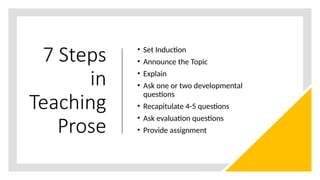
7 Steps
in
Teaching
Prose
• Set Induction
• Announce the Topic
• Explain
• Ask one or two developmental
questions
• Recapitulate 4-5 questions
• Ask evaluation questions
• Provide assignment
10 Steps in Teaching Prose
Introduce the Prose Lesson
Teach the Structures
Divide Text into smaller units
Teach vocabulary
Model Reading
Silent Reading
Test Comprehension
Text Application
Loud Reading
Give Assignment
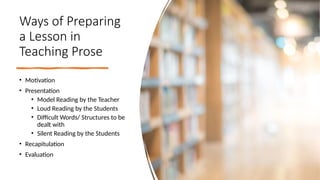
Ways of Preparing
a Lesson in
Teaching Prose
• Motivation
• Presentation
• Model Reading by the Teacher
• Loud Reading by the Students
• Difficult Words/ Structures to be
dealt with
• Silent Reading by the Students
• Recapitulation
• Evaluation
Other
Strategies
in
Teaching
Prose
•Silent Reading
•Prose Performances
•Lyric Mode
•Dramatic Mode
•Epic Mode/ Combination
Dramatic Performance
THIS IS AN ACT OF PRESENTING
A PLAY OR MUSIC.
IT IS THE ACT OF PERFORMING
DRAMA.
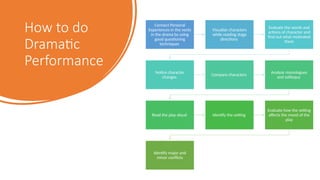
How to do
Dramatic
Performance
Connect Personal
Experiences in the vents
in the drama by using
good questioning
techniques
Visualize characters
while reading stage
directions
Evaluate the words and
actions of character and
find out what motivated
them
Notice character
changes
Compare characters
Analyze monologues
and soliloquy
Read the play aloud Identify the setting
Evaluate how the setting
affects the mood of the
play
Identify major and
minor conflicts
Features in
Dramatic
Performance
• It should be performed
on stage in front of an
audience
• It has to have actors,
dialogues, and actions.
Teaching and Assessing Prose Lecture.pptx

Teaching and Assessing Prose Lecture.pptx

  • 1.
  • 2.
    Prose •Prose is madeup of sentences and paragraphs taken together to express one idea or unit.
  • 3.
    Types and Varietiesof Prose Descriptive Prose – is a piece of writing which is used to describe things as a they are. Narrative Prose – refers to a piece of writing focused on describing events external or internal (could be describing feelings and emotions). Expository Prose – deals with explanations or definitions. It also aims to explain and clarify
  • 4.
    Fiction is aproduct of the imagination of man finding its shape in people’s stories or events. • Prose Allegory – a prose fiction wherein characters, ideas, and actions are implied and represent something else. • Fable – a story which uses animals as characters to tell a moral lesson • Parable – a story which illustrates one or more instructive lessons • Myth – a traditional story written anonymously, which explains briefly a custom or a mysterious natural phenomenon. • Legend – stories of creation and origins whether about an object, a place or an event
  • 5.
  • 6.
    Prose Romance –stories of supernatural or magical events, fantastic and unrealistic • Fairytales – Folkloric Stories whose motifs are about commonplace expressions and themes that are typical such as supernatural challenges and restoration with characters such as cruel king and wicked stepmothers and which mostly live happy endings. • Folktales – are stories which consist of one or a combination of many folklore themes (motifs) pass on from language to language and country to country. • Satire – are humorous stories used to ridicule human virtues and follies evident in its plot.
  • 7.
  • 8.
    Non-Fiction • Is writingbased on factual, realistic events, and real people. These writings can be essays, biography, autobiography, or history, letters/epistles, diaries, journals, book reviews, literary criticisms, and scientific and current publication.
  • 9.
    Essay – isan analytic and interpretative composition that deals on a subject in a more personal point • Descriptive Essay – Places the picture in your head; writes a creative story with a compelling plot; describing an event. • Narrative Essay – tells a story; creates compelling story on any subject that the one can imagine. • Expository Essay – explains something; informs and educates the reader about a particular issue; investigates a particular subject. • Persuasive/Argumentative Essay – sells opinion on some topic; wants the audience to agree; convincing someone.
  • 10.
    Other Types ofEssays • Process – explains how to do something or explains how something works. • Cause and Effect – finds the cause of something and the effects it might have. • Compare and Contrast – exposes key differences and similarities between two subjects by comparing them to each other and contrasting them against each other. • Reflective Essay – describes an experience or event observed or examined where a writer analyzes past events from the present point of view. • Biographical Essay – tells a story of a person’s life, his achievements and aspirations • Nature Essay – about the environment and the narrator’s encounter with the natural environment. • Critical Essay – analyzes, evaluates, and or interprets a text where the author claims how ideas or themes are conveyed. • Periodical – refers to published journals and articles in magazine or periodical. • Didactic Essay – gives instruction that is focused on a second-person viewpoint.
  • 11.
    More on Prose Novel– long and complex invented prose narrative dealing with human experiences with events arranged in sequence. Short Story – is a story with limited length and possesses the following elements such as characterization, unity, cumulative interest, climax, and resolution. Novelette – it is in between short story and novel. It is neither too short a story nor too long as a novel. Drama – written in dialogues intended for presentation and/or interpretation by an actor.
  • 12.
  • 13.
    Main Objectives of TeachingProse • To develop learners’ ability to read aloud with correct pronunciation and rhythm; • To enrich vocabulary of the learners; • To enhance learners’ ability to comprehend the meaning of the text; • To develop learners’ ability to enjoy reading short passage; • To express ideas freely orally in writing; and • To enjoy reading and writing.
  • 14.
    7 Steps in Teaching Prose • SetInduction • Announce the Topic • Explain • Ask one or two developmental questions • Recapitulate 4-5 questions • Ask evaluation questions • Provide assignment
  • 15.
    10 Steps inTeaching Prose Introduce the Prose Lesson Teach the Structures Divide Text into smaller units Teach vocabulary Model Reading Silent Reading Test Comprehension Text Application Loud Reading Give Assignment
  • 16.
    Ways of Preparing aLesson in Teaching Prose • Motivation • Presentation • Model Reading by the Teacher • Loud Reading by the Students • Difficult Words/ Structures to be dealt with • Silent Reading by the Students • Recapitulation • Evaluation
  • 17.
  • 18.
    Dramatic Performance THIS ISAN ACT OF PRESENTING A PLAY OR MUSIC. IT IS THE ACT OF PERFORMING DRAMA.
  • 19.
    How to do Dramatic Performance ConnectPersonal Experiences in the vents in the drama by using good questioning techniques Visualize characters while reading stage directions Evaluate the words and actions of character and find out what motivated them Notice character changes Compare characters Analyze monologues and soliloquy Read the play aloud Identify the setting Evaluate how the setting affects the mood of the play Identify major and minor conflicts
  • 20.
    Features in Dramatic Performance • Itshould be performed on stage in front of an audience • It has to have actors, dialogues, and actions.