ANXIETY DISORDERS
SLIDE 2:
REPORT: So here’s the scope of the Anxiety Disorders in DSM IV-TR
In DSM IV anxiety disorders includes:
A. Panic Disorder
B. Phobias
C. Generalized Anxiety
D. Post-Traumatic Stress Disorder
E. Acute Stress Disorder
F. Obsessive-Compulsive Disorder
SLIDE 3:
REPORT: As you can see nagkaron ng changes between DSM 4-TR and
DSM-5, in DSM-5 Anxiety Disorder no longer includes obsessive-
compulsive disorder, posttraumatic stress disorder and acute stress
disorder kasi they already have their own category although syempre
these disorders was accompanied by anxiety, you still can see the
relationship between all of them base dun sa arrangement nila sa DSM-5
In DSM-5 chapter, anxiety disorder no longer includes obsessive-
compulsive disorder (which is included with the obsessive-compulsive and related
disorders) or posttraumatic stress disorder and acute stress disorder (which are
included with the trauma- and stressor-related disorders).
However, the sequential order of these chapters in DSM-5 reflects the
close relationships among them.
SLIDE 4:
ANXIETY DISORDERS
 According to Boland and Verduin (2015), Anxiety disorders are among the most
common disorders in youth, affecting 10 to 20 percent of children and
adolescents.
 Include disorders that share features of excessive fear and anxiety
and related behavioral disturbances.
 Fear is the emotional response to real or perceived imminent threat,
whereas anxiety is anticipation of future threat.
 Anxiety is a negative mood state characterized by bodily symptoms of
physical tension and by apprehension about the future (American Psychiatric
Association, 2013).
REPORT: According to this, yung fear, nararamdaman natin yan if may
na-peperceive tayong threat sa paligid or certain situation, while yung
anxiety is all about the apprehension in the future, yung mga pag iisip
natin sa mga bagay na hindi pa naman nangyayari like incoming reports
sa work or studies, assignments na due na next week, kung anong
kahihinatnan natin sa future (kung kayo pa ba after 3 years chos) yung
1
mga ganong bagay, ito ang nagbibuild up kaya nadedevelop ang anxiety
disorders.
SLIDE 5:
Anxiety Symptoms
REPORT: So here are the Anxiety symptoms that we may feel, it is
arranged in chronological order:
 Physiological Symptoms- also known as somatic symptoms, including
muscle tension, stomach pain, heart palpitations, and the need to urinate.
 Emotional Symptoms-primarily sense of fearfulness and watchfulness,
yung pagiging vigilant natin if may napeperceive tayong mali
 Cognitive Symptoms-including unrealistic worries that something bad is
happening, feeling mo may mangyayaring hindi maganda sooner or later.
 Behavioral Symptoms- avoids situations because of fears.
“Physiological and behavioral symptoms make up what is known as the fight or
flight response (also called as the emergency reaction”)
REPORT: To explain this further, let’s have an example, kunwari si Jonie
ay may phobia sa aso, then one day, habang pauwi siya may
nakasalubong siyang aso, from that moment since may phobia siya sa
aso kakabahan siya, which is a physiological symptom then it will be
accompanied by emotional symptoms which is yung takot, and then
tatakbo sa isip niya na kakagatin siya nung aso which is a cognitive
symptom, and lastly since iniisip niya na kakagatin siya ng aso kaya
umiwas siya which is a behavioral symptom
SLIDE 6:
REPORT: Now these are the scope of Anxiety Disorders in DSM-5
ANXIETY DISORDERS IN DSM-5
A. Separation Anxiety Disorder
B. Selective Mutism
C. Specific Phobia
D. Social Anxiety Disorder (Social Phobia)
E. Panic Disorder
F
. Agoraphobia
G. Generalized Anxiety Disorder
H. Substance/Medication-Induced Anxiety Disorders
I. Anxiety Disorder due to another Medical Condition
J. Other Specified Anxiety Disorder
K. Unspecified Anxiety Disorder
SLIDE 8:
A. SEPARATION ANXIETY DISORDER
 Characterized by children’s unrealistic and persistent worry that something will
happen to their parents or other important people in their life or that
2
something will happen to the children themselves that will separate them from
their parents (for example, they will be lost, kidnapped, killed, or hurt in an
accident).
REPORT: All young children experience separation anxiety to some
extent; yun nga lang yung takot na nararamdaman nila is nagsa-subside
once they grow older kasi yung first attachment figure nila is yung
parents nila diba and as they grow older lumalawak na yung social
circles nila. Therefore, a clinician must judge whether the separation
anxiety is greater than would be expected at that particular age. So
dapat i-analyze if yung separation anxiety is normal pa ba dun sa age ng
bata, like for example 13 na yung bata but then matindi pa rin ang
separation anxiety niya sa magulang, it should be assessed further diba.
SLIDE 9:
DIAGNOSTIC CRITERIA
A. Developmentally inappropriate and excessive fear or anxiety concerning
separation from those to whom the individual is attached, as evidenced by
at least three of the following:
REPORT: So according sa Criterion A, nakakaramdam ng matinding takot
at anxiousness na yung major concern is the separation sa attachment
figure, and the evidence should be accompanied by at least 3 of the
following:
1. Recurrent excessive distress when anticipating or experiencing separation
from home or from major attachment figures.
2. Persistent and excessive worry about losing major attachment figures or
about possible harm to them, such as illness, injury, disasters, or death.
3. Persistent and excessive worry about experiencing an untoward event (e.g.,
getting lost, being kidnapped, having an accident, becoming ill) that causes
separation from a major attachment figure.
4. Persistent reluctance or refusal to go out, away from home, to school, to
work, or elsewhere because of fear of separation.
5. Persistent and excessive fear of or reluctance about being alone or without
major attachment figures at home or in other settings.
6. Persistent reluctance or refusal to sleep away from home or to go to sleep
without being near a major attachment figure.
7. Repeated nightmares involving the theme of separation.
8. Repeated complaints of physical symptoms (e.g., headaches, stomachaches,
nausea, vomiting) when separation from major attachment figures occurs or
is anticipated.
SLIDE 10:
B. The fear, anxiety, or avoidance is persistent, lasting at least 4 weeks in
children and adolescents and typically 6 months or more in adults.
REPORT: According sa Criterion B, continuous yung fear, anxiety at
avoidance which is nagtatagal ng at least 4 weeks in childrena and
adolescents, the 6 months or more kapag adult.
3
C. The disturbance causes clinically significant distress or impairment in social,
academic, occupational, or other important areas of functioning.
REPORT: Based on Criterion C, Nagkakaron na ng impairment when it
comes to social, academic, occupational, and other areas of functioning
D. The disturbance is not better explained by another mental disorder, such as
refusing to leave home because of excessive resistance to change in autism
spectrum disorder; delusions or hallucinations concerning separation in psychotic
disorders; refusal to go outside without a trusted companion in agoraphobia;
worries about ill health or other harm befalling significant others in generalized
anxiety disorder; or concerns about having an illness in illness anxiety disorder.
SLIDE 11:
Associated Features Supporting Diagnosis
When separated from major attachment figures, children with separation anxiety
disorder may exhibit social withdrawal, apathy, sadness, or difficulty
concentrating on work or play.
Depending on their age, individuals may have fears of animals,
monsters, the dark, muggers, burglars, kidnappers, car accidents, plane
travel, and other situations that are perceived as presenting danger to
the family or themselves.
Some individuals become homesick and uncomfortable to the point of misery
when away from home. Separation anxiety disorder in children may lead to school
refusal, which in turn may lead to academic difficulties and social isolation. When
extremely upset at the prospect of separation, children may show anger or
occasionally aggression toward someone who is forcing separation.
When alone, especially in the evening or the dark, young children may
report unusual perceptual experiences (e.g., seeing people peering into
their room, frightening creatures reaching for them, feeling eyes staring
at them).
Children with this disorder may be described as demanding, intrusive, and in need
of constant attention, and, as adults, may appear dependent and overprotective.
The individual’s excessive demands often become a source of frustration
for family members, leading to resentment and conflict in the family.
SLIDE 12:
Risk and Prognostic Factors
REPORT: This includes, Environmental, Genetic and Physiological, and
culture-related diagnostic issues.
Environmental. Separation anxiety disorder often develops after life stress,
especially a loss (e.g., the death of a relative or pet; an illness of the
individual or a relative; a change of schools; parental divorce; a move to
a new neighborhood; immigration; a disaster that involved periods of
separation from attachment figures). In young adults, other examples of life
stress include leaving the parental home, entering into a romantic relationship,
and becoming a parent. Parental overprotection 9 and intrusiveness16 may be
associated with separation anxiety disorder.
4
Genetic and physiological. Separation anxiety disorder in children may be
heritable. Heritability was estimated at 73% in a community sample of 6-
year-old twins, with higher rates in girls.
Culture-Related Diagnostic Issues
There are cultural variations in the degree to which it is considered desirable to
tolerate separation, so that demands and opportunities for separation between
parents and children are avoided in some cultures. For example, there is wide
variation across countries and cultures with respect to the age at which
it is expected that offspring should leave the parental home. It is
important to differentiate separation anxiety disorder from the high
value some cultures place on strong interdependence among family
members.
Gender-Related Diagnostic Issues
Girls manifest greater reluctance to attend or avoidance of school than boys.
Indirect expression of fear of separation may be more common in males than in
females, for example, by limited independent activity, reluctance to be
away from home alone, or distress when spouse or offspring do things
independently or when contact with spouse or offspring is not possible.
SLIDE 13:
Functional Consequences of Separation Anxiety Disorder
Individuals with separation anxiety disorder often limit independent activities
away from home or attachment figures (e.g., in children, avoiding school, not
going to camp, having difficulty sleeping alone; in adolescents, not
going away to college; in adults, not leaving the parental home, not
traveling, not working outside the home).
SLIDE 14:
DIFFERENTIAL DIAGNOSIS
Generalized anxiety disorder.
Separation anxiety disorder is distinguished from generalized anxiety disorder in
that the anxiety predominantly concerns separation from attachment figures, and
if other worries occur, they do not predominate the clinical picture.
REPORT: Magkaiba ang diagnosis sa separation anxiety disorder at
general anxiety disorder kasi sa separation anxiety disorder ang anxiety
ay nakafocus sa pagkakahiwalay doon sa attachment figures, unlike sa
GAD na halos lahat ng bagay nagko-cause ng anxiety
Panic disorder.
Threats of separation may lead to extreme anxiety and even a panic attack. In
separation anxiety disorder, in contrast to panic disorder, the anxiety concerns
the possibility of being away from attachment figures and worry about untoward
events befalling them, rather than being incapacitated by an unexpected panic
attack.
REPORT: Person with Separation Anxiety is not occupied with the fear of
unexpected panic attack kasi they are more anxious of being away from
their attachment figures.
5
Agoraphobia.
Unlike individuals with agoraphobia, those with separation anxiety disorder are
not anxious about being trapped or incapacitated in situations from which escape
is perceived as difficult in the event of panic-like symptoms or other
incapacitating symptoms.
Conduct disorder.
School avoidance (truancy) is common in conduct disorder, but anxiety about
separation is not responsible for school absences, and the child or adolescent
usually stays away from, rather than returns to, the home.
SLIDE 15:
Social anxiety disorder.
School refusal may be due to social anxiety disorder (social phobia). In such
instances, the school avoidance is due to fear of being judged negatively by
others rather than to worries about being separated from the attachment figures.
Posttraumatic stress disorder.
Fear of separation from loved ones is common after traumatic events
such as a disaster, particularly when periods of separation from loved
ones were experienced during the traumatic event. In posttraumatic stress
disorder (PTSD), the central symptoms concern intrusions about, and avoidance
of, memories associated with the traumatic event itself, whereas in separation
anxiety disorder, the worries and avoidance concern the well-being of attachment
figures and separation from them.
Illness anxiety disorder.
Individuals with illness anxiety disorder worry about specific illnesses they may
have, but the main concern is about the medical diagnosis itself, not about being
separated from attachment figures.
SLIDE 16:
Bereavement.
Intense yearning or longing for the deceased, intense sorrow and emotional pain,
and preoccupation with the deceased or the circumstances of the death are
expected responses occurring in bereavement, whereas fear of separation from
other attachment figures is central in separation anxiety disorder.
REPORT: In here, there’s a certain loss of a loved one kaya nagluluksa
yung isang tao kaya yung preoccupation nila ay nandoon, while sa
separation anxiety ofcourse yung takot ay nakasentro doon sa
pagkahiwalay sa attachment figure
Depressive and bipolar disorders.
These disorders may be associated with reluctance to leave home, but the main
concern is not worry or fear of untoward events befalling attachment figures, but
rather low motivation for engaging with the outside world. However, individuals
with separation anxiety disorder may become depressed while being separated or
in anticipation of separation.
REPORT: Unlike sa SEPANX, In depressive and bipolar disorder there is a
reluctance toward leaving home but not because of the separation with
the attachment figure kasi sila, ayaw nilang lumabas ng bahay simply
6
because wala silang motivation to go out not because of any fear or
anxiety.
Oppositional defiant disorder.
Children and adolescents with separation anxiety disorder may be oppositional in
the context of being forced to separate from attachment figures. Oppositional
defiant disorder should be considered only when there is persistent oppositional
behavior unrelated to the anticipation or occurrence of separation from
attachment figures.
SLIDE 17:
Psychotic disorders.
Unlike the hallucinations in psychotic disorders, the unusual perceptual
experiences that may occur in separation anxiety disorder are usually based on a
misperception of an actual stimulus, occur only in certain situations (e.g.,
nighttime), and are reversed by the presence of an attachment figure.
Personality disorders.
Dependent personality disorder is characterized by an indiscriminate tendency to
rely on others, whereas separation anxiety disorder involves concern about the
proximity and safety of main attachment figures. Borderline personality disorder is
characterized by fear of abandonment by loved ones, but problems in identity,
self-direction, interpersonal functioning, and impulsivity are additionally central to
that disorder, whereas they are not central to separation anxiety disorder.
REPORT: In dependent personality disorder, yung fear centered na baka
mawala yung specific person kung kanino ka nagrerely so much, unlike
sa sepanx kasi it is focused more on the fear about the safety of the
attachment figures. In Borderline personality disorder naman, takot
naman sila na iwan nung significant person nila which is hindi naman
yun ang main concern sa mga taong may sepanx.
SLIDE 18:
Recommendations:
 Separation anxiety disorder is usually treated with psychotherapy, sometimes
along with medication. Psychotherapy, sometimes called talk therapy or
psychological counseling, involves working with a therapist to reduce
separation anxiety symptoms.
 Cognitive behavioral therapy (CBT) is an effective form of psychotherapy for
separation anxiety disorder.
REPORT: Sometimes, combining medication with CBT may be helpful lalo
na kapag Malala na yung symptoms. Antidepressants called selective
serotonin reuptake inhibitors (SSRIs) may be an option for older children
and adults.
SLIDE 19-20: CASE ANALYSIS
REPORT: Let’s now focus on the case analysis…
7
(After reading the case)
The following symptoms in the highlighted text shows pasok siya sa
diagnostic criteria ng Separation Anxiety Disorder
SLIDE 22:
B. SELECTIVE MUTISM
REPORT: Now grouped with the anxiety disorders in DSM-5, considered
as a rare childhood disorder ang selective mutism which is characterized
by a lack of speech in one or more settings in which speaking is socially
expected. For example during recitation in class, expected na
magsasalita yung bata pero di siya makapagsalita but then sa bahay
naman madaldal siya. It seems to be clearly driven by social anxiety,
since the failure to speak is not because of a lack of knowledge of
speech or any physical difficulties, nor is it due to another disorder in
which speaking is rare or can be impaired such as autism spectrum
disorder. So speech in selective mutism commonly occurs in some
settings, such as home, but not others, such as school, hence the term
“selective.”
SLIDE 23:
DIAGNOSTIC CRITERIA
A. Consistent failure to speak in specific social situations in which there is an
expectation for speaking (e.g., at school) despite speaking in other situations.
REPORT: Ayan na nga, base sa Criterion A, most of the time hindi
nagsasalita kung saan may expectation for speaking pero
nakakapagsalita naman sa ibang situation.
B. The disturbance interferes with educational or occupational achievement or
with social communication.
C. The duration of the disturbance is at least 1 month (not limited to the first
month of school).
D. The failure to speak is not attributable to a lack of knowledge of, or comfort
with, the spoken language required in the social situation.
E. The disturbance is not better explained by a communication disorder (e.g.,
childhood-onset fluency disorder) and does not occur exclusively during the
course of autism spectrum disorder, schizophrenia, or another psychotic disorder
SLIDE 24:
Associated Features Supporting Diagnosis
Associated features of selective mutism may include excessive shyness, fear of
social embarrassment, social isolation and withdrawal, clinging, compulsive traits,
negativism, temper tantrums, or mild oppositional behavior.
Although children with this disorder generally have normal language
skills, there may occasionally be an associated communication disorder,
although no particular association with a specific communication
disorder has been identified. Even when these disorders are present,
anxiety is present as well.
8
In clinical settings, children with selective mutism are almost always given an
additional diagnosis of another anxiety disorder—most commonly, social anxiety
disorder (social phobia).
SLIDE 25:
Risk and Prognostic Factors
Temperamental. Temperamental risk factors for selective mutism are not well
identified. Negative affectivity (neuroticism) or behavioral inhibition may play a
role, as may parental history of shyness, social isolation, and social anxiety.
Those children with selective mutism may have subtle receptive
language difficulties compared with their peers, although receptive
language is still within the normal range.
Environmental. Social inhibition on the part of parents may serve as a model for
social reticence and selective mutism in children. Furthermore, parents of
children with selective mutism have been described as overprotective or
more controlling than parents of children with other anxiety disorders or
no disorder.
Genetic and physiological factors. Because of the significant overlap between
selective mutism and social anxiety disorder, there may be shared genetic factors
between these conditions.
Culture-Related Diagnostic Issues
Children in families who have immigrated to a country where a different language
is spoken may refuse to speak the new language because of lack of knowledge of
the language. However, If comprehension of the new language is
adequate but refusal to speak persists, a diagnosis of selective mutism
may be warranted.
SLIDE 26:
Functional Consequences of Selective Mutism
Selective mutism may result in social impairment, as children may be too anxious
to engage in reciprocal social interaction with other children. As children with
selective mutism mature, they may face increasing social isolation. In
school settings, these children may suffer academic impairment, because often
they do not communicate with teachers regarding their academic or personal
needs (e.g., not understanding a class assignment, not asking to use the
restroom). Severe impairment in school and social functioning, including that
resulting from teasing by peers, is common. In certain instances, selective
mutism may serve as a compensatory strategy to decrease anxious
arousal in social encounters
SLIDE 27:
DIFFERENTIAL DIAGNOSIS
Communication disorders.
9
Selective mutism should be distinguished from speech disturbances that are
better explained by a communication disorder, such as language disorder, speech
sound disorder (previously phonological disorder), childhood-onset fluency
disorder (stuttering), or pragmatic (social) communication disorder. Unlike
selective mutism, the speech disturbance in these conditions is not
restricted to a specific social situation.
Neurodevelopmental disorders and schizophrenia and other psychotic
disorders.
Individuals with an autism spectrum disorder, schizophrenia or another psychotic
disorder, or severe intellectual disability may have problems in social
communication and be unable to speak appropriately in social situations. In
contrast, selective mutism should be diagnosed only when a child has an
established capacity to speak in some social situations (e.g., typically at
home).
Social anxiety disorder (social phobia).
The social anxiety and social avoidance in social anxiety disorder may be
associated with selective mutism. In such cases, both diagnoses may be given.
SLIDE 28:
RECOMMENDATIONS:
 Behavioral strategies and Cognitive Behavioral Therapy (CBT) are the most
widely supported therapeutic treatments for selective mutism.
 Using a wide variety of strategies aimed at reducing the anxiety beneath the
behavior, these therapeutic interventions help kids learn to gradually engage in
more speaking behaviors.
REPORT: Examples of the behavioral strategies may include
Desensitization this means that the Kids are gradually exposed to
anxiety-producing situations kung saan expected yung speech, pero
they should be given emotional support and guidance with relaxation
exercises to help them work through it, and Contingency
management kung saan bibigyan ng positive reinforcement yung bata
for verbal behavior.
SLIDE 29-30: CASE ANALYSIS
REPORT: Let’s now focus on the case analysis…
(After reading the case)
The following symptoms in the highlighted text shows pasok siya sa
diagnostic criteria ng Selective mutism Disorder
SLIDE 32:
C. SPECIFIC PHOBIA
REPORT: Hey Jonie, do you have any specific phobia?
Jonie: Uhh takot mawalan ng pera, is it counted as phobia?
REPORT: Uhh let’s proceed to the discussion shall we?
A specific phobia is an irrational fear of a specific object or situation
that markedly interferes with an individual’s ability to function. In
10
earlier versions of the DSM, this category was called “simple” phobia
para ma-distinguish siya sa agoraphobia. Maybe marami sainyo na takot
sa mga bagay na hindi naman talaga dapat kinatatakutan, mga bagay na
hindi naman delikado para sainyo like going to the dentist, or have a
greatly exaggerated fear of something that is only slightly dangerous,
like driving a car or flying
SLIDE 33:
DIAGNOSTIC CRITERIA
A. Marked fear or anxiety about a specific object or situation (e.g.,
flying, heights, animals, receiving an injection, seeing blood)
Note: In children, the fear or anxiety may be expressed by crying,
tantrums, freezing, or clinging.
B. The phobic object or situation almost always provokes immediate fear or
anxiety.
C. The phobic object or situation is actively avoided or endured with intense
fear or anxiety.
D. The fear or anxiety is out of proportion to the actual danger posed
by the specific object or situation and to the socio-cultural context.
REPORT: Ayan, based on Criterion D, out of proportion na yung takot
na nararamdaman doon sa specific object, for example nahimatay ka
noong makakita ka ng ipis which is not normal since pwede mo naman
siya hampasin ng tsinelas instead na mahimatay sa sobrang takot
diba
E. The fear, anxiety, or avoidance is persistent, typically lasting for 6
months or more.
F. The fear, anxiety, or avoidance causes clinically significant distress or
impairment in social, occupational, or other important areas of functioning.
G. The disturbance is not better explained by the symptoms of another mental
disorder, including fear, anxiety, and avoidance of situations associated with
panic-like symptoms or other incapacitating symptoms (as in agoraphobia):
objects or situations related to obsessions (as in obsessive-compulsive
disorder); reminders of traumatic events (as in posttraumatic stress disorder);
separation from home or attachment figures (as in separation anxiety
disorder); or social situations (as in social anxiety disorder).
SLIDE 34:
Specify if:
• animal type - cued by animals or insects
• natural environment type - cued by objects in the environment, such as
storms, heights, or water
• blood-injection-injury type - cued by witnessing some invasive medical
procedure
• situational type - cued by a specific situation, such as public
transportation, tunnels, bridges, elevators, flying, driving, or enclosed
spaces
11
• other type - cued by other stimuli than the above, such as of choking,
vomiting, or contracting an illness
SLIDE 35:
Specifiers
It is common for individuals to have multiple specific phobias. The average
individual with specific phobia fears three objects or situations, and
approximately 75% of individuals with specific phobia fear more than one
situation or object. In such cases, multiple specific phobia diagnoses, each with
its own diagnostic code reflecting the phobic stimulus, would need to be given.
For example, if an individual fears thunderstorms and flying, then two
diagnoses would be given: specific phobia, natural environment which
is yung storm, and specific phobia, situational which is about flying.
SLIDE 36:
Associated Features Supporting Diagnosis
Individuals with specific phobia typically experience an increase in
physiological arousal in anticipation of or during exposure to a phobic object or
situation. However, the physiological response to the feared situation
or object varies. Whereas individuals with situational, natural environment,
and animal specific phobias are likely to show sympathetic nervous system
arousal like dilation of the pupil, accelerating heart rate, and sweating
, individuals with blood-injection-injury specific phobia often demonstrate a
vasovagal fainting or near-fainting response that is marked by initial brief
acceleration of heart rate and elevation of blood pressure followed by a
deceleration of heart rate and a drop in blood pressure. Current neural
systems models for specific phobia emphasize the amygdala and
related structures, much as in other anxiety disorders
SLIDE 37:
REPORT: So here are the list of Specific phobia and marami pa yan sa
totoo lang, you can search more about it if you want.
SLIDE 38:
Risk and Prognostic Factors
Temperamental. Temperamental risk factors for specific phobia, such as
negative affectivity (neuroticism) or behavioral inhibition, are risk factors for
other anxiety disorders as well.
Environmental. Environmental risk factors for specific phobias, such as
parental overprotectiveness, parental loss and separation, and physical and
sexual abuse, tend to predict other anxiety disorders as well. As noted
earlier, negative or traumatic encounters with the feared object or
situation sometimes (but not always) precede the development of
specific phobia.
Genetic and physiological. There may be a genetic susceptibility to a certain
category of specific phobia (e.g., an individual with a first-degree
12
relative with a specific phobia of animals is significantly more likely to
have the same specific phobia than any other category of phobia).
Individuals with blood-injection-injury phobia show a unique propensity to
vasovagal syncope (fainting) in the presence of the phobic stimulus.
Culture-Related Diagnostic Issues
In the United States, Asians and Latinos report significantly lower rates of
specific phobia than non-Latino whites, African Americans, and Native
Americans..
SLIDE 39:
Functional Consequences of Specific Phobia
Individuals with specific phobia show similar patterns of impairment in
psychosocial functioning and decreased quality of life as individuals with other
anxiety disorders and alcohol and substance use disorders, including
impairments in occupational and interpersonal functioning. In older adults,
impairment may be seen in caregiving duties and volunteer activities. Also,
fear of falling in older adults can lead to reduced mobility and reduced physical
and social functioning, and may lead to receiving formal or informal home
support. The distress and impairment caused by specific phobias tend
to increase with the number of feared objects and situations. Thus, an
individual who fears four objects or situations is likely to have more
impairment in his or her occupational and social roles and a lower
quality of life than an individual who fears only one object or
situation. Individuals with blood-injection-injury specific phobia are often
reluctant to obtain medical care even when a medical concern is present.
Additionally, fear of vomiting and choking may substantially reduce dietary
intake.
SLIDE 40:
Differential Diagnosis
Agoraphobia.
Situational specific phobia may resemble agoraphobia in its clinical
presentation, given the overlap in feared situations (e.g., flying, enclosed
places, elevators). If an individual fears only one of the agoraphobia situations,
then specific phobia, situational, may be diagnosed. If two or more agoraphobic
situations are feared, a diagnosis of agoraphobia is likely warranted.
For example, an individual who fears airplanes and elevator, so these
two represents the public transportation which isa sa mga
agoraphobic situation, but if that individual does not fear other
agoraphobic situations, pwede na siya i-diagnosed with specific
phobia with specifier of situational, but then if yung isang tao takot
siya sa airplanes, elevators, and crowds which is now nagooverlap na
sa dalawang agoraphobic situation, yung public transportation and
crowd, it would be diagnosed now with agoraphobia
Criterion B of agoraphobia (the situations are feared or avoided “because of
thoughts that escape might be difficult or help might not be available in the
event of developing panic-like symptoms or other incapacitating or
13
embarrassing symptoms”) can also be useful in differentiating agoraphobia
from specific phobia.
So if yung situation ay kinakatakutan for other reasons, like a fear of
being harm directly by the object or situations, for example, fear of
the plane crashing, or fear of animal biting, mas appropriate na
idiagnose yung tao with a specific phobia
Social anxiety disorder.
If the situations are feared because of negative evaluation, social anxiety
disorder should be diagnosed instead of specific phobia.
Separation anxiety disorder.
If the situations are feared because of separation from a primary caregiver or
attachment figure, separation anxiety disorder should be diagnosed instead of
specific phobia.
SLIDE 41:
Panic disorder.
Individuals with specific phobia may experience panic attacks when confronted
with their feared situation or object.
Ida-diagnose mo lang yung tao with specific phobia if yung panic
attack occurred in response doon sa specific object or situation, while
panic disorder naman ang diagnosis if yung isang tao naka-experience
ng panic attacks na hindi naman expected, meaning not in response
in any specific phobia object or situation.
Obsessive-compulsive disorder. If an individual’s primary fear or anxiety is
of an object or situation as a result of obsessions (e.g., fear of blood due to
obsessive thoughts about being contaminated from blood-borne
pathogens [i.e., HIV]; fear of driving due to obsessive images of
harming others), and if other diagnostic criteria for obsessive-compulsive
disorder are met, then obsessive-compulsive disorder should be diagnosed.
Trauma- and stressor-related disorders.
If the phobia develops following a traumatic event, posttraumatic stress
disorder (PTSD) should be considered as a diagnosis. However, traumatic
events can precede the onset of PTSD and specific phobia. So, sa case na to,
mada-diagnose mo lang siya with specific phobia if hindi niya mami-
meet lahat nung diagnostic criteria ng PTSD.
Eating disorders. A diagnosis of specific phobia is not given if the avoidance
behavior is exclusively limited to avoidance of food and food-related cues, in
which case a diagnosis of anorexia nervosa or bulimia nervosa should be
considered.
Schizophrenia spectrum and other psychotic disorders. When the fear
and avoidance are due to delusional thinking (as in schizophrenia or other
schizophrenia spectrum and other psychotic disorders), a diagnosis of
specific phobia is not warranted.
SLIDE 42:
RECOMMENDATIONS:
14
 The best treatment for specific phobias is a form of psychotherapy called
exposure therapy which involves exposing the target patient to the anxiety
source or its context without the intention to cause any danger.
REPORT: The goal of treatment is to improve quality of life so that a
person will no longer be limited by their phobias.
SLIDE 43-44: CASE ANALYSIS
REPORT: Let’s now focus on the case analysis…
(After reading the case)
The following symptoms in the highlighted text shows pasok siya sa
diagnostic criteria ng Specific Phobia
SLIDE 46:
A. SOCIAL ANXIETY DISORDER (SOCIAL PHOBIA)
Social Anxiety Disorder is described as having an intense anxiety or fear
of being judged, negatively evaluated, or rejected in a social or
performance situation. Yung mga tao na may social anxiety disorder
nag-aalala sila na baka mahalata sa kanilang kilos yung pagiging
anxious nila, typically yung pagbablush or nabubulol, they are also
worried about being viewed as stupid, awkward, or boring. As a result,
iniiwasan nila madalas yung social or performance situations, and when
a situation cannot be avoided, they experience significant anxiety and
distress. Many people with social anxiety disorder also experience
strong physical symptoms, such as a rapid heart rate, nausea, and
sweating, and may experience full-blown attacks when confronting a
feared situation. Although narerecognize naman nila na yung nafifeel
nilang takot ay sobra-sobra at hindi na reasonable, yung mga taong may
social anxiety disorder pakiramdam nila powerless sila against their
anxiety.
SLIDE 47:
DIAGNOSTIC CRITERIA
A. Marked fear or anxiety about one or more social situations in which the
individual is exposed to possible scrutiny by others. Examples include social
interactions (e.g., having a conversation, meeting unfamiliar people), being
observed (e.g., eating or drinking), and performing in front of others (e.g., giving a
speech).
Note: In children, the anxiety must occur in peer settings and not just during
interactions with adults.
B. The individual fears that he or she will act in a way or show anxiety symptoms
that will be negatively evaluated (i.e., will be humiliating or embarrassing; will
lead to rejection or offend others).
15
REPORT: With this criterion B, may fear yung isang tao na makipag
interact sa iba kasi baka during the conversation mabulol siya or
magblush and ang ending baka mapahiya lang siya sa ibang tao.
C. The social situations almost always provoke fear or anxiety.
Note: In children, the fear or anxiety may be expressed by crying, tantrums,
freezing, clinging, shrinking, or failing to speak in social situations.
D. The social situations are avoided or endured with intense fear or anxiety.
E. The fear or anxiety is out of proportion to the actual threat posed by the social
situation and to the sociocultural context.
SLIDE 48:
F. The fear, anxiety, or avoidance is persistent, typically lasting for 6 months or
more. G. The fear, anxiety, or avoidance causes clinically significant distress or
impairment in social, occupational, or other important areas of functioning.
H. The fear, anxiety, or avoidance is not attributable to the physiological effects of
a substance (e.g., a drug of abuse, a medication) or another medical condition.
I. The fear, anxiety, or avoidance is not better explained by the symptoms of
another mental disorder, such as panic disorder, body dysmorphic disorder, or
autism spectrum disorder.
J. If another medical condition (e.g., Parkinson’s disease, obesity, disfigurement
from burns or injury) is present, the fear, anxiety, or avoidance is clearly unrelated
or is excessive.
Specify if: Performance only: If the fear is restricted to speaking or performing in
public.
SLIDE 49:
Specifiers
Individuals with the performance only type of social anxiety disorder have
performance fears that are typically most impairing in their professional lives
(e.g., musicians, dancers, performers, athletes) or in roles that require regular
public speaking. Performance fears may also manifest in work, school, or
academic settings in which regular public presentations are required.
Individuals with performance only social anxiety disorder do not fear or avoid
nonperformance social situations.
SLIDE 50:
Associated Features Supporting Diagnosis
Individuals with social anxiety disorder may be inadequately assertive or
excessively submissive or, less commonly, highly controlling of the conversation.
They may show overly rigid body posture or inadequate eye contact, or
speak with an overly soft voice. These individuals may be shy or
withdrawn, and they may be less open in conversations and disclose
little about themselves. They may seek employment in jobs that do not require
social contact, although this is not the case for individuals with social anxiety
disorder, performance only. They may live at home longer. Men may be delayed
in marrying and having a family, whereas women who would want to
work outside the home may live a life as homemaker and mother. Self-
16
medication with substances is common (e.g., drinking before going to a party).
Social anxiety among older adults may also include exacerbation of symptoms of
medical illnesses, such as increased tremor or tachycardia. Blushing is a hallmark
physical response of social anxiety disorder.
SLIDE 51:
Risk and Prognostic Factors
Temperamental. Underlying traits that predispose individuals to social anxiety
disorder include behavioral inhibition and fear of negative evaluation.
Environmental. There is no causative role of increased rates of childhood
maltreatment or other early onset psychosocial adversity in the development of
social anxiety disorder. However, childhood maltreatment and adversity are
risk factors for social anxiety disorder.
Genetic and physiological. Traits predisposing individuals to social anxiety
disorder, such as behavioral inhibition, are strongly genetically influenced. The
genetic influence is subject to gene-environment interaction; that is,
children with high behavioral inhibition are more susceptible to
environmental influences, such as socially anxious modeling by parents.
Also, social anxiety disorder is heritable (but performance-only anxiety less so).
First-degree relatives have a two to six times greater chance of having
social anxiety disorder, and liability to the disorder involves the
interplay of disorder-specific (e.g., fear of negative evaluation) and
nonspecific (e.g., neuroticism) genetic factors
Culture-Related Diagnostic Issues
The syndrome of taijin kyofusho (e.g., in Japan and Korea) is often characterized
by social-evaluative concerns, fulfilling criteria for social anxiety disorder, that are
associated with the fear that the individual makes other people uncomfortable.
For example, iniisip ng isang tao na kaya iniiwasan siya ng ibang tao is
becaude na-a-upset sila in the way she looks at them, this fear
sometimes experienced with delusional intensity. This symptom may
also be found in non-Asian settings. Other presentations of taijin kyofusho
may fulfill criteria for body dysmorphic disorder or delusional disorder.
Gender-Related Diagnostic Issues
Females with social anxiety disorder report a greater number of social
fears and comorbid depressive, bipolar, and anxiety disorders, whereas
males are more likely to fear dating, have oppositional defiant disorder
or conduct disorder, and gumagamit sila ng alcohol and illicit drugs para
mabawasan yung symtoms ng disorder. Most common sa mga lalaki
yung paruresis or yung tinatawag na shy bladder syndrome.
SLIDE 52:
Functional Consequences of Social Anxiety Disorder
Social anxiety disorder is associated with elevated rates of school dropout and
with decreased well-being, employment, workplace productivity, socioeconomic
status, and quality of life. Social anxiety disorder is also associated with
being single, unmarried, or divorced and with not having children,
17
madalas ito sa mga lalaki. In older adults, there may be impairment in
caregiving duties and volunteer activities.
SLIDE 53:
Differential Diagnosis
Normative shyness.
Shyness (i.e., social reticence) is a common personality trait and is not by itself
pathological. In some societies, shyness is even evaluated positively. But
if hindi na makapag function ng maayos yung isang tao due to excessive
shyness, diagnosis of social anxiety disorder should be considered, and when full
diagnostic criteria for social anxiety disorder are met, the disorder should be
diagnosed.
Agoraphobia.
Individuals with agoraphobia may fear and avoid social situations (e.g., going to a
movie) because escape might be difficult or help might not be available in the
event of incapacitation or panic-like symptoms lalo na kung sobrang crowded
nung lugar na pupuntahan, whereas individuals with social anxiety disorder
are most fearful of scrutiny by others. Moreover, individuals with social
anxiety disorder are likely to be calm when left entirely alone, which is
often not the case in agoraphobia.
Panic disorder.
Individuals with social anxiety disorder may have panic attacks, but the concern
is about fear of negative evaluation, whereas in panic disorder the concern is
about the panic attacks themselves. Malinaw naman po siguro na yung panic
attack na maeexperience ng isang taong may social anxiety disorder is
due to the fear of negative evaluation, while yung concern naman ng
may mga panic disorder ay yung mismong panic attack na pwede nilang
maexperience.
Generalized anxiety disorder.
Social worries are common in generalized anxiety disorder, but the focus is more
on the nature of ongoing relationships rather than on fear of negative evaluation.
Individuals with generalized anxiety disorder, particularly children, may
have excessive worries about the quality of their social performance,
but these worries also pertain to nonsocial performance and when the
individual is not being evaluated by others. In social anxiety disorder,
the worries focus on social performance and others’ evaluation.
SLIDE 54:
Separation anxiety disorder.
Individuals with separation anxiety disorder may avoid social settings (including
school refusal) because of concerns about being separated from attachment
figures or, in children, about requiring the presence of a parent when it is not
developmentally appropriate. Yung mga taong may separation anxiety
disorder usually comfortable naman sila in social settings as long as
present sa situation yung attachment figure nila or kapag nasa bahay
18
sila, pero yung mga may social anxiety disorder, very uncomfortable sila
sa mga social situations kahit pa sa loob ng bahay nila and kahit na
nandoon ang presence ng attachment figures nila.
Specific phobias.
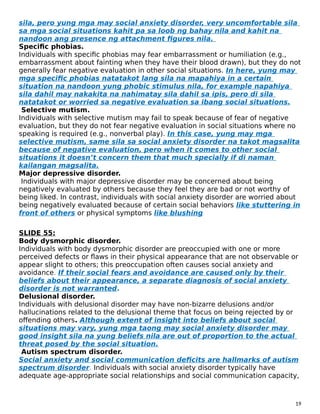
Individuals with specific phobias may fear embarrassment or humiliation (e.g.,
embarrassment about fainting when they have their blood drawn), but they do not
generally fear negative evaluation in other social situations. In here, yung may
mga specific phobias natatakot lang sila na mapahiya in a certain
situation na nandoon yung phobic stimulus nila, for example napahiya
sila dahil may nakakita na nahimatay sila dahil sa ipis, pero di sila
natatakot or worried sa negative evaluation sa ibang social situations.
Selective mutism.
Individuals with selective mutism may fail to speak because of fear of negative
evaluation, but they do not fear negative evaluation in social situations where no
speaking is required (e.g., nonverbal play). In this case, yung may mga
selective mutism, same sila sa social anxiety disorder na takot magsalita
because of negative evaluation, pero when it comes to other social
situations it doesn’t concern them that much specially if di naman
kailangan magsalita.
Major depressive disorder.
Individuals with major depressive disorder may be concerned about being
negatively evaluated by others because they feel they are bad or not worthy of
being liked. In contrast, individuals with social anxiety disorder are worried about
being negatively evaluated because of certain social behaviors like stuttering in
front of others or physical symptoms like blushing
SLIDE 55:
Body dysmorphic disorder.
Individuals with body dysmorphic disorder are preoccupied with one or more
perceived defects or flaws in their physical appearance that are not observable or
appear slight to others; this preoccupation often causes social anxiety and
avoidance. If their social fears and avoidance are caused only by their
beliefs about their appearance, a separate diagnosis of social anxiety
disorder is not warranted.
Delusional disorder.
Individuals with delusional disorder may have non-bizarre delusions and/or
hallucinations related to the delusional theme that focus on being rejected by or
offending others. Although extent of insight into beliefs about social
situations may vary, yung mga taong may social anxiety disorder may
good insight sila na yung beliefs nila are out of proportion to the actual
threat posed by the social situation.
Autism spectrum disorder.
Social anxiety and social communication deficits are hallmarks of autism
spectrum disorder. Individuals with social anxiety disorder typically have
adequate age-appropriate social relationships and social communication capacity,
19
although they may appear to have impairment in these areas when first
interacting with unfamiliar peers or adults.
SLIDE 56:
Personality disorders.
Given its frequent onset in childhood and its persistence into and through
adulthood, social anxiety disorder may resemble a personality disorder. The
most apparent overlap is with avoidant personality disorder. Individuals
with avoidant personality disorder have a broader avoidance pattern than those
with social anxiety disorder. Nonetheless, social anxiety disorder is typically
more comorbid with avoidant personality disorder than with other
personality disorders, and avoidant personality disorder is more
comorbid with social anxiety disorder than with other anxiety disorders.
Other mental disorders.
Social fears and discomfort can occur as part of schizophrenia, but other evidence
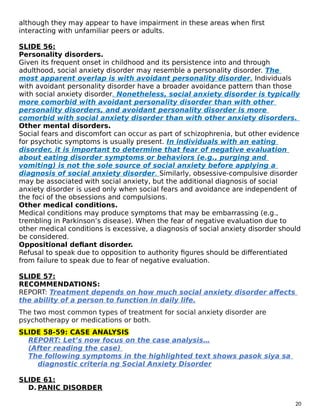
for psychotic symptoms is usually present. In individuals with an eating
disorder, it is important to determine that fear of negative evaluation
about eating disorder symptoms or behaviors (e.g., purging and
vomiting) is not the sole source of social anxiety before applying a
diagnosis of social anxiety disorder. Similarly, obsessive-compulsive disorder
may be associated with social anxiety, but the additional diagnosis of social
anxiety disorder is used only when social fears and avoidance are independent of
the foci of the obsessions and compulsions.
Other medical conditions.
Medical conditions may produce symptoms that may be embarrassing (e.g.,
trembling in Parkinson’s disease). When the fear of negative evaluation due to
other medical conditions is excessive, a diagnosis of social anxiety disorder should
be considered.
Oppositional defiant disorder.
Refusal to speak due to opposition to authority figures should be differentiated
from failure to speak due to fear of negative evaluation.
SLIDE 57:
RECOMMENDATIONS:
REPORT: Treatment depends on how much social anxiety disorder affects
the ability of a person to function in daily life.
The two most common types of treatment for social anxiety disorder are
psychotherapy or medications or both.
SLIDE 58-59: CASE ANALYSIS
REPORT: Let’s now focus on the case analysis…
(After reading the case)
The following symptoms in the highlighted text shows pasok siya sa
diagnostic criteria ng Social Anxiety Disorder
SLIDE 61:
D. PANIC DISORDER
20
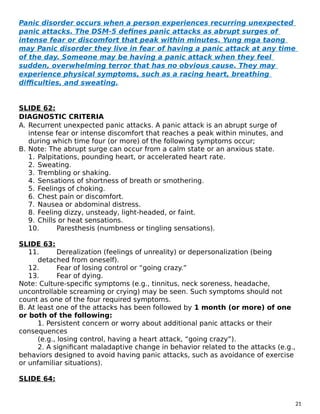
Panic disorder occurs when a person experiences recurring unexpected
panic attacks. The DSM-5 defines panic attacks as abrupt surges of
intense fear or discomfort that peak within minutes. Yung mga taong
may Panic disorder they live in fear of having a panic attack at any time
of the day. Someone may be having a panic attack when they feel
sudden, overwhelming terror that has no obvious cause. They may
experience physical symptoms, such as a racing heart, breathing
difficulties, and sweating.
SLIDE 62:
DIAGNOSTIC CRITERIA
A. Recurrent unexpected panic attacks. A panic attack is an abrupt surge of
intense fear or intense discomfort that reaches a peak within minutes, and
during which time four (or more) of the following symptoms occur;
B. Note: The abrupt surge can occur from a calm state or an anxious state.
1. Palpitations, pounding heart, or accelerated heart rate.
2. Sweating.
3. Trembling or shaking.
4. Sensations of shortness of breath or smothering.
5. Feelings of choking.
6. Chest pain or discomfort.
7. Nausea or abdominal distress.
8. Feeling dizzy, unsteady, light-headed, or faint.
9. Chills or heat sensations.
10. Paresthesis (numbness or tingling sensations).
SLIDE 63:
11. Derealization (feelings of unreality) or depersonalization (being
detached from oneself).
12. Fear of losing control or “going crazy.”
13. Fear of dying.
Note: Culture-specific symptoms (e.g., tinnitus, neck soreness, headache,
uncontrollable screaming or crying) may be seen. Such symptoms should not
count as one of the four required symptoms.
B. At least one of the attacks has been followed by 1 month (or more) of one
or both of the following:
1. Persistent concern or worry about additional panic attacks or their
consequences
(e.g., losing control, having a heart attack, “going crazy”).
2. A significant maladaptive change in behavior related to the attacks (e.g.,
behaviors designed to avoid having panic attacks, such as avoidance of exercise
or unfamiliar situations).
SLIDE 64:
21
C. The disturbance is not attributable to the physiological effects of a substance
(e.g., a drug of abuse, a medication) or another medical condition (e.g.,
hyperthyroidism, cardiopulmonary disorders).
D. The disturbance is not better explained by another mental disorder (e.g., the
panic attacks do not occur only in response to feared social situations, as in social
anxiety disorder: in response to circumscribed phobic objects or situations, as in
specific phobia: in response to obsessions, as in obsessive-compulsive disorder: in
response to reminders of traumatic events, as in posttraumatic stress disorder: or
in response to separation from attachment figures, as in separation anxiety
disorder).
SLIDE 65:
Associated Features Supporting Diagnosis
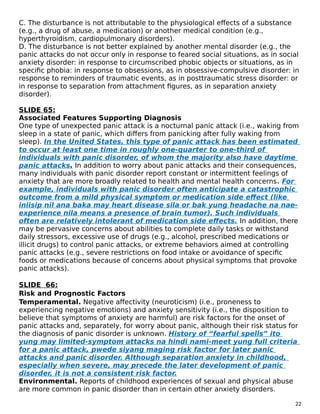
One type of unexpected panic attack is a nocturnal panic attack (i.e., waking from
sleep in a state of panic, which differs from panicking after fully waking from
sleep). In the United States, this type of panic attack has been estimated
to occur at least one time in roughly one-quarter to one-third of
individuals with panic disorder, of whom the majority also have daytime
panic attacks. In addition to worry about panic attacks and their consequences,
many individuals with panic disorder report constant or intermittent feelings of
anxiety that are more broadly related to health and mental health concerns. For
example, individuals with panic disorder often anticipate a catastrophic
outcome from a mild physical symptom or medication side effect (like
iniisip nil ana baka may heart disease sila or bak yung headache na nae-
experience nila means a presence of brain tumor). Such individuals
often are relatively intolerant of medication side effects. In addition, there
may be pervasive concerns about abilities to complete daily tasks or withstand
daily stressors, excessive use of drugs (e.g., alcohol, prescribed medications or
illicit drugs) to control panic attacks, or extreme behaviors aimed at controlling
panic attacks (e.g., severe restrictions on food intake or avoidance of specific
foods or medications because of concerns about physical symptoms that provoke
panic attacks).
SLIDE 66:
Risk and Prognostic Factors
Temperamental. Negative affectivity (neuroticism) (i.e., proneness to
experiencing negative emotions) and anxiety sensitivity (i.e., the disposition to
believe that symptoms of anxiety are harmful) are risk factors for the onset of
panic attacks and, separately, for worry about panic, although their risk status for
the diagnosis of panic disorder is unknown. History of “fearful spells” ito
yung may limited-symptom attacks na hindi nami-meet yung full criteria
for a panic attack, pwede siyang maging risk factor for later panic
attacks and panic disorder. Although separation anxiety in childhood,
especially when severe, may precede the later development of panic
disorder, it is not a consistent risk factor.
Environmental. Reports of childhood experiences of sexual and physical abuse
are more common in panic disorder than in certain other anxiety disorders.
22
Smoking is a risk factor for panic attacks and panic disorder. Most individuals
report identifiable stressors in the months before their first panic attack
(e.g., interpersonal stressors and stressors related to physical well-
being, such as negative experiences with illicit or prescription drugs,
disease, or death in the family).
Genetic and physiological. It is believed that multiple genes confer
vulnerability to panic disorder. However, the exact genes, gene products, or
functions related to the genetic regions implicated remain unknown.
Current neural systems models for panic disorder emphasize the amygdala and
related structures, much as in other anxiety disorders. There is an increased risk
for panic disorder among offspring of parents with anxiety, depressive, and
bipolar disorders. Respiratory disturbance, such as asthma, is associated
with panic disorder, in terms of past history, comorbidity, and family
history.
Gender-Related Diagnostic Issues
The clinical features of panic disorder do not appear to differ between males and
females.
SLIDE 67:
Functional Consequences of Panic Disorder
Panic disorder is associated with high levels of social, occupational, and physical
disability; considerable economic costs; and the highest number of medical visits
among the anxiety disorders, although the effects are strongest with the presence
of agoraphobia. Yung mga taong may panic disorder madalas silang
absent sa work at school because of doctor or emergency room visits,
and yun ang reason ng pagiging unemployed nila or dropped out sa
school. In older adults, impairment may be seen in caregiving duties or volunteer
activities. Full-symptom panic attacks typically are associated with greater
morbidity (e.g., greater health care utilization, more disability, poorer quality of
life) than limited-symptom attacks.
SLIDE 68:
DIFFERENTIAL DIAGNOSIS
Other specified anxiety disorder or unspecified anxiety disorder.
Panic disorder should not be diagnosed if full-symptom (unexpected) panic
attacks have never been experienced. In the case of only limited-symptom
unexpected panic attacks, another specified anxiety disorder or unspecified
anxiety disorder diagnosis should be considered
Anxiety disorder due to another medical condition.
Panic disorder is not diagnosed if the panic attacks are judged to be a direct
physiological consequence of another medical condition. Examples of medical
conditions that can cause panic attacks include hyperthyroidism,
hyperparathyroidism, pheochromocytoma, vestibular dysfunctions,
seizure disorders, and cardiopulmonary conditions (e.g., arrhythmias,
23
supraventricular tachycardia, asthma, chronic obstructive pulmonary
disease [COPD]). Appropriate laboratory tests or physical examinations may be
helpful in determining the etiological role of another medical condition.
SLIDE 69:
Substance/medication-induced anxiety disorder.
Hindi natin pwedeng i-diagnosed na may panic disorder ang isang tao if
yung panic attacks is due to the physiological consequence of a
substance. Intoxication with central nervous system stimulants (e.g., cocaine,
amphetamines, caffeine) or cannabis and withdrawal from central nervous
system depressants (e.g., alcohol, barbiturates) can precipitate a panic
attack. However, if panic attacks continue to occur outside of the context
of substance use (e.g., long after the effects of intoxication or
withdrawal have ended), a diagnosis of panic disorder should be
considered. In addition, because panic disorder may precede substance use in
some individuals and may be associated with increased substance use, especially
for purposes of self-medication, a detailed history should be taken to determine if
the individual had panic attacks prior to excessive substance use. If this is the
case, a diagnosis of panic disorder should be considered in addition to a
diagnosis of substance use disorder. Features such as onset after age 45
years or the presence of atypical symptoms during a panic attack (e.g., vertigo,
loss of consciousness, loss of bladder or bowel control, slurred speech,
amnesia) suggest the possibility that another medical condition or a substance
may be causing the panic attack symptoms.
Other mental disorders with panic attacks as an associated feature (e.g.,
other anxiety disorders and psychotic disorders).
Panic attacks that occur as a symptom of other anxiety disorders are expected
(example being triggered by social situations in social anxiety disorder,
by phobic objects or situations in specific phobia or agoraphobia, by
worry in generalized anxiety disorder, by separation from home or
attachment figures in separation anxiety disorder) and thus would not
meet criteria for panic disorder. (Note: So, sometimes yung mga unexpected
panic attack associated siya with the onset of another anxiety disorder,
yun nga lang habang natagal nagiging expected na yung attacks which
is iba sa panic disorder kasi it is characterized by recurrent unexpected
panic attacks.) If the panic attacks occur only in response to specific triggers,
then only the relevant anxiety disorder is assigned. However, if the individual
experiences unexpected panic attacks as well and shows persistent
concern and worry or behavioral change because of the attacks, then an
additional diagnosis of panic disorder should be considered.
SLIDE 70:
RECOMMENDATIONS:
24
 Therapy typically involves cognitive-behavioral therapy (CBT). This therapy
teaches the patient to change their thoughts and actions so that they can
understand their attacks and able to manage their fear.
 Medications used to treat panic disorder can include selective serotonin
reuptake inhibitors (SSRIs), a class of antidepressant.
REPORT: In addition to these treatments, may iba pang paraan para ma-
reduce yung symptoms ng panic disorder which includes:
maintaining a regular schedule, exercising on a regular basis, getting
enough sleep, and avoiding the use of stimulants such as caffeine.
SLIDE 71-72: CASE ANALYSIS
REPORT: Let’s now focus on the case analysis…
(After reading the case)
The following symptoms in the highlighted text shows pasok siya sa
diagnostic criteria ng Panic Disorder
SLIDE 73:
REPORT: Now let’s proceed to discuss the panic attack
REPORT: What is it Jonie?
Jonie: I was just wondering kung hindi ba disorder ang panic attack?
REPORT: Good question, let me discuss it to you
D. 2. PANIC ATTACK
In here pinepresent lang natin yung symptoms para ma-identify natin
yung panic attack, pero we should remember na hindi classified as
mental disorder ang panic attack and it cannot be coded. Panic attacks
can occur in the context of any anxiety disorder as well as other mental
disorders (e.g., depressive disorders, posttraumatic stress disorder,
substance use disorders) and some medical conditions (e.g., cardiac,
respiratory, vestibular, gastrointestinal). Kapag may presence ng panic
attack na na-identify, it should be noted as a specifier (e.g.,
“posttraumatic stress disorder with panic attacks”). For panic disorder,
included na sa diagnostic criteria niya yung presence ng panic attack
that’s why it is not used as a specifier. An abrupt surge of intense fear
or intense discomfort can occur from a calm state or an anxious state.
SLIDE 74:
REPORT: As you can see the symptoms of panic attack resembles with
those of panic disorder
SYMPTOMS
1. Palpitations, pounding heart, or accelerated heart rate.
2. Sweating.
3. Trembling or shaking.
4. Sensations of shortness of breath or smothering.
25
5. Feelings of choking.
6. Chest pain or discomfort.
7. Nausea or abdominal distress.
SLIDE 75:
8. Feeling dizzy, unsteady, light-headed, or faint.
9. Chills or heat sensations.
10. Paresthesias (numbness or tingling sensations).
11. Derealization (feelings of unreality) or depersonalization (being detached from
oneself).
12. Fear of losing control or “going crazy.”
13. Fear of dying.
Note: Culture-specific symptoms (e.g., tinnitus, neck soreness, headache,
uncontrollable screaming or crying) may be seen. Such symptoms should not
count as one of the four required symptoms.
SLIDE 76:
Features:
There are two characteristic types of panic attacks: expected and unexpected.
Expected panic attacks are attacks for which there is an obvious cue or trigger,
such as situations in which panic attacks have typically occurred for example
you are very aware na madalas kang mag-panic attack when you are in a
small tight places or even crowded ones.
Unexpected panic attacks are those for which there is no obvious cue or
trigger at the time of occurrence for example during relaxation or just doing
something normal in a day to day basis then out of nowhere aatakihin ka
ng intense panic.
Associated Features
One type of unexpected panic attack is a nocturnal panic attack like
magigising ka na lang bigla in a state of panic, which differs from panicking
after fully waking from sleep. Panic attacks are related to a higher rate of
suicide attempts and suicidal ideation even when comorbidity and other
suicide risk factors are taken into account.
SLIDE 77:
Risk and Prognostic Factors
Temperamental. Negative affectivity (neuroticism) for example prone ka na
maka-experience ng negative emotions and anxiety sensitivity (i.e., the
disposition to believe that symptoms of anxiety are harmful) are risk factors for
the onset of panic attacks. History of “fearful spells” (i.e., limited-symptom
attacks that do not meet full criteria for a panic attack) may be a risk
factor for later panic attacks.
26
Environmental. Smoking is a risk factor for panic attacks. Most individuals report
identifiable stressors in the months before their first panic attack (e.g.,
interpersonal stressors and stressors related to physical wellbeing, such
as negative experiences with illicit or prescription drugs, disease, or
death in the family).
Gender-Related Diagnostic Issues. So ayan, hindi man magkaiba sa
symptoms ng panic attacks between males and females, mas common
naman ito sa mga babae.
SLIDE 78:
RECOMMENDATIONS:
 Treatment for panic attack may include both psychotherapy and
medications.
 Therapy should help the patient figure out the situations, thoughts, or
feelings that cause their attacks.
 Medication is used to lessen the symptoms of panic attacks
SLIDE 80:
E. AGORAPHOBIA
In agoraphobia the focus of fear is being in situations where escape
might be difficult or that help wouldn't be available if things go wrong.
Many people assume agoraphobia is simply a fear of open spaces, but
it's actually a more complex condition.
SLIDE 81:
DIAGNOSTIC CRITERIA
A. Marked fear or anxiety about two (or more) of the following five
situations:
1. Using public transportation (e.g., automobiles, buses, trains, ships, planes).
2. Being in open spaces (e.g., parking lots, marketplaces, bridges).
3. Being in enclosed places (e.g., shops, theaters, cinemas).
4. Standing in line or being in a crowd.
5. Being outside of the home alone.
B. The individual fears or avoids these situations because of thoughts that
escape might be difficult or help might not be available in the event of
developing panic-like symptoms or other incapacitating or embarrassing
symptoms (e.g., fear of falling in the elderly; fear of incontinence).
SLIDE 82:
C. The agoraphobic situations almost always provoke fear or anxiety.
D. The agoraphobic situations are actively avoided, require the presence of a
companion, or are endured with intense fear or anxiety.
E. The fear or anxiety is out of proportion to the actual danger posed by the
agoraphobic situations and to the sociocultural context.
F. The fear, anxiety, or avoidance is persistent, typically lasting for 6 months
or more.
27
G. The fear, anxiety, or avoidance causes clinically significant distress or
impairment in social, occupational, or other important areas of functioning.
H. If another medical condition (e.g., inflammatory bowel disease, Parkinson’s
disease) is present, the fear, anxiety, or avoidance is clearly excessive.
SLIDE 83:
I. The fear, anxiety, or avoidance is not better explained by the symptoms of
another mental disorder—for example, the symptoms are not confined to specific
phobia, situational type; do not involve only social situations (as in social anxiety
disorder): and are not related exclusively to obsessions (as in obsessive-
compulsive disorder), perceived defects or flaws in physical appearance (as in
body dysmorphic disorder), reminders of traumatic events (as in posttraumatic
stress disorder), or fear of separation (as in separation anxiety disorder).
REPORT: ayan po may important note in which you can diagnose
someone with agoraphobia regardless if may presence ng panic disorder.
Kung yung isang tao na-meet niya pareho yung diagnostic criteria ng
panic disorder and agoraphobia meaning both diagnoses should be
assigned
SLIDE 84:
Associated Features Supporting Diagnosis
In its most severe forms, agoraphobia can cause individuals to become
completely homebound, unable to leave their home and dependent on others for
services or assistance to provide even for basic needs. Demoralization and
depressive symptoms, as well as abuse of alcohol and sedative
medication as inappropriate self-medication strategies, are common.
SLIDE 85:
Risk and Prognostic Factors
Temperamental. Behavioral inhibition and neurotic disposition (i.e., negative
affectivity [neuroticism] and anxiety sensitivity) are closely associated with
agoraphobia but are relevant to most anxiety disorders (phobic disorders, panic
disorder, generalized anxiety disorder). Anxiety sensitivity which is the
disposition to believe that symptoms of anxiety are harmful) is also
characteristic of individuals with agoraphobia.
Environmental. Negative events in childhood (e.g., separation, death of parent)
and other stressful events, such as being attacked or mugged, are associated with
the onset of agoraphobia. Furthermore, individuals with agoraphobia
describe the family climate and child-rearing behavior as being
characterized by reduced warmth and increased overprotection.
Genetic and physiological. Heritability for agoraphobia is 61%. Of the various
phobias, agoraphobia has the strongest and most specific association with the
genetic factor that represents proneness to phobias.
Gender-Related Diagnostic
28
Issues Females have different patterns of comorbid disorders than males.
Consistent with gender differences in the prevalence of mental disorders, males
have higher rates of comorbid substance use disorders.
SLIDE 86:
Functional Consequences of Agoraphobia
Agoraphobia is associated with considerable impairment and disability in terms of
role functioning, work productivity, and disability days. Agoraphobia severity is a
strong determinant of the degree of disability, irrespective of the presence of
comorbid panic disorder, panic attacks, and other comorbid conditions. More
than one-third of individuals with agoraphobia are completely
homebound and unable to work.
SLIDE 87:
DIFFERENTIAL DIAGNOSIS
Specific phobia, situational type.
Differentiating agoraphobia from situational specific phobia can be
challenging in some cases, because these conditions share several
symptom characteristics and criteria. Specific phobia, situational type, should
be diagnosed versus agoraphobia if the fear, anxiety, or avoidance is limited to
one of the agoraphobic situations. Requiring fears from two or more of the
agoraphobic situations is a robust means for differentiating agoraphobia from
specific phobias, particularly the situational subtype. Additional differentiating
features include the cognitive ideation. Thus, if the situation is feared for
reasons other than panic-like symptoms or other incapacitating or
embarrassing symptoms (e.g., fears of being directly harmed by the
situation itself, such as fear of the plane crashing for individuals who
fear flying), then a diagnosis of specific phobia may be more
appropriate.
Separation anxiety disorder.
Separation anxiety disorder can be best differentiated from agoraphobia
by examining cognitive ideation. In separation anxiety disorder, the thoughts
are about detachment from significant others and the home environment (i.e.,
parents or other attachment figures), whereas in agoraphobia the focus is on
panic-like symptoms or other incapacitating or embarrassing symptoms in the
feared situations.
Social anxiety disorder (social phobia).
Agoraphobia should be differentiated from social anxiety disorder based primarily
on the situational clusters that trigger fear, anxiety, or avoidance and the
cognitive ideation. In social anxiety disorder, the focus is on fear of being
negatively evaluated.
SLIDE 88:
Panic disorder.
29
Let’s say na-meet niya yung full diagnostic criteria ng panic disorder,
hindi mo siya pwedeng i-diagnosed ng agoraphobia if yung avoidance
behavior na link doon sa panic attack ay hindi umabot sa two or more
agoraphobic situations.
Acute stress disorder and posttraumatic stress disorder.
Acute stress disorder and posttraumatic stress disorder (PTSD) can be
differentiated from agoraphobia by examining whether the fear, anxiety,
or avoidance is related only to situations that remind the individual of a
traumatic event. If the fear, anxiety, or avoidance is restricted to trauma
reminders, and if the avoidance behavior does not extend to two or more
agoraphobic situations, then a diagnosis of agoraphobia is not warranted.
Major depressive disorder.
In major depressive disorder, the individual may avoid leaving home because of
apathy, loss of energy, low self-esteem, and anhedonia. If the avoidance is
unrelated to fears of panic-like or other incapacitating or embarrassing
symptoms, then agoraphobia should not be diagnosed.
Other medical conditions.
Hindi mo pwedeng i-diagnose na may agoraphobia yung isang tao if
yung pag iwas niya sa certain situations is due to possible physiological
consequences of a medical condition.This determination is based on
history, laboratory findings, and a physical examination. Other relevant
medical conditions may include neurodegenerative disorders with
associated motor disturbances (e.g., Parkinson’s disease, multiple
sclerosis), as well as cardiovascular disorders. Individuals with certain
medical conditions may avoid situations because of realistic concerns about being
incapacitated (e.g., fainting in an individual with transient ischemic attacks) or
being embarrassed (e.g., diarrhea in an individual with Crohn’s disease). The
diagnosis of agoraphobia should be given only when the fear or
avoidance is clearly in excess of that usually associated with these
medical conditions.
SLIDE 89:
RECOMMENDATIONS:
Cognitive behavioral therapy (CBT) is the most common form of psychotherapy
used to treat people with agoraphobia. CBT can help you understand the
distorted feelings and views associated with agoraphobia.
Selective serotonin and norepinephrine reuptake inhibitors, anti-anxiety
medications, and tricyclic antidepressants can also be use for treatment.
SLIDE 90-91: CASE ANALYSIS
REPORT: Let’s now focus on the case analysis…
(After reading the case)
30
The following symptoms in the highlighted text shows pasok siya sa
diagnostic criteria ng agoraphobia
SLIDE 93:
F. GENERALIZED ANXIETY DISORDER
In Generalized Anxiety Disorder it is characterized by persistent and
excessive worry about a number of different things. As in iba-ibang
bagay yung nagco-cause ng anxiety nila. People with GAD may
anticipate disaster and may be overly concerned about money, health,
family, work, or other issues. Yung mga taong may Generalized Anxiety
Disorders nahihirapan sila na kontrolin yung pag-aalala nila. They may
worry more than seem warranted about actual events or may expect the
worst even when there is no apparent reason for concern.
SLIDE 94:
DIAGNOSTIC CRITERIA
A. Excessive anxiety and worry (apprehensive expectation), occurring
more days than not for at least 6 months, about a number of events or
activities (such as work or school performance).
B. The individual finds it difficult to control the worry.
C. The anxiety and worry are associated with three (or more) of the following six
symptoms (with at least some symptoms having been present for more days than
not for the past 6 months);
Note: Only one item is required in children.
• 1. Restlessness or feeling keyed up or on edge.
• 2. Being easily fatigued.
• 3. Difficulty concentrating or mind going blank.
• 4. Irritability.
• 5. Muscle tension.
• 6. Sleep disturbance (difficulty falling or staying asleep, or restless,
unsatisfying sleep).
SLIDE 95:
D. The anxiety, worry, or physical symptoms cause clinically significant distress or
impairment in social, occupational, or other important areas of functioning.
E. The disturbance is not attributable to the physiological effects of a substance
(e.g., a drug of abuse, a medication) or another medical condition (e.g.,
hyperthyroidism).
F. The disturbance is not better explained by another mental disorder (e.g.,
anxiety or worry about having panic attacks in panic disorder, negative evaluation
in social anxiety disorder [social phobia], contamination or other obsessions in
obsessive-compulsive disorder, separation from attachment figures in separation
anxiety disorder, reminders of traumatic events in posttraumatic stress disorder,
gaining weight in anorexia nervosa, physical complaints in somatic symptom
disorder, perceived appearance flaws in body dysmorphic disorder, having a
31
serious illness in illness anxiety disorder, or the content of delusional beliefs in
schizophrenia or delusional disorder).
SLIDE 96:
Associated Features Supporting Diagnosis
Associated with muscle tension, there may be trembling, twitching, feeling shaky,
and muscle aches or soreness. Many individuals with generalized anxiety disorder
also experience somatic symptoms (e.g., sweating, nausea, diarrhea) and an
exaggerated startle response. Symptoms of autonomic hyperarousal (e.g.,
accelerated heart rate, shortness of breath, dizziness) are less
prominent in generalized anxiety disorder than in other anxiety
disorders, such as panic disorder. Other conditions that may be associated
with stress (e.g., irritable bowel syndrome, headaches) frequently accompany
generalized anxiety disorder.
SLIDE 97:
Gender-Related Diagnostic Issues
In clinical settings, generalized anxiety disorder is diagnosed somewhat more
frequently in females than in males (about 55%–60% of those presenting with the
disorder are female). In epidemiological studies, approximately two-thirds are
female. Females and males who experience generalized anxiety disorder
appear to have similar symptoms but demonstrate different patterns of
comorbidity consistent with gender differences in the prevalence of
disorders. In females, comorbidity is largely confined to the anxiety
disorders and unipolar depression, whereas in males, comorbidity is
more likely to extend to the substance use disorders as well.
Functional Consequences of Generalized Anxiety Disorder
Excessive worrying impairs the individual’s capacity to do things quickly and
efficiently, whether at home or at work. The worrying takes time and energy; the
associated symptoms of muscle tension and feeling keyed up or on edge,
tiredness, difficulty concentrating, and disturbed sleep contribute to the
impairment. Importantly, yung excessive o sobrang pag aalalala, it may
impair the ability of individuals with generalized anxiety disorder to
encourage confidence in their children.
SLIDE 98:
Differential Diagnosis
Anxiety disorder due to another medical condition.
You can diagnose someone with anxiety disorder due to another medical
condition if yung anxiety niya and worry ay nakabase doon sa
physiological effect of another specific medical condition (e.g.,
pheochromocytoma, hyperthyroidism).
Substance/medication-induced anxiety disorder.
A substance/medication-induced anxiety disorder is distinguished from
generalized anxiety disorder by the fact that a substance or medication (e.g., a
drug of abuse, exposure to a toxin) is judged to be etiologically related to the
anxiety. For example, severe anxiety that occurs only in the context of
32
heavy coffee consumption would be diagnosed as caffeine-induced
anxiety disorder.
Social anxiety disorder.
Individuals with social anxiety disorder often have anticipatory anxiety that is
focused on upcoming social situations in which they must perform or be evaluated
by others, whereas individuals with generalized anxiety disorder worry,
whether or not they are being evaluated.
SLIDE 99:
Obsessive-compulsive disorder.
Several features distinguish the excessive worry of generalized anxiety
disorder from the obsessional thoughts of obsessive-compulsive
disorder. In generalized anxiety disorder the focus of the worry is about
forthcoming problems, and it is the excessiveness of the worry about future
events that is abnormal. In obsessive-compulsive disorder, the obsessions are
inappropriate ideas that take the form of intrusive and unwanted thoughts, urges,
or images.
Posttraumatic stress disorder and adjustment disorders.
Anxiety is invariably present in posttraumatic stress disorder. Generalized
anxiety disorder is not diagnosed if the anxiety and worry are better explained by
symptoms of posttraumatic stress disorder. Anxiety may also be present in
adjustment disorder, but this residual category should be used only
when the criteria are not met for any other disorder (including
generalized anxiety disorder). Moreover, in adjustment disorders, the anxiety
occurs in response to an identifiable stressor within 3 months of the onset of the
stressor and does not persist for more than 6 months after the termination of the
stressor or its consequences.
Depressive, bipolar, and psychotic disorders.
Although generalized anxiety/worry is a common associated feature of depressive,
bipolar, and psychotic disorders, generalized anxiety disorder may be diagnosed
comorbidly if the anxiety/worry is sufficiently severe to warrant clinical attention.
SLIDE 100:
RECOMMENDATIONS:
 Medication or psychotherapy is a reasonable initial treatment option for
GAD. Some studies suggest that combining medication and psychotherapy
may be more effective for patients with moderate to severe symptoms.
 Selective serotonin reuptake inhibitors (SSRIs) are generally considered first-
line therapy for GAD.
REPORT: Generally according to Mayo Clinic (2020) mas effective ang a
short-term treatment, such as cognitive behavioral therapy para sa GAD,
Because it focuses on teaching specific skills to directly manage the
worries and help the patient gradually return to their activities avoided
because of anxiety. Several types of medications are also used to treat
33
this kind of disorder, including antidepressant, Buspirone, and
Benzodiazepines.
SLIDE 101-102: CASE ANALYSIS
REPORT: Let’s now focus on the case analysis…
(After reading the case)
The following symptoms in the highlighted text shows pasok siya sa
diagnostic criteria ng General Anxiety Disorder
SLIDE 104:
G. SUBSTANCE/MEDICATION- INDUCED ANXIETY DISORDER
You can diagnose someone with substance or medication-induced
anxiety disorder yung panic attacks niya or other anxiety symptoms ay
dahil doon sa withdrawal or paggamit niya ng alcohol or other drugs,
like taking medications or exposure to heavy metals or toxic substances.
SLIDE 105:
DIAGNOSTIC CRITERIA
A. Panic attacks or anxiety is predominant in the clinical picture.
B. There is evidence from the history, physical examination, or laboratory findings
of both (1)and (2):
1. The symptoms in Criterion A developed during or soon after substance
intoxication or withdrawal or after exposure to a medication.
2. The involved substance/medication is capable of producing the symptoms in
Criterion A.
C. The disturbance is not better explained by an anxiety disorder that is not
substance/ medication-induced. Such evidence of an independent anxiety
disorder could include the following: The symptoms precede the onset of the
substance/medication use; the symptoms persist for a substantial period
of time (e.g., about 1 month) after the cessation of acute withdrawal or
severe intoxication: or there is other evidence suggesting the existence of an
independent non-substance/medication-induced anxiety disorder (e.g., a history
of recurrent non-substance/medication-related episodes).
SLIDE 106:
D. The disturbance does not occur exclusively during the course of a delirium.
E. The disturbance causes clinically significant distress or impairment in social,
occupational, or other important areas of functioning.
Note: This diagnosis should be made instead of a diagnosis of substance
intoxication or substance withdrawal only when the symptoms in Criterion A
predominate in the clinical picture and they are sufficiently severe to warrant
clinical attention.
SLIDE 107:
34
Specify if:
With onset during intoxication: This specifier applies if criteria are met
for intoxication with the substance and the symptoms develop during
intoxication.
With onset during withdrawal: This specifier applies if criteria are met
for withdrawal from the substance and the symptoms develop during, or
shortly after, withdrawal.
With onset after medication use: Symptoms may appear either at
initiation of medication or after a modification or change in use.
SLIDE 108:
Associated Features Supporting Diagnosis
Panic or anxiety can occur in association with intoxication with the following
classes of substances: alcohol, caffeine, cannabis, phencyclidine, other
hallucinogens, inhalants, stimulants (including cocaine), and other (or unknown)
substances. Panic or anxiety can occur in association with withdrawal from the
following classes of substances: alcohol; opioids; sedatives, hypnotics, and
anxiolytics; stimulants (including cocaine); and other (or unknown) substances.
Some medications that evoke anxiety symptoms include anesthetics and
analgesics, actually there’s a lot more including the antipsychotic
medications, and antidepressant medications. Heavy metals and toxins
(e.g., organophosphate insecticide, nerve gases, carbon monoxide, carbon
dioxide, volatile substances such as gasoline and paint) may also cause panic
or anxiety symptoms.
SLIDE 109:
Diagnostic Markers
Laboratory assessments (e.g., urine toxicology) may be useful to measure
substance intoxication as part of an assessment for substance/medication-
induced anxiety disorder.
SLIDE 110:
Differential Diagnosis
Substance intoxication and substance withdrawal.
Anxiety symptoms commonly occur in substance intoxication and
substance withdrawal. The diagnosis of the substance-specific
intoxication or substance specific withdrawal will usually suffice to
categorize the symptom presentation. A diagnosis of substance/medication-
induced anxiety disorder should be made in addition to substance intoxication or
substance withdrawal when the panic or anxiety symptoms are predominant in
the clinical picture and are sufficiently severe to warrant independent clinical
attention. For example, panic or anxiety symptoms are characteristic of
alcohol withdrawal.
Anxiety disorder (i.e., not induced by a substance/medication).
35
Substance/medication-induced anxiety disorder is judged to be etiologically
related to the substance/medication. Substance/medication-induced anxiety
disorder is distinguished from a primary anxiety disorder based on the onset,
course, and other factors with respect to substances/medications. For drugs of
abuse, there must be evidence from the history, physical examination,
or laboratory findings for use, intoxication, or withdrawal.
Substance/medication induced anxiety disorders arise only in
association with intoxication or withdrawal states, whereas primary
anxiety disorders may precede the onset of substance/medication use.
The presence of features that are atypical of a primary anxiety disorder,
such as atypical age at onset (e.g., onset of panic disorder after age 45
years) or symptoms (e.g., atypical panic attack symptoms such as true
vertigo, loss of balance, loss of consciousness, loss of bladder control,
headaches, slurred speech) may suggest a substance/medication
induced etiology.
SLIDE 111:
Delirium.
If panic or anxiety symptoms occur exclusively during the course of delirium, they
are considered to be an associated feature of the delirium and are not diagnosed
separately.
Anxiety disorder due to another medical condition.
If the panic or anxiety symptoms are attributed to the physiological consequences
of another medical condition (i.e., rather than to the medication taken for the
medical condition), anxiety disorder due to another medical condition should be
diagnosed. The history often provides the basis for such a judgment. At times, a
change in the treatment for the other medical condition (e.g., medication
substitution or discontinuation) may be needed to determine whether the
medication is the causative agent (in which case the symptoms may be better
explained by substance/medication-induced anxiety disorder). If the
disturbance is attributable to both another medical condition and
substance use, both diagnoses (i.e., anxiety disorder due to another
medical condition and substance/medication-induced anxiety disorder)
may be given. When there is insufficient evidence to determine whether
the panic or anxiety symptoms are attributable to a
substance/medication or to another medical condition or are primary
(i.e., not attributable to either a substance or another medical
condition), a diagnosis of other specified or unspecified anxiety disorder
would be indicated.
SLIDE 112:
RECOMMENDATIONS:
 According to the research conducted by the Social Work Public Health
(2013), Cognitive-behavioral therapies (CBTs) are among the most effective
psychosocial treatments that can be used to treat individuals with
Substance/Medication-Induced Anxiety Disorder.
36
SLIDE 113-114: CASE ANALYSIS
REPORT: Let’s now focus on the case analysis…
(After reading the case)
The following symptoms in the highlighted text shows pasok siya sa
diagnostic criteria ng Substance or Medication-Induced Anxiety
Disorder
SLIDE 116:
I. ANXIETY DISORDER DUE TO ANOTHER MEDICAL CONDITION
You can diagnose someone with anxiety disorder due to another medical
condition kung ang nagco-cause ng anxiety niya ay yung physiological
effect of another medical condition na na-e-experience niya.
SLIDE 117:
DIAGNOSTIC CRITERIA
A. Panic attacks or anxiety is predominant in the clinical picture.
B. There is evidence from the history, physical examination, or laboratory findings
that the disturbance is the direct pathophysiological consequence of another
medical condition.
C. The disturbance is not better explained by another mental disorder.
D. The disturbance does not occur exclusively during the course of a delirium.
E. The disturbance causes clinically significant distress or impairment in social,
occupational, or other important areas of functioning.
SLIDE 118:
Associated Features Supporting Diagnosis
A number of medical conditions are known to include anxiety as a symptomatic
manifestation. Examples include endocrine disease (e.g., hyperthyroidism,
pheochromocytoma, hypoglycemia, hyper-adrenocortisolism), cardiovascular
disorders (e.g., congestive heart failure, pulmonary embolism, arrhythmia
such as atrial fibrillation), respiratory illness (e.g., chronic obstructive
pulmonary disease, asthma, pneumonia), metabolic disturbances (e.g., vitamin
B12 deficiency, porphyria), and neurological illness (e.g., neoplasms, vestibular
dysfunction, encephalitis, seizure disorders). Anxiety due to another medical
condition is diagnosed when the medical condition is known to induce
anxiety and when the medical condition preceded the onset of the
anxiety.
Diagnostic Markers
Laboratory assessments and/or medical examinations are necessary to confirm
the diagnosis of the associated medical condition.
SLIDE 119:
Differential Diagnosis
37
Delirium.
A separate diagnosis of anxiety disorder due to another medical condition is not
given if the anxiety disturbance occurs exclusively during the course of a delirium.
However, a diagnosis of anxiety disorder due to another medical
condition may be given in addition to a diagnosis of major
neurocognitive disorder (dementia) if the etiology of anxiety is judged
to be a physiological consequence of the pathological process causing
the neurocognitive disorder and if anxiety is a prominent part of the
clinical presentation.
Mixed presentation of symptoms (e.g., mood and anxiety).
If the presentation includes a mix of different types of symptoms, the specific
mental disorder due to another medical condition depends on which symptoms
predominate in the clinical picture.
Substance/medication-induced anxiety disorder.
If there is evidence of recent or prolonged substance use (including medications
with psychoactive effects), withdrawal from a substance, or exposure to a toxin, a
substance/medication-induced anxiety disorder should be considered. May mga
certain medications daw na nag increase ng anxiety once you take it
(e.g., corticosteroids, estrogens, metoclopramide), and when this is the
case, the medication may be the most likely etiology, although it may be
difficult to distinguish whether the anxiety is attributable to the
medications or to the medical illness itself. When a diagnosis of
substance-induced anxiety is being made in relation to recreational or
nonprescribed drugs, it may be useful to obtain a urine or blood drug
screen or other appropriate laboratory evaluation. Symptoms that occur
during or shortly after (i.e., within 4 weeks of) substance intoxication or
withdrawal or after medication use may be especially indicative of a
substance/medication-induced anxiety disorder, depending on the type, duration,
or amount of the substance used. If the disturbance is associated with both
another medical condition and substance use, both diagnoses (i.e., anxiety
disorder due to another medical condition and substance/medication-
induced anxiety disorder) can be given. Features such as onset after age
45 years or the presence of atypical symptoms during a panic attack
(e.g., vertigo, loss of consciousness, loss of bladder or bowel control,
slurred speech, amnesia) suggest the possibility that another medical
condition or a substance may be causing the panic attack symptoms.
SLIDE 120:
Anxiety disorder (not due to a known medical condition).
Anxiety disorder due to another medical condition should be
distinguished from other anxiety disorders (especially panic disorder
and generalized anxiety disorder). In other anxiety disorders, no specific and
direct causative physiological mechanisms associated with another medical
condition can be demonstrated. Late age at onset, atypical symptoms, and the
absence of a personal or family history of anxiety disorders suggest the need for a
thorough assessment to rule out the diagnosis of anxiety disorder due to another
medical condition. Anxiety disorders can exacerbate or pose increased risk
38
for medical conditions such as cardiovascular events and myocardial
infarction and should not be diagnosed as anxiety disorder due to
another medical condition in these cases
Illness anxiety disorder.
Anxiety disorder due to another medical condition should be
distinguished from illness anxiety disorder. Illness anxiety disorder is
characterized by worry about illness, concern about pain, and bodily
preoccupations. Sa illness anxiety disorder naman kasi, yung mga taong
meron nito may or may not have diagnosed medical conditions. Although
an individual with illness anxiety disorder and a diagnosed medical
condition is likely to experience anxiety about the medical condition, the
medical condition is not physiologically related to the anxiety
symptoms.
SLIDE 121:
Adjustment disorders.
Anxiety disorder due to another medical condition should be
distinguished from adjustment disorders, with anxiety, or with anxiety
and depressed mood. Masasabi siyang adjustment disorder kapag yung
isang tao hindi normal yung response niya sa stress nang pagkakaron
ng medical condition. The reaction to stress usually concerns the
meaning or consequences of the stress, as compared with the
experience of anxiety or mood symptoms that occur as a physiological
consequence of the other medical condition. In adjustment disorder, the
anxiety symptoms are typically related to coping with the stress of having a
general medical condition, whereas in anxiety disorder due to another medical
condition, individuals are more likely to have prominent physical symptoms and to
be focused on issues other than the stress of the illness itself.
Associated feature of another mental disorder.
Anxiety symptoms may be an associated feature of another mental disorder (e.g.,
schizophrenia, anorexia nervosa).
Other specified or unspecified anxiety disorder.
This diagnosis is given if it cannot be determined whether the anxiety symptoms
are primary, substance-induced, or associated with another medical condition.
SLIDE 122:
RECOMMENDATIONS:
In this case of anxiety due to another medical condition, treatment of the anxiety
may have to be postponed until the underlying medical condition is successfully
treated.
Primary medications used in treating the anxiety are antidepressants, anti-anxiety
medications, and beta-blockers.
REPORT: This depends on the medical condition and whether it is
potentially life-threatening. Often, treatment of both conditions can
39
occur simultaneously. Whether this happens may depend on the
treatment conditions for the medical disorder
SLIDE 123-124: CASE ANALYSIS
REPORT: Let’s now focus on the case analysis…
(After reading the case)
The following symptoms in the highlighted text shows pasok siya sa
diagnostic criteria ng Anxiety Disorder due to another medical
condition
SLIDE 126:
J. OTHER SPECIFIED ANXIETY DISORDER
In here, may predominant symptoms ng anxiety disorders na nagco-
cause ng distress sa isang tao and may impair the over all functioning
pero hindi niya na-meet yung full criteria ng ibang disorders under the
scope of the anxiety disorders. Ginagamit lang ang category na ito
kapag inindicate ng clinican yung specific reason kung bakit hindi na-
meet yung diagnostic criteria nung specific anxiety disorder for example
a person can be diagnosed with General anxiety disorder kaso hindi niya
na-meet yung specific month na kailangan para madiagnosed
completely.
SLIDE 127:
Examples of presentations that can be specified using the “other specified”
designation include the following;
1. Limited-symptom attacks.
2. Generalized anxiety not occurring more days than not.
3. Khyal cap (wind attacks): is a syndrome found among Cambodians in the
United States and Cambodia. Common symptoms include those of panic attacks
as well as other symptoms of anxiety and autonomic arousal (e.g., tinnitus and
neck soreness).
Khyâl attacks include catastrophic cognitions centered on the concern
that khyâl (a wind-like substance) may rise in the body—along with
blood—and cause a range of serious effects (e.g., compressing the lungs
to cause shortness of breath and asphyxia)
4. Ataque de nervios (attack of nerves):
A psychological syndrome most associated in the United States with
Spanish-speaking people from the Caribbean although commonly identified
among all Iberian-descended cultures.
Reported aspects of the syndrome include uncontrollable screaming or
shouting, crying, trembling, sensations of heat rising in the chest and
head, dissociative experiences, and verbal or physical aggression.
40
The reaction is usually associated with a stressful event
relating to the family, although it is not specifically defined as arising
from such occurrences.
SLIDE 129:
K. UNSPECIFIED ANXIETY DISORDER
With the unspecified anxiety disorder, halos same lang sa other
specified anxiety disorder since may predominant characteristics ng
anxiety disorder pero hindi rin na-meet yung full criteria to be
diagnosed with a specific disorder under anxiety disorders, however in
here, hindi na ini-specify ng clinician yung reason kung bakit hindi na-
meet nung certain existing anxiety disorder yung full criteria nung
specific anxiety disorder which is dahil sa ka-kulangan ng information na
nakuha para magconclude ng specific diagnosis dun sa patient.
41

ANXIETY_DISORDERS_part_1.docx.pdf

  • 1.
    ANXIETY DISORDERS SLIDE 2: REPORT:So here’s the scope of the Anxiety Disorders in DSM IV-TR In DSM IV anxiety disorders includes: A. Panic Disorder B. Phobias C. Generalized Anxiety D. Post-Traumatic Stress Disorder E. Acute Stress Disorder F. Obsessive-Compulsive Disorder SLIDE 3: REPORT: As you can see nagkaron ng changes between DSM 4-TR and DSM-5, in DSM-5 Anxiety Disorder no longer includes obsessive- compulsive disorder, posttraumatic stress disorder and acute stress disorder kasi they already have their own category although syempre these disorders was accompanied by anxiety, you still can see the relationship between all of them base dun sa arrangement nila sa DSM-5 In DSM-5 chapter, anxiety disorder no longer includes obsessive- compulsive disorder (which is included with the obsessive-compulsive and related disorders) or posttraumatic stress disorder and acute stress disorder (which are included with the trauma- and stressor-related disorders). However, the sequential order of these chapters in DSM-5 reflects the close relationships among them. SLIDE 4: ANXIETY DISORDERS  According to Boland and Verduin (2015), Anxiety disorders are among the most common disorders in youth, affecting 10 to 20 percent of children and adolescents.  Include disorders that share features of excessive fear and anxiety and related behavioral disturbances.  Fear is the emotional response to real or perceived imminent threat, whereas anxiety is anticipation of future threat.  Anxiety is a negative mood state characterized by bodily symptoms of physical tension and by apprehension about the future (American Psychiatric Association, 2013). REPORT: According to this, yung fear, nararamdaman natin yan if may na-peperceive tayong threat sa paligid or certain situation, while yung anxiety is all about the apprehension in the future, yung mga pag iisip natin sa mga bagay na hindi pa naman nangyayari like incoming reports sa work or studies, assignments na due na next week, kung anong kahihinatnan natin sa future (kung kayo pa ba after 3 years chos) yung 1
  • 2.
    mga ganong bagay,ito ang nagbibuild up kaya nadedevelop ang anxiety disorders. SLIDE 5: Anxiety Symptoms REPORT: So here are the Anxiety symptoms that we may feel, it is arranged in chronological order:  Physiological Symptoms- also known as somatic symptoms, including muscle tension, stomach pain, heart palpitations, and the need to urinate.  Emotional Symptoms-primarily sense of fearfulness and watchfulness, yung pagiging vigilant natin if may napeperceive tayong mali  Cognitive Symptoms-including unrealistic worries that something bad is happening, feeling mo may mangyayaring hindi maganda sooner or later.  Behavioral Symptoms- avoids situations because of fears. “Physiological and behavioral symptoms make up what is known as the fight or flight response (also called as the emergency reaction”) REPORT: To explain this further, let’s have an example, kunwari si Jonie ay may phobia sa aso, then one day, habang pauwi siya may nakasalubong siyang aso, from that moment since may phobia siya sa aso kakabahan siya, which is a physiological symptom then it will be accompanied by emotional symptoms which is yung takot, and then tatakbo sa isip niya na kakagatin siya nung aso which is a cognitive symptom, and lastly since iniisip niya na kakagatin siya ng aso kaya umiwas siya which is a behavioral symptom SLIDE 6: REPORT: Now these are the scope of Anxiety Disorders in DSM-5 ANXIETY DISORDERS IN DSM-5 A. Separation Anxiety Disorder B. Selective Mutism C. Specific Phobia D. Social Anxiety Disorder (Social Phobia) E. Panic Disorder F . Agoraphobia G. Generalized Anxiety Disorder H. Substance/Medication-Induced Anxiety Disorders I. Anxiety Disorder due to another Medical Condition J. Other Specified Anxiety Disorder K. Unspecified Anxiety Disorder SLIDE 8: A. SEPARATION ANXIETY DISORDER  Characterized by children’s unrealistic and persistent worry that something will happen to their parents or other important people in their life or that 2
  • 3.
    something will happento the children themselves that will separate them from their parents (for example, they will be lost, kidnapped, killed, or hurt in an accident). REPORT: All young children experience separation anxiety to some extent; yun nga lang yung takot na nararamdaman nila is nagsa-subside once they grow older kasi yung first attachment figure nila is yung parents nila diba and as they grow older lumalawak na yung social circles nila. Therefore, a clinician must judge whether the separation anxiety is greater than would be expected at that particular age. So dapat i-analyze if yung separation anxiety is normal pa ba dun sa age ng bata, like for example 13 na yung bata but then matindi pa rin ang separation anxiety niya sa magulang, it should be assessed further diba. SLIDE 9: DIAGNOSTIC CRITERIA A. Developmentally inappropriate and excessive fear or anxiety concerning separation from those to whom the individual is attached, as evidenced by at least three of the following: REPORT: So according sa Criterion A, nakakaramdam ng matinding takot at anxiousness na yung major concern is the separation sa attachment figure, and the evidence should be accompanied by at least 3 of the following: 1. Recurrent excessive distress when anticipating or experiencing separation from home or from major attachment figures. 2. Persistent and excessive worry about losing major attachment figures or about possible harm to them, such as illness, injury, disasters, or death. 3. Persistent and excessive worry about experiencing an untoward event (e.g., getting lost, being kidnapped, having an accident, becoming ill) that causes separation from a major attachment figure. 4. Persistent reluctance or refusal to go out, away from home, to school, to work, or elsewhere because of fear of separation. 5. Persistent and excessive fear of or reluctance about being alone or without major attachment figures at home or in other settings. 6. Persistent reluctance or refusal to sleep away from home or to go to sleep without being near a major attachment figure. 7. Repeated nightmares involving the theme of separation. 8. Repeated complaints of physical symptoms (e.g., headaches, stomachaches, nausea, vomiting) when separation from major attachment figures occurs or is anticipated. SLIDE 10: B. The fear, anxiety, or avoidance is persistent, lasting at least 4 weeks in children and adolescents and typically 6 months or more in adults. REPORT: According sa Criterion B, continuous yung fear, anxiety at avoidance which is nagtatagal ng at least 4 weeks in childrena and adolescents, the 6 months or more kapag adult. 3
  • 4.
    C. The disturbancecauses clinically significant distress or impairment in social, academic, occupational, or other important areas of functioning. REPORT: Based on Criterion C, Nagkakaron na ng impairment when it comes to social, academic, occupational, and other areas of functioning D. The disturbance is not better explained by another mental disorder, such as refusing to leave home because of excessive resistance to change in autism spectrum disorder; delusions or hallucinations concerning separation in psychotic disorders; refusal to go outside without a trusted companion in agoraphobia; worries about ill health or other harm befalling significant others in generalized anxiety disorder; or concerns about having an illness in illness anxiety disorder. SLIDE 11: Associated Features Supporting Diagnosis When separated from major attachment figures, children with separation anxiety disorder may exhibit social withdrawal, apathy, sadness, or difficulty concentrating on work or play. Depending on their age, individuals may have fears of animals, monsters, the dark, muggers, burglars, kidnappers, car accidents, plane travel, and other situations that are perceived as presenting danger to the family or themselves. Some individuals become homesick and uncomfortable to the point of misery when away from home. Separation anxiety disorder in children may lead to school refusal, which in turn may lead to academic difficulties and social isolation. When extremely upset at the prospect of separation, children may show anger or occasionally aggression toward someone who is forcing separation. When alone, especially in the evening or the dark, young children may report unusual perceptual experiences (e.g., seeing people peering into their room, frightening creatures reaching for them, feeling eyes staring at them). Children with this disorder may be described as demanding, intrusive, and in need of constant attention, and, as adults, may appear dependent and overprotective. The individual’s excessive demands often become a source of frustration for family members, leading to resentment and conflict in the family. SLIDE 12: Risk and Prognostic Factors REPORT: This includes, Environmental, Genetic and Physiological, and culture-related diagnostic issues. Environmental. Separation anxiety disorder often develops after life stress, especially a loss (e.g., the death of a relative or pet; an illness of the individual or a relative; a change of schools; parental divorce; a move to a new neighborhood; immigration; a disaster that involved periods of separation from attachment figures). In young adults, other examples of life stress include leaving the parental home, entering into a romantic relationship, and becoming a parent. Parental overprotection 9 and intrusiveness16 may be associated with separation anxiety disorder. 4
  • 5.
    Genetic and physiological.Separation anxiety disorder in children may be heritable. Heritability was estimated at 73% in a community sample of 6- year-old twins, with higher rates in girls. Culture-Related Diagnostic Issues There are cultural variations in the degree to which it is considered desirable to tolerate separation, so that demands and opportunities for separation between parents and children are avoided in some cultures. For example, there is wide variation across countries and cultures with respect to the age at which it is expected that offspring should leave the parental home. It is important to differentiate separation anxiety disorder from the high value some cultures place on strong interdependence among family members. Gender-Related Diagnostic Issues Girls manifest greater reluctance to attend or avoidance of school than boys. Indirect expression of fear of separation may be more common in males than in females, for example, by limited independent activity, reluctance to be away from home alone, or distress when spouse or offspring do things independently or when contact with spouse or offspring is not possible. SLIDE 13: Functional Consequences of Separation Anxiety Disorder Individuals with separation anxiety disorder often limit independent activities away from home or attachment figures (e.g., in children, avoiding school, not going to camp, having difficulty sleeping alone; in adolescents, not going away to college; in adults, not leaving the parental home, not traveling, not working outside the home). SLIDE 14: DIFFERENTIAL DIAGNOSIS Generalized anxiety disorder. Separation anxiety disorder is distinguished from generalized anxiety disorder in that the anxiety predominantly concerns separation from attachment figures, and if other worries occur, they do not predominate the clinical picture. REPORT: Magkaiba ang diagnosis sa separation anxiety disorder at general anxiety disorder kasi sa separation anxiety disorder ang anxiety ay nakafocus sa pagkakahiwalay doon sa attachment figures, unlike sa GAD na halos lahat ng bagay nagko-cause ng anxiety Panic disorder. Threats of separation may lead to extreme anxiety and even a panic attack. In separation anxiety disorder, in contrast to panic disorder, the anxiety concerns the possibility of being away from attachment figures and worry about untoward events befalling them, rather than being incapacitated by an unexpected panic attack. REPORT: Person with Separation Anxiety is not occupied with the fear of unexpected panic attack kasi they are more anxious of being away from their attachment figures. 5
  • 6.
    Agoraphobia. Unlike individuals withagoraphobia, those with separation anxiety disorder are not anxious about being trapped or incapacitated in situations from which escape is perceived as difficult in the event of panic-like symptoms or other incapacitating symptoms. Conduct disorder. School avoidance (truancy) is common in conduct disorder, but anxiety about separation is not responsible for school absences, and the child or adolescent usually stays away from, rather than returns to, the home. SLIDE 15: Social anxiety disorder. School refusal may be due to social anxiety disorder (social phobia). In such instances, the school avoidance is due to fear of being judged negatively by others rather than to worries about being separated from the attachment figures. Posttraumatic stress disorder. Fear of separation from loved ones is common after traumatic events such as a disaster, particularly when periods of separation from loved ones were experienced during the traumatic event. In posttraumatic stress disorder (PTSD), the central symptoms concern intrusions about, and avoidance of, memories associated with the traumatic event itself, whereas in separation anxiety disorder, the worries and avoidance concern the well-being of attachment figures and separation from them. Illness anxiety disorder. Individuals with illness anxiety disorder worry about specific illnesses they may have, but the main concern is about the medical diagnosis itself, not about being separated from attachment figures. SLIDE 16: Bereavement. Intense yearning or longing for the deceased, intense sorrow and emotional pain, and preoccupation with the deceased or the circumstances of the death are expected responses occurring in bereavement, whereas fear of separation from other attachment figures is central in separation anxiety disorder. REPORT: In here, there’s a certain loss of a loved one kaya nagluluksa yung isang tao kaya yung preoccupation nila ay nandoon, while sa separation anxiety ofcourse yung takot ay nakasentro doon sa pagkahiwalay sa attachment figure Depressive and bipolar disorders. These disorders may be associated with reluctance to leave home, but the main concern is not worry or fear of untoward events befalling attachment figures, but rather low motivation for engaging with the outside world. However, individuals with separation anxiety disorder may become depressed while being separated or in anticipation of separation. REPORT: Unlike sa SEPANX, In depressive and bipolar disorder there is a reluctance toward leaving home but not because of the separation with the attachment figure kasi sila, ayaw nilang lumabas ng bahay simply 6
  • 7.
    because wala silangmotivation to go out not because of any fear or anxiety. Oppositional defiant disorder. Children and adolescents with separation anxiety disorder may be oppositional in the context of being forced to separate from attachment figures. Oppositional defiant disorder should be considered only when there is persistent oppositional behavior unrelated to the anticipation or occurrence of separation from attachment figures. SLIDE 17: Psychotic disorders. Unlike the hallucinations in psychotic disorders, the unusual perceptual experiences that may occur in separation anxiety disorder are usually based on a misperception of an actual stimulus, occur only in certain situations (e.g., nighttime), and are reversed by the presence of an attachment figure. Personality disorders. Dependent personality disorder is characterized by an indiscriminate tendency to rely on others, whereas separation anxiety disorder involves concern about the proximity and safety of main attachment figures. Borderline personality disorder is characterized by fear of abandonment by loved ones, but problems in identity, self-direction, interpersonal functioning, and impulsivity are additionally central to that disorder, whereas they are not central to separation anxiety disorder. REPORT: In dependent personality disorder, yung fear centered na baka mawala yung specific person kung kanino ka nagrerely so much, unlike sa sepanx kasi it is focused more on the fear about the safety of the attachment figures. In Borderline personality disorder naman, takot naman sila na iwan nung significant person nila which is hindi naman yun ang main concern sa mga taong may sepanx. SLIDE 18: Recommendations:  Separation anxiety disorder is usually treated with psychotherapy, sometimes along with medication. Psychotherapy, sometimes called talk therapy or psychological counseling, involves working with a therapist to reduce separation anxiety symptoms.  Cognitive behavioral therapy (CBT) is an effective form of psychotherapy for separation anxiety disorder. REPORT: Sometimes, combining medication with CBT may be helpful lalo na kapag Malala na yung symptoms. Antidepressants called selective serotonin reuptake inhibitors (SSRIs) may be an option for older children and adults. SLIDE 19-20: CASE ANALYSIS REPORT: Let’s now focus on the case analysis… 7
  • 8.
    (After reading thecase) The following symptoms in the highlighted text shows pasok siya sa diagnostic criteria ng Separation Anxiety Disorder SLIDE 22: B. SELECTIVE MUTISM REPORT: Now grouped with the anxiety disorders in DSM-5, considered as a rare childhood disorder ang selective mutism which is characterized by a lack of speech in one or more settings in which speaking is socially expected. For example during recitation in class, expected na magsasalita yung bata pero di siya makapagsalita but then sa bahay naman madaldal siya. It seems to be clearly driven by social anxiety, since the failure to speak is not because of a lack of knowledge of speech or any physical difficulties, nor is it due to another disorder in which speaking is rare or can be impaired such as autism spectrum disorder. So speech in selective mutism commonly occurs in some settings, such as home, but not others, such as school, hence the term “selective.” SLIDE 23: DIAGNOSTIC CRITERIA A. Consistent failure to speak in specific social situations in which there is an expectation for speaking (e.g., at school) despite speaking in other situations. REPORT: Ayan na nga, base sa Criterion A, most of the time hindi nagsasalita kung saan may expectation for speaking pero nakakapagsalita naman sa ibang situation. B. The disturbance interferes with educational or occupational achievement or with social communication. C. The duration of the disturbance is at least 1 month (not limited to the first month of school). D. The failure to speak is not attributable to a lack of knowledge of, or comfort with, the spoken language required in the social situation. E. The disturbance is not better explained by a communication disorder (e.g., childhood-onset fluency disorder) and does not occur exclusively during the course of autism spectrum disorder, schizophrenia, or another psychotic disorder SLIDE 24: Associated Features Supporting Diagnosis Associated features of selective mutism may include excessive shyness, fear of social embarrassment, social isolation and withdrawal, clinging, compulsive traits, negativism, temper tantrums, or mild oppositional behavior. Although children with this disorder generally have normal language skills, there may occasionally be an associated communication disorder, although no particular association with a specific communication disorder has been identified. Even when these disorders are present, anxiety is present as well. 8
  • 9.
    In clinical settings,children with selective mutism are almost always given an additional diagnosis of another anxiety disorder—most commonly, social anxiety disorder (social phobia). SLIDE 25: Risk and Prognostic Factors Temperamental. Temperamental risk factors for selective mutism are not well identified. Negative affectivity (neuroticism) or behavioral inhibition may play a role, as may parental history of shyness, social isolation, and social anxiety. Those children with selective mutism may have subtle receptive language difficulties compared with their peers, although receptive language is still within the normal range. Environmental. Social inhibition on the part of parents may serve as a model for social reticence and selective mutism in children. Furthermore, parents of children with selective mutism have been described as overprotective or more controlling than parents of children with other anxiety disorders or no disorder. Genetic and physiological factors. Because of the significant overlap between selective mutism and social anxiety disorder, there may be shared genetic factors between these conditions. Culture-Related Diagnostic Issues Children in families who have immigrated to a country where a different language is spoken may refuse to speak the new language because of lack of knowledge of the language. However, If comprehension of the new language is adequate but refusal to speak persists, a diagnosis of selective mutism may be warranted. SLIDE 26: Functional Consequences of Selective Mutism Selective mutism may result in social impairment, as children may be too anxious to engage in reciprocal social interaction with other children. As children with selective mutism mature, they may face increasing social isolation. In school settings, these children may suffer academic impairment, because often they do not communicate with teachers regarding their academic or personal needs (e.g., not understanding a class assignment, not asking to use the restroom). Severe impairment in school and social functioning, including that resulting from teasing by peers, is common. In certain instances, selective mutism may serve as a compensatory strategy to decrease anxious arousal in social encounters SLIDE 27: DIFFERENTIAL DIAGNOSIS Communication disorders. 9
  • 10.
    Selective mutism shouldbe distinguished from speech disturbances that are better explained by a communication disorder, such as language disorder, speech sound disorder (previously phonological disorder), childhood-onset fluency disorder (stuttering), or pragmatic (social) communication disorder. Unlike selective mutism, the speech disturbance in these conditions is not restricted to a specific social situation. Neurodevelopmental disorders and schizophrenia and other psychotic disorders. Individuals with an autism spectrum disorder, schizophrenia or another psychotic disorder, or severe intellectual disability may have problems in social communication and be unable to speak appropriately in social situations. In contrast, selective mutism should be diagnosed only when a child has an established capacity to speak in some social situations (e.g., typically at home). Social anxiety disorder (social phobia). The social anxiety and social avoidance in social anxiety disorder may be associated with selective mutism. In such cases, both diagnoses may be given. SLIDE 28: RECOMMENDATIONS:  Behavioral strategies and Cognitive Behavioral Therapy (CBT) are the most widely supported therapeutic treatments for selective mutism.  Using a wide variety of strategies aimed at reducing the anxiety beneath the behavior, these therapeutic interventions help kids learn to gradually engage in more speaking behaviors. REPORT: Examples of the behavioral strategies may include Desensitization this means that the Kids are gradually exposed to anxiety-producing situations kung saan expected yung speech, pero they should be given emotional support and guidance with relaxation exercises to help them work through it, and Contingency management kung saan bibigyan ng positive reinforcement yung bata for verbal behavior. SLIDE 29-30: CASE ANALYSIS REPORT: Let’s now focus on the case analysis… (After reading the case) The following symptoms in the highlighted text shows pasok siya sa diagnostic criteria ng Selective mutism Disorder SLIDE 32: C. SPECIFIC PHOBIA REPORT: Hey Jonie, do you have any specific phobia? Jonie: Uhh takot mawalan ng pera, is it counted as phobia? REPORT: Uhh let’s proceed to the discussion shall we? A specific phobia is an irrational fear of a specific object or situation that markedly interferes with an individual’s ability to function. In 10
  • 11.
    earlier versions ofthe DSM, this category was called “simple” phobia para ma-distinguish siya sa agoraphobia. Maybe marami sainyo na takot sa mga bagay na hindi naman talaga dapat kinatatakutan, mga bagay na hindi naman delikado para sainyo like going to the dentist, or have a greatly exaggerated fear of something that is only slightly dangerous, like driving a car or flying SLIDE 33: DIAGNOSTIC CRITERIA A. Marked fear or anxiety about a specific object or situation (e.g., flying, heights, animals, receiving an injection, seeing blood) Note: In children, the fear or anxiety may be expressed by crying, tantrums, freezing, or clinging. B. The phobic object or situation almost always provokes immediate fear or anxiety. C. The phobic object or situation is actively avoided or endured with intense fear or anxiety. D. The fear or anxiety is out of proportion to the actual danger posed by the specific object or situation and to the socio-cultural context. REPORT: Ayan, based on Criterion D, out of proportion na yung takot na nararamdaman doon sa specific object, for example nahimatay ka noong makakita ka ng ipis which is not normal since pwede mo naman siya hampasin ng tsinelas instead na mahimatay sa sobrang takot diba E. The fear, anxiety, or avoidance is persistent, typically lasting for 6 months or more. F. The fear, anxiety, or avoidance causes clinically significant distress or impairment in social, occupational, or other important areas of functioning. G. The disturbance is not better explained by the symptoms of another mental disorder, including fear, anxiety, and avoidance of situations associated with panic-like symptoms or other incapacitating symptoms (as in agoraphobia): objects or situations related to obsessions (as in obsessive-compulsive disorder); reminders of traumatic events (as in posttraumatic stress disorder); separation from home or attachment figures (as in separation anxiety disorder); or social situations (as in social anxiety disorder). SLIDE 34: Specify if: • animal type - cued by animals or insects • natural environment type - cued by objects in the environment, such as storms, heights, or water • blood-injection-injury type - cued by witnessing some invasive medical procedure • situational type - cued by a specific situation, such as public transportation, tunnels, bridges, elevators, flying, driving, or enclosed spaces 11
  • 12.
    • other type- cued by other stimuli than the above, such as of choking, vomiting, or contracting an illness SLIDE 35: Specifiers It is common for individuals to have multiple specific phobias. The average individual with specific phobia fears three objects or situations, and approximately 75% of individuals with specific phobia fear more than one situation or object. In such cases, multiple specific phobia diagnoses, each with its own diagnostic code reflecting the phobic stimulus, would need to be given. For example, if an individual fears thunderstorms and flying, then two diagnoses would be given: specific phobia, natural environment which is yung storm, and specific phobia, situational which is about flying. SLIDE 36: Associated Features Supporting Diagnosis Individuals with specific phobia typically experience an increase in physiological arousal in anticipation of or during exposure to a phobic object or situation. However, the physiological response to the feared situation or object varies. Whereas individuals with situational, natural environment, and animal specific phobias are likely to show sympathetic nervous system arousal like dilation of the pupil, accelerating heart rate, and sweating , individuals with blood-injection-injury specific phobia often demonstrate a vasovagal fainting or near-fainting response that is marked by initial brief acceleration of heart rate and elevation of blood pressure followed by a deceleration of heart rate and a drop in blood pressure. Current neural systems models for specific phobia emphasize the amygdala and related structures, much as in other anxiety disorders SLIDE 37: REPORT: So here are the list of Specific phobia and marami pa yan sa totoo lang, you can search more about it if you want. SLIDE 38: Risk and Prognostic Factors Temperamental. Temperamental risk factors for specific phobia, such as negative affectivity (neuroticism) or behavioral inhibition, are risk factors for other anxiety disorders as well. Environmental. Environmental risk factors for specific phobias, such as parental overprotectiveness, parental loss and separation, and physical and sexual abuse, tend to predict other anxiety disorders as well. As noted earlier, negative or traumatic encounters with the feared object or situation sometimes (but not always) precede the development of specific phobia. Genetic and physiological. There may be a genetic susceptibility to a certain category of specific phobia (e.g., an individual with a first-degree 12
  • 13.
    relative with aspecific phobia of animals is significantly more likely to have the same specific phobia than any other category of phobia). Individuals with blood-injection-injury phobia show a unique propensity to vasovagal syncope (fainting) in the presence of the phobic stimulus. Culture-Related Diagnostic Issues In the United States, Asians and Latinos report significantly lower rates of specific phobia than non-Latino whites, African Americans, and Native Americans.. SLIDE 39: Functional Consequences of Specific Phobia Individuals with specific phobia show similar patterns of impairment in psychosocial functioning and decreased quality of life as individuals with other anxiety disorders and alcohol and substance use disorders, including impairments in occupational and interpersonal functioning. In older adults, impairment may be seen in caregiving duties and volunteer activities. Also, fear of falling in older adults can lead to reduced mobility and reduced physical and social functioning, and may lead to receiving formal or informal home support. The distress and impairment caused by specific phobias tend to increase with the number of feared objects and situations. Thus, an individual who fears four objects or situations is likely to have more impairment in his or her occupational and social roles and a lower quality of life than an individual who fears only one object or situation. Individuals with blood-injection-injury specific phobia are often reluctant to obtain medical care even when a medical concern is present. Additionally, fear of vomiting and choking may substantially reduce dietary intake. SLIDE 40: Differential Diagnosis Agoraphobia. Situational specific phobia may resemble agoraphobia in its clinical presentation, given the overlap in feared situations (e.g., flying, enclosed places, elevators). If an individual fears only one of the agoraphobia situations, then specific phobia, situational, may be diagnosed. If two or more agoraphobic situations are feared, a diagnosis of agoraphobia is likely warranted. For example, an individual who fears airplanes and elevator, so these two represents the public transportation which isa sa mga agoraphobic situation, but if that individual does not fear other agoraphobic situations, pwede na siya i-diagnosed with specific phobia with specifier of situational, but then if yung isang tao takot siya sa airplanes, elevators, and crowds which is now nagooverlap na sa dalawang agoraphobic situation, yung public transportation and crowd, it would be diagnosed now with agoraphobia Criterion B of agoraphobia (the situations are feared or avoided “because of thoughts that escape might be difficult or help might not be available in the event of developing panic-like symptoms or other incapacitating or 13
  • 14.
    embarrassing symptoms”) canalso be useful in differentiating agoraphobia from specific phobia. So if yung situation ay kinakatakutan for other reasons, like a fear of being harm directly by the object or situations, for example, fear of the plane crashing, or fear of animal biting, mas appropriate na idiagnose yung tao with a specific phobia Social anxiety disorder. If the situations are feared because of negative evaluation, social anxiety disorder should be diagnosed instead of specific phobia. Separation anxiety disorder. If the situations are feared because of separation from a primary caregiver or attachment figure, separation anxiety disorder should be diagnosed instead of specific phobia. SLIDE 41: Panic disorder. Individuals with specific phobia may experience panic attacks when confronted with their feared situation or object. Ida-diagnose mo lang yung tao with specific phobia if yung panic attack occurred in response doon sa specific object or situation, while panic disorder naman ang diagnosis if yung isang tao naka-experience ng panic attacks na hindi naman expected, meaning not in response in any specific phobia object or situation. Obsessive-compulsive disorder. If an individual’s primary fear or anxiety is of an object or situation as a result of obsessions (e.g., fear of blood due to obsessive thoughts about being contaminated from blood-borne pathogens [i.e., HIV]; fear of driving due to obsessive images of harming others), and if other diagnostic criteria for obsessive-compulsive disorder are met, then obsessive-compulsive disorder should be diagnosed. Trauma- and stressor-related disorders. If the phobia develops following a traumatic event, posttraumatic stress disorder (PTSD) should be considered as a diagnosis. However, traumatic events can precede the onset of PTSD and specific phobia. So, sa case na to, mada-diagnose mo lang siya with specific phobia if hindi niya mami- meet lahat nung diagnostic criteria ng PTSD. Eating disorders. A diagnosis of specific phobia is not given if the avoidance behavior is exclusively limited to avoidance of food and food-related cues, in which case a diagnosis of anorexia nervosa or bulimia nervosa should be considered. Schizophrenia spectrum and other psychotic disorders. When the fear and avoidance are due to delusional thinking (as in schizophrenia or other schizophrenia spectrum and other psychotic disorders), a diagnosis of specific phobia is not warranted. SLIDE 42: RECOMMENDATIONS: 14
  • 15.
     The besttreatment for specific phobias is a form of psychotherapy called exposure therapy which involves exposing the target patient to the anxiety source or its context without the intention to cause any danger. REPORT: The goal of treatment is to improve quality of life so that a person will no longer be limited by their phobias. SLIDE 43-44: CASE ANALYSIS REPORT: Let’s now focus on the case analysis… (After reading the case) The following symptoms in the highlighted text shows pasok siya sa diagnostic criteria ng Specific Phobia SLIDE 46: A. SOCIAL ANXIETY DISORDER (SOCIAL PHOBIA) Social Anxiety Disorder is described as having an intense anxiety or fear of being judged, negatively evaluated, or rejected in a social or performance situation. Yung mga tao na may social anxiety disorder nag-aalala sila na baka mahalata sa kanilang kilos yung pagiging anxious nila, typically yung pagbablush or nabubulol, they are also worried about being viewed as stupid, awkward, or boring. As a result, iniiwasan nila madalas yung social or performance situations, and when a situation cannot be avoided, they experience significant anxiety and distress. Many people with social anxiety disorder also experience strong physical symptoms, such as a rapid heart rate, nausea, and sweating, and may experience full-blown attacks when confronting a feared situation. Although narerecognize naman nila na yung nafifeel nilang takot ay sobra-sobra at hindi na reasonable, yung mga taong may social anxiety disorder pakiramdam nila powerless sila against their anxiety. SLIDE 47: DIAGNOSTIC CRITERIA A. Marked fear or anxiety about one or more social situations in which the individual is exposed to possible scrutiny by others. Examples include social interactions (e.g., having a conversation, meeting unfamiliar people), being observed (e.g., eating or drinking), and performing in front of others (e.g., giving a speech). Note: In children, the anxiety must occur in peer settings and not just during interactions with adults. B. The individual fears that he or she will act in a way or show anxiety symptoms that will be negatively evaluated (i.e., will be humiliating or embarrassing; will lead to rejection or offend others). 15
  • 16.
    REPORT: With thiscriterion B, may fear yung isang tao na makipag interact sa iba kasi baka during the conversation mabulol siya or magblush and ang ending baka mapahiya lang siya sa ibang tao. C. The social situations almost always provoke fear or anxiety. Note: In children, the fear or anxiety may be expressed by crying, tantrums, freezing, clinging, shrinking, or failing to speak in social situations. D. The social situations are avoided or endured with intense fear or anxiety. E. The fear or anxiety is out of proportion to the actual threat posed by the social situation and to the sociocultural context. SLIDE 48: F. The fear, anxiety, or avoidance is persistent, typically lasting for 6 months or more. G. The fear, anxiety, or avoidance causes clinically significant distress or impairment in social, occupational, or other important areas of functioning. H. The fear, anxiety, or avoidance is not attributable to the physiological effects of a substance (e.g., a drug of abuse, a medication) or another medical condition. I. The fear, anxiety, or avoidance is not better explained by the symptoms of another mental disorder, such as panic disorder, body dysmorphic disorder, or autism spectrum disorder. J. If another medical condition (e.g., Parkinson’s disease, obesity, disfigurement from burns or injury) is present, the fear, anxiety, or avoidance is clearly unrelated or is excessive. Specify if: Performance only: If the fear is restricted to speaking or performing in public. SLIDE 49: Specifiers Individuals with the performance only type of social anxiety disorder have performance fears that are typically most impairing in their professional lives (e.g., musicians, dancers, performers, athletes) or in roles that require regular public speaking. Performance fears may also manifest in work, school, or academic settings in which regular public presentations are required. Individuals with performance only social anxiety disorder do not fear or avoid nonperformance social situations. SLIDE 50: Associated Features Supporting Diagnosis Individuals with social anxiety disorder may be inadequately assertive or excessively submissive or, less commonly, highly controlling of the conversation. They may show overly rigid body posture or inadequate eye contact, or speak with an overly soft voice. These individuals may be shy or withdrawn, and they may be less open in conversations and disclose little about themselves. They may seek employment in jobs that do not require social contact, although this is not the case for individuals with social anxiety disorder, performance only. They may live at home longer. Men may be delayed in marrying and having a family, whereas women who would want to work outside the home may live a life as homemaker and mother. Self- 16
  • 17.
    medication with substancesis common (e.g., drinking before going to a party). Social anxiety among older adults may also include exacerbation of symptoms of medical illnesses, such as increased tremor or tachycardia. Blushing is a hallmark physical response of social anxiety disorder. SLIDE 51: Risk and Prognostic Factors Temperamental. Underlying traits that predispose individuals to social anxiety disorder include behavioral inhibition and fear of negative evaluation. Environmental. There is no causative role of increased rates of childhood maltreatment or other early onset psychosocial adversity in the development of social anxiety disorder. However, childhood maltreatment and adversity are risk factors for social anxiety disorder. Genetic and physiological. Traits predisposing individuals to social anxiety disorder, such as behavioral inhibition, are strongly genetically influenced. The genetic influence is subject to gene-environment interaction; that is, children with high behavioral inhibition are more susceptible to environmental influences, such as socially anxious modeling by parents. Also, social anxiety disorder is heritable (but performance-only anxiety less so). First-degree relatives have a two to six times greater chance of having social anxiety disorder, and liability to the disorder involves the interplay of disorder-specific (e.g., fear of negative evaluation) and nonspecific (e.g., neuroticism) genetic factors Culture-Related Diagnostic Issues The syndrome of taijin kyofusho (e.g., in Japan and Korea) is often characterized by social-evaluative concerns, fulfilling criteria for social anxiety disorder, that are associated with the fear that the individual makes other people uncomfortable. For example, iniisip ng isang tao na kaya iniiwasan siya ng ibang tao is becaude na-a-upset sila in the way she looks at them, this fear sometimes experienced with delusional intensity. This symptom may also be found in non-Asian settings. Other presentations of taijin kyofusho may fulfill criteria for body dysmorphic disorder or delusional disorder. Gender-Related Diagnostic Issues Females with social anxiety disorder report a greater number of social fears and comorbid depressive, bipolar, and anxiety disorders, whereas males are more likely to fear dating, have oppositional defiant disorder or conduct disorder, and gumagamit sila ng alcohol and illicit drugs para mabawasan yung symtoms ng disorder. Most common sa mga lalaki yung paruresis or yung tinatawag na shy bladder syndrome. SLIDE 52: Functional Consequences of Social Anxiety Disorder Social anxiety disorder is associated with elevated rates of school dropout and with decreased well-being, employment, workplace productivity, socioeconomic status, and quality of life. Social anxiety disorder is also associated with being single, unmarried, or divorced and with not having children, 17
  • 18.
    madalas ito samga lalaki. In older adults, there may be impairment in caregiving duties and volunteer activities. SLIDE 53: Differential Diagnosis Normative shyness. Shyness (i.e., social reticence) is a common personality trait and is not by itself pathological. In some societies, shyness is even evaluated positively. But if hindi na makapag function ng maayos yung isang tao due to excessive shyness, diagnosis of social anxiety disorder should be considered, and when full diagnostic criteria for social anxiety disorder are met, the disorder should be diagnosed. Agoraphobia. Individuals with agoraphobia may fear and avoid social situations (e.g., going to a movie) because escape might be difficult or help might not be available in the event of incapacitation or panic-like symptoms lalo na kung sobrang crowded nung lugar na pupuntahan, whereas individuals with social anxiety disorder are most fearful of scrutiny by others. Moreover, individuals with social anxiety disorder are likely to be calm when left entirely alone, which is often not the case in agoraphobia. Panic disorder. Individuals with social anxiety disorder may have panic attacks, but the concern is about fear of negative evaluation, whereas in panic disorder the concern is about the panic attacks themselves. Malinaw naman po siguro na yung panic attack na maeexperience ng isang taong may social anxiety disorder is due to the fear of negative evaluation, while yung concern naman ng may mga panic disorder ay yung mismong panic attack na pwede nilang maexperience. Generalized anxiety disorder. Social worries are common in generalized anxiety disorder, but the focus is more on the nature of ongoing relationships rather than on fear of negative evaluation. Individuals with generalized anxiety disorder, particularly children, may have excessive worries about the quality of their social performance, but these worries also pertain to nonsocial performance and when the individual is not being evaluated by others. In social anxiety disorder, the worries focus on social performance and others’ evaluation. SLIDE 54: Separation anxiety disorder. Individuals with separation anxiety disorder may avoid social settings (including school refusal) because of concerns about being separated from attachment figures or, in children, about requiring the presence of a parent when it is not developmentally appropriate. Yung mga taong may separation anxiety disorder usually comfortable naman sila in social settings as long as present sa situation yung attachment figure nila or kapag nasa bahay 18
  • 19.
    sila, pero yungmga may social anxiety disorder, very uncomfortable sila sa mga social situations kahit pa sa loob ng bahay nila and kahit na nandoon ang presence ng attachment figures nila. Specific phobias. Individuals with specific phobias may fear embarrassment or humiliation (e.g., embarrassment about fainting when they have their blood drawn), but they do not generally fear negative evaluation in other social situations. In here, yung may mga specific phobias natatakot lang sila na mapahiya in a certain situation na nandoon yung phobic stimulus nila, for example napahiya sila dahil may nakakita na nahimatay sila dahil sa ipis, pero di sila natatakot or worried sa negative evaluation sa ibang social situations. Selective mutism. Individuals with selective mutism may fail to speak because of fear of negative evaluation, but they do not fear negative evaluation in social situations where no speaking is required (e.g., nonverbal play). In this case, yung may mga selective mutism, same sila sa social anxiety disorder na takot magsalita because of negative evaluation, pero when it comes to other social situations it doesn’t concern them that much specially if di naman kailangan magsalita. Major depressive disorder. Individuals with major depressive disorder may be concerned about being negatively evaluated by others because they feel they are bad or not worthy of being liked. In contrast, individuals with social anxiety disorder are worried about being negatively evaluated because of certain social behaviors like stuttering in front of others or physical symptoms like blushing SLIDE 55: Body dysmorphic disorder. Individuals with body dysmorphic disorder are preoccupied with one or more perceived defects or flaws in their physical appearance that are not observable or appear slight to others; this preoccupation often causes social anxiety and avoidance. If their social fears and avoidance are caused only by their beliefs about their appearance, a separate diagnosis of social anxiety disorder is not warranted. Delusional disorder. Individuals with delusional disorder may have non-bizarre delusions and/or hallucinations related to the delusional theme that focus on being rejected by or offending others. Although extent of insight into beliefs about social situations may vary, yung mga taong may social anxiety disorder may good insight sila na yung beliefs nila are out of proportion to the actual threat posed by the social situation. Autism spectrum disorder. Social anxiety and social communication deficits are hallmarks of autism spectrum disorder. Individuals with social anxiety disorder typically have adequate age-appropriate social relationships and social communication capacity, 19
  • 20.
    although they mayappear to have impairment in these areas when first interacting with unfamiliar peers or adults. SLIDE 56: Personality disorders. Given its frequent onset in childhood and its persistence into and through adulthood, social anxiety disorder may resemble a personality disorder. The most apparent overlap is with avoidant personality disorder. Individuals with avoidant personality disorder have a broader avoidance pattern than those with social anxiety disorder. Nonetheless, social anxiety disorder is typically more comorbid with avoidant personality disorder than with other personality disorders, and avoidant personality disorder is more comorbid with social anxiety disorder than with other anxiety disorders. Other mental disorders. Social fears and discomfort can occur as part of schizophrenia, but other evidence for psychotic symptoms is usually present. In individuals with an eating disorder, it is important to determine that fear of negative evaluation about eating disorder symptoms or behaviors (e.g., purging and vomiting) is not the sole source of social anxiety before applying a diagnosis of social anxiety disorder. Similarly, obsessive-compulsive disorder may be associated with social anxiety, but the additional diagnosis of social anxiety disorder is used only when social fears and avoidance are independent of the foci of the obsessions and compulsions. Other medical conditions. Medical conditions may produce symptoms that may be embarrassing (e.g., trembling in Parkinson’s disease). When the fear of negative evaluation due to other medical conditions is excessive, a diagnosis of social anxiety disorder should be considered. Oppositional defiant disorder. Refusal to speak due to opposition to authority figures should be differentiated from failure to speak due to fear of negative evaluation. SLIDE 57: RECOMMENDATIONS: REPORT: Treatment depends on how much social anxiety disorder affects the ability of a person to function in daily life. The two most common types of treatment for social anxiety disorder are psychotherapy or medications or both. SLIDE 58-59: CASE ANALYSIS REPORT: Let’s now focus on the case analysis… (After reading the case) The following symptoms in the highlighted text shows pasok siya sa diagnostic criteria ng Social Anxiety Disorder SLIDE 61: D. PANIC DISORDER 20
  • 21.
    Panic disorder occurswhen a person experiences recurring unexpected panic attacks. The DSM-5 defines panic attacks as abrupt surges of intense fear or discomfort that peak within minutes. Yung mga taong may Panic disorder they live in fear of having a panic attack at any time of the day. Someone may be having a panic attack when they feel sudden, overwhelming terror that has no obvious cause. They may experience physical symptoms, such as a racing heart, breathing difficulties, and sweating. SLIDE 62: DIAGNOSTIC CRITERIA A. Recurrent unexpected panic attacks. A panic attack is an abrupt surge of intense fear or intense discomfort that reaches a peak within minutes, and during which time four (or more) of the following symptoms occur; B. Note: The abrupt surge can occur from a calm state or an anxious state. 1. Palpitations, pounding heart, or accelerated heart rate. 2. Sweating. 3. Trembling or shaking. 4. Sensations of shortness of breath or smothering. 5. Feelings of choking. 6. Chest pain or discomfort. 7. Nausea or abdominal distress. 8. Feeling dizzy, unsteady, light-headed, or faint. 9. Chills or heat sensations. 10. Paresthesis (numbness or tingling sensations). SLIDE 63: 11. Derealization (feelings of unreality) or depersonalization (being detached from oneself). 12. Fear of losing control or “going crazy.” 13. Fear of dying. Note: Culture-specific symptoms (e.g., tinnitus, neck soreness, headache, uncontrollable screaming or crying) may be seen. Such symptoms should not count as one of the four required symptoms. B. At least one of the attacks has been followed by 1 month (or more) of one or both of the following: 1. Persistent concern or worry about additional panic attacks or their consequences (e.g., losing control, having a heart attack, “going crazy”). 2. A significant maladaptive change in behavior related to the attacks (e.g., behaviors designed to avoid having panic attacks, such as avoidance of exercise or unfamiliar situations). SLIDE 64: 21
  • 22.
    C. The disturbanceis not attributable to the physiological effects of a substance (e.g., a drug of abuse, a medication) or another medical condition (e.g., hyperthyroidism, cardiopulmonary disorders). D. The disturbance is not better explained by another mental disorder (e.g., the panic attacks do not occur only in response to feared social situations, as in social anxiety disorder: in response to circumscribed phobic objects or situations, as in specific phobia: in response to obsessions, as in obsessive-compulsive disorder: in response to reminders of traumatic events, as in posttraumatic stress disorder: or in response to separation from attachment figures, as in separation anxiety disorder). SLIDE 65: Associated Features Supporting Diagnosis One type of unexpected panic attack is a nocturnal panic attack (i.e., waking from sleep in a state of panic, which differs from panicking after fully waking from sleep). In the United States, this type of panic attack has been estimated to occur at least one time in roughly one-quarter to one-third of individuals with panic disorder, of whom the majority also have daytime panic attacks. In addition to worry about panic attacks and their consequences, many individuals with panic disorder report constant or intermittent feelings of anxiety that are more broadly related to health and mental health concerns. For example, individuals with panic disorder often anticipate a catastrophic outcome from a mild physical symptom or medication side effect (like iniisip nil ana baka may heart disease sila or bak yung headache na nae- experience nila means a presence of brain tumor). Such individuals often are relatively intolerant of medication side effects. In addition, there may be pervasive concerns about abilities to complete daily tasks or withstand daily stressors, excessive use of drugs (e.g., alcohol, prescribed medications or illicit drugs) to control panic attacks, or extreme behaviors aimed at controlling panic attacks (e.g., severe restrictions on food intake or avoidance of specific foods or medications because of concerns about physical symptoms that provoke panic attacks). SLIDE 66: Risk and Prognostic Factors Temperamental. Negative affectivity (neuroticism) (i.e., proneness to experiencing negative emotions) and anxiety sensitivity (i.e., the disposition to believe that symptoms of anxiety are harmful) are risk factors for the onset of panic attacks and, separately, for worry about panic, although their risk status for the diagnosis of panic disorder is unknown. History of “fearful spells” ito yung may limited-symptom attacks na hindi nami-meet yung full criteria for a panic attack, pwede siyang maging risk factor for later panic attacks and panic disorder. Although separation anxiety in childhood, especially when severe, may precede the later development of panic disorder, it is not a consistent risk factor. Environmental. Reports of childhood experiences of sexual and physical abuse are more common in panic disorder than in certain other anxiety disorders. 22
  • 23.
    Smoking is arisk factor for panic attacks and panic disorder. Most individuals report identifiable stressors in the months before their first panic attack (e.g., interpersonal stressors and stressors related to physical well- being, such as negative experiences with illicit or prescription drugs, disease, or death in the family). Genetic and physiological. It is believed that multiple genes confer vulnerability to panic disorder. However, the exact genes, gene products, or functions related to the genetic regions implicated remain unknown. Current neural systems models for panic disorder emphasize the amygdala and related structures, much as in other anxiety disorders. There is an increased risk for panic disorder among offspring of parents with anxiety, depressive, and bipolar disorders. Respiratory disturbance, such as asthma, is associated with panic disorder, in terms of past history, comorbidity, and family history. Gender-Related Diagnostic Issues The clinical features of panic disorder do not appear to differ between males and females. SLIDE 67: Functional Consequences of Panic Disorder Panic disorder is associated with high levels of social, occupational, and physical disability; considerable economic costs; and the highest number of medical visits among the anxiety disorders, although the effects are strongest with the presence of agoraphobia. Yung mga taong may panic disorder madalas silang absent sa work at school because of doctor or emergency room visits, and yun ang reason ng pagiging unemployed nila or dropped out sa school. In older adults, impairment may be seen in caregiving duties or volunteer activities. Full-symptom panic attacks typically are associated with greater morbidity (e.g., greater health care utilization, more disability, poorer quality of life) than limited-symptom attacks. SLIDE 68: DIFFERENTIAL DIAGNOSIS Other specified anxiety disorder or unspecified anxiety disorder. Panic disorder should not be diagnosed if full-symptom (unexpected) panic attacks have never been experienced. In the case of only limited-symptom unexpected panic attacks, another specified anxiety disorder or unspecified anxiety disorder diagnosis should be considered Anxiety disorder due to another medical condition. Panic disorder is not diagnosed if the panic attacks are judged to be a direct physiological consequence of another medical condition. Examples of medical conditions that can cause panic attacks include hyperthyroidism, hyperparathyroidism, pheochromocytoma, vestibular dysfunctions, seizure disorders, and cardiopulmonary conditions (e.g., arrhythmias, 23
  • 24.
    supraventricular tachycardia, asthma,chronic obstructive pulmonary disease [COPD]). Appropriate laboratory tests or physical examinations may be helpful in determining the etiological role of another medical condition. SLIDE 69: Substance/medication-induced anxiety disorder. Hindi natin pwedeng i-diagnosed na may panic disorder ang isang tao if yung panic attacks is due to the physiological consequence of a substance. Intoxication with central nervous system stimulants (e.g., cocaine, amphetamines, caffeine) or cannabis and withdrawal from central nervous system depressants (e.g., alcohol, barbiturates) can precipitate a panic attack. However, if panic attacks continue to occur outside of the context of substance use (e.g., long after the effects of intoxication or withdrawal have ended), a diagnosis of panic disorder should be considered. In addition, because panic disorder may precede substance use in some individuals and may be associated with increased substance use, especially for purposes of self-medication, a detailed history should be taken to determine if the individual had panic attacks prior to excessive substance use. If this is the case, a diagnosis of panic disorder should be considered in addition to a diagnosis of substance use disorder. Features such as onset after age 45 years or the presence of atypical symptoms during a panic attack (e.g., vertigo, loss of consciousness, loss of bladder or bowel control, slurred speech, amnesia) suggest the possibility that another medical condition or a substance may be causing the panic attack symptoms. Other mental disorders with panic attacks as an associated feature (e.g., other anxiety disorders and psychotic disorders). Panic attacks that occur as a symptom of other anxiety disorders are expected (example being triggered by social situations in social anxiety disorder, by phobic objects or situations in specific phobia or agoraphobia, by worry in generalized anxiety disorder, by separation from home or attachment figures in separation anxiety disorder) and thus would not meet criteria for panic disorder. (Note: So, sometimes yung mga unexpected panic attack associated siya with the onset of another anxiety disorder, yun nga lang habang natagal nagiging expected na yung attacks which is iba sa panic disorder kasi it is characterized by recurrent unexpected panic attacks.) If the panic attacks occur only in response to specific triggers, then only the relevant anxiety disorder is assigned. However, if the individual experiences unexpected panic attacks as well and shows persistent concern and worry or behavioral change because of the attacks, then an additional diagnosis of panic disorder should be considered. SLIDE 70: RECOMMENDATIONS: 24
  • 25.
     Therapy typicallyinvolves cognitive-behavioral therapy (CBT). This therapy teaches the patient to change their thoughts and actions so that they can understand their attacks and able to manage their fear.  Medications used to treat panic disorder can include selective serotonin reuptake inhibitors (SSRIs), a class of antidepressant. REPORT: In addition to these treatments, may iba pang paraan para ma- reduce yung symptoms ng panic disorder which includes: maintaining a regular schedule, exercising on a regular basis, getting enough sleep, and avoiding the use of stimulants such as caffeine. SLIDE 71-72: CASE ANALYSIS REPORT: Let’s now focus on the case analysis… (After reading the case) The following symptoms in the highlighted text shows pasok siya sa diagnostic criteria ng Panic Disorder SLIDE 73: REPORT: Now let’s proceed to discuss the panic attack REPORT: What is it Jonie? Jonie: I was just wondering kung hindi ba disorder ang panic attack? REPORT: Good question, let me discuss it to you D. 2. PANIC ATTACK In here pinepresent lang natin yung symptoms para ma-identify natin yung panic attack, pero we should remember na hindi classified as mental disorder ang panic attack and it cannot be coded. Panic attacks can occur in the context of any anxiety disorder as well as other mental disorders (e.g., depressive disorders, posttraumatic stress disorder, substance use disorders) and some medical conditions (e.g., cardiac, respiratory, vestibular, gastrointestinal). Kapag may presence ng panic attack na na-identify, it should be noted as a specifier (e.g., “posttraumatic stress disorder with panic attacks”). For panic disorder, included na sa diagnostic criteria niya yung presence ng panic attack that’s why it is not used as a specifier. An abrupt surge of intense fear or intense discomfort can occur from a calm state or an anxious state. SLIDE 74: REPORT: As you can see the symptoms of panic attack resembles with those of panic disorder SYMPTOMS 1. Palpitations, pounding heart, or accelerated heart rate. 2. Sweating. 3. Trembling or shaking. 4. Sensations of shortness of breath or smothering. 25
  • 26.
    5. Feelings ofchoking. 6. Chest pain or discomfort. 7. Nausea or abdominal distress. SLIDE 75: 8. Feeling dizzy, unsteady, light-headed, or faint. 9. Chills or heat sensations. 10. Paresthesias (numbness or tingling sensations). 11. Derealization (feelings of unreality) or depersonalization (being detached from oneself). 12. Fear of losing control or “going crazy.” 13. Fear of dying. Note: Culture-specific symptoms (e.g., tinnitus, neck soreness, headache, uncontrollable screaming or crying) may be seen. Such symptoms should not count as one of the four required symptoms. SLIDE 76: Features: There are two characteristic types of panic attacks: expected and unexpected. Expected panic attacks are attacks for which there is an obvious cue or trigger, such as situations in which panic attacks have typically occurred for example you are very aware na madalas kang mag-panic attack when you are in a small tight places or even crowded ones. Unexpected panic attacks are those for which there is no obvious cue or trigger at the time of occurrence for example during relaxation or just doing something normal in a day to day basis then out of nowhere aatakihin ka ng intense panic. Associated Features One type of unexpected panic attack is a nocturnal panic attack like magigising ka na lang bigla in a state of panic, which differs from panicking after fully waking from sleep. Panic attacks are related to a higher rate of suicide attempts and suicidal ideation even when comorbidity and other suicide risk factors are taken into account. SLIDE 77: Risk and Prognostic Factors Temperamental. Negative affectivity (neuroticism) for example prone ka na maka-experience ng negative emotions and anxiety sensitivity (i.e., the disposition to believe that symptoms of anxiety are harmful) are risk factors for the onset of panic attacks. History of “fearful spells” (i.e., limited-symptom attacks that do not meet full criteria for a panic attack) may be a risk factor for later panic attacks. 26
  • 27.
    Environmental. Smoking isa risk factor for panic attacks. Most individuals report identifiable stressors in the months before their first panic attack (e.g., interpersonal stressors and stressors related to physical wellbeing, such as negative experiences with illicit or prescription drugs, disease, or death in the family). Gender-Related Diagnostic Issues. So ayan, hindi man magkaiba sa symptoms ng panic attacks between males and females, mas common naman ito sa mga babae. SLIDE 78: RECOMMENDATIONS:  Treatment for panic attack may include both psychotherapy and medications.  Therapy should help the patient figure out the situations, thoughts, or feelings that cause their attacks.  Medication is used to lessen the symptoms of panic attacks SLIDE 80: E. AGORAPHOBIA In agoraphobia the focus of fear is being in situations where escape might be difficult or that help wouldn't be available if things go wrong. Many people assume agoraphobia is simply a fear of open spaces, but it's actually a more complex condition. SLIDE 81: DIAGNOSTIC CRITERIA A. Marked fear or anxiety about two (or more) of the following five situations: 1. Using public transportation (e.g., automobiles, buses, trains, ships, planes). 2. Being in open spaces (e.g., parking lots, marketplaces, bridges). 3. Being in enclosed places (e.g., shops, theaters, cinemas). 4. Standing in line or being in a crowd. 5. Being outside of the home alone. B. The individual fears or avoids these situations because of thoughts that escape might be difficult or help might not be available in the event of developing panic-like symptoms or other incapacitating or embarrassing symptoms (e.g., fear of falling in the elderly; fear of incontinence). SLIDE 82: C. The agoraphobic situations almost always provoke fear or anxiety. D. The agoraphobic situations are actively avoided, require the presence of a companion, or are endured with intense fear or anxiety. E. The fear or anxiety is out of proportion to the actual danger posed by the agoraphobic situations and to the sociocultural context. F. The fear, anxiety, or avoidance is persistent, typically lasting for 6 months or more. 27
  • 28.
    G. The fear,anxiety, or avoidance causes clinically significant distress or impairment in social, occupational, or other important areas of functioning. H. If another medical condition (e.g., inflammatory bowel disease, Parkinson’s disease) is present, the fear, anxiety, or avoidance is clearly excessive. SLIDE 83: I. The fear, anxiety, or avoidance is not better explained by the symptoms of another mental disorder—for example, the symptoms are not confined to specific phobia, situational type; do not involve only social situations (as in social anxiety disorder): and are not related exclusively to obsessions (as in obsessive- compulsive disorder), perceived defects or flaws in physical appearance (as in body dysmorphic disorder), reminders of traumatic events (as in posttraumatic stress disorder), or fear of separation (as in separation anxiety disorder). REPORT: ayan po may important note in which you can diagnose someone with agoraphobia regardless if may presence ng panic disorder. Kung yung isang tao na-meet niya pareho yung diagnostic criteria ng panic disorder and agoraphobia meaning both diagnoses should be assigned SLIDE 84: Associated Features Supporting Diagnosis In its most severe forms, agoraphobia can cause individuals to become completely homebound, unable to leave their home and dependent on others for services or assistance to provide even for basic needs. Demoralization and depressive symptoms, as well as abuse of alcohol and sedative medication as inappropriate self-medication strategies, are common. SLIDE 85: Risk and Prognostic Factors Temperamental. Behavioral inhibition and neurotic disposition (i.e., negative affectivity [neuroticism] and anxiety sensitivity) are closely associated with agoraphobia but are relevant to most anxiety disorders (phobic disorders, panic disorder, generalized anxiety disorder). Anxiety sensitivity which is the disposition to believe that symptoms of anxiety are harmful) is also characteristic of individuals with agoraphobia. Environmental. Negative events in childhood (e.g., separation, death of parent) and other stressful events, such as being attacked or mugged, are associated with the onset of agoraphobia. Furthermore, individuals with agoraphobia describe the family climate and child-rearing behavior as being characterized by reduced warmth and increased overprotection. Genetic and physiological. Heritability for agoraphobia is 61%. Of the various phobias, agoraphobia has the strongest and most specific association with the genetic factor that represents proneness to phobias. Gender-Related Diagnostic 28
  • 29.
    Issues Females havedifferent patterns of comorbid disorders than males. Consistent with gender differences in the prevalence of mental disorders, males have higher rates of comorbid substance use disorders. SLIDE 86: Functional Consequences of Agoraphobia Agoraphobia is associated with considerable impairment and disability in terms of role functioning, work productivity, and disability days. Agoraphobia severity is a strong determinant of the degree of disability, irrespective of the presence of comorbid panic disorder, panic attacks, and other comorbid conditions. More than one-third of individuals with agoraphobia are completely homebound and unable to work. SLIDE 87: DIFFERENTIAL DIAGNOSIS Specific phobia, situational type. Differentiating agoraphobia from situational specific phobia can be challenging in some cases, because these conditions share several symptom characteristics and criteria. Specific phobia, situational type, should be diagnosed versus agoraphobia if the fear, anxiety, or avoidance is limited to one of the agoraphobic situations. Requiring fears from two or more of the agoraphobic situations is a robust means for differentiating agoraphobia from specific phobias, particularly the situational subtype. Additional differentiating features include the cognitive ideation. Thus, if the situation is feared for reasons other than panic-like symptoms or other incapacitating or embarrassing symptoms (e.g., fears of being directly harmed by the situation itself, such as fear of the plane crashing for individuals who fear flying), then a diagnosis of specific phobia may be more appropriate. Separation anxiety disorder. Separation anxiety disorder can be best differentiated from agoraphobia by examining cognitive ideation. In separation anxiety disorder, the thoughts are about detachment from significant others and the home environment (i.e., parents or other attachment figures), whereas in agoraphobia the focus is on panic-like symptoms or other incapacitating or embarrassing symptoms in the feared situations. Social anxiety disorder (social phobia). Agoraphobia should be differentiated from social anxiety disorder based primarily on the situational clusters that trigger fear, anxiety, or avoidance and the cognitive ideation. In social anxiety disorder, the focus is on fear of being negatively evaluated. SLIDE 88: Panic disorder. 29
  • 30.
    Let’s say na-meetniya yung full diagnostic criteria ng panic disorder, hindi mo siya pwedeng i-diagnosed ng agoraphobia if yung avoidance behavior na link doon sa panic attack ay hindi umabot sa two or more agoraphobic situations. Acute stress disorder and posttraumatic stress disorder. Acute stress disorder and posttraumatic stress disorder (PTSD) can be differentiated from agoraphobia by examining whether the fear, anxiety, or avoidance is related only to situations that remind the individual of a traumatic event. If the fear, anxiety, or avoidance is restricted to trauma reminders, and if the avoidance behavior does not extend to two or more agoraphobic situations, then a diagnosis of agoraphobia is not warranted. Major depressive disorder. In major depressive disorder, the individual may avoid leaving home because of apathy, loss of energy, low self-esteem, and anhedonia. If the avoidance is unrelated to fears of panic-like or other incapacitating or embarrassing symptoms, then agoraphobia should not be diagnosed. Other medical conditions. Hindi mo pwedeng i-diagnose na may agoraphobia yung isang tao if yung pag iwas niya sa certain situations is due to possible physiological consequences of a medical condition.This determination is based on history, laboratory findings, and a physical examination. Other relevant medical conditions may include neurodegenerative disorders with associated motor disturbances (e.g., Parkinson’s disease, multiple sclerosis), as well as cardiovascular disorders. Individuals with certain medical conditions may avoid situations because of realistic concerns about being incapacitated (e.g., fainting in an individual with transient ischemic attacks) or being embarrassed (e.g., diarrhea in an individual with Crohn’s disease). The diagnosis of agoraphobia should be given only when the fear or avoidance is clearly in excess of that usually associated with these medical conditions. SLIDE 89: RECOMMENDATIONS: Cognitive behavioral therapy (CBT) is the most common form of psychotherapy used to treat people with agoraphobia. CBT can help you understand the distorted feelings and views associated with agoraphobia. Selective serotonin and norepinephrine reuptake inhibitors, anti-anxiety medications, and tricyclic antidepressants can also be use for treatment. SLIDE 90-91: CASE ANALYSIS REPORT: Let’s now focus on the case analysis… (After reading the case) 30
  • 31.
    The following symptomsin the highlighted text shows pasok siya sa diagnostic criteria ng agoraphobia SLIDE 93: F. GENERALIZED ANXIETY DISORDER In Generalized Anxiety Disorder it is characterized by persistent and excessive worry about a number of different things. As in iba-ibang bagay yung nagco-cause ng anxiety nila. People with GAD may anticipate disaster and may be overly concerned about money, health, family, work, or other issues. Yung mga taong may Generalized Anxiety Disorders nahihirapan sila na kontrolin yung pag-aalala nila. They may worry more than seem warranted about actual events or may expect the worst even when there is no apparent reason for concern. SLIDE 94: DIAGNOSTIC CRITERIA A. Excessive anxiety and worry (apprehensive expectation), occurring more days than not for at least 6 months, about a number of events or activities (such as work or school performance). B. The individual finds it difficult to control the worry. C. The anxiety and worry are associated with three (or more) of the following six symptoms (with at least some symptoms having been present for more days than not for the past 6 months); Note: Only one item is required in children. • 1. Restlessness or feeling keyed up or on edge. • 2. Being easily fatigued. • 3. Difficulty concentrating or mind going blank. • 4. Irritability. • 5. Muscle tension. • 6. Sleep disturbance (difficulty falling or staying asleep, or restless, unsatisfying sleep). SLIDE 95: D. The anxiety, worry, or physical symptoms cause clinically significant distress or impairment in social, occupational, or other important areas of functioning. E. The disturbance is not attributable to the physiological effects of a substance (e.g., a drug of abuse, a medication) or another medical condition (e.g., hyperthyroidism). F. The disturbance is not better explained by another mental disorder (e.g., anxiety or worry about having panic attacks in panic disorder, negative evaluation in social anxiety disorder [social phobia], contamination or other obsessions in obsessive-compulsive disorder, separation from attachment figures in separation anxiety disorder, reminders of traumatic events in posttraumatic stress disorder, gaining weight in anorexia nervosa, physical complaints in somatic symptom disorder, perceived appearance flaws in body dysmorphic disorder, having a 31
  • 32.
    serious illness inillness anxiety disorder, or the content of delusional beliefs in schizophrenia or delusional disorder). SLIDE 96: Associated Features Supporting Diagnosis Associated with muscle tension, there may be trembling, twitching, feeling shaky, and muscle aches or soreness. Many individuals with generalized anxiety disorder also experience somatic symptoms (e.g., sweating, nausea, diarrhea) and an exaggerated startle response. Symptoms of autonomic hyperarousal (e.g., accelerated heart rate, shortness of breath, dizziness) are less prominent in generalized anxiety disorder than in other anxiety disorders, such as panic disorder. Other conditions that may be associated with stress (e.g., irritable bowel syndrome, headaches) frequently accompany generalized anxiety disorder. SLIDE 97: Gender-Related Diagnostic Issues In clinical settings, generalized anxiety disorder is diagnosed somewhat more frequently in females than in males (about 55%–60% of those presenting with the disorder are female). In epidemiological studies, approximately two-thirds are female. Females and males who experience generalized anxiety disorder appear to have similar symptoms but demonstrate different patterns of comorbidity consistent with gender differences in the prevalence of disorders. In females, comorbidity is largely confined to the anxiety disorders and unipolar depression, whereas in males, comorbidity is more likely to extend to the substance use disorders as well. Functional Consequences of Generalized Anxiety Disorder Excessive worrying impairs the individual’s capacity to do things quickly and efficiently, whether at home or at work. The worrying takes time and energy; the associated symptoms of muscle tension and feeling keyed up or on edge, tiredness, difficulty concentrating, and disturbed sleep contribute to the impairment. Importantly, yung excessive o sobrang pag aalalala, it may impair the ability of individuals with generalized anxiety disorder to encourage confidence in their children. SLIDE 98: Differential Diagnosis Anxiety disorder due to another medical condition. You can diagnose someone with anxiety disorder due to another medical condition if yung anxiety niya and worry ay nakabase doon sa physiological effect of another specific medical condition (e.g., pheochromocytoma, hyperthyroidism). Substance/medication-induced anxiety disorder. A substance/medication-induced anxiety disorder is distinguished from generalized anxiety disorder by the fact that a substance or medication (e.g., a drug of abuse, exposure to a toxin) is judged to be etiologically related to the anxiety. For example, severe anxiety that occurs only in the context of 32
  • 33.
    heavy coffee consumptionwould be diagnosed as caffeine-induced anxiety disorder. Social anxiety disorder. Individuals with social anxiety disorder often have anticipatory anxiety that is focused on upcoming social situations in which they must perform or be evaluated by others, whereas individuals with generalized anxiety disorder worry, whether or not they are being evaluated. SLIDE 99: Obsessive-compulsive disorder. Several features distinguish the excessive worry of generalized anxiety disorder from the obsessional thoughts of obsessive-compulsive disorder. In generalized anxiety disorder the focus of the worry is about forthcoming problems, and it is the excessiveness of the worry about future events that is abnormal. In obsessive-compulsive disorder, the obsessions are inappropriate ideas that take the form of intrusive and unwanted thoughts, urges, or images. Posttraumatic stress disorder and adjustment disorders. Anxiety is invariably present in posttraumatic stress disorder. Generalized anxiety disorder is not diagnosed if the anxiety and worry are better explained by symptoms of posttraumatic stress disorder. Anxiety may also be present in adjustment disorder, but this residual category should be used only when the criteria are not met for any other disorder (including generalized anxiety disorder). Moreover, in adjustment disorders, the anxiety occurs in response to an identifiable stressor within 3 months of the onset of the stressor and does not persist for more than 6 months after the termination of the stressor or its consequences. Depressive, bipolar, and psychotic disorders. Although generalized anxiety/worry is a common associated feature of depressive, bipolar, and psychotic disorders, generalized anxiety disorder may be diagnosed comorbidly if the anxiety/worry is sufficiently severe to warrant clinical attention. SLIDE 100: RECOMMENDATIONS:  Medication or psychotherapy is a reasonable initial treatment option for GAD. Some studies suggest that combining medication and psychotherapy may be more effective for patients with moderate to severe symptoms.  Selective serotonin reuptake inhibitors (SSRIs) are generally considered first- line therapy for GAD. REPORT: Generally according to Mayo Clinic (2020) mas effective ang a short-term treatment, such as cognitive behavioral therapy para sa GAD, Because it focuses on teaching specific skills to directly manage the worries and help the patient gradually return to their activities avoided because of anxiety. Several types of medications are also used to treat 33
  • 34.
    this kind ofdisorder, including antidepressant, Buspirone, and Benzodiazepines. SLIDE 101-102: CASE ANALYSIS REPORT: Let’s now focus on the case analysis… (After reading the case) The following symptoms in the highlighted text shows pasok siya sa diagnostic criteria ng General Anxiety Disorder SLIDE 104: G. SUBSTANCE/MEDICATION- INDUCED ANXIETY DISORDER You can diagnose someone with substance or medication-induced anxiety disorder yung panic attacks niya or other anxiety symptoms ay dahil doon sa withdrawal or paggamit niya ng alcohol or other drugs, like taking medications or exposure to heavy metals or toxic substances. SLIDE 105: DIAGNOSTIC CRITERIA A. Panic attacks or anxiety is predominant in the clinical picture. B. There is evidence from the history, physical examination, or laboratory findings of both (1)and (2): 1. The symptoms in Criterion A developed during or soon after substance intoxication or withdrawal or after exposure to a medication. 2. The involved substance/medication is capable of producing the symptoms in Criterion A. C. The disturbance is not better explained by an anxiety disorder that is not substance/ medication-induced. Such evidence of an independent anxiety disorder could include the following: The symptoms precede the onset of the substance/medication use; the symptoms persist for a substantial period of time (e.g., about 1 month) after the cessation of acute withdrawal or severe intoxication: or there is other evidence suggesting the existence of an independent non-substance/medication-induced anxiety disorder (e.g., a history of recurrent non-substance/medication-related episodes). SLIDE 106: D. The disturbance does not occur exclusively during the course of a delirium. E. The disturbance causes clinically significant distress or impairment in social, occupational, or other important areas of functioning. Note: This diagnosis should be made instead of a diagnosis of substance intoxication or substance withdrawal only when the symptoms in Criterion A predominate in the clinical picture and they are sufficiently severe to warrant clinical attention. SLIDE 107: 34
  • 35.
    Specify if: With onsetduring intoxication: This specifier applies if criteria are met for intoxication with the substance and the symptoms develop during intoxication. With onset during withdrawal: This specifier applies if criteria are met for withdrawal from the substance and the symptoms develop during, or shortly after, withdrawal. With onset after medication use: Symptoms may appear either at initiation of medication or after a modification or change in use. SLIDE 108: Associated Features Supporting Diagnosis Panic or anxiety can occur in association with intoxication with the following classes of substances: alcohol, caffeine, cannabis, phencyclidine, other hallucinogens, inhalants, stimulants (including cocaine), and other (or unknown) substances. Panic or anxiety can occur in association with withdrawal from the following classes of substances: alcohol; opioids; sedatives, hypnotics, and anxiolytics; stimulants (including cocaine); and other (or unknown) substances. Some medications that evoke anxiety symptoms include anesthetics and analgesics, actually there’s a lot more including the antipsychotic medications, and antidepressant medications. Heavy metals and toxins (e.g., organophosphate insecticide, nerve gases, carbon monoxide, carbon dioxide, volatile substances such as gasoline and paint) may also cause panic or anxiety symptoms. SLIDE 109: Diagnostic Markers Laboratory assessments (e.g., urine toxicology) may be useful to measure substance intoxication as part of an assessment for substance/medication- induced anxiety disorder. SLIDE 110: Differential Diagnosis Substance intoxication and substance withdrawal. Anxiety symptoms commonly occur in substance intoxication and substance withdrawal. The diagnosis of the substance-specific intoxication or substance specific withdrawal will usually suffice to categorize the symptom presentation. A diagnosis of substance/medication- induced anxiety disorder should be made in addition to substance intoxication or substance withdrawal when the panic or anxiety symptoms are predominant in the clinical picture and are sufficiently severe to warrant independent clinical attention. For example, panic or anxiety symptoms are characteristic of alcohol withdrawal. Anxiety disorder (i.e., not induced by a substance/medication). 35
  • 36.
    Substance/medication-induced anxiety disorderis judged to be etiologically related to the substance/medication. Substance/medication-induced anxiety disorder is distinguished from a primary anxiety disorder based on the onset, course, and other factors with respect to substances/medications. For drugs of abuse, there must be evidence from the history, physical examination, or laboratory findings for use, intoxication, or withdrawal. Substance/medication induced anxiety disorders arise only in association with intoxication or withdrawal states, whereas primary anxiety disorders may precede the onset of substance/medication use. The presence of features that are atypical of a primary anxiety disorder, such as atypical age at onset (e.g., onset of panic disorder after age 45 years) or symptoms (e.g., atypical panic attack symptoms such as true vertigo, loss of balance, loss of consciousness, loss of bladder control, headaches, slurred speech) may suggest a substance/medication induced etiology. SLIDE 111: Delirium. If panic or anxiety symptoms occur exclusively during the course of delirium, they are considered to be an associated feature of the delirium and are not diagnosed separately. Anxiety disorder due to another medical condition. If the panic or anxiety symptoms are attributed to the physiological consequences of another medical condition (i.e., rather than to the medication taken for the medical condition), anxiety disorder due to another medical condition should be diagnosed. The history often provides the basis for such a judgment. At times, a change in the treatment for the other medical condition (e.g., medication substitution or discontinuation) may be needed to determine whether the medication is the causative agent (in which case the symptoms may be better explained by substance/medication-induced anxiety disorder). If the disturbance is attributable to both another medical condition and substance use, both diagnoses (i.e., anxiety disorder due to another medical condition and substance/medication-induced anxiety disorder) may be given. When there is insufficient evidence to determine whether the panic or anxiety symptoms are attributable to a substance/medication or to another medical condition or are primary (i.e., not attributable to either a substance or another medical condition), a diagnosis of other specified or unspecified anxiety disorder would be indicated. SLIDE 112: RECOMMENDATIONS:  According to the research conducted by the Social Work Public Health (2013), Cognitive-behavioral therapies (CBTs) are among the most effective psychosocial treatments that can be used to treat individuals with Substance/Medication-Induced Anxiety Disorder. 36
  • 37.
    SLIDE 113-114: CASEANALYSIS REPORT: Let’s now focus on the case analysis… (After reading the case) The following symptoms in the highlighted text shows pasok siya sa diagnostic criteria ng Substance or Medication-Induced Anxiety Disorder SLIDE 116: I. ANXIETY DISORDER DUE TO ANOTHER MEDICAL CONDITION You can diagnose someone with anxiety disorder due to another medical condition kung ang nagco-cause ng anxiety niya ay yung physiological effect of another medical condition na na-e-experience niya. SLIDE 117: DIAGNOSTIC CRITERIA A. Panic attacks or anxiety is predominant in the clinical picture. B. There is evidence from the history, physical examination, or laboratory findings that the disturbance is the direct pathophysiological consequence of another medical condition. C. The disturbance is not better explained by another mental disorder. D. The disturbance does not occur exclusively during the course of a delirium. E. The disturbance causes clinically significant distress or impairment in social, occupational, or other important areas of functioning. SLIDE 118: Associated Features Supporting Diagnosis A number of medical conditions are known to include anxiety as a symptomatic manifestation. Examples include endocrine disease (e.g., hyperthyroidism, pheochromocytoma, hypoglycemia, hyper-adrenocortisolism), cardiovascular disorders (e.g., congestive heart failure, pulmonary embolism, arrhythmia such as atrial fibrillation), respiratory illness (e.g., chronic obstructive pulmonary disease, asthma, pneumonia), metabolic disturbances (e.g., vitamin B12 deficiency, porphyria), and neurological illness (e.g., neoplasms, vestibular dysfunction, encephalitis, seizure disorders). Anxiety due to another medical condition is diagnosed when the medical condition is known to induce anxiety and when the medical condition preceded the onset of the anxiety. Diagnostic Markers Laboratory assessments and/or medical examinations are necessary to confirm the diagnosis of the associated medical condition. SLIDE 119: Differential Diagnosis 37
  • 38.
    Delirium. A separate diagnosisof anxiety disorder due to another medical condition is not given if the anxiety disturbance occurs exclusively during the course of a delirium. However, a diagnosis of anxiety disorder due to another medical condition may be given in addition to a diagnosis of major neurocognitive disorder (dementia) if the etiology of anxiety is judged to be a physiological consequence of the pathological process causing the neurocognitive disorder and if anxiety is a prominent part of the clinical presentation. Mixed presentation of symptoms (e.g., mood and anxiety). If the presentation includes a mix of different types of symptoms, the specific mental disorder due to another medical condition depends on which symptoms predominate in the clinical picture. Substance/medication-induced anxiety disorder. If there is evidence of recent or prolonged substance use (including medications with psychoactive effects), withdrawal from a substance, or exposure to a toxin, a substance/medication-induced anxiety disorder should be considered. May mga certain medications daw na nag increase ng anxiety once you take it (e.g., corticosteroids, estrogens, metoclopramide), and when this is the case, the medication may be the most likely etiology, although it may be difficult to distinguish whether the anxiety is attributable to the medications or to the medical illness itself. When a diagnosis of substance-induced anxiety is being made in relation to recreational or nonprescribed drugs, it may be useful to obtain a urine or blood drug screen or other appropriate laboratory evaluation. Symptoms that occur during or shortly after (i.e., within 4 weeks of) substance intoxication or withdrawal or after medication use may be especially indicative of a substance/medication-induced anxiety disorder, depending on the type, duration, or amount of the substance used. If the disturbance is associated with both another medical condition and substance use, both diagnoses (i.e., anxiety disorder due to another medical condition and substance/medication- induced anxiety disorder) can be given. Features such as onset after age 45 years or the presence of atypical symptoms during a panic attack (e.g., vertigo, loss of consciousness, loss of bladder or bowel control, slurred speech, amnesia) suggest the possibility that another medical condition or a substance may be causing the panic attack symptoms. SLIDE 120: Anxiety disorder (not due to a known medical condition). Anxiety disorder due to another medical condition should be distinguished from other anxiety disorders (especially panic disorder and generalized anxiety disorder). In other anxiety disorders, no specific and direct causative physiological mechanisms associated with another medical condition can be demonstrated. Late age at onset, atypical symptoms, and the absence of a personal or family history of anxiety disorders suggest the need for a thorough assessment to rule out the diagnosis of anxiety disorder due to another medical condition. Anxiety disorders can exacerbate or pose increased risk 38
  • 39.
    for medical conditionssuch as cardiovascular events and myocardial infarction and should not be diagnosed as anxiety disorder due to another medical condition in these cases Illness anxiety disorder. Anxiety disorder due to another medical condition should be distinguished from illness anxiety disorder. Illness anxiety disorder is characterized by worry about illness, concern about pain, and bodily preoccupations. Sa illness anxiety disorder naman kasi, yung mga taong meron nito may or may not have diagnosed medical conditions. Although an individual with illness anxiety disorder and a diagnosed medical condition is likely to experience anxiety about the medical condition, the medical condition is not physiologically related to the anxiety symptoms. SLIDE 121: Adjustment disorders. Anxiety disorder due to another medical condition should be distinguished from adjustment disorders, with anxiety, or with anxiety and depressed mood. Masasabi siyang adjustment disorder kapag yung isang tao hindi normal yung response niya sa stress nang pagkakaron ng medical condition. The reaction to stress usually concerns the meaning or consequences of the stress, as compared with the experience of anxiety or mood symptoms that occur as a physiological consequence of the other medical condition. In adjustment disorder, the anxiety symptoms are typically related to coping with the stress of having a general medical condition, whereas in anxiety disorder due to another medical condition, individuals are more likely to have prominent physical symptoms and to be focused on issues other than the stress of the illness itself. Associated feature of another mental disorder. Anxiety symptoms may be an associated feature of another mental disorder (e.g., schizophrenia, anorexia nervosa). Other specified or unspecified anxiety disorder. This diagnosis is given if it cannot be determined whether the anxiety symptoms are primary, substance-induced, or associated with another medical condition. SLIDE 122: RECOMMENDATIONS: In this case of anxiety due to another medical condition, treatment of the anxiety may have to be postponed until the underlying medical condition is successfully treated. Primary medications used in treating the anxiety are antidepressants, anti-anxiety medications, and beta-blockers. REPORT: This depends on the medical condition and whether it is potentially life-threatening. Often, treatment of both conditions can 39
  • 40.
    occur simultaneously. Whetherthis happens may depend on the treatment conditions for the medical disorder SLIDE 123-124: CASE ANALYSIS REPORT: Let’s now focus on the case analysis… (After reading the case) The following symptoms in the highlighted text shows pasok siya sa diagnostic criteria ng Anxiety Disorder due to another medical condition SLIDE 126: J. OTHER SPECIFIED ANXIETY DISORDER In here, may predominant symptoms ng anxiety disorders na nagco- cause ng distress sa isang tao and may impair the over all functioning pero hindi niya na-meet yung full criteria ng ibang disorders under the scope of the anxiety disorders. Ginagamit lang ang category na ito kapag inindicate ng clinican yung specific reason kung bakit hindi na- meet yung diagnostic criteria nung specific anxiety disorder for example a person can be diagnosed with General anxiety disorder kaso hindi niya na-meet yung specific month na kailangan para madiagnosed completely. SLIDE 127: Examples of presentations that can be specified using the “other specified” designation include the following; 1. Limited-symptom attacks. 2. Generalized anxiety not occurring more days than not. 3. Khyal cap (wind attacks): is a syndrome found among Cambodians in the United States and Cambodia. Common symptoms include those of panic attacks as well as other symptoms of anxiety and autonomic arousal (e.g., tinnitus and neck soreness). Khyâl attacks include catastrophic cognitions centered on the concern that khyâl (a wind-like substance) may rise in the body—along with blood—and cause a range of serious effects (e.g., compressing the lungs to cause shortness of breath and asphyxia) 4. Ataque de nervios (attack of nerves): A psychological syndrome most associated in the United States with Spanish-speaking people from the Caribbean although commonly identified among all Iberian-descended cultures. Reported aspects of the syndrome include uncontrollable screaming or shouting, crying, trembling, sensations of heat rising in the chest and head, dissociative experiences, and verbal or physical aggression. 40
  • 41.
    The reaction isusually associated with a stressful event relating to the family, although it is not specifically defined as arising from such occurrences. SLIDE 129: K. UNSPECIFIED ANXIETY DISORDER With the unspecified anxiety disorder, halos same lang sa other specified anxiety disorder since may predominant characteristics ng anxiety disorder pero hindi rin na-meet yung full criteria to be diagnosed with a specific disorder under anxiety disorders, however in here, hindi na ini-specify ng clinician yung reason kung bakit hindi na- meet nung certain existing anxiety disorder yung full criteria nung specific anxiety disorder which is dahil sa ka-kulangan ng information na nakuha para magconclude ng specific diagnosis dun sa patient. 41