“Machine Learning and Data Science Using Python”
A internship submitted in partial fulfilment of the requirements
for the degree of
SOBHASARIA GROUP OF INSTITUTIONS, SIKAR
Bachelor of Engineering in CSE
Antriksh Verma
(20ESGCS008)
Under the guidance of
Mr. Nitesh Jangir
Assistant professor(CSE)
DEPARTMENT OF COMPUTER SCIENCE ENGINEERING
SESSION: 2023-2024
Overview
 Introduction to Machine Learning.
 Introduction to Data Science.
 Introduction to Python.
 Introduction to IDE.
 Introduction to Google Colab.
 Types of Machine learning Algorithms.
 Steps in Machine learning Process.
 Python Libraries for Machine Learning.
 Data Science Life Cycle.
 Python Libraries for Data Science.
 Data Visualization Techniques.
 Difference between machine learning and data science.
 Using Google Colab for machine learning and data science as IDE.
 Project .
 Scope of Data science.
 Scope of Machine learning.
 Advanced topics in Data science and Machine learning.
 Some Real World applications.
 Conclusion.
Introduction to Machine Learning
• What is Machine Learning ?............
Machine Learning is an application of Artificial
Intelligence (AI) that provides system the ability to
automatically learn and improve from experience without
being explicitly programmed.
Ordinary System
With AI
ML
Improves Pridicts Learns
Introduction to Data Science
• What is Data Science ?....
Data Science is an interdisciplinary field
that combines scientific methods, algorithms, and systems
to extract knowledge and insights from structured and
unstructured data. It involves using a combination of
statistics, mathematics, computer science, domain
knowledge, and data visualization techniques to uncover
patterns, make predictions, and gain valuable insights
from large and complex datasets
Introduction to Python
• What is Python ?....
Python is a high-level, interpreted, and general-purpose
programming language known for its simplicity, readability, and
versatility. It was created by Guido van Rossum and first released in 1991.
Python's design philosophy emphasizes code readability, making it easy
for developers to write clean and maintainable code.
Python is one of the most popular and widely used
programming languages for Machine Learning (ML) and Data Science due
to its rich ecosystem of libraries, frameworks, and tools specifically
designed for these domains.
Introduction to IDE…
• What is IDE ?....
An Integrated Development Environment (IDE) is like a special
computer program that helps software developers write their code more
easily and efficiently. It's like a toolbox that has everything a developer
needs in one place.
• List of popular IDEs for Python:
1. PyCharm
2. Visual Studio Code (VS Code)
3. Jupyter Notebook / JupyterLab
4. IDLE (Python's built-in IDE)
5. Anaconda (includes Jupyter Notebook and other tools)
6. Spyder
Introduction to Google Colab
• What is Google Colab ?....
Google Colab, short for "Google
Colaboratory," is an online tool where you can write and
run Python code without installing anything on your
computer. It's like a virtual notebook for coding, and it's
great for data analysis and machine learning tasks. You can
share your work with others and use powerful computers
in the cloud to handle big projects. All you need is an
internet connection and a web browser to get started!
Types of Machine Learning Algorithims
Types……..
1. "Teacher Learning" (Supervised Learning)
2. "Self-Discovery" (Unsupervised Learning)
3. "Trial and Error" (Reinforcement Learning)
Steps in Machine Learning process
Steps……..
1. Get Data
2. Clean Data
3. Choose Features
4. Split Data
5. Pick a Model
6. Train the Model
7. Test the Model
8. Tune the Model
9. Deploy the Model
10. Monitor and Update
Python Libraries for Machine Learning
Libraries……..
1. Scikit-learn: For various Machine Learning tasks like classification and regression.
2. TensorFlow: For deep learning and neural networks.
3. Keras: A user-friendly library for building deep learning models (works with TensorFlow).
4. PyTorch: Another library for deep learning, known for its ease of use.
5. XGBoost: For powerful gradient boosting, great for competitions.
6. LightGBM: A fast and efficient gradient boosting library.
7. Pandas: For data manipulation and preparation.
8. NumPy: For numerical computing and working with arrays.
9. Matplotlib and Seaborn: For data visualization.
10. SciPy: For additional scientific and mathematical functions.
Etc.……….
Data Science Life Cycle
Life Cycle……..
1. Understand the Problem
2. Collect Data
3. Clean Data
4. Explore Data
5. Choose Model
6. Train Model
7. Evaluate Model
8. Deploy Model
9. Monitor and Improve
10. Communicate Results
Python Libraries for Data Science
Libraries……..
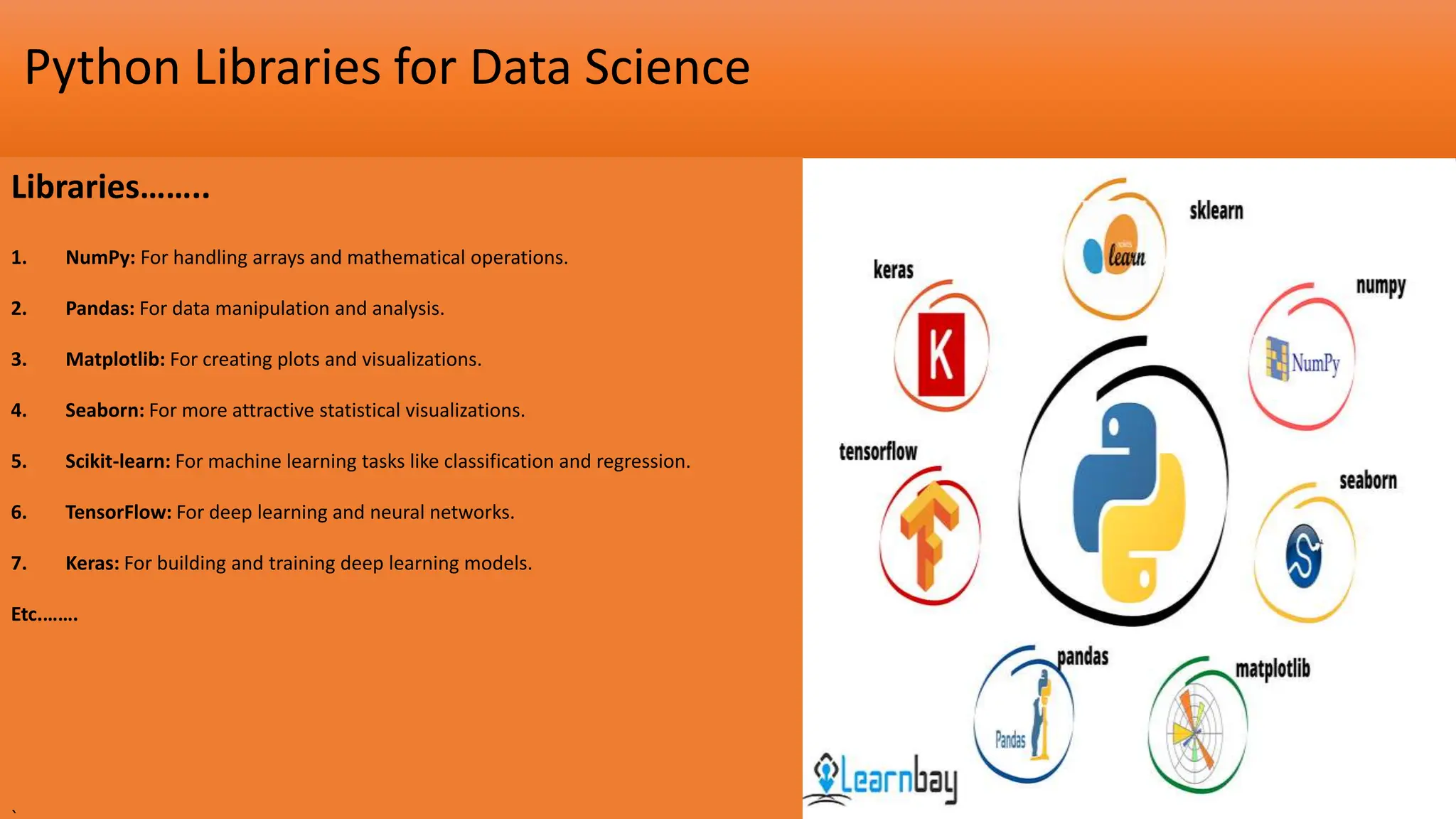
1. NumPy: For handling arrays and mathematical operations.
2. Pandas: For data manipulation and analysis.
3. Matplotlib: For creating plots and visualizations.
4. Seaborn: For more attractive statistical visualizations.
5. Scikit-learn: For machine learning tasks like classification and regression.
6. TensorFlow: For deep learning and neural networks.
7. Keras: For building and training deep learning models.
Etc.…….
Data Visualization Techniques
Techniques ……..
1. Line Chart
2. Bar Chart
3. Pie Chart
4. Scatter Plot
5. Histogram
6. Heatmap
7. Box Plot
8. Area Chart
9. Bubble Chart
10. Word Cloud
Difference between Machine Learning And Data Science
• Difference ……..
• Machine Learning:
• It's about teaching computers to learn from data and make
predictions automatically.
• Example: Teaching a computer to recognize pictures of cats.
• Data Science:
• It's about using data to find useful information and solve
problems.
• Example: Analyzing customer data to improve business
strategies.
In essence, Machine Learning is about computers learning on
their own, while Data Science is about using data to learn and
make better decisions.
Using Google Colab for machine learning and data science as IDE
Using Google Colab as IDE ……..
1. Collaboration
2. Google Services Integration
3. Hardware Acceleration
4. Interactive
5. Jupyter Notebook Interface
6. Pre-installed Libraries
7. Automatic Save
8. Reproducibility
9. Free and Online
Project
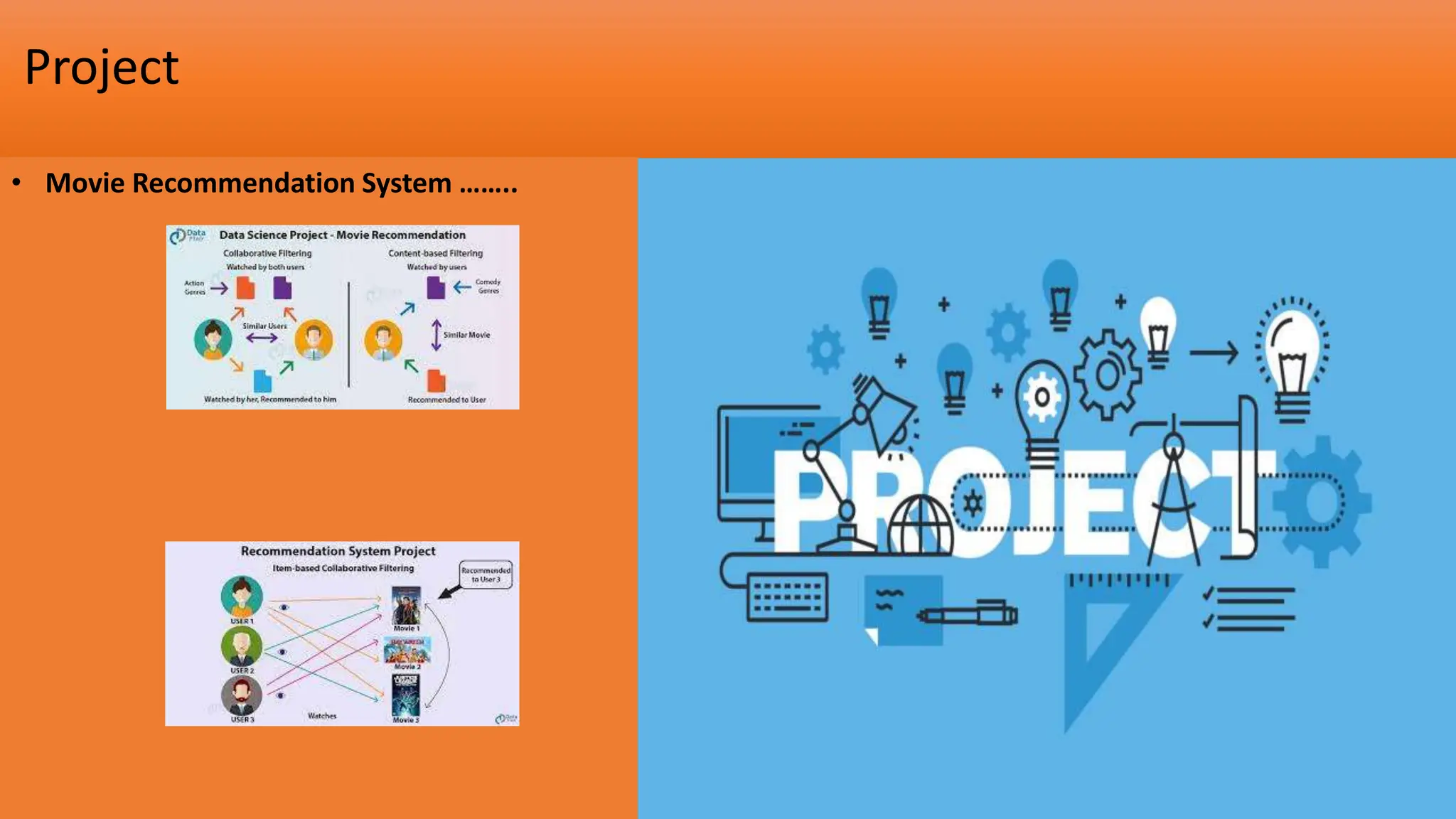
• Movie Recommendation System ……..
Scope of Data science
Scope ……..
1. Business
2. Healthcare
3. Marketing
4. Social Media
5. E-commerce
6. Internet of Things (IoT)
7. Transportation
8. Education
9. Energy
10. Natural Language Processing (NLP)
11. Entertainment
12. Environmental Science
Scope of Machine Learning
Scope ……..
• Image and Speech Recognition
• Natural Language Processing (NLP)
• Recommender Systems
• Healthcare.
• Finance
• Autonomous Vehicles
• Internet of Things (IoT)
• Gaming
• Personalization
• Manufacturing
• Robotics
• Fraud Detection
Advanced topics in Data science and Machine learning
Advanced Data Science Topics:
• Deep Learning
• Natural Language Processing (NLP)
• Time Series Analysis
• Anomaly Detection
• Transfer Learning
• Unsupervised Learning
• Data Ethics and Privacy
Advanced Machine Learning Topics:
• Generative Adversarial Networks (GANs)
• Transformer Architecture
• Autoencoders
• Self-Supervised Learning
• Federated Learning
• Explainable AI (XAI)
• Meta-Learning
Some Real World applications
Applications…..
• Personalized Movie Recommendations
• Voice Assistants
• Credit Card Fraud Detection
• Face Unlock
• Weather Prediction
• Email Categorization
Conclusion
In conclusion, Data Science and Machine
Learning are transforming industries and our
daily lives. From personalized
recommendations to fraud detection and
voice assistants, these technologies enhance
efficiency and user experiences. With
continuous advancements, they hold immense
potential for driving innovation and creating a
better future
antrikshindutrialmachinelearningPPT.pptx

antrikshindutrialmachinelearningPPT.pptx

  • 1.
    “Machine Learning andData Science Using Python” A internship submitted in partial fulfilment of the requirements for the degree of SOBHASARIA GROUP OF INSTITUTIONS, SIKAR Bachelor of Engineering in CSE Antriksh Verma (20ESGCS008) Under the guidance of Mr. Nitesh Jangir Assistant professor(CSE) DEPARTMENT OF COMPUTER SCIENCE ENGINEERING SESSION: 2023-2024
  • 3.
    Overview  Introduction toMachine Learning.  Introduction to Data Science.  Introduction to Python.  Introduction to IDE.  Introduction to Google Colab.  Types of Machine learning Algorithms.  Steps in Machine learning Process.  Python Libraries for Machine Learning.  Data Science Life Cycle.  Python Libraries for Data Science.  Data Visualization Techniques.  Difference between machine learning and data science.  Using Google Colab for machine learning and data science as IDE.  Project .  Scope of Data science.  Scope of Machine learning.  Advanced topics in Data science and Machine learning.  Some Real World applications.  Conclusion.
  • 4.
    Introduction to MachineLearning • What is Machine Learning ?............ Machine Learning is an application of Artificial Intelligence (AI) that provides system the ability to automatically learn and improve from experience without being explicitly programmed. Ordinary System With AI ML Improves Pridicts Learns
  • 5.
    Introduction to DataScience • What is Data Science ?.... Data Science is an interdisciplinary field that combines scientific methods, algorithms, and systems to extract knowledge and insights from structured and unstructured data. It involves using a combination of statistics, mathematics, computer science, domain knowledge, and data visualization techniques to uncover patterns, make predictions, and gain valuable insights from large and complex datasets
  • 6.
    Introduction to Python •What is Python ?.... Python is a high-level, interpreted, and general-purpose programming language known for its simplicity, readability, and versatility. It was created by Guido van Rossum and first released in 1991. Python's design philosophy emphasizes code readability, making it easy for developers to write clean and maintainable code. Python is one of the most popular and widely used programming languages for Machine Learning (ML) and Data Science due to its rich ecosystem of libraries, frameworks, and tools specifically designed for these domains.
  • 7.
    Introduction to IDE… •What is IDE ?.... An Integrated Development Environment (IDE) is like a special computer program that helps software developers write their code more easily and efficiently. It's like a toolbox that has everything a developer needs in one place. • List of popular IDEs for Python: 1. PyCharm 2. Visual Studio Code (VS Code) 3. Jupyter Notebook / JupyterLab 4. IDLE (Python's built-in IDE) 5. Anaconda (includes Jupyter Notebook and other tools) 6. Spyder
  • 8.
    Introduction to GoogleColab • What is Google Colab ?.... Google Colab, short for "Google Colaboratory," is an online tool where you can write and run Python code without installing anything on your computer. It's like a virtual notebook for coding, and it's great for data analysis and machine learning tasks. You can share your work with others and use powerful computers in the cloud to handle big projects. All you need is an internet connection and a web browser to get started!
  • 9.
    Types of MachineLearning Algorithims Types…….. 1. "Teacher Learning" (Supervised Learning) 2. "Self-Discovery" (Unsupervised Learning) 3. "Trial and Error" (Reinforcement Learning)
  • 10.
    Steps in MachineLearning process Steps…….. 1. Get Data 2. Clean Data 3. Choose Features 4. Split Data 5. Pick a Model 6. Train the Model 7. Test the Model 8. Tune the Model 9. Deploy the Model 10. Monitor and Update
  • 11.
    Python Libraries forMachine Learning Libraries…….. 1. Scikit-learn: For various Machine Learning tasks like classification and regression. 2. TensorFlow: For deep learning and neural networks. 3. Keras: A user-friendly library for building deep learning models (works with TensorFlow). 4. PyTorch: Another library for deep learning, known for its ease of use. 5. XGBoost: For powerful gradient boosting, great for competitions. 6. LightGBM: A fast and efficient gradient boosting library. 7. Pandas: For data manipulation and preparation. 8. NumPy: For numerical computing and working with arrays. 9. Matplotlib and Seaborn: For data visualization. 10. SciPy: For additional scientific and mathematical functions. Etc.……….
  • 12.
    Data Science LifeCycle Life Cycle…….. 1. Understand the Problem 2. Collect Data 3. Clean Data 4. Explore Data 5. Choose Model 6. Train Model 7. Evaluate Model 8. Deploy Model 9. Monitor and Improve 10. Communicate Results
  • 13.
    Python Libraries forData Science Libraries…….. 1. NumPy: For handling arrays and mathematical operations. 2. Pandas: For data manipulation and analysis. 3. Matplotlib: For creating plots and visualizations. 4. Seaborn: For more attractive statistical visualizations. 5. Scikit-learn: For machine learning tasks like classification and regression. 6. TensorFlow: For deep learning and neural networks. 7. Keras: For building and training deep learning models. Etc.…….
  • 14.
    Data Visualization Techniques Techniques…….. 1. Line Chart 2. Bar Chart 3. Pie Chart 4. Scatter Plot 5. Histogram 6. Heatmap 7. Box Plot 8. Area Chart 9. Bubble Chart 10. Word Cloud
  • 15.
    Difference between MachineLearning And Data Science • Difference …….. • Machine Learning: • It's about teaching computers to learn from data and make predictions automatically. • Example: Teaching a computer to recognize pictures of cats. • Data Science: • It's about using data to find useful information and solve problems. • Example: Analyzing customer data to improve business strategies. In essence, Machine Learning is about computers learning on their own, while Data Science is about using data to learn and make better decisions.
  • 16.
    Using Google Colabfor machine learning and data science as IDE Using Google Colab as IDE …….. 1. Collaboration 2. Google Services Integration 3. Hardware Acceleration 4. Interactive 5. Jupyter Notebook Interface 6. Pre-installed Libraries 7. Automatic Save 8. Reproducibility 9. Free and Online
  • 17.
  • 18.
    Scope of Datascience Scope …….. 1. Business 2. Healthcare 3. Marketing 4. Social Media 5. E-commerce 6. Internet of Things (IoT) 7. Transportation 8. Education 9. Energy 10. Natural Language Processing (NLP) 11. Entertainment 12. Environmental Science
  • 19.
    Scope of MachineLearning Scope …….. • Image and Speech Recognition • Natural Language Processing (NLP) • Recommender Systems • Healthcare. • Finance • Autonomous Vehicles • Internet of Things (IoT) • Gaming • Personalization • Manufacturing • Robotics • Fraud Detection
  • 20.
    Advanced topics inData science and Machine learning Advanced Data Science Topics: • Deep Learning • Natural Language Processing (NLP) • Time Series Analysis • Anomaly Detection • Transfer Learning • Unsupervised Learning • Data Ethics and Privacy Advanced Machine Learning Topics: • Generative Adversarial Networks (GANs) • Transformer Architecture • Autoencoders • Self-Supervised Learning • Federated Learning • Explainable AI (XAI) • Meta-Learning
  • 21.
    Some Real Worldapplications Applications….. • Personalized Movie Recommendations • Voice Assistants • Credit Card Fraud Detection • Face Unlock • Weather Prediction • Email Categorization
  • 22.
    Conclusion In conclusion, DataScience and Machine Learning are transforming industries and our daily lives. From personalized recommendations to fraud detection and voice assistants, these technologies enhance efficiency and user experiences. With continuous advancements, they hold immense potential for driving innovation and creating a better future